

By TDMM (TradeDog Market Maker) · 5-minute read
Key takeaways
DAO treasuries hold about $26B, and more than 70% of it is still in each DAO’s own token. That concentration erased $12.6B of treasury value in six months in 2024 and pushed 100+ projects into closure in 2026.
Runway is the survival metric: 12 to 24 months of costs in stablecoins or tokenized T-bills, counted as if the token were worth zero.
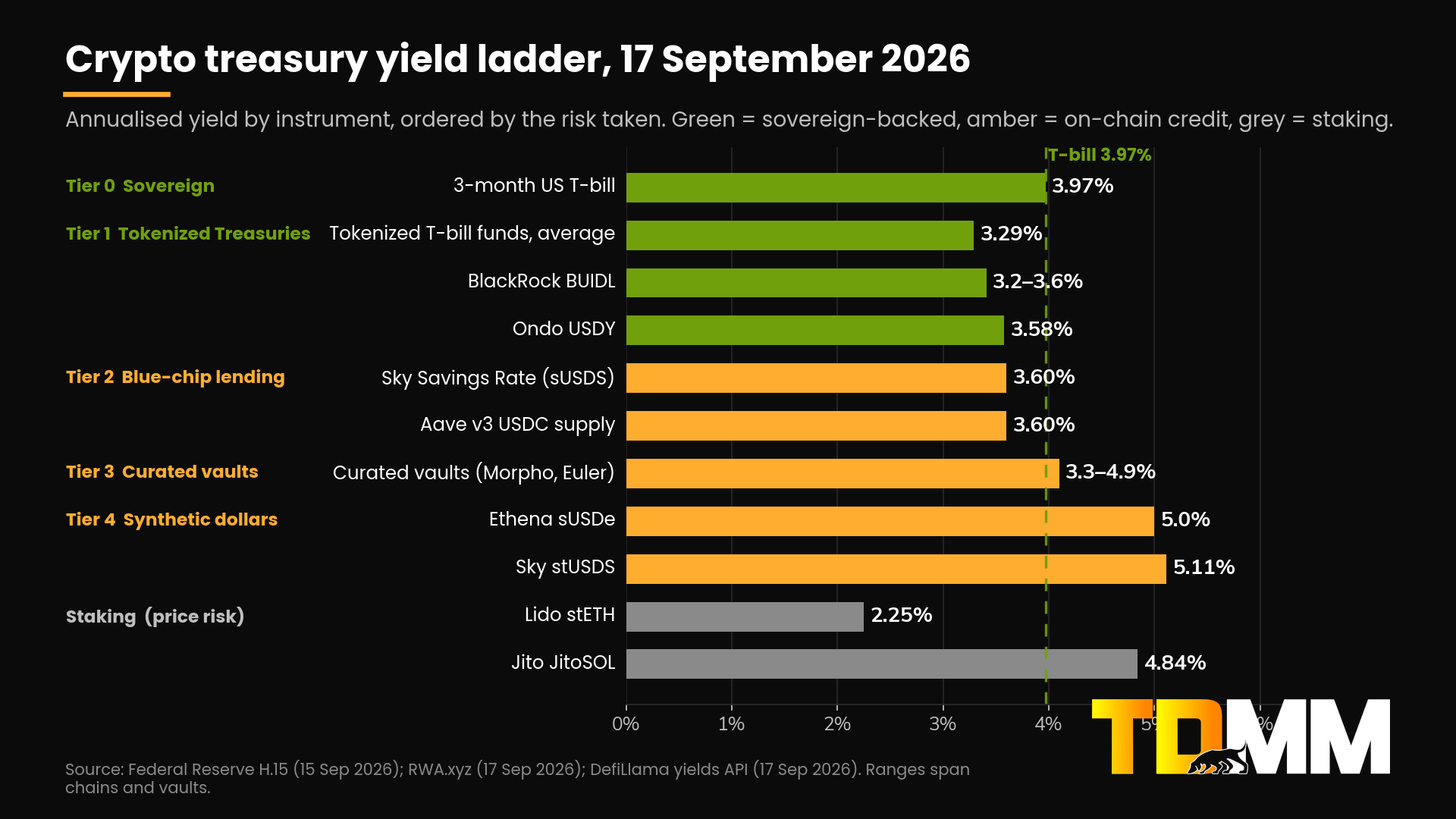
Safe yield is available on-chain: tokenized Treasuries pay 3.2 to 3.6%, blue-chip lending about 3.6%, against 3.97% on a T-bill.
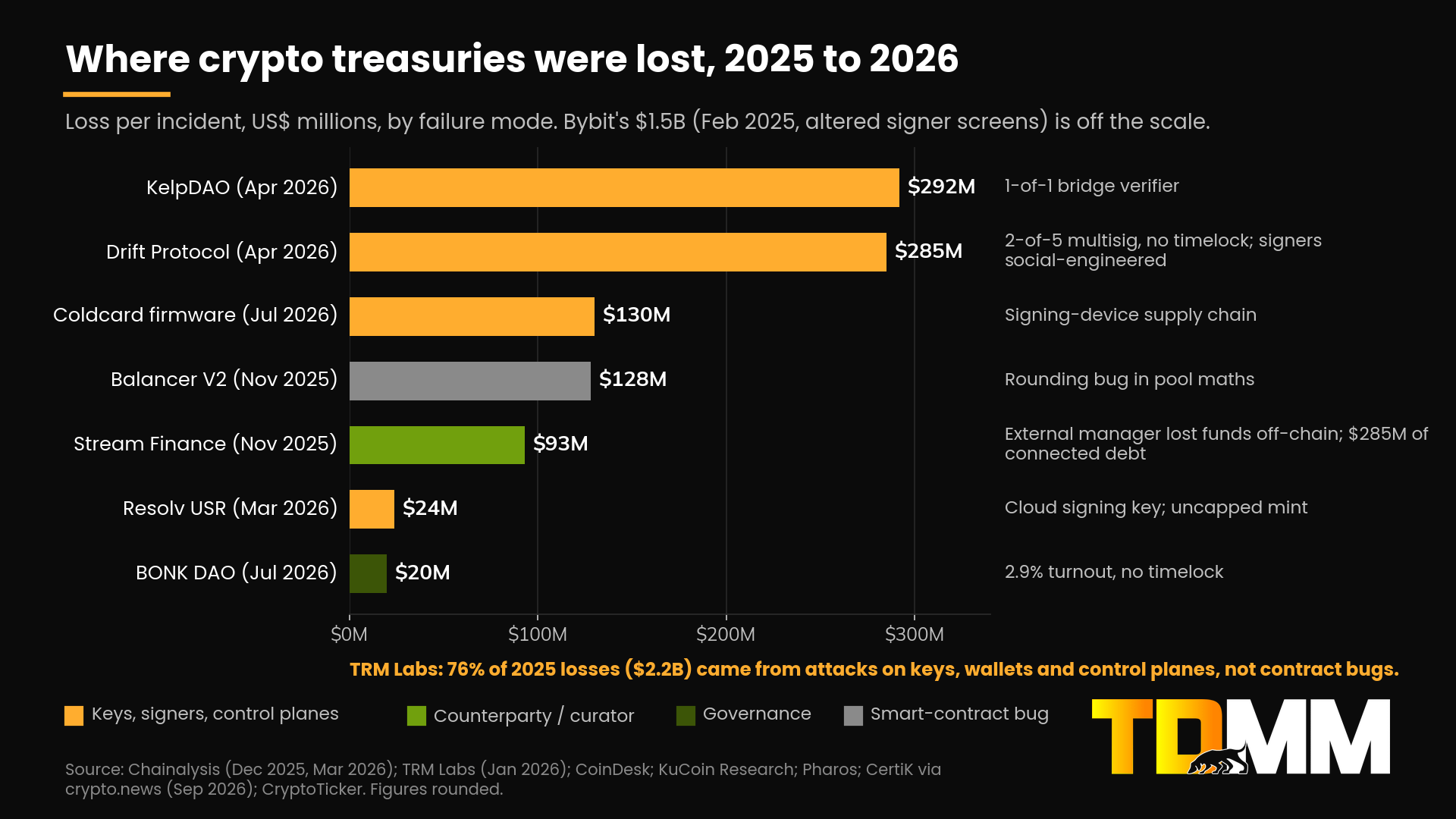
76% of 2025’s $2.87B in hack losses, about $2.2B, came from keys, signers and control planes, not smart contracts. Timelocks and hardware signing would have stopped most of it.
The native token is inventory. It needs a market maker, an unlock plan and honest buyback maths.
TDMM has provided market making, liquidity provisioning, treasury management, yield inventory optimisation and exit management to token projects since 2015, with more than $10 billion traded across 100+ exchanges and 200+ markets. Treasury and liquidity are one problem; TDMM runs them as one service.
1. Split the treasury into four buckets
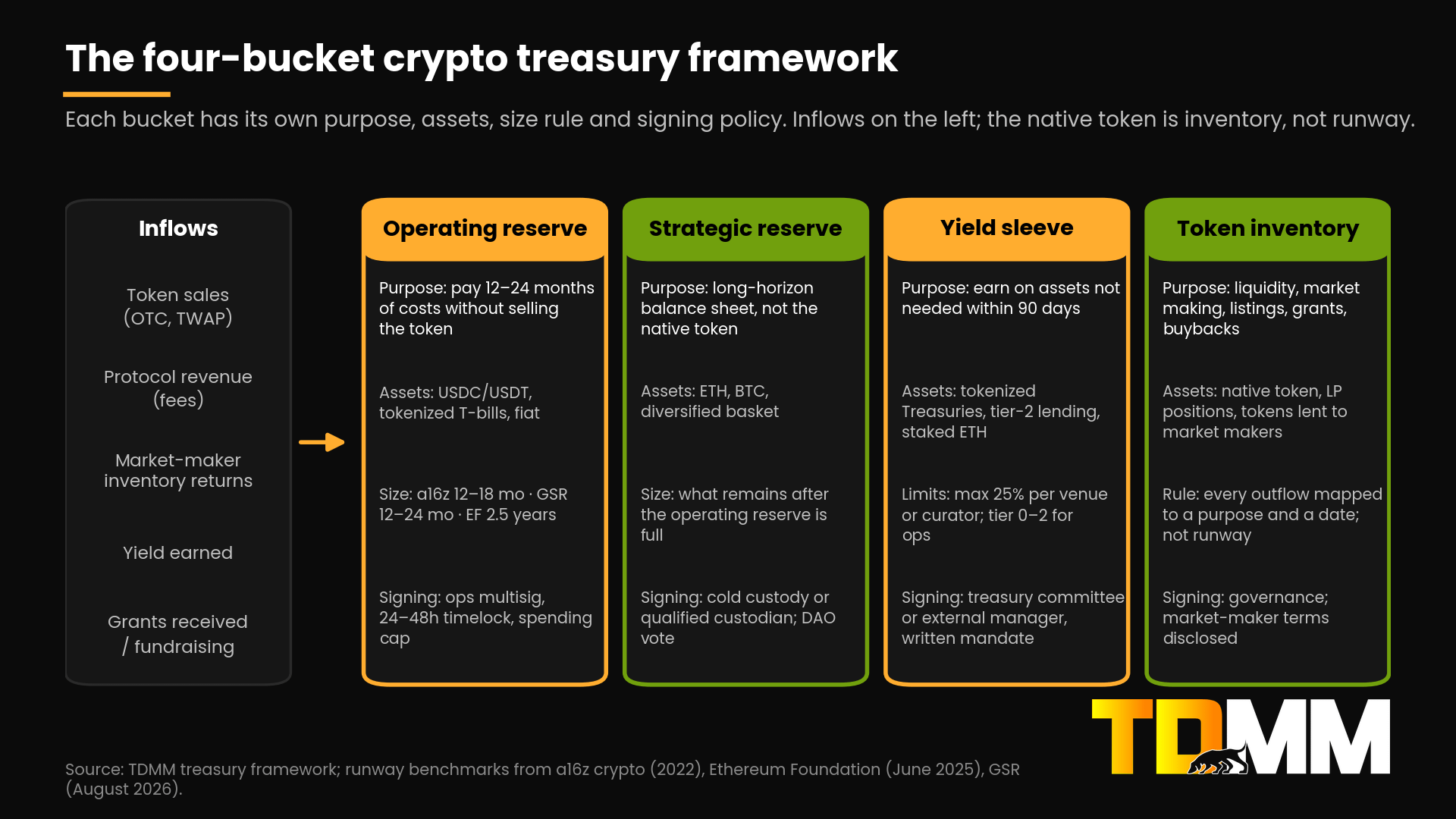
Operating reserve (stablecoins, tokenized T-bills, fiat, 12 to 24 months of costs, behind a timelocked multisig). Strategic reserve (ETH, $BTC , diversified, cold custody). Yield sleeve (only assets not needed within 90 days, hard limits per venue and curator). Token inventory (native token, LP positions, tokens lent to market makers, every outflow mapped to a purpose and a date, never counted as runway).
2. Size runway to a bear market
a16z crypto says 12 to 18 months. GSR’s 2026 research says 12 to 24. The Ethereum Foundation caps annual spending at 15% of its treasury and holds 2.5 years of fiat. The Uniswap Foundation publishes its runway: $49.9M cash and stablecoins against $9.7M of yearly opex, funded into January 2027. Fund the reserve while the token is strong. Count only unencumbered assets.
3. Diversify without crashing the token
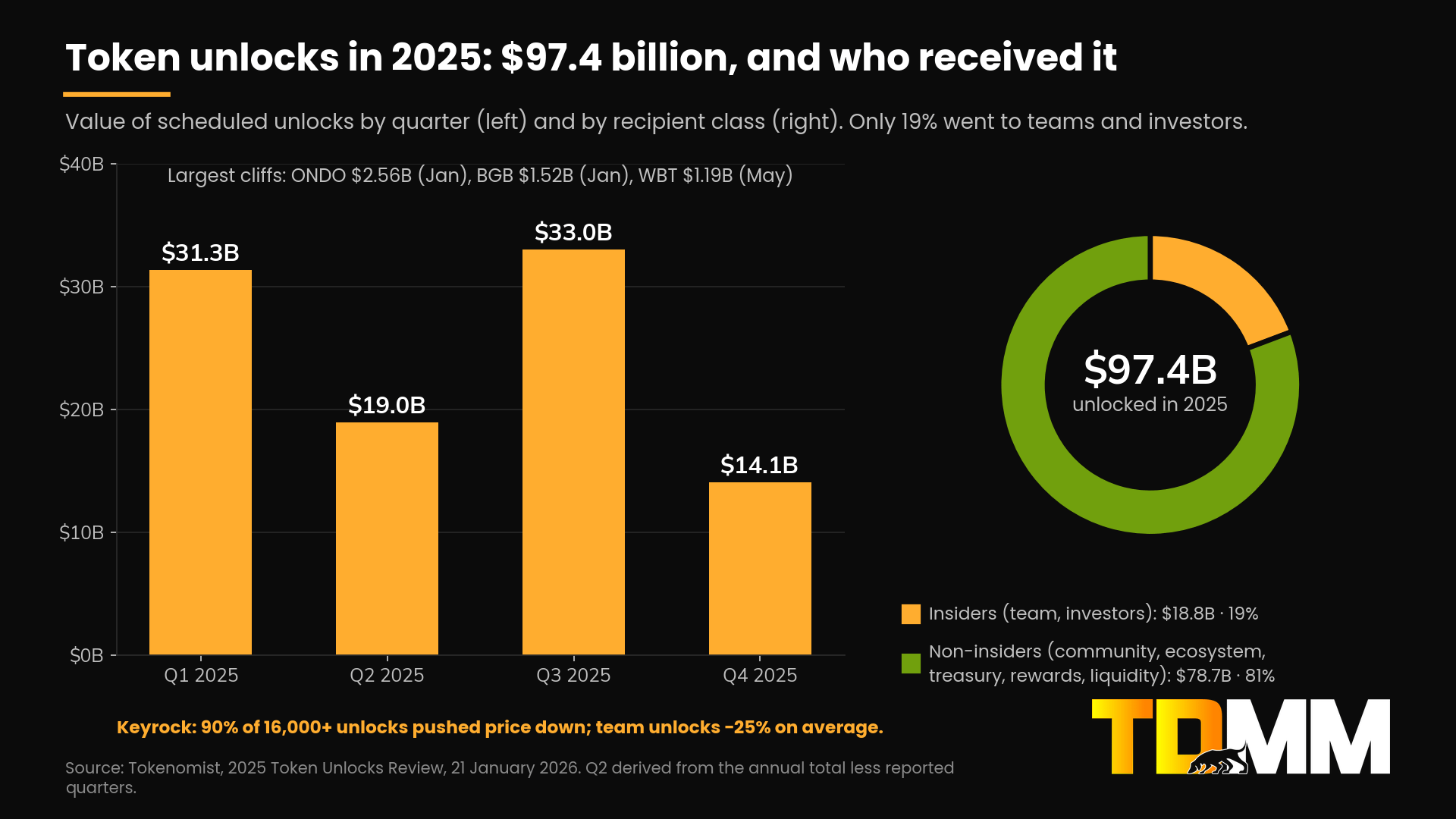
Keyrock studied 16,000 unlocks: 90% pushed price down, team unlocks by about 25%, with pressure starting 30 days before. $97.4B of tokens unlocked in 2025. Use OTC blocks, TWAP programmes and collars, coordinated with your market maker. Lido’s March 2026 buyback proposal found only about $90,000 of on-chain depth at ±2%, so it had to route through CEXs. No liquidity, no treasury flexibility.
4. Earn on idle stablecoins in tiers
Tokenized Treasury funds now hold $15.58B across 105 funds (BUIDL $2.68B, USYC $2.60B, USDY $2.24B) and pay 3.2 to 3.6%. Sky Savings Rate and $AAVE USDC pay about 3.6%. Curated vaults pay up to 4.9%, synthetic dollars about 5%. Arbitrum DAO’s STEP programme is the template: several issuers, several chains, one reporting line. Stream Finance ($93M external-manager loss, $285M of connected debt) and Resolv (a compromised cloud key, $180M of Morpho liquidations) show why the curator gets underwritten as carefully as the protocol.
5. Fix custody and signing first
Bybit lost $1.5B to altered signer screens. Drift lost $285M five days after moving to a 2-of-5 multisig with no timelock. KelpDAO lost $292M to a single-verifier bridge setup. The fixes are procedural: hardware-only signing with hash verification, a 24-hour timelock on every treasury transfer, a daily cap in code, 3-of-5 or higher, and no single dependency that can mint or move assets alone.
6. Make governance capture uneconomic
BONK DAO lost about $20M in July 2026 after an attacker bought $4M of tokens, met the 1% quorum and passed a proposal with 2.9% turnout, with no delay before execution. Compound’s Proposal 289 moved 499,000 COMP to a whale-controlled vehicle in 2024. Timelock, quorum as a share of supply, a veto that can cancel but not initiate, and a cap on what any single proposal can move.
7. Manage the native token as inventory
Fewer than 10% of new listings are above their listing price after twelve months. Liquidity is what lets a treasury sell, lend, hedge or buy back its token at all. Market-maker deals put different assets at risk: a retainer costs cash but keeps inventory on the balance sheet; a token loan with a call option (0.5–5% of supply, strikes 25–100% above launch) moves tokens off the treasury, and if they get sold, the treasury funded the selling. Movement Labs lent 5% of supply, 66M MOVE were dumped the day after listing, Binance froze $38M, and the company filed for Chapter 11 in July 2026. Binance now requires issuers to disclose market-maker identities and terms.
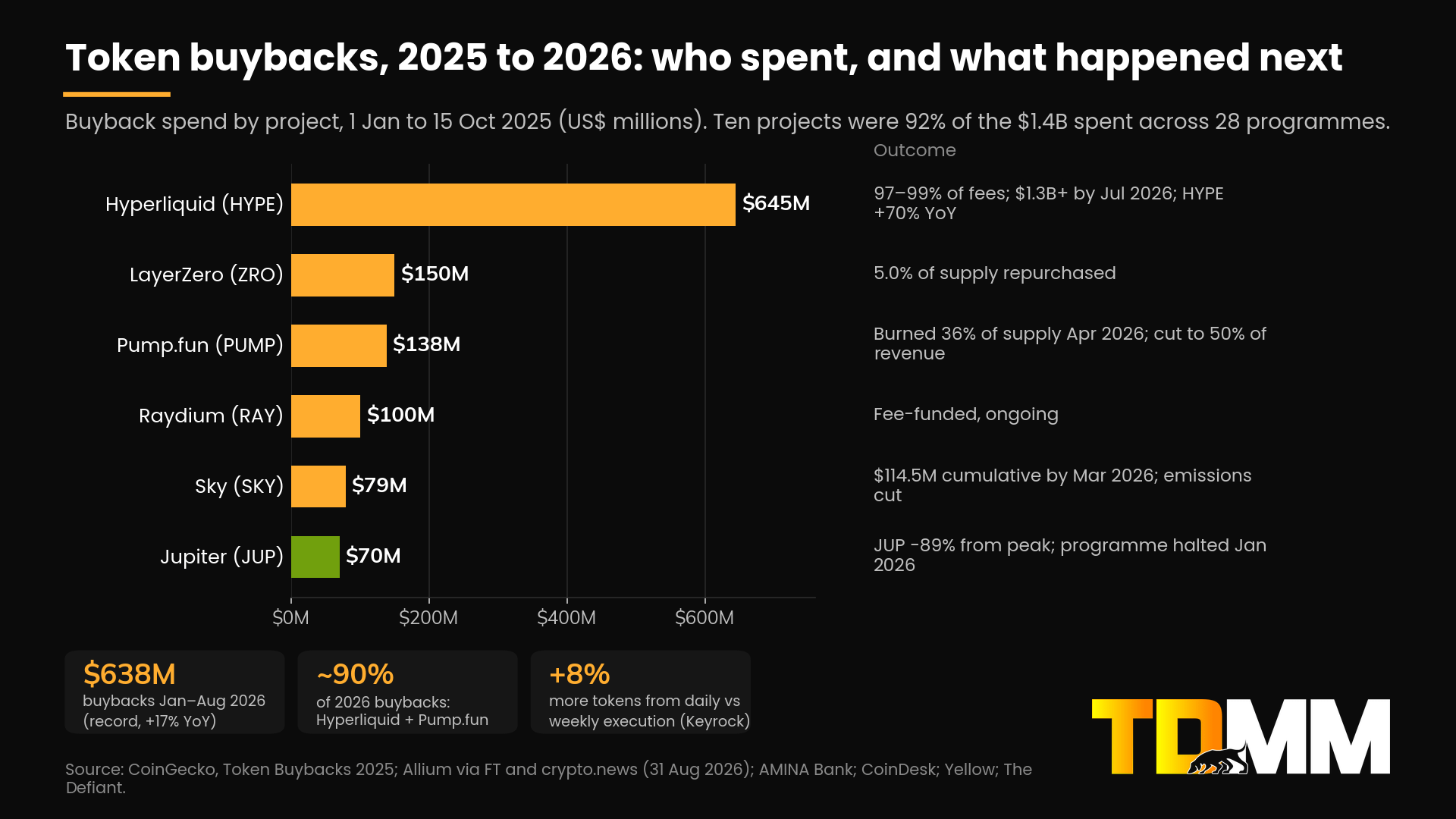
Buybacks are the same bucket. Hyperliquid’s fee-funded $1.3B+ programme worked; Jupiter’s $70M against 53M JUP a month of unlocks did not, and was halted after an 89% drawdown. Tracked buybacks hit a record $638M in the first eight months of 2026, 90% of it from Hyperliquid and Pump.fun.
8. Account, report and comply like a company
FASB fair-value accounting made Strategy’s Q2 2026 net loss $8.22B, while SharpLink’s staked $ETH fell outside the standard and took a $76.1M impairment. MiCA’s transition ended 1 July 2026. The GENIUS Act takes effect by 18 January 2027. Publish a monthly report with the same fields every month.
TDMM’s approach
TDMM has made markets since 2015, with $10B+ traded across 100+ exchanges and 200+ markets. It runs treasury and liquidity as one book: treasury management and yield inventory optimisation, exit management that turns tokens into operating capital without the sales becoming the price, 24/7 two-sided market making with real-time reporting, and unlock and listing support. No manufactured volume, no price promises.
The full guide, with a twelve-indicator treasury scorecard and a 90-day plan, is at tdmm.io/insights/blog/.
Sources: DefiLlama; RWA.xyz; Federal Reserve; TRM Labs; Chainalysis; Keyrock; Tokenomist; CoinGecko; CoinDesk; The Block; KuCoin Research; Safe Foundation; Strategy and SharpLink Q2 2026 results; ESMA; PYMNTS. All data as of 17 September 2026.
#CryptoTreasury #DAOTreasury #TreasuryManagement #MarketMaking #Tokenomics