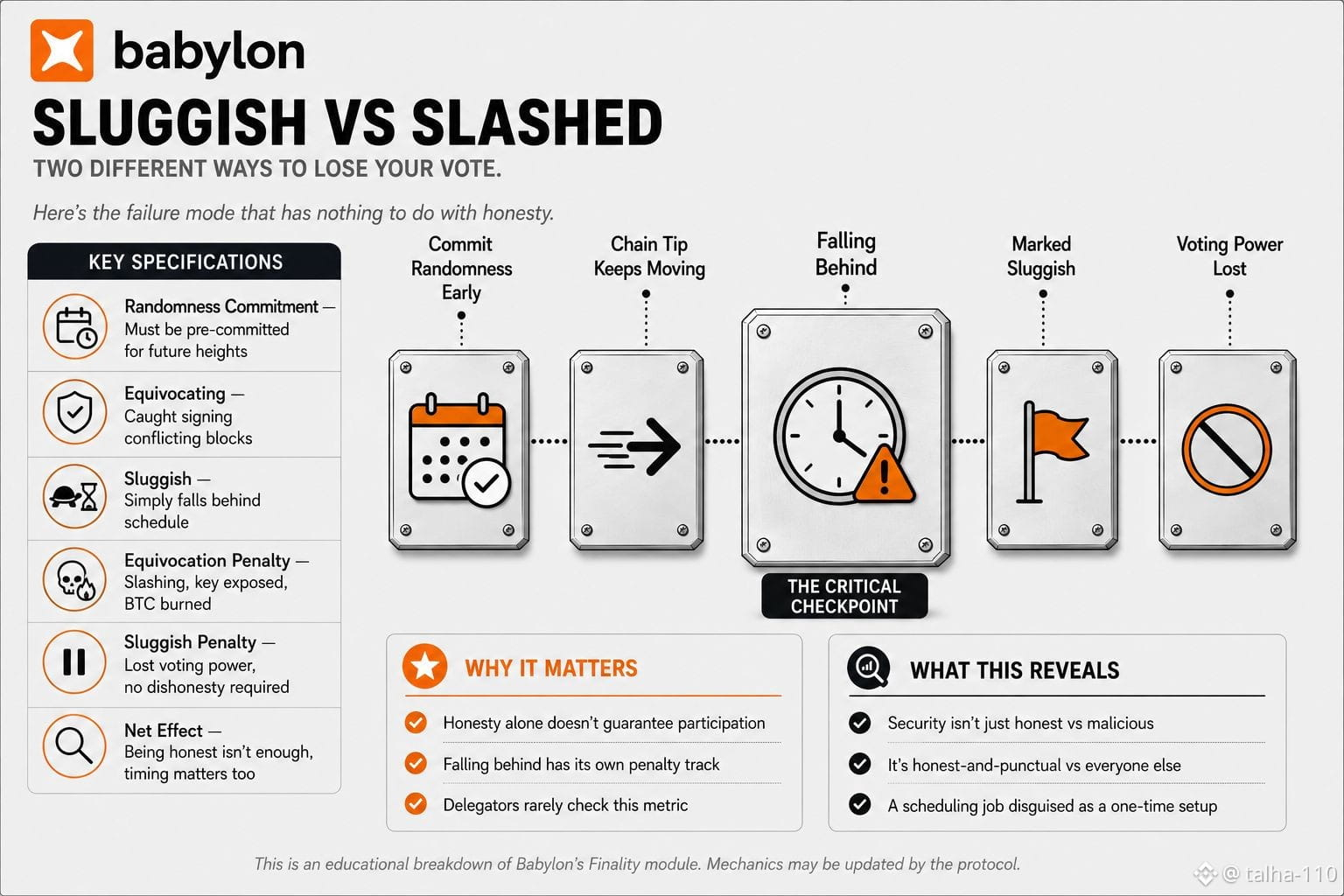
At first I assumed the only thing that could cost a Finality Provider their standing was outright malicious behavior, signing two conflicting blocks, getting caught, getting slashed, the classic honest-or-dishonest binary. Reading Babylon's own Finality module documentation, there's a second, quieter failure path that has nothing to do with honesty at all. Before a Finality Provider can even vote on a block, they have to proactively commit EOTS public randomness for that specific future height, in advance, before the block is even proposed. Babylon's system separately tracks two categories of problem providers, equivocating ones who get caught signing conflicting messages, and sluggish ones who simply fail to show up in time. Being slow isn't the same violation as being dishonest, but it still gets tracked and penalized as its own category. What that means in practice is a provider can be fully honest, never sign anything conflicting, never attempt anything adversarial, and still lose voting ability for a given height purely because their randomness commitment didn't keep pace with the chain's tip. Committing randomness isn't a one-time setup step, it's an ongoing forecasting job, staying ahead of a chain that keeps moving whether you're ready or not. So the actual security model being described isn't just honest versus malicious. It's honest-and-punctual versus everyone else, including honest providers who simply fell behind on a scheduling requirement most people staking to them probably never think to check.
@BabylonLabs_io #baby $BABY
@BabylonLabs_io #baby $BABY