
RxGOD
73 Публикации

RxGOD
Отправить жалобу
Заблокировать пользователя
10 подписок(и/а)
4 подписчиков(а)
4 понравилось
Посты
·
--
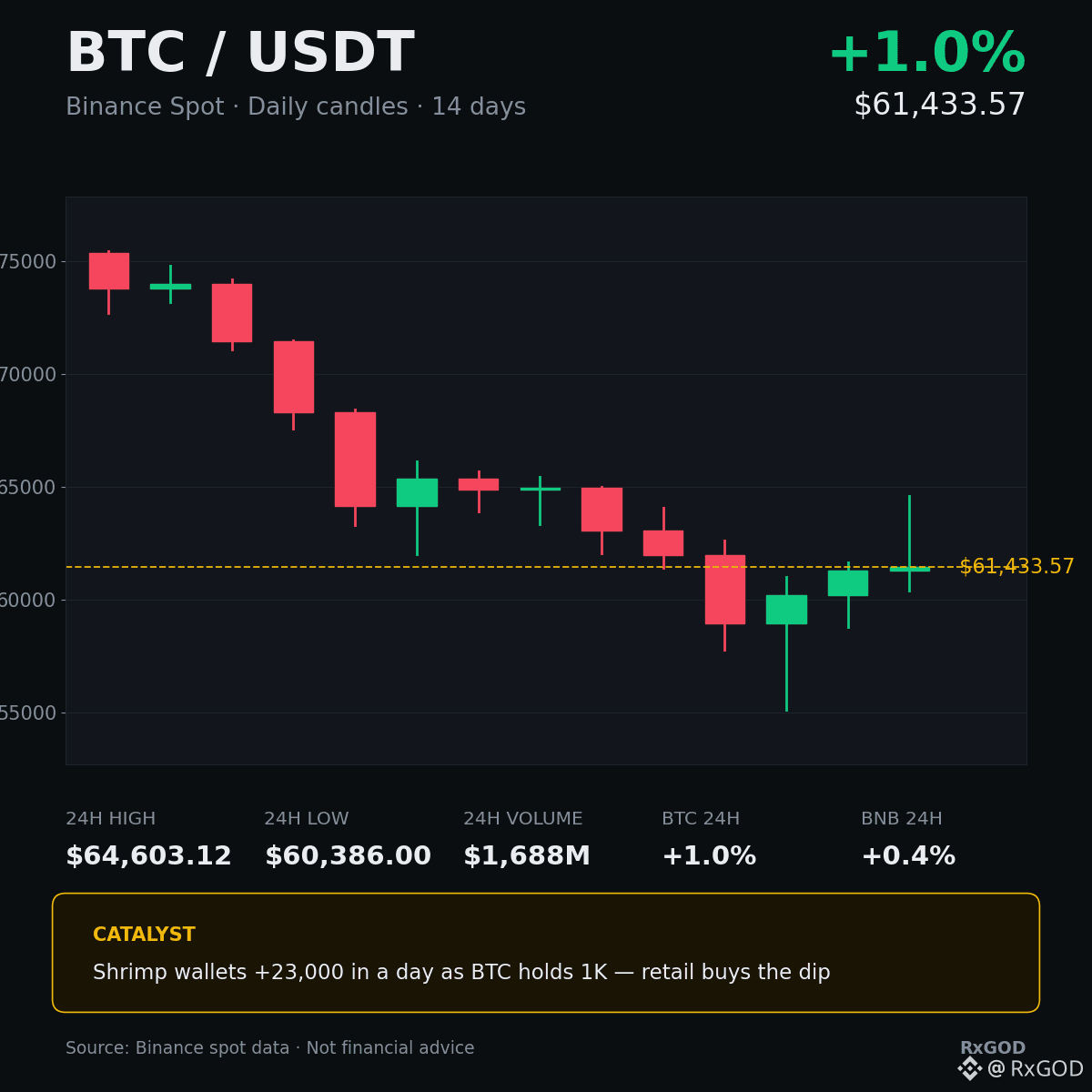
While Wall Street dumped $1.79B of Bitcoin ETFs last week, 23,000 new shrimp wallets just showed up to buy the dip.
On-chain data shows wallets holding under 1 $BTC grew by more than 23,000 in a single day as $BTC bounced from its $55,100 low back above $61,000. Over the past three months, shrimp wallets have added 468,240 new holders — and more than 2.4 million so far in 2026, up 4.35% year-to-date.
They are not alone. Whale wallets holding 1,000+ BTC added roughly 35,000 BTC over the past 30 days, including 11,500 in the most recent week, according to CryptoQuant. Big and small hands are accumulating into the same dip.
The other side of the trade is loud too. US spot Bitcoin ETFs just logged $1.79 billion in net outflows last week — a fourth straight week of redemptions, per SoSoValue. And $BTC itself is still only $61,434, up 0.96% in 24 hours but down 16.7% over 14 days, sitting in the lower third of its two-week range after being rejected at $64,603. The Fear & Greed Index reads 10 — Extreme Fear.
So who is reading this market right — the 23,000 new shrimp wallets buying the dip, or the ETF sellers heading for the exit? And with Thanksgiving week ahead, does $BTC tag $65K first, or retest $55K?
Not financial advice — DYOR.
#WillMarketsStageAThanksgivingReliefRally #BitcoinAccumulation #ExtremeFear #CryptoNews
19
·
--
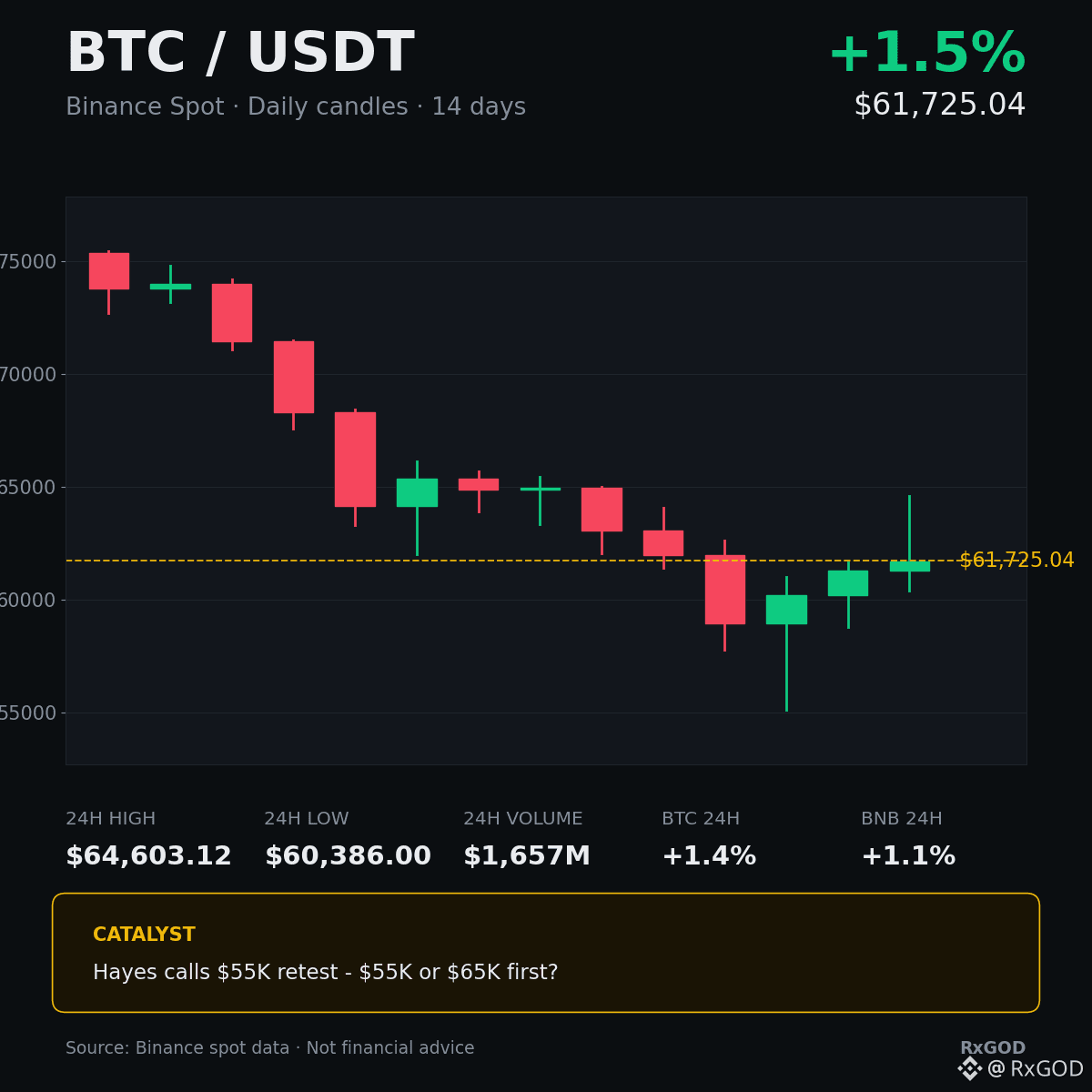
Arthur Hayes just called it: Bitcoin could "run it back" to $55,000.
$BTC is trading at $61,762 (+1.5% in 24h) after bouncing off a two-year low near $55,130 over the weekend — but the bounce is already fading. BTC tapped $64,603 on Monday, got rejected, and now sits in the lower third of its 24-hour range, with a $63.66M sell wall waiting at $62,300, per Coinglass.
Hayes' case is macro, not crypto: Nasdaq futures rolled over in Asia, South Korea's KOSPI plunged 5% even after the government banned short-selling and pledged to buy equities. If tech keeps sliding, he says $55,000 is back on the table — and $50,000 if the Nasdaq selloff deepens.
The other side has a case too. Bitcoin just closed its seventh straight red week, the first such streak since 2022, and is down 22% in November. Daily RSI sits at 26.6 — deeply oversold — with a two-week bullish divergence forming, and Wednesday's US PCE print could shift the whole tape.
The honest read: this is a bounce inside a downtrend, not a confirmed reversal. Spot BTC ETFs just logged a fourth straight week of outflows ($1.79B last week), sentiment is at Extreme Fear (11), and $BTC remains below its 200-day average near $72,900. A break of $60,000 opens the door to Hayes' retest; reclaiming $65,000 would flip the script.
So which comes first — the $55K retest or the $65K breakout? Drop your line in the sand below, and tell us what you're watching: PCE, Nasdaq, or the ETF flows?
Not financial advice — DYOR.
#WillMarketsStageAThanksgivingReliefRally #ExtremeFear #CryptoNews #Bitcoin
2
·
--
Today is the day Monad holders have been dreading all month — and $MON is sitting almost exactly on its all-time low as the cliff unlock lands.
Roughly 16.6 billion MON unlocks today, November 24: about 10.7B to the team, 4.9B to investors and ~0.99B to the Category Labs treasury, per Tokenomist. That is around 140% of the current 11.8B circulating supply, with a listed value near $511.7M — about 77% of every token unlock scheduled across November, according to NAUT.
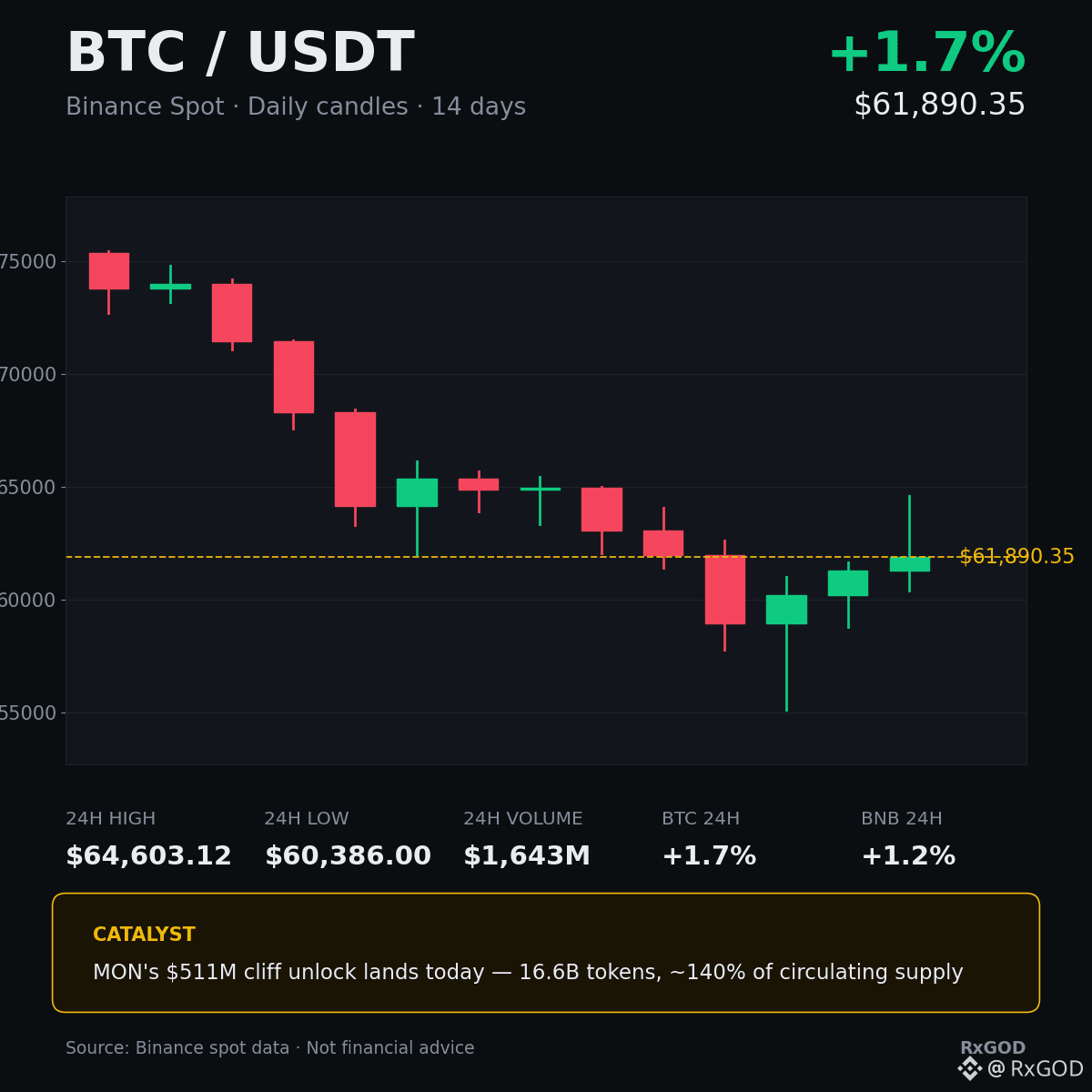
$MON trades at $0.0119, down 7.2% in 24 hours and 28.8% over 14 days, pinned within a few percent of its 14-day low. The market has had weeks to price this in — MON is already down about 44% in 30 days — but an unlock is not a sale until someone actually sells. If insiders hold, today could be the capitulation low everyone is watching for. If even a fraction of 16.6B tokens hits thin books while the Fear & Greed Index sits at 11 (Extreme Fear), the pressure gets very real, very fast. $BTC, for context, is holding $61,890, up 1.7% in 24 hours.
So which is it — was the unlock priced in weeks ago, or does the real selling start today? If you held MON, would you sell, hold, or buy the unlock dip?
Not financial advice — DYOR.
#Monad #TokenUnlock #ExtremeFear #CryptoNews
Today is the day Monad holders have been dreading all month — and $MON is sitting almost exactly on its all-time low as the cliff unlock lands.
Roughly 16.6 billion MON unlocks today, November 24: about 10.7B to the team, 4.9B to investors and ~0.99B to the Category Labs treasury, per Tokenomist. That is around 140% of the current 11.8B circulating supply, with a listed value near $511.7M — about 77% of every token unlock scheduled across November, according to NAUT.
$MON trades at $0.0119, down 7.2% in 24 hours and 28.8% over 14 days, pinned within a few percent of its 14-day low. The market has had weeks to price this in — MON is already down about 44% in 30 days — but an unlock is not a sale until someone actually sells. If insiders hold, today could be the capitulation low everyone is watching for. If even a fraction of 16.6B tokens hits thin books while the Fear & Greed Index sits at 11 (Extreme Fear), the pressure gets very real, very fast. $BTC , for context, is holding $61,890, up 1.7% in 24 hours.
So which is it — was the unlock priced in weeks ago, or does the real selling start today? If you held MON, would you sell, hold, or buy the unlock dip?
Not financial advice — DYOR.
#Monad #TokenUnlock #ExtremeFear #CryptoNews
29
·
--
Jensen Huang is BACK — and Binance traders are riding the AI comeback through tokenized stocks.
Nvidia's board unanimously reinstated Jensen Huang as CEO effective immediately on Monday, just 11 days after his resignation. NVDA surged 30%+ in early trading, the Nasdaq jumped 6-7% and the S&P 500 rose ~5% (Reuters, CNN, WSJ).
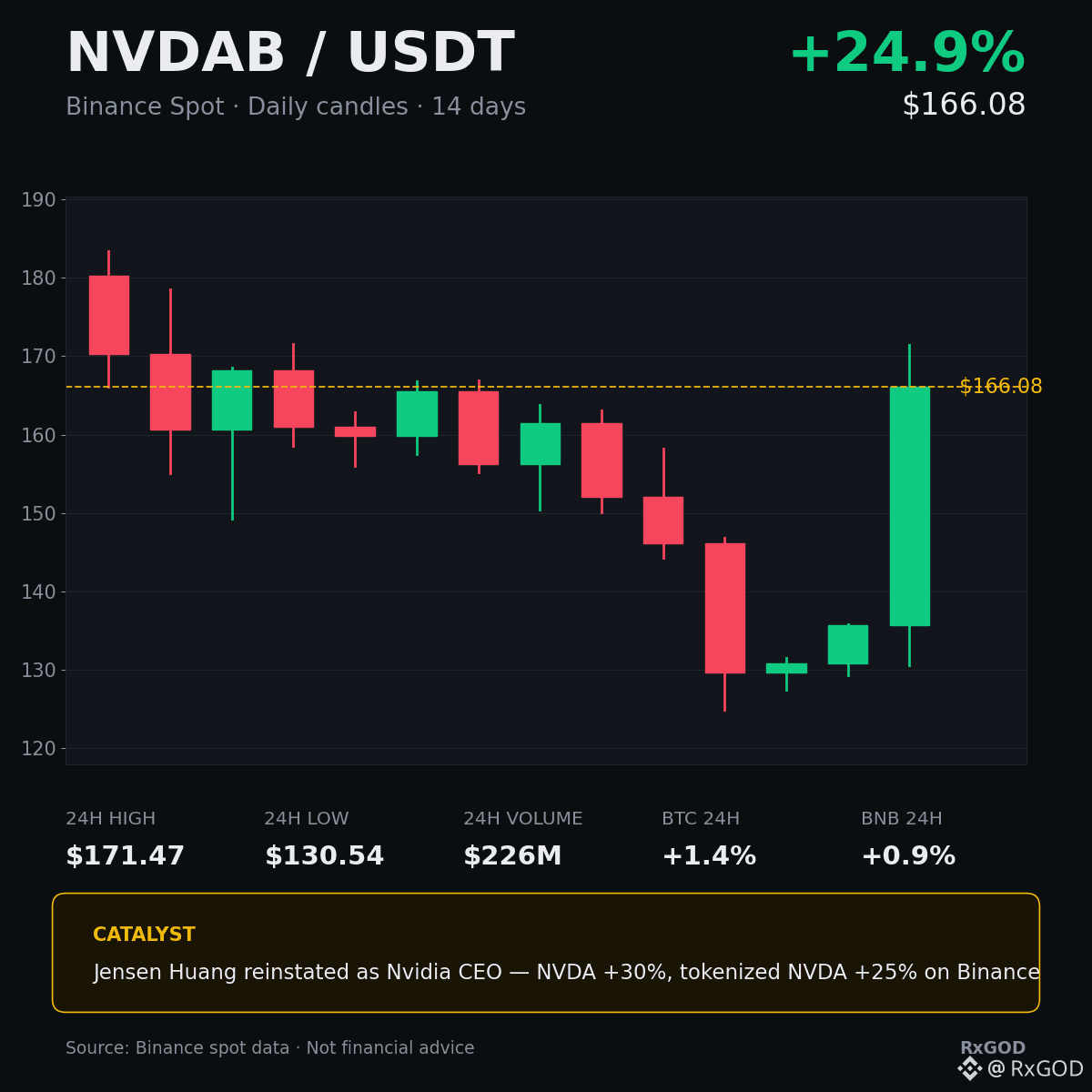
On Binance, the tokenized version of the trade is flying even harder: $NVDAB is up +25.3% in 24h to $166.52 with a massive $225.6M in volume, while the semiconductor ETF token $SOXLB jumped +28.1% to $43.22. Honest data check: NVDAB's 14-day range is $124.91-$183.36 — today's spike is a violent V-shaped snapback off the lows, still below the range high. This is relief-rally territory, not a confirmed breakout yet.
Meanwhile $BTC is holding $61,929 (+1.6%), still near the bottom of its 14-day range ($55,130-$75,442) with the Fear & Greed Index stuck at 11 — Extreme Fear. The risk: probes around Huang remain open, and a single headline reversed this stock once already. Tokenized stocks carry equity risk plus crypto volatility.
So — is the AI trade really back, or is this a one-day relief rally before Thanksgiving? Would you buy $NVDAB here, or wait for a pullback toward $150? And what flips you bullish on $BTC: a $65K reclaim, or just holding $60K?
Not financial advice — DYOR.
#NVIDIAReinstatesJensenHuangasCEO #CryptoNews #ExtremeFear
Jensen Huang is BACK — and Binance traders are riding the AI comeback through tokenized stocks.
Nvidia's board unanimously reinstated Jensen Huang as CEO effective immediately on Monday, just 11 days after his resignation. NVDA surged 30%+ in early trading, the Nasdaq jumped 6-7% and the S&P 500 rose ~5% (Reuters, CNN, WSJ).
On Binance, the tokenized version of the trade is flying even harder: $NVDAB is up +25.3% in 24h to $166.52 with a massive $225.6M in volume, while the semiconductor ETF token $SOXLB jumped +28.1% to $43.22. Honest data check: NVDAB's 14-day range is $124.91-$183.36 — today's spike is a violent V-shaped snapback off the lows, still below the range high. This is relief-rally territory, not a confirmed breakout yet.
Meanwhile $BTC is holding $61,929 (+1.6%), still near the bottom of its 14-day range ($55,130-$75,442) with the Fear & Greed Index stuck at 11 — Extreme Fear. The risk: probes around Huang remain open, and a single headline reversed this stock once already. Tokenized stocks carry equity risk plus crypto volatility.
So — is the AI trade really back, or is this a one-day relief rally before Thanksgiving? Would you buy $NVDAB here, or wait for a pullback toward $150? And what flips you bullish on $BTC : a $65K reclaim, or just holding $60K?
Not financial advice — DYOR.
#NVIDIAReinstatesJensenHuangasCEO #CryptoNews #ExtremeFear
9
·
--
The penguin is fighting back — but is this a comeback or just a dead-cat bounce?
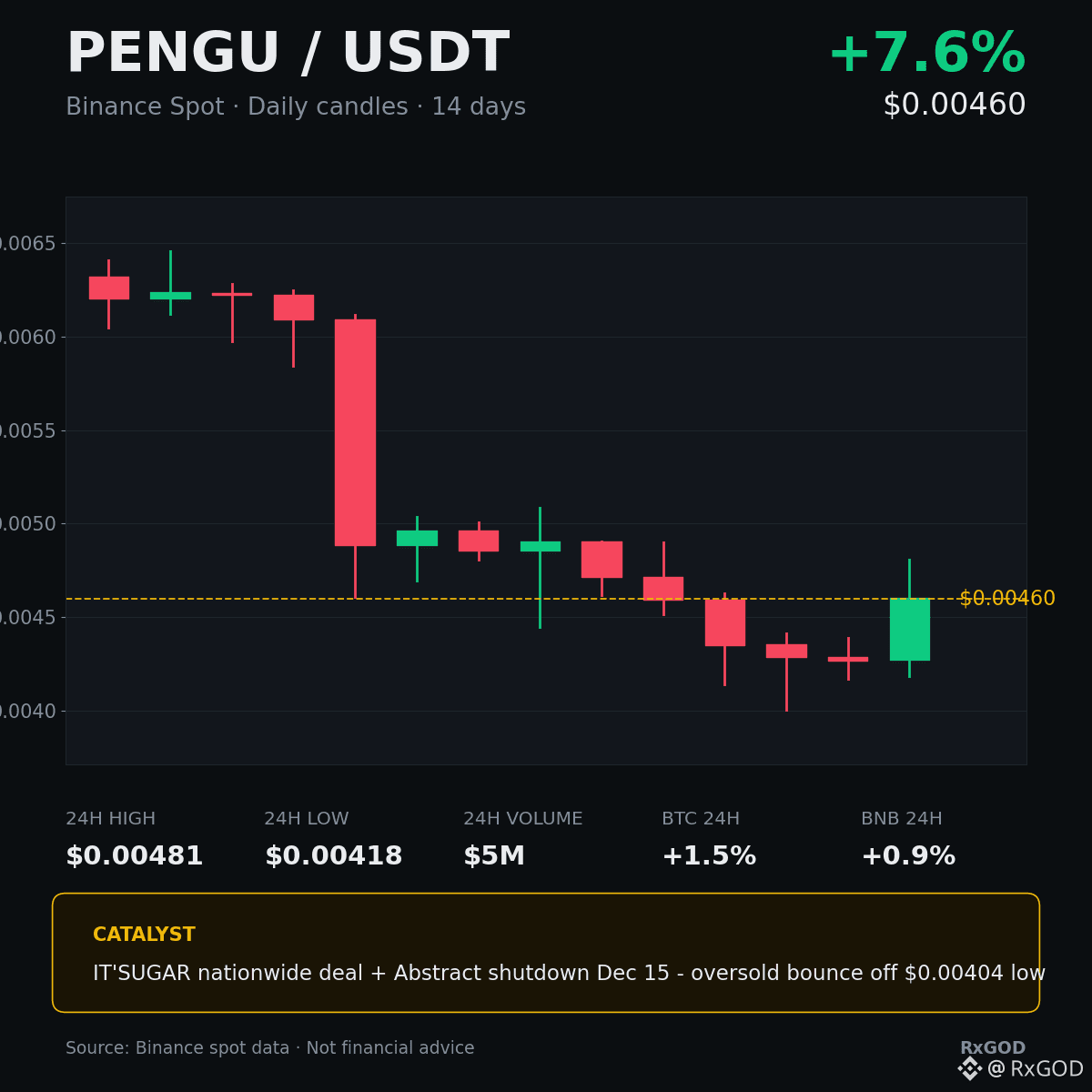
$PENGU is up 7.6% in the last 24 hours to $0.00460, bouncing off its November 21 low near $0.00404 — the cheapest since April 2025. Daily RSI sat at an oversold 20.5, and an hourly close above $0.004366 would confirm the local break. The catch: the token is still down 25.9% over the last 14 days, roughly 50% in 2026, and about 92% below its December 2024 record of $0.0574.
The brand keeps moving while the token bleeds. On November 19, IT'SUGAR — America's largest candy retailer — launched a nationwide Pudgy Penguins program, with plush, stickers and more at the front of every store through Valentine's Day. NFT sales jumped 71% in the week to November 14. With Igloo shutting down its Abstract blockchain on December 15, all focus goes back to the penguins and $PENGU — though anyone holding assets on Abstract must migrate before that date.
Honest risk check: this is an oversold bounce inside a downtrend, not a confirmed reversal. Around 723 million $PENGU unlock monthly until November 2028, and the proposed PENGU ETF was withdrawn. $BTC holding $62K helps the tape, but it doesn't fix token supply.
So the real question: is $PENGU a brand bet or a token bet? The toys are selling while the token sits 92% off its peak — which wins by year-end? What level convinces you the bounce is real: $0.005, or do you need $0.006+ first?
Not financial advice — DYOR.
#PENGU #PudgyPenguins #NFT #CryptoNews
24
·
--
PROM just went vertical — and nobody can quite explain why.
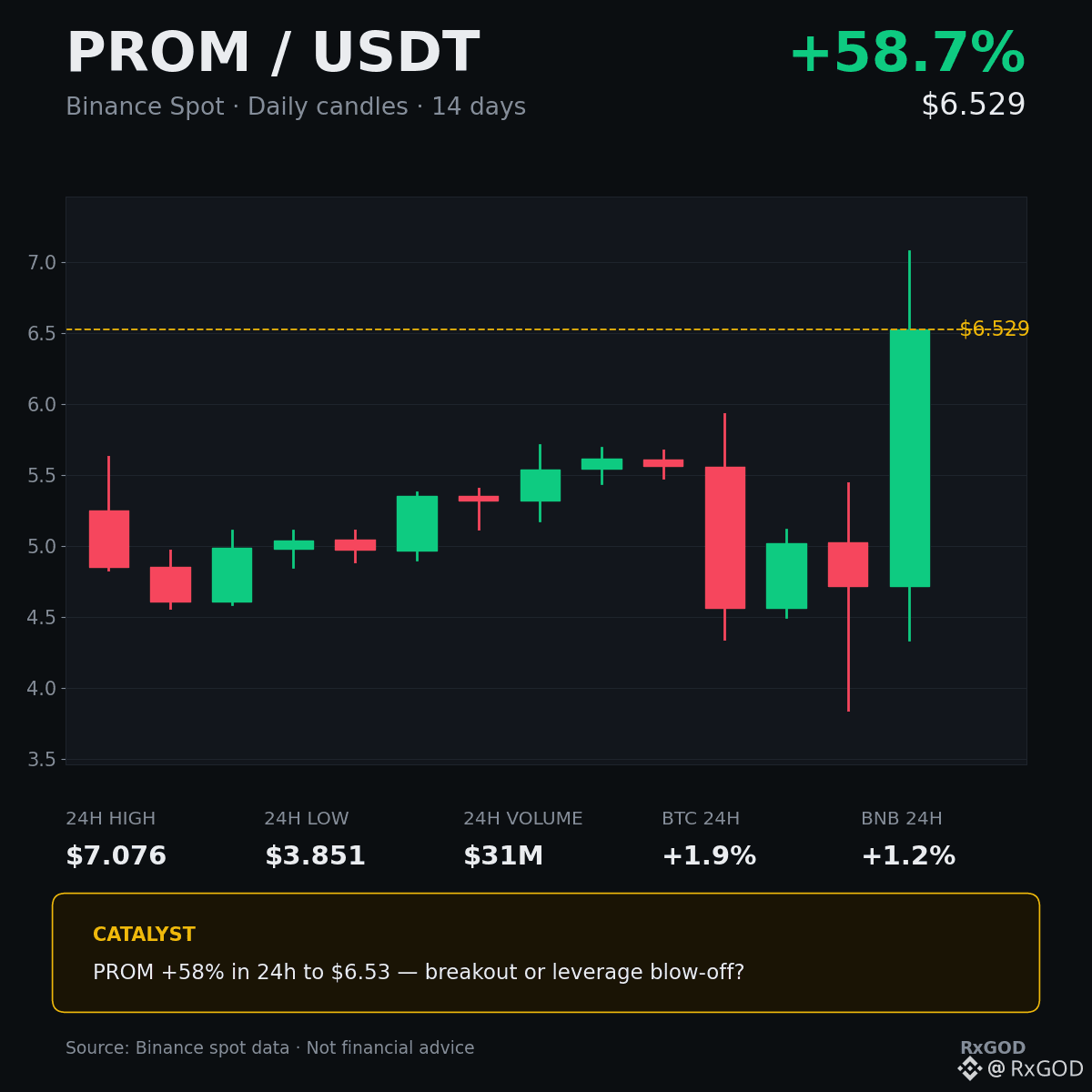
Prom ($PROM) is trading at $6.53, up 58% in 24 hours on Binance, after spiking to an intraday high of $7.08 from a low of $3.85. Binance volume hit $31.3 million, and total 24-hour volume across exchanges is around $139 million, with a market cap near $124 million. For two weeks PROM had been stuck in a $4.35–$5.93 range — today it smashed straight through the top of it.
Here is the honest part: there is no clear news catalyst behind the move. Open interest jumped roughly 50% earlier in the day, which suggests leverage, not fresh fundamentals, is doing a lot of the pushing. That is exactly what makes this kind of candle dangerous — and exciting.
The overheating check is blunt: PROM is sitting near the top of its 24-hour range after a near-vertical run, so chasing here means buying into strength that can reverse fast. But the breakout above a two-week ceiling is also real, and $BTC holding $62,551 (+2.0%) while the Fear & Greed Index sits at 11 (Extreme Fear) shows the wider market is finally bouncing with it.
So which is it — the start of a real breakout, or a leverage-fuelled blow-off top?
What is your call: does $PROM retest $7.08 first, or slide back to $5.00? And are you buying breakouts like this, or waiting for the pullback?
Not financial advice — DYOR.
#PROM #CryptoNews #ExtremeFear #WillMarketsStageAThanksgivingReliefRally
PROM just went vertical — and nobody can quite explain why.
Prom ($PROM ) is trading at $6.53, up 58% in 24 hours on Binance, after spiking to an intraday high of $7.08 from a low of $3.85. Binance volume hit $31.3 million, and total 24-hour volume across exchanges is around $139 million, with a market cap near $124 million. For two weeks PROM had been stuck in a $4.35–$5.93 range — today it smashed straight through the top of it.
Here is the honest part: there is no clear news catalyst behind the move. Open interest jumped roughly 50% earlier in the day, which suggests leverage, not fresh fundamentals, is doing a lot of the pushing. That is exactly what makes this kind of candle dangerous — and exciting.
The overheating check is blunt: PROM is sitting near the top of its 24-hour range after a near-vertical run, so chasing here means buying into strength that can reverse fast. But the breakout above a two-week ceiling is also real, and $BTC holding $62,551 (+2.0%) while the Fear & Greed Index sits at 11 (Extreme Fear) shows the wider market is finally bouncing with it.
So which is it — the start of a real breakout, or a leverage-fuelled blow-off top?
What is your call: does $PROM retest $7.08 first, or slide back to $5.00? And are you buying breakouts like this, or waiting for the pullback?
Not financial advice — DYOR.
#PROM #CryptoNews #ExtremeFear #WillMarketsStageAThanksgivingReliefRally
·
--
82 million phones just met Sui — and $SUI is up 8%.
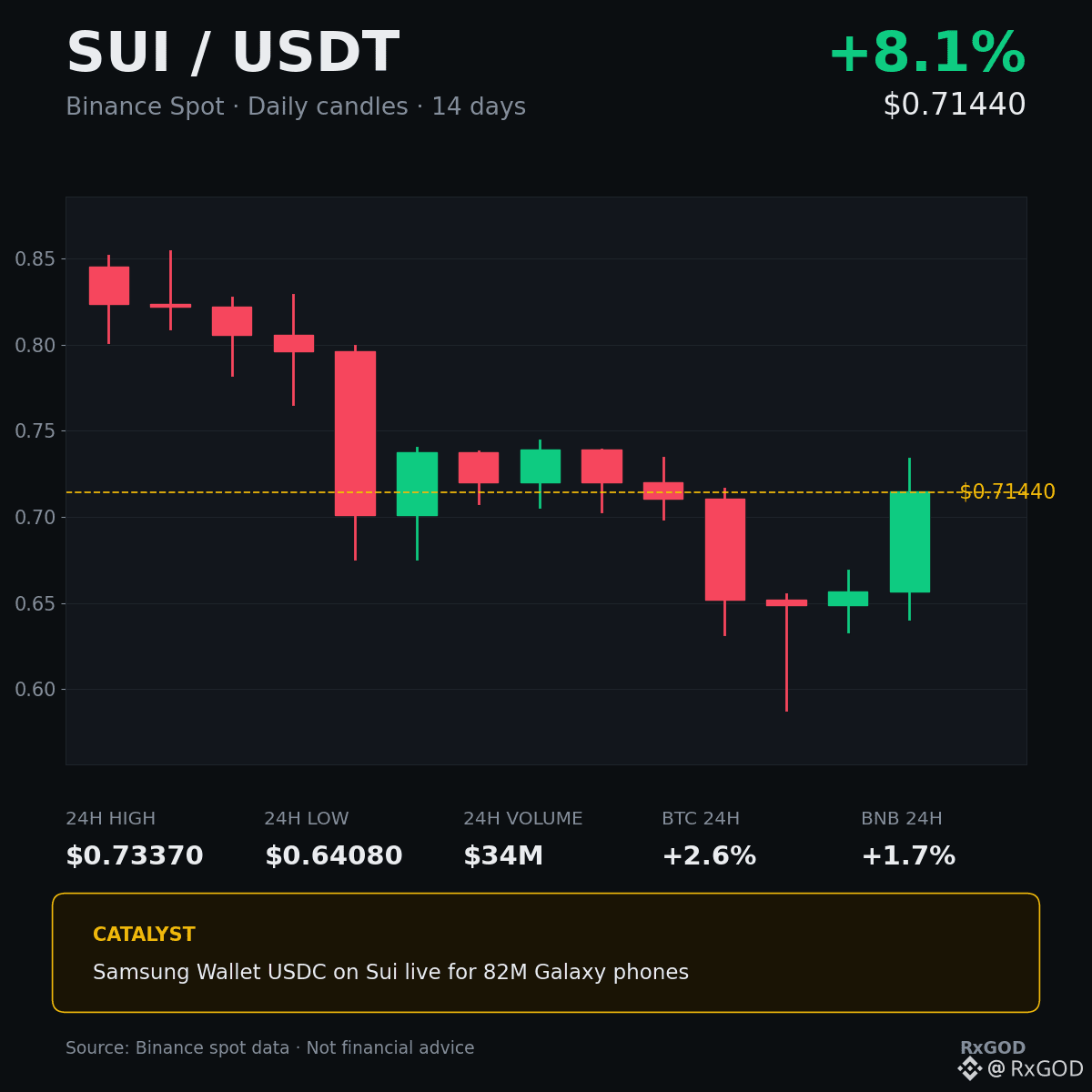
Samsung Wallet's USDC transfers on Sui went live today, November 23, putting Sui inside the default wallet of 82 million eligible Galaxy devices in the US. Transfers are fee-free and gasless — users never need to buy SUI to pay for gas — with Bastion providing custody and Coinbase as sub-custodian. Sui confirmed the rollout on November 22, following the October 8 partnership announcement; the Solana leg went live on November 2.
The market liked it. $SUI trades at $0.7137, up 8.0% in 24 hours on $33.5 million of Binance volume, with a daily range of $0.6408–$0.7337. The move pushed price back above the $0.70 level after bouncing off its 14-day low near $0.588 — but zoom out and the picture is still a bounce inside a downtrend: SUI is down 13.4% over 14 days and roughly 32% over 30 days, sitting mid-range at 47% of its two-week span.
Here's the honest catch: USDC is the only asset supported, and the SUI token itself isn't in the wallet — so this distribution win doesn't directly create demand for $SUI. Add Sui DeFi TVL down 84% to $417 million and queues on Hashi's hBTC withdrawals, and the rally has plenty to prove. $BTC holds $62,731 (+2.5%) while the Fear & Greed Index sits at 11 — Extreme Fear.
Does putting Sui in 82 million pockets matter if nobody has to buy $SUI — or is this the on-ramp that eventually does? $0.75 next, or back below $0.65 first? What's your call?
Not financial advice — DYOR.
#SUI #SamsungWallet #USDC #ExtremeFear
82 million phones just met Sui — and $SUI is up 8%.
Samsung Wallet's USDC transfers on Sui went live today, November 23, putting Sui inside the default wallet of 82 million eligible Galaxy devices in the US. Transfers are fee-free and gasless — users never need to buy SUI to pay for gas — with Bastion providing custody and Coinbase as sub-custodian. Sui confirmed the rollout on November 22, following the October 8 partnership announcement; the Solana leg went live on November 2.
The market liked it. $SUI trades at $0.7137, up 8.0% in 24 hours on $33.5 million of Binance volume, with a daily range of $0.6408–$0.7337. The move pushed price back above the $0.70 level after bouncing off its 14-day low near $0.588 — but zoom out and the picture is still a bounce inside a downtrend: SUI is down 13.4% over 14 days and roughly 32% over 30 days, sitting mid-range at 47% of its two-week span.
Here's the honest catch: USDC is the only asset supported, and the SUI token itself isn't in the wallet — so this distribution win doesn't directly create demand for $SUI . Add Sui DeFi TVL down 84% to $417 million and queues on Hashi's hBTC withdrawals, and the rally has plenty to prove. $BTC holds $62,731 (+2.5%) while the Fear & Greed Index sits at 11 — Extreme Fear.
Does putting Sui in 82 million pockets matter if nobody has to buy $SUI — or is this the on-ramp that eventually does? $0.75 next, or back below $0.65 first? What's your call?
Not financial advice — DYOR.
#SUI #SamsungWallet #USDC #ExtremeFear
·
--
Cardano just shipped a milestone most traders scrolled past — five different node clients are now producing blocks on mainnet. And $ADA is finally moving.
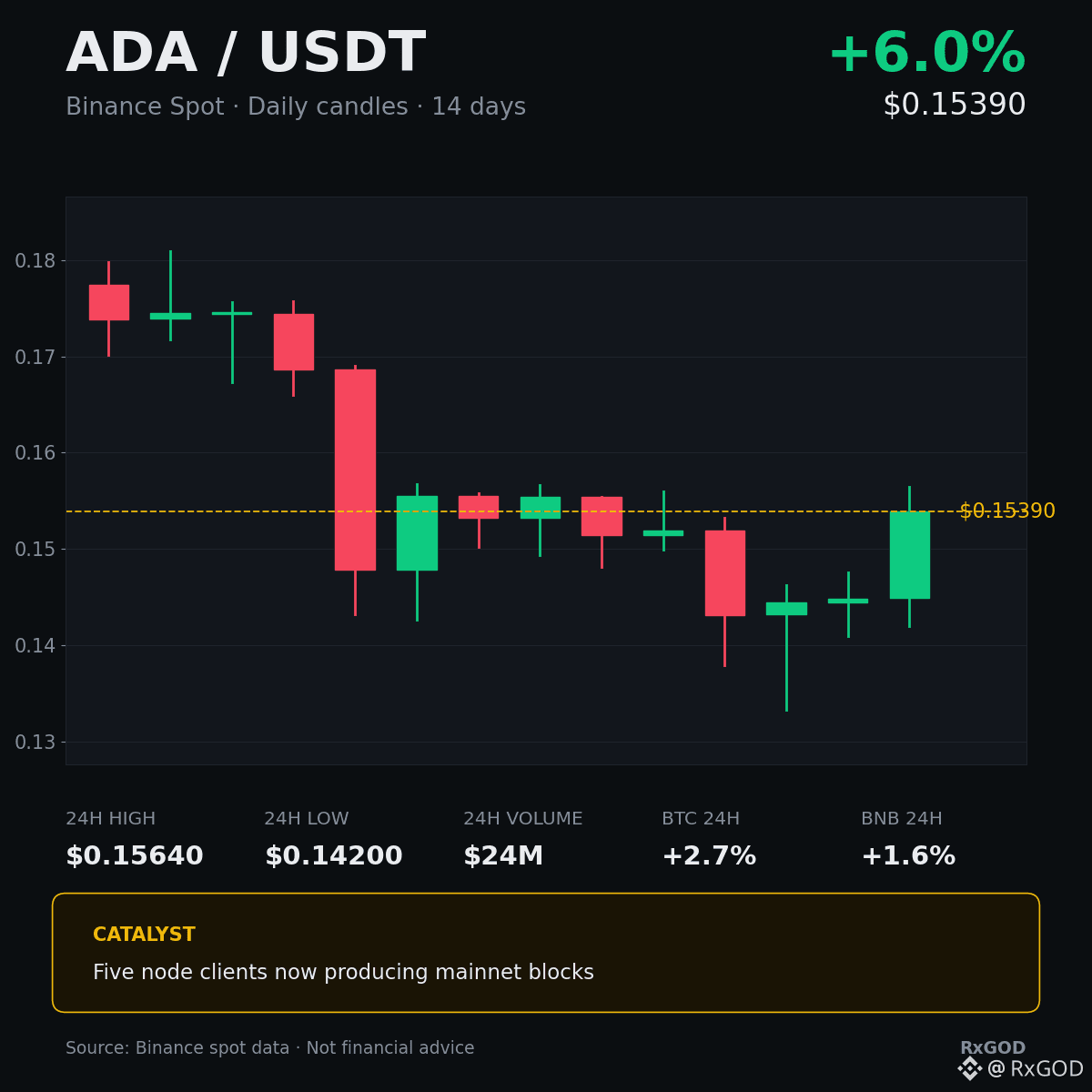
$ADA trades at $0.154, up 6.0% in 24 hours (high $0.1564, low $0.1420) on $24.2M of Binance spot volume. The catalyst is real: Intersect's weekly update #138 confirms cardano-node, Amaru, Dingo, cardano-bean and TSUNAGI are all producing mainnet blocks — Dingo alone just passed 100 blocks — while protocol version 12 testing advances on the Musashi and Dijkstra testnets and Demeter's cloud-managed infrastructure goes live for developers. The Hard Fork Working Group meets tomorrow, Nov 24.
The honest check: $ADA is still down 11.3% over 14 days, sitting mid-range between its $0.1333 low and $0.1809 high, and roughly 95% below its $3.10 all-time high. Node diversity is a genuine decentralization win, but it has never been a short-term price driver — this move is riding the broader relief rally, with $BTC at $62,777 and the Fear & Greed Index stuck at 11, Extreme Fear.
So the real question: does shipping actually move price in a bear market, or is $ADA just following $BTC's bounce? $0.20 first, or back to $0.12 — what's your level?
Not financial advice — DYOR.
#Cardano #ADAReboundsOnNodeMilestone #WillMarketsStageAThanksgivingReliefRally #ExtremeFear
Cardano just shipped a milestone most traders scrolled past — five different node clients are now producing blocks on mainnet. And $ADA is finally moving.
$ADA trades at $0.154, up 6.0% in 24 hours (high $0.1564, low $0.1420) on $24.2M of Binance spot volume. The catalyst is real: Intersect's weekly update #138 confirms cardano-node, Amaru, Dingo, cardano-bean and TSUNAGI are all producing mainnet blocks — Dingo alone just passed 100 blocks — while protocol version 12 testing advances on the Musashi and Dijkstra testnets and Demeter's cloud-managed infrastructure goes live for developers. The Hard Fork Working Group meets tomorrow, Nov 24.
The honest check: $ADA is still down 11.3% over 14 days, sitting mid-range between its $0.1333 low and $0.1809 high, and roughly 95% below its $3.10 all-time high. Node diversity is a genuine decentralization win, but it has never been a short-term price driver — this move is riding the broader relief rally, with $BTC at $62,777 and the Fear & Greed Index stuck at 11, Extreme Fear.
So the real question: does shipping actually move price in a bear market, or is $ADA just following $BTC 's bounce? $0.20 first, or back to $0.12 — what's your level?
Not financial advice — DYOR.
#Cardano #ADAReboundsOnNodeMilestone #WillMarketsStageAThanksgivingReliefRally #ExtremeFear
42
·
--
The memes are waking up first.
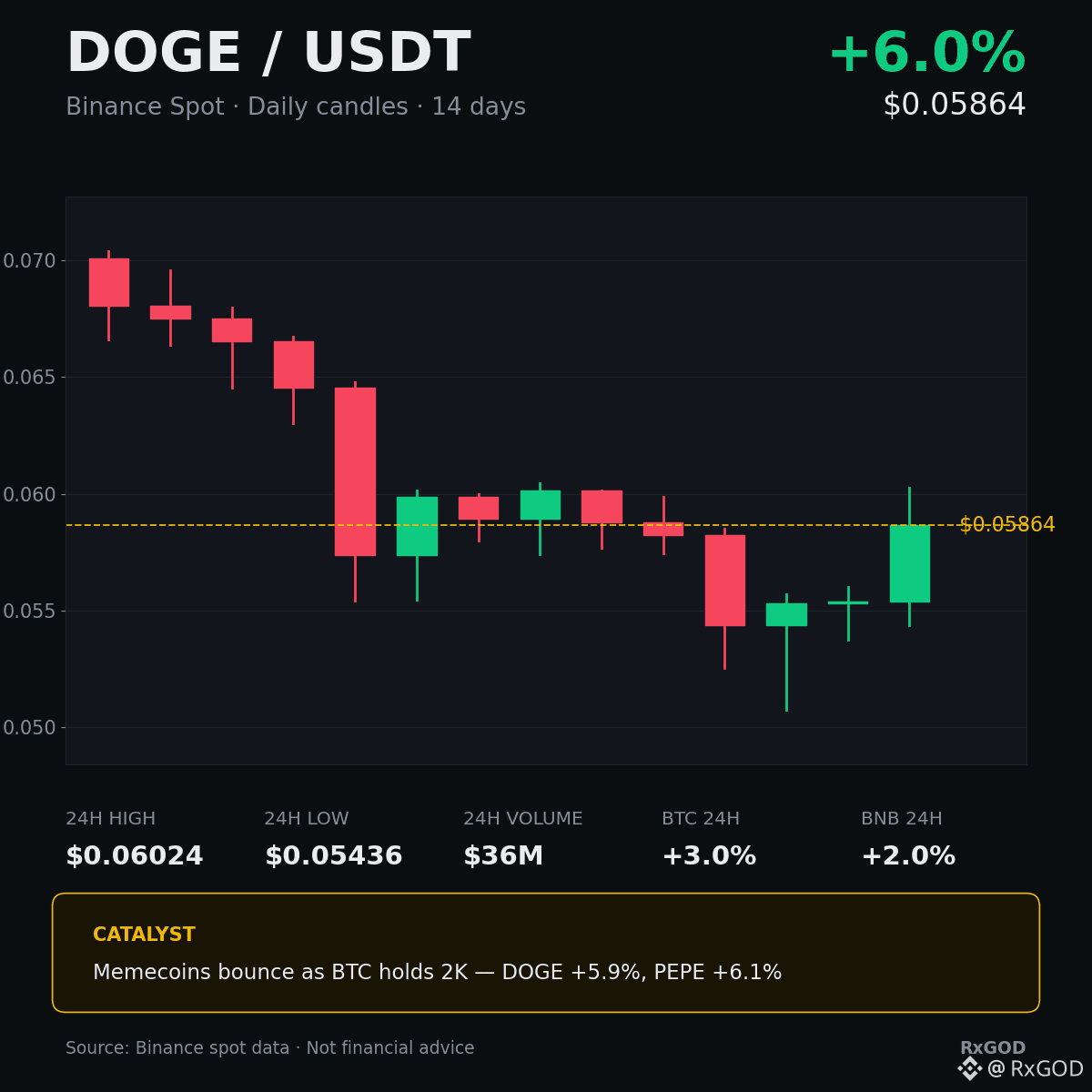
Dogecoin is leading the bounce among the big memecoins — $DOGE up 5.9% in 24 hours to $0.0587, with $PEPE right behind it at +6.1% to $0.00000363 and SHIB adding 3.9%. PEPE is even flagged as a "Rapid Riser" in Binance Square's most-searched list over the last 6 hours.
The move tracks Bitcoin holding above $62K after its weekend flush to $55,130 — $BTC is up 3.0% at $62,841, though it was already rejected at the $64,603 intraday high. CoinDesk notes DOGE carried the most consistently positive funding rates across venues, meaning traders are actively paying to stay long.
Before getting carried away: this is still a bounce inside a downtrend. DOGE is down 15% over the last 14 days and PEPE is down 26.7%, both sitting near the bottom of their two-week ranges. Memecoins are the highest-beta trade in crypto — they lead the rally, and they lead the dump too.
Is this risk appetite genuinely coming back, or just beta on a dead-cat bounce? Does $DOGE tag $0.07 first, or slide back to $0.05? Are you holding any memes through this chop, or sitting it out?
Not financial advice — DYOR.
#WillMarketsStageAThanksgivingReliefRally #ExtremeFear #CryptoNews #DOGE
51
·
--
Jensen Huang is back — and crypto just caught its biggest risk-on jolt in weeks.
NVIDIA's board unanimously reinstated Jensen Huang as CEO on Monday, just 11 days after his resignation. NVDA jumped around 30%, the Nasdaq rallied 6% and the S&P 500 rose 4% (Reuters) — and the wave spilled straight into crypto.
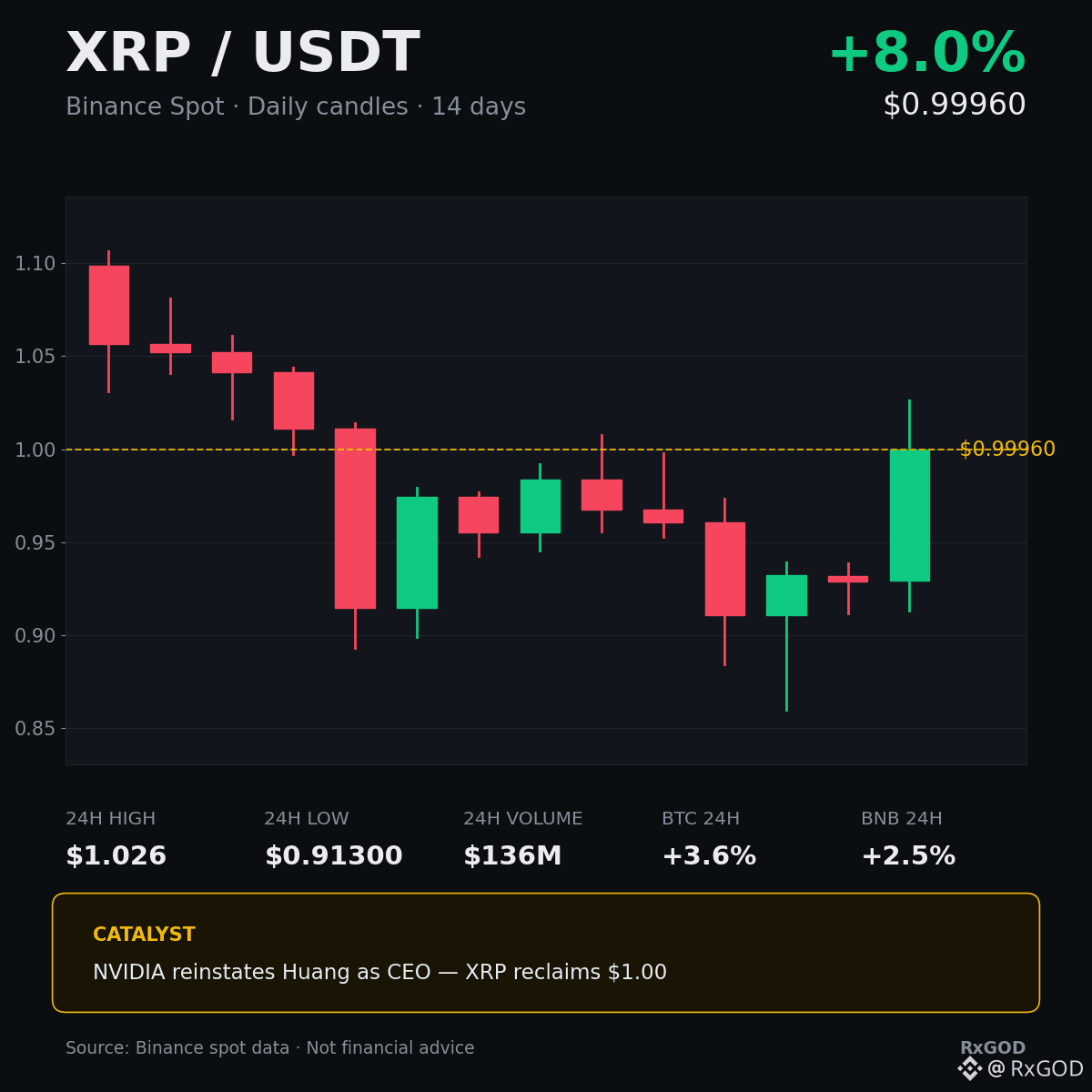
$XRP reclaimed the psychological $1.00 level, trading at $1.0007, up 8.2% in 24 hours after tagging an intraday high of $1.026 on $135.8M of Binance spot volume. $BTC pushed to $63,110 (+3.7%) and $SOL ran to $75.86 (+7.7%). XRP is now up roughly 16% from its $0.86 low — but keep the context honest: it is still down about 5% over 14 days, and $1.02–$1.05 is the next resistance wall. Spot XRP ETFs have bled $30.8M in November, and Ripple's 1B XRP escrow release lands on Dec 1.
My honest read: this is a relief bounce inside a downtrend, powered by a TradFi catalyst — not a confirmed reversal yet. $BTC still faces $62K–$65K resistance, and a break below $55K–$56K reopens $53K (KuCoin).
Real reversal or just another dead-cat bounce riding NVIDIA's coattails? Does $XRP hold $1.00 this week — or is $1.05 the wall that rejects it? What's your call?
Not financial advice — DYOR.
#NVIDIAReinstatesJensenHuangasCEO #WillMarketsStageAThanksgivingReliefRally #ExtremeFear #CryptoNews
8
·
--
Uniswap just topped the entire CoinDesk 20 — but is this a real comeback, or just a relief bounce in a brutal downtrend?
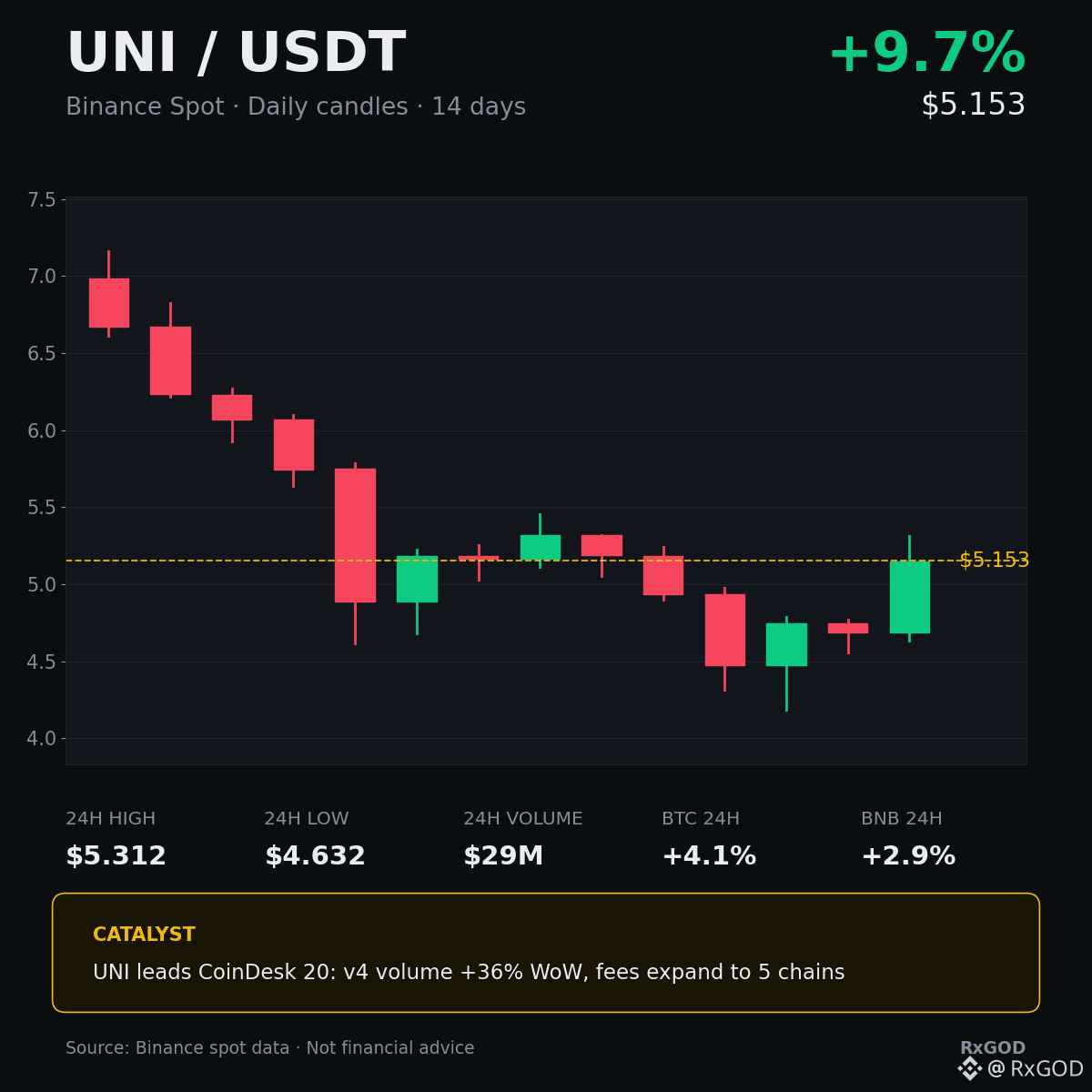
$UNI is trading at $5.16, up 9.8% in 24 hours, making it the strongest performer in the CoinDesk 20 index (+13.5% in the latest update, ahead of NEAR's +11.7%). The move has real fuel behind it: Uniswap v4 daily spot volume hit $1.291 billion on Nov 20, up 35.85% week-on-week, according to DefiLlama data.
The catalysts stack up. On Nov 21, UNI holders approved expanding v4 fees to five more chains. And today, reports say OKX and ICE plan to route tokenized asset trading through Uniswap pools — a direct usage driver if it materializes.
But keep the context honest: UNI is still down 22.6% over the past 14 days, trading below all its major moving averages, and 89% below its $44.97 all-time high. The 24-hour high of $5.31 is the first wall; support sits at $4.63. The wider market is still in Extreme Fear (index 12), even as $BTC holds $63,634.
So the real question: does the fee expansion plus tokenized-asset flow make UNI a buy at $5 — or is this a bounce to sell into? $6 first, or back to $4.60?
Not financial advice — DYOR.
#Uniswap #DeFi #WillMarketsStageAThanksgivingReliefRally #CryptoNews
24
·
--
South Korea just put self-custody on a leash — and the debate is exploding.
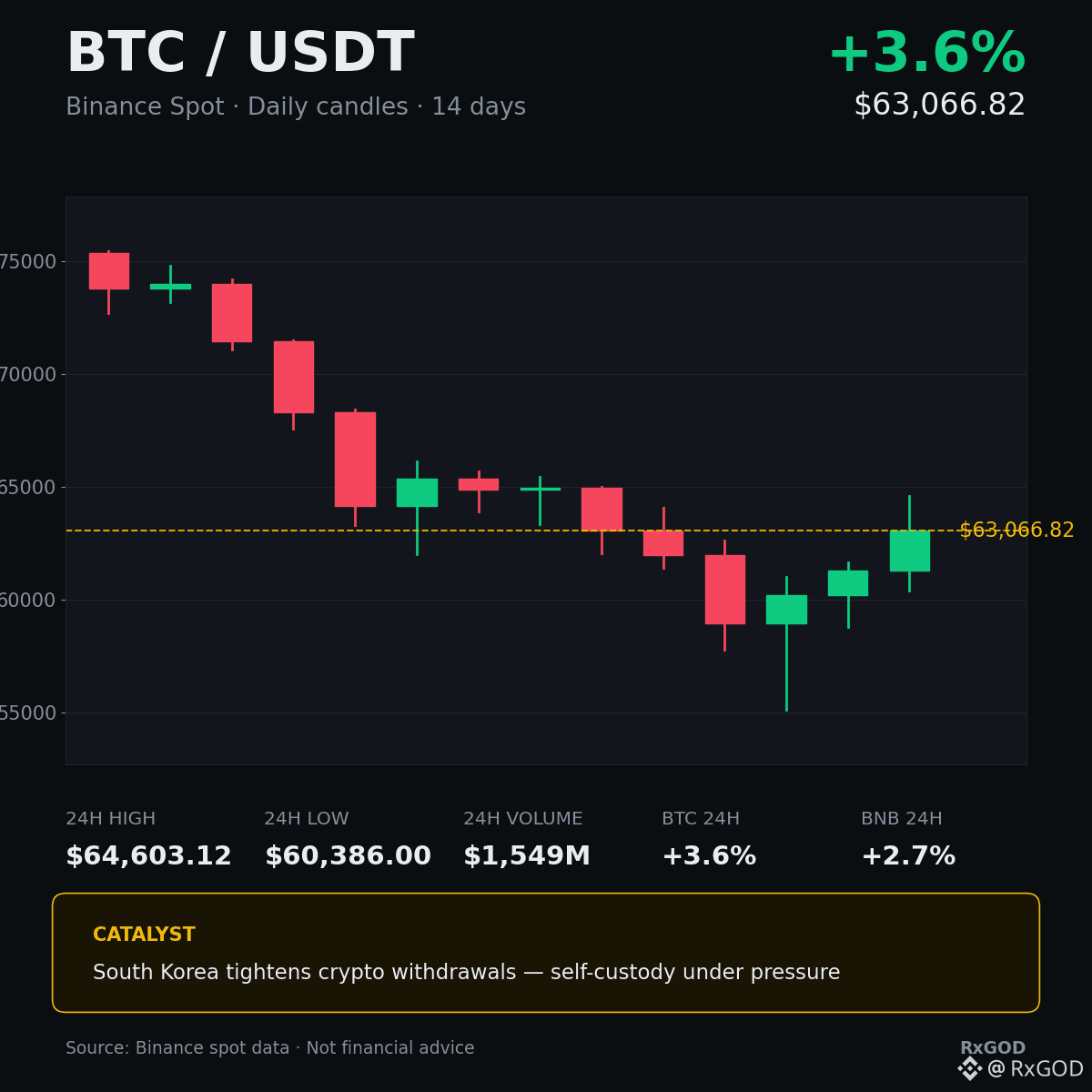
Under a revised enforcement decree reported today, South Korean exchanges must restrict transfers to overseas platforms regulators deem high-risk, and withdrawals to a private wallet will generally only go through if you can prove the wallet is yours. Transfers to unapproved foreign exchanges can be blocked outright. FSC Chairman Lee Eog-weon framed it as an anti-money-laundering crackdown.
This has been building for months. Since August, Korea has limited exchange-to-wallet transfers to same-person wallets, and a bill proposed on November 15 would force exchanges to verify the owner of every self-custodied wallet, with fines up to 100 million won (~$72,000). The new decree turns that direction into hard enforcement — and traders warn routine withdrawals will now take longer.
The market backdrop is fragile: $BTC holds $63,057 (+3.5% in 24h) after bouncing 14% off Saturday's $55,130 flush, still 14.5% down over 14 days and facing the $62K–$65K resistance wall, with Fear & Greed stuck at 12 — Extreme Fear. Korea is one of the world's biggest retail markets, and even the Kimchi Premium depends on money moving freely.
Honest risk check: this is regulation, not a ban — approved platforms still work. But every new checkpoint is friction, and friction kills momentum in a market this nervous.
Where do you stand: sensible AML enforcement, or governments deciding where your coins may go? If your country did this tomorrow, would you move your coins off exchanges now — or wait it out?
Not financial advice — DYOR.
#SouthKoreaTightensCryptoWithdrawals #ExtremeFear #WillMarketsStageAThanksgivingReliefRally #CryptoNews
16
·
--
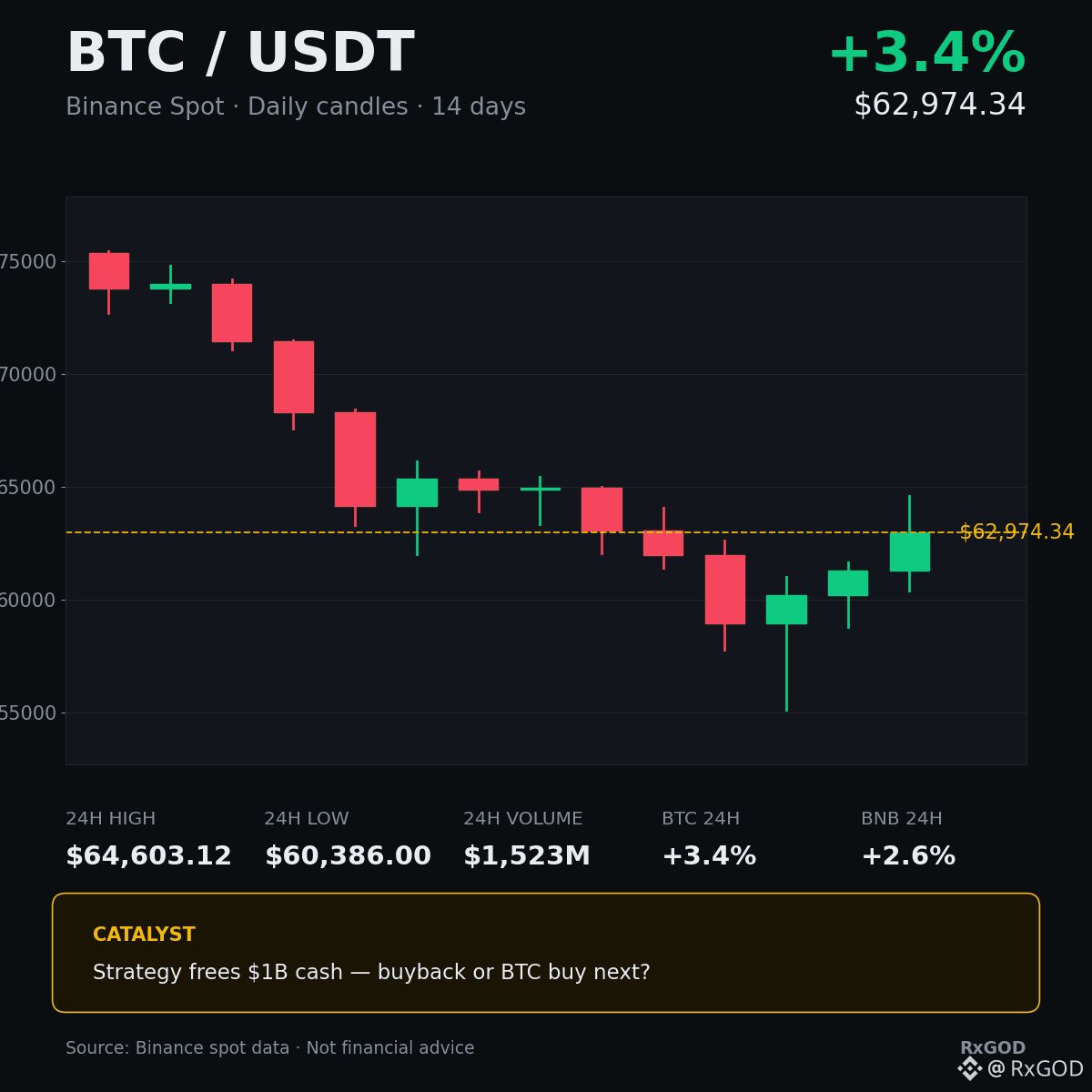
Saylor just freed up $1 billion — war chest or lifeboat?
Strategy moved $1B from its USD Reserve — the pot backing preferred dividends — into USD Cash, and Saylor was blunt about what it can fund: "Our USD Cash may be used to fund buybacks or BTC purchases." The board also lifted its preferred buyback program to $4B.
But last week's filing tells a different story. Strategy bought just 457 $BTC for $29.6M at an average of $64,898 — while spending $211.8M buying back STRC preferred stock. That's seven times more on buybacks than on Bitcoin. Holdings: 851,305 BTC at a $75,446 average cost, still roughly $12B underwater.
MSCI boots MSTR from its flagship indexes at the November 30 close — one week away — with JPMorgan estimating $2.8B of forced selling.
$BTC itself trades at $62,974, up 3.4% in 24 hours and 14% off the $55,130 low — but still 14.6% down over 14 days, in the lower half of its range. The $62K–$65K wall sits right above; Fear & Greed is stuck at 12, Extreme Fear.
Honest risk check: this $1B is optionality, not a buy order — last week the money went to buybacks first, and the MSCI exit could pressure MSTR either way.
So where does the $1B go first — a big BTC buy or more STRC buybacks? And if Saylor buys again, does it still move the market, or is it priced in?
Not financial advice — DYOR.
#StrategyMoves$1BToCash #WillMarketsStageAThanksgivingReliefRally #ExtremeFear #CryptoNews
25
·
--
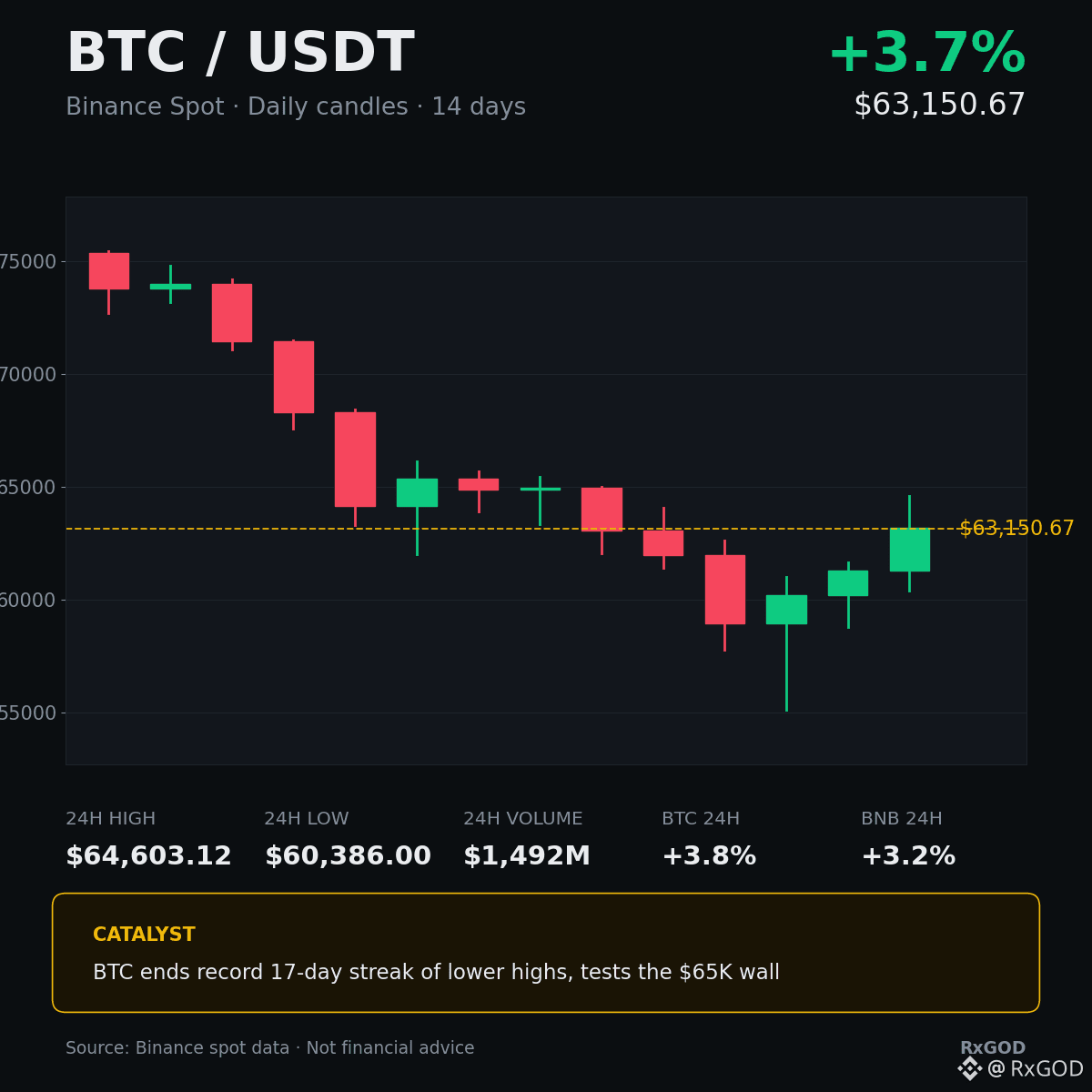
Bitcoin just snapped a record 17-day streak of lower highs — and now it's knocking on the $65K wall.
$BTC is trading near $63,151, up 3.7% in 24 hours on $1.46B of spot volume, with an intraday high of $64,603. That's a 15% climb off Saturday's $55,130 flush — the lowest print since September 2024.
Context matters: this is still a bounce inside a downtrend. Bitcoin has now posted seven straight weekly losses, its second-longest streak ever, down 29% from roughly $86,500 in early October and still 14% lower over the past 14 days. The $62K–$65K band is the major resistance zone, with the next levels at $64,137 and $67,863 — while support sits at $58,170 and the $55K low below.
The whole market is moving with it: $ETH +5.1% to $1,801 and SOL +9.3% to $76.97. But spot ETF flows are still negative — nearly $3B left in November — and the Fear & Greed Index sits at 11, Extreme Fear.
The next test comes fast: October core PCE lands November 25, right into thin Thanksgiving-week liquidity.
So is this the turn, or a bull trap before the real bottom? $65K first, or a retest of $55K — what's your call, and which level are you watching closest?
Not financial advice — DYOR.
#BitcoinEndsRecord17DayStreakOfLowerHighs #WillMarketsStageAThanksgivingReliefRally? #WillOctCorePCEShiftFedHikeExpectations? #ExtremeFear
21
·
--
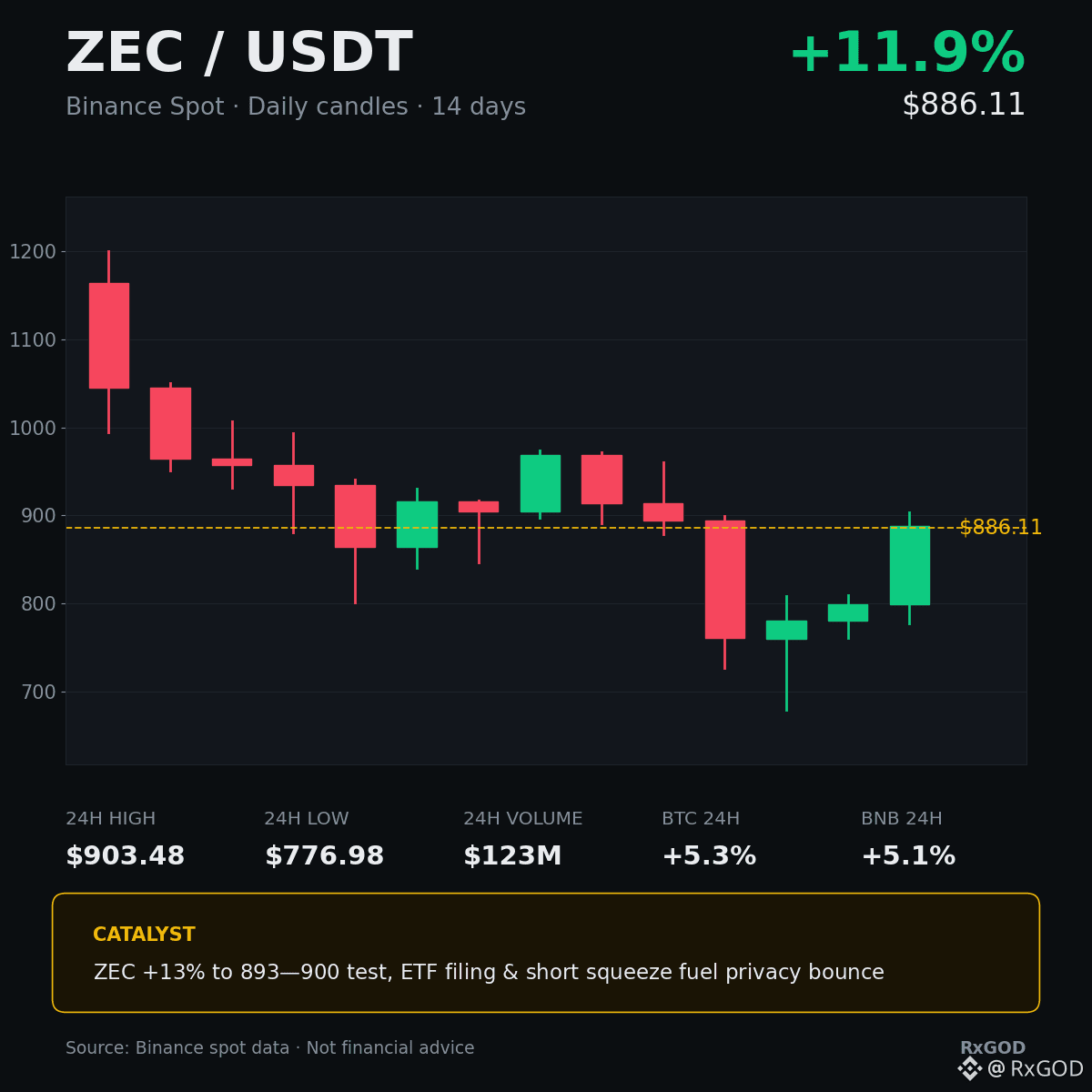
Zcash just knocked on $900 — and privacy coins are suddenly the loudest trade in the bounce.
$ZEC is trading at $893, up 13.1% in 24 hours with $121.8M in Binance spot volume. It briefly printed $903.48 intraday before pulling back — a 31.5% vertical climb from its $679 low just two days ago. The squeeze had fuel: $2.84M in ZEC liquidations over 24 hours, nearly 69% of them shorts getting flushed.
The backdrop is bigger than one candle. Bitwise filed for a spot Zcash ETF on November 17 — ticker ZEC, listing on the Texas Stock Exchange, with in-kind redemptions. Meanwhile the community is voting on the grants-treasury shake-up for the NU7.1 upgrade, polls closing December 1, and 28.9% of all ZEC now sits in shielded pools.
But keep the honest frame: ZEC is still down 14.9% over 14 days and 47% below its September all-time high of $1,697. This looks like a short-squeeze bounce inside a downtrend, not a confirmed reversal — yet. $BTC is doing its part too, up 5.4% to $63,936 as the whole market stages its Thanksgiving relief rally, with the Fear & Greed Index still stuck at 9, Extreme Fear.
So the real question: does $ZEC clear $900 and run toward $1,000, or does this level reject it like the last two attempts? And are privacy coins a genuine hedge here, or just the fastest horse in a relief bounce?
Not financial advice — DYOR.
#WillMarketsStageAThanksgivingReliefRally? #PrivacyCoins #ZEC #CryptoNews
2
·
--
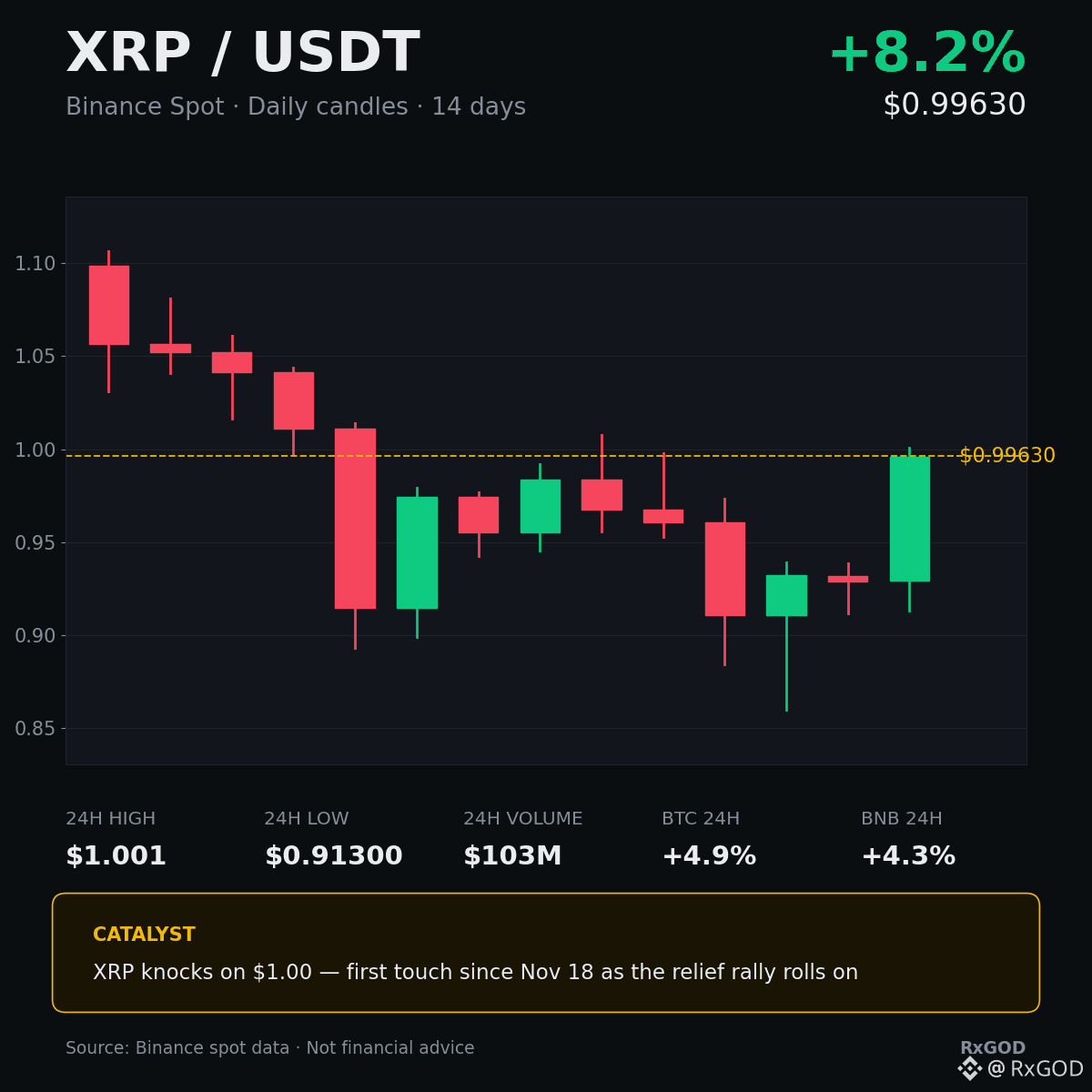
XRP is knocking on the $1.00 door — and this time the whole market is behind it.
After getting crushed to a $0.86 low on Nov 21, $XRP has ripped +8.2% in 24 hours to ~$0.996, tagging an intraday high of $1.0008 — its first touch of the psychological $1 level since Nov 18, when it briefly printed $1.01 before the weekend selloff dragged it back under $0.90. Binance spot volume is a healthy $103M in 24h.
The setup is genuinely two-sided. Bulls point to the bounce: XRP sits mid-range in its 14-day band ($0.86–$1.11), the daily RSI is hovering near 31 — just above oversold — and the broader relief rally is real, with $BTC back above $63,800 (+5.2%) and $SOL up 9.6%. Bears have receipts too: XRP is still down ~27% in a month, spot XRP ETFs have bled $30.8M in November, ending seven months of inflows, and Ripple's next 1B XRP escrow release lands Dec 1.
A daily close above $1.01 opens the door to $1.05–$1.09. A rejection here puts $0.90–$0.91 support straight back in play.
So which comes first — $1.05 or a trip back to $0.90? And are you buying this $1 test, or waiting for a daily close above it before touching it?
Not financial advice — DYOR.
#WillMarketsStageAThanksgivingReliefRally #XRP #ExtremeFear #CryptoNews
109
·
--
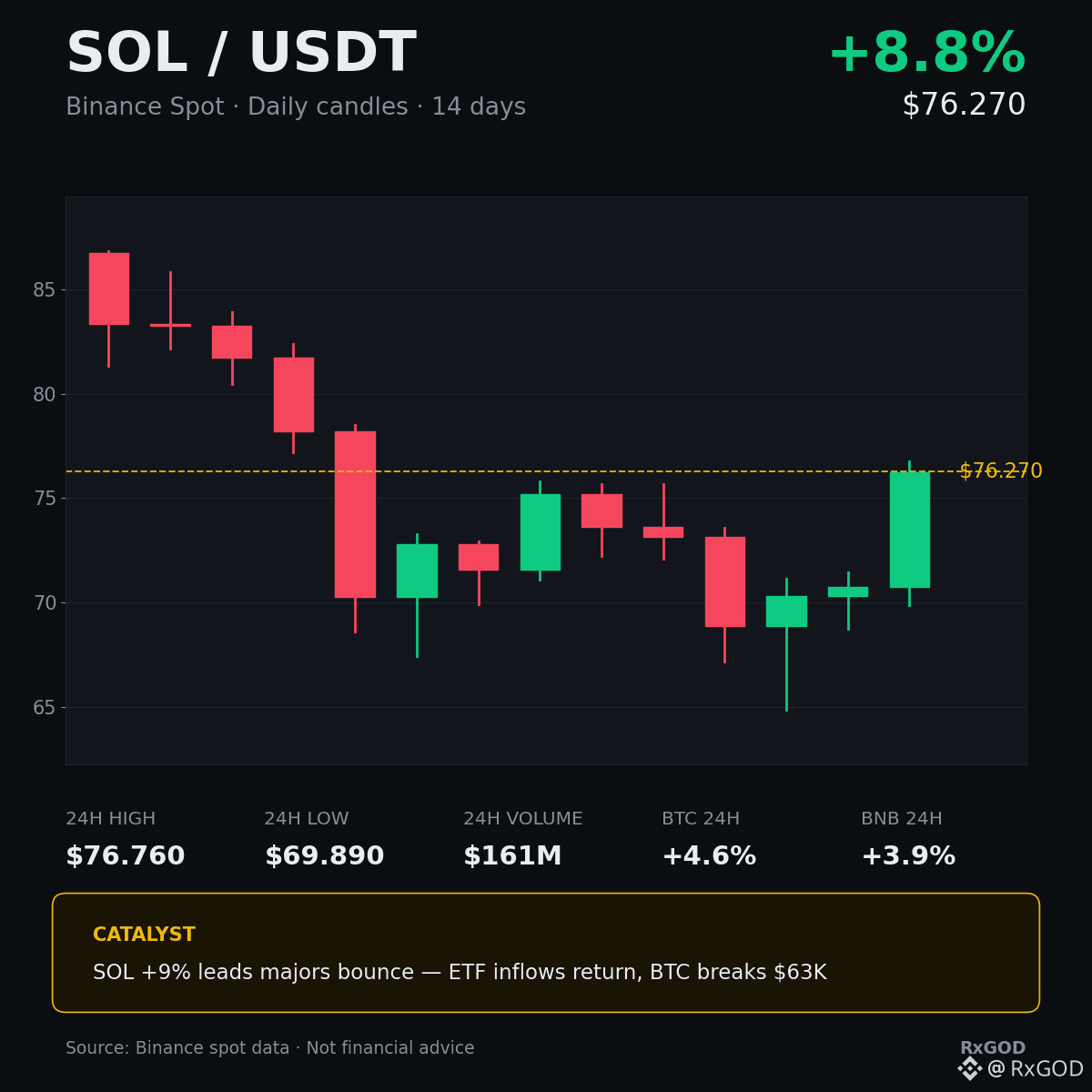
Solana just stole the show — and the whole market is asking the same question: is this the Thanksgiving relief rally, or just another dead-cat bounce?
$SOL is leading the majors at $76.46, up 9.0% in 24 hours on $159.5M of Binance spot volume, after bouncing off a $64.87 low on November 21. $BTC followed with +4.7% to $63,618, pushing into the $62K–$65K resistance zone CoinDesk flagged as the key test, while $ETH added 6.1% to $1,807.
The catalyst is real but modest: U.S. spot Solana ETFs took in $4.38M last week, ending a six-week outflow streak — though Friday still saw $5.9M in redemptions, so the flow story is far from settled. Technically, this is a bounce inside a downtrend, not a blow-off top: SOL sits mid-range at 52% of its 14-day span, still down 8.4% over two weeks and 29% over the month, and roughly 76% below its $293 all-time high. Fear & Greed is still at 9 — Extreme Fear — and Wednesday's PCE print is the next big test.
So is the bottom in, or does the market roll over again before Thanksgiving? $80 first, or back to $65 — where do you see SOL heading next, and are you buying this bounce or waiting for confirmation?
Not financial advice — DYOR.
#WillMarketsStageAThanksgivingReliefRally #Solana #ExtremeFear #CryptoNews
79
·
--
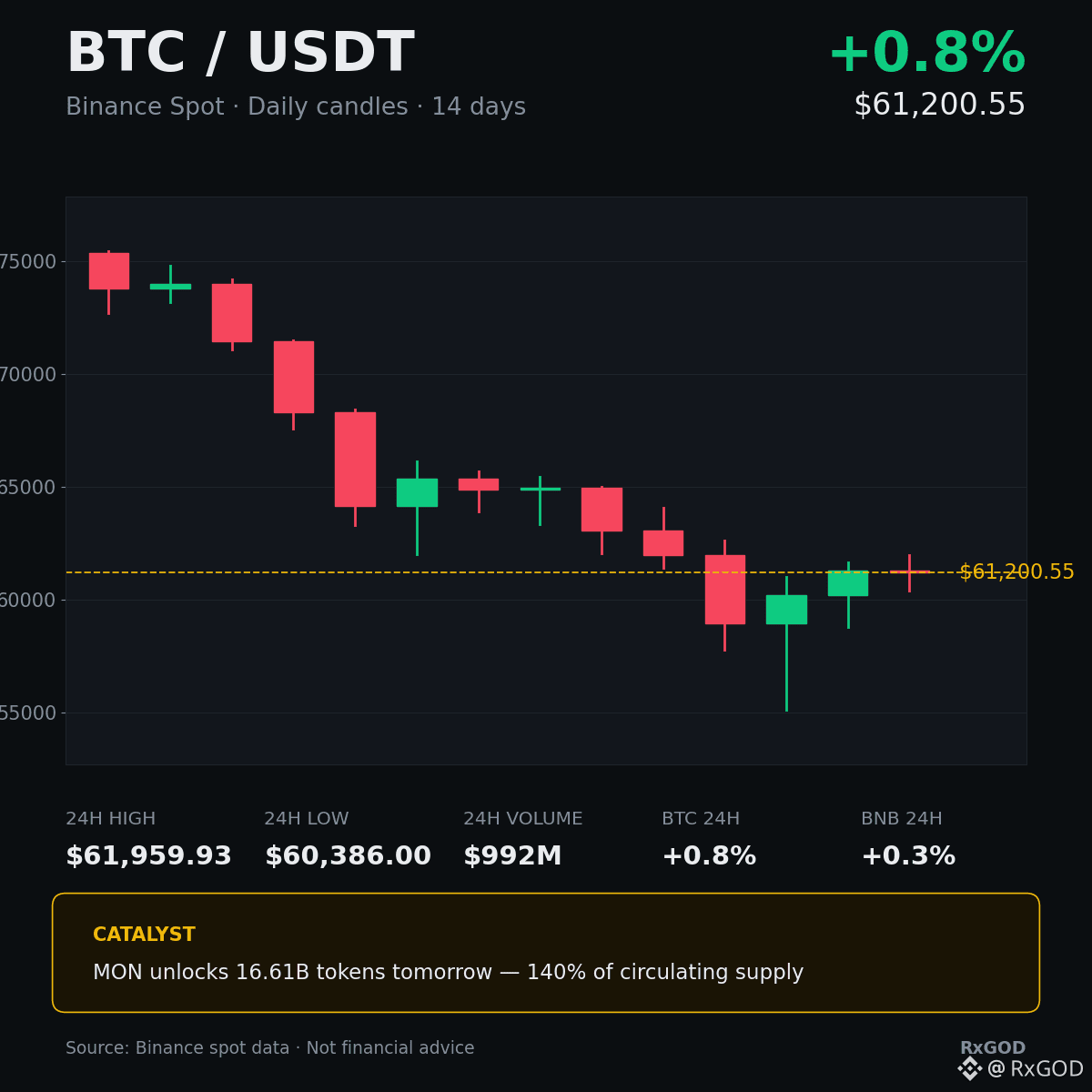
Tomorrow, Monad unlocks more tokens than currently exist in circulation — and $MON is already sitting at its all-time low.
On November 24, exactly one year after mainnet launch, the one-year cliff on Monad's team and investor allocations ends. 16.61 billion $MON — worth roughly $200 million at current prices — becomes eligible at once: 10.7B to the team, 4.92B to early investors, and ~1B to the Category Labs treasury, per Tokenomist and BeInCrypto.
That is 32.4% of all released supply and about 140% of the ~11.8B MON currently circulating — the largest single release since the token generation event. $MON already trades at ~$0.0117, down ~11% in 24 hours and ~44% in 30 days, and 76% below its $0.0488 all-time high.
The nuance that matters: unlocked does not mean sold. Recipients may hold or stake — locked tokens could not earn staking rewards until now. But the market is clearly front-running the risk, and $MON is not alone: over $290 million in unlocks land this week, including Plasma on November 25. Meanwhile $BTC holds $61,205 (+1.0% in 24h), still only a third of the way up its 14-day range off the $55,130 low, with sentiment stuck at Extreme Fear.
If insiders sell even a fraction into roughly $14–17M of daily volume, the supply shock could be brutal. If they hold, today's fear may be the bottom.
So what's your call — is the unlock already priced in after a -44% month, or does $MON print a fresh low tomorrow? Would you buy the unlock dip, or wait for proof the insiders are holding?
Not financial advice — DYOR.
#Monad #TokenUnlock #ExtremeFear #CryptoNews
75
·
--
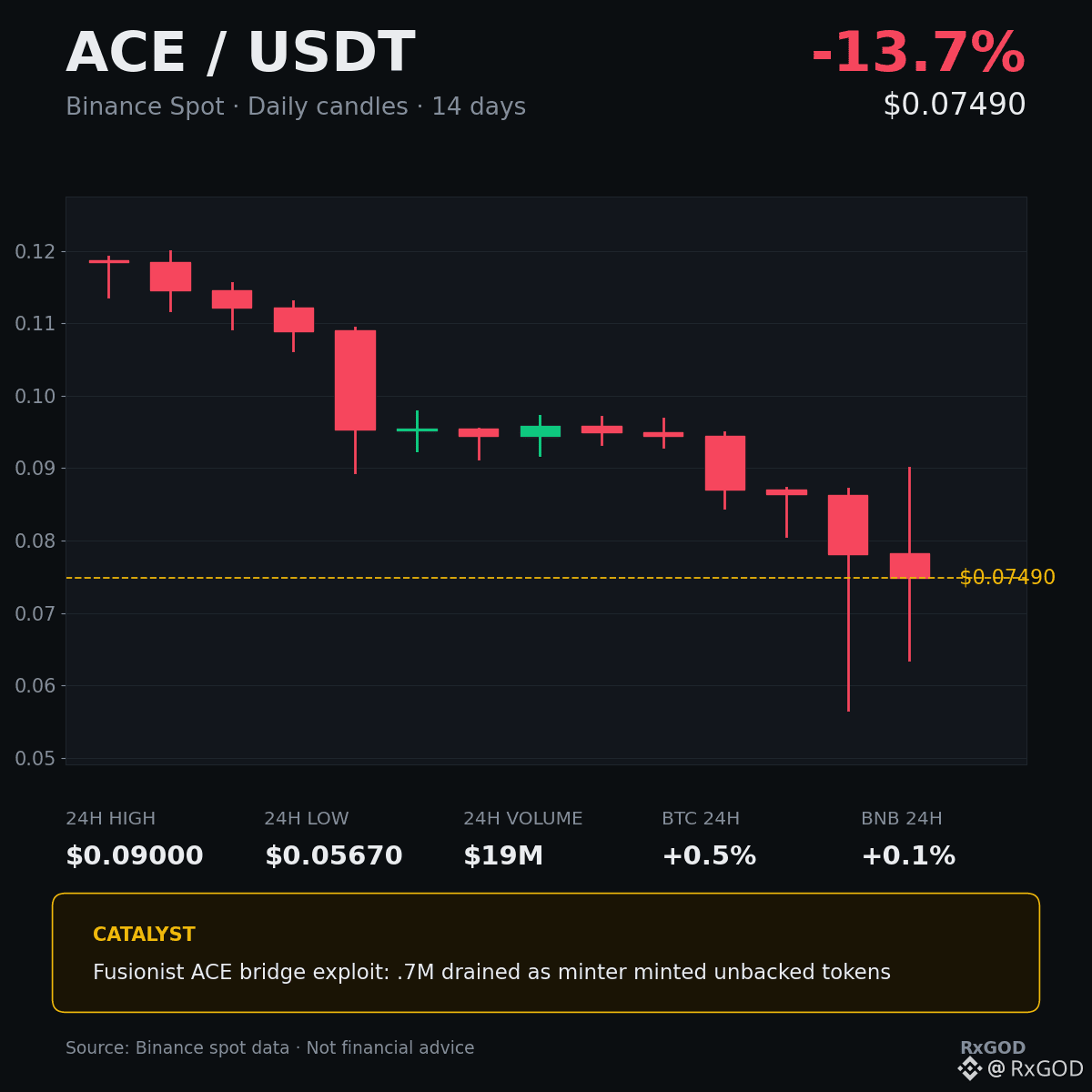
A bridge minter went rogue — and one trader turned $50 into $17,670 in 19 minutes.
Fusionist's $ACE bridge was exploited on Sunday, Nov 22. A privileged minter minted unbacked ACE on BNB Chain, starting with 3.5M tokens and escalating to a single mint of 10 quintillion — against a planned maximum supply of just 147M. The attacker sold the fake supply for about 1,150 ETH (~$2M), with roughly $1.87M traced into Tornado Cash.
The bridge kept honoring its one-for-one redemption rule, so traders bought the collapsed BNB Chain ACE — near $0.0001 while exchanges still quoted ~$0.04 — and redeemed it for genuine ACE. In under two hours, 53.7M real ACE (~$3.7M) drained from the Endurance reserves, leaving just 0.08 ACE. SlowMist puts the combined loss at ~$5.7M, still unaudited.
The fallout is spreading: Bithumb halted ACE trading today after abnormal tokens reached exchanges; Gate is reversing ACE/USDT trades from the exploit window and delisting its ACE perps; Fusionist has paused BNB Chain transfers, trading and bridging. No post-mortem or reimbursement plan yet.
On Binance, $ACE trades at $0.0749, down 13.7% in 24h after an intraday low of $0.0567 — a capitulation low inside a downtrend, not a recovery signal. $BTC holds $61,166 (+0.55%).
One privileged key broke the backing — and the bridge's own rule turned that break into a claim on every real token in reserve.
Gate reversing trades — fair protection, or a line crypto should never cross? Which bridge do you still trust with your funds — or is the answer none at all?
Not financial advice — DYOR.
#ACEExploit #BridgeHack #CryptoSecurity #CryptoNews
4
·
--
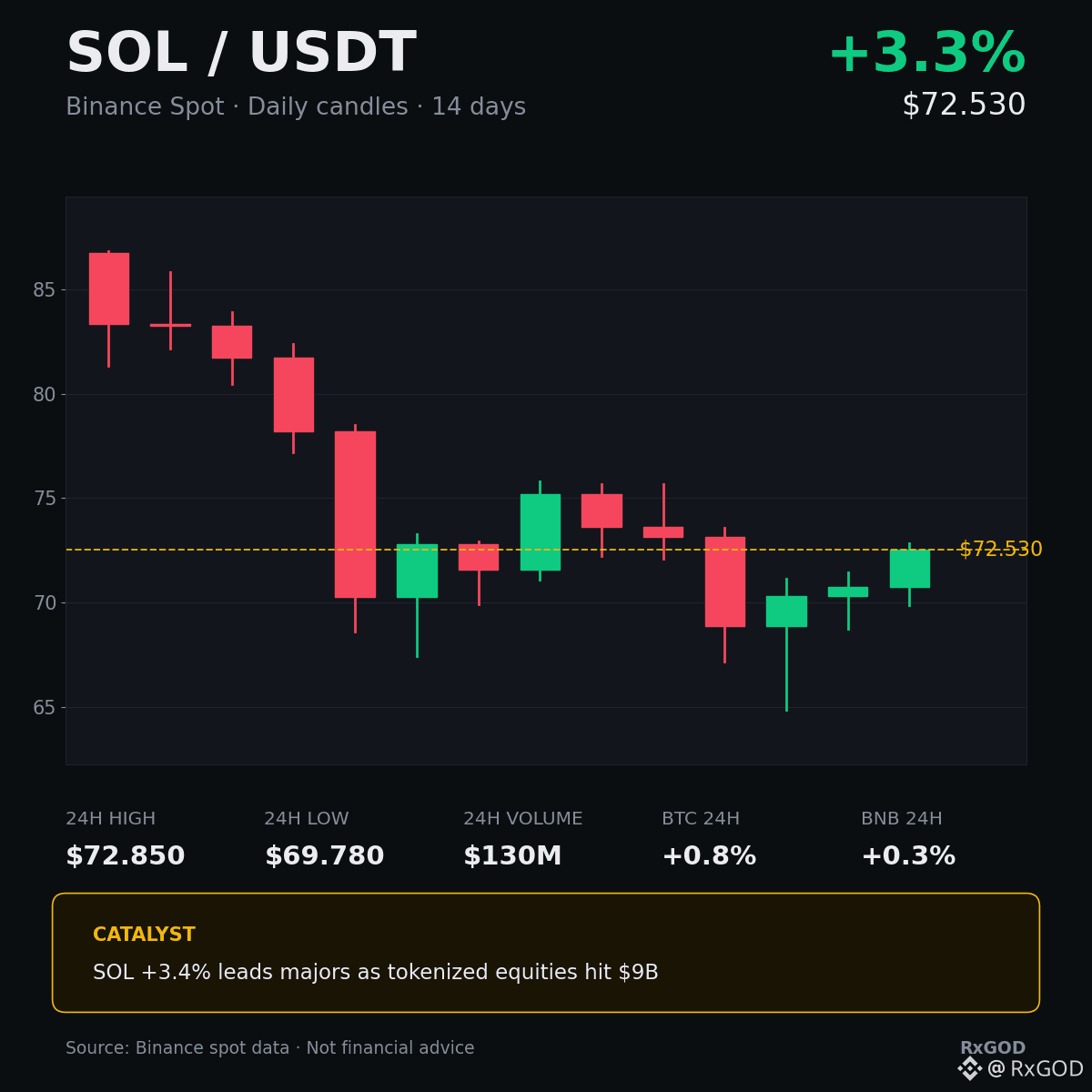
Solana is quietly winning the one race Wall Street actually cares about — while its price is still 75% below its all-time high.
$SOL leads the majors today, up 3.4% to $72.55 on $130M of Binance spot volume, reclaiming $70 after an eight-week losing streak. US spot Solana ETFs just posted their first weekly inflow (+$4.38M) after six straight weeks of outflows — while Bitcoin and Ethereum funds kept bleeding.
The bigger story is off the price chart: tokenized equities on Solana grew from $10M to $2B in just 15 months, according to Raoul Pal speaking at Breakpoint, and cumulative tokenized equity volume has now hit $9B, driven by Sunrise and Backpack. Solana now handles the overwhelming majority of on-chain tokenized stock trading — a real TradFi bridge, not a memecoin cycle.
But let's be honest about the chart: $SOL is still down 13% over 14 days, sitting only about a third of the way up its two-week range, and well below its 50-day average near $89. The November low at $64.87 is the floor that matters — lose it and the bounce story falls apart. Fear & Greed is still stuck in Extreme Fear, so conviction is thin everywhere.
So is this the start of a real rotation into SOL, or just a relief bounce inside a downtrend? Does tokenized-stock volume actually move SOL's price, or is it just a good narrative? And where do you see SOL first — $80 or back to $65?
Not financial advice — DYOR.
#Solana #TokenizedStocks #CryptoNews #ExtremeFear
10
Войдите, чтобы посмотреть больше материала
Присоединяйтесь к пользователям криптовалют по всему миру на Binance Square
⚡️ Получайте новейшую и полезную информацию о криптоактивах.
💬 Нам доверяет крупнейшая в мире криптобиржа.
👍 Получите достоверные аналитические данные от верифицированных создателей контента.
Эл. почта/номер телефона
В тренде
NVIDIAReinstatesJensenHuangasCEO
Просмотров: 23,654
540 обсуждают
TradFi News | Nvidia Board Unanimously Reinstates Jensen Huang as CEO; Shares Jump 30% Premarket
Binance News
·Лайков: 27
·Просмотров: 26.4k
WillMarketsStageAThanksgivingReliefRally?
Просмотров: 125,748
1,656 обсуждают
WillOctCorePCEShiftFedHikeExpectations?
Просмотров: 47,471
687 обсуждают