

Next 100X GEMS
2.1k Публикации

Next 100X GEMS
 Square Verified
Отправить жалобу
Заблокировать пользователя
Next 100X GEMS, a Crypto-Oriented Social Media Platform, Announces Marketing Campaigns for Crypto Projects and Much More | X: @Next100XGEMS
Трейдер с регулярными сделками
6.5 г
39 подписок(и/а)
47.0K+ подписчиков(а)
71.6K+ понравилось
Посты
Все
Цитирования
Видео
PINNED

Статья
Next 100X GEMS, your Crypto FriendNext 100X GEMS is a social media platform focused on #crypto , with about 500,000 Twitter, Instagram, Facebook, Telegram followers, that delivers news and shoutouts for up-and-coming crypto projects. The platform is getting ready to roll out marketing campaigns for these projects across various mainstream media channels, giving them the opportunity to establish an online presence and increase their visibility.
The Next 100X GEMS team spokesperson stated that they believe this initiative will assist potential projects in establishing a strong community presence and attracting investors even before the token launch. The platform offers extensive analysis of crypto projects, presented in a simple and easy-to-understand format.
Since its inception in 2021, the platform has rapidly become one of the most popular sources of information on crypto and #NFTs , as well as emerging projects. With a sizable community of over 500,000 members, Next 100X GEMS attracts crypto enthusiasts from all over the world.
One notable aspect of the Next 100X GEMS community is its ability to bring together people from various backgrounds who share a common interest in cryptocurrency. The Next 100X GEMS team aims to remain impartial and unbiased, as they are one of the largest crypto review and news hubs in the industry. They do so by discussing not only the strengths of a cryptocurrency project but also its limitations and risks.
"Next 100X GEMS' owner mentioned that as #cryptocurrency gains more mainstream attention, it attracts new investors who are vulnerable to scams and other risks in the crypto industry. To address this issue, the platform has established a welcoming and supportive community that collaborates to evaluate the strengths and weaknesses of different crypto projects.
The rapidly expanding market is sure to continue evolving, but according to the Next 100X GEMS team, one thing will always remain constant: they will continue to embrace new individuals and projects into their community and learn about cryptocurrencies together.
About Next 100X GEMS: Next 100X GEMS is a social media network focused on cryptocurrency that offers news on cryptocurrencies and current market trends, as well as reviews of crypto projects, to assist investors in conducting their own comprehensive research.
Important Link:
Official Website: next100xgems.io
Next 100X GEMS, your Crypto Friend
Next 100X GEMS is a social media platform focused on #crypto , with about 500,000 Twitter, Instagram, Facebook, Telegram followers, that delivers news and shoutouts for up-and-coming crypto projects. The platform is getting ready to roll out marketing campaigns for these projects across various mainstream media channels, giving them the opportunity to establish an online presence and increase their visibility.
The Next 100X GEMS team spokesperson stated that they believe this initiative will assist potential projects in establishing a strong community presence and attracting investors even before the token launch. The platform offers extensive analysis of crypto projects, presented in a simple and easy-to-understand format.
Since its inception in 2021, the platform has rapidly become one of the most popular sources of information on crypto and #NFTs , as well as emerging projects. With a sizable community of over 500,000 members, Next 100X GEMS attracts crypto enthusiasts from all over the world.
One notable aspect of the Next 100X GEMS community is its ability to bring together people from various backgrounds who share a common interest in cryptocurrency. The Next 100X GEMS team aims to remain impartial and unbiased, as they are one of the largest crypto review and news hubs in the industry. They do so by discussing not only the strengths of a cryptocurrency project but also its limitations and risks.
"Next 100X GEMS' owner mentioned that as #cryptocurrency gains more mainstream attention, it attracts new investors who are vulnerable to scams and other risks in the crypto industry. To address this issue, the platform has established a welcoming and supportive community that collaborates to evaluate the strengths and weaknesses of different crypto projects.
The rapidly expanding market is sure to continue evolving, but according to the Next 100X GEMS team, one thing will always remain constant: they will continue to embrace new individuals and projects into their community and learn about cryptocurrencies together.
About Next 100X GEMS: Next 100X GEMS is a social media network focused on cryptocurrency that offers news on cryptocurrencies and current market trends, as well as reviews of crypto projects, to assist investors in conducting their own comprehensive research.
Important Link:
Official Website: next100xgems.io
11
4
198
10.2k
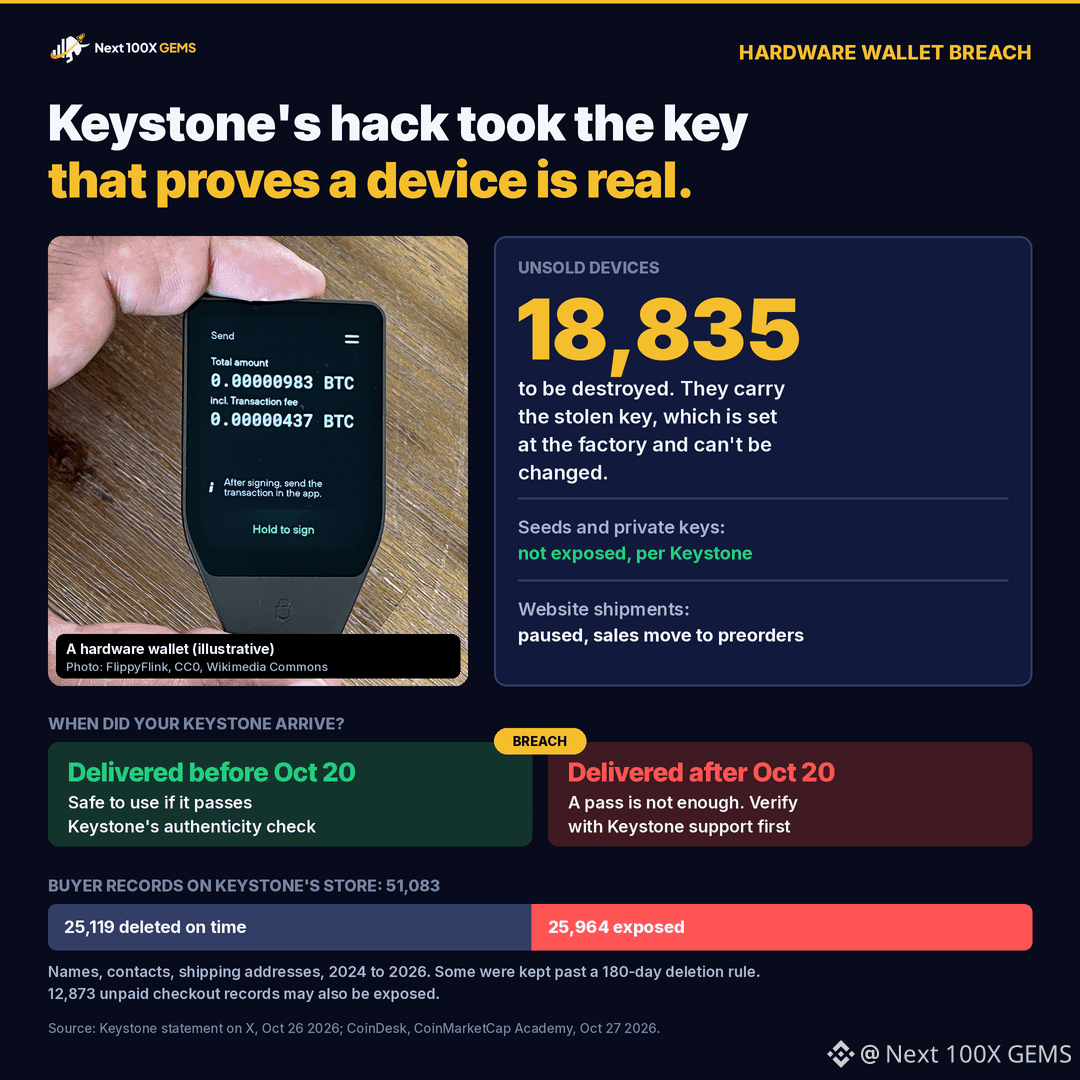
On Sunday we asked why a 2024 Keystone order was still on file when the company's own policy says buyer data gets erased after 180 days. Keystone has now answered, and the answer came with a bigger problem.
The attacker who got into its website on Oct 20 also took the key Keystone uses to check that a device is genuine. That key is written into each wallet at the factory and can't be erased or rewritten. With it, someone could build a counterfeit that passes Keystone's own authenticity check. So the company is destroying 18,835 devices in its inventory, has paused website shipments and is moving sales to preorders with a new key.
On the data side, Keystone's store held 51,083 buyer records. 25,119 had been deleted under the 180-day rule. The other 25,964, from 2024 to 2026, may have been taken: names, contact details, shipping addresses and order details. Keystone says its automated erasure tool failed and nobody caught it. Another 12,873 unpaid checkout records may also be exposed. Recovery phrases, private keys and payment details were not, per Keystone.
What that means if you own one: a Keystone delivered before Oct 20 is fine if it passes the check. One delivered after Oct 20 needs a direct check with Keystone support, even if it passes. You don't need to move your $BTC because of this alone, the company says. Keystone also says it will never ask you to ship a device back, so any "recall" email, call or parcel is a scam.
#CryptoSecurity #HardwareWallet
NFA. DYOR.
616
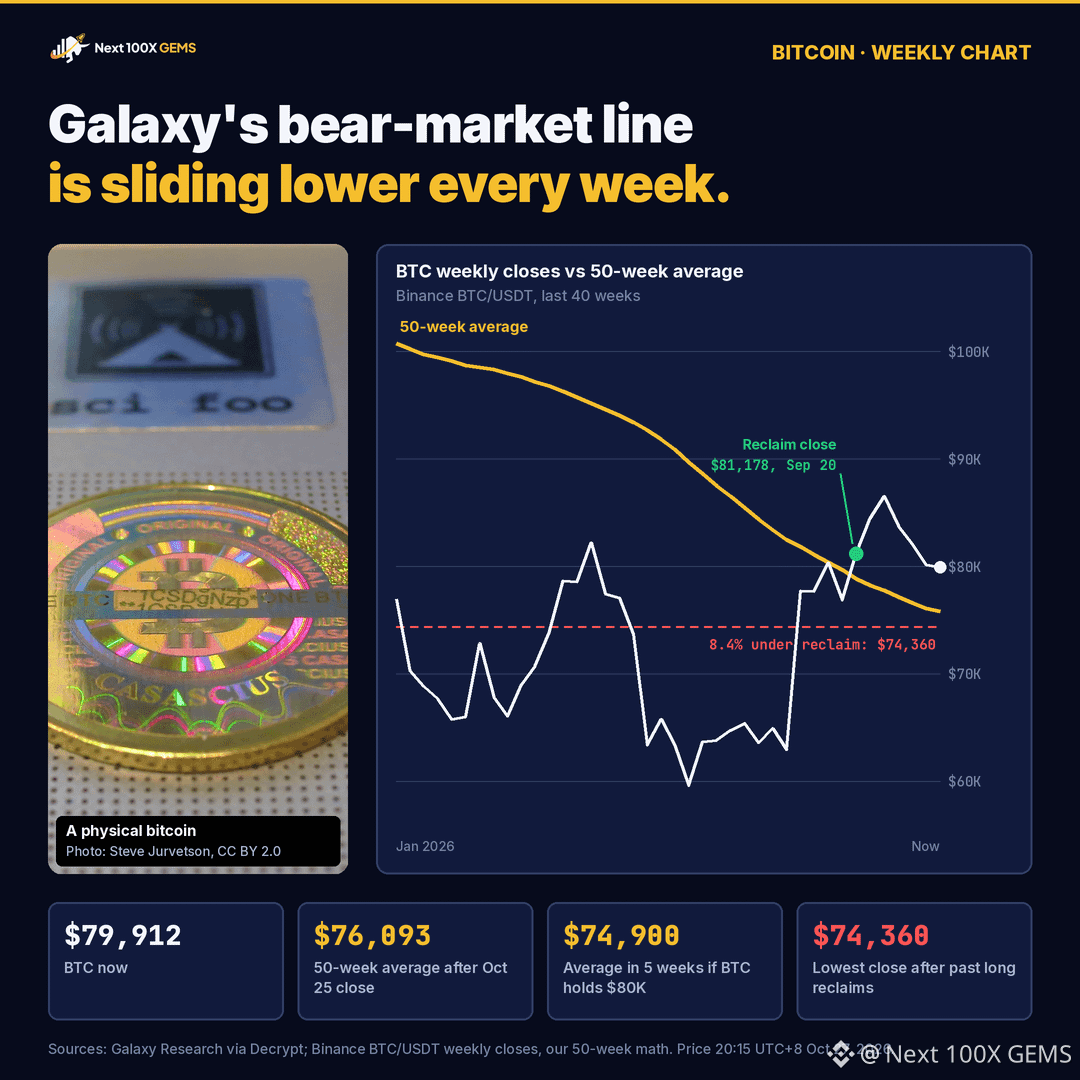
Galaxy says Bitcoin's bear market ended in June, and the line that would prove it wrong is moving down every week.
That line is the 50-week average, which Galaxy put at $76,540. On Binance BTC/USDT weekly closes we get about $76,580 after the Oct 18 close and about $76,090 after Oct 25. Last November's $86K to $94K weeks are now dropping out of the window. If BTC just sits near $80K, our math puts the average near $74,900 in five weeks.
Galaxy's second test is history. After long spells under the average, Bitcoin never closed more than 8.4% below its reclaim level in the year that followed. This reclaim closed at $81,178 on Sept 20, so that floor sits near $74,360.
BTC trades around $79,900 today. That is already 1.6% under the reclaim close and about 5% above the average. Galaxy and Thorn both disclose they hold BTC.
The Fed decides on Wednesday, and this week's candle closes at 08:00 UTC+8 on Monday. A weekly close under about $76K starts Galaxy's one-month clock.
$BTC
#Bitcoin #FOMC
NFA. DYOR.
84
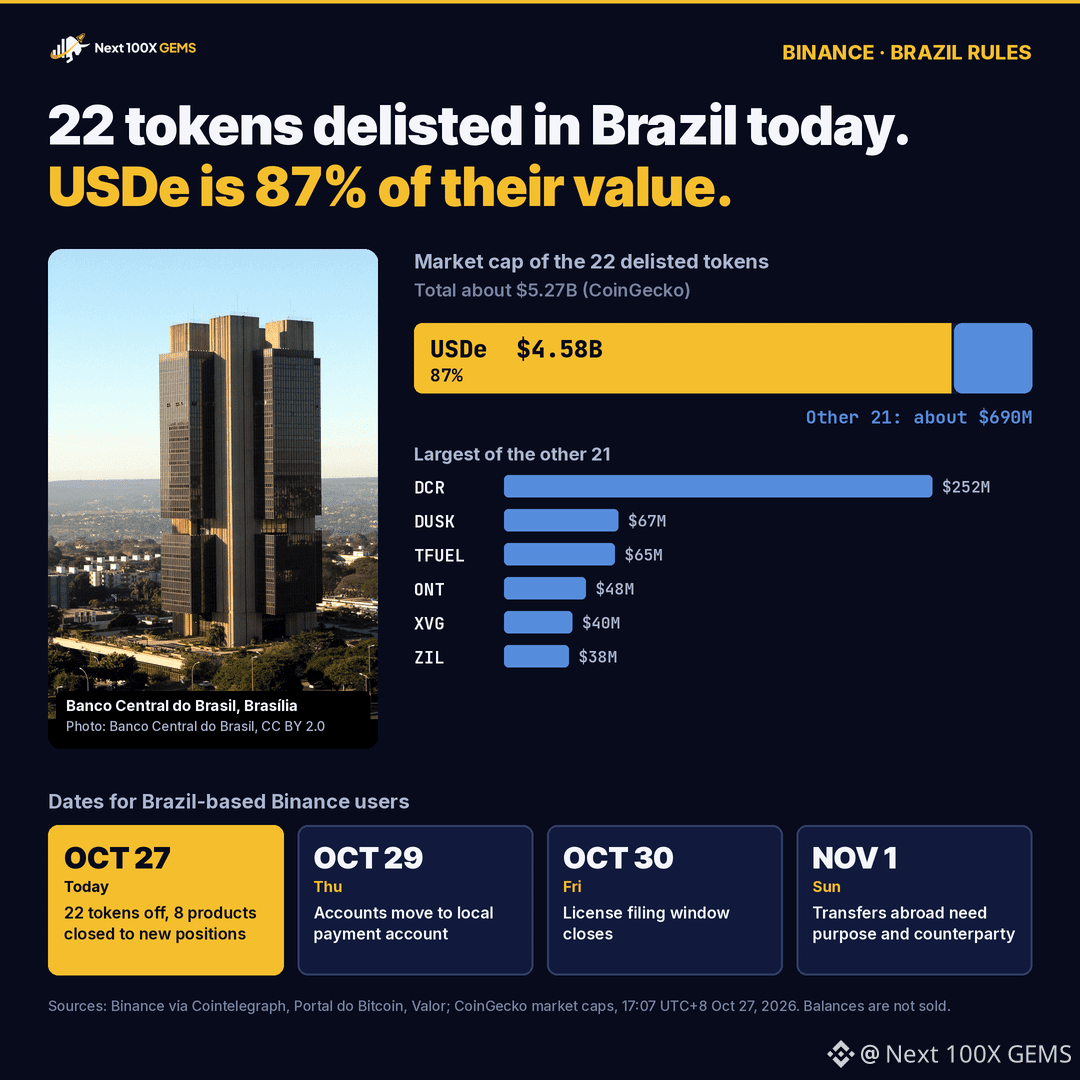
Binance pulled 22 tokens from trading for users in Brazil today. On CoinGecko's numbers they are worth about $5.27B combined, and Ethena's USDe alone is $4.58B of that, roughly 87%.
The other 21 come to about $690M. Decred is the biggest at around $252M, then Dusk, Theta Fuel, Ontology, Verge and Zilliqa. TerraClassicUSD is on the list as well. Nothing gets sold for you. Balances stay in the account and can still be withdrawn.
Eight products stopped taking new positions today too, including Loans, Margin, Launchpool, Megadrop, HODLer Airdrops and Alpha 2.0. Existing loans can only be repaid. Open margin positions stay for now, with no closing date set.
This is Binance lining up with the central bank's new crypto rules. It filed for a license on Oct 23 through a new local company, BBrasil. A filing is not approval.
The dates for Brazil-based users: accounts move to a local payment account by Oct 29, the license filing window for existing firms closes Oct 30, and from Nov 1 every international deposit or withdrawal needs a stated purpose and counterparty details, or it sits pending.
$USDE $DCR
#Binance #Brazil
NFA. DYOR.
1
418
Проверено
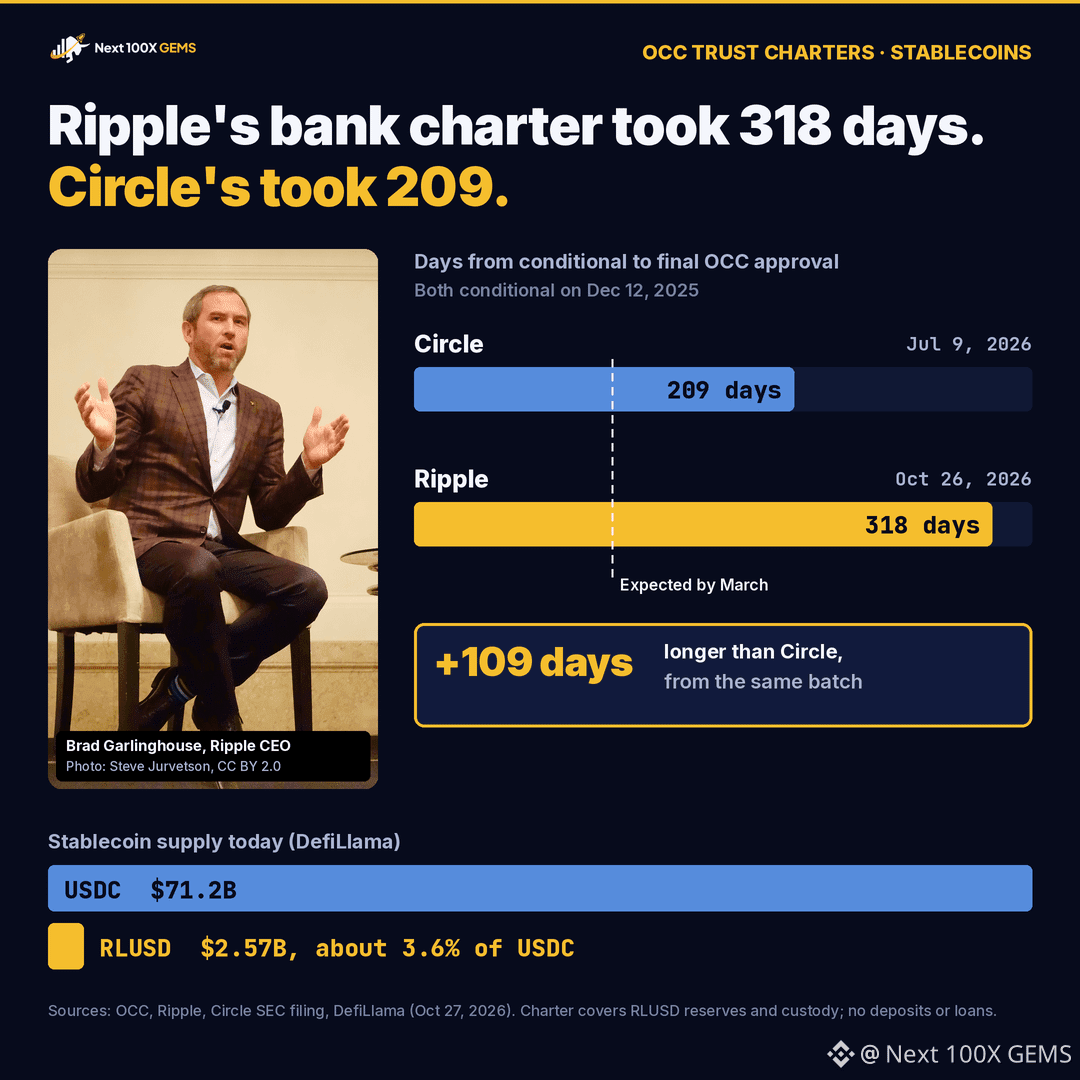
Ripple's national trust bank got final OCC approval on Oct 26, 318 days after its conditional approval. Circle cleared the same step in 209.
Both were approved conditionally on the same day, Dec 12, 2025, in one batch of five crypto firms. Circle got its final sign-off on July 9. Ripple waited another 109 days, and reports in late 2025 expected it by March.
The charter is narrower than the headline. Ripple National Trust Bank can manage the reserves behind RLUSD, act as collateral trustee for holders and offer crypto custody. It cannot take deposits or make loans, and RLUSD is still issued by Ripple's New York trust company.
Size is the bigger gap. DefiLlama shows RLUSD at about $2.57B today, around 3.6% of USDC's $71.2B. It added roughly $100M in the last day, which barely dents a 27x difference.
XRP sat near $1.30 around midday UTC+8, up about 1% on the day, so the token has mostly shrugged.
Ripple and Circle now hold the same kind of federal charter, so a 27x gap can no longer be put down to licensing. The RLUSD supply line is the number to track from here.
$XRP
#Ripple #Stablecoins
NFA. DYOR.
734
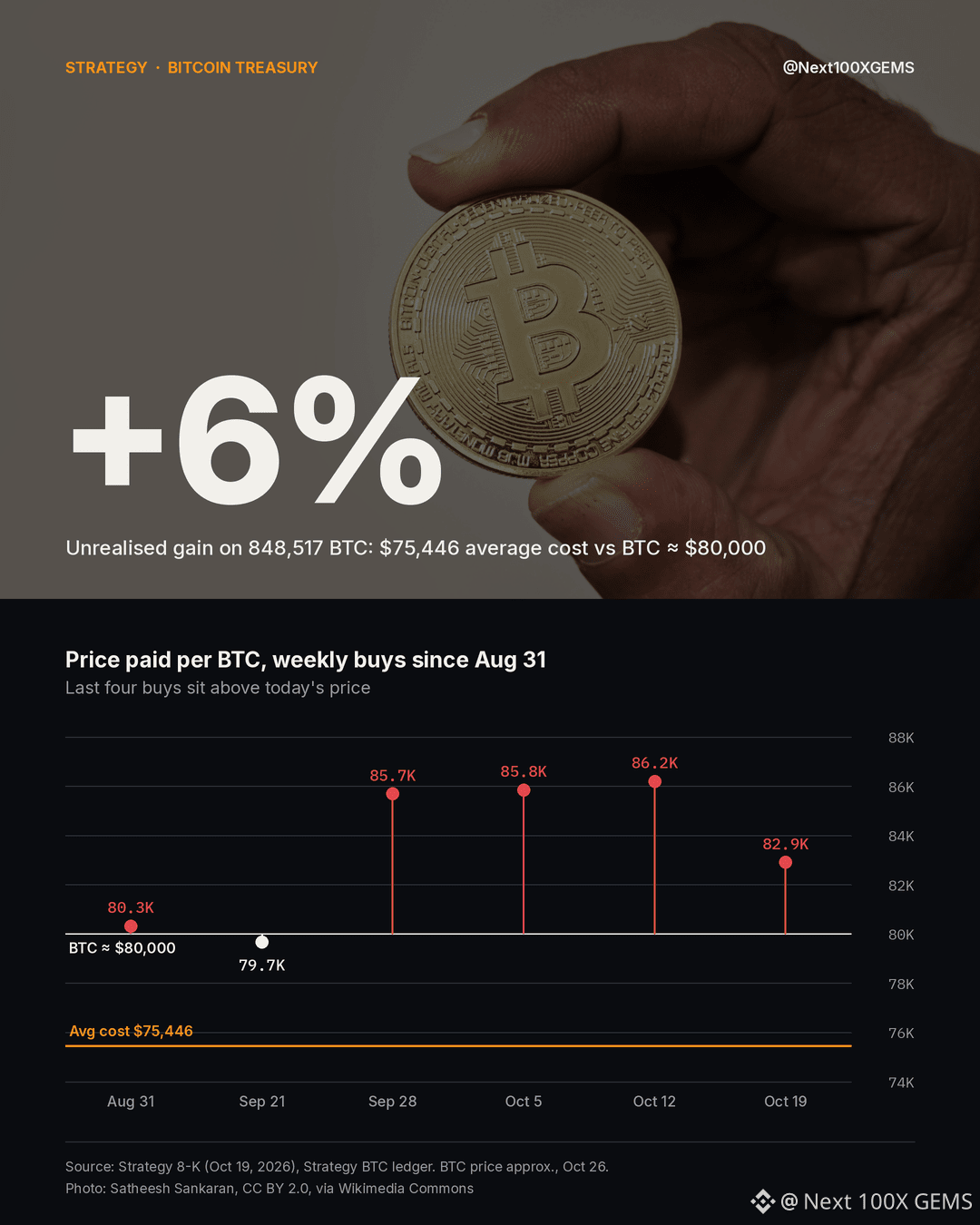
Strategy now holds 848,517 BTC at an average cost of $75,446 per coin, based on its latest 8-K. With BTC trading around $80,000, the whole stack is only about 6% in profit.
The newer buys tell a different story. The last four weekly purchases came in between $82,900 and $86,194 per BTC. At today's price, every one of them is under water, by roughly 3.5% to 7%.
The pace has also slowed. Weekly buying is down to about $22M, and it is being paid for with MSTR share sales. That works best while the stock trades at a healthy premium to the bitcoin it holds.
This week packs the test into a few days: the Fed decision on Wednesday, then Strategy and Coinbase earnings on Thursday. If BTC slips toward the $75K average cost, that thin cushion becomes the main question on the call.
Worth watching the cost basis line, not just the headline coin count.
$BTC
#Bitcoin #MicroStrategy
NFA. DYOR.
187
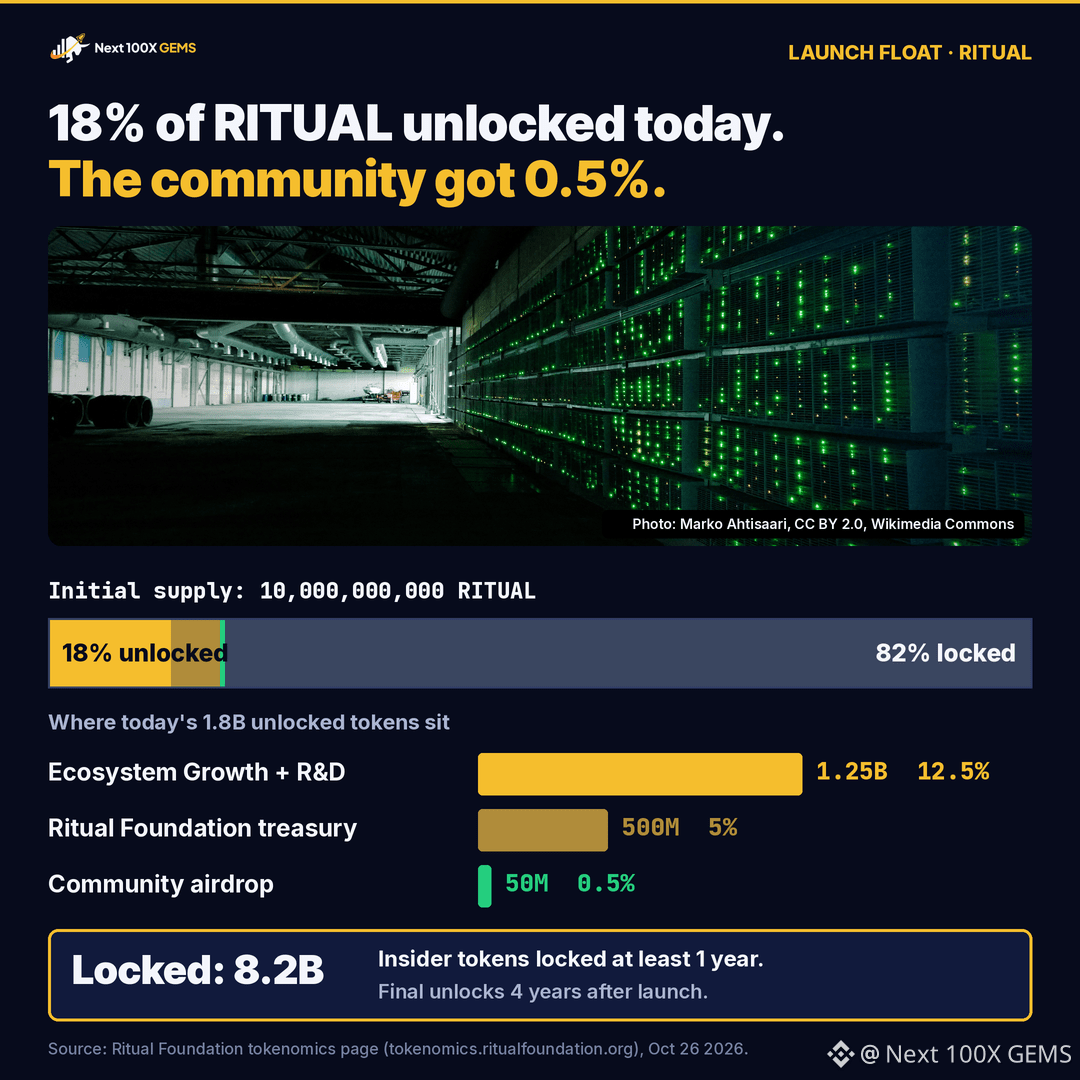
Ritual went live on mainnet today, and the token page says 18% of RITUAL is unlocked at launch. That is 1.8B tokens out of a 10B initial supply. Coinbase listed RITUAL-USD for today too, with trading opening once liquidity conditions are met.
The part worth reading twice is where that 1.8B sits. 1.25B comes from the Ecosystem Growth + R&D bucket and 500M from the Ritual Foundation treasury. The community airdrop to node operators, Frenrug users and long-time members is 50M tokens, 0.5% of supply, fully unlocked.
So 97% of the day-one float is held by the project side, not by airdrop farmers. If you are trying to read sell pressure this week, the airdrop wallets are the small story. Foundation and ecosystem wallets moving to exchanges would be the big one.
The other 8.2B is locked. Core contributors (29%) and Labs investors (11.3%) wait at least a year, and the last tokens unlock four years after launch. Supply has no cap either: about 5% yearly issuance, partly offset by base-fee burns.
Before you trade the listing, check the float math, not just the chart.
$RITUAL
#Ritual #Tokenomics
NFA. DYOR.
67
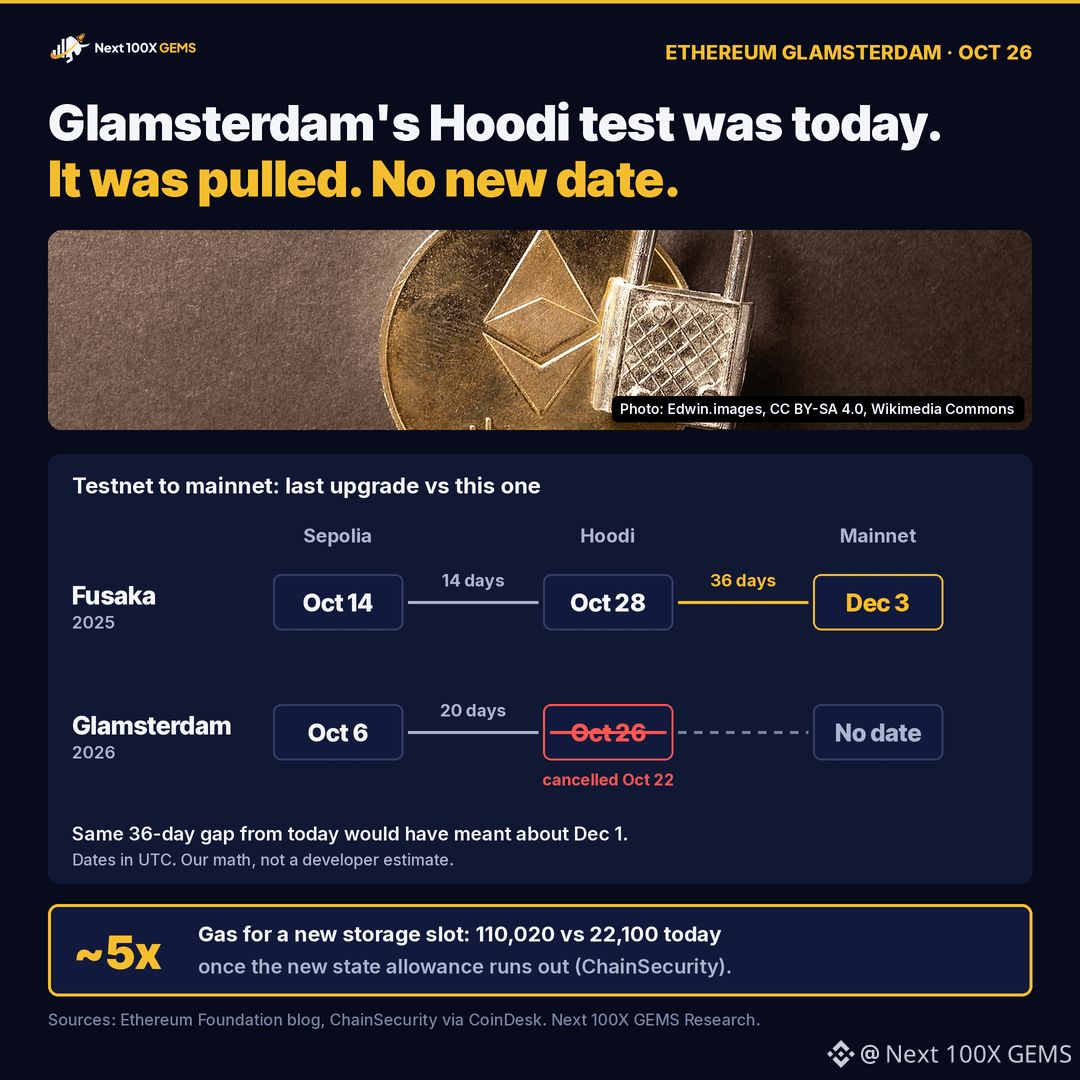
Ethereum's Glamsterdam upgrade was due on the Hoodi testnet at 17:42 UTC today. That slot was cancelled on Oct 22, and 20 days after Sepolia went live there is still no new date.
Developers pulled it after ChainSecurity showed that two gas changes in the upgrade, EIP-8037 and EIP-8038, can change how live contracts handle a failed call. A contract that used to revert can now finish its failure handler and mark a retryable action as failed for good. ChainSecurity says it has already found 13 real contracts with that pattern and is contacting those teams privately.
It cuts the other way too. Creating a new storage slot could cost 110,020 gas once a separate state allowance runs out, against 22,100 today. That is about 5x, enough to make a contract with a fixed gas budget fail on a normal action.
Then the calendar. Fusaka went from Hoodi on Oct 28, 2025 to mainnet on Dec 3, 36 days later. Even if Hoodi had gone ahead today, the same gap would have put mainnet around Dec 1, right where devs were aiming. Every day Hoodi stays unscheduled now pushes that out, by our math.
Mainnet date: none. ETH holders have nothing to do. Teams whose contracts check remaining gas before a retry have homework.
$ETH
#Ethereum #Glamsterdam
NFA. DYOR.
158
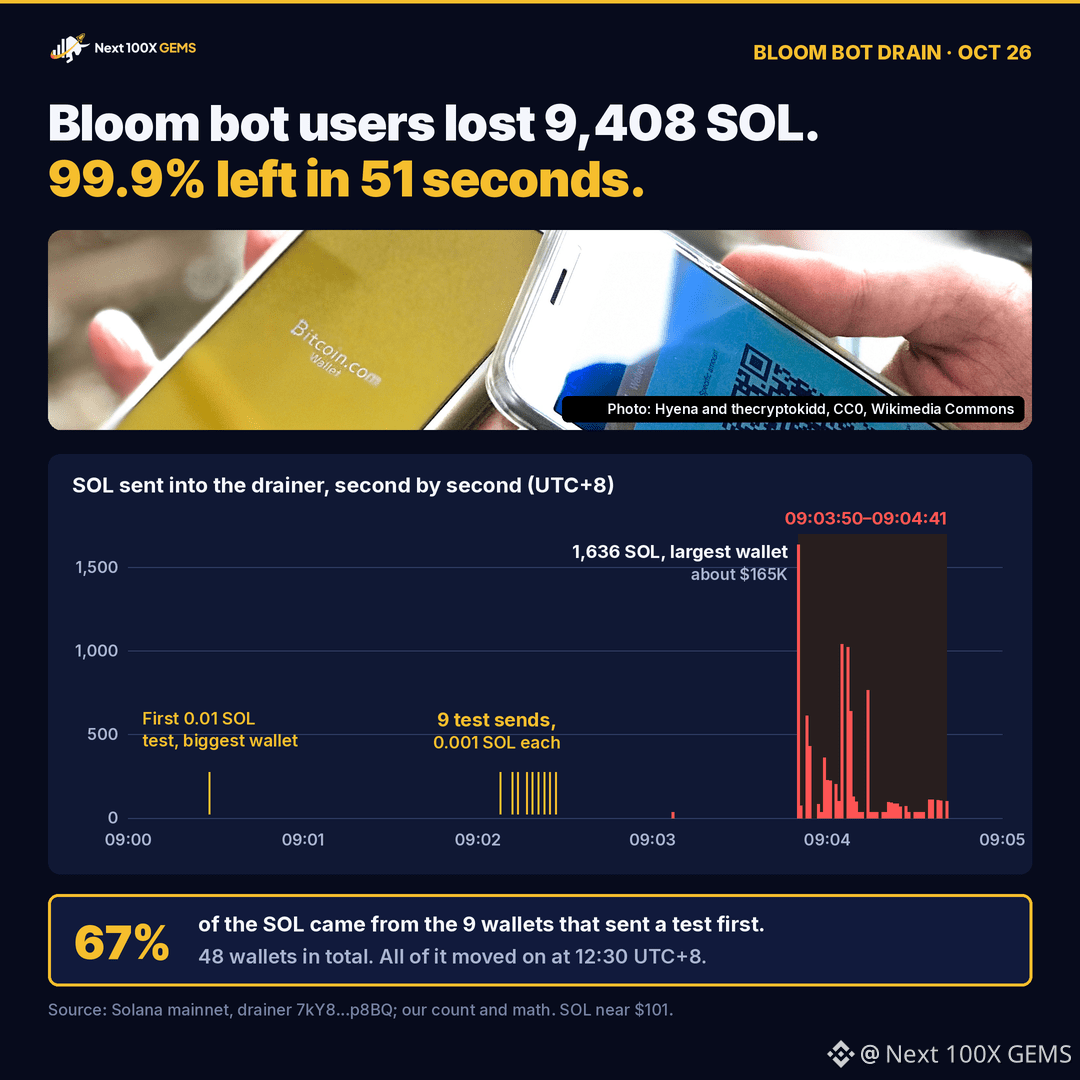
Bloom says 9 users were drained this morning. On-chain we counted 48 wallets emptied into one address, 9,408 SOL in total, and 99.9% of it arrived in 51 seconds.
The sweep ran from 09:03:50 to 09:04:41 UTC+8. At about $101 per SOL that is roughly $950K. The largest single wallet lost 1,636 SOL, around $165K. Bloom says the 49 affected wallets belong to 9 people, which fits the chain.
The test sends are what stand out. At about 09:00 the biggest victim wallet sent the drainer 0.01 SOL. At 09:02 nine wallets sent 0.001 SOL each, all within 20 seconds. Those nine then lost 6,279 SOL, two thirds of everything taken. To us that looks like someone checking which keys worked before moving the real money. That is our inference; Bloom has not confirmed a cause.
At 12:30 UTC+8 the full 9,408 SOL left the drainer in one transfer to a new address. The original wallet now holds zero.
Bloom has promised full refunds to new wallets picked by each owner, has paused some services, and says it is checking whether a third party was involved.
If you ever imported a private key into a trading bot, move what is left to a fresh seed today. A bot wallet should only hold what you can afford to lose.
$SOL
#Solana #CryptoSecurity
NFA. DYOR.
1
361
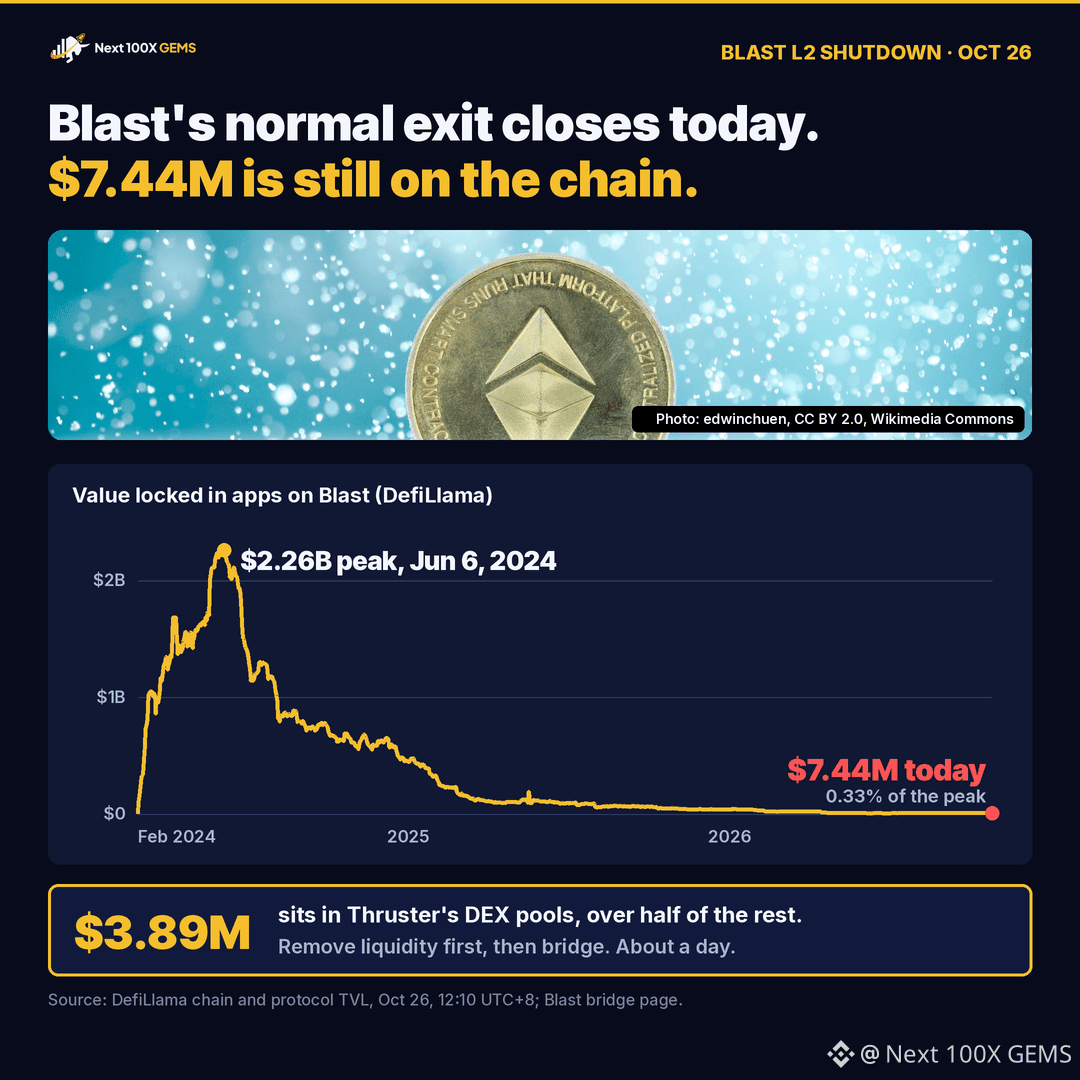
Blast's normal withdrawal route closes today, Oct 26, and DefiLlama still counts $7.44M sitting in apps on the chain.
That is about 0.33% of the $2.26B peak it recorded on June 6, 2024. The team announced the shutdown on Oct 2, saying the L2 costs more to run than it earns.
Over half of what's left sits in one DEX. Thruster's two pool versions hold about $3.89M (checked 12:10 UTC+8). LP tokens don't bridge on their own, so you remove the liquidity first and then bridge the coins back to Ethereum. Blast's bridge page says that leg takes about a day.
After today, Blast says funds can still come out, but only by calling its bridge contracts on Ethereum directly. It promised to publish instructions, and as of 12:10 UTC+8 its last post on X is a reminder from Oct 13.
Coinbase told users to move BLAST off before Oct 26 or lose access once the network shuts down.
Blast hasn't named a cutoff hour. If you still have anything on the chain, the PWA wallet included, start the exit now through the official Blast bridge. Anyone in your DMs offering to recover Blast funds is running a scam.
$BLAST
#Blast #Layer2
NFA. DYOR.
160
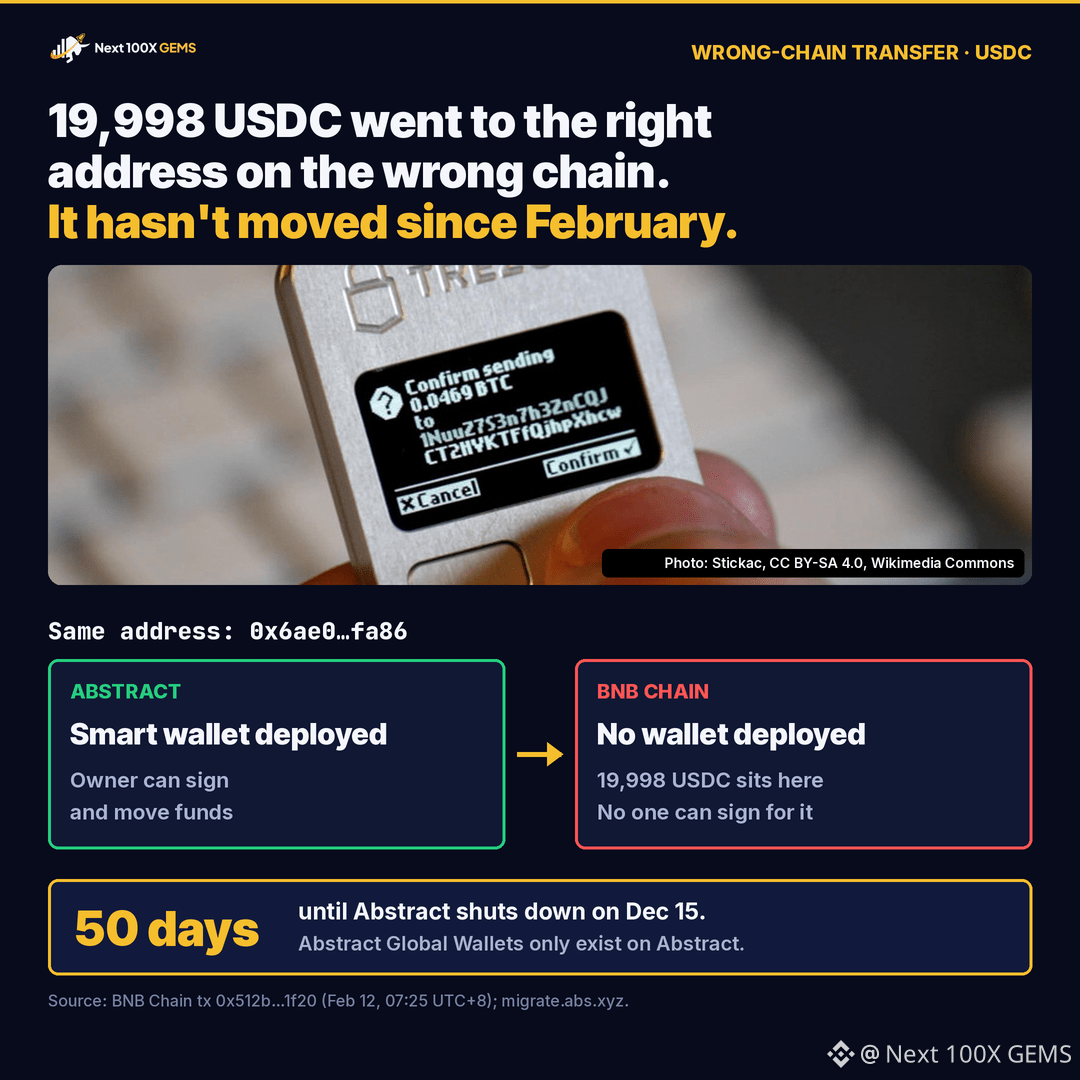
19,998 USDC has been sitting at one BNB Chain address since February. The sender says it is theirs. On BNB Chain, nobody can move it.
The address belongs to an Abstract Global Wallet, the smart-contract wallet built into the Abstract network. On Feb 12 at 07:25 UTC+8 the funds landed at that same address on BNB Chain. The address string matched, but the wallet itself was never deployed there. We checked: the address holds no contract code on BNB Chain, and the 19,998 USDC is still in it.
The sender says the Abstract Foundation told them recovery is technically impossible. On Oct 25 at 21:39 UTC+8 they posted a public bounty: $15,000 to anyone who can get it back.
This matters more now because Abstract is winding down. Its migration page says users have until Dec 15 to move funds out. That is 50 days away.
If you hold funds in an Abstract Global Wallet, only use the official exits, migrate.abs.xyz or the native bridge. Keep a little ETH on Abstract for gas and move it last. Native withdrawals can take up to 24 hours, so don't leave it to the final week. And never paste an AGW address as a receiving address on another chain.
$USDC $ETH
#CryptoSecurity #Abstract
NFA. DYOR.
234
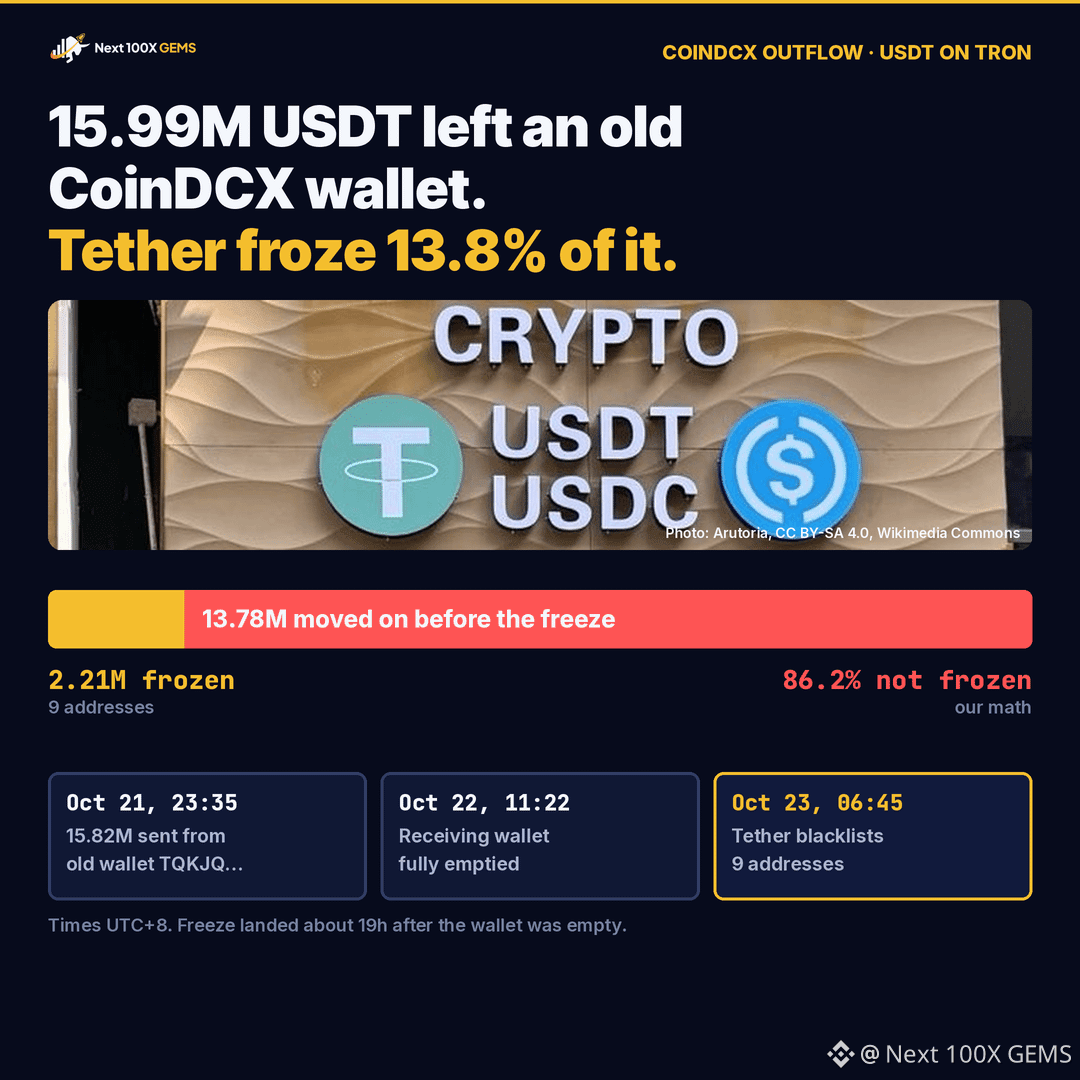
CoinDCX has now put a number on its TRON outflow: 15.99M USDT, lost from an old wallet it had called retired. Tether froze 2.21M of it. That is 13.8%.
On Oct 21 at 23:35 UTC+8, the old address TQKJQ sent 15,819,002 USDT in one transfer to a new wallet, which also took about 172,000 USDT from 39 smaller addresses. By 11:22 UTC+8 on Oct 22 that wallet had sent everything on to six addresses.
Tether blacklisted nine linked addresses at 06:45 UTC+8 on Oct 23, about 19 hours after the first wallet was empty. Those nine hold 2,212,850 USDT. By our math, about 13.78M, or 86.2%, had already moved on.
In a blog post on Oct 25, CoinDCX said the loss hit "old, deprecated wallet infrastructure which had unknown vulnerabilities", that its sweeping service had failed for a period, and that it absorbed the loss. It says customer balances are fully accounted for.
On-chain records read by CryptoWatchDesk show the same old address forwarding USDT as late as May 2026.
A freeze only catches what is still sitting still. Only deposit to the address your exchange app shows you today, never to one saved from before.
$USDT
#CoinDCX #Tether
NFA. DYOR.
150
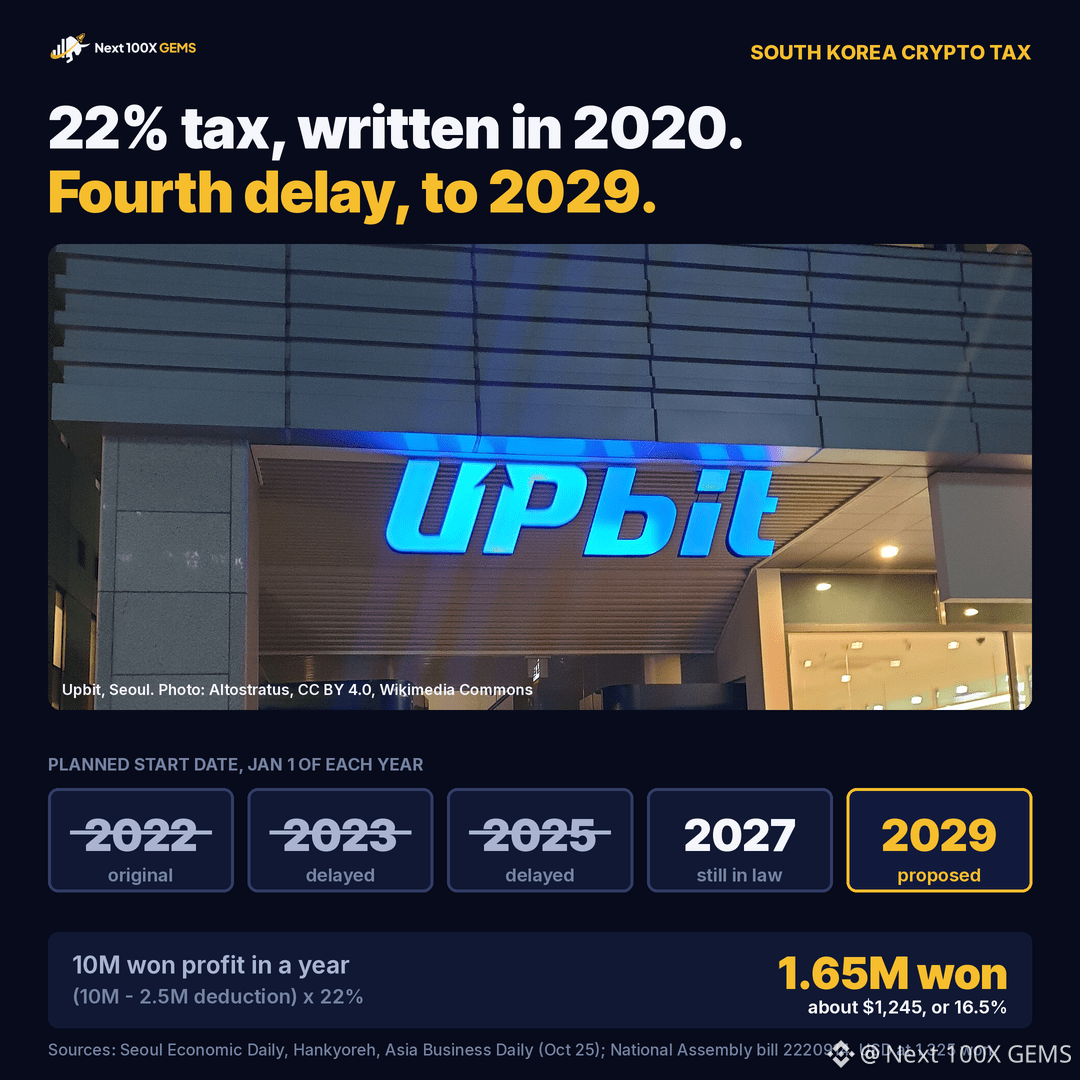
South Korea's 22% crypto tax was written into law in 2020 to start in 2022. It is now heading for its fourth delay, to 2029.
A presidential office official told Seoul Economic Daily on Sunday that the discussion "has moved toward delaying" the tax, which is still set to start on Jan 1, 2027. Hankyoreh was told the same. The main reason given is the US: it only joins the OECD's crypto data-sharing system, CARF, in 2029, so taxing now would fall mostly on users of Korean exchanges.
The start date has already moved from 2022 to 2023, then 2025, then 2027. A 2029 start would come eight years after the law was passed.
Yearly gains from selling or lending coins like Bitcoin, after losses are netted, are taxed at 22% above a 2.5M won deduction. A trader who makes 10M won (about $7,550) in a year would owe 1.65M won, about $1,245, or 16.5% of the profit.
Nothing is final. Parliament still has to amend the Income Tax Act. Bills moving the start to Jan 1, 2029 are already filed and both main parties back a delay. Seoul Economic Daily expects the change in November's tax review.
Until that vote, Jan 1, 2027 is still the date in the law.
$BTC
#CryptoTax #Bitcoin
NFA. DYOR.
1
5
2.5k
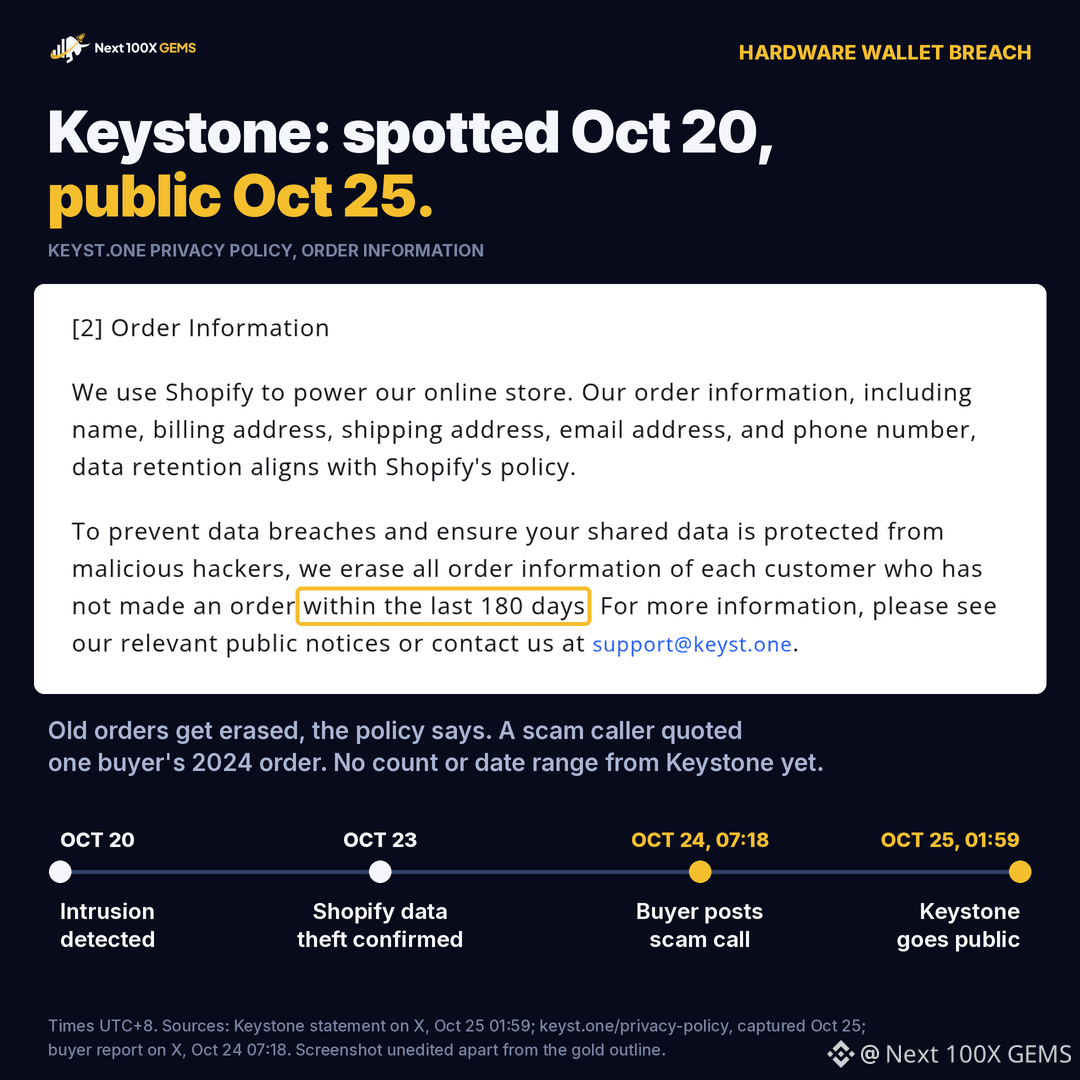
Keystone spotted someone inside its website on Oct 20. The public heard about it at 01:59 UTC+8 on Oct 25, and one buyer says the scammers called first.
The hardware wallet maker says that after checking its Shopify API activity, it confirmed on Oct 23 that a third party had taken customer shipping data: names, contact details, shipping addresses and order details, including items and prices. Card and bank details, recovery phrases, private keys and wallet passwords were not exposed, per Keystone.
About 18 hours before that statement, an X user posted that a caller on a spoofed Montreal police number had read back details matching their Keystone order from 2024.
That date is the awkward part. Keystone's own privacy policy says it erases the order information of any customer who hasn't ordered within the last 180 days. Under that rule, a 2024 order with no newer purchase shouldn't still be on file. If the caller's data did come from this breach, older buyers are in scope too. Keystone hasn't confirmed either way, and it hasn't said how many customers were hit. A detailed report is promised "in the coming days."
A hardware wallet keeps your $BTC keys offline. It can't stop someone who knows your name and address from calling about a "refund" or mailing you a "replacement" built to steal your seed.
If you ever bought from Keystone, treat any call, text, email or parcel offering a refund, a new device or a fix as a scam. Never type your recovery phrase into a device you didn't order.
#CryptoSecurity #HardwareWallet
NFA. DYOR.
166
Проверено
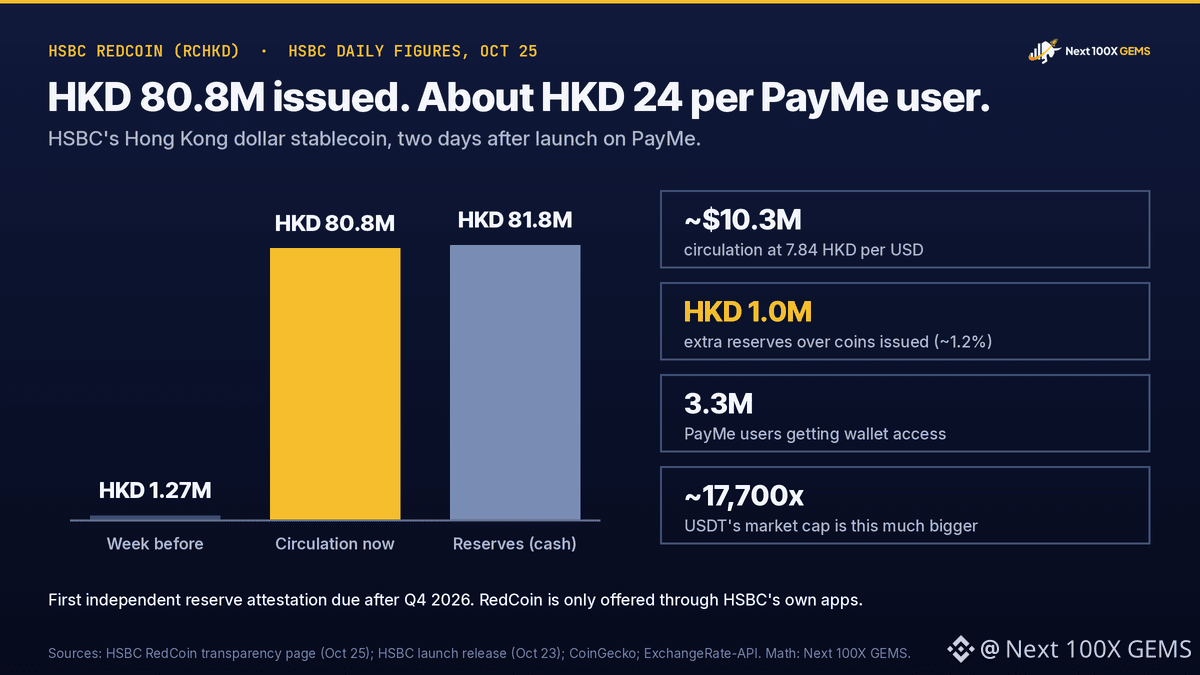
HSBC has HKD 80.8M of its new RedCoin stablecoin in circulation, about $10.3M. Averaged across PayMe's 3.3 million users, that's roughly HKD 24 each.
RedCoin (RCHKD) went live on PayMe on Friday under an HKMA stablecoin licence. HSBC posts circulation and reserves daily. Today's page shows a 7-day change of HKD +79.5M, which puts last week's figure near HKD 1.27M, from a staff pilot of nearly 100 users.
Reserves are HKD 81.8M, all in cash. That's exactly HKD 1M more than the coins issued, a buffer of about 1.2%.
It runs on HSBC's own ledger, not a public chain, and coins can't move between PayMe and the HSBC banking app. Wallet activation is rolling out "in the coming days", per HSBC. For scale, USDT's market cap is about $182B, around 17,700 times bigger.
The first independent attestation of the reserves is due after Q4 2026. HSBC says RedCoin is only offered through PayMe and, later, its own banking app, so any RCHKD token on a DEX or another platform isn't HSBC's.
#Stablecoin #HongKong
NFA. DYOR.
1.7k
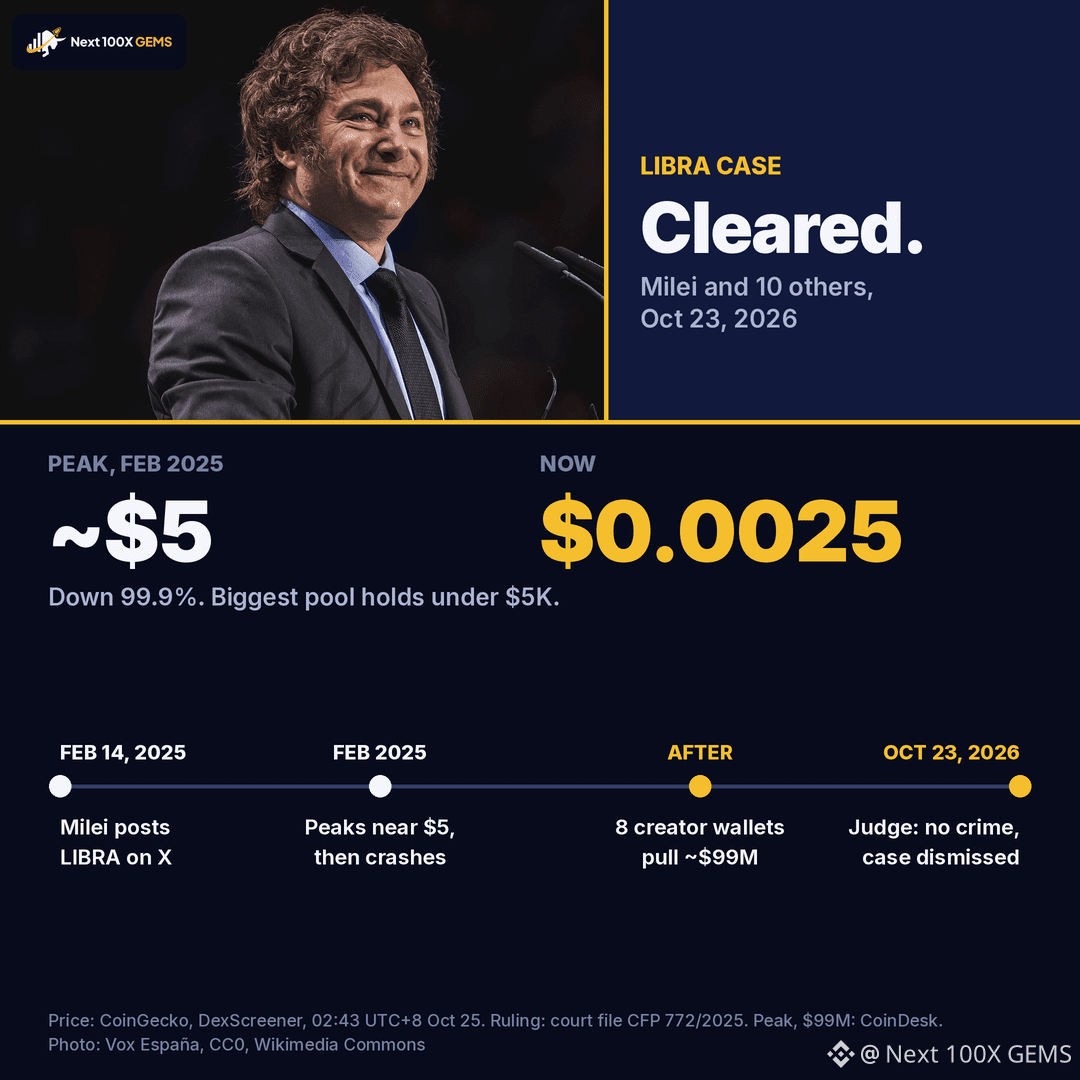
An Argentine federal judge has dismissed the LIBRA criminal case. Judge Marcelo Martínez de Giorgi cleared President Javier Milei, his sister Karina, token adviser Hayden Davis and eight others on Friday, finding the reported events "do not fall under a legal category" and no criminally relevant deception was proven. None of the 11 were ever formally questioned.
Quick recap. Milei posted about LIBRA on X on Feb 14, 2025. The Solana memecoin ran to about $5, then lost more than 95% of its value, while wallets linked to its creator withdrew around $99M, per CoinDesk.
Where it stands today: CoinGecko has LIBRA at about $0.0025, roughly 99.9% below that peak. Its biggest DexScreener pool holds under $5K in liquidity and traded less than $500 in the last 24 hours (checked 02:43 UTC+8, Oct 25).
The case may not be fully over. The prosecutor asked for the dismissal and isn't expected to appeal, but investors removed as plaintiffs in July are challenging that at Argentina's Federal Criminal Cassation Court. If they get back in, they can appeal.
The ruling settles who goes to court, not who got paid. A famous name posting a contract address is not due diligence. Check who holds the supply and who can pull the liquidity before you buy.
$SOL
#Memecoin #CryptoNews
NFA. DYOR.
188
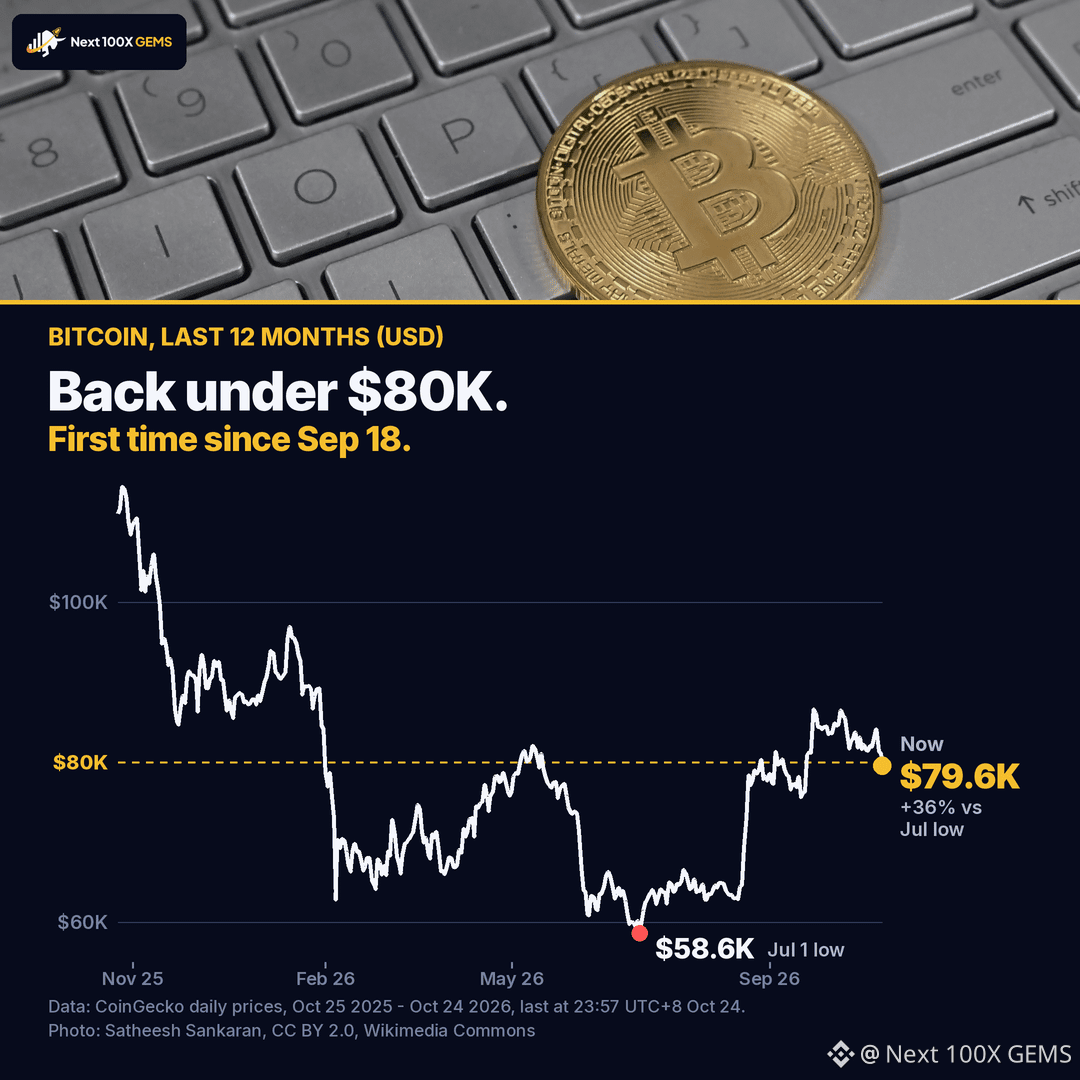
Bitcoin traded under $80,000 on Saturday for the first time since Sep 18. CoinGecko had it at about $79.6K around 23:57 UTC+8, down roughly 2.4% on the day.
The trigger was geopolitical. The Wall Street Journal reported Saturday morning, US time, that the US is quickly evacuating personnel from embassies and military bases across the Middle East on intelligence that Iran is preparing attacks on Americans. ETH is down about 4% near $2,300 and SOL slipped under $100.
It lands on a soft week for flows. US spot bitcoin ETFs lost $635.6M on Oct 22, more than wiping out the $528.4M that came in the day before.
For context, BTC is still about 36% above its Jul 1 low near $58.6K, and about 37% below the $126,080 all-time high from Oct 6, 2025. $80K is a level it has crossed back and forth several times this year.
Weekend order books are thin and headline moves can run further than usual. If you trade with leverage, size down until Monday's open and keep stops away from round numbers.
$BTC $ETH $SOL
#Bitcoin #CryptoMarket
NFA. DYOR.
1
1.5k
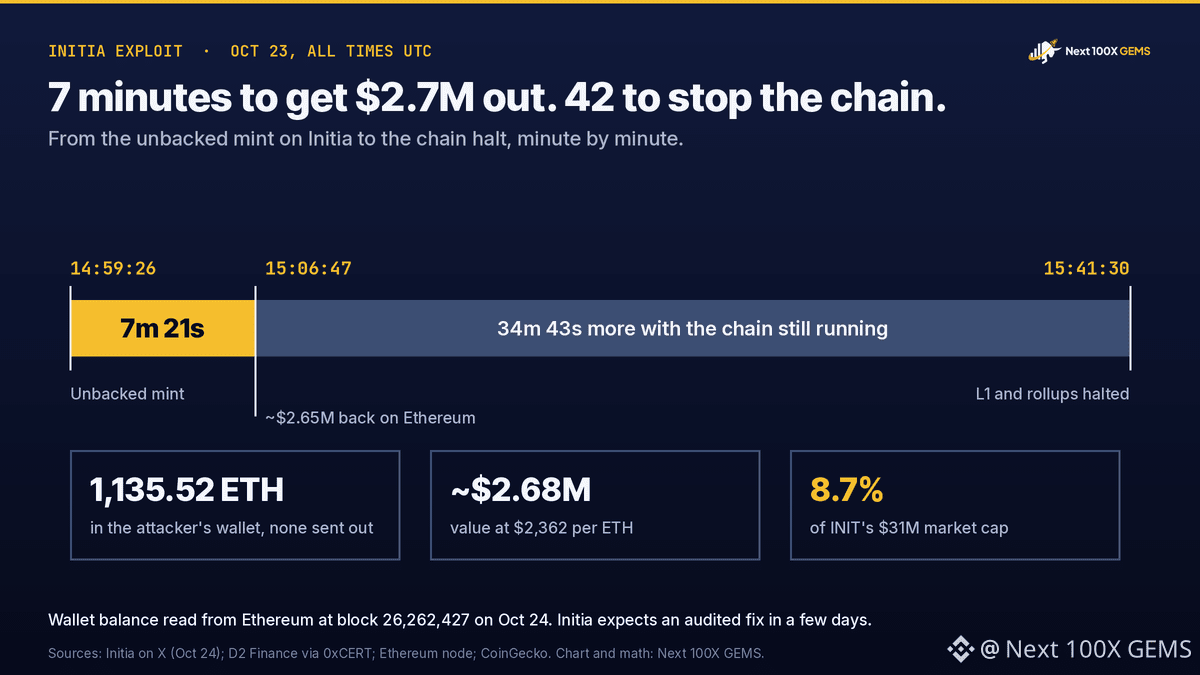
Initia's chain kept running for 42 minutes after the exploit. The attacker needed about 7 of them to get $2.7M out to Ethereum.
Initia posted its explanation on Saturday at 08:46 UTC. At 14:59 UTC on Oct 23, a bug in how its MoveVM caches scripts let malicious code skip security checks and credit the attacker with unbacked WETH, iUSD and USDC. No native INIT was minted and INIT's total supply is unchanged, the team says.
The exit went through the bridges: 105 WETH and about 1.4M AUSD0 via LayerZero, about 1.08M USDC via Noble and CCTP. On-chain analysts at D2 Finance say about $2.65M was back on Ethereum 7 minutes 21 seconds after the mint. The halt came at 15:41:30 UTC.
We checked the attacker's Ethereum wallet at block 26,262,427. It holds 1,135.52 ETH, about $2.68M at $2,362, and has not sent a single transaction yet.
For scale, $2.7M is about 8.7% of INIT's $31M market cap on CoinGecko. INIT is still up 11% on the day.
The L1 and rollups stay halted until a fix is audited, which Initia expects in a few days. Don't bridge to or from Initia before then, and ignore any "claim" or "refund" links.
$INIT $ETH
#Initia #CryptoHack
NFA. DYOR.
1.1k
Проверено
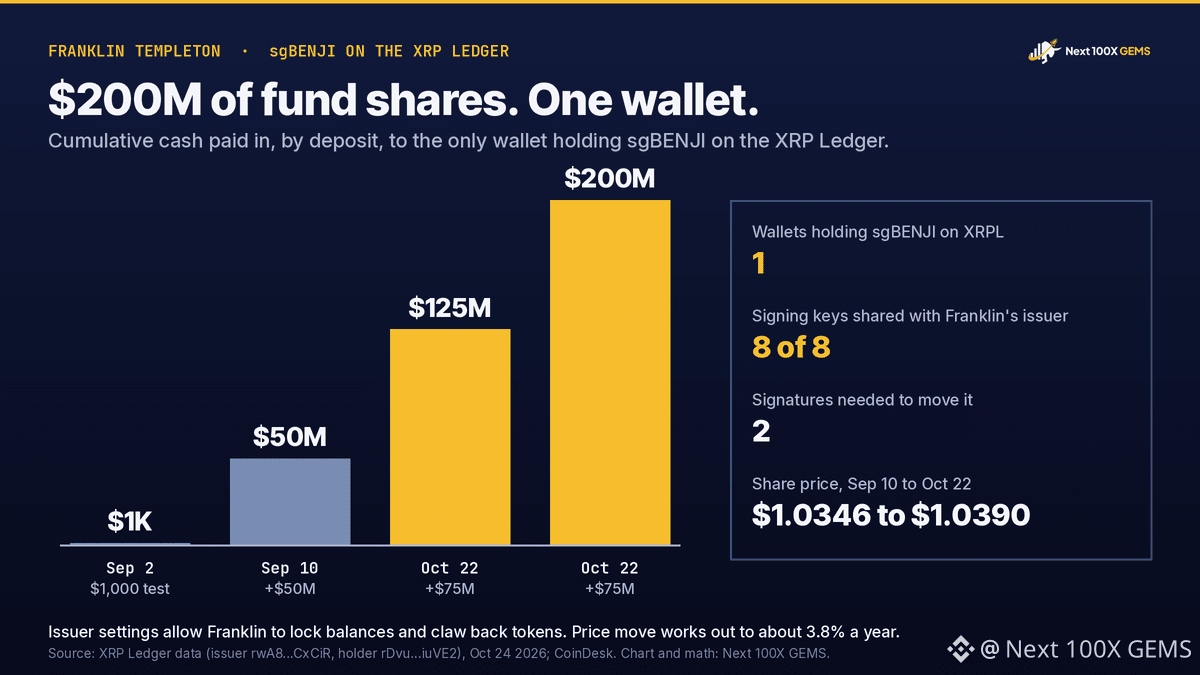
Franklin Templeton now has about $200M of fund shares on the XRP Ledger. Every one of them sits in a single wallet.
On Oct 22 the issuer sent two batches of 72,184,793 sgBENJI to that wallet, $75M each at a recorded share price of $1.039. sgBENJI is a share in Franklin's Singapore-domiciled US dollar short-term money market fund. Supply on the XRP Ledger is now 192.7M shares, about 4x what it was before.
We read the wallet's full history. It was opened on Aug 31, took a $1,000 test buy on Sep 2, then $50M on Sep 10 at $1.0346 a share, then this week's $150M. That's $200,001,000 paid in, worth about $200.2M at the latest price. The move from $1.0346 to $1.0390 in 42 days works out to roughly 3.8% a year, which is the fund's yield building into the share price.
The wallet and Franklin's issuing account use the same eight signing keys, and any two can approve a transaction. The token's settings let Franklin lock balances and claw tokens back, and holding it needs Franklin's approval.
CoinDesk asked Franklin whether this is an omnibus account for many clients and had no answer by Saturday. Until a second wallet shows up, the ledger shows one $200M holder whose keys match the issuer's.
$XRP
#XRPL #Tokenization
NFA. DYOR.
1
1.1k
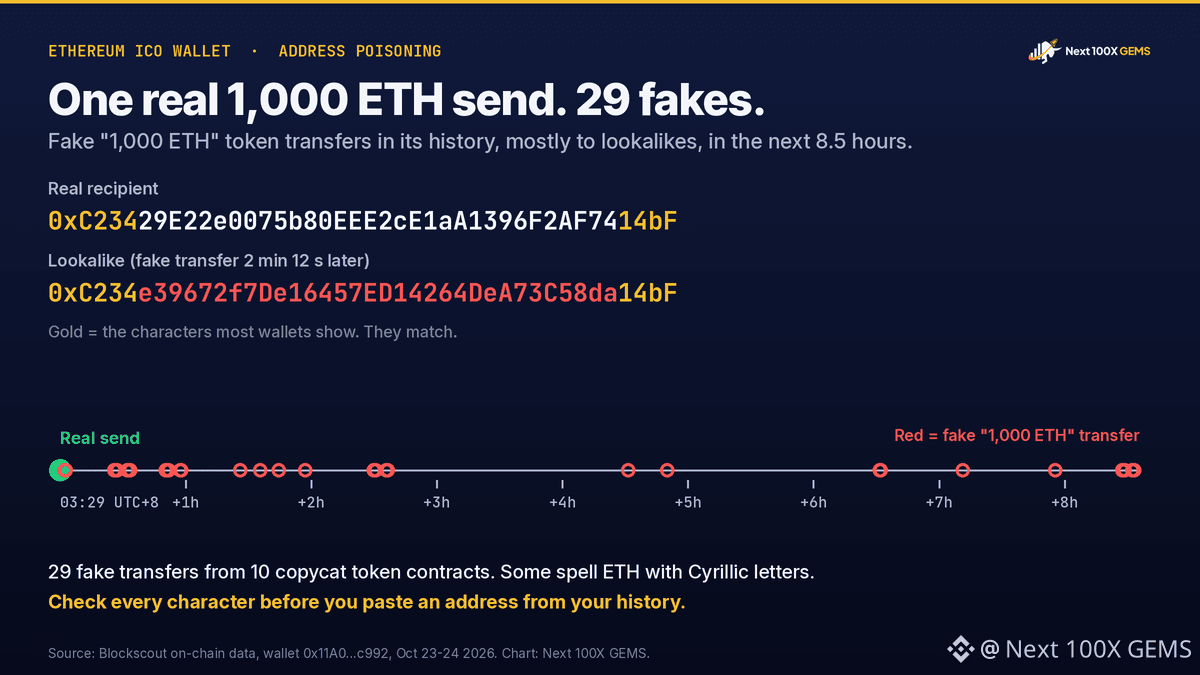
An Ethereum ICO wallet sent 1,000 ETH, about $2.38M, on Friday. Two minutes and 12 seconds later, scammers started faking that same transfer in its history.
Lookonchain flagged the sender as an ICO buyer who got 100,000 ETH at $0.31 each and called the move a sale. At that price, the 1,000 ETH cost $310. The wallet still holds 11,348.88 ETH, about $27M at $2,382.
We pulled the wallet's history. The real transfer went to an address starting 0xC234 and ending 14bF at 03:29 UTC+8 on Oct 24. In the next 8.5 hours, 29 fake "1,000 ETH" token transfers landed in its history from 10 copycat token contracts, some spelling ETH with Cyrillic letters. 28 of them point to lookalike addresses that start with 0xC2 and end in 14bF. Three more lookalikes sent the wallet 0 or 0.000000001 ETH, so they sit in its normal transaction list too.
The bet is that next time, the holder copies an address from recent history and picks a fake. The same wallet drew lookalikes after a 106 ETH send on Sep 30.
If you paste addresses from your history, check every character, or send only to a saved address book entry.
$ETH
#Ethereum #AddressPoisoning
NFA. DYOR.
213
Войдите, чтобы посмотреть больше материала
Присоединяйтесь к пользователям криптовалют по всему миру на Binance Square
⚡️ Получайте новейшую и полезную информацию о криптоактивах.
💬 Нам доверяет крупнейшая в мире криптобиржа.
👍 Получите достоверные аналитические данные от верифицированных создателей контента.
Эл. почта/номер телефона