

#tradingforbeginners
tradingforbeginners
Просмотров: 170,852
149 обсуждают
Популярные
Новые

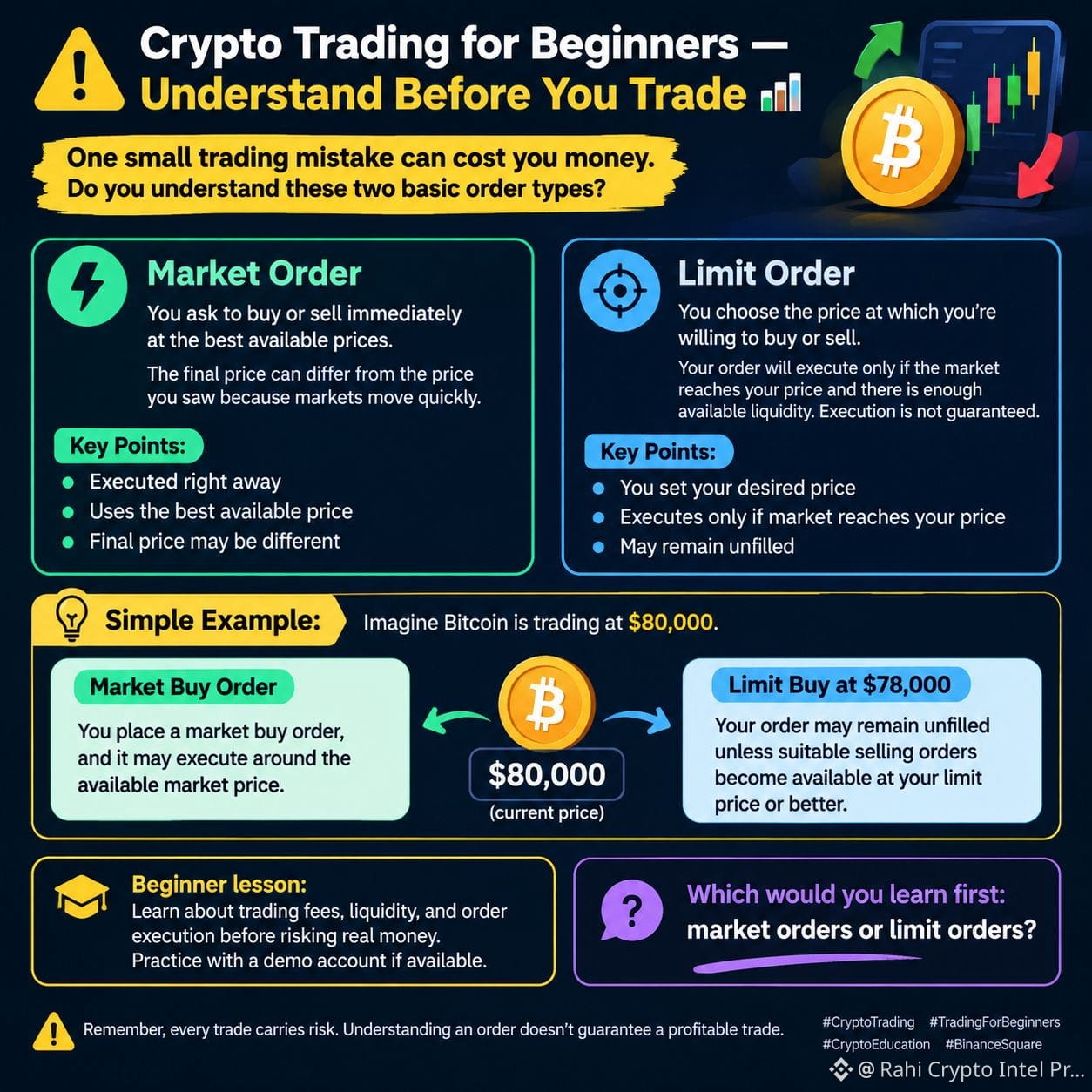
Crypto Trading for Beginners — Understand Before You Trade 📊
Hook: ⚠️ One small trading mistake can cost you money. Do you understand these two basic order types?
Post:
If you're new to crypto trading, start by learning the difference between market orders and limit orders.
🔹 Market Order: You ask to buy or sell immediately at the best available prices. The final price can differ from the price you saw because markets move quickly.
🔹 Limit Order: You choose the price at which you're willing to buy or sell. Your order will execute only if the market reaches your price and there is enough available liquidity. Execution is not guaranteed.
Here's a simple example:
Imagine Bitcoin is trading at $80,000.
You place a market buy order, and it may execute around the available market price.
Alternatively, you place a limit buy at $78,000. Your order may remain unfilled unless suitable selling orders become available at your limit price or better.
💡 Beginner lesson: Learn about trading fees, liquidity, and order execution before risking real money. Practice with a demo account if available.
Remember, every trade carries risk. Understanding an order doesn't guarantee a profitable trade.
Question: Which would you learn first: market orders or limit orders?
#CryptoTrading #TradingForBeginners #CryptoEducation #BinanceSquare
$NEAR
{future}(NEARUSDT)
$AVA
{future}(AVAUSDT)
$CVX
{future}(CVXUSDT)
Crypto Trading for Beginners — Understand Before You Trade 📊
Hook: ⚠️ One small trading mistake can cost you money. Do you understand these two basic order types?
Post:
If you're new to crypto trading, start by learning the difference between market orders and limit orders.
🔹 Market Order: You ask to buy or sell immediately at the best available prices. The final price can differ from the price you saw because markets move quickly.
🔹 Limit Order: You choose the price at which you're willing to buy or sell. Your order will execute only if the market reaches your price and there is enough available liquidity. Execution is not guaranteed.
Here's a simple example:
Imagine Bitcoin is trading at $80,000.
You place a market buy order, and it may execute around the available market price.
Alternatively, you place a limit buy at $78,000. Your order may remain unfilled unless suitable selling orders become available at your limit price or better.
💡 Beginner lesson: Learn about trading fees, liquidity, and order execution before risking real money. Practice with a demo account if available.
Remember, every trade carries risk. Understanding an order doesn't guarantee a profitable trade.
Question: Which would you learn first: market orders or limit orders?
#CryptoTrading #TradingForBeginners #CryptoEducation #BinanceSquare
$NEAR
$AVA
$CVX
438

🚀 Golden Rules for Beginners on Binance
If you’re brand new to crypto trading, don’t rush. Here are 3 simple habits that will save your capital while you learn:
Never FOMO into Green Candles: If a coin is already pumping 30%–50%, you're usually buying at the top. Wait for a pullback or consolidated base.
Master Risk Management: Risk no more than 1%–2% of your total portfolio on a single spot or futures trade. Capital preservation is job NO.1
Stick to Spot First: If you’re completely new, avoid high leverage in Futures until you understand price action and market structure on Spot.
💡 Remember: C
onsistency > Quick Profits. DYOR (Do Your Own Research) and trade safe!
$BTW $FIL
#BinanceSquareFamily #TradingForBeginners #CPIWatch
814

·
--
Падение
*Day 5 - Stop Loss: The Tool That Saves Beginners! 🛡️*
90% of new traders lose money because they don't use Stop Loss.
What is Stop Loss?
It automatically sells your coin if price goes down to your set level. So you lose small instead of losing everything.
Example: You bought at 100, you set Stop Loss at 95. If price drops, it will sell at 95 and save you from bigger loss.
Pro traders always use Stop Loss. You should too!
Do you use Stop Loss? Yes or No?
#crypto #TradingForBeginners #stoploss $BTC $ETH $BNB
1
126

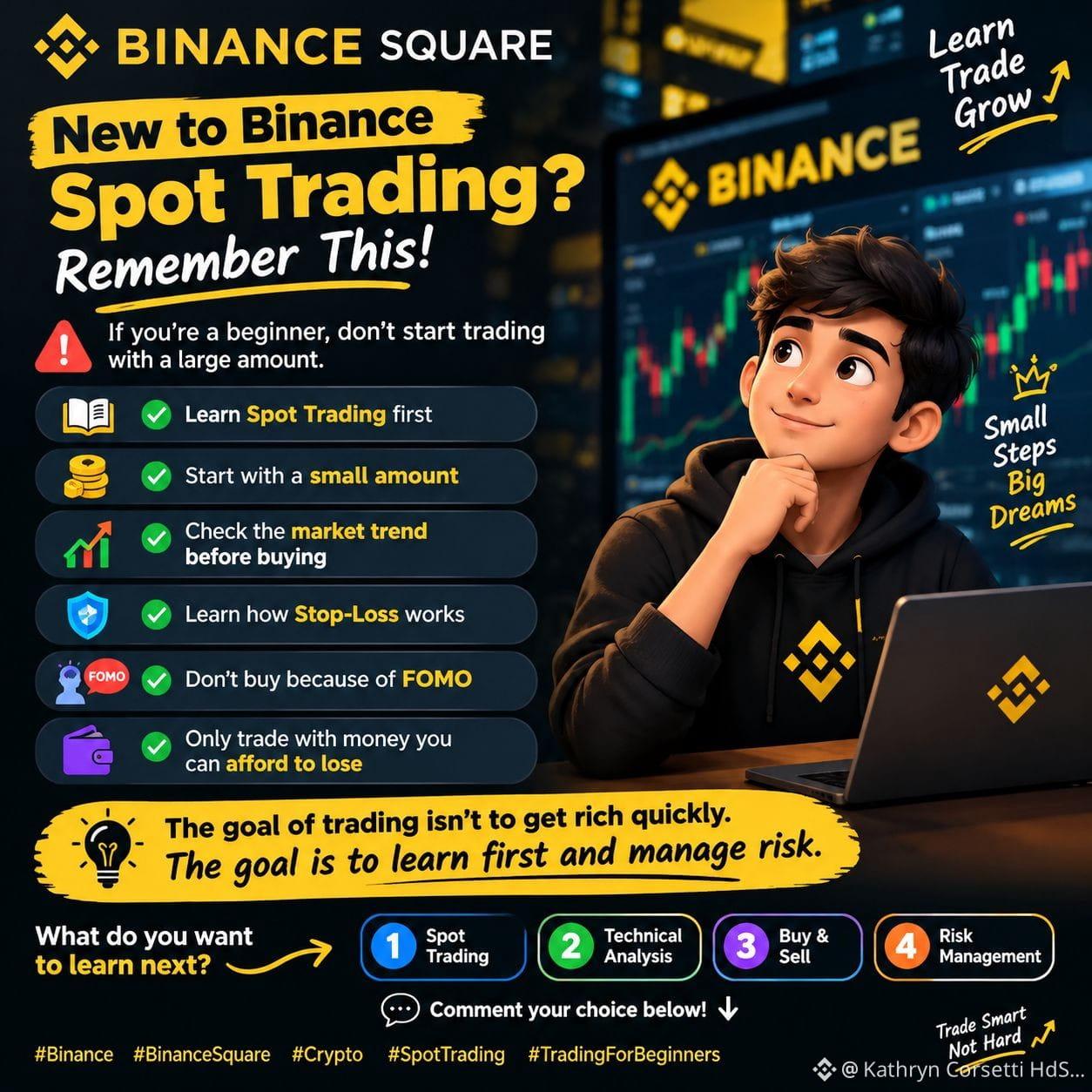
🚀 New to Binance Spot Trading? Remember This!
If you're a beginner, don't start trading with a large amount. ❌
✅ Learn Spot Trading first
✅ Start with a small amount
✅ Check the market trend before buying
✅ Learn how Stop-Loss works
✅ Don't buy because of FOMO
✅ Only trade with money you can afford to lose
💡 The goal of trading isn't to get rich quickly. The goal is to learn first and manage risk.
What do you want to learn next? 👇
1️⃣ Spot Trading
2️⃣ Technical Analysis
3️⃣ Buy & Sell
4️⃣ Risk Management
Comment your choice below! 👇
#BinanceSquareTalks #CryptoNewss
#cryptouniverseofficial #TradingForBeginners
117

·
--
Futures Trading is NOT a casino. It’s an incredible tool, but if you go in blind or believe in magic formulas, you are going to lose your money.
I've prepared super easy-to-understand content on my profile so you can learn the basics of Futures before risking a single cent. No fluff, no complex jargon.
I’ll also be uploading new content little by little, breaking down exactly what each Futures feature does whenever I get some free time between my studies.
👉 Check out my profile and read my step-by-step guides.
❤️ Like this post so this info can save more beginners.
✅ Follow me to learn real and honest trading.
See you inside! TheCryptoUpdate
#TradingForBeginners #FuturesTrading #CryptoEducation #BinanceSquare
13


·
--

Статья
Why Most Traders Fail — And How You Can WinSmart Strategies & Powerful Habits to Trade Like a Professional
Trading has become one of the fastest-growing ways to build income online. But the harsh reality is:
Most beginners lose money — not because trading is impossible, but because they enter the market without knowledge, discipline, or a proper strategy.
Successful trading is not gambling. It is a skill built through patience, emotional control, risk management, and smart decision-making.
If you are starting your trading journey and want to avoid costly mistakes while improving your chances of long-term success, this guide is for you.
📈 1. Learn the Market Before Investing Real Money
Many beginners start trading after watching social media clips, flashy profit screenshots, or “get rich quick” videos.
That approach is dangerous.
Before risking your hard-earned money, understand the fundamentals of trading:
• Market trends • Candlestick patterns • Support & resistance • Risk management • Trading psychology
🔑 Professional Tip
Start with a demo account first. Practice consistently and learn how the market moves before entering real trades.
“Learn the game before you play for money.”
💰 2. Start Small — Grow Smart
One of the biggest mistakes beginners make is investing too much too early.
Professional traders focus on protecting capital first.
Smart Risk Rule
✔ Risk only 1%–2% of your trading account on a single trade.
Small, consistent gains can grow into significant profits over time through discipline and patience.
Remember:
Survival in trading is more important than fast profits.
🛡️ 3. Risk Management Is the Real Secret
Even the best traders lose trades.
The difference is that professionals know how to control losses while beginners allow emotions to destroy their accounts.
Never Trade Without:
✅ A stop-loss ✅ Proper position sizing ✅ A clear exit strategy ✅ Emotional control
“A trader who protects capital survives long enough to win.”
Risk management is not optional — it is the foundation of long-term success.
📊 4. Follow the Trend — Don’t Fight It
The market always leaves clues.
If the market is trending upward, look for buying opportunities. If the market is falling, avoid emotional trades and unnecessary risks.
⭐ Golden Trading Rule
“The trend is your best friend.”
Trying to trade against the market trend is one of the fastest ways beginners lose money.
Trade with momentum — not against it.
🧠 5. Control Your Emotions Like a Professional
Fear and greed are the two biggest enemies in trading.
Most beginners:
• Panic during losses • Become greedy after profits • Enter random emotional trades • Overtrade without discipline
Professional traders stay calm, focused, and strategic.
Powerful Mental Question
Before entering any trade, ask yourself:
“Am I following my strategy — or following my emotions?”
If emotions are making the decision, stay out of the trade.
📝 6. Create a Clear Trading Plan
Random trading creates random results.
Every successful trader follows a detailed trading plan that includes:
• Entry point • Profit target • Stop-loss level • Risk amount • Trading schedule
A proper trading plan helps you stay disciplined even during market pressure.
“Discipline turns strategies into profits.”
⚠️ 7. Stay Away from Fake Trading Gurus
Social media is full of fake experts showing luxury lifestyles, rented cars, and unrealistic profits.
Real trading success looks very different.
Professional traders focus on:
• Consistency • Education • Risk control • Long-term growth
Important Reminder
❌ There is NO guaranteed profit in trading.
Anyone promising “easy money” is usually selling dreams — not real skills.
📔 8. Keep a Trading Journal
A trading journal is one of the most powerful tools used by successful traders.
After every trade, record:
• Why you entered • Why you exited • Profit or loss • Mistakes made • Lessons learned
This habit helps you improve faster, identify weaknesses, and avoid repeating costly errors.
“What gets measured gets improved.”
🎯 9. Master One Strategy Before Learning More
Many beginners constantly switch strategies every week.
This creates confusion and inconsistency.
Instead:
✔ Choose one strategy ✔ Practice it daily ✔ Improve gradually ✔ Build confidence through repetition
“Mastery creates confidence. Confusion creates losses.”
Successful traders master simplicity.
⏳ 10. Patience Is the Key to Consistent Earnings
The market will always provide new opportunities.
You do not need to trade every day.
Professional traders wait patiently for high-quality setups instead of forcing trades out of boredom or emotion.
🔥 Important Truth
Sometimes the best trade is NO trade at all.
Patience protects your capital and improves decision-making.
🌟 Final Thoughts
Trading can become a life-changing skill when approached with discipline, patience, and continuous learning.
True success in trading comes from:
• Smart risk management • Emotional control • Consistent strategy • Long-term thinking • Continuous self-improvement
Do not chase fast money.
Focus on becoming a skilled trader — because skilled traders naturally create profits over time.
🔥 Bonus Success Tip
“Protect Your Capital First — Profits Will Follow.”
The traders who survive the longest are often the traders who earn the most.
Start smart. Stay disciplined. Grow consistently. And trade with patience — not emotion.
🚀 Your Trading Journey Starts Today
Learn slowly. Practice consistently. Respect risk. Trust the process.
Because in trading:
Consistency beats excitement every single time.
#TradingForBeginners #daytrading #cryptotrading #BinanceSquareFamily
Why Most Traders Fail — And How You Can Win
Smart Strategies & Powerful Habits to Trade Like a Professional
Trading has become one of the fastest-growing ways to build income online. But the harsh reality is:
Most beginners lose money — not because trading is impossible, but because they enter the market without knowledge, discipline, or a proper strategy.
Successful trading is not gambling. It is a skill built through patience, emotional control, risk management, and smart decision-making.
If you are starting your trading journey and want to avoid costly mistakes while improving your chances of long-term success, this guide is for you.
📈 1. Learn the Market Before Investing Real Money
Many beginners start trading after watching social media clips, flashy profit screenshots, or “get rich quick” videos.
That approach is dangerous.
Before risking your hard-earned money, understand the fundamentals of trading:
• Market trends • Candlestick patterns • Support & resistance • Risk management • Trading psychology
🔑 Professional Tip
Start with a demo account first. Practice consistently and learn how the market moves before entering real trades.
“Learn the game before you play for money.”
💰 2. Start Small — Grow Smart
One of the biggest mistakes beginners make is investing too much too early.
Professional traders focus on protecting capital first.
Smart Risk Rule
✔ Risk only 1%–2% of your trading account on a single trade.
Small, consistent gains can grow into significant profits over time through discipline and patience.
Remember:
Survival in trading is more important than fast profits.
🛡️ 3. Risk Management Is the Real Secret
Even the best traders lose trades.
The difference is that professionals know how to control losses while beginners allow emotions to destroy their accounts.
Never Trade Without:
✅ A stop-loss ✅ Proper position sizing ✅ A clear exit strategy ✅ Emotional control
“A trader who protects capital survives long enough to win.”
Risk management is not optional — it is the foundation of long-term success.
📊 4. Follow the Trend — Don’t Fight It
The market always leaves clues.
If the market is trending upward, look for buying opportunities. If the market is falling, avoid emotional trades and unnecessary risks.
⭐ Golden Trading Rule
“The trend is your best friend.”
Trying to trade against the market trend is one of the fastest ways beginners lose money.
Trade with momentum — not against it.
🧠 5. Control Your Emotions Like a Professional
Fear and greed are the two biggest enemies in trading.
Most beginners:
• Panic during losses • Become greedy after profits • Enter random emotional trades • Overtrade without discipline
Professional traders stay calm, focused, and strategic.
Powerful Mental Question
Before entering any trade, ask yourself:
“Am I following my strategy — or following my emotions?”
If emotions are making the decision, stay out of the trade.
📝 6. Create a Clear Trading Plan
Random trading creates random results.
Every successful trader follows a detailed trading plan that includes:
• Entry point • Profit target • Stop-loss level • Risk amount • Trading schedule
A proper trading plan helps you stay disciplined even during market pressure.
“Discipline turns strategies into profits.”
⚠️ 7. Stay Away from Fake Trading Gurus
Social media is full of fake experts showing luxury lifestyles, rented cars, and unrealistic profits.
Real trading success looks very different.
Professional traders focus on:
• Consistency • Education • Risk control • Long-term growth
Important Reminder
❌ There is NO guaranteed profit in trading.
Anyone promising “easy money” is usually selling dreams — not real skills.
📔 8. Keep a Trading Journal
A trading journal is one of the most powerful tools used by successful traders.
After every trade, record:
• Why you entered • Why you exited • Profit or loss • Mistakes made • Lessons learned
This habit helps you improve faster, identify weaknesses, and avoid repeating costly errors.
“What gets measured gets improved.”
🎯 9. Master One Strategy Before Learning More
Many beginners constantly switch strategies every week.
This creates confusion and inconsistency.
Instead:
✔ Choose one strategy ✔ Practice it daily ✔ Improve gradually ✔ Build confidence through repetition
“Mastery creates confidence. Confusion creates losses.”
Successful traders master simplicity.
⏳ 10. Patience Is the Key to Consistent Earnings
The market will always provide new opportunities.
You do not need to trade every day.
Professional traders wait patiently for high-quality setups instead of forcing trades out of boredom or emotion.
🔥 Important Truth
Sometimes the best trade is NO trade at all.
Patience protects your capital and improves decision-making.
🌟 Final Thoughts
Trading can become a life-changing skill when approached with discipline, patience, and continuous learning.
True success in trading comes from:
• Smart risk management • Emotional control • Consistent strategy • Long-term thinking • Continuous self-improvement
Do not chase fast money.
Focus on becoming a skilled trader — because skilled traders naturally create profits over time.
🔥 Bonus Success Tip
“Protect Your Capital First — Profits Will Follow.”
The traders who survive the longest are often the traders who earn the most.
Start smart. Stay disciplined. Grow consistently. And trade with patience — not emotion.
🚀 Your Trading Journey Starts Today
Learn slowly. Practice consistently. Respect risk. Trust the process.
Because in trading:
Consistency beats excitement every single time.
#TradingForBeginners #daytrading #cryptotrading #BinanceSquareFamily
1
2
260

·
--
Падение
$BTC
{future}(BTCUSDT)
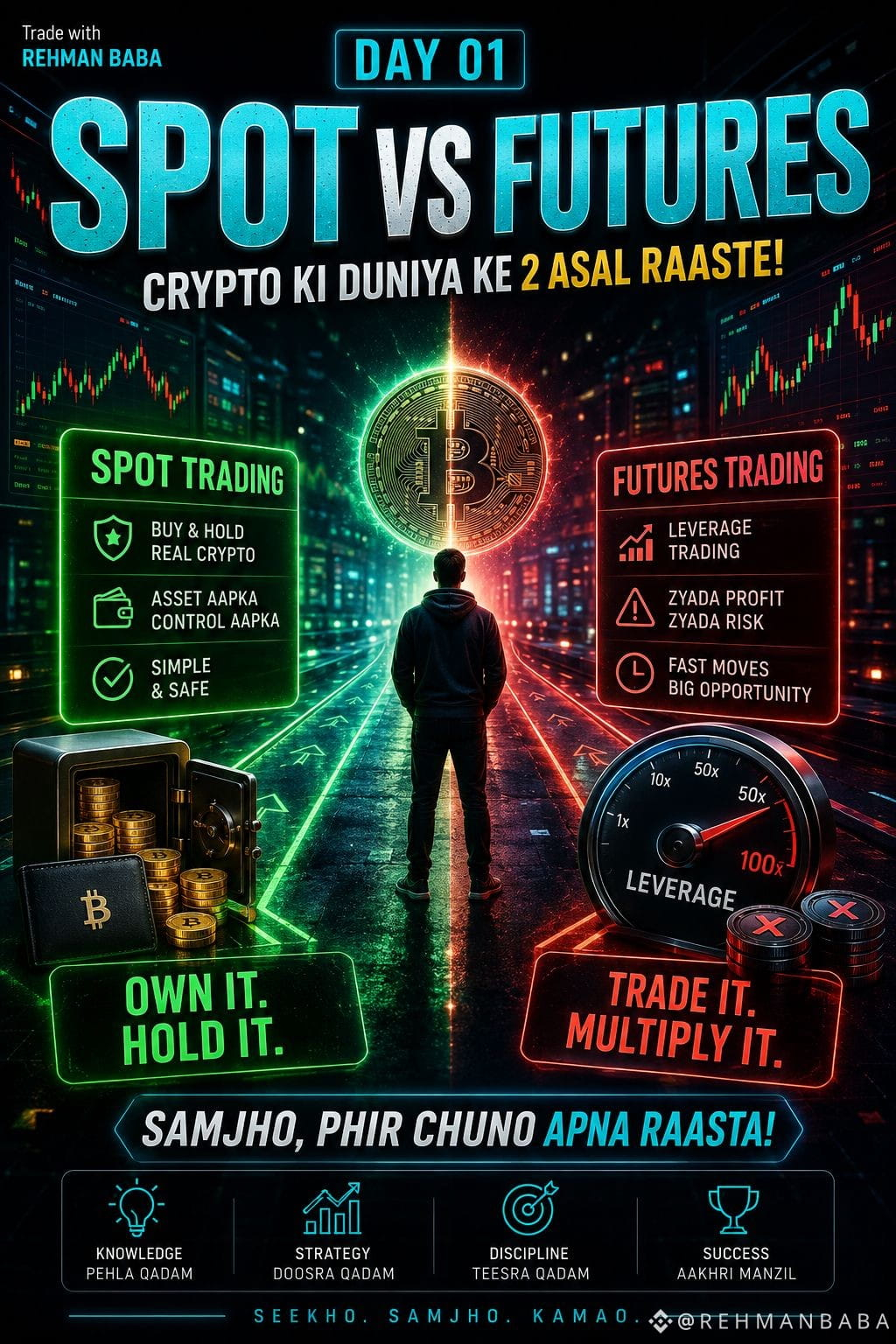
SpotTrading vs FuturesTrading — Asal Farq Kiya hai..?
Kiya Aap ko lagta hai k crypto mein sirf 'Sasta khareedo, Mehnga beecho' hi trading hai? Agar haan, to aaj ka din Aap ki poori soch badal dy gha..! 🤯
Crypto duniya mein 02 tarah ki trading hoti hai:
SpotTrading: Ye "Naqd Sauda" hai. Aap paisa dety hain aur Coin apne Wallet mein ly aate hain. Coin ab Hamesha k liye Aap ka hai, jab tak Aap khud na beechein.
FuturesTrading: Is mein Aap Coin nahi khareedte, bal k sirf ek "agreement" khareedty hain k Price Upar jaye ghi yan Neeche. Coin kabhi bhi Aap k paas nahi aata — sirf Profit & Loss aata hai.
For Example:
Socho 02 dost hain — Ahmed aur Bilal.
- Ahmed in SpotTrading: Ahmed ne $100 ka Gold khareeda shop sy. Gold ghar ly aya. Agar Gold ka rate girr jaye, Ahmed pareshan nahi hota kion k Gold us k paas hai, wo intezar kar sakta hai.
- Bilal in FutureTrading: Jab k Bilal ne $100 se "Gold ki price upar jaye ghi" wala contract liya bina Gold khareede. Agar rate girta hai, Bilal ka poora $100 ek hi jhatke mein khatam ho sakta hai — kion k us k paas real Gold nahi tha, sirf ek shart (bet) thi.
SpotTrading mein sabar rakhna asaan hai kion k Asset Aap k paas hota hai. Jab k FutureTrading mein sabar rakhna mushkil hai kion k Leverage ki wajah se chota sa ulta movement bhi bara nuksan dy sakta hai.
Apni Binance App open karein. "Spot" aur "Futures" dono tabs dhoondein aur bas dekhein k interface kaisa different hai. Koi trade nahi karni — sirf observe karna hai.
Aap ne ab tak sirf SpotTrading ki hai ya FutureTrading ka naam pehli baar sun rahy hain? Comment mein zaroor batayein!
#SpotVsFutures #BinanceFuturesBeginner #CryptoBasicsUrdu #FuturesTradingPakistan #CryptoEducationUrdu #dyor #TradingForBeginners
$BTC
SpotTrading vs FuturesTrading — Asal Farq Kiya hai..?
Kiya Aap ko lagta hai k crypto mein sirf 'Sasta khareedo, Mehnga beecho' hi trading hai? Agar haan, to aaj ka din Aap ki poori soch badal dy gha..! 🤯
Crypto duniya mein 02 tarah ki trading hoti hai:
SpotTrading: Ye "Naqd Sauda" hai. Aap paisa dety hain aur Coin apne Wallet mein ly aate hain. Coin ab Hamesha k liye Aap ka hai, jab tak Aap khud na beechein.
FuturesTrading: Is mein Aap Coin nahi khareedte, bal k sirf ek "agreement" khareedty hain k Price Upar jaye ghi yan Neeche. Coin kabhi bhi Aap k paas nahi aata — sirf Profit & Loss aata hai.
For Example:
Socho 02 dost hain — Ahmed aur Bilal.
- Ahmed in SpotTrading: Ahmed ne $100 ka Gold khareeda shop sy. Gold ghar ly aya. Agar Gold ka rate girr jaye, Ahmed pareshan nahi hota kion k Gold us k paas hai, wo intezar kar sakta hai.
- Bilal in FutureTrading: Jab k Bilal ne $100 se "Gold ki price upar jaye ghi" wala contract liya bina Gold khareede. Agar rate girta hai, Bilal ka poora $100 ek hi jhatke mein khatam ho sakta hai — kion k us k paas real Gold nahi tha, sirf ek shart (bet) thi.
SpotTrading mein sabar rakhna asaan hai kion k Asset Aap k paas hota hai. Jab k FutureTrading mein sabar rakhna mushkil hai kion k Leverage ki wajah se chota sa ulta movement bhi bara nuksan dy sakta hai.
Apni Binance App open karein. "Spot" aur "Futures" dono tabs dhoondein aur bas dekhein k interface kaisa different hai. Koi trade nahi karni — sirf observe karna hai.
Aap ne ab tak sirf SpotTrading ki hai ya FutureTrading ka naam pehli baar sun rahy hain? Comment mein zaroor batayein!
#SpotVsFutures #BinanceFuturesBeginner #CryptoBasicsUrdu #FuturesTradingPakistan #CryptoEducationUrdu #dyor #TradingForBeginners
96

·
--
Рост
#BinanceSquare #cryptoeducation #TradingForBeginners
🚨 ¿EMPEZANDO EN EL TRADING? La herramienta gratuita de Binance que te evitará perder dinero real 🛠️📊
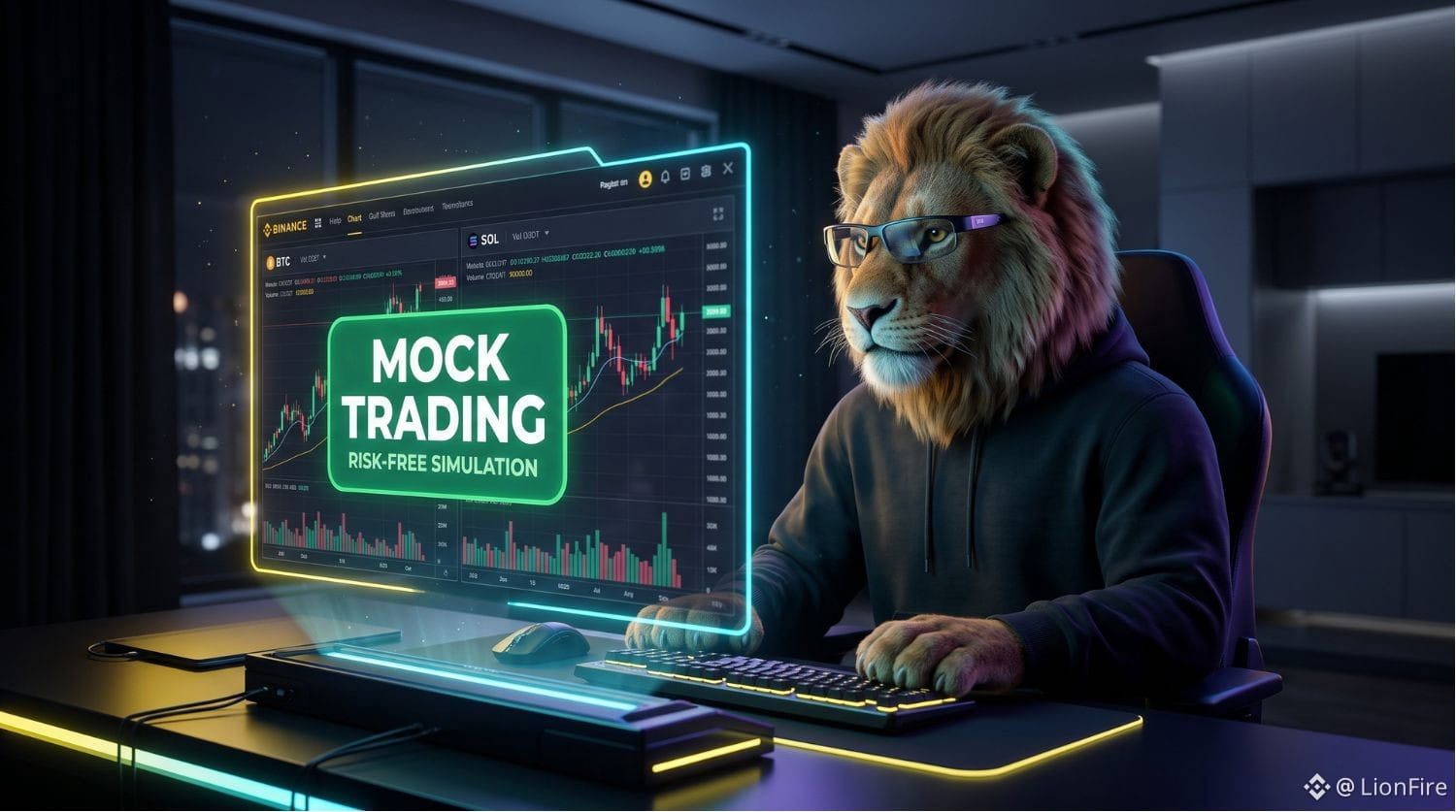
Uno de los mayores errores de los principiantes es saltar al mercado convulso arriesgando su propio capital sin una estrategia probada. Si estás dando tus primeros pasos, Binance ofrece una función clave que todo trader debería explotar antes de arriesgar un solo dólar: El Mock Trading (Trading de Prueba/Demo).
💡 ¿Qué es y por qué deberías usarlo hoy mismo?
🎮 Simulación en tiempo real sin riesgo: Te permite operar en el mercado de Futuros utilizando un saldo ficticio (hasta 3,000 USDT de prueba). Ejecutas órdenes con los mismos gráficos, libro de órdenes y volatilidad en vivo del mercado real.
📈 Prueba de estrategias en activos clave: ¿Quieres practicar la lectura del Supertrend en un gigante maduro como $BTC para aprender a gestionar la paciencia en rangos de consolidación? ¿O prefieres testear cómo reaccionar ante la alta volatilidad y la velocidad de un activo de capa 1 como $SOL? El simulador te permite experimentar ambos escenarios sin estrés financiero.
🧠 Dominio de la interfaz: Te ayuda a familiarizarte con el apalancamiento, la gestión de margen y el cálculo de Stop Loss para que no cometas errores de ejecución por torpeza o impulsividad cuando operes con dinero real.
📲 ¿Cómo acceder desde la App de Binance?
Ve a la sección de Futuros.
Toca el menú de los tres puntos (...) en la esquina superior derecha.
Selecciona Mock Trading.
¡Reclama tus fondos de prueba y empieza a practicar!
💡El mercado no perdona la improvisación. La diferencia entre un operador que sobrevive a largo plazo y uno que liquida su cuenta en semanas es la preparación. Domina la plataforma, testea tu sesgo tanto en activos estables como en altcoins más dinámicas y valida tu plan en el entorno demo antes de dar el salto al mercado real.
¿Ya has probado el Mock Trading o prefieres aprender directo en el fuego? ¡Te leo en los comentarios! 👇⚡
70
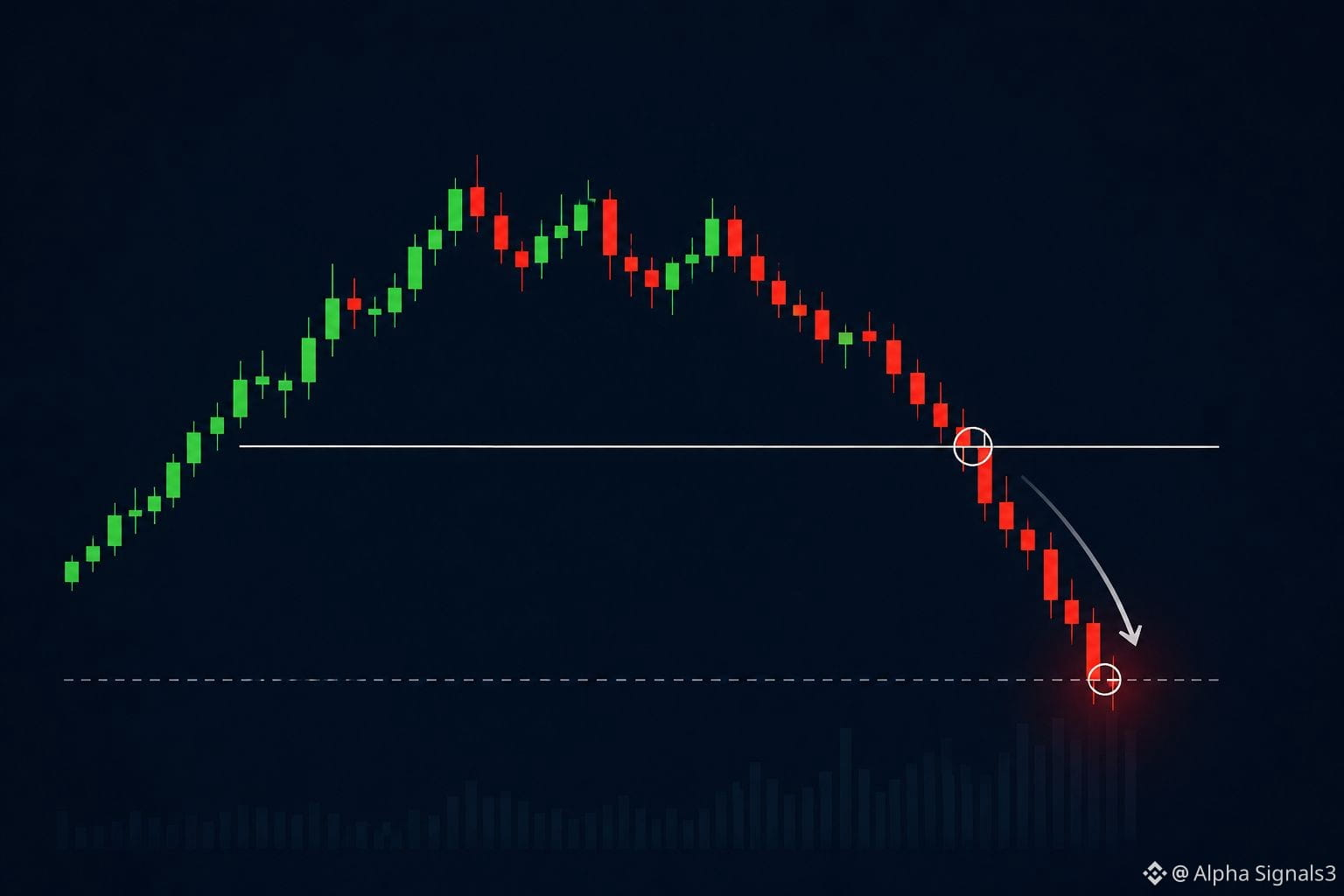
Stop Loss Kya Hota Hai?
Stop Loss trading ka sab se important tool hai.
Ye ek aisa level hota hai jahan trade automatically close ho jati hai taake zyada nuksan na ho.
📊 Example:
Buy Entry = $100
Stop Loss = $95
Agar price $95 tak aa jaye to trade close ho jayegi.
✅ Capital protected rahega.
❌ Stop Loss na lagana beginners ki sab se badi galti hoti hai.
📌 Trading Rule: "Profit optional hai, Risk Management compulsory hai."
$BNB $SOL
{future}(SOLUSDT)
{future}(BNBUSDT)
#StopLossHunting #BinanceSquareFamily #LearnTrading #RiskManagement #TradingForBeginners
Stop Loss Kya Hota Hai?
Stop Loss trading ka sab se important tool hai.
Ye ek aisa level hota hai jahan trade automatically close ho jati hai taake zyada nuksan na ho.
📊 Example:
Buy Entry = $100
Stop Loss = $95
Agar price $95 tak aa jaye to trade close ho jayegi.
✅ Capital protected rahega.
❌ Stop Loss na lagana beginners ki sab se badi galti hoti hai.
📌 Trading Rule: "Profit optional hai, Risk Management compulsory hai."
$BNB $SOL
#StopLossHunting #BinanceSquareFamily #LearnTrading #RiskManagement #TradingForBeginners
100

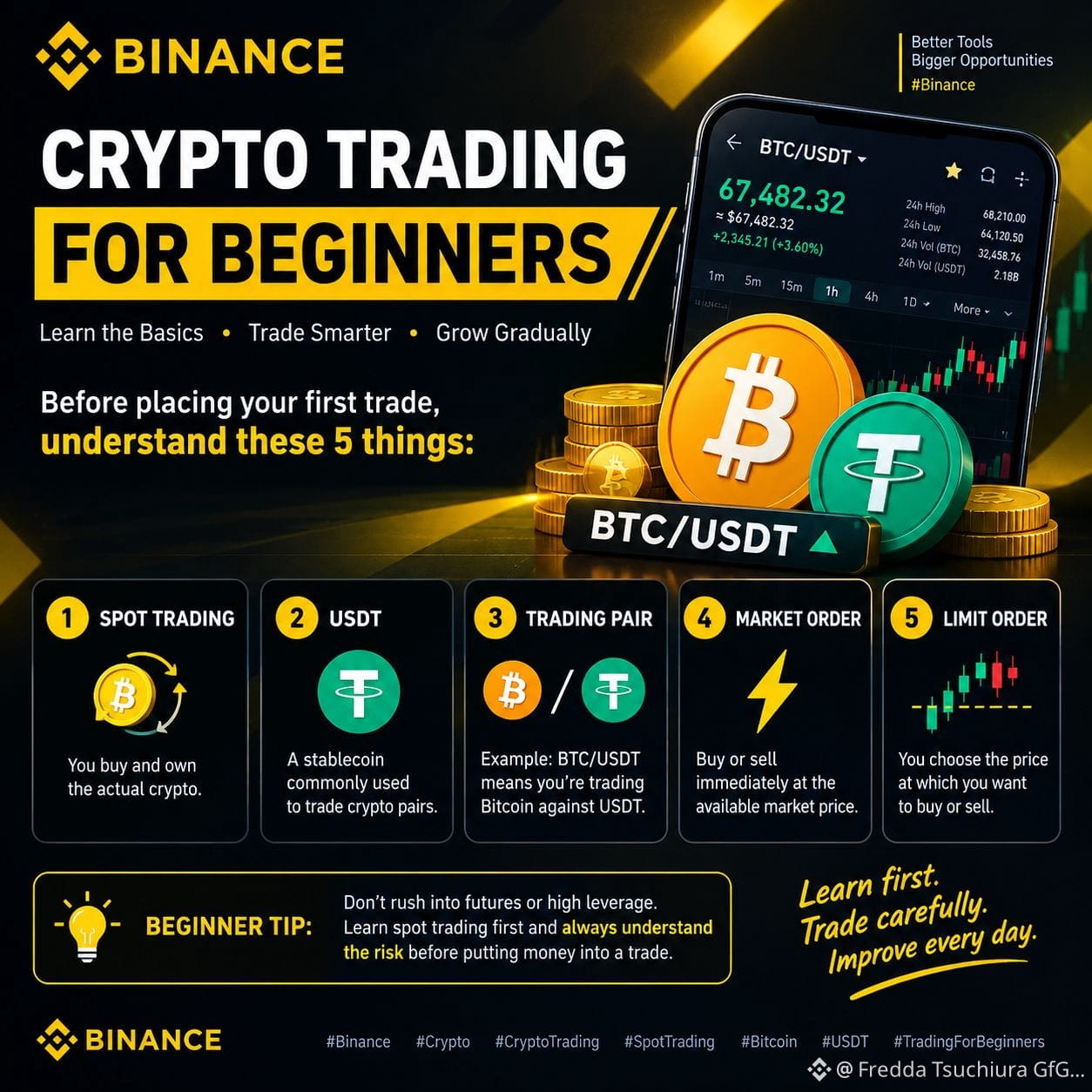
📚 Learn first. Trade carefully. Improve every day.
🚀 New to Crypto Trading? Start With the Basics!
Before placing your first trade, understand these 5 things:
1️⃣ Spot Trading — You buy and own the actual crypto.
2️⃣ USDT — A stablecoin commonly used to trade crypto pairs.
3️⃣ Trading Pair — BTC/USDT means you’re trading Bitcoin against USDT.
4️⃣ Market Order — Buy or sell immediately at the available market price.
5️⃣ Limit Order — You choose the price at which you want to buy or sell.
💡 Beginner tip: Don't rush into futures or high leverage. Learn spot trading first and understand the risks before putting money into a trade.
#Binance #Crypto #CryptoTrading
#SpotTrading #Bitcoin #USDT
#TradingForBeginners $
1
119


Статья
Why Real-World Utility Wins the Long Game 🧧If you are new to the crypto market, it is easy to get caught up in green candles, massive hype, and quick-profit promises. But if you want to survive—and thrive—for the long haul, utility is your best hedge against volatility.
Here are 5 core rules for beginners looking to build a sustainable portfolio:
Seek Solvers, Not Hype: Look for projects tackling tangible, real-world problems. Whether it's cross-border payments, decentralized storage, real-world asset tokenization (RWA), or scalable smart contracts, coins with genuine usage survive brutal bear markets.Analyze the Metrics: Don’t just read the whitepaper. Check active developer activity, daily active users, transaction volume, and total value locked (TVL). Real usage creates organic demand that outlasts short-term marketing spins.Master Dollar-Cost Averaging (DCA): Trying to time market tops and bottoms usually ends in tears for beginners. Buying fixed amounts at regular intervals lowers your average entry price and takes emotion out of the equation.Understand Tokenomics: A great product with terrible tokenomics (like massive inflation or unlocking schedules that dump on retail) makes a bad investment. Ensure token distribution aligns with long-term holders.Protect Your Capital First: Use stop-loss orders, never risk more than 1–2% of your account on a single trade, and never invest money you cannot afford to lose. Capital preservation is job number one.
Building wealth in crypto isn't about chasing overnight pumps—it's about backing the infrastructure of the future.
What is your favorite utility-driven project right now? Drop your thoughts below! 👇
#CryptoTips #TradingForBeginners #BinanceSquare #CryptoEducation
Why Real-World Utility Wins the Long Game 🧧
If you are new to the crypto market, it is easy to get caught up in green candles, massive hype, and quick-profit promises. But if you want to survive—and thrive—for the long haul, utility is your best hedge against volatility.
Here are 5 core rules for beginners looking to build a sustainable portfolio:
Seek Solvers, Not Hype: Look for projects tackling tangible, real-world problems. Whether it's cross-border payments, decentralized storage, real-world asset tokenization (RWA), or scalable smart contracts, coins with genuine usage survive brutal bear markets.Analyze the Metrics: Don’t just read the whitepaper. Check active developer activity, daily active users, transaction volume, and total value locked (TVL). Real usage creates organic demand that outlasts short-term marketing spins.Master Dollar-Cost Averaging (DCA): Trying to time market tops and bottoms usually ends in tears for beginners. Buying fixed amounts at regular intervals lowers your average entry price and takes emotion out of the equation.Understand Tokenomics: A great product with terrible tokenomics (like massive inflation or unlocking schedules that dump on retail) makes a bad investment. Ensure token distribution aligns with long-term holders.Protect Your Capital First: Use stop-loss orders, never risk more than 1–2% of your account on a single trade, and never invest money you cannot afford to lose. Capital preservation is job number one.
Building wealth in crypto isn't about chasing overnight pumps—it's about backing the infrastructure of the future.
What is your favorite utility-driven project right now? Drop your thoughts below! 👇
#CryptoTips #TradingForBeginners #BinanceSquare #CryptoEducation
261
16
261

·
--
Рост
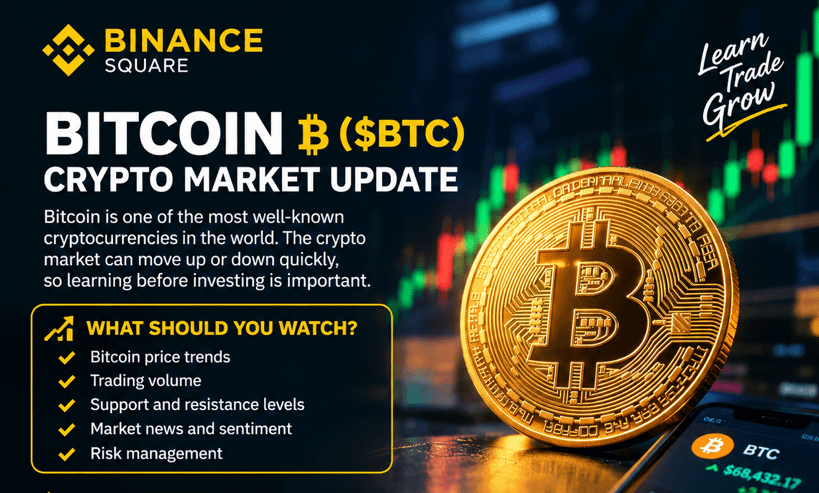
🚀 BITCOIN ($BTC) — CRYPTO MARKET UPDATE 📊
₿ Bitcoin is one of the most well-known cryptocurrencies in the world. The crypto market can move up or down quickly, so learning before investing is important.
📈 What should you watch?
🔹 Bitcoin price trends
🔹 Trading volume
🔹 Support and resistance levels
🔹 Market news and sentiment
🔹 Risk management
💡 Beginner Tip: Never make decisions based only on social media posts. Do your own research, understand the risks, and never invest money you cannot afford to lose.
👇 Let’s Discuss!
Do you think Bitcoin will rise or fall in the future? Share your thoughts respectfully in the comments!
#Bitcoin #BTC #CryptoEducation #CryptoMarket #BinanceSquare #TradingForBeginners
⚠️ Disclaimer: This post is for educational purposes only, not financial advice. Cryptocurrency prices are volatile, and losses are possible.😀#BitcoinReboundsTo$83K $BTC $BTC
{spot}(BTCUSDT)
🚀 BITCOIN ($BTC ) — CRYPTO MARKET UPDATE 📊
₿ Bitcoin is one of the most well-known cryptocurrencies in the world. The crypto market can move up or down quickly, so learning before investing is important.
📈 What should you watch?
🔹 Bitcoin price trends
🔹 Trading volume
🔹 Support and resistance levels
🔹 Market news and sentiment
🔹 Risk management
💡 Beginner Tip: Never make decisions based only on social media posts. Do your own research, understand the risks, and never invest money you cannot afford to lose.
👇 Let’s Discuss!
Do you think Bitcoin will rise or fall in the future? Share your thoughts respectfully in the comments!
#Bitcoin #BTC #CryptoEducation #CryptoMarket #BinanceSquare #TradingForBeginners
⚠️ Disclaimer: This post is for educational purposes only, not financial advice. Cryptocurrency prices are volatile, and losses are possible.😀#BitcoinReboundsTo$83K $BTC $BTC
96

Статья
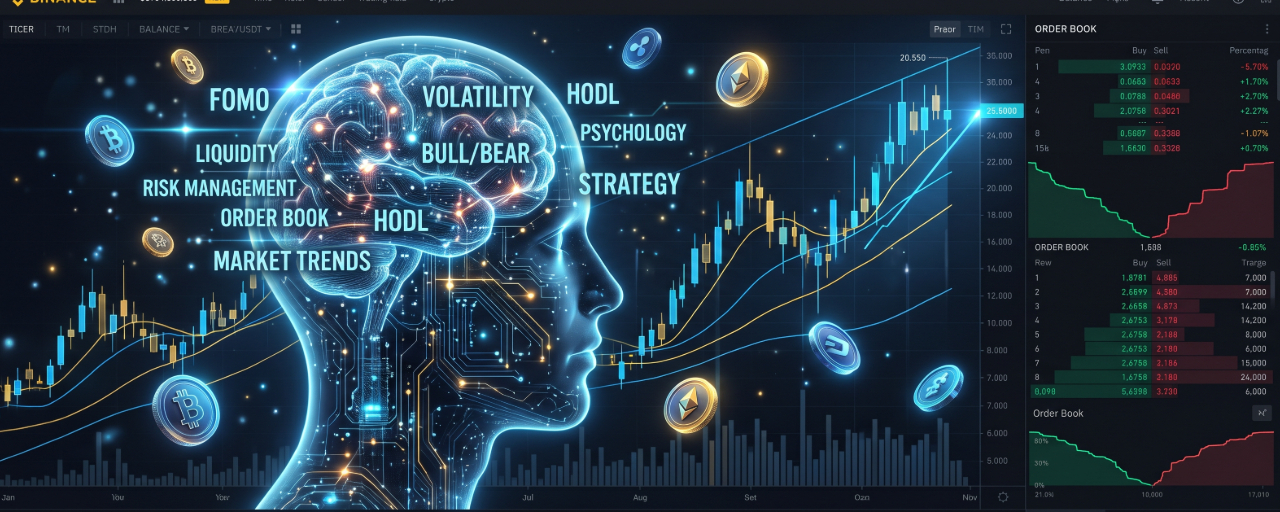
STOP GAMBLING IN CRYPTO! 25+ TRADING TERMS YOU MUST UNDERSTAND BEFORE RISKING YOUR MONEYThe difference between a beginner and a disciplined trader isn't always capital. Sometimes, it's simply understanding what is happening behind the charts.
Every day, thousands of people enter the cryptocurrency market because they see Bitcoin pumping, an altcoin making 40% gains, or someone posting screenshots of enormous profits.
They open an exchange, buy a random coin, watch a few green candles and assume they understand trading.
But here's the reality:
The market doesn't reward excitement. It rewards preparation, execution, discipline and risk management.
When beginners see a green candle, experienced traders may be looking at liquidity, volume, order-book depth, funding rates, token unlocks and market structure.
When beginners ask, "Can this coin reach $1?", experienced investors may ask, "What is its circulating supply, market capitalization and fully diluted valuation?"
And when beginners panic during a market crash, disciplined traders already know their invalidation levels, maximum acceptable loss and exit strategy.
Today, let's break down the terminology that every serious crypto trader should understand.
This isn't about memorizing complicated words to sound professional. It's about learning how the market actually works.
━━━━━━━━━━━━━━━━━━━━
🏛️ MODULE 1: ORDER BOOKS, MARKET DEPTH & TRADE EXECUTION
Before you buy or sell any cryptocurrency, you need to understand how your orders interact with the market.
1. Order Book
An order book is a real-time list of outstanding buy and sell orders for a particular trading pair.
For example, imagine BTC/USDT is trading around $100,000.
The order book might look something like this:
SELL ORDERS (ASKS)
$100,100 — 2 BTC
$100,050 — 3 BTC
$100,020 — 5 BTC
BUY ORDERS (BIDS)
$99,990 — 4 BTC
$99,950 — 6 BTC
$99,900 — 8 BTC
The sell side represents people willing to sell at specific prices.
The buy side represents people willing to buy at specific prices.
Understanding this helps you see where liquidity is available and how much trading activity exists at different price levels.
However, remember that visible orders can be cancelled. An order book is useful information, not a guarantee of future price movement.
2. Bid, Ask and Spread
Three essential terms:
• BID: The highest price a buyer is currently willing to pay.
• ASK: The lowest price a seller is currently willing to accept.
• SPREAD: The difference between the best ask and best bid.
Example:
Best Bid = $99,990
Best Ask = $100,000
Spread = $10
A narrow spread generally indicates a more liquid market, while a wider spread can make entering and exiting positions more expensive.
For scalpers and high-frequency traders, even a small spread can significantly affect profitability.
3. Market Maker vs. Market Taker
This is one of the most misunderstood concepts in trading.
A MARKET MAKER generally provides liquidity by placing orders that rest in the order book.
A MARKET TAKER removes available liquidity by executing against existing orders.
Example:
You place a limit order to buy BTC at $99,000 while the market trades at $100,000.
Your order waits in the order book. You are generally acting as a maker.
However, if you place a market order and immediately buy from available sellers, you are a taker.
Important: A limit order is not automatically a maker order. A limit order that immediately matches existing liquidity can also be classified as a taker order.
Why does this matter?
Because many exchanges use different maker and taker fees. Understanding the difference can help reduce unnecessary trading costs.
4. Market Depth
Market depth describes the amount of available buy and sell liquidity at different price levels.
Imagine two cryptocurrencies:
Coin A has $5 million in buy and sell orders near its current price.
Coin B has only $30,000 in nearby orders.
A large market order could have a relatively small effect on Coin A but move Coin B's price dramatically.
This is why low-cap coins can experience extreme volatility.
5. Slippage
Slippage occurs when your executed trade price differs from the price you expected.
Example:
You want to buy $10,000 worth of a low-liquidity altcoin at $1.
But there aren't enough sellers at $1.
Your order fills at:
$1.00
$1.03
$1.06
$1.10
Your average execution price becomes higher than expected.
This is called slippage.
Slippage becomes particularly dangerous during:
• Sudden market crashes.
• Low-liquidity trading sessions.
• Major news announcements.
• Large market orders.
• Extremely volatile altcoin movements.
A coin can show impressive percentage gains on a chart while being surprisingly difficult to trade profitably.
━━━━━━━━━━━━━━━━━━━━
📊 MODULE 2: TOKENOMICS — WHY A CHEAP COIN ISN'T NECESSARILY A GOOD INVESTMENT
One of the biggest mistakes beginners make is judging a cryptocurrency by its unit price.
They see a coin worth $0.0001 and think it has enormous potential because it could reach $0.01.
But the price of one token tells you very little about the actual valuation of a project.
Professional investors pay attention to token supply, market capitalization, valuation and future dilution.
6. Circulating Supply
Circulating supply refers to the number of tokens currently available in the market.
For example:
Token price = $2
Circulating supply = 100 million
Market capitalization = $200 million.
The circulating supply is important because it helps determine how much of the project's token supply is already available to investors.
7. Total Supply
Total supply represents the number of tokens currently in existence, after accounting for tokens that have been burned.
It does not necessarily include every token that could ever be created.
8. Maximum Supply
Maximum supply is the maximum number of tokens that can ever exist, provided the protocol has a fixed supply cap.
Bitcoin is the classic example, with a maximum supply of 21 million BTC.
Not every cryptocurrency has a maximum supply.
Some projects use inflationary token models where new tokens can continue entering circulation.
9. Market Capitalization
Market capitalization is calculated as:
MARKET CAP = CURRENT PRICE × CIRCULATING SUPPLY
Example:
Token price = $5
Circulating supply = 50 million
Market cap = $250 million.
This is a better way of evaluating a project's market valuation than looking at its token price alone.
10. Fully Diluted Valuation (FDV)
FDV estimates the valuation of a cryptocurrency if its entire assumed token supply were circulating at the current price.
FDV = CURRENT PRICE × MAXIMUM SUPPLY
Where a maximum supply is not defined, total supply or another clearly stated supply assumption may be used.
Example:
Current price = $2
Circulating supply = 100 million
Total supply = 1 billion
Market Cap = $200 million
FDV = $2 billion
Notice something interesting?
The market cap is only $200 million, but the fully diluted valuation is $2 billion.
This means the currently circulating supply represents only 10% of the total supply.
That doesn't automatically mean the project is bad.
But it raises an important question:
What happens when the remaining tokens become available?
11. Token Unlocks and Vesting
Many crypto projects distribute tokens gradually to:
• Early investors.
• Founders and team members.
• Advisors.
• Ecosystem funds.
• Community incentives.
These tokens may be locked for a specific period and released according to a vesting schedule.
When a large quantity of previously locked tokens becomes available, the market may face increased potential selling pressure.
For example:
A project has 100 million circulating tokens.
Another 50 million tokens are scheduled to unlock next month.
That represents a potential 50% increase over the current circulating supply.
Not every unlocked token is immediately sold, but investors should understand the potential impact.
Before buying an altcoin, investigate:
Current circulating supply.Total and maximum supply.Upcoming unlock dates.Percentage of supply held by insiders.Long-term token distribution.
A strong project with poor token economics can still be a difficult investment.
━━━━━━━━━━━━━━━━━━━━
⚡ MODULE 3: FUTURES, LEVERAGE AND DERIVATIVES
Spot trading and futures trading are not the same thing.
In spot trading, you purchase an actual cryptocurrency.
In futures trading, you trade a contract whose value is linked to the underlying asset.
This introduces additional risks that beginners frequently underestimate.
12. Long Position
A long position means you are speculating that the price will increase.
Example:
You open a BTC long position at $100,000.
BTC increases to $103,000.
Your position gains value before fees and funding payments.
However, if BTC falls, your position loses value.
13. Short Position
A short position means you are speculating that the price will decrease.
Example:
You open a BTC short position at $100,000.
BTC falls to $95,000.
Your position gains value before fees and funding payments.
Shorting can be useful in bearish markets, but rapid upward movements can result in significant losses.
14. Leverage
Leverage allows you to control a position larger than your initial margin.
Example:
Your capital = $100
Leverage = 5x
Position size = $500
If the underlying asset increases by 3%, your approximate gross profit is:
$500 × 3% = $15.
That represents a 15% gain on your $100 margin, before fees and funding.
But what happens if the market falls by 3%?
Your approximate loss becomes $15, or 15% of your initial margin.
At 10x leverage, a 3% adverse move represents approximately 30% of the initial margin.
Leverage magnifies both profits and losses.
It does not make a bad trading strategy better.
15. Liquidation Price
Liquidation happens when your margin is no longer sufficient to support an open leveraged position.
The exchange may automatically close your position to prevent further losses.
Your exact liquidation price depends on:
• Leverage.
• Entry price.
• Margin mode.
• Maintenance margin.
• Position size.
• Trading fees and funding.
Cross margin and isolated margin also work differently.
ISOLATED MARGIN restricts the margin allocated to a particular position.
CROSS MARGIN uses available account margin to support positions, which can expose more of your balance to losses.
Never assume your liquidation price is simply a fixed percentage away from your entry.
16. Funding Rates
Perpetual futures contracts do not have a traditional expiration date.
Funding payments help keep their prices aligned with the underlying spot market.
There are two important conditions:
POSITIVE FUNDING RATE:
Long traders generally pay short traders.
NEGATIVE FUNDING RATE:
Short traders generally pay long traders.
A very high positive funding rate can suggest that long positioning is crowded.
Similarly, deeply negative funding may indicate excessive bearish positioning.
But funding rates are not standalone buy or sell signals.
A market can remain overleveraged for longer than expected.
17. Open Interest (OI)
Open interest represents the total number of outstanding derivative contracts that have not been closed or settled.
It helps traders understand activity in futures markets.
A few useful interpretations:
Price rising + OI rising:
New positions may be entering alongside the rally.
Price falling + OI rising:
New positions may be building during the decline.
Price rising + OI falling:
Short positions may be closing, contributing to the rally.
Price falling + OI falling:
Positions may be getting closed or liquidated.
These are interpretations, not guaranteed predictions. Always combine open interest with volume, funding and price action.
18. Liquidation Cascade
A liquidation cascade occurs when forced position closures trigger further price movement and additional liquidations.
Imagine BTC begins falling.
Leveraged long positions approach their liquidation prices.
The exchange closes those positions, creating additional selling pressure.
That selling pressure pushes BTC even lower, triggering more liquidations.
The same process can happen in reverse during a sharp rally.
This is one reason cryptocurrency markets can experience extremely violent movements within minutes.
━━━━━━━━━━━━━━━━━━━━
🐋 MODULE 4: LIQUIDITY, WHALES AND MARKET PSYCHOLOGY
Understanding market psychology is just as important as understanding technical indicators.
Large traders often need substantial liquidity to enter and exit their positions.
Retail traders, meanwhile, tend to place orders around obvious support, resistance and psychological price levels.
This creates interesting market behaviour.
19. Liquidity
Liquidity refers to how easily an asset can be bought or sold without significantly affecting its market price.
High-liquidity assets generally have:
• More trading activity.
• Deeper order books.
• Tighter bid-ask spreads.
• Greater ability to handle larger orders.
Low-liquidity assets can experience sharp price movements even when relatively little capital is traded.
This is particularly important when trading small-cap altcoins.
20. Liquidity Sweeps
A liquidity sweep happens when price moves beyond a visible high or low, triggering stop orders or other liquidity, before potentially reversing.
Example:
BTC has support around $95,000.
Many traders place stop-loss orders just below that level.
Price suddenly falls to $94,600, triggering stop orders, but then quickly recovers to $96,000.
Traders may interpret this as a liquidity sweep.
However, be careful with the terminology.
Not every wick below support is a deliberate stop hunt by a whale.
It can also result from normal market volatility, low liquidity or a sudden imbalance between buyers and sellers.
The important thing is to observe how price behaves after taking liquidity.
21. Stop-Loss
A stop-loss is an order or trading instruction designed to limit the loss on a position.
Example:
Entry price = $100
Stop-loss = $95
Your planned loss is approximately 5% of the position value, before fees and slippage.
A stop-loss protects you from allowing a small mistake to become a devastating loss.
However, stop orders are not guaranteed to execute at the exact trigger price during extreme volatility.
22. Take-Profit (TP)
A take-profit order helps close a position when it reaches a predefined profit target.
Example:
Entry = $100
TP1 = $105
TP2 = $110
TP3 = $120
A trader could close part of the position at each target rather than trying to predict the exact market top.
This is called scaling out.
It can help manage emotional decision-making.
23. Support and Resistance
SUPPORT is a price area where buying interest has historically been strong enough to slow or reverse a decline.
RESISTANCE is a price area where selling pressure has historically slowed or reversed an advance.
Neither is a guaranteed price barrier.
When support breaks, it may become resistance.
When resistance breaks, it may become support.
Traders often look for confirmation through volume, candle closes and retests rather than entering simply because price touches a line.
24. Breakout and Fakeout
A breakout occurs when price moves beyond an established support or resistance zone.
But not every breakout is genuine.
A fakeout occurs when price briefly moves beyond a key level but fails to sustain the movement and returns to its previous range.
Example:
BTC resistance = $100,000.
BTC moves to $101,000, attracting breakout buyers.
A few minutes later, it falls to $98,500.
Traders who entered without confirmation may become trapped.
This is why volume, market structure and confirmation matter.
━━━━━━━━━━━━━━━━━━━━
🧮 MODULE 5: RISK MANAGEMENT — THE DIFFERENCE BETWEEN SURVIVING AND BLOWING UP
This is arguably the most important module in the entire article.
You can understand every chart pattern, know every indicator and correctly identify promising cryptocurrencies.
But without risk management, a few bad trades can destroy your account.
25. Risk-to-Reward Ratio (R)
Risk-to-reward ratio compares the amount you are willing to lose against your potential profit.
Example:
You risk $10 to potentially make $30.
Risk = $10
Reward = $30
Your risk-to-reward ratio is 1:3.
This means you are targeting three dollars of potential profit for every dollar of planned risk.
A higher risk-to-reward ratio can reduce the win rate required to break even, assuming the planned outcomes are achieved.
26. Win Rate
Win rate tells you what percentage of your trades are profitable.
Example:
You make 20 trades.
12 are profitable.
8 are losses.
Your win rate is 60%.
But here's something beginners often misunderstand:
A high win rate does not automatically mean a profitable strategy.
Imagine:
You win $5 on each successful trade.
You lose $20 on each unsuccessful trade.
Even with a 60% win rate:
12 wins × $5 = $60
8 losses × $20 = $160
Net result = -$100 before fees.
A disciplined trader evaluates win rate together with average profit, average loss, fees and execution quality.
27. Position Sizing
Position sizing determines how much capital you allocate to a particular trade.
Suppose:
Trading account = $1,000
Maximum planned risk = 1%
Maximum acceptable loss = $10
Your entry is $100 and your stop-loss is $95.
The price difference is 5%.
To risk approximately $10:
Position size = $10 ÷ 5% = $200.
So, your position would be worth $200, rather than risking your entire $1,000 account.
This is a simplified calculation. Fees, slippage and funding must also be considered.
Position sizing is often more important than finding the perfect entry.
28. Risk of Ruin
Risk of ruin describes the possibility of losing so much capital that continuing to trade becomes impractical.
Consider two traders:
Trader A risks 20% of their account on each trade.
Trader B risks 1% per trade.
A series of consecutive losses can devastate Trader A's account, while Trader B has significantly more room to recover.
Remember:
Losing 50% of your portfolio requires a 100% gain just to return to your starting balance.
Protecting capital is not boring.
It is a survival strategy.
━━━━━━━━━━━━━━━━━━━━
🌐 MODULE 6: DEFI — UNDERSTANDING THE OTHER SIDE OF CRYPTO
Cryptocurrency isn't only about buying Bitcoin and trading altcoins.
Decentralized Finance (DeFi) introduces another world of financial applications built using blockchain networks and smart contracts.
29. Smart Contracts
Smart contracts are programs deployed on blockchains that execute when predefined conditions are met.
They can power:
• Decentralized exchanges.
• Lending protocols.
• Token swaps.
• Liquidity pools.
• Automated financial applications.
However, smart contracts can contain vulnerabilities.
A project being decentralized does not automatically make it safe.
30. Automated Market Maker (AMM)
An AMM is a mechanism used by decentralized exchanges to facilitate trades through liquidity pools rather than relying exclusively on traditional order books.
For example, an ETH/USDT pool contains ETH and USDT.
Traders can swap between these assets using the pool's pricing mechanism.
Liquidity providers deposit assets into the pool and may earn trading fees.
31. Impermanent Loss
Impermanent loss occurs when the relative prices of assets deposited into a liquidity pool change compared with simply holding those assets.
Example:
You deposit equal values of ETH and USDT into a liquidity pool.
ETH experiences a significant price increase.
The AMM adjusts the pool's asset ratio as traders trade against it.
When you withdraw, your combined holdings may be worth less than if you had simply held the original ETH and USDT.
That difference is commonly called impermanent loss.
Trading fees and other rewards may offset some or all of that loss, but they do not guarantee profitability.
32. TVL (Total Value Locked)
TVL represents the total value of assets deposited into a DeFi protocol.
A higher TVL can indicate substantial participation, but it does not automatically mean a protocol is secure or sustainable.
Always investigate:
• Smart-contract audits.
• Protocol history.
• Liquidity concentration.
• Token incentives.
• Security incidents.
• Withdrawal conditions.
Never deposit money into a protocol simply because its TVL is large.
━━━━━━━━━━━━━━━━━━━━
🧠 MODULE 7: HOW TO THINK LIKE A DISCIPLINED TRADER
Let's compare two different approaches.
RETAIL TRADER:
"I saw a coin pumping 30%. I need to buy before it goes higher."
DISCIPLINED TRADER:
"What is driving the movement? Is volume increasing? Where is the next resistance? Is liquidity sufficient? What is my invalidation level?"
RETAIL TRADER:
"This coin is only $0.001. It can easily reach $1."
DISCIPLINED TRADER:
"What is the circulating supply? What would its market cap be at $1? Is that valuation realistic?"
RETAIL TRADER:
"I lost money. I need another trade to recover it."
DISCIPLINED TRADER:
"My setup failed. My predefined risk limit was respected. I'll wait for the next opportunity."
RETAIL TRADER:
"This influencer says the coin will 100x."
DISCIPLINED TRADER:
"What evidence supports that valuation? What are the token unlocks, liquidity conditions and downside risks?"
The biggest difference is that one approach is based on emotional reactions, while the other is based on a repeatable process.
━━━━━━━━━━━━━━━━━━━━
🎯 THE DAILY CRYPTO TRADER CHECKLIST
Before entering any position, ask yourself these questions:
1. Market Direction
Is Bitcoin trending upward, downward or sideways?
What is happening on the daily and 4-hour timeframes?
2. Market Structure
Are we seeing higher highs and higher lows, or lower highs and lower lows?
Where are the important support and resistance zones?
3. Volume Confirmation
Is the movement supported by meaningful trading volume?
Is the price moving on genuine demand or relatively thin liquidity?
4. Derivatives Data
What is the current funding rate?
Is open interest increasing or decreasing?
Are leveraged positions becoming excessively crowded?
5. Tokenomics
Is the cryptocurrency facing major token unlocks?
Is its FDV significantly higher than its market capitalization?
Who holds the majority of the supply?
6. Risk Management
Where is my entry?
Where is my stop-loss?
What is my take-profit?
How much money am I willing to lose?
7. Emotional Control
Am I entering because I have a strategy, or because I am afraid of missing an opportunity?
Would I still take this trade if nobody had posted about it on social media?
If you cannot answer these questions, you may not be ready to enter the position.
━━━━━━━━━━━━━━━━━━━━
FINAL THOUGHT: THE MARKET DOESN'T CARE ABOUT YOUR EXPECTATIONS
Crypto trading is not a competition to find the next 100x coin.
It is a continuous process of identifying opportunities, evaluating probabilities, controlling risk and managing uncertainty.
You do not need to win every trade.
You do not need to predict every Bitcoin movement.
And you certainly do not need to trade every single day.
The goal is to develop a strategy that can survive different market conditions.
Learn the terminology. Understand the mechanics. Study the data. Control your emotions.
Most importantly, never confuse a lucky trade with actual trading skill.
A trader's first responsibility is not to make money. It is to stay in the game long enough to develop an edge.
👇 LET'S MAKE THIS INTERESTING:
Which of these concepts do you find the most difficult to understand?
Order Book & LiquidityMarket Cap & FDVFutures, Leverage & LiquidationsFunding Rates & Open InterestLiquidity Sweeps & Market StructureRisk Management & Position SizingDeFi & Impermanent Loss
Comment with your number.
I'll use the most requested topic for a deeper practical breakdown with real-world examples in the next educational post.
Learn before you trade. Protect before you profit.
#cryptoeducation #BinanceSquare #TradingForBeginners #CryptoTrading #RiskManagement
$ZEC | $LSK | $BLZ
STOP GAMBLING IN CRYPTO! 25+ TRADING TERMS YOU MUST UNDERSTAND BEFORE RISKING YOUR MONEY
The difference between a beginner and a disciplined trader isn't always capital. Sometimes, it's simply understanding what is happening behind the charts.
Every day, thousands of people enter the cryptocurrency market because they see Bitcoin pumping, an altcoin making 40% gains, or someone posting screenshots of enormous profits.
They open an exchange, buy a random coin, watch a few green candles and assume they understand trading.
But here's the reality:
The market doesn't reward excitement. It rewards preparation, execution, discipline and risk management.
When beginners see a green candle, experienced traders may be looking at liquidity, volume, order-book depth, funding rates, token unlocks and market structure.
When beginners ask, "Can this coin reach $1?", experienced investors may ask, "What is its circulating supply, market capitalization and fully diluted valuation?"
And when beginners panic during a market crash, disciplined traders already know their invalidation levels, maximum acceptable loss and exit strategy.
Today, let's break down the terminology that every serious crypto trader should understand.
This isn't about memorizing complicated words to sound professional. It's about learning how the market actually works.
━━━━━━━━━━━━━━━━━━━━
🏛️ MODULE 1: ORDER BOOKS, MARKET DEPTH & TRADE EXECUTION
Before you buy or sell any cryptocurrency, you need to understand how your orders interact with the market.
1. Order Book
An order book is a real-time list of outstanding buy and sell orders for a particular trading pair.
For example, imagine BTC/USDT is trading around $100,000.
The order book might look something like this:
SELL ORDERS (ASKS)
$100,100 — 2 BTC
$100,050 — 3 BTC
$100,020 — 5 BTC
BUY ORDERS (BIDS)
$99,990 — 4 BTC
$99,950 — 6 BTC
$99,900 — 8 BTC
The sell side represents people willing to sell at specific prices.
The buy side represents people willing to buy at specific prices.
Understanding this helps you see where liquidity is available and how much trading activity exists at different price levels.
However, remember that visible orders can be cancelled. An order book is useful information, not a guarantee of future price movement.
2. Bid, Ask and Spread
Three essential terms:
• BID: The highest price a buyer is currently willing to pay.
• ASK: The lowest price a seller is currently willing to accept.
• SPREAD: The difference between the best ask and best bid.
Example:
Best Bid = $99,990
Best Ask = $100,000
Spread = $10
A narrow spread generally indicates a more liquid market, while a wider spread can make entering and exiting positions more expensive.
For scalpers and high-frequency traders, even a small spread can significantly affect profitability.
3. Market Maker vs. Market Taker
This is one of the most misunderstood concepts in trading.
A MARKET MAKER generally provides liquidity by placing orders that rest in the order book.
A MARKET TAKER removes available liquidity by executing against existing orders.
Example:
You place a limit order to buy BTC at $99,000 while the market trades at $100,000.
Your order waits in the order book. You are generally acting as a maker.
However, if you place a market order and immediately buy from available sellers, you are a taker.
Important: A limit order is not automatically a maker order. A limit order that immediately matches existing liquidity can also be classified as a taker order.
Why does this matter?
Because many exchanges use different maker and taker fees. Understanding the difference can help reduce unnecessary trading costs.
4. Market Depth
Market depth describes the amount of available buy and sell liquidity at different price levels.
Imagine two cryptocurrencies:
Coin A has $5 million in buy and sell orders near its current price.
Coin B has only $30,000 in nearby orders.
A large market order could have a relatively small effect on Coin A but move Coin B's price dramatically.
This is why low-cap coins can experience extreme volatility.
5. Slippage
Slippage occurs when your executed trade price differs from the price you expected.
Example:
You want to buy $10,000 worth of a low-liquidity altcoin at $1.
But there aren't enough sellers at $1.
Your order fills at:
$1.00
$1.03
$1.06
$1.10
Your average execution price becomes higher than expected.
This is called slippage.
Slippage becomes particularly dangerous during:
• Sudden market crashes.
• Low-liquidity trading sessions.
• Major news announcements.
• Large market orders.
• Extremely volatile altcoin movements.
A coin can show impressive percentage gains on a chart while being surprisingly difficult to trade profitably.
━━━━━━━━━━━━━━━━━━━━
📊 MODULE 2: TOKENOMICS — WHY A CHEAP COIN ISN'T NECESSARILY A GOOD INVESTMENT
One of the biggest mistakes beginners make is judging a cryptocurrency by its unit price.
They see a coin worth $0.0001 and think it has enormous potential because it could reach $0.01.
But the price of one token tells you very little about the actual valuation of a project.
Professional investors pay attention to token supply, market capitalization, valuation and future dilution.
6. Circulating Supply
Circulating supply refers to the number of tokens currently available in the market.
For example:
Token price = $2
Circulating supply = 100 million
Market capitalization = $200 million.
The circulating supply is important because it helps determine how much of the project's token supply is already available to investors.
7. Total Supply
Total supply represents the number of tokens currently in existence, after accounting for tokens that have been burned.
It does not necessarily include every token that could ever be created.
8. Maximum Supply
Maximum supply is the maximum number of tokens that can ever exist, provided the protocol has a fixed supply cap.
Bitcoin is the classic example, with a maximum supply of 21 million BTC.
Not every cryptocurrency has a maximum supply.
Some projects use inflationary token models where new tokens can continue entering circulation.
9. Market Capitalization
Market capitalization is calculated as:
MARKET CAP = CURRENT PRICE × CIRCULATING SUPPLY
Example:
Token price = $5
Circulating supply = 50 million
Market cap = $250 million.
This is a better way of evaluating a project's market valuation than looking at its token price alone.
10. Fully Diluted Valuation (FDV)
FDV estimates the valuation of a cryptocurrency if its entire assumed token supply were circulating at the current price.
FDV = CURRENT PRICE × MAXIMUM SUPPLY
Where a maximum supply is not defined, total supply or another clearly stated supply assumption may be used.
Example:
Current price = $2
Circulating supply = 100 million
Total supply = 1 billion
Market Cap = $200 million
FDV = $2 billion
Notice something interesting?
The market cap is only $200 million, but the fully diluted valuation is $2 billion.
This means the currently circulating supply represents only 10% of the total supply.
That doesn't automatically mean the project is bad.
But it raises an important question:
What happens when the remaining tokens become available?
11. Token Unlocks and Vesting
Many crypto projects distribute tokens gradually to:
• Early investors.
• Founders and team members.
• Advisors.
• Ecosystem funds.
• Community incentives.
These tokens may be locked for a specific period and released according to a vesting schedule.
When a large quantity of previously locked tokens becomes available, the market may face increased potential selling pressure.
For example:
A project has 100 million circulating tokens.
Another 50 million tokens are scheduled to unlock next month.
That represents a potential 50% increase over the current circulating supply.
Not every unlocked token is immediately sold, but investors should understand the potential impact.
Before buying an altcoin, investigate:
Current circulating supply.Total and maximum supply.Upcoming unlock dates.Percentage of supply held by insiders.Long-term token distribution.
A strong project with poor token economics can still be a difficult investment.
━━━━━━━━━━━━━━━━━━━━
⚡ MODULE 3: FUTURES, LEVERAGE AND DERIVATIVES
Spot trading and futures trading are not the same thing.
In spot trading, you purchase an actual cryptocurrency.
In futures trading, you trade a contract whose value is linked to the underlying asset.
This introduces additional risks that beginners frequently underestimate.
12. Long Position
A long position means you are speculating that the price will increase.
Example:
You open a BTC long position at $100,000.
BTC increases to $103,000.
Your position gains value before fees and funding payments.
However, if BTC falls, your position loses value.
13. Short Position
A short position means you are speculating that the price will decrease.
Example:
You open a BTC short position at $100,000.
BTC falls to $95,000.
Your position gains value before fees and funding payments.
Shorting can be useful in bearish markets, but rapid upward movements can result in significant losses.
14. Leverage
Leverage allows you to control a position larger than your initial margin.
Example:
Your capital = $100
Leverage = 5x
Position size = $500
If the underlying asset increases by 3%, your approximate gross profit is:
$500 × 3% = $15.
That represents a 15% gain on your $100 margin, before fees and funding.
But what happens if the market falls by 3%?
Your approximate loss becomes $15, or 15% of your initial margin.
At 10x leverage, a 3% adverse move represents approximately 30% of the initial margin.
Leverage magnifies both profits and losses.
It does not make a bad trading strategy better.
15. Liquidation Price
Liquidation happens when your margin is no longer sufficient to support an open leveraged position.
The exchange may automatically close your position to prevent further losses.
Your exact liquidation price depends on:
• Leverage.
• Entry price.
• Margin mode.
• Maintenance margin.
• Position size.
• Trading fees and funding.
Cross margin and isolated margin also work differently.
ISOLATED MARGIN restricts the margin allocated to a particular position.
CROSS MARGIN uses available account margin to support positions, which can expose more of your balance to losses.
Never assume your liquidation price is simply a fixed percentage away from your entry.
16. Funding Rates
Perpetual futures contracts do not have a traditional expiration date.
Funding payments help keep their prices aligned with the underlying spot market.
There are two important conditions:
POSITIVE FUNDING RATE:
Long traders generally pay short traders.
NEGATIVE FUNDING RATE:
Short traders generally pay long traders.
A very high positive funding rate can suggest that long positioning is crowded.
Similarly, deeply negative funding may indicate excessive bearish positioning.
But funding rates are not standalone buy or sell signals.
A market can remain overleveraged for longer than expected.
17. Open Interest (OI)
Open interest represents the total number of outstanding derivative contracts that have not been closed or settled.
It helps traders understand activity in futures markets.
A few useful interpretations:
Price rising + OI rising:
New positions may be entering alongside the rally.
Price falling + OI rising:
New positions may be building during the decline.
Price rising + OI falling:
Short positions may be closing, contributing to the rally.
Price falling + OI falling:
Positions may be getting closed or liquidated.
These are interpretations, not guaranteed predictions. Always combine open interest with volume, funding and price action.
18. Liquidation Cascade
A liquidation cascade occurs when forced position closures trigger further price movement and additional liquidations.
Imagine BTC begins falling.
Leveraged long positions approach their liquidation prices.
The exchange closes those positions, creating additional selling pressure.
That selling pressure pushes BTC even lower, triggering more liquidations.
The same process can happen in reverse during a sharp rally.
This is one reason cryptocurrency markets can experience extremely violent movements within minutes.
━━━━━━━━━━━━━━━━━━━━
🐋 MODULE 4: LIQUIDITY, WHALES AND MARKET PSYCHOLOGY
Understanding market psychology is just as important as understanding technical indicators.
Large traders often need substantial liquidity to enter and exit their positions.
Retail traders, meanwhile, tend to place orders around obvious support, resistance and psychological price levels.
This creates interesting market behaviour.
19. Liquidity
Liquidity refers to how easily an asset can be bought or sold without significantly affecting its market price.
High-liquidity assets generally have:
• More trading activity.
• Deeper order books.
• Tighter bid-ask spreads.
• Greater ability to handle larger orders.
Low-liquidity assets can experience sharp price movements even when relatively little capital is traded.
This is particularly important when trading small-cap altcoins.
20. Liquidity Sweeps
A liquidity sweep happens when price moves beyond a visible high or low, triggering stop orders or other liquidity, before potentially reversing.
Example:
BTC has support around $95,000.
Many traders place stop-loss orders just below that level.
Price suddenly falls to $94,600, triggering stop orders, but then quickly recovers to $96,000.
Traders may interpret this as a liquidity sweep.
However, be careful with the terminology.
Not every wick below support is a deliberate stop hunt by a whale.
It can also result from normal market volatility, low liquidity or a sudden imbalance between buyers and sellers.
The important thing is to observe how price behaves after taking liquidity.
21. Stop-Loss
A stop-loss is an order or trading instruction designed to limit the loss on a position.
Example:
Entry price = $100
Stop-loss = $95
Your planned loss is approximately 5% of the position value, before fees and slippage.
A stop-loss protects you from allowing a small mistake to become a devastating loss.
However, stop orders are not guaranteed to execute at the exact trigger price during extreme volatility.
22. Take-Profit (TP)
A take-profit order helps close a position when it reaches a predefined profit target.
Example:
Entry = $100
TP1 = $105
TP2 = $110
TP3 = $120
A trader could close part of the position at each target rather than trying to predict the exact market top.
This is called scaling out.
It can help manage emotional decision-making.
23. Support and Resistance
SUPPORT is a price area where buying interest has historically been strong enough to slow or reverse a decline.
RESISTANCE is a price area where selling pressure has historically slowed or reversed an advance.
Neither is a guaranteed price barrier.
When support breaks, it may become resistance.
When resistance breaks, it may become support.
Traders often look for confirmation through volume, candle closes and retests rather than entering simply because price touches a line.
24. Breakout and Fakeout
A breakout occurs when price moves beyond an established support or resistance zone.
But not every breakout is genuine.
A fakeout occurs when price briefly moves beyond a key level but fails to sustain the movement and returns to its previous range.
Example:
BTC resistance = $100,000.
BTC moves to $101,000, attracting breakout buyers.
A few minutes later, it falls to $98,500.
Traders who entered without confirmation may become trapped.
This is why volume, market structure and confirmation matter.
━━━━━━━━━━━━━━━━━━━━
🧮 MODULE 5: RISK MANAGEMENT — THE DIFFERENCE BETWEEN SURVIVING AND BLOWING UP
This is arguably the most important module in the entire article.
You can understand every chart pattern, know every indicator and correctly identify promising cryptocurrencies.
But without risk management, a few bad trades can destroy your account.
25. Risk-to-Reward Ratio (R)
Risk-to-reward ratio compares the amount you are willing to lose against your potential profit.
Example:
You risk $10 to potentially make $30.
Risk = $10
Reward = $30
Your risk-to-reward ratio is 1:3.
This means you are targeting three dollars of potential profit for every dollar of planned risk.
A higher risk-to-reward ratio can reduce the win rate required to break even, assuming the planned outcomes are achieved.
26. Win Rate
Win rate tells you what percentage of your trades are profitable.
Example:
You make 20 trades.
12 are profitable.
8 are losses.
Your win rate is 60%.
But here's something beginners often misunderstand:
A high win rate does not automatically mean a profitable strategy.
Imagine:
You win $5 on each successful trade.
You lose $20 on each unsuccessful trade.
Even with a 60% win rate:
12 wins × $5 = $60
8 losses × $20 = $160
Net result = -$100 before fees.
A disciplined trader evaluates win rate together with average profit, average loss, fees and execution quality.
27. Position Sizing
Position sizing determines how much capital you allocate to a particular trade.
Suppose:
Trading account = $1,000
Maximum planned risk = 1%
Maximum acceptable loss = $10
Your entry is $100 and your stop-loss is $95.
The price difference is 5%.
To risk approximately $10:
Position size = $10 ÷ 5% = $200.
So, your position would be worth $200, rather than risking your entire $1,000 account.
This is a simplified calculation. Fees, slippage and funding must also be considered.
Position sizing is often more important than finding the perfect entry.
28. Risk of Ruin
Risk of ruin describes the possibility of losing so much capital that continuing to trade becomes impractical.
Consider two traders:
Trader A risks 20% of their account on each trade.
Trader B risks 1% per trade.
A series of consecutive losses can devastate Trader A's account, while Trader B has significantly more room to recover.
Remember:
Losing 50% of your portfolio requires a 100% gain just to return to your starting balance.
Protecting capital is not boring.
It is a survival strategy.
━━━━━━━━━━━━━━━━━━━━
🌐 MODULE 6: DEFI — UNDERSTANDING THE OTHER SIDE OF CRYPTO
Cryptocurrency isn't only about buying Bitcoin and trading altcoins.
Decentralized Finance (DeFi) introduces another world of financial applications built using blockchain networks and smart contracts.
29. Smart Contracts
Smart contracts are programs deployed on blockchains that execute when predefined conditions are met.
They can power:
• Decentralized exchanges.
• Lending protocols.
• Token swaps.
• Liquidity pools.
• Automated financial applications.
However, smart contracts can contain vulnerabilities.
A project being decentralized does not automatically make it safe.
30. Automated Market Maker (AMM)
An AMM is a mechanism used by decentralized exchanges to facilitate trades through liquidity pools rather than relying exclusively on traditional order books.
For example, an ETH/USDT pool contains ETH and USDT.
Traders can swap between these assets using the pool's pricing mechanism.
Liquidity providers deposit assets into the pool and may earn trading fees.
31. Impermanent Loss
Impermanent loss occurs when the relative prices of assets deposited into a liquidity pool change compared with simply holding those assets.
Example:
You deposit equal values of ETH and USDT into a liquidity pool.
ETH experiences a significant price increase.
The AMM adjusts the pool's asset ratio as traders trade against it.
When you withdraw, your combined holdings may be worth less than if you had simply held the original ETH and USDT.
That difference is commonly called impermanent loss.
Trading fees and other rewards may offset some or all of that loss, but they do not guarantee profitability.
32. TVL (Total Value Locked)
TVL represents the total value of assets deposited into a DeFi protocol.
A higher TVL can indicate substantial participation, but it does not automatically mean a protocol is secure or sustainable.
Always investigate:
• Smart-contract audits.
• Protocol history.
• Liquidity concentration.
• Token incentives.
• Security incidents.
• Withdrawal conditions.
Never deposit money into a protocol simply because its TVL is large.
━━━━━━━━━━━━━━━━━━━━
🧠 MODULE 7: HOW TO THINK LIKE A DISCIPLINED TRADER
Let's compare two different approaches.
RETAIL TRADER:
"I saw a coin pumping 30%. I need to buy before it goes higher."
DISCIPLINED TRADER:
"What is driving the movement? Is volume increasing? Where is the next resistance? Is liquidity sufficient? What is my invalidation level?"
RETAIL TRADER:
"This coin is only $0.001. It can easily reach $1."
DISCIPLINED TRADER:
"What is the circulating supply? What would its market cap be at $1? Is that valuation realistic?"
RETAIL TRADER:
"I lost money. I need another trade to recover it."
DISCIPLINED TRADER:
"My setup failed. My predefined risk limit was respected. I'll wait for the next opportunity."
RETAIL TRADER:
"This influencer says the coin will 100x."
DISCIPLINED TRADER:
"What evidence supports that valuation? What are the token unlocks, liquidity conditions and downside risks?"
The biggest difference is that one approach is based on emotional reactions, while the other is based on a repeatable process.
━━━━━━━━━━━━━━━━━━━━
🎯 THE DAILY CRYPTO TRADER CHECKLIST
Before entering any position, ask yourself these questions:
1. Market Direction
Is Bitcoin trending upward, downward or sideways?
What is happening on the daily and 4-hour timeframes?
2. Market Structure
Are we seeing higher highs and higher lows, or lower highs and lower lows?
Where are the important support and resistance zones?
3. Volume Confirmation
Is the movement supported by meaningful trading volume?
Is the price moving on genuine demand or relatively thin liquidity?
4. Derivatives Data
What is the current funding rate?
Is open interest increasing or decreasing?
Are leveraged positions becoming excessively crowded?
5. Tokenomics
Is the cryptocurrency facing major token unlocks?
Is its FDV significantly higher than its market capitalization?
Who holds the majority of the supply?
6. Risk Management
Where is my entry?
Where is my stop-loss?
What is my take-profit?
How much money am I willing to lose?
7. Emotional Control
Am I entering because I have a strategy, or because I am afraid of missing an opportunity?
Would I still take this trade if nobody had posted about it on social media?
If you cannot answer these questions, you may not be ready to enter the position.
━━━━━━━━━━━━━━━━━━━━
FINAL THOUGHT: THE MARKET DOESN'T CARE ABOUT YOUR EXPECTATIONS
Crypto trading is not a competition to find the next 100x coin.
It is a continuous process of identifying opportunities, evaluating probabilities, controlling risk and managing uncertainty.
You do not need to win every trade.
You do not need to predict every Bitcoin movement.
And you certainly do not need to trade every single day.
The goal is to develop a strategy that can survive different market conditions.
Learn the terminology. Understand the mechanics. Study the data. Control your emotions.
Most importantly, never confuse a lucky trade with actual trading skill.
A trader's first responsibility is not to make money. It is to stay in the game long enough to develop an edge.
👇 LET'S MAKE THIS INTERESTING:
Which of these concepts do you find the most difficult to understand?
Order Book & LiquidityMarket Cap & FDVFutures, Leverage & LiquidationsFunding Rates & Open InterestLiquidity Sweeps & Market StructureRisk Management & Position SizingDeFi & Impermanent Loss
Comment with your number.
I'll use the most requested topic for a deeper practical breakdown with real-world examples in the next educational post.
Learn before you trade. Protect before you profit.
#cryptoeducation #BinanceSquare #TradingForBeginners #CryptoTrading #RiskManagement
$ZEC | $LSK | $BLZ
518

·
--
📊 HOW TO READ CRYPTO CHARTS LIKE A PRO! 🔥
Beginner to Pro — Part 3
Ever looked at a Bitcoin chart and wondered why the price suddenly pumps or crashes? 👀
Before entering your next trade, learn these 5 chart-reading basics! 👇
🕯️ 1. Understand Candlesticks
🟢 Green candle = price closed higher than it opened.
🔴 Red candle = price closed lower than it opened.
📈 2. Identify the Trend
Higher highs + higher lows = potential uptrend.
Lower highs + lower lows = potential downtrend.
🎯 3. Find Support & Resistance
Support is an area where buying interest may appear.
Resistance is an area where selling pressure may emerge.
📊 4. Check Trading Volume
A breakout with strong volume can be more convincing than one with weak volume—but confirmation is never guaranteed.
⚡ 5. Wait for Confirmation
Don't buy just because a candle turns green. Wait for the candle close, check the trend, and plan your risk.
💎 PRO TIP:
A chart doesn't tell you the future. It helps you build scenarios and manage uncertainty.
⚠️ No strategy wins every trade. Practice on demo charts before risking real money.
🔥 YOUR TURN!
Which topic should I explain next?
A) Support & Resistance
B) RSI Indicator
C) Candlestick Patterns
D) Breakout & Retest
👇 Comment A, B, C, or D!
📌 Save this post and follow for the next lesson.
#CryptoTrading #BinanceSquare #Bitcoin #TechnicalAnalysis #TradingForBeginners #CryptoEducation #BTC
1
51
·
--
🚀 BEGINNER TO PRO IN CRYPTO TRADING 📈 | THE ULTIMATE ROADMAP
💰 Want to become a better crypto trader? STOP chasing pumps. STOP trading on emotions. START learning the game.
Most beginners lose their way because they want profits before they understand the market. 👇
🔥 THE 7-STEP CRYPTO TRADING ROADMAP
🟢 STEP 1: Learn the Basics Understand Bitcoin, altcoins, spot trading, futures, market cap, and liquidity.
📊 STEP 2: Master Chart Reading Learn candlesticks, support and resistance, trends, and volume.
🎯 STEP 3: Understand Risk Management Never risk money you cannot afford to lose. Protecting capital comes before making profits.
🧠 STEP 4: Control Your Emotions FOMO makes you buy high. Panic makes you sell low. Discipline keeps you focused.
📉 STEP 5: Learn Technical Analysis Study market structure, breakouts, retests, RSI, and moving averages. No indicator guarantees a winning trade.
📝 STEP 6: Practice Before Going Live Use demo trading or paper trading. Record every trade and learn from your mistakes.
💎 STEP 7: Build Your Own Strategy Follow a clear entry plan, stop-loss, take-profit, and position-sizing rules. Never blindly copy signals.
⚠️ THE GOLDEN RULE: You don't need to win every trade. You need a strategy that manages losses and gives you a chance to improve over time.
🔥 YOUR CHALLENGE STARTS TODAY!
Comment “ROADMAP” if you're ready to learn crypto trading step by step.
📌 SAVE THIS POST — your trading journey starts with knowledge, not luck.
👇 Tell me: Are you a BEGINNER 🐣, INTERMEDIATE 📊, or EXPERIENCED TRADER 🐋?
Let's learn and grow together! 🚀
#CryptoTrading #BinanceSquare #bitcoin #TradingForBeginners #TechnicalAnalysis #RiskManagement #CryptoEducation #BTC
1
70


Статья
Bullish or Bearish? 7 Crypto Chart Signals Every Beginner Must UnderstandWant to understand where crypto might move next? Before buying Bitcoin or any altcoin, learn to read chart signals. These concepts can help beginners make informed decisions instead of following hype.
1. 🕯️ Candlestick Patterns
Candlesticks show opening, closing, highest, and lowest prices during a period. A green candle generally closes above its opening; a red candle closes below it. A hammer near support may suggest buyers are returning, but one candle cannot guarantee a reversal. Look for confirmation from later candles and the wider trend.
2. 📈 Trend Direction
An uptrend usually forms higher highs and higher lows, while a downtrend forms lower highs and lower lows. If BTC repeatedly rises above previous highs and holds higher lows, buyers may be gaining control. Repeated lower lows suggest sellers remain stronger.
3. 🧱 Support and Resistance
Support is a price area where buying interest may slow a decline. Resistance is where selling pressure may limit a rise. Imagine a coin bouncing near $1.00 but struggling around $1.20. These zones can help traders plan, but they are not guaranteed turning points.
4. 📊 Volume Confirmation
Volume measures how much of an asset is traded during a period. A breakout with rising volume may show stronger market participation than a move on weak volume. If a coin climbs above resistance while volume increases, buyers may be showing conviction. However, volume cannot guarantee a rally will continue, so compare it with price action.
5. 🚀 Breakout Signals
A breakout occurs when price moves beyond support or resistance. Suppose a coin trades between $10 and $12 for several days, then closes above $12. This could signal a bullish breakout. Watch for a close beyond the level, supportive volume, and possibly a successful retest.
6. ⚠️ False Breakouts
Sometimes price rises above resistance, attracts buyers, then falls back below it. This is a false breakout. For example, a coin crosses $12 but quickly drops to $11.50. Traders who chased the spike may face losses. Wait for confirmation and decide beforehand where you would exit if the setup fails.
7. 🔍 Market Structure
Market structure connects swing highs, swing lows, and price levels to show which side may be in control. Higher highs and higher lows suggest bullish structure; lower highs and lower lows suggest bearish structure. A break of an important swing level can hint at a shift, but confirmation is essential. Consider the wider trend.
💡 Final Thoughts
Chart analysis is not about predicting every move. It is about recognizing patterns, confirming signals, managing risk, and staying disciplined. Combine signals rather than relying on one pattern; crypto prices can reverse quickly. No setup guarantees profits, so never risk money you cannot afford to lose.
🔥 Your turn: Which signal do you trust most when analyzing crypto charts: candlesticks, volume confirmation, or market structure? Share your thoughts below!
Please Note: This is for educational and learning purpose only.
$BTC $BCH $SOL
#CryptoTrading #Bitcoin #TechnicalAnalysis #BinanceSquare #TradingForBeginners
Bullish or Bearish? 7 Crypto Chart Signals Every Beginner Must Understand
Want to understand where crypto might move next? Before buying Bitcoin or any altcoin, learn to read chart signals. These concepts can help beginners make informed decisions instead of following hype.
1. 🕯️ Candlestick Patterns
Candlesticks show opening, closing, highest, and lowest prices during a period. A green candle generally closes above its opening; a red candle closes below it. A hammer near support may suggest buyers are returning, but one candle cannot guarantee a reversal. Look for confirmation from later candles and the wider trend.
2. 📈 Trend Direction
An uptrend usually forms higher highs and higher lows, while a downtrend forms lower highs and lower lows. If BTC repeatedly rises above previous highs and holds higher lows, buyers may be gaining control. Repeated lower lows suggest sellers remain stronger.
3. 🧱 Support and Resistance
Support is a price area where buying interest may slow a decline. Resistance is where selling pressure may limit a rise. Imagine a coin bouncing near $1.00 but struggling around $1.20. These zones can help traders plan, but they are not guaranteed turning points.
4. 📊 Volume Confirmation
Volume measures how much of an asset is traded during a period. A breakout with rising volume may show stronger market participation than a move on weak volume. If a coin climbs above resistance while volume increases, buyers may be showing conviction. However, volume cannot guarantee a rally will continue, so compare it with price action.
5. 🚀 Breakout Signals
A breakout occurs when price moves beyond support or resistance. Suppose a coin trades between $10 and $12 for several days, then closes above $12. This could signal a bullish breakout. Watch for a close beyond the level, supportive volume, and possibly a successful retest.
6. ⚠️ False Breakouts
Sometimes price rises above resistance, attracts buyers, then falls back below it. This is a false breakout. For example, a coin crosses $12 but quickly drops to $11.50. Traders who chased the spike may face losses. Wait for confirmation and decide beforehand where you would exit if the setup fails.
7. 🔍 Market Structure
Market structure connects swing highs, swing lows, and price levels to show which side may be in control. Higher highs and higher lows suggest bullish structure; lower highs and lower lows suggest bearish structure. A break of an important swing level can hint at a shift, but confirmation is essential. Consider the wider trend.
💡 Final Thoughts
Chart analysis is not about predicting every move. It is about recognizing patterns, confirming signals, managing risk, and staying disciplined. Combine signals rather than relying on one pattern; crypto prices can reverse quickly. No setup guarantees profits, so never risk money you cannot afford to lose.
🔥 Your turn: Which signal do you trust most when analyzing crypto charts: candlesticks, volume confirmation, or market structure? Share your thoughts below!
Please Note: This is for educational and learning purpose only.
$BTC $BCH $SOL
#CryptoTrading #Bitcoin #TechnicalAnalysis #BinanceSquare #TradingForBeginners
Brezeltiger:
A combination of all and where the trade price is in relation to MA7/25/99 and supertrend on 15min 1/4hr and 1d chart. That with Volume/VolOSC ATR and RSI give a good over view for starters... considering background info and checking amy latest news e.a. $NFLXB on Q3 report whoch caused a nice drop.
$BCH i see rising afyer managing the brekout and tje positove renews to almost previous heights ... $ 400-500 as a wild guess.
2
1
293

·
--
Old Rules, New Assets
never stop to learn always learn and learn..😊
Whether you are trading BTC, ETH, or traditional blue-chip stocks, the core disciplines remain the same:
🚀Master Market Psychology: The biggest battle isn't with the chart; it's with your emotions.
🚀Build a Strategy (And Stick to It): Don't be a gambler. Define your entry, exit, and stop-loss before you press the button.
🚀Understand Chart Analysis: Candle stick patterns and technical indicators are powerful tools for any volatile asset.
Crypto isn't reinventing the wheel of trading psychology and technical indicators; it just made it faster.
If you are a beginner looking to trade in either market, mastering these fundamentals is non-negotiable.
Which market are you finding easier to analyze right now: Crypto or Stocks? write your comment👇
$BTC $BNB $SOL
#CryptoVsStocks #TradingForBeginners #BinanceSquareFamily #tradingpsychology #TechnicalAnalysis
26
7
65
4.6k

·
--
Рост
CANDLESTICK BASICS - Learn in 10 seconds 🕯️$DOT $BNB $ATOM
Main bhi $22.43 se seekh raha hun:
🟢 Bullish = Close > Open (Buyers jeet gaye)
🔴 Bearish = Close < Open (Sellers jeet gaye)
Shadows = Price kitna upar neeche gaya
Ye samajh lo to 50% trading samajh li!
💡 Tip: Aaj DOT 1.24 support pe hai - Green candle banegi to mera 22$ grow hoga!
Agar seekhne ko mila ho to ek Tip ❤️ se journey support kardo!
Aapko kaunsi candle zyada pasand hai? Green ya Red?
🔥 1 Chart = 50% Trading Samajh lo! 🔥
Follow my $22 to $1000 journey 👇
#CryptoEducation💡🚀 #candlestick #BinanceSquare #PakistanCryptoFuture #TradingForBeginners
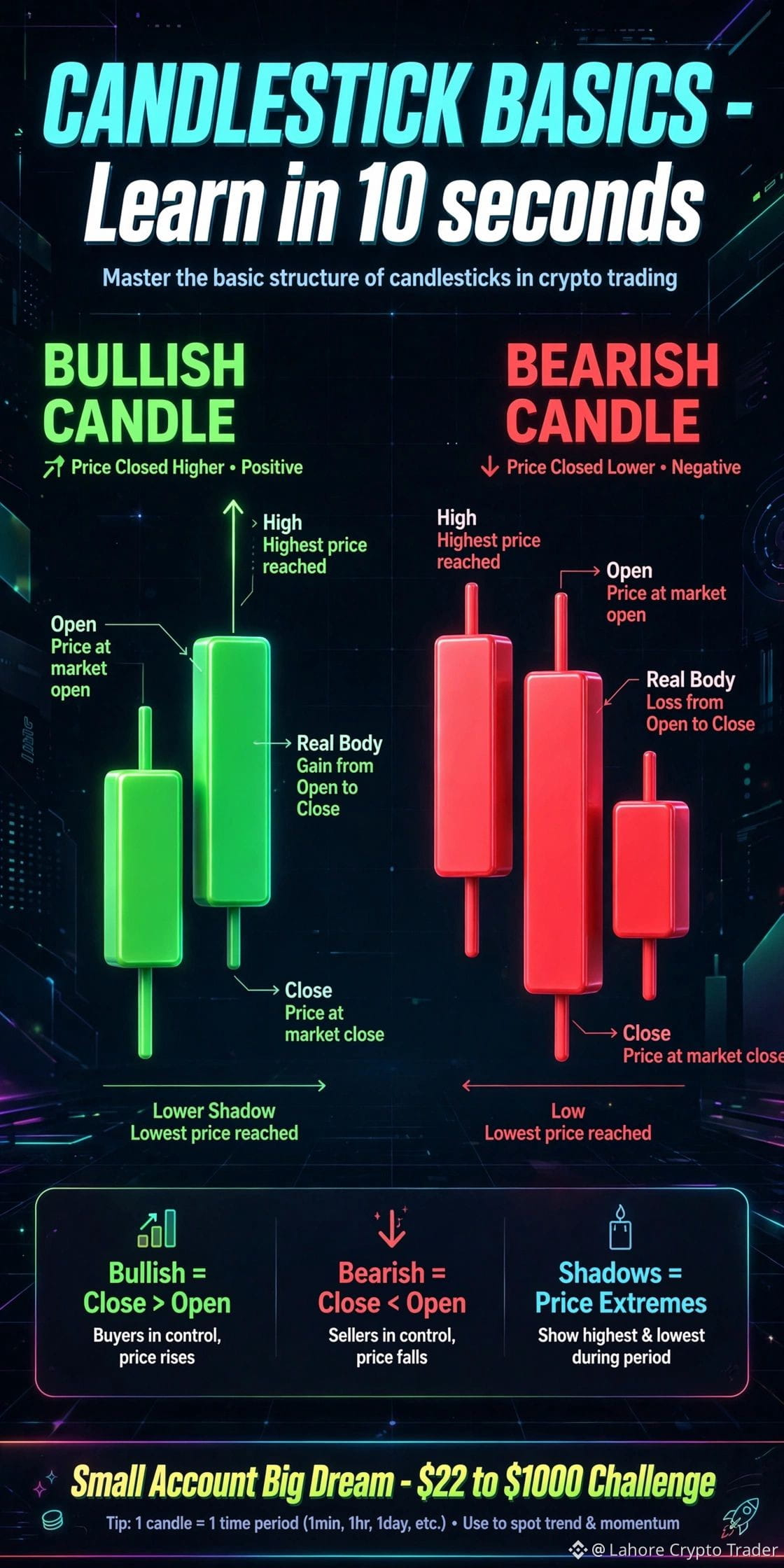
38

🎓 Day 1: Trading from ZERO! 🚀
Most beginners lose money because they skip this step... 😱
✅ Trading = short-term buying and selling for profit
✅ Investing = holding long term
💡 Golden rule: never trade money you can't afford to lose.
📌 Save this post. Tomorrow: Spot vs Futures!
Which one are you, trader or investor? 👇
#Binance #LearnCrypto #TradingForBeginners #CryptoTrading #Write2Earn
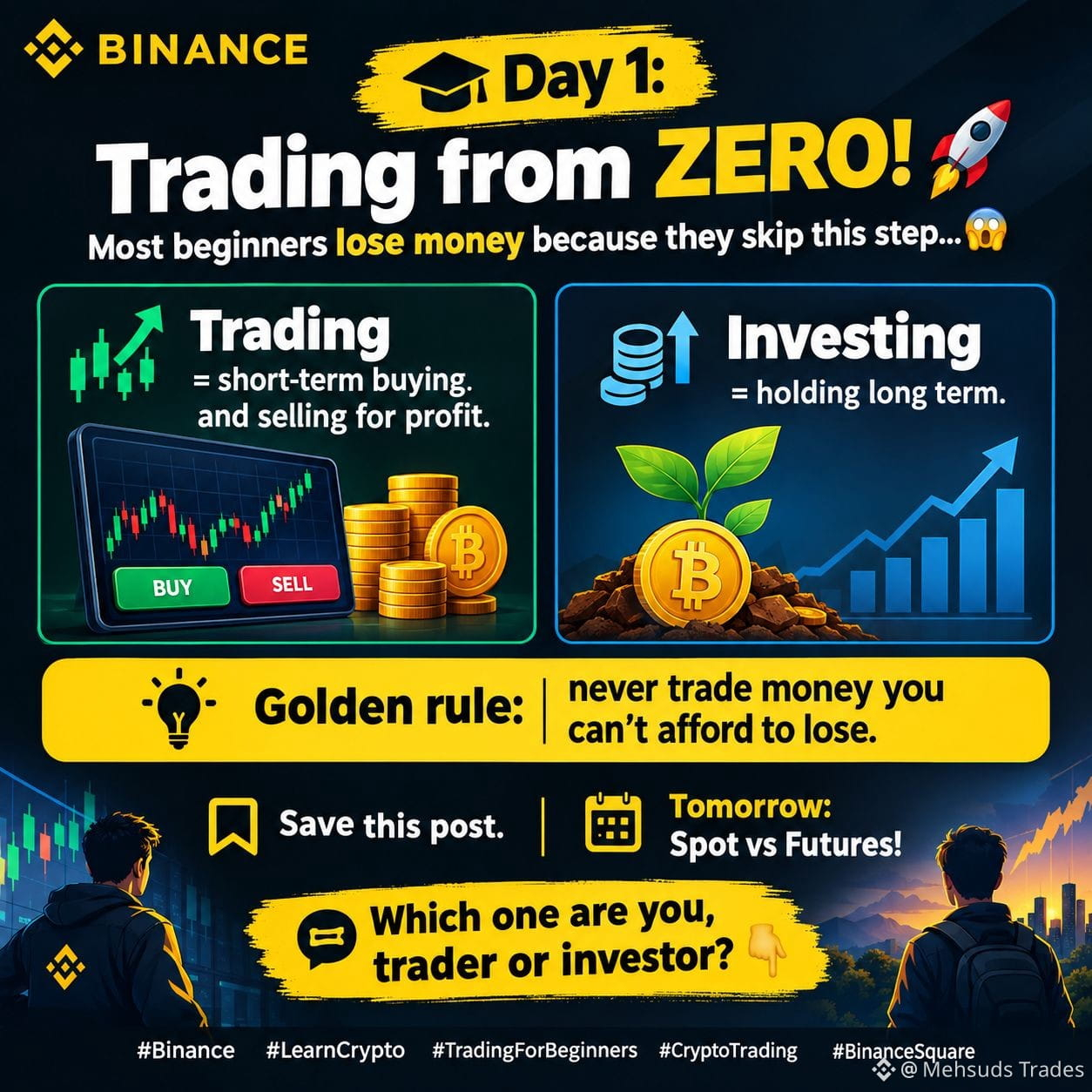
69
·
--
What is Leverage?
Leverage allows you to control a bigger position with smaller capital.
Example:
You have $100.
If you use 5x leverage, your position size becomes:
$100 × 5 = $500
So you are trading like you have $500, even though your margin is only $100.
This can increase your profit.
But it also increases your loss.
That is the part most beginners ignore.
#CryptoFutures #BİNANCEFUTURES #cryptotrading #FuturesTrading #BitcoinTrading #AltcoinTrading #cryptoeducation #TradingForBeginners #LeverageTrading #RiskManagement #BTC #CryptoTips
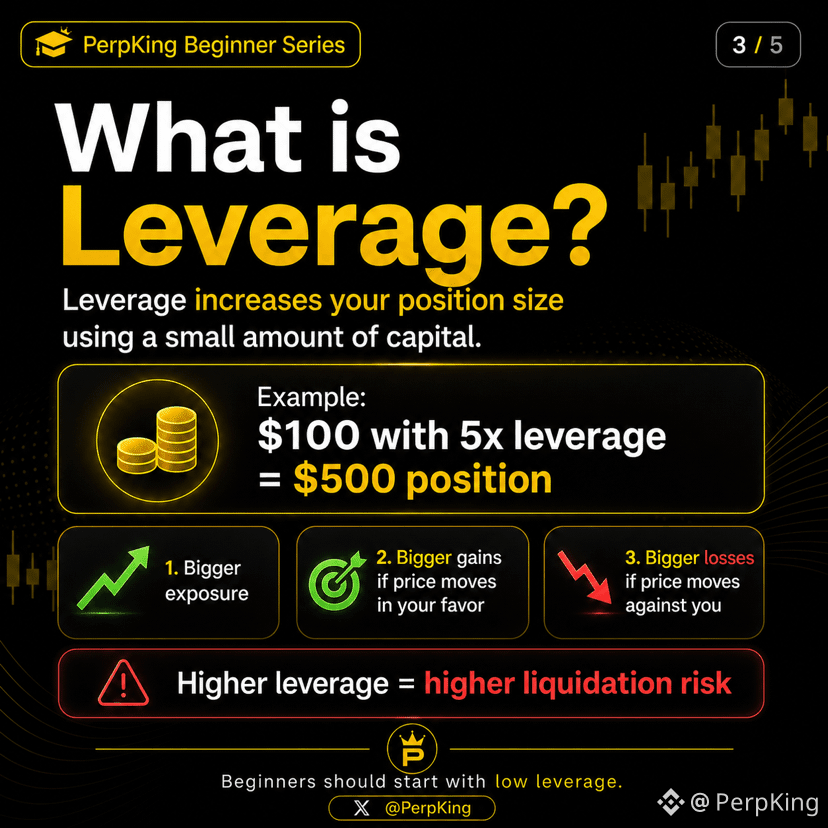
1
1
80
Войдите, чтобы посмотреть больше материала
Присоединяйтесь к пользователям криптовалют по всему миру на Binance Square
⚡️ Получайте новейшую и полезную информацию о криптоактивах.
💬 Нам доверяет крупнейшая в мире криптобиржа.
👍 Получите достоверные аналитические данные от верифицированных создателей контента.
Эл. почта/номер телефона
В тренде
1
#BinanceReports80%Recoveryof$6.3BillioninLossesfromHackIncident
Просмотров: 7,918
86 обсуждают
2
#HeYiSaysWithdrawalsExpectedtoResumeWithin42Hours
Просмотров: 14,264
292 обсуждают
3
#CZSaysCompensationIsinPlaceUsersAreProtected
Просмотров: 13,445
230 обсуждают
4
#RichardTengSaysBinanceWillCoverAllHackedLosseswithCompanyFunds
Просмотров: 880
14 обсуждают
5
#IntelHasItsWorstDaySince1974
Просмотров: 5
13 обсуждают
6
#TRMCambodianCasinosReceived$1.07BInCrypto
Просмотров: 856
32 обсуждают
7
#USDCCirculationFallsAbout800MInSevenDays
Просмотров: 10,121
201 обсуждают
8
#SuspectedNorthKoreaAttacksAccountForNearly89%OfCryptoHackLosses
Просмотров: 6,935
69 обсуждают
9
#OpenAICutsFundraisingTargetBy$10B
Просмотров: 1,232
53 обсуждают
10
#ASICHasReceivedNoPredictionMarketApplications
Просмотров: 24,476
610 обсуждают