

#riskmanagement
riskmanagement
Просмотров: 17.5M
67,469 обсуждают
Популярные
Новые

·
--
The Silent Portfolio Killers: 4 Deadly Trading Mistakes That Every Crypto Beginner Makes! ⚠️💸Entering the cryptocurrency market is filled with excitement, adrenaline, and dreams of financial freedom. However, the path to success is often blocked by invisible traps. Most traders don't lose their capital because the market is rigged against them; they lose it because of repeated, avoidable human errors. If you keep repeating these common mistakes, no bull run or high-leverage trade will ever save your portfolio.
Recognizing these traps is the first step toward true market maturity and consistent profitability. Let’s break down the most dangerous mistakes and how you can fix them starting today.
Mistake 1: Chasing Green Candles (The FOMO Trap)
One of the most destructive habits is jumping into a token after it has already pumped 100% or 200% in a single day, driven purely by Fear Of Missing Out (FOMO). By the time you buy at the local top, early whales and smart money are ready to dump their bags on your liquidity. True investing is about patience, waiting for market consolidation, and accumulating quality assets near strong support levels—never chasing a parabolic pump.
Mistake 2: Ignoring Strict Risk Management and Stop-Losses
Trading without a risk management plan is equivalent to driving a race car blindfolded without a seatbelt. Many traders risk an uncalculated percentage of their capital on a single trade, refusing to set stop-losses because they "hope" the market will bounce back. When a flash crash hits, that single unmanaged position can wipe out months of hard-earned profits in seconds. Always calculate your risk-to-reward ratio before opening any position.
Mistake 3: Over-Leveraging and High-Risk Gambling
Using high leverage (50x, 100x, etc.) transforms legitimate trading into pure casino gambling. A tiny 1% price fluctuation against your direction is enough to liquidate your entire margin. High leverage doesn't make you a professional trader; it makes you a fast target for market volatility. Focus on spot trading or very low, controlled leverage if you want to survive long-term.
Mistake 4: Failing to Do Your Own Research (DYOR)
Blindly following random social media influencers, Telegram signal groups, or hype-driven meme coins without checking underlying fundamentals or utility is a direct ticket to zero. If you don't understand what you are investing in, you are simply handing your money over to strangers. Always research project utilities, market caps, and team transparency.
Avoiding these common pitfalls shifts your mindset from a speculative gambler to a disciplined, strategic business owner.
Which of these mistakes have you witnessed or fallen into yourself in the past? How did you correct your approach? Let’s discuss in the comments below! 👇
🔔 Want to avoid costly mistakes, master smart risk management, and stay ahead with reliable insights? Hit the Follow button right now and never miss a vital update!
#CryptoTrading #TradingMistakes #InvestSmart #CryptoBeginner #LearnCrypto #CryptoCommunity #TradingTips #RiskManagement #BinanceSquare #SmartInvestments #Web3 #CryptoTips
$NEAR
{future}(NEARUSDT)
$DOT
{future}(DOTUSDT)
$LINK
{future}(LINKUSDT)
The Silent Portfolio Killers: 4 Deadly Trading Mistakes That Every Crypto Beginner Makes! ⚠️💸
Entering the cryptocurrency market is filled with excitement, adrenaline, and dreams of financial freedom. However, the path to success is often blocked by invisible traps. Most traders don't lose their capital because the market is rigged against them; they lose it because of repeated, avoidable human errors. If you keep repeating these common mistakes, no bull run or high-leverage trade will ever save your portfolio.
Recognizing these traps is the first step toward true market maturity and consistent profitability. Let’s break down the most dangerous mistakes and how you can fix them starting today.
Mistake 1: Chasing Green Candles (The FOMO Trap)
One of the most destructive habits is jumping into a token after it has already pumped 100% or 200% in a single day, driven purely by Fear Of Missing Out (FOMO). By the time you buy at the local top, early whales and smart money are ready to dump their bags on your liquidity. True investing is about patience, waiting for market consolidation, and accumulating quality assets near strong support levels—never chasing a parabolic pump.
Mistake 2: Ignoring Strict Risk Management and Stop-Losses
Trading without a risk management plan is equivalent to driving a race car blindfolded without a seatbelt. Many traders risk an uncalculated percentage of their capital on a single trade, refusing to set stop-losses because they "hope" the market will bounce back. When a flash crash hits, that single unmanaged position can wipe out months of hard-earned profits in seconds. Always calculate your risk-to-reward ratio before opening any position.
Mistake 3: Over-Leveraging and High-Risk Gambling
Using high leverage (50x, 100x, etc.) transforms legitimate trading into pure casino gambling. A tiny 1% price fluctuation against your direction is enough to liquidate your entire margin. High leverage doesn't make you a professional trader; it makes you a fast target for market volatility. Focus on spot trading or very low, controlled leverage if you want to survive long-term.
Mistake 4: Failing to Do Your Own Research (DYOR)
Blindly following random social media influencers, Telegram signal groups, or hype-driven meme coins without checking underlying fundamentals or utility is a direct ticket to zero. If you don't understand what you are investing in, you are simply handing your money over to strangers. Always research project utilities, market caps, and team transparency.
Avoiding these common pitfalls shifts your mindset from a speculative gambler to a disciplined, strategic business owner.
Which of these mistakes have you witnessed or fallen into yourself in the past? How did you correct your approach? Let’s discuss in the comments below! 👇
🔔 Want to avoid costly mistakes, master smart risk management, and stay ahead with reliable insights? Hit the Follow button right now and never miss a vital update!
#CryptoTrading #TradingMistakes #InvestSmart #CryptoBeginner #LearnCrypto #CryptoCommunity #TradingTips #RiskManagement #BinanceSquare #SmartInvestments #Web3 #CryptoTips
$NEAR
$DOT
$LINK
1
204

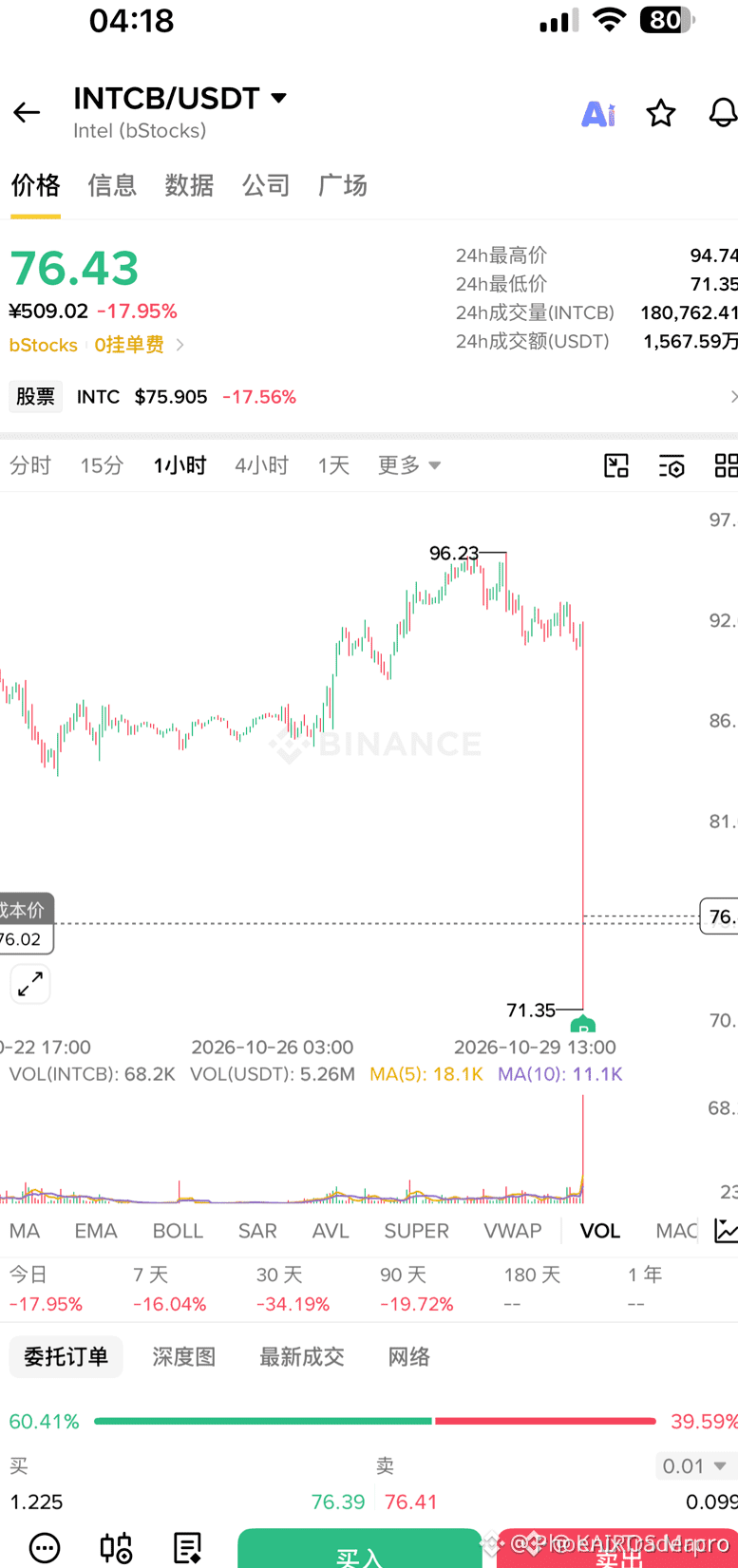
🔴 $INTEL PLUNGES INTO THE DEPTHS – A HARD LESSON IN RISK ⚡
The order flow turned into a rapid liquidity sweep, slamming $INTEL down 50k USDT in seconds. 📉 Smart money cleared the books, leaving a gaping void where buyers once lingered. 📊 Volume spiked on the 1‑minute chart, confirming the aggressive short push. ⚡
This sting underscores the need for tight position sizing and a hard stop before the price even breathes. 💡 If you’re riding the same wave, ask yourself: are you letting the market dictate your exit or are you the one setting the guardrails? 💬
⚠️ Not financial advice. Always manage your risk. 🛡️
🏷️ #INTEL #ShortSetup #RiskManagement #Crypto
🦈 🔥
20

·
--
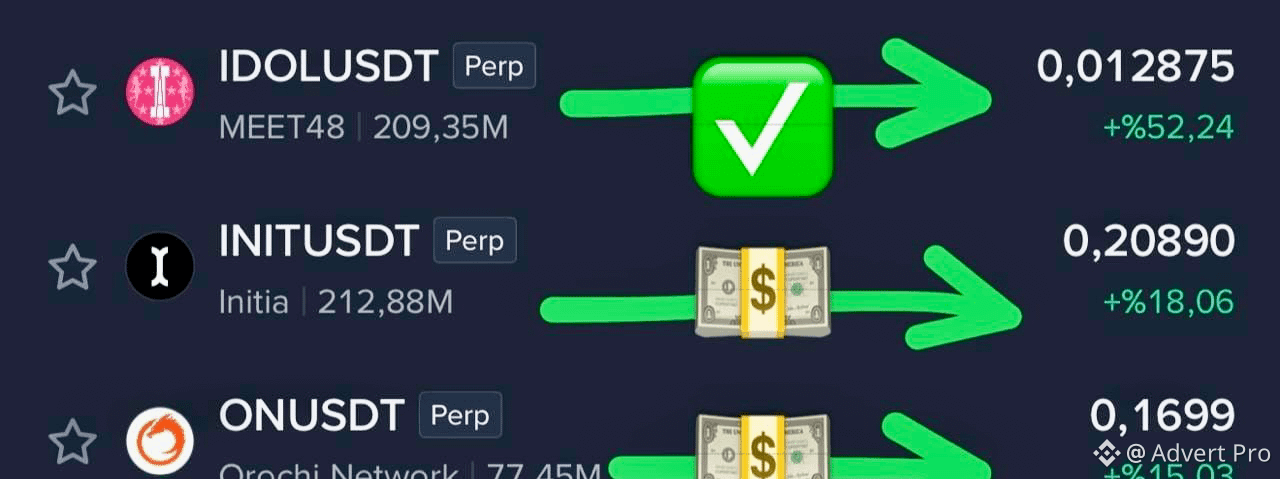
🚨 DECONSTRUCTING "RUNNER" ROTATIONS: AUDITING 🎯🚀
🔥 Your assessment of low-cap liquidity mechanics accurately highlights how market makers and trading desks engineer short-term pumps on illiquid tokens when major assets consolidate.
However, evaluating these three specific setups ($IDOL, $INIT,$ON) through a strict technical and market structure framework reveals critical execution risks.
🔍 Structural & Order Book Breakdown:
$IDOL (MEET48) — Accumulation Shelf vs. Derivative Squeeze ⚙️
The Structural Thesis: has consolidated within a defined horizontal range following earlier distribution.
The Order Book Trap: While accumulation on spot charts often precedes volatility expansion, derivative markets tell the real story. Perpetual Open Interest (OI) frequently outpaces spot order book depth.
$INIT (Initia) — Token Unlocks vs. Tactical Wicks 🚀
Your Take: Expected 1–2 day short-term rally followed by a drop.
The Supply Mechanics: Modern modular/L1 infrastructure tokens like operate with complex vesting schedules, early investor allocations, and emission cliffs.
$ON (Orochi Network) — Low-Depth Liquidity Trap 🪦
Your Take: Low market cap/volume enables high price impact with small trades.
The Risk Vector: Micro-caps with thin order books carry severe slippage risk. A single $20k–$50k market order can spike price +30%, creating an artificial "green wick." However, exiting that position requires selling into non-existent bid liquidity.
🛑 Trader Risk Warning:
Trading low-depth micro-caps in anticipation of speculative "runners" carries severe illiquidity, slippage, and rapid distribution risks! Protect your trading capital: enforce hard horizontal Stop-Loss parameters, keep leverage conservative, and prioritize capital preservation above all else! 🛡️⚡
📌 Follow & Like for daily technical audits, structural trade management, and disciplined risk-first execution! 🔥
#Binance #CryptoTrading #Altcoins #RiskManagement
🚨 DECONSTRUCTING "RUNNER" ROTATIONS: AUDITING 🎯🚀
🔥 Your assessment of low-cap liquidity mechanics accurately highlights how market makers and trading desks engineer short-term pumps on illiquid tokens when major assets consolidate.
However, evaluating these three specific setups ($IDOL , $INIT ,$ON ) through a strict technical and market structure framework reveals critical execution risks.
🔍 Structural & Order Book Breakdown:
$IDOL (MEET48) — Accumulation Shelf vs. Derivative Squeeze ⚙️
The Structural Thesis: has consolidated within a defined horizontal range following earlier distribution.
The Order Book Trap: While accumulation on spot charts often precedes volatility expansion, derivative markets tell the real story. Perpetual Open Interest (OI) frequently outpaces spot order book depth.
$INIT (Initia) — Token Unlocks vs. Tactical Wicks 🚀
Your Take: Expected 1–2 day short-term rally followed by a drop.
The Supply Mechanics: Modern modular/L1 infrastructure tokens like operate with complex vesting schedules, early investor allocations, and emission cliffs.
$ON (Orochi Network) — Low-Depth Liquidity Trap 🪦
Your Take: Low market cap/volume enables high price impact with small trades.
The Risk Vector: Micro-caps with thin order books carry severe slippage risk. A single $20k–$50k market order can spike price +30%, creating an artificial "green wick." However, exiting that position requires selling into non-existent bid liquidity.
🛑 Trader Risk Warning:
Trading low-depth micro-caps in anticipation of speculative "runners" carries severe illiquidity, slippage, and rapid distribution risks! Protect your trading capital: enforce hard horizontal Stop-Loss parameters, keep leverage conservative, and prioritize capital preservation above all else! 🛡️⚡
📌 Follow & Like for daily technical audits, structural trade management, and disciplined risk-first execution! 🔥
#Binance #CryptoTrading #Altcoins #RiskManagement
1
56
·
--
🚨 SYNDICATE FINANCIAL NETWORKS: AUDITING LAIRS, SCAMBAITERS, AND ASSET EXPOSURE 🕵️♂️
🔥 The prosecution of the multinational $65 million elder-fraud ring—brought to a close in the Southern District of California with the final guilty pleas—highlights how transnational organized crime operates at the intersection of impersonation networks, physical cash mule logistics, and crypto laundering infrastructure.
While the public focus centers on open-source intelligence (OSINT) from creators like Scammer Payback and Trilogy Media handing over unblurred video evidence to federal investigators, evaluating how these illicit proceeds are converted through OTC crypto desks reveals the broader liquidity risks.
🌐 Market & Token Reality Check (, $AIA ,$JST ):
$ON , $AIA,Micro-Cap Noise ⚙️
The Trap: Unrelated low-depth altcoins ($ON, $AIA,$JST) are frequently tagged in viral crime and scam reports on social media platforms to capture speculative traffic.
Execution View: A criminal syndicate using crypto or fiat to launder fraud proceeds has zero bearing on the underlying protocol mechanics or long-term value of random altcoins. Tagging low-cap tokens in scam summaries is designed to engineer artificial attention.
Risk Vector: Chasing lower-timeframe wicks on thin order books ($ON,$AIA) without verified spot volume or structural support reclaims leaves capital exposed to immediate liquidity dumps.
🛑 Trader Risk Warning:
Trading lower-timeframe volatility on thin altcoins tagged in viral crime news carries severe execution, slippage, and illiquidity risks! Protect your trading capital: enforce strict Stop-Loss parameters, keep perpetual leverage conservative, and prioritize capital defense above all else! 🛡️⚡
📌 Follow & Like for daily technical audits, cybersecurity risk analysis, and disciplined market execution! 🔥
#Binance #CyberSecurity #RiskManagement #DYOR
🚨 SYNDICATE FINANCIAL NETWORKS: AUDITING LAIRS, SCAMBAITERS, AND ASSET EXPOSURE 🕵️♂️
🔥 The prosecution of the multinational $65 million elder-fraud ring—brought to a close in the Southern District of California with the final guilty pleas—highlights how transnational organized crime operates at the intersection of impersonation networks, physical cash mule logistics, and crypto laundering infrastructure.
While the public focus centers on open-source intelligence (OSINT) from creators like Scammer Payback and Trilogy Media handing over unblurred video evidence to federal investigators, evaluating how these illicit proceeds are converted through OTC crypto desks reveals the broader liquidity risks.
🌐 Market & Token Reality Check (, $AIA ,$JST ):
$ON , $AIA ,Micro-Cap Noise ⚙️
The Trap: Unrelated low-depth altcoins ($ON , $AIA ,$JST ) are frequently tagged in viral crime and scam reports on social media platforms to capture speculative traffic.
Execution View: A criminal syndicate using crypto or fiat to launder fraud proceeds has zero bearing on the underlying protocol mechanics or long-term value of random altcoins. Tagging low-cap tokens in scam summaries is designed to engineer artificial attention.
Risk Vector: Chasing lower-timeframe wicks on thin order books ($ON ,$AIA ) without verified spot volume or structural support reclaims leaves capital exposed to immediate liquidity dumps.
🛑 Trader Risk Warning:
Trading lower-timeframe volatility on thin altcoins tagged in viral crime news carries severe execution, slippage, and illiquidity risks! Protect your trading capital: enforce strict Stop-Loss parameters, keep perpetual leverage conservative, and prioritize capital defense above all else! 🛡️⚡
📌 Follow & Like for daily technical audits, cybersecurity risk analysis, and disciplined market execution! 🔥
#Binance #CyberSecurity #RiskManagement #DYOR

7

·
--
🎯 Hourly Crypto Trade Blueprint: Key Setups & Targets
1. $FET | $0.1779
- 🎯 Trade Direction: LONG (Support Bounce)
- 📍 Entry Range: $0.1750 – $0.1775
- 💰 Targets: TP1: $0.180, TP2: $0.184, TP3: $0.188
- 🛑 Stop Loss: $0.1730
- 📝 Thesis: Price is stabilizing near the 24-hour low, offering a high-probability mean reversion setup.
2. $TAO | $252.40
- 🎯 Trade Direction: LONG (Trend Continuation)
- 📍 Entry Range: $248.00 – $252.00
- 💰 Targets: TP1: $256.0, TP2: $261.2, TP3: $267.5
- 🛑 Stop Loss: $243.50
- 📝 Thesis: Consolidating cleanly above daily structural support, primed for a technical test of local highs.
3. $DASH | $50.81
- 🎯 Trade Direction: RANGE SCALP (Oversold Rebound)
- 📍 Entry Range: $50.00 – $50.80
- 💰 Targets: TP1: $51.6, TP2: $52.6, TP3: $53.8
- 🛑 Stop Loss: $49.50
- 📝 Thesis: Approaching key psychological support where previous intraday buying volume stepped in.
🛡️ Risk Management Execution Rule: Secure 50% profits at TP1 and move SL to breakeven. Never risk >1-2% equity.
Drop your price targets! Will $FET reach TP2 before any pullback? Let us know below! 👇
Educational trade scenarios only, not financial advice.
$FET $TAO $DASH #BinanceSquare #CryptoTrading #RiskManagement

·
--
Hedging Explained
Hedging is a strategy used to protect your portfolio from potential losses, it's about managing risk. The Basic Idea
Hedging involves taking a position in a security that offsets potential losses in another security, this way you can reduce your exposure to downside risk. Example Time
For instance, if you hold $BTC and you're worried about a potential decline, you could take a position in a security that historically moves in the opposite direction of $BTC, this would help reduce your potential losses. The Goal
The goal of hedging is to reduce risk, not to make a profit, it's a defensive strategy. Types of Hedges
There are different types of hedges, including direct hedges and indirect hedges, each with its own characteristics. Importance of Hedging
Hedging is important because it can help you sleep better at night, knowing that you've taken steps to protect your portfolio from potential losses. Disclaimer
This post is for educational purposes only, it's not intended to be taken as investment advice, always do your own research and consult with a financial advisor before making any investment decisions.
BullMarket #BearMarket #RiskManagement
Hedging Explained
Hedging is a strategy used to protect your portfolio from potential losses, it's about managing risk. The Basic Idea
Hedging involves taking a position in a security that offsets potential losses in another security, this way you can reduce your exposure to downside risk. Example Time
For instance, if you hold $BTC and you're worried about a potential decline, you could take a position in a security that historically moves in the opposite direction of $BTC , this would help reduce your potential losses. The Goal
The goal of hedging is to reduce risk, not to make a profit, it's a defensive strategy. Types of Hedges
There are different types of hedges, including direct hedges and indirect hedges, each with its own characteristics. Importance of Hedging
Hedging is important because it can help you sleep better at night, knowing that you've taken steps to protect your portfolio from potential losses. Disclaimer
This post is for educational purposes only, it's not intended to be taken as investment advice, always do your own research and consult with a financial advisor before making any investment decisions.
BullMarket #BearMarket #RiskManagement
29
·
--
🎯 Hourly Crypto Trade Blueprint: Key Setups & Targets
1. $CHIP | Current: $0.04983
- 🎯 Direction: LONG (Breakout Re-test)
- 📍 Entry: $0.0485 - $0.0495
- 💰 Targets: TP1 $0.0506 | TP2 $0.0516 | TP3 $0.0528
- 🛑 Stop Loss: $0.0465
- 📝 Thesis: Holding above the 24h low offers structural support for a continuation toward daily highs.
2. $ADA | Current: $0.2043
- 🎯 Direction: RANGE SCALP (Support Bounce)
- 📍 Entry: $0.1980 - $0.2020
- 💰 Targets: TP1 $0.2074 | TP2 $0.2114 | TP3 $0.2165
- 🛑 Stop Loss: $0.1945
- 📝 Thesis: Steady volume supports a mean-reversion play testing the upper boundary of the current session range.
3. $LTC | Current: $58.25
- 🎯 Direction: MEAN REVERSION (Dip Buy)
- 📍 Entry: $57.20 - $57.90
- 💰 Targets: TP1 $59.12 | TP2 $60.28 | TP3 $61.74
- 🛑 Stop Loss: $56.50
- 📝 Thesis: Minor intraday weakness creates a favorable risk-to-reward entry near key demand.
🛡️ Risk Management Execution Rule: Secure 50% profits at TP1 and move SL to breakeven. Never risk >1-2% equity.
Trader Poll: Which setup offers the cleanest Risk-to-Reward right now? 🅰️ $CHIP | 🅱️ $ADA | 🅲 $LTC 👇
*Educational trade scenarios only, not financial advice.*
$CHIP $ADA $LTC #BinanceSquare #CryptoTrading #RiskManagement
4

·
--
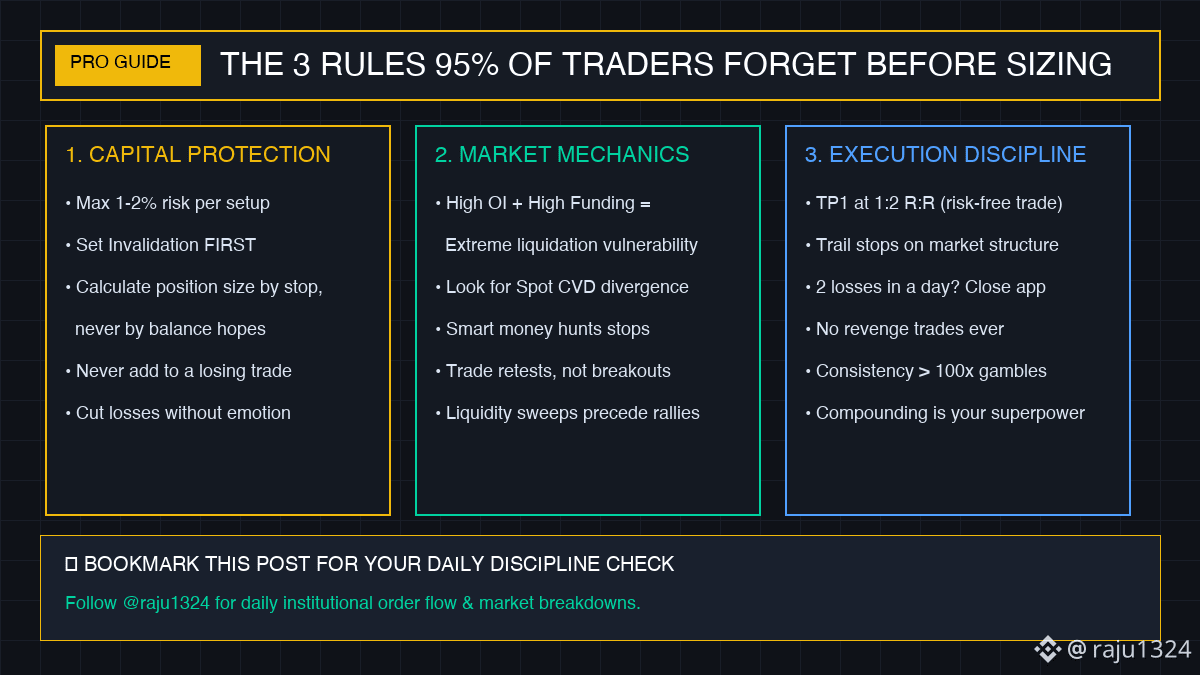
📉 The Brutal Truth: 95% of traders fail not because of their technical setup, but because of these 3 execution flaws.
If you want to protect your portfolio and build sustainable gains in this market, audit your habits against this checklist before placing your next trade:
❌ Flaw 1: Sizing for Hopes Instead of Invalidation
Most beginners open a trade and hope for massive profits without knowing where their setup is dead.
👉 The Fix: Determine where your trade is invalid FIRST. Then calculate your position size so that being wrong only costs 1–2% of your total balance.
❌ Flaw 2: Ignoring Funding Rates & Open Interest
Opening long positions when Open Interest (OI) is at extreme peaks and funding rates are overheated means you are paying high premiums in a crowded trade. Whales hunt this liquidity every single week.
👉 The Fix: Watch for Spot vs. Futures divergence. When spot buying absorbs sell-offs, smart money is accumulating.
❌ Flaw 3: Revenge Trading After a Stop-Loss
A stop-loss is simply the cost of doing business. Trying to win it back in the next 15 minutes is the fastest path to liquidation.
👉 The Fix: Two consecutive losses? Close the charts and walk away for 24 hours. The market will always be here.
💡 Golden Rule: Professional traders spend 80% of their energy on risk management and 20% on analysis. Amateurs do the reverse.
📌 Save & Bookmark this post to review before every trading session.
➕ Follow for daily data-backed market analysis and risk frameworks!
💬 QUESTION: Which rule was the hardest for you to master? Share below! 👇
#BinanceSquare #CryptoEducation #RiskManagement #TradingStrategy #FuturesTrading
1
25

·
--
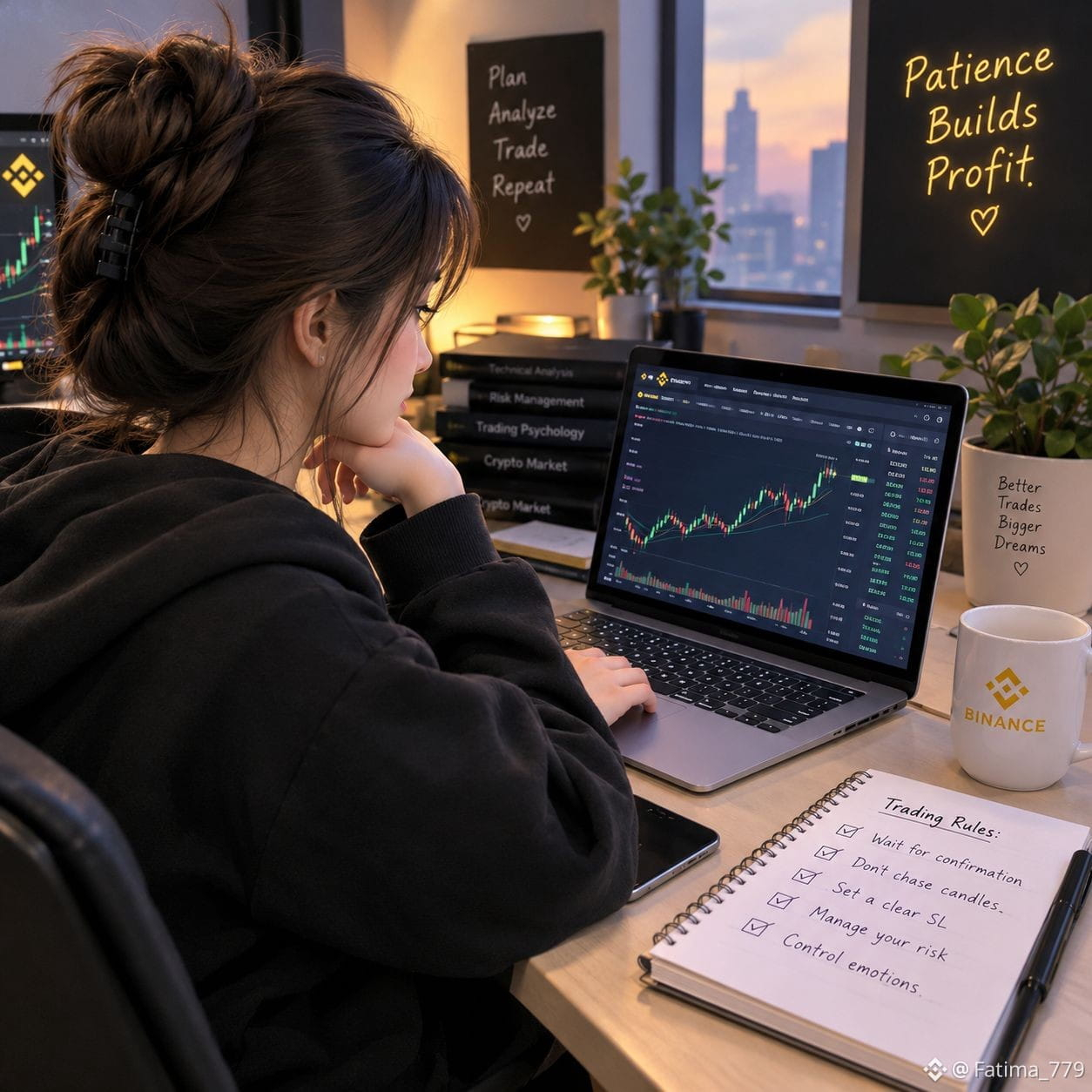
📊 Trading Is a Game of Patience, Not Emotions
The market gives opportunities every day, but that doesn't mean every move deserves a trade.
Sometimes the smartest decision is to wait. Sometimes protecting your capital is more important than making a quick profit.
Before entering any trade, remember:
📌 Wait for confirmation.
📌 Never chase a candle.
📌 Always set a clear Stop Loss.
📌 Follow proper risk management.
📌 Don't let fear or greed control your decisions.
A good trader doesn't need to win every trade. They need to manage losses, learn from mistakes, and stay consistent over time.
Remember: One missed trade is better than one careless loss. 🎯
What's your biggest trading challenge — Entry, Patience, or Risk Management? 👇
#trading #CryptoTrading #RiskManagement #BinanceSquare
$HYPE
{future}(HYPEUSDT)
$PUMP
{future}(PUMPUSDT)
$GPS
{future}(GPSUSDT)
📊 Trading Is a Game of Patience, Not Emotions
The market gives opportunities every day, but that doesn't mean every move deserves a trade.
Sometimes the smartest decision is to wait. Sometimes protecting your capital is more important than making a quick profit.
Before entering any trade, remember:
📌 Wait for confirmation.
📌 Never chase a candle.
📌 Always set a clear Stop Loss.
📌 Follow proper risk management.
📌 Don't let fear or greed control your decisions.
A good trader doesn't need to win every trade. They need to manage losses, learn from mistakes, and stay consistent over time.
Remember: One missed trade is better than one careless loss. 🎯
What's your biggest trading challenge — Entry, Patience, or Risk Management? 👇
#trading #CryptoTrading #RiskManagement #BinanceSquare
$HYPE
$PUMP
$GPS
3
104

·
--
📊 Crypto Traders, I Need Your Best Trading Advice! 🚀
I’m looking to improve my crypto trading skills and learn from experienced traders in the Binance community.
🎯 I want your advice on:
* 📈 How to identify strong support and resistance levels.
* 🔍 How to confirm a breakout or avoid a fakeout.
* ⚖️ The best risk management strategy for intraday trading.
* 🛑 How to set Stop-Loss and Take-Profit levels.
* 📉 How to use leverage without taking unnecessary risks.
My main focus is BTC, ETH, and BNB. I’m especially interested in practical strategies, technical analysis, and real trading experience rather than just market predictions.
💬 Experienced traders: What’s the ONE trading rule that has helped you the most?
Share your best advice in the comments. Let’s learn, improve, and grow together! 🤝
#BinanceSquare #bitcoin #Ethereum #TradingTips #RiskManagement
91
·
--
Why "buying the bounce" trapped people on $Q. 💀
A 70% drop doesn't mean "cheap". It means the coin is unstable.
3 lessons:
1️⃣ A bounce is not a bottom
2️⃣ Leverage on a coin like this can liquidate you in ONE candle
3️⃣ If you can't say where you're wrong BEFORE entry, don't enter
Have you bought a "cheap" crash? 👇
#q #RiskManagement #BinanceSquare
Not financial advice.
1
512

·
--

Статья
Never move your stop loss further away.It feels like hope. In reality, it is one of the most common ways a small loss becomes a big one.
The stop was set before you entered, when you were calm and had the full picture. Moving it later means your emotions are making the decision.
Before you move it, ask: has the setup actually changed, or do I just not want to be wrong?
If it is the second, you already know the move is a mistake.
A stop you respect is what keeps one bad trade from becoming a bad month.
Educational only. Not financial advice. Trade with a plan.
#BinanceSquare #RiskManagement #CryptoTrading
Never move your stop loss further away.
It feels like hope. In reality, it is one of the most common ways a small loss becomes a big one.
The stop was set before you entered, when you were calm and had the full picture. Moving it later means your emotions are making the decision.
Before you move it, ask: has the setup actually changed, or do I just not want to be wrong?
If it is the second, you already know the move is a mistake.
A stop you respect is what keeps one bad trade from becoming a bad month.
Educational only. Not financial advice. Trade with a plan.
#BinanceSquare #RiskManagement #CryptoTrading
69

·
--
To reduce losses in the crypto market, trade with a strategy, not your emotions. Always follow these 3 rules before investing in any coin:
1. Diversification: Don't put all your money into one coin. Spread it across different projects.
2. Stop-Loss: Always use a stop-loss to protect your portfolio from massive market drops.
3. Avoid FOMO (Fear Of Missing Out): Never jump into a coin just because its price is pumping rapidly.
The market always gives second chances, so stay patient.
#CryptoTips #TradingStrategy #BinanceSquare #RiskManagement
71

·
--
Рост
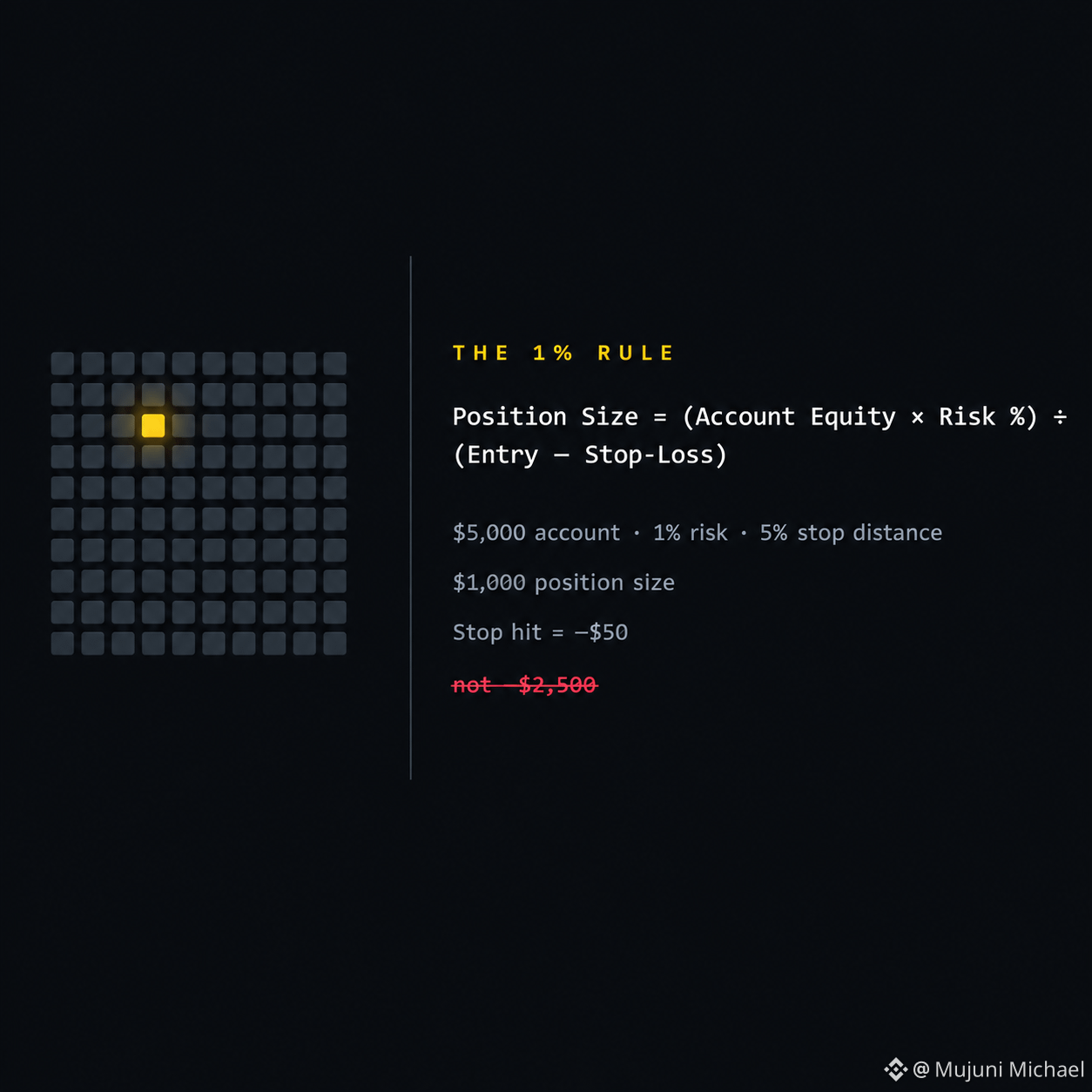
The formula that ends blown accounts:
Position Size = (Account Equity × Risk %) ÷ (Entry − Stop-Loss)
$5,000 account. 1% risk. 5% stop distance. → $1,000 position.
Stop hit = −$50. Not −$2,500.
Most people size by conviction. That's not risk management, that's a feeling.
Full formula + the math of ruin in Article 2 👇
[Risk Management](https://app.binance.com/uni-qr/cpos/382520527566788?l=en&r=VY46L7Y7&uc=web_square_share_link&uco=ylp0eWsydhwritSwu04hgg&us=copylink)
What's your real risk-per-trade %? Number only. I'll go first in the comments.
@Boltonfx
#RiskManagement #Write2Earn #FedWatch $BTC $XRP
The formula that ends blown accounts:
Position Size = (Account Equity × Risk %) ÷ (Entry − Stop-Loss)
$5,000 account. 1% risk. 5% stop distance. → $1,000 position.
Stop hit = −$50. Not −$2,500.
Most people size by conviction. That's not risk management, that's a feeling.
Full formula + the math of ruin in Article 2 👇
Risk Management
What's your real risk-per-trade %? Number only. I'll go first in the comments.
@Mujuni Michael
#RiskManagement #Write2Earn #FedWatch $BTC $XRP
20
·
--
Рост
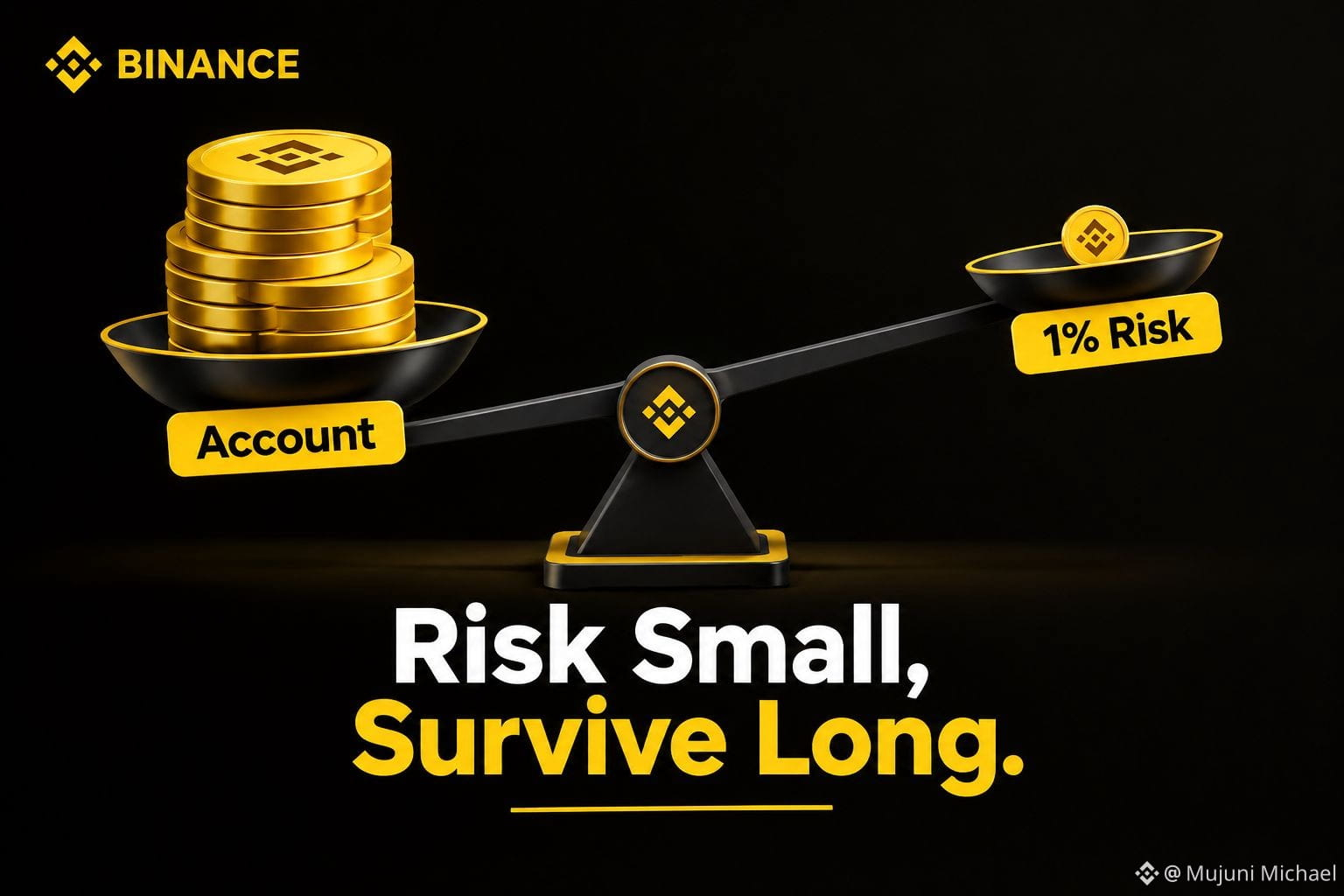
"The 1% Rule: The Only Risk Formula You Need Before You Touch Leverage"
Position sizing is not about how much you believe in a trade. It is about how much you lose when you are wrong.
Define the distinction between position size (how much you buy) and risk amount (how much you lose if the stop-loss triggers).
The formula: Position Size = (Account Equity × Risk %) ÷ (Entry Price -Stop-Loss Price).
Worked example: $5,000 account, 1% risk, 5% stop-loss distance → position size = $1,000. If the stop is hit, you lose exactly $50 (1%).
Why crypto demands a tighter rule than traditional markets: 5-10% daily swings are routine, so the 1% rule (not the traditional 2%) is the safer starting point.
The math of ruin: lose 50% of your account, and you need a 100% gain just to break even. The 1% rule keeps you far away from that trap.
"Be honest: what is your current risk-per-trade percentage? 1%? 3%? 'Whatever's left in the account'? Type the number. Not the number you think sounds good, the real one."
#RiskManagement #Leverage: #FedWatch #Write2Earn
If this is your first lesson, check in profile for other relevant posts [Lesson 2](https://app.binance.com/uni-qr/cpos/381090947827553?l=en&r=VY46L7Y7&uc=web_square_share_link&uco=ylp0eWsydhwritSwu04hgg&us=copylink)
NEXT UP - Monday: $BTC Is the Anchor, Altcoins Are the Amplifier. The 1% rule protects your account. Article 3 tells you what you're actually risking it on, because #cpi does not hit all crypto equally, and your altcoin bags are a leveraged bet on a macro print you can't control. $ETH $NVDAB
See you Monday.!!!
"The 1% Rule: The Only Risk Formula You Need Before You Touch Leverage"
Position sizing is not about how much you believe in a trade. It is about how much you lose when you are wrong.
Define the distinction between position size (how much you buy) and risk amount (how much you lose if the stop-loss triggers).
The formula: Position Size = (Account Equity × Risk %) ÷ (Entry Price -Stop-Loss Price).
Worked example: $5,000 account, 1% risk, 5% stop-loss distance → position size = $1,000. If the stop is hit, you lose exactly $50 (1%).
Why crypto demands a tighter rule than traditional markets: 5-10% daily swings are routine, so the 1% rule (not the traditional 2%) is the safer starting point.
The math of ruin: lose 50% of your account, and you need a 100% gain just to break even. The 1% rule keeps you far away from that trap.
"Be honest: what is your current risk-per-trade percentage? 1%? 3%? 'Whatever's left in the account'? Type the number. Not the number you think sounds good, the real one."
#RiskManagement #Leverage: #FedWatch #Write2Earn
If this is your first lesson, check in profile for other relevant posts Lesson 2
NEXT UP - Monday: $BTC Is the Anchor, Altcoins Are the Amplifier. The 1% rule protects your account. Article 3 tells you what you're actually risking it on, because #cpi does not hit all crypto equally, and your altcoin bags are a leveraged bet on a macro print you can't control. $ETH $NVDAB
See you Monday.!!!
Marvii Crypto:
Thanks for tagging me! Appreciate you sharing these insights, keeping an eye on it. Let's see how it plays out! 🚀
2
93
·
--
I'm not gonna sugarcoat it, hedging's about protecting your portfolio from downside risk. It's like insurance for your investments. You can reduce potential losses by taking a position in an asset that moves opposite to your main investment. If your main investment loses value, the hedge can help offset the loss. Hedging's not about making a profit, it's about managing RISK. It's a tool to help you sleep better at night. I've been through 2 bear markets and I can tell you, it's worth considering. #RiskManagement $SPY #TradingTips
I'm not gonna sugarcoat it, hedging's about protecting your portfolio from downside risk. It's like insurance for your investments. You can reduce potential losses by taking a position in an asset that moves opposite to your main investment. If your main investment loses value, the hedge can help offset the loss. Hedging's not about making a profit, it's about managing RISK. It's a tool to help you sleep better at night. I've been through 2 bear markets and I can tell you, it's worth considering. #RiskManagement $SPY #TradingTips
28
·
--
Crypto Basics
Risk management is KEY to surviving in the crypto space. It's about controlling your losses, so you can stay in the game. The Crypto Catalyst
You need to understand how to use stop loss, position sizing, and DCA to manage your risk. These tools help you limit your losses and avoid big setbacks. The Dynamic Outlook
If you set a stop loss, you can limit your losses to a certain amount, and avoid losing everything. For example, if you buy $ETH and set a stop loss, you can sell it automatically if it drops to a certain level. Setting the right position size is also important. It means you don't put all your money into one trade, so you can survive if it goes wrong. DCA, or dollar-cost averaging, is another way to manage risk, by spreading your investments over time. You should always have a plan before you start trading, and stick to it. Don't let your emotions control your decisions, and always keep an eye on your positions. Disclaimer The information provided is for educational purposes only and should not be considered as investment advice. DeFi #Web3 #RiskManagement
39

The Biggest Crypto Trading Lesson: Protect Your Capital! 🧠
You don't need to catch every pump to become a better trader. A disciplined approach, proper risk management, and patience can help you avoid costly mistakes.
My three rules: ✅ Never trade based on FOMO. ✅ Set your risk limits before entering a trade. ✅ Do your own research before investing.$BTC $MSFT.US $BNB
In crypto, protecting your capital matters just as much as finding opportunities.
What is your number one trading rule?
#CryptoTrading #RiskManagement #TradingPsychology #DYOR

80


$LINK: LINK: The Cost of Waiting vs. Chasing
Imagine two traders watching $LINK. The first waits for price to settle below 11.5031 before acting. The second jumps in because volume is high. Current data shows $LINK is above resistance with volume above baseline. This creates a tension. Entering now risks buying near the top before a pullback. Waiting risks missing a continued move if the volume surge is genuine. The key is not predicting the next candle but defining what would prove your thesis wrong. If the purpose is to test the volume hypothesis, a meaningful invalidation level is critical. Consider the distance between current price and a structural break. If that break is far, the risk to reward may be poor. If it is close, the invalidation is sharp. This trade-off explains why entry quality often matters more than speed. A clear reason to act must exist, not just momentum. Thinking through the scenario helps separate observation from assumption. If we assume volume leads price, then a drop below 11.356 disproves it. If we assume range-bound behavior, breaking 11.61 disproves that. The practical choice is to wait for the invalidation level to be defined first. Without a clear exit point, waiting is safer than chasing. Record the condition that would change your mind. Then monitor $LINK against that specific level. This turns a vague guess into a testable idea. It removes the emotional urge to act on general news or social sentiment. Instead, it focuses on the structural data already present. The decision becomes about managing risk, not catching a move.
Probabilistic market research, not a recommendation or guaranteed return.
Would you wait for clearer structure or reassess the risk first?
#LINK #RiskManagement
$LINK : LINK: The Cost of Waiting vs. Chasing
Imagine two traders watching $LINK . The first waits for price to settle below 11.5031 before acting. The second jumps in because volume is high. Current data shows $LINK is above resistance with volume above baseline. This creates a tension. Entering now risks buying near the top before a pullback. Waiting risks missing a continued move if the volume surge is genuine. The key is not predicting the next candle but defining what would prove your thesis wrong. If the purpose is to test the volume hypothesis, a meaningful invalidation level is critical. Consider the distance between current price and a structural break. If that break is far, the risk to reward may be poor. If it is close, the invalidation is sharp. This trade-off explains why entry quality often matters more than speed. A clear reason to act must exist, not just momentum. Thinking through the scenario helps separate observation from assumption. If we assume volume leads price, then a drop below 11.356 disproves it. If we assume range-bound behavior, breaking 11.61 disproves that. The practical choice is to wait for the invalidation level to be defined first. Without a clear exit point, waiting is safer than chasing. Record the condition that would change your mind. Then monitor $LINK against that specific level. This turns a vague guess into a testable idea. It removes the emotional urge to act on general news or social sentiment. Instead, it focuses on the structural data already present. The decision becomes about managing risk, not catching a move.
Probabilistic market research, not a recommendation or guaranteed return.
Would you wait for clearer structure or reassess the risk first?
#LINK #RiskManagement
44
·
--
0G got SLAMMED, down 11.5% to 0.1806 - that's the DEEPEST CUT today. Wiped out value FAST. Check the order book, WHEN LIQUIDITY DRIES UP, YOU GET GAPS. Watch your position size, THIS IS WHY RISK CONTROLS ARE KEY. I'm telling you, it's not worth the risk if you don't have a plan. $0G #Binance #Trading #RiskManagement
0G got SLAMMED, down 11.5% to 0.1806 - that's the DEEPEST CUT today. Wiped out value FAST. Check the order book, WHEN LIQUIDITY DRIES UP, YOU GET GAPS. Watch your position size, THIS IS WHY RISK CONTROLS ARE KEY. I'm telling you, it's not worth the risk if you don't have a plan. $0G #Binance #Trading #RiskManagement
78
Войдите, чтобы посмотреть больше материала
Присоединяйтесь к пользователям криптовалют по всему миру на Binance Square
⚡️ Получайте новейшую и полезную информацию о криптоактивах.
💬 Нам доверяет крупнейшая в мире криптобиржа.
👍 Получите достоверные аналитические данные от верифицированных создателей контента.
Эл. почта/номер телефона
В тренде
1
#FedWatch
Просмотров: 16.3M
39,325 обсуждают
2
#EarningsSeason
Просмотров: 6.4M
32,028 обсуждают
3
#USMidtermElections
Просмотров: 36,242
582 обсуждают
4
#BitcoinDropsBelow$80K
Просмотров: 24,550
104 обсуждают
5
#BoEOpensConsultationOnTokenizedCollateralForClearing
Просмотров: 499
23 обсуждают
6
#BrazilCryptoExchangesMustApplyForLicensesByFriday
Просмотров: 28,289
480 обсуждают
7
#ICEPartnersWithTradeXYZToBringPerpetualContractsToUS
Просмотров: 684
18 обсуждают
8
#SolidusLabsReportsSuspected$170MSpoofingOnHyperliquidOilContracts
Просмотров: 1,531
25 обсуждают
9
#StanDruckenmillerBecomesInvestorInTradeXYZ
Просмотров: 22,005
424 обсуждают
10
#RussiaProposedNonCustodialWalletLimitsExcludeIntlSettlements
Просмотров: 1,935
40 обсуждают