"They say small accounts can’t grow, but the truth is they just lack the right roadmap; with a true guide, even the smallest seed becomes a forest. 🌳📈" $DENT @Bantee X
Bantee X
·
--
Падение
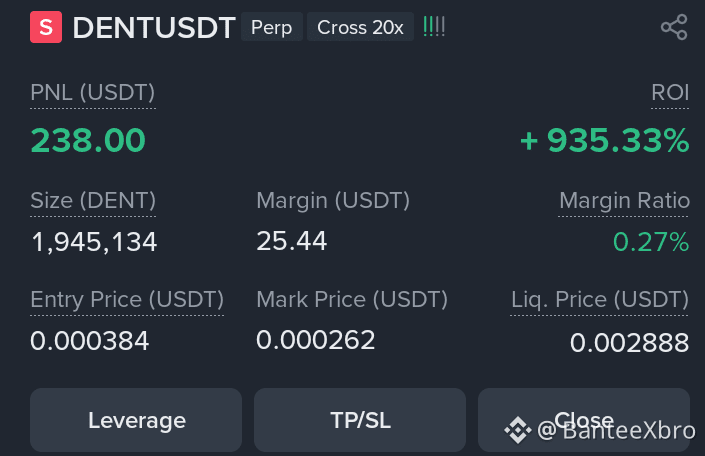
look at $DENT I'm open short at this 👇
see my entry and my final target is 🎯 0.000300 Must use stop lose ⛔ at 0.000432 let's see 😉 .... Always protect your capital first 🥇
I’m excited to share something new — I’m now officially sharing SPOT TRADE SIGNALS right here on Binance Square.
No hype. No shortcuts. Just real strategies to help you trade with more confidence and less stress.
Here’s what you can expect: 🔹 Genuine market analysis — based on trends, not guesswork 🔹 Clear buy & sell zones — no confusion, just smart decisions 🔹 Stop-loss guidance — because protecting your capital is priority #1 🔹 Beginner-friendly setups — simple to follow, easy to act on 🔹 Daily updates — so you stay ahead of market shifts
Many traders lose money not because of the market — but because they don’t have a clear plan. This is your chance to change that.
Whether you’re just starting out or looking to improve your results, these SPOT signals are made to support your journey.
👉 Follow me to start getting insights 👉 Learn to trade smarter, not harder 👉 Be part of a growing community that focuses on knowledge, discipline & growth
The market expecting a soft 65,000 jobs print… and then getting a 165,000 surge instead ⚡.
The October jobs report just dropped, and it was a clear surprise to the upside:
Nonfarm Payrolls: +165,000 (vs 65,000 expected) Unemployment Rate: 4.1% (down from 4.2%, beating the 4.2% forecast) Prior months revised higher by a combined +84,000 jobs Average hourly earnings rose 0.4% — hotter than expected 😯
This is not a borderline beat. It’s a decisive one. The U.S. labor market showed clear resilience after a softer stretch earlier in the year, and the breadth of hiring (especially in professional & business services and healthcare) made the report even stronger. For the Federal Reserve, the message is straightforward: the economy is not weakening fast enough to justify stepping back. Markets immediately began pricing a higher probability of a December rate hike. The “pause” in October now looks more like a temporary skip than the start of an easing cycle.
What this means for Bitcoin & crypto:
Stronger labor data → higher odds of tighter policy → stronger USD and higher yields → increased near-term pressure on risk assets. Bitcoin has already been navigating the historical “Fed pause-then-resume” pattern. This jobs report adds another layer of hawkish reinforcement at a sensitive moment.
Key levels to watch remain the same 👀 Support zone: $74,800 – $75,200 Resistance cluster: $77,400 – $78,600 Breakout target: $80,400 – $82,000
A resilient jobs market reduces the chance of an early Fed pivot. For Bitcoin, that means the path of least resistance in the short term stays challenging unless price can reclaim the higher levels and force a different narrative.
The data is clear. The labor market just pushed back against dovish hopes. What’s your take? Does this jobs beat lock in a December hike and more pressure on $BTC , or can Bitcoin absorb the hawkish shift and hold the $75K floor? Drop your view below 👇
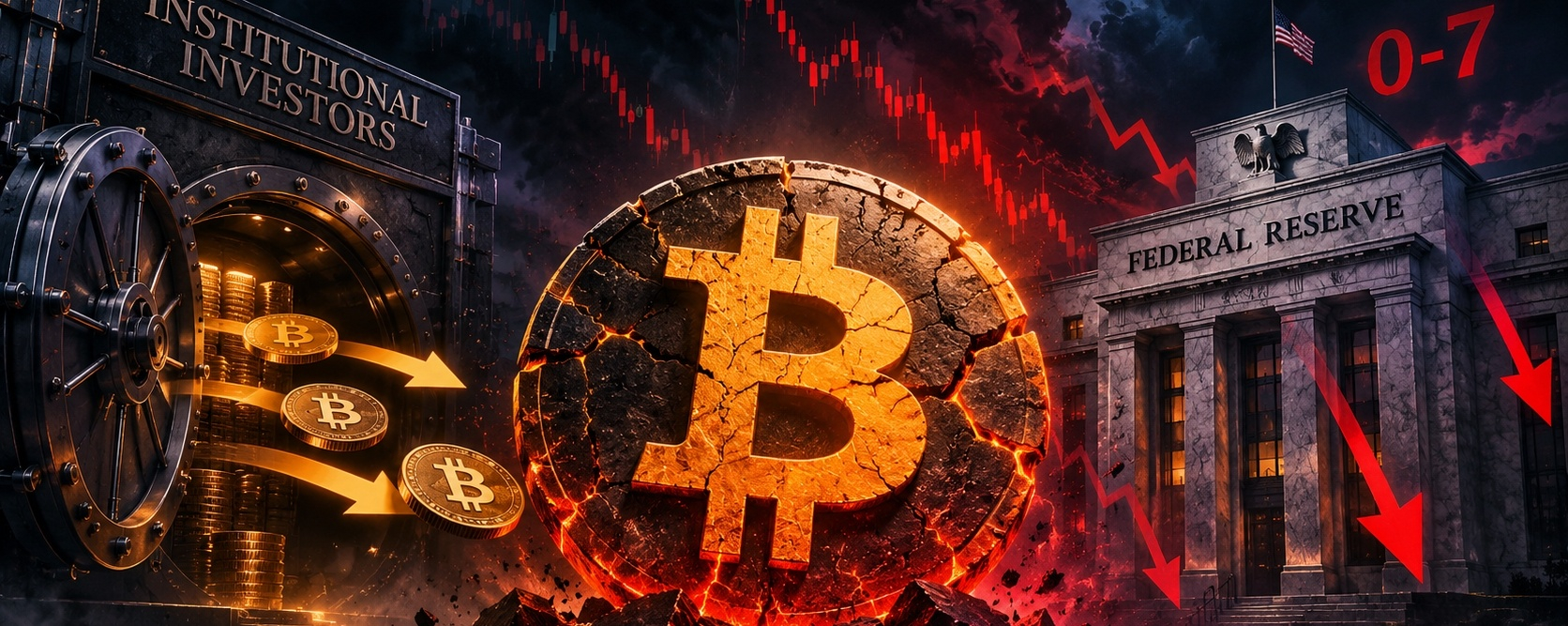
**BITCOIN’S DOUBLE PRESSURE: CORPORATE COLLATERAL MOVES MEET THE FED’S 0-7 CURSE** 🌐⚡ Imagine watching $344 million in Bitcoin leave a major corporate treasury the same week the Federal Reserve’s historical playbook turns against crypto 📜⚡. On November 5, wallets labeled “2028 Convertible Notes Collateral” transferred 4,259 BTC — roughly 30% of Trump Media’s reported holdings — to a Crypto.com address in two rapid batches. The move matched almost exactly the 4,260.73 BTC previously pledged against the company’s convertible notes. Similar transfers in May and August did not trigger open-market liquidations, pointing more toward custody restructuring than an immediate dump. Yet the timing is impossible to ignore: noteholders can demand up to $1 billion in cash redemptions by November 30, and filings explicitly list asset sales as a potential funding source 🏦. Now layer on the macro signal. Quantitative research shows that every single time the Fed has paused rate hikes and then resumed them since 2016 — seven instances, zero exceptions — Bitcoin has finished lower within 30 days, with a median decline of 2.4%. The current sequence mirrors the pattern almost perfectly: a September rate hike, an October pause, and markets pricing a December resumption. The closest historical twin remains 2018, when Bitcoin dropped 42% between the midterm elections and the Fed’s December hike 📉. These two forces are colliding while Bitcoin tests critical technical levels: - Daily Support Floor: $74,800 – $75,200 (defending recent demand zone) 🟢 - Overhead Resistance Cluster: $77,400 – $78,600 (moving-average confluence) 🛑 - Macro Breakout Target: $80,400 – $82,000 (reclaim of institutional control) 🎯 The corporate transfer does not confirm selling. The Fed pattern does not guarantee a crash. But when large pledged Bitcoin begins moving just as a historically perfect bearish sequence approaches its next trigger, the market is forced to price both liquidity risk and policy risk at the same time. Short-term noise often dominates the narrative. Longer-term conviction is built by understanding how corporate balance-sheet mechanics and central-bank sequencing interact. One is visible on-chain. The other is written in the historical record. What’s your take? Does the combination of collateral repositioning and the Fed’s 0-7 streak create a genuine danger zone, or will structural support at $75K absorb the pressure and flip the script? Drop your view below 👇 #Bitcoin #BTC #TrumpMedia #FederalReserve #MacroAnalysis #CryptoTrading #OnChain #BTCAnalysis
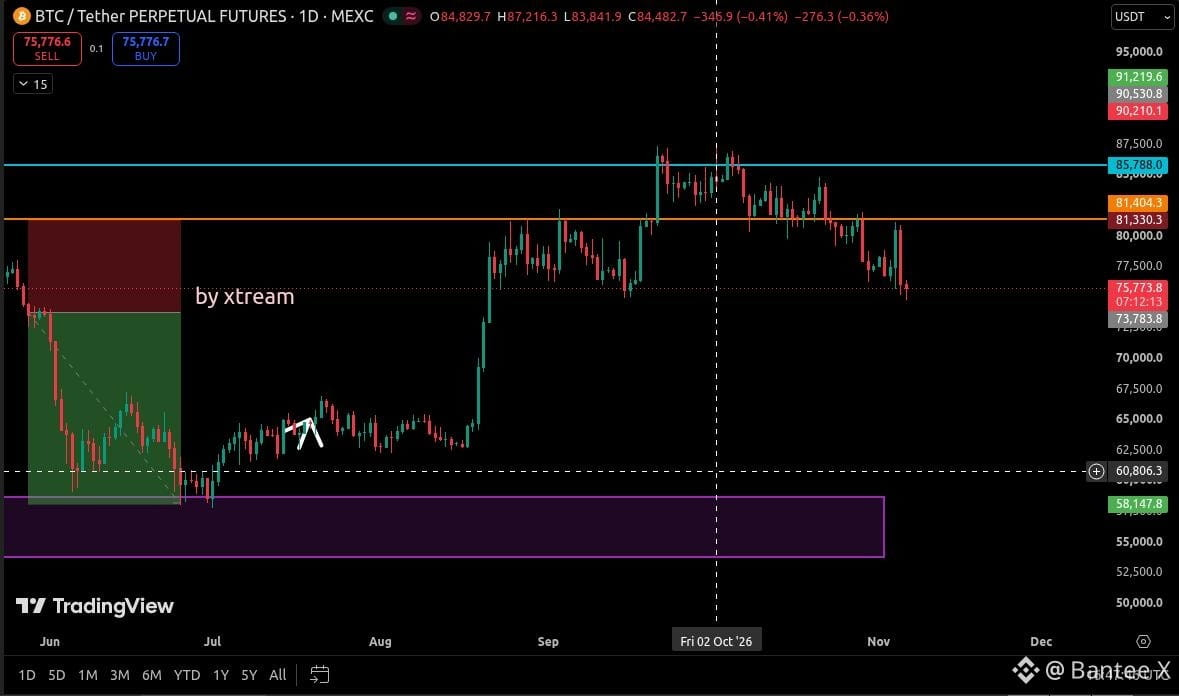
$BTC is currently approaching the $75K support region. This is an important area where we could see buyers step in and attempt to stabilize the market. If Bitcoin holds this daily support and produces a convincing bullish reaction, a recovery toward $78K–$80K becomes a possible scenario. However, we need to see actual buying pressure and stronger daily price action before considering a bounce confirmed. #bitcoin #BitcoinAnalysis #BitcoinRebounds$75KAsChipsLead
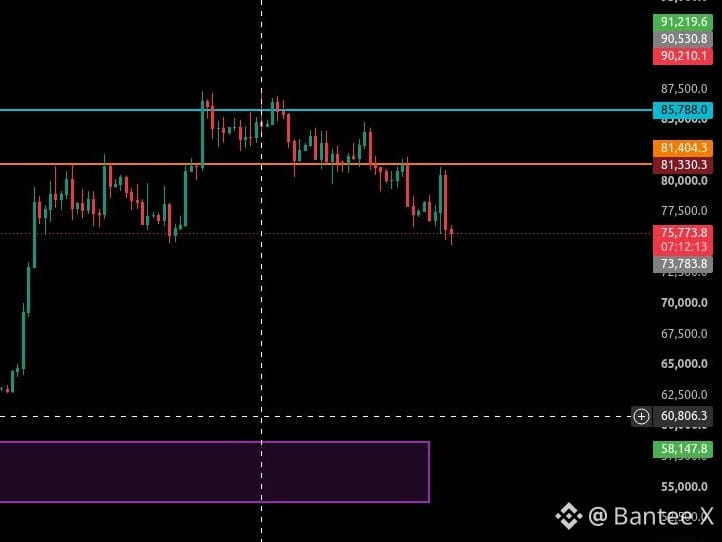
?Bitcoin failed to sustain its move above the $85K resistance region and has since experienced significant selling pressure.
After losing the $81K area, $BTC continued its decline and is now trading around $75,773, according to the supplied chart. At this stage, Bitcoin is approaching an important daily support zone. This is where we need to pay close attention to the market's next reaction.
BTC is currently approaching the $75K support region.
This is an important area where we could see buyers step in and attempt to stabilize the market. If Bitcoin holds this daily support and produces a convincing bullish reaction, a recovery toward $78K–$80K becomes a possible scenario.
However, we need to see actual buying pressure and stronger daily price action before considering a bounce confirmed. what's your analysis says 🤔 comment down 👇
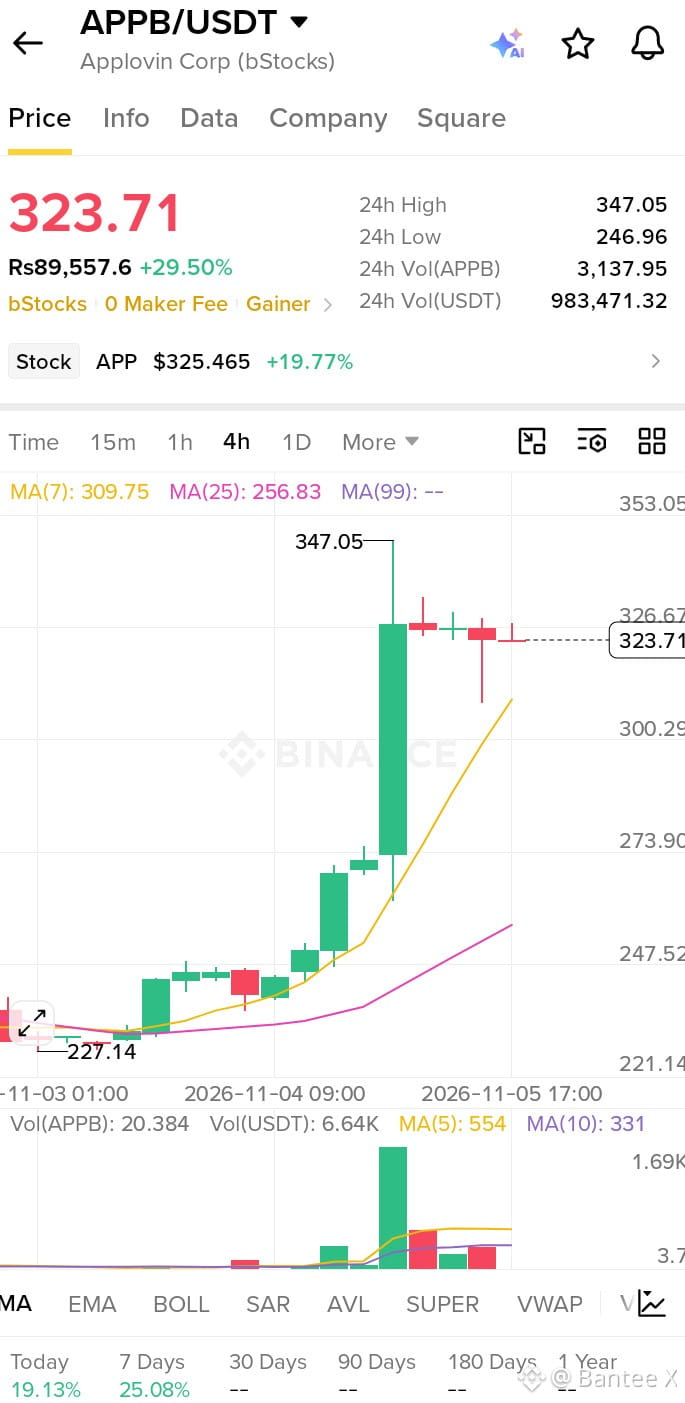
$APPB AppLovin Corp is making massive moves! But remember: this isn’t a normal crypto or meme coin. It’s a tokenized stock (bStocks) giving economic exposure to NASDAQ: $APP.US .
🚀 Why it pumped:
It’s all about fundamentals. AppLovin posted massive Q3 earnings: $2.18B revenue (+55% YoY) and an 84% EBITDA margin. This rapid stock repricing hit the tokenized market fast, fueled by new perpetual contracts and heavy momentum buying. 📈
We saw an explosive expansion from the $246 region to a peak of $347.05. Right now, price is consolidating sideways around $323, holding firmly above the MA7 at $309 and MA25 at $256. The short-term trend is highly bullish, but we need fresh volume to push higher. ⏳
Caution is required. The hourly MACD has turned negative, and RSI-6 has dropped sharply from overbought levels. Profit taking has begun.
Do NOT chase the green candles. Let the dust settle. Watch if $309 holds for a bounce, or if we retrace to the $256 breakout base. Trade the levels, not the emotion. Protect your capital first. Stay patient, team! 💬🔥
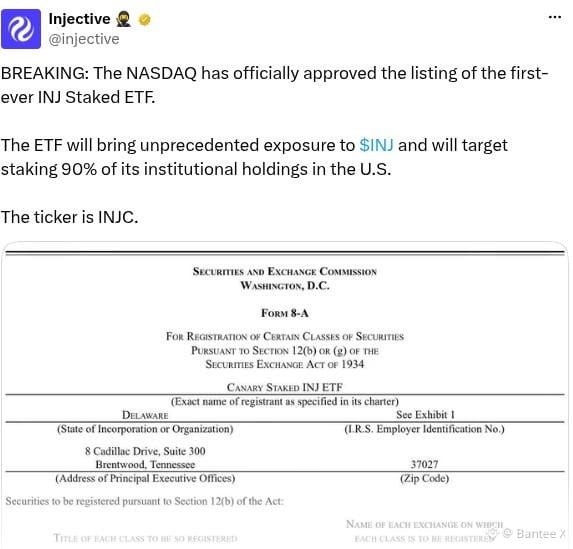
🚀 Injective $INJ ETF Lands on Nasdaq as Price Surges 22%! Big news for the Injective ecosystem! 🇺🇸 Canary Capital’s Staked INJ ETF (INJC) has received approval to list on Nasdaq, marking a major step toward greater institutional access to Injective. 📈 Key Highlights: INJ surged approximately 22%, climbing from $6.82 to around $8.30.The ETF plans to stake at least 90% of its INJ holdings, generating staking rewards.The fund carries a 1.10% annual sponsor fee, plus fees on staking rewards.INJ is testing a key resistance level at $8.43.A successful breakout could open the way toward $8.86 and $9.42.ETF inflows and newly created shares will be important indicators of institutional demand. $INJ 🔥 Why It Matters: The Nasdaq listing gives traditional investors another route to gain exposure to INJ while potentially increasing institutional participation and the amount of INJ locked in staking. However, the rally still needs technical confirmation, and actual ETF inflows will be crucial to watch. Is this the beginning of a bigger move for Injective? 👀 #Injective🔥 #İNJ
Bloomberg reported that the Kazakhstan government invested $100 million in cryptocurrency funds ..
🌍 Kazakhstan has invested $100 million in crypto funds, including Brevan Howard Digital, Bloomberg reports. 🔥 Why does this matter? 🏦 More institutional exposure to digital assets 📈 Growing confidence in the crypto industry 🌍 Another major signal of crypto's global adoption 💡 THE BIGGER PICTURE: While retail investors debate market movements, institutional players are exploring opportunities in digital assets. 🚀 Is this another step toward crypto becoming a mainstream part of global finance? One thing is clear: Institutional interest in crypto is getting harder to ignore. 👀
₿ LIQUIDITY GRAB COMPLETE! IS BTC PREPARING FOR AN $82K BREAKOUT?
Bitcoin has shown a powerful recovery after sweeping liquidity below its recent range 🌐. Following the downside liquidity grab around the $77,200 region, $BTC reversed sharply and climbed toward $80,500 📈. This move signals that buyers have firmly stepped back into the game, but Bitcoin is now testing a critical resistance wall that will dictate the next major leg up 🏛️. Can BTC smash resistance and run toward $82,000, or are we due for a quick retest first? Let’s break it down 🧠. The Liquidity Grab: What Actually Happened? 🔍 Before this bounce, Bitcoin dipped below its prior consolidation zone to sweep liquidity around the $77,200 mark 📉. This classic market-maker move triggers stops and flushes out leveraged positions before a reversal. Once liquidity was cleared, heavy buying pressure flooded the order books, driving BTC right back toward the $80,000 handle 💎.The intensity of this recovery candle shows short-term momentum shifting back to the bulls, though a sweep alone isn't enough—we need a structural confirmation above resistance 🛡️. The Critical Resistance Zone 🧱 Right now, Bitcoin is hammering against the $80,500–$80,600 resistance band on the 4H chart 📊. Multiple attempts have been made to punch through, but sellers are defending the level. If bulls secure a clean 4H candle close above this zone followed by a successful retest, the path clears for higher targets ⚡. Pullback vs. Direct Breakout 🔄 The Pullback Route: A minor retracement down to $80,000 or $79,800 is entirely healthy 📉. If buyers step in to defend this area, it builds a stronger base for a breakout. The Direct Breakout: If volume spikes and clears resistance immediately, $82K comes into play much faster without a deeper dip 🚀. 🎯 Key Levels to Watch 👀 Immediate Resistance: $80,500 – $80,600 (The breakout gateway) 🛑 Short-Term Support: $80,000 (Psychological defense line) 🟢 Major Retest Zone: $79,800 Key validation floor🛡️ Upside Target: $82,000 🎯 🔥 BANTEEX FINAL OUTLOOK Bitcoin has bounced hard from the $77,200 liquidity grab and is locked in a battle at the $80,500–$80,600 resistance zone 🌐⚡. A healthy dip toward $80,000–$79,800 followed by a bullish defense remains a clean setup, but a sustained hold above resistance unlocks the road to $82,000 💎📈. Stay sharp, wait for confirmation, and manage your risk. What’s your play, BanteeX family? Are we breaking $82K straight away, or dipping to $79.8K first? Let’s hear your thoughts below! 👇 #BinanceReopensWithdrawalsForMoreAssets #BTCRebounds80K #USMidterms-WhatAreMarketsExpecting?
I see heavy seller are in control $SOXL I'm short this at 73.6 finale Target 🎯 71 let's see 😜 always partial booking at 72.3 stop loss ⛔ at 74 #CircleQ3Revenue865M #DYOR!!
The 2026 US Midterm Elections results are in! While Donald Trump remains President through January 2029, the legislative balance of power has shifted as Democrats secured a majority in Congress. This political pivot is causing short term volatility across global markets and crypto.
$BTC Bitcoin is currently fluctuating around $77,000 – $78,500 after initial election volatility. Global Markets: S&P 500 futures Nasdaq, and the US Dollar Index experienced short-term pullbacks as Wall Street adjusts to the news.
🛡️ Why Panic Is Unnecessary ?
🏛️ Strategic BTC Reserve Order: The US national stockpile of ~328,000 BTC remains active under executive authority.
📜 Established Regulations: Stablecoin frameworks (GENIUS Act) and SEC/CFTC administrative rules remain intact.
⚙️ Strong Fundamentals: Institutional custody and Wall Street ETF frameworks are built to stay. Political majorities change Bitcoin's code and long term adoption remain constant! 💎
Every four years, the eyes of the world turn to the United States for its high stakes presidential race. Yet, embedded squarely at the midpoint of every commander-in-chief’s tenure lies an equally pivotal electoral crucible: the US Midterm Elections. Occurring precisely two years into a presidential cycle, these elections serve as a national referendum on the sitting administration’s performance while reshaping the legislative machinery that governs the country. To understand the mechanics of the midterms, one must look directly at the structure of the US Congress. Unlike presidential election years where executive power takes center stage, midterms focus entirely on national legislative representation. The ballot determines the full composition of the House of Representatives, subjecting all 435 seats to a public vote. Concurrently, the 100 seat Senate undergoes a partial calibration, with roughly one-third of its seats up for grabs due to its six year staggered terms. A common misconception among global observers is that a sweeping loss for the ruling party during midterms triggers a change in executive leadership. Under the American political framework, executive and legislative branches operate under strict separation of powers. Unlike parliamentary systems where a lost majority collapses the executive cabinet, an American president retains their office for the full four-year mandate regardless of congressional turnout. Instead, the true stakes of the midterm elections rest on legislative leverage. Congress holds the purse strings of the nation and retains sole authority over federal lawmaking and fiscal appropriations. When control of either chamber flips to the opposing party, the executive branch finds its policy agenda heavily constrained, transforming governance into an uphill battle of political compromise and legislative resistance. Congress decides which party leads crucial financial committees. A split Congress or a shift in majorities directly impacts crypto friendly legislation (such as stablecoin frameworks or the Clarity Act). Regulatory oversight by agencies like the SEC and CFTC often shifts depending on congressional pressure. #USMidterms-WhatAreMarketsExpecting? #USOctoberNFP-AreRateCutsStillPossible
🚨 Binance Security Incident – Important Update Binance has released its initial report regarding the October 29 security incident.
Approximately $6.34 billion in digital assets were impacted, with $2.85 billion frozen or intercepted. Binance has confirmed that users will not bear the financial losses, and 98% of the affected token assets have already been replenished.
The incident involved a sophisticated attack targeting internal wallet infrastructure. Binance has since rebuilt affected systems, strengthened security controls, replaced compromised devices and engaged independent cybersecurity experts for further review.
The key takeaway: Binance says user funds are protected, the financial impact will be covered by the exchange, and additional security measures are being implemented. The investigation is ongoing, and we will continue monitoring official updates.
Stay informed, stay cautious, and always follow official Binance announcements. 🛡️
29 October 2026 Binance Security Incident: Initial Findings and Response Update
On 29 October 2026, Binance experienced a serious and highly sophisticated security incident. This should not have happened, and we apologise for the concern, disruption and uncertainty it caused our users, partners and the wider industry.Our first responsibility is to protect users. Binance will absorb the financial impact of the stolen funds, not our users. We have already set aside more than 100% of the funds required to cover the loss. As of 31 October 2026, 98% of the impacted token assets have been replenished and are verifiable on our Proof of Reserves page. We are in the process of purchasing the outstanding, more illiquid assets.Approximately USD 6.34 billion in digital assets were impacted by the incident. As of this update, approximately USD 2.85 billion in digital assets have been frozen or intercepted, subject to reconciliation and market price volatility.We have taken immediate action to contain the incident and strengthen the systems involved. The entry points identified as having been used in the attack have been closed. Systems touched in the attack path have been rebuilt or replaced. We have also implemented tighter device controls, enhanced wallet-service risk controls and expanded AI-based behavioural anomaly detection.This is our initial report. It covers what we know today and what we have already improved. The investigation remains ongoing and our findings will be subject to further independent review. Some technical details will remain confidential to prevent malicious actors from using them to plan attacks. We are engaging independent security firms for further review. The latest information released by the Federal Bureau of Investigation indicates that the Democratic People’s Republic of Korea is responsible for this incident.We are sharing this initial report because security improves when the industry learns together.What happened on 29 OctoberThe attack unfolded quickly across several networks.The attacker exploited unauthorized access to an internal wallet signing service to initiate transactions outside the normal withdrawal process.Between 20:05 UTC and 20:09 UTC, five Binance hot wallets sent 233.46 million XRP to an attacker-controlled address.Binance hot wallets on Solana and Optimism sent approximately 970,500 SOL and 44.2 million OP to attacker-controlled addresses.Binance then received an internal alert regarding large-volume transfers and immediately began investigating.Binance hot wallet sent 18,270 BTC to an attacker-controlled address. The attacker then used the signing service to exploit Ethereum’s EIP-7702 authorization mechanism. EIP-7702 allows an account to delegate certain execution rights to a smart contract without exposing the private key. In this case, the attacker used that mechanism to give an attacker-controlled smart contract partial execution rights over a Binance hot wallet. Binance immediately initiated multiple containment measures, including suspending withdrawals to restrict further outflows, coordinating with partners to freeze affected tokens, and taking steps to revoke unauthorized permissions. These efforts froze a total of $2.85 billion in assets.However, suspending withdrawals alone could not stop all unauthorized asset movements. The malicious EIP-7702 authorizations existed on-chain and operated independently of Binance’s normal withdrawal infrastructure.The attackers submitted 50 signing transactions to manipulate the account nonce and establish malicious delegation authorizations. Once established, these authorizations enabled the attackers to continue moving assets independently of Binance's normal withdrawal infrastructure. Binance needed additional transactions to revoke these on-chain authorizations.The containment process involved additional technical complexities. Because the hot wallet used Multi-Party Computation (MPC), there was no single private key that could be used to immediately revoke the malicious EIP-7702 authorizations. The team therefore developed and executed a specialized procedure to revoke these authorizations, which required additional time. Furthermore, suspending withdrawals and shutting down hot wallet services did not automatically invalidate existing on-chain authorizations.These challenges extended the time required to fully contain the unauthorized asset movements. We are reviewing the incident response process, signing policy coverage, hot wallet controls and identifying opportunities to further strengthen our ability to respond rapidly to threats in the future.The final unauthorized transfer of 2,961.9 ETH finalised on-chain at 23:56 UTC. The transaction had previously been broadcast and remained pending before subsequently finalising. No further unauthorised transfers were observed after.At 00:10 UTC on 30 October 2026, Binance executed a new authorization from the Binance14 hot wallet to the zero address, clearing the EIP-7702 delegation code.Attack Preparation Our current investigation indicates that this was a sophisticated, multi-stage campaign. It was not a single isolated breach or a simple phishing incident. The attackers combined a range of techniques, including social engineering by fake recruitment interviews, malicious software downloads, compromised internal AI tooling, endpoint compromise, and an advanced transaction-authorisation method.June 2026 — Supply chain attack. Engineer A from Wallet DevOps downloaded a tampered Homebrew installation in order to install a popular AI coding tool after searching for it on a search engine. Our security team detected the anomaly, replaced the device, and rotated all related credentials as a proactive security action. However, Engineer A’s role and his related colleagues on our wallet infrastructure team was exposed to the hacker. Throughout 2026, Binance's security team detected and prevented 57 suspected North Korea-linked cyber threat cases. These attempts reflect the persistent threat posed by state-sponsored actors targeting the cryptocurrency industry. The techniques include fraudulent job interviews, malicious software disguised as popular developer tools, compromised software packages and browser extensions, fake video conferencing applications, and social engineering campaigns designed to steal credentials or deploy remote access malware.September 2026 — social engineering. Software Engineer B was contacted through a legitimate job-hunting platform by an individual posing as a Project Director. Software Engineer B had a profile on the platform that referenced his experience at Binance. The purported Project Director arranged a first-round interview with a HR representative, followed by a second-round interview with an individual claiming to be the CEO of a fictitious company.In the first round, the purported HR representative conducted a live video interview with Software Engineer B. The interviewer shared a social media account with him, including personal photos and videos posted on the platform, in order to build trust. This was more advanced and deceptive than previously seen social engineering approaches. The second interview was conducted in a popular social chat app, near the end of the interview, Engineer B was instructed to download an “assignment” containing a malicious code repository onto his work computer. The repository contained malicious code that executed during the setup process, initiating a series of unauthorized activities.The malware employed sophisticated obfuscation and evasion techniques, including replacing a legitimate development tool component with a malicious version to execute commands and establish communication with an attacker-controlled external server. The 0-day malware was not detected by the endpoint security protection tools at the time. The attacker also took steps to conceal the malicious activity and remove traces of the compromise, making detection and subsequent investigation more challenging.The script executed the below steps by applying obfuscation techniques to evade security detection.CREATE /opt/homebrew/Cellar/pyenv/2.8.0/libexec/pyenv_ MODIFY pyenv_ → 3,414 B DELETE .../libexec/pyenv (3,344 B) ← remove the valid pyenvRENAME pyenv_ → pyenv (3,414 B) ← replace it with a malicious version DELETE /opt/homebrew/bin/pyenv (3,414 B)ln (create a new symlink) + spawn zsh20 October, 2026 — use of an internal AI tool as a springboard. The attacker leveraged the compromised computer of engineer B and used an internal AI tool to gain control over the Wallet DevOps Engineer A and another Wallet Software Engineer C. The attacker soon discovered Wallet DevOps Engineer A had a container deployment permission token on his computer.29 October, 2026 — reach into wallet signing operations. On 29 October between 17:15 and 19:56, the attacker logged onto Software Engineer C’s computer, used the credentials stolen from Wallet DevOps Engineer A, deployed a container, and triggered a malicious script to launch the attack.What we have doneAs of Nov 3, 2026, we have taken the following actions:Rebuilt the affected wallet system in a new environment.Rebuilt the affected internal AI tool and access controls.Replaced affected devices.Decommissioned credentials and tokens related to affected engineers.Completed enhanced security scans across all employee devices.Enhanced AI-based behavioural anomaly detection.Strengthened wallet-service risk controls.Worked with law enforcement, blockchain intelligence firms and industry partners to trace and freeze affected assets.We will continue to strengthen our measures as the investigation progresses. There are a number of security measures we have implemented and are implementing that will remain private to prevent malicious actors from compromising our security.Further actionsWe are taking the following steps immediately.1. Independent cybersecurity reviewWe are engaging independent third-party cybersecurity experts to conduct a comprehensive review of the incident, validate our findings and recommend additional measures. The scope and findings of that review will inform our continuing remediation work.2. Expanded investment in AI security and preventionWe are increasing investment in AI-enabled detection, endpoint protection, developer-environment security and behavioural anomaly monitoring.3. Security research fund and industry initiativesWe are working on establishing a security research fund and targeted initiatives with leading AI companies, industry participants and security firms focused on AI security in blockchain environments.We will continue to proactively share information as and when we have it.

Войдите, чтобы посмотреть больше материала
Присоединяйтесь к пользователям криптовалют по всему миру на Binance Square
⚡️ Получайте новейшую и полезную информацию о криптоактивах.
💬 Нам доверяет крупнейшая в мире криптобиржа.
👍 Получите достоверные аналитические данные от верифицированных создателей контента.