

babaowais07
10 Публикации

babaowais07
Отправить жалобу
Заблокировать пользователя
get information about cryto..
10 подписок(и/а)
12 подписчиков(а)
23 понравилось
Посты
·
--
🚀 Bitcoin: A Strong September Comes to an End
Bitcoin ($BTC) is entering the final day of September around the $84K area after recovering from recent lows near $82.5K. The cryptocurrency market is closely watching the U.S. economic outlook, especially inflation data and rising Treasury yields. Recent data also showed around $31 million of net inflows into U.S. spot Bitcoin ETFs, indicating continued institutional interest.
With September coming to an end, traders are now looking toward Q4 and watching whether Bitcoin can maintain its recent momentum. Key factors to watch include ETF flows, the U.S. dollar, Treasury yields and upcoming economic data. 📊
Stay informed, manage risk and always do your own research.
#Bitcoin #BTC #Binance #Crypto #CryptoNews #BitcoinUpdate #Web3
{spot}(BTCUSDT)
🚀 Bitcoin: A Strong September Comes to an End
Bitcoin ($BTC) is entering the final day of September around the $84K area after recovering from recent lows near $82.5K. The cryptocurrency market is closely watching the U.S. economic outlook, especially inflation data and rising Treasury yields. Recent data also showed around $31 million of net inflows into U.S. spot Bitcoin ETFs, indicating continued institutional interest.
With September coming to an end, traders are now looking toward Q4 and watching whether Bitcoin can maintain its recent momentum. Key factors to watch include ETF flows, the U.S. dollar, Treasury yields and upcoming economic data. 📊
Stay informed, manage risk and always do your own research.
#Bitcoin #BTC #Binance #Crypto #CryptoNews #BitcoinUpdate #Web3
Bitcoin ($BTC) is entering the final day of September around the $84K area after recovering from recent lows near $82.5K. The cryptocurrency market is closely watching the U.S. economic outlook, especially inflation data and rising Treasury yields. Recent data also showed around $31 million of net inflows into U.S. spot Bitcoin ETFs, indicating continued institutional interest.
With September coming to an end, traders are now looking toward Q4 and watching whether Bitcoin can maintain its recent momentum. Key factors to watch include ETF flows, the U.S. dollar, Treasury yields and upcoming economic data. 📊
Stay informed, manage risk and always do your own research.
#Bitcoin #BTC #Binance #Crypto #CryptoNews #BitcoinUpdate #Web3
1
84
·
--
🔥 Bitcoin Market Update – September 29, 2026
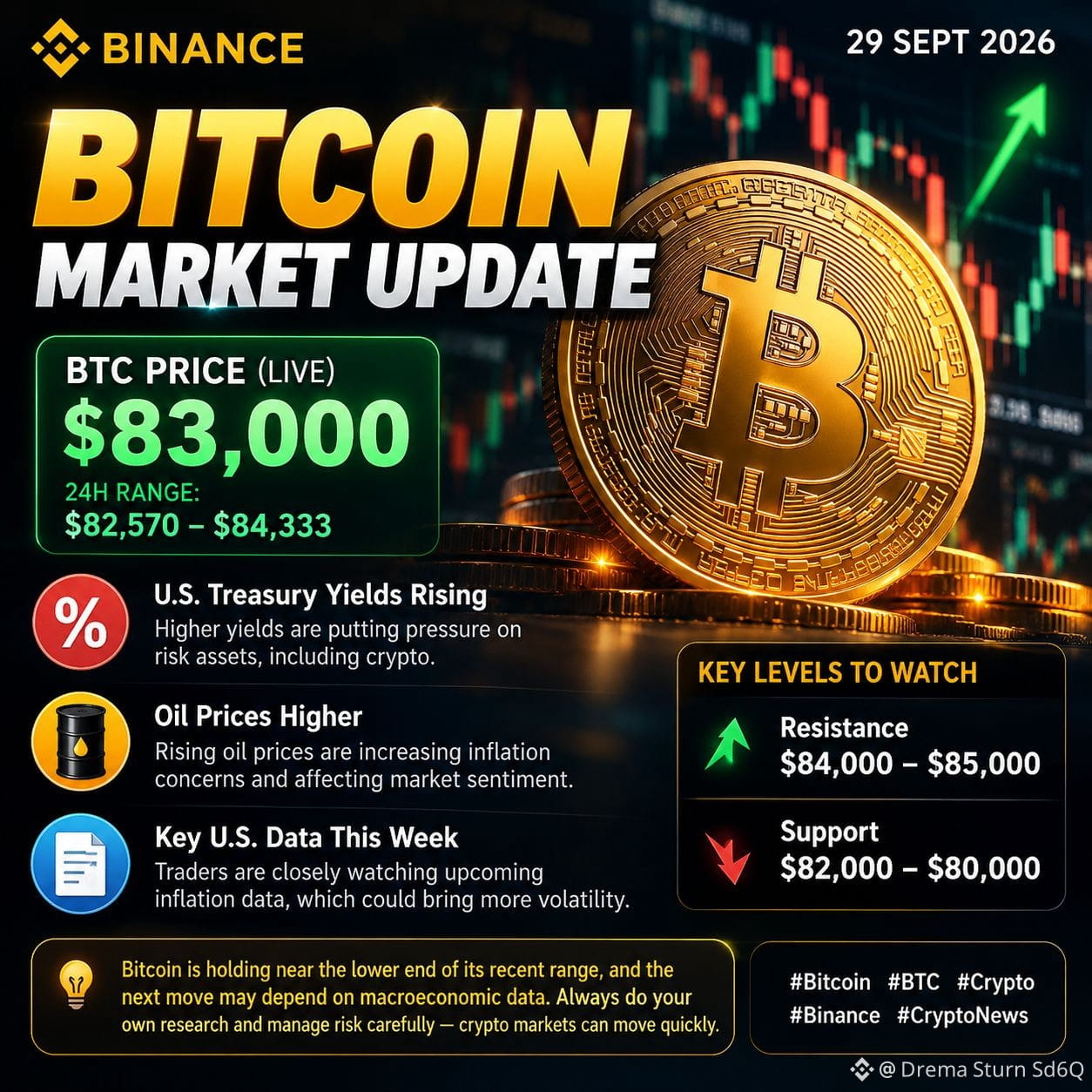
Bitcoin ($BTC) is currently trading around $83,000, with Binance data showing a 24-hour range of roughly $82,570–$84,333. The market is facing some pressure from rising U.S. Treasury yields and higher oil prices, which are increasing concerns about inflation and future interest-rate decisions. Despite this pressure, Bitcoin remains near the lower end of its recent trading range rather than showing a major breakdown. Traders are closely watching the $82K–$84K area for signs of the next move. With important U.S. inflation data due this week, volatility could remain elevated. Always do your own research and manage risk carefully—crypto markets can move quickly. 📊
#Bitcoin #BTC #Crypto #Binance #BitcoinUpdate
🔥 Bitcoin Market Update – September 29, 2026
Bitcoin ($BTC) is currently trading around $83,000, with Binance data showing a 24-hour range of roughly $82,570–$84,333. The market is facing some pressure from rising U.S. Treasury yields and higher oil prices, which are increasing concerns about inflation and future interest-rate decisions. Despite this pressure, Bitcoin remains near the lower end of its recent trading range rather than showing a major breakdown. Traders are closely watching the $82K–$84K area for signs of the next move. With important U.S. inflation data due this week, volatility could remain elevated. Always do your own research and manage risk carefully—crypto markets can move quickly. 📊
#Bitcoin #BTC #Crypto #Binance #BitcoinUpdate
Bitcoin ($BTC) is currently trading around $83,000, with Binance data showing a 24-hour range of roughly $82,570–$84,333. The market is facing some pressure from rising U.S. Treasury yields and higher oil prices, which are increasing concerns about inflation and future interest-rate decisions. Despite this pressure, Bitcoin remains near the lower end of its recent trading range rather than showing a major breakdown. Traders are closely watching the $82K–$84K area for signs of the next move. With important U.S. inflation data due this week, volatility could remain elevated. Always do your own research and manage risk carefully—crypto markets can move quickly. 📊
#Bitcoin #BTC #Crypto #Binance #BitcoinUpdate
1
65
·
--
Upcoming new listings on Binance are creating excitement among crypto traders and investors. These new tokens may offer opportunities to explore innovative blockchain projects, emerging technologies, and growing crypto communities. Binance continues to attract attention by introducing projects across sectors such as DeFi, gaming, artificial intelligence, and Web3. Investors should keep an eye on official Binance announcements for upcoming listings, launch dates, and trading pairs. Before investing, it is important to research each project's fundamentals, tokenomics, and potential risks. New listings can experience high volatility, so responsible trading and proper risk management are essential for long-term success in cryptocurrency markets.
Upcoming new listings on Binance are creating excitement among crypto traders and investors. These new tokens may offer opportunities to explore innovative blockchain projects, emerging technologies, and growing crypto communities. Binance continues to attract attention by introducing projects across sectors such as DeFi, gaming, artificial intelligence, and Web3. Investors should keep an eye on official Binance announcements for upcoming listings, launch dates, and trading pairs. Before investing, it is important to research each project's fundamentals, tokenomics, and potential risks. New listings can experience high volatility, so responsible trading and proper risk management are essential for long-term success in cryptocurrency markets.
1
69
·
--
#FootballSeason2026
*Option 1: Intense Match Analysis & Prediction**
> What an absolute tactical masterclass we witnessed on the pitch today! The manager's decision to press high from the opening whistle completely disrupted the opponent's midfield buildup. The defensive work rate was phenomenal, and those lightning-fast transitions on the counter-attack were clinical. If they keep playing with this level of chemistry and intensity, they are easily lifting the trophy this season. What are your score predictions for the next fixture? Let me know below! ⚽🔥 #BinancePickAndWin
### **Option 2: Passionate Fan & "Beautiful Game" Perspective**
> This is exactly why football is called the beautiful game! The sheer drama, the unbelievable atmosphere in the stadium, and that breathtaking last-minute winner in extra time had me completely on the edge of my seat. You simply cannot script this kind of passion and emotion. Moments like these prove why football unites fans across the entire globe like nothing else can. Ready and hyped up for the next matchday! Let's win this! 🙌⚽🏆 #BinancePickAndWin
#FootballSeason2026
*Option 1: Intense Match Analysis & Prediction**
> What an absolute tactical masterclass we witnessed on the pitch today! The manager's decision to press high from the opening whistle completely disrupted the opponent's midfield buildup. The defensive work rate was phenomenal, and those lightning-fast transitions on the counter-attack were clinical. If they keep playing with this level of chemistry and intensity, they are easily lifting the trophy this season. What are your score predictions for the next fixture? Let me know below! ⚽🔥 #BinancePickAndWin
### **Option 2: Passionate Fan & "Beautiful Game" Perspective**
> This is exactly why football is called the beautiful game! The sheer drama, the unbelievable atmosphere in the stadium, and that breathtaking last-minute winner in extra time had me completely on the edge of my seat. You simply cannot script this kind of passion and emotion. Moments like these prove why football unites fans across the entire globe like nothing else can. Ready and hyped up for the next matchday! Let's win this! 🙌⚽🏆 #BinancePickAndWin
*Option 1: Intense Match Analysis & Prediction**
> What an absolute tactical masterclass we witnessed on the pitch today! The manager's decision to press high from the opening whistle completely disrupted the opponent's midfield buildup. The defensive work rate was phenomenal, and those lightning-fast transitions on the counter-attack were clinical. If they keep playing with this level of chemistry and intensity, they are easily lifting the trophy this season. What are your score predictions for the next fixture? Let me know below! ⚽🔥 #BinancePickAndWin
### **Option 2: Passionate Fan & "Beautiful Game" Perspective**
> This is exactly why football is called the beautiful game! The sheer drama, the unbelievable atmosphere in the stadium, and that breathtaking last-minute winner in extra time had me completely on the edge of my seat. You simply cannot script this kind of passion and emotion. Moments like these prove why football unites fans across the entire globe like nothing else can. Ready and hyped up for the next matchday! Let's win this! 🙌⚽🏆 #BinancePickAndWin
2
27
·
--
#TrumpConsidersEndingIranConflict conflict may affect the price of dollar...
#TrumpConsidersEndingIranConflict conflict may affect the price of dollar...
1
2
·
--
What is USDT (Tether)? 💰
USDT (Tether) is a type of cryptocurrency known as a stablecoin. Unlike other cryptocurrencies like Bitcoin or Ethereum, USDT is designed to maintain a stable value — usually equal to 1 US dollar.
🔹 Why use USDT?
Stable price (no big ups & downs)
Easy to send money globally
Widely accepted on crypto exchanges
🔹 How does it work?
USDT is backed by reserves, meaning for every 1 USDT, there is supposed to be 1 USD (or equivalent assets) held by the company.
🔹 Common uses:
Trading crypto without volatility
Sending funds quickly
Saving value in crypto form
📌 In simple words: USDT = Digital Dollar in the crypto world.
What is USDT (Tether)? 💰
USDT (Tether) is a type of cryptocurrency known as a stablecoin. Unlike other cryptocurrencies like Bitcoin or Ethereum, USDT is designed to maintain a stable value — usually equal to 1 US dollar.
🔹 Why use USDT?
Stable price (no big ups & downs)
Easy to send money globally
Widely accepted on crypto exchanges
🔹 How does it work?
USDT is backed by reserves, meaning for every 1 USDT, there is supposed to be 1 USD (or equivalent assets) held by the company.
🔹 Common uses:
Trading crypto without volatility
Sending funds quickly
Saving value in crypto form
📌 In simple words: USDT = Digital Dollar in the crypto world.
USDT (Tether) is a type of cryptocurrency known as a stablecoin. Unlike other cryptocurrencies like Bitcoin or Ethereum, USDT is designed to maintain a stable value — usually equal to 1 US dollar.
🔹 Why use USDT?
Stable price (no big ups & downs)
Easy to send money globally
Widely accepted on crypto exchanges
🔹 How does it work?
USDT is backed by reserves, meaning for every 1 USDT, there is supposed to be 1 USD (or equivalent assets) held by the company.
🔹 Common uses:
Trading crypto without volatility
Sending funds quickly
Saving value in crypto form
📌 In simple words: USDT = Digital Dollar in the crypto world.
1
8
·
--
Bitcoin (BTC): The Future of Digital Currency
Bitcoin (BTC) is the world’s first decentralized digitBitcoin (BTC): The Future of Digital Currency
Bitcoin (BTC) is the world’s first decentralized digital currency, introduced in 2009 by an anonymous individual or group known as Satoshi Nakamoto. Unlike traditional currencies such as the dollar or rupee, Bitcoin operates without any central authority like a bank or government.
🔹 How Bitcoin Works
Bitcoin is powered by blockchain technology, a distributed public ledger that records all transactions across a network of computers. This ensures transparency, security, and immutability, making it extremely difficult to alter or hack transaction data.
🔹 Key Features
Decentralized – Not controlled by any central authority
Limited Supply – Only 21 million Bitcoins will ever exist
Secure – Uses advanced cryptography
Borderless – Can be sent and received globally
🔹 Use Cases
Online payments
Investment and trading
Store of value (often called “digital gold”)
🔹 Advantages
✔ Fast international transfers
✔ Lower transaction fees (in many cases)
✔ Protection against inflation
🔹 Risks
⚠ High price volatility
⚠ Regulatory uncertainty
⚠ Potential for scams and cyber threats
Bitcoin (BTC): The Future of Digital Currency Bitcoin (BTC) is the world’s first decentralized digit
Bitcoin (BTC): The Future of Digital Currency
Bitcoin (BTC) is the world’s first decentralized digital currency, introduced in 2009 by an anonymous individual or group known as Satoshi Nakamoto. Unlike traditional currencies such as the dollar or rupee, Bitcoin operates without any central authority like a bank or government.
🔹 How Bitcoin Works
Bitcoin is powered by blockchain technology, a distributed public ledger that records all transactions across a network of computers. This ensures transparency, security, and immutability, making it extremely difficult to alter or hack transaction data.
🔹 Key Features
Decentralized – Not controlled by any central authority
Limited Supply – Only 21 million Bitcoins will ever exist
Secure – Uses advanced cryptography
Borderless – Can be sent and received globally
🔹 Use Cases
Online payments
Investment and trading
Store of value (often called “digital gold”)
🔹 Advantages
✔ Fast international transfers
✔ Lower transaction fees (in many cases)
✔ Protection against inflation
🔹 Risks
⚠ High price volatility
⚠ Regulatory uncertainty
⚠ Potential for scams and cyber threats
Bitcoin (BTC) is the world’s first decentralized digital currency, introduced in 2009 by an anonymous individual or group known as Satoshi Nakamoto. Unlike traditional currencies such as the dollar or rupee, Bitcoin operates without any central authority like a bank or government.
🔹 How Bitcoin Works
Bitcoin is powered by blockchain technology, a distributed public ledger that records all transactions across a network of computers. This ensures transparency, security, and immutability, making it extremely difficult to alter or hack transaction data.
🔹 Key Features
Decentralized – Not controlled by any central authority
Limited Supply – Only 21 million Bitcoins will ever exist
Secure – Uses advanced cryptography
Borderless – Can be sent and received globally
🔹 Use Cases
Online payments
Investment and trading
Store of value (often called “digital gold”)
🔹 Advantages
✔ Fast international transfers
✔ Lower transaction fees (in many cases)
✔ Protection against inflation
🔹 Risks
⚠ High price volatility
⚠ Regulatory uncertainty
⚠ Potential for scams and cyber threats
1
1
·
--
2
13
·
--
Bitcoin is more than a digital currency; it represents a shift in how people think about money, trust, and power. At its core, Bitcoin challenges the traditional financial system by removing the need for central authorities such as banks or governments to control currency. Instead of relying on institutions, Bitcoin relies on mathematics, cryptography, and a decentralized network of participants who collectively maintain the system.
One of the most powerful ideas behind Bitcoin is trust in code rather than trust in people. Traditional money systems require faith that institutions will act honestly, manage inflation responsibly, and protect users’ funds. Bitcoin offers an alternative: transparent rules written into software, visible to everyone, and enforced by the network itself. This transparency gives users a sense of control and independence that was previously difficult to achieve in global finance.
Bitcoin also represents financial freedom for many people. In regions where banking services are limited or currencies are unstable, Bitcoin can act as a store of value and a means of transferring money across borders quickly and with relatively low cost. It empowers individuals to be their own bank, holding and managing their wealth without permission from any authority.
However, Bitcoin is not without challenges. Price volatility, regulatory uncertainty, and environmental concerns related to energy use raise important questions about its long-term role. Critics argue that it is too unstable to function as everyday money, while supporters believe it is still evolving and maturing.
Ultimately, Bitcoin is a bold experiment. Whether it becomes a global currency, digital gold, or simply a catalyst for financial innovation, its greatest impact may lie in the conversation it has started—about freedom, transparency, and who truly controls money in the modern world.
Bitcoin is more than a digital currency; it represents a shift in how people think about money, trust, and power. At its core, Bitcoin challenges the traditional financial system by removing the need for central authorities such as banks or governments to control currency. Instead of relying on institutions, Bitcoin relies on mathematics, cryptography, and a decentralized network of participants who collectively maintain the system.
One of the most powerful ideas behind Bitcoin is trust in code rather than trust in people. Traditional money systems require faith that institutions will act honestly, manage inflation responsibly, and protect users’ funds. Bitcoin offers an alternative: transparent rules written into software, visible to everyone, and enforced by the network itself. This transparency gives users a sense of control and independence that was previously difficult to achieve in global finance.
Bitcoin also represents financial freedom for many people. In regions where banking services are limited or currencies are unstable, Bitcoin can act as a store of value and a means of transferring money across borders quickly and with relatively low cost. It empowers individuals to be their own bank, holding and managing their wealth without permission from any authority.
However, Bitcoin is not without challenges. Price volatility, regulatory uncertainty, and environmental concerns related to energy use raise important questions about its long-term role. Critics argue that it is too unstable to function as everyday money, while supporters believe it is still evolving and maturing.
Ultimately, Bitcoin is a bold experiment. Whether it becomes a global currency, digital gold, or simply a catalyst for financial innovation, its greatest impact may lie in the conversation it has started—about freedom, transparency, and who truly controls money in the modern world.
One of the most powerful ideas behind Bitcoin is trust in code rather than trust in people. Traditional money systems require faith that institutions will act honestly, manage inflation responsibly, and protect users’ funds. Bitcoin offers an alternative: transparent rules written into software, visible to everyone, and enforced by the network itself. This transparency gives users a sense of control and independence that was previously difficult to achieve in global finance.
Bitcoin also represents financial freedom for many people. In regions where banking services are limited or currencies are unstable, Bitcoin can act as a store of value and a means of transferring money across borders quickly and with relatively low cost. It empowers individuals to be their own bank, holding and managing their wealth without permission from any authority.
However, Bitcoin is not without challenges. Price volatility, regulatory uncertainty, and environmental concerns related to energy use raise important questions about its long-term role. Critics argue that it is too unstable to function as everyday money, while supporters believe it is still evolving and maturing.
Ultimately, Bitcoin is a bold experiment. Whether it becomes a global currency, digital gold, or simply a catalyst for financial innovation, its greatest impact may lie in the conversation it has started—about freedom, transparency, and who truly controls money in the modern world.
5
19
·
--
#2025withBinance Start your crypto story with the @Binance Year in Review and share your highlights! #2025withBinance.
👉 Sign up with my link and get 100 USD rewards! https://www.binance.com/year-in-review/2025-with-binance?ref=949929594
#2025withBinance Start your crypto story with the @Binance Year in Review and share your highlights! #2025withBinance.
👉 Sign up with my link and get 100 USD rewards! https://www.binance.com/year-in-review/2025-with-binance?ref=949929594
👉 Sign up with my link and get 100 USD rewards! https://www.binance.com/year-in-review/2025-with-binance?ref=949929594
8
8
Войдите, чтобы посмотреть больше материала
Присоединяйтесь к пользователям криптовалют по всему миру на Binance Square
⚡️ Получайте новейшую и полезную информацию о криптоактивах.
💬 Нам доверяет крупнейшая в мире криптобиржа.
👍 Получите достоверные аналитические данные от верифицированных создателей контента.
Эл. почта/номер телефона
В тренде
BinanceKZ
Просмотров: 13,615
69 обсуждают
Как я потерял 180 000 тенге на «менеджере Binance» из WhatsApp — и почему всё равно остался в крипте
phpdead
·Лайков: 6
·Просмотров: 2.3k
TrumpRejectsAIRulesForVoluntaryAudits
Просмотров: 43
25 обсуждают
BitgetHotWalletBreachTiedToThirdPartySecurityFlaw
Просмотров: 33
29 обсуждают