
MistralAK
11 Публикации

MistralAK
Отправить жалобу
Заблокировать пользователя
MistralAK - Systematic Market Insights. Technical trade setups, liquidity zones and macro shifts. Focus: High-probability L1 and Major token targets
26 подписок(и/а)
7 подписчиков(а)
1 понравилось
Посты
Все
Цитирования
Видео
·
--
Статья
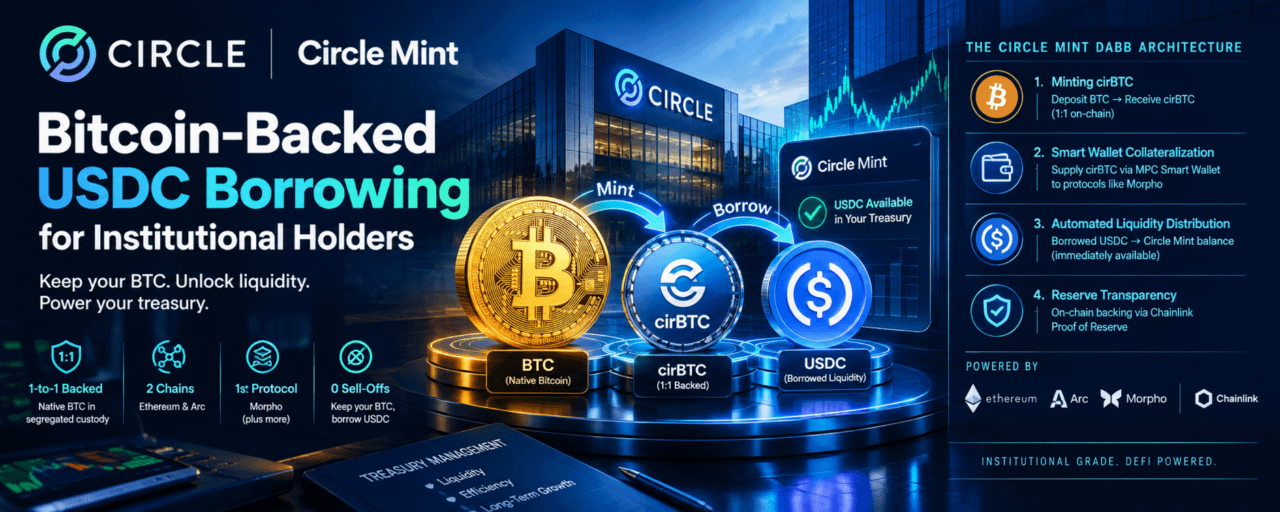
Circle Mint Unveils Bitcoin-Backed USDC Borrowing for Institutional HoldersEligible institutional clients can now leverage native Bitcoin collateral to borrow USDC directly into their treasury balances without selling underlying holdings.
Institutional crypto market infrastructure has taken another step forward as Circle ($CRCL ) introduces Digital Asset-Backed Borrowing (DABB) through Circle Mint. Eligible institutional accounts holding Bitcoin ($BTC ) can now mint Circle Wrapped Bitcoin (cirBTC), supply it as collateral across supported decentralized lending protocols, and borrow $USDC directly into their operational balances—allowing corporate treasuries to unlock working capital while maintaining long-term market exposure alongside assets like $ETH .
KEY FACTS
▪️ 1-to-1 Backed: Each cirBTC token is backed 1:1 by native Bitcoin custodied in segregated accounts at Circle National Trust, an OCC-regulated national trust bank.
▪️ 2 Supported Chains: The borrowing framework launches natively on Ethereum and Arc, Circle's financial-grade settlement network.
▪️ 1st Approved Protocol: Morpho serves as the inaugural third-party credit market, with planned expansions to additional protocols including Aave.
▪️ 0 Sell-Offs Required: Institutions access dollar liquidity without triggering immediate tax events or relinquishing underlying BTC upside.
HOW IT WORKS: THE CIRCLE MINT DABB ARCHITECTURE
Circle’s Digital Asset-Backed Borrowing unifies a multi-step DeFi borrowing workflow into a single institutional interface:
Minting cirBTC: Eligible Circle Mint institutional clients deposit native Bitcoin, which is custodied by Circle National Trust. In return, clients receive cirBTC 1:1 on-chain.Smart Wallet Collateralization: Using a user-controlled 2-of-2 Multi-Party Computation (MPC) Smart Wallet, institutions supply cirBTC as collateral into approved third-party credit protocols such as Morpho.Automated Liquidity Distribution: Borrowed USDC is automatically transferred back into the client’s Circle Mint balance, making funds immediately available for corporate operations or re-deployment.Reserve Transparency: On-chain backing is monitored through Chainlink Proof of Reserve feeds, offering real-time visibility over collateral coverage.
WHY IT MATTERS: CAPITAL EFFICIENCY & TREASURY MANAGEMENT
Historically, corporate Bitcoin treasuries faced a difficult operational trade-off: hold idle BTC for long-term price appreciation or liquidate holdings to generate short-term working capital. Liquidating BTC often incurred capital gains tax liabilities and market slippage.
By enabling cirBTC to serve as institutional-grade collateral for USDC borrowing, Circle creates a capital-efficiency loop for institutional balance sheets. Furthermore, because Circle does not operate a proprietary exchange or credit market, cirBTC is structured as a neutral wrapped asset designed to integrate across multiple decentralized venues.
WHAT TO WATCH: RISKS AND EXPANSION CATALYSTS
While institutional borrowing unlocks liquidity, market participants must monitor key operational parameters:
▪️ Smart Contract & Liquidation Parameters: Borrowing rates, loan-to-value (LTV) ratios, and liquidation thresholds are governed by independent third-party protocols like Morpho, exposing borrowers to market volatility.
▪️ Protocol Expansion: The addition of venues like Aave and broader adoption across Arc will indicate institutional market penetration.
▪️ Regulatory Alignment: The use of an OCC-supervised trust bank establishes structural security, though availability remains subject to specific jurisdictional eligibility.
THREE SCENARIOS
▪️ Bullish Adoption: Rapid integration of cirBTC across Morpho and Aave increases locked BTC value, expanding institutional DeFi liquidity and overall demand for USDC.
▪️ Baseline Treasury Usage: Institutional usage grows steadily among corporate treasuries for routine working capital management without significantly impacting retail market dynamics.
▪️ Volatile De-leveraging: Sharp downside volatility in BTC prices prompts institutions to lower LTV ratios or repay loans early to prevent automated liquidation on secondary markets.
FREQUENTLY ASKED QUESTIONS
Does Circle take custody of the borrowed USDC?
No. Borrowed USDC flows through the user's self-controlled MPC Smart Wallet and automatically updates their Circle Mint balance.
Is cirBTC available to retail traders on Binance?
Direct minting and borrowing via Circle Mint are restricted to eligible institutional entities, though cirBTC can circulate on secondary decentralized venues and supported networks.
BOTTOM LINE
Circle’s BTC-backed borrowing facility transforms idle institutional Bitcoin into active collateral, linking institutional treasury management directly with decentralized credit markets.
How will institutional collateral products like cirBTC reshape long-term Bitcoin liquidity and on-chain credit markets?
Sources: Circle Official Announcement, Circle Legal Disclosures, Chainlink Reserve Feeds.
Not financial advice. Always DYOR.
#CircleLaunchesInstitutionalBTCBackedBorrowing #BitcoinHits$85K #ZetaChainVotesToMigrateZETAToSolana #ECBStartsBlockchainEuroSettlement #SolanaCutsTargetSlotTimeTo250ms
Circle Mint Unveils Bitcoin-Backed USDC Borrowing for Institutional Holders
Eligible institutional clients can now leverage native Bitcoin collateral to borrow USDC directly into their treasury balances without selling underlying holdings.
Institutional crypto market infrastructure has taken another step forward as Circle ($CRCL ) introduces Digital Asset-Backed Borrowing (DABB) through Circle Mint. Eligible institutional accounts holding Bitcoin ($BTC ) can now mint Circle Wrapped Bitcoin (cirBTC), supply it as collateral across supported decentralized lending protocols, and borrow $USDC directly into their operational balances—allowing corporate treasuries to unlock working capital while maintaining long-term market exposure alongside assets like $ETH .
KEY FACTS
▪️ 1-to-1 Backed: Each cirBTC token is backed 1:1 by native Bitcoin custodied in segregated accounts at Circle National Trust, an OCC-regulated national trust bank.
▪️ 2 Supported Chains: The borrowing framework launches natively on Ethereum and Arc, Circle's financial-grade settlement network.
▪️ 1st Approved Protocol: Morpho serves as the inaugural third-party credit market, with planned expansions to additional protocols including Aave.
▪️ 0 Sell-Offs Required: Institutions access dollar liquidity without triggering immediate tax events or relinquishing underlying BTC upside.
HOW IT WORKS: THE CIRCLE MINT DABB ARCHITECTURE
Circle’s Digital Asset-Backed Borrowing unifies a multi-step DeFi borrowing workflow into a single institutional interface:
Minting cirBTC: Eligible Circle Mint institutional clients deposit native Bitcoin, which is custodied by Circle National Trust. In return, clients receive cirBTC 1:1 on-chain.Smart Wallet Collateralization: Using a user-controlled 2-of-2 Multi-Party Computation (MPC) Smart Wallet, institutions supply cirBTC as collateral into approved third-party credit protocols such as Morpho.Automated Liquidity Distribution: Borrowed USDC is automatically transferred back into the client’s Circle Mint balance, making funds immediately available for corporate operations or re-deployment.Reserve Transparency: On-chain backing is monitored through Chainlink Proof of Reserve feeds, offering real-time visibility over collateral coverage.
WHY IT MATTERS: CAPITAL EFFICIENCY & TREASURY MANAGEMENT
Historically, corporate Bitcoin treasuries faced a difficult operational trade-off: hold idle BTC for long-term price appreciation or liquidate holdings to generate short-term working capital. Liquidating BTC often incurred capital gains tax liabilities and market slippage.
By enabling cirBTC to serve as institutional-grade collateral for USDC borrowing, Circle creates a capital-efficiency loop for institutional balance sheets. Furthermore, because Circle does not operate a proprietary exchange or credit market, cirBTC is structured as a neutral wrapped asset designed to integrate across multiple decentralized venues.
WHAT TO WATCH: RISKS AND EXPANSION CATALYSTS
While institutional borrowing unlocks liquidity, market participants must monitor key operational parameters:
▪️ Smart Contract & Liquidation Parameters: Borrowing rates, loan-to-value (LTV) ratios, and liquidation thresholds are governed by independent third-party protocols like Morpho, exposing borrowers to market volatility.
▪️ Protocol Expansion: The addition of venues like Aave and broader adoption across Arc will indicate institutional market penetration.
▪️ Regulatory Alignment: The use of an OCC-supervised trust bank establishes structural security, though availability remains subject to specific jurisdictional eligibility.
THREE SCENARIOS
▪️ Bullish Adoption: Rapid integration of cirBTC across Morpho and Aave increases locked BTC value, expanding institutional DeFi liquidity and overall demand for USDC.
▪️ Baseline Treasury Usage: Institutional usage grows steadily among corporate treasuries for routine working capital management without significantly impacting retail market dynamics.
▪️ Volatile De-leveraging: Sharp downside volatility in BTC prices prompts institutions to lower LTV ratios or repay loans early to prevent automated liquidation on secondary markets.
FREQUENTLY ASKED QUESTIONS
Does Circle take custody of the borrowed USDC?
No. Borrowed USDC flows through the user's self-controlled MPC Smart Wallet and automatically updates their Circle Mint balance.
Is cirBTC available to retail traders on Binance?
Direct minting and borrowing via Circle Mint are restricted to eligible institutional entities, though cirBTC can circulate on secondary decentralized venues and supported networks.
BOTTOM LINE
Circle’s BTC-backed borrowing facility transforms idle institutional Bitcoin into active collateral, linking institutional treasury management directly with decentralized credit markets.
How will institutional collateral products like cirBTC reshape long-term Bitcoin liquidity and on-chain credit markets?
Sources: Circle Official Announcement, Circle Legal Disclosures, Chainlink Reserve Feeds.
Not financial advice. Always DYOR.
#CircleLaunchesInstitutionalBTCBackedBorrowing #BitcoinHits$85K #ZetaChainVotesToMigrateZETAToSolana #ECBStartsBlockchainEuroSettlement #SolanaCutsTargetSlotTimeTo250ms
Institutional crypto market infrastructure has taken another step forward as Circle ($CRCL ) introduces Digital Asset-Backed Borrowing (DABB) through Circle Mint. Eligible institutional accounts holding Bitcoin ($BTC ) can now mint Circle Wrapped Bitcoin (cirBTC), supply it as collateral across supported decentralized lending protocols, and borrow $USDC directly into their operational balances—allowing corporate treasuries to unlock working capital while maintaining long-term market exposure alongside assets like $ETH .
KEY FACTS
▪️ 1-to-1 Backed: Each cirBTC token is backed 1:1 by native Bitcoin custodied in segregated accounts at Circle National Trust, an OCC-regulated national trust bank.
▪️ 2 Supported Chains: The borrowing framework launches natively on Ethereum and Arc, Circle's financial-grade settlement network.
▪️ 1st Approved Protocol: Morpho serves as the inaugural third-party credit market, with planned expansions to additional protocols including Aave.
▪️ 0 Sell-Offs Required: Institutions access dollar liquidity without triggering immediate tax events or relinquishing underlying BTC upside.
HOW IT WORKS: THE CIRCLE MINT DABB ARCHITECTURE
Circle’s Digital Asset-Backed Borrowing unifies a multi-step DeFi borrowing workflow into a single institutional interface:
Minting cirBTC: Eligible Circle Mint institutional clients deposit native Bitcoin, which is custodied by Circle National Trust. In return, clients receive cirBTC 1:1 on-chain.Smart Wallet Collateralization: Using a user-controlled 2-of-2 Multi-Party Computation (MPC) Smart Wallet, institutions supply cirBTC as collateral into approved third-party credit protocols such as Morpho.Automated Liquidity Distribution: Borrowed USDC is automatically transferred back into the client’s Circle Mint balance, making funds immediately available for corporate operations or re-deployment.Reserve Transparency: On-chain backing is monitored through Chainlink Proof of Reserve feeds, offering real-time visibility over collateral coverage.
WHY IT MATTERS: CAPITAL EFFICIENCY & TREASURY MANAGEMENT
Historically, corporate Bitcoin treasuries faced a difficult operational trade-off: hold idle BTC for long-term price appreciation or liquidate holdings to generate short-term working capital. Liquidating BTC often incurred capital gains tax liabilities and market slippage.
By enabling cirBTC to serve as institutional-grade collateral for USDC borrowing, Circle creates a capital-efficiency loop for institutional balance sheets. Furthermore, because Circle does not operate a proprietary exchange or credit market, cirBTC is structured as a neutral wrapped asset designed to integrate across multiple decentralized venues.
WHAT TO WATCH: RISKS AND EXPANSION CATALYSTS
While institutional borrowing unlocks liquidity, market participants must monitor key operational parameters:
▪️ Smart Contract & Liquidation Parameters: Borrowing rates, loan-to-value (LTV) ratios, and liquidation thresholds are governed by independent third-party protocols like Morpho, exposing borrowers to market volatility.
▪️ Protocol Expansion: The addition of venues like Aave and broader adoption across Arc will indicate institutional market penetration.
▪️ Regulatory Alignment: The use of an OCC-supervised trust bank establishes structural security, though availability remains subject to specific jurisdictional eligibility.
THREE SCENARIOS
▪️ Bullish Adoption: Rapid integration of cirBTC across Morpho and Aave increases locked BTC value, expanding institutional DeFi liquidity and overall demand for USDC.
▪️ Baseline Treasury Usage: Institutional usage grows steadily among corporate treasuries for routine working capital management without significantly impacting retail market dynamics.
▪️ Volatile De-leveraging: Sharp downside volatility in BTC prices prompts institutions to lower LTV ratios or repay loans early to prevent automated liquidation on secondary markets.
FREQUENTLY ASKED QUESTIONS
Does Circle take custody of the borrowed USDC?
No. Borrowed USDC flows through the user's self-controlled MPC Smart Wallet and automatically updates their Circle Mint balance.
Is cirBTC available to retail traders on Binance?
Direct minting and borrowing via Circle Mint are restricted to eligible institutional entities, though cirBTC can circulate on secondary decentralized venues and supported networks.
BOTTOM LINE
Circle’s BTC-backed borrowing facility transforms idle institutional Bitcoin into active collateral, linking institutional treasury management directly with decentralized credit markets.
How will institutional collateral products like cirBTC reshape long-term Bitcoin liquidity and on-chain credit markets?
Sources: Circle Official Announcement, Circle Legal Disclosures, Chainlink Reserve Feeds.
Not financial advice. Always DYOR.
#CircleLaunchesInstitutionalBTCBackedBorrowing #BitcoinHits$85K #ZetaChainVotesToMigrateZETAToSolana #ECBStartsBlockchainEuroSettlement #SolanaCutsTargetSlotTimeTo250ms
1
223
·
--
Статья
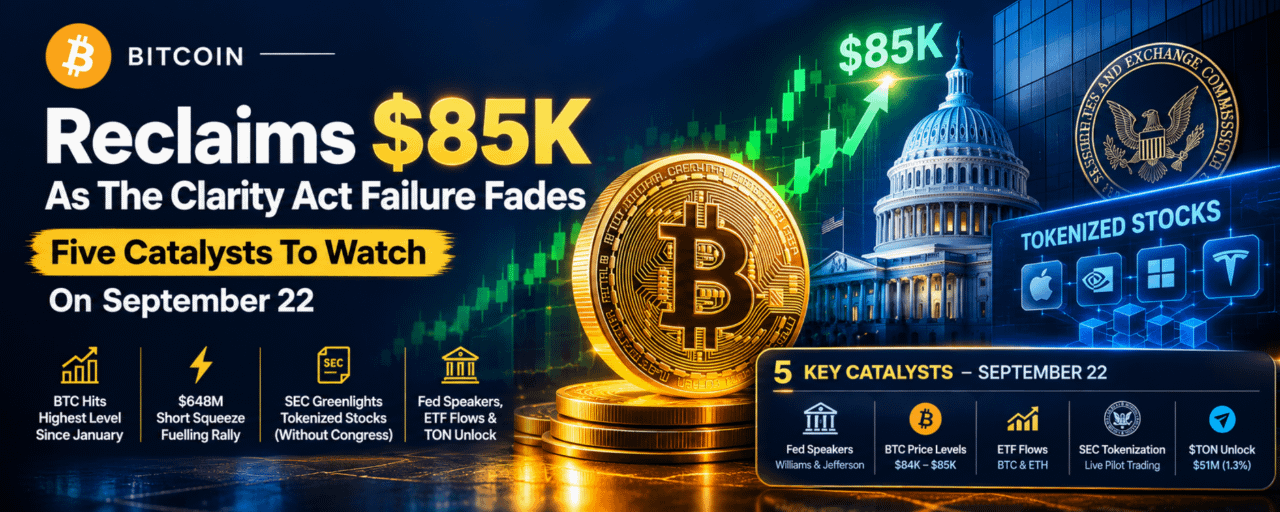
Bitcoin Reclaims $85K As The Clarity Act Failure Fades: Five Catalysts To Watch On September 22Bitcoin hit its highest level since January on a $648 million short squeeze, while the SEC moves ahead on tokenized stocks without Congress. Fed speakers, ETF flows and a $51 million $TON unlock will help decide whether the rally holds.
One week ago, $BTC traded near $75,000 after the Senate failed to advance the Clarity Act. Today it briefly topped $85,000. The bigger question for Tuesday is whether the move rests on real demand or on forced short covering, and whether an SEC workaround and the Fed's next comments change that picture. Altcoin traders also have $ETH relative strength and a TON unlock to track.
KEY FACTS
▪️ Bitcoin briefly topped $85,000 on September 21, its highest level since January, after trading near $75,000 on September 15.
▪️ CoinGlass data showed more than $750 million in crypto liquidations over 24 hours, with $648.3 million of them shorts.
▪️ The Clarity Act failed a Senate procedural vote 49 to 50 on September 15, well short of the 60 needed.
▪️ Two days later, on September 17, the SEC issued a five-year "Innovation Exemption" for tokenized U.S. stocks.
▪️ Strategy bought 950 BTC for $75.7 million at an average price of $79,670, bringing its holdings to 846,000 BTC.
WHY THE MARKET SHRUGGED OFF THE CLARITY FAILURE (ANALYSIS)
The selloff after the Senate vote reversed within days. Part of the recovery looks like squeeze-driven buying: shorts made up the bulk of liquidations, and several reports say the rally leaned heavily on forced covering. Part of it looks like genuine demand, with Strategy resuming purchases and BTC closing a weekly candle above its 50-week moving average, per one market digest. The distinction matters, because a move powered by liquidations can retrace quickly once the forced buying ends.
THE SEC WORKAROUND
The exemption lets qualifying Tokenized Securities Venues trade tokenized U.S. stocks on public blockchains through permissioned liquidity pools without registering as national exchanges. It comes with real limits:
▪️ It is temporary, lasting five years, and conditional.
▪️ Venues must be U.S. entities, and issuers can veto trading of their stocks.
▪️ It excludes synthetic products and includes volume limits.
▪️ It is not a blanket legalization of crypto assets.
CoinDesk's calendar lists September 22 as the day the window opens for pilot trading. My read: tokenization could increase demand for blockchain settlement, stablecoins and on-chain liquidity, but that is a narrative, not a guarantee for every altcoin.
SEPTEMBER 22 WATCHLIST
▪️ Fed speakers: New York Fed President John Williams speaks at 10:05 a.m. ET and Vice Chair Philip Jefferson at 10:20 a.m. ET at the Treasury Market Conference. The Fed raised rates 25 bps to 3.75%–4.00% last week, so guidance on another hike is the market-moving question.
▪️ BTC price levels: Whether it can hold the $84,000–85,000 area. Glassnode's broader resistance band extends to $86,000, and one report says Bitcoin would turn positive for the year above $87,000.
▪️ ETF flows: Spot Bitcoin ETFs took in $433 million on September 18 and Ethereum ETFs added $144 million. But the five-session week was roughly flat for Bitcoin funds, after $746 million of outflows on September 15 and 16. Monday's flow numbers are the next check.
▪️ SEC tokenization: Actual venue activity, not just headlines.
▪️ TON unlock: About $51.2 million, or 1.3% of circulating supply. Watch price, volume and exchange inflows to see whether it absorbs the supply.
BTC VS ETH
Bitcoin is leading today, gaining more than 4% since midnight UTC against roughly 2% for $ETH, per CoinDesk. But ETH is well ahead of BTC this quarter, so this isn't a simple "ETH is weak" story. If BTC keeps outperforming, the market is still trading as a BTC-led risk move rather than a broad altcoin rotation.
TWO WAYS THIS COULD GO (SCENARIOS, NOT FORECASTS)
▪️ Constructive: BTC holds the $84,000–85,000 area, ETF inflows continue, Fed speakers don't sharpen hawkish guidance, and the narrative shifts from "Clarity failed" to "regulation is advancing through agencies."
▪️ Risk: BTC loses the area, Fed comments lean toward more tightening, ETF flows reverse, and altcoins sell into the TON unlock. In that case, Monday's rally looks more like short covering than durable accumulation.
WHAT NOT TO BELIEVE
▪️ "The Clarity Act is coming back tomorrow." Nothing I found supports it.
▪️ "The SEC approved all crypto." The exemption is narrow and covers tokenized stocks only.
▪️ "Tokenized stocks are bullish for every altcoin." That does not follow from the evidence.
LATER THIS WEEK
Flash PMIs come out September 23. Jobless claims and new home sales land on September 24. Durable goods and the final Michigan sentiment reading follow on September 25, with consensus near 47.8 against 51.7 previously. A large XPL unlock, worth about $158 million and roughly 63% of circulating supply, is also due September 25.
BOTTOM LINE
The Clarity Act failure is no longer the market's dominant story. The rally is real, but part of it is forced buying, so price action, ETF flows and Fed comments matter more than the headline.
Is $85K a breakout or a squeeze that needs a retest? Share your levels below.
Sources: CoinGlass, The Block, CoinDesk, SEC-related coverage, Farside, Strategy 8-K.
Not financial advice. Always DYOR.
#bitcoin #BTC #SEC #Tokenization #ShortSqueeze
Bitcoin Reclaims $85K As The Clarity Act Failure Fades: Five Catalysts To Watch On September 22
Bitcoin hit its highest level since January on a $648 million short squeeze, while the SEC moves ahead on tokenized stocks without Congress. Fed speakers, ETF flows and a $51 million $TON unlock will help decide whether the rally holds.
One week ago, $BTC traded near $75,000 after the Senate failed to advance the Clarity Act. Today it briefly topped $85,000. The bigger question for Tuesday is whether the move rests on real demand or on forced short covering, and whether an SEC workaround and the Fed's next comments change that picture. Altcoin traders also have $ETH relative strength and a TON unlock to track.
KEY FACTS
▪️ Bitcoin briefly topped $85,000 on September 21, its highest level since January, after trading near $75,000 on September 15.
▪️ CoinGlass data showed more than $750 million in crypto liquidations over 24 hours, with $648.3 million of them shorts.
▪️ The Clarity Act failed a Senate procedural vote 49 to 50 on September 15, well short of the 60 needed.
▪️ Two days later, on September 17, the SEC issued a five-year "Innovation Exemption" for tokenized U.S. stocks.
▪️ Strategy bought 950 BTC for $75.7 million at an average price of $79,670, bringing its holdings to 846,000 BTC.
WHY THE MARKET SHRUGGED OFF THE CLARITY FAILURE (ANALYSIS)
The selloff after the Senate vote reversed within days. Part of the recovery looks like squeeze-driven buying: shorts made up the bulk of liquidations, and several reports say the rally leaned heavily on forced covering. Part of it looks like genuine demand, with Strategy resuming purchases and BTC closing a weekly candle above its 50-week moving average, per one market digest. The distinction matters, because a move powered by liquidations can retrace quickly once the forced buying ends.
THE SEC WORKAROUND
The exemption lets qualifying Tokenized Securities Venues trade tokenized U.S. stocks on public blockchains through permissioned liquidity pools without registering as national exchanges. It comes with real limits:
▪️ It is temporary, lasting five years, and conditional.
▪️ Venues must be U.S. entities, and issuers can veto trading of their stocks.
▪️ It excludes synthetic products and includes volume limits.
▪️ It is not a blanket legalization of crypto assets.
CoinDesk's calendar lists September 22 as the day the window opens for pilot trading. My read: tokenization could increase demand for blockchain settlement, stablecoins and on-chain liquidity, but that is a narrative, not a guarantee for every altcoin.
SEPTEMBER 22 WATCHLIST
▪️ Fed speakers: New York Fed President John Williams speaks at 10:05 a.m. ET and Vice Chair Philip Jefferson at 10:20 a.m. ET at the Treasury Market Conference. The Fed raised rates 25 bps to 3.75%–4.00% last week, so guidance on another hike is the market-moving question.
▪️ BTC price levels: Whether it can hold the $84,000–85,000 area. Glassnode's broader resistance band extends to $86,000, and one report says Bitcoin would turn positive for the year above $87,000.
▪️ ETF flows: Spot Bitcoin ETFs took in $433 million on September 18 and Ethereum ETFs added $144 million. But the five-session week was roughly flat for Bitcoin funds, after $746 million of outflows on September 15 and 16. Monday's flow numbers are the next check.
▪️ SEC tokenization: Actual venue activity, not just headlines.
▪️ TON unlock: About $51.2 million, or 1.3% of circulating supply. Watch price, volume and exchange inflows to see whether it absorbs the supply.
BTC VS ETH
Bitcoin is leading today, gaining more than 4% since midnight UTC against roughly 2% for $ETH , per CoinDesk. But ETH is well ahead of BTC this quarter, so this isn't a simple "ETH is weak" story. If BTC keeps outperforming, the market is still trading as a BTC-led risk move rather than a broad altcoin rotation.
TWO WAYS THIS COULD GO (SCENARIOS, NOT FORECASTS)
▪️ Constructive: BTC holds the $84,000–85,000 area, ETF inflows continue, Fed speakers don't sharpen hawkish guidance, and the narrative shifts from "Clarity failed" to "regulation is advancing through agencies."
▪️ Risk: BTC loses the area, Fed comments lean toward more tightening, ETF flows reverse, and altcoins sell into the TON unlock. In that case, Monday's rally looks more like short covering than durable accumulation.
WHAT NOT TO BELIEVE
▪️ "The Clarity Act is coming back tomorrow." Nothing I found supports it.
▪️ "The SEC approved all crypto." The exemption is narrow and covers tokenized stocks only.
▪️ "Tokenized stocks are bullish for every altcoin." That does not follow from the evidence.
LATER THIS WEEK
Flash PMIs come out September 23. Jobless claims and new home sales land on September 24. Durable goods and the final Michigan sentiment reading follow on September 25, with consensus near 47.8 against 51.7 previously. A large XPL unlock, worth about $158 million and roughly 63% of circulating supply, is also due September 25.
BOTTOM LINE
The Clarity Act failure is no longer the market's dominant story. The rally is real, but part of it is forced buying, so price action, ETF flows and Fed comments matter more than the headline.
Is $85K a breakout or a squeeze that needs a retest? Share your levels below.
Sources: CoinGlass, The Block, CoinDesk, SEC-related coverage, Farside, Strategy 8-K.
Not financial advice. Always DYOR.
#bitcoin #BTC #SEC #Tokenization #ShortSqueeze
One week ago, $BTC traded near $75,000 after the Senate failed to advance the Clarity Act. Today it briefly topped $85,000. The bigger question for Tuesday is whether the move rests on real demand or on forced short covering, and whether an SEC workaround and the Fed's next comments change that picture. Altcoin traders also have $ETH relative strength and a TON unlock to track.
KEY FACTS
▪️ Bitcoin briefly topped $85,000 on September 21, its highest level since January, after trading near $75,000 on September 15.
▪️ CoinGlass data showed more than $750 million in crypto liquidations over 24 hours, with $648.3 million of them shorts.
▪️ The Clarity Act failed a Senate procedural vote 49 to 50 on September 15, well short of the 60 needed.
▪️ Two days later, on September 17, the SEC issued a five-year "Innovation Exemption" for tokenized U.S. stocks.
▪️ Strategy bought 950 BTC for $75.7 million at an average price of $79,670, bringing its holdings to 846,000 BTC.
WHY THE MARKET SHRUGGED OFF THE CLARITY FAILURE (ANALYSIS)
The selloff after the Senate vote reversed within days. Part of the recovery looks like squeeze-driven buying: shorts made up the bulk of liquidations, and several reports say the rally leaned heavily on forced covering. Part of it looks like genuine demand, with Strategy resuming purchases and BTC closing a weekly candle above its 50-week moving average, per one market digest. The distinction matters, because a move powered by liquidations can retrace quickly once the forced buying ends.
THE SEC WORKAROUND
The exemption lets qualifying Tokenized Securities Venues trade tokenized U.S. stocks on public blockchains through permissioned liquidity pools without registering as national exchanges. It comes with real limits:
▪️ It is temporary, lasting five years, and conditional.
▪️ Venues must be U.S. entities, and issuers can veto trading of their stocks.
▪️ It excludes synthetic products and includes volume limits.
▪️ It is not a blanket legalization of crypto assets.
CoinDesk's calendar lists September 22 as the day the window opens for pilot trading. My read: tokenization could increase demand for blockchain settlement, stablecoins and on-chain liquidity, but that is a narrative, not a guarantee for every altcoin.
SEPTEMBER 22 WATCHLIST
▪️ Fed speakers: New York Fed President John Williams speaks at 10:05 a.m. ET and Vice Chair Philip Jefferson at 10:20 a.m. ET at the Treasury Market Conference. The Fed raised rates 25 bps to 3.75%–4.00% last week, so guidance on another hike is the market-moving question.
▪️ BTC price levels: Whether it can hold the $84,000–85,000 area. Glassnode's broader resistance band extends to $86,000, and one report says Bitcoin would turn positive for the year above $87,000.
▪️ ETF flows: Spot Bitcoin ETFs took in $433 million on September 18 and Ethereum ETFs added $144 million. But the five-session week was roughly flat for Bitcoin funds, after $746 million of outflows on September 15 and 16. Monday's flow numbers are the next check.
▪️ SEC tokenization: Actual venue activity, not just headlines.
▪️ TON unlock: About $51.2 million, or 1.3% of circulating supply. Watch price, volume and exchange inflows to see whether it absorbs the supply.
BTC VS ETH
Bitcoin is leading today, gaining more than 4% since midnight UTC against roughly 2% for $ETH , per CoinDesk. But ETH is well ahead of BTC this quarter, so this isn't a simple "ETH is weak" story. If BTC keeps outperforming, the market is still trading as a BTC-led risk move rather than a broad altcoin rotation.
TWO WAYS THIS COULD GO (SCENARIOS, NOT FORECASTS)
▪️ Constructive: BTC holds the $84,000–85,000 area, ETF inflows continue, Fed speakers don't sharpen hawkish guidance, and the narrative shifts from "Clarity failed" to "regulation is advancing through agencies."
▪️ Risk: BTC loses the area, Fed comments lean toward more tightening, ETF flows reverse, and altcoins sell into the TON unlock. In that case, Monday's rally looks more like short covering than durable accumulation.
WHAT NOT TO BELIEVE
▪️ "The Clarity Act is coming back tomorrow." Nothing I found supports it.
▪️ "The SEC approved all crypto." The exemption is narrow and covers tokenized stocks only.
▪️ "Tokenized stocks are bullish for every altcoin." That does not follow from the evidence.
LATER THIS WEEK
Flash PMIs come out September 23. Jobless claims and new home sales land on September 24. Durable goods and the final Michigan sentiment reading follow on September 25, with consensus near 47.8 against 51.7 previously. A large XPL unlock, worth about $158 million and roughly 63% of circulating supply, is also due September 25.
BOTTOM LINE
The Clarity Act failure is no longer the market's dominant story. The rally is real, but part of it is forced buying, so price action, ETF flows and Fed comments matter more than the headline.
Is $85K a breakout or a squeeze that needs a retest? Share your levels below.
Sources: CoinGlass, The Block, CoinDesk, SEC-related coverage, Farside, Strategy 8-K.
Not financial advice. Always DYOR.
#bitcoin #BTC #SEC #Tokenization #ShortSqueeze
59
·
--
Статья
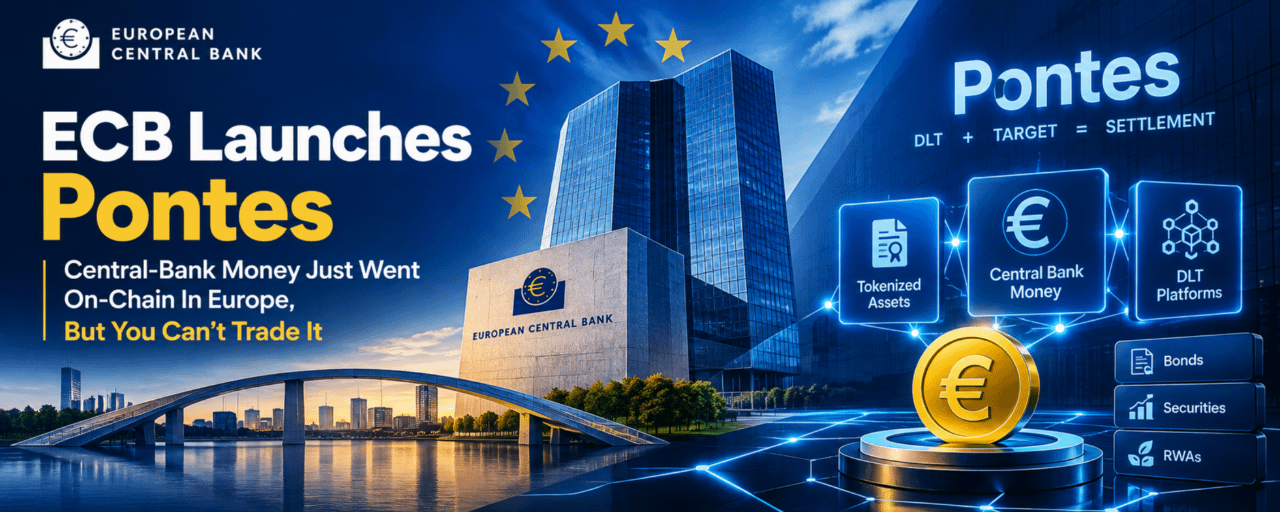
Europe Launches Pontes:Central-Bank Money Now Settles Tokenized Assets, Traders Should Pay AttentionThe European Central Bank switched on Pontes today, letting banks settle tokenized assets in central-bank euros. It is not a token and not a direct trigger for $BTC or $ETH , but it may be the clearest sign yet that institutional tokenization is becoming infrastructure.
Tokenized bonds and securities have been able to trade on-chain for a while. What they lacked was a risk-free way to settle the cash side. Pontes, which went live on September 21, is the ECB's answer, and it matters for anyone following the RWA, stablecoin and tokenization narratives.
KEY FACTS
▪️ Pontes links distributed ledger technology (DLT) platforms to the Eurosystem's TARGET Services, so tokenized wholesale transactions can settle in central-bank money.
▪️ 13 market participants and four DLT operators completed onboarding and are ready to use it immediately, with more committed to connecting in the coming months.
▪️ It initially runs on business days from 8:00 a.m. to 4:00 p.m. CET. The ECB says enhanced features and longer hours will roll out gradually, with full implementation expected by 2028.
▪️ It follows 2024 trials with 64 participants and more than 50 experiments, covering over €1.5 billion in transactions.
▪️ Pontes is wholesale infrastructure. It is separate from the retail digital euro, whose pilot is not scheduled to start until the second half of 2027.
WHO IS LIVE
▪️ Market participants: ABANCA, BayernLB, Caisse des Dépôts, Cecabank, Deutsche Bank, Deka Bank, DZ Bank, the European Investment Bank, KfW, Memo Bank, NRW.BANK, Santander and Société Générale. The Deutsche Bundesbank has also onboarded.
▪️ DLT operators: Axiology, Cashlink, Clearstream and SWIAT.
HOW IT WORKS
▪️ The problem it solves: The cash leg of a tokenized trade had to settle through legacy banking rails, creating lag and counterparty risk.
▪️ Dual settlement: Participants can settle with cash tokens on a Eurosystem DLT platform or directly in T2, the Eurosystem's real-time gross settlement system. Final settlement of the cash leg is achieved once the transaction completes in T2.
▪️ All-or-none execution: A Hash-Link protocol synchronizes settlement across platforms, so both legs of a trade settle or neither does.
▪️ Roadmap: At launch, legal finality stays with TARGET. Later versions are expected to bring finality onto a Eurosystem DLT platform and add smart contract functionality. Cipollone has also said later upgrades would extend operating hours to 22.5 hours per business day.
WHO CAN USE IT
Access is restricted. Under the ECB's initial-launch criteria, eligible market participants are entities with access to T2, and eligible DLT operators are central securities depositories or operators authorized under the EU's DLT Pilot Regime. It is not open to retail traders or public tokens.
WHY IT MATTERS (ANALYSIS)
Central-bank money carries no credit or liquidity risk, which is why banks want it as the anchor for tokenized markets. For the RWA narrative, this moves the discussion from concept to production infrastructure. The ECB has also signaled that tokenized bank deposits and regulated euro stablecoins are expected to coexist with central-bank money, so Pontes looks like a bridge rather than a replacement for private stablecoins.
THREE SCENARIOS
▪️ Constructive: Institutions adopt central-bank settlement, and tokenized-asset volumes grow steadily as participants and hours expand.
▪️ Neutral: Activity stays on permissioned institutional platforms, with little direct impact on crypto markets.
▪️ Risk: Adoption is slower than hoped, and limited initial hours and features keep volumes small.
These are scenarios, not forecasts.
WHAT PONTES IS NOT
▪️ It is not a public-blockchain integration.
▪️ It is not a confirmed catalyst for crypto prices.
▪️ Some social posts attach unrelated altcoin tickers to this news. No link between those tokens and Pontes has been shown.
WHAT TO WATCH
▪️ New participants onboarding
▪️ Longer operating hours and smart contract functionality
▪️ The ECB's plan to invest part of its own funds in tokenized euro debt from public issuers, with no amount disclosed yet
▪️ Growth of euro stablecoins and tokenized deposits alongside central-bank settlement
BOTTOM LINE
Europe now has a live route for settling tokenized assets in central-bank money. The scale-up is gradual, so adoption milestones matter more than any immediate price reaction.
As central-bank settlement goes live, does institutional volume stay on permissioned chains, or do public networks end up bridging the gap? Share your view below.
Sources: ECB press release, Eurosystem documentation and industry coverage. Not financial advice. Always DYOR.
#RWA #ECBStartsBlockchainEuroSettlement #Tokenization #Stablecoins #Pontes
Europe Launches Pontes:Central-Bank Money Now Settles Tokenized Assets, Traders Should Pay Attention
The European Central Bank switched on Pontes today, letting banks settle tokenized assets in central-bank euros. It is not a token and not a direct trigger for $BTC or $ETH , but it may be the clearest sign yet that institutional tokenization is becoming infrastructure.
Tokenized bonds and securities have been able to trade on-chain for a while. What they lacked was a risk-free way to settle the cash side. Pontes, which went live on September 21, is the ECB's answer, and it matters for anyone following the RWA, stablecoin and tokenization narratives.
KEY FACTS
▪️ Pontes links distributed ledger technology (DLT) platforms to the Eurosystem's TARGET Services, so tokenized wholesale transactions can settle in central-bank money.
▪️ 13 market participants and four DLT operators completed onboarding and are ready to use it immediately, with more committed to connecting in the coming months.
▪️ It initially runs on business days from 8:00 a.m. to 4:00 p.m. CET. The ECB says enhanced features and longer hours will roll out gradually, with full implementation expected by 2028.
▪️ It follows 2024 trials with 64 participants and more than 50 experiments, covering over €1.5 billion in transactions.
▪️ Pontes is wholesale infrastructure. It is separate from the retail digital euro, whose pilot is not scheduled to start until the second half of 2027.
WHO IS LIVE
▪️ Market participants: ABANCA, BayernLB, Caisse des Dépôts, Cecabank, Deutsche Bank, Deka Bank, DZ Bank, the European Investment Bank, KfW, Memo Bank, NRW.BANK, Santander and Société Générale. The Deutsche Bundesbank has also onboarded.
▪️ DLT operators: Axiology, Cashlink, Clearstream and SWIAT.
HOW IT WORKS
▪️ The problem it solves: The cash leg of a tokenized trade had to settle through legacy banking rails, creating lag and counterparty risk.
▪️ Dual settlement: Participants can settle with cash tokens on a Eurosystem DLT platform or directly in T2, the Eurosystem's real-time gross settlement system. Final settlement of the cash leg is achieved once the transaction completes in T2.
▪️ All-or-none execution: A Hash-Link protocol synchronizes settlement across platforms, so both legs of a trade settle or neither does.
▪️ Roadmap: At launch, legal finality stays with TARGET. Later versions are expected to bring finality onto a Eurosystem DLT platform and add smart contract functionality. Cipollone has also said later upgrades would extend operating hours to 22.5 hours per business day.
WHO CAN USE IT
Access is restricted. Under the ECB's initial-launch criteria, eligible market participants are entities with access to T2, and eligible DLT operators are central securities depositories or operators authorized under the EU's DLT Pilot Regime. It is not open to retail traders or public tokens.
WHY IT MATTERS (ANALYSIS)
Central-bank money carries no credit or liquidity risk, which is why banks want it as the anchor for tokenized markets. For the RWA narrative, this moves the discussion from concept to production infrastructure. The ECB has also signaled that tokenized bank deposits and regulated euro stablecoins are expected to coexist with central-bank money, so Pontes looks like a bridge rather than a replacement for private stablecoins.
THREE SCENARIOS
▪️ Constructive: Institutions adopt central-bank settlement, and tokenized-asset volumes grow steadily as participants and hours expand.
▪️ Neutral: Activity stays on permissioned institutional platforms, with little direct impact on crypto markets.
▪️ Risk: Adoption is slower than hoped, and limited initial hours and features keep volumes small.
These are scenarios, not forecasts.
WHAT PONTES IS NOT
▪️ It is not a public-blockchain integration.
▪️ It is not a confirmed catalyst for crypto prices.
▪️ Some social posts attach unrelated altcoin tickers to this news. No link between those tokens and Pontes has been shown.
WHAT TO WATCH
▪️ New participants onboarding
▪️ Longer operating hours and smart contract functionality
▪️ The ECB's plan to invest part of its own funds in tokenized euro debt from public issuers, with no amount disclosed yet
▪️ Growth of euro stablecoins and tokenized deposits alongside central-bank settlement
BOTTOM LINE
Europe now has a live route for settling tokenized assets in central-bank money. The scale-up is gradual, so adoption milestones matter more than any immediate price reaction.
As central-bank settlement goes live, does institutional volume stay on permissioned chains, or do public networks end up bridging the gap? Share your view below.
Sources: ECB press release, Eurosystem documentation and industry coverage. Not financial advice. Always DYOR.
#RWA #ECBStartsBlockchainEuroSettlement #Tokenization #Stablecoins #Pontes
Tokenized bonds and securities have been able to trade on-chain for a while. What they lacked was a risk-free way to settle the cash side. Pontes, which went live on September 21, is the ECB's answer, and it matters for anyone following the RWA, stablecoin and tokenization narratives.
KEY FACTS
▪️ Pontes links distributed ledger technology (DLT) platforms to the Eurosystem's TARGET Services, so tokenized wholesale transactions can settle in central-bank money.
▪️ 13 market participants and four DLT operators completed onboarding and are ready to use it immediately, with more committed to connecting in the coming months.
▪️ It initially runs on business days from 8:00 a.m. to 4:00 p.m. CET. The ECB says enhanced features and longer hours will roll out gradually, with full implementation expected by 2028.
▪️ It follows 2024 trials with 64 participants and more than 50 experiments, covering over €1.5 billion in transactions.
▪️ Pontes is wholesale infrastructure. It is separate from the retail digital euro, whose pilot is not scheduled to start until the second half of 2027.
WHO IS LIVE
▪️ Market participants: ABANCA, BayernLB, Caisse des Dépôts, Cecabank, Deutsche Bank, Deka Bank, DZ Bank, the European Investment Bank, KfW, Memo Bank, NRW.BANK, Santander and Société Générale. The Deutsche Bundesbank has also onboarded.
▪️ DLT operators: Axiology, Cashlink, Clearstream and SWIAT.
HOW IT WORKS
▪️ The problem it solves: The cash leg of a tokenized trade had to settle through legacy banking rails, creating lag and counterparty risk.
▪️ Dual settlement: Participants can settle with cash tokens on a Eurosystem DLT platform or directly in T2, the Eurosystem's real-time gross settlement system. Final settlement of the cash leg is achieved once the transaction completes in T2.
▪️ All-or-none execution: A Hash-Link protocol synchronizes settlement across platforms, so both legs of a trade settle or neither does.
▪️ Roadmap: At launch, legal finality stays with TARGET. Later versions are expected to bring finality onto a Eurosystem DLT platform and add smart contract functionality. Cipollone has also said later upgrades would extend operating hours to 22.5 hours per business day.
WHO CAN USE IT
Access is restricted. Under the ECB's initial-launch criteria, eligible market participants are entities with access to T2, and eligible DLT operators are central securities depositories or operators authorized under the EU's DLT Pilot Regime. It is not open to retail traders or public tokens.
WHY IT MATTERS (ANALYSIS)
Central-bank money carries no credit or liquidity risk, which is why banks want it as the anchor for tokenized markets. For the RWA narrative, this moves the discussion from concept to production infrastructure. The ECB has also signaled that tokenized bank deposits and regulated euro stablecoins are expected to coexist with central-bank money, so Pontes looks like a bridge rather than a replacement for private stablecoins.
THREE SCENARIOS
▪️ Constructive: Institutions adopt central-bank settlement, and tokenized-asset volumes grow steadily as participants and hours expand.
▪️ Neutral: Activity stays on permissioned institutional platforms, with little direct impact on crypto markets.
▪️ Risk: Adoption is slower than hoped, and limited initial hours and features keep volumes small.
These are scenarios, not forecasts.
WHAT PONTES IS NOT
▪️ It is not a public-blockchain integration.
▪️ It is not a confirmed catalyst for crypto prices.
▪️ Some social posts attach unrelated altcoin tickers to this news. No link between those tokens and Pontes has been shown.
WHAT TO WATCH
▪️ New participants onboarding
▪️ Longer operating hours and smart contract functionality
▪️ The ECB's plan to invest part of its own funds in tokenized euro debt from public issuers, with no amount disclosed yet
▪️ Growth of euro stablecoins and tokenized deposits alongside central-bank settlement
BOTTOM LINE
Europe now has a live route for settling tokenized assets in central-bank money. The scale-up is gradual, so adoption milestones matter more than any immediate price reaction.
As central-bank settlement goes live, does institutional volume stay on permissioned chains, or do public networks end up bridging the gap? Share your view below.
Sources: ECB press release, Eurosystem documentation and industry coverage. Not financial advice. Always DYOR.
#RWA #ECBStartsBlockchainEuroSettlement #Tokenization #Stablecoins #Pontes
50
·
--
Статья
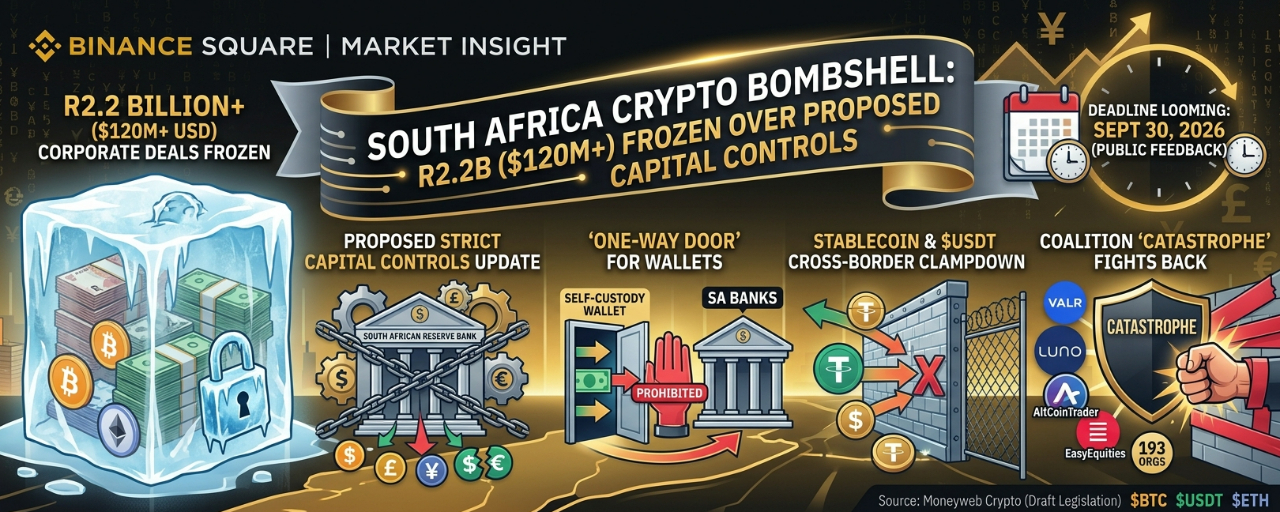
South Africa's Proposed Crypto Curbs Freeze R2.2 Billion In Deals And Put Stablecoin Flows At RiskAt least three crypto deals worth R2.2 billion are on hold in South Africa, the continent's second-largest crypto market, as draft exchange-control rules threaten cross-border stablecoin use. Public comment closes September 30.
Digital-asset firms in South Africa have paused billions of rand in transactions over proposed rules that would bring crypto under the country's exchange-control system. Industry executives warn the rules could push legitimate crypto activity offshore, and the outcome matters for $USDT and $BTC traders across Africa.
KEY FACTS
▪️ At least three deals worth about R2.2 billion are on hold, according to Bloomberg, which cited people familiar with the matter who asked not to be named.
▪️ VALR (A South African cryptocurrency exchange) CEO Farzam Ehsani says the affected deals include a R1.6 billion investment by an international private equity firm, plus deals worth R250 million and R350 million.
▪️ South Africa is Africa's second-largest crypto market, and firms use stablecoins to repatriate profits and receive dividends from subsidiaries elsewhere on the continent.
▪️ $USDT is the preferred local stablecoin, with on-chain transactions across three of the biggest licensed exchanges nearing R27 billion in the year through April, according to central bank data.
WHAT THE DRAFT RULES WOULD DO
The Treasury and the South African Reserve Bank (SARB) published a draft Crypto Asset Manual for cross-border activity on August 3. According to a summary by law firm Werksmans, it would:
▪️ Cap small remittance transactions at R5,000 per transaction per day and R25,000 per month
▪️ Apply individual allowances of R2 million a year (Single Discretionary Allowance) and R10 million (Foreign Capital Allowance)
▪️ Treat transfers to offshore platforms or non-custodial wallets as cross-border
▪️ Prohibit transfers from non-custodial wallets to domestic licensed providers
▪️ Require licensed providers to hold at least R5 million in minimum capital
WHY IT MATTERS
The rules update a law nearly a century old. Authorities say the goal is to monitor cross-border flows, limit regulatory arbitrage and combat illicit financial flows. Industry says the effect is different: an industry coalition that includes VALR, Luno, AltCoinTrader and EasyEquities argues the proposals would block legitimate blockchain-based cross-border business payments.
WHAT REGULATORS SAY
The SARB says the requirements are drafts that remain subject to refinement, and that the Treasury and other regulators are still working through the approach to stablecoins. Earlier this year, officials said the changes were not meant to criminalize crypto ownership and would not apply retroactively.
WHAT TO WATCH
▪️ The September 30 comment deadline
▪️ Whether the final manual softens the stablecoin and non-custodial wallet provisions
▪️ Whether frozen deals, including the R1.6 billion investment, resume
▪️ Possible legal challenges, the industry may pursue if its objections are ignored
FAQ
Are these rules final? No. They are drafts open for comment until September 30.
Does South Africa recognize crypto as legal tender? No.
Why do stablecoins matter here? Firms use them to move money across borders, partly because of hard-currency shortages in some African markets.
BOTTOM LINE
South Africa is deciding how tightly to control the stablecoin rails that move money across the continent. The final wording will determine whether deals resume or activity moves offshore.
Sources: Bloomberg via Moneyweb, VALR, Werksmans. Not financial advice. Always DYOR.
#SouthAfrica #Stablecoins #SouthAfricaProposesCryptoExchangeControls #CryptoRegulation #CryptoNews
South Africa's Proposed Crypto Curbs Freeze R2.2 Billion In Deals And Put Stablecoin Flows At Risk
At least three crypto deals worth R2.2 billion are on hold in South Africa, the continent's second-largest crypto market, as draft exchange-control rules threaten cross-border stablecoin use. Public comment closes September 30.
Digital-asset firms in South Africa have paused billions of rand in transactions over proposed rules that would bring crypto under the country's exchange-control system. Industry executives warn the rules could push legitimate crypto activity offshore, and the outcome matters for $USDT and $BTC traders across Africa.
KEY FACTS
▪️ At least three deals worth about R2.2 billion are on hold, according to Bloomberg, which cited people familiar with the matter who asked not to be named.
▪️ VALR (A South African cryptocurrency exchange) CEO Farzam Ehsani says the affected deals include a R1.6 billion investment by an international private equity firm, plus deals worth R250 million and R350 million.
▪️ South Africa is Africa's second-largest crypto market, and firms use stablecoins to repatriate profits and receive dividends from subsidiaries elsewhere on the continent.
▪️ $USDT is the preferred local stablecoin, with on-chain transactions across three of the biggest licensed exchanges nearing R27 billion in the year through April, according to central bank data.
WHAT THE DRAFT RULES WOULD DO
The Treasury and the South African Reserve Bank (SARB) published a draft Crypto Asset Manual for cross-border activity on August 3. According to a summary by law firm Werksmans, it would:
▪️ Cap small remittance transactions at R5,000 per transaction per day and R25,000 per month
▪️ Apply individual allowances of R2 million a year (Single Discretionary Allowance) and R10 million (Foreign Capital Allowance)
▪️ Treat transfers to offshore platforms or non-custodial wallets as cross-border
▪️ Prohibit transfers from non-custodial wallets to domestic licensed providers
▪️ Require licensed providers to hold at least R5 million in minimum capital
WHY IT MATTERS
The rules update a law nearly a century old. Authorities say the goal is to monitor cross-border flows, limit regulatory arbitrage and combat illicit financial flows. Industry says the effect is different: an industry coalition that includes VALR, Luno, AltCoinTrader and EasyEquities argues the proposals would block legitimate blockchain-based cross-border business payments.
WHAT REGULATORS SAY
The SARB says the requirements are drafts that remain subject to refinement, and that the Treasury and other regulators are still working through the approach to stablecoins. Earlier this year, officials said the changes were not meant to criminalize crypto ownership and would not apply retroactively.
WHAT TO WATCH
▪️ The September 30 comment deadline
▪️ Whether the final manual softens the stablecoin and non-custodial wallet provisions
▪️ Whether frozen deals, including the R1.6 billion investment, resume
▪️ Possible legal challenges, the industry may pursue if its objections are ignored
FAQ
Are these rules final? No. They are drafts open for comment until September 30.
Does South Africa recognize crypto as legal tender? No.
Why do stablecoins matter here? Firms use them to move money across borders, partly because of hard-currency shortages in some African markets.
BOTTOM LINE
South Africa is deciding how tightly to control the stablecoin rails that move money across the continent. The final wording will determine whether deals resume or activity moves offshore.
Sources: Bloomberg via Moneyweb, VALR, Werksmans. Not financial advice. Always DYOR.
#SouthAfrica #Stablecoins #SouthAfricaProposesCryptoExchangeControls #CryptoRegulation #CryptoNews
Digital-asset firms in South Africa have paused billions of rand in transactions over proposed rules that would bring crypto under the country's exchange-control system. Industry executives warn the rules could push legitimate crypto activity offshore, and the outcome matters for $USDT and $BTC traders across Africa.
KEY FACTS
▪️ At least three deals worth about R2.2 billion are on hold, according to Bloomberg, which cited people familiar with the matter who asked not to be named.
▪️ VALR (A South African cryptocurrency exchange) CEO Farzam Ehsani says the affected deals include a R1.6 billion investment by an international private equity firm, plus deals worth R250 million and R350 million.
▪️ South Africa is Africa's second-largest crypto market, and firms use stablecoins to repatriate profits and receive dividends from subsidiaries elsewhere on the continent.
▪️ $USDT is the preferred local stablecoin, with on-chain transactions across three of the biggest licensed exchanges nearing R27 billion in the year through April, according to central bank data.
WHAT THE DRAFT RULES WOULD DO
The Treasury and the South African Reserve Bank (SARB) published a draft Crypto Asset Manual for cross-border activity on August 3. According to a summary by law firm Werksmans, it would:
▪️ Cap small remittance transactions at R5,000 per transaction per day and R25,000 per month
▪️ Apply individual allowances of R2 million a year (Single Discretionary Allowance) and R10 million (Foreign Capital Allowance)
▪️ Treat transfers to offshore platforms or non-custodial wallets as cross-border
▪️ Prohibit transfers from non-custodial wallets to domestic licensed providers
▪️ Require licensed providers to hold at least R5 million in minimum capital
WHY IT MATTERS
The rules update a law nearly a century old. Authorities say the goal is to monitor cross-border flows, limit regulatory arbitrage and combat illicit financial flows. Industry says the effect is different: an industry coalition that includes VALR, Luno, AltCoinTrader and EasyEquities argues the proposals would block legitimate blockchain-based cross-border business payments.
WHAT REGULATORS SAY
The SARB says the requirements are drafts that remain subject to refinement, and that the Treasury and other regulators are still working through the approach to stablecoins. Earlier this year, officials said the changes were not meant to criminalize crypto ownership and would not apply retroactively.
WHAT TO WATCH
▪️ The September 30 comment deadline
▪️ Whether the final manual softens the stablecoin and non-custodial wallet provisions
▪️ Whether frozen deals, including the R1.6 billion investment, resume
▪️ Possible legal challenges, the industry may pursue if its objections are ignored
FAQ
Are these rules final? No. They are drafts open for comment until September 30.
Does South Africa recognize crypto as legal tender? No.
Why do stablecoins matter here? Firms use them to move money across borders, partly because of hard-currency shortages in some African markets.
BOTTOM LINE
South Africa is deciding how tightly to control the stablecoin rails that move money across the continent. The final wording will determine whether deals resume or activity moves offshore.
Sources: Bloomberg via Moneyweb, VALR, Werksmans. Not financial advice. Always DYOR.
#SouthAfrica #Stablecoins #SouthAfricaProposesCryptoExchangeControls #CryptoRegulation #CryptoNews
54
·
--
Статья
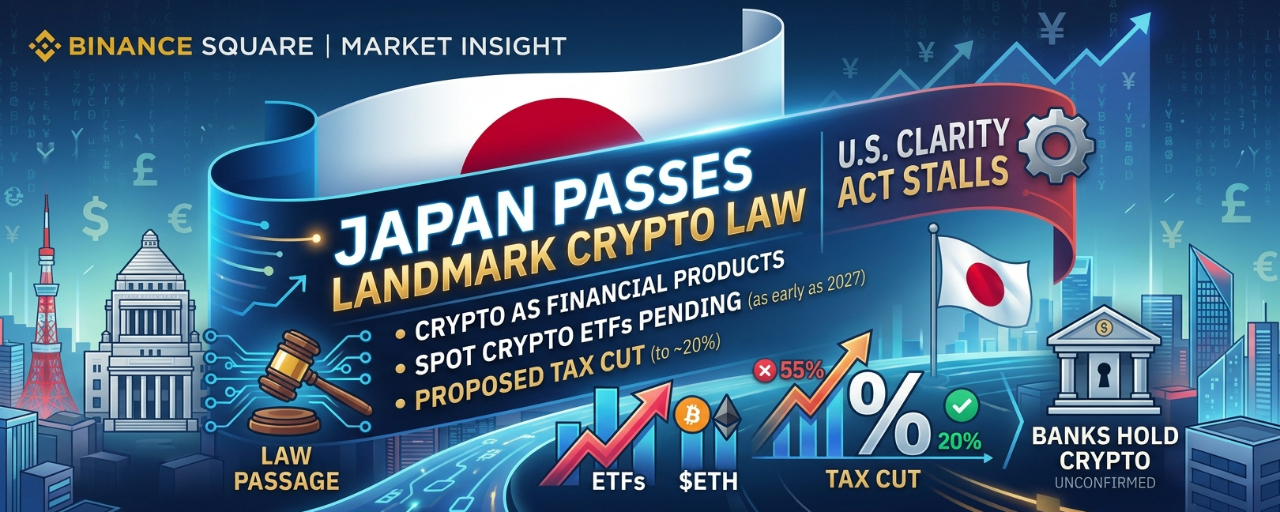
Japan Passes Landmark Crypto Law As U.S. Clarity Act StallsJapan's parliament has reclassified crypto as financial products, setting up spot crypto ETFs as early as 2027, while a proposed cut in the top tax rate to about 20% remains pending.
Japan's crypto market reform is no longer a proposal. The National Diet passed it on July 15, giving $BTC and $ETH traders a clearer rulebook at a time when the U.S. Clarity Act remains stalled in Congress.
KEY FACTS
▪️ Crypto now falls under the Financial Instruments and Exchange Act (FIEA), the framework that governs stocks and bonds, instead of the Payment Services Act.
▪️ The law adds insider-trading rules and annual disclosures by token issuers.
▪️ The maximum prison term for unregistered operators rises from three years to 10.
▪️ It lays the legal groundwork for spot crypto ETFs on the Tokyo Stock Exchange as early as 2027.
▪️ Implementation is expected within a year of passage.
THE TAX CUT: NOT YET LAW
A companion proposal would cut the top crypto tax rate from 55% to a flat 20.315%, in line with stocks. It is slated for January 2028 and still needs to pass. About 105 tokens on domestic licensed exchanges, including Bitcoin and Ether, are expected to qualify, and the plan reportedly allows losses to be carried forward for three years.
WHY THE U.S. COMPARISON MATTERS
Japan's law is a separate FIEA amendment, not a copy of the U.S. bill. But the contrast is real: Japan has a passed law and an ETF path, while U.S. market-structure legislation is stuck. Regulatory clarity tends to attract institutional money, though the timelines here run to 2027 and 2028, so this is not an overnight price catalyst.
WHAT TO WATCH
▪️ Passage of the tax legislation
▪️ Implementing rules from the Financial Services Agency
▪️ The first spot crypto ETF filings in Tokyo
▪️ Official confirmation of reports that banks may hold crypto for investment
FAQ
Is Japan's 20% crypto tax in effect? No. It is slated for January 2028 and still needs to pass.
Can Japanese banks hold crypto today? One outlet reports the FSA is moving to allow it, but I found no confirmation elsewhere. Check the FSA before relying on it.
Which tokens qualify? About 105 tokens on licensed domestic exchanges, including $BTC and ETH, are expected to qualify.
BOTTOM LINE
Japan has moved first on the legal framework. Traders should watch the tax bill and the ETF timeline rather than expect an immediate price reaction.
Sources: Japanese Diet and FSA coverage. Not financial advice. Always DYOR.
#Japan #Bitcoin #CryptoRegulation #CryptoTax #BTC
Japan Passes Landmark Crypto Law As U.S. Clarity Act Stalls
Japan's parliament has reclassified crypto as financial products, setting up spot crypto ETFs as early as 2027, while a proposed cut in the top tax rate to about 20% remains pending.
Japan's crypto market reform is no longer a proposal. The National Diet passed it on July 15, giving $BTC and $ETH traders a clearer rulebook at a time when the U.S. Clarity Act remains stalled in Congress.
KEY FACTS
▪️ Crypto now falls under the Financial Instruments and Exchange Act (FIEA), the framework that governs stocks and bonds, instead of the Payment Services Act.
▪️ The law adds insider-trading rules and annual disclosures by token issuers.
▪️ The maximum prison term for unregistered operators rises from three years to 10.
▪️ It lays the legal groundwork for spot crypto ETFs on the Tokyo Stock Exchange as early as 2027.
▪️ Implementation is expected within a year of passage.
THE TAX CUT: NOT YET LAW
A companion proposal would cut the top crypto tax rate from 55% to a flat 20.315%, in line with stocks. It is slated for January 2028 and still needs to pass. About 105 tokens on domestic licensed exchanges, including Bitcoin and Ether, are expected to qualify, and the plan reportedly allows losses to be carried forward for three years.
WHY THE U.S. COMPARISON MATTERS
Japan's law is a separate FIEA amendment, not a copy of the U.S. bill. But the contrast is real: Japan has a passed law and an ETF path, while U.S. market-structure legislation is stuck. Regulatory clarity tends to attract institutional money, though the timelines here run to 2027 and 2028, so this is not an overnight price catalyst.
WHAT TO WATCH
▪️ Passage of the tax legislation
▪️ Implementing rules from the Financial Services Agency
▪️ The first spot crypto ETF filings in Tokyo
▪️ Official confirmation of reports that banks may hold crypto for investment
FAQ
Is Japan's 20% crypto tax in effect? No. It is slated for January 2028 and still needs to pass.
Can Japanese banks hold crypto today? One outlet reports the FSA is moving to allow it, but I found no confirmation elsewhere. Check the FSA before relying on it.
Which tokens qualify? About 105 tokens on licensed domestic exchanges, including $BTC and ETH, are expected to qualify.
BOTTOM LINE
Japan has moved first on the legal framework. Traders should watch the tax bill and the ETF timeline rather than expect an immediate price reaction.
Sources: Japanese Diet and FSA coverage. Not financial advice. Always DYOR.
#Japan #Bitcoin #CryptoRegulation #CryptoTax #BTC
Japan's crypto market reform is no longer a proposal. The National Diet passed it on July 15, giving $BTC and $ETH traders a clearer rulebook at a time when the U.S. Clarity Act remains stalled in Congress.
KEY FACTS
▪️ Crypto now falls under the Financial Instruments and Exchange Act (FIEA), the framework that governs stocks and bonds, instead of the Payment Services Act.
▪️ The law adds insider-trading rules and annual disclosures by token issuers.
▪️ The maximum prison term for unregistered operators rises from three years to 10.
▪️ It lays the legal groundwork for spot crypto ETFs on the Tokyo Stock Exchange as early as 2027.
▪️ Implementation is expected within a year of passage.
THE TAX CUT: NOT YET LAW
A companion proposal would cut the top crypto tax rate from 55% to a flat 20.315%, in line with stocks. It is slated for January 2028 and still needs to pass. About 105 tokens on domestic licensed exchanges, including Bitcoin and Ether, are expected to qualify, and the plan reportedly allows losses to be carried forward for three years.
WHY THE U.S. COMPARISON MATTERS
Japan's law is a separate FIEA amendment, not a copy of the U.S. bill. But the contrast is real: Japan has a passed law and an ETF path, while U.S. market-structure legislation is stuck. Regulatory clarity tends to attract institutional money, though the timelines here run to 2027 and 2028, so this is not an overnight price catalyst.
WHAT TO WATCH
▪️ Passage of the tax legislation
▪️ Implementing rules from the Financial Services Agency
▪️ The first spot crypto ETF filings in Tokyo
▪️ Official confirmation of reports that banks may hold crypto for investment
FAQ
Is Japan's 20% crypto tax in effect? No. It is slated for January 2028 and still needs to pass.
Can Japanese banks hold crypto today? One outlet reports the FSA is moving to allow it, but I found no confirmation elsewhere. Check the FSA before relying on it.
Which tokens qualify? About 105 tokens on licensed domestic exchanges, including $BTC and ETH, are expected to qualify.
BOTTOM LINE
Japan has moved first on the legal framework. Traders should watch the tax bill and the ETF timeline rather than expect an immediate price reaction.
Sources: Japanese Diet and FSA coverage. Not financial advice. Always DYOR.
#Japan #Bitcoin #CryptoRegulation #CryptoTax #BTC
660
·
--
$BTC Just Crossed 85K and its soon going to Hit 100K.
Kevin O'Leary Says: Bitcoin "WILL" Hit $1 Million, With One Big Condition
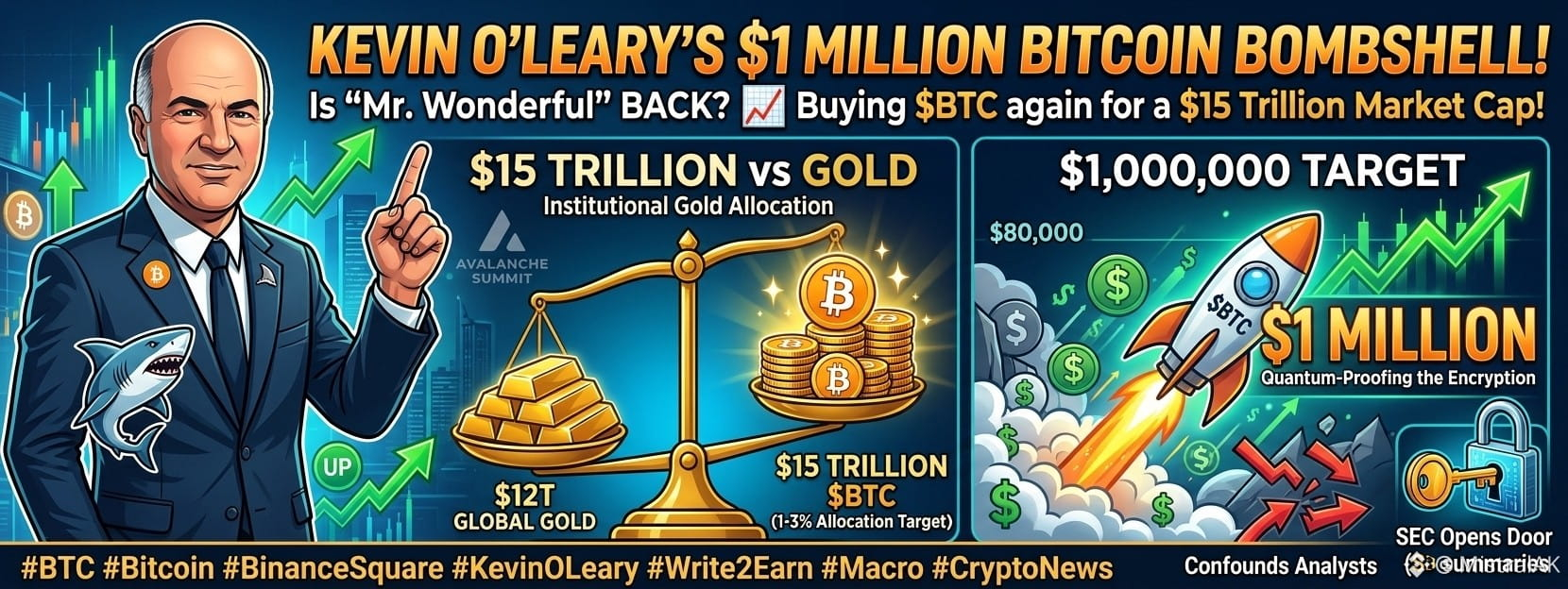
Kevin O'Leary's Bitcoin price prediction just got bigger. The Shark Tank investor says he's back buying $BTC for this cycle, and his target is now $1M. Bitcoin is holding near $80K after the Fed's first hike since 2023. Key points 👇
📌 THE THESIS
▪️ O'Leary called crypto "garbage" in 2019. Now he's buying new positions.
▪️ He expects Bitcoin to capture 1%–3% of alternative-asset allocations, like institutional gold holdings.
▪️ That implies ~$253K–$760K per BTC (up to a $15T market cap).
▪️ His new $1M target (~$20T) depends on one thing: quantum risk.
⚛️ WHY QUANTUM MATTERS
"Q-Day" is when a powerful quantum computer could break the encryption securing BTC and $ETH . A March Google paper estimated it would take under 500,000 physical qubits, ~20x fewer than earlier estimates. O'Leary says traders are already hedging with quantum-software stocks.
🏛️ TOKENIZED STOCKS
He called exchange adoption of tokenized assets a "watershed moment." This week the SEC created a regulatory path for certain venues to issue tokenized US stocks, right after the Clarity Act failed.
🧠 REALITY CHECK
▪️ $1M from ~$80K is a ~12x move.
▪️ Predictions aren't forecasts, though O'Leary is buying.
▪️ Quantum is HIS caveat, so don't skip it.
▪️ BTC has absorbed a rate hike, $100+ oil and a stalled Clarity Act and still holds up. Analysts say further upside depends on relief in oil, rates or the dollar.
Is $1M realistic this cycle, or will quantum risk be the roadblock? Drop your target 👇
Source: Forbes. Not financial advice. DYOR.
{future}(BTCUSDT)
#Bitcoin #BTC #KevinOLeary #BitcoinHits$85K #CryptoNews
$BTC Just Crossed 85K and its soon going to Hit 100K.
Kevin O'Leary Says: Bitcoin "WILL" Hit $1 Million, With One Big Condition
Kevin O'Leary's Bitcoin price prediction just got bigger. The Shark Tank investor says he's back buying $BTC for this cycle, and his target is now $1M. Bitcoin is holding near $80K after the Fed's first hike since 2023. Key points 👇
📌 THE THESIS
▪️ O'Leary called crypto "garbage" in 2019. Now he's buying new positions.
▪️ He expects Bitcoin to capture 1%–3% of alternative-asset allocations, like institutional gold holdings.
▪️ That implies ~$253K–$760K per BTC (up to a $15T market cap).
▪️ His new $1M target (~$20T) depends on one thing: quantum risk.
⚛️ WHY QUANTUM MATTERS
"Q-Day" is when a powerful quantum computer could break the encryption securing BTC and $ETH . A March Google paper estimated it would take under 500,000 physical qubits, ~20x fewer than earlier estimates. O'Leary says traders are already hedging with quantum-software stocks.
🏛️ TOKENIZED STOCKS
He called exchange adoption of tokenized assets a "watershed moment." This week the SEC created a regulatory path for certain venues to issue tokenized US stocks, right after the Clarity Act failed.
🧠 REALITY CHECK
▪️ $1M from ~$80K is a ~12x move.
▪️ Predictions aren't forecasts, though O'Leary is buying.
▪️ Quantum is HIS caveat, so don't skip it.
▪️ BTC has absorbed a rate hike, $100+ oil and a stalled Clarity Act and still holds up. Analysts say further upside depends on relief in oil, rates or the dollar.
Is $1M realistic this cycle, or will quantum risk be the roadblock? Drop your target 👇
Source: Forbes. Not financial advice. DYOR.
#Bitcoin #BTC #KevinOLeary #BitcoinHits$85K #CryptoNews
Kevin O'Leary Says: Bitcoin "WILL" Hit $1 Million, With One Big Condition
Kevin O'Leary's Bitcoin price prediction just got bigger. The Shark Tank investor says he's back buying $BTC for this cycle, and his target is now $1M. Bitcoin is holding near $80K after the Fed's first hike since 2023. Key points 👇
📌 THE THESIS
▪️ O'Leary called crypto "garbage" in 2019. Now he's buying new positions.
▪️ He expects Bitcoin to capture 1%–3% of alternative-asset allocations, like institutional gold holdings.
▪️ That implies ~$253K–$760K per BTC (up to a $15T market cap).
▪️ His new $1M target (~$20T) depends on one thing: quantum risk.
⚛️ WHY QUANTUM MATTERS
"Q-Day" is when a powerful quantum computer could break the encryption securing BTC and $ETH . A March Google paper estimated it would take under 500,000 physical qubits, ~20x fewer than earlier estimates. O'Leary says traders are already hedging with quantum-software stocks.
🏛️ TOKENIZED STOCKS
He called exchange adoption of tokenized assets a "watershed moment." This week the SEC created a regulatory path for certain venues to issue tokenized US stocks, right after the Clarity Act failed.
🧠 REALITY CHECK
▪️ $1M from ~$80K is a ~12x move.
▪️ Predictions aren't forecasts, though O'Leary is buying.
▪️ Quantum is HIS caveat, so don't skip it.
▪️ BTC has absorbed a rate hike, $100+ oil and a stalled Clarity Act and still holds up. Analysts say further upside depends on relief in oil, rates or the dollar.
Is $1M realistic this cycle, or will quantum risk be the roadblock? Drop your target 👇
Source: Forbes. Not financial advice. DYOR.
#Bitcoin #BTC #KevinOLeary #BitcoinHits$85K #CryptoNews
1
143
·
--
Fed hiked. BOJ hiked. And now the yen is the wildcard for $BTC 🚨
Binance News flagged it: the yen is near 156.9 after its worst week in almost a year, and Japan is closed until Wednesday. Here's my take 👇
1️⃣ Japan hiked, but the market wanted a roadmap
Two board members dissented, and Ueda gave no end point or pace for future hikes. Traders heard "slower tightening" and sold the yen anyway.
2️⃣ Thin liquidity means amplified moves
The BOJ has already done a rate check, which often comes before intervention. With Japan on holiday, any move could hit a thin market and overshoot. Golden Week played out the same way when the yen broke 160.
3️⃣ Why crypto traders should care: the carry trade
Cheap yen funding has helped fuel leveraged risk-taking globally. A sharp yen rebound can force those trades to unwind, and Aug 2024 showed how that can hit $BTC. Bitcoin just squeezed above $80K, and crypto trades 24/7 while Tokyo is closed.
⚠️ My read: two-way risk
▪️ Yen keeps sliding: intervention odds rise
▪️ Intervention lands: a fast yen spike and a volatility shock
▪️ Either way, over-leveraged longs are the ones exposed
Is the yen the hidden risk for $BTC this week, or is the market shrugging it off? 👇
Not financial advice. Leverage can liquidate you fast. Always DYOR.
#BOJ #Yen #Bitcoin #CarryTrade #CryptoNews
Fed hiked. BOJ hiked. And now the yen is the wildcard for $BTC 🚨
Binance News flagged it: the yen is near 156.9 after its worst week in almost a year, and Japan is closed until Wednesday. Here's my take 👇
1️⃣ Japan hiked, but the market wanted a roadmap
Two board members dissented, and Ueda gave no end point or pace for future hikes. Traders heard "slower tightening" and sold the yen anyway.
2️⃣ Thin liquidity means amplified moves
The BOJ has already done a rate check, which often comes before intervention. With Japan on holiday, any move could hit a thin market and overshoot. Golden Week played out the same way when the yen broke 160.
3️⃣ Why crypto traders should care: the carry trade
Cheap yen funding has helped fuel leveraged risk-taking globally. A sharp yen rebound can force those trades to unwind, and Aug 2024 showed how that can hit $BTC. Bitcoin just squeezed above $80K, and crypto trades 24/7 while Tokyo is closed.
⚠️ My read: two-way risk
▪️ Yen keeps sliding: intervention odds rise
▪️ Intervention lands: a fast yen spike and a volatility shock
▪️ Either way, over-leveraged longs are the ones exposed
Is the yen the hidden risk for $BTC this week, or is the market shrugging it off? 👇
Not financial advice. Leverage can liquidate you fast. Always DYOR.
#BOJ #Yen #Bitcoin #CarryTrade #CryptoNews
Binance News flagged it: the yen is near 156.9 after its worst week in almost a year, and Japan is closed until Wednesday. Here's my take 👇
1️⃣ Japan hiked, but the market wanted a roadmap
Two board members dissented, and Ueda gave no end point or pace for future hikes. Traders heard "slower tightening" and sold the yen anyway.
2️⃣ Thin liquidity means amplified moves
The BOJ has already done a rate check, which often comes before intervention. With Japan on holiday, any move could hit a thin market and overshoot. Golden Week played out the same way when the yen broke 160.
3️⃣ Why crypto traders should care: the carry trade
Cheap yen funding has helped fuel leveraged risk-taking globally. A sharp yen rebound can force those trades to unwind, and Aug 2024 showed how that can hit $BTC. Bitcoin just squeezed above $80K, and crypto trades 24/7 while Tokyo is closed.
⚠️ My read: two-way risk
▪️ Yen keeps sliding: intervention odds rise
▪️ Intervention lands: a fast yen spike and a volatility shock
▪️ Either way, over-leveraged longs are the ones exposed
Is the yen the hidden risk for $BTC this week, or is the market shrugging it off? 👇
Not financial advice. Leverage can liquidate you fast. Always DYOR.
#BOJ #Yen #Bitcoin #CarryTrade #CryptoNews


Binance News
·
--
Japan's Policy Signal Disappoints as Holiday Thins Liquidity, Raising Yen Downside Risk
The yen is likely to swing sharply and weaken further over the coming week. According to Sina Finance, Japan is heading into a three-day holiday, which will reduce market liquidity, while the Bank of Japan gave no clearer guidance on the pace of future rate hikes, disappointing investors.
On Monday, the yen steadied near 156.86 per dollar. It fell as much as 1.3% on Friday after two Bank of Japan board members opposed a rate hike, and a later report that officials had called market participants to conduct a currency check only slightly narrowed the decline.
The yen weakened more than 2% last week, its biggest weekly drop in nearly a year. James Reilly, senior market economist at Capital Economics, wrote in a report that the Bank of Japan has effectively halted the yen's recent momentum, and said a meaningful improvement in the yen's performance against the dollar would depend on U.S. factors.
The reported currency check also highlighted the possibility that Japanese authorities could intervene again to stop further yen weakness. According to Sina Finance, any intervention could trigger rapid and sharp exchange-rate moves, and the holiday through Wednesday could amplify the effect because of thin liquidity. Similar conditions were seen during the Golden Week holiday from late April to early May, when Japan intervened after the yen fell below 160 per dollar.
On Monday, the yen steadied near 156.86 per dollar. It fell as much as 1.3% on Friday after two Bank of Japan board members opposed a rate hike, and a later report that officials had called market participants to conduct a currency check only slightly narrowed the decline.
The yen weakened more than 2% last week, its biggest weekly drop in nearly a year. James Reilly, senior market economist at Capital Economics, wrote in a report that the Bank of Japan has effectively halted the yen's recent momentum, and said a meaningful improvement in the yen's performance against the dollar would depend on U.S. factors.
The reported currency check also highlighted the possibility that Japanese authorities could intervene again to stop further yen weakness. According to Sina Finance, any intervention could trigger rapid and sharp exchange-rate moves, and the holiday through Wednesday could amplify the effect because of thin liquidity. Similar conditions were seen during the Golden Week holiday from late April to early May, when Japan intervened after the yen fell below 160 per dollar.
21
·
--
WHY DID CRYPTO PUMP ON A FED RATE HIKE ? CONFUSED !
Everyone said "rate hike = bearish." Then $BTC went from ~$75K to above $81K and $450M+ in shorts got wiped out. Here's the real story:
1️⃣ The hike was already in the price:
The Fed raised rates 25 bps to 3.75%–4.00%, its first hike since 2023 and a unanimous vote. CME futures had it at roughly 92% before the meeting. No surprise means the uncertainty premium disappears. Classic "buy the news."
2️⃣ The market was positioned for a crash:
#BTC had just slid toward $75K after the CLARITY Act stalled in the Senate, and shorts piled in. When Bitcoin refused to break down, forced buying kicked in. It was a textbook short squeeze that dragged $ETH , $BNB and $SOL higher.
3️⃣ Hawkish did not mean worse than feared:
Chair Warsh sounded tough, and 16 of 18 officials see another hike this year. But the projections showed no sustained tightening cycle into 2027, and the 10-year yield backed off from 5%. Markets trade expectations vs. reality, not tone.
⚠️ What I'm watching now:
▪️ $80K: hold it and the squeeze has legs, lose it and the move may be spent
▪️ $81K–$83K: the supply zone bulls still need to clear
▪️ Leverage: after this much liquidation, funding and open interest reset fast
Did you buy the breakout, or are you waiting for a retest of $80K? Drop your level below 👇
Not financial advice. Leverage can liquidate you fast. Always DYOR.
#bitcoin #BTC #fomc #ShortSqueeze #CryptoNews
WHY DID CRYPTO PUMP ON A FED RATE HIKE ? CONFUSED !
Everyone said "rate hike = bearish." Then $BTC went from ~$75K to above $81K and $450M+ in shorts got wiped out. Here's the real story:
1️⃣ The hike was already in the price:
The Fed raised rates 25 bps to 3.75%–4.00%, its first hike since 2023 and a unanimous vote. CME futures had it at roughly 92% before the meeting. No surprise means the uncertainty premium disappears. Classic "buy the news."
2️⃣ The market was positioned for a crash:
#BTC had just slid toward $75K after the CLARITY Act stalled in the Senate, and shorts piled in. When Bitcoin refused to break down, forced buying kicked in. It was a textbook short squeeze that dragged $ETH , $BNB and $SOL higher.
3️⃣ Hawkish did not mean worse than feared:
Chair Warsh sounded tough, and 16 of 18 officials see another hike this year. But the projections showed no sustained tightening cycle into 2027, and the 10-year yield backed off from 5%. Markets trade expectations vs. reality, not tone.
⚠️ What I'm watching now:
▪️ $80K: hold it and the squeeze has legs, lose it and the move may be spent
▪️ $81K–$83K: the supply zone bulls still need to clear
▪️ Leverage: after this much liquidation, funding and open interest reset fast
Did you buy the breakout, or are you waiting for a retest of $80K? Drop your level below 👇
Not financial advice. Leverage can liquidate you fast. Always DYOR.
#bitcoin #BTC #fomc #ShortSqueeze #CryptoNews
Everyone said "rate hike = bearish." Then $BTC went from ~$75K to above $81K and $450M+ in shorts got wiped out. Here's the real story:
1️⃣ The hike was already in the price:
The Fed raised rates 25 bps to 3.75%–4.00%, its first hike since 2023 and a unanimous vote. CME futures had it at roughly 92% before the meeting. No surprise means the uncertainty premium disappears. Classic "buy the news."
2️⃣ The market was positioned for a crash:
#BTC had just slid toward $75K after the CLARITY Act stalled in the Senate, and shorts piled in. When Bitcoin refused to break down, forced buying kicked in. It was a textbook short squeeze that dragged $ETH , $BNB and $SOL higher.
3️⃣ Hawkish did not mean worse than feared:
Chair Warsh sounded tough, and 16 of 18 officials see another hike this year. But the projections showed no sustained tightening cycle into 2027, and the 10-year yield backed off from 5%. Markets trade expectations vs. reality, not tone.
⚠️ What I'm watching now:
▪️ $80K: hold it and the squeeze has legs, lose it and the move may be spent
▪️ $81K–$83K: the supply zone bulls still need to clear
▪️ Leverage: after this much liquidation, funding and open interest reset fast
Did you buy the breakout, or are you waiting for a retest of $80K? Drop your level below 👇
Not financial advice. Leverage can liquidate you fast. Always DYOR.
#bitcoin #BTC #fomc #ShortSqueeze #CryptoNews
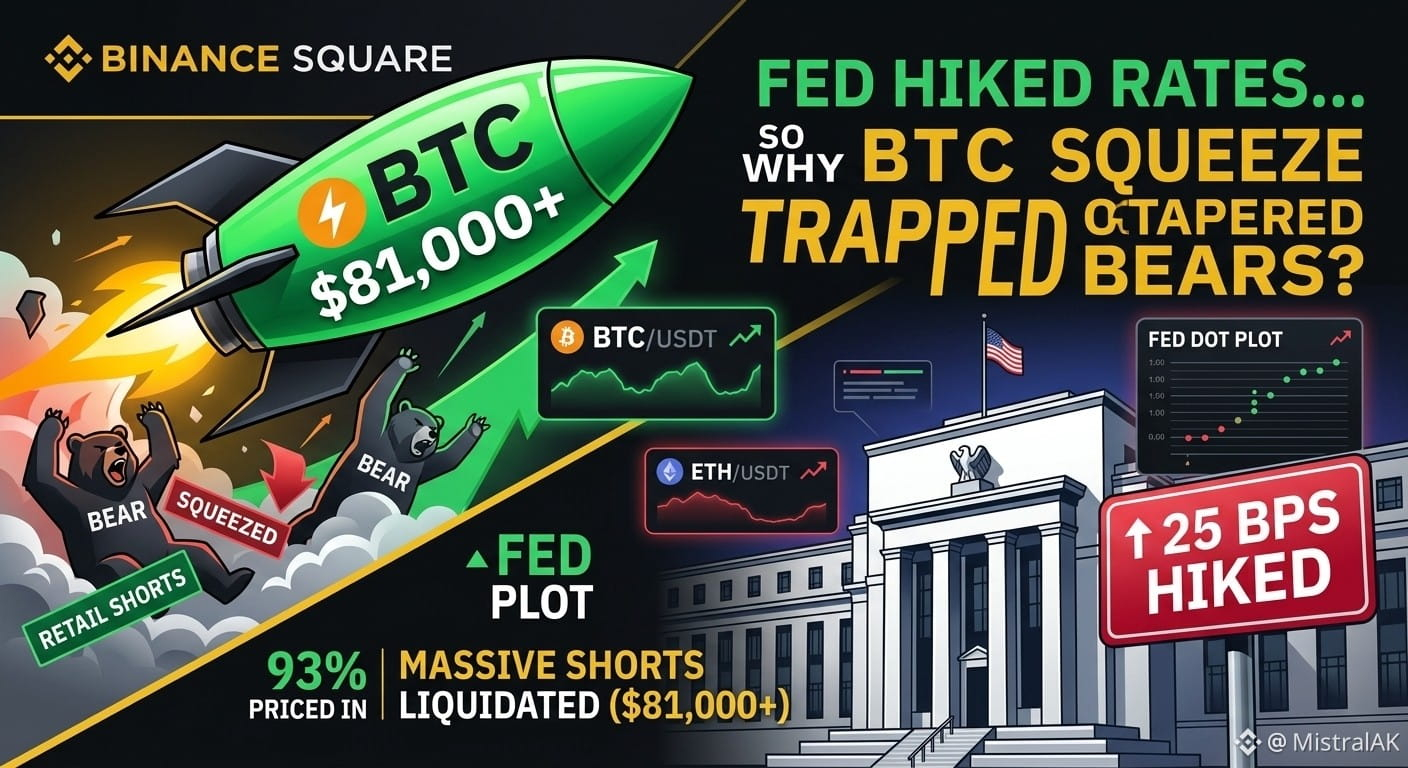
68
·
--
🚨 WHALE/DERIVATIVE ALPHA
• Options: 2X market share shift.
• BTC: -5.7k ETF leak vs heavy inflows; reload active. Target $100K/$4K.
• XRP: V1.1 upgrade >85%. Targets: $1.6992 / $1.8815.
• SOL: $750M mint claim fails onchain audit.
• INJ: Trade finance pilot live (POSCO/LG CNS).
• BNB: >$100B anchor intact.
• Macro: Trump/Iran "big things coming" ⚠️.
Trim or stack? Drop bag #1 👇
$BTC $ETH $XRP $SOL $INJ $BNB
#BinanceSquare #Crypto #Trading #trending #SaylorHintsStrategyBitcoinBuy
🚨 WHALE/DERIVATIVE ALPHA
• Options: 2X market share shift.
• BTC: -5.7k ETF leak vs heavy inflows; reload active. Target $100K/$4K.
• XRP: V1.1 upgrade >85%. Targets: $1.6992 / $1.8815.
• SOL: $750M mint claim fails onchain audit.
• INJ: Trade finance pilot live (POSCO/LG CNS).
• BNB: >$100B anchor intact.
• Macro: Trump/Iran "big things coming" ⚠️.
Trim or stack? Drop bag #1 👇
$BTC $ETH $XRP $SOL $INJ $BNB
#BinanceSquare #Crypto #Trading #trending #SaylorHintsStrategyBitcoinBuy
• Options: 2X market share shift.
• BTC: -5.7k ETF leak vs heavy inflows; reload active. Target $100K/$4K.
• XRP: V1.1 upgrade >85%. Targets: $1.6992 / $1.8815.
• SOL: $750M mint claim fails onchain audit.
• INJ: Trade finance pilot live (POSCO/LG CNS).
• BNB: >$100B anchor intact.
• Macro: Trump/Iran "big things coming" ⚠️.
Trim or stack? Drop bag #1 👇
$BTC $ETH $XRP $SOL $INJ $BNB
#BinanceSquare #Crypto #Trading #trending #SaylorHintsStrategyBitcoinBuy
261
·
--
Рост
🚀 I'm joining the Referral Summer Finale! Invite friends, earn Referral Points, and compete for up to 8,000 USDC. [Join Me !](https://www.binance.com/activity/trading-competition/ref-tournament-aug?ref=41198913)
🚀 I'm joining the Referral Summer Finale! Invite friends, earn Referral Points, and compete for up to 8,000 USDC. Join Me !
Войдите, чтобы посмотреть больше материала
Присоединяйтесь к пользователям криптовалют по всему миру на Binance Square
⚡️ Получайте новейшую и полезную информацию о криптоактивах.
💬 Нам доверяет крупнейшая в мире криптобиржа.
👍 Получите достоверные аналитические данные от верифицированных создателей контента.
Эл. почта/номер телефона