
Mian-SD
313 Публикации

Mian-SD
Growing daily 🌱 | Trading crypto, researching on-chain trends, sharing what I learn
Трейдер с частыми сделками
2.4 г
79 подписок(и/а)
131 подписчиков(а)
491 понравилось
Посты
Все
Цитирования
PINNED
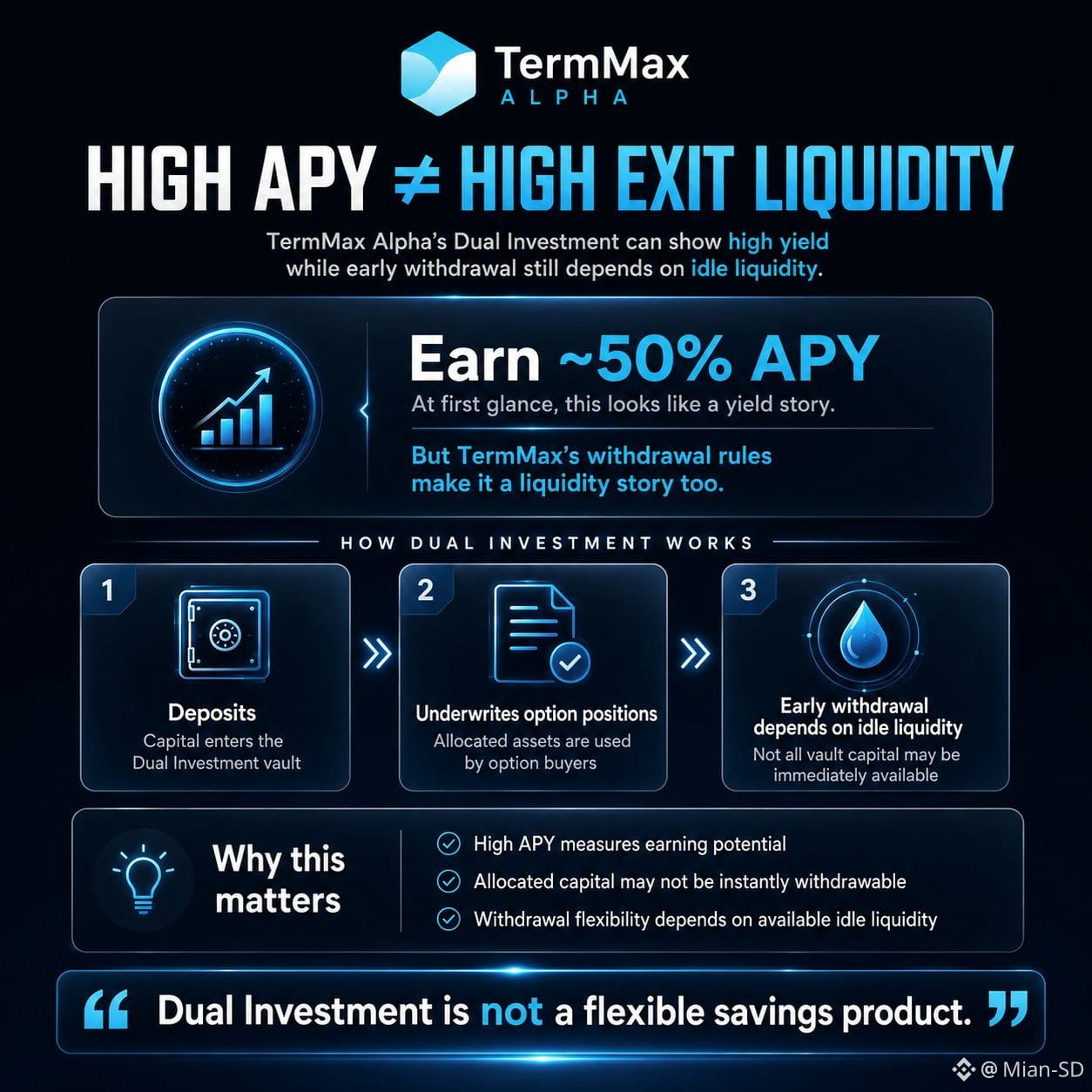
I kept coming back to one line on @TermMax Alpha:
“Earn ~50% APY.”
At first, I read it as a yield question.
Then I read TermMax’s Asset Withdrawal & Settlement rules and realized it is also a liquidity question.
Dual Investment deposits underwrite option positions, and TermMax says early withdrawal depends on how much of the vault has been allocated to option buyers.
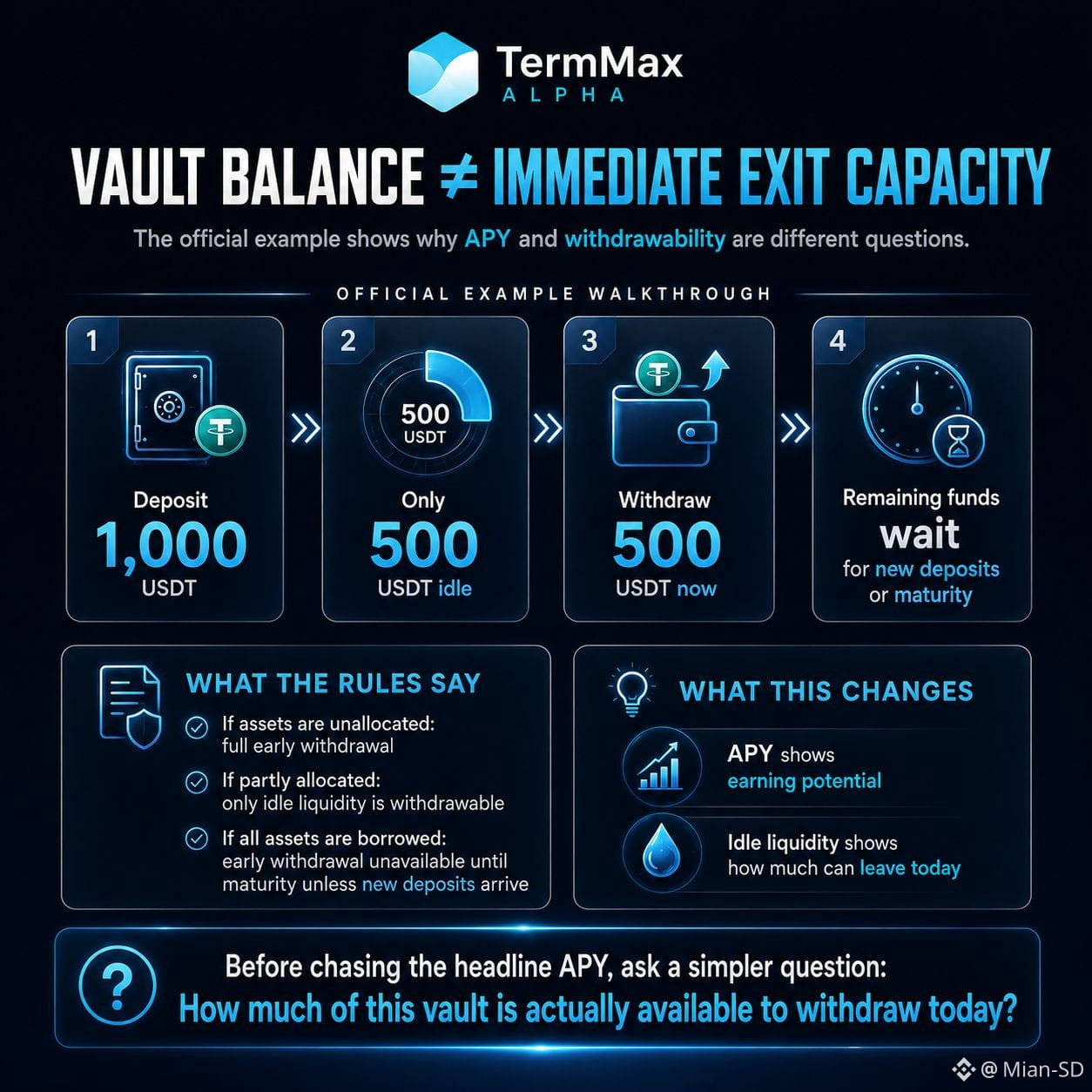
Their official example is simple:
You deposit 1,000 USDT.
Later, the vault has only 500 USDT idle.
You can withdraw 500 USDT now.
The remaining funds have to wait for new deposits to replenish the vault or for maturity.
If all assets are borrowed, early withdrawal is unavailable until maturity unless new deposits arrive.
That changed what the balance means to me.
Your vault balance tells you what you own.
Idle liquidity tells you how much exit capacity the vault actually has today.
To be fair, the restriction exists because that capital is doing the job that produces the yield: TermMax says high APY comes from premiums paid by option buyers.
The docs put it plainly:
Dual Investment is not a flexible savings product.
So before chasing the headline APY, the question I would ask is simpler:
If I need my money before maturity, how much of this vault is actually available to withdraw today?
#TermMax #termmax
“Earn ~50% APY.”
At first, I read it as a yield question.
Then I read TermMax’s Asset Withdrawal & Settlement rules and realized it is also a liquidity question.
Dual Investment deposits underwrite option positions, and TermMax says early withdrawal depends on how much of the vault has been allocated to option buyers.
Their official example is simple:
You deposit 1,000 USDT.
Later, the vault has only 500 USDT idle.
You can withdraw 500 USDT now.
The remaining funds have to wait for new deposits to replenish the vault or for maturity.
If all assets are borrowed, early withdrawal is unavailable until maturity unless new deposits arrive.
That changed what the balance means to me.
Your vault balance tells you what you own.
Idle liquidity tells you how much exit capacity the vault actually has today.
To be fair, the restriction exists because that capital is doing the job that produces the yield: TermMax says high APY comes from premiums paid by option buyers.
The docs put it plainly:
Dual Investment is not a flexible savings product.
So before chasing the headline APY, the question I would ask is simpler:
If I need my money before maturity, how much of this vault is actually available to withdraw today?
#TermMax #termmax
PINNED
Проверено
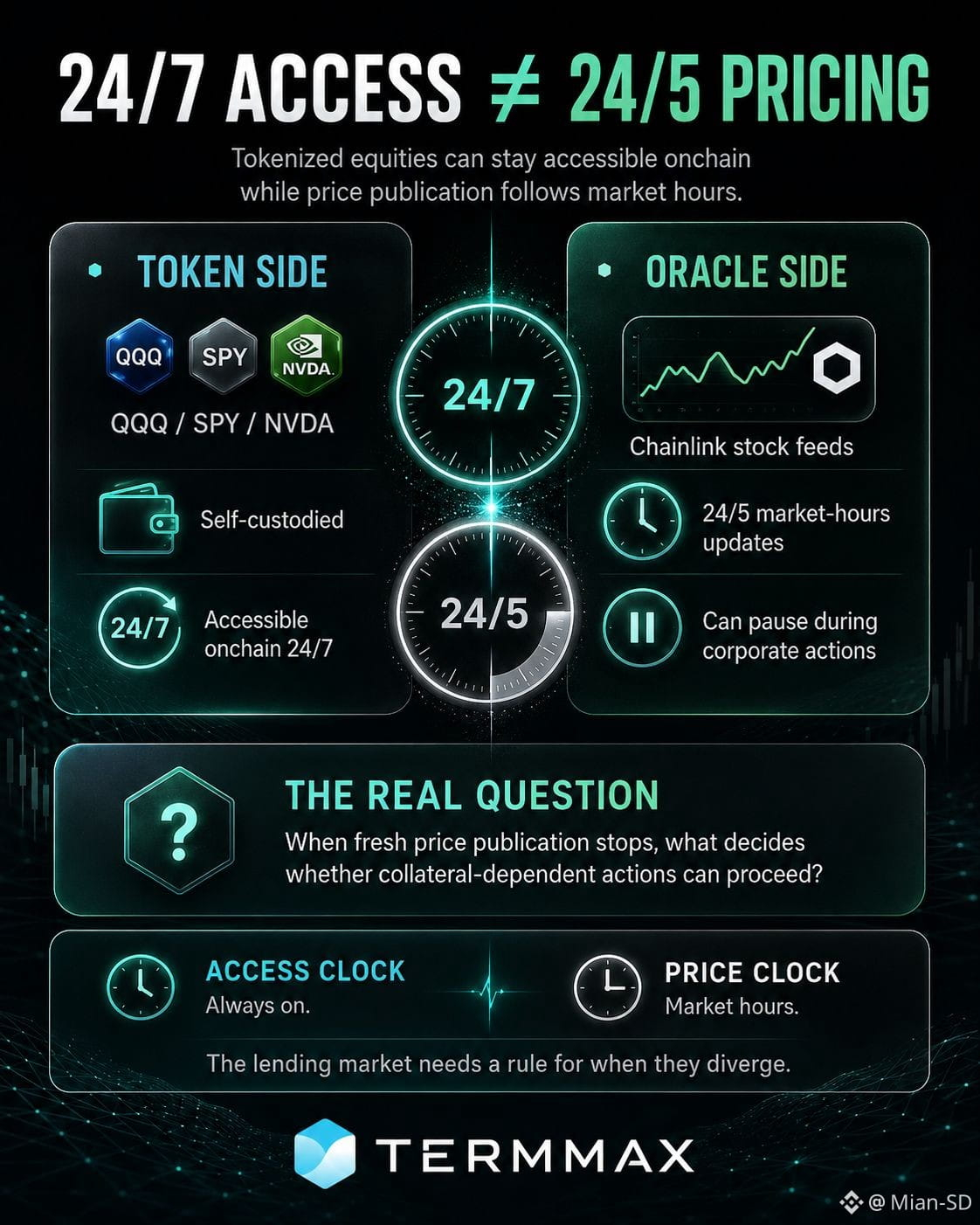
#termmax I saw TermMax using tokenized QQQ, SPY and NVDA as collateral and initially thought the oracle side would be straightforward.
Then I checked Robinhood’s oracle documentation.
Its Stock Tokens are self-custodied and accessible onchain 24/7, while their Chainlink stock feeds update 24/5 following market hours.
But one detail changed the question for me.
During corporate actions, Robinhood says the affected token’s oracle is paused.
The pause flag itself is advisory, not enforced onchain.
Integrators are still expected to check price staleness against the feed heartbeat and reject stale values.
Now put that beside @TermMax
TermMax allows tokenized QQQ, SPY and NVDA to back fixed-rate USDG loans, and its own risk documentation says external oracle feeds are used to value assets involved in loans.
TermMax’s public oracle documentation already publishes feed and heartbeat information for many existing assets.
What I could not find in the current public oracle table were entries for QQQ, SPY or NVDA.
That does not mean the safeguards are absent.
It means the interesting question is no longer simply “24/7 token versus 24/5 feed.”
It is what rule TermMax applies when those two clocks diverge.
For $TMX, I would want the accepted price age and behavior during a stale or paused feed to be as easy to inspect as the collateral parameters themselves.
Putting equity exposure onchain removes the access clock.
The lending market still needs a rule for the price clock.
When fresh price publication stops, what exactly decides whether collateral-dependent actions can proceed?
#TermMax
Then I checked Robinhood’s oracle documentation.
Its Stock Tokens are self-custodied and accessible onchain 24/7, while their Chainlink stock feeds update 24/5 following market hours.
But one detail changed the question for me.
During corporate actions, Robinhood says the affected token’s oracle is paused.
The pause flag itself is advisory, not enforced onchain.
Integrators are still expected to check price staleness against the feed heartbeat and reject stale values.
Now put that beside @TermMax
TermMax allows tokenized QQQ, SPY and NVDA to back fixed-rate USDG loans, and its own risk documentation says external oracle feeds are used to value assets involved in loans.
TermMax’s public oracle documentation already publishes feed and heartbeat information for many existing assets.
What I could not find in the current public oracle table were entries for QQQ, SPY or NVDA.
That does not mean the safeguards are absent.
It means the interesting question is no longer simply “24/7 token versus 24/5 feed.”
It is what rule TermMax applies when those two clocks diverge.
For $TMX, I would want the accepted price age and behavior during a stale or paused feed to be as easy to inspect as the collateral parameters themselves.
Putting equity exposure onchain removes the access clock.
The lending market still needs a rule for the price clock.
When fresh price publication stops, what exactly decides whether collateral-dependent actions can proceed?
#TermMax
I kept coming back to one liquidity example in @TermMax V2 because the numbers look almost impossible at first.
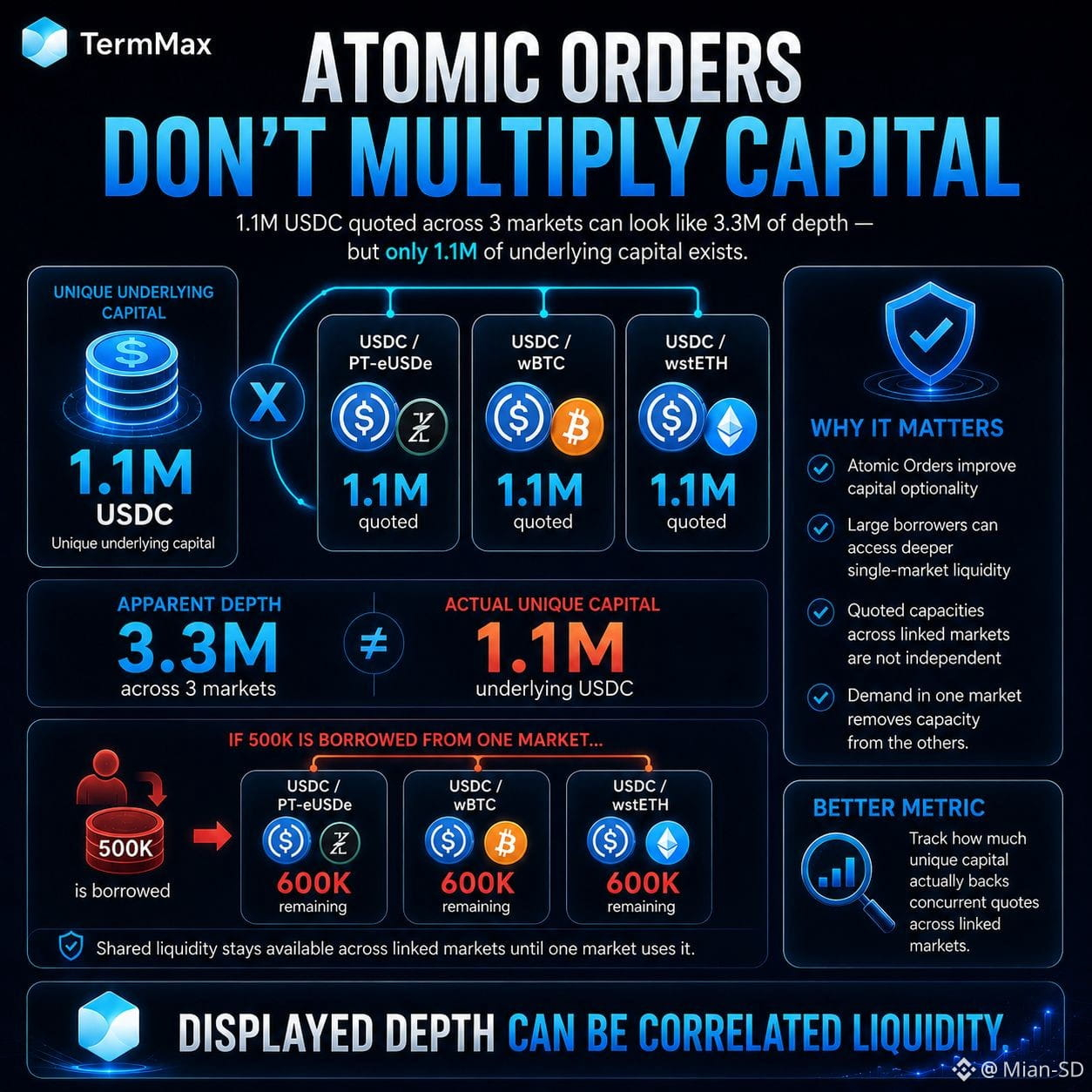
In TermMax’s V2 illustration, one vault has 1.1M USDC.
Yet Atomic Orders can quote that same 1.1M across three different markets at once.
Naively add those three quoted capacities and you could read 3.3M of market depth.
But only 1.1M of underlying capital exists.
That is because the same underlying liquidity is displayed across multiple markets, but can only be taken once.
If a borrower takes 500K from one market, the displayed available liquidity across all three linked markets falls to 600K.
Atomic Orders do not multiply capital.
They multiply where capital can be used.
That is a real efficiency gain: instead of pre-fragmenting 1.1M across separate markets, a large borrower in any one market can potentially access the shared pool.
But there is a second side.
The quoted capacities across linked markets are not independent. Demand in one market can remove capacity from the others.
So for $TMX, I would not simply add cross-market quoted depth together.
I would track how much unique capital actually backs concurrent quotes across linked markets.
Atomic Orders improve capital optionality.
The harder question is this:
When several markets quote against the same pool, how much unique capital actually backs those quotes at the same time?
#TermMax #termmax
In TermMax’s V2 illustration, one vault has 1.1M USDC.
Yet Atomic Orders can quote that same 1.1M across three different markets at once.
Naively add those three quoted capacities and you could read 3.3M of market depth.
But only 1.1M of underlying capital exists.
That is because the same underlying liquidity is displayed across multiple markets, but can only be taken once.
If a borrower takes 500K from one market, the displayed available liquidity across all three linked markets falls to 600K.
Atomic Orders do not multiply capital.
They multiply where capital can be used.
That is a real efficiency gain: instead of pre-fragmenting 1.1M across separate markets, a large borrower in any one market can potentially access the shared pool.
But there is a second side.
The quoted capacities across linked markets are not independent. Demand in one market can remove capacity from the others.
So for $TMX, I would not simply add cross-market quoted depth together.
I would track how much unique capital actually backs concurrent quotes across linked markets.
Atomic Orders improve capital optionality.
The harder question is this:
When several markets quote against the same pool, how much unique capital actually backs those quotes at the same time?
#TermMax #termmax
Частичная правда
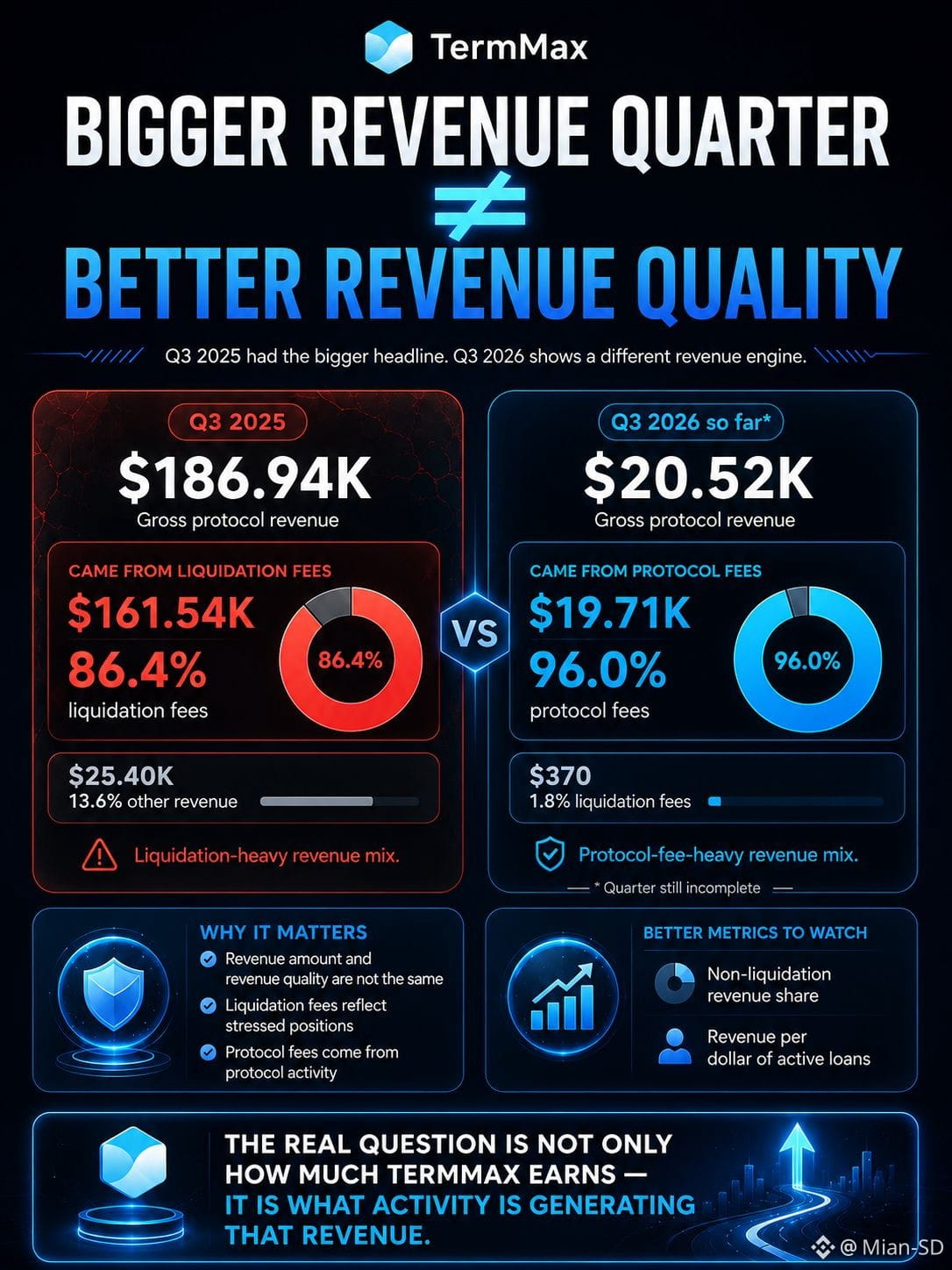
@TermMax biggest revenue quarter looked impressive until I checked what actually produced it.
DefiLlama shows $186.94K in gross protocol revenue for Q3 2025. But $161.54K of that, about 86.4%, came from liquidation fees.
Now compare the composition with Q3 2026 so far.
TermMax has generated $20.51K in gross revenue, with $19.70K coming from protocol fees and only $370 from liquidations.
The dollar totals aren't comparable yet. The revenue mix already is.
A dollar from a liquidation and a dollar from protocol fees both count as revenue. Economically, they describe completely different activity.
Liquidation fees and protocol fees are simply different revenue sources on TermMax.
That is why, for $TMX, I would not judge revenue growth by the headline number alone. I would track the share of revenue coming from non-liquidation activity, alongside revenue generated per dollar of active loans.
Q3 2025 had the bigger revenue headline. Q3 2026 so far has a very different revenue engine.
The more useful question is not just how much TermMax earns. It is whether revenue is being created by recurring protocol activity or by positions being liquidated.
#TermMax
#termmax
DefiLlama shows $186.94K in gross protocol revenue for Q3 2025. But $161.54K of that, about 86.4%, came from liquidation fees.
Now compare the composition with Q3 2026 so far.
TermMax has generated $20.51K in gross revenue, with $19.70K coming from protocol fees and only $370 from liquidations.
The dollar totals aren't comparable yet. The revenue mix already is.
A dollar from a liquidation and a dollar from protocol fees both count as revenue. Economically, they describe completely different activity.
Liquidation fees and protocol fees are simply different revenue sources on TermMax.
That is why, for $TMX, I would not judge revenue growth by the headline number alone. I would track the share of revenue coming from non-liquidation activity, alongside revenue generated per dollar of active loans.
Q3 2025 had the bigger revenue headline. Q3 2026 so far has a very different revenue engine.
The more useful question is not just how much TermMax earns. It is whether revenue is being created by recurring protocol activity or by positions being liquidated.
#TermMax
#termmax
Частичная правда
Something changed in @TermMax security surface today.
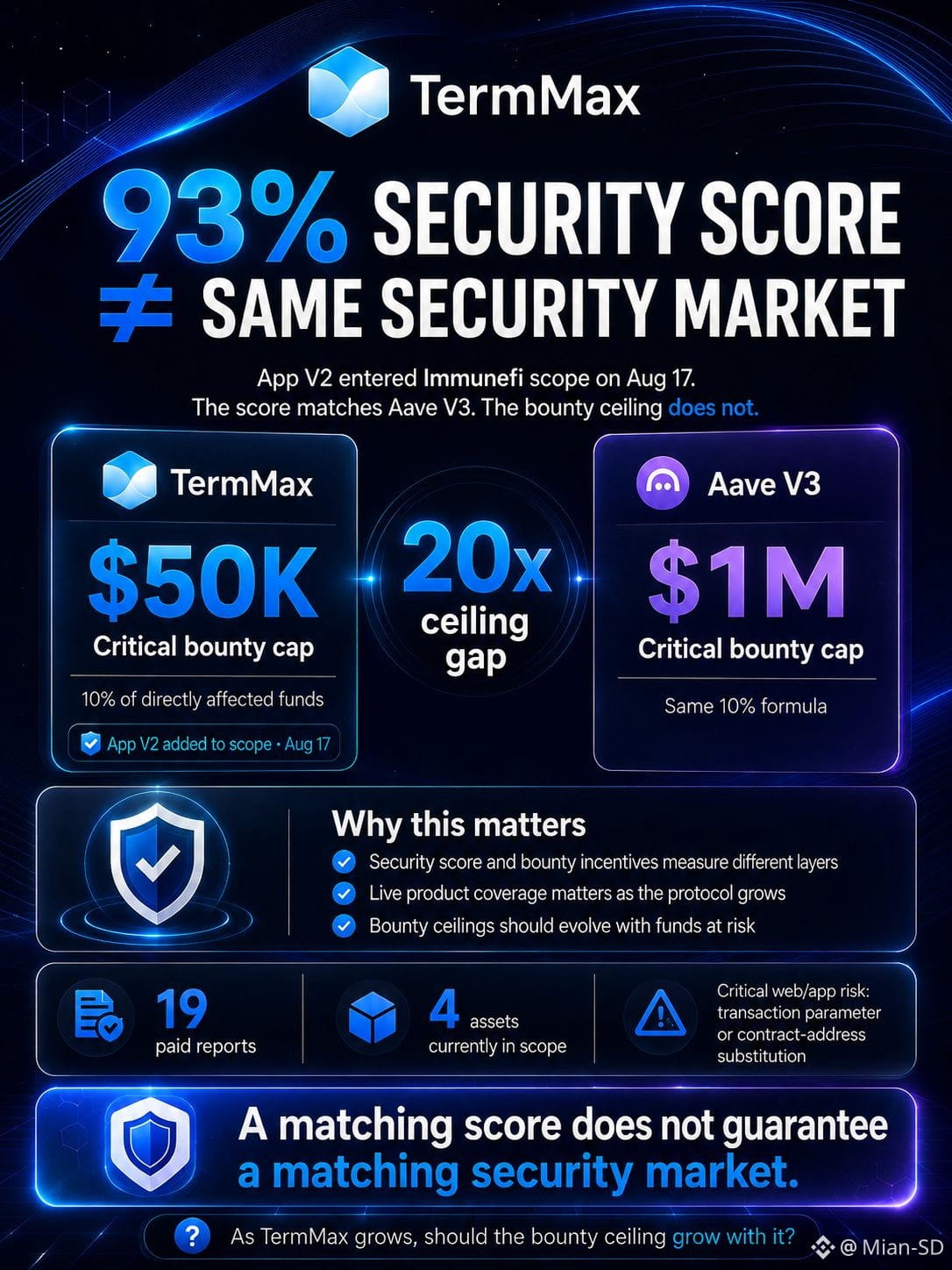
On August 17, TermMax App V2 was added to its Immunefi bounty scope. That made me revisit another number on TermMaxFi’s homepage: a 93% DeFi Security Score, described as matching Aave V3.
The score matches. The bounty economics do not.
For a critical smart-contract bug, TermMax pays 10% of directly affected funds, capped at $50,000. Aave uses the same 10% formula, but caps the reward at $1 million.
A 20x difference in the ceiling.
That is not evidence that Aave is 20x safer. It shows that a security score and the economic incentive for external researchers measure different layers.
TermMax has also paid 19 reports, with four assets currently listed in scope, including App V2. Its web/app scope treats connected-wallet attacks that modify transaction parameters or substitute contract addresses as critical.
So the metric I would watch as $TMX scales is not 93% alone.
I would track how bounty ceilings evolve with funds at risk, how much of the live product surface is in scope, and how quickly validated issues get fixed.
“Same security score” does not mean “same security market.”
As TermMax grows, should the bounty ceiling grow with it?
#TermMax #termmax
On August 17, TermMax App V2 was added to its Immunefi bounty scope. That made me revisit another number on TermMaxFi’s homepage: a 93% DeFi Security Score, described as matching Aave V3.
The score matches. The bounty economics do not.
For a critical smart-contract bug, TermMax pays 10% of directly affected funds, capped at $50,000. Aave uses the same 10% formula, but caps the reward at $1 million.
A 20x difference in the ceiling.
That is not evidence that Aave is 20x safer. It shows that a security score and the economic incentive for external researchers measure different layers.
TermMax has also paid 19 reports, with four assets currently listed in scope, including App V2. Its web/app scope treats connected-wallet attacks that modify transaction parameters or substitute contract addresses as critical.
So the metric I would watch as $TMX scales is not 93% alone.
I would track how bounty ceilings evolve with funds at risk, how much of the live product surface is in scope, and how quickly validated issues get fixed.
“Same security score” does not mean “same security market.”
As TermMax grows, should the bounty ceiling grow with it?
#TermMax #termmax
I placed two @BabylonLabs_io numbers side by side this morning.
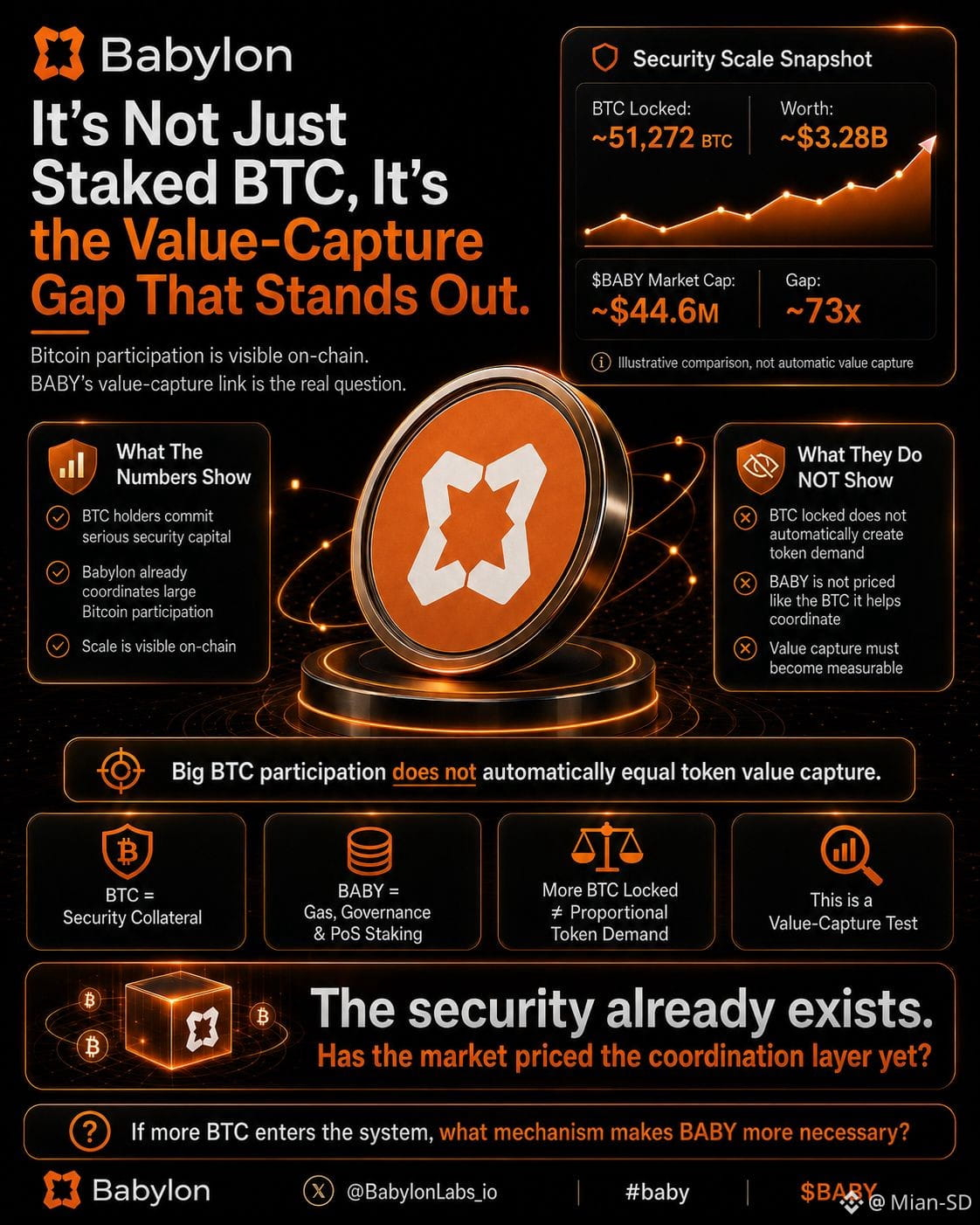
Its official staking dashboard showed roughly 51,272 BTC locked, worth about $3.28 billion.
$BABY circulating market cap was around $44.6 million.
At first, that gap looked like obvious undervaluation.
It is not that simple.
The BTC is security collateral. BABY is the native asset of Babylon Genesis, used for gas, governance and PoS staking. Its market cap does not insure the Bitcoin, and a larger BTC balance does not automatically create proportional value for the token.
That is the more useful distinction.
Billions in staked BTC show that holders are willing to commit Bitcoin through Babylon’s protocol.
They do not, by themselves, show how much additional demand, fees or value capture reaches BABY as that security base grows.
So I would not use the comparison to argue that BABY “should” have a particular valuation.
I would use it as a value-capture test.
If more BTC enters the system, what mechanism makes BABY more necessary?
The scale of Bitcoin participation is already visible.
The economic link between that scale and the token is what still needs to become measurable.
Should BABY be valued against the BTC secured through Babylon—or only against the economic demand that activity creates for the token?
#baby
Its official staking dashboard showed roughly 51,272 BTC locked, worth about $3.28 billion.
$BABY circulating market cap was around $44.6 million.
At first, that gap looked like obvious undervaluation.
It is not that simple.
The BTC is security collateral. BABY is the native asset of Babylon Genesis, used for gas, governance and PoS staking. Its market cap does not insure the Bitcoin, and a larger BTC balance does not automatically create proportional value for the token.
That is the more useful distinction.
Billions in staked BTC show that holders are willing to commit Bitcoin through Babylon’s protocol.
They do not, by themselves, show how much additional demand, fees or value capture reaches BABY as that security base grows.
So I would not use the comparison to argue that BABY “should” have a particular valuation.
I would use it as a value-capture test.
If more BTC enters the system, what mechanism makes BABY more necessary?
The scale of Bitcoin participation is already visible.
The economic link between that scale and the token is what still needs to become measurable.
Should BABY be valued against the BTC secured through Babylon—or only against the economic demand that activity creates for the token?
#baby
I thought liquidation risk started when I chose how much to borrow.
@BabylonLabs_io Trustless Bitcoin Vaults (TBV) made me realize it can start earlier: when I decide how to divide the Bitcoin before the loan even exists.
Each vault is a single, indivisible Bitcoin UTXO. Put the entire position into one vault and liquidation can seize that whole vault.
Babylon’s portal instead recommends a two-vault split: a “sacrificial vault” placed first in the liquidation order and a “protected vault” placed second. During a partial-position liquidation, the first vault can be seized while the remaining collateral stays in the position.
Same BTC.
Similar debt.
Different failure shape.
That turns vault creation from a setup step into risk management.
Users may need to size the sacrificial vault around what can absorb a liquidation event not simply place all the BTC they want to make productive into one vault.
Splitting does not remove liquidation risk. It changes how much of the position may survive it.
TBV does not only ask how much collateral a borrower has. It also makes the structure and liquidation order of that collateral matter.
For the broader $BABY ecosystem, a useful risk interface may need to show more than health factor. It may need to show which vault is exposed first—and what remains if liquidation happens.
Should collateral structure be treated as seriously as borrowing size?
#baby
@BabylonLabs_io Trustless Bitcoin Vaults (TBV) made me realize it can start earlier: when I decide how to divide the Bitcoin before the loan even exists.
Each vault is a single, indivisible Bitcoin UTXO. Put the entire position into one vault and liquidation can seize that whole vault.
Babylon’s portal instead recommends a two-vault split: a “sacrificial vault” placed first in the liquidation order and a “protected vault” placed second. During a partial-position liquidation, the first vault can be seized while the remaining collateral stays in the position.
Same BTC.
Similar debt.
Different failure shape.
That turns vault creation from a setup step into risk management.
Users may need to size the sacrificial vault around what can absorb a liquidation event not simply place all the BTC they want to make productive into one vault.
Splitting does not remove liquidation risk. It changes how much of the position may survive it.
TBV does not only ask how much collateral a borrower has. It also makes the structure and liquidation order of that collateral matter.
For the broader $BABY ecosystem, a useful risk interface may need to show more than health factor. It may need to show which vault is exposed first—and what remains if liquidation happens.
Should collateral structure be treated as seriously as borrowing size?
#baby
Проверено
I assumed protecting my seed phrase was the whole recovery plan.
Then I read @BabylonLabs_io Trustless Bitcoin Vaults (TBV) redemption documentation.
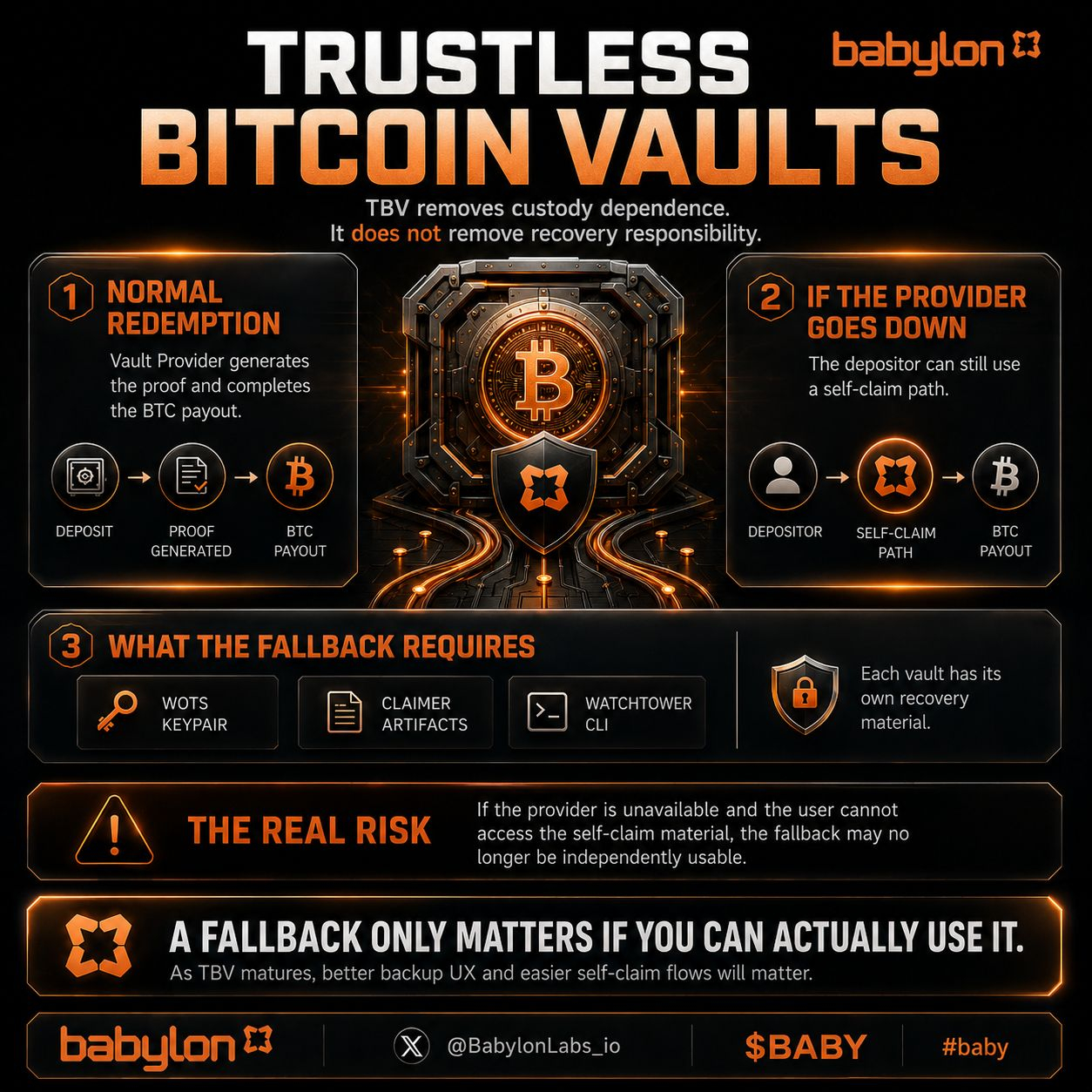
Normally, a Vault Provider generates the required proof and drives the Bitcoin claim and payout. If that provider becomes unresponsive, the depositor can use an independent self-claim path instead.
That sounded reassuring until I noticed what the fallback requires.
Self-claim depends on vault-specific material created during peg-in: a WOTS keypair, claimer artifacts and Babylon’s watchtower CLI. Each vault needs its own files, and the documentation recommends backing them up securely.
Losing those files is not the same as losing the BTC. If the Vault Provider remains available, the standard redemption path can still work.
The real problem appears when both the WOTS file and claimer artifacts are unavailable and the provider is also unresponsive. The depositor can no longer execute the self-claim fallback, and recovery may require Security Council intervention.
That turns recovery design into an adoption question.
Could this complexity influence how much BTC users are comfortable placing into TBV, or increase their reliance on wallets and services that manage the recovery process?
The protocol removes custody dependence.
It does not remove recovery responsibility.
As TBV develops beyond public testnet, I would watch whether wallets make recovery material easier to preserve and self-claim easier to execute without command-line expertise.
$BABY #baby
Can trustless recovery scale without making operational complexity part of the user experience?
$BLESS
$ICNT
Then I read @BabylonLabs_io Trustless Bitcoin Vaults (TBV) redemption documentation.
Normally, a Vault Provider generates the required proof and drives the Bitcoin claim and payout. If that provider becomes unresponsive, the depositor can use an independent self-claim path instead.
That sounded reassuring until I noticed what the fallback requires.
Self-claim depends on vault-specific material created during peg-in: a WOTS keypair, claimer artifacts and Babylon’s watchtower CLI. Each vault needs its own files, and the documentation recommends backing them up securely.
Losing those files is not the same as losing the BTC. If the Vault Provider remains available, the standard redemption path can still work.
The real problem appears when both the WOTS file and claimer artifacts are unavailable and the provider is also unresponsive. The depositor can no longer execute the self-claim fallback, and recovery may require Security Council intervention.
That turns recovery design into an adoption question.
Could this complexity influence how much BTC users are comfortable placing into TBV, or increase their reliance on wallets and services that manage the recovery process?
The protocol removes custody dependence.
It does not remove recovery responsibility.
As TBV develops beyond public testnet, I would watch whether wallets make recovery material easier to preserve and self-claim easier to execute without command-line expertise.
$BABY #baby
Can trustless recovery scale without making operational complexity part of the user experience?
$BLESS
$ICNT
Проверено
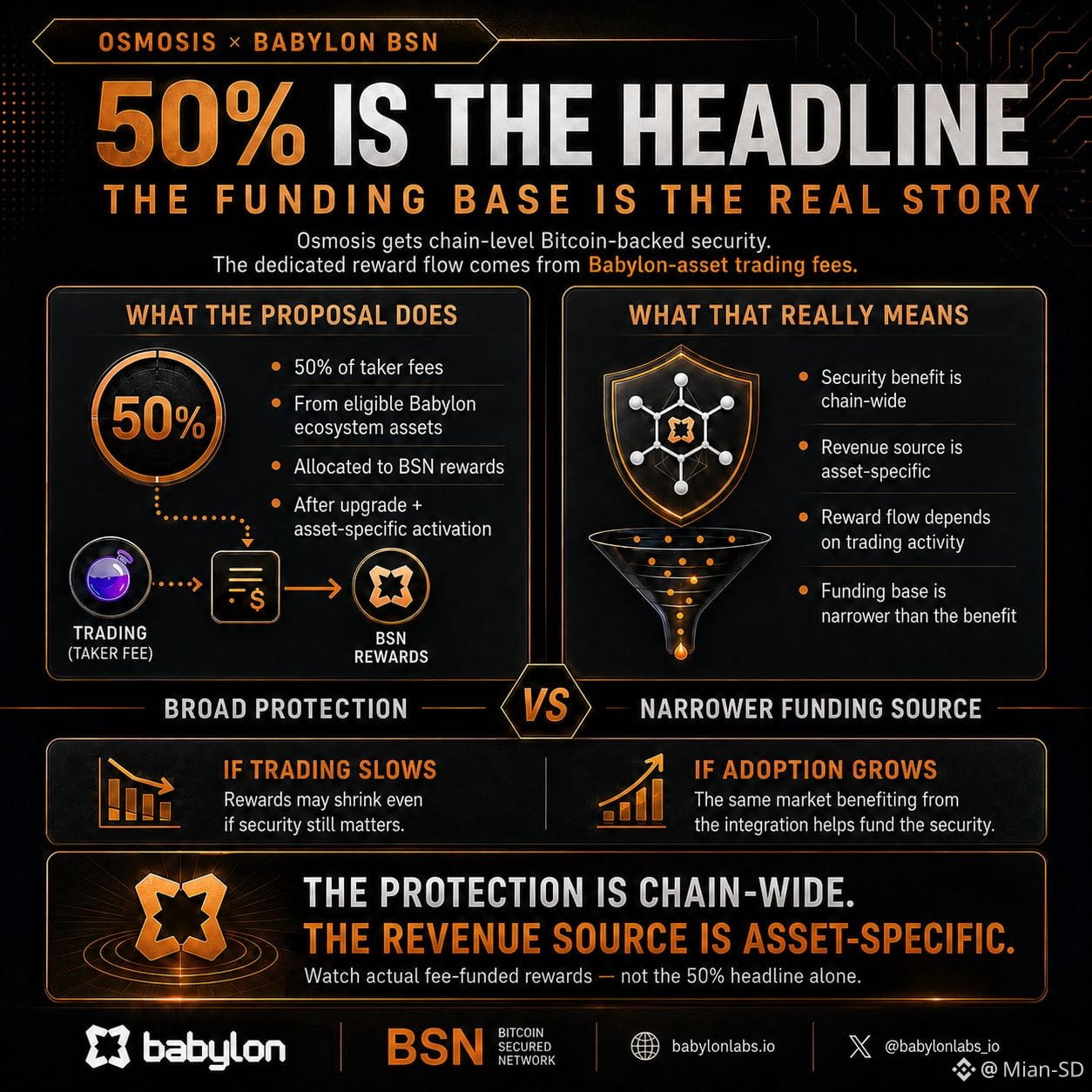
The first time I read Osmosis’s proposal to integrate with @BabylonLabs_io , the 50% headline caught my attention.
The second time, I found myself wondering who actually pays for the security.
The passed proposal established a framework under which 50% of taker fees from defined Babylon ecosystem assets would go toward BSN rewards, subject to a future software upgrade and asset-specific governance proposals.
It also states that this payment stream would not use inflationary rewards, Osmosis community-pool assets, or other Osmosis revenue.
Inflation funds security through new issuance. This model links the BSN payment stream to eligible trading activity instead.
Osmosis would receive Bitcoin-backed finality at the chain level, while the dedicated payment stream would come from trading in a narrower group of Babylon-related assets.
If eligible trading slows, fee revenue could fall even while the service remains important. If adoption grows, the same market benefiting from the integration also helps pay for it.
That creates a more usage-linked incentive loop than a payment stream funded through issuance. But it also ties this fee-funded component of BSN rewards to Babylon-asset trading volume rather than Osmosis-wide activity.
Once active, I would watch the BSN payments generated by eligible trading and whether Finality Provider participation remains stable across market cycles for $BABY
Should a chain-level finality service remain funded by an asset-specific fee base, or should that base broaden as the integration matures?
#baby $KOMA
The second time, I found myself wondering who actually pays for the security.
The passed proposal established a framework under which 50% of taker fees from defined Babylon ecosystem assets would go toward BSN rewards, subject to a future software upgrade and asset-specific governance proposals.
It also states that this payment stream would not use inflationary rewards, Osmosis community-pool assets, or other Osmosis revenue.
Inflation funds security through new issuance. This model links the BSN payment stream to eligible trading activity instead.
Osmosis would receive Bitcoin-backed finality at the chain level, while the dedicated payment stream would come from trading in a narrower group of Babylon-related assets.
If eligible trading slows, fee revenue could fall even while the service remains important. If adoption grows, the same market benefiting from the integration also helps pay for it.
That creates a more usage-linked incentive loop than a payment stream funded through issuance. But it also ties this fee-funded component of BSN rewards to Babylon-asset trading volume rather than Osmosis-wide activity.
Once active, I would watch the BSN payments generated by eligible trading and whether Finality Provider participation remains stable across market cycles for $BABY
Should a chain-level finality service remain funded by an asset-specific fee base, or should that base broaden as the integration matures?
#baby $KOMA
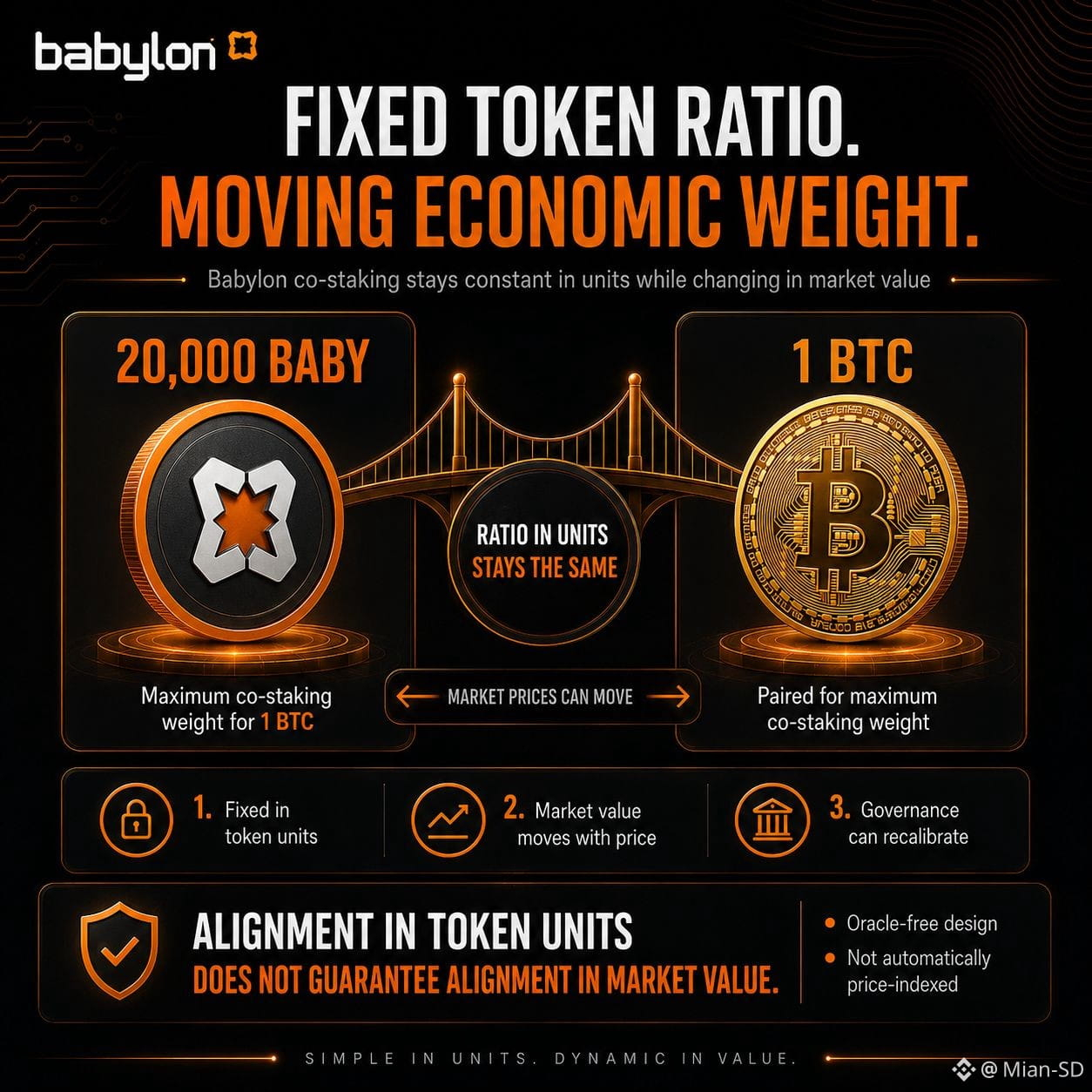
What matters about Babylon's 20,000 BABY-per-BTC co-staking factor is not just the ratio. It is what that ratio costs today.
At the time of writing, $BABY traded around $0.0127 on Binance, so 20,000 BABY was worth about $254. BTC was near $63,046.
That means the BABY required to give 1 BTC its maximum co-staking weight was worth only about 0.40% of the paired BTC position.
The reward formula is fixed in token units.
The market-value commitment behind it is not.
That is not automatically a flaw. A continuously price-adjusted ratio would need a price source, adding complexity and another dependency. @BabylonLabs_io instead uses an on-chain parameter that governance can update.
But between updates, market prices change the commitment. If BABY weakens against BTC, maximum co-staking weight becomes cheaper in dollar terms. If BABY strengthens, it becomes more expensive while the paired BTC amount stays unchanged.
Co-staking still gives BTC stakers a reason to participate in $BABY staking. But the fixed ratio does not keep the economic commitment between BABY and BTC constant.
The metric I would watch is the value of 20,000 BABY per BTC and whether governance defines a recalibration threshold.
Should Babylon keep the ratio simple and oracle-free, or specify when market divergence becomes large enough to change it?
#baby $MMT
At the time of writing, $BABY traded around $0.0127 on Binance, so 20,000 BABY was worth about $254. BTC was near $63,046.
That means the BABY required to give 1 BTC its maximum co-staking weight was worth only about 0.40% of the paired BTC position.
The reward formula is fixed in token units.
The market-value commitment behind it is not.
That is not automatically a flaw. A continuously price-adjusted ratio would need a price source, adding complexity and another dependency. @BabylonLabs_io instead uses an on-chain parameter that governance can update.
But between updates, market prices change the commitment. If BABY weakens against BTC, maximum co-staking weight becomes cheaper in dollar terms. If BABY strengthens, it becomes more expensive while the paired BTC amount stays unchanged.
Co-staking still gives BTC stakers a reason to participate in $BABY staking. But the fixed ratio does not keep the economic commitment between BABY and BTC constant.
The metric I would watch is the value of 20,000 BABY per BTC and whether governance defines a recalibration threshold.
Should Babylon keep the ratio simple and oracle-free, or specify when market divergence becomes large enough to change it?
#baby $MMT
Частичная правда
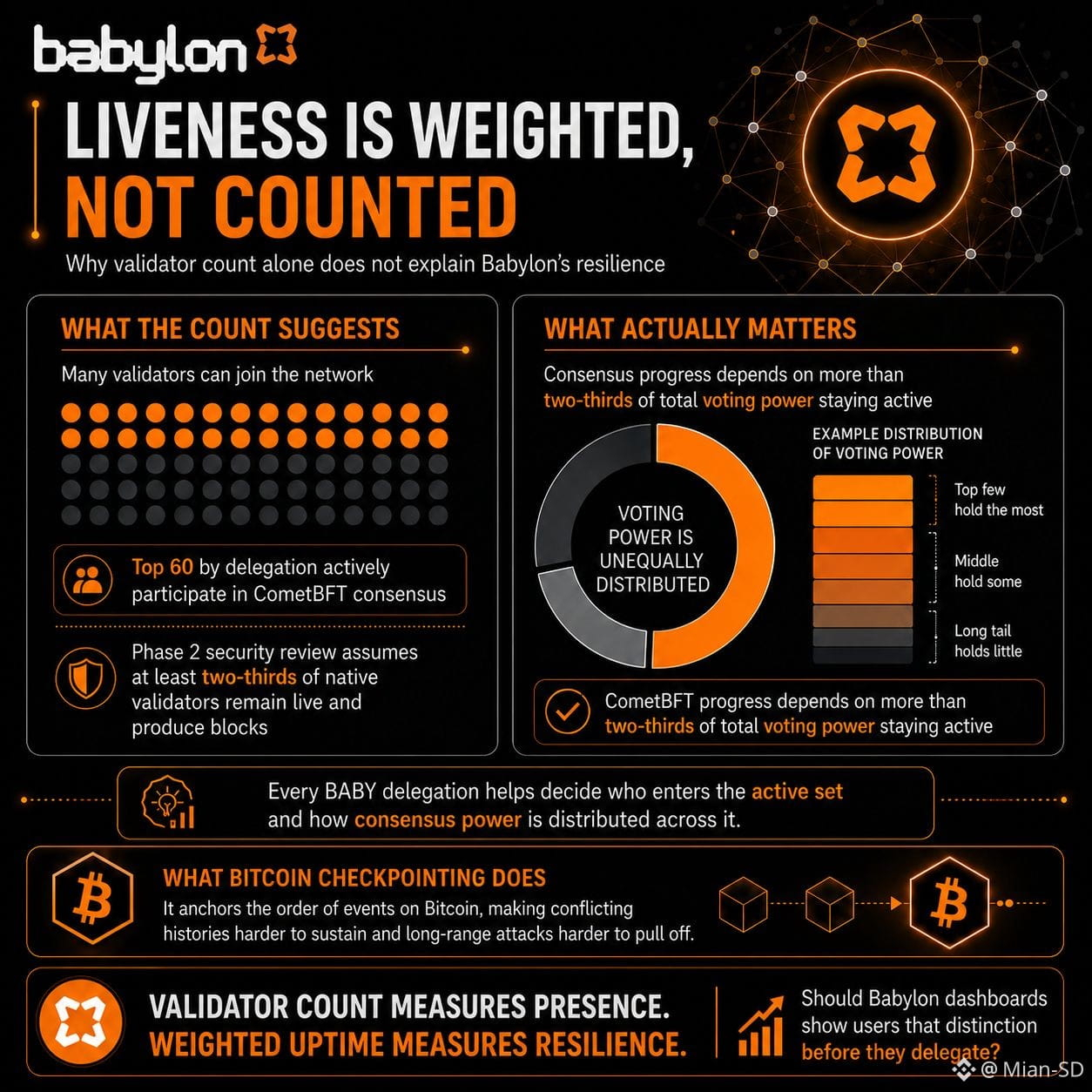
I kept thinking @BabylonLabs_io liveness mostly came down to how many validators were online.
Then I realised the count can improve while resilience barely changes.
Babylon can accept many validators, but only the top 60 by delegation actively participate in CometBFT consensus. Its Phase 2 security review assumes that at least two-thirds of native validators remain live and produce blocks. But CometBFT does not give every validator equal influence. Consensus follows voting power.
That creates a gap between what the network appears to have and what actually keeps it moving.
Liveness is weighted, not counted.
Adding more operators may improve participation, but it does not automatically reduce dependence on the validators holding the largest share of active voting power.
Every $BABY delegation therefore does more than select an operator. Collectively, delegators decide who enters the active set and how much consensus power each validator carries.
So a network can look more decentralized by headcount while its liveness risk remains concentrated.
The metric I would watch is not only how many validators are online, but how much voting power remains online when the largest operators disappear.
Validator count measures presence. Weighted uptime measures resilience.
Should Babylon dashboards show users that difference before they delegate?
#baby
Then I realised the count can improve while resilience barely changes.
Babylon can accept many validators, but only the top 60 by delegation actively participate in CometBFT consensus. Its Phase 2 security review assumes that at least two-thirds of native validators remain live and produce blocks. But CometBFT does not give every validator equal influence. Consensus follows voting power.
That creates a gap between what the network appears to have and what actually keeps it moving.
Liveness is weighted, not counted.
Adding more operators may improve participation, but it does not automatically reduce dependence on the validators holding the largest share of active voting power.
Every $BABY delegation therefore does more than select an operator. Collectively, delegators decide who enters the active set and how much consensus power each validator carries.
So a network can look more decentralized by headcount while its liveness risk remains concentrated.
The metric I would watch is not only how many validators are online, but how much voting power remains online when the largest operators disappear.
Validator count measures presence. Weighted uptime measures resilience.
Should Babylon dashboards show users that difference before they delegate?
#baby
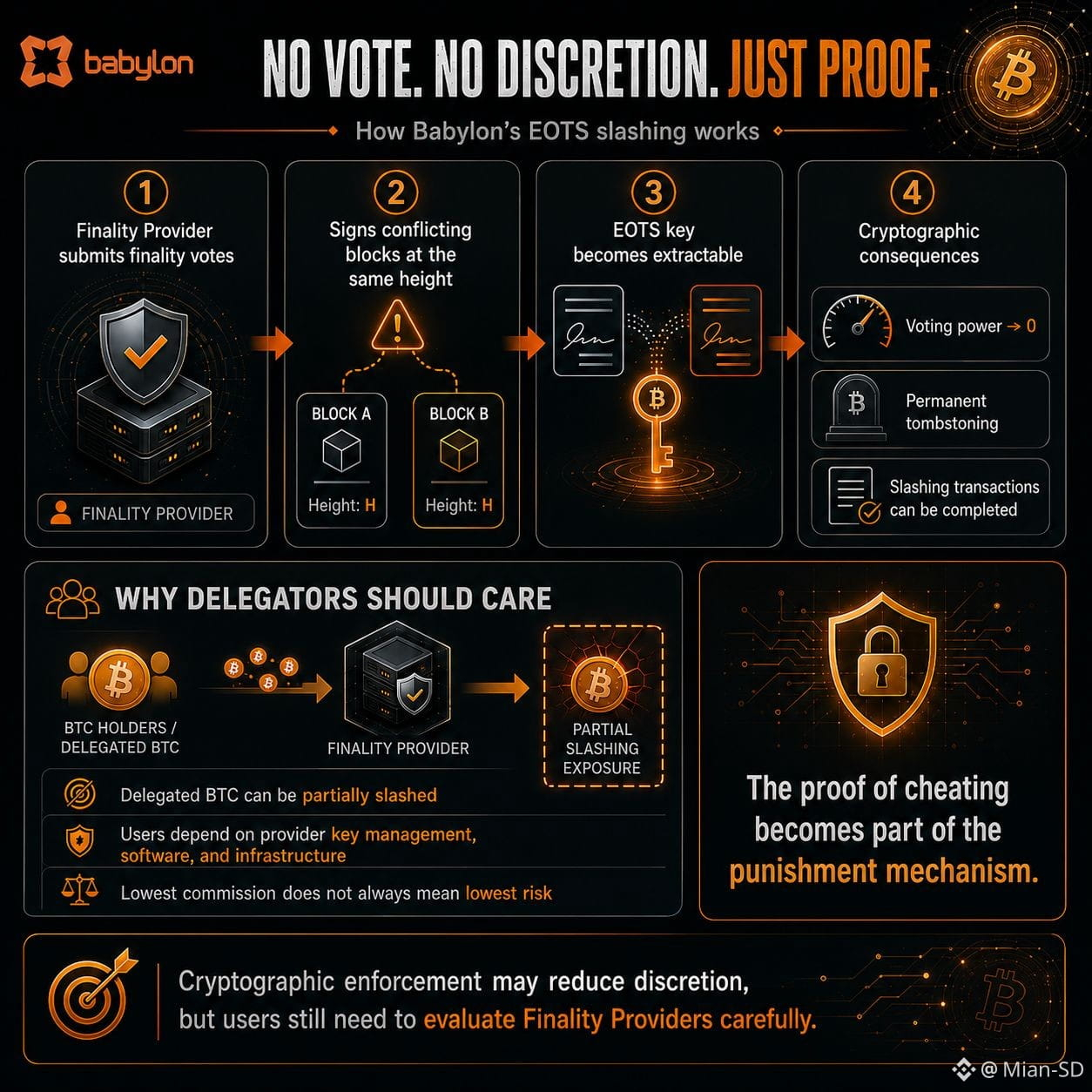
I assumed Babylon’s EOTS slashing was mainly a better punishment system.
What stood out is that it changes who decides whether cheating happened.
Finality Providers commit public randomness before voting. If one votes for two conflicting blocks at the same height, the signatures can expose its EOTS private key. Its voting power falls to zero permanently, and the exposed key can fully sign the slashing transactions tied to its BTC delegations.
The protocol can establish double-signing from the conflicting signatures themselves, reducing reliance on subjective judgment.
That sounds cleaner than enforcement shaped by human discretion.
But certainty ends there.
A BTC holder can compare visible signals like commission rates, while the risks that matter most key management, infrastructure and slashing protection are harder to inspect. Even well-operated infrastructure can fail, while delegators may still absorb part of the penalty if their chosen Finality Provider double-signs.
So EOTS makes misconduct easier for the protocol to prove without making provider reliability easier for users to judge.
Commission is visible. Operational risk is not.
Does removing human judgment make Babylon safer, or simply make choosing the wrong Finality Provider more costly?
$BABY @BabylonLabs_io #baby
What stood out is that it changes who decides whether cheating happened.
Finality Providers commit public randomness before voting. If one votes for two conflicting blocks at the same height, the signatures can expose its EOTS private key. Its voting power falls to zero permanently, and the exposed key can fully sign the slashing transactions tied to its BTC delegations.
The protocol can establish double-signing from the conflicting signatures themselves, reducing reliance on subjective judgment.
That sounds cleaner than enforcement shaped by human discretion.
But certainty ends there.
A BTC holder can compare visible signals like commission rates, while the risks that matter most key management, infrastructure and slashing protection are harder to inspect. Even well-operated infrastructure can fail, while delegators may still absorb part of the penalty if their chosen Finality Provider double-signs.
So EOTS makes misconduct easier for the protocol to prove without making provider reliability easier for users to judge.
Commission is visible. Operational risk is not.
Does removing human judgment make Babylon safer, or simply make choosing the wrong Finality Provider more costly?
$BABY @BabylonLabs_io #baby
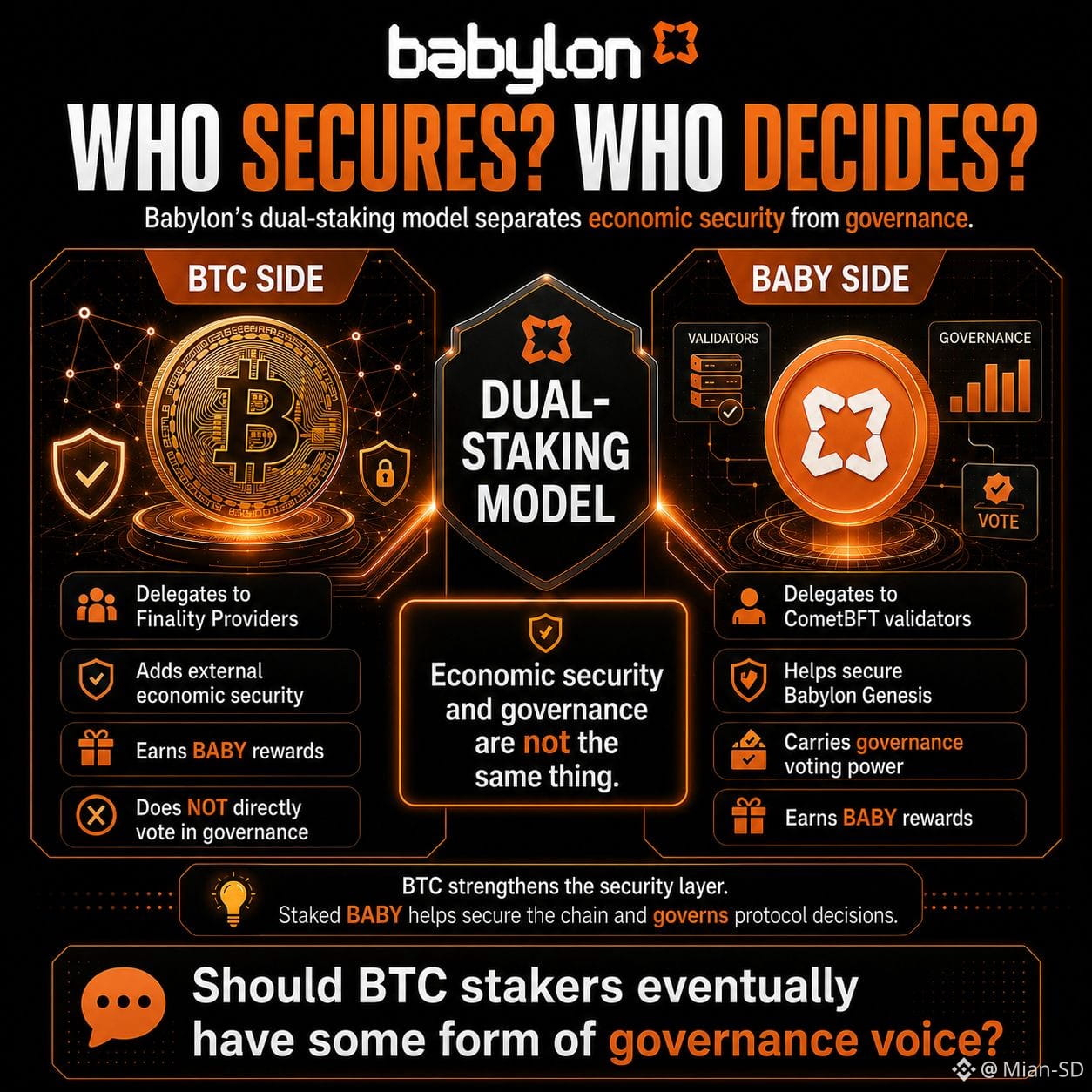
One thing I kept coming back to while reading about Babylon was this:
BTC adds external economic security, while staked BABY carries the governance power that shapes how the network evolves.
Babylon Genesis uses a dual-staking model. BTC holders delegate to Finality Providers, while BABY holders delegate to CometBFT validators. Both groups contribute to network security through different roles and receive BABY rewards.
Governance, however, is based on BABY voting power. BTC stakers do not directly participate in Babylon Genesis governance.
That separation matters.
Supplying more BTC can increase the economic security behind the network, but it does not by itself give the staker more influence over protocol changes, network upgrades, or governance parameters.
BTC strengthens the security layer.
Staked BABY helps secure the chain and carries governance voting power.
That is not necessarily a flaw. It means economic security supplied through BTC cannot automatically be converted into governance control. At the same time, it creates a clear separation between BTC security providers and the BABY participants who decide how the protocol develops.
To me, that is one of the most interesting tensions in Babylon’s dual-staking model.
Should BTC stakers eventually receive some form of governance voice?
Or is keeping governance based entirely on BABY voting power essential to protecting Babylon Genesis?
@BabylonLabs_io #baby $BABY
BTC adds external economic security, while staked BABY carries the governance power that shapes how the network evolves.
Babylon Genesis uses a dual-staking model. BTC holders delegate to Finality Providers, while BABY holders delegate to CometBFT validators. Both groups contribute to network security through different roles and receive BABY rewards.
Governance, however, is based on BABY voting power. BTC stakers do not directly participate in Babylon Genesis governance.
That separation matters.
Supplying more BTC can increase the economic security behind the network, but it does not by itself give the staker more influence over protocol changes, network upgrades, or governance parameters.
BTC strengthens the security layer.
Staked BABY helps secure the chain and carries governance voting power.
That is not necessarily a flaw. It means economic security supplied through BTC cannot automatically be converted into governance control. At the same time, it creates a clear separation between BTC security providers and the BABY participants who decide how the protocol develops.
To me, that is one of the most interesting tensions in Babylon’s dual-staking model.
Should BTC stakers eventually receive some form of governance voice?
Or is keeping governance based entirely on BABY voting power essential to protecting Babylon Genesis?
@BabylonLabs_io #baby $BABY
Проверено
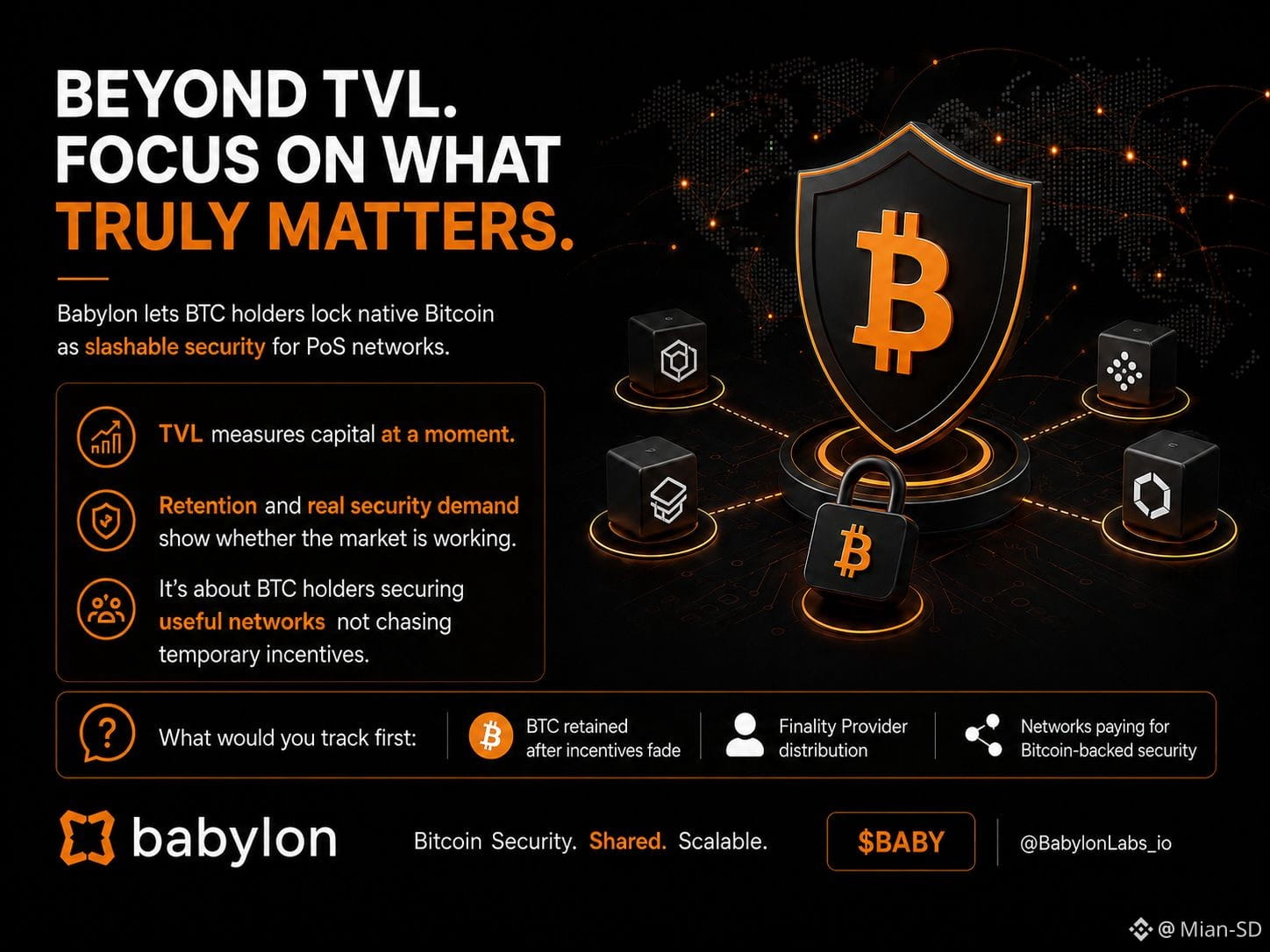
One thing I've noticed is that almost every conversation about Bitcoin infrastructure eventually comes back to TVL. I'm starting to think that metric is useful, but incomplete.
@BabylonLabs_io lets BTC holders lock native Bitcoin as slashable security for PoS networks. The goal isn't simply to accumulate deposits; it's to connect Bitcoin holders supplying security with networks willing to pay for it. That's what makes me question what success should actually look like here.
A rising TVL only tells us how much capital is present. It doesn't tell us whether stake is broadly distributed across Finality Providers, whether networks are creating sustainable demand for that security, or whether BTC stays committed once short-term incentives fade. Even USD-denominated TVL can climb purely because Bitcoin's price went up without a single additional BTC being staked. The number looks stronger while actual behavior hasn't changed at all.
To me, the more meaningful milestone would be BTC holders repeatedly choosing to secure useful networks because the risk, reward, and utility genuinely make sense, rather than a temporary campaign pulling capital in.
TVL measures capital at a moment. Retention and real security demand show whether the market is actually working.
What would you track first: BTC retained after incentives fade, Finality Provider distribution, or the number of networks actually paying for Bitcoin-backed security?
#baby $BABY
@BabylonLabs_io lets BTC holders lock native Bitcoin as slashable security for PoS networks. The goal isn't simply to accumulate deposits; it's to connect Bitcoin holders supplying security with networks willing to pay for it. That's what makes me question what success should actually look like here.
A rising TVL only tells us how much capital is present. It doesn't tell us whether stake is broadly distributed across Finality Providers, whether networks are creating sustainable demand for that security, or whether BTC stays committed once short-term incentives fade. Even USD-denominated TVL can climb purely because Bitcoin's price went up without a single additional BTC being staked. The number looks stronger while actual behavior hasn't changed at all.
To me, the more meaningful milestone would be BTC holders repeatedly choosing to secure useful networks because the risk, reward, and utility genuinely make sense, rather than a temporary campaign pulling capital in.
TVL measures capital at a moment. Retention and real security demand show whether the market is actually working.
What would you track first: BTC retained after incentives fade, Finality Provider distribution, or the number of networks actually paying for Bitcoin-backed security?
#baby $BABY
I initially thought Babylon was mainly about making idle Bitcoin productive.
Now I think that's only half the story.
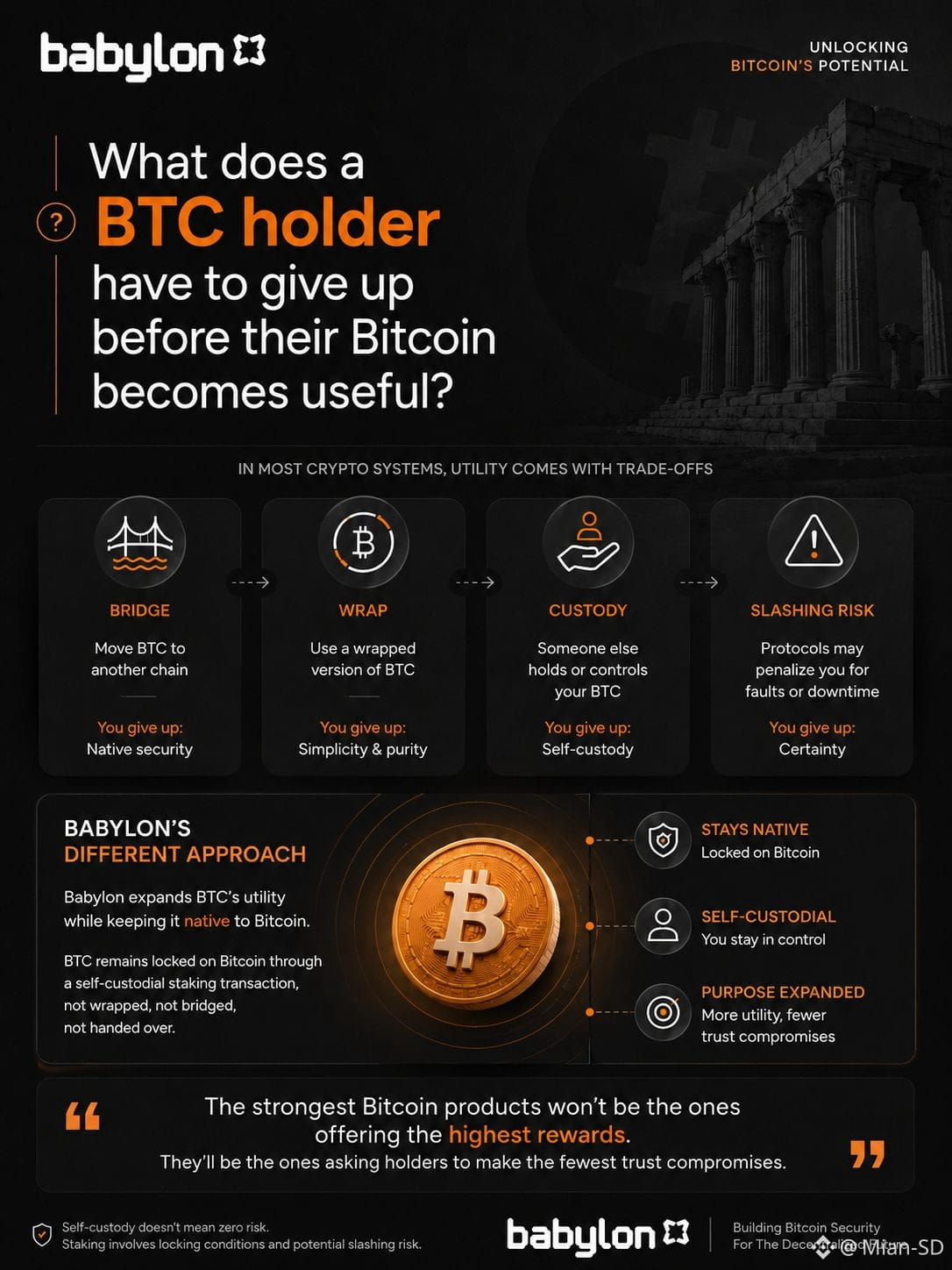
The more interesting question is: What does a BTC holder have to give up before their Bitcoin becomes useful?
In many crypto systems, using an asset outside its native network means introducing another layer of trust. The asset may need to be wrapped, bridged, or placed under someone else's control.
That's what makes @BabylonLabs_io interesting to me. It expands Bitcoin's utility while allowing BTC to remain native to the Bitcoin network through a self-custodial staking design, rather than requiring it to be wrapped or bridged to another chain.
To me, that distinction feels bigger than a technical feature.
Bitcoin holders are often described as resistant to new opportunities. But maybe the real issue isn't that they don't want utility. Maybe they don't want utility that asks them to compromise the properties that made them trust Bitcoin in the first place.
Self-custody doesn't eliminate every trade-off. Participating in any protocol still comes with rules and risks that users should understand.
If Bitcoin based products continue to evolve, I think the strongest ones won't necessarily be the ones offering the highest rewards. They'll be the ones asking holders to make the fewest trust compromises.
#baby $BABY
If you had to choose, would you rather earn a higher return or make fewer trust compromises?
$DEXE
Now I think that's only half the story.
The more interesting question is: What does a BTC holder have to give up before their Bitcoin becomes useful?
In many crypto systems, using an asset outside its native network means introducing another layer of trust. The asset may need to be wrapped, bridged, or placed under someone else's control.
That's what makes @BabylonLabs_io interesting to me. It expands Bitcoin's utility while allowing BTC to remain native to the Bitcoin network through a self-custodial staking design, rather than requiring it to be wrapped or bridged to another chain.
To me, that distinction feels bigger than a technical feature.
Bitcoin holders are often described as resistant to new opportunities. But maybe the real issue isn't that they don't want utility. Maybe they don't want utility that asks them to compromise the properties that made them trust Bitcoin in the first place.
Self-custody doesn't eliminate every trade-off. Participating in any protocol still comes with rules and risks that users should understand.
If Bitcoin based products continue to evolve, I think the strongest ones won't necessarily be the ones offering the highest rewards. They'll be the ones asking holders to make the fewest trust compromises.
#baby $BABY
If you had to choose, would you rather earn a higher return or make fewer trust compromises?
$DEXE
Проверено
The more I follow Bitcoin infrastructure, the more I realize the biggest question isn't whether BTC can become productive.
It's whether that can happen without changing the very reason people trusted Bitcoin in the first place.
That's what makes @BabylonLabs_io interesting to me.
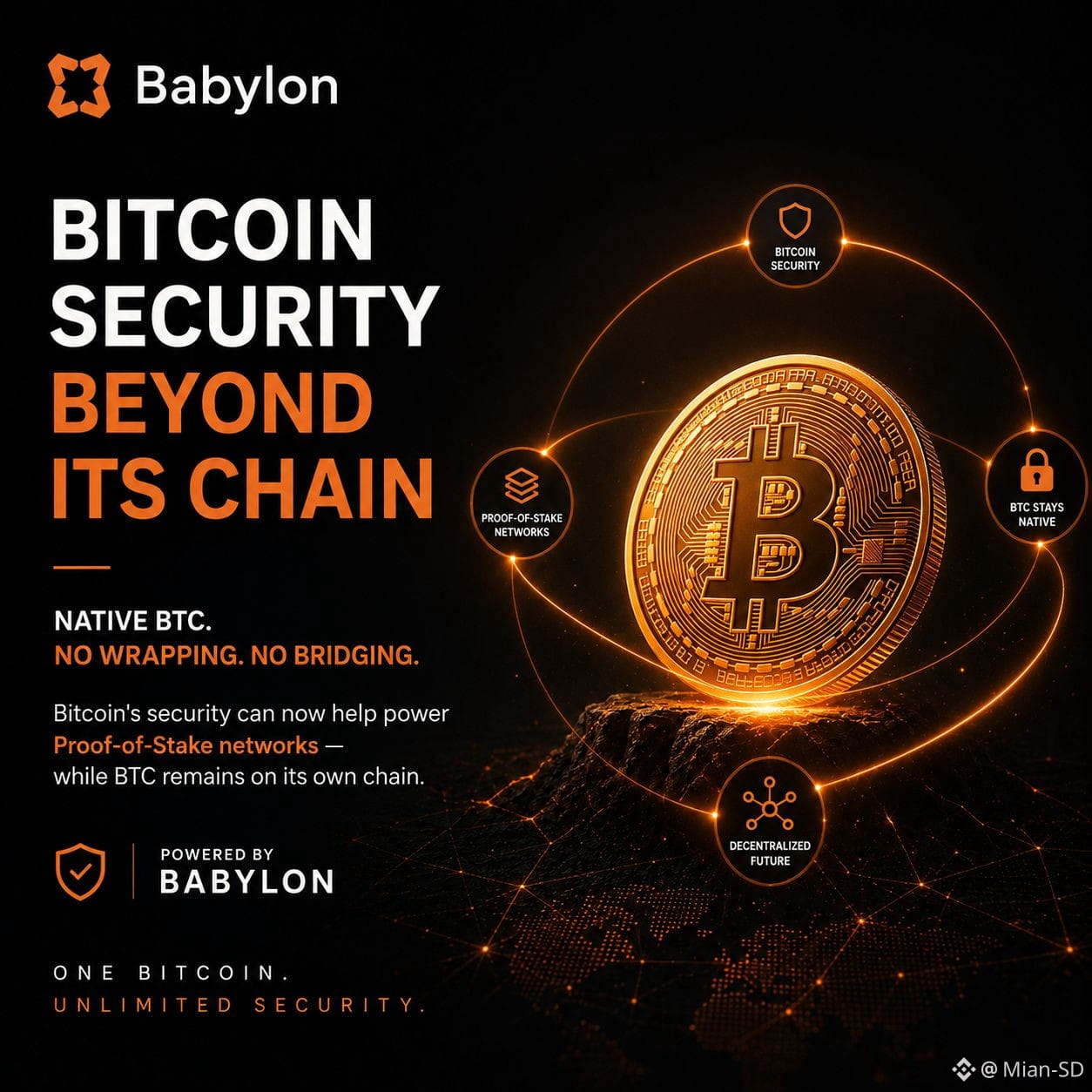
Babylon isn't trying to change Bitcoin. It's trying to extend Bitcoin's security beyond its own chain.
Instead of asking holders to wrap or bridge their BTC, it allows BTC to remain native while contributing its security to Proof-of-Stake networks. That feels less like adding another layer of DeFi on top of Bitcoin and more like expanding Bitcoin's role without compromising its core principles.
If this approach scales, Bitcoin could become more than just the largest store of value in crypto. It could also become one of the largest sources of economic security across the broader ecosystem.
If Bitcoin can secure other networks without ever leaving its own chain, are we looking at the next major evolution of BTC's role in crypto?
#baby $BABY $RE
It's whether that can happen without changing the very reason people trusted Bitcoin in the first place.
That's what makes @BabylonLabs_io interesting to me.
Babylon isn't trying to change Bitcoin. It's trying to extend Bitcoin's security beyond its own chain.
Instead of asking holders to wrap or bridge their BTC, it allows BTC to remain native while contributing its security to Proof-of-Stake networks. That feels less like adding another layer of DeFi on top of Bitcoin and more like expanding Bitcoin's role without compromising its core principles.
If this approach scales, Bitcoin could become more than just the largest store of value in crypto. It could also become one of the largest sources of economic security across the broader ecosystem.
If Bitcoin can secure other networks without ever leaving its own chain, are we looking at the next major evolution of BTC's role in crypto?
#baby $BABY $RE
Проверено
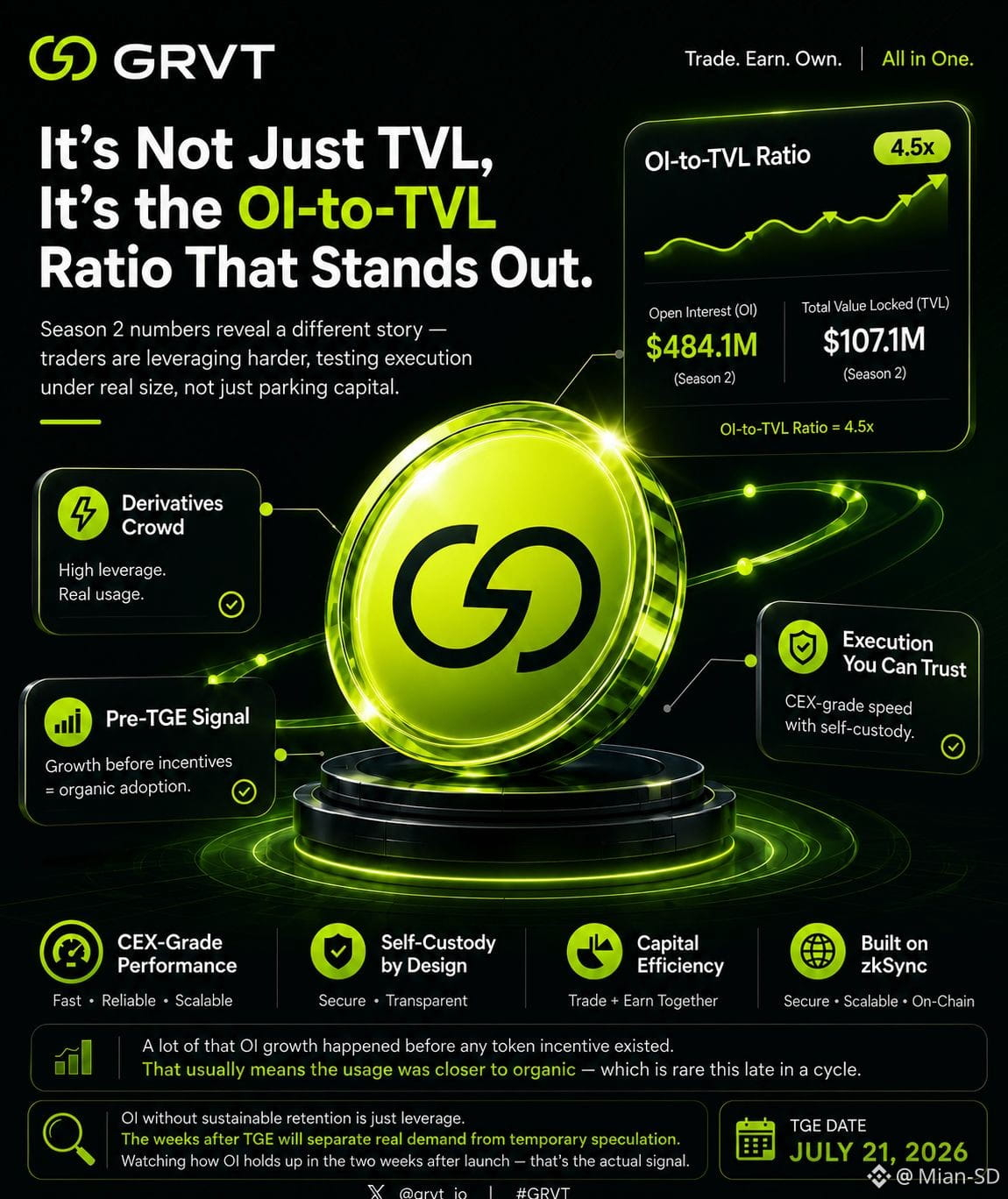
What stood out to me with @grvt_io isn't the TVL chart, it's the OI-to-TVL ratio. $11.6M to $484.1M in open interest while TVL only went from $11.3M to $107.1M during Season 2 means traders were leveraging way harder than depositors were parking capital. That's not a "safe yield" crowd, that's a derivatives crowd testing whether execution actually holds up under size. I've been watching a few CEX-style perps DEXs make this same claim and most of them choke on funding rate stability once volume gets real.
Testing slippage on a mid-cap pair is where this gets interesting the fills look closer to centralized venues than most zkSync-based DEXs I've come across. Self-custody with that kind of execution speed is the actual pitch here, not the unified balance marketing line everyone keeps repeating.
One thing people are missing ahead of the July 21 TGE: a lot of that OI growth happened before any token incentive existed. That usually means the usage was closer to organic than airdrop-farmed, which is rare this late in a cycle. Doesn't mean it holds post-TGE though once emissions hit, funding behavior and OI retention will tell the real story way faster than any dashboard screenshot.
#grvt
Do you think the OI stays high post-TGE?
$LUMIA $LAB $BILL
Testing slippage on a mid-cap pair is where this gets interesting the fills look closer to centralized venues than most zkSync-based DEXs I've come across. Self-custody with that kind of execution speed is the actual pitch here, not the unified balance marketing line everyone keeps repeating.
One thing people are missing ahead of the July 21 TGE: a lot of that OI growth happened before any token incentive existed. That usually means the usage was closer to organic than airdrop-farmed, which is rare this late in a cycle. Doesn't mean it holds post-TGE though once emissions hit, funding behavior and OI retention will tell the real story way faster than any dashboard screenshot.
#grvt
Do you think the OI stays high post-TGE?
$LUMIA $LAB $BILL
Проверено
I've been testing out @grvt_io with some capital for about two weeks now, mostly just observing how my idle balance behaves while actively trading and it's shifted how I think about capital efficiency.
Here's what actually caught my attention: on most exchanges, I unconsciously treat my funds as two separate buckets "capital for trading" and "capital for yield" because they usually live in different products, different dashboards, different withdrawal processes. GRVT removes that split entirely. My margin balance keeps earning while it sits there as collateral, so anything I'm not actively deploying in a trade isn't just sitting idle waiting to be moved somewhere else.
What surprised me more than the returns themselves was how it changed my behavior. I started holding slightly bigger cash buffers instead of running tight, simply because there was no longer an opportunity cost attached to keeping extra cushion in the account. It's a small shift, but it means fewer forced sizing decisions made purely to avoid "wasting" idle funds.
The part I think gets overlooked in most discussions is the settlement layer, not the yield percentage. Self-custody combined with on-chain settlement is what actually makes me trust that the balance is mine between trades not just a number the exchange promises to honor.
I'm still watching execution speed during volatile windows before committing larger size. With TGE just a week away, here's the real question I keep coming back to: does the earn rate actually hold up when a lot of capital exits positions simultaneously during a sharp downturn, or does everyone just trust the calm-market APY number without ever seeing it stress-tested?
#grvt
$DODO $DEXE $LAB
Here's what actually caught my attention: on most exchanges, I unconsciously treat my funds as two separate buckets "capital for trading" and "capital for yield" because they usually live in different products, different dashboards, different withdrawal processes. GRVT removes that split entirely. My margin balance keeps earning while it sits there as collateral, so anything I'm not actively deploying in a trade isn't just sitting idle waiting to be moved somewhere else.
What surprised me more than the returns themselves was how it changed my behavior. I started holding slightly bigger cash buffers instead of running tight, simply because there was no longer an opportunity cost attached to keeping extra cushion in the account. It's a small shift, but it means fewer forced sizing decisions made purely to avoid "wasting" idle funds.
The part I think gets overlooked in most discussions is the settlement layer, not the yield percentage. Self-custody combined with on-chain settlement is what actually makes me trust that the balance is mine between trades not just a number the exchange promises to honor.
I'm still watching execution speed during volatile windows before committing larger size. With TGE just a week away, here's the real question I keep coming back to: does the earn rate actually hold up when a lot of capital exits positions simultaneously during a sharp downturn, or does everyone just trust the calm-market APY number without ever seeing it stress-tested?
#grvt
$DODO $DEXE $LAB

"Not your keys, not your coins" we've all heard it but how many of us actually trade on a platform that respects that? GRVT combines self-custody with fast execution, so you're not stuck picking between security and speed. Been testing it out and it's a different feeling knowing you're still in control. What's stopping more exchanges from doing this? @grvt_io #grvt #SelfCustody
Войдите, чтобы посмотреть больше материала