I kept coming back to one liquidity example in @TermMax V2 because the numbers look almost impossible at first.
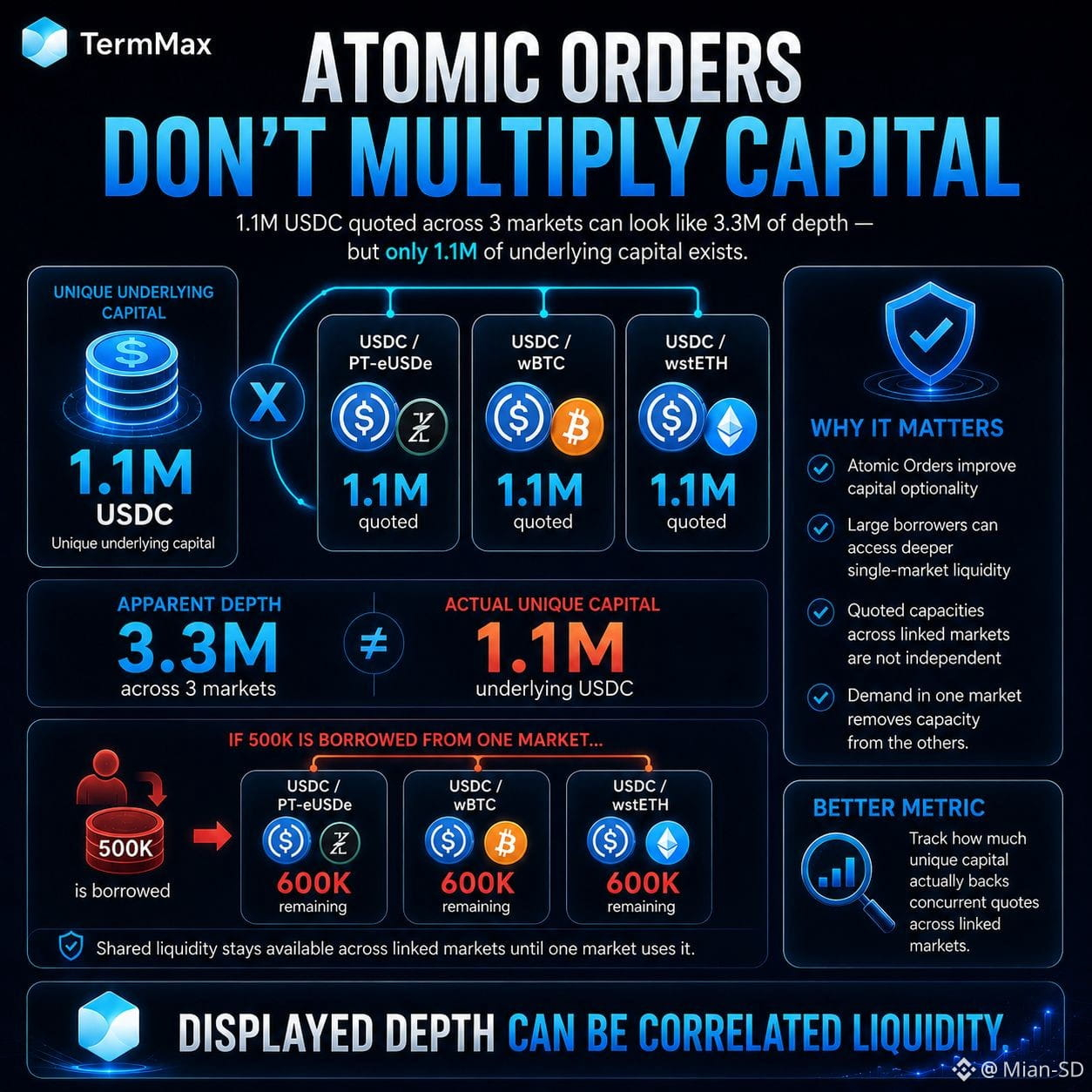
In TermMax’s V2 illustration, one vault has 1.1M USDC.
Yet Atomic Orders can quote that same 1.1M across three different markets at once.
Naively add those three quoted capacities and you could read 3.3M of market depth.
But only 1.1M of underlying capital exists.
That is because the same underlying liquidity is displayed across multiple markets, but can only be taken once.
If a borrower takes 500K from one market, the displayed available liquidity across all three linked markets falls to 600K.
Atomic Orders do not multiply capital.
They multiply where capital can be used.
That is a real efficiency gain: instead of pre-fragmenting 1.1M across separate markets, a large borrower in any one market can potentially access the shared pool.
But there is a second side.
The quoted capacities across linked markets are not independent. Demand in one market can remove capacity from the others.
So for $TMX, I would not simply add cross-market quoted depth together.
I would track how much unique capital actually backs concurrent quotes across linked markets.
Atomic Orders improve capital optionality.
The harder question is this:
When several markets quote against the same pool, how much unique capital actually backs those quotes at the same time?
#TermMax #termmax
In TermMax’s V2 illustration, one vault has 1.1M USDC.
Yet Atomic Orders can quote that same 1.1M across three different markets at once.
Naively add those three quoted capacities and you could read 3.3M of market depth.
But only 1.1M of underlying capital exists.
That is because the same underlying liquidity is displayed across multiple markets, but can only be taken once.
If a borrower takes 500K from one market, the displayed available liquidity across all three linked markets falls to 600K.
Atomic Orders do not multiply capital.
They multiply where capital can be used.
That is a real efficiency gain: instead of pre-fragmenting 1.1M across separate markets, a large borrower in any one market can potentially access the shared pool.
But there is a second side.
The quoted capacities across linked markets are not independent. Demand in one market can remove capacity from the others.
So for $TMX, I would not simply add cross-market quoted depth together.
I would track how much unique capital actually backs concurrent quotes across linked markets.
Atomic Orders improve capital optionality.
The harder question is this:
When several markets quote against the same pool, how much unique capital actually backs those quotes at the same time?
#TermMax #termmax