
Block Blaster
14.3k Публикации

Block Blaster
 Square Verified+
Отправить жалобу
Заблокировать пользователя
Crypto trader | Altcoin hunter | Risk managed, gains maximized
Открытая сделка
Трейдер с регулярными сделками
1.2 г
426 подписок(и/а)
38.3K+ подписчиков(а)
20.6K+ понравилось
Посты
Портфель
Все
Цитирования
Активно
·
--
Рост
#CPIWatch — INFLATION JUST PUT THE FED ON RED ALERT 🚨
I checked the numbers—and the headline looks calm, but underneath it, pressure is building.
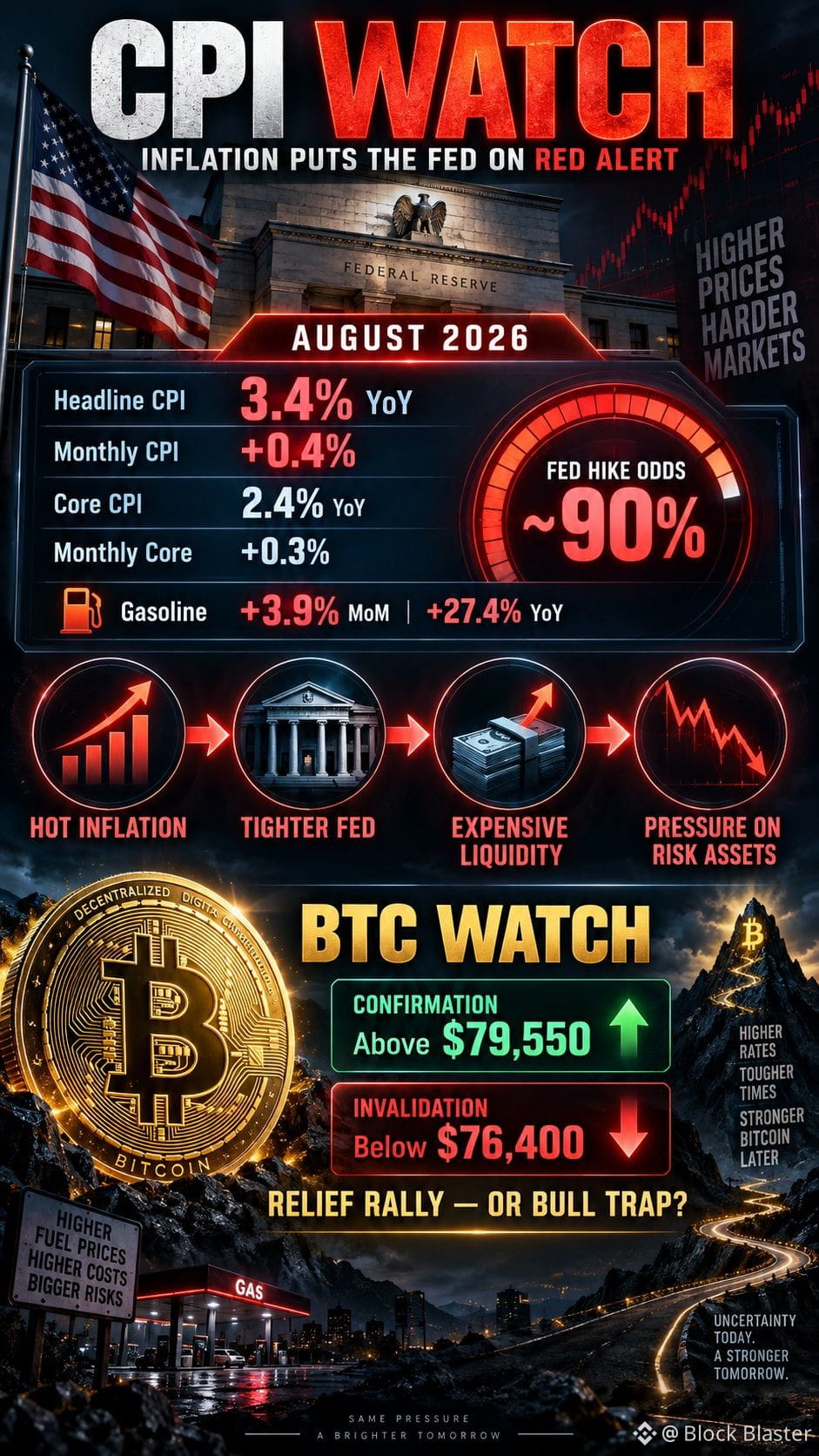
🇺🇸 August CPI:
• Headline: +3.4% YoY
• Monthly CPI: +0.4%
• Core CPI: +2.4% YoY
• Monthly Core: +0.3%, above the 0.2% forecast
• Gasoline: +3.9% MoM / +27.4% YoY
Gasoline alone produced over one-third of the monthly CPI increase, while shelter rose 0.3%. The annual core rate cooled, but its hotter monthly reading shows inflation has not been defeated. ("BLS" (https://www.bls.gov/news.release/cpi.nr0.htm))
The market’s reaction was sharp: probability of a 25-bps Fed hike on September 16 surged to around 90%, up from roughly 70%. ("Reuters" (https://www.reuters.com/business/view-august-core-inflation-reading-boosts-rate-hike-expectations-2026-09-11/))
Bitcoin initially rebounded near $79,000, but is now around $77,300—a warning that higher-rate expectations may overpower the first relief move.
The equation is simple:
Hot inflation → tighter Fed → expensive liquidity → pressure on risk assets.
A BTC recovery above $79,550 would strengthen the bullish response. Losing the $76,400 intraday low could expose a deeper risk-off move.
Is CPI relief real—or was the bounce only a trap before the Fed decision?
#Bitcoin #BTC #Crypto
#CPIWatch — INFLATION JUST PUT THE FED ON RED ALERT 🚨
I checked the numbers—and the headline looks calm, but underneath it, pressure is building.
🇺🇸 August CPI:
• Headline: +3.4% YoY
• Monthly CPI: +0.4%
• Core CPI: +2.4% YoY
• Monthly Core: +0.3%, above the 0.2% forecast
• Gasoline: +3.9% MoM / +27.4% YoY
Gasoline alone produced over one-third of the monthly CPI increase, while shelter rose 0.3%. The annual core rate cooled, but its hotter monthly reading shows inflation has not been defeated. ("BLS" (https://www.bls.gov/news.release/cpi.nr0.htm))
The market’s reaction was sharp: probability of a 25-bps Fed hike on September 16 surged to around 90%, up from roughly 70%. ("Reuters" (https://www.reuters.com/business/view-august-core-inflation-reading-boosts-rate-hike-expectations-2026-09-11/))
Bitcoin initially rebounded near $79,000, but is now around $77,300—a warning that higher-rate expectations may overpower the first relief move.
The equation is simple:
Hot inflation → tighter Fed → expensive liquidity → pressure on risk assets.
A BTC recovery above $79,550 would strengthen the bullish response. Losing the $76,400 intraday low could expose a deeper risk-off move.
Is CPI relief real—or was the bounce only a trap before the Fed decision?
#Bitcoin #BTC #Crypto
I checked the numbers—and the headline looks calm, but underneath it, pressure is building.
🇺🇸 August CPI:
• Headline: +3.4% YoY
• Monthly CPI: +0.4%
• Core CPI: +2.4% YoY
• Monthly Core: +0.3%, above the 0.2% forecast
• Gasoline: +3.9% MoM / +27.4% YoY
Gasoline alone produced over one-third of the monthly CPI increase, while shelter rose 0.3%. The annual core rate cooled, but its hotter monthly reading shows inflation has not been defeated. ("BLS" (https://www.bls.gov/news.release/cpi.nr0.htm))
The market’s reaction was sharp: probability of a 25-bps Fed hike on September 16 surged to around 90%, up from roughly 70%. ("Reuters" (https://www.reuters.com/business/view-august-core-inflation-reading-boosts-rate-hike-expectations-2026-09-11/))
Bitcoin initially rebounded near $79,000, but is now around $77,300—a warning that higher-rate expectations may overpower the first relief move.
The equation is simple:
Hot inflation → tighter Fed → expensive liquidity → pressure on risk assets.
A BTC recovery above $79,550 would strengthen the bullish response. Losing the $76,400 intraday low could expose a deeper risk-off move.
Is CPI relief real—or was the bounce only a trap before the Fed decision?
#Bitcoin #BTC #Crypto
147
·
--
Рост
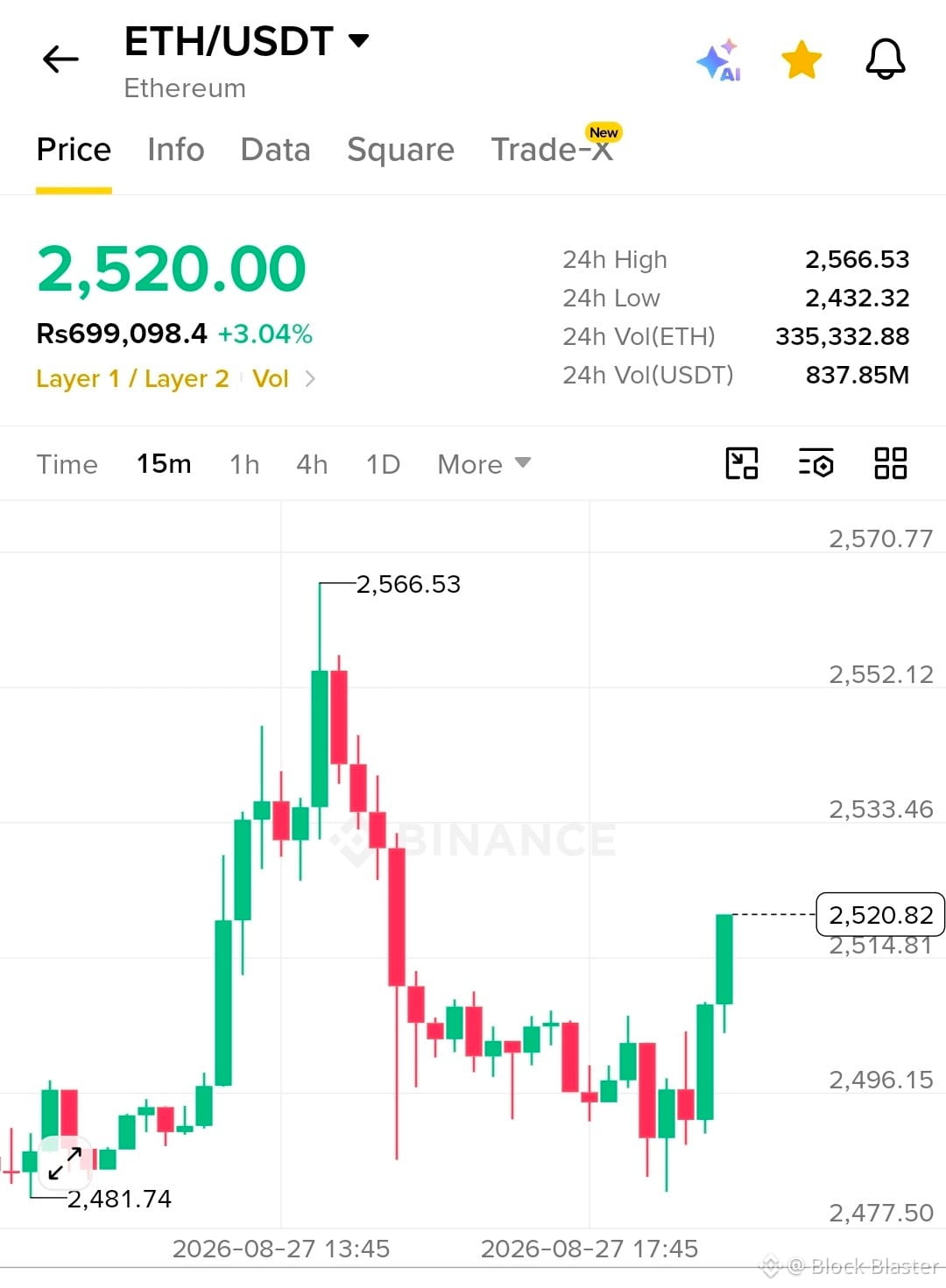
$ETH is fighting back hard. 🔥
Ethereum has reclaimed $2,520, up roughly 3% in 24 hours on the Binance snapshot, after buyers defended the $2,480–$2,490 area. The immediate battlefield is $2,566—today’s local high. A clean break could open the door to further upside, while losing $2,480 would weaken this rebound.
And there’s real fuel behind the move: U.S. spot ETH ETFs reportedly recorded about $184M of net inflows on Aug. 26, extending a seven-day inflow streak, while Ethereum’s upcoming Glamsterdam upgrade remains another important narrative.
ETH bulls have momentum. Now they need the breakout. 👀🚀
$ETH is fighting back hard. 🔥
Ethereum has reclaimed $2,520, up roughly 3% in 24 hours on the Binance snapshot, after buyers defended the $2,480–$2,490 area. The immediate battlefield is $2,566—today’s local high. A clean break could open the door to further upside, while losing $2,480 would weaken this rebound.
And there’s real fuel behind the move: U.S. spot ETH ETFs reportedly recorded about $184M of net inflows on Aug. 26, extending a seven-day inflow streak, while Ethereum’s upcoming Glamsterdam upgrade remains another important narrative.
ETH bulls have momentum. Now they need the breakout. 👀🚀
Ethereum has reclaimed $2,520, up roughly 3% in 24 hours on the Binance snapshot, after buyers defended the $2,480–$2,490 area. The immediate battlefield is $2,566—today’s local high. A clean break could open the door to further upside, while losing $2,480 would weaken this rebound.
And there’s real fuel behind the move: U.S. spot ETH ETFs reportedly recorded about $184M of net inflows on Aug. 26, extending a seven-day inflow streak, while Ethereum’s upcoming Glamsterdam upgrade remains another important narrative.
ETH bulls have momentum. Now they need the breakout. 👀🚀
1
175
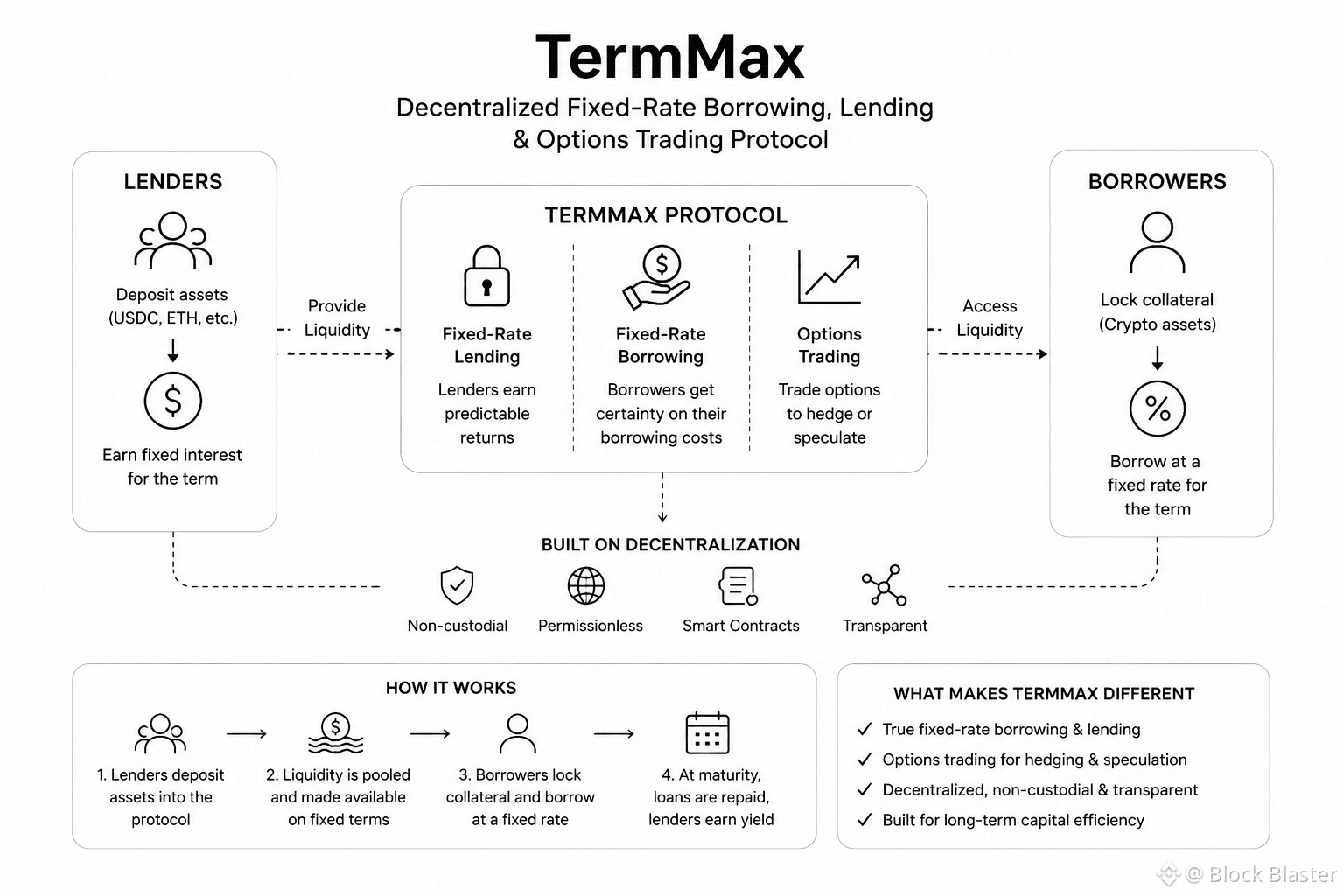
I started looking into TermMax thinking the main story was fixed-rate lending. Borrow at a rate you know, lend at a predictable return. Pretty straightforward.
But after digging around, I think the more interesting question is much simpler:
Are people actually coming here because they need fixed-rate loans?
TVL alone won’t answer that.
DeFi has plenty of capital that moves wherever the next attractive yield or incentive appears. Deposits can arrive quickly and disappear just as fast. Borrowers are harder to fake.
That’s why I’m paying more attention to what borrowers do on TermMax than how much liquidity gets deposited.
There’s also an interesting timing element here. When floating rates are cheap, locking a rate doesn’t feel that important. But when markets get messy and borrowing costs start jumping around, knowing exactly what you’ll owe suddenly becomes valuable.
It’s basically insurance against rate uncertainty. Nobody thinks much about the umbrella until the clouds show up.
Maybe TermMax manages to build consistent demand around that. Maybe users still prefer the flexibility of floating-rate markets.
Either way, I don’t think TVL will tell the full story.
For me, the real signal is whether borrowers keep coming back when there’s no extra carrot pulling capital in.
That’s what I’m watching.
@termmax #TermMax
I started looking into TermMax thinking the main story was fixed-rate lending. Borrow at a rate you know, lend at a predictable return. Pretty straightforward.
But after digging around, I think the more interesting question is much simpler:
Are people actually coming here because they need fixed-rate loans?
TVL alone won’t answer that.
DeFi has plenty of capital that moves wherever the next attractive yield or incentive appears. Deposits can arrive quickly and disappear just as fast. Borrowers are harder to fake.
That’s why I’m paying more attention to what borrowers do on TermMax than how much liquidity gets deposited.
There’s also an interesting timing element here. When floating rates are cheap, locking a rate doesn’t feel that important. But when markets get messy and borrowing costs start jumping around, knowing exactly what you’ll owe suddenly becomes valuable.
It’s basically insurance against rate uncertainty. Nobody thinks much about the umbrella until the clouds show up.
Maybe TermMax manages to build consistent demand around that. Maybe users still prefer the flexibility of floating-rate markets.
Either way, I don’t think TVL will tell the full story.
For me, the real signal is whether borrowers keep coming back when there’s no extra carrot pulling capital in.
That’s what I’m watching.
@TermMax #TermMax
But after digging around, I think the more interesting question is much simpler:
Are people actually coming here because they need fixed-rate loans?
TVL alone won’t answer that.
DeFi has plenty of capital that moves wherever the next attractive yield or incentive appears. Deposits can arrive quickly and disappear just as fast. Borrowers are harder to fake.
That’s why I’m paying more attention to what borrowers do on TermMax than how much liquidity gets deposited.
There’s also an interesting timing element here. When floating rates are cheap, locking a rate doesn’t feel that important. But when markets get messy and borrowing costs start jumping around, knowing exactly what you’ll owe suddenly becomes valuable.
It’s basically insurance against rate uncertainty. Nobody thinks much about the umbrella until the clouds show up.
Maybe TermMax manages to build consistent demand around that. Maybe users still prefer the flexibility of floating-rate markets.
Either way, I don’t think TVL will tell the full story.
For me, the real signal is whether borrowers keep coming back when there’s no extra carrot pulling capital in.
That’s what I’m watching.
@TermMax #TermMax
2
473
·
--
Рост
I started digging into TermMax because the fixed-rate borrowing sounded interesting.
But the more I looked, the more I wondered whether borrowing is actually the main story.
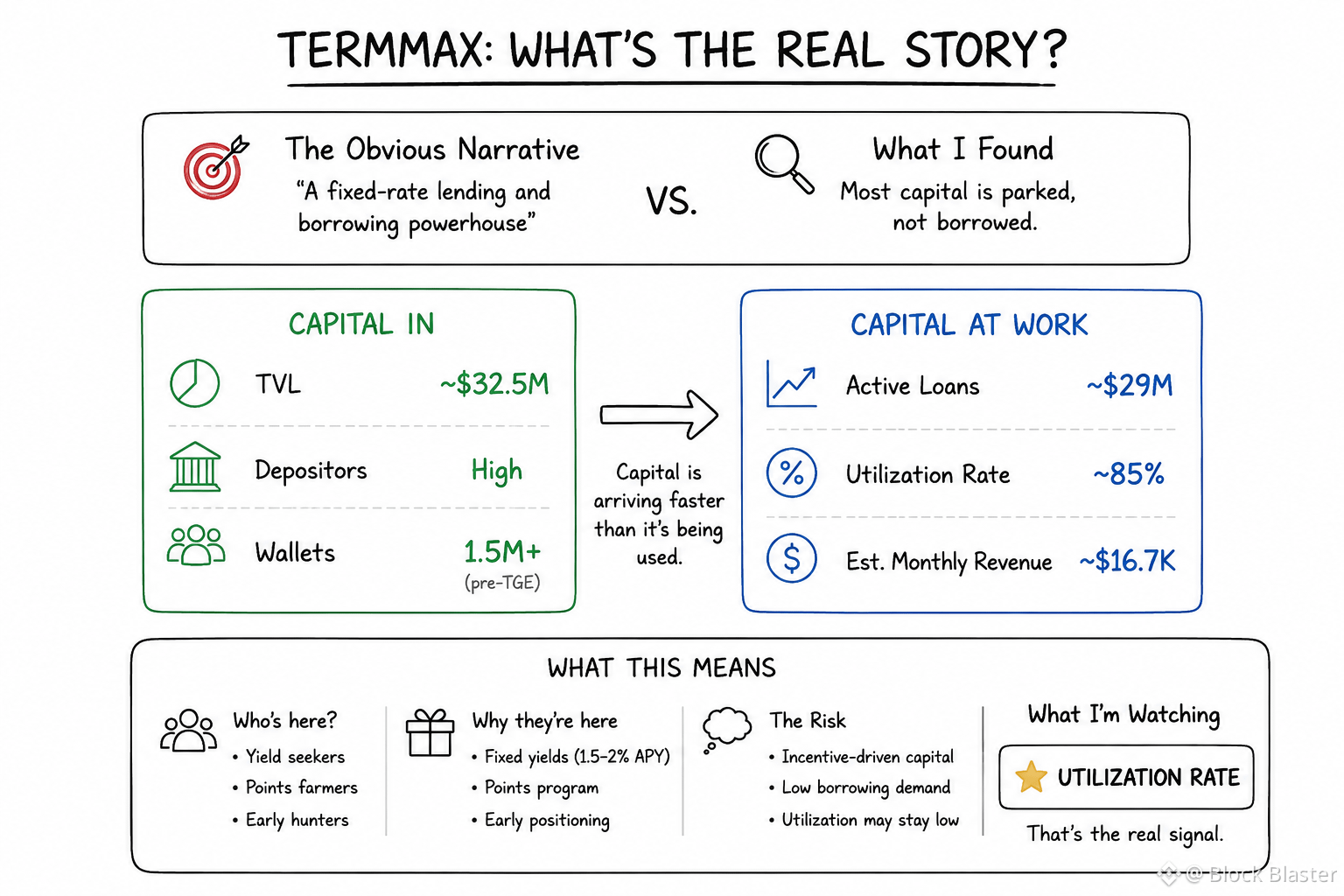
A lot of capital can sit inside a lending protocol without doing much. TVL looks great on a dashboard, but deposits and real borrowing demand are two very different things.
It’s basically a busy parking lot where half the cars never leave.
So I’m less interested in how much money TermMax attracts and more interested in what people actually do with it.
If borrowing starts catching up with deposits, that changes the picture.
If it doesn’t, the headline TVL matters a lot less.
That gap is what I’m watching.
@termmax #TermMax
I started digging into TermMax because the fixed-rate borrowing sounded interesting.
But the more I looked, the more I wondered whether borrowing is actually the main story.
A lot of capital can sit inside a lending protocol without doing much. TVL looks great on a dashboard, but deposits and real borrowing demand are two very different things.
It’s basically a busy parking lot where half the cars never leave.
So I’m less interested in how much money TermMax attracts and more interested in what people actually do with it.
If borrowing starts catching up with deposits, that changes the picture.
If it doesn’t, the headline TVL matters a lot less.
That gap is what I’m watching.
@TermMax #TermMax
But the more I looked, the more I wondered whether borrowing is actually the main story.
A lot of capital can sit inside a lending protocol without doing much. TVL looks great on a dashboard, but deposits and real borrowing demand are two very different things.
It’s basically a busy parking lot where half the cars never leave.
So I’m less interested in how much money TermMax attracts and more interested in what people actually do with it.
If borrowing starts catching up with deposits, that changes the picture.
If it doesn’t, the headline TVL matters a lot less.
That gap is what I’m watching.
@TermMax #TermMax
1
1
178
@termmax #TermMax
I almost missed that TermMax’s “fixed rate” isn’t really a rate being paid out over time in the way I first pictured it.
The interesting part is how the position gets split.
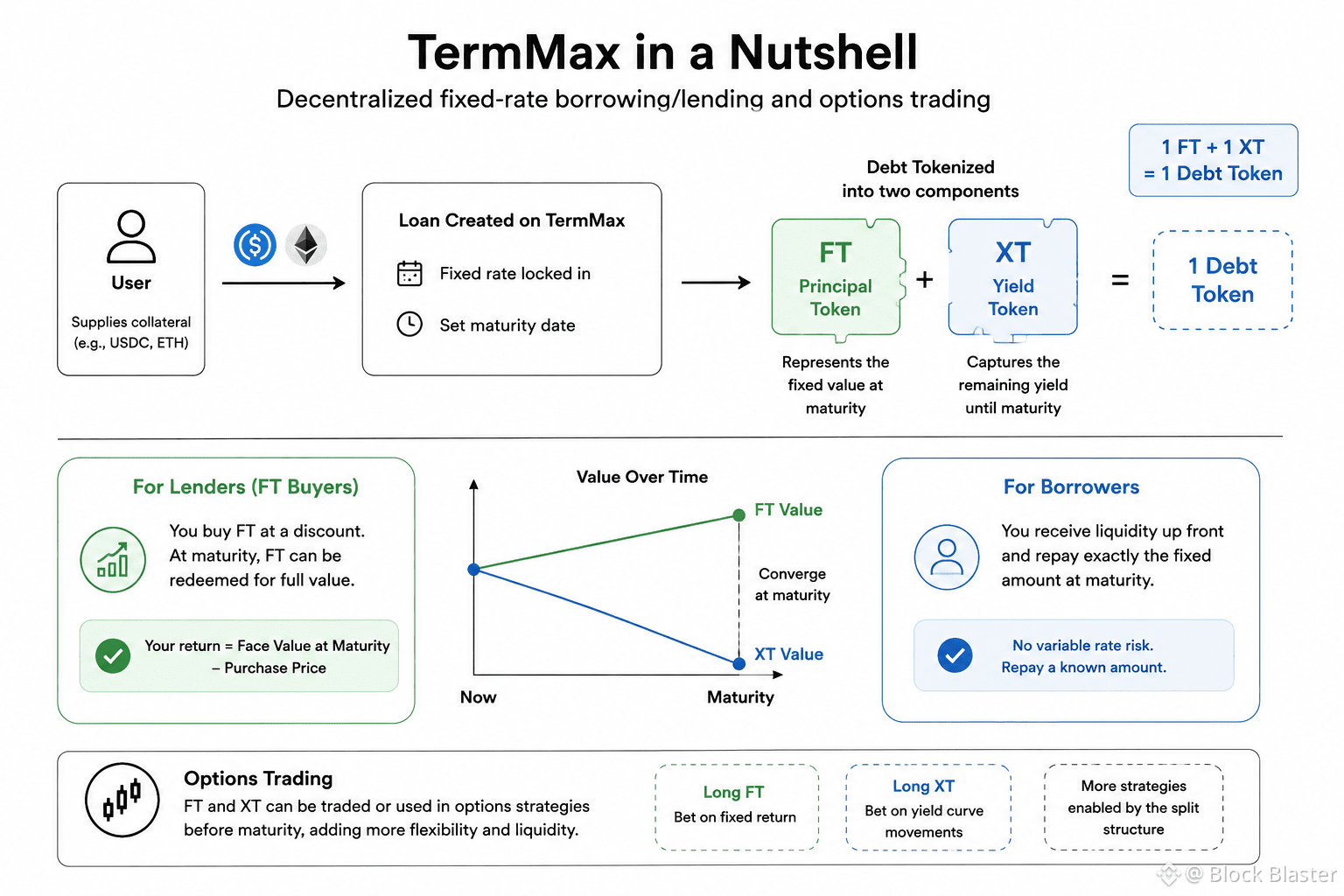
TermMax uses FT and XT, and the structure is tied together by a simple relationship: 1 FT + 1 XT corresponds to 1 debt token. FT is the piece that carries the repayment value toward maturity, while XT holds the remaining exposure around that position.
That means a lender’s return can come from buying FT below the amount it can later be redeemed for, rather than watching interest slowly accumulate block by block.
That sounds like a small difference, but it changes the whole mental model. You’re not just lending at a fixed APR. You’re effectively buying a discounted claim on a future repayment.
The extra token layer can definitely make the system less intuitive at first, but it also gives the market separate pieces that can be priced and traded instead of hiding everything inside one lending position.
I’m curious whether that separation becomes TermMax’s biggest advantage over time, or whether most users will prefer fixed-rate lending that feels simpler on the surface.
@TermMax #TermMax
I almost missed that TermMax’s “fixed rate” isn’t really a rate being paid out over time in the way I first pictured it.
The interesting part is how the position gets split.
TermMax uses FT and XT, and the structure is tied together by a simple relationship: 1 FT + 1 XT corresponds to 1 debt token. FT is the piece that carries the repayment value toward maturity, while XT holds the remaining exposure around that position.
That means a lender’s return can come from buying FT below the amount it can later be redeemed for, rather than watching interest slowly accumulate block by block.
That sounds like a small difference, but it changes the whole mental model. You’re not just lending at a fixed APR. You’re effectively buying a discounted claim on a future repayment.
The extra token layer can definitely make the system less intuitive at first, but it also gives the market separate pieces that can be priced and traded instead of hiding everything inside one lending position.
I’m curious whether that separation becomes TermMax’s biggest advantage over time, or whether most users will prefer fixed-rate lending that feels simpler on the surface.
I almost missed that TermMax’s “fixed rate” isn’t really a rate being paid out over time in the way I first pictured it.
The interesting part is how the position gets split.
TermMax uses FT and XT, and the structure is tied together by a simple relationship: 1 FT + 1 XT corresponds to 1 debt token. FT is the piece that carries the repayment value toward maturity, while XT holds the remaining exposure around that position.
That means a lender’s return can come from buying FT below the amount it can later be redeemed for, rather than watching interest slowly accumulate block by block.
That sounds like a small difference, but it changes the whole mental model. You’re not just lending at a fixed APR. You’re effectively buying a discounted claim on a future repayment.
The extra token layer can definitely make the system less intuitive at first, but it also gives the market separate pieces that can be priced and traded instead of hiding everything inside one lending position.
I’m curious whether that separation becomes TermMax’s biggest advantage over time, or whether most users will prefer fixed-rate lending that feels simpler on the surface.
2
2
167
@termmax #TermMax
I kept assuming TermMax’s “fixed rate” worked like a normal lending market with the rate simply locked when you borrow.
The part I had overlooked is that the fixed cost is really coming from how its debt tokens trade.
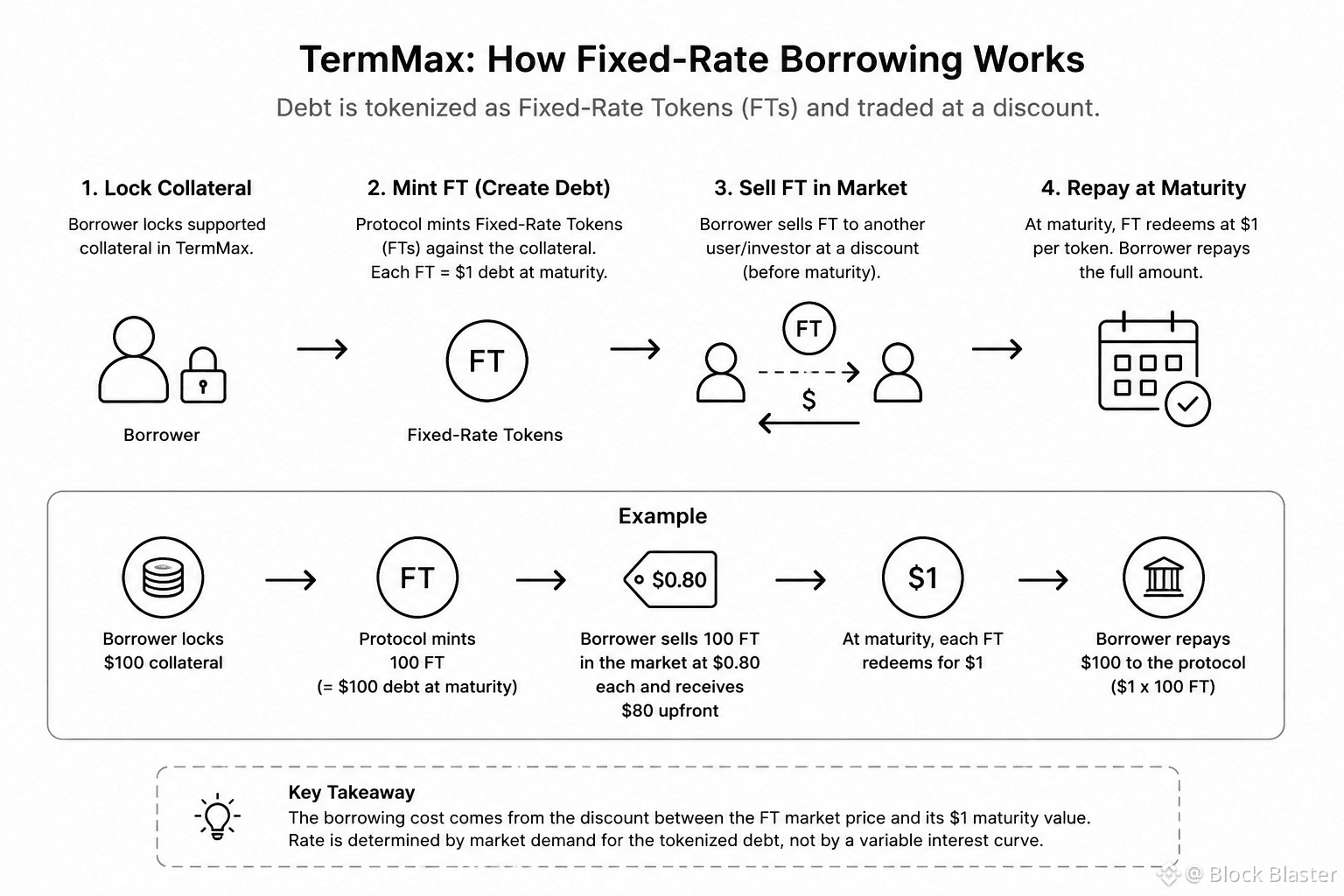
A borrower creates Fixed-Rate Tokens against a collateralized position. Those tokens have a known value at maturity, but they can be sold for less than that value today. If an FT settles at $1 later and the market pays $0.80 for it now, the borrower gets $0.80 upfront and takes on a $1 repayment obligation.
That $0.20 difference is basically the borrowing cost.
What changed my view is that the rate isn’t just a number assigned by the protocol. It comes from the price someone is willing to pay for that future repayment.
That makes the structure more predictable for borrowers, but it also means liquidity becomes part of the rate itself. Thin demand can make funding expensive even when the final debt amount is already known.
I can see why the design makes sense: the market does the pricing instead of relying on a constantly shifting utilization curve.
But does that actually make fixed-rate DeFi cleaner, or does it simply hide the rate risk inside token liquidity?
@TermMax #TermMax
I kept assuming TermMax’s “fixed rate” worked like a normal lending market with the rate simply locked when you borrow.
The part I had overlooked is that the fixed cost is really coming from how its debt tokens trade.
A borrower creates Fixed-Rate Tokens against a collateralized position. Those tokens have a known value at maturity, but they can be sold for less than that value today. If an FT settles at $1 later and the market pays $0.80 for it now, the borrower gets $0.80 upfront and takes on a $1 repayment obligation.
That $0.20 difference is basically the borrowing cost.
What changed my view is that the rate isn’t just a number assigned by the protocol. It comes from the price someone is willing to pay for that future repayment.
That makes the structure more predictable for borrowers, but it also means liquidity becomes part of the rate itself. Thin demand can make funding expensive even when the final debt amount is already known.
I can see why the design makes sense: the market does the pricing instead of relying on a constantly shifting utilization curve.
But does that actually make fixed-rate DeFi cleaner, or does it simply hide the rate risk inside token liquidity?
I kept assuming TermMax’s “fixed rate” worked like a normal lending market with the rate simply locked when you borrow.
The part I had overlooked is that the fixed cost is really coming from how its debt tokens trade.
A borrower creates Fixed-Rate Tokens against a collateralized position. Those tokens have a known value at maturity, but they can be sold for less than that value today. If an FT settles at $1 later and the market pays $0.80 for it now, the borrower gets $0.80 upfront and takes on a $1 repayment obligation.
That $0.20 difference is basically the borrowing cost.
What changed my view is that the rate isn’t just a number assigned by the protocol. It comes from the price someone is willing to pay for that future repayment.
That makes the structure more predictable for borrowers, but it also means liquidity becomes part of the rate itself. Thin demand can make funding expensive even when the final debt amount is already known.
I can see why the design makes sense: the market does the pricing instead of relying on a constantly shifting utilization curve.
But does that actually make fixed-rate DeFi cleaner, or does it simply hide the rate risk inside token liquidity?
2
1
220
@termmax #TermMax
I almost missed how unforgiving TermMax is about maturity.
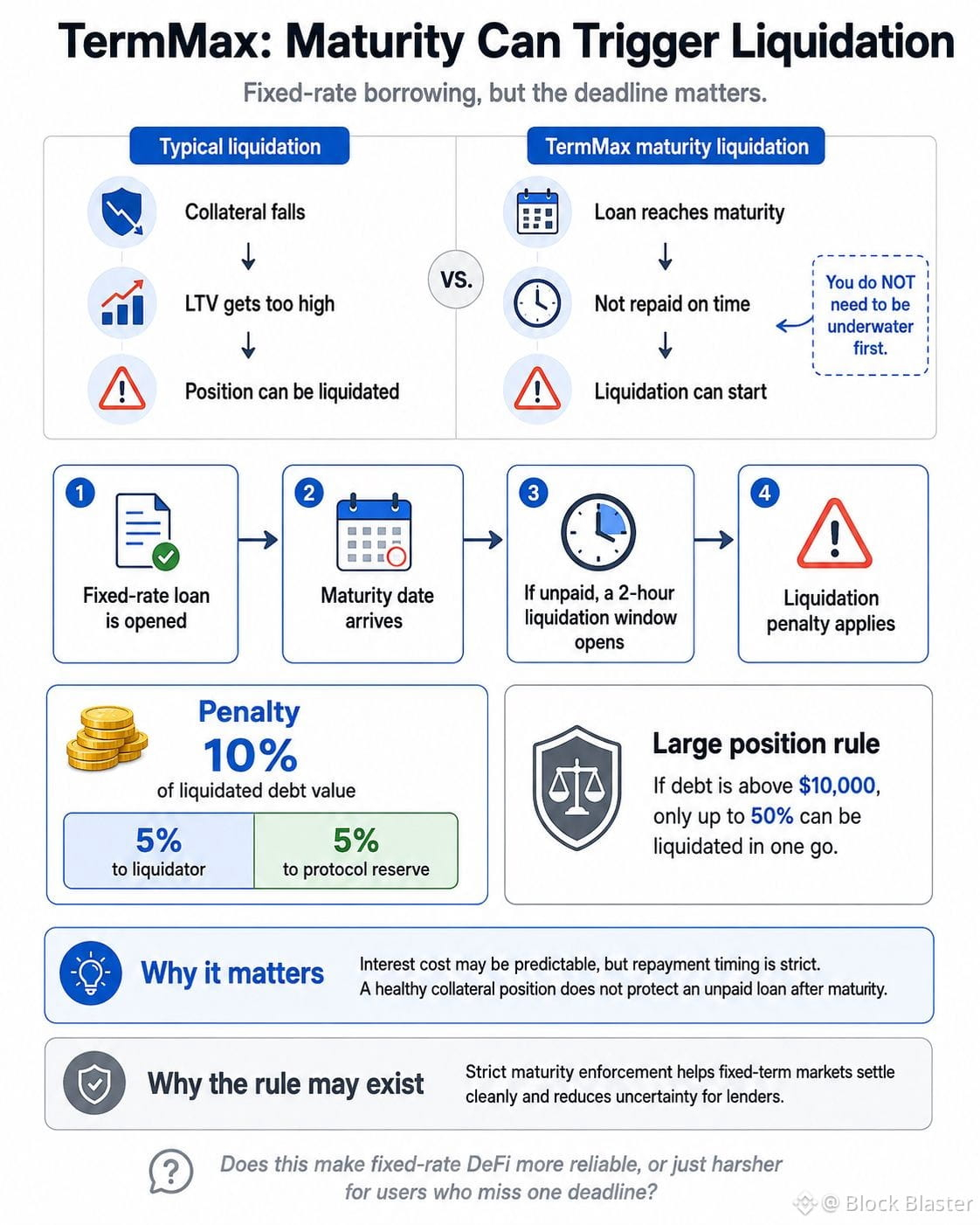
At first I was looking at the usual liquidation risk: collateral drops, LTV gets too high, position gets closed. But on TermMax, reaching maturity without repaying can trigger liquidation on its own. You don’t need to be underwater first.
Once that happens, there’s a two-hour liquidation window. The penalty is 10% of the liquidated debt value, split between the liquidator and the protocol reserve. And for debt above $10,000, only up to 50% can be liquidated in one go.
That detail changed how I think about fixed-rate borrowing here.
Your interest cost may be predictable, but the repayment deadline is not something you can casually roll past. Being properly collateralized doesn’t save you if the loan simply expires unpaid.
I can also see why TermMax designed it this way. Fixed-term markets only work if maturity actually means something. Without strict settlement, lenders would be taking on uncertainty they never priced for.
The interesting part is the tradeoff: does enforcing maturity this aggressively make fixed-rate DeFi cleaner and more reliable, or does it create a surprisingly sharp penalty for users who miss one deadline?
@TermMax #TermMax
I almost missed how unforgiving TermMax is about maturity.
At first I was looking at the usual liquidation risk: collateral drops, LTV gets too high, position gets closed. But on TermMax, reaching maturity without repaying can trigger liquidation on its own. You don’t need to be underwater first.
Once that happens, there’s a two-hour liquidation window. The penalty is 10% of the liquidated debt value, split between the liquidator and the protocol reserve. And for debt above $10,000, only up to 50% can be liquidated in one go.
That detail changed how I think about fixed-rate borrowing here.
Your interest cost may be predictable, but the repayment deadline is not something you can casually roll past. Being properly collateralized doesn’t save you if the loan simply expires unpaid.
I can also see why TermMax designed it this way. Fixed-term markets only work if maturity actually means something. Without strict settlement, lenders would be taking on uncertainty they never priced for.
The interesting part is the tradeoff: does enforcing maturity this aggressively make fixed-rate DeFi cleaner and more reliable, or does it create a surprisingly sharp penalty for users who miss one deadline?
I almost missed how unforgiving TermMax is about maturity.
At first I was looking at the usual liquidation risk: collateral drops, LTV gets too high, position gets closed. But on TermMax, reaching maturity without repaying can trigger liquidation on its own. You don’t need to be underwater first.
Once that happens, there’s a two-hour liquidation window. The penalty is 10% of the liquidated debt value, split between the liquidator and the protocol reserve. And for debt above $10,000, only up to 50% can be liquidated in one go.
That detail changed how I think about fixed-rate borrowing here.
Your interest cost may be predictable, but the repayment deadline is not something you can casually roll past. Being properly collateralized doesn’t save you if the loan simply expires unpaid.
I can also see why TermMax designed it this way. Fixed-term markets only work if maturity actually means something. Without strict settlement, lenders would be taking on uncertainty they never priced for.
The interesting part is the tradeoff: does enforcing maturity this aggressively make fixed-rate DeFi cleaner and more reliable, or does it create a surprisingly sharp penalty for users who miss one deadline?
6
6
174
·
--
Рост
@Dusk_Foundation #dusk $DUSK #Dusk
Dusk Network makes me curious, but not enough to ignore the difficult questions. Crypto has taught me that an interesting idea does not always become a successful product.
Dusk is a layer-1 blockchain focused on privacy for financial applications. Through confidential smart contracts and the XSC standard, it aims to protect sensitive information while still allowing necessary verification.
Honestly, the problem is real. Public blockchains expose balances, transactions, and wallet activity, which is unsuitable for many financial institutions.
Dusk is trying to find a middle ground between full transparency and complete secrecy. But someone must still verify investors, manage credentials, enforce restrictions, and decide when information can be disclosed.
Good privacy technology alone will not create adoption. Dusk also needs developers, institutions, exchanges, investors, and regulators to trust and use the network.
The DUSK token is used for fees and staking, but its purpose will only feel convincing if genuine financial activity follows.
Dusk is addressing a real weakness in blockchain finance, but a real problem does not guarantee a successful solution.
Maybe it works, maybe it doesn’t. For now, Dusk deserves cautious attention, not blind excitement.
@Dusk #dusk $DUSK #Dusk
Dusk Network makes me curious, but not enough to ignore the difficult questions. Crypto has taught me that an interesting idea does not always become a successful product.
Dusk is a layer-1 blockchain focused on privacy for financial applications. Through confidential smart contracts and the XSC standard, it aims to protect sensitive information while still allowing necessary verification.
Honestly, the problem is real. Public blockchains expose balances, transactions, and wallet activity, which is unsuitable for many financial institutions.
Dusk is trying to find a middle ground between full transparency and complete secrecy. But someone must still verify investors, manage credentials, enforce restrictions, and decide when information can be disclosed.
Good privacy technology alone will not create adoption. Dusk also needs developers, institutions, exchanges, investors, and regulators to trust and use the network.
The DUSK token is used for fees and staking, but its purpose will only feel convincing if genuine financial activity follows.
Dusk is addressing a real weakness in blockchain finance, but a real problem does not guarantee a successful solution.
Maybe it works, maybe it doesn’t. For now, Dusk deserves cautious attention, not blind excitement.
Dusk Network makes me curious, but not enough to ignore the difficult questions. Crypto has taught me that an interesting idea does not always become a successful product.
Dusk is a layer-1 blockchain focused on privacy for financial applications. Through confidential smart contracts and the XSC standard, it aims to protect sensitive information while still allowing necessary verification.
Honestly, the problem is real. Public blockchains expose balances, transactions, and wallet activity, which is unsuitable for many financial institutions.
Dusk is trying to find a middle ground between full transparency and complete secrecy. But someone must still verify investors, manage credentials, enforce restrictions, and decide when information can be disclosed.
Good privacy technology alone will not create adoption. Dusk also needs developers, institutions, exchanges, investors, and regulators to trust and use the network.
The DUSK token is used for fees and staking, but its purpose will only feel convincing if genuine financial activity follows.
Dusk is addressing a real weakness in blockchain finance, but a real problem does not guarantee a successful solution.
Maybe it works, maybe it doesn’t. For now, Dusk deserves cautious attention, not blind excitement.
3
3
272
·
--
Рост
$BNB BREAKOUT LOADING?
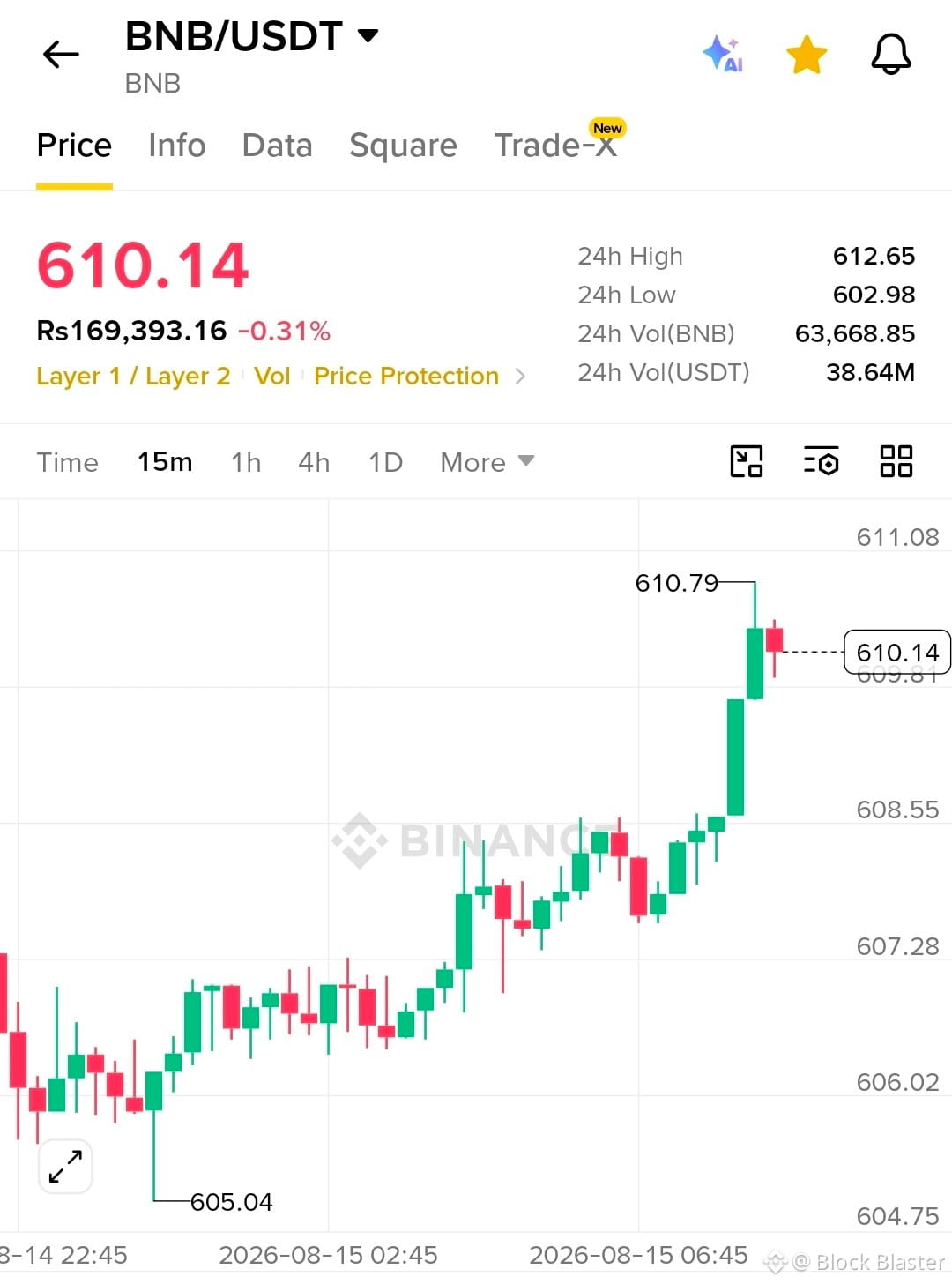
BNB is showing strong momentum on the 15M chart, pushing from $605.04 to a local high of $610.79. Price is now around $610.14, with the 24H high sitting at $612.65.
LONG Setup
EP: $609.80–$610.20
TP1: $610.80
TP2: $612.00
TP3: $612.60
SL: $608.40
Bulls have momentum, but $610.79–$612.65 is the key resistance zone. A clean breakout could open the door for another push.
Let’s go BNB!
Not financial advice. Manage your risk.
$BNB BREAKOUT LOADING?
BNB is showing strong momentum on the 15M chart, pushing from $605.04 to a local high of $610.79. Price is now around $610.14, with the 24H high sitting at $612.65.
LONG Setup
EP: $609.80–$610.20
TP1: $610.80
TP2: $612.00
TP3: $612.60
SL: $608.40
Bulls have momentum, but $610.79–$612.65 is the key resistance zone. A clean breakout could open the door for another push.
Let’s go BNB!
Not financial advice. Manage your risk.
BNB is showing strong momentum on the 15M chart, pushing from $605.04 to a local high of $610.79. Price is now around $610.14, with the 24H high sitting at $612.65.
LONG Setup
EP: $609.80–$610.20
TP1: $610.80
TP2: $612.00
TP3: $612.60
SL: $608.40
Bulls have momentum, but $610.79–$612.65 is the key resistance zone. A clean breakout could open the door for another push.
Let’s go BNB!
Not financial advice. Manage your risk.
148
·
--
Рост
@Dusk_Foundation #dusk $DUSK #Dusk
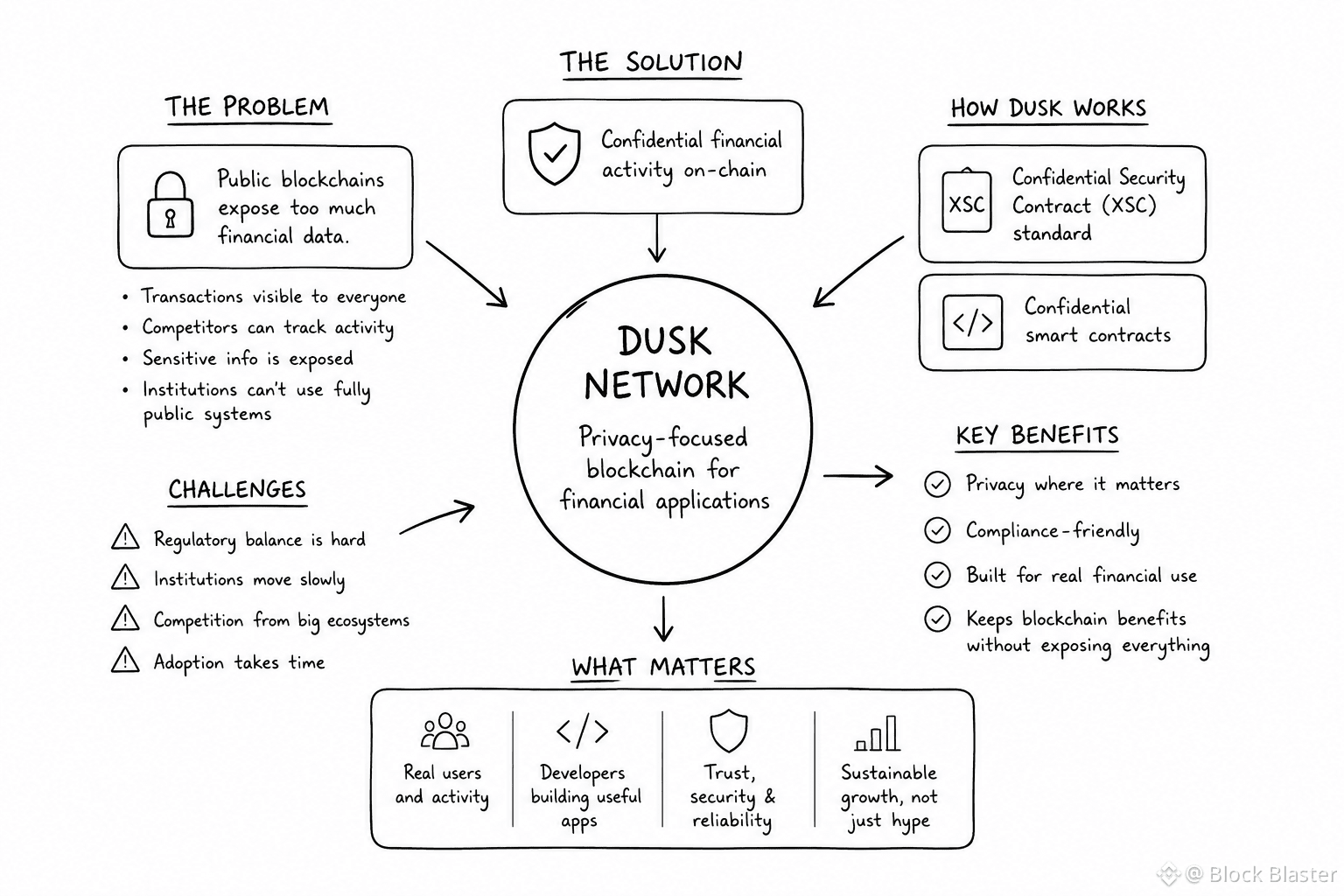
Dusk Network is one of those projects that doesn’t need a flashy story to make sense.
Its focus on confidential financial activity tackles a real problem: public blockchains expose too much information for serious finance.
Honestly, privacy in this space feels less like a feature and more like basic infrastructure.
That doesn’t mean adoption will be easy. Institutions move slowly, regulation is complicated, and good technology alone is never enough.
But the problem is real.
Maybe Dusk gets the balance right, maybe it doesn’t.
For now, I’d rather watch something trying to fix real financial plumbing than another project built around hype.
@Dusk #dusk $DUSK #Dusk
Dusk Network is one of those projects that doesn’t need a flashy story to make sense.
Its focus on confidential financial activity tackles a real problem: public blockchains expose too much information for serious finance.
Honestly, privacy in this space feels less like a feature and more like basic infrastructure.
That doesn’t mean adoption will be easy. Institutions move slowly, regulation is complicated, and good technology alone is never enough.
But the problem is real.
Maybe Dusk gets the balance right, maybe it doesn’t.
For now, I’d rather watch something trying to fix real financial plumbing than another project built around hype.
Dusk Network is one of those projects that doesn’t need a flashy story to make sense.
Its focus on confidential financial activity tackles a real problem: public blockchains expose too much information for serious finance.
Honestly, privacy in this space feels less like a feature and more like basic infrastructure.
That doesn’t mean adoption will be easy. Institutions move slowly, regulation is complicated, and good technology alone is never enough.
But the problem is real.
Maybe Dusk gets the balance right, maybe it doesn’t.
For now, I’d rather watch something trying to fix real financial plumbing than another project built around hype.
5
2
183
·
--
Рост
@Dusk_Foundation #dusk #Dusk $DUSK
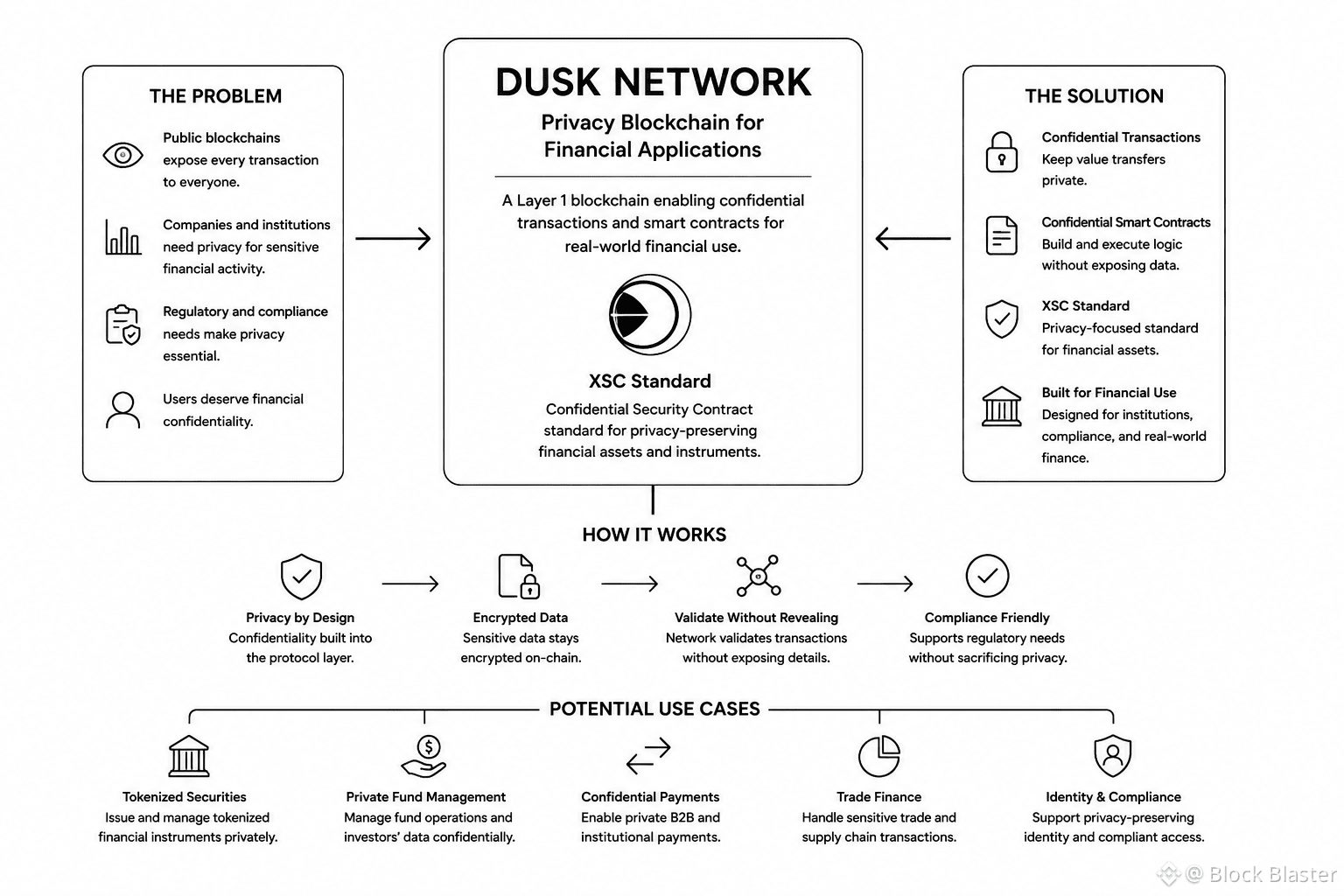
Dusk Network is interesting because it focuses on a problem that actually matters: financial privacy.
Public blockchains make almost everything visible, but real financial activity often needs confidentiality. Dusk is trying to address that through privacy-focused infrastructure and confidential smart contracts.
The idea makes sense, but technology alone isn’t enough. The real test is adoption. Can developers, institutions, and regulated financial applications actually find a reason to use Dusk?
Maybe they will, maybe they won’t. For now, the problem is real—the execution still has to prove itself.
@Dusk #dusk #Dusk $DUSK
Dusk Network is interesting because it focuses on a problem that actually matters: financial privacy.
Public blockchains make almost everything visible, but real financial activity often needs confidentiality. Dusk is trying to address that through privacy-focused infrastructure and confidential smart contracts.
The idea makes sense, but technology alone isn’t enough. The real test is adoption. Can developers, institutions, and regulated financial applications actually find a reason to use Dusk?
Maybe they will, maybe they won’t. For now, the problem is real—the execution still has to prove itself.
Dusk Network is interesting because it focuses on a problem that actually matters: financial privacy.
Public blockchains make almost everything visible, but real financial activity often needs confidentiality. Dusk is trying to address that through privacy-focused infrastructure and confidential smart contracts.
The idea makes sense, but technology alone isn’t enough. The real test is adoption. Can developers, institutions, and regulated financial applications actually find a reason to use Dusk?
Maybe they will, maybe they won’t. For now, the problem is real—the execution still has to prove itself.
1
232
·
--
Рост
@babylonlabs_io #baby $BABY
Been thinking about Babylon lately.
Not because I think it's guaranteed to become a huge success. Crypto has made me skeptical of that kind of thinking.
What caught my attention is the problem it's trying to solve.
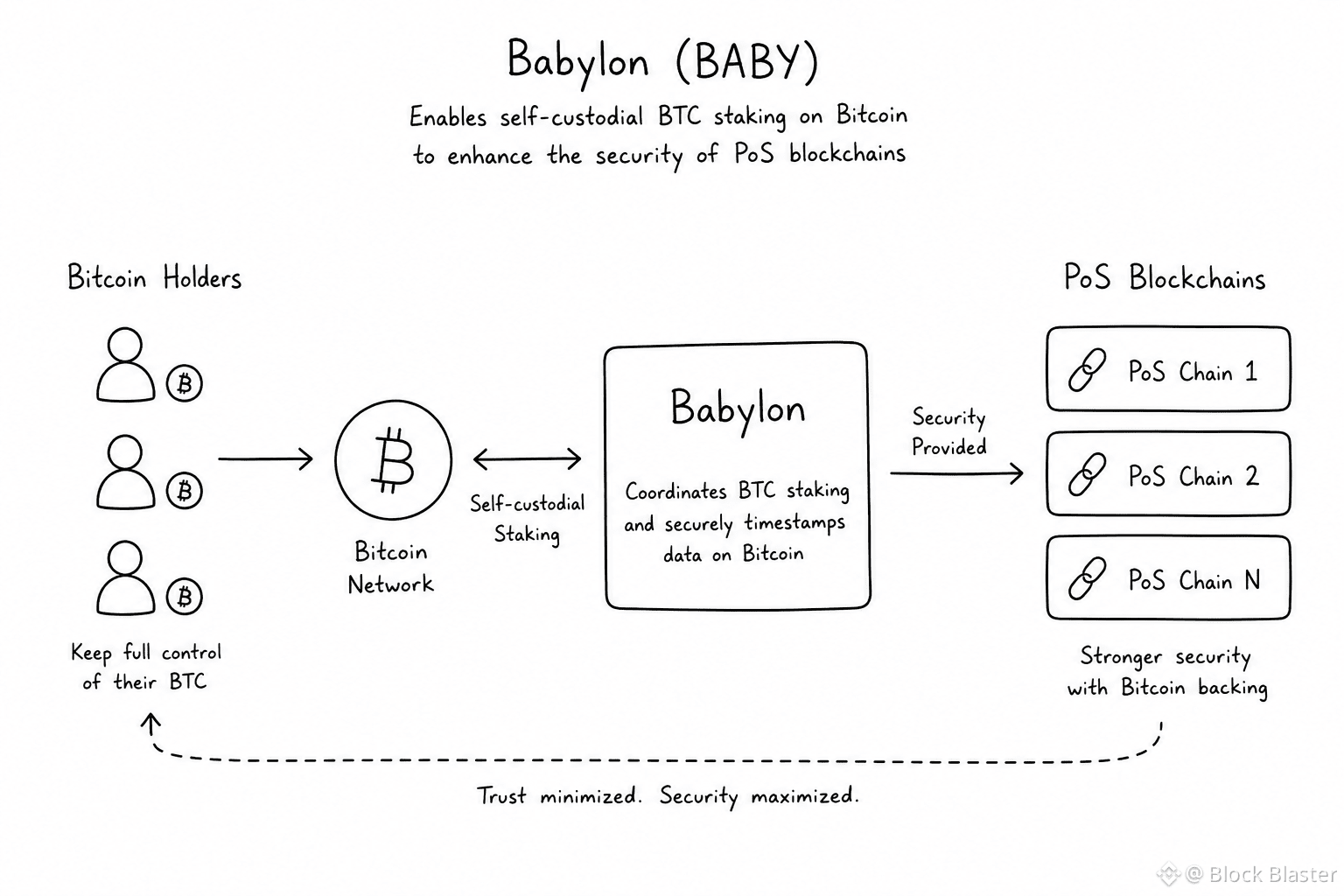
Bitcoin is the biggest asset in crypto, but most of it just sits there while newer networks keep trying to build security from scratch. That never really made sense to me.
I also like that the conversation starts with self-custody. After everything we've seen—collapsed exchanges, hacked bridges, frozen withdrawals—asking people to trust another middleman isn't exactly a winning pitch anymore.
That said, I'm still cautious.
Building infrastructure is hard. Getting people to actually use it is even harder.
And yes, I still question whether every infrastructure project really needs its own token. That's just where years in crypto have left me.
Maybe Babylon works.
Maybe it doesn't.
Either way, I'd rather watch projects trying to fix real problems than another hype cycle built around empty promises.
At this point, boring infrastructure sounds a lot more interesting than flashy marketing.
@BabylonLabs_io #baby $BABY
Been thinking about Babylon lately.
Not because I think it's guaranteed to become a huge success. Crypto has made me skeptical of that kind of thinking.
What caught my attention is the problem it's trying to solve.
Bitcoin is the biggest asset in crypto, but most of it just sits there while newer networks keep trying to build security from scratch. That never really made sense to me.
I also like that the conversation starts with self-custody. After everything we've seen—collapsed exchanges, hacked bridges, frozen withdrawals—asking people to trust another middleman isn't exactly a winning pitch anymore.
That said, I'm still cautious.
Building infrastructure is hard. Getting people to actually use it is even harder.
And yes, I still question whether every infrastructure project really needs its own token. That's just where years in crypto have left me.
Maybe Babylon works.
Maybe it doesn't.
Either way, I'd rather watch projects trying to fix real problems than another hype cycle built around empty promises.
At this point, boring infrastructure sounds a lot more interesting than flashy marketing.
Been thinking about Babylon lately.
Not because I think it's guaranteed to become a huge success. Crypto has made me skeptical of that kind of thinking.
What caught my attention is the problem it's trying to solve.
Bitcoin is the biggest asset in crypto, but most of it just sits there while newer networks keep trying to build security from scratch. That never really made sense to me.
I also like that the conversation starts with self-custody. After everything we've seen—collapsed exchanges, hacked bridges, frozen withdrawals—asking people to trust another middleman isn't exactly a winning pitch anymore.
That said, I'm still cautious.
Building infrastructure is hard. Getting people to actually use it is even harder.
And yes, I still question whether every infrastructure project really needs its own token. That's just where years in crypto have left me.
Maybe Babylon works.
Maybe it doesn't.
Either way, I'd rather watch projects trying to fix real problems than another hype cycle built around empty promises.
At this point, boring infrastructure sounds a lot more interesting than flashy marketing.
3
3
206
·
--
Рост
@babylonlabs_io #baby $BABY
Spent enough time in crypto and you start noticing the same pattern.
Everyone talks about the next big thing.
New narratives. New tokens. New promises.
But when something breaks, we always come back to the same boring topic:
Security.
That’s why Babylon (BABY) caught my attention.
Not because of hype. Not because of some loud claim about changing everything.
Because it is trying to solve a problem crypto keeps running into again and again.
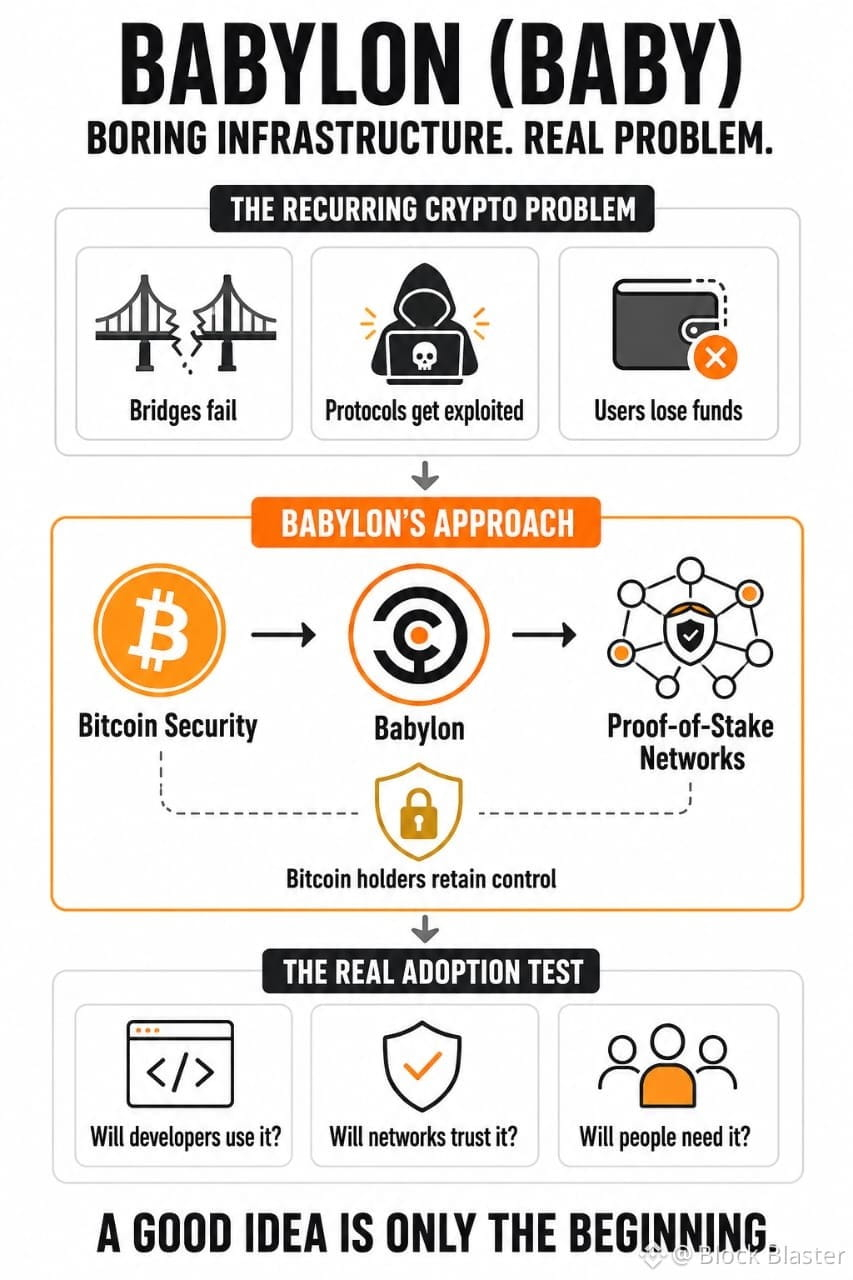
We’ve seen bridges fail. Protocols get exploited. Users lose money because the infrastructure underneath wasn’t strong enough.
The funny thing is, nobody cares about infrastructure when everything works.
They only care when it breaks.
Babylon is taking a different approach by exploring how Bitcoin’s security can help support proof-of-stake networks while keeping Bitcoin holders in control of their assets.
The idea makes sense.
But let’s be real — a good idea is only the beginning.
Crypto is full of projects with great concepts that never made it because adoption was harder than expected.
The real test is simple:
Will developers use it?
Will networks trust it?
Will people actually need it?
That’s where things get interesting.
I’m not here to call Babylon the next big thing. Crypto has taught me enough lessons to avoid that kind of excitement.
Maybe it works.
Maybe it takes years.
Maybe it doesn’t reach the level people expect.
But at least it is focused on a problem that actually exists.
In a market full of noise, sometimes the boring infrastructure projects are the ones worth watching.
@BabylonLabs_io #baby $BABY
Spent enough time in crypto and you start noticing the same pattern.
Everyone talks about the next big thing.
New narratives. New tokens. New promises.
But when something breaks, we always come back to the same boring topic:
Security.
That’s why Babylon (BABY) caught my attention.
Not because of hype. Not because of some loud claim about changing everything.
Because it is trying to solve a problem crypto keeps running into again and again.
We’ve seen bridges fail. Protocols get exploited. Users lose money because the infrastructure underneath wasn’t strong enough.
The funny thing is, nobody cares about infrastructure when everything works.
They only care when it breaks.
Babylon is taking a different approach by exploring how Bitcoin’s security can help support proof-of-stake networks while keeping Bitcoin holders in control of their assets.
The idea makes sense.
But let’s be real — a good idea is only the beginning.
Crypto is full of projects with great concepts that never made it because adoption was harder than expected.
The real test is simple:
Will developers use it?
Will networks trust it?
Will people actually need it?
That’s where things get interesting.
I’m not here to call Babylon the next big thing. Crypto has taught me enough lessons to avoid that kind of excitement.
Maybe it works.
Maybe it takes years.
Maybe it doesn’t reach the level people expect.
But at least it is focused on a problem that actually exists.
In a market full of noise, sometimes the boring infrastructure projects are the ones worth watching.
Spent enough time in crypto and you start noticing the same pattern.
Everyone talks about the next big thing.
New narratives. New tokens. New promises.
But when something breaks, we always come back to the same boring topic:
Security.
That’s why Babylon (BABY) caught my attention.
Not because of hype. Not because of some loud claim about changing everything.
Because it is trying to solve a problem crypto keeps running into again and again.
We’ve seen bridges fail. Protocols get exploited. Users lose money because the infrastructure underneath wasn’t strong enough.
The funny thing is, nobody cares about infrastructure when everything works.
They only care when it breaks.
Babylon is taking a different approach by exploring how Bitcoin’s security can help support proof-of-stake networks while keeping Bitcoin holders in control of their assets.
The idea makes sense.
But let’s be real — a good idea is only the beginning.
Crypto is full of projects with great concepts that never made it because adoption was harder than expected.
The real test is simple:
Will developers use it?
Will networks trust it?
Will people actually need it?
That’s where things get interesting.
I’m not here to call Babylon the next big thing. Crypto has taught me enough lessons to avoid that kind of excitement.
Maybe it works.
Maybe it takes years.
Maybe it doesn’t reach the level people expect.
But at least it is focused on a problem that actually exists.
In a market full of noise, sometimes the boring infrastructure projects are the ones worth watching.
9
7
245
·
--
Рост
@babylonlabs_io $BABY #baby
Babylon (BABY) is interesting to me for one simple reason: crypto has already shown us how badly bridges and custodians can fail.
We have wrapped BTC, moved it across chains, trusted third parties, and acted surprised when the plumbing broke. Funds disappeared. Withdrawals stopped. Then everyone read the risk warnings afterward.
Babylon is trying a different route. It wants Bitcoin holders to use their BTC to help secure proof-of-stake chains without giving up custody or turning it into another wrapped asset.
Honestly, that makes sense.
But self-custody does not mean zero risk. There is still code under the hood. There are operators, penalty rules, and integrations that need to work when things get messy—not only when markets are calm.
And then there is BABY, the token.
What happens when the early rewards dry up? Will PoS chains actually pay for this security? Will Bitcoin holders accept the extra risk for a reasonable return? Or will most activity disappear once the incentives become less attractive?
I don’t know.
That is why I’m curious, not excited.
The problem is real. PoS chains need stronger security, and BTC holders need better options than trusting another bridge or custodian. Babylon is trying to build the boring infrastructure between those two sides.
It might take time. It might fail. It might also become useful plumbing.
For now, I’m watching what happens after the hype—not during it.
@BabylonLabs_io $BABY #baby
Babylon (BABY) is interesting to me for one simple reason: crypto has already shown us how badly bridges and custodians can fail.
We have wrapped BTC, moved it across chains, trusted third parties, and acted surprised when the plumbing broke. Funds disappeared. Withdrawals stopped. Then everyone read the risk warnings afterward.
Babylon is trying a different route. It wants Bitcoin holders to use their BTC to help secure proof-of-stake chains without giving up custody or turning it into another wrapped asset.
Honestly, that makes sense.
But self-custody does not mean zero risk. There is still code under the hood. There are operators, penalty rules, and integrations that need to work when things get messy—not only when markets are calm.
And then there is BABY, the token.
What happens when the early rewards dry up? Will PoS chains actually pay for this security? Will Bitcoin holders accept the extra risk for a reasonable return? Or will most activity disappear once the incentives become less attractive?
I don’t know.
That is why I’m curious, not excited.
The problem is real. PoS chains need stronger security, and BTC holders need better options than trusting another bridge or custodian. Babylon is trying to build the boring infrastructure between those two sides.
It might take time. It might fail. It might also become useful plumbing.
For now, I’m watching what happens after the hype—not during it.
Babylon (BABY) is interesting to me for one simple reason: crypto has already shown us how badly bridges and custodians can fail.
We have wrapped BTC, moved it across chains, trusted third parties, and acted surprised when the plumbing broke. Funds disappeared. Withdrawals stopped. Then everyone read the risk warnings afterward.
Babylon is trying a different route. It wants Bitcoin holders to use their BTC to help secure proof-of-stake chains without giving up custody or turning it into another wrapped asset.
Honestly, that makes sense.
But self-custody does not mean zero risk. There is still code under the hood. There are operators, penalty rules, and integrations that need to work when things get messy—not only when markets are calm.
And then there is BABY, the token.
What happens when the early rewards dry up? Will PoS chains actually pay for this security? Will Bitcoin holders accept the extra risk for a reasonable return? Or will most activity disappear once the incentives become less attractive?
I don’t know.
That is why I’m curious, not excited.
The problem is real. PoS chains need stronger security, and BTC holders need better options than trusting another bridge or custodian. Babylon is trying to build the boring infrastructure between those two sides.
It might take time. It might fail. It might also become useful plumbing.
For now, I’m watching what happens after the hype—not during it.
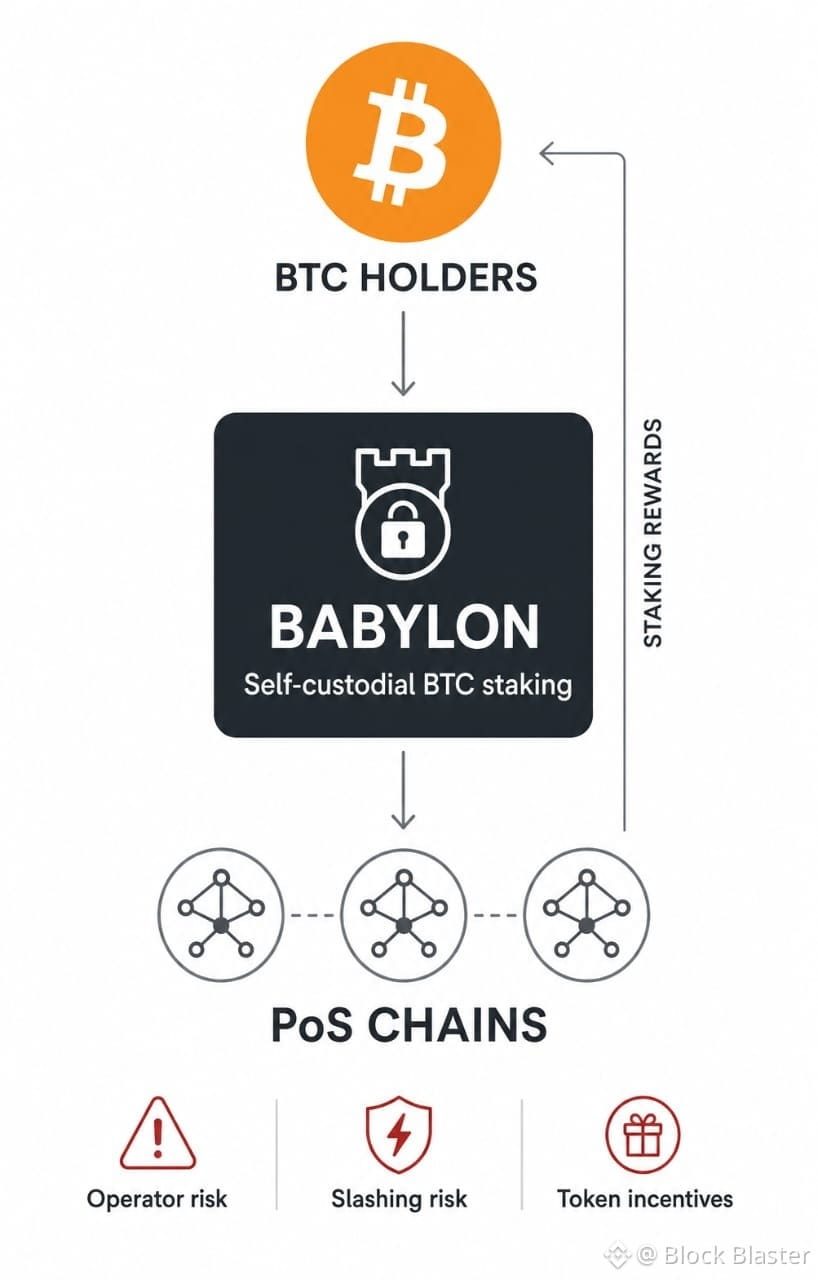
7
6
275
·
--
Падение
$币安人生 remains one of the strongest projects and could bounce sharply from support.
Trade Idea:
Entry: $0.620 - $0.640
Target: $0.690 / $0.740 / $0.800
Stop Loss: $0.590
Let's go trade now $币安人生
{spot}(币安人生USDT)
$币安人生 remains one of the strongest projects and could bounce sharply from support.
Trade Idea:
Entry: $0.620 - $0.640
Target: $0.690 / $0.740 / $0.800
Stop Loss: $0.590
Let's go trade now $币安人生
Trade Idea:
Entry: $0.620 - $0.640
Target: $0.690 / $0.740 / $0.800
Stop Loss: $0.590
Let's go trade now $币安人生
36
$ERA remains one of the strongest projects and could bounce sharply from support.
Trade Idea:
Entry: $0.0600 - $0.0620
Target: $0.0670 / $0.0730 / $0.0800
Stop Loss: $0.0570
Let's go trade now $ERA
{spot}(ERAUSDT)
$ERA remains one of the strongest projects and could bounce sharply from support.
Trade Idea:
Entry: $0.0600 - $0.0620
Target: $0.0670 / $0.0730 / $0.0800
Stop Loss: $0.0570
Let's go trade now $ERA
Trade Idea:
Entry: $0.0600 - $0.0620
Target: $0.0670 / $0.0730 / $0.0800
Stop Loss: $0.0570
Let's go trade now $ERA
176
$AWE remains one of the strongest projects and could bounce sharply from support.
Trade Idea:
Entry: $0.0565 - $0.0580
Target: $0.0620 / $0.0670 / $0.0730
Stop Loss: $0.0540
Let's go trade now $AWE
{spot}(AWEUSDT)
$AWE remains one of the strongest projects and could bounce sharply from support.
Trade Idea:
Entry: $0.0565 - $0.0580
Target: $0.0620 / $0.0670 / $0.0730
Stop Loss: $0.0540
Let's go trade now $AWE
Trade Idea:
Entry: $0.0565 - $0.0580
Target: $0.0620 / $0.0670 / $0.0730
Stop Loss: $0.0540
Let's go trade now $AWE
48
$NXPC remains one of the strongest projects and could bounce sharply from support.
Trade Idea:
Entry: $0.230 - $0.236
Target: $0.250 / $0.270 / $0.295
Stop Loss: $0.220
Let's go trade now $NXPC
{spot}(NXPCUSDT)
$NXPC remains one of the strongest projects and could bounce sharply from support.
Trade Idea:
Entry: $0.230 - $0.236
Target: $0.250 / $0.270 / $0.295
Stop Loss: $0.220
Let's go trade now $NXPC
Trade Idea:
Entry: $0.230 - $0.236
Target: $0.250 / $0.270 / $0.295
Stop Loss: $0.220
Let's go trade now $NXPC
347
·
--
Падение
$QTUM remains one of the strongest projects and could bounce sharply from support.
Trade Idea:
Entry: $0.690 - $0.710
Target: $0.760 / $0.820 / $0.900
Stop Loss: $0.660
Let's go trade now $QTUM
{spot}(QTUMUSDT)
$QTUM remains one of the strongest projects and could bounce sharply from support.
Trade Idea:
Entry: $0.690 - $0.710
Target: $0.760 / $0.820 / $0.900
Stop Loss: $0.660
Let's go trade now $QTUM
Trade Idea:
Entry: $0.690 - $0.710
Target: $0.760 / $0.820 / $0.900
Stop Loss: $0.660
Let's go trade now $QTUM
66
$EGLD remains one of the strongest projects and could bounce sharply from support.
Trade Idea:
Entry: $3.08 - $3.18
Target: $3.40 / $3.70 / $4.10
Stop Loss: $2.95
Let's go trade now $EGLD
{spot}(EGLDUSDT)
$EGLD remains one of the strongest projects and could bounce sharply from support.
Trade Idea:
Entry: $3.08 - $3.18
Target: $3.40 / $3.70 / $4.10
Stop Loss: $2.95
Let's go trade now $EGLD
Trade Idea:
Entry: $3.08 - $3.18
Target: $3.40 / $3.70 / $4.10
Stop Loss: $2.95
Let's go trade now $EGLD
1
127
Войдите, чтобы посмотреть больше материала
Присоединяйтесь к пользователям криптовалют по всему миру на Binance Square
⚡️ Получайте новейшую и полезную информацию о криптоактивах.
💬 Нам доверяет крупнейшая в мире криптобиржа.
👍 Получите достоверные аналитические данные от верифицированных создателей контента.
Эл. почта/номер телефона
В тренде
BitcoinReboundsTo$79K
Просмотров: 14,216
135 обсуждают
🚨 $BTC is pushing higher.
Bitcoin is trading around $78,804, up roughly 1.9%, after reclaiming the $78K area. The next level to watch is the intraday high near $78,905.
A clean break above that level could open the way toward $79K–$80K. If BTC gets rejected, support sits around $78,300, then $77,975.
Bulls have momentum, but BTC needs to hold above $78K.
#Bitcoin #BTC #CryptoTrading #CryptoMarket #CryptoAnalysis
PulseON
·Лайков: 15
·Просмотров: 14.2k
SouthKoreaCryptoTaxDelayPetitionTops50000
Просмотров: 784
61 обсуждают
SolanaTransactionV1GoesLiveOnMainnet
Просмотров: 508
35 обсуждают