

Lukukaku
830 Публикации

Lukukaku
Отправить жалобу
Заблокировать пользователя
230 подписок(и/а)
1.0K+ подписчиков(а)
871 понравилось
Посты
Все
Цитирования
·
--
I think $BTC will reach $100k by the end of 2026.
Reply "yes" if you agree with me, and you'll receive a lucky money envelope! 🧧🧧🧧
{spot}(BTCUSDT)
I think $BTC will reach $100k by the end of 2026.
Reply "yes" if you agree with me, and you'll receive a lucky money envelope! 🧧🧧🧧
Reply "yes" if you agree with me, and you'll receive a lucky money envelope! 🧧🧧🧧
191
17
191
·
--
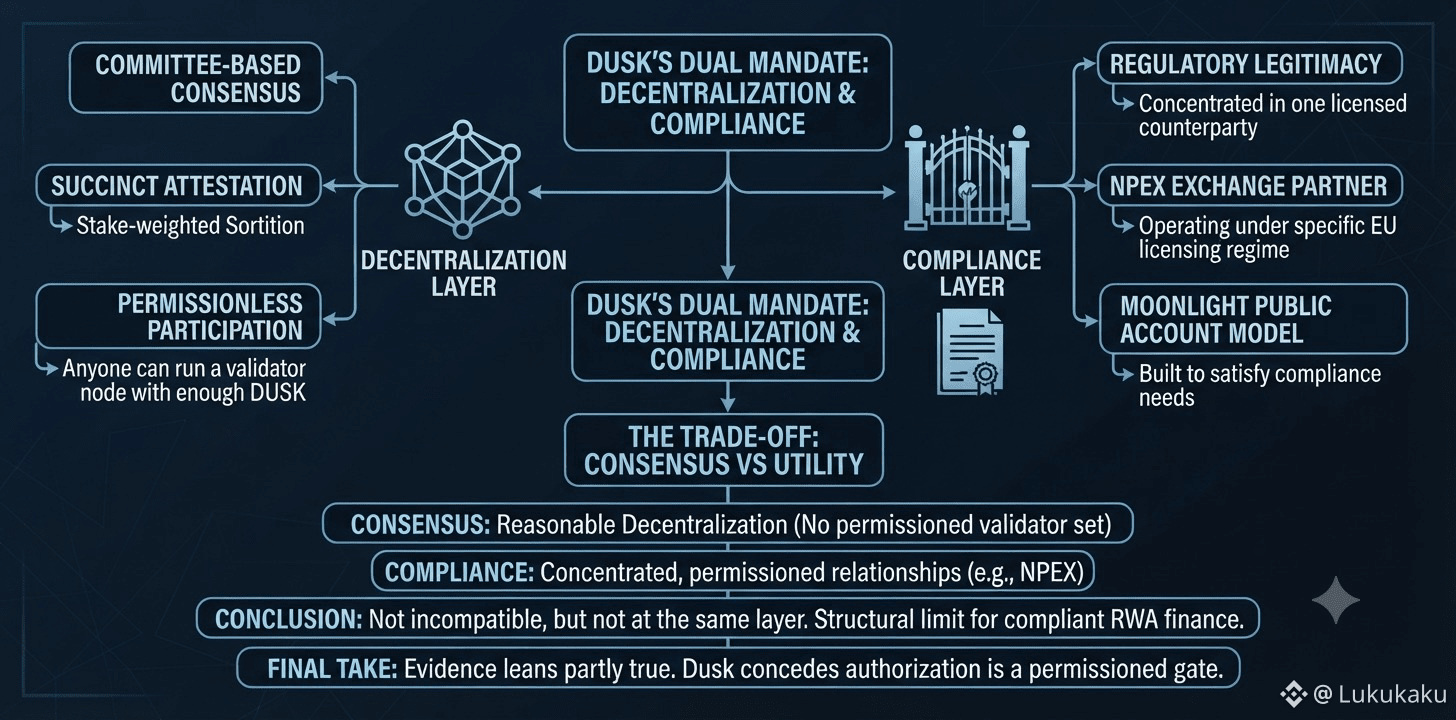
Is full decentralization actually incompatible with strict regulatory compliance, or is that just something people say to excuse projects that never tried very hard at either? I don't think there's a clean yes or no answer, but Dusk is a genuinely useful test case because it's tried harder than most projects at holding both at once.
On the decentralization side, Dusk uses a committee-based consensus, Succinct Attestation, where provisioners are selected through stake-weighted sortition rather than a fixed, permissioned validator set, which is a real attempt at permissionless participation. On the compliance side, its most significant real-world traction runs through exactly one regulated exchange partner, NPEX, operating under a specific EU licensing regime, with Moonlight's public account model built specifically to satisfy that relationship's compliance needs. Concentrating regulatory legitimacy in one licensed counterparty is a less decentralized dependency than a protocol with no institutional gatekeeper. Anyone can run a validator node with enough staked DUSK. Nobody becomes NPEX's licensed partner just by showing up with capital, and that asymmetry is the real shape of the tradeoff.
My honest take: the evidence leans partly true rather than false. Dusk's consensus layer stays reasonably decentralized, but the compliance layer that gives it real utility runs through concentrated, permissioned relationships, since no regulator licenses an anonymous validator set. That's not a flaw unique to Dusk. It's closer to a structural limit on how compliant RWA finance can work on any chain right now. Full decentralization and strict compliance aren't fully incompatible here, but they clearly aren't sitting at the same layer of the stack either. Dusk's own pitch already concedes part of this: its infrastructure is meant to carry native issuance workflows for regulated securities once institutions and venues have authorization in place, and authorization is a permissioned gate, not a decentralized one.
#dusk $DUSK @Dusk
1
2
13
123
·
--
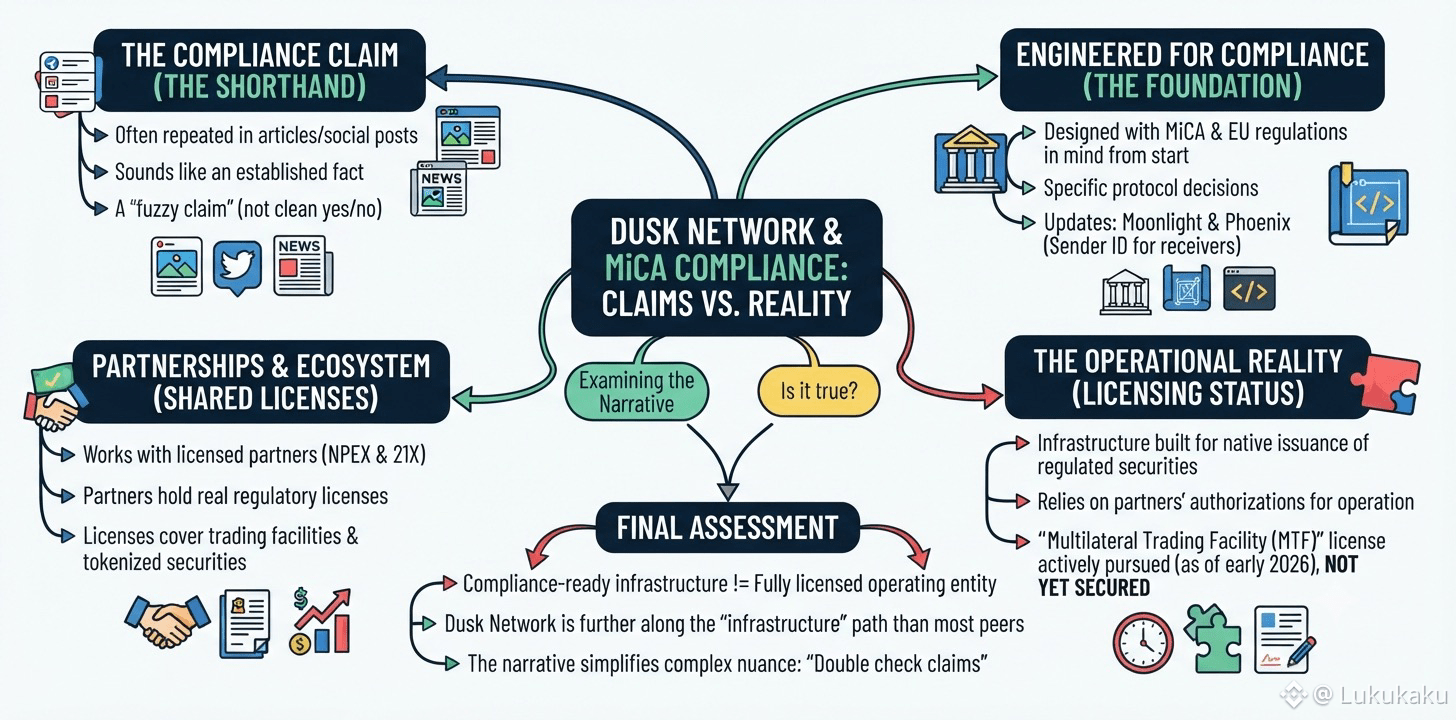
MiCA compliant. I have seen that phrase attached to Dusk Network across enough articles and social posts that it starts to sound like an established fact rather than a claim worth examining. So I looked closer, and the honest answer is that it is true in some senses and overstated in others, which makes it a better example of a fuzzy claim than a clean yes or no answer would suggest.
It is fair to say Dusk Network's protocol was engineered with MiCA and European securities regulation in mind from the start, down to specific decisions like adding Moonlight and updating Phoenix so senders can be identified by receivers. It is also fair to say the project works with partners, NPEX and 21X, who hold real, active regulatory licenses covering trading facilities and tokenized securities markets under European frameworks. What Dusk Network can more accurately claim is being infrastructure built to carry native issuance of regulated securities once a specific institution or venue already has the authorization and product design in place, which is a narrower and more honest description than a blanket compliance label. Its own Multilateral Trading Facility license was described as actively being pursued, not secured, as of early 2026, meaning a meaningful piece of its regulatory standing still runs through partner licenses rather than its own.
I do not think this makes the compliance narrative false. Compliance ready infrastructure and a fully licensed operating entity are simply different things, and Dusk Network is genuinely further along the first path than most of its peers. But the shorthand people repeat compresses that nuance into something cleaner than reality, and cleaner claims are usually the ones worth double checking before you repeat them yourself.
@Dusk_Foundation $DUSK #dusk
MiCA compliant. I have seen that phrase attached to Dusk Network across enough articles and social posts that it starts to sound like an established fact rather than a claim worth examining. So I looked closer, and the honest answer is that it is true in some senses and overstated in others, which makes it a better example of a fuzzy claim than a clean yes or no answer would suggest.
It is fair to say Dusk Network's protocol was engineered with MiCA and European securities regulation in mind from the start, down to specific decisions like adding Moonlight and updating Phoenix so senders can be identified by receivers. It is also fair to say the project works with partners, NPEX and 21X, who hold real, active regulatory licenses covering trading facilities and tokenized securities markets under European frameworks. What Dusk Network can more accurately claim is being infrastructure built to carry native issuance of regulated securities once a specific institution or venue already has the authorization and product design in place, which is a narrower and more honest description than a blanket compliance label. Its own Multilateral Trading Facility license was described as actively being pursued, not secured, as of early 2026, meaning a meaningful piece of its regulatory standing still runs through partner licenses rather than its own.
I do not think this makes the compliance narrative false. Compliance ready infrastructure and a fully licensed operating entity are simply different things, and Dusk Network is genuinely further along the first path than most of its peers. But the shorthand people repeat compresses that nuance into something cleaner than reality, and cleaner claims are usually the ones worth double checking before you repeat them yourself.
@Dusk $DUSK #dusk
1
6
95
·
--
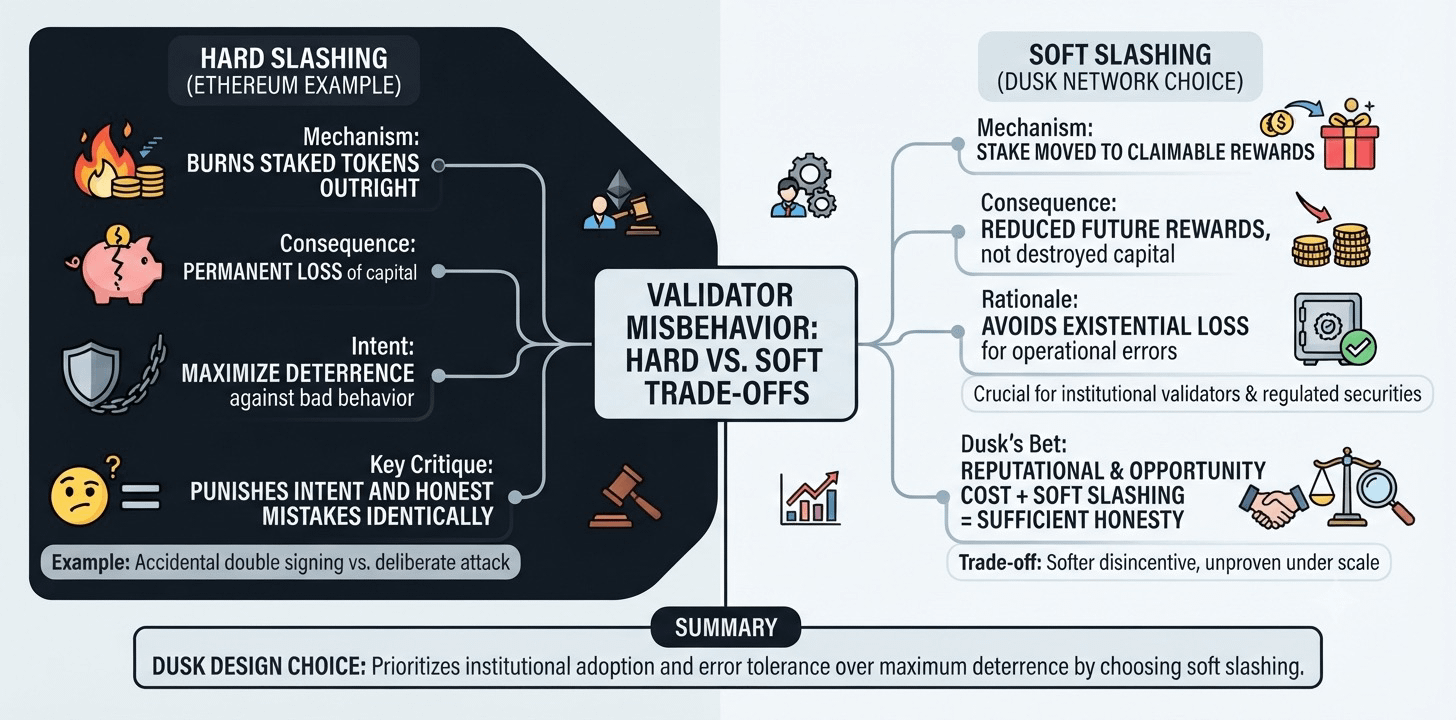
Proof of stake networks need a way to punish validators who misbehave, and the design choice usually comes down to how much pain that punishment should inflict. Hard slashing burns a portion of a validator's staked tokens outright, a permanent loss meant to make bad behavior expensive in a way nothing else quite achieves. Ethereum's validator set, by contrast, does include hard slashing for the most severe faults specifically because the deterrent value was judged worth the harsher outcome, a trade-off Dusk's design explicitly declines to make. Dusk Network chose a different path instead: soft slashing only, where a misbehaving provisioner's stake is moved into claimable rewards rather than destroyed.
The logic behind this is worth taking seriously rather than dismissing as validators going easy on themselves. Hard slashing punishes intent and honest mistakes identically, a misconfigured node that double signs by accident loses the same stake as an attacker deliberately trying to break consensus. That distinction matters more once you consider what this network hopes to eventually carry, native issuance for regulated securities that only becomes real once issuers and venues secure their own authorization, and institutional validators are unlikely to sign up if an honest bug can wipe out their stake. Soft slashing still removes the economic benefit of misbehaving without turning an honest operational error into an existential loss.
The trade-off is just as real in the other direction. Deterrence works partly through fear of permanent loss, and a validator who knows the worst case outcome is reduced future rewards rather than destroyed capital faces a softer disincentive against cutting corners on security. Dusk is betting that reputational and opportunity cost, alongside soft slashing, is enough to keep provisioners honest. Whether that holds under real adversarial pressure is a test the network has not yet faced at scale.
#dusk $DUSK @Dusk
2
80
·
--
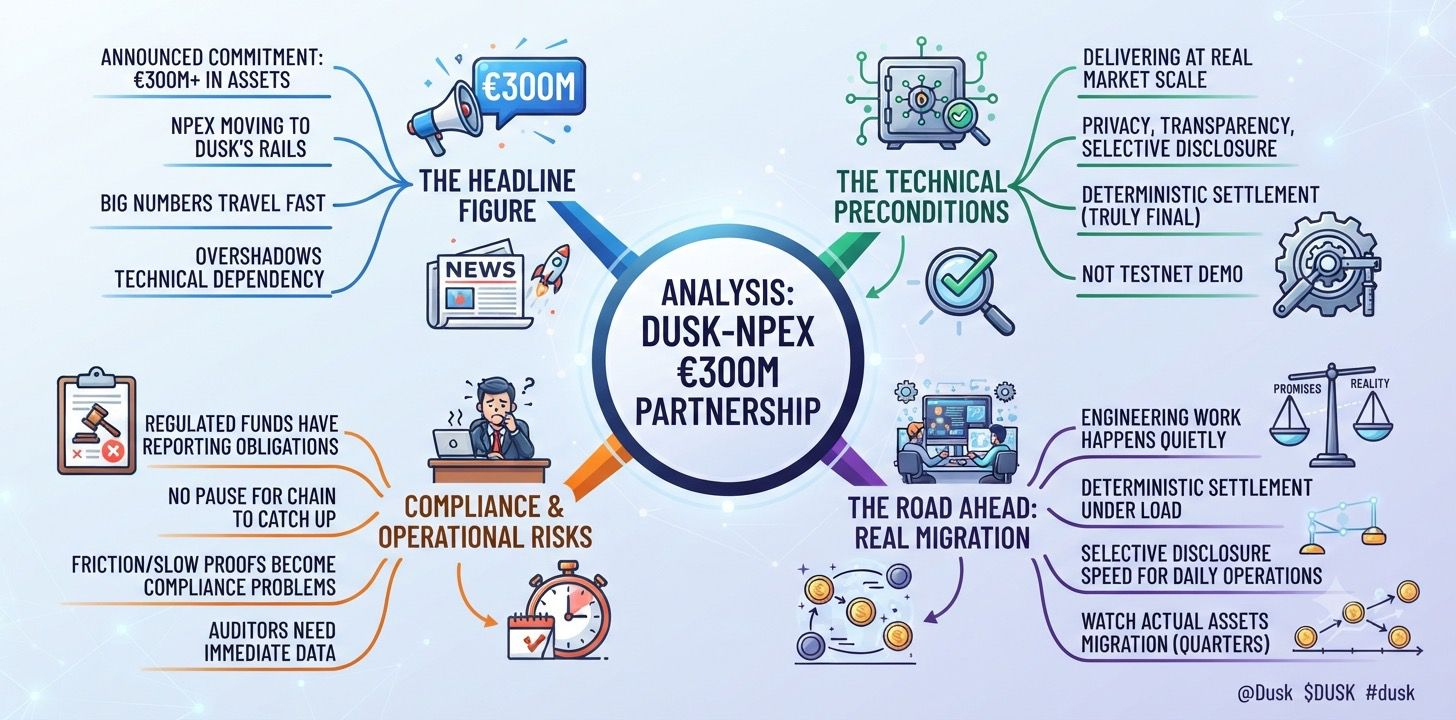
Big numbers travel faster than the infrastructure behind them, and €300M is exactly the kind of figure that gets repeated across headlines long before anyone checks what has to be true for it to become real. Dusk Network's NPEX partnership carries that number, and separating the number from the technical dependency underneath it is worth doing slowly instead of just once.
NPEX has committed to moving more than €300M in assets onto Dusk's rails. That commitment depends entirely on the base layer actually delivering privacy, transparency, selective disclosure, and deterministic settlement at the scale a real securities market requires, not a testnet demonstration with a handful of transactions. Regulated funds and bonds carry reporting obligations that do not pause for a chain to catch up technically, and any friction, slow disclosure proofs, settlement that is not truly final, becomes a compliance problem for NPEX, not just a technical inconvenience for Dusk. A fund administrator cannot tell an auditor that the blockchain was still finishing its proof generation when the reporting deadline passed.
This is the part most coverage skips. The announcement gets the headline. The engineering work of proving deterministic settlement holds under real load, or that selective disclosure can generate proofs fast enough for daily fund operations, happens quietly afterward and rarely gets its own headline at all, even though it is the part that actually determines whether €300M shows up onchain or quietly becomes €30M over a longer timeline than announced.
I am not betting against Dusk here, just refusing to treat the number as already real. A properly built settlement and disclosure layer is a precondition, not a guarantee, and the honest way to track this story is by watching actual assets migrate over the next several quarters, not by re-quoting the same figure every time it comes up.
#dusk $DUSK @Dusk_Foundation
Big numbers travel faster than the infrastructure behind them, and €300M is exactly the kind of figure that gets repeated across headlines long before anyone checks what has to be true for it to become real. Dusk Network's NPEX partnership carries that number, and separating the number from the technical dependency underneath it is worth doing slowly instead of just once.
NPEX has committed to moving more than €300M in assets onto Dusk's rails. That commitment depends entirely on the base layer actually delivering privacy, transparency, selective disclosure, and deterministic settlement at the scale a real securities market requires, not a testnet demonstration with a handful of transactions. Regulated funds and bonds carry reporting obligations that do not pause for a chain to catch up technically, and any friction, slow disclosure proofs, settlement that is not truly final, becomes a compliance problem for NPEX, not just a technical inconvenience for Dusk. A fund administrator cannot tell an auditor that the blockchain was still finishing its proof generation when the reporting deadline passed.
This is the part most coverage skips. The announcement gets the headline. The engineering work of proving deterministic settlement holds under real load, or that selective disclosure can generate proofs fast enough for daily fund operations, happens quietly afterward and rarely gets its own headline at all, even though it is the part that actually determines whether €300M shows up onchain or quietly becomes €30M over a longer timeline than announced.
I am not betting against Dusk here, just refusing to treat the number as already real. A properly built settlement and disclosure layer is a precondition, not a guarantee, and the honest way to track this story is by watching actual assets migrate over the next several quarters, not by re-quoting the same figure every time it comes up.
#dusk $DUSK @Dusk
2
112
·
--
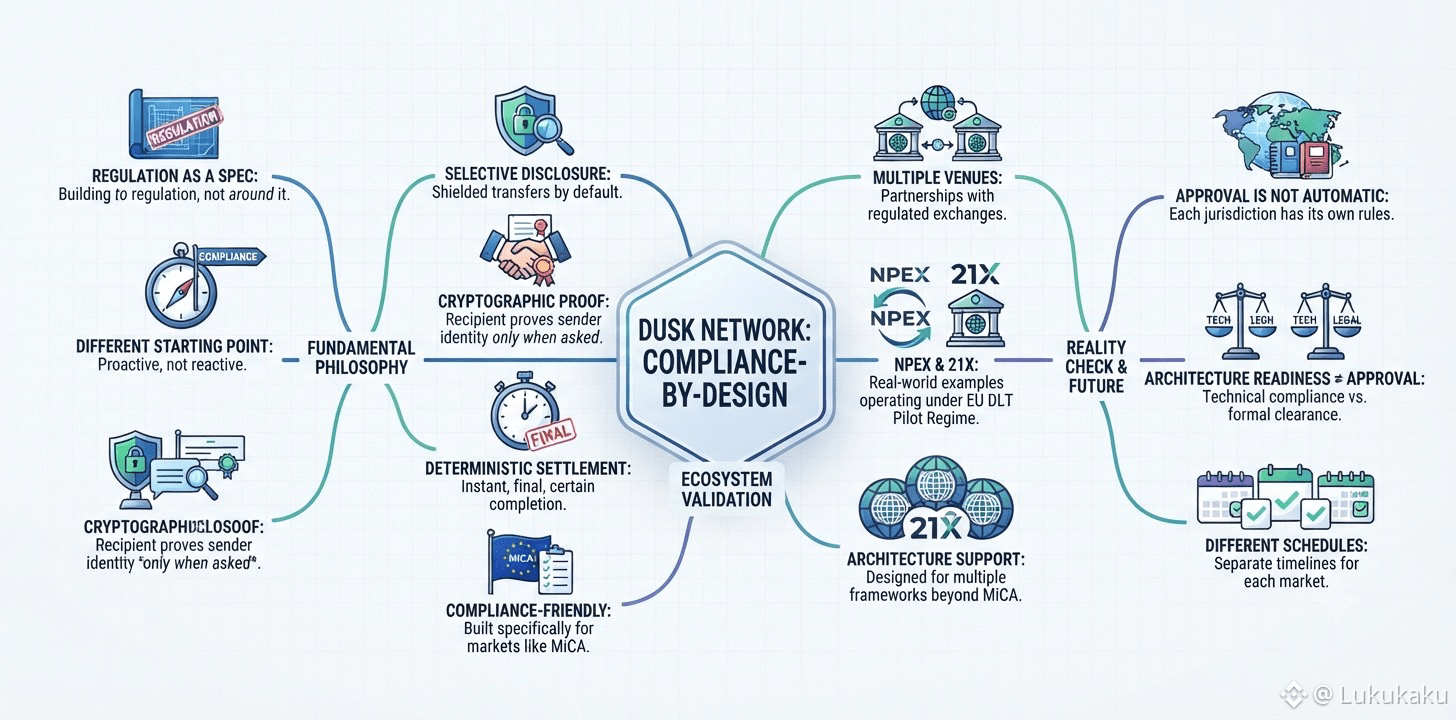
Regulation in crypto usually gets treated as an obstacle to design around. Dusk Network treats it as a spec to build to, and that's a meaningfully different starting point.
Selective disclosure is the mechanism that makes this possible in practice, not just in messaging. A shielded transfer on Dusk hides the sender and amount from public view by default, but the recipient can cryptographically prove who paid them when asked, satisfying rules like the EU's travel regulations without exposing the transaction to everyone else watching the chain. Add deterministic settlement, transactions that reach final, certain completion rather than a slowly improving probability, and the pieces start to resemble something built specifically for markets operating under frameworks like MiCA, rather than a general purpose chain hoping compliance works out later.
That ordering matters more than it gets credit for. Retrofitting compliance onto a transparent-by-default chain, or onto a fully private one, tends to produce awkward compromises. Designing selective disclosure into the base protocol from the start is a harder engineering problem upfront, in exchange for fewer painful compromises down the line.
NPEX isn't the only regulated venue in this picture either. Dusk has also connected with 21X, a digital asset exchange operating under the EU's DLT Pilot Regime, which suggests the compliance-first design isn't a one-partnership story but something the architecture is meant to support across multiple regulated venues and, eventually, multiple frameworks beyond MiCA alone.
None of this means regulatory approval is automatic or universal. MiCA covers the EU. Other jurisdictions have their own frameworks, their own regulators, their own timelines, and architecture readiness on Dusk's side doesn't shortcut any of that. Being built for compliance and being formally cleared for it in every market that matters are two different milestones, on two different schedules.
@Dusk_Foundation $DUSK #dusk
Regulation in crypto usually gets treated as an obstacle to design around. Dusk Network treats it as a spec to build to, and that's a meaningfully different starting point.
Selective disclosure is the mechanism that makes this possible in practice, not just in messaging. A shielded transfer on Dusk hides the sender and amount from public view by default, but the recipient can cryptographically prove who paid them when asked, satisfying rules like the EU's travel regulations without exposing the transaction to everyone else watching the chain. Add deterministic settlement, transactions that reach final, certain completion rather than a slowly improving probability, and the pieces start to resemble something built specifically for markets operating under frameworks like MiCA, rather than a general purpose chain hoping compliance works out later.
That ordering matters more than it gets credit for. Retrofitting compliance onto a transparent-by-default chain, or onto a fully private one, tends to produce awkward compromises. Designing selective disclosure into the base protocol from the start is a harder engineering problem upfront, in exchange for fewer painful compromises down the line.
NPEX isn't the only regulated venue in this picture either. Dusk has also connected with 21X, a digital asset exchange operating under the EU's DLT Pilot Regime, which suggests the compliance-first design isn't a one-partnership story but something the architecture is meant to support across multiple regulated venues and, eventually, multiple frameworks beyond MiCA alone.
None of this means regulatory approval is automatic or universal. MiCA covers the EU. Other jurisdictions have their own frameworks, their own regulators, their own timelines, and architecture readiness on Dusk's side doesn't shortcut any of that. Being built for compliance and being formally cleared for it in every market that matters are two different milestones, on two different schedules.
@Dusk $DUSK #dusk
88
·
--
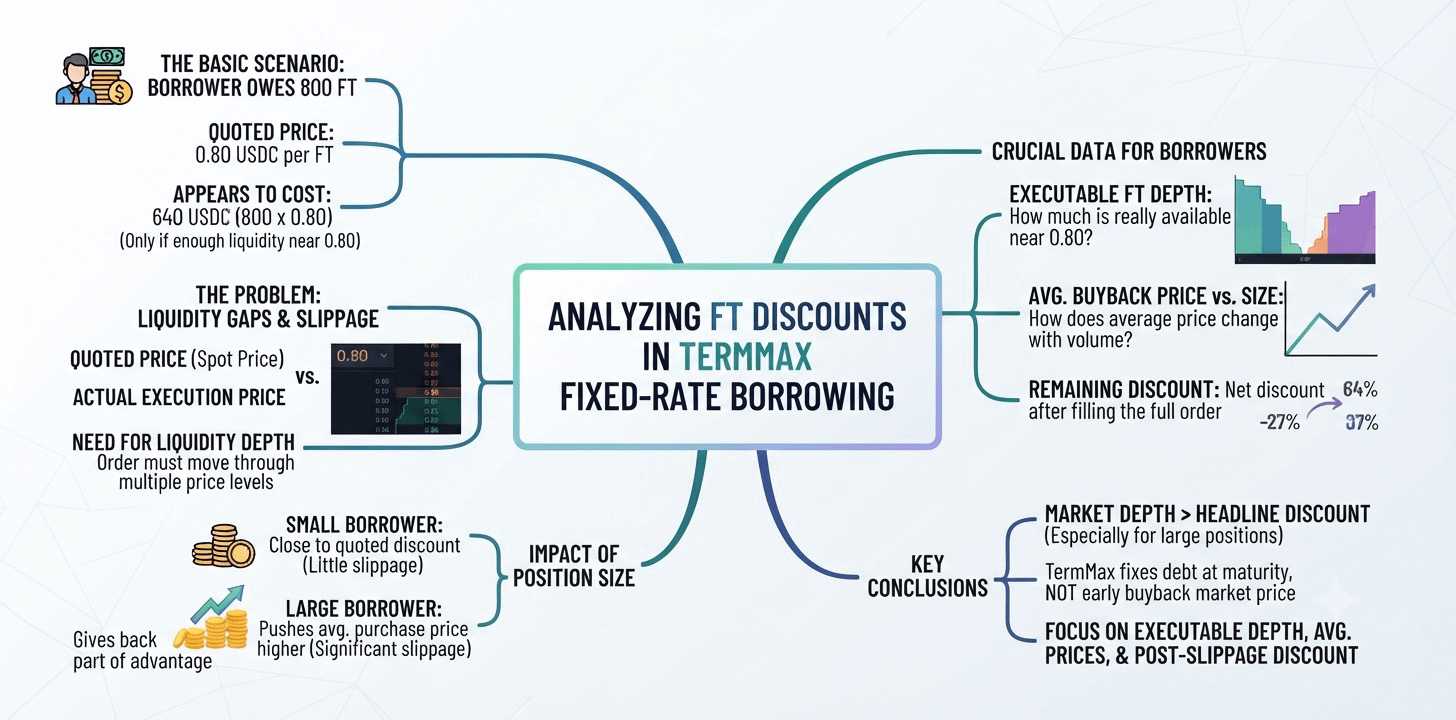
One TermMax example made me look at FT discounts in its fixed-rate borrowing markets a little differently.
A borrower might owe 800 Fixed-rate Tokens (FT). If FT is quoted at 0.80 USDC, buying back the full amount appears to cost 640 USDC.
But that only holds if there is enough FT available near 0.80.
The quoted price tells me where the market is trading. It does not tell me what it would actually cost to buy 800 FT, especially if the order has to move through several levels of liquidity.
That gap matters more as position size grows. A small borrower may get close to the quoted discount. A larger one could push the average purchase price higher and give back part of that advantage through slippage.
What I don't know yet is how quickly that happens in TermMax's FT markets.
The useful data would be the depth behind the quote: how much FT is available near 0.80, how the average buyback price changes with size, and how much of the discount to face value is still there once the full order is filled.
That tells me more than the spot FT price on its own.
TermMax can fix what a borrower owes at maturity. It cannot fix the price the market will offer when that borrower tries to buy the debt back early.
For larger positions, that makes market depth more important than the headline discount.
I am watching executable FT depth, average buyback prices across position sizes, and how much of the discount survives after slippage.
#termmax @termmax
One TermMax example made me look at FT discounts in its fixed-rate borrowing markets a little differently.
A borrower might owe 800 Fixed-rate Tokens (FT). If FT is quoted at 0.80 USDC, buying back the full amount appears to cost 640 USDC.
But that only holds if there is enough FT available near 0.80.
The quoted price tells me where the market is trading. It does not tell me what it would actually cost to buy 800 FT, especially if the order has to move through several levels of liquidity.
That gap matters more as position size grows. A small borrower may get close to the quoted discount. A larger one could push the average purchase price higher and give back part of that advantage through slippage.
What I don't know yet is how quickly that happens in TermMax's FT markets.
The useful data would be the depth behind the quote: how much FT is available near 0.80, how the average buyback price changes with size, and how much of the discount to face value is still there once the full order is filled.
That tells me more than the spot FT price on its own.
TermMax can fix what a borrower owes at maturity. It cannot fix the price the market will offer when that borrower tries to buy the debt back early.
For larger positions, that makes market depth more important than the headline discount.
I am watching executable FT depth, average buyback prices across position sizes, and how much of the discount survives after slippage.
#termmax @TermMax
1
2
81
·
--
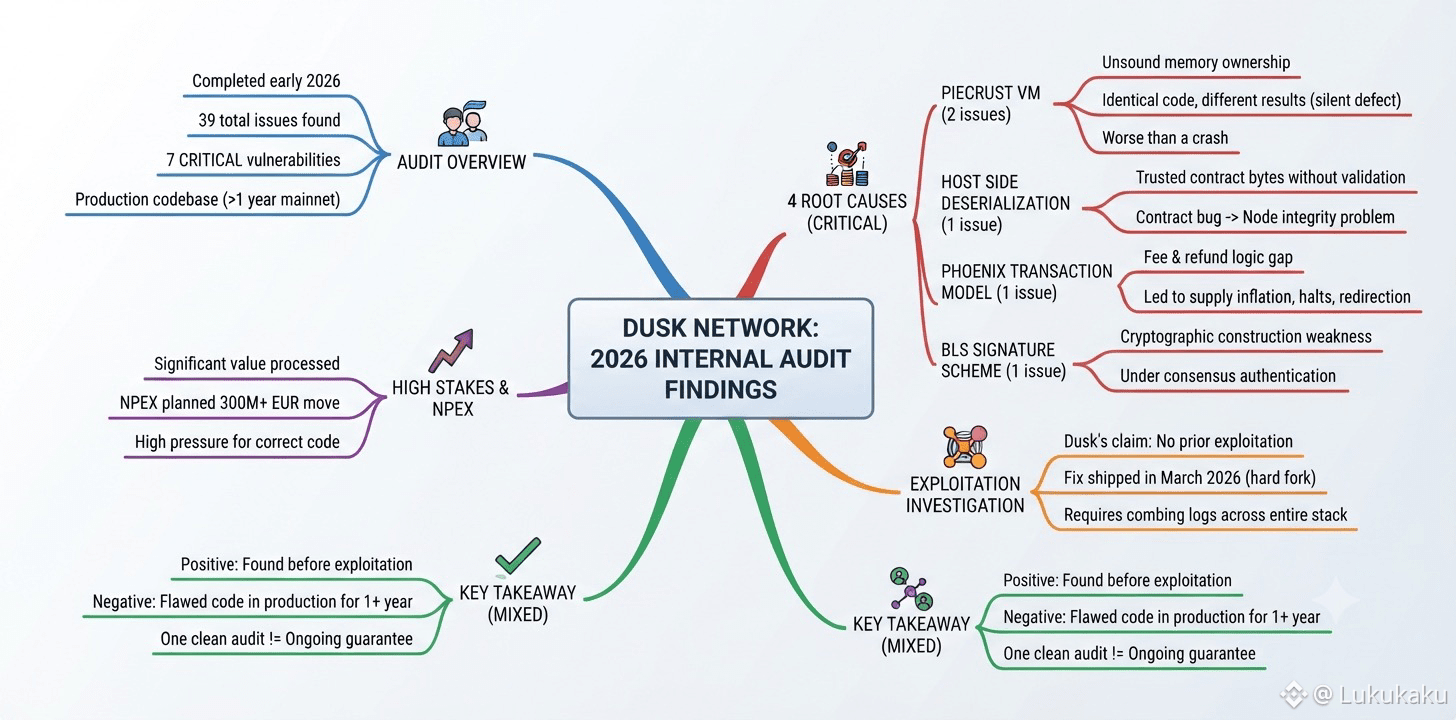
An uncomfortable fact is more useful than a comfortable one, so here is an uncomfortable fact about Dusk Network: an internal audit completed in early 2026 found 39 issues in its production codebase, seven of them critical, more than a year after mainnet had already been processing real value.
The four root causes behind those critical findings are worth naming plainly rather than smoothing over. Two came from unsound memory ownership in Piecrust, the virtual machine sandbox, that could let two honest nodes execute identical code and quietly compute different results, a defect category that is worse than a crash because it can stay invisible. One came from a host side deserialization path that trusted contract controlled bytes without validating them first, turning a contract level bug into a node integrity problem. Another sat in how Phoenix, the shielded transaction model, bound its fee and refund logic, a gap that on its own opened paths toward supply inflation, chain halts, and refund redirection all at once. The last was a cryptographic construction weakness in the BLS signature scheme sitting under consensus authentication itself. Investigating prior exploitation meant combing through logs and host level evidence across the whole stack, not just checking for one bug pattern in a transaction history.
Dusk says its own investigation found no evidence any of the seven were exploited before the fix shipped as a hard fork in March 2026, its largest release since launch. I have no way to independently confirm that claim, and neither does anyone reading this, though with NPEX alone planning to move over 300 million euros onto this codebase, the stakes for getting it right were never small. What I do take from it is more mixed than pure reassurance: catching this before exploitation is genuinely good work, but it also means code this consequential ran in production for over a year carrying flaws nobody had found yet. One clean audit is a milestone. It is not the same as an ongoing guarantee.
@Dusk_Foundation $DUSK #dusk
An uncomfortable fact is more useful than a comfortable one, so here is an uncomfortable fact about Dusk Network: an internal audit completed in early 2026 found 39 issues in its production codebase, seven of them critical, more than a year after mainnet had already been processing real value.
The four root causes behind those critical findings are worth naming plainly rather than smoothing over. Two came from unsound memory ownership in Piecrust, the virtual machine sandbox, that could let two honest nodes execute identical code and quietly compute different results, a defect category that is worse than a crash because it can stay invisible. One came from a host side deserialization path that trusted contract controlled bytes without validating them first, turning a contract level bug into a node integrity problem. Another sat in how Phoenix, the shielded transaction model, bound its fee and refund logic, a gap that on its own opened paths toward supply inflation, chain halts, and refund redirection all at once. The last was a cryptographic construction weakness in the BLS signature scheme sitting under consensus authentication itself. Investigating prior exploitation meant combing through logs and host level evidence across the whole stack, not just checking for one bug pattern in a transaction history.
Dusk says its own investigation found no evidence any of the seven were exploited before the fix shipped as a hard fork in March 2026, its largest release since launch. I have no way to independently confirm that claim, and neither does anyone reading this, though with NPEX alone planning to move over 300 million euros onto this codebase, the stakes for getting it right were never small. What I do take from it is more mixed than pure reassurance: catching this before exploitation is genuinely good work, but it also means code this consequential ran in production for over a year carrying flaws nobody had found yet. One clean audit is a milestone. It is not the same as an ongoing guarantee.
@Dusk $DUSK #dusk
1
83
·
--
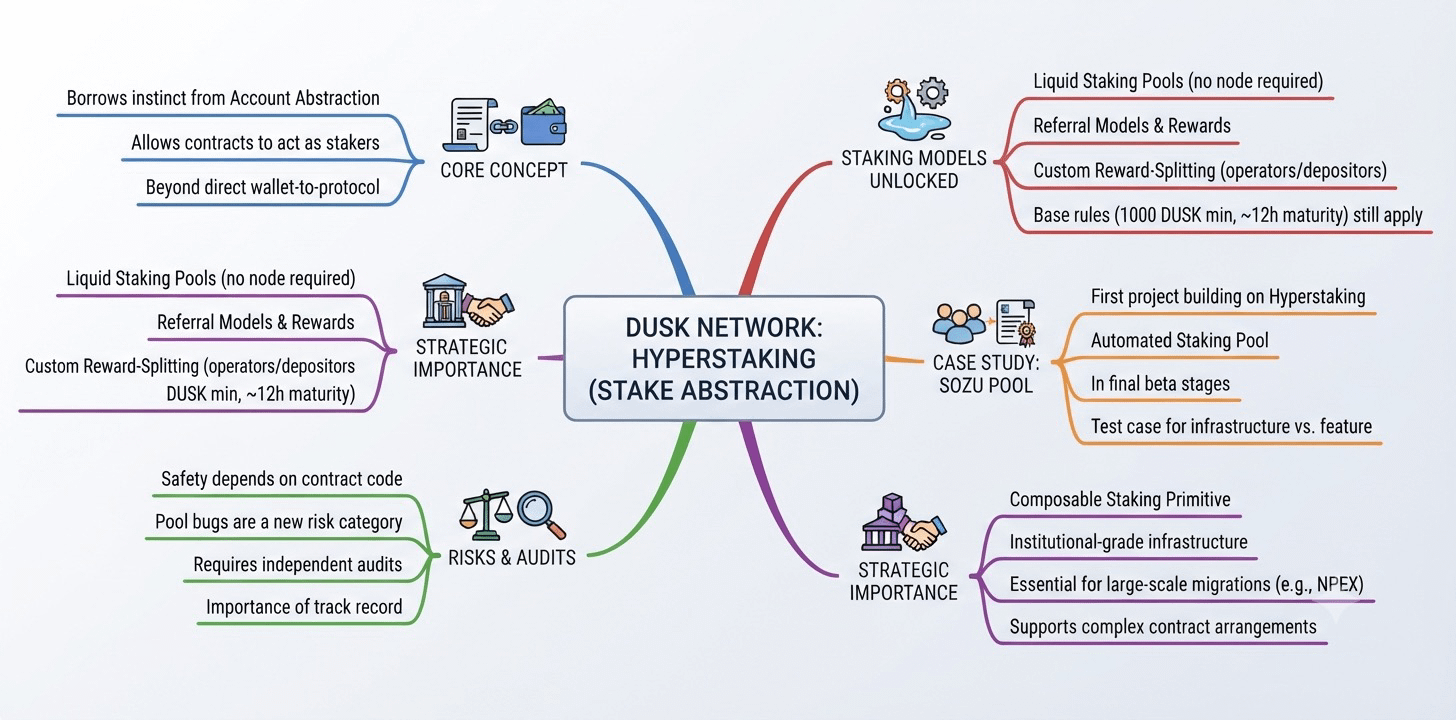
Account abstraction changed how people think about wallets on Ethereum, letting contracts do things only externally owned accounts could do before. Dusk Network borrowed that instinct and pointed it at staking, and the result, Hyperstaking, opens up staking models a plain wallet-to-protocol interaction never could.
Normally, staking is a direct relationship: a wallet locks DUSK, a node runs, rewards flow back to that wallet. Hyperstaking unlocks liquid staking pools where users never run their own node, referral models rewarding people for bringing in new stakers, and custom reward-splitting between operators and depositors. The 1,000 DUSK minimum and roughly 12-hour maturity still apply to contracts exactly as to individuals.
Sozu is the first project actually building on this, running an automated staking pool currently in its final beta stages, letting users stake DUSK through a contract without touching node infrastructure themselves. That's the real test case for whether Hyperstaking becomes infrastructure other people build businesses on, rather than a feature that exists mostly in documentation.
Abstracting staking behind a contract means the safety of a user's funds now depends on that contract's code, not only on Dusk Network's base protocol. A bug in a Hyperstaking pool is a different risk category than a bug in the core staking contract, one only fully understood after real audits and after these contracts have held meaningful value for a while.
Composable staking like this is exactly the kind of financial infrastructure Dusk Network will need more of if plans like the 300-million-euro-plus NPEX asset migration actually materialize, since institutions tend to need contract-level arrangements, not just individual wallets.
Programmable staking is a genuinely useful primitive. I'd want any Hyperstaking pool audited independently before trusting it with serious size.
@Dusk_Foundation line $DUSK #dusk
Account abstraction changed how people think about wallets on Ethereum, letting contracts do things only externally owned accounts could do before. Dusk Network borrowed that instinct and pointed it at staking, and the result, Hyperstaking, opens up staking models a plain wallet-to-protocol interaction never could.
Normally, staking is a direct relationship: a wallet locks DUSK, a node runs, rewards flow back to that wallet. Hyperstaking unlocks liquid staking pools where users never run their own node, referral models rewarding people for bringing in new stakers, and custom reward-splitting between operators and depositors. The 1,000 DUSK minimum and roughly 12-hour maturity still apply to contracts exactly as to individuals.
Sozu is the first project actually building on this, running an automated staking pool currently in its final beta stages, letting users stake DUSK through a contract without touching node infrastructure themselves. That's the real test case for whether Hyperstaking becomes infrastructure other people build businesses on, rather than a feature that exists mostly in documentation.
Abstracting staking behind a contract means the safety of a user's funds now depends on that contract's code, not only on Dusk Network's base protocol. A bug in a Hyperstaking pool is a different risk category than a bug in the core staking contract, one only fully understood after real audits and after these contracts have held meaningful value for a while.
Composable staking like this is exactly the kind of financial infrastructure Dusk Network will need more of if plans like the 300-million-euro-plus NPEX asset migration actually materialize, since institutions tend to need contract-level arrangements, not just individual wallets.
Programmable staking is a genuinely useful primitive. I'd want any Hyperstaking pool audited independently before trusting it with serious size.
@Dusk line $DUSK #dusk
1
62
·
--
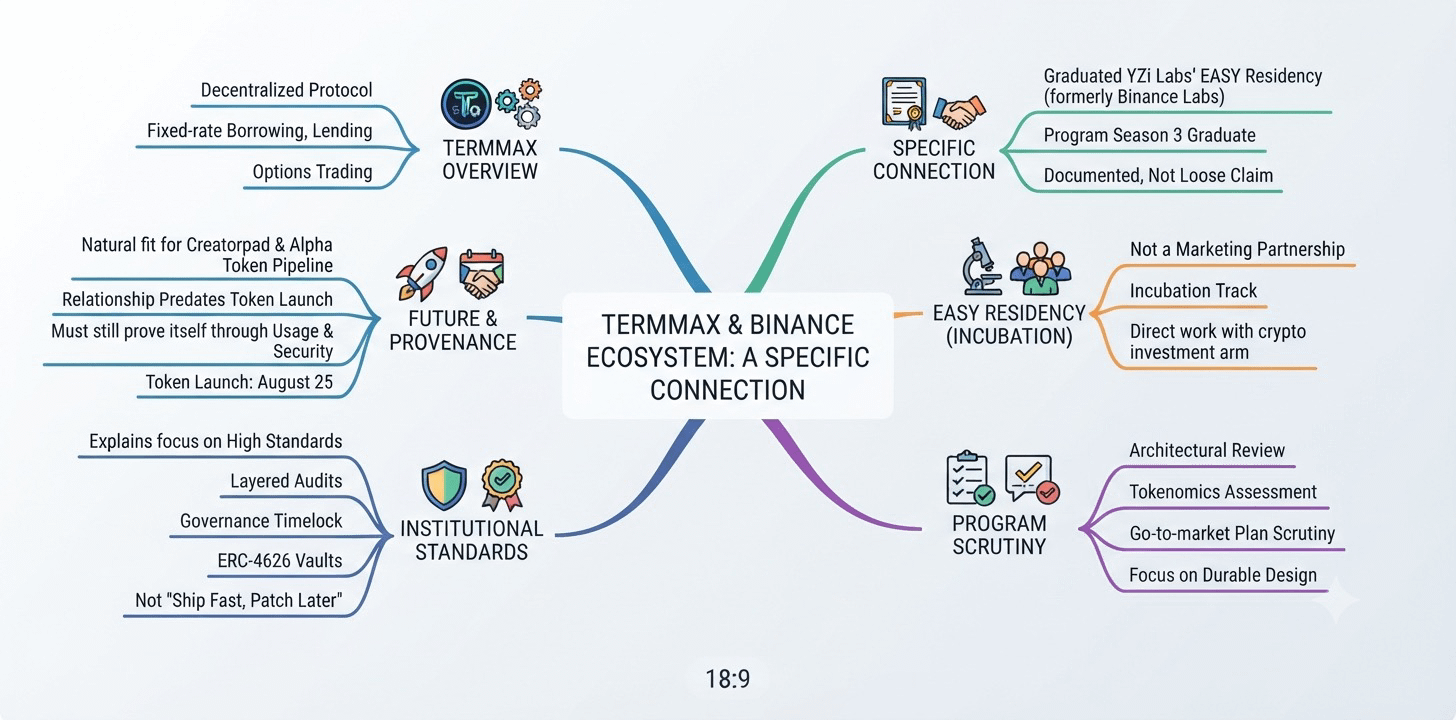
Plenty of projects claim a connection to Binance's ecosystem loosely. TermMax, a decentralized protocol spanning fixed-rate borrowing, lending, and options trading, has a connection that is specific and documented: it graduated from YZi Labs' EASY Residency program, formerly known as Binance Labs, during that program's third season.
The EASY Residency is not a marketing partnership. It is an incubation track where early-stage teams work directly with one of the industry's most active crypto investment arms, getting scrutiny on their technical architecture, tokenomics, and go-to-market plan before they are considered graduates rather than just applicants. For TermMax, going through that process means its three-token model, its vault and curator system, and its fixed-rate matching engine were reviewed by people whose job is separating durable protocol design from projects that look good in a pitch deck but do not hold up under real usage.
I think this matters more for what it explains than for what it promises. It helps explain why TermMax has consistently built toward institutional-grade standards, audits layered on audits, a documented governance timelock, ERC-4626 compliant vaults, rather than shipping fast and patching later the way plenty of DeFi projects still do. It also helps explain the natural fit of running this Creatorpad campaign and launching TermMax Alpha specifically to serve Binance's own Alpha token pipeline. This is not TermMax bolting onto Binance's ecosystem opportunistically. The relationship predates the token entirely.
None of this should be read as an endorsement of investment outcomes. Graduating an incubation program says a team cleared a specific bar at a specific point in time, not that every subsequent decision will be right. TermMax still has to prove itself the same way any protocol does, through usage, through security, and now, through how its token launch actually plays out starting August 25.
@termmax #TermMax
Plenty of projects claim a connection to Binance's ecosystem loosely. TermMax, a decentralized protocol spanning fixed-rate borrowing, lending, and options trading, has a connection that is specific and documented: it graduated from YZi Labs' EASY Residency program, formerly known as Binance Labs, during that program's third season.
The EASY Residency is not a marketing partnership. It is an incubation track where early-stage teams work directly with one of the industry's most active crypto investment arms, getting scrutiny on their technical architecture, tokenomics, and go-to-market plan before they are considered graduates rather than just applicants. For TermMax, going through that process means its three-token model, its vault and curator system, and its fixed-rate matching engine were reviewed by people whose job is separating durable protocol design from projects that look good in a pitch deck but do not hold up under real usage.
I think this matters more for what it explains than for what it promises. It helps explain why TermMax has consistently built toward institutional-grade standards, audits layered on audits, a documented governance timelock, ERC-4626 compliant vaults, rather than shipping fast and patching later the way plenty of DeFi projects still do. It also helps explain the natural fit of running this Creatorpad campaign and launching TermMax Alpha specifically to serve Binance's own Alpha token pipeline. This is not TermMax bolting onto Binance's ecosystem opportunistically. The relationship predates the token entirely.
None of this should be read as an endorsement of investment outcomes. Graduating an incubation program says a team cleared a specific bar at a specific point in time, not that every subsequent decision will be right. TermMax still has to prove itself the same way any protocol does, through usage, through security, and now, through how its token launch actually plays out starting August 25.
@TermMax #TermMax
83
·
--
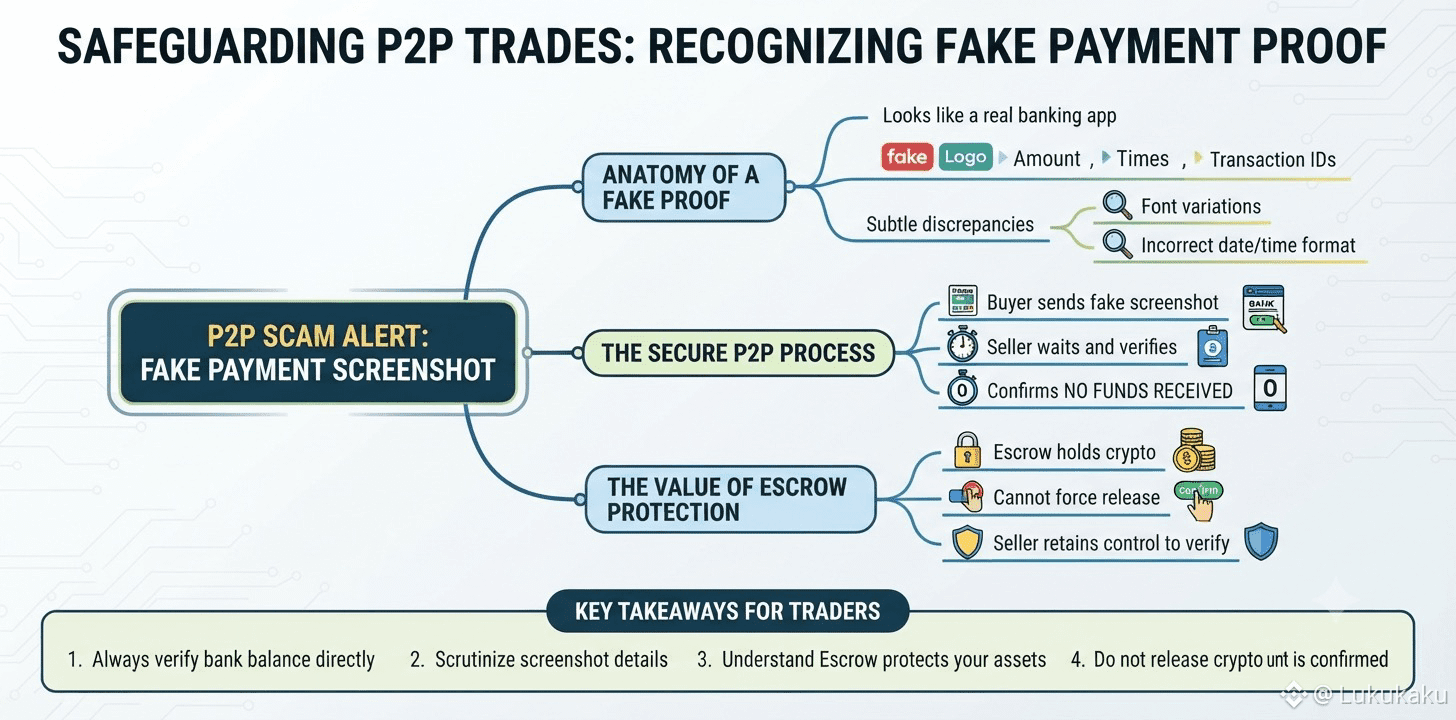
Chiêu trò giả mạo ảnh chụp màn hình xác nhận chuyển khoản là một trong những thủ đoạn tôi từng chứng kiến khi giao dịch trên Binance P2P, và tôi muốn chia sẻ lại để những người mới có thể cảnh giác hơn.
Người mua gửi cho tôi một ảnh chụp trông rất giống giao diện ứng dụng ngân hàng thật, với đầy đủ logo, số tiền, thời gian và cả mã giao dịch. Nhìn thoáng qua, khó có thể phát hiện đây là ảnh đã qua chỉnh sửa. Tuy nhiên, khi tôi để ý kỹ, phông chữ hiển thị số tiền có phần hơi khác so với những ảnh chụp thật tôi từng thấy từ chính ngân hàng đó, và định dạng thời gian cũng không hoàn toàn khớp với chuẩn thông thường.
Dù nghi ngờ, tôi không dựa vào cảm giác để quyết định, mà chỉ chờ đến khi tự kiểm tra ứng dụng ngân hàng và xác nhận số dư đã thay đổi. Kết quả đúng như dự đoán, không có khoản tiền nào được chuyển vào tài khoản của tôi.
Đây chính là lúc tôi thực sự thấm thía giá trị của cơ chế ký quỹ trên Binance P2P. Dù người mua có tinh vi đến đâu trong việc làm giả bằng chứng thanh toán, họ vẫn không thể ép hệ thống tự động release crypto nếu tôi không chủ động nhấn nút đó. Ký quỹ không chỉ bảo vệ tôi về mặt kỹ thuật, mà còn cho tôi thời gian và quyền chủ động để xác minh trước khi đưa ra quyết định cuối cùng.
Với những người mới giao dịch trên Binance P2P, tôi thường khuyên nên dành thêm vài giây quan sát kỹ font chữ và bố cục trong bất kỳ ảnh chụp nào được gửi đến, dù đây chỉ là bước cảnh giác bổ sung, không thể thay thế cho việc tự kiểm tra tài khoản ngân hàng của chính mình.
@Binance_Vietnam #BinanceP2PAnToan
Chiêu trò giả mạo ảnh chụp màn hình xác nhận chuyển khoản là một trong những thủ đoạn tôi từng chứng kiến khi giao dịch trên Binance P2P, và tôi muốn chia sẻ lại để những người mới có thể cảnh giác hơn.
Người mua gửi cho tôi một ảnh chụp trông rất giống giao diện ứng dụng ngân hàng thật, với đầy đủ logo, số tiền, thời gian và cả mã giao dịch. Nhìn thoáng qua, khó có thể phát hiện đây là ảnh đã qua chỉnh sửa. Tuy nhiên, khi tôi để ý kỹ, phông chữ hiển thị số tiền có phần hơi khác so với những ảnh chụp thật tôi từng thấy từ chính ngân hàng đó, và định dạng thời gian cũng không hoàn toàn khớp với chuẩn thông thường.
Dù nghi ngờ, tôi không dựa vào cảm giác để quyết định, mà chỉ chờ đến khi tự kiểm tra ứng dụng ngân hàng và xác nhận số dư đã thay đổi. Kết quả đúng như dự đoán, không có khoản tiền nào được chuyển vào tài khoản của tôi.
Đây chính là lúc tôi thực sự thấm thía giá trị của cơ chế ký quỹ trên Binance P2P. Dù người mua có tinh vi đến đâu trong việc làm giả bằng chứng thanh toán, họ vẫn không thể ép hệ thống tự động release crypto nếu tôi không chủ động nhấn nút đó. Ký quỹ không chỉ bảo vệ tôi về mặt kỹ thuật, mà còn cho tôi thời gian và quyền chủ động để xác minh trước khi đưa ra quyết định cuối cùng.
Với những người mới giao dịch trên Binance P2P, tôi thường khuyên nên dành thêm vài giây quan sát kỹ font chữ và bố cục trong bất kỳ ảnh chụp nào được gửi đến, dù đây chỉ là bước cảnh giác bổ sung, không thể thay thế cho việc tự kiểm tra tài khoản ngân hàng của chính mình.
@Binance Vietnam #BinanceP2PAnToan
276
·
--
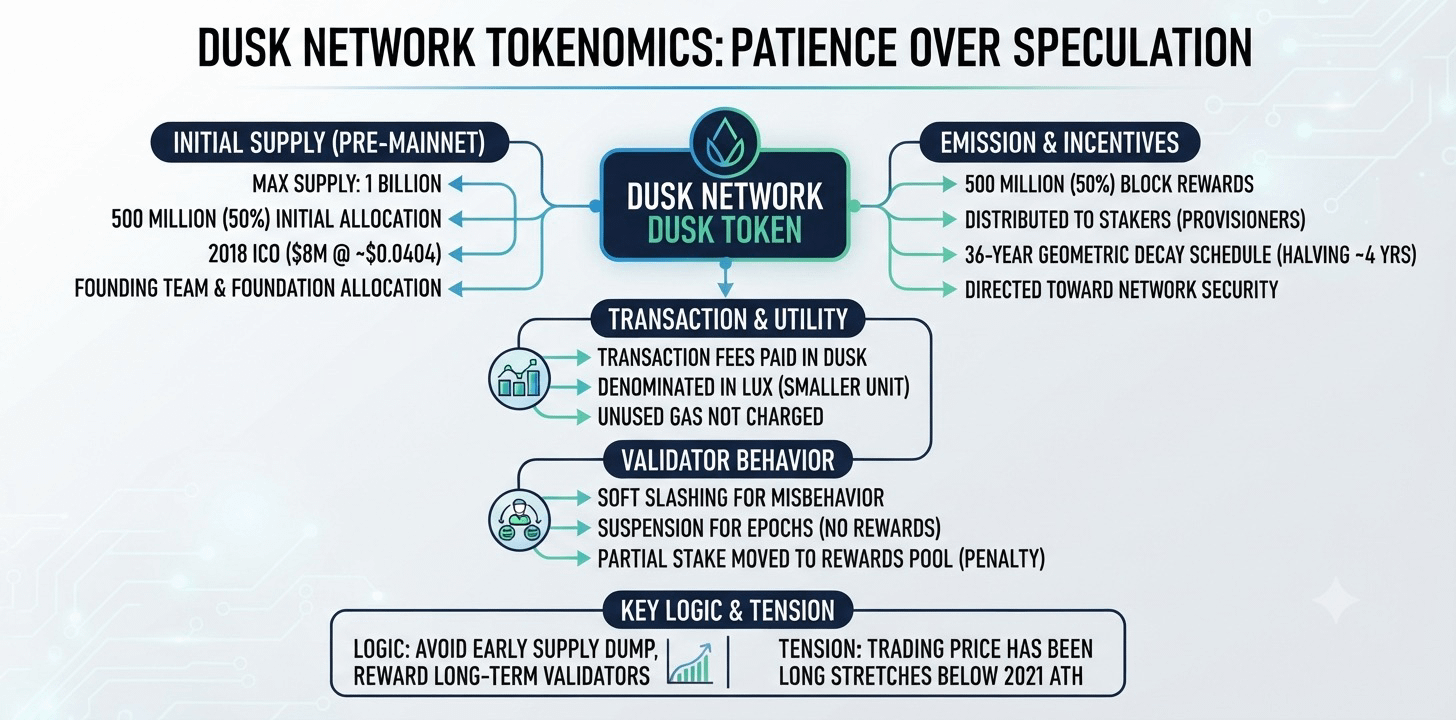
A token with a fixed supply cap sounds simple until you actually read how the emission is structured. Dusk Network's tokenomics reward patience over speculation, and I think that design choice explains a lot about who the project is actually building for.
DUSK has a maximum supply of 1 billion tokens. Half of that, 500 million, existed before mainnet launch through the 2018 initial coin offering, which raised roughly $8 million at about $0.0404 per token, plus allocations set aside for the founding team and the foundation supporting ongoing development. The remaining 500 million gets emitted to stakers as block rewards, distributed proportionally to the provisioners who actually participated in producing and ratifying each block over a 36-year period, following a geometric decay schedule that halves the emission rate roughly every 4 years, similar in spirit to Bitcoin's halving cycle but stretched across a much longer horizon and directed entirely toward network security rather than a broad mining reward. Transaction fees are paid in DUSK as well, denominated in a smaller unit called LUX, and unused gas from a transaction is never charged. Misbehaving validators face soft slashing rather than an outright burn: a provisioner can be suspended for one or more epochs with no rewards, or penalized by having a portion of stake moved into the claimable rewards pool.
The logic behind stretching emissions this far out is to avoid dumping large amounts of new supply on the market early, favoring a curve that keeps rewarding validators for decades.
Here's the tension worth sitting with honestly. DUSK has already spent long stretches trading far below its all time high from 2021.
DUSK is both the gas token and the long term security incentive behind all of this.
@Dusk_Foundation $DUSK #dusk
A token with a fixed supply cap sounds simple until you actually read how the emission is structured. Dusk Network's tokenomics reward patience over speculation, and I think that design choice explains a lot about who the project is actually building for.
DUSK has a maximum supply of 1 billion tokens. Half of that, 500 million, existed before mainnet launch through the 2018 initial coin offering, which raised roughly $8 million at about $0.0404 per token, plus allocations set aside for the founding team and the foundation supporting ongoing development. The remaining 500 million gets emitted to stakers as block rewards, distributed proportionally to the provisioners who actually participated in producing and ratifying each block over a 36-year period, following a geometric decay schedule that halves the emission rate roughly every 4 years, similar in spirit to Bitcoin's halving cycle but stretched across a much longer horizon and directed entirely toward network security rather than a broad mining reward. Transaction fees are paid in DUSK as well, denominated in a smaller unit called LUX, and unused gas from a transaction is never charged. Misbehaving validators face soft slashing rather than an outright burn: a provisioner can be suspended for one or more epochs with no rewards, or penalized by having a portion of stake moved into the claimable rewards pool.
The logic behind stretching emissions this far out is to avoid dumping large amounts of new supply on the market early, favoring a curve that keeps rewarding validators for decades.
Here's the tension worth sitting with honestly. DUSK has already spent long stretches trading far below its all time high from 2021.
DUSK is both the gas token and the long term security incentive behind all of this.
@Dusk $DUSK #dusk
55
·
--
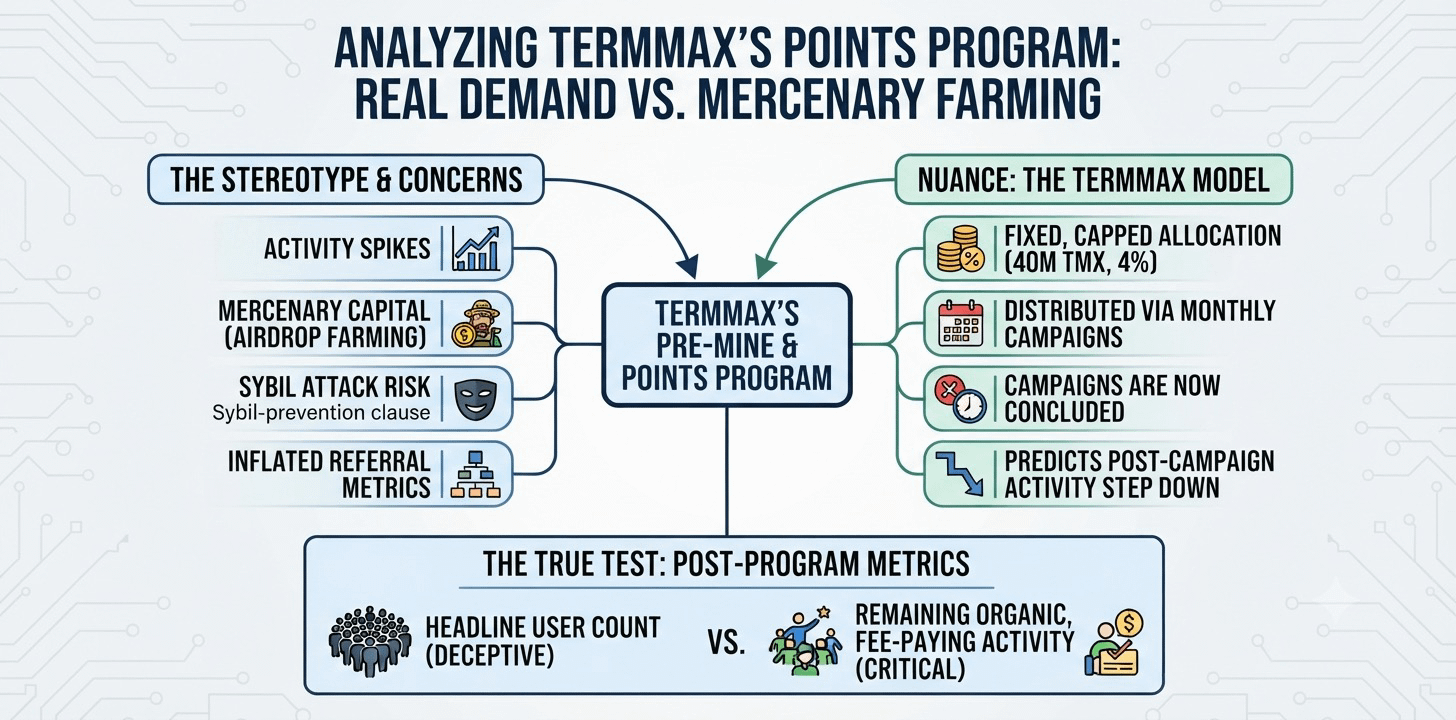
Every DeFi protocol running a points program eventually has to answer the same uncomfortable question: how much of this activity is real demand, and how much is mercenary capital farming a future token. TermMax's own numbers, over 1 million users, 837,000 registered wallets, a reported peak of 170,000 daily active users across more than 100 markets, invite exactly that scrutiny, because they were substantially built during a pre-mine phase explicitly designed to reward participation before TMX existed as a tradable token.
The stereotype is well earned across the category. Points programs reliably produce activity spikes that collapse the moment rewards stop, because a meaningful share of that volume was never about the product, it was about positioning for an airdrop. TermMax's own leaderboard documentation even includes a Sybil-prevention clause reserving the right to retroactively revoke rewards from detected Sybil activity, which is itself an admission that farmed, non-organic participation was a live concern worth building defenses against from the start. A tiered referral system stacked on top, rewarding users for bringing in active referees, adds another lever that can inflate headline numbers without necessarily reflecting deeper organic conviction in the product.
Here is where I think the picture gets more nuanced than the stereotype allows. Unlike a protocol paying out inflationary emissions indefinitely, TermMax's pre-mine was a fixed, capped allocation, 40 million TMX, 4% of total supply, distributed once through monthly campaigns and then finished for good. Activity generated purely to farm a program that has already concluded should, in theory, show up as a step down in usage now rather than a permanent floor propped up by ongoing rewards. Whether that step down actually happened, and how much real fee-paying activity remains underneath it, is the number worth checking directly rather than assuming from the headline user count alone.
@termmax #TermMax
Every DeFi protocol running a points program eventually has to answer the same uncomfortable question: how much of this activity is real demand, and how much is mercenary capital farming a future token. TermMax's own numbers, over 1 million users, 837,000 registered wallets, a reported peak of 170,000 daily active users across more than 100 markets, invite exactly that scrutiny, because they were substantially built during a pre-mine phase explicitly designed to reward participation before TMX existed as a tradable token.
The stereotype is well earned across the category. Points programs reliably produce activity spikes that collapse the moment rewards stop, because a meaningful share of that volume was never about the product, it was about positioning for an airdrop. TermMax's own leaderboard documentation even includes a Sybil-prevention clause reserving the right to retroactively revoke rewards from detected Sybil activity, which is itself an admission that farmed, non-organic participation was a live concern worth building defenses against from the start. A tiered referral system stacked on top, rewarding users for bringing in active referees, adds another lever that can inflate headline numbers without necessarily reflecting deeper organic conviction in the product.
Here is where I think the picture gets more nuanced than the stereotype allows. Unlike a protocol paying out inflationary emissions indefinitely, TermMax's pre-mine was a fixed, capped allocation, 40 million TMX, 4% of total supply, distributed once through monthly campaigns and then finished for good. Activity generated purely to farm a program that has already concluded should, in theory, show up as a step down in usage now rather than a permanent floor propped up by ongoing rewards. Whether that step down actually happened, and how much real fee-paying activity remains underneath it, is the number worth checking directly rather than assuming from the headline user count alone.
@TermMax #TermMax
1
1
110
·
--
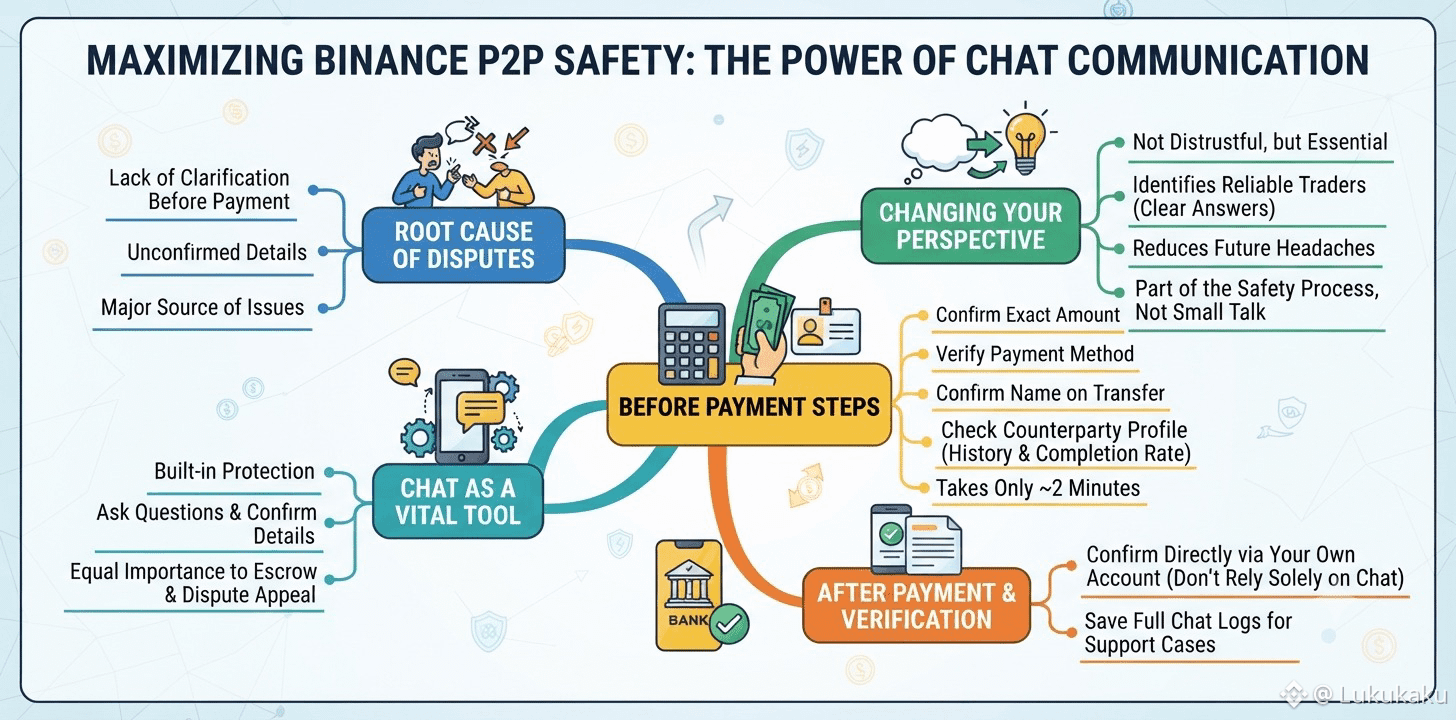
Most of the disputes I have heard about from other traders on Binance P2P seem to trace back to the same root cause: a detail that was never clarified before payment happened. Binance P2P provides a built in chat specifically so both sides can ask questions and confirm details before anything moves, and I have come to treat that chat as one of the most useful protections available, right alongside escrow and the dispute appeal process.
Before I send or expect any payment now, I use the chat to confirm the exact amount, the payment method, and the name that should appear on the transfer, even when an order seems straightforward. This takes maybe 2 extra minutes, but it has prevented several situations that could have easily turned into disagreements later. I also check the counterparty's profile during this same window, looking at their trade history and completion rate while we are still finalizing details together.
Once payment is sent, I still confirm it directly through my own account rather than relying on anything shared in chat, since a clear conversation beforehand does not replace verifying the transfer itself. I save the full chat log along with my confirmation for every completed order, which has made the few times I needed to contact support noticeably faster. A few clear questions asked early on Binance P2P have saved me far more time than they have ever cost.
I used to think asking too many questions in chat might come across as distrustful or slow the trade down unnecessarily, but every experienced trader I have talked to says the opposite is true. A merchant or buyer who answers clearly and patiently is usually someone worth trading with again, while hesitation or vague responses tell you just as much before any money moves. Treating the chat as part of the actual safety process, not just small talk before the real transaction, changed how I approach every single order on Binance P2P.
@Binance_Vietnam #BinanceP2PAnToan $RICE $BTW
Most of the disputes I have heard about from other traders on Binance P2P seem to trace back to the same root cause: a detail that was never clarified before payment happened. Binance P2P provides a built in chat specifically so both sides can ask questions and confirm details before anything moves, and I have come to treat that chat as one of the most useful protections available, right alongside escrow and the dispute appeal process.
Before I send or expect any payment now, I use the chat to confirm the exact amount, the payment method, and the name that should appear on the transfer, even when an order seems straightforward. This takes maybe 2 extra minutes, but it has prevented several situations that could have easily turned into disagreements later. I also check the counterparty's profile during this same window, looking at their trade history and completion rate while we are still finalizing details together.
Once payment is sent, I still confirm it directly through my own account rather than relying on anything shared in chat, since a clear conversation beforehand does not replace verifying the transfer itself. I save the full chat log along with my confirmation for every completed order, which has made the few times I needed to contact support noticeably faster. A few clear questions asked early on Binance P2P have saved me far more time than they have ever cost.
I used to think asking too many questions in chat might come across as distrustful or slow the trade down unnecessarily, but every experienced trader I have talked to says the opposite is true. A merchant or buyer who answers clearly and patiently is usually someone worth trading with again, while hesitation or vague responses tell you just as much before any money moves. Treating the chat as part of the actual safety process, not just small talk before the real transaction, changed how I approach every single order on Binance P2P.
@Binance Vietnam #BinanceP2PAnToan $RICE $BTW
236
·
--
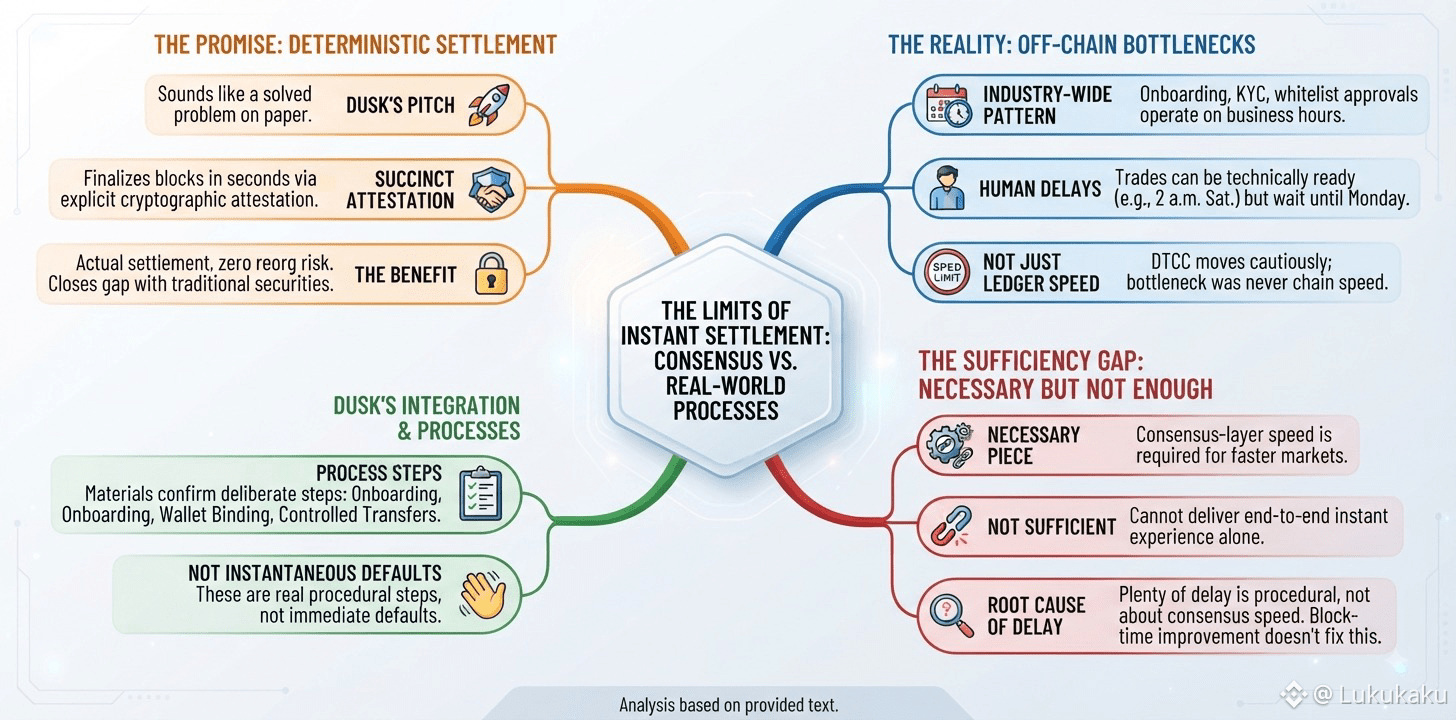
Deterministic settlement is the part of Dusk Network's pitch that sounds the most like a solved problem. Succinct Attestation finalizes blocks in seconds through explicit cryptographic attestation, not the probabilistic confirmation most chains rely on, so once a transaction settles, it is actually settled, with no reorg risk hanging over it. On paper that closes the gap between crypto's promise of instant settlement and the reality of how securities actually move.
The wider tokenized-securities industry keeps demonstrating why that gap does not close just because the chain is fast. Across the sector, onboarding still runs through whitelist approvals, KYC checks, and off-chain signoffs that operate on ordinary business hours regardless of how quickly the underlying chain can finalize a block. A trade can be technically ready to settle at 2 a.m. on a Saturday and still wait until Monday because a human step in the process has not caught up to what the cryptography can already do. Even the DTCC's own move toward tokenized-securities trading has followed a comparable pattern, with a limited rollout planned before a broader one arrives months later, precisely because the bottleneck was never the ledger's speed in the first place.
I have no reason to think Dusk Network is immune to this pattern, and its own materials describe onboarding, wallet binding, and controlled transfers as real, deliberate steps in the process rather than instantaneous defaults. Deterministic settlement at the consensus layer is a necessary piece of faster securities markets. It is not, by itself, sufficient to deliver the end-to-end instant experience the marketing language sometimes implies, because plenty of the delay in real markets was never actually about consensus speed to begin with, and no amount of block-time improvement changes that part of the process on its own.
@Dusk_Foundation $DUSK #dusk $TUT $GPS
Deterministic settlement is the part of Dusk Network's pitch that sounds the most like a solved problem. Succinct Attestation finalizes blocks in seconds through explicit cryptographic attestation, not the probabilistic confirmation most chains rely on, so once a transaction settles, it is actually settled, with no reorg risk hanging over it. On paper that closes the gap between crypto's promise of instant settlement and the reality of how securities actually move.
The wider tokenized-securities industry keeps demonstrating why that gap does not close just because the chain is fast. Across the sector, onboarding still runs through whitelist approvals, KYC checks, and off-chain signoffs that operate on ordinary business hours regardless of how quickly the underlying chain can finalize a block. A trade can be technically ready to settle at 2 a.m. on a Saturday and still wait until Monday because a human step in the process has not caught up to what the cryptography can already do. Even the DTCC's own move toward tokenized-securities trading has followed a comparable pattern, with a limited rollout planned before a broader one arrives months later, precisely because the bottleneck was never the ledger's speed in the first place.
I have no reason to think Dusk Network is immune to this pattern, and its own materials describe onboarding, wallet binding, and controlled transfers as real, deliberate steps in the process rather than instantaneous defaults. Deterministic settlement at the consensus layer is a necessary piece of faster securities markets. It is not, by itself, sufficient to deliver the end-to-end instant experience the marketing language sometimes implies, because plenty of the delay in real markets was never actually about consensus speed to begin with, and no amount of block-time improvement changes that part of the process on its own.
@Dusk $DUSK #dusk $TUT $GPS
1
68
·
--
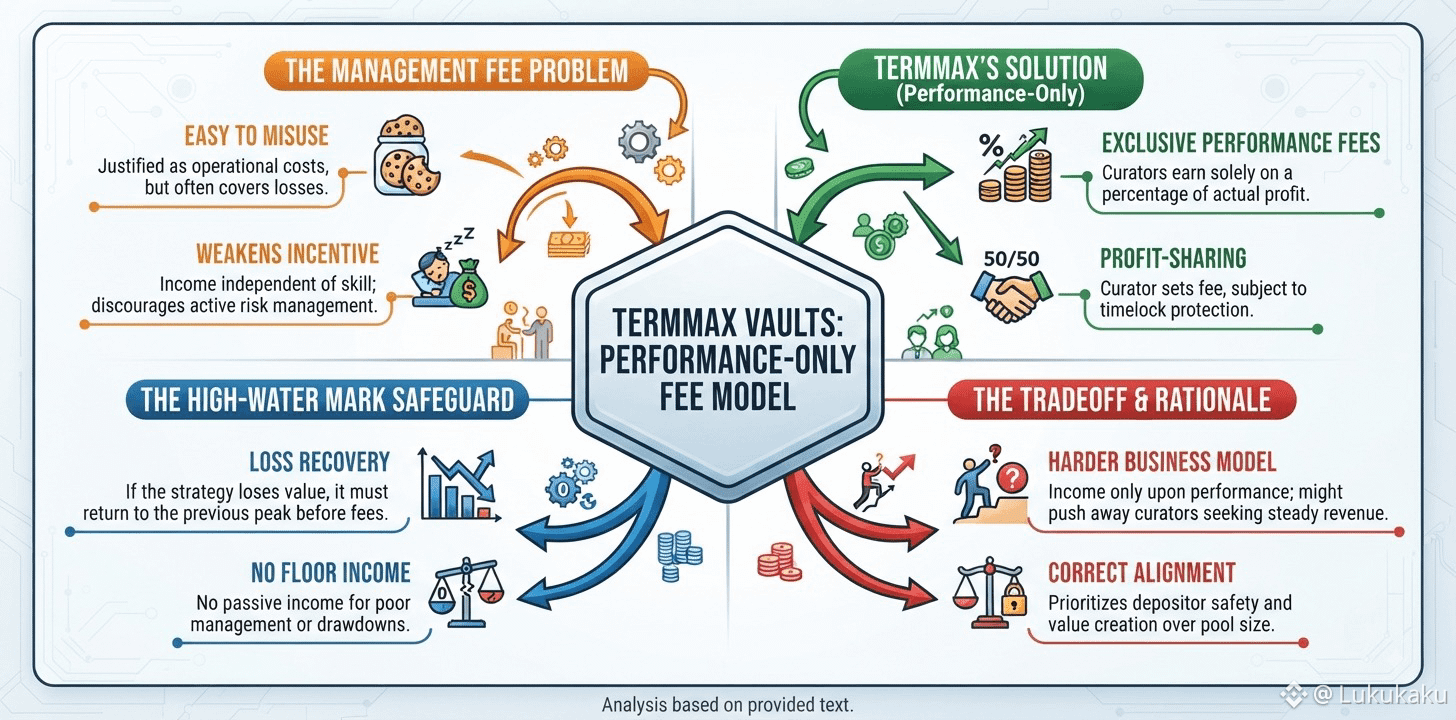
A management fee is one of the easiest things in finance to justify and one of the easiest to misuse. It gets framed as covering operational costs, and in a lot of vault products it ends up paid whether depositors made money that quarter or lost it. TermMax's vaults skip that fee structure entirely, and I think the decision is worth examining rather than just noting in passing.
Curators on TermMax earn exclusively through performance fees, a percentage of the actual profit their strategy generates for depositors, set by the curator but subject to timelock protection before changes take effect. Layered on top of that is a high-water mark requirement: if a curator's strategy loses value in one stretch, they have to bring depositors back to their previous peak before any new performance fee can be collected. There's no floor income for a curator who simply parks capital passively or manages it poorly, and no way to quietly collect fees during a drawdown.
The problem this solves is a specific one. A management fee creates income for a curator independent of skill, which weakens the incentive to actively manage risk once assets under management reach a comfortable size. Performance-only compensation with a high-water mark ties every dollar a curator earns to genuinely new value created for depositors, not to the size of the pool sitting under management.
The tradeoff is that TermMax's curator business is a harder one to run than a typical management-fee vault, since income only arrives when performance justifies it, which could push away curators who want steadier revenue regardless of strategy outcome. I think that's the correct tradeoff for a lending protocol handling other people's capital, even if it narrows the pool of curators willing to operate that way.
@termmax #TermMax $TUT $GPS
A management fee is one of the easiest things in finance to justify and one of the easiest to misuse. It gets framed as covering operational costs, and in a lot of vault products it ends up paid whether depositors made money that quarter or lost it. TermMax's vaults skip that fee structure entirely, and I think the decision is worth examining rather than just noting in passing.
Curators on TermMax earn exclusively through performance fees, a percentage of the actual profit their strategy generates for depositors, set by the curator but subject to timelock protection before changes take effect. Layered on top of that is a high-water mark requirement: if a curator's strategy loses value in one stretch, they have to bring depositors back to their previous peak before any new performance fee can be collected. There's no floor income for a curator who simply parks capital passively or manages it poorly, and no way to quietly collect fees during a drawdown.
The problem this solves is a specific one. A management fee creates income for a curator independent of skill, which weakens the incentive to actively manage risk once assets under management reach a comfortable size. Performance-only compensation with a high-water mark ties every dollar a curator earns to genuinely new value created for depositors, not to the size of the pool sitting under management.
The tradeoff is that TermMax's curator business is a harder one to run than a typical management-fee vault, since income only arrives when performance justifies it, which could push away curators who want steadier revenue regardless of strategy outcome. I think that's the correct tradeoff for a lending protocol handling other people's capital, even if it narrows the pool of curators willing to operate that way.
@TermMax #TermMax $TUT $GPS
1
259
Войдите, чтобы посмотреть больше материала
Присоединяйтесь к пользователям криптовалют по всему миру на Binance Square
⚡️ Получайте новейшую и полезную информацию о криптоактивах.
💬 Нам доверяет крупнейшая в мире криптобиржа.
👍 Получите достоверные аналитические данные от верифицированных создателей контента.
Эл. почта/номер телефона
В тренде
BinancekzWin
Просмотров: 32,367
93 обсуждают
МЕН ЧАТТА ЖАЙ ҒАНА ОТЫРЫП, 10 BNB ҰТЫП АЛДЫМ 😭🔥
Деп айтқым келеді, бірақ бұл шындық емес, Бірақ шындықтың өзі де керемет 💅
Жеңіл, танымдық, қызықты белсенділіктерге қатысып, қомақты сыйлықтар ұтып алу? Оңай, Binance KZ мүмкіндікке толы!
Чатта үнемі розыгрыштар болып тұрады, мен де жиі ұтып аламын. Бірақ ең басты жеңіс- өзіңе жайлы, адекватты комьюнити табу. Араласу барысында көп пайдалы нәрсе үйренесің, саудада көмектесетін білім аласың.
Тегін $50 алу приятно, ал сол білімнің арқасында оны көбейту ол менің жеңісім 💅
#BinancekzWin
Cabbage hater
·Лайков: 0
·Просмотров: 60
BinancePick
Просмотров: 2.5M
137,208 обсуждают
EarningsSeason
Просмотров: 4.9M
23,820 обсуждают