
股金团队威廉
178 Публикации

股金团队威廉
🔸股往金来团队🔸公众号:事件威廉 🔸推特:@0xWilliamETH 🔸币安广场建设者 🔸心藏山河 盘定输赢
Открытая сделка
Случайный трейдер
7.4 мес.
335 подписок(и/а)
1.3K+ подписчиков(а)
177 понравилось
Посты
Портфель
Все
Цитирования
Видео
Активно
PINNED

PINNED
Проверено


Binance News
·
--
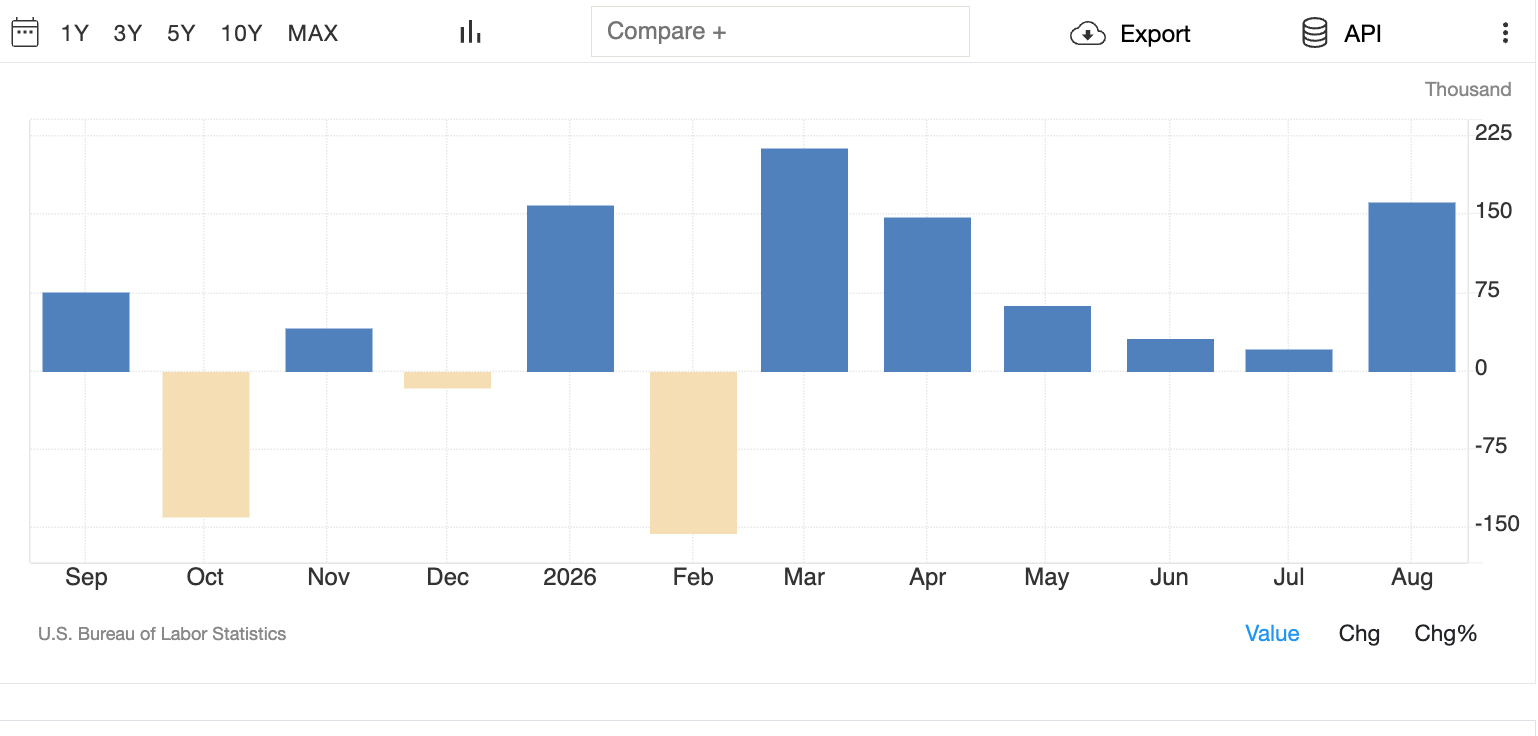
Market News Today: US Adds 162,000 Jobs in August, Nearly Triple Expectations, as July Revised to a Gain
The US economy added 162,000 jobs in August, following an upwardly revised 23,000 rise in July and far exceeding market expectations of 56,000.June and July were revised up by a combined 55,000.Food services and drinking places added 59,000 and local government education 42,000, largely offsetting the prior month's declines in those categories. Manufacturing continued its upward trend at 16,000, with machinery manufacturing up 6,000 and fabricated metal products up 6,000. Health care rose 13,000, led by home health care services at 11,000 and hospitals at 8,000.Information employment fell 23,000 — driven by computing infrastructure providers, data processing and web hosting at −8,000, publishing industries at −7,000, and broadcasting and content providers at −5,000.July Was Never Negative, Which Voids the Precedent ArgumentThe revision is the more consequential number than the headline.July printed −23,000 at the time, missing a Dow Jones consensus of +83,000 by 106,000. It has now been revised to +23,000 — a 46,000 swing that turns the month from contraction to expansion.Bloomberg Chief Economist Anna Wong had argued that a second consecutive negative payroll print would block a September hike, noting no precedent in modern Fed history for the central bank raising rates after two negative readings. There is now no first negative print, let alone a second. That constraint has evaporated.The revision direction also flipped. May and June were previously cut by a combined 103,000, which fed the narrative of a steadily deteriorating labor market. June and July have now been revised up by 55,000, which does the opposite.The Categories That Rebounded Are the Ones That Caused July's MissFood services and local government education adding a combined 101,000 is the specific detail that vindicates one side of a live dispute.The camp arguing July overstated the cooling had pointed to outsized declines in leisure and hospitality and in state and local government education as accounting for most of the downside surprise — implying a rebound rather than a trend. That is precisely what happened, and the BLS notes these gains "largely offset" the prior month's decrease.The opposing forecast came from Fifth Third's Bill Adams, who had projected a 25,000 drop citing labor force contraction of 1.3 million over twelve months and a larger effect from the TPS cancellation. That call missed by 187,000.Warsh's Labor Framing Is Now Fully ValidatedChair Kevin Warsh used Jackson Hole to describe labor markets as "consistent with full employment" and to explain soft monthly gains as a labor supply effect: "When labor supply is barely growing, monthly job gains are naturally going to run low."That framing was designed to hold for weak-but-positive prints. It no longer needs to. At 162,000, the gains are not low by any measure.Governors Michael Barr and Christopher Waller had already characterised the labor situation as "stable" and in "satisfactory shape" respectively. Three FOMC members voted for a hike at the previous meeting.The hawkish case rested entirely on inflation, with employment set aside as a non-constraint. This print removes even the residual doubt about that assumption.The Reaction Function Is Inverted, So This Is the Bearish OutcomeRates have sat at 3.50%-3.75% since December 2025, and the September question is whether tightening resumes rather than how fast easing proceeds.That reverses the usual trade. A strong print is the hawkish outcome.Hike odds had round-tripped over eight sessions — roughly 35% before Warsh spoke, up to about 70% Thursday, then back toward an even split heading into the release. A 106,000 beat against consensus, combined with upward revisions, argues for a sharp move back toward and likely through the earlier highs.The FOMC decides September 15-16, with CPI landing September 11. Warsh built his case on PCE at 3.7% annually and 4.1% over six months. Labor is no longer available as a counterargument.Information Employment Falling 23,000 Is the Detail Worth TrackingWhile every other major category added, information shed 23,000 — with computing infrastructure providers, data processing and web hosting alone down 8,000.That is an AI-adjacent sector contracting in a month when manufacturing, health care and hospitality all expanded. It is a single month and should not be over-read, but it is the first clear instance of the automation displacement thesis appearing in a category-level breakdown rather than in forecasts.Warsh flagged this question directly at Jackson Hole, asking whether token usage will be complementary or competitive to labor, and noting a Fed task force on productivity and jobs is examining it. Its recommendations, he stressed, have no bearing on current policy decisions.What the Report Did Not IncludeThe BLS release detail provided here covers payrolls and industry breakdowns but not the unemployment rate or average hourly earnings.Both matter for the rate path. Unemployment was expected to hold at 4.1%, and average hourly earnings were forecast to rise 0.3% month-over-month against 0.1% previously — a tripling of the monthly pace that would represent the clearest wage-to-inflation transmission signal available to a Fed focused solely on prices.A 162,000 payroll print combined with accelerating wages would be the maximally hawkish combination. Traders should confirm both figures before positioning on the headline alone.


链捕手ChainCatcher
·
--
数据:受 Bonk Guy 喊单影响,EMBER 近 40 分钟涨 170%,市值突破 4000 万美元
ChainCatcher 消息,据 GMGN 行情数据,Solana 链上 Ember Curve 平台币 EMBER 市值突破 4000 万美元,近 40 分钟涨 170%,24 小时涨幅 730%,24 小时交易量 2960 万美元。Ember Curve 是 Solana 上基于 Meteora 的新代币发行平台。
知名交易员 Bonk Guy 称,今天买入了很久以来第一个 Solana 生态代币 EMBER,它是目前基本面最好的代币发行平台之一,背后为 Meteora,资源和背书很强。Bonk Guy 预测 EMBER 市值将突破 1 亿美元。链上数据显示,Bonk Guy 公开地址持有价值 116 万美元 EMBER,浮盈 180%。
知名交易员 Bonk Guy 称,今天买入了很久以来第一个 Solana 生态代币 EMBER,它是目前基本面最好的代币发行平台之一,背后为 Meteora,资源和背书很强。Bonk Guy 预测 EMBER 市值将突破 1 亿美元。链上数据显示,Bonk Guy 公开地址持有价值 116 万美元 EMBER,浮盈 180%。

Binance News
·
--
欧洲央行加息25个基点
据金十数据报道,欧洲央行如预期加息25个基点,存款机制利率从2.25%升至2.5%,主要再融资利率、边际贷款利率同步上调,分别升至2.65%和2.9%。

Проверено

币安中文社区
·
--
300 亿美元,到底是个什么概念?🤔
#BStocks 累计交易量刚刚突破 300 亿——数字太大了,大到没什么实感
所以这次交给你们:用你的方式,让这个数字变得看得懂
本周话题:#300亿是什么概念
🔸 比喻、梗图、AI 图、手绘、纯文字,什么形式都行
🔸 带 #300亿是什么概念 发布评论区
🔸 活动截止:9/13 20:00(UTC+8)
🎁 最有画面感的作品获得 50USDT * 5人
先来个抛砖引玉:如果 1 美元是 1 秒,300 亿秒大约是 950 年 ⏳
#BStocks 累计交易量刚刚突破 300 亿——数字太大了,大到没什么实感
所以这次交给你们:用你的方式,让这个数字变得看得懂
本周话题:#300亿是什么概念
🔸 比喻、梗图、AI 图、手绘、纯文字,什么形式都行
🔸 带 #300亿是什么概念 发布评论区
🔸 活动截止:9/13 20:00(UTC+8)
🎁 最有画面感的作品获得 50USDT * 5人
先来个抛砖引玉:如果 1 美元是 1 秒,300 亿秒大约是 950 年 ⏳

Binance News
·
--
Crypto News Today: US Strikes Iranian Tankers, Liquid Network Loses $320M — Bitcoin Holds $79K as Nvidia Targets $300 and Three Central Banks Move This Week
The US struck three Iranian oil tankers over the weekend, sending Brent to $97 and diesel to record highs. A $320M exploit hit Liquid Network Sunday. Trump demanded rate cuts as September hike odds sit at 58%. Bitcoin held near $79,300 — within 1% of flat through a payrolls beat that equities sold, and less than half as sensitive to rising yields as gold per 90-day correlation data. KOSPI surged 4.6% on OpenAI's GPT-6 Astra model. Wall Street analysts are calling Nvidia, Uber, and Marvell their top long-term picks — with Nvidia's fiscal 2028 revenue guidance of 70% growth nearly double the market consensus. CPI Friday is the last variable before the September 16 FOMC.Bitcoin Falls Below $80,000 as US Strikes Iranian Tankers and Trump Pressures WarshCENTCOM confirmed striking three Iranian oil tankers near Kharg Island, Jask, and the Gulf of Oman — WTI hit $92.72, Brent $97, its highest in seven weeks. Diesel hit record highs, running roughly 90% above pre-war levels — the more consequential inflation signal since diesel propagates through nearly every physical supply chain. September hike odds sit at 58%, with October at 70%. The ECB is expected to hike Thursday and the BOJ has 75% odds of a move September 18 — synchronized tightening that removes the rate-differential logic normally supporting the dollar during Fed hiking cycles. The dollar fell 1% against the yen to 154.6 as short yen positions covered. Liquid Network suffered a $320M exploit Sunday, among the largest incidents of the year. Bitcoin traded near $79,700, down just under 1%, having held around $80,000 through the weekend.Bitcoin Holds $79,000 as Hike Odds Reach 58% and Zcash Runs 45% in a WeekBitcoin held just above $79,300 Monday — up 2% on the week, within 1% of flat through a payrolls beat that sent equities lower and the 2-year Treasury to a 52-week high. Zcash cleared $1,000 for the first time since 2016 and is up 45% on the week — far outside anything explicable by macro flows. Privacy coins leading through a hawkish repricing describes a retail-driven bid indifferent to the rate path. Bitcoin ETFs took ~$770M across September's first four sessions, though $731M of that came from a single Thursday session led by IBIT's $454M — one large desk repositioning rather than broad allocator conviction. The July revision from -23,000 to +23,000 removed the no-two-consecutive-negative-readings constraint that had been the dovish case's last defense. CPI Friday is the only variable left before September 16.Seoul's KOSPI Closes Up 4.6% at Five-Week High on AI Optimism; Tokyo Gains, Hong Kong SlipsSeoul's KOSPI jumped 4.61% to 6,995 — its highest since July 23 and a third straight advance — as OpenAI's new GPT-6 Astra model stoked demand for memory chip names: Samsung +5.68%, SK Hynix +8.26%. Tokyo's Nikkei rose 2.12% led by Advantest, Tokyo Electron, and SoftBank. Taiwan's TAIEX gained 1.67%, with TSMC +2.07% and MediaTek hitting its 10% daily limit. Hong Kong slipped 0.93%, with Baidu -4% and Xiaomi -3%. Mainland China was mixed — Shanghai nearly flat but ChiNext +3.41% as AI-hardware and semiconductor names rallied. The KOSPI's 4.6% single-session gain on an AI model release confirms OpenAI product launches now function as direct demand signals for Korean memory chips.Wall Street Analysts Favor Nvidia, Uber, and Marvell for Long-Term ValueAs bond yields and Iran tensions drive market volatility, Wall Street analysts are flagging three stocks for long-term growth beyond the short-term noise. Morgan Stanley's Joseph Moore raised Nvidia's price target to $300 from $288 after strong Q2 fiscal 2027 results — the company's fiscal 2028 revenue growth guidance of 70% was nearly double the market's 40% consensus and well above Moore's own 52% forecast, keeping it his top semiconductor pick. Moore also maintained a Buy on Uber at $119, highlighting its evolution into a diversified platform with autonomous driving becoming a meaningful revenue driver. KeyBanc's John Vinh reiterated a Buy on Marvell at $400 after better-than-expected Q2 results, led by data center revenue growing 46% year-over-year to $2.17B. All three sit at the intersection of AI infrastructure demand — the same thesis driving KOSPI chip names and Bitcoin miner AI pivots — but at valuations reflecting sustained rather than speculative growth.Bitcoin's Yield Sensitivity Is Less Than Half Gold's, Correlation Data ShowsBitcoin's 90-day correlation with the 10-year Treasury yield stands at -0.17 against gold's -0.41 — meaning rising yields hit gold more than twice as hard as Bitcoin. The Bitcoin-gold correlation itself sits at 0.59, a six-year high matching 2020's COVID-stimulus period. The real-world test came last week: gold fell $400 in five days as the 10-year climbed above 4.81%; Bitcoin held choppy between $76,000 and $80,000, then cleared $80,000 with yields still elevated. The same divergence repeated after Friday's payrolls beat. The caveat: the dollar remains the variable that has done more visible damage to Bitcoin than yields, with the DXY hovering near its 2011 trendline support.


Войдите, чтобы посмотреть больше материала