

Amelia Erics
1.1k Публикации

Amelia Erics
Отправить жалобу
Заблокировать пользователя
Crypto Enthusiast || Crypto Fundamental Analysis || Crypto Technical Analysis with HIGEST HitRatell FR
Открытая сделка
Трейдер с регулярными сделками
1 г
347 подписок(и/а)
7.5K+ подписчиков(а)
811 понравилось
Посты
Портфель
Все
Цитирования
Активно
PINNED
·
--
🎁✨ SOL Giveaway Time! ✨🎁
Feeling grateful today, so I'm sharing the love with a lucky winner! 💸🚀
✅To enter:
✅Follow me
✅ Like & Repost
Comment below
That's it! Good luck everyone! 🍀💎
{future}(SOLUSDT)
🎁✨ SOL Giveaway Time! ✨🎁
Feeling grateful today, so I'm sharing the love with a lucky winner! 💸🚀
✅To enter:
✅Follow me
✅ Like & Repost
Comment below
That's it! Good luck everyone! 🍀💎
Feeling grateful today, so I'm sharing the love with a lucky winner! 💸🚀
✅To enter:
✅Follow me
✅ Like & Repost
Comment below
That's it! Good luck everyone! 🍀💎

2.5k
7
139
2.5k
·
--
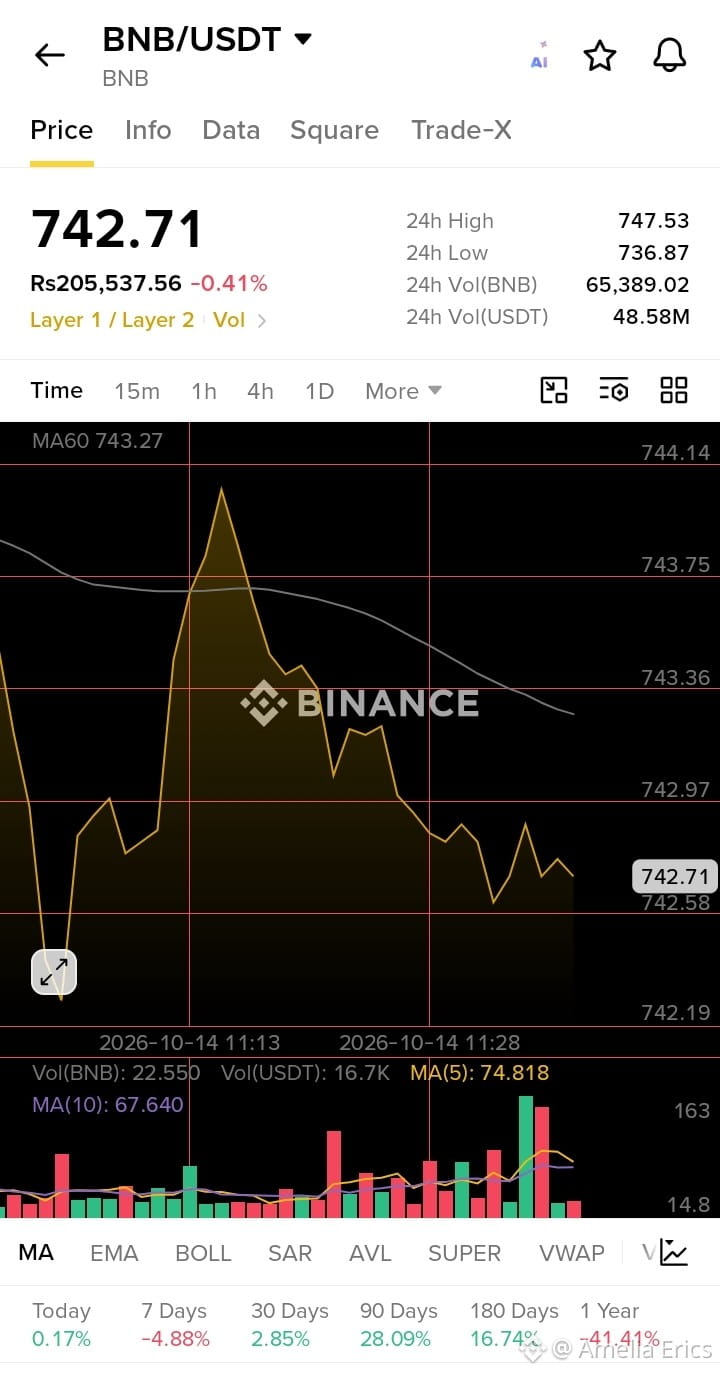
$BNB /USDT — Short-Term Trading Setup
Pro Tip: BNB is trading below the MA60 at 743.27 after a failed rebound toward 743.90. Selling pressure remains dominant, while 742.58 is the immediate support to watch.
Trade Decision: SHORT — conditional on a confirmed support breakdown.
EP: 742.85–743.15
TG1: 742.20
TG2: 741.70
TG3: 740.90
SL: 743.85
If BNB breaks below 742.58 and fails to reclaim it, downside continuation becomes more likely. A sustained move above 743.85 invalidates the short setup.
#CPIWatch #OptimismOPRises19.98% #USEthereumETFsSee10StraightDaysOfOutflows
$BNB /USDT — Short-Term Trading Setup
Pro Tip: BNB is trading below the MA60 at 743.27 after a failed rebound toward 743.90. Selling pressure remains dominant, while 742.58 is the immediate support to watch.
Trade Decision: SHORT — conditional on a confirmed support breakdown.
EP: 742.85–743.15
TG1: 742.20
TG2: 741.70
TG3: 740.90
SL: 743.85
If BNB breaks below 742.58 and fails to reclaim it, downside continuation becomes more likely. A sustained move above 743.85 invalidates the short setup.
#CPIWatch #OptimismOPRises19.98% #USEthereumETFsSee10StraightDaysOfOutflows
Pro Tip: BNB is trading below the MA60 at 743.27 after a failed rebound toward 743.90. Selling pressure remains dominant, while 742.58 is the immediate support to watch.
Trade Decision: SHORT — conditional on a confirmed support breakdown.
EP: 742.85–743.15
TG1: 742.20
TG2: 741.70
TG3: 740.90
SL: 743.85
If BNB breaks below 742.58 and fails to reclaim it, downside continuation becomes more likely. A sustained move above 743.85 invalidates the short setup.
#CPIWatch #OptimismOPRises19.98% #USEthereumETFsSee10StraightDaysOfOutflows
129
·
--
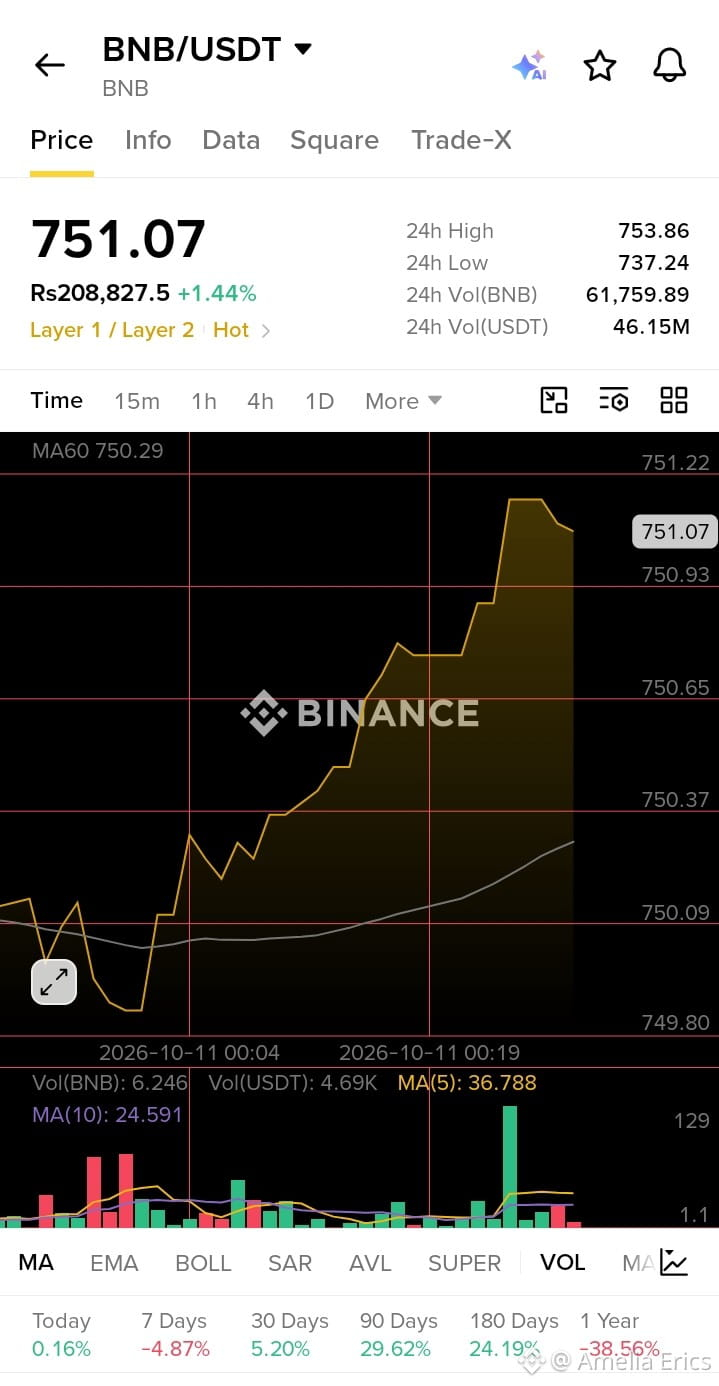
$BNB — Short-Term Setup**
**Pro Tip:** BNB has reclaimed the MA60 at 750.29 and pushed toward 751.22 with a volume spike. Short-term momentum favors buyers, but resistance near 753.86 remains a key hurdle.
**Trade Decision:** LONG — conditional on support holding.
**EP:** 750.60–751.10
**TG1:** 752.00
**TG2:** 753.80
**TG3:** 756.00
**SL:** 749.70
If BNB holds above 750.29 and breaks 753.86 with sustained volume, continuation toward 756.00 becomes more likely. A loss of 749.70 invalidates the setup.
Levels are based on your screenshot, not live market data. Confirm price action before entry and manage risk carefully.
#StateCouncilCallsForNationalBlockchainNetwork #StateCouncilCallsForNationalBlockchainNetwork #CFTCMovesToFoldEventContractsIntoSwapsRules
$BNB — Short-Term Setup**
**Pro Tip:** BNB has reclaimed the MA60 at 750.29 and pushed toward 751.22 with a volume spike. Short-term momentum favors buyers, but resistance near 753.86 remains a key hurdle.
**Trade Decision:** LONG — conditional on support holding.
**EP:** 750.60–751.10
**TG1:** 752.00
**TG2:** 753.80
**TG3:** 756.00
**SL:** 749.70
If BNB holds above 750.29 and breaks 753.86 with sustained volume, continuation toward 756.00 becomes more likely. A loss of 749.70 invalidates the setup.
Levels are based on your screenshot, not live market data. Confirm price action before entry and manage risk carefully.
#StateCouncilCallsForNationalBlockchainNetwork #StateCouncilCallsForNationalBlockchainNetwork #CFTCMovesToFoldEventContractsIntoSwapsRules
**Pro Tip:** BNB has reclaimed the MA60 at 750.29 and pushed toward 751.22 with a volume spike. Short-term momentum favors buyers, but resistance near 753.86 remains a key hurdle.
**Trade Decision:** LONG — conditional on support holding.
**EP:** 750.60–751.10
**TG1:** 752.00
**TG2:** 753.80
**TG3:** 756.00
**SL:** 749.70
If BNB holds above 750.29 and breaks 753.86 with sustained volume, continuation toward 756.00 becomes more likely. A loss of 749.70 invalidates the setup.
Levels are based on your screenshot, not live market data. Confirm price action before entry and manage risk carefully.
#StateCouncilCallsForNationalBlockchainNetwork #StateCouncilCallsForNationalBlockchainNetwork #CFTCMovesToFoldEventContractsIntoSwapsRules
314
·
--
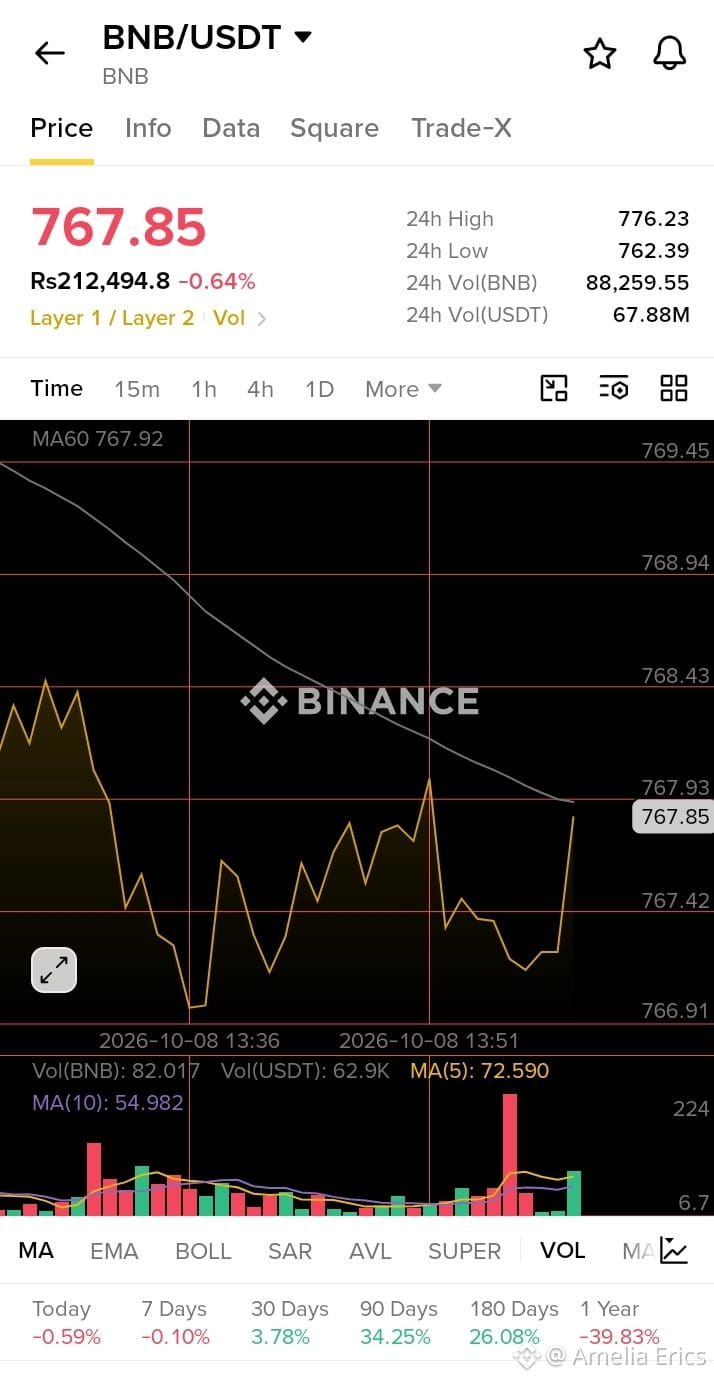
$BNB /USDT — 15M
Pro Tip: BNB is testing the MA60 at 767.92 after defending 766.91. The rebound is still weak, so confirmation above 768.43 is important before chasing longs.
Price is attempting to reclaim the short-term average. A clean break above 768.43 with volume would improve bullish momentum.
Trade Decision: LONG — only after confirmation.
EP: 767.95–768.25
TG1: 768.43
TG2: 768.95
TG3: 769.45
SL: 767.20
If BNB holds 767.40–767.90 and reclaims 768.43, continuation toward 768.95–769.45 is favored. A break below 767.20 invalidates the setup.
#FedMinutesFocusOnOctoberPause #VitalikWarnsAICouldWeakenCryptographySecurity #EvernorthDelaysNasdaqDebutToOct12
$BNB /USDT — 15M
Pro Tip: BNB is testing the MA60 at 767.92 after defending 766.91. The rebound is still weak, so confirmation above 768.43 is important before chasing longs.
Price is attempting to reclaim the short-term average. A clean break above 768.43 with volume would improve bullish momentum.
Trade Decision: LONG — only after confirmation.
EP: 767.95–768.25
TG1: 768.43
TG2: 768.95
TG3: 769.45
SL: 767.20
If BNB holds 767.40–767.90 and reclaims 768.43, continuation toward 768.95–769.45 is favored. A break below 767.20 invalidates the setup.
#FedMinutesFocusOnOctoberPause #VitalikWarnsAICouldWeakenCryptographySecurity #EvernorthDelaysNasdaqDebutToOct12
Pro Tip: BNB is testing the MA60 at 767.92 after defending 766.91. The rebound is still weak, so confirmation above 768.43 is important before chasing longs.
Price is attempting to reclaim the short-term average. A clean break above 768.43 with volume would improve bullish momentum.
Trade Decision: LONG — only after confirmation.
EP: 767.95–768.25
TG1: 768.43
TG2: 768.95
TG3: 769.45
SL: 767.20
If BNB holds 767.40–767.90 and reclaims 768.43, continuation toward 768.95–769.45 is favored. A break below 767.20 invalidates the setup.
#FedMinutesFocusOnOctoberPause #VitalikWarnsAICouldWeakenCryptographySecurity #EvernorthDelaysNasdaqDebutToOct12
137
·
--
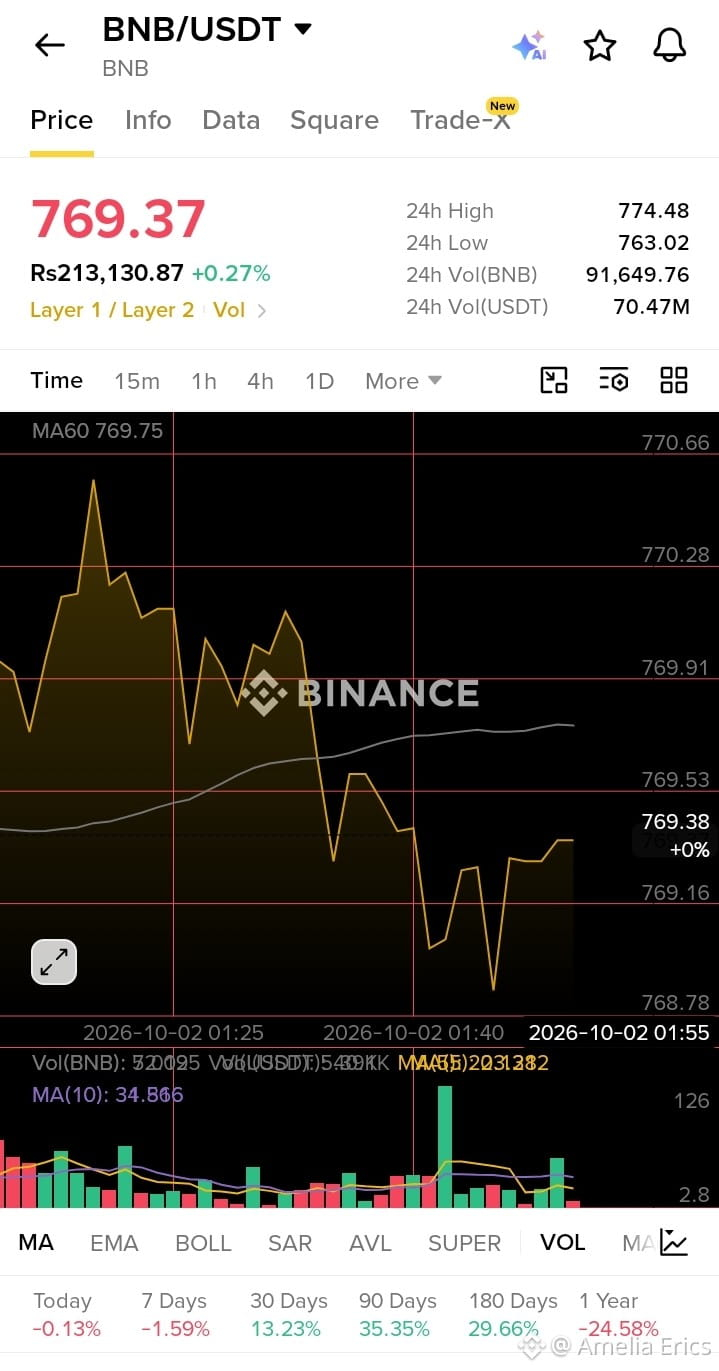
$BNB /USDT — Short-Term Trading Setup
Pro Tip: BNB is trading below the MA60 at 769.75, with recent selling pressure and only a modest rebound. Wait for confirmation before entering; the current chart does not yet show a clear bullish reversal.
Price remains weak below 769.75. A rejection near resistance may favor a short setup, while a sustained reclaim could shift momentum upward.
Trade Decision: SHORT — conditional on resistance rejection.
EP: 769.40–769.70 TG1: 769.00 TG2: 768.80 TG3: 768.40 SL: 770.05
If BNB rejects 769.75 and breaks below 769.00, downside continuation becomes more plausible. A sustained move above 770.05 invalidates this setup.
Note: The screenshot shows a very narrow price range. Confirm the broader 15-minute or 1-hour structure before trading, and account for fees and slippage.
#US10YearYieldNears5.3% #KoreaProposesTokenizingStocksAndBonds #MicronBeatsEarningsLiftsGuidance
$BNB /USDT — Short-Term Trading Setup
Pro Tip: BNB is trading below the MA60 at 769.75, with recent selling pressure and only a modest rebound. Wait for confirmation before entering; the current chart does not yet show a clear bullish reversal.
Price remains weak below 769.75. A rejection near resistance may favor a short setup, while a sustained reclaim could shift momentum upward.
Trade Decision: SHORT — conditional on resistance rejection.
EP: 769.40–769.70 TG1: 769.00 TG2: 768.80 TG3: 768.40 SL: 770.05
If BNB rejects 769.75 and breaks below 769.00, downside continuation becomes more plausible. A sustained move above 770.05 invalidates this setup.
Note: The screenshot shows a very narrow price range. Confirm the broader 15-minute or 1-hour structure before trading, and account for fees and slippage.
#US10YearYieldNears5.3% #KoreaProposesTokenizingStocksAndBonds #MicronBeatsEarningsLiftsGuidance
Pro Tip: BNB is trading below the MA60 at 769.75, with recent selling pressure and only a modest rebound. Wait for confirmation before entering; the current chart does not yet show a clear bullish reversal.
Price remains weak below 769.75. A rejection near resistance may favor a short setup, while a sustained reclaim could shift momentum upward.
Trade Decision: SHORT — conditional on resistance rejection.
EP: 769.40–769.70 TG1: 769.00 TG2: 768.80 TG3: 768.40 SL: 770.05
If BNB rejects 769.75 and breaks below 769.00, downside continuation becomes more plausible. A sustained move above 770.05 invalidates this setup.
Note: The screenshot shows a very narrow price range. Confirm the broader 15-minute or 1-hour structure before trading, and account for fees and slippage.
#US10YearYieldNears5.3% #KoreaProposesTokenizingStocksAndBonds #MicronBeatsEarningsLiftsGuidance
133
·
--
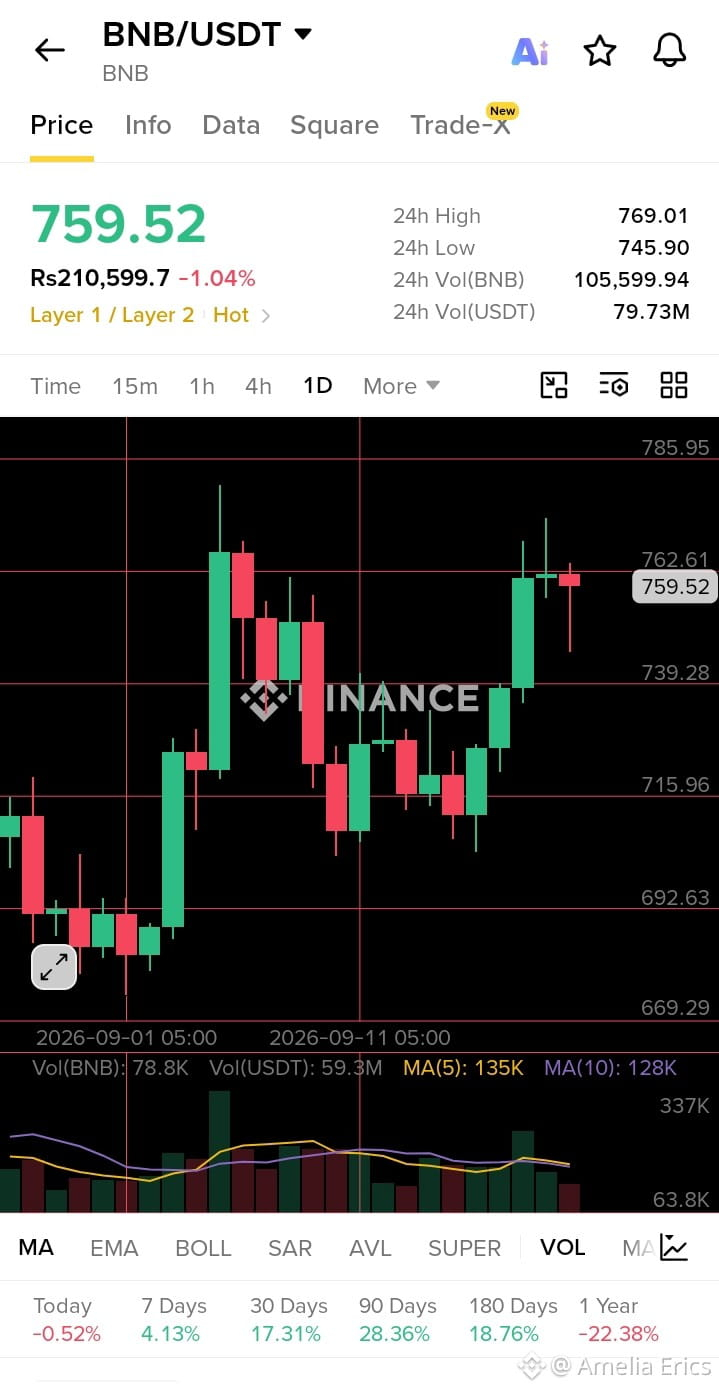
$BNB
Pro Tip: BNB is consolidating just below the 762.61 resistance after a strong recovery from the 715–739 zone. Avoid chasing into resistance; a clean daily reclaim would provide stronger confirmation.
The daily structure remains constructive while 739.28 holds. A breakout above 762.61 could open the next upside zone.
Trade Decision: LONG — on support hold or confirmed breakout.
EP: 753.00–759.00
TG1: 762.60
TG2: 776.00
TG3: 785.90
SL: 736.80
If BNB defends 739.28 and reclaims 762.61 with volume, continuation toward 776–785.90 is favored. A daily close below 736.80 invalidates the setup.
#SaylorHintsStrategyBitcoinBuy #BOJRaisesRatesTo31YearHigh #XRPExchangeReservesHitSevenYearLow
$BNB
Pro Tip: BNB is consolidating just below the 762.61 resistance after a strong recovery from the 715–739 zone. Avoid chasing into resistance; a clean daily reclaim would provide stronger confirmation.
The daily structure remains constructive while 739.28 holds. A breakout above 762.61 could open the next upside zone.
Trade Decision: LONG — on support hold or confirmed breakout.
EP: 753.00–759.00
TG1: 762.60
TG2: 776.00
TG3: 785.90
SL: 736.80
If BNB defends 739.28 and reclaims 762.61 with volume, continuation toward 776–785.90 is favored. A daily close below 736.80 invalidates the setup.
#SaylorHintsStrategyBitcoinBuy #BOJRaisesRatesTo31YearHigh #XRPExchangeReservesHitSevenYearLow
Pro Tip: BNB is consolidating just below the 762.61 resistance after a strong recovery from the 715–739 zone. Avoid chasing into resistance; a clean daily reclaim would provide stronger confirmation.
The daily structure remains constructive while 739.28 holds. A breakout above 762.61 could open the next upside zone.
Trade Decision: LONG — on support hold or confirmed breakout.
EP: 753.00–759.00
TG1: 762.60
TG2: 776.00
TG3: 785.90
SL: 736.80
If BNB defends 739.28 and reclaims 762.61 with volume, continuation toward 776–785.90 is favored. A daily close below 736.80 invalidates the setup.
#SaylorHintsStrategyBitcoinBuy #BOJRaisesRatesTo31YearHigh #XRPExchangeReservesHitSevenYearLow
110
·
--
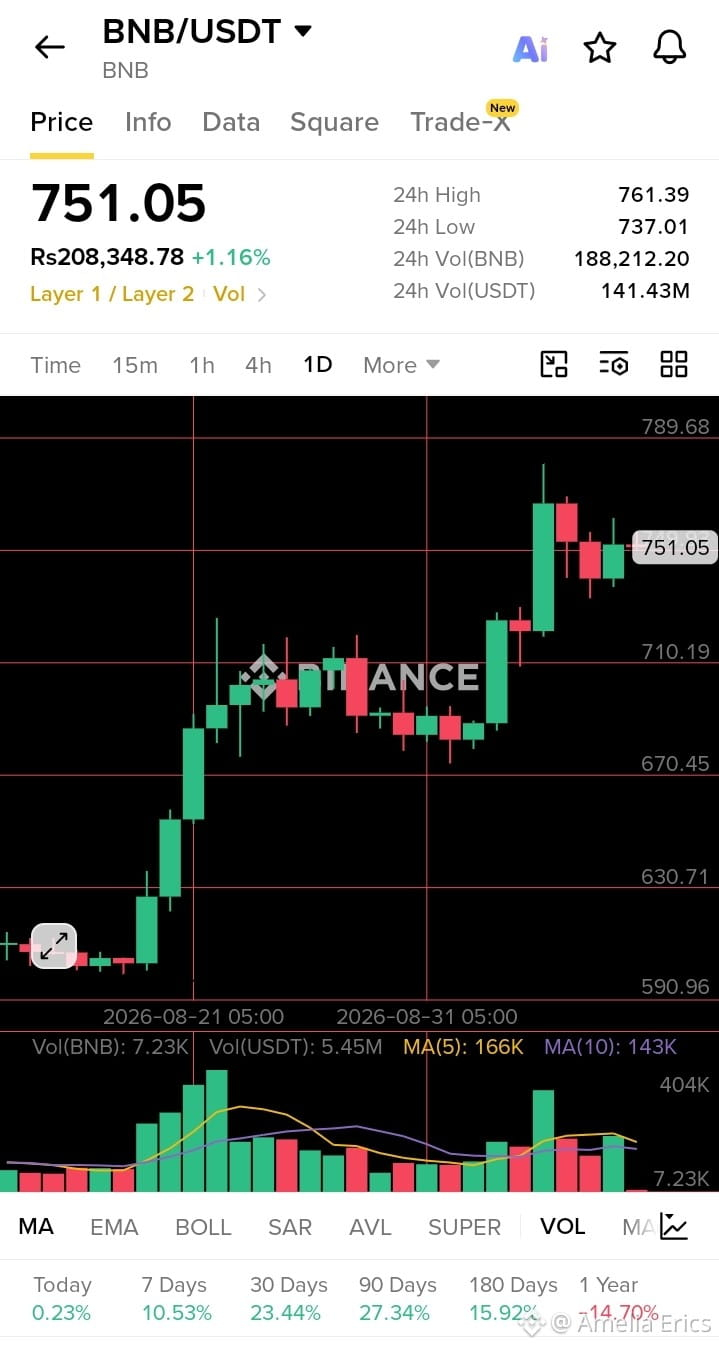
$BNB /USDT — 1D
Pro Tip: BNB remains in a strong daily uptrend after defending the 737.01 area and holding above the 710.19 breakout zone. The current pullback is constructive, but 761.39 is the key near-term resistance.
Momentum remains bullish while price holds the 737–740 support region. A daily breakout above 761.39 would favor continuation toward the next upside levels.
Trade Decision: LONG — preferably on a controlled pullback or confirmed breakout.
EP: 746.00–751.50
TG1: 761.40
TG2: 780.00
TG3: 800.00
SL: 736.50
If BNB defends 737–740 and reclaims 761.39, continuation toward 780–800 becomes more likely. A daily loss of 736.50 invalidates the long setup.#DowFallsOver600Points #AEROSurges17%In24Hours #USIranTradeTankerStrikesEscalate
$BNB /USDT — 1D
Pro Tip: BNB remains in a strong daily uptrend after defending the 737.01 area and holding above the 710.19 breakout zone. The current pullback is constructive, but 761.39 is the key near-term resistance.
Momentum remains bullish while price holds the 737–740 support region. A daily breakout above 761.39 would favor continuation toward the next upside levels.
Trade Decision: LONG — preferably on a controlled pullback or confirmed breakout.
EP: 746.00–751.50
TG1: 761.40
TG2: 780.00
TG3: 800.00
SL: 736.50
If BNB defends 737–740 and reclaims 761.39, continuation toward 780–800 becomes more likely. A daily loss of 736.50 invalidates the long setup.#DowFallsOver600Points #AEROSurges17%In24Hours #USIranTradeTankerStrikesEscalate
Pro Tip: BNB remains in a strong daily uptrend after defending the 737.01 area and holding above the 710.19 breakout zone. The current pullback is constructive, but 761.39 is the key near-term resistance.
Momentum remains bullish while price holds the 737–740 support region. A daily breakout above 761.39 would favor continuation toward the next upside levels.
Trade Decision: LONG — preferably on a controlled pullback or confirmed breakout.
EP: 746.00–751.50
TG1: 761.40
TG2: 780.00
TG3: 800.00
SL: 736.50
If BNB defends 737–740 and reclaims 761.39, continuation toward 780–800 becomes more likely. A daily loss of 736.50 invalidates the long setup.#DowFallsOver600Points #AEROSurges17%In24Hours #USIranTradeTankerStrikesEscalate
112
·
--
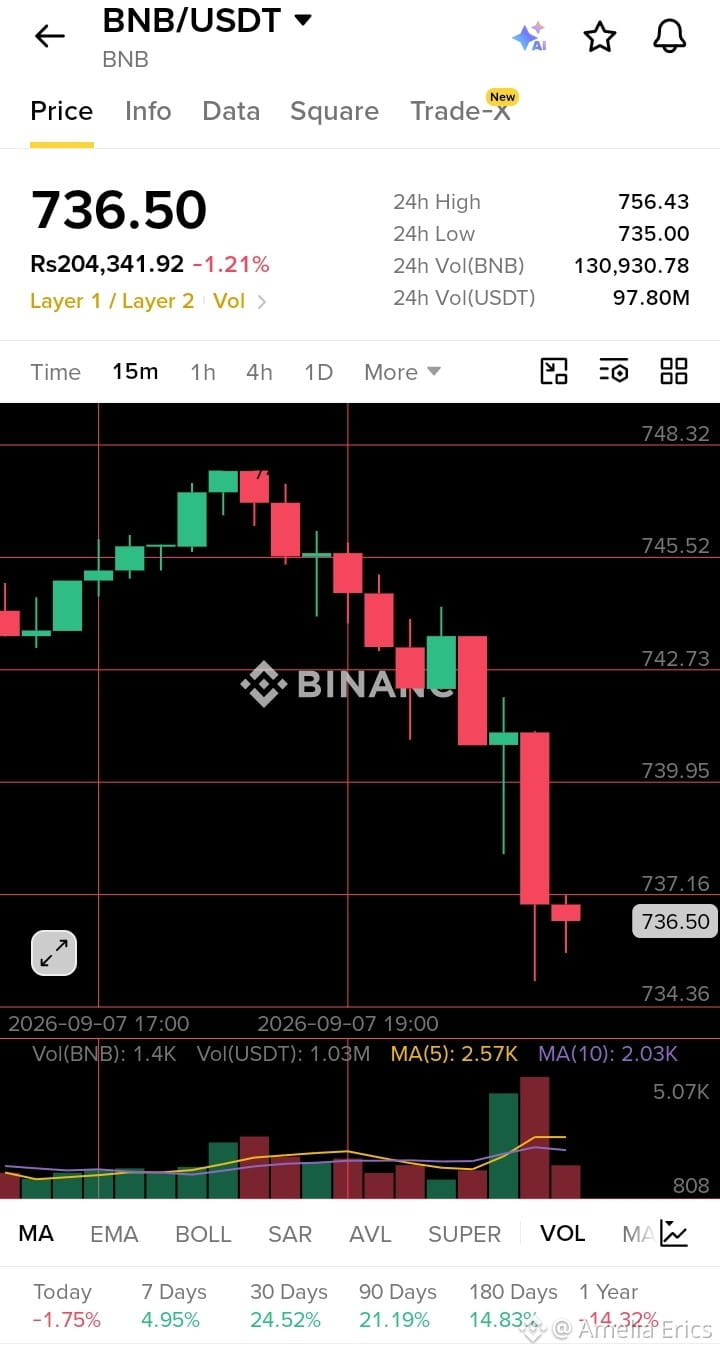
$BNB /USDT — 15M
Pro Tip: BNB has broken below 739.95 and 737.16 with strong selling volume. The 735.00–734.36 zone is the immediate support, so avoid chasing shorts directly into that area.
The short-term structure is bearish. A failed reclaim of 737.16–739.95 would favor further downside; a strong recovery above 739.95 would weaken the short setup.
Trade Decision: SHORT — preferably on a weak retest.
EP: 737.00–738.20
TG1: 735.00
TG2: 732.80
TG3: 730.50
SL: 740.30
If BNB rejects 737.16–739.95 and breaks 735.00, continuation toward 732.80–730.50 is favored. A sustained reclaim above 740.30 invalidates the short setup.
#USIranTradeTankerStrikesEscalate #CanadaToImpose15%To50%TariffsOnUSGoods #SideSwapSuspendsLiquidServices
$BNB /USDT — 15M
Pro Tip: BNB has broken below 739.95 and 737.16 with strong selling volume. The 735.00–734.36 zone is the immediate support, so avoid chasing shorts directly into that area.
The short-term structure is bearish. A failed reclaim of 737.16–739.95 would favor further downside; a strong recovery above 739.95 would weaken the short setup.
Trade Decision: SHORT — preferably on a weak retest.
EP: 737.00–738.20
TG1: 735.00
TG2: 732.80
TG3: 730.50
SL: 740.30
If BNB rejects 737.16–739.95 and breaks 735.00, continuation toward 732.80–730.50 is favored. A sustained reclaim above 740.30 invalidates the short setup.
#USIranTradeTankerStrikesEscalate #CanadaToImpose15%To50%TariffsOnUSGoods #SideSwapSuspendsLiquidServices
Pro Tip: BNB has broken below 739.95 and 737.16 with strong selling volume. The 735.00–734.36 zone is the immediate support, so avoid chasing shorts directly into that area.
The short-term structure is bearish. A failed reclaim of 737.16–739.95 would favor further downside; a strong recovery above 739.95 would weaken the short setup.
Trade Decision: SHORT — preferably on a weak retest.
EP: 737.00–738.20
TG1: 735.00
TG2: 732.80
TG3: 730.50
SL: 740.30
If BNB rejects 737.16–739.95 and breaks 735.00, continuation toward 732.80–730.50 is favored. A sustained reclaim above 740.30 invalidates the short setup.
#USIranTradeTankerStrikesEscalate #CanadaToImpose15%To50%TariffsOnUSGoods #SideSwapSuspendsLiquidServices
186
·
--
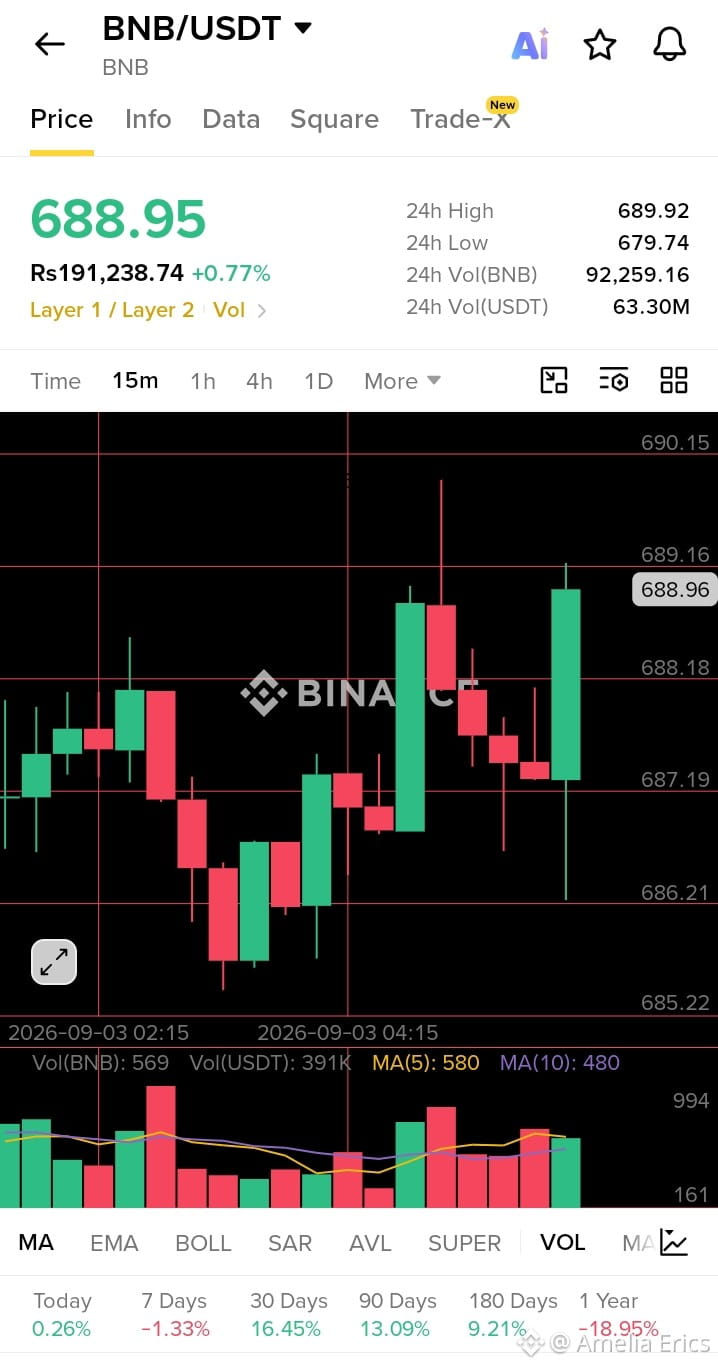
$BNB /USDT — 15M
Pro Tip: BNB has reclaimed 688.18 with a strong bullish candle and increased volume. Price is now approaching the 689.16–690.15 resistance zone, so avoid chasing the top.
The short-term momentum is bullish. A clean break above 690.15 would support further continuation.
Trade Decision: LONG — preferably on a pullback or confirmed breakout.
EP: 688.20–688.70
TG1: 689.90
TG2: 691.50
TG3: 693.00
SL: 686.90
If BNB holds 688.18 and breaks 690.15 with volume, continuation toward 691.50–693.00 is favored; loss of 686.90 invalidates the setup.
#SolanaFallsOver3% #DellSurges8%OnEarningsBeat #HangSengCloses18PointsLower
$BNB /USDT — 15M
Pro Tip: BNB has reclaimed 688.18 with a strong bullish candle and increased volume. Price is now approaching the 689.16–690.15 resistance zone, so avoid chasing the top.
The short-term momentum is bullish. A clean break above 690.15 would support further continuation.
Trade Decision: LONG — preferably on a pullback or confirmed breakout.
EP: 688.20–688.70
TG1: 689.90
TG2: 691.50
TG3: 693.00
SL: 686.90
If BNB holds 688.18 and breaks 690.15 with volume, continuation toward 691.50–693.00 is favored; loss of 686.90 invalidates the setup.
#SolanaFallsOver3% #DellSurges8%OnEarningsBeat #HangSengCloses18PointsLower
Pro Tip: BNB has reclaimed 688.18 with a strong bullish candle and increased volume. Price is now approaching the 689.16–690.15 resistance zone, so avoid chasing the top.
The short-term momentum is bullish. A clean break above 690.15 would support further continuation.
Trade Decision: LONG — preferably on a pullback or confirmed breakout.
EP: 688.20–688.70
TG1: 689.90
TG2: 691.50
TG3: 693.00
SL: 686.90
If BNB holds 688.18 and breaks 690.15 with volume, continuation toward 691.50–693.00 is favored; loss of 686.90 invalidates the setup.
#SolanaFallsOver3% #DellSurges8%OnEarningsBeat #HangSengCloses18PointsLower
131
·
--
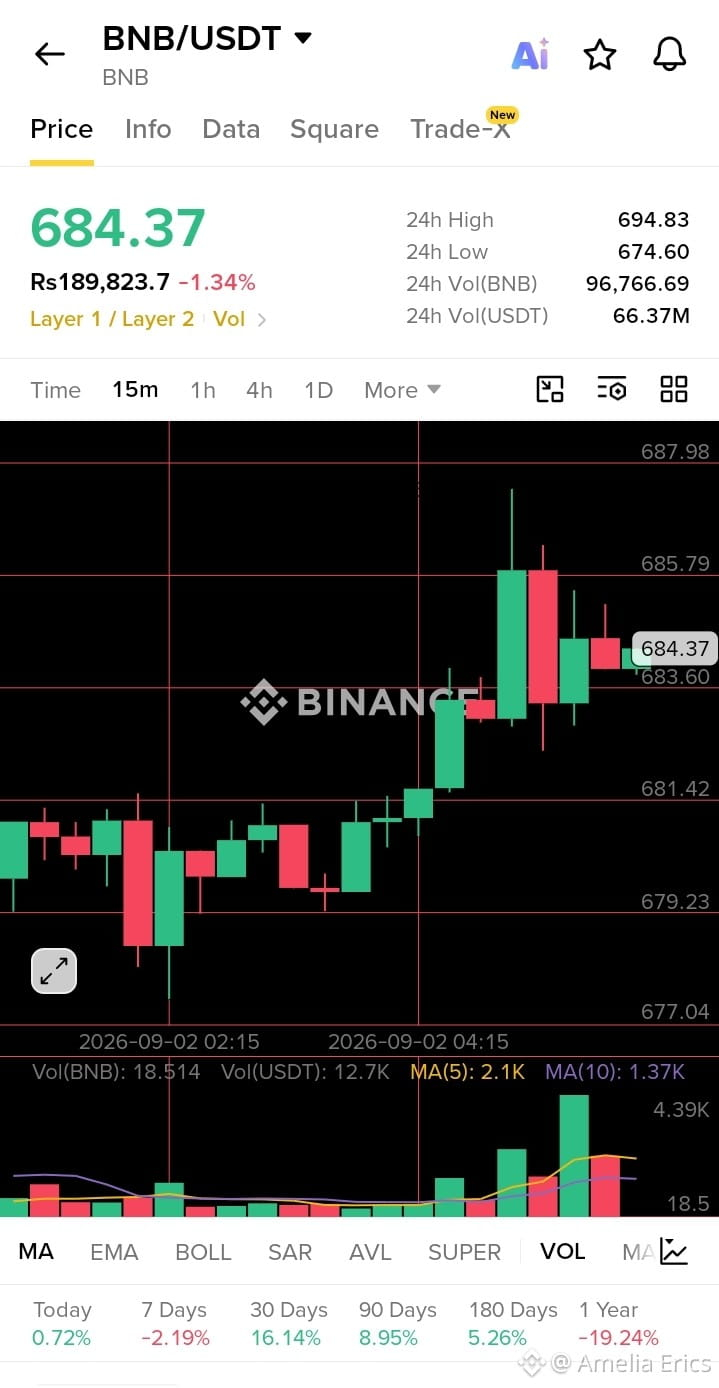
$BNB /USDT — 15M
Pro Tip: BNB has defended the 677.04–679.23 area and recovered toward 685.79 resistance. Volume has increased on the rebound, but 685.79 must be reclaimed for stronger continuation.
The short-term structure is recovering. Holding 683.60 keeps the bullish setup intact; a breakout above 685.79 would open the next resistance levels.
Trade Decision: LONG — preferably on a controlled pullback or confirmed reclaim.
EP: 683.60–684.30
TG1: 685.80
TG2: 687.90
TG3: 690.50
SL: 681.20
If BNB defends 683.60 and reclaims 685.79 with volume, continuation toward 688–690.50 is favored; a break below 681.20 invalidates the setup.#ARBRises30%OnRobinhoodChainRevenue #Japan10YYieldHits3%FirstSince1996 #WTIOilRisesAsOpenInterestShrinks
$BNB /USDT — 15M
Pro Tip: BNB has defended the 677.04–679.23 area and recovered toward 685.79 resistance. Volume has increased on the rebound, but 685.79 must be reclaimed for stronger continuation.
The short-term structure is recovering. Holding 683.60 keeps the bullish setup intact; a breakout above 685.79 would open the next resistance levels.
Trade Decision: LONG — preferably on a controlled pullback or confirmed reclaim.
EP: 683.60–684.30
TG1: 685.80
TG2: 687.90
TG3: 690.50
SL: 681.20
If BNB defends 683.60 and reclaims 685.79 with volume, continuation toward 688–690.50 is favored; a break below 681.20 invalidates the setup.#ARBRises30%OnRobinhoodChainRevenue #Japan10YYieldHits3%FirstSince1996 #WTIOilRisesAsOpenInterestShrinks
Pro Tip: BNB has defended the 677.04–679.23 area and recovered toward 685.79 resistance. Volume has increased on the rebound, but 685.79 must be reclaimed for stronger continuation.
The short-term structure is recovering. Holding 683.60 keeps the bullish setup intact; a breakout above 685.79 would open the next resistance levels.
Trade Decision: LONG — preferably on a controlled pullback or confirmed reclaim.
EP: 683.60–684.30
TG1: 685.80
TG2: 687.90
TG3: 690.50
SL: 681.20
If BNB defends 683.60 and reclaims 685.79 with volume, continuation toward 688–690.50 is favored; a break below 681.20 invalidates the setup.#ARBRises30%OnRobinhoodChainRevenue #Japan10YYieldHits3%FirstSince1996 #WTIOilRisesAsOpenInterestShrinks
110
·
--
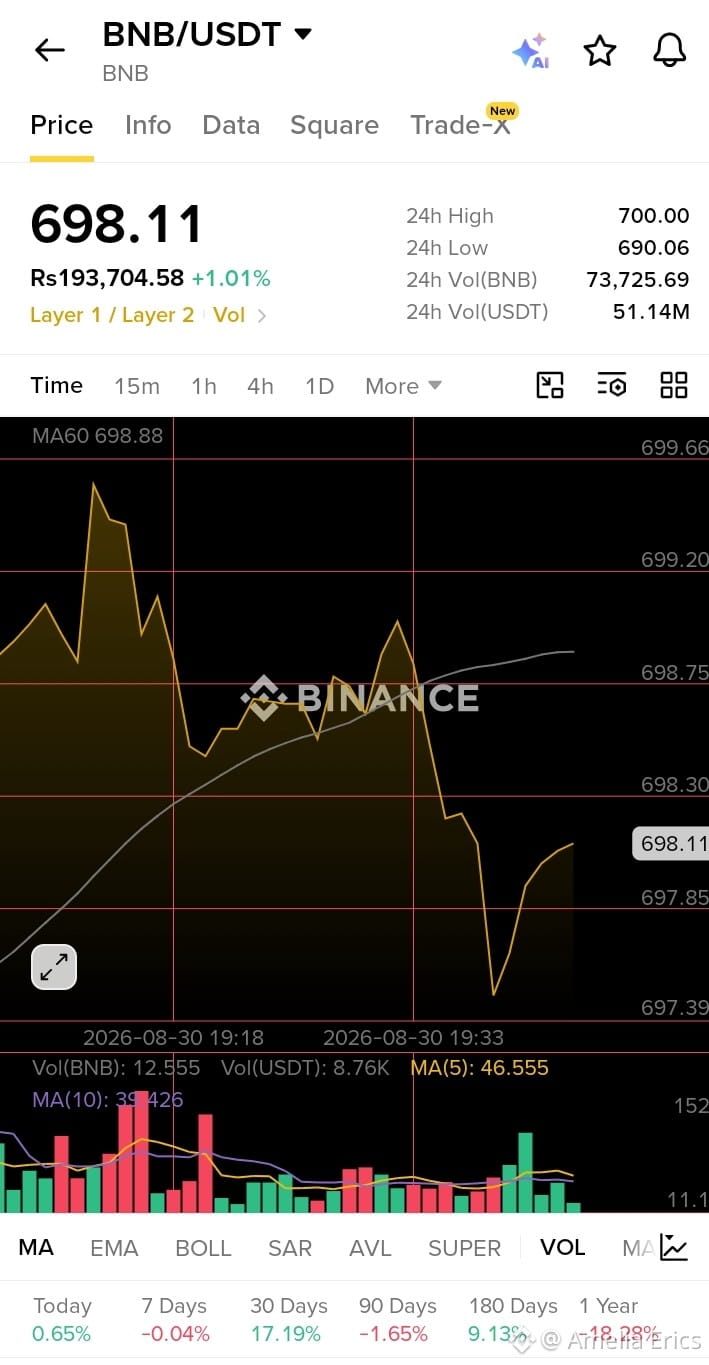
$BNB /USDT — 1H
Pro Tip: BNB briefly swept the 697.39 area and rebounded, but price remains below the 698.75–698.88 resistance zone. Wait for confirmation rather than chasing the rebound.
The liquidity sweep shows buyers defending the lower area. Momentum can turn bullish if BNB reclaims the MA60 zone with volume.
Trade Decision: LONG — only after a confirmed reclaim.
EP: 698.70–699.00
TG1: 699.65
TG2: 700.50
TG3: 702.00
SL: 697.20
If BNB holds 697.39 and reclaims 698.88, continuation toward 700.50–702.00 is favored. A clean break below 697.39 invalidates the long setup.
#KoreaSingleStockLeveragedETFTradingFalls #VietnamPilotsCryptoAssetMarket #AfghanistanTalibanReportedlyBansCryptoNationwide
$BNB /USDT — 1H
Pro Tip: BNB briefly swept the 697.39 area and rebounded, but price remains below the 698.75–698.88 resistance zone. Wait for confirmation rather than chasing the rebound.
The liquidity sweep shows buyers defending the lower area. Momentum can turn bullish if BNB reclaims the MA60 zone with volume.
Trade Decision: LONG — only after a confirmed reclaim.
EP: 698.70–699.00
TG1: 699.65
TG2: 700.50
TG3: 702.00
SL: 697.20
If BNB holds 697.39 and reclaims 698.88, continuation toward 700.50–702.00 is favored. A clean break below 697.39 invalidates the long setup.
#KoreaSingleStockLeveragedETFTradingFalls #VietnamPilotsCryptoAssetMarket #AfghanistanTalibanReportedlyBansCryptoNationwide
Pro Tip: BNB briefly swept the 697.39 area and rebounded, but price remains below the 698.75–698.88 resistance zone. Wait for confirmation rather than chasing the rebound.
The liquidity sweep shows buyers defending the lower area. Momentum can turn bullish if BNB reclaims the MA60 zone with volume.
Trade Decision: LONG — only after a confirmed reclaim.
EP: 698.70–699.00
TG1: 699.65
TG2: 700.50
TG3: 702.00
SL: 697.20
If BNB holds 697.39 and reclaims 698.88, continuation toward 700.50–702.00 is favored. A clean break below 697.39 invalidates the long setup.
#KoreaSingleStockLeveragedETFTradingFalls #VietnamPilotsCryptoAssetMarket #AfghanistanTalibanReportedlyBansCryptoNationwide
132
·
--
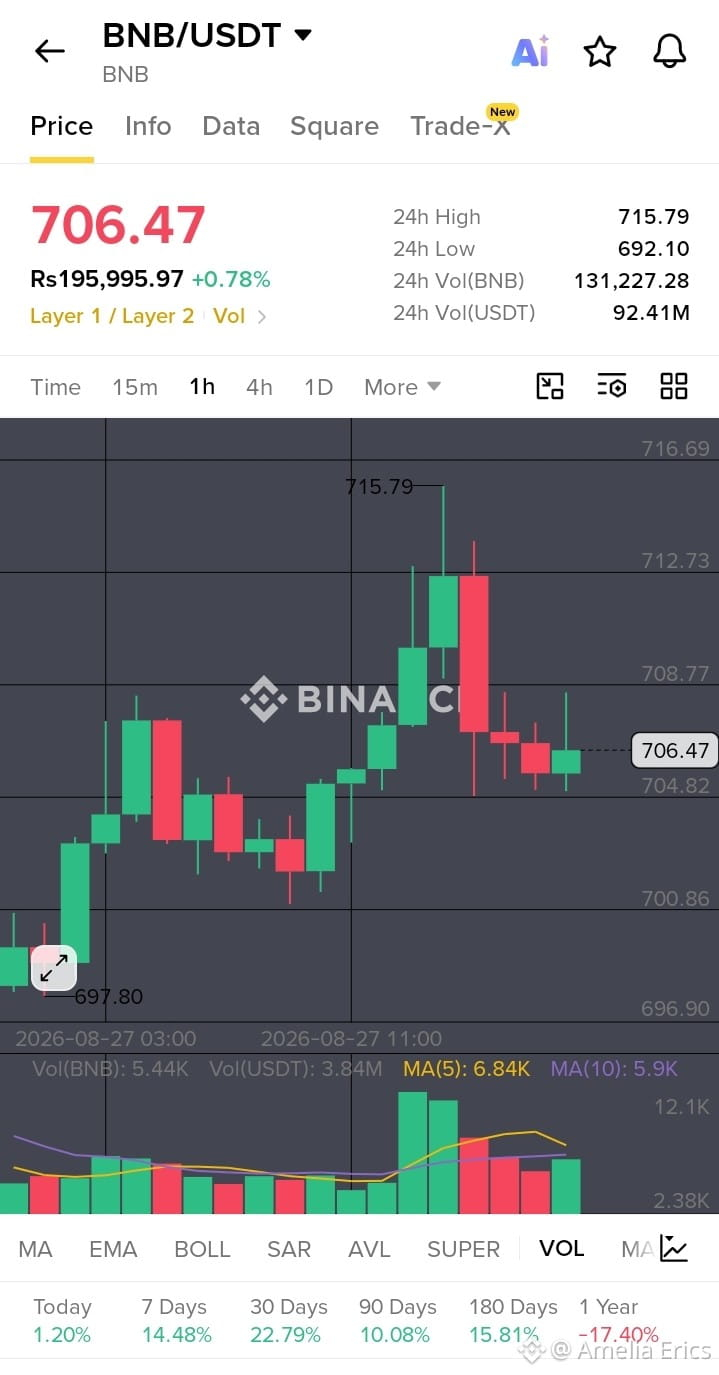
$BNB
Pro Tip: BNB is consolidating above 704.82 after rejecting 715.79. Avoid chasing at resistance. Prefer an entry near support or after a confirmed breakout above 708.77.
The pullback has held the 704.82 area, keeping short-term momentum constructive. A reclaim of 708.77 would favor another move toward the recent high.
Trade Decision: LONG — only while 704.82 holds.
EP: 705.00–706.20
TG1: 708.70
TG2: 712.70
TG3: 715.50
SL: 702.60
If BNB continues to defend 704.82 and breaks 708.77 with volume, continuation toward 712.70–715.50 is favored.
#BestBuyQ2RevenueTopsEstimatesLiftsOutlook #BestBuyQ2RevenueTopsEstimatesLiftsOutlook #ChinaOpposesUSProposed7.5%Tariff #BankOfKoreaHikesRatesTo3%
$BNB
Pro Tip: BNB is consolidating above 704.82 after rejecting 715.79. Avoid chasing at resistance. Prefer an entry near support or after a confirmed breakout above 708.77.
The pullback has held the 704.82 area, keeping short-term momentum constructive. A reclaim of 708.77 would favor another move toward the recent high.
Trade Decision: LONG — only while 704.82 holds.
EP: 705.00–706.20
TG1: 708.70
TG2: 712.70
TG3: 715.50
SL: 702.60
If BNB continues to defend 704.82 and breaks 708.77 with volume, continuation toward 712.70–715.50 is favored.
#BestBuyQ2RevenueTopsEstimatesLiftsOutlook #BestBuyQ2RevenueTopsEstimatesLiftsOutlook #ChinaOpposesUSProposed7.5%Tariff #BankOfKoreaHikesRatesTo3%
Pro Tip: BNB is consolidating above 704.82 after rejecting 715.79. Avoid chasing at resistance. Prefer an entry near support or after a confirmed breakout above 708.77.
The pullback has held the 704.82 area, keeping short-term momentum constructive. A reclaim of 708.77 would favor another move toward the recent high.
Trade Decision: LONG — only while 704.82 holds.
EP: 705.00–706.20
TG1: 708.70
TG2: 712.70
TG3: 715.50
SL: 702.60
If BNB continues to defend 704.82 and breaks 708.77 with volume, continuation toward 712.70–715.50 is favored.
#BestBuyQ2RevenueTopsEstimatesLiftsOutlook #BestBuyQ2RevenueTopsEstimatesLiftsOutlook #ChinaOpposesUSProposed7.5%Tariff #BankOfKoreaHikesRatesTo3%
95
·
--
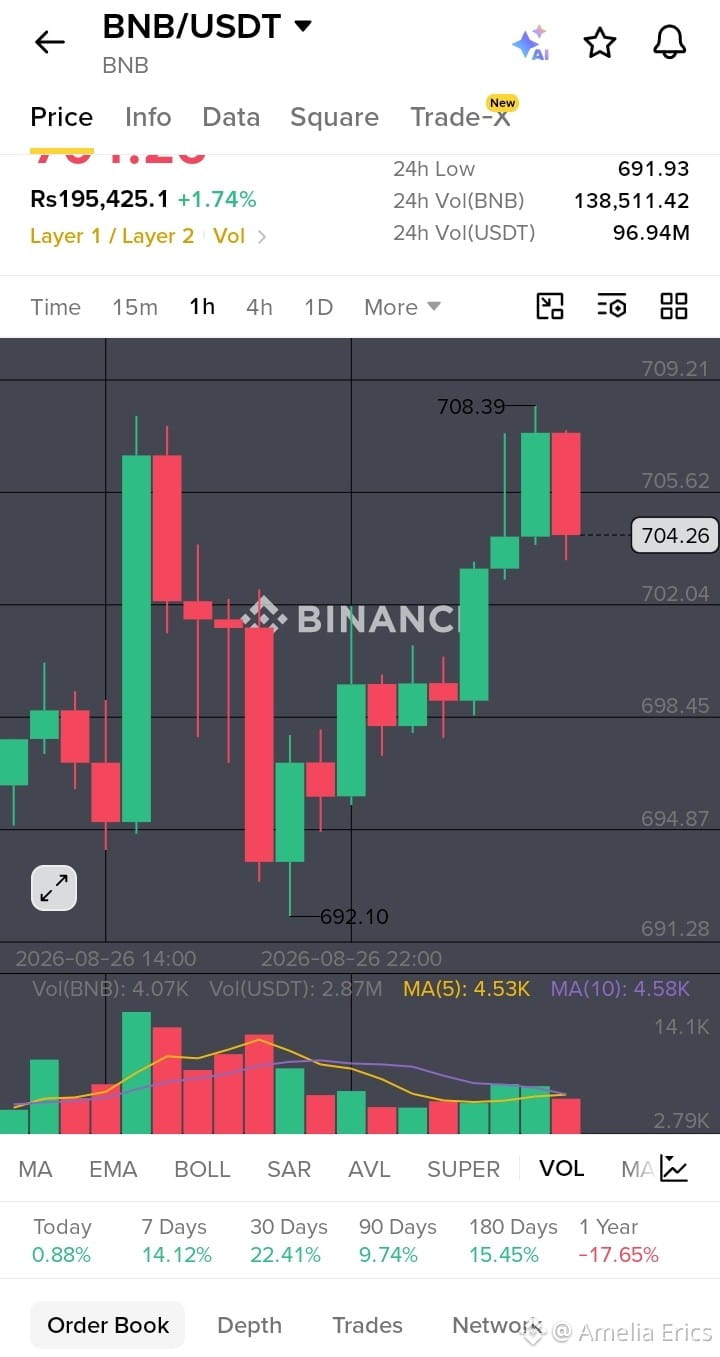
$BNB
Pro Tip: BNB is holding above the 702.04 support after a strong recovery from 692.10. Avoid chasing the move near 708–709 resistance; wait for a controlled entry or confirmed breakout.
BNB swept the 692.10 downside liquidity and recovered strongly, then pushed into the 708.39 resistance zone. The pullback remains constructive while 702.04 holds.
Trade Decision: LONG — conditional on support holding.
EP: 703.00–704.50
TG1: 708.30
TG2: 711.50
TG3: 714.00
SL: 700.80
Momentum can continue higher if BNB defends 702.04 and reclaims 708.39 with volume. A clean break below 702.04 invalidates the setup.
Risk note: Keep position size controlled and treat the levels as a technical setup, not a guarantee.
#IranSaysHormuzOmanDealNotFinalized #CryptoFearGreedIndexHits74 #KoreaMemoryChipStocksReverseLate
$BNB
Pro Tip: BNB is holding above the 702.04 support after a strong recovery from 692.10. Avoid chasing the move near 708–709 resistance; wait for a controlled entry or confirmed breakout.
BNB swept the 692.10 downside liquidity and recovered strongly, then pushed into the 708.39 resistance zone. The pullback remains constructive while 702.04 holds.
Trade Decision: LONG — conditional on support holding.
EP: 703.00–704.50
TG1: 708.30
TG2: 711.50
TG3: 714.00
SL: 700.80
Momentum can continue higher if BNB defends 702.04 and reclaims 708.39 with volume. A clean break below 702.04 invalidates the setup.
Risk note: Keep position size controlled and treat the levels as a technical setup, not a guarantee.
#IranSaysHormuzOmanDealNotFinalized #CryptoFearGreedIndexHits74 #KoreaMemoryChipStocksReverseLate
Pro Tip: BNB is holding above the 702.04 support after a strong recovery from 692.10. Avoid chasing the move near 708–709 resistance; wait for a controlled entry or confirmed breakout.
BNB swept the 692.10 downside liquidity and recovered strongly, then pushed into the 708.39 resistance zone. The pullback remains constructive while 702.04 holds.
Trade Decision: LONG — conditional on support holding.
EP: 703.00–704.50
TG1: 708.30
TG2: 711.50
TG3: 714.00
SL: 700.80
Momentum can continue higher if BNB defends 702.04 and reclaims 708.39 with volume. A clean break below 702.04 invalidates the setup.
Risk note: Keep position size controlled and treat the levels as a technical setup, not a guarantee.
#IranSaysHormuzOmanDealNotFinalized #CryptoFearGreedIndexHits74 #KoreaMemoryChipStocksReverseLate
152
·
--
$BNB /USDT — 1H Setup
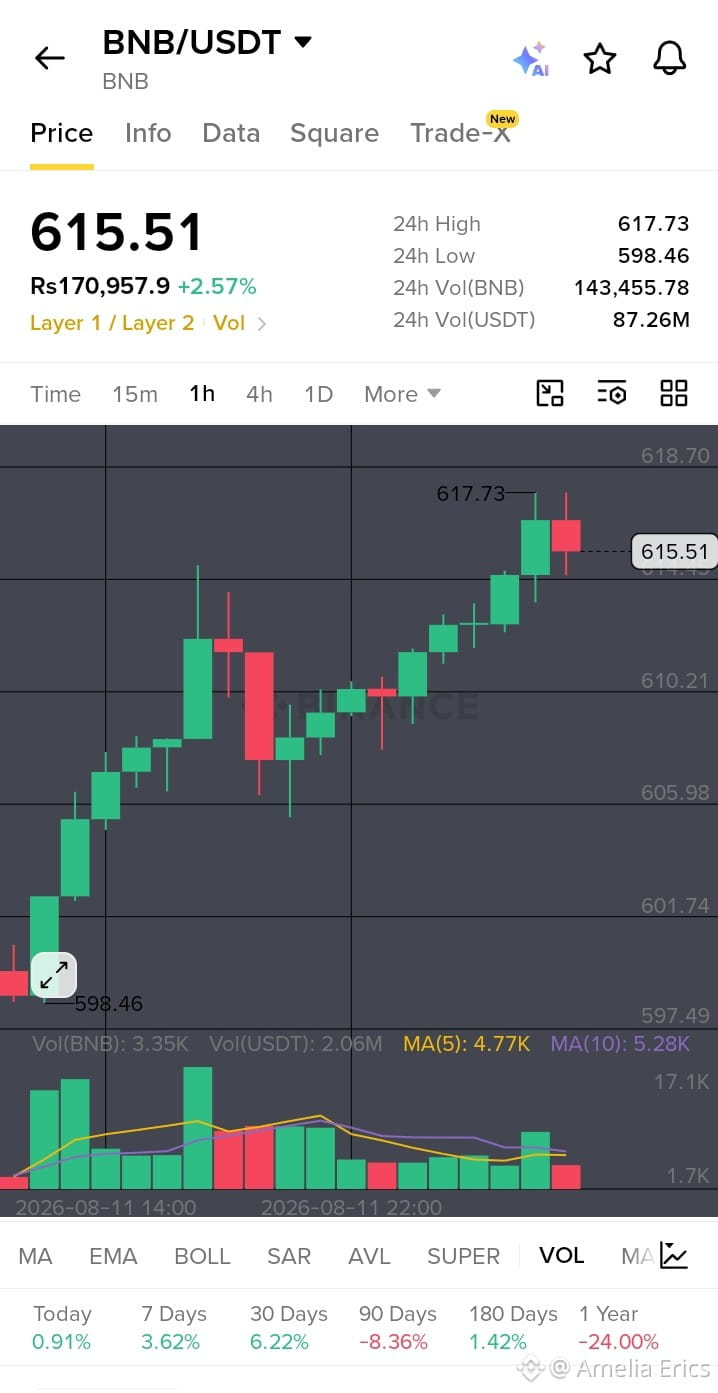
PRO TIP: Avoid chasing near 617.73 resistance. Prefer a controlled pullback into the entry zone or a confirmed breakout.
BNB defended the 610.21 area and formed a sequence of higher highs, pushing into the 617.73 resistance zone. This keeps short-term momentum bullish while buyers hold the recent support.
Trade Decision: LONG on pullback/confirmation
EP: 613.50–615.00
SL: 609.40
TG1: 618.50
TG2: 621.50
TG3: 625.00
If 610.21 continues to hold as support, continuation toward the upside targets remains favored; a clean break below it weakens the setup.
#SenateDelaysCLARITYActVoteToSeptember #MoneyGramExpandsCashCryptoServiceToSolana #BlackRockCanadaLaunchesBitcoinLinkedETF
$BNB /USDT — 1H Setup
PRO TIP: Avoid chasing near 617.73 resistance. Prefer a controlled pullback into the entry zone or a confirmed breakout.
BNB defended the 610.21 area and formed a sequence of higher highs, pushing into the 617.73 resistance zone. This keeps short-term momentum bullish while buyers hold the recent support.
Trade Decision: LONG on pullback/confirmation
EP: 613.50–615.00
SL: 609.40
TG1: 618.50
TG2: 621.50
TG3: 625.00
If 610.21 continues to hold as support, continuation toward the upside targets remains favored; a clean break below it weakens the setup.
#SenateDelaysCLARITYActVoteToSeptember #MoneyGramExpandsCashCryptoServiceToSolana #BlackRockCanadaLaunchesBitcoinLinkedETF
PRO TIP: Avoid chasing near 617.73 resistance. Prefer a controlled pullback into the entry zone or a confirmed breakout.
BNB defended the 610.21 area and formed a sequence of higher highs, pushing into the 617.73 resistance zone. This keeps short-term momentum bullish while buyers hold the recent support.
Trade Decision: LONG on pullback/confirmation
EP: 613.50–615.00
SL: 609.40
TG1: 618.50
TG2: 621.50
TG3: 625.00
If 610.21 continues to hold as support, continuation toward the upside targets remains favored; a clean break below it weakens the setup.
#SenateDelaysCLARITYActVoteToSeptember #MoneyGramExpandsCashCryptoServiceToSolana #BlackRockCanadaLaunchesBitcoinLinkedETF
154
·
--
$BNB
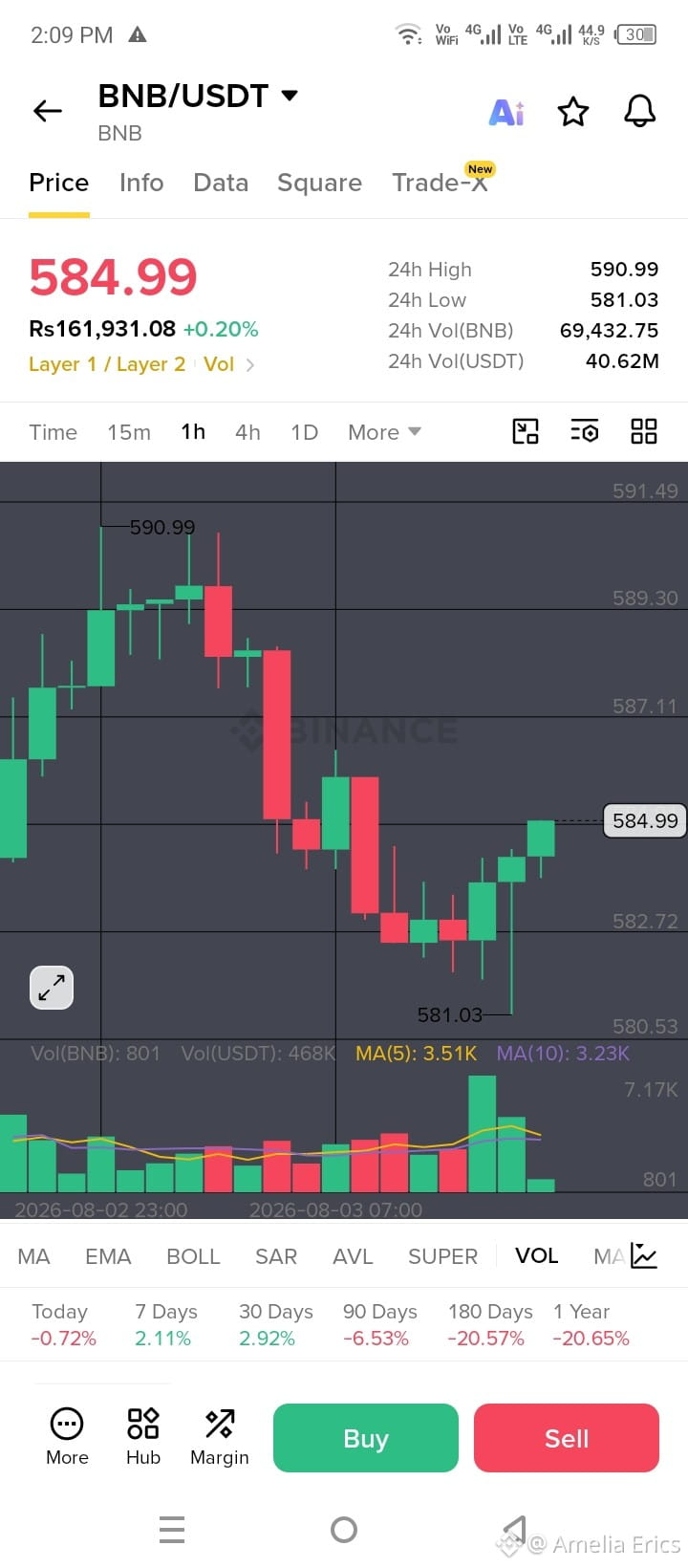
PRO TIP: Avoid chasing price near resistance. The cleaner setup is a controlled entry after support holds or a confirmed reclaim of the breakout level.
Market Event:
BNB rejected the downside near $581.03, showing strong buyer defense and absorption of lower liquidity.
Momentum:
The recovery favors short-term bullish continuation while BNB holds above the $582–$583 support zone.
Trade Decision:
BUY / LONG
Entry Price (EP):
$583.50 – $585.00
Trade Targets:
TG1: $587.10
TG2: $589.30
TG3: $590.99
Stop Loss (SL):
$580.80
Condition:
As long as BNB defends the $582–$583 zone, continuation toward TG1–TG3 remains valid; a break below $580.80 invalidates the setup.
Based on the provided 1H chart; not financial advice.
$BNB
PRO TIP: Avoid chasing price near resistance. The cleaner setup is a controlled entry after support holds or a confirmed reclaim of the breakout level.
Market Event:
BNB rejected the downside near $581.03, showing strong buyer defense and absorption of lower liquidity.
Momentum:
The recovery favors short-term bullish continuation while BNB holds above the $582–$583 support zone.
Trade Decision:
BUY / LONG
Entry Price (EP):
$583.50 – $585.00
Trade Targets:
TG1: $587.10
TG2: $589.30
TG3: $590.99
Stop Loss (SL):
$580.80
Condition:
As long as BNB defends the $582–$583 zone, continuation toward TG1–TG3 remains valid; a break below $580.80 invalidates the setup.
Based on the provided 1H chart; not financial advice.
PRO TIP: Avoid chasing price near resistance. The cleaner setup is a controlled entry after support holds or a confirmed reclaim of the breakout level.
Market Event:
BNB rejected the downside near $581.03, showing strong buyer defense and absorption of lower liquidity.
Momentum:
The recovery favors short-term bullish continuation while BNB holds above the $582–$583 support zone.
Trade Decision:
BUY / LONG
Entry Price (EP):
$583.50 – $585.00
Trade Targets:
TG1: $587.10
TG2: $589.30
TG3: $590.99
Stop Loss (SL):
$580.80
Condition:
As long as BNB defends the $582–$583 zone, continuation toward TG1–TG3 remains valid; a break below $580.80 invalidates the setup.
Based on the provided 1H chart; not financial advice.
152
·
--
OpenGradient and the Evolution of Decentralized AI Agents
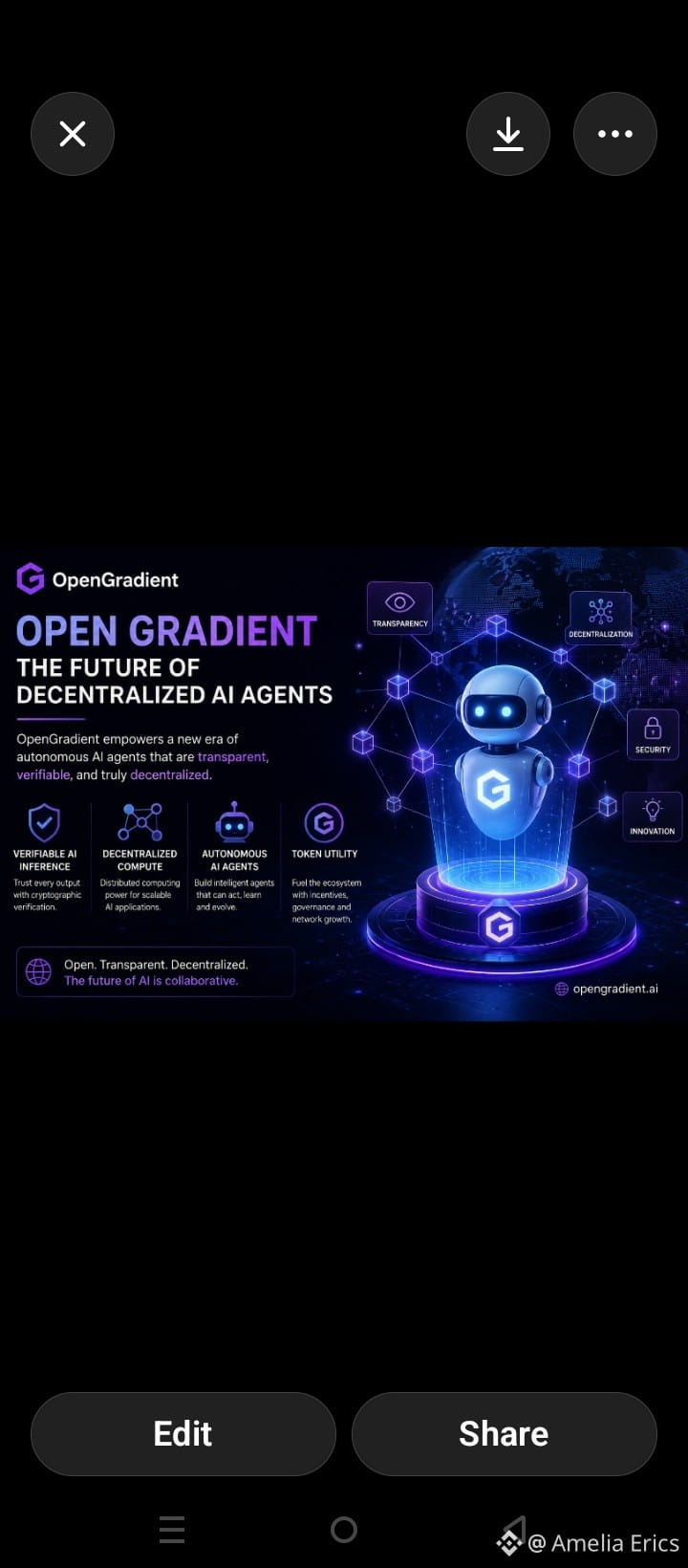
As I explore the rapidly changing world of Artificial Intelligence, one challenge stands out to me: most AI systems are still controlled by a small number of centralized organizations. This is why OpenGradient has caught my attention. It is building a decentralized AI ecosystem where intelligent agents can operate with greater transparency, trust, and independence.
What I find most impressive about OpenGradient is its focus on verifiable AI inference. In simple terms, users can verify that AI-generated outputs are authentic and have not been altered. In a time when trust in digital systems is becoming more important, this feature feels both practical and necessary. Recent developments in the project have strengthened its decentralized compute infrastructure, making it easier for autonomous AI agents to perform tasks securely across distributed networks. The platform’s token utility also plays an important role by supporting network participation, incentives, and ecosystem growth.
From my perspective, OpenGradient is more than just another AI project. It represents a shift toward open and accountable intelligence. By combining blockchain technology with AI, it reduces reliance on centralized providers and creates new opportunities for innovation.
In conclusion, I believe OpenGradient is helping shape the future of decentralized AI agents. Its commitment to transparency, verifiable computation, and community-driven infrastructure makes it a promising project. As AI continues to evolve, OpenGradient could become a key foundation for a more open, trustworthy, and decentralized intelligent future.
@OpenGradient
#opg
$OPG
OpenGradient and the Evolution of Decentralized AI Agents
As I explore the rapidly changing world of Artificial Intelligence, one challenge stands out to me: most AI systems are still controlled by a small number of centralized organizations. This is why OpenGradient has caught my attention. It is building a decentralized AI ecosystem where intelligent agents can operate with greater transparency, trust, and independence.
What I find most impressive about OpenGradient is its focus on verifiable AI inference. In simple terms, users can verify that AI-generated outputs are authentic and have not been altered. In a time when trust in digital systems is becoming more important, this feature feels both practical and necessary. Recent developments in the project have strengthened its decentralized compute infrastructure, making it easier for autonomous AI agents to perform tasks securely across distributed networks. The platform’s token utility also plays an important role by supporting network participation, incentives, and ecosystem growth.
From my perspective, OpenGradient is more than just another AI project. It represents a shift toward open and accountable intelligence. By combining blockchain technology with AI, it reduces reliance on centralized providers and creates new opportunities for innovation.
In conclusion, I believe OpenGradient is helping shape the future of decentralized AI agents. Its commitment to transparency, verifiable computation, and community-driven infrastructure makes it a promising project. As AI continues to evolve, OpenGradient could become a key foundation for a more open, trustworthy, and decentralized intelligent future.
@OpenGradient
#opg
$OPG
As I explore the rapidly changing world of Artificial Intelligence, one challenge stands out to me: most AI systems are still controlled by a small number of centralized organizations. This is why OpenGradient has caught my attention. It is building a decentralized AI ecosystem where intelligent agents can operate with greater transparency, trust, and independence.
What I find most impressive about OpenGradient is its focus on verifiable AI inference. In simple terms, users can verify that AI-generated outputs are authentic and have not been altered. In a time when trust in digital systems is becoming more important, this feature feels both practical and necessary. Recent developments in the project have strengthened its decentralized compute infrastructure, making it easier for autonomous AI agents to perform tasks securely across distributed networks. The platform’s token utility also plays an important role by supporting network participation, incentives, and ecosystem growth.
From my perspective, OpenGradient is more than just another AI project. It represents a shift toward open and accountable intelligence. By combining blockchain technology with AI, it reduces reliance on centralized providers and creates new opportunities for innovation.
In conclusion, I believe OpenGradient is helping shape the future of decentralized AI agents. Its commitment to transparency, verifiable computation, and community-driven infrastructure makes it a promising project. As AI continues to evolve, OpenGradient could become a key foundation for a more open, trustworthy, and decentralized intelligent future.
@OpenGradient
#opg
$OPG
3
1
347
·
--
OpenGradient and the Evolution of Decentralized AI Agents
As I follow the growth of AI, I believe trust and transparency are becoming just as important as intelligence itself. Most AI systems today are controlled by centralized companies, making it difficult to verify how decisions are made. OpenGradient is addressing this challenge by building a decentralized AI infrastructure where intelligent agents can operate openly and securely.
What attracts me most to OpenGradient is its focus on verifiable AI inference. Instead of blindly trusting AI outputs, users can verify computations on-chain. This creates a higher level of accountability and confidence in AI-powered applications. The project has also continued to strengthen its decentralized compute network, allowing developers to build scalable AI solutions without sacrificing transparency.
The platform's native token plays a vital role in the ecosystem. It powers network operations, rewards contributors, and supports community governance. This utility helps create a sustainable and community-driven network.
In my view, OpenGradient represents the next step in the evolution of decentralized AI agents. By combining blockchain verification with advanced AI capabilities, it is building a future where intelligent systems are more open, trustworthy, and efficient.
In conclusion, OpenGradient is not just another AI project. It is laying the foundation for a transparent and decentralized AI economy. If its development continues at the current pace, it could become a key infrastructure layer for the next generation of AI applications.
@OpenGradient
#opg
$OPG
OpenGradient and the Evolution of Decentralized AI Agents
As I follow the growth of AI, I believe trust and transparency are becoming just as important as intelligence itself. Most AI systems today are controlled by centralized companies, making it difficult to verify how decisions are made. OpenGradient is addressing this challenge by building a decentralized AI infrastructure where intelligent agents can operate openly and securely.
What attracts me most to OpenGradient is its focus on verifiable AI inference. Instead of blindly trusting AI outputs, users can verify computations on-chain. This creates a higher level of accountability and confidence in AI-powered applications. The project has also continued to strengthen its decentralized compute network, allowing developers to build scalable AI solutions without sacrificing transparency.
The platform's native token plays a vital role in the ecosystem. It powers network operations, rewards contributors, and supports community governance. This utility helps create a sustainable and community-driven network.
In my view, OpenGradient represents the next step in the evolution of decentralized AI agents. By combining blockchain verification with advanced AI capabilities, it is building a future where intelligent systems are more open, trustworthy, and efficient.
In conclusion, OpenGradient is not just another AI project. It is laying the foundation for a transparent and decentralized AI economy. If its development continues at the current pace, it could become a key infrastructure layer for the next generation of AI applications.
@OpenGradient
#opg
$OPG
As I follow the growth of AI, I believe trust and transparency are becoming just as important as intelligence itself. Most AI systems today are controlled by centralized companies, making it difficult to verify how decisions are made. OpenGradient is addressing this challenge by building a decentralized AI infrastructure where intelligent agents can operate openly and securely.
What attracts me most to OpenGradient is its focus on verifiable AI inference. Instead of blindly trusting AI outputs, users can verify computations on-chain. This creates a higher level of accountability and confidence in AI-powered applications. The project has also continued to strengthen its decentralized compute network, allowing developers to build scalable AI solutions without sacrificing transparency.
The platform's native token plays a vital role in the ecosystem. It powers network operations, rewards contributors, and supports community governance. This utility helps create a sustainable and community-driven network.
In my view, OpenGradient represents the next step in the evolution of decentralized AI agents. By combining blockchain verification with advanced AI capabilities, it is building a future where intelligent systems are more open, trustworthy, and efficient.
In conclusion, OpenGradient is not just another AI project. It is laying the foundation for a transparent and decentralized AI economy. If its development continues at the current pace, it could become a key infrastructure layer for the next generation of AI applications.
@OpenGradient
#opg
$OPG

261
·
--
How OpenGradient Turns AI Inference into a Verifiable Public Utility
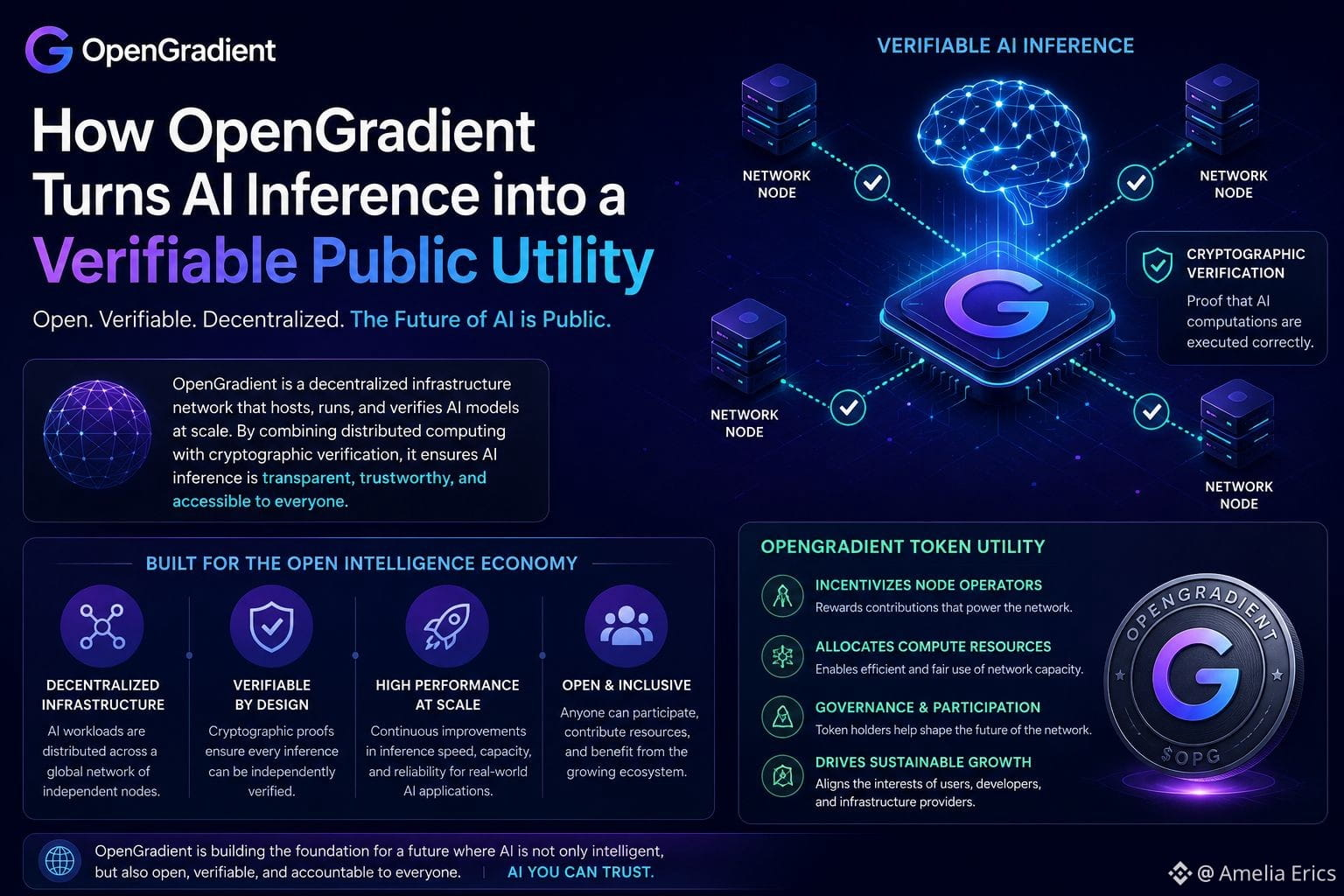
The more I explore AI, the more I realize that trust is becoming just as important as performance. Most AI systems operate behind closed doors, making it difficult to verify how results are produced. OpenGradient is addressing this challenge by turning AI inference into a verifiable public utility that anyone can trust.
What impressed me most about OpenGradient is its decentralized approach. Instead of relying on a single provider, the network distributes AI workloads across multiple nodes while enabling cryptographic verification of computations. This means AI outputs can be independently verified, bringing transparency and accountability to the process.
Recent developments have focused on improving inference efficiency, expanding network capabilities, and strengthening verification mechanisms. These upgrades support the project's mission of building a scalable infrastructure for the emerging open intelligence economy.
The OpenGradient token plays a vital role within the ecosystem. It is used to incentivize node operators, allocate computing resources, and support participation across the network. This creates a sustainable model that aligns the interests of users, developers, and infrastructure providers.
In my view, OpenGradient is solving one of AI's biggest problems: trust. By making AI inference open, verifiable, and decentralized, it is laying the foundation for a future where intelligence is not only powerful but also transparent and accountable. As AI adoption grows, solutions like OpenGradient could become essential infrastructure for the next generation of digital innovation.
@OpenGradient
#opg
$OPG
How OpenGradient Turns AI Inference into a Verifiable Public Utility
The more I explore AI, the more I realize that trust is becoming just as important as performance. Most AI systems operate behind closed doors, making it difficult to verify how results are produced. OpenGradient is addressing this challenge by turning AI inference into a verifiable public utility that anyone can trust.
What impressed me most about OpenGradient is its decentralized approach. Instead of relying on a single provider, the network distributes AI workloads across multiple nodes while enabling cryptographic verification of computations. This means AI outputs can be independently verified, bringing transparency and accountability to the process.
Recent developments have focused on improving inference efficiency, expanding network capabilities, and strengthening verification mechanisms. These upgrades support the project's mission of building a scalable infrastructure for the emerging open intelligence economy.
The OpenGradient token plays a vital role within the ecosystem. It is used to incentivize node operators, allocate computing resources, and support participation across the network. This creates a sustainable model that aligns the interests of users, developers, and infrastructure providers.
In my view, OpenGradient is solving one of AI's biggest problems: trust. By making AI inference open, verifiable, and decentralized, it is laying the foundation for a future where intelligence is not only powerful but also transparent and accountable. As AI adoption grows, solutions like OpenGradient could become essential infrastructure for the next generation of digital innovation.
@OpenGradient
#opg
$OPG
The more I explore AI, the more I realize that trust is becoming just as important as performance. Most AI systems operate behind closed doors, making it difficult to verify how results are produced. OpenGradient is addressing this challenge by turning AI inference into a verifiable public utility that anyone can trust.
What impressed me most about OpenGradient is its decentralized approach. Instead of relying on a single provider, the network distributes AI workloads across multiple nodes while enabling cryptographic verification of computations. This means AI outputs can be independently verified, bringing transparency and accountability to the process.
Recent developments have focused on improving inference efficiency, expanding network capabilities, and strengthening verification mechanisms. These upgrades support the project's mission of building a scalable infrastructure for the emerging open intelligence economy.
The OpenGradient token plays a vital role within the ecosystem. It is used to incentivize node operators, allocate computing resources, and support participation across the network. This creates a sustainable model that aligns the interests of users, developers, and infrastructure providers.
In my view, OpenGradient is solving one of AI's biggest problems: trust. By making AI inference open, verifiable, and decentralized, it is laying the foundation for a future where intelligence is not only powerful but also transparent and accountable. As AI adoption grows, solutions like OpenGradient could become essential infrastructure for the next generation of digital innovation.
@OpenGradient
#opg
$OPG
3
1
218
·
--
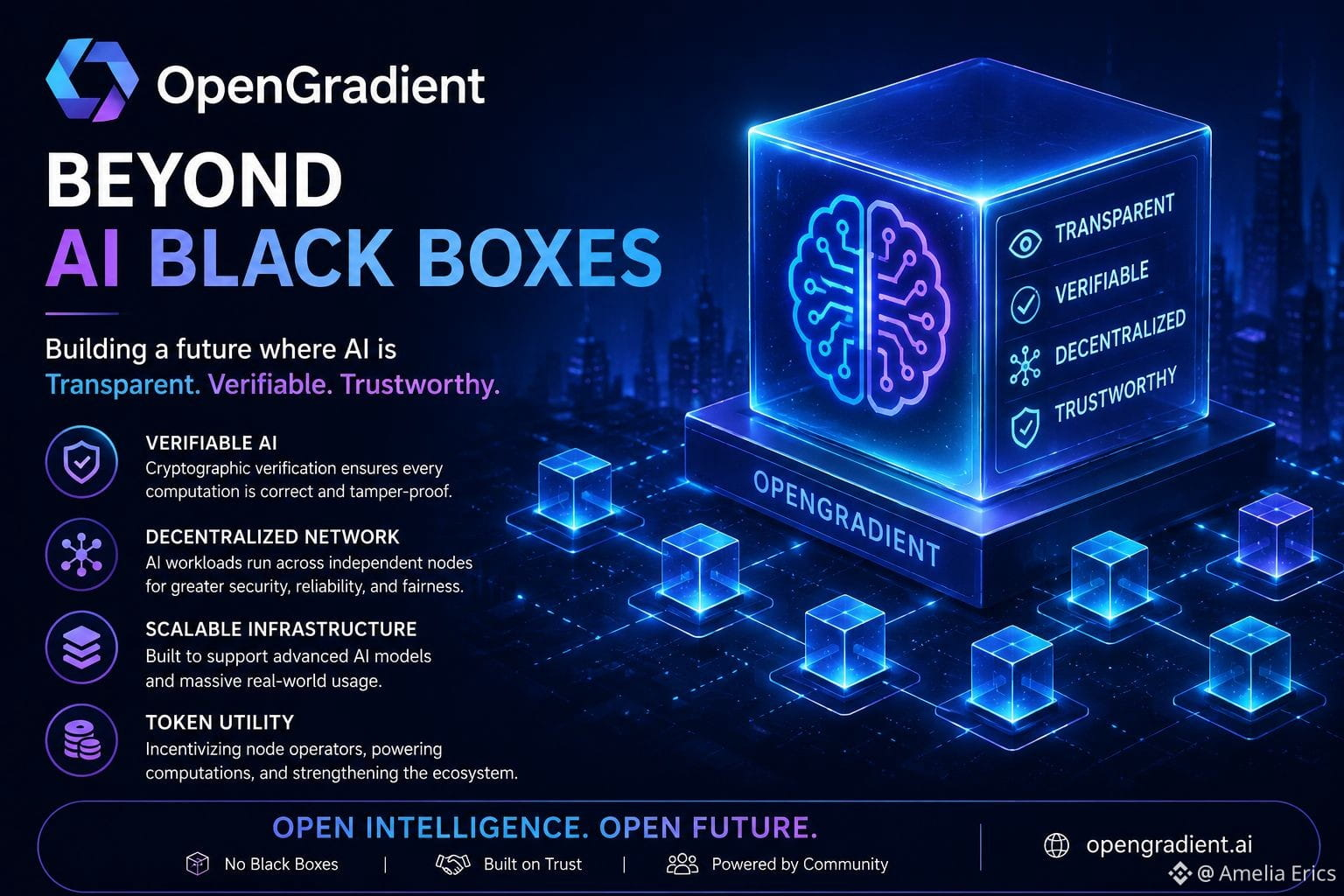
OpenGradient’s Vision Beyond AI Black Boxes
As I explore the rapidly evolving AI industry, one issue stands out: trust. Most AI systems function as black boxes, producing results without revealing how they were generated. That lack of transparency creates uncertainty. This is why OpenGradient caught my attention. Its vision is simple yet powerful—build an AI ecosystem where intelligence can be verified instead of blindly trusted.
What I find most compelling about OpenGradient is its focus on decentralized and verifiable AI. The network enables AI models to be hosted and executed across independent nodes while using cryptographic verification to prove that computations are accurate. Rather than relying on trust alone, users can validate AI outputs with confidence. In my view, this approach addresses one of the biggest challenges facing AI today.
Recent developments show steady progress toward that vision. OpenGradient continues to strengthen its infrastructure, improve AI verification, and support scalable AI workloads. The project's token utility is equally important, rewarding node operators, securing participation, and powering network activity. Together, these elements create a sustainable foundation for open intelligence.
I believe OpenGradient represents more than technological innovation. It represents a future where AI is transparent, accountable, and trustworthy. As AI becomes increasingly important in our lives, systems built on proof rather than promises will have a clear advantage.
In conclusion, OpenGradient is helping redefine trust in the AI economy. By combining decentralization, verification, and strong network incentives, it is paving the way for a future where AI is no longer a black box but an open and verifiable source of intelligence.
@OpenGradient
#opg
$OPG
OpenGradient’s Vision Beyond AI Black Boxes
As I explore the rapidly evolving AI industry, one issue stands out: trust. Most AI systems function as black boxes, producing results without revealing how they were generated. That lack of transparency creates uncertainty. This is why OpenGradient caught my attention. Its vision is simple yet powerful—build an AI ecosystem where intelligence can be verified instead of blindly trusted.
What I find most compelling about OpenGradient is its focus on decentralized and verifiable AI. The network enables AI models to be hosted and executed across independent nodes while using cryptographic verification to prove that computations are accurate. Rather than relying on trust alone, users can validate AI outputs with confidence. In my view, this approach addresses one of the biggest challenges facing AI today.
Recent developments show steady progress toward that vision. OpenGradient continues to strengthen its infrastructure, improve AI verification, and support scalable AI workloads. The project's token utility is equally important, rewarding node operators, securing participation, and powering network activity. Together, these elements create a sustainable foundation for open intelligence.
I believe OpenGradient represents more than technological innovation. It represents a future where AI is transparent, accountable, and trustworthy. As AI becomes increasingly important in our lives, systems built on proof rather than promises will have a clear advantage.
In conclusion, OpenGradient is helping redefine trust in the AI economy. By combining decentralization, verification, and strong network incentives, it is paving the way for a future where AI is no longer a black box but an open and verifiable source of intelligence.
@OpenGradient
#opg
$OPG
As I explore the rapidly evolving AI industry, one issue stands out: trust. Most AI systems function as black boxes, producing results without revealing how they were generated. That lack of transparency creates uncertainty. This is why OpenGradient caught my attention. Its vision is simple yet powerful—build an AI ecosystem where intelligence can be verified instead of blindly trusted.
What I find most compelling about OpenGradient is its focus on decentralized and verifiable AI. The network enables AI models to be hosted and executed across independent nodes while using cryptographic verification to prove that computations are accurate. Rather than relying on trust alone, users can validate AI outputs with confidence. In my view, this approach addresses one of the biggest challenges facing AI today.
Recent developments show steady progress toward that vision. OpenGradient continues to strengthen its infrastructure, improve AI verification, and support scalable AI workloads. The project's token utility is equally important, rewarding node operators, securing participation, and powering network activity. Together, these elements create a sustainable foundation for open intelligence.
I believe OpenGradient represents more than technological innovation. It represents a future where AI is transparent, accountable, and trustworthy. As AI becomes increasingly important in our lives, systems built on proof rather than promises will have a clear advantage.
In conclusion, OpenGradient is helping redefine trust in the AI economy. By combining decentralization, verification, and strong network incentives, it is paving the way for a future where AI is no longer a black box but an open and verifiable source of intelligence.
@OpenGradient
#opg
$OPG
188
·
--
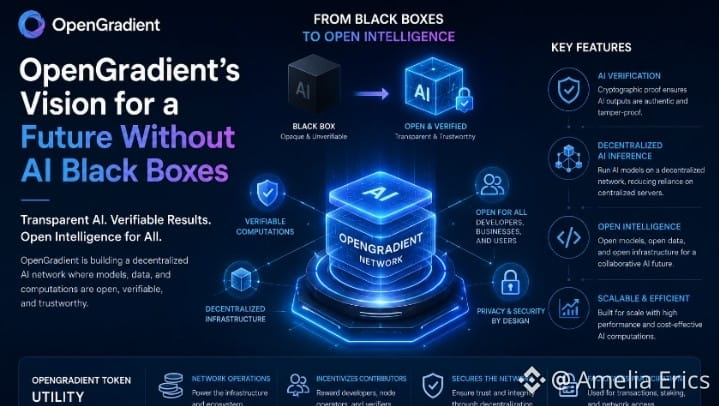
OpenGradient’s Vision for a Future Without AI Black Boxes
As AI becomes more powerful, trust is becoming a major concern. Most AI systems operate as “black boxes,” making it difficult to understand or verify how decisions are made. OpenGradient aims to solve this problem by creating a transparent and verifiable AI infrastructure.
OpenGradient is a decentralized network built to host, run, and verify AI models at scale. Its core innovation is cryptographic verification, which allows users to confirm that AI outputs are authentic and untampered. By enabling decentralized AI inference, the network reduces reliance on centralized providers while improving transparency and accountability.
Recent developments highlight OpenGradient’s focus on building the foundation for Open Intelligence. The project continues to expand its infrastructure, helping developers deploy trustworthy AI applications that can be independently verified.
The OpenGradient token supports network participation, incentivizes contributors, and helps secure the ecosystem. This utility aligns the interests of developers, operators, and users while driving network growth.
In conclusion, OpenGradient is working to eliminate AI black boxes by making intelligence open, verifiable, and trustworthy. As demand for transparent AI grows, the project is positioning itself as a key layer for the future of decentralized artificial intelligence.
@OpenGradient
#opg
$OPG
OpenGradient’s Vision for a Future Without AI Black Boxes
As AI becomes more powerful, trust is becoming a major concern. Most AI systems operate as “black boxes,” making it difficult to understand or verify how decisions are made. OpenGradient aims to solve this problem by creating a transparent and verifiable AI infrastructure.
OpenGradient is a decentralized network built to host, run, and verify AI models at scale. Its core innovation is cryptographic verification, which allows users to confirm that AI outputs are authentic and untampered. By enabling decentralized AI inference, the network reduces reliance on centralized providers while improving transparency and accountability.
Recent developments highlight OpenGradient’s focus on building the foundation for Open Intelligence. The project continues to expand its infrastructure, helping developers deploy trustworthy AI applications that can be independently verified.
The OpenGradient token supports network participation, incentivizes contributors, and helps secure the ecosystem. This utility aligns the interests of developers, operators, and users while driving network growth.
In conclusion, OpenGradient is working to eliminate AI black boxes by making intelligence open, verifiable, and trustworthy. As demand for transparent AI grows, the project is positioning itself as a key layer for the future of decentralized artificial intelligence.
@OpenGradient
#opg
$OPG
As AI becomes more powerful, trust is becoming a major concern. Most AI systems operate as “black boxes,” making it difficult to understand or verify how decisions are made. OpenGradient aims to solve this problem by creating a transparent and verifiable AI infrastructure.
OpenGradient is a decentralized network built to host, run, and verify AI models at scale. Its core innovation is cryptographic verification, which allows users to confirm that AI outputs are authentic and untampered. By enabling decentralized AI inference, the network reduces reliance on centralized providers while improving transparency and accountability.
Recent developments highlight OpenGradient’s focus on building the foundation for Open Intelligence. The project continues to expand its infrastructure, helping developers deploy trustworthy AI applications that can be independently verified.
The OpenGradient token supports network participation, incentivizes contributors, and helps secure the ecosystem. This utility aligns the interests of developers, operators, and users while driving network growth.
In conclusion, OpenGradient is working to eliminate AI black boxes by making intelligence open, verifiable, and trustworthy. As demand for transparent AI grows, the project is positioning itself as a key layer for the future of decentralized artificial intelligence.
@OpenGradient
#opg
$OPG
195
Войдите, чтобы посмотреть больше материала
Присоединяйтесь к пользователям криптовалют по всему миру на Binance Square
⚡️ Получайте новейшую и полезную информацию о криптоактивах.
💬 Нам доверяет крупнейшая в мире криптобиржа.
👍 Получите достоверные аналитические данные от верифицированных создателей контента.
Эл. почта/номер телефона
В тренде
BinancekzWin
Просмотров: 32,428
94 обсуждают
МЕН ЧАТТА ЖАЙ ҒАНА ОТЫРЫП, 10 BNB ҰТЫП АЛДЫМ 😭🔥
Деп айтқым келеді, бірақ бұл шындық емес, Бірақ шындықтың өзі де керемет 💅
Жеңіл, танымдық, қызықты белсенділіктерге қатысып, қомақты сыйлықтар ұтып алу? Оңай, Binance KZ мүмкіндікке толы!
Чатта үнемі розыгрыштар болып тұрады, мен де жиі ұтып аламын. Бірақ ең басты жеңіс- өзіңе жайлы, адекватты комьюнити табу. Араласу барысында көп пайдалы нәрсе үйренесің, саудада көмектесетін білім аласың.
Тегін $50 алу приятно, ал сол білімнің арқасында оны көбейту ол менің жеңісім 💅
#BinancekzWin
Cabbage hater
·Лайков: 0
·Просмотров: 65
BinancePick
Просмотров: 2.8M
148,446 обсуждают
EarningsSeason
Просмотров: 5.1M
25,344 обсуждают