
M I S H U
1.1k Публикации

M I S H U
Отправить жалобу
Заблокировать пользователя
Трейдер с регулярными сделками
1.1 г
125 подписок(и/а)
14.6K+ подписчиков(а)
1.0K+ понравилось
Посты
Все
Активно
·
--
POV: You sold yesterday 😎
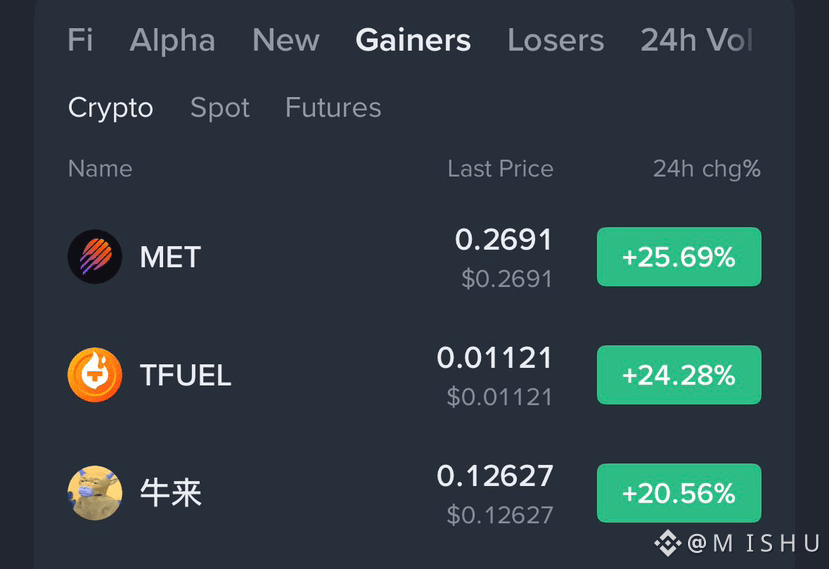
$MET +25.69%
$TFUEL +24.28%
$牛来 +20.56%
The market remembers everything. 😭
#OracleJumpsOver6%OnEarningsBeat
POV: You sold yesterday 😎
$MET +25.69%
$TFUEL +24.28%
$牛来 +20.56%
The market remembers everything. 😭
#OracleJumpsOver6%OnEarningsBeat
$MET +25.69%
$TFUEL +24.28%
$牛来 +20.56%
The market remembers everything. 😭
#OracleJumpsOver6%OnEarningsBeat
524
·
--
Is the Soft Landing Still Possible? What CPI Will Tell Us
Everyone's talking about the Fed's next move, but let's zoom out for a second. The real question isn't whether they'll hike, it's whether we avoid a hard landing entirely.
Here's what concerns me:
Nonfarm payrolls came in hot, but wage growth is moderating. That's actually a green flag for inflation (lower wage pressures = lower service inflation). But the consumer is also slowing. Credit card delinquencies are ticking up. Auto sales are cooling.
The CPI Report is a Crossroads
If CPI stays elevated → The Fed holds rates higher, the yield curve stays inverted, and we're pricing in recession risk. That hurts both stocks and bonds.
If CPI cools meaningfully → We get our soft landing narrative back. Growth stocks rally, cyclicals benefit, and maybe we finally see the rate cuts that'll support refinancing in 2025.
What I'm Watching
Core CPI (excluding food and energy) is the real tell
Services inflation, this is where the Fed's truly focused
What it means for 2025 earnings expectations
I'm not betting on the market here. I'm positioning based on economic fundamentals. Right now, that means holding quality names with pricing power and staying light on cyclical leverage.
The data doesn't lie. Let's see what it says this week.
#CPIWatch #crypto $CNPY $GAIB
Is the Soft Landing Still Possible? What CPI Will Tell Us
Everyone's talking about the Fed's next move, but let's zoom out for a second. The real question isn't whether they'll hike, it's whether we avoid a hard landing entirely.
Here's what concerns me:
Nonfarm payrolls came in hot, but wage growth is moderating. That's actually a green flag for inflation (lower wage pressures = lower service inflation). But the consumer is also slowing. Credit card delinquencies are ticking up. Auto sales are cooling.
The CPI Report is a Crossroads
If CPI stays elevated → The Fed holds rates higher, the yield curve stays inverted, and we're pricing in recession risk. That hurts both stocks and bonds.
If CPI cools meaningfully → We get our soft landing narrative back. Growth stocks rally, cyclicals benefit, and maybe we finally see the rate cuts that'll support refinancing in 2025.
What I'm Watching
Core CPI (excluding food and energy) is the real tell
Services inflation, this is where the Fed's truly focused
What it means for 2025 earnings expectations
I'm not betting on the market here. I'm positioning based on economic fundamentals. Right now, that means holding quality names with pricing power and staying light on cyclical leverage.
The data doesn't lie. Let's see what it says this week.
#CPIWatch #crypto $CNPY $GAIB
Everyone's talking about the Fed's next move, but let's zoom out for a second. The real question isn't whether they'll hike, it's whether we avoid a hard landing entirely.
Here's what concerns me:
Nonfarm payrolls came in hot, but wage growth is moderating. That's actually a green flag for inflation (lower wage pressures = lower service inflation). But the consumer is also slowing. Credit card delinquencies are ticking up. Auto sales are cooling.
The CPI Report is a Crossroads
If CPI stays elevated → The Fed holds rates higher, the yield curve stays inverted, and we're pricing in recession risk. That hurts both stocks and bonds.
If CPI cools meaningfully → We get our soft landing narrative back. Growth stocks rally, cyclicals benefit, and maybe we finally see the rate cuts that'll support refinancing in 2025.
What I'm Watching
Core CPI (excluding food and energy) is the real tell
Services inflation, this is where the Fed's truly focused
What it means for 2025 earnings expectations
I'm not betting on the market here. I'm positioning based on economic fundamentals. Right now, that means holding quality names with pricing power and staying light on cyclical leverage.
The data doesn't lie. Let's see what it says this week.
#CPIWatch #crypto $CNPY $GAIB

1
1
399
·
--
Someone check on the leaderboard.
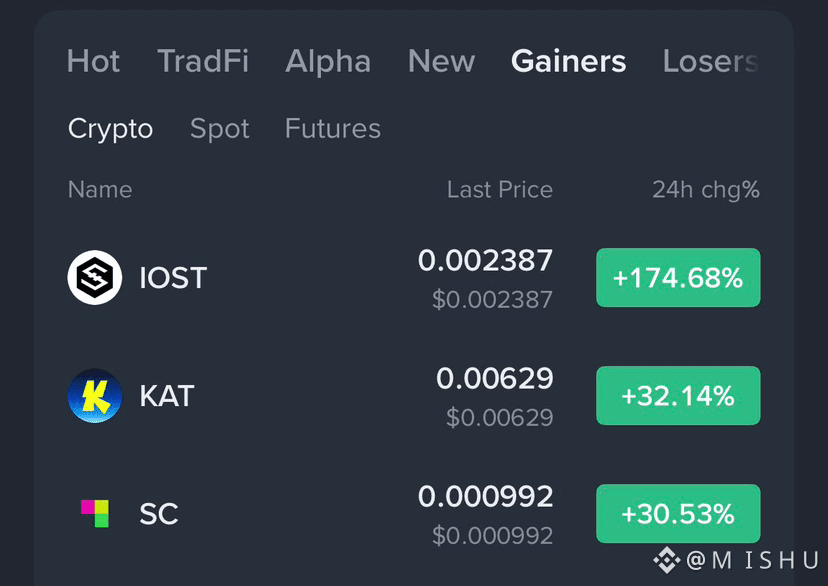
🚀 $IOST +174.68%
📈 $KAT +32.14%
📈 $SC +30.53%
KAT and SC posted the kind of gains traders dream about.
Unfortunately for them, IOST decided to print a move so large it made 30% look normal.
#BrentCrudeTops$100 #binance
Someone check on the leaderboard.
🚀 $IOST +174.68%
📈 $KAT +32.14%
📈 $SC +30.53%
KAT and SC posted the kind of gains traders dream about.
Unfortunately for them, IOST decided to print a move so large it made 30% look normal.
#BrentCrudeTops$100 #binance
🚀 $IOST +174.68%
📈 $KAT +32.14%
📈 $SC +30.53%
KAT and SC posted the kind of gains traders dream about.
Unfortunately for them, IOST decided to print a move so large it made 30% look normal.
#BrentCrudeTops$100 #binance
386
·
--
#dusk $DUSK @Dusk_Foundation
went looking for the mechanism behind "selective disclosure", a phrase every privacy chain uses but few define precisely. Most systems treat disclosure as binary: reveal everything to a regulator, or reveal nothing at all.
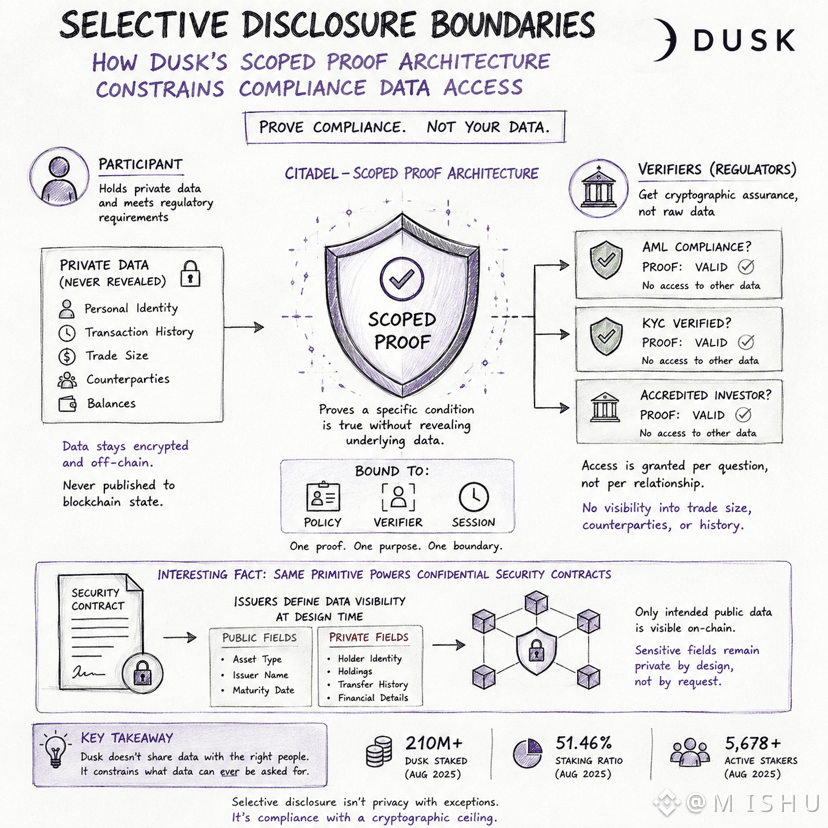
Dusk's model is narrower. Participants prove they satisfy AML/KYC requirements without exposing the personal or transactional data beneath the proof. The disclosure isn't "here's my data." It's "here's proof this condition holds", scoped to a single compliance question and nothing more.
Access is granted per question, not per relationship. A regulator verifying AML status doesn't automatically gain visibility into trade size, counterparties, or transaction history.
The interesting part is that the same principle extends to confidential security contracts, where issuers define which fields are public and which remain private before the asset even launches.
If a proof can only answer the question it was designed for, is selective disclosure really privacy with exceptions or compliance with a cryptographic ceiling on what can ever be known?
#dusk $DUSK @Dusk
went looking for the mechanism behind "selective disclosure", a phrase every privacy chain uses but few define precisely. Most systems treat disclosure as binary: reveal everything to a regulator, or reveal nothing at all.
Dusk's model is narrower. Participants prove they satisfy AML/KYC requirements without exposing the personal or transactional data beneath the proof. The disclosure isn't "here's my data." It's "here's proof this condition holds", scoped to a single compliance question and nothing more.
Access is granted per question, not per relationship. A regulator verifying AML status doesn't automatically gain visibility into trade size, counterparties, or transaction history.
The interesting part is that the same principle extends to confidential security contracts, where issuers define which fields are public and which remain private before the asset even launches.
If a proof can only answer the question it was designed for, is selective disclosure really privacy with exceptions or compliance with a cryptographic ceiling on what can ever be known?
went looking for the mechanism behind "selective disclosure", a phrase every privacy chain uses but few define precisely. Most systems treat disclosure as binary: reveal everything to a regulator, or reveal nothing at all.
Dusk's model is narrower. Participants prove they satisfy AML/KYC requirements without exposing the personal or transactional data beneath the proof. The disclosure isn't "here's my data." It's "here's proof this condition holds", scoped to a single compliance question and nothing more.
Access is granted per question, not per relationship. A regulator verifying AML status doesn't automatically gain visibility into trade size, counterparties, or transaction history.
The interesting part is that the same principle extends to confidential security contracts, where issuers define which fields are public and which remain private before the asset even launches.
If a proof can only answer the question it was designed for, is selective disclosure really privacy with exceptions or compliance with a cryptographic ceiling on what can ever be known?
1
2
1k
·
--
#dusk $DUSK @Dusk_Foundation
pulled up Dusk's incident notice expecting the usual vague "we're investigating" language. What I found instead was a distinction worth sitting with.
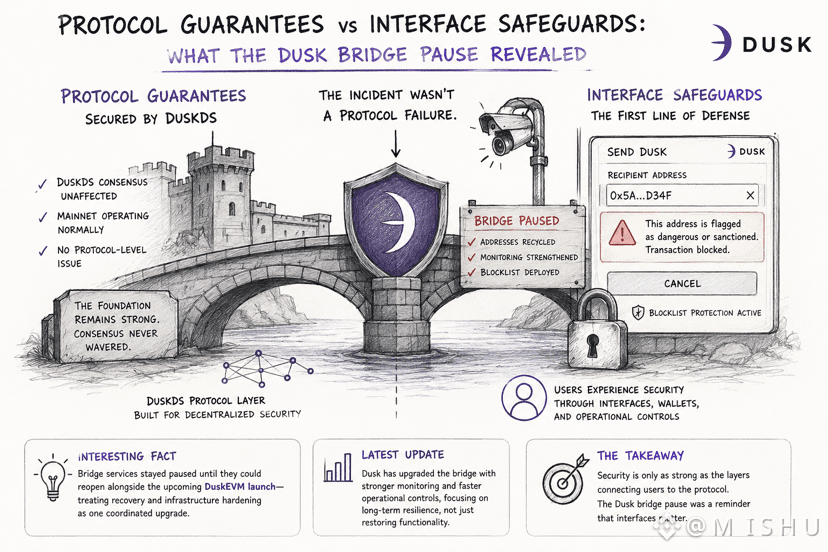
When Dusk detected abnormal bridge activity tied to a team managed operational wallet, it paused bridge services, recycled affected addresses, and deployed a Web Wallet blocklist that warns users before sending funds to known malicious or sanctioned destinations.
That's the interesting part.
A blocklist is an interface safeguard. It protects users before a transaction is signed. It isn't something DuskDS enforces at the protocol layer.
The team was equally explicit that the incident was not a protocol level failure. Consensus continued operating normally; the compromise existed entirely within operational infrastructure surrounding the bridge.
One detail stood out: bridge services remained paused until they could be reintroduced alongside DuskEVM, turning recovery and infrastructure hardening into a single rollout rather than reopening first and patching later.
If the protocol never failed, yet the protection users actually interacted with was a wallet level warning system, what does that say about where security is really experienced, in the protocol, or at the interface between users and the protocol?
#dusk $DUSK @Dusk
pulled up Dusk's incident notice expecting the usual vague "we're investigating" language. What I found instead was a distinction worth sitting with.
When Dusk detected abnormal bridge activity tied to a team managed operational wallet, it paused bridge services, recycled affected addresses, and deployed a Web Wallet blocklist that warns users before sending funds to known malicious or sanctioned destinations.
That's the interesting part.
A blocklist is an interface safeguard. It protects users before a transaction is signed. It isn't something DuskDS enforces at the protocol layer.
The team was equally explicit that the incident was not a protocol level failure. Consensus continued operating normally; the compromise existed entirely within operational infrastructure surrounding the bridge.
One detail stood out: bridge services remained paused until they could be reintroduced alongside DuskEVM, turning recovery and infrastructure hardening into a single rollout rather than reopening first and patching later.
If the protocol never failed, yet the protection users actually interacted with was a wallet level warning system, what does that say about where security is really experienced, in the protocol, or at the interface between users and the protocol?
pulled up Dusk's incident notice expecting the usual vague "we're investigating" language. What I found instead was a distinction worth sitting with.
When Dusk detected abnormal bridge activity tied to a team managed operational wallet, it paused bridge services, recycled affected addresses, and deployed a Web Wallet blocklist that warns users before sending funds to known malicious or sanctioned destinations.
That's the interesting part.
A blocklist is an interface safeguard. It protects users before a transaction is signed. It isn't something DuskDS enforces at the protocol layer.
The team was equally explicit that the incident was not a protocol level failure. Consensus continued operating normally; the compromise existed entirely within operational infrastructure surrounding the bridge.
One detail stood out: bridge services remained paused until they could be reintroduced alongside DuskEVM, turning recovery and infrastructure hardening into a single rollout rather than reopening first and patching later.
If the protocol never failed, yet the protection users actually interacted with was a wallet level warning system, what does that say about where security is really experienced, in the protocol, or at the interface between users and the protocol?
4
5
1.2k
·
--
#dusk $DUSK @Dusk_Foundation
was reading Dusk's bridge incident notice expecting the usual crypto hack template, panic, vague reassurances, silence. Instead, the wording was oddly specific about what didn't break.
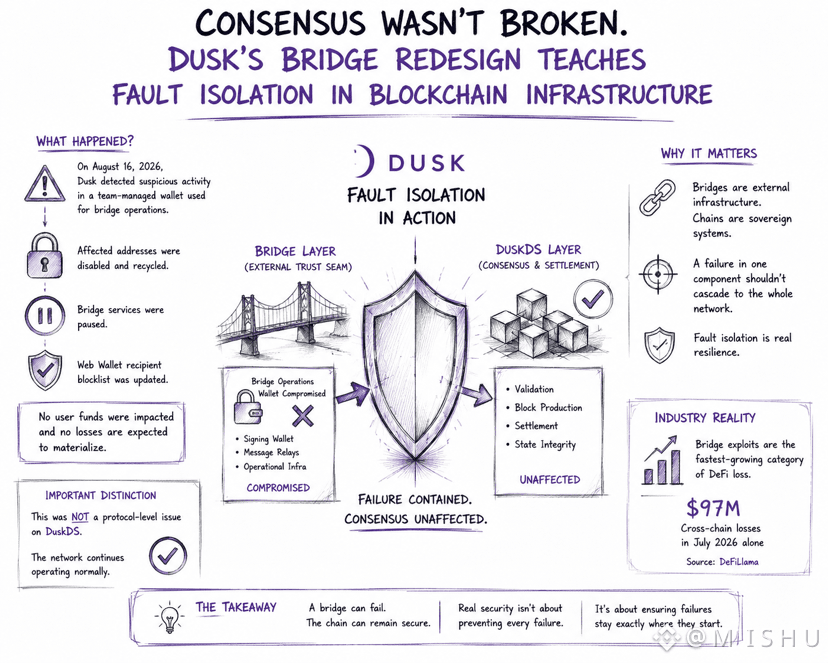
On August 16, 2026, the team detected suspicious activity tied to a team managed wallet used in bridge operations, disabled and recycled the affected addresses, paused bridge services, and added a Web Wallet recipient blocklist. Based on all available information, no user funds were impacted, and no losses are expected to materialize.
The line that actually mattered is this was not a protocol level issue on DuskDS, and the network continues operating normally. Consensus, settlement, the base layer, untouched. The failure was contained entirely to an operational wallet at the bridge boundary.
That's fault isolation working as designed, not luck. A bridge is an external trust seam bolted onto a chain; DuskDS validating blocks correctly the entire time is the actual proof the isolation held.
So.. bridge exploits are the fastest-growing category of DeFi loss this year, with July alone totaling $97M in cross chain losses industry wide and the recurring cause isn't broken cryptography, it's broken trust assumptions: a compromised signer, a forged message, a bypassed timelock.
If the base layer can stay untouched while the bridge fails, should "is the chain secure" and "is the bridge secure" ever be asked as the same question?
#dusk $DUSK @Dusk
was reading Dusk's bridge incident notice expecting the usual crypto hack template, panic, vague reassurances, silence. Instead, the wording was oddly specific about what didn't break.
On August 16, 2026, the team detected suspicious activity tied to a team managed wallet used in bridge operations, disabled and recycled the affected addresses, paused bridge services, and added a Web Wallet recipient blocklist. Based on all available information, no user funds were impacted, and no losses are expected to materialize.
The line that actually mattered is this was not a protocol level issue on DuskDS, and the network continues operating normally. Consensus, settlement, the base layer, untouched. The failure was contained entirely to an operational wallet at the bridge boundary.
That's fault isolation working as designed, not luck. A bridge is an external trust seam bolted onto a chain; DuskDS validating blocks correctly the entire time is the actual proof the isolation held.
So.. bridge exploits are the fastest-growing category of DeFi loss this year, with July alone totaling $97M in cross chain losses industry wide and the recurring cause isn't broken cryptography, it's broken trust assumptions: a compromised signer, a forged message, a bypassed timelock.
If the base layer can stay untouched while the bridge fails, should "is the chain secure" and "is the bridge secure" ever be asked as the same question?
was reading Dusk's bridge incident notice expecting the usual crypto hack template, panic, vague reassurances, silence. Instead, the wording was oddly specific about what didn't break.
On August 16, 2026, the team detected suspicious activity tied to a team managed wallet used in bridge operations, disabled and recycled the affected addresses, paused bridge services, and added a Web Wallet recipient blocklist. Based on all available information, no user funds were impacted, and no losses are expected to materialize.
The line that actually mattered is this was not a protocol level issue on DuskDS, and the network continues operating normally. Consensus, settlement, the base layer, untouched. The failure was contained entirely to an operational wallet at the bridge boundary.
That's fault isolation working as designed, not luck. A bridge is an external trust seam bolted onto a chain; DuskDS validating blocks correctly the entire time is the actual proof the isolation held.
So.. bridge exploits are the fastest-growing category of DeFi loss this year, with July alone totaling $97M in cross chain losses industry wide and the recurring cause isn't broken cryptography, it's broken trust assumptions: a compromised signer, a forged message, a bypassed timelock.
If the base layer can stay untouched while the bridge fails, should "is the chain secure" and "is the bridge secure" ever be asked as the same question?
17
3
1.6k
·
--
Проверено
#dusk $DUSK @Dusk_Foundation
opened Dusk’s CreatorPad task expecting another privacy focused narrative around Hedger and auditable zero knowledge proofs. Instead, what caught my attention was how the system behaved when something actually went wrong.
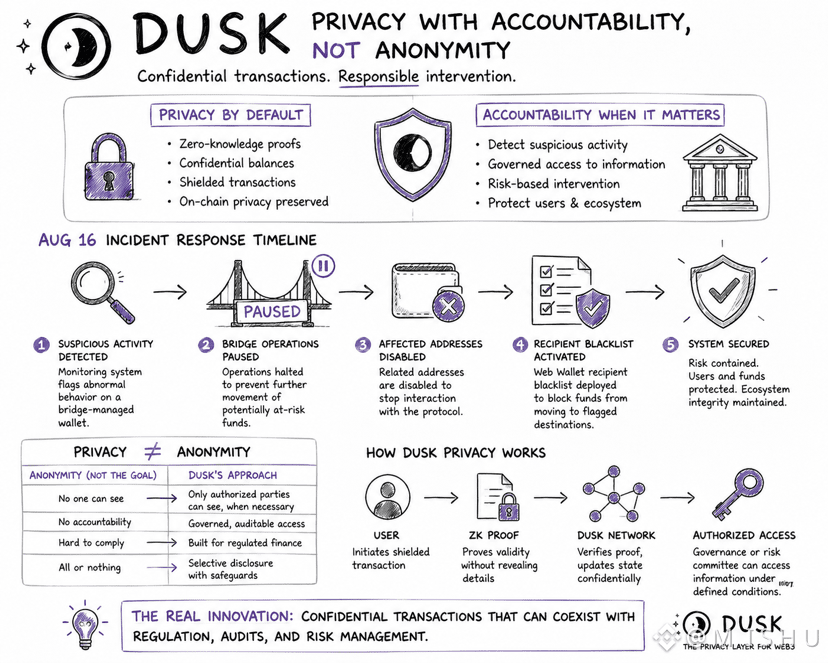
On August 16, the team detected suspicious activity involving a bridge managed wallet. Within hours, bridge operations were paused, affected addresses were disabled, and a recipient blacklist was deployed to prevent funds from reaching flagged destinations.
That response changes how I think about Dusk’s privacy model.
Many people hear “privacy by default” and assume complete anonymity. What Dusk appears to be building is something different: confidentiality with accountability. Transaction details can remain protected from public view, while the network still retains mechanisms to intervene when security, compliance, or asset protection require action.
For regulated finance, that distinction matters.
The real question may not be whether transactions are private, but who can access information under specific conditions, how that access is governed, and what safeguards exist around intervention powers.
Privacy is easy to market. Designing privacy that can coexist with regulation, audits, and risk management is the harder challenge and arguably the more important one.
#dusk $DUSK @Dusk
opened Dusk’s CreatorPad task expecting another privacy focused narrative around Hedger and auditable zero knowledge proofs. Instead, what caught my attention was how the system behaved when something actually went wrong.
On August 16, the team detected suspicious activity involving a bridge managed wallet. Within hours, bridge operations were paused, affected addresses were disabled, and a recipient blacklist was deployed to prevent funds from reaching flagged destinations.
That response changes how I think about Dusk’s privacy model.
Many people hear “privacy by default” and assume complete anonymity. What Dusk appears to be building is something different: confidentiality with accountability. Transaction details can remain protected from public view, while the network still retains mechanisms to intervene when security, compliance, or asset protection require action.
For regulated finance, that distinction matters.
The real question may not be whether transactions are private, but who can access information under specific conditions, how that access is governed, and what safeguards exist around intervention powers.
Privacy is easy to market. Designing privacy that can coexist with regulation, audits, and risk management is the harder challenge and arguably the more important one.
opened Dusk’s CreatorPad task expecting another privacy focused narrative around Hedger and auditable zero knowledge proofs. Instead, what caught my attention was how the system behaved when something actually went wrong.
On August 16, the team detected suspicious activity involving a bridge managed wallet. Within hours, bridge operations were paused, affected addresses were disabled, and a recipient blacklist was deployed to prevent funds from reaching flagged destinations.
That response changes how I think about Dusk’s privacy model.
Many people hear “privacy by default” and assume complete anonymity. What Dusk appears to be building is something different: confidentiality with accountability. Transaction details can remain protected from public view, while the network still retains mechanisms to intervene when security, compliance, or asset protection require action.
For regulated finance, that distinction matters.
The real question may not be whether transactions are private, but who can access information under specific conditions, how that access is governed, and what safeguards exist around intervention powers.
Privacy is easy to market. Designing privacy that can coexist with regulation, audits, and risk management is the harder challenge and arguably the more important one.
9
3
1.5k
·
--
Проверено
#dusk $DUSK @Dusk_Foundation
So…. went looking for what actually keeps a developer on a chain after the initial "we support Solidity" announcement fades.
EVM compatibility gets builders in the door.
It doesn't give them a reason to stay.
DuskEVM's testnet is now live, giving developers access to Solidity, familiar Ethereum tooling, and a lower-friction path into the ecosystem. That's important. But in 2026, compatibility is no longer a differentiator, it's the minimum requirement.
What caught my attention wasn't DuskEVM itself.
It was everything built around it.
Hedger introduces confidential transaction flows using homomorphic encryption and zero knowledge technology, allowing applications to combine privacy with regulated financial infrastructure. Most chains compete on execution. Dusk is competing on what can be executed privately.
Then there's Dusk Connect.
Released in April 2026, the SDK was designed to help dApps discover wallets, connect users, and handle transactions through a unified interface. It solves a problem that appears after acquisition: reducing friction for developers who have already decided to build.
ImDusk now offers two distinct builder paths. DuskEVM serves Solidity developers, while the native Dusk stack provides shielded accounts, privacy preserving execution, and direct node level tooling through W3sper. As applications mature, developers don't need to leave the ecosystem to access more advanced capabilities.
Hmm… Maybe that's the real retention strategy.
Not attracting builders with EVM compatibility.
Giving them infrastructure they can't easily find anywhere else.
What creates stronger builder loyalty?
#dusk $DUSK @Dusk
So…. went looking for what actually keeps a developer on a chain after the initial "we support Solidity" announcement fades.
EVM compatibility gets builders in the door.
It doesn't give them a reason to stay.
DuskEVM's testnet is now live, giving developers access to Solidity, familiar Ethereum tooling, and a lower-friction path into the ecosystem. That's important. But in 2026, compatibility is no longer a differentiator, it's the minimum requirement.
What caught my attention wasn't DuskEVM itself.
It was everything built around it.
Hedger introduces confidential transaction flows using homomorphic encryption and zero knowledge technology, allowing applications to combine privacy with regulated financial infrastructure. Most chains compete on execution. Dusk is competing on what can be executed privately.
Then there's Dusk Connect.
Released in April 2026, the SDK was designed to help dApps discover wallets, connect users, and handle transactions through a unified interface. It solves a problem that appears after acquisition: reducing friction for developers who have already decided to build.
ImDusk now offers two distinct builder paths. DuskEVM serves Solidity developers, while the native Dusk stack provides shielded accounts, privacy preserving execution, and direct node level tooling through W3sper. As applications mature, developers don't need to leave the ecosystem to access more advanced capabilities.
Hmm… Maybe that's the real retention strategy.
Not attracting builders with EVM compatibility.
Giving them infrastructure they can't easily find anywhere else.
What creates stronger builder loyalty?
So…. went looking for what actually keeps a developer on a chain after the initial "we support Solidity" announcement fades.
EVM compatibility gets builders in the door.
It doesn't give them a reason to stay.
DuskEVM's testnet is now live, giving developers access to Solidity, familiar Ethereum tooling, and a lower-friction path into the ecosystem. That's important. But in 2026, compatibility is no longer a differentiator, it's the minimum requirement.
What caught my attention wasn't DuskEVM itself.
It was everything built around it.
Hedger introduces confidential transaction flows using homomorphic encryption and zero knowledge technology, allowing applications to combine privacy with regulated financial infrastructure. Most chains compete on execution. Dusk is competing on what can be executed privately.
Then there's Dusk Connect.
Released in April 2026, the SDK was designed to help dApps discover wallets, connect users, and handle transactions through a unified interface. It solves a problem that appears after acquisition: reducing friction for developers who have already decided to build.
ImDusk now offers two distinct builder paths. DuskEVM serves Solidity developers, while the native Dusk stack provides shielded accounts, privacy preserving execution, and direct node level tooling through W3sper. As applications mature, developers don't need to leave the ecosystem to access more advanced capabilities.
Hmm… Maybe that's the real retention strategy.
Not attracting builders with EVM compatibility.
Giving them infrastructure they can't easily find anywhere else.
What creates stronger builder loyalty?
EVM Compatibility
100%
Privacy Infrastructure
0%
Better Developer Tools
0%
Real Ecosystem Demand
0%
1 проголосовали • Голосование закрыто
12
1
1.2k
·
--
Проверено
#dusk $DUSK @Dusk_Foundation
Was reading on $ONG and $ENA when i went through @Dusk_Foundation SME infrastructure this week expecting to find a growing list of tokenized issuers.
That's the narrative most people look for: more issuers, more adoption.
Instead, I found a more interesting metric.
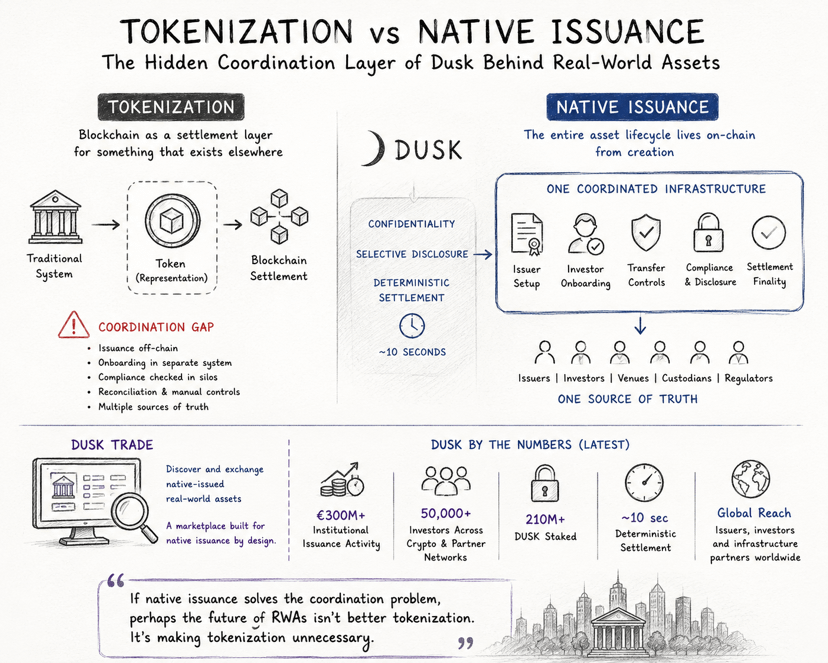
#dusk already provides the full stack for regulated issuance, asset creation, investor eligibility, transfer restrictions, compliance controls, and regulated settlement.
The infrastructure is ready.
But infrastructure readiness is not the same as economic activity.
The strongest signal I found was NPEX, a regulated securities marketplace with roughly €200–300M in listed investments connected to Dusk's infrastructure. That's not a wallet count or a testnet milestone. It's real capital operating through regulated rails.
It changed how I think about adoption.
Most networks measure growth by how many assets or issuers appear on chain.
For SME finance, a better question is: how much capital actually moves after an issuer arrives?
A hundred issuers can generate less value than ten issuers consistently issuing securities, attracting investors, and settling transactions.
Dusk compliance architecture makes issuer growth harder to manufacture than on most chains. Issuers must satisfy regulatory and eligibility requirements rather than simply deploy a token and call it adoption.
What I'm watching isn't issuer count.
It's economic activity per issuer.
Because real adoption begins when capital moves, not when an issuer registers.
#dusk $DUSK @Dusk
Was reading on $ONG and $ENA when i went through @Dusk SME infrastructure this week expecting to find a growing list of tokenized issuers.
That's the narrative most people look for: more issuers, more adoption.
Instead, I found a more interesting metric.
#dusk already provides the full stack for regulated issuance, asset creation, investor eligibility, transfer restrictions, compliance controls, and regulated settlement.
The infrastructure is ready.
But infrastructure readiness is not the same as economic activity.
The strongest signal I found was NPEX, a regulated securities marketplace with roughly €200–300M in listed investments connected to Dusk's infrastructure. That's not a wallet count or a testnet milestone. It's real capital operating through regulated rails.
It changed how I think about adoption.
Most networks measure growth by how many assets or issuers appear on chain.
For SME finance, a better question is: how much capital actually moves after an issuer arrives?
A hundred issuers can generate less value than ten issuers consistently issuing securities, attracting investors, and settling transactions.
Dusk compliance architecture makes issuer growth harder to manufacture than on most chains. Issuers must satisfy regulatory and eligibility requirements rather than simply deploy a token and call it adoption.
What I'm watching isn't issuer count.
It's economic activity per issuer.
Because real adoption begins when capital moves, not when an issuer registers.
Was reading on $ONG and $ENA when i went through @Dusk SME infrastructure this week expecting to find a growing list of tokenized issuers.
That's the narrative most people look for: more issuers, more adoption.
Instead, I found a more interesting metric.
#dusk already provides the full stack for regulated issuance, asset creation, investor eligibility, transfer restrictions, compliance controls, and regulated settlement.
The infrastructure is ready.
But infrastructure readiness is not the same as economic activity.
The strongest signal I found was NPEX, a regulated securities marketplace with roughly €200–300M in listed investments connected to Dusk's infrastructure. That's not a wallet count or a testnet milestone. It's real capital operating through regulated rails.
It changed how I think about adoption.
Most networks measure growth by how many assets or issuers appear on chain.
For SME finance, a better question is: how much capital actually moves after an issuer arrives?
A hundred issuers can generate less value than ten issuers consistently issuing securities, attracting investors, and settling transactions.
Dusk compliance architecture makes issuer growth harder to manufacture than on most chains. Issuers must satisfy regulatory and eligibility requirements rather than simply deploy a token and call it adoption.
What I'm watching isn't issuer count.
It's economic activity per issuer.
Because real adoption begins when capital moves, not when an issuer registers.
18
6
1k
·
--
Проверено
#termmax @termmax
Just saw a pump on $ONG $ENA and $PEOPLE , I realized liquidity fragmentation works a lot like having money spread across ten different wallets when you need to make one large payment.
The capital exists.
You just can't use it efficiently.
That thought came to mind while comparing TermMax's V1 markets against V2.
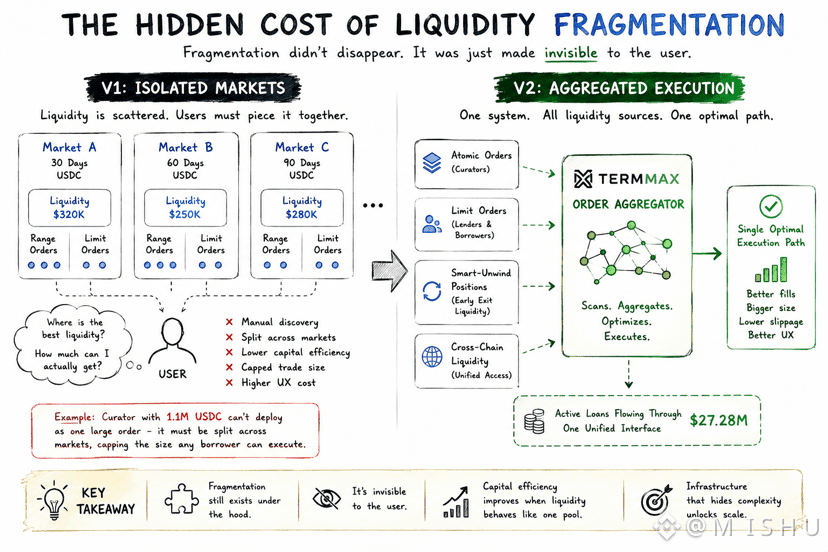
In V1, every market, different maturity, collateral type, or chain, held its own isolated liquidity. Curator range orders lived separately from lender and borrower limit orders, and users had to manually piece them together to find the best execution.
A curator with 1.1M USDC might have plenty of liquidity available overall, yet a large borrower could still struggle to access it in one transaction because that capital was scattered across multiple markets.
That's the hidden cost of fragmentation.
Not lower yield.
Not lower TVL.
A limit on execution quality.
What caught my attention is that TermMax didn't eliminate fragmentation. It changed who has to deal with it.
The Order Aggregator now scans atomic orders, limit orders, and smart unwind positions simultaneously, routing through all available liquidity sources and building a single execution path automatically.
The fragmentation still exists beneath the surface.
Users just don't see it anymore.
Today, around $27.28M in active loans moves through an interface that increasingly feels like one unified liquidity layer instead of dozens of separate markets.
While having tea i got to know an Interesting fact: some of the most impactful infrastructure upgrades don't create new liquidity, they simply make existing liquidity behave as if it were one market.
If fragmentation becomes completely invisible through routing, has the problem been solved or merely abstracted away?
#termmax @TermMax
Just saw a pump on $ONG $ENA and $PEOPLE , I realized liquidity fragmentation works a lot like having money spread across ten different wallets when you need to make one large payment.
The capital exists.
You just can't use it efficiently.
That thought came to mind while comparing TermMax's V1 markets against V2.
In V1, every market, different maturity, collateral type, or chain, held its own isolated liquidity. Curator range orders lived separately from lender and borrower limit orders, and users had to manually piece them together to find the best execution.
A curator with 1.1M USDC might have plenty of liquidity available overall, yet a large borrower could still struggle to access it in one transaction because that capital was scattered across multiple markets.
That's the hidden cost of fragmentation.
Not lower yield.
Not lower TVL.
A limit on execution quality.
What caught my attention is that TermMax didn't eliminate fragmentation. It changed who has to deal with it.
The Order Aggregator now scans atomic orders, limit orders, and smart unwind positions simultaneously, routing through all available liquidity sources and building a single execution path automatically.
The fragmentation still exists beneath the surface.
Users just don't see it anymore.
Today, around $27.28M in active loans moves through an interface that increasingly feels like one unified liquidity layer instead of dozens of separate markets.
While having tea i got to know an Interesting fact: some of the most impactful infrastructure upgrades don't create new liquidity, they simply make existing liquidity behave as if it were one market.
If fragmentation becomes completely invisible through routing, has the problem been solved or merely abstracted away?
Just saw a pump on $ONG $ENA and $PEOPLE , I realized liquidity fragmentation works a lot like having money spread across ten different wallets when you need to make one large payment.
The capital exists.
You just can't use it efficiently.
That thought came to mind while comparing TermMax's V1 markets against V2.
In V1, every market, different maturity, collateral type, or chain, held its own isolated liquidity. Curator range orders lived separately from lender and borrower limit orders, and users had to manually piece them together to find the best execution.
A curator with 1.1M USDC might have plenty of liquidity available overall, yet a large borrower could still struggle to access it in one transaction because that capital was scattered across multiple markets.
That's the hidden cost of fragmentation.
Not lower yield.
Not lower TVL.
A limit on execution quality.
What caught my attention is that TermMax didn't eliminate fragmentation. It changed who has to deal with it.
The Order Aggregator now scans atomic orders, limit orders, and smart unwind positions simultaneously, routing through all available liquidity sources and building a single execution path automatically.
The fragmentation still exists beneath the surface.
Users just don't see it anymore.
Today, around $27.28M in active loans moves through an interface that increasingly feels like one unified liquidity layer instead of dozens of separate markets.
While having tea i got to know an Interesting fact: some of the most impactful infrastructure upgrades don't create new liquidity, they simply make existing liquidity behave as if it were one market.
If fragmentation becomes completely invisible through routing, has the problem been solved or merely abstracted away?
16
3
1.6k
·
--
Частичная правда
#dusk $DUSK @Dusk_Foundation
Who got profit on $BTC and $ETH today? 🥳
Most investors only think about consensus when it fails.
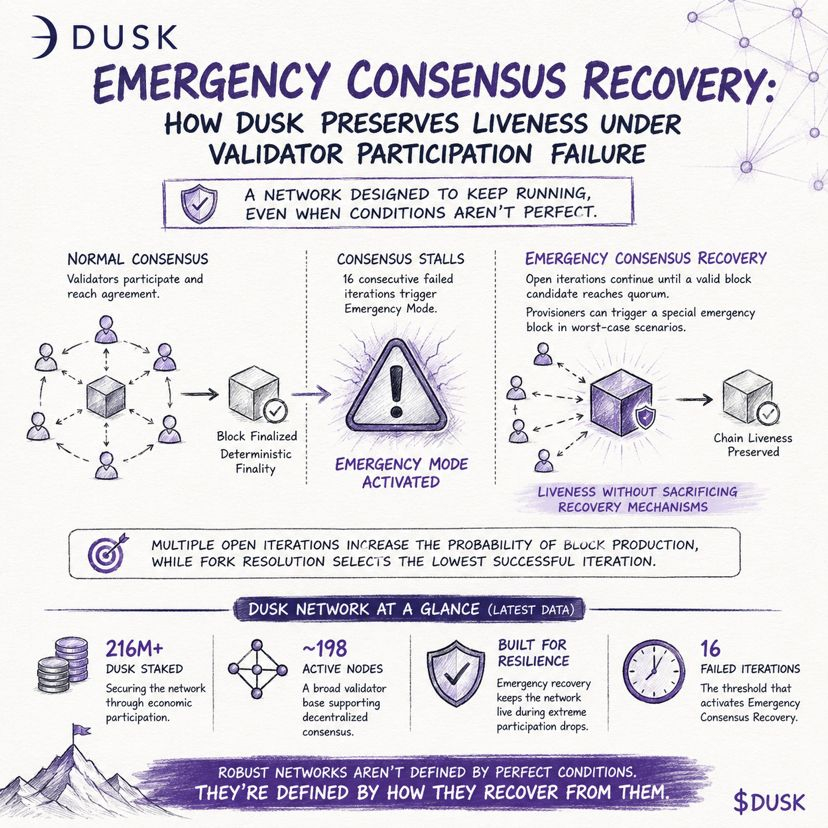
I became interested in Dusk's Emergency Consensus Recovery because it addresses a problem every blockchain eventually faces: validator participation isn't always perfect.
Traditional discussions around consensus focus on security. But real world networks also need liveness. A chain that is perfectly secure but unable to produce blocks isn't useful for institutions or users.
Dusk's approach is interesting. If normal consensus rounds repeatedly fail to reach completion, the protocol can enter an emergency recovery process designed to keep block production moving rather than allowing the network to stall. The goal isn't higher throughput or faster finality, it's preserving network availability during abnormal validator participation events.
What stands out is that this mechanism exists before it's needed. It's part of the protocol design, not an improvised response during a crisis.
Recent network statistics show over 216M DUSK staked across a validator network of roughly 198 active nodes, helping distribute participation while maintaining recovery safeguards if participation unexpectedly drops.
Time for tea wait ….😀
The strongest infrastructure isn't the one that never encounters failures.
It's the one designed to recover from them.
#FOMCWatch #CryptoRally
#dusk $DUSK @Dusk
Who got profit on $BTC and $ETH today? 🥳
Most investors only think about consensus when it fails.
I became interested in Dusk's Emergency Consensus Recovery because it addresses a problem every blockchain eventually faces: validator participation isn't always perfect.
Traditional discussions around consensus focus on security. But real world networks also need liveness. A chain that is perfectly secure but unable to produce blocks isn't useful for institutions or users.
Dusk's approach is interesting. If normal consensus rounds repeatedly fail to reach completion, the protocol can enter an emergency recovery process designed to keep block production moving rather than allowing the network to stall. The goal isn't higher throughput or faster finality, it's preserving network availability during abnormal validator participation events.
What stands out is that this mechanism exists before it's needed. It's part of the protocol design, not an improvised response during a crisis.
Recent network statistics show over 216M DUSK staked across a validator network of roughly 198 active nodes, helping distribute participation while maintaining recovery safeguards if participation unexpectedly drops.
Time for tea wait ….😀
The strongest infrastructure isn't the one that never encounters failures.
It's the one designed to recover from them.
#FOMCWatch #CryptoRally
Who got profit on $BTC and $ETH today? 🥳
Most investors only think about consensus when it fails.
I became interested in Dusk's Emergency Consensus Recovery because it addresses a problem every blockchain eventually faces: validator participation isn't always perfect.
Traditional discussions around consensus focus on security. But real world networks also need liveness. A chain that is perfectly secure but unable to produce blocks isn't useful for institutions or users.
Dusk's approach is interesting. If normal consensus rounds repeatedly fail to reach completion, the protocol can enter an emergency recovery process designed to keep block production moving rather than allowing the network to stall. The goal isn't higher throughput or faster finality, it's preserving network availability during abnormal validator participation events.
What stands out is that this mechanism exists before it's needed. It's part of the protocol design, not an improvised response during a crisis.
Recent network statistics show over 216M DUSK staked across a validator network of roughly 198 active nodes, helping distribute participation while maintaining recovery safeguards if participation unexpectedly drops.
Time for tea wait ….😀
The strongest infrastructure isn't the one that never encounters failures.
It's the one designed to recover from them.
#FOMCWatch #CryptoRally
5
6
1k
·
--
Частичная правда
#termmax @termmax
Wow $BTC $ETH and $SOL is really rocking today…. 🥳
Fixed rate borrowing used to mean predictable cost.
After TermMax introduced cross market liquidity, it started meaning predictable cost backed by network wide liquidity rather than whatever happened to sit inside a single market.
Before V2, liquidity was fragmented by design. A curator could have millions in capital, yet a borrower might still struggle to fill a large fixed rate loan because that liquidity was scattered across separate maturities and markets.
TermMax's Order Aggregator changes that dynamic.
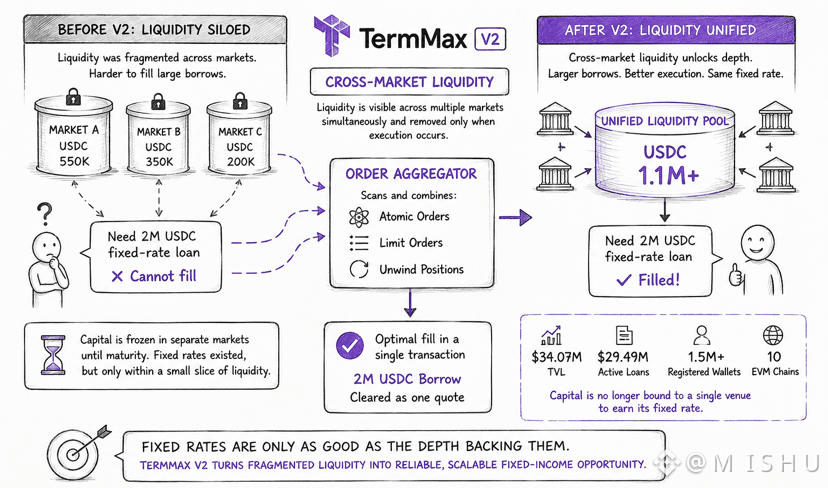
Instead of searching one isolated pool, it scans atomic orders, limit orders, and unwind positions simultaneously, then assembles the most efficient quote in a single transaction. Liquidity can be visible across multiple markets at once and is only removed when execution occurs.
The interesting part is that this doesn't just improve execution.
It improves the quality of fixed rate borrowing itself.
A fixed rate is only valuable if enough liquidity exists to support it when demand arrives. By reducing liquidity fragmentation, TermMax turns idle capital into accessible borrowing capacity without requiring more capital to enter the system.
Wait my coffee is getting ready … 🙂
So..
With $34.07M TVL and $29.49M in active loans, the story isn't how much capital exists.
It's how much more efficiently that capital can now be matched.
That's the hidden upgrade behind fixed income DeFi: better rates don't always come from more liquidity they can come from better liquidity coordination.
#termmax @TermMax
Wow $BTC $ETH and $SOL is really rocking today…. 🥳
Fixed rate borrowing used to mean predictable cost.
After TermMax introduced cross market liquidity, it started meaning predictable cost backed by network wide liquidity rather than whatever happened to sit inside a single market.
Before V2, liquidity was fragmented by design. A curator could have millions in capital, yet a borrower might still struggle to fill a large fixed rate loan because that liquidity was scattered across separate maturities and markets.
TermMax's Order Aggregator changes that dynamic.
Instead of searching one isolated pool, it scans atomic orders, limit orders, and unwind positions simultaneously, then assembles the most efficient quote in a single transaction. Liquidity can be visible across multiple markets at once and is only removed when execution occurs.
The interesting part is that this doesn't just improve execution.
It improves the quality of fixed rate borrowing itself.
A fixed rate is only valuable if enough liquidity exists to support it when demand arrives. By reducing liquidity fragmentation, TermMax turns idle capital into accessible borrowing capacity without requiring more capital to enter the system.
Wait my coffee is getting ready … 🙂
So..
With $34.07M TVL and $29.49M in active loans, the story isn't how much capital exists.
It's how much more efficiently that capital can now be matched.
That's the hidden upgrade behind fixed income DeFi: better rates don't always come from more liquidity they can come from better liquidity coordination.
Wow $BTC $ETH and $SOL is really rocking today…. 🥳
Fixed rate borrowing used to mean predictable cost.
After TermMax introduced cross market liquidity, it started meaning predictable cost backed by network wide liquidity rather than whatever happened to sit inside a single market.
Before V2, liquidity was fragmented by design. A curator could have millions in capital, yet a borrower might still struggle to fill a large fixed rate loan because that liquidity was scattered across separate maturities and markets.
TermMax's Order Aggregator changes that dynamic.
Instead of searching one isolated pool, it scans atomic orders, limit orders, and unwind positions simultaneously, then assembles the most efficient quote in a single transaction. Liquidity can be visible across multiple markets at once and is only removed when execution occurs.
The interesting part is that this doesn't just improve execution.
It improves the quality of fixed rate borrowing itself.
A fixed rate is only valuable if enough liquidity exists to support it when demand arrives. By reducing liquidity fragmentation, TermMax turns idle capital into accessible borrowing capacity without requiring more capital to enter the system.
Wait my coffee is getting ready … 🙂
So..
With $34.07M TVL and $29.49M in active loans, the story isn't how much capital exists.
It's how much more efficiently that capital can now be matched.
That's the hidden upgrade behind fixed income DeFi: better rates don't always come from more liquidity they can come from better liquidity coordination.
1
2
1.5k
·
--
#dusk $DUSK @Dusk_Foundation
Wow $RICE and $BTW is flying in the sky, just missed the chance, feeling sad ☹️ but now back to work
While most discussions around Dusk focus on privacy, I think the more interesting question is governance.
Selective disclosure sounds simple in theory: reveal information only to authorized parties while keeping everything else confidential.
But as institutional adoption grows, the challenge shifts.
The question is no longer whether cryptography can protect data.
It's who decides what should be disclosed, to whom, and under which conditions.
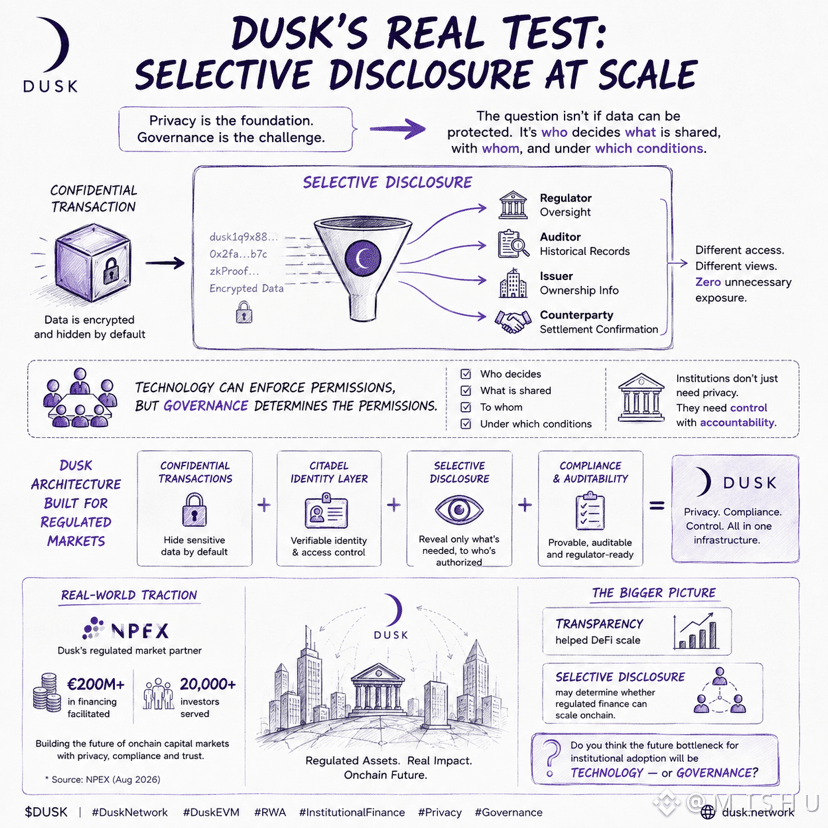
A regulator may require oversight. An auditor may need historical records. An issuer may need ownership information. A counterparty may need settlement confirmation. Each participant has different requirements, yet none should receive unrestricted access.
This is what makes Dusk's approach so interesting.
Its architecture combines confidential transactions, identity infrastructure through Citadel, and selective disclosure mechanisms designed for regulated markets. The technology can enforce permissions, but governance determines the permissions themselves.
That's why I believe Dusk's real test isn't privacy at scale.
It's selective disclosure at scale.
NPEX, Dusk's regulated market partner, has already facilitated more than €200M in financing and serves 20,000+ investors. As regulated assets move onchain, balancing privacy, compliance, and disclosure may become one of the defining challenges of institutional blockchain adoption.
Transparency helped DeFi scale.
Selective disclosure may determine whether regulated finance can scale onchain.
Let me have dinner today , but you guyz think ..😀
Do you think the future bottleneck for institutional blockchain adoption will be technology or governance?
#dusk $DUSK @Dusk
Wow $RICE and $BTW is flying in the sky, just missed the chance, feeling sad ☹️ but now back to work
While most discussions around Dusk focus on privacy, I think the more interesting question is governance.
Selective disclosure sounds simple in theory: reveal information only to authorized parties while keeping everything else confidential.
But as institutional adoption grows, the challenge shifts.
The question is no longer whether cryptography can protect data.
It's who decides what should be disclosed, to whom, and under which conditions.
A regulator may require oversight. An auditor may need historical records. An issuer may need ownership information. A counterparty may need settlement confirmation. Each participant has different requirements, yet none should receive unrestricted access.
This is what makes Dusk's approach so interesting.
Its architecture combines confidential transactions, identity infrastructure through Citadel, and selective disclosure mechanisms designed for regulated markets. The technology can enforce permissions, but governance determines the permissions themselves.
That's why I believe Dusk's real test isn't privacy at scale.
It's selective disclosure at scale.
NPEX, Dusk's regulated market partner, has already facilitated more than €200M in financing and serves 20,000+ investors. As regulated assets move onchain, balancing privacy, compliance, and disclosure may become one of the defining challenges of institutional blockchain adoption.
Transparency helped DeFi scale.
Selective disclosure may determine whether regulated finance can scale onchain.
Let me have dinner today , but you guyz think ..😀
Do you think the future bottleneck for institutional blockchain adoption will be technology or governance?
Wow $RICE and $BTW is flying in the sky, just missed the chance, feeling sad ☹️ but now back to work
While most discussions around Dusk focus on privacy, I think the more interesting question is governance.
Selective disclosure sounds simple in theory: reveal information only to authorized parties while keeping everything else confidential.
But as institutional adoption grows, the challenge shifts.
The question is no longer whether cryptography can protect data.
It's who decides what should be disclosed, to whom, and under which conditions.
A regulator may require oversight. An auditor may need historical records. An issuer may need ownership information. A counterparty may need settlement confirmation. Each participant has different requirements, yet none should receive unrestricted access.
This is what makes Dusk's approach so interesting.
Its architecture combines confidential transactions, identity infrastructure through Citadel, and selective disclosure mechanisms designed for regulated markets. The technology can enforce permissions, but governance determines the permissions themselves.
That's why I believe Dusk's real test isn't privacy at scale.
It's selective disclosure at scale.
NPEX, Dusk's regulated market partner, has already facilitated more than €200M in financing and serves 20,000+ investors. As regulated assets move onchain, balancing privacy, compliance, and disclosure may become one of the defining challenges of institutional blockchain adoption.
Transparency helped DeFi scale.
Selective disclosure may determine whether regulated finance can scale onchain.
Let me have dinner today , but you guyz think ..😀
Do you think the future bottleneck for institutional blockchain adoption will be technology or governance?
24
5
1.1k
·
--
Проверено
#termmax @termmax
was eating a plate of $RICE , biryani my favourite, while checking positions on $BTW and $VELVET when I noticed I was making money without paying much attention to what my borrowing costs were doing in the background. That felt normal in DeFi until I started thinking about how much of leveraged yield depends on variables most people never monitor.
While reviewing TermMax V2, I realized the protocol approaches leverage differently from most of #defi .Instead of optimizing for the highest possible yield, it optimizes for something much rarer: predictable funding costs.
Most leveraged strategies rely on a fragile assumption that borrowing rates stay below the yield being earned. When utilization spikes, that assumption can collapse overnight. What interested me about TermMax is that it attacks this risk at the structural level.
Its Gearing Token (GT) compresses an entire leveraged position into a single NFT, removing the complexity of repeated borrow swap deposit loops. Underneath it, Fixed Rate Tokens (FTs) lock the cost of capital at entry, meaning borrowers know their funding cost before the trade begins rather than discovering it later through changing market conditions.
Liquidation risk still exists. Market risk still exists. But interest rate risk the variable that quietly destroys many leveraged positions, is largely separated from the strategy itself.
The real innovation isn't higher leverage. It's making leverage behave more like a fixed income instrument and less like a floating rate gamble.
What is the biggest hidden risk in leveraged yield strategies?
#termmax @TermMax
was eating a plate of $RICE , biryani my favourite, while checking positions on $BTW and $VELVET when I noticed I was making money without paying much attention to what my borrowing costs were doing in the background. That felt normal in DeFi until I started thinking about how much of leveraged yield depends on variables most people never monitor.
While reviewing TermMax V2, I realized the protocol approaches leverage differently from most of #defi .Instead of optimizing for the highest possible yield, it optimizes for something much rarer: predictable funding costs.
Most leveraged strategies rely on a fragile assumption that borrowing rates stay below the yield being earned. When utilization spikes, that assumption can collapse overnight. What interested me about TermMax is that it attacks this risk at the structural level.
Its Gearing Token (GT) compresses an entire leveraged position into a single NFT, removing the complexity of repeated borrow swap deposit loops. Underneath it, Fixed Rate Tokens (FTs) lock the cost of capital at entry, meaning borrowers know their funding cost before the trade begins rather than discovering it later through changing market conditions.
Liquidation risk still exists. Market risk still exists. But interest rate risk the variable that quietly destroys many leveraged positions, is largely separated from the strategy itself.
The real innovation isn't higher leverage. It's making leverage behave more like a fixed income instrument and less like a floating rate gamble.
What is the biggest hidden risk in leveraged yield strategies?
was eating a plate of $RICE , biryani my favourite, while checking positions on $BTW and $VELVET when I noticed I was making money without paying much attention to what my borrowing costs were doing in the background. That felt normal in DeFi until I started thinking about how much of leveraged yield depends on variables most people never monitor.
While reviewing TermMax V2, I realized the protocol approaches leverage differently from most of #defi .Instead of optimizing for the highest possible yield, it optimizes for something much rarer: predictable funding costs.
Most leveraged strategies rely on a fragile assumption that borrowing rates stay below the yield being earned. When utilization spikes, that assumption can collapse overnight. What interested me about TermMax is that it attacks this risk at the structural level.
Its Gearing Token (GT) compresses an entire leveraged position into a single NFT, removing the complexity of repeated borrow swap deposit loops. Underneath it, Fixed Rate Tokens (FTs) lock the cost of capital at entry, meaning borrowers know their funding cost before the trade begins rather than discovering it later through changing market conditions.
Liquidation risk still exists. Market risk still exists. But interest rate risk the variable that quietly destroys many leveraged positions, is largely separated from the strategy itself.
The real innovation isn't higher leverage. It's making leverage behave more like a fixed income instrument and less like a floating rate gamble.
What is the biggest hidden risk in leveraged yield strategies?
Variable borrowing rates
33%
Liquidation risk
50%
Yield compression
9%
Liquidity fragmentation
8%
12 проголосовали • Голосование закрыто
32
5
4.9k
·
--
#dusk $DUSK @Dusk_Foundation
While having coffee and trading on $CLO $RED , i was browsing Dusk Explorer and validator statistics, I found myself spending less time looking at staking rewards and more time looking at what happened after rewards were issued.
One metric caught my attention.
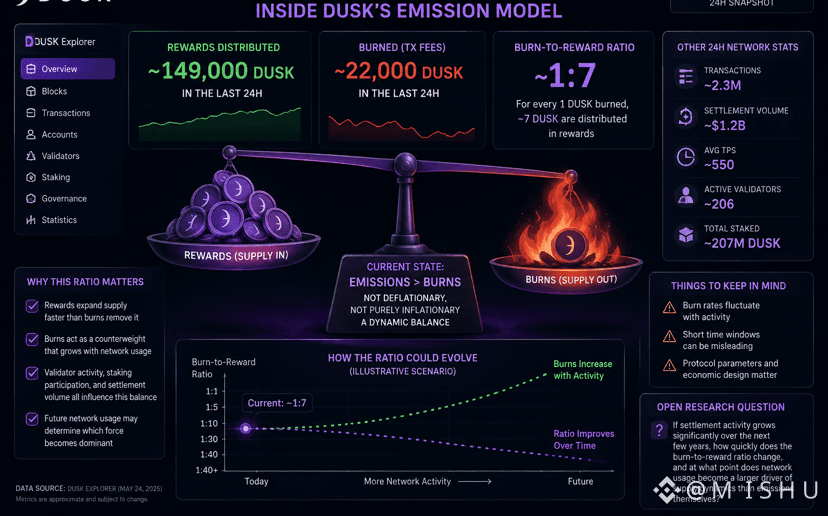
Recent network data shows roughly 149K DUSK distributed in rewards over 24 hours while about 22K DUSK was burned during the same period. That's a burn to reward ratio of roughly 1:7.
I don't think this is a bullish or bearish signal.
What interested me is how different it looks from the way tokenomics discussions are usually framed.
Most conversations focus on emissions or burns separately.
The ratio suggests they may be more meaningful when viewed together.
At current network conditions, rewards are expanding supply faster than burns are removing it. Yet the burn mechanism is not insignificant either. It acts as a counterweight whose impact depends on how validator activity, staking participation, and settlement volume evolve over time.
That creates an interesting dynamic.
The network isn't purely driven by emissions, nor is it meaningfully deflationary based on current data. Instead, it appears to sit somewhere between the two, with future network usage potentially determining which force becomes more influential.
Of course, there are other explanations. Burn rates can fluctuate with activity, and short observation windows can be misleading.
Just gona have dinner ..
What I'd like to research next is this:
If settlement activity grows significantly over the next few years, how quickly does the burn to reward ratio change, and at what point does network usage become a larger driver of supply dynamics than emissions themselves
#dusk $DUSK @Dusk
While having coffee and trading on $CLO $RED , i was browsing Dusk Explorer and validator statistics, I found myself spending less time looking at staking rewards and more time looking at what happened after rewards were issued.
One metric caught my attention.
Recent network data shows roughly 149K DUSK distributed in rewards over 24 hours while about 22K DUSK was burned during the same period. That's a burn to reward ratio of roughly 1:7.
I don't think this is a bullish or bearish signal.
What interested me is how different it looks from the way tokenomics discussions are usually framed.
Most conversations focus on emissions or burns separately.
The ratio suggests they may be more meaningful when viewed together.
At current network conditions, rewards are expanding supply faster than burns are removing it. Yet the burn mechanism is not insignificant either. It acts as a counterweight whose impact depends on how validator activity, staking participation, and settlement volume evolve over time.
That creates an interesting dynamic.
The network isn't purely driven by emissions, nor is it meaningfully deflationary based on current data. Instead, it appears to sit somewhere between the two, with future network usage potentially determining which force becomes more influential.
Of course, there are other explanations. Burn rates can fluctuate with activity, and short observation windows can be misleading.
Just gona have dinner ..
What I'd like to research next is this:
If settlement activity grows significantly over the next few years, how quickly does the burn to reward ratio change, and at what point does network usage become a larger driver of supply dynamics than emissions themselves
While having coffee and trading on $CLO $RED , i was browsing Dusk Explorer and validator statistics, I found myself spending less time looking at staking rewards and more time looking at what happened after rewards were issued.
One metric caught my attention.
Recent network data shows roughly 149K DUSK distributed in rewards over 24 hours while about 22K DUSK was burned during the same period. That's a burn to reward ratio of roughly 1:7.
I don't think this is a bullish or bearish signal.
What interested me is how different it looks from the way tokenomics discussions are usually framed.
Most conversations focus on emissions or burns separately.
The ratio suggests they may be more meaningful when viewed together.
At current network conditions, rewards are expanding supply faster than burns are removing it. Yet the burn mechanism is not insignificant either. It acts as a counterweight whose impact depends on how validator activity, staking participation, and settlement volume evolve over time.
That creates an interesting dynamic.
The network isn't purely driven by emissions, nor is it meaningfully deflationary based on current data. Instead, it appears to sit somewhere between the two, with future network usage potentially determining which force becomes more influential.
Of course, there are other explanations. Burn rates can fluctuate with activity, and short observation windows can be misleading.
Just gona have dinner ..
What I'd like to research next is this:
If settlement activity grows significantly over the next few years, how quickly does the burn to reward ratio change, and at what point does network usage become a larger driver of supply dynamics than emissions themselves
25
20
3.4k
·
--
#termmax @termmax
😭 having a loss on $RED $CLO and $EDEN , i was really depressed, so while having coffee, one metric immediately stood out to me while researching TermMax: nearly $29.5M of its roughly $34M TVL is actively deployed in loans. Most people would see that as a utilization story. I think it reveals something more important.
For years, DeFi lending has largely relied on algorithmic interest rates. Capital enters a pool, utilization changes, and rates adjust automatically. What has been missing is a market based way to price time.
That is where TermMax becomes interesting.
Instead of treating all borrowing demand the same, the protocol allows markets to form around specific maturities. A loan expiring in a week and a loan expiring months later can trade at different rates because participants are pricing duration risk directly. The result is something DeFi rarely produces naturally: an on chain yield curve.
The deeper implication is that DeFi may be moving beyond liquidity management and toward credit market infrastructure. Yield differences begin to reflect expectations, opportunity costs, and risk premiums rather than simply pool utilization.
Traditional bond markets use yield curves to understand how capital values time. TermMax suggests that on chain finance is starting to develop the same capability.
If the next generation of DeFi is built around fixed income markets rather than floating rate pools, will competitive risk pricing become more important than liquidity incentives themselves?
🥲need one more cup of coffee now.
What will drive the next evolution of DeFi lending?
#termmax @TermMax
😭 having a loss on $RED $CLO and $EDEN , i was really depressed, so while having coffee, one metric immediately stood out to me while researching TermMax: nearly $29.5M of its roughly $34M TVL is actively deployed in loans. Most people would see that as a utilization story. I think it reveals something more important.
For years, DeFi lending has largely relied on algorithmic interest rates. Capital enters a pool, utilization changes, and rates adjust automatically. What has been missing is a market based way to price time.
That is where TermMax becomes interesting.
Instead of treating all borrowing demand the same, the protocol allows markets to form around specific maturities. A loan expiring in a week and a loan expiring months later can trade at different rates because participants are pricing duration risk directly. The result is something DeFi rarely produces naturally: an on chain yield curve.
The deeper implication is that DeFi may be moving beyond liquidity management and toward credit market infrastructure. Yield differences begin to reflect expectations, opportunity costs, and risk premiums rather than simply pool utilization.
Traditional bond markets use yield curves to understand how capital values time. TermMax suggests that on chain finance is starting to develop the same capability.
If the next generation of DeFi is built around fixed income markets rather than floating rate pools, will competitive risk pricing become more important than liquidity incentives themselves?
🥲need one more cup of coffee now.
What will drive the next evolution of DeFi lending?
😭 having a loss on $RED $CLO and $EDEN , i was really depressed, so while having coffee, one metric immediately stood out to me while researching TermMax: nearly $29.5M of its roughly $34M TVL is actively deployed in loans. Most people would see that as a utilization story. I think it reveals something more important.
For years, DeFi lending has largely relied on algorithmic interest rates. Capital enters a pool, utilization changes, and rates adjust automatically. What has been missing is a market based way to price time.
That is where TermMax becomes interesting.
Instead of treating all borrowing demand the same, the protocol allows markets to form around specific maturities. A loan expiring in a week and a loan expiring months later can trade at different rates because participants are pricing duration risk directly. The result is something DeFi rarely produces naturally: an on chain yield curve.
The deeper implication is that DeFi may be moving beyond liquidity management and toward credit market infrastructure. Yield differences begin to reflect expectations, opportunity costs, and risk premiums rather than simply pool utilization.
Traditional bond markets use yield curves to understand how capital values time. TermMax suggests that on chain finance is starting to develop the same capability.
If the next generation of DeFi is built around fixed income markets rather than floating rate pools, will competitive risk pricing become more important than liquidity incentives themselves?
🥲need one more cup of coffee now.
What will drive the next evolution of DeFi lending?
A) Higher yields
0%
Larger liquidity pools
0%
On chain yield curves
0%
Better risk management
0%
0 проголосовали • Голосование закрыто
6
4
4k
·
--
Проверено
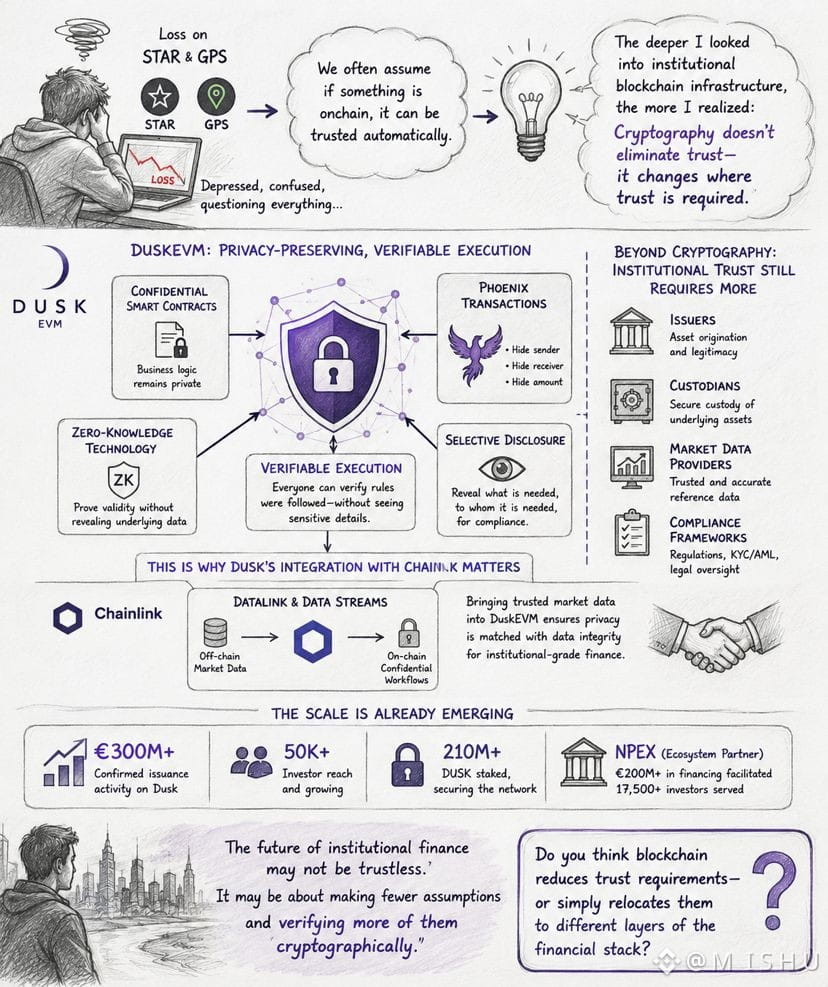
😭 not again… another loss .. after taking losses on $STAR and $GPS , I spent some time questioning a mistake many crypto participants make including myself.
We often assume that if something is onchain, it can be trusted automatically.
The deeper I looked into institutional blockchain infrastructure, the more I realized that cryptography doesn't eliminate trust, it changes where trust is required.
DuskEVM is built around this idea. Using confidential smart contracts and zero knowledge technology, it allows sensitive financial activity to remain private while still enabling verifiable execution. Privacy preserving Phoenix transactions can hide sender, receiver, and transfer amounts, while selective disclosure supports regulatory oversight when required.
But institutional adoption requires more than cryptographic guarantees.
Tokenized assets still depend on issuers, custodians, market data providers, and compliance frameworks beyond the blockchain itself. That's why @Dusk_Foundation integration with Chainlink DataLink and Data Streams is significant, it brings trusted market data into confidential financial workflows.
The scale is already emerging. $DUSK reports €300M+ in confirmed issuance activity, 50K+ investor reach, and more than 210M #dusk staked securing the network.
The future of institutional finance may not be trustless.
It may be about making fewer assumptions and verifying more of them cryptographically.
Do you think blockchain reduces trust requirements or simply relocates them to different layers of the financial stack?
😭 not again… another loss .. after taking losses on $STAR and $GPS , I spent some time questioning a mistake many crypto participants make including myself.
We often assume that if something is onchain, it can be trusted automatically.
The deeper I looked into institutional blockchain infrastructure, the more I realized that cryptography doesn't eliminate trust, it changes where trust is required.
DuskEVM is built around this idea. Using confidential smart contracts and zero knowledge technology, it allows sensitive financial activity to remain private while still enabling verifiable execution. Privacy preserving Phoenix transactions can hide sender, receiver, and transfer amounts, while selective disclosure supports regulatory oversight when required.
But institutional adoption requires more than cryptographic guarantees.
Tokenized assets still depend on issuers, custodians, market data providers, and compliance frameworks beyond the blockchain itself. That's why @Dusk integration with Chainlink DataLink and Data Streams is significant, it brings trusted market data into confidential financial workflows.
The scale is already emerging. $DUSK reports €300M+ in confirmed issuance activity, 50K+ investor reach, and more than 210M #dusk staked securing the network.
The future of institutional finance may not be trustless.
It may be about making fewer assumptions and verifying more of them cryptographically.
Do you think blockchain reduces trust requirements or simply relocates them to different layers of the financial stack?
We often assume that if something is onchain, it can be trusted automatically.
The deeper I looked into institutional blockchain infrastructure, the more I realized that cryptography doesn't eliminate trust, it changes where trust is required.
DuskEVM is built around this idea. Using confidential smart contracts and zero knowledge technology, it allows sensitive financial activity to remain private while still enabling verifiable execution. Privacy preserving Phoenix transactions can hide sender, receiver, and transfer amounts, while selective disclosure supports regulatory oversight when required.
But institutional adoption requires more than cryptographic guarantees.
Tokenized assets still depend on issuers, custodians, market data providers, and compliance frameworks beyond the blockchain itself. That's why @Dusk integration with Chainlink DataLink and Data Streams is significant, it brings trusted market data into confidential financial workflows.
The scale is already emerging. $DUSK reports €300M+ in confirmed issuance activity, 50K+ investor reach, and more than 210M #dusk staked securing the network.
The future of institutional finance may not be trustless.
It may be about making fewer assumptions and verifying more of them cryptographically.
Do you think blockchain reduces trust requirements or simply relocates them to different layers of the financial stack?
40
15
4.4k
·
--
Проверено
#termmax @termmax
Wow… recently took profits on $PORTAL $GPS and $ACE as both continue gaining momentum. That said, momentum alone is never a strategy,manage risk carefully and trade smart.
While researching new opportunities, I came across TermMax and started digging into a problem that rarely gets discussed in DeFi: liquidity fragmentation.
One example comes from TermMax V1, where a vault curator managing 1.1M USDC had to split capital across multiple fixed rate markets. The issue wasn't a lack of liquidity, it was that liquidity became trapped in isolated markets until maturity, creating what traditional finance would call inventory deadweight.
TermMax V2 addresses this through Atomic Orders. Instead of dedicating liquidity to a single market, the same capital can be quoted across multiple maturities simultaneously and executed only once when matched. This doesn't create new liquidity; it improves liquidity utilization.
The interesting part is the economic impact. If capital can be reused multiple times before maturity, lending efficiency becomes less dependent on total liquidity and more dependent on how effectively liquidity is coordinated. Combined with TermMax's Order Aggregator, borrowers can access the most efficient execution path across multiple liquidity sources through a single transaction.
The bigger question may not be how much liquidity a protocol has, but how efficiently that liquidity can move.
Could capital coordination become a bigger competitive advantage than liquidity itself?
#termmax @TermMax
Wow… recently took profits on $PORTAL $GPS and $ACE as both continue gaining momentum. That said, momentum alone is never a strategy,manage risk carefully and trade smart.
While researching new opportunities, I came across TermMax and started digging into a problem that rarely gets discussed in DeFi: liquidity fragmentation.
One example comes from TermMax V1, where a vault curator managing 1.1M USDC had to split capital across multiple fixed rate markets. The issue wasn't a lack of liquidity, it was that liquidity became trapped in isolated markets until maturity, creating what traditional finance would call inventory deadweight.
TermMax V2 addresses this through Atomic Orders. Instead of dedicating liquidity to a single market, the same capital can be quoted across multiple maturities simultaneously and executed only once when matched. This doesn't create new liquidity; it improves liquidity utilization.
The interesting part is the economic impact. If capital can be reused multiple times before maturity, lending efficiency becomes less dependent on total liquidity and more dependent on how effectively liquidity is coordinated. Combined with TermMax's Order Aggregator, borrowers can access the most efficient execution path across multiple liquidity sources through a single transaction.
The bigger question may not be how much liquidity a protocol has, but how efficiently that liquidity can move.
Could capital coordination become a bigger competitive advantage than liquidity itself?
Wow… recently took profits on $PORTAL $GPS and $ACE as both continue gaining momentum. That said, momentum alone is never a strategy,manage risk carefully and trade smart.
While researching new opportunities, I came across TermMax and started digging into a problem that rarely gets discussed in DeFi: liquidity fragmentation.
One example comes from TermMax V1, where a vault curator managing 1.1M USDC had to split capital across multiple fixed rate markets. The issue wasn't a lack of liquidity, it was that liquidity became trapped in isolated markets until maturity, creating what traditional finance would call inventory deadweight.
TermMax V2 addresses this through Atomic Orders. Instead of dedicating liquidity to a single market, the same capital can be quoted across multiple maturities simultaneously and executed only once when matched. This doesn't create new liquidity; it improves liquidity utilization.
The interesting part is the economic impact. If capital can be reused multiple times before maturity, lending efficiency becomes less dependent on total liquidity and more dependent on how effectively liquidity is coordinated. Combined with TermMax's Order Aggregator, borrowers can access the most efficient execution path across multiple liquidity sources through a single transaction.
The bigger question may not be how much liquidity a protocol has, but how efficiently that liquidity can move.
Could capital coordination become a bigger competitive advantage than liquidity itself?
Yes, efficiency beats size
75%
No, deeper liquidity wins
0%
Both are equally important
0%
Too early to tell in DeFi
25%
4 проголосовали • Голосование закрыто
13
9
4.1k
·
--
Частичная правда
hmm.. was observing that Confidential finance has an oracle problem.
DuskEVM can keep transaction data private, but regulated financial instruments still depend on external information such as interest rates, FX rates, market prices, and reference data.
Without trusted inputs, confidential contracts cannot support real financial markets.
That's what makes @Dusk_Foundation Chainlink integration important.
Through Chainlink Data Streams and DataLink, trusted market data can reach Dusk's confidential execution environment, allowing tokenized assets to be priced and settled while preserving privacy.
This is bigger than DeFi.
Institutions require trusted pricing, confidential execution, and compliance infrastructure before regulated assets can move onchain.
Chainlink addresses the data layer.
#dusk is building around the other two.
The opportunity is already emerging. NPEX, one of $DUSK ecosystem participants, has facilitated more than €200M in financing for over 100 SMEs and serves 17,500+ investors. Meanwhile, Dusk reports €300M+ in confirmed issuance activity, 50K+ investor reach, and more than 210M DUSK staked securing the network.
The result is a stack where tokenized assets are not only issued onchain, but can also be priced, settled, and verified using infrastructure designed for regulated markets.
Many networks are focused on putting assets onchain.
Dusk appears focused on making those assets operable within the rules of real financial markets.
Hmm.. while coffee i was thinking that What is the most important missing piece for institutional adoption of tokenized assets?
hmm.. was observing that Confidential finance has an oracle problem.
DuskEVM can keep transaction data private, but regulated financial instruments still depend on external information such as interest rates, FX rates, market prices, and reference data.
Without trusted inputs, confidential contracts cannot support real financial markets.
That's what makes @Dusk Chainlink integration important.
Through Chainlink Data Streams and DataLink, trusted market data can reach Dusk's confidential execution environment, allowing tokenized assets to be priced and settled while preserving privacy.
This is bigger than DeFi.
Institutions require trusted pricing, confidential execution, and compliance infrastructure before regulated assets can move onchain.
Chainlink addresses the data layer.
#dusk is building around the other two.
The opportunity is already emerging. NPEX, one of $DUSK ecosystem participants, has facilitated more than €200M in financing for over 100 SMEs and serves 17,500+ investors. Meanwhile, Dusk reports €300M+ in confirmed issuance activity, 50K+ investor reach, and more than 210M DUSK staked securing the network.
The result is a stack where tokenized assets are not only issued onchain, but can also be priced, settled, and verified using infrastructure designed for regulated markets.
Many networks are focused on putting assets onchain.
Dusk appears focused on making those assets operable within the rules of real financial markets.
Hmm.. while coffee i was thinking that What is the most important missing piece for institutional adoption of tokenized assets?
DuskEVM can keep transaction data private, but regulated financial instruments still depend on external information such as interest rates, FX rates, market prices, and reference data.
Without trusted inputs, confidential contracts cannot support real financial markets.
That's what makes @Dusk Chainlink integration important.
Through Chainlink Data Streams and DataLink, trusted market data can reach Dusk's confidential execution environment, allowing tokenized assets to be priced and settled while preserving privacy.
This is bigger than DeFi.
Institutions require trusted pricing, confidential execution, and compliance infrastructure before regulated assets can move onchain.
Chainlink addresses the data layer.
#dusk is building around the other two.
The opportunity is already emerging. NPEX, one of $DUSK ecosystem participants, has facilitated more than €200M in financing for over 100 SMEs and serves 17,500+ investors. Meanwhile, Dusk reports €300M+ in confirmed issuance activity, 50K+ investor reach, and more than 210M DUSK staked securing the network.
The result is a stack where tokenized assets are not only issued onchain, but can also be priced, settled, and verified using infrastructure designed for regulated markets.
Many networks are focused on putting assets onchain.
Dusk appears focused on making those assets operable within the rules of real financial markets.
Hmm.. while coffee i was thinking that What is the most important missing piece for institutional adoption of tokenized assets?
Trusted market data
100%
Privacy & confidentiality
0%
Regulatory compliance
0%
2 проголосовали • Голосование закрыто
35
20
4.6k
·
--
Частичная правда
Hmm.. i discovered while researching @Dusk_Foundation is that the network targets deterministic settlement in roughly 10 seconds, something that sounds ordinary in crypto until you compare it to how most blockchains actually achieve finality.
That sent me down a rabbit hole into #dusk consensus architecture, where I realized something most crypto investors misunderstand about finality:
Deterministic settlement isn't a protocol feature.
It's a decentralization assumption enforced by protocol design.
Most blockchains rely on probabilistic finality. A transaction becomes increasingly difficult to reverse as more blocks are added, but certainty comes from probability.
$DUSK takes a different approach.
Its Succinct Attestation consensus is designed for deterministic finality, meaning transactions become irreversible once finality is reached under the network's security assumptions. The system uses committee based Proof of Stake consensus to provide settlement suitable for regulated financial workflows.
What caught my attention is that Dusk isn't optimizing for speculation driven throughput. It's optimizing for settlement certainty.
Today, DUSK trades around $0.0607, with a $30.2M market cap, $60.7M FDV, 497M circulating supply, 36.9K holders, and roughly $2.8M daily trading volume. More importantly, the network reports 210M+ DUSK staked, €300M+ confirmed issuance activity, and approximately 10 second deterministic settlement.
The overlooked insight is that deterministic finality is only valuable if the validator and staking system remains healthy enough to preserve the assumptions behind it.
In other words, settlement certainty doesn't come from mathematics alone.
It comes from mathematics backed by decentralization.
If tokenized securities become a trillion dollar market, will institutions care more about transaction speed or about knowing exactly when ownership becomes legally final?
Hmm.. i discovered while researching @Dusk is that the network targets deterministic settlement in roughly 10 seconds, something that sounds ordinary in crypto until you compare it to how most blockchains actually achieve finality.
That sent me down a rabbit hole into #dusk consensus architecture, where I realized something most crypto investors misunderstand about finality:
Deterministic settlement isn't a protocol feature.
It's a decentralization assumption enforced by protocol design.
Most blockchains rely on probabilistic finality. A transaction becomes increasingly difficult to reverse as more blocks are added, but certainty comes from probability.
$DUSK takes a different approach.
Its Succinct Attestation consensus is designed for deterministic finality, meaning transactions become irreversible once finality is reached under the network's security assumptions. The system uses committee based Proof of Stake consensus to provide settlement suitable for regulated financial workflows.
What caught my attention is that Dusk isn't optimizing for speculation driven throughput. It's optimizing for settlement certainty.
Today, DUSK trades around $0.0607, with a $30.2M market cap, $60.7M FDV, 497M circulating supply, 36.9K holders, and roughly $2.8M daily trading volume. More importantly, the network reports 210M+ DUSK staked, €300M+ confirmed issuance activity, and approximately 10 second deterministic settlement.
The overlooked insight is that deterministic finality is only valuable if the validator and staking system remains healthy enough to preserve the assumptions behind it.
In other words, settlement certainty doesn't come from mathematics alone.
It comes from mathematics backed by decentralization.
If tokenized securities become a trillion dollar market, will institutions care more about transaction speed or about knowing exactly when ownership becomes legally final?
That sent me down a rabbit hole into #dusk consensus architecture, where I realized something most crypto investors misunderstand about finality:
Deterministic settlement isn't a protocol feature.
It's a decentralization assumption enforced by protocol design.
Most blockchains rely on probabilistic finality. A transaction becomes increasingly difficult to reverse as more blocks are added, but certainty comes from probability.
$DUSK takes a different approach.
Its Succinct Attestation consensus is designed for deterministic finality, meaning transactions become irreversible once finality is reached under the network's security assumptions. The system uses committee based Proof of Stake consensus to provide settlement suitable for regulated financial workflows.
What caught my attention is that Dusk isn't optimizing for speculation driven throughput. It's optimizing for settlement certainty.
Today, DUSK trades around $0.0607, with a $30.2M market cap, $60.7M FDV, 497M circulating supply, 36.9K holders, and roughly $2.8M daily trading volume. More importantly, the network reports 210M+ DUSK staked, €300M+ confirmed issuance activity, and approximately 10 second deterministic settlement.
The overlooked insight is that deterministic finality is only valuable if the validator and staking system remains healthy enough to preserve the assumptions behind it.
In other words, settlement certainty doesn't come from mathematics alone.
It comes from mathematics backed by decentralization.
If tokenized securities become a trillion dollar market, will institutions care more about transaction speed or about knowing exactly when ownership becomes legally final?
🔹 Transaction Speed
0%
🔹 Settlement Certainty
0%
🔹 Both Matter Equally
0%
🔹 Depends on the Asset
0%
0 проголосовали • Голосование закрыто
39
20
8k
Войдите, чтобы посмотреть больше материала
Присоединяйтесь к пользователям криптовалют по всему миру на Binance Square
⚡️ Получайте новейшую и полезную информацию о криптоактивах.
💬 Нам доверяет крупнейшая в мире криптобиржа.
👍 Получите достоверные аналитические данные от верифицированных создателей контента.
Эл. почта/номер телефона
В тренде
ClarityActFacesProceduralVoteSept15
Просмотров: 136
34 обсуждают
🇺🇸 15 سبتمبر قد يكون يومًا مهمًا لتنظيم الكريبتو في الولايات المتحدة.
مشروع CLARITY Act يقترب من تصويت إجرائي في مجلس الشيوخ، في خطوة قد تحدد مدى قدرة المشروع على التقدم نحو إقرار إطار أوضح لتنظيم الأصول الرقمية.
الأهمية لا تكمن في التصويت وحده، بل فيما يمثله المشروع للسوق:
• توضيح أدوار SEC وCFTC
• تقليل حالة عدم اليقين التنظيمي
• وضع قواعد أكثر وضوحًا لقطاع الأصول الرقمية
لكن لا أرى أن النتيجة محسومة مسبقًا. عدد الأصوات والدعم السياسي سيكونان العامل الأهم.
📌 بالنسبة لي، 15 سبتمبر يستحق المراقبة أكثر من المضاربة عليه؛ فالخبر قد يؤثر في معنويات السوق، لكن التفاصيل السياسية ستحدد اتجاه القصة.
$BTC $ETH $BNB
#ClarityActFacesProceduralVoteSept15
yosreia
·Лайков: 0
·Просмотров: 34
US2YearYieldRisesTo4.61%
Просмотров: 6,244
190 обсуждают
US10YearTreasuryYieldNears5%
Просмотров: 4,039
114 обсуждают