
AnasOnChain
3.6k Публикации

AnasOnChain
Отправить жалобу
Заблокировать пользователя
Crypto Trader 📊 | Technical & Fundamental Analysis | Market Trends, Alpha & Insights
Открытая сделка

Владелец INJ
Трейдер с регулярными сделками
2.1 г
2.1K+ подписок(и/а)
11.3K+ подписчиков(а)
7.5K+ понравилось
Посты
Портфель
Все
Цитирования
Видео
Активно
·
--
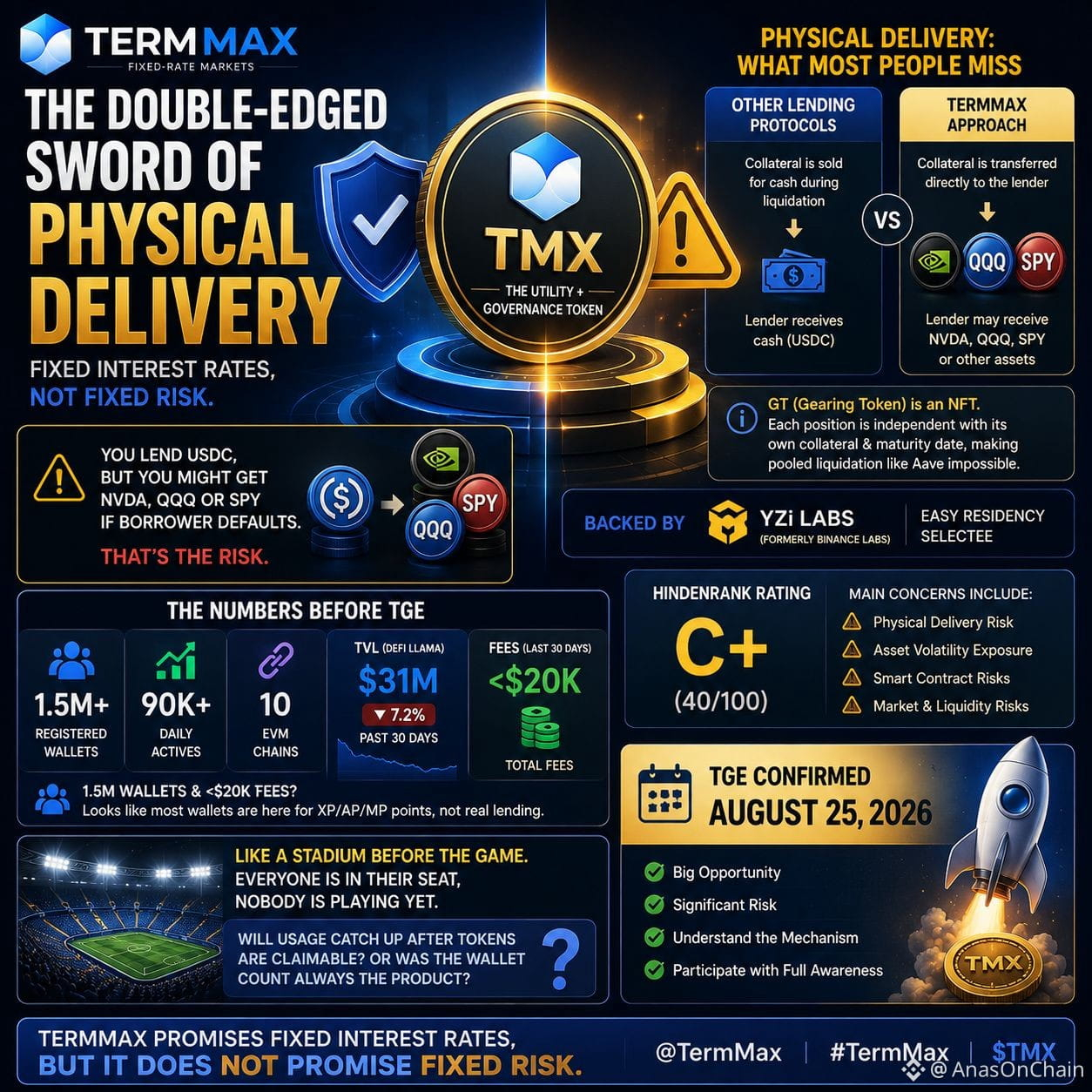
Kabhi kabhi mujhe lagta hai DeFi mein sabse important cheez woh hoti hai jo headline ke neeche chhupi hoti hai.
@termmax ko dekhte hue meri nazar physical delivery par ruk gayi.
TermMax mein GT positions NFT-based hain. Agar borrower default kare, collateral simply market mein sell hone ke bajaye lender ko directly deliver ho sakta hai.
Yahan mujhe risk ka doosra side samajh aaya.
Aapne USDC lend kiya, fixed interest expect kiya… lekin default ke case mein collateral NVDA, QQQ ya SPY exposure ho sakta hai.
Yani fixed rate ka matlab fixed risk nahi.
Aur ye point aur interesting ho jata hai jab official numbers ko on-chain activity ke saath dekhta hoon.
1.5M+ registered wallets
90K+ daily actives
10 EVM chains
Lekin DefiLlama par TVL around $31M, last 30 days mein 7.2% down, aur fees $20K se bhi kam.
Mujhe yahan wallet count se zyada important question nazar aata hai:
Kitne users actually GT positions aur vaults use kar rahe hain, aur kitne sirf XP/AP/MP farming kar rahe hain?
TGE 25 August ke kareeb hai, isliye mere liye real test token launch nahi.
Real test ye hai ke incentives hatne ke baad actual borrowing, lending aur GT activity kitni survive karti hai.
TermMax ka mechanism interesting hai.
Lekin mechanism samajhna aur uska risk samajhna — dono alag cheezen hain.
#termmax @termmax #TermMax
Kabhi kabhi mujhe lagta hai DeFi mein sabse important cheez woh hoti hai jo headline ke neeche chhupi hoti hai.
@TermMax ko dekhte hue meri nazar physical delivery par ruk gayi.
TermMax mein GT positions NFT-based hain. Agar borrower default kare, collateral simply market mein sell hone ke bajaye lender ko directly deliver ho sakta hai.
Yahan mujhe risk ka doosra side samajh aaya.
Aapne USDC lend kiya, fixed interest expect kiya… lekin default ke case mein collateral NVDA, QQQ ya SPY exposure ho sakta hai.
Yani fixed rate ka matlab fixed risk nahi.
Aur ye point aur interesting ho jata hai jab official numbers ko on-chain activity ke saath dekhta hoon.
1.5M+ registered wallets
90K+ daily actives
10 EVM chains
Lekin DefiLlama par TVL around $31M, last 30 days mein 7.2% down, aur fees $20K se bhi kam.
Mujhe yahan wallet count se zyada important question nazar aata hai:
Kitne users actually GT positions aur vaults use kar rahe hain, aur kitne sirf XP/AP/MP farming kar rahe hain?
TGE 25 August ke kareeb hai, isliye mere liye real test token launch nahi.
Real test ye hai ke incentives hatne ke baad actual borrowing, lending aur GT activity kitni survive karti hai.
TermMax ka mechanism interesting hai.
Lekin mechanism samajhna aur uska risk samajhna — dono alag cheezen hain.
#termmax @TermMax #TermMax
1
114
·
--
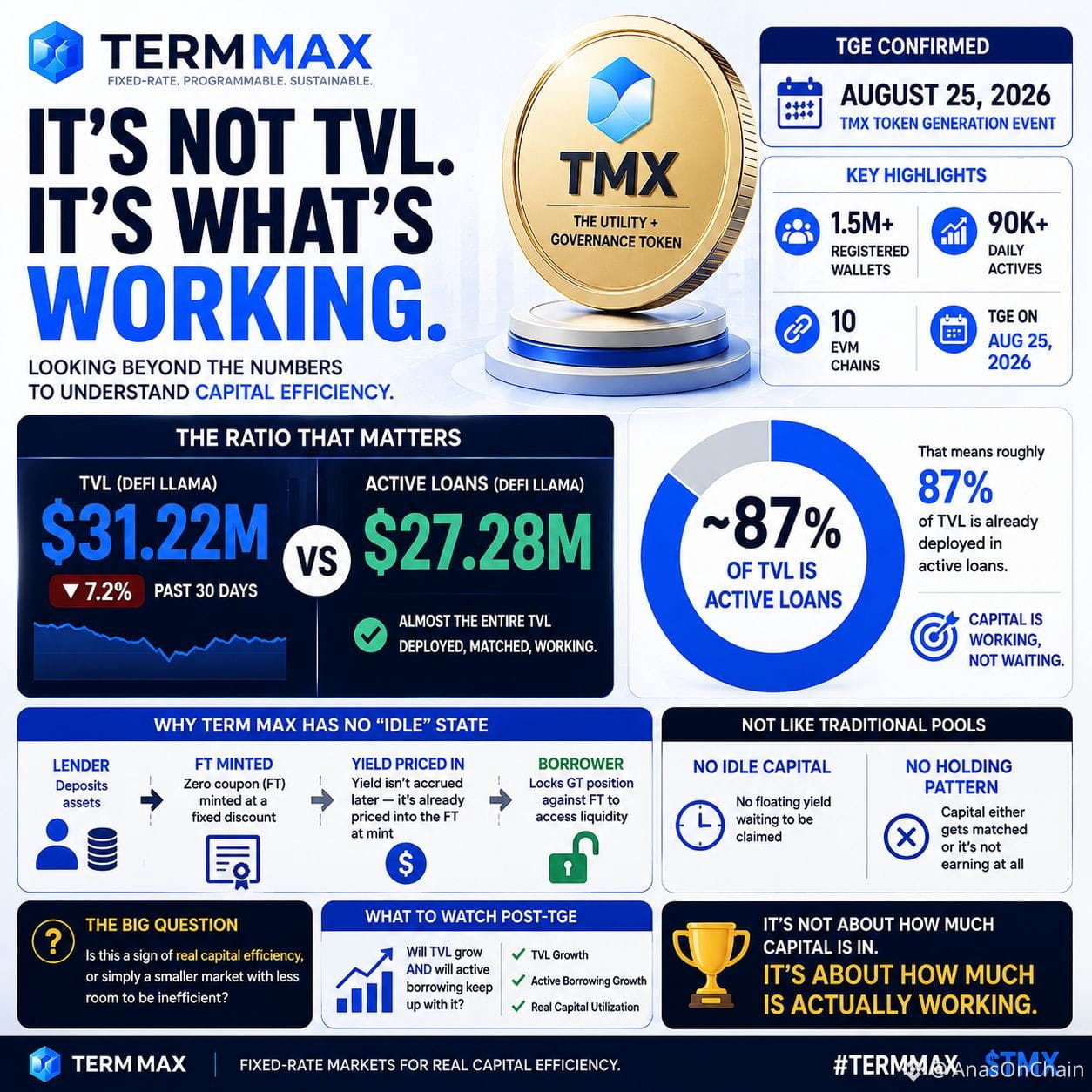
Kabhi kabhi mujhe lagta hai DeFi mein TVL ka number dekhna easy hai, lekin us capital ke andar kya ho raha hai woh zyada interesting hota hai.
@termmax ke numbers check karte hue meri nazar ek ratio par ruk gayi.
TVL $31.22M hai, last 30 days mein 7.2% down.
Lekin active loans $27.28M hain.
Yani roughly 87% TVL already deployed hai.
Yahan mujhe TermMax ka model traditional lending pools se different laga.
Lender deposit karta hai, FT mint hota hai aur fixed yield discount ke andar hi price ho jati hai.
Borrower GT position lock karta hai aur us structure ke against liquidity access karta hai.
Isliye yahan capital ka idea simple “deposit karo aur idle rehne do” wala nahi hai.
Mere liye ab real question $31.22M TVL nahi hai:
Kitna capital actually working hai?
$27.28M active loans definitely interesting hain, lekin main isay automatically bullish signal nahi maan raha.
High utilization genuine efficiency bhi ho sakti hai, ya smaller market mein limited liquidity ka result bhi.
Isi liye TGE ke baad main TVL se zyada TVL vs active borrowing ko watch karunga.
Agar dono saath grow hue, tab TermMax ka capital-efficiency model mere liye aur convincing hoga.
#TermMax #termmax @termmax
Kabhi kabhi mujhe lagta hai DeFi mein TVL ka number dekhna easy hai, lekin us capital ke andar kya ho raha hai woh zyada interesting hota hai.
@TermMax ke numbers check karte hue meri nazar ek ratio par ruk gayi.
TVL $31.22M hai, last 30 days mein 7.2% down.
Lekin active loans $27.28M hain.
Yani roughly 87% TVL already deployed hai.
Yahan mujhe TermMax ka model traditional lending pools se different laga.
Lender deposit karta hai, FT mint hota hai aur fixed yield discount ke andar hi price ho jati hai.
Borrower GT position lock karta hai aur us structure ke against liquidity access karta hai.
Isliye yahan capital ka idea simple “deposit karo aur idle rehne do” wala nahi hai.
Mere liye ab real question $31.22M TVL nahi hai:
Kitna capital actually working hai?
$27.28M active loans definitely interesting hain, lekin main isay automatically bullish signal nahi maan raha.
High utilization genuine efficiency bhi ho sakti hai, ya smaller market mein limited liquidity ka result bhi.
Isi liye TGE ke baad main TVL se zyada TVL vs active borrowing ko watch karunga.
Agar dono saath grow hue, tab TermMax ka capital-efficiency model mere liye aur convincing hoga.
#TermMax #termmax @TermMax
1
2
111
·
--
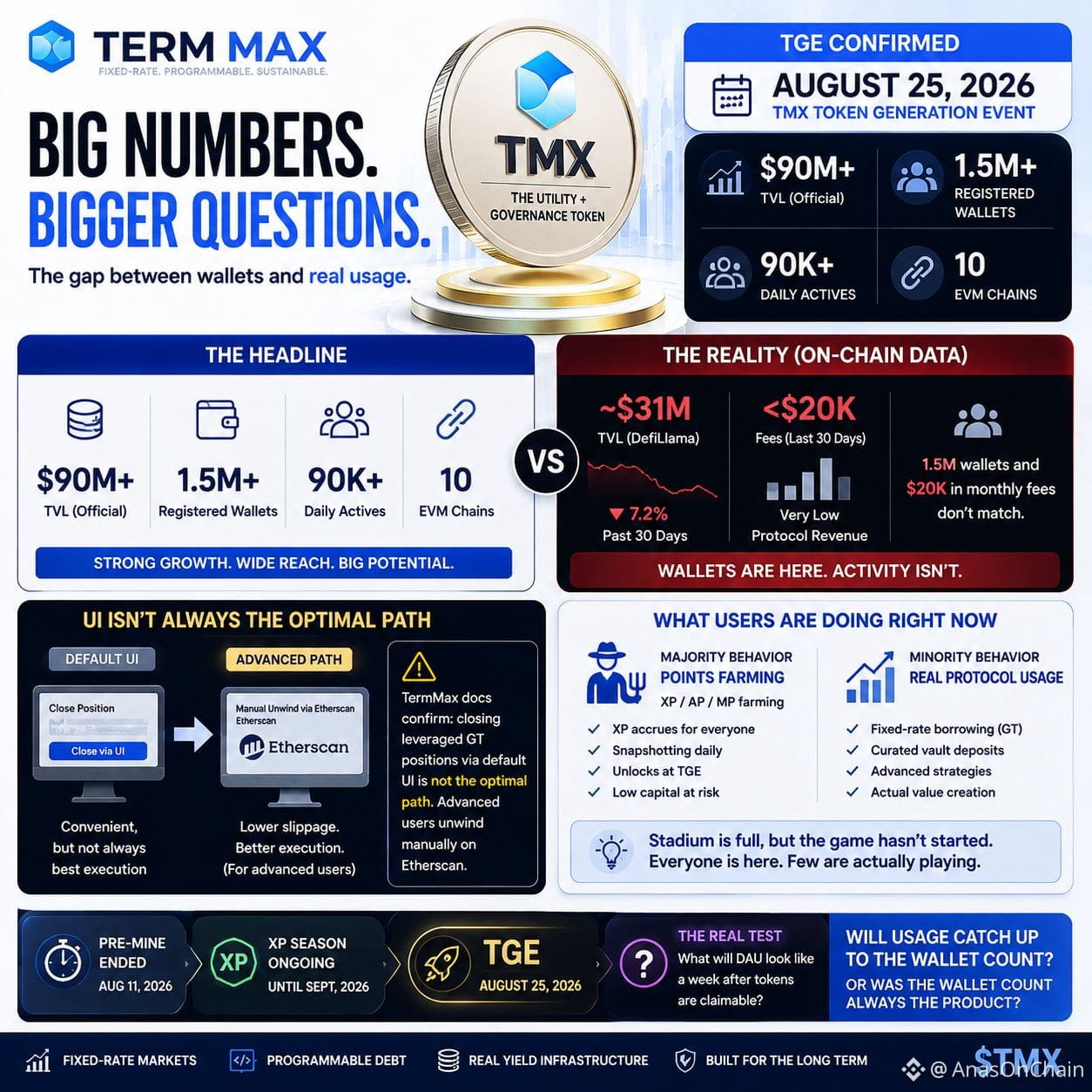
Mujhe TermMax mein ab ek interesting gap nazar aa raha hai: wallet growth aur actual usage ek hi cheez nahi hain.
@termmax ka TGE 25 August ko hai, aur official numbers impressive hain — $90M+ TVL, 1.5M+ registered wallets, 90K+ daily actives aur 10 EVM chains.
Lekin maine DefiLlama numbers dekhe to picture thodi different lagi.
TVL around $31M, past month mein 7.2% down, aur last 30 days ki fees $20K se bhi kam.
Yahan mere liye real question start hota hai.
1.5M wallets ka matlab ye zaroori nahi ke 1.5M users lending, borrowing ya actual fixed-rate positions use kar rahe hain.
XP/AP/MP farming bhi activity create kar sakti hai.
Aur ek aur interesting detail: advanced GT positions ko close karne ke liye TermMax docs mein Etherscan se manual unwind ka separate process hai, kyunke default UI har situation mein best execution nahi deta.
Matlab same protocol mein normal user experience aur advanced user execution abhi completely equal nahi hain.
Pre-mine 11 August ko end ho chuka hai, XP season September tak chal raha hai, aur TGE 25 August ko hai.
Ab mere liye sabse important metric wallet count nahi hoga.
TGE ke baad kitne wallets actual protocol activity mein convert hote hain?
Agar fees, TVL aur real borrowing usage wallet growth ke saath catch up karte hain, to TermMax ka story stronger hota hai.
Agar nahi…
to 1.5M wallets shayad users se zyada potential users honge.
@termmax #TermMax #termmax
Mujhe TermMax mein ab ek interesting gap nazar aa raha hai: wallet growth aur actual usage ek hi cheez nahi hain.
@TermMax ka TGE 25 August ko hai, aur official numbers impressive hain — $90M+ TVL, 1.5M+ registered wallets, 90K+ daily actives aur 10 EVM chains.
Lekin maine DefiLlama numbers dekhe to picture thodi different lagi.
TVL around $31M, past month mein 7.2% down, aur last 30 days ki fees $20K se bhi kam.
Yahan mere liye real question start hota hai.
1.5M wallets ka matlab ye zaroori nahi ke 1.5M users lending, borrowing ya actual fixed-rate positions use kar rahe hain.
XP/AP/MP farming bhi activity create kar sakti hai.
Aur ek aur interesting detail: advanced GT positions ko close karne ke liye TermMax docs mein Etherscan se manual unwind ka separate process hai, kyunke default UI har situation mein best execution nahi deta.
Matlab same protocol mein normal user experience aur advanced user execution abhi completely equal nahi hain.
Pre-mine 11 August ko end ho chuka hai, XP season September tak chal raha hai, aur TGE 25 August ko hai.
Ab mere liye sabse important metric wallet count nahi hoga.
TGE ke baad kitne wallets actual protocol activity mein convert hote hain?
Agar fees, TVL aur real borrowing usage wallet growth ke saath catch up karte hain, to TermMax ka story stronger hota hai.
Agar nahi…
to 1.5M wallets shayad users se zyada potential users honge.
@TermMax #TermMax #termmax
1
66
·
--
Проверено
Mujhe TermMax mein ek cheez samajhne ke baad TMX ka role thoda different nazar aaya.
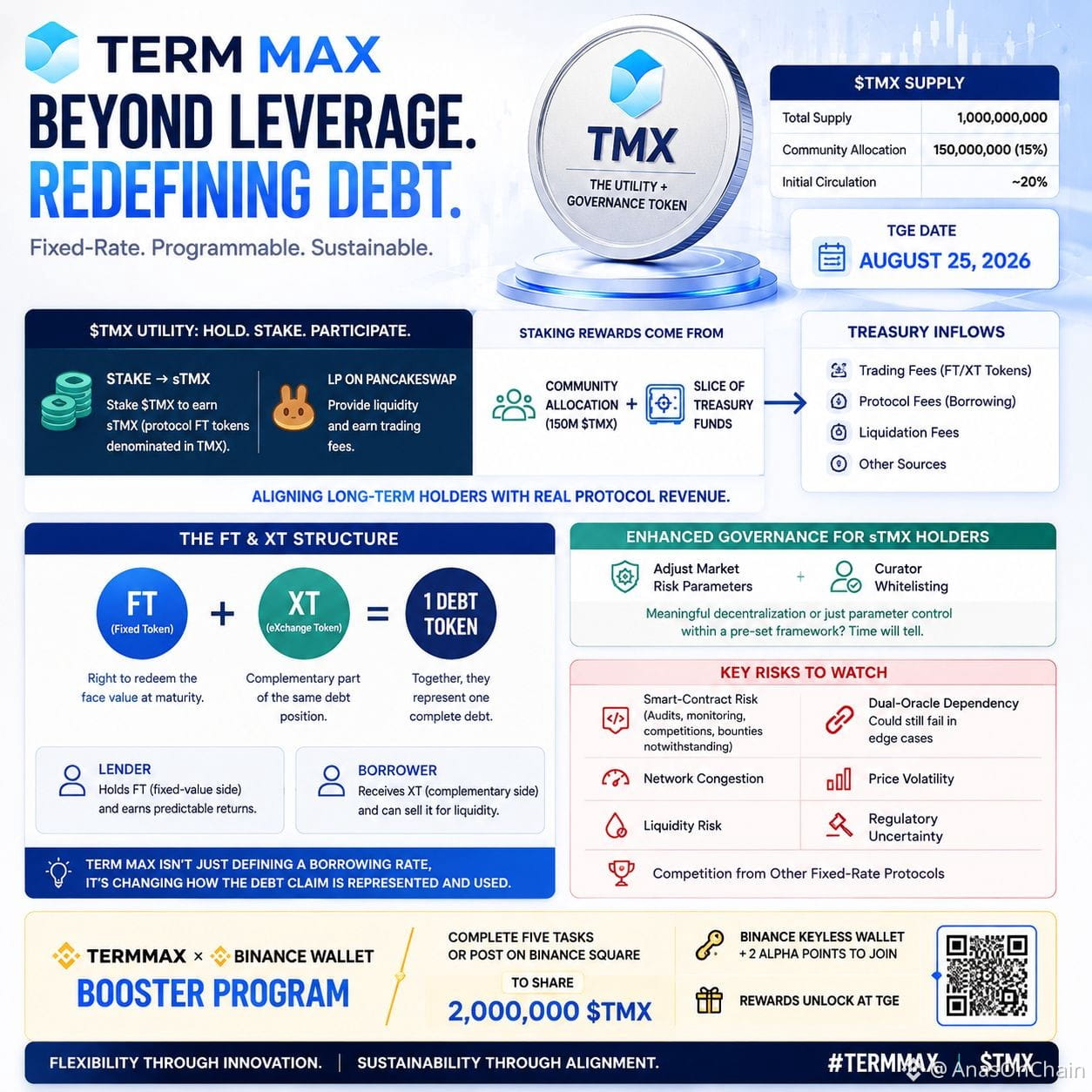
Ye sirf governance token nahi lagta. Fixed 1B supply mein Community ke liye 150M $TMX (15%) hai, aur holders staking ke through sTMX le sakte hain.
Interesting part Treasury hai.
FT/XT trading fees, borrowing fees, liquidation fees aur other protocol revenue Treasury mein aa sakta hai, jahan se staking rewards ka ek hissa potentially fund hota hai.
Lekin yahan mera question bhi hai: Treasury revenue ka kitna portion actually stakers tak jayega?
Phir FT/XT model dekha:
1 FT + 1 XT = 1 debt token.
Lender fixed-value side hold kar sakta hai, jabke borrower complementary XT ko liquidity ke liye use kar sakta hai.
Mere liye ye TermMax ka interesting part hai — protocol sirf loan create nahi kar raha, balki debt ko different financial exposures mein divide kar raha hai.
Flexibility badhti hai, lekin complexity bhi.
Aur sTMX holders ko risk parameters aur curator whitelisting par enhanced governance rights milte hain. Isliye actual test sirf token price nahi, governance aur Treasury distribution ka bhi hoga.
Binance WalletBooster mein 2M $TMX rewards hain, aur rewards TGE par unlock honge.
Ab dekhna ye hai ke campaign users sirf rewards claim karte hain...
Ya actual TermMax economy mein stake, govern aur participate bhi karte hain.
@termmax #TermMax
Mujhe TermMax mein ek cheez samajhne ke baad TMX ka role thoda different nazar aaya.
Ye sirf governance token nahi lagta. Fixed 1B supply mein Community ke liye 150M $TMX (15%) hai, aur holders staking ke through sTMX le sakte hain.
Interesting part Treasury hai.
FT/XT trading fees, borrowing fees, liquidation fees aur other protocol revenue Treasury mein aa sakta hai, jahan se staking rewards ka ek hissa potentially fund hota hai.
Lekin yahan mera question bhi hai: Treasury revenue ka kitna portion actually stakers tak jayega?
Phir FT/XT model dekha:
1 FT + 1 XT = 1 debt token.
Lender fixed-value side hold kar sakta hai, jabke borrower complementary XT ko liquidity ke liye use kar sakta hai.
Mere liye ye TermMax ka interesting part hai — protocol sirf loan create nahi kar raha, balki debt ko different financial exposures mein divide kar raha hai.
Flexibility badhti hai, lekin complexity bhi.
Aur sTMX holders ko risk parameters aur curator whitelisting par enhanced governance rights milte hain. Isliye actual test sirf token price nahi, governance aur Treasury distribution ka bhi hoga.
Binance WalletBooster mein 2M $TMX rewards hain, aur rewards TGE par unlock honge.
Ab dekhna ye hai ke campaign users sirf rewards claim karte hain...
Ya actual TermMax economy mein stake, govern aur participate bhi karte hain.
@TermMax #TermMax
1
1
160
·
--
Проверено
Mujhe TMX ko dekhte hue ek cheez expected se zyada interesting lagi.
Main zero-liquidation leverage story dekhne gaya tha, lekin numbers ne mujhe yield side par rok diya.
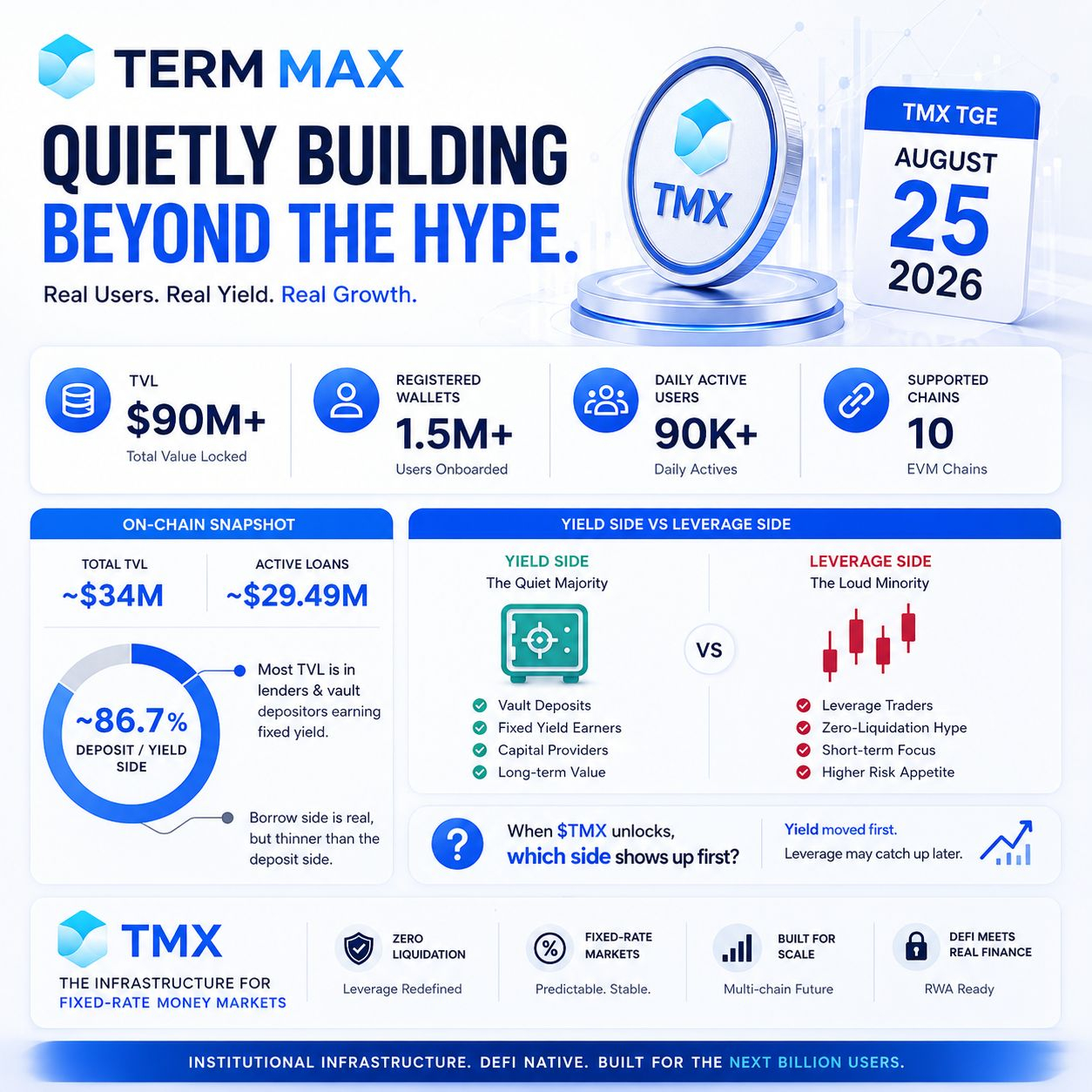
TermMax ne $TMX ka TGE 25 August 2026 confirm kiya hai. Saath mein 1.5M+ registered wallets, 90K+ daily active users aur 10 EVM chains ka footprint diya gaya hai.
Lekin yahan ek important difference hai.
Jo narrative sabse loud hai woh leverage ka hai.
Jo activity mujhe zyada interesting lagi, woh lenders aur vault depositors ki hai.
Mere tracked data mein TVL roughly $34M tha, jabke active loans around $29.49M thay. Broader ecosystem figure $90M+ TVL tak report ho raha hai.
Yani borrow side real hai, lekin deposit/yield side ko ignore karna mushkil hai.
Aur TermMax ka core design bhi isi direction ko support karta hai: fixed-rate lending aur borrowing, jahan user ko variable-rate uncertainty ke bajaye predefined terms milte hain.
Mere liye yahan actual question leverage nahi raha.
Question ye hai ke TGE ke baad TMX ko kaun drive karega?
Woh trader jo leverage use karta hai?
Ya woh much larger user base jo capital deposit karke fixed yield generate kar raha hai?
Agar yield side pehle grow kar gayi thi, to possible hai market TMX ko sirf “leverage token” ke lens se dekh hi na raha ho.
Yield moved first. Leverage may catch up later.
@termmax #TermMax
Mujhe TMX ko dekhte hue ek cheez expected se zyada interesting lagi.
Main zero-liquidation leverage story dekhne gaya tha, lekin numbers ne mujhe yield side par rok diya.
TermMax ne $TMX ka TGE 25 August 2026 confirm kiya hai. Saath mein 1.5M+ registered wallets, 90K+ daily active users aur 10 EVM chains ka footprint diya gaya hai.
Lekin yahan ek important difference hai.
Jo narrative sabse loud hai woh leverage ka hai.
Jo activity mujhe zyada interesting lagi, woh lenders aur vault depositors ki hai.
Mere tracked data mein TVL roughly $34M tha, jabke active loans around $29.49M thay. Broader ecosystem figure $90M+ TVL tak report ho raha hai.
Yani borrow side real hai, lekin deposit/yield side ko ignore karna mushkil hai.
Aur TermMax ka core design bhi isi direction ko support karta hai: fixed-rate lending aur borrowing, jahan user ko variable-rate uncertainty ke bajaye predefined terms milte hain.
Mere liye yahan actual question leverage nahi raha.
Question ye hai ke TGE ke baad TMX ko kaun drive karega?
Woh trader jo leverage use karta hai?
Ya woh much larger user base jo capital deposit karke fixed yield generate kar raha hai?
Agar yield side pehle grow kar gayi thi, to possible hai market TMX ko sirf “leverage token” ke lens se dekh hi na raha ho.
Yield moved first. Leverage may catch up later.
@TermMax #TermMax
1
2
105
·
--
Aaj DUSK ko price chart se nahi, security scorecard aur staking mechanics se dekha — aur yahan mujhe ek interesting gap nazar aya.
DUSK institutional-grade, MiCA-compliant financial infrastructure ki story build kar raha hai. Lekin jab security metrics dekhe to picture itni polished nahi thi.
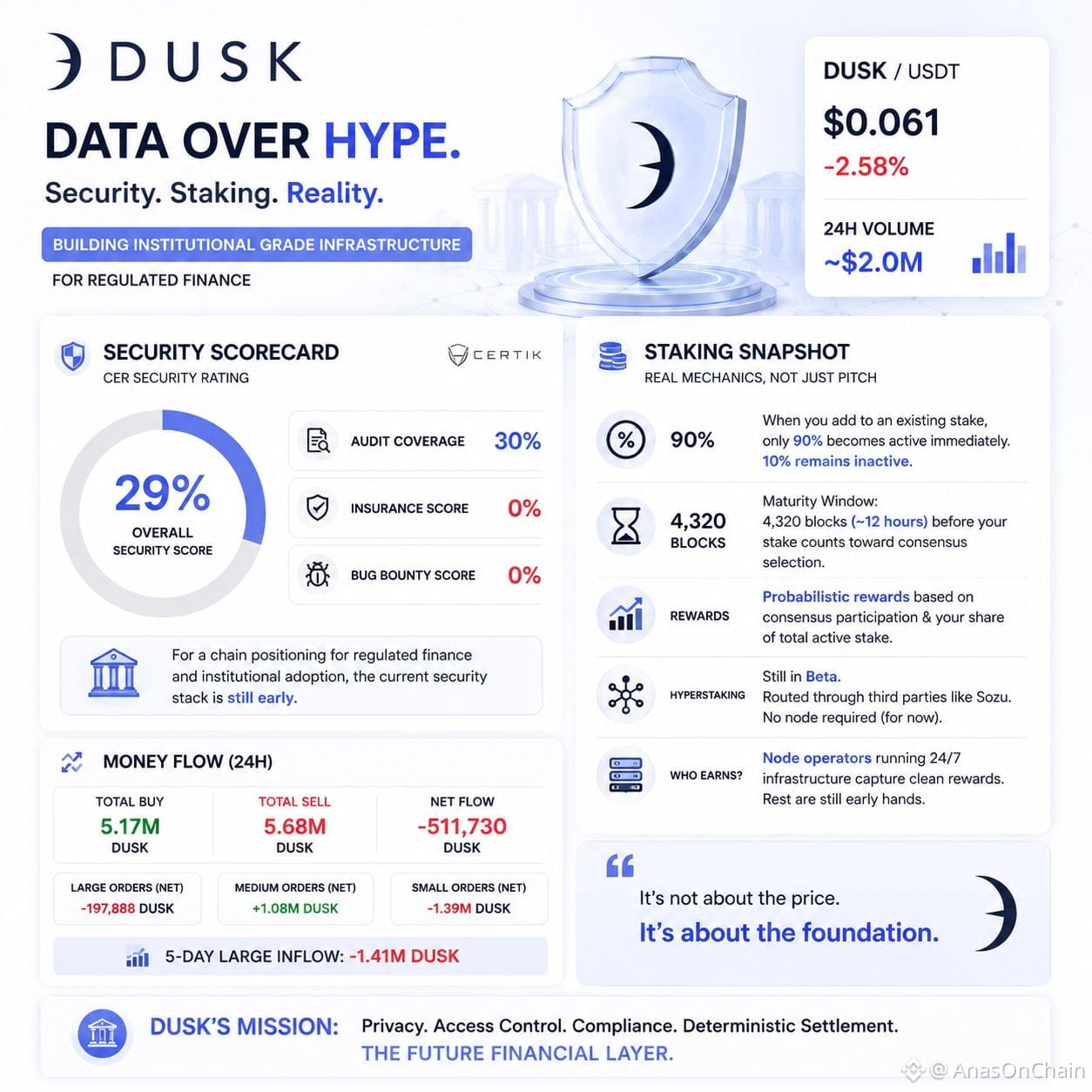
CER scorecard par: Overall security: 29%
Audit coverage: 30%
Insurance: 0%
Bug bounty: 0%
Mere liye sabse interesting number 0% tha.
RWA aur regulated finance mein institutions sirf ye nahi dekhte ke protocol kya promise kar raha hai. Woh ye bhi dekhte hain ke worst-case mein protection kitni mature hai.
Phir maine staking khud test ki.
Stake ka sirf 90% immediately active hota hai. Baqi 10% inactive rehta hai.
Aur consensus selection mein count hone se pehle 4,320 blocks (~12 hours) ka maturity window hai.
Rewards bhi fixed APR nahi hain. Consensus participation aur total active stake ke comparison mein tumhare stake par depend karte hain.
Hyperstaking bhi abhi beta aur third-party infrastructure ke through hai.
Yani DUSK ki story mujhe ab sirf “privacy + RWA” nahi lagti.
Asal test ye hai:
Kya institutional narrative ke peeche security aur staking infrastructure bhi utni hi speed se mature ho raha hai?
Price around $0.061 aur 24H volume ~$2M tha, lekin honestly mujhe price se zyada woh 0% insurance aur 0% bug bounty yaad reh gaya.
Agar DUSK future financial assets ko on-chain lana chahta hai, to next chapter sirf adoption nahi hoga.
Trust ko prove karna hoga.
@Dusk_Foundation #dusk $DUSK
Aaj DUSK ko price chart se nahi, security scorecard aur staking mechanics se dekha — aur yahan mujhe ek interesting gap nazar aya.
DUSK institutional-grade, MiCA-compliant financial infrastructure ki story build kar raha hai. Lekin jab security metrics dekhe to picture itni polished nahi thi.
CER scorecard par: Overall security: 29%
Audit coverage: 30%
Insurance: 0%
Bug bounty: 0%
Mere liye sabse interesting number 0% tha.
RWA aur regulated finance mein institutions sirf ye nahi dekhte ke protocol kya promise kar raha hai. Woh ye bhi dekhte hain ke worst-case mein protection kitni mature hai.
Phir maine staking khud test ki.
Stake ka sirf 90% immediately active hota hai. Baqi 10% inactive rehta hai.
Aur consensus selection mein count hone se pehle 4,320 blocks (~12 hours) ka maturity window hai.
Rewards bhi fixed APR nahi hain. Consensus participation aur total active stake ke comparison mein tumhare stake par depend karte hain.
Hyperstaking bhi abhi beta aur third-party infrastructure ke through hai.
Yani DUSK ki story mujhe ab sirf “privacy + RWA” nahi lagti.
Asal test ye hai:
Kya institutional narrative ke peeche security aur staking infrastructure bhi utni hi speed se mature ho raha hai?
Price around $0.061 aur 24H volume ~$2M tha, lekin honestly mujhe price se zyada woh 0% insurance aur 0% bug bounty yaad reh gaya.
Agar DUSK future financial assets ko on-chain lana chahta hai, to next chapter sirf adoption nahi hoga.
Trust ko prove karna hoga.
@Dusk #dusk $DUSK
5
4
114
·
--
Частичная правда
Aaj DUSK ka money-flow data dekha to price se zyada ek question interesting laga.
Agar kal BTC holders collectively sell kar dein, ya kisi major exchange ka hack market ka trust shake kar de… to problem sirf price ki nahi hogi.
Problem hogi: financial infrastructure kitni resilient hai?
Yahin mujhe DUSK interesting lagta hai.
DUSK BTC ko replace karne ka bet nahi hai. Iska focus regulated assets ko aise on-chain infrastructure par lana hai jahan privacy, access control aur settlement ek saath work karein.
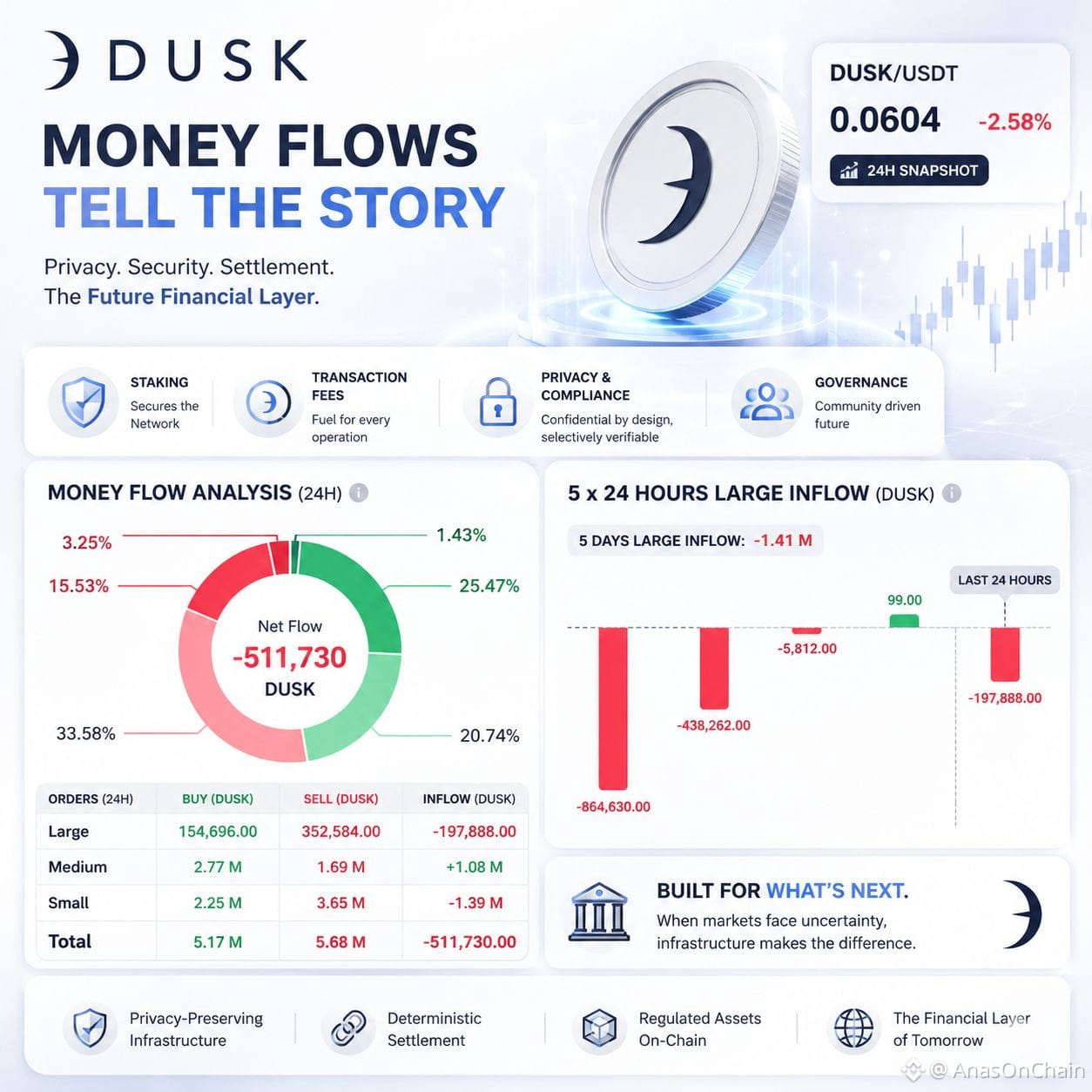
Aaj ke 24H data mein:
• Buy: 5.17M DUSK
• Sell: 5.68M DUSK
• Net: -511,730 DUSK
• Large orders: -197,888
• Medium: +1.08M
• Small: -1.39M
• 5-day large inflow: -1.41M
• Price: $0.0604 (-2.58%)
Market pressure apni jagah hai, lekin utility ki story different hai.
DUSK staking, transaction fees aur DuskEVM ko fuel karta hai. Privacy-focused financial applications mein selective disclosure bhi important role play karta hai.
BTC hack ho jaye to DUSK BTC recover nahi karega.
Binance hack ho jaye to DUSK Foundation exchange ko rescue nahi karegi.
Lekin agar aise events financial infrastructure ki weaknesses expose karein, to privacy + compliance + access control + deterministic settlement ki importance aur clear ho sakti hai.
BTC ka future BTC holders decide karenge.
Lekin next-generation financial rails kis type ke honge?
Shayad isi question mein $DUSK ka real opportunity hai.
@Dusk_Foundation #dusk $DUSK
Aaj DUSK ka money-flow data dekha to price se zyada ek question interesting laga.
Agar kal BTC holders collectively sell kar dein, ya kisi major exchange ka hack market ka trust shake kar de… to problem sirf price ki nahi hogi.
Problem hogi: financial infrastructure kitni resilient hai?
Yahin mujhe DUSK interesting lagta hai.
DUSK BTC ko replace karne ka bet nahi hai. Iska focus regulated assets ko aise on-chain infrastructure par lana hai jahan privacy, access control aur settlement ek saath work karein.
Aaj ke 24H data mein:
• Buy: 5.17M DUSK
• Sell: 5.68M DUSK
• Net: -511,730 DUSK
• Large orders: -197,888
• Medium: +1.08M
• Small: -1.39M
• 5-day large inflow: -1.41M
• Price: $0.0604 (-2.58%)
Market pressure apni jagah hai, lekin utility ki story different hai.
DUSK staking, transaction fees aur DuskEVM ko fuel karta hai. Privacy-focused financial applications mein selective disclosure bhi important role play karta hai.
BTC hack ho jaye to DUSK BTC recover nahi karega.
Binance hack ho jaye to DUSK Foundation exchange ko rescue nahi karegi.
Lekin agar aise events financial infrastructure ki weaknesses expose karein, to privacy + compliance + access control + deterministic settlement ki importance aur clear ho sakti hai.
BTC ka future BTC holders decide karenge.
Lekin next-generation financial rails kis type ke honge?
Shayad isi question mein $DUSK ka real opportunity hai.
@Dusk #dusk $DUSK
3
3
249
·
--
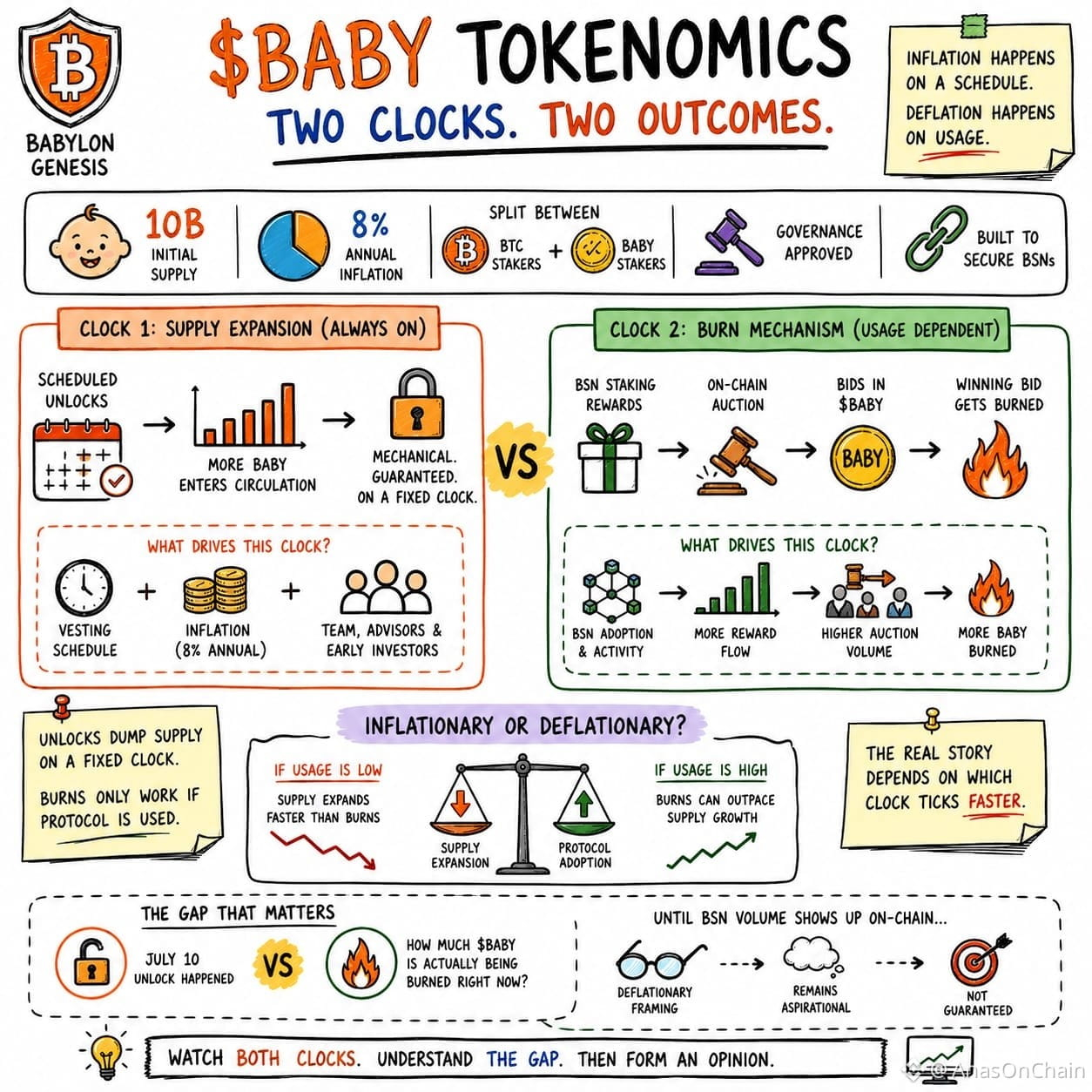
Har koi abhi sirf $BABY inflation ki baat kar raha hai, lekin mujhe Genesis tokenomics mein ek aur cheez zyada interesting lagi.
BABY ki initial supply 10B thi aur protocol 8% annual inflation ke sath BTC aur BABY stakers ko rewards deta hai. Yeh part sab jante hain.
Phir BSN reward mechanism dekha. BSN se aane wale rewards on-chain auction mein jate hain, bids BABY mein hoti hain aur winning bid burn ho jati hai. Yahan mujhe laga ke asal story inflation ya burn nahi, dono ke timing model mein hai.
Ek side scheduled unlocks aur inflation apni timeline par chal rahe hain. Dusri side burn tabhi meaningful hota hai jab BSNs real activity generate karein aur auctions mein enough BABY flow aaye.
Mere liye sawal yeh nahi ke BABY inflationary hai ya deflationary.
Sawal yeh hai ke kaunsi clock tez chalegi? Supply expansion wali... ya protocol adoption wali?
Agar future mein BSN adoption accelerate hoti hai to burn mechanism ka impact bhi naturally barhega. Agar adoption slow rahi to market pehle supply side ko feel karegi.
Isi liye mere nazdeek BABY ki long-term economics sirf token issuance se nahi, Babylon Genesis par build hone wali BSN activity se decide hogi.
@babylonlabs_io $BABY #baby
Har koi abhi sirf $BABY inflation ki baat kar raha hai, lekin mujhe Genesis tokenomics mein ek aur cheez zyada interesting lagi.
BABY ki initial supply 10B thi aur protocol 8% annual inflation ke sath BTC aur BABY stakers ko rewards deta hai. Yeh part sab jante hain.
Phir BSN reward mechanism dekha. BSN se aane wale rewards on-chain auction mein jate hain, bids BABY mein hoti hain aur winning bid burn ho jati hai. Yahan mujhe laga ke asal story inflation ya burn nahi, dono ke timing model mein hai.
Ek side scheduled unlocks aur inflation apni timeline par chal rahe hain. Dusri side burn tabhi meaningful hota hai jab BSNs real activity generate karein aur auctions mein enough BABY flow aaye.
Mere liye sawal yeh nahi ke BABY inflationary hai ya deflationary.
Sawal yeh hai ke kaunsi clock tez chalegi? Supply expansion wali... ya protocol adoption wali?
Agar future mein BSN adoption accelerate hoti hai to burn mechanism ka impact bhi naturally barhega. Agar adoption slow rahi to market pehle supply side ko feel karegi.
Isi liye mere nazdeek BABY ki long-term economics sirf token issuance se nahi, Babylon Genesis par build hone wali BSN activity se decide hogi.
@BabylonLabs_io $BABY #baby
3
2
92
·
--
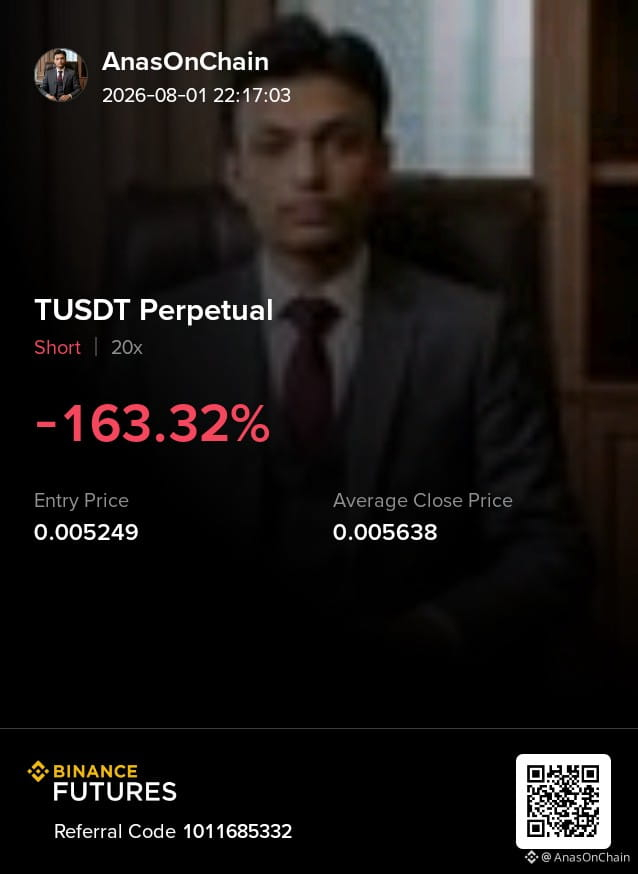
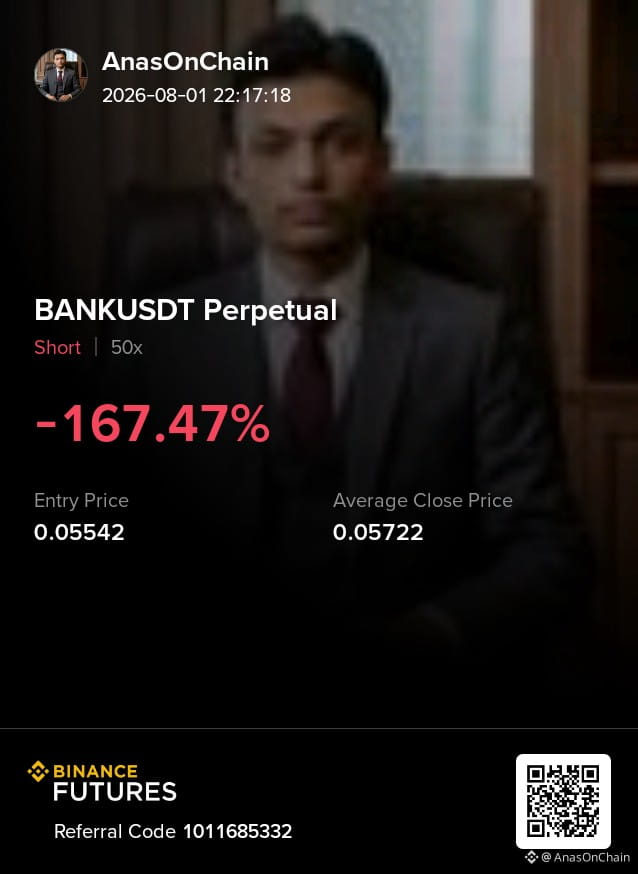
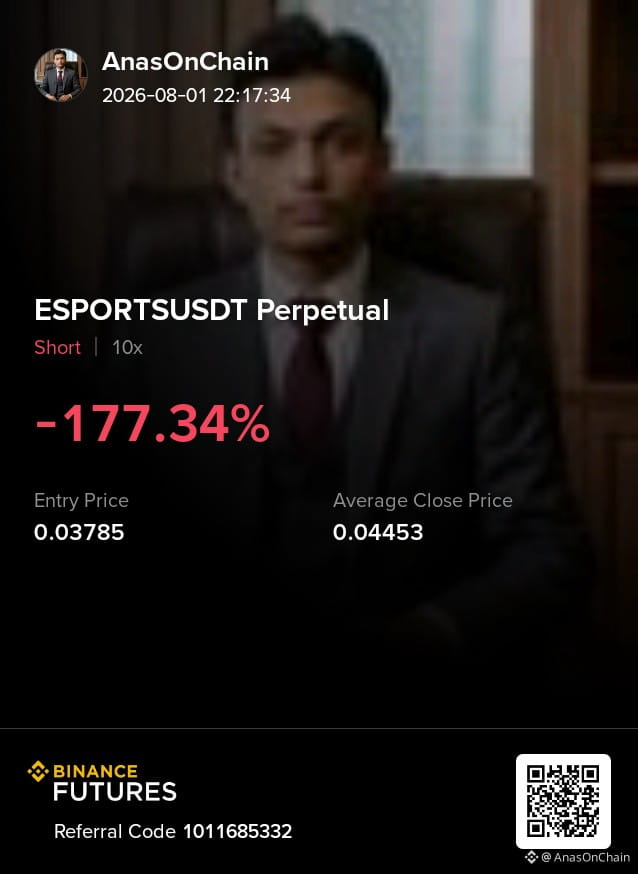
Started with losses. 📉
Three shorts. Three mistakes. Three lessons.
Every red trade paid for experience that no course can teach.
I don't post only wins. I post the journey.
Discipline > Emotion. Consistency > Perfection.
The goal isn't to avoid losses. The goal is to become the trader who survives them.
Three shorts. Three mistakes. Three lessons.
Every red trade paid for experience that no course can teach.
I don't post only wins. I post the journey.
Discipline > Emotion. Consistency > Perfection.
The goal isn't to avoid losses. The goal is to become the trader who survives them.
1
384
·
--
Частичная правда
Aaj @babylonlabs_io ko dobara study karte waqt ek cheez ne meri attention hold kar li.
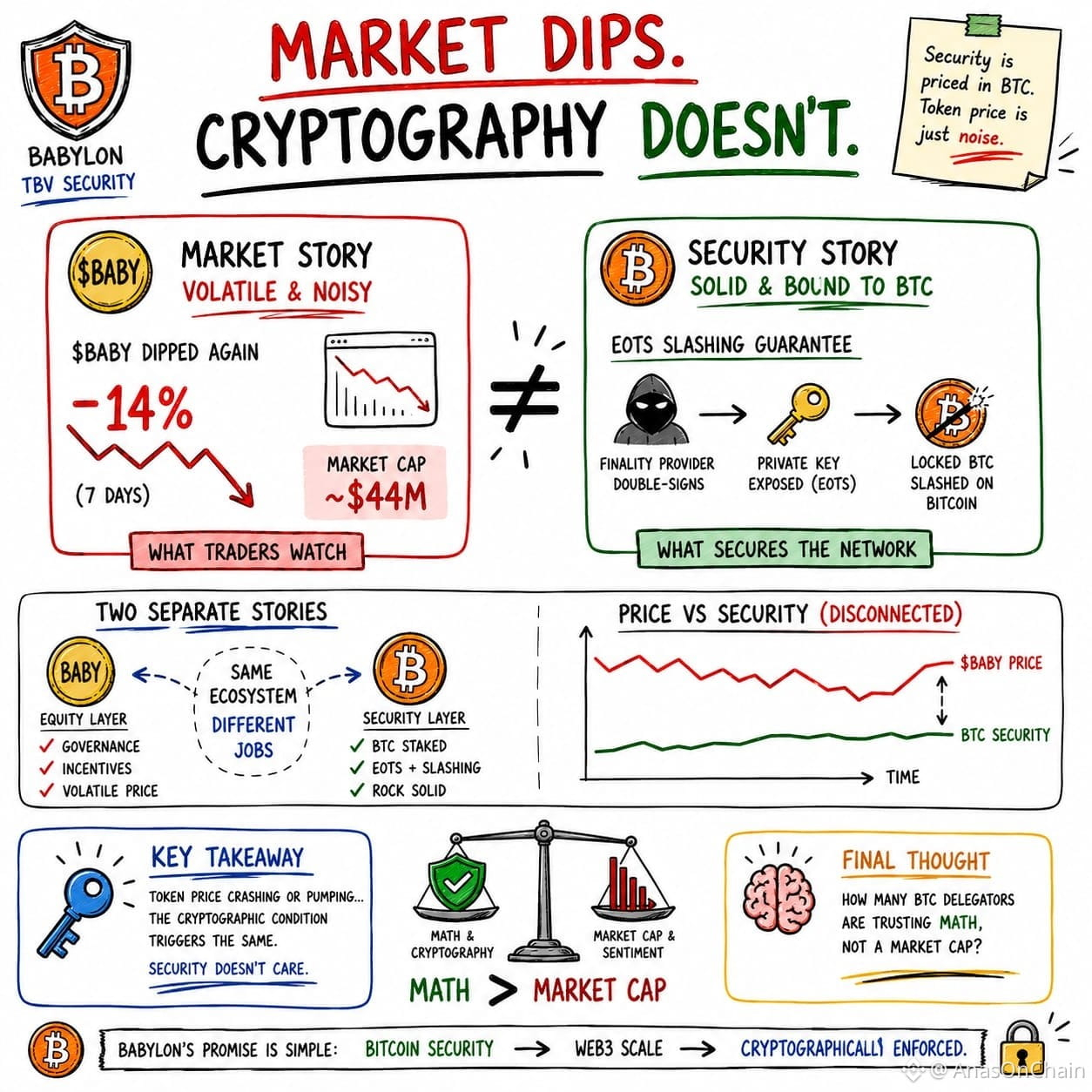
$BABY is week lagbhag 14% dip hua, market cap kareeb $44M tak aa gaya. Dusri taraf protocol ke peeche billions of dollars worth of BTC economic security ke liye stake hai.
Yahan EOTS ka design interesting lagta hai.
Agar koi Finality Provider double-sign kare, to uska private key expose hota hai aur us se backed locked BTC Bitcoin layer par slash ho jata hai. Is cryptographic rule ko farq nahi padta ke $BABY pump kar raha hai ya dump.
Yani Babylon mein do alag layers chal rahi hain.
BTC protocol ki economic security enforce karta hai.
Baby governance, coordination aur incentives ko power karta hai.
Market sentiment dono ko ek hi story samajhta hai, lekin protocol architecture aisa nahi karta.
Maine bhi pehle assume kiya tha ke token dip shayad network security ka signal ho. Whitepaper dobara padhne ke baad realize hua ke security guarantees aur token price do mukhtalif systems hain jo sirf ecosystem share karte hain.
Isi liye BTC delegators asal mein market cap par nahi, cryptographic accountability par trust kar rahe hote hain.
Ye separation mujhe Babylon ke design ka sab se underrated part laga.
@babylonlabs_io #baby $BABY
Aaj @BabylonLabs_io ko dobara study karte waqt ek cheez ne meri attention hold kar li.
$BABY is week lagbhag 14% dip hua, market cap kareeb $44M tak aa gaya. Dusri taraf protocol ke peeche billions of dollars worth of BTC economic security ke liye stake hai.
Yahan EOTS ka design interesting lagta hai.
Agar koi Finality Provider double-sign kare, to uska private key expose hota hai aur us se backed locked BTC Bitcoin layer par slash ho jata hai. Is cryptographic rule ko farq nahi padta ke $BABY pump kar raha hai ya dump.
Yani Babylon mein do alag layers chal rahi hain.
BTC protocol ki economic security enforce karta hai.
Baby governance, coordination aur incentives ko power karta hai.
Market sentiment dono ko ek hi story samajhta hai, lekin protocol architecture aisa nahi karta.
Maine bhi pehle assume kiya tha ke token dip shayad network security ka signal ho. Whitepaper dobara padhne ke baad realize hua ke security guarantees aur token price do mukhtalif systems hain jo sirf ecosystem share karte hain.
Isi liye BTC delegators asal mein market cap par nahi, cryptographic accountability par trust kar rahe hote hain.
Ye separation mujhe Babylon ke design ka sab se underrated part laga.
@BabylonLabs_io #baby $BABY
6
1
159
·
--
@babylonlabs_io ki TBV architecture ko dekhte hue mujhe ek interesting cheez samajh aayi.
Whitepaper mein cryptographic guarantees bohat strong lagti hain, lekin real-world security sirf mathematics se nahi, edge cases se bhi test hoti hai.
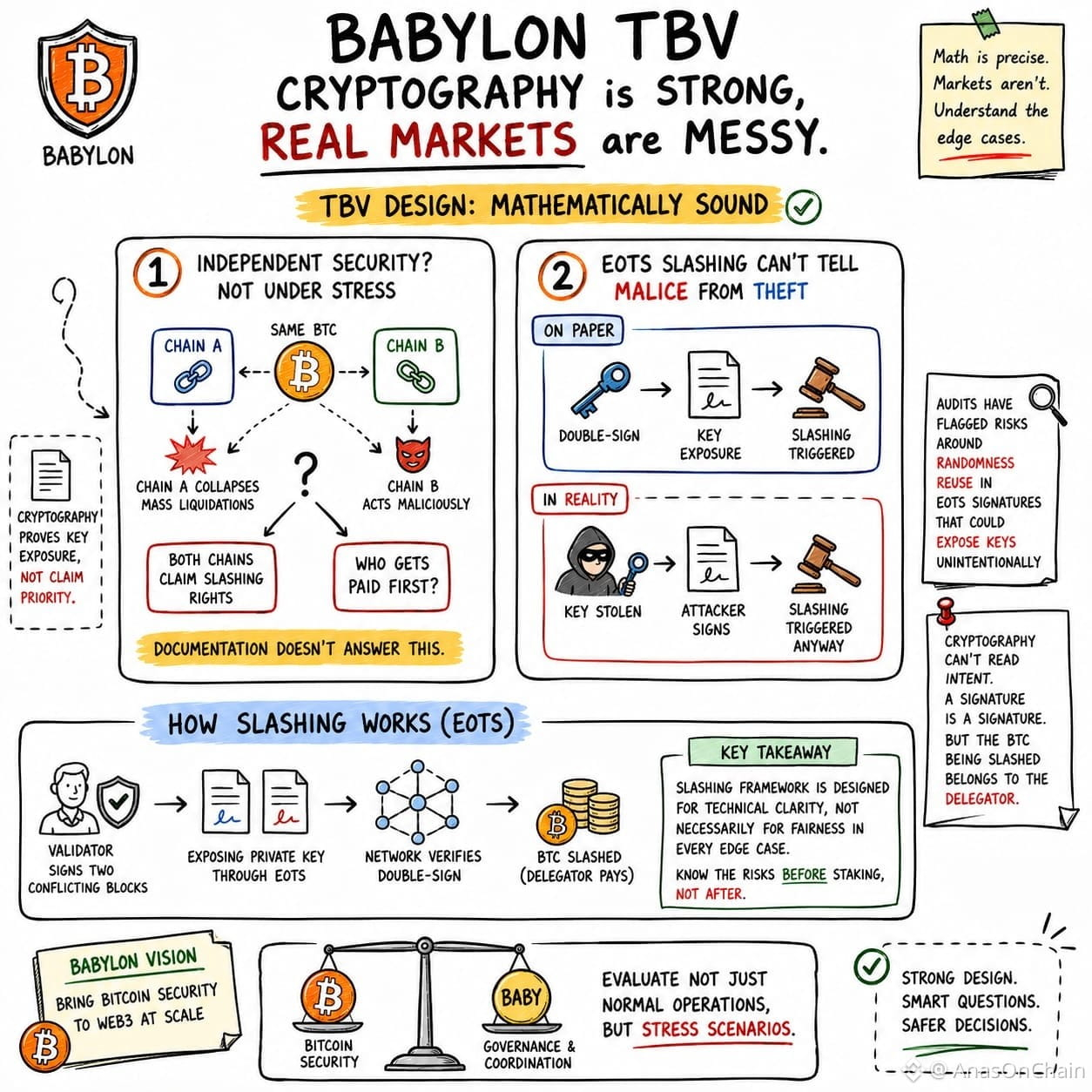
TBV ka model allow karta hai ke ek hi BTC multiple Bitcoin Secured Networks ko economic security provide kare. Ye capital efficiency ke liye powerful design hai. Lekin agar do chains extreme market stress ke dauran ek hi validator ke against slashing claim generate kar dein, to priority kis basis par decide hogi? Ye scenario documentation mein clearly define nahi hota.
Dusri observation EOTS slashing mechanism par thi.
EOTS validator honesty enforce karta hai kyun ke double-signing private key expose kar deti hai aur slashing trigger hoti hai. Lekin blockchain sirf signature dekh sakta hai, intention nahi. Agar key compromise ho jaye aur attacker usi key se sign kare, on-chain result phir bhi double-signing hi nazar aata hai.
Isi liye independent security reviews bhi randomness handling aur key management ko critical area mante hain, kyun ke technical implementation security ka utna hi important hissa hai jitna cryptographic design.
Mere liye ye protocol ki weakness nahi...
Balke trust model ko samajhne ka point hai.
Delegators sirf yield ya rewards choose nahi kar rahe. Wo us slashing framework par bhi trust kar rahe hote hain jo technical clarity provide karta hai, chahe har edge case mein intent ko identify na kar sake.
Babylon Bitcoin ki security ko Web3 tak extend kar raha hai, lekin us security model ko evaluate karte waqt sirf normal operation nahi, stress scenarios ko bhi dekhna zaroori hai.
@babylonlabs_io $BABY #baby
@BabylonLabs_io ki TBV architecture ko dekhte hue mujhe ek interesting cheez samajh aayi.
Whitepaper mein cryptographic guarantees bohat strong lagti hain, lekin real-world security sirf mathematics se nahi, edge cases se bhi test hoti hai.
TBV ka model allow karta hai ke ek hi BTC multiple Bitcoin Secured Networks ko economic security provide kare. Ye capital efficiency ke liye powerful design hai. Lekin agar do chains extreme market stress ke dauran ek hi validator ke against slashing claim generate kar dein, to priority kis basis par decide hogi? Ye scenario documentation mein clearly define nahi hota.
Dusri observation EOTS slashing mechanism par thi.
EOTS validator honesty enforce karta hai kyun ke double-signing private key expose kar deti hai aur slashing trigger hoti hai. Lekin blockchain sirf signature dekh sakta hai, intention nahi. Agar key compromise ho jaye aur attacker usi key se sign kare, on-chain result phir bhi double-signing hi nazar aata hai.
Isi liye independent security reviews bhi randomness handling aur key management ko critical area mante hain, kyun ke technical implementation security ka utna hi important hissa hai jitna cryptographic design.
Mere liye ye protocol ki weakness nahi...
Balke trust model ko samajhne ka point hai.
Delegators sirf yield ya rewards choose nahi kar rahe. Wo us slashing framework par bhi trust kar rahe hote hain jo technical clarity provide karta hai, chahe har edge case mein intent ko identify na kar sake.
Babylon Bitcoin ki security ko Web3 tak extend kar raha hai, lekin us security model ko evaluate karte waqt sirf normal operation nahi, stress scenarios ko bhi dekhna zaroori hai.
@BabylonLabs_io $BABY #baby
7
4
150
·
--
Kabhi kabhi protocol ki asli value us cheez mein nahi hoti jo verify hoti hai...
Balki us system mein hoti hai jo sab ko ek hi reality par agree karwata hai.
Babylon Genesis ko dekhte hue ye cheez kaafi interesting lagi.
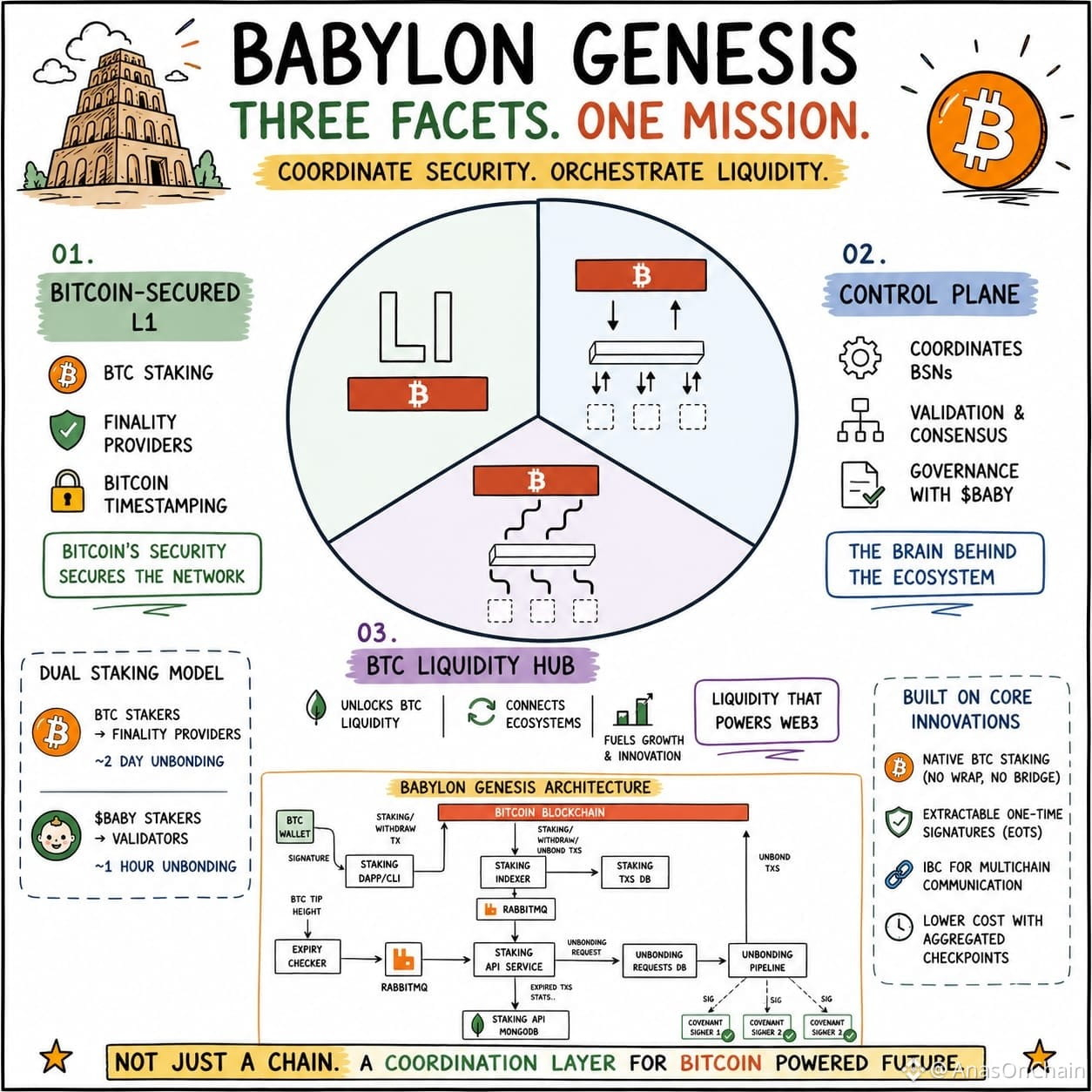
Diagram dekh kar pehle laga ye sirf Bitcoin-backed Layer 1 hai. Lekin architecture ko detail mein samjha to realize hua ke Genesis teen alag roles ek sath perform karta hai: Bitcoin-secured L1, Control Plane aur BTC Liquidity Hub.
Agar koi repayment proof ya on-chain condition complete bhi ho jaye, tab bhi system tabhi kaam karta hai jab har validator usi proof, usi price feed aur usi predefined rules ko exactly ek hi tarah interpret kare.
Yahan protocol sirf cryptography protect nahi kar raha...
Ye shared agreement protect kar raha hai.
Isi liye BTC economic security provide karta hai, Finality Providers verification ko strengthen karte hain aur BABY governance aur network operations ko coordinate karta hai. Ye separation infrastructure ko sirf secure nahi, consistent bhi banati hai.
Mere liye Babylon ka sab se interesting part Bitcoin staking nahi...
Balke ye hai ke protocol value move hone se pehle consensus of reality build karta hai.
Agar future Web3 coordination ka game ban jata hai, to kya coordination layers execution layers se bhi zyada important ho jayengi?
@babylonlabs_io $BABY #baby
Kabhi kabhi protocol ki asli value us cheez mein nahi hoti jo verify hoti hai...
Balki us system mein hoti hai jo sab ko ek hi reality par agree karwata hai.
Babylon Genesis ko dekhte hue ye cheez kaafi interesting lagi.
Diagram dekh kar pehle laga ye sirf Bitcoin-backed Layer 1 hai. Lekin architecture ko detail mein samjha to realize hua ke Genesis teen alag roles ek sath perform karta hai: Bitcoin-secured L1, Control Plane aur BTC Liquidity Hub.
Agar koi repayment proof ya on-chain condition complete bhi ho jaye, tab bhi system tabhi kaam karta hai jab har validator usi proof, usi price feed aur usi predefined rules ko exactly ek hi tarah interpret kare.
Yahan protocol sirf cryptography protect nahi kar raha...
Ye shared agreement protect kar raha hai.
Isi liye BTC economic security provide karta hai, Finality Providers verification ko strengthen karte hain aur BABY governance aur network operations ko coordinate karta hai. Ye separation infrastructure ko sirf secure nahi, consistent bhi banati hai.
Mere liye Babylon ka sab se interesting part Bitcoin staking nahi...
Balke ye hai ke protocol value move hone se pehle consensus of reality build karta hai.
Agar future Web3 coordination ka game ban jata hai, to kya coordination layers execution layers se bhi zyada important ho jayengi?
@BabylonLabs_io $BABY #baby
6
7
140
·
--
Проверено
Kabhi kabhi protocol ki sabse badi innovation us cheez mein hoti hai... jo woh remove karta hai, na ke jo add karta hai.
@babylonlabs_io ko detail mein dekhte hue mujhe ye observation mili.
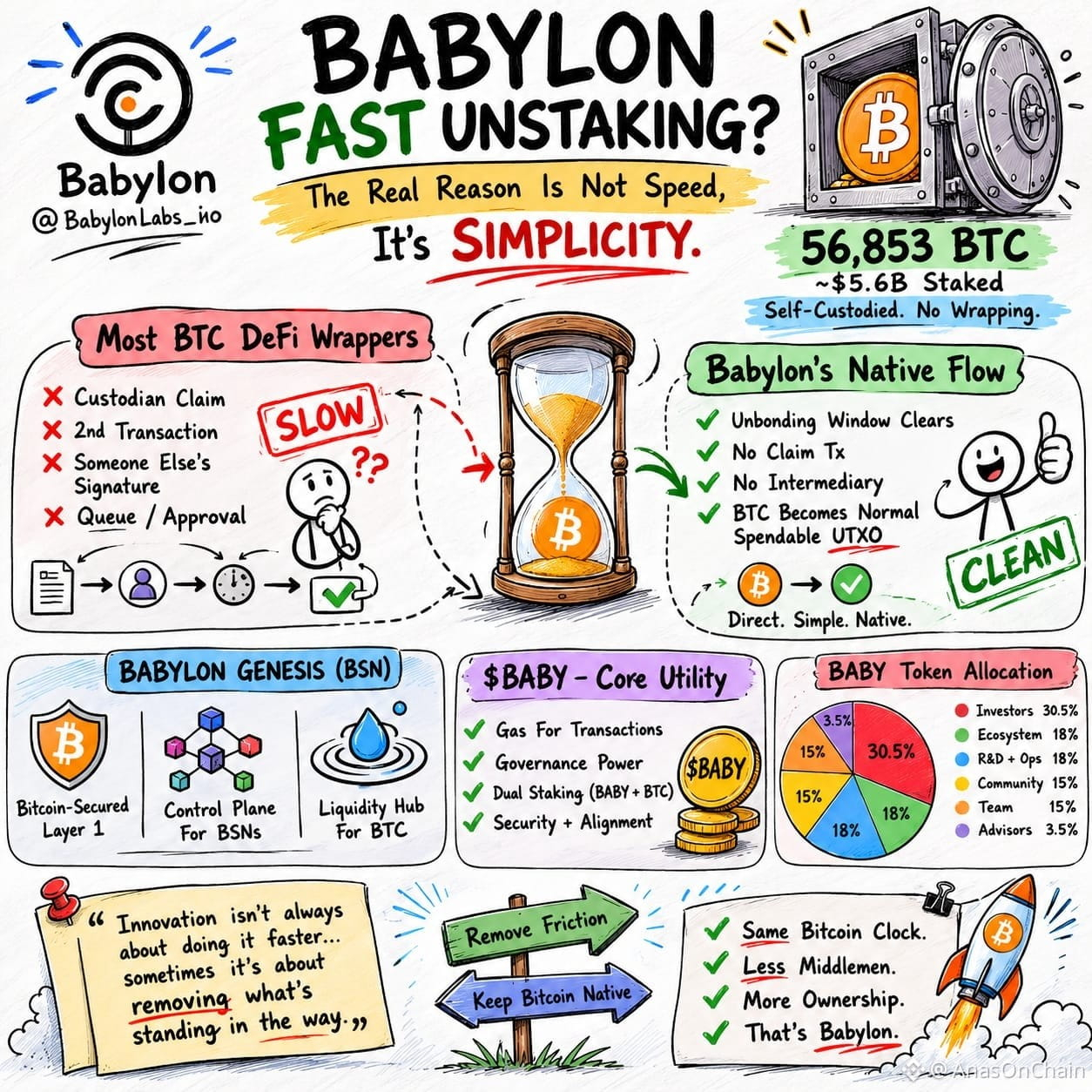
Aaj Babylon mein 56,853 BTC (~$5.6B) self-custodial stake hai. Pehli nazar mein sab "fast unstaking" ki baat karte hain, lekin architecture kuch aur hi story batata hai.
Reality ye hai ke Bitcoin apna native unbonding process complete karta hai. Difference ye nahi ke Bitcoin ka clock fast ho gaya.
Difference ye hai ke uske baad koi custodian claim, bridge approval ya intermediary confirmation ki zarurat nahi rehti. BTC seedha normal spendable UTXO ban jata hai.
Yani speed Bitcoin ki nahi... workflow ki optimization hai.
Ye approach Babylon Genesis ke broader design se bhi match karti hai. Genesis sirf ek Layer 1 nahi, balki Bitcoin-secured control plane aur liquidity hub hai jahan infrastructure ka focus unnecessary trust layers ko remove karna hai, replace karna nahi.
Mere liye ye "fast unstaking" se zyada trust minimization ki story hai.
Marketing speed highlight karti hai.
Protocol friction remove karta hai.
Dono ek jaise lagte hain... lekin engineering perspective se dono bilkul alag concepts hain.
Aap ke khayal mein future Bitcoin infrastructure ki asli value faster transactions hongi, ya intermediaries ko gradually eliminate karna?
@babylonlabs_io $BABY #baby
Kabhi kabhi protocol ki sabse badi innovation us cheez mein hoti hai... jo woh remove karta hai, na ke jo add karta hai.
@BabylonLabs_io ko detail mein dekhte hue mujhe ye observation mili.
Aaj Babylon mein 56,853 BTC (~$5.6B) self-custodial stake hai. Pehli nazar mein sab "fast unstaking" ki baat karte hain, lekin architecture kuch aur hi story batata hai.
Reality ye hai ke Bitcoin apna native unbonding process complete karta hai. Difference ye nahi ke Bitcoin ka clock fast ho gaya.
Difference ye hai ke uske baad koi custodian claim, bridge approval ya intermediary confirmation ki zarurat nahi rehti. BTC seedha normal spendable UTXO ban jata hai.
Yani speed Bitcoin ki nahi... workflow ki optimization hai.
Ye approach Babylon Genesis ke broader design se bhi match karti hai. Genesis sirf ek Layer 1 nahi, balki Bitcoin-secured control plane aur liquidity hub hai jahan infrastructure ka focus unnecessary trust layers ko remove karna hai, replace karna nahi.
Mere liye ye "fast unstaking" se zyada trust minimization ki story hai.
Marketing speed highlight karti hai.
Protocol friction remove karta hai.
Dono ek jaise lagte hain... lekin engineering perspective se dono bilkul alag concepts hain.
Aap ke khayal mein future Bitcoin infrastructure ki asli value faster transactions hongi, ya intermediaries ko gradually eliminate karna?
@BabylonLabs_io $BABY #baby
4
1
112
·
--
Проверено
Kabhi kabhi market aur protocol do bilkul alag stories likh rahe hote hain.
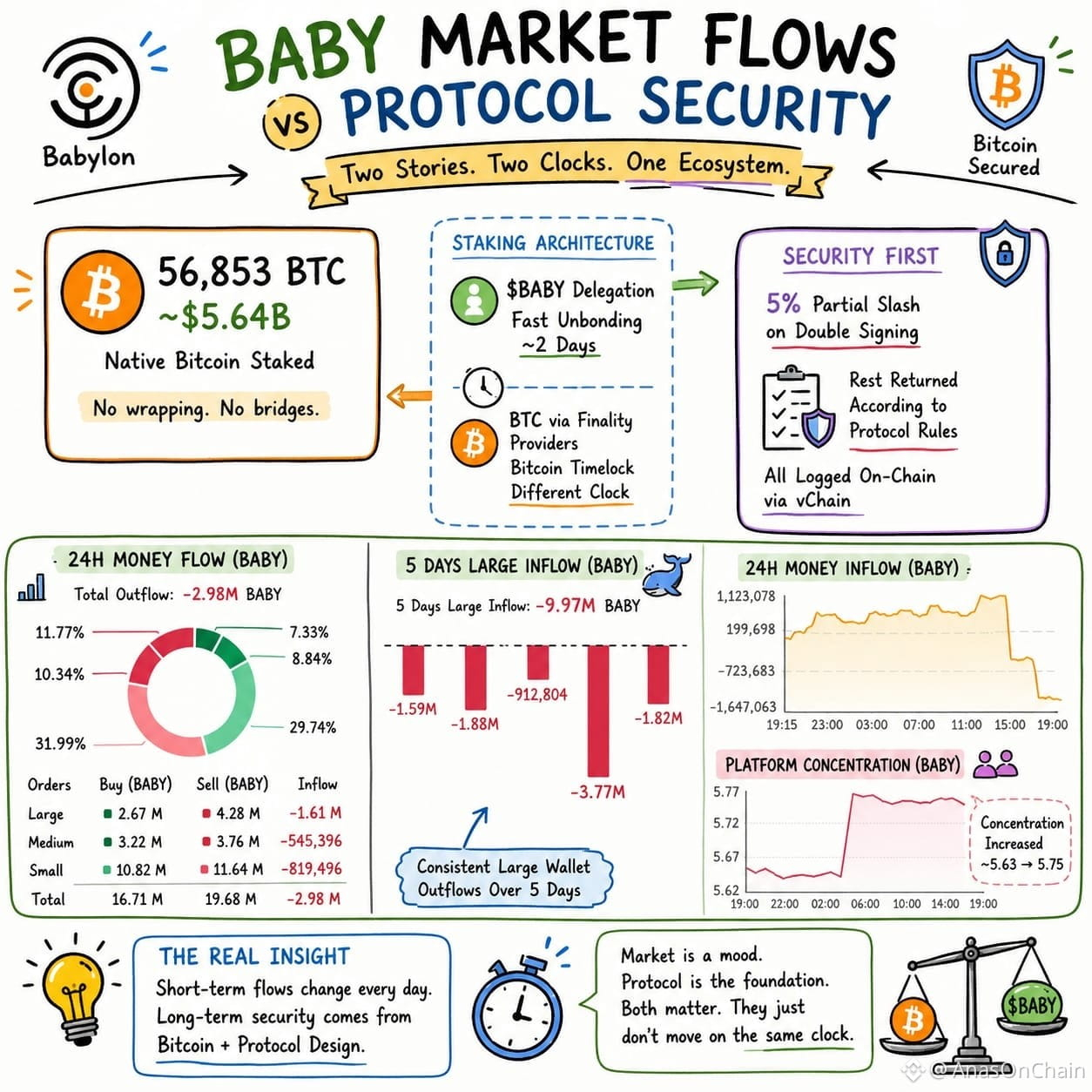
Aaj exchange data dekh raha tha. 24h total outflow -2.98M BABY tha, large wallets ka net outflow -1.61M BABY aur pichle 5 dinon mein large inflow -9.97M BABY raha. Short-term sentiment clearly pressure show kar raha hai.
Lekin isi waqt @babylonlabs_io ke protocol side par ek bilkul mukhtalif picture nazar aati hai.
56,853 BTC (~$5.64B) Native Bitcoin Staking ke zariye network ki economic security provide kar rahe hain, bina wrapping aur bridges ke. Mere liye asli insight ye thi ke Babylon market activity aur protocol security ko ek hi cheez treat nahi karta.
Staking architecture bhi isi philosophy ko follow karta hai.
$BABY delegation ka fast unbonding takreeban 2 din hai, jabke BTC Finality Providers aur Bitcoin timelocks ke through apni settlement rhythm follow karta hai. Dono assets ek ecosystem mein hain, lekin dono ka purpose alag hai.
Isi tarah short-term exchange flows bhi protocol ki long-term security ko define nahi karte.
Aaj money flow negative ho sakta hai, kal positive bhi ho sakta hai. Lekin Bitcoin-backed security, validator accountability aur protocol coordination hi woh layers hain jo ecosystem ko sustain karti hain.
Mere liye Babylon ki interesting baat APY ya daily inflows nahi...
Ye hai ke usne market behavior aur infrastructure behavior ko alag systems ke taur par design kiya hai.
Kya hum Web3 mein ab bhi exchange flows ko protocol fundamentals se zyada importance dete hain?
@babylonlabs_io $BABY #baby
Kabhi kabhi market aur protocol do bilkul alag stories likh rahe hote hain.
Aaj exchange data dekh raha tha. 24h total outflow -2.98M BABY tha, large wallets ka net outflow -1.61M BABY aur pichle 5 dinon mein large inflow -9.97M BABY raha. Short-term sentiment clearly pressure show kar raha hai.
Lekin isi waqt @BabylonLabs_io ke protocol side par ek bilkul mukhtalif picture nazar aati hai.
56,853 BTC (~$5.64B) Native Bitcoin Staking ke zariye network ki economic security provide kar rahe hain, bina wrapping aur bridges ke. Mere liye asli insight ye thi ke Babylon market activity aur protocol security ko ek hi cheez treat nahi karta.
Staking architecture bhi isi philosophy ko follow karta hai.
$BABY delegation ka fast unbonding takreeban 2 din hai, jabke BTC Finality Providers aur Bitcoin timelocks ke through apni settlement rhythm follow karta hai. Dono assets ek ecosystem mein hain, lekin dono ka purpose alag hai.
Isi tarah short-term exchange flows bhi protocol ki long-term security ko define nahi karte.
Aaj money flow negative ho sakta hai, kal positive bhi ho sakta hai. Lekin Bitcoin-backed security, validator accountability aur protocol coordination hi woh layers hain jo ecosystem ko sustain karti hain.
Mere liye Babylon ki interesting baat APY ya daily inflows nahi...
Ye hai ke usne market behavior aur infrastructure behavior ko alag systems ke taur par design kiya hai.
Kya hum Web3 mein ab bhi exchange flows ko protocol fundamentals se zyada importance dete hain?
@BabylonLabs_io $BABY #baby
4
2
158
·
--
Частичная правда
Kabhi kabhi kisi ecosystem ko samajhne ke liye unlock dates dekhna bhi zaroori hota hai... sirf isliye nahi ke kitne tokens release honge, balki isliye ke protocol incentives kaise evolve hote hain.
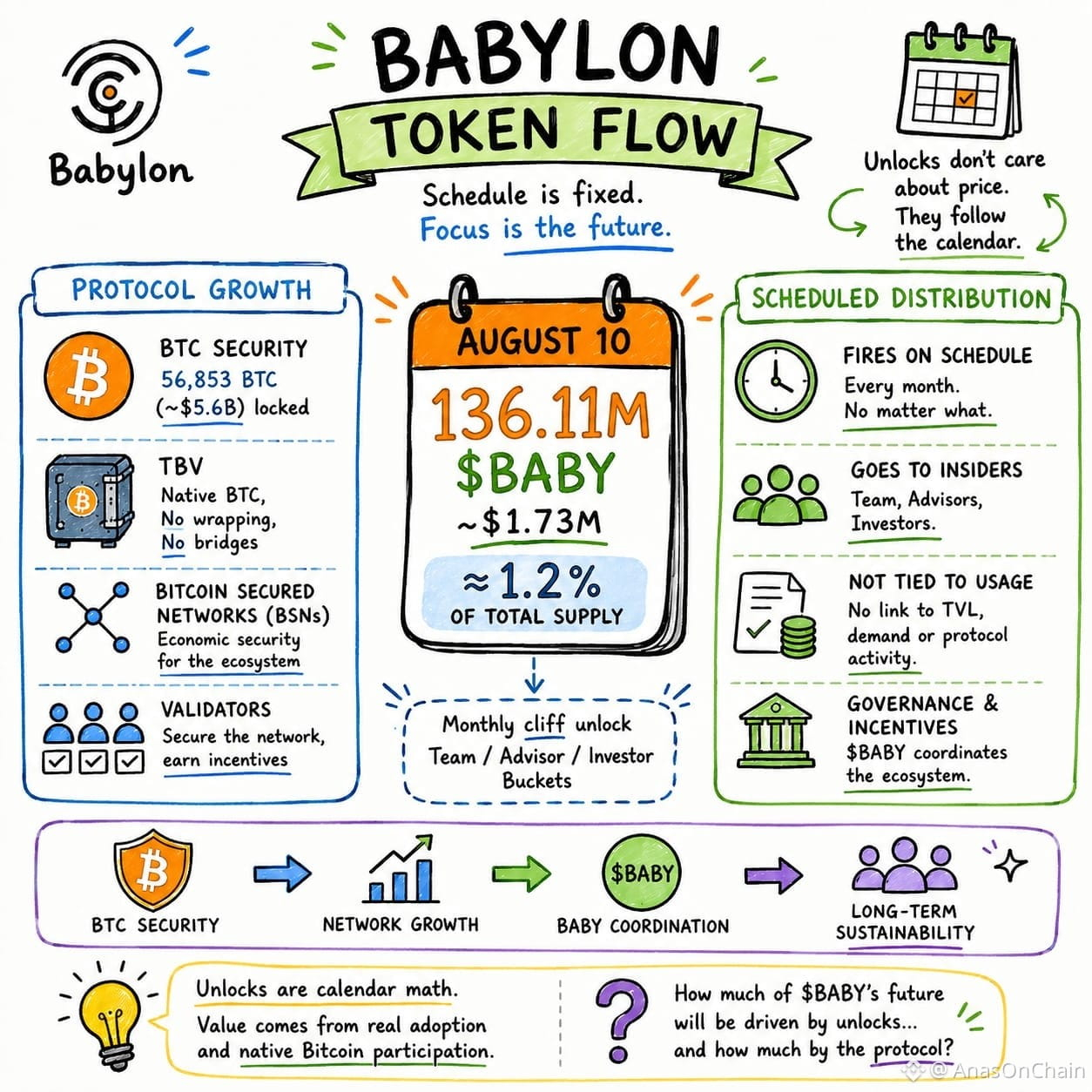
@babylonlabs_io ka agla scheduled unlock 10 August ko hai, jahan 136.11M $BABY tokens ecosystem allocation schedule ke mutabiq release honge. Ye process market conditions se nahi, protocol ke predefined distribution framework se tied hai.
Mere liye interesting cheez unlock nahi thi...
Balki ye thi ke Babylon ki long-term value sirf token distribution se define nahi hogi.
Agar Native Bitcoin Staking, Trustless Bitcoin Vaults (TBV) aur Bitcoin Secured Networks zyada adoption dekhte hain, to protocol ki asli strength infrastructure usage aur economic security se aayegi, na ke sirf circulating supply se.
BABY ka role bhi isi liye sirf reward token ka nahi. Governance, validator incentives aur ecosystem coordination uski core responsibility hain, jabke Bitcoin network ki economic security ka foundation rehta hai.
Strong ecosystems schedule se nahi bante.
Strong ecosystems tab bante hain jab incentives aur real protocol utility ek hi direction mein move karein.
Mere liye asal sawal unlock nahi...
Ye hai ke aane wale months mein protocol ki adoption aur native Bitcoin participation kitni tez grow karti hai.
@babylonlabs_io $BABY #baby
Kabhi kabhi kisi ecosystem ko samajhne ke liye unlock dates dekhna bhi zaroori hota hai... sirf isliye nahi ke kitne tokens release honge, balki isliye ke protocol incentives kaise evolve hote hain.
@BabylonLabs_io ka agla scheduled unlock 10 August ko hai, jahan 136.11M $BABY tokens ecosystem allocation schedule ke mutabiq release honge. Ye process market conditions se nahi, protocol ke predefined distribution framework se tied hai.
Mere liye interesting cheez unlock nahi thi...
Balki ye thi ke Babylon ki long-term value sirf token distribution se define nahi hogi.
Agar Native Bitcoin Staking, Trustless Bitcoin Vaults (TBV) aur Bitcoin Secured Networks zyada adoption dekhte hain, to protocol ki asli strength infrastructure usage aur economic security se aayegi, na ke sirf circulating supply se.
BABY ka role bhi isi liye sirf reward token ka nahi. Governance, validator incentives aur ecosystem coordination uski core responsibility hain, jabke Bitcoin network ki economic security ka foundation rehta hai.
Strong ecosystems schedule se nahi bante.
Strong ecosystems tab bante hain jab incentives aur real protocol utility ek hi direction mein move karein.
Mere liye asal sawal unlock nahi...
Ye hai ke aane wale months mein protocol ki adoption aur native Bitcoin participation kitni tez grow karti hai.
@BabylonLabs_io $BABY #baby
4
3
136
·
--
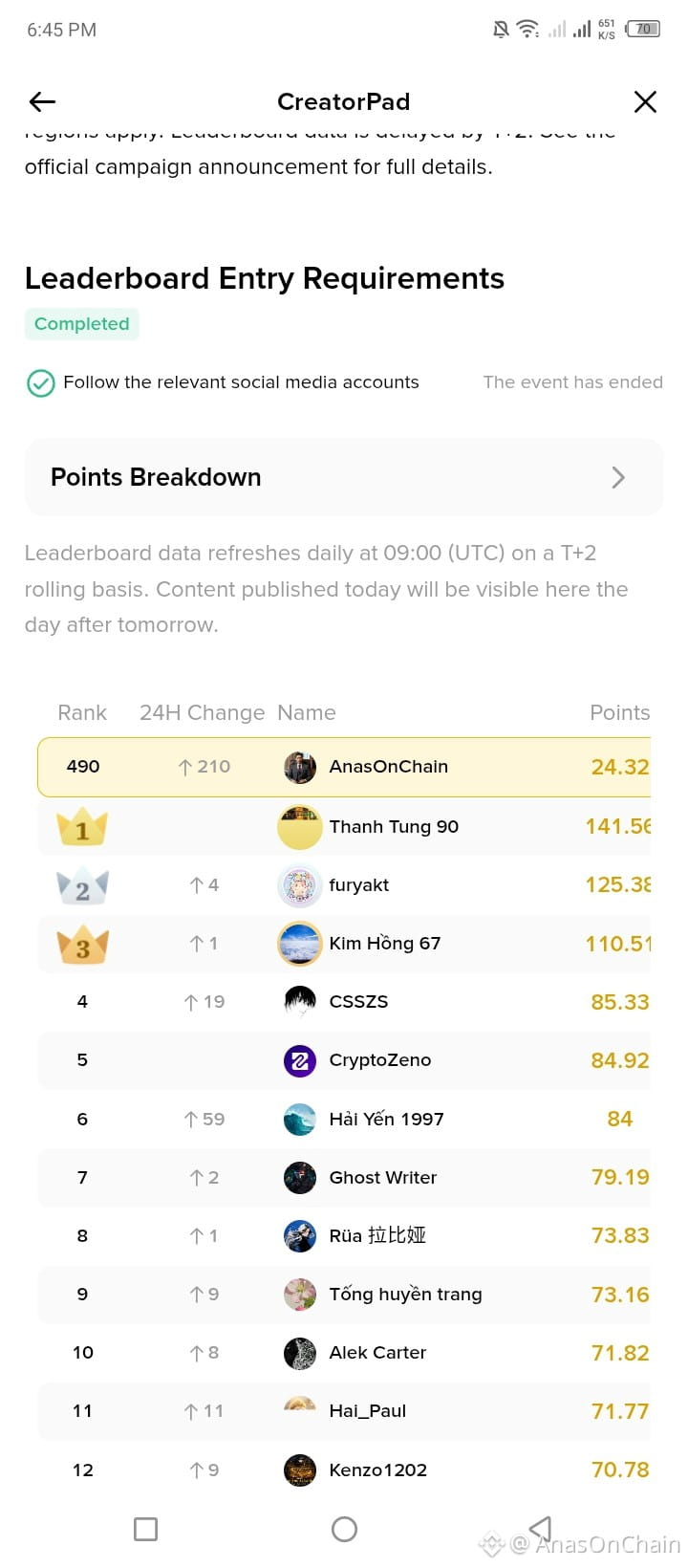
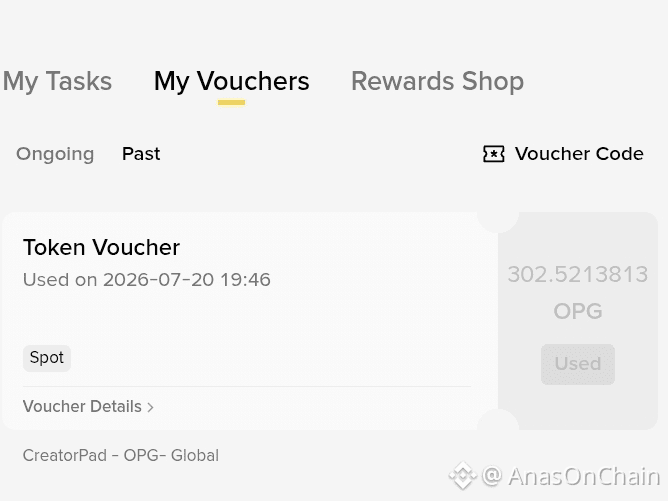
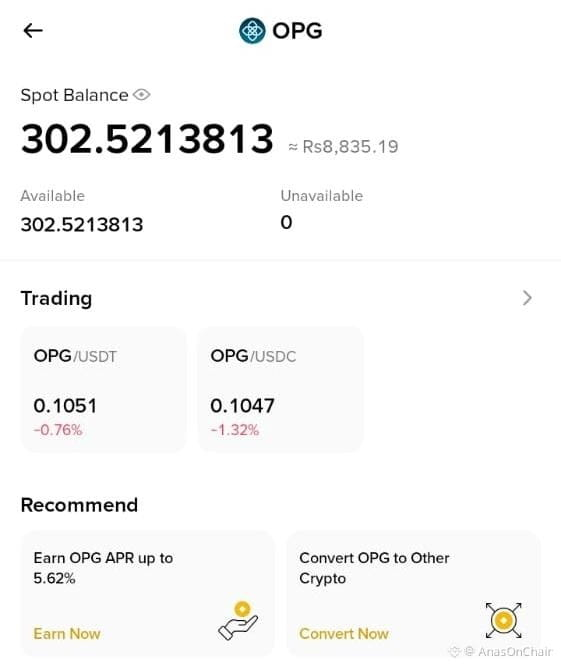
Finally received my OpenGradient CreatorPad reward: 302.52 $OPG (around $30).
To be honest, I'm disappointed. I finished around Top 150, so I expected a much better reward. $30 feels far below what many participants were hoping for.
I appreciate the opportunity, but I hope future CreatorPad campaigns offer rewards that better reflect participants' effort and rankings.
#OpenGradient #CreatorPad $OPG
1
157
·
--
Статья
$NEWT AI Builders Ke Liye Azadi Nahi, Bharosa Build Kar Raha HaiKabhi kabhi market kisi project ko ghalat angle se dekh leta hai.
Mujhe bhi pehle laga Newton Protocol sirf AI developers ke liye ek aur marketplace bana raha hai. Phir whitepaper aur recent updates dobara padhe, aur picture bilkul alag nikli.
Model Registry ka idea sirf agent list karna nahi hai.
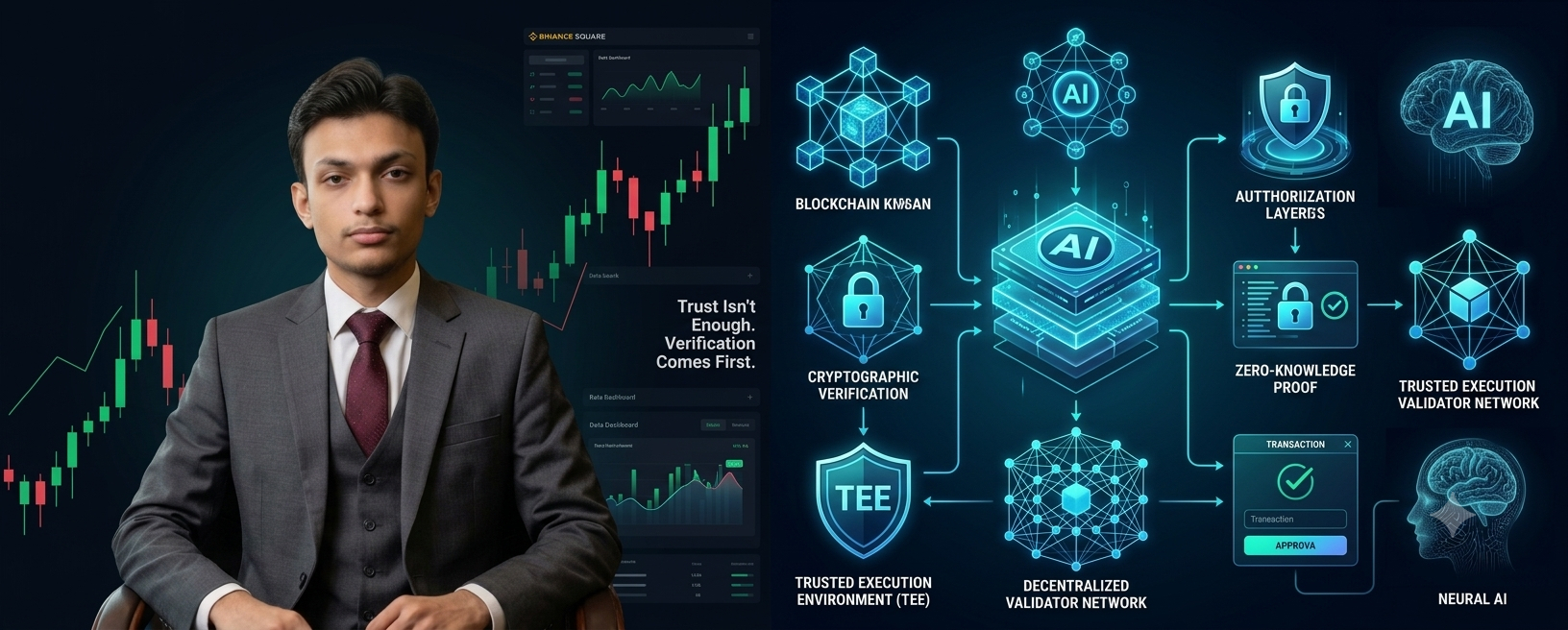
Asal cheez yeh hai ke har AI agent ek authorization framework ke andar operate karta hai. Registration, policy enforcement aur execution proofs mil kar aisi environment banate hain jahan AI sirf kaam nahi karta, apna har action verify bhi karta hai.
Yahan mujhe ek aur cheez interesting lagi.
Crypto mein hum aksar multisig wallets ko security samajh lete hain. Lekin bohat se incidents mein signatures complete thay, phir bhi ghalti ho gayi. Masla hackers nahi thay. Masla human attention thi.
Newton isi trust model ko change karna chahta hai.
Yahan focus "kitne signers thay" par nahi, balki "kya predefined conditions puri hui thi" par hai. Spend limits, whitelisted destinations, transaction rules aur programmable policies execution se pehle check hoti hain. Agar rule fail ho, transaction ruk jati hai.
Yehi whitepaper ka core idea hai: Authorization Before Execution.
Is approach ka ek tradeoff bhi hai.
Developer ko pure freedom nahi milti. Kuch boundaries hoti hain. Lekin agar AI agents ko institutions, RWAs aur real capital handle karna hai, to unrestricted automation se zyada important predictable automation ban jati hai.
Mere liye yeh restriction nahi, trust ka foundation hai.
Ab asli challenge adoption ka hai. Registry mein zyada quality agents, real execution volume aur active policy usage hi prove karega ke ecosystem kitna valuable ban raha hai.
Mujhe lagta hai agla AI cycle sirf smartest agents ka nahi hoga.
Woh infrastructure jeetega jo AI ko accountable banaye.
Aur isi wajah se $NEWT mujhe sirf AI project nahi, balki on-chain trust layer lagta hai jahan rules pehle decide hote hain, execution baad mein.
$NEWT #Newt @NewtonProtocol
{future}(NEWTUSDT)
$NEWT AI Builders Ke Liye Azadi Nahi, Bharosa Build Kar Raha Hai
Kabhi kabhi market kisi project ko ghalat angle se dekh leta hai.
Mujhe bhi pehle laga Newton Protocol sirf AI developers ke liye ek aur marketplace bana raha hai. Phir whitepaper aur recent updates dobara padhe, aur picture bilkul alag nikli.
Model Registry ka idea sirf agent list karna nahi hai.
Asal cheez yeh hai ke har AI agent ek authorization framework ke andar operate karta hai. Registration, policy enforcement aur execution proofs mil kar aisi environment banate hain jahan AI sirf kaam nahi karta, apna har action verify bhi karta hai.
Yahan mujhe ek aur cheez interesting lagi.
Crypto mein hum aksar multisig wallets ko security samajh lete hain. Lekin bohat se incidents mein signatures complete thay, phir bhi ghalti ho gayi. Masla hackers nahi thay. Masla human attention thi.
Newton isi trust model ko change karna chahta hai.
Yahan focus "kitne signers thay" par nahi, balki "kya predefined conditions puri hui thi" par hai. Spend limits, whitelisted destinations, transaction rules aur programmable policies execution se pehle check hoti hain. Agar rule fail ho, transaction ruk jati hai.
Yehi whitepaper ka core idea hai: Authorization Before Execution.
Is approach ka ek tradeoff bhi hai.
Developer ko pure freedom nahi milti. Kuch boundaries hoti hain. Lekin agar AI agents ko institutions, RWAs aur real capital handle karna hai, to unrestricted automation se zyada important predictable automation ban jati hai.
Mere liye yeh restriction nahi, trust ka foundation hai.
Ab asli challenge adoption ka hai. Registry mein zyada quality agents, real execution volume aur active policy usage hi prove karega ke ecosystem kitna valuable ban raha hai.
Mujhe lagta hai agla AI cycle sirf smartest agents ka nahi hoga.
Woh infrastructure jeetega jo AI ko accountable banaye.
Aur isi wajah se $NEWT mujhe sirf AI project nahi, balki on-chain trust layer lagta hai jahan rules pehle decide hote hain, execution baad mein.
$NEWT #Newt @NewtonProtocol
2
3
104
·
--
Main aaj @NewtonProtocol Explorer dekh raha tha aur ek cheez baar baar dimagh mein aa rahi thi.
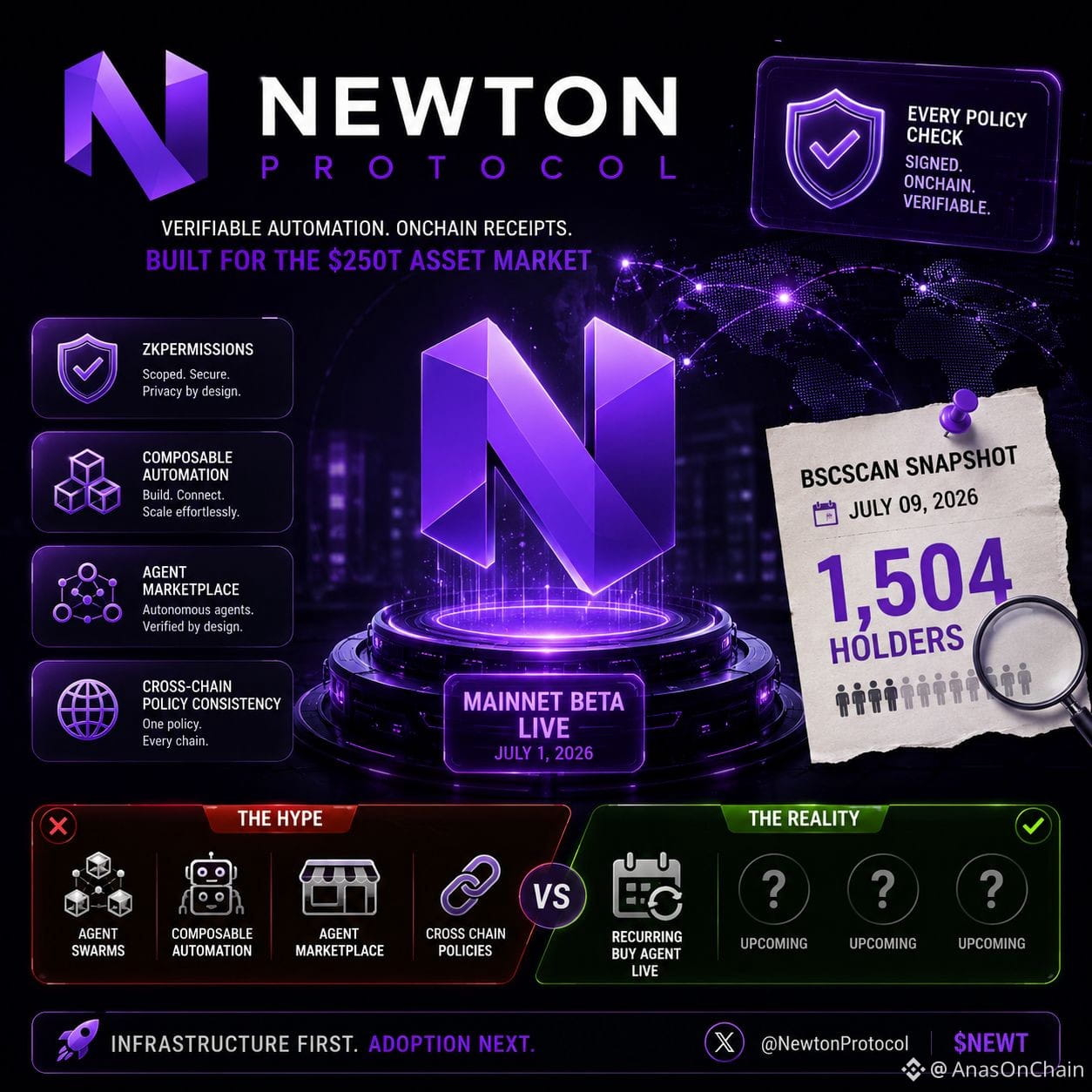
Mainnet Beta 1 July ko Base aur Ethereum par live hua. Har policy check ka signed on-chain receipt generate hota hai aur theoretically koi bhi usay verify kar sakta hai. Whitepaper ka core idea bhi yehi hai ke trust ki jagah cryptographic proof use ho.
Phir maine BscScan check ki.
9 July ke snapshot mein sirf 1,504 holders nazar aaye.
Us waqt mujhe laga technology aur adoption hamesha ek hi speed se grow nahi karte.
Whitepaper agent marketplace, composable automation, zkPermissions Rollup aur cross-chain policy consistency ki baat karta hai.
Lekin abhi reality mein Recurring Buy Agent live hai, jabke baaki features roadmap par hain.
Mujhe ismein koi negative cheez nahi lagi.
Infrastructure aksar traffic se pehle build hota hai.
Lekin ek difference zaroor hai.
"Verifiable by anyone" aur "actually verified by users" dono alag baatein hain.
Receipts on-chain maujood hain...
Lekin kitne log waqai unhein inspect kar rahe hain?
Shayad abhi builders zyada hain aur end users kam.
Mere liye agla important metric sirf price nahi hoga.
Main dekhna chahta hoon ke agle unlocks aur ecosystem growth ke baad holder count, agent adoption aur cross-chain activity kis speed se mature hoti hai.
Agar usage roadmap ke saath naturally grow karta gaya...
To Newton sirf ek AI narrative nahi, balki long-term authorization infrastructure ban sakta hai.
@NewtonProtocol $NEWT #Newt
1
105
Войдите, чтобы посмотреть больше материала
Присоединяйтесь к пользователям криптовалют по всему миру на Binance Square
⚡️ Получайте новейшую и полезную информацию о криптоактивах.
💬 Нам доверяет крупнейшая в мире криптобиржа.
👍 Получите достоверные аналитические данные от верифицированных создателей контента.
Эл. почта/номер телефона
В тренде
BitcoinRebounds$75KAsChipsLead
Просмотров: 10,563
147 обсуждают
Market Watch | Bitcoin Rebounds to $75,600 After Dip Below $75,000 as Chip Stocks Lead Rally on Jobs Beat
Binance News
·Лайков: 17
·Просмотров: 5.1k
JobsReportRaisesHikeOdds
Просмотров: 137,209
1,200 обсуждают
US Data Center Rules May Constrain AI Expansion
Просмотров: 20,479
111 обсуждают