
Joshua Brown 007
3.2k Публикации

Joshua Brown 007
Отправить жалобу
Заблокировать пользователя
(KITE UID:089089) i am a forward thinking crypto advisor with a strong grasp of blockchain innovation and digital asset management.
Открытая сделка
Трейдер с частыми сделками
2.7 г
974 подписок(и/а)
15.8K+ подписчиков(а)
6.7K+ понравилось
Посты
Портфель
Все
Цитирования
Видео
Активно
·
--
Падение
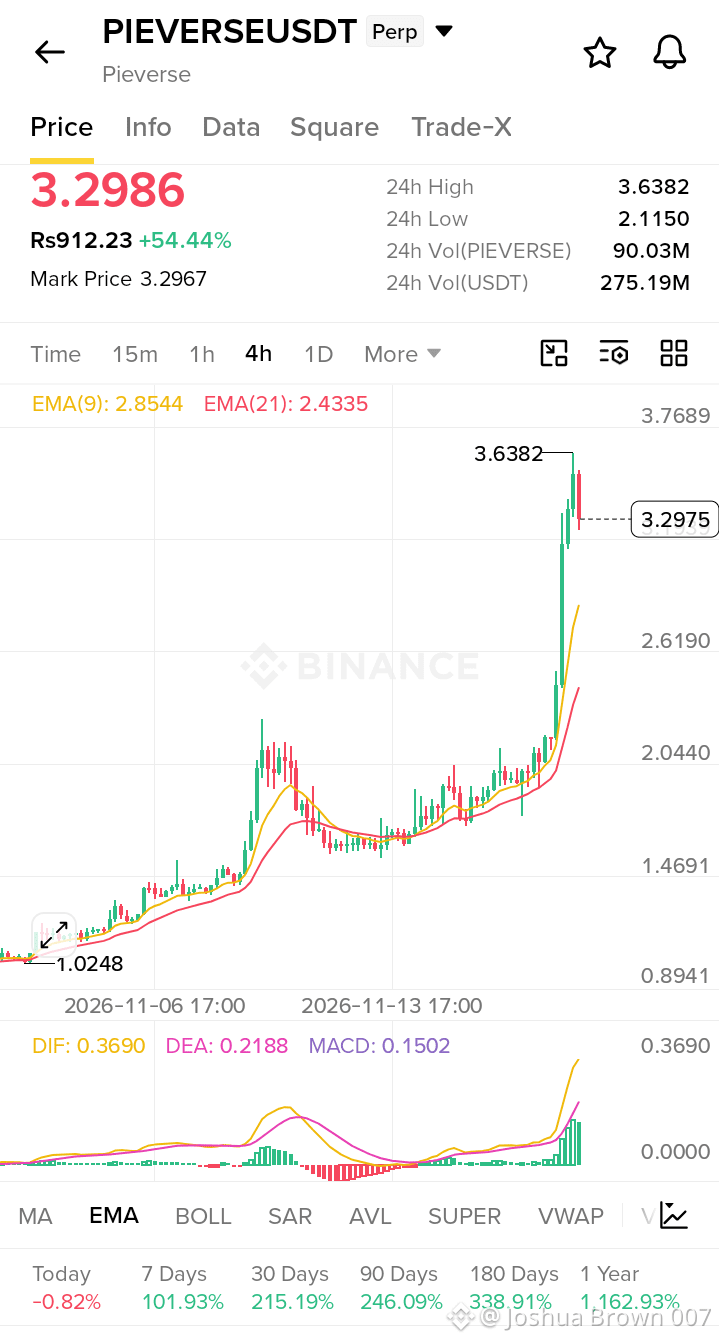
#trade $PIEVERSE Short Setup on 4H Candle
Entry 3.4000 - 3.6000
SL 3.70
TP 3.17
TP 2.85
TP 2.43
Invalidation Conditions:
A strong 4H candle close above 3.6500 invalidates the bearish pullback thesis.
A close below 2.4335 (EMA 21) invalidates the macro bullish trend.
#trade $PIEVERSE Short Setup on 4H Candle
Entry 3.4000 - 3.6000
SL 3.70
TP 3.17
TP 2.85
TP 2.43
Invalidation Conditions:
A strong 4H candle close above 3.6500 invalidates the bearish pullback thesis.
A close below 2.4335 (EMA 21) invalidates the macro bullish trend.
Entry 3.4000 - 3.6000
SL 3.70
TP 3.17
TP 2.85
TP 2.43
Invalidation Conditions:
A strong 4H candle close above 3.6500 invalidates the bearish pullback thesis.
A close below 2.4335 (EMA 21) invalidates the macro bullish trend.
1
331
#Trade $MMT Short Scalp
Entry 0.2500 - 0.2600
SL 0.2850
TP 0.2391
TP 0.2085
Look for a long entry near the EMA(9) (0.2085) or the EMA(21) (0.1681).
#Trade $MMT Short Scalp
Entry 0.2500 - 0.2600
SL 0.2850
TP 0.2391
TP 0.2085
Look for a long entry near the EMA(9) (0.2085) or the EMA(21) (0.1681).
Entry 0.2500 - 0.2600
SL 0.2850
TP 0.2391
TP 0.2085
Look for a long entry near the EMA(9) (0.2085) or the EMA(21) (0.1681).
1
364
#tradefutureandwin
200 BNB REWARD POOL, BUT HOW MANY PARTICIPANTS WILL ACTUALLY WIN? 🤔
I have a question about this Binance Futures campaign.
The campaign advertises a 200 BNB reward pool, which naturally attracts attention. But I think participants should also look beyond the headline prize.
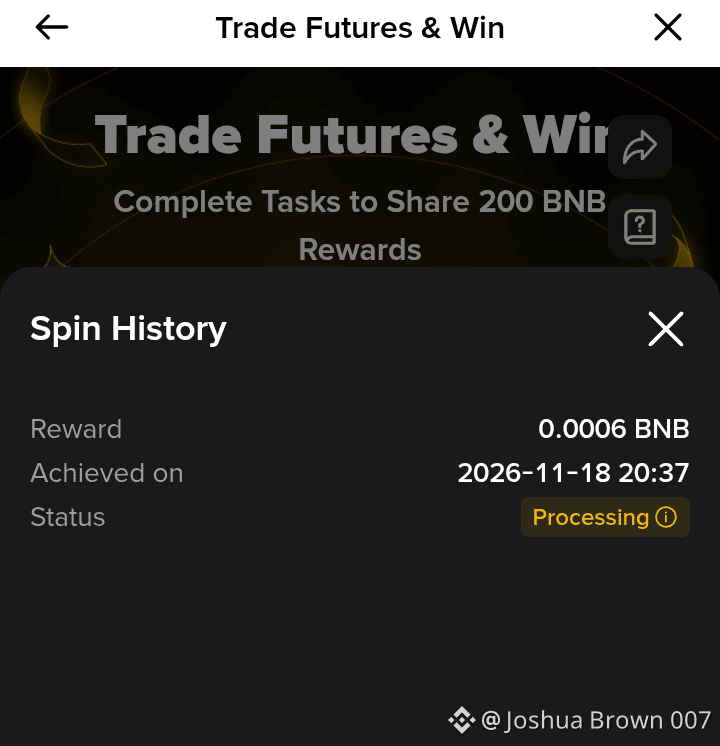
As I understand the reward structure, participants may first receive a small reward of around 0.0006 BNB, while the remaining BNB rewards are distributed through a lucky draw mechanism.
And this is where my concern begins.
If the bigger rewards are also distributed through a random selection bot, then participation doesn't necessarily mean a realistic chance of receiving a significant prize.
Maybe someone will get lucky and win a substantial reward. But honestly, I have participated in several campaigns, and I personally haven't received any of those major prizes so far.
I'm not questioning whether winners exist. I'm simply asking for more transparency.
A few questions worth asking:
How many participants will receive the major rewards?
What are the actual winning probabilities?
Will Binance publish the final distribution details?
Can participants independently verify the reward distribution?
A 200 BNB prize pool sounds impressive, but the real value of a campaign should be measured by its distribution, transparency and the actual rewards received by participants.
Campaigns should create genuine opportunities, not just attractive headlines.
What do you think? Is a lucky draw a fair reward mechanism for an entire trading community?
#Binance #BinanceFutures #BinanceSquareFamily #BinanceMegadrop
[lol 0.006 BNB😂😂😂](https://www.binance.com/activity/chance/trade-futures-win12-campaign?ref=860089089&utm_medium=web_share_copy)
#tradefutureandwin
200 BNB REWARD POOL, BUT HOW MANY PARTICIPANTS WILL ACTUALLY WIN? 🤔
I have a question about this Binance Futures campaign.
The campaign advertises a 200 BNB reward pool, which naturally attracts attention. But I think participants should also look beyond the headline prize.
As I understand the reward structure, participants may first receive a small reward of around 0.0006 BNB, while the remaining BNB rewards are distributed through a lucky draw mechanism.
And this is where my concern begins.
If the bigger rewards are also distributed through a random selection bot, then participation doesn't necessarily mean a realistic chance of receiving a significant prize.
Maybe someone will get lucky and win a substantial reward. But honestly, I have participated in several campaigns, and I personally haven't received any of those major prizes so far.
I'm not questioning whether winners exist. I'm simply asking for more transparency.
A few questions worth asking:
How many participants will receive the major rewards?
What are the actual winning probabilities?
Will Binance publish the final distribution details?
Can participants independently verify the reward distribution?
A 200 BNB prize pool sounds impressive, but the real value of a campaign should be measured by its distribution, transparency and the actual rewards received by participants.
Campaigns should create genuine opportunities, not just attractive headlines.
What do you think? Is a lucky draw a fair reward mechanism for an entire trading community?
#Binance #BinanceFutures #BinanceSquareFamily #BinanceMegadrop
lol 0.006 BNB😂😂😂

15
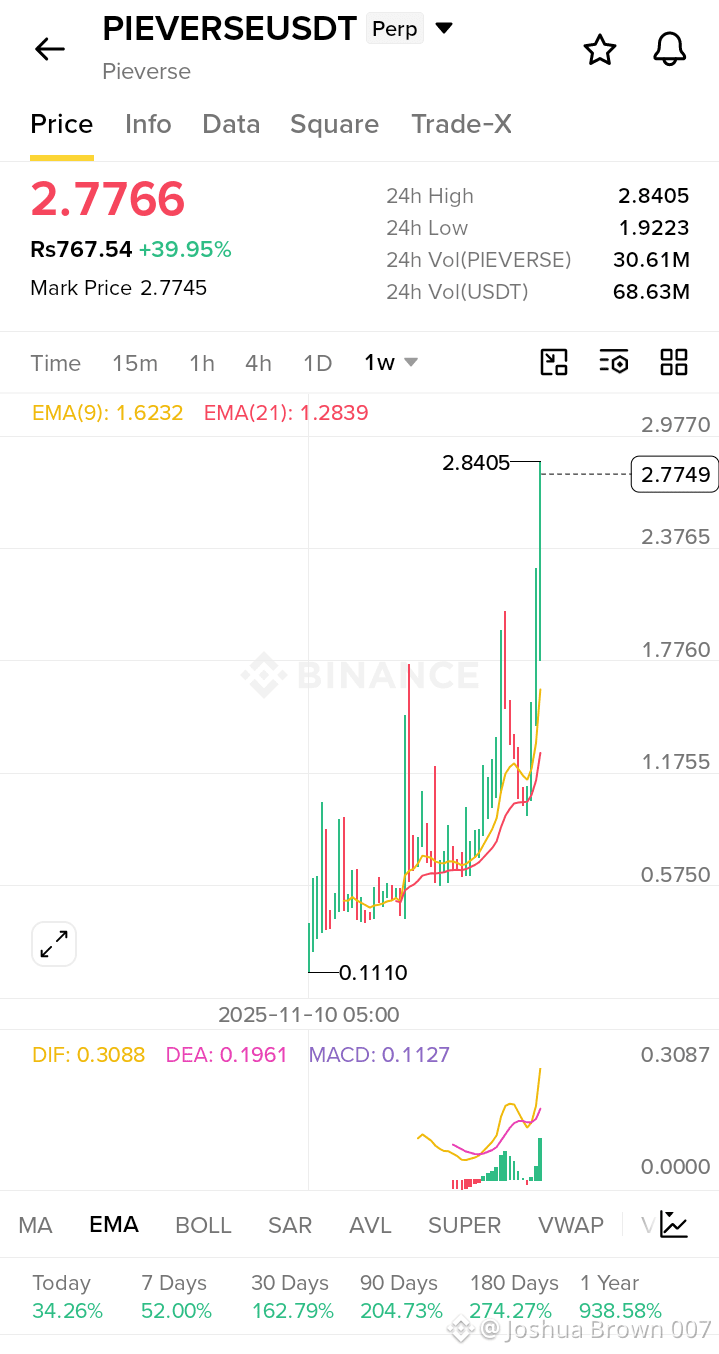
🚨 PIEVERSE ($PIEVERSE) IS MAKING A NEW ATH — BUT HOW MUCH HIGHER CAN IT GO BEFORE A CORRECTION?
PIEVERSE is showing explosive momentum on the weekly chart. In the screenshot, price is trading around $2.7766, with an intraday high of $2.8405, while the 24-hour gain stands at nearly 40%.
📊 What is driving this rally?
• Strong speculative demand and renewed interest in AI-agent payment narratives. • The market appears to have absorbed recent token-unlock supply better than many traders expected. • Futures activity, thin liquidity and potential short covering can amplify upward moves. • Recent product-related developments and the AI-agent narrative may also be contributing, although there is no single confirmed catalyst explaining the entire rally.
📈 Technical picture:
On the weekly chart: • EMA 9: $1.6232 • EMA 21: $1.2839 • MACD remains strongly bullish. • Price is trading significantly above both EMAs, showing an extended momentum move.
⚠️ Where could rejection happen?
If buyers fail to sustain momentum around $2.80–$2.85, short-term profit-taking could begin.
Potential correction zones I am watching:
🔹 $2.60–$2.50 — First potential pullback zone.
🔹 $2.35–$2.20 — Stronger retracement area if selling accelerates.
🔹 $2.00–$1.85 — Deeper correction zone in case momentum weakens significantly.
If price breaks above $2.85 with strong volume and holds the breakout, further price discovery is possible. However, chasing a nearly 40% daily move can be dangerous.
A bullish chart doesn't mean a safe entry. After a vertical rally, protecting capital matters more than chasing candles.
I would watch volume, price reaction around $2.85–$2.88, and whether sellers can defend the breakout.
#PIEVERSE #Crypto #Trading #Altcoins #TechnicalAnalysis $PIEVERSE
{future}(PIEVERSEUSDT)
🚨 PIEVERSE ($PIEVERSE ) IS MAKING A NEW ATH — BUT HOW MUCH HIGHER CAN IT GO BEFORE A CORRECTION?
PIEVERSE is showing explosive momentum on the weekly chart. In the screenshot, price is trading around $2.7766, with an intraday high of $2.8405, while the 24-hour gain stands at nearly 40%.
📊 What is driving this rally?
• Strong speculative demand and renewed interest in AI-agent payment narratives. • The market appears to have absorbed recent token-unlock supply better than many traders expected. • Futures activity, thin liquidity and potential short covering can amplify upward moves. • Recent product-related developments and the AI-agent narrative may also be contributing, although there is no single confirmed catalyst explaining the entire rally.
📈 Technical picture:
On the weekly chart: • EMA 9: $1.6232 • EMA 21: $1.2839 • MACD remains strongly bullish. • Price is trading significantly above both EMAs, showing an extended momentum move.
⚠️ Where could rejection happen?
If buyers fail to sustain momentum around $2.80–$2.85, short-term profit-taking could begin.
Potential correction zones I am watching:
🔹 $2.60–$2.50 — First potential pullback zone.
🔹 $2.35–$2.20 — Stronger retracement area if selling accelerates.
🔹 $2.00–$1.85 — Deeper correction zone in case momentum weakens significantly.
If price breaks above $2.85 with strong volume and holds the breakout, further price discovery is possible. However, chasing a nearly 40% daily move can be dangerous.
A bullish chart doesn't mean a safe entry. After a vertical rally, protecting capital matters more than chasing candles.
I would watch volume, price reaction around $2.85–$2.88, and whether sellers can defend the breakout.
#PIEVERSE #Crypto #Trading #Altcoins #TechnicalAnalysis $PIEVERSE
512
#Solana Solana is preparing for a major shift in how its validators reach consensus, and Alpenglow could be one of the most important upgrades in the network's history.
The biggest change is the finality target. Alpenglow aims to bring transaction finality down to around 150 milliseconds, compared with roughly 12.8 seconds under the previous TowerBFT system.
That is a massive difference in the user experience and could make Solana's infrastructure even more suitable for applications that depend on near-instant settlement.
The upgrade is built around two key components:
🔹 Votor: The voting mechanism that handles consensus. It went live on Solana mainnet on October 21, 2026, around 13:36 UTC.
🔹 Rotor: The block-delivery mechanism designed to improve how blocks move through the network. Its rollout is still pending, with no confirmed release date yet.
This isn't just about making transactions faster. Consensus speed, network reliability and validator participation are all critical pieces of a blockchain's long-term infrastructure.
For regular users, no action is required. Validators, however, need to upgrade their software and maintain the required SOL balance to remain active.
Solana's next evolution is about reducing the time between transaction execution and confidence in finality. That is worth watching closely.
#SOL #Alpenglow #Blockchain #Crypto
$SOL
{spot}(SOLUSDT)
#Solana Solana is preparing for a major shift in how its validators reach consensus, and Alpenglow could be one of the most important upgrades in the network's history.
The biggest change is the finality target. Alpenglow aims to bring transaction finality down to around 150 milliseconds, compared with roughly 12.8 seconds under the previous TowerBFT system.
That is a massive difference in the user experience and could make Solana's infrastructure even more suitable for applications that depend on near-instant settlement.
The upgrade is built around two key components:
🔹 Votor: The voting mechanism that handles consensus. It went live on Solana mainnet on October 21, 2026, around 13:36 UTC.
🔹 Rotor: The block-delivery mechanism designed to improve how blocks move through the network. Its rollout is still pending, with no confirmed release date yet.
This isn't just about making transactions faster. Consensus speed, network reliability and validator participation are all critical pieces of a blockchain's long-term infrastructure.
For regular users, no action is required. Validators, however, need to upgrade their software and maintain the required SOL balance to remain active.
Solana's next evolution is about reducing the time between transaction execution and confidence in finality. That is worth watching closely.
#SOL #Alpenglow #Blockchain #Crypto
$SOL

1
415
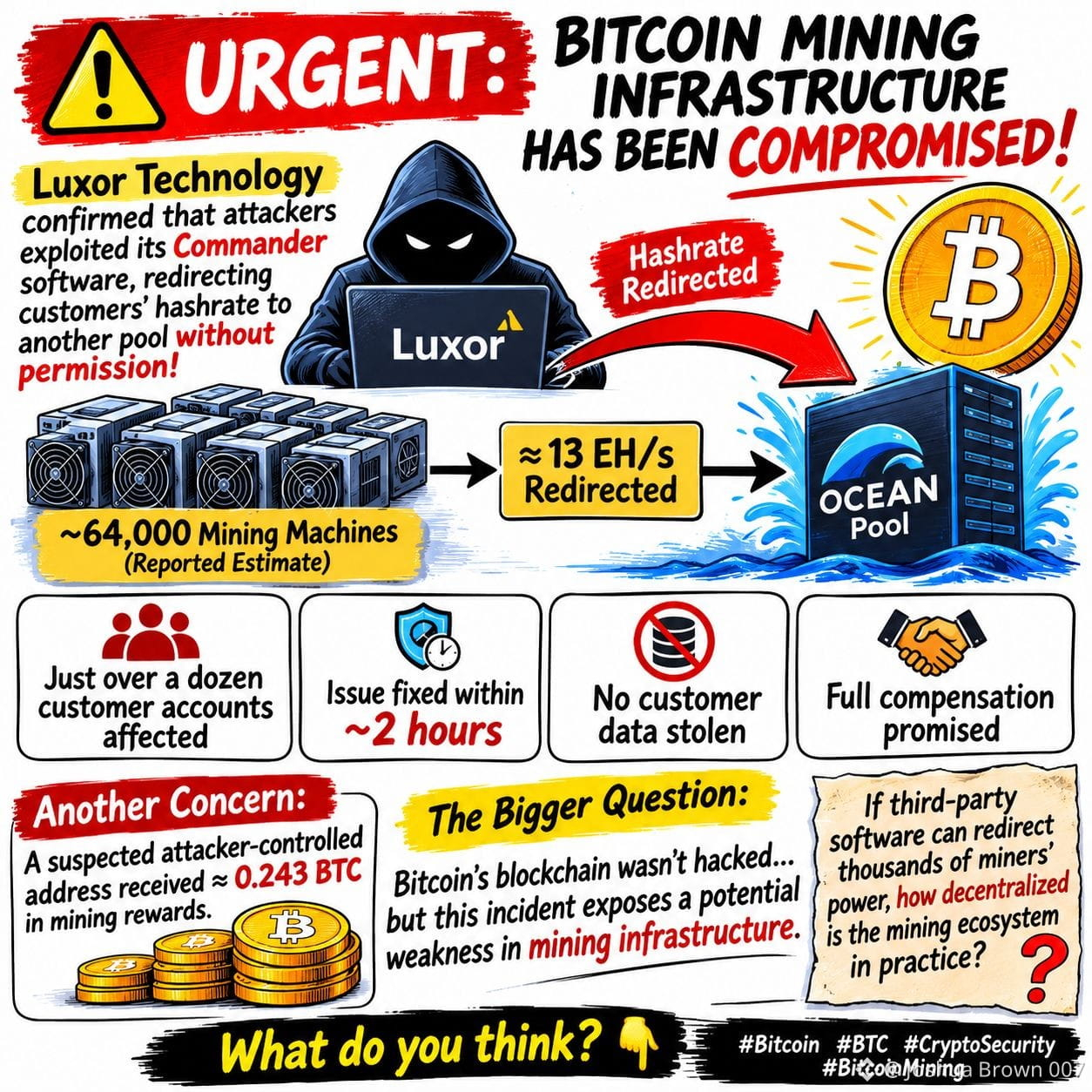
URGENT: BITCOIN MINING INFRASTRUCTURE HAS BEEN COMPROMISED!
Something serious happened in Bitcoin's mining ecosystem, and I think miners need to pay attention.
Luxor Technology confirmed that attackers exploited its Commander fleet-management software, redirecting customers' mining hashrate to another pool without authorization.
Here is where things get concerning:
Reported figures:
- Approximately 64,000 mining machines reportedly affected.
- Around 13 EH/s of computing power redirected.
- Mining activity was redirected to the OCEAN pool.
- Luxor officially confirmed that just over a dozen customer accounts were affected.
Luxor says it detected the incident, patched the vulnerability within approximately two hours, found no evidence of customer data being stolen, and committed to fully compensating affected clients.
But there is another concern: CoinDesk reported that a suspected attacker controlled address received approximately 0.243 BTC in mining rewards.
Now, let's look at the bigger issue.
Bitcoin's blockchain wasn't hacked. It was mining infrastructure.
This incident exposes a potential weakness in the ecosystem: miners can own their hardware, but if they depend on third-party software to manage thousands of machines, that software becomes a critical point of failure.
I believe Bitcoin's decentralization should be evaluated not only at the blockchain level, but also across mining pools, management software and operational infrastructure.
One question for the mining community:
If third party software can redirect thousands of miners' computing power without their permission, how decentralized is the mining ecosystem in practice?
What do you think?
#CryptoSecurity #BitcoinMiningNews
1
194
Статья
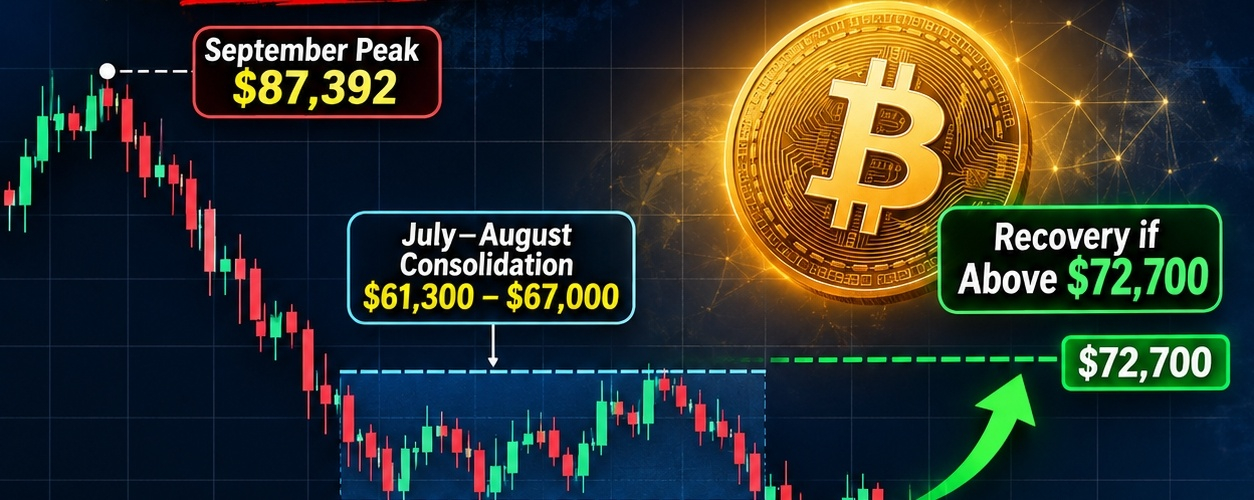
BITCOIN AT A CRITICAL TURNING POINT: WHY $57,800 MATTERS MORE THAN PEOPLE THINK!I have been watching Bitcoin's recent price structure, and one thing stands out: this is no longer just an ordinary market correction. The recovery structure itself is being tested.
According to Bitfinex, $57,803 is the critical level BTC needs to defend to preserve the recovery that started from its July lows.
Let's look at the numbers.
What the market is telling us:
• BTC dropped 12.6% over the past week.
• Price touched $62,029 on November 15.
• Bitcoin has recorded six consecutive weekly losses.
• Around $2.01 billion in crypto positions were liquidated within 24 hours.
• Long positions represented approximately 83% of those liquidations.
• Bitcoin futures Open Interest declined 8%.
Now, here is what I find particularly important.
When long positions are heavily liquidated, it tells us that too many leveraged traders were positioned in the same direction. Once price starts falling, forced closures can accelerate the selling pressure.
My technical watchlist:
🟢 $72,700 – A sustained reclaim could strengthen recovery expectations.
🟡 $61,300–$67,000 – Previous consolidation zone and an important area to monitor.
🔴 $57,803 – Major structural support identified by Bitfinex. A decisive breakdown would put the recovery thesis at serious risk.
I am not calling for an immediate reversal, nor am I predicting that Bitcoin must collapse.
I want to see how price behaves around support, whether selling volume decreases, and whether institutional demand returns.
One lesson I have learned from trading: catching a falling market just because the price looks cheap is not a strategy.
Watch the structure, respect liquidity, manage leverage, and let confirmation decide the entry.
What do you think: will BTC defend $57,800, or are we heading towards a deeper correction?
$BTC
#Bitfinex #BitcoinAnalysis #tradingStrategy
BITCOIN AT A CRITICAL TURNING POINT: WHY $57,800 MATTERS MORE THAN PEOPLE THINK!
I have been watching Bitcoin's recent price structure, and one thing stands out: this is no longer just an ordinary market correction. The recovery structure itself is being tested.
According to Bitfinex, $57,803 is the critical level BTC needs to defend to preserve the recovery that started from its July lows.
Let's look at the numbers.
What the market is telling us:
• BTC dropped 12.6% over the past week.
• Price touched $62,029 on November 15.
• Bitcoin has recorded six consecutive weekly losses.
• Around $2.01 billion in crypto positions were liquidated within 24 hours.
• Long positions represented approximately 83% of those liquidations.
• Bitcoin futures Open Interest declined 8%.
Now, here is what I find particularly important.
When long positions are heavily liquidated, it tells us that too many leveraged traders were positioned in the same direction. Once price starts falling, forced closures can accelerate the selling pressure.
My technical watchlist:
🟢 $72,700 – A sustained reclaim could strengthen recovery expectations.
🟡 $61,300–$67,000 – Previous consolidation zone and an important area to monitor.
🔴 $57,803 – Major structural support identified by Bitfinex. A decisive breakdown would put the recovery thesis at serious risk.
I am not calling for an immediate reversal, nor am I predicting that Bitcoin must collapse.
I want to see how price behaves around support, whether selling volume decreases, and whether institutional demand returns.
One lesson I have learned from trading: catching a falling market just because the price looks cheap is not a strategy.
Watch the structure, respect liquidity, manage leverage, and let confirmation decide the entry.
What do you think: will BTC defend $57,800, or are we heading towards a deeper correction?
$BTC
#Bitfinex #BitcoinAnalysis #tradingStrategy
2
1.1k
Статья
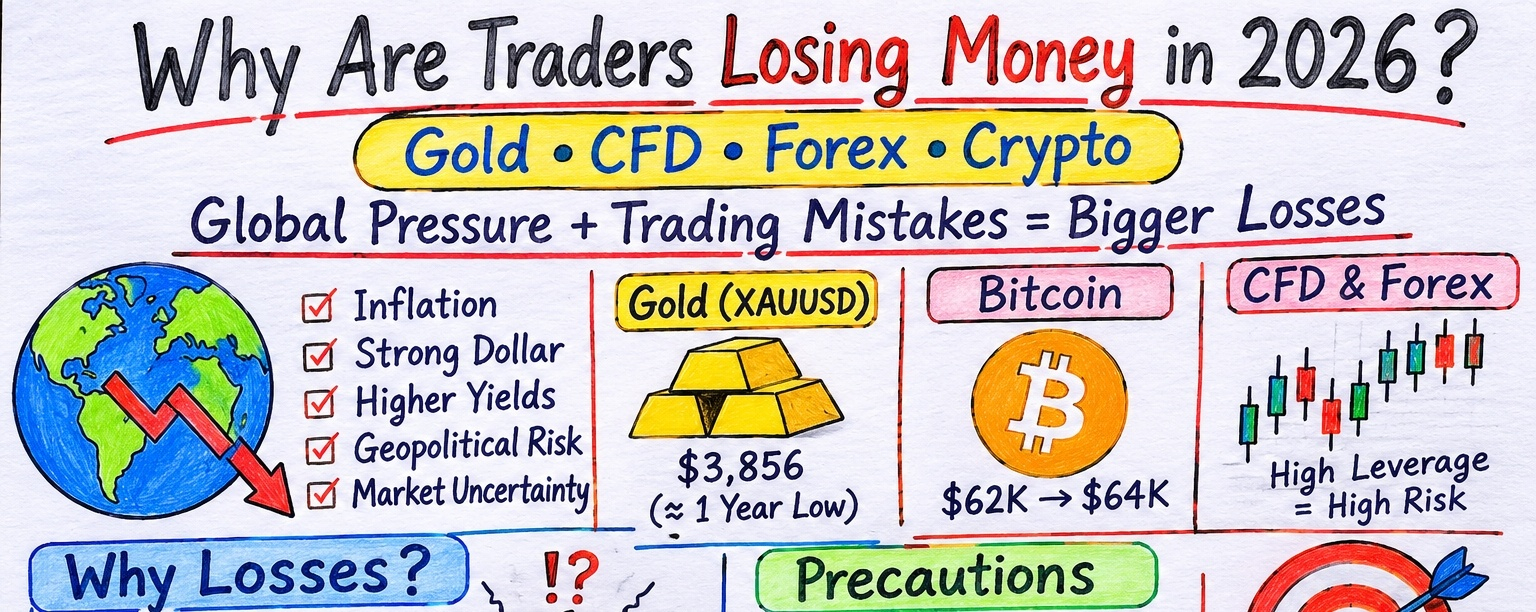
WHY ARE TRADERS LOSING MONEY IN 2026? THE REAL RISKS BEHIND GOLD, CFD, FOREX & CRYPTO MARKETSUnderstanding the global financial pressure, trading mistakes and strategies to protect your capital.
There is something important happening in financial markets right now that every trader needs to understand.
Whether someone trades Gold (XAUUSD), Forex, CFDs, Bitcoin or Altcoins, the biggest challenge is no longer simply finding the right entry. It is understanding the global economic environment, managing risk and protecting capital when markets move unexpectedly.
Many traders are losing money, even when their technical analysis looks correct. Why?
Because markets are influenced by much more than chart patterns and indicators.
1. The Global Financial Situation: Why Markets Are Under Pressure
The current global environment is influenced by several interconnected factors:
- Persistent inflation concerns.
- Strong US dollar and changing interest-rate expectations.
- Rising bond yields.
- Geopolitical uncertainty.
- Institutional investment flows.
- Reduced risk appetite among investors.
On November 17, 2026, international reports showed Gold trading around $3,856 per ounce, close to a one-year low. A stronger dollar, higher yields and expectations of further Federal Reserve tightening have increased pressure on precious metals.
Meanwhile, Bitcoin has also experienced a significant correction, falling towards $62,000 before recovering into the $64,000–$65,000 region.
This is a reminder that even traditionally different markets can experience simultaneous selling pressure when investors reduce exposure to risk.
2. GOLD TRADING: Why Are Gold Traders Losing Money?
Many retail traders believe Gold is always a safe buying opportunity because it is considered a safe-haven asset.
That assumption can be expensive.
Gold can decline sharply when:
- The US dollar strengthens.
- Treasury yields increase.
- Interest-rate expectations become more hawkish.
- Investors liquidate positions to raise cash.
- Technical support levels break.
The biggest mistake: Buying every dip without waiting for confirmation.
A bullish trend on the higher timeframe does not guarantee a profitable entry on the 5-minute or 15-minute chart.
Precautions:
1. Always analyse the 4H and daily trend before entering.
2. Mark important support and resistance levels.
3. Use EMA 9 and EMA 21 for short-term momentum confirmation.
4. Never enter immediately after a large impulsive candle.
5. Wait for a retest or a confirmed breakout.
6. Keep a predefined stop-loss.
7. Avoid excessive leverage during major economic announcements.
3. CFD & FOREX TRADING: The Hidden Danger of Leverage
CFD trading attracts beginners because it allows traders to control larger positions with relatively small deposits.
But this is also where many traders destroy their accounts.
For example:
If you have $100 and open a $5,000 position, you are controlling 50 times your capital.
A 1% adverse move against that position represents approximately $50 in losses before spreads, financing and other costs.
A 2% adverse move represents approximately $100.
The market does not need to move very far to create serious damage.
Common reasons for CFD losses:
- Trading with excessive leverage.
- Ignoring margin requirements.
- Holding positions through major economic announcements.
- Paying overnight financing costs.
- Entering trades without a proper stop-loss.
- Revenge trading after consecutive losses.
Precautions:
Use smaller position sizes, understand margin requirements, calculate risk before opening a trade and never risk money you cannot afford to lose.
Remember: A profitable trading strategy with poor risk management can still destroy an account.
4. CRYPTO TRADING: Why Bitcoin and Altcoin Traders Are Struggling
Crypto markets have their own challenges.
Unlike traditional markets, cryptocurrency trading operates continuously, and volatility can increase dramatically within minutes.
Recent market pressure has been associated with:
- Bitcoin ETF outflows.
- Institutional selling.
- Higher US interest-rate expectations.
- Leveraged long liquidations.
- Weak market sentiment.
- Reduced liquidity in altcoins.
Recent reports have highlighted nearly $2 billion in crypto liquidations during the November selloff, demonstrating how quickly excessive leverage can turn a market correction into a liquidation event.
Altcoin traders face additional risks because smaller tokens often have weaker liquidity and larger price swings.
Precautions for crypto traders:
1. Follow Bitcoin's overall market structure before trading altcoins.
2. Monitor BTC dominance and total market capitalisation.
3. Check Open Interest and funding rates.
4. Avoid chasing pumps after large green candles.
5. Check token unlocks and circulating supply.
6. Use isolated margin rather than unnecessary cross-margin exposure.
7. Prefer spot trading when you cannot actively monitor leveraged positions.
5. The Biggest Trading Mistakes That Cause Financial Losses
Regardless of the market, many losing traders repeat the same mistakes.
Mistake 1: Trading without a plan
Entering a trade because someone posted a bullish prediction is not a strategy.
Mistake 2: Overtrading
More trades do not automatically mean more profit. Sometimes the best decision is to stay out of the market.
Mistake 3: Increasing leverage after losses
Trying to recover a previous loss with a bigger position often creates an even bigger problem.
Mistake 4: Ignoring economic news
CPI, PPI, Federal Reserve decisions, employment data and Treasury yields can change market direction.
Mistake 5: Refusing to accept a stop-loss
A small controlled loss is part of trading. An uncontrolled loss can end your trading journey.
6. My Risk Management Strategy: Protect Capital First
Here is a practical framework that traders can use across different markets.
Trading rule | Recommended approach
| Risk per trade | 0.5%–1% |
| Maximum daily loss | 2% |
| Risk/reward | Minimum 1:2 |
| Trading leverage | Keep it low |
| Stop-loss | Always predefined |
| News trading | Avoid impulsive entries |
| Daily trades | Focus on quality |
| Emotional trading | Avoid completely |
These are suggested risk-management limits, not guarantees of profitability. A trader should also reduce exposure when volatility increases.
7. What Should Traders Watch Next?
The next phase of global markets will depend heavily on inflation, Federal Reserve policy, US Treasury yields, dollar strength and institutional capital flows.
For Gold, traders should watch whether price can establish a sustainable recovery or continue making lower lows.
For Forex and CFDs, the dollar and bond yields remain important drivers.
For Bitcoin and crypto, ETF flows, derivatives positioning, liquidity and the ability to reclaim important technical levels will help determine whether the latest recovery is sustainable.
Nobody can predict every market move. Professional trading is about preparing for different outcomes rather than believing in one prediction.
FINAL THOUGHT: THE MARKET DOES NOT REWARD CONFIDENCE WITHOUT DISCIPLINE
I believe one of the biggest differences between successful traders and consistently losing traders is not the number of indicators they use.
It is how they manage uncertainty.
You can be right about the long-term direction and still lose money because your entry, leverage or position size was wrong.
Gold, Forex, CFDs and cryptocurrency all offer opportunities, but every opportunity comes with risk.
My message to every trader:
Don't focus only on how much money you can make from your next trade. Focus on how much capital you can protect if your analysis turns out to be wrong.
Because the first responsibility of a trader is not to make a profit.
It is to survive long enough to trade another day.
#GoldTrading #Bitcoin #CryptoMarket #RiskManagement #GlobalMarkets
$XAUT
{spot}(XAUTUSDT)
$CROSS
{alpha}(560x6bf62ca91e397b5a7d1d6bce97d9092065d7a510)
$ON
{future}(ONUSDT)
WHY ARE TRADERS LOSING MONEY IN 2026? THE REAL RISKS BEHIND GOLD, CFD, FOREX & CRYPTO MARKETS
Understanding the global financial pressure, trading mistakes and strategies to protect your capital.
There is something important happening in financial markets right now that every trader needs to understand.
Whether someone trades Gold (XAUUSD), Forex, CFDs, Bitcoin or Altcoins, the biggest challenge is no longer simply finding the right entry. It is understanding the global economic environment, managing risk and protecting capital when markets move unexpectedly.
Many traders are losing money, even when their technical analysis looks correct. Why?
Because markets are influenced by much more than chart patterns and indicators.
1. The Global Financial Situation: Why Markets Are Under Pressure
The current global environment is influenced by several interconnected factors:
- Persistent inflation concerns.
- Strong US dollar and changing interest-rate expectations.
- Rising bond yields.
- Geopolitical uncertainty.
- Institutional investment flows.
- Reduced risk appetite among investors.
On November 17, 2026, international reports showed Gold trading around $3,856 per ounce, close to a one-year low. A stronger dollar, higher yields and expectations of further Federal Reserve tightening have increased pressure on precious metals.
Meanwhile, Bitcoin has also experienced a significant correction, falling towards $62,000 before recovering into the $64,000–$65,000 region.
This is a reminder that even traditionally different markets can experience simultaneous selling pressure when investors reduce exposure to risk.
2. GOLD TRADING: Why Are Gold Traders Losing Money?
Many retail traders believe Gold is always a safe buying opportunity because it is considered a safe-haven asset.
That assumption can be expensive.
Gold can decline sharply when:
- The US dollar strengthens.
- Treasury yields increase.
- Interest-rate expectations become more hawkish.
- Investors liquidate positions to raise cash.
- Technical support levels break.
The biggest mistake: Buying every dip without waiting for confirmation.
A bullish trend on the higher timeframe does not guarantee a profitable entry on the 5-minute or 15-minute chart.
Precautions:
1. Always analyse the 4H and daily trend before entering.
2. Mark important support and resistance levels.
3. Use EMA 9 and EMA 21 for short-term momentum confirmation.
4. Never enter immediately after a large impulsive candle.
5. Wait for a retest or a confirmed breakout.
6. Keep a predefined stop-loss.
7. Avoid excessive leverage during major economic announcements.
3. CFD & FOREX TRADING: The Hidden Danger of Leverage
CFD trading attracts beginners because it allows traders to control larger positions with relatively small deposits.
But this is also where many traders destroy their accounts.
For example:
If you have $100 and open a $5,000 position, you are controlling 50 times your capital.
A 1% adverse move against that position represents approximately $50 in losses before spreads, financing and other costs.
A 2% adverse move represents approximately $100.
The market does not need to move very far to create serious damage.
Common reasons for CFD losses:
- Trading with excessive leverage.
- Ignoring margin requirements.
- Holding positions through major economic announcements.
- Paying overnight financing costs.
- Entering trades without a proper stop-loss.
- Revenge trading after consecutive losses.
Precautions:
Use smaller position sizes, understand margin requirements, calculate risk before opening a trade and never risk money you cannot afford to lose.
Remember: A profitable trading strategy with poor risk management can still destroy an account.
4. CRYPTO TRADING: Why Bitcoin and Altcoin Traders Are Struggling
Crypto markets have their own challenges.
Unlike traditional markets, cryptocurrency trading operates continuously, and volatility can increase dramatically within minutes.
Recent market pressure has been associated with:
- Bitcoin ETF outflows.
- Institutional selling.
- Higher US interest-rate expectations.
- Leveraged long liquidations.
- Weak market sentiment.
- Reduced liquidity in altcoins.
Recent reports have highlighted nearly $2 billion in crypto liquidations during the November selloff, demonstrating how quickly excessive leverage can turn a market correction into a liquidation event.
Altcoin traders face additional risks because smaller tokens often have weaker liquidity and larger price swings.
Precautions for crypto traders:
1. Follow Bitcoin's overall market structure before trading altcoins.
2. Monitor BTC dominance and total market capitalisation.
3. Check Open Interest and funding rates.
4. Avoid chasing pumps after large green candles.
5. Check token unlocks and circulating supply.
6. Use isolated margin rather than unnecessary cross-margin exposure.
7. Prefer spot trading when you cannot actively monitor leveraged positions.
5. The Biggest Trading Mistakes That Cause Financial Losses
Regardless of the market, many losing traders repeat the same mistakes.
Mistake 1: Trading without a plan
Entering a trade because someone posted a bullish prediction is not a strategy.
Mistake 2: Overtrading
More trades do not automatically mean more profit. Sometimes the best decision is to stay out of the market.
Mistake 3: Increasing leverage after losses
Trying to recover a previous loss with a bigger position often creates an even bigger problem.
Mistake 4: Ignoring economic news
CPI, PPI, Federal Reserve decisions, employment data and Treasury yields can change market direction.
Mistake 5: Refusing to accept a stop-loss
A small controlled loss is part of trading. An uncontrolled loss can end your trading journey.
6. My Risk Management Strategy: Protect Capital First
Here is a practical framework that traders can use across different markets.
Trading rule | Recommended approach
| Risk per trade | 0.5%–1% |
| Maximum daily loss | 2% |
| Risk/reward | Minimum 1:2 |
| Trading leverage | Keep it low |
| Stop-loss | Always predefined |
| News trading | Avoid impulsive entries |
| Daily trades | Focus on quality |
| Emotional trading | Avoid completely |
These are suggested risk-management limits, not guarantees of profitability. A trader should also reduce exposure when volatility increases.
7. What Should Traders Watch Next?
The next phase of global markets will depend heavily on inflation, Federal Reserve policy, US Treasury yields, dollar strength and institutional capital flows.
For Gold, traders should watch whether price can establish a sustainable recovery or continue making lower lows.
For Forex and CFDs, the dollar and bond yields remain important drivers.
For Bitcoin and crypto, ETF flows, derivatives positioning, liquidity and the ability to reclaim important technical levels will help determine whether the latest recovery is sustainable.
Nobody can predict every market move. Professional trading is about preparing for different outcomes rather than believing in one prediction.
FINAL THOUGHT: THE MARKET DOES NOT REWARD CONFIDENCE WITHOUT DISCIPLINE
I believe one of the biggest differences between successful traders and consistently losing traders is not the number of indicators they use.
It is how they manage uncertainty.
You can be right about the long-term direction and still lose money because your entry, leverage or position size was wrong.
Gold, Forex, CFDs and cryptocurrency all offer opportunities, but every opportunity comes with risk.
My message to every trader:
Don't focus only on how much money you can make from your next trade. Focus on how much capital you can protect if your analysis turns out to be wrong.
Because the first responsibility of a trader is not to make a profit.
It is to survive long enough to trade another day.
#GoldTrading #Bitcoin #CryptoMarket #RiskManagement #GlobalMarkets
$XAUT
$CROSS
$ON
175
Статья
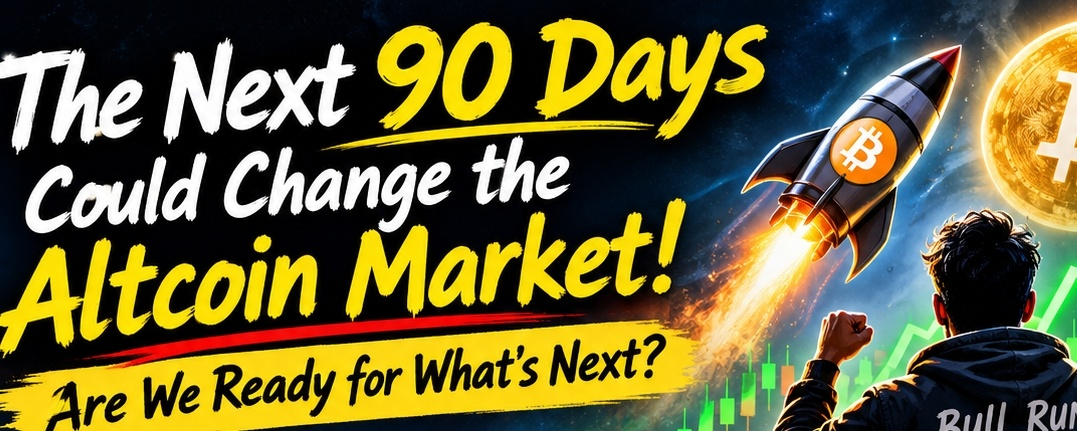
The Next 90 Days Could Change the Altcoin Market But Are We Ready for What Comes Next?I have been watching the crypto market closely, and one thing is becoming increasingly important: the next three months could be a defining period for Bitcoin, Ethereum, and the wider altcoin market.
Recently, an extremely bullish prediction caught my attention. It puts Bitcoin at $180,000, Ethereum at $10,000, and suggests that some altcoins could potentially deliver 60X, 100X, or even higher returns between November and January.
But I don't want to look at these numbers simply as exciting targets. I want to understand what would actually need to happen for such a rally to become possible.
First, let's talk about Bitcoin.
If Bitcoin moves towards $180K, it would require a combination of strong institutional demand, sustained ETF inflows, improving global liquidity, and a supportive macroeconomic environment. A price target alone cannot create a rally. Capital inflows and market structure have to support it.
Ethereum at $10,000 is another interesting possibility.
ETH would need stronger relative performance against Bitcoin, growing network activity, increasing institutional interest, and sustained demand across its ecosystem. The ETH/BTC chart will be particularly important to watch.
Now comes the part that interests me most: Altcoins.
Can we really see 60X, 100X, or even 200X returns in selected altcoins?
Historically, smaller cap projects have produced extraordinary returns during strong crypto cycles. However, not every altcoin participates equally. Liquidity, circulating supply, fully diluted valuation, token unlocks, real demand, and market capitalization all matter.
I would pay particular attention to three things:
Bitcoin Dominance: A meaningful decline could indicate capital rotation towards altcoins, although the trend needs confirmation.
ETH/BTC Strength: Ethereum outperforming Bitcoin could improve sentiment across the altcoin market.Liquidity and Volume: A genuine altcoin rally needs fresh capital, not just temporary speculative buying.
My November and January Market Perspective
I believe these three months deserve serious attention. However, I am not treating $180K Bitcoin or $10K Ethereum as guaranteed outcomes. They are bullish scenarios that require confirmation from price action, liquidity, and macroeconomic conditions.
There is another side that traders should never ignore: excessive leverage, weak projects, token unlocks, and sudden liquidity withdrawals can turn a bullish market into a painful experience.
My approach is simple: watch the market, study the fundamentals, follow the money, and never confuse somebody else's confidence with market confirmation.
The biggest opportunity might come from identifying strong projects before the crowd starts chasing green candles. But protecting capital is just as important as finding the next potential winner.
The next 90 days could be important. The real question is not how high the market can go, but which projects will actually have the strength to lead it.
#Bitcoin #Ethereum #Altcoins #AltSeasonComing #Altseason
This is a technical analysis and market perspective, NOT financial advice.
$SOL
{spot}(SOLUSDT)
$XRP
{spot}(XRPUSDT)
$SUI
{spot}(SUIUSDT)
The Next 90 Days Could Change the Altcoin Market But Are We Ready for What Comes Next?
I have been watching the crypto market closely, and one thing is becoming increasingly important: the next three months could be a defining period for Bitcoin, Ethereum, and the wider altcoin market.
Recently, an extremely bullish prediction caught my attention. It puts Bitcoin at $180,000, Ethereum at $10,000, and suggests that some altcoins could potentially deliver 60X, 100X, or even higher returns between November and January.
But I don't want to look at these numbers simply as exciting targets. I want to understand what would actually need to happen for such a rally to become possible.
First, let's talk about Bitcoin.
If Bitcoin moves towards $180K, it would require a combination of strong institutional demand, sustained ETF inflows, improving global liquidity, and a supportive macroeconomic environment. A price target alone cannot create a rally. Capital inflows and market structure have to support it.
Ethereum at $10,000 is another interesting possibility.
ETH would need stronger relative performance against Bitcoin, growing network activity, increasing institutional interest, and sustained demand across its ecosystem. The ETH/BTC chart will be particularly important to watch.
Now comes the part that interests me most: Altcoins.
Can we really see 60X, 100X, or even 200X returns in selected altcoins?
Historically, smaller cap projects have produced extraordinary returns during strong crypto cycles. However, not every altcoin participates equally. Liquidity, circulating supply, fully diluted valuation, token unlocks, real demand, and market capitalization all matter.
I would pay particular attention to three things:
Bitcoin Dominance: A meaningful decline could indicate capital rotation towards altcoins, although the trend needs confirmation.
ETH/BTC Strength: Ethereum outperforming Bitcoin could improve sentiment across the altcoin market.Liquidity and Volume: A genuine altcoin rally needs fresh capital, not just temporary speculative buying.
My November and January Market Perspective
I believe these three months deserve serious attention. However, I am not treating $180K Bitcoin or $10K Ethereum as guaranteed outcomes. They are bullish scenarios that require confirmation from price action, liquidity, and macroeconomic conditions.
There is another side that traders should never ignore: excessive leverage, weak projects, token unlocks, and sudden liquidity withdrawals can turn a bullish market into a painful experience.
My approach is simple: watch the market, study the fundamentals, follow the money, and never confuse somebody else's confidence with market confirmation.
The biggest opportunity might come from identifying strong projects before the crowd starts chasing green candles. But protecting capital is just as important as finding the next potential winner.
The next 90 days could be important. The real question is not how high the market can go, but which projects will actually have the strength to lead it.
#Bitcoin #Ethereum #Altcoins #AltSeasonComing #Altseason
This is a technical analysis and market perspective, NOT financial advice.
$SOL
$XRP
$SUI
2
267
·
--
Рост
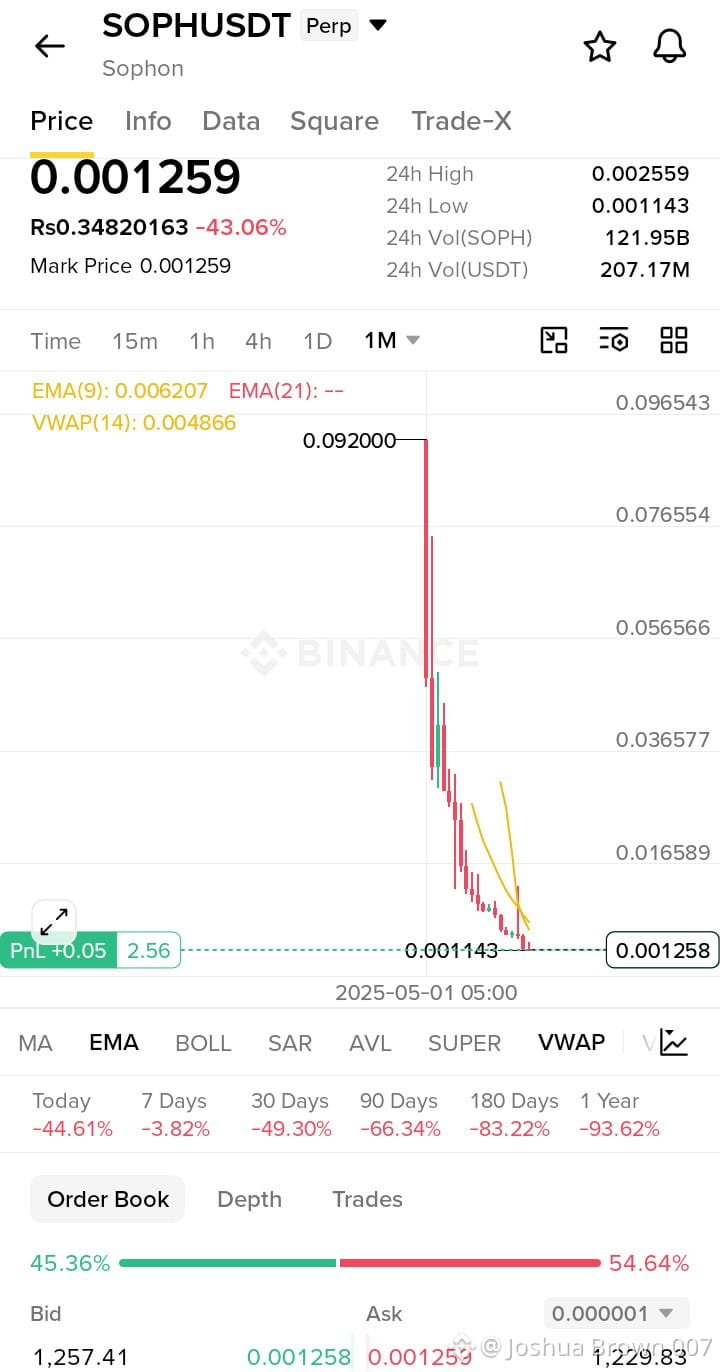
#trade $SOPH
i open the Long from ATL zone Let See 100X or 1000x are gone in to trash.
Guys Share your opinion below👇
#trade $SOPH
i open the Long from ATL zone Let See 100X or 1000x are gone in to trash.
Guys Share your opinion below👇
i open the Long from ATL zone Let See 100X or 1000x are gone in to trash.
Guys Share your opinion below👇
1
451
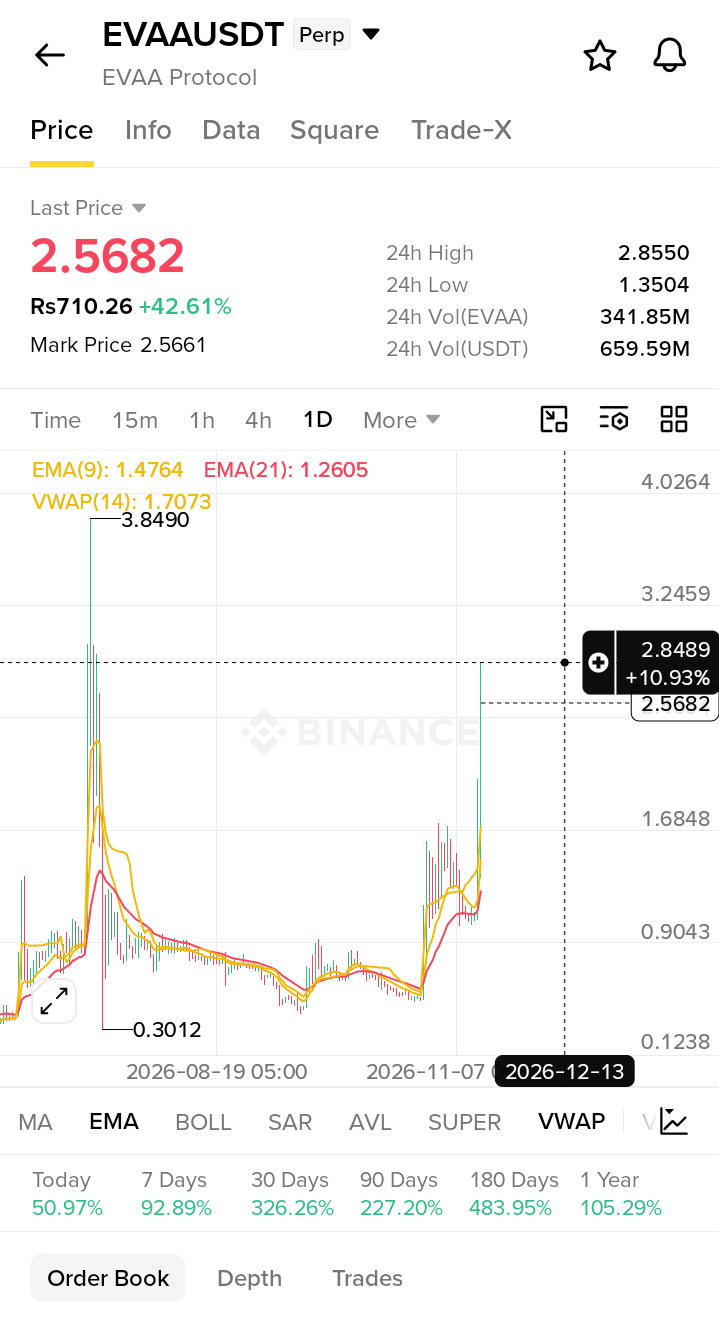
#TradeNTell $EVAA
previously I ignore The Daily Rejection/replacement level and got SL But I recover it😉
#TradeNTell $EVAA
previously I ignore The Daily Rejection/replacement level and got SL But I recover it😉
previously I ignore The Daily Rejection/replacement level and got SL But I recover it😉
2
667
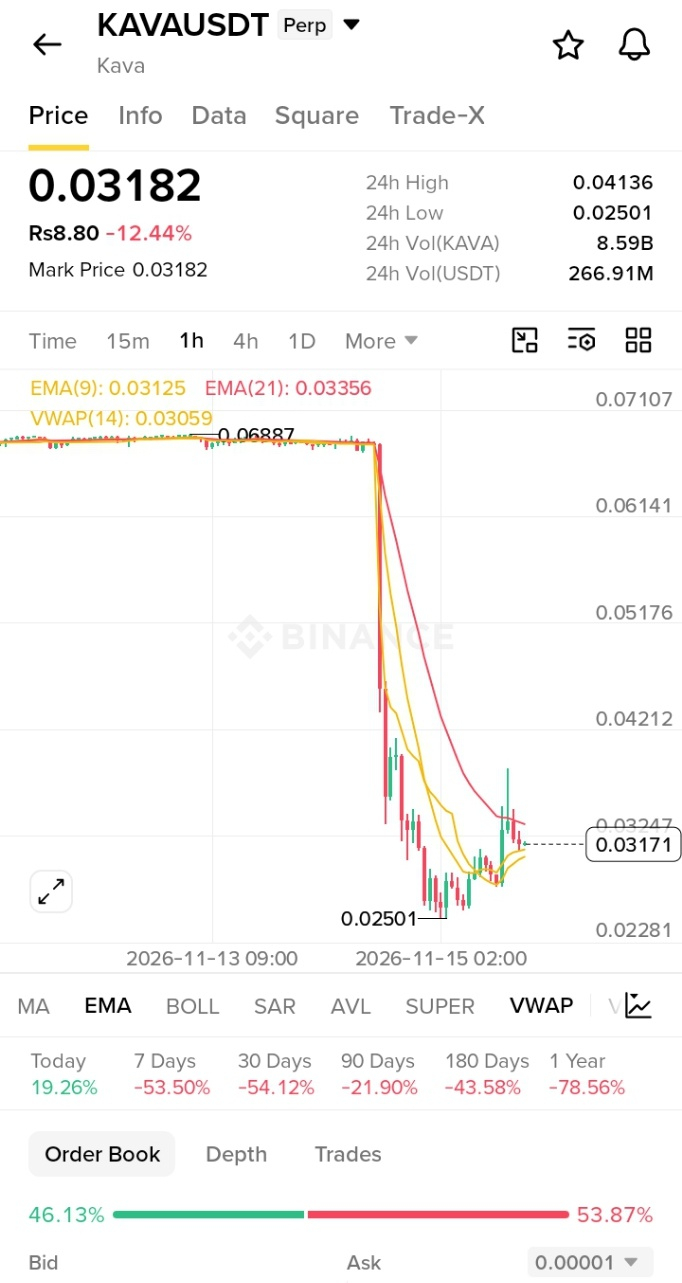
#trade $KAVA
LONG Scalp
Entry 0.03100 - 0.03150
SL 0.02950
TP 0.03356
TP 0.03600
must profit taking on TP1 50% or 70%
strong 1H candle close below 0.02950 invalidates the bounce thesis. A close above 0.03356 (EMA 21) confirms a larger trend shift.
#trade $KAVA
LONG Scalp
Entry 0.03100 - 0.03150
SL 0.02950
TP 0.03356
TP 0.03600
must profit taking on TP1 50% or 70%
strong 1H candle close below 0.02950 invalidates the bounce thesis. A close above 0.03356 (EMA 21) confirms a larger trend shift.
LONG Scalp
Entry 0.03100 - 0.03150
SL 0.02950
TP 0.03356
TP 0.03600
must profit taking on TP1 50% or 70%
strong 1H candle close below 0.02950 invalidates the bounce thesis. A close above 0.03356 (EMA 21) confirms a larger trend shift.
1
336
Статья
Bitcoin Is Falling, Gold Is Under Pressure Is the Global Financial Market Entering a New Risk phase?I have been watching the recent movements across Bitcoin, gold, forex and traditional financial markets, and one thing is becoming increasingly clear: this is not just a crypto-market correction. There is a much bigger global economic picture behind these movements.
The important question is not simply why Bitcoin is falling. It is why investors are becoming more cautious across multiple financial markets at the same time.
1. Bitcoin: What Is Behind the Decline?
Bitcoin remains one of the most sensitive assets to global liquidity and investor sentiment. Several factors can explain the current selling pressure.
First, expectations surrounding US Federal Reserve interest rate policy are creating uncertainty. When markets anticipate higher interest rates for longer, investors generally become more selective about riskier assets.
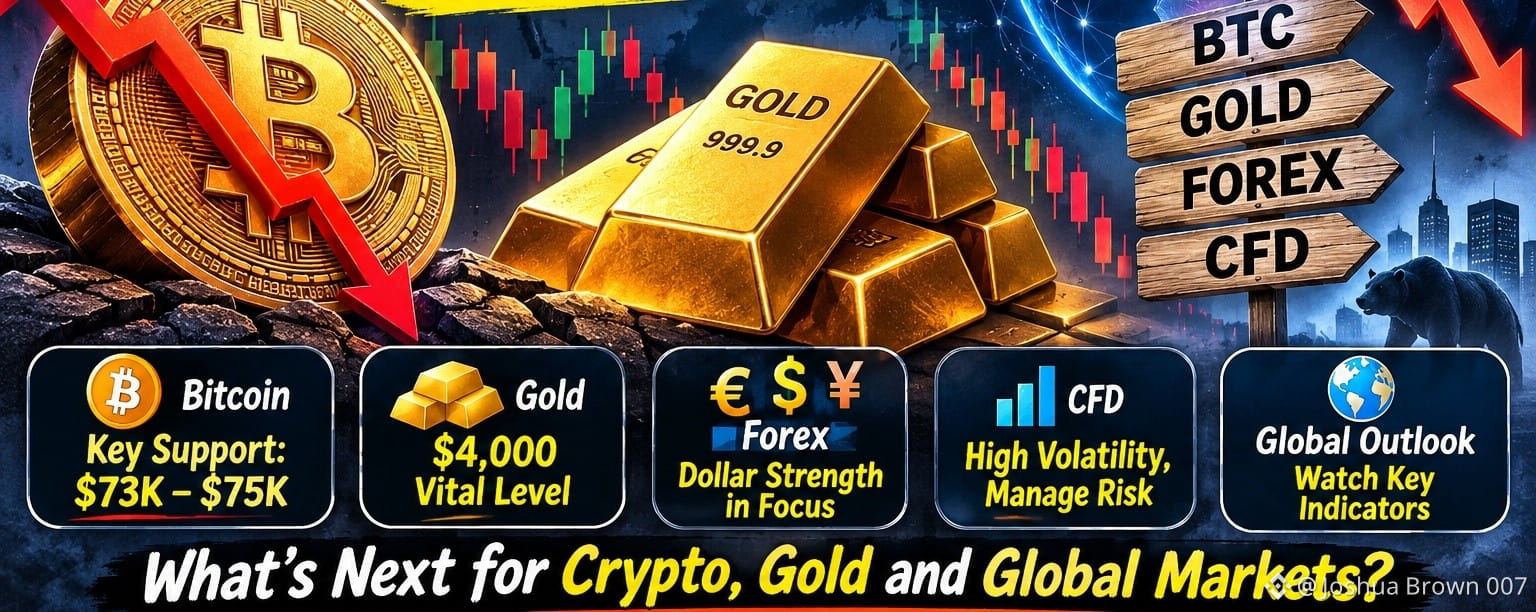
$73K–$75K Major recovery zone
$70K Psychological support
$66K–$68K Next major downside support
$62K Deeper downside risk
$80K–$82K Major resistance
However, these are potential support areas, not guaranteed price targets. A sustained recovery above resistance could change the entire short term outlook.
Second, institutional investment flows matter. Bitcoin ETFs have become an important channel for traditional financial capital. When investors withdraw money from these products, it can add selling pressure and weaken market confidence.
Third, the strength of the US dollar and rising Treasury yields can make speculative investments less attractive.
There is also another important factor: leverage. When Bitcoin starts declining, overleveraged long positions can face liquidation, accelerating the downward movement.
2. Gold: Why Is the Safe Haven Asset Also Struggling?
Strong US dollar is putting pressure on gold.
Higher Treasury yields make interest bearing assets more attractive.
Expectations of higher interest rates are reducing gold's short term appeal.
Central bank purchases and geopolitical uncertainty continue to provide longer term support.
3.Global outlook: Next few weeks
MY SCENARIO BASED VIEW
Asset Short term outlook
Bitcoin Bearish until $73K–$75K recovery
Gold Weak below $4,000; watch recovery
US Dollar Potential strength if rates remain high
Forex High event driven volatility
US Stocks Sensitive to inflation and AI sector weakness
Crypto Altcoins Higher downside risk than BTC
Oil Sensitive to geopolitical developments
My Final Market Perspective
I don't think traders should look at Bitcoin, gold, forex and CFDs as completely separate markets. They are connected through liquidity, interest rates, institutional capital and global investor confidence.
Bitcoin needs stronger demand and a technical recovery. Gold needs to demonstrate stabilization against dollar and yield pressure. Forex traders need to understand central bank policy differences, while CFD traders must manage leverage carefully.
What do you think: Are we witnessing a temporary global market correction, or the beginning of a deeper liquidity crisis?
#WhatWillDriveCryptoandStocks’NextRebound? #TradFiForBeginners #BitcoinActiveSupplyInProfitDropsBelow45% $BTC
{spot}(BTCUSDT)
$NVDAB
{spot}(NVDABUSDT)
Bitcoin Is Falling, Gold Is Under Pressure Is the Global Financial Market Entering a New Risk phase?
I have been watching the recent movements across Bitcoin, gold, forex and traditional financial markets, and one thing is becoming increasingly clear: this is not just a crypto-market correction. There is a much bigger global economic picture behind these movements.
The important question is not simply why Bitcoin is falling. It is why investors are becoming more cautious across multiple financial markets at the same time.
1. Bitcoin: What Is Behind the Decline?
Bitcoin remains one of the most sensitive assets to global liquidity and investor sentiment. Several factors can explain the current selling pressure.
First, expectations surrounding US Federal Reserve interest rate policy are creating uncertainty. When markets anticipate higher interest rates for longer, investors generally become more selective about riskier assets.
$73K–$75K Major recovery zone
$70K Psychological support
$66K–$68K Next major downside support
$62K Deeper downside risk
$80K–$82K Major resistance
However, these are potential support areas, not guaranteed price targets. A sustained recovery above resistance could change the entire short term outlook.
Second, institutional investment flows matter. Bitcoin ETFs have become an important channel for traditional financial capital. When investors withdraw money from these products, it can add selling pressure and weaken market confidence.
Third, the strength of the US dollar and rising Treasury yields can make speculative investments less attractive.
There is also another important factor: leverage. When Bitcoin starts declining, overleveraged long positions can face liquidation, accelerating the downward movement.
2. Gold: Why Is the Safe Haven Asset Also Struggling?
Strong US dollar is putting pressure on gold.
Higher Treasury yields make interest bearing assets more attractive.
Expectations of higher interest rates are reducing gold's short term appeal.
Central bank purchases and geopolitical uncertainty continue to provide longer term support.
3.Global outlook: Next few weeks
MY SCENARIO BASED VIEW
Asset Short term outlook
Bitcoin Bearish until $73K–$75K recovery
Gold Weak below $4,000; watch recovery
US Dollar Potential strength if rates remain high
Forex High event driven volatility
US Stocks Sensitive to inflation and AI sector weakness
Crypto Altcoins Higher downside risk than BTC
Oil Sensitive to geopolitical developments
My Final Market Perspective
I don't think traders should look at Bitcoin, gold, forex and CFDs as completely separate markets. They are connected through liquidity, interest rates, institutional capital and global investor confidence.
Bitcoin needs stronger demand and a technical recovery. Gold needs to demonstrate stabilization against dollar and yield pressure. Forex traders need to understand central bank policy differences, while CFD traders must manage leverage carefully.
What do you think: Are we witnessing a temporary global market correction, or the beginning of a deeper liquidity crisis?
#WhatWillDriveCryptoandStocks’NextRebound? #TradFiForBeginners #BitcoinActiveSupplyInProfitDropsBelow45% $BTC
$NVDAB
2
466
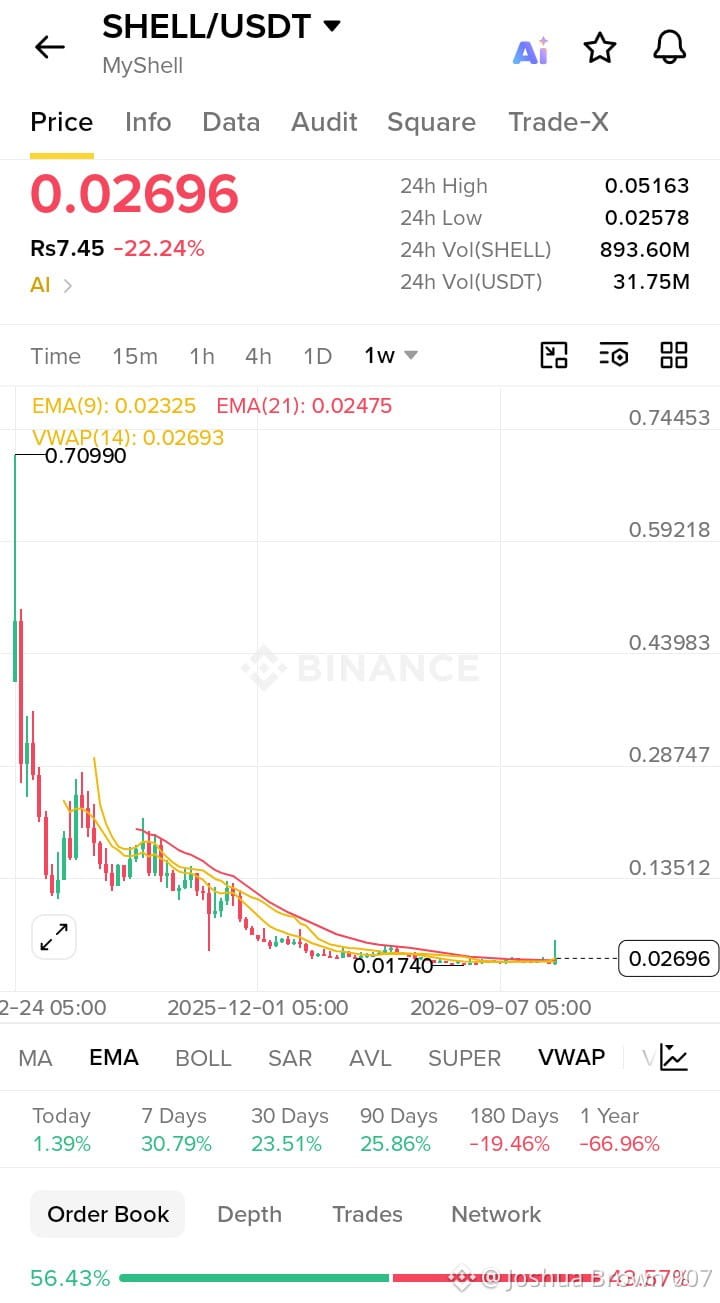
#TraderAlert $SHELL Analysis of spot buying?
Wait for the project to prove it can generate real revenue and for the token unlocks to slow down before even considering it.
More importantly, the project has a huge supply problem. Only about a quarter of all SHELL tokens are available for trading right now. The rest including a massive chunk held by the team and early investors will be unlocked and sold into the market over the coming months and years .
MAIN RISK: Continued price collapse due to massive token unlocks. The weekly chart shows a death spiral, and the fundamental supply pressure is overwhelming.
1
220
Проверено
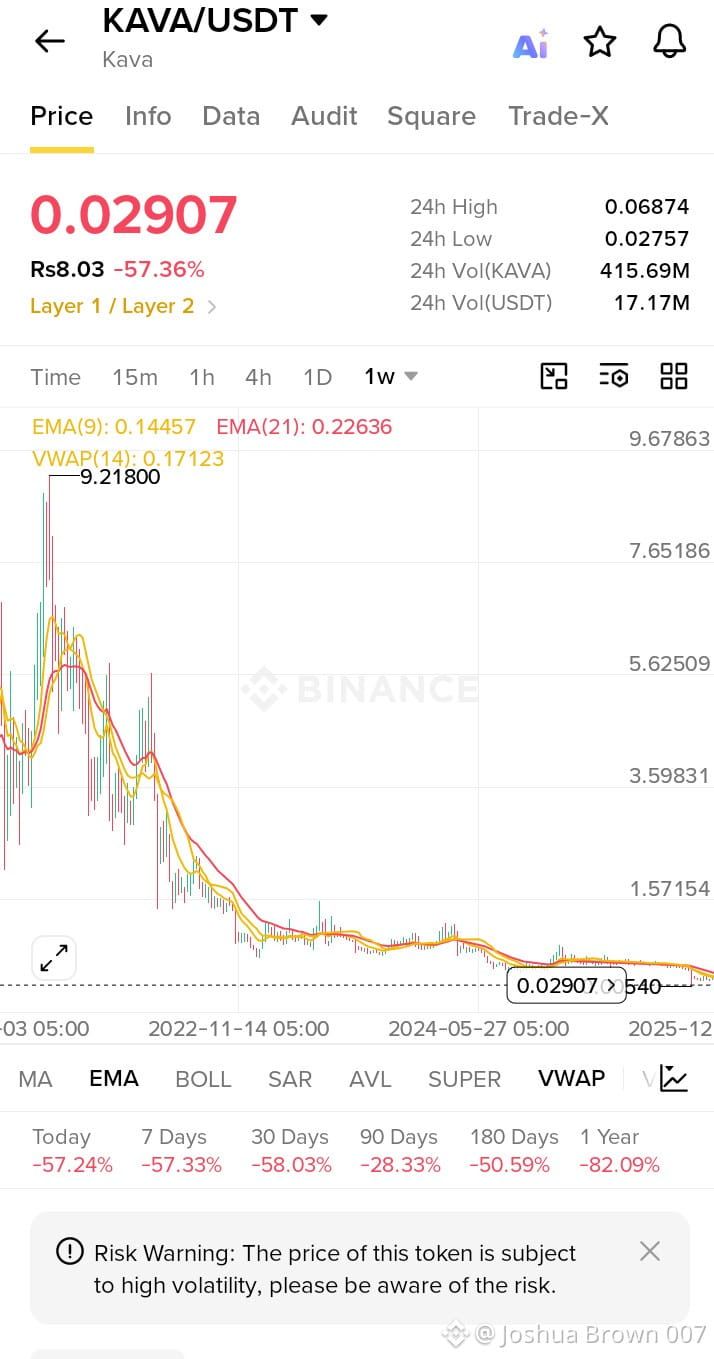
#CryptoNewss $KAVA
This is a very dangerous situation.
the price to crash by over 40% in just one hour.
Most importantly, major exchanges like Upbit and Binance have suspended KAVA deposits and withdrawals as a safety measure. This means if you buy KAVA now, you might not be able to move it or sell it if the situation worsens. For a conservative trader with a $50, $100 or $500 account, this is an absolute red alert. You must protect your capital. Do not buy this token. The risk of losing everything is extremely high, and the market is still unstable.
if you want to buy DAYOR.
2
789
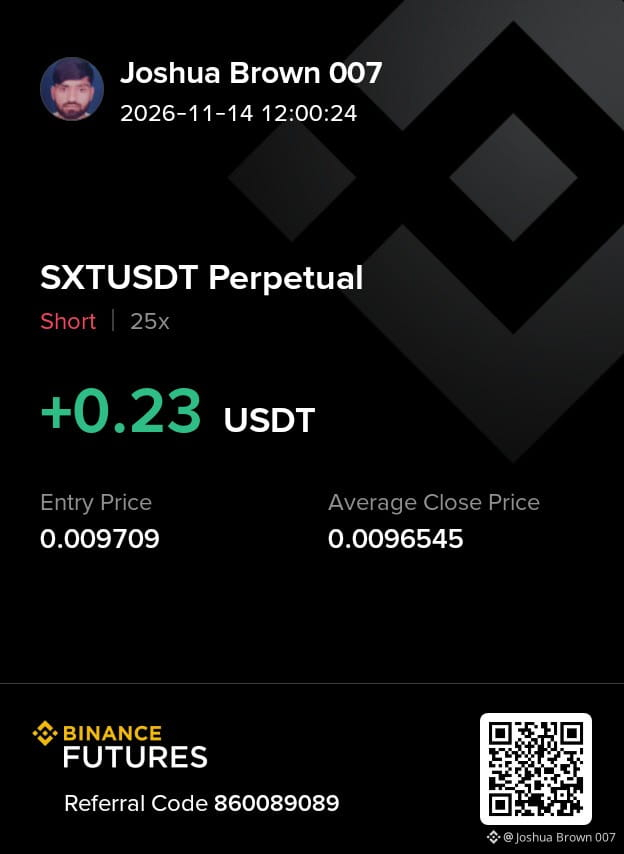
#sxt $SXT @SpaceandTimeDB
SXT Building Verifiable Data Infrastructure for AI, Tokenization & DeFi
Can AI and DeFi really be trusted if the data behind them cannot be verified?
This is one question that makes me look more closely at Space and Time.
As AI, tokenization, and DeFi continue to develop, reliable data is becoming just as important as the technology itself. Smart contracts need accurate information, AI systems need trustworthy data inputs, and tokenized assets need verifiable records.
This is where Space and Time has an interesting role. Its approach is built around powering verifiable data for AI, tokenization, and DeFi.
What I find interesting is the idea of making data independently verifiable instead of simply asking users to trust whatever information a system provides.
For me, this is an important part of building the next generation of blockchain applications. Innovation means very little if the information supporting it cannot be trusted.
I'm keeping an eye on how the Space and Time ecosystem develops.
$SXT
{future}(SXTUSDT)
#sxt $SXT @SpaceandTime
SXT Building Verifiable Data Infrastructure for AI, Tokenization & DeFi
Can AI and DeFi really be trusted if the data behind them cannot be verified?
This is one question that makes me look more closely at Space and Time.
As AI, tokenization, and DeFi continue to develop, reliable data is becoming just as important as the technology itself. Smart contracts need accurate information, AI systems need trustworthy data inputs, and tokenized assets need verifiable records.
This is where Space and Time has an interesting role. Its approach is built around powering verifiable data for AI, tokenization, and DeFi.
What I find interesting is the idea of making data independently verifiable instead of simply asking users to trust whatever information a system provides.
For me, this is an important part of building the next generation of blockchain applications. Innovation means very little if the information supporting it cannot be trusted.
I'm keeping an eye on how the Space and Time ecosystem develops.
$SXT
3
213
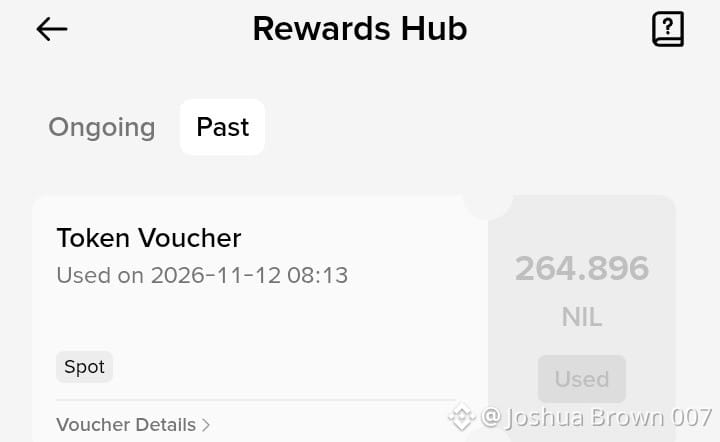
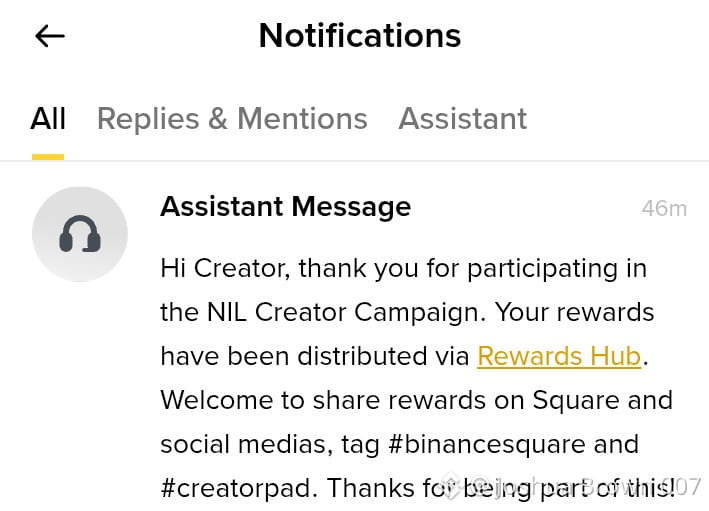
#BinanceSquareTalks Sometimes, the best part of being an active creator is seeing your contribution turn into something tangible. ❤️
yesterday, I successfully received and redeemed my 264.896 NIL tokens voucher through the NIL Creator Campaign!
A BIG THANK YOU to the entire NIL team and Binance Square for recognizing creators' efforts and making the reward distribution smooth through the Rewards Hub. 🙌
These rewards are more than just tokens for me. They represent appreciation, motivation, and the value of staying involved, researching, creating, and contributing to the community.
Really grateful to be part of this journey. Respect to everyone working behind the scenes to make these campaigns possible.
Let's keep creating, learning, and growing together. This is what makes a community stronger! 🚀
Thank you once again, NIL team! Much appreciated. ❤️
#BinanceSquare #CreatorPad #NIL #CryptoRewards
1
31
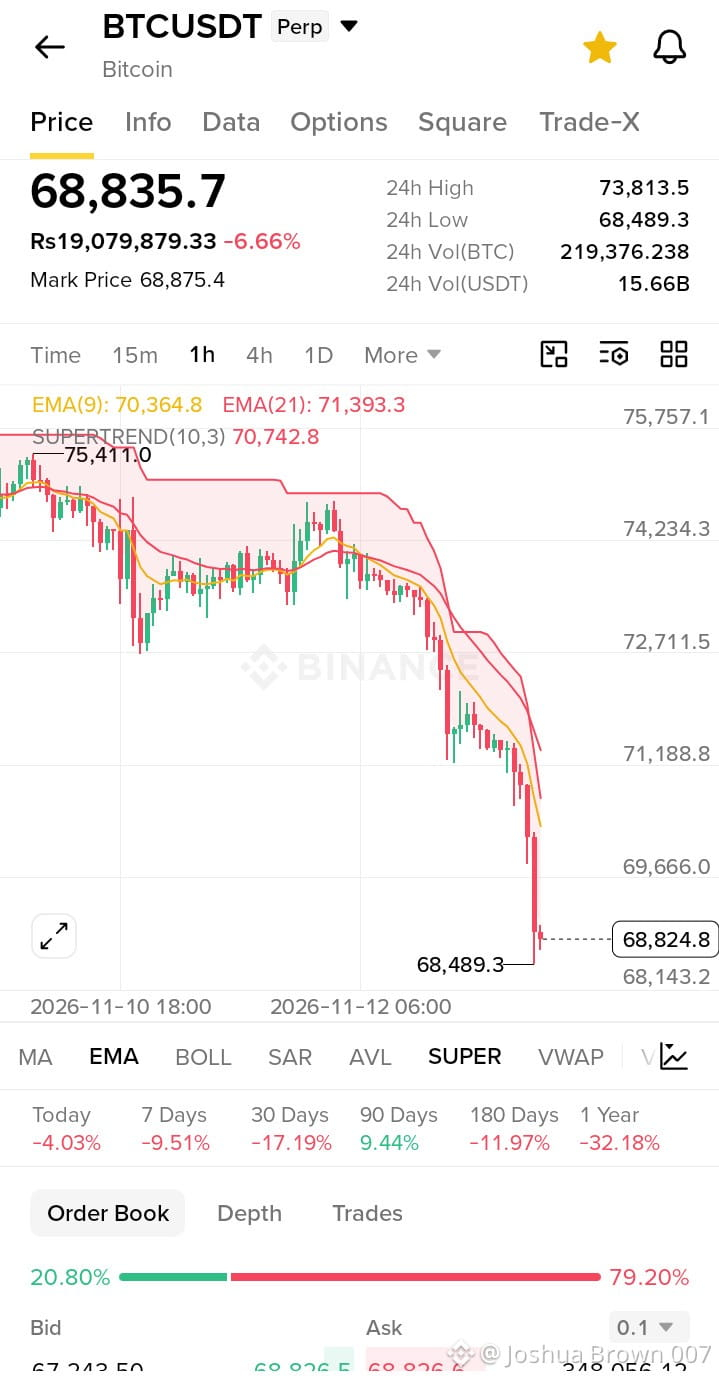
#trade $BTC Sell Short Limit Entry
my fellow Traders, do not attempt to catch this falling knife. A -6% drop in BTC is a massive event.
Entry 69,800 - 70,200
SL 71,000
TP 68,489
TP 64,871
The market is in a freefall. Wait for the price to establish a clear base and break above the EMA(9) with volume before considering any long positions.
{future}(BTCUSDT)
#trade $BTC Sell Short Limit Entry
my fellow Traders, do not attempt to catch this falling knife. A -6% drop in BTC is a massive event.
Entry 69,800 - 70,200
SL 71,000
TP 68,489
TP 64,871
The market is in a freefall. Wait for the price to establish a clear base and break above the EMA(9) with volume before considering any long positions.
1
135

Статья
Can a New Global Financial Shift Ignite the Next Major Market Rally?#cannvdareigniteairally
Understanding the connection between the world economy, institutional capital, and crypto markets
I have been looking at the global financial picture, and one thing stands out: financial markets are showing resilience, but the economic foundation supporting that optimism is facing serious challenges.
The question I keep coming back to is whether the next major market rally will be driven by genuine economic improvement or simply by investors taking on more risk.
1. The global economy: Growth is slowing, but not collapsing
According to the IMF's October 2026 World Economic Outlook, global economic growth is projected at 3.1% for 2026, with a recovery to 3.4% in 2027. However, global inflation is projected at 4.7% in 2026.
The OECD presents a slightly more cautious picture, projecting global growth of 2.9% in 2026 and 3.0% in 2027.
These figures suggest that the global economy is still expanding, but inflation, energy costs and geopolitical uncertainty are limiting the room for aggressive monetary easing.
2. What are international financial experts warning about?
The IMF's October 2026 Global Financial Stability Report highlights three important risks:
- An AI-related market correction if expected profits fail to materialise.
- Rising government bond yields driven by inflation and fiscal pressures.
- Cyber incidents that could disrupt financial infrastructure and investor confidence.
Athanasios Vamvakidis of the IMF has emphasised an important distinction: financial markets have remained resilient, but resilience does not mean the absence of risk.
This is particularly important because strong equity valuations can sometimes hide underlying financial vulnerabilities.
3. Interest rates and liquidity: The real drivers of a potential rally
Central-bank decisions remain among the most important factors for global markets.
When interest rates remain high, borrowing becomes expensive, businesses face higher financing costs, and investors become more selective about risky assets.
On the other hand, a sustainable decline in inflation could create room for monetary easing. That could improve liquidity conditions, support institutional investment and increase demand for equities, commodities and digital assets.
But there is a difference between lower interest rates and genuine financial liquidity. A rally needs sustainable capital flows, not just optimistic expectations.
4. How could global financial conditions affect cryptocurrency?
Crypto is increasingly connected to the wider financial system.
Bitcoin and other digital assets can benefit when institutional investors become more comfortable taking risks. However, they are also vulnerable when bond yields rise, the US dollar strengthens, or investors reduce exposure to speculative assets.
Three developments deserve close attention:
- Institutional capital flows into Bitcoin ETFs and digital assets.
- US Treasury yields and Federal Reserve policy expectations.
- Global liquidity, stablecoin supply and cryptocurrency market positioning.
A temporary increase in Bitcoin's price does not necessarily confirm a new bull market. Sustained demand, stronger spot volume and improving liquidity would provide more convincing evidence.
5. The biggest risk: A global economic shock
Energy-market disruptions, geopolitical tensions, growing government debt and expensive borrowing could create another wave of uncertainty.
The OECD warns that higher energy prices can reduce household purchasing power, while rising long-term bond yields increase government financing costs and put pressure on equity valuations.
Emerging economies may face additional pressure through currency depreciation, imported inflation and more expensive foreign borrowing.
For countries with limited financial reserves, these developments can have a particularly serious impact.
My personal market perspective
I do not think investors should assume that every improvement in market sentiment means a sustainable recovery is beginning.
The next major rally will need confirmation from several directions: inflation moving lower, bond yields stabilising, central-bank policy becoming less restrictive, institutional capital returning and corporate earnings remaining strong.
I would particularly watch Bitcoin's reaction to US bond yields and changes in global liquidity. These indicators can help explain whether capital is genuinely returning to risk assets or whether the market is experiencing another temporary recovery.
Final question: Are we approaching the beginning of a new global financial rally, or are markets simply enjoying temporary optimism before another economic challenge?
$NVDAB
#cannvdareigniteairally
Can a New Global Financial Shift Ignite the Next Major Market Rally?
#cannvdareigniteairally
Understanding the connection between the world economy, institutional capital, and crypto markets
I have been looking at the global financial picture, and one thing stands out: financial markets are showing resilience, but the economic foundation supporting that optimism is facing serious challenges.
The question I keep coming back to is whether the next major market rally will be driven by genuine economic improvement or simply by investors taking on more risk.
1. The global economy: Growth is slowing, but not collapsing
According to the IMF's October 2026 World Economic Outlook, global economic growth is projected at 3.1% for 2026, with a recovery to 3.4% in 2027. However, global inflation is projected at 4.7% in 2026.
The OECD presents a slightly more cautious picture, projecting global growth of 2.9% in 2026 and 3.0% in 2027.
These figures suggest that the global economy is still expanding, but inflation, energy costs and geopolitical uncertainty are limiting the room for aggressive monetary easing.
2. What are international financial experts warning about?
The IMF's October 2026 Global Financial Stability Report highlights three important risks:
- An AI-related market correction if expected profits fail to materialise.
- Rising government bond yields driven by inflation and fiscal pressures.
- Cyber incidents that could disrupt financial infrastructure and investor confidence.
Athanasios Vamvakidis of the IMF has emphasised an important distinction: financial markets have remained resilient, but resilience does not mean the absence of risk.
This is particularly important because strong equity valuations can sometimes hide underlying financial vulnerabilities.
3. Interest rates and liquidity: The real drivers of a potential rally
Central-bank decisions remain among the most important factors for global markets.
When interest rates remain high, borrowing becomes expensive, businesses face higher financing costs, and investors become more selective about risky assets.
On the other hand, a sustainable decline in inflation could create room for monetary easing. That could improve liquidity conditions, support institutional investment and increase demand for equities, commodities and digital assets.
But there is a difference between lower interest rates and genuine financial liquidity. A rally needs sustainable capital flows, not just optimistic expectations.
4. How could global financial conditions affect cryptocurrency?
Crypto is increasingly connected to the wider financial system.
Bitcoin and other digital assets can benefit when institutional investors become more comfortable taking risks. However, they are also vulnerable when bond yields rise, the US dollar strengthens, or investors reduce exposure to speculative assets.
Three developments deserve close attention:
- Institutional capital flows into Bitcoin ETFs and digital assets.
- US Treasury yields and Federal Reserve policy expectations.
- Global liquidity, stablecoin supply and cryptocurrency market positioning.
A temporary increase in Bitcoin's price does not necessarily confirm a new bull market. Sustained demand, stronger spot volume and improving liquidity would provide more convincing evidence.
5. The biggest risk: A global economic shock
Energy-market disruptions, geopolitical tensions, growing government debt and expensive borrowing could create another wave of uncertainty.
The OECD warns that higher energy prices can reduce household purchasing power, while rising long-term bond yields increase government financing costs and put pressure on equity valuations.
Emerging economies may face additional pressure through currency depreciation, imported inflation and more expensive foreign borrowing.
For countries with limited financial reserves, these developments can have a particularly serious impact.
My personal market perspective
I do not think investors should assume that every improvement in market sentiment means a sustainable recovery is beginning.
The next major rally will need confirmation from several directions: inflation moving lower, bond yields stabilising, central-bank policy becoming less restrictive, institutional capital returning and corporate earnings remaining strong.
I would particularly watch Bitcoin's reaction to US bond yields and changes in global liquidity. These indicators can help explain whether capital is genuinely returning to risk assets or whether the market is experiencing another temporary recovery.
Final question: Are we approaching the beginning of a new global financial rally, or are markets simply enjoying temporary optimism before another economic challenge?
$NVDAB
#cannvdareigniteairally
1
191
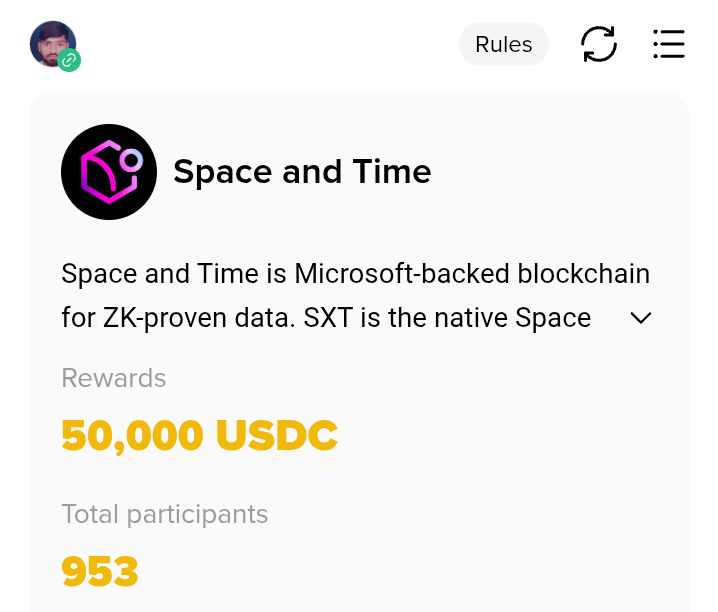
🎙️ Space and Time $SXT Track-1 and Track-2 campaign.
Завершено
02 ч 00 мин 40 сек
65

BNB
Активы
-0.01%
3
0
Войдите, чтобы посмотреть больше материала
Присоединяйтесь к пользователям криптовалют по всему миру на Binance Square
⚡️ Получайте новейшую и полезную информацию о криптоактивах.
💬 Нам доверяет крупнейшая в мире криптобиржа.
👍 Получите достоверные аналитические данные от верифицированных создателей контента.
Эл. почта/номер телефона
В тренде
BTCRemainsUnderPressureAfterHawkishFOMCMinutes
Просмотров: 57,463
840 обсуждают
FOMC Minutes | Fed Minutes Show Almost All Officials Expect More Rate Hikes, With Some Open to a Larger December Move
Binance News
·Лайков: 49
·Просмотров: 58.8k
AnthropicToDebutAfter$83IPOPricing
Просмотров: 15,333
89 обсуждают
NvidiaBoardReportedlySplitOverHuang’sReturn
Просмотров: 19,065
385 обсуждают