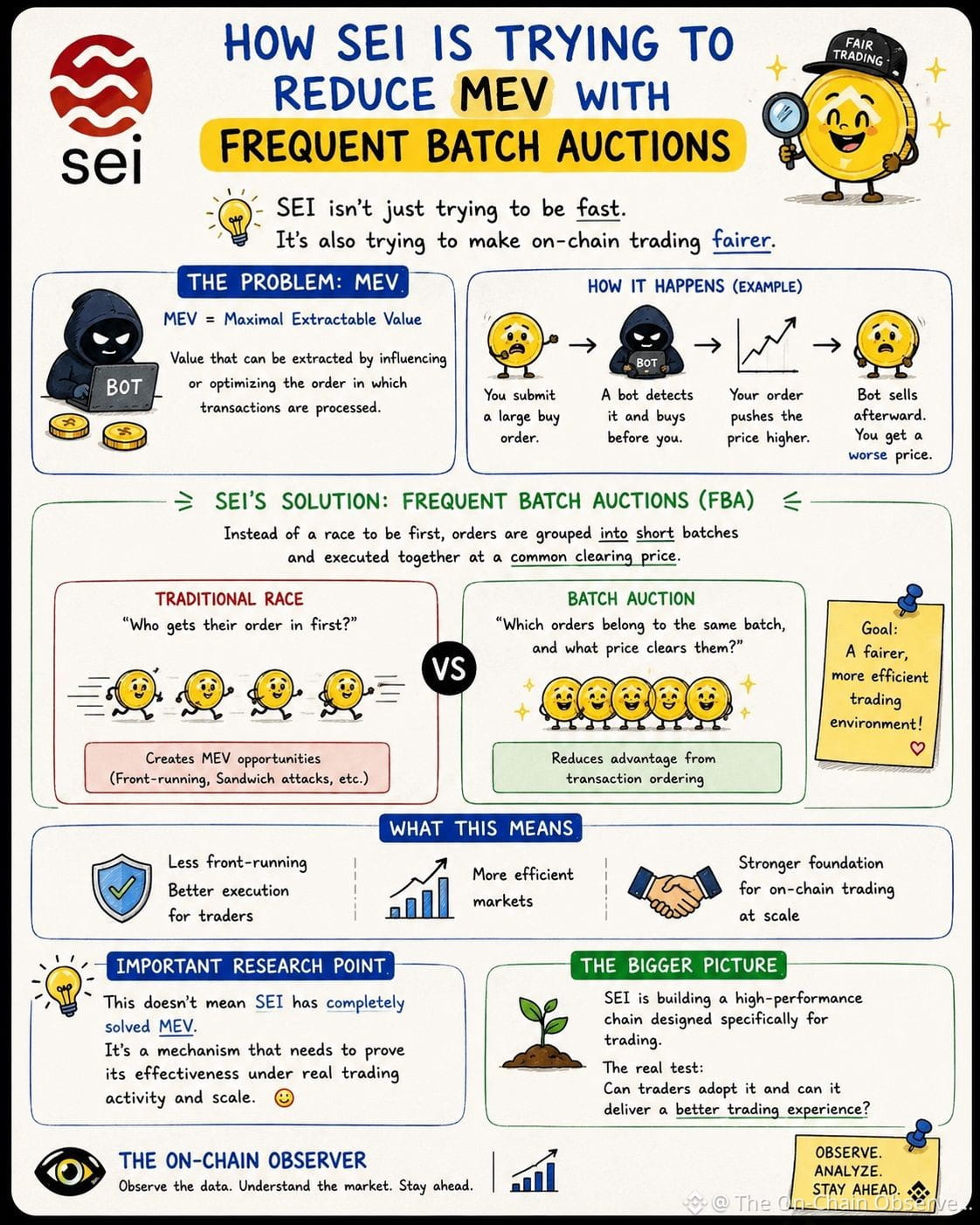
🔬 How Sei Is Trying to Reduce MEV
How is Sei trying to make on-chain trading fairer?
We've already discussed SEI's speed and its adoption challenge.
Now let's look at a different part of its design:
MEV.
MEV = Maximal Extractable Value.
In simple terms, it refers to value that can be extracted by influencing or optimizing the order in which transactions are processed.
👀 A simple example:
You submit a large buy order.
A bot detects it.
The bot buys before your transaction.
Your order pushes the price higher.
The bot sells afterward.
You receive a worse execution.
This is one example of how transaction ordering can create an advantage for sophisticated actors.
⚙️ So What Is Sei Trying to Do?
One part of Sei's trading-focused architecture is:
Frequent Batch Auctions (FBA)
Instead of treating every transaction as a race to get ahead of the next trader, orders can be grouped into short batches and processed together at a common clearing price.
The idea is to reduce the advantage gained from extremely fast transaction ordering.
🧠 Think of it like this:
❌ Traditional race
“Who gets their order in first?”
vs.
✅ Batch auction
“Which orders belong to the same batch, and what price clears them?”
⚠️ Important Research Point
This doesn't mean:
“SEI has completely solved MEV.”
A mechanism can be well-designed on paper and still needs to prove its effectiveness under real trading activity and scale.
That's why I separate:
Design → Implementation → Real-world results
🎯 The Bigger Picture
SEI isn't only trying to become faster.
It's also designing infrastructure specifically around on-chain trading.
The real question is:
Can these architectural choices create a better trading environment—and can traders actually adopt it?
That's what I'll be watching.
👁️ Follow @Sulaiman 零号猎人 for more Web3 research, protocol analysis, on-chain data & market intelligence.
#TheOnChainObserver #SEI #MEV #Web3Research #Write2Earn
$SEI
$TUT
$BICO
How is Sei trying to make on-chain trading fairer?
We've already discussed SEI's speed and its adoption challenge.
Now let's look at a different part of its design:
MEV.
MEV = Maximal Extractable Value.
In simple terms, it refers to value that can be extracted by influencing or optimizing the order in which transactions are processed.
👀 A simple example:
You submit a large buy order.
A bot detects it.
The bot buys before your transaction.
Your order pushes the price higher.
The bot sells afterward.
You receive a worse execution.
This is one example of how transaction ordering can create an advantage for sophisticated actors.
⚙️ So What Is Sei Trying to Do?
One part of Sei's trading-focused architecture is:
Frequent Batch Auctions (FBA)
Instead of treating every transaction as a race to get ahead of the next trader, orders can be grouped into short batches and processed together at a common clearing price.
The idea is to reduce the advantage gained from extremely fast transaction ordering.
🧠 Think of it like this:
❌ Traditional race
“Who gets their order in first?”
vs.
✅ Batch auction
“Which orders belong to the same batch, and what price clears them?”
⚠️ Important Research Point
This doesn't mean:
“SEI has completely solved MEV.”
A mechanism can be well-designed on paper and still needs to prove its effectiveness under real trading activity and scale.
That's why I separate:
Design → Implementation → Real-world results
🎯 The Bigger Picture
SEI isn't only trying to become faster.
It's also designing infrastructure specifically around on-chain trading.
The real question is:
Can these architectural choices create a better trading environment—and can traders actually adopt it?
That's what I'll be watching.
👁️ Follow @Sulaiman 零号猎人 for more Web3 research, protocol analysis, on-chain data & market intelligence.
#TheOnChainObserver #SEI #MEV #Web3Research #Write2Earn
$SEI
$TUT
$BICO