
#duskevm
duskevm
Просмотров: 18,451
254 обсуждают
Популярные
Новые

Проверено
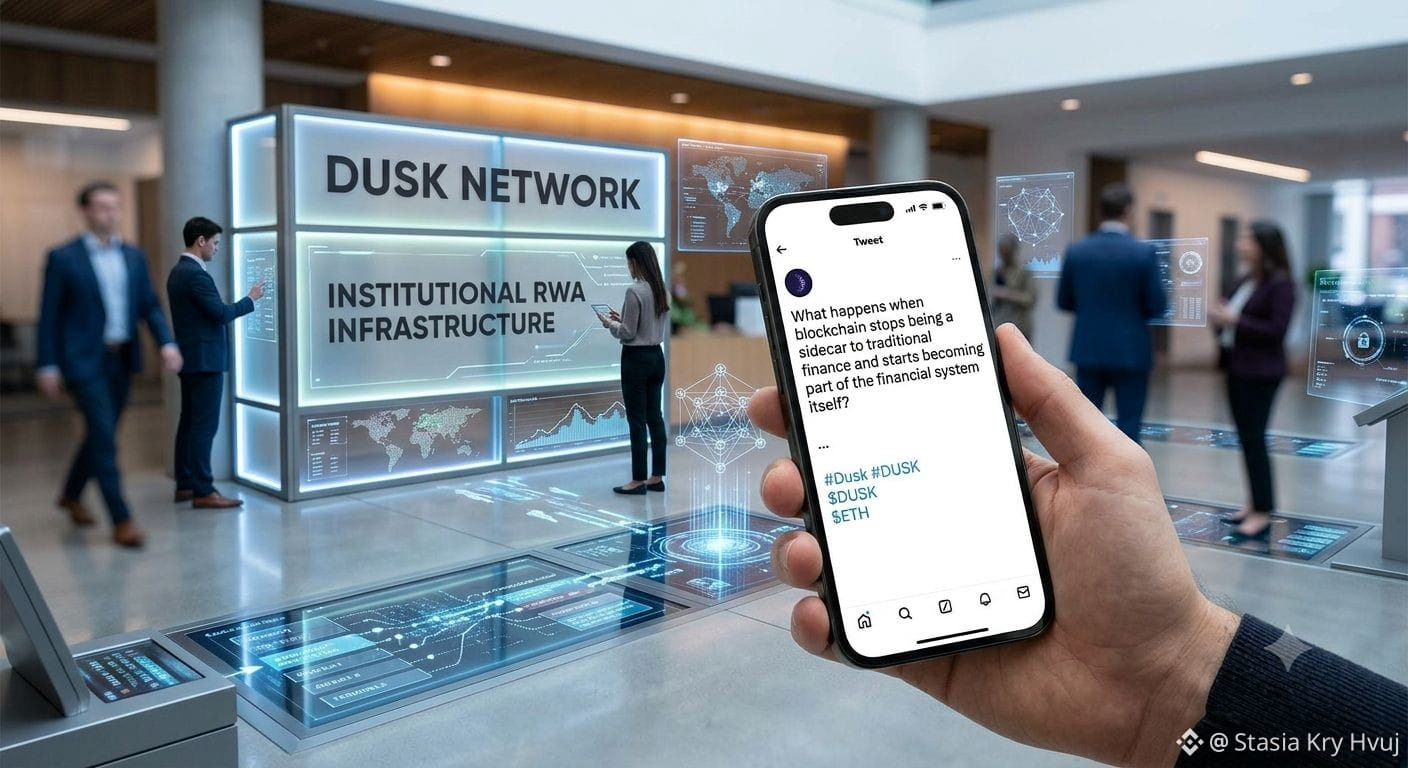
What happens when blockchain stops being a sidecar to traditional finance and starts becoming part of the financial system itself?
That is the question I keep coming back to with @Dusk_Foundation
There is a major difference between putting a digital wrapper around an existing financial product and designing the asset’s entire lifecycle natively on-chain.
When infrastructure becomes core to financial workflows, high standards are non-negotiable. It’s not just about speed—it’s about privacy, verifiable compliance, and institutional-grade trust.
This is where @Dusk_Foundation stands out:
Native Compliance & Privacy: Built-in Zero-Knowledge technology allows private transactions while remaining fully audit-ready (MiCA compliant).
Real-World Traction: Powering regulated venues like $NPEX to bring securities directly on-chain.
Interoperability: #DuskEVM and Chainlink #CCIP integration ensure institutional assets connect seamlessly to broader DeFi liquidity.
With $ETH showing renewed market momentum, the shift toward institutional-grade RWA infra structure is accelerating.
The real test for Dusk: can this technology become dependable enough for institutions to treat onchain infrastructure as part of the financial system itself?
#dusk @Dusk_Foundation $DUSK $XRP
What happens when blockchain stops being a sidecar to traditional finance and starts becoming part of the financial system itself?
That is the question I keep coming back to with @Dusk
There is a major difference between putting a digital wrapper around an existing financial product and designing the asset’s entire lifecycle natively on-chain.
When infrastructure becomes core to financial workflows, high standards are non-negotiable. It’s not just about speed—it’s about privacy, verifiable compliance, and institutional-grade trust.
This is where @Dusk stands out:
Native Compliance & Privacy: Built-in Zero-Knowledge technology allows private transactions while remaining fully audit-ready (MiCA compliant).
Real-World Traction: Powering regulated venues like $NPEX to bring securities directly on-chain.
Interoperability: #DuskEVM and Chainlink #CCIP integration ensure institutional assets connect seamlessly to broader DeFi liquidity.
With $ETH showing renewed market momentum, the shift toward institutional-grade RWA infra structure is accelerating.
The real test for Dusk: can this technology become dependable enough for institutions to treat onchain infrastructure as part of the financial system itself?
#dusk @Dusk $DUSK $XRP
34
10
624


·
--
Проверено
Статья
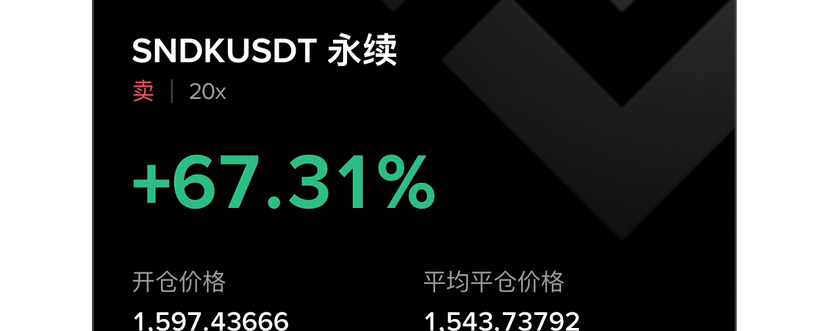
DUSK:RWA 进入下一阶段,核心可能不只是“资产上链”最近比较值得关注的一个方向是 Dusk。
很多 RWA 项目解决的是“把现实资产映射到链上”,但 Dusk 想做的更进一步——让资产发行、交易、合规、隐私以及结算等金融业务流程,本身就能够在链上运行。
其中最值得关注的是即将推进的 DuskEVM 主网。DuskEVM 为开发者和机构提供熟悉的 Solidity/EVM 开发环境,同时通过 Hedger 引入同态加密(HE)和零知识证明(ZKP),探索在金融场景中实现隐私保护 + 合规审查 + 选择性披露。
应用层还有 Dusk Trade,定位类似面向代币化金融资产的 Neobroker,将用户注册、钱包连接、资产发现、交易、支付协调和结算整合到一个市场界面,目前覆盖的方向包括 MMF、ETF、债券以及 RWA。
更重要的是,Dusk 正在推进机构级生态建设,包括与 Chainlink、NPEX 等合作。其中 NPEX 是受到荷兰 AFM 监管的交易所,并计划通过 Dusk 将超过 3 亿欧元的资产带到链上。
所以我认为,Dusk 值得关注的逻辑并不是简单的“又一个 RWA 公链”,而是:
EVM + 隐私 + 合规 + RWA + 原生发行 + 机构资产
如果未来传统金融资产真正大规模进入链上,市场需要的可能并不是单纯的公开账本,而是能够同时解决隐私、监管、交易和结算问题的基础设施。
Dusk 目前正在押注的,正是这一条路线。
RWA 的下一阶段,可能不是“把资产搬上链”,而是让金融市场本身在链上运行。
#DUSK #DuskNetwork #RWA #DuskEVM $DUSK
@Dusk_Foundation
DUSK:RWA 进入下一阶段,核心可能不只是“资产上链”
最近比较值得关注的一个方向是 Dusk。
很多 RWA 项目解决的是“把现实资产映射到链上”,但 Dusk 想做的更进一步——让资产发行、交易、合规、隐私以及结算等金融业务流程,本身就能够在链上运行。
其中最值得关注的是即将推进的 DuskEVM 主网。DuskEVM 为开发者和机构提供熟悉的 Solidity/EVM 开发环境,同时通过 Hedger 引入同态加密(HE)和零知识证明(ZKP),探索在金融场景中实现隐私保护 + 合规审查 + 选择性披露。
应用层还有 Dusk Trade,定位类似面向代币化金融资产的 Neobroker,将用户注册、钱包连接、资产发现、交易、支付协调和结算整合到一个市场界面,目前覆盖的方向包括 MMF、ETF、债券以及 RWA。
更重要的是,Dusk 正在推进机构级生态建设,包括与 Chainlink、NPEX 等合作。其中 NPEX 是受到荷兰 AFM 监管的交易所,并计划通过 Dusk 将超过 3 亿欧元的资产带到链上。
所以我认为,Dusk 值得关注的逻辑并不是简单的“又一个 RWA 公链”,而是:
EVM + 隐私 + 合规 + RWA + 原生发行 + 机构资产
如果未来传统金融资产真正大规模进入链上,市场需要的可能并不是单纯的公开账本,而是能够同时解决隐私、监管、交易和结算问题的基础设施。
Dusk 目前正在押注的,正是这一条路线。
RWA 的下一阶段,可能不是“把资产搬上链”,而是让金融市场本身在链上运行。
#DUSK #DuskNetwork #RWA #DuskEVM $DUSK
@Dusk
2
8
6.3k

·
--
Проверено
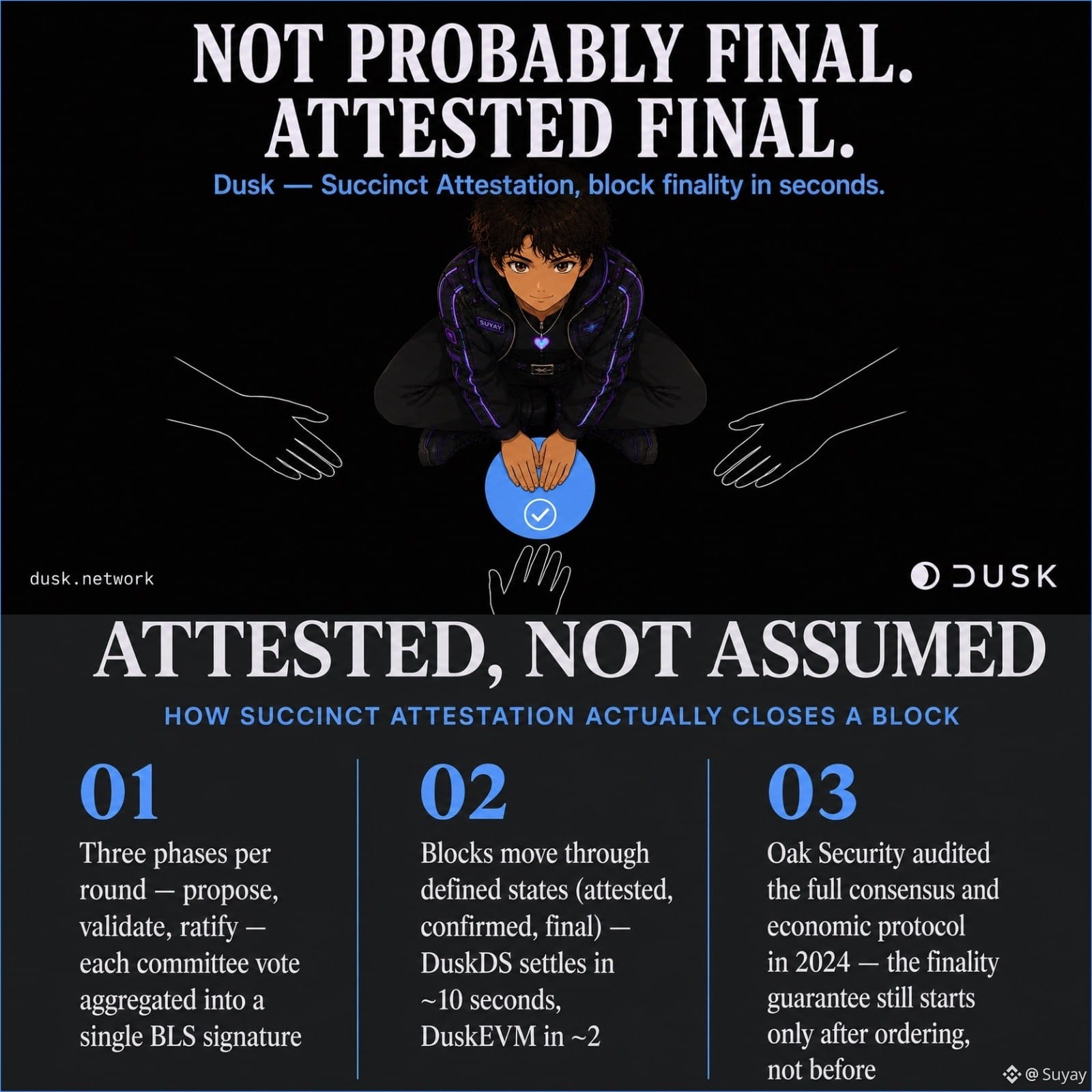
I always treated "blockchain finality" as closer to marketing language than a real guarantee, somewhere between hope and probability. Reading how Dusk's Succinct Attestation actually closes a block changed that.
Each round runs through three phases: a randomly selected provisioner proposes a candidate block, one committee votes on its validity, a second committee ratifies that outcome, both using aggregated BLS signatures reaching a supermajority. That's not a probabilistic confirmation stacking up over time, it's an explicit cryptographic attestation the block satisfies. Blocks move through defined states, attested, confirmed, final, and DuskDS settles in around ten seconds, DuskEVM even faster at roughly two. Oak Security audited the whole consensus and economic protocol and called it well-designed, combining pieces of existing approaches with some genuinely custom ones.
That's a real answer to reorg risk. A trade that's final on Dusk isn't final until nobody objects for a while, it's final because a defined committee already attested it is, which is the actual requirement for regulated securities settlement.
Here's what it doesn't resolve, and it connects to something I raised weeks ago about DuskEVM's sequencer. That attestation process is fully decentralized among provisioners on DuskDS. But DuskEVM still orders transactions through a single sequencer before anything reaches DuskDS for that same guarantee. The finality I just described protects what happens after ordering. It was never built to answer who sees the transaction first.
#dusk $DUSK @Dusk_Foundation #DuskEVM
I always treated "blockchain finality" as closer to marketing language than a real guarantee, somewhere between hope and probability. Reading how Dusk's Succinct Attestation actually closes a block changed that.
Each round runs through three phases: a randomly selected provisioner proposes a candidate block, one committee votes on its validity, a second committee ratifies that outcome, both using aggregated BLS signatures reaching a supermajority. That's not a probabilistic confirmation stacking up over time, it's an explicit cryptographic attestation the block satisfies. Blocks move through defined states, attested, confirmed, final, and DuskDS settles in around ten seconds, DuskEVM even faster at roughly two. Oak Security audited the whole consensus and economic protocol and called it well-designed, combining pieces of existing approaches with some genuinely custom ones.
That's a real answer to reorg risk. A trade that's final on Dusk isn't final until nobody objects for a while, it's final because a defined committee already attested it is, which is the actual requirement for regulated securities settlement.
Here's what it doesn't resolve, and it connects to something I raised weeks ago about DuskEVM's sequencer. That attestation process is fully decentralized among provisioners on DuskDS. But DuskEVM still orders transactions through a single sequencer before anything reaches DuskDS for that same guarantee. The finality I just described protects what happens after ordering. It was never built to answer who sees the transaction first.
#dusk $DUSK @Dusk #DuskEVM
9
4
244
·
--
Проверено
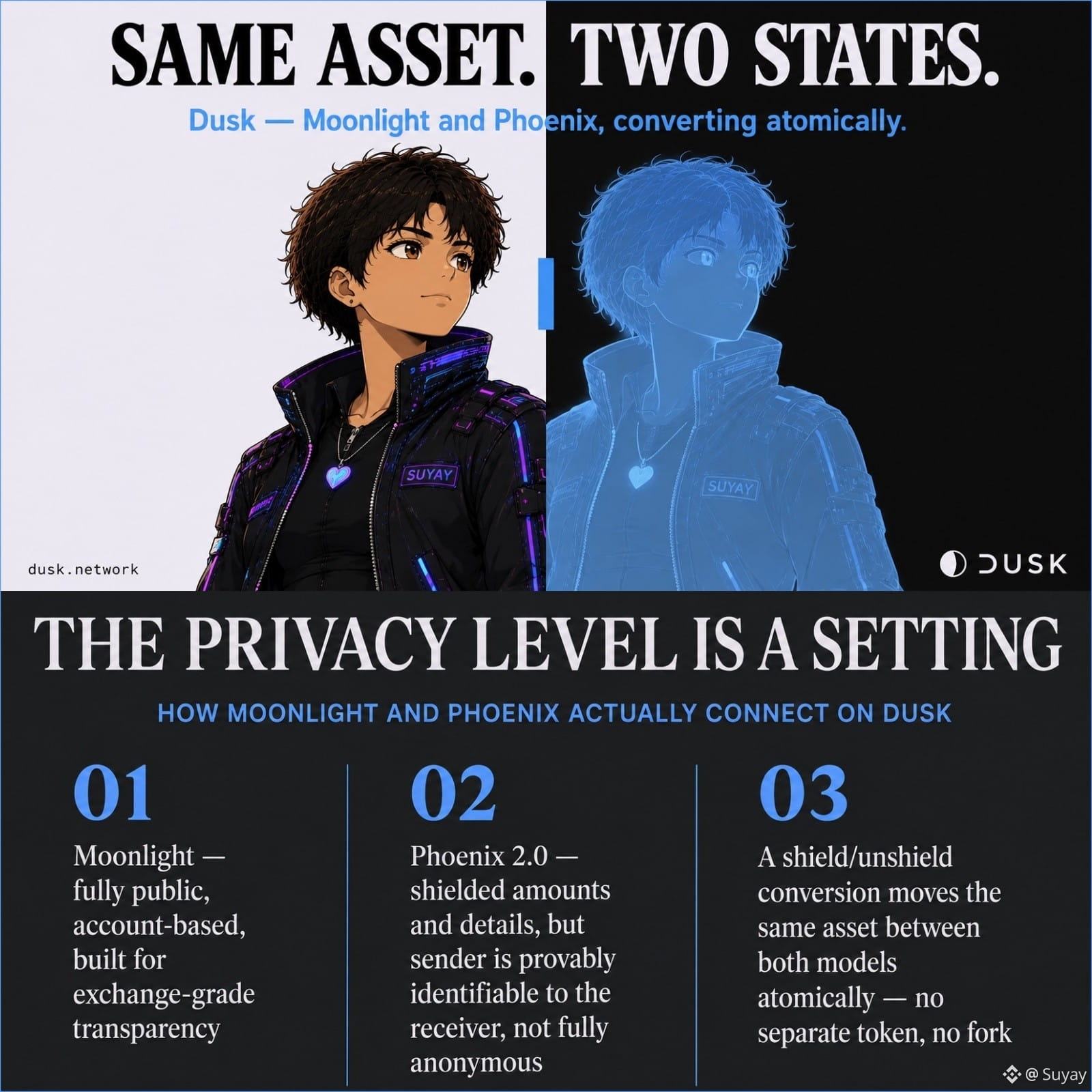
I assumed a privacy blockchain had to pick a side, fully hidden or fully transparent. Reading how Moonlight and Phoenix actually work together on Dusk, that assumption didn't survive.
Phoenix isn't anonymous the way I expected either. In its 2.0 spec, the sender of a transaction is provably identifiable to the receiver, even though the amount and details stay hidden from everyone else. Dusk built it that way specifically to avoid exchange delisting risk, full anonymity protocols keep failing that compliance bar, controlled privacy doesn't. Moonlight sits next to it as a fully public, account-based model, the same shape as a normal ledger entry, added for the same reason: some counterparties, especially exchanges, need transparency by default, not as an exception.
What actually surprised me is how the two connect. They're not separate products bolted together, there's a direct shield and unshield conversion built into the transfer contract, so a Phoenix note and a Moonlight balance move into and out of each other atomically. Same asset, same chain, the privacy level is a setting, not a fork.
The open question for me: DuskEVM's Hedger adds a third model on top, homomorphic encryption plus ZK for the EVM layer, which is a different construction from either Phoenix or Moonlight. Three coexisting privacy models are more flexible on paper. I haven't worked out yet whether that flexibility costs liquidity or tooling fragmentation once assets need to move between all three, not just two.
#dusk $DUSK @Dusk_Foundation #DuskEVM #Ethereum
I assumed a privacy blockchain had to pick a side, fully hidden or fully transparent. Reading how Moonlight and Phoenix actually work together on Dusk, that assumption didn't survive.
Phoenix isn't anonymous the way I expected either. In its 2.0 spec, the sender of a transaction is provably identifiable to the receiver, even though the amount and details stay hidden from everyone else. Dusk built it that way specifically to avoid exchange delisting risk, full anonymity protocols keep failing that compliance bar, controlled privacy doesn't. Moonlight sits next to it as a fully public, account-based model, the same shape as a normal ledger entry, added for the same reason: some counterparties, especially exchanges, need transparency by default, not as an exception.
What actually surprised me is how the two connect. They're not separate products bolted together, there's a direct shield and unshield conversion built into the transfer contract, so a Phoenix note and a Moonlight balance move into and out of each other atomically. Same asset, same chain, the privacy level is a setting, not a fork.
The open question for me: DuskEVM's Hedger adds a third model on top, homomorphic encryption plus ZK for the EVM layer, which is a different construction from either Phoenix or Moonlight. Three coexisting privacy models are more flexible on paper. I haven't worked out yet whether that flexibility costs liquidity or tooling fragmentation once assets need to move between all three, not just two.
#dusk $DUSK @Dusk #DuskEVM #Ethereum
11
7
223
·
--
#dusk $DUSK @Dusk_Foundation
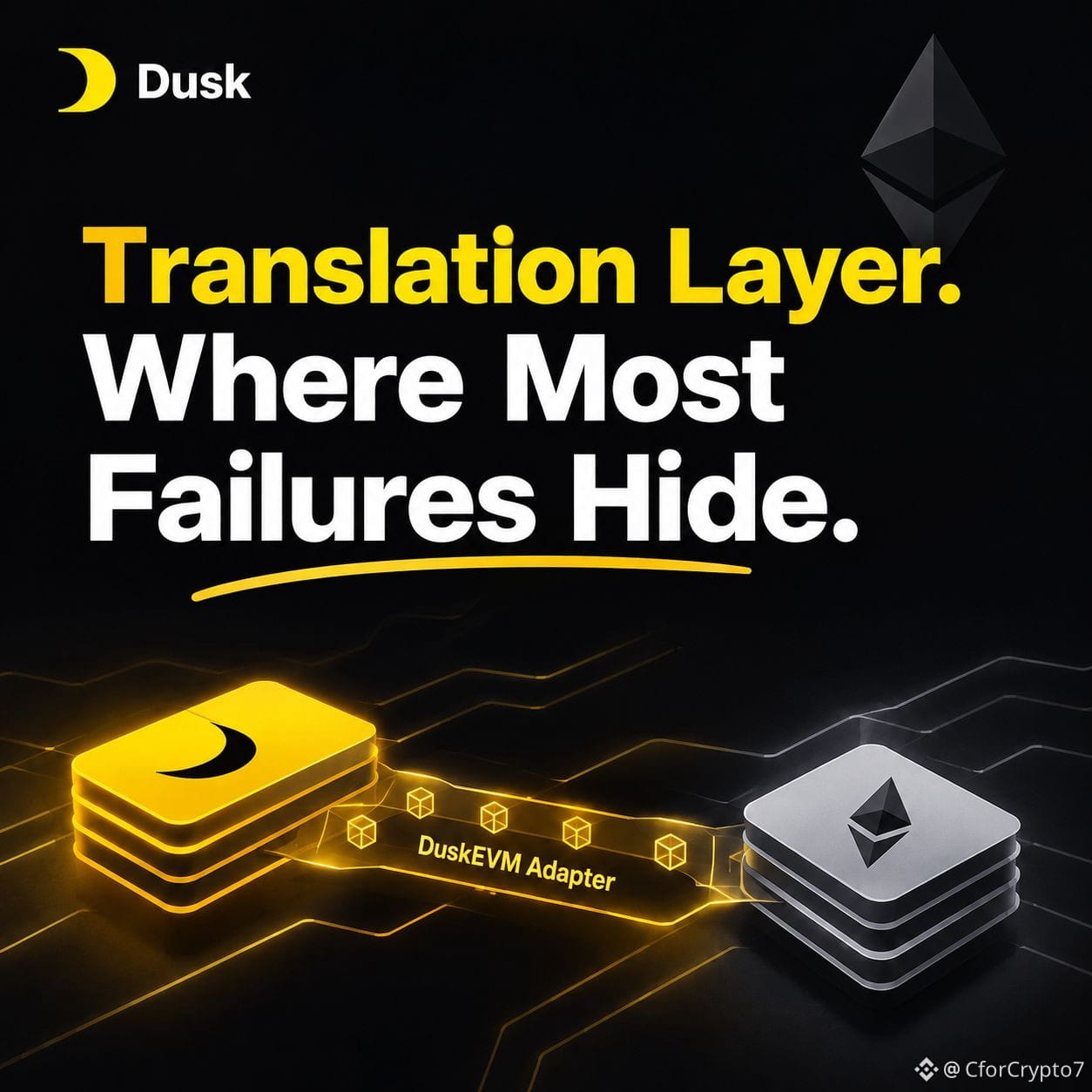
I was reading the DuskEVM adapter documentation last night and the “just a proxy” description still doesn’t sit well with me.
That’s the translation layer, and translation layers are where the interesting failures hide.
It takes Dusk’s GraphQL/RUES state and recasts it as an Ethereum-style JSON-RPC — blocks, receipts, logs, proofs — plus a LUX-to-WEI conversion and caller-identifier model that doesn’t neatly map to how Ethereum contracts think about msg.sender.
The path to happiness is well documented.
There are no failure modes, at least not that I’ve found.
If the adapter’s index lags behind the local state on disk, does the Ethereum client see stale data? An error?
Or something that looks right and isn’t? I’m also curious about what happens to the logic of the contention game once the final disk assumptions deviate from what the OP stack was built on.
And when EVM tooling assumes runtime behavior the disk contract model can't actually be satisfied — does it fail loudly, or silently?
If someone runs a DuskEVM node or pushes the adapter under real load,
I'd really like to hear if the state mapping holds up,
or where it cracks.
#DuskEVM #Dusk/usdt✅
#SanDiskRises7%OnRevenueGrowthOutlook
#dusk $DUSK @Dusk
I was reading the DuskEVM adapter documentation last night and the “just a proxy” description still doesn’t sit well with me.
That’s the translation layer, and translation layers are where the interesting failures hide.
It takes Dusk’s GraphQL/RUES state and recasts it as an Ethereum-style JSON-RPC — blocks, receipts, logs, proofs — plus a LUX-to-WEI conversion and caller-identifier model that doesn’t neatly map to how Ethereum contracts think about msg.sender.
The path to happiness is well documented.
There are no failure modes, at least not that I’ve found.
If the adapter’s index lags behind the local state on disk, does the Ethereum client see stale data? An error?
Or something that looks right and isn’t? I’m also curious about what happens to the logic of the contention game once the final disk assumptions deviate from what the OP stack was built on.
And when EVM tooling assumes runtime behavior the disk contract model can't actually be satisfied — does it fail loudly, or silently?
If someone runs a DuskEVM node or pushes the adapter under real load,
I'd really like to hear if the state mapping holds up,
or where it cracks.
#DuskEVM #Dusk/usdt✅
#SanDiskRises7%OnRevenueGrowthOutlook
6
3
116

·
--
Рост
$DUSK
{spot}(DUSKUSDT)
Privacy meets DeFi!
Moving assets on-chain shouldn’t mean exposing every balance to everyone.
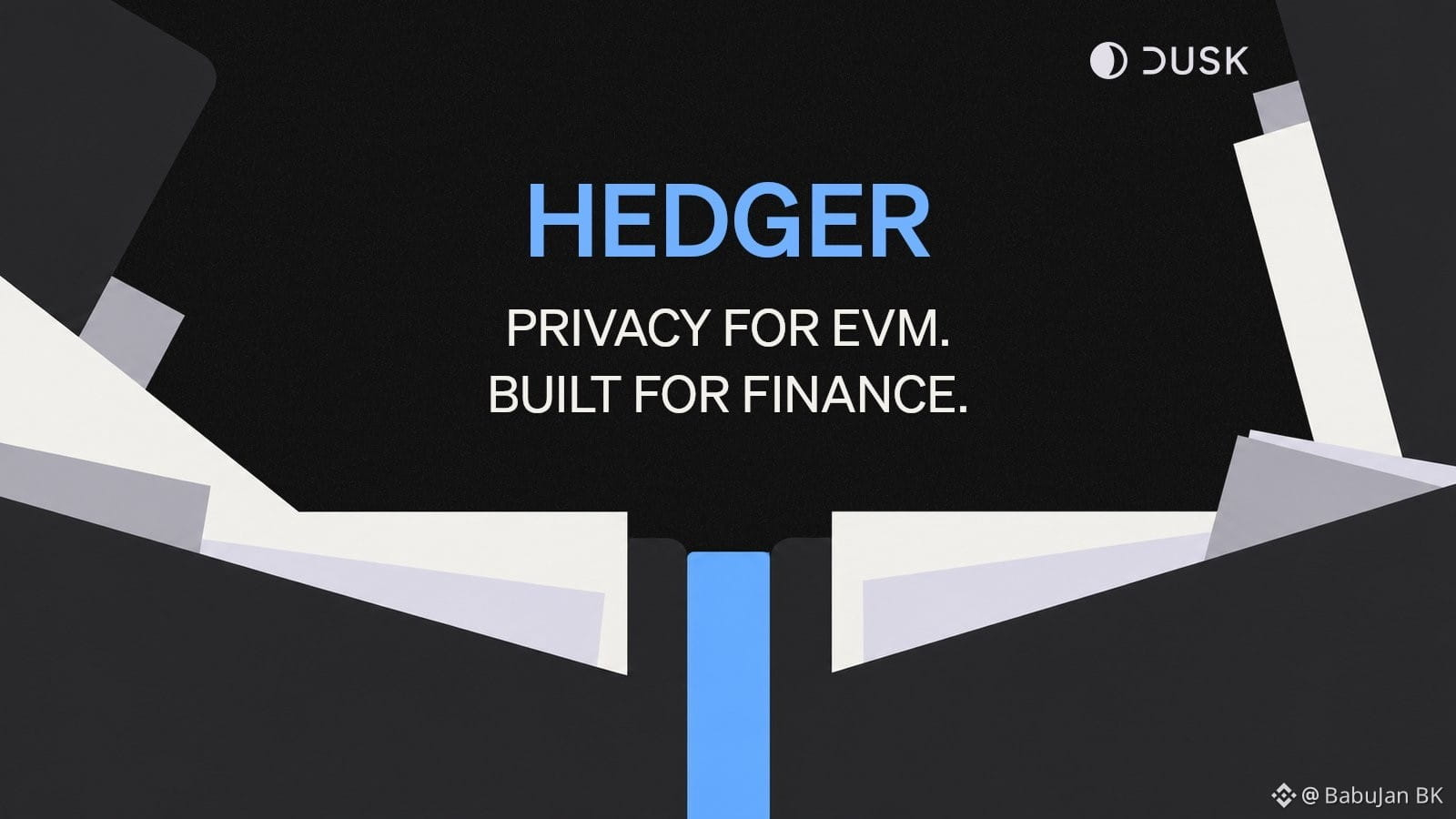
Hedger aims to bring confidential transfers to DuskEVM keeping balances and transfer amounts encrypted while transactions remain verifiable.
Privacy + transparency, without sacrificing verification.
Could this be a major step for private on-chain finance?
What do you think about Hedger
#dusk #DuskEVM #crypto
$DUSK
Privacy meets DeFi!
Moving assets on-chain shouldn’t mean exposing every balance to everyone.
Hedger aims to bring confidential transfers to DuskEVM keeping balances and transfer amounts encrypted while transactions remain verifiable.
Privacy + transparency, without sacrificing verification.
Could this be a major step for private on-chain finance?
What do you think about Hedger
#dusk #DuskEVM #crypto
1
170

·
--
#dusk $DUSK @Dusk_Foundation At first, I treated EVM compatibility like a checkbox.
If a chain supports Solidity, developers can come over. Simple, right?
Then I looked closer at DuskEVM, and that assumption started feeling a little too shallow.
What actually matters is what developers can keep when they move.
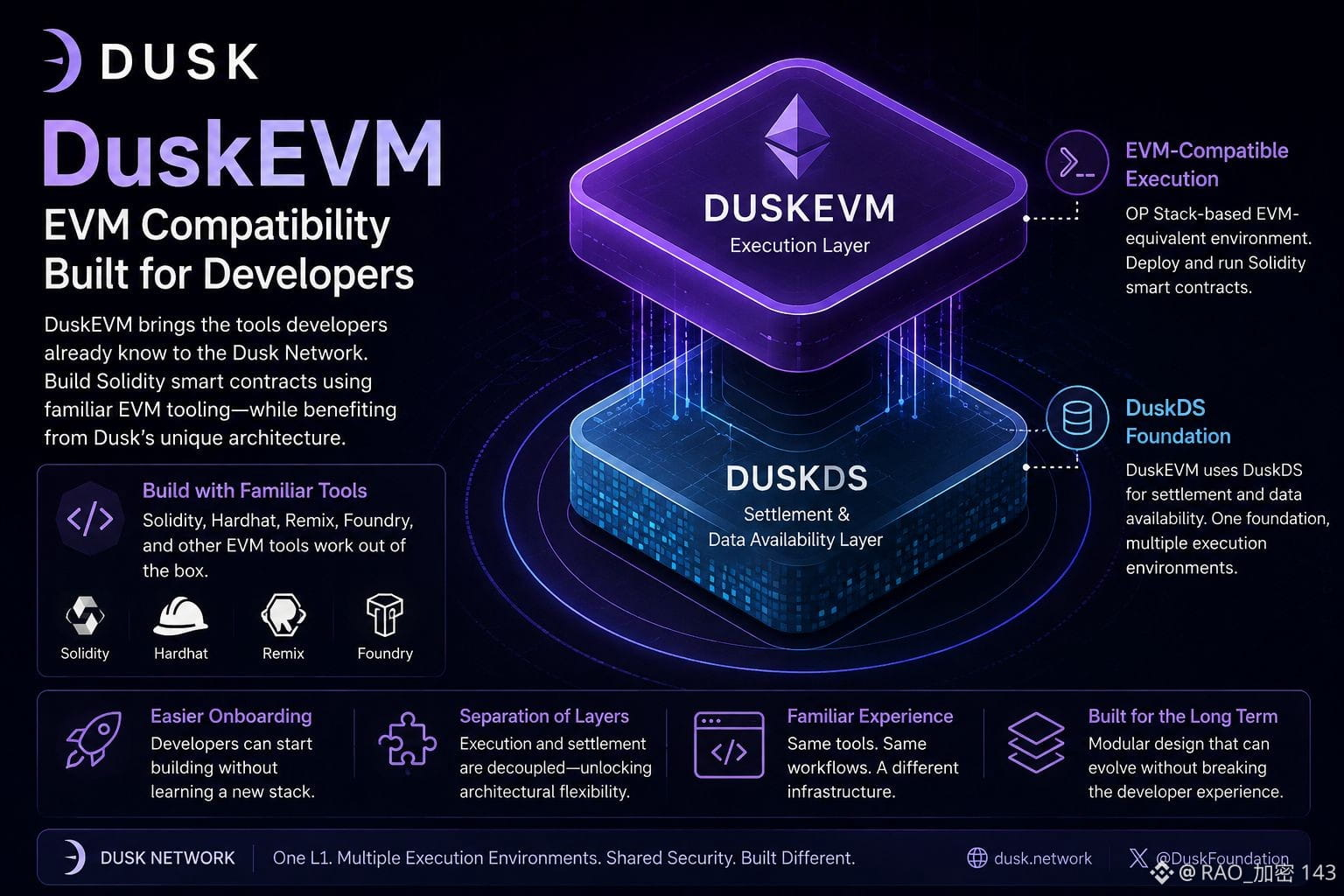
With DuskEVM, developers can work in an EVM-equivalent environment using Solidity and familiar EVM tooling. That means the conversation isn't simply about adding another execution environment. It's about lowering the distance between what developers already know and what Dusk is building.
That part caught my attention.
Because asking a developer to learn an entirely new stack is one thing. Letting them bring familiar smart-contract workflows into a different blockchain architecture is another.
And then there’s DuskDS.
DuskEVM handles execution, while DuskDS provides the settlement and data-availability foundation underneath it. DuskVM is another execution path, running Rust/WASM contracts directly on the Dusk L1.
So I started wondering:
If different execution environments can rely on the same settlement foundation, does that make the overall architecture more flexible?
Maybe.
But I don't think EVM compatibility alone proves anything.
The real test is what happens after developers arrive. Do they actually build? Is the tooling comfortable enough? Do applications benefit from the separation between execution and settlement?
That's what I'm more interested in watching now.
For an emerging Layer 1, is supporting Solidity enough to attract developers, or does the real test begin once people actually start building?
@Dusk_Foundation $DUSK
#Dusk #DuskEVM
#dusk $DUSK @Dusk At first, I treated EVM compatibility like a checkbox.
If a chain supports Solidity, developers can come over. Simple, right?
Then I looked closer at DuskEVM, and that assumption started feeling a little too shallow.
What actually matters is what developers can keep when they move.
With DuskEVM, developers can work in an EVM-equivalent environment using Solidity and familiar EVM tooling. That means the conversation isn't simply about adding another execution environment. It's about lowering the distance between what developers already know and what Dusk is building.
That part caught my attention.
Because asking a developer to learn an entirely new stack is one thing. Letting them bring familiar smart-contract workflows into a different blockchain architecture is another.
And then there’s DuskDS.
DuskEVM handles execution, while DuskDS provides the settlement and data-availability foundation underneath it. DuskVM is another execution path, running Rust/WASM contracts directly on the Dusk L1.
So I started wondering:
If different execution environments can rely on the same settlement foundation, does that make the overall architecture more flexible?
Maybe.
But I don't think EVM compatibility alone proves anything.
The real test is what happens after developers arrive. Do they actually build? Is the tooling comfortable enough? Do applications benefit from the separation between execution and settlement?
That's what I'm more interested in watching now.
For an emerging Layer 1, is supporting Solidity enough to attract developers, or does the real test begin once people actually start building?
@Dusk $DUSK
#Dusk #DuskEVM
15
15
303

#dusk $DUSK @Dusk_Foundation
Dusk’s Modular Stack: Three Layers, One Purpose
What if blockchain architecture treated settlement and execution as separate jobs?
@Dusk_Foundation is taking that approach with a modular design built around three components:
1. DuskDS — the settlement foundation
It handles consensus, finality, data availability, and Dusk’s native transaction models, including Moonlight for public transfers and Phoenix for shielded transfers.
2. DuskEVM — the EVM path
Developers can use Solidity and familiar Ethereum tooling while applications settle through DuskDS. This makes the environment more accessible for EVM-based DeFi and tokenized-asset applications.
3. DuskVM — direct L1 execution
DuskVM runs Rust/WASM smart contracts directly on Dusk L1, making it suited to applications that need deeper access to Dusk’s transaction models, privacy, or zero-knowledge capabilities.
The interesting part is the separation itself: different applications can choose the execution environment they need without replacing the underlying settlement layer.
For $DUSK , this creates a foundation where EVM compatibility, direct L1 execution, privacy, and deterministic settlement can work within the same broader architecture.
#DUSK #DuskEVM #DuskVM
Poll: 🏗️ What part of Dusk’s modular architecture interests you most?
#dusk $DUSK @Dusk
Dusk’s Modular Stack: Three Layers, One Purpose
What if blockchain architecture treated settlement and execution as separate jobs?
@Dusk is taking that approach with a modular design built around three components:
1. DuskDS — the settlement foundation
It handles consensus, finality, data availability, and Dusk’s native transaction models, including Moonlight for public transfers and Phoenix for shielded transfers.
2. DuskEVM — the EVM path
Developers can use Solidity and familiar Ethereum tooling while applications settle through DuskDS. This makes the environment more accessible for EVM-based DeFi and tokenized-asset applications.
3. DuskVM — direct L1 execution
DuskVM runs Rust/WASM smart contracts directly on Dusk L1, making it suited to applications that need deeper access to Dusk’s transaction models, privacy, or zero-knowledge capabilities.
The interesting part is the separation itself: different applications can choose the execution environment they need without replacing the underlying settlement layer.
For $DUSK , this creates a foundation where EVM compatibility, direct L1 execution, privacy, and deterministic settlement can work within the same broader architecture.
#DUSK #DuskEVM #DuskVM
Poll: 🏗️ What part of Dusk’s modular architecture interests you most?
🔹 DuskDS — Settlement
0%
🔹 DuskEVM — EVM compatibility
100%
🔹 DuskVM — Native execution
0%
🔹 🔐 Privacy & compliance
0%
1 проголосовали • Голосование закрыто
1
2
92
·
--
Рост
Проверено
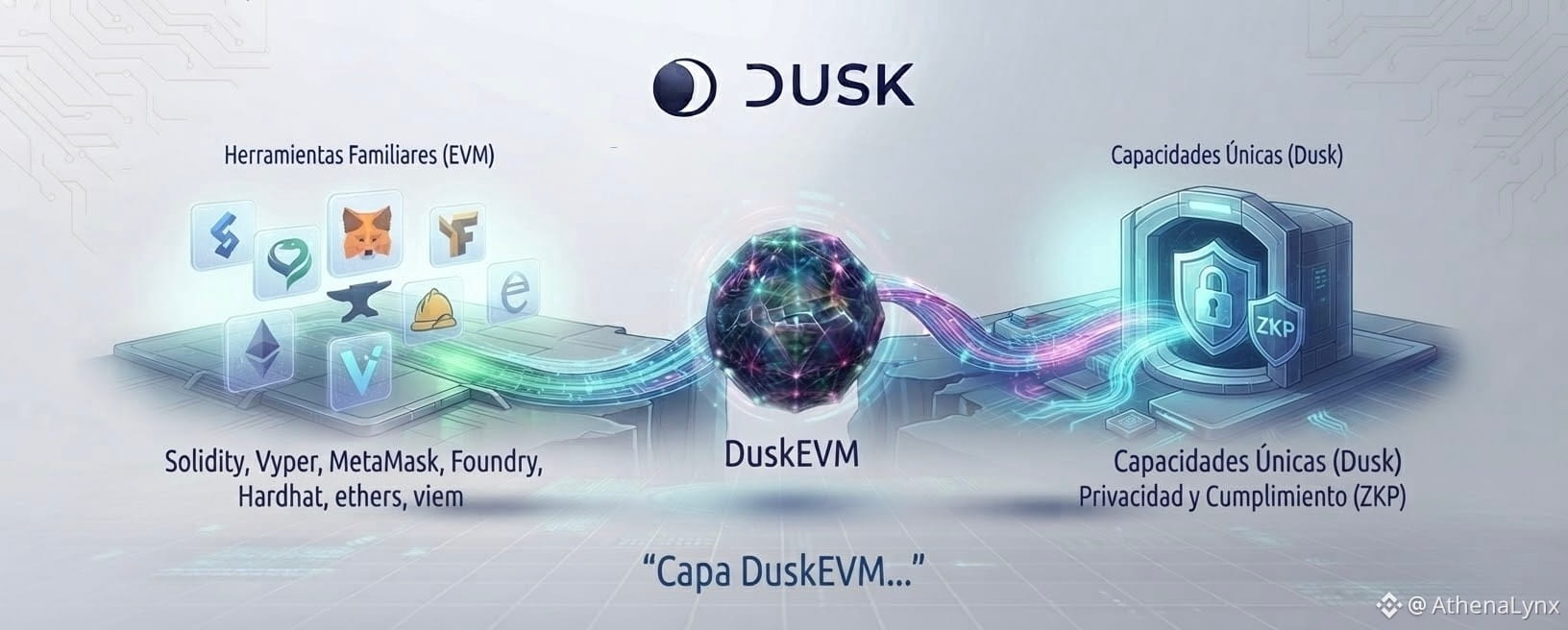
Después de hablarles sobre la adopción de @Dusk_Foundation 🌒, también me parece interesante contarles un poco más sobre el proyecto, porque Dusk no está construyendo únicamente una infraestructura para mercados financieros regulados. Su proyecto es mucho mas amplio y abarca diferentes capas.
En esta oportunidad quiero hablarles de DuskEVM, el entorno de programación de Dusk compatible con EVM de Ethereum. Está pensado para desarrolladores, aplicaciones y usuarios, permitiéndole a un desarrollador que ya trabaja con herramientas del ecosistema EVM, como Solidity, Vyper, MetaMask, Foundry, etc., puede aprovechar los conocimientos y herramientas que ya conoce para desarrollar aplicaciones sobre Dusk, sin tener que aprender todo desde cero.
Es importante tener en cuenta que DuskEVM no es Ethereum, sino el entorno de Dusk que busca ser compatible con el ecosistema EVM dentro de su propia blockchain, aprovechando así sus capacidades de privacidad y cumplimiento.
Para mí, facilitarle el camino al desarrollador es una estrategia inteligente y acertada, porque esto también puede facilitar el camino hacia la adopción de Dusk, el minimizar las brechas tecnológicas, puede ser clave para que proyectos del ecosistema EVM puedan explorar las capacidades que ofrece $DUSK .
#dusk #DuskEVM #Ethereum
Después de hablarles sobre la adopción de @Dusk 🌒, también me parece interesante contarles un poco más sobre el proyecto, porque Dusk no está construyendo únicamente una infraestructura para mercados financieros regulados. Su proyecto es mucho mas amplio y abarca diferentes capas.
En esta oportunidad quiero hablarles de DuskEVM, el entorno de programación de Dusk compatible con EVM de Ethereum. Está pensado para desarrolladores, aplicaciones y usuarios, permitiéndole a un desarrollador que ya trabaja con herramientas del ecosistema EVM, como Solidity, Vyper, MetaMask, Foundry, etc., puede aprovechar los conocimientos y herramientas que ya conoce para desarrollar aplicaciones sobre Dusk, sin tener que aprender todo desde cero.
Es importante tener en cuenta que DuskEVM no es Ethereum, sino el entorno de Dusk que busca ser compatible con el ecosistema EVM dentro de su propia blockchain, aprovechando así sus capacidades de privacidad y cumplimiento.
Para mí, facilitarle el camino al desarrollador es una estrategia inteligente y acertada, porque esto también puede facilitar el camino hacia la adopción de Dusk, el minimizar las brechas tecnológicas, puede ser clave para que proyectos del ecosistema EVM puedan explorar las capacidades que ofrece $DUSK .
#dusk #DuskEVM #Ethereum
2
789

·
--
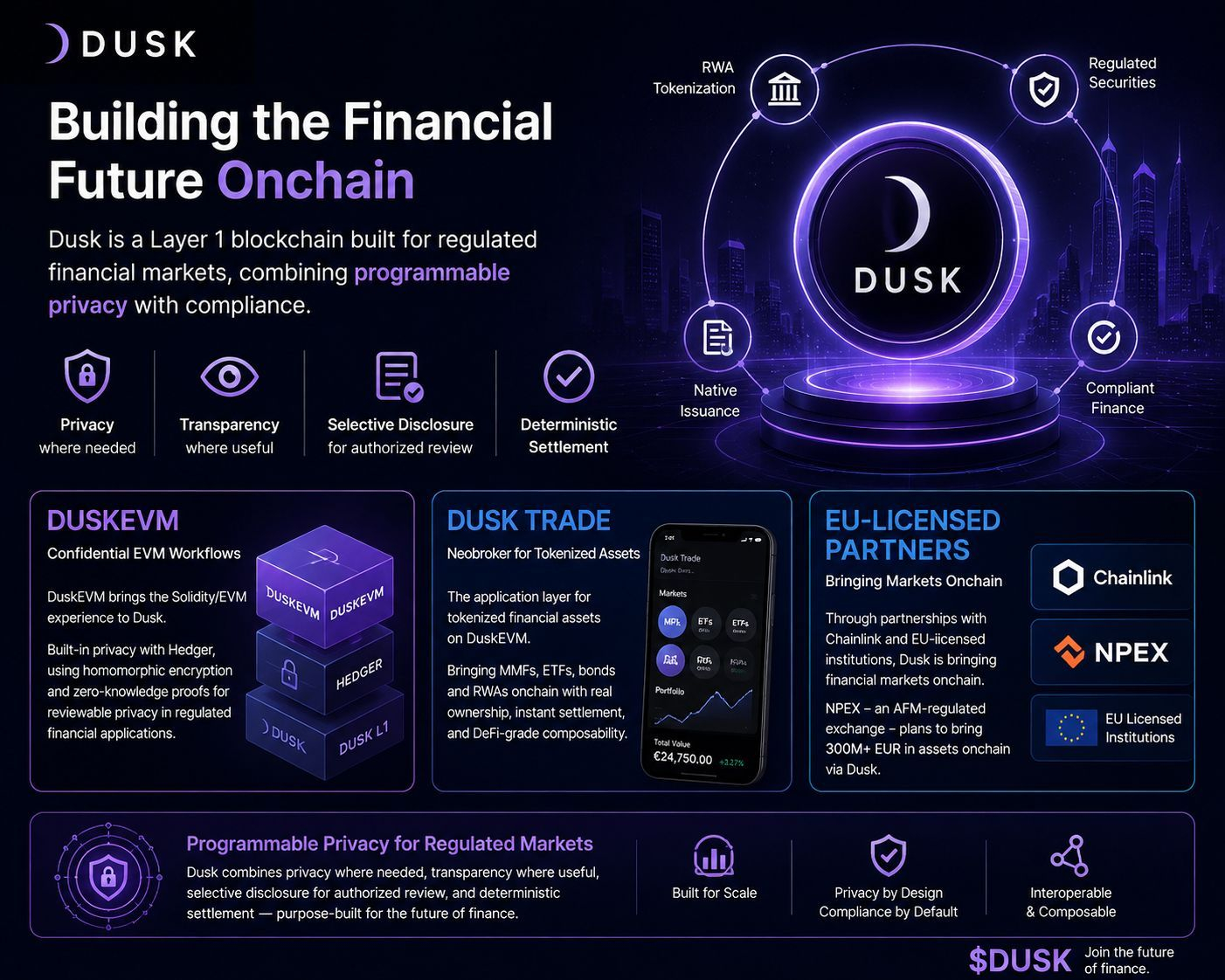
DUSK MAKES PRIVACY PROGRAMMABLE — EVM MEETS CONFIDENTIALITY 🔐
The DuskEVM mainnet marks a strategic inflection point that most retail charts won't even register. Rather than forcing builders to learn an entirely new stack, Dusk grafts the familiar Solidity/EVM environment onto its own sophisticated architecture, creating a bridge between developer accessibility and institutional-grade confidentiality.
The real institutional footprint sits inside Hedger — a layer that combines homomorphic encryption with zero-knowledge proofs to deliver programmable privacy. Financial data stays shielded when needed, yet auditable by authorized parties. That isn't just a feature set; that's a compliance-ready settlement layer for regulated markets.
Privacy, transparency, and finality rarely coexist in one venue. Dusk positions itself at that rare intersection. Can the market price in infrastructure that solves both compliance and confidentiality at once? 🧠
⚠️ Not financial advice. Always manage your risk. 🛡️
🏷️ $DUSK #DuskEVM #ZeroKnowledge #CryptoInfrastructure #PrivacyTech
🔑📊
2
2
21

·
--
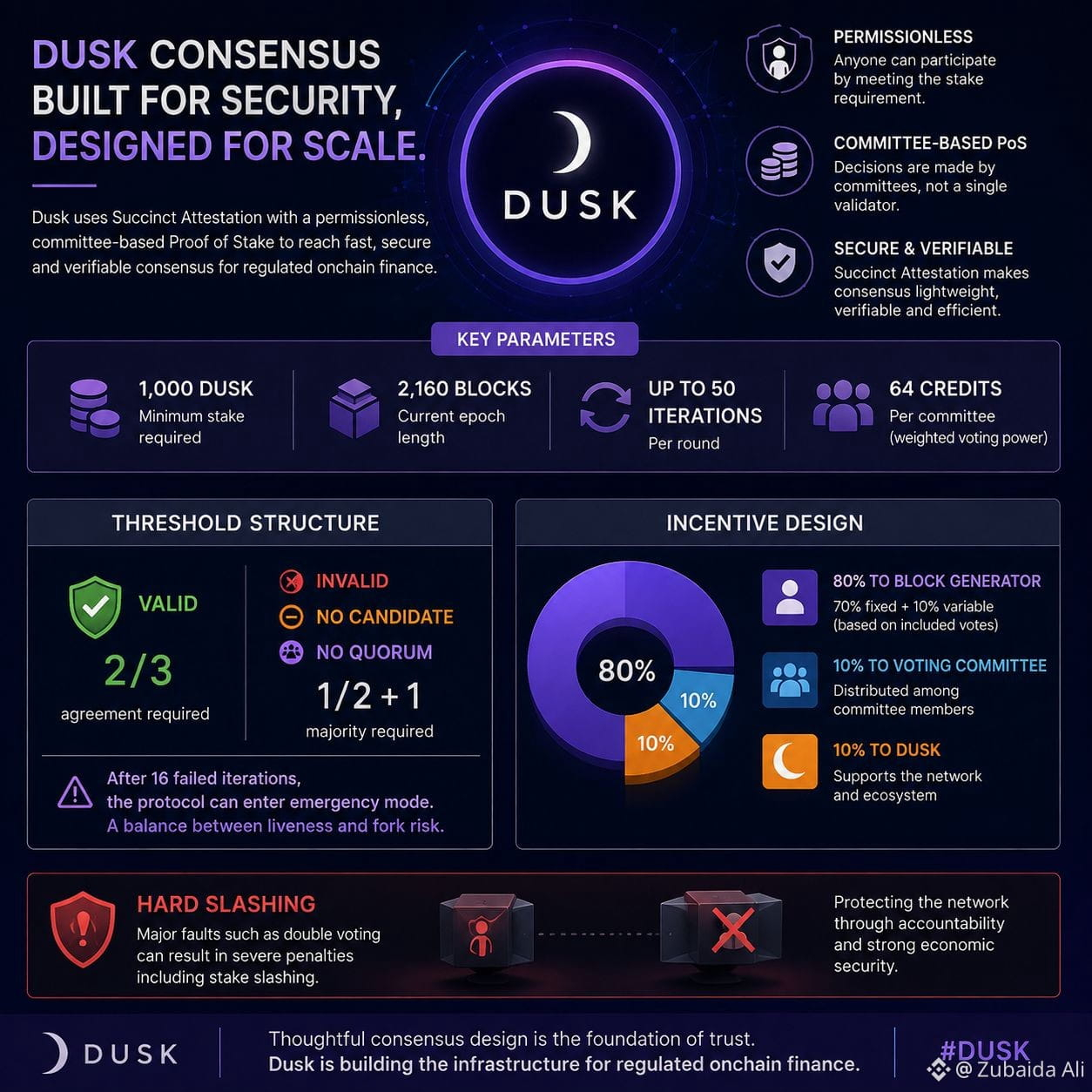
#dusk $DUSK @Dusk_Foundation Spent some time digging deeper into Dusk’s consensus model, and this part genuinely stood out to me.
Instead of relying on a basic one-validator-one-vote approach, Dusk combines Succinct Attestation with a permissionless Proof of Stake committee system. Stake, voting credits, iteration limits, and different agreement thresholds all play a role in how consensus is reached.
The part I find especially interesting is how the network handles both normal agreement and difficult situations. A 2/3 threshold is required for Valid, while other outcomes can reach a 1/2 + 1 majority. If consensus keeps failing, the protocol can move toward an emergency mode.
Then there’s the incentive side: rewards are split between the block generator, voting committee, and Dusk itself, while serious behavior like double voting can lead to hard slashing.
It’s a reminder that building infrastructure for regulated onchain finance isn’t only about tokenization—the underlying consensus design matters just as much.
#tokenizations #DuskEVM #Crypto
#dusk $DUSK @Dusk_Foundation
#dusk $DUSK @Dusk Spent some time digging deeper into Dusk’s consensus model, and this part genuinely stood out to me.
Instead of relying on a basic one-validator-one-vote approach, Dusk combines Succinct Attestation with a permissionless Proof of Stake committee system. Stake, voting credits, iteration limits, and different agreement thresholds all play a role in how consensus is reached.
The part I find especially interesting is how the network handles both normal agreement and difficult situations. A 2/3 threshold is required for Valid, while other outcomes can reach a 1/2 + 1 majority. If consensus keeps failing, the protocol can move toward an emergency mode.
Then there’s the incentive side: rewards are split between the block generator, voting committee, and Dusk itself, while serious behavior like double voting can lead to hard slashing.
It’s a reminder that building infrastructure for regulated onchain finance isn’t only about tokenization—the underlying consensus design matters just as much.
#tokenizations #DuskEVM #Crypto
#dusk $DUSK @Dusk
82
Проверено
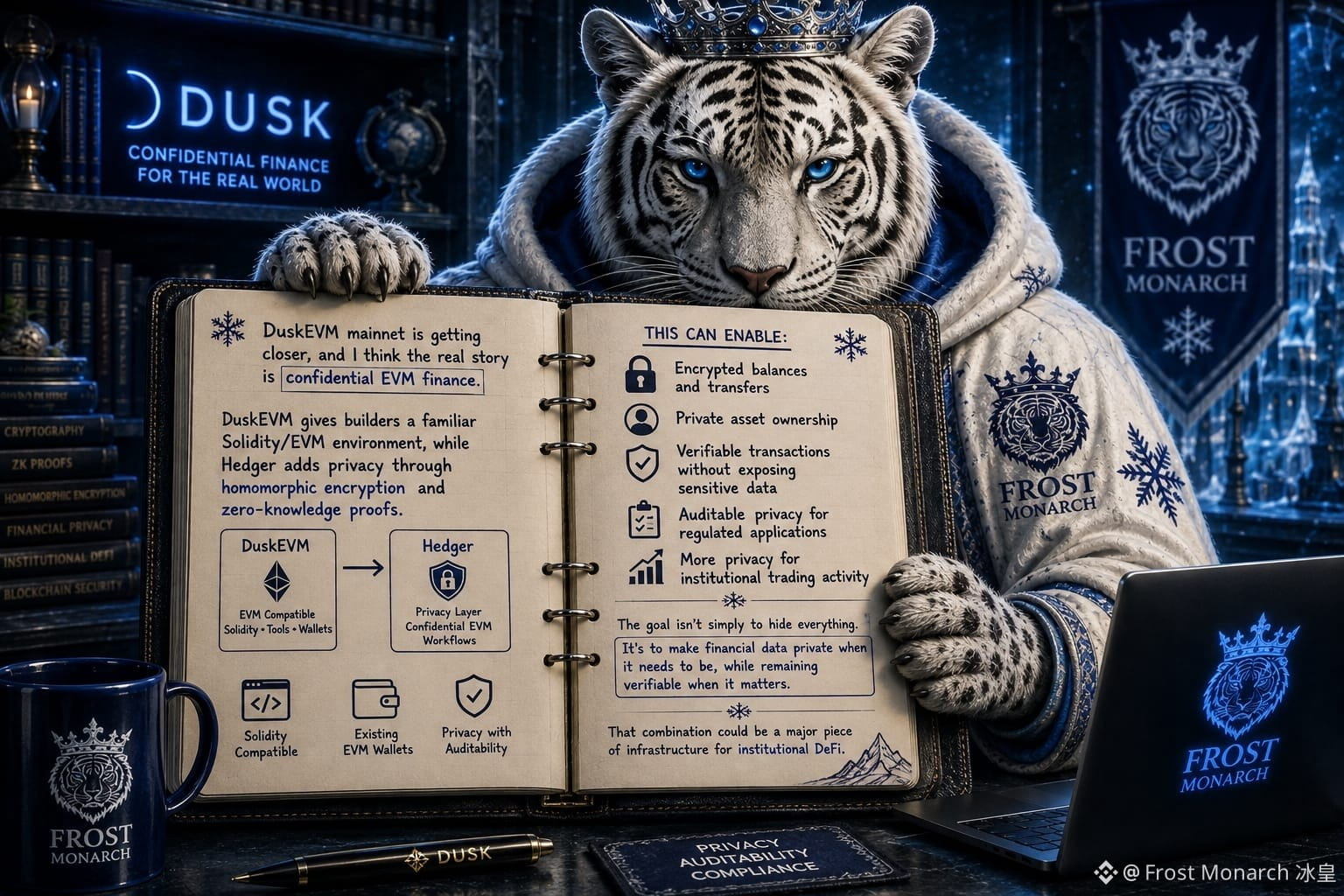
I’ve been watching DuskEVM closely, and I think the real story is confidential EVM finance.
DuskEVM gives builders a familiar Solidity/EVM environment, while Hedger adds privacy through homomorphic encryption and zero-knowledge proofs.
What I find interesting is what this could enable:
→ Encrypted balances and transfers
→ Private asset ownership
→ Verifiable transactions without exposing sensitive data
→ Auditable privacy for regulated applications
→ More privacy for institutional trading activity
I don’t think the goal is simply to hide everything.
The bigger idea is making financial data private when it needs to be, while remaining verifiable when it matters.
To me, that combination could become a major piece of infrastructure for institutional DeFi.
#DuskEVM #dusk $DUSK @Dusk_Foundation
{future}(DUSKUSDT)
I’ve been watching DuskEVM closely, and I think the real story is confidential EVM finance.
DuskEVM gives builders a familiar Solidity/EVM environment, while Hedger adds privacy through homomorphic encryption and zero-knowledge proofs.
What I find interesting is what this could enable:
→ Encrypted balances and transfers
→ Private asset ownership
→ Verifiable transactions without exposing sensitive data
→ Auditable privacy for regulated applications
→ More privacy for institutional trading activity
I don’t think the goal is simply to hide everything.
The bigger idea is making financial data private when it needs to be, while remaining verifiable when it matters.
To me, that combination could become a major piece of infrastructure for institutional DeFi.
#DuskEVM #dusk $DUSK @Dusk
23
2
10
262
·
--
عندما رأيت خريطة طريق DuskEVM mainnet ترددت لثلاث ثوانٍ: طبقة توافق EVM لـ L1 مصممة للتمويل المتوافقعندما رأيت خريطة طريق #DuskEVM mainnet ترددت لثلاث ثوانٍ: طبقة توافق EVM لـ L1 مصممة للتمويل المتوافق مع اللوائح، ومزودة أيضًا بوحدة خصوصية Hedger. تستخدم تشفيرًا متماثلًا وإثباتات معرفة صفرية لحل عقدة: «يجب أن يتمكن المنظم من التحقق، لكن المستخدم لا يريد الكشف عن كل شيء». هذه ليست مجرد إضافة جسر zk ثم الانتهاء؛ بل تصميم «الإفصاح الانتقائي» و«التسوية الحتمية» من مستوى الإجماع. $DUSK
في العام الماضي شاركت في محادثات مع مشروعين في RWA. في أوروبا، ما تخشاه المؤسسات المرخصة ليس أن التقنية غير كافية، بل أن دفتر الحسابات على السلسلة لا يمكن تدقيقه من قِبل المنظم، وفي الوقت نفسه يرفض المستخدمون رفضًا قاطعًا «التشغيل العاري». سلاسل الكتل التقليدية لا تحل هذا الأمر؛ فرق RWA على السلسلة مضطرة لإضافة حزمة امتثال كمكوّن خارجي، فتتضاعف تكلفة التشغيل مباشرةً. إذا نجحت مسار Dusk، فهذا يعني تحويل «الخصوصية القابلة للتدقيق» إلى بدائية ضمن L1، بحيث لا يضطر كل مشروع لإعادة بنائها من الصفر.
والأمر اللافت أن مسار DuskEVM يتطابق مع خط NPEX (AFM مرخصة كـ MTF مع Broker وECSP)، إذ لديهم نية لإدخال أصول بقيمة 300 مليون+ يورو على السلسلة. المؤسسات مستعدة لمد يدها، ولا يكفي الاعتماد على الورقة البيضاء فقط؛ يجب أن تكون هناك أدوات خصوص على مستوى L1 كضمان. مكوّن Hedger هو المفتاح الذي يحدد للمنظم: «انظر هنا، وتحقق هناك، وهذه الأجزاء تُحفظ».
لم تظهر فعليًا مسارات L1 باتجاه الامتثال على نحو حقيقي من قبل؛ Dusk يبدو أنه ينجز ثلاث مهام في وقت واحد: توافق EVM، وخصوصية قابلة للبرمجة، وربط مؤسسات مرخصة. خط السرد $DUSK لا يعتمد على الصراخ: «ستأتي المؤسسات» فحسب؛ بل لأنه فعلاً توجد أذونات تنظيمية قيد التشغيل.ية#Write2Earn
عندما رأيت خريطة طريق DuskEVM mainnet ترددت لثلاث ثوانٍ: طبقة توافق EVM لـ L1 مصممة للتمويل المتوافق
عندما رأيت خريطة طريق #DuskEVM mainnet ترددت لثلاث ثوانٍ: طبقة توافق EVM لـ L1 مصممة للتمويل المتوافق مع اللوائح، ومزودة أيضًا بوحدة خصوصية Hedger. تستخدم تشفيرًا متماثلًا وإثباتات معرفة صفرية لحل عقدة: «يجب أن يتمكن المنظم من التحقق، لكن المستخدم لا يريد الكشف عن كل شيء». هذه ليست مجرد إضافة جسر zk ثم الانتهاء؛ بل تصميم «الإفصاح الانتقائي» و«التسوية الحتمية» من مستوى الإجماع. $DUSK
في العام الماضي شاركت في محادثات مع مشروعين في RWA. في أوروبا، ما تخشاه المؤسسات المرخصة ليس أن التقنية غير كافية، بل أن دفتر الحسابات على السلسلة لا يمكن تدقيقه من قِبل المنظم، وفي الوقت نفسه يرفض المستخدمون رفضًا قاطعًا «التشغيل العاري». سلاسل الكتل التقليدية لا تحل هذا الأمر؛ فرق RWA على السلسلة مضطرة لإضافة حزمة امتثال كمكوّن خارجي، فتتضاعف تكلفة التشغيل مباشرةً. إذا نجحت مسار Dusk، فهذا يعني تحويل «الخصوصية القابلة للتدقيق» إلى بدائية ضمن L1، بحيث لا يضطر كل مشروع لإعادة بنائها من الصفر.
والأمر اللافت أن مسار DuskEVM يتطابق مع خط NPEX (AFM مرخصة كـ MTF مع Broker وECSP)، إذ لديهم نية لإدخال أصول بقيمة 300 مليون+ يورو على السلسلة. المؤسسات مستعدة لمد يدها، ولا يكفي الاعتماد على الورقة البيضاء فقط؛ يجب أن تكون هناك أدوات خصوص على مستوى L1 كضمان. مكوّن Hedger هو المفتاح الذي يحدد للمنظم: «انظر هنا، وتحقق هناك، وهذه الأجزاء تُحفظ».
لم تظهر فعليًا مسارات L1 باتجاه الامتثال على نحو حقيقي من قبل؛ Dusk يبدو أنه ينجز ثلاث مهام في وقت واحد: توافق EVM، وخصوصية قابلة للبرمجة، وربط مؤسسات مرخصة. خط السرد $DUSK لا يعتمد على الصراخ: «ستأتي المؤسسات» فحسب؛ بل لأنه فعلاً توجد أذونات تنظيمية قيد التشغيل.ية#Write2Earn
107

·
--
Проверено
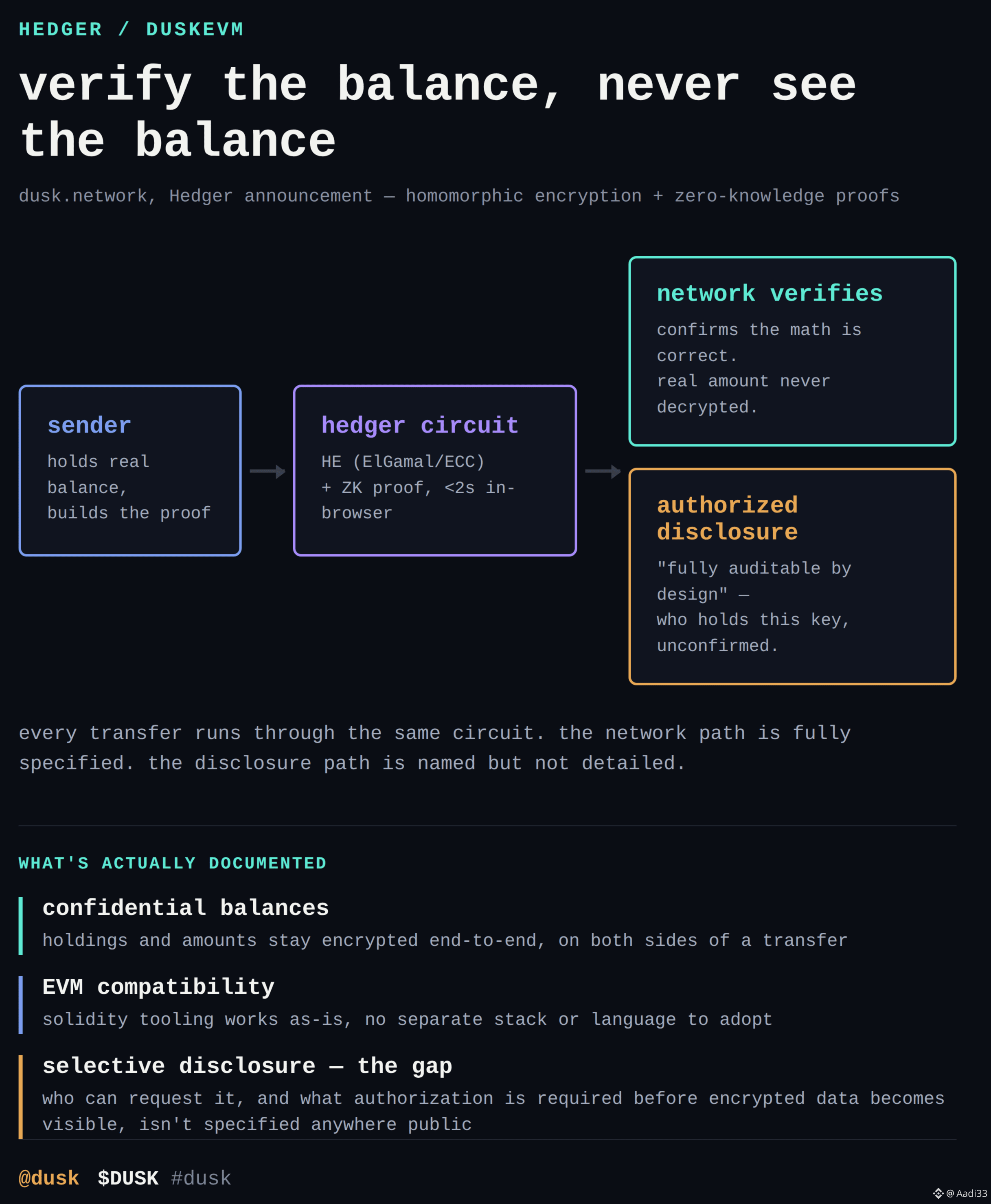
Your bank has never seen your balance. it still knows every check you write is good. It looks strange and Sounds impossible!
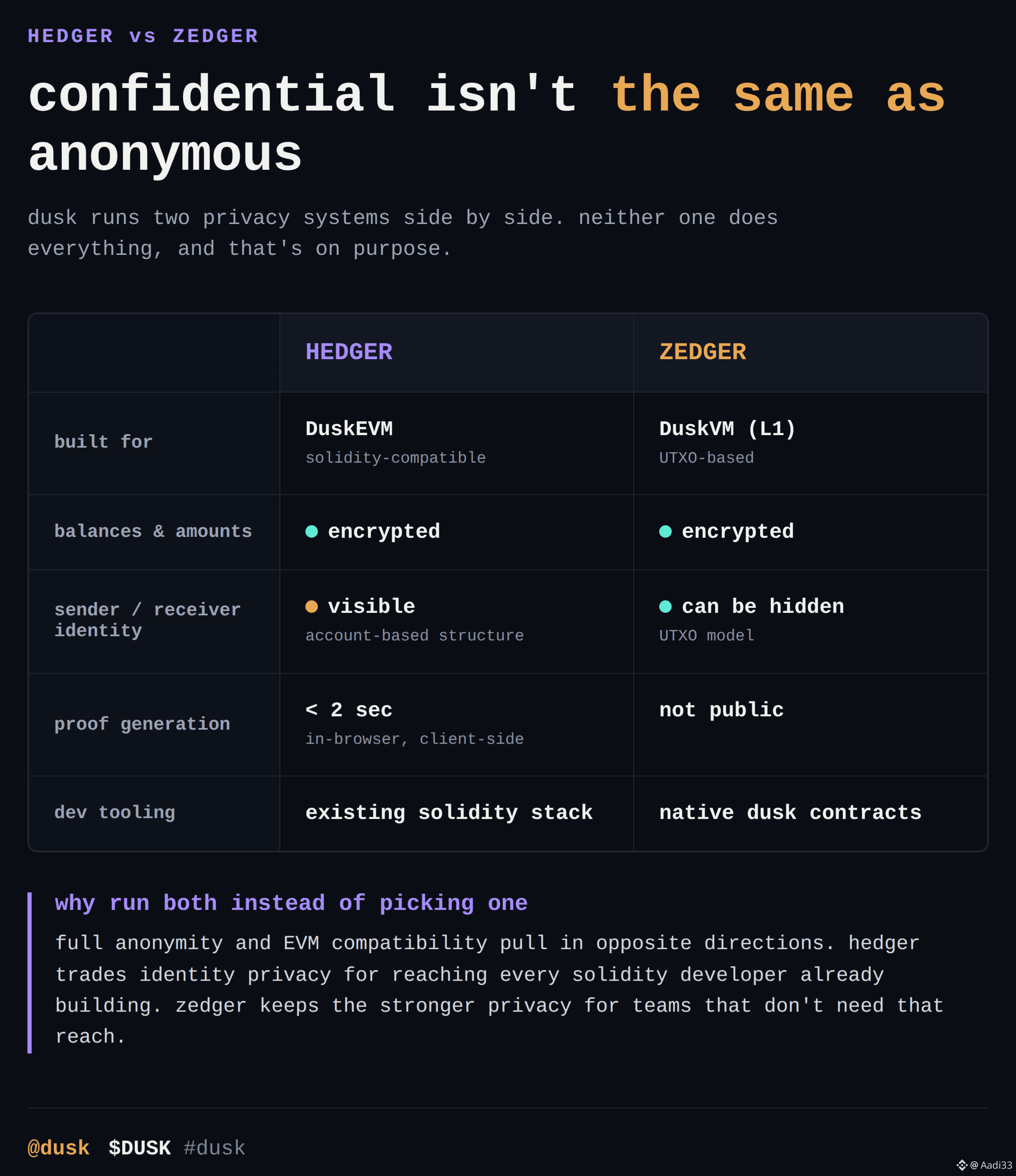
That's basically what @Dusk_Foundation is doing with hedger. it combines homomorphic encryption with zero-knowledge proofs, encrypting holdings and transaction amounts while still letting the network verify everything's correct without exposing the undErlying values and it does it in under two seconds without leaving your browser. because duskevm is EVM-compatible, it works with the solidity tooling developers already know.
the interesting part is what it doesn't try to do. zedger was built around a UTXO model and can offer stronger anonymity, while hedger is designed for the EVM environment and focuses on confidential transactions and balances rather than full anonymity.
i'm not saying that's a flaw. it's the tradeoff for bringing privacy into an EVM environment instead of asking developers to move to a completely different stack.
dusk also says hedger is fully auditable by design and supports selective disclosure when regulated participants need evidence. what's still worth digging into is how that disclosure actually works, who can request it and what authorization is required bef0re encrypted data becomes visible.
that's where "private but auditable" becomes more than a slogan.
@Dusk_Foundation $DUSK #dusk
#DuskEVM
Your bank has never seen your balance. it still knows every check you write is good. It looks strange and Sounds impossible!
That's basically what @Dusk is doing with hedger. it combines homomorphic encryption with zero-knowledge proofs, encrypting holdings and transaction amounts while still letting the network verify everything's correct without exposing the undErlying values and it does it in under two seconds without leaving your browser. because duskevm is EVM-compatible, it works with the solidity tooling developers already know.
the interesting part is what it doesn't try to do. zedger was built around a UTXO model and can offer stronger anonymity, while hedger is designed for the EVM environment and focuses on confidential transactions and balances rather than full anonymity.
i'm not saying that's a flaw. it's the tradeoff for bringing privacy into an EVM environment instead of asking developers to move to a completely different stack.
dusk also says hedger is fully auditable by design and supports selective disclosure when regulated participants need evidence. what's still worth digging into is how that disclosure actually works, who can request it and what authorization is required bef0re encrypted data becomes visible.
that's where "private but auditable" becomes more than a slogan.
@Dusk $DUSK #dusk
#DuskEVM
26
1
17
227

·
--
Частичная правда
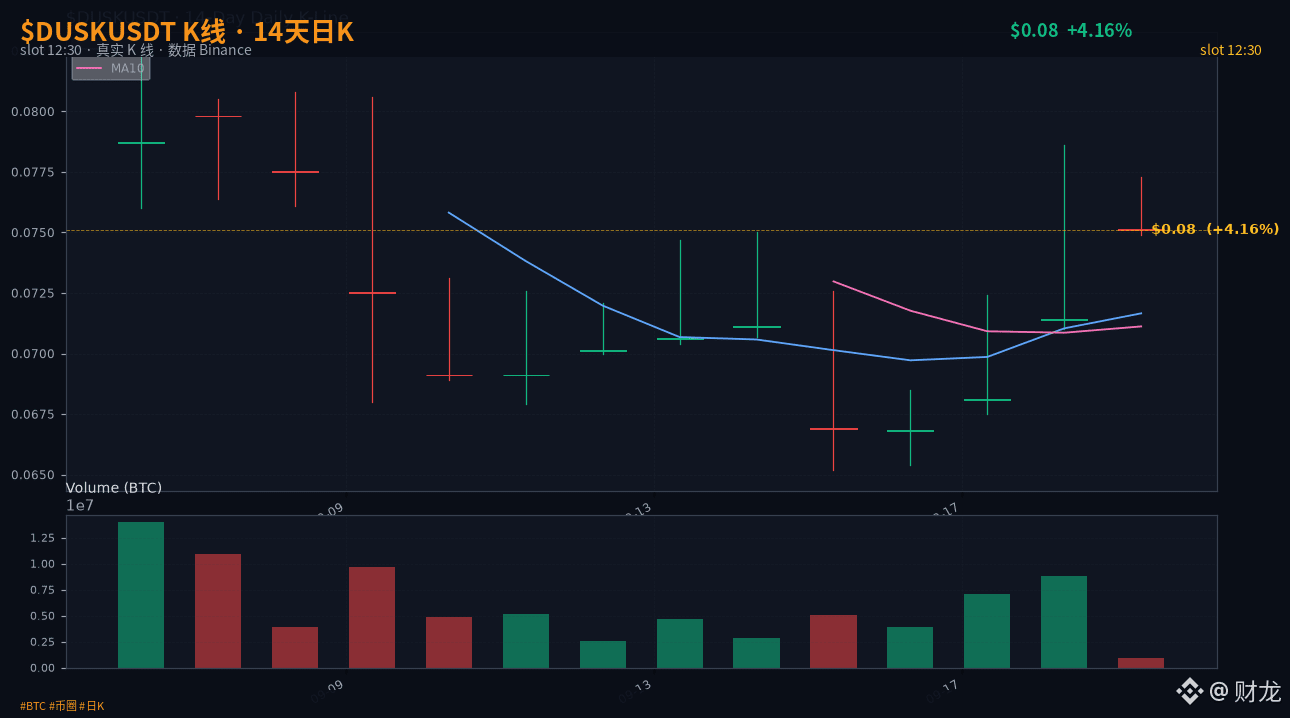
$DUSK 24 小时涨了 4.16%,报 0.08 美元一线磨。但昨天 @DuskFoundation 把这条链的 EVM 端和代币那条线明着接上去了,这是上线以来官方第一次把「应用跑起来」和「代币被用」写在同一句话里。
之前五周多,这条链讲的都是兼容 Solidity 工具栈、隐私层在 EVM 里改按需隐私、Chain ID 744 主网已经在线、Foundry 那套开发框架直接对齐主网接口,全是「能跑」的维度。但能跑不等于有活儿,活儿进不到代币那头,链上动作和代币就是两张皮。
9-18 这条帖子不一样,@Dusk 直接点名:代币付合约部署、付用户交易、付网络费、付质押,链上每多一个应用跑起来,代币那头就多一份需求。一边把 8 月那张长文里的产品收入路径(Dusk Trade 收手续费、买回、烧、应用层分配)摊开,一边把开发者门槛这件事从「能不能写」推进到「写完部署一次到底要烧多少代币」。
对 Solidity 开发者来说,这条链最值钱的不是 EVM 兼容,这条路上竞争太密。值钱的是隐私层在合约层给你按需加的那道隐私盾:订单簿可混淆,余额可屏蔽,所有权可密,但监管那头该看的接口按需开。不用自己写零知识电路,直接调用就行。配合 8 月就开始讲的应用层上 €300M 资产池、9 月把跨链数据栈接进来,这条链上的应用不是在「做 DeFi demo」,而是在「做合规金融基础设施」,两件事的市场天花板差一个数量级。
官方的逻辑链第一次讲透了:开发者进来 → 合约部署消耗代币 → 链上交易活跃 → 交易费持续吃掉代币 → 产品端(交易平台 / 身份层 / 隐私层)产生收入 → 收入反哺代币端。这是 Dusk 这条链上线以来第一次,「代币值不值得拿」这个问题官方给了完整的答案。
值得看的就一个问题:下一个在主网部署合约的项目,会是什么行业的?#dusk #DuskEVM #代币用在哪
1
1
475

·
--
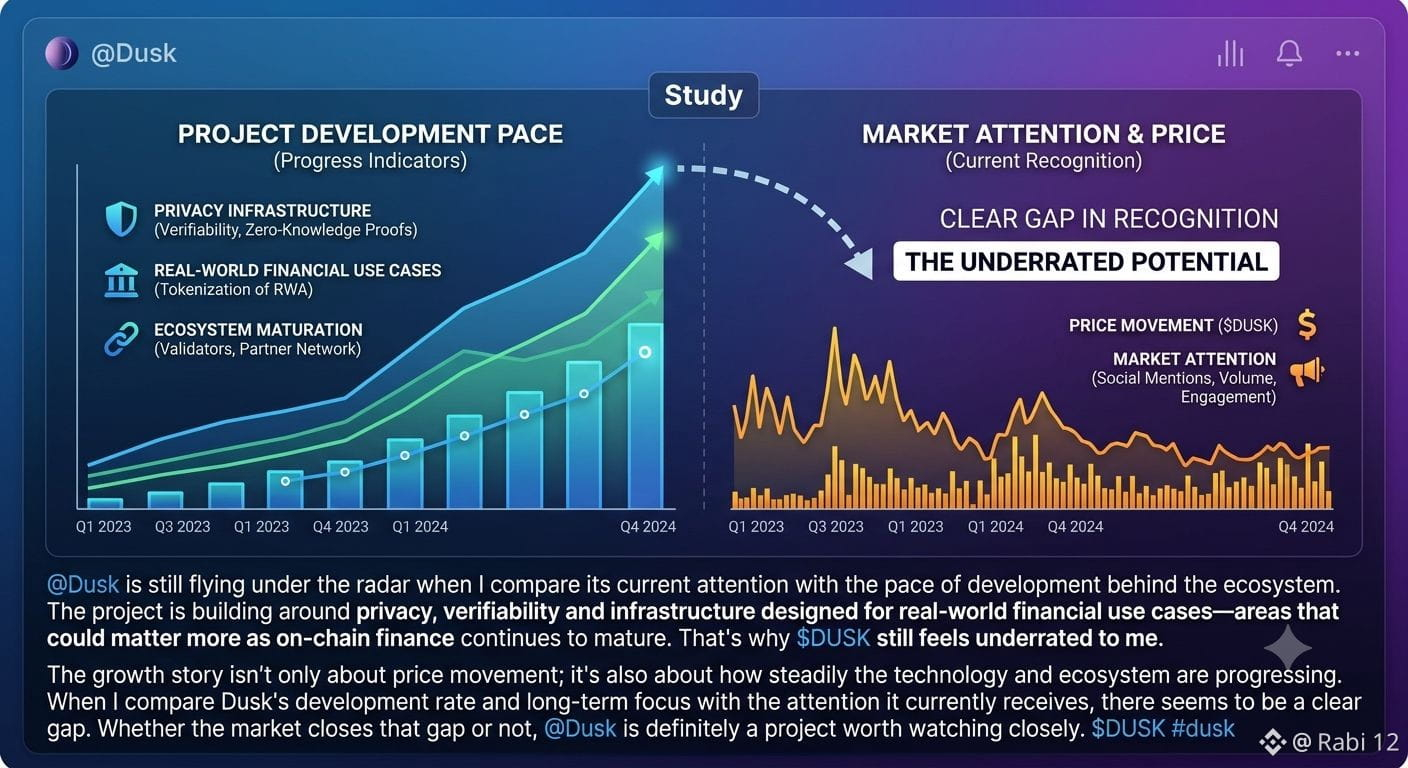
#dusk $DUSK @Dusk_Foundation is still flying under the radar when I compare its current attention with the pace of development behind the ecosystem. The project is building around privacy, verifiability and infrastructure designed for real-world financial use cases—areas that could matter more as on-chain finance continues to mature.
That’s why $DUSK still feels underrated to me. The growth story isn’t only about price movement; it’s also about how steadily the technology and ecosystem are progressing. When I compare Dusk’s development rate and long-term focus with the attention it currently receives, there seems to be a clear gap. Whether the market closes that gap or not, @Dusk is definitely a project worth watching closely. $DUSK #DuskEVM #Web3 #RWA
#dusk $DUSK @Dusk is still flying under the radar when I compare its current attention with the pace of development behind the ecosystem. The project is building around privacy, verifiability and infrastructure designed for real-world financial use cases—areas that could matter more as on-chain finance continues to mature.
That’s why $DUSK still feels underrated to me. The growth story isn’t only about price movement; it’s also about how steadily the technology and ecosystem are progressing. When I compare Dusk’s development rate and long-term focus with the attention it currently receives, there seems to be a clear gap. Whether the market closes that gap or not, @Dusk is definitely a project worth watching closely. $DUSK #DuskEVM #Web3 #RWA
That’s why $DUSK still feels underrated to me. The growth story isn’t only about price movement; it’s also about how steadily the technology and ecosystem are progressing. When I compare Dusk’s development rate and long-term focus with the attention it currently receives, there seems to be a clear gap. Whether the market closes that gap or not, @Dusk is definitely a project worth watching closely. $DUSK #DuskEVM #Web3 #RWA
96

#dusk $DUSK @Dusk_Foundation They didn't refactor. They demolished.
The Dusk intern said NO to V1.0 and brought the wrecking ball.
Old design? Gone.
Old code? Gone.
Old limits? Also gone.
In its place: THEDUSKINTERN.COM 🌙
A whole new skyscraper built for builders.
Inside: #DuskEVM tools, TDI drops, and $TDI.
Built on #Dusk. By an Intern.
Caution: Intern at Work.
This is what shipping fast in Web 3 looks like.
Break things. Build bigger. Launch experiments.
Privacy + Compliance + EVM = The new era starts here.
@Dusk_Foundation Foundation $DUSK #RWA #dusk
#dusk $DUSK @Dusk They didn't refactor. They demolished.
The Dusk intern said NO to V1.0 and brought the wrecking ball.
Old design? Gone.
Old code? Gone.
Old limits? Also gone.
In its place: THEDUSKINTERN.COM 🌙
A whole new skyscraper built for builders.
Inside: #DuskEVM tools, TDI drops, and $TDI.
Built on #Dusk. By an Intern.
Caution: Intern at Work.
This is what shipping fast in Web 3 looks like.
Break things. Build bigger. Launch experiments.
Privacy + Compliance + EVM = The new era starts here.
@Dusk Foundation $DUSK #RWA #dusk
64

Проверено
I added a small $DUSK position today, but I’m watching DuskEVM differently now.
What caught me wasn’t just EVM compatibility—it’s how Hedger makes private transactions reviewable using homomorphic encryption and ZK proofs. I used to see privacy as a user feature; now I see it as an adoption mechanism for regulated apps.
@Dusk_Foundation also powers execution while DuskDS handles settlement and data availability. That separation feels important.
I’m still unsure how quickly real users will adopt it, but the architecture changed my view.
$ATM $BANK #DUSK #DUSKEVM #DuskDS #Web3
What do you think matters most for DUSK?
I added a small $DUSK position today, but I’m watching DuskEVM differently now.
What caught me wasn’t just EVM compatibility—it’s how Hedger makes private transactions reviewable using homomorphic encryption and ZK proofs. I used to see privacy as a user feature; now I see it as an adoption mechanism for regulated apps.
@Dusk also powers execution while DuskDS handles settlement and data availability. That separation feels important.
I’m still unsure how quickly real users will adopt it, but the architecture changed my view.
$ATM $BANK #DUSK #DUSKEVM #DuskDS #Web3
What do you think matters most for DUSK?
Privacy 🔐
67%
EVM access
33%
Settlement
0%
6 проголосовали • Голосование закрыто
30
16
368
·
--
Рост
Проверено
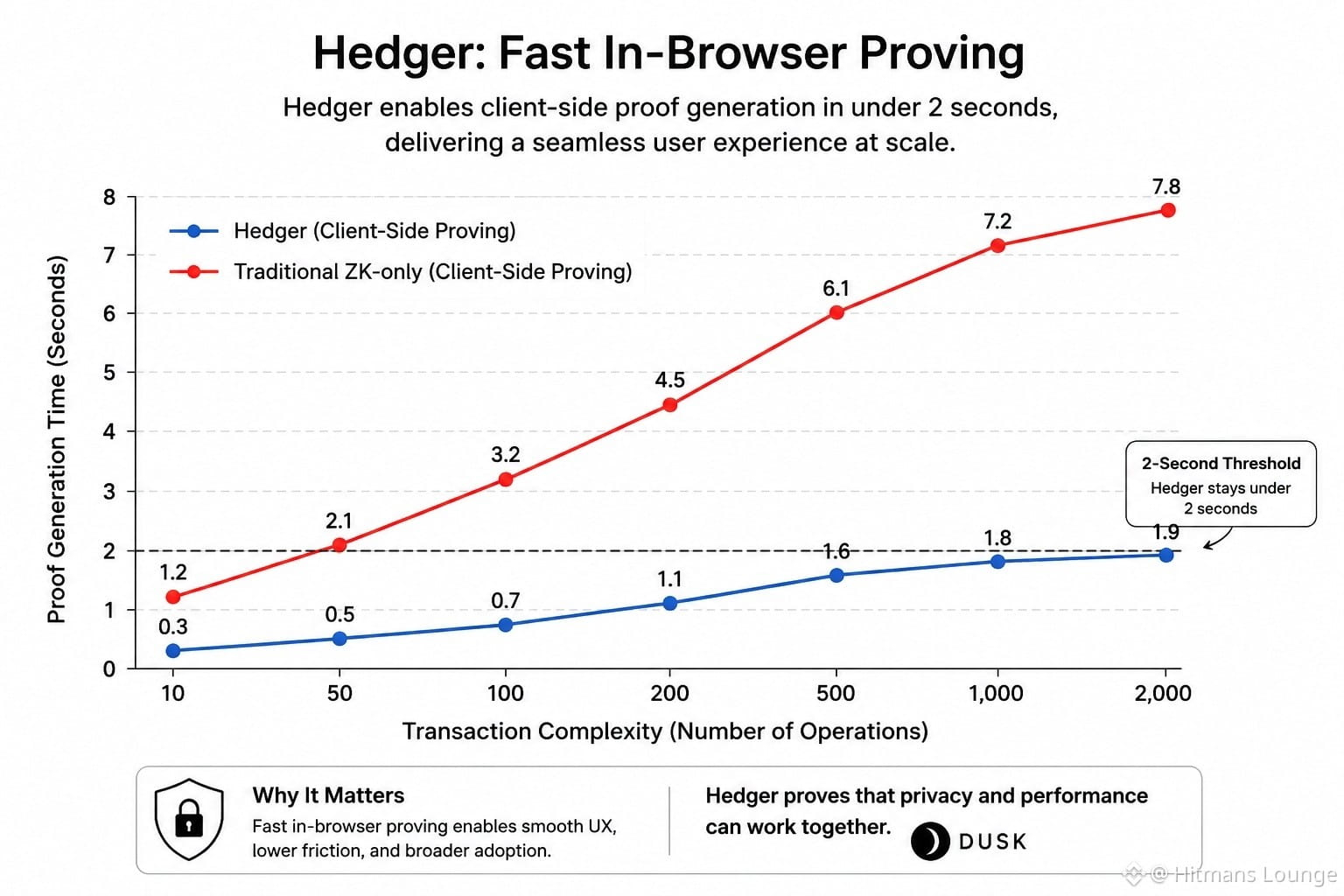
@Dusk_Foundation is building privacy infrastructure for regulated onchain finance, and I’ve been looking more closely at how Hedger fits into DuskEVM.
I actually added a small $DUSK position after initially hesitating. What changed my mind wasn’t another privacy headline—it was the way Hedger handles hidden values.
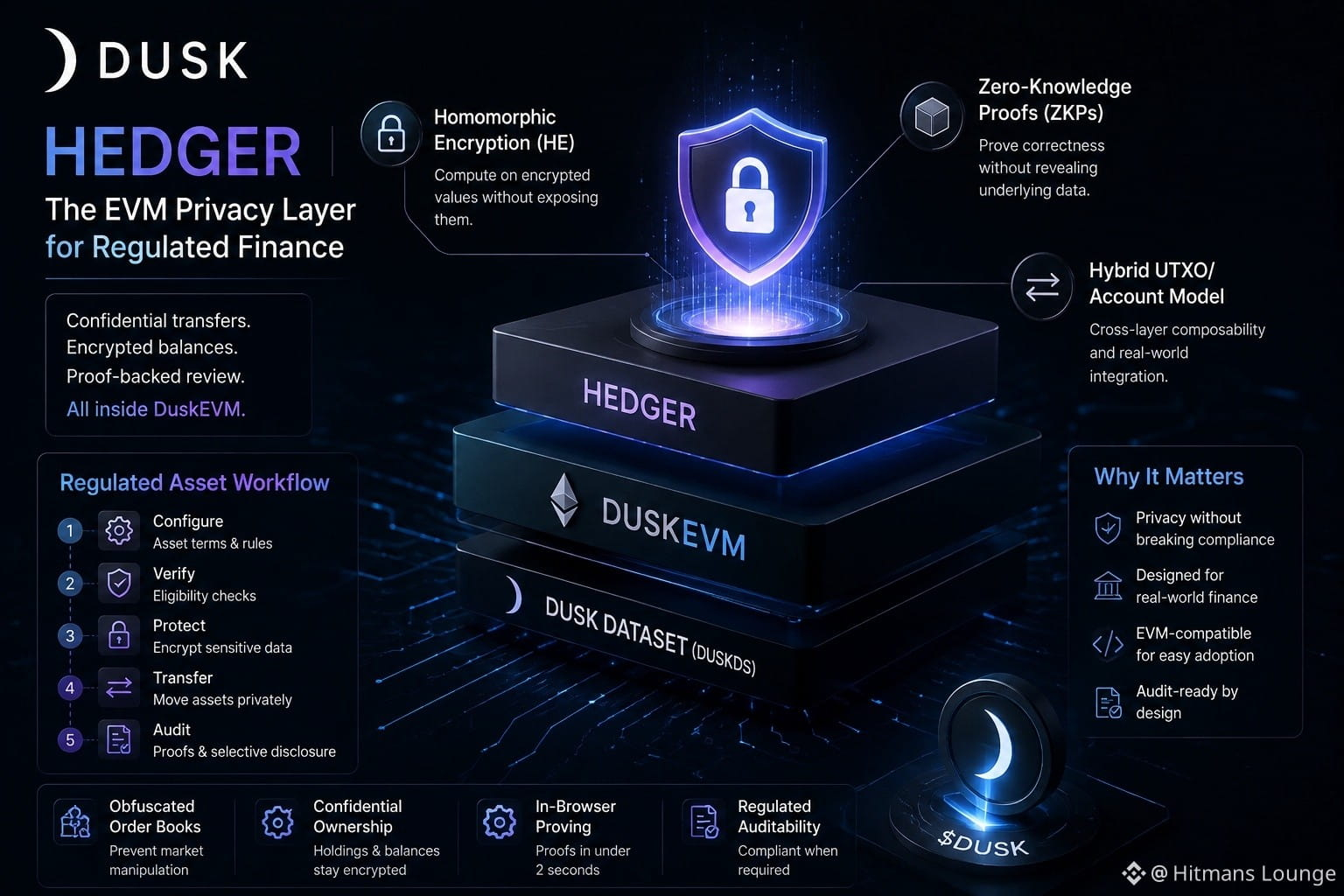
Hedger combines homomorphic encryption with zero-knowledge proofs, so balances and transfer amounts can stay encrypted while the network can still prove that the required rules were followed.
That made me think differently about adoption.
I used to see privacy mainly as “hide the transaction.” Now I think the more important feature is hiding sensitive financial information without breaking the review process.
For regulated assets, that distinction could matter a lot. An institution may not want its position size or trading activity public, but it still needs eligibility checks and audit paths.
I’m still cautious, though. The real test is whether users and institutions actually find this workflow simple enough to use. Sophisticated cryptography doesn't automatically create better UX.
My small position is basically a way for me to keep watching that experiment.
If Hedger can make confidential transfers feel normal rather than complicated, I think that’s where the interesting adoption story starts. 🧐
$AKE $ACE #DUSK #DuskEVM #Privacy #Hedger
@Dusk is building privacy infrastructure for regulated onchain finance, and I’ve been looking more closely at how Hedger fits into DuskEVM.
I actually added a small $DUSK position after initially hesitating. What changed my mind wasn’t another privacy headline—it was the way Hedger handles hidden values.
Hedger combines homomorphic encryption with zero-knowledge proofs, so balances and transfer amounts can stay encrypted while the network can still prove that the required rules were followed.
That made me think differently about adoption.
I used to see privacy mainly as “hide the transaction.” Now I think the more important feature is hiding sensitive financial information without breaking the review process.
For regulated assets, that distinction could matter a lot. An institution may not want its position size or trading activity public, but it still needs eligibility checks and audit paths.
I’m still cautious, though. The real test is whether users and institutions actually find this workflow simple enough to use. Sophisticated cryptography doesn't automatically create better UX.
My small position is basically a way for me to keep watching that experiment.
If Hedger can make confidential transfers feel normal rather than complicated, I think that’s where the interesting adoption story starts. 🧐
$AKE $ACE #DUSK #DuskEVM #Privacy #Hedger
70
26
562

·
--
Рост
Проверено
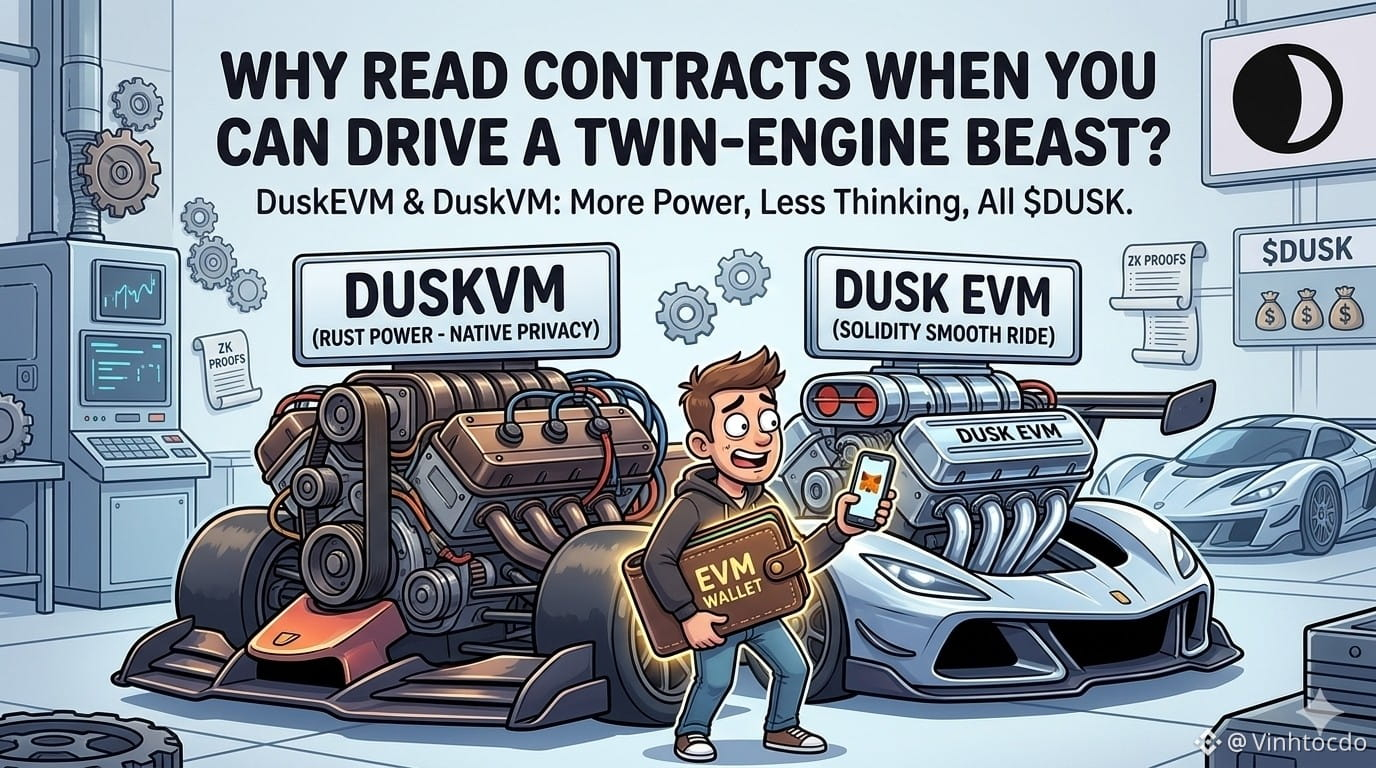
DuskVM and DuskEVM. 2 in 1.
Back at @dusk headquarters, I inspected our tech arsenal and found out we possess a twin-engine beast! 🏎️⚙️
Dusk equips devs with two powerhouses: DuskVM (raw Rust/WASM power for native, deep zero-knowledge privacy) and DuskEVM (the smooth Solidity lane for Ethereum dApps).
I’m just a trader, not a coder, so how do we use it? Easy! We don't read smart contracts. We just interact with DuskEVM dApps on the Testnet via familiar EVM wallets. The benefit? Massive liquidity migration and bulletproof privacy without learning new tech. Just bridge your test tokens, test the private dApps, and stack your $DUSK !
Not financial advice!
#dusk @Dusk_Foundation #DuskEVM #PrivacyTech $TRUMP $ENA
DuskVM and DuskEVM. 2 in 1.
Back at @dusk headquarters, I inspected our tech arsenal and found out we possess a twin-engine beast! 🏎️⚙️
Dusk equips devs with two powerhouses: DuskVM (raw Rust/WASM power for native, deep zero-knowledge privacy) and DuskEVM (the smooth Solidity lane for Ethereum dApps).
I’m just a trader, not a coder, so how do we use it? Easy! We don't read smart contracts. We just interact with DuskEVM dApps on the Testnet via familiar EVM wallets. The benefit? Massive liquidity migration and bulletproof privacy without learning new tech. Just bridge your test tokens, test the private dApps, and stack your $DUSK !
Not financial advice!
#dusk @Dusk #DuskEVM #PrivacyTech $TRUMP $ENA
27
21
145
Войдите, чтобы посмотреть больше материала
Присоединяйтесь к пользователям криптовалют по всему миру на Binance Square
⚡️ Получайте новейшую и полезную информацию о криптоактивах.
💬 Нам доверяет крупнейшая в мире криптобиржа.
👍 Получите достоверные аналитические данные от верифицированных создателей контента.
Эл. почта/номер телефона
В тренде
1
#HuangExitNvidiaStrategyInFocus
Просмотров: 87,792
980 обсуждают
2
#AnthropicRejectsIPODelayValuationinQuestion
Просмотров: 690,260
5,246 обсуждают
3
#BitMineReports$6.3BNetLossForFiscal2026
Просмотров: 11,099
119 обсуждают
4
#ChipStocksExtendLossesAfterNvidiaCEOChange
Просмотров: 35,305
426 обсуждают
5
#ThailandProposes$148KDailyStablecoinDepositWithdrawalCaps
Просмотров: 3,148
45 обсуждают
6
#CoreWeaveJumps10%On168%RevenueGrowth
Просмотров: 190,086
1,664 обсуждают
7
#ZcashFallsBelow$1000ForFirstTimeSinceSeptember
Просмотров: 88,748
260 обсуждают
8
#MSCIRemovalMayCurbStrategy’sBitcoinBuying
Просмотров: 55,288
598 обсуждают
9
#TradFiForBeginners
Просмотров: 532,833
3,697 обсуждают
10
#USJoblessClaimsRise
Просмотров: 19.1M
7,808 обсуждают