
#exchangeflows
exchangeflows
Просмотров: 5,174
60 обсуждают
Популярные
Новые

·
--
Статья
Coins Left the Exchange: Three Things That Number Might Mean"Exchange outflows surge" is an easy headline. It sounds bullish, because coins leaving an exchange look like people moving to long-term storage. But the number alone cannot tell you that.
First, the basics
Data providers such as CryptoQuant define a few simple metrics:
Exchange inflow: coins deposited into exchange wallets.Exchange outflow: coins withdrawn from exchange wallets.Exchange netflow: inflow minus outflow. A negative number means more coins left than arrived.Exchange reserve: the total balance held in exchange addresses at a given time.
Reserve is the running total of netflow over time. If netflow stays negative, the reserve falls.
Three explanations for one outflow
When coins leave an exchange, at least three things could be happening:
Self-custody. A holder moved coins to a personal wallet to keep them long term. This is the story people usually assume.Another venue. The coins went to a different exchange, perhaps for trading, arbitrage or a better market. Supply did not leave the trading ecosystem at all.Internal movement. The exchange reshuffled its own wallets, for example between hot and cold storage, or a user moved between their own addresses. This can look like a large outflow while nothing meaningful changed.
Data providers try to separate these by labelling addresses, but labelling is imperfect. Labels can lag, and new wallets can be missed.
What reserve and netflow can miss
Off-exchange trading. OTC and other off-exchange volume can be large, and it does not show up in exchange wallet data.Chain coverage. Most reserve tracking focuses on Bitcoin and Ethereum. A stablecoin moved on a less-watched network may not appear in your chart.Long-term drift. Reserve levels change structurally over multi-year periods as custody habits and collateral practices change. A falling reserve is not automatically a new signal.
A situation like Binance's recent security incident shows why context matters. When withdrawals are paused, outflows drop to zero. When they reopen in phases, outflows jump as users move funds. Neither number says much about long-term market direction without knowing that context.
How to read it responsibly
Look at the trend, not a single day. Use a moving average and compare against recent history.Read coin flows together with stablecoin balances. Falling coin reserves plus rising stablecoin reserves is read by many analysts as a different setup than falling reserves alone.Ask what else happened that day: an exchange outage, a listing, a hack, a withdrawal pause.Treat it as background on supply and demand, not as a trade signal. Price structure and risk management still decide outcomes.
The honest takeaway
Net outflow is a fact. "Bullish" is an interpretation. The gap between the two is where most bad analysis happens.
Next time you see a big outflow headline, ask where the coins went, who labelled the addresses, and what else could explain it. If the answer is unclear, so is the signal.
#CryptoData #OnChain #ExchangeFlows
This is for information only and is not financial advice. Always do your own research.
Coins Left the Exchange: Three Things That Number Might Mean
"Exchange outflows surge" is an easy headline. It sounds bullish, because coins leaving an exchange look like people moving to long-term storage. But the number alone cannot tell you that.
First, the basics
Data providers such as CryptoQuant define a few simple metrics:
Exchange inflow: coins deposited into exchange wallets.Exchange outflow: coins withdrawn from exchange wallets.Exchange netflow: inflow minus outflow. A negative number means more coins left than arrived.Exchange reserve: the total balance held in exchange addresses at a given time.
Reserve is the running total of netflow over time. If netflow stays negative, the reserve falls.
Three explanations for one outflow
When coins leave an exchange, at least three things could be happening:
Self-custody. A holder moved coins to a personal wallet to keep them long term. This is the story people usually assume.Another venue. The coins went to a different exchange, perhaps for trading, arbitrage or a better market. Supply did not leave the trading ecosystem at all.Internal movement. The exchange reshuffled its own wallets, for example between hot and cold storage, or a user moved between their own addresses. This can look like a large outflow while nothing meaningful changed.
Data providers try to separate these by labelling addresses, but labelling is imperfect. Labels can lag, and new wallets can be missed.
What reserve and netflow can miss
Off-exchange trading. OTC and other off-exchange volume can be large, and it does not show up in exchange wallet data.Chain coverage. Most reserve tracking focuses on Bitcoin and Ethereum. A stablecoin moved on a less-watched network may not appear in your chart.Long-term drift. Reserve levels change structurally over multi-year periods as custody habits and collateral practices change. A falling reserve is not automatically a new signal.
A situation like Binance's recent security incident shows why context matters. When withdrawals are paused, outflows drop to zero. When they reopen in phases, outflows jump as users move funds. Neither number says much about long-term market direction without knowing that context.
How to read it responsibly
Look at the trend, not a single day. Use a moving average and compare against recent history.Read coin flows together with stablecoin balances. Falling coin reserves plus rising stablecoin reserves is read by many analysts as a different setup than falling reserves alone.Ask what else happened that day: an exchange outage, a listing, a hack, a withdrawal pause.Treat it as background on supply and demand, not as a trade signal. Price structure and risk management still decide outcomes.
The honest takeaway
Net outflow is a fact. "Bullish" is an interpretation. The gap between the two is where most bad analysis happens.
Next time you see a big outflow headline, ask where the coins went, who labelled the addresses, and what else could explain it. If the answer is unclear, so is the signal.
#CryptoData #OnChain #ExchangeFlows
This is for information only and is not financial advice. Always do your own research.
71

·
--
#BinanceHourlyDepositsExceedWithdrawals
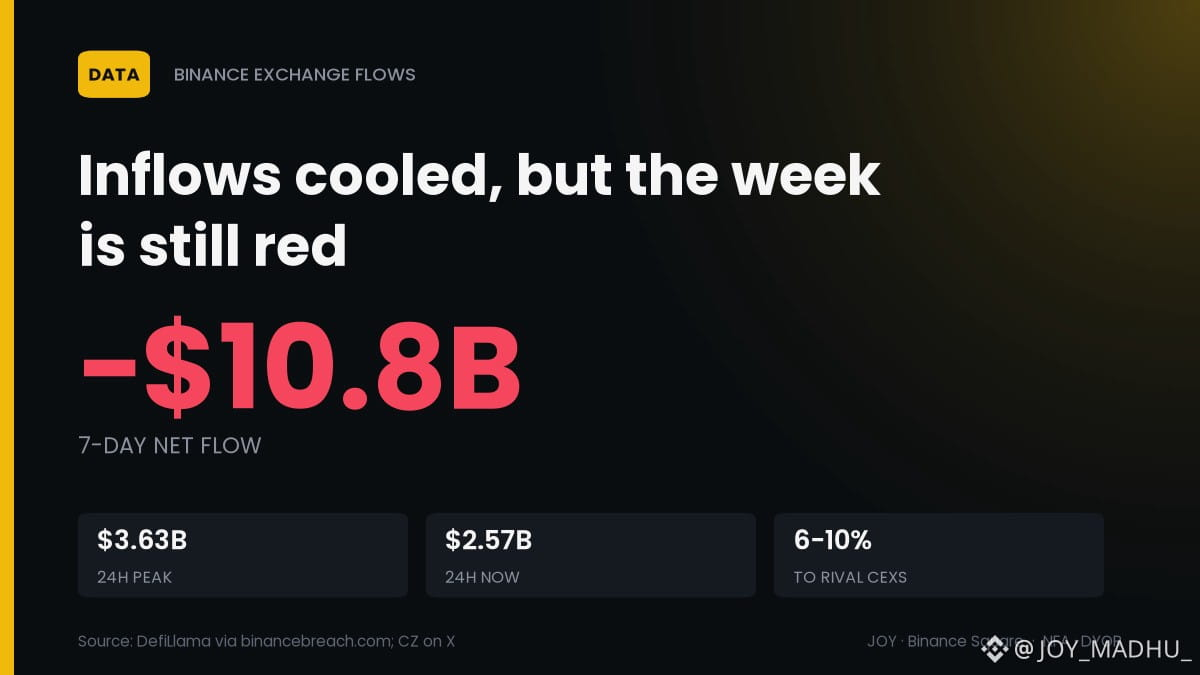
🧭 Only 6-10% of Binance Withdrawals Went to Rival CEXs
Binance's 24-hour net inflow cooled from a $3.63B peak to about $2.57B, but the week is still deeply negative.
📉 7-day net flow: about -$10.8B (DefiLlama, Nov 4)
📈 24h net inflow: $3.63B peak to $2.57B now
🏦 Tracked assets: about $128.4B vs $129.7B at peak
⚠️ Per CZ, most withdrawals went to self-custody
Zoom out: self-custody funds can return as fast as they left, so daily flows stay noisy.
Will Binance's 7-day net outflow fall below $10B by Friday, or stay above it? 👇
$BNB $BTC
#ExchangeFlows #Binance #BinanceHourlyDepositsExceedWithdrawals
34

Binance just flipped the script. 💰 After a brutal Monday of withdrawals tied to a 6.3B USD exploit, net inflows are back in the green at 2.3B USD over 24 hours — the strongest of any exchange — with fund access restored. Users aren't waiting for reassurance; they're voting with their wallets. Is this the fastest confidence rebound we've seen this cycle, or a trap for the impatient? Keep an eye on $BNB and $BTC for the read-through.
#Binance #CryptoNews #ExchangeFlows
#Binance #CryptoNews #ExchangeFlows

70

·
--
За оцінкою аналітика MaxiCalls, за перші 12 годин після відновлення виведень з Binance пішло близько 16 000 $BTC , це приблизно 2,4% її біткоїн-резервів. Це не обов'язково тиск на ціну: монети часто переходять у холодні гаманці, а не на продаж. Сама біржа каже, що обсяги виведень поступово знижувались після початкового сплеску. Це оцінка аналітика, а не офіційні дані.
Ці виведення про недовіру чи про звичайну обережність? 👇
#ExchangeFlows
Ці виведення про недовіру чи про звичайну обережність? 👇
#ExchangeFlows
3
37

·
--
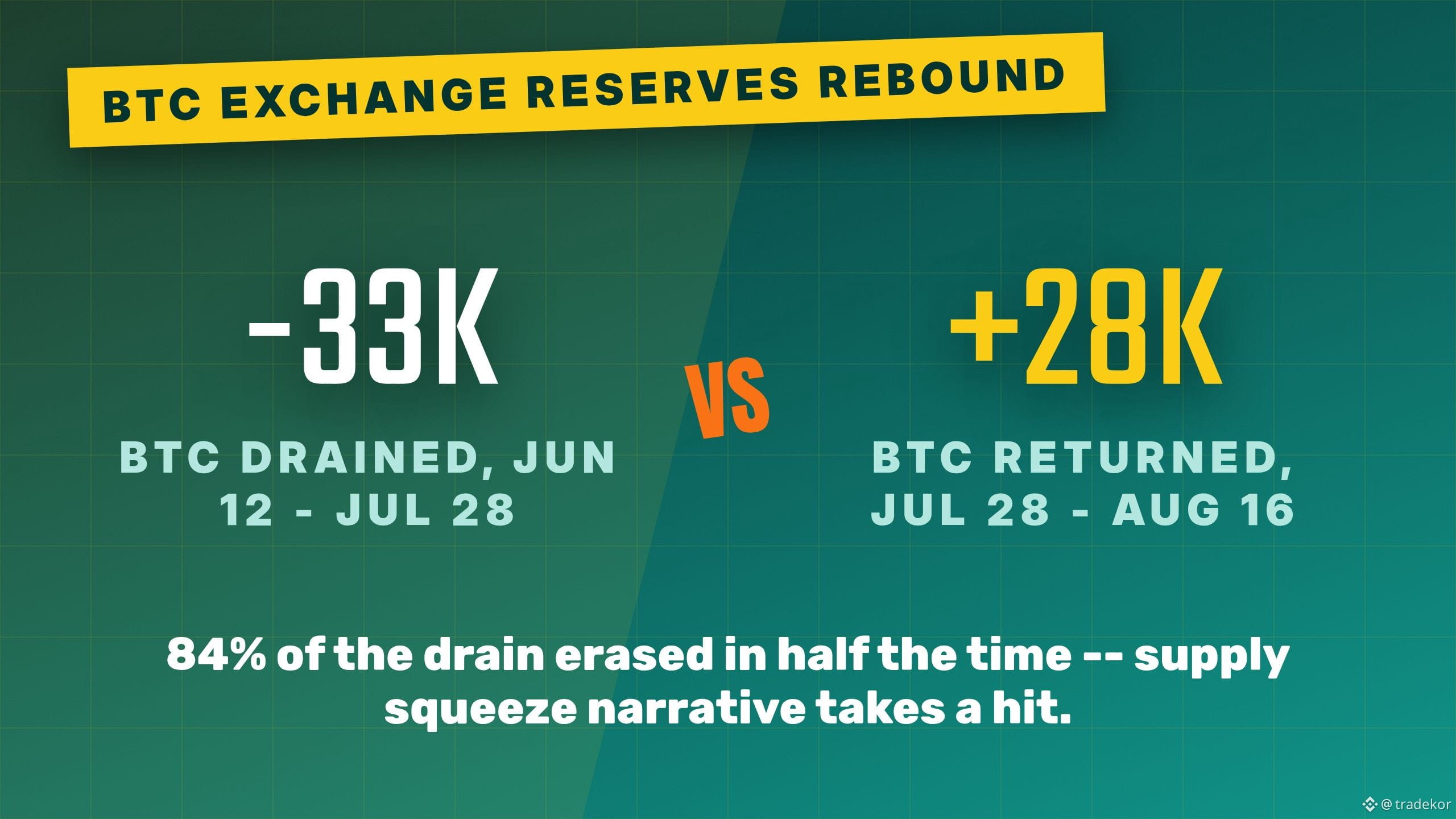
Bitcoin exchange reserves just erased 84% of a six-week drain in under three weeks -- 28,000 BTC flowed back onto exchanges since July 28.
The data: Santiment shows BTC exchange reserves peaked at 1.337M BTC on June 12, fell to a low of 1.304M BTC on July 28 (a 33,000 BTC withdrawal), then rebounded to ~1.332M BTC by August 16 -- recovering 28,000 BTC in under half the time it took to drain. Reserves now sit just ~5,200 BTC below the June peak, the highest level since June 15.
The catch: more BTC sitting on exchanges means more liquid, readily-sellable supply -- the opposite of what the "ETF demand is draining tradable BTC" narrative implied a few weeks ago. Santiment itself flags that this rebound doesn't necessarily mean active selling; it could reflect OTC settlement, arbitrage flows, or ETF create/redeem mechanics moving coins around rather than holders dumping.
Our read: this cuts both ways at once -- it undercuts the supply-squeeze bull case, but it doesn't confirm a bear case either. Falsifiable watch-point: does this reserve level keep climbing back toward June's peak, or was this a short-lived reversal?
Does rising exchange reserves change your read on BTC's supply story, or is this just noise in the flow?
Not financial advice. DYOR.
$BTC #Bitcoin #OnChain #ExchangeFlows #CryptoNews
25

·
--
Bitcoin to 53K? Exchange Deposits Jump
Bitcoin exchange deposits have surged sharply in recent sessions, prompting analysts to warn of heightened volatility ahead. Trading data shows significant inflows across major platforms as market participants reposition portfolios amid growing uncertainty about near-term price action.
Historical patterns reveal that similar deposit spikes often precede major price movements, with on-chain analytics showing divergent signals. Long-term holders continue accumulating while short-term traders increase leverage, creating technical tension on both sides of the order book.
The timing coincides with broader macroeconomic uncertainty and ongoing regulatory discussions in key markets. Institutional investors maintain cautious positioning while retail sentiment oscillates between FOMO and profit-taking concerns. Exchange reserve data suggests potential liquidation pressure building.
Could this deposition wave signal an imminent breakout or sharp correction? Market analysts remain divided with some seeing accumulation signals while others interpret it as preparatory selling pressure. #BitcoinVolatility #ExchangeFlows #MarketAnalysis
55

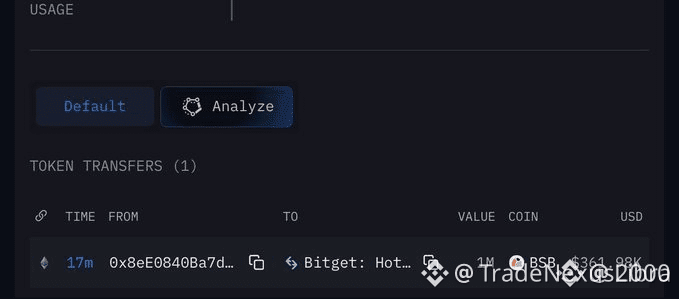
$BSB exchange flow comes into focus 🔎
1,000,000 $BSB , valued around $361.98K, was transferred from an identified wallet to a Top-tier exchange hot wallet. This type of movement is worth monitoring because deposits to exchange infrastructure can sometimes precede liquidity activity, rebalancing, or potential sell-side preparation.
For now, the key is not to overreact to a single transfer. The more useful signal comes from follow-through: volume expansion, order book behavior, and whether price starts accepting below nearby demand.
Not financial advice. Manage your risk.
#BSB #OnChain #CryptoNews #ExchangeFlows
⚡
211

·
--
📉 BTC Exchange Outflows Are Flashing a Warning Signal Nobody Wants to Hear
What the data shows:
Exchange outflows = BTC withdrawn from exchanges = buyers taking custody = bullish signal.
But that signal just broke down.
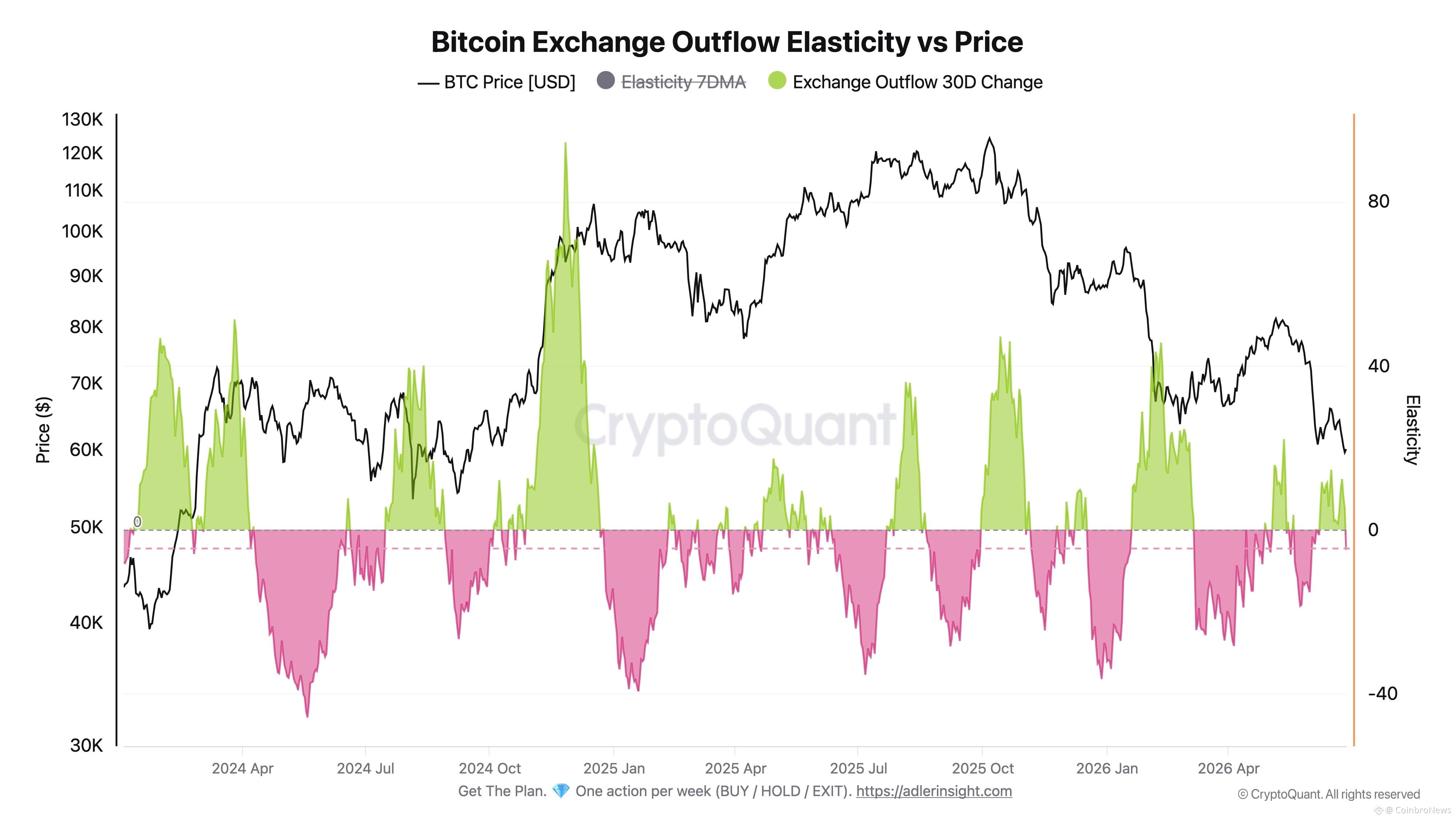
30-day exchange outflow momentum turned red — the 30D average is now 4.9% below its level from a month ago. Buyers are no longer absorbing supply like before. Bitcoin Foundation
The full picture is worse:
Yesterday alone — $696.3 million left Bitcoin ETFs in a single day, the largest daily outflow of June. June total ETF outflows hit $3.61 billion. Year-to-date net outflows now at $4.6 billion. CoinDCX
ETF total net assets dropped to $72.6 billion — down 57% from the October 2025 peak of $169.5 billion. CoinDCX
Three demand signals all turning red simultaneously:
❌ Exchange outflows weakening — spot buyers disappearing
❌ ETF outflows accelerating — institutions exiting
❌ Strategy slowed Bitcoin buying to 3,600 BTC in June — down from 25,000 BTC in May Bitcoin Foundation
When all three demand pillars weaken at once — price has no floor support.
The one silver lining:
June 23 marked the first day of positive ETF inflows in weeks — $39.2M net inflow led by ARKB and MSBT. Bitcoin Foundation
One day. Too early to call reversal. But worth watching.
My take:
Fear & Greed Index hit 12 on June 25 — Extreme Fear. Yahoo Finance
Markets bottom in Extreme Fear. But Extreme Fear can also get more extreme.
The question isn't whether BTC is cheap. It is.
The question is: who's left to buy?
Exchange outflows say: not enough people yet. 👀
Drop your take below 👇
Not financial advice. DYOR.
Sources: CoinStats, @CryptoQuant_Quicktake , InteractiveCrypto — June 26, 2026
#ETF #OnChain #CryptoMarket #ExchangeFlows #CoinbroNews
📉 BTC Exchange Outflows Are Flashing a Warning Signal Nobody Wants to Hear
What the data shows:
Exchange outflows = BTC withdrawn from exchanges = buyers taking custody = bullish signal.
But that signal just broke down.
30-day exchange outflow momentum turned red — the 30D average is now 4.9% below its level from a month ago. Buyers are no longer absorbing supply like before. Bitcoin Foundation
The full picture is worse:
Yesterday alone — $696.3 million left Bitcoin ETFs in a single day, the largest daily outflow of June. June total ETF outflows hit $3.61 billion. Year-to-date net outflows now at $4.6 billion. CoinDCX
ETF total net assets dropped to $72.6 billion — down 57% from the October 2025 peak of $169.5 billion. CoinDCX
Three demand signals all turning red simultaneously:
❌ Exchange outflows weakening — spot buyers disappearing
❌ ETF outflows accelerating — institutions exiting
❌ Strategy slowed Bitcoin buying to 3,600 BTC in June — down from 25,000 BTC in May Bitcoin Foundation
When all three demand pillars weaken at once — price has no floor support.
The one silver lining:
June 23 marked the first day of positive ETF inflows in weeks — $39.2M net inflow led by ARKB and MSBT. Bitcoin Foundation
One day. Too early to call reversal. But worth watching.
My take:
Fear & Greed Index hit 12 on June 25 — Extreme Fear. Yahoo Finance
Markets bottom in Extreme Fear. But Extreme Fear can also get more extreme.
The question isn't whether BTC is cheap. It is.
The question is: who's left to buy?
Exchange outflows say: not enough people yet. 👀
Drop your take below 👇
Not financial advice. DYOR.
Sources: CoinStats, @CryptoQuant Quicktake , InteractiveCrypto — June 26, 2026
#ETF #OnChain #CryptoMarket #ExchangeFlows #CoinbroNews
119

🦈 $BTC EXCHANGE WALLETS ABSORBED 4,701 BTC IN 7 DAYS — INSTITUTIONAL VENUE TOOK 75% 📥
📊 Coinglass's 7-day flow ledger reads loud: 4,701 BTC hit centralized rails, with the institutional-grade venue swallowing 3,540 BTC — a 75% share. That's not retail panic-dumping; that's a heavyweight pulling chips toward the table.
🦈 The global spot leader saw just 577 BTC, and the veteran offshore venue took 458 BTC — pocket change next to the main event. When the smart money corridor absorbs four-figure BTC deposits, it's either pre-positioning for accumulation or a block trade moving toward crossing desks.
💡 The tell lands in the next 48 hours: if spot volume swells and bids defend support, this inflow was fuel for the next leg up. 💬 Is this accumulation ammunition or a distribution warning in disguise? 👇
⚠️ Not financial advice. Always manage your risk. 🛡️
🏷️ #BTC #ExchangeFlows #WhaleWatch #OnChain
🦈 💎
36

·
--
🚨 $BTC WITHDRAWAL WAVES EXPOSE THE REAL FLOW BEHIND THE HEADLINES 🔍
📡 A 367.65 BTC transfer from cold storage to hot wallet — roughly $23.92M — just hit the chain. This isn't random shuffling. It's the second visible move this week from an exchange that announced its shutdown last month.
🌊 These repeated sweeps are the quiet mechanics of user withdrawals, not market-moving demand. But they tell us something sharper: circulating supply is shifting hands at scale, and the market is absorbing it without panic. 📊 Order flow like this often precedes a window where derivatives positioning resets.
💡 The real signal? Liquidity is being repositioned behind the scenes while price holds its ground. 🔍 Are you reading on-chain flows as a warning sign or a coiled spring for the next structural move? 💬
⚠️ Not financial advice. Always manage your risk. 🛡️
🏷️ #BTC #OnChain #ExchangeFlows #CryptoInsights
⚡ 🦈
42

·
--
$BTC EXCHANGE INFLOW FROM GALAXY DIGITAL RAISES SELLING PRESSURE CONCERNS 🔥
Entry: Not provided
Target: Not provided
Stop Loss: Not provided
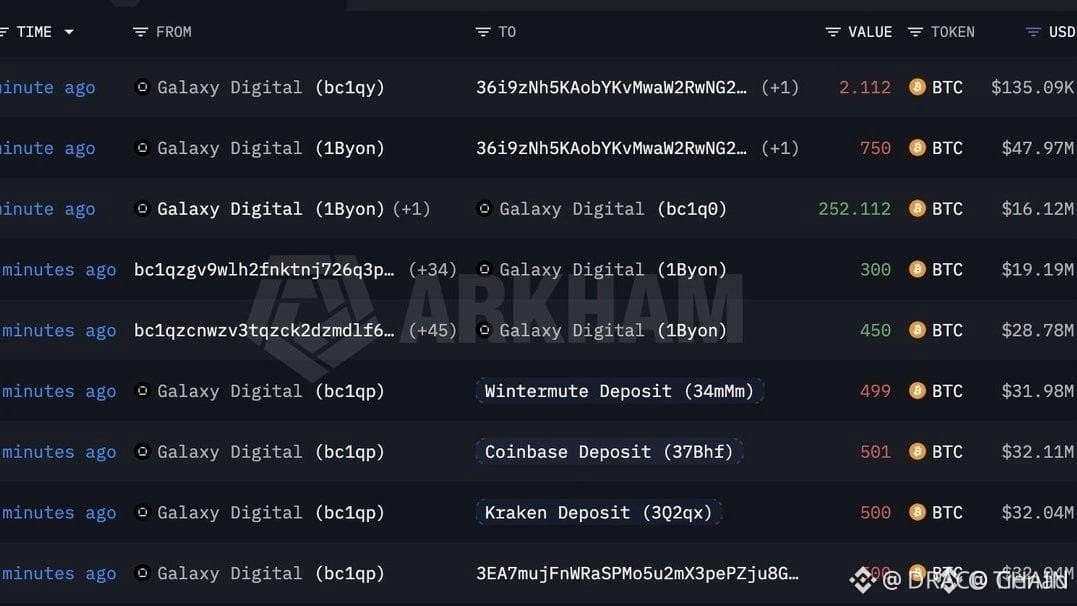
Galaxy Digital has moved 2,500 BTC (~$160M) to exchange wallets in the past 24 hours, according to on-chain data. This is the largest single-entity transfer to centralized exchanges this month and historically precedes distribution. Price action around $64k is still holding, but if this supply hits the book, a liquidity sweep below the recent range low becomes likely.
Volume divergence is already showing on the 30-minute chart while bid support thins. Are you expecting a breakdown or a buy-the-dip opportunity here?
Not financial advice. Always manage your risk.
#BTC #OnChain #ExchangeFlows #Bitcoin
🔥


34

📊 Exchange Inflows Surge as Traders Prepare for Volatility: Increased exchange activity hints at impending price movement
On July 20, 2026, exchange wallets are seeing heightened inflow activity as traders position for the next major move. With total market volume at $44.23 billion and $BTC volume alone at $17.91 billion, the data suggests preparation for volatility.
When exchange inflows increase during periods of low volatility, it often signals that traders are pre-positioning for an anticipated breakout. The current pattern resembles the setup seen before previous significant price expansions.
$BTC leads exchange activity with $17.91 billion in volume, followed by $ETH at $7.12 billion. The concentration of inflows in the top assets suggests any breakout is likely led by large-cap cryptocurrencies.
📌 Key Takeaway:
Surge in exchange inflows during a low-volatility period is a classic precursor to an imminent volatility expansion — the market is coiling.
#CryptoMarkets #ExchangeFlows
#BinanceAlphaAlert
12

·
--
🐋 $BTC EXCHANGE FLOWS: A METRIC TO WATCH!
Changes in exchange inflows and outflows can provide clues about investor behavior. But transfers can happen for many reasons, including custody changes. Never treat one transaction as proof of an incoming rally or crash.
{spot}(BTCUSDT)
#BTC #ExchangeFlows #OnChainData #CryptoResearch #Market
🐋 $BTC EXCHANGE FLOWS: A METRIC TO WATCH!
Changes in exchange inflows and outflows can provide clues about investor behavior. But transfers can happen for many reasons, including custody changes. Never treat one transaction as proof of an incoming rally or crash.
#BTC #ExchangeFlows #OnChainData #CryptoResearch #Market
Changes in exchange inflows and outflows can provide clues about investor behavior. But transfers can happen for many reasons, including custody changes. Never treat one transaction as proof of an incoming rally or crash.
#BTC #ExchangeFlows #OnChainData #CryptoResearch #Market
1
3

·
--
After hack
🚨 $11.8 BILLION FLOWING OUT OF BINANCE!
Something interesting is happening in the crypto market. 👀
According to the latest exchange flow data:
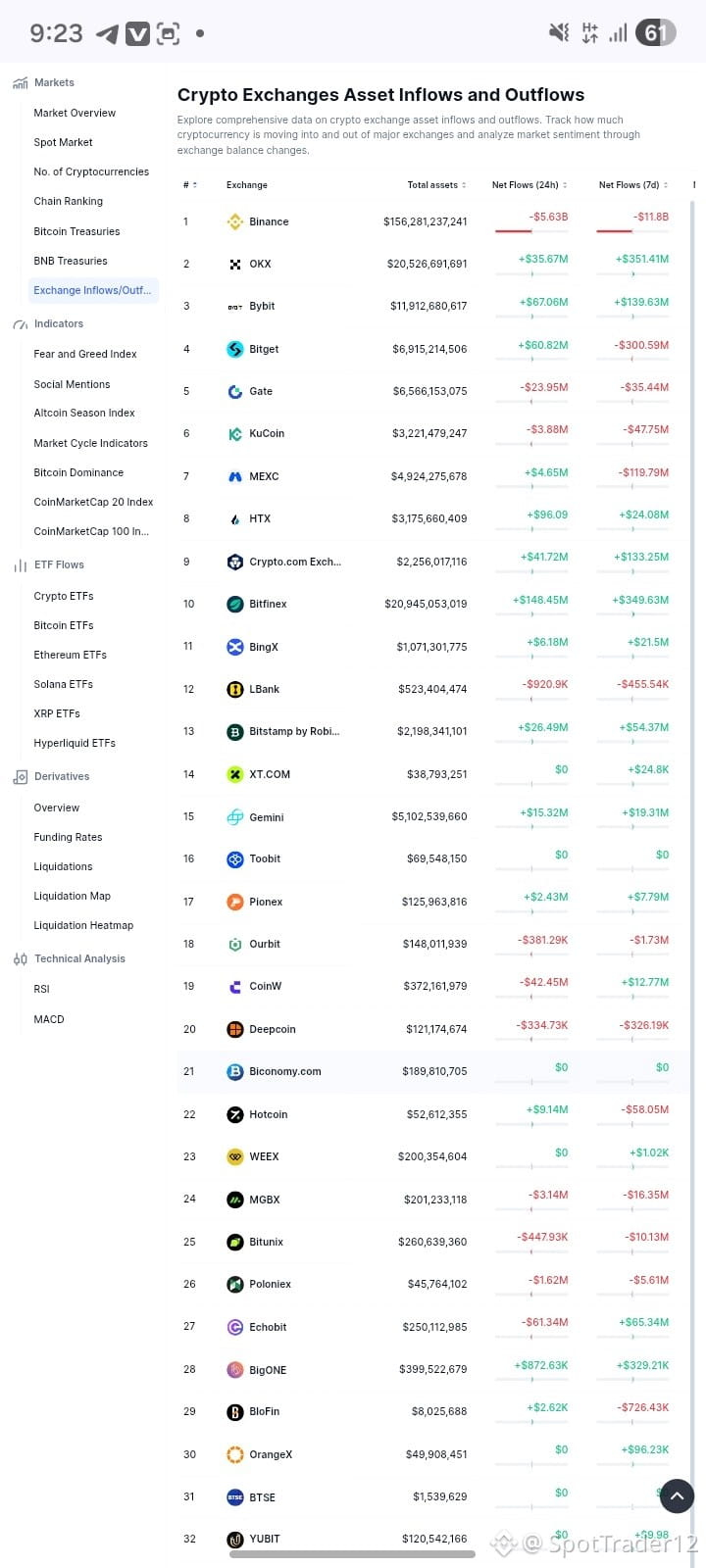
🔴 Binance Net Outflow (24H): -$5.63 BILLION
🔴 Binance Net Outflow (7D): -$11.8 BILLION
💡 What does this mean?
Billions of dollars in net assets have reportedly moved out of Binance over the past week.
This could indicate:
🔹 Investors moving assets to private wallets.
🔹 Potential long-term holding behavior.
🔹 Reduced exchange reserves.
🔹 A possible shift in market sentiment.
⚠️ However, outflows don't automatically mean a bullish market. We need to watch Bitcoin's price action, trading volume, and overall market conditions.
🔥 THE BIG QUESTION:
Are investors preparing to HOLD, or is something bigger happening behind the scenes?
What do you think? 👇
#Binance #Crypto #bitcoin #BTC #ExchangeFlows
1
54

·
--
Binance取款重启后36.4亿美元净流出,资金加速逃离交易所
头部交易所的资金流向,往往是判断市场情绪与流动性变化的先行指标。据CNBC报道,Binance在恢复提款后录得36.4亿美元的净流出,而此前引发市场关注的盗刷规模高达63亿美元。这一数据值得从资金面的角度重新审视。
事情的核心并非盗案本身,而是取款恢复后的资金节奏。据CNBC,Binance在重启提款后出现36.4亿美元的净流出,意味着持有者正在把资产从交易所账户转出,转向链上钱包或稳定币等其他形态。相较之下,被盗金额达到63亿美元,是理解本轮事件规模的另一个锚点。
为什么这个数据点比单纯回顾黑案更有意义?交易所净流出通常被解读为持有者将资产转移至自持或稳定币环境,可能反映两类动机:一是长期持有、降低交易所对手方风险;二是套现转向法币等价物。净流出规模越大、速度越快,说明资金离开中心化平台的意愿越强,这对以交易所余额衡量抛压的框架构成增量信息。
从流动性传导的角度看,资金离开交易所可能降低现货市场的即时卖压,也可能意味着部分资金转向稳定币等待更低位置介入。但据现有事实,净流出的具体币种构成、去向链路与后续节奏尚不明确,需要观察这一趋势是短期回补还是结构性迁移。
市场可能如何反应?若净流出持续,交易所余额下降或在边际上削弱短期抛压;但若资金转向稳定币并随时可重新买入,则更多是情绪信号而非实质去杠杆。目前尚无足够证据确定其方向。
需要警惕的反方因素包括:净流出可能部分源于盗案后的资产重组与合规清退,而非真实持有者决策;且单一交易所的数据难以代表全市场资金流向,需结合其他平台与链上指标交叉验证。
接下来观察什么?重点在于净流出是否延续、63亿美元被盗资金的处理进展,以及资金是否真正转向稳定币或链上自持。交易层面更重要的是等待这一资金面信号被更多数据确认,而非仅凭单点净流出做出判断。
#Binance #CryptoMarket #ExchangeFlows
以上为信息整理与个人分析,不构成投资建议。
关注我,持续跟踪关键市场变化与数据。
64

$148M VOLUME. 76% IS WASH.
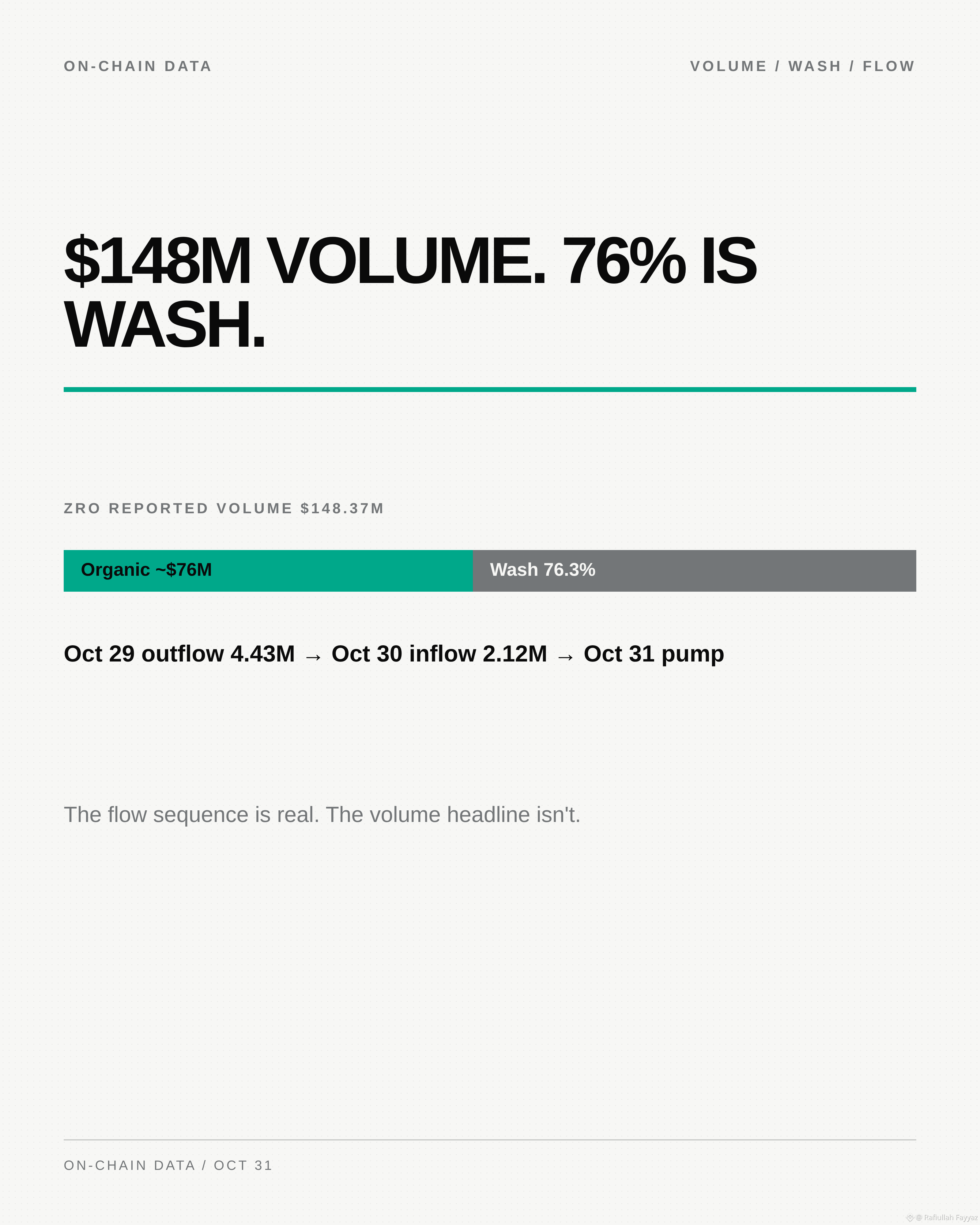
ZRO is up 15.39%. Reported volume is $148.37 million across 76 exchanges.
On-chain data flags 76.3% of transfer volume as wash activity. The credible organic figure is roughly $75.83 million.
That doesn't make the move fake. It makes the headline misleading.
Exchange flow adds a layer. October 29 saw a 4.43 million ZRO net outflow — the largest accumulation signal in 14 days. October 30 flipped to a 2.12 million net inflow. Then price jumped today.
Withdrawal, deposit, pump. That's a sequence worth recognizing. But the wash ratio means part of the volume behind it isn't real demand.
Watching if ZRO holds above $1.65 on organic volume or fades back.
$ZRO
#washtrading #VolumeAnalysis #ExchangeFlows #MarketStructure #onchaindata
{spot}(ZROUSDT)
$148M VOLUME. 76% IS WASH.
ZRO is up 15.39%. Reported volume is $148.37 million across 76 exchanges.
On-chain data flags 76.3% of transfer volume as wash activity. The credible organic figure is roughly $75.83 million.
That doesn't make the move fake. It makes the headline misleading.
Exchange flow adds a layer. October 29 saw a 4.43 million ZRO net outflow — the largest accumulation signal in 14 days. October 30 flipped to a 2.12 million net inflow. Then price jumped today.
Withdrawal, deposit, pump. That's a sequence worth recognizing. But the wash ratio means part of the volume behind it isn't real demand.
Watching if ZRO holds above $1.65 on organic volume or fades back.
$ZRO
#washtrading #VolumeAnalysis #ExchangeFlows #MarketStructure #onchaindata
195
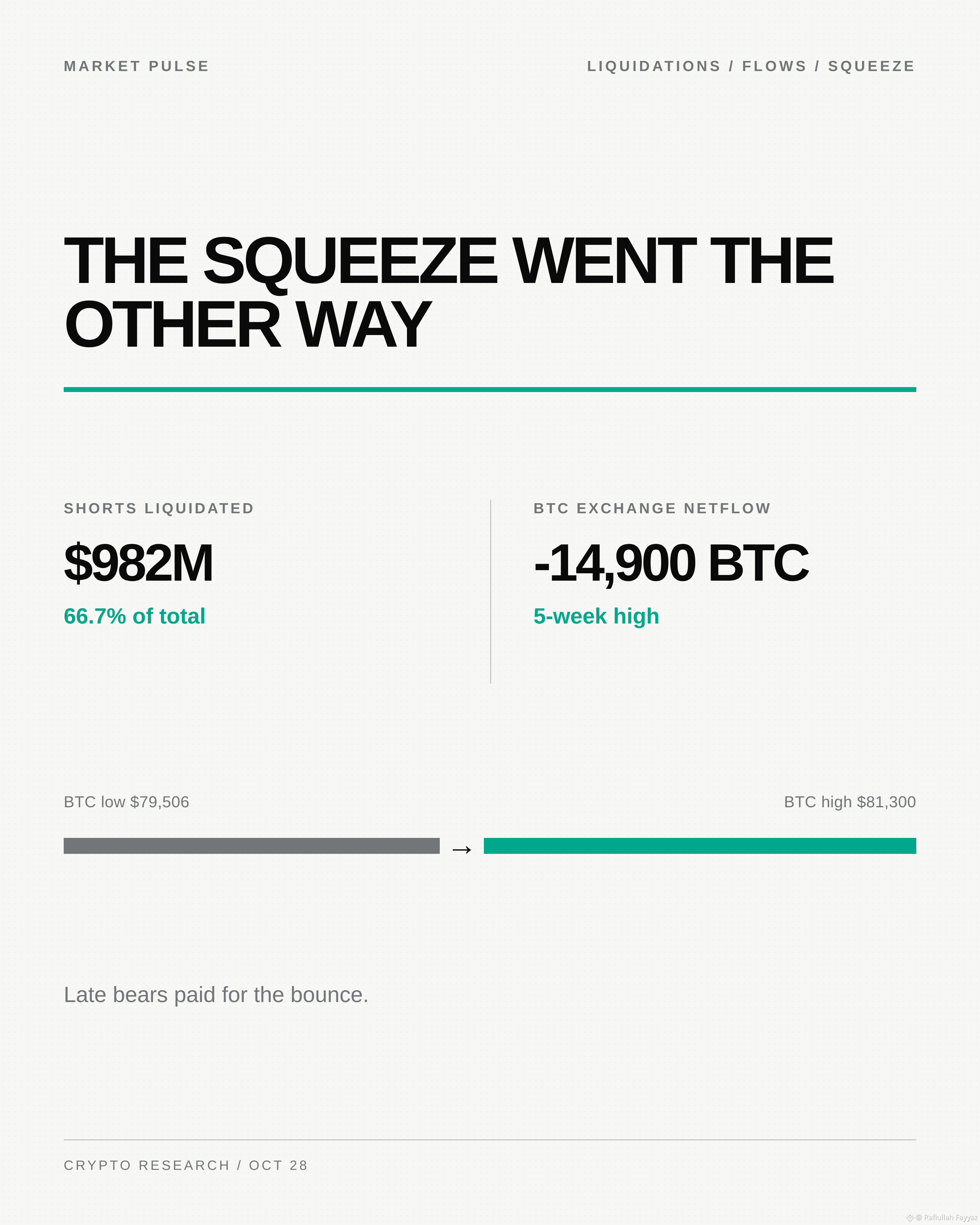
$1.49 billion liquidated in 24 hours. 66.7% were shorts.
That's the reversal nobody positioned for. BTC bounced from $79,506 to $81,300, and the traders who bet on a deeper flush got squeezed out.
Meanwhile, exchange net outflows hit 14,900 BTC — the largest daily outflow in five weeks. Coins are leaving exchanges while shorts are getting liquidated. Both point the same direction: less immediate sell pressure, more pain for late bears.
The Fed decision today decides if this holds. If BTC clears $82,500, the squeeze has room to run.
$BTC $ETH
#ShortSqueeze #Liquidations #ExchangeFlows #MarketStructure #FedDecision
{spot}(BTCUSDT)
{spot}(ETHUSDT)
$1.49 billion liquidated in 24 hours. 66.7% were shorts.
That's the reversal nobody positioned for. BTC bounced from $79,506 to $81,300, and the traders who bet on a deeper flush got squeezed out.
Meanwhile, exchange net outflows hit 14,900 BTC — the largest daily outflow in five weeks. Coins are leaving exchanges while shorts are getting liquidated. Both point the same direction: less immediate sell pressure, more pain for late bears.
The Fed decision today decides if this holds. If BTC clears $82,500, the squeeze has room to run.
$BTC $ETH
#ShortSqueeze #Liquidations #ExchangeFlows #MarketStructure #FedDecision
101

·
--
$BTC LARGE DEPOSITS TO EXCHANGES SIGNAL POTENTIAL SELL PRESSURE 🔥
Abraxas Capital moved $18M in assets to top-tier exchanges — including $10M USDT and $4M XAUT sent to Binance and another $4M XAUT to Bitfinex. This kind of volume hitting order books often precedes distribution or repositioning by major players.
The 4H structure on BTC is already fragile below key resistance. Large deposits during low liquidity hours add weight to the bearish case. Are you hedging exposure or waiting for a sweep of liquidity first?
Not financial advice. Always manage your risk.
#BTC #XAUT #ExchangeFlows #MarketStructure #Crypto
⚡
17

$BNB draws attention as Binance drives WODL and Red Packet engagement 🎁
Binance’s latest promotional traffic around WODL and Red Packet activity is less about immediate price discovery and more about user retention and platform stickiness. The message is clear: the exchange is leaning on gamified distribution to keep retail attention inside its ecosystem. In market terms, that typically supports engagement metrics before it translates into any visible shift in spot order flow.
My read is that this is an attention-liquidity event, not a directional catalyst. Retail often treats these drops as isolated perks, but institutions watch the broader effect: recurring campaigns can reinforce venue loyalty, lift transactional cadence, and sustain capital rotation through the Top-tier exchange complex. For $BNB, that matters because ecosystem activity can quietly underpin demand expectations even when the broader tape remains range-bound.
Not financial advice. This is a market commentary, not a recommendation to buy or sell.
#BNB #Binance #CryptoMarkets #ExchangeFlows
{future}(BNBUSDT)
$BNB draws attention as Binance drives WODL and Red Packet engagement 🎁
Binance’s latest promotional traffic around WODL and Red Packet activity is less about immediate price discovery and more about user retention and platform stickiness. The message is clear: the exchange is leaning on gamified distribution to keep retail attention inside its ecosystem. In market terms, that typically supports engagement metrics before it translates into any visible shift in spot order flow.
My read is that this is an attention-liquidity event, not a directional catalyst. Retail often treats these drops as isolated perks, but institutions watch the broader effect: recurring campaigns can reinforce venue loyalty, lift transactional cadence, and sustain capital rotation through the Top-tier exchange complex. For $BNB , that matters because ecosystem activity can quietly underpin demand expectations even when the broader tape remains range-bound.
Not financial advice. This is a market commentary, not a recommendation to buy or sell.
#BNB #Binance #CryptoMarkets #ExchangeFlows

286
$HYPE WHALE'S $93M TRADING ENDS IN $406K LOSS — EXCHANGE TRANSFERS SPOTTED 🦈📉
Smart money isn't always smart. This $HYPE player churned $93.25M in spot volume since December — buying 1.37M tokens, selling 1.25M — and the scoreboard reads a $406K deficit. 📊 That's the sound of a high-frequency battle where fees and slippage chewed up the edge.
Now 20,000 $HYPE ($1.15M) just unstaked and moved to a top-tier exchange for a likely sell-off. Another 24,950 followed last week. 🦈 This wallet is distributing, not accumulating — and the order book feels the gravity. 🌊
Volume doesn't equal alpha. This trader fought the tape for months and lost to the house spread. 💡 Are you tracking exchange inflows, or just staring at the chart? 🤔
⚠️ Not financial advice. Always manage your risk. 🛡️
🏷️ #HYPE #WhaleWatch #CryptoAnalysis #ExchangeFlows #TradingPsychology
🦈 💡
66
Войдите, чтобы посмотреть больше материала
Присоединяйтесь к пользователям криптовалют по всему миру на Binance Square
⚡️ Получайте новейшую и полезную информацию о криптоактивах.
💬 Нам доверяет крупнейшая в мире криптобиржа.
👍 Получите достоверные аналитические данные от верифицированных создателей контента.
Эл. почта/номер телефона
В тренде
1
#CryptoSelloffTriggersMultipleWhaleLiquidations
Просмотров: 187,588
1,819 обсуждают
2
#USSpotXRPETFsSeeLargestWeeklyOutflowIn8Months
Просмотров: 164,332
1,574 обсуждают
3
#WillFOMCMinutesReinforceRateHikeExpectations?
Просмотров: 49,258
756 обсуждают
4
#BitcoinActiveSupplyInProfitDropsBelow45%
Просмотров: 241,415
1,832 обсуждают
5
#TONStrategyReports$23.97MQ3NetLoss
Просмотров: 20,973
153 обсуждают
6
#KavaSaysAbnormalActivityLimitedToKavaLend
Просмотров: 159,966
1,044 обсуждают
7
#WORPTLetsTouristsConvertCryptoToThaiBaht
Просмотров: 58,940
415 обсуждают
8
#WhoWillSucceedJensenHuangatNvidia?
Просмотров: 366,223
2,179 обсуждают
9
#WhatWillDriveCryptoandStocks’NextRebound?
Просмотров: 897,949
3,982 обсуждают
10
#TradFiForBeginners
Просмотров: 855,853
4,995 обсуждают