

TamaraSolovei
34 Publicações

TamaraSolovei
Denunciar
Bloquear Utilizador
7 A seguir
2 Seguidores
5 Gostaram
Publicações
#dusk $DUSK @Dusk_Foundation
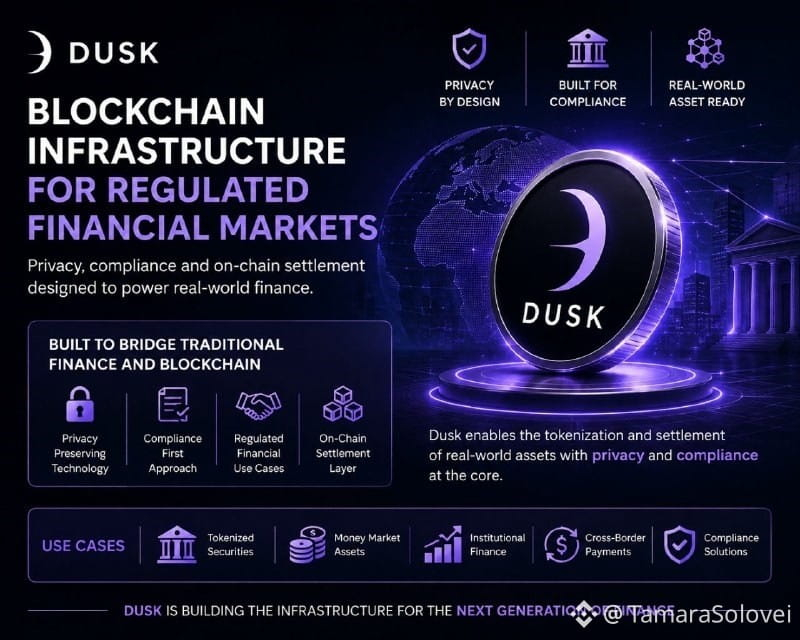
Uma das coisas mais importantes para as finanças institucionais é saber exatamente o que acontece quando uma transação é concluída.
Foi por isso que a abordagem da Dusk para o settlement chamou minha atenção.
Nos mercados financeiros tradicionais, o settlement pode envolver vários sistemas e intermediários. A infraestrutura on-chain oferece a possibilidade de tornar o processo mais direto e programável.
@Dusk_Foundation está construindo em torno de um settlement determinístico, enquanto o combina com recursos de privacidade e conformidade necessários para ativos regulados.
Isso importa porque um título tokenizado não é útil apenas por existir em uma blockchain.
A infraestrutura também precisa responder:
🔹 Quem tem permissão para mantê-lo?
🔹 Ele pode ser transferido?
🔹 Quais informações precisam ser verificadas?
🔹 Quando a transação se torna definitiva?
A Dusk está tentando fazer essas regras parte da própria rede.
Para mim, essa é a tese de RWA mais interessante: não apenas tokenizar ativos, mas tornar todo o ciclo de vida da transação financeira programável e verificável.
#dusk $DUSK @Dusk
Uma das coisas mais importantes para as finanças institucionais é saber exatamente o que acontece quando uma transação é concluída.
Foi por isso que a abordagem da Dusk para o settlement chamou minha atenção.
Nos mercados financeiros tradicionais, o settlement pode envolver vários sistemas e intermediários. A infraestrutura on-chain oferece a possibilidade de tornar o processo mais direto e programável.
@Dusk está construindo em torno de um settlement determinístico, enquanto o combina com recursos de privacidade e conformidade necessários para ativos regulados.
Isso importa porque um título tokenizado não é útil apenas por existir em uma blockchain.
A infraestrutura também precisa responder:
🔹 Quem tem permissão para mantê-lo?
🔹 Ele pode ser transferido?
🔹 Quais informações precisam ser verificadas?
🔹 Quando a transação se torna definitiva?
A Dusk está tentando fazer essas regras parte da própria rede.
Para mim, essa é a tese de RWA mais interessante: não apenas tokenizar ativos, mas tornar todo o ciclo de vida da transação financeira programável e verificável.
Uma das coisas mais importantes para as finanças institucionais é saber exatamente o que acontece quando uma transação é concluída.
Foi por isso que a abordagem da Dusk para o settlement chamou minha atenção.
Nos mercados financeiros tradicionais, o settlement pode envolver vários sistemas e intermediários. A infraestrutura on-chain oferece a possibilidade de tornar o processo mais direto e programável.
@Dusk está construindo em torno de um settlement determinístico, enquanto o combina com recursos de privacidade e conformidade necessários para ativos regulados.
Isso importa porque um título tokenizado não é útil apenas por existir em uma blockchain.
A infraestrutura também precisa responder:
🔹 Quem tem permissão para mantê-lo?
🔹 Ele pode ser transferido?
🔹 Quais informações precisam ser verificadas?
🔹 Quando a transação se torna definitiva?
A Dusk está tentando fazer essas regras parte da própria rede.
Para mim, essa é a tese de RWA mais interessante: não apenas tokenizar ativos, mas tornar todo o ciclo de vida da transação financeira programável e verificável.
103
Ver tradução
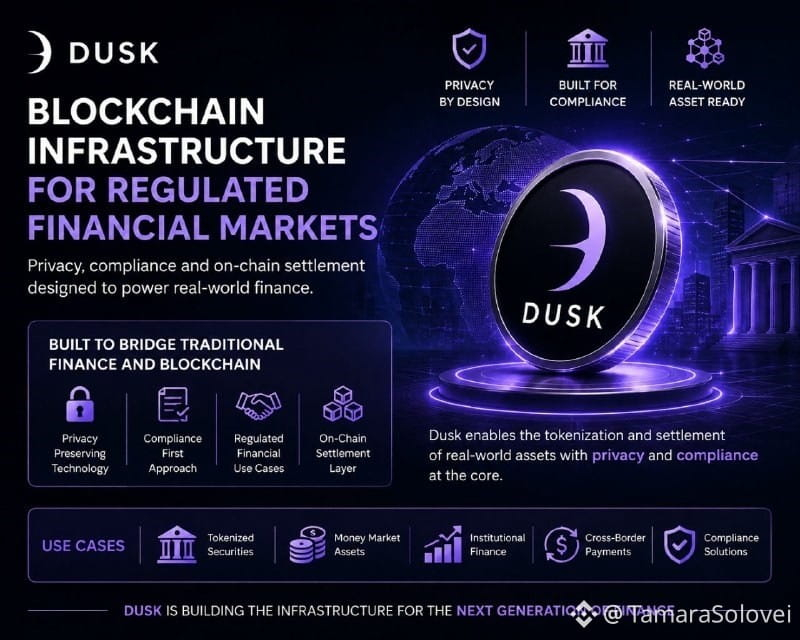
#dusk $DUSK @Dusk_Foundation After following Dusk for a while, the part that stands out to me is how specifically the network is built around financial markets.
Dusk isn't trying to solve every possible blockchain use case.
Its infrastructure is focused on a much narrower — but potentially very important — problem: making regulated financial assets work on-chain.
That means dealing with the things that make traditional finance complicated in the first place:
🔹 Investor eligibility
🔹 Asset transfers
🔹 Privacy and selective disclosure
🔹 Compliance requirements
🔹 Deterministic settlement
🔹 Different execution environments for developers
And I think that's the right way to approach the RWA market.
Tokenizing an asset is only the starting point. The real challenge is building infrastructure where that asset can actually be issued, transferred, traded and settled while the rules surrounding it remain enforceable.
That's the thesis behind Dusk that I find most compelling.
Not “blockchain for everything.”
Blockchain infrastructure specifically designed for financial markets.
Whether Dusk can turn this architecture into significant real-world adoption remains the big question.
But as the RWA sector continues to develop, I think projects solving the infrastructure problem deserve attention.
For now, $DUSK stays on my watchlist.
#dusk $DUSK @Dusk After following Dusk for a while, the part that stands out to me is how specifically the network is built around financial markets.
Dusk isn't trying to solve every possible blockchain use case.
Its infrastructure is focused on a much narrower — but potentially very important — problem: making regulated financial assets work on-chain.
That means dealing with the things that make traditional finance complicated in the first place:
🔹 Investor eligibility
🔹 Asset transfers
🔹 Privacy and selective disclosure
🔹 Compliance requirements
🔹 Deterministic settlement
🔹 Different execution environments for developers
And I think that's the right way to approach the RWA market.
Tokenizing an asset is only the starting point. The real challenge is building infrastructure where that asset can actually be issued, transferred, traded and settled while the rules surrounding it remain enforceable.
That's the thesis behind Dusk that I find most compelling.
Not “blockchain for everything.”
Blockchain infrastructure specifically designed for financial markets.
Whether Dusk can turn this architecture into significant real-world adoption remains the big question.
But as the RWA sector continues to develop, I think projects solving the infrastructure problem deserve attention.
For now, $DUSK stays on my watchlist.
Dusk isn't trying to solve every possible blockchain use case.
Its infrastructure is focused on a much narrower — but potentially very important — problem: making regulated financial assets work on-chain.
That means dealing with the things that make traditional finance complicated in the first place:
🔹 Investor eligibility
🔹 Asset transfers
🔹 Privacy and selective disclosure
🔹 Compliance requirements
🔹 Deterministic settlement
🔹 Different execution environments for developers
And I think that's the right way to approach the RWA market.
Tokenizing an asset is only the starting point. The real challenge is building infrastructure where that asset can actually be issued, transferred, traded and settled while the rules surrounding it remain enforceable.
That's the thesis behind Dusk that I find most compelling.
Not “blockchain for everything.”
Blockchain infrastructure specifically designed for financial markets.
Whether Dusk can turn this architecture into significant real-world adoption remains the big question.
But as the RWA sector continues to develop, I think projects solving the infrastructure problem deserve attention.
For now, $DUSK stays on my watchlist.
83
#dusk $DUSK @Dusk_Foundation
A parte mais interessante de Dusk talvez seja o que acontece entre o momento em que um ativo é emitido e o momento em que ele chega a um investidor.
As finanças regulamentadas têm muitas condições que precisam ser cumpridas antes que um ativo possa realmente se mover: elegibilidade do investidor, restrições de transferência, verificações de conformidade e liquidação.
@Dusk_Foundation está incorporando esses requisitos na própria infraestrutura blockchain.
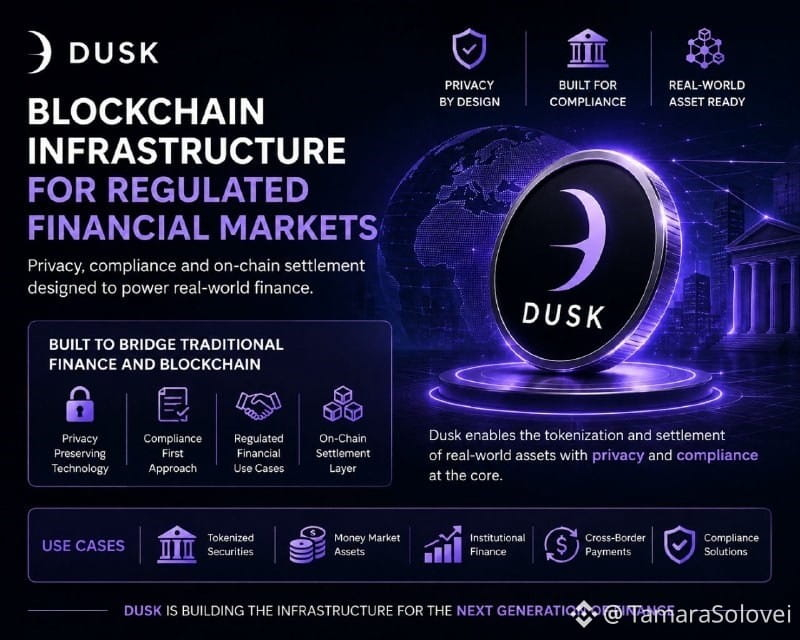
Isso significa que a rede não está tratando a conformidade como uma camada separada que precisa ser acoplada a cada aplicação. Em vez disso, fluxos de ativos regulamentados podem ser construídos com base em controles de acesso nativos, transações que preservam a privacidade e liquidação determinística.
Acho que essa abordagem faz sentido para os mercados institucionais.
Uma blockchain pública pode fornecer transparência, mas as instituições financeiras também precisam de acesso controlado e execução previsível.
A Dusk está tentando combinar ambos:
Infraestrutura transparente quando isso ajuda.
Privacidade quando necessário.
Verificação quando a regulamentação exige.
Se os títulos tokenizados eventualmente se tornarem um grande mercado, esses detalhes poderiam importar muito mais do que simplesmente ter outra blockchain capaz de emitir tokens.
O verdadeiro teste é se as instituições financeiras conseguem realmente operar na rede.
É isso que vou observar com $DUSK .
#dusk $DUSK @Dusk
A parte mais interessante de Dusk talvez seja o que acontece entre o momento em que um ativo é emitido e o momento em que ele chega a um investidor.
As finanças regulamentadas têm muitas condições que precisam ser cumpridas antes que um ativo possa realmente se mover: elegibilidade do investidor, restrições de transferência, verificações de conformidade e liquidação.
@Dusk está incorporando esses requisitos na própria infraestrutura blockchain.
Isso significa que a rede não está tratando a conformidade como uma camada separada que precisa ser acoplada a cada aplicação. Em vez disso, fluxos de ativos regulamentados podem ser construídos com base em controles de acesso nativos, transações que preservam a privacidade e liquidação determinística.
Acho que essa abordagem faz sentido para os mercados institucionais.
Uma blockchain pública pode fornecer transparência, mas as instituições financeiras também precisam de acesso controlado e execução previsível.
A Dusk está tentando combinar ambos:
Infraestrutura transparente quando isso ajuda.
Privacidade quando necessário.
Verificação quando a regulamentação exige.
Se os títulos tokenizados eventualmente se tornarem um grande mercado, esses detalhes poderiam importar muito mais do que simplesmente ter outra blockchain capaz de emitir tokens.
O verdadeiro teste é se as instituições financeiras conseguem realmente operar na rede.
É isso que vou observar com $DUSK .
A parte mais interessante de Dusk talvez seja o que acontece entre o momento em que um ativo é emitido e o momento em que ele chega a um investidor.
As finanças regulamentadas têm muitas condições que precisam ser cumpridas antes que um ativo possa realmente se mover: elegibilidade do investidor, restrições de transferência, verificações de conformidade e liquidação.
@Dusk está incorporando esses requisitos na própria infraestrutura blockchain.
Isso significa que a rede não está tratando a conformidade como uma camada separada que precisa ser acoplada a cada aplicação. Em vez disso, fluxos de ativos regulamentados podem ser construídos com base em controles de acesso nativos, transações que preservam a privacidade e liquidação determinística.
Acho que essa abordagem faz sentido para os mercados institucionais.
Uma blockchain pública pode fornecer transparência, mas as instituições financeiras também precisam de acesso controlado e execução previsível.
A Dusk está tentando combinar ambos:
Infraestrutura transparente quando isso ajuda.
Privacidade quando necessário.
Verificação quando a regulamentação exige.
Se os títulos tokenizados eventualmente se tornarem um grande mercado, esses detalhes poderiam importar muito mais do que simplesmente ter outra blockchain capaz de emitir tokens.
O verdadeiro teste é se as instituições financeiras conseguem realmente operar na rede.
É isso que vou observar com $DUSK .
80
Ver tradução
#dusk $DUSK @Dusk_Foundation
Most people hear “RWA” and immediately think about tokenizing government bonds or putting real estate onchain.
But I think the more interesting opportunity is much broader.
Private markets.
A huge amount of economic activity happens outside public markets.
Private companies need financing.
Investors need access to opportunities.
Ownership needs to be recorded.
Transfers need to be controlled.
Payments and settlement need to happen.
And every participant needs to know who is actually allowed to do what.
Today, a lot of this infrastructure is fragmented across issuers, banks, custodians, administrators, brokers and other intermediaries.
Tokenization doesn't automatically solve that.
Putting an asset on a blockchain doesn't magically create liquidity, demand or legal certainty.
The interesting part is what happens when the entire lifecycle of an asset can be represented digitally.
Issuance.
Investor eligibility.
Ownership.
Transfers.
Dividends.
Voting.
Settlement.
That's where @Dusk_Foundation _Foundation is taking an interesting approach.
Dusk isn't simply saying “let's put more assets onchain.”
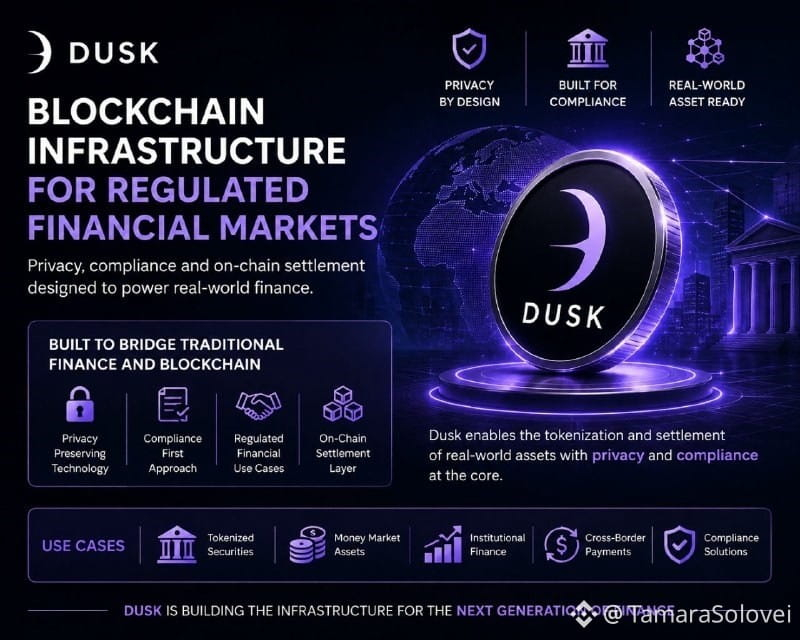
It's trying to build infrastructure where regulated assets can exist onchain while still dealing with the requirements that financial markets can't ignore.
Privacy.
Selective disclosure.
Access controls.
Compliance.
Deterministic settlement.
And that's particularly important for private markets.
A public blockchain gives you transparency by default.
Financial markets often need the opposite: controlled visibility.
An investor may need to prove they're eligible without exposing every piece of personal information.
A company may need to keep sensitive positions private.
A regulated venue may need to know exactly who can hold or transfer an asset.
That doesn't mean blockchain has to choose between transparency and privacy.
It means the infrastructure needs to be designed for both.
This is why I'm paying attention to Dusk.
The interesting question isn't whether we can tokenize another asset.
#dusk $DUSK @Dusk
Most people hear “RWA” and immediately think about tokenizing government bonds or putting real estate onchain.
But I think the more interesting opportunity is much broader.
Private markets.
A huge amount of economic activity happens outside public markets.
Private companies need financing.
Investors need access to opportunities.
Ownership needs to be recorded.
Transfers need to be controlled.
Payments and settlement need to happen.
And every participant needs to know who is actually allowed to do what.
Today, a lot of this infrastructure is fragmented across issuers, banks, custodians, administrators, brokers and other intermediaries.
Tokenization doesn't automatically solve that.
Putting an asset on a blockchain doesn't magically create liquidity, demand or legal certainty.
The interesting part is what happens when the entire lifecycle of an asset can be represented digitally.
Issuance.
Investor eligibility.
Ownership.
Transfers.
Dividends.
Voting.
Settlement.
That's where @Dusk _Foundation is taking an interesting approach.
Dusk isn't simply saying “let's put more assets onchain.”
It's trying to build infrastructure where regulated assets can exist onchain while still dealing with the requirements that financial markets can't ignore.
Privacy.
Selective disclosure.
Access controls.
Compliance.
Deterministic settlement.
And that's particularly important for private markets.
A public blockchain gives you transparency by default.
Financial markets often need the opposite: controlled visibility.
An investor may need to prove they're eligible without exposing every piece of personal information.
A company may need to keep sensitive positions private.
A regulated venue may need to know exactly who can hold or transfer an asset.
That doesn't mean blockchain has to choose between transparency and privacy.
It means the infrastructure needs to be designed for both.
This is why I'm paying attention to Dusk.
The interesting question isn't whether we can tokenize another asset.
Most people hear “RWA” and immediately think about tokenizing government bonds or putting real estate onchain.
But I think the more interesting opportunity is much broader.
Private markets.
A huge amount of economic activity happens outside public markets.
Private companies need financing.
Investors need access to opportunities.
Ownership needs to be recorded.
Transfers need to be controlled.
Payments and settlement need to happen.
And every participant needs to know who is actually allowed to do what.
Today, a lot of this infrastructure is fragmented across issuers, banks, custodians, administrators, brokers and other intermediaries.
Tokenization doesn't automatically solve that.
Putting an asset on a blockchain doesn't magically create liquidity, demand or legal certainty.
The interesting part is what happens when the entire lifecycle of an asset can be represented digitally.
Issuance.
Investor eligibility.
Ownership.
Transfers.
Dividends.
Voting.
Settlement.
That's where @Dusk _Foundation is taking an interesting approach.
Dusk isn't simply saying “let's put more assets onchain.”
It's trying to build infrastructure where regulated assets can exist onchain while still dealing with the requirements that financial markets can't ignore.
Privacy.
Selective disclosure.
Access controls.
Compliance.
Deterministic settlement.
And that's particularly important for private markets.
A public blockchain gives you transparency by default.
Financial markets often need the opposite: controlled visibility.
An investor may need to prove they're eligible without exposing every piece of personal information.
A company may need to keep sensitive positions private.
A regulated venue may need to know exactly who can hold or transfer an asset.
That doesn't mean blockchain has to choose between transparency and privacy.
It means the infrastructure needs to be designed for both.
This is why I'm paying attention to Dusk.
The interesting question isn't whether we can tokenize another asset.
71
#dusk $DUSK @Dusk_Foundation
A maioria das pessoas ouve “RWA” e imediatamente pensa em tokenizar títulos do governo ou em colocar imóveis na onchain.
Mas acho que a oportunidade mais interessante é muito mais ampla.
Mercados privados.
Uma quantidade enorme de atividade econômica acontece fora dos mercados públicos.
Empresas privadas precisam de financiamento.
Investidores precisam de acesso a oportunidades.
A propriedade precisa ser registrada.
As transferências precisam ser controladas.
Pagamentos e liquidação precisam acontecer.
E cada participante precisa saber quem realmente está autorizado a fazer o quê.
Hoje, grande parte dessa infraestrutura está fragmentada entre emissores, bancos, custodiante, administradores, corretores e outros intermediários.
A tokenização não resolve isso automaticamente.
Colocar um ativo em uma blockchain não cria liquidez, demanda ou certeza legal de forma mágica.
A parte interessante é o que acontece quando todo o ciclo de vida de um ativo pode ser representado digitalmente.
Emissão.
Elegibilidade do investidor.
Propriedade.
Transferências.
Dividendos.
Votação.
Liquidação.
É aí que o @Dusk_Foundation _Foundation está adotando uma abordagem interessante.
A Dusk não está simplesmente dizendo “vamos colocar mais ativos na onchain”.
Ela está tentando construir uma infraestrutura em que ativos regulamentados possam existir onchain, ainda lidando com requisitos que os mercados financeiros não podem ignorar.
Privacidade.
Divulgação seletiva.
Controles de acesso.
Conformidade.
Liquidação determinística.
E isso é especialmente importante para mercados privados.
Uma blockchain pública lhe dá transparência por padrão.
Os mercados financeiros muitas vezes precisam do oposto: visibilidade controlada.
Um investidor pode precisar provar que é elegível sem expor cada detalhe de informações pessoais.
Uma empresa pode precisar manter posições sensíveis em sigilo.
Um ambiente regulado pode precisar saber exatamente quem pode manter ou transferir um ativo.
Isso não significa que a blockchain precise escolher entre transparência e privacidade.
Significa que a infraestrutura precisa ser projetada para ambas.
Por isso estou prestando atenção na Dusk.
A pergunta interessante não é se conseguimos tokenizar mais um ativo.
#dusk $DUSK @Dusk
A maioria das pessoas ouve “RWA” e imediatamente pensa em tokenizar títulos do governo ou em colocar imóveis na onchain.
Mas acho que a oportunidade mais interessante é muito mais ampla.
Mercados privados.
Uma quantidade enorme de atividade econômica acontece fora dos mercados públicos.
Empresas privadas precisam de financiamento.
Investidores precisam de acesso a oportunidades.
A propriedade precisa ser registrada.
As transferências precisam ser controladas.
Pagamentos e liquidação precisam acontecer.
E cada participante precisa saber quem realmente está autorizado a fazer o quê.
Hoje, grande parte dessa infraestrutura está fragmentada entre emissores, bancos, custodiante, administradores, corretores e outros intermediários.
A tokenização não resolve isso automaticamente.
Colocar um ativo em uma blockchain não cria liquidez, demanda ou certeza legal de forma mágica.
A parte interessante é o que acontece quando todo o ciclo de vida de um ativo pode ser representado digitalmente.
Emissão.
Elegibilidade do investidor.
Propriedade.
Transferências.
Dividendos.
Votação.
Liquidação.
É aí que o @Dusk _Foundation está adotando uma abordagem interessante.
A Dusk não está simplesmente dizendo “vamos colocar mais ativos na onchain”.
Ela está tentando construir uma infraestrutura em que ativos regulamentados possam existir onchain, ainda lidando com requisitos que os mercados financeiros não podem ignorar.
Privacidade.
Divulgação seletiva.
Controles de acesso.
Conformidade.
Liquidação determinística.
E isso é especialmente importante para mercados privados.
Uma blockchain pública lhe dá transparência por padrão.
Os mercados financeiros muitas vezes precisam do oposto: visibilidade controlada.
Um investidor pode precisar provar que é elegível sem expor cada detalhe de informações pessoais.
Uma empresa pode precisar manter posições sensíveis em sigilo.
Um ambiente regulado pode precisar saber exatamente quem pode manter ou transferir um ativo.
Isso não significa que a blockchain precise escolher entre transparência e privacidade.
Significa que a infraestrutura precisa ser projetada para ambas.
Por isso estou prestando atenção na Dusk.
A pergunta interessante não é se conseguimos tokenizar mais um ativo.
A maioria das pessoas ouve “RWA” e imediatamente pensa em tokenizar títulos do governo ou em colocar imóveis na onchain.
Mas acho que a oportunidade mais interessante é muito mais ampla.
Mercados privados.
Uma quantidade enorme de atividade econômica acontece fora dos mercados públicos.
Empresas privadas precisam de financiamento.
Investidores precisam de acesso a oportunidades.
A propriedade precisa ser registrada.
As transferências precisam ser controladas.
Pagamentos e liquidação precisam acontecer.
E cada participante precisa saber quem realmente está autorizado a fazer o quê.
Hoje, grande parte dessa infraestrutura está fragmentada entre emissores, bancos, custodiante, administradores, corretores e outros intermediários.
A tokenização não resolve isso automaticamente.
Colocar um ativo em uma blockchain não cria liquidez, demanda ou certeza legal de forma mágica.
A parte interessante é o que acontece quando todo o ciclo de vida de um ativo pode ser representado digitalmente.
Emissão.
Elegibilidade do investidor.
Propriedade.
Transferências.
Dividendos.
Votação.
Liquidação.
É aí que o @Dusk _Foundation está adotando uma abordagem interessante.
A Dusk não está simplesmente dizendo “vamos colocar mais ativos na onchain”.
Ela está tentando construir uma infraestrutura em que ativos regulamentados possam existir onchain, ainda lidando com requisitos que os mercados financeiros não podem ignorar.
Privacidade.
Divulgação seletiva.
Controles de acesso.
Conformidade.
Liquidação determinística.
E isso é especialmente importante para mercados privados.
Uma blockchain pública lhe dá transparência por padrão.
Os mercados financeiros muitas vezes precisam do oposto: visibilidade controlada.
Um investidor pode precisar provar que é elegível sem expor cada detalhe de informações pessoais.
Uma empresa pode precisar manter posições sensíveis em sigilo.
Um ambiente regulado pode precisar saber exatamente quem pode manter ou transferir um ativo.
Isso não significa que a blockchain precise escolher entre transparência e privacidade.
Significa que a infraestrutura precisa ser projetada para ambas.
Por isso estou prestando atenção na Dusk.
A pergunta interessante não é se conseguimos tokenizar mais um ativo.
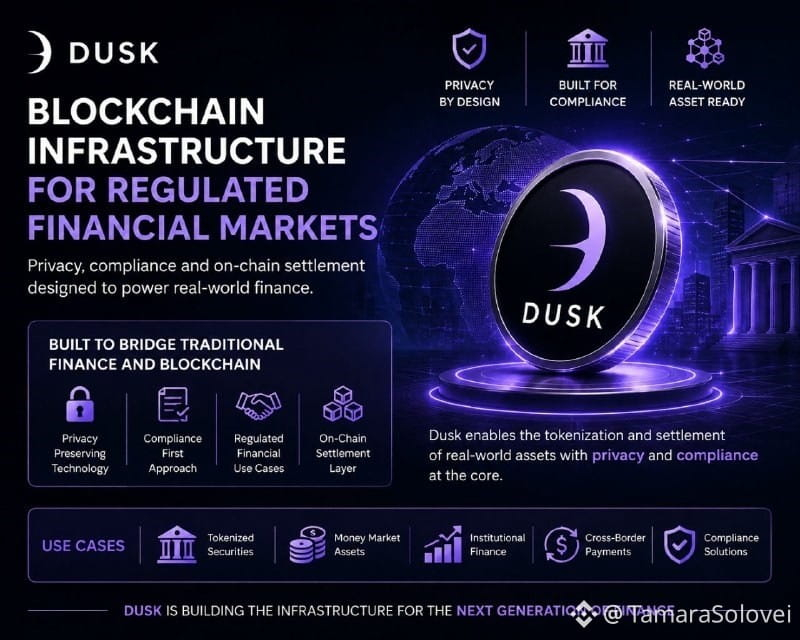
64
Ver tradução
#termmax @termmax DeFi becomes much more interesting when financial positions can be built like Lego blocks.
That’s one reason I’m watching TermMax.
The protocol is focused on fixed-rate lending and borrowing with defined maturities, but the bigger idea is what these predictable positions can enable on top of them.
A fixed-rate position can become a building block for:
🔹 Hedging interest-rate exposure
🔹 More predictable leverage
🔹 Fixed-income strategies
🔹 Vaults and structured products
🔹 More precise capital management
Instead of every strategy depending on whatever the floating market rate happens to be at a particular moment, users can build around a known rate and a defined time horizon.
That's important because sophisticated financial strategies usually need more than liquidity. They need predictability.
TermMax is essentially bringing another primitive from traditional fixed-income markets into DeFi and making it composable with on-chain infrastructure.
The interesting question is how far fixed-rate markets can go once they become programmable.
$TMX is one token I'll be watching as this sector develops.
#termmax @TermMax DeFi becomes much more interesting when financial positions can be built like Lego blocks.
That’s one reason I’m watching TermMax.
The protocol is focused on fixed-rate lending and borrowing with defined maturities, but the bigger idea is what these predictable positions can enable on top of them.
A fixed-rate position can become a building block for:
🔹 Hedging interest-rate exposure
🔹 More predictable leverage
🔹 Fixed-income strategies
🔹 Vaults and structured products
🔹 More precise capital management
Instead of every strategy depending on whatever the floating market rate happens to be at a particular moment, users can build around a known rate and a defined time horizon.
That's important because sophisticated financial strategies usually need more than liquidity. They need predictability.
TermMax is essentially bringing another primitive from traditional fixed-income markets into DeFi and making it composable with on-chain infrastructure.
The interesting question is how far fixed-rate markets can go once they become programmable.
$TMX is one token I'll be watching as this sector develops.
That’s one reason I’m watching TermMax.
The protocol is focused on fixed-rate lending and borrowing with defined maturities, but the bigger idea is what these predictable positions can enable on top of them.
A fixed-rate position can become a building block for:
🔹 Hedging interest-rate exposure
🔹 More predictable leverage
🔹 Fixed-income strategies
🔹 Vaults and structured products
🔹 More precise capital management
Instead of every strategy depending on whatever the floating market rate happens to be at a particular moment, users can build around a known rate and a defined time horizon.
That's important because sophisticated financial strategies usually need more than liquidity. They need predictability.
TermMax is essentially bringing another primitive from traditional fixed-income markets into DeFi and making it composable with on-chain infrastructure.
The interesting question is how far fixed-rate markets can go once they become programmable.
$TMX is one token I'll be watching as this sector develops.
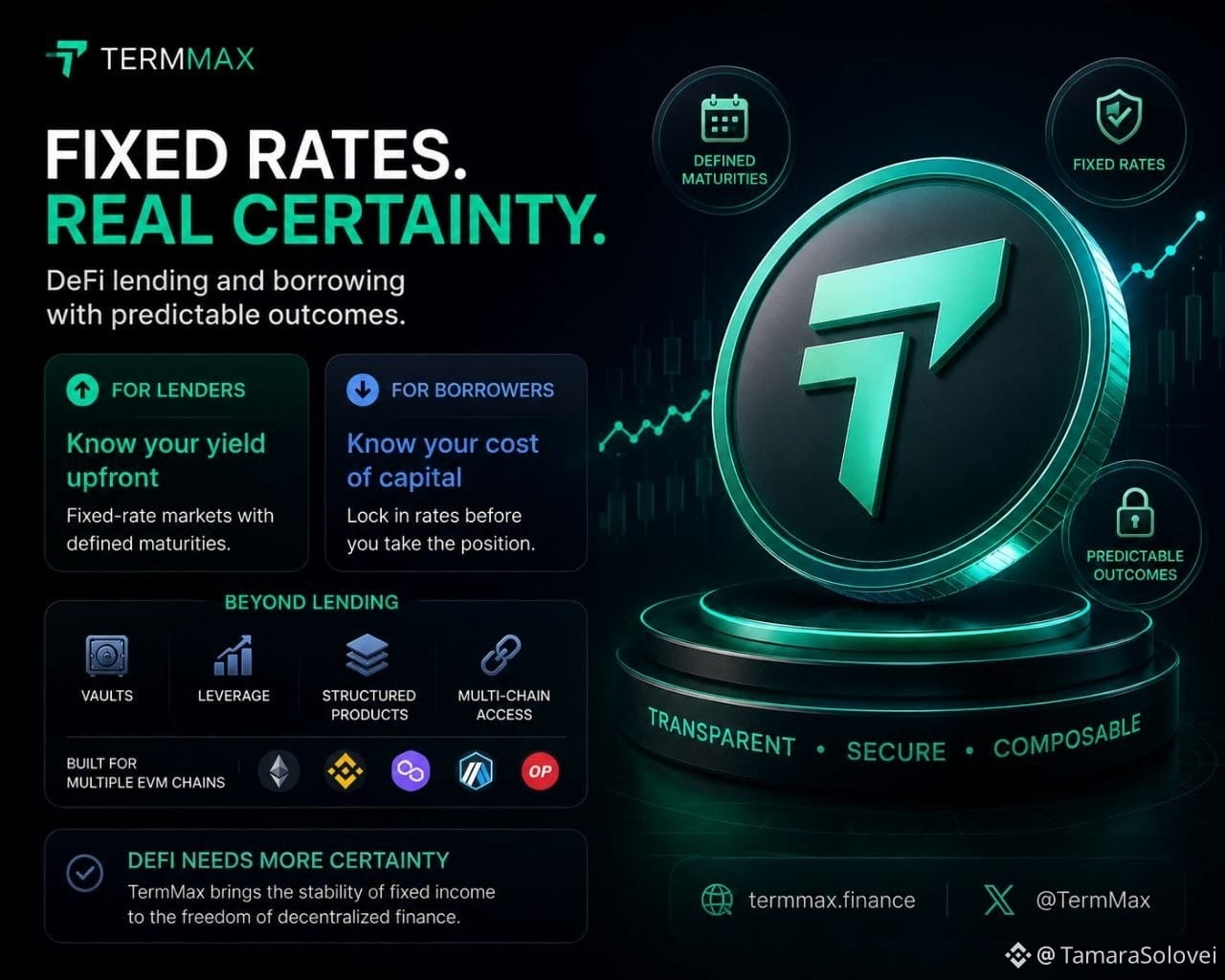
57
Ver tradução
#dusk $DUSK @Dusk_Foundation
One thing I find interesting about Dusk is that it isn't trying to force every financial application into the same execution model.
The network provides DuskVM for native Rust/WASM applications and DuskEVM for developers who want an Ethereum-compatible environment.
That creates an interesting balance.
Developers can use familiar EVM tooling and smart-contract languages, while applications that need deeper access to Dusk's native capabilities can build directly on DuskVM.
Underneath both environments is DuskDS, providing the settlement and data-availability layer.
This architecture makes sense for a network focused on financial applications. Different products can have different technical requirements without necessarily needing completely separate chains.
And the native $DUSK token ties the ecosystem together through transaction fees and network staking.
For me, the interesting question isn't whether Dusk can attract developers — it's whether this architecture can turn into real financial activity on-chain.
If it does, $DUSK becomes more than just a token attached to an RWA narrative. It becomes part of the infrastructure powering the applications built on Dusk.
#dusk $DUSK @Dusk
One thing I find interesting about Dusk is that it isn't trying to force every financial application into the same execution model.
The network provides DuskVM for native Rust/WASM applications and DuskEVM for developers who want an Ethereum-compatible environment.
That creates an interesting balance.
Developers can use familiar EVM tooling and smart-contract languages, while applications that need deeper access to Dusk's native capabilities can build directly on DuskVM.
Underneath both environments is DuskDS, providing the settlement and data-availability layer.
This architecture makes sense for a network focused on financial applications. Different products can have different technical requirements without necessarily needing completely separate chains.
And the native $DUSK token ties the ecosystem together through transaction fees and network staking.
For me, the interesting question isn't whether Dusk can attract developers — it's whether this architecture can turn into real financial activity on-chain.
If it does, $DUSK becomes more than just a token attached to an RWA narrative. It becomes part of the infrastructure powering the applications built on Dusk.
One thing I find interesting about Dusk is that it isn't trying to force every financial application into the same execution model.
The network provides DuskVM for native Rust/WASM applications and DuskEVM for developers who want an Ethereum-compatible environment.
That creates an interesting balance.
Developers can use familiar EVM tooling and smart-contract languages, while applications that need deeper access to Dusk's native capabilities can build directly on DuskVM.
Underneath both environments is DuskDS, providing the settlement and data-availability layer.
This architecture makes sense for a network focused on financial applications. Different products can have different technical requirements without necessarily needing completely separate chains.
And the native $DUSK token ties the ecosystem together through transaction fees and network staking.
For me, the interesting question isn't whether Dusk can attract developers — it's whether this architecture can turn into real financial activity on-chain.
If it does, $DUSK becomes more than just a token attached to an RWA narrative. It becomes part of the infrastructure powering the applications built on Dusk.
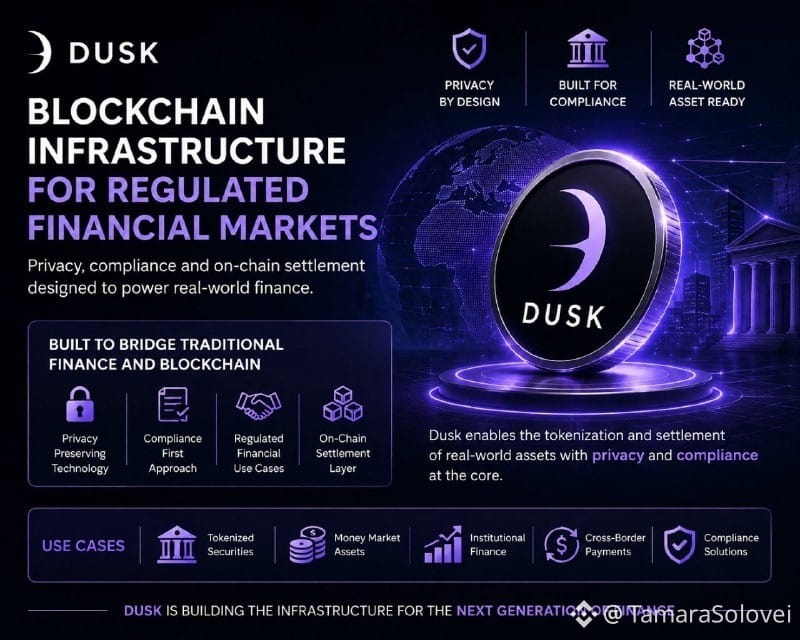
79
Ver tradução
#dusk $DUSK @Dusk_Foundation
Dusk is taking an interesting approach to one of the biggest problems in on-chain finance: making different parts of the market work together.
A tokenized security needs more than a blockchain address. It needs rules around who can hold it, how it can move, what information can be disclosed and how settlement is finalized.
Dusk is building these requirements into its network rather than treating them as separate infrastructure.
What stands out to me is the combination of:
🔹 Permissioned access where required
🔹 Privacy-preserving transactions
🔹 Selective disclosure
🔹 Deterministic settlement
🔹 EVM compatibility for developers
That combination could make Dusk useful for financial applications where completely public transactions aren't practical, but completely private systems aren't acceptable either.
The interesting part of the Dusk thesis isn't putting finance on a blockchain. It's making blockchain infrastructure fit the way regulated finance actually works.
If RWAs continue moving toward institutional adoption, that's a niche worth watching.
#dusk $DUSK @Dusk
Dusk is taking an interesting approach to one of the biggest problems in on-chain finance: making different parts of the market work together.
A tokenized security needs more than a blockchain address. It needs rules around who can hold it, how it can move, what information can be disclosed and how settlement is finalized.
Dusk is building these requirements into its network rather than treating them as separate infrastructure.
What stands out to me is the combination of:
🔹 Permissioned access where required
🔹 Privacy-preserving transactions
🔹 Selective disclosure
🔹 Deterministic settlement
🔹 EVM compatibility for developers
That combination could make Dusk useful for financial applications where completely public transactions aren't practical, but completely private systems aren't acceptable either.
The interesting part of the Dusk thesis isn't putting finance on a blockchain. It's making blockchain infrastructure fit the way regulated finance actually works.
If RWAs continue moving toward institutional adoption, that's a niche worth watching.
Dusk is taking an interesting approach to one of the biggest problems in on-chain finance: making different parts of the market work together.
A tokenized security needs more than a blockchain address. It needs rules around who can hold it, how it can move, what information can be disclosed and how settlement is finalized.
Dusk is building these requirements into its network rather than treating them as separate infrastructure.
What stands out to me is the combination of:
🔹 Permissioned access where required
🔹 Privacy-preserving transactions
🔹 Selective disclosure
🔹 Deterministic settlement
🔹 EVM compatibility for developers
That combination could make Dusk useful for financial applications where completely public transactions aren't practical, but completely private systems aren't acceptable either.
The interesting part of the Dusk thesis isn't putting finance on a blockchain. It's making blockchain infrastructure fit the way regulated finance actually works.
If RWAs continue moving toward institutional adoption, that's a niche worth watching.
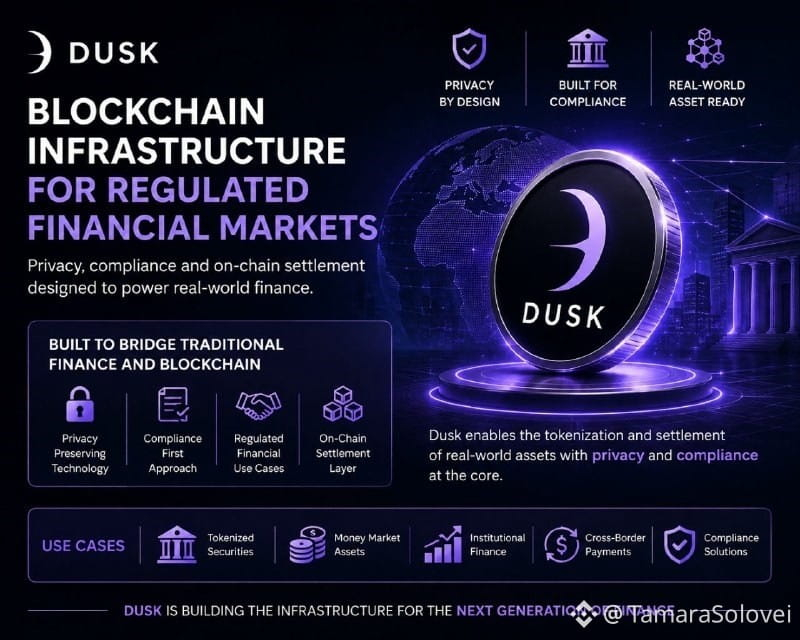
62
Ver tradução
#termmax @termmax
Predictability can be just as valuable as yield in DeFi.
When borrowing rates constantly change, managing a position becomes a moving target. A strategy that looks attractive today can become expensive tomorrow simply because market conditions changed.
TermMax approaches this with fixed-rate markets and defined maturities.
That gives users something DeFi often lacks: a clearer framework for planning capital.
Borrowers can know their financing cost in advance, while lenders can evaluate an expected return over a specific period instead of relying entirely on a floating rate.
This also creates interesting possibilities for more sophisticated strategies:
🔹 Hedging interest-rate risk
🔹 Planning leverage more precisely
🔹 Building fixed-income strategies
🔹 Combining lending with structured products
🔹 Creating more predictable vault strategies
I think this is an important step if DeFi wants to move beyond short-term speculation and become a more complete financial ecosystem.
The ability to know your rate and maturity in advance may sound simple — but in a volatile market, predictability itself has value.
That’s what makes the TermMax approach worth watching.
#termmax @TermMax
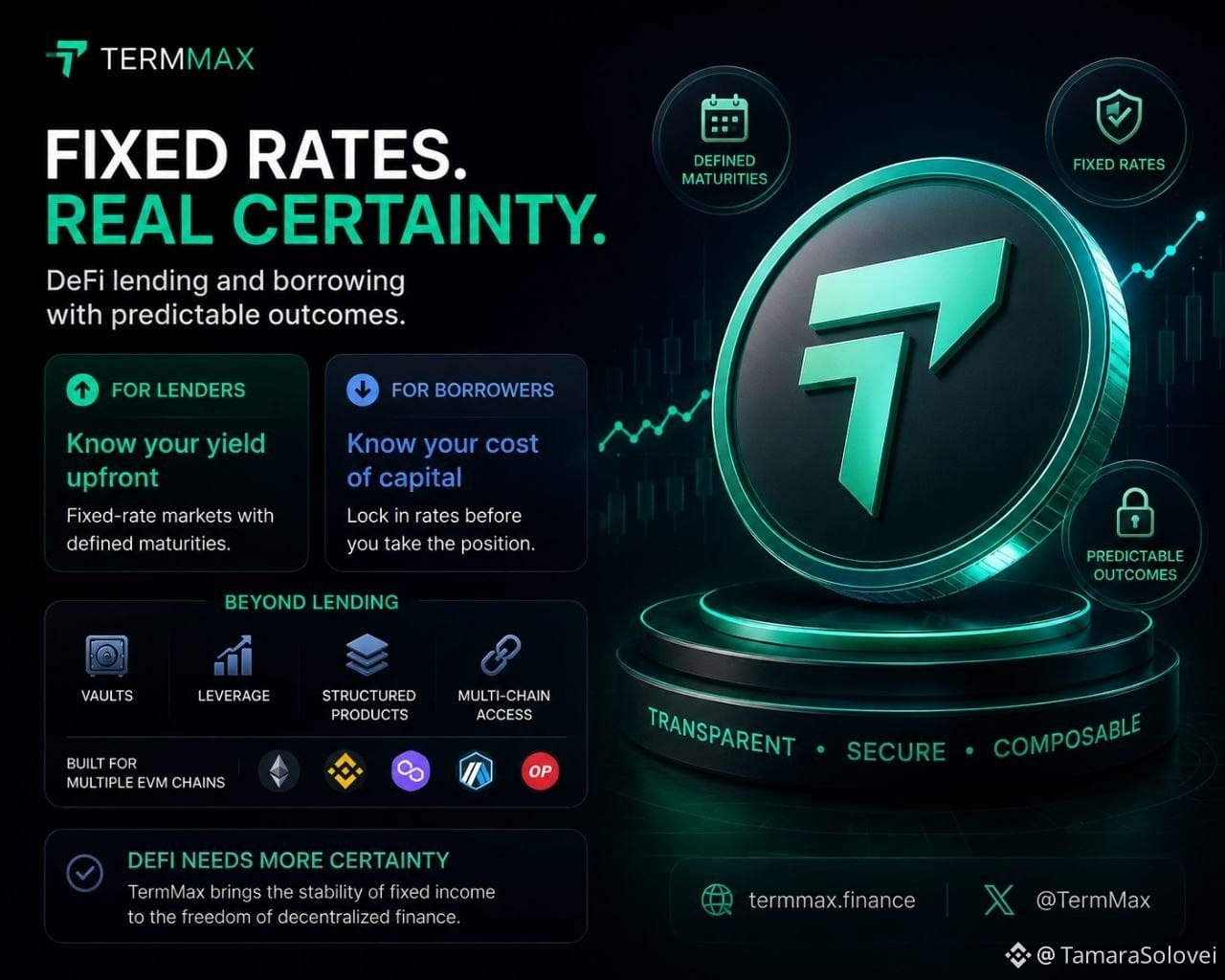
Predictability can be just as valuable as yield in DeFi.
When borrowing rates constantly change, managing a position becomes a moving target. A strategy that looks attractive today can become expensive tomorrow simply because market conditions changed.
TermMax approaches this with fixed-rate markets and defined maturities.
That gives users something DeFi often lacks: a clearer framework for planning capital.
Borrowers can know their financing cost in advance, while lenders can evaluate an expected return over a specific period instead of relying entirely on a floating rate.
This also creates interesting possibilities for more sophisticated strategies:
🔹 Hedging interest-rate risk
🔹 Planning leverage more precisely
🔹 Building fixed-income strategies
🔹 Combining lending with structured products
🔹 Creating more predictable vault strategies
I think this is an important step if DeFi wants to move beyond short-term speculation and become a more complete financial ecosystem.
The ability to know your rate and maturity in advance may sound simple — but in a volatile market, predictability itself has value.
That’s what makes the TermMax approach worth watching.
Predictability can be just as valuable as yield in DeFi.
When borrowing rates constantly change, managing a position becomes a moving target. A strategy that looks attractive today can become expensive tomorrow simply because market conditions changed.
TermMax approaches this with fixed-rate markets and defined maturities.
That gives users something DeFi often lacks: a clearer framework for planning capital.
Borrowers can know their financing cost in advance, while lenders can evaluate an expected return over a specific period instead of relying entirely on a floating rate.
This also creates interesting possibilities for more sophisticated strategies:
🔹 Hedging interest-rate risk
🔹 Planning leverage more precisely
🔹 Building fixed-income strategies
🔹 Combining lending with structured products
🔹 Creating more predictable vault strategies
I think this is an important step if DeFi wants to move beyond short-term speculation and become a more complete financial ecosystem.
The ability to know your rate and maturity in advance may sound simple — but in a volatile market, predictability itself has value.
That’s what makes the TermMax approach worth watching.
77
Ver tradução
#termmax @termmax
What makes TermMax interesting isn't only fixed-rate lending. It's the idea of turning predictable debt into a building block for DeFi.
Fixed-rate markets can give users something that is often missing from on-chain finance: a clear timeline for a position.
Instead of constantly reacting to changing borrowing costs, users can structure positions around a known rate and maturity.
This creates interesting possibilities for more advanced strategies:
🔹 Fixed-rate borrowing
🔹 Predictable lending returns
🔹 Leveraged strategies
🔹 Vault-based products
🔹 Structured positions
The goal isn't simply to copy traditional fixed-income products on-chain. It's to make these financial primitives composable with the rest of DeFi.
That's where I think $TMX becomes interesting as part of the bigger TermMax ecosystem.
If DeFi wants to attract more sophisticated capital, predictable rates and defined maturities could become just as important as liquidity.
The next evolution of DeFi might not be about more leverage. It might be about better control over risk.
#termmax @TermMax
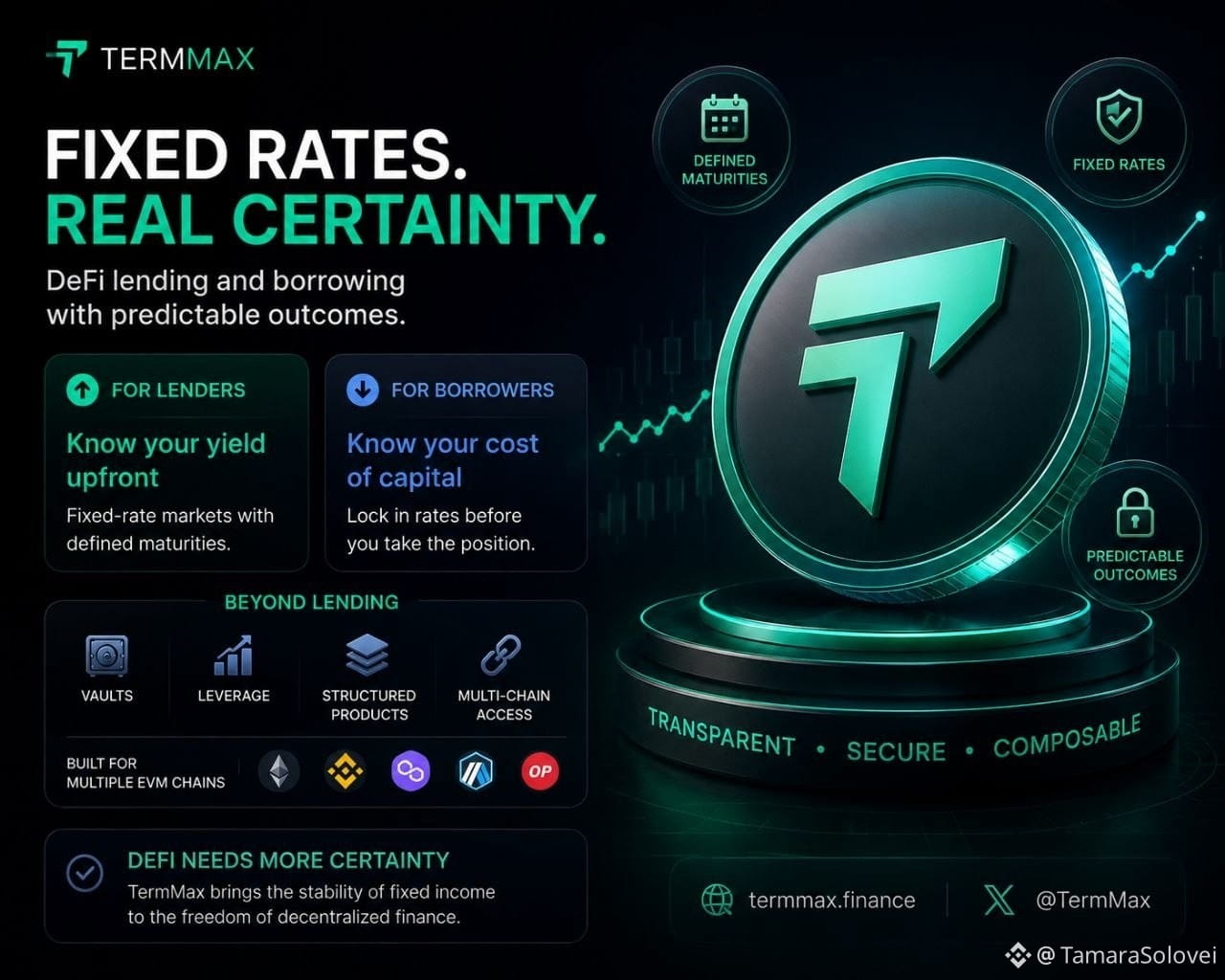
What makes TermMax interesting isn't only fixed-rate lending. It's the idea of turning predictable debt into a building block for DeFi.
Fixed-rate markets can give users something that is often missing from on-chain finance: a clear timeline for a position.
Instead of constantly reacting to changing borrowing costs, users can structure positions around a known rate and maturity.
This creates interesting possibilities for more advanced strategies:
🔹 Fixed-rate borrowing
🔹 Predictable lending returns
🔹 Leveraged strategies
🔹 Vault-based products
🔹 Structured positions
The goal isn't simply to copy traditional fixed-income products on-chain. It's to make these financial primitives composable with the rest of DeFi.
That's where I think $TMX becomes interesting as part of the bigger TermMax ecosystem.
If DeFi wants to attract more sophisticated capital, predictable rates and defined maturities could become just as important as liquidity.
The next evolution of DeFi might not be about more leverage. It might be about better control over risk.
What makes TermMax interesting isn't only fixed-rate lending. It's the idea of turning predictable debt into a building block for DeFi.
Fixed-rate markets can give users something that is often missing from on-chain finance: a clear timeline for a position.
Instead of constantly reacting to changing borrowing costs, users can structure positions around a known rate and maturity.
This creates interesting possibilities for more advanced strategies:
🔹 Fixed-rate borrowing
🔹 Predictable lending returns
🔹 Leveraged strategies
🔹 Vault-based products
🔹 Structured positions
The goal isn't simply to copy traditional fixed-income products on-chain. It's to make these financial primitives composable with the rest of DeFi.
That's where I think $TMX becomes interesting as part of the bigger TermMax ecosystem.
If DeFi wants to attract more sophisticated capital, predictable rates and defined maturities could become just as important as liquidity.
The next evolution of DeFi might not be about more leverage. It might be about better control over risk.
56
Ver tradução
#dusk $DUSK @Dusk_Foundation
Why does regulated finance need its own blockchain infrastructure instead of simply using a public chain?
That question is becoming increasingly important as tokenized securities and real-world assets move on-chain.
@Dusk_Foundation is built around the idea that financial markets have different requirements from ordinary crypto applications. Issuers, investors, custodians and regulators all need to interact with the same infrastructure while sensitive financial information remains protected.
One of the most interesting concepts is selective disclosure.
Instead of choosing between complete transparency or complete privacy, Dusk is designed to let authorized parties verify the information they need without exposing every transaction or portfolio detail publicly. Combined with deterministic settlement and access controls, this creates infrastructure tailored for regulated digital assets.
I think that distinction is what makes Dusk worth watching. The future of RWAs may depend less on creating tokens and more on creating networks capable of handling the real-world rules behind them.
#dusk $DUSK @Dusk
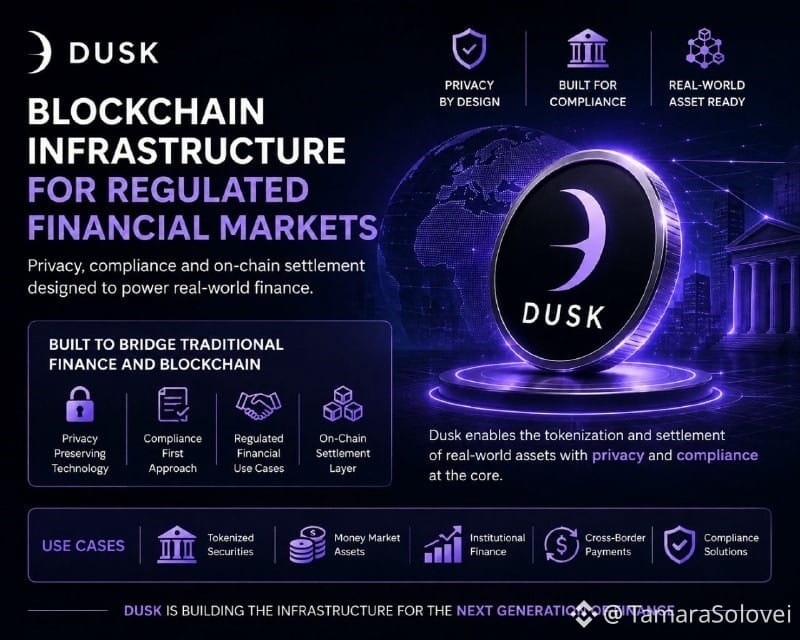
Why does regulated finance need its own blockchain infrastructure instead of simply using a public chain?
That question is becoming increasingly important as tokenized securities and real-world assets move on-chain.
@Dusk is built around the idea that financial markets have different requirements from ordinary crypto applications. Issuers, investors, custodians and regulators all need to interact with the same infrastructure while sensitive financial information remains protected.
One of the most interesting concepts is selective disclosure.
Instead of choosing between complete transparency or complete privacy, Dusk is designed to let authorized parties verify the information they need without exposing every transaction or portfolio detail publicly. Combined with deterministic settlement and access controls, this creates infrastructure tailored for regulated digital assets.
I think that distinction is what makes Dusk worth watching. The future of RWAs may depend less on creating tokens and more on creating networks capable of handling the real-world rules behind them.
Why does regulated finance need its own blockchain infrastructure instead of simply using a public chain?
That question is becoming increasingly important as tokenized securities and real-world assets move on-chain.
@Dusk is built around the idea that financial markets have different requirements from ordinary crypto applications. Issuers, investors, custodians and regulators all need to interact with the same infrastructure while sensitive financial information remains protected.
One of the most interesting concepts is selective disclosure.
Instead of choosing between complete transparency or complete privacy, Dusk is designed to let authorized parties verify the information they need without exposing every transaction or portfolio detail publicly. Combined with deterministic settlement and access controls, this creates infrastructure tailored for regulated digital assets.
I think that distinction is what makes Dusk worth watching. The future of RWAs may depend less on creating tokens and more on creating networks capable of handling the real-world rules behind them.
78
Ver tradução
#termmax @termmax
DeFi is great at giving users flexibility, but flexibility often comes with uncertainty.
Interest rates can change quickly, making it difficult to plan the cost of borrowing or the return on lending.
@termmax approaches this problem with fixed-rate markets and defined maturities.
Instead of constantly watching the lending rate, users can know the key parameters of a position in advance.
For lenders, that can mean clearer expectations around yield. For borrowers, it can make the cost of capital easier to plan.
I think this is an important direction for DeFi because predictable financial products could make on-chain markets more useful beyond short-term speculation.
More certainty doesn't have to mean less flexibility. It can simply mean better tools for managing risk.
#termmax @TermMax
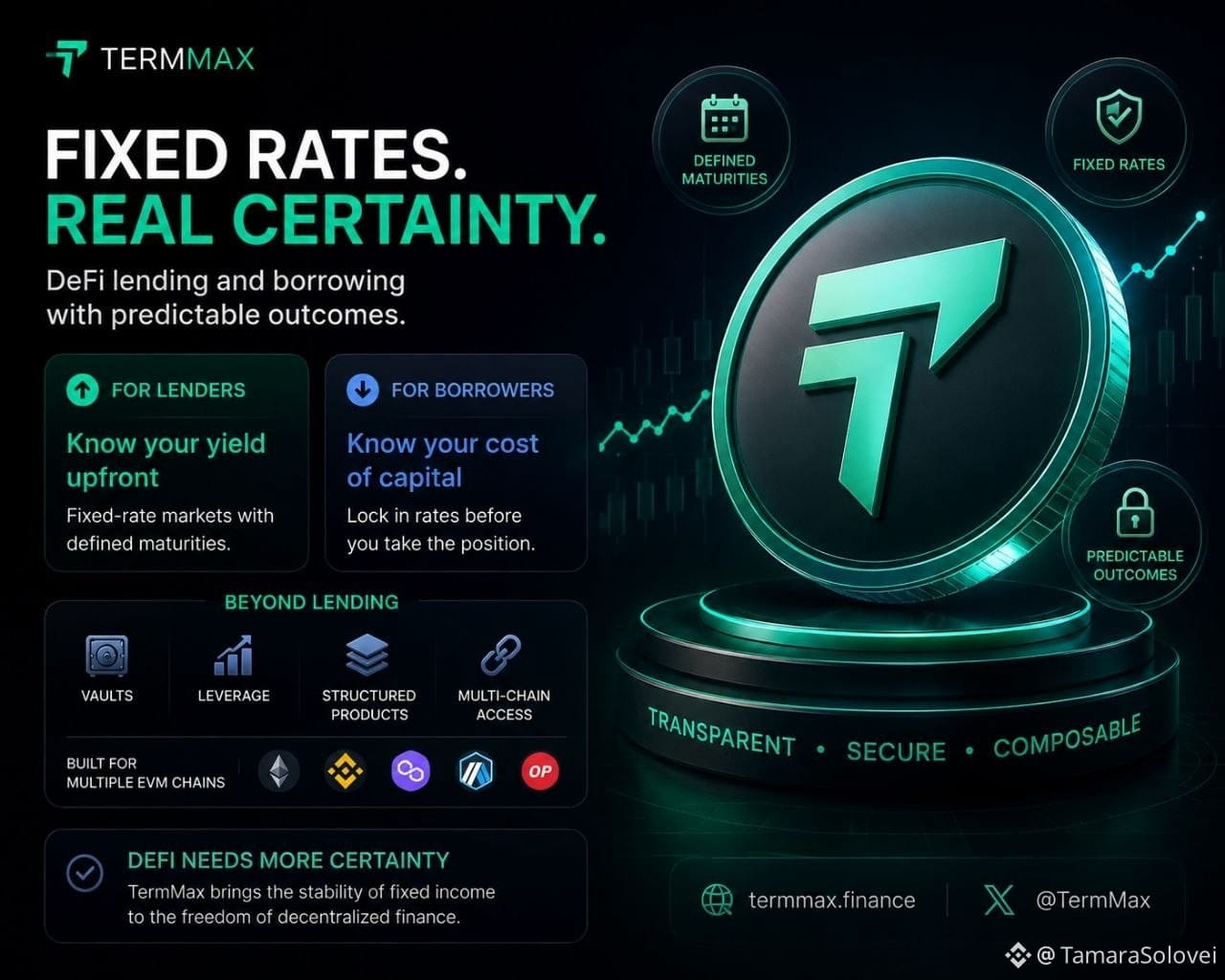
DeFi is great at giving users flexibility, but flexibility often comes with uncertainty.
Interest rates can change quickly, making it difficult to plan the cost of borrowing or the return on lending.
@TermMax approaches this problem with fixed-rate markets and defined maturities.
Instead of constantly watching the lending rate, users can know the key parameters of a position in advance.
For lenders, that can mean clearer expectations around yield. For borrowers, it can make the cost of capital easier to plan.
I think this is an important direction for DeFi because predictable financial products could make on-chain markets more useful beyond short-term speculation.
More certainty doesn't have to mean less flexibility. It can simply mean better tools for managing risk.
DeFi is great at giving users flexibility, but flexibility often comes with uncertainty.
Interest rates can change quickly, making it difficult to plan the cost of borrowing or the return on lending.
@TermMax approaches this problem with fixed-rate markets and defined maturities.
Instead of constantly watching the lending rate, users can know the key parameters of a position in advance.
For lenders, that can mean clearer expectations around yield. For borrowers, it can make the cost of capital easier to plan.
I think this is an important direction for DeFi because predictable financial products could make on-chain markets more useful beyond short-term speculation.
More certainty doesn't have to mean less flexibility. It can simply mean better tools for managing risk.
40
Ver tradução
#dusk $DUSK @Dusk_Foundation
A financial asset doesn't end its journey when the trade is completed.
That’s why I think the infrastructure behind tokenized assets is more important than the token itself.
In traditional markets, an asset can go through issuance, trading, settlement, dividends, reporting, transfers and other corporate actions. Each stage can involve different systems and intermediaries.
@Dusk_Foundation is approaching this as a complete on-chain workflow.
Its infrastructure is designed to handle things like eligibility checks, transfer restrictions, privacy, settlement, reporting and corporate actions as part of the asset lifecycle.
There is also an interesting distinction between public transparency and private financial information.
Dusk supports transparent transactions through Moonlight, while Phoenix enables shielded transfers using zero-knowledge proofs. Information can also be selectively disclosed when an authorized party needs it.
This is important because regulated finance doesn't necessarily need everything to be public.
It needs the right information to be visible to the right participants at the right time.
And that's a very different design philosophy from simply putting an existing financial asset on a public blockchain.
If tokenized securities become a major part of the next phase of Web3, I think infrastructure like this will be just as important as the assets themselves.
Dusk isn't only trying to put finance on-chain. It's trying to make the entire financial workflow work there.
#dusk $DUSK @Dusk
A financial asset doesn't end its journey when the trade is completed.
That’s why I think the infrastructure behind tokenized assets is more important than the token itself.
In traditional markets, an asset can go through issuance, trading, settlement, dividends, reporting, transfers and other corporate actions. Each stage can involve different systems and intermediaries.
@Dusk is approaching this as a complete on-chain workflow.
Its infrastructure is designed to handle things like eligibility checks, transfer restrictions, privacy, settlement, reporting and corporate actions as part of the asset lifecycle.
There is also an interesting distinction between public transparency and private financial information.
Dusk supports transparent transactions through Moonlight, while Phoenix enables shielded transfers using zero-knowledge proofs. Information can also be selectively disclosed when an authorized party needs it.
This is important because regulated finance doesn't necessarily need everything to be public.
It needs the right information to be visible to the right participants at the right time.
And that's a very different design philosophy from simply putting an existing financial asset on a public blockchain.
If tokenized securities become a major part of the next phase of Web3, I think infrastructure like this will be just as important as the assets themselves.
Dusk isn't only trying to put finance on-chain. It's trying to make the entire financial workflow work there.
A financial asset doesn't end its journey when the trade is completed.
That’s why I think the infrastructure behind tokenized assets is more important than the token itself.
In traditional markets, an asset can go through issuance, trading, settlement, dividends, reporting, transfers and other corporate actions. Each stage can involve different systems and intermediaries.
@Dusk is approaching this as a complete on-chain workflow.
Its infrastructure is designed to handle things like eligibility checks, transfer restrictions, privacy, settlement, reporting and corporate actions as part of the asset lifecycle.
There is also an interesting distinction between public transparency and private financial information.
Dusk supports transparent transactions through Moonlight, while Phoenix enables shielded transfers using zero-knowledge proofs. Information can also be selectively disclosed when an authorized party needs it.
This is important because regulated finance doesn't necessarily need everything to be public.
It needs the right information to be visible to the right participants at the right time.
And that's a very different design philosophy from simply putting an existing financial asset on a public blockchain.
If tokenized securities become a major part of the next phase of Web3, I think infrastructure like this will be just as important as the assets themselves.
Dusk isn't only trying to put finance on-chain. It's trying to make the entire financial workflow work there.
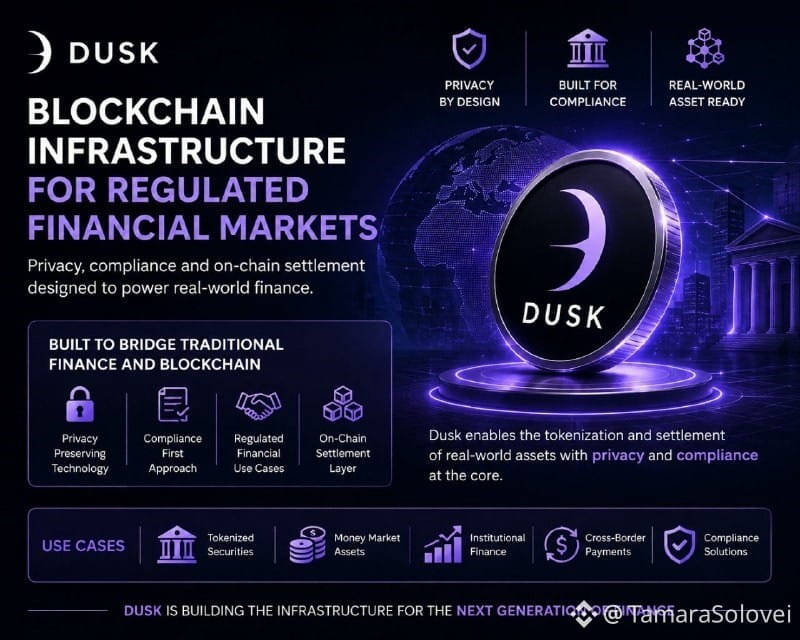
60
Ver tradução
#bstockscis @BinanceCIS
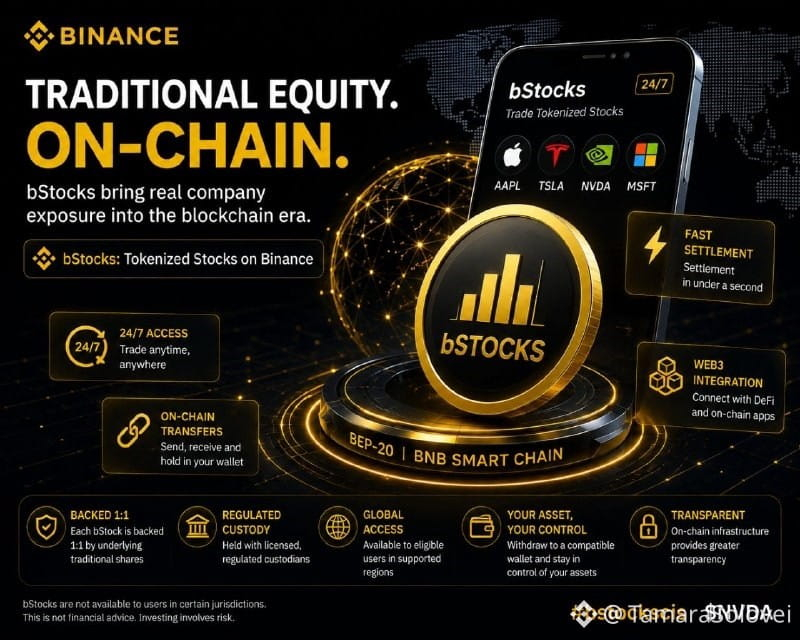
What makes tokenized stocks interesting isn't just the ability to buy them on-chain. It's what happens after you own them.
bStocks bring traditional equity exposure into a blockchain environment, opening the door to features that don't exist in the same way with conventional brokerage accounts.
With bStocks operating as BEP-20 tokens on BNB Smart Chain, the asset can become part of a broader on-chain ecosystem rather than remaining locked inside a traditional financial platform.
That creates some interesting possibilities:
🔹
On-chain transfers
🔹
24/7 access
🔹
Blockchain-based settlement
🔹
Potential integration with Web3 infrastructure
🔹
The ability to hold tokenized equity in a compatible wallet
But the most important part for me is the bridge between two financial worlds.
Traditional stocks provide exposure to established companies and real businesses. Blockchain infrastructure adds programmability, portability and continuous settlement.
Put those two things together, and tokenized equities start looking less like a simple crypto product and more like a new financial primitive.
The RWA market is still developing, but this is exactly the kind of infrastructure I think is worth watching.
Which traditional asset would you most like to see become fully integrated with on-chain finance?
#bstockscis @BinanceCIS
What makes tokenized stocks interesting isn't just the ability to buy them on-chain. It's what happens after you own them.
bStocks bring traditional equity exposure into a blockchain environment, opening the door to features that don't exist in the same way with conventional brokerage accounts.
With bStocks operating as BEP-20 tokens on BNB Smart Chain, the asset can become part of a broader on-chain ecosystem rather than remaining locked inside a traditional financial platform.
That creates some interesting possibilities:
🔹
On-chain transfers
🔹
24/7 access
🔹
Blockchain-based settlement
🔹
Potential integration with Web3 infrastructure
🔹
The ability to hold tokenized equity in a compatible wallet
But the most important part for me is the bridge between two financial worlds.
Traditional stocks provide exposure to established companies and real businesses. Blockchain infrastructure adds programmability, portability and continuous settlement.
Put those two things together, and tokenized equities start looking less like a simple crypto product and more like a new financial primitive.
The RWA market is still developing, but this is exactly the kind of infrastructure I think is worth watching.
Which traditional asset would you most like to see become fully integrated with on-chain finance?
What makes tokenized stocks interesting isn't just the ability to buy them on-chain. It's what happens after you own them.
bStocks bring traditional equity exposure into a blockchain environment, opening the door to features that don't exist in the same way with conventional brokerage accounts.
With bStocks operating as BEP-20 tokens on BNB Smart Chain, the asset can become part of a broader on-chain ecosystem rather than remaining locked inside a traditional financial platform.
That creates some interesting possibilities:
🔹
On-chain transfers
🔹
24/7 access
🔹
Blockchain-based settlement
🔹
Potential integration with Web3 infrastructure
🔹
The ability to hold tokenized equity in a compatible wallet
But the most important part for me is the bridge between two financial worlds.
Traditional stocks provide exposure to established companies and real businesses. Blockchain infrastructure adds programmability, portability and continuous settlement.
Put those two things together, and tokenized equities start looking less like a simple crypto product and more like a new financial primitive.
The RWA market is still developing, but this is exactly the kind of infrastructure I think is worth watching.
Which traditional asset would you most like to see become fully integrated with on-chain finance?
147
#termmax @termmax
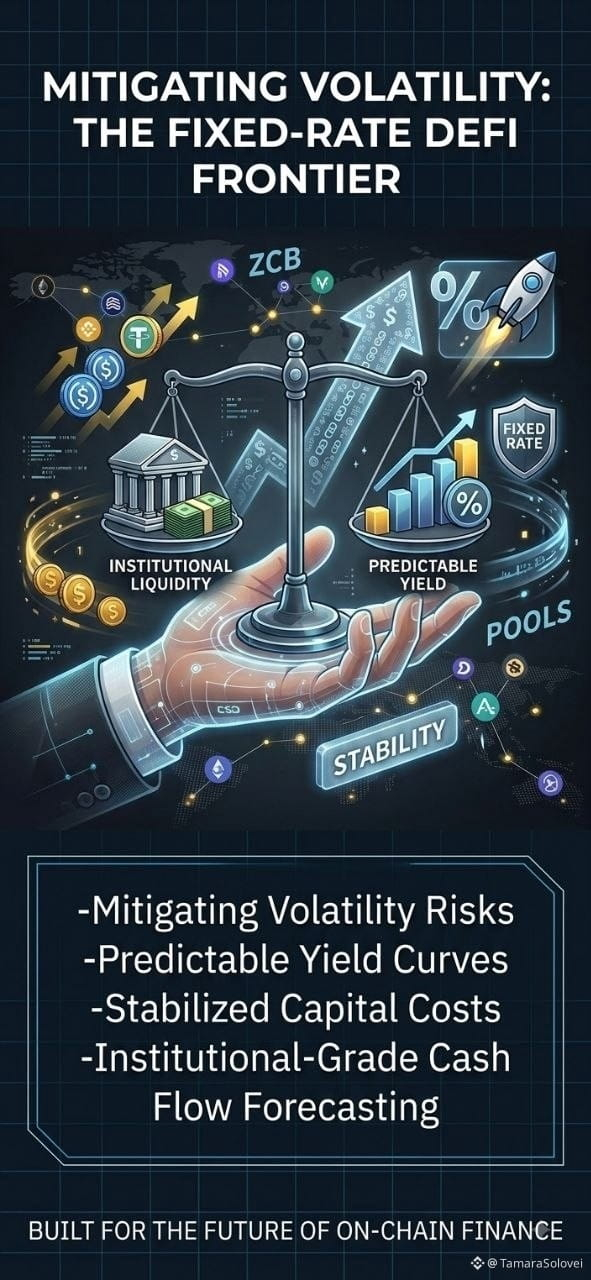
A maturidade do ecossistema DeFi está diretamente correlacionada à introdução de instrumentos financeiros primitivos capazes de mitigar riscos de volatilidade. Uma lacuna significativa nos mercados de crédito atuais é a falta de soluções de empréstimo a taxa fixa robustas. É aqui que @termmax introduz uma inovação crucial.
Ao utilizar Títulos com Cupom Zero e Pools de Liquidez, o TermMax fornece curvas de rendimento previsíveis para credores e custos de capital garantidos para tomadores. Esse modelo reduz drasticamente o slippage e a incerteza associada a taxas de juros variáveis. Na minha perspectiva, essa abordagem é essencial para atrair liquidez institucional em larga escala, que exige uma previsão precisa de fluxos de caixa. Superar a dependência de taxas variáveis é um passo crítico rumo à estabilização de longo prazo dos mercados de capital na blockchain.
#termmax @TermMax
A maturidade do ecossistema DeFi está diretamente correlacionada à introdução de instrumentos financeiros primitivos capazes de mitigar riscos de volatilidade. Uma lacuna significativa nos mercados de crédito atuais é a falta de soluções de empréstimo a taxa fixa robustas. É aqui que @TermMax introduz uma inovação crucial.
Ao utilizar Títulos com Cupom Zero e Pools de Liquidez, o TermMax fornece curvas de rendimento previsíveis para credores e custos de capital garantidos para tomadores. Esse modelo reduz drasticamente o slippage e a incerteza associada a taxas de juros variáveis. Na minha perspectiva, essa abordagem é essencial para atrair liquidez institucional em larga escala, que exige uma previsão precisa de fluxos de caixa. Superar a dependência de taxas variáveis é um passo crítico rumo à estabilização de longo prazo dos mercados de capital na blockchain.
A maturidade do ecossistema DeFi está diretamente correlacionada à introdução de instrumentos financeiros primitivos capazes de mitigar riscos de volatilidade. Uma lacuna significativa nos mercados de crédito atuais é a falta de soluções de empréstimo a taxa fixa robustas. É aqui que @TermMax introduz uma inovação crucial.
Ao utilizar Títulos com Cupom Zero e Pools de Liquidez, o TermMax fornece curvas de rendimento previsíveis para credores e custos de capital garantidos para tomadores. Esse modelo reduz drasticamente o slippage e a incerteza associada a taxas de juros variáveis. Na minha perspectiva, essa abordagem é essencial para atrair liquidez institucional em larga escala, que exige uma previsão precisa de fluxos de caixa. Superar a dependência de taxas variáveis é um passo crítico rumo à estabilização de longo prazo dos mercados de capital na blockchain.
47
#dusk $DUSK @Dusk_Foundation
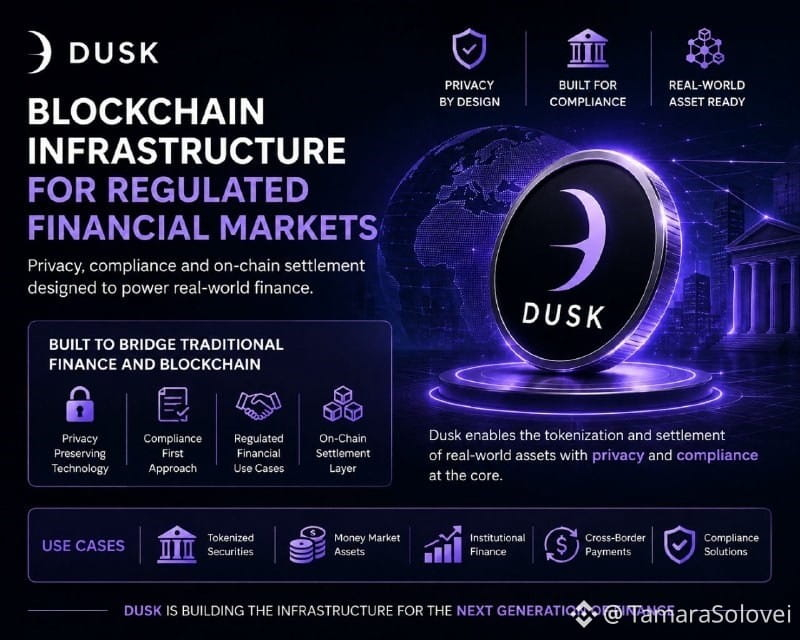
Tokenizar um ativo é apenas o primeiro passo. O verdadeiro desafio é construir o mercado ao redor dele.
É por isso que me interessa o que @Dusk_Foundation está construindo.
A Dusk Trade foi projetada como uma camada de aplicação para ativos financeiros tokenizados, cobrindo mais do que simplesmente comprar e vender. O fluxo pode incluir onboarding de investidores, verificações de elegibilidade, conexão de carteira, coordenação de pagamentos e liquidação.
Por baixo disso, a Dusk fornece a infraestrutura para fluxos regulados: controles de acesso, privacidade, divulgação seletiva e liquidação determinística.
Essa abordagem faz sentido para mim porque os mercados financeiros reais não são apenas contratos tokenizados. Eles envolvem emissores, investidores, locais de negociação, custodiante, conformidade e liquidação — tudo isso precisa funcionar em conjunto.
Se as RWA forem para escalar, a infraestrutura precisa dar suporte ao fluxo completo do mercado, não apenas colocar mais um ativo on-chain.
É nessa direção que estou de olho com a Dusk.
#dusk $DUSK @Dusk
Tokenizar um ativo é apenas o primeiro passo. O verdadeiro desafio é construir o mercado ao redor dele.
É por isso que me interessa o que @Dusk está construindo.
A Dusk Trade foi projetada como uma camada de aplicação para ativos financeiros tokenizados, cobrindo mais do que simplesmente comprar e vender. O fluxo pode incluir onboarding de investidores, verificações de elegibilidade, conexão de carteira, coordenação de pagamentos e liquidação.
Por baixo disso, a Dusk fornece a infraestrutura para fluxos regulados: controles de acesso, privacidade, divulgação seletiva e liquidação determinística.
Essa abordagem faz sentido para mim porque os mercados financeiros reais não são apenas contratos tokenizados. Eles envolvem emissores, investidores, locais de negociação, custodiante, conformidade e liquidação — tudo isso precisa funcionar em conjunto.
Se as RWA forem para escalar, a infraestrutura precisa dar suporte ao fluxo completo do mercado, não apenas colocar mais um ativo on-chain.
É nessa direção que estou de olho com a Dusk.
Tokenizar um ativo é apenas o primeiro passo. O verdadeiro desafio é construir o mercado ao redor dele.
É por isso que me interessa o que @Dusk está construindo.
A Dusk Trade foi projetada como uma camada de aplicação para ativos financeiros tokenizados, cobrindo mais do que simplesmente comprar e vender. O fluxo pode incluir onboarding de investidores, verificações de elegibilidade, conexão de carteira, coordenação de pagamentos e liquidação.
Por baixo disso, a Dusk fornece a infraestrutura para fluxos regulados: controles de acesso, privacidade, divulgação seletiva e liquidação determinística.
Essa abordagem faz sentido para mim porque os mercados financeiros reais não são apenas contratos tokenizados. Eles envolvem emissores, investidores, locais de negociação, custodiante, conformidade e liquidação — tudo isso precisa funcionar em conjunto.
Se as RWA forem para escalar, a infraestrutura precisa dar suporte ao fluxo completo do mercado, não apenas colocar mais um ativo on-chain.
É nessa direção que estou de olho com a Dusk.
61
#bstockscis @BinanceCIS
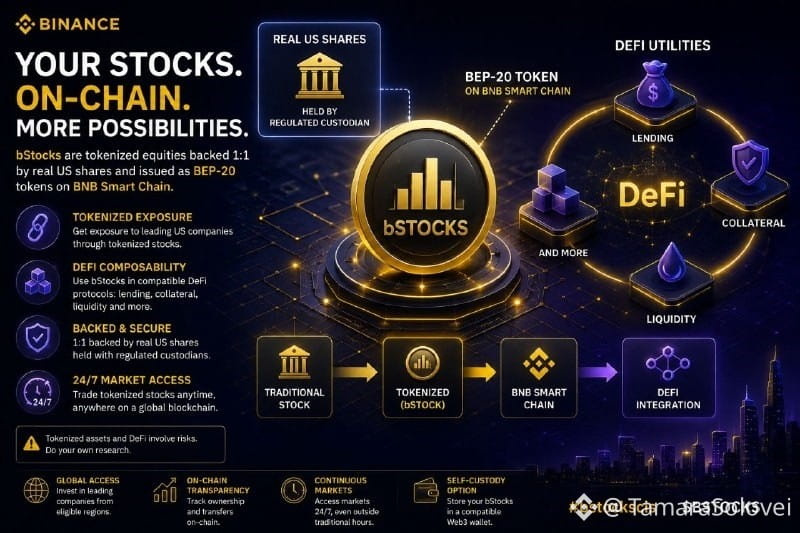
E se o seu portfólio de ações pudesse se tornar parte da sua estratégia financeira on-chain?
É aqui que as ações tokenizadas começam a ficar bem mais interessantes.
Ações não são apenas representações digitais de ações tradicionais. Como existem como tokens BEP-20 na BNB Smart Chain, elas podem potencialmente interagir com a mesma infraestrutura de blockchain que dá suporte a outros ativos digitais.
Isso abre um espaço de design totalmente diferente.
Imagine ter exposição a uma empresa e conseguir usar esse token em aplicações DeFi compatíveis, em vez de manter o ativo isolado dentro de uma conta de corretora tradicional.
A palavra importante aqui é composabilidade.
As ações tradicionais geralmente vivem dentro de uma infraestrutura de corretagem. Ativos tokenizados podem potencialmente se tornar blocos de construção para outras aplicações financeiras — empréstimos, garantias, liquidez e outras estratégias on-chain, dependendo dos protocolos específicos e dos requisitos de elegibilidade.
O framework atual da Binance para bStocks é construído em torno de lastro 1:1 por ações dos EUA correspondentes mantidas com um custodiante regulamentado, enquanto o token em si opera na BNB Smart Chain.
Isso cria uma combinação interessante:
Ativo tradicional → representação tokenizada → infraestrutura de blockchain → potencial utilidade em DeFi.
E é por isso que eu acho que a história de RWA é maior do que simplesmente tornar os mercados disponíveis 24/7.
A verdadeira inovação pode estar em tornar ativos financeiros que antes eram isolados composáveis com uma pilha financeira totalmente nova.
Claro, a integração com DeFi também introduz riscos adicionais de contratos inteligentes, liquidez e mercado, então “on-chain” não significa automaticamente “melhor”.
Mas a possibilidade em si é fascinante.
Você usaria, de fato, uma ação tokenizada como garantia ou dentro do DeFi, ou manteria isso puramente como um investimento?
#bstockscis @BinanceCIS
E se o seu portfólio de ações pudesse se tornar parte da sua estratégia financeira on-chain?
É aqui que as ações tokenizadas começam a ficar bem mais interessantes.
Ações não são apenas representações digitais de ações tradicionais. Como existem como tokens BEP-20 na BNB Smart Chain, elas podem potencialmente interagir com a mesma infraestrutura de blockchain que dá suporte a outros ativos digitais.
Isso abre um espaço de design totalmente diferente.
Imagine ter exposição a uma empresa e conseguir usar esse token em aplicações DeFi compatíveis, em vez de manter o ativo isolado dentro de uma conta de corretora tradicional.
A palavra importante aqui é composabilidade.
As ações tradicionais geralmente vivem dentro de uma infraestrutura de corretagem. Ativos tokenizados podem potencialmente se tornar blocos de construção para outras aplicações financeiras — empréstimos, garantias, liquidez e outras estratégias on-chain, dependendo dos protocolos específicos e dos requisitos de elegibilidade.
O framework atual da Binance para bStocks é construído em torno de lastro 1:1 por ações dos EUA correspondentes mantidas com um custodiante regulamentado, enquanto o token em si opera na BNB Smart Chain.
Isso cria uma combinação interessante:
Ativo tradicional → representação tokenizada → infraestrutura de blockchain → potencial utilidade em DeFi.
E é por isso que eu acho que a história de RWA é maior do que simplesmente tornar os mercados disponíveis 24/7.
A verdadeira inovação pode estar em tornar ativos financeiros que antes eram isolados composáveis com uma pilha financeira totalmente nova.
Claro, a integração com DeFi também introduz riscos adicionais de contratos inteligentes, liquidez e mercado, então “on-chain” não significa automaticamente “melhor”.
Mas a possibilidade em si é fascinante.
Você usaria, de fato, uma ação tokenizada como garantia ou dentro do DeFi, ou manteria isso puramente como um investimento?
E se o seu portfólio de ações pudesse se tornar parte da sua estratégia financeira on-chain?
É aqui que as ações tokenizadas começam a ficar bem mais interessantes.
Ações não são apenas representações digitais de ações tradicionais. Como existem como tokens BEP-20 na BNB Smart Chain, elas podem potencialmente interagir com a mesma infraestrutura de blockchain que dá suporte a outros ativos digitais.
Isso abre um espaço de design totalmente diferente.
Imagine ter exposição a uma empresa e conseguir usar esse token em aplicações DeFi compatíveis, em vez de manter o ativo isolado dentro de uma conta de corretora tradicional.
A palavra importante aqui é composabilidade.
As ações tradicionais geralmente vivem dentro de uma infraestrutura de corretagem. Ativos tokenizados podem potencialmente se tornar blocos de construção para outras aplicações financeiras — empréstimos, garantias, liquidez e outras estratégias on-chain, dependendo dos protocolos específicos e dos requisitos de elegibilidade.
O framework atual da Binance para bStocks é construído em torno de lastro 1:1 por ações dos EUA correspondentes mantidas com um custodiante regulamentado, enquanto o token em si opera na BNB Smart Chain.
Isso cria uma combinação interessante:
Ativo tradicional → representação tokenizada → infraestrutura de blockchain → potencial utilidade em DeFi.
E é por isso que eu acho que a história de RWA é maior do que simplesmente tornar os mercados disponíveis 24/7.
A verdadeira inovação pode estar em tornar ativos financeiros que antes eram isolados composáveis com uma pilha financeira totalmente nova.
Claro, a integração com DeFi também introduz riscos adicionais de contratos inteligentes, liquidez e mercado, então “on-chain” não significa automaticamente “melhor”.
Mas a possibilidade em si é fascinante.
Você usaria, de fato, uma ação tokenizada como garantia ou dentro do DeFi, ou manteria isso puramente como um investimento?
69
#dusk $DUSK @Dusk_Foundation
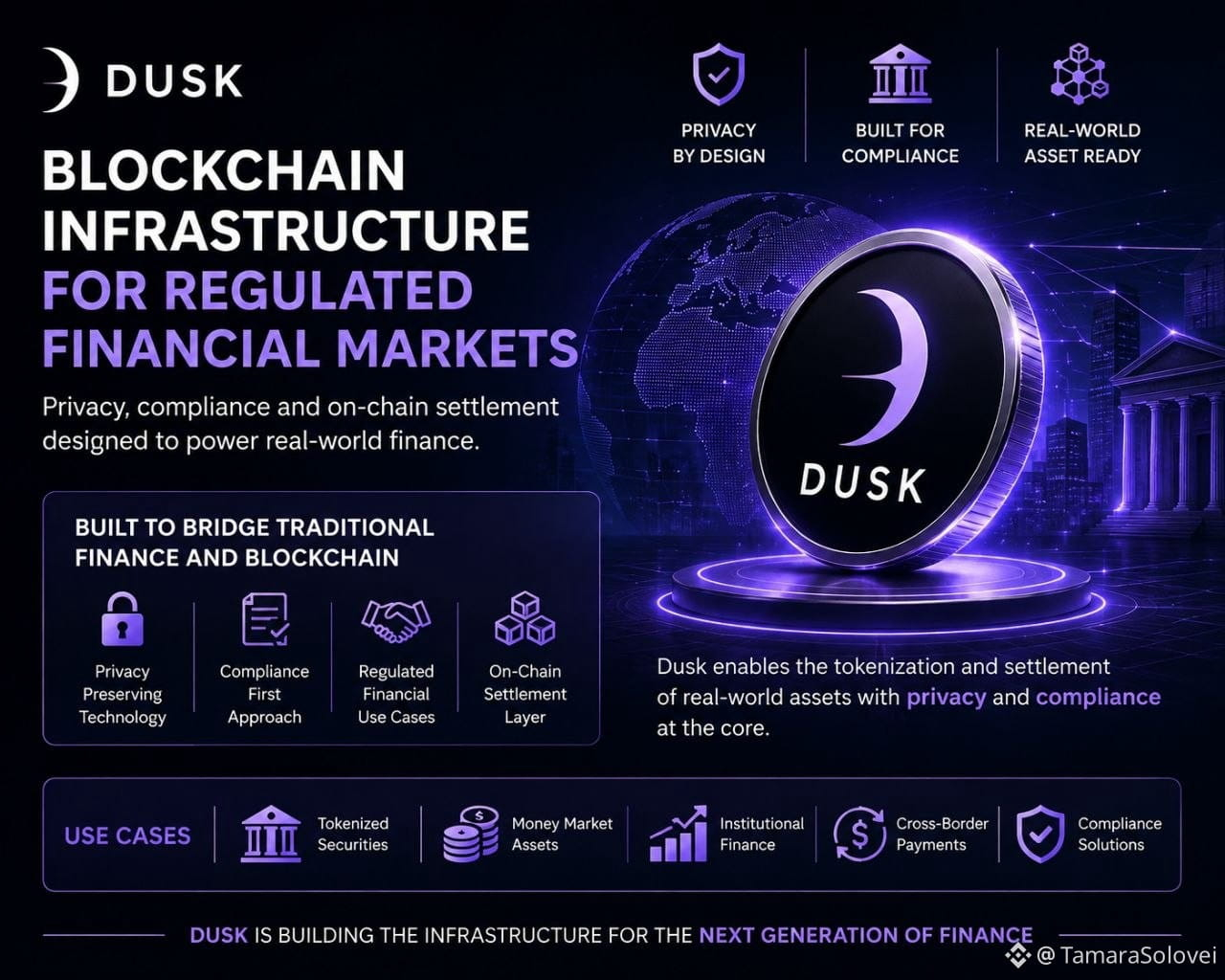
RWAs precisam de mais do que tokenização. Elas precisam de uma infraestrutura construída para mercados financeiros reais.
É isso que torna @Dusk_Foundation interessante para mim.
Dusk foi projetado em torno de ativos regulados, combinando privacidade, conformidade e liquidação on-chain. Em vez de tornar cada transação completamente pública, sua arquitetura oferece suporte a divulgação seletiva — permitindo que informações relevantes sejam verificadas sem expor tudo a todos.
Isso pode ser especialmente útil para valores mobiliários, títulos e outros ativos regulados, nos quais a privacidade do investidor e as exigências regulatórias precisam coexistir.
Outra parte interessante é a compatibilidade do Dusk com a EVM, que facilita para desenvolvedores familiarizados com as ferramentas do Ethereum a construção de aplicações na rede.
Se as RWAs vão se tornar uma parte importante do Web3, a infraestrutura por trás delas precisa lidar com muito mais do que transferências simples de tokens.
É nesse nicho que a Dusk está tentando construir.
#dusk $DUSK @Dusk
RWAs precisam de mais do que tokenização. Elas precisam de uma infraestrutura construída para mercados financeiros reais.
É isso que torna @Dusk interessante para mim.
Dusk foi projetado em torno de ativos regulados, combinando privacidade, conformidade e liquidação on-chain. Em vez de tornar cada transação completamente pública, sua arquitetura oferece suporte a divulgação seletiva — permitindo que informações relevantes sejam verificadas sem expor tudo a todos.
Isso pode ser especialmente útil para valores mobiliários, títulos e outros ativos regulados, nos quais a privacidade do investidor e as exigências regulatórias precisam coexistir.
Outra parte interessante é a compatibilidade do Dusk com a EVM, que facilita para desenvolvedores familiarizados com as ferramentas do Ethereum a construção de aplicações na rede.
Se as RWAs vão se tornar uma parte importante do Web3, a infraestrutura por trás delas precisa lidar com muito mais do que transferências simples de tokens.
É nesse nicho que a Dusk está tentando construir.
RWAs precisam de mais do que tokenização. Elas precisam de uma infraestrutura construída para mercados financeiros reais.
É isso que torna @Dusk interessante para mim.
Dusk foi projetado em torno de ativos regulados, combinando privacidade, conformidade e liquidação on-chain. Em vez de tornar cada transação completamente pública, sua arquitetura oferece suporte a divulgação seletiva — permitindo que informações relevantes sejam verificadas sem expor tudo a todos.
Isso pode ser especialmente útil para valores mobiliários, títulos e outros ativos regulados, nos quais a privacidade do investidor e as exigências regulatórias precisam coexistir.
Outra parte interessante é a compatibilidade do Dusk com a EVM, que facilita para desenvolvedores familiarizados com as ferramentas do Ethereum a construção de aplicações na rede.
Se as RWAs vão se tornar uma parte importante do Web3, a infraestrutura por trás delas precisa lidar com muito mais do que transferências simples de tokens.
É nesse nicho que a Dusk está tentando construir.
1
79
#bstockscis @BinanceCIS
O que acontece quando uma ação deixa de ficar bloqueada dentro de uma conta de corretagem?
Essa é uma das ideias mais interessantes por trás da bStocks.
Uma ação tokenizada como $AAPL não é apenas um ticker exibido em uma bolsa. As bStocks são lastreadas 1:1 por ações dos EUA correspondentes mantidas com um custodiante regulamentado, enquanto o token em si existe como um ativo BEP-20 na BNB Smart Chain.
A parte interessante é o que isso viabiliza.
Em vez de manter sua exposição exclusivamente dentro de um ambiente tradicional de corretagem, usuários elegíveis podem sacar o ativo tokenizado para uma carteira Web3 compatível.
Isso abre a porta para algo que ações tradicionais não conseguem fornecer com facilidade:
🔗 Transferências nativas de blockchain
🌐 Componibilidade on-chain
🔐 Autocustódia por meio de uma carteira compatível
🕐 Infraestrutura de negociação 24/7
E é aqui que a tokenização se torna mais do que apenas mudar o formato de um ativo.
A exposição econômica subjacente continua conectada à segurança tradicional, enquanto a representação dessa exposição pode interagir com a infraestrutura de blockchain.
É essa a parte das equity tokenizadas que eu acho mais interessante: trazer ativos financeiros do mundo real para um ambiente em que a propriedade e as aplicações de blockchain finalmente possam começar a interagir.
Você manteria uma ação tokenizada na Binance ou a moveria para sua própria carteira compatível?
#bstockscis @BinanceCIS
O que acontece quando uma ação deixa de ficar bloqueada dentro de uma conta de corretagem?
Essa é uma das ideias mais interessantes por trás da bStocks.
Uma ação tokenizada como $AAPL não é apenas um ticker exibido em uma bolsa. As bStocks são lastreadas 1:1 por ações dos EUA correspondentes mantidas com um custodiante regulamentado, enquanto o token em si existe como um ativo BEP-20 na BNB Smart Chain.
A parte interessante é o que isso viabiliza.
Em vez de manter sua exposição exclusivamente dentro de um ambiente tradicional de corretagem, usuários elegíveis podem sacar o ativo tokenizado para uma carteira Web3 compatível.
Isso abre a porta para algo que ações tradicionais não conseguem fornecer com facilidade:
🔗 Transferências nativas de blockchain
🌐 Componibilidade on-chain
🔐 Autocustódia por meio de uma carteira compatível
🕐 Infraestrutura de negociação 24/7
E é aqui que a tokenização se torna mais do que apenas mudar o formato de um ativo.
A exposição econômica subjacente continua conectada à segurança tradicional, enquanto a representação dessa exposição pode interagir com a infraestrutura de blockchain.
É essa a parte das equity tokenizadas que eu acho mais interessante: trazer ativos financeiros do mundo real para um ambiente em que a propriedade e as aplicações de blockchain finalmente possam começar a interagir.
Você manteria uma ação tokenizada na Binance ou a moveria para sua própria carteira compatível?
O que acontece quando uma ação deixa de ficar bloqueada dentro de uma conta de corretagem?
Essa é uma das ideias mais interessantes por trás da bStocks.
Uma ação tokenizada como $AAPL não é apenas um ticker exibido em uma bolsa. As bStocks são lastreadas 1:1 por ações dos EUA correspondentes mantidas com um custodiante regulamentado, enquanto o token em si existe como um ativo BEP-20 na BNB Smart Chain.
A parte interessante é o que isso viabiliza.
Em vez de manter sua exposição exclusivamente dentro de um ambiente tradicional de corretagem, usuários elegíveis podem sacar o ativo tokenizado para uma carteira Web3 compatível.
Isso abre a porta para algo que ações tradicionais não conseguem fornecer com facilidade:
🔗 Transferências nativas de blockchain
🌐 Componibilidade on-chain
🔐 Autocustódia por meio de uma carteira compatível
🕐 Infraestrutura de negociação 24/7
E é aqui que a tokenização se torna mais do que apenas mudar o formato de um ativo.
A exposição econômica subjacente continua conectada à segurança tradicional, enquanto a representação dessa exposição pode interagir com a infraestrutura de blockchain.
É essa a parte das equity tokenizadas que eu acho mais interessante: trazer ativos financeiros do mundo real para um ambiente em que a propriedade e as aplicações de blockchain finalmente possam começar a interagir.
Você manteria uma ação tokenizada na Binance ou a moveria para sua própria carteira compatível?
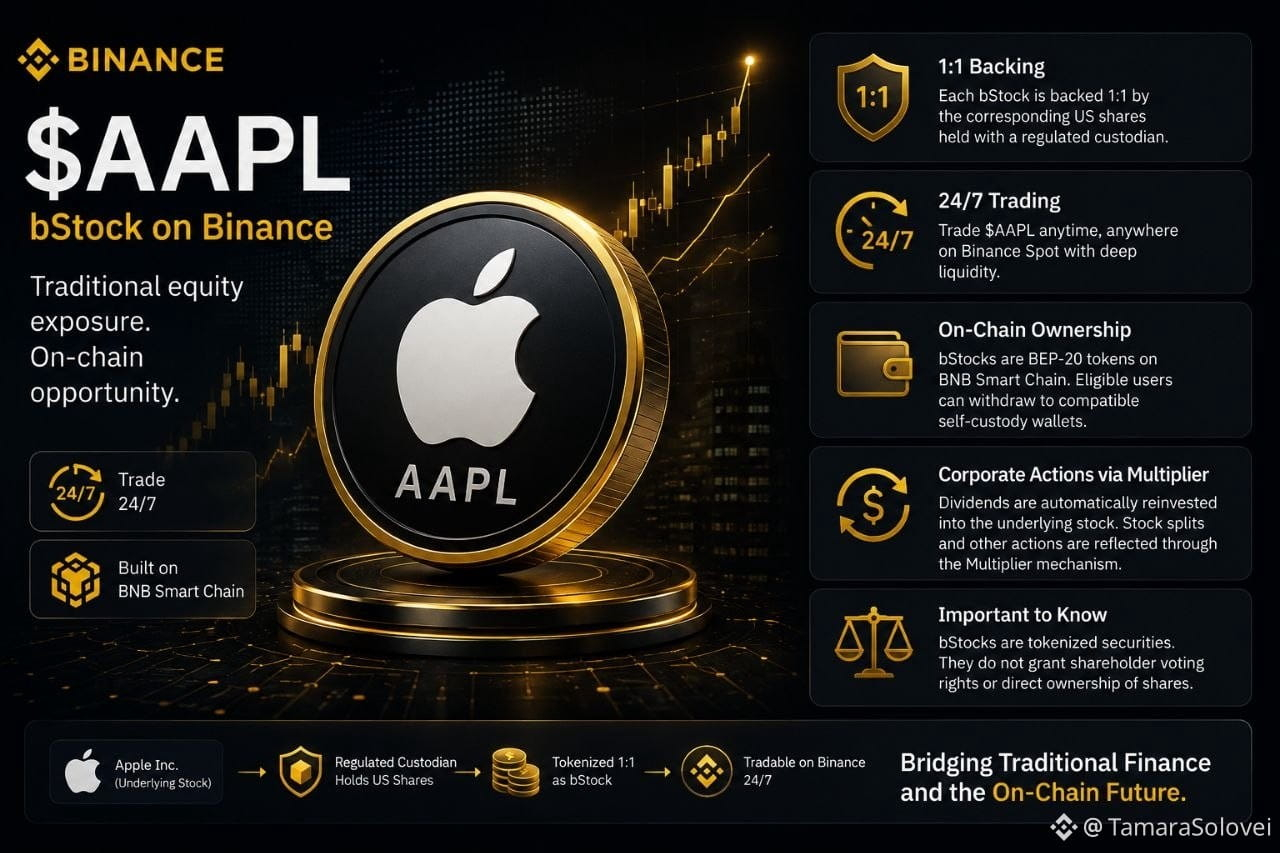
1
2
116
#dusk $DUSK @Dusk_Foundation
Uma coisa que torna o Dusk interessante é que ele não obriga cada aplicação a usar a infraestrutura blockchain exatamente da mesma forma.
O Dusk separa liquidação de execução por meio de sua arquitetura modular.
Na base está o DuskDS, responsável por consenso, finalização (finality) e disponibilidade de dados. Sobre isso, desenvolvedores podem usar o DuskVM para contratos inteligentes nativos em Rust/WASM ou o DuskEVM quando quiserem um ambiente compatível com EVM e as ferramentas familiares do Solidity.
Por que isso é importante para o setor financeiro regulado?
Diferentes aplicações financeiras têm exigências distintas. Um fluxo de ativos nativos pode precisar de acesso direto à privacidade do Dusk e aos modelos de transação, enquanto outra aplicação pode se beneficiar das ferramentas existentes do Ethereum e da infraestrutura de desenvolvimento.
O Dusk basicamente tenta oferecer ambos os caminhos sem abrir mão da sua camada subjacente de liquidação.
E é aqui que a arquitetura se torna mais interessante do que a narrativa usual de “blockchain de RWA”.
A rede foi projetada em torno de requisitos como:
🔹 elegibilidade e controles de acesso
🔹 divulgação seletiva de informações sensíveis
🔹 transações confidenciais
🔹 liquidação determinística
🔹 emissão e atendimento (servicing) de ativos regulados
A documentação descreve especificamente casos de uso que vão de ações e dívidas tokenizadas até DeFi institucional e liquidação delivery-versus-payment.
Para mim, a pergunta-chave não é se as instituições eventualmente vão usar blockchain. É se a infraestrutura subjacente é flexível o suficiente para atender aos requisitos de mercados financeiros reais.
É essa a parte da tese do Dusk que eu estou acompanhando.
#dusk $DUSK @Dusk
Uma coisa que torna o Dusk interessante é que ele não obriga cada aplicação a usar a infraestrutura blockchain exatamente da mesma forma.
O Dusk separa liquidação de execução por meio de sua arquitetura modular.
Na base está o DuskDS, responsável por consenso, finalização (finality) e disponibilidade de dados. Sobre isso, desenvolvedores podem usar o DuskVM para contratos inteligentes nativos em Rust/WASM ou o DuskEVM quando quiserem um ambiente compatível com EVM e as ferramentas familiares do Solidity.
Por que isso é importante para o setor financeiro regulado?
Diferentes aplicações financeiras têm exigências distintas. Um fluxo de ativos nativos pode precisar de acesso direto à privacidade do Dusk e aos modelos de transação, enquanto outra aplicação pode se beneficiar das ferramentas existentes do Ethereum e da infraestrutura de desenvolvimento.
O Dusk basicamente tenta oferecer ambos os caminhos sem abrir mão da sua camada subjacente de liquidação.
E é aqui que a arquitetura se torna mais interessante do que a narrativa usual de “blockchain de RWA”.
A rede foi projetada em torno de requisitos como:
🔹 elegibilidade e controles de acesso
🔹 divulgação seletiva de informações sensíveis
🔹 transações confidenciais
🔹 liquidação determinística
🔹 emissão e atendimento (servicing) de ativos regulados
A documentação descreve especificamente casos de uso que vão de ações e dívidas tokenizadas até DeFi institucional e liquidação delivery-versus-payment.
Para mim, a pergunta-chave não é se as instituições eventualmente vão usar blockchain. É se a infraestrutura subjacente é flexível o suficiente para atender aos requisitos de mercados financeiros reais.
É essa a parte da tese do Dusk que eu estou acompanhando.
Uma coisa que torna o Dusk interessante é que ele não obriga cada aplicação a usar a infraestrutura blockchain exatamente da mesma forma.
O Dusk separa liquidação de execução por meio de sua arquitetura modular.
Na base está o DuskDS, responsável por consenso, finalização (finality) e disponibilidade de dados. Sobre isso, desenvolvedores podem usar o DuskVM para contratos inteligentes nativos em Rust/WASM ou o DuskEVM quando quiserem um ambiente compatível com EVM e as ferramentas familiares do Solidity.
Por que isso é importante para o setor financeiro regulado?
Diferentes aplicações financeiras têm exigências distintas. Um fluxo de ativos nativos pode precisar de acesso direto à privacidade do Dusk e aos modelos de transação, enquanto outra aplicação pode se beneficiar das ferramentas existentes do Ethereum e da infraestrutura de desenvolvimento.
O Dusk basicamente tenta oferecer ambos os caminhos sem abrir mão da sua camada subjacente de liquidação.
E é aqui que a arquitetura se torna mais interessante do que a narrativa usual de “blockchain de RWA”.
A rede foi projetada em torno de requisitos como:
🔹 elegibilidade e controles de acesso
🔹 divulgação seletiva de informações sensíveis
🔹 transações confidenciais
🔹 liquidação determinística
🔹 emissão e atendimento (servicing) de ativos regulados
A documentação descreve especificamente casos de uso que vão de ações e dívidas tokenizadas até DeFi institucional e liquidação delivery-versus-payment.
Para mim, a pergunta-chave não é se as instituições eventualmente vão usar blockchain. É se a infraestrutura subjacente é flexível o suficiente para atender aos requisitos de mercados financeiros reais.
É essa a parte da tese do Dusk que eu estou acompanhando.
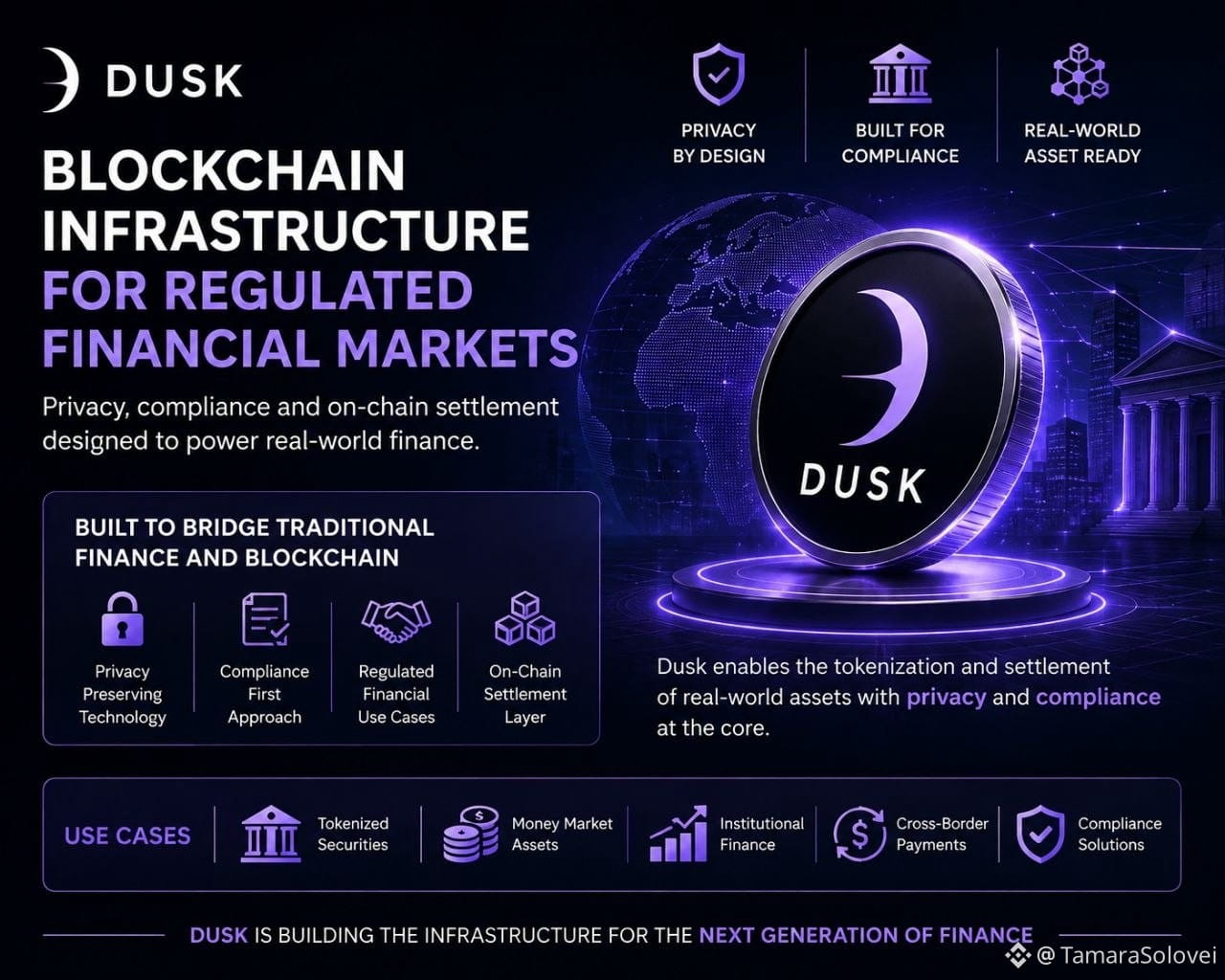
2
1
57
Inicia sessão para explorar mais conteúdos
Junta-te a utilizadores de criptomoedas de todo o mundo na Binance Square
⚡️ Obtém informações úteis e recentes sobre criptomoedas.
💬 Com a confiança da maior exchange de criptomoedas do mundo.
👍 Descobre perspetivas reais de criadores verificados.
E-mail/Número de telefone
Tópicos em Tendência
CircleMints500MUSDCOnSolana
29,154 visualizações
819 a discutir
#circlemints500musdconsolana
🚨 AUMENTO ENORME de Liquidez! A Circle Cunha 500 Milhões de USDC na Solana — Será que uma Grande Corrida DeFi vem aí? 🚀
💵 O que Aconteceu?
Em um grande evento on-chain, o Tesouro do USDC emitiu 500 milhões de USDC diretamente na rede Solana, em duas transações de 250 milhões.
Esse maciço influxo de capital lastreado em dinheiro real destaca um apetite crescente por stablecoins em ecossistemas de alta velocidade e baixo custo.
🔑 Principais Conclusões & Manchetes
Nova Liquidez On-Chain: O USDC recém-cunhado impulsiona pools de liquidez em DEXs baseados na Solana, mercados de empréstimo e protocolos de yield.
$SOL
Sinal Institucional: Como cada USDC é lastreado 1:1 por reservas reais, eventos grandes de cunhagem refletem capital institucional ou comercial de fato entrando no ecossistema.
Expansão da Participação de Mercado da Solana: A Solana continua ganhando uma fatia cada vez maior da circulação total de USDC, ameaçando as distribuições tradicionais de stablecoin.
Contexto Macro & Fed: À medida que traders acompanham desenvolvimentos macroeconômicos globais e a perspectiva das taxas de juros, oportunidades on-chain de alto rendimento atraem capital parado de volta para a Web3.
💡 Por que isso Importa para Traders
Menor Slippage & Melhores Trades: Mais profundidade em stablecoin significa que operações maiores podem ocorrer sem grande impacto no mercado.
Potencial de Yield em DeFi: Reservas maiores de USDC incentivam um aumento do TVL (Total Value Locked) em protocolos de empréstimo e farming na Solana.
Mudança de Sentimento: Injeções massivas de stablecoin historicamente são indicadores de alta para os tokens do ecossistema ($SOL,$JUP, $RAY,$KMNO).
Qual é o seu plano? Você está mantendo dinheiro de lado ou surfando a onda de liquidez da Solana? Deixe suas ideias abaixo! 👇
#BlackRockBuildsTokenizedPortfoliosForOndo #solana #defi
Lily星星
·7 gostos
·2.8k visualizações
PolymarketBankFailureBetsDrawFDICConcern
43,301 visualizações
984 a discutir
BlackRockBuildsTokenizedPortfoliosForOndo
35,737 visualizações
660 a discutir