
mikeskcv
28 Publicações

mikeskcv
Denunciar
Bloquear Utilizador
5 A seguir
1 Seguidores
10 Gostaram
Publicações
·
--
As taxas dos bancos centrais voltaram a estar nas notícias, e é interessante observar como os ativos tradicionais reagem a isso. A TradFi na Binance é conveniente justamente porque não é preciso manter cinco abas abertas com diferentes corretoras — tudo em um só lugar, e o quadro do mercado se forma mais rápido.
#TradFi #Binance #CreateWithBinance #ринок
As taxas dos bancos centrais voltaram a estar nas notícias, e é interessante observar como os ativos tradicionais reagem a isso. A TradFi na Binance é conveniente justamente porque não é preciso manter cinco abas abertas com diferentes corretoras — tudo em um só lugar, e o quadro do mercado se forma mais rápido.
#TradFi #Binance #CreateWithBinance #ринок
#TradFi #Binance #CreateWithBinance #ринок
114
·
--
Tentei bStocks esta semana. Comprei uma pequena parcela da Apple — o pedido foi processado mais rápido do que com um corretor comum, e a comissão me surpreendeu agradavelmente. Por enquanto, é um plus.
#bStocks #Binance #CreateWithBinance #інвестиції
Tentei bStocks esta semana. Comprei uma pequena parcela da Apple — o pedido foi processado mais rápido do que com um corretor comum, e a comissão me surpreendeu agradavelmente. Por enquanto, é um plus.
#bStocks #Binance #CreateWithBinance #інвестиції
#bStocks #Binance #CreateWithBinance #інвестиції
181
·
--
Ver tradução
#termmax @termmax
What if the most interesting part of DeFi lending isn't the yield?
But who gets to choose the terms?
That's what I find interesting about TermMax.
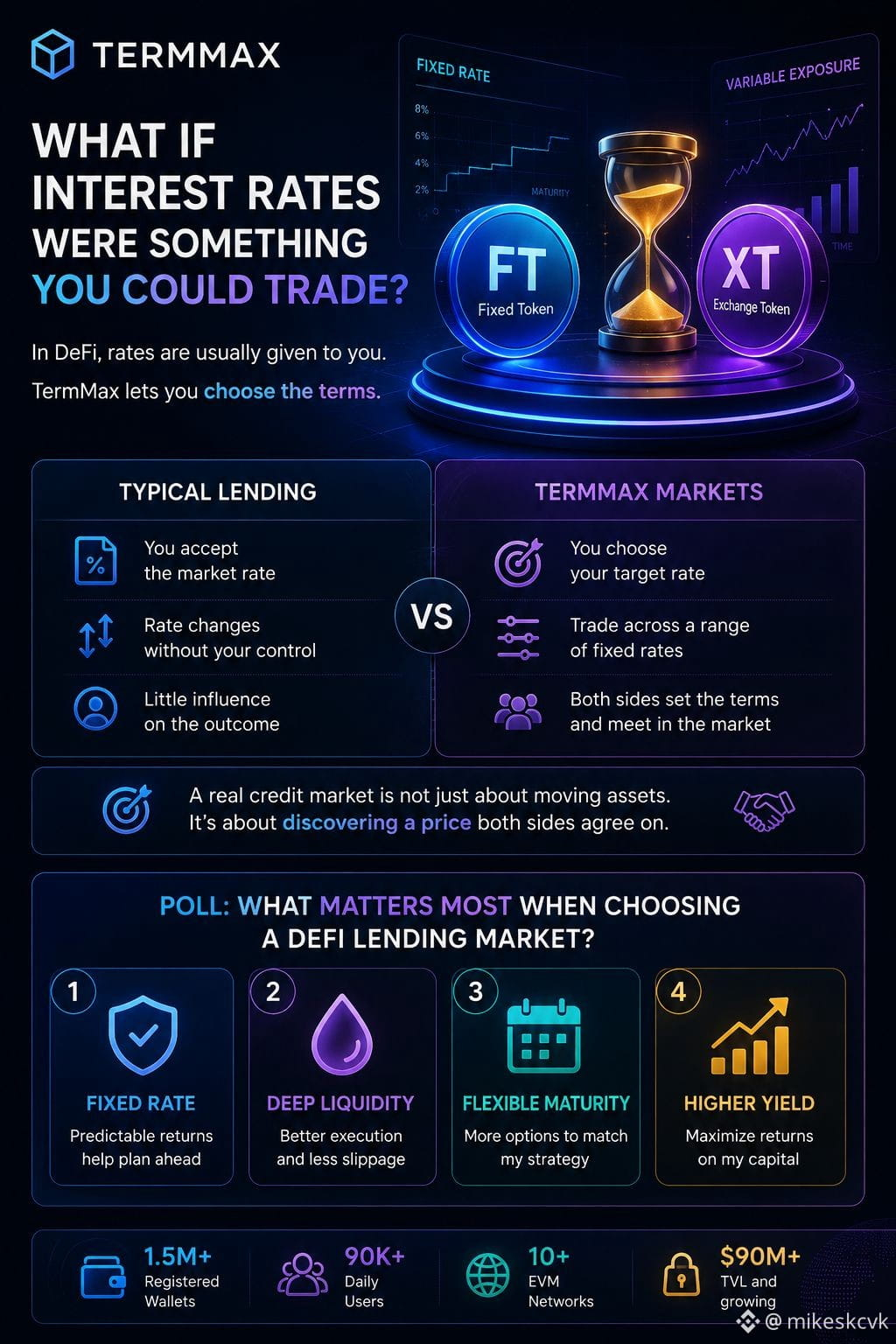
In a typical lending market, you mostly accept whatever rate the market is giving you.
But fixed-rate markets introduce another possibility.
A borrower can think:
“At what rate does this loan actually make sense for
me?”
And a lender can think:
“At what return am I comfortable locking my capital?”
Now the interest rate isn't just a number on a dashboard.
It's part of the negotiation.
That changes how I look at on-chain credit.
Because a real financial market isn't only about moving assets from A to B.
It's about discovering a price that both sides are willing to accept.
TermMax is experimenting with that idea on-chain.
And honestly, I think this is a more interesting question than chasing the highest APY:
Can DeFi create efficient markets for the price of time and capital?
That's what I'll be watching.
#termmax @TermMax
What if the most interesting part of DeFi lending isn't the yield?
But who gets to choose the terms?
That's what I find interesting about TermMax.
In a typical lending market, you mostly accept whatever rate the market is giving you.
But fixed-rate markets introduce another possibility.
A borrower can think:
“At what rate does this loan actually make sense for
me?”
And a lender can think:
“At what return am I comfortable locking my capital?”
Now the interest rate isn't just a number on a dashboard.
It's part of the negotiation.
That changes how I look at on-chain credit.
Because a real financial market isn't only about moving assets from A to B.
It's about discovering a price that both sides are willing to accept.
TermMax is experimenting with that idea on-chain.
And honestly, I think this is a more interesting question than chasing the highest APY:
Can DeFi create efficient markets for the price of time and capital?
That's what I'll be watching.
What if the most interesting part of DeFi lending isn't the yield?
But who gets to choose the terms?
That's what I find interesting about TermMax.
In a typical lending market, you mostly accept whatever rate the market is giving you.
But fixed-rate markets introduce another possibility.
A borrower can think:
“At what rate does this loan actually make sense for
me?”
And a lender can think:
“At what return am I comfortable locking my capital?”
Now the interest rate isn't just a number on a dashboard.
It's part of the negotiation.
That changes how I look at on-chain credit.
Because a real financial market isn't only about moving assets from A to B.
It's about discovering a price that both sides are willing to accept.
TermMax is experimenting with that idea on-chain.
And honestly, I think this is a more interesting question than chasing the highest APY:
Can DeFi create efficient markets for the price of time and capital?
That's what I'll be watching.
88
·
--
Ver tradução
#termmax @termmax
The most interesting TermMax update isn't the $TMX TGE.
It's something much less exciting at first glance:
App V2.
Why?
Because DeFi has a fragmentation problem.
One chain for this position.
Another chain for that vault.
Different interfaces.
Different orders.
Different liquidity.
You can have a great protocol and still make the user experience feel like managing five different accounts.
TermMax V2 is moving in the opposite direction.
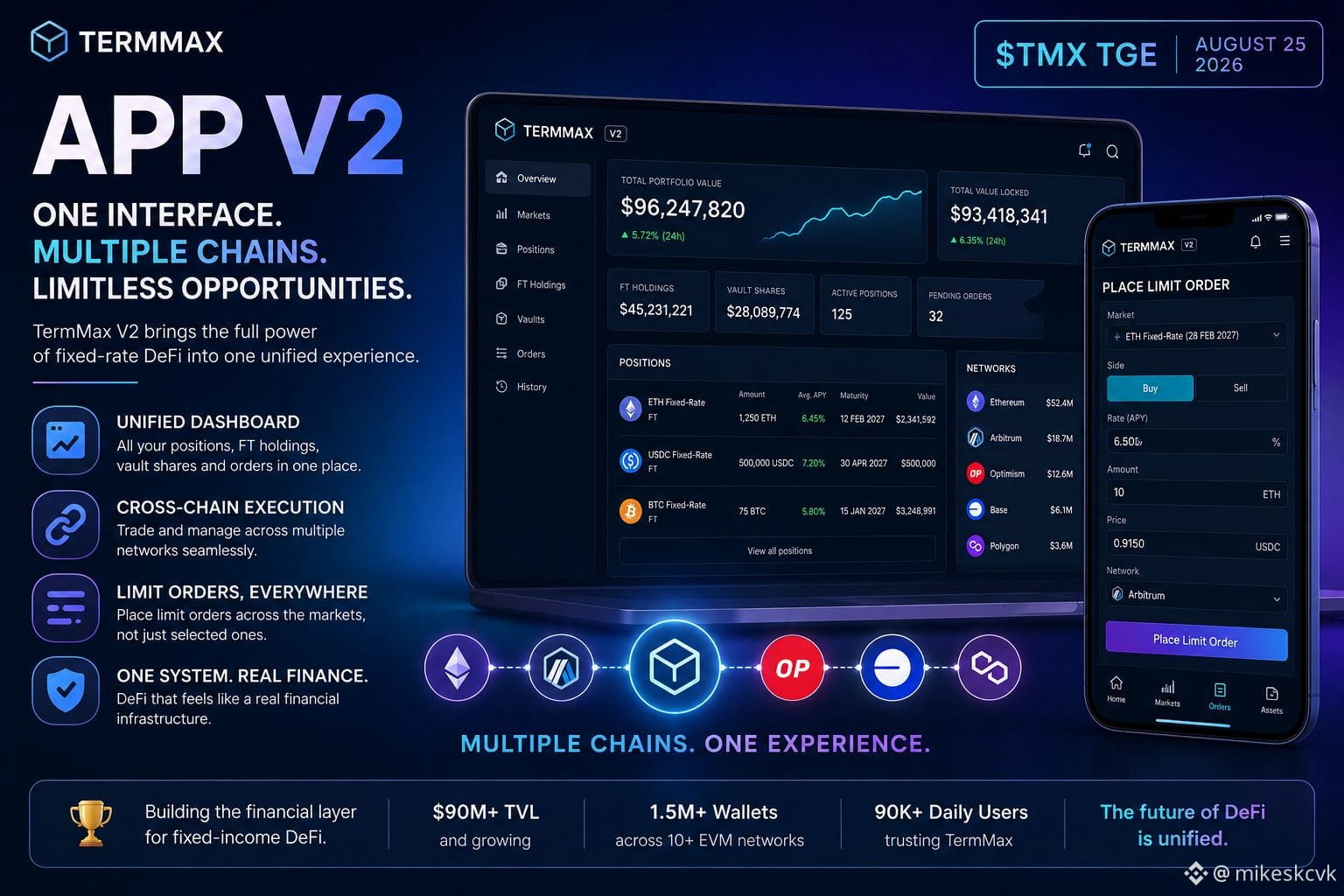
One interface for multiple chains.
One dashboard for positions, FT holdings, vault shares and orders.
And limit orders across the markets instead of restricting them to selected ones.
That might sound like a UX improvement.
I think it's more important than that.
If fixed-rate DeFi is supposed to become actual financial infrastructure, users shouldn't have to think about the underlying chain every time they make a transaction.
The chain should become the infrastructure.
The product should be the market.
And this is where TermMax gets interesting to me.
The next stage of DeFi may not be about adding more protocols.
It may be about making the protocols we already have feel like one financial system.
$TMX TGE is coming on August 25.
But I'm more interested in what happens after the infrastructure is already built.
#termmax @TermMax
The most interesting TermMax update isn't the $TMX TGE.
It's something much less exciting at first glance:
App V2.
Why?
Because DeFi has a fragmentation problem.
One chain for this position.
Another chain for that vault.
Different interfaces.
Different orders.
Different liquidity.
You can have a great protocol and still make the user experience feel like managing five different accounts.
TermMax V2 is moving in the opposite direction.
One interface for multiple chains.
One dashboard for positions, FT holdings, vault shares and orders.
And limit orders across the markets instead of restricting them to selected ones.
That might sound like a UX improvement.
I think it's more important than that.
If fixed-rate DeFi is supposed to become actual financial infrastructure, users shouldn't have to think about the underlying chain every time they make a transaction.
The chain should become the infrastructure.
The product should be the market.
And this is where TermMax gets interesting to me.
The next stage of DeFi may not be about adding more protocols.
It may be about making the protocols we already have feel like one financial system.
$TMX TGE is coming on August 25.
But I'm more interested in what happens after the infrastructure is already built.
The most interesting TermMax update isn't the $TMX TGE.
It's something much less exciting at first glance:
App V2.
Why?
Because DeFi has a fragmentation problem.
One chain for this position.
Another chain for that vault.
Different interfaces.
Different orders.
Different liquidity.
You can have a great protocol and still make the user experience feel like managing five different accounts.
TermMax V2 is moving in the opposite direction.
One interface for multiple chains.
One dashboard for positions, FT holdings, vault shares and orders.
And limit orders across the markets instead of restricting them to selected ones.
That might sound like a UX improvement.
I think it's more important than that.
If fixed-rate DeFi is supposed to become actual financial infrastructure, users shouldn't have to think about the underlying chain every time they make a transaction.
The chain should become the infrastructure.
The product should be the market.
And this is where TermMax gets interesting to me.
The next stage of DeFi may not be about adding more protocols.
It may be about making the protocols we already have feel like one financial system.
$TMX TGE is coming on August 25.
But I'm more interested in what happens after the infrastructure is already built.
1
82
·
--
Em Alta
#termmax @termmax
A maioria das pessoas olha para ações tokenizadas como uma forma de acessar os mercados tradicionais via blockchain.
Mas para mim o mais interessante é outra pergunta.
E se esses ativos não puderem apenas ficar em carteira?
E se eles puderem funcionar como um instrumento financeiro?
É aqui que tudo fica interessante.
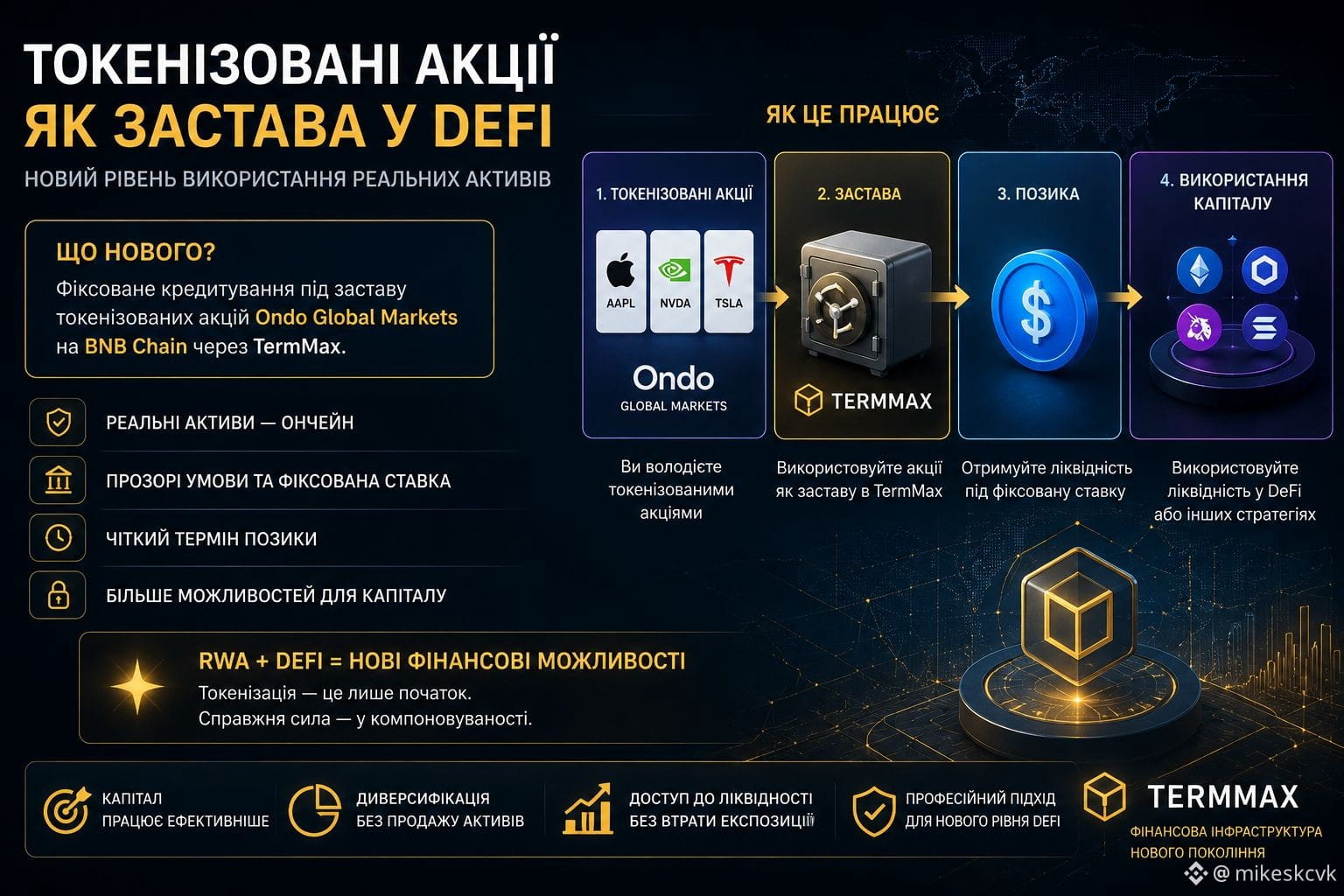
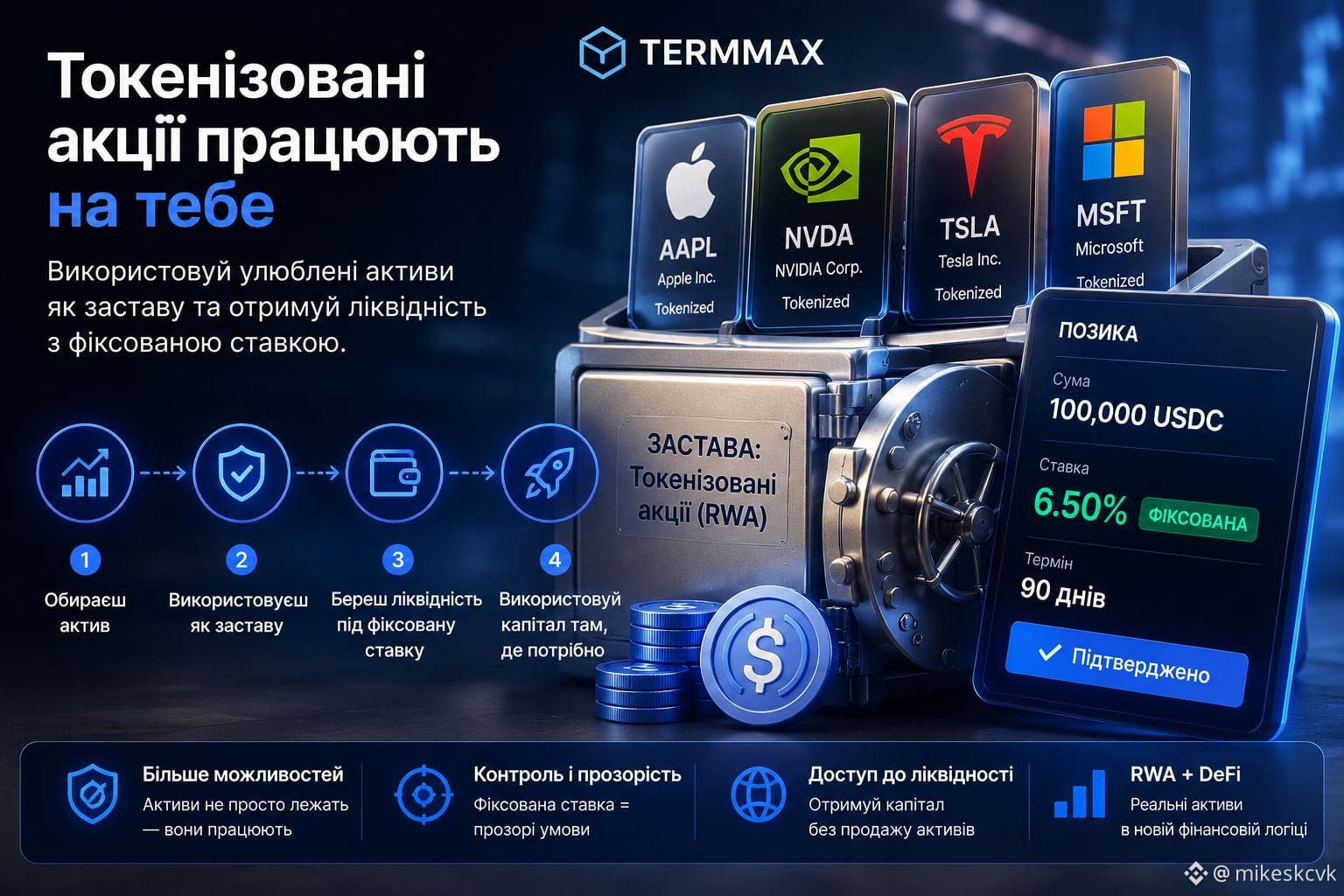
A TermMax permite usar ações tokenizadas como colateral para obter liquidez a uma taxa fixa.
Ou seja, o ativo não apenas reflete o preço de uma ação.
Ele passa a fazer parte de uma ecossistema DeFi.
Como resultado, surge uma lógica nova:
📈 Você mantém ações tokenizadas
🔒 Você as usa como colateral
💵 Você obtém liquidez
🚀 Você utiliza o capital em outras estratégias
Na minha opinião, é aqui que está o verdadeiro potencial do RWA.
Não na tokenização em si.
E sim no fato de que ativos reais começam a interagir com o DeFi com a mesma flexibilidade dos criptoativos.
E quanto mais desses cenários surgirem, mais interessante se torna todo o ecossistema.
A tokenização é apenas o primeiro passo.
O valor real começa quando os ativos podem ser usados de uma nova forma.
#termmax @TermMax
A maioria das pessoas olha para ações tokenizadas como uma forma de acessar os mercados tradicionais via blockchain.
Mas para mim o mais interessante é outra pergunta.
E se esses ativos não puderem apenas ficar em carteira?
E se eles puderem funcionar como um instrumento financeiro?
É aqui que tudo fica interessante.
A TermMax permite usar ações tokenizadas como colateral para obter liquidez a uma taxa fixa.
Ou seja, o ativo não apenas reflete o preço de uma ação.
Ele passa a fazer parte de uma ecossistema DeFi.
Como resultado, surge uma lógica nova:
📈 Você mantém ações tokenizadas
🔒 Você as usa como colateral
💵 Você obtém liquidez
🚀 Você utiliza o capital em outras estratégias
Na minha opinião, é aqui que está o verdadeiro potencial do RWA.
Não na tokenização em si.
E sim no fato de que ativos reais começam a interagir com o DeFi com a mesma flexibilidade dos criptoativos.
E quanto mais desses cenários surgirem, mais interessante se torna todo o ecossistema.
A tokenização é apenas o primeiro passo.
O valor real começa quando os ativos podem ser usados de uma nova forma.
A maioria das pessoas olha para ações tokenizadas como uma forma de acessar os mercados tradicionais via blockchain.
Mas para mim o mais interessante é outra pergunta.
E se esses ativos não puderem apenas ficar em carteira?
E se eles puderem funcionar como um instrumento financeiro?
É aqui que tudo fica interessante.
A TermMax permite usar ações tokenizadas como colateral para obter liquidez a uma taxa fixa.
Ou seja, o ativo não apenas reflete o preço de uma ação.
Ele passa a fazer parte de uma ecossistema DeFi.
Como resultado, surge uma lógica nova:
📈 Você mantém ações tokenizadas
🔒 Você as usa como colateral
💵 Você obtém liquidez
🚀 Você utiliza o capital em outras estratégias
Na minha opinião, é aqui que está o verdadeiro potencial do RWA.
Não na tokenização em si.
E sim no fato de que ativos reais começam a interagir com o DeFi com a mesma flexibilidade dos criptoativos.
E quanto mais desses cenários surgirem, mais interessante se torna todo o ecossistema.
A tokenização é apenas o primeiro passo.
O valor real começa quando os ativos podem ser usados de uma nova forma.
138
·
--
Ver tradução
Most people look at a lending protocol and ask:
“What's the APY?”
I think that's only half the story.
The other half is what happens to your capital while you're earning that APY.
Can you predict when the position ends?
Do you know exactly what you're lending into?
Can you build a strategy around a specific maturity?
That's the part of TermMax I find interesting.
Its approach treats lending more like an actual financial instrument: the position has defined terms and a maturity instead of being just another deposit sitting in a pool.
And this matters beyond retail DeFi.
If on-chain credit is ever going to attract serious capital, investors will need more than attractive yields.
They'll need products they can understand, price and plan around.
Maybe DeFi's next upgrade isn't another way to chase yield.
Maybe it's making lending feel more like a real financial market.
That's a much more interesting direction to me.
#termmax @termmax
Quick DeFi poll 👇
When you choose a lending opportunity, what do you care about MOST?
Most people look at a lending protocol and ask:
“What's the APY?”
I think that's only half the story.
The other half is what happens to your capital while you're earning that APY.
Can you predict when the position ends?
Do you know exactly what you're lending into?
Can you build a strategy around a specific maturity?
That's the part of TermMax I find interesting.
Its approach treats lending more like an actual financial instrument: the position has defined terms and a maturity instead of being just another deposit sitting in a pool.
And this matters beyond retail DeFi.
If on-chain credit is ever going to attract serious capital, investors will need more than attractive yields.
They'll need products they can understand, price and plan around.
Maybe DeFi's next upgrade isn't another way to chase yield.
Maybe it's making lending feel more like a real financial market.
That's a much more interesting direction to me.
#termmax @TermMax
Quick DeFi poll 👇
When you choose a lending opportunity, what do you care about MOST?
“What's the APY?”
I think that's only half the story.
The other half is what happens to your capital while you're earning that APY.
Can you predict when the position ends?
Do you know exactly what you're lending into?
Can you build a strategy around a specific maturity?
That's the part of TermMax I find interesting.
Its approach treats lending more like an actual financial instrument: the position has defined terms and a maturity instead of being just another deposit sitting in a pool.
And this matters beyond retail DeFi.
If on-chain credit is ever going to attract serious capital, investors will need more than attractive yields.
They'll need products they can understand, price and plan around.
Maybe DeFi's next upgrade isn't another way to chase yield.
Maybe it's making lending feel more like a real financial market.
That's a much more interesting direction to me.
#termmax @TermMax
Quick DeFi poll 👇
When you choose a lending opportunity, what do you care about MOST?
Higher APY
0%
Fixed maturity
0%
Liquidity
0%
Risk / security
0%
0 Votos • Votação encerrada
56
·
--
Ver tradução
I used to think a bigger balance automatically meant a bigger position.
Then I started paying more attention to what one unit actually represents.
Imagine I have 10 tokens.
Later, I look again and see 20.
My first instinct would probably be:
“Nice. I doubled my position.”
But that conclusion can be completely wrong.
If a corporate action changes the unit structure, the number of tokens can change while the economic exposure is adjusted at the same time.
So the balance by itself isn't enough.
I now think about it as two separate questions:
How many units do I own?
and
What is each unit worth?
Those two numbers need to be looked at together.
Otherwise, a simple change in quantity can create a very misleading impression.
It's the same reason I don't judge a company by its share count alone.
More shares doesn't automatically mean more value.
The unit matters.
The price matters.
And the relationship between them matters even more.
That's a small detail, but it's exactly the kind of detail that can make a tokenized asset look confusing when nothing unusual actually happened to the underlying economic position.
Would you check the token quantity first, or the total position value first?
#bstockscis @BinanceCIS
I used to think a bigger balance automatically meant a bigger position.
Then I started paying more attention to what one unit actually represents.
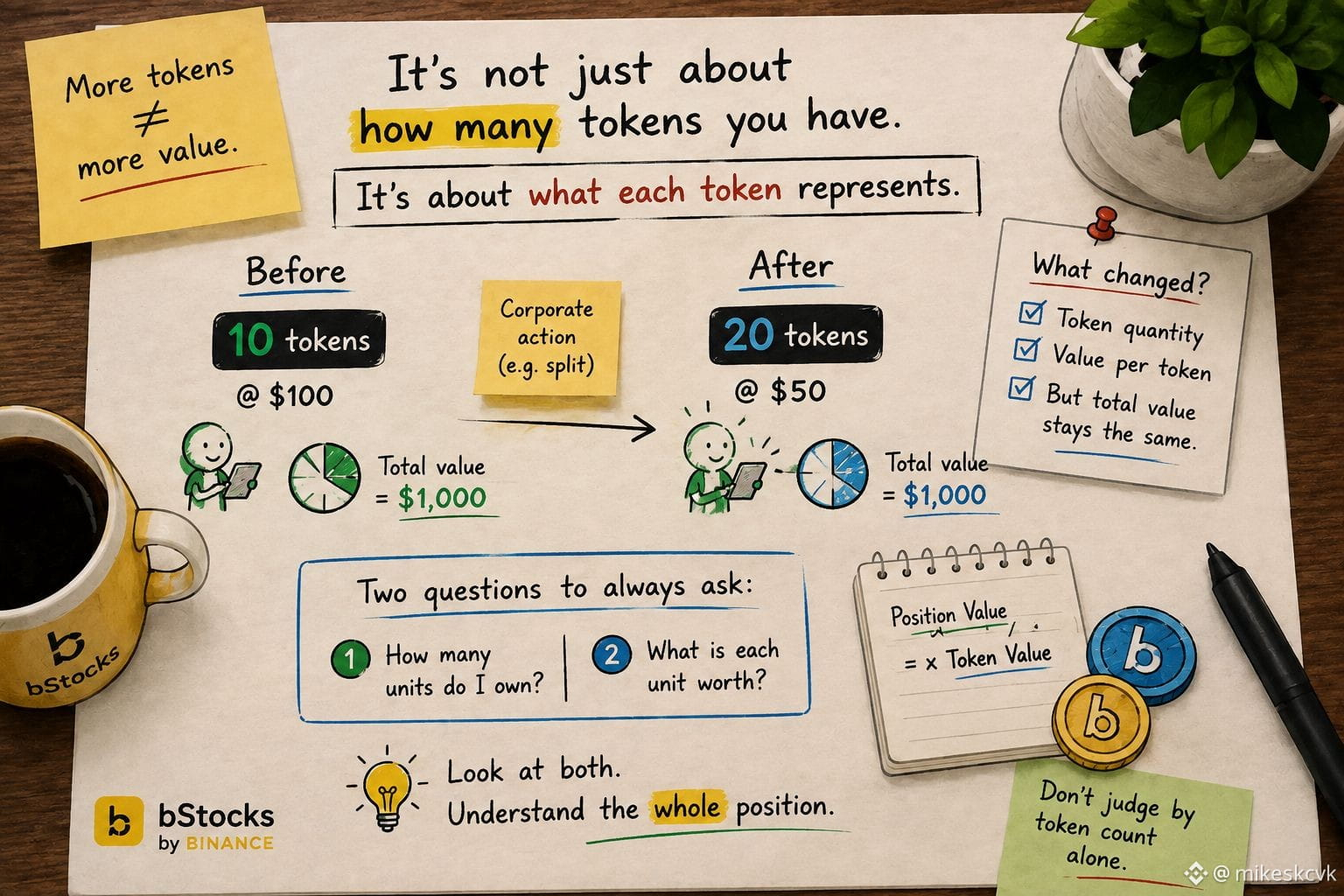
Imagine I have 10 tokens.
Later, I look again and see 20.
My first instinct would probably be:
“Nice. I doubled my position.”
But that conclusion can be completely wrong.
If a corporate action changes the unit structure, the number of tokens can change while the economic exposure is adjusted at the same time.
So the balance by itself isn't enough.
I now think about it as two separate questions:
How many units do I own?
and
What is each unit worth?
Those two numbers need to be looked at together.
Otherwise, a simple change in quantity can create a very misleading impression.
It's the same reason I don't judge a company by its share count alone.
More shares doesn't automatically mean more value.
The unit matters.
The price matters.
And the relationship between them matters even more.
That's a small detail, but it's exactly the kind of detail that can make a tokenized asset look confusing when nothing unusual actually happened to the underlying economic position.
Would you check the token quantity first, or the total position value first?
#bstockscis @BinanceCIS
Then I started paying more attention to what one unit actually represents.
Imagine I have 10 tokens.
Later, I look again and see 20.
My first instinct would probably be:
“Nice. I doubled my position.”
But that conclusion can be completely wrong.
If a corporate action changes the unit structure, the number of tokens can change while the economic exposure is adjusted at the same time.
So the balance by itself isn't enough.
I now think about it as two separate questions:
How many units do I own?
and
What is each unit worth?
Those two numbers need to be looked at together.
Otherwise, a simple change in quantity can create a very misleading impression.
It's the same reason I don't judge a company by its share count alone.
More shares doesn't automatically mean more value.
The unit matters.
The price matters.
And the relationship between them matters even more.
That's a small detail, but it's exactly the kind of detail that can make a tokenized asset look confusing when nothing unusual actually happened to the underlying economic position.
Would you check the token quantity first, or the total position value first?
#bstockscis @BinanceCIS
1
1
99
·
--
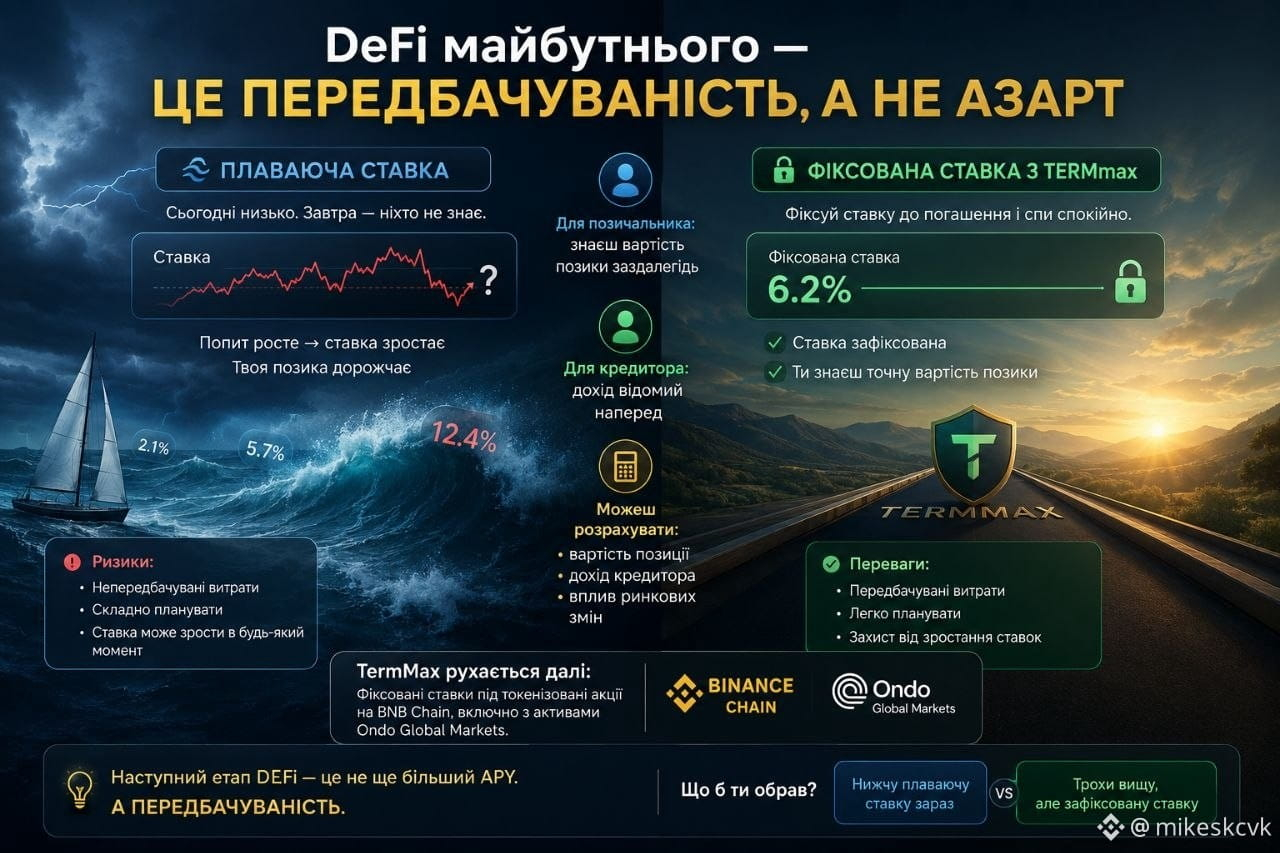
A DeFi acostuma a taxas flutuantes.
Até você precisar de um empréstimo por alguns meses.
Hoje, a taxa é vantajosa. Amanhã, devido a mudanças na demanda ou na liquidez, o custo do empréstimo já será outro.
É por isso que estou interessado no TermMax.
Aqui você pode fixar a taxa até o vencimento.
Para o tomador — um custo de empréstimo claro.
Para o credor — uma receita projetada.
E isso é especialmente interessante para estratégias maiores, em que é importante saber com antecedência o custo do capital.
Ainda mais interessante é que o TermMax está caminhando na direção de RWA. A equipe já integrou o empréstimo de taxa fixa para ações tokenizadas na BNB Chain.
Talvez a próxima etapa do DeFi não seja o APY máximo.
Mas a previsibilidade.
O que você vai escolher: uma taxa flutuante mais baixa ou um pouco mais alta, porém fixa?
#termmax @termmax
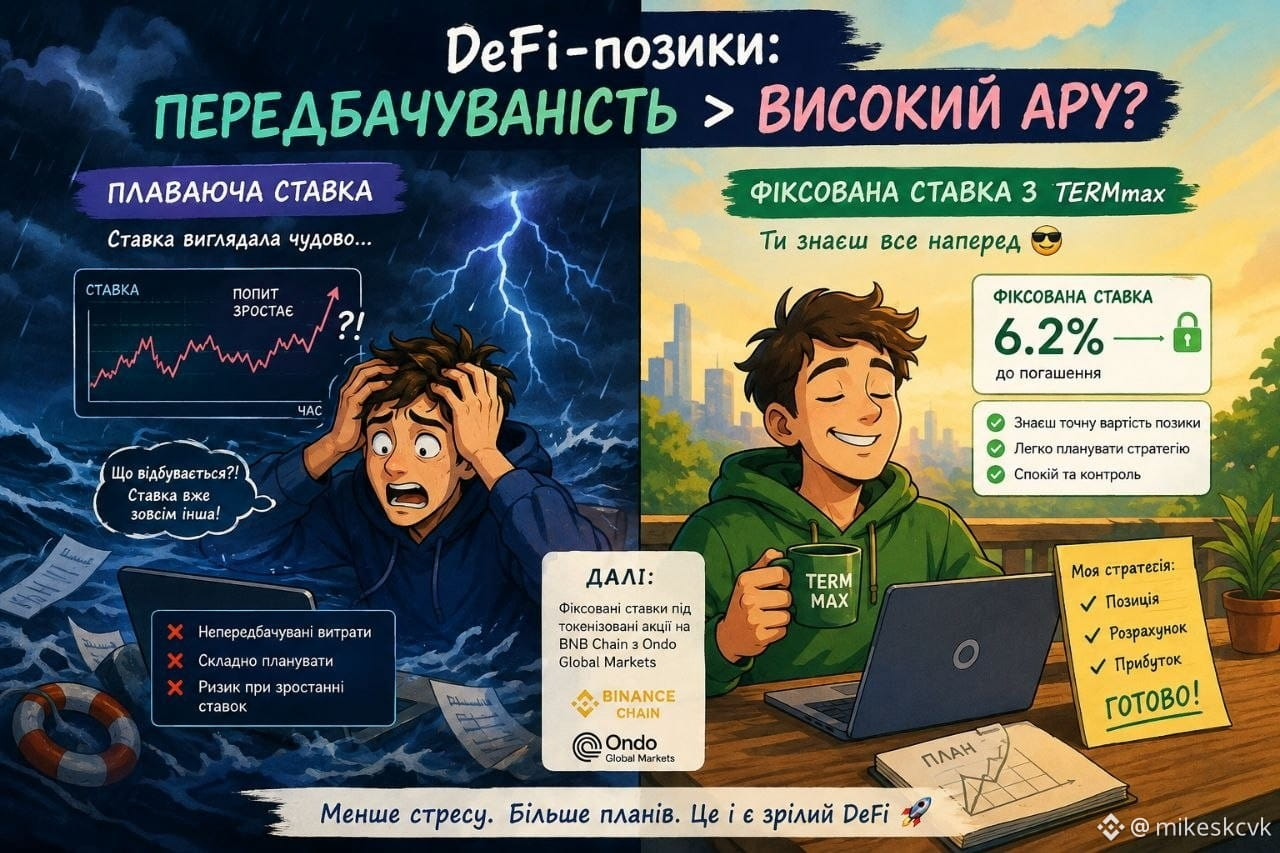
A DeFi acostuma a taxas flutuantes.
Até você precisar de um empréstimo por alguns meses.
Hoje, a taxa é vantajosa. Amanhã, devido a mudanças na demanda ou na liquidez, o custo do empréstimo já será outro.
É por isso que estou interessado no TermMax.
Aqui você pode fixar a taxa até o vencimento.
Para o tomador — um custo de empréstimo claro.
Para o credor — uma receita projetada.
E isso é especialmente interessante para estratégias maiores, em que é importante saber com antecedência o custo do capital.
Ainda mais interessante é que o TermMax está caminhando na direção de RWA. A equipe já integrou o empréstimo de taxa fixa para ações tokenizadas na BNB Chain.
Talvez a próxima etapa do DeFi não seja o APY máximo.
Mas a previsibilidade.
O que você vai escolher: uma taxa flutuante mais baixa ou um pouco mais alta, porém fixa?
#termmax @TermMax
Até você precisar de um empréstimo por alguns meses.
Hoje, a taxa é vantajosa. Amanhã, devido a mudanças na demanda ou na liquidez, o custo do empréstimo já será outro.
É por isso que estou interessado no TermMax.
Aqui você pode fixar a taxa até o vencimento.
Para o tomador — um custo de empréstimo claro.
Para o credor — uma receita projetada.
E isso é especialmente interessante para estratégias maiores, em que é importante saber com antecedência o custo do capital.
Ainda mais interessante é que o TermMax está caminhando na direção de RWA. A equipe já integrou o empréstimo de taxa fixa para ações tokenizadas na BNB Chain.
Talvez a próxima etapa do DeFi não seja o APY máximo.
Mas a previsibilidade.
O que você vai escolher: uma taxa flutuante mais baixa ou um pouco mais alta, porém fixa?
#termmax @TermMax
131
·
--
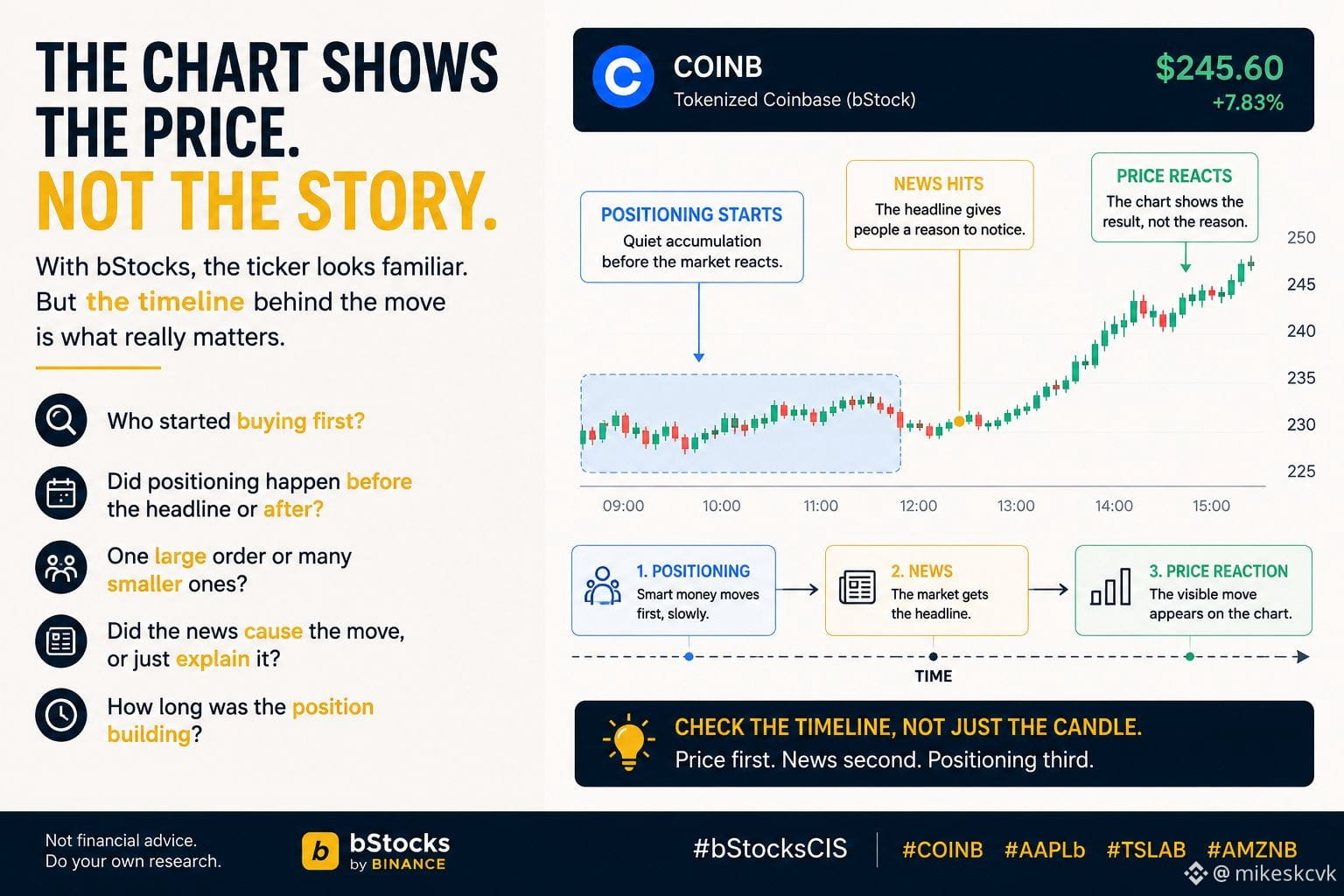
Uma coisa que comecei a prestar mais atenção em ações tokenizadas é a diferença entre o que o gráfico mostra e o que realmente aconteceu antes de o gráfico se mover.
Vamos usar #COINB como exemplo.
Uma vela verde forte pode fazer parecer que o mercado “decidiu” de repente que a empresa valia mais.
Mas a vela só me diz onde o mercado negociou.
Ela não me diz: — quem começou a comprar primeiro
— por quanto tempo a posição estava sendo construída
— se o movimento veio de uma única grande ordem ou de muitas menores
— se a reação do preço aconteceu antes ou depois do manchete
— ou se a manchete simplesmente deu aos traders um motivo para notar a movimentação.
Essa última parte é fácil de perder.
Às vezes, a notícia é a explicação que as pessoas lembram, enquanto o posicionamento aconteceu bem mais cedo.
E isso muda a forma como eu leio um gráfico.
Em vez de perguntar:
“Por que #COINB subiu hoje?”
Eu prefiro perguntar:
“O que já estava acontecendo antes de hoje?”
Para bStocks, acho que essa distinção é especialmente útil porque a interface pode fazer um ticker tradicional parecer muito familiar. O ticker familiar não significa que cada pedaço de informação do mercado deva ser interpretado exatamente como uma posição normal em uma corretora.
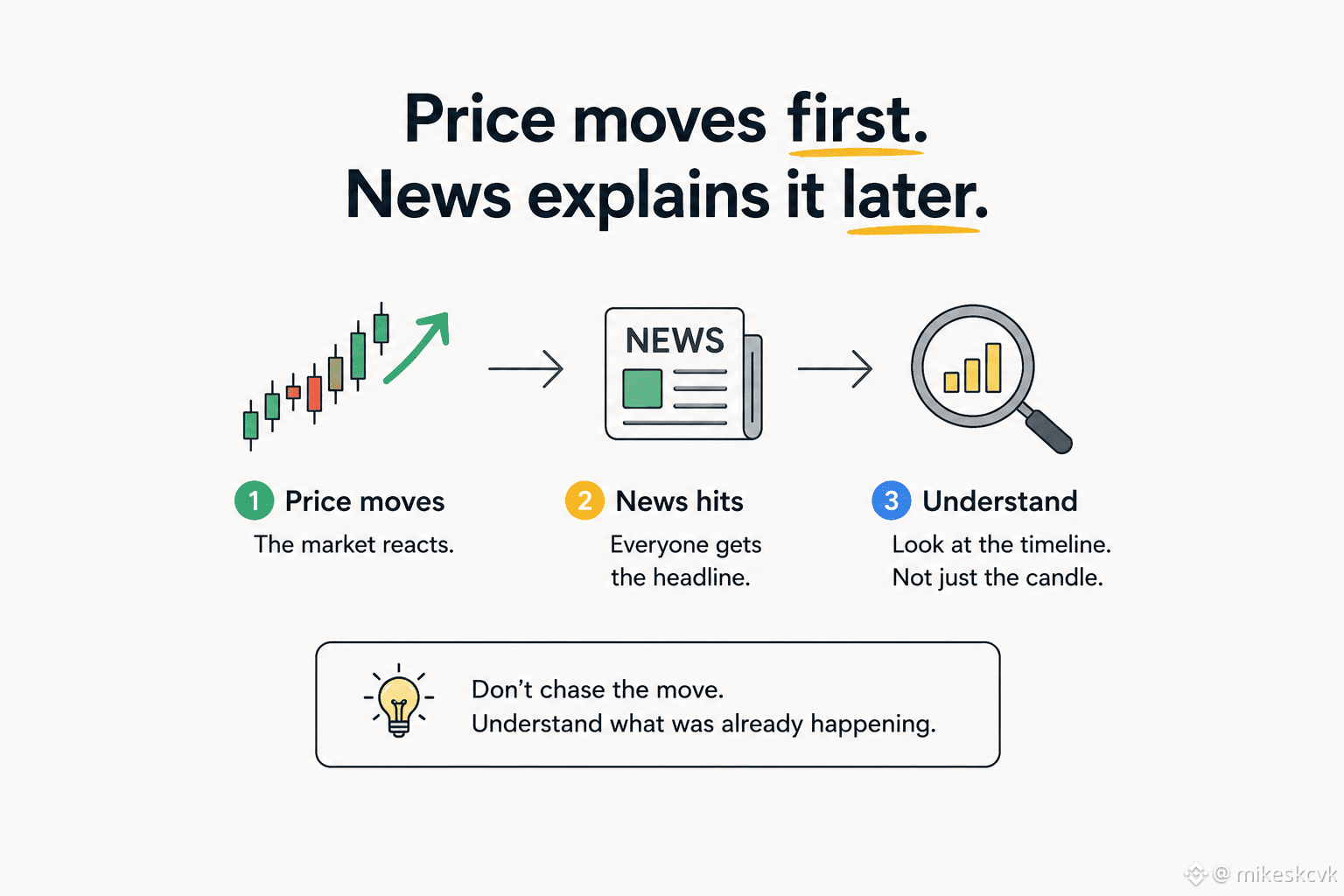
Então, agora, quando eu vejo um grande movimento, meu primeiro impulso não é correr atrás da vela.
Eu verifico a linha do tempo.
Preço primeiro.
Notícias em segundo.
Posicionamento em terceiro.
A ordem importa mais do que eu imaginava.
#bstockscis @BinanceCIS
Uma coisa que comecei a prestar mais atenção em ações tokenizadas é a diferença entre o que o gráfico mostra e o que realmente aconteceu antes de o gráfico se mover.
Vamos usar #COINB como exemplo.
Uma vela verde forte pode fazer parecer que o mercado “decidiu” de repente que a empresa valia mais.
Mas a vela só me diz onde o mercado negociou.
Ela não me diz: — quem começou a comprar primeiro
— por quanto tempo a posição estava sendo construída
— se o movimento veio de uma única grande ordem ou de muitas menores
— se a reação do preço aconteceu antes ou depois do manchete
— ou se a manchete simplesmente deu aos traders um motivo para notar a movimentação.
Essa última parte é fácil de perder.
Às vezes, a notícia é a explicação que as pessoas lembram, enquanto o posicionamento aconteceu bem mais cedo.
E isso muda a forma como eu leio um gráfico.
Em vez de perguntar:
“Por que #COINB subiu hoje?”
Eu prefiro perguntar:
“O que já estava acontecendo antes de hoje?”
Para bStocks, acho que essa distinção é especialmente útil porque a interface pode fazer um ticker tradicional parecer muito familiar. O ticker familiar não significa que cada pedaço de informação do mercado deva ser interpretado exatamente como uma posição normal em uma corretora.
Então, agora, quando eu vejo um grande movimento, meu primeiro impulso não é correr atrás da vela.
Eu verifico a linha do tempo.
Preço primeiro.
Notícias em segundo.
Posicionamento em terceiro.
A ordem importa mais do que eu imaginava.
#bstockscis @BinanceCIS
Vamos usar #COINB como exemplo.
Uma vela verde forte pode fazer parecer que o mercado “decidiu” de repente que a empresa valia mais.
Mas a vela só me diz onde o mercado negociou.
Ela não me diz: — quem começou a comprar primeiro
— por quanto tempo a posição estava sendo construída
— se o movimento veio de uma única grande ordem ou de muitas menores
— se a reação do preço aconteceu antes ou depois do manchete
— ou se a manchete simplesmente deu aos traders um motivo para notar a movimentação.
Essa última parte é fácil de perder.
Às vezes, a notícia é a explicação que as pessoas lembram, enquanto o posicionamento aconteceu bem mais cedo.
E isso muda a forma como eu leio um gráfico.
Em vez de perguntar:
“Por que #COINB subiu hoje?”
Eu prefiro perguntar:
“O que já estava acontecendo antes de hoje?”
Para bStocks, acho que essa distinção é especialmente útil porque a interface pode fazer um ticker tradicional parecer muito familiar. O ticker familiar não significa que cada pedaço de informação do mercado deva ser interpretado exatamente como uma posição normal em uma corretora.
Então, agora, quando eu vejo um grande movimento, meu primeiro impulso não é correr atrás da vela.
Eu verifico a linha do tempo.
Preço primeiro.
Notícias em segundo.
Posicionamento em terceiro.
A ordem importa mais do que eu imaginava.
#bstockscis @BinanceCIS
82
·
--
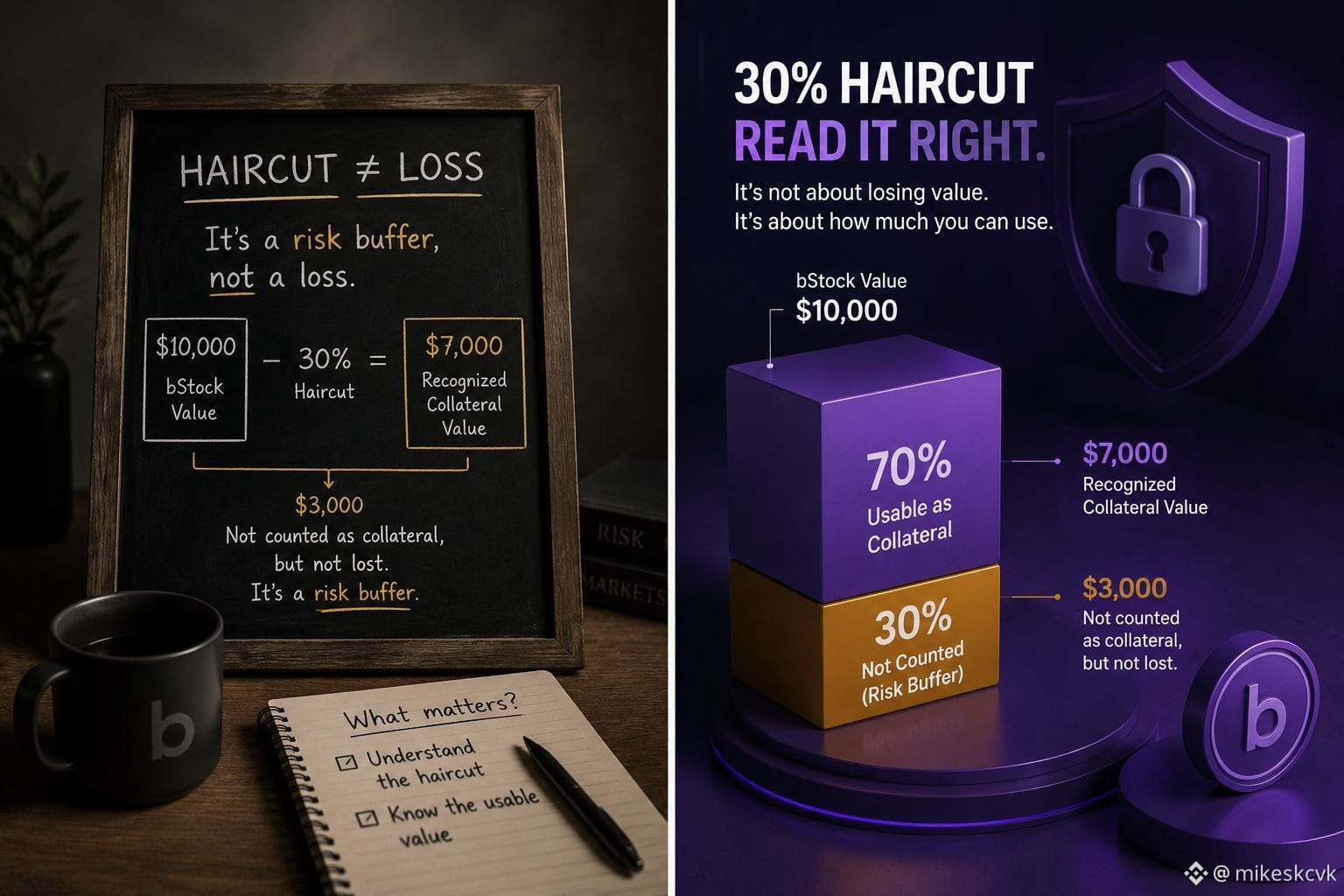
Costumava ler um haircut de colateral como se fosse apenas um desconto simples.
Esse era o modelo mental errado.
Suponha que uma ação tokenizada tenha um haircut de 30%.
Meu primeiro impulso seria:
“Ok, então 30% do ativo basicamente se perdeu.”
Mas não é isso que o número está dizendo.
A pergunta mais útil é:
Quanto do valor do ativo pode realmente ser reconhecido como colateral?
Se você tem US$ 10.000 de um bStock e o haircut aplicável é de 30%, o valor do colateral reconhecido é de US$ 7.000.
Os outros US$ 3.000 não desapareceram.
Eles simplesmente não são contabilizados no valor do colateral sob essa suposição de haircut.
Essa distinção importa porque os cálculos de colateral são sobre buffers de risco, e não sobre declarar parte de um ativo como sem valor.
E há um outro detalhe que eu checaria antes de fazer qualquer cálculo:
A que exatamente se aplica o haircut?
A resposta pode depender do ativo, das regras relevantes e do framework específico de colateral.
Então, em vez de lembrar:
“Haircut de 30% = perda de 30%,”
agora eu lembro:
“Haircut de 30% = 70% do valor do colateral reconhecido.”
Uma pequena diferença de redação, mas uma forma completamente diferente de interpretar o número.
Para mim, este é um daqueles conceitos de bStocks que fica muito mais fácil quando você para de pensar na porcentagem como uma “perda” e começa a pensar nela como um valor de colateral ajustado ao risco.
Você interpretaria corretamente um haircut de 30% sem fazer o cálculo?
{spot}(NVDABUSDT)
$NVDAB
#bstockscis @BinanceCIS
Costumava ler um haircut de colateral como se fosse apenas um desconto simples.
Esse era o modelo mental errado.
Suponha que uma ação tokenizada tenha um haircut de 30%.
Meu primeiro impulso seria:
“Ok, então 30% do ativo basicamente se perdeu.”
Mas não é isso que o número está dizendo.
A pergunta mais útil é:
Quanto do valor do ativo pode realmente ser reconhecido como colateral?
Se você tem US$ 10.000 de um bStock e o haircut aplicável é de 30%, o valor do colateral reconhecido é de US$ 7.000.
Os outros US$ 3.000 não desapareceram.
Eles simplesmente não são contabilizados no valor do colateral sob essa suposição de haircut.
Essa distinção importa porque os cálculos de colateral são sobre buffers de risco, e não sobre declarar parte de um ativo como sem valor.
E há um outro detalhe que eu checaria antes de fazer qualquer cálculo:
A que exatamente se aplica o haircut?
A resposta pode depender do ativo, das regras relevantes e do framework específico de colateral.
Então, em vez de lembrar:
“Haircut de 30% = perda de 30%,”
agora eu lembro:
“Haircut de 30% = 70% do valor do colateral reconhecido.”
Uma pequena diferença de redação, mas uma forma completamente diferente de interpretar o número.
Para mim, este é um daqueles conceitos de bStocks que fica muito mais fácil quando você para de pensar na porcentagem como uma “perda” e começa a pensar nela como um valor de colateral ajustado ao risco.
Você interpretaria corretamente um haircut de 30% sem fazer o cálculo?
$NVDAB
#bstockscis @BinanceCIS
Esse era o modelo mental errado.
Suponha que uma ação tokenizada tenha um haircut de 30%.
Meu primeiro impulso seria:
“Ok, então 30% do ativo basicamente se perdeu.”
Mas não é isso que o número está dizendo.
A pergunta mais útil é:
Quanto do valor do ativo pode realmente ser reconhecido como colateral?
Se você tem US$ 10.000 de um bStock e o haircut aplicável é de 30%, o valor do colateral reconhecido é de US$ 7.000.
Os outros US$ 3.000 não desapareceram.
Eles simplesmente não são contabilizados no valor do colateral sob essa suposição de haircut.
Essa distinção importa porque os cálculos de colateral são sobre buffers de risco, e não sobre declarar parte de um ativo como sem valor.
E há um outro detalhe que eu checaria antes de fazer qualquer cálculo:
A que exatamente se aplica o haircut?
A resposta pode depender do ativo, das regras relevantes e do framework específico de colateral.
Então, em vez de lembrar:
“Haircut de 30% = perda de 30%,”
agora eu lembro:
“Haircut de 30% = 70% do valor do colateral reconhecido.”
Uma pequena diferença de redação, mas uma forma completamente diferente de interpretar o número.
Para mim, este é um daqueles conceitos de bStocks que fica muito mais fácil quando você para de pensar na porcentagem como uma “perda” e começa a pensar nela como um valor de colateral ajustado ao risco.
Você interpretaria corretamente um haircut de 30% sem fazer o cálculo?
$NVDAB
#bstockscis @BinanceCIS
96
·
--
Continuo vendo a mesma suposição:
“Valores mobiliários tokenizados são apenas ações tradicionais em outro formato.”
Mas, se esse fosse o ponto inteiro, a pergunta ficaria bem simples:
Por que construir toda essa infraestrutura extra?
Há várias respostas possíveis.
Talvez o maior valor seja tornar a exposição a ações mais acessível.
Talvez seja a capacidade de interagir com os mercados por meio da infraestrutura de blockchain.
Talvez a disponibilidade de negociação estendida importe mais.
Ou talvez a verdadeira vantagem seja simplesmente criar uma forma diferente de as pessoas acessarem ativos familiares.
Eu não acho que exista uma resposta universal.
Então fico curioso para saber o que a comunidade realmente pensa.
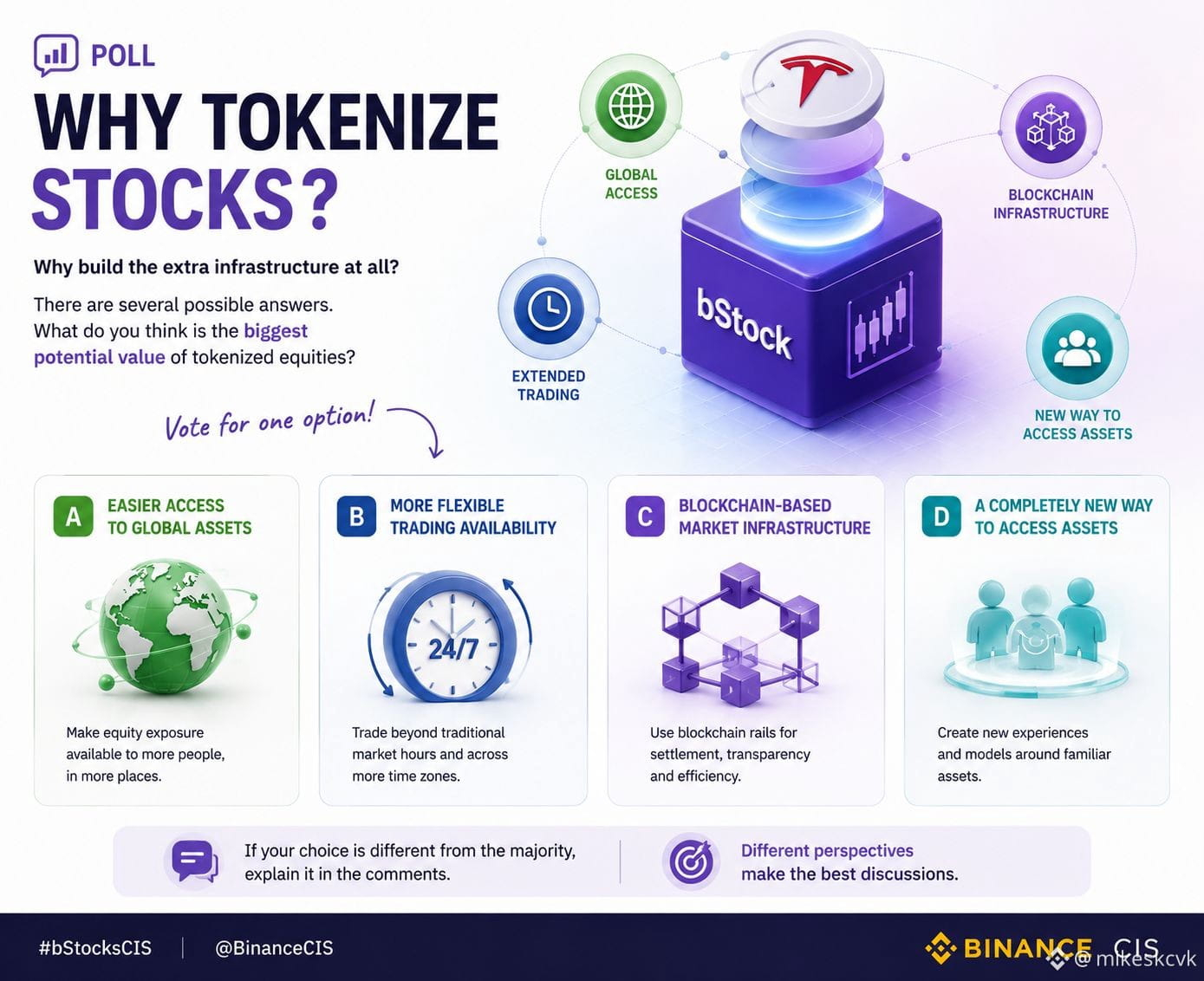
Qual é o maior potencial de valor das ações tokenizadas?
A — Acesso mais fácil a ativos globais
B — Mais flexibilidade na disponibilidade de negociação
C — Infraestrutura de mercado baseada em blockchain
D — Uma forma completamente nova de acessar ativos familiares
Vote em uma.
E se sua escolha for diferente da maioria, explique — é provavelmente aí que começa a discussão interessante.
#bstockscis @BinanceCIS
Continuo vendo a mesma suposição:
“Valores mobiliários tokenizados são apenas ações tradicionais em outro formato.”
Mas, se esse fosse o ponto inteiro, a pergunta ficaria bem simples:
Por que construir toda essa infraestrutura extra?
Há várias respostas possíveis.
Talvez o maior valor seja tornar a exposição a ações mais acessível.
Talvez seja a capacidade de interagir com os mercados por meio da infraestrutura de blockchain.
Talvez a disponibilidade de negociação estendida importe mais.
Ou talvez a verdadeira vantagem seja simplesmente criar uma forma diferente de as pessoas acessarem ativos familiares.
Eu não acho que exista uma resposta universal.
Então fico curioso para saber o que a comunidade realmente pensa.
Qual é o maior potencial de valor das ações tokenizadas?
A — Acesso mais fácil a ativos globais
B — Mais flexibilidade na disponibilidade de negociação
C — Infraestrutura de mercado baseada em blockchain
D — Uma forma completamente nova de acessar ativos familiares
Vote em uma.
E se sua escolha for diferente da maioria, explique — é provavelmente aí que começa a discussão interessante.
#bstockscis @BinanceCIS
“Valores mobiliários tokenizados são apenas ações tradicionais em outro formato.”
Mas, se esse fosse o ponto inteiro, a pergunta ficaria bem simples:
Por que construir toda essa infraestrutura extra?
Há várias respostas possíveis.
Talvez o maior valor seja tornar a exposição a ações mais acessível.
Talvez seja a capacidade de interagir com os mercados por meio da infraestrutura de blockchain.
Talvez a disponibilidade de negociação estendida importe mais.
Ou talvez a verdadeira vantagem seja simplesmente criar uma forma diferente de as pessoas acessarem ativos familiares.
Eu não acho que exista uma resposta universal.
Então fico curioso para saber o que a comunidade realmente pensa.
Qual é o maior potencial de valor das ações tokenizadas?
A — Acesso mais fácil a ativos globais
B — Mais flexibilidade na disponibilidade de negociação
C — Infraestrutura de mercado baseada em blockchain
D — Uma forma completamente nova de acessar ativos familiares
Vote em uma.
E se sua escolha for diferente da maioria, explique — é provavelmente aí que começa a discussão interessante.
#bstockscis @BinanceCIS
76
·
--
Em Alta
Ver tradução
A smaller market does not automatically mean an uninteresting market.
That is something I keep in mind when looking at tokenized equities.
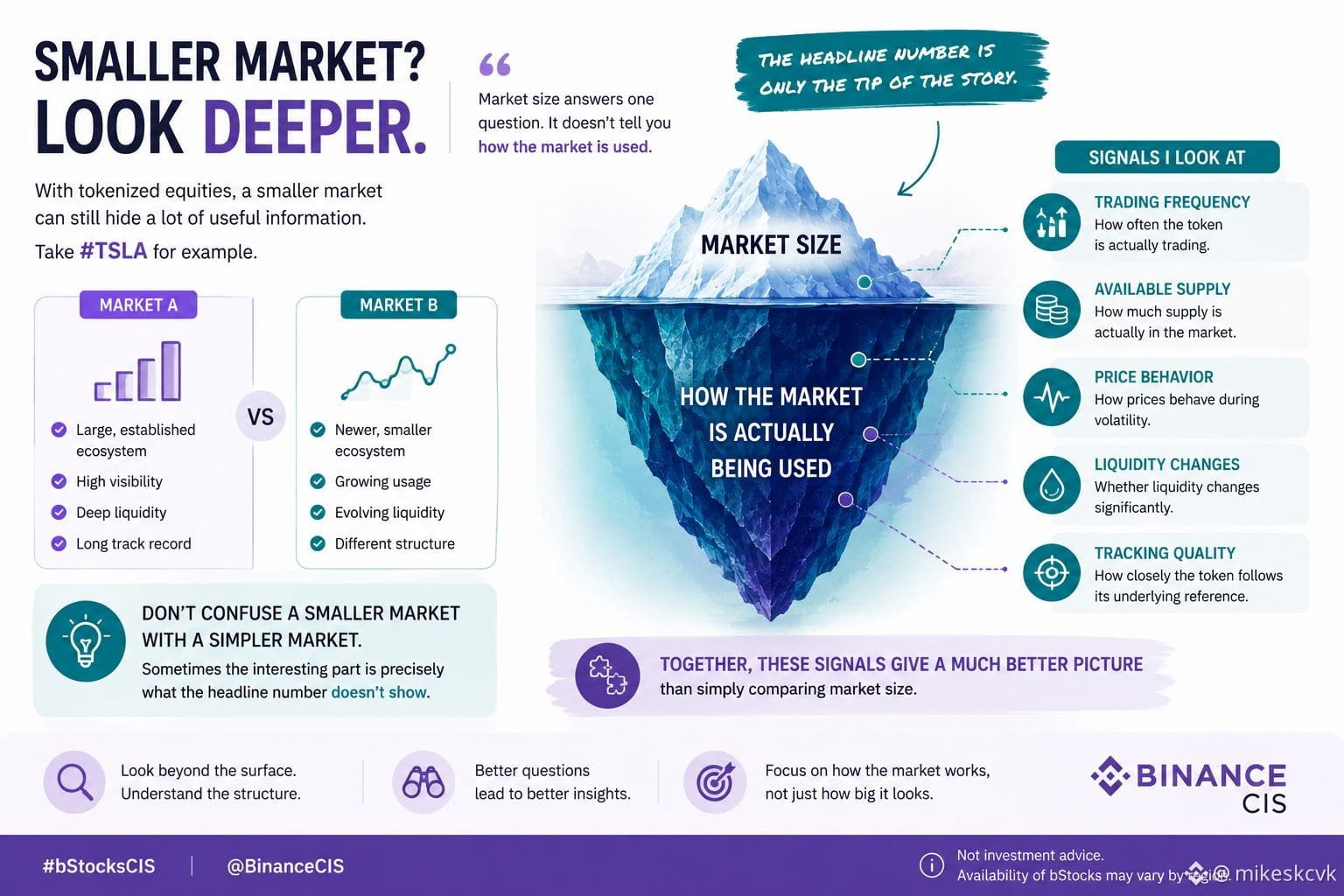
Imagine two markets showing almost the same underlying asset.
One has a huge established ecosystem.
The other is newer, smaller, and built around tokenized exposure.
It would be easy to look at the second one and say:
“Too small. Move on.”
But size answers only one question.
It doesn't tell me how the market is being used.
For example, with #TSLA I would rather look at several signals together:
→ how often the token trades
→ how much supply is actually available
→ how prices behave during volatility
→ whether liquidity changes significantly
→ how closely the token follows its underlying reference
None of these tells the whole story alone.
But together, they give a much better picture than simply comparing market size.
That is probably my biggest takeaway from studying bStocks:
Don't confuse a smaller market with a simpler market.
Sometimes the interesting part is precisely what the headline number doesn't show.
#bstockscis @BinanceCIS
A smaller market does not automatically mean an uninteresting market.
That is something I keep in mind when looking at tokenized equities.
Imagine two markets showing almost the same underlying asset.
One has a huge established ecosystem.
The other is newer, smaller, and built around tokenized exposure.
It would be easy to look at the second one and say:
“Too small. Move on.”
But size answers only one question.
It doesn't tell me how the market is being used.
For example, with #TSLA I would rather look at several signals together:
→ how often the token trades
→ how much supply is actually available
→ how prices behave during volatility
→ whether liquidity changes significantly
→ how closely the token follows its underlying reference
None of these tells the whole story alone.
But together, they give a much better picture than simply comparing market size.
That is probably my biggest takeaway from studying bStocks:
Don't confuse a smaller market with a simpler market.
Sometimes the interesting part is precisely what the headline number doesn't show.
#bstockscis @BinanceCIS
That is something I keep in mind when looking at tokenized equities.
Imagine two markets showing almost the same underlying asset.
One has a huge established ecosystem.
The other is newer, smaller, and built around tokenized exposure.
It would be easy to look at the second one and say:
“Too small. Move on.”
But size answers only one question.
It doesn't tell me how the market is being used.
For example, with #TSLA I would rather look at several signals together:
→ how often the token trades
→ how much supply is actually available
→ how prices behave during volatility
→ whether liquidity changes significantly
→ how closely the token follows its underlying reference
None of these tells the whole story alone.
But together, they give a much better picture than simply comparing market size.
That is probably my biggest takeaway from studying bStocks:
Don't confuse a smaller market with a simpler market.
Sometimes the interesting part is precisely what the headline number doesn't show.
#bstockscis @BinanceCIS
1
80
·
--
Ver tradução
I used to think that when evaluating a new financial product, the most important thing was understanding what exactly you are buying.
Now I'd add another question:
What happens around that asset after you buy it?
That's where tokenized stocks become much more interesting than a simple comparison with traditional markets.
An asset isn't just a price.
There is an entire process around it:
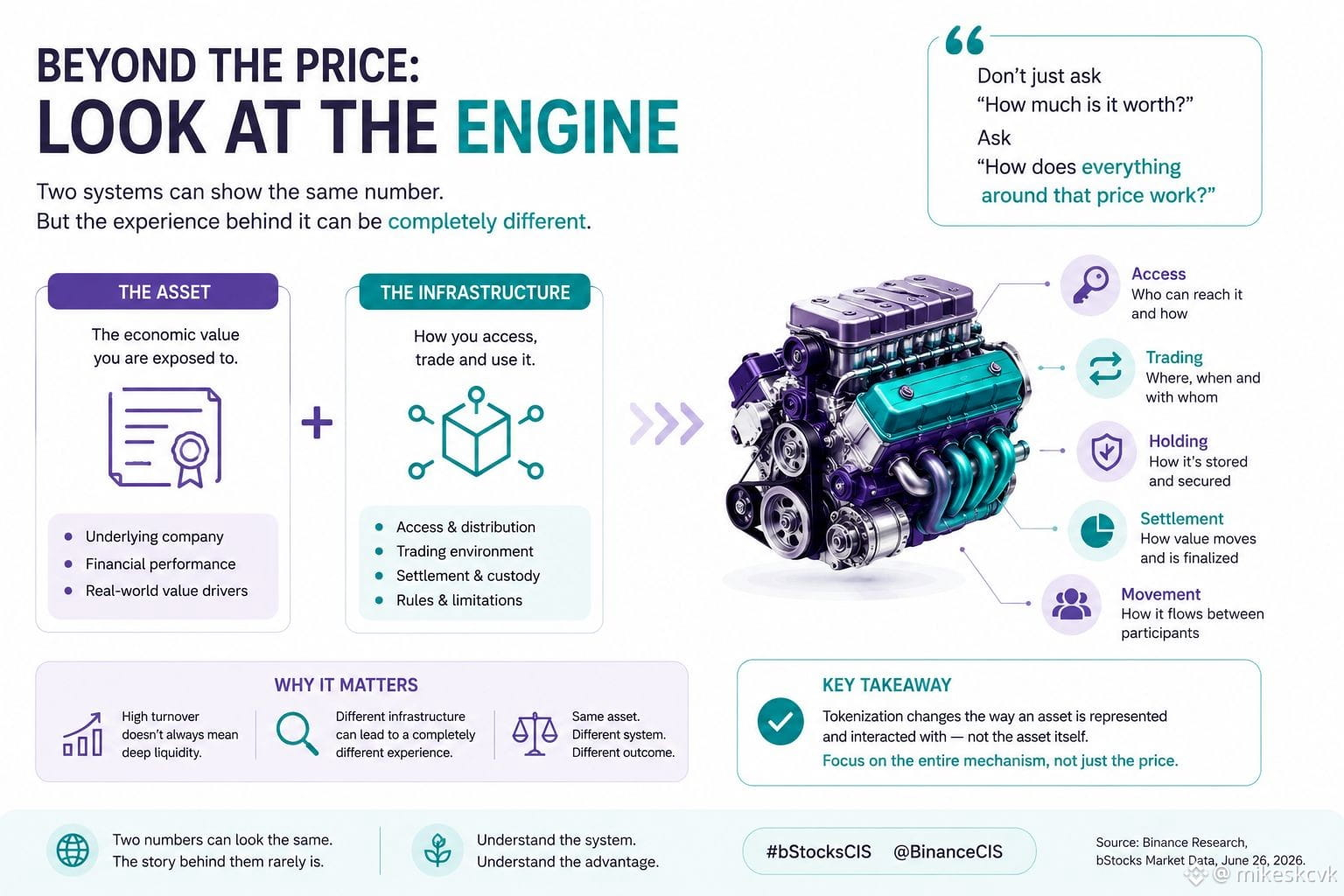
access → trading → holding → settlement → movement between participants
If you only look at the price chart, most of that story disappears.
So I try to separate two things.
The asset — what the economic value is connected to.
The infrastructure — how that asset is represented and accessed by the user.
Those are not the same thing.
And that's one of the parts of bStocks I find most interesting.
Tokenization doesn't magically change the underlying asset.
It changes the way that asset is represented and interacted with inside a different financial environment.
So my main takeaway is simple:
Don't evaluate a tokenized product only by asking:
“How much is it worth?”
Ask:
“How does everything around that price actually work?”
Two systems can display a very similar number on a screen while providing a completely different experience underneath.
And that's the difference I'm most interested in watching with bStocks.
@BinanceCIS #bstockscis
I used to think that when evaluating a new financial product, the most important thing was understanding what exactly you are buying.
Now I'd add another question:
What happens around that asset after you buy it?
That's where tokenized stocks become much more interesting than a simple comparison with traditional markets.
An asset isn't just a price.
There is an entire process around it:
access → trading → holding → settlement → movement between participants
If you only look at the price chart, most of that story disappears.
So I try to separate two things.
The asset — what the economic value is connected to.
The infrastructure — how that asset is represented and accessed by the user.
Those are not the same thing.
And that's one of the parts of bStocks I find most interesting.
Tokenization doesn't magically change the underlying asset.
It changes the way that asset is represented and interacted with inside a different financial environment.
So my main takeaway is simple:
Don't evaluate a tokenized product only by asking:
“How much is it worth?”
Ask:
“How does everything around that price actually work?”
Two systems can display a very similar number on a screen while providing a completely different experience underneath.
And that's the difference I'm most interested in watching with bStocks.
@BinanceCIS #bstockscis
Now I'd add another question:
What happens around that asset after you buy it?
That's where tokenized stocks become much more interesting than a simple comparison with traditional markets.
An asset isn't just a price.
There is an entire process around it:
access → trading → holding → settlement → movement between participants
If you only look at the price chart, most of that story disappears.
So I try to separate two things.
The asset — what the economic value is connected to.
The infrastructure — how that asset is represented and accessed by the user.
Those are not the same thing.
And that's one of the parts of bStocks I find most interesting.
Tokenization doesn't magically change the underlying asset.
It changes the way that asset is represented and interacted with inside a different financial environment.
So my main takeaway is simple:
Don't evaluate a tokenized product only by asking:
“How much is it worth?”
Ask:
“How does everything around that price actually work?”
Two systems can display a very similar number on a screen while providing a completely different experience underneath.
And that's the difference I'm most interested in watching with bStocks.
@BinanceCIS #bstockscis
1
80
·
--
Ver tradução
I think one of the easiest ways to misunderstand tokenized stocks is to focus only on the word “stock”.
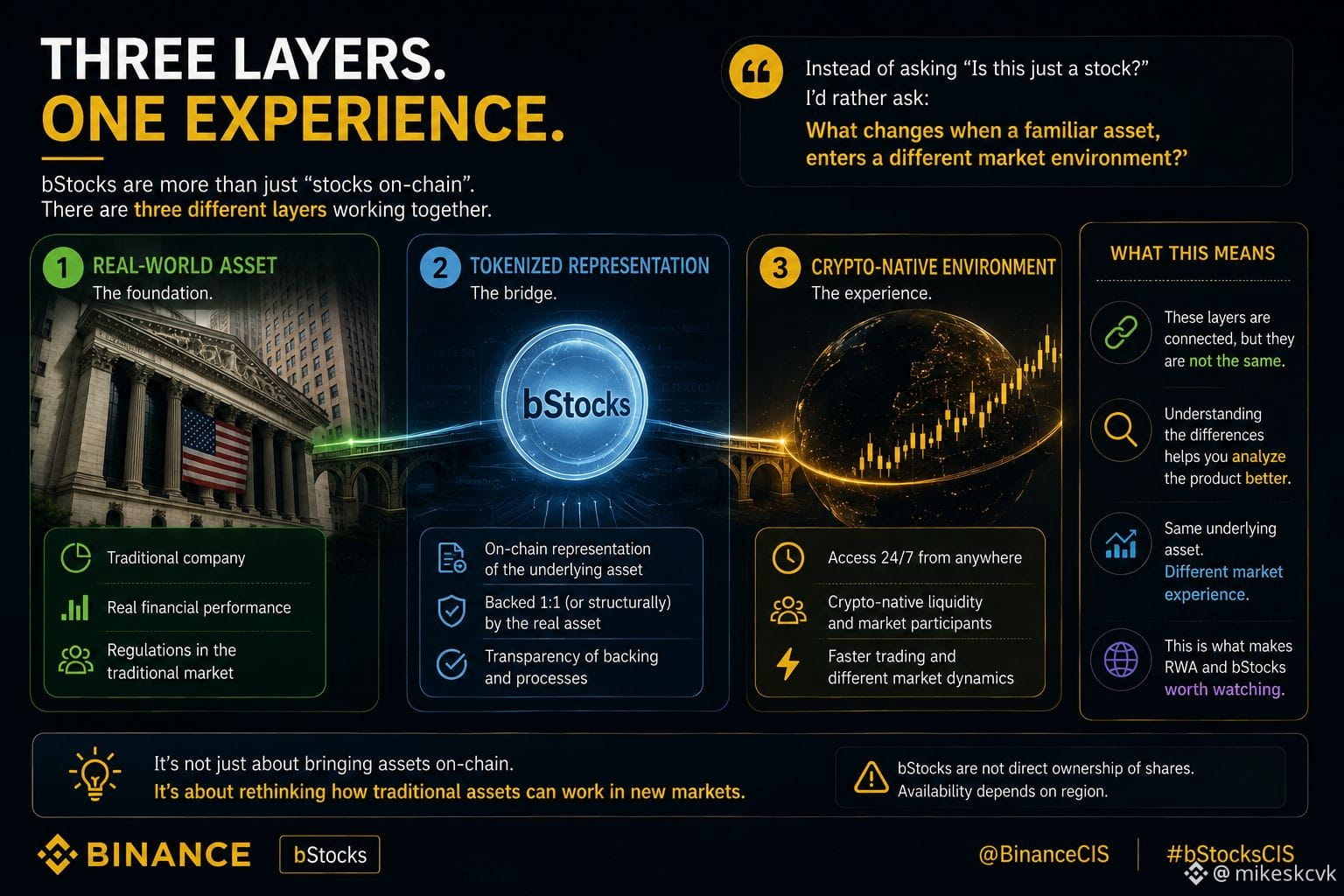
The more I look at bStocks, the more I see three different things happening at once.
There is the real-world asset.
Then there is the tokenized representation.
And finally, there is the crypto-native environment where the token can be traded.
Those three layers are connected, but they are not the same thing.
And that changes how I would look at the product.
Instead of asking:
“Is this just a stock?”
I'd rather ask:
“What changes when a familiar asset enters a different market environment?”
Trading hours, access, liquidity and the way people interact with the asset can all become part of the picture.
That shift in perspective makes much more sense to me than simply comparing a token to a traditional share.
Same underlying idea.
Different market experience. 🔎
That's what makes this space worth watching. 🌍@BinanceCIS 😀 #bstockscis
I think one of the easiest ways to misunderstand tokenized stocks is to focus only on the word “stock”.
The more I look at bStocks, the more I see three different things happening at once.
There is the real-world asset.
Then there is the tokenized representation.
And finally, there is the crypto-native environment where the token can be traded.
Those three layers are connected, but they are not the same thing.
And that changes how I would look at the product.
Instead of asking:
“Is this just a stock?”
I'd rather ask:
“What changes when a familiar asset enters a different market environment?”
Trading hours, access, liquidity and the way people interact with the asset can all become part of the picture.
That shift in perspective makes much more sense to me than simply comparing a token to a traditional share.
Same underlying idea.
Different market experience. 🔎
That's what makes this space worth watching. 🌍@BinanceCIS 😀 #bstockscis
The more I look at bStocks, the more I see three different things happening at once.
There is the real-world asset.
Then there is the tokenized representation.
And finally, there is the crypto-native environment where the token can be traded.
Those three layers are connected, but they are not the same thing.
And that changes how I would look at the product.
Instead of asking:
“Is this just a stock?”
I'd rather ask:
“What changes when a familiar asset enters a different market environment?”
Trading hours, access, liquidity and the way people interact with the asset can all become part of the picture.
That shift in perspective makes much more sense to me than simply comparing a token to a traditional share.
Same underlying idea.
Different market experience. 🔎
That's what makes this space worth watching. 🌍@BinanceCIS 😀 #bstockscis
73
·
--
Ver tradução
I used to think the hardest part of understanding tokenized stocks was the technology.
Honestly, I think it's the terminology.
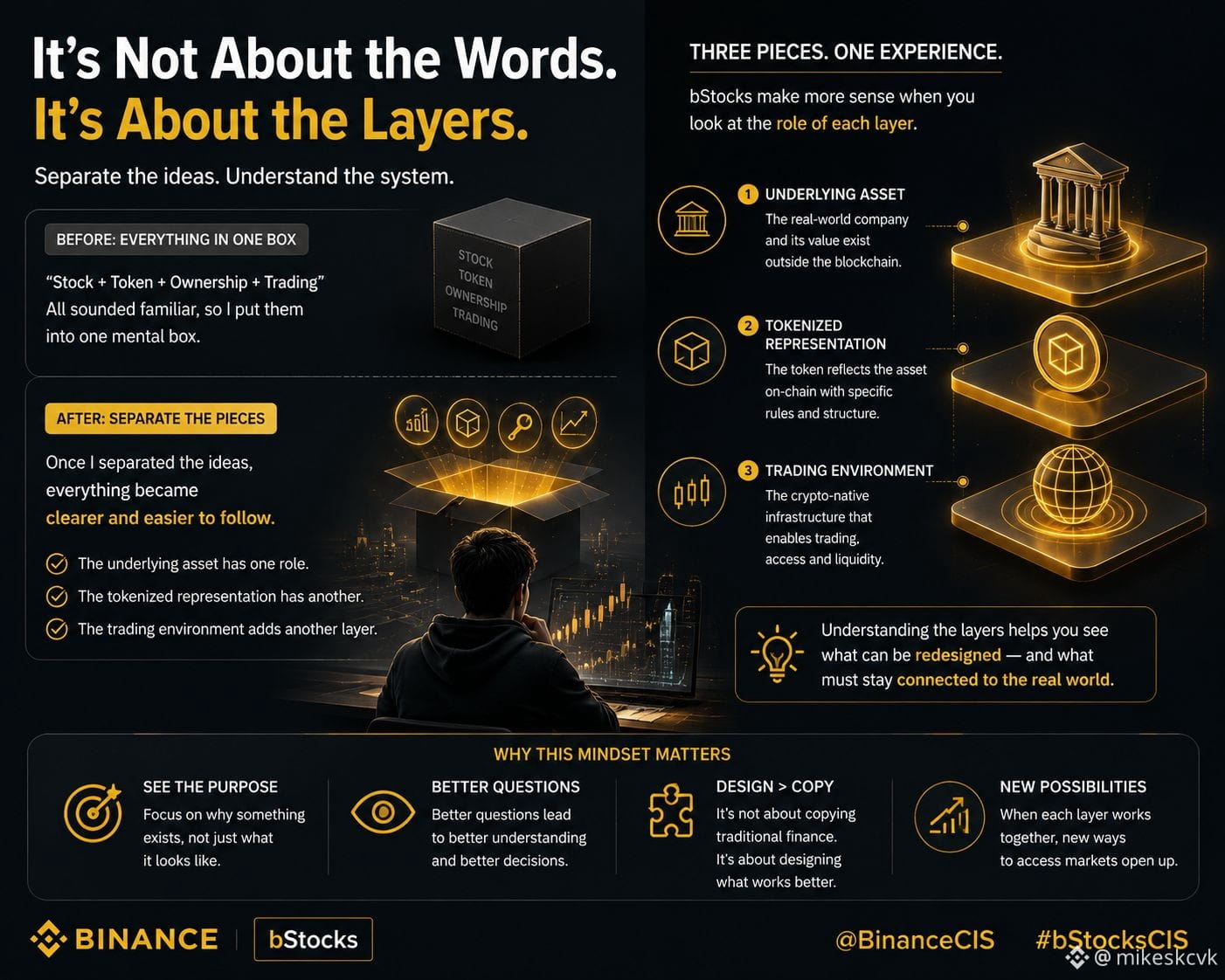
Words like “stock”, “token”, “ownership” and “trading” sound familiar, so it's very easy to put them all into one mental box.
But bStocks made me slow down and separate those ideas.
A tokenized asset isn't interesting just because it looks familiar.
What's interesting is the infrastructure around it.
The underlying asset has one role.
The tokenized representation has another.
And the trading environment adds another layer on top.
Once I started separating those pieces, the whole concept became much easier to follow.
Maybe that's also why RWA is interesting to me.
It's not simply about bringing traditional assets onto blockchain.
It's about figuring out which parts of the old financial experience can be redesigned without losing the connection to the underlying asset.
Still learning, but I definitely look at tokenization differently now. 🔎
@BinanceCIS #bstockscis
I used to think the hardest part of understanding tokenized stocks was the technology.
Honestly, I think it's the terminology.
Words like “stock”, “token”, “ownership” and “trading” sound familiar, so it's very easy to put them all into one mental box.
But bStocks made me slow down and separate those ideas.
A tokenized asset isn't interesting just because it looks familiar.
What's interesting is the infrastructure around it.
The underlying asset has one role.
The tokenized representation has another.
And the trading environment adds another layer on top.
Once I started separating those pieces, the whole concept became much easier to follow.
Maybe that's also why RWA is interesting to me.
It's not simply about bringing traditional assets onto blockchain.
It's about figuring out which parts of the old financial experience can be redesigned without losing the connection to the underlying asset.
Still learning, but I definitely look at tokenization differently now. 🔎
@BinanceCIS #bstockscis
Honestly, I think it's the terminology.
Words like “stock”, “token”, “ownership” and “trading” sound familiar, so it's very easy to put them all into one mental box.
But bStocks made me slow down and separate those ideas.
A tokenized asset isn't interesting just because it looks familiar.
What's interesting is the infrastructure around it.
The underlying asset has one role.
The tokenized representation has another.
And the trading environment adds another layer on top.
Once I started separating those pieces, the whole concept became much easier to follow.
Maybe that's also why RWA is interesting to me.
It's not simply about bringing traditional assets onto blockchain.
It's about figuring out which parts of the old financial experience can be redesigned without losing the connection to the underlying asset.
Still learning, but I definitely look at tokenization differently now. 🔎
@BinanceCIS #bstockscis
92
·
--
Eu estava pensando em bStocks hoje a partir da direção oposta.
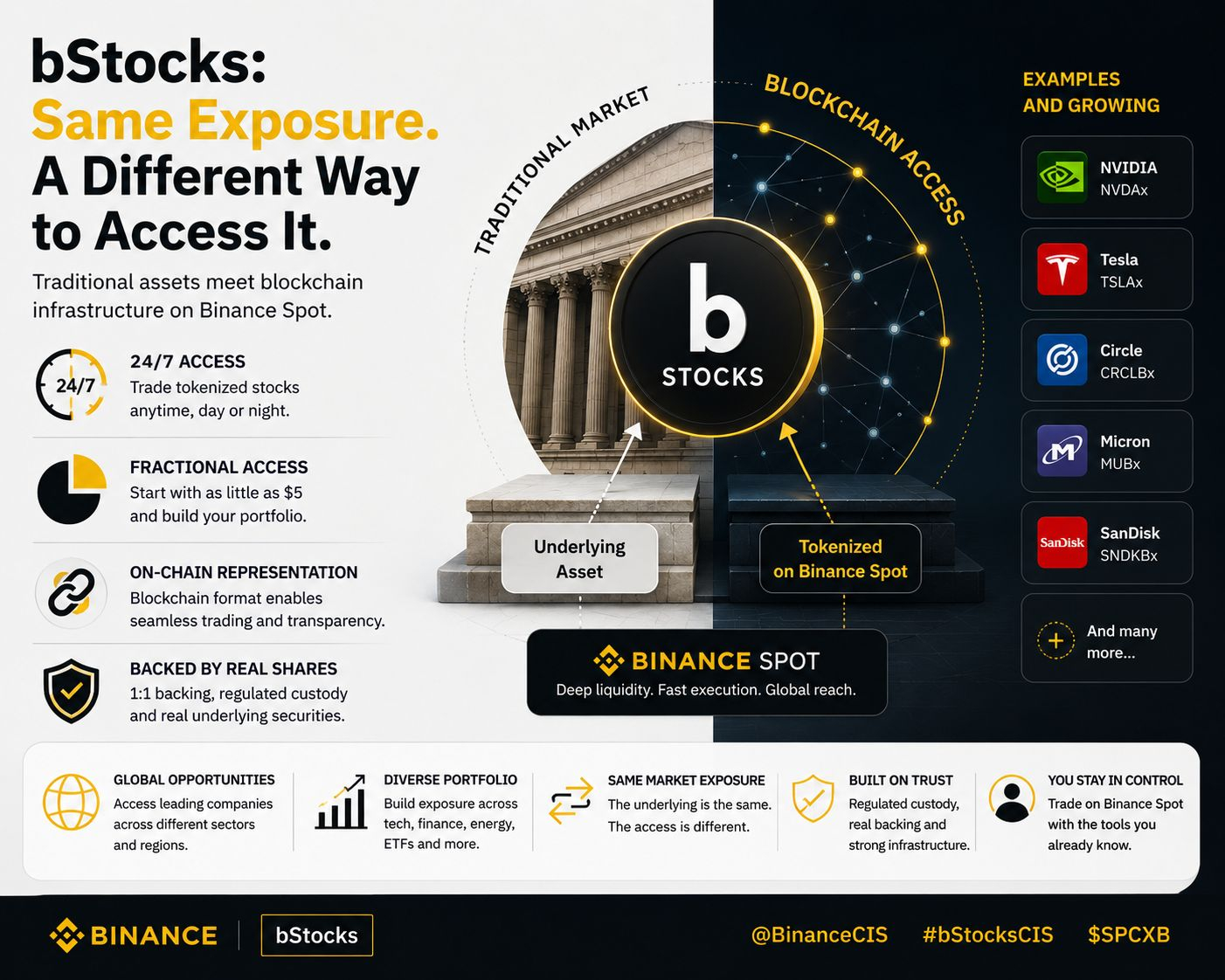
Em vez de perguntar “qual ação é tokenizada?”, acho que a melhor pergunta é “o que muda quando a mesma exposição ao mercado ganha um formato baseado em blockchain?”
Você obtém um ambiente de negociação diferente, acesso 24/7 no Binance Spot, acesso fracionado e uma representação on-chain — enquanto a estrutura subjacente ainda se conecta ao ativo tradicional.
Essa mistura provavelmente é a parte mais interessante para mim.
Não é sobre substituir o mercado de ações. É sobre experimentar uma forma diferente de acessá-lo. 🔎🌍
@BinanceCIS #bStocksCIS $SPCXB
Eu estava pensando em bStocks hoje a partir da direção oposta.
Em vez de perguntar “qual ação é tokenizada?”, acho que a melhor pergunta é “o que muda quando a mesma exposição ao mercado ganha um formato baseado em blockchain?”
Você obtém um ambiente de negociação diferente, acesso 24/7 no Binance Spot, acesso fracionado e uma representação on-chain — enquanto a estrutura subjacente ainda se conecta ao ativo tradicional.
Essa mistura provavelmente é a parte mais interessante para mim.
Não é sobre substituir o mercado de ações. É sobre experimentar uma forma diferente de acessá-lo. 🔎🌍
@BinanceCIS #bStocksCIS $SPCXB
Em vez de perguntar “qual ação é tokenizada?”, acho que a melhor pergunta é “o que muda quando a mesma exposição ao mercado ganha um formato baseado em blockchain?”
Você obtém um ambiente de negociação diferente, acesso 24/7 no Binance Spot, acesso fracionado e uma representação on-chain — enquanto a estrutura subjacente ainda se conecta ao ativo tradicional.
Essa mistura provavelmente é a parte mais interessante para mim.
Não é sobre substituir o mercado de ações. É sobre experimentar uma forma diferente de acessá-lo. 🔎🌍
@BinanceCIS #bStocksCIS $SPCXB
162
·
--
Algo que achei interessante ao investigar o bStocks é a diferença entre o próprio ativo e a forma como você acessa ele.
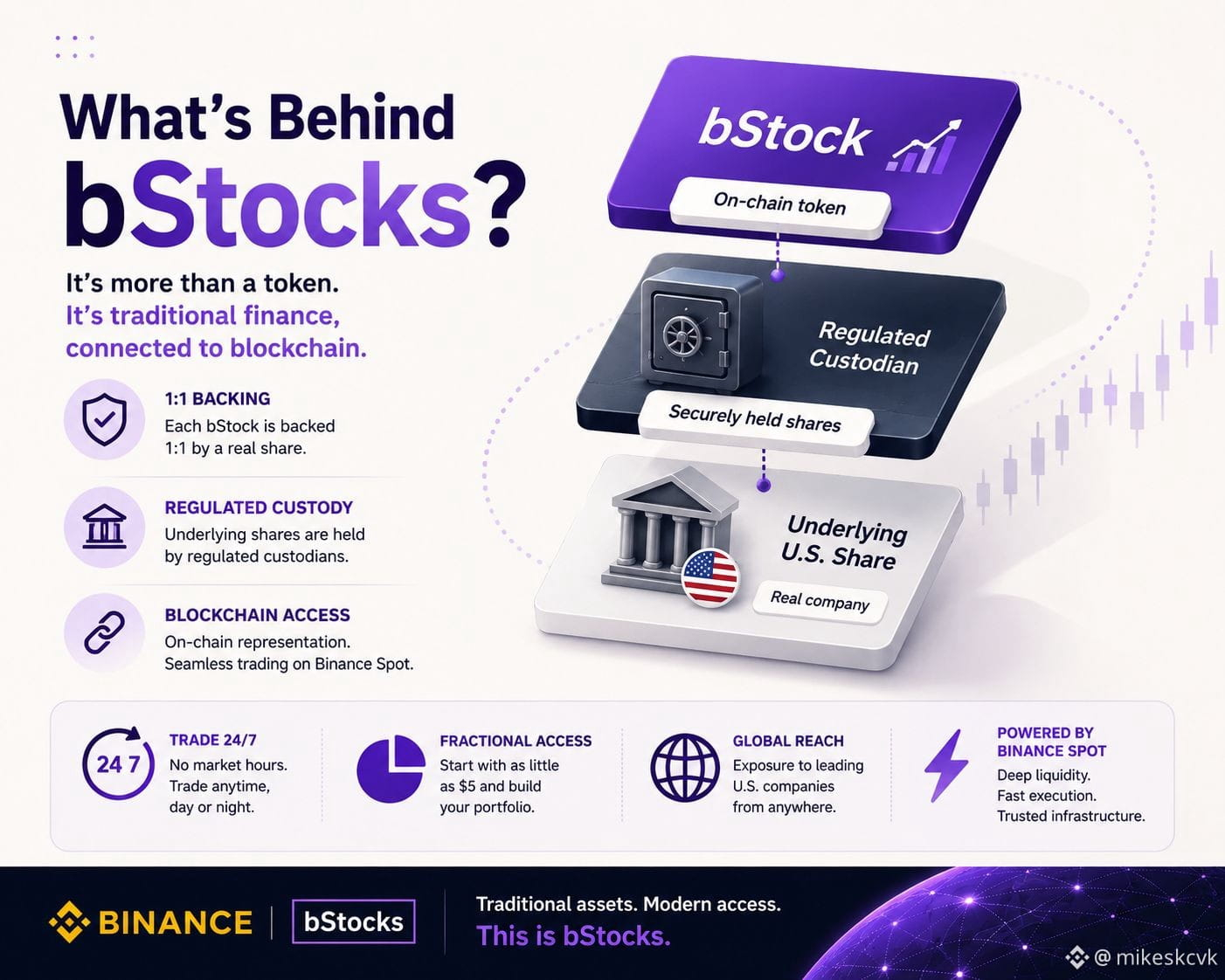
Ainda existe um valor mobiliário subjacente por trás da estrutura, com lastro 1:1 e custódia regulada. A parte de blockchain muda a forma como a exposição é representada e negociada.
Então eu não descreveria bStocks simplesmente como “uma ação colocada em uma blockchain”.
Há bastante coisa acontecendo por baixo — custódia, tokenização, infraestrutura de negociação e a conexão com a Binance Spot.
Sinceramente, essa é a parte que acho mais interessante do que apenas olhar o gráfico de preços. 😅🔎
@BinanceCIS $SPCXB #bstockscis
Algo que achei interessante ao investigar o bStocks é a diferença entre o próprio ativo e a forma como você acessa ele.
Ainda existe um valor mobiliário subjacente por trás da estrutura, com lastro 1:1 e custódia regulada. A parte de blockchain muda a forma como a exposição é representada e negociada.
Então eu não descreveria bStocks simplesmente como “uma ação colocada em uma blockchain”.
Há bastante coisa acontecendo por baixo — custódia, tokenização, infraestrutura de negociação e a conexão com a Binance Spot.
Sinceramente, essa é a parte que acho mais interessante do que apenas olhar o gráfico de preços. 😅🔎
@BinanceCIS $SPCXB #bstockscis
Ainda existe um valor mobiliário subjacente por trás da estrutura, com lastro 1:1 e custódia regulada. A parte de blockchain muda a forma como a exposição é representada e negociada.
Então eu não descreveria bStocks simplesmente como “uma ação colocada em uma blockchain”.
Há bastante coisa acontecendo por baixo — custódia, tokenização, infraestrutura de negociação e a conexão com a Binance Spot.
Sinceramente, essa é a parte que acho mais interessante do que apenas olhar o gráfico de preços. 😅🔎
@BinanceCIS $SPCXB #bstockscis
1
114
·
--
Eu costumava pensar que o valor dos bStocks era apenas sobre colocar ações na blockchain.
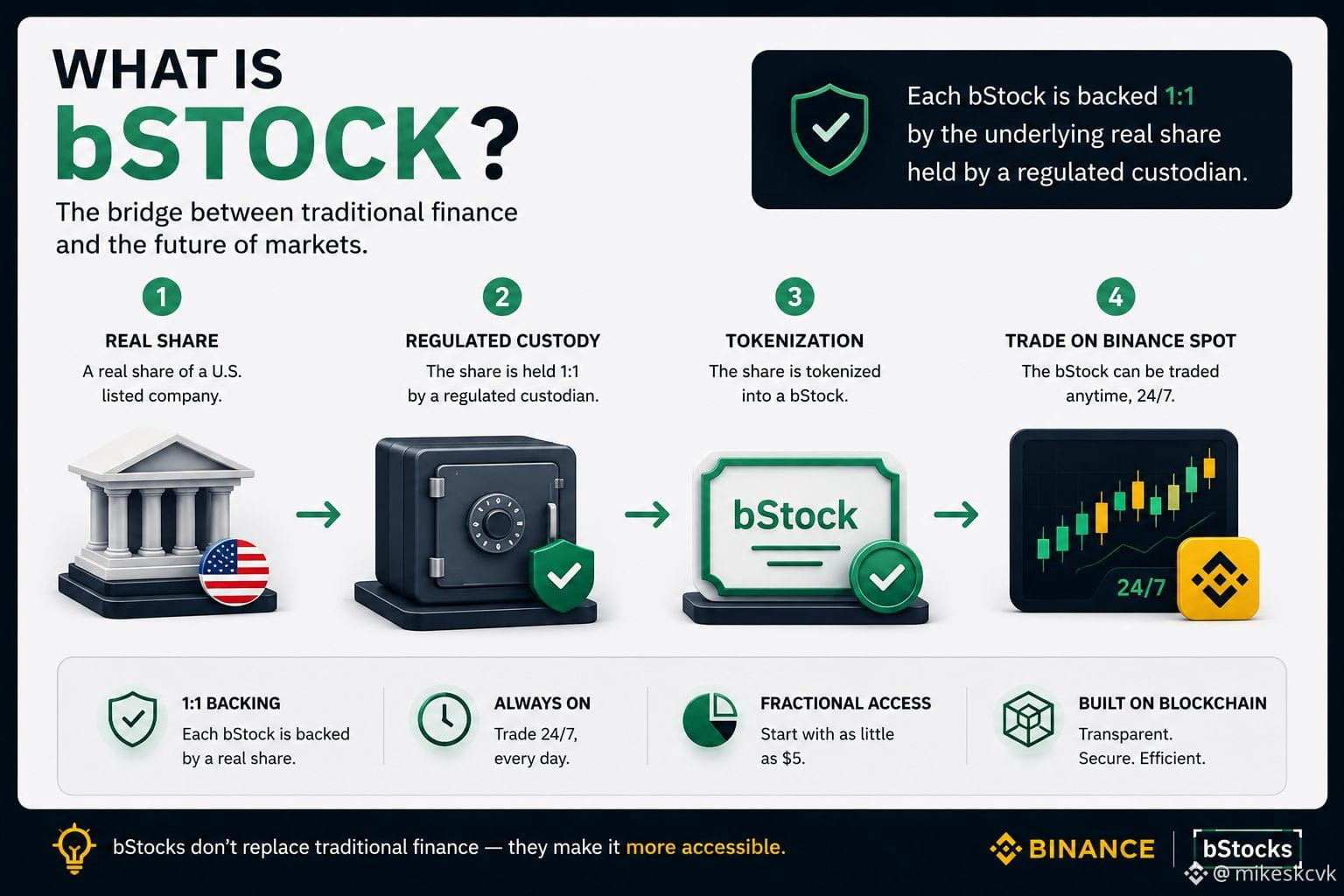
Depois de ler mais sobre como eles funcionam, acho que o valor real está na estrutura por trás deles.
A Binance explica que cada bStock é lastreado 1:1 por uma ação subjacente mantida por um custodiante regulado. Essa conexão entre as finanças tradicionais e a blockchain é o que torna o conceito interessante para mim.
Às vezes, entender como um produto funciona é mais valioso do que observar o gráfico do preço dele.
Você passou mais tempo aprendendo a mecânica dos bStocks ou está principalmente acompanhando o mercado? 📚💭
#bstockscis
Eu costumava pensar que o valor dos bStocks era apenas sobre colocar ações na blockchain.
Depois de ler mais sobre como eles funcionam, acho que o valor real está na estrutura por trás deles.
A Binance explica que cada bStock é lastreado 1:1 por uma ação subjacente mantida por um custodiante regulado. Essa conexão entre as finanças tradicionais e a blockchain é o que torna o conceito interessante para mim.
Às vezes, entender como um produto funciona é mais valioso do que observar o gráfico do preço dele.
Você passou mais tempo aprendendo a mecânica dos bStocks ou está principalmente acompanhando o mercado? 📚💭
#bstockscis
Depois de ler mais sobre como eles funcionam, acho que o valor real está na estrutura por trás deles.
A Binance explica que cada bStock é lastreado 1:1 por uma ação subjacente mantida por um custodiante regulado. Essa conexão entre as finanças tradicionais e a blockchain é o que torna o conceito interessante para mim.
Às vezes, entender como um produto funciona é mais valioso do que observar o gráfico do preço dele.
Você passou mais tempo aprendendo a mecânica dos bStocks ou está principalmente acompanhando o mercado? 📚💭
#bstockscis
1
103
·
--
Uma coisa que eu gosto sobre blockchain é que não é mais só sobre criptomoedas.
Projetos como bStocks mostram como a tecnologia pode ser usada para representar ativos financeiros tradicionais de forma digital. Seja esse modelo se tornando popular ou não, é interessante observar como as finanças continuam evoluindo.
Estou curioso para ver como a tokenização vai estar nos próximos anos.
Que ativo do mundo real você acha que poderia ser tokenizado em seguida? 💭🚀
@BinanceCIS $SPCXB #bstockscis
Uma coisa que eu gosto sobre blockchain é que não é mais só sobre criptomoedas.
Projetos como bStocks mostram como a tecnologia pode ser usada para representar ativos financeiros tradicionais de forma digital. Seja esse modelo se tornando popular ou não, é interessante observar como as finanças continuam evoluindo.
Estou curioso para ver como a tokenização vai estar nos próximos anos.
Que ativo do mundo real você acha que poderia ser tokenizado em seguida? 💭🚀
@BinanceCIS $SPCXB #bstockscis
Projetos como bStocks mostram como a tecnologia pode ser usada para representar ativos financeiros tradicionais de forma digital. Seja esse modelo se tornando popular ou não, é interessante observar como as finanças continuam evoluindo.
Estou curioso para ver como a tokenização vai estar nos próximos anos.
Que ativo do mundo real você acha que poderia ser tokenizado em seguida? 💭🚀
@BinanceCIS $SPCXB #bstockscis

1
1
109
·
--
Notei uma característica interessante do bStocks: o mais importante aqui não é apenas o ativo em si, mas a forma como ele é apresentado.
A tokenização não cria uma nova empresa e não altera o valor mobiliário subjacente. Ela permite interagir com o ativo por meio da infraestrutura blockchain, mantendo o vínculo com o ativo subjacente real.
Acredito que esse tipo de solução mostra como as finanças tradicionais e a Web3 estão sendo integradas de forma gradual.
Na sua opinião, quais outros ativos reais poderiam ser tokenizados no futuro?
@BinanceCIS #bStocksCIS $SPCXB #BinanceSquare
{spot}(SPCXBUSDT)
#bstockscis
Notei uma característica interessante do bStocks: o mais importante aqui não é apenas o ativo em si, mas a forma como ele é apresentado.
A tokenização não cria uma nova empresa e não altera o valor mobiliário subjacente. Ela permite interagir com o ativo por meio da infraestrutura blockchain, mantendo o vínculo com o ativo subjacente real.
Acredito que esse tipo de solução mostra como as finanças tradicionais e a Web3 estão sendo integradas de forma gradual.
Na sua opinião, quais outros ativos reais poderiam ser tokenizados no futuro?
@BinanceCIS #bStocksCIS $SPCXB #BinanceSquare
#bstockscis
A tokenização não cria uma nova empresa e não altera o valor mobiliário subjacente. Ela permite interagir com o ativo por meio da infraestrutura blockchain, mantendo o vínculo com o ativo subjacente real.
Acredito que esse tipo de solução mostra como as finanças tradicionais e a Web3 estão sendo integradas de forma gradual.
Na sua opinião, quais outros ativos reais poderiam ser tokenizados no futuro?
@BinanceCIS #bStocksCIS $SPCXB #BinanceSquare
#bstockscis

1
1
65
Inicia sessão para explorar mais conteúdos
Junta-te a utilizadores de criptomoedas de todo o mundo na Binance Square
⚡️ Obtém informações úteis e recentes sobre criptomoedas.
💬 Com a confiança da maior exchange de criptomoedas do mundo.
👍 Descobre perspetivas reais de criadores verificados.
E-mail/Número de telefone
Tópicos em Tendência
NEARSurges26%Past$3.45
135 visualizações
23 a discutir
“Eu Nunca Investiria em XRP” — Investidor de Singapura explica por que está evitando a ligação com a Ripple-Linke...
ZyCrypto
·3 gostos
·1.4k visualizações
BOJHikesRatesTo31YearHigh
3,218 visualizações
163 a discutir
ChainlinkPowersBottomlinePaymentPlatform
7,833 visualizações
252 a discutir