
Muhammad BR Crypto
72 Publicações

Muhammad BR Crypto
Denunciar
Bloquear Utilizador
36 A seguir
232 Seguidores
46 Gostaram
Publicações
Tudo
Cotações
Em direto
Dê a resposta e receba a recompensa
10+10
Dê a resposta e receba a recompensa
10+10
10+10
104
2
7
104
Ver tradução
#BinancePick Day by day, I'm climbing the Scores leaderboard on #BinancePick. Completing markets, making smart predictions, and enjoying every step of the campaign! 📈
#BinancePick Day by day, I'm climbing the Scores leaderboard on #BinancePick. Completing markets, making smart predictions, and enjoying every step of the campaign! 📈
1
#BinancePick Acabei de entrar no Binance Pick e é uma forma divertida de testar minhas previsões de mercado! Escolha seus mercados, faça suas previsões e ganhe pontos ao longo do caminho. Mal posso esperar para ver quantos consigo desbloquear esta semana.
#BinancePick Acabei de entrar no Binance Pick e é uma forma divertida de testar minhas previsões de mercado! Escolha seus mercados, faça suas previsões e ganhe pontos ao longo do caminho. Mal posso esperar para ver quantos consigo desbloquear esta semana.
9
Ver tradução
#BinancePick Just joined Binance Pick and it's a fun way to put my market predictions to the test! Pick your markets, make your calls, and earn Scores along the way. Can't wait to see how many I can unlock this week.
#BinancePick Just joined Binance Pick and it's a fun way to put my market predictions to the test! Pick your markets, make your calls, and earn Scores along the way. Can't wait to see how many I can unlock this week.
11
Ver tradução
#BinancePick Prediction markets make crypto even more exciting. Participating in #BinancePick daily to complete tasks and climb the leaderboard.
#BinancePick Prediction markets make crypto even more exciting. Participating in #BinancePick daily to complete tasks and climb the leaderboard.
3


Ver tradução
#BinancePick Prediction Market se market samajhna mazedaar hai. Bina FOMO ke, sahi analysis ke saath predict karo!
#BinancePick Prediction Market se market samajhna mazedaar hai. Bina FOMO ke, sahi analysis ke saath predict karo!
Ver tradução
#BinancePick Prediction markets make trading feel more interactive. I'm taking my time to research each market on Binance Pick before making a call. Who else is participating?
#BinancePick Prediction markets make trading feel more interactive. I'm taking my time to research each market on Binance Pick before making a call. Who else is participating?
Ver tradução
#BinancePick Prediction markets make crypto even more exciting. Participating daily to complete tasks and climb the leaderboard. Who else is in?
#BinancePick Prediction markets make crypto even more exciting. Participating daily to complete tasks and climb the leaderboard. Who else is in?
3
Ver tradução
#BinancePick Just completed today's #BinancePick task! Joining prediction markets is a fresh, fun way to understand crypto better. Have you tried Predict yet? ?
#BinancePick Just completed today's #BinancePick task! Joining prediction markets is a fresh, fun way to understand crypto better. Have you tried Predict yet? ?
63
Ver tradução
#BinancePick Prediction markets are a whole new way to put your insights to work. 📊 On Binance Pick, you can back your read on different markets and earn rewards along the way. Joined a few markets today. Give it a try!
#BinancePick Prediction markets are a whole new way to put your insights to work. 📊 On Binance Pick, you can back your read on different markets and earn rewards along the way. Joined a few markets today. Give it a try!
53
Ver tradução
#BinancePick
Prediction markets mein hissa lena ek naya aur interesting experience hai! Market trends ko samajh kar sahi predict karna sach mein maza deta hai.
#BinancePick
Prediction markets mein hissa lena ek naya aur interesting experience hai! Market trends ko samajh kar sahi predict karna sach mein maza deta hai.
Prediction markets mein hissa lena ek naya aur interesting experience hai! Market trends ko samajh kar sahi predict karna sach mein maza deta hai.
66
Ver tradução
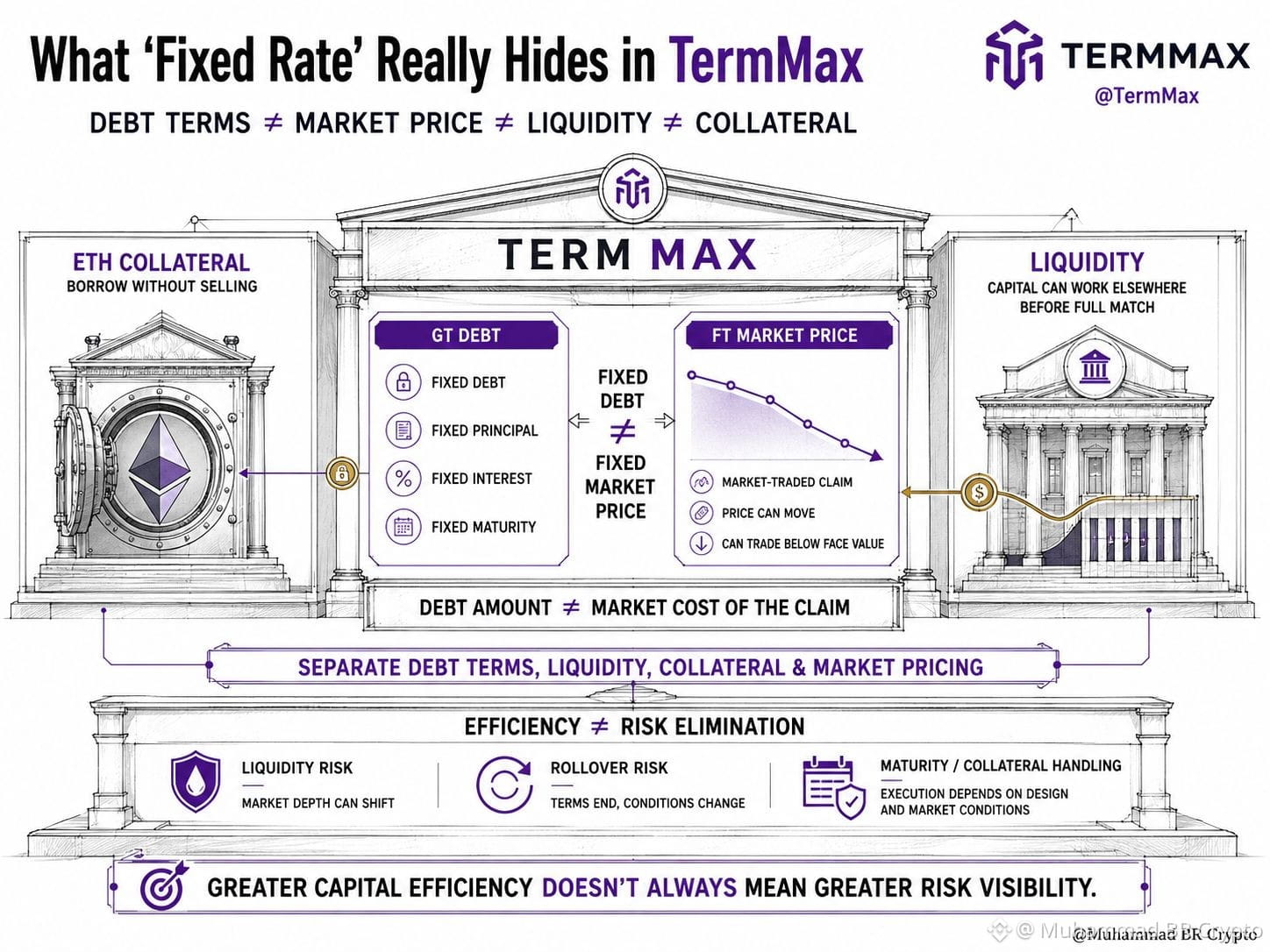
#termmax @termmax I used to think the interesting part of TermMax was simply fixed-rate borrowing. The more I looked at how its products connect, the more I realized that was only the surface.
A borrower can use ETH as collateral without selling it, while lenders can have capital working elsewhere even before an order is fully matched. But large protocol TVL doesn’t necessarily mean deep liquidity or easy execution in every market.
What really changed my view was seeing how differently capital behaves depending on where it sits. A GT debt can remain fixed while the FT linked to that debt trades below face value — so the amount of debt and the market cost of acquiring the claim are not necessarily the same.
That made me see @termmax less as a simple lending market and more as an attempt to separate debt terms, liquidity, collateral and market pricing instead of treating them as one thing.
The trade-off is that this can improve capital efficiency, but it doesn’t automatically remove liquidity or rollover risk — especially as a position approaches maturity or collateral needs to be handled after a default.
The bigger question, then, isn’t simply whether @termmax makes capital more efficient. It’s whether separating debt, liquidity, collateral and market pricing makes capital easier to manage — or simply makes the risks harder to see.
#termmax @TermMax I used to think the interesting part of TermMax was simply fixed-rate borrowing. The more I looked at how its products connect, the more I realized that was only the surface.
A borrower can use ETH as collateral without selling it, while lenders can have capital working elsewhere even before an order is fully matched. But large protocol TVL doesn’t necessarily mean deep liquidity or easy execution in every market.
What really changed my view was seeing how differently capital behaves depending on where it sits. A GT debt can remain fixed while the FT linked to that debt trades below face value — so the amount of debt and the market cost of acquiring the claim are not necessarily the same.
That made me see @TermMax less as a simple lending market and more as an attempt to separate debt terms, liquidity, collateral and market pricing instead of treating them as one thing.
The trade-off is that this can improve capital efficiency, but it doesn’t automatically remove liquidity or rollover risk — especially as a position approaches maturity or collateral needs to be handled after a default.
The bigger question, then, isn’t simply whether @TermMax makes capital more efficient. It’s whether separating debt, liquidity, collateral and market pricing makes capital easier to manage — or simply makes the risks harder to see.
A borrower can use ETH as collateral without selling it, while lenders can have capital working elsewhere even before an order is fully matched. But large protocol TVL doesn’t necessarily mean deep liquidity or easy execution in every market.
What really changed my view was seeing how differently capital behaves depending on where it sits. A GT debt can remain fixed while the FT linked to that debt trades below face value — so the amount of debt and the market cost of acquiring the claim are not necessarily the same.
That made me see @TermMax less as a simple lending market and more as an attempt to separate debt terms, liquidity, collateral and market pricing instead of treating them as one thing.
The trade-off is that this can improve capital efficiency, but it doesn’t automatically remove liquidity or rollover risk — especially as a position approaches maturity or collateral needs to be handled after a default.
The bigger question, then, isn’t simply whether @TermMax makes capital more efficient. It’s whether separating debt, liquidity, collateral and market pricing makes capital easier to manage — or simply makes the risks harder to see.
2
82
Ver tradução
#termmax @termmax I’ve been looking at @TermMax from different angles over the last few days, and I keep coming back to one question:
Is TermMax actually making DeFi simpler, or just making complexity easier to access?
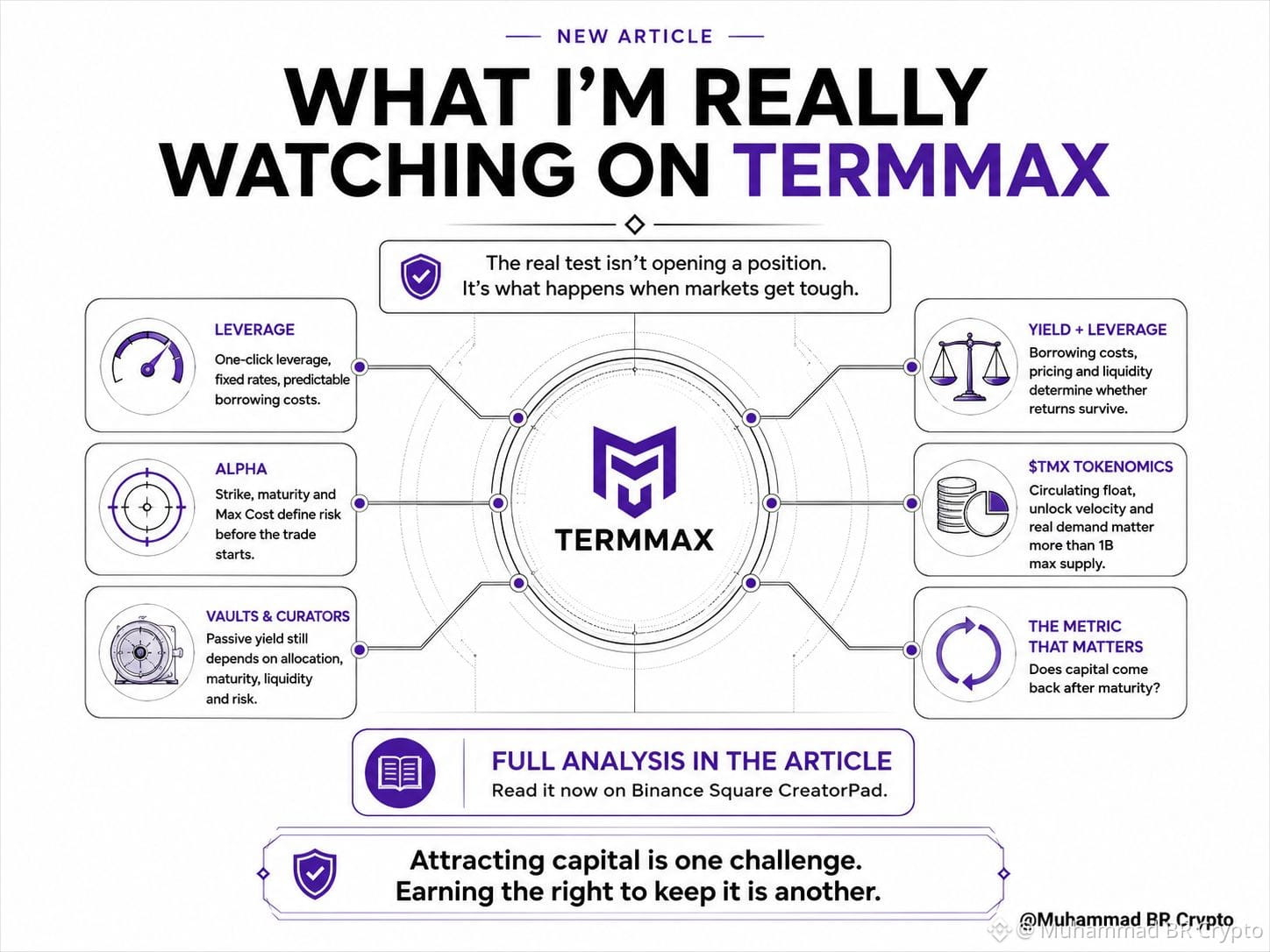
One-click leverage is a good example. It bundles multiple steps into one transaction, while fixed rates make borrowing costs more predictable.
Alpha takes the same idea into risk management. Strike, maturity and Max Cost define the trade before it starts. The market can still move against you, but the downside has a clearer boundary.
Then there’s the Vault and Curator layer.
Passive yield doesn’t remove risk. It shifts the responsibility of choosing markets, maturities, liquidity and risk levels to another layer.
That matters even more with leverage and yield-bearing assets, where borrowing costs, pricing and liquidity can determine whether the expected return actually survives.
Even TMX tokenomics points to the same lesson. The 1B maximum supply matters less than circulating float, unlock velocity and real demand.
And I’m less interested in headline wallet counts or TVL than one simple metric:
Does capital come back after maturity?
Because the real test isn’t opening a position when markets are calm.
It’s what happens when volatility rises, liquidity gets tight and users want to unwind.
Attracting capital is one challenge. Earning the right to keep it is another.
#termmax @TermMax I’ve been looking at @TermMax from different angles over the last few days, and I keep coming back to one question:
Is TermMax actually making DeFi simpler, or just making complexity easier to access?
One-click leverage is a good example. It bundles multiple steps into one transaction, while fixed rates make borrowing costs more predictable.
Alpha takes the same idea into risk management. Strike, maturity and Max Cost define the trade before it starts. The market can still move against you, but the downside has a clearer boundary.
Then there’s the Vault and Curator layer.
Passive yield doesn’t remove risk. It shifts the responsibility of choosing markets, maturities, liquidity and risk levels to another layer.
That matters even more with leverage and yield-bearing assets, where borrowing costs, pricing and liquidity can determine whether the expected return actually survives.
Even TMX tokenomics points to the same lesson. The 1B maximum supply matters less than circulating float, unlock velocity and real demand.
And I’m less interested in headline wallet counts or TVL than one simple metric:
Does capital come back after maturity?
Because the real test isn’t opening a position when markets are calm.
It’s what happens when volatility rises, liquidity gets tight and users want to unwind.
Attracting capital is one challenge. Earning the right to keep it is another.
Is TermMax actually making DeFi simpler, or just making complexity easier to access?
One-click leverage is a good example. It bundles multiple steps into one transaction, while fixed rates make borrowing costs more predictable.
Alpha takes the same idea into risk management. Strike, maturity and Max Cost define the trade before it starts. The market can still move against you, but the downside has a clearer boundary.
Then there’s the Vault and Curator layer.
Passive yield doesn’t remove risk. It shifts the responsibility of choosing markets, maturities, liquidity and risk levels to another layer.
That matters even more with leverage and yield-bearing assets, where borrowing costs, pricing and liquidity can determine whether the expected return actually survives.
Even TMX tokenomics points to the same lesson. The 1B maximum supply matters less than circulating float, unlock velocity and real demand.
And I’m less interested in headline wallet counts or TVL than one simple metric:
Does capital come back after maturity?
Because the real test isn’t opening a position when markets are calm.
It’s what happens when volatility rises, liquidity gets tight and users want to unwind.
Attracting capital is one challenge. Earning the right to keep it is another.
2
75
Ver tradução
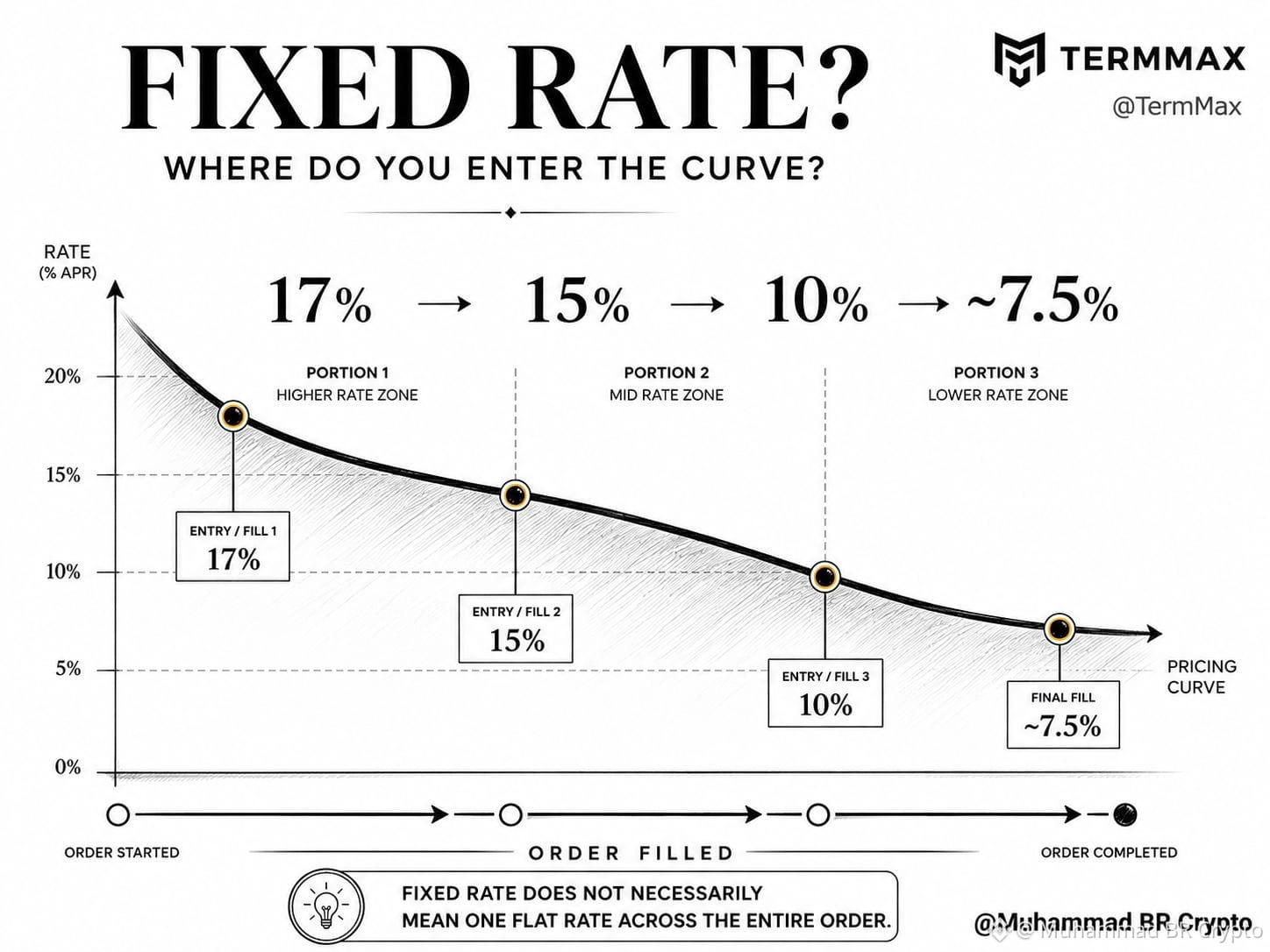
#termmax @termmax I thought “fixed rate” on @termmax meant one rate across an entire order.
Then I looked closer at how Range Orders actually work and realized I was oversimplifying it.
They’re built from pricing curves, not flat rates. In TermMax’s borrowing example, the first 1.5M ranges from 17% toward 15%, the next 0.2M from 15% toward 10%, and the final 0.17M from 10% toward roughly 7.5%.
So once your portion is matched, its rate is fixed — but different portions can lock in different rates depending on where they’re matched on the curve.
That makes the order’s fill position more important than I initially thought.
For a taker, should the first question be “what’s the rate?” — or “where am I entering the curve?”
#termmax @TermMax I thought “fixed rate” on @TermMax meant one rate across an entire order.
Then I looked closer at how Range Orders actually work and realized I was oversimplifying it.
They’re built from pricing curves, not flat rates. In TermMax’s borrowing example, the first 1.5M ranges from 17% toward 15%, the next 0.2M from 15% toward 10%, and the final 0.17M from 10% toward roughly 7.5%.
So once your portion is matched, its rate is fixed — but different portions can lock in different rates depending on where they’re matched on the curve.
That makes the order’s fill position more important than I initially thought.
For a taker, should the first question be “what’s the rate?” — or “where am I entering the curve?”
Then I looked closer at how Range Orders actually work and realized I was oversimplifying it.
They’re built from pricing curves, not flat rates. In TermMax’s borrowing example, the first 1.5M ranges from 17% toward 15%, the next 0.2M from 15% toward 10%, and the final 0.17M from 10% toward roughly 7.5%.
So once your portion is matched, its rate is fixed — but different portions can lock in different rates depending on where they’re matched on the curve.
That makes the order’s fill position more important than I initially thought.
For a taker, should the first question be “what’s the rate?” — or “where am I entering the curve?”
1
79
Ver tradução
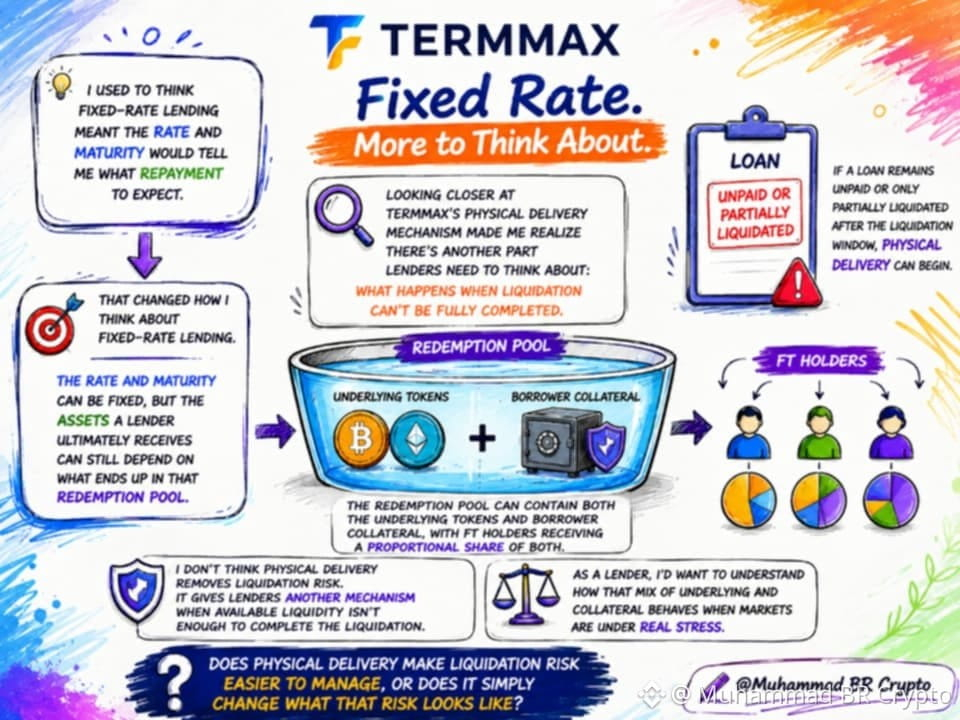
#termmax @termmax I used to think fixed-rate lending was mainly about knowing the rate and maturity upfront.
But looking closer at @termmax physical delivery mechanism made me realize there’s another question: what happens when liquidation can’t be fully completed?
If a loan remains unpaid or only partially liquidated after the liquidation window, physical delivery can begin. The redemption pool can contain both the underlying tokens and borrower collateral, with FT holders receiving a proportional share of both.
That changed how I think about fixed-rate lending.
The rate and maturity can be fixed, but what a lender ultimately receives can still depend on what ends up in that pool.
That’s also where I see the practical value of TermMax: lenders can target fixed returns, borrowers can access defined-rate liquidity, and LPs can provide liquidity to the market.
I don’t think physical delivery removes liquidation risk. It gives lenders another mechanism when available liquidity isn’t enough to complete the liquidation.
Does physical delivery make liquidation risk easier to manage, or simply change what that risk looks like?
#termmax @TermMax I used to think fixed-rate lending was mainly about knowing the rate and maturity upfront.
But looking closer at @TermMax physical delivery mechanism made me realize there’s another question: what happens when liquidation can’t be fully completed?
If a loan remains unpaid or only partially liquidated after the liquidation window, physical delivery can begin. The redemption pool can contain both the underlying tokens and borrower collateral, with FT holders receiving a proportional share of both.
That changed how I think about fixed-rate lending.
The rate and maturity can be fixed, but what a lender ultimately receives can still depend on what ends up in that pool.
That’s also where I see the practical value of TermMax: lenders can target fixed returns, borrowers can access defined-rate liquidity, and LPs can provide liquidity to the market.
I don’t think physical delivery removes liquidation risk. It gives lenders another mechanism when available liquidity isn’t enough to complete the liquidation.
Does physical delivery make liquidation risk easier to manage, or simply change what that risk looks like?
But looking closer at @TermMax physical delivery mechanism made me realize there’s another question: what happens when liquidation can’t be fully completed?
If a loan remains unpaid or only partially liquidated after the liquidation window, physical delivery can begin. The redemption pool can contain both the underlying tokens and borrower collateral, with FT holders receiving a proportional share of both.
That changed how I think about fixed-rate lending.
The rate and maturity can be fixed, but what a lender ultimately receives can still depend on what ends up in that pool.
That’s also where I see the practical value of TermMax: lenders can target fixed returns, borrowers can access defined-rate liquidity, and LPs can provide liquidity to the market.
I don’t think physical delivery removes liquidation risk. It gives lenders another mechanism when available liquidity isn’t enough to complete the liquidation.
Does physical delivery make liquidation risk easier to manage, or simply change what that risk looks like?
2
57
Ver tradução
#dusk $DUSK I used to think more transparency automatically meant more trust in financial blockchains. But the more I look at @Dusk_Foundation , the less convincing that assumption feels.
In regulated finance, institutions need to prove eligibility and compliance without necessarily exposing every underlying detail. Dusk’s programmable privacy approach caught my attention because it aims for privacy where needed, transparency where useful, and selective disclosure when authorized.
That makes me look at Hedger differently too. Its homomorphic encryption and zero-knowledge proofs aren’t simply about hiding information; they enable confidential transaction flows while preserving the ability to verify relevant information when needed.
The real tension is interesting: can regulated markets have strong privacy without giving up verifiability?
Could programmable disclosure be the missing piece?
#dusk $DUSK I used to think more transparency automatically meant more trust in financial blockchains. But the more I look at @Dusk , the less convincing that assumption feels.
In regulated finance, institutions need to prove eligibility and compliance without necessarily exposing every underlying detail. Dusk’s programmable privacy approach caught my attention because it aims for privacy where needed, transparency where useful, and selective disclosure when authorized.
That makes me look at Hedger differently too. Its homomorphic encryption and zero-knowledge proofs aren’t simply about hiding information; they enable confidential transaction flows while preserving the ability to verify relevant information when needed.
The real tension is interesting: can regulated markets have strong privacy without giving up verifiability?
Could programmable disclosure be the missing piece?
In regulated finance, institutions need to prove eligibility and compliance without necessarily exposing every underlying detail. Dusk’s programmable privacy approach caught my attention because it aims for privacy where needed, transparency where useful, and selective disclosure when authorized.
That makes me look at Hedger differently too. Its homomorphic encryption and zero-knowledge proofs aren’t simply about hiding information; they enable confidential transaction flows while preserving the ability to verify relevant information when needed.
The real tension is interesting: can regulated markets have strong privacy without giving up verifiability?
Could programmable disclosure be the missing piece?
66
Ver tradução
😍
😍

Ahmad Wêb³
·
--
Em AltaEu testei o fluxo do cofre de Bitcoin sem confiança da Babylon, e a parte que ficou comigo não foi pegar BTC emprestado. Foi a espera depois do bloqueio. Esse pequeno atraso mostrou o cerne da troca: o TBV é construído em torno de verificação nativa do Bitcoin e reduz suposições de confiança, não é uma comodidade imediata de DeFi.
Então eu olhei para o mercado.
$BABY está sendo negociado por cerca de US$ 0,0129, com market cap perto de US$ 50,7M, enquanto o token caiu aproximadamente 9% nos últimos 7 dias. O mercado ainda aguarda evidências de que o crescimento do ecossistema da Babylon pode se traduzir em uma demanda sustentável pelo token.
Mas o ecossistema conta outra história.
O TVL da Babylon está em torno de US$ 3,25B, mostrando que o protocolo já está conectado a um valor significativo de BTC. A questão-chave é se essa atividade cria uma captura real de valor para $BABY por meio da adoção e do crescimento da rede.
Do lado da oferta, há mais uma camada.
A BABY tem cerca de 4,02B de oferta em circulação, de um total de 10,89B. O próximo desbloqueio em 10 de agosto libera 136,11M de tokens BABY, cerca de 1,2% da oferta total, para assessores, investidores iniciais e alocações da equipe.
Então o mercado está equilibrando duas coisas:
A Babylon consegue transformar a adoção de BTC em uma demanda duradoura pelo token, ao mesmo tempo em que administra a expansão futura da oferta?
O desafio real talvez não seja construir a infraestrutura do Bitcoin — talvez seja provar que detentores de Bitcoin vão escolher esse modelo de confiança em vez de alternativas mais rápidas.
A Babylon vai se tornar a camada que traz liquidez séria de BTC para o DeFi, ou a conveniência continuará vencendo?
@BabylonLabs_io
#baby $BABY
Então eu olhei para o mercado.
$BABY está sendo negociado por cerca de US$ 0,0129, com market cap perto de US$ 50,7M, enquanto o token caiu aproximadamente 9% nos últimos 7 dias. O mercado ainda aguarda evidências de que o crescimento do ecossistema da Babylon pode se traduzir em uma demanda sustentável pelo token.
Mas o ecossistema conta outra história.
O TVL da Babylon está em torno de US$ 3,25B, mostrando que o protocolo já está conectado a um valor significativo de BTC. A questão-chave é se essa atividade cria uma captura real de valor para $BABY por meio da adoção e do crescimento da rede.
Do lado da oferta, há mais uma camada.
A BABY tem cerca de 4,02B de oferta em circulação, de um total de 10,89B. O próximo desbloqueio em 10 de agosto libera 136,11M de tokens BABY, cerca de 1,2% da oferta total, para assessores, investidores iniciais e alocações da equipe.
Então o mercado está equilibrando duas coisas:
A Babylon consegue transformar a adoção de BTC em uma demanda duradoura pelo token, ao mesmo tempo em que administra a expansão futura da oferta?
O desafio real talvez não seja construir a infraestrutura do Bitcoin — talvez seja provar que detentores de Bitcoin vão escolher esse modelo de confiança em vez de alternativas mais rápidas.
A Babylon vai se tornar a camada que traz liquidez séria de BTC para o DeFi, ou a conveniência continuará vencendo?
@BabylonLabs_io
#baby $BABY
2
Ver tradução
Spain vs Argentina feels like a classic football rivalry on the biggest stage! ⚽ Both teams have world class attackers, creative midfielders, and strong defenses. I’m expecting a high intensity final with plenty of chances and dramatic moments. My prediction: an entertaining match that goes right down to the final whistle. Who are you supporting tonight? #BinancePickAndWin
Spain vs Argentina feels like a classic football rivalry on the biggest stage! ⚽ Both teams have world class attackers, creative midfielders, and strong defenses. I’m expecting a high intensity final with plenty of chances and dramatic moments. My prediction: an entertaining match that goes right down to the final whistle. Who are you supporting tonight? #BinancePickAndWin
74
Inicia sessão para explorar mais conteúdos
Junta-te a utilizadores de criptomoedas de todo o mundo na Binance Square
⚡️ Obtém informações úteis e recentes sobre criptomoedas.
💬 Com a confiança da maior exchange de criptomoedas do mundo.
👍 Descobre perspetivas reais de criadores verificados.
E-mail/Número de telefone
Tópicos em Tendência
BTCRemainsUnderPressureAfterHawkishFOMCMinutes
28,323 visualizações
411 a discutir
Ata do FOMC | Ata do Fed mostra que quase todos os dirigentes esperam novos aumentos dos juros, e alguns admitem uma alta maior em dezembro
Binance News
·42 gostos
·52.4k visualizações
AnthropicToDebutAfter$83IPOPricing
8,883 visualizações
49 a discutir
NvidiaBoardReportedlySplitOverHuang’sReturn
7,204 visualizações
127 a discutir