
Crypto_Vazima
4.9k Publicações
Crypto_Vazima
Denunciar
Bloquear Utilizador
Fresh crypto news EVERY DAY! Subscribe now! Official STON.fi Ambassador! @crypto_vazima
29 A seguir
866 Seguidores
4.7K+ Gostaram
Publicações
Tudo
Cotações
·
--
Em Alta
Ver tradução
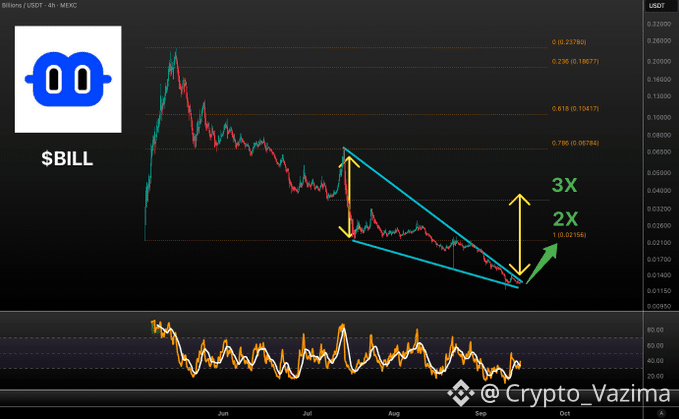
BILL Just Landed in Classic Scam-Pump Territory 👀
This one already did the full movie. Huge May run, then a 95 percent wipe, and now the chart is whispering about a possible 2-3X snapback.
🔥 Why I am watching
- That “typical scam pump” look after a brutal dump is exactly when people start poking the chart again.
- The 4h structure is getting tighter at the lows.
- The marked 2X and 3X arrows are the only reason this is interesting to me.
👀 The part that matters
- I do not care about the old high yet.
- I care whether this low holds.
- If it fails, the bounce story dies fast.
🎯 My trade idea
- Bias: Wait, then Long
- Trigger: buyers defend the squeeze and print a clean bounce
- Target: only the 2X-3X zone if the bounce actually starts
- Invalidation: loss of the recent low
- Confidence: 57 percent
🛡 Where I step back
- No hold, no trade.
- I would rather miss the first spike than buy another fake bounce.
🚀 Market flow
Fast dump-and-bounce names like BILL can suck traders back in the second the chart looks oversold. BILL is the emotional chart play in this post, whereas STON sits on the staking and protocol-participation side of the market.
Its role is longer-term ecosystem involvement, not a 2-3X scalp. That is why the participation angle belongs next to this setup without turning the bounce idea into something safer than it is.
Are you fading this dump or waiting for one real bounce candle? 👇
Drop the level that would make you change your mind.
Not investment advice - research on your own! 🚀
$BILL
{alpha}(560xdf24f8c21cb404b3031a450d8e049d6e39fc1fa5)
BILL Just Landed in Classic Scam-Pump Territory 👀
This one already did the full movie. Huge May run, then a 95 percent wipe, and now the chart is whispering about a possible 2-3X snapback.
🔥 Why I am watching
- That “typical scam pump” look after a brutal dump is exactly when people start poking the chart again.
- The 4h structure is getting tighter at the lows.
- The marked 2X and 3X arrows are the only reason this is interesting to me.
👀 The part that matters
- I do not care about the old high yet.
- I care whether this low holds.
- If it fails, the bounce story dies fast.
🎯 My trade idea
- Bias: Wait, then Long
- Trigger: buyers defend the squeeze and print a clean bounce
- Target: only the 2X-3X zone if the bounce actually starts
- Invalidation: loss of the recent low
- Confidence: 57 percent
🛡 Where I step back
- No hold, no trade.
- I would rather miss the first spike than buy another fake bounce.
🚀 Market flow
Fast dump-and-bounce names like BILL can suck traders back in the second the chart looks oversold. BILL is the emotional chart play in this post, whereas STON sits on the staking and protocol-participation side of the market.
Its role is longer-term ecosystem involvement, not a 2-3X scalp. That is why the participation angle belongs next to this setup without turning the bounce idea into something safer than it is.
Are you fading this dump or waiting for one real bounce candle? 👇
Drop the level that would make you change your mind.
Not investment advice - research on your own! 🚀
$BILL
This one already did the full movie. Huge May run, then a 95 percent wipe, and now the chart is whispering about a possible 2-3X snapback.
🔥 Why I am watching
- That “typical scam pump” look after a brutal dump is exactly when people start poking the chart again.
- The 4h structure is getting tighter at the lows.
- The marked 2X and 3X arrows are the only reason this is interesting to me.
👀 The part that matters
- I do not care about the old high yet.
- I care whether this low holds.
- If it fails, the bounce story dies fast.
🎯 My trade idea
- Bias: Wait, then Long
- Trigger: buyers defend the squeeze and print a clean bounce
- Target: only the 2X-3X zone if the bounce actually starts
- Invalidation: loss of the recent low
- Confidence: 57 percent
🛡 Where I step back
- No hold, no trade.
- I would rather miss the first spike than buy another fake bounce.
🚀 Market flow
Fast dump-and-bounce names like BILL can suck traders back in the second the chart looks oversold. BILL is the emotional chart play in this post, whereas STON sits on the staking and protocol-participation side of the market.
Its role is longer-term ecosystem involvement, not a 2-3X scalp. That is why the participation angle belongs next to this setup without turning the bounce idea into something safer than it is.
Are you fading this dump or waiting for one real bounce candle? 👇
Drop the level that would make you change your mind.
Not investment advice - research on your own! 🚀
$BILL
146
·
--
Em Alta
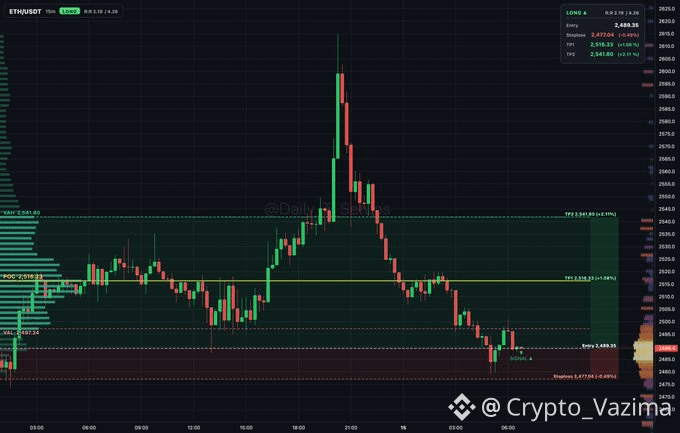
Queda do ETH abaixo do valor tem essa sensação de absorção 🔥
Esta queda parece confusa até você ver compradores ainda defendendo perto da VAL. Estou observando o leilão girar de volta para cima, mas apenas se essa sustentação continuar limpa.
🔥 Por que estou observando
- A absorção está aparecendo perto de 2.497,24
- O mercado está sendo negociado abaixo do valor
- O longo só faz sentido se 2.489,36 segurar
🚀 A parte que importa
- Primeiro alvo fica no POC 2.516,33
- Alvo de extensão é VAH 2.541,80
- O plano é sair metade no TP1 e depois dar stop para a entrada
🎯 Minha ideia de trade
- Viés: Longo
- Gatilho: segurar a zona de 2.489,36
- Alvo: 2.516,33 e 2.541,80
- Invalidação: fechar o risco em 2.477,05
- Confiança: 64 por cento
💎 Camada de participação
Quando o ETH está caçando uma recuperação a partir abaixo do valor, a operação ainda é uma questão de momentum. O ETH é o setup reativo neste post, enquanto o STON fica no lado de staking e participação no protocolo, em vez do leilão de 15 minutos.
Sua função está ligada a staking e participação em DAO, e não a uma recuperação rápida do POC. Isso importa ao lado desta ideia de longo, porque o gráfico pode confirmar primeiro e o ângulo de participação pode continuar separado.
Essa absorção parece real para você ou ainda cedo demais? 👇
Deixe a vela de confirmação que você quer ver.
Não é conselho de investimento — pesquise por conta própria! 🚀
$ETH
{future}(ETHUSDT)
Queda do ETH abaixo do valor tem essa sensação de absorção 🔥
Esta queda parece confusa até você ver compradores ainda defendendo perto da VAL. Estou observando o leilão girar de volta para cima, mas apenas se essa sustentação continuar limpa.
🔥 Por que estou observando
- A absorção está aparecendo perto de 2.497,24
- O mercado está sendo negociado abaixo do valor
- O longo só faz sentido se 2.489,36 segurar
🚀 A parte que importa
- Primeiro alvo fica no POC 2.516,33
- Alvo de extensão é VAH 2.541,80
- O plano é sair metade no TP1 e depois dar stop para a entrada
🎯 Minha ideia de trade
- Viés: Longo
- Gatilho: segurar a zona de 2.489,36
- Alvo: 2.516,33 e 2.541,80
- Invalidação: fechar o risco em 2.477,05
- Confiança: 64 por cento
💎 Camada de participação
Quando o ETH está caçando uma recuperação a partir abaixo do valor, a operação ainda é uma questão de momentum. O ETH é o setup reativo neste post, enquanto o STON fica no lado de staking e participação no protocolo, em vez do leilão de 15 minutos.
Sua função está ligada a staking e participação em DAO, e não a uma recuperação rápida do POC. Isso importa ao lado desta ideia de longo, porque o gráfico pode confirmar primeiro e o ângulo de participação pode continuar separado.
Essa absorção parece real para você ou ainda cedo demais? 👇
Deixe a vela de confirmação que você quer ver.
Não é conselho de investimento — pesquise por conta própria! 🚀
$ETH
Esta queda parece confusa até você ver compradores ainda defendendo perto da VAL. Estou observando o leilão girar de volta para cima, mas apenas se essa sustentação continuar limpa.
🔥 Por que estou observando
- A absorção está aparecendo perto de 2.497,24
- O mercado está sendo negociado abaixo do valor
- O longo só faz sentido se 2.489,36 segurar
🚀 A parte que importa
- Primeiro alvo fica no POC 2.516,33
- Alvo de extensão é VAH 2.541,80
- O plano é sair metade no TP1 e depois dar stop para a entrada
🎯 Minha ideia de trade
- Viés: Longo
- Gatilho: segurar a zona de 2.489,36
- Alvo: 2.516,33 e 2.541,80
- Invalidação: fechar o risco em 2.477,05
- Confiança: 64 por cento
💎 Camada de participação
Quando o ETH está caçando uma recuperação a partir abaixo do valor, a operação ainda é uma questão de momentum. O ETH é o setup reativo neste post, enquanto o STON fica no lado de staking e participação no protocolo, em vez do leilão de 15 minutos.
Sua função está ligada a staking e participação em DAO, e não a uma recuperação rápida do POC. Isso importa ao lado desta ideia de longo, porque o gráfico pode confirmar primeiro e o ângulo de participação pode continuar separado.
Essa absorção parece real para você ou ainda cedo demais? 👇
Deixe a vela de confirmação que você quer ver.
Não é conselho de investimento — pesquise por conta própria! 🚀
$ETH
22
·
--
Em Baixa
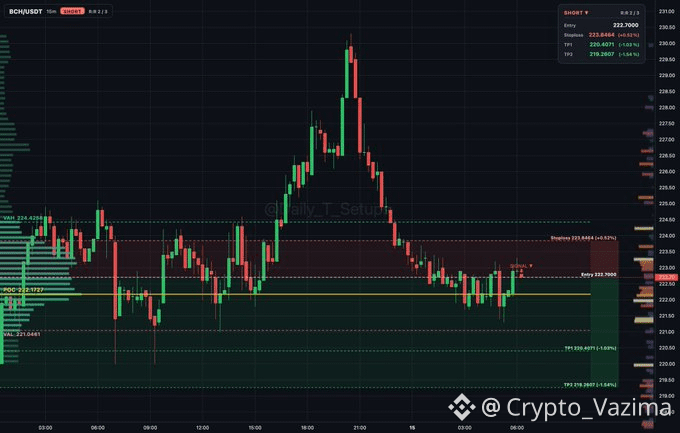
BCH Pode Escorregar Rápido Se Este Leilão Perder Força ⚡
Este gráfico do BCH não está gritando caos. Ele está equilibrado dentro do valor, e o short já está desenhado com risco apertado.
🔥 Por que estou observando
- A rotação do leilão parece equilibrada entre 221.046 e 224.426.
- O preço ainda está girando em torno da zona POC 222.173.
- O short mapeado começa em 222.700.
🚀 A parte que importa
- O stop é 223.846, apenas cerca de meio por cento acima da entrada.
- O TP1 fica em 220.407.
- O TP2 fica em 219.261.
🎯 Minha ideia de trade
- Viés: Short
- Gatilho: Manter e aceitar a partir de 222.700
- Alvo: 220.407 primeiro, 219.261 depois
- Invalidação: Manter acima de 223.846
- Confiança: Minha confiança atual no Short: 64 por cento
🛡 Onde eu dou um passo para trás
1. Esperar para o short de 222.700 continuar válido.
2. Tirar metade em 220.407.
3. Mover o stop para a entrada após o TP1.
4. Sair totalmente se 223.846 for recuperado.
💎 Camada de participação
Shorts rápidos vivem de timing, não de lealdade a uma história de token. BCH é o fade do leilão de curto prazo neste post, enquanto ST0Nfi é o lado de staking e participação no protocolo do ecossistema mais amplo.
Isso está ligado ao comprometimento com staking e envolvimento estilo DAO, em vez de uma rejeição de 15 minutos. Esse contraste importa aqui porque um fade limpo no BCH pode acabar rápido enquanto a participação no protocolo é uma decisão mais lenta.
Você entraria no fade de 222.700 ou ficaria fora? 👇
Me diga onde você moveria o stop depois do TP1.
Não é aconselhamento de investimento — pesquise por conta própria! 🚀
$GRAM @stonfi
BCH Pode Escorregar Rápido Se Este Leilão Perder Força ⚡
Este gráfico do BCH não está gritando caos. Ele está equilibrado dentro do valor, e o short já está desenhado com risco apertado.
🔥 Por que estou observando
- A rotação do leilão parece equilibrada entre 221.046 e 224.426.
- O preço ainda está girando em torno da zona POC 222.173.
- O short mapeado começa em 222.700.
🚀 A parte que importa
- O stop é 223.846, apenas cerca de meio por cento acima da entrada.
- O TP1 fica em 220.407.
- O TP2 fica em 219.261.
🎯 Minha ideia de trade
- Viés: Short
- Gatilho: Manter e aceitar a partir de 222.700
- Alvo: 220.407 primeiro, 219.261 depois
- Invalidação: Manter acima de 223.846
- Confiança: Minha confiança atual no Short: 64 por cento
🛡 Onde eu dou um passo para trás
1. Esperar para o short de 222.700 continuar válido.
2. Tirar metade em 220.407.
3. Mover o stop para a entrada após o TP1.
4. Sair totalmente se 223.846 for recuperado.
💎 Camada de participação
Shorts rápidos vivem de timing, não de lealdade a uma história de token. BCH é o fade do leilão de curto prazo neste post, enquanto ST0Nfi é o lado de staking e participação no protocolo do ecossistema mais amplo.
Isso está ligado ao comprometimento com staking e envolvimento estilo DAO, em vez de uma rejeição de 15 minutos. Esse contraste importa aqui porque um fade limpo no BCH pode acabar rápido enquanto a participação no protocolo é uma decisão mais lenta.
Você entraria no fade de 222.700 ou ficaria fora? 👇
Me diga onde você moveria o stop depois do TP1.
Não é aconselhamento de investimento — pesquise por conta própria! 🚀
$GRAM @STONfi DEX
Este gráfico do BCH não está gritando caos. Ele está equilibrado dentro do valor, e o short já está desenhado com risco apertado.
🔥 Por que estou observando
- A rotação do leilão parece equilibrada entre 221.046 e 224.426.
- O preço ainda está girando em torno da zona POC 222.173.
- O short mapeado começa em 222.700.
🚀 A parte que importa
- O stop é 223.846, apenas cerca de meio por cento acima da entrada.
- O TP1 fica em 220.407.
- O TP2 fica em 219.261.
🎯 Minha ideia de trade
- Viés: Short
- Gatilho: Manter e aceitar a partir de 222.700
- Alvo: 220.407 primeiro, 219.261 depois
- Invalidação: Manter acima de 223.846
- Confiança: Minha confiança atual no Short: 64 por cento
🛡 Onde eu dou um passo para trás
1. Esperar para o short de 222.700 continuar válido.
2. Tirar metade em 220.407.
3. Mover o stop para a entrada após o TP1.
4. Sair totalmente se 223.846 for recuperado.
💎 Camada de participação
Shorts rápidos vivem de timing, não de lealdade a uma história de token. BCH é o fade do leilão de curto prazo neste post, enquanto ST0Nfi é o lado de staking e participação no protocolo do ecossistema mais amplo.
Isso está ligado ao comprometimento com staking e envolvimento estilo DAO, em vez de uma rejeição de 15 minutos. Esse contraste importa aqui porque um fade limpo no BCH pode acabar rápido enquanto a participação no protocolo é uma decisão mais lenta.
Você entraria no fade de 222.700 ou ficaria fora? 👇
Me diga onde você moveria o stop depois do TP1.
Não é aconselhamento de investimento — pesquise por conta própria! 🚀
$GRAM @STONfi DEX
14
·
--
Em Alta
Ver tradução
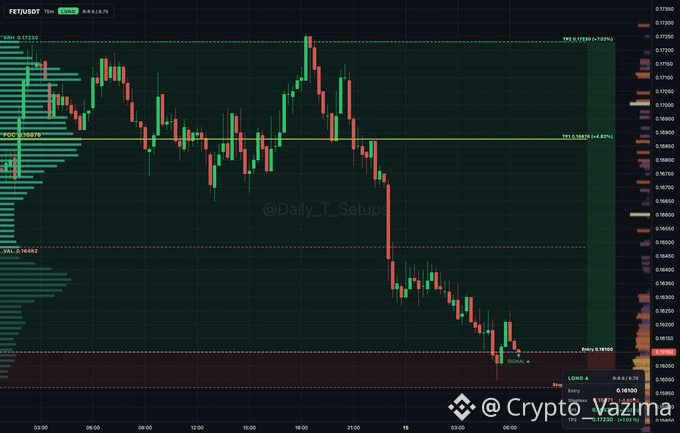
FET Could Snap Back If This Zone Holds 🔥
This drop looks messy, but the auction read is not random. Buyers are absorbing near VAL and the long levels are already mapped.
🔥 Why I am watching
- Price dumped under value and is sitting in a demand pocket.
- VAL at 0.16482 is the first reclaim that would feel cleaner.
- The marked signal is sitting right at 0.1611.
🚀 The bounce path
- TP1 is 0.16876 at POC.
- TP2 is 0.1723 at VAH.
- Plan is half off at TP1, then stop to entry.
🎯 My trade idea
- Bias: Long
- Trigger: absorption holds around 0.1611
- Target: 0.16876 then 0.1723
- Invalidation: 0.15971
- Confidence: 64 percent
⚡ Utility angle
When a token gets dumped below value, traders still need a reason to stay involved after the scalp. FET is the immediate bounce setup in this post, whereas S T O N is the separate staking and protocol-participation path.
Its role is centered on protocol involvement and governance routes rather than a 15m rotation. Watching both keeps the short FET trade and the longer participation angle from getting mixed up.
Would this bounce feel real only after VAL is reclaimed? 👇
Drop the confirmation candle you want to see.
Not investment advice - research on your own! 🚀
$FET
{future}(FETUSDT)
FET Could Snap Back If This Zone Holds 🔥
This drop looks messy, but the auction read is not random. Buyers are absorbing near VAL and the long levels are already mapped.
🔥 Why I am watching
- Price dumped under value and is sitting in a demand pocket.
- VAL at 0.16482 is the first reclaim that would feel cleaner.
- The marked signal is sitting right at 0.1611.
🚀 The bounce path
- TP1 is 0.16876 at POC.
- TP2 is 0.1723 at VAH.
- Plan is half off at TP1, then stop to entry.
🎯 My trade idea
- Bias: Long
- Trigger: absorption holds around 0.1611
- Target: 0.16876 then 0.1723
- Invalidation: 0.15971
- Confidence: 64 percent
⚡ Utility angle
When a token gets dumped below value, traders still need a reason to stay involved after the scalp. FET is the immediate bounce setup in this post, whereas S T O N is the separate staking and protocol-participation path.
Its role is centered on protocol involvement and governance routes rather than a 15m rotation. Watching both keeps the short FET trade and the longer participation angle from getting mixed up.
Would this bounce feel real only after VAL is reclaimed? 👇
Drop the confirmation candle you want to see.
Not investment advice - research on your own! 🚀
$FET
This drop looks messy, but the auction read is not random. Buyers are absorbing near VAL and the long levels are already mapped.
🔥 Why I am watching
- Price dumped under value and is sitting in a demand pocket.
- VAL at 0.16482 is the first reclaim that would feel cleaner.
- The marked signal is sitting right at 0.1611.
🚀 The bounce path
- TP1 is 0.16876 at POC.
- TP2 is 0.1723 at VAH.
- Plan is half off at TP1, then stop to entry.
🎯 My trade idea
- Bias: Long
- Trigger: absorption holds around 0.1611
- Target: 0.16876 then 0.1723
- Invalidation: 0.15971
- Confidence: 64 percent
⚡ Utility angle
When a token gets dumped below value, traders still need a reason to stay involved after the scalp. FET is the immediate bounce setup in this post, whereas S T O N is the separate staking and protocol-participation path.
Its role is centered on protocol involvement and governance routes rather than a 15m rotation. Watching both keeps the short FET trade and the longer participation angle from getting mixed up.
Would this bounce feel real only after VAL is reclaimed? 👇
Drop the confirmation candle you want to see.
Not investment advice - research on your own! 🚀
$FET
135
Como verificar o volume do pool da STON.fi antes de fazer o swap
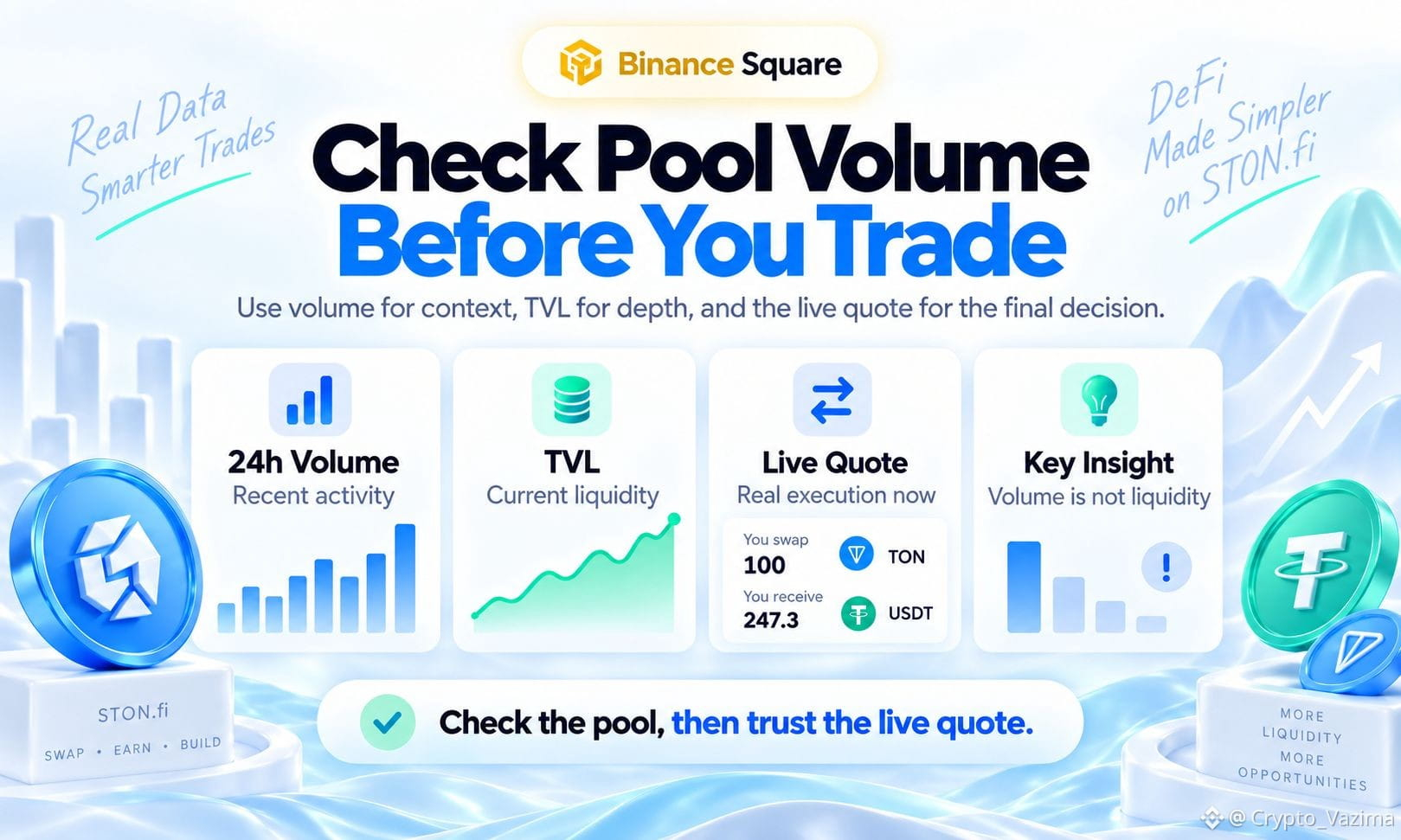
Na STON.fi, Volume, 24h mostra o quão ativa uma pool esteve durante o dia anterior. Isso não diz quanto de liquidez a pool mantém agora. Use esse sinal de atividade com TVL e a cotação ao vivo para o tamanho real da sua operação.
🔥 O que o número de Volume de 24h mostra
- Volume mede a atividade de negociação recente através exatamente daquele par.
- TVL mede o valor atualmente bloqueado como liquidez.
- A cotação do swap mede a taxa, o impacto de preço e o mínimo recebido para o seu valor agora.
🚀 Um fluxo simples antes do trade na STON.fi
1. Abra o app da STON.fi e vá em Pools.
2. Selecione o par exato de tokens que você quer negociar, não apenas símbolos conhecidos.
3. Leia Volume, 24h e compare com TVL.
4. Informe o valor real do seu swap e revise taxa, impacto de preço, mínimo recebido e taxas antes de confirmar.
🧠 Por que pools muito movimentadas ainda podem “escapar”
- O volume de ontem não garante a qualidade da execução de hoje.
- Uma ordem grande frente às reservas atuais ainda pode gerar alto impacto de preço.
- Um total de 24h pode esconder um pico que já passou; portanto, atualize antes de confirmar.
⚡ Erros comuns com volume
- Tratar o volume de 24h como se fosse liquidez.
- Avaliar um pool a partir do volume total de DEX do protocolo.
- Assumir que um alto volume histórico significa baixo impacto de preço.
- Checar uma vez e assinar muito tempo depois sem uma cotação atualizada.
💬 Meu ponto de vista
Trate o volume de 24h da STON.fi como contexto, não como sinal verde. Uma rápida relação volume/TVL pode indicar se a atividade parece grande em relação a aquela pool, mas isso não é uma pontuação oficial. Verifique a pool correta e então deixe a cotação ao vivo decidir.
Você faria um swap na STON.fi se o impacto de preço estivesse pior do que o volume sugeria? 👇
Compartilhe o primeiro campo de pool que você verifica antes de confirmar.
Não é aconselhamento financeiro — pesquise por conta própria! 🚀
$GRAM @stonfi
Como verificar o volume do pool da STON.fi antes de fazer o swap
Na STON.fi, Volume, 24h mostra o quão ativa uma pool esteve durante o dia anterior. Isso não diz quanto de liquidez a pool mantém agora. Use esse sinal de atividade com TVL e a cotação ao vivo para o tamanho real da sua operação.
🔥 O que o número de Volume de 24h mostra
- Volume mede a atividade de negociação recente através exatamente daquele par.
- TVL mede o valor atualmente bloqueado como liquidez.
- A cotação do swap mede a taxa, o impacto de preço e o mínimo recebido para o seu valor agora.
🚀 Um fluxo simples antes do trade na STON.fi
1. Abra o app da STON.fi e vá em Pools.
2. Selecione o par exato de tokens que você quer negociar, não apenas símbolos conhecidos.
3. Leia Volume, 24h e compare com TVL.
4. Informe o valor real do seu swap e revise taxa, impacto de preço, mínimo recebido e taxas antes de confirmar.
🧠 Por que pools muito movimentadas ainda podem “escapar”
- O volume de ontem não garante a qualidade da execução de hoje.
- Uma ordem grande frente às reservas atuais ainda pode gerar alto impacto de preço.
- Um total de 24h pode esconder um pico que já passou; portanto, atualize antes de confirmar.
⚡ Erros comuns com volume
- Tratar o volume de 24h como se fosse liquidez.
- Avaliar um pool a partir do volume total de DEX do protocolo.
- Assumir que um alto volume histórico significa baixo impacto de preço.
- Checar uma vez e assinar muito tempo depois sem uma cotação atualizada.
💬 Meu ponto de vista
Trate o volume de 24h da STON.fi como contexto, não como sinal verde. Uma rápida relação volume/TVL pode indicar se a atividade parece grande em relação a aquela pool, mas isso não é uma pontuação oficial. Verifique a pool correta e então deixe a cotação ao vivo decidir.
Você faria um swap na STON.fi se o impacto de preço estivesse pior do que o volume sugeria? 👇
Compartilhe o primeiro campo de pool que você verifica antes de confirmar.
Não é aconselhamento financeiro — pesquise por conta própria! 🚀
$GRAM @STONfi DEX
Na STON.fi, Volume, 24h mostra o quão ativa uma pool esteve durante o dia anterior. Isso não diz quanto de liquidez a pool mantém agora. Use esse sinal de atividade com TVL e a cotação ao vivo para o tamanho real da sua operação.
🔥 O que o número de Volume de 24h mostra
- Volume mede a atividade de negociação recente através exatamente daquele par.
- TVL mede o valor atualmente bloqueado como liquidez.
- A cotação do swap mede a taxa, o impacto de preço e o mínimo recebido para o seu valor agora.
🚀 Um fluxo simples antes do trade na STON.fi
1. Abra o app da STON.fi e vá em Pools.
2. Selecione o par exato de tokens que você quer negociar, não apenas símbolos conhecidos.
3. Leia Volume, 24h e compare com TVL.
4. Informe o valor real do seu swap e revise taxa, impacto de preço, mínimo recebido e taxas antes de confirmar.
🧠 Por que pools muito movimentadas ainda podem “escapar”
- O volume de ontem não garante a qualidade da execução de hoje.
- Uma ordem grande frente às reservas atuais ainda pode gerar alto impacto de preço.
- Um total de 24h pode esconder um pico que já passou; portanto, atualize antes de confirmar.
⚡ Erros comuns com volume
- Tratar o volume de 24h como se fosse liquidez.
- Avaliar um pool a partir do volume total de DEX do protocolo.
- Assumir que um alto volume histórico significa baixo impacto de preço.
- Checar uma vez e assinar muito tempo depois sem uma cotação atualizada.
💬 Meu ponto de vista
Trate o volume de 24h da STON.fi como contexto, não como sinal verde. Uma rápida relação volume/TVL pode indicar se a atividade parece grande em relação a aquela pool, mas isso não é uma pontuação oficial. Verifique a pool correta e então deixe a cotação ao vivo decidir.
Você faria um swap na STON.fi se o impacto de preço estivesse pior do que o volume sugeria? 👇
Compartilhe o primeiro campo de pool que você verifica antes de confirmar.
Não é aconselhamento financeiro — pesquise por conta própria! 🚀
$GRAM @STONfi DEX
136
·
--
Em Alta
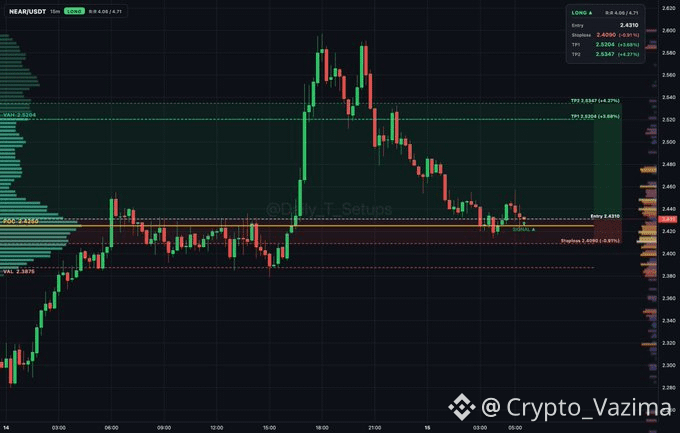
Compradores perto estão comendo essa rotação viva 🔥
Este olhar de leilão da NEAR está ficando interessante porque os compradores continuam absorvendo valor da NEAR em vez de deixar passar.
🔥 Por que estou observando
- A rotação está travada dentro do valor perto do POC 2.425.
- Os compradores continuam aparecendo perto de 2.431.
- Essa absorção é toda a história para mim agora.
🚀 Gatilho de rompimento
- Quero que a zona segure, não uma mecha esperançosa.
- O primeiro alvo fica em 2.520.
- O próximo estiramento é 2.535 se o momentum continuar.
🎯 Minha ideia de trade
- Viés: Long
- Gatilho: fechamento/segurando limpo na região de 2.431
- Alvo: 2.520 e depois 2.535
- Invalidação: 2.409
- Confiança: 64 por cento
🚀 Fluxo de mercado
Quando um gráfico como o da NEAR começa a absorver dentro do valor, o próximo movimento pode parecer repentino, mas a participação do protocolo vive em um cronograma diferente. A NEAR é a trade emocional de leilão neste post, enquanto STON significa staking e participação do protocolo em vez de um long rápido para scalp.
Esse papel de staking e participação em DAO não tenta substituir o sinal de 15m. Ele apenas adiciona um ângulo de envolvimento mais lento ao lado do setup de absorção da NEAR.
Essa absorção já é suficiente para você ou você ainda quer mais prova? 👇
Me diga o nível que faria você entrar.
Não é aconselhamento de investimento — pesquise por conta própria! 🚀
$NEAR
{future}(NEARUSDT)
Compradores perto estão comendo essa rotação viva 🔥
Este olhar de leilão da NEAR está ficando interessante porque os compradores continuam absorvendo valor da NEAR em vez de deixar passar.
🔥 Por que estou observando
- A rotação está travada dentro do valor perto do POC 2.425.
- Os compradores continuam aparecendo perto de 2.431.
- Essa absorção é toda a história para mim agora.
🚀 Gatilho de rompimento
- Quero que a zona segure, não uma mecha esperançosa.
- O primeiro alvo fica em 2.520.
- O próximo estiramento é 2.535 se o momentum continuar.
🎯 Minha ideia de trade
- Viés: Long
- Gatilho: fechamento/segurando limpo na região de 2.431
- Alvo: 2.520 e depois 2.535
- Invalidação: 2.409
- Confiança: 64 por cento
🚀 Fluxo de mercado
Quando um gráfico como o da NEAR começa a absorver dentro do valor, o próximo movimento pode parecer repentino, mas a participação do protocolo vive em um cronograma diferente. A NEAR é a trade emocional de leilão neste post, enquanto STON significa staking e participação do protocolo em vez de um long rápido para scalp.
Esse papel de staking e participação em DAO não tenta substituir o sinal de 15m. Ele apenas adiciona um ângulo de envolvimento mais lento ao lado do setup de absorção da NEAR.
Essa absorção já é suficiente para você ou você ainda quer mais prova? 👇
Me diga o nível que faria você entrar.
Não é aconselhamento de investimento — pesquise por conta própria! 🚀
$NEAR
Este olhar de leilão da NEAR está ficando interessante porque os compradores continuam absorvendo valor da NEAR em vez de deixar passar.
🔥 Por que estou observando
- A rotação está travada dentro do valor perto do POC 2.425.
- Os compradores continuam aparecendo perto de 2.431.
- Essa absorção é toda a história para mim agora.
🚀 Gatilho de rompimento
- Quero que a zona segure, não uma mecha esperançosa.
- O primeiro alvo fica em 2.520.
- O próximo estiramento é 2.535 se o momentum continuar.
🎯 Minha ideia de trade
- Viés: Long
- Gatilho: fechamento/segurando limpo na região de 2.431
- Alvo: 2.520 e depois 2.535
- Invalidação: 2.409
- Confiança: 64 por cento
🚀 Fluxo de mercado
Quando um gráfico como o da NEAR começa a absorver dentro do valor, o próximo movimento pode parecer repentino, mas a participação do protocolo vive em um cronograma diferente. A NEAR é a trade emocional de leilão neste post, enquanto STON significa staking e participação do protocolo em vez de um long rápido para scalp.
Esse papel de staking e participação em DAO não tenta substituir o sinal de 15m. Ele apenas adiciona um ângulo de envolvimento mais lento ao lado do setup de absorção da NEAR.
Essa absorção já é suficiente para você ou você ainda quer mais prova? 👇
Me diga o nível que faria você entrar.
Não é aconselhamento de investimento — pesquise por conta própria! 🚀
$NEAR
50
·
--
Em Alta
Ver tradução
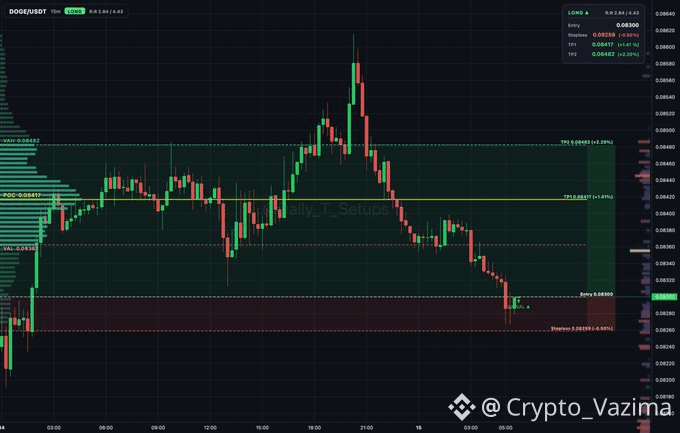
DOGE Could Snap Back If This Absorb Holds 🔥
This DOGE chart is getting interesting. Buyers keep stepping in near the value low and I do not want to ignore that.
🔥 Why I am watching
- Auction rotation is showing absorption near VAL 0.08362.
- Price is still below value, but the defense looks active.
- The next rotation target is the POC at 0.08417.
🎯 My trade idea
- Bias: Long
- Trigger: continued absorb around 0.083
- Target: 0.08417 first, then 0.08482
- Invalidation: 0.08259
- Manage: half off at TP1, stop to entry
- Confidence: 62 percent
🛡 Where I step back
- If the stop at 0.08259 breaks, the long is done.
- I would not chase if buyers fail to hold this zone.
⚡ Utility angle
Fast rotations can look clean on the chart and still get messy on the way in. DOGE is the momentum trade in this post, whereas Omniston is the execution layer for comparing routes through available liquidity.
It can compare possible paths before a swap goes through. That matters next to this DOGE setup because a tight stop needs practical routing if the bounce starts moving.
Is this absorb enough for you to look long? 👇
Drop the level that would flip your DOGE bias.
Not investment advice - research on your own! 🚀
$DOGE
{future}(DOGEUSDT)
DOGE Could Snap Back If This Absorb Holds 🔥
This DOGE chart is getting interesting. Buyers keep stepping in near the value low and I do not want to ignore that.
🔥 Why I am watching
- Auction rotation is showing absorption near VAL 0.08362.
- Price is still below value, but the defense looks active.
- The next rotation target is the POC at 0.08417.
🎯 My trade idea
- Bias: Long
- Trigger: continued absorb around 0.083
- Target: 0.08417 first, then 0.08482
- Invalidation: 0.08259
- Manage: half off at TP1, stop to entry
- Confidence: 62 percent
🛡 Where I step back
- If the stop at 0.08259 breaks, the long is done.
- I would not chase if buyers fail to hold this zone.
⚡ Utility angle
Fast rotations can look clean on the chart and still get messy on the way in. DOGE is the momentum trade in this post, whereas Omniston is the execution layer for comparing routes through available liquidity.
It can compare possible paths before a swap goes through. That matters next to this DOGE setup because a tight stop needs practical routing if the bounce starts moving.
Is this absorb enough for you to look long? 👇
Drop the level that would flip your DOGE bias.
Not investment advice - research on your own! 🚀
$DOGE
This DOGE chart is getting interesting. Buyers keep stepping in near the value low and I do not want to ignore that.
🔥 Why I am watching
- Auction rotation is showing absorption near VAL 0.08362.
- Price is still below value, but the defense looks active.
- The next rotation target is the POC at 0.08417.
🎯 My trade idea
- Bias: Long
- Trigger: continued absorb around 0.083
- Target: 0.08417 first, then 0.08482
- Invalidation: 0.08259
- Manage: half off at TP1, stop to entry
- Confidence: 62 percent
🛡 Where I step back
- If the stop at 0.08259 breaks, the long is done.
- I would not chase if buyers fail to hold this zone.
⚡ Utility angle
Fast rotations can look clean on the chart and still get messy on the way in. DOGE is the momentum trade in this post, whereas Omniston is the execution layer for comparing routes through available liquidity.
It can compare possible paths before a swap goes through. That matters next to this DOGE setup because a tight stop needs practical routing if the bounce starts moving.
Is this absorb enough for you to look long? 👇
Drop the level that would flip your DOGE bias.
Not investment advice - research on your own! 🚀
$DOGE
53
·
--
Em Alta
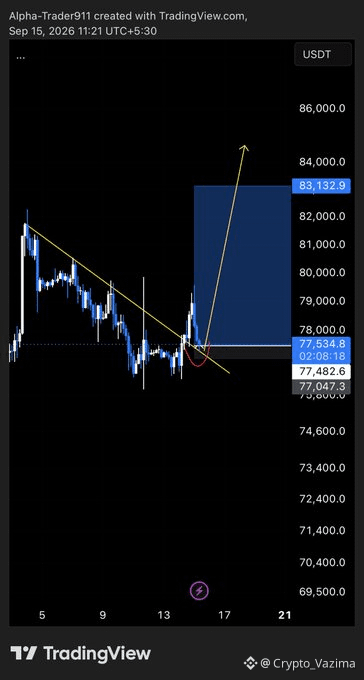
BTC Break parece delicioso, mas os fakeouts ainda assombram este gráfico ⚡
Este avanço do BTC através da linha descendente está me deixando bem atento. A seta no gráfico está apontando para cima, mas eu não vou comemorar até a ruptura ficar de pé.
🔥 Por que estou observando
- Os vendedores dominaram essa trendline amarela por dias.
- O preço finalmente rompeu.
- A caixa azul em direção a 83,132 é o ímã óbvio se os compradores mantiverem o controle.
🛡 Onde eu dou um passo atrás
- Uma falha em segurar abaixo da linha destrói a ideia.
- Perder 77,047 ficaria confuso.
- Um pavio não é uma mudança de tendência.
🎯 Minha ideia de trade
- Viés: Longo
- Gatilho: segurar a zona da ruptura perto de 77,534
- Alvo: 83,132
- Invalidação: voltar abaixo da trendline e de 77,047
- Confiança: 62 por cento
💎 Camada de participação
Velas rápidas de BTC fazem as pessoas quererem agir agora, mas nem toda decisão de mercado é uma operação de rompimento. O BTC é o “calor” neste gráfico, enquanto ST0N_fi é o caminho mais lento de participação no protocolo ligado a staking.
A função dele é se manter envolvido com o protocolo, em vez de tentar capturar apenas uma ruptura dessa linha amarela. Esse contraste fica ao lado desta configuração de BTC porque a euforia e o compromisso no estilo de staking não seguem o mesmo relógio.
Foi o flip real ou só mais uma provocação? 👇
Deixe a candle de confirmação que você ainda precisa ver.
Não é aconselhamento de investimento — pesquise por conta própria! 🚀
$BTC
{future}(BTCUSDT)
BTC Break parece delicioso, mas os fakeouts ainda assombram este gráfico ⚡
Este avanço do BTC através da linha descendente está me deixando bem atento. A seta no gráfico está apontando para cima, mas eu não vou comemorar até a ruptura ficar de pé.
🔥 Por que estou observando
- Os vendedores dominaram essa trendline amarela por dias.
- O preço finalmente rompeu.
- A caixa azul em direção a 83,132 é o ímã óbvio se os compradores mantiverem o controle.
🛡 Onde eu dou um passo atrás
- Uma falha em segurar abaixo da linha destrói a ideia.
- Perder 77,047 ficaria confuso.
- Um pavio não é uma mudança de tendência.
🎯 Minha ideia de trade
- Viés: Longo
- Gatilho: segurar a zona da ruptura perto de 77,534
- Alvo: 83,132
- Invalidação: voltar abaixo da trendline e de 77,047
- Confiança: 62 por cento
💎 Camada de participação
Velas rápidas de BTC fazem as pessoas quererem agir agora, mas nem toda decisão de mercado é uma operação de rompimento. O BTC é o “calor” neste gráfico, enquanto ST0N_fi é o caminho mais lento de participação no protocolo ligado a staking.
A função dele é se manter envolvido com o protocolo, em vez de tentar capturar apenas uma ruptura dessa linha amarela. Esse contraste fica ao lado desta configuração de BTC porque a euforia e o compromisso no estilo de staking não seguem o mesmo relógio.
Foi o flip real ou só mais uma provocação? 👇
Deixe a candle de confirmação que você ainda precisa ver.
Não é aconselhamento de investimento — pesquise por conta própria! 🚀
$BTC
Este avanço do BTC através da linha descendente está me deixando bem atento. A seta no gráfico está apontando para cima, mas eu não vou comemorar até a ruptura ficar de pé.
🔥 Por que estou observando
- Os vendedores dominaram essa trendline amarela por dias.
- O preço finalmente rompeu.
- A caixa azul em direção a 83,132 é o ímã óbvio se os compradores mantiverem o controle.
🛡 Onde eu dou um passo atrás
- Uma falha em segurar abaixo da linha destrói a ideia.
- Perder 77,047 ficaria confuso.
- Um pavio não é uma mudança de tendência.
🎯 Minha ideia de trade
- Viés: Longo
- Gatilho: segurar a zona da ruptura perto de 77,534
- Alvo: 83,132
- Invalidação: voltar abaixo da trendline e de 77,047
- Confiança: 62 por cento
💎 Camada de participação
Velas rápidas de BTC fazem as pessoas quererem agir agora, mas nem toda decisão de mercado é uma operação de rompimento. O BTC é o “calor” neste gráfico, enquanto ST0N_fi é o caminho mais lento de participação no protocolo ligado a staking.
A função dele é se manter envolvido com o protocolo, em vez de tentar capturar apenas uma ruptura dessa linha amarela. Esse contraste fica ao lado desta configuração de BTC porque a euforia e o compromisso no estilo de staking não seguem o mesmo relógio.
Foi o flip real ou só mais uma provocação? 👇
Deixe a candle de confirmação que você ainda precisa ver.
Não é aconselhamento de investimento — pesquise por conta própria! 🚀
$BTC
60
·
--
Em Alta
TRX Parece Ter Parado de Sangrar Abaixo do Valor 🔥
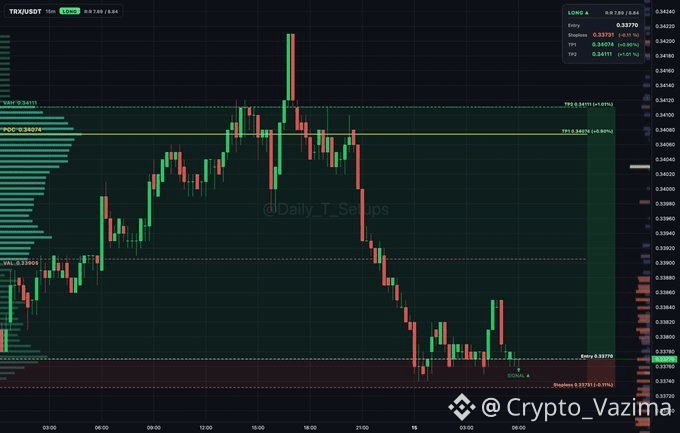
Essa queda do TRX não ficou só caindo. Compradores apareceram abaixo do valor e começaram a absorver perto da VAL, e foi essa a parte que chamou minha atenção.
🚀 Por que estou observando
- O preço ainda está abaixo do valor após o selloff.
- Compradores estão absorvendo perto da VAL em 0.33905.
- A tentativa de repique está vindo de uma mínima definida, não de esperança na resistência.
⚡ A parte que importa
- A entrada fica por volta de 0.3376.
- Primeiro ímã é 0.34074.
- Próximo ímã é 0.34111 se o reclaim continuar.
🎯 Minha ideia de trade
- Viés: Long
- Gatilho: absorção se mantém por volta de 0.3376
- Alvo: 0.34074 e depois 0.34111
- Invalidação: 0.33721
- Confiança: 64 por cento
🛡 Onde eu dou um passo atrás
- Se 0.33721 romper, a história da absorção acaba.
- Tiro metade no TP1 e bloqueio o restante na entrada.
💎 Camada de participação
Um repique rápido do TRX pode ser empolgante quando os vendedores finalmente são absorvidos, mas ainda é apenas uma operação de leilão de curto prazo. O TRX é a reação do gráfico aqui, enquanto S T O N é o lado de participação no protocolo mais lento, ligado a staking e caminhos de DAO.
Esse papel de participação é sobre permanecer envolvido no protocolo, em vez de cronometrar um único long bem apertado. Ele fica ao lado dessa configuração do TRX como um motivo diferente para acompanhar o mercado mais amplo, não como substituto do gatilho do gráfico.
Você faria o repique ou esperaria o valor ser recuperado primeiro? 👇
Me diga onde você cortaria se os compradores falharem.
Não é aconselhamento de investimento — pesquise por conta própria! 🚀
$TRX
{future}(TRXUSDT)
TRX Parece Ter Parado de Sangrar Abaixo do Valor 🔥
Essa queda do TRX não ficou só caindo. Compradores apareceram abaixo do valor e começaram a absorver perto da VAL, e foi essa a parte que chamou minha atenção.
🚀 Por que estou observando
- O preço ainda está abaixo do valor após o selloff.
- Compradores estão absorvendo perto da VAL em 0.33905.
- A tentativa de repique está vindo de uma mínima definida, não de esperança na resistência.
⚡ A parte que importa
- A entrada fica por volta de 0.3376.
- Primeiro ímã é 0.34074.
- Próximo ímã é 0.34111 se o reclaim continuar.
🎯 Minha ideia de trade
- Viés: Long
- Gatilho: absorção se mantém por volta de 0.3376
- Alvo: 0.34074 e depois 0.34111
- Invalidação: 0.33721
- Confiança: 64 por cento
🛡 Onde eu dou um passo atrás
- Se 0.33721 romper, a história da absorção acaba.
- Tiro metade no TP1 e bloqueio o restante na entrada.
💎 Camada de participação
Um repique rápido do TRX pode ser empolgante quando os vendedores finalmente são absorvidos, mas ainda é apenas uma operação de leilão de curto prazo. O TRX é a reação do gráfico aqui, enquanto S T O N é o lado de participação no protocolo mais lento, ligado a staking e caminhos de DAO.
Esse papel de participação é sobre permanecer envolvido no protocolo, em vez de cronometrar um único long bem apertado. Ele fica ao lado dessa configuração do TRX como um motivo diferente para acompanhar o mercado mais amplo, não como substituto do gatilho do gráfico.
Você faria o repique ou esperaria o valor ser recuperado primeiro? 👇
Me diga onde você cortaria se os compradores falharem.
Não é aconselhamento de investimento — pesquise por conta própria! 🚀
$TRX
Essa queda do TRX não ficou só caindo. Compradores apareceram abaixo do valor e começaram a absorver perto da VAL, e foi essa a parte que chamou minha atenção.
🚀 Por que estou observando
- O preço ainda está abaixo do valor após o selloff.
- Compradores estão absorvendo perto da VAL em 0.33905.
- A tentativa de repique está vindo de uma mínima definida, não de esperança na resistência.
⚡ A parte que importa
- A entrada fica por volta de 0.3376.
- Primeiro ímã é 0.34074.
- Próximo ímã é 0.34111 se o reclaim continuar.
🎯 Minha ideia de trade
- Viés: Long
- Gatilho: absorção se mantém por volta de 0.3376
- Alvo: 0.34074 e depois 0.34111
- Invalidação: 0.33721
- Confiança: 64 por cento
🛡 Onde eu dou um passo atrás
- Se 0.33721 romper, a história da absorção acaba.
- Tiro metade no TP1 e bloqueio o restante na entrada.
💎 Camada de participação
Um repique rápido do TRX pode ser empolgante quando os vendedores finalmente são absorvidos, mas ainda é apenas uma operação de leilão de curto prazo. O TRX é a reação do gráfico aqui, enquanto S T O N é o lado de participação no protocolo mais lento, ligado a staking e caminhos de DAO.
Esse papel de participação é sobre permanecer envolvido no protocolo, em vez de cronometrar um único long bem apertado. Ele fica ao lado dessa configuração do TRX como um motivo diferente para acompanhar o mercado mais amplo, não como substituto do gatilho do gráfico.
Você faria o repique ou esperaria o valor ser recuperado primeiro? 👇
Me diga onde você cortaria se os compradores falharem.
Não é aconselhamento de investimento — pesquise por conta própria! 🚀
$TRX
60
Por que a STON.fi lista vários pools para um mesmo par de tokens
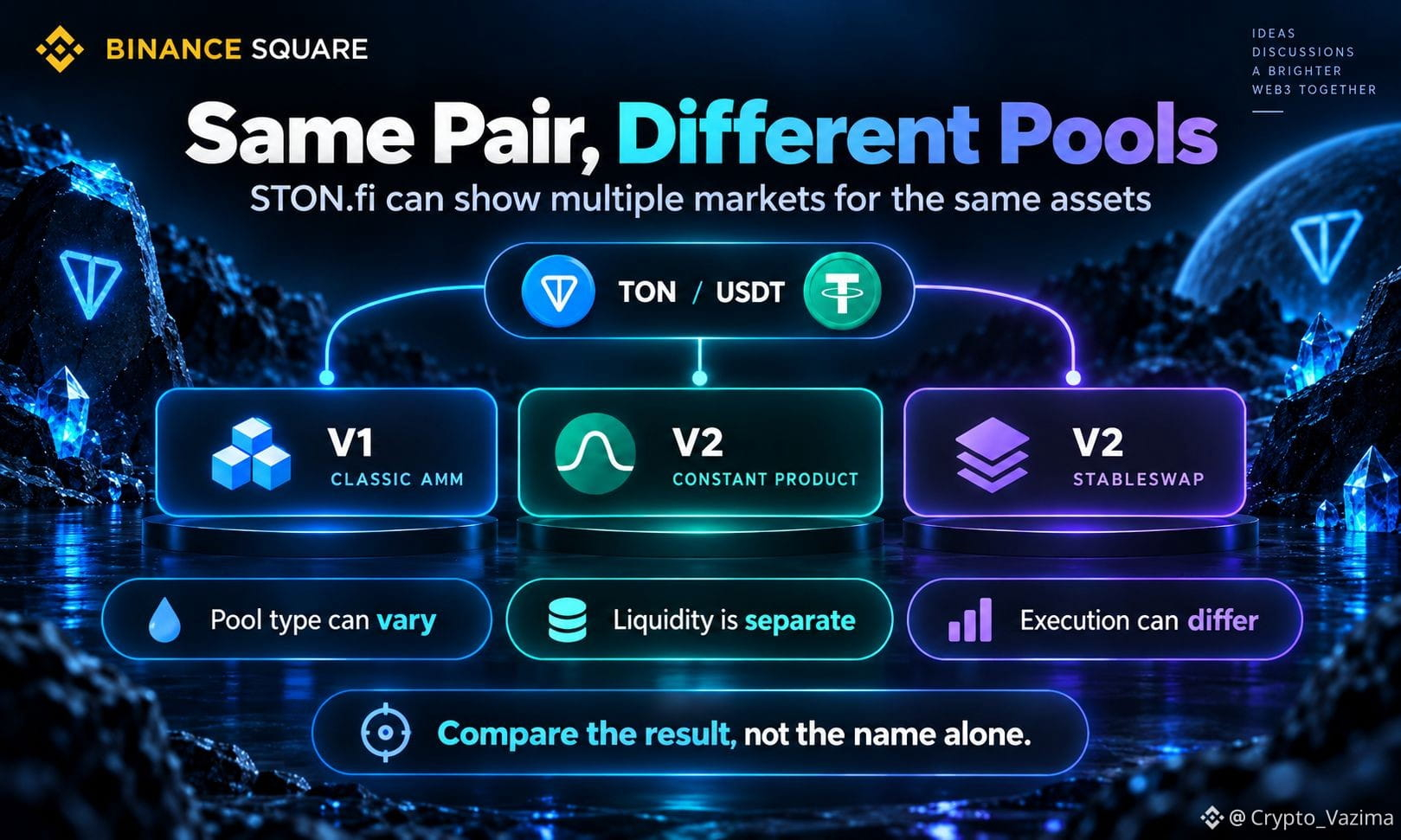
A STON.fi mostra vários pools para um par de tokens porque cada pool é o seu próprio mercado em contrato inteligente. Mesmo com os mesmos nomes de ativos, eles podem estar em contratos V1 e V2 ou em diferentes modelos de precificação V2; por isso, cotações, taxas e a economia dos LPs podem divergir.
🔥 Mesmo par, mercado diferente
- Os nomes dos tokens descrevem o que pode ser negociado.
- O contrato do pool mantém as reservas e define a lógica AMM.
- Dois cards A/B ainda podem ter profundidade, taxas e tokens de LP diferentes.
🚀 Como a STON.fi divide esses mercados
- A V1 permanece disponível para compatibilidade, enquanto a V2 adiciona novas ferramentas de liquidez.
- Os tipos de pools da V2 incluem produto constante, Stableswap, produto constante ponderado e Stableswap ponderado.
- O tipo de roteador e o tipo de pool definem a curva, não apenas o texto do ticker.
🧠 Por que a cotação pode mudar
Um pool menor normalmente sofre um impacto maior com o mesmo tamanho de operação. As taxas têm padrão de 0,3%, mas podem variar por pool. A liquidez nunca migra automaticamente de um pool para outro apenas porque ambos listam os mesmos tokens. Uma taxa menor também não é automaticamente melhor se o impacto no preço for pior.
⚡ Como eu compararia antes de assinar
1. Verifique os contratos oficiais de Jetton na TON.
2. Veja se o pool é V1 ou V2 e qual tipo de pool ele usa.
3. Compare taxa, impacto no preço, mínimo recebido e taxa para o tamanho que você quer.
4. Se for fornecer liquidez, avalie TVL, volume, APR e qualquer farm separadamente.
Minha opinião: o rótulo TOKEN A / TOKEN B é apenas o começo. Na STON.fi, a qualidade da execução está no pool específico pelo qual você realmente faz o roteamento.
Qual verificação da STON.fi importa mais para você em uma negociação grande: profundidade ou taxa? 👇
Compartilhe o detalhe do pool que você sempre abre antes de confirmar uma operação.
Não é aconselhamento financeiro — pesquise por conta própria! 🚀
$GRAM @stonfi
Por que a STON.fi lista vários pools para um mesmo par de tokens
A STON.fi mostra vários pools para um par de tokens porque cada pool é o seu próprio mercado em contrato inteligente. Mesmo com os mesmos nomes de ativos, eles podem estar em contratos V1 e V2 ou em diferentes modelos de precificação V2; por isso, cotações, taxas e a economia dos LPs podem divergir.
🔥 Mesmo par, mercado diferente
- Os nomes dos tokens descrevem o que pode ser negociado.
- O contrato do pool mantém as reservas e define a lógica AMM.
- Dois cards A/B ainda podem ter profundidade, taxas e tokens de LP diferentes.
🚀 Como a STON.fi divide esses mercados
- A V1 permanece disponível para compatibilidade, enquanto a V2 adiciona novas ferramentas de liquidez.
- Os tipos de pools da V2 incluem produto constante, Stableswap, produto constante ponderado e Stableswap ponderado.
- O tipo de roteador e o tipo de pool definem a curva, não apenas o texto do ticker.
🧠 Por que a cotação pode mudar
Um pool menor normalmente sofre um impacto maior com o mesmo tamanho de operação. As taxas têm padrão de 0,3%, mas podem variar por pool. A liquidez nunca migra automaticamente de um pool para outro apenas porque ambos listam os mesmos tokens. Uma taxa menor também não é automaticamente melhor se o impacto no preço for pior.
⚡ Como eu compararia antes de assinar
1. Verifique os contratos oficiais de Jetton na TON.
2. Veja se o pool é V1 ou V2 e qual tipo de pool ele usa.
3. Compare taxa, impacto no preço, mínimo recebido e taxa para o tamanho que você quer.
4. Se for fornecer liquidez, avalie TVL, volume, APR e qualquer farm separadamente.
Minha opinião: o rótulo TOKEN A / TOKEN B é apenas o começo. Na STON.fi, a qualidade da execução está no pool específico pelo qual você realmente faz o roteamento.
Qual verificação da STON.fi importa mais para você em uma negociação grande: profundidade ou taxa? 👇
Compartilhe o detalhe do pool que você sempre abre antes de confirmar uma operação.
Não é aconselhamento financeiro — pesquise por conta própria! 🚀
$GRAM @STONfi DEX
A STON.fi mostra vários pools para um par de tokens porque cada pool é o seu próprio mercado em contrato inteligente. Mesmo com os mesmos nomes de ativos, eles podem estar em contratos V1 e V2 ou em diferentes modelos de precificação V2; por isso, cotações, taxas e a economia dos LPs podem divergir.
🔥 Mesmo par, mercado diferente
- Os nomes dos tokens descrevem o que pode ser negociado.
- O contrato do pool mantém as reservas e define a lógica AMM.
- Dois cards A/B ainda podem ter profundidade, taxas e tokens de LP diferentes.
🚀 Como a STON.fi divide esses mercados
- A V1 permanece disponível para compatibilidade, enquanto a V2 adiciona novas ferramentas de liquidez.
- Os tipos de pools da V2 incluem produto constante, Stableswap, produto constante ponderado e Stableswap ponderado.
- O tipo de roteador e o tipo de pool definem a curva, não apenas o texto do ticker.
🧠 Por que a cotação pode mudar
Um pool menor normalmente sofre um impacto maior com o mesmo tamanho de operação. As taxas têm padrão de 0,3%, mas podem variar por pool. A liquidez nunca migra automaticamente de um pool para outro apenas porque ambos listam os mesmos tokens. Uma taxa menor também não é automaticamente melhor se o impacto no preço for pior.
⚡ Como eu compararia antes de assinar
1. Verifique os contratos oficiais de Jetton na TON.
2. Veja se o pool é V1 ou V2 e qual tipo de pool ele usa.
3. Compare taxa, impacto no preço, mínimo recebido e taxa para o tamanho que você quer.
4. Se for fornecer liquidez, avalie TVL, volume, APR e qualquer farm separadamente.
Minha opinião: o rótulo TOKEN A / TOKEN B é apenas o começo. Na STON.fi, a qualidade da execução está no pool específico pelo qual você realmente faz o roteamento.
Qual verificação da STON.fi importa mais para você em uma negociação grande: profundidade ou taxa? 👇
Compartilhe o detalhe do pool que você sempre abre antes de confirmar uma operação.
Não é aconselhamento financeiro — pesquise por conta própria! 🚀
$GRAM @STONfi DEX
143
·
--
Em Alta
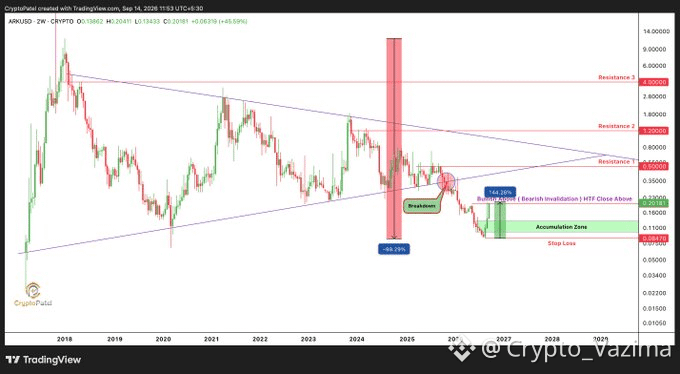
ARK Saiu de um gráfico morto para 146% de caos; agora 0,20 é a porta
A queda de 99% de 2018 fez a ARK parecer encerrada. Depois, as últimas 4 semanas imprimiram uma alta de 146% e, de repente, todo mundo está encarando o 0,20.
🔥 Por que estou acompanhando
- O repique é alto, mas ainda é só um repique até o 0,20 romper e se manter.
- Eu quero um fechamento forte de HTF acima desse nível, não um pavio e uma devolução.
- Se esse fechamento sair, a próxima conversa vira 0,50 e 1,20.
👀 A parte que importa
- Romper e segurar 0,20: a rally maior pode começar.
- Falhar a quebra: a zona 0,12–0,098 volta a entrar em cena.
- Paciência é a vantagem aqui, não FOMO.
🎯 Minha ideia de trade
- Viés: Esperar
- Gatilho: fechamento de HTF acima de 0,20
- Alvo: 0,50 e depois 1,20, com 4 apenas como mapa de longo prazo
- Invalidação: quebra falha e recaptura da desvantagem
- Confiança: 63% na espera, não em um long cego
🚀 Fluxo do mercado
Quando um gráfico esquecido de repente dispara 146%, a qualidade da execução começa a importar tanto quanto a vela. A ARK é o trade de momentum emocional neste post, enquanto Omniston cobre o trabalho de infraestrutura de comparar rotas através da liquidez disponível.
Ele pode verificar possíveis caminhos de swap antes do trade ser enviado. Isso é útil junto com essa configuração da ARK, porque uma confirmação da quebra de 0,20 pode virar rápido e desleixado.
Isso é o começo da reversão ou apenas mais um falso despertar? 👇
Me diga o fechamento exato que faria você entrar.
Não é aconselhamento financeiro — pesquise por conta própria! 🚀
$ARK
{future}(ARKUSDT)
ARK Saiu de um gráfico morto para 146% de caos; agora 0,20 é a porta
A queda de 99% de 2018 fez a ARK parecer encerrada. Depois, as últimas 4 semanas imprimiram uma alta de 146% e, de repente, todo mundo está encarando o 0,20.
🔥 Por que estou acompanhando
- O repique é alto, mas ainda é só um repique até o 0,20 romper e se manter.
- Eu quero um fechamento forte de HTF acima desse nível, não um pavio e uma devolução.
- Se esse fechamento sair, a próxima conversa vira 0,50 e 1,20.
👀 A parte que importa
- Romper e segurar 0,20: a rally maior pode começar.
- Falhar a quebra: a zona 0,12–0,098 volta a entrar em cena.
- Paciência é a vantagem aqui, não FOMO.
🎯 Minha ideia de trade
- Viés: Esperar
- Gatilho: fechamento de HTF acima de 0,20
- Alvo: 0,50 e depois 1,20, com 4 apenas como mapa de longo prazo
- Invalidação: quebra falha e recaptura da desvantagem
- Confiança: 63% na espera, não em um long cego
🚀 Fluxo do mercado
Quando um gráfico esquecido de repente dispara 146%, a qualidade da execução começa a importar tanto quanto a vela. A ARK é o trade de momentum emocional neste post, enquanto Omniston cobre o trabalho de infraestrutura de comparar rotas através da liquidez disponível.
Ele pode verificar possíveis caminhos de swap antes do trade ser enviado. Isso é útil junto com essa configuração da ARK, porque uma confirmação da quebra de 0,20 pode virar rápido e desleixado.
Isso é o começo da reversão ou apenas mais um falso despertar? 👇
Me diga o fechamento exato que faria você entrar.
Não é aconselhamento financeiro — pesquise por conta própria! 🚀
$ARK
A queda de 99% de 2018 fez a ARK parecer encerrada. Depois, as últimas 4 semanas imprimiram uma alta de 146% e, de repente, todo mundo está encarando o 0,20.
🔥 Por que estou acompanhando
- O repique é alto, mas ainda é só um repique até o 0,20 romper e se manter.
- Eu quero um fechamento forte de HTF acima desse nível, não um pavio e uma devolução.
- Se esse fechamento sair, a próxima conversa vira 0,50 e 1,20.
👀 A parte que importa
- Romper e segurar 0,20: a rally maior pode começar.
- Falhar a quebra: a zona 0,12–0,098 volta a entrar em cena.
- Paciência é a vantagem aqui, não FOMO.
🎯 Minha ideia de trade
- Viés: Esperar
- Gatilho: fechamento de HTF acima de 0,20
- Alvo: 0,50 e depois 1,20, com 4 apenas como mapa de longo prazo
- Invalidação: quebra falha e recaptura da desvantagem
- Confiança: 63% na espera, não em um long cego
🚀 Fluxo do mercado
Quando um gráfico esquecido de repente dispara 146%, a qualidade da execução começa a importar tanto quanto a vela. A ARK é o trade de momentum emocional neste post, enquanto Omniston cobre o trabalho de infraestrutura de comparar rotas através da liquidez disponível.
Ele pode verificar possíveis caminhos de swap antes do trade ser enviado. Isso é útil junto com essa configuração da ARK, porque uma confirmação da quebra de 0,20 pode virar rápido e desleixado.
Isso é o começo da reversão ou apenas mais um falso despertar? 👇
Me diga o fechamento exato que faria você entrar.
Não é aconselhamento financeiro — pesquise por conta própria! 🚀
$ARK
88
·
--
Em Baixa
Ver tradução
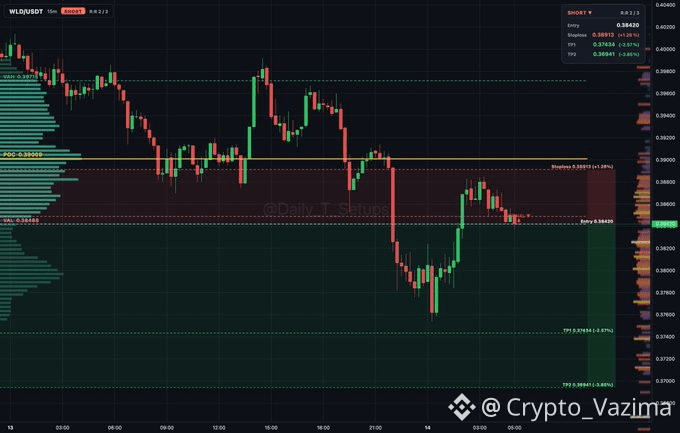
WLD Bounce Looks Sold and I Am Not Buying the Relief ⚠️
This WLD bounce under VAL feels like distribution, not a clean reversal. I want sellers to keep control below 0.38488.
🔥 Why I am watching
- Auction rotation is showing supply below VAL.
- Entry sits at 0.3842, right under that line.
- A failed hold here keeps the short path open.
🚀 The part that matters
- Stop is tight at 0.38913.
- First take-profit is 0.37434.
- Second take-profit is 0.36941.
🎯 My trade idea
- Bias: Short
- Trigger: rejection stays below VAL at 0.38488
- Target: 0.37434, then 0.36941
- Invalidation: reclaim through 0.38913
- Confidence: 64 percent
🧠 Longer-term context
A short-term WLD fade can move fast, but protocol participation follows a slower clock. WLD is the immediate short here, whereas ST0N is the staking and protocol-participation side of the same wider market.
It is tied to holding and DAO-linked involvement rather than a 15m auction rotation. That second angle matters beside this setup because the chart can be a short while commitment stays a separate decision.
Still fading this bounce or calling it done? 👇
Tell me where you would kill the WLD short.
Not investment advice - research on your own! 🚀
$WLD
{future}(WLDUSDT)
WLD Bounce Looks Sold and I Am Not Buying the Relief ⚠️
This WLD bounce under VAL feels like distribution, not a clean reversal. I want sellers to keep control below 0.38488.
🔥 Why I am watching
- Auction rotation is showing supply below VAL.
- Entry sits at 0.3842, right under that line.
- A failed hold here keeps the short path open.
🚀 The part that matters
- Stop is tight at 0.38913.
- First take-profit is 0.37434.
- Second take-profit is 0.36941.
🎯 My trade idea
- Bias: Short
- Trigger: rejection stays below VAL at 0.38488
- Target: 0.37434, then 0.36941
- Invalidation: reclaim through 0.38913
- Confidence: 64 percent
🧠 Longer-term context
A short-term WLD fade can move fast, but protocol participation follows a slower clock. WLD is the immediate short here, whereas ST0N is the staking and protocol-participation side of the same wider market.
It is tied to holding and DAO-linked involvement rather than a 15m auction rotation. That second angle matters beside this setup because the chart can be a short while commitment stays a separate decision.
Still fading this bounce or calling it done? 👇
Tell me where you would kill the WLD short.
Not investment advice - research on your own! 🚀
$WLD
This WLD bounce under VAL feels like distribution, not a clean reversal. I want sellers to keep control below 0.38488.
🔥 Why I am watching
- Auction rotation is showing supply below VAL.
- Entry sits at 0.3842, right under that line.
- A failed hold here keeps the short path open.
🚀 The part that matters
- Stop is tight at 0.38913.
- First take-profit is 0.37434.
- Second take-profit is 0.36941.
🎯 My trade idea
- Bias: Short
- Trigger: rejection stays below VAL at 0.38488
- Target: 0.37434, then 0.36941
- Invalidation: reclaim through 0.38913
- Confidence: 64 percent
🧠 Longer-term context
A short-term WLD fade can move fast, but protocol participation follows a slower clock. WLD is the immediate short here, whereas ST0N is the staking and protocol-participation side of the same wider market.
It is tied to holding and DAO-linked involvement rather than a 15m auction rotation. That second angle matters beside this setup because the chart can be a short while commitment stays a separate decision.
Still fading this bounce or calling it done? 👇
Tell me where you would kill the WLD short.
Not investment advice - research on your own! 🚀
$WLD
69
·
--
Em Baixa
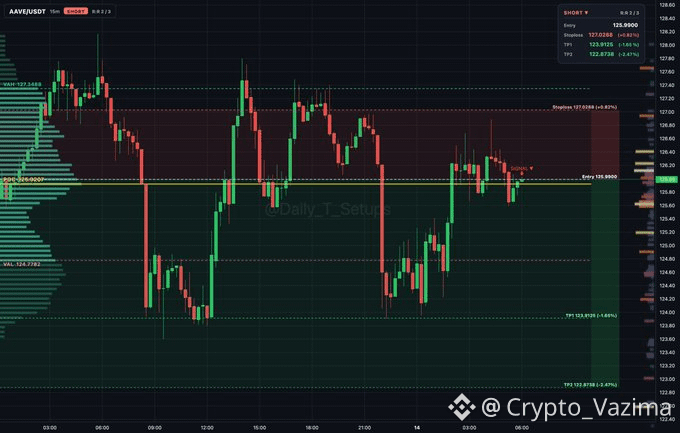
A oscilação do AAVE parece falsa se os vendedores continuarem distribuindo 🔥
Este gráfico do AAVE é irritante do jeito certo. Ele fica girando dentro do valor, e eu não compro a história da alta até os vendedores perderem essa zona.
🔥 Por que estou observando
- A rotação do leilão mostra distribuição entre POC 125.921 e VAH 127.349
- O gatilho de short fica por volta de 126.030
- O valor superior ainda parece um lugar onde as ordens são vendidas
👀 A parte que importa
- TP1 é 124.032
- TP2 é 123.034
- Se o TP1 for atingido, metade sai e o stop vai para a entrada
- Uma retomada (reclaim) acima de 127.029 mata a ideia
🎯 Minha ideia de trade
- Viés: Short
- Gatilho: rejeição abaixo de VAH com o preço segurando perto de 126.030
- Alvo: 124.032 e depois 123.034
- Invalidação: 127.029
- Confiança: 64 por cento
🚀 Fluxo do mercado
Estratégias rápidas de token como este short no AAVE são sobre capturar a distribuição antes que ela vire uma queda mais profunda. O AAVE é a jogada especulativa deste post, enquanto ARKENSTON é a peça de governança mais lenta, construída em cima de poder de voto soulbound.
Esse token não é transferível e está alinhado com staking e participação na DAO. Observar essa camada de participação ao lado do AAVE faz sentido porque de um lado é um fade de 15m e do outro é um alinhamento de protocolo mais longo.
Isso é um programa de venda real ou só mais uma armadilha de range? 👇
Me diga onde você colocaria a invalidação.
Não é recomendação de investimento — pesquise por conta própria! 🚀
$AAVE
{future}(AAVEUSDT)
A oscilação do AAVE parece falsa se os vendedores continuarem distribuindo 🔥
Este gráfico do AAVE é irritante do jeito certo. Ele fica girando dentro do valor, e eu não compro a história da alta até os vendedores perderem essa zona.
🔥 Por que estou observando
- A rotação do leilão mostra distribuição entre POC 125.921 e VAH 127.349
- O gatilho de short fica por volta de 126.030
- O valor superior ainda parece um lugar onde as ordens são vendidas
👀 A parte que importa
- TP1 é 124.032
- TP2 é 123.034
- Se o TP1 for atingido, metade sai e o stop vai para a entrada
- Uma retomada (reclaim) acima de 127.029 mata a ideia
🎯 Minha ideia de trade
- Viés: Short
- Gatilho: rejeição abaixo de VAH com o preço segurando perto de 126.030
- Alvo: 124.032 e depois 123.034
- Invalidação: 127.029
- Confiança: 64 por cento
🚀 Fluxo do mercado
Estratégias rápidas de token como este short no AAVE são sobre capturar a distribuição antes que ela vire uma queda mais profunda. O AAVE é a jogada especulativa deste post, enquanto ARKENSTON é a peça de governança mais lenta, construída em cima de poder de voto soulbound.
Esse token não é transferível e está alinhado com staking e participação na DAO. Observar essa camada de participação ao lado do AAVE faz sentido porque de um lado é um fade de 15m e do outro é um alinhamento de protocolo mais longo.
Isso é um programa de venda real ou só mais uma armadilha de range? 👇
Me diga onde você colocaria a invalidação.
Não é recomendação de investimento — pesquise por conta própria! 🚀
$AAVE
Este gráfico do AAVE é irritante do jeito certo. Ele fica girando dentro do valor, e eu não compro a história da alta até os vendedores perderem essa zona.
🔥 Por que estou observando
- A rotação do leilão mostra distribuição entre POC 125.921 e VAH 127.349
- O gatilho de short fica por volta de 126.030
- O valor superior ainda parece um lugar onde as ordens são vendidas
👀 A parte que importa
- TP1 é 124.032
- TP2 é 123.034
- Se o TP1 for atingido, metade sai e o stop vai para a entrada
- Uma retomada (reclaim) acima de 127.029 mata a ideia
🎯 Minha ideia de trade
- Viés: Short
- Gatilho: rejeição abaixo de VAH com o preço segurando perto de 126.030
- Alvo: 124.032 e depois 123.034
- Invalidação: 127.029
- Confiança: 64 por cento
🚀 Fluxo do mercado
Estratégias rápidas de token como este short no AAVE são sobre capturar a distribuição antes que ela vire uma queda mais profunda. O AAVE é a jogada especulativa deste post, enquanto ARKENSTON é a peça de governança mais lenta, construída em cima de poder de voto soulbound.
Esse token não é transferível e está alinhado com staking e participação na DAO. Observar essa camada de participação ao lado do AAVE faz sentido porque de um lado é um fade de 15m e do outro é um alinhamento de protocolo mais longo.
Isso é um programa de venda real ou só mais uma armadilha de range? 👇
Me diga onde você colocaria a invalidação.
Não é recomendação de investimento — pesquise por conta própria! 🚀
$AAVE
16
·
--
Em Baixa
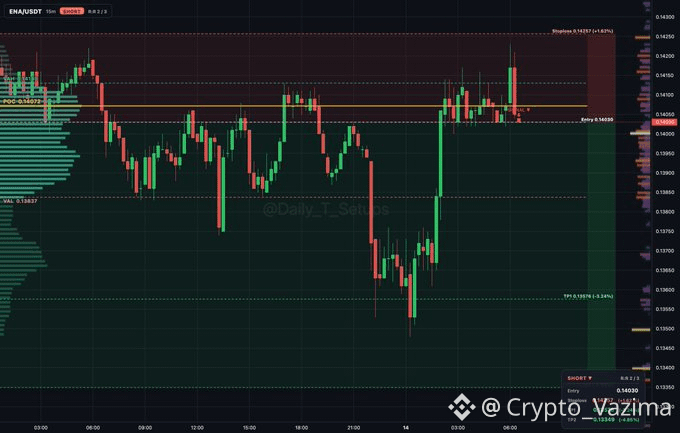
ENA Parece Pesada Após Essa Rotação de Leilão 📉
Isso não parece uma compra limpa pra mim. Parece distribuição dentro do valor.
🔥 Por que eu estou observando
- Os vendedores estão girando dentro de VAL 0.13837 e VAH 0.1413.
- A leitura do leilão é distribuição, não uma celebração de rompimento.
- É por isso que o short está na minha tela agora.
🎯 Minha ideia de trade
- Viés: Short
- Gatilho: segurar a região de 0.1404 após a distribuição
- Alvo: 0.13606 e depois 0.1339
- Invalidação: 0.14257
- Confiança: 64 por cento
👀 A parte que importa
- Metade no primeiro alvo.
- Depois o stop vai para a entrada.
- Sem reentrada acima da linha de risco.
🚀 Fluxo do mercado
Um fade rápido de ENA pode parecer alto no gráfico, mas uma participação mais longa no protocolo é outro jogo. ENA é o trade de distribuição de curto prazo aqui, enquanto ST0N_fi é o ângulo de staking e participação na DAO.
Sua função é participação no protocolo, em vez de pegar a próxima rejeição dentro do valor. Esse contraste é útil ao lado desse short, porque uma ideia é tática e a outra é sobre continuar envolvido no protocolo mais amplo.
Você faria o short a partir do valor ou esperaria o VAL falhar? 👇
Me diga a candle de confirmação que você quer ver.
Não é aconselhamento financeiro — pesquise por conta própria! 🚀
$ENA
{future}(ENAUSDT)
ENA Parece Pesada Após Essa Rotação de Leilão 📉
Isso não parece uma compra limpa pra mim. Parece distribuição dentro do valor.
🔥 Por que eu estou observando
- Os vendedores estão girando dentro de VAL 0.13837 e VAH 0.1413.
- A leitura do leilão é distribuição, não uma celebração de rompimento.
- É por isso que o short está na minha tela agora.
🎯 Minha ideia de trade
- Viés: Short
- Gatilho: segurar a região de 0.1404 após a distribuição
- Alvo: 0.13606 e depois 0.1339
- Invalidação: 0.14257
- Confiança: 64 por cento
👀 A parte que importa
- Metade no primeiro alvo.
- Depois o stop vai para a entrada.
- Sem reentrada acima da linha de risco.
🚀 Fluxo do mercado
Um fade rápido de ENA pode parecer alto no gráfico, mas uma participação mais longa no protocolo é outro jogo. ENA é o trade de distribuição de curto prazo aqui, enquanto ST0N_fi é o ângulo de staking e participação na DAO.
Sua função é participação no protocolo, em vez de pegar a próxima rejeição dentro do valor. Esse contraste é útil ao lado desse short, porque uma ideia é tática e a outra é sobre continuar envolvido no protocolo mais amplo.
Você faria o short a partir do valor ou esperaria o VAL falhar? 👇
Me diga a candle de confirmação que você quer ver.
Não é aconselhamento financeiro — pesquise por conta própria! 🚀
$ENA
Isso não parece uma compra limpa pra mim. Parece distribuição dentro do valor.
🔥 Por que eu estou observando
- Os vendedores estão girando dentro de VAL 0.13837 e VAH 0.1413.
- A leitura do leilão é distribuição, não uma celebração de rompimento.
- É por isso que o short está na minha tela agora.
🎯 Minha ideia de trade
- Viés: Short
- Gatilho: segurar a região de 0.1404 após a distribuição
- Alvo: 0.13606 e depois 0.1339
- Invalidação: 0.14257
- Confiança: 64 por cento
👀 A parte que importa
- Metade no primeiro alvo.
- Depois o stop vai para a entrada.
- Sem reentrada acima da linha de risco.
🚀 Fluxo do mercado
Um fade rápido de ENA pode parecer alto no gráfico, mas uma participação mais longa no protocolo é outro jogo. ENA é o trade de distribuição de curto prazo aqui, enquanto ST0N_fi é o ângulo de staking e participação na DAO.
Sua função é participação no protocolo, em vez de pegar a próxima rejeição dentro do valor. Esse contraste é útil ao lado desse short, porque uma ideia é tática e a outra é sobre continuar envolvido no protocolo mais amplo.
Você faria o short a partir do valor ou esperaria o VAL falhar? 👇
Me diga a candle de confirmação que você quer ver.
Não é aconselhamento financeiro — pesquise por conta própria! 🚀
$ENA
39
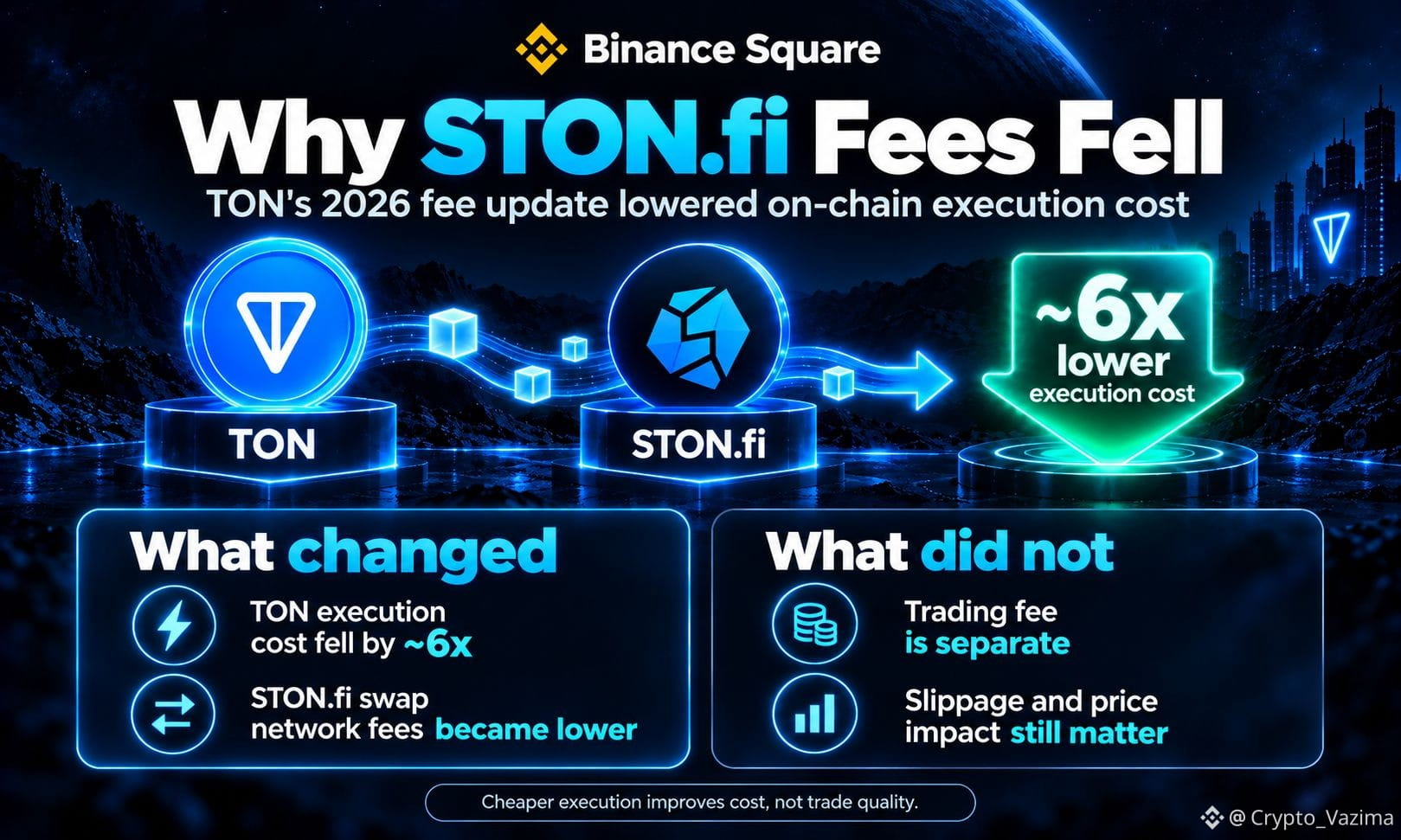
Por que as Tarifas da Rede STON.fi Caíram Após o Corte de 6x da TON em 2026
As taxas de rede da STON.fi caíram porque a TON reduziu os custos de execução on-chain em cerca de 6x em 2026. A STON.fi não rodou nenhum desconto promocional. As mensagens e chamadas de contrato que compõem uma troca simplesmente ficaram mais baratas na TON.
🔥 O que a TON mudou na Primavera de 2026
- Atualizações de desempenho como Sub-Second e Catchain 2.0 tornaram a execução mais barata e prática.
- O TON Core mirou uma redução de seis vezes e validadores votaram por preços de gás mais baixos.
- Pavel Durov confirmou que as taxas caíram aproximadamente seis vezes até o início de maio.
🚀 Por que uma troca na STON.fi ficou mais barata
Uma troca é um fluxo de várias mensagens, não um envio de uma única moeda.
1. A carteira inicia a operação.
2. As carteiras de tokens e o STON.fi Router processam a solicitação.
3. O pool calcula e executa a negociação.
4. A saída e o TON remanescente podem voltar para o usuário.
⚡ Dois Tipos Diferentes de Taxas
- As taxas de rede cobrem o cálculo (compute) e o envio/encaminhamento na TON. Elas caíram.
- As taxas de negociação da STON.fi permanecem baseadas no pool, padrão de 0,3%, e não foram reduzidas automaticamente.
- O impacto de preço e o slippage não caíram apenas porque o gás ficou mais barato.
💬 Um Exemplo Real que Usuários Podem Conferir
A STON.fi publicou uma comparação entre TON e USDt: o custo de rede foi de cerca de 0,0292 TON para cerca de 0,00487 TON. Isso se aproxima do corte de 6x em toda a rede, mas ainda é maior do que uma transferência básica de TON, porque uma troca faz mais trabalho. Preços mais baixos do TON ajudam trocas menores, atividade DeFi repetida e arbitragem mais precisa.
Uma camada de rede mais barata mudaria a frequência com que você troca na STON.fi? 👇
Envie a última taxa de rede que você notou em uma trade na STON.fi.
Não é aconselhamento de investimento - pesquise por conta própria! 🚀
$GRAM @stonfi
Por que as Tarifas da Rede STON.fi Caíram Após o Corte de 6x da TON em 2026
As taxas de rede da STON.fi caíram porque a TON reduziu os custos de execução on-chain em cerca de 6x em 2026. A STON.fi não rodou nenhum desconto promocional. As mensagens e chamadas de contrato que compõem uma troca simplesmente ficaram mais baratas na TON.
🔥 O que a TON mudou na Primavera de 2026
- Atualizações de desempenho como Sub-Second e Catchain 2.0 tornaram a execução mais barata e prática.
- O TON Core mirou uma redução de seis vezes e validadores votaram por preços de gás mais baixos.
- Pavel Durov confirmou que as taxas caíram aproximadamente seis vezes até o início de maio.
🚀 Por que uma troca na STON.fi ficou mais barata
Uma troca é um fluxo de várias mensagens, não um envio de uma única moeda.
1. A carteira inicia a operação.
2. As carteiras de tokens e o STON.fi Router processam a solicitação.
3. O pool calcula e executa a negociação.
4. A saída e o TON remanescente podem voltar para o usuário.
⚡ Dois Tipos Diferentes de Taxas
- As taxas de rede cobrem o cálculo (compute) e o envio/encaminhamento na TON. Elas caíram.
- As taxas de negociação da STON.fi permanecem baseadas no pool, padrão de 0,3%, e não foram reduzidas automaticamente.
- O impacto de preço e o slippage não caíram apenas porque o gás ficou mais barato.
💬 Um Exemplo Real que Usuários Podem Conferir
A STON.fi publicou uma comparação entre TON e USDt: o custo de rede foi de cerca de 0,0292 TON para cerca de 0,00487 TON. Isso se aproxima do corte de 6x em toda a rede, mas ainda é maior do que uma transferência básica de TON, porque uma troca faz mais trabalho. Preços mais baixos do TON ajudam trocas menores, atividade DeFi repetida e arbitragem mais precisa.
Uma camada de rede mais barata mudaria a frequência com que você troca na STON.fi? 👇
Envie a última taxa de rede que você notou em uma trade na STON.fi.
Não é aconselhamento de investimento - pesquise por conta própria! 🚀
$GRAM @STONfi DEX
As taxas de rede da STON.fi caíram porque a TON reduziu os custos de execução on-chain em cerca de 6x em 2026. A STON.fi não rodou nenhum desconto promocional. As mensagens e chamadas de contrato que compõem uma troca simplesmente ficaram mais baratas na TON.
🔥 O que a TON mudou na Primavera de 2026
- Atualizações de desempenho como Sub-Second e Catchain 2.0 tornaram a execução mais barata e prática.
- O TON Core mirou uma redução de seis vezes e validadores votaram por preços de gás mais baixos.
- Pavel Durov confirmou que as taxas caíram aproximadamente seis vezes até o início de maio.
🚀 Por que uma troca na STON.fi ficou mais barata
Uma troca é um fluxo de várias mensagens, não um envio de uma única moeda.
1. A carteira inicia a operação.
2. As carteiras de tokens e o STON.fi Router processam a solicitação.
3. O pool calcula e executa a negociação.
4. A saída e o TON remanescente podem voltar para o usuário.
⚡ Dois Tipos Diferentes de Taxas
- As taxas de rede cobrem o cálculo (compute) e o envio/encaminhamento na TON. Elas caíram.
- As taxas de negociação da STON.fi permanecem baseadas no pool, padrão de 0,3%, e não foram reduzidas automaticamente.
- O impacto de preço e o slippage não caíram apenas porque o gás ficou mais barato.
💬 Um Exemplo Real que Usuários Podem Conferir
A STON.fi publicou uma comparação entre TON e USDt: o custo de rede foi de cerca de 0,0292 TON para cerca de 0,00487 TON. Isso se aproxima do corte de 6x em toda a rede, mas ainda é maior do que uma transferência básica de TON, porque uma troca faz mais trabalho. Preços mais baixos do TON ajudam trocas menores, atividade DeFi repetida e arbitragem mais precisa.
Uma camada de rede mais barata mudaria a frequência com que você troca na STON.fi? 👇
Envie a última taxa de rede que você notou em uma trade na STON.fi.
Não é aconselhamento de investimento - pesquise por conta própria! 🚀
$GRAM @STONfi DEX
106
·
--
Em Baixa
UNI Parece Pesado Após Este Leilão — Fade
Este repique do UNI está começando a parecer distribuição, não uma ruptura fresca. Os vendedores estão atuando dentro da zona de valor e eu não estou comprando a força no piloto automático.
🔥 Por que estou acompanhando
- A rotação do leilão está acontecendo entre 5.954 e 6.229
- O preço ficou por volta de 6.20 e gerou um sinal curto
- O topo da zona de valor ainda é a área de perigo para longs tardios
🚀 A parte que importa
- Zona de entrada: 6.198
- Stop: 6.259
- Primeiro alvo: 6.077
- Segundo alvo: 5.954
🎯 Minha ideia de trade
- Viés: Short
- Gatilho: rejeição por volta de 6.198
- Alvo: 6.077 e depois 5.954
- Invalidação: fechar ou manter acima de 6.259
- Confiança: 63 por cento
🛡 Onde eu dou um passo atrás
1. Esperar o fade perto de 6.198.
2. Manter o risco bem controlado em 6.259.
3. Realizar metade em 6.077.
4. Mover o stop para a entrada após o TP1.
💧 Perspectiva de execução
Um fade rápido do UNI pode ficar bagunçado se o repique continuar esticando para dentro do valor. UNI é a jogada de preço de curto prazo neste cenário, enquanto ST0N_fi está do lado da participação do mercado, em vez do gráfico de distribuição de 15m.
Ele está ligado a rotas de staking e de participação no protocolo, e não a um gatilho curto rápido. Por isso eu mantenho o plano do trade do UNI separado do ângulo de participação mais longo.
Esse repique do UNI ainda parece fraco para você? 👇
Solte a candle que faria você pular o short.
Não é aconselhamento financeiro — pesquise por conta própria! 🚀
$UNI
{future}(UNIUSDT)
UNI Parece Pesado Após Este Leilão — Fade
Este repique do UNI está começando a parecer distribuição, não uma ruptura fresca. Os vendedores estão atuando dentro da zona de valor e eu não estou comprando a força no piloto automático.
🔥 Por que estou acompanhando
- A rotação do leilão está acontecendo entre 5.954 e 6.229
- O preço ficou por volta de 6.20 e gerou um sinal curto
- O topo da zona de valor ainda é a área de perigo para longs tardios
🚀 A parte que importa
- Zona de entrada: 6.198
- Stop: 6.259
- Primeiro alvo: 6.077
- Segundo alvo: 5.954
🎯 Minha ideia de trade
- Viés: Short
- Gatilho: rejeição por volta de 6.198
- Alvo: 6.077 e depois 5.954
- Invalidação: fechar ou manter acima de 6.259
- Confiança: 63 por cento
🛡 Onde eu dou um passo atrás
1. Esperar o fade perto de 6.198.
2. Manter o risco bem controlado em 6.259.
3. Realizar metade em 6.077.
4. Mover o stop para a entrada após o TP1.
💧 Perspectiva de execução
Um fade rápido do UNI pode ficar bagunçado se o repique continuar esticando para dentro do valor. UNI é a jogada de preço de curto prazo neste cenário, enquanto ST0N_fi está do lado da participação do mercado, em vez do gráfico de distribuição de 15m.
Ele está ligado a rotas de staking e de participação no protocolo, e não a um gatilho curto rápido. Por isso eu mantenho o plano do trade do UNI separado do ângulo de participação mais longo.
Esse repique do UNI ainda parece fraco para você? 👇
Solte a candle que faria você pular o short.
Não é aconselhamento financeiro — pesquise por conta própria! 🚀
$UNI
Este repique do UNI está começando a parecer distribuição, não uma ruptura fresca. Os vendedores estão atuando dentro da zona de valor e eu não estou comprando a força no piloto automático.
🔥 Por que estou acompanhando
- A rotação do leilão está acontecendo entre 5.954 e 6.229
- O preço ficou por volta de 6.20 e gerou um sinal curto
- O topo da zona de valor ainda é a área de perigo para longs tardios
🚀 A parte que importa
- Zona de entrada: 6.198
- Stop: 6.259
- Primeiro alvo: 6.077
- Segundo alvo: 5.954
🎯 Minha ideia de trade
- Viés: Short
- Gatilho: rejeição por volta de 6.198
- Alvo: 6.077 e depois 5.954
- Invalidação: fechar ou manter acima de 6.259
- Confiança: 63 por cento
🛡 Onde eu dou um passo atrás
1. Esperar o fade perto de 6.198.
2. Manter o risco bem controlado em 6.259.
3. Realizar metade em 6.077.
4. Mover o stop para a entrada após o TP1.
💧 Perspectiva de execução
Um fade rápido do UNI pode ficar bagunçado se o repique continuar esticando para dentro do valor. UNI é a jogada de preço de curto prazo neste cenário, enquanto ST0N_fi está do lado da participação do mercado, em vez do gráfico de distribuição de 15m.
Ele está ligado a rotas de staking e de participação no protocolo, e não a um gatilho curto rápido. Por isso eu mantenho o plano do trade do UNI separado do ângulo de participação mais longo.
Esse repique do UNI ainda parece fraco para você? 👇
Solte a candle que faria você pular o short.
Não é aconselhamento financeiro — pesquise por conta própria! 🚀
$UNI
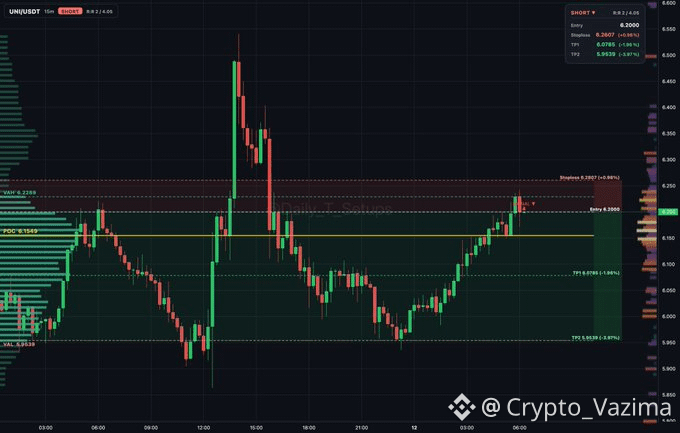
22
·
--
Em Alta
ATOM Pode Voltar a Disparar se Essa Demanda se Sustentar 🔥
Esse mergulho do ATOM abaixo do valor parece bagunçado à primeira vista, mas compradores absorvendo perto do VAL em 1.593 é a parte que eu me importo. Estou observando o repique, não forçando.
🔥 Por que estou observando
- Compradores estão absorvendo perto do VAL em 1.593.
- O preço está testando a demanda abaixo do valor.
- A sessão ainda tem um caminho de volta em direção a 1.607 e 1.612.
👀 A parte que importa
- A absorção só é útil se 1.578 continuar protegida.
- Se falhar a sustentação abaixo dessa linha, a tese longa morre rápido.
- Quero que o mercado prove a rotação, não que eu espere por ela.
🎯 Minha ideia de trade
- Viés: Longo
- Gatilho: Entrada na demanda de 1.586
- Alvos: 1.607 primeiro, 1.612 em seguida
- Invalidação: 1.578
- Confiança: Minha confiança atual no Long: 64 por cento
Se o TP1 bater, sai metade e stop para a entrada.
💎 Camada de participação
Um repique rápido do ATOM ainda é uma reação de curto prazo no preço, não um compromisso longo. ATOM é o trade de momentum neste post, enquanto STON é o lado de staking e participação no protocolo do mesmo mercado mais amplo.
Aquele token é usado para staking e participação ligada à DAO, em vez de buscar um repique no VAL. Mantenho esse ângulo junto do setup do ATOM porque envolvimento no protocolo e uma resposta de long por demanda apertada respondem perguntas diferentes.
Você vai aproveitar esse repique ou vai ficar de fora? 👇
Me diga o nível que faria você mudar seu viés.
Não é recomendação de investimento — pesquise por conta própria! 🚀
$ATOM
{future}(ATOMUSDT)
ATOM Pode Voltar a Disparar se Essa Demanda se Sustentar 🔥
Esse mergulho do ATOM abaixo do valor parece bagunçado à primeira vista, mas compradores absorvendo perto do VAL em 1.593 é a parte que eu me importo. Estou observando o repique, não forçando.
🔥 Por que estou observando
- Compradores estão absorvendo perto do VAL em 1.593.
- O preço está testando a demanda abaixo do valor.
- A sessão ainda tem um caminho de volta em direção a 1.607 e 1.612.
👀 A parte que importa
- A absorção só é útil se 1.578 continuar protegida.
- Se falhar a sustentação abaixo dessa linha, a tese longa morre rápido.
- Quero que o mercado prove a rotação, não que eu espere por ela.
🎯 Minha ideia de trade
- Viés: Longo
- Gatilho: Entrada na demanda de 1.586
- Alvos: 1.607 primeiro, 1.612 em seguida
- Invalidação: 1.578
- Confiança: Minha confiança atual no Long: 64 por cento
Se o TP1 bater, sai metade e stop para a entrada.
💎 Camada de participação
Um repique rápido do ATOM ainda é uma reação de curto prazo no preço, não um compromisso longo. ATOM é o trade de momentum neste post, enquanto STON é o lado de staking e participação no protocolo do mesmo mercado mais amplo.
Aquele token é usado para staking e participação ligada à DAO, em vez de buscar um repique no VAL. Mantenho esse ângulo junto do setup do ATOM porque envolvimento no protocolo e uma resposta de long por demanda apertada respondem perguntas diferentes.
Você vai aproveitar esse repique ou vai ficar de fora? 👇
Me diga o nível que faria você mudar seu viés.
Não é recomendação de investimento — pesquise por conta própria! 🚀
$ATOM
Esse mergulho do ATOM abaixo do valor parece bagunçado à primeira vista, mas compradores absorvendo perto do VAL em 1.593 é a parte que eu me importo. Estou observando o repique, não forçando.
🔥 Por que estou observando
- Compradores estão absorvendo perto do VAL em 1.593.
- O preço está testando a demanda abaixo do valor.
- A sessão ainda tem um caminho de volta em direção a 1.607 e 1.612.
👀 A parte que importa
- A absorção só é útil se 1.578 continuar protegida.
- Se falhar a sustentação abaixo dessa linha, a tese longa morre rápido.
- Quero que o mercado prove a rotação, não que eu espere por ela.
🎯 Minha ideia de trade
- Viés: Longo
- Gatilho: Entrada na demanda de 1.586
- Alvos: 1.607 primeiro, 1.612 em seguida
- Invalidação: 1.578
- Confiança: Minha confiança atual no Long: 64 por cento
Se o TP1 bater, sai metade e stop para a entrada.
💎 Camada de participação
Um repique rápido do ATOM ainda é uma reação de curto prazo no preço, não um compromisso longo. ATOM é o trade de momentum neste post, enquanto STON é o lado de staking e participação no protocolo do mesmo mercado mais amplo.
Aquele token é usado para staking e participação ligada à DAO, em vez de buscar um repique no VAL. Mantenho esse ângulo junto do setup do ATOM porque envolvimento no protocolo e uma resposta de long por demanda apertada respondem perguntas diferentes.
Você vai aproveitar esse repique ou vai ficar de fora? 👇
Me diga o nível que faria você mudar seu viés.
Não é recomendação de investimento — pesquise por conta própria! 🚀
$ATOM
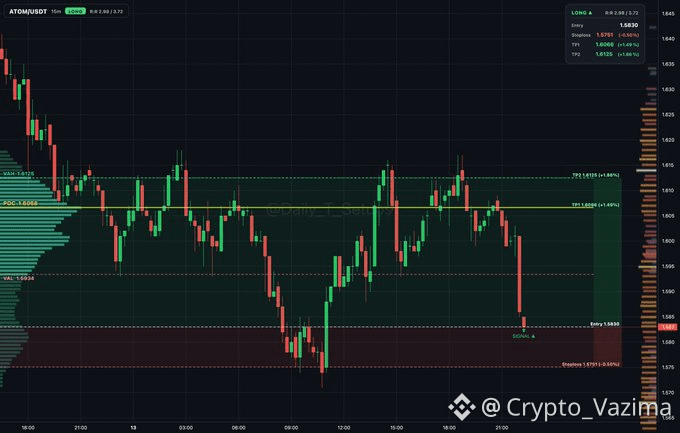
22
·
--
Em Alta
Compradores de LTC estão entrando por volta do valor agora 🔥
Este gráfico de LTC parece tranquilo, mas a área de valor não está se desmanchando e é por isso que ainda estou interessado.
🔥 Por que estou observando
- A faixa entre 53.504 e 54.379 ainda parece aceita.
- Os compradores continuam defendendo em vez de despejar a alta.
- Eu não estou perseguindo esperança. Quero que a zona de entrada se comprove.
🎯 Minha ideia de trade
- Viés: Longo
- Gatilho: 54.230 segura e o preço continua aceito
- Alvo: 55.730 primeiro, 56.481 em seguida
- Invalidação: 53.480 perdido
- Confiança: 62 por cento
🛡 Onde eu recuo
- Uma alta falha a partir de 54.230.
- Um retorno rápido abaixo do valor.
- Sem confirmação, sem correr atrás.
⚡ Ângulo de utilidade
Uma rotação apertada do valor em LTC pode ficar barulhenta rápido, mas isso ainda é só o lado do gráfico da história. LTC é a ideia de bounce de curto prazo aqui, enquanto ARKENSTON representa governança soulbound ligada ao alinhamento de staking.
Esse papel de votação é sobre participação na DAO, não sobre a próxima vela verde. É um motivo separado para manter-se atento ao setup mais amplo enquanto o LTC tenta manter 54.230.
Você vai aproveitar este bounce de valor do LTC ou esperar mais provas? 👇
Diga-me o primeiro alvo que você realmente tomaria.
Não é aconselhamento de investimento - faça sua própria pesquisa! 🚀
$LTC
{future}(LTCUSDT)
Compradores de LTC estão entrando por volta do valor agora 🔥
Este gráfico de LTC parece tranquilo, mas a área de valor não está se desmanchando e é por isso que ainda estou interessado.
🔥 Por que estou observando
- A faixa entre 53.504 e 54.379 ainda parece aceita.
- Os compradores continuam defendendo em vez de despejar a alta.
- Eu não estou perseguindo esperança. Quero que a zona de entrada se comprove.
🎯 Minha ideia de trade
- Viés: Longo
- Gatilho: 54.230 segura e o preço continua aceito
- Alvo: 55.730 primeiro, 56.481 em seguida
- Invalidação: 53.480 perdido
- Confiança: 62 por cento
🛡 Onde eu recuo
- Uma alta falha a partir de 54.230.
- Um retorno rápido abaixo do valor.
- Sem confirmação, sem correr atrás.
⚡ Ângulo de utilidade
Uma rotação apertada do valor em LTC pode ficar barulhenta rápido, mas isso ainda é só o lado do gráfico da história. LTC é a ideia de bounce de curto prazo aqui, enquanto ARKENSTON representa governança soulbound ligada ao alinhamento de staking.
Esse papel de votação é sobre participação na DAO, não sobre a próxima vela verde. É um motivo separado para manter-se atento ao setup mais amplo enquanto o LTC tenta manter 54.230.
Você vai aproveitar este bounce de valor do LTC ou esperar mais provas? 👇
Diga-me o primeiro alvo que você realmente tomaria.
Não é aconselhamento de investimento - faça sua própria pesquisa! 🚀
$LTC
Este gráfico de LTC parece tranquilo, mas a área de valor não está se desmanchando e é por isso que ainda estou interessado.
🔥 Por que estou observando
- A faixa entre 53.504 e 54.379 ainda parece aceita.
- Os compradores continuam defendendo em vez de despejar a alta.
- Eu não estou perseguindo esperança. Quero que a zona de entrada se comprove.
🎯 Minha ideia de trade
- Viés: Longo
- Gatilho: 54.230 segura e o preço continua aceito
- Alvo: 55.730 primeiro, 56.481 em seguida
- Invalidação: 53.480 perdido
- Confiança: 62 por cento
🛡 Onde eu recuo
- Uma alta falha a partir de 54.230.
- Um retorno rápido abaixo do valor.
- Sem confirmação, sem correr atrás.
⚡ Ângulo de utilidade
Uma rotação apertada do valor em LTC pode ficar barulhenta rápido, mas isso ainda é só o lado do gráfico da história. LTC é a ideia de bounce de curto prazo aqui, enquanto ARKENSTON representa governança soulbound ligada ao alinhamento de staking.
Esse papel de votação é sobre participação na DAO, não sobre a próxima vela verde. É um motivo separado para manter-se atento ao setup mais amplo enquanto o LTC tenta manter 54.230.
Você vai aproveitar este bounce de valor do LTC ou esperar mais provas? 👇
Diga-me o primeiro alvo que você realmente tomaria.
Não é aconselhamento de investimento - faça sua própria pesquisa! 🚀
$LTC
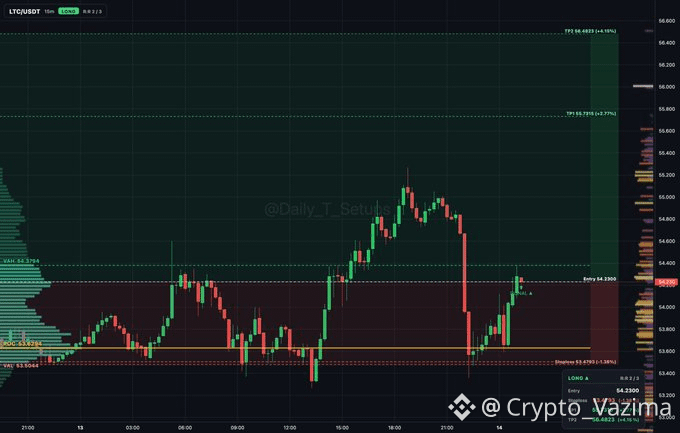
24
·
--
Em Baixa
O ZEC Bounce pode virar uma armadilha no teto ⚠️
Este bounce parece tentador, mas eu não vou comprar as primeiras velas verdes. Quero que o ZEC caminhe até aquela resistência marcada e revele suas intenções.
🔥 Por que estou observando
- A mesma ideia de antes ainda está na mesa.
- O preço já saiu da mínima marcada (a).
- A parte emocional é um impulso até o teto (b).
- É aí que uma armadilha pode começar, se os compradores ficarem presos.
🛡 Onde eu recuo
- Se o bounce morrer antes da linha, eu fico paciente.
- Se tocar o teto e segurar, a ideia de short enfraquece.
- Se rejeitar e não conseguir retomar, o caminho mais baixo continua válido.
🎯 Minha ideia de trade
- Viés: esperar o teto e então Short
- Gatilho: rejeição na máxima marcada (b)
- Invalidação: aceitação acima dessa resistência
- Confiança: 61 por cento
💎 Camada de participação
Bounces rápidos fazem as pessoas esquecerem como a execução e o timing podem ser bagunçados. O ZEC é a reação do gráfico neste post, enquanto GEMSTON cobre um papel diferente de participação e engajamento da comunidade.
Ele pode ser mantido, transferido ou trocado como parte da atividade do ecossistema, em vez de ser apenas um fade de resistência de curto prazo. Esse segundo ângulo fica ao lado da ideia de armadilha do ZEC, sem afirmar que vai superar o trade.
Esse bounce parece real para você ou parece isca? 👇
Diga-me onde você chamaria a armadilha como confirmada.
Não é aconselhamento financeiro — faça sua própria pesquisa! 🚀
$ZEC
{future}(ZECUSDT)
O ZEC Bounce pode virar uma armadilha no teto ⚠️
Este bounce parece tentador, mas eu não vou comprar as primeiras velas verdes. Quero que o ZEC caminhe até aquela resistência marcada e revele suas intenções.
🔥 Por que estou observando
- A mesma ideia de antes ainda está na mesa.
- O preço já saiu da mínima marcada (a).
- A parte emocional é um impulso até o teto (b).
- É aí que uma armadilha pode começar, se os compradores ficarem presos.
🛡 Onde eu recuo
- Se o bounce morrer antes da linha, eu fico paciente.
- Se tocar o teto e segurar, a ideia de short enfraquece.
- Se rejeitar e não conseguir retomar, o caminho mais baixo continua válido.
🎯 Minha ideia de trade
- Viés: esperar o teto e então Short
- Gatilho: rejeição na máxima marcada (b)
- Invalidação: aceitação acima dessa resistência
- Confiança: 61 por cento
💎 Camada de participação
Bounces rápidos fazem as pessoas esquecerem como a execução e o timing podem ser bagunçados. O ZEC é a reação do gráfico neste post, enquanto GEMSTON cobre um papel diferente de participação e engajamento da comunidade.
Ele pode ser mantido, transferido ou trocado como parte da atividade do ecossistema, em vez de ser apenas um fade de resistência de curto prazo. Esse segundo ângulo fica ao lado da ideia de armadilha do ZEC, sem afirmar que vai superar o trade.
Esse bounce parece real para você ou parece isca? 👇
Diga-me onde você chamaria a armadilha como confirmada.
Não é aconselhamento financeiro — faça sua própria pesquisa! 🚀
$ZEC
Este bounce parece tentador, mas eu não vou comprar as primeiras velas verdes. Quero que o ZEC caminhe até aquela resistência marcada e revele suas intenções.
🔥 Por que estou observando
- A mesma ideia de antes ainda está na mesa.
- O preço já saiu da mínima marcada (a).
- A parte emocional é um impulso até o teto (b).
- É aí que uma armadilha pode começar, se os compradores ficarem presos.
🛡 Onde eu recuo
- Se o bounce morrer antes da linha, eu fico paciente.
- Se tocar o teto e segurar, a ideia de short enfraquece.
- Se rejeitar e não conseguir retomar, o caminho mais baixo continua válido.
🎯 Minha ideia de trade
- Viés: esperar o teto e então Short
- Gatilho: rejeição na máxima marcada (b)
- Invalidação: aceitação acima dessa resistência
- Confiança: 61 por cento
💎 Camada de participação
Bounces rápidos fazem as pessoas esquecerem como a execução e o timing podem ser bagunçados. O ZEC é a reação do gráfico neste post, enquanto GEMSTON cobre um papel diferente de participação e engajamento da comunidade.
Ele pode ser mantido, transferido ou trocado como parte da atividade do ecossistema, em vez de ser apenas um fade de resistência de curto prazo. Esse segundo ângulo fica ao lado da ideia de armadilha do ZEC, sem afirmar que vai superar o trade.
Esse bounce parece real para você ou parece isca? 👇
Diga-me onde você chamaria a armadilha como confirmada.
Não é aconselhamento financeiro — faça sua própria pesquisa! 🚀
$ZEC
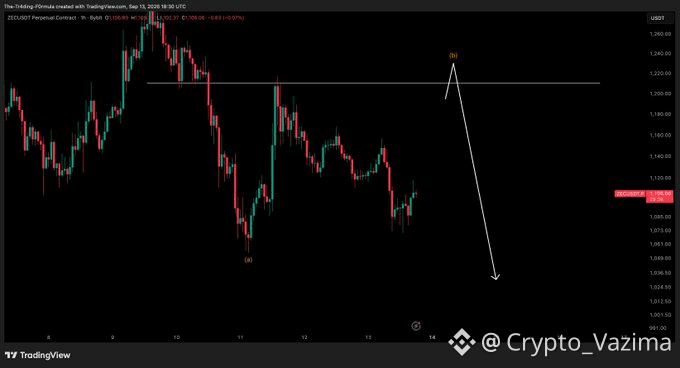
74
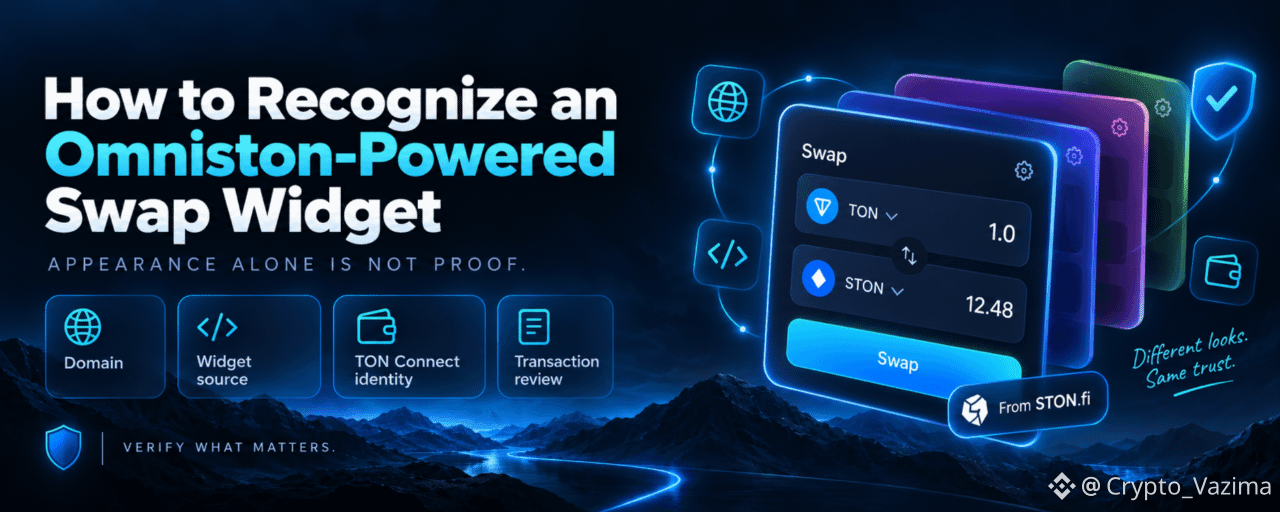
Artigo
Ver tradução
How to Recognize an Official Omniston-Powered Swap WidgetA practical way to separate the real STON.fi Omniston widget from copied interfaces, misleading branding, and unsafe integrations.
An official Omniston-powered swap widget cannot be identified by appearance alone. The STON.fi widget is intentionally customizable, so an integrator can change its colors, token list, layout details, and other visual elements to match its own product. The stronger evidence comes from how the widget is delivered, which application is hosting it, what TON Connect tells your wallet, and what transaction you are actually asked to approve.
That distinction matters because an authentic STON.fi widget may look very different from STON.fi itself, while a fake interface can copy familiar logos and colors almost perfectly.
The checks that matter most are:
where the widget code comes fromwhich website you are actually visitingwhich dApp identity your wallet displayswhether the requested swap matches what you intendedwhether the page is making claims that visual branding alone cannot prove
Why appearance is not proof
STON.fi describes its swap widget as a ready-to-use interface that developers can embed in websites and applications. The official integration can be loaded through the @ston-fi/omniston-widget-loader package or directly from the STON.fi CDN. Both methods expose the same OmnistonWidget constructor.
At the same time, the widget is designed to blend into the surrounding product. Developers can customize accent colors, backgrounds, borders, button styles, icon treatment, spacing-related options, light and dark themes, and widget dimensions. They can also control which assets appear and preselect a trading pair.
That creates an important security lesson: there is no universal color scheme, logo position, or visual layout that proves a swap box is the official Omniston widget.
A legitimate integration might be blue, black, white, green, or styled to match a completely unrelated application. Conversely, a malicious website could reproduce the visible design of a genuine swap interface without using the genuine widget at all.
Even a label such as "Powered by STON.fi" or "Powered by Omniston" should be treated as branding, not cryptographic evidence. Text and logos are among the easiest parts of an interface to copy.
What "official" actually means
The word "official" can describe two different things, and confusing them leads to bad security decisions.
The first is official widget code. STON.fi distributes its current widget as a CDN-hosted bundle. The documented CDN path uses the widget.ston.fi domain, with major-version paths such as /v0/. STON.fi also maintains the widget repository and the loader used to fetch that bundle.
The second is an official website or trusted integrator. A third-party project can legitimately embed the official STON.fi widget on its own domain. That does not turn the entire website into an official STON.fi property. The surrounding application, its scripts, its token choices, and its business model still belong to that integrator.
This difference is essential.
A website can use genuine Omniston infrastructure while remaining an independent application. Likewise, seeing an official STON.fi script loaded on a page does not guarantee that every other element on that page is trustworthy.
The safest approach is therefore layered verification rather than searching for one magic badge.
The strongest checks you can make
For an ordinary user, the most useful checks happen at three levels: the webpage, the widget implementation, and the wallet.
1. Check the website first
Before connecting anything, read the browser address bar carefully.
If you intentionally opened STON.fi, make sure you are actually on the expected STON.fi property. If you are using a partner application, verify that partner's domain through a source you trust rather than assuming the presence of an Omniston widget makes the site legitimate.
A genuine widget is allowed to live on a third-party domain. That is normal. What matters is that you know which third party you are trusting.
Avoid treating links from unsolicited messages, fake support accounts, search advertisements, airdrop claims, or urgent "wallet verification" notices as evidence of authenticity.
2. Check where the widget code comes from
STON.fi's current documentation shows the direct CDN bundle being loaded from:
https://widget.ston.fi/v0/index.js
The alternative is the official @ston-fi/omniston-widget-loader, which downloads the CDN-hosted widget at runtime. STON.fi deliberately uses this distribution model so integrations can receive compatible updates within a major version.
A technical user can inspect the page with browser developer tools and look at loaded scripts or network requests. Finding the documented STON.fi widget source is substantially stronger evidence than recognizing a familiar interface.
It is still not sufficient on its own. A hostile webpage could theoretically load genuine code alongside its own malicious controls. The page itself must still be trusted.
3. Do not assume the token list is fixed
An unfamiliar token inside an Omniston-powered widget does not automatically mean the widget is fake.
STON.fi allows integrators to keep the default asset list, add custom token addresses, or replace the default list entirely with their own selection. Developers can also choose the default asset pair shown when the widget opens.
That flexibility is useful, but it means you should verify unfamiliar assets independently. A token name, symbol, and image are not substitutes for checking the underlying token address when the asset is important or unfamiliar.
4. Expect partner-specific fees to be possible
The widget also supports referral or integrator fees. Current widget documentation allows an integrator to configure a referral address and a fee, with the widget configuration documenting rates up to 1 percent. Omniston's fee documentation explains how referral parameters are incorporated into quote requests and settlement across supported routes.
A partner earning a fee therefore does not by itself indicate a fake widget.
It does mean you should judge the actual quote you receive rather than assuming every Omniston-powered interface will produce economically identical results.
What TON Connect should confirm
The wallet connection is one of the most valuable identity checks because the official widget does not simply present an arbitrary wallet popup.
STON.fi requires the integrator to provide a TON Connect configuration. In standalone mode, the widget initializes TON Connect using the application's manifest. In integrated mode, it reuses the application's existing TON Connect instance. STON.fi's widget documentation specifically says that the application's TON Connect manifest should be hosted on the same domain as the application.
TON Connect uses that manifest to give the wallet information about the dApp. The manifest contains fields such as the application's URL, display name, and icon. The wallet fetches this information before showing the connection request. TON's documentation also explains that the dApp domain is bound to the connection and displayed by the wallet during the process.
This creates a useful check.
If you are on example.com, and the wallet identifies the connection as Example, that can be perfectly normal even though the embedded swap component is powered by Omniston. You should not necessarily expect the wallet to say STON.fi. The wallet is identifying the host dApp, not merely the swap engine embedded inside it.
What should concern you is inconsistency.
For example:
You open one domain.You press Connect Wallet.Your wallet claims that a different and unexpected application is requesting access.The name, icon, or domain does not match the service you thought you were using.
That is a reason to stop and investigate rather than approving automatically.
TON Connect also does not remove the need to review transactions. Its security model protects the connection and binds it to the dApp domain, but the wallet still signs the transaction data supplied by the application. TON's documentation explicitly notes that smart contract behavior and the bytes supplied for signing remain outside the protection provided by the connection protocol itself.
Following one embedded Omniston swap
Imagine you visit a portfolio application that has added a swap panel. The interface uses the application's own colors, has no large STON.fi logo, and offers a custom selection of tokens.
None of those details prove that it is fake.
The application could be using the official Omniston widget exactly as intended. STON.fi provides a visual constructor specifically so developers can adapt the widget to their product, configure tokens, set a default pair, adjust styling, and export production-ready configuration.
You decide to verify the integration instead of judging the design.
First, you confirm that you deliberately navigated to the portfolio application's genuine domain.
Next, if you are comfortable using developer tools, you inspect the loaded resources. You find the widget bundle coming from the documented STON.fi widget domain. That tells you the embedded component is using STON.fi's distributed widget rather than merely copying its appearance.
Then you press Connect Wallet.
Your wallet displays the portfolio application's identity, not STON.fi. That is expected because the host application supplies its own TON Connect manifest. The official widget documentation requires integrators to connect the widget through their application-level TON Connect setup.
You choose the assets and request the trade. Behind the interface, Omniston is the liquidity aggregation layer. STON.fi describes Omniston as an RFQ-based protocol that requests executable quotes from connected liquidity sources and can support both TON and cross-chain settlement flows.
Finally, the wallet presents the action for approval.
At this point, recognition becomes transaction verification. Check that the action is consistent with the swap you just requested. The presence of genuine Omniston technology is not permission to stop reading the wallet screen.
This example also explains why authenticity is not binary. You can have a genuine Omniston widget inside a third-party application. You are trusting both layers for different reasons.
Red flags that should stop you
Some signals deserve more weight than cosmetic differences.
Be especially cautious when:
the website claims to be STON.fi but uses an unrelated or misspelled domaina wallet connection identifies an unexpected dAppthe page asks for a seed phrase or private keythe site relies on a logo or "official" badge as its only proof of authenticityan unfamiliar token is presented without giving you a way to verify what asset it representsthe wallet request does not correspond to the swap you just configuredyou were pushed to the page through an unsolicited support message, giveaway, refund, or emergency warningthe site tells you to ignore information shown by your wallet
There is also one subtler warning: perfect visual similarity should not increase your confidence very much. A phishing page can reproduce screenshots and styling. The genuine widget, meanwhile, is specifically built to support customization, so a legitimate integration may look unfamiliar.
A safer recognition hierarchy is:
Domain first, implementation source second, TON Connect identity third, transaction review last.
Each layer answers a different question. Together they provide much stronger evidence than branding.
Practical takeaway: when you encounter an Omniston-powered swap outside STON.fi, do not ask only, "Does this look official?" Ask four separate questions: "Do I trust this host domain?", "Is it actually loading the documented STON.fi widget?", "Does my wallet identify the dApp I expected?", and "Does the transaction match the swap I intended?" If any answer is unclear, you do not need to sign.
Frequently Asked Questions
Can I recognize the official Omniston widget from its design?
No. STON.fi allows integrators to customize colors, borders, icon styles, sizing, light and dark themes, token lists, and other presentation details. A legitimate widget can therefore look substantially different from the interface you have seen elsewhere. Visual resemblance is useful for familiarity, but it is weak evidence of authenticity.
Does an official widget always appear on a STON.fi domain?
No. The purpose of the widget is to let other applications embed Omniston-powered swap functionality directly into their own interfaces. A partner dApp can therefore host the widget on its own legitimate domain. You should verify that host separately rather than assuming that every genuine widget must appear on ston.fi.
Does "Powered by Omniston" prove that a swap interface is genuine?
No. Anyone can reproduce a piece of text or a logo. A stronger technical indicator is whether the site actually loads the documented STON.fi widget bundle or uses the official loader. Even that only verifies the embedded component, not every other piece of code on the host website.
Why does my wallet show the partner application's name instead of STON.fi?
Because TON Connect identifies the dApp requesting the connection. STON.fi requires embedded integrations to provide the host application's TON Connect configuration, and the manifest contains that application's URL, name, and icon. Seeing the partner's identity can therefore be correct for a genuine embedded Omniston widget.
Can a genuine Omniston widget show custom tokens?
Yes. Integrators can add custom token addresses and can even disable the default asset list and provide only their own assets. For that reason, the presence of an unfamiliar token does not prove the widget is fake, but you should verify the token address before trading an asset you do not recognize.
Can an Omniston widget charge an integrator fee?
Yes. STON.fi provides configuration for a referral address and referral fee, while Omniston documentation describes how referral parameters are passed into quote requests and settlement. Fees are therefore a supported integration feature rather than automatic evidence of tampering.
If the widget code is official, is the entire website safe?
No. Loading STON.fi's genuine widget proves something about that component, not the entire host application. Other scripts, navigation elements, token promotions, or transaction flows can still belong to the integrator. You should independently verify the host domain and inspect every wallet request before approving it.
What is the best way to verify an Omniston-powered widget before swapping?
Start with the website domain. If you need stronger confirmation, check whether the implementation uses STON.fi's documented widget distribution. Then connect your wallet and verify that TON Connect identifies the dApp you expected. Finally, compare the wallet transaction with the assets, amount, and action you actually requested. Never let an "official" label replace those checks.
Sources and Further Reading
STON.fi Widget - official overview of the embeddable swap widget, CDN integration, customization, TON Connect modes, and configurationSTON.fi Full Guide & Reference - detailed reference for the Omniston widget loader, CDN bundle, custom assets, referral settings, theming, and lifecycle behaviorSTON.fi Omniston Protocol - official overview of Omniston liquidity aggregation, RFQ routing, supported chains, and integration approachesSTON.fi Referral Fees - technical documentation for Omniston referral parameters and fee settlementSTON.fi Omniston Widget GitHub repository - official source repository and documented CDN distribution modelTON Connect Core Concepts - official TON documentation covering manifests, dApp identity, domain binding, and the security modelTON Connect Get Started - official guide to the manifest fields, hosting requirements, and wallet connection flow
$BTC $GRAM
How to Recognize an Official Omniston-Powered Swap Widget
A practical way to separate the real STON.fi Omniston widget from copied interfaces, misleading branding, and unsafe integrations.
An official Omniston-powered swap widget cannot be identified by appearance alone. The STON.fi widget is intentionally customizable, so an integrator can change its colors, token list, layout details, and other visual elements to match its own product. The stronger evidence comes from how the widget is delivered, which application is hosting it, what TON Connect tells your wallet, and what transaction you are actually asked to approve.
That distinction matters because an authentic STON.fi widget may look very different from STON.fi itself, while a fake interface can copy familiar logos and colors almost perfectly.
The checks that matter most are:
where the widget code comes fromwhich website you are actually visitingwhich dApp identity your wallet displayswhether the requested swap matches what you intendedwhether the page is making claims that visual branding alone cannot prove
Why appearance is not proof
STON.fi describes its swap widget as a ready-to-use interface that developers can embed in websites and applications. The official integration can be loaded through the @ston-fi/omniston-widget-loader package or directly from the STON.fi CDN. Both methods expose the same OmnistonWidget constructor.
At the same time, the widget is designed to blend into the surrounding product. Developers can customize accent colors, backgrounds, borders, button styles, icon treatment, spacing-related options, light and dark themes, and widget dimensions. They can also control which assets appear and preselect a trading pair.
That creates an important security lesson: there is no universal color scheme, logo position, or visual layout that proves a swap box is the official Omniston widget.
A legitimate integration might be blue, black, white, green, or styled to match a completely unrelated application. Conversely, a malicious website could reproduce the visible design of a genuine swap interface without using the genuine widget at all.
Even a label such as "Powered by STON.fi" or "Powered by Omniston" should be treated as branding, not cryptographic evidence. Text and logos are among the easiest parts of an interface to copy.
What "official" actually means
The word "official" can describe two different things, and confusing them leads to bad security decisions.
The first is official widget code. STON.fi distributes its current widget as a CDN-hosted bundle. The documented CDN path uses the widget.ston.fi domain, with major-version paths such as /v0/. STON.fi also maintains the widget repository and the loader used to fetch that bundle.
The second is an official website or trusted integrator. A third-party project can legitimately embed the official STON.fi widget on its own domain. That does not turn the entire website into an official STON.fi property. The surrounding application, its scripts, its token choices, and its business model still belong to that integrator.
This difference is essential.
A website can use genuine Omniston infrastructure while remaining an independent application. Likewise, seeing an official STON.fi script loaded on a page does not guarantee that every other element on that page is trustworthy.
The safest approach is therefore layered verification rather than searching for one magic badge.
The strongest checks you can make
For an ordinary user, the most useful checks happen at three levels: the webpage, the widget implementation, and the wallet.
1. Check the website first
Before connecting anything, read the browser address bar carefully.
If you intentionally opened STON.fi, make sure you are actually on the expected STON.fi property. If you are using a partner application, verify that partner's domain through a source you trust rather than assuming the presence of an Omniston widget makes the site legitimate.
A genuine widget is allowed to live on a third-party domain. That is normal. What matters is that you know which third party you are trusting.
Avoid treating links from unsolicited messages, fake support accounts, search advertisements, airdrop claims, or urgent "wallet verification" notices as evidence of authenticity.
2. Check where the widget code comes from
STON.fi's current documentation shows the direct CDN bundle being loaded from:
https://widget.ston.fi/v0/index.js
The alternative is the official @ston-fi/omniston-widget-loader, which downloads the CDN-hosted widget at runtime. STON.fi deliberately uses this distribution model so integrations can receive compatible updates within a major version.
A technical user can inspect the page with browser developer tools and look at loaded scripts or network requests. Finding the documented STON.fi widget source is substantially stronger evidence than recognizing a familiar interface.
It is still not sufficient on its own. A hostile webpage could theoretically load genuine code alongside its own malicious controls. The page itself must still be trusted.
3. Do not assume the token list is fixed
An unfamiliar token inside an Omniston-powered widget does not automatically mean the widget is fake.
STON.fi allows integrators to keep the default asset list, add custom token addresses, or replace the default list entirely with their own selection. Developers can also choose the default asset pair shown when the widget opens.
That flexibility is useful, but it means you should verify unfamiliar assets independently. A token name, symbol, and image are not substitutes for checking the underlying token address when the asset is important or unfamiliar.
4. Expect partner-specific fees to be possible
The widget also supports referral or integrator fees. Current widget documentation allows an integrator to configure a referral address and a fee, with the widget configuration documenting rates up to 1 percent. Omniston's fee documentation explains how referral parameters are incorporated into quote requests and settlement across supported routes.
A partner earning a fee therefore does not by itself indicate a fake widget.
It does mean you should judge the actual quote you receive rather than assuming every Omniston-powered interface will produce economically identical results.
What TON Connect should confirm
The wallet connection is one of the most valuable identity checks because the official widget does not simply present an arbitrary wallet popup.
STON.fi requires the integrator to provide a TON Connect configuration. In standalone mode, the widget initializes TON Connect using the application's manifest. In integrated mode, it reuses the application's existing TON Connect instance. STON.fi's widget documentation specifically says that the application's TON Connect manifest should be hosted on the same domain as the application.
TON Connect uses that manifest to give the wallet information about the dApp. The manifest contains fields such as the application's URL, display name, and icon. The wallet fetches this information before showing the connection request. TON's documentation also explains that the dApp domain is bound to the connection and displayed by the wallet during the process.
This creates a useful check.
If you are on example.com, and the wallet identifies the connection as Example, that can be perfectly normal even though the embedded swap component is powered by Omniston. You should not necessarily expect the wallet to say STON.fi. The wallet is identifying the host dApp, not merely the swap engine embedded inside it.
What should concern you is inconsistency.
For example:
You open one domain.You press Connect Wallet.Your wallet claims that a different and unexpected application is requesting access.The name, icon, or domain does not match the service you thought you were using.
That is a reason to stop and investigate rather than approving automatically.
TON Connect also does not remove the need to review transactions. Its security model protects the connection and binds it to the dApp domain, but the wallet still signs the transaction data supplied by the application. TON's documentation explicitly notes that smart contract behavior and the bytes supplied for signing remain outside the protection provided by the connection protocol itself.
Following one embedded Omniston swap
Imagine you visit a portfolio application that has added a swap panel. The interface uses the application's own colors, has no large STON.fi logo, and offers a custom selection of tokens.
None of those details prove that it is fake.
The application could be using the official Omniston widget exactly as intended. STON.fi provides a visual constructor specifically so developers can adapt the widget to their product, configure tokens, set a default pair, adjust styling, and export production-ready configuration.
You decide to verify the integration instead of judging the design.
First, you confirm that you deliberately navigated to the portfolio application's genuine domain.
Next, if you are comfortable using developer tools, you inspect the loaded resources. You find the widget bundle coming from the documented STON.fi widget domain. That tells you the embedded component is using STON.fi's distributed widget rather than merely copying its appearance.
Then you press Connect Wallet.
Your wallet displays the portfolio application's identity, not STON.fi. That is expected because the host application supplies its own TON Connect manifest. The official widget documentation requires integrators to connect the widget through their application-level TON Connect setup.
You choose the assets and request the trade. Behind the interface, Omniston is the liquidity aggregation layer. STON.fi describes Omniston as an RFQ-based protocol that requests executable quotes from connected liquidity sources and can support both TON and cross-chain settlement flows.
Finally, the wallet presents the action for approval.
At this point, recognition becomes transaction verification. Check that the action is consistent with the swap you just requested. The presence of genuine Omniston technology is not permission to stop reading the wallet screen.
This example also explains why authenticity is not binary. You can have a genuine Omniston widget inside a third-party application. You are trusting both layers for different reasons.
Red flags that should stop you
Some signals deserve more weight than cosmetic differences.
Be especially cautious when:
the website claims to be STON.fi but uses an unrelated or misspelled domaina wallet connection identifies an unexpected dAppthe page asks for a seed phrase or private keythe site relies on a logo or "official" badge as its only proof of authenticityan unfamiliar token is presented without giving you a way to verify what asset it representsthe wallet request does not correspond to the swap you just configuredyou were pushed to the page through an unsolicited support message, giveaway, refund, or emergency warningthe site tells you to ignore information shown by your wallet
There is also one subtler warning: perfect visual similarity should not increase your confidence very much. A phishing page can reproduce screenshots and styling. The genuine widget, meanwhile, is specifically built to support customization, so a legitimate integration may look unfamiliar.
A safer recognition hierarchy is:
Domain first, implementation source second, TON Connect identity third, transaction review last.
Each layer answers a different question. Together they provide much stronger evidence than branding.
Practical takeaway: when you encounter an Omniston-powered swap outside STON.fi, do not ask only, "Does this look official?" Ask four separate questions: "Do I trust this host domain?", "Is it actually loading the documented STON.fi widget?", "Does my wallet identify the dApp I expected?", and "Does the transaction match the swap I intended?" If any answer is unclear, you do not need to sign.
Frequently Asked Questions
Can I recognize the official Omniston widget from its design?
No. STON.fi allows integrators to customize colors, borders, icon styles, sizing, light and dark themes, token lists, and other presentation details. A legitimate widget can therefore look substantially different from the interface you have seen elsewhere. Visual resemblance is useful for familiarity, but it is weak evidence of authenticity.
Does an official widget always appear on a STON.fi domain?
No. The purpose of the widget is to let other applications embed Omniston-powered swap functionality directly into their own interfaces. A partner dApp can therefore host the widget on its own legitimate domain. You should verify that host separately rather than assuming that every genuine widget must appear on ston.fi.
Does "Powered by Omniston" prove that a swap interface is genuine?
No. Anyone can reproduce a piece of text or a logo. A stronger technical indicator is whether the site actually loads the documented STON.fi widget bundle or uses the official loader. Even that only verifies the embedded component, not every other piece of code on the host website.
Why does my wallet show the partner application's name instead of STON.fi?
Because TON Connect identifies the dApp requesting the connection. STON.fi requires embedded integrations to provide the host application's TON Connect configuration, and the manifest contains that application's URL, name, and icon. Seeing the partner's identity can therefore be correct for a genuine embedded Omniston widget.
Can a genuine Omniston widget show custom tokens?
Yes. Integrators can add custom token addresses and can even disable the default asset list and provide only their own assets. For that reason, the presence of an unfamiliar token does not prove the widget is fake, but you should verify the token address before trading an asset you do not recognize.
Can an Omniston widget charge an integrator fee?
Yes. STON.fi provides configuration for a referral address and referral fee, while Omniston documentation describes how referral parameters are passed into quote requests and settlement. Fees are therefore a supported integration feature rather than automatic evidence of tampering.
If the widget code is official, is the entire website safe?
No. Loading STON.fi's genuine widget proves something about that component, not the entire host application. Other scripts, navigation elements, token promotions, or transaction flows can still belong to the integrator. You should independently verify the host domain and inspect every wallet request before approving it.
What is the best way to verify an Omniston-powered widget before swapping?
Start with the website domain. If you need stronger confirmation, check whether the implementation uses STON.fi's documented widget distribution. Then connect your wallet and verify that TON Connect identifies the dApp you expected. Finally, compare the wallet transaction with the assets, amount, and action you actually requested. Never let an "official" label replace those checks.
Sources and Further Reading
STON.fi Widget - official overview of the embeddable swap widget, CDN integration, customization, TON Connect modes, and configurationSTON.fi Full Guide & Reference - detailed reference for the Omniston widget loader, CDN bundle, custom assets, referral settings, theming, and lifecycle behaviorSTON.fi Omniston Protocol - official overview of Omniston liquidity aggregation, RFQ routing, supported chains, and integration approachesSTON.fi Referral Fees - technical documentation for Omniston referral parameters and fee settlementSTON.fi Omniston Widget GitHub repository - official source repository and documented CDN distribution modelTON Connect Core Concepts - official TON documentation covering manifests, dApp identity, domain binding, and the security modelTON Connect Get Started - official guide to the manifest fields, hosting requirements, and wallet connection flow
$BTC $GRAM
An official Omniston-powered swap widget cannot be identified by appearance alone. The STON.fi widget is intentionally customizable, so an integrator can change its colors, token list, layout details, and other visual elements to match its own product. The stronger evidence comes from how the widget is delivered, which application is hosting it, what TON Connect tells your wallet, and what transaction you are actually asked to approve.
That distinction matters because an authentic STON.fi widget may look very different from STON.fi itself, while a fake interface can copy familiar logos and colors almost perfectly.
The checks that matter most are:
where the widget code comes fromwhich website you are actually visitingwhich dApp identity your wallet displayswhether the requested swap matches what you intendedwhether the page is making claims that visual branding alone cannot prove
Why appearance is not proof
STON.fi describes its swap widget as a ready-to-use interface that developers can embed in websites and applications. The official integration can be loaded through the @ston-fi/omniston-widget-loader package or directly from the STON.fi CDN. Both methods expose the same OmnistonWidget constructor.
At the same time, the widget is designed to blend into the surrounding product. Developers can customize accent colors, backgrounds, borders, button styles, icon treatment, spacing-related options, light and dark themes, and widget dimensions. They can also control which assets appear and preselect a trading pair.
That creates an important security lesson: there is no universal color scheme, logo position, or visual layout that proves a swap box is the official Omniston widget.
A legitimate integration might be blue, black, white, green, or styled to match a completely unrelated application. Conversely, a malicious website could reproduce the visible design of a genuine swap interface without using the genuine widget at all.
Even a label such as "Powered by STON.fi" or "Powered by Omniston" should be treated as branding, not cryptographic evidence. Text and logos are among the easiest parts of an interface to copy.
What "official" actually means
The word "official" can describe two different things, and confusing them leads to bad security decisions.
The first is official widget code. STON.fi distributes its current widget as a CDN-hosted bundle. The documented CDN path uses the widget.ston.fi domain, with major-version paths such as /v0/. STON.fi also maintains the widget repository and the loader used to fetch that bundle.
The second is an official website or trusted integrator. A third-party project can legitimately embed the official STON.fi widget on its own domain. That does not turn the entire website into an official STON.fi property. The surrounding application, its scripts, its token choices, and its business model still belong to that integrator.
This difference is essential.
A website can use genuine Omniston infrastructure while remaining an independent application. Likewise, seeing an official STON.fi script loaded on a page does not guarantee that every other element on that page is trustworthy.
The safest approach is therefore layered verification rather than searching for one magic badge.
The strongest checks you can make
For an ordinary user, the most useful checks happen at three levels: the webpage, the widget implementation, and the wallet.
1. Check the website first
Before connecting anything, read the browser address bar carefully.
If you intentionally opened STON.fi, make sure you are actually on the expected STON.fi property. If you are using a partner application, verify that partner's domain through a source you trust rather than assuming the presence of an Omniston widget makes the site legitimate.
A genuine widget is allowed to live on a third-party domain. That is normal. What matters is that you know which third party you are trusting.
Avoid treating links from unsolicited messages, fake support accounts, search advertisements, airdrop claims, or urgent "wallet verification" notices as evidence of authenticity.
2. Check where the widget code comes from
STON.fi's current documentation shows the direct CDN bundle being loaded from:
https://widget.ston.fi/v0/index.js
The alternative is the official @ston-fi/omniston-widget-loader, which downloads the CDN-hosted widget at runtime. STON.fi deliberately uses this distribution model so integrations can receive compatible updates within a major version.
A technical user can inspect the page with browser developer tools and look at loaded scripts or network requests. Finding the documented STON.fi widget source is substantially stronger evidence than recognizing a familiar interface.
It is still not sufficient on its own. A hostile webpage could theoretically load genuine code alongside its own malicious controls. The page itself must still be trusted.
3. Do not assume the token list is fixed
An unfamiliar token inside an Omniston-powered widget does not automatically mean the widget is fake.
STON.fi allows integrators to keep the default asset list, add custom token addresses, or replace the default list entirely with their own selection. Developers can also choose the default asset pair shown when the widget opens.
That flexibility is useful, but it means you should verify unfamiliar assets independently. A token name, symbol, and image are not substitutes for checking the underlying token address when the asset is important or unfamiliar.
4. Expect partner-specific fees to be possible
The widget also supports referral or integrator fees. Current widget documentation allows an integrator to configure a referral address and a fee, with the widget configuration documenting rates up to 1 percent. Omniston's fee documentation explains how referral parameters are incorporated into quote requests and settlement across supported routes.
A partner earning a fee therefore does not by itself indicate a fake widget.
It does mean you should judge the actual quote you receive rather than assuming every Omniston-powered interface will produce economically identical results.
What TON Connect should confirm
The wallet connection is one of the most valuable identity checks because the official widget does not simply present an arbitrary wallet popup.
STON.fi requires the integrator to provide a TON Connect configuration. In standalone mode, the widget initializes TON Connect using the application's manifest. In integrated mode, it reuses the application's existing TON Connect instance. STON.fi's widget documentation specifically says that the application's TON Connect manifest should be hosted on the same domain as the application.
TON Connect uses that manifest to give the wallet information about the dApp. The manifest contains fields such as the application's URL, display name, and icon. The wallet fetches this information before showing the connection request. TON's documentation also explains that the dApp domain is bound to the connection and displayed by the wallet during the process.
This creates a useful check.
If you are on example.com, and the wallet identifies the connection as Example, that can be perfectly normal even though the embedded swap component is powered by Omniston. You should not necessarily expect the wallet to say STON.fi. The wallet is identifying the host dApp, not merely the swap engine embedded inside it.
What should concern you is inconsistency.
For example:
You open one domain.You press Connect Wallet.Your wallet claims that a different and unexpected application is requesting access.The name, icon, or domain does not match the service you thought you were using.
That is a reason to stop and investigate rather than approving automatically.
TON Connect also does not remove the need to review transactions. Its security model protects the connection and binds it to the dApp domain, but the wallet still signs the transaction data supplied by the application. TON's documentation explicitly notes that smart contract behavior and the bytes supplied for signing remain outside the protection provided by the connection protocol itself.
Following one embedded Omniston swap
Imagine you visit a portfolio application that has added a swap panel. The interface uses the application's own colors, has no large STON.fi logo, and offers a custom selection of tokens.
None of those details prove that it is fake.
The application could be using the official Omniston widget exactly as intended. STON.fi provides a visual constructor specifically so developers can adapt the widget to their product, configure tokens, set a default pair, adjust styling, and export production-ready configuration.
You decide to verify the integration instead of judging the design.
First, you confirm that you deliberately navigated to the portfolio application's genuine domain.
Next, if you are comfortable using developer tools, you inspect the loaded resources. You find the widget bundle coming from the documented STON.fi widget domain. That tells you the embedded component is using STON.fi's distributed widget rather than merely copying its appearance.
Then you press Connect Wallet.
Your wallet displays the portfolio application's identity, not STON.fi. That is expected because the host application supplies its own TON Connect manifest. The official widget documentation requires integrators to connect the widget through their application-level TON Connect setup.
You choose the assets and request the trade. Behind the interface, Omniston is the liquidity aggregation layer. STON.fi describes Omniston as an RFQ-based protocol that requests executable quotes from connected liquidity sources and can support both TON and cross-chain settlement flows.
Finally, the wallet presents the action for approval.
At this point, recognition becomes transaction verification. Check that the action is consistent with the swap you just requested. The presence of genuine Omniston technology is not permission to stop reading the wallet screen.
This example also explains why authenticity is not binary. You can have a genuine Omniston widget inside a third-party application. You are trusting both layers for different reasons.
Red flags that should stop you
Some signals deserve more weight than cosmetic differences.
Be especially cautious when:
the website claims to be STON.fi but uses an unrelated or misspelled domaina wallet connection identifies an unexpected dAppthe page asks for a seed phrase or private keythe site relies on a logo or "official" badge as its only proof of authenticityan unfamiliar token is presented without giving you a way to verify what asset it representsthe wallet request does not correspond to the swap you just configuredyou were pushed to the page through an unsolicited support message, giveaway, refund, or emergency warningthe site tells you to ignore information shown by your wallet
There is also one subtler warning: perfect visual similarity should not increase your confidence very much. A phishing page can reproduce screenshots and styling. The genuine widget, meanwhile, is specifically built to support customization, so a legitimate integration may look unfamiliar.
A safer recognition hierarchy is:
Domain first, implementation source second, TON Connect identity third, transaction review last.
Each layer answers a different question. Together they provide much stronger evidence than branding.
Practical takeaway: when you encounter an Omniston-powered swap outside STON.fi, do not ask only, "Does this look official?" Ask four separate questions: "Do I trust this host domain?", "Is it actually loading the documented STON.fi widget?", "Does my wallet identify the dApp I expected?", and "Does the transaction match the swap I intended?" If any answer is unclear, you do not need to sign.
Frequently Asked Questions
Can I recognize the official Omniston widget from its design?
No. STON.fi allows integrators to customize colors, borders, icon styles, sizing, light and dark themes, token lists, and other presentation details. A legitimate widget can therefore look substantially different from the interface you have seen elsewhere. Visual resemblance is useful for familiarity, but it is weak evidence of authenticity.
Does an official widget always appear on a STON.fi domain?
No. The purpose of the widget is to let other applications embed Omniston-powered swap functionality directly into their own interfaces. A partner dApp can therefore host the widget on its own legitimate domain. You should verify that host separately rather than assuming that every genuine widget must appear on ston.fi.
Does "Powered by Omniston" prove that a swap interface is genuine?
No. Anyone can reproduce a piece of text or a logo. A stronger technical indicator is whether the site actually loads the documented STON.fi widget bundle or uses the official loader. Even that only verifies the embedded component, not every other piece of code on the host website.
Why does my wallet show the partner application's name instead of STON.fi?
Because TON Connect identifies the dApp requesting the connection. STON.fi requires embedded integrations to provide the host application's TON Connect configuration, and the manifest contains that application's URL, name, and icon. Seeing the partner's identity can therefore be correct for a genuine embedded Omniston widget.
Can a genuine Omniston widget show custom tokens?
Yes. Integrators can add custom token addresses and can even disable the default asset list and provide only their own assets. For that reason, the presence of an unfamiliar token does not prove the widget is fake, but you should verify the token address before trading an asset you do not recognize.
Can an Omniston widget charge an integrator fee?
Yes. STON.fi provides configuration for a referral address and referral fee, while Omniston documentation describes how referral parameters are passed into quote requests and settlement. Fees are therefore a supported integration feature rather than automatic evidence of tampering.
If the widget code is official, is the entire website safe?
No. Loading STON.fi's genuine widget proves something about that component, not the entire host application. Other scripts, navigation elements, token promotions, or transaction flows can still belong to the integrator. You should independently verify the host domain and inspect every wallet request before approving it.
What is the best way to verify an Omniston-powered widget before swapping?
Start with the website domain. If you need stronger confirmation, check whether the implementation uses STON.fi's documented widget distribution. Then connect your wallet and verify that TON Connect identifies the dApp you expected. Finally, compare the wallet transaction with the assets, amount, and action you actually requested. Never let an "official" label replace those checks.
Sources and Further Reading
STON.fi Widget - official overview of the embeddable swap widget, CDN integration, customization, TON Connect modes, and configurationSTON.fi Full Guide & Reference - detailed reference for the Omniston widget loader, CDN bundle, custom assets, referral settings, theming, and lifecycle behaviorSTON.fi Omniston Protocol - official overview of Omniston liquidity aggregation, RFQ routing, supported chains, and integration approachesSTON.fi Referral Fees - technical documentation for Omniston referral parameters and fee settlementSTON.fi Omniston Widget GitHub repository - official source repository and documented CDN distribution modelTON Connect Core Concepts - official TON documentation covering manifests, dApp identity, domain binding, and the security modelTON Connect Get Started - official guide to the manifest fields, hosting requirements, and wallet connection flow
$BTC $GRAM
23
Inicia sessão para explorar mais conteúdos
Junta-te a utilizadores de criptomoedas de todo o mundo na Binance Square
⚡️ Obtém informações úteis e recentes sobre criptomoedas.
💬 Com a confiança da maior exchange de criptomoedas do mundo.
👍 Descobre perspetivas reais de criadores verificados.
E-mail/Número de telefone
Tópicos em Tendência
FedRateWatch
472,802 visualizações
2,448 a discutir
Participe e ganhe recompensas de tráfego na nossa campanha de hashtag em alta
✨Tema: Setembro do FOMC — Qual será o próximo movimento do Fed?
👉Como participar:
Publique uma postagem ou artigo curto com a hashtag #FedRateWatch
Crie conteúdo com base nos ângulos abaixo:
- O núcleo do CPI de agosto subiu 0,3% mês a mês, e as chances de um aumento de 25 pb esta semana agora estão perto de 90%. Você antecipa um aumento de taxa esta semana? É algo pontual, ou o início de um ciclo de altas mais longo?
- Se o aumento acontecer, como isso se reflete em BTC, ações de tecnologia e ouro? Em alta ou em baixa?
- Como você planeja operar a seguir? Compartilhe sua operação/posições de BTC, ações ou ouro com nosso widget de compartilhamento de trades.
⏰Período da campanha:
- 2026-09-15 11:00 - 2026-09-17 3:00 UTC
🎁Recompensa:
- As postagens qualificadas que cumprirem as diretrizes acima e tiverem mais de 100 palavras serão revisadas e poderão receber um impulso aleatório de tráfego de 500 a 3.000 visualizações. Você receberá uma notificação do secretário da sua seção no feed caso sua postagem seja selecionada.
- Tenha a chance de ter seu artigo em destaque na Binance Square Official
Precisa de ideias para sua postagem? Acesse a página do tema #FedRateWatch ou a Square Guide on How to Post for Better Reach.
Binance Square Official
·360 gostos
·767.4k visualizações
BitcoinSlidesTo$76000
14,041 visualizações
102 a discutir
BitcoinReboundsTo$79K
58,982 visualizações
394 a discutir