

GweiToTheSky
2.6k Publicações

GweiToTheSky
Denunciar
Bloquear Utilizador
759 A seguir
5.4K+ Seguidores
3.9K+ Gostaram
Publicações
Tudo
Cotações
Em direto
·
--
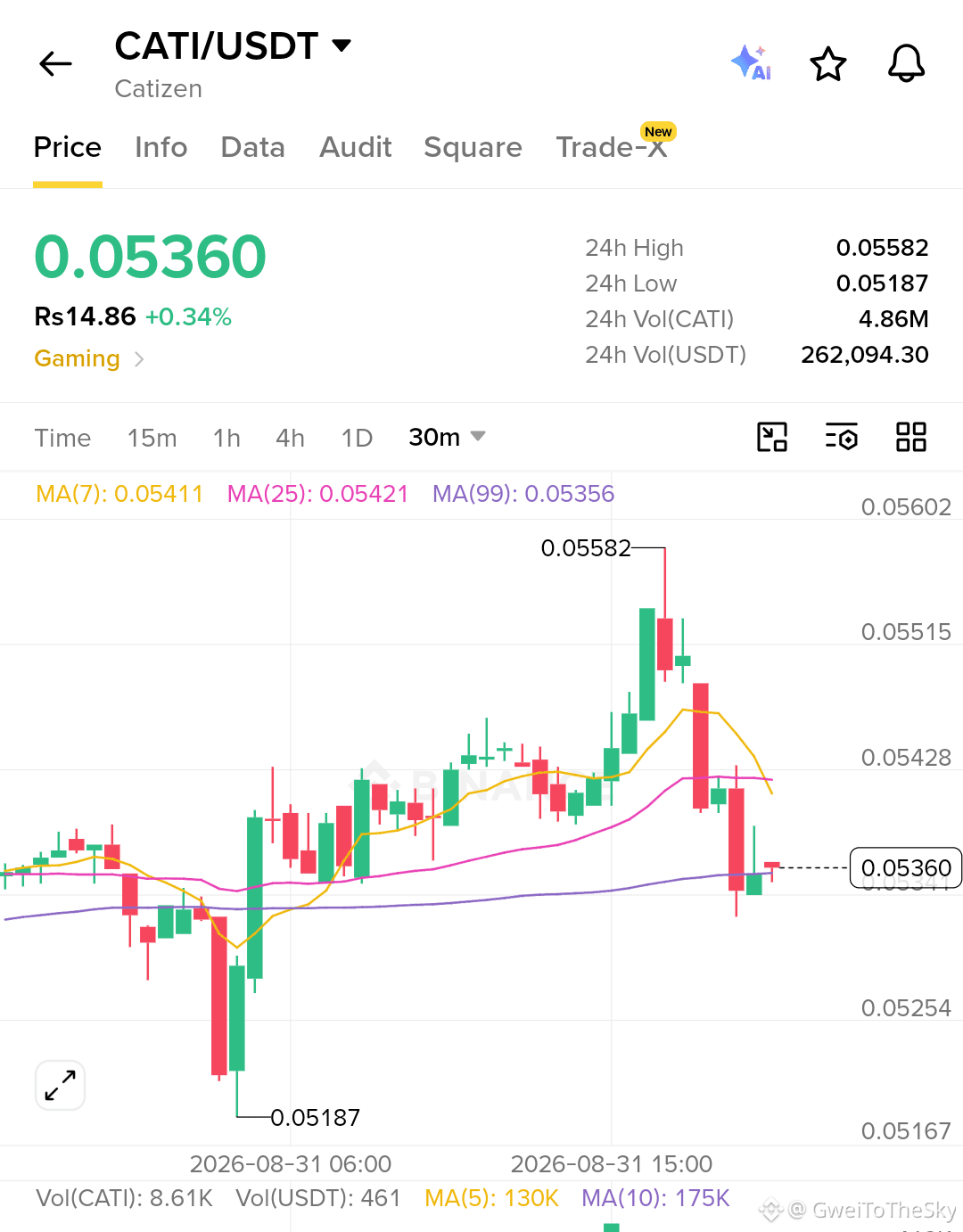
$CATI /$USDT — LONG SETUP 🔥
A CATI está sendo negociada atualmente por volta de 0.05360 USDT no gráfico de 30M. O preço está perto da MA(99) em 0.05356, tornando esta uma zona de decisão importante.
📌 Plano de Trade
🟢 Entrada: 0.05340 – 0.05370
🛑 Stop Loss: 0.05290
🎯 TP1: 0.05430
🎯 TP2: 0.05515
🎯 TP3: 0.05580
📊 Risco/Retorno: Aproximadamente de 1:2 a 1:4+ dependendo da entrada e do objetivo.
Confirmação: Um fechamento forte no 30M acima de 0.05430 fortaleceria a configuração de alta. Se o preço perder 0.05290, a configuração é invalidada.
Não exagere na alavancagem. Risco apenas o que você pode perder e considere garantir lucros parciais em TP1/TP2.
#CATI #cryptouniverseofficial #altcoins
$CATI /$USDT — LONG SETUP 🔥
A CATI está sendo negociada atualmente por volta de 0.05360 USDT no gráfico de 30M. O preço está perto da MA(99) em 0.05356, tornando esta uma zona de decisão importante.
📌 Plano de Trade
🟢 Entrada: 0.05340 – 0.05370
🛑 Stop Loss: 0.05290
🎯 TP1: 0.05430
🎯 TP2: 0.05515
🎯 TP3: 0.05580
📊 Risco/Retorno: Aproximadamente de 1:2 a 1:4+ dependendo da entrada e do objetivo.
Confirmação: Um fechamento forte no 30M acima de 0.05430 fortaleceria a configuração de alta. Se o preço perder 0.05290, a configuração é invalidada.
Não exagere na alavancagem. Risco apenas o que você pode perder e considere garantir lucros parciais em TP1/TP2.
#CATI #cryptouniverseofficial #altcoins
A CATI está sendo negociada atualmente por volta de 0.05360 USDT no gráfico de 30M. O preço está perto da MA(99) em 0.05356, tornando esta uma zona de decisão importante.
📌 Plano de Trade
🟢 Entrada: 0.05340 – 0.05370
🛑 Stop Loss: 0.05290
🎯 TP1: 0.05430
🎯 TP2: 0.05515
🎯 TP3: 0.05580
📊 Risco/Retorno: Aproximadamente de 1:2 a 1:4+ dependendo da entrada e do objetivo.
Confirmação: Um fechamento forte no 30M acima de 0.05430 fortaleceria a configuração de alta. Se o preço perder 0.05290, a configuração é invalidada.
Não exagere na alavancagem. Risco apenas o que você pode perder e considere garantir lucros parciais em TP1/TP2.
#CATI #cryptouniverseofficial #altcoins
1
98
·
--
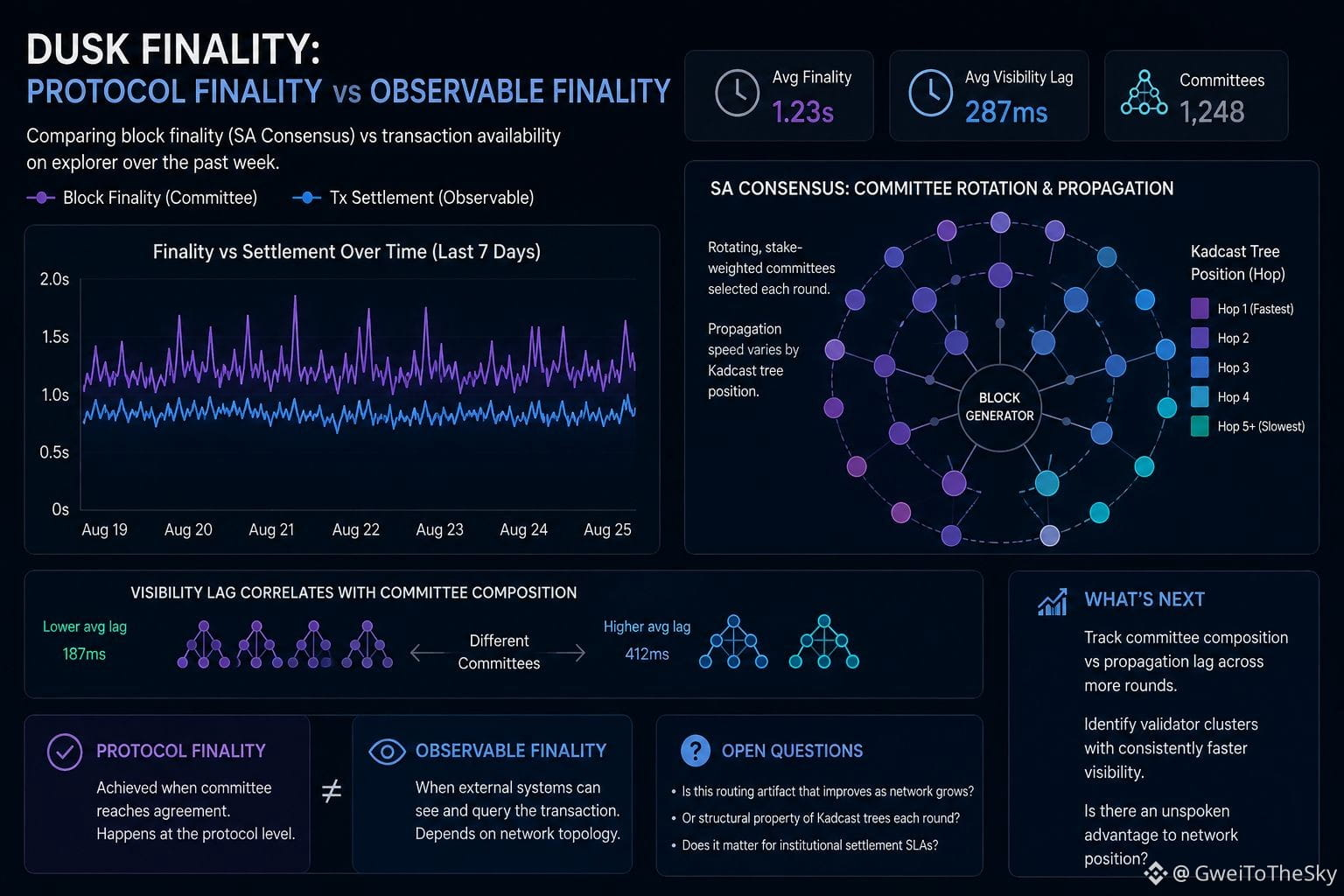
As marcas de tempo de finalização do bloco de @Dusk_Foundation contra o assentamento real da transação no explorador ao longo da última semana. No começo, eu assumi que o pequeno atraso que eu vinha vendo — alguns poucos centenas de milissegundos entre a finalização do comitê e quando uma transação se tornava consultável em ferramentas de downstream — era apenas um atraso de indexação. Deixei isso de lado como ruído e passei a verificar as taxas de participação dos validadores.
Enquanto investigava por que essa lacuna não era constante, descobri que ela se correlacionava com quais membros do comitê foram selecionados para aquela rodada sob o SA Consensus. Comitês rotativos ponderados por stake não escolhem validadores aleatoriamente a cada rodada; eles carregam tempos de propagação ligeiramente diferentes dependendo da posição na árvore do Kadcast. Isso não está documentado em nada do que eu li — apenas apareceu nos dados quando eu alinhei várias rodadas lado a lado.
Isso separou duas coisas na minha cabeça que eu vinha tratando como uma: finalidade de consenso e finalidade observável. A finalidade no nível do protocolo acontece no momento em que o comitê concorda, mas o que um sistema externo vê depende da topologia da rede naquele instante. A maioria das pessoas que acompanha $DUSK assume que "finalidade rápida" significa uniformemente rápida para todo mundo no downstream, e não é exatamente isso que estou vendo.
O que eu ainda não consigo determinar é se essa variação de timing importa para algo além da conveniência de indexação, ou se começa a importar quando sistemas de liquidação institucionais esperam janelas mais estreitas e previsíveis. Isso é um artefato de roteamento que se autocorrige à medida que a rede cresce, ou uma propriedade estrutural de como as árvores do Kadcast se formam a cada rodada.
Para o futuro, quero acompanhar a composição do comitê em relação ao atraso de propagação em uma amostra maior, junto com a verificação de se certos clusters de validadores consistentemente produzem uma visibilidade mais rápida no downstream. Isso me diria se é neutro em termos de incentivos ou se há uma vantagem não dita de posição na rede que os operadores ainda não precificaram.
#Dusk
$BTR
{future}(BTRUSDT)
$BMT
{future}(BMTUSDT)
As marcas de tempo de finalização do bloco de @Dusk contra o assentamento real da transação no explorador ao longo da última semana. No começo, eu assumi que o pequeno atraso que eu vinha vendo — alguns poucos centenas de milissegundos entre a finalização do comitê e quando uma transação se tornava consultável em ferramentas de downstream — era apenas um atraso de indexação. Deixei isso de lado como ruído e passei a verificar as taxas de participação dos validadores.
Enquanto investigava por que essa lacuna não era constante, descobri que ela se correlacionava com quais membros do comitê foram selecionados para aquela rodada sob o SA Consensus. Comitês rotativos ponderados por stake não escolhem validadores aleatoriamente a cada rodada; eles carregam tempos de propagação ligeiramente diferentes dependendo da posição na árvore do Kadcast. Isso não está documentado em nada do que eu li — apenas apareceu nos dados quando eu alinhei várias rodadas lado a lado.
Isso separou duas coisas na minha cabeça que eu vinha tratando como uma: finalidade de consenso e finalidade observável. A finalidade no nível do protocolo acontece no momento em que o comitê concorda, mas o que um sistema externo vê depende da topologia da rede naquele instante. A maioria das pessoas que acompanha $DUSK assume que "finalidade rápida" significa uniformemente rápida para todo mundo no downstream, e não é exatamente isso que estou vendo.
O que eu ainda não consigo determinar é se essa variação de timing importa para algo além da conveniência de indexação, ou se começa a importar quando sistemas de liquidação institucionais esperam janelas mais estreitas e previsíveis. Isso é um artefato de roteamento que se autocorrige à medida que a rede cresce, ou uma propriedade estrutural de como as árvores do Kadcast se formam a cada rodada.
Para o futuro, quero acompanhar a composição do comitê em relação ao atraso de propagação em uma amostra maior, junto com a verificação de se certos clusters de validadores consistentemente produzem uma visibilidade mais rápida no downstream. Isso me diria se é neutro em termos de incentivos ou se há uma vantagem não dita de posição na rede que os operadores ainda não precificaram.
#Dusk
$BTR
$BMT
Enquanto investigava por que essa lacuna não era constante, descobri que ela se correlacionava com quais membros do comitê foram selecionados para aquela rodada sob o SA Consensus. Comitês rotativos ponderados por stake não escolhem validadores aleatoriamente a cada rodada; eles carregam tempos de propagação ligeiramente diferentes dependendo da posição na árvore do Kadcast. Isso não está documentado em nada do que eu li — apenas apareceu nos dados quando eu alinhei várias rodadas lado a lado.
Isso separou duas coisas na minha cabeça que eu vinha tratando como uma: finalidade de consenso e finalidade observável. A finalidade no nível do protocolo acontece no momento em que o comitê concorda, mas o que um sistema externo vê depende da topologia da rede naquele instante. A maioria das pessoas que acompanha $DUSK assume que "finalidade rápida" significa uniformemente rápida para todo mundo no downstream, e não é exatamente isso que estou vendo.
O que eu ainda não consigo determinar é se essa variação de timing importa para algo além da conveniência de indexação, ou se começa a importar quando sistemas de liquidação institucionais esperam janelas mais estreitas e previsíveis. Isso é um artefato de roteamento que se autocorrige à medida que a rede cresce, ou uma propriedade estrutural de como as árvores do Kadcast se formam a cada rodada.
Para o futuro, quero acompanhar a composição do comitê em relação ao atraso de propagação em uma amostra maior, junto com a verificação de se certos clusters de validadores consistentemente produzem uma visibilidade mais rápida no downstream. Isso me diria se é neutro em termos de incentivos ou se há uma vantagem não dita de posição na rede que os operadores ainda não precificaram.
#Dusk
$BTR
$BMT
3
294
·
--
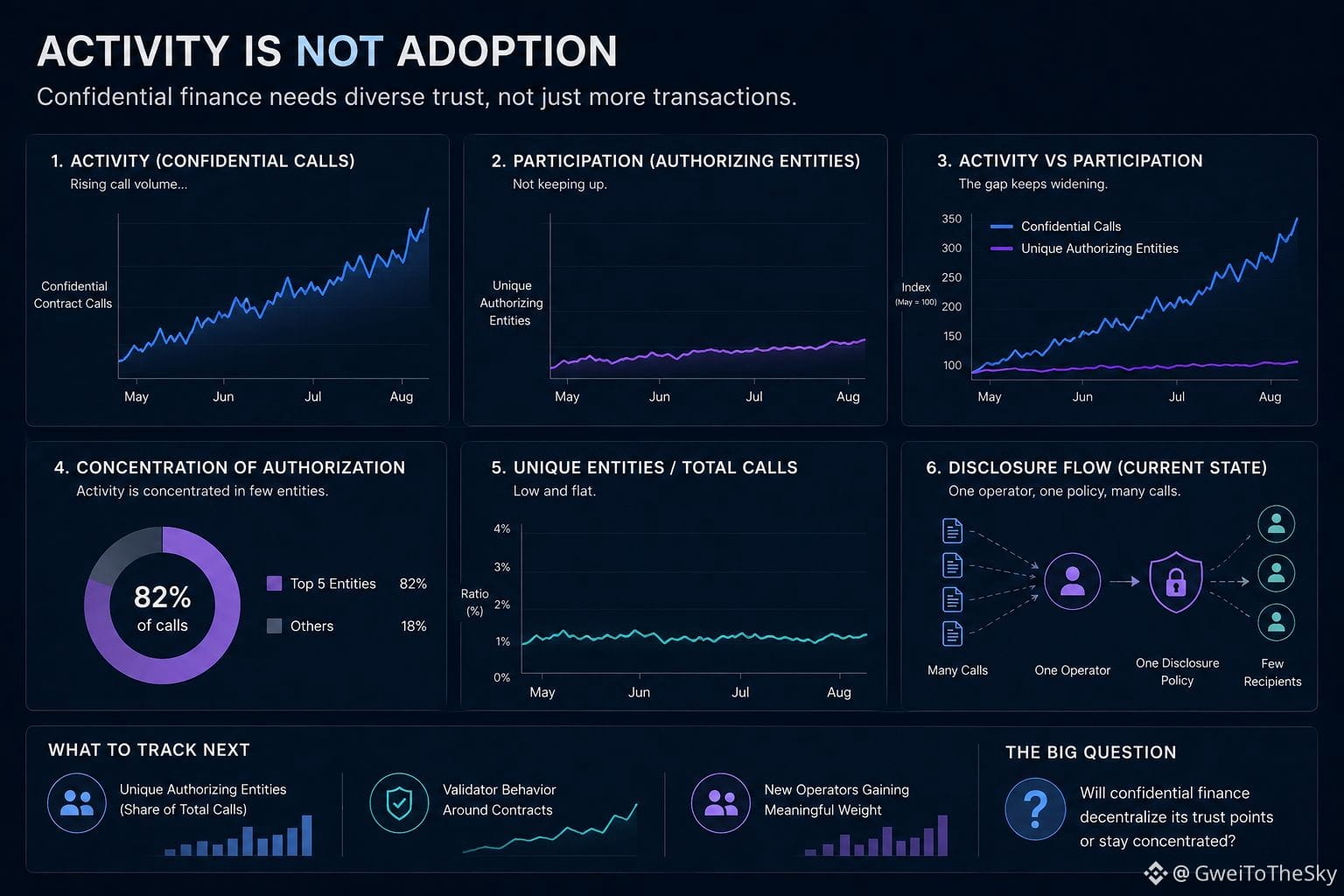
@Dusk_Foundation instância de exploração na semana passada. Eu presumi que um pico nas chamadas de contratos confidenciais significava nova atividade de usuários, mas as assinaturas em nível de carteira por trás dessas chamadas continuavam apontando para um pequeno cluster de endereços.
Ao investigar mais a fundo, descobri que o mecanismo real que fazia o trabalho não era o próprio volume de transações, e sim a camada de divulgação seletiva que fica por baixo. Cada chamada estava sendo roteada pela mesma política de divulgação, o que significa que a “atividade” que eu estava vendo era, na verdade, um único operador alternando solicitações de autorização por meio de contratos no estilo XSC, em vez de um uso orgânico se espalhando para fora.
Essa distinção mudou a forma como eu penso sobre adoção aqui. Contagem de transações e diversidade de autorizações não são o mesmo tipo de sinal. Uma cadeia pode mostrar aumento no volume de chamadas, enquanto o conjunto real de entidades que decide o que é divulgado para quem permanece restrito. A lacuna de segunda ordem entre atividade e participação é fácil de ignorar se você só traça o throughput.
O que ainda não consigo resolver é se essa concentração é uma fase de bootstrap ou uma característica estrutural de como essas “trilhas” de finanças confidenciais naturalmente se comportam. Contrapartes reguladas podem preferir menos pontos de divulgação confiáveis no início, mas eu não sei se o desenho de incentivos leva a ampliar esse conjunto com o tempo ou se premia silenciosamente a permanência estreita.
No futuro, quero acompanhar entidades autorizadoras únicas em relação ao total de chamadas confidenciais, não apenas o volume bruto. Também estou observando se o comportamento de validadores em torno desses contratos muda à medida que as solicitações de divulgação se diversificam, e se operadores novos que entram realmente ganham um peso de autorização significativo ou apenas adicionam ruído à contagem.
Fiquei sem uma conclusão clara, apenas uma pergunta mais precisa: a privacidade “by design” nas finanças eventualmente descentraliza seus pontos de confiança, ou ela favorece estruturalmente um pequeno número de gatekeepers que controlam a divulgação. Eu não acho que os dados que vi até agora respondam a qualquer um dos lados.
#Dusk
$DUSK
{future}(DUSKUSDT)
$BMT
{future}(BMTUSDT)
$ZRO
{future}(ZROUSDT)
@Dusk instância de exploração na semana passada. Eu presumi que um pico nas chamadas de contratos confidenciais significava nova atividade de usuários, mas as assinaturas em nível de carteira por trás dessas chamadas continuavam apontando para um pequeno cluster de endereços.
Ao investigar mais a fundo, descobri que o mecanismo real que fazia o trabalho não era o próprio volume de transações, e sim a camada de divulgação seletiva que fica por baixo. Cada chamada estava sendo roteada pela mesma política de divulgação, o que significa que a “atividade” que eu estava vendo era, na verdade, um único operador alternando solicitações de autorização por meio de contratos no estilo XSC, em vez de um uso orgânico se espalhando para fora.
Essa distinção mudou a forma como eu penso sobre adoção aqui. Contagem de transações e diversidade de autorizações não são o mesmo tipo de sinal. Uma cadeia pode mostrar aumento no volume de chamadas, enquanto o conjunto real de entidades que decide o que é divulgado para quem permanece restrito. A lacuna de segunda ordem entre atividade e participação é fácil de ignorar se você só traça o throughput.
O que ainda não consigo resolver é se essa concentração é uma fase de bootstrap ou uma característica estrutural de como essas “trilhas” de finanças confidenciais naturalmente se comportam. Contrapartes reguladas podem preferir menos pontos de divulgação confiáveis no início, mas eu não sei se o desenho de incentivos leva a ampliar esse conjunto com o tempo ou se premia silenciosamente a permanência estreita.
No futuro, quero acompanhar entidades autorizadoras únicas em relação ao total de chamadas confidenciais, não apenas o volume bruto. Também estou observando se o comportamento de validadores em torno desses contratos muda à medida que as solicitações de divulgação se diversificam, e se operadores novos que entram realmente ganham um peso de autorização significativo ou apenas adicionam ruído à contagem.
Fiquei sem uma conclusão clara, apenas uma pergunta mais precisa: a privacidade “by design” nas finanças eventualmente descentraliza seus pontos de confiança, ou ela favorece estruturalmente um pequeno número de gatekeepers que controlam a divulgação. Eu não acho que os dados que vi até agora respondam a qualquer um dos lados.
#Dusk
$DUSK
$BMT
$ZRO
Ao investigar mais a fundo, descobri que o mecanismo real que fazia o trabalho não era o próprio volume de transações, e sim a camada de divulgação seletiva que fica por baixo. Cada chamada estava sendo roteada pela mesma política de divulgação, o que significa que a “atividade” que eu estava vendo era, na verdade, um único operador alternando solicitações de autorização por meio de contratos no estilo XSC, em vez de um uso orgânico se espalhando para fora.
Essa distinção mudou a forma como eu penso sobre adoção aqui. Contagem de transações e diversidade de autorizações não são o mesmo tipo de sinal. Uma cadeia pode mostrar aumento no volume de chamadas, enquanto o conjunto real de entidades que decide o que é divulgado para quem permanece restrito. A lacuna de segunda ordem entre atividade e participação é fácil de ignorar se você só traça o throughput.
O que ainda não consigo resolver é se essa concentração é uma fase de bootstrap ou uma característica estrutural de como essas “trilhas” de finanças confidenciais naturalmente se comportam. Contrapartes reguladas podem preferir menos pontos de divulgação confiáveis no início, mas eu não sei se o desenho de incentivos leva a ampliar esse conjunto com o tempo ou se premia silenciosamente a permanência estreita.
No futuro, quero acompanhar entidades autorizadoras únicas em relação ao total de chamadas confidenciais, não apenas o volume bruto. Também estou observando se o comportamento de validadores em torno desses contratos muda à medida que as solicitações de divulgação se diversificam, e se operadores novos que entram realmente ganham um peso de autorização significativo ou apenas adicionam ruído à contagem.
Fiquei sem uma conclusão clara, apenas uma pergunta mais precisa: a privacidade “by design” nas finanças eventualmente descentraliza seus pontos de confiança, ou ela favorece estruturalmente um pequeno número de gatekeepers que controlam a divulgação. Eu não acho que os dados que vi até agora respondam a qualquer um dos lados.
#Dusk
$DUSK
$BMT
$ZRO
4
274
·
--
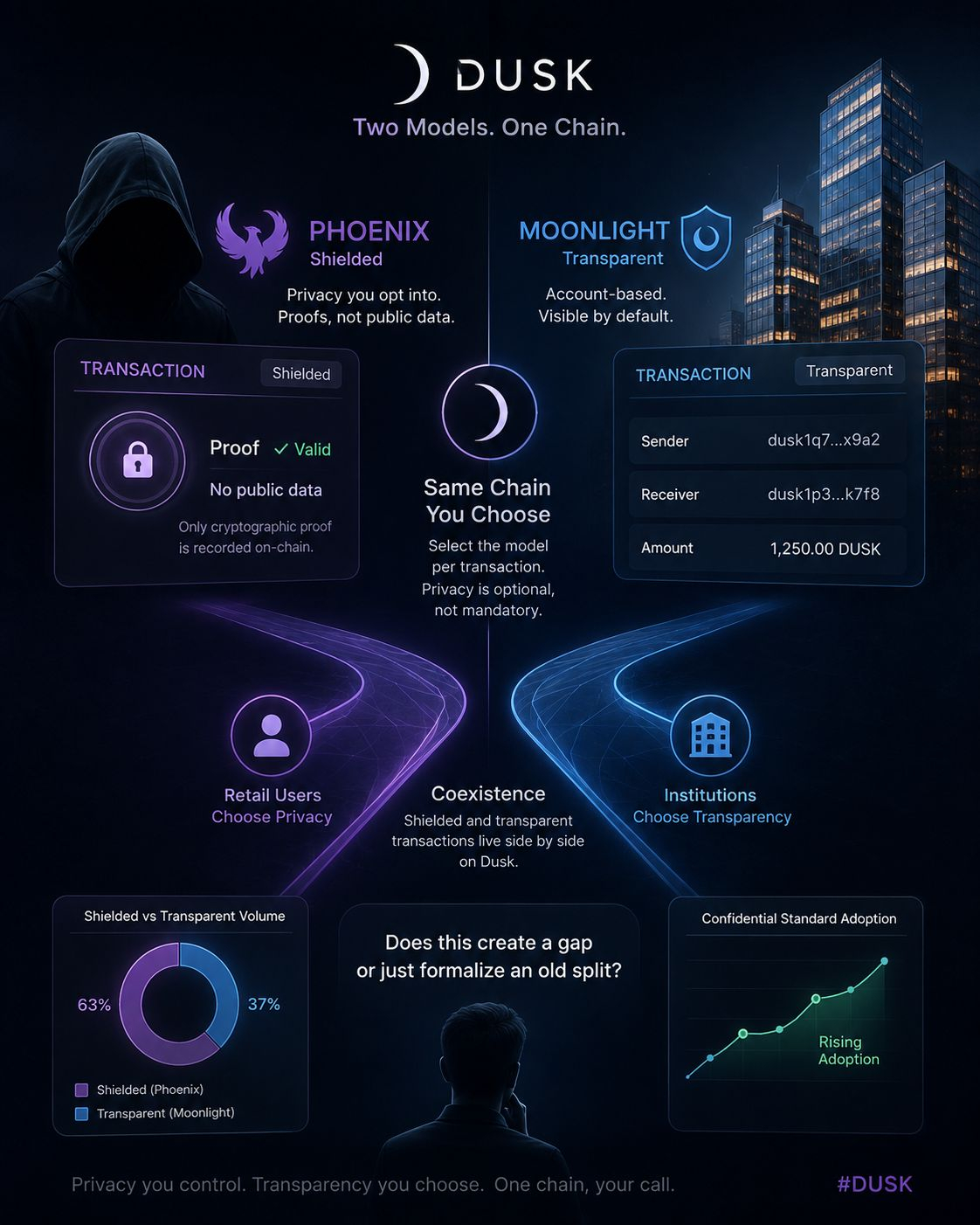
Um dia, ao entardecer, o explorador de Dusk estava meio atento, quando algo pareceu estranho. Algumas transações mostravam remetente, destinatário e valor; outras eram apenas uma prova, sem nada legível. Meu primeiro pensamento foi que o explorador estivesse com algum bug.
Descobri que não era isso. A Dusk roda dois modelos lado a lado: Phoenix, protegido, e Moonlight, transparente, baseados em conta. Ninguém te força a ficar em um só—você escolhe por transação, e foi isso que eu vi.
Foi então que minha forma de pensar mudou. Eu costumava colocar “privacy chain” e “privado por padrão” no mesmo saco. Aqui não bate. Privacidade é algo em que você opta, não algo embutido; então atividades ocultas e visíveis coexistem.
Ainda estou refletindo. Se dinheiro regulamentado continuar transparente enquanto o varejo ficar protegido, isso cria uma lacuna, ou apenas formaliza uma divisão antiga?
Por enquanto, estou acompanhando a proporção entre volume protegido e transparente, não os números brutos—além de quantos contratos adotam o padrão confidencial em vez de ficar no padrão transparente.
Honestamente, não sei se isso gera um mercado mais saudável ou só divide a liquidez em salas que nunca conversam. Ainda estou com isso na cabeça.
@Dusk_Foundation #Dusk
$DUSK
{future}(DUSKUSDT)
$TAC
{future}(TACUSDT)
$ONG
{future}(ONGUSDT)
Um dia, ao entardecer, o explorador de Dusk estava meio atento, quando algo pareceu estranho. Algumas transações mostravam remetente, destinatário e valor; outras eram apenas uma prova, sem nada legível. Meu primeiro pensamento foi que o explorador estivesse com algum bug.
Descobri que não era isso. A Dusk roda dois modelos lado a lado: Phoenix, protegido, e Moonlight, transparente, baseados em conta. Ninguém te força a ficar em um só—você escolhe por transação, e foi isso que eu vi.
Foi então que minha forma de pensar mudou. Eu costumava colocar “privacy chain” e “privado por padrão” no mesmo saco. Aqui não bate. Privacidade é algo em que você opta, não algo embutido; então atividades ocultas e visíveis coexistem.
Ainda estou refletindo. Se dinheiro regulamentado continuar transparente enquanto o varejo ficar protegido, isso cria uma lacuna, ou apenas formaliza uma divisão antiga?
Por enquanto, estou acompanhando a proporção entre volume protegido e transparente, não os números brutos—além de quantos contratos adotam o padrão confidencial em vez de ficar no padrão transparente.
Honestamente, não sei se isso gera um mercado mais saudável ou só divide a liquidez em salas que nunca conversam. Ainda estou com isso na cabeça.
@Dusk #Dusk
$DUSK
$TAC
$ONG
Descobri que não era isso. A Dusk roda dois modelos lado a lado: Phoenix, protegido, e Moonlight, transparente, baseados em conta. Ninguém te força a ficar em um só—você escolhe por transação, e foi isso que eu vi.
Foi então que minha forma de pensar mudou. Eu costumava colocar “privacy chain” e “privado por padrão” no mesmo saco. Aqui não bate. Privacidade é algo em que você opta, não algo embutido; então atividades ocultas e visíveis coexistem.
Ainda estou refletindo. Se dinheiro regulamentado continuar transparente enquanto o varejo ficar protegido, isso cria uma lacuna, ou apenas formaliza uma divisão antiga?
Por enquanto, estou acompanhando a proporção entre volume protegido e transparente, não os números brutos—além de quantos contratos adotam o padrão confidencial em vez de ficar no padrão transparente.
Honestamente, não sei se isso gera um mercado mais saudável ou só divide a liquidez em salas que nunca conversam. Ainda estou com isso na cabeça.
@Dusk #Dusk
$DUSK
$TAC
$ONG
3
5
495
·
--
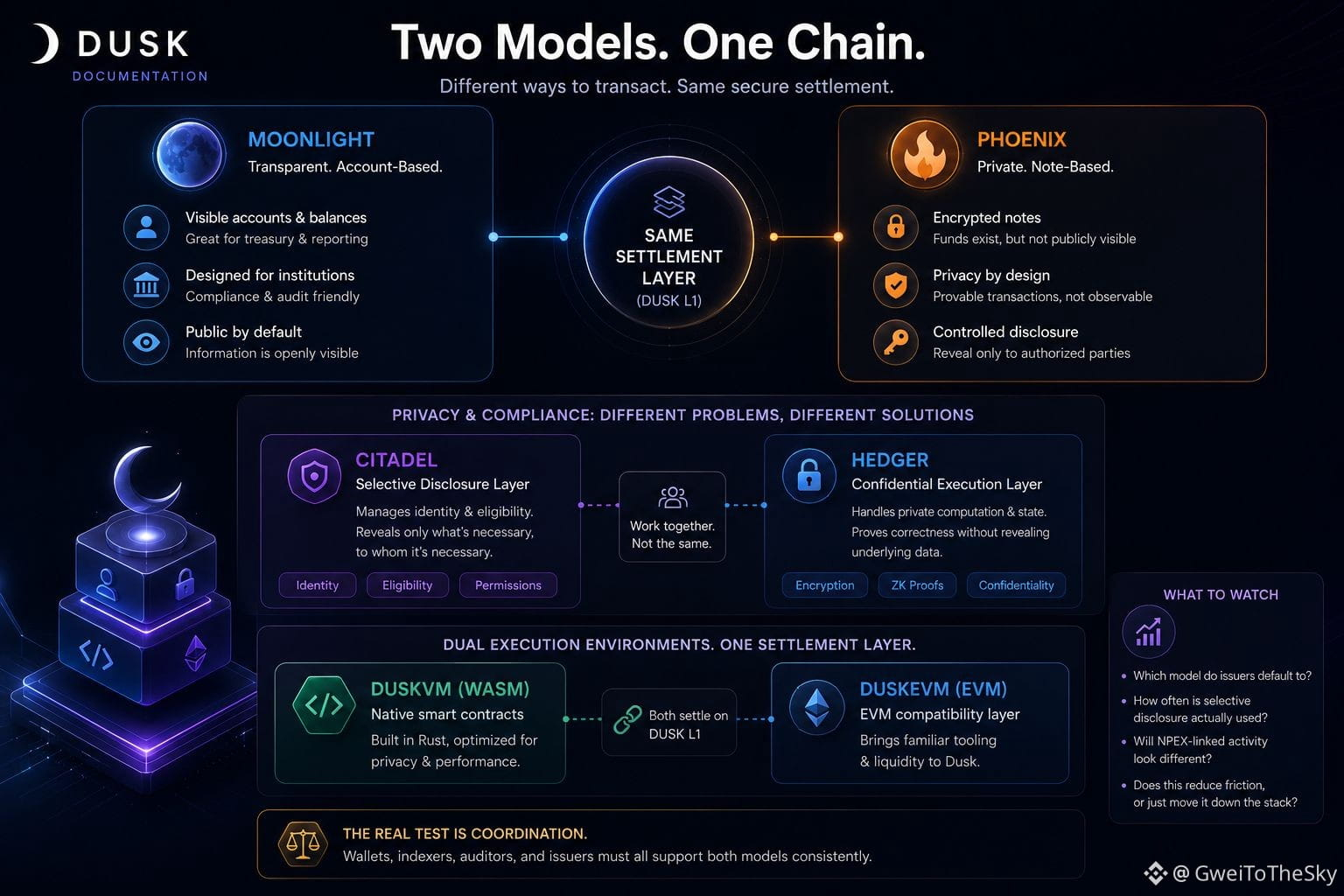
Em vez de um gráfico, a documentação de Dusk; eu assumi que Moonlight e Phoenix eram apenas duas opções de carteira — uma transparente versus uma privada — escolha a sua preferência. Essa formulação não sobreviveu a uma leitura mais atenta.
O que mudou a minha visão foi perceber que não são modos intercambiáveis, mas sim modelos de transação separados que se assentam na mesma cadeia. Moonlight se comporta como um livro-razão de conta visível, útil para tesouraria e relatórios. Phoenix mantém os fundos como notas criptografadas: verificáveis, mas não observáveis. A mesma camada de liquidação, duas superfícies de informação diferentes.
Essa distinção importa porque privacidade e conformidade são tratadas como opostos em grande parte do discurso cripto. Aqui elas são separadas por design: Citadel cuida da divulgação seletiva de atributos de identidade, Hedger cuida da execução confidencial do lado da EVM. Comprovar elegibilidade e ocultar uma posição acabam sendo problemas diferentes, resolvidos de maneiras diferentes.
O que ainda não consigo resolver é o custo de coordenação. Executar dois modelos de transação e dois ambientes de execução (WASM nativo além da EVM) significa mais área de superfície para carteiras, indexadores e auditores precisarem dar suporte de forma consistente. Elegante no papel não garante ferramentas uniformes na prática.
Para frente, prefiro observar em quais modelos os emissores realmente acabam dando padrão, com que frequência a divulgação seletiva é acionada em vez de apenas discutida, e se a atividade vinculada a NPEX se comporta de maneira diferente de transferências comuns.
Ainda não está claro para mim se essa arquitetura reduz atrito ou apenas o desloca mais adiante na pilha.
@Dusk_Foundation #Dusk
$DUSK
{future}(DUSKUSDT)
$MORPHO
{future}(MORPHOUSDT)
$TRUMP
{future}(TRUMPUSDT)
Em vez de um gráfico, a documentação de Dusk; eu assumi que Moonlight e Phoenix eram apenas duas opções de carteira — uma transparente versus uma privada — escolha a sua preferência. Essa formulação não sobreviveu a uma leitura mais atenta.
O que mudou a minha visão foi perceber que não são modos intercambiáveis, mas sim modelos de transação separados que se assentam na mesma cadeia. Moonlight se comporta como um livro-razão de conta visível, útil para tesouraria e relatórios. Phoenix mantém os fundos como notas criptografadas: verificáveis, mas não observáveis. A mesma camada de liquidação, duas superfícies de informação diferentes.
Essa distinção importa porque privacidade e conformidade são tratadas como opostos em grande parte do discurso cripto. Aqui elas são separadas por design: Citadel cuida da divulgação seletiva de atributos de identidade, Hedger cuida da execução confidencial do lado da EVM. Comprovar elegibilidade e ocultar uma posição acabam sendo problemas diferentes, resolvidos de maneiras diferentes.
O que ainda não consigo resolver é o custo de coordenação. Executar dois modelos de transação e dois ambientes de execução (WASM nativo além da EVM) significa mais área de superfície para carteiras, indexadores e auditores precisarem dar suporte de forma consistente. Elegante no papel não garante ferramentas uniformes na prática.
Para frente, prefiro observar em quais modelos os emissores realmente acabam dando padrão, com que frequência a divulgação seletiva é acionada em vez de apenas discutida, e se a atividade vinculada a NPEX se comporta de maneira diferente de transferências comuns.
Ainda não está claro para mim se essa arquitetura reduz atrito ou apenas o desloca mais adiante na pilha.
@Dusk #Dusk
$DUSK
$MORPHO
$TRUMP
O que mudou a minha visão foi perceber que não são modos intercambiáveis, mas sim modelos de transação separados que se assentam na mesma cadeia. Moonlight se comporta como um livro-razão de conta visível, útil para tesouraria e relatórios. Phoenix mantém os fundos como notas criptografadas: verificáveis, mas não observáveis. A mesma camada de liquidação, duas superfícies de informação diferentes.
Essa distinção importa porque privacidade e conformidade são tratadas como opostos em grande parte do discurso cripto. Aqui elas são separadas por design: Citadel cuida da divulgação seletiva de atributos de identidade, Hedger cuida da execução confidencial do lado da EVM. Comprovar elegibilidade e ocultar uma posição acabam sendo problemas diferentes, resolvidos de maneiras diferentes.
O que ainda não consigo resolver é o custo de coordenação. Executar dois modelos de transação e dois ambientes de execução (WASM nativo além da EVM) significa mais área de superfície para carteiras, indexadores e auditores precisarem dar suporte de forma consistente. Elegante no papel não garante ferramentas uniformes na prática.
Para frente, prefiro observar em quais modelos os emissores realmente acabam dando padrão, com que frequência a divulgação seletiva é acionada em vez de apenas discutida, e se a atividade vinculada a NPEX se comporta de maneira diferente de transferências comuns.
Ainda não está claro para mim se essa arquitetura reduz atrito ou apenas o desloca mais adiante na pilha.
@Dusk #Dusk
$DUSK
$MORPHO
$TRUMP
5
6
269
·
--
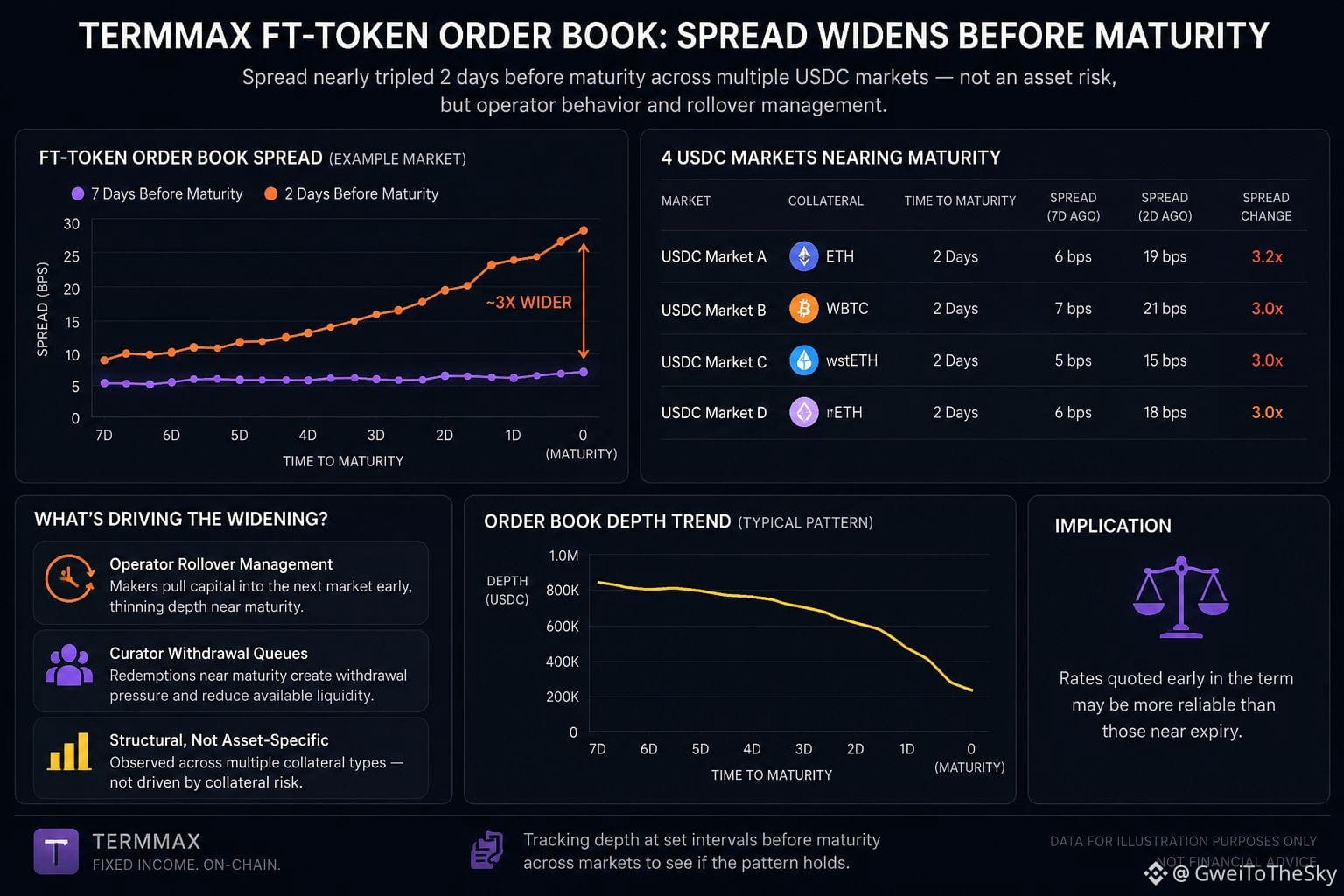
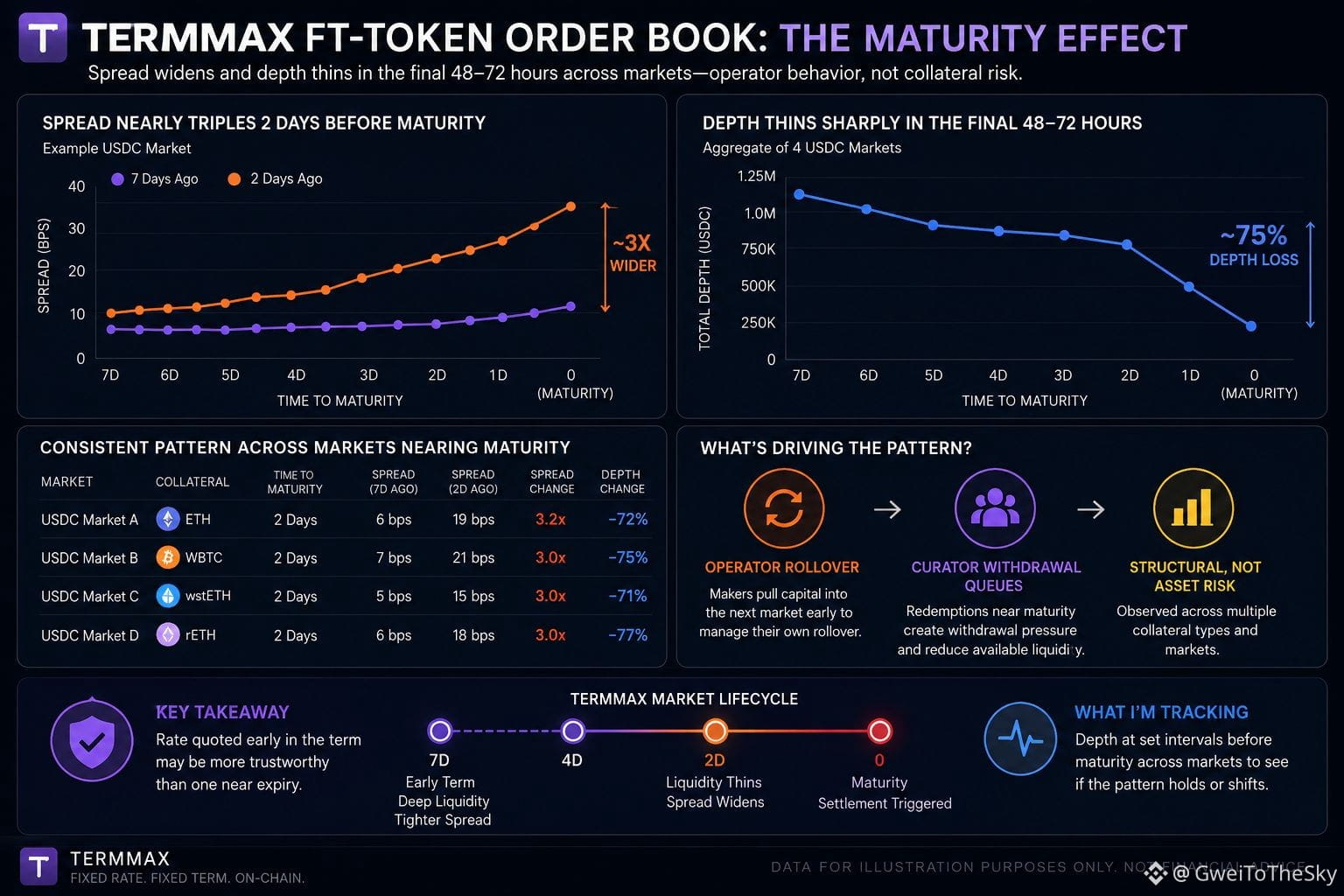
O livro de ordens ft-token da TermMax dois dias antes da maturidade de um mercado: percebi que o spread havia se alargado quase três vezes em relação à semana anterior. No começo, presumi que o risco de colateral estava sendo precificado.
Constatei isso ao analisar mais três mercados em USDC se aproximando da maturidade e encontrei o mesmo padrão: o volume/liquidez (depth) afinava de forma acentuada nas últimas 48–72 horas, independentemente do tipo de colateral. Isso eliminou um susto específico de um ativo.
O que eu não tinha considerado era o comportamento dos operadores. Os market makers que cotam taxas fixas não estão apenas precificando risco de crédito: eles também administram sua própria rolagem (rollover). Perto da maturidade, eles puxam capital para o próximo mercado mais cedo, afinando o livro em vez de refletir confiança no colateral.
Ainda não sei se isso é um comportamento coordenado dos makers ou um interesse próprio em paralelo; ou ainda se filas de retirada do curador estão processando resgates perto da maturidade, tornando isso estrutural.
Agora estou acompanhando a liquidez em intervalos regulares antes da maturidade em diferentes mercados, para ver se a queda se mantém consistente ou se muda.
Se o padrão se confirmar, a taxa cotada no início de um termo pode ser mais confiável do que a cotada perto do vencimento. Alguém notou isso?
@termmax #termmax
$GALA
{future}(GALAUSDT)
$BLESS
{future}(BLESSUSDT)
$GPS
{future}(GPSUSDT)
O livro de ordens ft-token da TermMax dois dias antes da maturidade de um mercado: percebi que o spread havia se alargado quase três vezes em relação à semana anterior. No começo, presumi que o risco de colateral estava sendo precificado.
Constatei isso ao analisar mais três mercados em USDC se aproximando da maturidade e encontrei o mesmo padrão: o volume/liquidez (depth) afinava de forma acentuada nas últimas 48–72 horas, independentemente do tipo de colateral. Isso eliminou um susto específico de um ativo.
O que eu não tinha considerado era o comportamento dos operadores. Os market makers que cotam taxas fixas não estão apenas precificando risco de crédito: eles também administram sua própria rolagem (rollover). Perto da maturidade, eles puxam capital para o próximo mercado mais cedo, afinando o livro em vez de refletir confiança no colateral.
Ainda não sei se isso é um comportamento coordenado dos makers ou um interesse próprio em paralelo; ou ainda se filas de retirada do curador estão processando resgates perto da maturidade, tornando isso estrutural.
Agora estou acompanhando a liquidez em intervalos regulares antes da maturidade em diferentes mercados, para ver se a queda se mantém consistente ou se muda.
Se o padrão se confirmar, a taxa cotada no início de um termo pode ser mais confiável do que a cotada perto do vencimento. Alguém notou isso?
@TermMax #termmax
$GALA
$BLESS
$GPS
Constatei isso ao analisar mais três mercados em USDC se aproximando da maturidade e encontrei o mesmo padrão: o volume/liquidez (depth) afinava de forma acentuada nas últimas 48–72 horas, independentemente do tipo de colateral. Isso eliminou um susto específico de um ativo.
O que eu não tinha considerado era o comportamento dos operadores. Os market makers que cotam taxas fixas não estão apenas precificando risco de crédito: eles também administram sua própria rolagem (rollover). Perto da maturidade, eles puxam capital para o próximo mercado mais cedo, afinando o livro em vez de refletir confiança no colateral.
Ainda não sei se isso é um comportamento coordenado dos makers ou um interesse próprio em paralelo; ou ainda se filas de retirada do curador estão processando resgates perto da maturidade, tornando isso estrutural.
Agora estou acompanhando a liquidez em intervalos regulares antes da maturidade em diferentes mercados, para ver se a queda se mantém consistente ou se muda.
Se o padrão se confirmar, a taxa cotada no início de um termo pode ser mais confiável do que a cotada perto do vencimento. Alguém notou isso?
@TermMax #termmax
$GALA
$BLESS
$GPS
3
276
·
--
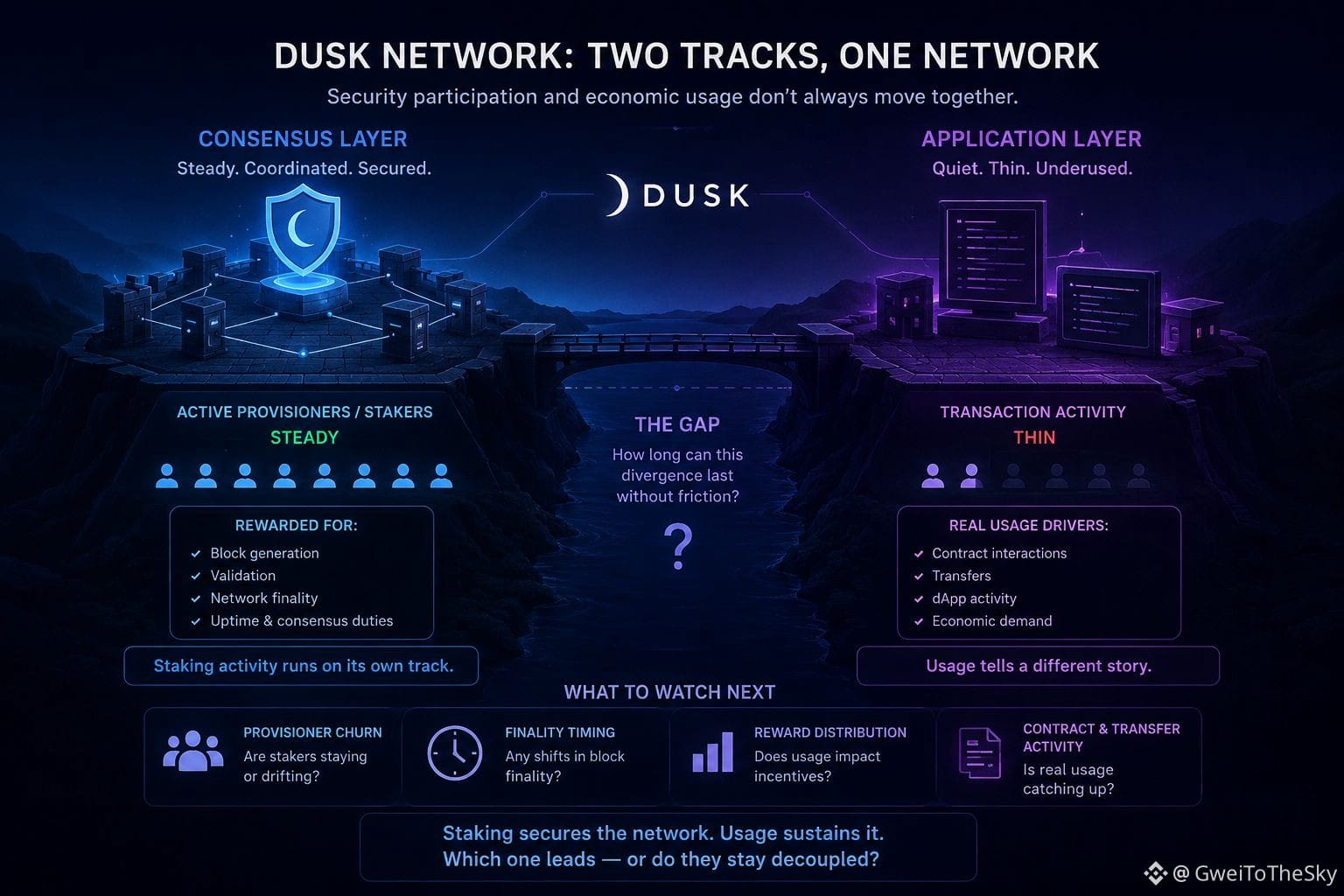
Ao verificar o explorador de Dusk na semana passada, os provedores ativos com staking na rede pareciam estáveis, quase saudáveis, mas a contagem de transações abaixo continuava baixa. Assumi que isso significava que o staking estava, em grande parte, ocioso, estacionado em busca de rendimento, com pouca participação real por trás.
Ao investigar mais a fundo, descobri que a discrepância vem de como a Dusk separa a participação no consenso da execução de transações. Os provedores recebem recompensas pela sua função na geração e validação de blocos por meio do processo de acordo segregado da rede — uma obrigação que continua quer os usuários estejam transacionando ou não. A atividade de staking e o uso da rede parecem seguir trilhas quase independentes.
Isso mudou a forma como eu interpretava os dados. Eu estava tratando participação de segurança e uso econômico como um único sinal, quando claramente não são. Uma rede pode parecer segura e coordenada na camada de consenso enquanto permanece silenciosa na camada de aplicação, e nenhum dos números diz muito sobre o outro por si só.
O que ainda não consigo resolver é por quanto tempo esse descompasso se mantém sem fricção. Se os provedores são compensados principalmente por disponibilidade e deveres de consenso, o uso precisa eventualmente acompanhar para que os incentivos permaneçam equilibrados, ou a participação de validadores pode se manter estável indefinidamente por conta própria?
Para a frente, quero acompanhar a rotatividade dos provedores junto com a atividade real de contratos e transferências, e não apenas com os totais de staking. A retenção entre os menores participantes do staking, mudanças no timing da finalização e qualquer alteração na distribuição de recompensas à medida que o uso se move me diriam mais do que os números de staking em manchete.
Ainda não tenho certeza de qual lado puxa o outro aqui: se o uso eventualmente puxa o comportamento de staking com ele ou se os dois realmente permanecem desacoplados. É essa parte que eu continuo pensando.
@Dusk_Foundation #Dusk
$DUSK
{future}(DUSKUSDT)
$ZEC
{future}(ZECUSDT)
$ENA
{future}(ENAUSDT)
Ao verificar o explorador de Dusk na semana passada, os provedores ativos com staking na rede pareciam estáveis, quase saudáveis, mas a contagem de transações abaixo continuava baixa. Assumi que isso significava que o staking estava, em grande parte, ocioso, estacionado em busca de rendimento, com pouca participação real por trás.
Ao investigar mais a fundo, descobri que a discrepância vem de como a Dusk separa a participação no consenso da execução de transações. Os provedores recebem recompensas pela sua função na geração e validação de blocos por meio do processo de acordo segregado da rede — uma obrigação que continua quer os usuários estejam transacionando ou não. A atividade de staking e o uso da rede parecem seguir trilhas quase independentes.
Isso mudou a forma como eu interpretava os dados. Eu estava tratando participação de segurança e uso econômico como um único sinal, quando claramente não são. Uma rede pode parecer segura e coordenada na camada de consenso enquanto permanece silenciosa na camada de aplicação, e nenhum dos números diz muito sobre o outro por si só.
O que ainda não consigo resolver é por quanto tempo esse descompasso se mantém sem fricção. Se os provedores são compensados principalmente por disponibilidade e deveres de consenso, o uso precisa eventualmente acompanhar para que os incentivos permaneçam equilibrados, ou a participação de validadores pode se manter estável indefinidamente por conta própria?
Para a frente, quero acompanhar a rotatividade dos provedores junto com a atividade real de contratos e transferências, e não apenas com os totais de staking. A retenção entre os menores participantes do staking, mudanças no timing da finalização e qualquer alteração na distribuição de recompensas à medida que o uso se move me diriam mais do que os números de staking em manchete.
Ainda não tenho certeza de qual lado puxa o outro aqui: se o uso eventualmente puxa o comportamento de staking com ele ou se os dois realmente permanecem desacoplados. É essa parte que eu continuo pensando.
@Dusk #Dusk
$DUSK
$ZEC
$ENA
Ao investigar mais a fundo, descobri que a discrepância vem de como a Dusk separa a participação no consenso da execução de transações. Os provedores recebem recompensas pela sua função na geração e validação de blocos por meio do processo de acordo segregado da rede — uma obrigação que continua quer os usuários estejam transacionando ou não. A atividade de staking e o uso da rede parecem seguir trilhas quase independentes.
Isso mudou a forma como eu interpretava os dados. Eu estava tratando participação de segurança e uso econômico como um único sinal, quando claramente não são. Uma rede pode parecer segura e coordenada na camada de consenso enquanto permanece silenciosa na camada de aplicação, e nenhum dos números diz muito sobre o outro por si só.
O que ainda não consigo resolver é por quanto tempo esse descompasso se mantém sem fricção. Se os provedores são compensados principalmente por disponibilidade e deveres de consenso, o uso precisa eventualmente acompanhar para que os incentivos permaneçam equilibrados, ou a participação de validadores pode se manter estável indefinidamente por conta própria?
Para a frente, quero acompanhar a rotatividade dos provedores junto com a atividade real de contratos e transferências, e não apenas com os totais de staking. A retenção entre os menores participantes do staking, mudanças no timing da finalização e qualquer alteração na distribuição de recompensas à medida que o uso se move me diriam mais do que os números de staking em manchete.
Ainda não tenho certeza de qual lado puxa o outro aqui: se o uso eventualmente puxa o comportamento de staking com ele ou se os dois realmente permanecem desacoplados. É essa parte que eu continuo pensando.
@Dusk #Dusk
$DUSK
$ZEC
$ENA
2
5
480
·
--
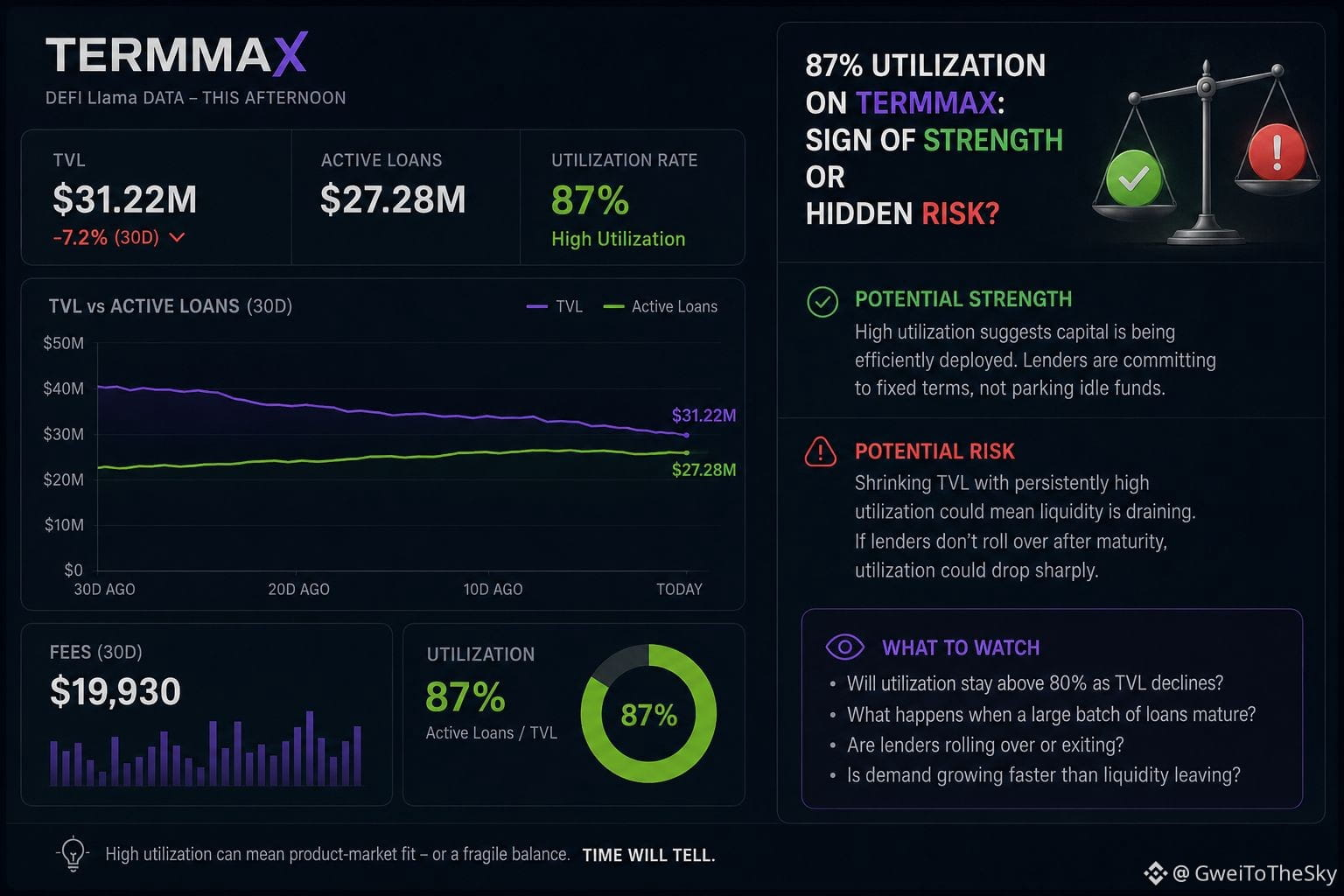
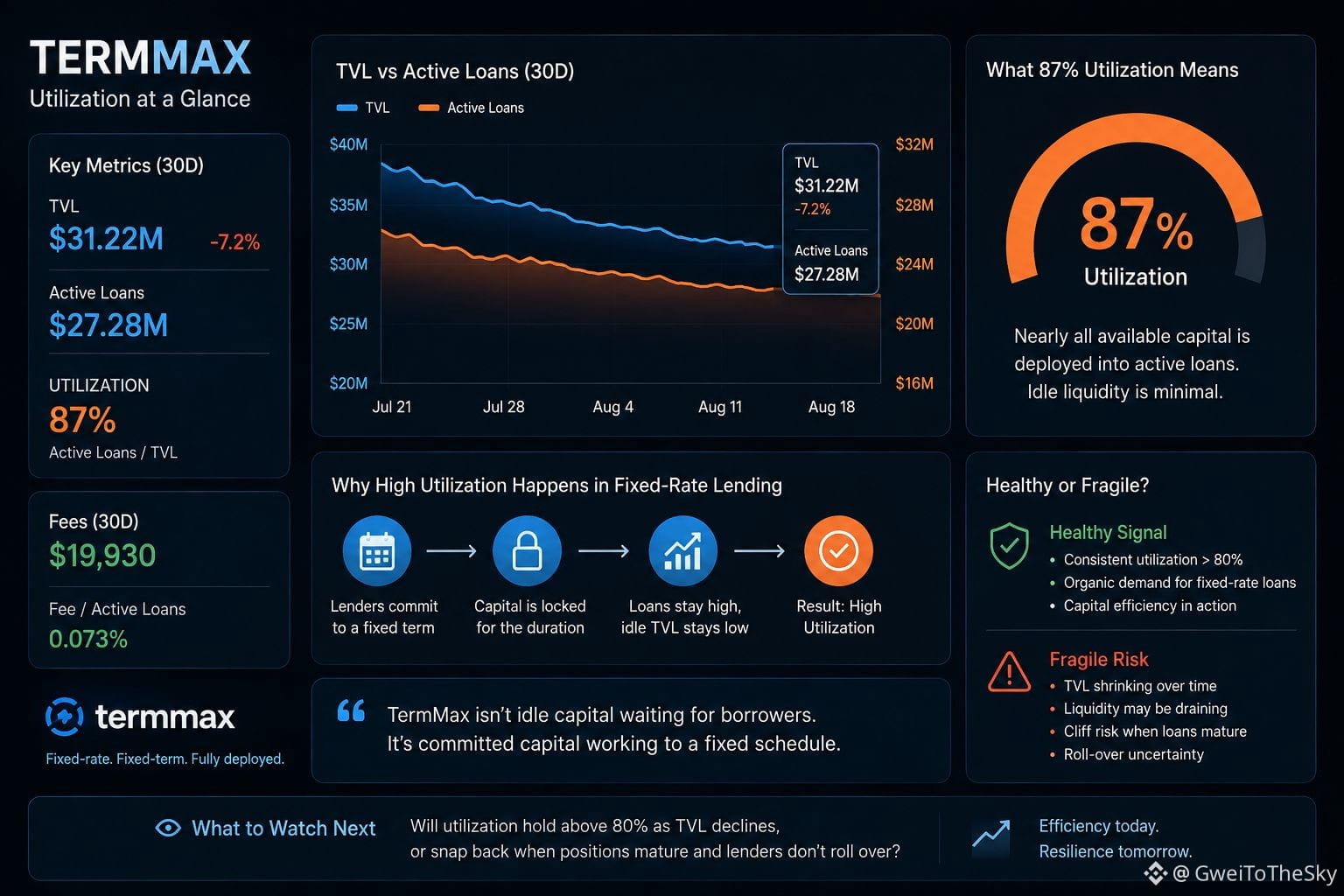
Os números da TermMax ficaram fora do que o DefiLlama mostrou esta tarde: o TVL está em US$ 31,22M, caindo 7,2% ao longo de 30 dias, mas os empréstimos ativos estão em US$ 27,28M. Isso dá aproximadamente 87% de utilização. No começo, achei que tinha interpretado o gráfico errado.
Voltei e cruzei com as taxas. Apenas US$ 19.930 em taxas ao longo de 30 dias em quase US$ 27M emprestados. Para um mercado de empréstimos baseado em taxa fixa e vencimento, essa proporção pareceu tênue diante de o quão intensamente o pool de garantias está sendo usado.
Aí fez sentido para mim. A TermMax não é um pool parado, esperando por tomadores; é mais perto de capital praticamente totalmente alocado a qualquer momento. Vencimentos fixos significam que os credores não estão estacionando fundos esperando por rendimento—eles estão comprometidos com um prazo específico. Então o TVL ocioso naturalmente diminui, enquanto os empréstimos permanecem proporcionalmente grandes.
Ainda não tenho certeza se isso é saudável ou frágil. Alta utilização sobre uma base de TVL menor pode significar capital eficiente, ou pode significar que a liquidez está escoando silenciosamente enquanto as posições existentes ainda não venceram.
Estou observando se a utilização se mantém acima de 80% conforme o TVL continua caindo, ou se ela volta ao normal quando as posições vencem e os credores não renovam.
87% de utilização na TermMax é um sinal de um verdadeiro encaixe produto-mercado para empréstimos de taxa fixa, ou um sintoma de um pool que está encolhendo e ainda não foi testado sob estresse?
@termmax #termmax
$ONG
{future}(ONGUSDT)
$BOME
{future}(BOMEUSDT)
$ACE
{future}(ACEUSDT)
Os números da TermMax ficaram fora do que o DefiLlama mostrou esta tarde: o TVL está em US$ 31,22M, caindo 7,2% ao longo de 30 dias, mas os empréstimos ativos estão em US$ 27,28M. Isso dá aproximadamente 87% de utilização. No começo, achei que tinha interpretado o gráfico errado.
Voltei e cruzei com as taxas. Apenas US$ 19.930 em taxas ao longo de 30 dias em quase US$ 27M emprestados. Para um mercado de empréstimos baseado em taxa fixa e vencimento, essa proporção pareceu tênue diante de o quão intensamente o pool de garantias está sendo usado.
Aí fez sentido para mim. A TermMax não é um pool parado, esperando por tomadores; é mais perto de capital praticamente totalmente alocado a qualquer momento. Vencimentos fixos significam que os credores não estão estacionando fundos esperando por rendimento—eles estão comprometidos com um prazo específico. Então o TVL ocioso naturalmente diminui, enquanto os empréstimos permanecem proporcionalmente grandes.
Ainda não tenho certeza se isso é saudável ou frágil. Alta utilização sobre uma base de TVL menor pode significar capital eficiente, ou pode significar que a liquidez está escoando silenciosamente enquanto as posições existentes ainda não venceram.
Estou observando se a utilização se mantém acima de 80% conforme o TVL continua caindo, ou se ela volta ao normal quando as posições vencem e os credores não renovam.
87% de utilização na TermMax é um sinal de um verdadeiro encaixe produto-mercado para empréstimos de taxa fixa, ou um sintoma de um pool que está encolhendo e ainda não foi testado sob estresse?
@TermMax #termmax
$ONG
$BOME
$ACE
Voltei e cruzei com as taxas. Apenas US$ 19.930 em taxas ao longo de 30 dias em quase US$ 27M emprestados. Para um mercado de empréstimos baseado em taxa fixa e vencimento, essa proporção pareceu tênue diante de o quão intensamente o pool de garantias está sendo usado.
Aí fez sentido para mim. A TermMax não é um pool parado, esperando por tomadores; é mais perto de capital praticamente totalmente alocado a qualquer momento. Vencimentos fixos significam que os credores não estão estacionando fundos esperando por rendimento—eles estão comprometidos com um prazo específico. Então o TVL ocioso naturalmente diminui, enquanto os empréstimos permanecem proporcionalmente grandes.
Ainda não tenho certeza se isso é saudável ou frágil. Alta utilização sobre uma base de TVL menor pode significar capital eficiente, ou pode significar que a liquidez está escoando silenciosamente enquanto as posições existentes ainda não venceram.
Estou observando se a utilização se mantém acima de 80% conforme o TVL continua caindo, ou se ela volta ao normal quando as posições vencem e os credores não renovam.
87% de utilização na TermMax é um sinal de um verdadeiro encaixe produto-mercado para empréstimos de taxa fixa, ou um sintoma de um pool que está encolhendo e ainda não foi testado sob estresse?
@TermMax #termmax
$ONG
$BOME
$ACE
6
99
·
--
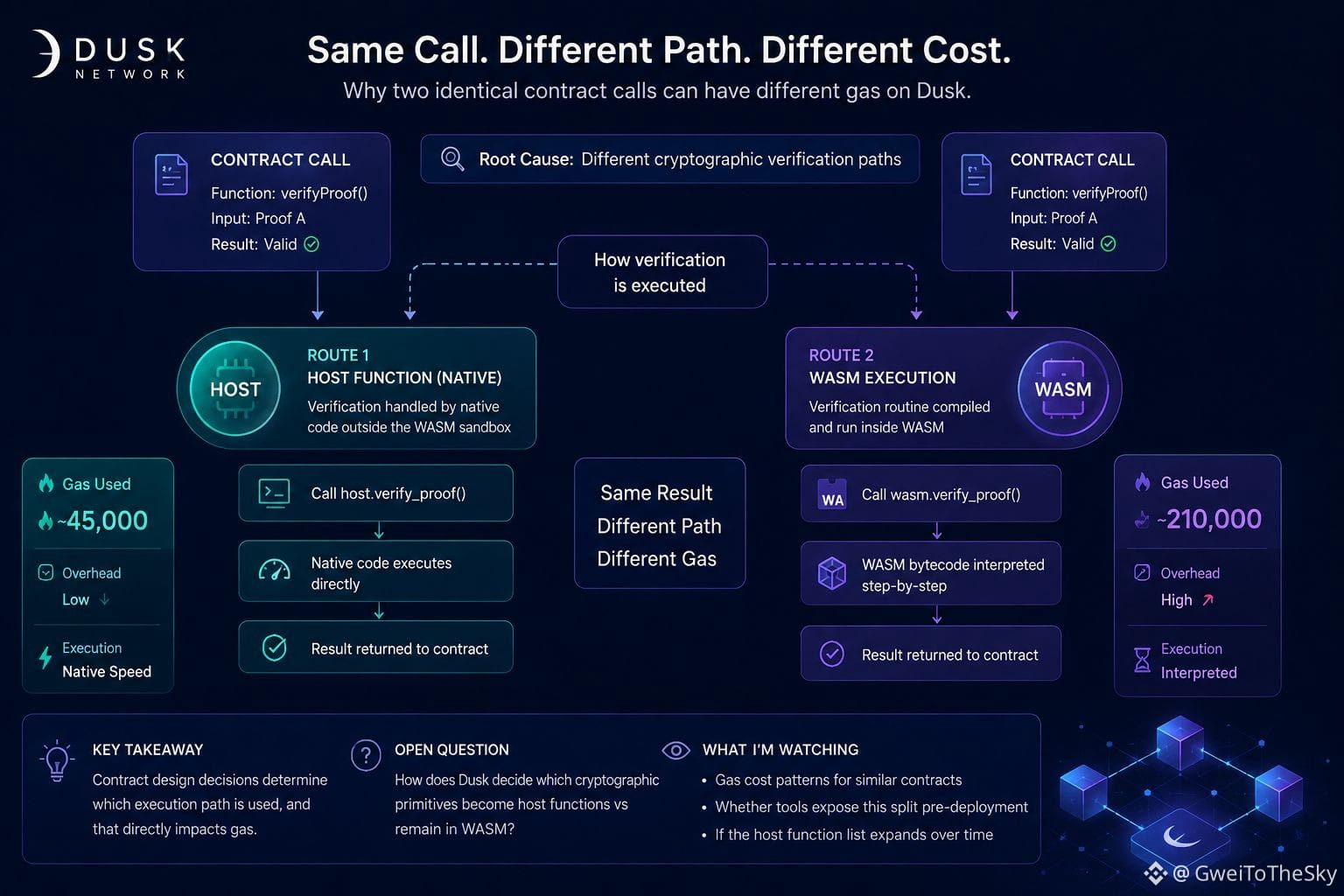
Um explorador do Dusk, tarde da noite, fez duas chamadas de contrato que, à primeira vista, pareciam funcionalmente idênticas; mas elas se resolveram com pegadas de gás visivelmente diferentes. Minha primeira suposição foi que uma delas tinha apenas uma lógica mais complexa embutida. Descobri que isso estava errado.
Ao investigar mais a fundo, encontrei a diferença em como cada contrato tratava a etapa de verificação criptográfica. Um caminho acionava uma função host — código nativo — executada diretamente pelo runtime fora do sandbox WASM, enquanto o outro executava uma rotina de verificação compilada no próprio WASM. O Dusk reserva funções host para operações específicas como hashing e verificação de provas, e a diferença de gás era, na verdade, uma diferença de visibilidade desse desdobramento.
Isso recontextualizou algo que eu vinha tratando como uma única categoria: “computação on-chain”. Eu vinha agrupando execução em sandbox e execução nativa como se custo e comportamento escalassem do mesmo jeito para ambos. Eles não escalam. Chamadas nativas contornam o overhead da interpretação do WASM, o que significa que escolhas de design no topo determinam silenciosamente qual caminho de execução uma transação seguirá na sequência.
O que não fica claro para mim é como o Dusk decide quais primitivas criptográficas futuras passam a ter status de função host, em vez de permanecer dentro do WASM. Existe um limite de desempenho definido ou isso é avaliado caso a caso conforme novos esquemas de verificação são adicionados? Essa ambiguidade importa mais à medida que a lista de primitivas cresce.
A partir de agora, vou observar o quão consistentemente os custos de gás se agrupam para contratos logicamente semelhantes e se as ferramentas para desenvolvedores começam a evidenciar essa divisão de execução antes do deployment — e não depois. Padrões recorrentes ali me diriam se isso é um diferencial de design estável ou algo que autores de contratos precisam aprender da forma mais difícil.
Ainda não sei se essa divisão foi pensada para permanecer estreita por design ou se vai se expandir conforme o protocolo amadurece, e também não tenho certeza de qual resultado seria de fato mais saudável para construtores na rede.
@Dusk_Foundation #Dusk
$ACE
{future}(ACEUSDT)
$DUSK
{future}(DUSKUSDT)
$BOME
{future}(BOMEUSDT)
Um explorador do Dusk, tarde da noite, fez duas chamadas de contrato que, à primeira vista, pareciam funcionalmente idênticas; mas elas se resolveram com pegadas de gás visivelmente diferentes. Minha primeira suposição foi que uma delas tinha apenas uma lógica mais complexa embutida. Descobri que isso estava errado.
Ao investigar mais a fundo, encontrei a diferença em como cada contrato tratava a etapa de verificação criptográfica. Um caminho acionava uma função host — código nativo — executada diretamente pelo runtime fora do sandbox WASM, enquanto o outro executava uma rotina de verificação compilada no próprio WASM. O Dusk reserva funções host para operações específicas como hashing e verificação de provas, e a diferença de gás era, na verdade, uma diferença de visibilidade desse desdobramento.
Isso recontextualizou algo que eu vinha tratando como uma única categoria: “computação on-chain”. Eu vinha agrupando execução em sandbox e execução nativa como se custo e comportamento escalassem do mesmo jeito para ambos. Eles não escalam. Chamadas nativas contornam o overhead da interpretação do WASM, o que significa que escolhas de design no topo determinam silenciosamente qual caminho de execução uma transação seguirá na sequência.
O que não fica claro para mim é como o Dusk decide quais primitivas criptográficas futuras passam a ter status de função host, em vez de permanecer dentro do WASM. Existe um limite de desempenho definido ou isso é avaliado caso a caso conforme novos esquemas de verificação são adicionados? Essa ambiguidade importa mais à medida que a lista de primitivas cresce.
A partir de agora, vou observar o quão consistentemente os custos de gás se agrupam para contratos logicamente semelhantes e se as ferramentas para desenvolvedores começam a evidenciar essa divisão de execução antes do deployment — e não depois. Padrões recorrentes ali me diriam se isso é um diferencial de design estável ou algo que autores de contratos precisam aprender da forma mais difícil.
Ainda não sei se essa divisão foi pensada para permanecer estreita por design ou se vai se expandir conforme o protocolo amadurece, e também não tenho certeza de qual resultado seria de fato mais saudável para construtores na rede.
@Dusk #Dusk
$ACE
$DUSK
$BOME
Ao investigar mais a fundo, encontrei a diferença em como cada contrato tratava a etapa de verificação criptográfica. Um caminho acionava uma função host — código nativo — executada diretamente pelo runtime fora do sandbox WASM, enquanto o outro executava uma rotina de verificação compilada no próprio WASM. O Dusk reserva funções host para operações específicas como hashing e verificação de provas, e a diferença de gás era, na verdade, uma diferença de visibilidade desse desdobramento.
Isso recontextualizou algo que eu vinha tratando como uma única categoria: “computação on-chain”. Eu vinha agrupando execução em sandbox e execução nativa como se custo e comportamento escalassem do mesmo jeito para ambos. Eles não escalam. Chamadas nativas contornam o overhead da interpretação do WASM, o que significa que escolhas de design no topo determinam silenciosamente qual caminho de execução uma transação seguirá na sequência.
O que não fica claro para mim é como o Dusk decide quais primitivas criptográficas futuras passam a ter status de função host, em vez de permanecer dentro do WASM. Existe um limite de desempenho definido ou isso é avaliado caso a caso conforme novos esquemas de verificação são adicionados? Essa ambiguidade importa mais à medida que a lista de primitivas cresce.
A partir de agora, vou observar o quão consistentemente os custos de gás se agrupam para contratos logicamente semelhantes e se as ferramentas para desenvolvedores começam a evidenciar essa divisão de execução antes do deployment — e não depois. Padrões recorrentes ali me diriam se isso é um diferencial de design estável ou algo que autores de contratos precisam aprender da forma mais difícil.
Ainda não sei se essa divisão foi pensada para permanecer estreita por design ou se vai se expandir conforme o protocolo amadurece, e também não tenho certeza de qual resultado seria de fato mais saudável para construtores na rede.
@Dusk #Dusk
$ACE
$DUSK
$BOME
1
5
342
·
--
Enquanto eu verificava um lote de posições do TermMax após um pico de taxa, notei algo que não correspondia às minhas expectativas: as liquidações não estavam se agrupando como normalmente acontece nos mercados de empréstimo que eu já acompanhei antes.
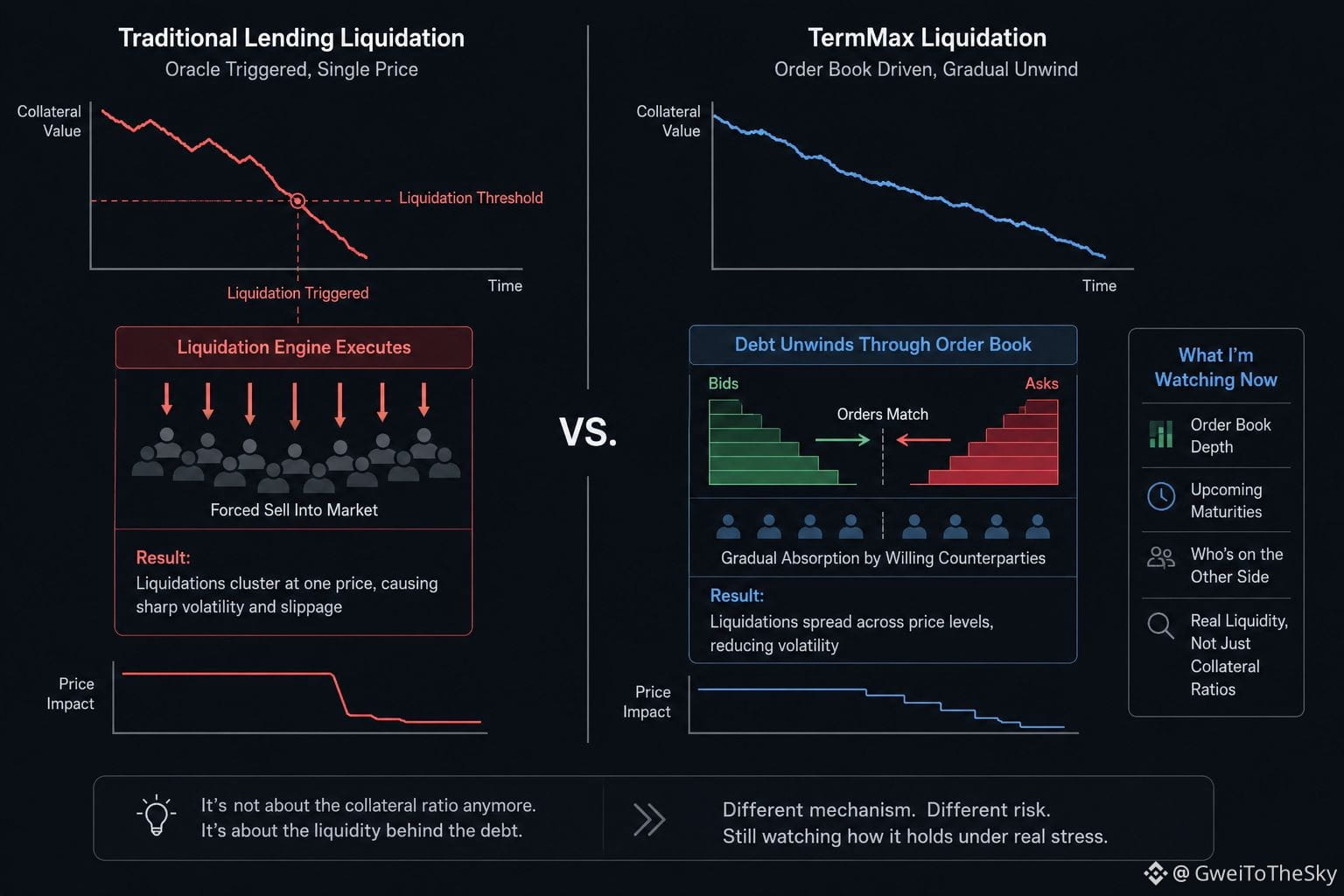
Eu presumi que uma queda rápida do colateral acionaria a onda usual de vendas forçadas guiadas por oráculos, atingindo um único preço de uma vez. Então voltei no fluxo de ordens ao redor dessas posições para ver o que realmente foi executado.
O que encontrei foi diferente. Como os preços do TermMax liquidam a dívida através do próprio livro de ordens de tokens com vencimento fixo, em vez de empurrar tudo por um único gatilho de oráculo, os encerramentos foram sendo absorvidos gradualmente conforme as ordens correspondiam às ofertas existentes, em vez de “colidirem” com um preço único de liquidação. A própria dívida se comporta como um instrumento negociável com sua própria profundidade, não apenas como um limite a ser ultrapassado.
Isso mudou a forma como eu penso sobre o risco aqui. Não é que a volatilidade desapareça; é que o mecanismo distribui a execução entre contrapartes dispostas, e não por uma única engrenagem de liquidação, o que altera a rapidez com que o estresse aparece no preço.
Ainda não tenho certeza se isso se mantém sob estresse real. Livros de ordens finos perto de vencimentos menos populares podem se comportar de maneiras bem diferentes, e eu ainda não vi esse sistema ser testado em um mercado genuinamente caótico.
Então agora estou observando com mais atenção a profundidade do livro de ordens nos vencimentos que se aproximam; estou menos interessado no índice de colateral em si e mais em quem está do outro lado desse livro de ordens quando isso realmente importa.
@termmax #termmax
$RE
{future}(REUSDT)
$HEMI
{future}(HEMIUSDT)
$ETH
{future}(ETHUSDT)
Enquanto eu verificava um lote de posições do TermMax após um pico de taxa, notei algo que não correspondia às minhas expectativas: as liquidações não estavam se agrupando como normalmente acontece nos mercados de empréstimo que eu já acompanhei antes.
Eu presumi que uma queda rápida do colateral acionaria a onda usual de vendas forçadas guiadas por oráculos, atingindo um único preço de uma vez. Então voltei no fluxo de ordens ao redor dessas posições para ver o que realmente foi executado.
O que encontrei foi diferente. Como os preços do TermMax liquidam a dívida através do próprio livro de ordens de tokens com vencimento fixo, em vez de empurrar tudo por um único gatilho de oráculo, os encerramentos foram sendo absorvidos gradualmente conforme as ordens correspondiam às ofertas existentes, em vez de “colidirem” com um preço único de liquidação. A própria dívida se comporta como um instrumento negociável com sua própria profundidade, não apenas como um limite a ser ultrapassado.
Isso mudou a forma como eu penso sobre o risco aqui. Não é que a volatilidade desapareça; é que o mecanismo distribui a execução entre contrapartes dispostas, e não por uma única engrenagem de liquidação, o que altera a rapidez com que o estresse aparece no preço.
Ainda não tenho certeza se isso se mantém sob estresse real. Livros de ordens finos perto de vencimentos menos populares podem se comportar de maneiras bem diferentes, e eu ainda não vi esse sistema ser testado em um mercado genuinamente caótico.
Então agora estou observando com mais atenção a profundidade do livro de ordens nos vencimentos que se aproximam; estou menos interessado no índice de colateral em si e mais em quem está do outro lado desse livro de ordens quando isso realmente importa.
@TermMax #termmax
$RE
$HEMI
$ETH
Eu presumi que uma queda rápida do colateral acionaria a onda usual de vendas forçadas guiadas por oráculos, atingindo um único preço de uma vez. Então voltei no fluxo de ordens ao redor dessas posições para ver o que realmente foi executado.
O que encontrei foi diferente. Como os preços do TermMax liquidam a dívida através do próprio livro de ordens de tokens com vencimento fixo, em vez de empurrar tudo por um único gatilho de oráculo, os encerramentos foram sendo absorvidos gradualmente conforme as ordens correspondiam às ofertas existentes, em vez de “colidirem” com um preço único de liquidação. A própria dívida se comporta como um instrumento negociável com sua própria profundidade, não apenas como um limite a ser ultrapassado.
Isso mudou a forma como eu penso sobre o risco aqui. Não é que a volatilidade desapareça; é que o mecanismo distribui a execução entre contrapartes dispostas, e não por uma única engrenagem de liquidação, o que altera a rapidez com que o estresse aparece no preço.
Ainda não tenho certeza se isso se mantém sob estresse real. Livros de ordens finos perto de vencimentos menos populares podem se comportar de maneiras bem diferentes, e eu ainda não vi esse sistema ser testado em um mercado genuinamente caótico.
Então agora estou observando com mais atenção a profundidade do livro de ordens nos vencimentos que se aproximam; estou menos interessado no índice de colateral em si e mais em quem está do outro lado desse livro de ordens quando isso realmente importa.
@TermMax #termmax
$RE
$HEMI
$ETH
4
46
·
--
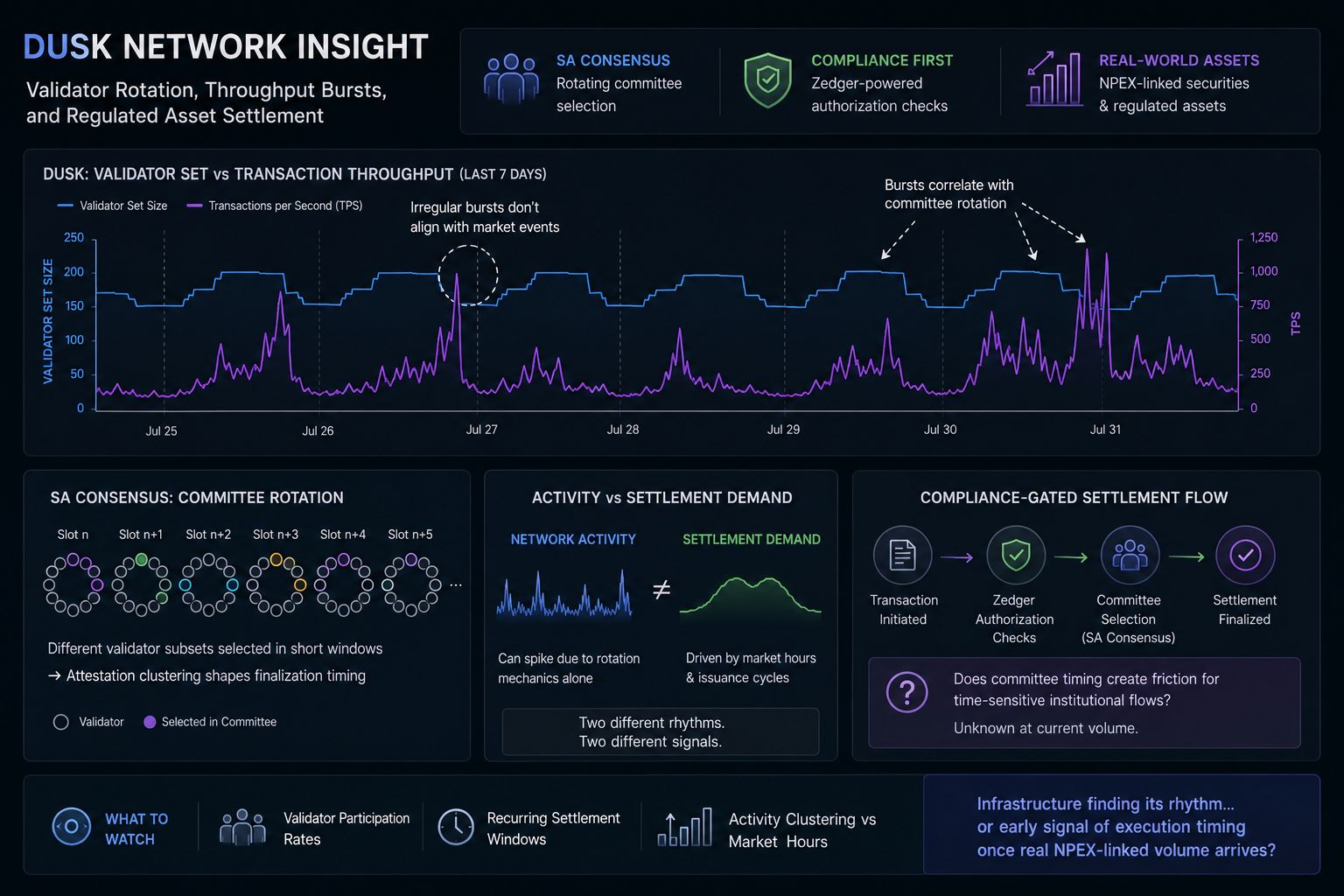
O conjunto de validadores do Dusk contra a sua capacidade de transações na semana passada Eu tinha assumido que uma rede construída para ativos regulados mostraria padrões de atividade constantes, quase entediantes. Em vez disso, vi rajadas irregulares que não coincidiam com nenhum evento de mercado óbvio.
Ao investigar, rastreei as rajadas até como a seleção do comitê de consenso do Dusk gira sob o SA Consensus. Não era ruído aleatório. O padrão parecia algo mais próximo de agrupamento de atestações: certos subconjuntos de validadores são selecionados com mais frequência em janelas curtas, o que molda quando a atividade mais pesada em liquidação realmente finaliza.
Essa distinção importa mais do que eu tinha dado a entender. Eu estava tratando "atividade da rede" e "demanda de liquidação" como, basicamente, o mesmo sinal. Não são. A atividade pode disparar apenas por mecanismos de rotação de validadores, enquanto a demanda real de liquidação — do tipo ligado a ativos originados na NPEX — segue um ritmo completamente diferente, atrelado a horários de mercado e ciclos de emissão.
O que ainda não consigo resolver é como esse comportamento de rotação interage especificamente com transações que passam por controles de conformidade. Se valores mobiliários baseados em Zedger exigem verificações específicas de autorização antes de liquidar, a temporização do comitê alguma vez cria atrito para fluxos institucionais sensíveis ao tempo, ou esse atrito é negligenciável no volume atual? Não tenho dados suficientes para dizer qualquer uma das opções.
Para frente, quero observar as taxas de participação dos validadores junto com quaisquer janelas de liquidação recorrentes, não apenas contagens brutas de transações. Se a atividade de ativos regulados começar a se agrupar em torno de rotações específicas de comitês em vez de horários de mercado, isso me diria algo sobre quanto fluxo institucional realmente está ativo versus ainda em fase experimental.
Fico me perguntando se esse padrão de rotação é apenas a infraestrutura encontrando seu ritmo, ou um sinal inicial de como o timing de execução pode se comportar quando volumes reais de ativos ligados à NPEX começarem a fluir pela rede. Eu não acho que consiga responder isso ainda.
@Dusk_Foundation #Dusk
$DUSK
{future}(DUSKUSDT)
$HEMI
{future}(HEMIUSDT)
$TREE
{future}(TREEUSDT)
O conjunto de validadores do Dusk contra a sua capacidade de transações na semana passada Eu tinha assumido que uma rede construída para ativos regulados mostraria padrões de atividade constantes, quase entediantes. Em vez disso, vi rajadas irregulares que não coincidiam com nenhum evento de mercado óbvio.
Ao investigar, rastreei as rajadas até como a seleção do comitê de consenso do Dusk gira sob o SA Consensus. Não era ruído aleatório. O padrão parecia algo mais próximo de agrupamento de atestações: certos subconjuntos de validadores são selecionados com mais frequência em janelas curtas, o que molda quando a atividade mais pesada em liquidação realmente finaliza.
Essa distinção importa mais do que eu tinha dado a entender. Eu estava tratando "atividade da rede" e "demanda de liquidação" como, basicamente, o mesmo sinal. Não são. A atividade pode disparar apenas por mecanismos de rotação de validadores, enquanto a demanda real de liquidação — do tipo ligado a ativos originados na NPEX — segue um ritmo completamente diferente, atrelado a horários de mercado e ciclos de emissão.
O que ainda não consigo resolver é como esse comportamento de rotação interage especificamente com transações que passam por controles de conformidade. Se valores mobiliários baseados em Zedger exigem verificações específicas de autorização antes de liquidar, a temporização do comitê alguma vez cria atrito para fluxos institucionais sensíveis ao tempo, ou esse atrito é negligenciável no volume atual? Não tenho dados suficientes para dizer qualquer uma das opções.
Para frente, quero observar as taxas de participação dos validadores junto com quaisquer janelas de liquidação recorrentes, não apenas contagens brutas de transações. Se a atividade de ativos regulados começar a se agrupar em torno de rotações específicas de comitês em vez de horários de mercado, isso me diria algo sobre quanto fluxo institucional realmente está ativo versus ainda em fase experimental.
Fico me perguntando se esse padrão de rotação é apenas a infraestrutura encontrando seu ritmo, ou um sinal inicial de como o timing de execução pode se comportar quando volumes reais de ativos ligados à NPEX começarem a fluir pela rede. Eu não acho que consiga responder isso ainda.
@Dusk #Dusk
$DUSK
$HEMI
$TREE
Ao investigar, rastreei as rajadas até como a seleção do comitê de consenso do Dusk gira sob o SA Consensus. Não era ruído aleatório. O padrão parecia algo mais próximo de agrupamento de atestações: certos subconjuntos de validadores são selecionados com mais frequência em janelas curtas, o que molda quando a atividade mais pesada em liquidação realmente finaliza.
Essa distinção importa mais do que eu tinha dado a entender. Eu estava tratando "atividade da rede" e "demanda de liquidação" como, basicamente, o mesmo sinal. Não são. A atividade pode disparar apenas por mecanismos de rotação de validadores, enquanto a demanda real de liquidação — do tipo ligado a ativos originados na NPEX — segue um ritmo completamente diferente, atrelado a horários de mercado e ciclos de emissão.
O que ainda não consigo resolver é como esse comportamento de rotação interage especificamente com transações que passam por controles de conformidade. Se valores mobiliários baseados em Zedger exigem verificações específicas de autorização antes de liquidar, a temporização do comitê alguma vez cria atrito para fluxos institucionais sensíveis ao tempo, ou esse atrito é negligenciável no volume atual? Não tenho dados suficientes para dizer qualquer uma das opções.
Para frente, quero observar as taxas de participação dos validadores junto com quaisquer janelas de liquidação recorrentes, não apenas contagens brutas de transações. Se a atividade de ativos regulados começar a se agrupar em torno de rotações específicas de comitês em vez de horários de mercado, isso me diria algo sobre quanto fluxo institucional realmente está ativo versus ainda em fase experimental.
Fico me perguntando se esse padrão de rotação é apenas a infraestrutura encontrando seu ritmo, ou um sinal inicial de como o timing de execução pode se comportar quando volumes reais de ativos ligados à NPEX começarem a fluir pela rede. Eu não acho que consiga responder isso ainda.
@Dusk #Dusk
$DUSK
$HEMI
$TREE
2
4
190
·
--
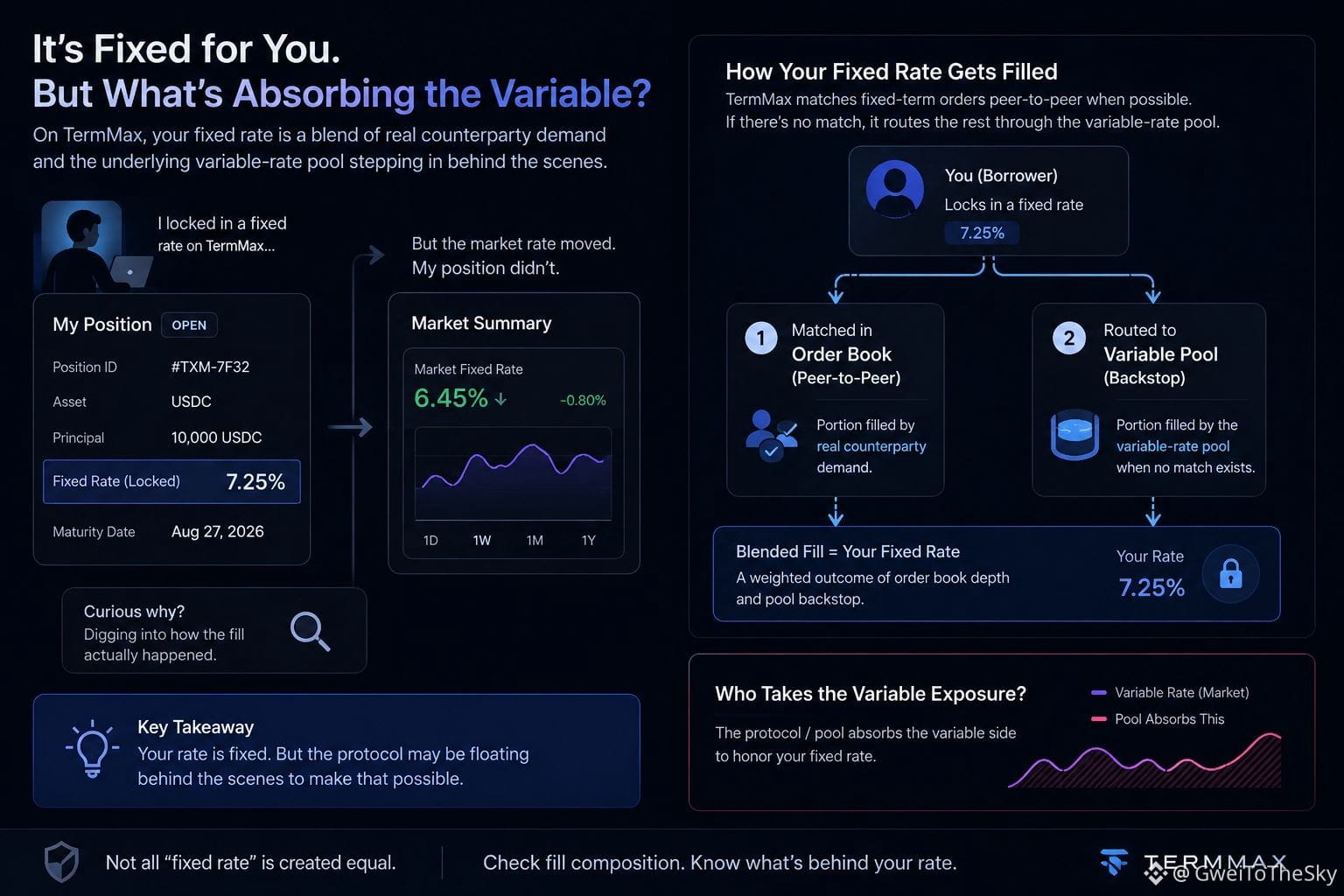
Ao verificar a data de vencimento da minha posição em aberto no @termmax , a taxa fixa que eu havia travado não batia mais com a taxa exibida na página de resumo do mercado, mesmo sem nada ter mudado na minha posição. No começo, achei que era apenas um atraso na exibição.
Então comecei a investigar como as ordens são preenchidas contra o pool subjacente. TermMax faz match de ordens de prazo fixo peer-to-peer quando possível, mas quando não há uma contraparte direta, ele redireciona pelo pool de taxa variável por baixo para preencher a lacuna. Minha posição tinha sido parcialmente preenchida desse jeito, sem que eu percebesse.
Isso mudou completamente a forma como eu entendo “taxa fixa” aqui. Para mim, como tomador, ela é fixa; mas o protocolo está absorvendo silenciosamente a exposição a taxa variável do outro lado para que essa garantia seja possível. A taxa que eu vejo não é apenas um número que eu escolhi — é um resultado “mesclado” pela profundidade do livro no momento em que entrei.
Ainda não tenho certeza de quão “fino” fica esse nível peer-to-peer durante horas de baixa liquidez, nem de quanto do livro é realmente correspondido versus roteado pelo pool em qualquer dia. A documentação menciona o mecanismo, mas não revela uma proporção ao vivo.
Passei a checar a composição dos preenchimentos antes de entrar em posições maiores, principalmente para ver quanto da minha taxa é demanda real de contraparte versus um apoio do pool.
Fico pensando quantos protocolos de taxa fixa são “fixos” apenas no nome, com a estabilidade na prática dependendo de quem estiver absorvendo a ponta de taxa variável por baixo.
#TermMax
$CLO
{future}(CLOUSDT)
$VELVET
{future}(VELVETUSDT)
$EDEN
{future}(EDENUSDT)
Ao verificar a data de vencimento da minha posição em aberto no @TermMax , a taxa fixa que eu havia travado não batia mais com a taxa exibida na página de resumo do mercado, mesmo sem nada ter mudado na minha posição. No começo, achei que era apenas um atraso na exibição.
Então comecei a investigar como as ordens são preenchidas contra o pool subjacente. TermMax faz match de ordens de prazo fixo peer-to-peer quando possível, mas quando não há uma contraparte direta, ele redireciona pelo pool de taxa variável por baixo para preencher a lacuna. Minha posição tinha sido parcialmente preenchida desse jeito, sem que eu percebesse.
Isso mudou completamente a forma como eu entendo “taxa fixa” aqui. Para mim, como tomador, ela é fixa; mas o protocolo está absorvendo silenciosamente a exposição a taxa variável do outro lado para que essa garantia seja possível. A taxa que eu vejo não é apenas um número que eu escolhi — é um resultado “mesclado” pela profundidade do livro no momento em que entrei.
Ainda não tenho certeza de quão “fino” fica esse nível peer-to-peer durante horas de baixa liquidez, nem de quanto do livro é realmente correspondido versus roteado pelo pool em qualquer dia. A documentação menciona o mecanismo, mas não revela uma proporção ao vivo.
Passei a checar a composição dos preenchimentos antes de entrar em posições maiores, principalmente para ver quanto da minha taxa é demanda real de contraparte versus um apoio do pool.
Fico pensando quantos protocolos de taxa fixa são “fixos” apenas no nome, com a estabilidade na prática dependendo de quem estiver absorvendo a ponta de taxa variável por baixo.
#TermMax
$CLO
$VELVET
$EDEN
Então comecei a investigar como as ordens são preenchidas contra o pool subjacente. TermMax faz match de ordens de prazo fixo peer-to-peer quando possível, mas quando não há uma contraparte direta, ele redireciona pelo pool de taxa variável por baixo para preencher a lacuna. Minha posição tinha sido parcialmente preenchida desse jeito, sem que eu percebesse.
Isso mudou completamente a forma como eu entendo “taxa fixa” aqui. Para mim, como tomador, ela é fixa; mas o protocolo está absorvendo silenciosamente a exposição a taxa variável do outro lado para que essa garantia seja possível. A taxa que eu vejo não é apenas um número que eu escolhi — é um resultado “mesclado” pela profundidade do livro no momento em que entrei.
Ainda não tenho certeza de quão “fino” fica esse nível peer-to-peer durante horas de baixa liquidez, nem de quanto do livro é realmente correspondido versus roteado pelo pool em qualquer dia. A documentação menciona o mecanismo, mas não revela uma proporção ao vivo.
Passei a checar a composição dos preenchimentos antes de entrar em posições maiores, principalmente para ver quanto da minha taxa é demanda real de contraparte versus um apoio do pool.
Fico pensando quantos protocolos de taxa fixa são “fixos” apenas no nome, com a estabilidade na prática dependendo de quem estiver absorvendo a ponta de taxa variável por baixo.
#TermMax
$CLO
$VELVET
$EDEN
1
3
312
·
--
#dusk $DUSK @Dusk_Foundation
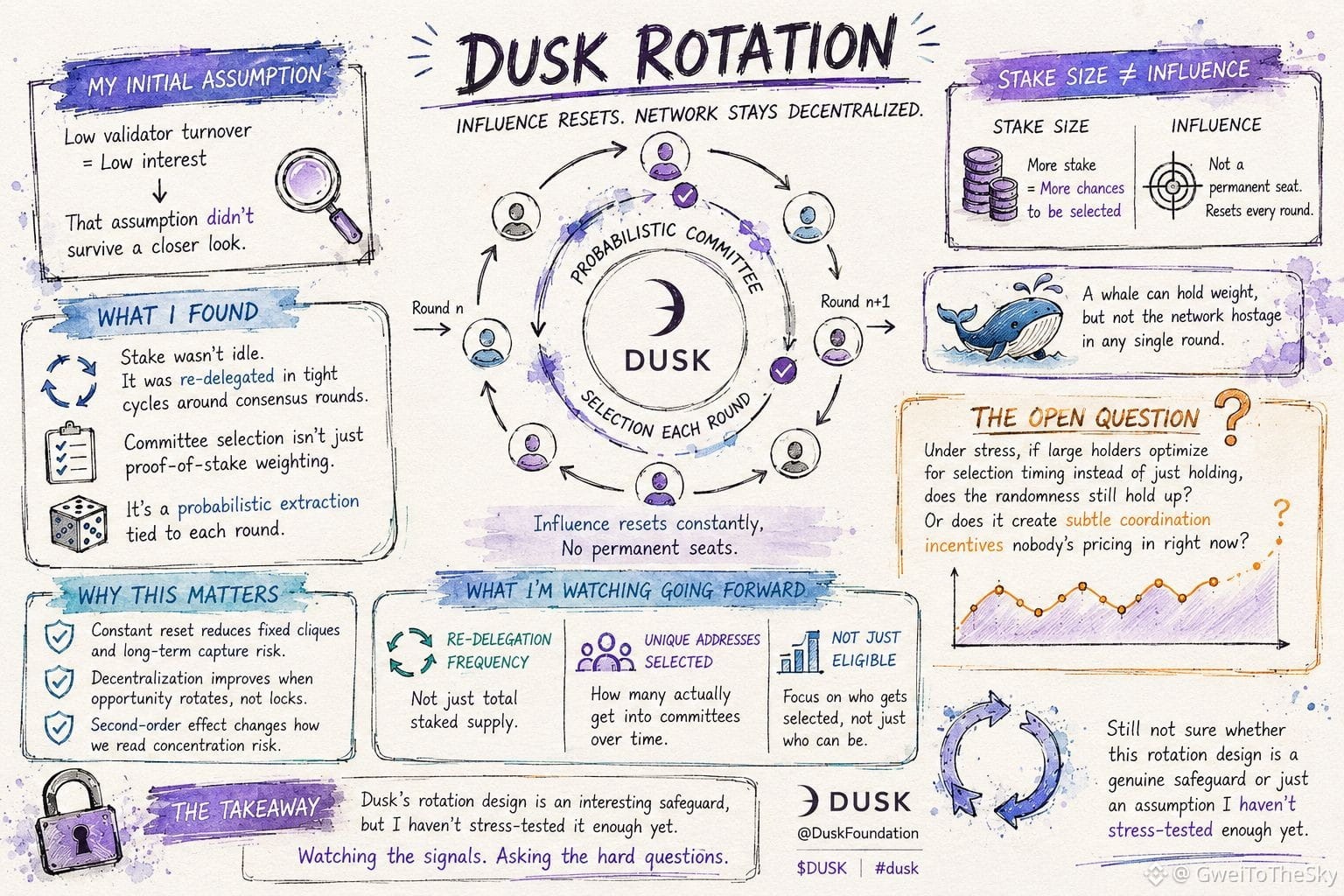
Meu marido escreveu o assunto para mim e perguntou se esta notícia é boa para quem segura o Dusk. O tamanho do conjunto de validadores do Dusk em relação à taxa de participação na sua aposta na semana passada, e a minha primeira suposição foi que a baixa rotatividade significava baixo interesse. Essa suposição não se sustentou após um olhar mais atento.
Ao verificar os logs de rotação dos provisionadores, descobri que a aposta não estava ociosa; ela estava sendo re-delegada em ciclos curtos ao redor das rodadas de consenso, em vez de permanecer estática. Isso me levou a entender como a seleção do comitê do Dusk realmente funciona: não é apenas ponderação por prova de participação; é uma extração probabilística vinculada a cada rodada, então a influência é redefinida constantemente em vez de se acumular com um grupo fixo de validadores.
Essa diferença importa mais do que parece. Eu vinha tratando "tamanho da aposta" e "influência no consenso" como se fossem a mesma variável, mas elas não são. Uma grande aposta te dá mais chances de ser selecionado, não um assento permanente. Esse efeito de segunda ordem muda como eu leio o risco de concentração aqui: uma baleia pode ter peso sem manter a rede refém em qualquer rodada isolada.
O que ainda não consigo resolver é como isso se comporta sob estresse. Se os detentores grandes começarem a otimizar o timing da seleção em vez de apenas manter, a aleatoriedade ainda se mantém, ou ela cria incentivos sutis de coordenação que ninguém está precificando agora.
Para a frente, vou observar a frequência de re-delegação, não apenas a oferta total apostada, junto com quantos endereços únicos realmente são selecionados para os comitês ao longo do tempo, e não apenas quantos são elegíveis para serem.
Ainda não tenho certeza se esse desenho de rotação é uma salvaguarda genuína ou apenas uma suposição que eu ainda não testei o suficiente sob estresse.
$BTW $ACE
#dusk $DUSK @Dusk
Meu marido escreveu o assunto para mim e perguntou se esta notícia é boa para quem segura o Dusk. O tamanho do conjunto de validadores do Dusk em relação à taxa de participação na sua aposta na semana passada, e a minha primeira suposição foi que a baixa rotatividade significava baixo interesse. Essa suposição não se sustentou após um olhar mais atento.
Ao verificar os logs de rotação dos provisionadores, descobri que a aposta não estava ociosa; ela estava sendo re-delegada em ciclos curtos ao redor das rodadas de consenso, em vez de permanecer estática. Isso me levou a entender como a seleção do comitê do Dusk realmente funciona: não é apenas ponderação por prova de participação; é uma extração probabilística vinculada a cada rodada, então a influência é redefinida constantemente em vez de se acumular com um grupo fixo de validadores.
Essa diferença importa mais do que parece. Eu vinha tratando "tamanho da aposta" e "influência no consenso" como se fossem a mesma variável, mas elas não são. Uma grande aposta te dá mais chances de ser selecionado, não um assento permanente. Esse efeito de segunda ordem muda como eu leio o risco de concentração aqui: uma baleia pode ter peso sem manter a rede refém em qualquer rodada isolada.
O que ainda não consigo resolver é como isso se comporta sob estresse. Se os detentores grandes começarem a otimizar o timing da seleção em vez de apenas manter, a aleatoriedade ainda se mantém, ou ela cria incentivos sutis de coordenação que ninguém está precificando agora.
Para a frente, vou observar a frequência de re-delegação, não apenas a oferta total apostada, junto com quantos endereços únicos realmente são selecionados para os comitês ao longo do tempo, e não apenas quantos são elegíveis para serem.
Ainda não tenho certeza se esse desenho de rotação é uma salvaguarda genuína ou apenas uma suposição que eu ainda não testei o suficiente sob estresse.
$BTW $ACE
Meu marido escreveu o assunto para mim e perguntou se esta notícia é boa para quem segura o Dusk. O tamanho do conjunto de validadores do Dusk em relação à taxa de participação na sua aposta na semana passada, e a minha primeira suposição foi que a baixa rotatividade significava baixo interesse. Essa suposição não se sustentou após um olhar mais atento.
Ao verificar os logs de rotação dos provisionadores, descobri que a aposta não estava ociosa; ela estava sendo re-delegada em ciclos curtos ao redor das rodadas de consenso, em vez de permanecer estática. Isso me levou a entender como a seleção do comitê do Dusk realmente funciona: não é apenas ponderação por prova de participação; é uma extração probabilística vinculada a cada rodada, então a influência é redefinida constantemente em vez de se acumular com um grupo fixo de validadores.
Essa diferença importa mais do que parece. Eu vinha tratando "tamanho da aposta" e "influência no consenso" como se fossem a mesma variável, mas elas não são. Uma grande aposta te dá mais chances de ser selecionado, não um assento permanente. Esse efeito de segunda ordem muda como eu leio o risco de concentração aqui: uma baleia pode ter peso sem manter a rede refém em qualquer rodada isolada.
O que ainda não consigo resolver é como isso se comporta sob estresse. Se os detentores grandes começarem a otimizar o timing da seleção em vez de apenas manter, a aleatoriedade ainda se mantém, ou ela cria incentivos sutis de coordenação que ninguém está precificando agora.
Para a frente, vou observar a frequência de re-delegação, não apenas a oferta total apostada, junto com quantos endereços únicos realmente são selecionados para os comitês ao longo do tempo, e não apenas quantos são elegíveis para serem.
Ainda não tenho certeza se esse desenho de rotação é uma salvaguarda genuína ou apenas uma suposição que eu ainda não testei o suficiente sob estresse.
$BTW $ACE
2
2
133
·
--
#Dusk $HEMI $COW $DUSK
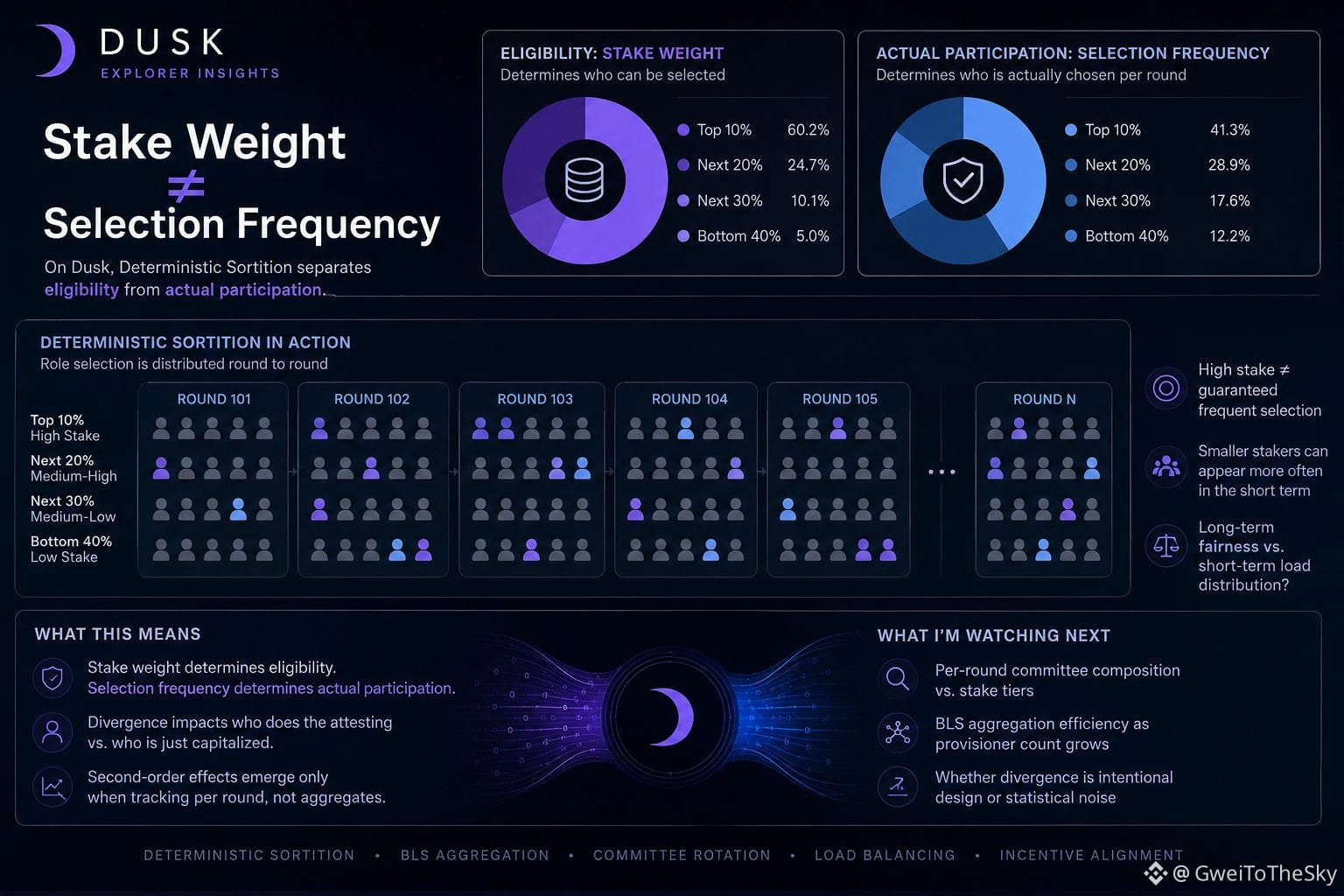
Explorador do crepúsculo da semana passada. Eu assumi que a rotatividade do comitê por rodada espelharia, de forma aproximada, a distribuição de capital, já que é assim que a maioria dos sistemas de sessenção (sortition) se comporta na prática. Os números não chegaram a se alinhar dessa maneira, e isso ficou me incomodando.
Ao investigar mais a fundo, eu rastreei a questão até a forma como a Sessenção Determinística atribui funções separadamente da ponderação do capital. Um provisionador pode deter uma parcela significativa de capital e ainda assim aparecer em menos comitês de validação do que um depositante menor dentro da mesma janela, simplesmente por causa de como a seleção de papéis é distribuída de uma rodada para outra. Foi aí que percebi que eu estava confundindo duas coisas que não são, de fato, a mesma coisa.
O peso do capital determina a elegibilidade. A frequência de seleção determina a participação real. A maioria das pessoas trata essas duas coisas como um único sinal, mas elas divergem, e essa divergência molda silenciosamente quem de fato está atestando versus quem apenas tem capitalizado. É um efeito de segunda ordem que não aparece a menos que você esteja acompanhando as rodadas individualmente, e não apenas a fatia agregada de capital.
O que ainda não consigo resolver é se essa divergência é intencional para balanceamento de carga ou apenas ruído estatístico que se dilui ao longo de períodos de amostra maiores. Se for estrutural, isso levanta uma questão real sobre se os provisionadores menores estão recebendo proporcionalmente mais responsabilidade do que sua exposição de capital sugeriria, e o que isso significa para o alinhamento de incentivos ao longo do tempo.
A partir de agora, vou observar a composição de comitês por rodada em relação às faixas de capital, não apenas os números de participação em destaque. Também quero verificar se a eficiência de agregação BLS se mantém estável conforme o número de provisionadores cresce, porque é aí que a sobrecarga de comunicação normalmente começa a pesar.
Ainda não tenho uma leitura firme sobre se isso é uma característica do projeto ou um artefato do tamanho atual da rede, e não sei nem qual explicação eu preferiria.
@Dusk_Foundation
#Dusk $HEMI $COW $DUSK
Explorador do crepúsculo da semana passada. Eu assumi que a rotatividade do comitê por rodada espelharia, de forma aproximada, a distribuição de capital, já que é assim que a maioria dos sistemas de sessenção (sortition) se comporta na prática. Os números não chegaram a se alinhar dessa maneira, e isso ficou me incomodando.
Ao investigar mais a fundo, eu rastreei a questão até a forma como a Sessenção Determinística atribui funções separadamente da ponderação do capital. Um provisionador pode deter uma parcela significativa de capital e ainda assim aparecer em menos comitês de validação do que um depositante menor dentro da mesma janela, simplesmente por causa de como a seleção de papéis é distribuída de uma rodada para outra. Foi aí que percebi que eu estava confundindo duas coisas que não são, de fato, a mesma coisa.
O peso do capital determina a elegibilidade. A frequência de seleção determina a participação real. A maioria das pessoas trata essas duas coisas como um único sinal, mas elas divergem, e essa divergência molda silenciosamente quem de fato está atestando versus quem apenas tem capitalizado. É um efeito de segunda ordem que não aparece a menos que você esteja acompanhando as rodadas individualmente, e não apenas a fatia agregada de capital.
O que ainda não consigo resolver é se essa divergência é intencional para balanceamento de carga ou apenas ruído estatístico que se dilui ao longo de períodos de amostra maiores. Se for estrutural, isso levanta uma questão real sobre se os provisionadores menores estão recebendo proporcionalmente mais responsabilidade do que sua exposição de capital sugeriria, e o que isso significa para o alinhamento de incentivos ao longo do tempo.
A partir de agora, vou observar a composição de comitês por rodada em relação às faixas de capital, não apenas os números de participação em destaque. Também quero verificar se a eficiência de agregação BLS se mantém estável conforme o número de provisionadores cresce, porque é aí que a sobrecarga de comunicação normalmente começa a pesar.
Ainda não tenho uma leitura firme sobre se isso é uma característica do projeto ou um artefato do tamanho atual da rede, e não sei nem qual explicação eu preferiria.
@Dusk
Explorador do crepúsculo da semana passada. Eu assumi que a rotatividade do comitê por rodada espelharia, de forma aproximada, a distribuição de capital, já que é assim que a maioria dos sistemas de sessenção (sortition) se comporta na prática. Os números não chegaram a se alinhar dessa maneira, e isso ficou me incomodando.
Ao investigar mais a fundo, eu rastreei a questão até a forma como a Sessenção Determinística atribui funções separadamente da ponderação do capital. Um provisionador pode deter uma parcela significativa de capital e ainda assim aparecer em menos comitês de validação do que um depositante menor dentro da mesma janela, simplesmente por causa de como a seleção de papéis é distribuída de uma rodada para outra. Foi aí que percebi que eu estava confundindo duas coisas que não são, de fato, a mesma coisa.
O peso do capital determina a elegibilidade. A frequência de seleção determina a participação real. A maioria das pessoas trata essas duas coisas como um único sinal, mas elas divergem, e essa divergência molda silenciosamente quem de fato está atestando versus quem apenas tem capitalizado. É um efeito de segunda ordem que não aparece a menos que você esteja acompanhando as rodadas individualmente, e não apenas a fatia agregada de capital.
O que ainda não consigo resolver é se essa divergência é intencional para balanceamento de carga ou apenas ruído estatístico que se dilui ao longo de períodos de amostra maiores. Se for estrutural, isso levanta uma questão real sobre se os provisionadores menores estão recebendo proporcionalmente mais responsabilidade do que sua exposição de capital sugeriria, e o que isso significa para o alinhamento de incentivos ao longo do tempo.
A partir de agora, vou observar a composição de comitês por rodada em relação às faixas de capital, não apenas os números de participação em destaque. Também quero verificar se a eficiência de agregação BLS se mantém estável conforme o número de provisionadores cresce, porque é aí que a sobrecarga de comunicação normalmente começa a pesar.
Ainda não tenho uma leitura firme sobre se isso é uma característica do projeto ou um artefato do tamanho atual da rede, e não sei nem qual explicação eu preferiria.
@Dusk
6
4
198
·
--
Ao revisar dados recentes de produção de blocos no explorador da Dusk, notei que o mesmo pequeno conjunto de endereços de validadores aparecia muito mais vezes do que a participação deles parecia justificar. Minha primeira suposição foi que eu estava interpretando mal a paginação ou acessando um índice desatualizado, então coletei os dados novamente em uma faixa de blocos mais ampla.
O padrão se manteve, o que me levou ao próprio mecanismo de consenso. A Dusk seleciona seu comitê produtor de blocos a cada rodada por meio de uma extração baseada em peso de participação e por rodadas, em vez de uma rotação fixa. O que parecia dominância em uma janela estreita era, na verdade, variância de amostragem embutida na forma como os comitês são sorteados, e não tratamento preferencial de certos operadores.
Essa distinção remodelou a maneira como penso sobre justiça aqui. O peso da participação e a frequência de seleção são tratados como a mesma coisa, mas apenas convergem ao longo de janelas de observação longas. No curto prazo, a aleatoriedade domina, e um validador pode aparecer super-representado apenas por acaso. O efeito negligenciado é psicológico: operadores menores, observando janelas curtas, podem perceber o sistema como enviesado mesmo quando, no longo prazo, a matemática está equilibrada.
O que ainda não consigo resolver é como essa percepção se desenrola operacionalmente. Se validadores menores avaliam a justiça por janelas curtas em vez da convergência estatística, alguns podem reduzir a participação ou sair completamente, o que concentraria a participação por razões que não têm nada a ver com viés real do protocolo.
Para frente, quero acompanhar a distribuição de produção de blocos em janelas mensais móveis, em vez de instantâneos diários, junto com o tamanho do conjunto de validadores e a rotatividade entre operadores menores. Participação sustentada apesar de variância visível de curto prazo me diria mais do que qualquer período único de amostragem.
Fico pensando se a justiça matemática, por si só, é suficiente, ou se a percepção de justiça acaba moldando a descentralização tanto quanto o desenho subjacente.
@Dusk_Foundation #Dusk
$ACE $VELVET $DUSK
Ao revisar dados recentes de produção de blocos no explorador da Dusk, notei que o mesmo pequeno conjunto de endereços de validadores aparecia muito mais vezes do que a participação deles parecia justificar. Minha primeira suposição foi que eu estava interpretando mal a paginação ou acessando um índice desatualizado, então coletei os dados novamente em uma faixa de blocos mais ampla.
O padrão se manteve, o que me levou ao próprio mecanismo de consenso. A Dusk seleciona seu comitê produtor de blocos a cada rodada por meio de uma extração baseada em peso de participação e por rodadas, em vez de uma rotação fixa. O que parecia dominância em uma janela estreita era, na verdade, variância de amostragem embutida na forma como os comitês são sorteados, e não tratamento preferencial de certos operadores.
Essa distinção remodelou a maneira como penso sobre justiça aqui. O peso da participação e a frequência de seleção são tratados como a mesma coisa, mas apenas convergem ao longo de janelas de observação longas. No curto prazo, a aleatoriedade domina, e um validador pode aparecer super-representado apenas por acaso. O efeito negligenciado é psicológico: operadores menores, observando janelas curtas, podem perceber o sistema como enviesado mesmo quando, no longo prazo, a matemática está equilibrada.
O que ainda não consigo resolver é como essa percepção se desenrola operacionalmente. Se validadores menores avaliam a justiça por janelas curtas em vez da convergência estatística, alguns podem reduzir a participação ou sair completamente, o que concentraria a participação por razões que não têm nada a ver com viés real do protocolo.
Para frente, quero acompanhar a distribuição de produção de blocos em janelas mensais móveis, em vez de instantâneos diários, junto com o tamanho do conjunto de validadores e a rotatividade entre operadores menores. Participação sustentada apesar de variância visível de curto prazo me diria mais do que qualquer período único de amostragem.
Fico pensando se a justiça matemática, por si só, é suficiente, ou se a percepção de justiça acaba moldando a descentralização tanto quanto o desenho subjacente.
@Dusk #Dusk
$ACE $VELVET $DUSK
O padrão se manteve, o que me levou ao próprio mecanismo de consenso. A Dusk seleciona seu comitê produtor de blocos a cada rodada por meio de uma extração baseada em peso de participação e por rodadas, em vez de uma rotação fixa. O que parecia dominância em uma janela estreita era, na verdade, variância de amostragem embutida na forma como os comitês são sorteados, e não tratamento preferencial de certos operadores.
Essa distinção remodelou a maneira como penso sobre justiça aqui. O peso da participação e a frequência de seleção são tratados como a mesma coisa, mas apenas convergem ao longo de janelas de observação longas. No curto prazo, a aleatoriedade domina, e um validador pode aparecer super-representado apenas por acaso. O efeito negligenciado é psicológico: operadores menores, observando janelas curtas, podem perceber o sistema como enviesado mesmo quando, no longo prazo, a matemática está equilibrada.
O que ainda não consigo resolver é como essa percepção se desenrola operacionalmente. Se validadores menores avaliam a justiça por janelas curtas em vez da convergência estatística, alguns podem reduzir a participação ou sair completamente, o que concentraria a participação por razões que não têm nada a ver com viés real do protocolo.
Para frente, quero acompanhar a distribuição de produção de blocos em janelas mensais móveis, em vez de instantâneos diários, junto com o tamanho do conjunto de validadores e a rotatividade entre operadores menores. Participação sustentada apesar de variância visível de curto prazo me diria mais do que qualquer período único de amostragem.
Fico pensando se a justiça matemática, por si só, é suficiente, ou se a percepção de justiça acaba moldando a descentralização tanto quanto o desenho subjacente.
@Dusk #Dusk
$ACE $VELVET $DUSK
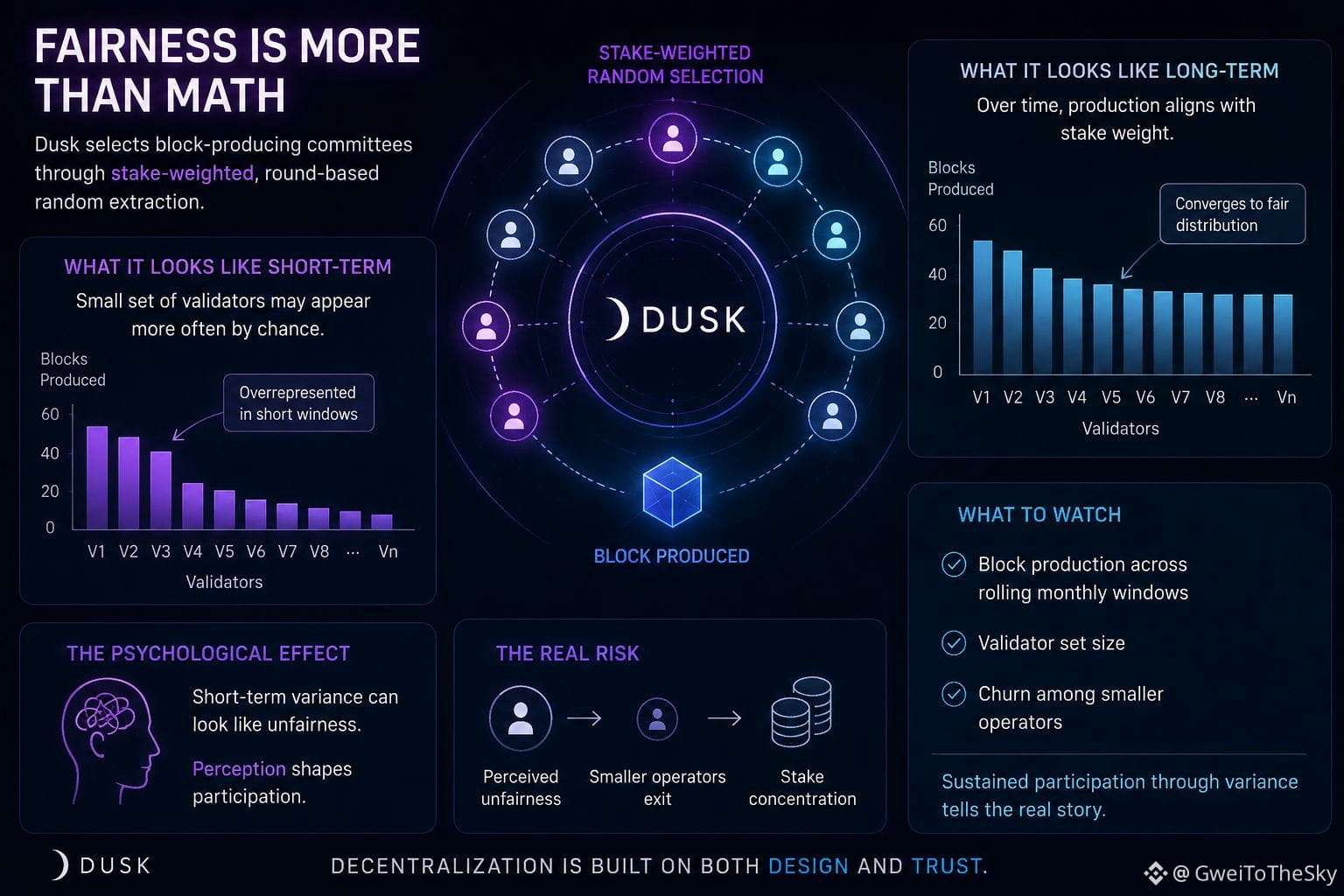
3
3
310
·
--
O contrato confidencial de Dusk faz chamadas em oposição à sua atividade pública no mempool: uma parcela significativa das transações mostrou transições de estado válidas com quase nenhum dado de entrada visível. Minha primeira hipótese foi que isso era apenas ruído de falhas de decodificação do meu lado, uma particularidade de indexador interpretando erroneamente cargas úteis blindadas como vazias.
Investigando mais a fundo, rastreei isso até como a divulgação seletiva realmente se comporta no momento da execução, e não na camada de relatório. Em vez de uma transação ser totalmente pública ou totalmente ocultada, a lógica de divulgação parece se acoplar a campos específicos dentro de uma única chamada de contrato, revelando dados de elegibilidade ou conformidade a uma parte designada, enquanto deixa intactos os valores de transferência e os contraparte. Isso é um mecanismo diferente de criptografia que é ligada ou desligada.
Isso me obrigou a separar duas coisas que eu vinha tratando como uma só: privacidade e confidencialidade. Privacidade sugere reter informações de todos. Confidencialidade aqui significa visibilidade controlada: a informação existe e é verificável, mas apenas para quem detém a chave de autorização correta. O efeito de segunda ordem é sutil: a divulgação se torna uma ação com permissões, não uma configuração aplicada à rede inteira, o que muda quem de fato controla o fluxo de informações.
O que ainda não consigo resolver é como isso escala sob carga institucional real. Se os direitos de divulgação ficam com emissores ou auditores, isso cria uma dependência “leve” em um pequeno conjunto de partes autorizadas, e essa dependência muda dependendo da jurisdição ou do tipo de ativo?
A partir daqui, quero observar padrões de emissão de chaves de autorização, com que frequência as permissões de divulgação são acionadas versus ficarem dormentes, e se o comportamento dos validadores em chamadas confidenciais permanece consistente conforme o volume cresce.
Ainda não tenho certeza se essa camada de autorização se torna infraestrutura ou atrito. Essa distinção parece valer a pena acompanhar de perto.
@Dusk_Foundation $DUSK #Dusk
O contrato confidencial de Dusk faz chamadas em oposição à sua atividade pública no mempool: uma parcela significativa das transações mostrou transições de estado válidas com quase nenhum dado de entrada visível. Minha primeira hipótese foi que isso era apenas ruído de falhas de decodificação do meu lado, uma particularidade de indexador interpretando erroneamente cargas úteis blindadas como vazias.
Investigando mais a fundo, rastreei isso até como a divulgação seletiva realmente se comporta no momento da execução, e não na camada de relatório. Em vez de uma transação ser totalmente pública ou totalmente ocultada, a lógica de divulgação parece se acoplar a campos específicos dentro de uma única chamada de contrato, revelando dados de elegibilidade ou conformidade a uma parte designada, enquanto deixa intactos os valores de transferência e os contraparte. Isso é um mecanismo diferente de criptografia que é ligada ou desligada.
Isso me obrigou a separar duas coisas que eu vinha tratando como uma só: privacidade e confidencialidade. Privacidade sugere reter informações de todos. Confidencialidade aqui significa visibilidade controlada: a informação existe e é verificável, mas apenas para quem detém a chave de autorização correta. O efeito de segunda ordem é sutil: a divulgação se torna uma ação com permissões, não uma configuração aplicada à rede inteira, o que muda quem de fato controla o fluxo de informações.
O que ainda não consigo resolver é como isso escala sob carga institucional real. Se os direitos de divulgação ficam com emissores ou auditores, isso cria uma dependência “leve” em um pequeno conjunto de partes autorizadas, e essa dependência muda dependendo da jurisdição ou do tipo de ativo?
A partir daqui, quero observar padrões de emissão de chaves de autorização, com que frequência as permissões de divulgação são acionadas versus ficarem dormentes, e se o comportamento dos validadores em chamadas confidenciais permanece consistente conforme o volume cresce.
Ainda não tenho certeza se essa camada de autorização se torna infraestrutura ou atrito. Essa distinção parece valer a pena acompanhar de perto.
@Dusk $DUSK #Dusk
Investigando mais a fundo, rastreei isso até como a divulgação seletiva realmente se comporta no momento da execução, e não na camada de relatório. Em vez de uma transação ser totalmente pública ou totalmente ocultada, a lógica de divulgação parece se acoplar a campos específicos dentro de uma única chamada de contrato, revelando dados de elegibilidade ou conformidade a uma parte designada, enquanto deixa intactos os valores de transferência e os contraparte. Isso é um mecanismo diferente de criptografia que é ligada ou desligada.
Isso me obrigou a separar duas coisas que eu vinha tratando como uma só: privacidade e confidencialidade. Privacidade sugere reter informações de todos. Confidencialidade aqui significa visibilidade controlada: a informação existe e é verificável, mas apenas para quem detém a chave de autorização correta. O efeito de segunda ordem é sutil: a divulgação se torna uma ação com permissões, não uma configuração aplicada à rede inteira, o que muda quem de fato controla o fluxo de informações.
O que ainda não consigo resolver é como isso escala sob carga institucional real. Se os direitos de divulgação ficam com emissores ou auditores, isso cria uma dependência “leve” em um pequeno conjunto de partes autorizadas, e essa dependência muda dependendo da jurisdição ou do tipo de ativo?
A partir daqui, quero observar padrões de emissão de chaves de autorização, com que frequência as permissões de divulgação são acionadas versus ficarem dormentes, e se o comportamento dos validadores em chamadas confidenciais permanece consistente conforme o volume cresce.
Ainda não tenho certeza se essa camada de autorização se torna infraestrutura ou atrito. Essa distinção parece valer a pena acompanhar de perto.
@Dusk $DUSK #Dusk
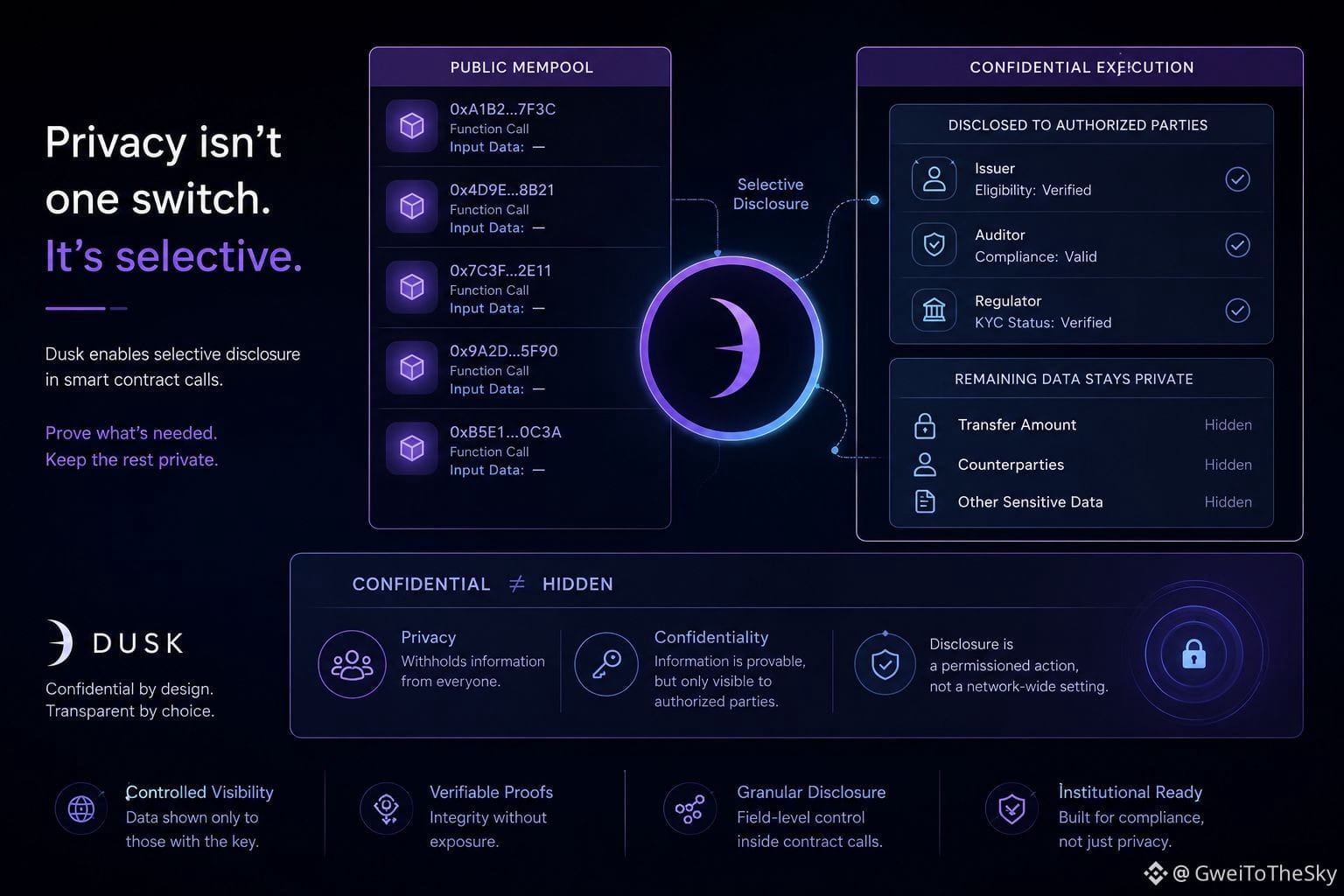
3
86
·
--
Percebi algo estranho ao comparar os tempos de confirmação entre um lote de transações DUSK que eu havia coletado no explorador. Eu presumi que todos os transfers na rede se liquidavam pelo mesmo caminho de execução, então qualquer variação de tempo teria que ser congestionamento de rede. Essa suposição não se sustentou quando eu ordenei os dados.
Ao aprofundar, o padrão de atraso acompanhava o tipo de transação, não a carga do bloco. Alguns transfers eram protegidos, roteados pelo modelo de execução voltado à privacidade que a rede chama de “privacy-preserving execution”, enquanto outros eram transfers totalmente transparentes, usando um caminho separado baseado em contas. Ambos se liquidam na mesma cadeia, mas são processados por lógicas distintas, o que explicou a variação que eu estava vendo.
Essa distinção mudou a forma como eu vinha pensando sobre a rede. Eu tinha privacidade e conformidade na mesma cabeça como se fossem o mesmo recurso. Não são. Privacidade determina o que fica visível on-chain por padrão. Conformidade determina o que pode ser provado depois, para quem, e sob qual autorização. Uma transação pode ser privada e ainda assim ser auditável, se existir o mecanismo certo de divulgação. Misturar as duas coisas esconde completamente essa segunda camada.
O que ainda não consigo resolver é quem, na prática, usa o caminho transparente versus o protegido, e por quê. A execução transparente é majoritariamente de operadores e fluxos institucionais que querem um rastro de auditoria limpo, ou é apenas hábito de usuários que não estão familiarizados com a opção protegida? Essa divisão importa para entender a demanda real.
No futuro, quero observar a razão entre o volume de transações protegidas e transparentes ao longo do tempo, e não apenas o throughput bruto. Uma mudança em direção ao uso protegido me diria que as ferramentas de privacidade estão sendo ativamente escolhidas, e não apenas disponíveis.
Ainda não sei se essa razão reflete preferência genuína ou mera inércia, e não acho que apenas dados de volume vão responder isso.
@Dusk_Foundation
$DUSK #Dusk
Percebi algo estranho ao comparar os tempos de confirmação entre um lote de transações DUSK que eu havia coletado no explorador. Eu presumi que todos os transfers na rede se liquidavam pelo mesmo caminho de execução, então qualquer variação de tempo teria que ser congestionamento de rede. Essa suposição não se sustentou quando eu ordenei os dados.
Ao aprofundar, o padrão de atraso acompanhava o tipo de transação, não a carga do bloco. Alguns transfers eram protegidos, roteados pelo modelo de execução voltado à privacidade que a rede chama de “privacy-preserving execution”, enquanto outros eram transfers totalmente transparentes, usando um caminho separado baseado em contas. Ambos se liquidam na mesma cadeia, mas são processados por lógicas distintas, o que explicou a variação que eu estava vendo.
Essa distinção mudou a forma como eu vinha pensando sobre a rede. Eu tinha privacidade e conformidade na mesma cabeça como se fossem o mesmo recurso. Não são. Privacidade determina o que fica visível on-chain por padrão. Conformidade determina o que pode ser provado depois, para quem, e sob qual autorização. Uma transação pode ser privada e ainda assim ser auditável, se existir o mecanismo certo de divulgação. Misturar as duas coisas esconde completamente essa segunda camada.
O que ainda não consigo resolver é quem, na prática, usa o caminho transparente versus o protegido, e por quê. A execução transparente é majoritariamente de operadores e fluxos institucionais que querem um rastro de auditoria limpo, ou é apenas hábito de usuários que não estão familiarizados com a opção protegida? Essa divisão importa para entender a demanda real.
No futuro, quero observar a razão entre o volume de transações protegidas e transparentes ao longo do tempo, e não apenas o throughput bruto. Uma mudança em direção ao uso protegido me diria que as ferramentas de privacidade estão sendo ativamente escolhidas, e não apenas disponíveis.
Ainda não sei se essa razão reflete preferência genuína ou mera inércia, e não acho que apenas dados de volume vão responder isso.
@Dusk
$DUSK #Dusk
Ao aprofundar, o padrão de atraso acompanhava o tipo de transação, não a carga do bloco. Alguns transfers eram protegidos, roteados pelo modelo de execução voltado à privacidade que a rede chama de “privacy-preserving execution”, enquanto outros eram transfers totalmente transparentes, usando um caminho separado baseado em contas. Ambos se liquidam na mesma cadeia, mas são processados por lógicas distintas, o que explicou a variação que eu estava vendo.
Essa distinção mudou a forma como eu vinha pensando sobre a rede. Eu tinha privacidade e conformidade na mesma cabeça como se fossem o mesmo recurso. Não são. Privacidade determina o que fica visível on-chain por padrão. Conformidade determina o que pode ser provado depois, para quem, e sob qual autorização. Uma transação pode ser privada e ainda assim ser auditável, se existir o mecanismo certo de divulgação. Misturar as duas coisas esconde completamente essa segunda camada.
O que ainda não consigo resolver é quem, na prática, usa o caminho transparente versus o protegido, e por quê. A execução transparente é majoritariamente de operadores e fluxos institucionais que querem um rastro de auditoria limpo, ou é apenas hábito de usuários que não estão familiarizados com a opção protegida? Essa divisão importa para entender a demanda real.
No futuro, quero observar a razão entre o volume de transações protegidas e transparentes ao longo do tempo, e não apenas o throughput bruto. Uma mudança em direção ao uso protegido me diria que as ferramentas de privacidade estão sendo ativamente escolhidas, e não apenas disponíveis.
Ainda não sei se essa razão reflete preferência genuína ou mera inércia, e não acho que apenas dados de volume vão responder isso.
@Dusk
$DUSK #Dusk
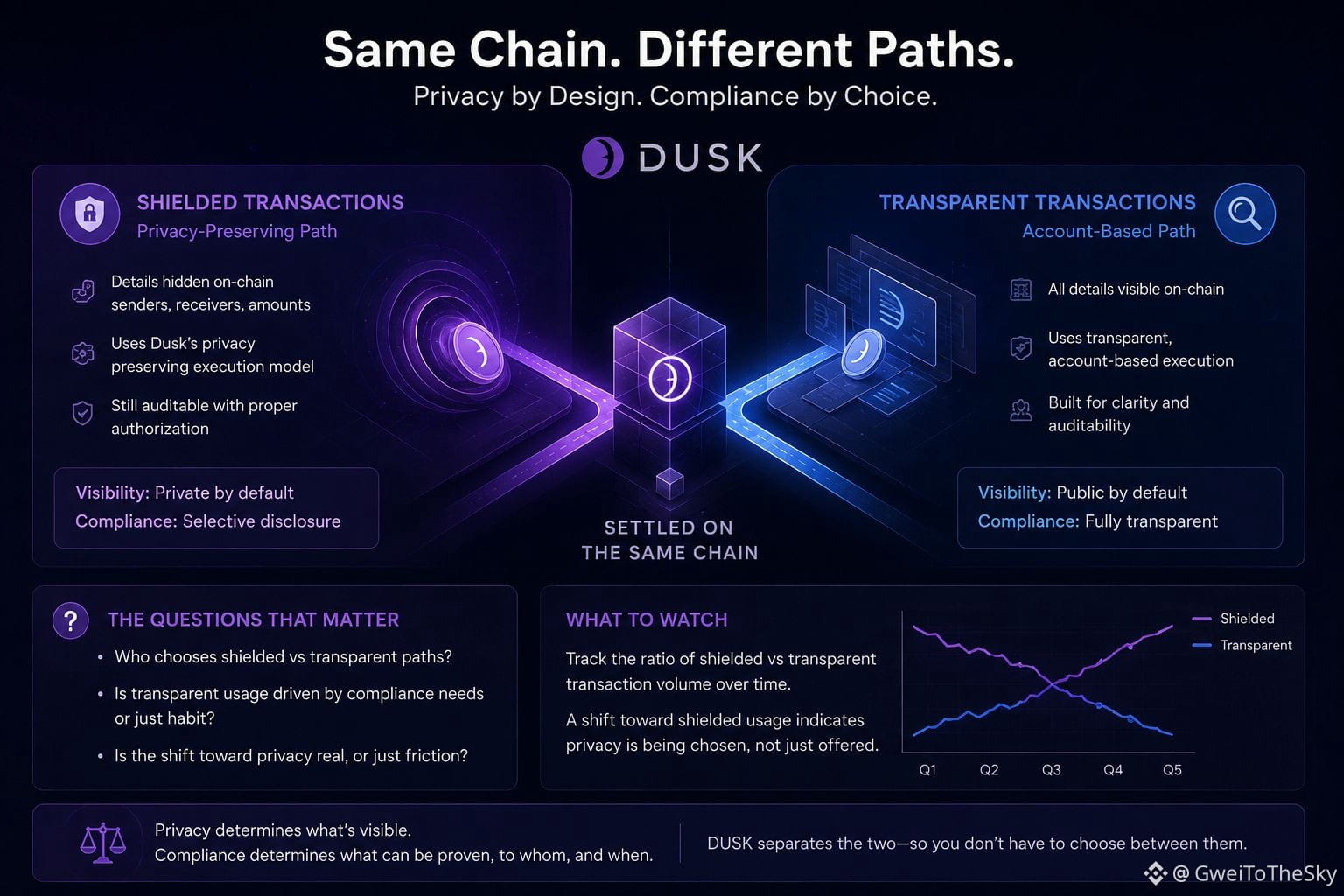
1
3
83
·
--
Cada ciclo de cripto nos vende o mesmo sonho: desta vez, o sistema finalmente elimina a necessidade de confiança.
“Consertamos a confiança.”
“Consertamos a segurança.”
“Consertamos a camada que faltava.”
O Protocolo Newton ($NEWT ) está mirando um problema real: se agentes de IA, cofres automatizados e contratos inteligentes começarem a movimentar dinheiro de verdade, quem garante que essas ações sigam as regras corretas antes de o dano acontecer?
A ideia parece lógica. Não espere por um hack. Não investigue a falha depois que os fundos somem. Coloque políticas antes da execução e bloqueie ações arriscadas antes que se concretizem.
História limpa.
Pelo menos no papel.
Mas é aqui que as coisas se complicam. Adicionar uma camada de regras também cria uma nova dependência. Quem escreve essas políticas? Quem controla as configurações padrão? Quem decide o que “seguro” realmente significa?
Porque, às vezes, o maior poder não está em segurar o dinheiro.
Está em controlar o que o dinheiro está autorizado a fazer.
A Newton fala em sair da confiança cega em direção a regras verificáveis, e essa é uma direção que vale observar. Mas só tecnologia não remove incentivos humanos. Alguém ainda projeta o sistema. Alguém se beneficia da adoção. Alguém controla os padrões que todo mundo segue.
O verdadeiro teste para o Newt não é se a tecnologia funciona durante uma fase beta com primeiros adeptos.
O teste vem depois.
Quando o dinheiro real entra, os incentivos colidem, e o sistema precisa provar que consegue proteger os usuários sem se tornar outro gatekeeper usando um nome diferente.
@NewtonProtocol #Newt
$TAC $SKL
Cada ciclo de cripto nos vende o mesmo sonho: desta vez, o sistema finalmente elimina a necessidade de confiança.
“Consertamos a confiança.”
“Consertamos a segurança.”
“Consertamos a camada que faltava.”
O Protocolo Newton ($NEWT ) está mirando um problema real: se agentes de IA, cofres automatizados e contratos inteligentes começarem a movimentar dinheiro de verdade, quem garante que essas ações sigam as regras corretas antes de o dano acontecer?
A ideia parece lógica. Não espere por um hack. Não investigue a falha depois que os fundos somem. Coloque políticas antes da execução e bloqueie ações arriscadas antes que se concretizem.
História limpa.
Pelo menos no papel.
Mas é aqui que as coisas se complicam. Adicionar uma camada de regras também cria uma nova dependência. Quem escreve essas políticas? Quem controla as configurações padrão? Quem decide o que “seguro” realmente significa?
Porque, às vezes, o maior poder não está em segurar o dinheiro.
Está em controlar o que o dinheiro está autorizado a fazer.
A Newton fala em sair da confiança cega em direção a regras verificáveis, e essa é uma direção que vale observar. Mas só tecnologia não remove incentivos humanos. Alguém ainda projeta o sistema. Alguém se beneficia da adoção. Alguém controla os padrões que todo mundo segue.
O verdadeiro teste para o Newt não é se a tecnologia funciona durante uma fase beta com primeiros adeptos.
O teste vem depois.
Quando o dinheiro real entra, os incentivos colidem, e o sistema precisa provar que consegue proteger os usuários sem se tornar outro gatekeeper usando um nome diferente.
@NewtonProtocol #Newt
$TAC $SKL
“Consertamos a confiança.”
“Consertamos a segurança.”
“Consertamos a camada que faltava.”
O Protocolo Newton ($NEWT ) está mirando um problema real: se agentes de IA, cofres automatizados e contratos inteligentes começarem a movimentar dinheiro de verdade, quem garante que essas ações sigam as regras corretas antes de o dano acontecer?
A ideia parece lógica. Não espere por um hack. Não investigue a falha depois que os fundos somem. Coloque políticas antes da execução e bloqueie ações arriscadas antes que se concretizem.
História limpa.
Pelo menos no papel.
Mas é aqui que as coisas se complicam. Adicionar uma camada de regras também cria uma nova dependência. Quem escreve essas políticas? Quem controla as configurações padrão? Quem decide o que “seguro” realmente significa?
Porque, às vezes, o maior poder não está em segurar o dinheiro.
Está em controlar o que o dinheiro está autorizado a fazer.
A Newton fala em sair da confiança cega em direção a regras verificáveis, e essa é uma direção que vale observar. Mas só tecnologia não remove incentivos humanos. Alguém ainda projeta o sistema. Alguém se beneficia da adoção. Alguém controla os padrões que todo mundo segue.
O verdadeiro teste para o Newt não é se a tecnologia funciona durante uma fase beta com primeiros adeptos.
O teste vem depois.
Quando o dinheiro real entra, os incentivos colidem, e o sistema precisa provar que consegue proteger os usuários sem se tornar outro gatekeeper usando um nome diferente.
@NewtonProtocol #Newt
$TAC $SKL
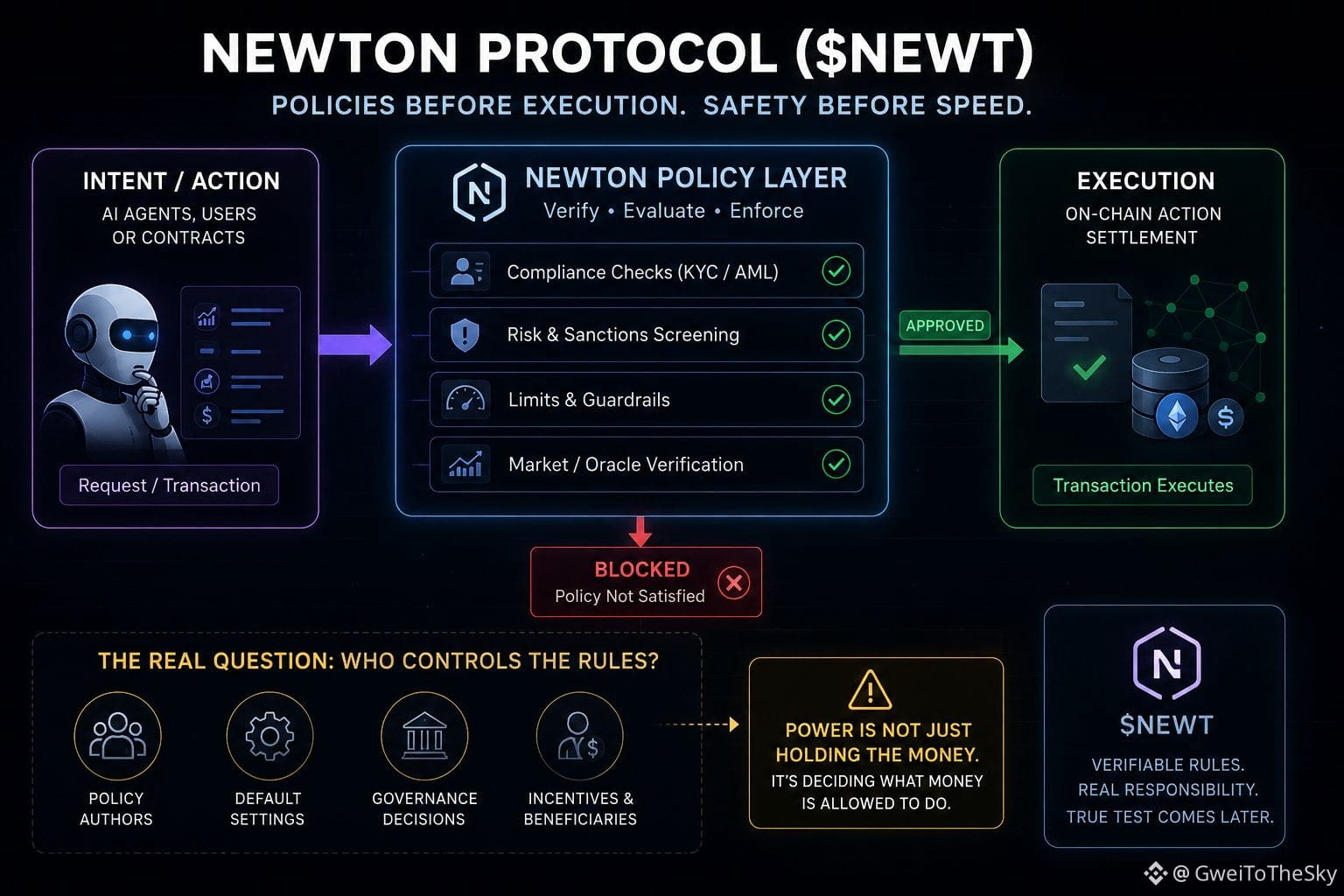
3
2
163
·
--
Olha, cada ciclo tem uma nova promessa de que a tecnologia vai eliminar os erros humanos. @NewtonProtocol está entrando com uma ideia semelhante: agentes de IA estão ficando mais poderosos, mas se eles controlarem dinheiro, quem garante que eles não ultrapassem a linha?
Newton tenta resolver um problema real ao adicionar regras e limites verificáveis antes que ações financeiras autônomas aconteçam. O objetivo não é apenas transações de IA mais rápidas, mas um comportamento de IA controlado.
Mas vamos ser honestos: adicionar uma camada de regras também adiciona outro sistema que as pessoas precisam confiar. Mais políticas, mais verificação, mais infraestrutura. Às vezes, resolver a complexidade cria um novo tipo de complexidade.
A verdadeira questão é quem controla essas regras e quem se beneficia se isso virar o padrão. Desenvolvedores, operadores, provedores de infraestrutura e detentores de tokens podem ganhar valor, mas os usuários ainda estão confiando nas escolhas de design de alguém.
Descentralização soa bem, mas o poder pode se concentrar silenciosamente em quem cria políticas, gerencia a infraestrutura crítica ou define o que “seguro” realmente significa.
E o que acontece quando uma IA segue regras aprovadas, mas ainda toma uma decisão financeira terrível? Um erro verificado ainda é um erro.
O maior desafio da Newton não é provar que a IA consegue movimentar dinheiro.
É provar que adicionar mais um sistema de confiança realmente reduz o risco, em vez de apenas mover o risco para algum lugar mais difícil de enxergar.
#Newt $NEWT
$SENT $SPCX
Olha, cada ciclo tem uma nova promessa de que a tecnologia vai eliminar os erros humanos. @NewtonProtocol está entrando com uma ideia semelhante: agentes de IA estão ficando mais poderosos, mas se eles controlarem dinheiro, quem garante que eles não ultrapassem a linha?
Newton tenta resolver um problema real ao adicionar regras e limites verificáveis antes que ações financeiras autônomas aconteçam. O objetivo não é apenas transações de IA mais rápidas, mas um comportamento de IA controlado.
Mas vamos ser honestos: adicionar uma camada de regras também adiciona outro sistema que as pessoas precisam confiar. Mais políticas, mais verificação, mais infraestrutura. Às vezes, resolver a complexidade cria um novo tipo de complexidade.
A verdadeira questão é quem controla essas regras e quem se beneficia se isso virar o padrão. Desenvolvedores, operadores, provedores de infraestrutura e detentores de tokens podem ganhar valor, mas os usuários ainda estão confiando nas escolhas de design de alguém.
Descentralização soa bem, mas o poder pode se concentrar silenciosamente em quem cria políticas, gerencia a infraestrutura crítica ou define o que “seguro” realmente significa.
E o que acontece quando uma IA segue regras aprovadas, mas ainda toma uma decisão financeira terrível? Um erro verificado ainda é um erro.
O maior desafio da Newton não é provar que a IA consegue movimentar dinheiro.
É provar que adicionar mais um sistema de confiança realmente reduz o risco, em vez de apenas mover o risco para algum lugar mais difícil de enxergar.
#Newt $NEWT
$SENT $SPCX
Newton tenta resolver um problema real ao adicionar regras e limites verificáveis antes que ações financeiras autônomas aconteçam. O objetivo não é apenas transações de IA mais rápidas, mas um comportamento de IA controlado.
Mas vamos ser honestos: adicionar uma camada de regras também adiciona outro sistema que as pessoas precisam confiar. Mais políticas, mais verificação, mais infraestrutura. Às vezes, resolver a complexidade cria um novo tipo de complexidade.
A verdadeira questão é quem controla essas regras e quem se beneficia se isso virar o padrão. Desenvolvedores, operadores, provedores de infraestrutura e detentores de tokens podem ganhar valor, mas os usuários ainda estão confiando nas escolhas de design de alguém.
Descentralização soa bem, mas o poder pode se concentrar silenciosamente em quem cria políticas, gerencia a infraestrutura crítica ou define o que “seguro” realmente significa.
E o que acontece quando uma IA segue regras aprovadas, mas ainda toma uma decisão financeira terrível? Um erro verificado ainda é um erro.
O maior desafio da Newton não é provar que a IA consegue movimentar dinheiro.
É provar que adicionar mais um sistema de confiança realmente reduz o risco, em vez de apenas mover o risco para algum lugar mais difícil de enxergar.
#Newt $NEWT
$SENT $SPCX
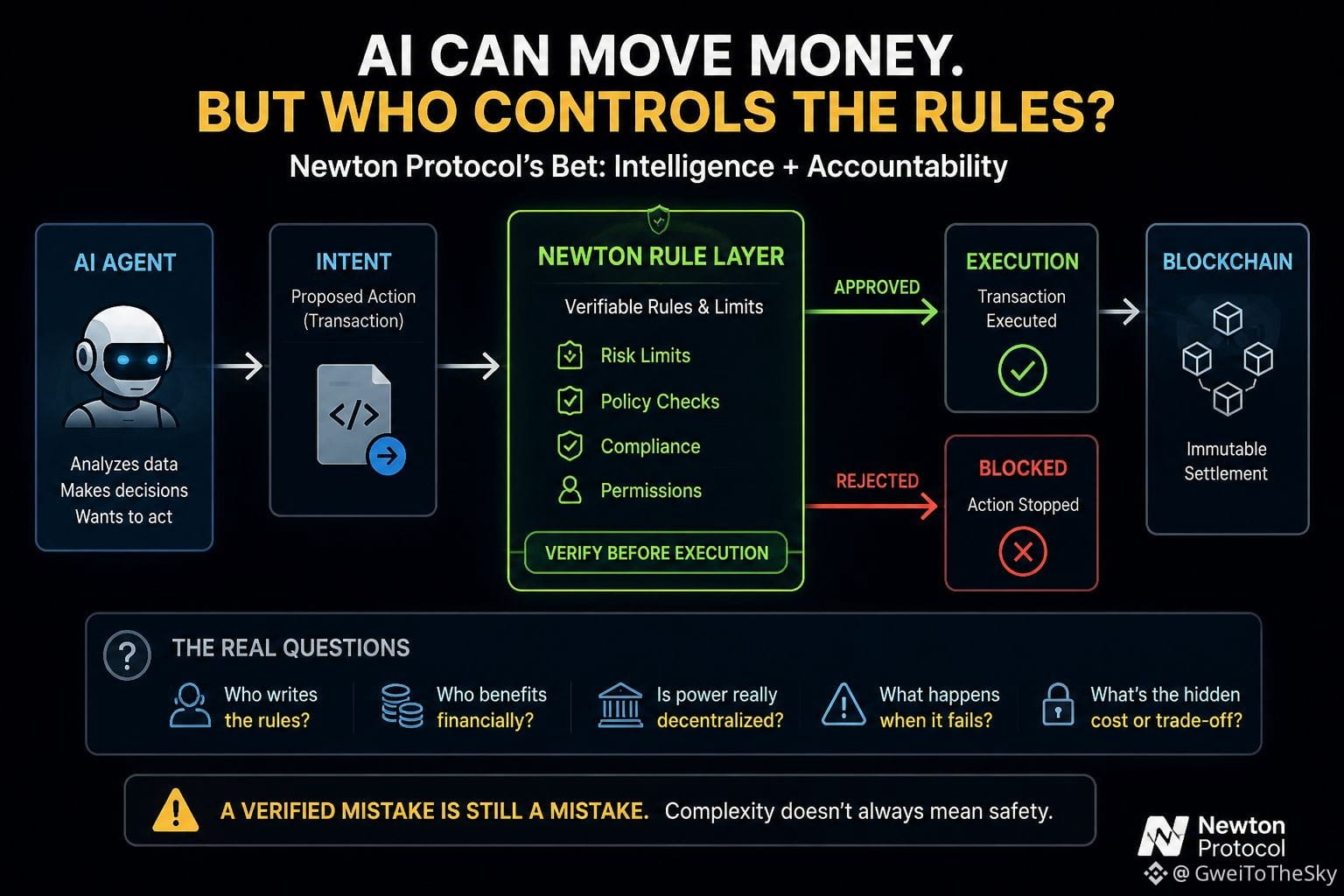
4
2
218
·
--
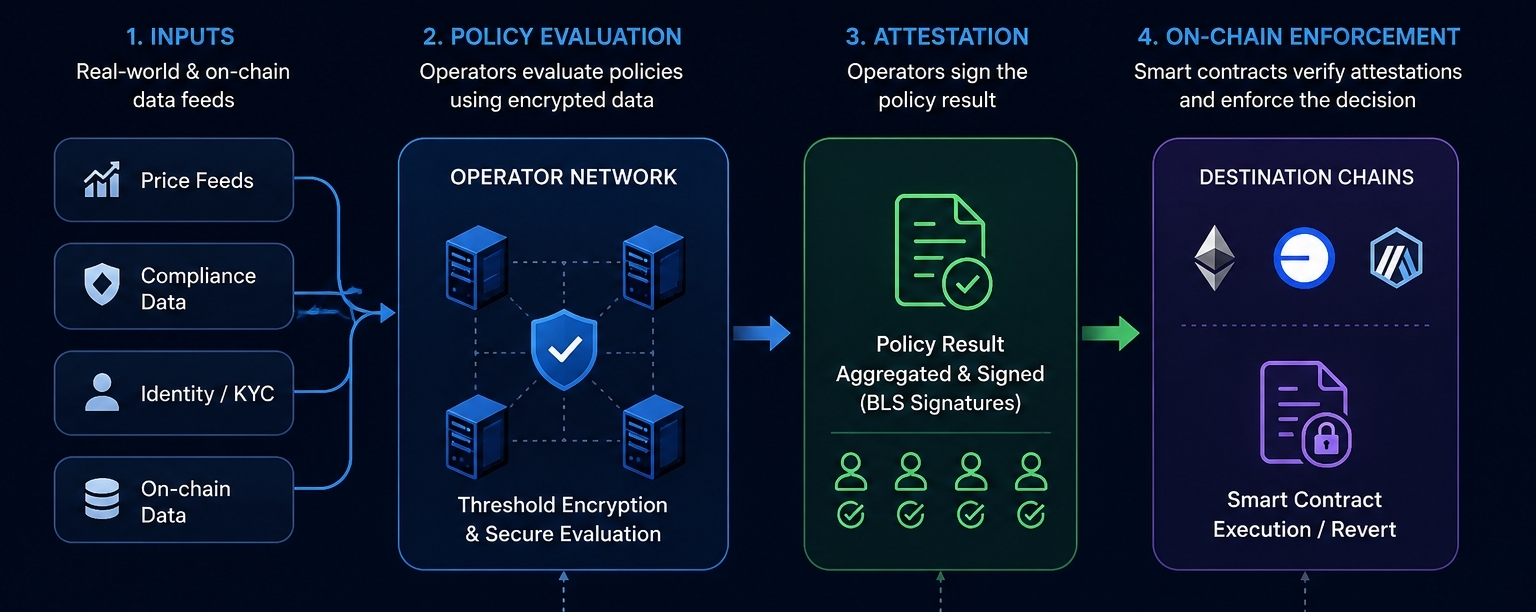
Artigo
Protocolo Newton e a Linha Tênue Entre Verificação e SuposiçãoA Pergunta Silenciosa por Trás da Confiança Programável
O Protocolo Newton tem circulado por conversas sobre infraestrutura há algum tempo, não porque prometa uma versão mais alta de cripto, mas porque está tentando responder a uma pergunta mais silenciosa e desconfortável: no que exatamente estamos confiando quando sistemas automatizados começam a mover valor real?
Eu já vi ciclos suficientes de tecnologia para saber que a primeira onda de atenção geralmente vai para velocidade, escala e demos impressionantes. As perguntas mais difíceis chegam depois. Quem controla o sistema? Quem verifica as decisões? O que acontece quando algo funciona tecnicamente, mas ainda assim produz o resultado errado?
Protocolo Newton e a Linha Tênue Entre Verificação e Suposição
A Pergunta Silenciosa por Trás da Confiança Programável
O Protocolo Newton tem circulado por conversas sobre infraestrutura há algum tempo, não porque prometa uma versão mais alta de cripto, mas porque está tentando responder a uma pergunta mais silenciosa e desconfortável: no que exatamente estamos confiando quando sistemas automatizados começam a mover valor real?
Eu já vi ciclos suficientes de tecnologia para saber que a primeira onda de atenção geralmente vai para velocidade, escala e demos impressionantes. As perguntas mais difíceis chegam depois. Quem controla o sistema? Quem verifica as decisões? O que acontece quando algo funciona tecnicamente, mas ainda assim produz o resultado errado?
O Protocolo Newton tem circulado por conversas sobre infraestrutura há algum tempo, não porque prometa uma versão mais alta de cripto, mas porque está tentando responder a uma pergunta mais silenciosa e desconfortável: no que exatamente estamos confiando quando sistemas automatizados começam a mover valor real?
Eu já vi ciclos suficientes de tecnologia para saber que a primeira onda de atenção geralmente vai para velocidade, escala e demos impressionantes. As perguntas mais difíceis chegam depois. Quem controla o sistema? Quem verifica as decisões? O que acontece quando algo funciona tecnicamente, mas ainda assim produz o resultado errado?
7
3
61
Inicia sessão para explorar mais conteúdos
Junta-te a utilizadores de criptomoedas de todo o mundo na Binance Square
⚡️ Obtém informações úteis e recentes sobre criptomoedas.
💬 Com a confiança da maior exchange de criptomoedas do mundo.
👍 Descobre perspetivas reais de criadores verificados.
E-mail/Número de telefone
Tópicos em Tendência
NFPWatch
10.4M visualizações
16,634 a discutir
Notícias de Cripto | Bitcoin se Aproxima de US$ 85 mil à medida que os Rendimento dos Treasuries Caem antes do Relatório NFP dos EUA
Binance News
·1 gostos
·1.3k visualizações
BitcoinRisesToward$85K
0 visualizações
20 a discutir
AmazonPlansToSell$8BNvidiaChips
510 visualizações
27 a discutir