
TEKT0NIC 1
1k Publicações

TEKT0NIC 1
Denunciar
Bloquear usuário
Passionate about crypto and blockchain | Crypto Enthusiastic | Technical Analysis | Fundamental News
0 Seguindo
8 Seguidores
37 Curtiu
Publicações
·
--
Os próximos números da próxima rodada do mercado são US$ 83.000 em Bitcoin e US$ 3.000 em Ether. Essas são as barreiras. Elas não são bilhetes automáticos para US$ 100.000 e US$ 5.000. De acordo com os níveis que limitaram este repique, o $BTC ainda precisa romper a zona das máximas de maio perto de US$ 83.000. O $ETH ainda precisa romper US$ 3.000. Operadores que tratam esses níveis como gatilhos para US$ 100.000 e US$ 5.000 estão precificando uma retomada total da tendência se aquelas prateleiras virarem de resistência para suporte. Principais detalhes: > Primeira barreira do Bitcoin: US$ 83.000. Próximo número da rodada após isso: US$ 100.000. > Primeira barreira do Ether: US$ 3.000. Próximo número da rodada após isso: US$ 5.000. > Área atual: Bitcoin na faixa das altas de US$ 70.000, Ether por volta de US$ 2.500. > Uma virada significa manter acima do nível, não apenas um pavio único atravessando-o. US$ 83.000 e US$ 3.000 são as linhas de confirmação. US$ 100.000 e US$ 5.000 são os alvos que as pessoas escrevem assim que essas linhas são aceitas. Falhar em US$ 83.000 novamente e o Bitcoin continua limitado em faixa. Falhar em US$ 3.000 e o Ether ainda é uma operação de recuperação que não começou. Níveis: US$ 83K $BTC e US$ 3K $ETH Primeiro — US$ 100K e US$ 5K Somente Depois que Isso Segurar #BTC Price Analysis# #Bitcoin Price Prediction: What is Bitcoins next move?#
Os próximos números da próxima rodada do mercado são US$ 83.000 em Bitcoin e US$ 3.000 em Ether. Essas são as barreiras. Elas não são bilhetes automáticos para US$ 100.000 e US$ 5.000. De acordo com os níveis que limitaram este repique, o $BTC ainda precisa romper a zona das máximas de maio perto de US$ 83.000. O $ETH ainda precisa romper US$ 3.000. Operadores que tratam esses níveis como gatilhos para US$ 100.000 e US$ 5.000 estão precificando uma retomada total da tendência se aquelas prateleiras virarem de resistência para suporte. Principais detalhes: > Primeira barreira do Bitcoin: US$ 83.000. Próximo número da rodada após isso: US$ 100.000. > Primeira barreira do Ether: US$ 3.000. Próximo número da rodada após isso: US$ 5.000. > Área atual: Bitcoin na faixa das altas de US$ 70.000, Ether por volta de US$ 2.500. > Uma virada significa manter acima do nível, não apenas um pavio único atravessando-o. US$ 83.000 e US$ 3.000 são as linhas de confirmação. US$ 100.000 e US$ 5.000 são os alvos que as pessoas escrevem assim que essas linhas são aceitas. Falhar em US$ 83.000 novamente e o Bitcoin continua limitado em faixa. Falhar em US$ 3.000 e o Ether ainda é uma operação de recuperação que não começou. Níveis: US$ 83K $BTC e US$ 3K $ETH Primeiro — US$ 100K e US$ 5K Somente Depois que Isso Segurar #BTC Price Analysis# #Bitcoin Price Prediction: What is Bitcoins next move?#
·
--
Ver tradução
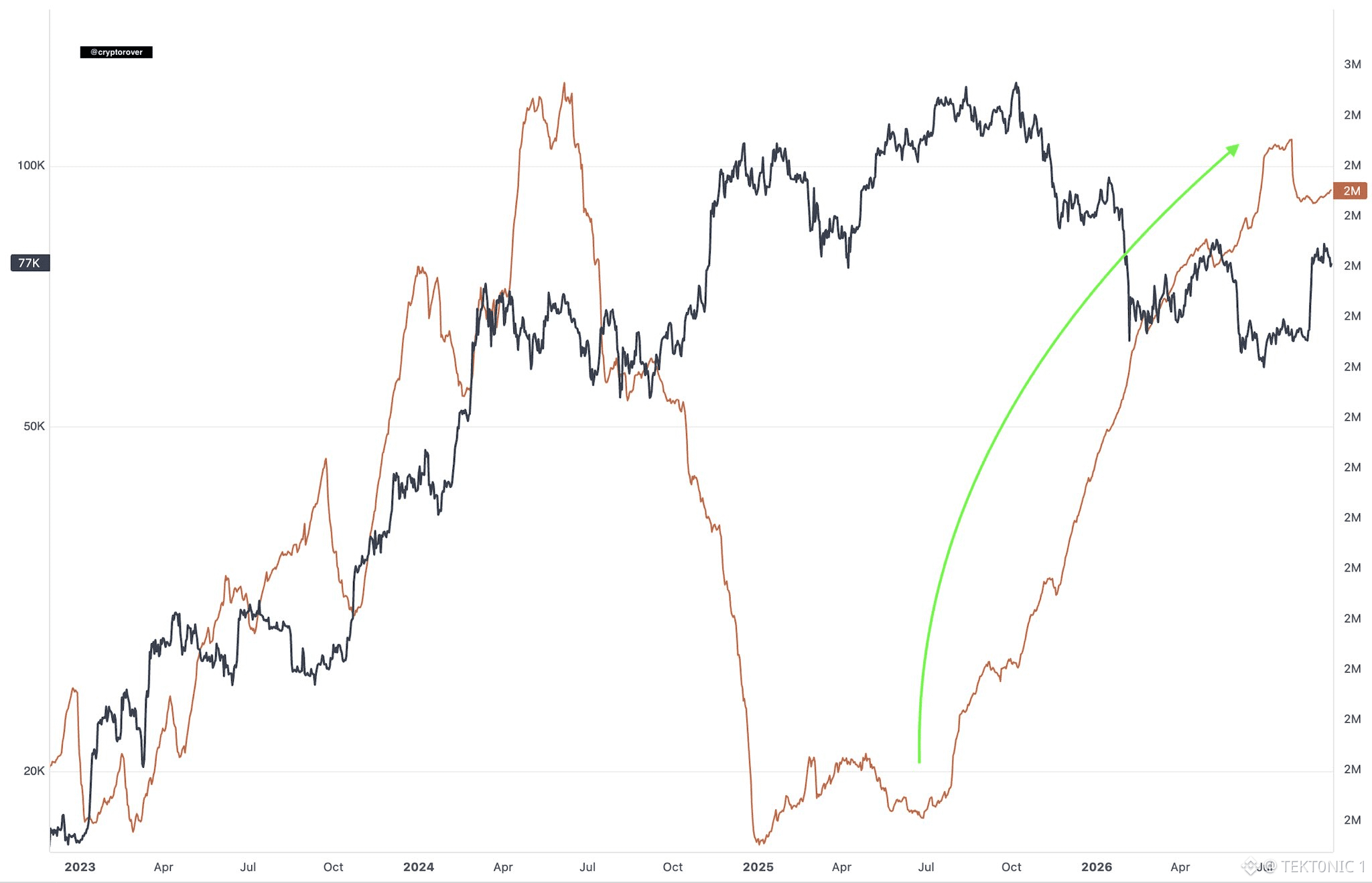
Large-Holder Bitcoin Supply Has Been Rebuilding Into the $77,000 Area The orange line on this overlay is the accumulation side of the tape. Price is the black line. According to the chart, $BTC is near $77,000. The second series — the whale/large-holder cohort on the right-hand scale — collapsed in late 2024, then turned up through 2025 and 2026 and is back near the 2 million mark. That recovery is what the green arrow is marking. Key Details: > Bitcoin price on this view: about $77,000, still below the $100,000 handle and the $126,000 high. > The orange cohort fell hard, then spent more than a year grinding higher. > The latest reading is back around 2 million on that scale. > Price and the cohort are no longer moving in lockstep: holdings rebuilt while price chopped. A rising large-holder line into a $77,000 base is constructive. It is not the same thing as a breakout. Whales can add for months and still sell into $83,000. Confirmation remains a hold of $80,000 and a close through $82,000–$83,000. Whale-Scale Bitcoin Holdings Back Near 2M While Price Sits at $77K #BTC Price Analysis# #Bitcoin Price Prediction: What is Bitcoins next move?# $ETH $BTC
Large-Holder Bitcoin Supply Has Been Rebuilding Into the $77,000 Area The orange line on this overlay is the accumulation side of the tape. Price is the black line. According to the chart, $BTC is near $77,000. The second series — the whale/large-holder cohort on the right-hand scale — collapsed in late 2024, then turned up through 2025 and 2026 and is back near the 2 million mark. That recovery is what the green arrow is marking. Key Details: > Bitcoin price on this view: about $77,000, still below the $100,000 handle and the $126,000 high. > The orange cohort fell hard, then spent more than a year grinding higher. > The latest reading is back around 2 million on that scale. > Price and the cohort are no longer moving in lockstep: holdings rebuilt while price chopped. A rising large-holder line into a $77,000 base is constructive. It is not the same thing as a breakout. Whales can add for months and still sell into $83,000. Confirmation remains a hold of $80,000 and a close through $82,000–$83,000. Whale-Scale Bitcoin Holdings Back Near 2M While Price Sits at $77K #BTC Price Analysis# #Bitcoin Price Prediction: What is Bitcoins next move?# $ETH $BTC
·
--
Ver tradução
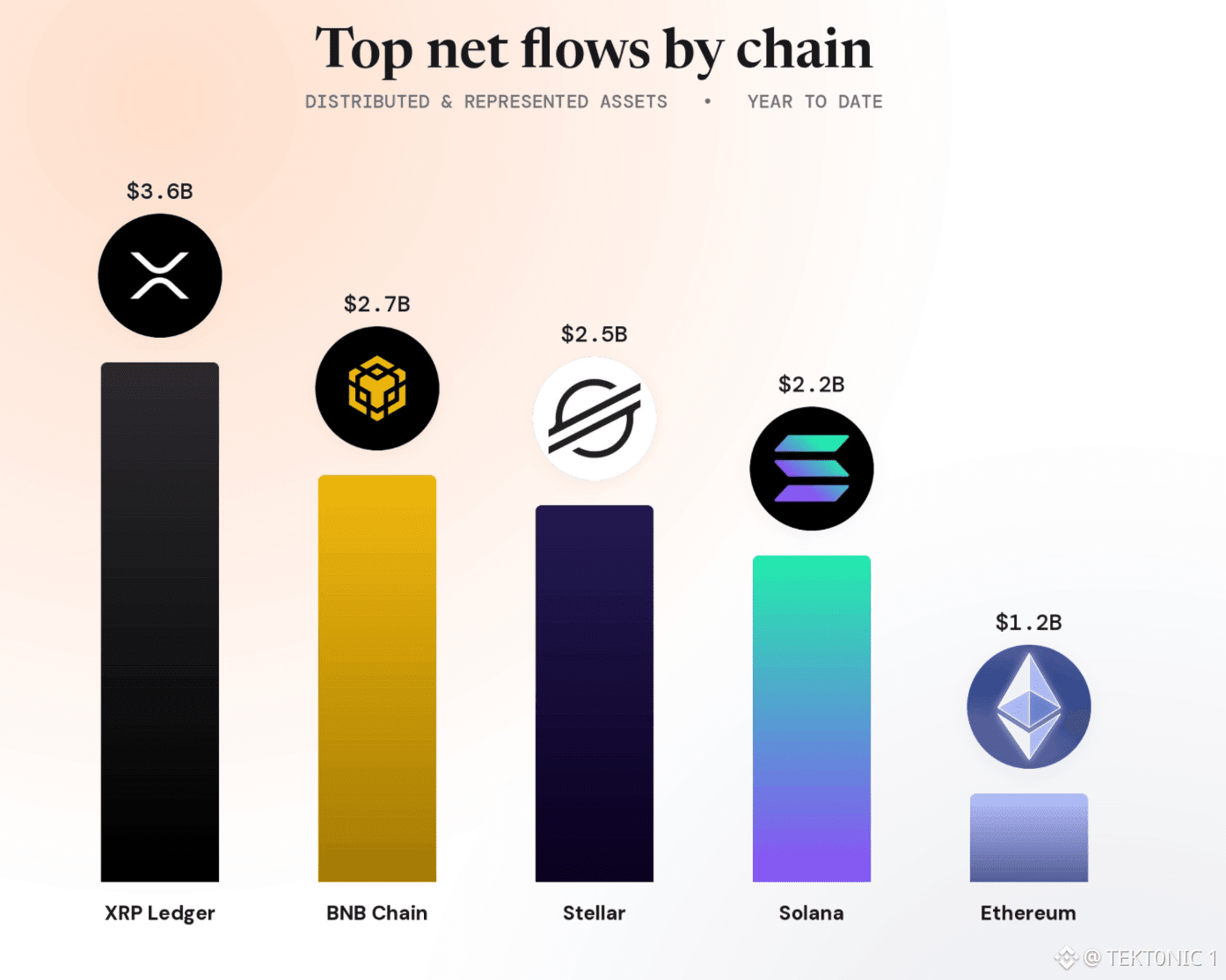
RWA capital is moving across more chains. year to date, the XRP Ledger has attracted around $3.6b in net RWA flows, leading all major chains. here’s how the top 5 look: > XRP Ledger — $3.6b > BNB Chain — $2.7b > Stellar — $2.5b > Solana — $2.2b > Ethereum — $1.2b and the growth isn’t limited to one type of asset. XRPL’s recent inflows have been driven heavily by tokenized commodities and asset-backed credit, while Stellar has crossed $3b in total RWA value with Treasuries, money-market funds, credit and gold all represented on the network. ethereum still has the largest overall RWA base, but the flow data shows capital is spreading across other ecosystems. tokenization is becoming a multi-chain market. and these numbers are starting to show it. #BTC Price Analysis# #Altcoin Season# #RWA $XRP $SOL
RWA capital is moving across more chains. year to date, the XRP Ledger has attracted around $3.6b in net RWA flows, leading all major chains. here’s how the top 5 look: > XRP Ledger — $3.6b > BNB Chain — $2.7b > Stellar — $2.5b > Solana — $2.2b > Ethereum — $1.2b and the growth isn’t limited to one type of asset. XRPL’s recent inflows have been driven heavily by tokenized commodities and asset-backed credit, while Stellar has crossed $3b in total RWA value with Treasuries, money-market funds, credit and gold all represented on the network. ethereum still has the largest overall RWA base, but the flow data shows capital is spreading across other ecosystems. tokenization is becoming a multi-chain market. and these numbers are starting to show it. #BTC Price Analysis# #Altcoin Season# #RWA $XRP $SOL
27
·
--
Ver tradução
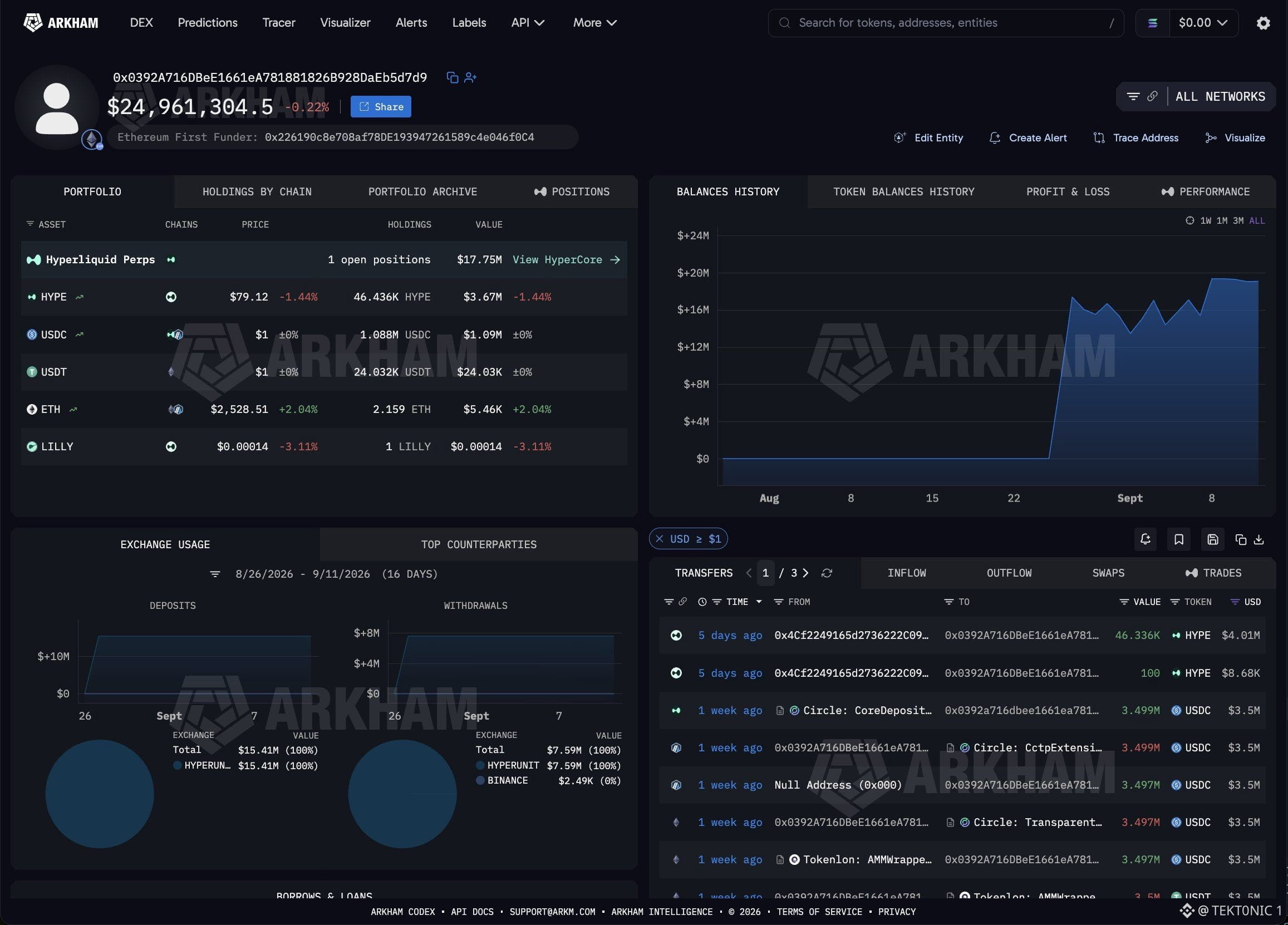
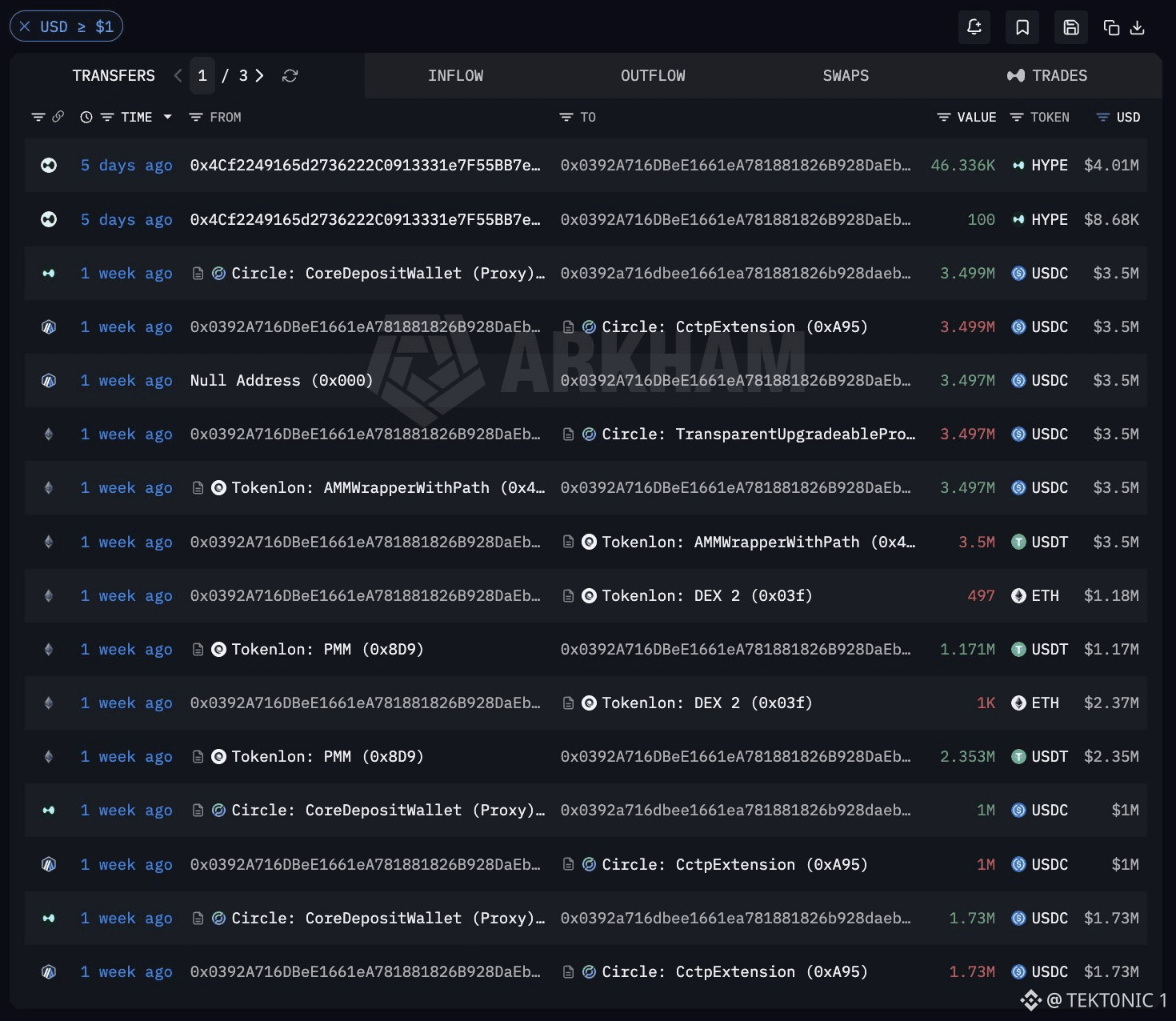
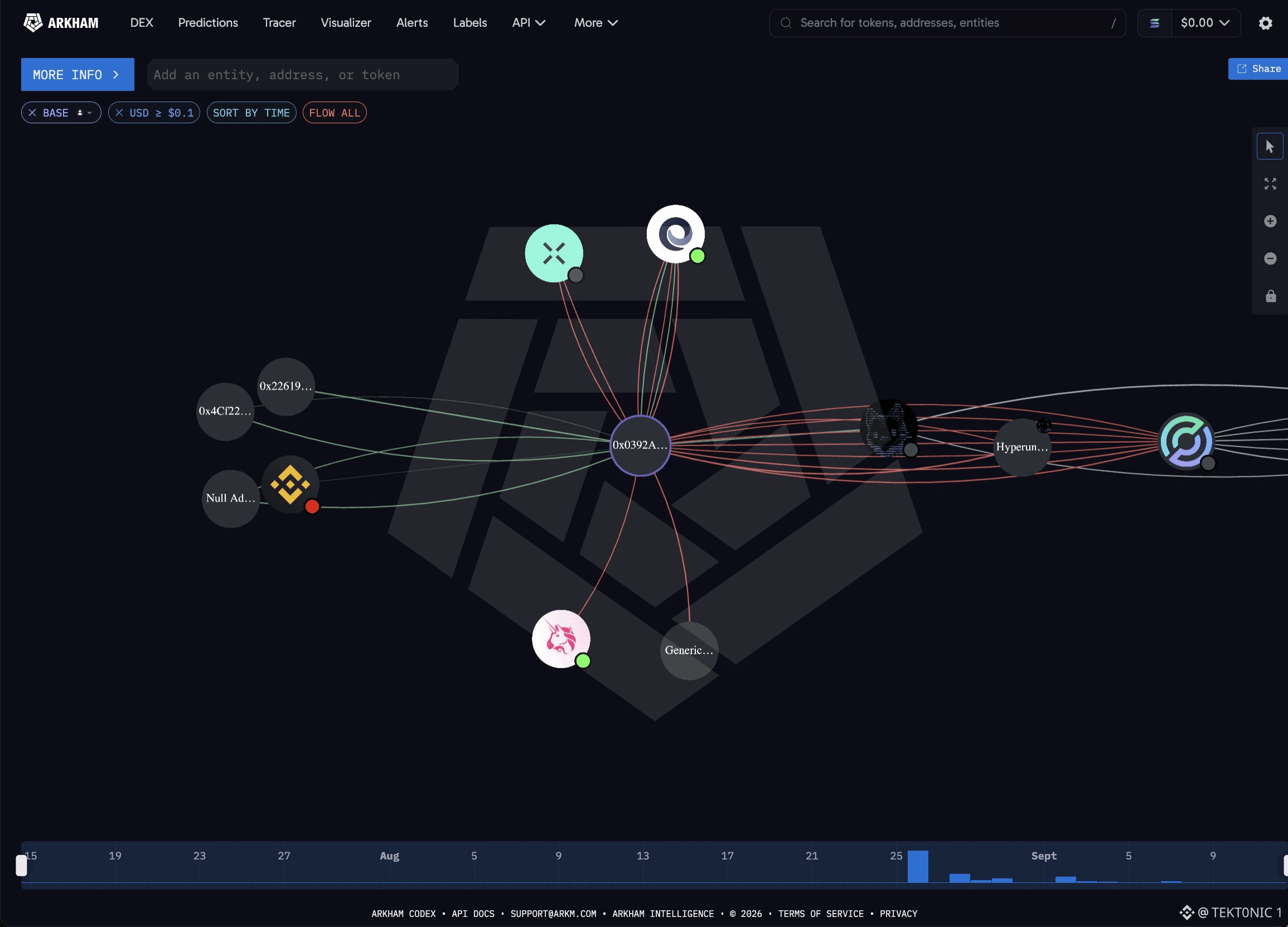
this Hyperliquid wallet is green again on a crowded ETH long. 0x039 funded a fresh address about two weeks ago. Arkham shows the book at $24.96 million now, with one perp position marked at $17.75 million plus 46,436 $HYPE . deposits over the last 16 days were $15.41 million, almost all through Hyperunit. the trade is an 8x $ETH long. entry was $2,486. notional is $114.37 million. ten days ago, when ETH printed $2,372, the account was down about $4.9 million. ETH is back through the entry. unrealized PnL is +$1.98 million. that matters because the same book that looked stopped out below $2,400 is now covering the hole without cutting the size. the catch: this is mark-to-market on 8x. a move back under $2,486 wipes the $1.98 million and puts the $4.9 million drawdown back on the screen. one wallet is not the whole bid. so the long survived the dip. it has not been reduced. $ETH still has to hold the entry for the profit to stick. #BTC Price Analysis# #HyperLiquid #Ethereum $HYPE
this Hyperliquid wallet is green again on a crowded ETH long. 0x039 funded a fresh address about two weeks ago. Arkham shows the book at $24.96 million now, with one perp position marked at $17.75 million plus 46,436 $HYPE . deposits over the last 16 days were $15.41 million, almost all through Hyperunit. the trade is an 8x $ETH long. entry was $2,486. notional is $114.37 million. ten days ago, when ETH printed $2,372, the account was down about $4.9 million. ETH is back through the entry. unrealized PnL is +$1.98 million. that matters because the same book that looked stopped out below $2,400 is now covering the hole without cutting the size. the catch: this is mark-to-market on 8x. a move back under $2,486 wipes the $1.98 million and puts the $4.9 million drawdown back on the screen. one wallet is not the whole bid. so the long survived the dip. it has not been reduced. $ETH still has to hold the entry for the profit to stick. #BTC Price Analysis# #HyperLiquid #Ethereum $HYPE
28
·
--
Ver tradução
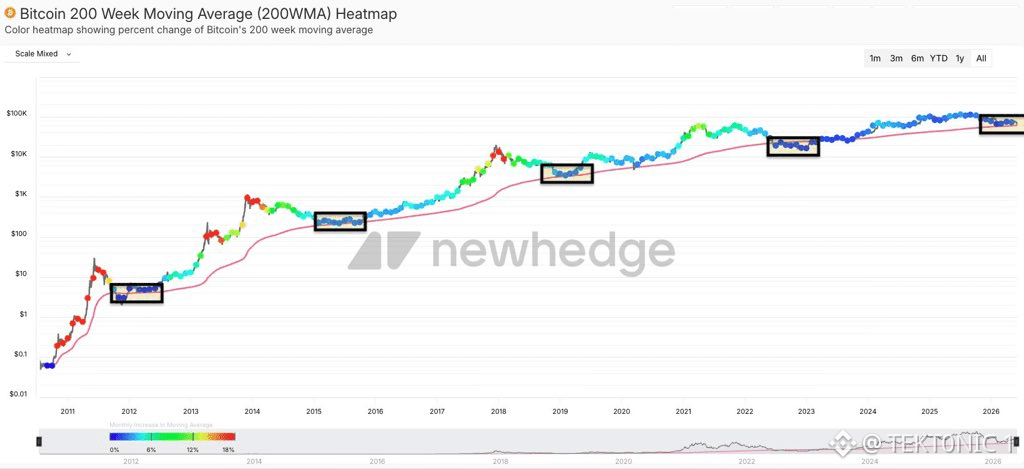
Bitcoin Is Back on Its 200-Week Average — The Line That Has Marked Prior Cycle Floors The long-term mean is holding. That is a support test, not a slogan. According to the Newhedge 200-week moving-average heatmap, $BTC is sitting on the rising 200-week line again in 2026. The same chart boxed similar tags in 2012, 2015, 2019, and 2022. Those prior touches preceded large multi-year advances. Color on the dots is the pace of change in the average itself. Key Details: > The 200-week average is the typical weekly close over about four years. It rises slowly and rarely rolls over. > Price is tagging that line again in the latest boxed zone. > Earlier boxes at the 200-week line lined up with bear-market lows, not tops. > The average is still sloping up, which means the long-term trend has not broken even after the drop from $126,000. “Never bet against the 200-week” has been a useful rule on this chart. It is not a law. The risk is a weekly close that loses the line and stays lost. The opportunity is the same one those older boxes marked: a long-term mean that has so far absorbed every major drawdown. Bitcoin Tagging the 200-Week Average Again — Same Zone That Marked 2015, 2019, and 2022 Lows #BTC Price Analysis# #Bitcoin Price Prediction: What is Bitcoins next move?# $BTC $ETH
Bitcoin Is Back on Its 200-Week Average — The Line That Has Marked Prior Cycle Floors The long-term mean is holding. That is a support test, not a slogan. According to the Newhedge 200-week moving-average heatmap, $BTC is sitting on the rising 200-week line again in 2026. The same chart boxed similar tags in 2012, 2015, 2019, and 2022. Those prior touches preceded large multi-year advances. Color on the dots is the pace of change in the average itself. Key Details: > The 200-week average is the typical weekly close over about four years. It rises slowly and rarely rolls over. > Price is tagging that line again in the latest boxed zone. > Earlier boxes at the 200-week line lined up with bear-market lows, not tops. > The average is still sloping up, which means the long-term trend has not broken even after the drop from $126,000. “Never bet against the 200-week” has been a useful rule on this chart. It is not a law. The risk is a weekly close that loses the line and stays lost. The opportunity is the same one those older boxes marked: a long-term mean that has so far absorbed every major drawdown. Bitcoin Tagging the 200-Week Average Again — Same Zone That Marked 2015, 2019, and 2022 Lows #BTC Price Analysis# #Bitcoin Price Prediction: What is Bitcoins next move?# $BTC $ETH
36
·
--
Ver tradução
the Houthis now sit on the rock that splits Bab el-Mandeb. Perim Island, also called Mayun, fell after Yemeni government forces pulled off. Mocha and Dhubab went in the same two-day push. Perim divides the strait into its two shipping lanes, which is why the island matters more than another coastal town. Q2 flows through Bab el-Mandeb averaged 8.1 million barrels a day, per the EIA, about 8% of global supply. that volume had already jumped after Hormuz tightened and more Gulf crude was sent to Yanbu for the Red Sea route. Kpler had crossings drop from 30 to 15 on Friday. Hormuz traffic is already crushed. the Saudi East-West line that exists to bypass it was hit and shut in the same window. Brent has been trading above $100. two oil chokepoints are now under pressure at once. cargo that leaves one gate still has to clear the other. the catch: seizing Perim is not the same as closing the strait. ships are still moving, just fewer of them. the price is pricing disruption risk, not a confirmed zero-flow print. #BTC Price Analysis# #Bitcoin Price Prediction: What is Bitcoins next move?# $BTC $SOL
the Houthis now sit on the rock that splits Bab el-Mandeb. Perim Island, also called Mayun, fell after Yemeni government forces pulled off. Mocha and Dhubab went in the same two-day push. Perim divides the strait into its two shipping lanes, which is why the island matters more than another coastal town. Q2 flows through Bab el-Mandeb averaged 8.1 million barrels a day, per the EIA, about 8% of global supply. that volume had already jumped after Hormuz tightened and more Gulf crude was sent to Yanbu for the Red Sea route. Kpler had crossings drop from 30 to 15 on Friday. Hormuz traffic is already crushed. the Saudi East-West line that exists to bypass it was hit and shut in the same window. Brent has been trading above $100. two oil chokepoints are now under pressure at once. cargo that leaves one gate still has to clear the other. the catch: seizing Perim is not the same as closing the strait. ships are still moving, just fewer of them. the price is pricing disruption risk, not a confirmed zero-flow print. #BTC Price Analysis# #Bitcoin Price Prediction: What is Bitcoins next move?# $BTC $SOL

43
·
--
A Grayscale transformou uma antiga confiança do Zcash em um produto listado — e a linha do ativo disparou. O ZCSH começou a ser negociado na NYSE Arca em 25 de agosto como uma trust de concessão à vista. Ele mantém ZEC na Coinbase Custody, acompanha o benchmark do CoinDesk Zcash e cobra uma taxa de patrocinador de 2,50%. Cerca de 559.000 ZEC estavam no fundo na publicação de 10 de setembro. Desde a listagem do produto, ele captou cerca de US$ 179 milhões em 11 sessões. O AUM agora está acima de US$ 700 milhões. Essa taxa de crescimento o coloca no top 1% de quase 4.000 ETPs. O próprio $ZEC também subiu 59% na mesma janela. Parte das primeiras ordens de compra veio de perto de casa. A DCG International, dentro do mesmo grupo do patrocinador, foi reportada como uma grande compradora no início. A valorização do preço mais as criações vão elevar o AUM, então a posição é uma mistura de fluxos e um “coin” em andamento. O detalhe: uma taxa de 2,50% e uma amostra de 11 dias não formam um ciclo. Os ETPs de bitcoin ainda dominam este livro. Se $ZEC devolver os 59%, a divulgação do AUM virá junto. Assim, a listagem encontrou demanda. O próximo teste é se as criações continuam quando o token parar de “rodar”. #BTC Price Analysis# #Bitcoin Price Prediction: What is Bitcoins next move?# $BTC
A Grayscale transformou uma antiga confiança do Zcash em um produto listado — e a linha do ativo disparou. O ZCSH começou a ser negociado na NYSE Arca em 25 de agosto como uma trust de concessão à vista. Ele mantém ZEC na Coinbase Custody, acompanha o benchmark do CoinDesk Zcash e cobra uma taxa de patrocinador de 2,50%. Cerca de 559.000 ZEC estavam no fundo na publicação de 10 de setembro. Desde a listagem do produto, ele captou cerca de US$ 179 milhões em 11 sessões. O AUM agora está acima de US$ 700 milhões. Essa taxa de crescimento o coloca no top 1% de quase 4.000 ETPs. O próprio $ZEC também subiu 59% na mesma janela. Parte das primeiras ordens de compra veio de perto de casa. A DCG International, dentro do mesmo grupo do patrocinador, foi reportada como uma grande compradora no início. A valorização do preço mais as criações vão elevar o AUM, então a posição é uma mistura de fluxos e um “coin” em andamento. O detalhe: uma taxa de 2,50% e uma amostra de 11 dias não formam um ciclo. Os ETPs de bitcoin ainda dominam este livro. Se $ZEC devolver os 59%, a divulgação do AUM virá junto. Assim, a listagem encontrou demanda. O próximo teste é se as criações continuam quando o token parar de “rodar”. #BTC Price Analysis# #Bitcoin Price Prediction: What is Bitcoins next move?# $BTC

12
·
--
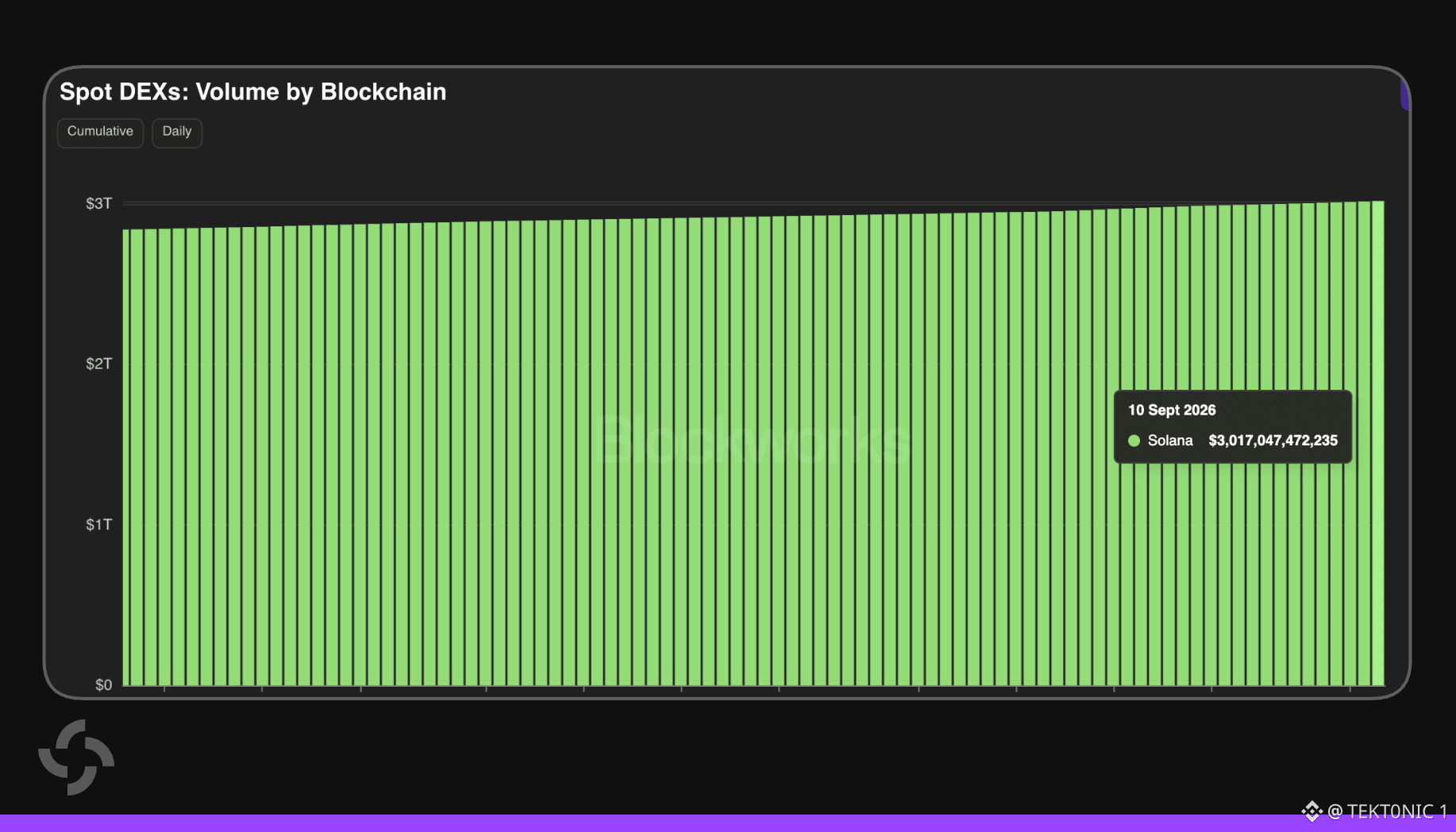
O volume cumulativo de DEX da Solana ultrapassou US$ 3 trilhões. Esse é o volume vitalício de negociações à vista em DEX na rede, não uma impressão de um único dia. De acordo com dados da Blockworks em 10 de setembro de 2026, o volume cumulativo de DEX à vista da Solana está em US$ 3,017 trilhões. A série cumulativa vem subindo de forma constante, quase em linha reta, à medida que o fluxo diário continua adicionando ao total. Principais detalhes: > Volume cumulativo de DEX à vista da Solana: US$ 3,017 trilhões. > Data do gráfico: 10 de setembro de 2026. > É volume de todos os tempos somado, então aumenta mesmo em dias tranquilos. > O volume de DEX contabiliza trades. Ele não equivale a usuários únicos nem a capital líquido novo. US$ 3 trilhões é um número em escala. Ele indica que a Solana tem sido, por muito tempo, o destino padrão e barato para spot on-chain. Por si só, isso não diz que o próximo mês será mais forte do que o anterior. Acompanhe o volume diário e a receita dos aplicativos para saber se o motor continua acelerando. Volume da DEX da Solana: US$ 3,02 trilhões cumulativo em 10 de set. #Análise do preço do BTC# #Previsão de preço do Bitcoin: qual será o próximo movimento de Bitcoins?# $BTC $SOL #Em alta
O volume cumulativo de DEX da Solana ultrapassou US$ 3 trilhões. Esse é o volume vitalício de negociações à vista em DEX na rede, não uma impressão de um único dia. De acordo com dados da Blockworks em 10 de setembro de 2026, o volume cumulativo de DEX à vista da Solana está em US$ 3,017 trilhões. A série cumulativa vem subindo de forma constante, quase em linha reta, à medida que o fluxo diário continua adicionando ao total. Principais detalhes: > Volume cumulativo de DEX à vista da Solana: US$ 3,017 trilhões. > Data do gráfico: 10 de setembro de 2026. > É volume de todos os tempos somado, então aumenta mesmo em dias tranquilos. > O volume de DEX contabiliza trades. Ele não equivale a usuários únicos nem a capital líquido novo. US$ 3 trilhões é um número em escala. Ele indica que a Solana tem sido, por muito tempo, o destino padrão e barato para spot on-chain. Por si só, isso não diz que o próximo mês será mais forte do que o anterior. Acompanhe o volume diário e a receita dos aplicativos para saber se o motor continua acelerando. Volume da DEX da Solana: US$ 3,02 trilhões cumulativo em 10 de set. #Análise do preço do BTC# #Previsão de preço do Bitcoin: qual será o próximo movimento de Bitcoins?# $BTC $SOL #Em alta
·
--
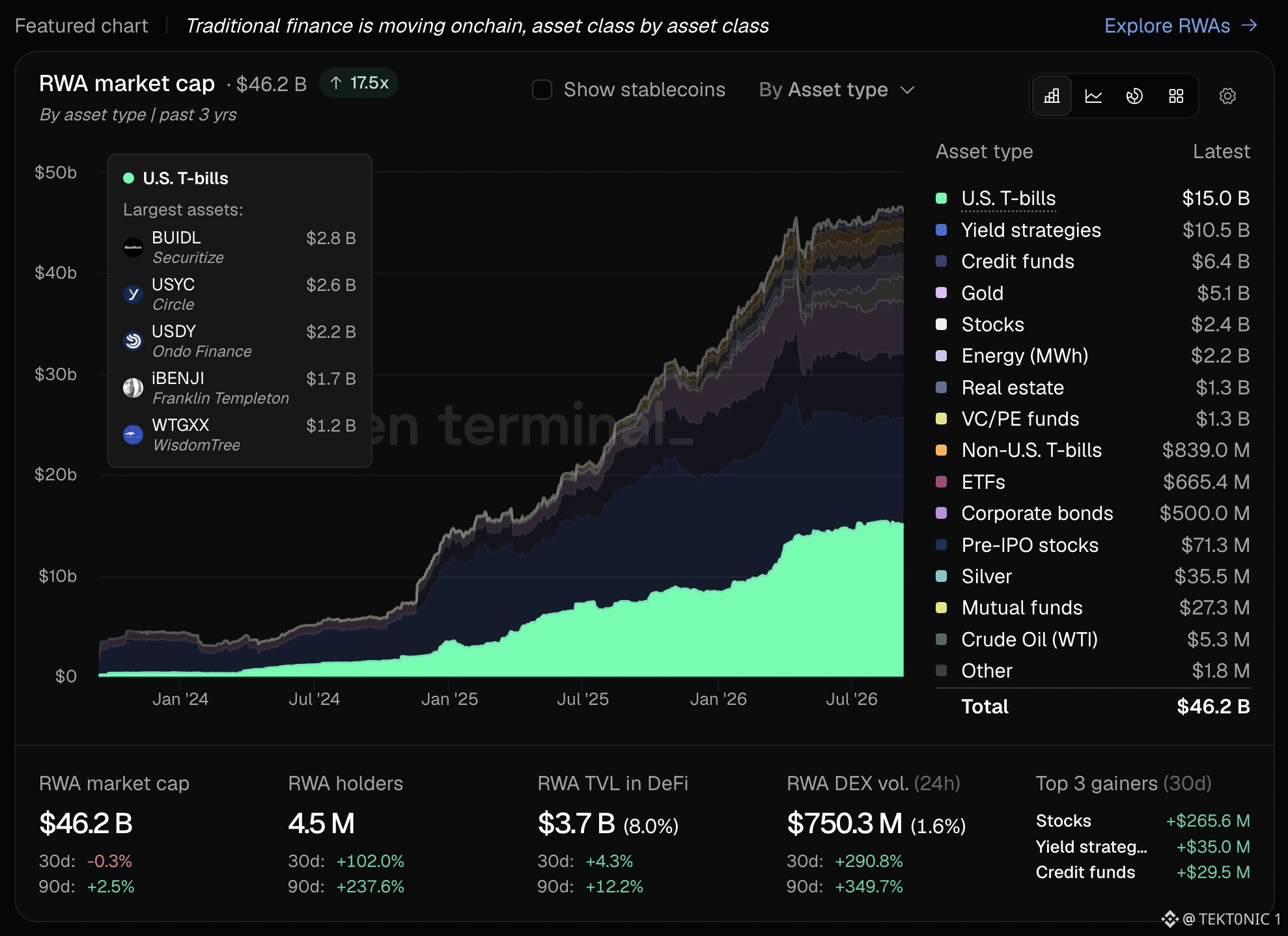
onchain RWAs apenas emitiram US$ 46,2 bilhões. A Token Terminal tem o mercado a 17,5x em três anos, com stablecoins desligados. As T-bills dos EUA continuam sendo a maior fatia, com US$ 15,0 bilhões. isso não é o livro inteiro. estratégias de yield são US$ 10,5B, fundos de crédito US$ 6,4B, ouro US$ 5,1B, ações US$ 2,4B e energia US$ 2,2B. cinco fundos dominam a fatia das T-bills. BUIDL é US$ 2,8B, USYC da Circle US$ 2,6B, USDY da Ondo US$ 2,2B, iBENJI da Franklin US$ 1,7B e WTGXX da WisdomTree US$ 1,2B. juntos, eles detêm US$ 10,5 bilhões, ou 70% das T-bills tokenizadas. os detentores agora são 4,5 milhões, acima de 102% em 30 dias e 238% em 90 dias. o volume de DEX de RWA nas últimas 24 horas é US$ 750 milhões. ações lideraram os últimos 30 dias, adicionando US$ 266 milhões. grande parte desse crescimento é de emissão. papel tradfi está sendo tokenizado e marcado onchain. o uso de DeFi ainda é leve: apenas US$ 3,7 bilhões, ou 8% do total, está implantado em protocolos. o mercado é real. e também está apertado. T-bills lideram, cinco fundos controlam essa fatia e o restante dos RWAs ainda é menor. #BTC Price Analysis# #Bitcoin Price Prediction: What is Bitcoins next move?# #RWA $BTC $XRP
onchain RWAs apenas emitiram US$ 46,2 bilhões. A Token Terminal tem o mercado a 17,5x em três anos, com stablecoins desligados. As T-bills dos EUA continuam sendo a maior fatia, com US$ 15,0 bilhões. isso não é o livro inteiro. estratégias de yield são US$ 10,5B, fundos de crédito US$ 6,4B, ouro US$ 5,1B, ações US$ 2,4B e energia US$ 2,2B. cinco fundos dominam a fatia das T-bills. BUIDL é US$ 2,8B, USYC da Circle US$ 2,6B, USDY da Ondo US$ 2,2B, iBENJI da Franklin US$ 1,7B e WTGXX da WisdomTree US$ 1,2B. juntos, eles detêm US$ 10,5 bilhões, ou 70% das T-bills tokenizadas. os detentores agora são 4,5 milhões, acima de 102% em 30 dias e 238% em 90 dias. o volume de DEX de RWA nas últimas 24 horas é US$ 750 milhões. ações lideraram os últimos 30 dias, adicionando US$ 266 milhões. grande parte desse crescimento é de emissão. papel tradfi está sendo tokenizado e marcado onchain. o uso de DeFi ainda é leve: apenas US$ 3,7 bilhões, ou 8% do total, está implantado em protocolos. o mercado é real. e também está apertado. T-bills lideram, cinco fundos controlam essa fatia e o restante dos RWAs ainda é menor. #BTC Price Analysis# #Bitcoin Price Prediction: What is Bitcoins next move?# #RWA $BTC $XRP
19
·
--
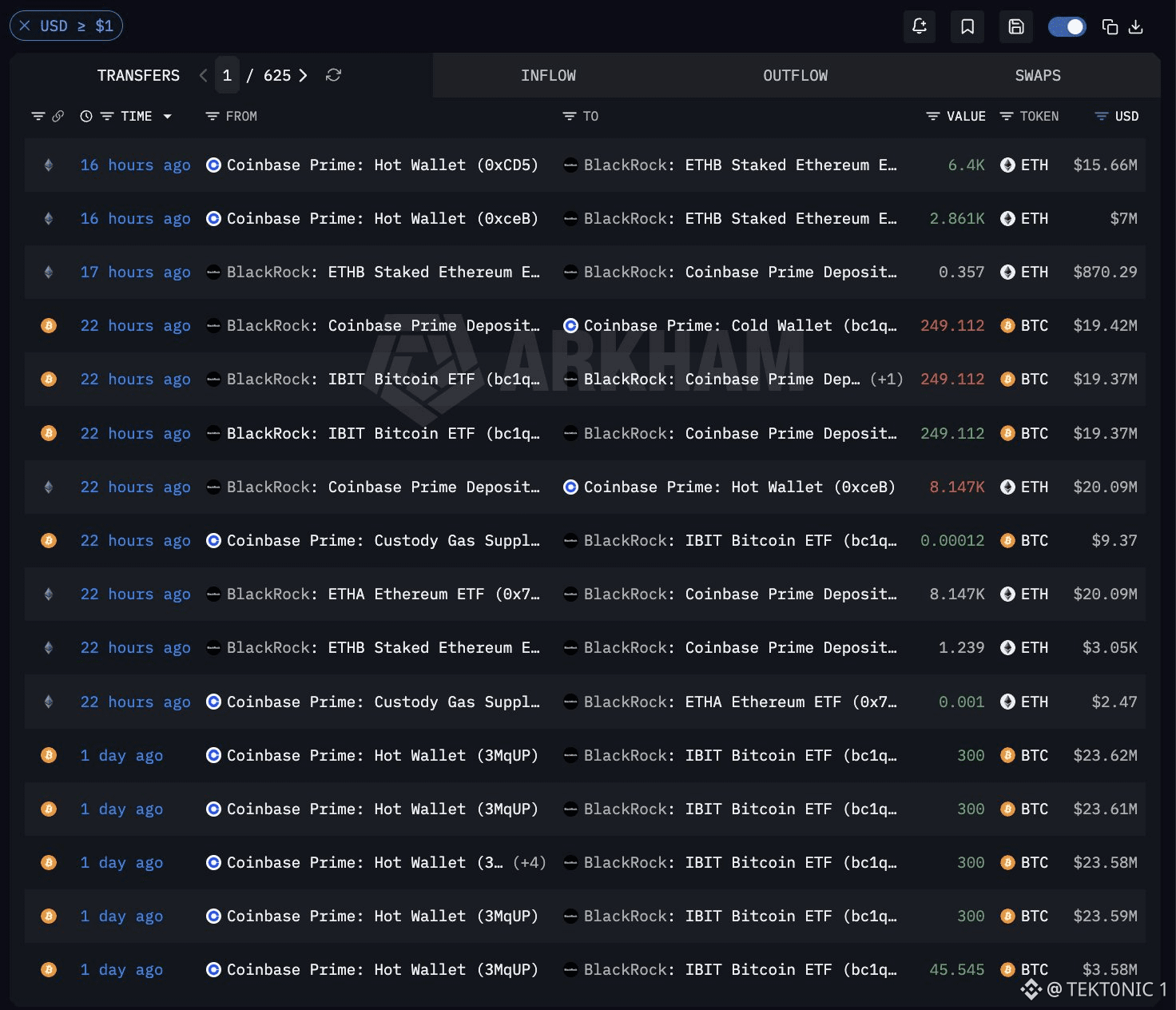
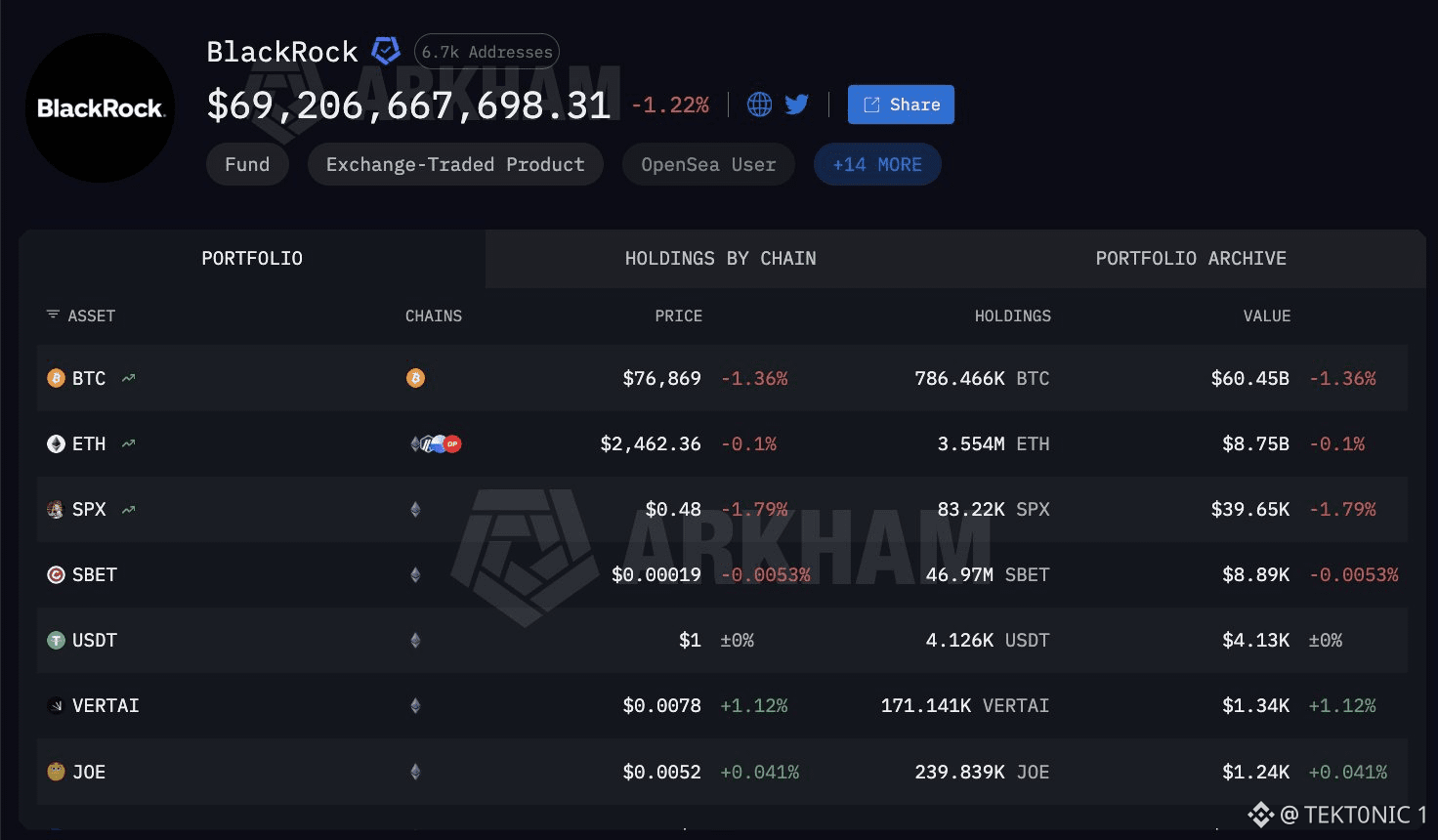
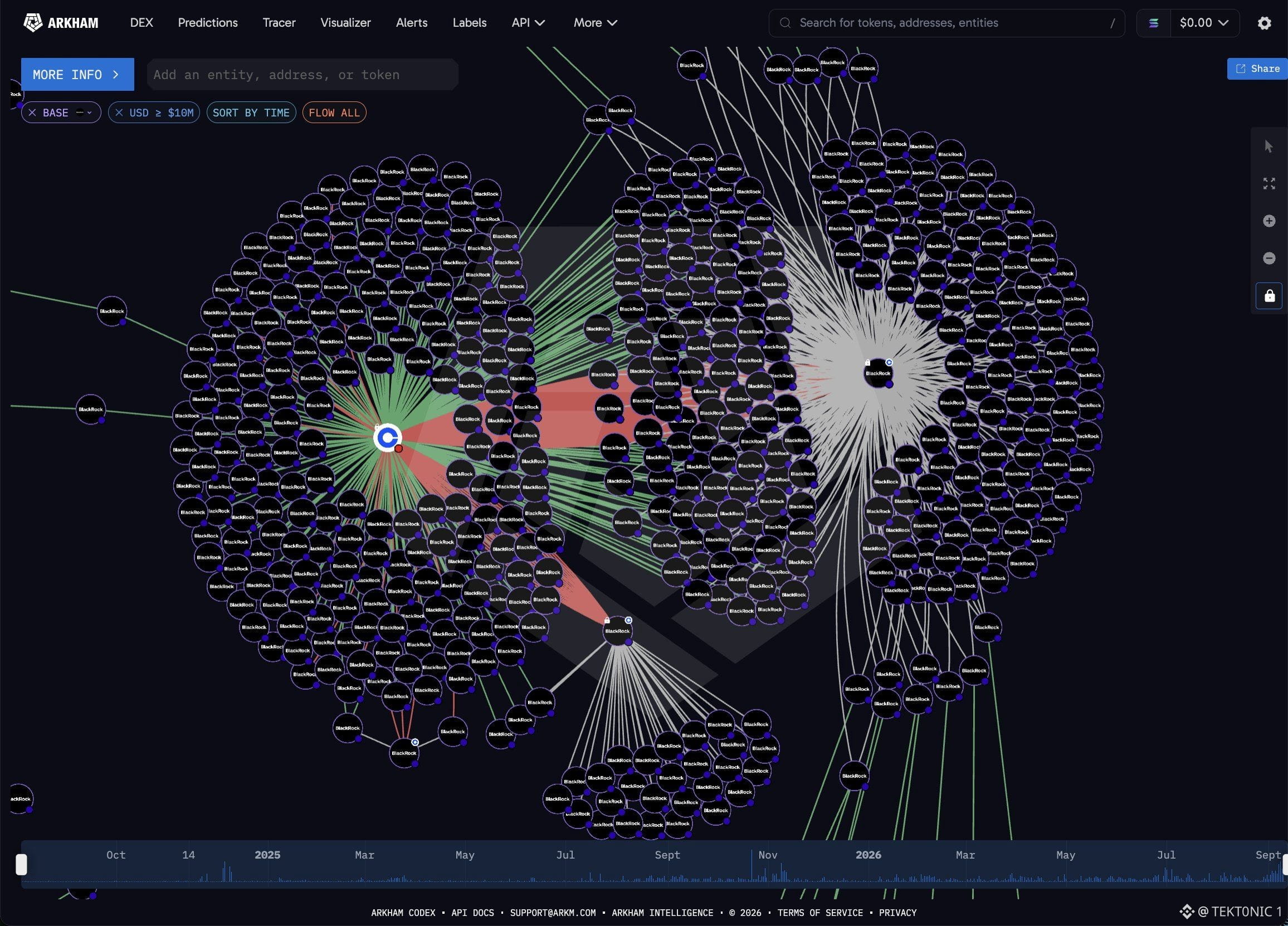
O ETHB da BlackRock já captou US$ 251 milhões em Ether por 20 dias seguidos Um produto Ether está comprando. Os outros no mesmo dia não. De acordo com o fluxo mais recente, o ETHB da BlackRock comprou US$ 13,9 milhões de $ETH ontem. O fundo irmã ETHA e o FETH da Fidelity registraram saídas (outflows). Nos últimos 20 pregões, o ETHB adicionou US$ 251,4 milhões em Ether e não registrou um único dia de saída. Pontos-chave: > ETHB ontem: +US$ 13,9 milhões. > ETHB em 20 sessões: +US$ 251,4 milhões, sem dias de queda (outflow). > ETHA e FETH: saídas no mesmo dia em que o ETHB ficou verde. > Isso é demanda de clientes em uma classe de ações de Ether da BlackRock, não um recado geral da empresa para vender Bitcoin. Vinte dias verdes em um produto de $ETH é uma oferta real. Não é prova de que Wall Street tenha girado para fora do Bitcoin. O IBIT ainda estava recebendo centenas de milhões de $BTC no começo deste mês. A leitura mais clara é que a exposição a ETH está sendo adicionada via ETHB, enquanto outros fundos de Ether permanecem mistos. ETHB da BlackRock: +US$ 13,9M Ontem, +US$ 251M em 20 dias, zero sessões com saída Você vê uma sequência de 20 dias do ETHB como Ether ganhando demanda (bid), ou como uma única classe de ações sendo preenchida enquanto o ETHA e o FETH vazam? #Análise do Preço do BTC# #Previsão do Preço do Bitcoin: qual será o próximo movimento do Bitcoins?# #Ethereum $BTC
O ETHB da BlackRock já captou US$ 251 milhões em Ether por 20 dias seguidos Um produto Ether está comprando. Os outros no mesmo dia não. De acordo com o fluxo mais recente, o ETHB da BlackRock comprou US$ 13,9 milhões de $ETH ontem. O fundo irmã ETHA e o FETH da Fidelity registraram saídas (outflows). Nos últimos 20 pregões, o ETHB adicionou US$ 251,4 milhões em Ether e não registrou um único dia de saída. Pontos-chave: > ETHB ontem: +US$ 13,9 milhões. > ETHB em 20 sessões: +US$ 251,4 milhões, sem dias de queda (outflow). > ETHA e FETH: saídas no mesmo dia em que o ETHB ficou verde. > Isso é demanda de clientes em uma classe de ações de Ether da BlackRock, não um recado geral da empresa para vender Bitcoin. Vinte dias verdes em um produto de $ETH é uma oferta real. Não é prova de que Wall Street tenha girado para fora do Bitcoin. O IBIT ainda estava recebendo centenas de milhões de $BTC no começo deste mês. A leitura mais clara é que a exposição a ETH está sendo adicionada via ETHB, enquanto outros fundos de Ether permanecem mistos. ETHB da BlackRock: +US$ 13,9M Ontem, +US$ 251M em 20 dias, zero sessões com saída Você vê uma sequência de 20 dias do ETHB como Ether ganhando demanda (bid), ou como uma única classe de ações sendo preenchida enquanto o ETHA e o FETH vazam? #Análise do Preço do BTC# #Previsão do Preço do Bitcoin: qual será o próximo movimento do Bitcoins?# #Ethereum $BTC
·
--
Cerca de US$ 1,5 bilhão em ativos tokenizados agora está sendo usado como garantia em empréstimos Um saldo em uma carteira mostra apenas que o dinheiro está guardado. A garantia mostra que ele está sendo utilizado. De acordo com o levantamento mais recente do mercado de empréstimos, cerca de US$ 1,5 bilhão em ativos tokenizados do mundo real está atuando como garantia hoje — depositado em protocolos para que alguém possa tomar empréstimos contra esses ativos. O exemplo dos T-bills da Spiko EU no Morpho é uma pequena parte disso: a garantia fornecida subiu acima de US$ 2 milhões, com a dívida contraída acompanhando pouco abaixo desse patamar desde o rampa de abril. Principais detalhes: > Ativos tokenizados usados como garantia em empréstimos: cerca de US$ 1,5 bilhão. > Manter um fundo tokenizado em uma carteira é custódia. Publicar isso no Morpho ou em outro mercado é financiamento. > T-bills da Spiko EU no Morpho: garantia acima de US$ 2 milhões, tomados um passo abaixo, estável desde julho. > A diferença entre as linhas vermelha e azul é garantia não utilizada — oferta que foi depositada, mas não totalmente sacada. US$ 1,5 bilhão ainda é pouco ao lado da garantia nativa de cripto. É o primeiro sinal claro de que T-bills tokenizados e papéis semelhantes estão saindo do “apenas parados ali”. Observe se esse número de US$ 1,5 bilhão continua subindo — não apenas se mais fundos estão sendo emitidos. US$ 1,5B em ativos tokenizados em garantia de empréstimos — T-Bills Spiko no Morpho acima de US$ 2M #BTC Análise de Preço# #Previsão do Preço do Bitcoin: Qual será o próximo passo das Bitcoins?# $BTC $XRP
Cerca de US$ 1,5 bilhão em ativos tokenizados agora está sendo usado como garantia em empréstimos Um saldo em uma carteira mostra apenas que o dinheiro está guardado. A garantia mostra que ele está sendo utilizado. De acordo com o levantamento mais recente do mercado de empréstimos, cerca de US$ 1,5 bilhão em ativos tokenizados do mundo real está atuando como garantia hoje — depositado em protocolos para que alguém possa tomar empréstimos contra esses ativos. O exemplo dos T-bills da Spiko EU no Morpho é uma pequena parte disso: a garantia fornecida subiu acima de US$ 2 milhões, com a dívida contraída acompanhando pouco abaixo desse patamar desde o rampa de abril. Principais detalhes: > Ativos tokenizados usados como garantia em empréstimos: cerca de US$ 1,5 bilhão. > Manter um fundo tokenizado em uma carteira é custódia. Publicar isso no Morpho ou em outro mercado é financiamento. > T-bills da Spiko EU no Morpho: garantia acima de US$ 2 milhões, tomados um passo abaixo, estável desde julho. > A diferença entre as linhas vermelha e azul é garantia não utilizada — oferta que foi depositada, mas não totalmente sacada. US$ 1,5 bilhão ainda é pouco ao lado da garantia nativa de cripto. É o primeiro sinal claro de que T-bills tokenizados e papéis semelhantes estão saindo do “apenas parados ali”. Observe se esse número de US$ 1,5 bilhão continua subindo — não apenas se mais fundos estão sendo emitidos. US$ 1,5B em ativos tokenizados em garantia de empréstimos — T-Bills Spiko no Morpho acima de US$ 2M #BTC Análise de Preço# #Previsão do Preço do Bitcoin: Qual será o próximo passo das Bitcoins?# $BTC $XRP

·
--
A Binance acabou de ver uma oferta forte de $ETH. No gráfico de 5 minutos de ETHUSDT, o preço disparou de US$ 2.433 para US$ 2.666. Agora ele está sendo negociado perto de US$ 2.603. O delta de volume cumulativo em USDT da Binance registrou +74,25 milhões nesse pico. Isso é uma compra agressiva no par principal. A mínima da sessão foi US$ 2.433. A máxima foi US$ 2.666. O preço já voltou acima de US$ 2.550. Um fechamento semanal acima de US$ 2.550 é o nível que está sendo observado para uma possível alta em direção a US$ 3.000. Isso importa porque o CVD subindo junto com o preço significa que o movimento foi comprado — não foi apenas um aperto fino sem fluxo. O detalhe: US$ 3.000 é uma meta, não um preenchimento. Outros pares de $ETH na mesma janela ficaram mistos, incluindo um registro de −16,58 milhões. Um único impulso forte da Binance pode perder força antes do fechamento da vela semanal. Então a oferta apareceu. Agora, o fechamento semanal ainda precisa se sustentar. #Análise de Preço do BTC# #Previsão de Preço do Bitcoin: Para onde será o próximo movimento do Bitcoin?# $BTC
A Binance acabou de ver uma oferta forte de $ETH. No gráfico de 5 minutos de ETHUSDT, o preço disparou de US$ 2.433 para US$ 2.666. Agora ele está sendo negociado perto de US$ 2.603. O delta de volume cumulativo em USDT da Binance registrou +74,25 milhões nesse pico. Isso é uma compra agressiva no par principal. A mínima da sessão foi US$ 2.433. A máxima foi US$ 2.666. O preço já voltou acima de US$ 2.550. Um fechamento semanal acima de US$ 2.550 é o nível que está sendo observado para uma possível alta em direção a US$ 3.000. Isso importa porque o CVD subindo junto com o preço significa que o movimento foi comprado — não foi apenas um aperto fino sem fluxo. O detalhe: US$ 3.000 é uma meta, não um preenchimento. Outros pares de $ETH na mesma janela ficaram mistos, incluindo um registro de −16,58 milhões. Um único impulso forte da Binance pode perder força antes do fechamento da vela semanal. Então a oferta apareceu. Agora, o fechamento semanal ainda precisa se sustentar. #Análise de Preço do BTC# #Previsão de Preço do Bitcoin: Para onde será o próximo movimento do Bitcoin?# $BTC

·
--
Kalshi coloca uma chance de 41% em Puts em $HYPE terminando 2026 em US$ 100 ou mais. O caso-base da multidão continua sendo um ano no fim com quatro dígitos. Não é uma certeza. De acordo com o mercado “Qual é o preço do HYPE no fim do ano?” da Kalshi, “US$ 100 ou acima” é a faixa líder, com 41%. O HYPE está sendo negociado perto de US$ 80, então esse contrato pergunta se ele consegue somar cerca de 25% e sustentar isso até dezembro. As próximas faixas listadas são US$ 85–US$ 89, com 14%, US$ 45–US$ 49, com 12%, e US$ 50–US$ 54, com 10%. Principais detalhes: > Fim do ano US$ 100 ou acima: 41%. > US$ 85–US$ 89: 14%. > US$ 45–US$ 49: 12%. > US$ 50–US$ 54: 10%. O preço à vista está perto de US$ 80, então US$ 100 é a meta mais próxima em número redondo acima do mercado. 41% é o resultado mais popular neste quadro, não uma maioria. Somando o bloco dos mid-80s, você obtém um agrupamento razoável acima do preço de hoje. As faixas mais baixas mostram que ainda há uma minoria real precificando um retorno ao intervalo de US$ 45–US$ 55. A nova seção de Predictions do CryptoRank agora acompanha esse tipo de probabilidade de metas em um só lugar. $HYPE Fim do ano: 41% Chances de $100+, Com preço em $80 #Bitcoin Price Prediction: What is Bitcoins next move?# #BTC Price Analysis# $BTC
Kalshi coloca uma chance de 41% em Puts em $HYPE terminando 2026 em US$ 100 ou mais. O caso-base da multidão continua sendo um ano no fim com quatro dígitos. Não é uma certeza. De acordo com o mercado “Qual é o preço do HYPE no fim do ano?” da Kalshi, “US$ 100 ou acima” é a faixa líder, com 41%. O HYPE está sendo negociado perto de US$ 80, então esse contrato pergunta se ele consegue somar cerca de 25% e sustentar isso até dezembro. As próximas faixas listadas são US$ 85–US$ 89, com 14%, US$ 45–US$ 49, com 12%, e US$ 50–US$ 54, com 10%. Principais detalhes: > Fim do ano US$ 100 ou acima: 41%. > US$ 85–US$ 89: 14%. > US$ 45–US$ 49: 12%. > US$ 50–US$ 54: 10%. O preço à vista está perto de US$ 80, então US$ 100 é a meta mais próxima em número redondo acima do mercado. 41% é o resultado mais popular neste quadro, não uma maioria. Somando o bloco dos mid-80s, você obtém um agrupamento razoável acima do preço de hoje. As faixas mais baixas mostram que ainda há uma minoria real precificando um retorno ao intervalo de US$ 45–US$ 55. A nova seção de Predictions do CryptoRank agora acompanha esse tipo de probabilidade de metas em um só lugar. $HYPE Fim do ano: 41% Chances de $100+, Com preço em $80 #Bitcoin Price Prediction: What is Bitcoins next move?# #BTC Price Analysis# $BTC

1
·
--
UniCredit avalia custódia e corretagem de cripto O segundo maior banco da Itália está considerando construir a infraestrutura para manter e negociar ativos digitais, e não apenas envolvê-los em uma nota estruturada. A Bloomberg informou em 11 de setembro que a UniCredit está avaliando parceiros de tecnologia para custódia e infraestrutura de corretagem. As conversas ainda estão no início. Não foi tomada nenhuma decisão final. O trabalho em análise também inclui produtos de investimento tokenizados, títulos de renda fixa, uso de stablecoin e exposição de clientes a cripto. Isso seria um passo além do que o banco já fez. Ele vendeu a clientes profissionais um produto ligado ao IBIT da BlackRock, emitiu a primeira minibond tokenizada da Itália em uma blockchain pública, se juntou ao grupo Qivalis que trabalha em uma stablecoin em euro e, nesta semana, adquiriu uma participação minoritária na plataforma alemã VC Trade. A medida se encaixa na mudança mais ampla dos bancos europeus à luz da MiCA. Custódia e corretagem importam mais do que outro título tokenizado pontual, porque é assim que os ativos dos clientes ficam, de fato, no balanço de um grande credor. Ainda é uma revisão, não um lançamento. O sinal é que um grande banco italiano agora está procurando a infraestrutura, e não descartando a categoria. #BTC Price Analysis# #Bitcoin Price Prediction: What is Bitcoins next move?# $BTC $XRP
UniCredit avalia custódia e corretagem de cripto O segundo maior banco da Itália está considerando construir a infraestrutura para manter e negociar ativos digitais, e não apenas envolvê-los em uma nota estruturada. A Bloomberg informou em 11 de setembro que a UniCredit está avaliando parceiros de tecnologia para custódia e infraestrutura de corretagem. As conversas ainda estão no início. Não foi tomada nenhuma decisão final. O trabalho em análise também inclui produtos de investimento tokenizados, títulos de renda fixa, uso de stablecoin e exposição de clientes a cripto. Isso seria um passo além do que o banco já fez. Ele vendeu a clientes profissionais um produto ligado ao IBIT da BlackRock, emitiu a primeira minibond tokenizada da Itália em uma blockchain pública, se juntou ao grupo Qivalis que trabalha em uma stablecoin em euro e, nesta semana, adquiriu uma participação minoritária na plataforma alemã VC Trade. A medida se encaixa na mudança mais ampla dos bancos europeus à luz da MiCA. Custódia e corretagem importam mais do que outro título tokenizado pontual, porque é assim que os ativos dos clientes ficam, de fato, no balanço de um grande credor. Ainda é uma revisão, não um lançamento. O sinal é que um grande banco italiano agora está procurando a infraestrutura, e não descartando a categoria. #BTC Price Analysis# #Bitcoin Price Prediction: What is Bitcoins next move?# $BTC $XRP

·
--
As perdas de detentores de longo prazo podem durar um ano Uma primeira impressão de estresse entre detentores não é a mesma coisa que um fundo finalizado. O gráfico LTH-SOPR da Glassnode mostra que moedas mais antigas podem ser gastas com prejuízo por muito tempo. O urso de 2014–15 manteve essa condição por 402 dias, com a métrica caindo para 0,50, ou cerca de 50% de perda média. O urso de 2018–19 durou 328 dias e chegou perto de um fundo em 0,48, ou cerca de 52% de perda. Março de 2020 foi mais curto: 50 dias, caindo para 0,80, ou cerca de 20% de perda. Em julho de 2022, a mesma métrica estava em 0,67. Detentores de longo prazo movendo moedas estavam consolidando uma perda média de 33% após apenas 51 dias nessa faixa. A Glassnode ainda alertou que os preços poderiam cair mais. Eles caíram. A comparação de longo prazo versus curto prazo da Cryptoquant_com precisa do mesmo cuidado. Ser menos lucrativo do que outro grupo não significa automaticamente que você está realizando uma perda. A desvantagem relativa pode persistir enquanto o reset mais amplo ainda não estiver concluído. Isso ainda deixa espaço para acumular. Não cria um motivo para correr. Os ciclos anteriores precisavam de tempo em prejuízo, não apenas da primeira leitura disso. #Análise de Preço do BTC# #Previsão de Preço do Bitcoin: Para onde será o próximo movimento do Bitcoins?# $BTC $XRP
As perdas de detentores de longo prazo podem durar um ano Uma primeira impressão de estresse entre detentores não é a mesma coisa que um fundo finalizado. O gráfico LTH-SOPR da Glassnode mostra que moedas mais antigas podem ser gastas com prejuízo por muito tempo. O urso de 2014–15 manteve essa condição por 402 dias, com a métrica caindo para 0,50, ou cerca de 50% de perda média. O urso de 2018–19 durou 328 dias e chegou perto de um fundo em 0,48, ou cerca de 52% de perda. Março de 2020 foi mais curto: 50 dias, caindo para 0,80, ou cerca de 20% de perda. Em julho de 2022, a mesma métrica estava em 0,67. Detentores de longo prazo movendo moedas estavam consolidando uma perda média de 33% após apenas 51 dias nessa faixa. A Glassnode ainda alertou que os preços poderiam cair mais. Eles caíram. A comparação de longo prazo versus curto prazo da Cryptoquant_com precisa do mesmo cuidado. Ser menos lucrativo do que outro grupo não significa automaticamente que você está realizando uma perda. A desvantagem relativa pode persistir enquanto o reset mais amplo ainda não estiver concluído. Isso ainda deixa espaço para acumular. Não cria um motivo para correr. Os ciclos anteriores precisavam de tempo em prejuízo, não apenas da primeira leitura disso. #Análise de Preço do BTC# #Previsão de Preço do Bitcoin: Para onde será o próximo movimento do Bitcoins?# $BTC $XRP

·
--
A Metaplanet reduz opções executivas após pressão de acionistas O maior tesouro público de Bitcoin do Japão acabou de diminuir o tamanho da reivindicação da administração. De acordo com um aviso da empresa datado de 11 de setembro, o conselho revisou os direitos de aquisição de ações da Série 10. A taxa de conversão foi redefinida e cerca de 41% das ações potenciais relacionadas foram canceladas, eliminando mais de US$ 220 milhões em valor de warrants. O CEO Simon Gerovich já havia exercido direitos que resultaram em cerca de 64 milhões de ações. As opções restantes, ainda não adquiridas (unvested), agora passam a ser liberadas em 2029, 2030 e 2031. Principais detalhes: > O CEO já havia tomado cerca de 64 milhões de ações com o exercício da Série 10. > Opções cortadas: o pool foi reduzido, cancelando mais de US$ 220 milhões de valor de warrant e cerca de 41% das ações relacionadas. > Conversão redefinida para 410 ações por direito, no nível anterior ao da oferta. > O restante não adquirido será liberado em parcelas de 2029 a 2031. > Um pool planejado de incentivos para funcionários ligado a essa estrutura foi cancelado. A reação contrária foi, em essência, sobre diluição: a fórmula das opções havia crescido a cada ação emitida para comprar Bitcoin, ampliando a reivindicação da administração. Cortar o pool aumenta o Bitcoin por ação totalmente diluída. Isso não desfaz as ações já emitidas ao CEO. A governança agora faz parte do acordo da Metaplanet, e não apenas do “stack” de BTC. Metaplanet: Corte de Opções em Escala de 105M, US$ 220M Apagados, 64M Ações do CEO Já Saíram #Análise do Preço do BTC# #Previsão de Preço do Bitcoin: Qual é o próximo movimento do Bitcoin?# $BTC $SOL
A Metaplanet reduz opções executivas após pressão de acionistas O maior tesouro público de Bitcoin do Japão acabou de diminuir o tamanho da reivindicação da administração. De acordo com um aviso da empresa datado de 11 de setembro, o conselho revisou os direitos de aquisição de ações da Série 10. A taxa de conversão foi redefinida e cerca de 41% das ações potenciais relacionadas foram canceladas, eliminando mais de US$ 220 milhões em valor de warrants. O CEO Simon Gerovich já havia exercido direitos que resultaram em cerca de 64 milhões de ações. As opções restantes, ainda não adquiridas (unvested), agora passam a ser liberadas em 2029, 2030 e 2031. Principais detalhes: > O CEO já havia tomado cerca de 64 milhões de ações com o exercício da Série 10. > Opções cortadas: o pool foi reduzido, cancelando mais de US$ 220 milhões de valor de warrant e cerca de 41% das ações relacionadas. > Conversão redefinida para 410 ações por direito, no nível anterior ao da oferta. > O restante não adquirido será liberado em parcelas de 2029 a 2031. > Um pool planejado de incentivos para funcionários ligado a essa estrutura foi cancelado. A reação contrária foi, em essência, sobre diluição: a fórmula das opções havia crescido a cada ação emitida para comprar Bitcoin, ampliando a reivindicação da administração. Cortar o pool aumenta o Bitcoin por ação totalmente diluída. Isso não desfaz as ações já emitidas ao CEO. A governança agora faz parte do acordo da Metaplanet, e não apenas do “stack” de BTC. Metaplanet: Corte de Opções em Escala de 105M, US$ 220M Apagados, 64M Ações do CEO Já Saíram #Análise do Preço do BTC# #Previsão de Preço do Bitcoin: Qual é o próximo movimento do Bitcoin?# $BTC $SOL

·
--
Bitcoin recuperou US$ 78.000 e o Ether retomou US$ 2.500 A divulgação do CPI veio em linha. O repique não foi pequeno. De acordo com os gráficos da sessão, o $BTC avançou de um pavio perto de US$ 76.100 de volta acima de US$ 78.000, subindo cerca de 1% no dia. O $ETH caiu em direção a US$ 2.435, depois recuperou US$ 2.500 e a última cotação ficou perto de US$ 2.510, subindo cerca de 3%. Principais detalhes: > Bitcoin: cerca de US$ 78.000, +US$ 750 / +0,97% na sessão após uma queda rápida. > Ethereum: cerca de US$ 2.510, +US$ 74 / +3,03%, de volta acima de US$ 2.500. > Contexto: CPI de sexta-feira em 3,4%, em linha com as projeções, após o PPI de quinta-feira em 5,4%. > O Ether está superando o Bitcoin no dia, o que combina com a recente queda na dominância do BTC. CPI em linha afastou o pior susto dos preços do radar por uma tarde. US$ 78.000 ainda está abaixo da faixa de US$ 80.000–US$ 83.000 que importa no semanal. Ether US$ 2.500 é uma retomada de número redondo, não uma nova tendência por si só. A próxima reunião do Fed ainda é o evento que decide se esse repique se sustenta. Bitcoin US$ 78.000 e Ether US$ 2.500 Após CPI em Linha Você compra essa recuperação antes da reunião do Fed, ou desacredita até US$ 80.000 e US$ 2.550 realmente se manterem? #BTC Price Analysis# #Bitcoin Price Prediction: What is Bitcoins next move?# $BTC $ETH
Bitcoin recuperou US$ 78.000 e o Ether retomou US$ 2.500 A divulgação do CPI veio em linha. O repique não foi pequeno. De acordo com os gráficos da sessão, o $BTC avançou de um pavio perto de US$ 76.100 de volta acima de US$ 78.000, subindo cerca de 1% no dia. O $ETH caiu em direção a US$ 2.435, depois recuperou US$ 2.500 e a última cotação ficou perto de US$ 2.510, subindo cerca de 3%. Principais detalhes: > Bitcoin: cerca de US$ 78.000, +US$ 750 / +0,97% na sessão após uma queda rápida. > Ethereum: cerca de US$ 2.510, +US$ 74 / +3,03%, de volta acima de US$ 2.500. > Contexto: CPI de sexta-feira em 3,4%, em linha com as projeções, após o PPI de quinta-feira em 5,4%. > O Ether está superando o Bitcoin no dia, o que combina com a recente queda na dominância do BTC. CPI em linha afastou o pior susto dos preços do radar por uma tarde. US$ 78.000 ainda está abaixo da faixa de US$ 80.000–US$ 83.000 que importa no semanal. Ether US$ 2.500 é uma retomada de número redondo, não uma nova tendência por si só. A próxima reunião do Fed ainda é o evento que decide se esse repique se sustenta. Bitcoin US$ 78.000 e Ether US$ 2.500 Após CPI em Linha Você compra essa recuperação antes da reunião do Fed, ou desacredita até US$ 80.000 e US$ 2.550 realmente se manterem? #BTC Price Analysis# #Bitcoin Price Prediction: What is Bitcoins next move?# $BTC $ETH

26
·
--
Teste uma Transferência Antes de Mover Grandes Quantias Um pequeno envio de teste é a forma mais simples de evitar uma perda permanente. Envie primeiro um real (ou um dólar). Confirme que ele chega ao endereço certo, à rede certa e ao ativo certo. Essa verificação leva cerca de trinta segundos. É a diferença entre um erro barato e um erro que compromete o saldo inteiro. A maioria das grandes perdas em carteiras não acontece por causa de movimentos do mercado. Elas acontecem por uma cadeia errada, um endereço digitado incorretamente ou um destino que nunca foi verificado. O teste é como você identifica isso antes que o valor real saia. A quantia em si é trivial. O sinal é a confirmação. Se você estiver usando uma carteira de hardware, compare o endereço de recebimento na tela do dispositivo, não apenas no aplicativo. Em seguida, envie o restante. Um pequeno teste ainda é o hábito de maior alavancagem em operações com cripto. #BTC Price Analysis# #Bitcoin Price Prediction: What is Bitcoins next move?# $BTC $XRP
Teste uma Transferência Antes de Mover Grandes Quantias Um pequeno envio de teste é a forma mais simples de evitar uma perda permanente. Envie primeiro um real (ou um dólar). Confirme que ele chega ao endereço certo, à rede certa e ao ativo certo. Essa verificação leva cerca de trinta segundos. É a diferença entre um erro barato e um erro que compromete o saldo inteiro. A maioria das grandes perdas em carteiras não acontece por causa de movimentos do mercado. Elas acontecem por uma cadeia errada, um endereço digitado incorretamente ou um destino que nunca foi verificado. O teste é como você identifica isso antes que o valor real saia. A quantia em si é trivial. O sinal é a confirmação. Se você estiver usando uma carteira de hardware, compare o endereço de recebimento na tela do dispositivo, não apenas no aplicativo. Em seguida, envie o restante. Um pequeno teste ainda é o hábito de maior alavancagem em operações com cripto. #BTC Price Analysis# #Bitcoin Price Prediction: What is Bitcoins next move?# $BTC $XRP

23
·
--
O CPI dos EUA Sai em 3,4%, Dentro do Previsto — A publicação do consumidor não surpreendeu. Ela também não encerrou o debate sobre aumento de juros. De acordo com a última divulgação do CPI, a inflação anual ficou em 3,4%, igual ao esperado. Esse é um número alinhado: nem quente o suficiente para forçar um novo susto por conta própria, nem frio o bastante para tirar uma alta de juros da mesa após o relatório de 162.000 empregos desta semana e o PPI de 5,4%. Principais detalhes: > CPI principal: 3,4% ano contra ano, como esperado. > Isso segue o PPI de quinta-feira em 5,4% ano contra ano. > Os dados de empregos deste mês já estavam firmes em +162.000. > A reunião do Fed é na próxima semana. Um CPI alinhado deixa a decisão para o comitê, e não para um choque isolado. “Nem baixista nem altista” é a leitura inicial correta para os ativos de risco. Bitcoin perto de US$ 80.000 e o ouro após a liquidação de ontem agora negociam o caminho do Fed, não uma surpresa do CPI. Uma manutenção ajudaria no teste de US$ 83.000. Uma alta colocaria US$ 80.000 novamente em jogo como resistência. CPI em 3,4%, Dentro do Alvo — A divulgação não decide o aumento. A reunião do Fed da próxima semana decide. Você trata o CPI alinhado como permissão para comprar a queda para US$ 80.000, ou espera a decisão do Fed primeiro? #BTC Price Analysis# #Bitcoin Price Prediction: What is Bitcoins next move?# $BTC $ETH
O CPI dos EUA Sai em 3,4%, Dentro do Previsto — A publicação do consumidor não surpreendeu. Ela também não encerrou o debate sobre aumento de juros. De acordo com a última divulgação do CPI, a inflação anual ficou em 3,4%, igual ao esperado. Esse é um número alinhado: nem quente o suficiente para forçar um novo susto por conta própria, nem frio o bastante para tirar uma alta de juros da mesa após o relatório de 162.000 empregos desta semana e o PPI de 5,4%. Principais detalhes: > CPI principal: 3,4% ano contra ano, como esperado. > Isso segue o PPI de quinta-feira em 5,4% ano contra ano. > Os dados de empregos deste mês já estavam firmes em +162.000. > A reunião do Fed é na próxima semana. Um CPI alinhado deixa a decisão para o comitê, e não para um choque isolado. “Nem baixista nem altista” é a leitura inicial correta para os ativos de risco. Bitcoin perto de US$ 80.000 e o ouro após a liquidação de ontem agora negociam o caminho do Fed, não uma surpresa do CPI. Uma manutenção ajudaria no teste de US$ 83.000. Uma alta colocaria US$ 80.000 novamente em jogo como resistência. CPI em 3,4%, Dentro do Alvo — A divulgação não decide o aumento. A reunião do Fed da próxima semana decide. Você trata o CPI alinhado como permissão para comprar a queda para US$ 80.000, ou espera a decisão do Fed primeiro? #BTC Price Analysis# #Bitcoin Price Prediction: What is Bitcoins next move?# $BTC $ETH

2
163
·
--
O IPC dos EUA cai em minutos A inflação de agosto sai às 8h30 (horário do leste dos EUA). O consenso é de 3,4% na comparação anual, inalterado em relação a julho. A variação mensal do índice principal deve ficar em +0,4% após +0,1% em julho, em grande parte por uma recuperação nos preços da gasolina. O CPI (inflação) “core” é o número que mais importa para o Fed. A rua espera +0,2% na base mensal e cerca de 2,4% na base anual, abaixo de 2,5%. Esta leitura sai poucos dias antes do próximo FOMC da semana que vem. Os mercados já se inclinaram para uma possível alta após um PPI forte. Uma leitura “core” quente reforçaria essa visão. Um resultado limpo de 0,2% ou mais fraco manteria a decisão mais aberta. O Bitcoin está perto de US$ 77 mil no momento da divulgação. A primeira reação vai aparecer nos rendimentos e no dólar. O cripto acompanha isso, e não a manchete isoladamente. Observe o “core”, não apenas os 3,4%. #BTC Price Analysis# #Bitcoin Price Prediction: What is Bitcoins next move?# #Altcoin Season# $BTC $XRP
O IPC dos EUA cai em minutos A inflação de agosto sai às 8h30 (horário do leste dos EUA). O consenso é de 3,4% na comparação anual, inalterado em relação a julho. A variação mensal do índice principal deve ficar em +0,4% após +0,1% em julho, em grande parte por uma recuperação nos preços da gasolina. O CPI (inflação) “core” é o número que mais importa para o Fed. A rua espera +0,2% na base mensal e cerca de 2,4% na base anual, abaixo de 2,5%. Esta leitura sai poucos dias antes do próximo FOMC da semana que vem. Os mercados já se inclinaram para uma possível alta após um PPI forte. Uma leitura “core” quente reforçaria essa visão. Um resultado limpo de 0,2% ou mais fraco manteria a decisão mais aberta. O Bitcoin está perto de US$ 77 mil no momento da divulgação. A primeira reação vai aparecer nos rendimentos e no dólar. O cripto acompanha isso, e não a manchete isoladamente. Observe o “core”, não apenas os 3,4%. #BTC Price Analysis# #Bitcoin Price Prediction: What is Bitcoins next move?# #Altcoin Season# $BTC $XRP

64
Faça login para explorar mais conteúdos
Junte-se a usuários de criptomoedas de todo o mundo no Binance Square.
⚡️ Obter informações mais recentes e úteis sobre criptomoeda.
💬 Com a confiança da maior corretora de criptomoedas do mundo.
👍 Descubra insights reais de criadores verificados.
E-mail / número de telefone
Tópicos em Alta
SECReceivesGrayscaleLitecoinTrustETFFiling
83 visualizações
25 discutindo
A Comissão de Valores Mobiliários dos EUA (SEC) recebeu um pedido de registro da Grayscale para um ETF de spot de Litecoin Trust. Essa medida indica um possível avanço na adoção mais ampla de ativos digitais por instituições, na sequência de solicitações semelhantes para ETFs de Bitcoin. O mercado acompanhará de perto a decisão da SEC, pois ela pode estabelecer um precedente para outros ETFs baseados em altcoins. Esse desenvolvimento pode influenciar o sentimento dos investidores e a atividade de negociação para $LTC e outras criptomoedas.
Estas informações são apenas para fins informativos e não constituem aconselhamento de investimento.
#SECReceivesGrayscaleLitecoinTrustETFFiling $BTC
vuducdung1308
·0 curtidas
·6 visualizações
ClarityActFacesProceduralVoteSept15
76,609 visualizações
987 discutindo
US10YearTreasuryYieldNears5%
28,167 visualizações
499 discutindo