

Ether Guru 1
146 Publicações

Ether Guru 1
Denunciar
Bloquear usuário
Where experience meets discipline. Crypto isn’t luck — it’s mindset 💭
0 Seguindo
6 Seguidores
26 Curtiu
Publicações
·
--
Ver tradução
$BTC SHE EARNS $58,000. BUT WOULD QUITTING HER JOB ACTUALLY SAVE MONEY?
Her husband’s promotion changed the conversation at home.
He now earns around $186,000 annually, while she brings in $58,000. With a three-year-old daughter and daycare bills approaching $2,000 a month, he suggested she consider becoming a stay-at-home mom.
The idea sounds reasonable until you look beyond the monthly bills.
Daycare alone costs about $24,000 annually. Add commuting, work lunches, and other job expenses, and a meaningful portion of her paycheck may disappear before it reaches the family budget.
But there’s another side to this calculation.
If she leaves her job, the household loses more than a salary. It may also lose employer retirement contributions, opportunities for raises, and years of career growth.
And there’s a risk families sometimes underestimate: returning to work later might mean starting at a lower salary or spending months searching for the right position.
Meanwhile, relying on one income creates a different kind of financial exposure. If that paycheck disappears, the family has no second salary to fall back on.
Before deciding, they could calculate her actual take-home pay after work-related expenses, compare both household budgets, and explore flexible work or part-time childcare arrangements.
Because the question isn't simply whether daycare is expensive.
It's whether the family's long-term financial position would change after accounting for everything her job provides.
A paycheck has value beyond its monthly deposit.
$BTC SHE EARNS $58,000. BUT WOULD QUITTING HER JOB ACTUALLY SAVE MONEY?
Her husband’s promotion changed the conversation at home.
He now earns around $186,000 annually, while she brings in $58,000. With a three-year-old daughter and daycare bills approaching $2,000 a month, he suggested she consider becoming a stay-at-home mom.
The idea sounds reasonable until you look beyond the monthly bills.
Daycare alone costs about $24,000 annually. Add commuting, work lunches, and other job expenses, and a meaningful portion of her paycheck may disappear before it reaches the family budget.
But there’s another side to this calculation.
If she leaves her job, the household loses more than a salary. It may also lose employer retirement contributions, opportunities for raises, and years of career growth.
And there’s a risk families sometimes underestimate: returning to work later might mean starting at a lower salary or spending months searching for the right position.
Meanwhile, relying on one income creates a different kind of financial exposure. If that paycheck disappears, the family has no second salary to fall back on.
Before deciding, they could calculate her actual take-home pay after work-related expenses, compare both household budgets, and explore flexible work or part-time childcare arrangements.
Because the question isn't simply whether daycare is expensive.
It's whether the family's long-term financial position would change after accounting for everything her job provides.
A paycheck has value beyond its monthly deposit.
Her husband’s promotion changed the conversation at home.
He now earns around $186,000 annually, while she brings in $58,000. With a three-year-old daughter and daycare bills approaching $2,000 a month, he suggested she consider becoming a stay-at-home mom.
The idea sounds reasonable until you look beyond the monthly bills.
Daycare alone costs about $24,000 annually. Add commuting, work lunches, and other job expenses, and a meaningful portion of her paycheck may disappear before it reaches the family budget.
But there’s another side to this calculation.
If she leaves her job, the household loses more than a salary. It may also lose employer retirement contributions, opportunities for raises, and years of career growth.
And there’s a risk families sometimes underestimate: returning to work later might mean starting at a lower salary or spending months searching for the right position.
Meanwhile, relying on one income creates a different kind of financial exposure. If that paycheck disappears, the family has no second salary to fall back on.
Before deciding, they could calculate her actual take-home pay after work-related expenses, compare both household budgets, and explore flexible work or part-time childcare arrangements.
Because the question isn't simply whether daycare is expensive.
It's whether the family's long-term financial position would change after accounting for everything her job provides.
A paycheck has value beyond its monthly deposit.
54
·
--
Ver tradução
$BTC 3 BITCOIN COULD COST HIM MORE THAN MONEY.
A friend already owns 3+ BTC bought below $30,000, roughly $2 million in income-producing real estate with equity, and more than $400,000 in cash.
Now his wife wants him to buy another 3 BTC before Bitcoin climbs back above $100,000.
But he has three teenagers approaching college age.
And that changes the calculation.
Buying 3 BTC at $85,000 each would require about $255,000 before fees.
From $400,000 in cash, that leaves just $145,000.
If tuition, property repairs, vacancies or another unexpected expense arrives, he may have to sell assets at an inconvenient time.
His real estate may be valuable, but equity isn't the same as cash. Accessing it can take time, cost money and depend on financing conditions.
And Bitcoin could rise above $100,000—or fall sharply before it gets there.
Nobody knows which happens first.
The decision isn't simply whether 3 more BTC would be a good investment.
It's whether the potential upside justifies reducing the family's readily available financial cushion while major education expenses are approaching.
He could estimate the next several years of college costs, property expenses and household spending first, then determine how much cash is genuinely available for investing.
An opportunity matters less if it weakens your financial flexibility.
$BTC 3 BITCOIN COULD COST HIM MORE THAN MONEY.
A friend already owns 3+ BTC bought below $30,000, roughly $2 million in income-producing real estate with equity, and more than $400,000 in cash.
Now his wife wants him to buy another 3 BTC before Bitcoin climbs back above $100,000.
But he has three teenagers approaching college age.
And that changes the calculation.
Buying 3 BTC at $85,000 each would require about $255,000 before fees.
From $400,000 in cash, that leaves just $145,000.
If tuition, property repairs, vacancies or another unexpected expense arrives, he may have to sell assets at an inconvenient time.
His real estate may be valuable, but equity isn't the same as cash. Accessing it can take time, cost money and depend on financing conditions.
And Bitcoin could rise above $100,000—or fall sharply before it gets there.
Nobody knows which happens first.
The decision isn't simply whether 3 more BTC would be a good investment.
It's whether the potential upside justifies reducing the family's readily available financial cushion while major education expenses are approaching.
He could estimate the next several years of college costs, property expenses and household spending first, then determine how much cash is genuinely available for investing.
An opportunity matters less if it weakens your financial flexibility.
A friend already owns 3+ BTC bought below $30,000, roughly $2 million in income-producing real estate with equity, and more than $400,000 in cash.
Now his wife wants him to buy another 3 BTC before Bitcoin climbs back above $100,000.
But he has three teenagers approaching college age.
And that changes the calculation.
Buying 3 BTC at $85,000 each would require about $255,000 before fees.
From $400,000 in cash, that leaves just $145,000.
If tuition, property repairs, vacancies or another unexpected expense arrives, he may have to sell assets at an inconvenient time.
His real estate may be valuable, but equity isn't the same as cash. Accessing it can take time, cost money and depend on financing conditions.
And Bitcoin could rise above $100,000—or fall sharply before it gets there.
Nobody knows which happens first.
The decision isn't simply whether 3 more BTC would be a good investment.
It's whether the potential upside justifies reducing the family's readily available financial cushion while major education expenses are approaching.
He could estimate the next several years of college costs, property expenses and household spending first, then determine how much cash is genuinely available for investing.
An opportunity matters less if it weakens your financial flexibility.
64
·
--
Ver tradução
$BTC FOUR YEARS CAN CHANGE THE BITCOIN MATH FAST.
On September 27, 2022, Bitcoin was around $18,802.
Four years later, the reference price is about $84,625.
That works out to roughly a 46% annualized growth rate.
Now comes the interesting part.
If Bitcoin somehow repeated that exact 46% CAGR for another four years, the math would put BTC near $381,000 by September 2030.
Rounded up, that's the often-mentioned $385K scenario.
But there’s a huge difference between calculating a return and predicting one.
Bitcoin did not rise 46% every year.
Some periods were dramatically stronger, while others produced deep drawdowns.
So the $385K figure isn't a forecast.
It's simply what happens when you extend the previous four-year annualized growth rate forward for another four years.
That distinction matters whenever historical performance gets turned into future price targets.
Past compounding creates scenarios, not promises.
$BTC FOUR YEARS CAN CHANGE THE BITCOIN MATH FAST.
On September 27, 2022, Bitcoin was around $18,802.
Four years later, the reference price is about $84,625.
That works out to roughly a 46% annualized growth rate.
Now comes the interesting part.
If Bitcoin somehow repeated that exact 46% CAGR for another four years, the math would put BTC near $381,000 by September 2030.
Rounded up, that's the often-mentioned $385K scenario.
But there’s a huge difference between calculating a return and predicting one.
Bitcoin did not rise 46% every year.
Some periods were dramatically stronger, while others produced deep drawdowns.
So the $385K figure isn't a forecast.
It's simply what happens when you extend the previous four-year annualized growth rate forward for another four years.
That distinction matters whenever historical performance gets turned into future price targets.
Past compounding creates scenarios, not promises.
On September 27, 2022, Bitcoin was around $18,802.
Four years later, the reference price is about $84,625.
That works out to roughly a 46% annualized growth rate.
Now comes the interesting part.
If Bitcoin somehow repeated that exact 46% CAGR for another four years, the math would put BTC near $381,000 by September 2030.
Rounded up, that's the often-mentioned $385K scenario.
But there’s a huge difference between calculating a return and predicting one.
Bitcoin did not rise 46% every year.
Some periods were dramatically stronger, while others produced deep drawdowns.
So the $385K figure isn't a forecast.
It's simply what happens when you extend the previous four-year annualized growth rate forward for another four years.
That distinction matters whenever historical performance gets turned into future price targets.
Past compounding creates scenarios, not promises.
4
·
--
Ver tradução
$BTC WHAT IF AMERICAN WEALTH WERE MEASURED IN BTC?
Using a fixed Bitcoin price can make the numbers look surprisingly simple.
But there’s an important catch:
A net-worth threshold measured in BTC changes every time Bitcoin’s dollar price changes.
If a household has $1 million in net worth, that represents about 11.8 BTC at an $85,000 Bitcoin price.
At $170,000, the same $1 million would equal only about 5.9 BTC.
The household didn't become poorer.
The BTC measurement changed.
That’s why converting U.S. wealth percentiles into Bitcoin is more of a thought experiment than a permanent definition of being rich.
It also shows something important about Bitcoin:
As the BTC price rises, the amount of Bitcoin needed to represent the same dollar wealth falls.
Bitcoin can change the measuring stick without changing wealth.
$BTC WHAT IF AMERICAN WEALTH WERE MEASURED IN BTC?
Using a fixed Bitcoin price can make the numbers look surprisingly simple.
But there’s an important catch:
A net-worth threshold measured in BTC changes every time Bitcoin’s dollar price changes.
If a household has $1 million in net worth, that represents about 11.8 BTC at an $85,000 Bitcoin price.
At $170,000, the same $1 million would equal only about 5.9 BTC.
The household didn't become poorer.
The BTC measurement changed.
That’s why converting U.S. wealth percentiles into Bitcoin is more of a thought experiment than a permanent definition of being rich.
It also shows something important about Bitcoin:
As the BTC price rises, the amount of Bitcoin needed to represent the same dollar wealth falls.
Bitcoin can change the measuring stick without changing wealth.
Using a fixed Bitcoin price can make the numbers look surprisingly simple.
But there’s an important catch:
A net-worth threshold measured in BTC changes every time Bitcoin’s dollar price changes.
If a household has $1 million in net worth, that represents about 11.8 BTC at an $85,000 Bitcoin price.
At $170,000, the same $1 million would equal only about 5.9 BTC.
The household didn't become poorer.
The BTC measurement changed.
That’s why converting U.S. wealth percentiles into Bitcoin is more of a thought experiment than a permanent definition of being rich.
It also shows something important about Bitcoin:
As the BTC price rises, the amount of Bitcoin needed to represent the same dollar wealth falls.
Bitcoin can change the measuring stick without changing wealth.

66
·
--
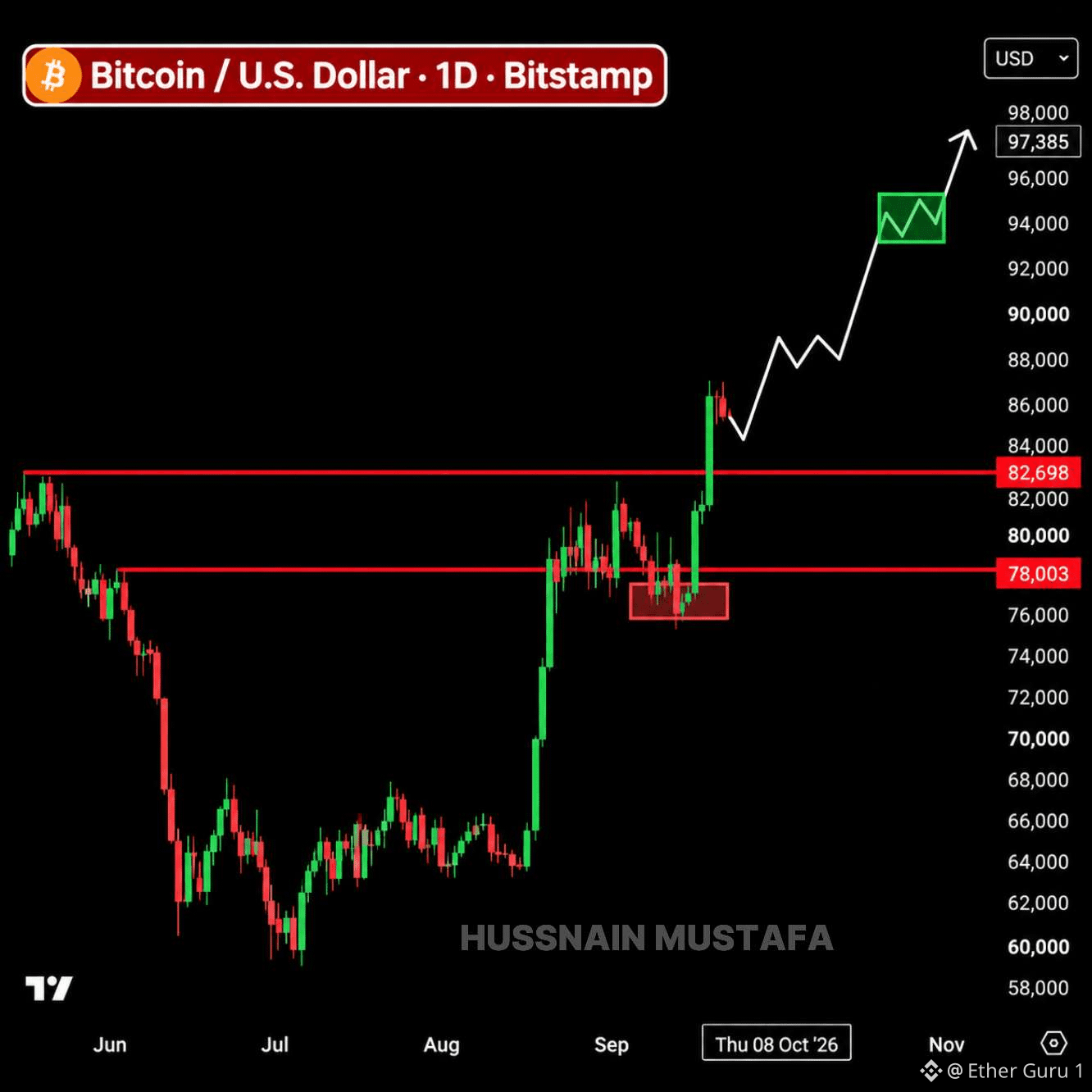
$BTC BITCOIN ACABOU DE TRANSFORMAR DUAS ANTIGAS ZONAS DE RESISTÊNCIA EM SUPORTE.
$78K foi recuperado.
Então $82,7K cedeu.
Agora o BTC está sendo negociado em torno de $84K, com o mercado observando se os compradores conseguem manter a defesa dos níveis que antes seguravam o preço.
Essa distinção importa.
Uma ruptura é uma coisa.
Manter acima dela depois que a empolgação passa é outra.
Se $82,7K continuar atuando como suporte, $90K se torna um nível muito mais óbvio para os traders acompanharem.
Mas se esse nível for perdido de novo, todo o cenário começa a parecer diferente.
Por enquanto, a parte interessante não é o próprio número de $90K.
É se o Bitcoin consegue continuar construindo topos mais altos de fundos (higher lows) por baixo dele.
O próximo movimento depende do que sustenta.
$BTC BITCOIN ACABOU DE TRANSFORMAR DUAS ANTIGAS ZONAS DE RESISTÊNCIA EM SUPORTE.
$78K foi recuperado.
Então $82,7K cedeu.
Agora o BTC está sendo negociado em torno de $84K, com o mercado observando se os compradores conseguem manter a defesa dos níveis que antes seguravam o preço.
Essa distinção importa.
Uma ruptura é uma coisa.
Manter acima dela depois que a empolgação passa é outra.
Se $82,7K continuar atuando como suporte, $90K se torna um nível muito mais óbvio para os traders acompanharem.
Mas se esse nível for perdido de novo, todo o cenário começa a parecer diferente.
Por enquanto, a parte interessante não é o próprio número de $90K.
É se o Bitcoin consegue continuar construindo topos mais altos de fundos (higher lows) por baixo dele.
O próximo movimento depende do que sustenta.
$78K foi recuperado.
Então $82,7K cedeu.
Agora o BTC está sendo negociado em torno de $84K, com o mercado observando se os compradores conseguem manter a defesa dos níveis que antes seguravam o preço.
Essa distinção importa.
Uma ruptura é uma coisa.
Manter acima dela depois que a empolgação passa é outra.
Se $82,7K continuar atuando como suporte, $90K se torna um nível muito mais óbvio para os traders acompanharem.
Mas se esse nível for perdido de novo, todo o cenário começa a parecer diferente.
Por enquanto, a parte interessante não é o próprio número de $90K.
É se o Bitcoin consegue continuar construindo topos mais altos de fundos (higher lows) por baixo dele.
O próximo movimento depende do que sustenta.
60
·
--
$BTC ETF DE COMPRA DE BITCOIN ACABOU DE FICAR SÉRIO DE NOVO.
Os ETFs de Bitcoin à vista dos EUA captaram aproximadamente US$ 715 milhões na terça-feira.
Esse foi o quarto pregão consecutivo positivo, levando a sequência de quatro dias para cerca de US$ 2,31 bilhões.
O IBIT da BlackRock sozinho recebeu aproximadamente US$ 350 milhões.
A Fidelity adicionou mais US$ 257 milhões.
Isso é importante porque os fluxos de ETFs representam demanda real por Bitcoin à vista, e não apenas pessoas falando de alta nas redes sociais.
Depois de semanas de fluxos oscilantes, bilhões voltando em apenas algumas sessões é uma mudança perceptível na negociação.
Isso não garante o próximo movimento de alta.
Mas se essa demanda continuar aparecendo enquanto o Bitcoin mantiver seus ganhos recentes, o mercado está recebendo um sinal bem diferente daquele que vimos durante a recente queda.
O capital está voltando para o Bitcoin.
$BTC ETF DE COMPRA DE BITCOIN ACABOU DE FICAR SÉRIO DE NOVO.
Os ETFs de Bitcoin à vista dos EUA captaram aproximadamente US$ 715 milhões na terça-feira.
Esse foi o quarto pregão consecutivo positivo, levando a sequência de quatro dias para cerca de US$ 2,31 bilhões.
O IBIT da BlackRock sozinho recebeu aproximadamente US$ 350 milhões.
A Fidelity adicionou mais US$ 257 milhões.
Isso é importante porque os fluxos de ETFs representam demanda real por Bitcoin à vista, e não apenas pessoas falando de alta nas redes sociais.
Depois de semanas de fluxos oscilantes, bilhões voltando em apenas algumas sessões é uma mudança perceptível na negociação.
Isso não garante o próximo movimento de alta.
Mas se essa demanda continuar aparecendo enquanto o Bitcoin mantiver seus ganhos recentes, o mercado está recebendo um sinal bem diferente daquele que vimos durante a recente queda.
O capital está voltando para o Bitcoin.
Os ETFs de Bitcoin à vista dos EUA captaram aproximadamente US$ 715 milhões na terça-feira.
Esse foi o quarto pregão consecutivo positivo, levando a sequência de quatro dias para cerca de US$ 2,31 bilhões.
O IBIT da BlackRock sozinho recebeu aproximadamente US$ 350 milhões.
A Fidelity adicionou mais US$ 257 milhões.
Isso é importante porque os fluxos de ETFs representam demanda real por Bitcoin à vista, e não apenas pessoas falando de alta nas redes sociais.
Depois de semanas de fluxos oscilantes, bilhões voltando em apenas algumas sessões é uma mudança perceptível na negociação.
Isso não garante o próximo movimento de alta.
Mas se essa demanda continuar aparecendo enquanto o Bitcoin mantiver seus ganhos recentes, o mercado está recebendo um sinal bem diferente daquele que vimos durante a recente queda.
O capital está voltando para o Bitcoin.

BTC+1,60%
IBITETF+0,91%
68
·
--
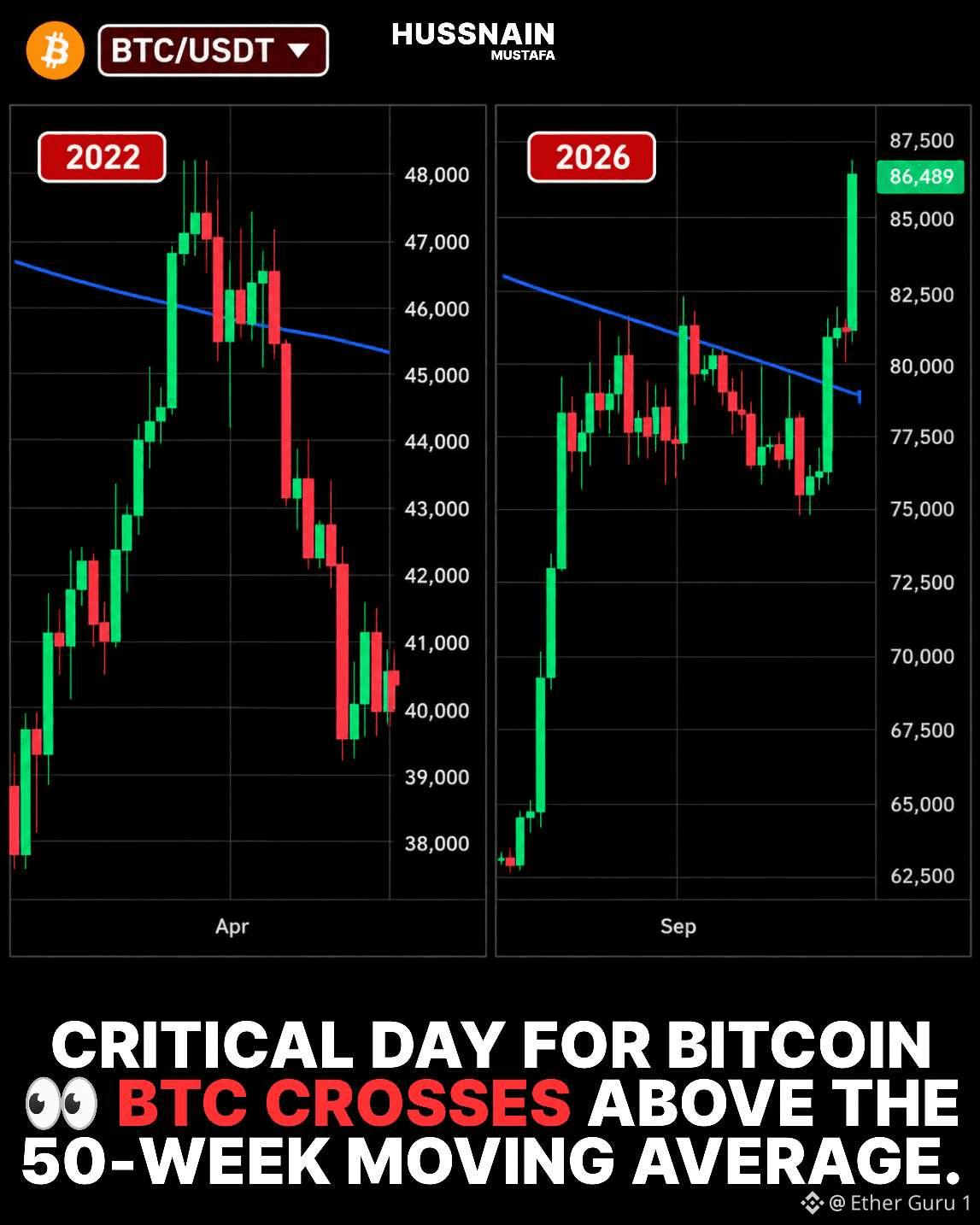
$BTC BITCOIN RECUPEROU UM NÍVEL QUE IMPORTA.
O BTC fechou por volta de US$ 81.159.
Sua média móvel de 50 semanas estava perto de US$ 78.788.
Isso coloca o Bitcoin aproximadamente 3% acima da linha.
Mas a história torna essa configuração interessante.
A Galaxy Research encontrou 13 recuperações semanais anteriores.
Onze não foram seguidas por uma nova mínima do ciclo.
Duas foram diferentes.
Dezembro de 2021 e março de 2022 recuperaram a média antes de o Bitcoin eventualmente cair bem mais.
Então um único fechamento bem-sucedido não garante uma reversão de tendência.
A pergunta importante agora é se o BTC consegue permanecer acima da média móvel.
É aí que este sinal se torna mais útil.
Uma recuperação fracassada transformaria o mesmo nível novamente em resistência.
Um movimento sustentado acima dele fortaleceria o argumento de que a estrutura do mercado mudou.
Indicadores técnicos funcionam melhor como evidência, não como certeza.
E, neste momento, o Bitcoin está diretamente sobre uma de suas mais observadas linhas de tendência de longo prazo.
Os próximos fechamentos semanais podem importar mais do que o rompimento de hoje.
$BTC BITCOIN RECUPEROU UM NÍVEL QUE IMPORTA.
O BTC fechou por volta de US$ 81.159.
Sua média móvel de 50 semanas estava perto de US$ 78.788.
Isso coloca o Bitcoin aproximadamente 3% acima da linha.
Mas a história torna essa configuração interessante.
A Galaxy Research encontrou 13 recuperações semanais anteriores.
Onze não foram seguidas por uma nova mínima do ciclo.
Duas foram diferentes.
Dezembro de 2021 e março de 2022 recuperaram a média antes de o Bitcoin eventualmente cair bem mais.
Então um único fechamento bem-sucedido não garante uma reversão de tendência.
A pergunta importante agora é se o BTC consegue permanecer acima da média móvel.
É aí que este sinal se torna mais útil.
Uma recuperação fracassada transformaria o mesmo nível novamente em resistência.
Um movimento sustentado acima dele fortaleceria o argumento de que a estrutura do mercado mudou.
Indicadores técnicos funcionam melhor como evidência, não como certeza.
E, neste momento, o Bitcoin está diretamente sobre uma de suas mais observadas linhas de tendência de longo prazo.
Os próximos fechamentos semanais podem importar mais do que o rompimento de hoje.
O BTC fechou por volta de US$ 81.159.
Sua média móvel de 50 semanas estava perto de US$ 78.788.
Isso coloca o Bitcoin aproximadamente 3% acima da linha.
Mas a história torna essa configuração interessante.
A Galaxy Research encontrou 13 recuperações semanais anteriores.
Onze não foram seguidas por uma nova mínima do ciclo.
Duas foram diferentes.
Dezembro de 2021 e março de 2022 recuperaram a média antes de o Bitcoin eventualmente cair bem mais.
Então um único fechamento bem-sucedido não garante uma reversão de tendência.
A pergunta importante agora é se o BTC consegue permanecer acima da média móvel.
É aí que este sinal se torna mais útil.
Uma recuperação fracassada transformaria o mesmo nível novamente em resistência.
Um movimento sustentado acima dele fortaleceria o argumento de que a estrutura do mercado mudou.
Indicadores técnicos funcionam melhor como evidência, não como certeza.
E, neste momento, o Bitcoin está diretamente sobre uma de suas mais observadas linhas de tendência de longo prazo.
Os próximos fechamentos semanais podem importar mais do que o rompimento de hoje.
70
·
--
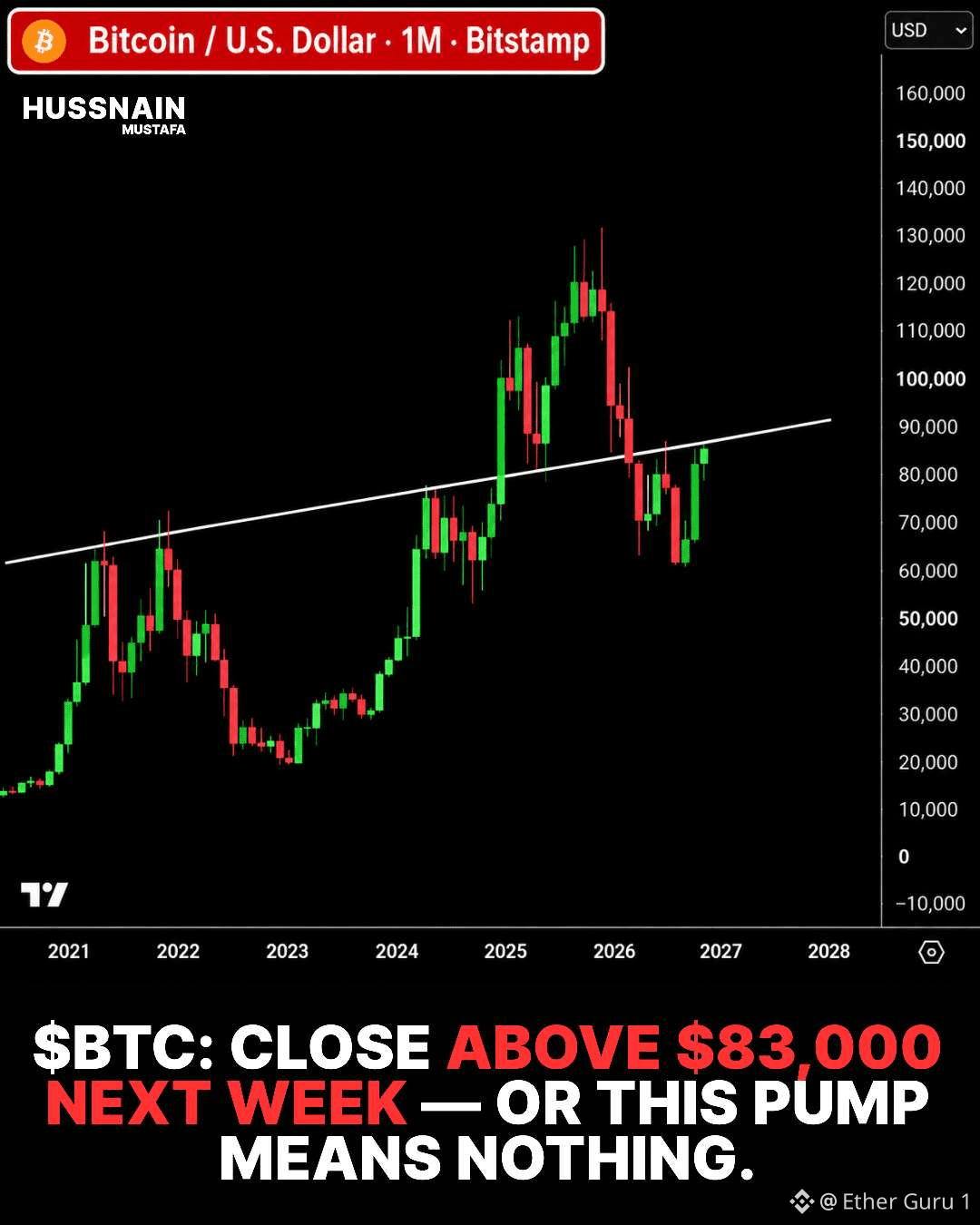
$BTC Bitcoin’s $83K Weekly Test
Uma alta semanal acima de $83.000 colocaria o Bitcoin em um novo marco de curto prazo.
O nível importa porque os fechamentos semanais mostram onde compradores e vendedores terminaram o período.
Um movimento intradiário acima de $83K conta uma história diferente.
Um fechamento sustentado forneceria evidências mais fortes de aceitação acima desse preço.
A recuperação recente do Bitcoin já o afastou das mínimas de setembro.
Mas o impulso de curto prazo pode desaparecer rapidamente nas criptos.
Volume, fluxos de ETF e liquidez podem influenciar todo o desdobramento.
Um único preço de fechamento não pode confirmar todo um ciclo de mercado.
A próxima vela semanal vai revelar se $83K vira suporte.
Ou se este rali foi apenas mais um movimento temporário.
$BTC Bitcoin’s $83K Weekly Test
Uma alta semanal acima de $83.000 colocaria o Bitcoin em um novo marco de curto prazo.
O nível importa porque os fechamentos semanais mostram onde compradores e vendedores terminaram o período.
Um movimento intradiário acima de $83K conta uma história diferente.
Um fechamento sustentado forneceria evidências mais fortes de aceitação acima desse preço.
A recuperação recente do Bitcoin já o afastou das mínimas de setembro.
Mas o impulso de curto prazo pode desaparecer rapidamente nas criptos.
Volume, fluxos de ETF e liquidez podem influenciar todo o desdobramento.
Um único preço de fechamento não pode confirmar todo um ciclo de mercado.
A próxima vela semanal vai revelar se $83K vira suporte.
Ou se este rali foi apenas mais um movimento temporário.
Uma alta semanal acima de $83.000 colocaria o Bitcoin em um novo marco de curto prazo.
O nível importa porque os fechamentos semanais mostram onde compradores e vendedores terminaram o período.
Um movimento intradiário acima de $83K conta uma história diferente.
Um fechamento sustentado forneceria evidências mais fortes de aceitação acima desse preço.
A recuperação recente do Bitcoin já o afastou das mínimas de setembro.
Mas o impulso de curto prazo pode desaparecer rapidamente nas criptos.
Volume, fluxos de ETF e liquidez podem influenciar todo o desdobramento.
Um único preço de fechamento não pode confirmar todo um ciclo de mercado.
A próxima vela semanal vai revelar se $83K vira suporte.
Ou se este rali foi apenas mais um movimento temporário.
63
·
--
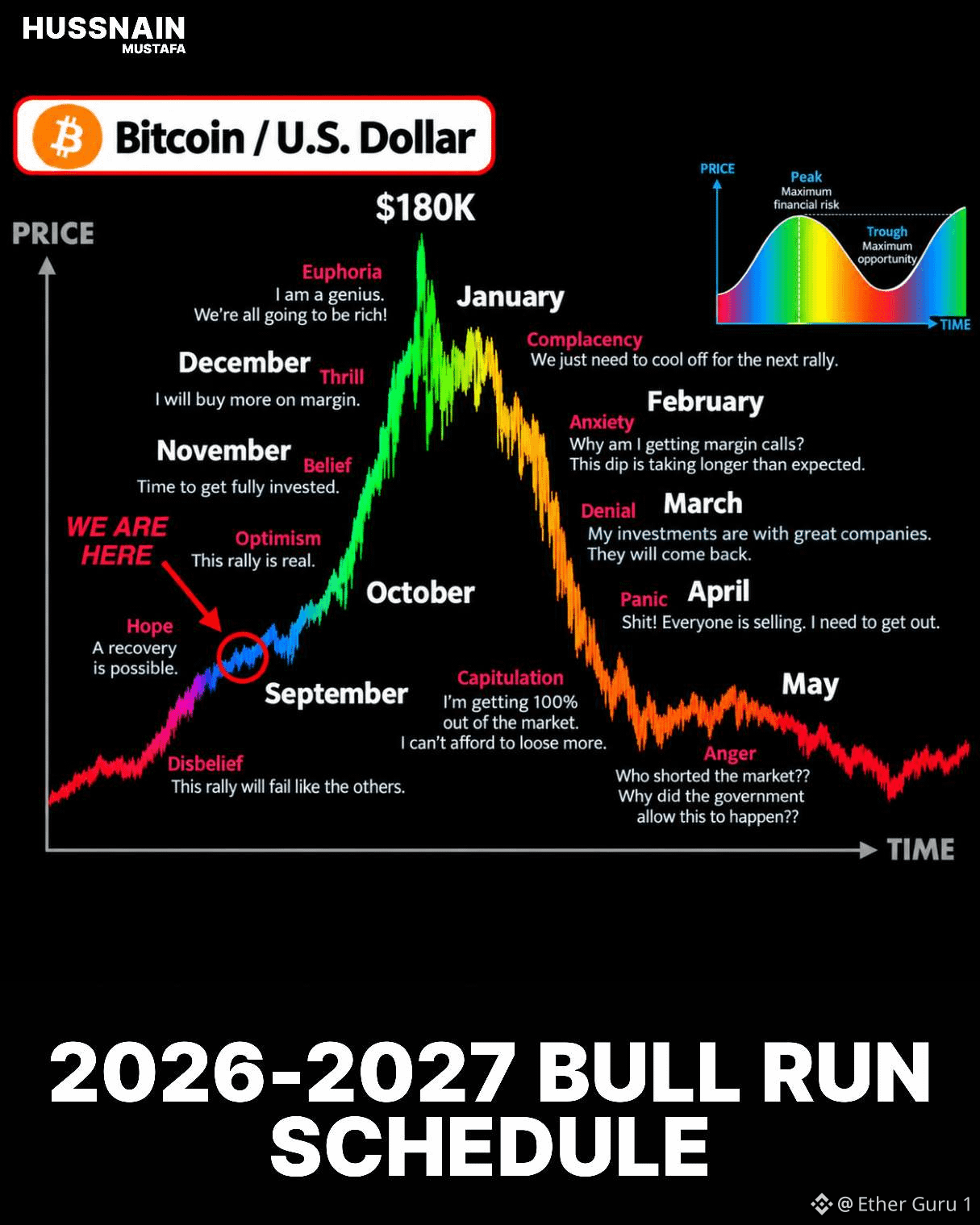
$BTC NÃO EXISTE NÚMERO MÁGICO DE BITCOIN PARA A APOSENTADORIA.
Um gráfico viral diz 0,05 BTC aos 16.
Depois, 0,25 BTC até os 30.
E 5 BTC após os 65.
Mas essas metas não são uma regra financeira.
O Bitcoin tem uma oferta máxima fixa de 21 milhões de moedas.
A 5 BTC por pessoa, apenas cerca de 4,2 milhões de pessoas poderiam teoricamente deter essa quantia.
Isso desconsidera moedas perdidas, instituições, governos, exchanges e a distribuição desigual de ownership.
A lição maior é, na verdade, sobre acumulação.
Alguém que tem 0,10 BTC hoje possui uma participação diferente na rede do que alguém que começa dez anos a partir de agora.
Mas o preço do Bitcoin também pode cair drasticamente.
Uma meta medida apenas em BTC ignora renda, dívida, reservas de emergência, impostos, contas de aposentadoria e o patrimônio líquido geral.
Para uma pessoa, 0,25 BTC pode ser uma alocação especulativa pequena.
Para outra, pode representar uma concentração desproporcional da riqueza.
Então “ganhar o jogo” não pode ser definido por um único número de Bitcoin.
A pergunta útil é quanta exposição ao risco um indivíduo consegue carregar com responsabilidade.
Ter Bitcoin importa, mas o contexto financeiro importa ainda mais.
$BTC NÃO EXISTE NÚMERO MÁGICO DE BITCOIN PARA A APOSENTADORIA.
Um gráfico viral diz 0,05 BTC aos 16.
Depois, 0,25 BTC até os 30.
E 5 BTC após os 65.
Mas essas metas não são uma regra financeira.
O Bitcoin tem uma oferta máxima fixa de 21 milhões de moedas.
A 5 BTC por pessoa, apenas cerca de 4,2 milhões de pessoas poderiam teoricamente deter essa quantia.
Isso desconsidera moedas perdidas, instituições, governos, exchanges e a distribuição desigual de ownership.
A lição maior é, na verdade, sobre acumulação.
Alguém que tem 0,10 BTC hoje possui uma participação diferente na rede do que alguém que começa dez anos a partir de agora.
Mas o preço do Bitcoin também pode cair drasticamente.
Uma meta medida apenas em BTC ignora renda, dívida, reservas de emergência, impostos, contas de aposentadoria e o patrimônio líquido geral.
Para uma pessoa, 0,25 BTC pode ser uma alocação especulativa pequena.
Para outra, pode representar uma concentração desproporcional da riqueza.
Então “ganhar o jogo” não pode ser definido por um único número de Bitcoin.
A pergunta útil é quanta exposição ao risco um indivíduo consegue carregar com responsabilidade.
Ter Bitcoin importa, mas o contexto financeiro importa ainda mais.
Um gráfico viral diz 0,05 BTC aos 16.
Depois, 0,25 BTC até os 30.
E 5 BTC após os 65.
Mas essas metas não são uma regra financeira.
O Bitcoin tem uma oferta máxima fixa de 21 milhões de moedas.
A 5 BTC por pessoa, apenas cerca de 4,2 milhões de pessoas poderiam teoricamente deter essa quantia.
Isso desconsidera moedas perdidas, instituições, governos, exchanges e a distribuição desigual de ownership.
A lição maior é, na verdade, sobre acumulação.
Alguém que tem 0,10 BTC hoje possui uma participação diferente na rede do que alguém que começa dez anos a partir de agora.
Mas o preço do Bitcoin também pode cair drasticamente.
Uma meta medida apenas em BTC ignora renda, dívida, reservas de emergência, impostos, contas de aposentadoria e o patrimônio líquido geral.
Para uma pessoa, 0,25 BTC pode ser uma alocação especulativa pequena.
Para outra, pode representar uma concentração desproporcional da riqueza.
Então “ganhar o jogo” não pode ser definido por um único número de Bitcoin.
A pergunta útil é quanta exposição ao risco um indivíduo consegue carregar com responsabilidade.
Ter Bitcoin importa, mas o contexto financeiro importa ainda mais.
71
·
--
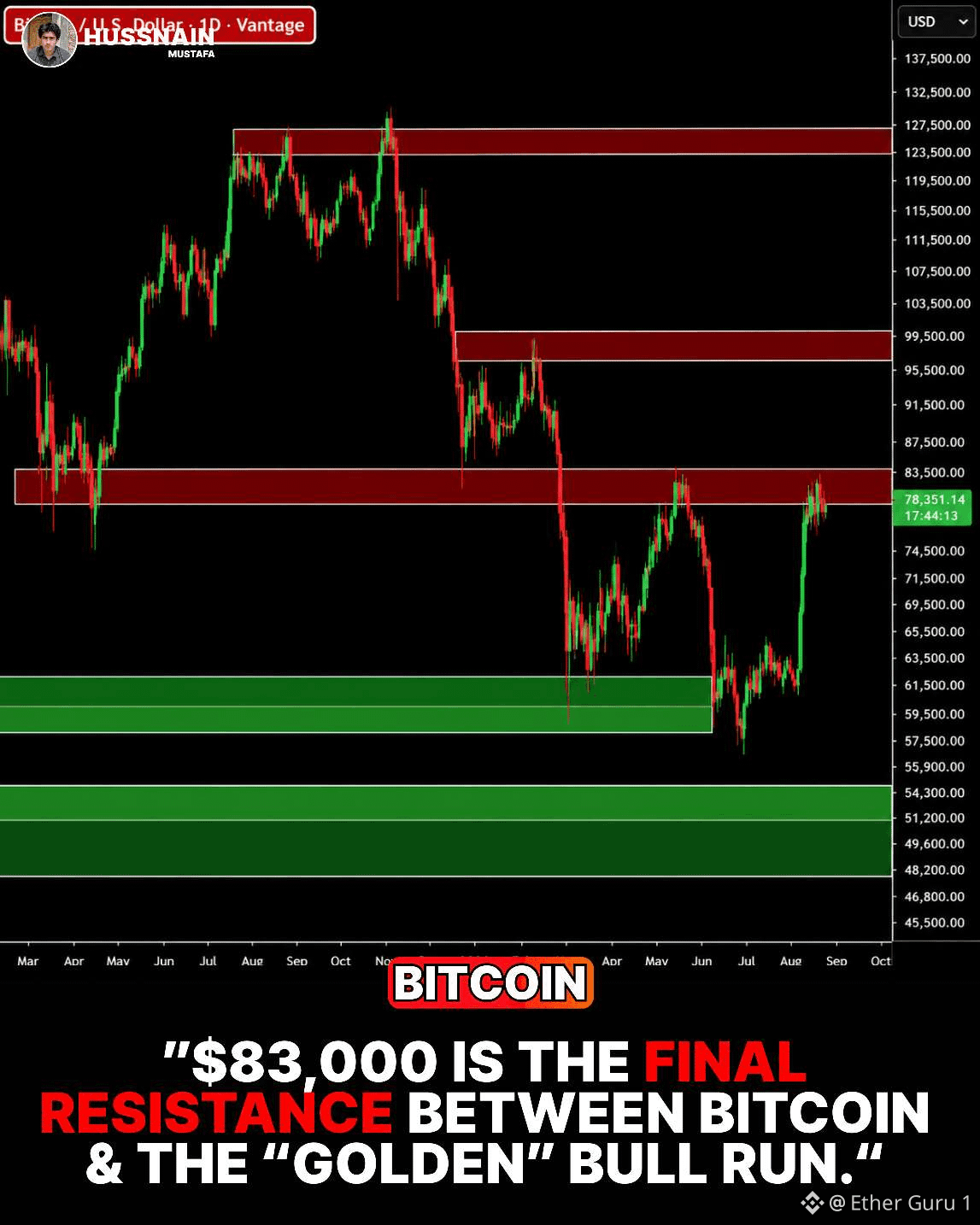
$BTC $83,000 é onde o gráfico fica sério.
Essa região coincide com a máxima de maio do Bitcoin e fica dentro de uma área mais ampla de oferta de $83K–$86K.
O pano de fundo técnico também melhorou.
O Bitcoin acabou de registrar seu primeiro golden cross de 50 dias acima do de 200 dias desde maio de 2025.
Mas a mudança de cruzamento, por si só, não confirma uma reversão de tendência duradoura.
Uma ruptura decisiva acima de $83K removeria uma grande barreira técnica.
Até lá, os vendedores ainda controlam a zona de resistência mais importante.
$83K continua sendo o portão.
$BTC $83,000 é onde o gráfico fica sério.
Essa região coincide com a máxima de maio do Bitcoin e fica dentro de uma área mais ampla de oferta de $83K–$86K.
O pano de fundo técnico também melhorou.
O Bitcoin acabou de registrar seu primeiro golden cross de 50 dias acima do de 200 dias desde maio de 2025.
Mas a mudança de cruzamento, por si só, não confirma uma reversão de tendência duradoura.
Uma ruptura decisiva acima de $83K removeria uma grande barreira técnica.
Até lá, os vendedores ainda controlam a zona de resistência mais importante.
$83K continua sendo o portão.
Essa região coincide com a máxima de maio do Bitcoin e fica dentro de uma área mais ampla de oferta de $83K–$86K.
O pano de fundo técnico também melhorou.
O Bitcoin acabou de registrar seu primeiro golden cross de 50 dias acima do de 200 dias desde maio de 2025.
Mas a mudança de cruzamento, por si só, não confirma uma reversão de tendência duradoura.
Uma ruptura decisiva acima de $83K removeria uma grande barreira técnica.
Até lá, os vendedores ainda controlam a zona de resistência mais importante.
$83K continua sendo o portão.
52
·
--
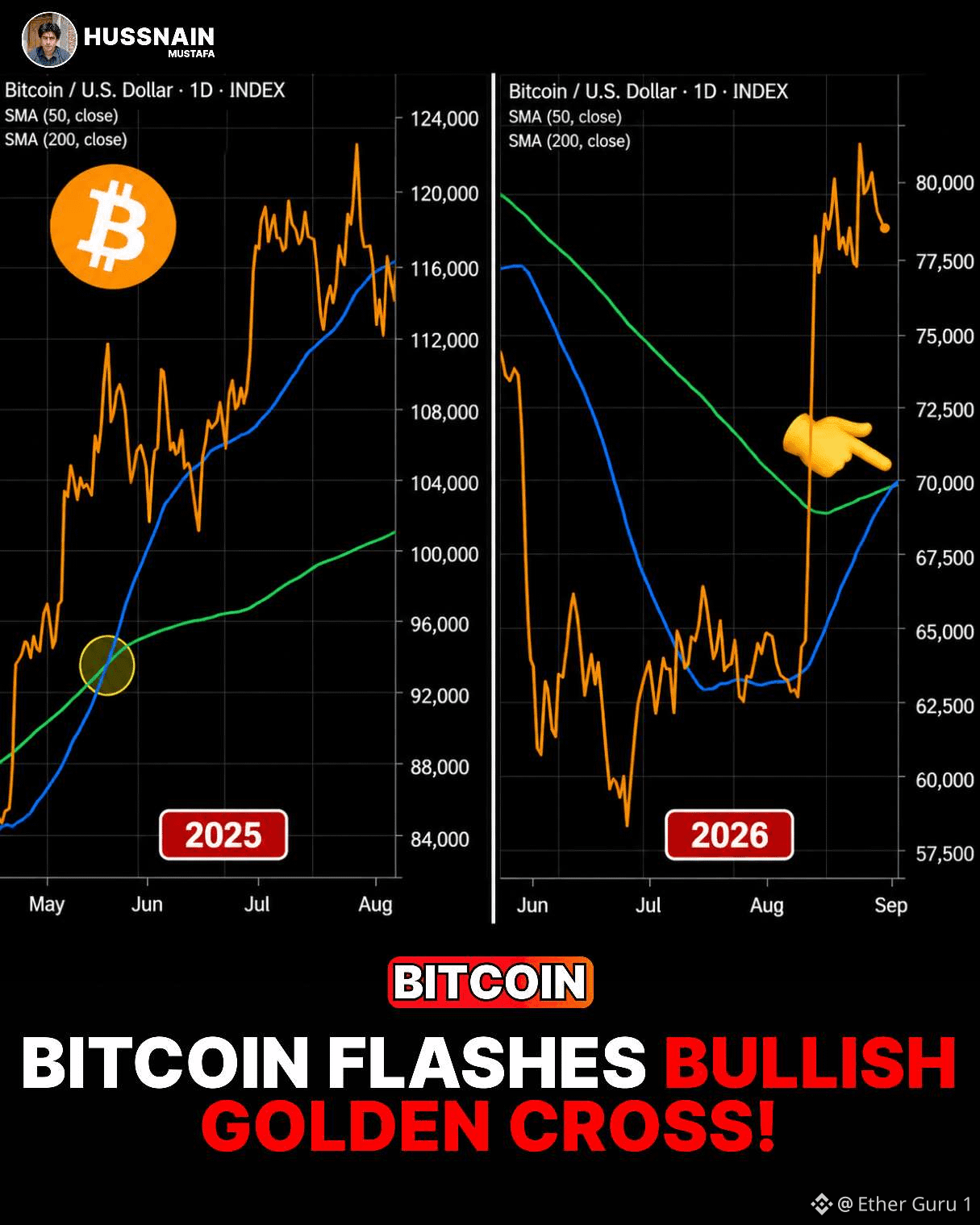
$BTC Bitcoin está voltando a mostrar um setup de cruz dourada.
O mesmo padrão técnico apareceu em maio de 2025, antes de o BTC eventualmente subir até sua máxima histórica de US$ 126.200.
Desta vez, o gráfico novamente chama a atenção para a relação entre as principais médias móveis do Bitcoin.
Mas o histórico é uma referência, não uma promessa.
Cruz dourada pode confirmar um impulso em melhora, mas não garante outra alta em linha reta. A análise técnica recente ainda aponta para níveis de resistência importantes que o BTC precisaria superar.
O sinal voltou.
Agora, o preço precisa responder
$BTC Bitcoin está voltando a mostrar um setup de cruz dourada.
O mesmo padrão técnico apareceu em maio de 2025, antes de o BTC eventualmente subir até sua máxima histórica de US$ 126.200.
Desta vez, o gráfico novamente chama a atenção para a relação entre as principais médias móveis do Bitcoin.
Mas o histórico é uma referência, não uma promessa.
Cruz dourada pode confirmar um impulso em melhora, mas não garante outra alta em linha reta. A análise técnica recente ainda aponta para níveis de resistência importantes que o BTC precisaria superar.
O sinal voltou.
Agora, o preço precisa responder
O mesmo padrão técnico apareceu em maio de 2025, antes de o BTC eventualmente subir até sua máxima histórica de US$ 126.200.
Desta vez, o gráfico novamente chama a atenção para a relação entre as principais médias móveis do Bitcoin.
Mas o histórico é uma referência, não uma promessa.
Cruz dourada pode confirmar um impulso em melhora, mas não garante outra alta em linha reta. A análise técnica recente ainda aponta para níveis de resistência importantes que o BTC precisaria superar.
O sinal voltou.
Agora, o preço precisa responder
73
·
--
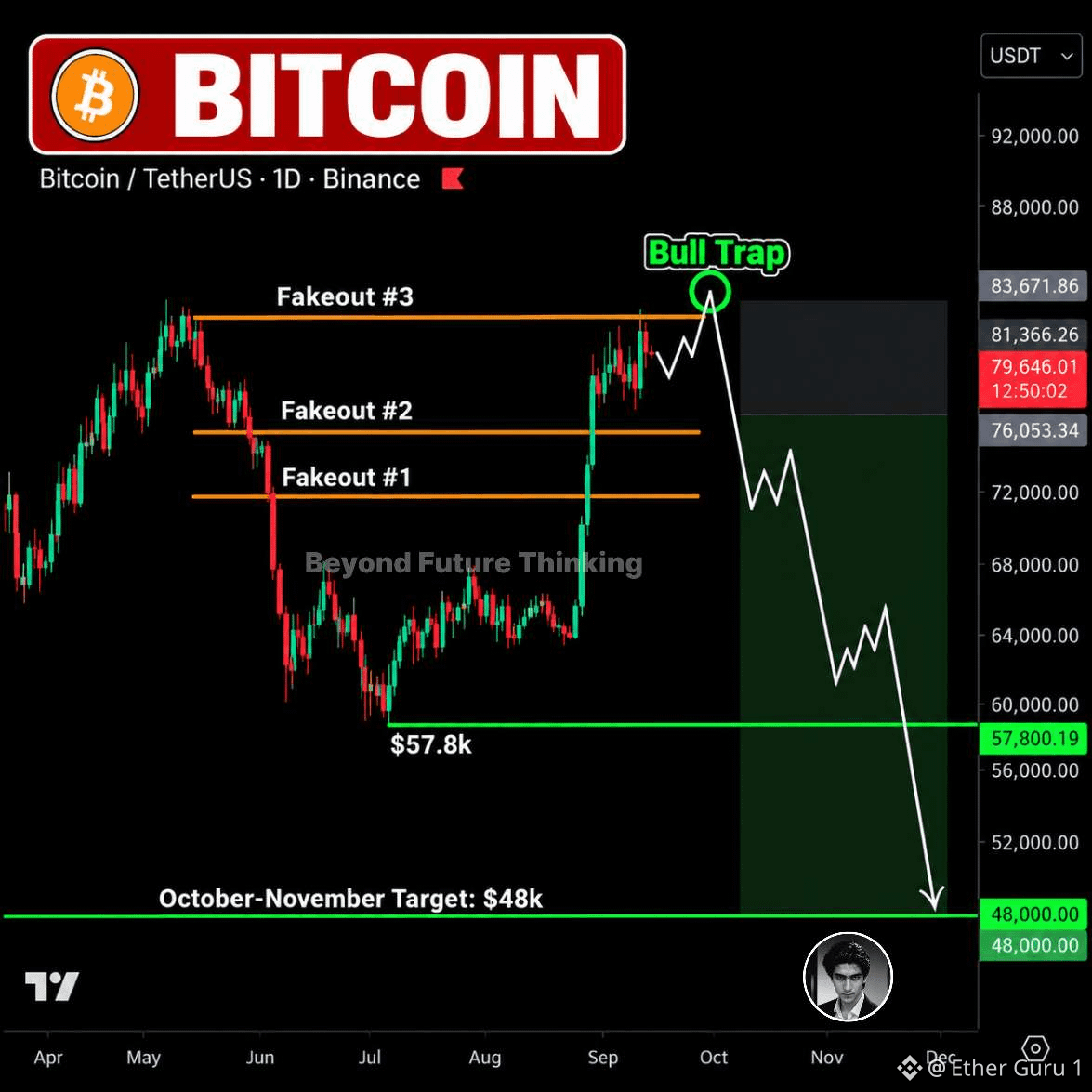
$BTC A área de US$ 83K pode decidir o próximo grande movimento do Bitcoin
O Bitcoin recentemente voltou a subir em direção aos US$ 82K, puxando o sentimento otimista de volta para o mercado.
Mas ainda existe uma grande zona de liquidez por volta dos US$ 83K.
Isso significa que o preço pode potencialmente fazer mais um movimento para cima antes que a direção real fique clara.
Meu roteiro atual continua sendo:
US$ 79K → US$ 83K → US$ 68K
Se o mercado perder o impulso após esse repique, os próximos níveis de queda que estou observando são:
US$ 57,8K → US$ 49K
O motivo de eu não tratar o repique mais recente como uma recuperação confirmada é simples.
Um movimento forte para cima pode trazer novos compradores de volta ao mercado, especialmente depois de semanas de medo e vendas intensas.
Essa liquidez perto dos US$ 83K pode se tornar uma área importante para a próxima grande reação.
Se o Bitcoin for rejeitado ali, a estrutura de queda pode voltar rapidamente ao foco.
Tenho acompanhado esses níveis principais de perto ao longo de todo o ciclo, incluindo os movimentos de US$ 98K → US$ 60K e US$ 83K → US$ 57K.
Isso não significa que todas as próximas previsões estejam garantidas.
Mas a ação do preço, a liquidez e os níveis-chave ainda importam mais do que emoções.
Os próximos alguns movimentos podem revelar se isso foi uma recuperação genuína — ou apenas mais uma armadilha antes de uma queda mais profunda.
US$ 83K é a linha.
$BTC A área de US$ 83K pode decidir o próximo grande movimento do Bitcoin
O Bitcoin recentemente voltou a subir em direção aos US$ 82K, puxando o sentimento otimista de volta para o mercado.
Mas ainda existe uma grande zona de liquidez por volta dos US$ 83K.
Isso significa que o preço pode potencialmente fazer mais um movimento para cima antes que a direção real fique clara.
Meu roteiro atual continua sendo:
US$ 79K → US$ 83K → US$ 68K
Se o mercado perder o impulso após esse repique, os próximos níveis de queda que estou observando são:
US$ 57,8K → US$ 49K
O motivo de eu não tratar o repique mais recente como uma recuperação confirmada é simples.
Um movimento forte para cima pode trazer novos compradores de volta ao mercado, especialmente depois de semanas de medo e vendas intensas.
Essa liquidez perto dos US$ 83K pode se tornar uma área importante para a próxima grande reação.
Se o Bitcoin for rejeitado ali, a estrutura de queda pode voltar rapidamente ao foco.
Tenho acompanhado esses níveis principais de perto ao longo de todo o ciclo, incluindo os movimentos de US$ 98K → US$ 60K e US$ 83K → US$ 57K.
Isso não significa que todas as próximas previsões estejam garantidas.
Mas a ação do preço, a liquidez e os níveis-chave ainda importam mais do que emoções.
Os próximos alguns movimentos podem revelar se isso foi uma recuperação genuína — ou apenas mais uma armadilha antes de uma queda mais profunda.
US$ 83K é a linha.
O Bitcoin recentemente voltou a subir em direção aos US$ 82K, puxando o sentimento otimista de volta para o mercado.
Mas ainda existe uma grande zona de liquidez por volta dos US$ 83K.
Isso significa que o preço pode potencialmente fazer mais um movimento para cima antes que a direção real fique clara.
Meu roteiro atual continua sendo:
US$ 79K → US$ 83K → US$ 68K
Se o mercado perder o impulso após esse repique, os próximos níveis de queda que estou observando são:
US$ 57,8K → US$ 49K
O motivo de eu não tratar o repique mais recente como uma recuperação confirmada é simples.
Um movimento forte para cima pode trazer novos compradores de volta ao mercado, especialmente depois de semanas de medo e vendas intensas.
Essa liquidez perto dos US$ 83K pode se tornar uma área importante para a próxima grande reação.
Se o Bitcoin for rejeitado ali, a estrutura de queda pode voltar rapidamente ao foco.
Tenho acompanhado esses níveis principais de perto ao longo de todo o ciclo, incluindo os movimentos de US$ 98K → US$ 60K e US$ 83K → US$ 57K.
Isso não significa que todas as próximas previsões estejam garantidas.
Mas a ação do preço, a liquidez e os níveis-chave ainda importam mais do que emoções.
Os próximos alguns movimentos podem revelar se isso foi uma recuperação genuína — ou apenas mais uma armadilha antes de uma queda mais profunda.
US$ 83K é a linha.
134
·
--
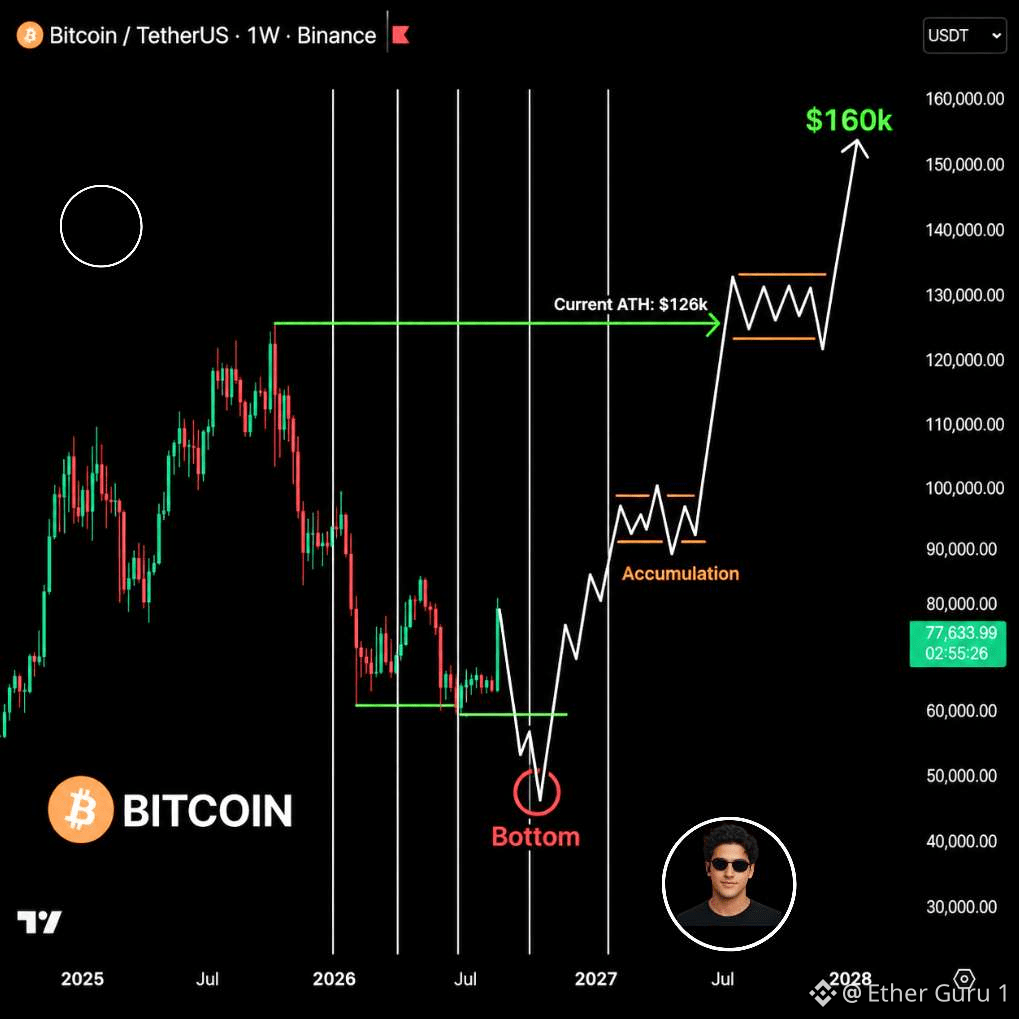
$BTC 🚨 O RESET MACRO 2026–27
O 3º trimestre de 2026 pode se tornar um grande teste para os ativos de risco se a política monetária e o sentimento cripto enfraquecerem juntos.
BTC: fase de possível fundo
SPX: cenário de queda para ~7,3K
Um novo ciclo de liderança no Fed poderia remodelar as expectativas sobre taxas, liquidez e condições financeiras.
O primeiro corte de juros não significará automaticamente um mercado em alta.
Se os temores de recessão se intensificarem, os mercados podem inicialmente interpretar o afrouxamento como uma resposta à fraqueza econômica.
Sentimento cripto: cenário de medo extremo
O 4º trimestre pode trazer um arranjo diferente se o Bitcoin recuperar resistências importantes e a demanda institucional se fortalecer.
BTC: acima de US$ 84K
A clareza regulatória pode se tornar outro catalisador caso a Lei CLARITY eventualmente se torne lei.
A infraestrutura de IA e a adoção de cripto também podem criar novas narrativas para a rotação de capital.
Cenário BTC para 2027: US$ 160K+
Três cortes do Fed representariam uma mudança significativa nas condições monetárias se a fraqueza econômica ficar mais evidente.
O Bitcoin pode passar a ser visto cada vez mais junto com outros ativos escassos durante períodos de incerteza monetária.
Mas o caminho não será linear.
Um retorno de 2x em 12 meses exigiria que o Bitcoin atingisse aproximadamente o dobro do nível de entrada do 3º trimestre.
Isso continua sendo um cenário, não um resultado garantido.
As maiores oportunidades muitas vezes surgem quando o sentimento está no pior nível.
O medo cria o arranjo.
A liquidez define o timing.
$BTC 🚨 O RESET MACRO 2026–27
O 3º trimestre de 2026 pode se tornar um grande teste para os ativos de risco se a política monetária e o sentimento cripto enfraquecerem juntos.
BTC: fase de possível fundo
SPX: cenário de queda para ~7,3K
Um novo ciclo de liderança no Fed poderia remodelar as expectativas sobre taxas, liquidez e condições financeiras.
O primeiro corte de juros não significará automaticamente um mercado em alta.
Se os temores de recessão se intensificarem, os mercados podem inicialmente interpretar o afrouxamento como uma resposta à fraqueza econômica.
Sentimento cripto: cenário de medo extremo
O 4º trimestre pode trazer um arranjo diferente se o Bitcoin recuperar resistências importantes e a demanda institucional se fortalecer.
BTC: acima de US$ 84K
A clareza regulatória pode se tornar outro catalisador caso a Lei CLARITY eventualmente se torne lei.
A infraestrutura de IA e a adoção de cripto também podem criar novas narrativas para a rotação de capital.
Cenário BTC para 2027: US$ 160K+
Três cortes do Fed representariam uma mudança significativa nas condições monetárias se a fraqueza econômica ficar mais evidente.
O Bitcoin pode passar a ser visto cada vez mais junto com outros ativos escassos durante períodos de incerteza monetária.
Mas o caminho não será linear.
Um retorno de 2x em 12 meses exigiria que o Bitcoin atingisse aproximadamente o dobro do nível de entrada do 3º trimestre.
Isso continua sendo um cenário, não um resultado garantido.
As maiores oportunidades muitas vezes surgem quando o sentimento está no pior nível.
O medo cria o arranjo.
A liquidez define o timing.
O 3º trimestre de 2026 pode se tornar um grande teste para os ativos de risco se a política monetária e o sentimento cripto enfraquecerem juntos.
BTC: fase de possível fundo
SPX: cenário de queda para ~7,3K
Um novo ciclo de liderança no Fed poderia remodelar as expectativas sobre taxas, liquidez e condições financeiras.
O primeiro corte de juros não significará automaticamente um mercado em alta.
Se os temores de recessão se intensificarem, os mercados podem inicialmente interpretar o afrouxamento como uma resposta à fraqueza econômica.
Sentimento cripto: cenário de medo extremo
O 4º trimestre pode trazer um arranjo diferente se o Bitcoin recuperar resistências importantes e a demanda institucional se fortalecer.
BTC: acima de US$ 84K
A clareza regulatória pode se tornar outro catalisador caso a Lei CLARITY eventualmente se torne lei.
A infraestrutura de IA e a adoção de cripto também podem criar novas narrativas para a rotação de capital.
Cenário BTC para 2027: US$ 160K+
Três cortes do Fed representariam uma mudança significativa nas condições monetárias se a fraqueza econômica ficar mais evidente.
O Bitcoin pode passar a ser visto cada vez mais junto com outros ativos escassos durante períodos de incerteza monetária.
Mas o caminho não será linear.
Um retorno de 2x em 12 meses exigiria que o Bitcoin atingisse aproximadamente o dobro do nível de entrada do 3º trimestre.
Isso continua sendo um cenário, não um resultado garantido.
As maiores oportunidades muitas vezes surgem quando o sentimento está no pior nível.
O medo cria o arranjo.
A liquidez define o timing.
118
·
--
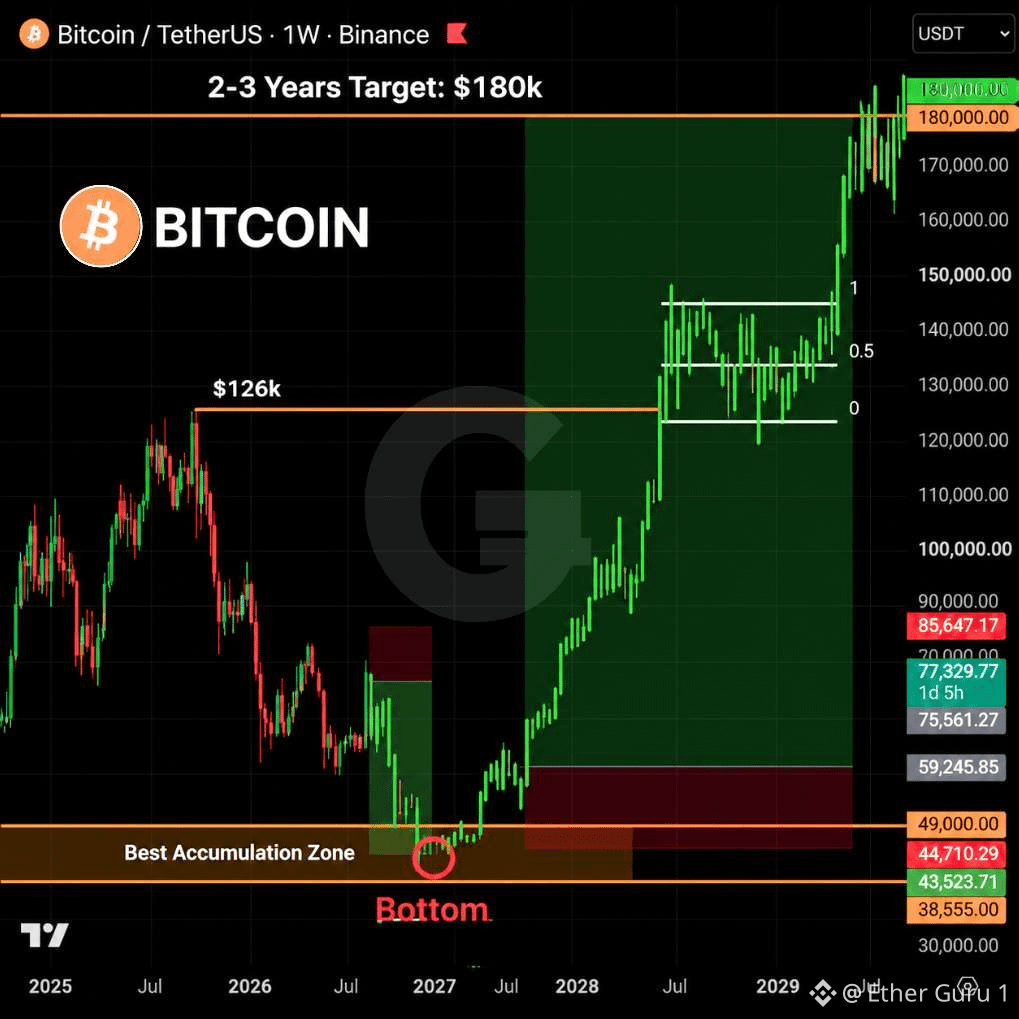
$BTC $BTC ROADMAP 🧭
O cenário atual do Bitcoin está sendo mapeado a partir de um ponto de partida de US$ 77 mil.
A projeção do caso de baixa mira US$ 39 mil–US$ 49 mil para uma possível zona de fundo do ciclo.
Isso representaria uma queda possível de 36%–49% em relação a US$ 77 mil.
O caso de alta de longo prazo, então, mira US$ 180 mil nos próximos 2–3 anos.
A partir de um meio de US$ 45 mil, US$ 180 mil exigiria um crescimento de aproximadamente 4×.
Este é um cenário técnico — a faixa de US$ 39 mil–US$ 49 mil não é um fundo confirmado.
A estratégia é observar o medo, a liquidez e a estrutura antes de tratar essa zona como uma oportunidade de acumulação.
$BTC $BTC ROADMAP 🧭
O cenário atual do Bitcoin está sendo mapeado a partir de um ponto de partida de US$ 77 mil.
A projeção do caso de baixa mira US$ 39 mil–US$ 49 mil para uma possível zona de fundo do ciclo.
Isso representaria uma queda possível de 36%–49% em relação a US$ 77 mil.
O caso de alta de longo prazo, então, mira US$ 180 mil nos próximos 2–3 anos.
A partir de um meio de US$ 45 mil, US$ 180 mil exigiria um crescimento de aproximadamente 4×.
Este é um cenário técnico — a faixa de US$ 39 mil–US$ 49 mil não é um fundo confirmado.
A estratégia é observar o medo, a liquidez e a estrutura antes de tratar essa zona como uma oportunidade de acumulação.
O cenário atual do Bitcoin está sendo mapeado a partir de um ponto de partida de US$ 77 mil.
A projeção do caso de baixa mira US$ 39 mil–US$ 49 mil para uma possível zona de fundo do ciclo.
Isso representaria uma queda possível de 36%–49% em relação a US$ 77 mil.
O caso de alta de longo prazo, então, mira US$ 180 mil nos próximos 2–3 anos.
A partir de um meio de US$ 45 mil, US$ 180 mil exigiria um crescimento de aproximadamente 4×.
Este é um cenário técnico — a faixa de US$ 39 mil–US$ 49 mil não é um fundo confirmado.
A estratégia é observar o medo, a liquidez e a estrutura antes de tratar essa zona como uma oportunidade de acumulação.
91
·
--
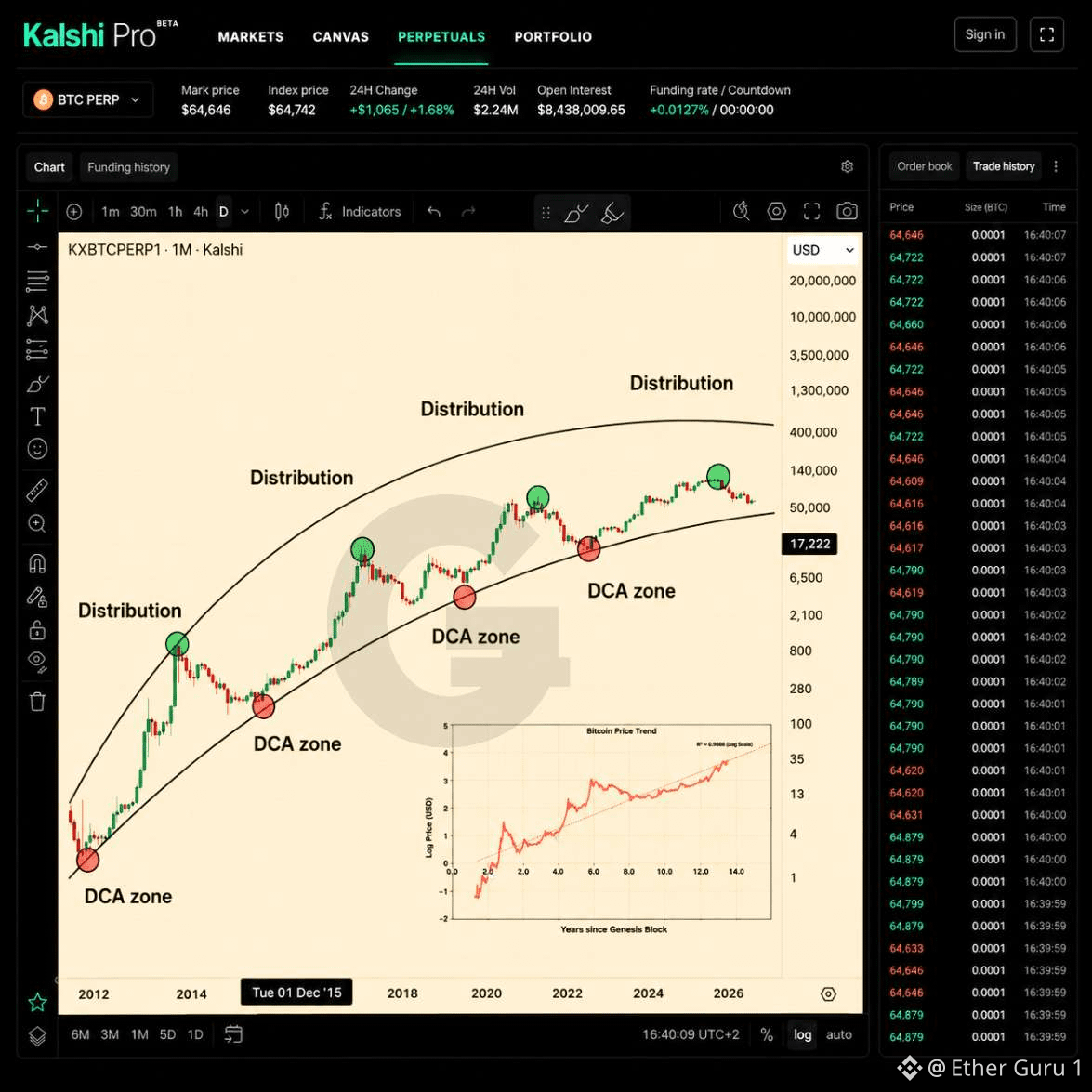
$BTC 🚨 CADA QUEDA TEM DEIXADO UM PISO MAIS ALTO
O Bitcoin repetidamente passou por retiradas brutais, mas os ciclos posteriores estabeleceram patamares de preço dramaticamente mais altos.
2010 → ~$0,10
2011 → ~$1
2013 → ~$50
2015 → ~$200
2018 → ~$3.000
2022 → ~$15.000
2024 → ~$39.000
2026 → ~$60.000
A progressão é impressionante.
De US$ 0,10 → US$ 60K representa um aumento de aproximadamente 600.000×.
Mesmo a alta do fundo de 2022, de ~$15K para $60K, representa cerca de 4×.
Isso não significa que cada futura queda deva gerar um piso mais alto.
O Bitcoin ainda pode enfrentar volatilidade severa, mercados baixistas prolongados e correções mais profundas do que o esperado.
Mas a história de longo prazo dos preços mostra uma característica recorrente:
O preço do “desastre” de ontem repetidamente se torna o ponto de referência histórico de amanhã.
A questão mais interessante não é se acontecerá mais uma queda.
É se o próximo grande ciclo, eventualmente, estabelecerá outro piso que faça US$ 60K parecer tão distante quanto US$ 15K parece hoje.
$BTC 🚨 CADA QUEDA TEM DEIXADO UM PISO MAIS ALTO
O Bitcoin repetidamente passou por retiradas brutais, mas os ciclos posteriores estabeleceram patamares de preço dramaticamente mais altos.
2010 → ~$0,10
2011 → ~$1
2013 → ~$50
2015 → ~$200
2018 → ~$3.000
2022 → ~$15.000
2024 → ~$39.000
2026 → ~$60.000
A progressão é impressionante.
De US$ 0,10 → US$ 60K representa um aumento de aproximadamente 600.000×.
Mesmo a alta do fundo de 2022, de ~$15K para $60K, representa cerca de 4×.
Isso não significa que cada futura queda deva gerar um piso mais alto.
O Bitcoin ainda pode enfrentar volatilidade severa, mercados baixistas prolongados e correções mais profundas do que o esperado.
Mas a história de longo prazo dos preços mostra uma característica recorrente:
O preço do “desastre” de ontem repetidamente se torna o ponto de referência histórico de amanhã.
A questão mais interessante não é se acontecerá mais uma queda.
É se o próximo grande ciclo, eventualmente, estabelecerá outro piso que faça US$ 60K parecer tão distante quanto US$ 15K parece hoje.
O Bitcoin repetidamente passou por retiradas brutais, mas os ciclos posteriores estabeleceram patamares de preço dramaticamente mais altos.
2010 → ~$0,10
2011 → ~$1
2013 → ~$50
2015 → ~$200
2018 → ~$3.000
2022 → ~$15.000
2024 → ~$39.000
2026 → ~$60.000
A progressão é impressionante.
De US$ 0,10 → US$ 60K representa um aumento de aproximadamente 600.000×.
Mesmo a alta do fundo de 2022, de ~$15K para $60K, representa cerca de 4×.
Isso não significa que cada futura queda deva gerar um piso mais alto.
O Bitcoin ainda pode enfrentar volatilidade severa, mercados baixistas prolongados e correções mais profundas do que o esperado.
Mas a história de longo prazo dos preços mostra uma característica recorrente:
O preço do “desastre” de ontem repetidamente se torna o ponto de referência histórico de amanhã.
A questão mais interessante não é se acontecerá mais uma queda.
É se o próximo grande ciclo, eventualmente, estabelecerá outro piso que faça US$ 60K parecer tão distante quanto US$ 15K parece hoje.
57
·
--
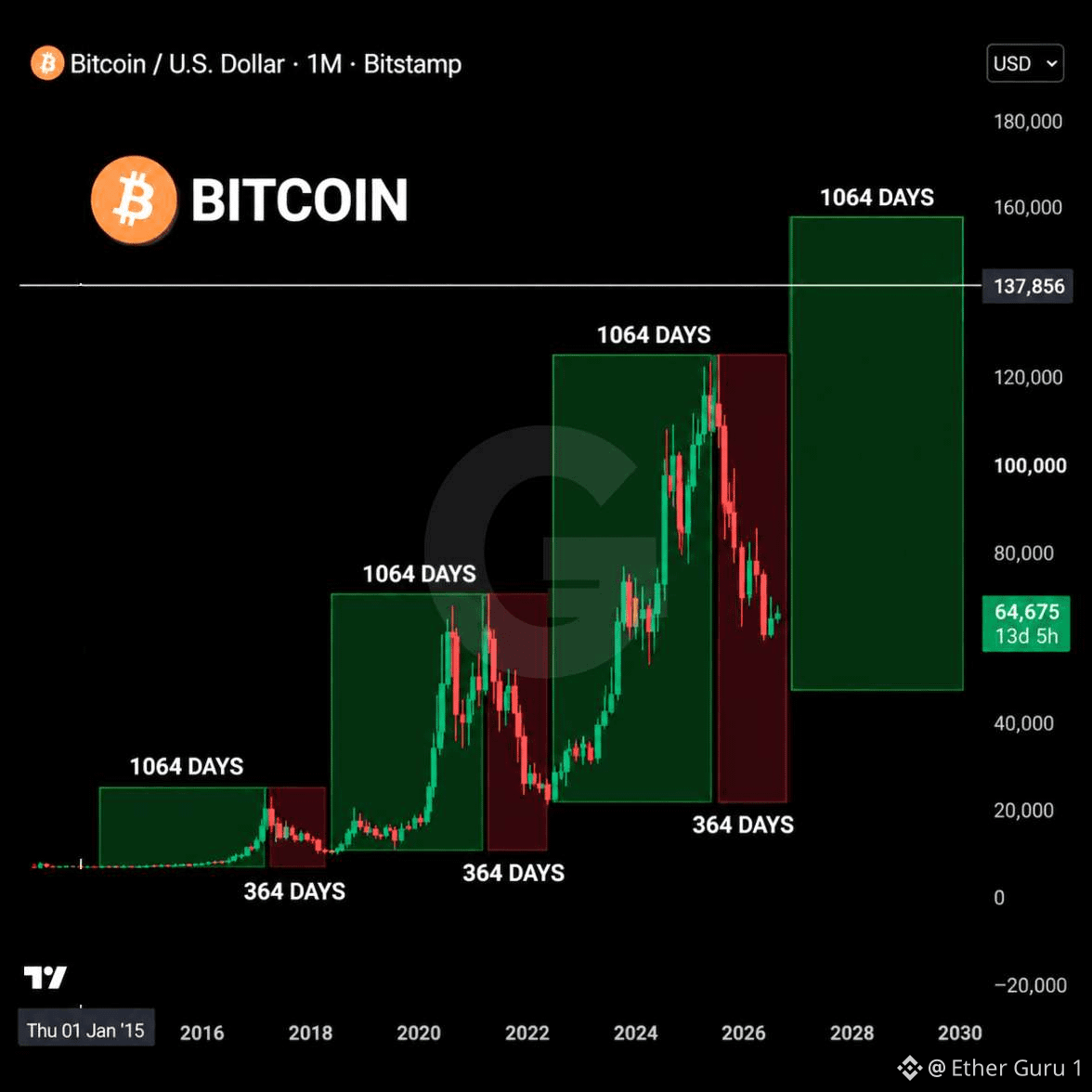
$BTC CYCLE
A Teoria do Ciclo de Bitcoin de 1.064 / 364 Dias Aponta para o Início de Outubro de 2026.
O Modelo Usa 1.064 Dias para a Fase de Expansão e 364 Dias para a Fase de Baixa.
2015–2017: 1.064 Dias
2017–2018: 364 Dias
2018–2021: 1.064 Dias
2021–2022: 364 Dias
O Pico de 2025 Foi por Volta de US$ 126K.
Aplicar Outra Fase de 364 Dias Coloca o Timing Teórico do Fundo por Volta de 5–9 de Outubro de 2026.
Essa Data é uma Projeção Padrão Histórica — Não um Fundo de Mercado Garantido.
$BTC CYCLE
A Teoria do Ciclo de Bitcoin de 1.064 / 364 Dias Aponta para o Início de Outubro de 2026.
O Modelo Usa 1.064 Dias para a Fase de Expansão e 364 Dias para a Fase de Baixa.
2015–2017: 1.064 Dias
2017–2018: 364 Dias
2018–2021: 1.064 Dias
2021–2022: 364 Dias
O Pico de 2025 Foi por Volta de US$ 126K.
Aplicar Outra Fase de 364 Dias Coloca o Timing Teórico do Fundo por Volta de 5–9 de Outubro de 2026.
Essa Data é uma Projeção Padrão Histórica — Não um Fundo de Mercado Garantido.
A Teoria do Ciclo de Bitcoin de 1.064 / 364 Dias Aponta para o Início de Outubro de 2026.
O Modelo Usa 1.064 Dias para a Fase de Expansão e 364 Dias para a Fase de Baixa.
2015–2017: 1.064 Dias
2017–2018: 364 Dias
2018–2021: 1.064 Dias
2021–2022: 364 Dias
O Pico de 2025 Foi por Volta de US$ 126K.
Aplicar Outra Fase de 364 Dias Coloca o Timing Teórico do Fundo por Volta de 5–9 de Outubro de 2026.
Essa Data é uma Projeção Padrão Histórica — Não um Fundo de Mercado Garantido.
76
·
--
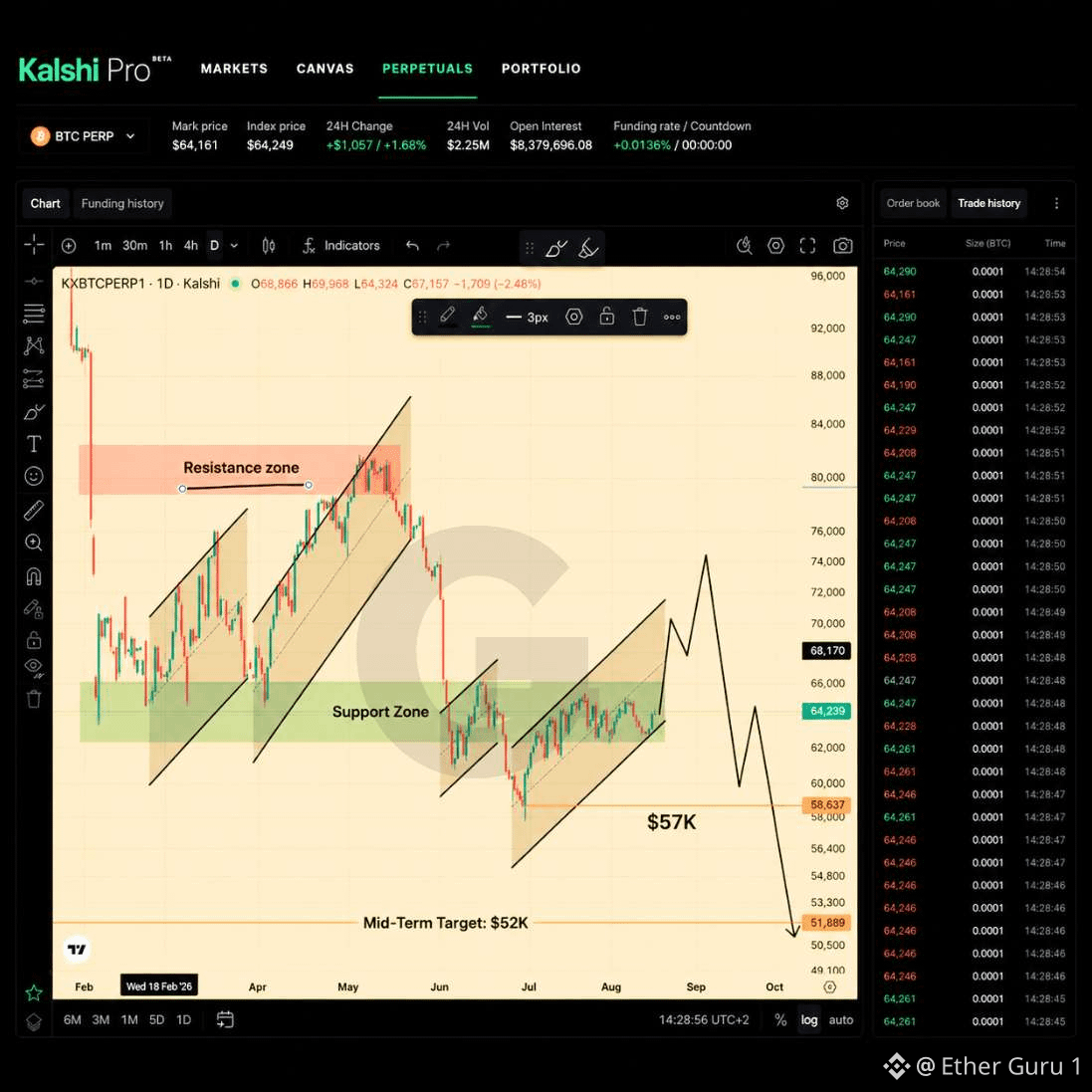
$BTC 🚨 O PRÓXIMO TESTE DE $70K PODE SER A MAIOR ARMADILHA DO MERCADO
Depois de cair em direção a $62K, a próxima grande área em destaque é o FVG de $70K–$72K.
Uma recuperação para essa zona representaria aproximadamente uma alta de 13–16% a partir de $62K.
Meu cenário atual para 2–3 meses é baseado em vários testes de liquidez.
$63K → $70K → $58K
$58K → $64K → $50K
$50K → $55K → $48K
Então, potencialmente 30–45 dias de acumulação na faixa inferior.
Se essa estrutura se desenvolver, o mercado pode passar semanas se movendo lateralmente antes de estabelecer uma tendência direcional mais forte.
O nível mais importante pode, portanto, ser $70K–$72K — não porque garanta uma reversão, mas porque uma rejeição ali fortaleceria o cenário baixista.
Um movimento de $72K → $48K representaria aproximadamente 33% de queda.
Por outro lado, uma aceitação sustentada acima do FVG enfraqueceria bastante este roteiro.
Isso torna a próxima recuperação mais importante do que a própria previsão.
$62K → referência atual
$70K–$72K → principal teste de alta
$58K → primeiro ponto de checagem de queda
$50K → suporte mais profundo
$48K → possível zona de acumulação
Isso continua sendo um cenário baseado em liquidez e estrutura de mercado — não um caminho garantido.
A confirmação virá de como o preço reage em cada nível, e não apenas do roteiro.
$BTC 🚨 O PRÓXIMO TESTE DE $70K PODE SER A MAIOR ARMADILHA DO MERCADO
Depois de cair em direção a $62K, a próxima grande área em destaque é o FVG de $70K–$72K.
Uma recuperação para essa zona representaria aproximadamente uma alta de 13–16% a partir de $62K.
Meu cenário atual para 2–3 meses é baseado em vários testes de liquidez.
$63K → $70K → $58K
$58K → $64K → $50K
$50K → $55K → $48K
Então, potencialmente 30–45 dias de acumulação na faixa inferior.
Se essa estrutura se desenvolver, o mercado pode passar semanas se movendo lateralmente antes de estabelecer uma tendência direcional mais forte.
O nível mais importante pode, portanto, ser $70K–$72K — não porque garanta uma reversão, mas porque uma rejeição ali fortaleceria o cenário baixista.
Um movimento de $72K → $48K representaria aproximadamente 33% de queda.
Por outro lado, uma aceitação sustentada acima do FVG enfraqueceria bastante este roteiro.
Isso torna a próxima recuperação mais importante do que a própria previsão.
$62K → referência atual
$70K–$72K → principal teste de alta
$58K → primeiro ponto de checagem de queda
$50K → suporte mais profundo
$48K → possível zona de acumulação
Isso continua sendo um cenário baseado em liquidez e estrutura de mercado — não um caminho garantido.
A confirmação virá de como o preço reage em cada nível, e não apenas do roteiro.
Depois de cair em direção a $62K, a próxima grande área em destaque é o FVG de $70K–$72K.
Uma recuperação para essa zona representaria aproximadamente uma alta de 13–16% a partir de $62K.
Meu cenário atual para 2–3 meses é baseado em vários testes de liquidez.
$63K → $70K → $58K
$58K → $64K → $50K
$50K → $55K → $48K
Então, potencialmente 30–45 dias de acumulação na faixa inferior.
Se essa estrutura se desenvolver, o mercado pode passar semanas se movendo lateralmente antes de estabelecer uma tendência direcional mais forte.
O nível mais importante pode, portanto, ser $70K–$72K — não porque garanta uma reversão, mas porque uma rejeição ali fortaleceria o cenário baixista.
Um movimento de $72K → $48K representaria aproximadamente 33% de queda.
Por outro lado, uma aceitação sustentada acima do FVG enfraqueceria bastante este roteiro.
Isso torna a próxima recuperação mais importante do que a própria previsão.
$62K → referência atual
$70K–$72K → principal teste de alta
$58K → primeiro ponto de checagem de queda
$50K → suporte mais profundo
$48K → possível zona de acumulação
Isso continua sendo um cenário baseado em liquidez e estrutura de mercado — não um caminho garantido.
A confirmação virá de como o preço reage em cada nível, e não apenas do roteiro.
60
·
--
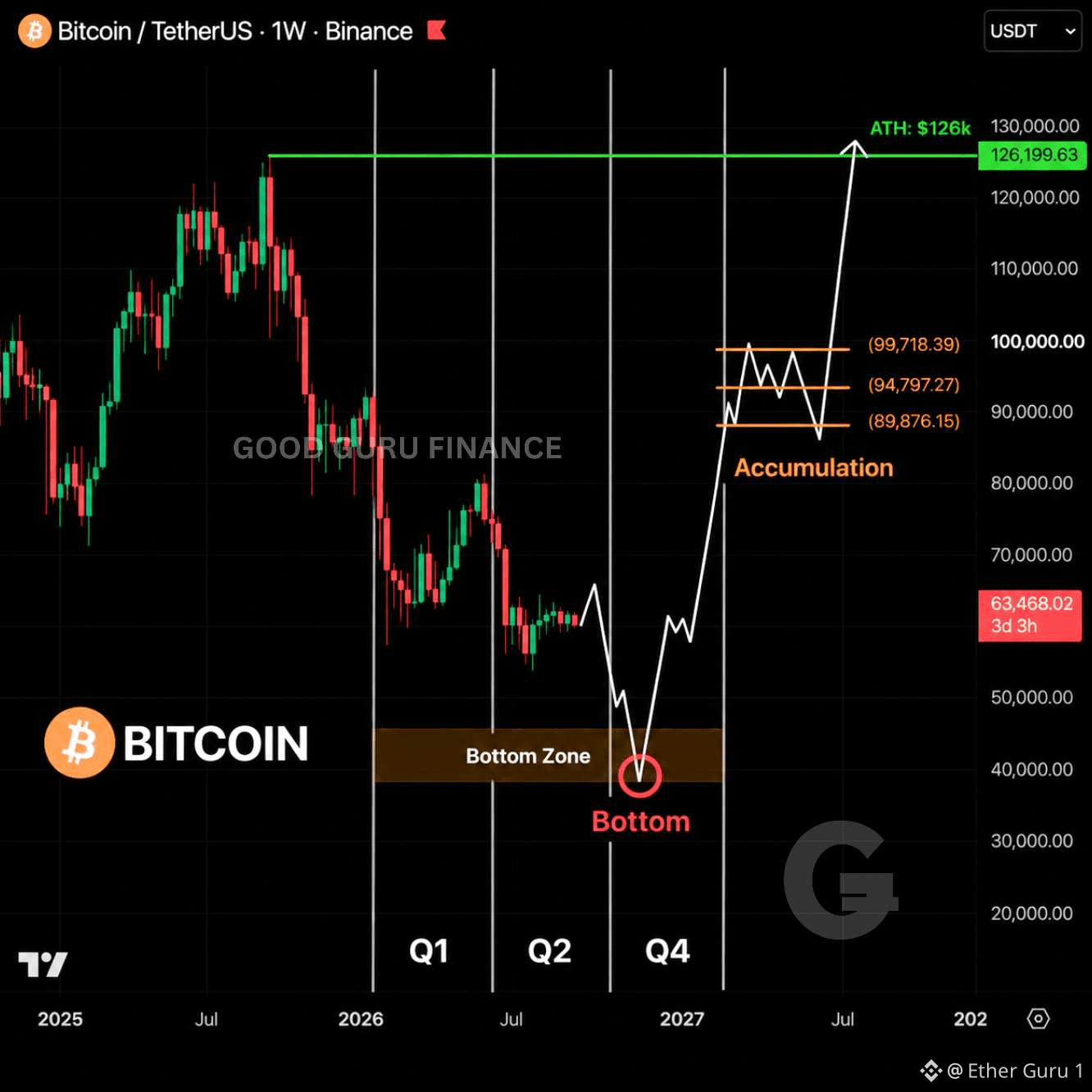
$BTC 🗓️ OS PRÓXIMOS QUATRO MESES PODEM DEFINIR TODO O CENÁRIO
O meu cenário atual para 2026 está construído em torno de cinco fases distintas, em vez de um movimento único e linear.
AGOSTO
Uma alta em direção a US$ 70K poderia gerar uma forte recuperação de curto prazo — mas a questão principal seria se o preço consegue de fato se manter acima dessa faixa.
SETEMBRO
Se o momentum enfraquecer perto das máximas, pode surgir distribuição e expor o mercado a um movimento abaixo de US$ 57K.
OUTUBRO
O cenário de queda mais profunda fica na faixa de US$ 40K–$45K, onde um grande teste de liquidez poderia potencialmente se desenvolver.
NOVEMBRO
Se a pressão vendedora esgotar, várias semanas de consolidação poderiam começar, enquanto o mercado procura uma mínima mais baixa sustentável.
DEZEMBRO
Uma recuperação em direção a US$ 100K representaria uma grande reversão em relação às mínimas projetadas de outubro.
De US$ 42K → US$ 100K exigiria aproximadamente 138% de alta.
Todo o roteiro é um cenário, não uma previsão com tempo garantido.
O que mais importa é se cada fase confirma ou invalida a próxima.
O mercado não precisa seguir o calendário.
A ação do preço é que vai decidir.
$BTC 🗓️ OS PRÓXIMOS QUATRO MESES PODEM DEFINIR TODO O CENÁRIO
O meu cenário atual para 2026 está construído em torno de cinco fases distintas, em vez de um movimento único e linear.
AGOSTO
Uma alta em direção a US$ 70K poderia gerar uma forte recuperação de curto prazo — mas a questão principal seria se o preço consegue de fato se manter acima dessa faixa.
SETEMBRO
Se o momentum enfraquecer perto das máximas, pode surgir distribuição e expor o mercado a um movimento abaixo de US$ 57K.
OUTUBRO
O cenário de queda mais profunda fica na faixa de US$ 40K–$45K, onde um grande teste de liquidez poderia potencialmente se desenvolver.
NOVEMBRO
Se a pressão vendedora esgotar, várias semanas de consolidação poderiam começar, enquanto o mercado procura uma mínima mais baixa sustentável.
DEZEMBRO
Uma recuperação em direção a US$ 100K representaria uma grande reversão em relação às mínimas projetadas de outubro.
De US$ 42K → US$ 100K exigiria aproximadamente 138% de alta.
Todo o roteiro é um cenário, não uma previsão com tempo garantido.
O que mais importa é se cada fase confirma ou invalida a próxima.
O mercado não precisa seguir o calendário.
A ação do preço é que vai decidir.
O meu cenário atual para 2026 está construído em torno de cinco fases distintas, em vez de um movimento único e linear.
AGOSTO
Uma alta em direção a US$ 70K poderia gerar uma forte recuperação de curto prazo — mas a questão principal seria se o preço consegue de fato se manter acima dessa faixa.
SETEMBRO
Se o momentum enfraquecer perto das máximas, pode surgir distribuição e expor o mercado a um movimento abaixo de US$ 57K.
OUTUBRO
O cenário de queda mais profunda fica na faixa de US$ 40K–$45K, onde um grande teste de liquidez poderia potencialmente se desenvolver.
NOVEMBRO
Se a pressão vendedora esgotar, várias semanas de consolidação poderiam começar, enquanto o mercado procura uma mínima mais baixa sustentável.
DEZEMBRO
Uma recuperação em direção a US$ 100K representaria uma grande reversão em relação às mínimas projetadas de outubro.
De US$ 42K → US$ 100K exigiria aproximadamente 138% de alta.
Todo o roteiro é um cenário, não uma previsão com tempo garantido.
O que mais importa é se cada fase confirma ou invalida a próxima.
O mercado não precisa seguir o calendário.
A ação do preço é que vai decidir.
76
·
--
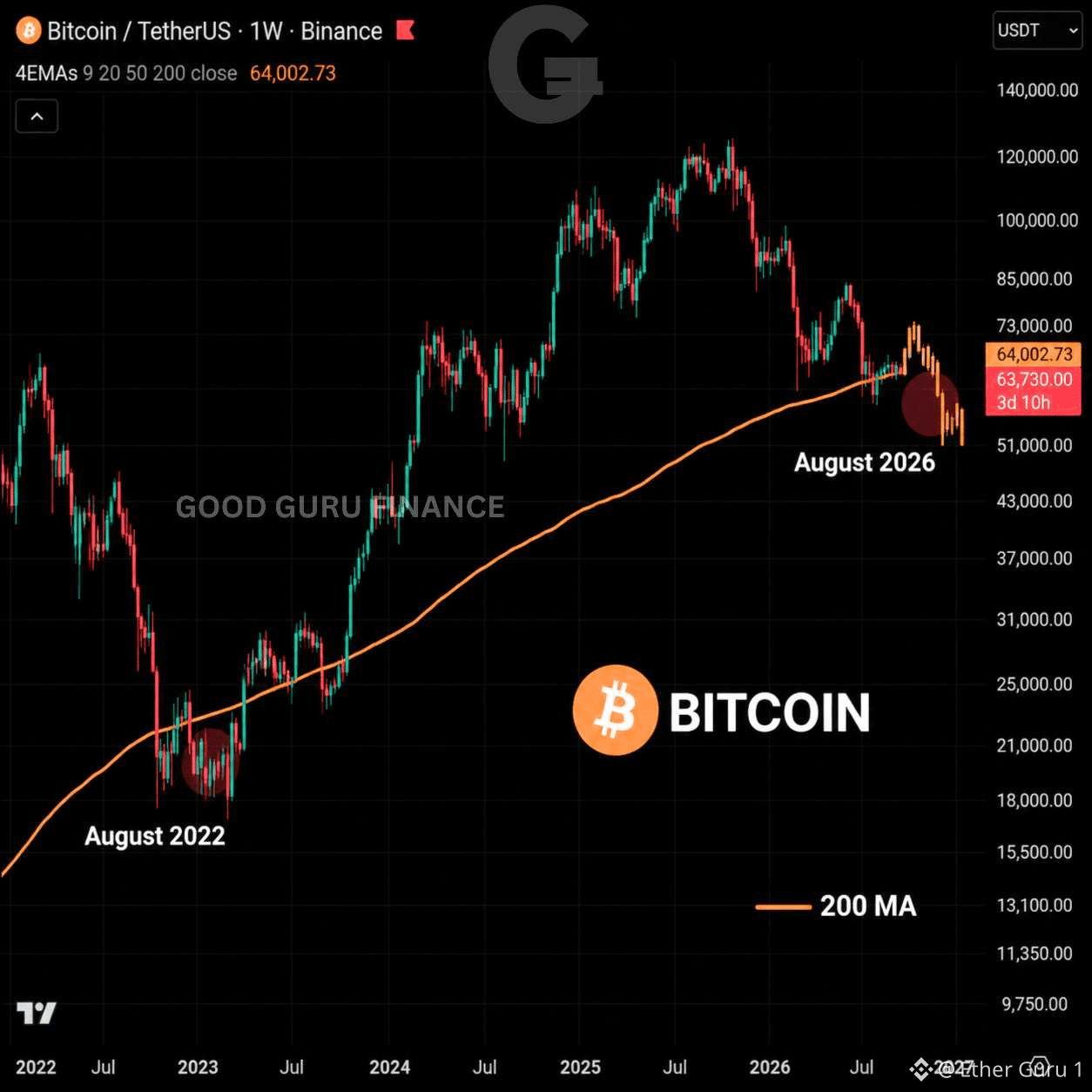
$BTC Bitcoin voltou a fechar abaixo de um importante indicador de tendência de longo prazo.
Em 2026, o BTC já negociou abaixo da sua média móvel de 200 semanas (200-W MA), com o nível em torno de US$ 61,8 mil em junho.
A analogia de 2022 é interessante — mas o mercado passou meses abaixo da 200WMA antes de o fundo do ciclo chegar.
Um cenário de baixa em aberto sugere um possível fundo do ciclo por volta de US$ 40 mil–US$ 46 mil mais tarde em 2026.
Um fundo de outubro em US$ 45 mil, portanto, é um cenário — não um roteiro confirmado.
A reação à 200WMA pode importar mais do que a data no calendário.
$BTC Bitcoin voltou a fechar abaixo de um importante indicador de tendência de longo prazo.
Em 2026, o BTC já negociou abaixo da sua média móvel de 200 semanas (200-W MA), com o nível em torno de US$ 61,8 mil em junho.
A analogia de 2022 é interessante — mas o mercado passou meses abaixo da 200WMA antes de o fundo do ciclo chegar.
Um cenário de baixa em aberto sugere um possível fundo do ciclo por volta de US$ 40 mil–US$ 46 mil mais tarde em 2026.
Um fundo de outubro em US$ 45 mil, portanto, é um cenário — não um roteiro confirmado.
A reação à 200WMA pode importar mais do que a data no calendário.
Em 2026, o BTC já negociou abaixo da sua média móvel de 200 semanas (200-W MA), com o nível em torno de US$ 61,8 mil em junho.
A analogia de 2022 é interessante — mas o mercado passou meses abaixo da 200WMA antes de o fundo do ciclo chegar.
Um cenário de baixa em aberto sugere um possível fundo do ciclo por volta de US$ 40 mil–US$ 46 mil mais tarde em 2026.
Um fundo de outubro em US$ 45 mil, portanto, é um cenário — não um roteiro confirmado.
A reação à 200WMA pode importar mais do que a data no calendário.
74
·
--
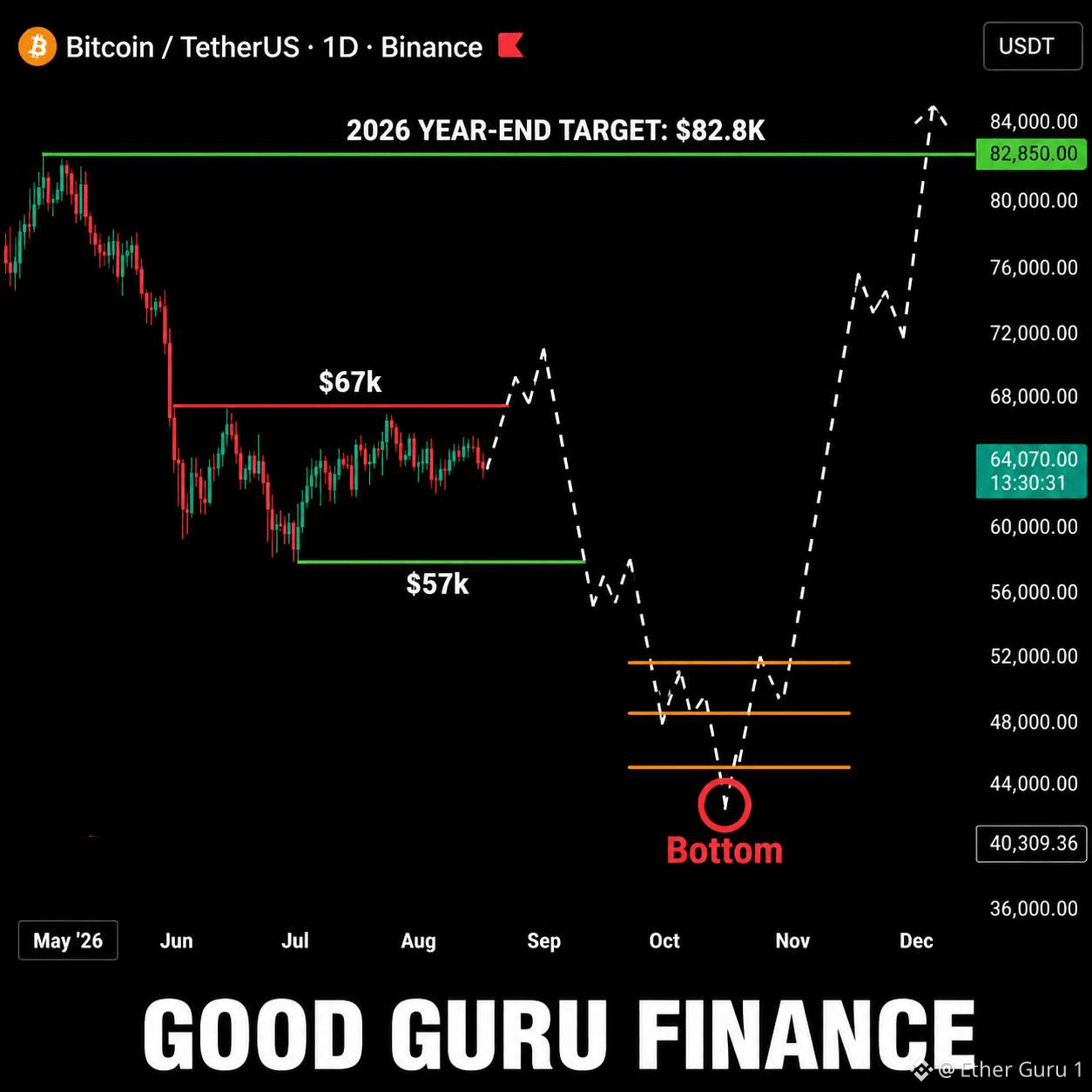
$BTC ⚠️ A PRÓXIMA FASE PODE SER DECIDIDA POR ALGUNS NÍVEIS-CHAVE
A recuperação atual ainda pode se mostrar como um repique temporário, e não como uma reversão de tendência confirmada.
Meu cenário de 2–3 meses:
$64K → $70K → $57K → $48K → $42K → $87K
Os níveis importantes estão separados por condições de mercado bem diferentes.
Um movimento em direção a $70K representaria cerca de 9% de alta a partir de $64K.
Uma queda de $70K para $42K representaria, então, cerca de 40% de baixa.
De $42K para $87K, a recuperação exigiria cerca de 107% de alta.
Meu cronograma continua sendo um cenário, não uma certeza:
Final de agosto → teste em $57K
Outubro–novembro → possível zona de $43K
Fim de 2026 → possível recuperação em direção a $87K
A confirmação principal virá de como o preço se comporta em torno de cada nível.
Uma ruptura sustentada muda a estrutura de baixa.
Uma rejeição seguida por mínimas mais baixas mantém o cenário de baixa em vigor.
$BTC ⚠️ A PRÓXIMA FASE PODE SER DECIDIDA POR ALGUNS NÍVEIS-CHAVE
A recuperação atual ainda pode se mostrar como um repique temporário, e não como uma reversão de tendência confirmada.
Meu cenário de 2–3 meses:
$64K → $70K → $57K → $48K → $42K → $87K
Os níveis importantes estão separados por condições de mercado bem diferentes.
Um movimento em direção a $70K representaria cerca de 9% de alta a partir de $64K.
Uma queda de $70K para $42K representaria, então, cerca de 40% de baixa.
De $42K para $87K, a recuperação exigiria cerca de 107% de alta.
Meu cronograma continua sendo um cenário, não uma certeza:
Final de agosto → teste em $57K
Outubro–novembro → possível zona de $43K
Fim de 2026 → possível recuperação em direção a $87K
A confirmação principal virá de como o preço se comporta em torno de cada nível.
Uma ruptura sustentada muda a estrutura de baixa.
Uma rejeição seguida por mínimas mais baixas mantém o cenário de baixa em vigor.
A recuperação atual ainda pode se mostrar como um repique temporário, e não como uma reversão de tendência confirmada.
Meu cenário de 2–3 meses:
$64K → $70K → $57K → $48K → $42K → $87K
Os níveis importantes estão separados por condições de mercado bem diferentes.
Um movimento em direção a $70K representaria cerca de 9% de alta a partir de $64K.
Uma queda de $70K para $42K representaria, então, cerca de 40% de baixa.
De $42K para $87K, a recuperação exigiria cerca de 107% de alta.
Meu cronograma continua sendo um cenário, não uma certeza:
Final de agosto → teste em $57K
Outubro–novembro → possível zona de $43K
Fim de 2026 → possível recuperação em direção a $87K
A confirmação principal virá de como o preço se comporta em torno de cada nível.
Uma ruptura sustentada muda a estrutura de baixa.
Uma rejeição seguida por mínimas mais baixas mantém o cenário de baixa em vigor.
70
Faça login para explorar mais conteúdos
Junte-se a usuários de criptomoedas de todo o mundo no Binance Square.
⚡️ Obter informações mais recentes e úteis sobre criptomoeda.
💬 Com a confiança da maior corretora de criptomoedas do mundo.
👍 Descubra insights reais de criadores verificados.
E-mail / número de telefone
Tópicos em Alta
EarningsSeason
26,963 visualizações
207 discutindo
Temporada de Resultados: Resultados do 4T da Micron — Touro ou Urso?
Binance Square Official
·21 curtidas
·11.4k visualizações
BitgetHackerFailsToMoveStolenFunds
1,775 visualizações
125 discutindo
BitMineETHHoldingsTop6Million
5,075 visualizações
285 discutindo