
Esthol
4 ໂພສ

Esthol
ລາຍງານ
ບລັອກຜູ້ໃຊ້
I am a Web3 content creator
0 ກໍາລັງຕິດຕາມ
10 ຜູ້ຕິດຕາມ
19 Liked
ໂພສ
·
--
ບົດຄວາມ
ເບິ່ງການແປ
Elysium: Beyond Value Extraction – Why Hyperliquid’s First L2 Redefines On-Chain Capital EfficiencyFor months, the Layer 2 scaling debate across #Web3 has revolved around an uncomfortable reality: many L2s can introduce new layers of liquidity fragmentation, execution overhead, and token incentives without necessarily creating a strong economic connection to their underlying Layer 1.
Within the #Hyperliquid ecosystem, Kinetiq Research is taking a different approach.
As a major liquid staking protocol within the ecosystem, Kinetiq is introducing Elysium, a purpose-built L2 designed not to compete with Hyperliquid but to extend HyperCore’s capabilities while connecting execution activity to ecosystem value accrual.
The result is an infrastructure model focused on one central question:
What if an L2 could scale execution without disconnecting that activity from the economic engine of its parent network?
1. The Bottleneck: Why HyperEVM Needs an Execution Engine
Hyperliquid’s dual architecture, combining HyperCore for low-latency trading with HyperEVM for smart-contract execution, was designed with deliberate constraints.
Those constraints help protect HyperCore’s high-performance order-book environment. However, during periods of elevated network activity and market volatility, they can create friction for more demanding on-chain applications.
Three key challenges stand out:
Gas Spikes: Simple token swaps on HyperEVM can become significantly more expensive during periods of congestion.Dual-Block Friction: High-frequency strategies, algorithmic market makers, and liquidation systems can face limitations when operating around EVM execution timelines.Throughput Constraints: More complex DeFi applications can be restricted by available EVM execution capacity.
This creates a clear infrastructure requirement.
Hyperliquid does not necessarily need another generic EVM environment. It needs an execution layer that can expand application capacity while remaining tightly connected to HyperCore.
Elysium is designed around that premise, targeting 300 Mgas/s throughput and 100–200 ms block times.
2. Core Architectural Breakthroughs
Elysium approaches the L2-L1 relationship through three major architectural components.
A. Native HYPE Gas Integration
Rather than introducing another gas asset that users must acquire and manage, Elysium uses native HYPE for gas.
$HYPE bridges on a 1:1 basis, reducing the complexity associated with wrapped assets and helping maintain a more unified economic experience across the Hyperliquid ecosystem.
The objective is straightforward: scale execution without unnecessarily fragmenting the user experience or economic structure.
B. The L1Read Precompile: A Native Oracle Advantage
One of Elysium’s most important architectural components is its L1Read precompile, which is co-located with a Hyperliquid node.
Rather than depending entirely on external oracle updates, #Elysium contracts can access relevant HyperCore information directly.
“Contracts on Elysium can query live HyperCore order book state, mark prices, and position data at ~100 ms granularity for standard call gas.”
This architecture has significant implications for applications that depend on timely market information.
AMMs, algorithmic trading systems, and PropAMMs can access HyperCore data with substantially lower latency, creating an environment better suited to applications where pricing precision and execution speed matter.
C. A Complete Token Lifecycle
Elysium also introduces a structured pathway for assets to progress from initial liquidity formation toward deeper market infrastructure.
The lifecycle can be viewed in three stages:
Bootstrapping: New assets begin within low-cost Elysium AMMs.Maturation: As liquidity develops, assets can transition into PropAMMs using native L1Read market-depth data.HyperCore Graduation: More mature assets can progress into HyperCore Spot order books and, where applicable, HIP-3 perpetual markets.
This creates more than an isolated L2 environment.
It establishes a potential lifecycle connecting asset creation, liquidity formation, market maturation, and deeper Hyperliquid-native markets.
3. The Sequencer Fee Model: Rethinking Value Accrual
The most distinctive part of Elysium’s design may be its approach to sequencer revenue.
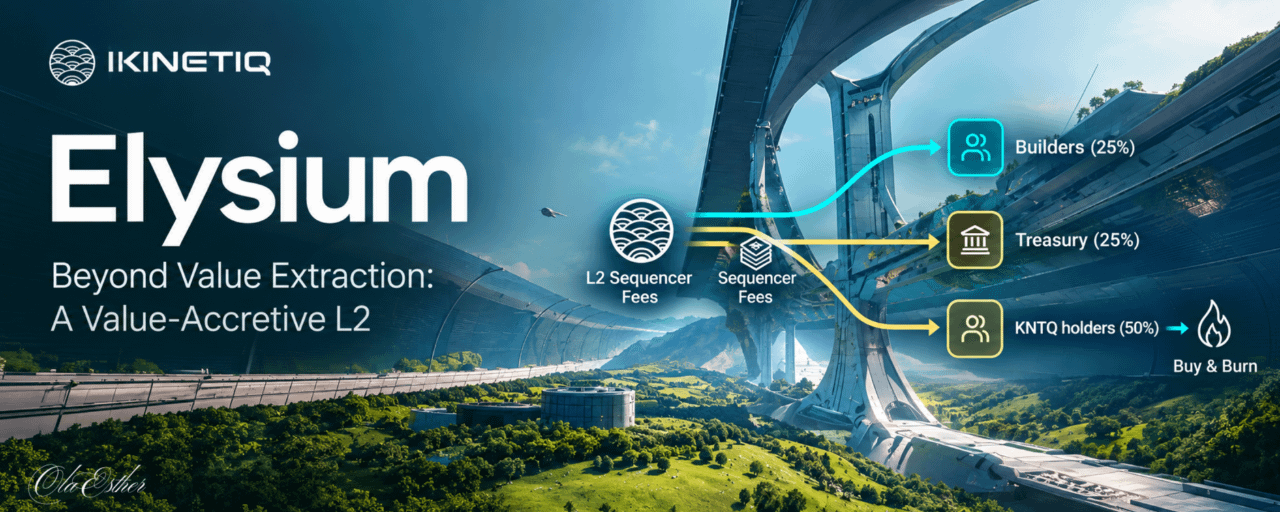
Instead of treating sequencer revenue as an isolated source of income, Elysium distributes 100% of sequencer fee proceeds across builders, the ecosystem treasury, and KNTQ buy-and-burn activity.
Elysium Sequencer Revenue
25% → Builders Automatically compensates developer teams according to network block-space usage.
25% → Ecosystem Treasury Supports long-term protocol development, security, and ecosystem initiatives.
50% → KNTQ Buy & Burn Half of sequencer fee proceeds are directed toward purchasing and burning $KNTQ.
The economic relationship is therefore straightforward:
More network execution → more sequencer fees → more KNTQ buy-and-burn activity.
This creates a direct connection between Elysium’s network utilization and KNTQ’s token-supply dynamics.
Rather than relying solely on governance utility, KNTQ becomes economically connected to the activity generated by the infrastructure surrounding it.
That distinction is important when evaluating L2 token models.
4. Why Elysium Matters for Hyperliquid
Elysium represents a different approach to scaling.
Instead of positioning an L2 as an independent destination that competes for liquidity and users, its architecture is designed around complementarity with the underlying Hyperliquid stack.
For developers, it provides additional execution capacity.
For traders and market makers, it creates infrastructure designed around faster access to HyperCore data.
For the broader ecosystem, its sequencing model creates a mechanism through which network activity can contribute to ecosystem development and KNTQ supply reduction.
And for Hyperliquid itself, the broader proposition is about expanding execution capacity without abandoning the economic and technical advantages of HyperCore.
Elysium is not simply about adding another execution layer. Its larger proposition is about making that execution layer economically connected to the ecosystem it extends.
5. The Bigger Picture
The evolution of Layer 2 infrastructure is moving beyond the simple question of “How much throughput can this chain provide?”
The more important questions are becoming:
Where does the liquidity go?Who captures the economic value created by execution?How closely is the L2 connected to its underlying network?Does increased activity strengthen the broader ecosystem or simply create another isolated economy?
Elysium attempts to address these questions through a purpose-built architecture combining HYPE-native gas, direct HyperCore data access, high-throughput execution, structured token lifecycles, and a sequencer-fee model connected to KNTQ.
That makes its significance larger than simply being another L2.
Elysium represents an attempt to build an execution layer where scaling, composability, and value accrual are designed to reinforce one another.
As Hyperliquid’s ecosystem continues to expand, this model could provide an interesting blueprint for how future L2s approach the relationship between execution infrastructure and the economic systems they are built to extend.
Elysium: Beyond Value Extraction – Why Hyperliquid’s First L2 Redefines On-Chain Capital Efficiency
For months, the Layer 2 scaling debate across #Web3 has revolved around an uncomfortable reality: many L2s can introduce new layers of liquidity fragmentation, execution overhead, and token incentives without necessarily creating a strong economic connection to their underlying Layer 1.
Within the #Hyperliquid ecosystem, Kinetiq Research is taking a different approach.
As a major liquid staking protocol within the ecosystem, Kinetiq is introducing Elysium, a purpose-built L2 designed not to compete with Hyperliquid but to extend HyperCore’s capabilities while connecting execution activity to ecosystem value accrual.
The result is an infrastructure model focused on one central question:
What if an L2 could scale execution without disconnecting that activity from the economic engine of its parent network?
1. The Bottleneck: Why HyperEVM Needs an Execution Engine
Hyperliquid’s dual architecture, combining HyperCore for low-latency trading with HyperEVM for smart-contract execution, was designed with deliberate constraints.
Those constraints help protect HyperCore’s high-performance order-book environment. However, during periods of elevated network activity and market volatility, they can create friction for more demanding on-chain applications.
Three key challenges stand out:
Gas Spikes: Simple token swaps on HyperEVM can become significantly more expensive during periods of congestion.Dual-Block Friction: High-frequency strategies, algorithmic market makers, and liquidation systems can face limitations when operating around EVM execution timelines.Throughput Constraints: More complex DeFi applications can be restricted by available EVM execution capacity.
This creates a clear infrastructure requirement.
Hyperliquid does not necessarily need another generic EVM environment. It needs an execution layer that can expand application capacity while remaining tightly connected to HyperCore.
Elysium is designed around that premise, targeting 300 Mgas/s throughput and 100–200 ms block times.
2. Core Architectural Breakthroughs
Elysium approaches the L2-L1 relationship through three major architectural components.
A. Native HYPE Gas Integration
Rather than introducing another gas asset that users must acquire and manage, Elysium uses native HYPE for gas.
$HYPE bridges on a 1:1 basis, reducing the complexity associated with wrapped assets and helping maintain a more unified economic experience across the Hyperliquid ecosystem.
The objective is straightforward: scale execution without unnecessarily fragmenting the user experience or economic structure.
B. The L1Read Precompile: A Native Oracle Advantage
One of Elysium’s most important architectural components is its L1Read precompile, which is co-located with a Hyperliquid node.
Rather than depending entirely on external oracle updates, #Elysium contracts can access relevant HyperCore information directly.
“Contracts on Elysium can query live HyperCore order book state, mark prices, and position data at ~100 ms granularity for standard call gas.”
This architecture has significant implications for applications that depend on timely market information.
AMMs, algorithmic trading systems, and PropAMMs can access HyperCore data with substantially lower latency, creating an environment better suited to applications where pricing precision and execution speed matter.
C. A Complete Token Lifecycle
Elysium also introduces a structured pathway for assets to progress from initial liquidity formation toward deeper market infrastructure.
The lifecycle can be viewed in three stages:
Bootstrapping: New assets begin within low-cost Elysium AMMs.Maturation: As liquidity develops, assets can transition into PropAMMs using native L1Read market-depth data.HyperCore Graduation: More mature assets can progress into HyperCore Spot order books and, where applicable, HIP-3 perpetual markets.
This creates more than an isolated L2 environment.
It establishes a potential lifecycle connecting asset creation, liquidity formation, market maturation, and deeper Hyperliquid-native markets.
3. The Sequencer Fee Model: Rethinking Value Accrual
The most distinctive part of Elysium’s design may be its approach to sequencer revenue.
Instead of treating sequencer revenue as an isolated source of income, Elysium distributes 100% of sequencer fee proceeds across builders, the ecosystem treasury, and KNTQ buy-and-burn activity.
Elysium Sequencer Revenue
25% → Builders Automatically compensates developer teams according to network block-space usage.
25% → Ecosystem Treasury Supports long-term protocol development, security, and ecosystem initiatives.
50% → KNTQ Buy & Burn Half of sequencer fee proceeds are directed toward purchasing and burning $KNTQ.
The economic relationship is therefore straightforward:
More network execution → more sequencer fees → more KNTQ buy-and-burn activity.
This creates a direct connection between Elysium’s network utilization and KNTQ’s token-supply dynamics.
Rather than relying solely on governance utility, KNTQ becomes economically connected to the activity generated by the infrastructure surrounding it.
That distinction is important when evaluating L2 token models.
4. Why Elysium Matters for Hyperliquid
Elysium represents a different approach to scaling.
Instead of positioning an L2 as an independent destination that competes for liquidity and users, its architecture is designed around complementarity with the underlying Hyperliquid stack.
For developers, it provides additional execution capacity.
For traders and market makers, it creates infrastructure designed around faster access to HyperCore data.
For the broader ecosystem, its sequencing model creates a mechanism through which network activity can contribute to ecosystem development and KNTQ supply reduction.
And for Hyperliquid itself, the broader proposition is about expanding execution capacity without abandoning the economic and technical advantages of HyperCore.
Elysium is not simply about adding another execution layer. Its larger proposition is about making that execution layer economically connected to the ecosystem it extends.
5. The Bigger Picture
The evolution of Layer 2 infrastructure is moving beyond the simple question of “How much throughput can this chain provide?”
The more important questions are becoming:
Where does the liquidity go?Who captures the economic value created by execution?How closely is the L2 connected to its underlying network?Does increased activity strengthen the broader ecosystem or simply create another isolated economy?
Elysium attempts to address these questions through a purpose-built architecture combining HYPE-native gas, direct HyperCore data access, high-throughput execution, structured token lifecycles, and a sequencer-fee model connected to KNTQ.
That makes its significance larger than simply being another L2.
Elysium represents an attempt to build an execution layer where scaling, composability, and value accrual are designed to reinforce one another.
As Hyperliquid’s ecosystem continues to expand, this model could provide an interesting blueprint for how future L2s approach the relationship between execution infrastructure and the economic systems they are built to extend.
Within the #Hyperliquid ecosystem, Kinetiq Research is taking a different approach.
As a major liquid staking protocol within the ecosystem, Kinetiq is introducing Elysium, a purpose-built L2 designed not to compete with Hyperliquid but to extend HyperCore’s capabilities while connecting execution activity to ecosystem value accrual.
The result is an infrastructure model focused on one central question:
What if an L2 could scale execution without disconnecting that activity from the economic engine of its parent network?
1. The Bottleneck: Why HyperEVM Needs an Execution Engine
Hyperliquid’s dual architecture, combining HyperCore for low-latency trading with HyperEVM for smart-contract execution, was designed with deliberate constraints.
Those constraints help protect HyperCore’s high-performance order-book environment. However, during periods of elevated network activity and market volatility, they can create friction for more demanding on-chain applications.
Three key challenges stand out:
Gas Spikes: Simple token swaps on HyperEVM can become significantly more expensive during periods of congestion.Dual-Block Friction: High-frequency strategies, algorithmic market makers, and liquidation systems can face limitations when operating around EVM execution timelines.Throughput Constraints: More complex DeFi applications can be restricted by available EVM execution capacity.
This creates a clear infrastructure requirement.
Hyperliquid does not necessarily need another generic EVM environment. It needs an execution layer that can expand application capacity while remaining tightly connected to HyperCore.
Elysium is designed around that premise, targeting 300 Mgas/s throughput and 100–200 ms block times.
2. Core Architectural Breakthroughs
Elysium approaches the L2-L1 relationship through three major architectural components.
A. Native HYPE Gas Integration
Rather than introducing another gas asset that users must acquire and manage, Elysium uses native HYPE for gas.
$HYPE bridges on a 1:1 basis, reducing the complexity associated with wrapped assets and helping maintain a more unified economic experience across the Hyperliquid ecosystem.
The objective is straightforward: scale execution without unnecessarily fragmenting the user experience or economic structure.
B. The L1Read Precompile: A Native Oracle Advantage
One of Elysium’s most important architectural components is its L1Read precompile, which is co-located with a Hyperliquid node.
Rather than depending entirely on external oracle updates, #Elysium contracts can access relevant HyperCore information directly.
“Contracts on Elysium can query live HyperCore order book state, mark prices, and position data at ~100 ms granularity for standard call gas.”
This architecture has significant implications for applications that depend on timely market information.
AMMs, algorithmic trading systems, and PropAMMs can access HyperCore data with substantially lower latency, creating an environment better suited to applications where pricing precision and execution speed matter.
C. A Complete Token Lifecycle
Elysium also introduces a structured pathway for assets to progress from initial liquidity formation toward deeper market infrastructure.
The lifecycle can be viewed in three stages:
Bootstrapping: New assets begin within low-cost Elysium AMMs.Maturation: As liquidity develops, assets can transition into PropAMMs using native L1Read market-depth data.HyperCore Graduation: More mature assets can progress into HyperCore Spot order books and, where applicable, HIP-3 perpetual markets.
This creates more than an isolated L2 environment.
It establishes a potential lifecycle connecting asset creation, liquidity formation, market maturation, and deeper Hyperliquid-native markets.
3. The Sequencer Fee Model: Rethinking Value Accrual
The most distinctive part of Elysium’s design may be its approach to sequencer revenue.
Instead of treating sequencer revenue as an isolated source of income, Elysium distributes 100% of sequencer fee proceeds across builders, the ecosystem treasury, and KNTQ buy-and-burn activity.
Elysium Sequencer Revenue
25% → Builders Automatically compensates developer teams according to network block-space usage.
25% → Ecosystem Treasury Supports long-term protocol development, security, and ecosystem initiatives.
50% → KNTQ Buy & Burn Half of sequencer fee proceeds are directed toward purchasing and burning $KNTQ.
The economic relationship is therefore straightforward:
More network execution → more sequencer fees → more KNTQ buy-and-burn activity.
This creates a direct connection between Elysium’s network utilization and KNTQ’s token-supply dynamics.
Rather than relying solely on governance utility, KNTQ becomes economically connected to the activity generated by the infrastructure surrounding it.
That distinction is important when evaluating L2 token models.
4. Why Elysium Matters for Hyperliquid
Elysium represents a different approach to scaling.
Instead of positioning an L2 as an independent destination that competes for liquidity and users, its architecture is designed around complementarity with the underlying Hyperliquid stack.
For developers, it provides additional execution capacity.
For traders and market makers, it creates infrastructure designed around faster access to HyperCore data.
For the broader ecosystem, its sequencing model creates a mechanism through which network activity can contribute to ecosystem development and KNTQ supply reduction.
And for Hyperliquid itself, the broader proposition is about expanding execution capacity without abandoning the economic and technical advantages of HyperCore.
Elysium is not simply about adding another execution layer. Its larger proposition is about making that execution layer economically connected to the ecosystem it extends.
5. The Bigger Picture
The evolution of Layer 2 infrastructure is moving beyond the simple question of “How much throughput can this chain provide?”
The more important questions are becoming:
Where does the liquidity go?Who captures the economic value created by execution?How closely is the L2 connected to its underlying network?Does increased activity strengthen the broader ecosystem or simply create another isolated economy?
Elysium attempts to address these questions through a purpose-built architecture combining HYPE-native gas, direct HyperCore data access, high-throughput execution, structured token lifecycles, and a sequencer-fee model connected to KNTQ.
That makes its significance larger than simply being another L2.
Elysium represents an attempt to build an execution layer where scaling, composability, and value accrual are designed to reinforce one another.
As Hyperliquid’s ecosystem continues to expand, this model could provide an interesting blueprint for how future L2s approach the relationship between execution infrastructure and the economic systems they are built to extend.
1
108
·
--
ບົດຄວາມ
ເບິ່ງການແປ
The Architecture of Autonomous AI: Inside IronClaw 1.0 and NEAR’s Decentralized EcosystemAs autonomous AI agents evolve from experimental scripts into always-on enterprise assistants, traditional software frameworks face a critical bottleneck: safety and continuity. When an agent possesses unrestrained authority to query databases, write code, or execute financial transactions, a single flaw in reasoning can lead to catastrophic execution errors.
To solve this, @NEAR_Protocol is redefining autonomous execution with the launch of IronClaw 1.0, an open-source agent framework engineered to separate cognitive decision-making from physical execution.
IronClaw 1.0: Separating Thinking from Acting
At the core of #IronClaw 1.0 is a fundamental structural rethink: the component that decides what to do is strictly separated from the component that performs the action.
[ Cognitive Layer (Thinking) ] ──► [ Guard Layer (Checkpoint) ] ──► [ Execution Layer (Acting) ]
Positioned between reasoning and execution sits the "Guard" layer—a centralized, deterministic coordination checkpoint. Every proposed action must pass through this single security choke point before taking effect.
A single checkpoint in front of every action is the kind of design people assume costs capability... Instead, it yields a system that is safer by default without sacrificing operational velocity.
By routing all intent through a unified Guard, IronClaw prevents agents from executing unvetted API calls, leaked credentials, or rogue commands.
Benchmark Dominance across Enterprise Workloads
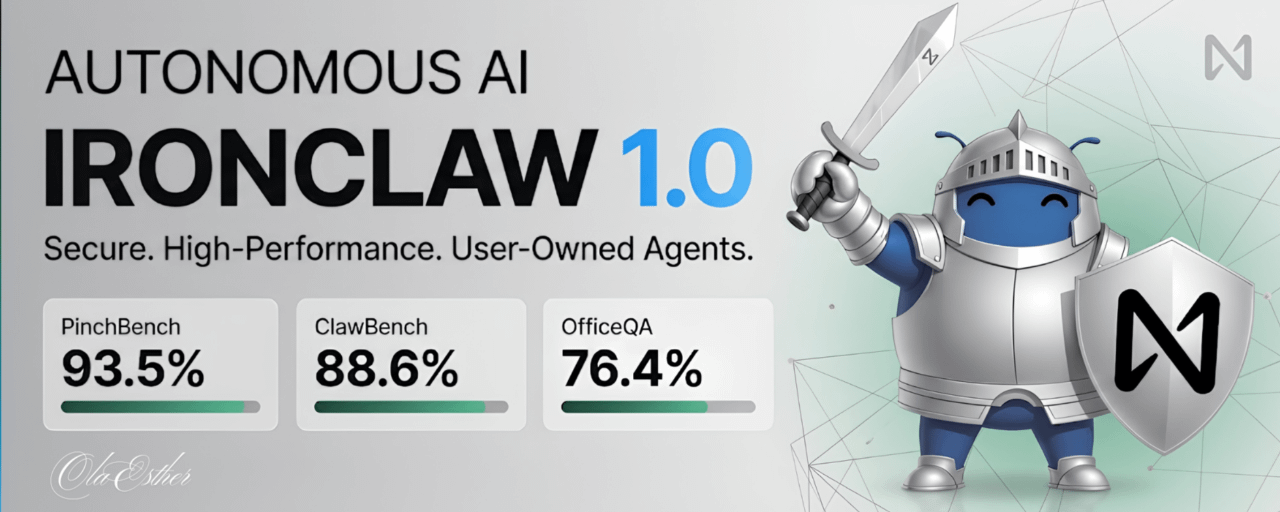
To validate this architecture, IronClaw 1.0 was evaluated alongside competing frameworks using the deepseek-v4-flash base model. The results demonstrate that strict security gating enhances rather than hinders agentic performance:
● PinchBench (93.5%): Outperformed top competing agent harnesses on 147 complex real-world tasks, including schedule planning, email triage, code generation, and multi-step research.
● ClawBench (88.6%): Ranked #1 across 140+ production web environments, leading the field average by 5.3 percentage points on multi-step browser navigation.
● OfficeQA (76.4%): Set the industry benchmark for grounded reasoning and document parsing across massive enterprise data silos.
Core Pillars: Built for Enterprise Continuity
Beyond static benchmarks, IronClaw addresses the practical operational challenges of enterprise deployments:
1. Safer by Design: Requires explicit human-in-the-loop approvals for sensitive state changes. Secrets, API keys, and credentials are single-use by default and automatically scrubbed from logs and reports.
2. Persistent State Checkpointing: Traditional agents lose context if interrupted. IronClaw continuously writes state checkpoints, allowing tasks paused for permissions or system restarts to resume immediately without losing progress.
3. Omni-Channel Memory: Integrates across CLI, Web, Slack, and Telegram as a single unified assistant. Cross-channel interactions preserve identical safety rules, preferences, and long-term memory.
4. Team & Workspace Isolation: Supports both multi-tenant team environments—where shared tools accelerate workflow discovery—and strict single-tenant isolation for compliance-heavy enterprise requirements.
The Infrastructure Backbone: NEARAI and Staking
An agent framework is only as reliable as the underlying network powering it. As #NEARAI advances toward next-generation agent rollouts like OpenClaw, the broader NEAR Protocol ecosystem provides the necessary decentralized, user-owned compute layer.
Within this framework, Staking on NEAR extends far beyond generating validation yield. Staked capital provides the economic security and Sybil resistance required to validate hardware-enforced Trusted Execution Environments (TEEs) and zero-knowledge inference nodes.
Staking acts as the foundational economic guarantee securing the decentralized cloud—ensuring that when autonomous AI agents negotiate, hold state, or process financial primitives on behalf of users, the underlying infrastructure remains censorship-resistant, verifiable, and user-owned.
By pairing IronClaw's safe execution harness with NEAR’s economically secured consensus layer, Web3 is establishing the blueprint for the emerging agentic economy.
The Architecture of Autonomous AI: Inside IronClaw 1.0 and NEAR’s Decentralized Ecosystem
As autonomous AI agents evolve from experimental scripts into always-on enterprise assistants, traditional software frameworks face a critical bottleneck: safety and continuity. When an agent possesses unrestrained authority to query databases, write code, or execute financial transactions, a single flaw in reasoning can lead to catastrophic execution errors.
To solve this, @NEAR Protocol is redefining autonomous execution with the launch of IronClaw 1.0, an open-source agent framework engineered to separate cognitive decision-making from physical execution.
IronClaw 1.0: Separating Thinking from Acting
At the core of #IronClaw 1.0 is a fundamental structural rethink: the component that decides what to do is strictly separated from the component that performs the action.
[ Cognitive Layer (Thinking) ] ──► [ Guard Layer (Checkpoint) ] ──► [ Execution Layer (Acting) ]
Positioned between reasoning and execution sits the "Guard" layer—a centralized, deterministic coordination checkpoint. Every proposed action must pass through this single security choke point before taking effect.
A single checkpoint in front of every action is the kind of design people assume costs capability... Instead, it yields a system that is safer by default without sacrificing operational velocity.
By routing all intent through a unified Guard, IronClaw prevents agents from executing unvetted API calls, leaked credentials, or rogue commands.
Benchmark Dominance across Enterprise Workloads
To validate this architecture, IronClaw 1.0 was evaluated alongside competing frameworks using the deepseek-v4-flash base model. The results demonstrate that strict security gating enhances rather than hinders agentic performance:
● PinchBench (93.5%): Outperformed top competing agent harnesses on 147 complex real-world tasks, including schedule planning, email triage, code generation, and multi-step research.
● ClawBench (88.6%): Ranked #1 across 140+ production web environments, leading the field average by 5.3 percentage points on multi-step browser navigation.
● OfficeQA (76.4%): Set the industry benchmark for grounded reasoning and document parsing across massive enterprise data silos.
Core Pillars: Built for Enterprise Continuity
Beyond static benchmarks, IronClaw addresses the practical operational challenges of enterprise deployments:
1. Safer by Design: Requires explicit human-in-the-loop approvals for sensitive state changes. Secrets, API keys, and credentials are single-use by default and automatically scrubbed from logs and reports.
2. Persistent State Checkpointing: Traditional agents lose context if interrupted. IronClaw continuously writes state checkpoints, allowing tasks paused for permissions or system restarts to resume immediately without losing progress.
3. Omni-Channel Memory: Integrates across CLI, Web, Slack, and Telegram as a single unified assistant. Cross-channel interactions preserve identical safety rules, preferences, and long-term memory.
4. Team & Workspace Isolation: Supports both multi-tenant team environments—where shared tools accelerate workflow discovery—and strict single-tenant isolation for compliance-heavy enterprise requirements.
The Infrastructure Backbone: NEARAI and Staking
An agent framework is only as reliable as the underlying network powering it. As #NEARAI advances toward next-generation agent rollouts like OpenClaw, the broader NEAR Protocol ecosystem provides the necessary decentralized, user-owned compute layer.
Within this framework, Staking on NEAR extends far beyond generating validation yield. Staked capital provides the economic security and Sybil resistance required to validate hardware-enforced Trusted Execution Environments (TEEs) and zero-knowledge inference nodes.
Staking acts as the foundational economic guarantee securing the decentralized cloud—ensuring that when autonomous AI agents negotiate, hold state, or process financial primitives on behalf of users, the underlying infrastructure remains censorship-resistant, verifiable, and user-owned.
By pairing IronClaw's safe execution harness with NEAR’s economically secured consensus layer, Web3 is establishing the blueprint for the emerging agentic economy.
To solve this, @NEAR Protocol is redefining autonomous execution with the launch of IronClaw 1.0, an open-source agent framework engineered to separate cognitive decision-making from physical execution.
IronClaw 1.0: Separating Thinking from Acting
At the core of #IronClaw 1.0 is a fundamental structural rethink: the component that decides what to do is strictly separated from the component that performs the action.
[ Cognitive Layer (Thinking) ] ──► [ Guard Layer (Checkpoint) ] ──► [ Execution Layer (Acting) ]
Positioned between reasoning and execution sits the "Guard" layer—a centralized, deterministic coordination checkpoint. Every proposed action must pass through this single security choke point before taking effect.
A single checkpoint in front of every action is the kind of design people assume costs capability... Instead, it yields a system that is safer by default without sacrificing operational velocity.
By routing all intent through a unified Guard, IronClaw prevents agents from executing unvetted API calls, leaked credentials, or rogue commands.
Benchmark Dominance across Enterprise Workloads
To validate this architecture, IronClaw 1.0 was evaluated alongside competing frameworks using the deepseek-v4-flash base model. The results demonstrate that strict security gating enhances rather than hinders agentic performance:
● PinchBench (93.5%): Outperformed top competing agent harnesses on 147 complex real-world tasks, including schedule planning, email triage, code generation, and multi-step research.
● ClawBench (88.6%): Ranked #1 across 140+ production web environments, leading the field average by 5.3 percentage points on multi-step browser navigation.
● OfficeQA (76.4%): Set the industry benchmark for grounded reasoning and document parsing across massive enterprise data silos.
Core Pillars: Built for Enterprise Continuity
Beyond static benchmarks, IronClaw addresses the practical operational challenges of enterprise deployments:
1. Safer by Design: Requires explicit human-in-the-loop approvals for sensitive state changes. Secrets, API keys, and credentials are single-use by default and automatically scrubbed from logs and reports.
2. Persistent State Checkpointing: Traditional agents lose context if interrupted. IronClaw continuously writes state checkpoints, allowing tasks paused for permissions or system restarts to resume immediately without losing progress.
3. Omni-Channel Memory: Integrates across CLI, Web, Slack, and Telegram as a single unified assistant. Cross-channel interactions preserve identical safety rules, preferences, and long-term memory.
4. Team & Workspace Isolation: Supports both multi-tenant team environments—where shared tools accelerate workflow discovery—and strict single-tenant isolation for compliance-heavy enterprise requirements.
The Infrastructure Backbone: NEARAI and Staking
An agent framework is only as reliable as the underlying network powering it. As #NEARAI advances toward next-generation agent rollouts like OpenClaw, the broader NEAR Protocol ecosystem provides the necessary decentralized, user-owned compute layer.
Within this framework, Staking on NEAR extends far beyond generating validation yield. Staked capital provides the economic security and Sybil resistance required to validate hardware-enforced Trusted Execution Environments (TEEs) and zero-knowledge inference nodes.
Staking acts as the foundational economic guarantee securing the decentralized cloud—ensuring that when autonomous AI agents negotiate, hold state, or process financial primitives on behalf of users, the underlying infrastructure remains censorship-resistant, verifiable, and user-owned.
By pairing IronClaw's safe execution harness with NEAR’s economically secured consensus layer, Web3 is establishing the blueprint for the emerging agentic economy.
1
94
ເຂົ້າສູ່ລະບົບເພື່ອສຳຫຼວດເນື້ອຫາເພີ່ມເຕີມ
ເຂົ້າຮ່ວມກຸ່ມຜູ້ໃຊ້ຄຣິບໂຕທົ່ວໂລກໃນ Binance Square.
⚡️ ໄດ້ຮັບຂໍ້ມູນຫຼ້າສຸດ ແລະ ທີ່ມີປະໂຫຍດກ່ຽວກັບຄຣິບໂຕ.
💬 ໄດ້ຮັບຄວາມໄວ້ວາງໃຈຈາກຕະຫຼາດແລກປ່ຽນຄຣິບໂຕທີ່ໃຫຍ່ທີ່ສຸດໃນໂລກ.
👍 ຄົ້ນຫາຂໍ້ມູນເຊີງເລິກທີ່ແທ້ຈາກນັກສ້າງທີ່ໄດ້ຮັບການຢືນຢັນ.
ອີເມວ / ເບີໂທລະສັບ
ຫົວຂໍ້ທີ່ກໍາລັງນິຍົມ
SaylorHintsStrategyBitcoinBuy
2.2M views
11,349 ກຳລັງສົນທະນາ
#SaylorHintsStrategyBitcoinBuy
Maiak Saylor vai atu ke lele i se fa'ailoga lelei e uiga i le Fuafuaga Bitcoin.
Peita'i, o fa'amatalaga fou ua fa'ailoa mai e le'i fa'atauina e le Fuafuaga Bitcoin i ni vaiaso ua mavae. E o'o mai i le aso 13 Setema 2026, o lo'o taofia pea e le kamupani le 845.050 BTC ma e tusa ma le US$6,4 piliona le aofa'i o aseta e fa'avae i le USD.
Malo atu nai lo le fa'atauina o le BTC, ua fa'atuina e le Fuafuaga pe tusa ma le US$139 miliona e fa'atau ai le toe fa'atauina o sea fa'apitoa STRC.
O le ā le uiga mo le maketi?
🔹 O lo'o tumau pea le Fuafuaga i le fa'amoemoe umi i le Bitcoin
🔹 O aitalafu USD e maua ai avanoa mo se fa'atauga BTC mulimuli ane
🔹 O le fa'atauga fou e mafai ona avea ma katalis bullish mo lagona o fa'alapotopotoga
🔹 Peita'i, o le fa'aata atonu e le tutusa ma le fa'atau ua fa'amaonia
Mo le taimi nei, e mana'omia e le maketi ona fa'avasega i le va o tala o le fa'aputuina ma le pepa aloa'ia.
Tali mo le fa'amaoniga—aua le fa'atau na'o le mulimuli i le ulutala.
#Bitcoin #BTC #Strategy #MichaelSaylor
$BTC
XaliCoin
·1 ຖືກໃຈ
·83 views
BOJRaisesRatesTo31YearHigh
177,395 views
2,652 ກຳລັງສົນທະນາ
BuffettStepsDownAsBerkshireChairman
85,980 views
1,368 ກຳລັງສົນທະນາ