
PositiveMindsGlobalResults
676 ໂພສ

PositiveMindsGlobalResults
ລາຍງານ
ບລັອກຜູ້ໃຊ້
Positivity isn't a luxury. Pain exists everywhere, but so does resilience. Practicing positivity without borders proves empathy is universally understood.
ຜູ້ຊື້ຂາຍປະຈໍາ
2.3 ປີ
2.5K+ ກໍາລັງຕິດຕາມ
2.8K+ ຜູ້ຕິດຕາມ
1.1K+ Liked
ໂພສ
ທັງໝົດ
ວົງຢືມ
ວີດີໂອ
ຖ່າຍທອດສົດ
ປັກໝຸດ

ບົດຄວາມ
THE NOVEMBER MARKET STORM: BITCOIN, TARIFFS & GLOBAL RECESSION FEARS.?🌍 #PositiveMindsGlobalResults #BinanceSquare #BinanceNews
BINANCE SQUARE | INVEST • LEARN • GROW • TOGETHER
SPECIAL EDITION | NOVEMBER 25, 2026 | BITCOIN • CRYPTOCURRENCY • GLOBAL FINANCIAL MARKETS • ECONOMIC INTELLIGENCE
MARKET STORM: BITCOIN'S UNCERTAIN REBOUND, TRUMP'S TARIFF SHOCK AND THE GROWING THREAT OF A GLOBAL RECESSION.
Bitcoin • BNB • Ethereum • Wall Street • Inflation • Global Trade • Recession RisksBy PositiveMindsGlobalResults | Global Financial & Economic Analysis
The global financial landscape is entering another period of uncertainty. Cryptocurrency markets are struggling to regain momentum, technology stocks are experiencing renewed selling pressure, inflation remains a concern for central banks, and President Donald Trump's latest tariff plans are raising fresh questions about the future of international trade.
What initially appeared to be a recovery across several financial markets is increasingly looking like a fragile rebound rather than a convincing return of investor confidence.
Bitcoin, the world's largest cryptocurrency, is facing pressure below the $60,000 level. Meanwhile, Ethereum, BNB and other major digital assets are struggling to establish sustainable upward momentum. Across traditional markets, investors are reassessing technology valuations, interest-rate expectations and the potential economic consequences of another round of trade restrictions.
The central question is no longer simply when markets will recover. It is whether the global economy can absorb these pressures without entering a more serious period of economic contraction.
This special edition examines the developments across cryptocurrency, the United States, Europe and Asia, and explores what another global economic downturn could mean for businesses, investors and ordinary households.
1. BITCOIN IN NOVEMBER: WHY IS THE REBOUND LOSING STRENGTH?
Bitcoin's November performance has exposed the growing vulnerability of the cryptocurrency market to changes in global financial conditions.
After briefly recovering towards $64,000, Bitcoin struggled to maintain its gains and subsequently fell below $60,000. On November 20, it dropped to approximately $59,381, its lowest level since July, highlighting how quickly market sentiment can deteriorate when investors become more cautious.
The latest November 24 trading session provided another warning: Bitcoin closed around $59,832, while Ethereum finished near $1,680.
Why is Bitcoin falling?
There is no single explanation. Several developments are combining to create pressure:
Federal Reserve uncertainty: Expectations of potentially higher interest rates make speculative assets less attractive.ETF capital outflows: Continued withdrawals from spot Bitcoin investment products are weakening an important source of institutional demand.Technology stock weakness: Bitcoin is increasingly sensitive to changes in investor appetite for high-growth and higher-risk assets.Market leverage: Forced liquidations can accelerate declines when prices fall through important levels.Security and confidence concerns: Recent cryptocurrency security incidents have added another layer of uncertainty to an already fragile market.
The decline should therefore not be interpreted as an isolated Bitcoin problem. It reflects a wider reassessment of risk, liquidity and valuations across financial markets.
What about BNB, ETH and other cryptocurrencies?
Ethereum (ETH)
Ethereum continues to face pressure from declining risk appetite and weakness across the broader digital asset market. Although ETH performed slightly better than Bitcoin during the November 24 session, its performance over the preceding month remained weaker. A short-term improvement does not necessarily indicate that a lasting recovery has begun.
BNB
BNB is also exposed to the wider market downturn. Its comparatively smaller daily decline on November 24 offered some relative resilience, but that does not remove the risks associated with declining liquidity and broader cryptocurrency sentiment.
Other major digital assets
Solana, XRP, Cardano and other established cryptocurrencies remain sensitive to Bitcoin's direction. When Bitcoin loses important price levels, selling pressure can spread rapidly across the wider market.
The important distinction: A market rebound becomes more convincing when it is supported by stronger trading activity, renewed capital inflows and sustained demand—not simply a few days of rising prices.
2. UNITED STATES: STOCK ETFs, CPI, PCE AND THE HOUSEHOLD INFLATION PROBLEM
The United States remains one of the most important drivers of global financial sentiment. Developments in American inflation, employment, monetary policy and consumer spending have consequences far beyond Wall Street.
In November, investors are facing a difficult combination: uncertainty over future interest rates, pressure on technology valuations and concerns about the cost of living.
Wall Street: Is the technology rally losing its foundation?
The recent weakness in American equities has highlighted the growing concentration of market risk in technology and artificial intelligence companies.
On November 24:
S&P 500 declined 0.50% to 7,201.09.Nasdaq Composite fell 1.48% to 23,733.54.Dow Jones Industrial Average gained 0.85% to 50,018.70.Russell 2000 advanced 0.60%.
The contrasting performance suggests that investors were moving away from some technology positions while other areas of the market attracted buying interest.
The question surrounding artificial intelligence is also changing.
Investors are no longer satisfied with impressive announcements, ambitious infrastructure plans or expectations of future growth. They increasingly want evidence that enormous AI investments can generate sustainable revenue, improve profitability and justify current valuations.
This matters because technology companies have become an important influence on major American stock indexes.
If AI-related shares continue to weaken, the consequences could extend into exchange-traded funds (ETFs), pension portfolios, institutional investment strategies and global equity markets.
CPI and PCE: Why inflation remains important
Two economic indicators are particularly important when assessing the American economy.
Consumer Price Index (CPI) measures changes in the prices consumers pay for goods and services. It provides an important indication of the cost-of-living pressures facing households.
Personal Consumption Expenditures (PCE) Price Index measures inflation across consumer spending and is the Federal Reserve's preferred inflation gauge.
Recent inflation developments have complicated the Federal Reserve's policy outlook. S&P Global' s November economic assessment highlighted persistent underlying price pressures, including US core consumer prices increasing by 0.3% month over month for the third consecutive month in October.
Investors are particularly focused on the October PCE report scheduled for November 26, which could provide further evidence about whether inflation is cooling sufficiently to allow the Federal Reserve to maintain or reconsider its monetary policy position.
A stronger-than-expected inflation reading could reinforce expectations of higher interest rates. Conversely, evidence of easing price pressures could improve confidence in financial markets.
US unemployment and household purchasing power
Inflation is only one side of the economic equation. Employment conditions are equally important.
For American households, the real economic challenge is the relationship between income, employment stability, borrowing costs and everyday expenses.
Even when inflation slows, consumers may continue experiencing financial pressure because prices do not automatically return to their previous levels.
Consider the impact on ordinary households:
Housing costs and mortgage payments can consume a larger share of monthly income.Higher borrowing costs make credit cards, vehicle financing and personal loans more expensive.Food, healthcare, transportation and utility expenses affect disposable income.Employment uncertainty can encourage households to postpone major purchases.
This creates a difficult situation for the Federal Reserve. Tight monetary policy may help control inflation, but maintaining restrictive financial conditions for too long could weaken business investment, consumer demand and employment.
The bigger concern: If inflation remains elevated while unemployment increases, the American economy could face a particularly difficult combination of weakening demand and persistent living costs.
What does this mean for stock ETFs and cryptocurrency investors?
ETFs provide investors with exposure to baskets of securities, sectors or assets. However, diversification does not eliminate market risk.
Technology-focused ETFs may experience greater volatility when AI valuations come under pressure. Broad-market ETFs can also decline when economic uncertainty spreads across sectors.
For cryptocurrency investors, the same macroeconomic environment matters because higher interest-rate expectations and reduced liquidity can discourage investment in speculative assets.
3. EUROPEAN MARKETS: TRADE UNCERTAINTY MEETS ECONOMIC PRESSURE
Europe is facing a challenging combination of inflation concerns, fiscal uncertainty, industrial competitiveness and international trade risks.
President Trump's proposed tariff investigations have become another potential source of uncertainty for European exporters and multinational businesses.
On November 25, European markets were under pressure following weakness in technology shares and renewed concerns about American trade policy.
According to Saxo's November 25 market assessment:
STOXX Europe 600 declined approximately 0.7%.Germany's DAX fell approximately 1.3%.EURO STOXX 50 declined approximately 1.2%.UK's FTSE 100 slipped approximately 0.1%.
Technology and industrial companies were among the sectors experiencing significant pressure.
Why are Trump's tariff plans important to Europe?
The United States is preparing findings from trade investigations involving 16 trading partners, including the European Union, China and other major economies.
The investigations could potentially lead to additional trade restrictions targeting alleged industrial overcapacity and unfair trade practices.
For European businesses, the implications could include:
Higher costs for companies exporting products to the American market.Reduced competitiveness for manufacturers facing additional duties.Greater uncertainty surrounding international supply chains.Delayed investment decisions as businesses reassess trade exposure.Potential retaliation that could create further pressure on international commerce.
Germany's industrial sector is particularly important in this discussion because of its dependence on international manufacturing, exports and industrial supply chains.
Europe's economic dilemma
European policymakers must balance economic growth, inflation control and financial stability.
Higher interest rates can help contain inflation but may also restrict borrowing, investment and household spending.
Meanwhile, weaker international trade could affect manufacturing, employment and business confidence.
Europe is not necessarily heading towards a recession, but the combination of fiscal challenges, trade uncertainty and restrictive financial conditions deserves close attention.
4. ASIAN MARKETS: TRUMP'S TARIFF PLANS CREATE NEW RISKS FOR EXPORT-DRIVEN ECONOMIES
Asia could be among the regions most exposed to another escalation in global trade tensions.
The region is deeply integrated into international manufacturing, semiconductor production, electronics, automotive supply chains and consumer goods exports.
Countries including China, Japan, South Korea and Taiwan have significant economic exposure to international trade.
On November 25, Asian markets experienced substantial selling pressure as renewed US tariff concerns coincided with weakness in technology shares.
Market developments included:
South Korea's KOSPI falling as much as 5.3% during the session.Taiwan's equity market declining as much as 5.1%.Japan's Nikkei 225 falling approximately 3.3% by the midday break.MSCI's broad Asia-Pacific index excluding Japan declining approximately 2.3%.
The combination of tariff uncertainty and fading enthusiasm for AI-related investments placed additional pressure on the region's technology-heavy markets.
China: Manufacturing and international trade
China remains central to the global manufacturing ecosystem.
Additional US tariffs could increase uncertainty for Chinese exporters, manufacturers and international companies that depend on Chinese production networks.
Potential consequences include higher export costs, changes in sourcing strategies, weaker business confidence and further adjustments to global supply chains.
However, China also has substantial domestic economic activity and alternative trading relationships. The actual impact would depend on the scope of any new measures and the response from Chinese policymakers.
Japan: Currency, exports and economic growth
Japan faces a different combination of challenges.
Its economy is sensitive to global demand, manufacturing activity, currency movements and imported energy costs.
S&P Global' s November outlook reported that Japan's real GDP contracted during the July–September quarter, ending four consecutive quarters of expansion.
Additional trade restrictions could create further difficulties for Japanese exporters, particularly in industries connected to automobiles, machinery and advanced manufacturing.
South Korea and Taiwan: The semiconductor exposure
South Korea and Taiwan are especially important to the global technology supply chain.
Both economies have substantial exposure to semiconductor manufacturing and the broader AI infrastructure investment cycle.
When investor confidence in AI spending weakens, semiconductor companies can experience valuation pressure even if long-term demand for advanced chips remains intact.
This creates a double challenge: weaker technology investment sentiment and uncertainty surrounding international trade.
Southeast Asia: Could Malaysia benefit or suffer?
Southeast Asia occupies an increasingly important position in global supply chains.
Malaysia, Singapore, Vietnam, Thailand and Indonesia have varying degrees of exposure to electronics manufacturing, international investment, commodities and global trade.
Malaysia, in particular, has an important role in the semiconductor ecosystem, including semiconductor assembly, testing and packaging.
There could be opportunities if international manufacturers diversify production away from heavily exposed markets.
However, these opportunities are not guaranteed.
If tariffs weaken international demand, disrupt supply chains or discourage investment, Southeast Asian exporters could also face significant pressure.
For Malaysia, the important question is whether supply-chain diversification can create enough new investment and employment to offset the risks of a weaker global trading environment.
5. IS THE WORLD APPROACHING ANOTHER GLOBAL RECESSION?
This is perhaps the most important question facing investors, governments and businesses in November 2026.
The global economy is not yet confirmed to be entering a recession. However, several warning signs deserve attention.
The combination of financial market weakness, inflation uncertainty, restrictive monetary policy, trade tensions and slowing economic activity creates an environment in which economic risks could reinforce one another.
Five warning signs investors should monitor
1. Global trade fragmentation
If the United States introduces additional tariffs, international businesses could face higher operating costs and reduced access to important export markets.
Retaliatory measures could create further uncertainty, making international investment and manufacturing decisions more difficult.
2. Higher borrowing costs
If inflation remains persistent, central banks may have less room to reduce interest rates.
Businesses could postpone expansion, households could reduce borrowing and governments could face higher debt-servicing expenses.
3. Weakening consumer demand
Households experiencing higher living costs may reduce discretionary spending.
If this happens across multiple major economies, businesses could experience declining sales, weaker profitability and pressure to reduce employment.
4. Financial market corrections
Falling stock prices, cryptocurrency losses and declining investor confidence can affect household wealth and institutional investment.
Although market corrections do not automatically produce recessions, prolonged financial weakness can reinforce economic uncertainty.
5. Manufacturing and employment pressures
Export-dependent economies could face weaker orders if international trade slows.
Manufacturing companies may respond by reducing production, delaying investment or adjusting their workforce.
How much could another global recession cost the world?
There is no reliable single figure for the potential cost of a future global recession. The impact would depend on its severity, duration, geographic reach and the effectiveness of government responses.
Nevertheless, the potential economic consequences could be substantial.
Economic area Potential consequences
Global GDP Slower economic growth or contractionInternational trade Lower export demand and disrupted supply chains.Employment Layoffs, reduced recruitment and weaker wages.Households Reduced purchasing power and financial security.Businesses Lower revenues, tighter financing and delayed expansion.Financial markets Further volatility across stocks, bonds and crypto.Governments Lower tax revenues and increased economic support costs.
The consequences would not be distributed equally.
Developing economies with limited fiscal resources, high external debt or significant dependence on exports could experience greater pressure.
Meanwhile, countries with stronger financial systems, diversified economies and sufficient policy flexibility may be better positioned to absorb economic shocks.
A recession scenario versus a recovery scenario
The direction of the global economy will depend heavily on how policymakers, businesses and financial markets respond over the coming months.
Scenario A: Global economic deterioration
Bearish risk
Additional tariffs escalate international trade tensions.Inflation remains difficult to control.Central banks maintain restrictive interest rates.Technology stocks and cryptocurrencies experience further selling.Consumer spending and business investment weaken.
Scenario B: Stabilization and recovery
Recovery potential
Trade negotiations reduce uncertainty.Inflation gradually moderates.Central banks gain greater policy flexibility.Institutional capital returns to financial markets.Technology investment becomes supported by stronger earnings and sustainable demand.
Neither scenario is guaranteed. The next several economic releases, trade-policy announcements and central bank decisions will be important in determining which direction becomes more likely.
6. WHAT SHOULD INVESTORS WATCH NEXT?
Rather than reacting to every headline, investors should concentrate on developments that can materially change the economic outlook.
Indicator Why it matters
US October PCE Measures underlying inflation.US CPI developments Indicates household price pressures.US unemployment Measures labour-market strength.Federal Reserve decisions Influences borrowing costs and liquidity.Bitcoin ETF flows Helps assess institutional demand.BTC and ETH price action Indicates cryptocurrency market strength.US tariff announcements Determines potential trade exposure.European and Asian manufacturing Provides insight into global demand.
For cryptocurrency investors, Bitcoin's ability to recover and maintain important price levels, supported by stronger market participation, will be particularly important.
For traditional investors, the relationship between inflation, employment, corporate earnings and interest rates deserves equal attention.
The biggest mistake would be assuming that a short-term market rebound automatically means the underlying economic problems have disappeared.
FINAL THOUGHTS
November 2026 is becoming a defining period for global investors.
Bitcoin's struggle below $60,000, pressure on technology shares, uncertainty surrounding US inflation and renewed tariff concerns are creating a challenging environment for financial markets.The most important issue is not whether Bitcoin will recover tomorrow or whether the stock market will rise next week.It is whether the global economy can maintain growth while dealing with higher trade barriers, persistent living costs, financial market volatility and changing monetary policies.For investors, businesses and ordinary households, understanding these connections is more important than chasing short-term market movements.The next global economic crisis may not begin with a single dramatic event. It could develop gradually through the accumulation of trade restrictions, financial stress, weaker demand and declining confidence.The world does not necessarily face another recession, but the warning signs deserve serious attention.
Stay informed. Understand the risks. Think beyond the headlines.
MARKET RISK DISCLAIMER
This article is for educational and informational purposes only and does not constitute financial, investment, trading or economic advice.
Cryptocurrency, equities, ETFs and other financial markets involve substantial risks, including the possibility of losing invested capital. Market scenarios and economic assessments are based on available information as of November 25, 2026, and are not guarantees of future performance.
Always conduct your own research (DYOR), assess your financial circumstances and risk tolerance, and make independent decisions.
#Bitcoin #BTC #Ethereum #ETH #BNB #CryptoMarket #GlobalMarkets #StockMarket #USMarkets #Inflation #FederalReserve #Tariffs #GlobalEconomy #RecessionRisk #AsianMarkets #EuropeanMarkets #PositiveMindsGlobalResults
{spot}(BNBUSDT)
{spot}(BTCUSDT)
THE NOVEMBER MARKET STORM: BITCOIN, TARIFFS & GLOBAL RECESSION FEARS.?
🌍 #PositiveMindsGlobalResults #BinanceSquare #BinanceNews
BINANCE SQUARE | INVEST • LEARN • GROW • TOGETHER
SPECIAL EDITION | NOVEMBER 25, 2026 | BITCOIN • CRYPTOCURRENCY • GLOBAL FINANCIAL MARKETS • ECONOMIC INTELLIGENCE
MARKET STORM: BITCOIN'S UNCERTAIN REBOUND, TRUMP'S TARIFF SHOCK AND THE GROWING THREAT OF A GLOBAL RECESSION.
Bitcoin • BNB • Ethereum • Wall Street • Inflation • Global Trade • Recession RisksBy PositiveMindsGlobalResults | Global Financial & Economic Analysis
The global financial landscape is entering another period of uncertainty. Cryptocurrency markets are struggling to regain momentum, technology stocks are experiencing renewed selling pressure, inflation remains a concern for central banks, and President Donald Trump's latest tariff plans are raising fresh questions about the future of international trade.
What initially appeared to be a recovery across several financial markets is increasingly looking like a fragile rebound rather than a convincing return of investor confidence.
Bitcoin, the world's largest cryptocurrency, is facing pressure below the $60,000 level. Meanwhile, Ethereum, BNB and other major digital assets are struggling to establish sustainable upward momentum. Across traditional markets, investors are reassessing technology valuations, interest-rate expectations and the potential economic consequences of another round of trade restrictions.
The central question is no longer simply when markets will recover. It is whether the global economy can absorb these pressures without entering a more serious period of economic contraction.
This special edition examines the developments across cryptocurrency, the United States, Europe and Asia, and explores what another global economic downturn could mean for businesses, investors and ordinary households.
1. BITCOIN IN NOVEMBER: WHY IS THE REBOUND LOSING STRENGTH?
Bitcoin's November performance has exposed the growing vulnerability of the cryptocurrency market to changes in global financial conditions.
After briefly recovering towards $64,000, Bitcoin struggled to maintain its gains and subsequently fell below $60,000. On November 20, it dropped to approximately $59,381, its lowest level since July, highlighting how quickly market sentiment can deteriorate when investors become more cautious.
The latest November 24 trading session provided another warning: Bitcoin closed around $59,832, while Ethereum finished near $1,680.
Why is Bitcoin falling?
There is no single explanation. Several developments are combining to create pressure:
Federal Reserve uncertainty: Expectations of potentially higher interest rates make speculative assets less attractive.ETF capital outflows: Continued withdrawals from spot Bitcoin investment products are weakening an important source of institutional demand.Technology stock weakness: Bitcoin is increasingly sensitive to changes in investor appetite for high-growth and higher-risk assets.Market leverage: Forced liquidations can accelerate declines when prices fall through important levels.Security and confidence concerns: Recent cryptocurrency security incidents have added another layer of uncertainty to an already fragile market.
The decline should therefore not be interpreted as an isolated Bitcoin problem. It reflects a wider reassessment of risk, liquidity and valuations across financial markets.
What about BNB, ETH and other cryptocurrencies?
Ethereum (ETH)
Ethereum continues to face pressure from declining risk appetite and weakness across the broader digital asset market. Although ETH performed slightly better than Bitcoin during the November 24 session, its performance over the preceding month remained weaker. A short-term improvement does not necessarily indicate that a lasting recovery has begun.
BNB
BNB is also exposed to the wider market downturn. Its comparatively smaller daily decline on November 24 offered some relative resilience, but that does not remove the risks associated with declining liquidity and broader cryptocurrency sentiment.
Other major digital assets
Solana, XRP, Cardano and other established cryptocurrencies remain sensitive to Bitcoin's direction. When Bitcoin loses important price levels, selling pressure can spread rapidly across the wider market.
The important distinction: A market rebound becomes more convincing when it is supported by stronger trading activity, renewed capital inflows and sustained demand—not simply a few days of rising prices.
2. UNITED STATES: STOCK ETFs, CPI, PCE AND THE HOUSEHOLD INFLATION PROBLEM
The United States remains one of the most important drivers of global financial sentiment. Developments in American inflation, employment, monetary policy and consumer spending have consequences far beyond Wall Street.
In November, investors are facing a difficult combination: uncertainty over future interest rates, pressure on technology valuations and concerns about the cost of living.
Wall Street: Is the technology rally losing its foundation?
The recent weakness in American equities has highlighted the growing concentration of market risk in technology and artificial intelligence companies.
On November 24:
S&P 500 declined 0.50% to 7,201.09.Nasdaq Composite fell 1.48% to 23,733.54.Dow Jones Industrial Average gained 0.85% to 50,018.70.Russell 2000 advanced 0.60%.
The contrasting performance suggests that investors were moving away from some technology positions while other areas of the market attracted buying interest.
The question surrounding artificial intelligence is also changing.
Investors are no longer satisfied with impressive announcements, ambitious infrastructure plans or expectations of future growth. They increasingly want evidence that enormous AI investments can generate sustainable revenue, improve profitability and justify current valuations.
This matters because technology companies have become an important influence on major American stock indexes.
If AI-related shares continue to weaken, the consequences could extend into exchange-traded funds (ETFs), pension portfolios, institutional investment strategies and global equity markets.
CPI and PCE: Why inflation remains important
Two economic indicators are particularly important when assessing the American economy.
Consumer Price Index (CPI) measures changes in the prices consumers pay for goods and services. It provides an important indication of the cost-of-living pressures facing households.
Personal Consumption Expenditures (PCE) Price Index measures inflation across consumer spending and is the Federal Reserve's preferred inflation gauge.
Recent inflation developments have complicated the Federal Reserve's policy outlook. S&P Global' s November economic assessment highlighted persistent underlying price pressures, including US core consumer prices increasing by 0.3% month over month for the third consecutive month in October.
Investors are particularly focused on the October PCE report scheduled for November 26, which could provide further evidence about whether inflation is cooling sufficiently to allow the Federal Reserve to maintain or reconsider its monetary policy position.
A stronger-than-expected inflation reading could reinforce expectations of higher interest rates. Conversely, evidence of easing price pressures could improve confidence in financial markets.
US unemployment and household purchasing power
Inflation is only one side of the economic equation. Employment conditions are equally important.
For American households, the real economic challenge is the relationship between income, employment stability, borrowing costs and everyday expenses.
Even when inflation slows, consumers may continue experiencing financial pressure because prices do not automatically return to their previous levels.
Consider the impact on ordinary households:
Housing costs and mortgage payments can consume a larger share of monthly income.Higher borrowing costs make credit cards, vehicle financing and personal loans more expensive.Food, healthcare, transportation and utility expenses affect disposable income.Employment uncertainty can encourage households to postpone major purchases.
This creates a difficult situation for the Federal Reserve. Tight monetary policy may help control inflation, but maintaining restrictive financial conditions for too long could weaken business investment, consumer demand and employment.
The bigger concern: If inflation remains elevated while unemployment increases, the American economy could face a particularly difficult combination of weakening demand and persistent living costs.
What does this mean for stock ETFs and cryptocurrency investors?
ETFs provide investors with exposure to baskets of securities, sectors or assets. However, diversification does not eliminate market risk.
Technology-focused ETFs may experience greater volatility when AI valuations come under pressure. Broad-market ETFs can also decline when economic uncertainty spreads across sectors.
For cryptocurrency investors, the same macroeconomic environment matters because higher interest-rate expectations and reduced liquidity can discourage investment in speculative assets.
3. EUROPEAN MARKETS: TRADE UNCERTAINTY MEETS ECONOMIC PRESSURE
Europe is facing a challenging combination of inflation concerns, fiscal uncertainty, industrial competitiveness and international trade risks.
President Trump's proposed tariff investigations have become another potential source of uncertainty for European exporters and multinational businesses.
On November 25, European markets were under pressure following weakness in technology shares and renewed concerns about American trade policy.
According to Saxo's November 25 market assessment:
STOXX Europe 600 declined approximately 0.7%.Germany's DAX fell approximately 1.3%.EURO STOXX 50 declined approximately 1.2%.UK's FTSE 100 slipped approximately 0.1%.
Technology and industrial companies were among the sectors experiencing significant pressure.
Why are Trump's tariff plans important to Europe?
The United States is preparing findings from trade investigations involving 16 trading partners, including the European Union, China and other major economies.
The investigations could potentially lead to additional trade restrictions targeting alleged industrial overcapacity and unfair trade practices.
For European businesses, the implications could include:
Higher costs for companies exporting products to the American market.Reduced competitiveness for manufacturers facing additional duties.Greater uncertainty surrounding international supply chains.Delayed investment decisions as businesses reassess trade exposure.Potential retaliation that could create further pressure on international commerce.
Germany's industrial sector is particularly important in this discussion because of its dependence on international manufacturing, exports and industrial supply chains.
Europe's economic dilemma
European policymakers must balance economic growth, inflation control and financial stability.
Higher interest rates can help contain inflation but may also restrict borrowing, investment and household spending.
Meanwhile, weaker international trade could affect manufacturing, employment and business confidence.
Europe is not necessarily heading towards a recession, but the combination of fiscal challenges, trade uncertainty and restrictive financial conditions deserves close attention.
4. ASIAN MARKETS: TRUMP'S TARIFF PLANS CREATE NEW RISKS FOR EXPORT-DRIVEN ECONOMIES
Asia could be among the regions most exposed to another escalation in global trade tensions.
The region is deeply integrated into international manufacturing, semiconductor production, electronics, automotive supply chains and consumer goods exports.
Countries including China, Japan, South Korea and Taiwan have significant economic exposure to international trade.
On November 25, Asian markets experienced substantial selling pressure as renewed US tariff concerns coincided with weakness in technology shares.
Market developments included:
South Korea's KOSPI falling as much as 5.3% during the session.Taiwan's equity market declining as much as 5.1%.Japan's Nikkei 225 falling approximately 3.3% by the midday break.MSCI's broad Asia-Pacific index excluding Japan declining approximately 2.3%.
The combination of tariff uncertainty and fading enthusiasm for AI-related investments placed additional pressure on the region's technology-heavy markets.
China: Manufacturing and international trade
China remains central to the global manufacturing ecosystem.
Additional US tariffs could increase uncertainty for Chinese exporters, manufacturers and international companies that depend on Chinese production networks.
Potential consequences include higher export costs, changes in sourcing strategies, weaker business confidence and further adjustments to global supply chains.
However, China also has substantial domestic economic activity and alternative trading relationships. The actual impact would depend on the scope of any new measures and the response from Chinese policymakers.
Japan: Currency, exports and economic growth
Japan faces a different combination of challenges.
Its economy is sensitive to global demand, manufacturing activity, currency movements and imported energy costs.
S&P Global' s November outlook reported that Japan's real GDP contracted during the July–September quarter, ending four consecutive quarters of expansion.
Additional trade restrictions could create further difficulties for Japanese exporters, particularly in industries connected to automobiles, machinery and advanced manufacturing.
South Korea and Taiwan: The semiconductor exposure
South Korea and Taiwan are especially important to the global technology supply chain.
Both economies have substantial exposure to semiconductor manufacturing and the broader AI infrastructure investment cycle.
When investor confidence in AI spending weakens, semiconductor companies can experience valuation pressure even if long-term demand for advanced chips remains intact.
This creates a double challenge: weaker technology investment sentiment and uncertainty surrounding international trade.
Southeast Asia: Could Malaysia benefit or suffer?
Southeast Asia occupies an increasingly important position in global supply chains.
Malaysia, Singapore, Vietnam, Thailand and Indonesia have varying degrees of exposure to electronics manufacturing, international investment, commodities and global trade.
Malaysia, in particular, has an important role in the semiconductor ecosystem, including semiconductor assembly, testing and packaging.
There could be opportunities if international manufacturers diversify production away from heavily exposed markets.
However, these opportunities are not guaranteed.
If tariffs weaken international demand, disrupt supply chains or discourage investment, Southeast Asian exporters could also face significant pressure.
For Malaysia, the important question is whether supply-chain diversification can create enough new investment and employment to offset the risks of a weaker global trading environment.
5. IS THE WORLD APPROACHING ANOTHER GLOBAL RECESSION?
This is perhaps the most important question facing investors, governments and businesses in November 2026.
The global economy is not yet confirmed to be entering a recession. However, several warning signs deserve attention.
The combination of financial market weakness, inflation uncertainty, restrictive monetary policy, trade tensions and slowing economic activity creates an environment in which economic risks could reinforce one another.
Five warning signs investors should monitor
1. Global trade fragmentation
If the United States introduces additional tariffs, international businesses could face higher operating costs and reduced access to important export markets.
Retaliatory measures could create further uncertainty, making international investment and manufacturing decisions more difficult.
2. Higher borrowing costs
If inflation remains persistent, central banks may have less room to reduce interest rates.
Businesses could postpone expansion, households could reduce borrowing and governments could face higher debt-servicing expenses.
3. Weakening consumer demand
Households experiencing higher living costs may reduce discretionary spending.
If this happens across multiple major economies, businesses could experience declining sales, weaker profitability and pressure to reduce employment.
4. Financial market corrections
Falling stock prices, cryptocurrency losses and declining investor confidence can affect household wealth and institutional investment.
Although market corrections do not automatically produce recessions, prolonged financial weakness can reinforce economic uncertainty.
5. Manufacturing and employment pressures
Export-dependent economies could face weaker orders if international trade slows.
Manufacturing companies may respond by reducing production, delaying investment or adjusting their workforce.
How much could another global recession cost the world?
There is no reliable single figure for the potential cost of a future global recession. The impact would depend on its severity, duration, geographic reach and the effectiveness of government responses.
Nevertheless, the potential economic consequences could be substantial.
Economic area Potential consequences
Global GDP Slower economic growth or contractionInternational trade Lower export demand and disrupted supply chains.Employment Layoffs, reduced recruitment and weaker wages.Households Reduced purchasing power and financial security.Businesses Lower revenues, tighter financing and delayed expansion.Financial markets Further volatility across stocks, bonds and crypto.Governments Lower tax revenues and increased economic support costs.
The consequences would not be distributed equally.
Developing economies with limited fiscal resources, high external debt or significant dependence on exports could experience greater pressure.
Meanwhile, countries with stronger financial systems, diversified economies and sufficient policy flexibility may be better positioned to absorb economic shocks.
A recession scenario versus a recovery scenario
The direction of the global economy will depend heavily on how policymakers, businesses and financial markets respond over the coming months.
Scenario A: Global economic deterioration
Bearish risk
Additional tariffs escalate international trade tensions.Inflation remains difficult to control.Central banks maintain restrictive interest rates.Technology stocks and cryptocurrencies experience further selling.Consumer spending and business investment weaken.
Scenario B: Stabilization and recovery
Recovery potential
Trade negotiations reduce uncertainty.Inflation gradually moderates.Central banks gain greater policy flexibility.Institutional capital returns to financial markets.Technology investment becomes supported by stronger earnings and sustainable demand.
Neither scenario is guaranteed. The next several economic releases, trade-policy announcements and central bank decisions will be important in determining which direction becomes more likely.
6. WHAT SHOULD INVESTORS WATCH NEXT?
Rather than reacting to every headline, investors should concentrate on developments that can materially change the economic outlook.
Indicator Why it matters
US October PCE Measures underlying inflation.US CPI developments Indicates household price pressures.US unemployment Measures labour-market strength.Federal Reserve decisions Influences borrowing costs and liquidity.Bitcoin ETF flows Helps assess institutional demand.BTC and ETH price action Indicates cryptocurrency market strength.US tariff announcements Determines potential trade exposure.European and Asian manufacturing Provides insight into global demand.
For cryptocurrency investors, Bitcoin's ability to recover and maintain important price levels, supported by stronger market participation, will be particularly important.
For traditional investors, the relationship between inflation, employment, corporate earnings and interest rates deserves equal attention.
The biggest mistake would be assuming that a short-term market rebound automatically means the underlying economic problems have disappeared.
FINAL THOUGHTS
November 2026 is becoming a defining period for global investors.
Bitcoin's struggle below $60,000, pressure on technology shares, uncertainty surrounding US inflation and renewed tariff concerns are creating a challenging environment for financial markets.The most important issue is not whether Bitcoin will recover tomorrow or whether the stock market will rise next week.It is whether the global economy can maintain growth while dealing with higher trade barriers, persistent living costs, financial market volatility and changing monetary policies.For investors, businesses and ordinary households, understanding these connections is more important than chasing short-term market movements.The next global economic crisis may not begin with a single dramatic event. It could develop gradually through the accumulation of trade restrictions, financial stress, weaker demand and declining confidence.The world does not necessarily face another recession, but the warning signs deserve serious attention.
Stay informed. Understand the risks. Think beyond the headlines.
MARKET RISK DISCLAIMER
This article is for educational and informational purposes only and does not constitute financial, investment, trading or economic advice.
Cryptocurrency, equities, ETFs and other financial markets involve substantial risks, including the possibility of losing invested capital. Market scenarios and economic assessments are based on available information as of November 25, 2026, and are not guarantees of future performance.
Always conduct your own research (DYOR), assess your financial circumstances and risk tolerance, and make independent decisions.
#Bitcoin #BTC #Ethereum #ETH #BNB #CryptoMarket #GlobalMarkets #StockMarket #USMarkets #Inflation #FederalReserve #Tariffs #GlobalEconomy #RecessionRisk #AsianMarkets #EuropeanMarkets #PositiveMindsGlobalResults
39
ປັກໝຸດ
SPACE X & ANTHROPIC: THE NEW IPO REVOLUTION — PUBLIC MONEY, PRIVATE CONTROL#anthropicbreaksbelowipopriceamidaislump 🌍 #PositiveMindsGlobalResults
BINANCE SQUARE | INVEST • LEARN • GROW • TOGETHER
NOVEMBER 25, 2026 | GLOBAL MARKETS • TECHNOLOGY • IPO STRATEGY • CORPORATE GOVERNANCE |
SPACE X & ANTHROPIC: THE NEW IPO REVOLUTION — PUBLIC MONEY, PRIVATE CONTROL
How Elon Musk and Anthropic are changing the rules of Wall Street
The traditional rules of going public are changing. Two of the world's most closely watched technology companies, SpaceX and Anthropic, are demonstrating a new approach to initial public offerings (IPOs): raising enormous amounts of capital from public investors while allowing founders and existing governance structures to retain significant control over corporate decisions.
Their approach could fundamentally reshape how major private companies enter public markets, potentially influencing future IPO plans for companies such as OpenAI and other ambitious technology businesses.
But the development also raises an important question: If ordinary investors provide the capital, should they have an equal voice in controlling the companies they own?
1. SpaceX: Elon Musk retains extraordinary voting power
SpaceX
SpaceX has introduced a dual-class share structure that separates financial ownership from voting authority.
Under its IPO structure:
Class A shares carry one vote per share.Class B shares carry ten votes per share.Elon Musk retains approximately 82.4% of the company's voting power.
This means public shareholders can participate financially in SpaceX's performance without receiving voting influence proportional to their economic ownership.
The arrangement gives Musk considerable authority over board elections, strategic decisions and corporate governance.
For supporters, this structure protects long-term innovation from short-term shareholder pressure. Critics, however, argue that it weakens accountability and limits ordinary investors' ability to challenge management.
2. Anthropic: A different model of concentrated control
Anthropic
The company behind Claude has adopted a different governance arrangement.
Anthropic's structure includes a special Class F share held by a founder-controlled limited liability company, carrying 50.1% of voting power.
Another important element is its Long-Term Benefit Trust, which has the authority to elect a majority of the company's board.
This arrangement is designed to protect the company's long-term mission and strategic independence, even as its shares become publicly traded.
The distinction is important: SpaceX relies heavily on weighted voting shares, while Anthropic combines special voting rights with a governance trust
3. The biggest innovation: Controlling when shareholders can sell
Beyond voting rights, both companies are changing how existing shareholders gain access to liquidity.
Traditionally, IPO investors and employees may face a lock-up period, often around 180 days, before they can sell certain shares.
SpaceX and Anthropic have adopted more structured approaches involving staggered share-release schedules.
This means:
Different shareholder groups can receive permission to sell at different times.Employee and early-investor shares do not necessarily enter the market simultaneously.Certain restrictions can extend beyond traditional lock-up periods.Companies can manage the gradual expansion of publicly available shares.
The objective is to reduce sudden selling pressure and create a more controlled transition from private ownership to public trading.
However, staggered releases do not eliminate volatility. Investors must still consider how much additional supply could enter the market when restrictions expire.
4. Why this matters for OpenAI and the future of technology IPOs
OpenAI
OpenAI could become one of the next major companies attracting attention in private capital markets.
The SpaceX and Anthropic examples provide a potential blueprint for other technology companies considering public listings.
For companies investing billions in artificial intelligence, cloud computing, semiconductor infrastructure and advanced research, maintaining strategic independence can be extremely important.
Going public provides access to:
Larger pools of investment capital.Greater liquidity for employees and early investors.Public-market valuation and visibility.Potentially broader institutional and retail participation.
But founders may be reluctant to surrender control over long-term decisions.
This is where the new IPO model becomes attractive: companies can access public capital while retaining governance arrangements that preserve substantial insider influence.
OpenAI and other major private technology companies will therefore be closely watched as investors assess whether this approach becomes a wider industry standard.
5. The risks ordinary investors should not ignore
The new IPO model creates opportunities, but it also introduces important governance concerns.
1. Limited shareholder influence
Investors may own shares but have relatively little ability to influence corporate decisions.
2. Founder concentration
A small group of insiders may retain substantial authority even after the company becomes publicly traded.
3. Lock-up expiration pressure
When restricted shares become available, increased selling could affect the market price.
4. Valuation uncertainty
High-profile technology companies can attract enormous expectations, potentially creating a gap between market valuation and underlying financial performance.
5. Corporate accountability
Investors must understand whether governance arrangements provide sufficient independent oversight and protection for minority shareholders.
An IPO should never be evaluated purely on brand recognition, founder reputation or market excitement.
6. The bigger picture: Is Wall Street entering a new IPO era?
The emergence of these structures signals a potential transformation in the relationship between private companies and public investors.
For decades, going public was generally associated with broader ownership, greater transparency and increased shareholder participation.
Now, the largest technology companies are demonstrating that public listings do not necessarily require founders to surrender meaningful control.
This could create a new generation of publicly traded companies with private-market-style governance and carefully managed shareholder liquidity.
For Wall Street, institutional investors and retail traders, the implications could be substantial.
The central issue is no longer simply whether a company can attract public investment. It is whether investors are comfortable providing capital without receiving proportional influence over the company's future.
FINAL MARKET PERSPECTIVE
The future of IPOs may not be about giving up control. It may be about finding new ways to raise public capital while keeping strategic power in the hands of founders.
SpaceX and Anthropic are providing two important examples of this changing model.
For investors, the lesson is clear: understanding voting rights, shareholder protections, ownership structures and lock-up schedules may become just as important as analyzing revenue, profitability and valuation.
The next IPO revolution may change not only who owns the world's biggest technology companies, but also who actually controls them.
Market Risk Disclaimer: This article is for educational and informational purposes only and does not constitute financial or investment advice. IPO investments involve risks, including valuation uncertainty, limited shareholder voting rights, governance concerns and market volatility. Always conduct independent research (DYOR) before making investment decisions.
#SpaceX #Anthropic #IPORevolution #WallStreet #ElonMusk #ArtificialIntelligence #OpenAI #StockMarket #CorporateGovernance #PrivateMarkets #TechnologyInvesting #GlobalMarkets #InvestorProtection #VentureCapital #PositiveMindsGlobalResults
{spot}(BTCUSDT)
{spot}(BNBUSDT)
SPACE X & ANTHROPIC: THE NEW IPO REVOLUTION — PUBLIC MONEY, PRIVATE CONTROL
#anthropicbreaksbelowipopriceamidaislump 🌍 #PositiveMindsGlobalResults
BINANCE SQUARE | INVEST • LEARN • GROW • TOGETHER
NOVEMBER 25, 2026 | GLOBAL MARKETS • TECHNOLOGY • IPO STRATEGY • CORPORATE GOVERNANCE |
SPACE X & ANTHROPIC: THE NEW IPO REVOLUTION — PUBLIC MONEY, PRIVATE CONTROL
How Elon Musk and Anthropic are changing the rules of Wall Street
The traditional rules of going public are changing. Two of the world's most closely watched technology companies, SpaceX and Anthropic, are demonstrating a new approach to initial public offerings (IPOs): raising enormous amounts of capital from public investors while allowing founders and existing governance structures to retain significant control over corporate decisions.
Their approach could fundamentally reshape how major private companies enter public markets, potentially influencing future IPO plans for companies such as OpenAI and other ambitious technology businesses.
But the development also raises an important question: If ordinary investors provide the capital, should they have an equal voice in controlling the companies they own?
1. SpaceX: Elon Musk retains extraordinary voting power
SpaceX
SpaceX has introduced a dual-class share structure that separates financial ownership from voting authority.
Under its IPO structure:
Class A shares carry one vote per share.Class B shares carry ten votes per share.Elon Musk retains approximately 82.4% of the company's voting power.
This means public shareholders can participate financially in SpaceX's performance without receiving voting influence proportional to their economic ownership.
The arrangement gives Musk considerable authority over board elections, strategic decisions and corporate governance.
For supporters, this structure protects long-term innovation from short-term shareholder pressure. Critics, however, argue that it weakens accountability and limits ordinary investors' ability to challenge management.
2. Anthropic: A different model of concentrated control
Anthropic
The company behind Claude has adopted a different governance arrangement.
Anthropic's structure includes a special Class F share held by a founder-controlled limited liability company, carrying 50.1% of voting power.
Another important element is its Long-Term Benefit Trust, which has the authority to elect a majority of the company's board.
This arrangement is designed to protect the company's long-term mission and strategic independence, even as its shares become publicly traded.
The distinction is important: SpaceX relies heavily on weighted voting shares, while Anthropic combines special voting rights with a governance trust
3. The biggest innovation: Controlling when shareholders can sell
Beyond voting rights, both companies are changing how existing shareholders gain access to liquidity.
Traditionally, IPO investors and employees may face a lock-up period, often around 180 days, before they can sell certain shares.
SpaceX and Anthropic have adopted more structured approaches involving staggered share-release schedules.
This means:
Different shareholder groups can receive permission to sell at different times.Employee and early-investor shares do not necessarily enter the market simultaneously.Certain restrictions can extend beyond traditional lock-up periods.Companies can manage the gradual expansion of publicly available shares.
The objective is to reduce sudden selling pressure and create a more controlled transition from private ownership to public trading.
However, staggered releases do not eliminate volatility. Investors must still consider how much additional supply could enter the market when restrictions expire.
4. Why this matters for OpenAI and the future of technology IPOs
OpenAI
OpenAI could become one of the next major companies attracting attention in private capital markets.
The SpaceX and Anthropic examples provide a potential blueprint for other technology companies considering public listings.
For companies investing billions in artificial intelligence, cloud computing, semiconductor infrastructure and advanced research, maintaining strategic independence can be extremely important.
Going public provides access to:
Larger pools of investment capital.Greater liquidity for employees and early investors.Public-market valuation and visibility.Potentially broader institutional and retail participation.
But founders may be reluctant to surrender control over long-term decisions.
This is where the new IPO model becomes attractive: companies can access public capital while retaining governance arrangements that preserve substantial insider influence.
OpenAI and other major private technology companies will therefore be closely watched as investors assess whether this approach becomes a wider industry standard.
5. The risks ordinary investors should not ignore
The new IPO model creates opportunities, but it also introduces important governance concerns.
1. Limited shareholder influence
Investors may own shares but have relatively little ability to influence corporate decisions.
2. Founder concentration
A small group of insiders may retain substantial authority even after the company becomes publicly traded.
3. Lock-up expiration pressure
When restricted shares become available, increased selling could affect the market price.
4. Valuation uncertainty
High-profile technology companies can attract enormous expectations, potentially creating a gap between market valuation and underlying financial performance.
5. Corporate accountability
Investors must understand whether governance arrangements provide sufficient independent oversight and protection for minority shareholders.
An IPO should never be evaluated purely on brand recognition, founder reputation or market excitement.
6. The bigger picture: Is Wall Street entering a new IPO era?
The emergence of these structures signals a potential transformation in the relationship between private companies and public investors.
For decades, going public was generally associated with broader ownership, greater transparency and increased shareholder participation.
Now, the largest technology companies are demonstrating that public listings do not necessarily require founders to surrender meaningful control.
This could create a new generation of publicly traded companies with private-market-style governance and carefully managed shareholder liquidity.
For Wall Street, institutional investors and retail traders, the implications could be substantial.
The central issue is no longer simply whether a company can attract public investment. It is whether investors are comfortable providing capital without receiving proportional influence over the company's future.
FINAL MARKET PERSPECTIVE
The future of IPOs may not be about giving up control. It may be about finding new ways to raise public capital while keeping strategic power in the hands of founders.
SpaceX and Anthropic are providing two important examples of this changing model.
For investors, the lesson is clear: understanding voting rights, shareholder protections, ownership structures and lock-up schedules may become just as important as analyzing revenue, profitability and valuation.
The next IPO revolution may change not only who owns the world's biggest technology companies, but also who actually controls them.
Market Risk Disclaimer: This article is for educational and informational purposes only and does not constitute financial or investment advice. IPO investments involve risks, including valuation uncertainty, limited shareholder voting rights, governance concerns and market volatility. Always conduct independent research (DYOR) before making investment decisions.
#SpaceX #Anthropic #IPORevolution #WallStreet #ElonMusk #ArtificialIntelligence #OpenAI #StockMarket #CorporateGovernance #PrivateMarkets #TechnologyInvesting #GlobalMarkets #InvestorProtection #VentureCapital #PositiveMindsGlobalResults
326
THE TARIFF SHADOW RETURNS: WHY BITCOIN, AI STOCKS AND GLOBAL MARKETS ARE LOSING MOMENTUM#bitcoinandstocksslipagainamidtrump’stariffplans 🌍 #PositiveMindsGlobalResults
BINANCE SQUARE | INVEST • LEARN • GROW • TOGETHER
NOVEMBER 25, 2026 | BITCOIN • AI • STOCKS • TRADE POLICY • GLOBAL ECONOMY
THE TARIFF SHADOW RETURNS: WHY BITCOIN, AI STOCKS AND GLOBAL MARKETS ARE LOSING MOMENTUM.
A fresh wave of US trade uncertainty is testing investor confidence, exposing the growing connection between global manufacturing, artificial intelligence and digital assets.
A new source of pressure is emerging across financial markets
Financial markets are confronting an uncomfortable question: how much uncertainty can investors absorb before confidence begins to deteriorate?
The latest developments in Washington have brought international trade tensions back into the spotlight. President Donald Trump's administration is preparing findings from investigations into alleged industrial overcapacity and government subsidies involving 16 major trading partners. The findings could provide the basis for another round of US import tariffs.
For investors, the timing is significant. Markets were already navigating an uncertain technology outlook, questions surrounding artificial intelligence valuations and concerns about the sustainability of recent equity gains.
Now, the possibility of additional trade restrictions is creating another obstacle.
The immediate reaction has been visible across Asia, Wall Street and cryptocurrency markets. However, the deeper concern is not simply about tariffs themselves. It is about what prolonged trade uncertainty could mean for corporate profitability, inflation, global investment and financial liquidity.
THE TRADE WAR RISK IS BACK ON INVESTORS' RADAR
The proposed US trade measures could affect China, the European Union, Japan, South Korea and other major economies.
Washington's investigation focuses on alleged government subsidies and excess industrial production that US officials argue could disadvantage domestic manufacturers.
The proposed duties have not yet been finalized, and their precise rates and implementation schedule remain uncertain.
Nevertheless, the possibility of additional trade barriers is enough to influence investment decisions.
Companies operating internationally may need to reconsider manufacturing locations, sourcing arrangements, inventory strategies and future capital expenditure.
For multinational businesses, uncertainty itself carries a financial cost. Delayed investment, changing supplier relationships and unpredictable import expenses can complicate long-term planning.
This is particularly important for industries dependent on international manufacturing networks, including semiconductors, electronics, automobiles, batteries and artificial intelligence infrastructure.
ASIA'S TECHNOLOGY ENGINE FEELS THE PRESSURE
The latest market reaction highlights how exposed Asian economies are to changes in global trade and technology investment.
On November 25, South Korea's KOSPI fell as much as 6.4%, while Taiwan's equity market declined as much as 8.6%. Japan's Nikkei also experienced significant selling pressure.
These declines reflect more than tariff concerns.
Asia occupies a central position in the global semiconductor and electronics supply chain. Any disruption involving international trade, technology exports or manufacturing costs could influence expectations for companies across the region.
Investors are also reassessing whether the enormous investment cycle surrounding artificial intelligence can continue delivering the earnings growth required to justify elevated valuations.
This creates a difficult combination: geopolitical uncertainty is increasing at the same time that enthusiasm for technology-related investments is becoming more selective.
THE AI BOOM FACES A REALITY CHECK
Artificial intelligence remains one of the most important long-term investment opportunities in the global economy. However, its rapid expansion has also created substantial expectations.
Companies are investing billions of dollars in data centres, advanced processors, cloud infrastructure and specialized computing systems.
The challenge is translating that expenditure into sustainable revenue and profitability.
Recent weakness in technology shares illustrates how quickly investor sentiment can change. Nvidia and Anthropic both experienced declines during the latest reported trading session, despite continuing interest in the broader AI industry.
Dell's stronger-than-expected AI server performance offered a more positive signal, demonstrating that demand for AI infrastructure has not disappeared.
The distinction is important: a correction in AI-related shares does not necessarily mean the artificial intelligence industry is losing its long-term potential.
Instead, investors may be becoming more selective about valuations, capital expenditure, competition and the actual financial returns from AI investments.
BITCOIN'S BIGGER CHALLENGE: INSTITUTIONAL RISK APPETITE
Bitcoin is facing a different but closely connected challenge.
The cryptocurrency has increasingly become part of the broader institutional investment environment. Consequently, its short-term price behavior can reflect the same liquidity conditions and risk-management decisions influencing technology stocks and other speculative assets.During the latest reported Asian trading session on November 25, Bitcoin traded around $59,258, while Ethereum changed hands near $1,661.These levels highlight the pressure facing digital assets as investors reassess their exposure to volatile markets.One important development is the reported weakness in US spot Bitcoin ETF flows. November outflows have raised questions about whether institutional demand is strong enough to absorb selling pressure.
The implication is significant.
Bitcoin's long-term investment narrative may remain intact, but short-term price performance can still be influenced by institutional withdrawals, leveraged positions, macroeconomic uncertainty and changes in available liquidity.This is another reminder that Bitcoin does not operate independently of the global financial system.
INFLATION COULD COMPLICATE THE FEDERAL RESERVE'S NEXT MOVE
Another important factor is inflation.
Tariffs can increase the cost of imported products, intermediate goods and manufacturing inputs. If businesses pass those additional costs to consumers, inflationary pressure could become more persistent.
That would create a difficult policy environment for the Federal Reserve.
If inflation remains elevated, policymakers may have less flexibility to reduce borrowing costs. If economic activity simultaneously weakens, the central bank could face competing priorities.
Investors are therefore paying close attention to upcoming US personal consumption expenditures inflation data, particularly the core PCE measure.The relationship between inflation, interest rates and financial liquidity will remain central to the outlook for equities and cryptocurrencies.
THREE POSSIBLE DIRECTIONS FOR GLOBAL MARKETS
1. Escalating trade tensions
More aggressive tariffs or retaliatory measures could increase uncertainty, disrupt supply chains and place additional pressure on technology shares and cryptocurrencies.
2. Negotiations and market recovery
If the proposed measures prove less severe than anticipated, or negotiations reduce uncertainty, investor confidence could improve. Technology shares and digital assets may benefit from renewed risk appetite.
3. A prolonged period of economic uncertainty
If trade restrictions, inflationary pressure and weaker corporate investment develop simultaneously, markets could experience a more sustained period of volatility.None of these scenarios is guaranteed. The final impact will depend on the actual trade measures, economic data and subsequent policy responses.
THE BIGGER PICTURE: MARKETS ARE ENTERING A MORE SELECTIVE PHASE
The latest developments reveal an important shift in investor behavior.
Markets are no longer responding exclusively to corporate earnings or technological breakthroughs. Geopolitical decisions, international trade relationships, monetary policy and capital flows are increasingly influencing how financial assets are valued.
For Bitcoin, the challenge is demonstrating resilience when institutional investors become more cautious.For technology companies, the challenge is proving that enormous AI investments can generate sustainable returns.For governments, the challenge is balancing domestic industrial interests with the economic consequences of restricting international trade.The next major market direction may depend less on one headline and more on how these forces interact.
FINAL MARKET PERSPECTIVE
The return of tariff uncertainty is a warning that global financial stability remains sensitive to political and economic decisions.
Bitcoin's weakness, the pressure on Asian technology shares and the fading momentum in parts of the AI sector are interconnected developments, but they should not be mistaken for proof of a single underlying cause.
Investors should distinguish between temporary market reactions and fundamental changes in the global economic outlook.
In an environment where trade policy, inflation, technology investment and liquidity are moving simultaneously, discipline, diversification and risk management remain essential.
The question is no longer simply whether markets will recover. It is which assets and businesses can demonstrate resilience when global uncertainty rises.
MARKET RISK DISCLAIMER
This publication is for educational and informational purposes only and does not constitute financial or investment advice. Cryptocurrency, equities and other financial instruments involve significant risks. Market expectations and scenarios are not guarantees of future performance. Always conduct independent research (DYOR) and make investment decisions according to your financial circumstances and risk tolerance.
Editorial distinction: This article takes a broader macroeconomic perspective rather than presenting the tariff announcement as the sole explanation for Bitcoin's decline. That distinction makes the analysis more balanced and credible.
#Bitcoin #TrumpTariffs #GlobalMarkets #AIStocks #CryptoMarket #TradeWar #WallStreet #FederalReserve #MarketOutlook #PositiveMindsGlobalResults
{spot}(BNBUSDT)
THE TARIFF SHADOW RETURNS: WHY BITCOIN, AI STOCKS AND GLOBAL MARKETS ARE LOSING MOMENTUM
#bitcoinandstocksslipagainamidtrump’stariffplans 🌍 #PositiveMindsGlobalResults
BINANCE SQUARE | INVEST • LEARN • GROW • TOGETHER
NOVEMBER 25, 2026 | BITCOIN • AI • STOCKS • TRADE POLICY • GLOBAL ECONOMY
THE TARIFF SHADOW RETURNS: WHY BITCOIN, AI STOCKS AND GLOBAL MARKETS ARE LOSING MOMENTUM.
A fresh wave of US trade uncertainty is testing investor confidence, exposing the growing connection between global manufacturing, artificial intelligence and digital assets.
A new source of pressure is emerging across financial markets
Financial markets are confronting an uncomfortable question: how much uncertainty can investors absorb before confidence begins to deteriorate?
The latest developments in Washington have brought international trade tensions back into the spotlight. President Donald Trump's administration is preparing findings from investigations into alleged industrial overcapacity and government subsidies involving 16 major trading partners. The findings could provide the basis for another round of US import tariffs.
For investors, the timing is significant. Markets were already navigating an uncertain technology outlook, questions surrounding artificial intelligence valuations and concerns about the sustainability of recent equity gains.
Now, the possibility of additional trade restrictions is creating another obstacle.
The immediate reaction has been visible across Asia, Wall Street and cryptocurrency markets. However, the deeper concern is not simply about tariffs themselves. It is about what prolonged trade uncertainty could mean for corporate profitability, inflation, global investment and financial liquidity.
THE TRADE WAR RISK IS BACK ON INVESTORS' RADAR
The proposed US trade measures could affect China, the European Union, Japan, South Korea and other major economies.
Washington's investigation focuses on alleged government subsidies and excess industrial production that US officials argue could disadvantage domestic manufacturers.
The proposed duties have not yet been finalized, and their precise rates and implementation schedule remain uncertain.
Nevertheless, the possibility of additional trade barriers is enough to influence investment decisions.
Companies operating internationally may need to reconsider manufacturing locations, sourcing arrangements, inventory strategies and future capital expenditure.
For multinational businesses, uncertainty itself carries a financial cost. Delayed investment, changing supplier relationships and unpredictable import expenses can complicate long-term planning.
This is particularly important for industries dependent on international manufacturing networks, including semiconductors, electronics, automobiles, batteries and artificial intelligence infrastructure.
ASIA'S TECHNOLOGY ENGINE FEELS THE PRESSURE
The latest market reaction highlights how exposed Asian economies are to changes in global trade and technology investment.
On November 25, South Korea's KOSPI fell as much as 6.4%, while Taiwan's equity market declined as much as 8.6%. Japan's Nikkei also experienced significant selling pressure.
These declines reflect more than tariff concerns.
Asia occupies a central position in the global semiconductor and electronics supply chain. Any disruption involving international trade, technology exports or manufacturing costs could influence expectations for companies across the region.
Investors are also reassessing whether the enormous investment cycle surrounding artificial intelligence can continue delivering the earnings growth required to justify elevated valuations.
This creates a difficult combination: geopolitical uncertainty is increasing at the same time that enthusiasm for technology-related investments is becoming more selective.
THE AI BOOM FACES A REALITY CHECK
Artificial intelligence remains one of the most important long-term investment opportunities in the global economy. However, its rapid expansion has also created substantial expectations.
Companies are investing billions of dollars in data centres, advanced processors, cloud infrastructure and specialized computing systems.
The challenge is translating that expenditure into sustainable revenue and profitability.
Recent weakness in technology shares illustrates how quickly investor sentiment can change. Nvidia and Anthropic both experienced declines during the latest reported trading session, despite continuing interest in the broader AI industry.
Dell's stronger-than-expected AI server performance offered a more positive signal, demonstrating that demand for AI infrastructure has not disappeared.
The distinction is important: a correction in AI-related shares does not necessarily mean the artificial intelligence industry is losing its long-term potential.
Instead, investors may be becoming more selective about valuations, capital expenditure, competition and the actual financial returns from AI investments.
BITCOIN'S BIGGER CHALLENGE: INSTITUTIONAL RISK APPETITE
Bitcoin is facing a different but closely connected challenge.
The cryptocurrency has increasingly become part of the broader institutional investment environment. Consequently, its short-term price behavior can reflect the same liquidity conditions and risk-management decisions influencing technology stocks and other speculative assets.During the latest reported Asian trading session on November 25, Bitcoin traded around $59,258, while Ethereum changed hands near $1,661.These levels highlight the pressure facing digital assets as investors reassess their exposure to volatile markets.One important development is the reported weakness in US spot Bitcoin ETF flows. November outflows have raised questions about whether institutional demand is strong enough to absorb selling pressure.
The implication is significant.
Bitcoin's long-term investment narrative may remain intact, but short-term price performance can still be influenced by institutional withdrawals, leveraged positions, macroeconomic uncertainty and changes in available liquidity.This is another reminder that Bitcoin does not operate independently of the global financial system.
INFLATION COULD COMPLICATE THE FEDERAL RESERVE'S NEXT MOVE
Another important factor is inflation.
Tariffs can increase the cost of imported products, intermediate goods and manufacturing inputs. If businesses pass those additional costs to consumers, inflationary pressure could become more persistent.
That would create a difficult policy environment for the Federal Reserve.
If inflation remains elevated, policymakers may have less flexibility to reduce borrowing costs. If economic activity simultaneously weakens, the central bank could face competing priorities.
Investors are therefore paying close attention to upcoming US personal consumption expenditures inflation data, particularly the core PCE measure.The relationship between inflation, interest rates and financial liquidity will remain central to the outlook for equities and cryptocurrencies.
THREE POSSIBLE DIRECTIONS FOR GLOBAL MARKETS
1. Escalating trade tensions
More aggressive tariffs or retaliatory measures could increase uncertainty, disrupt supply chains and place additional pressure on technology shares and cryptocurrencies.
2. Negotiations and market recovery
If the proposed measures prove less severe than anticipated, or negotiations reduce uncertainty, investor confidence could improve. Technology shares and digital assets may benefit from renewed risk appetite.
3. A prolonged period of economic uncertainty
If trade restrictions, inflationary pressure and weaker corporate investment develop simultaneously, markets could experience a more sustained period of volatility.None of these scenarios is guaranteed. The final impact will depend on the actual trade measures, economic data and subsequent policy responses.
THE BIGGER PICTURE: MARKETS ARE ENTERING A MORE SELECTIVE PHASE
The latest developments reveal an important shift in investor behavior.
Markets are no longer responding exclusively to corporate earnings or technological breakthroughs. Geopolitical decisions, international trade relationships, monetary policy and capital flows are increasingly influencing how financial assets are valued.
For Bitcoin, the challenge is demonstrating resilience when institutional investors become more cautious.For technology companies, the challenge is proving that enormous AI investments can generate sustainable returns.For governments, the challenge is balancing domestic industrial interests with the economic consequences of restricting international trade.The next major market direction may depend less on one headline and more on how these forces interact.
FINAL MARKET PERSPECTIVE
The return of tariff uncertainty is a warning that global financial stability remains sensitive to political and economic decisions.
Bitcoin's weakness, the pressure on Asian technology shares and the fading momentum in parts of the AI sector are interconnected developments, but they should not be mistaken for proof of a single underlying cause.
Investors should distinguish between temporary market reactions and fundamental changes in the global economic outlook.
In an environment where trade policy, inflation, technology investment and liquidity are moving simultaneously, discipline, diversification and risk management remain essential.
The question is no longer simply whether markets will recover. It is which assets and businesses can demonstrate resilience when global uncertainty rises.
MARKET RISK DISCLAIMER
This publication is for educational and informational purposes only and does not constitute financial or investment advice. Cryptocurrency, equities and other financial instruments involve significant risks. Market expectations and scenarios are not guarantees of future performance. Always conduct independent research (DYOR) and make investment decisions according to your financial circumstances and risk tolerance.
Editorial distinction: This article takes a broader macroeconomic perspective rather than presenting the tariff announcement as the sole explanation for Bitcoin's decline. That distinction makes the analysis more balanced and credible.
#Bitcoin #TrumpTariffs #GlobalMarkets #AIStocks #CryptoMarket #TradeWar #WallStreet #FederalReserve #MarketOutlook #PositiveMindsGlobalResults
154
BEYOND CHINA: AMERICA'S TARIFF STRATEGY COULD SHAKE THE ENTIRE GLOBAL ECONOMY#bitcoinandstocksslipagainamidtrump’stariffplans 🌍 #PositiveMindsGlobalResults
BINANCE SQUARE | INVEST • LEARN • GROW • TOGETHER
NOVEMBER 25, 2026 | GLOBAL MARKETS & ECONOMIC INSIGHTS
America is turning trade into a strategic weapon again—and the consequences may reach far beyond China.
The global economy may be approaching another turning point as Washington considers expanding tariffs on China and potentially other trading partners. What initially appears to be a dispute over imported goods is increasingly becoming a broader battle over industrial power, economic security, manufacturing dominance, and the future of international trade.
The message from Washington is becoming increasingly clear: access to the American market may no longer come without political and economic conditions.
A NEW ERA OF ECONOMIC PRESSURE
For years, global businesses built their operations around a simple principle—manufacture products where costs are lowest, source materials internationally, and sell to the world's largest consumer markets.
That model is now facing growing pressure.
The United States is increasingly concerned about foreign manufacturing capacity, heavily subsidized industries, strategic dependence on overseas suppliers, and the competitive position of American companies. China, with its enormous manufacturing ecosystem and export capacity, remains at the center of these concerns.
Potential new tariffs could make imported goods more expensive, alter commercial decisions, and force multinational companies to reconsider where they manufacture, assemble, and distribute products.
However, tariffs are not a cost-free solution. Protecting domestic producers could simultaneously increase expenses for American importers, retailers, manufacturers, and consumers.
THE REAL BATTLE IS ABOUT WHO CONTROLS THE FUTURE OF INDUSTRY
The trade confrontation is no longer limited to traditional products such as steel, automobiles, machinery, or consumer goods.
The strategic competition increasingly extends into electric vehicles, batteries, semiconductors, artificial intelligence infrastructure, renewable energy, advanced manufacturing, critical minerals, and technology supply chains.
These industries are essential to the next generation of economic growth.
Washington wants greater domestic production and less reliance on potentially vulnerable foreign supply chains. Beijing, meanwhile, has spent years building manufacturing capacity, expanding export markets, and strengthening its position in strategically important industries.
The result is a growing economic rivalry in which tariffs, investment restrictions, export controls, industrial subsidies, and diplomatic negotiations are becoming interconnected tools of national policy.
COULD AMERICAN BUSINESSES AND CONSUMERS PAY THE PRICE?
One of the biggest questions surrounding additional tariffs is who ultimately absorbs the cost.
Although tariffs are imposed on imported goods, their economic burden can be distributed among importers, foreign suppliers, businesses, and consumers. Companies may attempt to absorb higher costs to protect market share, negotiate lower prices with suppliers, or pass expenses on to customers.
If tariffs spread across multiple industries, businesses could face higher production costs at a time when they are already managing wage pressures, borrowing costs, and uncertain consumer demand.
For households, the potential impact could emerge gradually through higher prices for electronics, clothing, household products, vehicles, and other imported goods.
This creates a difficult policy balance: protecting domestic industries without unintentionally creating another source of inflation.
CHINA AND THE GLOBAL EXPORT NETWORK
China's importance to the global economy extends far beyond direct trade with the United States. Its manufacturing network is connected to suppliers, assembly facilities, shipping companies, commodity producers, and consumer markets across Asia, Europe, Africa, and Latin America.
If American tariff barriers increase, Chinese exporters may accelerate efforts to redirect products toward alternative markets.
That could intensify competition in Southeast Asia, Europe, Latin America, and other regions. Countries that benefit from redirected investment and manufacturing could experience new opportunities, while domestic industries in those same economies may face tougher competition from lower-priced imports.
The consequences could therefore be uneven. Some economies may gain factories, employment, and foreign investment, while others may struggle to protect local manufacturers.
FINANCIAL MARKETS ARE WATCHING THE SECONDARY EFFECTS
For investors, tariffs are not simply a trade headline. They can influence inflation expectations, corporate earnings forecasts, interest-rate outlooks, currency movements, and investor confidence.
A prolonged trade dispute could increase uncertainty for multinational companies, particularly businesses dependent on international production networks or cross-border sales.
Equity markets may become more sensitive to companies' profit margins and forward guidance. Commodity markets could respond to changing demand expectations, while currency markets may reflect shifting trade balances and capital flows.
The cryptocurrency market could also feel the consequences.
Bitcoin and other digital assets remain sensitive to global liquidity, investor risk appetite, dollar strength, technology-stock performance, and macroeconomic expectations. A sudden escalation in trade tensions could trigger short-term risk reduction across multiple asset classes.
However, if trade uncertainty eventually contributes to slower economic growth and expectations of monetary easing, the longer-term market reaction could become more complicated. Risk assets could face initial pressure before responding to changing liquidity conditions.
THE WORLD MAY BE ENTERING A DIFFERENT KIND OF GLOBALIZATION
The greatest significance of this tariff debate may not be the percentage of duty imposed on any particular product.
It may be the transformation of globalization itself.
Businesses are increasingly being forced to consider political risk alongside labor costs, transportation expenses, efficiency, and profitability. Supply chains designed primarily for maximum efficiency may increasingly be redesigned for resilience, diversification, and strategic security.
That shift could accelerate investment in alternative manufacturing locations, regional trade networks, automation, domestic production, and new supplier relationships.
The global economy is not necessarily moving toward the end of international trade. Instead, it may be moving toward a more fragmented system in which countries trade extensively—but increasingly compete over the rules, technologies, industries, and strategic resources that determine economic power.
THE BIG QUESTION: NEGOTIATION OR ESCALATION?
Tariffs can serve as leverage in negotiations, potentially encouraging trading partners to make concessions or reach new agreements.
But if both sides respond with additional restrictions, retaliatory duties, and countermeasures, the strategy could evolve into a prolonged economic confrontation with consequences far beyond the original dispute.
The coming decisions from Washington may therefore matter not only to China or American manufacturers, but to global businesses, consumers, investors, emerging economies, and financial markets.
The next trade battle may not be measured simply by how much tax is imposed on imported goods.
It may be measured by how much the global economic system changes in response.
In a world where trade has become a strategic weapon, the countries that adapt fastest—not necessarily those that impose the highest tariffs—could ultimately emerge with the strongest economic position.
Market Risk Disclaimer: This article is for informational and educational purposes only and does not constitute financial or investment advice. Markets are volatile, and any potential outcomes discussed are scenarios, not guarantees. Always conduct your own research (DYOR) before making investment decisions.
#USChinaTrade #TariffStrategy #GlobalTrade #TradeWar #EconomicPower #Geopolitics #SupplyChainShift #InflationRisk #GlobalEconomy #FinancialMarkets #WallStreet #ChinaEconomy #USPolicy #TradeTensions #Bitcoin #CryptoMarket #MarketOutlook #PositiveMindsGlobalResults
{spot}(BNBUSDT)
{spot}(BTCUSDT)
BEYOND CHINA: AMERICA'S TARIFF STRATEGY COULD SHAKE THE ENTIRE GLOBAL ECONOMY
#bitcoinandstocksslipagainamidtrump’stariffplans 🌍 #PositiveMindsGlobalResults
BINANCE SQUARE | INVEST • LEARN • GROW • TOGETHER
NOVEMBER 25, 2026 | GLOBAL MARKETS & ECONOMIC INSIGHTS
America is turning trade into a strategic weapon again—and the consequences may reach far beyond China.
The global economy may be approaching another turning point as Washington considers expanding tariffs on China and potentially other trading partners. What initially appears to be a dispute over imported goods is increasingly becoming a broader battle over industrial power, economic security, manufacturing dominance, and the future of international trade.
The message from Washington is becoming increasingly clear: access to the American market may no longer come without political and economic conditions.
A NEW ERA OF ECONOMIC PRESSURE
For years, global businesses built their operations around a simple principle—manufacture products where costs are lowest, source materials internationally, and sell to the world's largest consumer markets.
That model is now facing growing pressure.
The United States is increasingly concerned about foreign manufacturing capacity, heavily subsidized industries, strategic dependence on overseas suppliers, and the competitive position of American companies. China, with its enormous manufacturing ecosystem and export capacity, remains at the center of these concerns.
Potential new tariffs could make imported goods more expensive, alter commercial decisions, and force multinational companies to reconsider where they manufacture, assemble, and distribute products.
However, tariffs are not a cost-free solution. Protecting domestic producers could simultaneously increase expenses for American importers, retailers, manufacturers, and consumers.
THE REAL BATTLE IS ABOUT WHO CONTROLS THE FUTURE OF INDUSTRY
The trade confrontation is no longer limited to traditional products such as steel, automobiles, machinery, or consumer goods.
The strategic competition increasingly extends into electric vehicles, batteries, semiconductors, artificial intelligence infrastructure, renewable energy, advanced manufacturing, critical minerals, and technology supply chains.
These industries are essential to the next generation of economic growth.
Washington wants greater domestic production and less reliance on potentially vulnerable foreign supply chains. Beijing, meanwhile, has spent years building manufacturing capacity, expanding export markets, and strengthening its position in strategically important industries.
The result is a growing economic rivalry in which tariffs, investment restrictions, export controls, industrial subsidies, and diplomatic negotiations are becoming interconnected tools of national policy.
COULD AMERICAN BUSINESSES AND CONSUMERS PAY THE PRICE?
One of the biggest questions surrounding additional tariffs is who ultimately absorbs the cost.
Although tariffs are imposed on imported goods, their economic burden can be distributed among importers, foreign suppliers, businesses, and consumers. Companies may attempt to absorb higher costs to protect market share, negotiate lower prices with suppliers, or pass expenses on to customers.
If tariffs spread across multiple industries, businesses could face higher production costs at a time when they are already managing wage pressures, borrowing costs, and uncertain consumer demand.
For households, the potential impact could emerge gradually through higher prices for electronics, clothing, household products, vehicles, and other imported goods.
This creates a difficult policy balance: protecting domestic industries without unintentionally creating another source of inflation.
CHINA AND THE GLOBAL EXPORT NETWORK
China's importance to the global economy extends far beyond direct trade with the United States. Its manufacturing network is connected to suppliers, assembly facilities, shipping companies, commodity producers, and consumer markets across Asia, Europe, Africa, and Latin America.
If American tariff barriers increase, Chinese exporters may accelerate efforts to redirect products toward alternative markets.
That could intensify competition in Southeast Asia, Europe, Latin America, and other regions. Countries that benefit from redirected investment and manufacturing could experience new opportunities, while domestic industries in those same economies may face tougher competition from lower-priced imports.
The consequences could therefore be uneven. Some economies may gain factories, employment, and foreign investment, while others may struggle to protect local manufacturers.
FINANCIAL MARKETS ARE WATCHING THE SECONDARY EFFECTS
For investors, tariffs are not simply a trade headline. They can influence inflation expectations, corporate earnings forecasts, interest-rate outlooks, currency movements, and investor confidence.
A prolonged trade dispute could increase uncertainty for multinational companies, particularly businesses dependent on international production networks or cross-border sales.
Equity markets may become more sensitive to companies' profit margins and forward guidance. Commodity markets could respond to changing demand expectations, while currency markets may reflect shifting trade balances and capital flows.
The cryptocurrency market could also feel the consequences.
Bitcoin and other digital assets remain sensitive to global liquidity, investor risk appetite, dollar strength, technology-stock performance, and macroeconomic expectations. A sudden escalation in trade tensions could trigger short-term risk reduction across multiple asset classes.
However, if trade uncertainty eventually contributes to slower economic growth and expectations of monetary easing, the longer-term market reaction could become more complicated. Risk assets could face initial pressure before responding to changing liquidity conditions.
THE WORLD MAY BE ENTERING A DIFFERENT KIND OF GLOBALIZATION
The greatest significance of this tariff debate may not be the percentage of duty imposed on any particular product.
It may be the transformation of globalization itself.
Businesses are increasingly being forced to consider political risk alongside labor costs, transportation expenses, efficiency, and profitability. Supply chains designed primarily for maximum efficiency may increasingly be redesigned for resilience, diversification, and strategic security.
That shift could accelerate investment in alternative manufacturing locations, regional trade networks, automation, domestic production, and new supplier relationships.
The global economy is not necessarily moving toward the end of international trade. Instead, it may be moving toward a more fragmented system in which countries trade extensively—but increasingly compete over the rules, technologies, industries, and strategic resources that determine economic power.
THE BIG QUESTION: NEGOTIATION OR ESCALATION?
Tariffs can serve as leverage in negotiations, potentially encouraging trading partners to make concessions or reach new agreements.
But if both sides respond with additional restrictions, retaliatory duties, and countermeasures, the strategy could evolve into a prolonged economic confrontation with consequences far beyond the original dispute.
The coming decisions from Washington may therefore matter not only to China or American manufacturers, but to global businesses, consumers, investors, emerging economies, and financial markets.
The next trade battle may not be measured simply by how much tax is imposed on imported goods.
It may be measured by how much the global economic system changes in response.
In a world where trade has become a strategic weapon, the countries that adapt fastest—not necessarily those that impose the highest tariffs—could ultimately emerge with the strongest economic position.
Market Risk Disclaimer: This article is for informational and educational purposes only and does not constitute financial or investment advice. Markets are volatile, and any potential outcomes discussed are scenarios, not guarantees. Always conduct your own research (DYOR) before making investment decisions.
#USChinaTrade #TariffStrategy #GlobalTrade #TradeWar #EconomicPower #Geopolitics #SupplyChainShift #InflationRisk #GlobalEconomy #FinancialMarkets #WallStreet #ChinaEconomy #USPolicy #TradeTensions #Bitcoin #CryptoMarket #MarketOutlook #PositiveMindsGlobalResults
69
ACCOUNTABILITY VS. POWER: JENSEN HUANG’S RETURN SPARKS A CORPORATE GOVERNANCE DEBATE#NVIDIA 🌍 #PositiveMindsGlobalResults
BINANCE SQUARE | INVEST • LEARN • GROW • TOGETHER
NOVEMBER 25, 2026 | NVIDIA • AI • CORPORATE GOVERNANCE • GLOBAL MARKETS
ACCOUNTABILITY VS. POWER: JENSEN HUANG’S RETURN SPARKS A CORPORATE GOVERNANCE DEBATE
The return of Jensen Huang as CEO of Nvidia has triggered a major debate across the international business community, raising difficult questions about corporate accountability, executive responsibility, board independence and the growing influence of powerful technology leaders.
A particularly striking assessment comes from a Fortune report in which 14 senior executives from Fortune 500 and Global 500 companies shared their reactions anonymously. Their responses revealed a divided business community: some believe Nvidia needs Huang to maintain its leadership in the global artificial intelligence race, while others question whether his reinstatement sends the wrong message about corporate accountability.
At the centre of the debate is one uncomfortable question:
Should an executive's importance to a company determine whether they are held accountable to the same standards as everyone else?
1. THE RETURN THAT DIVIDED CORPORATE AMERICA
Nvidia's board reinstated Huang on November 23, 2026, after an 11-day leadership crisis. The decision came after the board had initially rejected his request to return.
The reversal followed pressure from major investors, technology industry figures and the Trump administration. President Donald Trump publicly supported Huang's return and acknowledged speaking directly with Nvidia's board.
The announcement immediately attracted market attention. Nvidia shares surged as much as 32% during Monday's trading session, reflecting investors' confidence in leadership continuity and the company's central role in the AI industry.
However, the financial reaction did not settle the corporate governance debate. Instead, it raised another question: Did Nvidia bring back its most important executive because the company believed in his leadership, or because the financial and strategic consequences of losing him had become too significant?
2. FOURTEEN BUSINESS LEADERS RAISE THREE MAJOR CONCERNS
According to Fortune journalist Diane Brady, 14 senior executives from Fortune 500 and Global 500 companies shared their views anonymously. Four of those interviewed were women.
Their reactions highlighted three major areas of concern.
A. Corporate accountability and leadership standards
Several executives questioned whether a company's most valuable leader should receive different treatment from other employees.The controversy involves allegations concerning Huang's personal relationships, including relationships with subordinates, and questions about whether he was sufficiently transparent with company leadership.Some executives argued that relationships involving direct reporting lines create serious conflicts of interest and workplace fairness concerns.Their broader concern was that reinstating an executive under these circumstances could weaken the credibility of corporate codes of conduct.
B. The concentration of power in the AI industry
Another concern was Nvidia's extraordinary influence over the global artificial intelligence ecosystem.Nvidia supplies critical processors and technology infrastructure used by major AI developers, cloud providers and technology companies.This creates a complicated situation: decisions involving one company's leadership can influence investor confidence, technology investment and the broader AI market.Some executives argued that Huang's importance to the AI race makes his departure particularly risky. Others warned that excessive dependence on one individual creates systemic vulnerabilities.
C. The responsibility of Nvidia's board
Several business leaders questioned the board's decision-making process.They raised concerns about succession planning, the reversal of its original position and the message sent to employees when a senior executive is reinstated despite unresolved questions.The fundamental issue is not simply whether Huang can lead Nvidia successfully. It is whether the board can demonstrate that its governance standards apply consistently, regardless of an executive's commercial importance.
3. WHY SOME INDUSTRY LEADERS WANTED HUANG BACK
Not everyone viewed the reinstatement negatively.
Supporters argued that Nvidia's position in the AI industry makes leadership continuity strategically important.
Elon Musk welcomed the decision, writing that the mistake had been corrected. Investor Bill Ackman also supported the move, suggesting that collective judgment had prevailed.
President Trump described Huang as an important American technology figure and said the government had no reason to believe his return created a national security risk.
The commercial argument is straightforward: Huang has played a central role in building Nvidia's AI strategy, strengthening its relationships with technology partners and positioning the company at the centre of the global AI infrastructure expansion.
For investors and industry partners, uncertainty surrounding Nvidia's leadership could have consequences far beyond the company itself.
Nevertheless, strategic importance and corporate accountability are two separate questions. Supporting leadership continuity does not automatically resolve concerns about governance.
4. NATIONAL SECURITY AND POLITICAL PRESSURE
Huang's reinstatement also attracted attention in Washington.
The controversy included questions about Nvidia's export-control compliance and allegations involving a businesswoman whom some reports linked to Chinese intelligence.
Importantly, Reuters reported that it could not independently confirm the alleged Chinese government affiliation.
The US administration said it had found no evidence that Huang's return presented a national security risk or that he had engaged in unlawful conduct in that regard.
However, lawmakers from both political parties continued demanding answers.
Democratic lawmakers, including Elizabeth Warren and Hakeem Jeffries, questioned the circumstances surrounding the reinstatement and called for further scrutiny.
Republican Congressman Don Bacon also criticized the decision, raising concerns about national security and technology transfers to China.
This demonstrates that the controversy extends beyond personal conduct. It also concerns the relationship between major technology companies, government policy, national security and economic competitiveness.
5. THE MARKET LOVES CERTAINTY — BUT GOVERNANCE STILL MATTERS
Nvidia's share-price reaction demonstrated how strongly investors value leadership continuity.
Reuters reported that the stock surged as much as 32% following the reinstatement announcement. The Associated Press also reported a 31.5% gain on Monday.
However, a positive market reaction should not be confused with the resolution of underlying corporate risks.
Nvidia continues to operate in an environment shaped by enormous AI infrastructure spending, competition, regulatory scrutiny and questions about the sustainability of investment across the technology sector.
Another important concern is circular financing.
Nvidia has entered arrangements involving investments, computing commitments and commercial relationships with companies operating within its AI ecosystem.
Such arrangements can support rapid infrastructure expansion, but they also create financial dependencies that investors need to understand.
If AI demand slows, financing becomes more expensive or customers struggle to generate sustainable revenue, the effects could spread across interconnected businesses.
Huang's return therefore does not eliminate the financial and structural risks facing Nvidia.
6. THE BIGGER QUESTION: CAN A COMPANY BE TOO DEPENDENT ON ONE PERSON?
Perhaps the most important lesson from this episode concerns corporate governance.
A company that becomes excessively dependent on one executive faces several risks:
Leadership concentration: Strategic decisions become heavily dependent on one individual.Succession uncertainty: The organization may struggle when its chief executive suddenly becomes unavailable.Governance credibility: Employees and investors may question whether corporate rules are applied consistently.Investor confidence: Leadership controversies can create uncertainty even when the underlying business remains strong.Strategic vulnerability: The company's future may become closely connected to the reputation and decisions of a single individual.
The question is particularly important for the AI industry, where a relatively small number of companies control essential technology, computing infrastructure and investment relationships.
Nvidia's experience highlights why strong boards, independent oversight and transparent succession planning matter, even for companies led by highly influential founders.
7. WHAT HAPPENS NEXT?
Huang's return may restore operational continuity, but several challenges remain.
The company still needs to address governance concerns, maintain investor confidence, demonstrate compliance with applicable regulations and reassure employees and commercial partners.
The ongoing legal and regulatory scrutiny also means the controversy cannot simply be considered closed.
For Nvidia, the challenge is to demonstrate that its competitive strength does not depend on weakening corporate oversight.
For the wider technology industry, the episode raises a much larger question about the balance between innovation, executive influence and institutional responsibility.
FINAL ANALYSIS: ACCOUNTABILITY MUST NOT DEPEND ON MARKET VALUE
Jensen Huang's return illustrates a difficult reality in modern corporate leadership.
When a CEO becomes central to a company's valuation, strategic relationships and global competitiveness, removing that person can carry enormous financial consequences.But corporate governance exists precisely to ensure that commercial success does not become a substitute for accountability.Nvidia's decision may provide short-term reassurance to investors and business partners. Whether it strengthens or weakens long-term confidence will depend on how the company handles the outstanding governance questions.A powerful CEO can build an extraordinary company. But no company should become so dependent on one individual that its principles become negotiable.The future of artificial intelligence will not be measured only by faster processors, larger data centres or more powerful AI models. It will also depend on the transparency, responsibility and trustworthiness of the institutions building that future.
Market Risk Disclaimer: This article is for educational and informational purposes only. It does not constitute financial or investment advice. Market reactions, company valuations and future developments are uncertain. Allegations and ongoing investigations should not be interpreted as established findings of wrongdoing. Always conduct independent research (DYOR) before making investment decisions.
#JensenHuang #NVIDIA #CorporateGovernance #LeadershipAccountability #ArtificialIntelligence #AIIndustry #TechLeadership #GlobalMarkets #WallStreet #BusinessEthics #InvestorConfidence #TechnologyNews #PositiveMindsGlobalResults
{spot}(BNBUSDT)
{spot}(BTCUSDT)
ACCOUNTABILITY VS. POWER: JENSEN HUANG’S RETURN SPARKS A CORPORATE GOVERNANCE DEBATE
#NVIDIA 🌍 #PositiveMindsGlobalResults
BINANCE SQUARE | INVEST • LEARN • GROW • TOGETHER
NOVEMBER 25, 2026 | NVIDIA • AI • CORPORATE GOVERNANCE • GLOBAL MARKETS
ACCOUNTABILITY VS. POWER: JENSEN HUANG’S RETURN SPARKS A CORPORATE GOVERNANCE DEBATE
The return of Jensen Huang as CEO of Nvidia has triggered a major debate across the international business community, raising difficult questions about corporate accountability, executive responsibility, board independence and the growing influence of powerful technology leaders.
A particularly striking assessment comes from a Fortune report in which 14 senior executives from Fortune 500 and Global 500 companies shared their reactions anonymously. Their responses revealed a divided business community: some believe Nvidia needs Huang to maintain its leadership in the global artificial intelligence race, while others question whether his reinstatement sends the wrong message about corporate accountability.
At the centre of the debate is one uncomfortable question:
Should an executive's importance to a company determine whether they are held accountable to the same standards as everyone else?
1. THE RETURN THAT DIVIDED CORPORATE AMERICA
Nvidia's board reinstated Huang on November 23, 2026, after an 11-day leadership crisis. The decision came after the board had initially rejected his request to return.
The reversal followed pressure from major investors, technology industry figures and the Trump administration. President Donald Trump publicly supported Huang's return and acknowledged speaking directly with Nvidia's board.
The announcement immediately attracted market attention. Nvidia shares surged as much as 32% during Monday's trading session, reflecting investors' confidence in leadership continuity and the company's central role in the AI industry.
However, the financial reaction did not settle the corporate governance debate. Instead, it raised another question: Did Nvidia bring back its most important executive because the company believed in his leadership, or because the financial and strategic consequences of losing him had become too significant?
2. FOURTEEN BUSINESS LEADERS RAISE THREE MAJOR CONCERNS
According to Fortune journalist Diane Brady, 14 senior executives from Fortune 500 and Global 500 companies shared their views anonymously. Four of those interviewed were women.
Their reactions highlighted three major areas of concern.
A. Corporate accountability and leadership standards
Several executives questioned whether a company's most valuable leader should receive different treatment from other employees.The controversy involves allegations concerning Huang's personal relationships, including relationships with subordinates, and questions about whether he was sufficiently transparent with company leadership.Some executives argued that relationships involving direct reporting lines create serious conflicts of interest and workplace fairness concerns.Their broader concern was that reinstating an executive under these circumstances could weaken the credibility of corporate codes of conduct.
B. The concentration of power in the AI industry
Another concern was Nvidia's extraordinary influence over the global artificial intelligence ecosystem.Nvidia supplies critical processors and technology infrastructure used by major AI developers, cloud providers and technology companies.This creates a complicated situation: decisions involving one company's leadership can influence investor confidence, technology investment and the broader AI market.Some executives argued that Huang's importance to the AI race makes his departure particularly risky. Others warned that excessive dependence on one individual creates systemic vulnerabilities.
C. The responsibility of Nvidia's board
Several business leaders questioned the board's decision-making process.They raised concerns about succession planning, the reversal of its original position and the message sent to employees when a senior executive is reinstated despite unresolved questions.The fundamental issue is not simply whether Huang can lead Nvidia successfully. It is whether the board can demonstrate that its governance standards apply consistently, regardless of an executive's commercial importance.
3. WHY SOME INDUSTRY LEADERS WANTED HUANG BACK
Not everyone viewed the reinstatement negatively.
Supporters argued that Nvidia's position in the AI industry makes leadership continuity strategically important.
Elon Musk welcomed the decision, writing that the mistake had been corrected. Investor Bill Ackman also supported the move, suggesting that collective judgment had prevailed.
President Trump described Huang as an important American technology figure and said the government had no reason to believe his return created a national security risk.
The commercial argument is straightforward: Huang has played a central role in building Nvidia's AI strategy, strengthening its relationships with technology partners and positioning the company at the centre of the global AI infrastructure expansion.
For investors and industry partners, uncertainty surrounding Nvidia's leadership could have consequences far beyond the company itself.
Nevertheless, strategic importance and corporate accountability are two separate questions. Supporting leadership continuity does not automatically resolve concerns about governance.
4. NATIONAL SECURITY AND POLITICAL PRESSURE
Huang's reinstatement also attracted attention in Washington.
The controversy included questions about Nvidia's export-control compliance and allegations involving a businesswoman whom some reports linked to Chinese intelligence.
Importantly, Reuters reported that it could not independently confirm the alleged Chinese government affiliation.
The US administration said it had found no evidence that Huang's return presented a national security risk or that he had engaged in unlawful conduct in that regard.
However, lawmakers from both political parties continued demanding answers.
Democratic lawmakers, including Elizabeth Warren and Hakeem Jeffries, questioned the circumstances surrounding the reinstatement and called for further scrutiny.
Republican Congressman Don Bacon also criticized the decision, raising concerns about national security and technology transfers to China.
This demonstrates that the controversy extends beyond personal conduct. It also concerns the relationship between major technology companies, government policy, national security and economic competitiveness.
5. THE MARKET LOVES CERTAINTY — BUT GOVERNANCE STILL MATTERS
Nvidia's share-price reaction demonstrated how strongly investors value leadership continuity.
Reuters reported that the stock surged as much as 32% following the reinstatement announcement. The Associated Press also reported a 31.5% gain on Monday.
However, a positive market reaction should not be confused with the resolution of underlying corporate risks.
Nvidia continues to operate in an environment shaped by enormous AI infrastructure spending, competition, regulatory scrutiny and questions about the sustainability of investment across the technology sector.
Another important concern is circular financing.
Nvidia has entered arrangements involving investments, computing commitments and commercial relationships with companies operating within its AI ecosystem.
Such arrangements can support rapid infrastructure expansion, but they also create financial dependencies that investors need to understand.
If AI demand slows, financing becomes more expensive or customers struggle to generate sustainable revenue, the effects could spread across interconnected businesses.
Huang's return therefore does not eliminate the financial and structural risks facing Nvidia.
6. THE BIGGER QUESTION: CAN A COMPANY BE TOO DEPENDENT ON ONE PERSON?
Perhaps the most important lesson from this episode concerns corporate governance.
A company that becomes excessively dependent on one executive faces several risks:
Leadership concentration: Strategic decisions become heavily dependent on one individual.Succession uncertainty: The organization may struggle when its chief executive suddenly becomes unavailable.Governance credibility: Employees and investors may question whether corporate rules are applied consistently.Investor confidence: Leadership controversies can create uncertainty even when the underlying business remains strong.Strategic vulnerability: The company's future may become closely connected to the reputation and decisions of a single individual.
The question is particularly important for the AI industry, where a relatively small number of companies control essential technology, computing infrastructure and investment relationships.
Nvidia's experience highlights why strong boards, independent oversight and transparent succession planning matter, even for companies led by highly influential founders.
7. WHAT HAPPENS NEXT?
Huang's return may restore operational continuity, but several challenges remain.
The company still needs to address governance concerns, maintain investor confidence, demonstrate compliance with applicable regulations and reassure employees and commercial partners.
The ongoing legal and regulatory scrutiny also means the controversy cannot simply be considered closed.
For Nvidia, the challenge is to demonstrate that its competitive strength does not depend on weakening corporate oversight.
For the wider technology industry, the episode raises a much larger question about the balance between innovation, executive influence and institutional responsibility.
FINAL ANALYSIS: ACCOUNTABILITY MUST NOT DEPEND ON MARKET VALUE
Jensen Huang's return illustrates a difficult reality in modern corporate leadership.
When a CEO becomes central to a company's valuation, strategic relationships and global competitiveness, removing that person can carry enormous financial consequences.But corporate governance exists precisely to ensure that commercial success does not become a substitute for accountability.Nvidia's decision may provide short-term reassurance to investors and business partners. Whether it strengthens or weakens long-term confidence will depend on how the company handles the outstanding governance questions.A powerful CEO can build an extraordinary company. But no company should become so dependent on one individual that its principles become negotiable.The future of artificial intelligence will not be measured only by faster processors, larger data centres or more powerful AI models. It will also depend on the transparency, responsibility and trustworthiness of the institutions building that future.
Market Risk Disclaimer: This article is for educational and informational purposes only. It does not constitute financial or investment advice. Market reactions, company valuations and future developments are uncertain. Allegations and ongoing investigations should not be interpreted as established findings of wrongdoing. Always conduct independent research (DYOR) before making investment decisions.
#JensenHuang #NVIDIA #CorporateGovernance #LeadershipAccountability #ArtificialIntelligence #AIIndustry #TechLeadership #GlobalMarkets #WallStreet #BusinessEthics #InvestorConfidence #TechnologyNews #PositiveMindsGlobalResults
153
Nadella OPEN TO LEASING SPACEX COMPUTE TO STRENGTHEN MICROSOFT'S AI CAPACITY🌍 #PositiveMindsGlobalResults #SPCX #MSFT
BINANCE SQUARE | INVEST • LEARN • GROW • TOGETHER
NOVEMBER 25, 2026 | AI • TECHNOLOGY • GLOBAL MARKETS
Nadella OPEN TO LEASING SPACEX COMPUTE TO STRENGTHEN MICROSOFT'S AI CAPACITY
Microsoft CEO Satya Nadella has signaled that Microsoft could be willing to lease artificial intelligence computing capacity from Elon Musk’s SpaceX if the infrastructure becomes available, highlighting the growing pressure on major technology companies to secure enough computing power to support the rapidly expanding AI industry.
At the New York Times DealBook Summit, Nadella was asked about the future of data centers and Elon Musk’s vision for computing infrastructure beyond Earth. His response was direct:
“If he has SpaceX capacity that I can lease, I would lease it.”
The remark has attracted attention because Microsoft is investing heavily in AI infrastructure, including data centers, advanced processors, networking and cloud computing capacity, as demand for AI services continues to expand.
AI COMPUTING CAPACITY BECOMES A STRATEGIC BATTLE
The AI race is no longer only about developing the most advanced models. It is increasingly about securing the physical infrastructure required to train, deploy and operate them.
Companies such as Microsoft, Google, Amazon, Meta, OpenAI and Anthropic are competing for access to:
High-performance AI chips and GPUsData center capacity and electricityAdvanced networking infrastructureCloud computing resourcesLong-term infrastructure partnerships
Microsoft's willingness to consider leasing computing capacity from SpaceX illustrates how flexible major technology companies may become in securing the resources necessary to maintain their AI expansion.
MICROSOFT'S MASSIVE INFRASTRUCTURE COMMITMENTS
Microsoft has already committed substantial capital toward expanding its AI and cloud infrastructure. Its financial disclosures indicate significant future lease obligations, particularly related to data centers, with additional infrastructure commitments scheduled to begin over the coming years.
Rather than relying exclusively on infrastructure it owns and operates, Microsoft increasingly uses a combination of long-term leases, cloud partnerships and infrastructure investments to expand computing capacity.
This strategy could allow Microsoft to access additional computing resources more quickly, although availability, costs, technical requirements and commercial terms would determine whether leasing capacity from SpaceX becomes practical.
SPACEX AND THE FUTURE OF AI COMPUTING
Elon Musk has repeatedly discussed the possibility of developing large-scale computing infrastructure beyond traditional terrestrial data centers, including the concept of placing AI computing facilities in space.
Space-based computing remains an ambitious technological vision, facing substantial challenges involving energy systems, cooling, hardware maintenance, launch costs, communications and reliability.
However, Nadella's comments suggest that Microsoft is open to exploring alternative infrastructure sources if they can deliver the scale and capacity required for its AI ambitions.
Importantly, Nadella's statement does not confirm that Microsoft and SpaceX have signed a computing lease agreement. It expresses willingness to lease capacity if SpaceX makes suitable infrastructure available.
WHAT THIS MEANS FOR THE AI INDUSTRY
The statement reflects a broader shift in the technology sector. AI development is increasingly constrained not only by software innovation but also by the availability of computing power, electricity, capital and infrastructure.
If companies begin leasing computing resources from unconventional providers, the AI infrastructure landscape could become significantly more competitive and diversified.
The potential convergence of Microsoft’s cloud ecosystem, SpaceX’s infrastructure ambitions and the rapidly expanding AI industry raises an important question: Could computing capacity become one of the world's most valuable strategic resources in the next decade?
The answer may shape the next phase of the global AI race.
Market Risk Disclaimer: This article is for informational and educational purposes only and does not constitute financial or investment advice. Technology and AI-related investments involve risks, market volatility, and uncertainty. All developments and projections are subject to change. Always conduct your own research (DYOR) and make informed investment decisions.
#Microsoft #SpaceX #SatyaNadella #ElonMusk #ArtificialIntelligence #AIInfrastructure #Azure #CloudComputing #DataCenters #TechNews #AIInvestment #FutureTechnology
{spot}(BTCUSDT)
{spot}(BNBUSDT)
Nadella OPEN TO LEASING SPACEX COMPUTE TO STRENGTHEN MICROSOFT'S AI CAPACITY
🌍 #PositiveMindsGlobalResults #SPCX #MSFT
BINANCE SQUARE | INVEST • LEARN • GROW • TOGETHER
NOVEMBER 25, 2026 | AI • TECHNOLOGY • GLOBAL MARKETS
Nadella OPEN TO LEASING SPACEX COMPUTE TO STRENGTHEN MICROSOFT'S AI CAPACITY
Microsoft CEO Satya Nadella has signaled that Microsoft could be willing to lease artificial intelligence computing capacity from Elon Musk’s SpaceX if the infrastructure becomes available, highlighting the growing pressure on major technology companies to secure enough computing power to support the rapidly expanding AI industry.
At the New York Times DealBook Summit, Nadella was asked about the future of data centers and Elon Musk’s vision for computing infrastructure beyond Earth. His response was direct:
“If he has SpaceX capacity that I can lease, I would lease it.”
The remark has attracted attention because Microsoft is investing heavily in AI infrastructure, including data centers, advanced processors, networking and cloud computing capacity, as demand for AI services continues to expand.
AI COMPUTING CAPACITY BECOMES A STRATEGIC BATTLE
The AI race is no longer only about developing the most advanced models. It is increasingly about securing the physical infrastructure required to train, deploy and operate them.
Companies such as Microsoft, Google, Amazon, Meta, OpenAI and Anthropic are competing for access to:
High-performance AI chips and GPUsData center capacity and electricityAdvanced networking infrastructureCloud computing resourcesLong-term infrastructure partnerships
Microsoft's willingness to consider leasing computing capacity from SpaceX illustrates how flexible major technology companies may become in securing the resources necessary to maintain their AI expansion.
MICROSOFT'S MASSIVE INFRASTRUCTURE COMMITMENTS
Microsoft has already committed substantial capital toward expanding its AI and cloud infrastructure. Its financial disclosures indicate significant future lease obligations, particularly related to data centers, with additional infrastructure commitments scheduled to begin over the coming years.
Rather than relying exclusively on infrastructure it owns and operates, Microsoft increasingly uses a combination of long-term leases, cloud partnerships and infrastructure investments to expand computing capacity.
This strategy could allow Microsoft to access additional computing resources more quickly, although availability, costs, technical requirements and commercial terms would determine whether leasing capacity from SpaceX becomes practical.
SPACEX AND THE FUTURE OF AI COMPUTING
Elon Musk has repeatedly discussed the possibility of developing large-scale computing infrastructure beyond traditional terrestrial data centers, including the concept of placing AI computing facilities in space.
Space-based computing remains an ambitious technological vision, facing substantial challenges involving energy systems, cooling, hardware maintenance, launch costs, communications and reliability.
However, Nadella's comments suggest that Microsoft is open to exploring alternative infrastructure sources if they can deliver the scale and capacity required for its AI ambitions.
Importantly, Nadella's statement does not confirm that Microsoft and SpaceX have signed a computing lease agreement. It expresses willingness to lease capacity if SpaceX makes suitable infrastructure available.
WHAT THIS MEANS FOR THE AI INDUSTRY
The statement reflects a broader shift in the technology sector. AI development is increasingly constrained not only by software innovation but also by the availability of computing power, electricity, capital and infrastructure.
If companies begin leasing computing resources from unconventional providers, the AI infrastructure landscape could become significantly more competitive and diversified.
The potential convergence of Microsoft’s cloud ecosystem, SpaceX’s infrastructure ambitions and the rapidly expanding AI industry raises an important question: Could computing capacity become one of the world's most valuable strategic resources in the next decade?
The answer may shape the next phase of the global AI race.
Market Risk Disclaimer: This article is for informational and educational purposes only and does not constitute financial or investment advice. Technology and AI-related investments involve risks, market volatility, and uncertainty. All developments and projections are subject to change. Always conduct your own research (DYOR) and make informed investment decisions.
#Microsoft #SpaceX #SatyaNadella #ElonMusk #ArtificialIntelligence #AIInfrastructure #Azure #CloudComputing #DataCenters #TechNews #AIInvestment #FutureTechnology
188
GOLD UNDER PRESSURE: INVESTORS AWAIT US INFLATION DATA AS FED RATE-HIKE EXPECTATIONS SHAKE GLOBAL MA🌍 #PositiveMindsGlobalResults #GoldInflationWatch
BINANCE SQUARE | INVEST • LEARN • GROW • TOGETHER
NOVEMBER 25, 2026 | GOLD • ETFs • STOCKS • GLOBAL MARKETS
GOLD UNDER PRESSURE: INVESTORS AWAIT US INFLATION DATA AS FED RATE-HIKE EXPECTATIONS SHAKE GLOBAL MARKETS
Gold is facing renewed pressure as global investors turn their attention to the latest US inflation figures, a critical economic release that could influence the Federal Reserve's interest-rate decisions and the direction of financial markets heading into December.
The precious metal has struggled to maintain its recovery following last week's sharp sell-off, while uncertainty surrounding US monetary policy, technology stock valuations and global economic conditions continues to influence investment decisions.
The central question for investors is whether inflation will remain sufficiently persistent to justify further monetary tightening or whether easing price pressures could provide relief for gold, equities and other risk-sensitive assets.
Gold struggles as inflation uncertainty increases Gold prices edged lower on Tuesday, November 24, as investors reduced exposure ahead of the US Personal Consumption Expenditures (PCE) inflation report.
According to market reports, spot gold declined approximately 0.3% to $3,619.95 per ounce, while US gold futures fell approximately 0.9% to $3,619.
This followed a significant recovery in the previous session, when bargain hunters returned after gold touched its lowest level since September 2025.
The earlier sell-off was particularly severe. Gold lost approximately 9% during the previous week as technology-sector volatility and concerns about tighter monetary policy triggered widespread selling.
One important factor is that gold does not generate interest income. When investors expect interest rates to rise, interest-bearing assets such as government bonds can become more attractive, increasing the opportunity cost of holding bullion.
Consequently, the next inflation report could become an important catalyst for determining gold's near-term direction.
US inflation Why the PCE report matters The US Personal Consumption Expenditures Price Index is particularly important because it is the Federal Reserve's preferred inflation gauge.
The November 25 release is expected to provide fresh information about whether inflation is cooling sufficiently or whether price pressures remain stubborn.
Three potential outcomes deserve attention:
Higher-than-expected inflation: Could strengthen expectations of additional interest-rate increases, support the US dollar and Treasury yields, and create further pressure on gold and growth-oriented stocks.Lower-than-expected inflation: Could ease concerns about monetary tightening, potentially support gold prices and improve sentiment across equities and digital assets.Inflation broadly in line with expectations: Could produce a more limited market reaction, leaving investors focused on Federal Reserve commentary and upcoming economic indicators. Markets have already been pricing in a December rate increase, with estimates varying across reporting times. Federal Reserve officials, including New York Fed President John Williams, have maintained a cautious stance, emphasizing that persistent inflation remains a concern.
The next Federal Open Market Committee meeting on December 8–9 will therefore be particularly important.
The inflation report is not simply another economic statistic. It could influence expectations for borrowing costs, bond yields, currency valuations and global investment flows.
Wall Street loses momentum as technology stocks retreat The US equity market experienced another difficult session on Tuesday, November 24, as technology shares reversed much of their previous day's recovery.
US market index November 24 performance
Dow Jones +0.9%
S&P 500 -0.5%
Nasdaq Composite -1.5%
Russell 2000 +0.6%
The S&P 500 closed at 7,201.09, while the Nasdaq finished at 23,733.54.
The Dow Jones Industrial Average advanced 423.39 points to 50,018.70, demonstrating that weakness in technology shares did not translate into an equally broad decline across the entire US market.
Nvidia fell approximately 5.9% after its substantial rally in the previous session. Other AI-related companies also experienced selling pressure, reflecting continuing concerns about elevated valuations, financing costs and the long-term profitability of artificial intelligence investments.
This divergence highlights an important development: investors are becoming increasingly selective rather than buying technology stocks indiscriminately.
5. What this means for gold ETFs and stock-market investors
Gold exchange-traded funds (ETFs) provide investors with exposure to gold prices without requiring them to purchase and physically store bullion.
However, gold ETFs are not immune to market volatility.
When gold prices decline, funds tracking the metal generally experience corresponding downward pressure, although individual ETF performance can also be affected by management fees, currency movements, tracking differences and fund structure.
Investors should pay attention to several factors:
Gold ETFs: Monitor movements in spot gold, ETF inflows and outflows, and changes in institutional demand.
Mining stocks: Gold-mining companies may experience additional pressure when bullion prices decline, particularly when operating costs remain elevated.
US Treasury yields: Rising yields can make interest-bearing investments more attractive relative to gold.
US dollar: A stronger dollar can make dollar-denominated gold more expensive for international buyers.
Equity ETFs: Broad-market funds may benefit if inflation moderates and investor confidence improves, although technology-heavy ETFs remain exposed to AI valuation risks.
Importantly, a decline in gold does not automatically mean that its longer-term investment outlook has deteriorated. The distinction between short-term price movements and long-term fundamentals remains essential.
6. What should investors watch next?
The coming sessions could determine whether the recent weakness represents a temporary correction or the beginning of a longer period of market adjustment.
Three potential market scenarios
Bullish scenario Positive inflation surprise
Inflation comes in softer than expected, reducing expectations of aggressive monetary tightening. Gold could recover, while equities and risk-sensitive assets may receive additional support.
Bearish scenario Persistent inflation
Stronger inflation reinforces expectations of higher interest rates. Gold could face additional selling pressure, while technology stocks and growth-oriented ETFs may struggle.
Neutral scenario Data meets expectations
Markets may remain volatile as investors reassess Federal Reserve guidance, Treasury yields, the dollar and corporate earnings.
7. The bigger picture: A critical moment for global markets
The November 25 inflation report arrives at a sensitive moment for financial markets.
Gold is attempting to recover from a substantial correction. US equities are struggling to maintain their recent rebound, while investors continue to reassess the sustainability of AI-related valuations and the cost of financing future technological expansion.
At the same time, expectations of tighter Federal Reserve policy are creating additional uncertainty across commodities, bonds, currencies, ETFs and cryptocurrencies.
The most important lesson is that markets are increasingly responding to the interaction between inflation, interest rates, liquidity and investor confidence.
Gold's next major move may depend less on short-term buying and selling and more on what the inflation numbers reveal about the Federal Reserve's next policy decision.
For now, patience, risk management and careful analysis remain essential.
Market intelligence summary
Asset / Market Key development
Gold Struggling to sustain its recovery
Gold ETFs Sensitive to bullion prices and fund flows
US equities Technology weakness weighs on major indexes
US dollar Important influence on international gold demand
Treasury yields Central factor in gold's attractiveness
Federal Reserve December policy expectations remain critical
PCE inflation November 25's major market catalyst
Market Risk Disclaimer: This article is for educational and informational purposes only and does not constitute financial or investment advice. Market scenarios are not guaranteed outcomes. Gold, ETFs, equities and other financial instruments involve risk. Always conduct independent research (DYOR) and assess your financial circumstances before making investment decisions.
#GOLD #GoldPrice #Inflation #USInflation #FederalReserve #InterestRates #GoldETF #ETFs #StockMarket #USStocks #WallStreet #TreasuryYields #USDOLLAR #MarketVolatility #GlobalMarkets #MarketOutlook #InvestmentStrategy #PreciousMetals #SafeHaven #FinancialMarkets #PositiveMindsGlobalResults
{spot}(BNBUSDT)
{spot}(BTCUSDT)
GOLD UNDER PRESSURE: INVESTORS AWAIT US INFLATION DATA AS FED RATE-HIKE EXPECTATIONS SHAKE GLOBAL MA
🌍 #PositiveMindsGlobalResults #GoldInflationWatch
BINANCE SQUARE | INVEST • LEARN • GROW • TOGETHER
NOVEMBER 25, 2026 | GOLD • ETFs • STOCKS • GLOBAL MARKETS
GOLD UNDER PRESSURE: INVESTORS AWAIT US INFLATION DATA AS FED RATE-HIKE EXPECTATIONS SHAKE GLOBAL MARKETS
Gold is facing renewed pressure as global investors turn their attention to the latest US inflation figures, a critical economic release that could influence the Federal Reserve's interest-rate decisions and the direction of financial markets heading into December.
The precious metal has struggled to maintain its recovery following last week's sharp sell-off, while uncertainty surrounding US monetary policy, technology stock valuations and global economic conditions continues to influence investment decisions.
The central question for investors is whether inflation will remain sufficiently persistent to justify further monetary tightening or whether easing price pressures could provide relief for gold, equities and other risk-sensitive assets.
Gold struggles as inflation uncertainty increases Gold prices edged lower on Tuesday, November 24, as investors reduced exposure ahead of the US Personal Consumption Expenditures (PCE) inflation report.
According to market reports, spot gold declined approximately 0.3% to $3,619.95 per ounce, while US gold futures fell approximately 0.9% to $3,619.
This followed a significant recovery in the previous session, when bargain hunters returned after gold touched its lowest level since September 2025.
The earlier sell-off was particularly severe. Gold lost approximately 9% during the previous week as technology-sector volatility and concerns about tighter monetary policy triggered widespread selling.
One important factor is that gold does not generate interest income. When investors expect interest rates to rise, interest-bearing assets such as government bonds can become more attractive, increasing the opportunity cost of holding bullion.
Consequently, the next inflation report could become an important catalyst for determining gold's near-term direction.
US inflation Why the PCE report matters The US Personal Consumption Expenditures Price Index is particularly important because it is the Federal Reserve's preferred inflation gauge.
The November 25 release is expected to provide fresh information about whether inflation is cooling sufficiently or whether price pressures remain stubborn.
Three potential outcomes deserve attention:
Higher-than-expected inflation: Could strengthen expectations of additional interest-rate increases, support the US dollar and Treasury yields, and create further pressure on gold and growth-oriented stocks.Lower-than-expected inflation: Could ease concerns about monetary tightening, potentially support gold prices and improve sentiment across equities and digital assets.Inflation broadly in line with expectations: Could produce a more limited market reaction, leaving investors focused on Federal Reserve commentary and upcoming economic indicators. Markets have already been pricing in a December rate increase, with estimates varying across reporting times. Federal Reserve officials, including New York Fed President John Williams, have maintained a cautious stance, emphasizing that persistent inflation remains a concern.
The next Federal Open Market Committee meeting on December 8–9 will therefore be particularly important.
The inflation report is not simply another economic statistic. It could influence expectations for borrowing costs, bond yields, currency valuations and global investment flows.
Wall Street loses momentum as technology stocks retreat The US equity market experienced another difficult session on Tuesday, November 24, as technology shares reversed much of their previous day's recovery.
US market index November 24 performance
Dow Jones +0.9%
S&P 500 -0.5%
Nasdaq Composite -1.5%
Russell 2000 +0.6%
The S&P 500 closed at 7,201.09, while the Nasdaq finished at 23,733.54.
The Dow Jones Industrial Average advanced 423.39 points to 50,018.70, demonstrating that weakness in technology shares did not translate into an equally broad decline across the entire US market.
Nvidia fell approximately 5.9% after its substantial rally in the previous session. Other AI-related companies also experienced selling pressure, reflecting continuing concerns about elevated valuations, financing costs and the long-term profitability of artificial intelligence investments.
This divergence highlights an important development: investors are becoming increasingly selective rather than buying technology stocks indiscriminately.
5. What this means for gold ETFs and stock-market investors
Gold exchange-traded funds (ETFs) provide investors with exposure to gold prices without requiring them to purchase and physically store bullion.
However, gold ETFs are not immune to market volatility.
When gold prices decline, funds tracking the metal generally experience corresponding downward pressure, although individual ETF performance can also be affected by management fees, currency movements, tracking differences and fund structure.
Investors should pay attention to several factors:
Gold ETFs: Monitor movements in spot gold, ETF inflows and outflows, and changes in institutional demand.
Mining stocks: Gold-mining companies may experience additional pressure when bullion prices decline, particularly when operating costs remain elevated.
US Treasury yields: Rising yields can make interest-bearing investments more attractive relative to gold.
US dollar: A stronger dollar can make dollar-denominated gold more expensive for international buyers.
Equity ETFs: Broad-market funds may benefit if inflation moderates and investor confidence improves, although technology-heavy ETFs remain exposed to AI valuation risks.
Importantly, a decline in gold does not automatically mean that its longer-term investment outlook has deteriorated. The distinction between short-term price movements and long-term fundamentals remains essential.
6. What should investors watch next?
The coming sessions could determine whether the recent weakness represents a temporary correction or the beginning of a longer period of market adjustment.
Three potential market scenarios
Bullish scenario Positive inflation surprise
Inflation comes in softer than expected, reducing expectations of aggressive monetary tightening. Gold could recover, while equities and risk-sensitive assets may receive additional support.
Bearish scenario Persistent inflation
Stronger inflation reinforces expectations of higher interest rates. Gold could face additional selling pressure, while technology stocks and growth-oriented ETFs may struggle.
Neutral scenario Data meets expectations
Markets may remain volatile as investors reassess Federal Reserve guidance, Treasury yields, the dollar and corporate earnings.
7. The bigger picture: A critical moment for global markets
The November 25 inflation report arrives at a sensitive moment for financial markets.
Gold is attempting to recover from a substantial correction. US equities are struggling to maintain their recent rebound, while investors continue to reassess the sustainability of AI-related valuations and the cost of financing future technological expansion.
At the same time, expectations of tighter Federal Reserve policy are creating additional uncertainty across commodities, bonds, currencies, ETFs and cryptocurrencies.
The most important lesson is that markets are increasingly responding to the interaction between inflation, interest rates, liquidity and investor confidence.
Gold's next major move may depend less on short-term buying and selling and more on what the inflation numbers reveal about the Federal Reserve's next policy decision.
For now, patience, risk management and careful analysis remain essential.
Market intelligence summary
Asset / Market Key development
Gold Struggling to sustain its recovery
Gold ETFs Sensitive to bullion prices and fund flows
US equities Technology weakness weighs on major indexes
US dollar Important influence on international gold demand
Treasury yields Central factor in gold's attractiveness
Federal Reserve December policy expectations remain critical
PCE inflation November 25's major market catalyst
Market Risk Disclaimer: This article is for educational and informational purposes only and does not constitute financial or investment advice. Market scenarios are not guaranteed outcomes. Gold, ETFs, equities and other financial instruments involve risk. Always conduct independent research (DYOR) and assess your financial circumstances before making investment decisions.
#GOLD #GoldPrice #Inflation #USInflation #FederalReserve #InterestRates #GoldETF #ETFs #StockMarket #USStocks #WallStreet #TreasuryYields #USDOLLAR #MarketVolatility #GlobalMarkets #MarketOutlook #InvestmentStrategy #PreciousMetals #SafeHaven #FinancialMarkets #PositiveMindsGlobalResults
163

ບົດຄວາມ
OPENAI’S IPO COUNTDOWN CLOCK IS TICKING: WILL SAM ALTMAN TAKE THE AI GIANT PUBLIC?#OpenAIIPOCountdown 🌍 #PositiveMindsGlobalResults
BINANCE SQUARE | INVEST • LEARN • GROW • TOGETHER
NOVEMBER 25, 2026 | AI • TECHNOLOGY • GLOBAL MARKETS
OPENAI’S IPO COUNTDOWN CLOCK IS TICKING: WILL SAM ALTMAN TAKE THE AI GIANT PUBLIC?
The race to dominate artificial intelligence is entering a new financial chapter. With rival AI developer Anthropic moving toward the public markets, pressure is mounting on OpenAI to determine when it will take its place on Wall Street.
However, an OpenAI IPO is not yet officially scheduled. CEO Sam Altman recently reiterated that he expects the company to go public at some point, without committing to a specific date.
Why OpenAI’s IPO is becoming a major market event OpenAI is no longer simply a technology startup competing for attention. It has become one of the most influential companies in the global AI industry, with enormous infrastructure requirements, expanding commercial operations and growing competition from established technology giants.
The company has several reasons to consider entering public markets:
Access to capital: Developing increasingly powerful AI models requires substantial investment in computing infrastructure, advanced chips and data centres.Global expansion: Public-market funding could support international expansion and enterprise adoption.Investor demand: AI remains a major investment theme, although market enthusiasm is becoming more selective.Competitive pressure: Anthropic's progress is increasing the urgency for OpenAI to demonstrate its financial strength.
Reuters reported in October that OpenAI was pursuing approximately $30 billion in additional funding at a valuation exceeding $1.4 trillion, partly to strengthen its financial position ahead of a potential 2027 IPO.
2. Anthropic is changing the IPO equation
OpenAI's biggest challenge is no longer just building better AI technology. It must also demonstrate that its business model can compete financially with other leading AI developers.
Anthropic's progress with Claude has intensified competition, particularly in enterprise AI, software development and coding assistance.
The comparison between these companies could become one of the biggest investment stories of the AI era.
Investors will be examining:
Annual revenue growth.Operating expenses and profitability.AI infrastructure spending.Enterprise customer demand.Computing costs and capital requirements.Long-term competitive advantages.
OpenAI will need to convince investors that its enormous spending commitments can eventually translate into sustainable profitability.
3. The biggest question: Is the AI valuation sustainable?
The excitement surrounding AI has created enormous expectations across financial markets.
However, the economics of artificial intelligence remain challenging. Developing and operating advanced models requires expensive computing infrastructure, electricity, specialized chips and highly skilled employees.
Investors are increasingly asking whether future AI revenue will justify today's extraordinary valuations.
If OpenAI enters public markets at a trillion-dollar valuation, expectations will be exceptionally high.
Even strong revenue growth might not be enough if investors believe costs are rising faster than the company's ability to generate profits.
4. What could an OpenAI IPO mean for global markets?
An OpenAI listing could have implications far beyond the technology sector.
Market Potential impact
US stock market Increased investor interest in AI companies
Semiconductor industry Greater attention to AI chip demand
Cloud computing More focus on infrastructure spending
Technology stocks Increased competition for investment capital
Cryptocurrency Possible changes in risk appetite and capital allocation
For cryptocurrency investors, an important distinction is necessary: an OpenAI IPO would not automatically cause Bitcoin to rise or fall.
However, a major shift in institutional capital toward AI-related equities could influence broader market liquidity and risk appetite.
5. What investors should watch next
The next major developments will include:
OpenAI's official IPO timetable.Its financial disclosures and revenue growth.The cost of AI infrastructure expansion.Anthropic's public-market performance.Investor appetite for high-valuation technology companies.Interest rates and broader stock-market conditions.
These factors will help determine whether the AI investment boom can sustain its momentum.
Final analysis: The countdown is real, but the date is uncertain
OpenAI is approaching an important financial crossroads. The company has enormous commercial potential, but its next chapter will require balancing technological ambition, financial discipline and investor expectations.
Anthropic's progress has raised the competitive stakes, while growing market volatility has made the timing of major technology listings more complicated.
The central question is no longer simply whether OpenAI can become a trillion-dollar company. It is whether it can convince public-market investors that its valuation is supported by sustainable growth, genuine demand and a credible path to profitability.
For now, investors should distinguish between IPO expectations, reported fundraising discussions and officially confirmed listing plans.
Market Risk Disclaimer: This article is for informational and educational purposes only. IPO expectations, company valuations and market projections are subject to change. Nothing here constitutes financial or investment advice. Always conduct your own research (DYOR).
#OpenAIIPO #SamAltman #ArtificialIntelligence #AIRevolution #Anthropic #ClaudeAI #TechIPO #GlobalMarkets #WallStreet #AIInvestment #TechnologyNews #PositiveMindsGlobalResults
{spot}(BNBUSDT)
{spot}(BTCUSDT)
OPENAI’S IPO COUNTDOWN CLOCK IS TICKING: WILL SAM ALTMAN TAKE THE AI GIANT PUBLIC?
#OpenAIIPOCountdown 🌍 #PositiveMindsGlobalResults
BINANCE SQUARE | INVEST • LEARN • GROW • TOGETHER
NOVEMBER 25, 2026 | AI • TECHNOLOGY • GLOBAL MARKETS
OPENAI’S IPO COUNTDOWN CLOCK IS TICKING: WILL SAM ALTMAN TAKE THE AI GIANT PUBLIC?
The race to dominate artificial intelligence is entering a new financial chapter. With rival AI developer Anthropic moving toward the public markets, pressure is mounting on OpenAI to determine when it will take its place on Wall Street.
However, an OpenAI IPO is not yet officially scheduled. CEO Sam Altman recently reiterated that he expects the company to go public at some point, without committing to a specific date.
Why OpenAI’s IPO is becoming a major market event OpenAI is no longer simply a technology startup competing for attention. It has become one of the most influential companies in the global AI industry, with enormous infrastructure requirements, expanding commercial operations and growing competition from established technology giants.
The company has several reasons to consider entering public markets:
Access to capital: Developing increasingly powerful AI models requires substantial investment in computing infrastructure, advanced chips and data centres.Global expansion: Public-market funding could support international expansion and enterprise adoption.Investor demand: AI remains a major investment theme, although market enthusiasm is becoming more selective.Competitive pressure: Anthropic's progress is increasing the urgency for OpenAI to demonstrate its financial strength.
Reuters reported in October that OpenAI was pursuing approximately $30 billion in additional funding at a valuation exceeding $1.4 trillion, partly to strengthen its financial position ahead of a potential 2027 IPO.
2. Anthropic is changing the IPO equation
OpenAI's biggest challenge is no longer just building better AI technology. It must also demonstrate that its business model can compete financially with other leading AI developers.
Anthropic's progress with Claude has intensified competition, particularly in enterprise AI, software development and coding assistance.
The comparison between these companies could become one of the biggest investment stories of the AI era.
Investors will be examining:
Annual revenue growth.Operating expenses and profitability.AI infrastructure spending.Enterprise customer demand.Computing costs and capital requirements.Long-term competitive advantages.
OpenAI will need to convince investors that its enormous spending commitments can eventually translate into sustainable profitability.
3. The biggest question: Is the AI valuation sustainable?
The excitement surrounding AI has created enormous expectations across financial markets.
However, the economics of artificial intelligence remain challenging. Developing and operating advanced models requires expensive computing infrastructure, electricity, specialized chips and highly skilled employees.
Investors are increasingly asking whether future AI revenue will justify today's extraordinary valuations.
If OpenAI enters public markets at a trillion-dollar valuation, expectations will be exceptionally high.
Even strong revenue growth might not be enough if investors believe costs are rising faster than the company's ability to generate profits.
4. What could an OpenAI IPO mean for global markets?
An OpenAI listing could have implications far beyond the technology sector.
Market Potential impact
US stock market Increased investor interest in AI companies
Semiconductor industry Greater attention to AI chip demand
Cloud computing More focus on infrastructure spending
Technology stocks Increased competition for investment capital
Cryptocurrency Possible changes in risk appetite and capital allocation
For cryptocurrency investors, an important distinction is necessary: an OpenAI IPO would not automatically cause Bitcoin to rise or fall.
However, a major shift in institutional capital toward AI-related equities could influence broader market liquidity and risk appetite.
5. What investors should watch next
The next major developments will include:
OpenAI's official IPO timetable.Its financial disclosures and revenue growth.The cost of AI infrastructure expansion.Anthropic's public-market performance.Investor appetite for high-valuation technology companies.Interest rates and broader stock-market conditions.
These factors will help determine whether the AI investment boom can sustain its momentum.
Final analysis: The countdown is real, but the date is uncertain
OpenAI is approaching an important financial crossroads. The company has enormous commercial potential, but its next chapter will require balancing technological ambition, financial discipline and investor expectations.
Anthropic's progress has raised the competitive stakes, while growing market volatility has made the timing of major technology listings more complicated.
The central question is no longer simply whether OpenAI can become a trillion-dollar company. It is whether it can convince public-market investors that its valuation is supported by sustainable growth, genuine demand and a credible path to profitability.
For now, investors should distinguish between IPO expectations, reported fundraising discussions and officially confirmed listing plans.
Market Risk Disclaimer: This article is for informational and educational purposes only. IPO expectations, company valuations and market projections are subject to change. Nothing here constitutes financial or investment advice. Always conduct your own research (DYOR).
#OpenAIIPO #SamAltman #ArtificialIntelligence #AIRevolution #Anthropic #ClaudeAI #TechIPO #GlobalMarkets #WallStreet #AIInvestment #TechnologyNews #PositiveMindsGlobalResults
70
GLOBAL MARKETS AT A CROSSROADS: TARIFF THREATS, AI SELL-OFF, ANTHROPIC'S IPO AND BITCOIN'S DECLINE#anthropicbreaksbelowipopriceamidaislump 🌍 #PositiveMindsGlobalResults
BINANCE SQUARE | INVEST • LEARN • GROW • TOGETHER
NOVEMBER 25, 2026 | GLOBAL MARKETS • AI • BITCOIN • TRADE • ECONOMY
GLOBAL MARKETS AT A CROSSROADS: TARIFF THREATS, AI SELL-OFF, ANTHROPIC'S IPO AND BITCOIN'S DECLINE
🌐 A NEW WAVE OF MARKET UNCERTAINTY IS BUILDING
Global financial markets are facing a renewed wave of uncertainty as potential US tariff increases, a sharp reversal in artificial intelligence stocks, concerns surrounding Anthropic's record-breaking IPO and Bitcoin's recent decline begin to converge.
What initially appeared to be separate developments across trade policy, technology and cryptocurrency is increasingly becoming a broader question about investor confidence, valuations, liquidity, economic growth and the sustainability of the global AI investment boom.
The United States is reportedly preparing new tariffs against China, Japan, South Korea, the European Union and more than a dozen other trading partners. At the same time, AI-linked stocks have come under renewed pressure, investors are reassessing the enormous costs of AI infrastructure, and Bitcoin is struggling amid a deteriorating appetite for risk.
The timing is significant.
Markets are no longer simply rewarding companies for announcing AI investments, expansion plans or ambitious growth projections. Investors are increasingly demanding evidence that the billions—and potentially trillions—being committed to artificial intelligence can eventually produce sustainable revenue, profitability and returns.
This could mark a critical transition for global markets: moving from the excitement of the AI boom toward a more demanding period of financial scrutiny.
🇺🇸 1. US TARIFF THREATS REIGNITE GLOBAL TRADE UNCERTAINTY
The Trump administration is preparing to unveil potential new import duties targeting 16 major trading partners as part of an investigation into alleged excess industrial capacity, government subsidies and manufacturing practices that Washington believes disadvantage American companies.
The investigation, conducted under Section 301 of the Trade Act of 1974, reportedly covers China, Japan, South Korea, the European Union, India, Vietnam, Taiwan, Thailand, Malaysia, Indonesia, Mexico, Singapore and several other economies.
According to reports, the findings and potential tariff proposals could be announced as soon as this week. However, the final tariff rates, exemptions and implementation timetable remain uncertain.
Countries potentially facing new tariffs
Major economies and trade partners under scrutiny
Other economies included in the reported investigation are Norway, Switzerland, Bangladesh and Cambodia.
The US administration argues that government-backed subsidies, state-supported financing, industrial policies and excess manufacturing capacity allow foreign producers to compete unfairly, potentially flooding international markets with goods and putting American industries under pressure.
China is expected to face particularly close scrutiny, with Washington arguing that its industrial policies contribute to excess production in sectors including electric vehicles, solar products, metals, machinery and other manufacturing industries. Beijing has rejected accusations that its exports are unfair, maintaining that its industrial competitiveness reflects economic strengths and market demand.
Why this matters to global markets
Tariffs are not simply political announcements. If implemented, they can affect the cost of imported goods, company margins, consumer prices, manufacturing investment, supply-chain decisions and international trade volumes.
Businesses may face higher costs when sourcing components or finished products. Companies could respond by passing those costs to customers, reducing profit margins, moving production, delaying investment or restructuring their supply chains.
For financial markets, the biggest concern is the possibility that higher tariffs could create a difficult combination of slower economic growth and renewed inflationary pressure.
That scenario could complicate the Federal Reserve's policy decisions, particularly if inflation remains elevated while economic activity begins to weaken.
The market risk is not just the tariffs themselves—it is the possibility that businesses and investors begin preparing for another prolonged period of unpredictable global trade policy.
📉 2. ANTHROPIC'S IPO: A HISTORIC DEBUT FOLLOWED BY A SHARP REVERSAL
Anthropic's IPO has quickly become one of the most important tests of investor confidence in the artificial intelligence industry.
The company, known for developing Claude AI, entered public markets amid enormous investor interest in artificial intelligence. Its debut attracted attention not only because of its size, but because it provided investors with a direct opportunity to evaluate the financial expectations surrounding one of the industry's leading AI developers.
However, the excitement surrounding the listing has been followed by significant volatility.
Anthropic shares fell below their $83 IPO price on November 24, declining to approximately $76.60, after opening at $111.50 on November 19. Its valuation reportedly fell from around $2 trillion at its debut to approximately $1.5 trillion.
The reversal is significant because it raises questions about how much future growth was already reflected in the company's valuation.
The AI valuation problem
Artificial intelligence remains one of the most transformative technologies of this generation. However, the financial cost of developing and operating advanced AI models is enormous.
Companies must continuously invest in:
High-performance computing infrastructure.Advanced AI chips and accelerators.Data centres and electricity.Cloud infrastructure and networking.Research, engineering and talent.Model training and inference.Cybersecurity and data protection.Global commercial expansion.
Even companies experiencing rapid revenue growth may face enormous operating costs, capital commitments and cash-flow pressure.
The market is beginning to distinguish between companies that can demonstrate sustainable commercial returns and those whose valuations depend heavily on expectations of future dominance.
Anthropic's post-IPO weakness does not automatically mean the company is fundamentally failing. It may instead reflect investors reassessing the price they are willing to pay for long-term AI growth.
Why Anthropic's decline matters beyond Anthropic
The IPO has become an important market signal for the broader AI sector.
If investors become increasingly cautious about the valuation of a leading AI company, the consequences may extend to other AI developers, semiconductor manufacturers, cloud providers, data-centre operators and companies supplying AI infrastructure.
The key question is no longer simply:
How quickly is AI growing?
It is becoming:
How much capital must be invested to achieve that growth, and how much profit will ultimately be generated?
This distinction could define the next phase of the AI market.
🧠 3. NVIDIA, ANTHROPIC AND AI STOCKS FACE A NEW REALITY
The artificial intelligence investment boom is entering a more challenging phase as investors increasingly question whether the industry's extraordinary spending can deliver the returns required to justify current valuations.
On November 24, US stocks reversed lower as AI-related shares weakened, pulling major indexes down despite gains across parts of the broader market.
The S&P 500 declined approximately 1%, while the Nasdaq Composite fell around 2.1%. Nvidia dropped 7.8% following its extraordinary 31.5% rally the previous day. Other AI-linked companies, including Anthropic and CoreWeave, also faced selling pressure.
The growing gap between AI expectations and financial reality
The market's concern is not necessarily that artificial intelligence will disappear or lose its importance.
The concern is that the financial market may have moved too far ahead of the actual economic benefits currently being generated.
Major technology companies are investing heavily in AI infrastructure. These investments include chip purchases, data-centre construction, electricity capacity, cloud platforms, networking equipment and long-term computing commitments.
While these investments could create enormous value over time, the financial returns may not arrive at the same speed as the capital being deployed.
This creates a critical risk for investors.
If AI adoption continues growing but companies struggle to monetize the technology quickly enough, valuations could remain under pressure even while AI usage expands.
In other words, the technology can succeed while some investors still lose money.
The market is demanding more than growth
The next stage of the AI investment cycle could reward companies capable of demonstrating:
Strong and sustainable revenue growth.Improving operating margins.Positive free cash flow.Profitable AI services and products.Efficient use of infrastructure.Competitive advantages that are difficult to replicate.Returns that justify large capital expenditures.
This could result in a more selective market where AI companies are no longer valued equally simply because they operate in the AI sector.
₿ 4. IS ANTHROPIC'S IPO REALLY RESPONSIBLE FOR BITCOIN'S RECENT DOWNTURN?
Bitcoin's recent decline has generated a difficult question for cryptocurrency investors: Is the AI market correction beginning to spill over into digital assets, and is Anthropic's IPO somehow contributing to the pressure?
The timing has attracted attention.
Anthropic's IPO initially generated enormous excitement, but its shares subsequently weakened. AI stocks then experienced another significant sell-off, while Bitcoin also came under pressure amid a broader decline in investor confidence.
The relationship deserves attention—but it must be understood carefully.
There is no confirmed direct link between Anthropic's IPO and Bitcoin's decline
Anthropic's share-price movement does not directly determine Bitcoin's value.
Bitcoin is influenced by a much wider combination of factors, including:
Global liquidity conditions.Federal Reserve interest-rate expectations.Institutional investment and ETF flows.Leverage and derivatives positioning.Liquidations across crypto exchanges.US dollar strength or weakness.Risk appetite across equities and technology.Regulatory developments.Geopolitical uncertainty.
However, financial markets are increasingly interconnected.
When investors become concerned about valuations in one major asset class, that caution can spread to other assets perceived as risky. Technology stocks and cryptocurrencies can both experience selling pressure when investors reduce exposure to speculative investments, raise cash or seek safer assets.
The AI trade and Bitcoin may share the same risk environment
Bitcoin is increasingly traded within the same global liquidity environment as high-growth technology stocks.
When institutional investors become more defensive, they may reduce exposure to multiple risk-sensitive investments simultaneously.
Technology stocks decline
AI valuations and future earnings expectations are reassessed.
Risk appetite weakens
Investors reduce exposure to volatile and speculative assets.
Bitcoin faces selling pressure
Crypto can suffer as liquidity, sentiment and leverage deteriorate.
This is a potential transmission mechanism—not proof that one market is causing another to fall.
Why Bitcoin could remain vulnerable
If the AI stock correction continues, investors could become more cautious toward the entire risk-asset environment.
Bitcoin may face additional pressure if:
Institutional investors reduce risk exposure.US technology stocks continue falling.Market volatility increases.Leveraged traders are forced to liquidate.Spot Bitcoin ETF flows weaken.Liquidity conditions tighten.Investors move toward cash and lower-risk assets.
Conversely, if Bitcoin stabilizes despite falling technology stocks, it could indicate that cryptocurrency markets are becoming less dependent on broader technology-sector sentiment—or that crypto-specific demand is supporting prices.
The critical question is whether Bitcoin can eventually decouple from the current risk-off environment.
Could Bitcoin fall further?
Yes, additional downside remains possible if global risk appetite deteriorates, liquidity tightens, leveraged positions unwind and major support levels fail.
But a decline in AI stocks alone does not establish a reliable Bitcoin price target.
Investors should avoid assuming that Bitcoin must follow Nvidia, Anthropic or the Nasdaq in a predictable manner. Correlations can change rapidly, particularly during periods of financial stress.
The most important signal will be whether Bitcoin continues falling alongside technology stocks—or begins showing independent strength even while the AI market remains under pressure.
💻 5. MICROSOFT TURNS TO INTEL EMIB TO REDUCE AI CHIP BOTTLENECKS
While investors are questioning the sustainability of AI spending, the industry's largest technology companies are continuing to expand and redesign the infrastructure supporting artificial intelligence.
Microsoft's decision to adopt Intel Foundry's EMIB advanced packaging technology for custom Azure chips represents an important development in the semiconductor supply chain.
The agreement, announced November 18, highlights Microsoft's effort to diversify its AI hardware ecosystem and improve flexibility in building custom computing solutions.
Intel's EMIB—Embedded Multi-die Interconnect Bridge—is an advanced packaging technology designed to connect multiple chip components within a package using a high-density interconnect bridge.
Rather than depending entirely on one advanced packaging approach or supplier, technology companies are increasingly exploring alternative manufacturing, packaging and chip integration solutions to improve supply availability and manage infrastructure costs.
Microsoft's move also reflects the growing importance of custom silicon in cloud computing.
Why advanced packaging matters to AI
Modern AI computing is not dependent on a single chip.
High-performance AI systems require an increasingly complex combination of:
GPU and AI accelerator chips.CPUs for system operations.High-bandwidth memory.Advanced chip packaging.High-speed interconnects.Networking infrastructure.Power delivery and cooling.
As AI models become larger and more computationally demanding, the ability to combine multiple chip components efficiently becomes increasingly important.
Advanced packaging can help improve communication between chaplets, reduce certain integration constraints and support more complex semiconductor designs.
Microsoft and Intel: a strategic opportunity
The partnership could create a new opportunity for Intel Foundry as Microsoft seeks additional flexibility in its custom Azure hardware development.
For Intel, winning a major cloud customer for its advanced packaging technology could strengthen its position in the semiconductor manufacturing ecosystem.
For Microsoft, diversifying its chip supply and packaging capabilities may provide greater control over its infrastructure roadmap, potentially reducing reliance on a limited number of suppliers and technologies.
However, the agreement should not be interpreted as Microsoft abandoning Nvidia or TSMC.
The AI hardware ecosystem is too large and complex for a single supplier to replace all existing technologies immediately. Instead, companies are increasingly pursuing diversified hardware strategies, combining GPUs, custom accelerators, CPUs, memory and different packaging technologies according to workload requirements.
The bigger message is that the AI infrastructure race is expanding beyond the battle for GPUs.
The next competitive advantage may come from the entire computing architecture—how chips are manufactured, connected, powered, cooled and deployed at scale.
⚙️ 6. THE AI INFRASTRUCTURE RACE IS BECOMING A SUPPLY-CHAIN BATTLE
The global AI race is increasingly becoming a battle for control over the entire semiconductor and computing supply chain.
The industry depends on a highly interconnected ecosystem involving semiconductor designers, foundries, advanced packaging providers, memory manufacturers, data-centre operators, cloud platforms, electricity suppliers and international logistics networks.
The United States may lead in many AI software and chip-design areas, but the infrastructure supporting AI development is heavily dependent on global manufacturing capabilities.
Taiwan remains particularly important to the semiconductor industry, while Japan, South Korea, China, Malaysia, Singapore and other Asian economies play significant roles in manufacturing, packaging, materials, memory, equipment and logistics.
This creates a strategic challenge for technology companies and governments.
The bottlenecks are becoming more complicated
The industry is no longer facing only a shortage of high-performance GPUs.
AI expansion can also be constrained by:
Infrastructure bottleneck Why it matters
Advanced chip manufacturing AI chips require highly sophisticated production
capabilities.
Advanced packaging Chips must be integrated efficiently to achieve
performance and scale.
High-bandwidth memory AI systems require enormous quantities of fast
memory.
Electricity Large data centres require dependable power at
industrial scale.
Cooling systems AI workloads generate substantial heat and require
advanced thermal management.
Networking High-speed connections are needed to link thousands
of processors.
Data-centre construction Buildings, equipment and infrastructure can take years
to complete.
Capital expenditure The cost of expanding AI infrastructure can pressure
cash flow and debt levels.
These constraints explain why Microsoft is exploring alternatives and why companies across the industry are investing in custom chips, advanced packaging and diversified supply chains.
The AI industry may continue to grow, but the speed of that growth will increasingly depend on whether the physical infrastructure can keep pace with the ambitions of software developers and cloud providers.
📊 7. THE FINANCIAL MARKETS ARE ENTERING A MORE DEMANDING AI PHASE
For several years, the AI narrative has been one of explosive growth, technological breakthroughs, massive investment and extraordinary expectations.
Companies announcing AI expansion plans frequently received strong investor attention because the market anticipated that artificial intelligence would transform productivity, business operations, cloud computing, software, healthcare, finance, manufacturing and countless other industries.
But the investment environment is changing.
Investors are beginning to ask whether the current pace of spending is sustainable, whether AI infrastructure will generate sufficient returns, whether competition will reduce pricing power, and whether the largest technology companies can maintain the margins investors currently expect.
The difference between an AI boom and an AI investment cycle
The AI boom may continue to expand while the AI investment cycle becomes more volatile.
A technology can transform the global economy without every company associated with it becoming a successful investment.
History provides numerous examples of revolutionary technologies creating enormous long-term economic value while investors experienced major losses during periods of excessive valuation and speculation.
The internet transformed global commerce, communications and business productivity. Yet many companies during the dot-com era failed because their valuations, business models or spending plans were not sustainable.
Artificial intelligence could follow a similar pattern in some areas—not because AI is a failure, but because the market may have overestimated how quickly certain businesses can generate profits.
The next phase could therefore produce a major distinction between:
AI companies with sustainable revenue and strong cash flow.AI businesses with high operating costs and uncertain profitability.Companies with real infrastructure advantages.Companies relying heavily on external financing.Technology firms with valuable AI products.Businesses whose AI investments have not yet generated meaningful returns.
The market could remain bullish on artificial intelligence over the long term while becoming bearish on certain AI stocks in the short term.
That distinction is increasingly important for investors.
💵 8. THE FEDERAL RESERVE, INFLATION AND INTEREST-RATE UNCERTAINTY
The tariff situation could create another challenge for monetary policy.
If new tariffs increase the cost of imported products, businesses could face higher input costs. Depending on the extent of the measures, those costs could eventually affect consumer prices, manufacturing expenses, supply chains and inflation expectations.
At the same time, trade restrictions and uncertainty could weaken business confidence, reduce investment, slow hiring and potentially affect economic growth.
This creates a difficult scenario for central banks.
The potential policy dilemma
Inflation pressure
Tariffs may increase import costs and create renewed price pressure.
Growth pressure
Trade uncertainty may weaken business activity and economic confidence.
If inflation remains persistent, the Federal Reserve may have less room to ease monetary policy.
If economic growth weakens significantly, policymakers may face pressure to support the economy.
A combination of slowing growth and stubborn inflation would create a difficult environment for equities, bonds, cryptocurrencies and other risk-sensitive assets.
For Bitcoin, interest-rate expectations and global liquidity remain important because they can influence institutional demand, capital allocation and investor willingness to hold volatile assets.
🔗 9. HOW THESE FOUR DEVELOPMENTS COULD CONNECT
The potential tariff announcement, Anthropic's IPO reversal, AI stock selling and Microsoft's chip strategy may appear to be separate stories. However, together they reveal four major forces currently influencing financial markets.
The four forces shaping the market
1. Geopolitical risk
Tariffs, trade negotiations, industrial policy and supply-chain uncertainty.
2. Valuation risk
Investors question whether AI growth expectations are already priced too aggressively.
3. Capital expenditure risk
Billions in computing, chips, power, cooling and data centres must eventually generate returns.
4. Liquidity and risk appetite
Investors may reduce exposure to volatile assets when uncertainty and market volatility rise.
The potential chain of events is important.
Tariff uncertainty could increase concerns about inflation and economic growth. Higher uncertainty could influence monetary policy expectations and corporate investment decisions. AI stocks could experience further valuation adjustments if investors become less confident about future profitability. Bitcoin and other cryptocurrencies could then face pressure as capital moves away from risk-sensitive assets.
This is a possible scenario, not a guaranteed outcome.
Markets can also respond positively if tariffs are limited, trade negotiations improve, inflation moderates, AI earnings remain strong or liquidity conditions become more favourable.
The direction of markets will depend on how these forces develop—not simply on the headlines themselves.
🔮 10. THREE POSSIBLE MARKET SCENARIOS FROM HERE
A scenario-based outlook—not a prediction or price guarantee.
SCENARIO 1 — BEARISH: RISK-OFF SELLING DEEPENS
Higher tariffs + AI valuation pressure + tighter liquidity
If new tariffs escalate trade tensions, AI stocks continue declining and inflation expectations rise, markets could face another wave of risk reduction. Technology stocks, Bitcoin and other speculative assets could experience further selling pressure.
Key risks: tariff escalation, inflation, weak earnings, leverage liquidations and declining liquidity.
SCENARIO 2 — BASE CASE: VOLATILITY AND SELECTIVE RECOVERY
Markets adjust without a major economic breakdown
Investors continue reassessing AI valuations, but earnings growth remains reasonably strong. Tariff announcements create uncertainty without triggering a major trade escalation. Markets remain volatile, with sharp rebounds and corrections as investors distinguish between stronger and weaker companies.
Key factors: earnings resilience, controlled inflation, stable liquidity and manageable tariff measures.
SCENARIO 3 — BULLISH: CONFIDENCE RETURNS
Trade tensions ease + AI profitability improves + liquidity stabilizes
If tariff measures are more limited than expected, AI earnings remain strong and financial conditions improve, investors could return to equities and cryptocurrencies. AI infrastructure companies could recover, and Bitcoin could benefit from renewed institutional demand and improved risk appetite.
Key catalysts: trade agreements, improving earnings, falling inflation, stronger liquidity and sustained investment demand.
👀 11. WHAT INVESTORS SHOULD WATCH NEXT
The coming days and weeks could be important for determining whether this is a temporary market correction or the beginning of a more sustained adjustment.
Key market indicators to monitor:
US tariff announcement
Rates, affected countries, exemptions and implementation dates.
Nvidia and AI stocks
Price stabilization, earnings outlooks and institutional positioning.
Anthropic's post-IPO performance
Whether the stock can stabilize and attract demand following its initial decline.
Federal Reserve expectations
Inflation, Treasury yields and interest-rate outlook.
Bitcoin institutional flows
ETF inflows and outflows, spot demand and liquidity.
Crypto leverage and liquidations
Open interest, funding rates and forced selling.
AI infrastructure spending
Capital expenditure, electricity demand, data-centre expansion and return on investment.
🧭 12. THE BIGGER PICTURE: A TRANSITION FROM EXCITEMENT TO REALITY
The global AI industry is not necessarily entering its end. It may be entering a more mature and financially demanding stage.
The first phase of the AI boom was driven largely by technological breakthroughs, enormous demand for computing power, rapid adoption and expectations of future growth.
The next phase could be defined by competition, efficiency, profitability, financing, energy availability, infrastructure capacity and commercial execution.
Companies that can convert AI demand into sustainable earnings may ultimately emerge stronger.
Companies that spend aggressively without delivering sufficient returns could face lower valuations, financial pressure and increasing scrutiny from investors.
At the same time, governments are becoming more deeply involved in trade, industrial policy, chip restrictions and strategic technology competition. This means the AI industry is not operating in a purely commercial environment anymore—it is increasingly connected to national security, economic policy and geopolitical competition.
Microsoft's move toward Intel EMIB, renewed US tariff investigations and the volatility surrounding Anthropic's IPO all reflect different sides of the same transformation.
The AI economy is expanding, but the cost of building it is becoming increasingly visible.
And financial markets are beginning to ask harder questions.
📝 FINAL CONCLUSION: THE WORLD IS ENTERING A MORE COMPLEX MARKET CYCLE
The simultaneous pressure on AI stocks, Bitcoin and global financial markets is a reminder that markets rarely move because of one headline alone.
The threat of new US tariffs could reshape global trade expectations. Anthropic's IPO reversal is testing investor confidence in AI valuations. Nvidia and other AI stocks are facing renewed scrutiny over the sustainability of enormous technology investments. Microsoft and Intel, meanwhile, are working to address the infrastructure bottlenecks that could determine the next stage of AI expansion.
Bitcoin is caught within this wider financial environment, where liquidity, institutional positioning, global economic expectations and investor confidence can become just as important as developments inside the cryptocurrency industry itself.
The coming period could bring further volatility, but it could also create opportunities for investors who remain disciplined, understand the risks and avoid making decisions based solely on headlines.
The AI revolution is still unfolding. The global economy is still adapting. And the financial markets are now testing which expectations are realistic, which valuations are sustainable and which investments can survive a more demanding economic environment.
The next major market move may not be driven by a single company, a single cryptocurrency or a single economic announcement—but by how all these forces interact.
Market Risk Disclaimer: This publication is for informational and educational purposes only and does not constitute financial, investment or trading advice. Financial markets, stocks and cryptocurrencies involve substantial risks, including the possibility of losing your capital. Market scenarios and forward-looking analysis are not guarantees of future performance. Always conduct your own research (DYOR) and carefully assess your financial situation and risk tolerance before making any investment decisions.
#GlobalMarkets #Bitcoin #BTC #Anthropic #NVIDIA #ArtificialIntelligence #AIStocks #Microsoft #Intel #CryptoMarket #WallStreet #USATariffs #TradeWar #Semiconductors #TechStocks #MarketVolatility #EconomicOutlook #Investing #FinancialMarkets #PositiveMindsGlobalResults
🌍 PositiveMindsGlobalResults I BINANCE SQUARE | INVEST • LEARN • GROW • TOGETHER
INOVEMBER 25, 2026 | GLOBAL MARKETS • AI • BITCOIN • TRADE • ECONOMY
GLOBAL MARKETS AT A CROSSROADS: TARIFF THREATS, AI SELL-OFF, ANTHROPIC'S IPO AND BITCOIN'S DECLINE
#anthropicbreaksbelowipopriceamidaislump 🌍 #PositiveMindsGlobalResults
BINANCE SQUARE | INVEST • LEARN • GROW • TOGETHER
NOVEMBER 25, 2026 | GLOBAL MARKETS • AI • BITCOIN • TRADE • ECONOMY
GLOBAL MARKETS AT A CROSSROADS: TARIFF THREATS, AI SELL-OFF, ANTHROPIC'S IPO AND BITCOIN'S DECLINE
🌐 A NEW WAVE OF MARKET UNCERTAINTY IS BUILDING
Global financial markets are facing a renewed wave of uncertainty as potential US tariff increases, a sharp reversal in artificial intelligence stocks, concerns surrounding Anthropic's record-breaking IPO and Bitcoin's recent decline begin to converge.
What initially appeared to be separate developments across trade policy, technology and cryptocurrency is increasingly becoming a broader question about investor confidence, valuations, liquidity, economic growth and the sustainability of the global AI investment boom.
The United States is reportedly preparing new tariffs against China, Japan, South Korea, the European Union and more than a dozen other trading partners. At the same time, AI-linked stocks have come under renewed pressure, investors are reassessing the enormous costs of AI infrastructure, and Bitcoin is struggling amid a deteriorating appetite for risk.
The timing is significant.
Markets are no longer simply rewarding companies for announcing AI investments, expansion plans or ambitious growth projections. Investors are increasingly demanding evidence that the billions—and potentially trillions—being committed to artificial intelligence can eventually produce sustainable revenue, profitability and returns.
This could mark a critical transition for global markets: moving from the excitement of the AI boom toward a more demanding period of financial scrutiny.
🇺🇸 1. US TARIFF THREATS REIGNITE GLOBAL TRADE UNCERTAINTY
The Trump administration is preparing to unveil potential new import duties targeting 16 major trading partners as part of an investigation into alleged excess industrial capacity, government subsidies and manufacturing practices that Washington believes disadvantage American companies.
The investigation, conducted under Section 301 of the Trade Act of 1974, reportedly covers China, Japan, South Korea, the European Union, India, Vietnam, Taiwan, Thailand, Malaysia, Indonesia, Mexico, Singapore and several other economies.
According to reports, the findings and potential tariff proposals could be announced as soon as this week. However, the final tariff rates, exemptions and implementation timetable remain uncertain.
Countries potentially facing new tariffs
Major economies and trade partners under scrutiny
Other economies included in the reported investigation are Norway, Switzerland, Bangladesh and Cambodia.
The US administration argues that government-backed subsidies, state-supported financing, industrial policies and excess manufacturing capacity allow foreign producers to compete unfairly, potentially flooding international markets with goods and putting American industries under pressure.
China is expected to face particularly close scrutiny, with Washington arguing that its industrial policies contribute to excess production in sectors including electric vehicles, solar products, metals, machinery and other manufacturing industries. Beijing has rejected accusations that its exports are unfair, maintaining that its industrial competitiveness reflects economic strengths and market demand.
Why this matters to global markets
Tariffs are not simply political announcements. If implemented, they can affect the cost of imported goods, company margins, consumer prices, manufacturing investment, supply-chain decisions and international trade volumes.
Businesses may face higher costs when sourcing components or finished products. Companies could respond by passing those costs to customers, reducing profit margins, moving production, delaying investment or restructuring their supply chains.
For financial markets, the biggest concern is the possibility that higher tariffs could create a difficult combination of slower economic growth and renewed inflationary pressure.
That scenario could complicate the Federal Reserve's policy decisions, particularly if inflation remains elevated while economic activity begins to weaken.
The market risk is not just the tariffs themselves—it is the possibility that businesses and investors begin preparing for another prolonged period of unpredictable global trade policy.
📉 2. ANTHROPIC'S IPO: A HISTORIC DEBUT FOLLOWED BY A SHARP REVERSAL
Anthropic's IPO has quickly become one of the most important tests of investor confidence in the artificial intelligence industry.
The company, known for developing Claude AI, entered public markets amid enormous investor interest in artificial intelligence. Its debut attracted attention not only because of its size, but because it provided investors with a direct opportunity to evaluate the financial expectations surrounding one of the industry's leading AI developers.
However, the excitement surrounding the listing has been followed by significant volatility.
Anthropic shares fell below their $83 IPO price on November 24, declining to approximately $76.60, after opening at $111.50 on November 19. Its valuation reportedly fell from around $2 trillion at its debut to approximately $1.5 trillion.
The reversal is significant because it raises questions about how much future growth was already reflected in the company's valuation.
The AI valuation problem
Artificial intelligence remains one of the most transformative technologies of this generation. However, the financial cost of developing and operating advanced AI models is enormous.
Companies must continuously invest in:
High-performance computing infrastructure.Advanced AI chips and accelerators.Data centres and electricity.Cloud infrastructure and networking.Research, engineering and talent.Model training and inference.Cybersecurity and data protection.Global commercial expansion.
Even companies experiencing rapid revenue growth may face enormous operating costs, capital commitments and cash-flow pressure.
The market is beginning to distinguish between companies that can demonstrate sustainable commercial returns and those whose valuations depend heavily on expectations of future dominance.
Anthropic's post-IPO weakness does not automatically mean the company is fundamentally failing. It may instead reflect investors reassessing the price they are willing to pay for long-term AI growth.
Why Anthropic's decline matters beyond Anthropic
The IPO has become an important market signal for the broader AI sector.
If investors become increasingly cautious about the valuation of a leading AI company, the consequences may extend to other AI developers, semiconductor manufacturers, cloud providers, data-centre operators and companies supplying AI infrastructure.
The key question is no longer simply:
How quickly is AI growing?
It is becoming:
How much capital must be invested to achieve that growth, and how much profit will ultimately be generated?
This distinction could define the next phase of the AI market.
🧠 3. NVIDIA, ANTHROPIC AND AI STOCKS FACE A NEW REALITY
The artificial intelligence investment boom is entering a more challenging phase as investors increasingly question whether the industry's extraordinary spending can deliver the returns required to justify current valuations.
On November 24, US stocks reversed lower as AI-related shares weakened, pulling major indexes down despite gains across parts of the broader market.
The S&P 500 declined approximately 1%, while the Nasdaq Composite fell around 2.1%. Nvidia dropped 7.8% following its extraordinary 31.5% rally the previous day. Other AI-linked companies, including Anthropic and CoreWeave, also faced selling pressure.
The growing gap between AI expectations and financial reality
The market's concern is not necessarily that artificial intelligence will disappear or lose its importance.
The concern is that the financial market may have moved too far ahead of the actual economic benefits currently being generated.
Major technology companies are investing heavily in AI infrastructure. These investments include chip purchases, data-centre construction, electricity capacity, cloud platforms, networking equipment and long-term computing commitments.
While these investments could create enormous value over time, the financial returns may not arrive at the same speed as the capital being deployed.
This creates a critical risk for investors.
If AI adoption continues growing but companies struggle to monetize the technology quickly enough, valuations could remain under pressure even while AI usage expands.
In other words, the technology can succeed while some investors still lose money.
The market is demanding more than growth
The next stage of the AI investment cycle could reward companies capable of demonstrating:
Strong and sustainable revenue growth.Improving operating margins.Positive free cash flow.Profitable AI services and products.Efficient use of infrastructure.Competitive advantages that are difficult to replicate.Returns that justify large capital expenditures.
This could result in a more selective market where AI companies are no longer valued equally simply because they operate in the AI sector.
₿ 4. IS ANTHROPIC'S IPO REALLY RESPONSIBLE FOR BITCOIN'S RECENT DOWNTURN?
Bitcoin's recent decline has generated a difficult question for cryptocurrency investors: Is the AI market correction beginning to spill over into digital assets, and is Anthropic's IPO somehow contributing to the pressure?
The timing has attracted attention.
Anthropic's IPO initially generated enormous excitement, but its shares subsequently weakened. AI stocks then experienced another significant sell-off, while Bitcoin also came under pressure amid a broader decline in investor confidence.
The relationship deserves attention—but it must be understood carefully.
There is no confirmed direct link between Anthropic's IPO and Bitcoin's decline
Anthropic's share-price movement does not directly determine Bitcoin's value.
Bitcoin is influenced by a much wider combination of factors, including:
Global liquidity conditions.Federal Reserve interest-rate expectations.Institutional investment and ETF flows.Leverage and derivatives positioning.Liquidations across crypto exchanges.US dollar strength or weakness.Risk appetite across equities and technology.Regulatory developments.Geopolitical uncertainty.
However, financial markets are increasingly interconnected.
When investors become concerned about valuations in one major asset class, that caution can spread to other assets perceived as risky. Technology stocks and cryptocurrencies can both experience selling pressure when investors reduce exposure to speculative investments, raise cash or seek safer assets.
The AI trade and Bitcoin may share the same risk environment
Bitcoin is increasingly traded within the same global liquidity environment as high-growth technology stocks.
When institutional investors become more defensive, they may reduce exposure to multiple risk-sensitive investments simultaneously.
Technology stocks decline
AI valuations and future earnings expectations are reassessed.
Risk appetite weakens
Investors reduce exposure to volatile and speculative assets.
Bitcoin faces selling pressure
Crypto can suffer as liquidity, sentiment and leverage deteriorate.
This is a potential transmission mechanism—not proof that one market is causing another to fall.
Why Bitcoin could remain vulnerable
If the AI stock correction continues, investors could become more cautious toward the entire risk-asset environment.
Bitcoin may face additional pressure if:
Institutional investors reduce risk exposure.US technology stocks continue falling.Market volatility increases.Leveraged traders are forced to liquidate.Spot Bitcoin ETF flows weaken.Liquidity conditions tighten.Investors move toward cash and lower-risk assets.
Conversely, if Bitcoin stabilizes despite falling technology stocks, it could indicate that cryptocurrency markets are becoming less dependent on broader technology-sector sentiment—or that crypto-specific demand is supporting prices.
The critical question is whether Bitcoin can eventually decouple from the current risk-off environment.
Could Bitcoin fall further?
Yes, additional downside remains possible if global risk appetite deteriorates, liquidity tightens, leveraged positions unwind and major support levels fail.
But a decline in AI stocks alone does not establish a reliable Bitcoin price target.
Investors should avoid assuming that Bitcoin must follow Nvidia, Anthropic or the Nasdaq in a predictable manner. Correlations can change rapidly, particularly during periods of financial stress.
The most important signal will be whether Bitcoin continues falling alongside technology stocks—or begins showing independent strength even while the AI market remains under pressure.
💻 5. MICROSOFT TURNS TO INTEL EMIB TO REDUCE AI CHIP BOTTLENECKS
While investors are questioning the sustainability of AI spending, the industry's largest technology companies are continuing to expand and redesign the infrastructure supporting artificial intelligence.
Microsoft's decision to adopt Intel Foundry's EMIB advanced packaging technology for custom Azure chips represents an important development in the semiconductor supply chain.
The agreement, announced November 18, highlights Microsoft's effort to diversify its AI hardware ecosystem and improve flexibility in building custom computing solutions.
Intel's EMIB—Embedded Multi-die Interconnect Bridge—is an advanced packaging technology designed to connect multiple chip components within a package using a high-density interconnect bridge.
Rather than depending entirely on one advanced packaging approach or supplier, technology companies are increasingly exploring alternative manufacturing, packaging and chip integration solutions to improve supply availability and manage infrastructure costs.
Microsoft's move also reflects the growing importance of custom silicon in cloud computing.
Why advanced packaging matters to AI
Modern AI computing is not dependent on a single chip.
High-performance AI systems require an increasingly complex combination of:
GPU and AI accelerator chips.CPUs for system operations.High-bandwidth memory.Advanced chip packaging.High-speed interconnects.Networking infrastructure.Power delivery and cooling.
As AI models become larger and more computationally demanding, the ability to combine multiple chip components efficiently becomes increasingly important.
Advanced packaging can help improve communication between chaplets, reduce certain integration constraints and support more complex semiconductor designs.
Microsoft and Intel: a strategic opportunity
The partnership could create a new opportunity for Intel Foundry as Microsoft seeks additional flexibility in its custom Azure hardware development.
For Intel, winning a major cloud customer for its advanced packaging technology could strengthen its position in the semiconductor manufacturing ecosystem.
For Microsoft, diversifying its chip supply and packaging capabilities may provide greater control over its infrastructure roadmap, potentially reducing reliance on a limited number of suppliers and technologies.
However, the agreement should not be interpreted as Microsoft abandoning Nvidia or TSMC.
The AI hardware ecosystem is too large and complex for a single supplier to replace all existing technologies immediately. Instead, companies are increasingly pursuing diversified hardware strategies, combining GPUs, custom accelerators, CPUs, memory and different packaging technologies according to workload requirements.
The bigger message is that the AI infrastructure race is expanding beyond the battle for GPUs.
The next competitive advantage may come from the entire computing architecture—how chips are manufactured, connected, powered, cooled and deployed at scale.
⚙️ 6. THE AI INFRASTRUCTURE RACE IS BECOMING A SUPPLY-CHAIN BATTLE
The global AI race is increasingly becoming a battle for control over the entire semiconductor and computing supply chain.
The industry depends on a highly interconnected ecosystem involving semiconductor designers, foundries, advanced packaging providers, memory manufacturers, data-centre operators, cloud platforms, electricity suppliers and international logistics networks.
The United States may lead in many AI software and chip-design areas, but the infrastructure supporting AI development is heavily dependent on global manufacturing capabilities.
Taiwan remains particularly important to the semiconductor industry, while Japan, South Korea, China, Malaysia, Singapore and other Asian economies play significant roles in manufacturing, packaging, materials, memory, equipment and logistics.
This creates a strategic challenge for technology companies and governments.
The bottlenecks are becoming more complicated
The industry is no longer facing only a shortage of high-performance GPUs.
AI expansion can also be constrained by:
Infrastructure bottleneck Why it matters
Advanced chip manufacturing AI chips require highly sophisticated production
capabilities.
Advanced packaging Chips must be integrated efficiently to achieve
performance and scale.
High-bandwidth memory AI systems require enormous quantities of fast
memory.
Electricity Large data centres require dependable power at
industrial scale.
Cooling systems AI workloads generate substantial heat and require
advanced thermal management.
Networking High-speed connections are needed to link thousands
of processors.
Data-centre construction Buildings, equipment and infrastructure can take years
to complete.
Capital expenditure The cost of expanding AI infrastructure can pressure
cash flow and debt levels.
These constraints explain why Microsoft is exploring alternatives and why companies across the industry are investing in custom chips, advanced packaging and diversified supply chains.
The AI industry may continue to grow, but the speed of that growth will increasingly depend on whether the physical infrastructure can keep pace with the ambitions of software developers and cloud providers.
📊 7. THE FINANCIAL MARKETS ARE ENTERING A MORE DEMANDING AI PHASE
For several years, the AI narrative has been one of explosive growth, technological breakthroughs, massive investment and extraordinary expectations.
Companies announcing AI expansion plans frequently received strong investor attention because the market anticipated that artificial intelligence would transform productivity, business operations, cloud computing, software, healthcare, finance, manufacturing and countless other industries.
But the investment environment is changing.
Investors are beginning to ask whether the current pace of spending is sustainable, whether AI infrastructure will generate sufficient returns, whether competition will reduce pricing power, and whether the largest technology companies can maintain the margins investors currently expect.
The difference between an AI boom and an AI investment cycle
The AI boom may continue to expand while the AI investment cycle becomes more volatile.
A technology can transform the global economy without every company associated with it becoming a successful investment.
History provides numerous examples of revolutionary technologies creating enormous long-term economic value while investors experienced major losses during periods of excessive valuation and speculation.
The internet transformed global commerce, communications and business productivity. Yet many companies during the dot-com era failed because their valuations, business models or spending plans were not sustainable.
Artificial intelligence could follow a similar pattern in some areas—not because AI is a failure, but because the market may have overestimated how quickly certain businesses can generate profits.
The next phase could therefore produce a major distinction between:
AI companies with sustainable revenue and strong cash flow.AI businesses with high operating costs and uncertain profitability.Companies with real infrastructure advantages.Companies relying heavily on external financing.Technology firms with valuable AI products.Businesses whose AI investments have not yet generated meaningful returns.
The market could remain bullish on artificial intelligence over the long term while becoming bearish on certain AI stocks in the short term.
That distinction is increasingly important for investors.
💵 8. THE FEDERAL RESERVE, INFLATION AND INTEREST-RATE UNCERTAINTY
The tariff situation could create another challenge for monetary policy.
If new tariffs increase the cost of imported products, businesses could face higher input costs. Depending on the extent of the measures, those costs could eventually affect consumer prices, manufacturing expenses, supply chains and inflation expectations.
At the same time, trade restrictions and uncertainty could weaken business confidence, reduce investment, slow hiring and potentially affect economic growth.
This creates a difficult scenario for central banks.
The potential policy dilemma
Inflation pressure
Tariffs may increase import costs and create renewed price pressure.
Growth pressure
Trade uncertainty may weaken business activity and economic confidence.
If inflation remains persistent, the Federal Reserve may have less room to ease monetary policy.
If economic growth weakens significantly, policymakers may face pressure to support the economy.
A combination of slowing growth and stubborn inflation would create a difficult environment for equities, bonds, cryptocurrencies and other risk-sensitive assets.
For Bitcoin, interest-rate expectations and global liquidity remain important because they can influence institutional demand, capital allocation and investor willingness to hold volatile assets.
🔗 9. HOW THESE FOUR DEVELOPMENTS COULD CONNECT
The potential tariff announcement, Anthropic's IPO reversal, AI stock selling and Microsoft's chip strategy may appear to be separate stories. However, together they reveal four major forces currently influencing financial markets.
The four forces shaping the market
1. Geopolitical risk
Tariffs, trade negotiations, industrial policy and supply-chain uncertainty.
2. Valuation risk
Investors question whether AI growth expectations are already priced too aggressively.
3. Capital expenditure risk
Billions in computing, chips, power, cooling and data centres must eventually generate returns.
4. Liquidity and risk appetite
Investors may reduce exposure to volatile assets when uncertainty and market volatility rise.
The potential chain of events is important.
Tariff uncertainty could increase concerns about inflation and economic growth. Higher uncertainty could influence monetary policy expectations and corporate investment decisions. AI stocks could experience further valuation adjustments if investors become less confident about future profitability. Bitcoin and other cryptocurrencies could then face pressure as capital moves away from risk-sensitive assets.
This is a possible scenario, not a guaranteed outcome.
Markets can also respond positively if tariffs are limited, trade negotiations improve, inflation moderates, AI earnings remain strong or liquidity conditions become more favourable.
The direction of markets will depend on how these forces develop—not simply on the headlines themselves.
🔮 10. THREE POSSIBLE MARKET SCENARIOS FROM HERE
A scenario-based outlook—not a prediction or price guarantee.
SCENARIO 1 — BEARISH: RISK-OFF SELLING DEEPENS
Higher tariffs + AI valuation pressure + tighter liquidity
If new tariffs escalate trade tensions, AI stocks continue declining and inflation expectations rise, markets could face another wave of risk reduction. Technology stocks, Bitcoin and other speculative assets could experience further selling pressure.
Key risks: tariff escalation, inflation, weak earnings, leverage liquidations and declining liquidity.
SCENARIO 2 — BASE CASE: VOLATILITY AND SELECTIVE RECOVERY
Markets adjust without a major economic breakdown
Investors continue reassessing AI valuations, but earnings growth remains reasonably strong. Tariff announcements create uncertainty without triggering a major trade escalation. Markets remain volatile, with sharp rebounds and corrections as investors distinguish between stronger and weaker companies.
Key factors: earnings resilience, controlled inflation, stable liquidity and manageable tariff measures.
SCENARIO 3 — BULLISH: CONFIDENCE RETURNS
Trade tensions ease + AI profitability improves + liquidity stabilizes
If tariff measures are more limited than expected, AI earnings remain strong and financial conditions improve, investors could return to equities and cryptocurrencies. AI infrastructure companies could recover, and Bitcoin could benefit from renewed institutional demand and improved risk appetite.
Key catalysts: trade agreements, improving earnings, falling inflation, stronger liquidity and sustained investment demand.
👀 11. WHAT INVESTORS SHOULD WATCH NEXT
The coming days and weeks could be important for determining whether this is a temporary market correction or the beginning of a more sustained adjustment.
Key market indicators to monitor:
US tariff announcement
Rates, affected countries, exemptions and implementation dates.
Nvidia and AI stocks
Price stabilization, earnings outlooks and institutional positioning.
Anthropic's post-IPO performance
Whether the stock can stabilize and attract demand following its initial decline.
Federal Reserve expectations
Inflation, Treasury yields and interest-rate outlook.
Bitcoin institutional flows
ETF inflows and outflows, spot demand and liquidity.
Crypto leverage and liquidations
Open interest, funding rates and forced selling.
AI infrastructure spending
Capital expenditure, electricity demand, data-centre expansion and return on investment.
🧭 12. THE BIGGER PICTURE: A TRANSITION FROM EXCITEMENT TO REALITY
The global AI industry is not necessarily entering its end. It may be entering a more mature and financially demanding stage.
The first phase of the AI boom was driven largely by technological breakthroughs, enormous demand for computing power, rapid adoption and expectations of future growth.
The next phase could be defined by competition, efficiency, profitability, financing, energy availability, infrastructure capacity and commercial execution.
Companies that can convert AI demand into sustainable earnings may ultimately emerge stronger.
Companies that spend aggressively without delivering sufficient returns could face lower valuations, financial pressure and increasing scrutiny from investors.
At the same time, governments are becoming more deeply involved in trade, industrial policy, chip restrictions and strategic technology competition. This means the AI industry is not operating in a purely commercial environment anymore—it is increasingly connected to national security, economic policy and geopolitical competition.
Microsoft's move toward Intel EMIB, renewed US tariff investigations and the volatility surrounding Anthropic's IPO all reflect different sides of the same transformation.
The AI economy is expanding, but the cost of building it is becoming increasingly visible.
And financial markets are beginning to ask harder questions.
📝 FINAL CONCLUSION: THE WORLD IS ENTERING A MORE COMPLEX MARKET CYCLE
The simultaneous pressure on AI stocks, Bitcoin and global financial markets is a reminder that markets rarely move because of one headline alone.
The threat of new US tariffs could reshape global trade expectations. Anthropic's IPO reversal is testing investor confidence in AI valuations. Nvidia and other AI stocks are facing renewed scrutiny over the sustainability of enormous technology investments. Microsoft and Intel, meanwhile, are working to address the infrastructure bottlenecks that could determine the next stage of AI expansion.
Bitcoin is caught within this wider financial environment, where liquidity, institutional positioning, global economic expectations and investor confidence can become just as important as developments inside the cryptocurrency industry itself.
The coming period could bring further volatility, but it could also create opportunities for investors who remain disciplined, understand the risks and avoid making decisions based solely on headlines.
The AI revolution is still unfolding. The global economy is still adapting. And the financial markets are now testing which expectations are realistic, which valuations are sustainable and which investments can survive a more demanding economic environment.
The next major market move may not be driven by a single company, a single cryptocurrency or a single economic announcement—but by how all these forces interact.
Market Risk Disclaimer: This publication is for informational and educational purposes only and does not constitute financial, investment or trading advice. Financial markets, stocks and cryptocurrencies involve substantial risks, including the possibility of losing your capital. Market scenarios and forward-looking analysis are not guarantees of future performance. Always conduct your own research (DYOR) and carefully assess your financial situation and risk tolerance before making any investment decisions.
#GlobalMarkets #Bitcoin #BTC #Anthropic #NVIDIA #ArtificialIntelligence #AIStocks #Microsoft #Intel #CryptoMarket #WallStreet #USATariffs #TradeWar #Semiconductors #TechStocks #MarketVolatility #EconomicOutlook #Investing #FinancialMarkets #PositiveMindsGlobalResults
🌍 PositiveMindsGlobalResults I BINANCE SQUARE | INVEST • LEARN • GROW • TOGETHER
INOVEMBER 25, 2026 | GLOBAL MARKETS • AI • BITCOIN • TRADE • ECONOMY
142
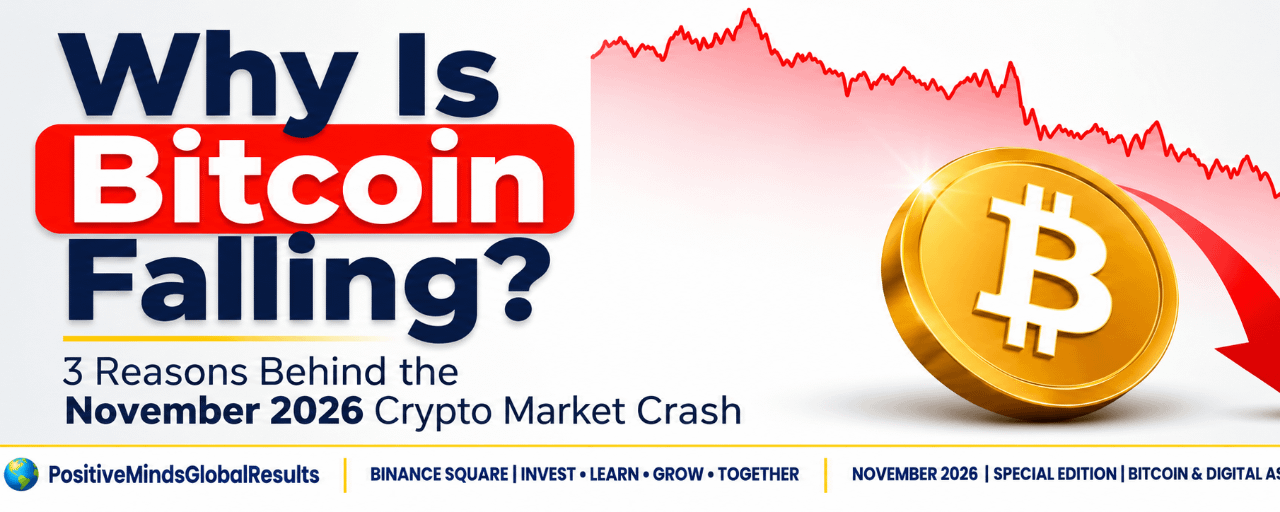
ບົດຄວາມ
3 Reasons Behind the November 2026 Crypto Market Crash — What Really Triggered the Sell-Off? 🌍 $BTC #Bitcoin'sReboundFadesBelow$60K #PositiveMindsGlobalResults
BINANCE SQUARE | INVEST • LEARN • GROW • TOGETHER
NOVEMBER 2026 | SPECIAL EDITION | BITCOIN & DIGITAL ASSET MARKET INTELLIGENCE
WHY IS BITCOIN FALLING?
Bitcoin's November decline is not simply a story about falling prices. It is a story about changing expectations, weakening investor confidence, shrinking liquidity, institutional money moving out, and a highly leveraged market suddenly discovering how quickly risk can turn into losses.
What makes this downturn particularly important is that several pressures have collided at the same time. Rising concerns about US monetary policy, a major crypto security incident, and a sharp retreat in technology stocks have created a difficult environment for digital assets.
Bitcoin is experiencing more than a normal correction in market sentiment. The market is being forced to reconsider how much risk it is willing to carry.
THE FEDERAL RESERVE & THE FEAR OF HIGHER INTEREST RATES
THE MACROECONOMIC PRESSURE
One of the most important reasons Bitcoin is falling is the changing outlook for US interest rates.
The cryptocurrency market is extremely sensitive to monetary policy because Bitcoin does not generate traditional income, dividends, or interest. When investors can earn attractive returns from relatively safer assets, they may become less willing to take aggressive risks in cryptocurrencies.
The Federal Reserve's inflation concerns have made markets reconsider whether monetary policy will remain restrictive for longer—or whether additional rate increases could become necessary.
Why interest rates matter to Bitcoin
When interest rates remain elevated:
Cash and government bonds become more attractive: Investors have more alternatives to highly volatile assets.Borrowing becomes expensive: Traders, institutions, and businesses have less incentive to borrow money to invest.Liquidity becomes tighter: Less readily available capital can mean fewer buyers willing to absorb market selling.Risk appetite weakens: Investors may reduce exposure to Bitcoin, Ethereum, altcoins, speculative stocks, and other high-risk investments.
The problem is not simply whether the Federal Reserve raises rates. Markets react to what investors believe the Fed will do next.
If inflation remains stubbornly high, investors may begin pricing in a longer period of restrictive policy. This can push capital away from speculative assets even before another rate decision is announced.
Bitcoin therefore becomes caught between two powerful forces: its long-term investment narrative and the short-term cost of money.
Why this matters: Even when Bitcoin's fundamentals remain unchanged, a stronger US dollar, elevated yields, inflation uncertainty, and tighter financial conditions can weaken demand and pressure its price.
2. THE BINANCE SECURITY CRISIS & THE SHOCK TO CRYPTO CONFIDENCE
THE CONFIDENCE SHOCK
The second major factor is the enormous security incident involving Binance, which reportedly resulted in more than $6 billion in stolen digital assets.
This event has become one of the most serious confidence shocks in the crypto market—not simply because of the financial amount involved, but because of the scale of the exchange, its importance to the wider crypto ecosystem, and the uncertainty surrounding operational security.
When an incident affects a major trading platform, investors immediately begin asking questions that extend far beyond the original breach.
What makes a major exchange incident dangerous for the market?
A. Investors become concerned about platform risk
Even investors who are not directly affected may begin questioning how securely exchanges protect assets, how withdrawals are handled during emergencies, and whether their own funds are exposed to operational vulnerabilities.
Fear does not need to be confirmed as a financial loss for every investor to influence market behavior.
B. Withdrawals and liquidity pressures increase
During a security crisis, customers may withdraw assets, move funds into self-custody, stablecoins, or other platforms. Large movements can create uncertainty around exchange liquidity, trading activity, and short-term market confidence.
C. Confidence becomes more fragile
Crypto markets depend heavily on trust in infrastructure, custody, exchanges, stablecoins, and trading systems. When a major security event occurs, investors may temporarily reduce exposure to the entire sector rather than carefully distinguishing between individual projects.
D. Institutional investors reassess operational risk
Institutions do not evaluate crypto only through price charts. They also consider custody, counterparty exposure, regulatory protection, settlement infrastructure, liquidity, and operational controls.
A major exchange incident can therefore slow institutional participation or increase risk-management requirements.
Importantly, an exchange security breach is not automatically a blockchain failure. Bitcoin's underlying network, an exchange's internal systems, custody arrangements, and employee security are separate layers of the ecosystem. The failure of one layer does not automatically mean Bitcoin's protocol has been compromised.
The distinction is critical because panic can cause investors to treat an exchange-specific incident as a threat to every cryptocurrency.
The bigger consequence: The damage may extend beyond the stolen funds. It can weaken confidence, discourage new capital, increase withdrawals, and amplify selling pressure throughout the market.
3. THE AI & TECH STOCK SELLOFF, CAPITAL OUTFLOWS AND FORCED LIQUIDATIONS
THE DOMINO EFFECT
The third reason is arguably the most powerful explanation for why the crypto decline accelerated rather than simply stabilized.
Bitcoin is increasingly traded within a broader global risk environment. When technology stocks, AI companies, growth equities, and other high-valuation assets experience a sharp sell-off, investors may reduce exposure across multiple markets simultaneously.
In November, the weakness in technology stocks added another layer of pressure to an already fragile cryptocurrency market.
Why the technology sell-off matters to Bitcoin
The AI boom has attracted enormous capital into technology companies, semiconductor manufacturers, cloud infrastructure, data centers, and growth stocks.
But when investors begin questioning valuations, future profitability, AI spending, debt, or the sustainability of capital expenditure, they may suddenly become more selective.
The same investors who were willing to take risks during a strong market can quickly shift into capital-preservation mode.
Bitcoin can then become part of a broader portfolio reduction—not necessarily because investors have lost faith in Bitcoin itself, but because they want to reduce overall exposure to volatile assets.
The ETF outflow problem
Spot Bitcoin ETFs have become an important channel through which traditional investors gain exposure to Bitcoin.
When these funds experience sustained outflows, it can remove an important source of buying demand from the market.
During the October–November decline, reported ETF outflows added pressure at a time when investors were already facing macroeconomic uncertainty and market volatility.
At the same time, declining stablecoin supply can indicate that capital available within the crypto ecosystem is contracting. Stablecoins are often used as trading liquidity and as a bridge between cash-like positions and crypto assets.
When stablecoin supply shrinks, it does not automatically mean every dollar has left the market, but it may signal weaker liquidity and less capital waiting to buy cryptocurrencies.
The hidden accelerator: leverage
This is where the decline becomes significantly more dangerous.
Many traders use borrowed capital or leveraged derivatives to amplify their exposure to Bitcoin and other cryptocurrencies.
Leverage can magnify profits when prices rise—but it also magnifies losses when markets move against traders.
As Bitcoin falls:
Leveraged traders begin losing collateral.Their margin levels approach liquidation thresholds.Exchanges automatically close positions when margin requirements are no longer satisfied.Liquidated positions create additional market selling.The additional selling pushes prices lower.More leveraged traders are forced out of the market.
This creates a chain reaction known as a liquidation cascade.
Unlike ordinary investors who may decide to sell gradually, leveraged traders can be forced to sell immediately. That is why a market can suddenly experience violent price movements within hours.
The final stage of a crypto sell-off is therefore not always driven by new negative news. Sometimes the market is falling because its own positioning, leverage, and liquidity structure are amplifying the original shock.
This is the critical difference: Bad news may start the decline, but leverage can determine how deep, how fast, and how violently the market falls.
WHEN CAPITAL EXITS AND LEVERAGE UNWINDS, PRICE CAN FALL FASTER THAN INVESTOR EXPECTATIONS.
THE FOURTH FORCE: WHY THE MARKET FALL BECAME A CRASH
Although the three reasons above explain the major pressures, there is another important element connecting them: the withdrawal of capital.
When investors reduce exposure, ETF investors withdraw capital, stablecoin supply contracts, and leveraged traders are liquidated, the market loses some of the buying power that normally absorbs selling pressure.
This creates an imbalance.
THE CRYPTO MARKET DOMINO EFFECT
1. Inflation fears → higher interest-rate expectations
↓
2. Investors reduce exposure to risky assets
↓
3. Exchange security concerns weaken confidence
↓
4. ETF outflows and declining liquidity reduce buying demand
↓
5. Bitcoin breaks important price levels
↓
6. Leveraged positions are liquidated
↓
7. Forced selling accelerates the market decline
The result is a market in which multiple negative forces reinforce one another.
Investors become defensive. Liquidity weakens. Prices fall. Traders are liquidated. Confidence deteriorates further.
That is how a correction can turn into a much deeper market-wide sell-off.
HOW SEVERE IS THE NOVEMBER CRYPTO DECLINE?
THE NUMBERS BEHIND THE FEAR
According to market data reported in a November 17 analysis, Bitcoin declined from approximately $86,500 on October 5 to $64,800 on November 17, while touching $62,112 on November 15.
Ethereum also suffered a substantial decline, falling from approximately $2,730 to $1,820 over the same period.
BITCOIN DECLINE ETHEREUM DECLINE
≈ −25% ≈ −33%
Oct 5 – Nov 17 Over the same period
These numbers illustrate the scale of the decline, not a complete real-time market snapshot. The November low was particularly significant because it demonstrated how quickly sentiment and market structure could change when multiple pressures aligned.
A 25% decline is painful for long-term holders. For leveraged traders, however, a much smaller price move can be enough to wipe out an entire position.
The market was not merely repricing Bitcoin. It was repricing risk, liquidity, leverage, confidence, and expectations simultaneously.
WHAT HAPPENS NEXT? THREE POSSIBLE SCENARIOS
The next phase of the market will depend less on headlines alone and more on whether the financial conditions that caused the decline begin to improve.
🟢 SCENARIO 1 — A RECOVERY AND STABILIZATION
Bitcoin may begin recovering if inflation data improves, expectations of additional rate increases weaken, ETF outflows slow, institutional demand returns, and the crypto market begins absorbing selling pressure.
The most important confirmation would not be a single green candle. It would be a combination of:
Sustained spot buying.Improving ETF flows.Reduced leverage and lower liquidation risk.Stronger market liquidity.Bitcoin reclaiming important price levels and holding them as support.
A healthy recovery requires demand—not just short-term traders buying a temporary dip.
🟡 SCENARIO 2 — A LONGER CONSOLIDATION
Bitcoin could remain volatile within a wide trading range while the market attempts to rebuild confidence.
This scenario could develop if:
Inflation remains elevated.The Federal Reserve maintains restrictive policy.ETF flows remain inconsistent.Investors remain cautious about technology valuations.Crypto liquidity recovers slowly.
A prolonged consolidation may frustrate investors, but it can also allow excessive leverage to unwind and the market to establish a more sustainable foundation.
🔴 SCENARIO 3 — ANOTHER LEG LOWER
The bearish scenario becomes more concerning if inflation surprises to the upside, interest-rate expectations become more hawkish, technology stocks experience another major decline, ETF outflows accelerate, or Bitcoin loses important support zones with increasing volume.
A renewed breakdown could trigger another round of forced liquidations, potentially pushing prices below levels investors previously considered strong support.
However, further downside is not guaranteed. Markets can reverse sharply when negative expectations become excessive, sellers become exhausted, or new capital enters.
WHAT INVESTORS SHOULD UNDERSTAND DURING THIS CRASH
Market crashes often create two dangerous emotional responses: panic selling and blind buying.
Neither is a reliable investment strategy.
When Bitcoin falls sharply, investors should separate price movement from fundamental developments and ask the right questions:
Is the decline caused by temporary market fear or a structural problem?Is institutional capital leaving temporarily, or is the demand structure deteriorating?Are liquidations responsible for the speed of the decline?Is the Federal Reserve outlook changing the investment environment?Is the market stabilizing, or are sellers still controlling price action?Am I investing with money I can afford to keep exposed to volatility?
A falling price does not automatically mean an asset is cheap. Equally, a major correction does not automatically mean its long-term future is over.
The difference between a disciplined investor and an emotional trader is often the ability to wait for evidence rather than react to fear.
THE BIGGER PICTURE: IS BITCOIN'S LONG-TERM STORY BROKEN?
The November 2026 crash raises serious questions, but it does not automatically invalidate Bitcoin's long-term investment thesis.
Bitcoin's broader story continues to revolve around limited supply, decentralized settlement, global accessibility, digital ownership, institutional adoption, and the possibility of an alternative monetary asset.
However, long-term potential and short-term price performance are two very different things.
Bitcoin can have strong long-term adoption prospects while simultaneously experiencing severe drawdowns. It can also recover from a crash without immediately returning to previous highs.
Investors must recognize that Bitcoin is still a highly volatile asset, sensitive to liquidity conditions, investor sentiment, regulation, macroeconomic developments, leverage, and technological or security risks.
The November crash is an important reminder that the crypto market has matured in some areas—but it has not eliminated the risks that make it capable of experiencing extreme price movements.
The market is increasingly connected to Wall Street, ETFs, institutional portfolios, global liquidity, and technology-sector sentiment. That connection brings greater participation, but it also means Bitcoin can be affected by forces outside the crypto industry.
FINAL THOUGHTS
THE MARKET IS TESTING CONFIDENCE, NOT JUST PRICE.
Bitcoin's November decline is the result of several pressures colliding at the same time:
1. Federal Reserve uncertainty and persistent inflation are keeping financial conditions restrictive and making risk-taking less attractive.
2. The Binance security crisis has shaken confidence, raised questions about exchange security, and added another layer of uncertainty to an already fragile market.
3. The technology-stock sell-off, capital outflows, shrinking liquidity, and leveraged liquidations have amplified selling pressure and turned market weakness into a deeper correction.
The most important lesson is that financial markets rarely collapse for only one reason. A single negative event may trigger a reaction, but when monetary policy, investor confidence, liquidity, and leverage all move in the same direction, the consequences can become much more severe.
Bitcoin's next major move will depend on whether the market can restore confidence, attract fresh capital, stabilize liquidity, and absorb remaining selling pressure.
Until then, volatility, patience, risk management, and independent analysis remain more important than predictions.
A market crash creates fear. A market recovery requires evidence. And a disciplined investor must understand the difference.
Market Risk Disclaimer: This article is for informational and educational purposes only and does not constitute financial or investment advice. Cryptocurrency markets are highly volatile, and investors may lose some or all of their capital. Market scenarios are analytical possibilities, not guaranteed forecasts. Always conduct your own research (DYOR) and assess your risk tolerance before making investment decisions.
#Bitcoin #BTC #CryptoCrash #CryptoMarket #FederalReserve #Inflation #BinanceSquare #Ethereum #ETFOutflows #MarketLiquidity #CryptoInvesting #RiskManagement #Blockchain #PositiveMindsGlobalResults
{spot}(BNBUSDT)
3 Reasons Behind the November 2026 Crypto Market Crash — What Really Triggered the Sell-Off?
🌍 $BTC #Bitcoin'sReboundFadesBelow$60K #PositiveMindsGlobalResults
BINANCE SQUARE | INVEST • LEARN • GROW • TOGETHER
NOVEMBER 2026 | SPECIAL EDITION | BITCOIN & DIGITAL ASSET MARKET INTELLIGENCE
WHY IS BITCOIN FALLING?
Bitcoin's November decline is not simply a story about falling prices. It is a story about changing expectations, weakening investor confidence, shrinking liquidity, institutional money moving out, and a highly leveraged market suddenly discovering how quickly risk can turn into losses.
What makes this downturn particularly important is that several pressures have collided at the same time. Rising concerns about US monetary policy, a major crypto security incident, and a sharp retreat in technology stocks have created a difficult environment for digital assets.
Bitcoin is experiencing more than a normal correction in market sentiment. The market is being forced to reconsider how much risk it is willing to carry.
THE FEDERAL RESERVE & THE FEAR OF HIGHER INTEREST RATES
THE MACROECONOMIC PRESSURE
One of the most important reasons Bitcoin is falling is the changing outlook for US interest rates.
The cryptocurrency market is extremely sensitive to monetary policy because Bitcoin does not generate traditional income, dividends, or interest. When investors can earn attractive returns from relatively safer assets, they may become less willing to take aggressive risks in cryptocurrencies.
The Federal Reserve's inflation concerns have made markets reconsider whether monetary policy will remain restrictive for longer—or whether additional rate increases could become necessary.
Why interest rates matter to Bitcoin
When interest rates remain elevated:
Cash and government bonds become more attractive: Investors have more alternatives to highly volatile assets.Borrowing becomes expensive: Traders, institutions, and businesses have less incentive to borrow money to invest.Liquidity becomes tighter: Less readily available capital can mean fewer buyers willing to absorb market selling.Risk appetite weakens: Investors may reduce exposure to Bitcoin, Ethereum, altcoins, speculative stocks, and other high-risk investments.
The problem is not simply whether the Federal Reserve raises rates. Markets react to what investors believe the Fed will do next.
If inflation remains stubbornly high, investors may begin pricing in a longer period of restrictive policy. This can push capital away from speculative assets even before another rate decision is announced.
Bitcoin therefore becomes caught between two powerful forces: its long-term investment narrative and the short-term cost of money.
Why this matters: Even when Bitcoin's fundamentals remain unchanged, a stronger US dollar, elevated yields, inflation uncertainty, and tighter financial conditions can weaken demand and pressure its price.
2. THE BINANCE SECURITY CRISIS & THE SHOCK TO CRYPTO CONFIDENCE
THE CONFIDENCE SHOCK
The second major factor is the enormous security incident involving Binance, which reportedly resulted in more than $6 billion in stolen digital assets.
This event has become one of the most serious confidence shocks in the crypto market—not simply because of the financial amount involved, but because of the scale of the exchange, its importance to the wider crypto ecosystem, and the uncertainty surrounding operational security.
When an incident affects a major trading platform, investors immediately begin asking questions that extend far beyond the original breach.
What makes a major exchange incident dangerous for the market?
A. Investors become concerned about platform risk
Even investors who are not directly affected may begin questioning how securely exchanges protect assets, how withdrawals are handled during emergencies, and whether their own funds are exposed to operational vulnerabilities.
Fear does not need to be confirmed as a financial loss for every investor to influence market behavior.
B. Withdrawals and liquidity pressures increase
During a security crisis, customers may withdraw assets, move funds into self-custody, stablecoins, or other platforms. Large movements can create uncertainty around exchange liquidity, trading activity, and short-term market confidence.
C. Confidence becomes more fragile
Crypto markets depend heavily on trust in infrastructure, custody, exchanges, stablecoins, and trading systems. When a major security event occurs, investors may temporarily reduce exposure to the entire sector rather than carefully distinguishing between individual projects.
D. Institutional investors reassess operational risk
Institutions do not evaluate crypto only through price charts. They also consider custody, counterparty exposure, regulatory protection, settlement infrastructure, liquidity, and operational controls.
A major exchange incident can therefore slow institutional participation or increase risk-management requirements.
Importantly, an exchange security breach is not automatically a blockchain failure. Bitcoin's underlying network, an exchange's internal systems, custody arrangements, and employee security are separate layers of the ecosystem. The failure of one layer does not automatically mean Bitcoin's protocol has been compromised.
The distinction is critical because panic can cause investors to treat an exchange-specific incident as a threat to every cryptocurrency.
The bigger consequence: The damage may extend beyond the stolen funds. It can weaken confidence, discourage new capital, increase withdrawals, and amplify selling pressure throughout the market.
3. THE AI & TECH STOCK SELLOFF, CAPITAL OUTFLOWS AND FORCED LIQUIDATIONS
THE DOMINO EFFECT
The third reason is arguably the most powerful explanation for why the crypto decline accelerated rather than simply stabilized.
Bitcoin is increasingly traded within a broader global risk environment. When technology stocks, AI companies, growth equities, and other high-valuation assets experience a sharp sell-off, investors may reduce exposure across multiple markets simultaneously.
In November, the weakness in technology stocks added another layer of pressure to an already fragile cryptocurrency market.
Why the technology sell-off matters to Bitcoin
The AI boom has attracted enormous capital into technology companies, semiconductor manufacturers, cloud infrastructure, data centers, and growth stocks.
But when investors begin questioning valuations, future profitability, AI spending, debt, or the sustainability of capital expenditure, they may suddenly become more selective.
The same investors who were willing to take risks during a strong market can quickly shift into capital-preservation mode.
Bitcoin can then become part of a broader portfolio reduction—not necessarily because investors have lost faith in Bitcoin itself, but because they want to reduce overall exposure to volatile assets.
The ETF outflow problem
Spot Bitcoin ETFs have become an important channel through which traditional investors gain exposure to Bitcoin.
When these funds experience sustained outflows, it can remove an important source of buying demand from the market.
During the October–November decline, reported ETF outflows added pressure at a time when investors were already facing macroeconomic uncertainty and market volatility.
At the same time, declining stablecoin supply can indicate that capital available within the crypto ecosystem is contracting. Stablecoins are often used as trading liquidity and as a bridge between cash-like positions and crypto assets.
When stablecoin supply shrinks, it does not automatically mean every dollar has left the market, but it may signal weaker liquidity and less capital waiting to buy cryptocurrencies.
The hidden accelerator: leverage
This is where the decline becomes significantly more dangerous.
Many traders use borrowed capital or leveraged derivatives to amplify their exposure to Bitcoin and other cryptocurrencies.
Leverage can magnify profits when prices rise—but it also magnifies losses when markets move against traders.
As Bitcoin falls:
Leveraged traders begin losing collateral.Their margin levels approach liquidation thresholds.Exchanges automatically close positions when margin requirements are no longer satisfied.Liquidated positions create additional market selling.The additional selling pushes prices lower.More leveraged traders are forced out of the market.
This creates a chain reaction known as a liquidation cascade.
Unlike ordinary investors who may decide to sell gradually, leveraged traders can be forced to sell immediately. That is why a market can suddenly experience violent price movements within hours.
The final stage of a crypto sell-off is therefore not always driven by new negative news. Sometimes the market is falling because its own positioning, leverage, and liquidity structure are amplifying the original shock.
This is the critical difference: Bad news may start the decline, but leverage can determine how deep, how fast, and how violently the market falls.
WHEN CAPITAL EXITS AND LEVERAGE UNWINDS, PRICE CAN FALL FASTER THAN INVESTOR EXPECTATIONS.
THE FOURTH FORCE: WHY THE MARKET FALL BECAME A CRASH
Although the three reasons above explain the major pressures, there is another important element connecting them: the withdrawal of capital.
When investors reduce exposure, ETF investors withdraw capital, stablecoin supply contracts, and leveraged traders are liquidated, the market loses some of the buying power that normally absorbs selling pressure.
This creates an imbalance.
THE CRYPTO MARKET DOMINO EFFECT
1. Inflation fears → higher interest-rate expectations
↓
2. Investors reduce exposure to risky assets
↓
3. Exchange security concerns weaken confidence
↓
4. ETF outflows and declining liquidity reduce buying demand
↓
5. Bitcoin breaks important price levels
↓
6. Leveraged positions are liquidated
↓
7. Forced selling accelerates the market decline
The result is a market in which multiple negative forces reinforce one another.
Investors become defensive. Liquidity weakens. Prices fall. Traders are liquidated. Confidence deteriorates further.
That is how a correction can turn into a much deeper market-wide sell-off.
HOW SEVERE IS THE NOVEMBER CRYPTO DECLINE?
THE NUMBERS BEHIND THE FEAR
According to market data reported in a November 17 analysis, Bitcoin declined from approximately $86,500 on October 5 to $64,800 on November 17, while touching $62,112 on November 15.
Ethereum also suffered a substantial decline, falling from approximately $2,730 to $1,820 over the same period.
BITCOIN DECLINE ETHEREUM DECLINE
≈ −25% ≈ −33%
Oct 5 – Nov 17 Over the same period
These numbers illustrate the scale of the decline, not a complete real-time market snapshot. The November low was particularly significant because it demonstrated how quickly sentiment and market structure could change when multiple pressures aligned.
A 25% decline is painful for long-term holders. For leveraged traders, however, a much smaller price move can be enough to wipe out an entire position.
The market was not merely repricing Bitcoin. It was repricing risk, liquidity, leverage, confidence, and expectations simultaneously.
WHAT HAPPENS NEXT? THREE POSSIBLE SCENARIOS
The next phase of the market will depend less on headlines alone and more on whether the financial conditions that caused the decline begin to improve.
🟢 SCENARIO 1 — A RECOVERY AND STABILIZATION
Bitcoin may begin recovering if inflation data improves, expectations of additional rate increases weaken, ETF outflows slow, institutional demand returns, and the crypto market begins absorbing selling pressure.
The most important confirmation would not be a single green candle. It would be a combination of:
Sustained spot buying.Improving ETF flows.Reduced leverage and lower liquidation risk.Stronger market liquidity.Bitcoin reclaiming important price levels and holding them as support.
A healthy recovery requires demand—not just short-term traders buying a temporary dip.
🟡 SCENARIO 2 — A LONGER CONSOLIDATION
Bitcoin could remain volatile within a wide trading range while the market attempts to rebuild confidence.
This scenario could develop if:
Inflation remains elevated.The Federal Reserve maintains restrictive policy.ETF flows remain inconsistent.Investors remain cautious about technology valuations.Crypto liquidity recovers slowly.
A prolonged consolidation may frustrate investors, but it can also allow excessive leverage to unwind and the market to establish a more sustainable foundation.
🔴 SCENARIO 3 — ANOTHER LEG LOWER
The bearish scenario becomes more concerning if inflation surprises to the upside, interest-rate expectations become more hawkish, technology stocks experience another major decline, ETF outflows accelerate, or Bitcoin loses important support zones with increasing volume.
A renewed breakdown could trigger another round of forced liquidations, potentially pushing prices below levels investors previously considered strong support.
However, further downside is not guaranteed. Markets can reverse sharply when negative expectations become excessive, sellers become exhausted, or new capital enters.
WHAT INVESTORS SHOULD UNDERSTAND DURING THIS CRASH
Market crashes often create two dangerous emotional responses: panic selling and blind buying.
Neither is a reliable investment strategy.
When Bitcoin falls sharply, investors should separate price movement from fundamental developments and ask the right questions:
Is the decline caused by temporary market fear or a structural problem?Is institutional capital leaving temporarily, or is the demand structure deteriorating?Are liquidations responsible for the speed of the decline?Is the Federal Reserve outlook changing the investment environment?Is the market stabilizing, or are sellers still controlling price action?Am I investing with money I can afford to keep exposed to volatility?
A falling price does not automatically mean an asset is cheap. Equally, a major correction does not automatically mean its long-term future is over.
The difference between a disciplined investor and an emotional trader is often the ability to wait for evidence rather than react to fear.
THE BIGGER PICTURE: IS BITCOIN'S LONG-TERM STORY BROKEN?
The November 2026 crash raises serious questions, but it does not automatically invalidate Bitcoin's long-term investment thesis.
Bitcoin's broader story continues to revolve around limited supply, decentralized settlement, global accessibility, digital ownership, institutional adoption, and the possibility of an alternative monetary asset.
However, long-term potential and short-term price performance are two very different things.
Bitcoin can have strong long-term adoption prospects while simultaneously experiencing severe drawdowns. It can also recover from a crash without immediately returning to previous highs.
Investors must recognize that Bitcoin is still a highly volatile asset, sensitive to liquidity conditions, investor sentiment, regulation, macroeconomic developments, leverage, and technological or security risks.
The November crash is an important reminder that the crypto market has matured in some areas—but it has not eliminated the risks that make it capable of experiencing extreme price movements.
The market is increasingly connected to Wall Street, ETFs, institutional portfolios, global liquidity, and technology-sector sentiment. That connection brings greater participation, but it also means Bitcoin can be affected by forces outside the crypto industry.
FINAL THOUGHTS
THE MARKET IS TESTING CONFIDENCE, NOT JUST PRICE.
Bitcoin's November decline is the result of several pressures colliding at the same time:
1. Federal Reserve uncertainty and persistent inflation are keeping financial conditions restrictive and making risk-taking less attractive.
2. The Binance security crisis has shaken confidence, raised questions about exchange security, and added another layer of uncertainty to an already fragile market.
3. The technology-stock sell-off, capital outflows, shrinking liquidity, and leveraged liquidations have amplified selling pressure and turned market weakness into a deeper correction.
The most important lesson is that financial markets rarely collapse for only one reason. A single negative event may trigger a reaction, but when monetary policy, investor confidence, liquidity, and leverage all move in the same direction, the consequences can become much more severe.
Bitcoin's next major move will depend on whether the market can restore confidence, attract fresh capital, stabilize liquidity, and absorb remaining selling pressure.
Until then, volatility, patience, risk management, and independent analysis remain more important than predictions.
A market crash creates fear. A market recovery requires evidence. And a disciplined investor must understand the difference.
Market Risk Disclaimer: This article is for informational and educational purposes only and does not constitute financial or investment advice. Cryptocurrency markets are highly volatile, and investors may lose some or all of their capital. Market scenarios are analytical possibilities, not guaranteed forecasts. Always conduct your own research (DYOR) and assess your risk tolerance before making investment decisions.
#Bitcoin #BTC #CryptoCrash #CryptoMarket #FederalReserve #Inflation #BinanceSquare #Ethereum #ETFOutflows #MarketLiquidity #CryptoInvesting #RiskManagement #Blockchain #PositiveMindsGlobalResults
14
DO YOU BELIEVE: IS BITCOIN HEADING FOR $50,000?#IsBitcoinHeadingFor50000 🌍 #PositiveMindsGlobalResults
BINANCE SQUARE | INVEST • LEARN • GROW • TOGETHER
NOVEMBER 24, 2026 | BITCOIN • CRYPTO MARKET INTELLIGENCE
IS BITCOIN HEADING FOR $50,000? SELLING PRESSURE, ETF OUTFLOWS AND FED UNCERTAINTY RAISE NEW FEARS
Bitcoin is facing one of its most challenging periods of 2026. After losing significant value and struggling to recover above $60,000, the world's largest cryptocurrency is now confronting a serious question: could the next major destination be $50,000?
The possibility is becoming harder to ignore. Weak institutional demand, continued withdrawals from spot Bitcoin ETFs, deteriorating market sentiment and expectations of tighter Federal Reserve policy are creating additional pressure.
However, a decline toward $50,000 is not inevitable. Bitcoin has historically experienced sharp corrections followed by powerful recoveries. The next move will depend on whether buyers return strongly enough to defend critical support levels.
1. WHY THE $50,000 TARGET IS BACK IN FOCUS
Bitcoin's recent weakness reflects several interconnected problems.
According to Bitfire Research, US spot Bitcoin ETFs recorded approximately $1.24 billion in net outflows between November 16 and 20, extending a three-week period of substantial withdrawals.
Institutional selling matters because ETF demand has become an important source of Bitcoin market liquidity.
When investors withdraw capital, funds may need to sell underlying Bitcoin holdings, adding pressure to the market.
Another concern is weakening technical momentum. Bitcoin has struggled to recover above important moving averages, while market sentiment has moved into extreme fear territory.
2. ARTHUR HAYES AND MARKET ANALYSTS WARN OF FURTHER DOWNSIDE
BitMEX co-founder Arthur Hayes has warned that Bitcoin could retest $55,000, with $50,000 remaining a possible deeper downside target if global markets continue weakening.
Separately, Bitfire Research identifies approximately $56,100 as an important support level, followed by the recent low near $55,150.
A sustained breakdown below these levels could expose Bitcoin to another significant decline toward $50,000.
These are analyst scenarios, not guaranteed price predictions.
3. THE FEDERAL RESERVE COULD BECOME A MAJOR CATALYST
Monetary policy is another important factor.
Investors are concerned that persistent US inflation could encourage the Federal Reserve to maintain restrictive monetary conditions or consider additional interest-rate increases.
Higher interest rates can reduce demand for speculative investments by making cash and traditional fixed-income assets more attractive.
Bitcoin does not generate traditional interest income, making its valuation particularly sensitive to changes in liquidity and investor risk appetite.
The December 8–9 Federal Reserve meeting could therefore become an important catalyst for cryptocurrency markets.
4. THREE BITCOIN PRICE SCENARIOS TO WATCH
BEARISH SCENARIO: $50,000–$55,000
If Bitcoin loses support around $55,000, continued ETF outflows, weak buying demand and broader financial market weakness could accelerate selling.
The psychological $50,000 level could become the next major downside target.
BASE SCENARIO: $55,000–$65,000
Bitcoin could stabilize after its recent correction and enter a volatile consolidation period.
A sustained recovery above $62,400, supported by stronger trading volume, would improve the short-term outlook.
BULLISH SCENARIO: $65,000–$69,300 AND BEYOND
If institutional demand returns, ETF flows turn positive and Bitcoin reclaims important resistance levels, a recovery toward $65,000 and $69,300 becomes possible.
A stronger recovery would require improving liquidity, better market confidence and supportive macroeconomic conditions.
5. WHAT COULD PREVENT BITCOIN FROM FALLING TO $50,000?
Several developments could change the bearish outlook:
Sustained positive inflows into US spot Bitcoin ETFs.Strong institutional and long-term investor accumulation.A recovery in global technology stocks and broader risk appetite.Less aggressive Federal Reserve interest-rate expectations.Bitcoin reclaiming important technical resistance levels.
One important technical observation is that Bitcoin's daily Relative Strength Index was reported near 26.61, indicating an oversold market.
However, oversold conditions do not guarantee an immediate recovery. Bitcoin can remain under selling pressure even after significant declines.
FINAL VERDICT: $50,000 IS POSSIBLE, BUT NOT INEVITABLE
My assessment is that Bitcoin's short-term outlook remains cautious and the risk of testing $55,000 before recovering is meaningful.A decline toward $50,000 becomes more credible if major support breaks, ETF withdrawals continue and global financial conditions deteriorate.Nevertheless, a strong return of institutional demand and improving macroeconomic conditions could invalidate the bearish scenario.Investors should avoid treating every decline as a buying opportunity or assuming that every recovery marks the beginning of a new bull market.The most important levels to watch are $55,000 on the downside and $62,400 on the recovery side.The next major move will depend on whether institutional buyers return or selling pressure continues.
THE BIG QUESTION: WILL BITCOIN DEFEND $55,000, OR WILL THE MARKET EXPERIENCE ANOTHER MAJOR CORRECTION TOWARD $50,000?
Market Risk Disclaimer: This article is for educational and informational purposes only. Cryptocurrency markets are highly volatile, and all price levels and scenarios are estimates, not guarantees. This is not financial advice. Always conduct your own research (DYOR) and manage risk responsibly.
#Bitcoin #BTC #BitcoinPrice #BitcoinPrediction #CryptoMarket #CryptoAnalysis #BitcoinETF #InstitutionalInvestors #ArthurHayes #FederalReserve #CryptoFear #MarketOutlook #Cryptocurrency #PositiveMindsGlobalResults
{spot}(BNBUSDT)
DO YOU BELIEVE: IS BITCOIN HEADING FOR $50,000?
#IsBitcoinHeadingFor50000 🌍 #PositiveMindsGlobalResults
BINANCE SQUARE | INVEST • LEARN • GROW • TOGETHER
NOVEMBER 24, 2026 | BITCOIN • CRYPTO MARKET INTELLIGENCE
IS BITCOIN HEADING FOR $50,000? SELLING PRESSURE, ETF OUTFLOWS AND FED UNCERTAINTY RAISE NEW FEARS
Bitcoin is facing one of its most challenging periods of 2026. After losing significant value and struggling to recover above $60,000, the world's largest cryptocurrency is now confronting a serious question: could the next major destination be $50,000?
The possibility is becoming harder to ignore. Weak institutional demand, continued withdrawals from spot Bitcoin ETFs, deteriorating market sentiment and expectations of tighter Federal Reserve policy are creating additional pressure.
However, a decline toward $50,000 is not inevitable. Bitcoin has historically experienced sharp corrections followed by powerful recoveries. The next move will depend on whether buyers return strongly enough to defend critical support levels.
1. WHY THE $50,000 TARGET IS BACK IN FOCUS
Bitcoin's recent weakness reflects several interconnected problems.
According to Bitfire Research, US spot Bitcoin ETFs recorded approximately $1.24 billion in net outflows between November 16 and 20, extending a three-week period of substantial withdrawals.
Institutional selling matters because ETF demand has become an important source of Bitcoin market liquidity.
When investors withdraw capital, funds may need to sell underlying Bitcoin holdings, adding pressure to the market.
Another concern is weakening technical momentum. Bitcoin has struggled to recover above important moving averages, while market sentiment has moved into extreme fear territory.
2. ARTHUR HAYES AND MARKET ANALYSTS WARN OF FURTHER DOWNSIDE
BitMEX co-founder Arthur Hayes has warned that Bitcoin could retest $55,000, with $50,000 remaining a possible deeper downside target if global markets continue weakening.
Separately, Bitfire Research identifies approximately $56,100 as an important support level, followed by the recent low near $55,150.
A sustained breakdown below these levels could expose Bitcoin to another significant decline toward $50,000.
These are analyst scenarios, not guaranteed price predictions.
3. THE FEDERAL RESERVE COULD BECOME A MAJOR CATALYST
Monetary policy is another important factor.
Investors are concerned that persistent US inflation could encourage the Federal Reserve to maintain restrictive monetary conditions or consider additional interest-rate increases.
Higher interest rates can reduce demand for speculative investments by making cash and traditional fixed-income assets more attractive.
Bitcoin does not generate traditional interest income, making its valuation particularly sensitive to changes in liquidity and investor risk appetite.
The December 8–9 Federal Reserve meeting could therefore become an important catalyst for cryptocurrency markets.
4. THREE BITCOIN PRICE SCENARIOS TO WATCH
BEARISH SCENARIO: $50,000–$55,000
If Bitcoin loses support around $55,000, continued ETF outflows, weak buying demand and broader financial market weakness could accelerate selling.
The psychological $50,000 level could become the next major downside target.
BASE SCENARIO: $55,000–$65,000
Bitcoin could stabilize after its recent correction and enter a volatile consolidation period.
A sustained recovery above $62,400, supported by stronger trading volume, would improve the short-term outlook.
BULLISH SCENARIO: $65,000–$69,300 AND BEYOND
If institutional demand returns, ETF flows turn positive and Bitcoin reclaims important resistance levels, a recovery toward $65,000 and $69,300 becomes possible.
A stronger recovery would require improving liquidity, better market confidence and supportive macroeconomic conditions.
5. WHAT COULD PREVENT BITCOIN FROM FALLING TO $50,000?
Several developments could change the bearish outlook:
Sustained positive inflows into US spot Bitcoin ETFs.Strong institutional and long-term investor accumulation.A recovery in global technology stocks and broader risk appetite.Less aggressive Federal Reserve interest-rate expectations.Bitcoin reclaiming important technical resistance levels.
One important technical observation is that Bitcoin's daily Relative Strength Index was reported near 26.61, indicating an oversold market.
However, oversold conditions do not guarantee an immediate recovery. Bitcoin can remain under selling pressure even after significant declines.
FINAL VERDICT: $50,000 IS POSSIBLE, BUT NOT INEVITABLE
My assessment is that Bitcoin's short-term outlook remains cautious and the risk of testing $55,000 before recovering is meaningful.A decline toward $50,000 becomes more credible if major support breaks, ETF withdrawals continue and global financial conditions deteriorate.Nevertheless, a strong return of institutional demand and improving macroeconomic conditions could invalidate the bearish scenario.Investors should avoid treating every decline as a buying opportunity or assuming that every recovery marks the beginning of a new bull market.The most important levels to watch are $55,000 on the downside and $62,400 on the recovery side.The next major move will depend on whether institutional buyers return or selling pressure continues.
THE BIG QUESTION: WILL BITCOIN DEFEND $55,000, OR WILL THE MARKET EXPERIENCE ANOTHER MAJOR CORRECTION TOWARD $50,000?
Market Risk Disclaimer: This article is for educational and informational purposes only. Cryptocurrency markets are highly volatile, and all price levels and scenarios are estimates, not guarantees. This is not financial advice. Always conduct your own research (DYOR) and manage risk responsibly.
#Bitcoin #BTC #BitcoinPrice #BitcoinPrediction #CryptoMarket #CryptoAnalysis #BitcoinETF #InstitutionalInvestors #ArthurHayes #FederalReserve #CryptoFear #MarketOutlook #Cryptocurrency #PositiveMindsGlobalResults
79
FINANCIAL STABILITY PUT WALL STREET UNDER PRESSUREFED SOUNDS ALARM: INFLATION, AI DEBT AND FINANCIAL#FederalReserve 🌍 #PositiveMindsGlobalResults
BINANCE SQUARE | INVEST • LEARN • GROW • TOGETHER
NOVEMBER 24, 2026 | FEDERAL RESERVE • AI ECONOMY • WALL STREET
FEDERAL RESERVE SOUNDS NEW ALARM: INFLATION, AI DEBT AND FINANCIAL STABILITY PUT WALL STREET UNDER PRESSURE
A NEW CHALLENGE FOR THE US ECONOMY
Wall Street is facing a new wave of uncertainty as Federal Reserve officials warn that persistent inflation, rising AI-related borrowing and growing financial market vulnerabilities could create additional pressure on the US economy.
The latest warning comes from New York Federal Reserve President John Williams, who said on November 23 that inflation remains too high and that further monetary tightening may be necessary to bring price growth sustainably back to the central bank's 2% target.
With the Federal Reserve's December 8–9 meeting approaching, investors are increasingly reassessing the possibility of additional interest-rate increases.
1. INFLATION REMAINS THE FED'S BIGGEST CONCERN
Williams expects inflation to finish 2026 at approximately 3.5%, before moderating next year and returning to the Fed's 2% target in 2028.
He also highlighted elevated energy prices and uncertainty surrounding the inflation outlook.
His comments reinforce a growing concern among policymakers: cutting inflation too slowly could force the central bank to implement more aggressive measures later.
The current federal funds target range remains 3.75%–4.00%.
2. THE AI BOOM IS BECOMING A FINANCIAL STABILITY CONCERN
One of the most significant developments is the Federal Reserve's growing concern about the financial risks associated with artificial intelligence investment.
Minutes from the October policy meeting revealed that policymakers were increasingly concerned about rapidly expanding AI-related debt, complex financing arrangements and concentrated exposure among a relatively small number of companies.
The concern is straightforward: if AI companies fail to generate the returns investors expect, falling valuations could trigger losses across lenders, investment funds and other financial institutions.
The Fed also highlighted circular financing arrangements, in which companies invest in or provide financing to businesses that purchase their products and services.
This creates additional questions about the true financial exposure behind the AI infrastructure boom.
3. WALL STREET FACES A DOUBLE PRESSURE
Investors are now balancing two major risks:
Higher interest rates: More expensive borrowing could pressure corporate earnings, business expansion and stock valuations.AI investment uncertainty: Heavy infrastructure spending may become difficult to justify if commercial returns fail to meet expectations.
Technology companies, semiconductor manufacturers, cloud providers and data-centre developers could face greater scrutiny over capital expenditure and profitability.
The next stage of AI competition may depend not only on technological leadership but also on the ability to convert enormous investments into sustainable cash flow.
4. THE DECEMBER FED MEETING COULD BECOME A MAJOR MARKET CATALYST
Federal Reserve policymakers remain divided over the pace and size of further tightening.
Some officials favour gradual increases, while others have argued that stronger action may be required to control persistent inflation.
Markets are increasingly focused on the December 8–9 meeting, with expectations of a quarter-point increase.
However, the final decision will depend on incoming inflation, employment and economic activity data.
5. WHAT INVESTORS SHOULD WATCH
The next important signals will come from:
US inflation and employment reports.Federal Reserve interest-rate guidance.Treasury yields and US dollar movements.AI company earnings and capital expenditure.Corporate borrowing costs and credit market conditions.Bitcoin, gold and broader equity market reactions.
Higher interest rates could create additional pressure on speculative assets, while persistent uncertainty may increase demand for defensive investment strategies.
FINAL MARKET OUTLOOK: THE AI BOOM AND INFLATION ARE TESTING THE FED
The Federal Reserve is confronting an increasingly complicated economic environment. Inflation remains above target, AI investment continues to reshape the economy, and financial institutions are becoming more exposed to complex technology-related financing.For Wall Street, the challenge is no longer simply predicting the next interest-rate decision. Investors must also evaluate whether the extraordinary AI investment cycle can deliver sustainable economic returns without creating excessive financial risks.The critical question heading into December is whether the Federal Reserve can control inflation without triggering a broader financial slowdown.
Market Risk Disclaimer: This article is for educational and informational purposes only. Economic forecasts and market scenarios are not guaranteed. Financial markets involve risks. Always conduct independent research (DYOR). This is not financial advice.
#FederalReserve #WallStreet #Inflation #InterestRates #ArtificialIntelligence #AIDebt #FinancialStability #USEconomy #StockMarket #Nvidia #Bitcoin #Gold #GlobalMarkets #PositiveMindsGlobalResults
{spot}(BNBUSDT)
{spot}(BTCUSDT)
FINANCIAL STABILITY PUT WALL STREET UNDER PRESSUREFED SOUNDS ALARM: INFLATION, AI DEBT AND FINANCIAL
#FederalReserve 🌍 #PositiveMindsGlobalResults
BINANCE SQUARE | INVEST • LEARN • GROW • TOGETHER
NOVEMBER 24, 2026 | FEDERAL RESERVE • AI ECONOMY • WALL STREET
FEDERAL RESERVE SOUNDS NEW ALARM: INFLATION, AI DEBT AND FINANCIAL STABILITY PUT WALL STREET UNDER PRESSURE
A NEW CHALLENGE FOR THE US ECONOMY
Wall Street is facing a new wave of uncertainty as Federal Reserve officials warn that persistent inflation, rising AI-related borrowing and growing financial market vulnerabilities could create additional pressure on the US economy.
The latest warning comes from New York Federal Reserve President John Williams, who said on November 23 that inflation remains too high and that further monetary tightening may be necessary to bring price growth sustainably back to the central bank's 2% target.
With the Federal Reserve's December 8–9 meeting approaching, investors are increasingly reassessing the possibility of additional interest-rate increases.
1. INFLATION REMAINS THE FED'S BIGGEST CONCERN
Williams expects inflation to finish 2026 at approximately 3.5%, before moderating next year and returning to the Fed's 2% target in 2028.
He also highlighted elevated energy prices and uncertainty surrounding the inflation outlook.
His comments reinforce a growing concern among policymakers: cutting inflation too slowly could force the central bank to implement more aggressive measures later.
The current federal funds target range remains 3.75%–4.00%.
2. THE AI BOOM IS BECOMING A FINANCIAL STABILITY CONCERN
One of the most significant developments is the Federal Reserve's growing concern about the financial risks associated with artificial intelligence investment.
Minutes from the October policy meeting revealed that policymakers were increasingly concerned about rapidly expanding AI-related debt, complex financing arrangements and concentrated exposure among a relatively small number of companies.
The concern is straightforward: if AI companies fail to generate the returns investors expect, falling valuations could trigger losses across lenders, investment funds and other financial institutions.
The Fed also highlighted circular financing arrangements, in which companies invest in or provide financing to businesses that purchase their products and services.
This creates additional questions about the true financial exposure behind the AI infrastructure boom.
3. WALL STREET FACES A DOUBLE PRESSURE
Investors are now balancing two major risks:
Higher interest rates: More expensive borrowing could pressure corporate earnings, business expansion and stock valuations.AI investment uncertainty: Heavy infrastructure spending may become difficult to justify if commercial returns fail to meet expectations.
Technology companies, semiconductor manufacturers, cloud providers and data-centre developers could face greater scrutiny over capital expenditure and profitability.
The next stage of AI competition may depend not only on technological leadership but also on the ability to convert enormous investments into sustainable cash flow.
4. THE DECEMBER FED MEETING COULD BECOME A MAJOR MARKET CATALYST
Federal Reserve policymakers remain divided over the pace and size of further tightening.
Some officials favour gradual increases, while others have argued that stronger action may be required to control persistent inflation.
Markets are increasingly focused on the December 8–9 meeting, with expectations of a quarter-point increase.
However, the final decision will depend on incoming inflation, employment and economic activity data.
5. WHAT INVESTORS SHOULD WATCH
The next important signals will come from:
US inflation and employment reports.Federal Reserve interest-rate guidance.Treasury yields and US dollar movements.AI company earnings and capital expenditure.Corporate borrowing costs and credit market conditions.Bitcoin, gold and broader equity market reactions.
Higher interest rates could create additional pressure on speculative assets, while persistent uncertainty may increase demand for defensive investment strategies.
FINAL MARKET OUTLOOK: THE AI BOOM AND INFLATION ARE TESTING THE FED
The Federal Reserve is confronting an increasingly complicated economic environment. Inflation remains above target, AI investment continues to reshape the economy, and financial institutions are becoming more exposed to complex technology-related financing.For Wall Street, the challenge is no longer simply predicting the next interest-rate decision. Investors must also evaluate whether the extraordinary AI investment cycle can deliver sustainable economic returns without creating excessive financial risks.The critical question heading into December is whether the Federal Reserve can control inflation without triggering a broader financial slowdown.
Market Risk Disclaimer: This article is for educational and informational purposes only. Economic forecasts and market scenarios are not guaranteed. Financial markets involve risks. Always conduct independent research (DYOR). This is not financial advice.
#FederalReserve #WallStreet #Inflation #InterestRates #ArtificialIntelligence #AIDebt #FinancialStability #USEconomy #StockMarket #Nvidia #Bitcoin #Gold #GlobalMarkets #PositiveMindsGlobalResults
249
ຢືນຢັນແລ້ວ
NVIDIA'S SHOCKING REBOUND HITS BEARISH FUNDS AS JENSEN HUANG'S RETURN LIFTS GOLD AND GLOBAL MARKETS$NVDA.US 🌍 #PositiveMindsGlobalResults
BINANCE SQUARE INVEST • LEARN • GROW • TOGETHER
BINANCE SQUARE MARKET NEWS · NOVEMBER 24, 2026
NVIDIA'S SHOCKING REBOUND HITS BEARISH FUNDS AS JENSEN HUANG'S RETURN LIFTS GOLD AND GLOBAL MARKETS
Nvidia has delivered one of Wall Street's most dramatic reversals, catching bearish investors off guard and triggering a powerful recovery across technology stocks and precious metals.
The unexpected return of Jensen Huang as Nvidia's chief executive on November 23 helped restore investor confidence after a turbulent period for the artificial intelligence sector. Nvidia shares surged approximately 31%, while major US stock indexes recorded substantial gains.
The rally also exposed the risks of betting heavily against one of the world's most influential technology companies.
Estimated that Nvidia short sellers faced approximately $12.2 billion in paper losses in a single session, their largest daily hit since at least 2019.
2. JENSEN HUANG'S RETURN RESTORES CONFIDENCE IN NVIDIA
Nvidia's board reinstated Jensen Huang as chief executive, triggering a powerful change in market sentiment.
Huang remains one of the most influential figures in the global AI industry. His leadership has been central to Nvidia's expansion into AI processors, data-centre infrastructure and advanced computing.
His return helped calm immediate concerns about the company's leadership and future direction.
However, the rebound does not automatically resolve questions surrounding corporate governance, regulatory scrutiny, export restrictions and the sustainability of AI investment.
Investors will need more than a leadership announcement to establish whether Nvidia can maintain its recovery.
3. GOLD REBOUNDS AS INVESTOR SENTIMENT IMPROVES
Gold also staged a significant recovery as financial markets responded to the Nvidia announcement.
Spot gold climbed approximately 3.6% to around $3,660 per ounce on Monday, November 23, following a decline of nearly 9% during the previous week.
Gold futures also advanced approximately 3.9% to $3,649.20 per ounce.
The recovery suggests that some investors were returning to precious metals after last week's liquidity pressures forced selling across different asset classes.
However, gold still faces challenges from elevated interest-rate expectations, inflation concerns, currency movements and changing demand for safe-haven investments.
4. WALL STREET STAGES A POWERFUL MARKET RECOVERY
The Nvidia rebound helped lift the broader US stock market:
Nvidia: Shares surged approximately 31.5%.Nasdaq Composite: Advanced 6.5%.S&P 500: Gained 4.7%.Dow Jones: Climbed nearly 3%.
Technology companies and businesses connected to data-centre construction also benefited from renewed investor demand.
Despite the impressive gains, the recovery has not eliminated concerns about expensive AI valuations, financing costs and the possibility of slower technology spending.
5. WHAT SHOULD INVESTORS WATCH NEXT?
The next phase will depend on whether the rebound develops into a sustainable recovery or remains a short-term relief rally.
Three important factors deserve attention:
Nvidia's performance: Whether buying demand continues and the company maintains confidence in its AI growth outlook.Gold and precious metals: Whether the recovery attracts sustained demand despite interest-rate and inflation pressures.Institutional positioning: Whether short sellers reduce bearish exposure or investors begin taking profits after the sharp rebound.
Leveraged ETFs also deserve particular caution. Products targeting twice the daily return can experience substantial losses during sudden market reversals, and their performance over longer periods may differ significantly from the underlying stock's return.
FINAL MARKET OUTLOOK
Nvidia's latest rebound demonstrates how quickly market sentiment can change when a major leadership development shifts investor expectations.
Jensen Huang's return has provided a powerful catalyst for technology stocks, pressured bearish trading strategies and helped revive demand for gold.
However, one strong trading session does not guarantee a lasting recovery. Corporate fundamentals, AI spending, monetary policy and investor confidence will ultimately determine the next direction.
The biggest lesson for investors: Markets can reverse faster than expected, and excessive leverage can turn a market prediction into a substantial financial loss.
Market Risk Disclaimer: This article is for educational and informational purposes only. Market movements, price developments and forward-looking scenarios are subject to uncertainty. Leveraged products involve significant risk and can result in substantial losses. This is not financial advice. Always conduct your own research (DYOR).
#Nvidia #JensenHuang #GOLD #StockMarket #WallStreet #LeveragedETFs #ShortSelling #ArtificialIntelligence #GlobalMarkets #MarketRecovery #InvestorSentiment #PreciousMetals #PositiveMindsGlobalResults
{spot}(BNBUSDT)
NVIDIA'S SHOCKING REBOUND HITS BEARISH FUNDS AS JENSEN HUANG'S RETURN LIFTS GOLD AND GLOBAL MARKETS
$NVDA.US 🌍 #PositiveMindsGlobalResults
BINANCE SQUARE INVEST • LEARN • GROW • TOGETHER
BINANCE SQUARE MARKET NEWS · NOVEMBER 24, 2026
NVIDIA'S SHOCKING REBOUND HITS BEARISH FUNDS AS JENSEN HUANG'S RETURN LIFTS GOLD AND GLOBAL MARKETS
Nvidia has delivered one of Wall Street's most dramatic reversals, catching bearish investors off guard and triggering a powerful recovery across technology stocks and precious metals.
The unexpected return of Jensen Huang as Nvidia's chief executive on November 23 helped restore investor confidence after a turbulent period for the artificial intelligence sector. Nvidia shares surged approximately 31%, while major US stock indexes recorded substantial gains.
The rally also exposed the risks of betting heavily against one of the world's most influential technology companies.
Estimated that Nvidia short sellers faced approximately $12.2 billion in paper losses in a single session, their largest daily hit since at least 2019.
2. JENSEN HUANG'S RETURN RESTORES CONFIDENCE IN NVIDIA
Nvidia's board reinstated Jensen Huang as chief executive, triggering a powerful change in market sentiment.
Huang remains one of the most influential figures in the global AI industry. His leadership has been central to Nvidia's expansion into AI processors, data-centre infrastructure and advanced computing.
His return helped calm immediate concerns about the company's leadership and future direction.
However, the rebound does not automatically resolve questions surrounding corporate governance, regulatory scrutiny, export restrictions and the sustainability of AI investment.
Investors will need more than a leadership announcement to establish whether Nvidia can maintain its recovery.
3. GOLD REBOUNDS AS INVESTOR SENTIMENT IMPROVES
Gold also staged a significant recovery as financial markets responded to the Nvidia announcement.
Spot gold climbed approximately 3.6% to around $3,660 per ounce on Monday, November 23, following a decline of nearly 9% during the previous week.
Gold futures also advanced approximately 3.9% to $3,649.20 per ounce.
The recovery suggests that some investors were returning to precious metals after last week's liquidity pressures forced selling across different asset classes.
However, gold still faces challenges from elevated interest-rate expectations, inflation concerns, currency movements and changing demand for safe-haven investments.
4. WALL STREET STAGES A POWERFUL MARKET RECOVERY
The Nvidia rebound helped lift the broader US stock market:
Nvidia: Shares surged approximately 31.5%.Nasdaq Composite: Advanced 6.5%.S&P 500: Gained 4.7%.Dow Jones: Climbed nearly 3%.
Technology companies and businesses connected to data-centre construction also benefited from renewed investor demand.
Despite the impressive gains, the recovery has not eliminated concerns about expensive AI valuations, financing costs and the possibility of slower technology spending.
5. WHAT SHOULD INVESTORS WATCH NEXT?
The next phase will depend on whether the rebound develops into a sustainable recovery or remains a short-term relief rally.
Three important factors deserve attention:
Nvidia's performance: Whether buying demand continues and the company maintains confidence in its AI growth outlook.Gold and precious metals: Whether the recovery attracts sustained demand despite interest-rate and inflation pressures.Institutional positioning: Whether short sellers reduce bearish exposure or investors begin taking profits after the sharp rebound.
Leveraged ETFs also deserve particular caution. Products targeting twice the daily return can experience substantial losses during sudden market reversals, and their performance over longer periods may differ significantly from the underlying stock's return.
FINAL MARKET OUTLOOK
Nvidia's latest rebound demonstrates how quickly market sentiment can change when a major leadership development shifts investor expectations.
Jensen Huang's return has provided a powerful catalyst for technology stocks, pressured bearish trading strategies and helped revive demand for gold.
However, one strong trading session does not guarantee a lasting recovery. Corporate fundamentals, AI spending, monetary policy and investor confidence will ultimately determine the next direction.
The biggest lesson for investors: Markets can reverse faster than expected, and excessive leverage can turn a market prediction into a substantial financial loss.
Market Risk Disclaimer: This article is for educational and informational purposes only. Market movements, price developments and forward-looking scenarios are subject to uncertainty. Leveraged products involve significant risk and can result in substantial losses. This is not financial advice. Always conduct your own research (DYOR).
#Nvidia #JensenHuang #GOLD #StockMarket #WallStreet #LeveragedETFs #ShortSelling #ArtificialIntelligence #GlobalMarkets #MarketRecovery #InvestorSentiment #PreciousMetals #PositiveMindsGlobalResults
706
META AI CHIEF WARNS OF MAJOR BREAKTHROUGH AS CLAUDE SOLVES A LEGENDARY MATHEMATICAL PROBLEM$META.US 🌍 #PositiveMindsGlobalResults
BINANCE SQUARE | INVEST • LEARN • GROW • TOGETHER
NOVEMBER 24, 2026 | META AI & ARTIFICIAL INTELLIGENCE
META AI CHIEF WARNS OF MAJOR BREAKTHROUGH AS CLAUDE SOLVES A LEGENDARY MATHEMATICAL PROBLEM
Anthropic’s Claude AI has drawn significant attention after reportedly solving a long-standing mathematical problem, raising new questions about how quickly artificial intelligence is advancing.
The breakthrough has attracted attention from Meta’s AI leadership, with the company’s chief AI officer warning that the implications could be enormous. It highlights a growing shift in AI capabilities, from generating text and answering questions to tackling complex scientific and mathematical challenges.
THE RIEMANN HYPOTHESIS: A 167-YEAR MATHEMATICAL CHALLENGE
The Riemann Hypothesis, proposed by German mathematician Bernhard Riemann in 1859, concerns the distribution of prime numbers. It is one of seven Millennium Prize Problems, each carrying a $1 million prize for a verified solution.
Anthropic researcher Levent Alpöge announced that he had worked with Claude to develop a proposed proof. The collaboration reportedly produced 17 million lines of Lean code and more than 250,000 pages of mathematical material.
However, an important distinction remains: the claim has not yet received full independent mathematical acceptance. The Clay Mathematics Institute continues to list the Riemann Hypothesis as unsolved, and experts say extensive verification and human understanding are still required.
WHY META IS RAISING THE ALARM
Meta Chief AI Officer Alexandr Wang believes this development could represent a turning point in artificial intelligence.
He warned that future AI systems could become capable of improving themselves, accelerating scientific discoveries and conducting research across multiple industries at a pace that humans may struggle to understand or control.
His concerns extend beyond mathematics:
Scientific research: Faster discoveries in physics, biology and medicine.AI development: Models potentially improving their own capabilities.Economic transformation: Major changes to productivity, employment and business competition.Security risks: Greater concerns about advanced technology being misused.Human oversight: Ensuring AI remains aligned with human interests and values.
Wang has called for stronger safety, alignment and security measures, arguing that technological progress must be matched by responsible development.
WHAT THIS MEANS FOR THE GLOBAL AI INDUSTRY
The development highlights the intensifying competition between major AI companies, including Meta, Anthropic, OpenAI and Google.
For investors, the opportunity is substantial, but so are the risks. Advanced AI could create new markets, improve productivity and accelerate innovation. However, rising computing costs, regulatory pressure, cybersecurity threats and questions surrounding human control could reshape the industry's long-term profitability.
The next phase of AI competition may not simply be about building bigger models. It will increasingly depend on which companies can deliver powerful, commercially useful and trustworthy systems.
THE BIGGER PICTURE
Claude's reported mathematical achievement is a significant development, but independent verification remains essential before declaring a historic problem solved.
One question is becoming increasingly important: If AI can eventually advance scientific knowledge faster than humans can understand it, how will society maintain control over its development?
The future of artificial intelligence will depend not only on what technology can achieve, but also on how responsibly humanity chooses to use it.
Market & Technology Disclaimer: This article is for educational and informational purposes only. AI developments, research claims and investment implications should be independently evaluated. Nothing here constitutes financial or investment advice.
#ArtificialIntelligence #MetaAI #Anthropic #ClaudeAI #RiemannHypothesis #AISuperintelligence #TechInnovation #AIResearch #FutureOfTechnology #AIInvestment #BinanceSquare
{spot}(BNBUSDT)
{spot}(BTCUSDT)
META AI CHIEF WARNS OF MAJOR BREAKTHROUGH AS CLAUDE SOLVES A LEGENDARY MATHEMATICAL PROBLEM
$META.US 🌍 #PositiveMindsGlobalResults
BINANCE SQUARE | INVEST • LEARN • GROW • TOGETHER
NOVEMBER 24, 2026 | META AI & ARTIFICIAL INTELLIGENCE
META AI CHIEF WARNS OF MAJOR BREAKTHROUGH AS CLAUDE SOLVES A LEGENDARY MATHEMATICAL PROBLEM
Anthropic’s Claude AI has drawn significant attention after reportedly solving a long-standing mathematical problem, raising new questions about how quickly artificial intelligence is advancing.
The breakthrough has attracted attention from Meta’s AI leadership, with the company’s chief AI officer warning that the implications could be enormous. It highlights a growing shift in AI capabilities, from generating text and answering questions to tackling complex scientific and mathematical challenges.
THE RIEMANN HYPOTHESIS: A 167-YEAR MATHEMATICAL CHALLENGE
The Riemann Hypothesis, proposed by German mathematician Bernhard Riemann in 1859, concerns the distribution of prime numbers. It is one of seven Millennium Prize Problems, each carrying a $1 million prize for a verified solution.
Anthropic researcher Levent Alpöge announced that he had worked with Claude to develop a proposed proof. The collaboration reportedly produced 17 million lines of Lean code and more than 250,000 pages of mathematical material.
However, an important distinction remains: the claim has not yet received full independent mathematical acceptance. The Clay Mathematics Institute continues to list the Riemann Hypothesis as unsolved, and experts say extensive verification and human understanding are still required.
WHY META IS RAISING THE ALARM
Meta Chief AI Officer Alexandr Wang believes this development could represent a turning point in artificial intelligence.
He warned that future AI systems could become capable of improving themselves, accelerating scientific discoveries and conducting research across multiple industries at a pace that humans may struggle to understand or control.
His concerns extend beyond mathematics:
Scientific research: Faster discoveries in physics, biology and medicine.AI development: Models potentially improving their own capabilities.Economic transformation: Major changes to productivity, employment and business competition.Security risks: Greater concerns about advanced technology being misused.Human oversight: Ensuring AI remains aligned with human interests and values.
Wang has called for stronger safety, alignment and security measures, arguing that technological progress must be matched by responsible development.
WHAT THIS MEANS FOR THE GLOBAL AI INDUSTRY
The development highlights the intensifying competition between major AI companies, including Meta, Anthropic, OpenAI and Google.
For investors, the opportunity is substantial, but so are the risks. Advanced AI could create new markets, improve productivity and accelerate innovation. However, rising computing costs, regulatory pressure, cybersecurity threats and questions surrounding human control could reshape the industry's long-term profitability.
The next phase of AI competition may not simply be about building bigger models. It will increasingly depend on which companies can deliver powerful, commercially useful and trustworthy systems.
THE BIGGER PICTURE
Claude's reported mathematical achievement is a significant development, but independent verification remains essential before declaring a historic problem solved.
One question is becoming increasingly important: If AI can eventually advance scientific knowledge faster than humans can understand it, how will society maintain control over its development?
The future of artificial intelligence will depend not only on what technology can achieve, but also on how responsibly humanity chooses to use it.
Market & Technology Disclaimer: This article is for educational and informational purposes only. AI developments, research claims and investment implications should be independently evaluated. Nothing here constitutes financial or investment advice.
#ArtificialIntelligence #MetaAI #Anthropic #ClaudeAI #RiemannHypothesis #AISuperintelligence #TechInnovation #AIResearch #FutureOfTechnology #AIInvestment #BinanceSquare
56
BNB SLIDES AS SELLING PRESSURE INCREASES — KEY SUPPORT LEVELS IN FOCUS🌍 #PositiveMindsGlobalResults
BINANCE SQUARE | INVEST • LEARN • GROW • TOGETHER
NOVEMBER 24, 2026 | BNB PRICE DROP 📉
BNB SLIDES AS SELLING PRESSURE INCREASES — KEY SUPPORT LEVELS IN FOCUS
BNB Price Drop 📉
BNB (Binance Coin) — Market Update
BNB is under selling pressure.
Latest price data available:
$560.78
24-hour change: +0.71%
24h range: $550.94 – $585.90
7-day: -4.93% | 30-day: -22.43%
BNB has experienced a significant decline over the past month, showing weaker momentum and continued volatility. Traders are watching whether the $550–$560 support zone can hold or if further downside pressure develops.
BNB (BNB)
$557.96
+$3.38 (0.61%)
Open - Volume - Market Cap -
Day Low 550.94 Year Low 504.34 EPS (TTM) -
Day High 585.9 Year High 954.97 P/E Ratio -
Key levels to watchSupport: $550 → $530 → $500Resistance: $580 → $600 → $620Bullish scenario: A recovery above $580–$600 could improve short-term momentum.Bearish scenario: A break below $550 could increase selling pressure toward lower support zones.These are technical watch levels, not guaranteed price targets.
Market Risk Disclaimer: Cryptocurrency markets are highly volatile, and prices can rise or fall rapidly. This content is for informational and educational purposes only and does not constitute financial or investment advice. Always do your own research (DYOR) and invest responsibly. Never invest more than you can afford to lose.
#BNB #Binance #CryptoMarket #Altcoins #CryptoAnalysis #PositiveMindsGlobalResults
{spot}(USDCUSDT)
{spot}(BTCUSDT)
BNB SLIDES AS SELLING PRESSURE INCREASES — KEY SUPPORT LEVELS IN FOCUS
🌍 #PositiveMindsGlobalResults
BINANCE SQUARE | INVEST • LEARN • GROW • TOGETHER
NOVEMBER 24, 2026 | BNB PRICE DROP 📉
BNB SLIDES AS SELLING PRESSURE INCREASES — KEY SUPPORT LEVELS IN FOCUS
BNB Price Drop 📉
BNB (Binance Coin) — Market Update
BNB is under selling pressure.
Latest price data available:
$560.78
24-hour change: +0.71%
24h range: $550.94 – $585.90
7-day: -4.93% | 30-day: -22.43%
BNB has experienced a significant decline over the past month, showing weaker momentum and continued volatility. Traders are watching whether the $550–$560 support zone can hold or if further downside pressure develops.
BNB (BNB)
$557.96
+$3.38 (0.61%)
Open - Volume - Market Cap -
Day Low 550.94 Year Low 504.34 EPS (TTM) -
Day High 585.9 Year High 954.97 P/E Ratio -
Key levels to watchSupport: $550 → $530 → $500Resistance: $580 → $600 → $620Bullish scenario: A recovery above $580–$600 could improve short-term momentum.Bearish scenario: A break below $550 could increase selling pressure toward lower support zones.These are technical watch levels, not guaranteed price targets.
Market Risk Disclaimer: Cryptocurrency markets are highly volatile, and prices can rise or fall rapidly. This content is for informational and educational purposes only and does not constitute financial or investment advice. Always do your own research (DYOR) and invest responsibly. Never invest more than you can afford to lose.
#BNB #Binance #CryptoMarket #Altcoins #CryptoAnalysis #PositiveMindsGlobalResults
50
ຢືນຢັນແລ້ວ
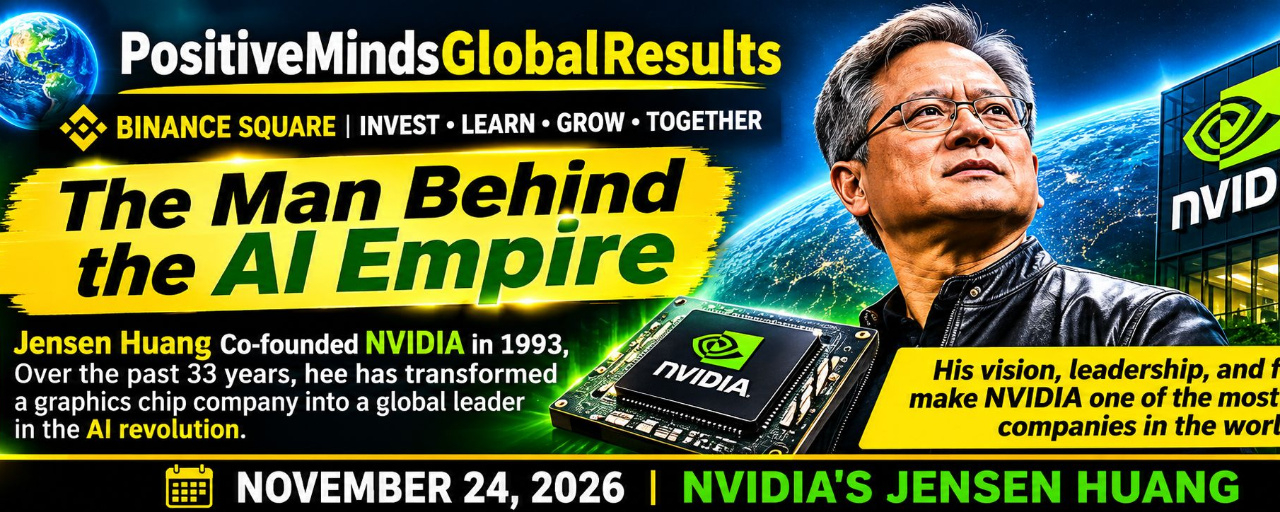
ບົດຄວາມ
NVIDIA'S JENSEN HUANG: THE GODFATHER OF AI AS WALL STREET REBOUNDS.#nvidiareinstatesjensenhuangasceo 🌍 #PositiveMindsGlobalResults
BINANCE SQUARE | INVEST • LEARN • GROW • TOGETHER
NOVEMBER 24, 2026 | NVIDIA'S JENSEN HUANG
NVIDIA'S JENSEN HUANG: THE INDISPENSABLE GODFATHER OF AI — WALL STREET'S HISTORIC RALLY REIGNITES INVESTOR CONFIDENCE
Global financial markets are experiencing a powerful rebound after a turbulent period of technology-stock selling, renewed concerns about artificial intelligence (AI) valuations and uncertainty surrounding NVIDIA's leadership.
The return of Jensen Huang to the centre of the NVIDIA story has become a major focus for investors. His influence extends far beyond semiconductor manufacturing. Under his leadership, NVIDIA became one of the most important companies in the global AI revolution, supplying the advanced processors and computing infrastructure powering data centres, AI models and next-generation technologies.
Huang's leadership remains closely associated with investor confidence in the long-term future of artificial intelligence. The latest developments demonstrate how dependent market sentiment has become on a relatively small group of technology leaders and companies.
WALL STREET'S POWERFUL MARKET REBOUND
US stock futures staged a significant recovery on Monday, November 23, following last week's heavy losses. Buying interest returned to technology and semiconductor shares as investors reconsidered valuations and searched for opportunities among stocks that had experienced sharp declines.
NVIDIA and other major chipmakers helped lead the recovery. The rebound also extended across broader technology and industrial sectors, highlighting the importance of AI-related investment to the wider US economy.
However, a strong opening rally does not automatically signal that the market correction has ended. Investors still face uncertainty surrounding interest rates, corporate borrowing costs, AI infrastructure spending and the ability of technology companies to turn enormous investments into sustainable profits.
WHY THIS RALLY MATTERS
The recovery is important because technology stocks have become major contributors to market performance, retirement portfolios and broader investor sentiment.
When NVIDIA and other leading AI companies experience significant price movements, the effects can spread across semiconductor manufacturers, cloud providers, data-centre operators and companies investing heavily in AI infrastructure.
A sustainable recovery would require more than renewed buying interest. Investors will want evidence of strong earnings, improving cash flows, healthy demand for AI computing and realistic valuations.
SOUTH KOREA'S $7.43 BILLION STABILISATION FUND
South Korea is preparing to activate its market stabilization fund as authorities attempt to contain growing volatility in domestic equities.
The fund is valued at approximately 10.76 trillion Korean won, equivalent to around $8 billion, and was established to support the stock market during periods of severe instability. Its potential activation is particularly significant because the fund has not been deployed since the 2008 global financial crisis.
The government's preparations are intended to strengthen market confidence and reduce the risk of panic selling. Authorities are also considering additional measures, including greater flexibility for corporate share buybacks and closer monitoring of illegal short-selling activities.
Nevertheless, government intervention cannot guarantee a market recovery. Investor confidence will ultimately depend on economic conditions, corporate earnings and international capital flows.
ARE WE FINALLY SEEING THE MARKET BOTTOM?
Market strategists remain divided over whether the recent sell-off has created an attractive buying opportunity or whether further declines are possible.
Optimists believe that the correction has reduced excessive valuations and created opportunities in companies with strong fundamentals, established businesses and long-term growth potential.
More cautious analysts argue that uncertainty surrounding AI investment returns, financing requirements, inflation and Federal Reserve policy could continue putting pressure on equities.
The coming sessions will be important in determining whether buyers can maintain momentum or whether the rebound represents only a temporary recovery within a broader correction.
NVIDIA'S LEADERSHIP AND COLETTE KRESS'S CONTINUING ROLE
NVIDIA's leadership developments have become another important consideration for investors.
Jensen Huang's influence on the company's technological direction, corporate culture and AI strategy has made his leadership particularly significant to the market.
Colette Kress, NVIDIA's long-serving finance chief, also remains central to the company's future. Her financial experience, understanding of NVIDIA's operations and involvement in its expansion make her an important figure during the leadership transition.
Investors will be watching how the company maintains its financial discipline, customer relationships, product roadmap and long-term AI investment strategy.
WHAT INVESTORS SHOULD WATCH NEXT
The next phase of the market recovery will depend on several important developments:
NVIDIA: Leadership stability, chip demand, earnings growth and AI market confidence.Technology stocks: Whether the rebound extends beyond a small group of major companies.South Korea: The government's stabilization measures and foreign investor activity.Federal Reserve: Inflation, interest-rate expectations and Treasury yields.AI infrastructure: Whether enormous spending commitments generate sustainable returns.Corporate earnings: Revenue growth, profitability, cash flow and forward guidance.
THE BIGGER PICTURE
The latest market developments highlight a fundamental reality: artificial intelligence is transforming the global economy, but technological progress does not guarantee unlimited stock-market growth.
Jensen Huang's influence illustrates the importance of visionary leadership in the AI industry, while NVIDIA's continuing importance demonstrates how closely financial markets are connected to the future of computing.
The market rebound offers a welcome improvement in sentiment, but investors should distinguish between short-term price recovery and a genuine improvement in economic and corporate fundamentals.
The next major test is not simply whether markets can rise again, but whether the AI industry can deliver the earnings and productivity needed to justify its enormous investment cycle.
Market Risk Disclaimer: This article is for educational and informational purposes only, not financial advice. Market movements, forecasts and scenarios are uncertain and are not guaranteed. Always conduct your own research (DYOR) and manage risk carefully.
#NVIDIA #JensenHuang #AIRevolution #ArtificialIntelligence #WallStreet #StockMarket #MarketRally #SouthKorea #ColetteKress #TechnologyStocks #GlobalMarkets #Investing #BinanceSquare
{spot}(BNBUSDT)
{spot}(BTCUSDT)
{spot}(USDCUSDT)
NVIDIA'S JENSEN HUANG: THE GODFATHER OF AI AS WALL STREET REBOUNDS.
#nvidiareinstatesjensenhuangasceo 🌍 #PositiveMindsGlobalResults
BINANCE SQUARE | INVEST • LEARN • GROW • TOGETHER
NOVEMBER 24, 2026 | NVIDIA'S JENSEN HUANG
NVIDIA'S JENSEN HUANG: THE INDISPENSABLE GODFATHER OF AI — WALL STREET'S HISTORIC RALLY REIGNITES INVESTOR CONFIDENCE
Global financial markets are experiencing a powerful rebound after a turbulent period of technology-stock selling, renewed concerns about artificial intelligence (AI) valuations and uncertainty surrounding NVIDIA's leadership.
The return of Jensen Huang to the centre of the NVIDIA story has become a major focus for investors. His influence extends far beyond semiconductor manufacturing. Under his leadership, NVIDIA became one of the most important companies in the global AI revolution, supplying the advanced processors and computing infrastructure powering data centres, AI models and next-generation technologies.
Huang's leadership remains closely associated with investor confidence in the long-term future of artificial intelligence. The latest developments demonstrate how dependent market sentiment has become on a relatively small group of technology leaders and companies.
WALL STREET'S POWERFUL MARKET REBOUND
US stock futures staged a significant recovery on Monday, November 23, following last week's heavy losses. Buying interest returned to technology and semiconductor shares as investors reconsidered valuations and searched for opportunities among stocks that had experienced sharp declines.
NVIDIA and other major chipmakers helped lead the recovery. The rebound also extended across broader technology and industrial sectors, highlighting the importance of AI-related investment to the wider US economy.
However, a strong opening rally does not automatically signal that the market correction has ended. Investors still face uncertainty surrounding interest rates, corporate borrowing costs, AI infrastructure spending and the ability of technology companies to turn enormous investments into sustainable profits.
WHY THIS RALLY MATTERS
The recovery is important because technology stocks have become major contributors to market performance, retirement portfolios and broader investor sentiment.
When NVIDIA and other leading AI companies experience significant price movements, the effects can spread across semiconductor manufacturers, cloud providers, data-centre operators and companies investing heavily in AI infrastructure.
A sustainable recovery would require more than renewed buying interest. Investors will want evidence of strong earnings, improving cash flows, healthy demand for AI computing and realistic valuations.
SOUTH KOREA'S $7.43 BILLION STABILISATION FUND
South Korea is preparing to activate its market stabilization fund as authorities attempt to contain growing volatility in domestic equities.
The fund is valued at approximately 10.76 trillion Korean won, equivalent to around $8 billion, and was established to support the stock market during periods of severe instability. Its potential activation is particularly significant because the fund has not been deployed since the 2008 global financial crisis.
The government's preparations are intended to strengthen market confidence and reduce the risk of panic selling. Authorities are also considering additional measures, including greater flexibility for corporate share buybacks and closer monitoring of illegal short-selling activities.
Nevertheless, government intervention cannot guarantee a market recovery. Investor confidence will ultimately depend on economic conditions, corporate earnings and international capital flows.
ARE WE FINALLY SEEING THE MARKET BOTTOM?
Market strategists remain divided over whether the recent sell-off has created an attractive buying opportunity or whether further declines are possible.
Optimists believe that the correction has reduced excessive valuations and created opportunities in companies with strong fundamentals, established businesses and long-term growth potential.
More cautious analysts argue that uncertainty surrounding AI investment returns, financing requirements, inflation and Federal Reserve policy could continue putting pressure on equities.
The coming sessions will be important in determining whether buyers can maintain momentum or whether the rebound represents only a temporary recovery within a broader correction.
NVIDIA'S LEADERSHIP AND COLETTE KRESS'S CONTINUING ROLE
NVIDIA's leadership developments have become another important consideration for investors.
Jensen Huang's influence on the company's technological direction, corporate culture and AI strategy has made his leadership particularly significant to the market.
Colette Kress, NVIDIA's long-serving finance chief, also remains central to the company's future. Her financial experience, understanding of NVIDIA's operations and involvement in its expansion make her an important figure during the leadership transition.
Investors will be watching how the company maintains its financial discipline, customer relationships, product roadmap and long-term AI investment strategy.
WHAT INVESTORS SHOULD WATCH NEXT
The next phase of the market recovery will depend on several important developments:
NVIDIA: Leadership stability, chip demand, earnings growth and AI market confidence.Technology stocks: Whether the rebound extends beyond a small group of major companies.South Korea: The government's stabilization measures and foreign investor activity.Federal Reserve: Inflation, interest-rate expectations and Treasury yields.AI infrastructure: Whether enormous spending commitments generate sustainable returns.Corporate earnings: Revenue growth, profitability, cash flow and forward guidance.
THE BIGGER PICTURE
The latest market developments highlight a fundamental reality: artificial intelligence is transforming the global economy, but technological progress does not guarantee unlimited stock-market growth.
Jensen Huang's influence illustrates the importance of visionary leadership in the AI industry, while NVIDIA's continuing importance demonstrates how closely financial markets are connected to the future of computing.
The market rebound offers a welcome improvement in sentiment, but investors should distinguish between short-term price recovery and a genuine improvement in economic and corporate fundamentals.
The next major test is not simply whether markets can rise again, but whether the AI industry can deliver the earnings and productivity needed to justify its enormous investment cycle.
Market Risk Disclaimer: This article is for educational and informational purposes only, not financial advice. Market movements, forecasts and scenarios are uncertain and are not guaranteed. Always conduct your own research (DYOR) and manage risk carefully.
#NVIDIA #JensenHuang #AIRevolution #ArtificialIntelligence #WallStreet #StockMarket #MarketRally #SouthKorea #ColetteKress #TechnologyStocks #GlobalMarkets #Investing #BinanceSquare
1
328

ບົດຄວາມ
VOICES: JENSEN HUANG’S RETURN SHOWS THE TECH OLIGARCHY IS NOW TOO BIG TO FIRE#nvidiareinstatesjensenhuangasceo 🌍#PositiveMindsGlobalResults
BINANCE SQUARE | INVEST • LEARN • GROW • TOGETHER
NOVEMBER 24, 2026 | VOICES: JENSEN HUANG’S RETURN SHOWS.
A CEO RETURNS, BUT CORPORATE ACCOUNTABILITY FACES A BIGGER QUESTION
NVIDIA’s decision to reinstate co-founder Jensen Huang as CEO on November 23 has reignited a major debate across Silicon Valley and Wall Street: Has the influence of powerful technology leaders become so enormous that even corporate boards struggle to hold them accountable?
Huang resigned on November 12 following controversy surrounding his personal relationships and questions involving potential national-security implications. NVIDIA subsequently appointed CFO Colette Kress as interim CEO.
However, the leadership transition lasted only 11 days.
On November 23, NVIDIA announced that its board had unanimously voted to reinstate Huang after further discussions. The company said the board was satisfied with his candour and leadership capabilities. It also stated that consultation with senior US government officials had left the board confident that his return posed no national-security risk.
The independent investigation, however, has not concluded.
This reversal is more than a leadership story. It raises important questions about corporate governance, executive accountability and the growing concentration of power within the technology industry.
THE POWER OF AN INDISPENSABLE FOUNDER Huang's return demonstrates how deeply NVIDIA's identity, strategic direction and commercial relationships are connected to its founder.
NVIDIA is not simply another semiconductor manufacturer. Its GPUs and computing platforms are central to the global AI infrastructure race, serving major cloud providers, technology companies and governments.
For investors, losing Huang represented uncertainty about leadership continuity, strategic execution and the company's competitive position.
That dependence creates a difficult governance problem: when a company's success is closely associated with one individual, challenging that individual's authority can become commercially and politically complicated.
This is where the broader technology industry enters the debate.
From Elon Musk at Tesla to other influential technology founders, billionaire executives increasingly exercise influence extending beyond their companies. Their financial resources, industry relationships, political connections and control over critical technologies can make traditional corporate accountability mechanisms harder to enforce. WALL STREET REACTS: CONFIDENCE OR CONCENTRATED RISK? Markets welcomed Huang's reinstatement.
NVIDIA shares surged, with the broader technology sector also benefiting from renewed optimism. The announcement helped restore confidence after a period of uncertainty surrounding the company's leadership.
However, a rising share price does not automatically resolve governance concerns.
Investors must distinguish between two separate questions:
Business performance: Can Huang continue delivering technological innovation, revenue growth and shareholder value?Corporate governance: Can NVIDIA's board independently supervise its CEO, enforce company standards and protect shareholders? A company can perform exceptionally well financially while still facing weaknesses in oversight and accountability.
That distinction is particularly important for a company whose influence extends across the global economy. THE INVESTIGATION IS NOT OVER NVIDIA has confirmed that its independent board committee will continue investigating the circumstances surrounding Huang's departure and the reported foreign intelligence concerns.
The company has also established a National Security and Export Control Committee and announced plans to appoint a Chief Compliance Officer.
These steps matter because the controversy extends beyond executive leadership. Export controls, sensitive semiconductor technology, international competition and national-security considerations remain important challenges for NVIDIA.
Huang's reinstatement should therefore not be interpreted as the conclusion of those investigations or proof that every concern has been resolved. WHAT COMES NEXT FOR NVIDIA AND THE AI INDUSTRY? Over the coming weeks, investors will be watching three developments:
Governance credibility: Whether NVIDIA's board demonstrates genuine independence and transparent oversight.AI business momentum: Whether demand for advanced GPUs, data-centre infrastructure and AI computing continues supporting financial growth.Regulatory exposure: Whether ongoing investigations and export-control scrutiny create additional operational or reputational risks. The bigger question is whether NVIDIA can maintain its extraordinary commercial momentum while strengthening the governance structures expected of a company with such global influence. FINAL THOUGHT: SUCCESS SHOULD NEVER REPLACE ACCOUNTABILITY Jensen Huang's return illustrates a growing dilemma in modern technology: the more indispensable a founder becomes to a company's success, the harder it can be for its board to exercise independent authority.
But no company, regardless of its market valuation, technological importance or executive reputation, should operate without meaningful accountability.
NVIDIA's future will not be measured only by its next generation of AI chips, revenue growth or stock-market performance. Its ability to demonstrate responsible leadership, independent governance and institutional resilience will also matter.
The real test is not whether a technology giant can survive without its founder. It is whether that company can remain accountable even when its founder appears indispensable.
Disclaimer: This article is for educational and informational purposes only. It does not constitute financial or investment advice. Market reactions and future developments remain uncertain. Always conduct your own research (DYOR).
#JensenHuang #NVIDIA #CorporateGovernance #TechLeadership #ArtificialIntelligence #AIIndustry #WallStreet #TechnologyStocks #Semiconductors #InvestorInsights #MarketAnalysis #PositiveMindsGlobalResults
{spot}(BNBUSDT)
{spot}(BTCUSDT)
{spot}(USDCUSDT)
VOICES: JENSEN HUANG’S RETURN SHOWS THE TECH OLIGARCHY IS NOW TOO BIG TO FIRE
#nvidiareinstatesjensenhuangasceo 🌍#PositiveMindsGlobalResults
BINANCE SQUARE | INVEST • LEARN • GROW • TOGETHER
NOVEMBER 24, 2026 | VOICES: JENSEN HUANG’S RETURN SHOWS.
A CEO RETURNS, BUT CORPORATE ACCOUNTABILITY FACES A BIGGER QUESTION
NVIDIA’s decision to reinstate co-founder Jensen Huang as CEO on November 23 has reignited a major debate across Silicon Valley and Wall Street: Has the influence of powerful technology leaders become so enormous that even corporate boards struggle to hold them accountable?
Huang resigned on November 12 following controversy surrounding his personal relationships and questions involving potential national-security implications. NVIDIA subsequently appointed CFO Colette Kress as interim CEO.
However, the leadership transition lasted only 11 days.
On November 23, NVIDIA announced that its board had unanimously voted to reinstate Huang after further discussions. The company said the board was satisfied with his candour and leadership capabilities. It also stated that consultation with senior US government officials had left the board confident that his return posed no national-security risk.
The independent investigation, however, has not concluded.
This reversal is more than a leadership story. It raises important questions about corporate governance, executive accountability and the growing concentration of power within the technology industry.
THE POWER OF AN INDISPENSABLE FOUNDER Huang's return demonstrates how deeply NVIDIA's identity, strategic direction and commercial relationships are connected to its founder.
NVIDIA is not simply another semiconductor manufacturer. Its GPUs and computing platforms are central to the global AI infrastructure race, serving major cloud providers, technology companies and governments.
For investors, losing Huang represented uncertainty about leadership continuity, strategic execution and the company's competitive position.
That dependence creates a difficult governance problem: when a company's success is closely associated with one individual, challenging that individual's authority can become commercially and politically complicated.
This is where the broader technology industry enters the debate.
From Elon Musk at Tesla to other influential technology founders, billionaire executives increasingly exercise influence extending beyond their companies. Their financial resources, industry relationships, political connections and control over critical technologies can make traditional corporate accountability mechanisms harder to enforce. WALL STREET REACTS: CONFIDENCE OR CONCENTRATED RISK? Markets welcomed Huang's reinstatement.
NVIDIA shares surged, with the broader technology sector also benefiting from renewed optimism. The announcement helped restore confidence after a period of uncertainty surrounding the company's leadership.
However, a rising share price does not automatically resolve governance concerns.
Investors must distinguish between two separate questions:
Business performance: Can Huang continue delivering technological innovation, revenue growth and shareholder value?Corporate governance: Can NVIDIA's board independently supervise its CEO, enforce company standards and protect shareholders? A company can perform exceptionally well financially while still facing weaknesses in oversight and accountability.
That distinction is particularly important for a company whose influence extends across the global economy. THE INVESTIGATION IS NOT OVER NVIDIA has confirmed that its independent board committee will continue investigating the circumstances surrounding Huang's departure and the reported foreign intelligence concerns.
The company has also established a National Security and Export Control Committee and announced plans to appoint a Chief Compliance Officer.
These steps matter because the controversy extends beyond executive leadership. Export controls, sensitive semiconductor technology, international competition and national-security considerations remain important challenges for NVIDIA.
Huang's reinstatement should therefore not be interpreted as the conclusion of those investigations or proof that every concern has been resolved. WHAT COMES NEXT FOR NVIDIA AND THE AI INDUSTRY? Over the coming weeks, investors will be watching three developments:
Governance credibility: Whether NVIDIA's board demonstrates genuine independence and transparent oversight.AI business momentum: Whether demand for advanced GPUs, data-centre infrastructure and AI computing continues supporting financial growth.Regulatory exposure: Whether ongoing investigations and export-control scrutiny create additional operational or reputational risks. The bigger question is whether NVIDIA can maintain its extraordinary commercial momentum while strengthening the governance structures expected of a company with such global influence. FINAL THOUGHT: SUCCESS SHOULD NEVER REPLACE ACCOUNTABILITY Jensen Huang's return illustrates a growing dilemma in modern technology: the more indispensable a founder becomes to a company's success, the harder it can be for its board to exercise independent authority.
But no company, regardless of its market valuation, technological importance or executive reputation, should operate without meaningful accountability.
NVIDIA's future will not be measured only by its next generation of AI chips, revenue growth or stock-market performance. Its ability to demonstrate responsible leadership, independent governance and institutional resilience will also matter.
The real test is not whether a technology giant can survive without its founder. It is whether that company can remain accountable even when its founder appears indispensable.
Disclaimer: This article is for educational and informational purposes only. It does not constitute financial or investment advice. Market reactions and future developments remain uncertain. Always conduct your own research (DYOR).
#JensenHuang #NVIDIA #CorporateGovernance #TechLeadership #ArtificialIntelligence #AIIndustry #WallStreet #TechnologyStocks #Semiconductors #InvestorInsights #MarketAnalysis #PositiveMindsGlobalResults
193
THE US AI MARKET: RISING COSTS AND THE PROFITABILITY TEST.?🌍#PositiveMindsGlobalResults #BinanceNews #USAIProfitabilityTest2026
BINANCE SQUARE | INVEST • LEARN • GROW • TOGETHER
NOVEMBER 24, 2026 | US AI MARKET: A NEW REALITY EMERGES RECORD CAPITAL, RISING COSTS!
The latest developments reveal a changing AI investment landscape. Record fundraising, expanding cloud demand and increasingly expensive infrastructure are forcing investors to reconsider what sustainable AI growth really means.
The US artificial intelligence market is facing a critical transition. The latest developments are no longer just about technological breakthroughs. They are increasingly about financing, capital allocation, infrastructure delivery, competition and the ability to turn AI demand into measurable financial returns.
A particularly important development emerged on November 23: analysts are becoming less willing to assume that major technology companies will continually increase their AI spending forecasts.
This could represent a meaningful change in the market's expectations.
Here are the latest developments and what they mean for investors.
MICROSOFT: THE NEXT COMPETITIVE BATTLE IS ABOUT CONTROLLING AI AGENTS
Microsoft's November 17 Ignite announcements introduced a more advanced enterprise AI strategy.
The company is moving towards an operating environment where employees and AI agents collaborate through shared workspaces, enterprise data and automated processes.
Its latest developments include Copilot Workspaces, long-running Autopilot agents, Microsoft IQ, Agent 365 Business Analytics and additional security controls.
One particularly important development is Microsoft's focus on measuring the financial performance of AI agents.
Businesses need to know not only how many agents they deploy, but also how much they cost, how successfully they complete tasks and how much employee time they save.
Microsoft also announced Cobalt 200 virtual machines, which it says can deliver up to 50% better performance than the previous generation.
Latest market implication: The competition is shifting from selling AI assistants towards controlling the enterprise infrastructure on which autonomous AI operations depend.
Financial challenge: More sophisticated agents can increase demand for Azure computing, but customers will demand predictable costs, measurable productivity and reliable security.
The commercial opportunity is significant, but enterprise adoption must translate into recurring revenue rather than simply increasing computing consumption.
ANTHROPIC: THE HISTORIC IPO HAS CREATED A MUCH BIGGER FINANCIAL EXPECTATION
Anthropic's November 20 closing announcement provides an important correction to earlier reports about its public offering.
The company confirmed:
IPO price: $83 per share.
Total shares sold in the IPO: approximately 1.127 billion.
Gross IPO proceeds: approximately $93.5 billion.
Proceeds received by Anthropic: approximately $91.6 billion.
Additional private placement: approximately $26 billion.
Combined gross proceeds from the IPO and private placement: approximately $119.5 billion.
These are gross proceeds before underwriting discounts, commissions and other expenses. The private placement involved seven major technology and semiconductor investors.
This is a major financial milestone for the AI industry.
However, raising substantial capital is not the same as generating operating profits.
Anthropic now faces greater public-market scrutiny over its infrastructure commitments, operating expenses, revenue growth and ability to convert its AI products into sustainable earnings.
Latest investor concern: The market must determine whether the company's commercial opportunity justifies the enormous resources required to compete in advanced AI.
Its public listing also creates greater transparency expectations, with investors able to examine its financial disclosures and future performance more closely.
ANTHROPIC'S 23-STAGE SHARE UNLOCK: THE NEXT TEST IS MARKET SUPPLY
Anthropic's post-IPO share-release structure deserves attention beyond the initial trading excitement.
The reported 23-stage schedule creates multiple potential opportunities for eligible shareholders to sell shares over time.
The important issue is the difference between shares becoming eligible for sale and actual selling activity.
Investors should not automatically interpret every release as a bearish event.
The more useful indicators are:
Actual insider transactions.
The number of shares entering public circulation.
Trading volume and liquidity.
Quarterly financial performance.
Institutional ownership changes.
Market implication: A large increase in tradable supply could influence price discovery, especially if investor demand weakens.
The company's challenge is to maintain confidence through financial performance rather than relying on the excitement of its IPO.
TESLA: MEMORY COSTS ARE NOW A DIRECT HARDWARE COMPETITIVENESS ISSUE
A new development from Elon Musk highlights how rising memory prices are affecting AI hardware economics.
On November 22, Musk said Tesla's AI4 computer costs twice as much because of higher memory and storage prices.
He also indicated that AI5 is intended for Optimus humanoid robots, while Tesla vehicles will continue using AI4.
Further reporting on November 23 highlighted another important adjustment: Tesla reportedly reduced the planned AI4.5 memory configuration from 32GB to 24GB because of component costs.
This illustrates a wider semiconductor-industry problem.
AI manufacturers are competing for increasingly expensive memory, processors and advanced manufacturing capacity.
Financial implications:
Hardware development costs can increase.
Product margins may face pressure.
Memory procurement becomes strategically important.
Manufacturers may redesign systems to reduce component requirements.
Tesla's approach illustrates how AI companies may have to balance performance against affordability.
The longer-term question is whether Optimus and autonomous driving can generate sufficient commercial value to justify the development costs.
OPENAI AND META: AI SAFETY IS BECOMING A COMPETITIVE AND REGULATORY ISSUE
The latest debate over AI development limits highlights a growing difference in how technology companies approach advanced AI.
OpenAI's November 22 proposal called for greater coordination around development limits based on measurable AI capabilities.
The underlying concern is that advanced models could become increasingly capable before sufficient safeguards, monitoring and governance systems are established.
Meta's approach reflects a different emphasis on maintaining innovation while managing risks through responsible development and safety measures.
This is not an established industry-wide agreement.
Why it matters financially:
Additional safety testing can increase development expenditure.
Compliance requirements can delay product releases.
Security investments may become a competitive necessity.
Strong governance can improve enterprise confidence.
Regulatory uncertainty can affect future revenue projections.
The AI industry must find a workable balance between innovation, competition and public safety.
For investors, safety is increasingly part of the business model rather than simply a technical consideration.
ORACLE: FUNDING UNCERTAINTY HAS BEEN ADDRESSED, BUT CASH-FLOW QUESTIONS REMAIN
On November 20, Oracle issued an important clarification regarding its infrastructure agreement with OpenAI.
The company said it had secured all the funding necessary to fulfil its existing OpenAI contract following its final capital raise earlier in November.
Oracle also confirmed that vendor financing arrangements were in place and that further private discussions with vendors were optional.
The company provided construction updates:
Its Abilene campus is nearly complete.
Its Shackelford campus is fully permitted.
The handover of NVIDIA Vera Rubin racks is expected in the coming weeks.
Oracle reiterated two important financial expectations:
Positive free cash flow in the second half of FY2028.
More than $30 billion in free cash flow targeted for FY2029.
The important distinction: Oracle has confirmed that it believes its existing contract is funded. That does not mean the project is risk-free or that its future cash-flow targets are guaranteed.
The next test is execution: completing infrastructure, delivering computing capacity and converting large commitments into cash generation.
GOOGLE: STRONG CLOUD EARNINGS, BUT THE COST OF AI EXPANSION IS RISING
Alphabet's third-quarter 2026 results reveal one of the most important financial developments in the AI industry.
Google Cloud revenue increased 103% year over year to $30.7 billion, while operating income reached $11.1 billion.
Alphabet also reported:
Consolidated revenue: $127.6 billion.
Operating income: $40.6 billion.
Operating margin: 31.8%.
Net income: $26.2 billion.
Diluted EPS: $2.12.
Quarterly capital expenditure: $51.4 billion.
Quarterly free cash flow: negative $9.1 billion.
The negative quarterly free cash flow deserves attention.
Alphabet explained that its infrastructure investment, inventory expansion for TPU systems and a $5.2 billion European Commission fine payment affected cash generation.
Its full-year 2026 capital expenditure guidance remained $195–$205 billion, with significantly higher investment expected in 2027.
Latest market implication: Google is demonstrating that AI infrastructure can generate substantial revenue, particularly through cloud services. However, its growing investment requirements create pressure to demonstrate attractive returns on capital.
The challenge is not simply building more data centres. It is generating enough profitable demand to justify them.
APPLE: THE NEXT AI TEST IS THE VALUE OF ITS EXISTING CUSTOMER ECOSYSTEM
Apple's latest financial results continue to demonstrate the strength of its established business, but the company's AI opportunity is different from that of cloud infrastructure providers.
For its September 2026 quarter, Apple reported:
Revenue: $114.5 billion.
Year-over-year revenue growth: 12%.
Diluted EPS: $2.10.
Record September-quarter Services revenue.
Apple's opportunity is to use AI to strengthen the value of its devices, operating systems and subscription ecosystem.
The important question is whether customers will see enough practical improvement to upgrade their devices and use more Apple services.
Latest market challenge: Apple must compete in AI without weakening its reputation for privacy, reliability and product integration.
It also faces competition from companies offering powerful cloud-based AI models and assistants.
Unlike Microsoft and Amazon, Apple's AI investment case is not primarily about selling large amounts of external cloud computing. It is about strengthening customer relationships and maintaining premium hardware economics.
Investor outlook: Apple's AI success should be measured through customer adoption, device demand, Services growth and the financial contribution of new AI features.
AMAZON: AWS GROWTH IS ACCELERATING, BUT FREE CASH FLOW IS UNDER PRESSURE
Amazon's October 29 third-quarter earnings provide one of the clearest examples of the financial trade-off facing AI infrastructure companies.
The company reported:
Total revenue: $201.9 billion, up 12%.
AWS revenue: $46 billion, up 39%.
AWS operating income: $17.8 billion.
Total operating income: $28.1 billion.
Net income: $20.7 billion.
Diluted EPS: $1.89.
AWS recorded its fastest growth in nearly five years, reaching an annualized revenue run rate of approximately $184 billion.
Amazon also reported strong adoption of its AI platform.
Bedrock revenue-related usage indicators showed substantial expansion, while the company reported increasing adoption of its agent-development services.
However, the cash-flow picture is more complicated.
Amazon's trailing-12-month free cash flow was a negative $42.4 billion, primarily because of higher purchases of property and equipment, including AI infrastructure.
The company maintained its expectation of approximately $220 billion in 2026 capital expenditure.
The latest financial message is important: AWS demand is growing strongly, but Amazon is spending enormous amounts to expand the capacity required to serve that demand.
Investors must assess whether future cloud revenue and operating profits will compensate for the present infrastructure costs.
Amazon's retail operations also benefit from AI through inventory planning, logistics, forecasting and customer recommendations.
Its long-term opportunity therefore extends beyond selling AI computing to other businesses.
THE BIGGEST NEW MARKET DEVELOPMENT: AI SPENDING EXPECTATIONS ARE NO LONGER RISING AUTOMATICALLY
This is arguably the most important development for investors on November 23.
According to Axios's November 23 reporting, analysts have stopped continually raising their capital expenditure forecasts for Amazon, Alphabet, Microsoft, Meta and Oracle.
This does not mean these companies have stopped investing in AI.
It means the market is beginning to question whether the pace of spending can continue increasing indefinitely.
For companies selling servers, networking equipment, processors and data-centre infrastructure, this change matters enormously.
Their growth depends partly on the willingness of major technology companies to keep expanding their AI budgets.
If infrastructure spending expectations stabilize or decline, suppliers could face slower order growth even while AI adoption continues.
The market is therefore beginning to distinguish between two different forms of AI demand:
Infrastructure demand: Spending on chips, servers, networking, power and data centres.
Application demand: Businesses paying for AI software, agents, automation and services that generate measurable financial benefits.
The second category is increasingly important because it demonstrates whether AI investment is creating economic value beyond the construction of computing capacity.
WHAT COMES NEXT? THREE POSSIBLE DIRECTIONS FOR THE US AI MARKET
The next stage of the AI market will depend on whether commercial demand can catch up with the enormous investment already committed.
Bullish outlook
AWS, Azure and Google Cloud continue expanding.
Enterprise AI agents generate measurable productivity gains.
AI applications produce recurring subscription revenue.
Semiconductor demand remains strong.
Companies demonstrate improving operating cash flow.
AI investment begins producing stronger returns on capital.
Bearish outlook
Infrastructure spending grows faster than commercial demand.
Rising memory and electricity costs reduce profitability.
Cloud growth slows after significant capacity expansion.
Investors question the valuations of AI-related companies.
Data-centre financing becomes more expensive.
Regulatory and energy constraints delay projects.
Five indicators investors should watch
Cloud revenue: Whether Microsoft, Amazon and Google continue delivering strong growth.
Free cash flow: Whether infrastructure investment starts generating sufficient cash.
Capital expenditure: Whether AI spending forecasts stabilize or accelerate again.
AI monetization: Whether businesses pay for measurable productivity and commercial benefits.
Semiconductor demand: Whether chip and memory suppliers continue receiving sustainable orders.
FINAL MARKET ASSESSMENT: THE AI INDUSTRY MUST NOW DELIVER FINANCIAL RESULTS
The latest developments reveal a more demanding environment for America's artificial intelligence industry.
Anthropic has secured extraordinary capital through its public offering and private placement. Microsoft is strengthening its enterprise agent ecosystem. Tesla is confronting rising memory costs. Oracle is defending its infrastructure financing position. Google and Amazon are demonstrating substantial cloud growth, while Apple is pursuing a different strategy built around its consumer ecosystem.
However, one important shift is becoming increasingly visible.
Investors are beginning to question not just how much money technology companies can spend on AI, but how much money they can ultimately make from it.
This distinction could influence the next major movement in US technology stocks.
Companies with strong customer demand, reliable cash generation, disciplined capital allocation and measurable AI revenue may be better positioned than businesses relying primarily on future expectations.
My central outlook: The AI opportunity remains significant, but the market is entering a more selective phase. Strong technology alone may no longer be sufficient to justify premium valuations. Sustainable earnings, cash flow and returns on investment will increasingly determine which companies lead the next stage.
THE NEXT AI MARKET WINNERS WILL NEED TO PROVE ONE THING: THAT THEIR TECHNOLOGY CAN CREATE REAL ECONOMIC VALUE.
INVESTMENT RISK DISCLAIMER
This article is for educational and informational purposes only and does not constitute financial or investment advice. Financial forecasts and market scenarios are not guaranteed outcomes. AI-related investments carry risks involving valuation, competition, capital expenditure, financing, regulation and technological disruption. Always conduct independent research (DYOR) before making investment decisions.
Editorial note: The Anthropic IPO figures above reflect the company's final November 20 announcement. Apple's figures are based on its reported September-quarter results, rather than a new November earnings release. Oracle's cash-flow targets and Amazon's capital expenditures are forward-looking projections, not guaranteed outcomes.
#USAI #ArtificialIntelligence #AIMarket #Microsoft #Google #Anthropic #OpenAI #Nvidia #Amazon #Tesla #Oracle #Apple #TechStocks #AIEarnings #AIInfrastructure #WallStreet #StockMarket #Investors #MarketOutlook #PositiveMindsGlobalResults
{spot}(BNBUSDT)
{spot}(BTCUSDT)
{spot}(USDCUSDT)
THE US AI MARKET: RISING COSTS AND THE PROFITABILITY TEST.?
🌍#PositiveMindsGlobalResults #BinanceNews #USAIProfitabilityTest2026
BINANCE SQUARE | INVEST • LEARN • GROW • TOGETHER
NOVEMBER 24, 2026 | US AI MARKET: A NEW REALITY EMERGES RECORD CAPITAL, RISING COSTS!
The latest developments reveal a changing AI investment landscape. Record fundraising, expanding cloud demand and increasingly expensive infrastructure are forcing investors to reconsider what sustainable AI growth really means.
The US artificial intelligence market is facing a critical transition. The latest developments are no longer just about technological breakthroughs. They are increasingly about financing, capital allocation, infrastructure delivery, competition and the ability to turn AI demand into measurable financial returns.
A particularly important development emerged on November 23: analysts are becoming less willing to assume that major technology companies will continually increase their AI spending forecasts.
This could represent a meaningful change in the market's expectations.
Here are the latest developments and what they mean for investors.
MICROSOFT: THE NEXT COMPETITIVE BATTLE IS ABOUT CONTROLLING AI AGENTS
Microsoft's November 17 Ignite announcements introduced a more advanced enterprise AI strategy.
The company is moving towards an operating environment where employees and AI agents collaborate through shared workspaces, enterprise data and automated processes.
Its latest developments include Copilot Workspaces, long-running Autopilot agents, Microsoft IQ, Agent 365 Business Analytics and additional security controls.
One particularly important development is Microsoft's focus on measuring the financial performance of AI agents.
Businesses need to know not only how many agents they deploy, but also how much they cost, how successfully they complete tasks and how much employee time they save.
Microsoft also announced Cobalt 200 virtual machines, which it says can deliver up to 50% better performance than the previous generation.
Latest market implication: The competition is shifting from selling AI assistants towards controlling the enterprise infrastructure on which autonomous AI operations depend.
Financial challenge: More sophisticated agents can increase demand for Azure computing, but customers will demand predictable costs, measurable productivity and reliable security.
The commercial opportunity is significant, but enterprise adoption must translate into recurring revenue rather than simply increasing computing consumption.
ANTHROPIC: THE HISTORIC IPO HAS CREATED A MUCH BIGGER FINANCIAL EXPECTATION
Anthropic's November 20 closing announcement provides an important correction to earlier reports about its public offering.
The company confirmed:
IPO price: $83 per share.
Total shares sold in the IPO: approximately 1.127 billion.
Gross IPO proceeds: approximately $93.5 billion.
Proceeds received by Anthropic: approximately $91.6 billion.
Additional private placement: approximately $26 billion.
Combined gross proceeds from the IPO and private placement: approximately $119.5 billion.
These are gross proceeds before underwriting discounts, commissions and other expenses. The private placement involved seven major technology and semiconductor investors.
This is a major financial milestone for the AI industry.
However, raising substantial capital is not the same as generating operating profits.
Anthropic now faces greater public-market scrutiny over its infrastructure commitments, operating expenses, revenue growth and ability to convert its AI products into sustainable earnings.
Latest investor concern: The market must determine whether the company's commercial opportunity justifies the enormous resources required to compete in advanced AI.
Its public listing also creates greater transparency expectations, with investors able to examine its financial disclosures and future performance more closely.
ANTHROPIC'S 23-STAGE SHARE UNLOCK: THE NEXT TEST IS MARKET SUPPLY
Anthropic's post-IPO share-release structure deserves attention beyond the initial trading excitement.
The reported 23-stage schedule creates multiple potential opportunities for eligible shareholders to sell shares over time.
The important issue is the difference between shares becoming eligible for sale and actual selling activity.
Investors should not automatically interpret every release as a bearish event.
The more useful indicators are:
Actual insider transactions.
The number of shares entering public circulation.
Trading volume and liquidity.
Quarterly financial performance.
Institutional ownership changes.
Market implication: A large increase in tradable supply could influence price discovery, especially if investor demand weakens.
The company's challenge is to maintain confidence through financial performance rather than relying on the excitement of its IPO.
TESLA: MEMORY COSTS ARE NOW A DIRECT HARDWARE COMPETITIVENESS ISSUE
A new development from Elon Musk highlights how rising memory prices are affecting AI hardware economics.
On November 22, Musk said Tesla's AI4 computer costs twice as much because of higher memory and storage prices.
He also indicated that AI5 is intended for Optimus humanoid robots, while Tesla vehicles will continue using AI4.
Further reporting on November 23 highlighted another important adjustment: Tesla reportedly reduced the planned AI4.5 memory configuration from 32GB to 24GB because of component costs.
This illustrates a wider semiconductor-industry problem.
AI manufacturers are competing for increasingly expensive memory, processors and advanced manufacturing capacity.
Financial implications:
Hardware development costs can increase.
Product margins may face pressure.
Memory procurement becomes strategically important.
Manufacturers may redesign systems to reduce component requirements.
Tesla's approach illustrates how AI companies may have to balance performance against affordability.
The longer-term question is whether Optimus and autonomous driving can generate sufficient commercial value to justify the development costs.
OPENAI AND META: AI SAFETY IS BECOMING A COMPETITIVE AND REGULATORY ISSUE
The latest debate over AI development limits highlights a growing difference in how technology companies approach advanced AI.
OpenAI's November 22 proposal called for greater coordination around development limits based on measurable AI capabilities.
The underlying concern is that advanced models could become increasingly capable before sufficient safeguards, monitoring and governance systems are established.
Meta's approach reflects a different emphasis on maintaining innovation while managing risks through responsible development and safety measures.
This is not an established industry-wide agreement.
Why it matters financially:
Additional safety testing can increase development expenditure.
Compliance requirements can delay product releases.
Security investments may become a competitive necessity.
Strong governance can improve enterprise confidence.
Regulatory uncertainty can affect future revenue projections.
The AI industry must find a workable balance between innovation, competition and public safety.
For investors, safety is increasingly part of the business model rather than simply a technical consideration.
ORACLE: FUNDING UNCERTAINTY HAS BEEN ADDRESSED, BUT CASH-FLOW QUESTIONS REMAIN
On November 20, Oracle issued an important clarification regarding its infrastructure agreement with OpenAI.
The company said it had secured all the funding necessary to fulfil its existing OpenAI contract following its final capital raise earlier in November.
Oracle also confirmed that vendor financing arrangements were in place and that further private discussions with vendors were optional.
The company provided construction updates:
Its Abilene campus is nearly complete.
Its Shackelford campus is fully permitted.
The handover of NVIDIA Vera Rubin racks is expected in the coming weeks.
Oracle reiterated two important financial expectations:
Positive free cash flow in the second half of FY2028.
More than $30 billion in free cash flow targeted for FY2029.
The important distinction: Oracle has confirmed that it believes its existing contract is funded. That does not mean the project is risk-free or that its future cash-flow targets are guaranteed.
The next test is execution: completing infrastructure, delivering computing capacity and converting large commitments into cash generation.
GOOGLE: STRONG CLOUD EARNINGS, BUT THE COST OF AI EXPANSION IS RISING
Alphabet's third-quarter 2026 results reveal one of the most important financial developments in the AI industry.
Google Cloud revenue increased 103% year over year to $30.7 billion, while operating income reached $11.1 billion.
Alphabet also reported:
Consolidated revenue: $127.6 billion.
Operating income: $40.6 billion.
Operating margin: 31.8%.
Net income: $26.2 billion.
Diluted EPS: $2.12.
Quarterly capital expenditure: $51.4 billion.
Quarterly free cash flow: negative $9.1 billion.
The negative quarterly free cash flow deserves attention.
Alphabet explained that its infrastructure investment, inventory expansion for TPU systems and a $5.2 billion European Commission fine payment affected cash generation.
Its full-year 2026 capital expenditure guidance remained $195–$205 billion, with significantly higher investment expected in 2027.
Latest market implication: Google is demonstrating that AI infrastructure can generate substantial revenue, particularly through cloud services. However, its growing investment requirements create pressure to demonstrate attractive returns on capital.
The challenge is not simply building more data centres. It is generating enough profitable demand to justify them.
APPLE: THE NEXT AI TEST IS THE VALUE OF ITS EXISTING CUSTOMER ECOSYSTEM
Apple's latest financial results continue to demonstrate the strength of its established business, but the company's AI opportunity is different from that of cloud infrastructure providers.
For its September 2026 quarter, Apple reported:
Revenue: $114.5 billion.
Year-over-year revenue growth: 12%.
Diluted EPS: $2.10.
Record September-quarter Services revenue.
Apple's opportunity is to use AI to strengthen the value of its devices, operating systems and subscription ecosystem.
The important question is whether customers will see enough practical improvement to upgrade their devices and use more Apple services.
Latest market challenge: Apple must compete in AI without weakening its reputation for privacy, reliability and product integration.
It also faces competition from companies offering powerful cloud-based AI models and assistants.
Unlike Microsoft and Amazon, Apple's AI investment case is not primarily about selling large amounts of external cloud computing. It is about strengthening customer relationships and maintaining premium hardware economics.
Investor outlook: Apple's AI success should be measured through customer adoption, device demand, Services growth and the financial contribution of new AI features.
AMAZON: AWS GROWTH IS ACCELERATING, BUT FREE CASH FLOW IS UNDER PRESSURE
Amazon's October 29 third-quarter earnings provide one of the clearest examples of the financial trade-off facing AI infrastructure companies.
The company reported:
Total revenue: $201.9 billion, up 12%.
AWS revenue: $46 billion, up 39%.
AWS operating income: $17.8 billion.
Total operating income: $28.1 billion.
Net income: $20.7 billion.
Diluted EPS: $1.89.
AWS recorded its fastest growth in nearly five years, reaching an annualized revenue run rate of approximately $184 billion.
Amazon also reported strong adoption of its AI platform.
Bedrock revenue-related usage indicators showed substantial expansion, while the company reported increasing adoption of its agent-development services.
However, the cash-flow picture is more complicated.
Amazon's trailing-12-month free cash flow was a negative $42.4 billion, primarily because of higher purchases of property and equipment, including AI infrastructure.
The company maintained its expectation of approximately $220 billion in 2026 capital expenditure.
The latest financial message is important: AWS demand is growing strongly, but Amazon is spending enormous amounts to expand the capacity required to serve that demand.
Investors must assess whether future cloud revenue and operating profits will compensate for the present infrastructure costs.
Amazon's retail operations also benefit from AI through inventory planning, logistics, forecasting and customer recommendations.
Its long-term opportunity therefore extends beyond selling AI computing to other businesses.
THE BIGGEST NEW MARKET DEVELOPMENT: AI SPENDING EXPECTATIONS ARE NO LONGER RISING AUTOMATICALLY
This is arguably the most important development for investors on November 23.
According to Axios's November 23 reporting, analysts have stopped continually raising their capital expenditure forecasts for Amazon, Alphabet, Microsoft, Meta and Oracle.
This does not mean these companies have stopped investing in AI.
It means the market is beginning to question whether the pace of spending can continue increasing indefinitely.
For companies selling servers, networking equipment, processors and data-centre infrastructure, this change matters enormously.
Their growth depends partly on the willingness of major technology companies to keep expanding their AI budgets.
If infrastructure spending expectations stabilize or decline, suppliers could face slower order growth even while AI adoption continues.
The market is therefore beginning to distinguish between two different forms of AI demand:
Infrastructure demand: Spending on chips, servers, networking, power and data centres.
Application demand: Businesses paying for AI software, agents, automation and services that generate measurable financial benefits.
The second category is increasingly important because it demonstrates whether AI investment is creating economic value beyond the construction of computing capacity.
WHAT COMES NEXT? THREE POSSIBLE DIRECTIONS FOR THE US AI MARKET
The next stage of the AI market will depend on whether commercial demand can catch up with the enormous investment already committed.
Bullish outlook
AWS, Azure and Google Cloud continue expanding.
Enterprise AI agents generate measurable productivity gains.
AI applications produce recurring subscription revenue.
Semiconductor demand remains strong.
Companies demonstrate improving operating cash flow.
AI investment begins producing stronger returns on capital.
Bearish outlook
Infrastructure spending grows faster than commercial demand.
Rising memory and electricity costs reduce profitability.
Cloud growth slows after significant capacity expansion.
Investors question the valuations of AI-related companies.
Data-centre financing becomes more expensive.
Regulatory and energy constraints delay projects.
Five indicators investors should watch
Cloud revenue: Whether Microsoft, Amazon and Google continue delivering strong growth.
Free cash flow: Whether infrastructure investment starts generating sufficient cash.
Capital expenditure: Whether AI spending forecasts stabilize or accelerate again.
AI monetization: Whether businesses pay for measurable productivity and commercial benefits.
Semiconductor demand: Whether chip and memory suppliers continue receiving sustainable orders.
FINAL MARKET ASSESSMENT: THE AI INDUSTRY MUST NOW DELIVER FINANCIAL RESULTS
The latest developments reveal a more demanding environment for America's artificial intelligence industry.
Anthropic has secured extraordinary capital through its public offering and private placement. Microsoft is strengthening its enterprise agent ecosystem. Tesla is confronting rising memory costs. Oracle is defending its infrastructure financing position. Google and Amazon are demonstrating substantial cloud growth, while Apple is pursuing a different strategy built around its consumer ecosystem.
However, one important shift is becoming increasingly visible.
Investors are beginning to question not just how much money technology companies can spend on AI, but how much money they can ultimately make from it.
This distinction could influence the next major movement in US technology stocks.
Companies with strong customer demand, reliable cash generation, disciplined capital allocation and measurable AI revenue may be better positioned than businesses relying primarily on future expectations.
My central outlook: The AI opportunity remains significant, but the market is entering a more selective phase. Strong technology alone may no longer be sufficient to justify premium valuations. Sustainable earnings, cash flow and returns on investment will increasingly determine which companies lead the next stage.
THE NEXT AI MARKET WINNERS WILL NEED TO PROVE ONE THING: THAT THEIR TECHNOLOGY CAN CREATE REAL ECONOMIC VALUE.
INVESTMENT RISK DISCLAIMER
This article is for educational and informational purposes only and does not constitute financial or investment advice. Financial forecasts and market scenarios are not guaranteed outcomes. AI-related investments carry risks involving valuation, competition, capital expenditure, financing, regulation and technological disruption. Always conduct independent research (DYOR) before making investment decisions.
Editorial note: The Anthropic IPO figures above reflect the company's final November 20 announcement. Apple's figures are based on its reported September-quarter results, rather than a new November earnings release. Oracle's cash-flow targets and Amazon's capital expenditures are forward-looking projections, not guaranteed outcomes.
#USAI #ArtificialIntelligence #AIMarket #Microsoft #Google #Anthropic #OpenAI #Nvidia #Amazon #Tesla #Oracle #Apple #TechStocks #AIEarnings #AIInfrastructure #WallStreet #StockMarket #Investors #MarketOutlook #PositiveMindsGlobalResults
191
THE FED'S NEW WARNING: AI DEBT COULD BECOME A HIDDEN THREAT TO GLOBAL FINANCIAL MARKETS#BinanceNews 🌍#PositiveMindsGlobalResults
BINANCE SQUARE | INVEST • LEARN • GROW • TOGETHER
NOVEMBER 23, 2026 | GLOBAL MARKET INTELLIGENCE
Wall Street's Biggest Growth Opportunity Could Also Become Its Biggest Financial Risk
The artificial intelligence revolution has become one of the strongest forces driving global financial markets. However, a new concern is emerging from an unexpected place: the Federal Reserve.
Federal Reserve Chair Kevin Warsh and the Federal Open Market Committee (FOMC) are examining the financial risks associated with the enormous investment and borrowing supporting the artificial intelligence (AI) infrastructure boom.
According to the Federal Reserve's October 27–28 meeting minutes, released on November 18, policymakers discussed how rapidly growing AI-related debt, complicated financing arrangements and interconnected corporate investments could amplify financial losses if expected returns from AI infrastructure fail to materialize.
This warning introduces a new dimension to the global AI investment story.
Until now, investors have largely focused on how quickly artificial intelligence could transform businesses, increase productivity and generate enormous profits. Now, the Federal Reserve is highlighting another important question:
What happens if the financial returns from the AI revolution fail to justify the billions of dollars being invested?
The concern is not that artificial intelligence itself is failing. It is that the financing structures supporting its rapid expansion could create vulnerabilities across the financial system.
1. WHY IS THE FEDERAL RESERVE CONCERNED ABOUT AI DEBT?
Building the infrastructure required to support advanced artificial intelligence is extraordinarily expensive.
Major technology companies are committing enormous amounts of capital to data centres, advanced processors, high-bandwidth memory, networking equipment, electricity generation and cloud computing infrastructure.
However, the Federal Reserve has identified several financial vulnerabilities associated with this expansion.
Rapidly growing AI-related debt: Borrowing connected to AI infrastructure has expanded significantly, increasing the financial exposure of companies involved in the industry.
Complex financing arrangements: Some investments involve complicated and less transparent financing structures, making it harder for investors to understand the full extent of financial obligations.
Off-balance-sheet commitments: Leasing arrangements can create substantial future payment obligations that may not be immediately visible when examining conventional balance-sheet debt.
Circular financing arrangements: Financial relationships between interconnected AI companies could increase exposure if one company experiences financial difficulties.
The Federal Reserve's concern is that disappointing AI investment returns could trigger losses that spread beyond individual companies and potentially amplify broader economic shocks.
Importantly, policymakers did not conclude that a financial crisis was inevitable. They identified vulnerabilities that deserve closer monitoring.
2. THE AI BOOM: FROM INVESTMENT OPPORTUNITY TO FINANCIAL RISK
Artificial intelligence has transformed the investment landscape.
Companies such as Nvidia, Microsoft, Amazon, Alphabet and Meta are investing heavily in AI infrastructure to compete for leadership in the next generation of computing.
This spending has created significant opportunities for semiconductor manufacturers, cloud providers, technology suppliers and data-centre operators.
However, the growing scale of investment raises a critical question:
Can the revenue generated by artificial intelligence justify the enormous cost of building its infrastructure?
If AI adoption accelerates and businesses successfully commercialize their technology, today's infrastructure investments could generate substantial long-term economic value.
But if demand slows, borrowing costs increase or expected profits disappoint, companies could face excess computing capacity, weaker returns and growing debt obligations.
This is the financial risk that investors must now consider alongside the enormous technological opportunities.
3. WHAT COULD THIS MEAN FOR THE US STOCK MARKET?
The Federal Reserve's warning could influence investor sentiment across Wall Street, particularly in technology stocks and companies with significant exposure to AI infrastructure.
Technology stocks: High-growth companies could face valuation pressure if investors begin questioning future earnings and investment returns.
Semiconductor companies: Reduced AI infrastructure spending could affect demand for processors, advanced memory and semiconductor manufacturing.
Cloud computing companies: Major cloud providers may face greater pressure to demonstrate that their AI investments can generate sustainable profits.
Corporate bond markets: Investors could demand higher returns for financing companies with significant AI-related debt exposure.
Nasdaq and S&P 500: A reassessment of AI valuations could increase volatility across major US stock indices.
The biggest risk is a change in investor expectations. If the market begins questioning the profitability of the AI infrastructure boom, companies with expensive valuations could experience significant corrections.
4. NVIDIA AND THE GLOBAL SEMICONDUCTOR INDUSTRY: WHAT IS AT STAKE?
Nvidia occupies a central position in the global AI infrastructure ecosystem.
Its graphics processing units (GPUs) power many of the world's advanced AI systems, making the company one of the biggest beneficiaries of increasing investment in artificial intelligence.
However, its success is also connected to the financial strength and investment decisions of its customers.
If major technology companies reduce capital expenditure, demand for AI processors could weaken.
Other companies potentially affected include:
Nvidia: Demand for advanced AI processors and computing platforms.AMD: Competition in AI accelerators and data-centre processors.Broadcom: AI networking and custom semiconductor solutions.TSMC: Advanced semiconductor manufacturing demand.Micron: High-bandwidth memory and data-centre memory requirements.ASML: Long-term demand for advanced semiconductor manufacturing equipment.
These companies have different business models and financial exposures. Therefore, a slowdown in AI investment would not necessarily affect all of them equally.
The key issue is whether the industry can maintain strong demand while generating sufficient financial returns to justify continued expansion.
5. COULD THIS WARNING AFFECT BITCOIN AND CRYPTOCURRENCY MARKETS?
Although the Federal Reserve's concerns focus primarily on financial stability and AI-related borrowing, the consequences could extend into cryptocurrency markets.
Digital assets are sensitive to changes in global liquidity, interest-rate expectations and institutional risk appetite.
If concerns about AI-related debt trigger broader financial market uncertainty, investors could reduce exposure to more volatile assets.
Potential consequences include:
Bitcoin facing additional selling pressure.Ethereum and altcoins experiencing greater volatility.Institutional investors becoming more cautious about speculative investments.Increased demand for liquidity and lower-risk assets.Greater sensitivity to Federal Reserve monetary policy decisions.
However, a different outcome is also possible.
If AI investment remains profitable and financial stability risks stay contained, technology market confidence could improve, supporting broader risk appetite.
Bitcoin's direction will also depend on ETF flows, institutional demand, dollar movements and wider economic conditions.
6. THREE POSSIBLE SCENARIOS FOR THE COMING WEEKS
BULLISH SCENARIO — AI GROWTH REMAINS STRONG
AI companies demonstrate sustainable revenue growth, infrastructure investments generate attractive returns and financing risks remain manageable.
Technology stocks and semiconductor companies could regain momentum as investors maintain confidence in the long-term AI opportunity.
NEUTRAL SCENARIO — INVESTORS BECOME MORE SELECTIVE
AI investment continues expanding, but financial markets increasingly distinguish between companies with sustainable business models and those carrying greater financing risks.
This could result in sector rotation, selective buying and continued volatility.
BEARISH SCENARIO — AI INVESTMENT RETURNS DISAPPOINT
If AI revenues fail to meet expectations while financing costs and debt obligations increase, companies could reduce investment spending.
Such a development could put pressure on semiconductor demand, technology valuations, corporate bonds and cryptocurrency markets.
These are possible market scenarios, not predictions or guaranteed outcomes.
7. MY MARKET OUTLOOK: THE AI REVOLUTION FACES A NEW FINANCIAL TEST
The Federal Reserve's latest assessment highlights an important change in the AI investment narrative.
The market is no longer evaluating artificial intelligence solely through technological innovation and future growth potential. Investors must also examine how this expansion is financed, how much debt is accumulating and whether expected returns can support the enormous capital commitments.
One important detail should not be overlooked: the Federal Reserve staff assessed that the financial system remained resilient, supported by well-capitalized banks and relatively strong household balance sheets.
Nevertheless, elevated asset valuations, hedge-fund leverage and growing AI-related financial exposures remain important vulnerabilities.
The December 8–9 Federal Reserve meeting and upcoming corporate earnings will provide further information about the direction of monetary policy, financing conditions and AI investment demand.
My expectation: AI-related stocks and semiconductor companies may remain sensitive to financing conditions and earnings expectations. The long-term AI opportunity remains substantial, but investors could become increasingly selective about companies capable of turning massive infrastructure investments into sustainable profits.
FINAL THOUGHT: IS THE AI BOOM STRONG ENOUGH TO SUPPORT ITS OWN FINANCIAL WEIGHT?Artificial intelligence could become one of the most transformative technologies in modern economic history.However, technological progress does not eliminate financial risk.The Federal Reserve's warning highlights a fundamental challenge facing the global economy: the difference between investing in a revolutionary technology and financing that investment sustainably.The next major test for the AI industry may not simply be how powerful its technology becomes, but whether the companies building it can generate enough real economic value to justify the enormous cost.
THE BIG QUESTION: Could the world's biggest AI investment boom become a source of financial instability if debt grows faster than the profits generated by artificial intelligence?The answer could have significant implications for Nvidia, global semiconductor manufacturers, Wall Street, institutional investors and the cryptocurrency market.
DISCLAIMER: This article is for educational and informational purposes only and does not constitute financial advice. Market scenarios are possibilities, not guarantees. Always conduct your own research (DYOR), assess your risk tolerance and make informed investment decisions.
#FederalReserve #KevinWarsh #fomc #ArtificialIntelligence #AIDebt #Nvidia #Semiconductor #StockMarket #WallStreet #AIInvestment #Bitcoin #CryptoMarket #GlobalFinancialMarkets #PositiveMindsGlobalResults
THE FED'S NEW WARNING: AI DEBT COULD BECOME A HIDDEN THREAT TO GLOBAL FINANCIAL MARKETS
#BinanceNews 🌍#PositiveMindsGlobalResults
BINANCE SQUARE | INVEST • LEARN • GROW • TOGETHER
NOVEMBER 23, 2026 | GLOBAL MARKET INTELLIGENCE
Wall Street's Biggest Growth Opportunity Could Also Become Its Biggest Financial Risk
The artificial intelligence revolution has become one of the strongest forces driving global financial markets. However, a new concern is emerging from an unexpected place: the Federal Reserve.
Federal Reserve Chair Kevin Warsh and the Federal Open Market Committee (FOMC) are examining the financial risks associated with the enormous investment and borrowing supporting the artificial intelligence (AI) infrastructure boom.
According to the Federal Reserve's October 27–28 meeting minutes, released on November 18, policymakers discussed how rapidly growing AI-related debt, complicated financing arrangements and interconnected corporate investments could amplify financial losses if expected returns from AI infrastructure fail to materialize.
This warning introduces a new dimension to the global AI investment story.
Until now, investors have largely focused on how quickly artificial intelligence could transform businesses, increase productivity and generate enormous profits. Now, the Federal Reserve is highlighting another important question:
What happens if the financial returns from the AI revolution fail to justify the billions of dollars being invested?
The concern is not that artificial intelligence itself is failing. It is that the financing structures supporting its rapid expansion could create vulnerabilities across the financial system.
1. WHY IS THE FEDERAL RESERVE CONCERNED ABOUT AI DEBT?
Building the infrastructure required to support advanced artificial intelligence is extraordinarily expensive.
Major technology companies are committing enormous amounts of capital to data centres, advanced processors, high-bandwidth memory, networking equipment, electricity generation and cloud computing infrastructure.
However, the Federal Reserve has identified several financial vulnerabilities associated with this expansion.
Rapidly growing AI-related debt: Borrowing connected to AI infrastructure has expanded significantly, increasing the financial exposure of companies involved in the industry.
Complex financing arrangements: Some investments involve complicated and less transparent financing structures, making it harder for investors to understand the full extent of financial obligations.
Off-balance-sheet commitments: Leasing arrangements can create substantial future payment obligations that may not be immediately visible when examining conventional balance-sheet debt.
Circular financing arrangements: Financial relationships between interconnected AI companies could increase exposure if one company experiences financial difficulties.
The Federal Reserve's concern is that disappointing AI investment returns could trigger losses that spread beyond individual companies and potentially amplify broader economic shocks.
Importantly, policymakers did not conclude that a financial crisis was inevitable. They identified vulnerabilities that deserve closer monitoring.
2. THE AI BOOM: FROM INVESTMENT OPPORTUNITY TO FINANCIAL RISK
Artificial intelligence has transformed the investment landscape.
Companies such as Nvidia, Microsoft, Amazon, Alphabet and Meta are investing heavily in AI infrastructure to compete for leadership in the next generation of computing.
This spending has created significant opportunities for semiconductor manufacturers, cloud providers, technology suppliers and data-centre operators.
However, the growing scale of investment raises a critical question:
Can the revenue generated by artificial intelligence justify the enormous cost of building its infrastructure?
If AI adoption accelerates and businesses successfully commercialize their technology, today's infrastructure investments could generate substantial long-term economic value.
But if demand slows, borrowing costs increase or expected profits disappoint, companies could face excess computing capacity, weaker returns and growing debt obligations.
This is the financial risk that investors must now consider alongside the enormous technological opportunities.
3. WHAT COULD THIS MEAN FOR THE US STOCK MARKET?
The Federal Reserve's warning could influence investor sentiment across Wall Street, particularly in technology stocks and companies with significant exposure to AI infrastructure.
Technology stocks: High-growth companies could face valuation pressure if investors begin questioning future earnings and investment returns.
Semiconductor companies: Reduced AI infrastructure spending could affect demand for processors, advanced memory and semiconductor manufacturing.
Cloud computing companies: Major cloud providers may face greater pressure to demonstrate that their AI investments can generate sustainable profits.
Corporate bond markets: Investors could demand higher returns for financing companies with significant AI-related debt exposure.
Nasdaq and S&P 500: A reassessment of AI valuations could increase volatility across major US stock indices.
The biggest risk is a change in investor expectations. If the market begins questioning the profitability of the AI infrastructure boom, companies with expensive valuations could experience significant corrections.
4. NVIDIA AND THE GLOBAL SEMICONDUCTOR INDUSTRY: WHAT IS AT STAKE?
Nvidia occupies a central position in the global AI infrastructure ecosystem.
Its graphics processing units (GPUs) power many of the world's advanced AI systems, making the company one of the biggest beneficiaries of increasing investment in artificial intelligence.
However, its success is also connected to the financial strength and investment decisions of its customers.
If major technology companies reduce capital expenditure, demand for AI processors could weaken.
Other companies potentially affected include:
Nvidia: Demand for advanced AI processors and computing platforms.AMD: Competition in AI accelerators and data-centre processors.Broadcom: AI networking and custom semiconductor solutions.TSMC: Advanced semiconductor manufacturing demand.Micron: High-bandwidth memory and data-centre memory requirements.ASML: Long-term demand for advanced semiconductor manufacturing equipment.
These companies have different business models and financial exposures. Therefore, a slowdown in AI investment would not necessarily affect all of them equally.
The key issue is whether the industry can maintain strong demand while generating sufficient financial returns to justify continued expansion.
5. COULD THIS WARNING AFFECT BITCOIN AND CRYPTOCURRENCY MARKETS?
Although the Federal Reserve's concerns focus primarily on financial stability and AI-related borrowing, the consequences could extend into cryptocurrency markets.
Digital assets are sensitive to changes in global liquidity, interest-rate expectations and institutional risk appetite.
If concerns about AI-related debt trigger broader financial market uncertainty, investors could reduce exposure to more volatile assets.
Potential consequences include:
Bitcoin facing additional selling pressure.Ethereum and altcoins experiencing greater volatility.Institutional investors becoming more cautious about speculative investments.Increased demand for liquidity and lower-risk assets.Greater sensitivity to Federal Reserve monetary policy decisions.
However, a different outcome is also possible.
If AI investment remains profitable and financial stability risks stay contained, technology market confidence could improve, supporting broader risk appetite.
Bitcoin's direction will also depend on ETF flows, institutional demand, dollar movements and wider economic conditions.
6. THREE POSSIBLE SCENARIOS FOR THE COMING WEEKS
BULLISH SCENARIO — AI GROWTH REMAINS STRONG
AI companies demonstrate sustainable revenue growth, infrastructure investments generate attractive returns and financing risks remain manageable.
Technology stocks and semiconductor companies could regain momentum as investors maintain confidence in the long-term AI opportunity.
NEUTRAL SCENARIO — INVESTORS BECOME MORE SELECTIVE
AI investment continues expanding, but financial markets increasingly distinguish between companies with sustainable business models and those carrying greater financing risks.
This could result in sector rotation, selective buying and continued volatility.
BEARISH SCENARIO — AI INVESTMENT RETURNS DISAPPOINT
If AI revenues fail to meet expectations while financing costs and debt obligations increase, companies could reduce investment spending.
Such a development could put pressure on semiconductor demand, technology valuations, corporate bonds and cryptocurrency markets.
These are possible market scenarios, not predictions or guaranteed outcomes.
7. MY MARKET OUTLOOK: THE AI REVOLUTION FACES A NEW FINANCIAL TEST
The Federal Reserve's latest assessment highlights an important change in the AI investment narrative.
The market is no longer evaluating artificial intelligence solely through technological innovation and future growth potential. Investors must also examine how this expansion is financed, how much debt is accumulating and whether expected returns can support the enormous capital commitments.
One important detail should not be overlooked: the Federal Reserve staff assessed that the financial system remained resilient, supported by well-capitalized banks and relatively strong household balance sheets.
Nevertheless, elevated asset valuations, hedge-fund leverage and growing AI-related financial exposures remain important vulnerabilities.
The December 8–9 Federal Reserve meeting and upcoming corporate earnings will provide further information about the direction of monetary policy, financing conditions and AI investment demand.
My expectation: AI-related stocks and semiconductor companies may remain sensitive to financing conditions and earnings expectations. The long-term AI opportunity remains substantial, but investors could become increasingly selective about companies capable of turning massive infrastructure investments into sustainable profits.
FINAL THOUGHT: IS THE AI BOOM STRONG ENOUGH TO SUPPORT ITS OWN FINANCIAL WEIGHT?Artificial intelligence could become one of the most transformative technologies in modern economic history.However, technological progress does not eliminate financial risk.The Federal Reserve's warning highlights a fundamental challenge facing the global economy: the difference between investing in a revolutionary technology and financing that investment sustainably.The next major test for the AI industry may not simply be how powerful its technology becomes, but whether the companies building it can generate enough real economic value to justify the enormous cost.
THE BIG QUESTION: Could the world's biggest AI investment boom become a source of financial instability if debt grows faster than the profits generated by artificial intelligence?The answer could have significant implications for Nvidia, global semiconductor manufacturers, Wall Street, institutional investors and the cryptocurrency market.
DISCLAIMER: This article is for educational and informational purposes only and does not constitute financial advice. Market scenarios are possibilities, not guarantees. Always conduct your own research (DYOR), assess your risk tolerance and make informed investment decisions.
#FederalReserve #KevinWarsh #fomc #ArtificialIntelligence #AIDebt #Nvidia #Semiconductor #StockMarket #WallStreet #AIInvestment #Bitcoin #CryptoMarket #GlobalFinancialMarkets #PositiveMindsGlobalResults
1
142
BILL ACKMAN WARNS: ANOTHER FED RATE HIKE COULD PUSH THE US ECONOMY INTO RECESSION#willoctcorepceshiftfedhikeexpectations? 🌍 #PositiveMindsGlobalResults
BINANCE SQUARE | INVEST • LEARN • GROW • TOGETHER
NOVEMBER 23, 2026 | GLOBAL MARKET INTELLIGENCE
A Dangerous Balancing Act: Fighting Inflation or Protecting Economic Growth?
Billionaire hedge-fund manager Bill Ackman has issued a significant warning to financial markets, arguing that further Federal Reserve interest-rate increases could push the United States and the global economy towards recession.
Ackman believes the Fed's continued pursuit of its 2% inflation target could become economically damaging if policymakers ignore how sharply financial conditions have already tightened.
Instead, he argues that a 3% inflation target may be more realistic in today's economic environment, pointing to geopolitical tensions, tariffs, rising military expenditure and enormous investments in artificial intelligence infrastructure and energy.
His warning comes at a particularly sensitive moment for investors, as markets prepare for the Federal Reserve's next policy decision on December 9.
1. Why Is Ackman Concerned?
Ackman's central argument is that higher borrowing costs are already putting pressure on businesses and financial markets.
He highlighted SpaceX's recent secured debt financing at approximately 8.259%, compared with borrowing costs below 6% for its earlier unsecured bonds around its IPO.
He also pointed to falling stock prices, which increase the cost of raising equity capital.
His concern is straightforward: another rate increase could further restrict business investment, consumer spending and economic activity.
2. What Does This Mean for the Stock Market?
A further Fed rate increase could create additional pressure across US equity markets.
Technology stocks: Higher borrowing costs can reduce the present value of future earnings, particularly for high-growth companies.AI companies: Expensive financing could slow data-centre construction and infrastructure investment.Banking sector: Higher rates may support lending margins, but weaker economic activity could increase credit risks.Consumer companies: Higher mortgage, credit-card and borrowing costs could weaken consumer demand.
However, some financial institutions and companies may benefit from higher interest rates. Market reactions will depend on earnings, valuations and economic conditions.
3. Could Bitcoin and Cryptocurrency Markets Be Affected?
The Federal Reserve's decisions are also important for cryptocurrency markets.
If interest rates rise further, investors may become more cautious about holding volatile assets such as Bitcoin and Ethereum.
Potential consequences include:
Reduced appetite for speculative investments.Stronger demand for cash and lower-risk assets.Pressure on cryptocurrency valuations.Greater volatility in Bitcoin and altcoins.
Conversely, if the Fed signals that it will avoid excessive tightening, risk appetite could improve and support a recovery in digital assets.
Nevertheless, Bitcoin's direction will also depend on ETF flows, institutional demand, liquidity and broader investor sentiment.
4. The December 9 Fed Decision: A Critical Turning Point
The Federal Reserve's next meeting could become a major catalyst for global financial markets.
At its October meeting, the Fed maintained its benchmark interest-rate range at 3.75%–4.00%. However, policymakers remain divided over whether further tightening is necessary to control inflation.
Markets are pricing in a substantial probability of another 25-basis-point increase, although expectations can change as new economic data emerge.
The decision will depend heavily on inflation, employment, economic growth and financial conditions.
5. Three Possible Market Scenarios
Bullish scenario: If the Fed avoids another increase and signals a more cautious approach, stocks, technology shares and cryptocurrencies could benefit from improving investor confidence.
Neutral scenario: If policymakers maintain rates while keeping future increases on the table, markets could remain volatile as investors assess incoming economic data.
Bearish scenario: Another rate increase could strengthen concerns about economic slowdown, putting additional pressure on equities, AI investments, Bitcoin and other risk-sensitive assets.
6. My Market Outlook: Inflation Versus Recession
The central issue is no longer simply whether inflation can return to 2%. It is whether the Federal Reserve can achieve that objective without causing unnecessary damage to economic growth.
Ackman's proposal to accept 3% inflation deserves attention, but it also carries risks. A higher target could weaken the Fed's inflation-fighting credibility and potentially influence inflation expectations.
There is no guarantee that accepting higher inflation would prevent a recession.
For investors, the coming weeks could be particularly important. The relationship between interest rates, corporate borrowing costs, technology investment and global liquidity will remain central to market direction.
My expectation: Markets could experience increased volatility ahead of the December 9 decision. Technology stocks and cryptocurrencies may remain sensitive to changes in interest-rate expectations. A pause could support risk appetite, while further tightening could intensify economic concerns.
FINAL THOUGHT
Bill Ackman's warning highlights a difficult challenge facing the global economy: controlling inflation without sacrificing economic growth.
The Federal Reserve must balance price stability, employment and financial stability. Getting that balance wrong could have consequences extending far beyond Wall Street.
THE BIG QUESTION: Is the Federal Reserve fighting inflation at the risk of triggering a recession, or is another rate increase necessary to protect long-term economic stability?
Market analysis and scenarios are for educational purposes only, not financial advice. Forecasts are not guarantees. Always conduct your own research (DYOR).
#BillAckman #FederalReserve #FedRates #USRecession #Inflation #InterestRates #StockMarket #Bitcoin #CryptoMarket #GlobalEconomy #AIInvestment #FinancialMarkets #PositiveMindsGlobalResults
BILL ACKMAN WARNS: ANOTHER FED RATE HIKE COULD PUSH THE US ECONOMY INTO RECESSION
#willoctcorepceshiftfedhikeexpectations? 🌍 #PositiveMindsGlobalResults
BINANCE SQUARE | INVEST • LEARN • GROW • TOGETHER
NOVEMBER 23, 2026 | GLOBAL MARKET INTELLIGENCE
A Dangerous Balancing Act: Fighting Inflation or Protecting Economic Growth?
Billionaire hedge-fund manager Bill Ackman has issued a significant warning to financial markets, arguing that further Federal Reserve interest-rate increases could push the United States and the global economy towards recession.
Ackman believes the Fed's continued pursuit of its 2% inflation target could become economically damaging if policymakers ignore how sharply financial conditions have already tightened.
Instead, he argues that a 3% inflation target may be more realistic in today's economic environment, pointing to geopolitical tensions, tariffs, rising military expenditure and enormous investments in artificial intelligence infrastructure and energy.
His warning comes at a particularly sensitive moment for investors, as markets prepare for the Federal Reserve's next policy decision on December 9.
1. Why Is Ackman Concerned?
Ackman's central argument is that higher borrowing costs are already putting pressure on businesses and financial markets.
He highlighted SpaceX's recent secured debt financing at approximately 8.259%, compared with borrowing costs below 6% for its earlier unsecured bonds around its IPO.
He also pointed to falling stock prices, which increase the cost of raising equity capital.
His concern is straightforward: another rate increase could further restrict business investment, consumer spending and economic activity.
2. What Does This Mean for the Stock Market?
A further Fed rate increase could create additional pressure across US equity markets.
Technology stocks: Higher borrowing costs can reduce the present value of future earnings, particularly for high-growth companies.AI companies: Expensive financing could slow data-centre construction and infrastructure investment.Banking sector: Higher rates may support lending margins, but weaker economic activity could increase credit risks.Consumer companies: Higher mortgage, credit-card and borrowing costs could weaken consumer demand.
However, some financial institutions and companies may benefit from higher interest rates. Market reactions will depend on earnings, valuations and economic conditions.
3. Could Bitcoin and Cryptocurrency Markets Be Affected?
The Federal Reserve's decisions are also important for cryptocurrency markets.
If interest rates rise further, investors may become more cautious about holding volatile assets such as Bitcoin and Ethereum.
Potential consequences include:
Reduced appetite for speculative investments.Stronger demand for cash and lower-risk assets.Pressure on cryptocurrency valuations.Greater volatility in Bitcoin and altcoins.
Conversely, if the Fed signals that it will avoid excessive tightening, risk appetite could improve and support a recovery in digital assets.
Nevertheless, Bitcoin's direction will also depend on ETF flows, institutional demand, liquidity and broader investor sentiment.
4. The December 9 Fed Decision: A Critical Turning Point
The Federal Reserve's next meeting could become a major catalyst for global financial markets.
At its October meeting, the Fed maintained its benchmark interest-rate range at 3.75%–4.00%. However, policymakers remain divided over whether further tightening is necessary to control inflation.
Markets are pricing in a substantial probability of another 25-basis-point increase, although expectations can change as new economic data emerge.
The decision will depend heavily on inflation, employment, economic growth and financial conditions.
5. Three Possible Market Scenarios
Bullish scenario: If the Fed avoids another increase and signals a more cautious approach, stocks, technology shares and cryptocurrencies could benefit from improving investor confidence.
Neutral scenario: If policymakers maintain rates while keeping future increases on the table, markets could remain volatile as investors assess incoming economic data.
Bearish scenario: Another rate increase could strengthen concerns about economic slowdown, putting additional pressure on equities, AI investments, Bitcoin and other risk-sensitive assets.
6. My Market Outlook: Inflation Versus Recession
The central issue is no longer simply whether inflation can return to 2%. It is whether the Federal Reserve can achieve that objective without causing unnecessary damage to economic growth.
Ackman's proposal to accept 3% inflation deserves attention, but it also carries risks. A higher target could weaken the Fed's inflation-fighting credibility and potentially influence inflation expectations.
There is no guarantee that accepting higher inflation would prevent a recession.
For investors, the coming weeks could be particularly important. The relationship between interest rates, corporate borrowing costs, technology investment and global liquidity will remain central to market direction.
My expectation: Markets could experience increased volatility ahead of the December 9 decision. Technology stocks and cryptocurrencies may remain sensitive to changes in interest-rate expectations. A pause could support risk appetite, while further tightening could intensify economic concerns.
FINAL THOUGHT
Bill Ackman's warning highlights a difficult challenge facing the global economy: controlling inflation without sacrificing economic growth.
The Federal Reserve must balance price stability, employment and financial stability. Getting that balance wrong could have consequences extending far beyond Wall Street.
THE BIG QUESTION: Is the Federal Reserve fighting inflation at the risk of triggering a recession, or is another rate increase necessary to protect long-term economic stability?
Market analysis and scenarios are for educational purposes only, not financial advice. Forecasts are not guarantees. Always conduct your own research (DYOR).
#BillAckman #FederalReserve #FedRates #USRecession #Inflation #InterestRates #StockMarket #Bitcoin #CryptoMarket #GlobalEconomy #AIInvestment #FinancialMarkets #PositiveMindsGlobalResults
1
228
ເຂົ້າສູ່ລະບົບເພື່ອສຳຫຼວດເນື້ອຫາເພີ່ມເຕີມ
ເຂົ້າຮ່ວມກຸ່ມຜູ້ໃຊ້ຄຣິບໂຕທົ່ວໂລກໃນ Binance Square.
⚡️ ໄດ້ຮັບຂໍ້ມູນຫຼ້າສຸດ ແລະ ທີ່ມີປະໂຫຍດກ່ຽວກັບຄຣິບໂຕ.
💬 ໄດ້ຮັບຄວາມໄວ້ວາງໃຈຈາກຕະຫຼາດແລກປ່ຽນຄຣິບໂຕທີ່ໃຫຍ່ທີ່ສຸດໃນໂລກ.
👍 ຄົ້ນຫາຂໍ້ມູນເຊີງເລິກທີ່ແທ້ຈາກນັກສ້າງທີ່ໄດ້ຮັບການຢືນຢັນ.
ອີເມວ / ເບີໂທລະສັບ
ຫົວຂໍ້ທີ່ກໍາລັງນິຍົມ
BitcoinAndStocksSlipAgainAmidTrump’sTariffPlans
43,183 ຄັ້ງທີ່ເບິ່ງ
589 ກຳລັງສົນທະນາ
U.S. Plans New Tariffs on China, EU and Others; Bitcoin Slips Below $60,000 and Nasdaq Falls 1.5%
Binance News
·11 ຖືກໃຈ
·11.1k ຄັ້ງທີ່ເບິ່ງ
WillOctCorePCEShiftFedHikeExpectations?
337,394 ຄັ້ງທີ່ເບິ່ງ
2,231 ກຳລັງສົນທະນາ
JensenHuangSaysNvidiaDoesn’tNeedASuccessionPlan
27,713 ຄັ້ງທີ່ເບິ່ງ
378 ກຳລັງສົນທະນາ