

SNAX_Y3LLA
223 ໂພສ

SNAX_Y3LLA
ລາຍງານ
ບລັອກຜູ້ໃຊ້
Crypto learner & Content Creator | Market watcher | Sharing thoughts on trends, charts & narratives
ເປີດການຊື້ຂາຍ

ຜູ້ຖື BABY
ຜູ້ຊື້ຂາຍປະຈໍາ
4.7 ປີ
71 ກໍາລັງຕິດຕາມ
51 ຜູ້ຕິດຕາມ
408 Liked
ໂພສ
Portfolio
ທັງໝົດ
ວົງຢືມ
·
--
If you had $100,000 to invest TODAY, what would you do?
#SKHynixPlunges13%AsKOSPIDrops10% #SpaceXErases$1.2TInMarketCap #IntelRises9%AfterHours
$VANRY $ETH $NVDA.US
If you had $100,000 to invest TODAY, what would you do?
#SKHynixPlunges13%AsKOSPIDrops10% #SpaceXErases$1.2TInMarketCap #IntelRises9%AfterHours
$VANRY $ETH $NVDA.US
#SKHynixPlunges13%AsKOSPIDrops10% #SpaceXErases$1.2TInMarketCap #IntelRises9%AfterHours
$VANRY $ETH $NVDA.US
Buy the dip 💰
50%
Wait for earnings 📊
0%
Short the rally 📉
25%
Stay away completely 🚫
25%
4 ຄະແນນສຽງ • ປິດລົງຄະແນນສຽງ
1
449
·
--
ເປັນຄວາມຈິງບາງສ່ວນ
TBV is more than just a borrowing primitive.
It is a standard for utilizing Collateralized Bitcoin as a general-purpose collateralization asset.
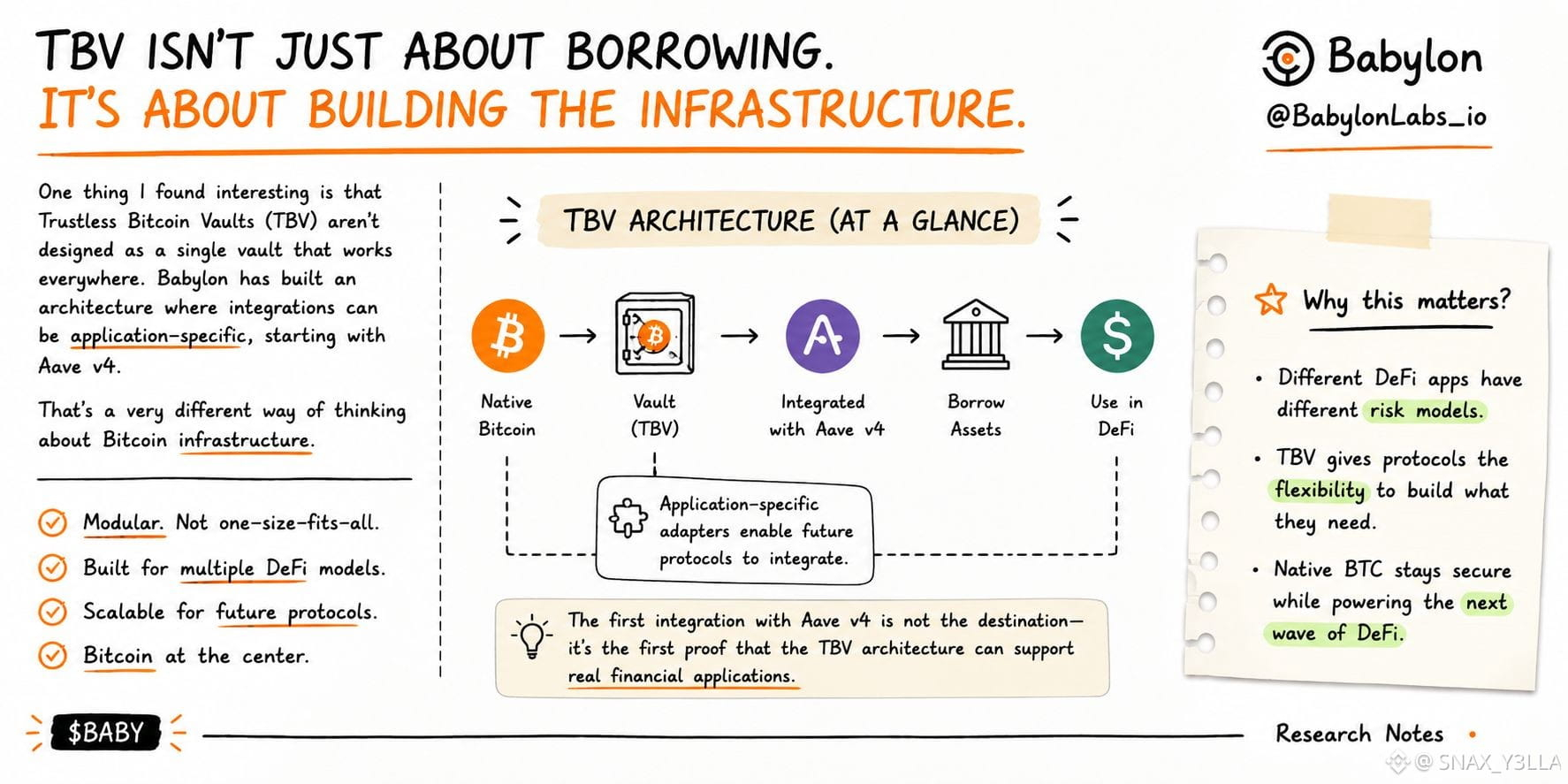
One of the technical details I found interesting was that Trustless Bitcoin Vaults (TBV) are not intended to be a general-purpose vault, but rather the Babylon team has designed the system in a way that allows application-specific integration, beginning with Aave v4.
I initially did not realize why this distinction was relevant, but then I understood it.
A DeFi risk engine, collateralization rules, and settlement logic are fundamentally different for each protocol. In other words, lending protools cannot borrow the same code base or architecture of an insurance protocol. Rather, it offers a generic framework that individual protocols can build on top of, according to their specific needs.
This is a fundamentally different approach to designing and building Bitcoin infrastructure.
In my opinion, the first Aave v4 integration is not the end of the road for TBV, but rather the beginning of a much larger undertaking that will provide the infrastructure for a larger financial application ecosystem to be built around Bitcoin. If more protocols begin to adopt this approach to designing financial applications around Bitcoin, I believe infrastructure innovation would be far more impactful than most realize.
Infrastructure typically flies under the radar of the general public, but in the long run, the infrastructure ultimately defines the limits of an ecosystem’s potential growth.
@babylonlabs_io $BABY $BTC #baby
TBV is more than just a borrowing primitive.
It is a standard for utilizing Collateralized Bitcoin as a general-purpose collateralization asset.
One of the technical details I found interesting was that Trustless Bitcoin Vaults (TBV) are not intended to be a general-purpose vault, but rather the Babylon team has designed the system in a way that allows application-specific integration, beginning with Aave v4.
I initially did not realize why this distinction was relevant, but then I understood it.
A DeFi risk engine, collateralization rules, and settlement logic are fundamentally different for each protocol. In other words, lending protools cannot borrow the same code base or architecture of an insurance protocol. Rather, it offers a generic framework that individual protocols can build on top of, according to their specific needs.
This is a fundamentally different approach to designing and building Bitcoin infrastructure.
In my opinion, the first Aave v4 integration is not the end of the road for TBV, but rather the beginning of a much larger undertaking that will provide the infrastructure for a larger financial application ecosystem to be built around Bitcoin. If more protocols begin to adopt this approach to designing financial applications around Bitcoin, I believe infrastructure innovation would be far more impactful than most realize.
Infrastructure typically flies under the radar of the general public, but in the long run, the infrastructure ultimately defines the limits of an ecosystem’s potential growth.
@BabylonLabs_io $BABY $BTC #baby
It is a standard for utilizing Collateralized Bitcoin as a general-purpose collateralization asset.
One of the technical details I found interesting was that Trustless Bitcoin Vaults (TBV) are not intended to be a general-purpose vault, but rather the Babylon team has designed the system in a way that allows application-specific integration, beginning with Aave v4.
I initially did not realize why this distinction was relevant, but then I understood it.
A DeFi risk engine, collateralization rules, and settlement logic are fundamentally different for each protocol. In other words, lending protools cannot borrow the same code base or architecture of an insurance protocol. Rather, it offers a generic framework that individual protocols can build on top of, according to their specific needs.
This is a fundamentally different approach to designing and building Bitcoin infrastructure.
In my opinion, the first Aave v4 integration is not the end of the road for TBV, but rather the beginning of a much larger undertaking that will provide the infrastructure for a larger financial application ecosystem to be built around Bitcoin. If more protocols begin to adopt this approach to designing financial applications around Bitcoin, I believe infrastructure innovation would be far more impactful than most realize.
Infrastructure typically flies under the radar of the general public, but in the long run, the infrastructure ultimately defines the limits of an ecosystem’s potential growth.
@BabylonLabs_io $BABY $BTC #baby
1
2
88
·
--
ຢືນຢັນແລ້ວ
@babylonlabs_io
I've always felt that Bitcoin is one of the strongest assets in crypto, but when it comes to DeFi, using BTC usually means making a compromise. Most solutions ask you to wrap your Bitcoin, bridge it to another chain, or trust a third party. That never felt like the ideal experience to me.
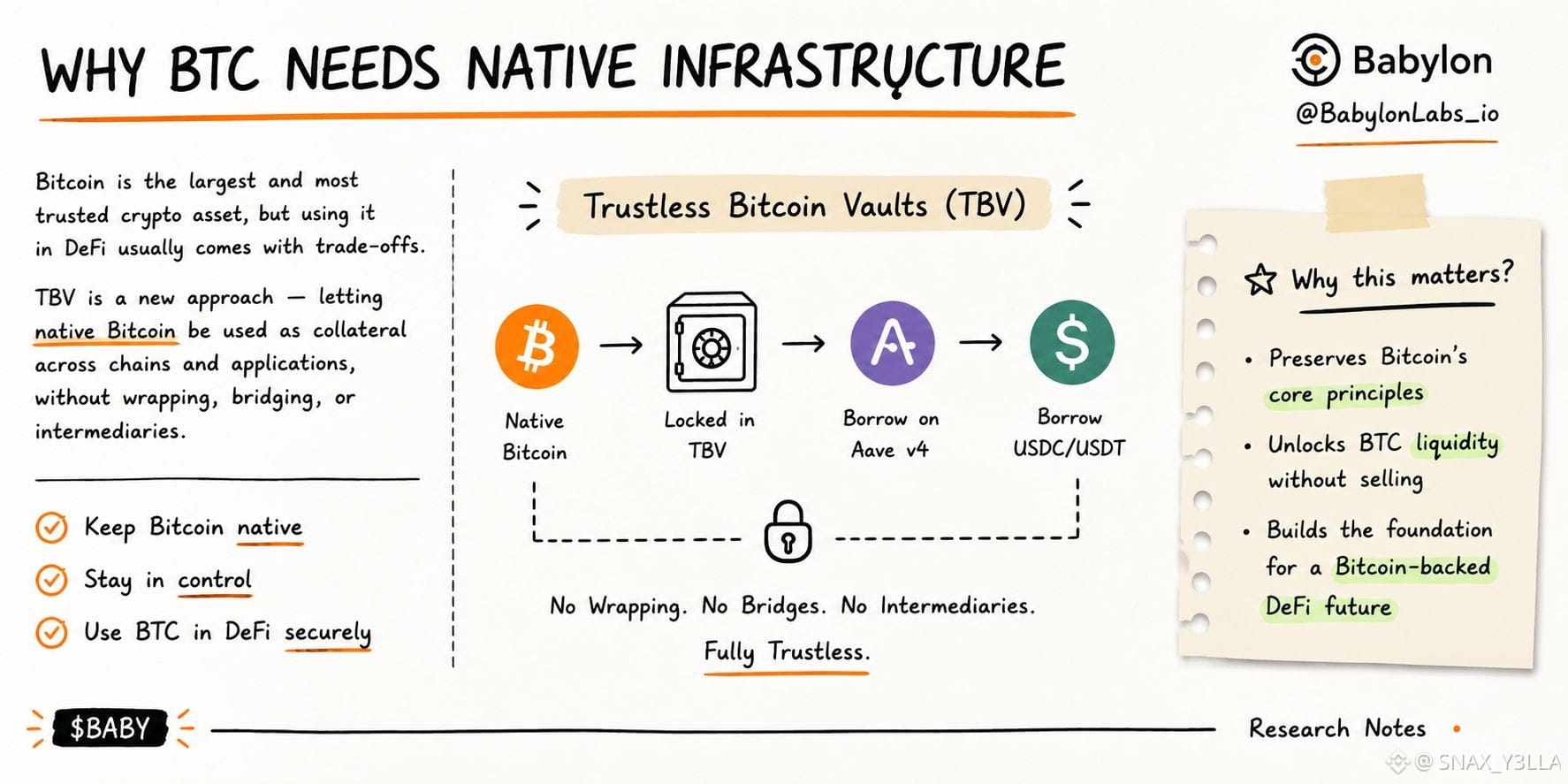
While exploring @babylonlabs_io I came across Trustless Bitcoin Vaults (TBV), and I found the concept genuinely interesting. Instead of creating another wrapped version of Bitcoin, TBV is designed to let native Bitcoin be used as collateral across different chains and applications without wrapping, bridging, or relying on intermediaries. To me, that's a different way of thinking about Bitcoin's role in DeFi.
Another thing I liked is that the Public Testnet is already live. I always appreciate when projects invite the community to test their products before a full launch because it gives users the chance to understand how everything works, share feedback, and help improve the overall experience. Building with community participation often leads to stronger and more reliable infrastructure.
What stands out to me is that Babylon isn't trying to change Bitcoin - it seems to be focused on expanding what Bitcoin can do while preserving its core principles. If users can access liquidity while keeping their BTC native and under their own control, it could remove one of the biggest barriers that has kept many Bitcoin holders away from DeFi.
I'm looking forward to exploring the TBV testnet myself and seeing how this approach develops over time. If it delivers on its vision, it could become an important step toward making Bitcoin more useful across the broader on-chain ecosystem—without asking users to sacrifice the qualities that made Bitcoin valuable in the first place.
@babylonlabs_io $BABY #baby
@BabylonLabs_io
I've always felt that Bitcoin is one of the strongest assets in crypto, but when it comes to DeFi, using BTC usually means making a compromise. Most solutions ask you to wrap your Bitcoin, bridge it to another chain, or trust a third party. That never felt like the ideal experience to me.
While exploring @BabylonLabs_io I came across Trustless Bitcoin Vaults (TBV), and I found the concept genuinely interesting. Instead of creating another wrapped version of Bitcoin, TBV is designed to let native Bitcoin be used as collateral across different chains and applications without wrapping, bridging, or relying on intermediaries. To me, that's a different way of thinking about Bitcoin's role in DeFi.
Another thing I liked is that the Public Testnet is already live. I always appreciate when projects invite the community to test their products before a full launch because it gives users the chance to understand how everything works, share feedback, and help improve the overall experience. Building with community participation often leads to stronger and more reliable infrastructure.
What stands out to me is that Babylon isn't trying to change Bitcoin - it seems to be focused on expanding what Bitcoin can do while preserving its core principles. If users can access liquidity while keeping their BTC native and under their own control, it could remove one of the biggest barriers that has kept many Bitcoin holders away from DeFi.
I'm looking forward to exploring the TBV testnet myself and seeing how this approach develops over time. If it delivers on its vision, it could become an important step toward making Bitcoin more useful across the broader on-chain ecosystem—without asking users to sacrifice the qualities that made Bitcoin valuable in the first place.
@BabylonLabs_io $BABY #baby
I've always felt that Bitcoin is one of the strongest assets in crypto, but when it comes to DeFi, using BTC usually means making a compromise. Most solutions ask you to wrap your Bitcoin, bridge it to another chain, or trust a third party. That never felt like the ideal experience to me.
While exploring @BabylonLabs_io I came across Trustless Bitcoin Vaults (TBV), and I found the concept genuinely interesting. Instead of creating another wrapped version of Bitcoin, TBV is designed to let native Bitcoin be used as collateral across different chains and applications without wrapping, bridging, or relying on intermediaries. To me, that's a different way of thinking about Bitcoin's role in DeFi.
Another thing I liked is that the Public Testnet is already live. I always appreciate when projects invite the community to test their products before a full launch because it gives users the chance to understand how everything works, share feedback, and help improve the overall experience. Building with community participation often leads to stronger and more reliable infrastructure.
What stands out to me is that Babylon isn't trying to change Bitcoin - it seems to be focused on expanding what Bitcoin can do while preserving its core principles. If users can access liquidity while keeping their BTC native and under their own control, it could remove one of the biggest barriers that has kept many Bitcoin holders away from DeFi.
I'm looking forward to exploring the TBV testnet myself and seeing how this approach develops over time. If it delivers on its vision, it could become an important step toward making Bitcoin more useful across the broader on-chain ecosystem—without asking users to sacrifice the qualities that made Bitcoin valuable in the first place.
@BabylonLabs_io $BABY #baby
4
2
114
·
--

ບົດຄວາມ
SpaceXShortInterestHits29%OfFloat: Is the Market Too Bearish, or Is a Massive Short Squeeze LoadingSpaceX has become one of the most talked-about stocks in the market after nearly 29–30% of its publicly tradable shares were sold short, representing around $25 billion in bearish positions. This level of short interest is exceptionally high and signals that many investors expect the stock to continue falling.
However, history has shown that crowded trades can quickly reverse.
A stock with such heavy short interest doesn't automatically mean it will collapse. Instead, it creates two competing possibilities:
📉 Bearish Scenario
The pessimistic view is based on several factors:
SpaceX shares have fallen below their $135 IPO price after reaching highs above $225.Short sellers are already sitting on billions of dollars in paper profits, reducing the pressure to buy back shares.An upcoming lock-up expiration could release hundreds of millions of additional shares into the market, increasing supply and potentially weighing further on the stock.
🚀 Bullish Scenario
On the other hand, high short interest can become fuel for a powerful rally.
If SpaceX delivers a strong earnings report, achieves a successful Starship milestone, secures a major government contract, or surprises investors with positive AI or space-related developments, short sellers may rush to close their positions. This buying pressure can amplify upward momentum in what's known as a short squeeze.
What Should Investors Watch?
Rather than focusing only on the 29% short-interest figure, investors should monitor:
Upcoming earnings resultsStarship flight progressLock-up expiration datesInstitutional buying activityOverall market sentiment toward high-growth technology companies
Final Thoughts
High short interest is not a prediction—it's a positioning signal. It tells us where traders are betting, not what will actually happen.
The next major catalyst will likely determine whether the bears continue winning or whether SpaceX becomes the next headline-making short squeeze. Until then, risk management remains more important than chasing market narratives.
What do you think? Is the market correctly pricing SpaceX's risks, or are short sellers becoming too confident?
#SpaceXShortInterestHits29%OfFloat #SpaceX #SPCX #BinanceSquare
$VANRY $PSG $ETH
SpaceXShortInterestHits29%OfFloat: Is the Market Too Bearish, or Is a Massive Short Squeeze Loading
SpaceX has become one of the most talked-about stocks in the market after nearly 29–30% of its publicly tradable shares were sold short, representing around $25 billion in bearish positions. This level of short interest is exceptionally high and signals that many investors expect the stock to continue falling.
However, history has shown that crowded trades can quickly reverse.
A stock with such heavy short interest doesn't automatically mean it will collapse. Instead, it creates two competing possibilities:
📉 Bearish Scenario
The pessimistic view is based on several factors:
SpaceX shares have fallen below their $135 IPO price after reaching highs above $225.Short sellers are already sitting on billions of dollars in paper profits, reducing the pressure to buy back shares.An upcoming lock-up expiration could release hundreds of millions of additional shares into the market, increasing supply and potentially weighing further on the stock.
🚀 Bullish Scenario
On the other hand, high short interest can become fuel for a powerful rally.
If SpaceX delivers a strong earnings report, achieves a successful Starship milestone, secures a major government contract, or surprises investors with positive AI or space-related developments, short sellers may rush to close their positions. This buying pressure can amplify upward momentum in what's known as a short squeeze.
What Should Investors Watch?
Rather than focusing only on the 29% short-interest figure, investors should monitor:
Upcoming earnings resultsStarship flight progressLock-up expiration datesInstitutional buying activityOverall market sentiment toward high-growth technology companies
Final Thoughts
High short interest is not a prediction—it's a positioning signal. It tells us where traders are betting, not what will actually happen.
The next major catalyst will likely determine whether the bears continue winning or whether SpaceX becomes the next headline-making short squeeze. Until then, risk management remains more important than chasing market narratives.
What do you think? Is the market correctly pricing SpaceX's risks, or are short sellers becoming too confident?
#SpaceXShortInterestHits29%OfFloat #SpaceX #SPCX #BinanceSquare
$VANRY $PSG $ETH
However, history has shown that crowded trades can quickly reverse.
A stock with such heavy short interest doesn't automatically mean it will collapse. Instead, it creates two competing possibilities:
📉 Bearish Scenario
The pessimistic view is based on several factors:
SpaceX shares have fallen below their $135 IPO price after reaching highs above $225.Short sellers are already sitting on billions of dollars in paper profits, reducing the pressure to buy back shares.An upcoming lock-up expiration could release hundreds of millions of additional shares into the market, increasing supply and potentially weighing further on the stock.
🚀 Bullish Scenario
On the other hand, high short interest can become fuel for a powerful rally.
If SpaceX delivers a strong earnings report, achieves a successful Starship milestone, secures a major government contract, or surprises investors with positive AI or space-related developments, short sellers may rush to close their positions. This buying pressure can amplify upward momentum in what's known as a short squeeze.
What Should Investors Watch?
Rather than focusing only on the 29% short-interest figure, investors should monitor:
Upcoming earnings resultsStarship flight progressLock-up expiration datesInstitutional buying activityOverall market sentiment toward high-growth technology companies
Final Thoughts
High short interest is not a prediction—it's a positioning signal. It tells us where traders are betting, not what will actually happen.
The next major catalyst will likely determine whether the bears continue winning or whether SpaceX becomes the next headline-making short squeeze. Until then, risk management remains more important than chasing market narratives.
What do you think? Is the market correctly pricing SpaceX's risks, or are short sellers becoming too confident?
#SpaceXShortInterestHits29%OfFloat #SpaceX #SPCX #BinanceSquare
$VANRY $PSG $ETH
1
318
·
--
#MarketSentimentToday 📊
Today's market feels caught between better macro data and rising geopolitical risk.
Cooling U.S. inflation is supporting expectations for a more accommodative Fed, but renewed Middle East tensions and higher oil prices are preventing investors from fully embracing risk. At the same time, semiconductor stocks remain under pressure, keeping the tech sector cautious.
Bitcoin reflects that same balance.
It isn't collapsing, but it also isn't breaking out with conviction. Buyers are stepping in, yet every rally still faces macro uncertainty.
My takeaway:
The market isn't risk-on or risk-off today. It's waiting for the next catalyst.
When multiple asset classes stop reacting to good news with strong follow-through, it usually tells me investors are protecting capital while keeping one eye on the next headline.
$BTC $ETH $BNB #crypto #markets
#MarketSentimentToday 📊
Today's market feels caught between better macro data and rising geopolitical risk.
Cooling U.S. inflation is supporting expectations for a more accommodative Fed, but renewed Middle East tensions and higher oil prices are preventing investors from fully embracing risk. At the same time, semiconductor stocks remain under pressure, keeping the tech sector cautious.
Bitcoin reflects that same balance.
It isn't collapsing, but it also isn't breaking out with conviction. Buyers are stepping in, yet every rally still faces macro uncertainty.
My takeaway:
The market isn't risk-on or risk-off today. It's waiting for the next catalyst.
When multiple asset classes stop reacting to good news with strong follow-through, it usually tells me investors are protecting capital while keeping one eye on the next headline.
$BTC $ETH $BNB #crypto #markets
Today's market feels caught between better macro data and rising geopolitical risk.
Cooling U.S. inflation is supporting expectations for a more accommodative Fed, but renewed Middle East tensions and higher oil prices are preventing investors from fully embracing risk. At the same time, semiconductor stocks remain under pressure, keeping the tech sector cautious.
Bitcoin reflects that same balance.
It isn't collapsing, but it also isn't breaking out with conviction. Buyers are stepping in, yet every rally still faces macro uncertainty.
My takeaway:
The market isn't risk-on or risk-off today. It's waiting for the next catalyst.
When multiple asset classes stop reacting to good news with strong follow-through, it usually tells me investors are protecting capital while keeping one eye on the next headline.
$BTC $ETH $BNB #crypto #markets
1
73
·
--
#tanzaniacentralbankfinalizesdigitalassetrules $NVDAB
Tanzania's New Digital Asset Rules Show That Crypto Is Entering a Different Era
A few years ago, most news was about price swings, exchange listings, or the next big bull run. Today, I'm seeing something different. More countries are starting to focus on regulation—not to stop digital assets, but to define how they should fit into the financial system.
The latest example is Tanzania, where the central bank has finalized a regulatory framework for digital assets.
To me, this is significant because it reflects a broader trend that extends far beyond a single country.
For years, many governments preferred to observe the crypto market from the sidelines. The industry was growing quickly, technology was evolving, and regulators were often trying to understand where digital assets belonged within existing financial laws.
Now, that approach appears to be changing.
Instead of asking whether digital assets should exist, many regulators are asking how they should be supervised.
That's an important difference.
$VELVET $LAB
#tanzaniacentralbankfinalizesdigitalassetrules $NVDAB
Tanzania's New Digital Asset Rules Show That Crypto Is Entering a Different Era
A few years ago, most news was about price swings, exchange listings, or the next big bull run. Today, I'm seeing something different. More countries are starting to focus on regulation—not to stop digital assets, but to define how they should fit into the financial system.
The latest example is Tanzania, where the central bank has finalized a regulatory framework for digital assets.
To me, this is significant because it reflects a broader trend that extends far beyond a single country.
For years, many governments preferred to observe the crypto market from the sidelines. The industry was growing quickly, technology was evolving, and regulators were often trying to understand where digital assets belonged within existing financial laws.
Now, that approach appears to be changing.
Instead of asking whether digital assets should exist, many regulators are asking how they should be supervised.
That's an important difference.
$VELVET $LAB
Tanzania's New Digital Asset Rules Show That Crypto Is Entering a Different Era
A few years ago, most news was about price swings, exchange listings, or the next big bull run. Today, I'm seeing something different. More countries are starting to focus on regulation—not to stop digital assets, but to define how they should fit into the financial system.
The latest example is Tanzania, where the central bank has finalized a regulatory framework for digital assets.
To me, this is significant because it reflects a broader trend that extends far beyond a single country.
For years, many governments preferred to observe the crypto market from the sidelines. The industry was growing quickly, technology was evolving, and regulators were often trying to understand where digital assets belonged within existing financial laws.
Now, that approach appears to be changing.
Instead of asking whether digital assets should exist, many regulators are asking how they should be supervised.
That's an important difference.
$VELVET $LAB

1
343
·
--

ບົດຄວາມ
Tanzania's New Crypto Regulations: The Dawn of a Regulated Era in Africa#tanzaniacentralbankfinalizesdigitalassetrules
The global crypto space is undergoing a significant shift, and Africa is at the epicentre of this change.
The region's historical approach to digital assets was one of bans or restrictions. However, the Bank of Tanzania (BoT) is preparing to reverse this trend.
Central Bank Governor Emmanuel Tutuba announced that Tanzania is developing a regulatory framework for virtual assets, including cryptocurrencies and stable-coins.
This development is poised to have a profound impact on the African economy, as the country embraces a more sophisticated and modern approach to regulating digital assets after a decade of caution.
Why the U-Turn? The Power of Retail Adoption!
Like many countries, Tanzania has turned wary of crypto-adoption, warning investors that the Shilling remains the only legal tender. However, you can’t stop the wave of the future.
There were three main reasons why the Bank of Tanzania announced its regulatory plans.
1. Protection of Unsuspecting Main Street Investors
The BoT is witnessing a significant influx of young people into the market and an increasing number of complaints about scams and losses. The new guidelines will ensure consumer protection, which is a must in any functioning economy.
2. Elimination of Financial System Vulnerabilities
The guidelines aim to mitigate money laundering and terrorist financing risks. With clearer rules, Tanzania can monitor crypto-flows in the formal and informal sectors more efficiently.
3. Presidential Nod
President Samia Suluhu Hassan has urged the Central Bank to consider adopting blockchain technology and position Tanzania as a regional leader in digital assets. It comes as no surprise that the President endorsed the guidelines.
The Co-Existence Era of Regulation and Crypto Begins! 🌍
Tanzania is not an island. Several African governments have realized the importance of regulating crypto rather than banning it. Crypto-adoption is inevitable, so authorities scramble to create sandboxes to let Main Street and Wall Street meet.
South Africa classified crypto as a financial instrument and created licensing regulations for crypto-enabling businesses. Kenya’s guidelines focus on Virtual Asset Service Providers (VASP) and are expected to license and tax crypto activities. Nigeria, once the hardest nation against crypto, lifted its banking restrictions and is now ready to regulate the sector.
Tanzania’s rules will require crypto exchanges, custodians, and stable-coins to operate under the licensing framework. It will ensure safer transactions while fostering institutional adoption in the informal 1.5 billion-dollar crypto economy. The guidelines will also help local retail investors who are hesitant to deal with unlicensed private dealers.
Positive Implications for Binance Users and Investors 💡
Regulation always trumps prohibition. The new guidelines are a positive development for the region and will have several positive implications.
1. Fewer Scams
With exchanges licensed by the BoT, dealing with bad actors in crypto will become a thing of the past.
2. Institutional Adoption
Banks and payment processors will feel more confident dealing with crypto-assets, which will lead to greater mainstream acceptance and reduce price volatility.
3. Enhanced Retail Adoption
The licensing regime will promote greater trust in crypto-asset transactions, encouraging more individuals to adopt digital assets.
The “Wild West” days of crypto are over. Web3 is entering a new phase of maturity and institutional adoption. Tanzania’s new regulations are yet another sign that crypto is truly the future. What do you think about Tanzania’s move? Would regulation propel crypto-adoption in the region?
Let’s hear your thoughts!
Tanzania's New Crypto Regulations: The Dawn of a Regulated Era in Africa
#tanzaniacentralbankfinalizesdigitalassetrules
The global crypto space is undergoing a significant shift, and Africa is at the epicentre of this change.
The region's historical approach to digital assets was one of bans or restrictions. However, the Bank of Tanzania (BoT) is preparing to reverse this trend.
Central Bank Governor Emmanuel Tutuba announced that Tanzania is developing a regulatory framework for virtual assets, including cryptocurrencies and stable-coins.
This development is poised to have a profound impact on the African economy, as the country embraces a more sophisticated and modern approach to regulating digital assets after a decade of caution.
Why the U-Turn? The Power of Retail Adoption!
Like many countries, Tanzania has turned wary of crypto-adoption, warning investors that the Shilling remains the only legal tender. However, you can’t stop the wave of the future.
There were three main reasons why the Bank of Tanzania announced its regulatory plans.
1. Protection of Unsuspecting Main Street Investors
The BoT is witnessing a significant influx of young people into the market and an increasing number of complaints about scams and losses. The new guidelines will ensure consumer protection, which is a must in any functioning economy.
2. Elimination of Financial System Vulnerabilities
The guidelines aim to mitigate money laundering and terrorist financing risks. With clearer rules, Tanzania can monitor crypto-flows in the formal and informal sectors more efficiently.
3. Presidential Nod
President Samia Suluhu Hassan has urged the Central Bank to consider adopting blockchain technology and position Tanzania as a regional leader in digital assets. It comes as no surprise that the President endorsed the guidelines.
The Co-Existence Era of Regulation and Crypto Begins! 🌍
Tanzania is not an island. Several African governments have realized the importance of regulating crypto rather than banning it. Crypto-adoption is inevitable, so authorities scramble to create sandboxes to let Main Street and Wall Street meet.
South Africa classified crypto as a financial instrument and created licensing regulations for crypto-enabling businesses. Kenya’s guidelines focus on Virtual Asset Service Providers (VASP) and are expected to license and tax crypto activities. Nigeria, once the hardest nation against crypto, lifted its banking restrictions and is now ready to regulate the sector.
Tanzania’s rules will require crypto exchanges, custodians, and stable-coins to operate under the licensing framework. It will ensure safer transactions while fostering institutional adoption in the informal 1.5 billion-dollar crypto economy. The guidelines will also help local retail investors who are hesitant to deal with unlicensed private dealers.
Positive Implications for Binance Users and Investors 💡
Regulation always trumps prohibition. The new guidelines are a positive development for the region and will have several positive implications.
1. Fewer Scams
With exchanges licensed by the BoT, dealing with bad actors in crypto will become a thing of the past.
2. Institutional Adoption
Banks and payment processors will feel more confident dealing with crypto-assets, which will lead to greater mainstream acceptance and reduce price volatility.
3. Enhanced Retail Adoption
The licensing regime will promote greater trust in crypto-asset transactions, encouraging more individuals to adopt digital assets.
The “Wild West” days of crypto are over. Web3 is entering a new phase of maturity and institutional adoption. Tanzania’s new regulations are yet another sign that crypto is truly the future. What do you think about Tanzania’s move? Would regulation propel crypto-adoption in the region?
Let’s hear your thoughts!
The global crypto space is undergoing a significant shift, and Africa is at the epicentre of this change.
The region's historical approach to digital assets was one of bans or restrictions. However, the Bank of Tanzania (BoT) is preparing to reverse this trend.
Central Bank Governor Emmanuel Tutuba announced that Tanzania is developing a regulatory framework for virtual assets, including cryptocurrencies and stable-coins.
This development is poised to have a profound impact on the African economy, as the country embraces a more sophisticated and modern approach to regulating digital assets after a decade of caution.
Why the U-Turn? The Power of Retail Adoption!
Like many countries, Tanzania has turned wary of crypto-adoption, warning investors that the Shilling remains the only legal tender. However, you can’t stop the wave of the future.
There were three main reasons why the Bank of Tanzania announced its regulatory plans.
1. Protection of Unsuspecting Main Street Investors
The BoT is witnessing a significant influx of young people into the market and an increasing number of complaints about scams and losses. The new guidelines will ensure consumer protection, which is a must in any functioning economy.
2. Elimination of Financial System Vulnerabilities
The guidelines aim to mitigate money laundering and terrorist financing risks. With clearer rules, Tanzania can monitor crypto-flows in the formal and informal sectors more efficiently.
3. Presidential Nod
President Samia Suluhu Hassan has urged the Central Bank to consider adopting blockchain technology and position Tanzania as a regional leader in digital assets. It comes as no surprise that the President endorsed the guidelines.
The Co-Existence Era of Regulation and Crypto Begins! 🌍
Tanzania is not an island. Several African governments have realized the importance of regulating crypto rather than banning it. Crypto-adoption is inevitable, so authorities scramble to create sandboxes to let Main Street and Wall Street meet.
South Africa classified crypto as a financial instrument and created licensing regulations for crypto-enabling businesses. Kenya’s guidelines focus on Virtual Asset Service Providers (VASP) and are expected to license and tax crypto activities. Nigeria, once the hardest nation against crypto, lifted its banking restrictions and is now ready to regulate the sector.
Tanzania’s rules will require crypto exchanges, custodians, and stable-coins to operate under the licensing framework. It will ensure safer transactions while fostering institutional adoption in the informal 1.5 billion-dollar crypto economy. The guidelines will also help local retail investors who are hesitant to deal with unlicensed private dealers.
Positive Implications for Binance Users and Investors 💡
Regulation always trumps prohibition. The new guidelines are a positive development for the region and will have several positive implications.
1. Fewer Scams
With exchanges licensed by the BoT, dealing with bad actors in crypto will become a thing of the past.
2. Institutional Adoption
Banks and payment processors will feel more confident dealing with crypto-assets, which will lead to greater mainstream acceptance and reduce price volatility.
3. Enhanced Retail Adoption
The licensing regime will promote greater trust in crypto-asset transactions, encouraging more individuals to adopt digital assets.
The “Wild West” days of crypto are over. Web3 is entering a new phase of maturity and institutional adoption. Tanzania’s new regulations are yet another sign that crypto is truly the future. What do you think about Tanzania’s move? Would regulation propel crypto-adoption in the region?
Let’s hear your thoughts!
2
207
·
--
#USLaunches337ProbeIntoDRAMDevices 🖥️
The US has opened a Section 337 investigation into certain DRAM memory devices, which means another probe into the semiconductor space.
While the probe is likely to have limited implications for now, it has already sparked concerns about possible disruptions to the global chip supply, manufacturing chains, and tech companies’ exposure to such a risk.
Meanwhile, for crypto investors, this latest development serves as a sombre reminder that the blockchain space is not an island. Exclusively dependent on such technologies as AI, cloud computing, data centres, and crypto mining – the crypto space cannot thrive independently from general technological advancements.
As illustrated by recent headlines, the confluence of cutting-edge innovations, geopolitics, and financial markets creates an environment where developments on one front can have cascading effects on others.
#semiconductor #Technology #markets $BTC $ETH $XRP
Do you think disputes over semiconductors will have a more significant impact on the markets in the coming years?
#USLaunches337ProbeIntoDRAMDevices 🖥️
The US has opened a Section 337 investigation into certain DRAM memory devices, which means another probe into the semiconductor space.
While the probe is likely to have limited implications for now, it has already sparked concerns about possible disruptions to the global chip supply, manufacturing chains, and tech companies’ exposure to such a risk.
Meanwhile, for crypto investors, this latest development serves as a sombre reminder that the blockchain space is not an island. Exclusively dependent on such technologies as AI, cloud computing, data centres, and crypto mining – the crypto space cannot thrive independently from general technological advancements.
As illustrated by recent headlines, the confluence of cutting-edge innovations, geopolitics, and financial markets creates an environment where developments on one front can have cascading effects on others.
#semiconductor #Technology #markets $BTC $ETH $XRP
Do you think disputes over semiconductors will have a more significant impact on the markets in the coming years?
The US has opened a Section 337 investigation into certain DRAM memory devices, which means another probe into the semiconductor space.
While the probe is likely to have limited implications for now, it has already sparked concerns about possible disruptions to the global chip supply, manufacturing chains, and tech companies’ exposure to such a risk.
Meanwhile, for crypto investors, this latest development serves as a sombre reminder that the blockchain space is not an island. Exclusively dependent on such technologies as AI, cloud computing, data centres, and crypto mining – the crypto space cannot thrive independently from general technological advancements.
As illustrated by recent headlines, the confluence of cutting-edge innovations, geopolitics, and financial markets creates an environment where developments on one front can have cascading effects on others.
#semiconductor #Technology #markets $BTC $ETH $XRP
Do you think disputes over semiconductors will have a more significant impact on the markets in the coming years?
Yes, substantially
0%
Only in the short term
0%
0 ຄະແນນສຽງ • ປິດລົງຄະແນນສຽງ
1
171
·
--
I've noticed something interesting while following @NewtonProtocol over the past few weeks.
Most people immediately ask what the $NEWT token will do.
I found myself asking a different question.
Why does an authorization network need its own token in the first place?
The more I looked at the market, the more I realized that almost every successful blockchain infrastructure eventually needs a mechanism that aligns everyone building on it.
Developers, operators, validators, and users all contribute to the network in different ways. Without an incentive layer, it's difficult to keep that ecosystem growing over the long term.
That's why I don't see newton as just another tradable asset.
If Newton succeeds in becoming the authorization layer for vaults, RWAs, stable coins, and AI agents, the token could eventually represent participation in a much larger infrastructure rather than a single application.
Of course, adoption will determine everything.
But I've learned that the strongest infrastructure projects usually become more valuable as more builders start relying on them.
I'll be watching developer adoption far more closely than short-term price movements.
#Newt $NEWT
What will matter most for newton over the next year?
I've noticed something interesting while following @NewtonProtocol over the past few weeks.
Most people immediately ask what the $NEWT token will do.
I found myself asking a different question.
Why does an authorization network need its own token in the first place?
The more I looked at the market, the more I realized that almost every successful blockchain infrastructure eventually needs a mechanism that aligns everyone building on it.
Developers, operators, validators, and users all contribute to the network in different ways. Without an incentive layer, it's difficult to keep that ecosystem growing over the long term.
That's why I don't see newton as just another tradable asset.
If Newton succeeds in becoming the authorization layer for vaults, RWAs, stable coins, and AI agents, the token could eventually represent participation in a much larger infrastructure rather than a single application.
Of course, adoption will determine everything.
But I've learned that the strongest infrastructure projects usually become more valuable as more builders start relying on them.
I'll be watching developer adoption far more closely than short-term price movements.
#Newt $NEWT
What will matter most for newton over the next year?
Most people immediately ask what the $NEWT token will do.
I found myself asking a different question.
Why does an authorization network need its own token in the first place?
The more I looked at the market, the more I realized that almost every successful blockchain infrastructure eventually needs a mechanism that aligns everyone building on it.
Developers, operators, validators, and users all contribute to the network in different ways. Without an incentive layer, it's difficult to keep that ecosystem growing over the long term.
That's why I don't see newton as just another tradable asset.
If Newton succeeds in becoming the authorization layer for vaults, RWAs, stable coins, and AI agents, the token could eventually represent participation in a much larger infrastructure rather than a single application.
Of course, adoption will determine everything.
But I've learned that the strongest infrastructure projects usually become more valuable as more builders start relying on them.
I'll be watching developer adoption far more closely than short-term price movements.
#Newt $NEWT
What will matter most for newton over the next year?
🟢 Developer adoption
50%
🔵 Ecosystem growth
50%
2 ຄະແນນສຽງ • ປິດລົງຄະແນນສຽງ
5
2
92
·
--
ບົດຄວາມ
Newton's Biggest Product Isn't a Vault and an AI Agent. It's a Marketplace of Rules@NewtonProtocol
This week i've spent a considerable amount of time studying about Newton's Protocol.
As expected most of my attention was drawn to the technical aspects of the protocol, such as authorization, policy evaluation, operators, and cryptographic attestations.
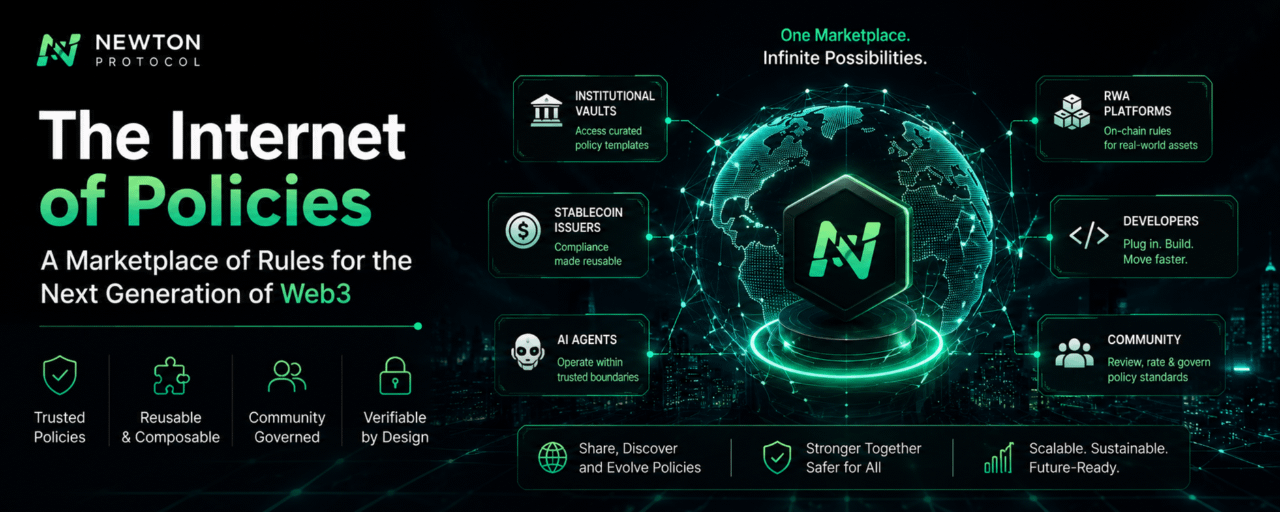
However, while I was looking through the documentation, one phrase kept echoing in my head: Internet of Policies
At first, I didn't pay much attention to it.
Internet of Policies sounded like any other Web3 buzzword.
Yet, the more I followed the market and saw how the protocols were developing, the more I realized that the Internet of Policies concept could soon become one of the central ideas defining Newton.
I believe that right now, every protocol is trying to build some unique set of rules that would define the way this protocol would function.
Every vault has spending limitations, every institution has some compliance standards, every AI agent will require certain permissions, every stable coin issuer, and every RWA utility will create additional rules, policies, and constraints.
Each of them will write policies about what this particular entity allows and what it does not allow.
However, very few of them are going to provide an infrastructure where all these policies could be shared, evaluated, adopted, enhanced, and battle-tested across multiple use cases.
This is the thought that made me realize that Newton is not necessarily a protocol that only defines what gets authorized; it wants to standardize the way these authorizations are designed.
There is an obvious parallel between what Newton is trying to achieve and the way modern software development transformed over the last 20 years.
If you remember 20 years ago every web company had to build almost every single piece of software on its own.
Today we have open-source software, allowing companies to adopt many existing components without building them from scratch.
Authentication systems, payment systems, cloud storage infrastructure, and other components can be re-used or modified to fit the specific needs of a particular company.
It made software development easier, less error-prone, and more standardized.
I think that policy logic could eventually transform the way protocol-specific rules are being created.
Maybe in a couple of years instead of designing a set of permissions for a lending smart contract from scratch, a developer will be able to look for existing policies that already fit the desired permissions or be able to combine different policies into a single one.
Instead of asking the question "how to write these policies," the industry will have to answer "which policies does the industry already agree on?"
This approach in my opinion has the potential to shift the way protocols develop and interact with each other for the better.
Right now when looking at the market I see many organizations that want to design their tokenized assets, stable coins, and regulated financial products.
In the future I think that we will see more and more institutions that want to build multi-chain financial products and instruments.
However I think that the development of such financial tools will require deeper standardization because, instead of having dozens of protocols, each of which utilizes a completely different set of permissions for its smart contracts, we will have to develop deeper interoperability between them.
An Internet of Policies concept is in my opinion one way to tackle this challenge.
However one thing that I want to note is that an Internet of Policies will not emerge as soon as tomorrow.
It will take time and effort for developers to publish policies, for companies to adopt them, for institutions to recognize them and trust them enough to utilize them in their own financial instruments.
However, I think that this is the way forward for the industry.
Most major tech companies that we use today were not built as solitary apps but rather as platforms connecting thousands of other apps and services together.
In my opinion that is the vision that Newton is trying to achieve.
Maybe the Newton's team does not want to create just another smart contract platform. Maybe they want to develop a new standard for the financial industry as a whole.
Perhaps instead of competing with other protocols to make our smart contracts the most secure and the most flexible, we are going to compete to make our policies the most trusted shared by thousands of other protocols.
This is the thought that keeps returning to my mind every time I look at Newton's documentation.
This is why I think that Newton's biggest product could potentially be not an AI agent or a vault but rather a marketplace of policies where the whole industry eventually utilizes the same shared rules.
#Newt $NEWT
#BitcoinPlansECashHardFork
#AMDSharesSlideNearly10%
#bitcoin
{future}(NEWTUSDT)
Newton's Biggest Product Isn't a Vault and an AI Agent. It's a Marketplace of Rules
@NewtonProtocol
This week i've spent a considerable amount of time studying about Newton's Protocol.
As expected most of my attention was drawn to the technical aspects of the protocol, such as authorization, policy evaluation, operators, and cryptographic attestations.
However, while I was looking through the documentation, one phrase kept echoing in my head: Internet of Policies
At first, I didn't pay much attention to it.
Internet of Policies sounded like any other Web3 buzzword.
Yet, the more I followed the market and saw how the protocols were developing, the more I realized that the Internet of Policies concept could soon become one of the central ideas defining Newton.
I believe that right now, every protocol is trying to build some unique set of rules that would define the way this protocol would function.
Every vault has spending limitations, every institution has some compliance standards, every AI agent will require certain permissions, every stable coin issuer, and every RWA utility will create additional rules, policies, and constraints.
Each of them will write policies about what this particular entity allows and what it does not allow.
However, very few of them are going to provide an infrastructure where all these policies could be shared, evaluated, adopted, enhanced, and battle-tested across multiple use cases.
This is the thought that made me realize that Newton is not necessarily a protocol that only defines what gets authorized; it wants to standardize the way these authorizations are designed.
There is an obvious parallel between what Newton is trying to achieve and the way modern software development transformed over the last 20 years.
If you remember 20 years ago every web company had to build almost every single piece of software on its own.
Today we have open-source software, allowing companies to adopt many existing components without building them from scratch.
Authentication systems, payment systems, cloud storage infrastructure, and other components can be re-used or modified to fit the specific needs of a particular company.
It made software development easier, less error-prone, and more standardized.
I think that policy logic could eventually transform the way protocol-specific rules are being created.
Maybe in a couple of years instead of designing a set of permissions for a lending smart contract from scratch, a developer will be able to look for existing policies that already fit the desired permissions or be able to combine different policies into a single one.
Instead of asking the question "how to write these policies," the industry will have to answer "which policies does the industry already agree on?"
This approach in my opinion has the potential to shift the way protocols develop and interact with each other for the better.
Right now when looking at the market I see many organizations that want to design their tokenized assets, stable coins, and regulated financial products.
In the future I think that we will see more and more institutions that want to build multi-chain financial products and instruments.
However I think that the development of such financial tools will require deeper standardization because, instead of having dozens of protocols, each of which utilizes a completely different set of permissions for its smart contracts, we will have to develop deeper interoperability between them.
An Internet of Policies concept is in my opinion one way to tackle this challenge.
However one thing that I want to note is that an Internet of Policies will not emerge as soon as tomorrow.
It will take time and effort for developers to publish policies, for companies to adopt them, for institutions to recognize them and trust them enough to utilize them in their own financial instruments.
However, I think that this is the way forward for the industry.
Most major tech companies that we use today were not built as solitary apps but rather as platforms connecting thousands of other apps and services together.
In my opinion that is the vision that Newton is trying to achieve.
Maybe the Newton's team does not want to create just another smart contract platform. Maybe they want to develop a new standard for the financial industry as a whole.
Perhaps instead of competing with other protocols to make our smart contracts the most secure and the most flexible, we are going to compete to make our policies the most trusted shared by thousands of other protocols.
This is the thought that keeps returning to my mind every time I look at Newton's documentation.
This is why I think that Newton's biggest product could potentially be not an AI agent or a vault but rather a marketplace of policies where the whole industry eventually utilizes the same shared rules.
#Newt $NEWT
#BitcoinPlansECashHardFork
#AMDSharesSlideNearly10%
#bitcoin
This week i've spent a considerable amount of time studying about Newton's Protocol.
As expected most of my attention was drawn to the technical aspects of the protocol, such as authorization, policy evaluation, operators, and cryptographic attestations.
However, while I was looking through the documentation, one phrase kept echoing in my head: Internet of Policies
At first, I didn't pay much attention to it.
Internet of Policies sounded like any other Web3 buzzword.
Yet, the more I followed the market and saw how the protocols were developing, the more I realized that the Internet of Policies concept could soon become one of the central ideas defining Newton.
I believe that right now, every protocol is trying to build some unique set of rules that would define the way this protocol would function.
Every vault has spending limitations, every institution has some compliance standards, every AI agent will require certain permissions, every stable coin issuer, and every RWA utility will create additional rules, policies, and constraints.
Each of them will write policies about what this particular entity allows and what it does not allow.
However, very few of them are going to provide an infrastructure where all these policies could be shared, evaluated, adopted, enhanced, and battle-tested across multiple use cases.
This is the thought that made me realize that Newton is not necessarily a protocol that only defines what gets authorized; it wants to standardize the way these authorizations are designed.
There is an obvious parallel between what Newton is trying to achieve and the way modern software development transformed over the last 20 years.
If you remember 20 years ago every web company had to build almost every single piece of software on its own.
Today we have open-source software, allowing companies to adopt many existing components without building them from scratch.
Authentication systems, payment systems, cloud storage infrastructure, and other components can be re-used or modified to fit the specific needs of a particular company.
It made software development easier, less error-prone, and more standardized.
I think that policy logic could eventually transform the way protocol-specific rules are being created.
Maybe in a couple of years instead of designing a set of permissions for a lending smart contract from scratch, a developer will be able to look for existing policies that already fit the desired permissions or be able to combine different policies into a single one.
Instead of asking the question "how to write these policies," the industry will have to answer "which policies does the industry already agree on?"
This approach in my opinion has the potential to shift the way protocols develop and interact with each other for the better.
Right now when looking at the market I see many organizations that want to design their tokenized assets, stable coins, and regulated financial products.
In the future I think that we will see more and more institutions that want to build multi-chain financial products and instruments.
However I think that the development of such financial tools will require deeper standardization because, instead of having dozens of protocols, each of which utilizes a completely different set of permissions for its smart contracts, we will have to develop deeper interoperability between them.
An Internet of Policies concept is in my opinion one way to tackle this challenge.
However one thing that I want to note is that an Internet of Policies will not emerge as soon as tomorrow.
It will take time and effort for developers to publish policies, for companies to adopt them, for institutions to recognize them and trust them enough to utilize them in their own financial instruments.
However, I think that this is the way forward for the industry.
Most major tech companies that we use today were not built as solitary apps but rather as platforms connecting thousands of other apps and services together.
In my opinion that is the vision that Newton is trying to achieve.
Maybe the Newton's team does not want to create just another smart contract platform. Maybe they want to develop a new standard for the financial industry as a whole.
Perhaps instead of competing with other protocols to make our smart contracts the most secure and the most flexible, we are going to compete to make our policies the most trusted shared by thousands of other protocols.
This is the thought that keeps returning to my mind every time I look at Newton's documentation.
This is why I think that Newton's biggest product could potentially be not an AI agent or a vault but rather a marketplace of policies where the whole industry eventually utilizes the same shared rules.
#Newt $NEWT
#BitcoinPlansECashHardFork
#AMDSharesSlideNearly10%
#bitcoin
5
2
106
·
--
ບົດຄວາມ
The Missing Layer Between DeFi Vaults and Real-World RiskIt was a few days ago, and I’ve spent the last several days poring over Newton Protocol’s architecture. The common discussion revolves around Newton’s authorization model or policy engine, but one particular ecosystem piece stood out to me at launch: the Vault SDK.
At first glance, it appears to be another tool for developers building applications on Web3. After all, the space is full of promises that any given SDK, library, or API will reduce development time by 80%. But the deeper I looked into Newton’s offering, the more it became clear to me that it defines a new paradigm for DeFi vaults altogether.
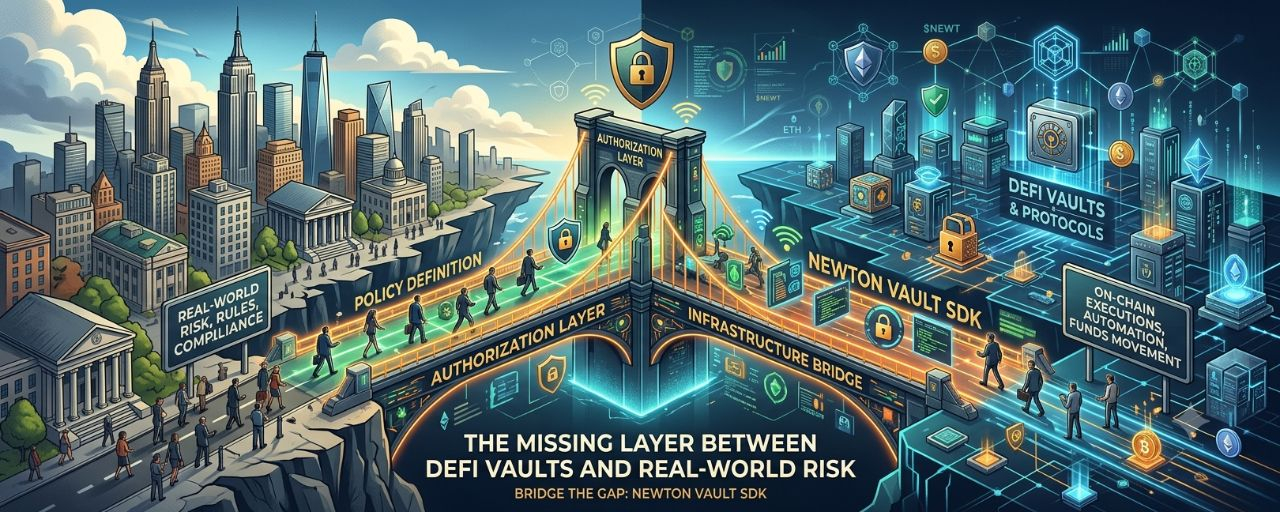
Modern DeFi vaults are built to hold capital in accordance with a set of predefined strategies. They can rebalance, liquidity mine, or perform other operations automatically in accordance with a given strategy. But the bigger the vault grows, the harder it becomes to ensure every single action taken by it conforms to the strategy, in full context of the rules agreed upon by investors or other stakeholders.
In practice, this means that many such vaults employ some combination of off-chain monitoring, ad-hoc scripting, manual checks, or application-specific control logic to enforce strategic or regulatory constraints. They all serve a purpose, but the overall lack of a standardized approach creates operational overhead and bloats the attack surface of any given application.
This is where Newton’s Vault SDK comes into play, because it recognizes that control logic, policy checks, and general compliance with real-world rules should be treated as a system with its own security surface.
The Newton architecture unifies these features under one singular, shared permission-ing layer which can be applied to any given transaction to determine whether it should or should not be allowed in accordance with a given set of policies.
It shifts the conversation from “can this transaction happen” to “should this transaction happen” and gives developers a shared framework to work with.
From there, the applications of such a tool become clear, because institutional investors typically operate within clearly-defined operational guardrails dictated by their internal risk management frameworks. Their spending power, acceptable counterparties, transaction restrictions, and other factors are rarely dictated by one source, but instead comprise a set of rules that must be taken into account simultaneously when considering any given transaction. By unifying them under one system, Newton eliminates the complexity of integrating with five different tools at once.
I think it’s worth emphasizing that Newton does not attempt to replace existing DeFi applications, but rather operate alongside them by providing developers with a much-needed extension to their current smart contract tooling. In my experience, that is the kind of approach that resonates with developers, because they recognize the value in something that enhances their work rather than disrupting an entire field just to insert itself in the middle.
In many ways, that is the genius of Newton – it does not seek to dictate the future of autonomous finance, but rather contribute to the evolution of a space that will inevitably grow more sophisticated with the arrival of institutional finance.
As DeFi matures, the conversations around it will inevitably shift from raw automation to responsible automation. It will be less about enabling yield and more about ensuring yield is generated responsibly. And with the way the Vault SDK is designed, I believe Newton has the potential to influence that conversation at its core, shaping the way automated finance develops for years to come.
@NewtonProtocol
$NEWT #Newt
The Missing Layer Between DeFi Vaults and Real-World Risk
It was a few days ago, and I’ve spent the last several days poring over Newton Protocol’s architecture. The common discussion revolves around Newton’s authorization model or policy engine, but one particular ecosystem piece stood out to me at launch: the Vault SDK.
At first glance, it appears to be another tool for developers building applications on Web3. After all, the space is full of promises that any given SDK, library, or API will reduce development time by 80%. But the deeper I looked into Newton’s offering, the more it became clear to me that it defines a new paradigm for DeFi vaults altogether.
Modern DeFi vaults are built to hold capital in accordance with a set of predefined strategies. They can rebalance, liquidity mine, or perform other operations automatically in accordance with a given strategy. But the bigger the vault grows, the harder it becomes to ensure every single action taken by it conforms to the strategy, in full context of the rules agreed upon by investors or other stakeholders.
In practice, this means that many such vaults employ some combination of off-chain monitoring, ad-hoc scripting, manual checks, or application-specific control logic to enforce strategic or regulatory constraints. They all serve a purpose, but the overall lack of a standardized approach creates operational overhead and bloats the attack surface of any given application.
This is where Newton’s Vault SDK comes into play, because it recognizes that control logic, policy checks, and general compliance with real-world rules should be treated as a system with its own security surface.
The Newton architecture unifies these features under one singular, shared permission-ing layer which can be applied to any given transaction to determine whether it should or should not be allowed in accordance with a given set of policies.
It shifts the conversation from “can this transaction happen” to “should this transaction happen” and gives developers a shared framework to work with.
From there, the applications of such a tool become clear, because institutional investors typically operate within clearly-defined operational guardrails dictated by their internal risk management frameworks. Their spending power, acceptable counterparties, transaction restrictions, and other factors are rarely dictated by one source, but instead comprise a set of rules that must be taken into account simultaneously when considering any given transaction. By unifying them under one system, Newton eliminates the complexity of integrating with five different tools at once.
I think it’s worth emphasizing that Newton does not attempt to replace existing DeFi applications, but rather operate alongside them by providing developers with a much-needed extension to their current smart contract tooling. In my experience, that is the kind of approach that resonates with developers, because they recognize the value in something that enhances their work rather than disrupting an entire field just to insert itself in the middle.
In many ways, that is the genius of Newton – it does not seek to dictate the future of autonomous finance, but rather contribute to the evolution of a space that will inevitably grow more sophisticated with the arrival of institutional finance.
As DeFi matures, the conversations around it will inevitably shift from raw automation to responsible automation. It will be less about enabling yield and more about ensuring yield is generated responsibly. And with the way the Vault SDK is designed, I believe Newton has the potential to influence that conversation at its core, shaping the way automated finance develops for years to come.
@NewtonProtocol
$NEWT #Newt
At first glance, it appears to be another tool for developers building applications on Web3. After all, the space is full of promises that any given SDK, library, or API will reduce development time by 80%. But the deeper I looked into Newton’s offering, the more it became clear to me that it defines a new paradigm for DeFi vaults altogether.
Modern DeFi vaults are built to hold capital in accordance with a set of predefined strategies. They can rebalance, liquidity mine, or perform other operations automatically in accordance with a given strategy. But the bigger the vault grows, the harder it becomes to ensure every single action taken by it conforms to the strategy, in full context of the rules agreed upon by investors or other stakeholders.
In practice, this means that many such vaults employ some combination of off-chain monitoring, ad-hoc scripting, manual checks, or application-specific control logic to enforce strategic or regulatory constraints. They all serve a purpose, but the overall lack of a standardized approach creates operational overhead and bloats the attack surface of any given application.
This is where Newton’s Vault SDK comes into play, because it recognizes that control logic, policy checks, and general compliance with real-world rules should be treated as a system with its own security surface.
The Newton architecture unifies these features under one singular, shared permission-ing layer which can be applied to any given transaction to determine whether it should or should not be allowed in accordance with a given set of policies.
It shifts the conversation from “can this transaction happen” to “should this transaction happen” and gives developers a shared framework to work with.
From there, the applications of such a tool become clear, because institutional investors typically operate within clearly-defined operational guardrails dictated by their internal risk management frameworks. Their spending power, acceptable counterparties, transaction restrictions, and other factors are rarely dictated by one source, but instead comprise a set of rules that must be taken into account simultaneously when considering any given transaction. By unifying them under one system, Newton eliminates the complexity of integrating with five different tools at once.
I think it’s worth emphasizing that Newton does not attempt to replace existing DeFi applications, but rather operate alongside them by providing developers with a much-needed extension to their current smart contract tooling. In my experience, that is the kind of approach that resonates with developers, because they recognize the value in something that enhances their work rather than disrupting an entire field just to insert itself in the middle.
In many ways, that is the genius of Newton – it does not seek to dictate the future of autonomous finance, but rather contribute to the evolution of a space that will inevitably grow more sophisticated with the arrival of institutional finance.
As DeFi matures, the conversations around it will inevitably shift from raw automation to responsible automation. It will be less about enabling yield and more about ensuring yield is generated responsibly. And with the way the Vault SDK is designed, I believe Newton has the potential to influence that conversation at its core, shaping the way automated finance develops for years to come.
@NewtonProtocol
$NEWT #Newt
3
2
40
·
--
I noticed something interesting about @NewtonProtocol is "DeFi vaults".
Right now, a lot of vaults rely on off-chain workarounds to handle spending limits, risk rules, or compliance checks. That gets the job done, but it also adds extra moving parts and forces you to trust outside systems.
Newton is trying something different: they're moving those policy checks directly on-chain, catching them before a transaction even goes through.
For me, that's where the real value lies.
Instead of just putting asset management on autopilot, the real goal here is to blow the doors wide open on how the rules themselves work. It’s about making sure every single policy is completely transparent, easy to verify, and strictly enforced before a single penny even thinks about moving.
As more and more big institutional money starts flowing into DeFi, I honestly think this kind of underlying infrastructure is going to become a massive deal. In fact, it'll probably end up being just as crucial as the actual vaults themselves. It's one thing to have a place to put your capital, but having the foundational rails to actually secure it and manage it properly is what's going to move the needle.
@NewtonProtocol #Newt $NEWT
$BTC $BNB
{future}(NEWTUSDT)
Which feature matters most for institutional DeFi vaults?
I noticed something interesting about @NewtonProtocol is "DeFi vaults".
Right now, a lot of vaults rely on off-chain workarounds to handle spending limits, risk rules, or compliance checks. That gets the job done, but it also adds extra moving parts and forces you to trust outside systems.
Newton is trying something different: they're moving those policy checks directly on-chain, catching them before a transaction even goes through.
For me, that's where the real value lies.
Instead of just putting asset management on autopilot, the real goal here is to blow the doors wide open on how the rules themselves work. It’s about making sure every single policy is completely transparent, easy to verify, and strictly enforced before a single penny even thinks about moving.
As more and more big institutional money starts flowing into DeFi, I honestly think this kind of underlying infrastructure is going to become a massive deal. In fact, it'll probably end up being just as crucial as the actual vaults themselves. It's one thing to have a place to put your capital, but having the foundational rails to actually secure it and manage it properly is what's going to move the needle.
@NewtonProtocol #Newt $NEWT
$BTC $BNB
Which feature matters most for institutional DeFi vaults?
Right now, a lot of vaults rely on off-chain workarounds to handle spending limits, risk rules, or compliance checks. That gets the job done, but it also adds extra moving parts and forces you to trust outside systems.
Newton is trying something different: they're moving those policy checks directly on-chain, catching them before a transaction even goes through.
For me, that's where the real value lies.
Instead of just putting asset management on autopilot, the real goal here is to blow the doors wide open on how the rules themselves work. It’s about making sure every single policy is completely transparent, easy to verify, and strictly enforced before a single penny even thinks about moving.
As more and more big institutional money starts flowing into DeFi, I honestly think this kind of underlying infrastructure is going to become a massive deal. In fact, it'll probably end up being just as crucial as the actual vaults themselves. It's one thing to have a place to put your capital, but having the foundational rails to actually secure it and manage it properly is what's going to move the needle.
@NewtonProtocol #Newt $NEWT
$BTC $BNB
Which feature matters most for institutional DeFi vaults?
On-chain risk controls
100%
Compliance checks
0%
1 ຄະແນນສຽງ • ປິດລົງຄະແນນສຽງ
3
2
91
·
--
ຢືນຢັນແລ້ວ
#sp500endsjustbelowrecord 📈
The S&P 500 closed just shy of a new all-time high, showing that market optimism remains intact despite ongoing uncertainty around interest rates and global headlines.
When equities continue pushing toward record levels, investors often view it as a sign that risk appetite is returning.
The next few sessions could determine whether this becomes a confirmed breakout or another test of resistance.
Markets are watching closely.
#SP500 #stock #markets $BTC $ETH
What's next for the S&P 500?
#sp500endsjustbelowrecord 📈
The S&P 500 closed just shy of a new all-time high, showing that market optimism remains intact despite ongoing uncertainty around interest rates and global headlines.
When equities continue pushing toward record levels, investors often view it as a sign that risk appetite is returning.
The next few sessions could determine whether this becomes a confirmed breakout or another test of resistance.
Markets are watching closely.
#SP500 #stock #markets $BTC $ETH
What's next for the S&P 500?
The S&P 500 closed just shy of a new all-time high, showing that market optimism remains intact despite ongoing uncertainty around interest rates and global headlines.
When equities continue pushing toward record levels, investors often view it as a sign that risk appetite is returning.
The next few sessions could determine whether this becomes a confirmed breakout or another test of resistance.
Markets are watching closely.
#SP500 #stock #markets $BTC $ETH
What's next for the S&P 500?
New record high
40%
More sideways movement
33%
Short-term pullback
27%
15 ຄະແນນສຽງ • ປິດລົງຄະແນນສຽງ
2
5
1.7k
·
--
#Bitcoin$60K$70KRangeHits307DayConsolidation 📊
Bitcoin has seen 307 days of consolidation between $60K and $70K
For some, it's a boring market
For others, it's a historic low-volatility consolidation phase of this cycle.
History has shown that consolidation periods can lead to explosive moves, but the direction of those moves is never known.
The longer it goes on, the more eyes will be on either end of the breakouts.
$BTC $BITCOIN $ETH #crypto #markets
Will Bitcoin's next big move be:
#Bitcoin$60K$70KRangeHits307DayConsolidation 📊
Bitcoin has seen 307 days of consolidation between $60K and $70K
For some, it's a boring market
For others, it's a historic low-volatility consolidation phase of this cycle.
History has shown that consolidation periods can lead to explosive moves, but the direction of those moves is never known.
The longer it goes on, the more eyes will be on either end of the breakouts.
$BTC $BITCOIN $ETH #crypto #markets
Will Bitcoin's next big move be:
Bitcoin has seen 307 days of consolidation between $60K and $70K
For some, it's a boring market
For others, it's a historic low-volatility consolidation phase of this cycle.
History has shown that consolidation periods can lead to explosive moves, but the direction of those moves is never known.
The longer it goes on, the more eyes will be on either end of the breakouts.
$BTC $BITCOIN $ETH #crypto #markets
Will Bitcoin's next big move be:
Above $70K 🚀
0%
Below $60K? 📉
100%
1 ຄະແນນສຽງ • ປິດລົງຄະແນນສຽງ
4
120
·
--
@NewtonProtocol
Whille doing some background research on @NewtonProtocol, I found myself learning about the team behind the protocol, rather than the protocol itself.
One particular discovery resonated with me.
The core development team behind Newton, Magic Labs, happens to be the force behind the wallet infrastructure at Polymarket.
Now, this in itself isn't surprising, as there's a long list of multitalented developers in crypto.
However, this did make me think - do we, as an industry, pay enough attention to the experience of the teams building the products which we use?
We often compare TPS rates, tokenomics, and technical aspects of protocols, but rarely do we discuss what infrastructure has been built previously by the development team behind the project.
After-all, if you've already built and launched a successful infrastructure product (wallets, in this case), you have the domain expertise to build the next big thing in our industry.
This, in my opinion, is the true mark of a great protocol.
Something that I've always looked for when investing in crypto projects is substance, both in terms of tech, and the experience of the people writing the code.
What better testament to Newton's potential than the proven track record of the Magic Labs team?
#newt $NEWT
So what, in your opinion, makes a web3 infrastructure project good?
@NewtonProtocol
Whille doing some background research on @NewtonProtocol, I found myself learning about the team behind the protocol, rather than the protocol itself.
One particular discovery resonated with me.
The core development team behind Newton, Magic Labs, happens to be the force behind the wallet infrastructure at Polymarket.
Now, this in itself isn't surprising, as there's a long list of multitalented developers in crypto.
However, this did make me think - do we, as an industry, pay enough attention to the experience of the teams building the products which we use?
We often compare TPS rates, tokenomics, and technical aspects of protocols, but rarely do we discuss what infrastructure has been built previously by the development team behind the project.
After-all, if you've already built and launched a successful infrastructure product (wallets, in this case), you have the domain expertise to build the next big thing in our industry.
This, in my opinion, is the true mark of a great protocol.
Something that I've always looked for when investing in crypto projects is substance, both in terms of tech, and the experience of the people writing the code.
What better testament to Newton's potential than the proven track record of the Magic Labs team?
#newt $NEWT
So what, in your opinion, makes a web3 infrastructure project good?
Whille doing some background research on @NewtonProtocol, I found myself learning about the team behind the protocol, rather than the protocol itself.
One particular discovery resonated with me.
The core development team behind Newton, Magic Labs, happens to be the force behind the wallet infrastructure at Polymarket.
Now, this in itself isn't surprising, as there's a long list of multitalented developers in crypto.
However, this did make me think - do we, as an industry, pay enough attention to the experience of the teams building the products which we use?
We often compare TPS rates, tokenomics, and technical aspects of protocols, but rarely do we discuss what infrastructure has been built previously by the development team behind the project.
After-all, if you've already built and launched a successful infrastructure product (wallets, in this case), you have the domain expertise to build the next big thing in our industry.
This, in my opinion, is the true mark of a great protocol.
Something that I've always looked for when investing in crypto projects is substance, both in terms of tech, and the experience of the people writing the code.
What better testament to Newton's potential than the proven track record of the Magic Labs team?
#newt $NEWT
So what, in your opinion, makes a web3 infrastructure project good?
🔹 Technology
0%
🔹 Experience
0%
0 ຄະແນນສຽງ • ປິດລົງຄະແນນສຽງ
12
4
76
·
--
📉____The #LAB Meltdown
The $LAB token collapse is absolutely brutal.
Dropping 94% from $17.68 to $1.05 in just 3 days and wiping out over $5B in market cap is a massive blow to the space.
The warnings from community sleuths like ZachXBT were spot on—thin liquidity pools and heavy insider control (allegedly over 95% of supply) propped up by internal market makers. The bubble finally burst, triggering massive liquidations on perp futures markets.
The team blames large external sellers, but onchain data shows millions of tokens moving through suspicious wallets right before the dump. Absolute caution if you're looking at this knife. 🛑
#LABTokenDrops94%
#crypto #DEFİ
$NVDAB
$BTC
📉____The #LAB Meltdown
The $LAB token collapse is absolutely brutal.
Dropping 94% from $17.68 to $1.05 in just 3 days and wiping out over $5B in market cap is a massive blow to the space.
The warnings from community sleuths like ZachXBT were spot on—thin liquidity pools and heavy insider control (allegedly over 95% of supply) propped up by internal market makers. The bubble finally burst, triggering massive liquidations on perp futures markets.
The team blames large external sellers, but onchain data shows millions of tokens moving through suspicious wallets right before the dump. Absolute caution if you're looking at this knife. 🛑
#LABTokenDrops94%
#crypto #DEFİ
$NVDAB
$BTC
The $LAB token collapse is absolutely brutal.
Dropping 94% from $17.68 to $1.05 in just 3 days and wiping out over $5B in market cap is a massive blow to the space.
The warnings from community sleuths like ZachXBT were spot on—thin liquidity pools and heavy insider control (allegedly over 95% of supply) propped up by internal market makers. The bubble finally burst, triggering massive liquidations on perp futures markets.
The team blames large external sellers, but onchain data shows millions of tokens moving through suspicious wallets right before the dump. Absolute caution if you're looking at this knife. 🛑
#LABTokenDrops94%
#crypto #DEFİ
$NVDAB
$BTC
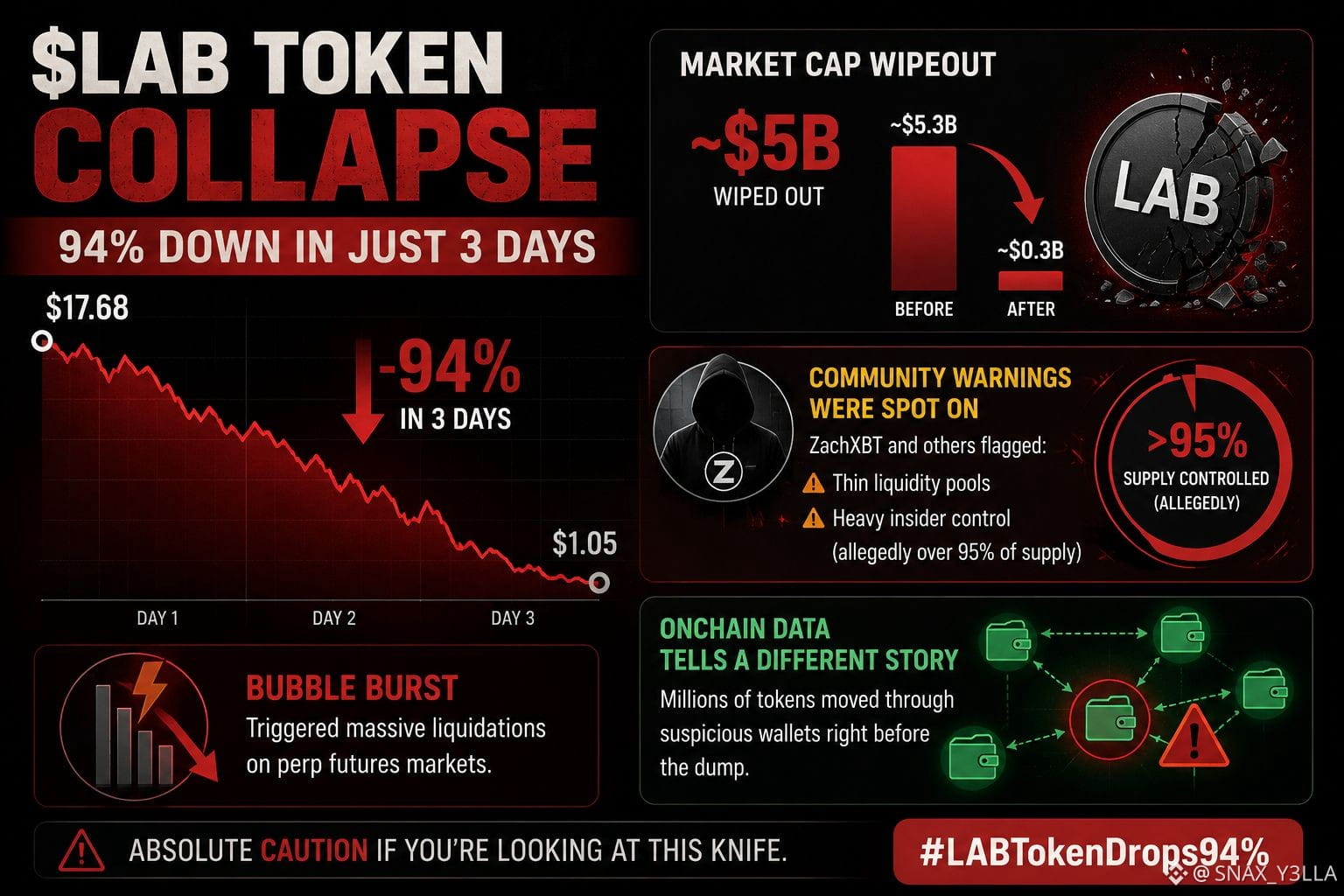
2
211
·
--
ຢືນຢັນແລ້ວ
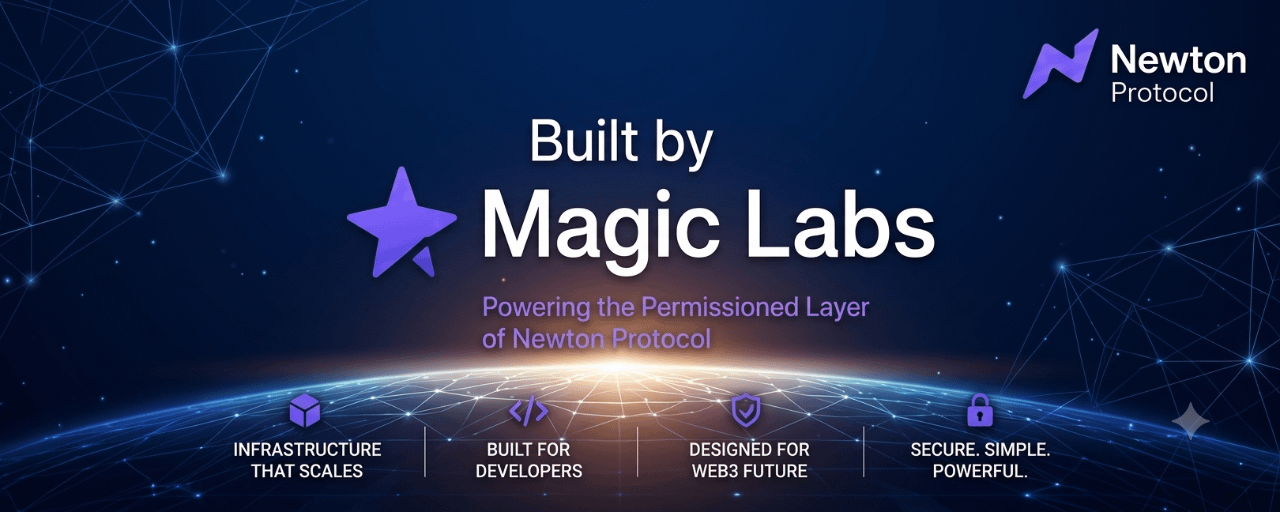
ບົດຄວາມ
Behind Newton Protocol Is A Company Most People Never Knew About@NewtonProtocol
One of the first things people tend to do when researching a blockchain project is studying its protocol
How much speed and security does it offer? What problem does it solve?
These are all fair questions but, while learning about Newton’s Mainnet Beta, I found myself asking more personal ones.
Who are the people behind the code?
Soon enough, my curiosity led me to Magic Labs – a company that, in my opinion, is deeply underrated when it comes to contributing to the Newton Protocol’s development.
Magic Labs is not some unknown start-up that has been fiddling with wallets on the sidelines.
Before Newton Protocol even hit the scene, Magic Labs has been steadily building infrastructure software for Web3 that powers hundreds of thousands of developers.
Apart from wallets, the company has been working on various blockchain solutions, one of which eventually became Newton’s permissioned layer.
Magic labs has been recognized by big names in the industry, like PayPal Ventures.
According to Newton’s website, Magic Labs’ solutions have already been used to power 57 million+ wallets and 200+K developers.
These are staggering figures.
I find such achievements important because, when evaluating a blockchain project, one has to realize that successful infrastructure usually involves credible expertise.
The more I learn about Newton, and the more I think about Magic Labs’ reputation, the more I believe that the right insight is crucial to building any kind of infrastructure.
Newton does not aim to solve a “simple” problem.
The permissioned layer it hopes to provide will serve as an authorization evaluation mechanism for policy governance before any transaction gets settled on-chain
This means that infrastructure developers need to have the exact conditions to make their product appealing to the developers who will eventually use it.
It takes time and effort to build something that is scalable and practical enough for other coders to implement in their own tools.
That is why I believe Newton’s collaboration with Magic Labs is so interesting.
Web3 experts know the company for its work in making Web3 onboarding easier and, therefore, more accessible.
Rather than ask every user to set up a crypto wallet from scratch, Magic Labs has been building user experience-friendly solutions for both developers and consumers for years.
Magic’s experience in the field is directly applicable to Newton’s needs because the permissioned layer wants to be adopted by developers.
The only way a permissioned layer can achieve that goal is by being intuitive enough for developers to implement in their own software.
One of the most important details that stood out to me in the context of Newton’s future adoption is how their approach differs from other permissioned layer blockchains.
Many promising protocols of the past failed to gain ground because their solutions were either incompatible with existing tools or too complicated for developers to implement.
Newton seems to have a much better shot at competing with the likes of Ethereum or Solana.
Their approach is to design an authorization mechanism that sits on top of existing smart contracts rather than ask developers to migrate their existing apps to a single blockchain.
This strategy echoes Magic Labs’ past successes.
Working with Magic makes much more sense when you realize how infrastructure products usually fail to gain ground.
The truth is, user-facing apps and infrastructure products are fundamentally different.
You will never hear someone saying “I love the infrastructure” that let them build a dApp.
A blockchain’s success is always a result of collective effort, with each link in the chain being responsible for its own performance.
With this in mind, Magic’s experience in creating products that are easy to use and implement is arguably one of the company’s main strengths.
In my opinion, it is also one of Newton’s most important assets.
I believe that, when it comes to infrastructure, many credible projects fail to gain ground simply because they greatly underestimate the importance of credible expertise.
People tend to get excited about new tech developments first, and then realize later how important existing solutions were in the creation process.
That is why, when I think about companies like Magic Labs, I see their work as the backbone of Web3 transformation.
In my opinion, their role in developing Newton’s permissioned layer is one of those underrated milestones every industry participant should acknowledge.
#Newt $NEWT
Behind Newton Protocol Is A Company Most People Never Knew About
@NewtonProtocol
One of the first things people tend to do when researching a blockchain project is studying its protocol
How much speed and security does it offer? What problem does it solve?
These are all fair questions but, while learning about Newton’s Mainnet Beta, I found myself asking more personal ones.
Who are the people behind the code?
Soon enough, my curiosity led me to Magic Labs – a company that, in my opinion, is deeply underrated when it comes to contributing to the Newton Protocol’s development.
Magic Labs is not some unknown start-up that has been fiddling with wallets on the sidelines.
Before Newton Protocol even hit the scene, Magic Labs has been steadily building infrastructure software for Web3 that powers hundreds of thousands of developers.
Apart from wallets, the company has been working on various blockchain solutions, one of which eventually became Newton’s permissioned layer.
Magic labs has been recognized by big names in the industry, like PayPal Ventures.
According to Newton’s website, Magic Labs’ solutions have already been used to power 57 million+ wallets and 200+K developers.
These are staggering figures.
I find such achievements important because, when evaluating a blockchain project, one has to realize that successful infrastructure usually involves credible expertise.
The more I learn about Newton, and the more I think about Magic Labs’ reputation, the more I believe that the right insight is crucial to building any kind of infrastructure.
Newton does not aim to solve a “simple” problem.
The permissioned layer it hopes to provide will serve as an authorization evaluation mechanism for policy governance before any transaction gets settled on-chain
This means that infrastructure developers need to have the exact conditions to make their product appealing to the developers who will eventually use it.
It takes time and effort to build something that is scalable and practical enough for other coders to implement in their own tools.
That is why I believe Newton’s collaboration with Magic Labs is so interesting.
Web3 experts know the company for its work in making Web3 onboarding easier and, therefore, more accessible.
Rather than ask every user to set up a crypto wallet from scratch, Magic Labs has been building user experience-friendly solutions for both developers and consumers for years.
Magic’s experience in the field is directly applicable to Newton’s needs because the permissioned layer wants to be adopted by developers.
The only way a permissioned layer can achieve that goal is by being intuitive enough for developers to implement in their own software.
One of the most important details that stood out to me in the context of Newton’s future adoption is how their approach differs from other permissioned layer blockchains.
Many promising protocols of the past failed to gain ground because their solutions were either incompatible with existing tools or too complicated for developers to implement.
Newton seems to have a much better shot at competing with the likes of Ethereum or Solana.
Their approach is to design an authorization mechanism that sits on top of existing smart contracts rather than ask developers to migrate their existing apps to a single blockchain.
This strategy echoes Magic Labs’ past successes.
Working with Magic makes much more sense when you realize how infrastructure products usually fail to gain ground.
The truth is, user-facing apps and infrastructure products are fundamentally different.
You will never hear someone saying “I love the infrastructure” that let them build a dApp.
A blockchain’s success is always a result of collective effort, with each link in the chain being responsible for its own performance.
With this in mind, Magic’s experience in creating products that are easy to use and implement is arguably one of the company’s main strengths.
In my opinion, it is also one of Newton’s most important assets.
I believe that, when it comes to infrastructure, many credible projects fail to gain ground simply because they greatly underestimate the importance of credible expertise.
People tend to get excited about new tech developments first, and then realize later how important existing solutions were in the creation process.
That is why, when I think about companies like Magic Labs, I see their work as the backbone of Web3 transformation.
In my opinion, their role in developing Newton’s permissioned layer is one of those underrated milestones every industry participant should acknowledge.
#Newt $NEWT
One of the first things people tend to do when researching a blockchain project is studying its protocol
How much speed and security does it offer? What problem does it solve?
These are all fair questions but, while learning about Newton’s Mainnet Beta, I found myself asking more personal ones.
Who are the people behind the code?
Soon enough, my curiosity led me to Magic Labs – a company that, in my opinion, is deeply underrated when it comes to contributing to the Newton Protocol’s development.
Magic Labs is not some unknown start-up that has been fiddling with wallets on the sidelines.
Before Newton Protocol even hit the scene, Magic Labs has been steadily building infrastructure software for Web3 that powers hundreds of thousands of developers.
Apart from wallets, the company has been working on various blockchain solutions, one of which eventually became Newton’s permissioned layer.
Magic labs has been recognized by big names in the industry, like PayPal Ventures.
According to Newton’s website, Magic Labs’ solutions have already been used to power 57 million+ wallets and 200+K developers.
These are staggering figures.
I find such achievements important because, when evaluating a blockchain project, one has to realize that successful infrastructure usually involves credible expertise.
The more I learn about Newton, and the more I think about Magic Labs’ reputation, the more I believe that the right insight is crucial to building any kind of infrastructure.
Newton does not aim to solve a “simple” problem.
The permissioned layer it hopes to provide will serve as an authorization evaluation mechanism for policy governance before any transaction gets settled on-chain
This means that infrastructure developers need to have the exact conditions to make their product appealing to the developers who will eventually use it.
It takes time and effort to build something that is scalable and practical enough for other coders to implement in their own tools.
That is why I believe Newton’s collaboration with Magic Labs is so interesting.
Web3 experts know the company for its work in making Web3 onboarding easier and, therefore, more accessible.
Rather than ask every user to set up a crypto wallet from scratch, Magic Labs has been building user experience-friendly solutions for both developers and consumers for years.
Magic’s experience in the field is directly applicable to Newton’s needs because the permissioned layer wants to be adopted by developers.
The only way a permissioned layer can achieve that goal is by being intuitive enough for developers to implement in their own software.
One of the most important details that stood out to me in the context of Newton’s future adoption is how their approach differs from other permissioned layer blockchains.
Many promising protocols of the past failed to gain ground because their solutions were either incompatible with existing tools or too complicated for developers to implement.
Newton seems to have a much better shot at competing with the likes of Ethereum or Solana.
Their approach is to design an authorization mechanism that sits on top of existing smart contracts rather than ask developers to migrate their existing apps to a single blockchain.
This strategy echoes Magic Labs’ past successes.
Working with Magic makes much more sense when you realize how infrastructure products usually fail to gain ground.
The truth is, user-facing apps and infrastructure products are fundamentally different.
You will never hear someone saying “I love the infrastructure” that let them build a dApp.
A blockchain’s success is always a result of collective effort, with each link in the chain being responsible for its own performance.
With this in mind, Magic’s experience in creating products that are easy to use and implement is arguably one of the company’s main strengths.
In my opinion, it is also one of Newton’s most important assets.
I believe that, when it comes to infrastructure, many credible projects fail to gain ground simply because they greatly underestimate the importance of credible expertise.
People tend to get excited about new tech developments first, and then realize later how important existing solutions were in the creation process.
That is why, when I think about companies like Magic Labs, I see their work as the backbone of Web3 transformation.
In my opinion, their role in developing Newton’s permissioned layer is one of those underrated milestones every industry participant should acknowledge.
#Newt $NEWT
9
4
86
·
--
@NewtonProtocol
Imagine swiping your credit card and the bank waited until the next day to realize that the card was valid, that the merchant had no fraud history, and therefore, the customer's balance was now compromised. Such an implementation would sound absurd today, but that is precisely how web3 settlements work: we allow transactions to be confirmed and only later attempt to mitigate damage from potential exploits.
On-chain security has always been a reactive process. We build protections based on known vulnerabilities or attacks that have already occurred. In essence, we only build solutions once there is an indisputable need for them.
This approach can only take us so far. Security needs to be proactive and have built-in guardrails before any execution happens.
This is why the Newton Mainnet Beta is so exciting.
It represents the long-awaited shift towards a new paradigm in which settlement is no longer confirmation or finality but rather a result of passing custom policy checks. It is essentially the "Visa Network" for the onchain economy, a foundational protocol-level infrastructure that enables richer applications by implementing flexible policy checks in real-time before any settlement occurs.
In other words, Newton goes beyond the standard reactive security measures by performing dynamic, customizable assessments of transactions, smart contracts, or any other entities participating in its ecosystem, checking whether they adhere to predefined rules or policies.
Web3 cannot scale to enterprise-grade applications with the status quo. Shifting from the "settle first, ask questions later" to Newton-style settlement is a necessary evolution in how the infrastructure for this space is designed. That is why I am so bullish on the project; it has the potential to become the standard for the industry.
#newt $NEWT
@NewtonProtocol
Imagine swiping your credit card and the bank waited until the next day to realize that the card was valid, that the merchant had no fraud history, and therefore, the customer's balance was now compromised. Such an implementation would sound absurd today, but that is precisely how web3 settlements work: we allow transactions to be confirmed and only later attempt to mitigate damage from potential exploits.
On-chain security has always been a reactive process. We build protections based on known vulnerabilities or attacks that have already occurred. In essence, we only build solutions once there is an indisputable need for them.
This approach can only take us so far. Security needs to be proactive and have built-in guardrails before any execution happens.
This is why the Newton Mainnet Beta is so exciting.
It represents the long-awaited shift towards a new paradigm in which settlement is no longer confirmation or finality but rather a result of passing custom policy checks. It is essentially the "Visa Network" for the onchain economy, a foundational protocol-level infrastructure that enables richer applications by implementing flexible policy checks in real-time before any settlement occurs.
In other words, Newton goes beyond the standard reactive security measures by performing dynamic, customizable assessments of transactions, smart contracts, or any other entities participating in its ecosystem, checking whether they adhere to predefined rules or policies.
Web3 cannot scale to enterprise-grade applications with the status quo. Shifting from the "settle first, ask questions later" to Newton-style settlement is a necessary evolution in how the infrastructure for this space is designed. That is why I am so bullish on the project; it has the potential to become the standard for the industry.
#newt $NEWT
Imagine swiping your credit card and the bank waited until the next day to realize that the card was valid, that the merchant had no fraud history, and therefore, the customer's balance was now compromised. Such an implementation would sound absurd today, but that is precisely how web3 settlements work: we allow transactions to be confirmed and only later attempt to mitigate damage from potential exploits.
On-chain security has always been a reactive process. We build protections based on known vulnerabilities or attacks that have already occurred. In essence, we only build solutions once there is an indisputable need for them.
This approach can only take us so far. Security needs to be proactive and have built-in guardrails before any execution happens.
This is why the Newton Mainnet Beta is so exciting.
It represents the long-awaited shift towards a new paradigm in which settlement is no longer confirmation or finality but rather a result of passing custom policy checks. It is essentially the "Visa Network" for the onchain economy, a foundational protocol-level infrastructure that enables richer applications by implementing flexible policy checks in real-time before any settlement occurs.
In other words, Newton goes beyond the standard reactive security measures by performing dynamic, customizable assessments of transactions, smart contracts, or any other entities participating in its ecosystem, checking whether they adhere to predefined rules or policies.
Web3 cannot scale to enterprise-grade applications with the status quo. Shifting from the "settle first, ask questions later" to Newton-style settlement is a necessary evolution in how the infrastructure for this space is designed. That is why I am so bullish on the project; it has the potential to become the standard for the industry.
#newt $NEWT
3
2
67
·
--
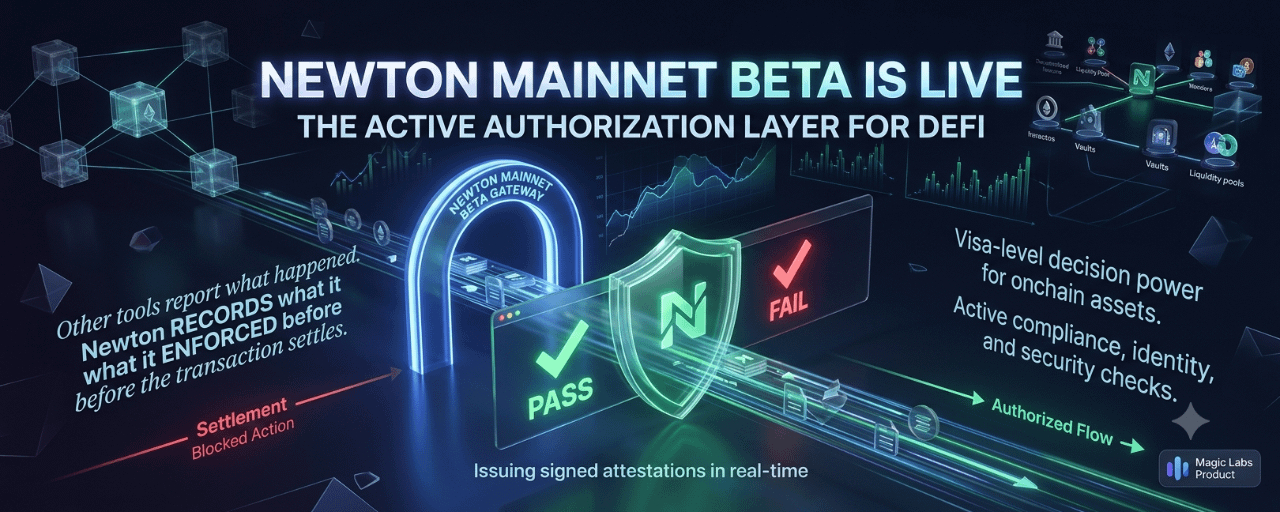
ບົດຄວາມ
Why On-Chain Execution Needs an Authorization Layer Before Settlement@NewtonProtocol
I’ve been thinking a lot about Web3 infrastructure lately, and I think we’re approaching something rather remarkable. Our present-day transaction model has a critical inverse: security is always reactive, only learned about after the fact that a protocol had been exploited.
By contrast, the Newton Mainnet Beta is notable for the way it reframes the discussion in terms of pre-settlement execution guardrails, instead of post-settlement reporting.
This is what it looks like on chain:
Any basic description of a blockchain transaction will note the familiar progression:
User signs and submits a payload to mempool, then block producers pick it up and execute the resulting state transition. Once a transaction is picked up for settlement inclusion, it is too late to stop it. If the settled payload unintentionally interacts with an attacked DeFi protocol, or crosses a compliance threshold, or sees an incorrect price feed from an oracle, the network has already accepted the resultant state change. Presently, the only tools in the Web3 security toolbox are purely reactionary: parsing settled change for subsequent reporting and dashboarding
The Newton Protocol fills a demonstrable gap in the decentralized finance security toolbox, with one simple and intuitive innovation: an active pre-settlement authorization layer familiar to anyone who has used a credit card at point of sale.
The "Visa Network" Analogy for Decentralized Finance
The next time you pay for a purchase with a credit card at point of sale, consider that the money in your account will not leave until a transaction has been authorized by a central payment processor. Visa’s internal network has milliseconds to analyze the transaction for risk factors, including account balance, fraudulent location data, and more, before returning a simple pass/fail response to the point of sale terminal. Once approved, the money in your account will actually move
What Newton Protocol does for Web3 is conceptually similar to what Visa does for the global payments ecosystem. Acting as an independent settlement layer during the Newton Mainnet Beta window, Newton has the ability to intercept transactions and evaluate them against a live policy set before any state transition occurs on the parent smart contract
Whereas the standard practice for securing smart contract transactions presently involves scanning the settled blockchain for suspicious addresses and behaviors, Newton evaluates the transaction payload itself in real time against a given policy set and returns a signed on-chain pass/fail attestation just before settlement
Resolving the Fragmented Logic Bottleneck
If there’s a specific counterparty or category of counterparties a multisig or asset vault wishes to restrict activity with, this typically involves writing either brittle off-chain logic or burning unnecessary gas with on-chain whitelisting. Either way, risk management logic gets unnecessarily tied up in the settlement layer
What this means for developers is that they can encode richer, more flexible compositional guardrails in Newton without disrupting the UX economics of their main dApp. By offloading policy evaluation to a separate purpose-built execution environment, Newton makes it possible for developers to write much more elaborate logic without negatively impacting the performance of their settlement layer smart contracts. The base layer doesn’t even have to perform any calculations: it can simply reference Newton’s published cryptographic attestation to verify that the transaction has passed Newton’s security policies for settlement to proceed.
As Web3 transitions from a consumer-friendly playground to a serious institutional-grade settlement layer for billions of dollars in assets, "settle first, ask questions later" is no longer a viable approach to security.
By introducing a pre-settlement transaction analysis and authorization layer, Newton has begun the critical work of plugging a foundational security weakness across the decentralized finance ecosystem.
[https://www.binance.com/en/square/profile/newtonprotocol](https://www.binance.com/en/square/profile/newtonprotocol)
@NewtonProtocol #Newt $NEWT
Why On-Chain Execution Needs an Authorization Layer Before Settlement
@NewtonProtocol
I’ve been thinking a lot about Web3 infrastructure lately, and I think we’re approaching something rather remarkable. Our present-day transaction model has a critical inverse: security is always reactive, only learned about after the fact that a protocol had been exploited.
By contrast, the Newton Mainnet Beta is notable for the way it reframes the discussion in terms of pre-settlement execution guardrails, instead of post-settlement reporting.
This is what it looks like on chain:
Any basic description of a blockchain transaction will note the familiar progression:
User signs and submits a payload to mempool, then block producers pick it up and execute the resulting state transition. Once a transaction is picked up for settlement inclusion, it is too late to stop it. If the settled payload unintentionally interacts with an attacked DeFi protocol, or crosses a compliance threshold, or sees an incorrect price feed from an oracle, the network has already accepted the resultant state change. Presently, the only tools in the Web3 security toolbox are purely reactionary: parsing settled change for subsequent reporting and dashboarding
The Newton Protocol fills a demonstrable gap in the decentralized finance security toolbox, with one simple and intuitive innovation: an active pre-settlement authorization layer familiar to anyone who has used a credit card at point of sale.
The "Visa Network" Analogy for Decentralized Finance
The next time you pay for a purchase with a credit card at point of sale, consider that the money in your account will not leave until a transaction has been authorized by a central payment processor. Visa’s internal network has milliseconds to analyze the transaction for risk factors, including account balance, fraudulent location data, and more, before returning a simple pass/fail response to the point of sale terminal. Once approved, the money in your account will actually move
What Newton Protocol does for Web3 is conceptually similar to what Visa does for the global payments ecosystem. Acting as an independent settlement layer during the Newton Mainnet Beta window, Newton has the ability to intercept transactions and evaluate them against a live policy set before any state transition occurs on the parent smart contract
Whereas the standard practice for securing smart contract transactions presently involves scanning the settled blockchain for suspicious addresses and behaviors, Newton evaluates the transaction payload itself in real time against a given policy set and returns a signed on-chain pass/fail attestation just before settlement
Resolving the Fragmented Logic Bottleneck
If there’s a specific counterparty or category of counterparties a multisig or asset vault wishes to restrict activity with, this typically involves writing either brittle off-chain logic or burning unnecessary gas with on-chain whitelisting. Either way, risk management logic gets unnecessarily tied up in the settlement layer
What this means for developers is that they can encode richer, more flexible compositional guardrails in Newton without disrupting the UX economics of their main dApp. By offloading policy evaluation to a separate purpose-built execution environment, Newton makes it possible for developers to write much more elaborate logic without negatively impacting the performance of their settlement layer smart contracts. The base layer doesn’t even have to perform any calculations: it can simply reference Newton’s published cryptographic attestation to verify that the transaction has passed Newton’s security policies for settlement to proceed.
As Web3 transitions from a consumer-friendly playground to a serious institutional-grade settlement layer for billions of dollars in assets, "settle first, ask questions later" is no longer a viable approach to security.
By introducing a pre-settlement transaction analysis and authorization layer, Newton has begun the critical work of plugging a foundational security weakness across the decentralized finance ecosystem.
https://www.binance.com/en/square/profile/newtonprotocol
@NewtonProtocol #Newt $NEWT
I’ve been thinking a lot about Web3 infrastructure lately, and I think we’re approaching something rather remarkable. Our present-day transaction model has a critical inverse: security is always reactive, only learned about after the fact that a protocol had been exploited.
By contrast, the Newton Mainnet Beta is notable for the way it reframes the discussion in terms of pre-settlement execution guardrails, instead of post-settlement reporting.
This is what it looks like on chain:
Any basic description of a blockchain transaction will note the familiar progression:
User signs and submits a payload to mempool, then block producers pick it up and execute the resulting state transition. Once a transaction is picked up for settlement inclusion, it is too late to stop it. If the settled payload unintentionally interacts with an attacked DeFi protocol, or crosses a compliance threshold, or sees an incorrect price feed from an oracle, the network has already accepted the resultant state change. Presently, the only tools in the Web3 security toolbox are purely reactionary: parsing settled change for subsequent reporting and dashboarding
The Newton Protocol fills a demonstrable gap in the decentralized finance security toolbox, with one simple and intuitive innovation: an active pre-settlement authorization layer familiar to anyone who has used a credit card at point of sale.
The "Visa Network" Analogy for Decentralized Finance
The next time you pay for a purchase with a credit card at point of sale, consider that the money in your account will not leave until a transaction has been authorized by a central payment processor. Visa’s internal network has milliseconds to analyze the transaction for risk factors, including account balance, fraudulent location data, and more, before returning a simple pass/fail response to the point of sale terminal. Once approved, the money in your account will actually move
What Newton Protocol does for Web3 is conceptually similar to what Visa does for the global payments ecosystem. Acting as an independent settlement layer during the Newton Mainnet Beta window, Newton has the ability to intercept transactions and evaluate them against a live policy set before any state transition occurs on the parent smart contract
Whereas the standard practice for securing smart contract transactions presently involves scanning the settled blockchain for suspicious addresses and behaviors, Newton evaluates the transaction payload itself in real time against a given policy set and returns a signed on-chain pass/fail attestation just before settlement
Resolving the Fragmented Logic Bottleneck
If there’s a specific counterparty or category of counterparties a multisig or asset vault wishes to restrict activity with, this typically involves writing either brittle off-chain logic or burning unnecessary gas with on-chain whitelisting. Either way, risk management logic gets unnecessarily tied up in the settlement layer
What this means for developers is that they can encode richer, more flexible compositional guardrails in Newton without disrupting the UX economics of their main dApp. By offloading policy evaluation to a separate purpose-built execution environment, Newton makes it possible for developers to write much more elaborate logic without negatively impacting the performance of their settlement layer smart contracts. The base layer doesn’t even have to perform any calculations: it can simply reference Newton’s published cryptographic attestation to verify that the transaction has passed Newton’s security policies for settlement to proceed.
As Web3 transitions from a consumer-friendly playground to a serious institutional-grade settlement layer for billions of dollars in assets, "settle first, ask questions later" is no longer a viable approach to security.
By introducing a pre-settlement transaction analysis and authorization layer, Newton has begun the critical work of plugging a foundational security weakness across the decentralized finance ecosystem.
https://www.binance.com/en/square/profile/newtonprotocol
@NewtonProtocol #Newt $NEWT
7
2
100
·
--
Overcoming the Gas Floor:
How Newton Protocol Approaches Recursive Proof Batching
@NewtonProtocol
With the Newton Protocol Mainnet Beta now live, developers are already looking towards the next challenge ahead: the gas floor of base-layer execution environments. During congested periods, the cost for Newton’s decentralized nodes to process heavy cryptographic artifacts or verify on-chain recursive logic can become prohibitively expensive. Developers are faced with a triage between transaction latency and validation costs during peak times.
To support enterprise-grade applications while maintaining economic viability around the Newton infrastructure, the protocol uses Recursive Proof Batching as a mechanism to reduce the overhead of validating transactions.
By recursively batching hundreds of small verification proofs into a single large proof structurally, the effective gas cost for processing an aggregated proof reverts to roughly that of a regular transaction. By offloading the majority of the mathematical heft to optimized execution loops in custom-precompiled contracts and only resorting to the mainnet execution environment for data-availability and settlement, the Newton infrastructure breaks the linear correlation between throughput and verification costs. For generic web3 developers building high-frequency automated tools, the ability to decouple validation overhead from effective throughput represents a significant leap towards parity with established web2 tooling.
#Newt $NEWT
#NewtonProtocol #Web3Security #Cryptography #MainnetBeta
Overcoming the Gas Floor:
How Newton Protocol Approaches Recursive Proof Batching
@NewtonProtocol
With the Newton Protocol Mainnet Beta now live, developers are already looking towards the next challenge ahead: the gas floor of base-layer execution environments. During congested periods, the cost for Newton’s decentralized nodes to process heavy cryptographic artifacts or verify on-chain recursive logic can become prohibitively expensive. Developers are faced with a triage between transaction latency and validation costs during peak times.
To support enterprise-grade applications while maintaining economic viability around the Newton infrastructure, the protocol uses Recursive Proof Batching as a mechanism to reduce the overhead of validating transactions.
By recursively batching hundreds of small verification proofs into a single large proof structurally, the effective gas cost for processing an aggregated proof reverts to roughly that of a regular transaction. By offloading the majority of the mathematical heft to optimized execution loops in custom-precompiled contracts and only resorting to the mainnet execution environment for data-availability and settlement, the Newton infrastructure breaks the linear correlation between throughput and verification costs. For generic web3 developers building high-frequency automated tools, the ability to decouple validation overhead from effective throughput represents a significant leap towards parity with established web2 tooling.
#Newt $NEWT
#NewtonProtocol #Web3Security #Cryptography #MainnetBeta
How Newton Protocol Approaches Recursive Proof Batching
@NewtonProtocol
With the Newton Protocol Mainnet Beta now live, developers are already looking towards the next challenge ahead: the gas floor of base-layer execution environments. During congested periods, the cost for Newton’s decentralized nodes to process heavy cryptographic artifacts or verify on-chain recursive logic can become prohibitively expensive. Developers are faced with a triage between transaction latency and validation costs during peak times.
To support enterprise-grade applications while maintaining economic viability around the Newton infrastructure, the protocol uses Recursive Proof Batching as a mechanism to reduce the overhead of validating transactions.
By recursively batching hundreds of small verification proofs into a single large proof structurally, the effective gas cost for processing an aggregated proof reverts to roughly that of a regular transaction. By offloading the majority of the mathematical heft to optimized execution loops in custom-precompiled contracts and only resorting to the mainnet execution environment for data-availability and settlement, the Newton infrastructure breaks the linear correlation between throughput and verification costs. For generic web3 developers building high-frequency automated tools, the ability to decouple validation overhead from effective throughput represents a significant leap towards parity with established web2 tooling.
#Newt $NEWT
#NewtonProtocol #Web3Security #Cryptography #MainnetBeta
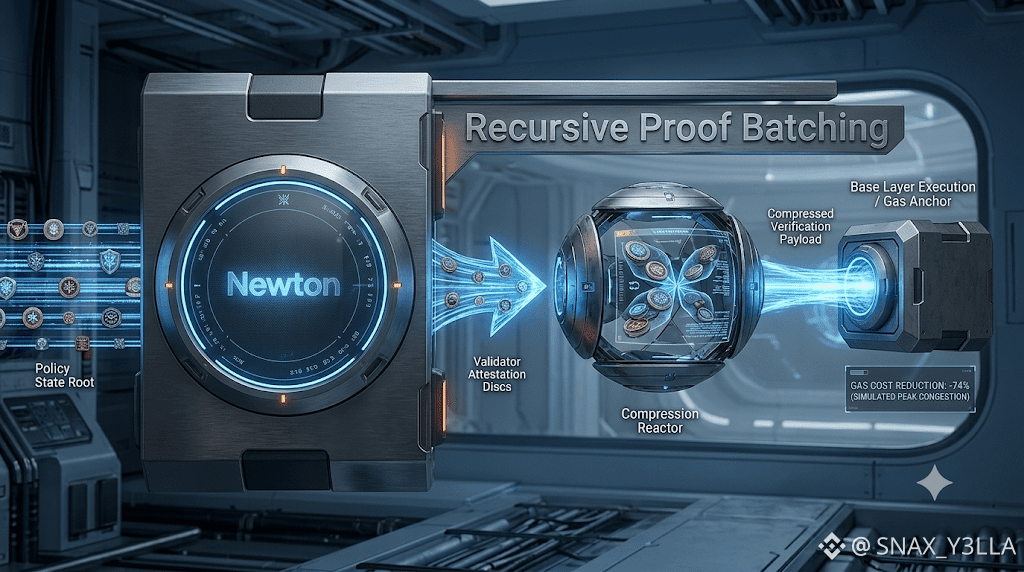
4
1
65
ເຂົ້າສູ່ລະບົບເພື່ອສຳຫຼວດເນື້ອຫາເພີ່ມເຕີມ
ເຂົ້າຮ່ວມກຸ່ມຜູ້ໃຊ້ຄຣິບໂຕທົ່ວໂລກໃນ Binance Square.
⚡️ ໄດ້ຮັບຂໍ້ມູນຫຼ້າສຸດ ແລະ ທີ່ມີປະໂຫຍດກ່ຽວກັບຄຣິບໂຕ.
💬 ໄດ້ຮັບຄວາມໄວ້ວາງໃຈຈາກຕະຫຼາດແລກປ່ຽນຄຣິບໂຕທີ່ໃຫຍ່ທີ່ສຸດໃນໂລກ.
👍 ຄົ້ນຫາຂໍ້ມູນເຊີງເລິກທີ່ແທ້ຈາກນັກສ້າງທີ່ໄດ້ຮັບການຢືນຢັນ.
ອີເມວ / ເບີໂທລະສັບ
ຫົວຂໍ້ທີ່ກໍາລັງນິຍົມ
CircleMints500MUSDCOnSolana
138,989 views
2,577 ກຳລັງສົນທະນາ
#circlemints500musdconsolana 🚨 $500M USDC PUT SOLANA DEFI UNDER THE MICROSCOPE
Circle has added 500 million Dollar in USDC to Solana. That’s a number.. Here’s what traders really need to pay attention to. 👀
A 500 million Dollar jump in USDC supply doesn’t automatically mean 500 million dollar of buying pressure. That’s not how it works. The real story is what happens next.
🔹 Does the USDC move into lending protocols?
🔹 Does borrowing demand pick up more liquidity comes in?
🔹 Do USDC lending yields drop as supply grows?
🔹 Does all this stablecoin liquidity eventually shift into SOL and other Solana assets?
Circle says the USDC can be minted in advance and held before it hits the circulating supply. That means the headline number is the start. The actual flow after minting matters more than the announcement.
Jupiter is already a player on Solana for USDC lending and borrowing. So the utilization rate and borrowing activity there are metrics to watch.
📊 Here’s my main focus:
inflows → DeFi utilization → rising borrowing demand → SOL liquidity.
Is this 500 million Dollar going to sit idle?. Will it flow into DeFi first?. Then will it eventually move into riskier assets like SOL, JUP, KMNO?
The next few days could tell us a lot, about how Solana DeFi's reacting to this injection.
#solana #crypto #Khan62 #USDC
$KMNO $JUP $ORCA
Khan 62
·6 ຖືກໃຈ
·5k views
PolymarketBankFailureBetsDrawFDICConcern
124,500 views
2,112 ກຳລັງສົນທະນາ
BlackRockBuildsTokenizedPortfoliosForOndo
120,396 views
1,515 ກຳລັງສົນທະນາ