

Hashmi29
11 ໂພສ

Hashmi29
ລາຍງານ
ບລັອກຜູ້ໃຊ້
Self-funded Trader • Crypto Writer • Blogger • Data-driven Threads
ເປີດການຊື້ຂາຍ
ຜູ້ຊື້ຂາຍຊົ່ວຄາວ
1.7 ປີ
3 ກໍາລັງຕິດຕາມ
16 ຜູ້ຕິດຕາມ
30 Liked
ໂພສ
Portfolio
ທັງໝົດ
ວົງຢືມ
·
--
$6.3 BILLION CRYPTO HACK — BUT BITCOIN IS HOLDING ITS GROUND!
The world's biggest cryptocurrency exchange, Binance, has suffered a record-breaking security breach, with approximately $6.3 billion in digital assets affected.
Yet Bitcoin is showing unexpected resilience.
📉 Bitcoin fell around 4%, trading near $77,065 on Friday afternoon, October 30, according to CNBC.
But here's what makes this different:
🔸 Previous major crypto exchange hacks triggered an average Bitcoin decline of 8.3% within the first 24 hours, according to Anchorage Digital data cited by CNBC.
🔸 Analysts say Bitcoin itself was NOT hacked. The breach targeted a centralised exchange's security infrastructure.
🔸 Binance pledged to cover the losses using its financial resources.
🔸 Crypto industry partners reportedly froze approximately $3 billion in stolen assets.
🔸 Long-term Bitcoin investors may also be helping limit panic selling.
WHY IS BITCOIN NOT CRASHING HARDER?
Market analysts believe investors are distinguishing between a security failure at a cryptocurrency exchange and a failure of the Bitcoin blockchain itself.
The distinction could be crucial for Bitcoin's long-term reputation.
💬 Do you think Bitcoin can survive even a $6.3 billion crypto disaster without losing investor confidence?
Follow Eagle News for global financial and cryptocurrency updates.
#Binance #CryptoNews #BitcoinPrice #CryptoHack #BTC #Blockchain #Cryptocurrency #CryptoMarket

30
·
--

ບົດຄວາມ
BINANCE'S $6.34 BILLION RESCUE PLAN! Can the Crypto Giant Recover From History's Biggest Hack?Binance Sets Aside $6.34 Billion to Cover Losses After Record-Breaking $6.3 Billion Crypto Hack
World's largest cryptocurrency exchange moves to protect customer balances as hackers drain billions in digital assets, triggering emergency security measures and industry-wide concern.
Binance has announced that it has allocated more than $6.34 billion in company resources to cover losses following what is being described as one of the largest cryptocurrency thefts in history.
The announcement comes after attackers reportedly stole approximately $6.3 billion in digital assets from the cryptocurrency exchange, raising serious questions about the security of major trading platforms and the protection of customer funds.
According to a report by CoinDesk, Binance has already secured approximately $5 billion in the exact cryptocurrency assets affected by the attack. The company is purchasing the remaining assets through public cryptocurrency markets and over-the-counter (OTC) transactions to ensure that affected customer balances can be restored on a one-for-one basis.
Binance said the funds allocated for recovery come from its own corporate resources and will not be taken from unaffected customer accounts.
$3 Billion in stolen assets frozen
In addition to its financial commitment, Binance confirmed that cryptocurrency industry partners have helped freeze approximately $3 billion worth of stolen assets.
Major cryptocurrency companies, including Tether and Circle, reportedly moved quickly to restrict the movement of billions of dollars in stolen stablecoins.
Tether froze more than $1.56 billion in USDT, while Circle blocked approximately $823 million in USDC. Ripple and other industry participants also reportedly helped freeze additional assets.
However, freezing cryptocurrency does not automatically mean the money has been returned. Binance is continuing to work with industry partners and law enforcement agencies to recover the affected funds.
How did the massive hack happen?
The attack reportedly unfolded across multiple blockchain networks, with attackers draining Binance hot wallets in a series of rapid transactions lasting approximately 20 minutes.
Binance initially identified a compromised employee device as a possible entry point. However, subsequent investigations revealed additional security weaknesses and potential attack methods.
Binance co-CEO Richard Teng later said investigators had discovered further breach points and that attackers had used sophisticated techniques to bypass normal security checks.
Blockchain analytics firms, including Chainalysis and TRM Labs, linked the attack with high confidence to North Korean state-linked hacking operations.
The investigation remains ongoing.
Binance pauses withdrawals amid security checks
Following the incident, Binance temporarily suspended withdrawals while reviewing and strengthening its security infrastructure.
Deposits remained open, while the company worked to verify its systems, investigate the attack and protect customer assets.
The exchange also indicated that it intended to publish updated Proof of Reserves information to provide greater transparency about the assets backing customer balances.
A major test for the cryptocurrency industry
The incident has sparked a wider debate about cryptocurrency exchange security, digital asset protection and the industry's ability to respond to large-scale cyberattacks.
Binance's decision to commit more than $6.34 billion demonstrates the financial resources being deployed to reassure customers and maintain confidence in the platform.
However, the attack also highlights the risks associated with keeping large amounts of cryptocurrency within centralized exchanges.
With billions of dollars still subject to recovery efforts, the incident could influence how cryptocurrency platforms approach wallet security, withdrawal approvals and cooperation with blockchain investigators.
The biggest question now is whether Binance and its industry partners can recover the stolen assets and prevent another attack of this scale.
BINANCE'S $6.34 BILLION RESCUE PLAN! Can the Crypto Giant Recover From History's Biggest Hack?
Binance Sets Aside $6.34 Billion to Cover Losses After Record-Breaking $6.3 Billion Crypto Hack
World's largest cryptocurrency exchange moves to protect customer balances as hackers drain billions in digital assets, triggering emergency security measures and industry-wide concern.
Binance has announced that it has allocated more than $6.34 billion in company resources to cover losses following what is being described as one of the largest cryptocurrency thefts in history.
The announcement comes after attackers reportedly stole approximately $6.3 billion in digital assets from the cryptocurrency exchange, raising serious questions about the security of major trading platforms and the protection of customer funds.
According to a report by CoinDesk, Binance has already secured approximately $5 billion in the exact cryptocurrency assets affected by the attack. The company is purchasing the remaining assets through public cryptocurrency markets and over-the-counter (OTC) transactions to ensure that affected customer balances can be restored on a one-for-one basis.
Binance said the funds allocated for recovery come from its own corporate resources and will not be taken from unaffected customer accounts.
$3 Billion in stolen assets frozen
In addition to its financial commitment, Binance confirmed that cryptocurrency industry partners have helped freeze approximately $3 billion worth of stolen assets.
Major cryptocurrency companies, including Tether and Circle, reportedly moved quickly to restrict the movement of billions of dollars in stolen stablecoins.
Tether froze more than $1.56 billion in USDT, while Circle blocked approximately $823 million in USDC. Ripple and other industry participants also reportedly helped freeze additional assets.
However, freezing cryptocurrency does not automatically mean the money has been returned. Binance is continuing to work with industry partners and law enforcement agencies to recover the affected funds.
How did the massive hack happen?
The attack reportedly unfolded across multiple blockchain networks, with attackers draining Binance hot wallets in a series of rapid transactions lasting approximately 20 minutes.
Binance initially identified a compromised employee device as a possible entry point. However, subsequent investigations revealed additional security weaknesses and potential attack methods.
Binance co-CEO Richard Teng later said investigators had discovered further breach points and that attackers had used sophisticated techniques to bypass normal security checks.
Blockchain analytics firms, including Chainalysis and TRM Labs, linked the attack with high confidence to North Korean state-linked hacking operations.
The investigation remains ongoing.
Binance pauses withdrawals amid security checks
Following the incident, Binance temporarily suspended withdrawals while reviewing and strengthening its security infrastructure.
Deposits remained open, while the company worked to verify its systems, investigate the attack and protect customer assets.
The exchange also indicated that it intended to publish updated Proof of Reserves information to provide greater transparency about the assets backing customer balances.
A major test for the cryptocurrency industry
The incident has sparked a wider debate about cryptocurrency exchange security, digital asset protection and the industry's ability to respond to large-scale cyberattacks.
Binance's decision to commit more than $6.34 billion demonstrates the financial resources being deployed to reassure customers and maintain confidence in the platform.
However, the attack also highlights the risks associated with keeping large amounts of cryptocurrency within centralized exchanges.
With billions of dollars still subject to recovery efforts, the incident could influence how cryptocurrency platforms approach wallet security, withdrawal approvals and cooperation with blockchain investigators.
The biggest question now is whether Binance and its industry partners can recover the stolen assets and prevent another attack of this scale.
1
1.3k
·
--
ບົດຄວາມ
$1.4 Billion Bitcoin Heist: Hackers Split Stolen Binance Funds Across 19 Wallets$1.4 Billion Bitcoin Heist: Hackers Split Stolen Binance Funds Across 19 Wallets in a Move That Bitcoin Cannot Simply Reverse
The massive cryptocurrency theft has raised fresh concerns about digital asset security, blockchain investigations and the challenges of recovering stolen Bitcoin.
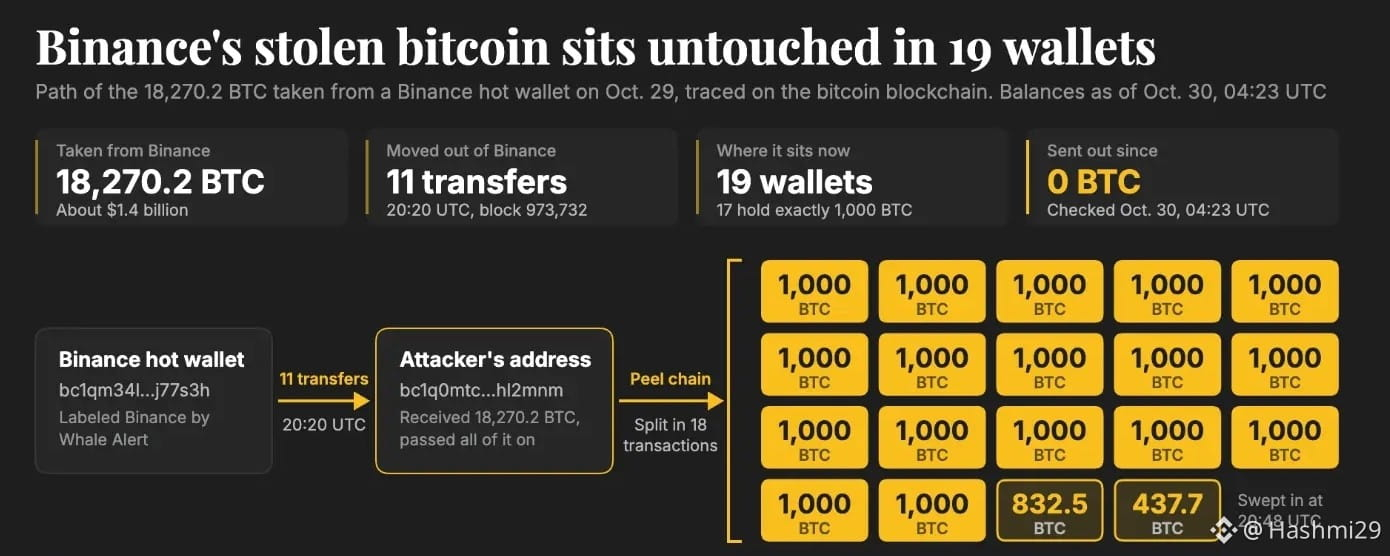
A major cryptocurrency theft involving approximately 18,270.2 Bitcoin (BTC), valued at around $1.4 billion, has drawn attention across the global crypto market after the stolen funds were distributed across 19 separate cryptocurrency wallets.
According to blockchain tracking data highlighted by CoinDesk, the Bitcoin was taken from a Binance hot wallet on October 29, 2026. The attackers reportedly transferred the stolen cryptocurrency through 11 transactions before moving the funds into a series of separate wallets.
The operation appears to have been designed to distribute the stolen assets across multiple addresses, making the movement of funds more complicated for investigators and blockchain monitoring services.
How the stolen Bitcoin was distributed
The CoinDesk analysis shows that the attacker initially received the entire 18,270.2 BTC before splitting the funds into multiple transactions.
The resulting distribution included:
- Total stolen: 18,270.2 BTC.
- Estimated value: Approximately $1.4 billion.
- Initial transfers: 11 transactions.
- Destination wallets: 19 separate wallets.
- Wallet balances: 17 wallets reportedly holding exactly 1,000 BTC each.
- Remaining balances: Approximately 832.5 BTC and 437.7 BTC in two other wallets.
At the time of the October 30 tracking snapshot, none of the Bitcoin had been transferred out of those destination wallets.
This unusual distribution has attracted attention because it provides investigators with multiple addresses to monitor while making the recovery process more complicated.
Why can't Bitcoin simply be frozen?
One of the most important aspects of this incident is the difference between Bitcoin and centrally issued stablecoins.
Some stablecoin issuers have the technical ability to freeze tokens associated with specific blockchain addresses. This allows them to restrict the movement of funds in certain circumstances.
Bitcoin works differently.
There is no central company or issuing authority controlling the Bitcoin network that can simply freeze an address or reverse a confirmed transaction.
Once a Bitcoin transaction is confirmed, it cannot ordinarily be reversed by a central authority.
However, this does not mean stolen Bitcoin is impossible to recover. Exchanges and other regulated cryptocurrency services can identify suspicious deposits, restrict accounts under their control and cooperate with law enforcement.
Stablecoin issuers take action
The CoinDesk graphic also reports that stablecoin issuers froze approximately $3 billion worth of stolen assets within hours.
This highlights an important difference in cryptocurrency security: while certain centrally controlled digital assets can be frozen by their issuers, Bitcoin requires a different approach to tracking and recovering stolen funds.
Investigators must rely heavily on blockchain analysis, transaction monitoring and cooperation with cryptocurrency exchanges.
What happens next?
The movement of the stolen Bitcoin will remain an important development to watch.
Although splitting funds across multiple wallets can complicate investigations, Bitcoin transactions are recorded on a public blockchain. This means investigators and blockchain analytics companies can continue monitoring the addresses and tracing subsequent transactions.
If the attackers attempt to convert the Bitcoin into traditional currency or move it through cooperating cryptocurrency platforms, they may expose themselves to identification and intervention.
For now, the October 30 tracking snapshot indicates that the stolen Bitcoin remained in the 19 identified wallets.
A major test for cryptocurrency security
The incident highlights a continuing challenge for the cryptocurrency industry: blockchain technology offers transparency, but transparency does not automatically guarantee the recovery of stolen assets.
As cryptocurrency adoption grows worldwide, exchanges face increasing pressure to strengthen wallet security, improve transaction monitoring and respond quickly to suspicious activity.
The central question is no longer just how the attackers managed to steal such a huge amount of Bitcoin, but whether investigators can identify them and recover the funds.
The world is watching what happens to the $1.4 billion Bitcoin stash.
$1.4 Billion Bitcoin Heist: Hackers Split Stolen Binance Funds Across 19 Wallets
$1.4 Billion Bitcoin Heist: Hackers Split Stolen Binance Funds Across 19 Wallets in a Move That Bitcoin Cannot Simply Reverse
The massive cryptocurrency theft has raised fresh concerns about digital asset security, blockchain investigations and the challenges of recovering stolen Bitcoin.
A major cryptocurrency theft involving approximately 18,270.2 Bitcoin (BTC), valued at around $1.4 billion, has drawn attention across the global crypto market after the stolen funds were distributed across 19 separate cryptocurrency wallets.
According to blockchain tracking data highlighted by CoinDesk, the Bitcoin was taken from a Binance hot wallet on October 29, 2026. The attackers reportedly transferred the stolen cryptocurrency through 11 transactions before moving the funds into a series of separate wallets.
The operation appears to have been designed to distribute the stolen assets across multiple addresses, making the movement of funds more complicated for investigators and blockchain monitoring services.
How the stolen Bitcoin was distributed
The CoinDesk analysis shows that the attacker initially received the entire 18,270.2 BTC before splitting the funds into multiple transactions.
The resulting distribution included:
- Total stolen: 18,270.2 BTC.
- Estimated value: Approximately $1.4 billion.
- Initial transfers: 11 transactions.
- Destination wallets: 19 separate wallets.
- Wallet balances: 17 wallets reportedly holding exactly 1,000 BTC each.
- Remaining balances: Approximately 832.5 BTC and 437.7 BTC in two other wallets.
At the time of the October 30 tracking snapshot, none of the Bitcoin had been transferred out of those destination wallets.
This unusual distribution has attracted attention because it provides investigators with multiple addresses to monitor while making the recovery process more complicated.
Why can't Bitcoin simply be frozen?
One of the most important aspects of this incident is the difference between Bitcoin and centrally issued stablecoins.
Some stablecoin issuers have the technical ability to freeze tokens associated with specific blockchain addresses. This allows them to restrict the movement of funds in certain circumstances.
Bitcoin works differently.
There is no central company or issuing authority controlling the Bitcoin network that can simply freeze an address or reverse a confirmed transaction.
Once a Bitcoin transaction is confirmed, it cannot ordinarily be reversed by a central authority.
However, this does not mean stolen Bitcoin is impossible to recover. Exchanges and other regulated cryptocurrency services can identify suspicious deposits, restrict accounts under their control and cooperate with law enforcement.
Stablecoin issuers take action
The CoinDesk graphic also reports that stablecoin issuers froze approximately $3 billion worth of stolen assets within hours.
This highlights an important difference in cryptocurrency security: while certain centrally controlled digital assets can be frozen by their issuers, Bitcoin requires a different approach to tracking and recovering stolen funds.
Investigators must rely heavily on blockchain analysis, transaction monitoring and cooperation with cryptocurrency exchanges.
What happens next?
The movement of the stolen Bitcoin will remain an important development to watch.
Although splitting funds across multiple wallets can complicate investigations, Bitcoin transactions are recorded on a public blockchain. This means investigators and blockchain analytics companies can continue monitoring the addresses and tracing subsequent transactions.
If the attackers attempt to convert the Bitcoin into traditional currency or move it through cooperating cryptocurrency platforms, they may expose themselves to identification and intervention.
For now, the October 30 tracking snapshot indicates that the stolen Bitcoin remained in the 19 identified wallets.
A major test for cryptocurrency security
The incident highlights a continuing challenge for the cryptocurrency industry: blockchain technology offers transparency, but transparency does not automatically guarantee the recovery of stolen assets.
As cryptocurrency adoption grows worldwide, exchanges face increasing pressure to strengthen wallet security, improve transaction monitoring and respond quickly to suspicious activity.
The central question is no longer just how the attackers managed to steal such a huge amount of Bitcoin, but whether investigators can identify them and recover the funds.
The world is watching what happens to the $1.4 billion Bitcoin stash.
2
1.4k
·
--
$1.4 BILLION IN BITCOIN STOLEN — 19 WALLETS, ZERO FROZEN!
A massive crypto heist has taken a shocking turn.
Hackers reportedly stole 18,270.2 BTC (worth approximately $1.4 billion) from a Binance hot wallet and quickly divided the stolen Bitcoin across 19 different wallets.
But here's what makes this even more alarming:
🔸 18,270.2 BTC stolen from Binance.
🔸 Funds split through 11 transfers.
🔸 Bitcoin distributed across 19 wallets.
🔸 17 wallets reportedly hold exactly 1,000 BTC each.
🔸 Zero BTC had moved out of those wallets at the time of CoinDesk's October 30 tracking update.
WHY CAN'T BITCOIN BE FROZEN?
Unlike centralized stablecoins, Bitcoin has no issuing company that can simply freeze specific coins. The funds can potentially be intercepted if they reach cooperating exchanges or other regulated services, but the Bitcoin network itself cannot simply reverse or freeze the transactions.
💰 A $1.4 BILLION crypto mystery is unfolding. Will investigators recover the stolen Bitcoin?
👇 What do you think: Will the hackers eventually cash out, or will this Bitcoin remain untouched?
Follow for more breaking cryptocurrency and global financial news.
#Binance #Bitcoin #CryptoNews #CryptoHack #BitcoinHeist #Blockchain #Cryptocurrency #BTC #CyberSecurity #CryptoMarket #EagleNews

1
612

·
--
Hackers stole $6.3 billion from Binance, the world's biggest cryptocurrency exchange, in a theft that analysts blamed on North Korea and said could be the largest financial heist of all time.
Cryptocurrency prices fell on the news, while Binance halted withdrawals and said it would use company funds to cover the losses. Stablecoin issuers including El Salvador-based Tether and the Trump-backed World Liberty Financial froze about half of the stolen assets.
#BinanceWillListPredictPREDICT #BİNANCE #Hacked #cryptohacks #Binance #BinanceHack #CryptoHack #CryptoNews #Bitcoin #Cryptocurrency #CryptoSecurity #Blockchain #CyberAttack #NorthKorea #CryptoTheft #DigitalAssets #CryptoMarket #Stablecoin #Tether #WorldLibertyFinancial #FinancialCrime #CyberCrime #CryptoScam #GlobalNews #BreakingNews #EagleNews #EagleNews29

72
·
--
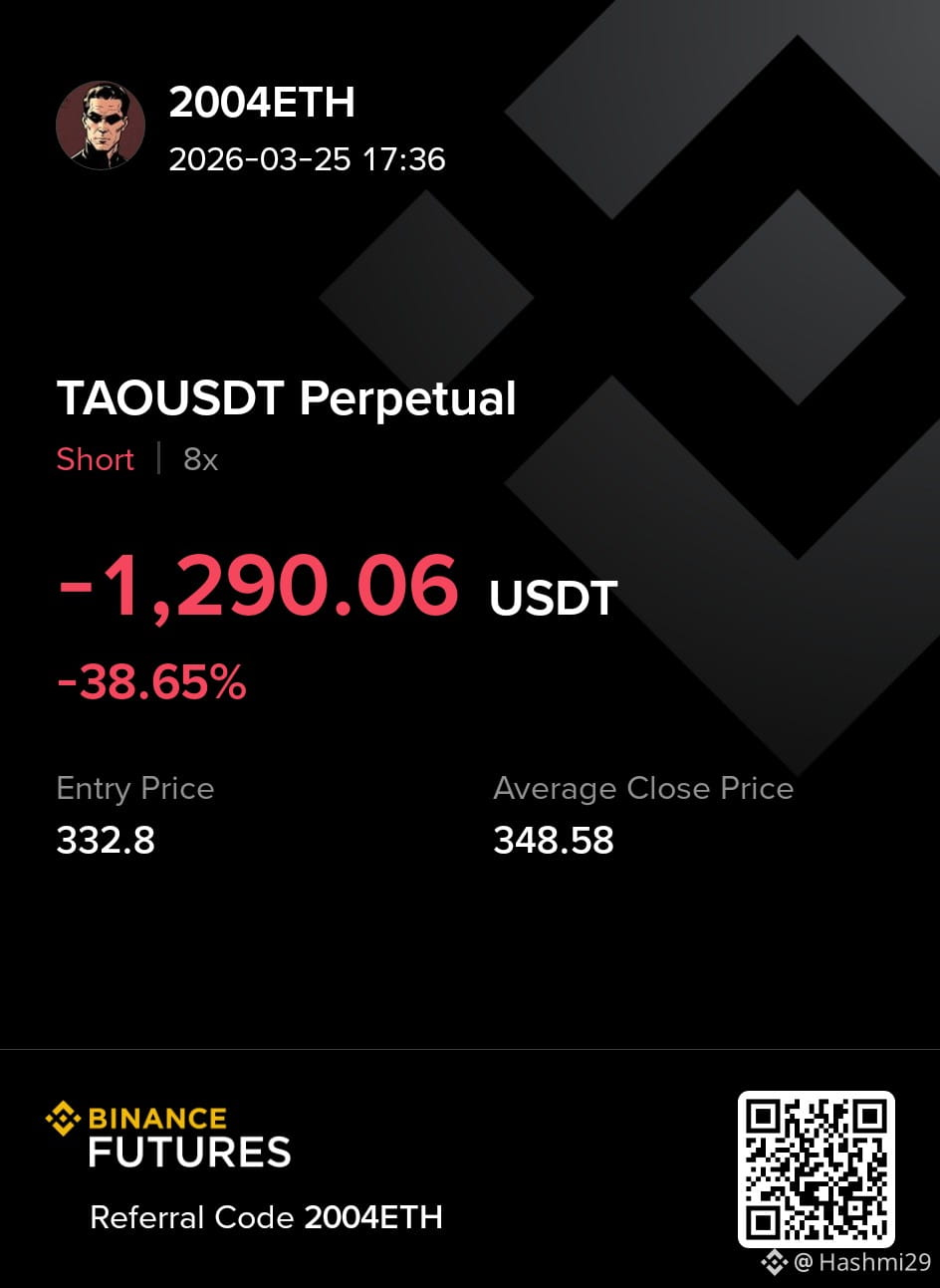
im done with $TAO very hurt🤧.
I will.short $TAO again but with small Volume 🥰
im done with $TAO very hurt🤧.
I will.short $TAO again but with small Volume 🥰
I will.short $TAO again but with small Volume 🥰
·
--
Market 🚨Alert
Market 🚨Alert

khuranabarkha
·
--
🚨 Market Shocker Alert 🚨
The United States reportedly spent around $3.7 billion in just 100 hours during engagement in Iran — that’s nearly $900 million per day 💸
This kind of massive spending highlights how global events can heavily impact financial markets, including crypto. When uncertainty rises, investors often shift towards alternative assets like Bitcoin & crypto.
📊 What does this mean for traders?
Stay alert, manage risk, and watch market sentiment closely — big news = big volatility.
Crypto isn’t just charts… it’s connected to global events. 🌍

1
·
--
🥰🥰
🥰🥰


Insighter Yi Xi
·
--
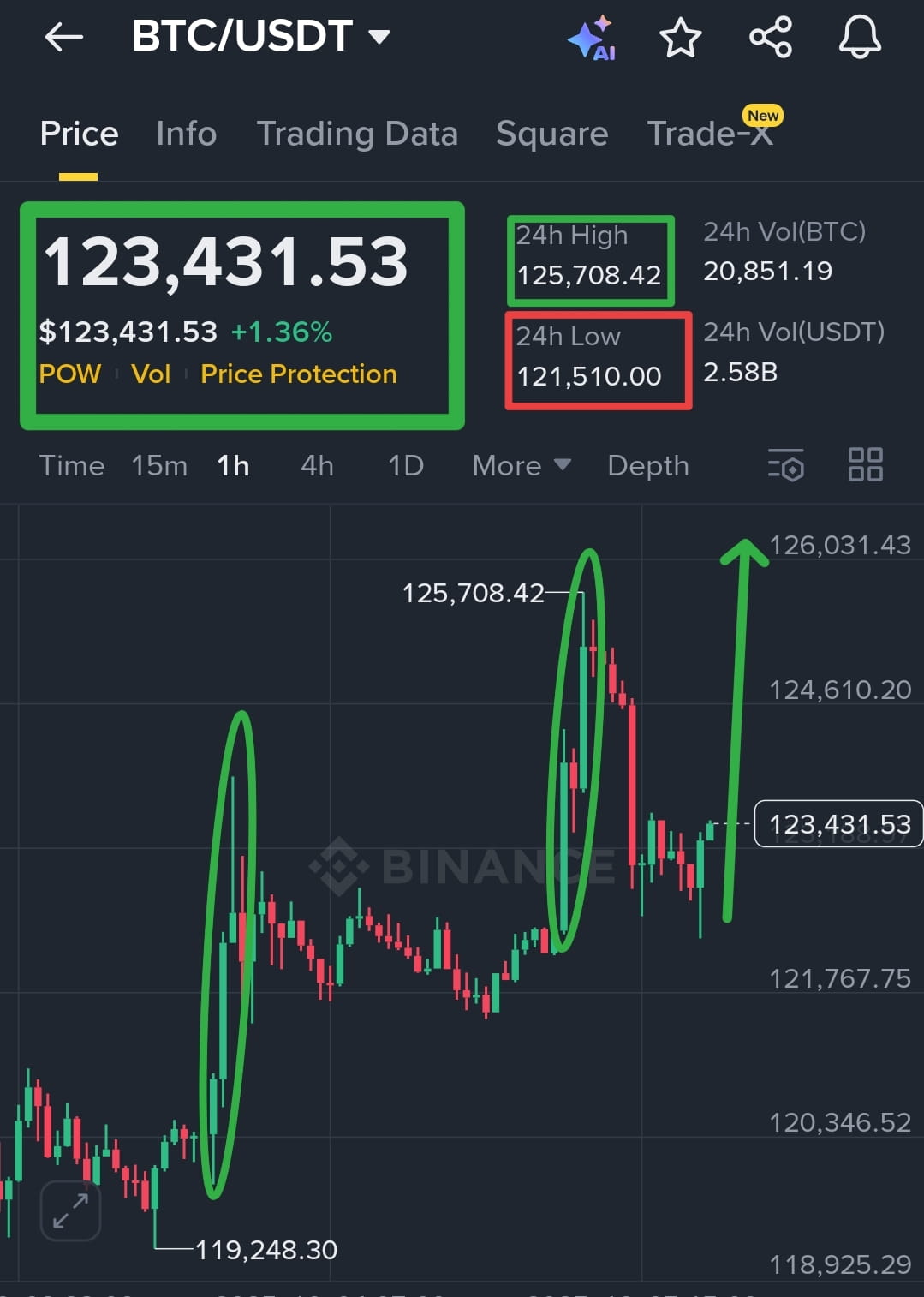
ສັນຍານກະທິງ$BTC /USDT Bulls Eyeing $126K Breakout
Bitcoin is trading near $123,400 after a strong rebound from the $121,500 support zone. The chart structure shows higher lows and sharp bullish spikes, indicating that buyers are in control. Momentum suggests another attempt toward the $126,000 resistance, which could trigger fresh upside if broken.
🔹 Analysis
Support Zone: $121,500 – $119,200 (buyers defending strongly)
Resistance Zone: $125,700 – $126,500 (key breakout area)
Market Bias: Bullish while holding above $123K
Trade Setup
Entry: $123,000 – $123,500
Stop-Loss: $121,400
Target 1: $125,700
Target 2: $126,500
A clean breakout above $126K could fuel a stronger rally, while risk remains limited if price slips below $121,500.
#BTCUSDT #Bitcoin #Binance #CryptoTrading
12
12
·
--
kindly try this amazing trick 🥰👍👍
kindly try this amazing trick 🥰👍👍

Eliza Ross
·
--
How to Earn $1–$4 Daily on Binance Without Any Investment
Earning a small daily income online is possible even if you don’t want to invest any money. Binance, one of the world’s largest cryptocurrency platforms, offers several programs and rewards that allow users to earn free crypto every day. By following a few simple strategies, you can consistently make $1–$4 daily without risking your money.
1. Binance Learn & Earn
Binance Learn & Earn is a beginner-friendly program where you learn about new cryptocurrencies and earn rewards for completing short educational activities:
Watch short videos or read articles about a coin.
Complete quizzes related to the content.
Earn crypto rewards instantly.
Why it’s helpful:
It requires no investment.
You also gain knowledge about cryptocurrency projects.
Daily participation can consistently earn small rewards.
2. Complete Daily Tasks
Binance offers daily tasks and missions that give free crypto:
Logging in daily
Trying new Binance features
Participating in small surveys or challenges
Helpful tip:
Check the “Tasks & Rewards” section in your Binance app every day.
Complete tasks immediately as rewards often have limited availability.
3. Participate in Free Crypto Events
Binance regularly holds promotions, contests, and giveaways:
Social media contests on Twitter or Telegram
Daily login rewards in the app
Micro trading competitions or token airdrops
Why it helps:
You can earn extra crypto daily without spending money.
Following Binance’s official channels ensures you never miss opportunities.
4. Use the Referral Program
Even without trading, you can earn from Binance’s referral program:
Share your referral link with friends or family.
Earn a small percentage of their trading fees.
Helpful tip:Even if your friends trade a little, this can add up to $1–$4 daily if you have active referrals.
5. Optional: Grow Your Earnings
Once you earn small amounts of crypto, you can reinvest them in Binance Savings or staking programs to earn additional passive income. This way, your daily rewards can grow over time.
Pro Tips for Consistent Daily Earnings
1. Check Binance app daily for new tasks, promotions, and Learn & Earn campaigns.
2. Focus on quick, low-effort rewards that give instant crypto.
3. Track your daily rewards to understand which activities earn the most.
4. Reinvest small rewards in staking or savings to maximize growth.
#Binance #BinanceEarnings #PassiveIncome #FreeCryptoEarnings #dailyearnings
10
10
ເຂົ້າສູ່ລະບົບເພື່ອສຳຫຼວດເນື້ອຫາເພີ່ມເຕີມ
ເຂົ້າຮ່ວມກຸ່ມຜູ້ໃຊ້ຄຣິບໂຕທົ່ວໂລກໃນ Binance Square.
⚡️ ໄດ້ຮັບຂໍ້ມູນຫຼ້າສຸດ ແລະ ທີ່ມີປະໂຫຍດກ່ຽວກັບຄຣິບໂຕ.
💬 ໄດ້ຮັບຄວາມໄວ້ວາງໃຈຈາກຕະຫຼາດແລກປ່ຽນຄຣິບໂຕທີ່ໃຫຍ່ທີ່ສຸດໃນໂລກ.
👍 ຄົ້ນຫາຂໍ້ມູນເຊີງເລິກທີ່ແທ້ຈາກນັກສ້າງທີ່ໄດ້ຮັບການຢືນຢັນ.
ອີເມວ / ເບີໂທລະສັບ
ຫົວຂໍ້ທີ່ກໍາລັງນິຍົມ
BinanceSAFUFundTransferCompleted7499BTC
3,853 ຄັ້ງທີ່ເບິ່ງ
228 ກຳລັງສົນທະນາ
BREAKING: Binance Recovers 90% of $6.3B - My Take
Guys, biggest recovery in crypto history just happened.
Binance just confirmed in its 3rd security update on Oct 31:
90% of the stolen assets have been replenished - up from 80% yesterday.
What happened?
Total breach: ∼$6.3B on Oct 29 (hot wallets)Binance set aside $6.34B from company funds to cover itSources used: Corporate Treasury + SAFU Fund ($1B fund) + Futures Insurance FundResult: 10 major tokens now 100% backed: $BTC, $ETH, $USDT, $BNB, $SOL, $USDC, $XRP, $USD1, $RLUSD, $ZECRemaining 10% are less liquid tokens, will take more time to sourceWithdrawals expected to resume Nov 1
My analysis: This is why Binance is still #1. No other exchange could cover $6.3B from its own pocket in 2 days. This shows SAFU actually works.
Is this enough to bring back trust? Or you are still worried?
Drop your opinion below - I will read all comments.
Binance #SAFU #CryptoRecovery #BinanceSecurity #BTC#binancesafufundtransfercompleted7499btc
True News
·12 ຖືກໃຈ
·4.8k ຄັ້ງທີ່ເບິ່ງ
BinanceRecovery90% of stolen assets
38,757 ຄັ້ງທີ່ເບິ່ງ
94 ກຳລັງສົນທະນາ
YiHe:ProofOfReserves:10TokensAt100%Backing
74,383 ຄັ້ງທີ່ເບິ່ງ
406 ກຳລັງສົນທະນາ