

Laissons
10.6k ໂພສ

Laissons
ລາຍງານ
ບລັອກຜູ້ໃຊ້
Crypto Trader | Market Analyst | Risk Management Focused.
ເປີດການຊື້ຂາຍ
ຜູ້ຊື້ຂາຍປະຈໍາ
10.3 ເດືອນ
907 ກໍາລັງຕິດຕາມ
2.8K+ ຜູ້ຕິດຕາມ
4.8K+ Liked
ໂພສ
Portfolio
ປັກໝຸດ
·
--
AI stocks are still showing powerful momentum, but I don’t think the opportunity ends with buying the biggest AI names.
Nvidia’s latest outlook points to another year of very strong AI-compute demand, while Broadcom expects its AI chip revenue to potentially double again by 2028. At the same time, companies are spending heavily on data centers, networking, power and cooling to support this expansion.
That makes me bullish on the AI infrastructure layer, but not blindly bullish on every AI stock.The next phase could be about the companies supplying the infrastructure that AI needs to scale: semiconductors, data centers, electricity, networking, cooling and specialized software.
There is also a real debate around how quickly AI development should continue, with some researchers raising safety concerns while U.S. policymakers continue emphasizing AI expansion.
For me, the key question isn’t simply “Are AI stocks going higher?”
It is: Who actually captures the economic value created by the next wave of AI spending?
I’m bullish on the long-term AI theme, but I’m watching valuation, cash flow and actual demand rather than chasing momentum.
What’s your view AI stocks still early in the cycle, or already priced for perfection?
#AIStocksWhatNext
AI stocks are still showing powerful momentum, but I don’t think the opportunity ends with buying the biggest AI names.
Nvidia’s latest outlook points to another year of very strong AI-compute demand, while Broadcom expects its AI chip revenue to potentially double again by 2028. At the same time, companies are spending heavily on data centers, networking, power and cooling to support this expansion.
That makes me bullish on the AI infrastructure layer, but not blindly bullish on every AI stock.The next phase could be about the companies supplying the infrastructure that AI needs to scale: semiconductors, data centers, electricity, networking, cooling and specialized software.
There is also a real debate around how quickly AI development should continue, with some researchers raising safety concerns while U.S. policymakers continue emphasizing AI expansion.
For me, the key question isn’t simply “Are AI stocks going higher?”
It is: Who actually captures the economic value created by the next wave of AI spending?
I’m bullish on the long-term AI theme, but I’m watching valuation, cash flow and actual demand rather than chasing momentum.
What’s your view AI stocks still early in the cycle, or already priced for perfection?
#AIStocksWhatNext
Nvidia’s latest outlook points to another year of very strong AI-compute demand, while Broadcom expects its AI chip revenue to potentially double again by 2028. At the same time, companies are spending heavily on data centers, networking, power and cooling to support this expansion.
That makes me bullish on the AI infrastructure layer, but not blindly bullish on every AI stock.The next phase could be about the companies supplying the infrastructure that AI needs to scale: semiconductors, data centers, electricity, networking, cooling and specialized software.
There is also a real debate around how quickly AI development should continue, with some researchers raising safety concerns while U.S. policymakers continue emphasizing AI expansion.
For me, the key question isn’t simply “Are AI stocks going higher?”
It is: Who actually captures the economic value created by the next wave of AI spending?
I’m bullish on the long-term AI theme, but I’m watching valuation, cash flow and actual demand rather than chasing momentum.
What’s your view AI stocks still early in the cycle, or already priced for perfection?
#AIStocksWhatNext
95
ປັກໝຸດ
·
--
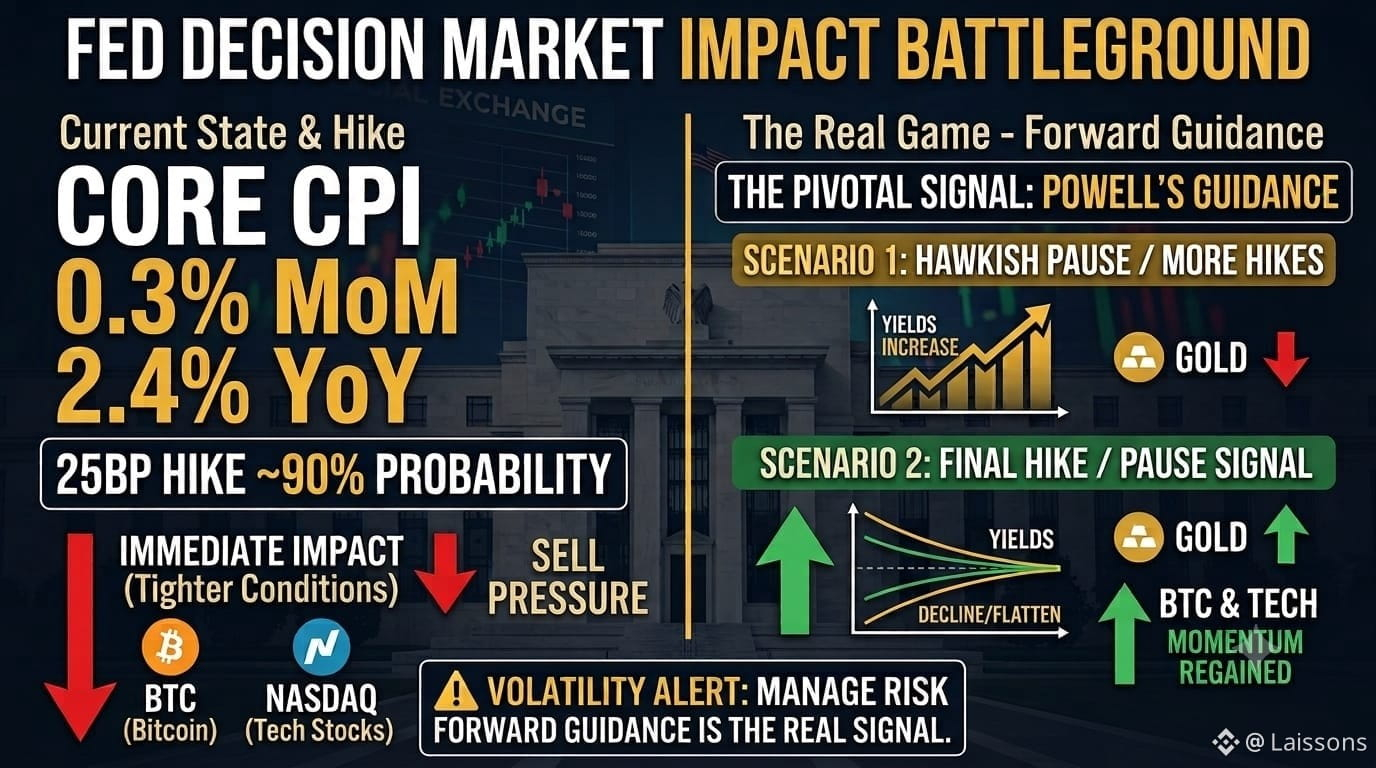
🚨 FED DECISION COULD SHAKE THE MARKETS
The market is almost convinced that a 25bp rate hike is coming. But I think the bigger trade starts after the decision.
August core CPI rose 0.3% MoM, keeping inflation pressure on the Fed. If the hike happens, BTC and tech stocks could initially face selling pressure as traders react to tighter financial conditions.
But here’s the twist 👀
If Powell signals that this could be the final hike before a pause, the reaction could quickly reverse. BTC and tech stocks may regain momentum as markets start pricing in a less aggressive Fed path.
Gold is also interesting here. A hawkish Fed could pressure gold through higher real yields, while signs of slower growth or future easing could support it.
📊 My focus: BTC price reaction + US yields + Powell’s guidance.
The rate decision is the headline. The forward guidance is the real signal.
⚠️ Volatility can be extreme around FOMC.. Manage risk and avoid overleveraging.
25bp hike = priced in.
What comes next = the real game.
#FedRateWatch
🚨 FED DECISION COULD SHAKE THE MARKETS
The market is almost convinced that a 25bp rate hike is coming. But I think the bigger trade starts after the decision.
August core CPI rose 0.3% MoM, keeping inflation pressure on the Fed. If the hike happens, BTC and tech stocks could initially face selling pressure as traders react to tighter financial conditions.
But here’s the twist 👀
If Powell signals that this could be the final hike before a pause, the reaction could quickly reverse. BTC and tech stocks may regain momentum as markets start pricing in a less aggressive Fed path.
Gold is also interesting here. A hawkish Fed could pressure gold through higher real yields, while signs of slower growth or future easing could support it.
📊 My focus: BTC price reaction + US yields + Powell’s guidance.
The rate decision is the headline. The forward guidance is the real signal.
⚠️ Volatility can be extreme around FOMC.. Manage risk and avoid overleveraging.
25bp hike = priced in.
What comes next = the real game.
#FedRateWatch
The market is almost convinced that a 25bp rate hike is coming. But I think the bigger trade starts after the decision.
August core CPI rose 0.3% MoM, keeping inflation pressure on the Fed. If the hike happens, BTC and tech stocks could initially face selling pressure as traders react to tighter financial conditions.
But here’s the twist 👀
If Powell signals that this could be the final hike before a pause, the reaction could quickly reverse. BTC and tech stocks may regain momentum as markets start pricing in a less aggressive Fed path.
Gold is also interesting here. A hawkish Fed could pressure gold through higher real yields, while signs of slower growth or future easing could support it.
📊 My focus: BTC price reaction + US yields + Powell’s guidance.
The rate decision is the headline. The forward guidance is the real signal.
⚠️ Volatility can be extreme around FOMC.. Manage risk and avoid overleveraging.
25bp hike = priced in.
What comes next = the real game.
#FedRateWatch
1
276
·
--
@Dusk_Foundation I’ve been looking at Dusk’s settlement design less as a speed problem and more as a coordination problem.
A fast finality layer is useful, but regulated settlement involves multiple parties whose systems do not necessarily move at the same pace. Dusk’s DuskDS layer can provide deterministic finality and coordinate settlement state, yet the asset leg, payment rail, custodian and compliance checks can still introduce timing differences.
That changes the metric I’d care about.
“Settlement quality is measured when systems disagree.”
If a delivery-versus-payment transaction encounters a delay or mismatch, the important question is what the protocol and surrounding infrastructure do next. Can the asset remain safely locked? Can the payment side be reconciled without creating a new counterparty exposure? Can authorized participants verify the relevant state without exposing information they should not see?
This is where Dusk’s confidential execution becomes more interesting to me than raw throughput. The system has to preserve both transaction correctness and controlled information flow when something goes wrong.
The weakness is that Dusk cannot eliminate dependencies outside the chain. A perfectly deterministic settlement layer still inherits operational risk from custodians, payment providers and external data sources.
So I’d watch failed-settlement handling, reconciliation time and repeat institutional usage. Successful transactions show that the system works; difficult transactions show whether it can actually be trusted.
#dusk @Dusk_Foundation $DUSK $BTR $BMT
{future}(BMTUSDT)
{future}(BTRUSDT)
{future}(DUSKUSDT)
@Dusk I’ve been looking at Dusk’s settlement design less as a speed problem and more as a coordination problem.
A fast finality layer is useful, but regulated settlement involves multiple parties whose systems do not necessarily move at the same pace. Dusk’s DuskDS layer can provide deterministic finality and coordinate settlement state, yet the asset leg, payment rail, custodian and compliance checks can still introduce timing differences.
That changes the metric I’d care about.
“Settlement quality is measured when systems disagree.”
If a delivery-versus-payment transaction encounters a delay or mismatch, the important question is what the protocol and surrounding infrastructure do next. Can the asset remain safely locked? Can the payment side be reconciled without creating a new counterparty exposure? Can authorized participants verify the relevant state without exposing information they should not see?
This is where Dusk’s confidential execution becomes more interesting to me than raw throughput. The system has to preserve both transaction correctness and controlled information flow when something goes wrong.
The weakness is that Dusk cannot eliminate dependencies outside the chain. A perfectly deterministic settlement layer still inherits operational risk from custodians, payment providers and external data sources.
So I’d watch failed-settlement handling, reconciliation time and repeat institutional usage. Successful transactions show that the system works; difficult transactions show whether it can actually be trusted.
#dusk @Dusk $DUSK $BTR $BMT
A fast finality layer is useful, but regulated settlement involves multiple parties whose systems do not necessarily move at the same pace. Dusk’s DuskDS layer can provide deterministic finality and coordinate settlement state, yet the asset leg, payment rail, custodian and compliance checks can still introduce timing differences.
That changes the metric I’d care about.
“Settlement quality is measured when systems disagree.”
If a delivery-versus-payment transaction encounters a delay or mismatch, the important question is what the protocol and surrounding infrastructure do next. Can the asset remain safely locked? Can the payment side be reconciled without creating a new counterparty exposure? Can authorized participants verify the relevant state without exposing information they should not see?
This is where Dusk’s confidential execution becomes more interesting to me than raw throughput. The system has to preserve both transaction correctness and controlled information flow when something goes wrong.
The weakness is that Dusk cannot eliminate dependencies outside the chain. A perfectly deterministic settlement layer still inherits operational risk from custodians, payment providers and external data sources.
So I’d watch failed-settlement handling, reconciliation time and repeat institutional usage. Successful transactions show that the system works; difficult transactions show whether it can actually be trusted.
#dusk @Dusk $DUSK $BTR $BMT
5
3
251
·
--
I’ve started thinking about Dusk’s relatively quiet communication as an information-quality advantage rather than a branding choice.
For a privacy-focused financial network, the important audience is not necessarily the largest one.It is the group capable of evaluating whether confidential state, selective disclosure and regulated asset workflows can actually work under institutional constraints.
That makes the way Dusk explains mechanisms like Moonlight and Phoenix relevant.One exposes a transparent account model; the other uses zero-knowledge technology for confidential transaction data.The value is not that either sounds impressive.It is that the architecture gives institutions specific controls they can evaluate.
Serious infrastructure is easier to audit than to hype.
I think that creates a different adoption dynamic.Builders can ignore marketing for a while, but they cannot ignore operational requirements when real capital is involved. If Dusk’s documentation helps developers and institutions understand exactly what they are integrating, that can shorten the gap between experimentation and deployment.
Still, there is a weakness here: technically clear infrastructure does not guarantee distribution.If developers, issuers and venues choose more established ecosystems, architectural quality alone may not generate meaningful network activity.
So I’d watch whether Dusk’s technical clarity converts into repeat deployments, not whether it wins the attention cycle.
#dusk $DUSK @Dusk_Foundation
{future}(DUSKUSDT)
I’ve started thinking about Dusk’s relatively quiet communication as an information-quality advantage rather than a branding choice.
For a privacy-focused financial network, the important audience is not necessarily the largest one.It is the group capable of evaluating whether confidential state, selective disclosure and regulated asset workflows can actually work under institutional constraints.
That makes the way Dusk explains mechanisms like Moonlight and Phoenix relevant.One exposes a transparent account model; the other uses zero-knowledge technology for confidential transaction data.The value is not that either sounds impressive.It is that the architecture gives institutions specific controls they can evaluate.
Serious infrastructure is easier to audit than to hype.
I think that creates a different adoption dynamic.Builders can ignore marketing for a while, but they cannot ignore operational requirements when real capital is involved. If Dusk’s documentation helps developers and institutions understand exactly what they are integrating, that can shorten the gap between experimentation and deployment.
Still, there is a weakness here: technically clear infrastructure does not guarantee distribution.If developers, issuers and venues choose more established ecosystems, architectural quality alone may not generate meaningful network activity.
So I’d watch whether Dusk’s technical clarity converts into repeat deployments, not whether it wins the attention cycle.
#dusk $DUSK @Dusk
For a privacy-focused financial network, the important audience is not necessarily the largest one.It is the group capable of evaluating whether confidential state, selective disclosure and regulated asset workflows can actually work under institutional constraints.
That makes the way Dusk explains mechanisms like Moonlight and Phoenix relevant.One exposes a transparent account model; the other uses zero-knowledge technology for confidential transaction data.The value is not that either sounds impressive.It is that the architecture gives institutions specific controls they can evaluate.
Serious infrastructure is easier to audit than to hype.
I think that creates a different adoption dynamic.Builders can ignore marketing for a while, but they cannot ignore operational requirements when real capital is involved. If Dusk’s documentation helps developers and institutions understand exactly what they are integrating, that can shorten the gap between experimentation and deployment.
Still, there is a weakness here: technically clear infrastructure does not guarantee distribution.If developers, issuers and venues choose more established ecosystems, architectural quality alone may not generate meaningful network activity.
So I’d watch whether Dusk’s technical clarity converts into repeat deployments, not whether it wins the attention cycle.
#dusk $DUSK @Dusk
10
11
301
·
--
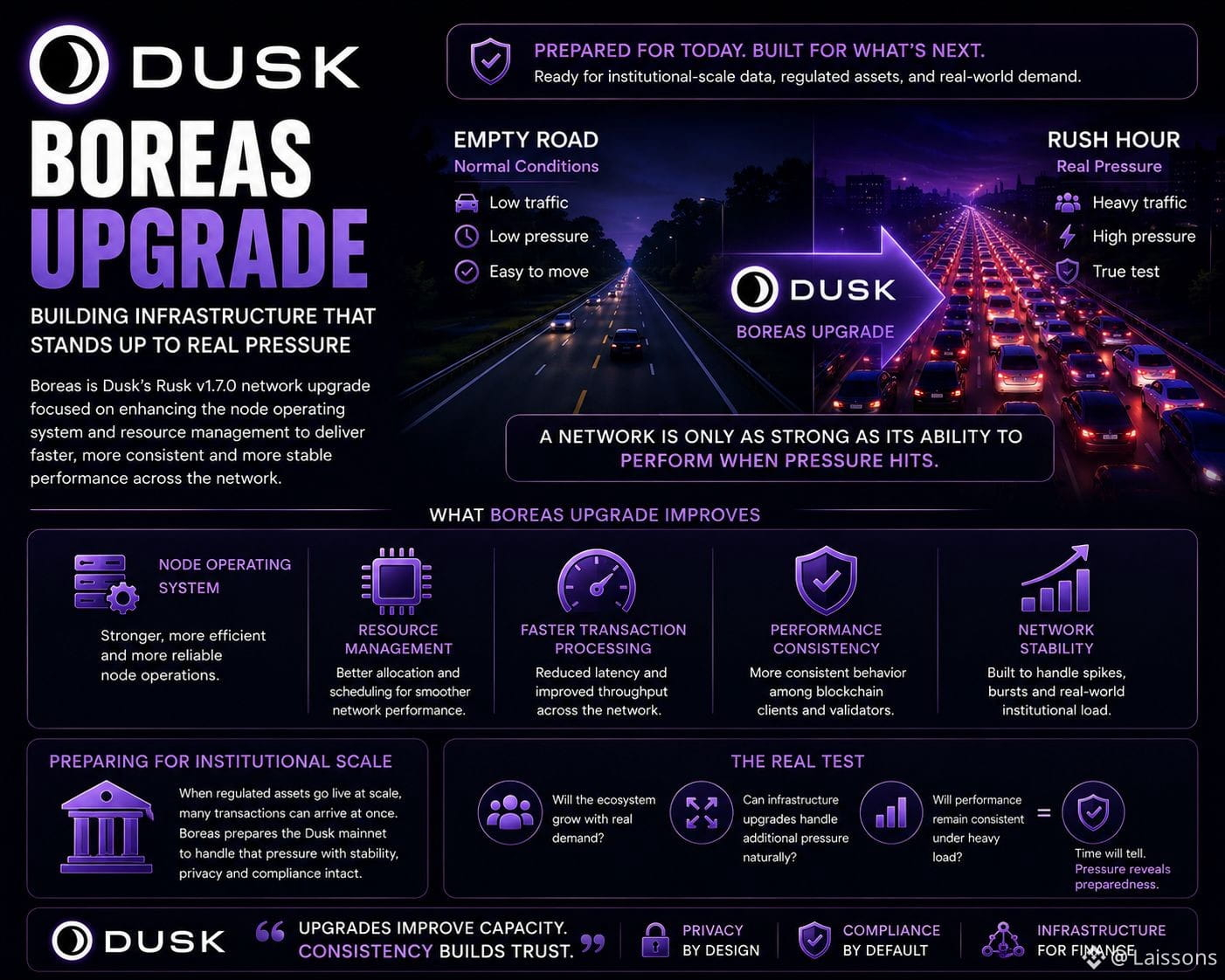
@Dusk_Foundation I’ve started looking at Dusk’s infrastructure upgrades less through peak performance and more through consistency under uneven demand.
Boreas is interesting in that context because the focus on node operations and resource management is not just about making transactions faster.For financial infrastructure, predictable execution matters when workload spikes are concentrated rather than evenly distributed.
A network can perform well during normal activity and still behave very differently when a large number of settlement events arrive together.That matters for Dusk because regulated assets could create workloads tied to issuance, trading, servicing or coordinated settlement windows.
Throughput gets attention; variance determines reliability.
From an investor perspective, I’d rather see evidence that Boreas reduces performance degradation during bursts than simply a higher theoretical capacity.Institutions generally build around predictable processing, not optimistic averages.
The limitation is that upgrades can improve the network’s operating envelope without proving that real institutional workloads will fit comfortably inside it.Until those workloads appear, some of the thesis remains untested.
So I’m watching node resource utilization, transaction latency during spikes and whether performance remains consistent as activity grows.
If Dusk wants to become financial infrastructure, the important question is not how fast it runs when conditions are easy.It is how predictably it behaves when several demanding workflows arrive at once.
#Dusk. #dusk $DUSK @Dusk_Foundation
{future}(DUSKUSDT)
@Dusk I’ve started looking at Dusk’s infrastructure upgrades less through peak performance and more through consistency under uneven demand.
Boreas is interesting in that context because the focus on node operations and resource management is not just about making transactions faster.For financial infrastructure, predictable execution matters when workload spikes are concentrated rather than evenly distributed.
A network can perform well during normal activity and still behave very differently when a large number of settlement events arrive together.That matters for Dusk because regulated assets could create workloads tied to issuance, trading, servicing or coordinated settlement windows.
Throughput gets attention; variance determines reliability.
From an investor perspective, I’d rather see evidence that Boreas reduces performance degradation during bursts than simply a higher theoretical capacity.Institutions generally build around predictable processing, not optimistic averages.
The limitation is that upgrades can improve the network’s operating envelope without proving that real institutional workloads will fit comfortably inside it.Until those workloads appear, some of the thesis remains untested.
So I’m watching node resource utilization, transaction latency during spikes and whether performance remains consistent as activity grows.
If Dusk wants to become financial infrastructure, the important question is not how fast it runs when conditions are easy.It is how predictably it behaves when several demanding workflows arrive at once.
#Dusk. #dusk $DUSK @Dusk
Boreas is interesting in that context because the focus on node operations and resource management is not just about making transactions faster.For financial infrastructure, predictable execution matters when workload spikes are concentrated rather than evenly distributed.
A network can perform well during normal activity and still behave very differently when a large number of settlement events arrive together.That matters for Dusk because regulated assets could create workloads tied to issuance, trading, servicing or coordinated settlement windows.
Throughput gets attention; variance determines reliability.
From an investor perspective, I’d rather see evidence that Boreas reduces performance degradation during bursts than simply a higher theoretical capacity.Institutions generally build around predictable processing, not optimistic averages.
The limitation is that upgrades can improve the network’s operating envelope without proving that real institutional workloads will fit comfortably inside it.Until those workloads appear, some of the thesis remains untested.
So I’m watching node resource utilization, transaction latency during spikes and whether performance remains consistent as activity grows.
If Dusk wants to become financial infrastructure, the important question is not how fast it runs when conditions are easy.It is how predictably it behaves when several demanding workflows arrive at once.
#Dusk. #dusk $DUSK @Dusk
5
5
139
·
--
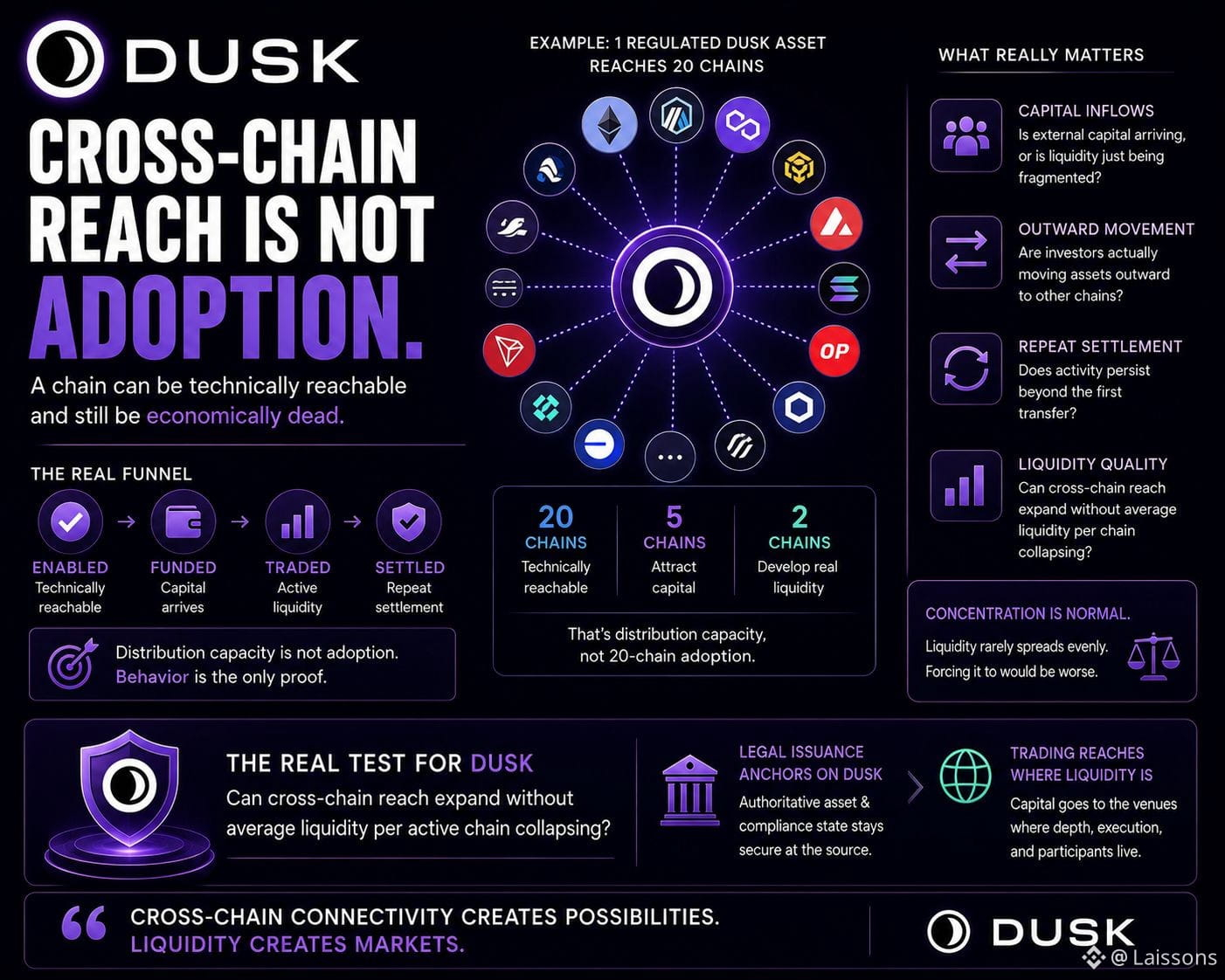
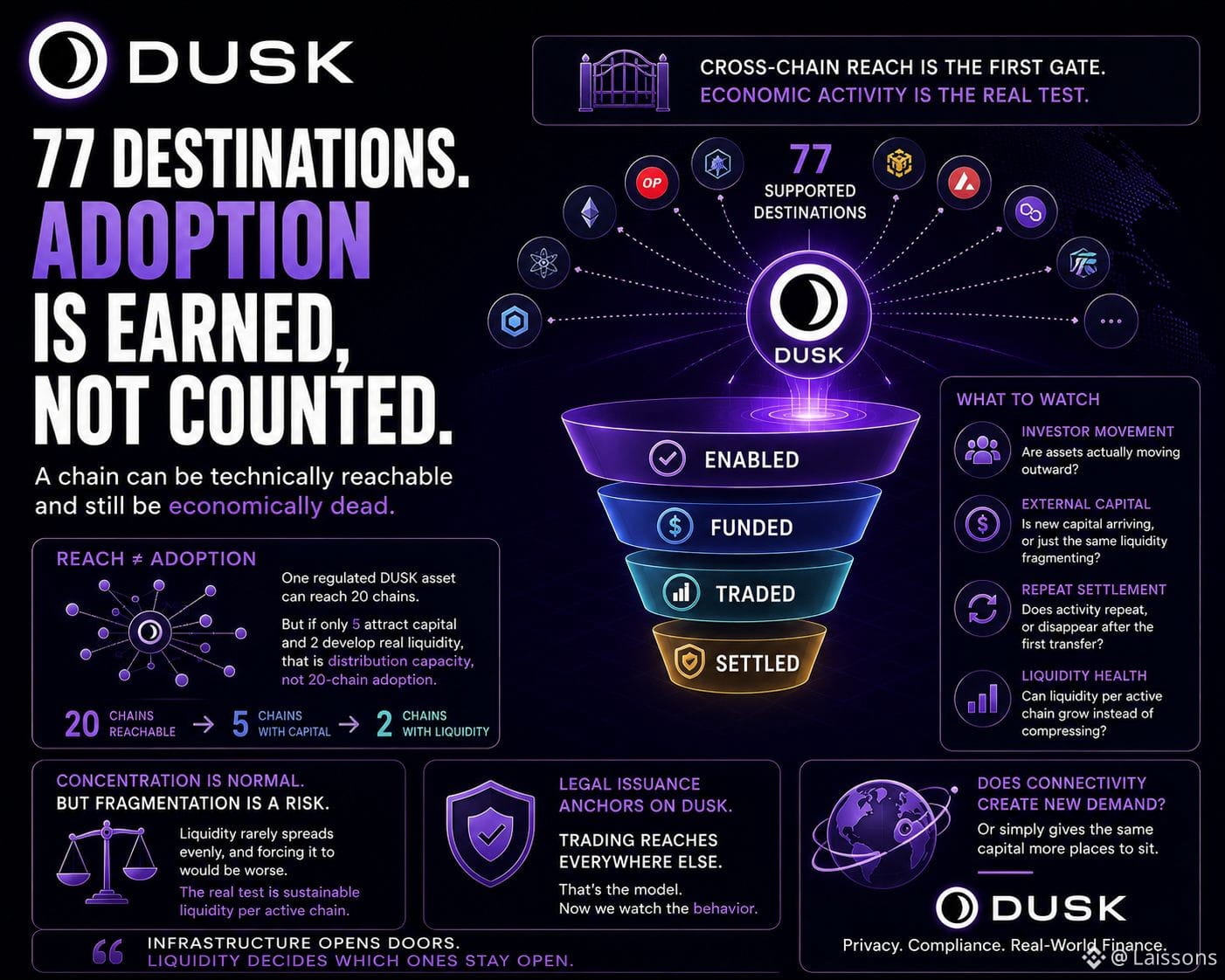
@Dusk_Foundation I’ve been looking at Dusk’s cross-chain reach as a capital-routing problem rather than a connectivity metric.
Supporting many destinations can expand where an asset is technically usable, but it can also change where liquidity wants to live.Once trading and settlement extend beyond the home chain, investors start optimizing for depth, execution quality and counterparty access not for where the asset was originally issued.
That makes the composition of cross-chain activity more important than the number of connected networks.
Connectivity creates options; liquidity decides where capital stays.
For Dusk, I’d want to see whether cross-chain movement is bringing genuinely new participants into regulated assets or simply distributing existing liquidity across more venues. The latter can make the ecosystem look broader while making execution worse at the margin.
There is also a positive scenario. If Dusk can keep authoritative asset and compliance state anchored while allowing liquidity to reach the venues where investors already operate, the chain could function as a coordination layer rather than trying to capture every trade locally.
The weakness is fragmentation. More destinations mean more bridges, liquidity pools and operational dependencies to monitor.
So I’d track capital inflows, repeat settlement, liquidity depth per active venue and the share of volume coming from external participants.
That should reveal whether Dusk’s connectivity is expanding the market or simply spreading it thinner.
#dusk @Dusk_Foundation $DUSK
{future}(DUSKUSDT)
@Dusk I’ve been looking at Dusk’s cross-chain reach as a capital-routing problem rather than a connectivity metric.
Supporting many destinations can expand where an asset is technically usable, but it can also change where liquidity wants to live.Once trading and settlement extend beyond the home chain, investors start optimizing for depth, execution quality and counterparty access not for where the asset was originally issued.
That makes the composition of cross-chain activity more important than the number of connected networks.
Connectivity creates options; liquidity decides where capital stays.
For Dusk, I’d want to see whether cross-chain movement is bringing genuinely new participants into regulated assets or simply distributing existing liquidity across more venues. The latter can make the ecosystem look broader while making execution worse at the margin.
There is also a positive scenario. If Dusk can keep authoritative asset and compliance state anchored while allowing liquidity to reach the venues where investors already operate, the chain could function as a coordination layer rather than trying to capture every trade locally.
The weakness is fragmentation. More destinations mean more bridges, liquidity pools and operational dependencies to monitor.
So I’d track capital inflows, repeat settlement, liquidity depth per active venue and the share of volume coming from external participants.
That should reveal whether Dusk’s connectivity is expanding the market or simply spreading it thinner.
#dusk @Dusk $DUSK
Supporting many destinations can expand where an asset is technically usable, but it can also change where liquidity wants to live.Once trading and settlement extend beyond the home chain, investors start optimizing for depth, execution quality and counterparty access not for where the asset was originally issued.
That makes the composition of cross-chain activity more important than the number of connected networks.
Connectivity creates options; liquidity decides where capital stays.
For Dusk, I’d want to see whether cross-chain movement is bringing genuinely new participants into regulated assets or simply distributing existing liquidity across more venues. The latter can make the ecosystem look broader while making execution worse at the margin.
There is also a positive scenario. If Dusk can keep authoritative asset and compliance state anchored while allowing liquidity to reach the venues where investors already operate, the chain could function as a coordination layer rather than trying to capture every trade locally.
The weakness is fragmentation. More destinations mean more bridges, liquidity pools and operational dependencies to monitor.
So I’d track capital inflows, repeat settlement, liquidity depth per active venue and the share of volume coming from external participants.
That should reveal whether Dusk’s connectivity is expanding the market or simply spreading it thinner.
#dusk @Dusk $DUSK
8
8
147
·
--
ຢືນຢັນແລ້ວ
#dusk $DUSK @Dusk_Foundation
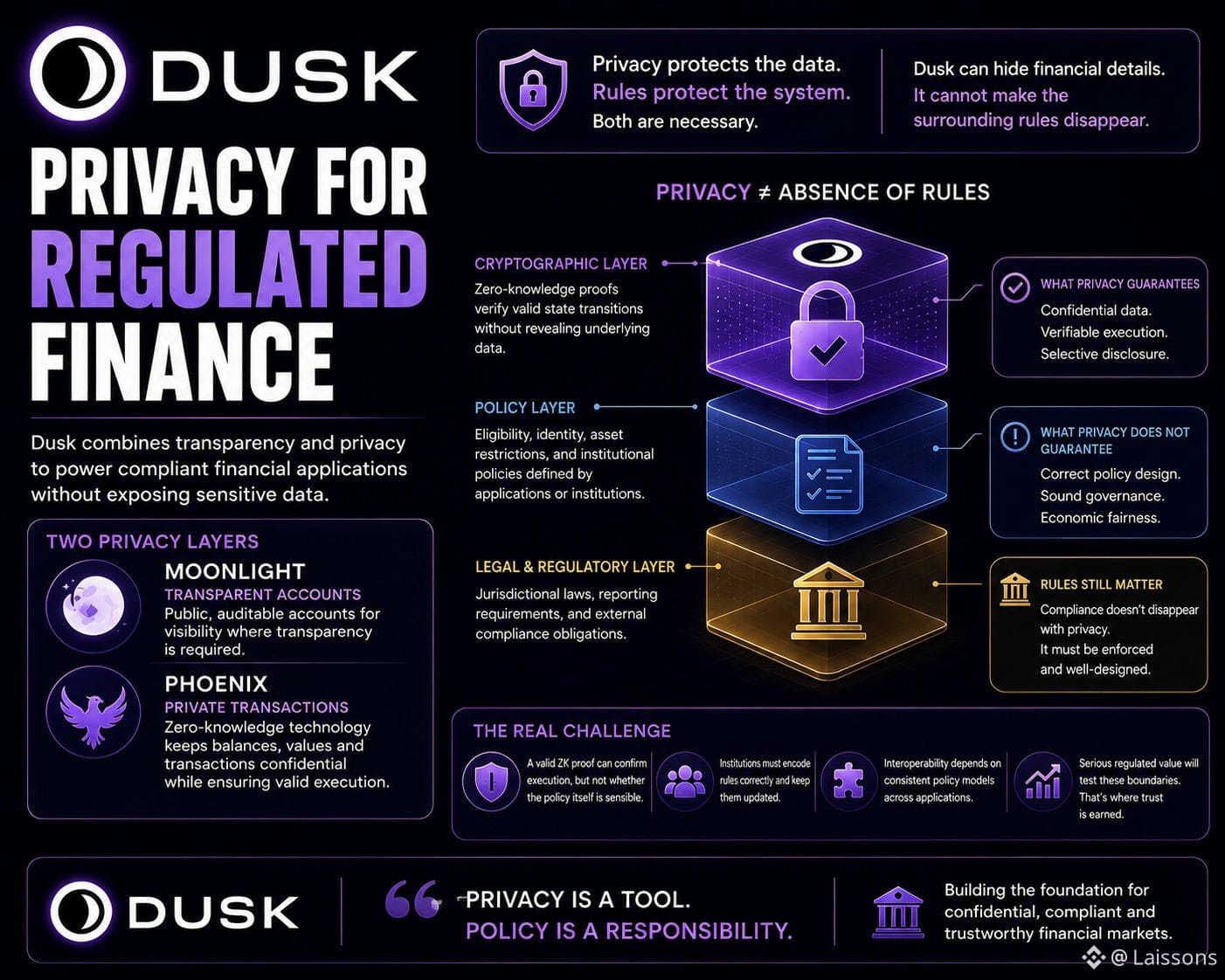
I’ve been looking at Dusk’s privacy model as a question of policy portability, and that seems more important than the privacy setting itself.
Moonlight and Phoenix show that Dusk can support different visibility models, with Phoenix using zero-knowledge proofs to keep transaction values and balances confidential. But a financial institution still needs its rules to travel with the transaction: who is eligible, which assets can move, what limits apply, and when disclosure is required.
That creates an interesting verification problem.
A ZK proof can establish that a transaction followed the encoded conditions. It cannot tell an institution whether those conditions were designed correctly in the first place.
“Private execution does not equal correct policy.”
For investors, I think this creates a useful way to assess Dusk’s institutional thesis. The question is not simply whether sensitive information stays hidden. It is whether applications can make compliance rules precise enough to be verified consistently across repeated financial workflows.
The weakness is governance and integration. If every institution defines eligibility, disclosure and asset restrictions differently, the cryptographic layer may remain strong while the operational layer becomes fragmented.
I’d watch how Dusk handles policy updates, credential verification and selective disclosure as real financial workflows scale. That is where privacy infrastructure either becomes dependable financial infrastructure or remains a technical capability.
#Dusk $TUT $TRUMP
{future}(TRUMPUSDT)
{future}(TUTUSDT)
{future}(DUSKUSDT)
#dusk $DUSK @Dusk
I’ve been looking at Dusk’s privacy model as a question of policy portability, and that seems more important than the privacy setting itself.
Moonlight and Phoenix show that Dusk can support different visibility models, with Phoenix using zero-knowledge proofs to keep transaction values and balances confidential. But a financial institution still needs its rules to travel with the transaction: who is eligible, which assets can move, what limits apply, and when disclosure is required.
That creates an interesting verification problem.
A ZK proof can establish that a transaction followed the encoded conditions. It cannot tell an institution whether those conditions were designed correctly in the first place.
“Private execution does not equal correct policy.”
For investors, I think this creates a useful way to assess Dusk’s institutional thesis. The question is not simply whether sensitive information stays hidden. It is whether applications can make compliance rules precise enough to be verified consistently across repeated financial workflows.
The weakness is governance and integration. If every institution defines eligibility, disclosure and asset restrictions differently, the cryptographic layer may remain strong while the operational layer becomes fragmented.
I’d watch how Dusk handles policy updates, credential verification and selective disclosure as real financial workflows scale. That is where privacy infrastructure either becomes dependable financial infrastructure or remains a technical capability.
#Dusk $TUT $TRUMP
I’ve been looking at Dusk’s privacy model as a question of policy portability, and that seems more important than the privacy setting itself.
Moonlight and Phoenix show that Dusk can support different visibility models, with Phoenix using zero-knowledge proofs to keep transaction values and balances confidential. But a financial institution still needs its rules to travel with the transaction: who is eligible, which assets can move, what limits apply, and when disclosure is required.
That creates an interesting verification problem.
A ZK proof can establish that a transaction followed the encoded conditions. It cannot tell an institution whether those conditions were designed correctly in the first place.
“Private execution does not equal correct policy.”
For investors, I think this creates a useful way to assess Dusk’s institutional thesis. The question is not simply whether sensitive information stays hidden. It is whether applications can make compliance rules precise enough to be verified consistently across repeated financial workflows.
The weakness is governance and integration. If every institution defines eligibility, disclosure and asset restrictions differently, the cryptographic layer may remain strong while the operational layer becomes fragmented.
I’d watch how Dusk handles policy updates, credential verification and selective disclosure as real financial workflows scale. That is where privacy infrastructure either becomes dependable financial infrastructure or remains a technical capability.
#Dusk $TUT $TRUMP
6
9
158
·
--
@Dusk_Foundation
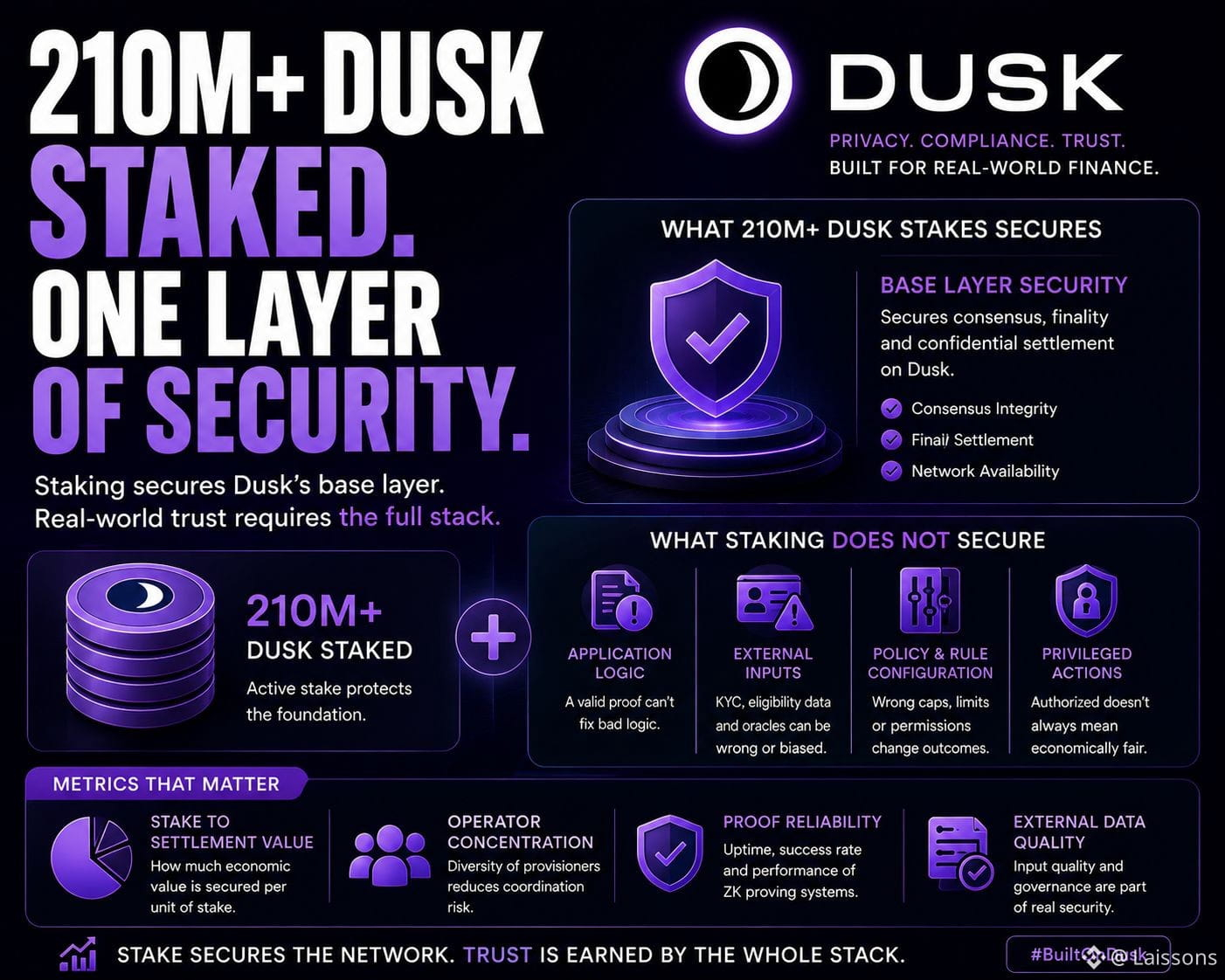
I’ve been thinking about Dusk’s staking model as a question of security coverage rather than security size.
A large provisioner set can make consensus harder to disrupt, but that does not automatically make every financial application built above it equally robust. Dusk’s private smart contracts can prove that state transitions satisfy defined rules without exposing the underlying data, which is valuable for regulated finance.
The investor question is what sits outside that proof.🤔
A contract can correctly enforce an eligibility rule while the underlying eligibility input is wrong.A settlement can be final while an external asset register is inaccurate.The protocol can be secure while an application’s economic assumptions are poorly designed.
Cryptographic certainty is only as strong as the inputs being certified.
That makes Dusk’s security profile more interesting to me.I’d separate base-layer security from application assurance and external-data quality instead of treating staking as a single proxy for institutional safety.
The weakness is measurement. Application-level failures are harder to compare than validator performance, so investors can easily overfocus on the cleanest number available: total stake.
For Dusk, I’d watch how private applications handle external data, proof failures, privileged actions and confidential settlement value.That should tell us more about real economic reliability than staking growth alone.
#Dusk #dusk $DUSK $BLESS $BCH
{future}(BCHUSDT)
{future}(BLESSUSDT)
{future}(DUSKUSDT)
@Dusk
I’ve been thinking about Dusk’s staking model as a question of security coverage rather than security size.
A large provisioner set can make consensus harder to disrupt, but that does not automatically make every financial application built above it equally robust. Dusk’s private smart contracts can prove that state transitions satisfy defined rules without exposing the underlying data, which is valuable for regulated finance.
The investor question is what sits outside that proof.🤔
A contract can correctly enforce an eligibility rule while the underlying eligibility input is wrong.A settlement can be final while an external asset register is inaccurate.The protocol can be secure while an application’s economic assumptions are poorly designed.
Cryptographic certainty is only as strong as the inputs being certified.
That makes Dusk’s security profile more interesting to me.I’d separate base-layer security from application assurance and external-data quality instead of treating staking as a single proxy for institutional safety.
The weakness is measurement. Application-level failures are harder to compare than validator performance, so investors can easily overfocus on the cleanest number available: total stake.
For Dusk, I’d watch how private applications handle external data, proof failures, privileged actions and confidential settlement value.That should tell us more about real economic reliability than staking growth alone.
#Dusk #dusk $DUSK $BLESS $BCH
I’ve been thinking about Dusk’s staking model as a question of security coverage rather than security size.
A large provisioner set can make consensus harder to disrupt, but that does not automatically make every financial application built above it equally robust. Dusk’s private smart contracts can prove that state transitions satisfy defined rules without exposing the underlying data, which is valuable for regulated finance.
The investor question is what sits outside that proof.🤔
A contract can correctly enforce an eligibility rule while the underlying eligibility input is wrong.A settlement can be final while an external asset register is inaccurate.The protocol can be secure while an application’s economic assumptions are poorly designed.
Cryptographic certainty is only as strong as the inputs being certified.
That makes Dusk’s security profile more interesting to me.I’d separate base-layer security from application assurance and external-data quality instead of treating staking as a single proxy for institutional safety.
The weakness is measurement. Application-level failures are harder to compare than validator performance, so investors can easily overfocus on the cleanest number available: total stake.
For Dusk, I’d watch how private applications handle external data, proof failures, privileged actions and confidential settlement value.That should tell us more about real economic reliability than staking growth alone.
#Dusk #dusk $DUSK $BLESS $BCH
19
17
624
·
--
#dusk $DUSK @Dusk_Foundation
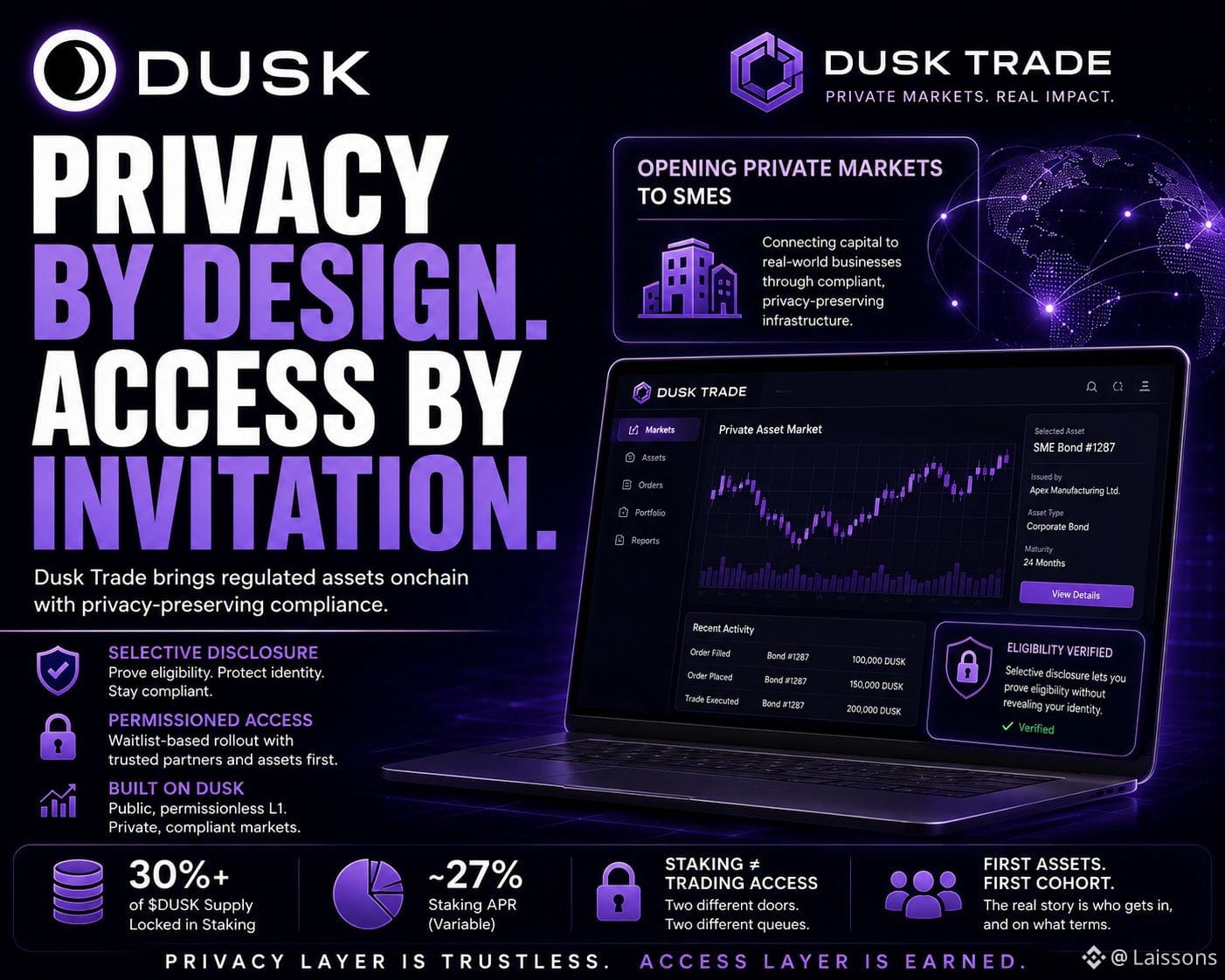
I’ve been separating Dusk’s technical accessibility from its actual market accessibility, and that distinction changes how I evaluate the Trade rollout.
Dusk can make privacy-preserving verification technically possible through selective disclosure, but market access still depends on who is admitted, which assets are available, and how liquidity is introduced.
That creates an interesting gap between infrastructure readiness and economic readiness.
For an investor, I’d rather know how the first group of issuers and participants behave than simply see another increase in staking or wallet activity. If Dusk Trade can attract credible assets and enough two-sided flow, the privacy architecture starts becoming economically relevant rather than just technically impressive.
“Permissionless infrastructure can still produce permissioned experiences.”
That isn’t necessarily a flaw. Regulated markets often need controlled participation. The risk is whether those controls remain a temporary bootstrapping mechanism or become a permanent bottleneck for liquidity.
I’m especially watching asset selection, onboarding speed, repeat participation and depth around the first markets. Those should reveal whether Dusk is building a functioning venue or simply a sophisticated access layer.
The market may be underestimating how difficult the second step is: getting verified participants to actually trade once they are allowed in.
#Dusk $ACE $ONG
{future}(ONGUSDT)
{future}(ACEUSDT)
{future}(DUSKUSDT)
#dusk $DUSK @Dusk
I’ve been separating Dusk’s technical accessibility from its actual market accessibility, and that distinction changes how I evaluate the Trade rollout.
Dusk can make privacy-preserving verification technically possible through selective disclosure, but market access still depends on who is admitted, which assets are available, and how liquidity is introduced.
That creates an interesting gap between infrastructure readiness and economic readiness.
For an investor, I’d rather know how the first group of issuers and participants behave than simply see another increase in staking or wallet activity. If Dusk Trade can attract credible assets and enough two-sided flow, the privacy architecture starts becoming economically relevant rather than just technically impressive.
“Permissionless infrastructure can still produce permissioned experiences.”
That isn’t necessarily a flaw. Regulated markets often need controlled participation. The risk is whether those controls remain a temporary bootstrapping mechanism or become a permanent bottleneck for liquidity.
I’m especially watching asset selection, onboarding speed, repeat participation and depth around the first markets. Those should reveal whether Dusk is building a functioning venue or simply a sophisticated access layer.
The market may be underestimating how difficult the second step is: getting verified participants to actually trade once they are allowed in.
#Dusk $ACE $ONG
I’ve been separating Dusk’s technical accessibility from its actual market accessibility, and that distinction changes how I evaluate the Trade rollout.
Dusk can make privacy-preserving verification technically possible through selective disclosure, but market access still depends on who is admitted, which assets are available, and how liquidity is introduced.
That creates an interesting gap between infrastructure readiness and economic readiness.
For an investor, I’d rather know how the first group of issuers and participants behave than simply see another increase in staking or wallet activity. If Dusk Trade can attract credible assets and enough two-sided flow, the privacy architecture starts becoming economically relevant rather than just technically impressive.
“Permissionless infrastructure can still produce permissioned experiences.”
That isn’t necessarily a flaw. Regulated markets often need controlled participation. The risk is whether those controls remain a temporary bootstrapping mechanism or become a permanent bottleneck for liquidity.
I’m especially watching asset selection, onboarding speed, repeat participation and depth around the first markets. Those should reveal whether Dusk is building a functioning venue or simply a sophisticated access layer.
The market may be underestimating how difficult the second step is: getting verified participants to actually trade once they are allowed in.
#Dusk $ACE $ONG
17
15
722
·
--
#dusk $DUSK @Dusk_Foundation
I’ve started separating Dusk’s core protocol risk from its asset-routing risk, and the distinction matters more than I expected.
The January bridge incident is a useful example. Even if DuskDS itself remains unaffected, a bridge connected to the ecosystem can still become the place where users experience loss, delays, or uncertainty. From an investor perspective, that makes the bridge part of the effective security perimeter, whether or not it sits inside consensus.
What I’m watching is not only whether funds were affected. I want to understand how quickly the system can establish an auditable picture of what moved, which addresses were involved, what was paused, and how the affected infrastructure was isolated.
“Security boundaries are defined by dependencies, not diagrams.”
That is especially relevant for Dusk because its broader thesis depends on institutions being comfortable routing regulated value through the surrounding infrastructure.A technically strong base layer does not automatically make every connected component equally trustworthy.
The weakness is attribution. Without complete transaction-level reconstruction, external observers can end up comparing competing narratives instead of verified accounting.
For me, bridge flows, incident response, address-level transparency and recovery procedures deserve as much attention as DuskDS consensus metrics.
#Dusk
$HEMI
$TREE
{future}(DUSKUSDT)
🔎 What matters most after a bridge incident?
#dusk $DUSK @Dusk
I’ve started separating Dusk’s core protocol risk from its asset-routing risk, and the distinction matters more than I expected.
The January bridge incident is a useful example. Even if DuskDS itself remains unaffected, a bridge connected to the ecosystem can still become the place where users experience loss, delays, or uncertainty. From an investor perspective, that makes the bridge part of the effective security perimeter, whether or not it sits inside consensus.
What I’m watching is not only whether funds were affected. I want to understand how quickly the system can establish an auditable picture of what moved, which addresses were involved, what was paused, and how the affected infrastructure was isolated.
“Security boundaries are defined by dependencies, not diagrams.”
That is especially relevant for Dusk because its broader thesis depends on institutions being comfortable routing regulated value through the surrounding infrastructure.A technically strong base layer does not automatically make every connected component equally trustworthy.
The weakness is attribution. Without complete transaction-level reconstruction, external observers can end up comparing competing narratives instead of verified accounting.
For me, bridge flows, incident response, address-level transparency and recovery procedures deserve as much attention as DuskDS consensus metrics.
#Dusk
$HEMI
$TREE
🔎 What matters most after a bridge incident?
I’ve started separating Dusk’s core protocol risk from its asset-routing risk, and the distinction matters more than I expected.
The January bridge incident is a useful example. Even if DuskDS itself remains unaffected, a bridge connected to the ecosystem can still become the place where users experience loss, delays, or uncertainty. From an investor perspective, that makes the bridge part of the effective security perimeter, whether or not it sits inside consensus.
What I’m watching is not only whether funds were affected. I want to understand how quickly the system can establish an auditable picture of what moved, which addresses were involved, what was paused, and how the affected infrastructure was isolated.
“Security boundaries are defined by dependencies, not diagrams.”
That is especially relevant for Dusk because its broader thesis depends on institutions being comfortable routing regulated value through the surrounding infrastructure.A technically strong base layer does not automatically make every connected component equally trustworthy.
The weakness is attribution. Without complete transaction-level reconstruction, external observers can end up comparing competing narratives instead of verified accounting.
For me, bridge flows, incident response, address-level transparency and recovery procedures deserve as much attention as DuskDS consensus metrics.
#Dusk
$HEMI
$TREE
🔎 What matters most after a bridge incident?
🛡️ Security
0%
🔍 Transparency
0%
🌉 Bridge flows
0%
⚡ Response speed
100%
1 ຄະແນນສຽງ • ປິດລົງຄະແນນສຽງ
27
27
148
·
--
#dusk $DUSK @Dusk_Foundation
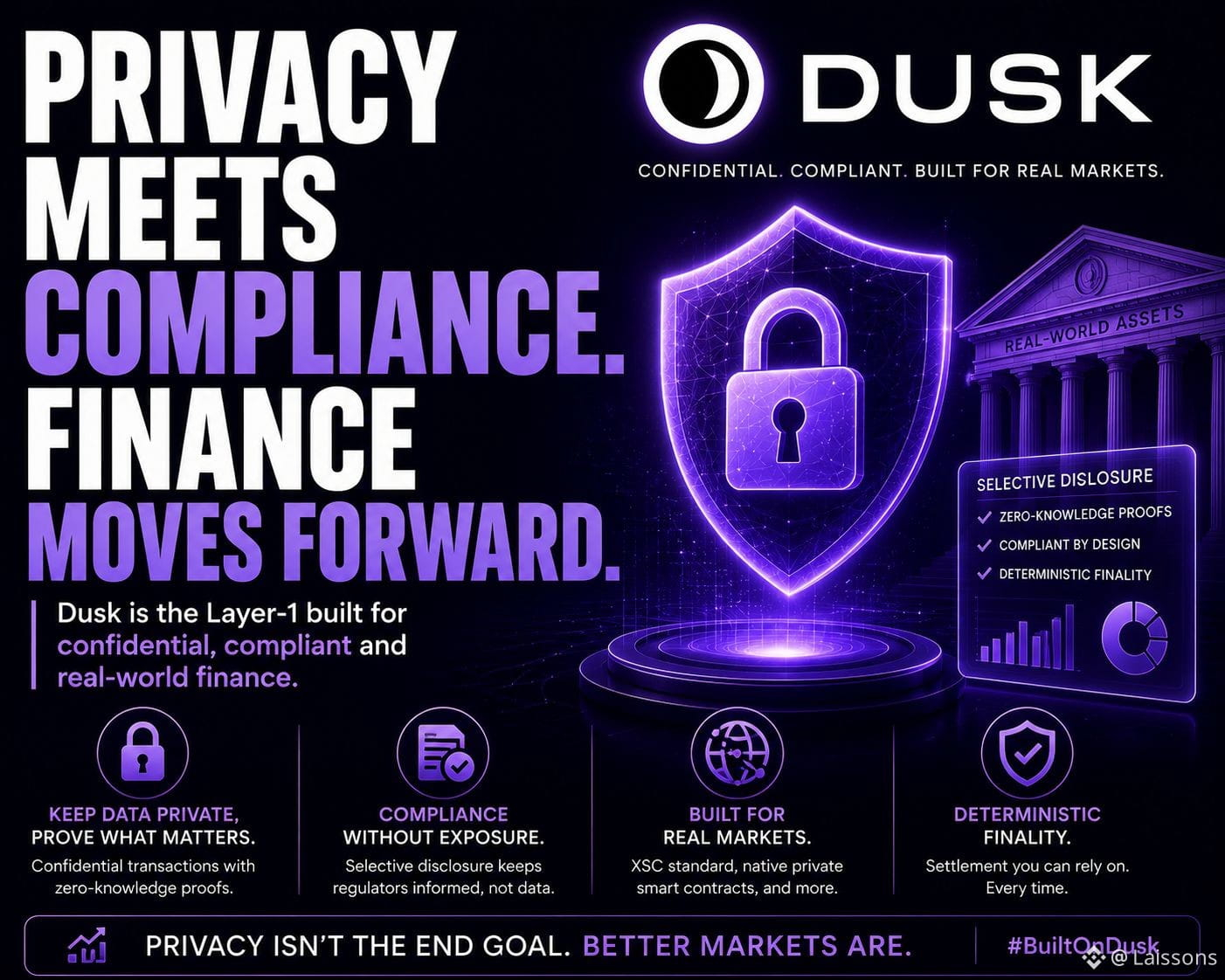
I’ve started looking at Dusk’s privacy architecture less as a confidentiality feature and more as a way to improve how financial risk gets verified.
That distinction matters.In regulated markets, the problem is rarely that every participant needs to see everything.The problem is proving that the right conditions were satisfied without unnecessarily exposing the underlying data.
Dusk’s combination of shielded transactions, zero-knowledge proofs and selective disclosure gives applications a mechanism to separate those two requirements.An institution could potentially prove eligibility or transaction validity while keeping sensitive balances, positions or counterparties private.
For me, the investor question becomes whether this actually changes capital behavior.
“Privacy becomes valuable when it improves verification, not when it merely hides information.”
If financial institutions can use these proofs to reduce data exposure while maintaining auditable compliance, the benefit could compound across repeated workflows.That is more meaningful than simply counting private transactions.
There is still a weakness I would not ignore: selective disclosure only works as infrastructure if counterparties, issuers and regulators agree on what must be proven and how those proofs are accepted. Technical privacy alone cannot solve fragmented compliance standards.
So I’m watching whether Dusk turns privacy into a reusable verification layer, rather than just another transaction property.
#Dusk
$ACE
$AAPL.US
#dusk $DUSK @Dusk
I’ve started looking at Dusk’s privacy architecture less as a confidentiality feature and more as a way to improve how financial risk gets verified.
That distinction matters.In regulated markets, the problem is rarely that every participant needs to see everything.The problem is proving that the right conditions were satisfied without unnecessarily exposing the underlying data.
Dusk’s combination of shielded transactions, zero-knowledge proofs and selective disclosure gives applications a mechanism to separate those two requirements.An institution could potentially prove eligibility or transaction validity while keeping sensitive balances, positions or counterparties private.
For me, the investor question becomes whether this actually changes capital behavior.
“Privacy becomes valuable when it improves verification, not when it merely hides information.”
If financial institutions can use these proofs to reduce data exposure while maintaining auditable compliance, the benefit could compound across repeated workflows.That is more meaningful than simply counting private transactions.
There is still a weakness I would not ignore: selective disclosure only works as infrastructure if counterparties, issuers and regulators agree on what must be proven and how those proofs are accepted. Technical privacy alone cannot solve fragmented compliance standards.
So I’m watching whether Dusk turns privacy into a reusable verification layer, rather than just another transaction property.
#Dusk
$ACE
$AAPL.US
I’ve started looking at Dusk’s privacy architecture less as a confidentiality feature and more as a way to improve how financial risk gets verified.
That distinction matters.In regulated markets, the problem is rarely that every participant needs to see everything.The problem is proving that the right conditions were satisfied without unnecessarily exposing the underlying data.
Dusk’s combination of shielded transactions, zero-knowledge proofs and selective disclosure gives applications a mechanism to separate those two requirements.An institution could potentially prove eligibility or transaction validity while keeping sensitive balances, positions or counterparties private.
For me, the investor question becomes whether this actually changes capital behavior.
“Privacy becomes valuable when it improves verification, not when it merely hides information.”
If financial institutions can use these proofs to reduce data exposure while maintaining auditable compliance, the benefit could compound across repeated workflows.That is more meaningful than simply counting private transactions.
There is still a weakness I would not ignore: selective disclosure only works as infrastructure if counterparties, issuers and regulators agree on what must be proven and how those proofs are accepted. Technical privacy alone cannot solve fragmented compliance standards.
So I’m watching whether Dusk turns privacy into a reusable verification layer, rather than just another transaction property.
#Dusk
$ACE
$AAPL.US
31
21
265
·
--
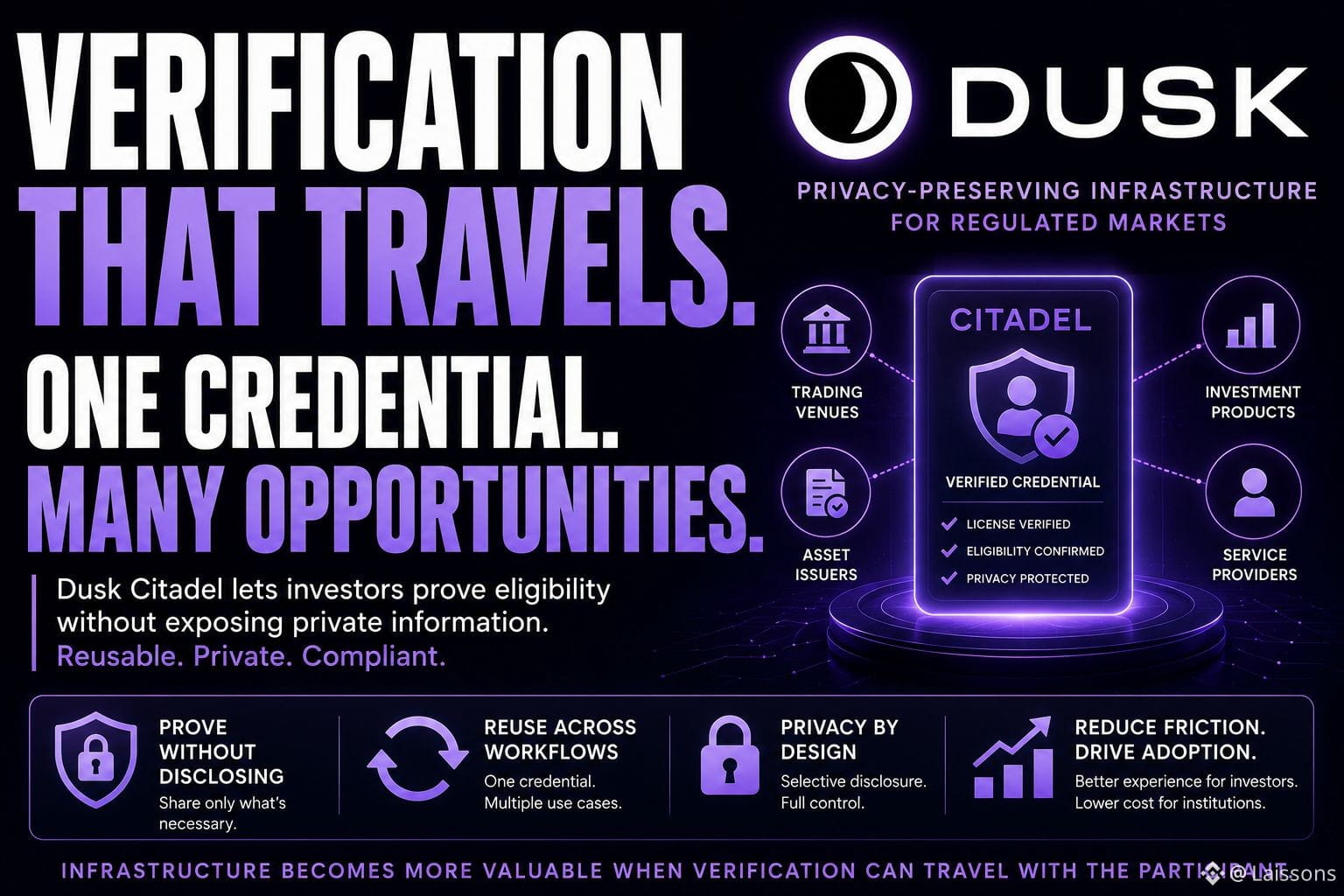
@Dusk_Foundation I’ve been thinking about regulated identity as a routing problem rather than an onboarding problem.
Citadel is interesting because an onchain credential can potentially become a reusable proof of eligibility instead of forcing an investor to restart the verification process whenever they enter another regulated workflow.
That changes the economics of compliance infrastructure. If a credential can be presented across different venues while revealing only what is necessary, the investor carries a verified permission state with them rather than repeatedly handing sensitive information to every counterparty.
For Dusk, the important signal would not be the number of credentials issued. It would be how many independent financial workflows actually accept them.
“Portable verification can turn compliance into network infrastructure.”
That could create a subtle retention effect: once investors and institutions build workflows around reusable credentials, switching systems becomes more costly because the coordination layer has accumulated value.
The weakness is credential governance.If issuers, validity periods, revocation rules or accepted credential formats become fragmented, portability breaks down and the process returns to venue-specific verification.
I’d therefore watch credential reuse, cross-venue acceptance and revocation efficiency. Those metrics would tell me whether Citadel is becoming shared infrastructure or simply another identity layer.
#Dusk #dusk $DUSK $PORTAL $GPS
{future}(GPSUSDT)
{future}(PORTALUSDT)
{future}(DUSKUSDT)
@Dusk I’ve been thinking about regulated identity as a routing problem rather than an onboarding problem.
Citadel is interesting because an onchain credential can potentially become a reusable proof of eligibility instead of forcing an investor to restart the verification process whenever they enter another regulated workflow.
That changes the economics of compliance infrastructure. If a credential can be presented across different venues while revealing only what is necessary, the investor carries a verified permission state with them rather than repeatedly handing sensitive information to every counterparty.
For Dusk, the important signal would not be the number of credentials issued. It would be how many independent financial workflows actually accept them.
“Portable verification can turn compliance into network infrastructure.”
That could create a subtle retention effect: once investors and institutions build workflows around reusable credentials, switching systems becomes more costly because the coordination layer has accumulated value.
The weakness is credential governance.If issuers, validity periods, revocation rules or accepted credential formats become fragmented, portability breaks down and the process returns to venue-specific verification.
I’d therefore watch credential reuse, cross-venue acceptance and revocation efficiency. Those metrics would tell me whether Citadel is becoming shared infrastructure or simply another identity layer.
#Dusk #dusk $DUSK $PORTAL $GPS
Citadel is interesting because an onchain credential can potentially become a reusable proof of eligibility instead of forcing an investor to restart the verification process whenever they enter another regulated workflow.
That changes the economics of compliance infrastructure. If a credential can be presented across different venues while revealing only what is necessary, the investor carries a verified permission state with them rather than repeatedly handing sensitive information to every counterparty.
For Dusk, the important signal would not be the number of credentials issued. It would be how many independent financial workflows actually accept them.
“Portable verification can turn compliance into network infrastructure.”
That could create a subtle retention effect: once investors and institutions build workflows around reusable credentials, switching systems becomes more costly because the coordination layer has accumulated value.
The weakness is credential governance.If issuers, validity periods, revocation rules or accepted credential formats become fragmented, portability breaks down and the process returns to venue-specific verification.
I’d therefore watch credential reuse, cross-venue acceptance and revocation efficiency. Those metrics would tell me whether Citadel is becoming shared infrastructure or simply another identity layer.
#Dusk #dusk $DUSK $PORTAL $GPS
59
30
694
·
--
#dusk @Dusk_Foundation
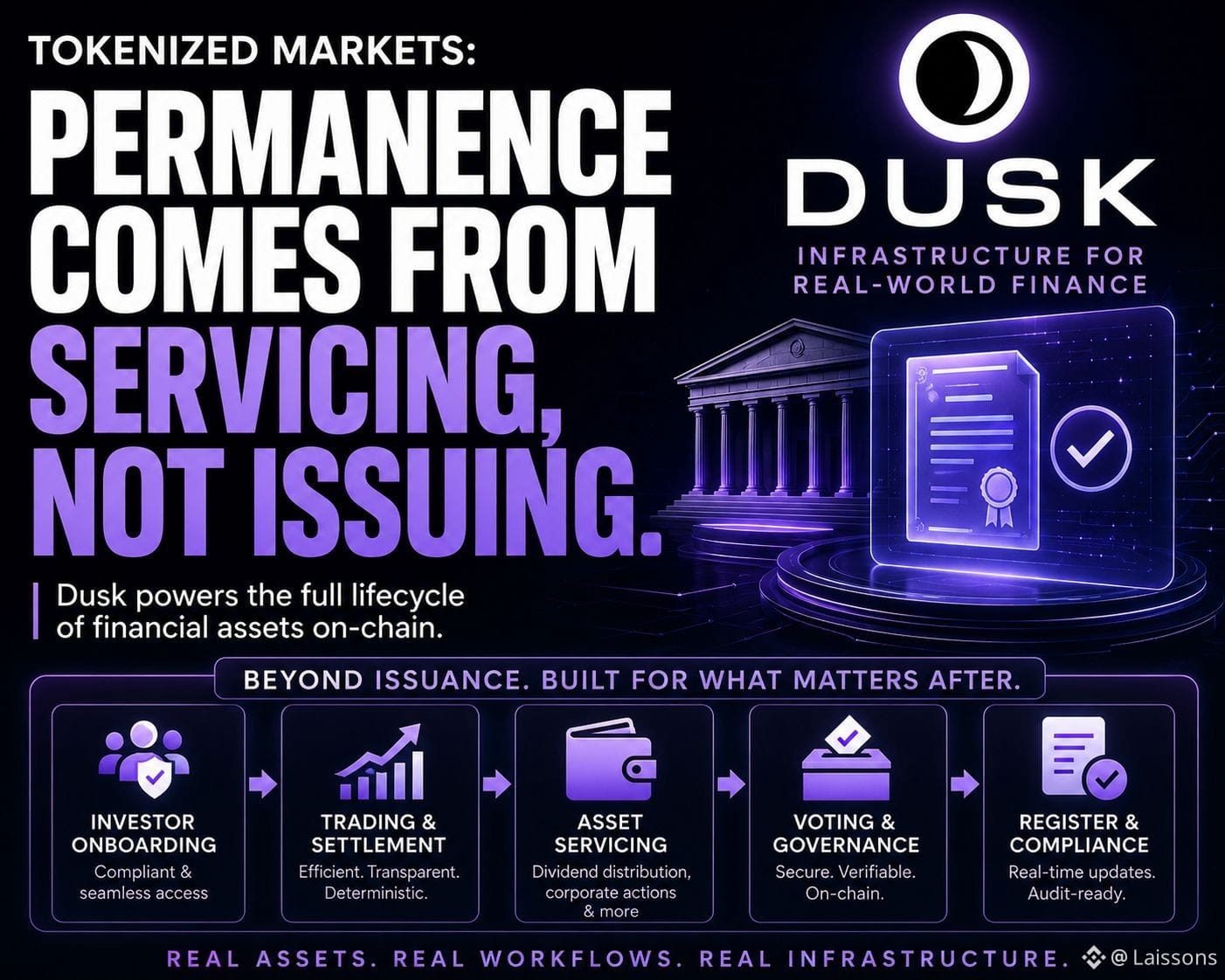
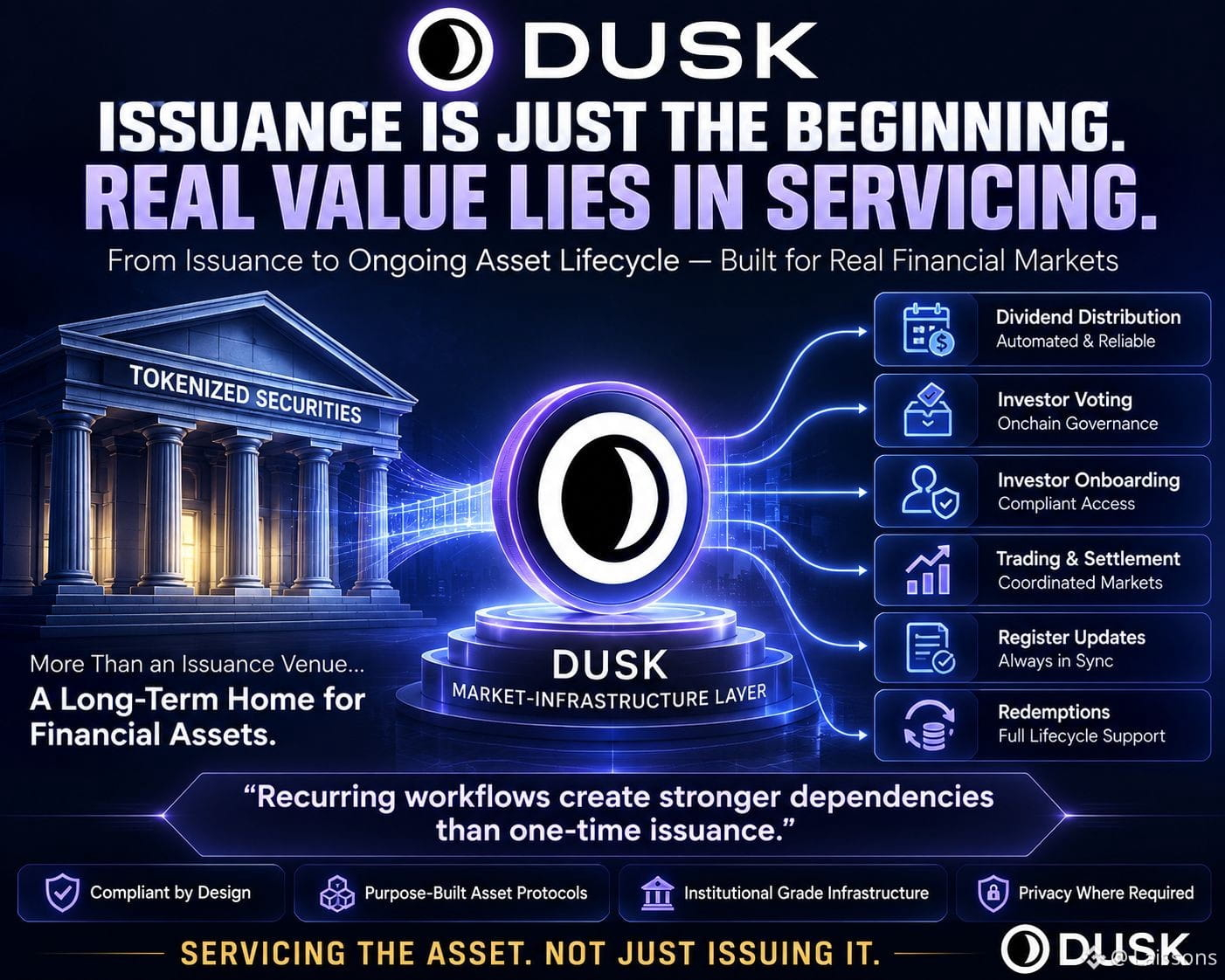
I’ve been paying more attention to what happens to a tokenized asset between major transactions, because that is where infrastructure can become difficult to replace.
For Dusk, the interesting piece is its support for asset-level workflows such as dividends and voting alongside the broader market infrastructure.These are not high-frequency blockchain actions, but they recur whenever an asset has real investors and obligations.
That creates a different kind of network effect.If an issuer uses Dusk not only to represent ownership but also to coordinate distributions, voting and other servicing events, the chain becomes embedded in the asset’s operating process.The value is less about transaction count and more about reducing the number of systems that have to agree on the same financial record.
“Recurring workflows create stronger dependencies than one-time issuance.”
I think that is an important distinction for evaluating RWA infrastructure.An asset can be issued onchain and still have most of its economic administration happen elsewhere.
The risk is execution complexity.If institutions keep critical servicing functions in legacy systems for legal, operational or integration reasons, Dusk may remain a settlement rail rather than becoming core financial infrastructure.
I’d therefore watch repeat servicing activity and issuer retention more closely than headline issuance numbers.
$DUSK
{future}(DUSKUSDT)
$PORTAL
{future}(PORTALUSDT)
$APR
{future}(APRUSDT)
#dusk @Dusk
I’ve been paying more attention to what happens to a tokenized asset between major transactions, because that is where infrastructure can become difficult to replace.
For Dusk, the interesting piece is its support for asset-level workflows such as dividends and voting alongside the broader market infrastructure.These are not high-frequency blockchain actions, but they recur whenever an asset has real investors and obligations.
That creates a different kind of network effect.If an issuer uses Dusk not only to represent ownership but also to coordinate distributions, voting and other servicing events, the chain becomes embedded in the asset’s operating process.The value is less about transaction count and more about reducing the number of systems that have to agree on the same financial record.
“Recurring workflows create stronger dependencies than one-time issuance.”
I think that is an important distinction for evaluating RWA infrastructure.An asset can be issued onchain and still have most of its economic administration happen elsewhere.
The risk is execution complexity.If institutions keep critical servicing functions in legacy systems for legal, operational or integration reasons, Dusk may remain a settlement rail rather than becoming core financial infrastructure.
I’d therefore watch repeat servicing activity and issuer retention more closely than headline issuance numbers.
$DUSK
$PORTAL
$APR
I’ve been paying more attention to what happens to a tokenized asset between major transactions, because that is where infrastructure can become difficult to replace.
For Dusk, the interesting piece is its support for asset-level workflows such as dividends and voting alongside the broader market infrastructure.These are not high-frequency blockchain actions, but they recur whenever an asset has real investors and obligations.
That creates a different kind of network effect.If an issuer uses Dusk not only to represent ownership but also to coordinate distributions, voting and other servicing events, the chain becomes embedded in the asset’s operating process.The value is less about transaction count and more about reducing the number of systems that have to agree on the same financial record.
“Recurring workflows create stronger dependencies than one-time issuance.”
I think that is an important distinction for evaluating RWA infrastructure.An asset can be issued onchain and still have most of its economic administration happen elsewhere.
The risk is execution complexity.If institutions keep critical servicing functions in legacy systems for legal, operational or integration reasons, Dusk may remain a settlement rail rather than becoming core financial infrastructure.
I’d therefore watch repeat servicing activity and issuer retention more closely than headline issuance numbers.
$DUSK
$PORTAL
$APR
38
27
291
·
--
ຢືນຢັນແລ້ວ
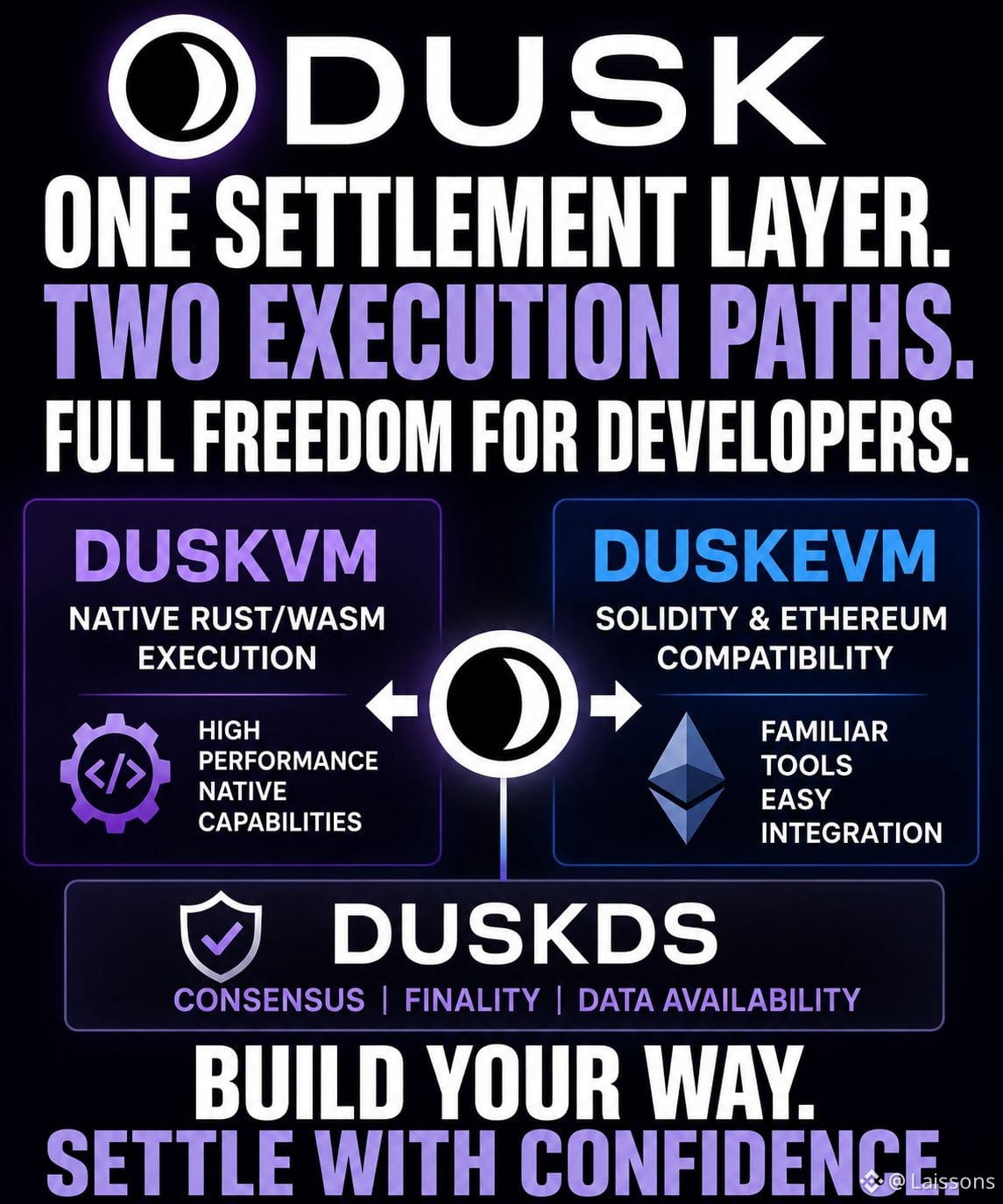
@Dusk_Foundation I’ve started thinking about Dusk’s two execution environments as a developer-retention mechanism, not simply a compatibility feature.
DuskEVM lowers the entry cost for teams already working with Solidity and Ethereum tooling. DuskVM offers a different path for applications that want to use Rust/WASM and interact more directly with Dusk’s native execution environment.
The interesting part is what happens after the initial deployment.
If developers can start with familiar EVM infrastructure but later move specific workloads toward native capabilities, Dusk has a potential conversion path that many networks don’t have.The network is not only competing for new deployments; it can potentially increase the depth of existing applications over time.
“Compatibility gets developers in. Capability keeps them there.”
That distinction matters for investors because raw deployment counts can hide weak retention. I’d rather see applications increasing activity, moving meaningful assets, and using native functionality than simply counting new contracts.
There is still a structural risk: two execution environments can divide liquidity and developer attention.If users experience them as separate ecosystems rather than complementary layers, the flexibility becomes fragmentation.
So I’m watching migration, cross-environment asset flow and sustained application usage more closely than headline deployment numbers.
#dusk #Dusk @Dusk_Foundation $DUSK
{future}(DUSKUSDT)
$HEMI
{future}(HEMIUSDT)
$COW
{future}(COWUSDT)
@Dusk I’ve started thinking about Dusk’s two execution environments as a developer-retention mechanism, not simply a compatibility feature.
DuskEVM lowers the entry cost for teams already working with Solidity and Ethereum tooling. DuskVM offers a different path for applications that want to use Rust/WASM and interact more directly with Dusk’s native execution environment.
The interesting part is what happens after the initial deployment.
If developers can start with familiar EVM infrastructure but later move specific workloads toward native capabilities, Dusk has a potential conversion path that many networks don’t have.The network is not only competing for new deployments; it can potentially increase the depth of existing applications over time.
“Compatibility gets developers in. Capability keeps them there.”
That distinction matters for investors because raw deployment counts can hide weak retention. I’d rather see applications increasing activity, moving meaningful assets, and using native functionality than simply counting new contracts.
There is still a structural risk: two execution environments can divide liquidity and developer attention.If users experience them as separate ecosystems rather than complementary layers, the flexibility becomes fragmentation.
So I’m watching migration, cross-environment asset flow and sustained application usage more closely than headline deployment numbers.
#dusk #Dusk @Dusk $DUSK
$HEMI
$COW
DuskEVM lowers the entry cost for teams already working with Solidity and Ethereum tooling. DuskVM offers a different path for applications that want to use Rust/WASM and interact more directly with Dusk’s native execution environment.
The interesting part is what happens after the initial deployment.
If developers can start with familiar EVM infrastructure but later move specific workloads toward native capabilities, Dusk has a potential conversion path that many networks don’t have.The network is not only competing for new deployments; it can potentially increase the depth of existing applications over time.
“Compatibility gets developers in. Capability keeps them there.”
That distinction matters for investors because raw deployment counts can hide weak retention. I’d rather see applications increasing activity, moving meaningful assets, and using native functionality than simply counting new contracts.
There is still a structural risk: two execution environments can divide liquidity and developer attention.If users experience them as separate ecosystems rather than complementary layers, the flexibility becomes fragmentation.
So I’m watching migration, cross-environment asset flow and sustained application usage more closely than headline deployment numbers.
#dusk #Dusk @Dusk $DUSK
$HEMI
$COW
43
29
1.5k
·
--
@Dusk_Foundation I’ve started viewing Dusk’s validator design through a different lens: operator quality can matter as much as the size of the security set.
Provisioners don’t earn simply by locking DUSK.They need synchronized infrastructure and consistent consensus participation to remain productive.That creates an economic filter: inactive capital becomes less useful because rewards depend on the stake being attached to an operational node.
What I find interesting is the effect this can have on validator behavior. Soft penalties for missed participation and stronger penalties for provably invalid consensus actions make reliability economically measurable.In theory, this should push operators toward better monitoring, redundancy and infrastructure discipline rather than treating staking as passive yield.
“Stake only protects a network when it can actually participate.”
The part I’m still watching is whether this design eventually favors professional operators too heavily.If running reliable provisioner infrastructure becomes complex enough, stake could become concentrated among fewer technically capable entities, weakening the distribution that the security model ultimately depends on.
For Dusk, I’d therefore track active provisioners, stake concentration, participation consistency and penalty frequency together.The quality of the operator set may reveal more about network resilience than the headline staking ratio.
#Dusk #dusk $DUSK
{future}(DUSKUSDT)
$ACE
{future}(ACEUSDT)
$AKE
{future}(AKEUSDT)
What matters most for Dusk security?
@Dusk I’ve started viewing Dusk’s validator design through a different lens: operator quality can matter as much as the size of the security set.
Provisioners don’t earn simply by locking DUSK.They need synchronized infrastructure and consistent consensus participation to remain productive.That creates an economic filter: inactive capital becomes less useful because rewards depend on the stake being attached to an operational node.
What I find interesting is the effect this can have on validator behavior. Soft penalties for missed participation and stronger penalties for provably invalid consensus actions make reliability economically measurable.In theory, this should push operators toward better monitoring, redundancy and infrastructure discipline rather than treating staking as passive yield.
“Stake only protects a network when it can actually participate.”
The part I’m still watching is whether this design eventually favors professional operators too heavily.If running reliable provisioner infrastructure becomes complex enough, stake could become concentrated among fewer technically capable entities, weakening the distribution that the security model ultimately depends on.
For Dusk, I’d therefore track active provisioners, stake concentration, participation consistency and penalty frequency together.The quality of the operator set may reveal more about network resilience than the headline staking ratio.
#Dusk #dusk $DUSK
$ACE
$AKE
What matters most for Dusk security?
Provisioners don’t earn simply by locking DUSK.They need synchronized infrastructure and consistent consensus participation to remain productive.That creates an economic filter: inactive capital becomes less useful because rewards depend on the stake being attached to an operational node.
What I find interesting is the effect this can have on validator behavior. Soft penalties for missed participation and stronger penalties for provably invalid consensus actions make reliability economically measurable.In theory, this should push operators toward better monitoring, redundancy and infrastructure discipline rather than treating staking as passive yield.
“Stake only protects a network when it can actually participate.”
The part I’m still watching is whether this design eventually favors professional operators too heavily.If running reliable provisioner infrastructure becomes complex enough, stake could become concentrated among fewer technically capable entities, weakening the distribution that the security model ultimately depends on.
For Dusk, I’d therefore track active provisioners, stake concentration, participation consistency and penalty frequency together.The quality of the operator set may reveal more about network resilience than the headline staking ratio.
#Dusk #dusk $DUSK
$ACE
$AKE
What matters most for Dusk security?
Active stake
75%
Operator quality
25%
Decentralization
0%
Penalties
0%
4 ຄະແນນສຽງ • ປິດລົງຄະແນນສຽງ
71
33
205
·
--
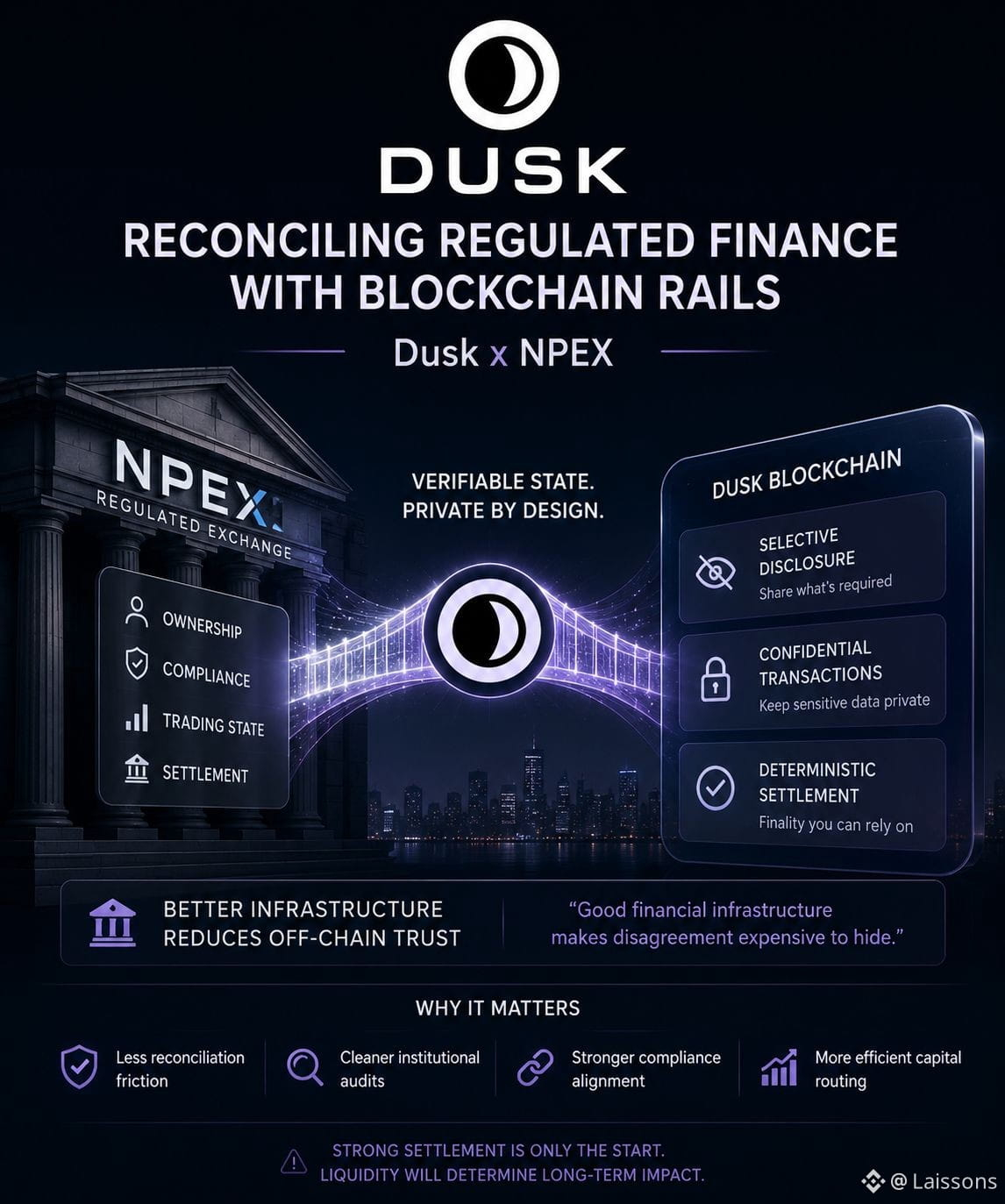
@Dusk_Foundation I’ve been looking at Dusk less as an RWA chain and more as a reconciliation layer for regulated markets.
That distinction matters with NPEX.
A security moving onchain is only useful if its ownership, compliance status, trading state, and settlement can remain consistent across the full lifecycle.Dusk’s combination of selective disclosure, confidential transactions, and deterministic settlement is interesting because it attacks the operational gap between what a financial institution is allowed to reveal and what a blockchain needs to verify.
The investor implication is subtle: better infrastructure should reduce the amount of trust users need to place in off-chain reconciliation.
“Good financial infrastructure makes disagreement expensive to hide.”
That is where I think Dusk has something worth testing. If NPEX activity can increasingly be represented through verifiable onchain state while sensitive information remains restricted, institutions may have a cleaner way to audit positions without exposing everything publicly.
The weakness is liquidity. Better settlement does not automatically create active secondary markets. If regulated securities remain thinly traded, the infrastructure can be technically strong while capital efficiency stays limited.
So I’m watching whether Dusk reduces reconciliation friction enough to change how institutions actually route and retain capital.
#dusk #Dusk $DUSK
{future}(DUSKUSDT)
$AKE
{future}(AKEUSDT)
@Dusk I’ve been looking at Dusk less as an RWA chain and more as a reconciliation layer for regulated markets.
That distinction matters with NPEX.
A security moving onchain is only useful if its ownership, compliance status, trading state, and settlement can remain consistent across the full lifecycle.Dusk’s combination of selective disclosure, confidential transactions, and deterministic settlement is interesting because it attacks the operational gap between what a financial institution is allowed to reveal and what a blockchain needs to verify.
The investor implication is subtle: better infrastructure should reduce the amount of trust users need to place in off-chain reconciliation.
“Good financial infrastructure makes disagreement expensive to hide.”
That is where I think Dusk has something worth testing. If NPEX activity can increasingly be represented through verifiable onchain state while sensitive information remains restricted, institutions may have a cleaner way to audit positions without exposing everything publicly.
The weakness is liquidity. Better settlement does not automatically create active secondary markets. If regulated securities remain thinly traded, the infrastructure can be technically strong while capital efficiency stays limited.
So I’m watching whether Dusk reduces reconciliation friction enough to change how institutions actually route and retain capital.
#dusk #Dusk $DUSK
$AKE
That distinction matters with NPEX.
A security moving onchain is only useful if its ownership, compliance status, trading state, and settlement can remain consistent across the full lifecycle.Dusk’s combination of selective disclosure, confidential transactions, and deterministic settlement is interesting because it attacks the operational gap between what a financial institution is allowed to reveal and what a blockchain needs to verify.
The investor implication is subtle: better infrastructure should reduce the amount of trust users need to place in off-chain reconciliation.
“Good financial infrastructure makes disagreement expensive to hide.”
That is where I think Dusk has something worth testing. If NPEX activity can increasingly be represented through verifiable onchain state while sensitive information remains restricted, institutions may have a cleaner way to audit positions without exposing everything publicly.
The weakness is liquidity. Better settlement does not automatically create active secondary markets. If regulated securities remain thinly traded, the infrastructure can be technically strong while capital efficiency stays limited.
So I’m watching whether Dusk reduces reconciliation friction enough to change how institutions actually route and retain capital.
#dusk #Dusk $DUSK
$AKE
40
1
33
1.6k
·
--
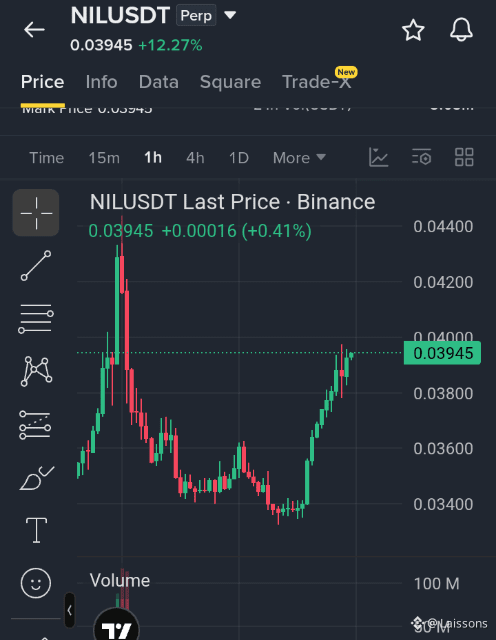
$NIL Trade Setup (LONG)
Entry: 0.03940–0.03960
TP-1: 0.04080
TP-2: 0.04200
TP-3: 0.04350
SL: 0.03820
$NIL bullish recovery approaching key resistance
1H structure shows strong higher lows and impulsive buying from the 0.0340 base. Price is now testing 0.0400 resistance; a clean breakout with sustained volume can open the next upside levels.
Triggers as long as price holds above 0.03820 and breaks/accepts above 0.04000.
Let's Go ... $NIL
{future}(NILUSDT)
$NIL Trade Setup (LONG)
Entry: 0.03940–0.03960
TP-1: 0.04080
TP-2: 0.04200
TP-3: 0.04350
SL: 0.03820
$NIL bullish recovery approaching key resistance
1H structure shows strong higher lows and impulsive buying from the 0.0340 base. Price is now testing 0.0400 resistance; a clean breakout with sustained volume can open the next upside levels.
Triggers as long as price holds above 0.03820 and breaks/accepts above 0.04000.
Let's Go ... $NIL
Entry: 0.03940–0.03960
TP-1: 0.04080
TP-2: 0.04200
TP-3: 0.04350
SL: 0.03820
$NIL bullish recovery approaching key resistance
1H structure shows strong higher lows and impulsive buying from the 0.0340 base. Price is now testing 0.0400 resistance; a clean breakout with sustained volume can open the next upside levels.
Triggers as long as price holds above 0.03820 and breaks/accepts above 0.04000.
Let's Go ... $NIL
3
1.5k
·
--
@babylonlabs_io
I found myself paying more attention to Babylon's verification process than its market metrics.
Weekly reserve attestations create an interesting shift in responsibility.Instead of asking users to simply trust that an LST remains backed, the protocol provides a recurring mechanism for issuers to demonstrate it using signed proofs tied to Bitcoin block heights and on-chain data.
That changes how I think about transparency.A reserve claim isn't just a statement made at launch it becomes something that can be checked repeatedly as the system operates.
"Trust is strongest when verification becomes routine."
$BABY
{future}(BABYUSDT)
Of course, publishing proofs doesn't guarantee every participant will verify them.Most users will probably continue relying on interfaces, issuers, or community summaries rather than inspecting the attestations themselves. That's the practical limitation of any transparency framework: evidence is only valuable if enough people are willing to use it.
For me, the interesting metric isn't just whether attestations are published on schedule.It's whether wallets, explorers, and analytics platforms eventually make those proofs visible enough that verification becomes a normal habit instead of an expert-only exercise.If that happens, Babylon won't just improve transparency it could change how users evaluate BTC-backed assets altogether.
#baby #Babylon $HEI
{future}(HEIUSDT)
$HFT
{future}(HFTUSDT)
How would you verify an LST?
@BabylonLabs_io
I found myself paying more attention to Babylon's verification process than its market metrics.
Weekly reserve attestations create an interesting shift in responsibility.Instead of asking users to simply trust that an LST remains backed, the protocol provides a recurring mechanism for issuers to demonstrate it using signed proofs tied to Bitcoin block heights and on-chain data.
That changes how I think about transparency.A reserve claim isn't just a statement made at launch it becomes something that can be checked repeatedly as the system operates.
"Trust is strongest when verification becomes routine."
$BABY
Of course, publishing proofs doesn't guarantee every participant will verify them.Most users will probably continue relying on interfaces, issuers, or community summaries rather than inspecting the attestations themselves. That's the practical limitation of any transparency framework: evidence is only valuable if enough people are willing to use it.
For me, the interesting metric isn't just whether attestations are published on schedule.It's whether wallets, explorers, and analytics platforms eventually make those proofs visible enough that verification becomes a normal habit instead of an expert-only exercise.If that happens, Babylon won't just improve transparency it could change how users evaluate BTC-backed assets altogether.
#baby #Babylon $HEI
$HFT
How would you verify an LST?
I found myself paying more attention to Babylon's verification process than its market metrics.
Weekly reserve attestations create an interesting shift in responsibility.Instead of asking users to simply trust that an LST remains backed, the protocol provides a recurring mechanism for issuers to demonstrate it using signed proofs tied to Bitcoin block heights and on-chain data.
That changes how I think about transparency.A reserve claim isn't just a statement made at launch it becomes something that can be checked repeatedly as the system operates.
"Trust is strongest when verification becomes routine."
$BABY
Of course, publishing proofs doesn't guarantee every participant will verify them.Most users will probably continue relying on interfaces, issuers, or community summaries rather than inspecting the attestations themselves. That's the practical limitation of any transparency framework: evidence is only valuable if enough people are willing to use it.
For me, the interesting metric isn't just whether attestations are published on schedule.It's whether wallets, explorers, and analytics platforms eventually make those proofs visible enough that verification becomes a normal habit instead of an expert-only exercise.If that happens, Babylon won't just improve transparency it could change how users evaluate BTC-backed assets altogether.
#baby #Babylon $HEI
$HFT
How would you verify an LST?
🔍 Check Proofs
40%
✅ Trust the Peg
20%
📊 Both Together
40%
5 ຄະແນນສຽງ • ປິດລົງຄະແນນສຽງ
21
17
3.5k
·
--
#Babylon I found myself comparing two very different signals in the Babylon ecosystem this week.
Bitcoin staking is a relatively slow-moving commitment.Once BTC is delegated, participation tends to reflect a longer-term security decision.Trading volume, on the other hand, can change dramatically within days because exchange incentives temporarily alter behavior.
That's why I don't automatically treat higher volume as evidence of stronger network adoption.Volume tells me capital is moving. It doesn't tell me whether capital is becoming economically committed to the protocol.
"Activity is visible. Commitment takes longer to measure."
I could be overlooking part of the picture, but I'd rather compare exchange-driven trading spikes with on-chain participation over the same period than evaluate either metric in isolation. If staking, governance participation, or future co-staking adoption remain largely unchanged while trading activity accelerates, the market may simply be reacting to incentives rather than expressing a stronger conviction about the protocol itself.
For me, the more durable indicator isn't how often BABY changes hands. It's whether temporary attention eventually translates into capital that stays engaged with Babylon's security model after promotional campaigns have already ended.
#babylon @babylonlabs_io
#baby $BABY
{future}(BABYUSDT)
$CYS
{future}(CYSUSDT)
$HEI
{future}(HEIUSDT)
What drove BABY activity most?
#Babylon I found myself comparing two very different signals in the Babylon ecosystem this week.
Bitcoin staking is a relatively slow-moving commitment.Once BTC is delegated, participation tends to reflect a longer-term security decision.Trading volume, on the other hand, can change dramatically within days because exchange incentives temporarily alter behavior.
That's why I don't automatically treat higher volume as evidence of stronger network adoption.Volume tells me capital is moving. It doesn't tell me whether capital is becoming economically committed to the protocol.
"Activity is visible. Commitment takes longer to measure."
I could be overlooking part of the picture, but I'd rather compare exchange-driven trading spikes with on-chain participation over the same period than evaluate either metric in isolation. If staking, governance participation, or future co-staking adoption remain largely unchanged while trading activity accelerates, the market may simply be reacting to incentives rather than expressing a stronger conviction about the protocol itself.
For me, the more durable indicator isn't how often BABY changes hands. It's whether temporary attention eventually translates into capital that stays engaged with Babylon's security model after promotional campaigns have already ended.
#babylon @BabylonLabs_io
#baby $BABY
$CYS
$HEI
What drove BABY activity most?
Bitcoin staking is a relatively slow-moving commitment.Once BTC is delegated, participation tends to reflect a longer-term security decision.Trading volume, on the other hand, can change dramatically within days because exchange incentives temporarily alter behavior.
That's why I don't automatically treat higher volume as evidence of stronger network adoption.Volume tells me capital is moving. It doesn't tell me whether capital is becoming economically committed to the protocol.
"Activity is visible. Commitment takes longer to measure."
I could be overlooking part of the picture, but I'd rather compare exchange-driven trading spikes with on-chain participation over the same period than evaluate either metric in isolation. If staking, governance participation, or future co-staking adoption remain largely unchanged while trading activity accelerates, the market may simply be reacting to incentives rather than expressing a stronger conviction about the protocol itself.
For me, the more durable indicator isn't how often BABY changes hands. It's whether temporary attention eventually translates into capital that stays engaged with Babylon's security model after promotional campaigns have already ended.
#babylon @BabylonLabs_io
#baby $BABY
$CYS
$HEI
What drove BABY activity most?
🎁 Campaigns
100%
₿ BTC Staking
0%
📈 Trading Volume
0%
⚙️ Co-Staking
0%
4 ຄະແນນສຽງ • ປິດລົງຄະແນນສຽງ
50
24
294
·
--
@babylonlabs_io I found myself thinking less about Babylon's circulating supply and more about the speed at which newly circulating BABY finds a long-term role in the network.
Token unlocks are deterministic.They increase the amount of capital that can make a decision.Co-staking is different because it tries to influence what that decision becomes.One expands optionality; the other tries to create commitment.
That's why I don't see these as separate events.They're part of the same economic feedback loop. Every newly unlocked token can remain liquid, be sold, or eventually become productive capital through staking and governance.
"Distribution is automatic. Commitment is voluntary."
I'm not assuming co-staking will immediately absorb that additional supply. Adoption takes time, and if the mechanism isn't compelling enough, liquidity can remain mobile instead of becoming economically aligned with the protocol.
The metric I'd watch isn't simply circulating supply or vesting progress. It's the share of unlocked BABY that eventually transitions into long-term participation. If that percentage steadily rises, the protocol is converting liquidity into conviction.If it doesn't, the token's economic role may stay weaker than its intended design.
To me, that's a more meaningful measure of token quality than the unlock schedule by itself.
#Babylon @babylonlabs_io
#baby $BABY
{future}(BABYUSDT)
$HOME
{future}(HOMEUSDT)
$BLESS
{future}(BLESSUSDT)
What will shape BABY next?
@BabylonLabs_io I found myself thinking less about Babylon's circulating supply and more about the speed at which newly circulating BABY finds a long-term role in the network.
Token unlocks are deterministic.They increase the amount of capital that can make a decision.Co-staking is different because it tries to influence what that decision becomes.One expands optionality; the other tries to create commitment.
That's why I don't see these as separate events.They're part of the same economic feedback loop. Every newly unlocked token can remain liquid, be sold, or eventually become productive capital through staking and governance.
"Distribution is automatic. Commitment is voluntary."
I'm not assuming co-staking will immediately absorb that additional supply. Adoption takes time, and if the mechanism isn't compelling enough, liquidity can remain mobile instead of becoming economically aligned with the protocol.
The metric I'd watch isn't simply circulating supply or vesting progress. It's the share of unlocked BABY that eventually transitions into long-term participation. If that percentage steadily rises, the protocol is converting liquidity into conviction.If it doesn't, the token's economic role may stay weaker than its intended design.
To me, that's a more meaningful measure of token quality than the unlock schedule by itself.
#Babylon @BabylonLabs_io
#baby $BABY
$HOME
$BLESS
What will shape BABY next?
Token unlocks are deterministic.They increase the amount of capital that can make a decision.Co-staking is different because it tries to influence what that decision becomes.One expands optionality; the other tries to create commitment.
That's why I don't see these as separate events.They're part of the same economic feedback loop. Every newly unlocked token can remain liquid, be sold, or eventually become productive capital through staking and governance.
"Distribution is automatic. Commitment is voluntary."
I'm not assuming co-staking will immediately absorb that additional supply. Adoption takes time, and if the mechanism isn't compelling enough, liquidity can remain mobile instead of becoming economically aligned with the protocol.
The metric I'd watch isn't simply circulating supply or vesting progress. It's the share of unlocked BABY that eventually transitions into long-term participation. If that percentage steadily rises, the protocol is converting liquidity into conviction.If it doesn't, the token's economic role may stay weaker than its intended design.
To me, that's a more meaningful measure of token quality than the unlock schedule by itself.
#Babylon @BabylonLabs_io
#baby $BABY
$HOME
$BLESS
What will shape BABY next?
🔒 Co-Staking
70%
📊 Token Unlocks
10%
🗳️ Governance
10%
💎 Long-Term Holding
10%
10 ຄະແນນສຽງ • ປິດລົງຄະແນນສຽງ
59
38
2.2k
ເຂົ້າສູ່ລະບົບເພື່ອສຳຫຼວດເນື້ອຫາເພີ່ມເຕີມ
ເຂົ້າຮ່ວມກຸ່ມຜູ້ໃຊ້ຄຣິບໂຕທົ່ວໂລກໃນ Binance Square.
⚡️ ໄດ້ຮັບຂໍ້ມູນຫຼ້າສຸດ ແລະ ທີ່ມີປະໂຫຍດກ່ຽວກັບຄຣິບໂຕ.
💬 ໄດ້ຮັບຄວາມໄວ້ວາງໃຈຈາກຕະຫຼາດແລກປ່ຽນຄຣິບໂຕທີ່ໃຫຍ່ທີ່ສຸດໃນໂລກ.
👍 ຄົ້ນຫາຂໍ້ມູນເຊີງເລິກທີ່ແທ້ຈາກນັກສ້າງທີ່ໄດ້ຮັບການຢືນຢັນ.
ອີເມວ / ເບີໂທລະສັບ