

NAJAF_加密 143
2.4k ໂພສ

NAJAF_加密 143
 Square Verified+
ລາຍງານ
ບລັອກຜູ້ໃຊ້
Crypto trading and learning more Crypto skills. My X account is @Najafhaider9999
ເປີດການຊື້ຂາຍ
ຜູ້ຊື້ຂາຍປະຈໍາ
9.6 ເດືອນ
2.1K+ ກໍາລັງຕິດຕາມ
39.7K+ ຜູ້ຕິດຕາມ
12.6K+ Liked
ໂພສ
Portfolio
ທັງໝົດ
ວົງຢືມ

·
--
888
888

Flora Firdos
·
--
👀 Who wants some $USDT PALA? 💸🔥
One lucky community member is getting a little surprise! 🎁💚
💬 Comment 999
❤️ Hit like
🔄 Repost this
➕ Follow me
Finish the steps and you’re in! 🚀
Good luck, everyone! 🍀✨
One lucky community member is getting a little surprise! 🎁💚
💬 Comment 999
❤️ Hit like
🔄 Repost this
➕ Follow me
Finish the steps and you’re in! 🚀
Good luck, everyone! 🍀✨

·
--
888
888

E L E X A
·
--
🚨 IT’S LIVE 🚨
Watching is simple… but winners take action 👀
🎁 Want FREE $USDT?
💬 Comment 888
❤️ Like
🔁 Share
➕ Follow
⏳ Don’t miss your chance — spots are limited!
Drop 888 below and join now 🚀
#Crypto #USDT。 #Giveaway
Watching is simple… but winners take action 👀
🎁 Want FREE $USDT?
💬 Comment 888
❤️ Like
🔁 Share
➕ Follow
⏳ Don’t miss your chance — spots are limited!
Drop 888 below and join now 🚀
#Crypto #USDT。 #Giveaway

19





·
--
🎁 #NAJAFCrypto143 BNB SURPRISE DROP! 🎁
✨ The Red Packet is full and ready to open! ✨
👇 Simple Steps to Participate 👇
❤️ Follow #NAJAFCrypto143
🔁 Like & Share
💬 Comment “BNB”
🔔 Stay connected and active for upcoming surprise drops!
#Crypto #RedPacket #Binance $BNB
🎁 #NAJAFCrypto143 BNB SURPRISE DROP! 🎁
✨ The Red Packet is full and ready to open! ✨
👇 Simple Steps to Participate 👇
❤️ Follow #NAJAFCrypto143
🔁 Like & Share
💬 Comment “BNB”
🔔 Stay connected and active for upcoming surprise drops!
#Crypto #RedPacket #Binance $BNB
✨ The Red Packet is full and ready to open! ✨
👇 Simple Steps to Participate 👇
❤️ Follow #NAJAFCrypto143
🔁 Like & Share
💬 Comment “BNB”
🔔 Stay connected and active for upcoming surprise drops!
#Crypto #RedPacket #Binance $BNB

2.1k
51
128
2.1k

·
--
ZEC Signal
$ZEC is showing strong momentum, trading around $1,550 after a sharp rally. Volume remains active, but the move looks extended, so volatility can stay high.
I’m watching whether $ZEC holds key support after this breakout. If momentum and volume continue, more upside may follow. For now, manage risk and DYOR before entering.
Make the market outlook more balanced
Clarify what confirms the breakout
Add a stronger risk warning
$ZEC #zec
ZEC Signal
$ZEC is showing strong momentum, trading around $1,550 after a sharp rally. Volume remains active, but the move looks extended, so volatility can stay high.
I’m watching whether $ZEC holds key support after this breakout. If momentum and volume continue, more upside may follow. For now, manage risk and DYOR before entering.
Make the market outlook more balanced
Clarify what confirms the breakout
Add a stronger risk warning
$ZEC #zec
$ZEC is showing strong momentum, trading around $1,550 after a sharp rally. Volume remains active, but the move looks extended, so volatility can stay high.
I’m watching whether $ZEC holds key support after this breakout. If momentum and volume continue, more upside may follow. For now, manage risk and DYOR before entering.
Make the market outlook more balanced
Clarify what confirms the breakout
Add a stronger risk warning
$ZEC #zec
3
552


·
--
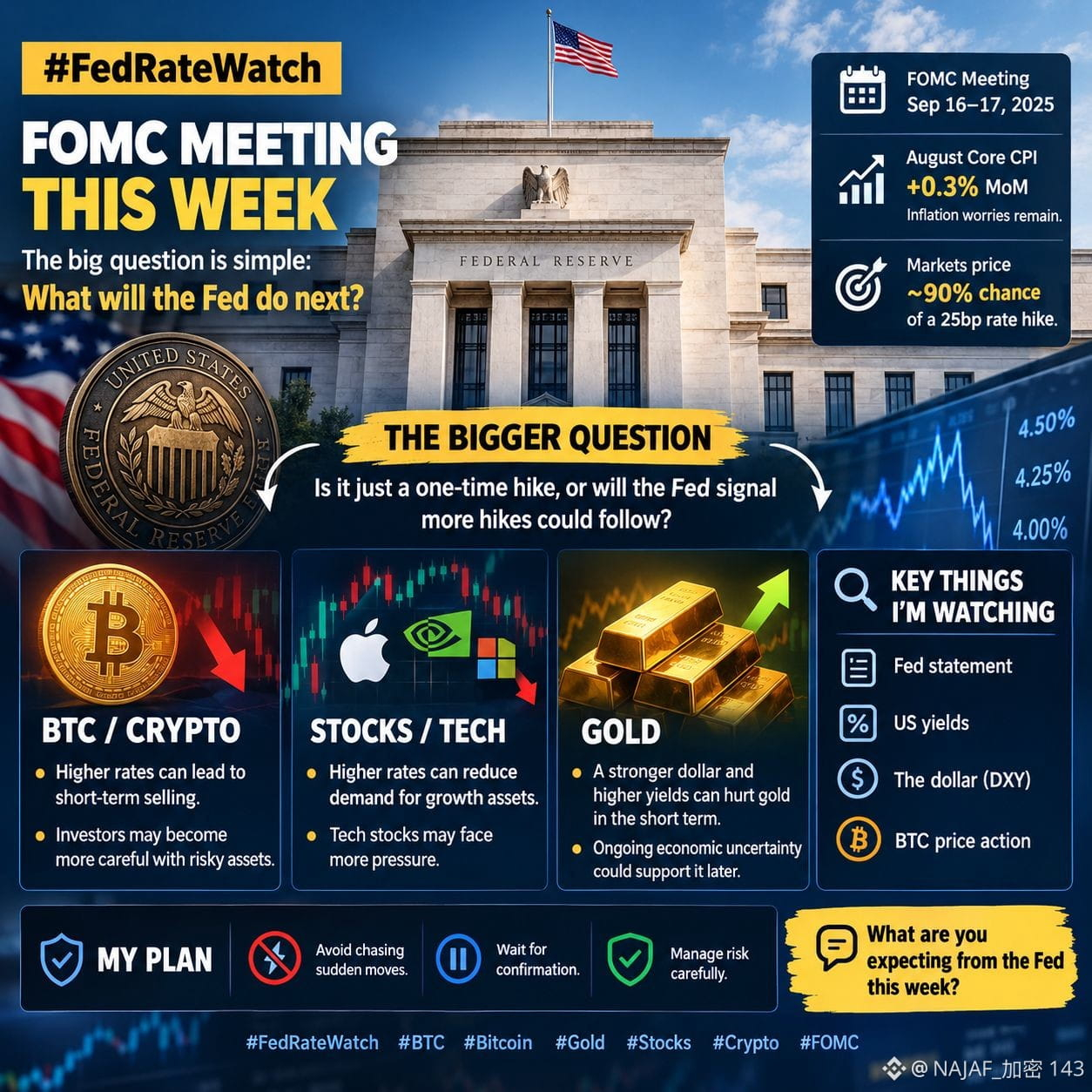
The September FOMC meeting is here, and the big question is simple: What will the Fed do next?
August core CPI rose 0.3% month-over-month, keeping inflation worries alive. Markets are now pricing close to a 90% chance of a 25bp rate hike this week. For me, the bigger question is not only whether the hike happens, but what the Fed says after it.
If this is just a one-time hike, markets may handle it better. But if the Fed signals that more hikes could follow, risk assets may face more pressure.
BTC could see short-term selling as higher rates usually make investors more careful with risky assets. Tech stocks may also feel pressure because higher rates can reduce demand for growth assets.
Gold is a little different. A stronger dollar and higher yields can hurt gold in the short term, but continued economic uncertainty could support it later.
I’m not trying to predict the exact market move. I’m watching the Fed statement, US yields, the dollar, and BTC price action after the decision.
My plan is simple: avoid chasing sudden moves, wait for confirmation, and manage risk carefully.
The next move could create volatility across BTC, stocks, and gold.
What are you expecting from the Fed this week?
#FedRateWatch #BTC #Bitcoin #Gold #FOMC
The September FOMC meeting is here, and the big question is simple: What will the Fed do next?
August core CPI rose 0.3% month-over-month, keeping inflation worries alive. Markets are now pricing close to a 90% chance of a 25bp rate hike this week. For me, the bigger question is not only whether the hike happens, but what the Fed says after it.
If this is just a one-time hike, markets may handle it better. But if the Fed signals that more hikes could follow, risk assets may face more pressure.
BTC could see short-term selling as higher rates usually make investors more careful with risky assets. Tech stocks may also feel pressure because higher rates can reduce demand for growth assets.
Gold is a little different. A stronger dollar and higher yields can hurt gold in the short term, but continued economic uncertainty could support it later.
I’m not trying to predict the exact market move. I’m watching the Fed statement, US yields, the dollar, and BTC price action after the decision.
My plan is simple: avoid chasing sudden moves, wait for confirmation, and manage risk carefully.
The next move could create volatility across BTC, stocks, and gold.
What are you expecting from the Fed this week?
#FedRateWatch #BTC #Bitcoin #Gold #FOMC
August core CPI rose 0.3% month-over-month, keeping inflation worries alive. Markets are now pricing close to a 90% chance of a 25bp rate hike this week. For me, the bigger question is not only whether the hike happens, but what the Fed says after it.
If this is just a one-time hike, markets may handle it better. But if the Fed signals that more hikes could follow, risk assets may face more pressure.
BTC could see short-term selling as higher rates usually make investors more careful with risky assets. Tech stocks may also feel pressure because higher rates can reduce demand for growth assets.
Gold is a little different. A stronger dollar and higher yields can hurt gold in the short term, but continued economic uncertainty could support it later.
I’m not trying to predict the exact market move. I’m watching the Fed statement, US yields, the dollar, and BTC price action after the decision.
My plan is simple: avoid chasing sudden moves, wait for confirmation, and manage risk carefully.
The next move could create volatility across BTC, stocks, and gold.
What are you expecting from the Fed this week?
#FedRateWatch #BTC #Bitcoin #Gold #FOMC
4
1
11
746
·
--
‼️$ZEC Reward is here ‼️
I’m sharing $ZEC rewards with the community as a Bigger thank-you.
✨ Just claim your reward and enjoy! ✨
Claim it. Get rewarded
$ZEC @Square-Creator-418831459 #zec
‼️$ZEC Reward is here ‼️
I’m sharing $ZEC rewards with the community as a Bigger thank-you.
✨ Just claim your reward and enjoy! ✨
Claim it. Get rewarded
$ZEC @ZEC是加密的比特币 #zec
I’m sharing $ZEC rewards with the community as a Bigger thank-you.
✨ Just claim your reward and enjoy! ✨
Claim it. Get rewarded
$ZEC @ZEC是加密的比特币 #zec

3.5k
57
228
3.5k
·
--
Noticing a major structural shift in $BTC after the latest market moves: we are seeing consistent institutional outflows from exchanges into cold storage.
The hard cap of 21 million units combined with the post-halving reduction to 450 daily coins makes this asset increasingly scarce.
Honestly, I am positioning for the long term because the math is simply on my side. While retail traders chase noise, I am focusing on the macro supply crunch.
My thesis is that as institutional balance sheets absorb supply, the price floor must shift higher over time. 🚀 Are you stacking or waiting for a dip? 👀👇
$BTC #bitcoin @Square-Creator-a6b19761fc5e5 #BTC☀
Noticing a major structural shift in $BTC after the latest market moves: we are seeing consistent institutional outflows from exchanges into cold storage.
The hard cap of 21 million units combined with the post-halving reduction to 450 daily coins makes this asset increasingly scarce.
Honestly, I am positioning for the long term because the math is simply on my side. While retail traders chase noise, I am focusing on the macro supply crunch.
My thesis is that as institutional balance sheets absorb supply, the price floor must shift higher over time. 🚀 Are you stacking or waiting for a dip? 👀👇
$BTC #bitcoin @BTC #BTC☀
The hard cap of 21 million units combined with the post-halving reduction to 450 daily coins makes this asset increasingly scarce.
Honestly, I am positioning for the long term because the math is simply on my side. While retail traders chase noise, I am focusing on the macro supply crunch.
My thesis is that as institutional balance sheets absorb supply, the price floor must shift higher over time. 🚀 Are you stacking or waiting for a dip? 👀👇
$BTC #bitcoin @BTC #BTC☀

5
750
·
--
Crypto trading advice disguised as romance:
Pick the wrong coin (or girl), and you'll go broke. Panic-sell and chase the re-entry?
You'll lose twice as fast.
Winning comes down to two simple rules: choose the right one, and hold on through the volatility. Loyalty pays off.
$ZEC $BTC $ETH
Crypto trading advice disguised as romance:
Pick the wrong coin (or girl), and you'll go broke. Panic-sell and chase the re-entry?
You'll lose twice as fast.
Winning comes down to two simple rules: choose the right one, and hold on through the volatility. Loyalty pays off.
$ZEC $BTC $ETH
Pick the wrong coin (or girl), and you'll go broke. Panic-sell and chase the re-entry?
You'll lose twice as fast.
Winning comes down to two simple rules: choose the right one, and hold on through the volatility. Loyalty pays off.
$ZEC $BTC $ETH
3
234
·
--
ຢືນຢັນແລ້ວ
The CPI numbers just dropped, holding steady at 3.4% year-over-year while headline inflation ticked up 0.4% this month, mostly driven by rising energy costs. Meanwhile, core CPI cooled slightly to 2.4%, showing that underlying pressures are slowly easing despite gas pump spikes.
Looking at the charts, BTC is holding its ground around key support levels while markets digest what this means for the Fed's next rate decision. With energy prices pushing up the headline figure, the central bank is in a tight spot between persistent shelter costs and cooling core metrics.
I’m currently watching the BTC/USDT pair closely as volatility picks up. I entered a small long position near $58,200, anticipating a short-term bounce as the market realizes core inflation is still trending downward. My stop-loss is set tight at $57,400 with a profit target near $60,500.
Macro data like this creates quick swings, so managing risk is key here. Are you trading this CPI print or waiting on the sidelines for clearer market direction? Let me know your setup below.
#CPIWatch
The CPI numbers just dropped, holding steady at 3.4% year-over-year while headline inflation ticked up 0.4% this month, mostly driven by rising energy costs. Meanwhile, core CPI cooled slightly to 2.4%, showing that underlying pressures are slowly easing despite gas pump spikes.
Looking at the charts, BTC is holding its ground around key support levels while markets digest what this means for the Fed's next rate decision. With energy prices pushing up the headline figure, the central bank is in a tight spot between persistent shelter costs and cooling core metrics.
I’m currently watching the BTC/USDT pair closely as volatility picks up. I entered a small long position near $58,200, anticipating a short-term bounce as the market realizes core inflation is still trending downward. My stop-loss is set tight at $57,400 with a profit target near $60,500.
Macro data like this creates quick swings, so managing risk is key here. Are you trading this CPI print or waiting on the sidelines for clearer market direction? Let me know your setup below.
#CPIWatch
Looking at the charts, BTC is holding its ground around key support levels while markets digest what this means for the Fed's next rate decision. With energy prices pushing up the headline figure, the central bank is in a tight spot between persistent shelter costs and cooling core metrics.
I’m currently watching the BTC/USDT pair closely as volatility picks up. I entered a small long position near $58,200, anticipating a short-term bounce as the market realizes core inflation is still trending downward. My stop-loss is set tight at $57,400 with a profit target near $60,500.
Macro data like this creates quick swings, so managing risk is key here. Are you trading this CPI print or waiting on the sidelines for clearer market direction? Let me know your setup below.
#CPIWatch
3
882
·
--
#cpiwatch
CPIWatch CPI came in hotter than expected. Now BTC gets more interesting.
Yesterday, PPI was already a bit uncomfortable at 5.4% against 5.3% expected.
Today’s CPI looked okay at first. Headline CPI came in at 0.4% month-on-month and 3.4% year-on-year, pretty much in line with expectations.
But core CPI is what caught my attention.
Core CPI came in at 0.3% m/m, higher than the 0.2% expected, while the yearly figure was 2.4%.
That’s the number I’m watching closely.
Headline inflation can move because of food and energy prices. Core CPI gives us a better look at the underlying inflation pressure.
The timing also matters. This is the last major inflation report before the Fed meeting on September 15–16.
So now we have hot PPI followed by stronger core CPI.
I’m not ready to predict BTC’s next move yet. I want to see how yields, DXY and BTC react to this data.
Sometimes the numbers look bearish, but the market tells a different story.
Has this CPI changed your view on the Fed’s next move, or are you waiting for the FOMC statement?
#CPIWatch #BTC #Bitcoin #Crypto
#cpiwatch
CPIWatch CPI came in hotter than expected. Now BTC gets more interesting.
Yesterday, PPI was already a bit uncomfortable at 5.4% against 5.3% expected.
Today’s CPI looked okay at first. Headline CPI came in at 0.4% month-on-month and 3.4% year-on-year, pretty much in line with expectations.
But core CPI is what caught my attention.
Core CPI came in at 0.3% m/m, higher than the 0.2% expected, while the yearly figure was 2.4%.
That’s the number I’m watching closely.
Headline inflation can move because of food and energy prices. Core CPI gives us a better look at the underlying inflation pressure.
The timing also matters. This is the last major inflation report before the Fed meeting on September 15–16.
So now we have hot PPI followed by stronger core CPI.
I’m not ready to predict BTC’s next move yet. I want to see how yields, DXY and BTC react to this data.
Sometimes the numbers look bearish, but the market tells a different story.
Has this CPI changed your view on the Fed’s next move, or are you waiting for the FOMC statement?
#CPIWatch #BTC #Bitcoin #Crypto
CPIWatch CPI came in hotter than expected. Now BTC gets more interesting.
Yesterday, PPI was already a bit uncomfortable at 5.4% against 5.3% expected.
Today’s CPI looked okay at first. Headline CPI came in at 0.4% month-on-month and 3.4% year-on-year, pretty much in line with expectations.
But core CPI is what caught my attention.
Core CPI came in at 0.3% m/m, higher than the 0.2% expected, while the yearly figure was 2.4%.
That’s the number I’m watching closely.
Headline inflation can move because of food and energy prices. Core CPI gives us a better look at the underlying inflation pressure.
The timing also matters. This is the last major inflation report before the Fed meeting on September 15–16.
So now we have hot PPI followed by stronger core CPI.
I’m not ready to predict BTC’s next move yet. I want to see how yields, DXY and BTC react to this data.
Sometimes the numbers look bearish, but the market tells a different story.
Has this CPI changed your view on the Fed’s next move, or are you waiting for the FOMC statement?
#CPIWatch #BTC #Bitcoin #Crypto

5
2
18
662
·
--
‼️$SOL Reward is here ‼️
I’m sharing $SOL rewards with the community as a Bigger thank-you.
✨ Just claim your reward and enjoy! ✨
Claim it. Get rewarded
@Solana_Official $SOL #Solana
‼️$SOL Reward is here ‼️
I’m sharing $SOL rewards with the community as a Bigger thank-you.
✨ Just claim your reward and enjoy! ✨
Claim it. Get rewarded
@Solana Official $SOL #Solana
I’m sharing $SOL rewards with the community as a Bigger thank-you.
✨ Just claim your reward and enjoy! ✨
Claim it. Get rewarded
@Solana Official $SOL #Solana

3.3k
73
220
3.3k

ເຂົ້າສູ່ລະບົບເພື່ອສຳຫຼວດເນື້ອຫາເພີ່ມເຕີມ
ເຂົ້າຮ່ວມກຸ່ມຜູ້ໃຊ້ຄຣິບໂຕທົ່ວໂລກໃນ Binance Square.
⚡️ ໄດ້ຮັບຂໍ້ມູນຫຼ້າສຸດ ແລະ ທີ່ມີປະໂຫຍດກ່ຽວກັບຄຣິບໂຕ.
💬 ໄດ້ຮັບຄວາມໄວ້ວາງໃຈຈາກຕະຫຼາດແລກປ່ຽນຄຣິບໂຕທີ່ໃຫຍ່ທີ່ສຸດໃນໂລກ.
👍 ຄົ້ນຫາຂໍ້ມູນເຊີງເລິກທີ່ແທ້ຈາກນັກສ້າງທີ່ໄດ້ຮັບການຢືນຢັນ.
ອີເມວ / ເບີໂທລະສັບ
ຫົວຂໍ້ທີ່ກໍາລັງນິຍົມ
BinanceLaunchesBinanceIntelligence
339,775 views
2,790 ກຳລັງສົນທະນາ
The real test for Binance Intelligence isn’t whether AI can generate a strategy
Zaki Web3 Media
·17 ຖືກໃຈ
·20.3k views
BitcoinTargets2026OpenAt$87570
1,313 views
56 ກຳລັງສົນທະນາ
BitcoinRejectedAt$87KThirdTime
1,551 views
49 ກຳລັງສົນທະນາ