

#digitalmolvi
digitalmolvi
7,133 views
163 ກຳລັງສົນທະນາ
ມາແຮງ
ຫຼ້າສຸດ

ບົດຄວາມ
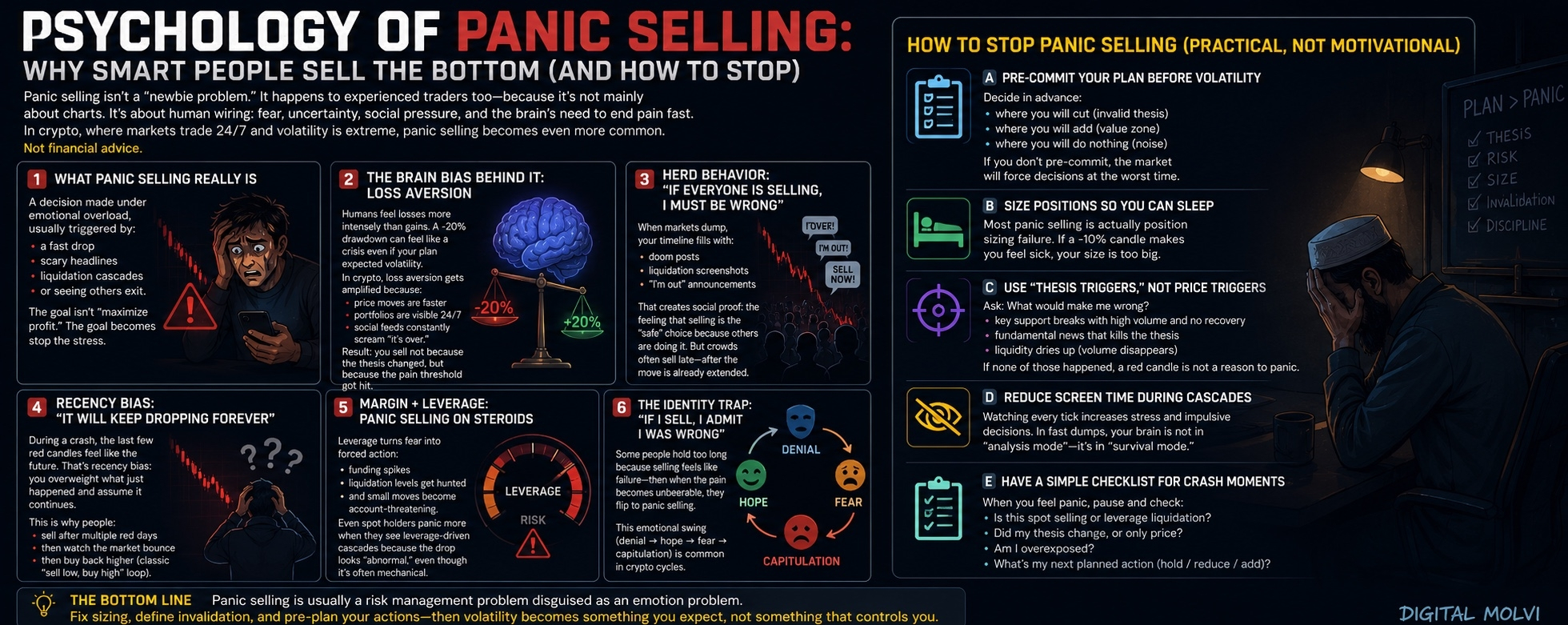
Psychology of Panic Selling: Why Smart People Sell the BottomPanic selling isn’t a “newbie problem.” It happens to experienced traders too—because it’s not mainly about charts. It’s about human wiring: fear, uncertainty, social pressure, and the brain’s need to end pain fast. In crypto, where markets trade 24/7 and volatility is extreme, panic selling becomes even more common.
1) What panic selling really is
Panic selling is a decision made under emotional overload, usually triggered by:
a fast drop,
scary headlines,
liquidation cascades,
or seeing others exit.
The goal isn’t “maximize profit.” The goal becomes stop the stress. That’s why people sell at the worst time: the brain prioritizes relief over logic.
2) The brain bias behind it: Loss aversion
Humans feel losses more intensely than gains. A -20% drawdown can feel like a crisis even if your plan expected volatility.
In crypto, loss aversion gets amplified because:
price moves are faster,
portfolios are visible 24/7,
and social feeds constantly scream “it’s over.”
Result: you sell not because the thesis changed, but because the pain threshold got hit.
3) Herd behavior: “If everyone is selling, I must be wrong”
When markets dump, your timeline fills with:
doom posts,
liquidation screenshots,
“I’m out” announcements.
That creates social proof: the feeling that selling is the “safe” choice because others are doing it. But crowds often sell late—after the move is already extended.
4) Recency bias: “It will keep dropping forever”
During a crash, the last few red candles feel like the future. That’s recency bias: you overweight what just happened and assume it continues.
This is why people:
sell after multiple red days,
then watch the market bounce,
then buy back higher (classic “sell low, buy high” loop).
5) Margin + leverage: panic selling on steroids
Leverage turns fear into forced action:
funding spikes,
liquidation levels get hunted,
and small moves become account-threatening.
Even spot holders panic more when they see leverage-driven cascades because the drop looks “abnormal,” even though it’s often mechanical.
6) The identity trap: “If I sell, I admit I was wrong”
Some people hold too long because selling feels like failure—then when the pain becomes unbearable, they flip to panic selling.
This emotional swing (denial → hope → fear → capitulation) is common in crypto cycles.
How to stop panic selling (practical, not motivational)
A) Pre-commit your plan before volatility
Decide in advance:
where you will cut (invalid thesis),
where you will add (value zone),
and where you will do nothing (noise).
If you don’t pre-commit, the market will force decisions at the worst time.
B) Size positions so you can sleep
Most panic selling is actually position sizing failure. If a -10% candle makes you feel sick, your size is too big.
C) Use “thesis triggers,” not price triggers
Ask: What would make me wrong? Examples:
key support breaks with high volume and no recovery,
fundamental news that kills the thesis,
liquidity dries up (volume disappears).
If none of those happened, a red candle is not a reason to panic.
D) Reduce screen time during cascades
Watching every tick increases stress and impulsive decisions. In fast dumps, your brain is not in “analysis mode”—it’s in “survival mode.”
E) Have a simple checklist for crash moments
When you feel panic, pause and check:
Is this spot selling or leverage liquidation?
Did my thesis change, or only price?
Am I overexposed?
What’s my next planned action (hold / reduce / add)?
Panic selling is usually a risk management problem disguised as an emotion problem. Fix sizing, define invalidation, and pre-plan your actions—then volatility becomes something you expect, not something that controls you.
#digitalmolvi #BinanceSquare #CryptoPsychology #tradingpsychology #panicselling
$BTC
{spot}(BTCUSDT)
$PEPE
{spot}(PEPEUSDT)
$TAO
{spot}(TAOUSDT)
Psychology of Panic Selling: Why Smart People Sell the Bottom
Panic selling isn’t a “newbie problem.” It happens to experienced traders too—because it’s not mainly about charts. It’s about human wiring: fear, uncertainty, social pressure, and the brain’s need to end pain fast. In crypto, where markets trade 24/7 and volatility is extreme, panic selling becomes even more common.
1) What panic selling really is
Panic selling is a decision made under emotional overload, usually triggered by:
a fast drop,
scary headlines,
liquidation cascades,
or seeing others exit.
The goal isn’t “maximize profit.” The goal becomes stop the stress. That’s why people sell at the worst time: the brain prioritizes relief over logic.
2) The brain bias behind it: Loss aversion
Humans feel losses more intensely than gains. A -20% drawdown can feel like a crisis even if your plan expected volatility.
In crypto, loss aversion gets amplified because:
price moves are faster,
portfolios are visible 24/7,
and social feeds constantly scream “it’s over.”
Result: you sell not because the thesis changed, but because the pain threshold got hit.
3) Herd behavior: “If everyone is selling, I must be wrong”
When markets dump, your timeline fills with:
doom posts,
liquidation screenshots,
“I’m out” announcements.
That creates social proof: the feeling that selling is the “safe” choice because others are doing it. But crowds often sell late—after the move is already extended.
4) Recency bias: “It will keep dropping forever”
During a crash, the last few red candles feel like the future. That’s recency bias: you overweight what just happened and assume it continues.
This is why people:
sell after multiple red days,
then watch the market bounce,
then buy back higher (classic “sell low, buy high” loop).
5) Margin + leverage: panic selling on steroids
Leverage turns fear into forced action:
funding spikes,
liquidation levels get hunted,
and small moves become account-threatening.
Even spot holders panic more when they see leverage-driven cascades because the drop looks “abnormal,” even though it’s often mechanical.
6) The identity trap: “If I sell, I admit I was wrong”
Some people hold too long because selling feels like failure—then when the pain becomes unbearable, they flip to panic selling.
This emotional swing (denial → hope → fear → capitulation) is common in crypto cycles.
How to stop panic selling (practical, not motivational)
A) Pre-commit your plan before volatility
Decide in advance:
where you will cut (invalid thesis),
where you will add (value zone),
and where you will do nothing (noise).
If you don’t pre-commit, the market will force decisions at the worst time.
B) Size positions so you can sleep
Most panic selling is actually position sizing failure. If a -10% candle makes you feel sick, your size is too big.
C) Use “thesis triggers,” not price triggers
Ask: What would make me wrong? Examples:
key support breaks with high volume and no recovery,
fundamental news that kills the thesis,
liquidity dries up (volume disappears).
If none of those happened, a red candle is not a reason to panic.
D) Reduce screen time during cascades
Watching every tick increases stress and impulsive decisions. In fast dumps, your brain is not in “analysis mode”—it’s in “survival mode.”
E) Have a simple checklist for crash moments
When you feel panic, pause and check:
Is this spot selling or leverage liquidation?
Did my thesis change, or only price?
Am I overexposed?
What’s my next planned action (hold / reduce / add)?
Panic selling is usually a risk management problem disguised as an emotion problem. Fix sizing, define invalidation, and pre-plan your actions—then volatility becomes something you expect, not something that controls you.
#digitalmolvi #BinanceSquare #CryptoPsychology #tradingpsychology #panicselling
$BTC
$PEPE
$TAO
1) What panic selling really is
Panic selling is a decision made under emotional overload, usually triggered by:
a fast drop,
scary headlines,
liquidation cascades,
or seeing others exit.
The goal isn’t “maximize profit.” The goal becomes stop the stress. That’s why people sell at the worst time: the brain prioritizes relief over logic.
2) The brain bias behind it: Loss aversion
Humans feel losses more intensely than gains. A -20% drawdown can feel like a crisis even if your plan expected volatility.
In crypto, loss aversion gets amplified because:
price moves are faster,
portfolios are visible 24/7,
and social feeds constantly scream “it’s over.”
Result: you sell not because the thesis changed, but because the pain threshold got hit.
3) Herd behavior: “If everyone is selling, I must be wrong”
When markets dump, your timeline fills with:
doom posts,
liquidation screenshots,
“I’m out” announcements.
That creates social proof: the feeling that selling is the “safe” choice because others are doing it. But crowds often sell late—after the move is already extended.
4) Recency bias: “It will keep dropping forever”
During a crash, the last few red candles feel like the future. That’s recency bias: you overweight what just happened and assume it continues.
This is why people:
sell after multiple red days,
then watch the market bounce,
then buy back higher (classic “sell low, buy high” loop).
5) Margin + leverage: panic selling on steroids
Leverage turns fear into forced action:
funding spikes,
liquidation levels get hunted,
and small moves become account-threatening.
Even spot holders panic more when they see leverage-driven cascades because the drop looks “abnormal,” even though it’s often mechanical.
6) The identity trap: “If I sell, I admit I was wrong”
Some people hold too long because selling feels like failure—then when the pain becomes unbearable, they flip to panic selling.
This emotional swing (denial → hope → fear → capitulation) is common in crypto cycles.
How to stop panic selling (practical, not motivational)
A) Pre-commit your plan before volatility
Decide in advance:
where you will cut (invalid thesis),
where you will add (value zone),
and where you will do nothing (noise).
If you don’t pre-commit, the market will force decisions at the worst time.
B) Size positions so you can sleep
Most panic selling is actually position sizing failure. If a -10% candle makes you feel sick, your size is too big.
C) Use “thesis triggers,” not price triggers
Ask: What would make me wrong? Examples:
key support breaks with high volume and no recovery,
fundamental news that kills the thesis,
liquidity dries up (volume disappears).
If none of those happened, a red candle is not a reason to panic.
D) Reduce screen time during cascades
Watching every tick increases stress and impulsive decisions. In fast dumps, your brain is not in “analysis mode”—it’s in “survival mode.”
E) Have a simple checklist for crash moments
When you feel panic, pause and check:
Is this spot selling or leverage liquidation?
Did my thesis change, or only price?
Am I overexposed?
What’s my next planned action (hold / reduce / add)?
Panic selling is usually a risk management problem disguised as an emotion problem. Fix sizing, define invalidation, and pre-plan your actions—then volatility becomes something you expect, not something that controls you.
#digitalmolvi #BinanceSquare #CryptoPsychology #tradingpsychology #panicselling
$BTC
$PEPE
$TAO
152
·
--
ສັນຍານກະທິງ
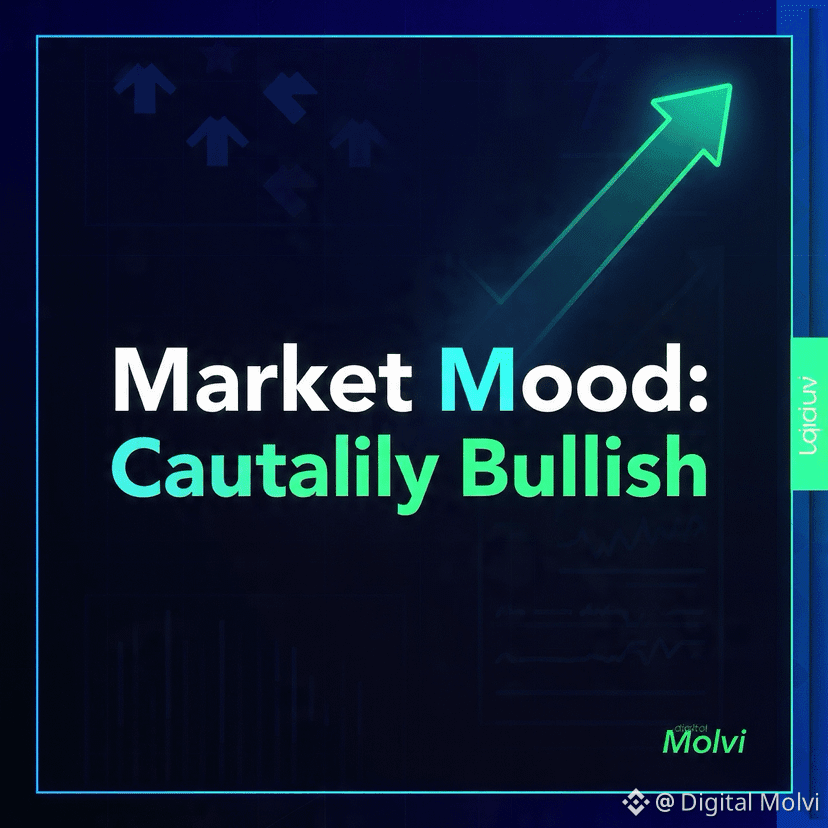
Market mood: Cautiously bullish, but still headline-driven.
Bulls are showing up on dips, and momentum is improving when volume expands.
Bears still have a window if BTC chops or macro/news turns risk-off.
Altcoins feel selective: money rotates into strong narratives (AI, memes) while weak coins lag.
Best approach: trade levels, not emotions—keep stops tight and take partial profits on spikes.
Want a BTC + alts mood version in 2 lines?
Or a meme/AI sector mood only?
$BTC
{future}(BTCUSDT)
$ETH
{future}(ETHUSDT)
$BNB
{future}(BNBUSDT)
#digitalmolvi #marketmood #Binance
Market mood: Cautiously bullish, but still headline-driven.
Bulls are showing up on dips, and momentum is improving when volume expands.
Bears still have a window if BTC chops or macro/news turns risk-off.
Altcoins feel selective: money rotates into strong narratives (AI, memes) while weak coins lag.
Best approach: trade levels, not emotions—keep stops tight and take partial profits on spikes.
Want a BTC + alts mood version in 2 lines?
Or a meme/AI sector mood only?
$BTC
$ETH
$BNB
#digitalmolvi #marketmood #Binance
Bulls are showing up on dips, and momentum is improving when volume expands.
Bears still have a window if BTC chops or macro/news turns risk-off.
Altcoins feel selective: money rotates into strong narratives (AI, memes) while weak coins lag.
Best approach: trade levels, not emotions—keep stops tight and take partial profits on spikes.
Want a BTC + alts mood version in 2 lines?
Or a meme/AI sector mood only?
$BTC
$ETH
$BNB
#digitalmolvi #marketmood #Binance
30
ບົດຄວາມ
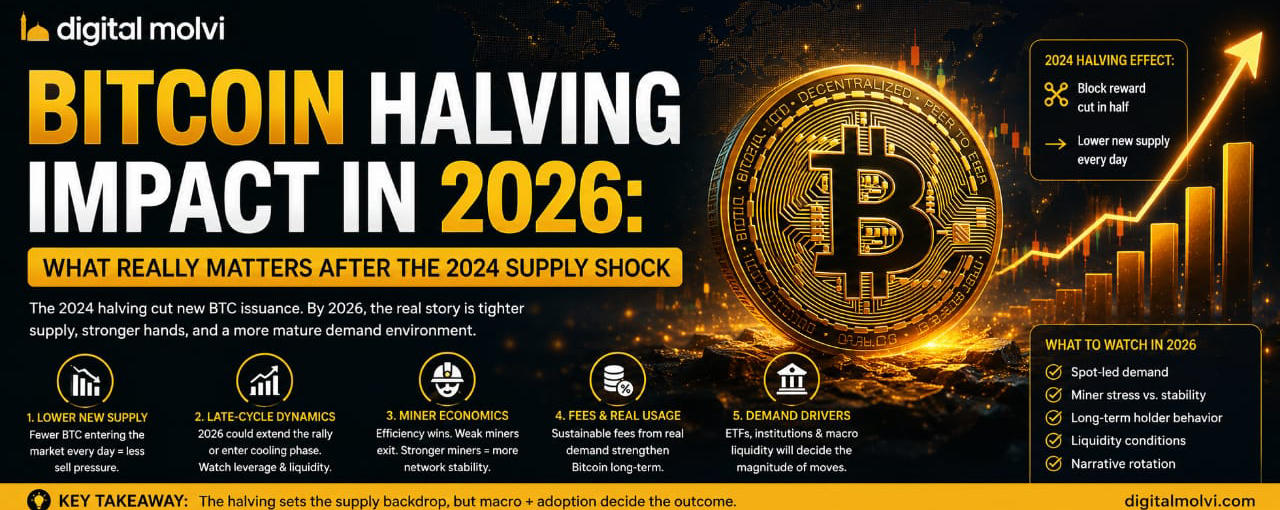
Bitcoin Halving Impact in 2026Bitcoin’s most important “built-in event” is the halving—when the block subsidy paid to miners is cut in half. The last halving happened in April 2024, reducing new BTC issuance. By 2026, the market is no longer reacting to the headline itself; it’s living with the after-effects: tighter supply flow, shifting miner economics, and a more mature demand environment (ETFs, institutions, macro liquidity).
Here’s how the halving’s impact can show up in 2026—and what investors should actually watch.
1) The Halving’s Core Effect in 2026: Lower “New Supply” Every Day
The halving doesn’t reduce Bitcoin’s total supply overnight—it reduces the rate at which new BTC enters the market.
By 2026, that reduced issuance has been in place for roughly two years, which matters because:
Sell pressure from miners tends to be structurally lower than it would have been without the halving.
Any sustained demand (spot buying, ETF inflows, corporate accumulation, retail cycles) has less fresh supply to absorb.
The market becomes more sensitive to demand spikes because the “baseline” new supply is smaller.
In simple terms: in 2026, Bitcoin is still benefiting from the 2024 halving because the supply tap remains tighter every single day.
2) Price Cycles: 2026 Is Often About “Late-Cycle” Behavior
Historically, Bitcoin’s strongest moves often occur in the 12–18 months after a halving, but 2026 can be a period where:
Momentum either extends (if liquidity and demand stay strong), or
The market transitions into cooling/mean reversion (if leverage gets excessive and macro conditions tighten).
So in 2026, the halving impact is less about “halving hype” and more about whether the market is:
still in a post-halving expansion, or
entering a post-euphoria digestion phase.
What to watch in 2026:
Funding rates and leverage (overheating risk)
Long-term holder behavior (are they distributing?)
Spot vs. derivatives dominance (healthier rallies are spot-led)
3) Miner Economics in 2026: Efficiency Wins, Weak Hands Exit
After the 2024 halving, miners earn fewer BTC per block, so they must survive on:
higher BTC price,
lower operating costs,
better hardware efficiency,
and transaction fees.
By 2026, the mining industry typically looks “cleaner”:
inefficient miners may have already capitulated,
stronger miners consolidate market share,
and the network tends to stabilize around more efficient operators.
Why this matters for price:
Miner capitulation phases can create temporary sell pressure.
Once weaker miners are flushed out, forced selling can reduce—supporting a more stable uptrend.
4) Transaction Fees & Real Usage: A Bigger Deal Than People Think
In the long run, Bitcoin security relies more on fees as block rewards shrink. By 2026, the market pays closer attention to:
Are fees rising due to real demand (settlement, L2 activity, inscriptions/other usage)?
Or are fees spiking only during speculative bursts?
A healthy 2026 environment is one where:
fees are meaningful but not purely chaotic,
and Bitcoin’s role as a settlement layer continues to strengthen.
5) The “Demand Side” in 2026: ETFs, Institutions, and Macro Liquidity
The halving is only half the story. In 2026, the bigger driver can be who is buying and why:
If institutional access keeps improving, demand can become more consistent.
If global liquidity expands (rate cuts, easing conditions), risk assets—including BTC—often benefit.
If regulation tightens or liquidity contracts, the halving’s supply reduction may not be enough to prevent drawdowns.
In other words: the halving sets the supply backdrop, but macro + adoption decide the magnitude.
Practical Takeaways for 2026
If you’re thinking about “halving impact” in 2026, focus on these signals:
Spot-led demand (stronger than leverage-led pumps)
Miner stress vs. miner stability (capitulation risk fades over time)
Long-term holder behavior (accumulation vs. distribution)
Liquidity conditions (macro is the amplifier)
Narrative rotation (BTC dominance vs. alt-season phases)
Conclusion
By 2026, the Bitcoin halving isn’t a one-day catalyst—it’s a structural supply change that continues shaping the market. The real question is whether demand, liquidity, and adoption are strong enough to turn that reduced issuance into sustained upside—or whether late-cycle dynamics and macro headwinds dominate.
#digitalmolvi #BinanceSquare #BitcoinHalving #article #BTC
{spot}(BTCUSDT)
$ETH
{spot}(ETHUSDT)
$BNB
{spot}(BNBUSDT)
Bitcoin Halving Impact in 2026
Bitcoin’s most important “built-in event” is the halving—when the block subsidy paid to miners is cut in half. The last halving happened in April 2024, reducing new BTC issuance. By 2026, the market is no longer reacting to the headline itself; it’s living with the after-effects: tighter supply flow, shifting miner economics, and a more mature demand environment (ETFs, institutions, macro liquidity).
Here’s how the halving’s impact can show up in 2026—and what investors should actually watch.
1) The Halving’s Core Effect in 2026: Lower “New Supply” Every Day
The halving doesn’t reduce Bitcoin’s total supply overnight—it reduces the rate at which new BTC enters the market.
By 2026, that reduced issuance has been in place for roughly two years, which matters because:
Sell pressure from miners tends to be structurally lower than it would have been without the halving.
Any sustained demand (spot buying, ETF inflows, corporate accumulation, retail cycles) has less fresh supply to absorb.
The market becomes more sensitive to demand spikes because the “baseline” new supply is smaller.
In simple terms: in 2026, Bitcoin is still benefiting from the 2024 halving because the supply tap remains tighter every single day.
2) Price Cycles: 2026 Is Often About “Late-Cycle” Behavior
Historically, Bitcoin’s strongest moves often occur in the 12–18 months after a halving, but 2026 can be a period where:
Momentum either extends (if liquidity and demand stay strong), or
The market transitions into cooling/mean reversion (if leverage gets excessive and macro conditions tighten).
So in 2026, the halving impact is less about “halving hype” and more about whether the market is:
still in a post-halving expansion, or
entering a post-euphoria digestion phase.
What to watch in 2026:
Funding rates and leverage (overheating risk)
Long-term holder behavior (are they distributing?)
Spot vs. derivatives dominance (healthier rallies are spot-led)
3) Miner Economics in 2026: Efficiency Wins, Weak Hands Exit
After the 2024 halving, miners earn fewer BTC per block, so they must survive on:
higher BTC price,
lower operating costs,
better hardware efficiency,
and transaction fees.
By 2026, the mining industry typically looks “cleaner”:
inefficient miners may have already capitulated,
stronger miners consolidate market share,
and the network tends to stabilize around more efficient operators.
Why this matters for price:
Miner capitulation phases can create temporary sell pressure.
Once weaker miners are flushed out, forced selling can reduce—supporting a more stable uptrend.
4) Transaction Fees & Real Usage: A Bigger Deal Than People Think
In the long run, Bitcoin security relies more on fees as block rewards shrink. By 2026, the market pays closer attention to:
Are fees rising due to real demand (settlement, L2 activity, inscriptions/other usage)?
Or are fees spiking only during speculative bursts?
A healthy 2026 environment is one where:
fees are meaningful but not purely chaotic,
and Bitcoin’s role as a settlement layer continues to strengthen.
5) The “Demand Side” in 2026: ETFs, Institutions, and Macro Liquidity
The halving is only half the story. In 2026, the bigger driver can be who is buying and why:
If institutional access keeps improving, demand can become more consistent.
If global liquidity expands (rate cuts, easing conditions), risk assets—including BTC—often benefit.
If regulation tightens or liquidity contracts, the halving’s supply reduction may not be enough to prevent drawdowns.
In other words: the halving sets the supply backdrop, but macro + adoption decide the magnitude.
Practical Takeaways for 2026
If you’re thinking about “halving impact” in 2026, focus on these signals:
Spot-led demand (stronger than leverage-led pumps)
Miner stress vs. miner stability (capitulation risk fades over time)
Long-term holder behavior (accumulation vs. distribution)
Liquidity conditions (macro is the amplifier)
Narrative rotation (BTC dominance vs. alt-season phases)
Conclusion
By 2026, the Bitcoin halving isn’t a one-day catalyst—it’s a structural supply change that continues shaping the market. The real question is whether demand, liquidity, and adoption are strong enough to turn that reduced issuance into sustained upside—or whether late-cycle dynamics and macro headwinds dominate.
#digitalmolvi #BinanceSquare #BitcoinHalving #article #BTC
$ETH
$BNB
Here’s how the halving’s impact can show up in 2026—and what investors should actually watch.
1) The Halving’s Core Effect in 2026: Lower “New Supply” Every Day
The halving doesn’t reduce Bitcoin’s total supply overnight—it reduces the rate at which new BTC enters the market.
By 2026, that reduced issuance has been in place for roughly two years, which matters because:
Sell pressure from miners tends to be structurally lower than it would have been without the halving.
Any sustained demand (spot buying, ETF inflows, corporate accumulation, retail cycles) has less fresh supply to absorb.
The market becomes more sensitive to demand spikes because the “baseline” new supply is smaller.
In simple terms: in 2026, Bitcoin is still benefiting from the 2024 halving because the supply tap remains tighter every single day.
2) Price Cycles: 2026 Is Often About “Late-Cycle” Behavior
Historically, Bitcoin’s strongest moves often occur in the 12–18 months after a halving, but 2026 can be a period where:
Momentum either extends (if liquidity and demand stay strong), or
The market transitions into cooling/mean reversion (if leverage gets excessive and macro conditions tighten).
So in 2026, the halving impact is less about “halving hype” and more about whether the market is:
still in a post-halving expansion, or
entering a post-euphoria digestion phase.
What to watch in 2026:
Funding rates and leverage (overheating risk)
Long-term holder behavior (are they distributing?)
Spot vs. derivatives dominance (healthier rallies are spot-led)
3) Miner Economics in 2026: Efficiency Wins, Weak Hands Exit
After the 2024 halving, miners earn fewer BTC per block, so they must survive on:
higher BTC price,
lower operating costs,
better hardware efficiency,
and transaction fees.
By 2026, the mining industry typically looks “cleaner”:
inefficient miners may have already capitulated,
stronger miners consolidate market share,
and the network tends to stabilize around more efficient operators.
Why this matters for price:
Miner capitulation phases can create temporary sell pressure.
Once weaker miners are flushed out, forced selling can reduce—supporting a more stable uptrend.
4) Transaction Fees & Real Usage: A Bigger Deal Than People Think
In the long run, Bitcoin security relies more on fees as block rewards shrink. By 2026, the market pays closer attention to:
Are fees rising due to real demand (settlement, L2 activity, inscriptions/other usage)?
Or are fees spiking only during speculative bursts?
A healthy 2026 environment is one where:
fees are meaningful but not purely chaotic,
and Bitcoin’s role as a settlement layer continues to strengthen.
5) The “Demand Side” in 2026: ETFs, Institutions, and Macro Liquidity
The halving is only half the story. In 2026, the bigger driver can be who is buying and why:
If institutional access keeps improving, demand can become more consistent.
If global liquidity expands (rate cuts, easing conditions), risk assets—including BTC—often benefit.
If regulation tightens or liquidity contracts, the halving’s supply reduction may not be enough to prevent drawdowns.
In other words: the halving sets the supply backdrop, but macro + adoption decide the magnitude.
Practical Takeaways for 2026
If you’re thinking about “halving impact” in 2026, focus on these signals:
Spot-led demand (stronger than leverage-led pumps)
Miner stress vs. miner stability (capitulation risk fades over time)
Long-term holder behavior (accumulation vs. distribution)
Liquidity conditions (macro is the amplifier)
Narrative rotation (BTC dominance vs. alt-season phases)
Conclusion
By 2026, the Bitcoin halving isn’t a one-day catalyst—it’s a structural supply change that continues shaping the market. The real question is whether demand, liquidity, and adoption are strong enough to turn that reduced issuance into sustained upside—or whether late-cycle dynamics and macro headwinds dominate.
#digitalmolvi #BinanceSquare #BitcoinHalving #article #BTC
$ETH
$BNB
147
ບົດຄວາມ
Top 5 Memecoins to Watch 2026Memecoins aren’t just jokes anymore—they’re a full market sector driven by community, attention, and liquidity. In every bull phase, memecoins can outperform because they move on momentum + narrative, not traditional fundamentals. But the same thing that makes them explode also makes them dangerous: when attention leaves, price can drop fast.
So instead of chasing random launches, many traders focus on memecoins with three key traits:
Strong, recognizable brand (easy for the crowd to rally behind)
High liquidity (easier entries/exits, less slippage)
Consistent social volume (attention = fuel)
Here are 5 memecoins to watch, and what matters most for each.
1) DOGE (Dogecoin) — The “macro meme” benchmark
DOGE is often treated like the “BTC of memes.” When meme season starts, DOGE usually becomes the first big signal that retail attention is returning. It’s widely recognized, highly liquid, and reacts strongly to market sentiment shifts.
What to watch: broader market risk-on/risk-off, sudden social spikes, and large-volume breakouts above key levels.
2) SHIB (Shiba Inu) — The community heavyweight
SHIB has one of the biggest meme communities in crypto, and that matters more than people admit. Communities can keep a project alive through downtrends, and when momentum returns, they can create powerful waves of buying pressure.
What to watch: ecosystem updates, burn narrative hype, and volume expansions after long consolidations.
3) PEPE — The high-beta momentum meme
PEPE trades like a pure attention asset. When memes rotate into “degen mode,” PEPE often becomes a leader because it’s fast, emotional, and heavily momentum-driven. It can trend hard in both directions.
What to watch: breakout volume, trend strength (higher highs/higher lows), and signs of topping (sharp pumps + weakening follow-through).
4) BONK — The chain mascot effect
BONK has benefited from being tied to a broader chain narrative (the “mascot meme” effect). When a chain ecosystem is strong, its leading memecoin can catch extra inflows—especially from users already active on that chain.
What to watch: ecosystem sentiment, rotation into chain narratives, and whether BONK leads or lags other major memes.
5) FLOKI — The brand + narrative memecoin
FLOKI is a memecoin that leans heavily into branding and narrative marketing. In strong meme cycles, coins with recognizable branding and relentless community push can hold attention longer than expected.
What to watch: community activity, exchange/liquidity developments, and whether it follows DOGE/SHIB rotations or creates independent momentum.
A quick “watchlist” checklist (simple but effective)
Before you buy any memecoin, ask:
Is volume rising or fading?
Is it trending (clean structure) or just spiking and dumping?
Are you buying support or chasing green candles?
Do you already know your stop/invalidation and profit-taking plan?
Memecoins can be incredible opportunities—but only when you trade them with rules.
#digitalmolvi #DOGE #SHİB #pepe #BinanceSquare
$DOGE
{future}(DOGEUSDT)
$SHIB
{spot}(SHIBUSDT)
$PEPE
{spot}(PEPEUSDT)
Top 5 Memecoins to Watch 2026
Memecoins aren’t just jokes anymore—they’re a full market sector driven by community, attention, and liquidity. In every bull phase, memecoins can outperform because they move on momentum + narrative, not traditional fundamentals. But the same thing that makes them explode also makes them dangerous: when attention leaves, price can drop fast.
So instead of chasing random launches, many traders focus on memecoins with three key traits:
Strong, recognizable brand (easy for the crowd to rally behind)
High liquidity (easier entries/exits, less slippage)
Consistent social volume (attention = fuel)
Here are 5 memecoins to watch, and what matters most for each.
1) DOGE (Dogecoin) — The “macro meme” benchmark
DOGE is often treated like the “BTC of memes.” When meme season starts, DOGE usually becomes the first big signal that retail attention is returning. It’s widely recognized, highly liquid, and reacts strongly to market sentiment shifts.
What to watch: broader market risk-on/risk-off, sudden social spikes, and large-volume breakouts above key levels.
2) SHIB (Shiba Inu) — The community heavyweight
SHIB has one of the biggest meme communities in crypto, and that matters more than people admit. Communities can keep a project alive through downtrends, and when momentum returns, they can create powerful waves of buying pressure.
What to watch: ecosystem updates, burn narrative hype, and volume expansions after long consolidations.
3) PEPE — The high-beta momentum meme
PEPE trades like a pure attention asset. When memes rotate into “degen mode,” PEPE often becomes a leader because it’s fast, emotional, and heavily momentum-driven. It can trend hard in both directions.
What to watch: breakout volume, trend strength (higher highs/higher lows), and signs of topping (sharp pumps + weakening follow-through).
4) BONK — The chain mascot effect
BONK has benefited from being tied to a broader chain narrative (the “mascot meme” effect). When a chain ecosystem is strong, its leading memecoin can catch extra inflows—especially from users already active on that chain.
What to watch: ecosystem sentiment, rotation into chain narratives, and whether BONK leads or lags other major memes.
5) FLOKI — The brand + narrative memecoin
FLOKI is a memecoin that leans heavily into branding and narrative marketing. In strong meme cycles, coins with recognizable branding and relentless community push can hold attention longer than expected.
What to watch: community activity, exchange/liquidity developments, and whether it follows DOGE/SHIB rotations or creates independent momentum.
A quick “watchlist” checklist (simple but effective)
Before you buy any memecoin, ask:
Is volume rising or fading?
Is it trending (clean structure) or just spiking and dumping?
Are you buying support or chasing green candles?
Do you already know your stop/invalidation and profit-taking plan?
Memecoins can be incredible opportunities—but only when you trade them with rules.
#digitalmolvi #DOGE #SHİB #pepe #BinanceSquare
$DOGE
$SHIB
$PEPE
So instead of chasing random launches, many traders focus on memecoins with three key traits:
Strong, recognizable brand (easy for the crowd to rally behind)
High liquidity (easier entries/exits, less slippage)
Consistent social volume (attention = fuel)
Here are 5 memecoins to watch, and what matters most for each.
1) DOGE (Dogecoin) — The “macro meme” benchmark
DOGE is often treated like the “BTC of memes.” When meme season starts, DOGE usually becomes the first big signal that retail attention is returning. It’s widely recognized, highly liquid, and reacts strongly to market sentiment shifts.
What to watch: broader market risk-on/risk-off, sudden social spikes, and large-volume breakouts above key levels.
2) SHIB (Shiba Inu) — The community heavyweight
SHIB has one of the biggest meme communities in crypto, and that matters more than people admit. Communities can keep a project alive through downtrends, and when momentum returns, they can create powerful waves of buying pressure.
What to watch: ecosystem updates, burn narrative hype, and volume expansions after long consolidations.
3) PEPE — The high-beta momentum meme
PEPE trades like a pure attention asset. When memes rotate into “degen mode,” PEPE often becomes a leader because it’s fast, emotional, and heavily momentum-driven. It can trend hard in both directions.
What to watch: breakout volume, trend strength (higher highs/higher lows), and signs of topping (sharp pumps + weakening follow-through).
4) BONK — The chain mascot effect
BONK has benefited from being tied to a broader chain narrative (the “mascot meme” effect). When a chain ecosystem is strong, its leading memecoin can catch extra inflows—especially from users already active on that chain.
What to watch: ecosystem sentiment, rotation into chain narratives, and whether BONK leads or lags other major memes.
5) FLOKI — The brand + narrative memecoin
FLOKI is a memecoin that leans heavily into branding and narrative marketing. In strong meme cycles, coins with recognizable branding and relentless community push can hold attention longer than expected.
What to watch: community activity, exchange/liquidity developments, and whether it follows DOGE/SHIB rotations or creates independent momentum.
A quick “watchlist” checklist (simple but effective)
Before you buy any memecoin, ask:
Is volume rising or fading?
Is it trending (clean structure) or just spiking and dumping?
Are you buying support or chasing green candles?
Do you already know your stop/invalidation and profit-taking plan?
Memecoins can be incredible opportunities—but only when you trade them with rules.
#digitalmolvi #DOGE #SHİB #pepe #BinanceSquare
$DOGE
$SHIB
$PEPE
213
ບົດຄວາມ
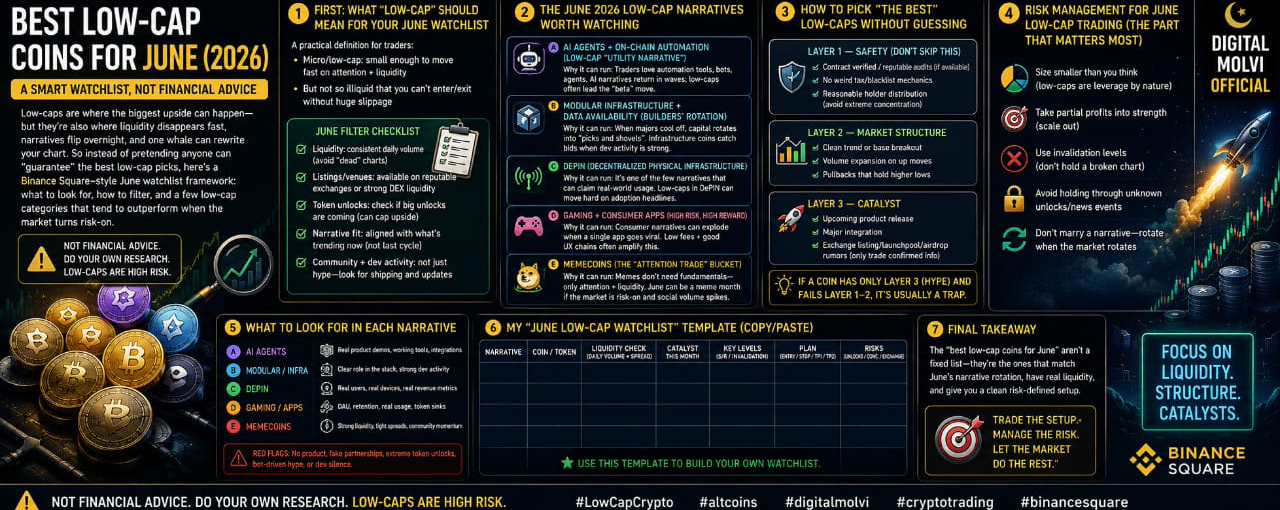
Best Low-Cap Coins for June (2026)Low-caps are where the biggest upside can happen—but they’re also where liquidity disappears fast, narratives flip overnight, and one whale can rewrite your chart. So instead of pretending anyone can “guarantee” the best low-cap picks, here’s a Binance Square–style June watchlist framework: what to look for, how to filter, and a few low-cap categories that tend to outperform when the market turns risk-on.
Not financial advice. Do your own research. Low-caps are high risk.
1) First: What “low-cap” should mean for your June watchlist
A practical definition for traders:
Micro/low-cap: small enough to move fast on attention + liquidity
But not so illiquid that you can’t enter/exit without huge slippage
June filter checklist (simple but powerful):
Liquidity: consistent daily volume (avoid “dead” charts)
Listings/venues: available on reputable exchanges or strong DEX liquidity
Token unlocks: check if big unlocks are coming (can cap upside)
Narrative fit: aligned with what’s trending now (not last cycle)
Community + dev activity: not just hype—look for shipping and updates
2) The June 2026 low-cap narratives worth watching
Instead of naming random coins, focus on narratives that attract rotation. In most cycles, low-caps pump hardest when they sit at the intersection of: attention + liquidity + a clear story.
A) AI Agents + On-chain Automation (low-cap “utility narrative”)
Why it can run in June:
Traders love anything that promises automation: bots, agents, execution tools
AI narratives return in waves; low-caps often lead the “beta” move
What to look for:
Real product demos (agent frameworks, automation, integrations)
Transparent token utility (fees, staking for services, access)
Partnerships that are verifiable (not vague “collabs”)
Red flags:
“Guaranteed profit AI bot” marketing
No product, only token
B) Modular Infrastructure + Data Availability (builders’ rotation)
Why it can run:
When majors cool off, capital rotates into “picks and shovels”
Infrastructure coins can catch bids when dev activity is strong
What to look for:
Clear role in the stack (DA, indexing, interoperability, tooling)
Active GitHub/dev updates and ecosystem integrations
Sustainable token emissions (or at least transparent)
C) DePIN (Decentralized Physical Infrastructure)
Why it can run:
It’s one of the few narratives that can claim real-world usage
Low-caps in DePIN can move hard on adoption headlines
What to look for:
Real users, real devices/nodes, real revenue metrics (if available)
Token incentives that don’t rely purely on inflation
Geographic/community expansion that’s measurable
D) Gaming + Consumer Apps (high risk, high reward)
Why it can run:
Consumer narratives can explode when a single app goes viral
Low fees + good UX chains often amplify this
What to look for:
Daily active users (DAU), retention, and actual gameplay/app usage
Token sinks (spending) not just token rewards (farming)
E) Memecoins (the “attention trade” bucket)
Why it can run:
Memes don’t need fundamentals—only attention + liquidity
June can be a meme month if the market is risk-on and social volume spikes
What to look for:
Strong liquidity pools, tight spreads, consistent volume
Community momentum (but avoid obvious bot-driven hype)
Clear risk plan (memes can drop 30–70% fast)
3) How to pick “the best” low-caps without guessing
Use a 3-layer scoring model:
Layer 1 — Safety (don’t skip this)
Contract verified / reputable audits (if available)
No weird tax/blacklist mechanics
Reasonable holder distribution (avoid extreme concentration)
Layer 2 — Market structure
Clean trend or base breakout
Volume expansion on up moves
Pullbacks that hold higher lows
Layer 3 — Catalyst
Upcoming product release
Major integration
Exchange listing/launchpool/airdrop rumors (only trade confirmed info)
If a coin has only Layer 3 (hype) and fails Layer 1–2, it’s usually a trap.
4) Risk management for June low-cap trading (the part that matters most)
Low-caps don’t reward “diamond hands.” They reward structure.
Simple rules that keep you alive:
Size smaller than you think (low-caps are leverage by nature)
Take partial profits into strength (scale out)
Use invalidation levels (don’t hold a broken chart)
Avoid holding through unknown unlocks/news events
Don’t marry a narrative—rotate when the market rotates
5) My “June Low-Cap Watchlist” template (copy/paste)
Use this to build your own list:
Narrative: (AI / DePIN / Modular / Gaming / Meme)
Liquidity check: (daily volume + spread)
Catalyst this month: (release, integration, listing, event)
Key levels: support / resistance / invalidation
Plan: entry, stop, TP1, TP2
Risk: unlocks, concentration, regulatory/exchange risk
Final takeaway
The “best low-cap coins for June” aren’t a fixed list—they’re the ones that match June’s narrative rotation, have real liquidity, and give you a clean risk-defined setup.
If you want, tell me:
Your risk level (low / medium / high)
Whether you prefer AI, DePIN, memes, or infrastructure
And whether you want spot-only or futures-friendly
…and I’ll tailor a tighter June watchlist format around that.
#LowCapCrypto #altcoins #digitalmolvi #cryptotrading #binancesquare
$BTC
{future}(BTCUSDT)
$ETH
{future}(ETHUSDT)
$BNB
{future}(BNBUSDT)
Best Low-Cap Coins for June (2026)
Low-caps are where the biggest upside can happen—but they’re also where liquidity disappears fast, narratives flip overnight, and one whale can rewrite your chart. So instead of pretending anyone can “guarantee” the best low-cap picks, here’s a Binance Square–style June watchlist framework: what to look for, how to filter, and a few low-cap categories that tend to outperform when the market turns risk-on.
Not financial advice. Do your own research. Low-caps are high risk.
1) First: What “low-cap” should mean for your June watchlist
A practical definition for traders:
Micro/low-cap: small enough to move fast on attention + liquidity
But not so illiquid that you can’t enter/exit without huge slippage
June filter checklist (simple but powerful):
Liquidity: consistent daily volume (avoid “dead” charts)
Listings/venues: available on reputable exchanges or strong DEX liquidity
Token unlocks: check if big unlocks are coming (can cap upside)
Narrative fit: aligned with what’s trending now (not last cycle)
Community + dev activity: not just hype—look for shipping and updates
2) The June 2026 low-cap narratives worth watching
Instead of naming random coins, focus on narratives that attract rotation. In most cycles, low-caps pump hardest when they sit at the intersection of: attention + liquidity + a clear story.
A) AI Agents + On-chain Automation (low-cap “utility narrative”)
Why it can run in June:
Traders love anything that promises automation: bots, agents, execution tools
AI narratives return in waves; low-caps often lead the “beta” move
What to look for:
Real product demos (agent frameworks, automation, integrations)
Transparent token utility (fees, staking for services, access)
Partnerships that are verifiable (not vague “collabs”)
Red flags:
“Guaranteed profit AI bot” marketing
No product, only token
B) Modular Infrastructure + Data Availability (builders’ rotation)
Why it can run:
When majors cool off, capital rotates into “picks and shovels”
Infrastructure coins can catch bids when dev activity is strong
What to look for:
Clear role in the stack (DA, indexing, interoperability, tooling)
Active GitHub/dev updates and ecosystem integrations
Sustainable token emissions (or at least transparent)
C) DePIN (Decentralized Physical Infrastructure)
Why it can run:
It’s one of the few narratives that can claim real-world usage
Low-caps in DePIN can move hard on adoption headlines
What to look for:
Real users, real devices/nodes, real revenue metrics (if available)
Token incentives that don’t rely purely on inflation
Geographic/community expansion that’s measurable
D) Gaming + Consumer Apps (high risk, high reward)
Why it can run:
Consumer narratives can explode when a single app goes viral
Low fees + good UX chains often amplify this
What to look for:
Daily active users (DAU), retention, and actual gameplay/app usage
Token sinks (spending) not just token rewards (farming)
E) Memecoins (the “attention trade” bucket)
Why it can run:
Memes don’t need fundamentals—only attention + liquidity
June can be a meme month if the market is risk-on and social volume spikes
What to look for:
Strong liquidity pools, tight spreads, consistent volume
Community momentum (but avoid obvious bot-driven hype)
Clear risk plan (memes can drop 30–70% fast)
3) How to pick “the best” low-caps without guessing
Use a 3-layer scoring model:
Layer 1 — Safety (don’t skip this)
Contract verified / reputable audits (if available)
No weird tax/blacklist mechanics
Reasonable holder distribution (avoid extreme concentration)
Layer 2 — Market structure
Clean trend or base breakout
Volume expansion on up moves
Pullbacks that hold higher lows
Layer 3 — Catalyst
Upcoming product release
Major integration
Exchange listing/launchpool/airdrop rumors (only trade confirmed info)
If a coin has only Layer 3 (hype) and fails Layer 1–2, it’s usually a trap.
4) Risk management for June low-cap trading (the part that matters most)
Low-caps don’t reward “diamond hands.” They reward structure.
Simple rules that keep you alive:
Size smaller than you think (low-caps are leverage by nature)
Take partial profits into strength (scale out)
Use invalidation levels (don’t hold a broken chart)
Avoid holding through unknown unlocks/news events
Don’t marry a narrative—rotate when the market rotates
5) My “June Low-Cap Watchlist” template (copy/paste)
Use this to build your own list:
Narrative: (AI / DePIN / Modular / Gaming / Meme)
Liquidity check: (daily volume + spread)
Catalyst this month: (release, integration, listing, event)
Key levels: support / resistance / invalidation
Plan: entry, stop, TP1, TP2
Risk: unlocks, concentration, regulatory/exchange risk
Final takeaway
The “best low-cap coins for June” aren’t a fixed list—they’re the ones that match June’s narrative rotation, have real liquidity, and give you a clean risk-defined setup.
If you want, tell me:
Your risk level (low / medium / high)
Whether you prefer AI, DePIN, memes, or infrastructure
And whether you want spot-only or futures-friendly
…and I’ll tailor a tighter June watchlist format around that.
#LowCapCrypto #altcoins #digitalmolvi #cryptotrading #binancesquare
$BTC
$ETH
$BNB
Not financial advice. Do your own research. Low-caps are high risk.
1) First: What “low-cap” should mean for your June watchlist
A practical definition for traders:
Micro/low-cap: small enough to move fast on attention + liquidity
But not so illiquid that you can’t enter/exit without huge slippage
June filter checklist (simple but powerful):
Liquidity: consistent daily volume (avoid “dead” charts)
Listings/venues: available on reputable exchanges or strong DEX liquidity
Token unlocks: check if big unlocks are coming (can cap upside)
Narrative fit: aligned with what’s trending now (not last cycle)
Community + dev activity: not just hype—look for shipping and updates
2) The June 2026 low-cap narratives worth watching
Instead of naming random coins, focus on narratives that attract rotation. In most cycles, low-caps pump hardest when they sit at the intersection of: attention + liquidity + a clear story.
A) AI Agents + On-chain Automation (low-cap “utility narrative”)
Why it can run in June:
Traders love anything that promises automation: bots, agents, execution tools
AI narratives return in waves; low-caps often lead the “beta” move
What to look for:
Real product demos (agent frameworks, automation, integrations)
Transparent token utility (fees, staking for services, access)
Partnerships that are verifiable (not vague “collabs”)
Red flags:
“Guaranteed profit AI bot” marketing
No product, only token
B) Modular Infrastructure + Data Availability (builders’ rotation)
Why it can run:
When majors cool off, capital rotates into “picks and shovels”
Infrastructure coins can catch bids when dev activity is strong
What to look for:
Clear role in the stack (DA, indexing, interoperability, tooling)
Active GitHub/dev updates and ecosystem integrations
Sustainable token emissions (or at least transparent)
C) DePIN (Decentralized Physical Infrastructure)
Why it can run:
It’s one of the few narratives that can claim real-world usage
Low-caps in DePIN can move hard on adoption headlines
What to look for:
Real users, real devices/nodes, real revenue metrics (if available)
Token incentives that don’t rely purely on inflation
Geographic/community expansion that’s measurable
D) Gaming + Consumer Apps (high risk, high reward)
Why it can run:
Consumer narratives can explode when a single app goes viral
Low fees + good UX chains often amplify this
What to look for:
Daily active users (DAU), retention, and actual gameplay/app usage
Token sinks (spending) not just token rewards (farming)
E) Memecoins (the “attention trade” bucket)
Why it can run:
Memes don’t need fundamentals—only attention + liquidity
June can be a meme month if the market is risk-on and social volume spikes
What to look for:
Strong liquidity pools, tight spreads, consistent volume
Community momentum (but avoid obvious bot-driven hype)
Clear risk plan (memes can drop 30–70% fast)
3) How to pick “the best” low-caps without guessing
Use a 3-layer scoring model:
Layer 1 — Safety (don’t skip this)
Contract verified / reputable audits (if available)
No weird tax/blacklist mechanics
Reasonable holder distribution (avoid extreme concentration)
Layer 2 — Market structure
Clean trend or base breakout
Volume expansion on up moves
Pullbacks that hold higher lows
Layer 3 — Catalyst
Upcoming product release
Major integration
Exchange listing/launchpool/airdrop rumors (only trade confirmed info)
If a coin has only Layer 3 (hype) and fails Layer 1–2, it’s usually a trap.
4) Risk management for June low-cap trading (the part that matters most)
Low-caps don’t reward “diamond hands.” They reward structure.
Simple rules that keep you alive:
Size smaller than you think (low-caps are leverage by nature)
Take partial profits into strength (scale out)
Use invalidation levels (don’t hold a broken chart)
Avoid holding through unknown unlocks/news events
Don’t marry a narrative—rotate when the market rotates
5) My “June Low-Cap Watchlist” template (copy/paste)
Use this to build your own list:
Narrative: (AI / DePIN / Modular / Gaming / Meme)
Liquidity check: (daily volume + spread)
Catalyst this month: (release, integration, listing, event)
Key levels: support / resistance / invalidation
Plan: entry, stop, TP1, TP2
Risk: unlocks, concentration, regulatory/exchange risk
Final takeaway
The “best low-cap coins for June” aren’t a fixed list—they’re the ones that match June’s narrative rotation, have real liquidity, and give you a clean risk-defined setup.
If you want, tell me:
Your risk level (low / medium / high)
Whether you prefer AI, DePIN, memes, or infrastructure
And whether you want spot-only or futures-friendly
…and I’ll tailor a tighter June watchlist format around that.
#LowCapCrypto #altcoins #digitalmolvi #cryptotrading #binancesquare
$BTC
$ETH
$BNB
79
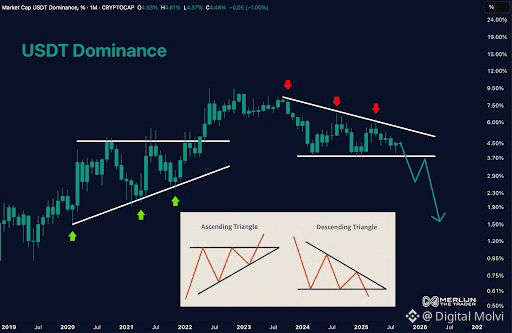
USDT Dominance: What It Can Signal
USDT dominance is basically “how much of the crypto market’s stablecoin liquidity is sitting in USDT.” Traders watch it because it can hint at risk appetite:
USDT dominance rising: often means money is parking in stables → more caution / risk-off
USDT dominance falling: often means stables are rotating into BTC/ETH/alts → more risk-on
Key detail: confirm with BTC trend + total market cap + volume (dominance alone can mislead)
Use it as a context indicator, not a buy/sell trigger.
#digitalmolvi #USDT #Tether #Stablecoins #BinanceSquare
$USDT $USDC
{future}(USDCUSDT)
USDT Dominance: What It Can Signal
USDT dominance is basically “how much of the crypto market’s stablecoin liquidity is sitting in USDT.” Traders watch it because it can hint at risk appetite:
USDT dominance rising: often means money is parking in stables → more caution / risk-off
USDT dominance falling: often means stables are rotating into BTC/ETH/alts → more risk-on
Key detail: confirm with BTC trend + total market cap + volume (dominance alone can mislead)
Use it as a context indicator, not a buy/sell trigger.
#digitalmolvi #USDT #Tether #Stablecoins #BinanceSquare
$USDT $USDC
USDT dominance is basically “how much of the crypto market’s stablecoin liquidity is sitting in USDT.” Traders watch it because it can hint at risk appetite:
USDT dominance rising: often means money is parking in stables → more caution / risk-off
USDT dominance falling: often means stables are rotating into BTC/ETH/alts → more risk-on
Key detail: confirm with BTC trend + total market cap + volume (dominance alone can mislead)
Use it as a context indicator, not a buy/sell trigger.
#digitalmolvi #USDT #Tether #Stablecoins #BinanceSquare
$USDT $USDC
132
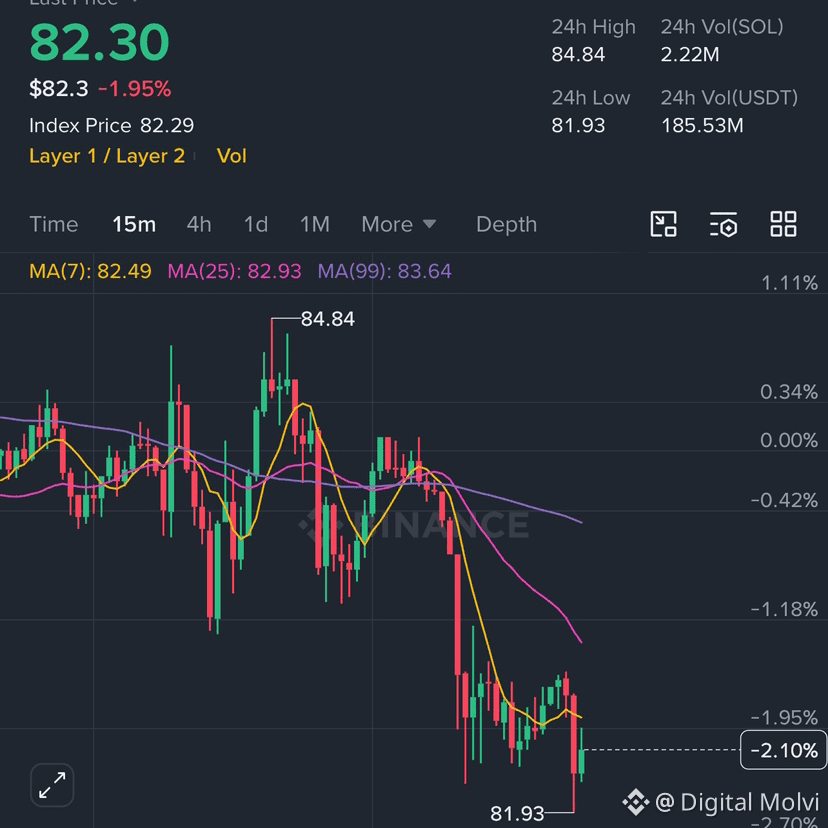
Solana’s speed is its main selling point: fast confirmations + low fees, which makes it feel closer to a Web2 app than a typical blockchain. That’s why Solana often becomes the “home” for high-activity use cases—trading, memecoins, NFTs, payments, and apps where users do lots of small transactions.
But here’s the real takeaway: speed only matters if reliability stays strong. The winning chain for mainstream users isn’t just the fastest on paper—it’s the one that’s consistently fast, cheap, and stable when traffic spikes.
If you’re trading on Solana, the edge is simple:
Faster execution
Lower friction (fees)
More room for rapid rotations in hot narratives
#digitalmolvi #sol #cryptotrading #Web3 #altcoins
$SOL
{future}(SOLUSDT)
Solana’s speed is its main selling point: fast confirmations + low fees, which makes it feel closer to a Web2 app than a typical blockchain. That’s why Solana often becomes the “home” for high-activity use cases—trading, memecoins, NFTs, payments, and apps where users do lots of small transactions.
But here’s the real takeaway: speed only matters if reliability stays strong. The winning chain for mainstream users isn’t just the fastest on paper—it’s the one that’s consistently fast, cheap, and stable when traffic spikes.
If you’re trading on Solana, the edge is simple:
Faster execution
Lower friction (fees)
More room for rapid rotations in hot narratives
#digitalmolvi #sol #cryptotrading #Web3 #altcoins
$SOL
But here’s the real takeaway: speed only matters if reliability stays strong. The winning chain for mainstream users isn’t just the fastest on paper—it’s the one that’s consistently fast, cheap, and stable when traffic spikes.
If you’re trading on Solana, the edge is simple:
Faster execution
Lower friction (fees)
More room for rapid rotations in hot narratives
#digitalmolvi #sol #cryptotrading #Web3 #altcoins
$SOL
93
ບົດຄວາມ
Strait of Hormuz Crisis & Crypto Market Impact$BTC
$ETH
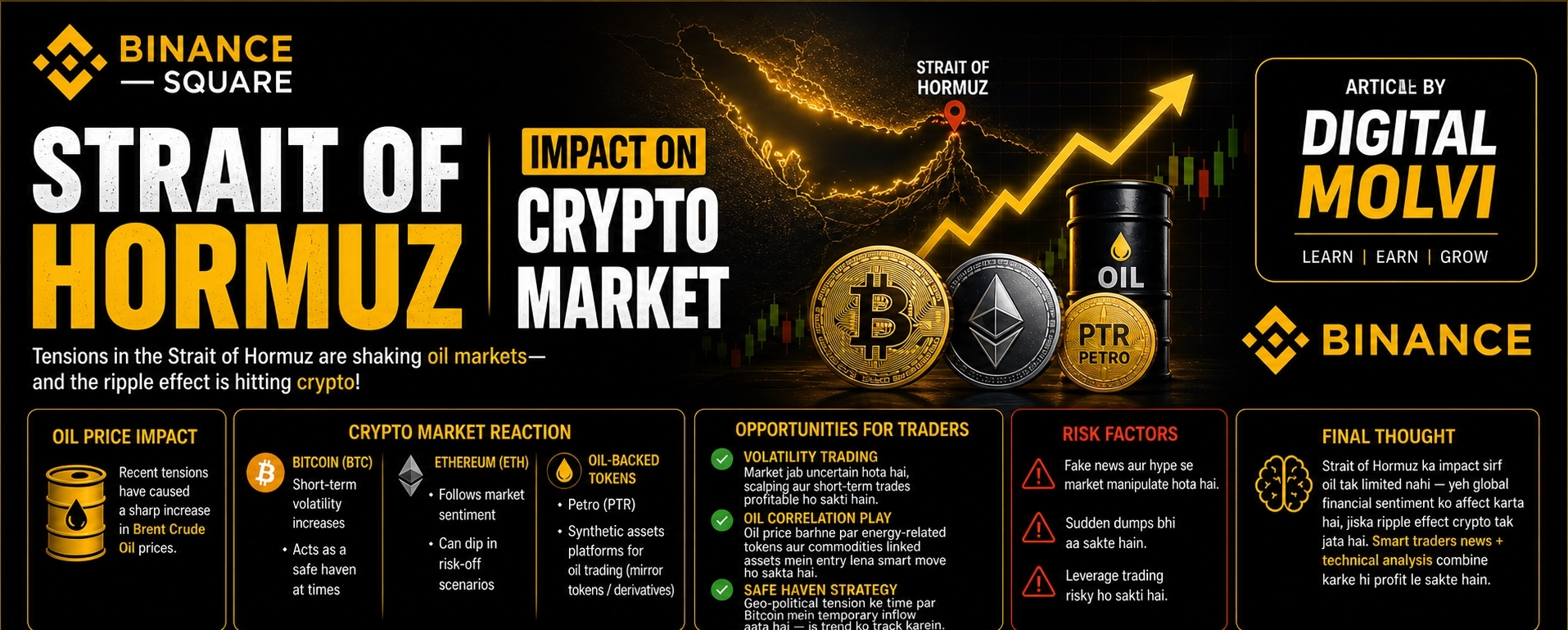
$Global trade has a very important chokepoint: the Strait of Hormuz, through which nearly 20% of the world’s oil supply passes. Whenever tensions rise here (Iran–US or broader Middle East conflicts), the impact is not limited to oil — it also affects the crypto market.
📊 Oil Price Impact
Due to recent tensions, crude oil (Brent Crude Oil) has seen a sharp increase in price. With supply risks rising, investors tend to shift toward safer assets.
💥 Crypto Market Reaction
Bitcoin
Short-term volatility increasesSometimes acts as a safe haven and pumps
Ethereum
Follows overall market sentimentCan dip in risk-off scenarios
Oil-backed Tokens
In the crypto space, there are a few options for oil exposure:
Petro (PTR)Synthetic assets platforms offering oil trading (e.g., mirror tokens / derivatives)
📈 Opportunity for Traders
If you use smart strategies, you can profit from such situations:
✔️ Volatility Trading
When markets are uncertain, scalping and short-term trades can be profitable.
✔️ Oil Correlation Play
When oil prices rise, entering energy-related tokens or commodity-linked assets can be a smart move.
✔️ Safe Haven Strategy
During geopolitical tensions, Bitcoin often sees temporary inflows — tracking this trend can be beneficial.
⚠️ Risk Factors
Market manipulation due to fake news and hypeSudden dumps can occurLeverage trading can be highly risky
🧠 Final Thought
The impact of the Strait of Hormuz is not limited to oil — it influences global financial sentiment, which creates a ripple effect in the crypto market. Smart traders combine news analysis with technical analysis to maximize profits.
#Binancesquare #CryptoPakistan #BTC #OilPrices #digitalmolvi
Strait of Hormuz Crisis & Crypto Market Impact
$BTC
$ETH
$Global trade has a very important chokepoint: the Strait of Hormuz, through which nearly 20% of the world’s oil supply passes. Whenever tensions rise here (Iran–US or broader Middle East conflicts), the impact is not limited to oil — it also affects the crypto market.
📊 Oil Price Impact
Due to recent tensions, crude oil (Brent Crude Oil) has seen a sharp increase in price. With supply risks rising, investors tend to shift toward safer assets.
💥 Crypto Market Reaction
Bitcoin
Short-term volatility increasesSometimes acts as a safe haven and pumps
Ethereum
Follows overall market sentimentCan dip in risk-off scenarios
Oil-backed Tokens
In the crypto space, there are a few options for oil exposure:
Petro (PTR)Synthetic assets platforms offering oil trading (e.g., mirror tokens / derivatives)
📈 Opportunity for Traders
If you use smart strategies, you can profit from such situations:
✔️ Volatility Trading
When markets are uncertain, scalping and short-term trades can be profitable.
✔️ Oil Correlation Play
When oil prices rise, entering energy-related tokens or commodity-linked assets can be a smart move.
✔️ Safe Haven Strategy
During geopolitical tensions, Bitcoin often sees temporary inflows — tracking this trend can be beneficial.
⚠️ Risk Factors
Market manipulation due to fake news and hypeSudden dumps can occurLeverage trading can be highly risky
🧠 Final Thought
The impact of the Strait of Hormuz is not limited to oil — it influences global financial sentiment, which creates a ripple effect in the crypto market. Smart traders combine news analysis with technical analysis to maximize profits.
#Binancesquare #CryptoPakistan #BTC #OilPrices #digitalmolvi
$ETH
$Global trade has a very important chokepoint: the Strait of Hormuz, through which nearly 20% of the world’s oil supply passes. Whenever tensions rise here (Iran–US or broader Middle East conflicts), the impact is not limited to oil — it also affects the crypto market.
📊 Oil Price Impact
Due to recent tensions, crude oil (Brent Crude Oil) has seen a sharp increase in price. With supply risks rising, investors tend to shift toward safer assets.
💥 Crypto Market Reaction
Bitcoin
Short-term volatility increasesSometimes acts as a safe haven and pumps
Ethereum
Follows overall market sentimentCan dip in risk-off scenarios
Oil-backed Tokens
In the crypto space, there are a few options for oil exposure:
Petro (PTR)Synthetic assets platforms offering oil trading (e.g., mirror tokens / derivatives)
📈 Opportunity for Traders
If you use smart strategies, you can profit from such situations:
✔️ Volatility Trading
When markets are uncertain, scalping and short-term trades can be profitable.
✔️ Oil Correlation Play
When oil prices rise, entering energy-related tokens or commodity-linked assets can be a smart move.
✔️ Safe Haven Strategy
During geopolitical tensions, Bitcoin often sees temporary inflows — tracking this trend can be beneficial.
⚠️ Risk Factors
Market manipulation due to fake news and hypeSudden dumps can occurLeverage trading can be highly risky
🧠 Final Thought
The impact of the Strait of Hormuz is not limited to oil — it influences global financial sentiment, which creates a ripple effect in the crypto market. Smart traders combine news analysis with technical analysis to maximize profits.
#Binancesquare #CryptoPakistan #BTC #OilPrices #digitalmolvi
111
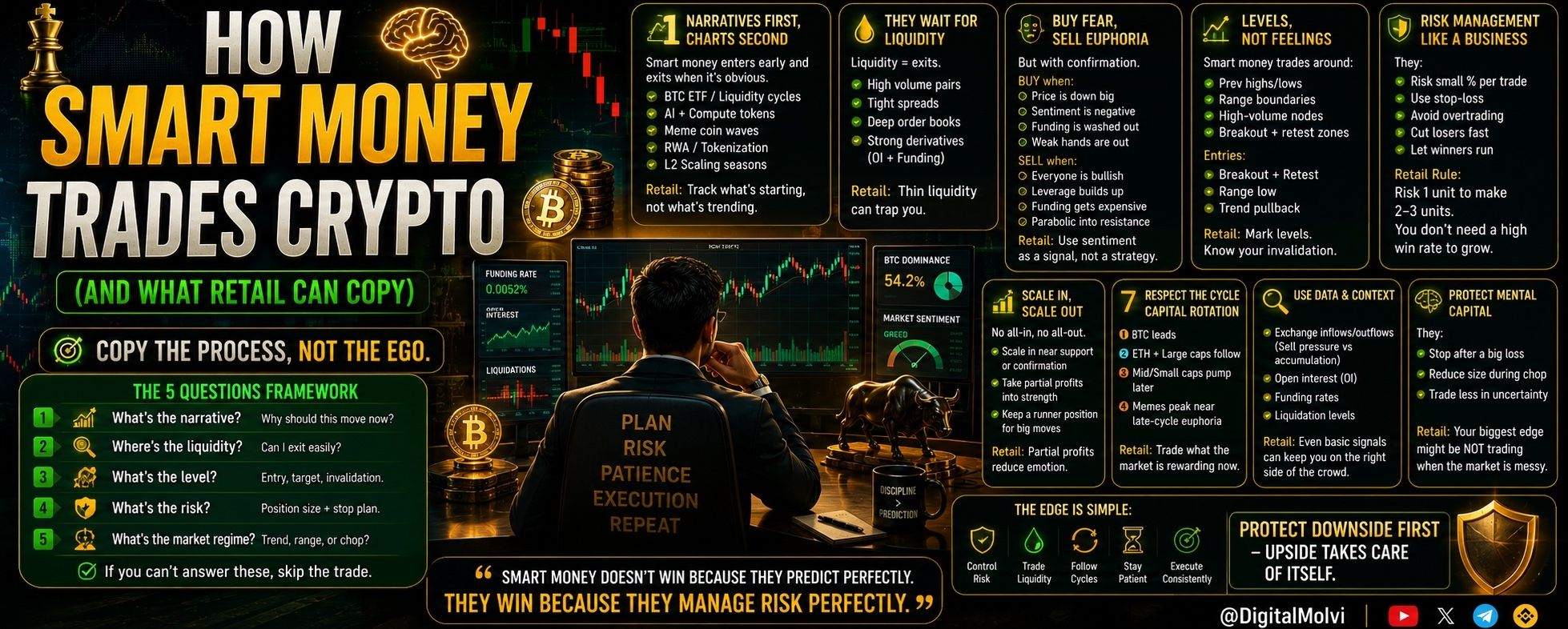
ບົດຄວາມ
How Smart Money Trades Crypto ?“Smart money” doesn’t mean people who always win. It usually means experienced traders, funds, market makers, and whales who have better tools, deeper liquidity, and stronger risk control. The good news: you don’t need insider access to learn their habits. You just need to copy the process, not the ego.
Below is a practical breakdown of how smart money typically trades crypto—and how you can apply the same logic on Binance.
1) They trade narratives first, charts second
Smart money often enters positions when a narrative is early and exits when it becomes “obvious” to everyone.
Examples of narratives:
BTC ETF / macro liquidity cycles
AI + compute tokens
Meme coin attention waves
RWA/tokenization
L2 scaling seasons
Retail takeaway: Don’t chase what’s already trending everywhere. Track what’s starting to trend: rising volume, new listings, ecosystem growth, and social momentum.
2) They wait for liquidity (because liquidity = exits)
Smart money cares less about “the perfect entry” and more about where they can enter and exit with size.
They look for:
High volume pairs
Tight spreads
Deep order books
Strong derivatives activity (open interest + funding)
Retail takeaway: If a coin has thin liquidity, you can get trapped. Prefer assets with consistent volume—especially if you’re trading short-term.
3) They buy fear, sell euphoria (but with confirmation)
Smart money often accumulates when:
Price is down big
Sentiment is negative
Funding is washed out
Weak hands are forced out
And they distribute when:
Everyone is bullish
Leverage builds up
Funding gets expensive
Price goes parabolic into resistance
Retail takeaway: Use sentiment as a signal, not a strategy. Combine it with structure: support/resistance, trend, and volume.
4) They use levels, not feelings
Smart money trades around key levels:
Previous highs/lows
Range boundaries
High-volume nodes
Breakout + retest zones
They often enter on:
Breakout + retest (safer)
Range low (higher risk, better reward)
Trend pullback (best in strong trends)
Retail takeaway: Mark levels before you trade. If you can’t define your invalidation (where you’re wrong), you’re gambling.
5) They manage risk like a business
This is the biggest difference.
Smart money typically:
Risks a small % per trade
Uses stop-loss or clear invalidation
Avoids overtrading
Cuts losers fast
Lets winners run (in trends)
Simple rule retail can copy: If you risk 1 unit, aim to make 2–3 units on winners.
That way you don’t need a high win rate to grow.
6) They scale in and scale out (no all-in, no all-out)
Instead of buying once, they:
Scale in near support or during confirmation
Take partial profits into strength
Keep a “runner” position for big moves
Retail takeaway: Partial profits reduce emotional pressure and stop you from selling too early or holding too long.
7) They respect the cycle: BTC → majors → midcaps → memes
In many bull phases, capital rotates like this:
BTC leads
ETH + large caps follow
Mid/small caps pump later
Memes often peak near late-cycle euphoria
Retail takeaway: Don’t treat every coin like it’s in the same season. Trade what the market is rewarding right now.
8) They use data: on-chain + derivatives + order flow
Smart money watches:
Exchange inflows/outflows (sell pressure vs accumulation)
Open interest (leverage build-up)
Funding rates (crowded longs/shorts)
Liquidation levels (where forced moves happen)
Retail takeaway: You don’t need 10 dashboards. Even basic signals—volume, funding, OI, and key levels—can keep you on the right side of the crowd.
9) They avoid “revenge trading” and protect mental capital
Smart money knows the market will be here tomorrow.
They:
Stop trading after a big loss
Reduce size during chop
Trade less when conditions are unclear
Retail takeaway: Your biggest edge might be not trading when the market is messy.
A simple “Smart Money” framework you can use
Before any trade, answer these 5 questions:
What’s the narrative? Why should this move now?
Where’s the liquidity? Can I exit easily?
What’s the level? Entry, target, invalidation.
What’s the risk? Position size + stop plan.
What’s the market regime? Trend, range, or chop?
If you can’t answer these, skip the trade.
Final Thoughts
Smart money doesn’t win because they predict perfectly. They win because they:
control risk
trade with liquidity
follow cycles
stay patient
execute consistently
If you copy only one thing, copy this: protect downside first—upside takes care of itself.
#digitalmolvi #BinanceSquare #smartmoney #trades #crypto
$BTC
{spot}(BTCUSDT)
$ETH
{spot}(ETHUSDT)
$BNB
{spot}(BNBUSDT)
How Smart Money Trades Crypto ?
“Smart money” doesn’t mean people who always win. It usually means experienced traders, funds, market makers, and whales who have better tools, deeper liquidity, and stronger risk control. The good news: you don’t need insider access to learn their habits. You just need to copy the process, not the ego.
Below is a practical breakdown of how smart money typically trades crypto—and how you can apply the same logic on Binance.
1) They trade narratives first, charts second
Smart money often enters positions when a narrative is early and exits when it becomes “obvious” to everyone.
Examples of narratives:
BTC ETF / macro liquidity cycles
AI + compute tokens
Meme coin attention waves
RWA/tokenization
L2 scaling seasons
Retail takeaway: Don’t chase what’s already trending everywhere. Track what’s starting to trend: rising volume, new listings, ecosystem growth, and social momentum.
2) They wait for liquidity (because liquidity = exits)
Smart money cares less about “the perfect entry” and more about where they can enter and exit with size.
They look for:
High volume pairs
Tight spreads
Deep order books
Strong derivatives activity (open interest + funding)
Retail takeaway: If a coin has thin liquidity, you can get trapped. Prefer assets with consistent volume—especially if you’re trading short-term.
3) They buy fear, sell euphoria (but with confirmation)
Smart money often accumulates when:
Price is down big
Sentiment is negative
Funding is washed out
Weak hands are forced out
And they distribute when:
Everyone is bullish
Leverage builds up
Funding gets expensive
Price goes parabolic into resistance
Retail takeaway: Use sentiment as a signal, not a strategy. Combine it with structure: support/resistance, trend, and volume.
4) They use levels, not feelings
Smart money trades around key levels:
Previous highs/lows
Range boundaries
High-volume nodes
Breakout + retest zones
They often enter on:
Breakout + retest (safer)
Range low (higher risk, better reward)
Trend pullback (best in strong trends)
Retail takeaway: Mark levels before you trade. If you can’t define your invalidation (where you’re wrong), you’re gambling.
5) They manage risk like a business
This is the biggest difference.
Smart money typically:
Risks a small % per trade
Uses stop-loss or clear invalidation
Avoids overtrading
Cuts losers fast
Lets winners run (in trends)
Simple rule retail can copy: If you risk 1 unit, aim to make 2–3 units on winners.
That way you don’t need a high win rate to grow.
6) They scale in and scale out (no all-in, no all-out)
Instead of buying once, they:
Scale in near support or during confirmation
Take partial profits into strength
Keep a “runner” position for big moves
Retail takeaway: Partial profits reduce emotional pressure and stop you from selling too early or holding too long.
7) They respect the cycle: BTC → majors → midcaps → memes
In many bull phases, capital rotates like this:
BTC leads
ETH + large caps follow
Mid/small caps pump later
Memes often peak near late-cycle euphoria
Retail takeaway: Don’t treat every coin like it’s in the same season. Trade what the market is rewarding right now.
8) They use data: on-chain + derivatives + order flow
Smart money watches:
Exchange inflows/outflows (sell pressure vs accumulation)
Open interest (leverage build-up)
Funding rates (crowded longs/shorts)
Liquidation levels (where forced moves happen)
Retail takeaway: You don’t need 10 dashboards. Even basic signals—volume, funding, OI, and key levels—can keep you on the right side of the crowd.
9) They avoid “revenge trading” and protect mental capital
Smart money knows the market will be here tomorrow.
They:
Stop trading after a big loss
Reduce size during chop
Trade less when conditions are unclear
Retail takeaway: Your biggest edge might be not trading when the market is messy.
A simple “Smart Money” framework you can use
Before any trade, answer these 5 questions:
What’s the narrative? Why should this move now?
Where’s the liquidity? Can I exit easily?
What’s the level? Entry, target, invalidation.
What’s the risk? Position size + stop plan.
What’s the market regime? Trend, range, or chop?
If you can’t answer these, skip the trade.
Final Thoughts
Smart money doesn’t win because they predict perfectly. They win because they:
control risk
trade with liquidity
follow cycles
stay patient
execute consistently
If you copy only one thing, copy this: protect downside first—upside takes care of itself.
#digitalmolvi #BinanceSquare #smartmoney #trades #crypto
$BTC
$ETH
$BNB
Below is a practical breakdown of how smart money typically trades crypto—and how you can apply the same logic on Binance.
1) They trade narratives first, charts second
Smart money often enters positions when a narrative is early and exits when it becomes “obvious” to everyone.
Examples of narratives:
BTC ETF / macro liquidity cycles
AI + compute tokens
Meme coin attention waves
RWA/tokenization
L2 scaling seasons
Retail takeaway: Don’t chase what’s already trending everywhere. Track what’s starting to trend: rising volume, new listings, ecosystem growth, and social momentum.
2) They wait for liquidity (because liquidity = exits)
Smart money cares less about “the perfect entry” and more about where they can enter and exit with size.
They look for:
High volume pairs
Tight spreads
Deep order books
Strong derivatives activity (open interest + funding)
Retail takeaway: If a coin has thin liquidity, you can get trapped. Prefer assets with consistent volume—especially if you’re trading short-term.
3) They buy fear, sell euphoria (but with confirmation)
Smart money often accumulates when:
Price is down big
Sentiment is negative
Funding is washed out
Weak hands are forced out
And they distribute when:
Everyone is bullish
Leverage builds up
Funding gets expensive
Price goes parabolic into resistance
Retail takeaway: Use sentiment as a signal, not a strategy. Combine it with structure: support/resistance, trend, and volume.
4) They use levels, not feelings
Smart money trades around key levels:
Previous highs/lows
Range boundaries
High-volume nodes
Breakout + retest zones
They often enter on:
Breakout + retest (safer)
Range low (higher risk, better reward)
Trend pullback (best in strong trends)
Retail takeaway: Mark levels before you trade. If you can’t define your invalidation (where you’re wrong), you’re gambling.
5) They manage risk like a business
This is the biggest difference.
Smart money typically:
Risks a small % per trade
Uses stop-loss or clear invalidation
Avoids overtrading
Cuts losers fast
Lets winners run (in trends)
Simple rule retail can copy: If you risk 1 unit, aim to make 2–3 units on winners.
That way you don’t need a high win rate to grow.
6) They scale in and scale out (no all-in, no all-out)
Instead of buying once, they:
Scale in near support or during confirmation
Take partial profits into strength
Keep a “runner” position for big moves
Retail takeaway: Partial profits reduce emotional pressure and stop you from selling too early or holding too long.
7) They respect the cycle: BTC → majors → midcaps → memes
In many bull phases, capital rotates like this:
BTC leads
ETH + large caps follow
Mid/small caps pump later
Memes often peak near late-cycle euphoria
Retail takeaway: Don’t treat every coin like it’s in the same season. Trade what the market is rewarding right now.
8) They use data: on-chain + derivatives + order flow
Smart money watches:
Exchange inflows/outflows (sell pressure vs accumulation)
Open interest (leverage build-up)
Funding rates (crowded longs/shorts)
Liquidation levels (where forced moves happen)
Retail takeaway: You don’t need 10 dashboards. Even basic signals—volume, funding, OI, and key levels—can keep you on the right side of the crowd.
9) They avoid “revenge trading” and protect mental capital
Smart money knows the market will be here tomorrow.
They:
Stop trading after a big loss
Reduce size during chop
Trade less when conditions are unclear
Retail takeaway: Your biggest edge might be not trading when the market is messy.
A simple “Smart Money” framework you can use
Before any trade, answer these 5 questions:
What’s the narrative? Why should this move now?
Where’s the liquidity? Can I exit easily?
What’s the level? Entry, target, invalidation.
What’s the risk? Position size + stop plan.
What’s the market regime? Trend, range, or chop?
If you can’t answer these, skip the trade.
Final Thoughts
Smart money doesn’t win because they predict perfectly. They win because they:
control risk
trade with liquidity
follow cycles
stay patient
execute consistently
If you copy only one thing, copy this: protect downside first—upside takes care of itself.
#digitalmolvi #BinanceSquare #smartmoney #trades #crypto
$BTC
$ETH
$BNB
84
Web3 adoption is growing, but the real shift is happening quietly: wallets are getting simpler, stablecoins are becoming everyday money, and big brands are testing tokenized rewards + digital ownership. The winners won’t be the loudest projects—they’ll be the ones that hide the blockchain and deliver a smooth Web2-style experience.
#digitalmolvi #binancepost #Web3Adoption #Web3 #crypto
$LINK
{spot}(LINKUSDT)
Web3 adoption is growing, but the real shift is happening quietly: wallets are getting simpler, stablecoins are becoming everyday money, and big brands are testing tokenized rewards + digital ownership. The winners won’t be the loudest projects—they’ll be the ones that hide the blockchain and deliver a smooth Web2-style experience.
#digitalmolvi #binancepost #Web3Adoption #Web3 #crypto
$LINK
#digitalmolvi #binancepost #Web3Adoption #Web3 #crypto
$LINK

149
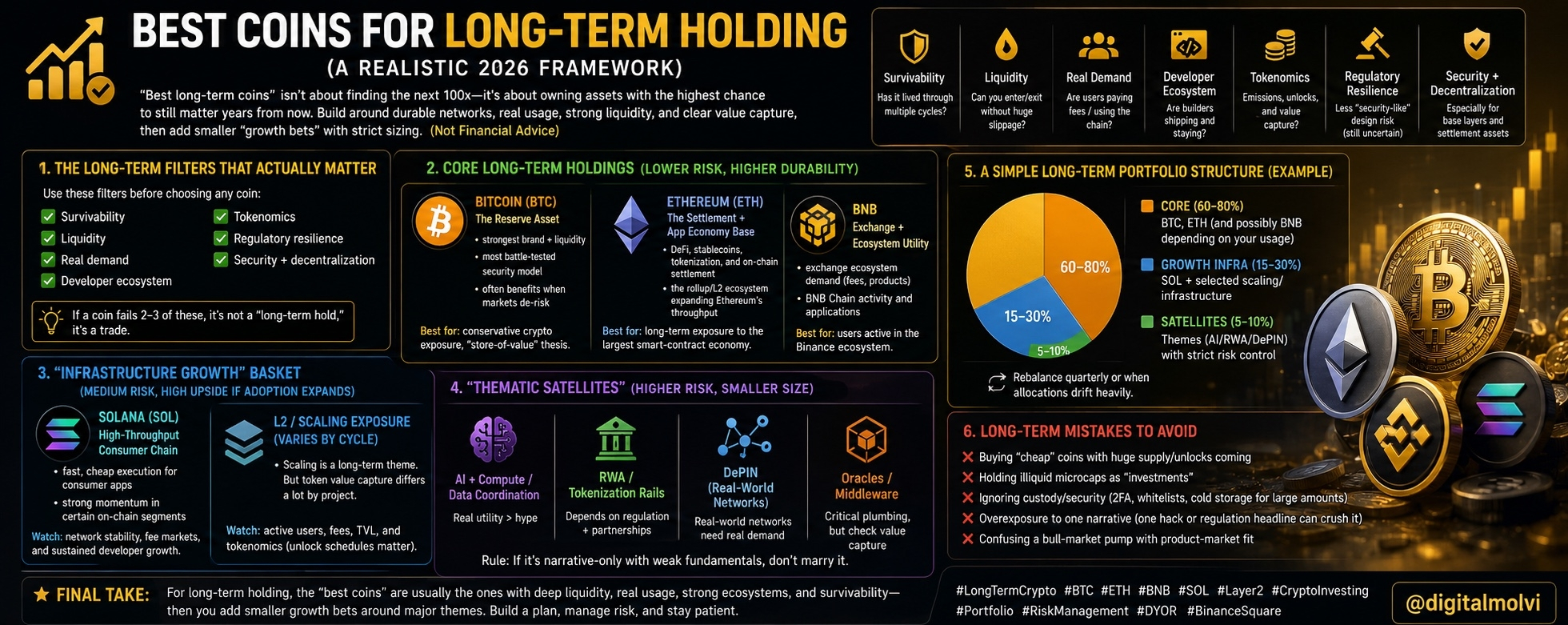
ບົດຄວາມ
Best Coins for Long‑Term Holding 2026Best long-term coins” isn’t about finding the next 100x—it’s about owning assets with the highest chance to still matter years from now. The safest approach is to build around durable networks, real usage, strong liquidity, and clear value capture, then add smaller “growth bets” with strict sizing.
Below is a practical long-term framework (not financial advice).
1) The Long-Term Filters That Actually Matter
Before naming any coin, use these filters:
Survivability: Has it lived through multiple cycles and crises?
Liquidity: Can you enter/exit without huge slippage?
Real demand: Are users paying fees / using the chain?
Developer ecosystem: Are builders shipping and staying?
Tokenomics: Emissions, unlocks, and whether the token captures value
Regulatory resilience: Less “obviously a security-like” design risk (still uncertain in many regions)
Security + decentralization: Especially for base layers and settlement assets
If a coin fails 2–3 of these, it’s not a “long-term hold,” it’s a trade.
2) Core Long-Term Holdings (Lower Risk, Higher Durability)
Bitcoin (BTC) — the reserve asset
BTC remains the simplest long-term thesis in crypto:
strongest brand + liquidity
most battle-tested security model
often benefits when markets de-risk
Best for: conservative crypto exposure, “store-of-value” thesis.
Ethereum (ETH) — the settlement + app economy base
ETH’s long-term case is tied to:
DeFi, stablecoins, tokenization, and on-chain settlement
the rollup/L2 ecosystem expanding Ethereum’s throughput
Best for: long-term exposure to the largest smart-contract economy.
BNB — exchange + ecosystem utility
BNB’s thesis is utility-driven:
exchange ecosystem demand (fees, products)
BNB Chain activity and applications
Best for: users active in the Binance ecosystem who want utility exposure.
3) “Infrastructure Growth” Basket (Medium Risk, High Upside if Adoption Expands)
Solana (SOL) — high-throughput consumer chain
SOL’s long-term bet is:
fast, cheap execution for consumer apps
strong momentum in certain on-chain segments
Watch: network stability, fee markets, and sustained developer growth.
Top L2 / scaling exposure (varies by cycle)
Scaling is a long-term theme. But token value capture differs a lot by project.
Watch: active users, fees, TVL, and tokenomics (unlock schedules matter).
4) “Thematic Satellites” (Higher Risk, Smaller Size)
These can outperform, but should be sized smaller:
AI + compute/data coordination (real utility > hype)
RWA/tokenization rails (depends on regulation + partnerships)
DePIN (real-world networks need real demand)
Oracles / middleware (critical plumbing, but check value capture)
Rule: If it’s narrative-only with weak fundamentals, don’t marry it.
5) A Simple Long-Term Portfolio Structure (Example)
A common risk-aware structure:
60–80% Core: BTC, ETH (and possibly BNB depending on your usage)
15–30% Growth Infra: SOL + selected scaling/infrastructure
5–10% Satellites: themes (AI/RWA/DePIN) with strict risk control
Rebalance quarterly or when allocations drift heavily.
6) Long-Term Mistakes to Avoid
Buying “cheap” coins with huge supply/unlocks coming
Holding illiquid microcaps as “investments”
Ignoring custody/security (2FA, whitelists, cold storage for large amounts)
Overexposure to one narrative (one hack or regulation headline can crush it)
Confusing a bull-market pump with product-market fit
For long-term holding, the “best coins” are usually the ones with deep liquidity, real usage, strong ecosystems, and survivability—then you add smaller growth bets around major themes. If you want, tell me your risk level (low/medium/high) and whether you prefer income (Earn) or pure growth, and I’ll suggest a clean long-term allocation framework you can execute on Binance.
#digitalmolvi #BinanceSquare #LongTermCrypto #article #CryptoInvestment
$BTC
{spot}(BTCUSDT)
$ETH
{spot}(ETHUSDT)
$BNB
{spot}(BNBUSDT)
@Binance_Square_Official @Binance_Academy
Best Coins for Long‑Term Holding 2026
Best long-term coins” isn’t about finding the next 100x—it’s about owning assets with the highest chance to still matter years from now. The safest approach is to build around durable networks, real usage, strong liquidity, and clear value capture, then add smaller “growth bets” with strict sizing.
Below is a practical long-term framework (not financial advice).
1) The Long-Term Filters That Actually Matter
Before naming any coin, use these filters:
Survivability: Has it lived through multiple cycles and crises?
Liquidity: Can you enter/exit without huge slippage?
Real demand: Are users paying fees / using the chain?
Developer ecosystem: Are builders shipping and staying?
Tokenomics: Emissions, unlocks, and whether the token captures value
Regulatory resilience: Less “obviously a security-like” design risk (still uncertain in many regions)
Security + decentralization: Especially for base layers and settlement assets
If a coin fails 2–3 of these, it’s not a “long-term hold,” it’s a trade.
2) Core Long-Term Holdings (Lower Risk, Higher Durability)
Bitcoin (BTC) — the reserve asset
BTC remains the simplest long-term thesis in crypto:
strongest brand + liquidity
most battle-tested security model
often benefits when markets de-risk
Best for: conservative crypto exposure, “store-of-value” thesis.
Ethereum (ETH) — the settlement + app economy base
ETH’s long-term case is tied to:
DeFi, stablecoins, tokenization, and on-chain settlement
the rollup/L2 ecosystem expanding Ethereum’s throughput
Best for: long-term exposure to the largest smart-contract economy.
BNB — exchange + ecosystem utility
BNB’s thesis is utility-driven:
exchange ecosystem demand (fees, products)
BNB Chain activity and applications
Best for: users active in the Binance ecosystem who want utility exposure.
3) “Infrastructure Growth” Basket (Medium Risk, High Upside if Adoption Expands)
Solana (SOL) — high-throughput consumer chain
SOL’s long-term bet is:
fast, cheap execution for consumer apps
strong momentum in certain on-chain segments
Watch: network stability, fee markets, and sustained developer growth.
Top L2 / scaling exposure (varies by cycle)
Scaling is a long-term theme. But token value capture differs a lot by project.
Watch: active users, fees, TVL, and tokenomics (unlock schedules matter).
4) “Thematic Satellites” (Higher Risk, Smaller Size)
These can outperform, but should be sized smaller:
AI + compute/data coordination (real utility > hype)
RWA/tokenization rails (depends on regulation + partnerships)
DePIN (real-world networks need real demand)
Oracles / middleware (critical plumbing, but check value capture)
Rule: If it’s narrative-only with weak fundamentals, don’t marry it.
5) A Simple Long-Term Portfolio Structure (Example)
A common risk-aware structure:
60–80% Core: BTC, ETH (and possibly BNB depending on your usage)
15–30% Growth Infra: SOL + selected scaling/infrastructure
5–10% Satellites: themes (AI/RWA/DePIN) with strict risk control
Rebalance quarterly or when allocations drift heavily.
6) Long-Term Mistakes to Avoid
Buying “cheap” coins with huge supply/unlocks coming
Holding illiquid microcaps as “investments”
Ignoring custody/security (2FA, whitelists, cold storage for large amounts)
Overexposure to one narrative (one hack or regulation headline can crush it)
Confusing a bull-market pump with product-market fit
For long-term holding, the “best coins” are usually the ones with deep liquidity, real usage, strong ecosystems, and survivability—then you add smaller growth bets around major themes. If you want, tell me your risk level (low/medium/high) and whether you prefer income (Earn) or pure growth, and I’ll suggest a clean long-term allocation framework you can execute on Binance.
#digitalmolvi #BinanceSquare #LongTermCrypto #article #CryptoInvestment
$BTC
$ETH
$BNB
@Binance Square Official @Binance_Academy
Below is a practical long-term framework (not financial advice).
1) The Long-Term Filters That Actually Matter
Before naming any coin, use these filters:
Survivability: Has it lived through multiple cycles and crises?
Liquidity: Can you enter/exit without huge slippage?
Real demand: Are users paying fees / using the chain?
Developer ecosystem: Are builders shipping and staying?
Tokenomics: Emissions, unlocks, and whether the token captures value
Regulatory resilience: Less “obviously a security-like” design risk (still uncertain in many regions)
Security + decentralization: Especially for base layers and settlement assets
If a coin fails 2–3 of these, it’s not a “long-term hold,” it’s a trade.
2) Core Long-Term Holdings (Lower Risk, Higher Durability)
Bitcoin (BTC) — the reserve asset
BTC remains the simplest long-term thesis in crypto:
strongest brand + liquidity
most battle-tested security model
often benefits when markets de-risk
Best for: conservative crypto exposure, “store-of-value” thesis.
Ethereum (ETH) — the settlement + app economy base
ETH’s long-term case is tied to:
DeFi, stablecoins, tokenization, and on-chain settlement
the rollup/L2 ecosystem expanding Ethereum’s throughput
Best for: long-term exposure to the largest smart-contract economy.
BNB — exchange + ecosystem utility
BNB’s thesis is utility-driven:
exchange ecosystem demand (fees, products)
BNB Chain activity and applications
Best for: users active in the Binance ecosystem who want utility exposure.
3) “Infrastructure Growth” Basket (Medium Risk, High Upside if Adoption Expands)
Solana (SOL) — high-throughput consumer chain
SOL’s long-term bet is:
fast, cheap execution for consumer apps
strong momentum in certain on-chain segments
Watch: network stability, fee markets, and sustained developer growth.
Top L2 / scaling exposure (varies by cycle)
Scaling is a long-term theme. But token value capture differs a lot by project.
Watch: active users, fees, TVL, and tokenomics (unlock schedules matter).
4) “Thematic Satellites” (Higher Risk, Smaller Size)
These can outperform, but should be sized smaller:
AI + compute/data coordination (real utility > hype)
RWA/tokenization rails (depends on regulation + partnerships)
DePIN (real-world networks need real demand)
Oracles / middleware (critical plumbing, but check value capture)
Rule: If it’s narrative-only with weak fundamentals, don’t marry it.
5) A Simple Long-Term Portfolio Structure (Example)
A common risk-aware structure:
60–80% Core: BTC, ETH (and possibly BNB depending on your usage)
15–30% Growth Infra: SOL + selected scaling/infrastructure
5–10% Satellites: themes (AI/RWA/DePIN) with strict risk control
Rebalance quarterly or when allocations drift heavily.
6) Long-Term Mistakes to Avoid
Buying “cheap” coins with huge supply/unlocks coming
Holding illiquid microcaps as “investments”
Ignoring custody/security (2FA, whitelists, cold storage for large amounts)
Overexposure to one narrative (one hack or regulation headline can crush it)
Confusing a bull-market pump with product-market fit
For long-term holding, the “best coins” are usually the ones with deep liquidity, real usage, strong ecosystems, and survivability—then you add smaller growth bets around major themes. If you want, tell me your risk level (low/medium/high) and whether you prefer income (Earn) or pure growth, and I’ll suggest a clean long-term allocation framework you can execute on Binance.
#digitalmolvi #BinanceSquare #LongTermCrypto #article #CryptoInvestment
$BTC
$ETH
$BNB
@Binance Square Official @Binance_Academy
200
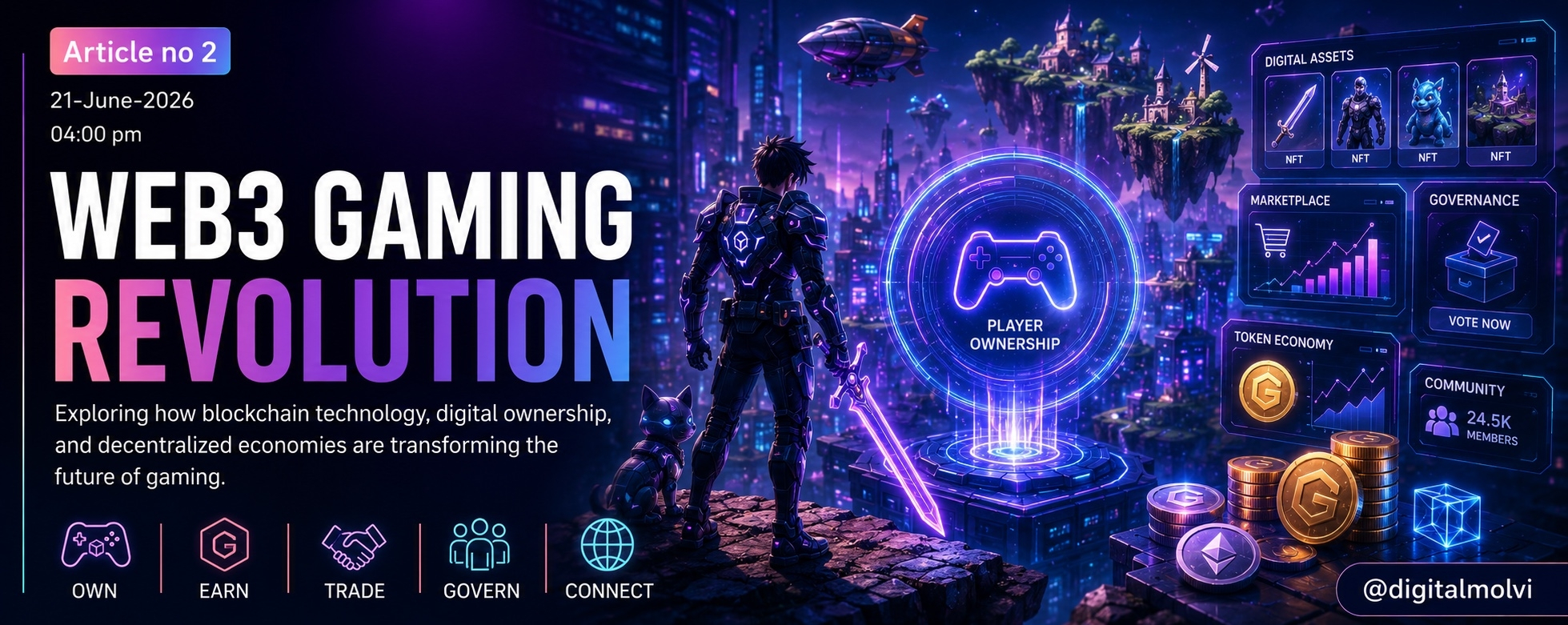
ບົດຄວາມ
Web3 Gaming RevolutionThe gaming industry is entering a new phase of transformation, and at the center of this shift is Web3 gaming. For years, games have evolved through better graphics, online multiplayer systems, mobile accessibility, and live-service economies. Now a new layer is being added: blockchain-based ownership, decentralized economies, and player participation in value creation. This movement is often described as the Web3 gaming revolution.
While the term can sound futuristic or overhyped, the core idea is simple. Web3 gaming aims to give players more control over digital assets, identities, and in-game economies. Instead of everything being fully controlled by a central publisher, some parts of the gaming experience can become more open, portable, and community-driven.
This article explores what Web3 gaming is, why it matters, what is driving the revolution, the opportunities it creates, the challenges it faces, and what the future may look like.
What Is Web3 Gaming?
Web3 gaming refers to video games that use blockchain technology as part of their design, economy, or infrastructure. These games may include:
Cryptographic tokens used as in-game currencies or governance assets
NFTs representing characters, skins, weapons, land, or collectibles
Wallet-based ownership of digital items
Decentralized marketplaces for trading assets
Community governance systems
On-chain records of ownership, rewards, or achievements
In traditional gaming, players can spend time and money building accounts, collecting rare items, and purchasing cosmetics, but those assets usually remain under the control of the game publisher. In Web3 gaming, the goal is to let players hold and manage certain assets directly.
This does not mean every part of a game must be decentralized. In fact, many successful Web3 gaming models are likely to be hybrid, combining traditional game design with blockchain-based ownership and economy features.
Why Web3 Gaming Is Called a Revolution
The word “revolution” is used because Web3 gaming challenges several long-standing assumptions in the gaming industry.
1. From Access to Ownership
In traditional games, players often buy access, not true ownership. Even if a player spends hundreds of dollars on skins or items, those assets can usually be modified, restricted, or removed by the publisher.
Web3 gaming introduces the possibility of verifiable ownership. A player may hold a tokenized asset in a wallet and potentially trade it outside the game’s native marketplace.
2. From Closed Economies to Open Economies
Most game economies are closed systems. Developers create the rules, issue the items, and control the marketplace. Web3 gaming opens the door to more transparent and interoperable economies where users can trade assets peer-to-peer and where value can move more freely.
3. From Passive Players to Active Stakeholders
Web3 gaming often treats players as participants in the ecosystem rather than just consumers. Through governance tokens, creator rewards, community treasuries, or player-driven marketplaces, users may have a more active role in shaping the game world.
4. From Platform Dependency to Digital Portability
One of the most ambitious ideas in Web3 gaming is portability. A digital identity, collectible, or reputation layer could potentially move across games, communities, or platforms. Full interoperability remains difficult, but even partial portability is a major shift from the current model.
Core Technologies Behind Web3 Gaming
The Web3 gaming revolution is built on several technologies working together.
Blockchain
Blockchain provides a shared ledger that records ownership and transactions. In gaming, this can be used to track who owns a specific item, how assets move between users, or how rewards are distributed.
Smart Contracts
Smart contracts are programmable rules deployed on a blockchain. They can automate marketplace transactions, staking systems, tournament rewards, governance voting, and royalty payments.
NFTs
Non-fungible tokens are unique digital assets. In gaming, NFTs can represent rare items, avatars, land, collectibles, or access passes. Their uniqueness makes them useful for scarcity-based game design and digital ownership.
Fungible Tokens
These are interchangeable tokens used as currencies, reward systems, or governance tools. A game may use one token for utility and another for governance, though simpler systems are often more sustainable.
Wallet Infrastructure
Wallets allow players to store and manage blockchain assets. In the future, wallet systems will likely become more user-friendly, with embedded wallets, social logins, and gasless transactions reducing friction for mainstream players.
Layer 2 Networks and Scalable Chains
Gaming requires fast, cheap transactions. High fees and slow confirmations are major barriers. Layer 2 solutions and gaming-focused chains are helping make Web3 gaming more practical by reducing costs and improving speed.
The Main Promises of Web3 Gaming
Web3 gaming has attracted attention because it offers several compelling possibilities.
True Digital Ownership
Players can potentially own in-game assets in a way that is independent of a single company database. This creates stronger property rights in virtual worlds.
Tradable Value
Items, currencies, and collectibles can be traded in open markets. This can create liquidity and allow players to realize value from time spent in a game.
Creator Economies
Web3 gaming can reward not only players but also creators. Artists, modders, map designers, guild leaders, and community builders may be compensated directly through tokenized systems.
Community Governance
Some projects allow token holders to vote on game updates, treasury use, ecosystem grants, or competitive structures. This can make communities more invested in long-term success.
Interoperability
Although still limited, Web3 gaming encourages the idea that digital assets should not always be trapped in one ecosystem. Shared standards may eventually support broader compatibility.
New Business Models
Instead of relying only on upfront purchases or microtransactions, developers can experiment with marketplace fees, tokenized memberships, creator royalties, and community-driven funding.
The Rise and Fall of Early Play-to-Earn
No discussion of Web3 gaming is complete without addressing play-to-earn. Early blockchain games gained popularity by promising players financial rewards for participation. This model generated huge excitement, especially in regions where gaming income looked meaningful compared to local wages.
However, many early play-to-earn systems struggled for several reasons:
Token inflation
Weak gameplay
Overdependence on new user growth
Speculative demand replacing real utility
Unsustainable reward structures
When token prices fell, many ecosystems collapsed. This was a critical lesson for the industry. A game cannot rely on financial incentives alone. If the gameplay is not compelling, users leave when rewards decline.
As a result, the industry has shifted toward concepts like:
Play-and-own
Own-and-trade
Play-and-engage
Community-powered gaming economies
The new focus is on making games enjoyable first and tokenized second.
How the Revolution Is Evolving
The Web3 gaming revolution is becoming more practical and less ideological. Several important shifts are shaping its next phase.
Gameplay First
Developers are realizing that blockchain features should support the game, not dominate it. The best Web3 games of the future will likely feel like great games that happen to use blockchain, rather than blockchain products disguised as games.
Invisible Infrastructure
Mainstream players do not want to deal with seed phrases, gas fees, or complex wallet setups. The future of Web3 gaming depends on abstracting away technical friction through:
Embedded wallets
Account abstraction
Gas sponsorship
One-click onboarding
Familiar app-like interfaces
Sustainable Tokenomics
Projects are paying more attention to supply control, token sinks, reward balancing, and treasury management. Sustainable economies are essential if Web3 gaming is to survive beyond speculative cycles.
Better Regulation and Compliance
As the industry matures, projects will need clearer legal structures around tokens, digital assets, and user protections. Compliance may become a competitive advantage.
Hybrid Models
Not every game needs a token, and not every asset needs to be on-chain. Many successful models may use blockchain selectively for high-value items, identity, marketplace settlement, or community governance while keeping core gameplay off-chain.
Opportunities Created by Web3 Gaming
The revolution creates opportunities across the gaming ecosystem.
For Players
Greater control over digital assets
Potential resale value for rare items
More transparent economies
Participation in governance and community decisions
New ways to earn from skill, creativity, or contribution
For Developers
New monetization channels
Stronger community alignment
Lower dependence on centralized marketplaces
Programmable royalties and automated revenue sharing
More flexible ecosystem design
For Creators and Communities
Tokenized rewards for content creation
Community-owned guilds and teams
Shared treasuries for events and development
Better incentives for long-term engagement
For Investors and Ecosystem Builders
Exposure to emerging digital economies
Infrastructure opportunities in wallets, marketplaces, analytics, and scaling
Participation in the growth of virtual asset ownership
Challenges That Could Slow the Revolution
Despite its promise, Web3 gaming still faces major obstacles.
User Experience Problems
Wallet setup, private key management, bridging, and transaction signing remain too complicated for many mainstream users.
Speculation and Volatility
If token prices dominate the player experience, games can become unstable and unattractive to ordinary users.
Regulatory Risk
Some gaming tokens may be treated differently across jurisdictions, especially if they resemble investment products.
Security Concerns
Smart contract exploits, phishing attacks, fake marketplaces, and wallet theft can undermine trust.
Game Design Tensions
Financial incentives can distort gameplay. Developers must avoid creating systems where profit-seeking overwhelms fun, fairness, or balance.
Gamer Skepticism
Many traditional gamers remain resistant to NFTs and blockchain integration, often due to concerns about scams, environmental impact, and exploitative monetization.
What the Future of Web3 Gaming May Look Like
The future of Web3 gaming is unlikely to be a total replacement of traditional gaming. Instead, it will probably develop as a parallel evolution that influences mainstream design over time.
#digitalmolvi #Web3 #BinanceSquare
$IMX
{spot}(IMXUSDT)
$RONIN
{spot}(RONINUSDT)
$APE
{spot}(APEUSDT)
Web3 Gaming Revolution
The gaming industry is entering a new phase of transformation, and at the center of this shift is Web3 gaming. For years, games have evolved through better graphics, online multiplayer systems, mobile accessibility, and live-service economies. Now a new layer is being added: blockchain-based ownership, decentralized economies, and player participation in value creation. This movement is often described as the Web3 gaming revolution.
While the term can sound futuristic or overhyped, the core idea is simple. Web3 gaming aims to give players more control over digital assets, identities, and in-game economies. Instead of everything being fully controlled by a central publisher, some parts of the gaming experience can become more open, portable, and community-driven.
This article explores what Web3 gaming is, why it matters, what is driving the revolution, the opportunities it creates, the challenges it faces, and what the future may look like.
What Is Web3 Gaming?
Web3 gaming refers to video games that use blockchain technology as part of their design, economy, or infrastructure. These games may include:
Cryptographic tokens used as in-game currencies or governance assets
NFTs representing characters, skins, weapons, land, or collectibles
Wallet-based ownership of digital items
Decentralized marketplaces for trading assets
Community governance systems
On-chain records of ownership, rewards, or achievements
In traditional gaming, players can spend time and money building accounts, collecting rare items, and purchasing cosmetics, but those assets usually remain under the control of the game publisher. In Web3 gaming, the goal is to let players hold and manage certain assets directly.
This does not mean every part of a game must be decentralized. In fact, many successful Web3 gaming models are likely to be hybrid, combining traditional game design with blockchain-based ownership and economy features.
Why Web3 Gaming Is Called a Revolution
The word “revolution” is used because Web3 gaming challenges several long-standing assumptions in the gaming industry.
1. From Access to Ownership
In traditional games, players often buy access, not true ownership. Even if a player spends hundreds of dollars on skins or items, those assets can usually be modified, restricted, or removed by the publisher.
Web3 gaming introduces the possibility of verifiable ownership. A player may hold a tokenized asset in a wallet and potentially trade it outside the game’s native marketplace.
2. From Closed Economies to Open Economies
Most game economies are closed systems. Developers create the rules, issue the items, and control the marketplace. Web3 gaming opens the door to more transparent and interoperable economies where users can trade assets peer-to-peer and where value can move more freely.
3. From Passive Players to Active Stakeholders
Web3 gaming often treats players as participants in the ecosystem rather than just consumers. Through governance tokens, creator rewards, community treasuries, or player-driven marketplaces, users may have a more active role in shaping the game world.
4. From Platform Dependency to Digital Portability
One of the most ambitious ideas in Web3 gaming is portability. A digital identity, collectible, or reputation layer could potentially move across games, communities, or platforms. Full interoperability remains difficult, but even partial portability is a major shift from the current model.
Core Technologies Behind Web3 Gaming
The Web3 gaming revolution is built on several technologies working together.
Blockchain
Blockchain provides a shared ledger that records ownership and transactions. In gaming, this can be used to track who owns a specific item, how assets move between users, or how rewards are distributed.
Smart Contracts
Smart contracts are programmable rules deployed on a blockchain. They can automate marketplace transactions, staking systems, tournament rewards, governance voting, and royalty payments.
NFTs
Non-fungible tokens are unique digital assets. In gaming, NFTs can represent rare items, avatars, land, collectibles, or access passes. Their uniqueness makes them useful for scarcity-based game design and digital ownership.
Fungible Tokens
These are interchangeable tokens used as currencies, reward systems, or governance tools. A game may use one token for utility and another for governance, though simpler systems are often more sustainable.
Wallet Infrastructure
Wallets allow players to store and manage blockchain assets. In the future, wallet systems will likely become more user-friendly, with embedded wallets, social logins, and gasless transactions reducing friction for mainstream players.
Layer 2 Networks and Scalable Chains
Gaming requires fast, cheap transactions. High fees and slow confirmations are major barriers. Layer 2 solutions and gaming-focused chains are helping make Web3 gaming more practical by reducing costs and improving speed.
The Main Promises of Web3 Gaming
Web3 gaming has attracted attention because it offers several compelling possibilities.
True Digital Ownership
Players can potentially own in-game assets in a way that is independent of a single company database. This creates stronger property rights in virtual worlds.
Tradable Value
Items, currencies, and collectibles can be traded in open markets. This can create liquidity and allow players to realize value from time spent in a game.
Creator Economies
Web3 gaming can reward not only players but also creators. Artists, modders, map designers, guild leaders, and community builders may be compensated directly through tokenized systems.
Community Governance
Some projects allow token holders to vote on game updates, treasury use, ecosystem grants, or competitive structures. This can make communities more invested in long-term success.
Interoperability
Although still limited, Web3 gaming encourages the idea that digital assets should not always be trapped in one ecosystem. Shared standards may eventually support broader compatibility.
New Business Models
Instead of relying only on upfront purchases or microtransactions, developers can experiment with marketplace fees, tokenized memberships, creator royalties, and community-driven funding.
The Rise and Fall of Early Play-to-Earn
No discussion of Web3 gaming is complete without addressing play-to-earn. Early blockchain games gained popularity by promising players financial rewards for participation. This model generated huge excitement, especially in regions where gaming income looked meaningful compared to local wages.
However, many early play-to-earn systems struggled for several reasons:
Token inflation
Weak gameplay
Overdependence on new user growth
Speculative demand replacing real utility
Unsustainable reward structures
When token prices fell, many ecosystems collapsed. This was a critical lesson for the industry. A game cannot rely on financial incentives alone. If the gameplay is not compelling, users leave when rewards decline.
As a result, the industry has shifted toward concepts like:
Play-and-own
Own-and-trade
Play-and-engage
Community-powered gaming economies
The new focus is on making games enjoyable first and tokenized second.
How the Revolution Is Evolving
The Web3 gaming revolution is becoming more practical and less ideological. Several important shifts are shaping its next phase.
Gameplay First
Developers are realizing that blockchain features should support the game, not dominate it. The best Web3 games of the future will likely feel like great games that happen to use blockchain, rather than blockchain products disguised as games.
Invisible Infrastructure
Mainstream players do not want to deal with seed phrases, gas fees, or complex wallet setups. The future of Web3 gaming depends on abstracting away technical friction through:
Embedded wallets
Account abstraction
Gas sponsorship
One-click onboarding
Familiar app-like interfaces
Sustainable Tokenomics
Projects are paying more attention to supply control, token sinks, reward balancing, and treasury management. Sustainable economies are essential if Web3 gaming is to survive beyond speculative cycles.
Better Regulation and Compliance
As the industry matures, projects will need clearer legal structures around tokens, digital assets, and user protections. Compliance may become a competitive advantage.
Hybrid Models
Not every game needs a token, and not every asset needs to be on-chain. Many successful models may use blockchain selectively for high-value items, identity, marketplace settlement, or community governance while keeping core gameplay off-chain.
Opportunities Created by Web3 Gaming
The revolution creates opportunities across the gaming ecosystem.
For Players
Greater control over digital assets
Potential resale value for rare items
More transparent economies
Participation in governance and community decisions
New ways to earn from skill, creativity, or contribution
For Developers
New monetization channels
Stronger community alignment
Lower dependence on centralized marketplaces
Programmable royalties and automated revenue sharing
More flexible ecosystem design
For Creators and Communities
Tokenized rewards for content creation
Community-owned guilds and teams
Shared treasuries for events and development
Better incentives for long-term engagement
For Investors and Ecosystem Builders
Exposure to emerging digital economies
Infrastructure opportunities in wallets, marketplaces, analytics, and scaling
Participation in the growth of virtual asset ownership
Challenges That Could Slow the Revolution
Despite its promise, Web3 gaming still faces major obstacles.
User Experience Problems
Wallet setup, private key management, bridging, and transaction signing remain too complicated for many mainstream users.
Speculation and Volatility
If token prices dominate the player experience, games can become unstable and unattractive to ordinary users.
Regulatory Risk
Some gaming tokens may be treated differently across jurisdictions, especially if they resemble investment products.
Security Concerns
Smart contract exploits, phishing attacks, fake marketplaces, and wallet theft can undermine trust.
Game Design Tensions
Financial incentives can distort gameplay. Developers must avoid creating systems where profit-seeking overwhelms fun, fairness, or balance.
Gamer Skepticism
Many traditional gamers remain resistant to NFTs and blockchain integration, often due to concerns about scams, environmental impact, and exploitative monetization.
What the Future of Web3 Gaming May Look Like
The future of Web3 gaming is unlikely to be a total replacement of traditional gaming. Instead, it will probably develop as a parallel evolution that influences mainstream design over time.
#digitalmolvi #Web3 #BinanceSquare
$IMX
$RONIN
$APE
While the term can sound futuristic or overhyped, the core idea is simple. Web3 gaming aims to give players more control over digital assets, identities, and in-game economies. Instead of everything being fully controlled by a central publisher, some parts of the gaming experience can become more open, portable, and community-driven.
This article explores what Web3 gaming is, why it matters, what is driving the revolution, the opportunities it creates, the challenges it faces, and what the future may look like.
What Is Web3 Gaming?
Web3 gaming refers to video games that use blockchain technology as part of their design, economy, or infrastructure. These games may include:
Cryptographic tokens used as in-game currencies or governance assets
NFTs representing characters, skins, weapons, land, or collectibles
Wallet-based ownership of digital items
Decentralized marketplaces for trading assets
Community governance systems
On-chain records of ownership, rewards, or achievements
In traditional gaming, players can spend time and money building accounts, collecting rare items, and purchasing cosmetics, but those assets usually remain under the control of the game publisher. In Web3 gaming, the goal is to let players hold and manage certain assets directly.
This does not mean every part of a game must be decentralized. In fact, many successful Web3 gaming models are likely to be hybrid, combining traditional game design with blockchain-based ownership and economy features.
Why Web3 Gaming Is Called a Revolution
The word “revolution” is used because Web3 gaming challenges several long-standing assumptions in the gaming industry.
1. From Access to Ownership
In traditional games, players often buy access, not true ownership. Even if a player spends hundreds of dollars on skins or items, those assets can usually be modified, restricted, or removed by the publisher.
Web3 gaming introduces the possibility of verifiable ownership. A player may hold a tokenized asset in a wallet and potentially trade it outside the game’s native marketplace.
2. From Closed Economies to Open Economies
Most game economies are closed systems. Developers create the rules, issue the items, and control the marketplace. Web3 gaming opens the door to more transparent and interoperable economies where users can trade assets peer-to-peer and where value can move more freely.
3. From Passive Players to Active Stakeholders
Web3 gaming often treats players as participants in the ecosystem rather than just consumers. Through governance tokens, creator rewards, community treasuries, or player-driven marketplaces, users may have a more active role in shaping the game world.
4. From Platform Dependency to Digital Portability
One of the most ambitious ideas in Web3 gaming is portability. A digital identity, collectible, or reputation layer could potentially move across games, communities, or platforms. Full interoperability remains difficult, but even partial portability is a major shift from the current model.
Core Technologies Behind Web3 Gaming
The Web3 gaming revolution is built on several technologies working together.
Blockchain
Blockchain provides a shared ledger that records ownership and transactions. In gaming, this can be used to track who owns a specific item, how assets move between users, or how rewards are distributed.
Smart Contracts
Smart contracts are programmable rules deployed on a blockchain. They can automate marketplace transactions, staking systems, tournament rewards, governance voting, and royalty payments.
NFTs
Non-fungible tokens are unique digital assets. In gaming, NFTs can represent rare items, avatars, land, collectibles, or access passes. Their uniqueness makes them useful for scarcity-based game design and digital ownership.
Fungible Tokens
These are interchangeable tokens used as currencies, reward systems, or governance tools. A game may use one token for utility and another for governance, though simpler systems are often more sustainable.
Wallet Infrastructure
Wallets allow players to store and manage blockchain assets. In the future, wallet systems will likely become more user-friendly, with embedded wallets, social logins, and gasless transactions reducing friction for mainstream players.
Layer 2 Networks and Scalable Chains
Gaming requires fast, cheap transactions. High fees and slow confirmations are major barriers. Layer 2 solutions and gaming-focused chains are helping make Web3 gaming more practical by reducing costs and improving speed.
The Main Promises of Web3 Gaming
Web3 gaming has attracted attention because it offers several compelling possibilities.
True Digital Ownership
Players can potentially own in-game assets in a way that is independent of a single company database. This creates stronger property rights in virtual worlds.
Tradable Value
Items, currencies, and collectibles can be traded in open markets. This can create liquidity and allow players to realize value from time spent in a game.
Creator Economies
Web3 gaming can reward not only players but also creators. Artists, modders, map designers, guild leaders, and community builders may be compensated directly through tokenized systems.
Community Governance
Some projects allow token holders to vote on game updates, treasury use, ecosystem grants, or competitive structures. This can make communities more invested in long-term success.
Interoperability
Although still limited, Web3 gaming encourages the idea that digital assets should not always be trapped in one ecosystem. Shared standards may eventually support broader compatibility.
New Business Models
Instead of relying only on upfront purchases or microtransactions, developers can experiment with marketplace fees, tokenized memberships, creator royalties, and community-driven funding.
The Rise and Fall of Early Play-to-Earn
No discussion of Web3 gaming is complete without addressing play-to-earn. Early blockchain games gained popularity by promising players financial rewards for participation. This model generated huge excitement, especially in regions where gaming income looked meaningful compared to local wages.
However, many early play-to-earn systems struggled for several reasons:
Token inflation
Weak gameplay
Overdependence on new user growth
Speculative demand replacing real utility
Unsustainable reward structures
When token prices fell, many ecosystems collapsed. This was a critical lesson for the industry. A game cannot rely on financial incentives alone. If the gameplay is not compelling, users leave when rewards decline.
As a result, the industry has shifted toward concepts like:
Play-and-own
Own-and-trade
Play-and-engage
Community-powered gaming economies
The new focus is on making games enjoyable first and tokenized second.
How the Revolution Is Evolving
The Web3 gaming revolution is becoming more practical and less ideological. Several important shifts are shaping its next phase.
Gameplay First
Developers are realizing that blockchain features should support the game, not dominate it. The best Web3 games of the future will likely feel like great games that happen to use blockchain, rather than blockchain products disguised as games.
Invisible Infrastructure
Mainstream players do not want to deal with seed phrases, gas fees, or complex wallet setups. The future of Web3 gaming depends on abstracting away technical friction through:
Embedded wallets
Account abstraction
Gas sponsorship
One-click onboarding
Familiar app-like interfaces
Sustainable Tokenomics
Projects are paying more attention to supply control, token sinks, reward balancing, and treasury management. Sustainable economies are essential if Web3 gaming is to survive beyond speculative cycles.
Better Regulation and Compliance
As the industry matures, projects will need clearer legal structures around tokens, digital assets, and user protections. Compliance may become a competitive advantage.
Hybrid Models
Not every game needs a token, and not every asset needs to be on-chain. Many successful models may use blockchain selectively for high-value items, identity, marketplace settlement, or community governance while keeping core gameplay off-chain.
Opportunities Created by Web3 Gaming
The revolution creates opportunities across the gaming ecosystem.
For Players
Greater control over digital assets
Potential resale value for rare items
More transparent economies
Participation in governance and community decisions
New ways to earn from skill, creativity, or contribution
For Developers
New monetization channels
Stronger community alignment
Lower dependence on centralized marketplaces
Programmable royalties and automated revenue sharing
More flexible ecosystem design
For Creators and Communities
Tokenized rewards for content creation
Community-owned guilds and teams
Shared treasuries for events and development
Better incentives for long-term engagement
For Investors and Ecosystem Builders
Exposure to emerging digital economies
Infrastructure opportunities in wallets, marketplaces, analytics, and scaling
Participation in the growth of virtual asset ownership
Challenges That Could Slow the Revolution
Despite its promise, Web3 gaming still faces major obstacles.
User Experience Problems
Wallet setup, private key management, bridging, and transaction signing remain too complicated for many mainstream users.
Speculation and Volatility
If token prices dominate the player experience, games can become unstable and unattractive to ordinary users.
Regulatory Risk
Some gaming tokens may be treated differently across jurisdictions, especially if they resemble investment products.
Security Concerns
Smart contract exploits, phishing attacks, fake marketplaces, and wallet theft can undermine trust.
Game Design Tensions
Financial incentives can distort gameplay. Developers must avoid creating systems where profit-seeking overwhelms fun, fairness, or balance.
Gamer Skepticism
Many traditional gamers remain resistant to NFTs and blockchain integration, often due to concerns about scams, environmental impact, and exploitative monetization.
What the Future of Web3 Gaming May Look Like
The future of Web3 gaming is unlikely to be a total replacement of traditional gaming. Instead, it will probably develop as a parallel evolution that influences mainstream design over time.
#digitalmolvi #Web3 #BinanceSquare
$IMX
$RONIN
$APE
1
327
Breakout watchlist: the market rewards preparation, not chasing. Build your list early, track strong setups, and be ready before the move begins.
#digitalmolvi #Breakout #BinanceSquare
$BTC
{spot}(BTCUSDT)
$ETH
{spot}(ETHUSDT)
$BNB
{spot}(BNBUSDT)
Breakout watchlist: the market rewards preparation, not chasing. Build your list early, track strong setups, and be ready before the move begins.
#digitalmolvi #Breakout #BinanceSquare
$BTC
$ETH
$BNB
#digitalmolvi #Breakout #BinanceSquare
$BTC
$ETH
$BNB
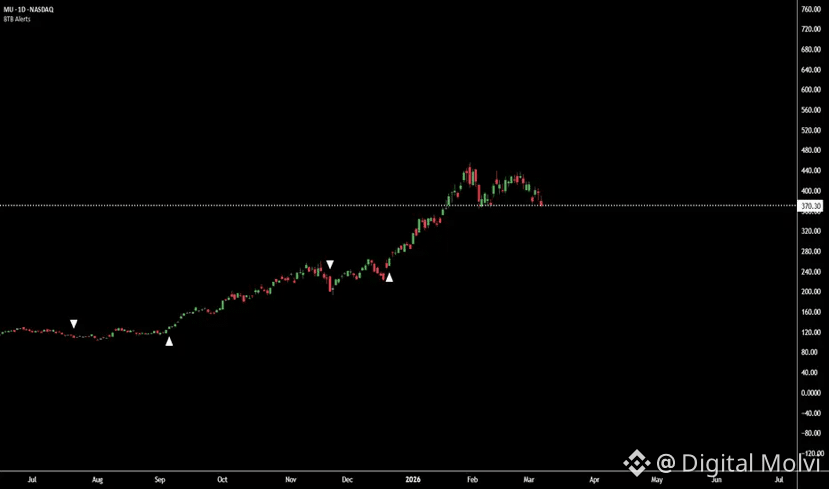
108
ບົດຄວາມ
The Future of Gaming TokensGaming tokens sit at the intersection of two massive industries: gaming and blockchain. For years, people have imagined virtual economies where in-game items, currencies, and identities could move freely across platforms and hold real-world value. Gaming tokens are one of the clearest attempts to make that vision real.
This article explores where gaming tokens are today, what is driving their growth, the challenges they still face, and what their future may look like.
What Are Gaming Tokens?
Gaming tokens are blockchain-based digital assets used within gaming ecosystems. They usually fall into a few categories:
In-game currencies used for purchases, upgrades, rewards, or marketplace activity
Governance tokens that let holders vote on game development or ecosystem decisions
Utility tokens that unlock features, access, staking rewards, or premium content
NFT-linked assets connected to characters, skins, weapons, land, or collectibles
Unlike traditional in-game currencies, gaming tokens can often be owned directly by players in self-custodied wallets, traded on exchanges, or used outside the original game environment.
Why Gaming Tokens Matter
Traditional games already have thriving digital economies. Players spend billions on skins, battle passes, upgrades, and virtual goods, but they usually do not truly own those assets. Gaming tokens introduce a different model: programmable ownership.
This matters for several reasons:
1. Player Ownership
Blockchain-based assets can give players stronger control over what they earn or buy. Instead of assets being locked inside a publisher’s database, tokens can be held, transferred, sold, or sometimes used across connected ecosystems.
2. Open Market Economies
Gaming tokens can support secondary markets where players trade assets more freely. This can create more dynamic economies and potentially reward skilled or early participants.
3. New Incentive Models
Developers can use tokens to reward engagement, tournament participation, content creation, bug reporting, or community building. This can turn players into stakeholders.
4. Community Governance
Some projects use tokens to let communities influence updates, treasury spending, esports initiatives, or ecosystem expansion.
The Evolution of Gaming Tokens
The first wave of blockchain gaming was driven by novelty. Early projects focused heavily on “play-to-earn,” promising users that gameplay could generate meaningful income. This attracted attention quickly, especially in emerging markets, but many of those models proved unsustainable.
Why? Because many early token economies depended more on new user inflows than on genuine entertainment value. When growth slowed, token prices dropped, rewards weakened, and user retention collapsed.
The next phase is more mature. The industry is shifting from play-to-earn to play-and-own or play-and-engage. In this model, the game comes first, and tokenization supports the experience rather than replacing it.
That shift is important. The future of gaming tokens likely depends less on speculation and more on whether they improve gameplay, community, and digital ownership in meaningful ways.
Key Trends Shaping the Future
1. Better Tokenomics
Future gaming tokens will likely be designed with more discipline. Stronger tokenomics may include:
Controlled token issuance
Clear sinks for spending tokens
Reduced inflation
Reward systems tied to real activity
Treasury management for long-term sustainability
Projects that treat tokens as economic infrastructure rather than marketing tools will have a better chance of surviving.
2. Gameplay First, Blockchain Second
The most promising blockchain games are increasingly hiding the technical complexity from users. Many players do not want to manage seed phrases, bridge assets, or pay unpredictable gas fees just to enjoy a game.
Future winners will likely make blockchain nearly invisible:
Wallets embedded into accounts
Gas abstraction
Simple onboarding
Familiar user interfaces
Optional rather than mandatory token interaction
In other words, players want fun first. Tokens should enhance the game, not become the game.
3. Interoperable Digital Assets
One of the most exciting long-term ideas is interoperability. A token or NFT earned in one game could potentially be recognized in another, or at least within a broader publisher ecosystem.
This is still difficult in practice because games differ in art style, balance, mechanics, and intellectual property rules. But partial interoperability is realistic:
Shared identity systems
Cross-game loyalty rewards
Ecosystem-wide currencies
Publisher-wide inventories
Tradable collectibles with multi-platform utility
The future may not be one sword usable in every game, but rather connected economies across related titles.
4. Growth of Layer 2 and Low-Fee Infrastructure
Gaming requires speed and low transaction costs. Expensive or slow blockchains are poor fits for high-frequency in-game actions. As scaling infrastructure improves, gaming tokens become more practical.
Low-fee networks, app-specific chains, and layer 2 solutions can support:
Microtransactions
Real-time rewards
Cheap item minting
High-volume marketplace activity
Seamless player interactions
Infrastructure improvements may do more for gaming token adoption than hype ever did.
5. Integration With Esports and Creator Economies
Gaming tokens may expand beyond gameplay into broader digital ecosystems:
Fan rewards for esports communities
Creator tipping and monetization
Tournament prize distribution
Community-owned teams or guilds
Token-gated events and memberships
This could make gaming tokens part of a larger entertainment economy, not just a game mechanic.
6. AI, User-Generated Content, and Virtual Economies
As games become more social and creator-driven, tokens may help coordinate ownership and incentives around user-generated content. Players could create maps, skins, mods, quests, or virtual experiences and receive token-based compensation.
Combined with AI-generated content, this could lead to much larger in-game economies where value is created not only by studios but by communities.
Major Challenges Ahead
Despite the potential, gaming tokens face serious obstacles.
Speculation Over Utility
Many gaming tokens are still valued more for trading potential than for actual in-game usefulness. If speculation dominates, economies become unstable and players lose trust.
Regulatory Uncertainty
Some tokens may attract scrutiny depending on how they are marketed, distributed, or used. Projects must be careful about compliance, especially when tokens resemble investment products.
Poor Game Quality
A weak game cannot be saved by a token. Many blockchain games failed because they focused on monetization before fun.
Economic Imbalance
If rewards are too generous, inflation rises. If rewards are too low, players disengage. Designing balanced token economies is extremely difficult.
Security Risks
Smart contract bugs, wallet compromises, phishing, and marketplace exploits can damage player confidence quickly.
Mainstream Resistance
Many traditional gamers remain skeptical of blockchain integration due to concerns about scams, environmental impact, pay-to-win mechanics, and financialization.
What the Future May Actually Look Like
The future of gaming tokens is unlikely to be a world where every game has a tradable token. Instead, adoption will probably be selective.
Here is a more realistic outlook:
Short Term
Fewer hype-driven token launches
More focus on sustainable economies
Better infrastructure and onboarding
Continued experimentation in niche communities
Medium Term
Stronger integration into live-service games
More token use in creator ecosystems and esports
Hybrid models where blockchain features are optional
Publisher ecosystems with shared rewards and marketplaces
Long Term
Persistent digital identities and reputations
Portable ownership across related platforms
Tokenized virtual labor and creator economies
Deep integration into metaverse-like social gaming environments
The biggest winners may not be projects that advertise themselves as “crypto games,” but games that quietly use blockchain to improve ownership, trading, and community participation.
Who Will Benefit Most?
Several groups could benefit if gaming tokens mature properly:
Players, through stronger ownership and tradable value
Developers, through new monetization and retention models
Creators, through direct compensation and programmable royalties
Communities, through governance and shared incentives
Publishers, through broader ecosystem engagement
But these benefits only materialize if token systems are fair, useful, and secondary to the core entertainment experience.
Conclusion
Gaming tokens have moved beyond the earliest wave of hype, but their future remains open. They are neither guaranteed to transform gaming nor destined to disappear. Their success will depend on whether they solve real problems for players and developers.
The strongest future for gaming tokens is not built on speculation. It is built on better games, smoother user experiences, sustainable economies, and genuine digital ownership.
If the industry gets those pieces right, gaming tokens could become a normal part of online gaming infrastructure. If not, they may remain a niche experiment remembered more for excitement than lasting impact.
In the end, the future of gaming tokens will be decided by a simple question: do they make games better? If the answer becomes yes, adoption will follow.
#digitalmolvi #GamingTokens #BinanceSquare
$AXS
{spot}(AXSUSDT)
$IMX
{spot}(IMXUSDT)
$SAND
{spot}(SANDUSDT)
The Future of Gaming Tokens
Gaming tokens sit at the intersection of two massive industries: gaming and blockchain. For years, people have imagined virtual economies where in-game items, currencies, and identities could move freely across platforms and hold real-world value. Gaming tokens are one of the clearest attempts to make that vision real.
This article explores where gaming tokens are today, what is driving their growth, the challenges they still face, and what their future may look like.
What Are Gaming Tokens?
Gaming tokens are blockchain-based digital assets used within gaming ecosystems. They usually fall into a few categories:
In-game currencies used for purchases, upgrades, rewards, or marketplace activity
Governance tokens that let holders vote on game development or ecosystem decisions
Utility tokens that unlock features, access, staking rewards, or premium content
NFT-linked assets connected to characters, skins, weapons, land, or collectibles
Unlike traditional in-game currencies, gaming tokens can often be owned directly by players in self-custodied wallets, traded on exchanges, or used outside the original game environment.
Why Gaming Tokens Matter
Traditional games already have thriving digital economies. Players spend billions on skins, battle passes, upgrades, and virtual goods, but they usually do not truly own those assets. Gaming tokens introduce a different model: programmable ownership.
This matters for several reasons:
1. Player Ownership
Blockchain-based assets can give players stronger control over what they earn or buy. Instead of assets being locked inside a publisher’s database, tokens can be held, transferred, sold, or sometimes used across connected ecosystems.
2. Open Market Economies
Gaming tokens can support secondary markets where players trade assets more freely. This can create more dynamic economies and potentially reward skilled or early participants.
3. New Incentive Models
Developers can use tokens to reward engagement, tournament participation, content creation, bug reporting, or community building. This can turn players into stakeholders.
4. Community Governance
Some projects use tokens to let communities influence updates, treasury spending, esports initiatives, or ecosystem expansion.
The Evolution of Gaming Tokens
The first wave of blockchain gaming was driven by novelty. Early projects focused heavily on “play-to-earn,” promising users that gameplay could generate meaningful income. This attracted attention quickly, especially in emerging markets, but many of those models proved unsustainable.
Why? Because many early token economies depended more on new user inflows than on genuine entertainment value. When growth slowed, token prices dropped, rewards weakened, and user retention collapsed.
The next phase is more mature. The industry is shifting from play-to-earn to play-and-own or play-and-engage. In this model, the game comes first, and tokenization supports the experience rather than replacing it.
That shift is important. The future of gaming tokens likely depends less on speculation and more on whether they improve gameplay, community, and digital ownership in meaningful ways.
Key Trends Shaping the Future
1. Better Tokenomics
Future gaming tokens will likely be designed with more discipline. Stronger tokenomics may include:
Controlled token issuance
Clear sinks for spending tokens
Reduced inflation
Reward systems tied to real activity
Treasury management for long-term sustainability
Projects that treat tokens as economic infrastructure rather than marketing tools will have a better chance of surviving.
2. Gameplay First, Blockchain Second
The most promising blockchain games are increasingly hiding the technical complexity from users. Many players do not want to manage seed phrases, bridge assets, or pay unpredictable gas fees just to enjoy a game.
Future winners will likely make blockchain nearly invisible:
Wallets embedded into accounts
Gas abstraction
Simple onboarding
Familiar user interfaces
Optional rather than mandatory token interaction
In other words, players want fun first. Tokens should enhance the game, not become the game.
3. Interoperable Digital Assets
One of the most exciting long-term ideas is interoperability. A token or NFT earned in one game could potentially be recognized in another, or at least within a broader publisher ecosystem.
This is still difficult in practice because games differ in art style, balance, mechanics, and intellectual property rules. But partial interoperability is realistic:
Shared identity systems
Cross-game loyalty rewards
Ecosystem-wide currencies
Publisher-wide inventories
Tradable collectibles with multi-platform utility
The future may not be one sword usable in every game, but rather connected economies across related titles.
4. Growth of Layer 2 and Low-Fee Infrastructure
Gaming requires speed and low transaction costs. Expensive or slow blockchains are poor fits for high-frequency in-game actions. As scaling infrastructure improves, gaming tokens become more practical.
Low-fee networks, app-specific chains, and layer 2 solutions can support:
Microtransactions
Real-time rewards
Cheap item minting
High-volume marketplace activity
Seamless player interactions
Infrastructure improvements may do more for gaming token adoption than hype ever did.
5. Integration With Esports and Creator Economies
Gaming tokens may expand beyond gameplay into broader digital ecosystems:
Fan rewards for esports communities
Creator tipping and monetization
Tournament prize distribution
Community-owned teams or guilds
Token-gated events and memberships
This could make gaming tokens part of a larger entertainment economy, not just a game mechanic.
6. AI, User-Generated Content, and Virtual Economies
As games become more social and creator-driven, tokens may help coordinate ownership and incentives around user-generated content. Players could create maps, skins, mods, quests, or virtual experiences and receive token-based compensation.
Combined with AI-generated content, this could lead to much larger in-game economies where value is created not only by studios but by communities.
Major Challenges Ahead
Despite the potential, gaming tokens face serious obstacles.
Speculation Over Utility
Many gaming tokens are still valued more for trading potential than for actual in-game usefulness. If speculation dominates, economies become unstable and players lose trust.
Regulatory Uncertainty
Some tokens may attract scrutiny depending on how they are marketed, distributed, or used. Projects must be careful about compliance, especially when tokens resemble investment products.
Poor Game Quality
A weak game cannot be saved by a token. Many blockchain games failed because they focused on monetization before fun.
Economic Imbalance
If rewards are too generous, inflation rises. If rewards are too low, players disengage. Designing balanced token economies is extremely difficult.
Security Risks
Smart contract bugs, wallet compromises, phishing, and marketplace exploits can damage player confidence quickly.
Mainstream Resistance
Many traditional gamers remain skeptical of blockchain integration due to concerns about scams, environmental impact, pay-to-win mechanics, and financialization.
What the Future May Actually Look Like
The future of gaming tokens is unlikely to be a world where every game has a tradable token. Instead, adoption will probably be selective.
Here is a more realistic outlook:
Short Term
Fewer hype-driven token launches
More focus on sustainable economies
Better infrastructure and onboarding
Continued experimentation in niche communities
Medium Term
Stronger integration into live-service games
More token use in creator ecosystems and esports
Hybrid models where blockchain features are optional
Publisher ecosystems with shared rewards and marketplaces
Long Term
Persistent digital identities and reputations
Portable ownership across related platforms
Tokenized virtual labor and creator economies
Deep integration into metaverse-like social gaming environments
The biggest winners may not be projects that advertise themselves as “crypto games,” but games that quietly use blockchain to improve ownership, trading, and community participation.
Who Will Benefit Most?
Several groups could benefit if gaming tokens mature properly:
Players, through stronger ownership and tradable value
Developers, through new monetization and retention models
Creators, through direct compensation and programmable royalties
Communities, through governance and shared incentives
Publishers, through broader ecosystem engagement
But these benefits only materialize if token systems are fair, useful, and secondary to the core entertainment experience.
Conclusion
Gaming tokens have moved beyond the earliest wave of hype, but their future remains open. They are neither guaranteed to transform gaming nor destined to disappear. Their success will depend on whether they solve real problems for players and developers.
The strongest future for gaming tokens is not built on speculation. It is built on better games, smoother user experiences, sustainable economies, and genuine digital ownership.
If the industry gets those pieces right, gaming tokens could become a normal part of online gaming infrastructure. If not, they may remain a niche experiment remembered more for excitement than lasting impact.
In the end, the future of gaming tokens will be decided by a simple question: do they make games better? If the answer becomes yes, adoption will follow.
#digitalmolvi #GamingTokens #BinanceSquare
$AXS
$IMX
$SAND
This article explores where gaming tokens are today, what is driving their growth, the challenges they still face, and what their future may look like.
What Are Gaming Tokens?
Gaming tokens are blockchain-based digital assets used within gaming ecosystems. They usually fall into a few categories:
In-game currencies used for purchases, upgrades, rewards, or marketplace activity
Governance tokens that let holders vote on game development or ecosystem decisions
Utility tokens that unlock features, access, staking rewards, or premium content
NFT-linked assets connected to characters, skins, weapons, land, or collectibles
Unlike traditional in-game currencies, gaming tokens can often be owned directly by players in self-custodied wallets, traded on exchanges, or used outside the original game environment.
Why Gaming Tokens Matter
Traditional games already have thriving digital economies. Players spend billions on skins, battle passes, upgrades, and virtual goods, but they usually do not truly own those assets. Gaming tokens introduce a different model: programmable ownership.
This matters for several reasons:
1. Player Ownership
Blockchain-based assets can give players stronger control over what they earn or buy. Instead of assets being locked inside a publisher’s database, tokens can be held, transferred, sold, or sometimes used across connected ecosystems.
2. Open Market Economies
Gaming tokens can support secondary markets where players trade assets more freely. This can create more dynamic economies and potentially reward skilled or early participants.
3. New Incentive Models
Developers can use tokens to reward engagement, tournament participation, content creation, bug reporting, or community building. This can turn players into stakeholders.
4. Community Governance
Some projects use tokens to let communities influence updates, treasury spending, esports initiatives, or ecosystem expansion.
The Evolution of Gaming Tokens
The first wave of blockchain gaming was driven by novelty. Early projects focused heavily on “play-to-earn,” promising users that gameplay could generate meaningful income. This attracted attention quickly, especially in emerging markets, but many of those models proved unsustainable.
Why? Because many early token economies depended more on new user inflows than on genuine entertainment value. When growth slowed, token prices dropped, rewards weakened, and user retention collapsed.
The next phase is more mature. The industry is shifting from play-to-earn to play-and-own or play-and-engage. In this model, the game comes first, and tokenization supports the experience rather than replacing it.
That shift is important. The future of gaming tokens likely depends less on speculation and more on whether they improve gameplay, community, and digital ownership in meaningful ways.
Key Trends Shaping the Future
1. Better Tokenomics
Future gaming tokens will likely be designed with more discipline. Stronger tokenomics may include:
Controlled token issuance
Clear sinks for spending tokens
Reduced inflation
Reward systems tied to real activity
Treasury management for long-term sustainability
Projects that treat tokens as economic infrastructure rather than marketing tools will have a better chance of surviving.
2. Gameplay First, Blockchain Second
The most promising blockchain games are increasingly hiding the technical complexity from users. Many players do not want to manage seed phrases, bridge assets, or pay unpredictable gas fees just to enjoy a game.
Future winners will likely make blockchain nearly invisible:
Wallets embedded into accounts
Gas abstraction
Simple onboarding
Familiar user interfaces
Optional rather than mandatory token interaction
In other words, players want fun first. Tokens should enhance the game, not become the game.
3. Interoperable Digital Assets
One of the most exciting long-term ideas is interoperability. A token or NFT earned in one game could potentially be recognized in another, or at least within a broader publisher ecosystem.
This is still difficult in practice because games differ in art style, balance, mechanics, and intellectual property rules. But partial interoperability is realistic:
Shared identity systems
Cross-game loyalty rewards
Ecosystem-wide currencies
Publisher-wide inventories
Tradable collectibles with multi-platform utility
The future may not be one sword usable in every game, but rather connected economies across related titles.
4. Growth of Layer 2 and Low-Fee Infrastructure
Gaming requires speed and low transaction costs. Expensive or slow blockchains are poor fits for high-frequency in-game actions. As scaling infrastructure improves, gaming tokens become more practical.
Low-fee networks, app-specific chains, and layer 2 solutions can support:
Microtransactions
Real-time rewards
Cheap item minting
High-volume marketplace activity
Seamless player interactions
Infrastructure improvements may do more for gaming token adoption than hype ever did.
5. Integration With Esports and Creator Economies
Gaming tokens may expand beyond gameplay into broader digital ecosystems:
Fan rewards for esports communities
Creator tipping and monetization
Tournament prize distribution
Community-owned teams or guilds
Token-gated events and memberships
This could make gaming tokens part of a larger entertainment economy, not just a game mechanic.
6. AI, User-Generated Content, and Virtual Economies
As games become more social and creator-driven, tokens may help coordinate ownership and incentives around user-generated content. Players could create maps, skins, mods, quests, or virtual experiences and receive token-based compensation.
Combined with AI-generated content, this could lead to much larger in-game economies where value is created not only by studios but by communities.
Major Challenges Ahead
Despite the potential, gaming tokens face serious obstacles.
Speculation Over Utility
Many gaming tokens are still valued more for trading potential than for actual in-game usefulness. If speculation dominates, economies become unstable and players lose trust.
Regulatory Uncertainty
Some tokens may attract scrutiny depending on how they are marketed, distributed, or used. Projects must be careful about compliance, especially when tokens resemble investment products.
Poor Game Quality
A weak game cannot be saved by a token. Many blockchain games failed because they focused on monetization before fun.
Economic Imbalance
If rewards are too generous, inflation rises. If rewards are too low, players disengage. Designing balanced token economies is extremely difficult.
Security Risks
Smart contract bugs, wallet compromises, phishing, and marketplace exploits can damage player confidence quickly.
Mainstream Resistance
Many traditional gamers remain skeptical of blockchain integration due to concerns about scams, environmental impact, pay-to-win mechanics, and financialization.
What the Future May Actually Look Like
The future of gaming tokens is unlikely to be a world where every game has a tradable token. Instead, adoption will probably be selective.
Here is a more realistic outlook:
Short Term
Fewer hype-driven token launches
More focus on sustainable economies
Better infrastructure and onboarding
Continued experimentation in niche communities
Medium Term
Stronger integration into live-service games
More token use in creator ecosystems and esports
Hybrid models where blockchain features are optional
Publisher ecosystems with shared rewards and marketplaces
Long Term
Persistent digital identities and reputations
Portable ownership across related platforms
Tokenized virtual labor and creator economies
Deep integration into metaverse-like social gaming environments
The biggest winners may not be projects that advertise themselves as “crypto games,” but games that quietly use blockchain to improve ownership, trading, and community participation.
Who Will Benefit Most?
Several groups could benefit if gaming tokens mature properly:
Players, through stronger ownership and tradable value
Developers, through new monetization and retention models
Creators, through direct compensation and programmable royalties
Communities, through governance and shared incentives
Publishers, through broader ecosystem engagement
But these benefits only materialize if token systems are fair, useful, and secondary to the core entertainment experience.
Conclusion
Gaming tokens have moved beyond the earliest wave of hype, but their future remains open. They are neither guaranteed to transform gaming nor destined to disappear. Their success will depend on whether they solve real problems for players and developers.
The strongest future for gaming tokens is not built on speculation. It is built on better games, smoother user experiences, sustainable economies, and genuine digital ownership.
If the industry gets those pieces right, gaming tokens could become a normal part of online gaming infrastructure. If not, they may remain a niche experiment remembered more for excitement than lasting impact.
In the end, the future of gaming tokens will be decided by a simple question: do they make games better? If the answer becomes yes, adoption will follow.
#digitalmolvi #GamingTokens #BinanceSquare
$AXS
$IMX
$SAND
222
Staking rewards look “passive,” but the real game is net return: rewards earned minus price volatility, lock-up limits, and validator/platform risk. Best approach: stake only coins you’d hold long-term, diversify across assets, and avoid unrealistic APYs that usually come with hidden risk.
#digitalmolvi #BinanceSquare #stakingrewards #CryptoEarn #dyor
$BTC
{spot}(BTCUSDT)
Staking rewards look “passive,” but the real game is net return: rewards earned minus price volatility, lock-up limits, and validator/platform risk. Best approach: stake only coins you’d hold long-term, diversify across assets, and avoid unrealistic APYs that usually come with hidden risk.
#digitalmolvi #BinanceSquare #stakingrewards #CryptoEarn #dyor
$BTC
#digitalmolvi #BinanceSquare #stakingrewards #CryptoEarn #dyor
$BTC
46
Trending alts show where attention and liquidity are flowing, but hype alone is not a strategy.
The real edge is separating strong narratives and real momentum from short-term noise.
#digitalmolvi
$BTC
{spot}(BTCUSDT)
$ETH
{spot}(ETHUSDT)
$SOL
{spot}(SOLUSDT)
Trending alts show where attention and liquidity are flowing, but hype alone is not a strategy.
The real edge is separating strong narratives and real momentum from short-term noise.
#digitalmolvi
$BTC
$ETH
$SOL
The real edge is separating strong narratives and real momentum from short-term noise.
#digitalmolvi
$BTC
$ETH
$SOL
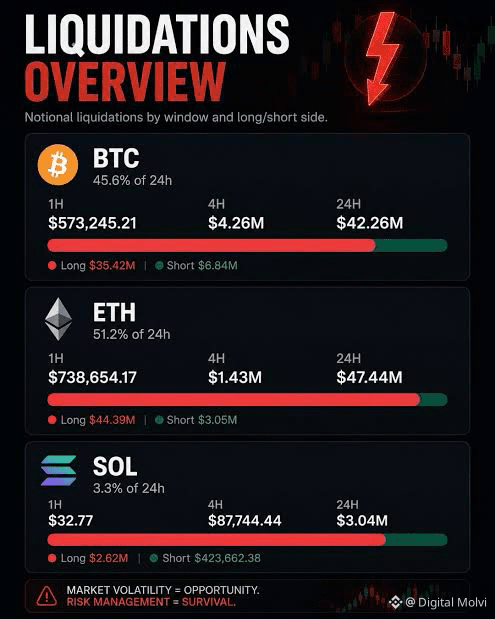
64
Prioritizing Capital Preservation in Crypto Trading
In the volatile world of digital assets, the first rule of long-term success is capital protection. While chasing gains is a primary goal, safeguarding your principal is what keeps you in the game.
To protect your capital on Binance, consider these essential strategies:
Use Stop-Loss Orders: Always define your exit point to prevent emotional decision-making during market dips.
Diversification: Avoid over-concentration in a single asset; spread your risk across different sectors of the crypto ecosystem.
Utilize Binance Earn: For a more conservative approach, consider low-risk products like Simple Earn to grow your holdings with lower volatility.
Risk Management: Never invest more than you can afford to lose and manage your leverage levels strictly.
Remember: Profit comes and goes, but preserved capital provides the foundation for your next opportunity.
#digitalmolvi #cryptotrading #RiskManagement #capitalprotection #binancesquare
$BTC
{spot}(BTCUSDT)
$ETH
{spot}(ETHUSDT)
$BNB
{spot}(BNBUSDT)
Prioritizing Capital Preservation in Crypto Trading
In the volatile world of digital assets, the first rule of long-term success is capital protection. While chasing gains is a primary goal, safeguarding your principal is what keeps you in the game.
To protect your capital on Binance, consider these essential strategies:
Use Stop-Loss Orders: Always define your exit point to prevent emotional decision-making during market dips.
Diversification: Avoid over-concentration in a single asset; spread your risk across different sectors of the crypto ecosystem.
Utilize Binance Earn: For a more conservative approach, consider low-risk products like Simple Earn to grow your holdings with lower volatility.
Risk Management: Never invest more than you can afford to lose and manage your leverage levels strictly.
Remember: Profit comes and goes, but preserved capital provides the foundation for your next opportunity.
#digitalmolvi #cryptotrading #RiskManagement #capitalprotection #binancesquare
$BTC
$ETH
$BNB
In the volatile world of digital assets, the first rule of long-term success is capital protection. While chasing gains is a primary goal, safeguarding your principal is what keeps you in the game.
To protect your capital on Binance, consider these essential strategies:
Use Stop-Loss Orders: Always define your exit point to prevent emotional decision-making during market dips.
Diversification: Avoid over-concentration in a single asset; spread your risk across different sectors of the crypto ecosystem.
Utilize Binance Earn: For a more conservative approach, consider low-risk products like Simple Earn to grow your holdings with lower volatility.
Risk Management: Never invest more than you can afford to lose and manage your leverage levels strictly.
Remember: Profit comes and goes, but preserved capital provides the foundation for your next opportunity.
#digitalmolvi #cryptotrading #RiskManagement #capitalprotection #binancesquare
$BTC
$ETH
$BNB

29
·
--
ສັນຍານກະທິງ
Tokenized assets are turning real-world value into on-chain opportunity. From stocks and bonds to real estate and gold, tokenization can make markets more accessible, liquid, and global. The big idea: faster settlement, fractional ownership, and 24/7 transferability. Still early—but this trend could reshape how value moves.
#digitalmolvi #Tokenization #binancesquare
$RENDER
{spot}(RENDERUSDT)
$TAO
{spot}(TAOUSDT)
$ICP
{spot}(ICPUSDT)
Tokenized assets are turning real-world value into on-chain opportunity. From stocks and bonds to real estate and gold, tokenization can make markets more accessible, liquid, and global. The big idea: faster settlement, fractional ownership, and 24/7 transferability. Still early—but this trend could reshape how value moves.
#digitalmolvi #Tokenization #binancesquare
$RENDER
$TAO
$ICP
#digitalmolvi #Tokenization #binancesquare
$RENDER
$TAO
$ICP
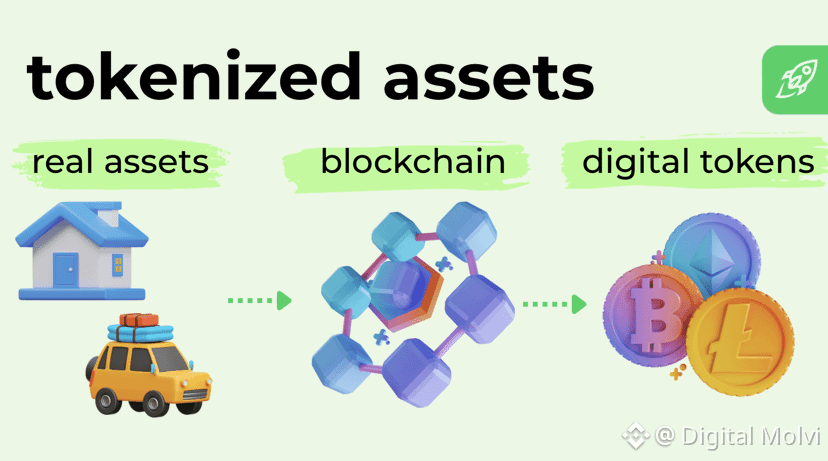
207
Bull cycle mindset:
In a bull market, almost everything looks easy — until greed takes over. The real winners are usually the ones who manage risk, take profits in layers, and don’t confuse hype with strength. Ride the trend, but protect your capital.
#digitalmolvi #BullCycle #BinanceSquare
$SPCXB
{spot}(SPCXBUSDT)
$TSLAB
{spot}(TSLABUSDT)
$MUB
{spot}(MUBUSDT)
Bull cycle mindset:
In a bull market, almost everything looks easy — until greed takes over. The real winners are usually the ones who manage risk, take profits in layers, and don’t confuse hype with strength. Ride the trend, but protect your capital.
#digitalmolvi #BullCycle #BinanceSquare
$SPCXB
$TSLAB
$MUB
In a bull market, almost everything looks easy — until greed takes over. The real winners are usually the ones who manage risk, take profits in layers, and don’t confuse hype with strength. Ride the trend, but protect your capital.
#digitalmolvi #BullCycle #BinanceSquare
$SPCXB
$TSLAB
$MUB
119
Crypto is changing remittance use cases because it can make cross-border transfers faster, cheaper, and more accessible than traditional rails in some situations.
For many users, especially in emerging markets, stablecoins are becoming more than a trading tool—they’re becoming a practical payment layer.
#digitalmolvi
$PEPE
{spot}(PEPEUSDT)
$SHIB
{spot}(SHIBUSDT)
$DOGE
{spot}(DOGEUSDT)
Crypto is changing remittance use cases because it can make cross-border transfers faster, cheaper, and more accessible than traditional rails in some situations.
For many users, especially in emerging markets, stablecoins are becoming more than a trading tool—they’re becoming a practical payment layer.
#digitalmolvi
$PEPE
$SHIB
$DOGE
For many users, especially in emerging markets, stablecoins are becoming more than a trading tool—they’re becoming a practical payment layer.
#digitalmolvi
$PEPE
$SHIB
$DOGE
88
ເຂົ້າສູ່ລະບົບເພື່ອສຳຫຼວດເນື້ອຫາເພີ່ມເຕີມ
ເຂົ້າຮ່ວມກຸ່ມຜູ້ໃຊ້ຄຣິບໂຕທົ່ວໂລກໃນ Binance Square.
⚡️ ໄດ້ຮັບຂໍ້ມູນຫຼ້າສຸດ ແລະ ທີ່ມີປະໂຫຍດກ່ຽວກັບຄຣິບໂຕ.
💬 ໄດ້ຮັບຄວາມໄວ້ວາງໃຈຈາກຕະຫຼາດແລກປ່ຽນຄຣິບໂຕທີ່ໃຫຍ່ທີ່ສຸດໃນໂລກ.
👍 ຄົ້ນຫາຂໍ້ມູນເຊີງເລິກທີ່ແທ້ຈາກນັກສ້າງທີ່ໄດ້ຮັບການຢືນຢັນ.
ອີເມວ / ເບີໂທລະສັບ
ຫົວຂໍ້ທີ່ກໍາລັງນິຍົມ
1
#BinanceLaunchesBinanceIntelligence
231,596 views
2,082 ກຳລັງສົນທະນາ
2
#StriveBuys2000BTCFor$169M
10,252 views
99 ກຳລັງສົນທະນາ
3
#EvernorthXRPTreasuryCompletesSPACMerger
122,023 views
1,225 ກຳລັງສົນທະນາ
4
#ADAGains10%Above$0.27
53,689 views
251 ກຳລັງສົນທະນາ
5
#ETHUp70%InQ3ButLiquidityFalls
318,361 views
2,233 ກຳລັງສົນທະນາ
6
#EthStakingExitQueueHits2026High
126,584 views
1,478 ກຳລັງສົນທະນາ
7
#FedOctoberHoldOdds82.3%
136,110 views
1,408 ກຳລັງສົນທະນາ
8
#Nikkei225Jumps2.5%ToThreeMonthHigh
120,613 views
1,537 ກຳລັງສົນທະນາ
9
#CircleMints$2.75BUSDCOnSolanaIn7Days
3,193 views
65 ກຳລັງສົນທະນາ
10
#DriftHackVictimsBeginClaims
241,918 views
2,235 ກຳລັງສົນທະນາ