

Max-bia
13.7k Жариялаулар

Max-bia
Хабарлау
Пайдаланушыны блоктау
Still learning💻 Still growing💸
620 Жазылым
5.6K+ Жазылушылар
7.2K+ лайк басылған
Жазбалар
·
--
CYS Short & Punchy Breakdown:
Navigating the -16.60% Dip!
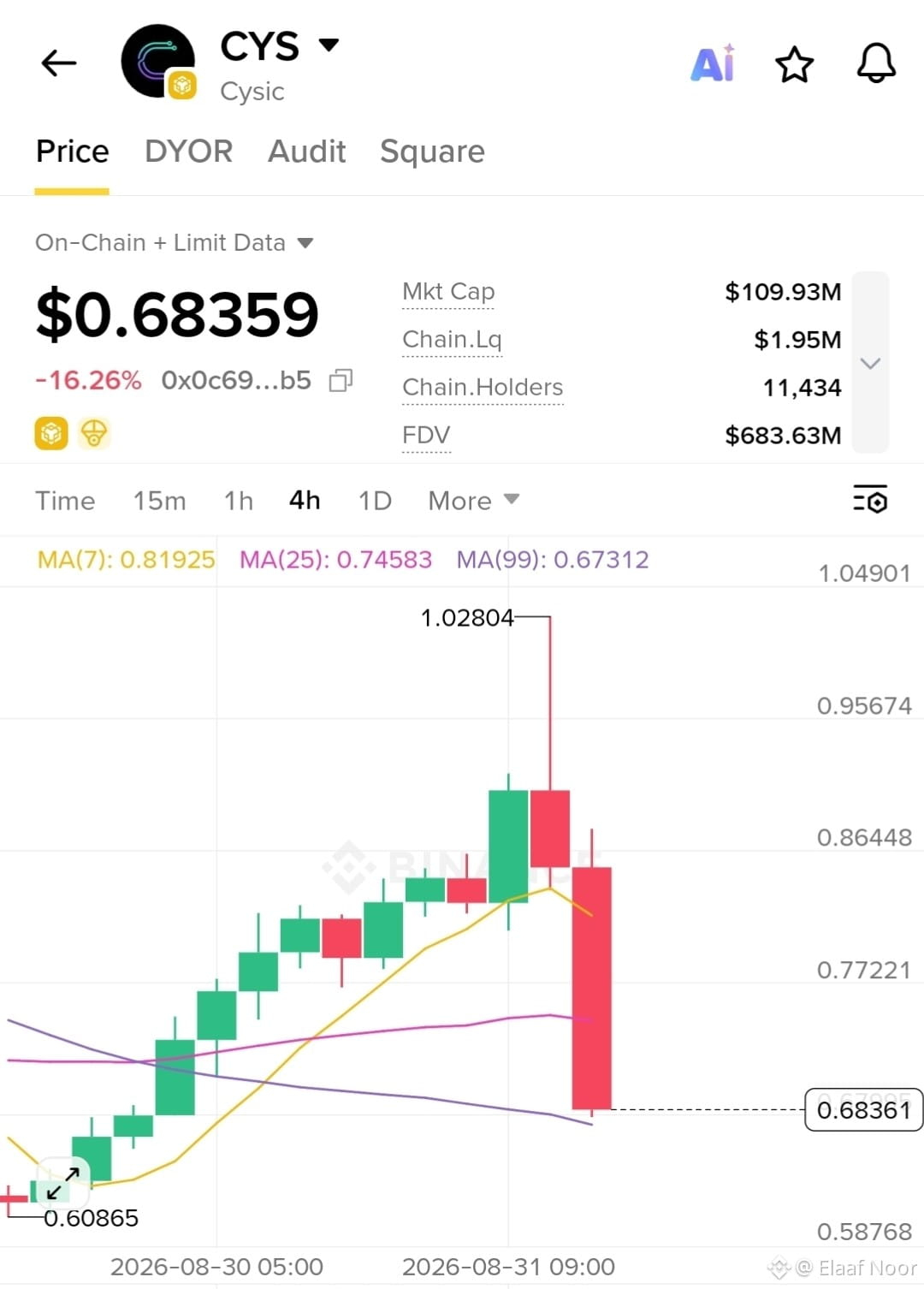
$CYS (Cysic) is under heavy pressure dropping - 16.60% to trade at $0.6820 currently sitting in a bearish structure below the $0.75 resistance.
However social sentiment remains heavily skewed at 72.49% Bullish hinting that accumulation might be brewing beneath the surface.
Here is the tactical game plan:
The Critical Support Zone: Smart money longs are clustering near support creating a defined risk area with clear invalidation rules for traders.
The Reclaim Trigger: Watch for a 1-hour candle close above $0.76.
This confirms that sellers have been absorbed by whales and paves the way for a bullish continuation toward $0.85.
Are you accumulating this -16.60% dip or waiting for the $0.76 confirmation? Let me know below!
$CYS #CYS #cryptotrading #BinanceSquare
CYS Short & Punchy Breakdown:
Navigating the -16.60% Dip!
$CYS (Cysic) is under heavy pressure dropping - 16.60% to trade at $0.6820 currently sitting in a bearish structure below the $0.75 resistance.
However social sentiment remains heavily skewed at 72.49% Bullish hinting that accumulation might be brewing beneath the surface.
Here is the tactical game plan:
The Critical Support Zone: Smart money longs are clustering near support creating a defined risk area with clear invalidation rules for traders.
The Reclaim Trigger: Watch for a 1-hour candle close above $0.76.
This confirms that sellers have been absorbed by whales and paves the way for a bullish continuation toward $0.85.
Are you accumulating this -16.60% dip or waiting for the $0.76 confirmation? Let me know below!
$CYS #CYS #cryptotrading #BinanceSquare
Navigating the -16.60% Dip!
$CYS (Cysic) is under heavy pressure dropping - 16.60% to trade at $0.6820 currently sitting in a bearish structure below the $0.75 resistance.
However social sentiment remains heavily skewed at 72.49% Bullish hinting that accumulation might be brewing beneath the surface.
Here is the tactical game plan:
The Critical Support Zone: Smart money longs are clustering near support creating a defined risk area with clear invalidation rules for traders.
The Reclaim Trigger: Watch for a 1-hour candle close above $0.76.
This confirms that sellers have been absorbed by whales and paves the way for a bullish continuation toward $0.85.
Are you accumulating this -16.60% dip or waiting for the $0.76 confirmation? Let me know below!
$CYS #CYS #cryptotrading #BinanceSquare
1
290
·
--
Market Pulse: $MRVL Post-Earnings Reality Check
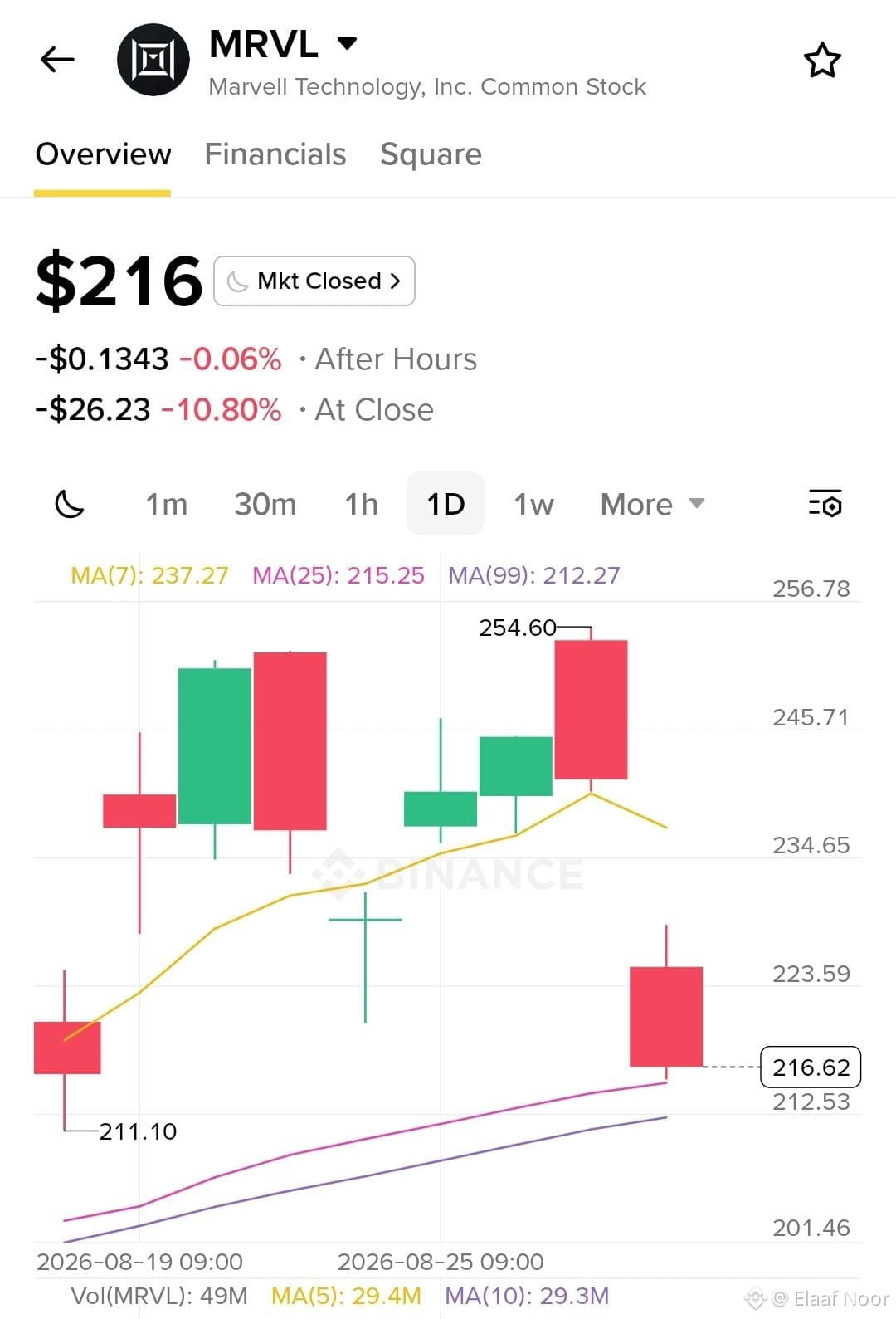
The numbers looked solid the long-term guidance was rais yet the market reacted with an 11.02% drop.
When a core semiconductor infrastructure player pulls back like that despite robust data-center growth it tells a very clear story about how high valuation expectations currently sit.
Here is how the underlying market dynamics are shaking out:
The Earnings Setup: Marvell lifted its multi-year targets driven directly by data-center expansion & heavy technology spending under CEO Matt Murphy.
The Reaction: A sharp 11.02% sell-off proving that in rich valuations even strong corporate updates can temporarily turn into sell-the-news events if investors crave higher upside or sharper margin visibility.
The Infrastructure Layer: Sitting right alongside major legacy tech giants MRVL's movement highlights how strictly the market is weighing hardware execution customer concentration & custom silicon programs.
The Bigger Picture:
The real test moving forward isnot just the initial guidance bump-its whether custom silicon orders and high-speed networking demand can consistently convert into durable operating leverage quarter after quarter.
Are you viewing this 11.02% dip as a healthy flush or a sign of stretched valuation
#Marvell #Semiconductors #stockmarket #BinanceSquare
$MRVL
Market Pulse: $MRVL Post-Earnings Reality Check
The numbers looked solid the long-term guidance was rais yet the market reacted with an 11.02% drop.
When a core semiconductor infrastructure player pulls back like that despite robust data-center growth it tells a very clear story about how high valuation expectations currently sit.
Here is how the underlying market dynamics are shaking out:
The Earnings Setup: Marvell lifted its multi-year targets driven directly by data-center expansion & heavy technology spending under CEO Matt Murphy.
The Reaction: A sharp 11.02% sell-off proving that in rich valuations even strong corporate updates can temporarily turn into sell-the-news events if investors crave higher upside or sharper margin visibility.
The Infrastructure Layer: Sitting right alongside major legacy tech giants MRVL's movement highlights how strictly the market is weighing hardware execution customer concentration & custom silicon programs.
The Bigger Picture:
The real test moving forward isnot just the initial guidance bump-its whether custom silicon orders and high-speed networking demand can consistently convert into durable operating leverage quarter after quarter.
Are you viewing this 11.02% dip as a healthy flush or a sign of stretched valuation
#Marvell #Semiconductors #stockmarket #BinanceSquare
$MRVL
The numbers looked solid the long-term guidance was rais yet the market reacted with an 11.02% drop.
When a core semiconductor infrastructure player pulls back like that despite robust data-center growth it tells a very clear story about how high valuation expectations currently sit.
Here is how the underlying market dynamics are shaking out:
The Earnings Setup: Marvell lifted its multi-year targets driven directly by data-center expansion & heavy technology spending under CEO Matt Murphy.
The Reaction: A sharp 11.02% sell-off proving that in rich valuations even strong corporate updates can temporarily turn into sell-the-news events if investors crave higher upside or sharper margin visibility.
The Infrastructure Layer: Sitting right alongside major legacy tech giants MRVL's movement highlights how strictly the market is weighing hardware execution customer concentration & custom silicon programs.
The Bigger Picture:
The real test moving forward isnot just the initial guidance bump-its whether custom silicon orders and high-speed networking demand can consistently convert into durable operating leverage quarter after quarter.
Are you viewing this 11.02% dip as a healthy flush or a sign of stretched valuation
#Marvell #Semiconductors #stockmarket #BinanceSquare
$MRVL
2
301
·
--
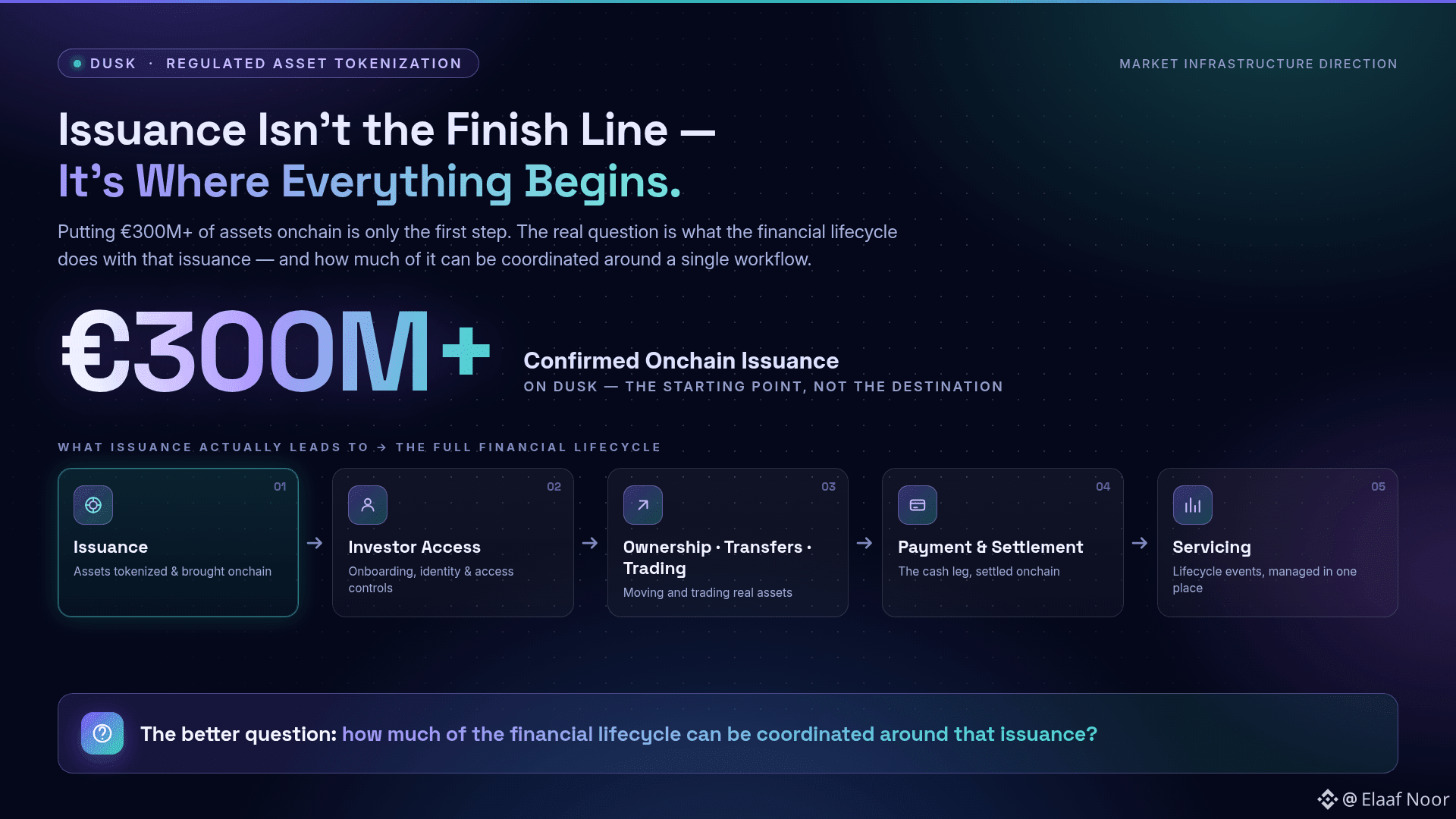
I noticed Dusk is currently showing €300M+ in confirmed issuance.
But honestly I did not think the number itself is the most interesting part.
The better question is:
What does issuance actually lead to?
Because putting €300M worth of assets onchain is not the finish line.
After issuance comes:
investor access
ownership / transfers / trading / payment / settlement and servicing.
That is why I think Dusk's current market-infrastructure direction is more interesting than a simple tokenization headline.
The network is being designed around the full workflow.
Dusk's own architecture brings together:
native L1 settlement
Dusk Trade
DuskEVM
identity and access infrastructure
regulated venues
custody
payment infrastructure.
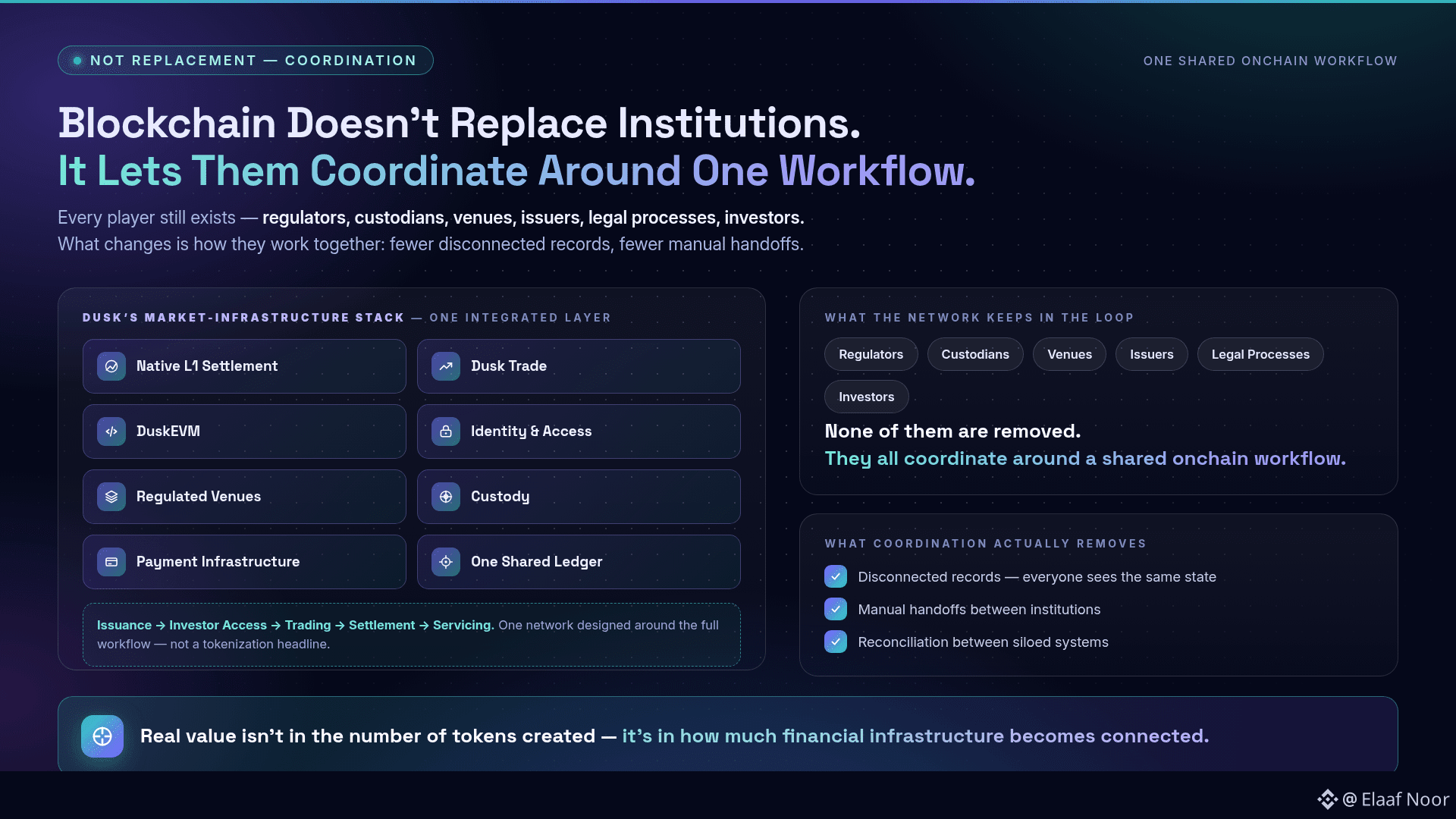
And the goal isnot necessarily to replace every institution involved.
It is to let those institutions coordinate around a shared onchain workflow.
That is an important distinction.
Blockchain doesnot eliminate:
regulators
custodians
venues
issuers
legal processes
or investors.
It can potentially reduce the number of disconnected records and manual handoffs between them.
So when I see €300M+ confirmed issuance, I do not immediately think:
“more tokens.”
I think: How much of the financial lifecycle can eventually be coordinated around that issuance?
Because that is where the real value of regulated tokenization should show up.
Not in the number of tokens created.
In the amount of financial infrastructure that becomes more connected.
#dusk $DUSK @Dusk_Foundation
I noticed Dusk is currently showing €300M+ in confirmed issuance.
But honestly I did not think the number itself is the most interesting part.
The better question is:
What does issuance actually lead to?
Because putting €300M worth of assets onchain is not the finish line.
After issuance comes:
investor access
ownership / transfers / trading / payment / settlement and servicing.
That is why I think Dusk's current market-infrastructure direction is more interesting than a simple tokenization headline.
The network is being designed around the full workflow.
Dusk's own architecture brings together:
native L1 settlement
Dusk Trade
DuskEVM
identity and access infrastructure
regulated venues
custody
payment infrastructure.
And the goal isnot necessarily to replace every institution involved.
It is to let those institutions coordinate around a shared onchain workflow.
That is an important distinction.
Blockchain doesnot eliminate:
regulators
custodians
venues
issuers
legal processes
or investors.
It can potentially reduce the number of disconnected records and manual handoffs between them.
So when I see €300M+ confirmed issuance, I do not immediately think:
“more tokens.”
I think: How much of the financial lifecycle can eventually be coordinated around that issuance?
Because that is where the real value of regulated tokenization should show up.
Not in the number of tokens created.
In the amount of financial infrastructure that becomes more connected.
#dusk $DUSK @Dusk
But honestly I did not think the number itself is the most interesting part.
The better question is:
What does issuance actually lead to?
Because putting €300M worth of assets onchain is not the finish line.
After issuance comes:
investor access
ownership / transfers / trading / payment / settlement and servicing.
That is why I think Dusk's current market-infrastructure direction is more interesting than a simple tokenization headline.
The network is being designed around the full workflow.
Dusk's own architecture brings together:
native L1 settlement
Dusk Trade
DuskEVM
identity and access infrastructure
regulated venues
custody
payment infrastructure.
And the goal isnot necessarily to replace every institution involved.
It is to let those institutions coordinate around a shared onchain workflow.
That is an important distinction.
Blockchain doesnot eliminate:
regulators
custodians
venues
issuers
legal processes
or investors.
It can potentially reduce the number of disconnected records and manual handoffs between them.
So when I see €300M+ confirmed issuance, I do not immediately think:
“more tokens.”
I think: How much of the financial lifecycle can eventually be coordinated around that issuance?
Because that is where the real value of regulated tokenization should show up.
Not in the number of tokens created.
In the amount of financial infrastructure that becomes more connected.
#dusk $DUSK @Dusk
1
5
1.2k
·
--
Жоғары (өспелі)
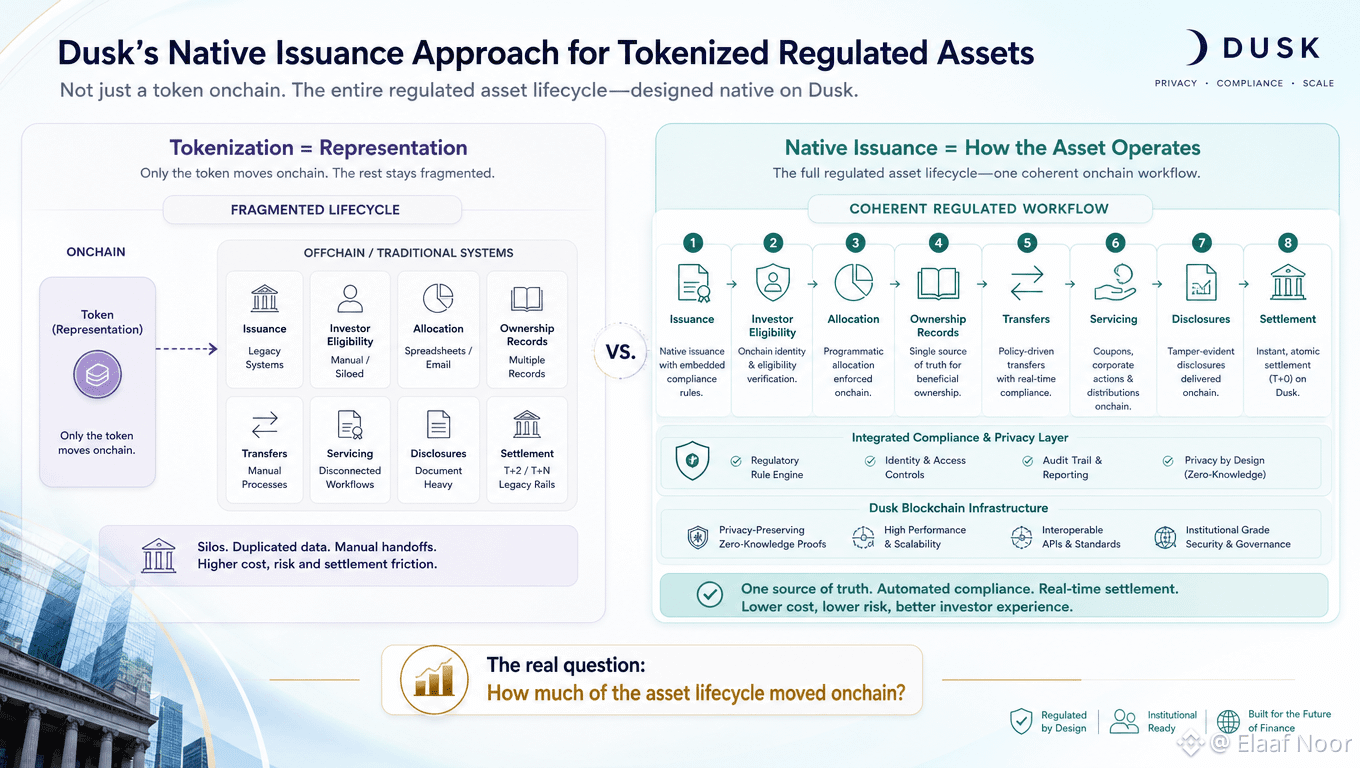
The more I read Dusk's approach to tokenization, the more I think the word tokenization hides the real problem.
Creating a token is relatively easy.
The harder question is:
What happens to the asset after the token exists?
Take a regulated security.
Its lifecycle can involve:
issuance
investor eligibility
allocation
ownership records
transfers
servicing
disclosures
settlement.
If only the ownership token moves onchain while the rest of the lifecycle remains scattered across traditional systems have digitized a piece of the process.
You have not necessarily rebuilt the process.
Thats why Dusk's native-issuance approach interests me.
The idea is to design more of the assets lifecycle around onchain infrastructure from the beginning rather than simply creating an onchain representation of something that fundamentally lives elsewhere.
And there is an important distinction here:
tokenization is about representation.
Native issuance can be about how the asset actually operates.
That changes the design question.
Instead of asking:
Can this security become a token?
I did ask: Can its rules, ownership changes, transfers, servicing and settlement be designed as one coherent regulated workflow?
Thats a much higher bar.
And it is also why I think RWAs should eventually be judged by more than token count or TVL.
The real metric should be:
How much of the asset lifecycle actually moved onchain?
That's the part of Dusk's thesis I find increasingly interesting.
#dusk $DUSK @Dusk_Foundation
The more I read Dusk's approach to tokenization, the more I think the word tokenization hides the real problem.
Creating a token is relatively easy.
The harder question is:
What happens to the asset after the token exists?
Take a regulated security.
Its lifecycle can involve:
issuance
investor eligibility
allocation
ownership records
transfers
servicing
disclosures
settlement.
If only the ownership token moves onchain while the rest of the lifecycle remains scattered across traditional systems have digitized a piece of the process.
You have not necessarily rebuilt the process.
Thats why Dusk's native-issuance approach interests me.
The idea is to design more of the assets lifecycle around onchain infrastructure from the beginning rather than simply creating an onchain representation of something that fundamentally lives elsewhere.
And there is an important distinction here:
tokenization is about representation.
Native issuance can be about how the asset actually operates.
That changes the design question.
Instead of asking:
Can this security become a token?
I did ask: Can its rules, ownership changes, transfers, servicing and settlement be designed as one coherent regulated workflow?
Thats a much higher bar.
And it is also why I think RWAs should eventually be judged by more than token count or TVL.
The real metric should be:
How much of the asset lifecycle actually moved onchain?
That's the part of Dusk's thesis I find increasingly interesting.
#dusk $DUSK @Dusk
Creating a token is relatively easy.
The harder question is:
What happens to the asset after the token exists?
Take a regulated security.
Its lifecycle can involve:
issuance
investor eligibility
allocation
ownership records
transfers
servicing
disclosures
settlement.
If only the ownership token moves onchain while the rest of the lifecycle remains scattered across traditional systems have digitized a piece of the process.
You have not necessarily rebuilt the process.
Thats why Dusk's native-issuance approach interests me.
The idea is to design more of the assets lifecycle around onchain infrastructure from the beginning rather than simply creating an onchain representation of something that fundamentally lives elsewhere.
And there is an important distinction here:
tokenization is about representation.
Native issuance can be about how the asset actually operates.
That changes the design question.
Instead of asking:
Can this security become a token?
I did ask: Can its rules, ownership changes, transfers, servicing and settlement be designed as one coherent regulated workflow?
Thats a much higher bar.
And it is also why I think RWAs should eventually be judged by more than token count or TVL.
The real metric should be:
How much of the asset lifecycle actually moved onchain?
That's the part of Dusk's thesis I find increasingly interesting.
#dusk $DUSK @Dusk
11
6
1.2k
·
--
Жоғары (өспелі)
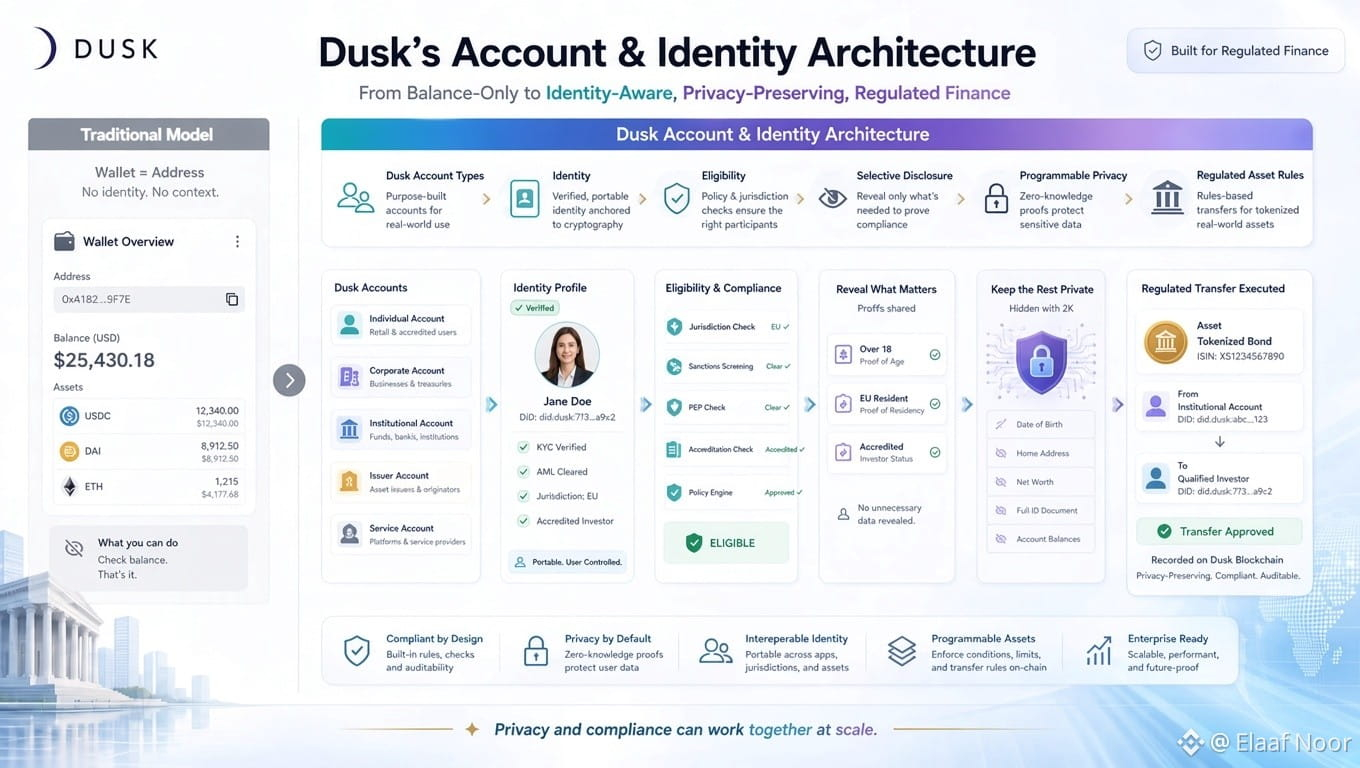
Something I noticed while digging through Dusk's core architecture today:
Dusk doesn't treat an account as simply an address holding coins.
Its account model is much more deliberate.
There are account types designed around different transaction requirements including public and privacy-preserving flows.
Do you think selective disclosure and programmable privacy are the ultimate keys to institutional adoption?
And that becomes particularly interesting when you think about regulated assets.
In a normal token transfer the main question is:
Does this address have enough balance?
A regulated security needs more questions answered.
Who is behind the account?
Is the holder eligible?
Is this transfer permitted?
What information should be revealed?
What information should remain private?
And can an authorized party verify the required attributes without exposing everything else?
That's where I think Dusk's account and identity architecture starts becoming more relevant than the usual wallet-address model.
The blockchain isnot just tracking balances.
It can become part of a rules-based financial identity and transfer workflow.
And there is an important distinction here:
privacy doesnot necessarily mean hiding the existence of everything.
It can mean exposing exactly what needs to be verified while keeping unrelated information confidential.
That's a much more useful model for regulated finance.
So the question I am asking about Dusk now isn't:
Does it have private transactions?
That's too basic.
It's:
Can account, identity, eligibility and transaction rules work together without forcing every financial application to expose the user's entire identity?
If that works at scale that's where programmable privacy becomes genuinely useful.
#dusk $DUSK @Dusk_Foundation
Something I noticed while digging through Dusk's core architecture today:
Dusk doesn't treat an account as simply an address holding coins.
Its account model is much more deliberate.
There are account types designed around different transaction requirements including public and privacy-preserving flows.
Do you think selective disclosure and programmable privacy are the ultimate keys to institutional adoption?
And that becomes particularly interesting when you think about regulated assets.
In a normal token transfer the main question is:
Does this address have enough balance?
A regulated security needs more questions answered.
Who is behind the account?
Is the holder eligible?
Is this transfer permitted?
What information should be revealed?
What information should remain private?
And can an authorized party verify the required attributes without exposing everything else?
That's where I think Dusk's account and identity architecture starts becoming more relevant than the usual wallet-address model.
The blockchain isnot just tracking balances.
It can become part of a rules-based financial identity and transfer workflow.
And there is an important distinction here:
privacy doesnot necessarily mean hiding the existence of everything.
It can mean exposing exactly what needs to be verified while keeping unrelated information confidential.
That's a much more useful model for regulated finance.
So the question I am asking about Dusk now isn't:
Does it have private transactions?
That's too basic.
It's:
Can account, identity, eligibility and transaction rules work together without forcing every financial application to expose the user's entire identity?
If that works at scale that's where programmable privacy becomes genuinely useful.
#dusk $DUSK @Dusk
Dusk doesn't treat an account as simply an address holding coins.
Its account model is much more deliberate.
There are account types designed around different transaction requirements including public and privacy-preserving flows.
Do you think selective disclosure and programmable privacy are the ultimate keys to institutional adoption?
And that becomes particularly interesting when you think about regulated assets.
In a normal token transfer the main question is:
Does this address have enough balance?
A regulated security needs more questions answered.
Who is behind the account?
Is the holder eligible?
Is this transfer permitted?
What information should be revealed?
What information should remain private?
And can an authorized party verify the required attributes without exposing everything else?
That's where I think Dusk's account and identity architecture starts becoming more relevant than the usual wallet-address model.
The blockchain isnot just tracking balances.
It can become part of a rules-based financial identity and transfer workflow.
And there is an important distinction here:
privacy doesnot necessarily mean hiding the existence of everything.
It can mean exposing exactly what needs to be verified while keeping unrelated information confidential.
That's a much more useful model for regulated finance.
So the question I am asking about Dusk now isn't:
Does it have private transactions?
That's too basic.
It's:
Can account, identity, eligibility and transaction rules work together without forcing every financial application to expose the user's entire identity?
If that works at scale that's where programmable privacy becomes genuinely useful.
#dusk $DUSK @Dusk
4
3
350
·
--
Жоғары (өспелі)
I went through Dusk's latest developer activity today and found a detail that I think is more important than it looks at first.
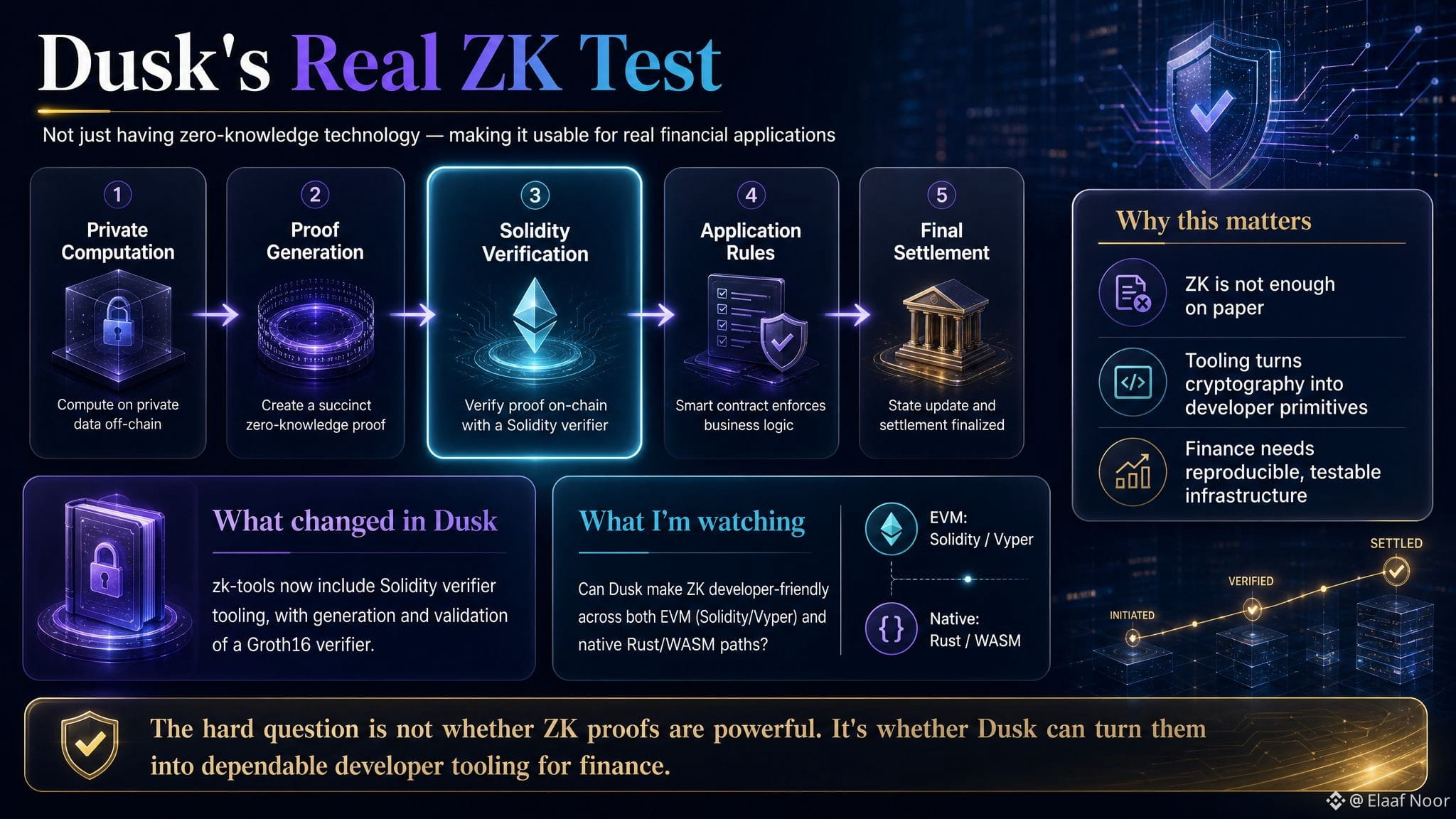
Dusk's zk-tools are being expanded with Solidity verifier tooling, including generation and validation of a Groth16 verifier.
That immediately made me think about the difference between having ZK technology and making ZK technology usable.
A financial application doesnot benefit much from hearing:
we support zero-knowledge proofs.
The developer needs to actually build:
private computation
proof generation
Solidity verification
application rule
final settlement.
That verification step is where cryptographic privacy becomes something a smart contract can actually reason about.
And this is particularly relevant for Dusk because its EVM path is designed for Solidity/Vyper development while Dusk also has a native Rust/WASM path.
So the interesting direction isnot simply Dusk has ZK.
It is the growing developer layer around it.
Even the recent zk-tools work includes shared validation & reproducible build artifacts.
That matters to me because financial infrastructure needs reproducibility.
If a proof verifier works once on a developers machine but cannot be reliably built tested & validated by another team it isnot mature infrastructure yet.
So I am watching this side of Dusk closely.
The real question isnot whether ZK proofs are powerful.
We already know they are.
The question is:
Can Dusk turn this cryptography into developer friendly primitives that financial applications can actually depend on?
That is a much harder test.
Do you think developer tooling is real bottleneck for zero-knowledge adoption in finance?
#dusk $DUSK @Dusk_Foundation
I went through Dusk's latest developer activity today and found a detail that I think is more important than it looks at first.
Dusk's zk-tools are being expanded with Solidity verifier tooling, including generation and validation of a Groth16 verifier.
That immediately made me think about the difference between having ZK technology and making ZK technology usable.
A financial application doesnot benefit much from hearing:
we support zero-knowledge proofs.
The developer needs to actually build:
private computation
proof generation
Solidity verification
application rule
final settlement.
That verification step is where cryptographic privacy becomes something a smart contract can actually reason about.
And this is particularly relevant for Dusk because its EVM path is designed for Solidity/Vyper development while Dusk also has a native Rust/WASM path.
So the interesting direction isnot simply Dusk has ZK.
It is the growing developer layer around it.
Even the recent zk-tools work includes shared validation & reproducible build artifacts.
That matters to me because financial infrastructure needs reproducibility.
If a proof verifier works once on a developers machine but cannot be reliably built tested & validated by another team it isnot mature infrastructure yet.
So I am watching this side of Dusk closely.
The real question isnot whether ZK proofs are powerful.
We already know they are.
The question is:
Can Dusk turn this cryptography into developer friendly primitives that financial applications can actually depend on?
That is a much harder test.
Do you think developer tooling is real bottleneck for zero-knowledge adoption in finance?
#dusk $DUSK @Dusk
Dusk's zk-tools are being expanded with Solidity verifier tooling, including generation and validation of a Groth16 verifier.
That immediately made me think about the difference between having ZK technology and making ZK technology usable.
A financial application doesnot benefit much from hearing:
we support zero-knowledge proofs.
The developer needs to actually build:
private computation
proof generation
Solidity verification
application rule
final settlement.
That verification step is where cryptographic privacy becomes something a smart contract can actually reason about.
And this is particularly relevant for Dusk because its EVM path is designed for Solidity/Vyper development while Dusk also has a native Rust/WASM path.
So the interesting direction isnot simply Dusk has ZK.
It is the growing developer layer around it.
Even the recent zk-tools work includes shared validation & reproducible build artifacts.
That matters to me because financial infrastructure needs reproducibility.
If a proof verifier works once on a developers machine but cannot be reliably built tested & validated by another team it isnot mature infrastructure yet.
So I am watching this side of Dusk closely.
The real question isnot whether ZK proofs are powerful.
We already know they are.
The question is:
Can Dusk turn this cryptography into developer friendly primitives that financial applications can actually depend on?
That is a much harder test.
Do you think developer tooling is real bottleneck for zero-knowledge adoption in finance?
#dusk $DUSK @Dusk
17
11
1.1k
·
--
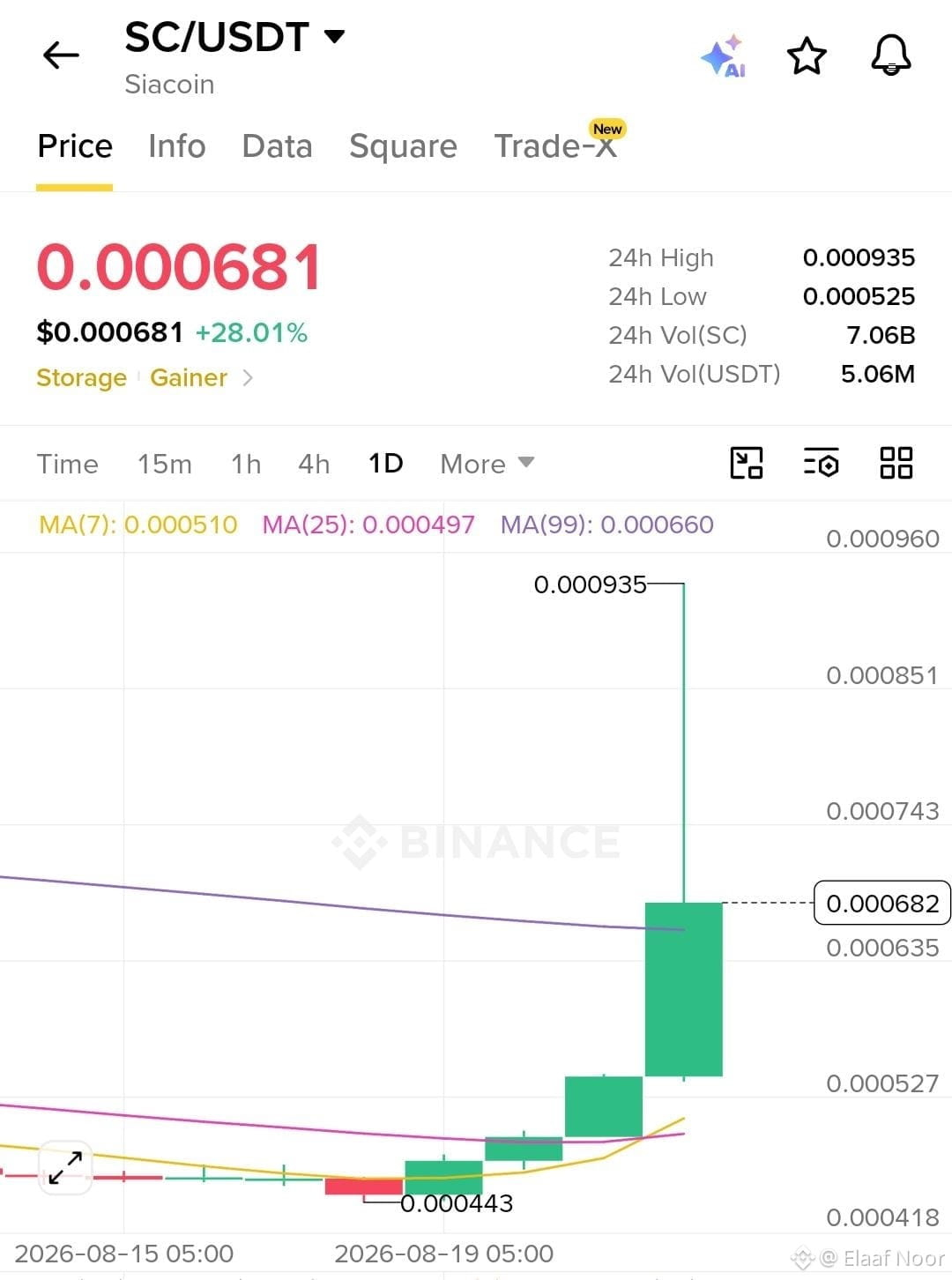
Massive volume expansion on $SC today!
Currently trading around 0.000681 USDT (+28%) pushing off strong moving averages with over 7B volume flowing in.
Key Test: The 24h high sits near 0.000935 & order books are leaning green with 53.94% buy pressure.
The Play: Momentum is here but chasing green candles blindly can be risky. Watching how it holds above local support is key before the next leg.
Are you riding this pump on Siacoin, or waiting for a dip? Let me know below! 👇
#SC #Siacoin #CryptoTrading #BinanceSquare $SC
Massive volume expansion on $SC today!
Currently trading around 0.000681 USDT (+28%) pushing off strong moving averages with over 7B volume flowing in.
Key Test: The 24h high sits near 0.000935 & order books are leaning green with 53.94% buy pressure.
The Play: Momentum is here but chasing green candles blindly can be risky. Watching how it holds above local support is key before the next leg.
Are you riding this pump on Siacoin, or waiting for a dip? Let me know below! 👇
#SC #Siacoin #CryptoTrading #BinanceSquare $SC
Currently trading around 0.000681 USDT (+28%) pushing off strong moving averages with over 7B volume flowing in.
Key Test: The 24h high sits near 0.000935 & order books are leaning green with 53.94% buy pressure.
The Play: Momentum is here but chasing green candles blindly can be risky. Watching how it holds above local support is key before the next leg.
Are you riding this pump on Siacoin, or waiting for a dip? Let me know below! 👇
#SC #Siacoin #CryptoTrading #BinanceSquare $SC
2
3
353
·
--
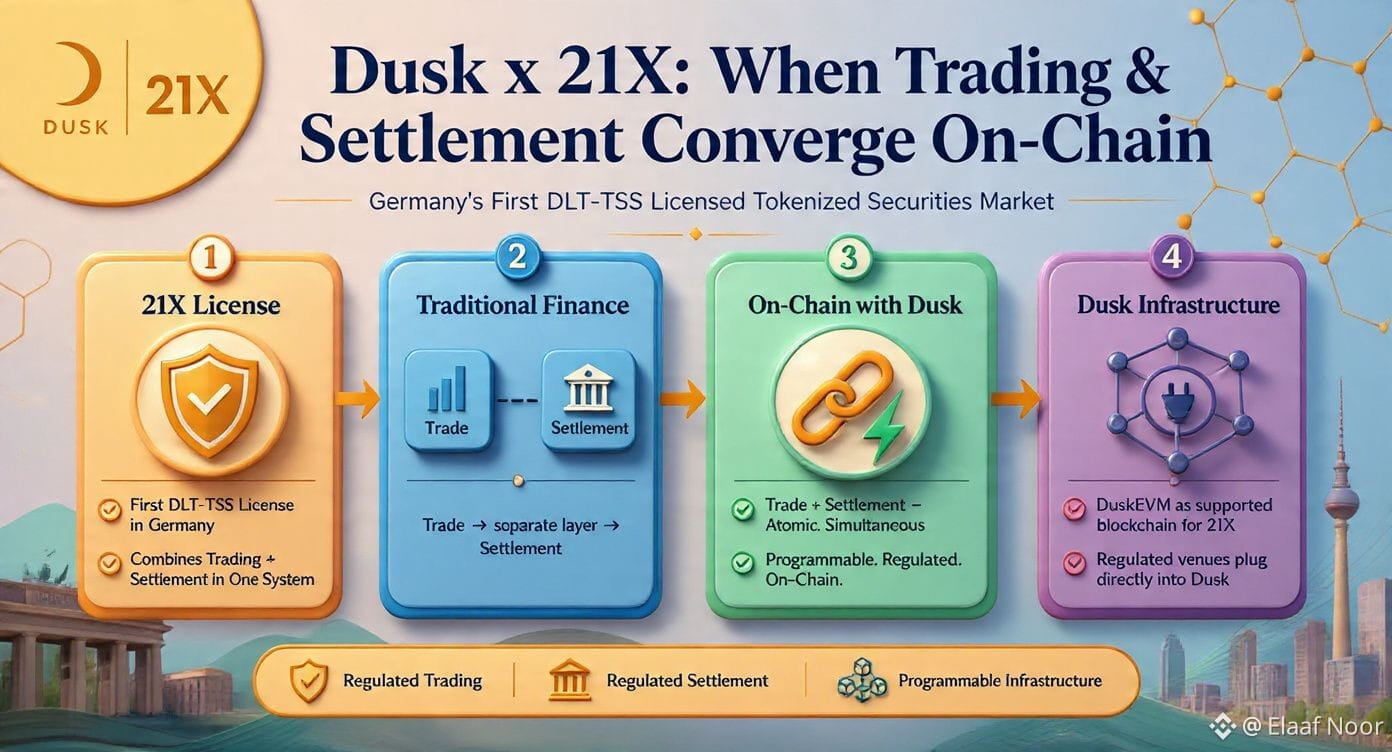
I went back through Dusk's institutional partnerships and found one detail about 21X that I think deserves way more attention.
21X isnot just another RWA project integrating with Dusk.
It is the first company to receive Germany's DLT-TSS license for a fully tokenized securities market.
& the important part of that license is what it allows.
Traditionally trading & settlement are separate pieces of the financial system.
A trade happens on one platform.
Then settlement moves through another layer.
21X is authorized to combine those functions inside a single DLT Trading and Settlement System.
That means the trade & settlement process can happen together onchain with atomic settlement.
That is a very different proposition from simply putting a security certificate on a blockchain.
And this is where Dusk's partnership starts making more sense to me.
Dusk provides the blockchain infrastructure.
21X brings regulated DLT market infrastructure.
The goal is not just:
tokenized asset + blockchain.
It is: regulated trading + regulated settlement + programmable infrastructure.
And there is another interesting piece.
21X plans to integrate DuskEVM as one of its supported blockchains.
So Dusk isnot only trying to create assets.
It is trying to become infrastructure that regulated venues can actually plug into.
That is a much higher bar.
I am curious how far this model can go once more regulated venues connect to the same infrastructure.
Because if trading and settlement can genuinely converge onchain the efficiency gain could be much bigger than simply reducing the time needed to transfer a token.
Do you think combining trading and settlement on-chain is the ultimate unlock for institutional RWA adoption?
#dusk $DUSK @Dusk_Foundation
I went back through Dusk's institutional partnerships and found one detail about 21X that I think deserves way more attention.
21X isnot just another RWA project integrating with Dusk.
It is the first company to receive Germany's DLT-TSS license for a fully tokenized securities market.
& the important part of that license is what it allows.
Traditionally trading & settlement are separate pieces of the financial system.
A trade happens on one platform.
Then settlement moves through another layer.
21X is authorized to combine those functions inside a single DLT Trading and Settlement System.
That means the trade & settlement process can happen together onchain with atomic settlement.
That is a very different proposition from simply putting a security certificate on a blockchain.
And this is where Dusk's partnership starts making more sense to me.
Dusk provides the blockchain infrastructure.
21X brings regulated DLT market infrastructure.
The goal is not just:
tokenized asset + blockchain.
It is: regulated trading + regulated settlement + programmable infrastructure.
And there is another interesting piece.
21X plans to integrate DuskEVM as one of its supported blockchains.
So Dusk isnot only trying to create assets.
It is trying to become infrastructure that regulated venues can actually plug into.
That is a much higher bar.
I am curious how far this model can go once more regulated venues connect to the same infrastructure.
Because if trading and settlement can genuinely converge onchain the efficiency gain could be much bigger than simply reducing the time needed to transfer a token.
Do you think combining trading and settlement on-chain is the ultimate unlock for institutional RWA adoption?
#dusk $DUSK @Dusk
21X isnot just another RWA project integrating with Dusk.
It is the first company to receive Germany's DLT-TSS license for a fully tokenized securities market.
& the important part of that license is what it allows.
Traditionally trading & settlement are separate pieces of the financial system.
A trade happens on one platform.
Then settlement moves through another layer.
21X is authorized to combine those functions inside a single DLT Trading and Settlement System.
That means the trade & settlement process can happen together onchain with atomic settlement.
That is a very different proposition from simply putting a security certificate on a blockchain.
And this is where Dusk's partnership starts making more sense to me.
Dusk provides the blockchain infrastructure.
21X brings regulated DLT market infrastructure.
The goal is not just:
tokenized asset + blockchain.
It is: regulated trading + regulated settlement + programmable infrastructure.
And there is another interesting piece.
21X plans to integrate DuskEVM as one of its supported blockchains.
So Dusk isnot only trying to create assets.
It is trying to become infrastructure that regulated venues can actually plug into.
That is a much higher bar.
I am curious how far this model can go once more regulated venues connect to the same infrastructure.
Because if trading and settlement can genuinely converge onchain the efficiency gain could be much bigger than simply reducing the time needed to transfer a token.
Do you think combining trading and settlement on-chain is the ultimate unlock for institutional RWA adoption?
#dusk $DUSK @Dusk
23
1
11
1.1k
·
--
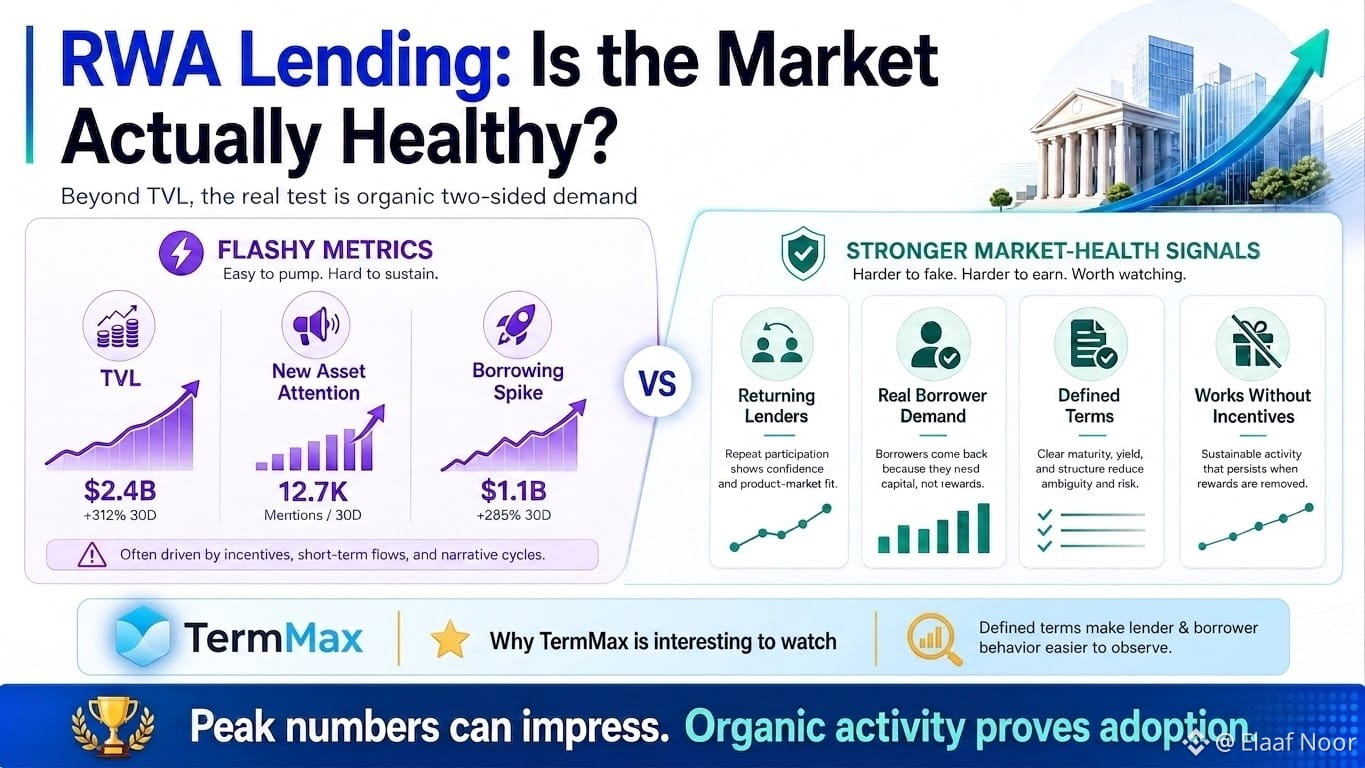
RWA lending has a problem I find more interesting than the tokenization itself:
how do you know a collateral market is actually healthy?
TVL can look impressive.
A new asset can attract attention.
Borrowing volume can spike.
None of those tells me whether the market has developed real two-sided demand.
That is where I think @termmax has an interesting setup to observe.
When financing is arranged around defined terms instead of one constantly changing pool rate the behaviour of lenders & borrowers becomes easier to examine.
Who is willing to provide capital?
Who is willing to pay for it?
How long are they willing to commit?
And what happens when the easy liquidity disappears?
Those questions matter even more for tokenized assets because liquidity conditions can vary dramatically from one asset to another.
I did rather see a smaller market where participants keep returning under normal conditions than a huge number that only looks active while incentives are doing the heavy lifting.
So if TermMax expands deeper into RWA credit I would not be watching the headline TVL first.
I will be watching whether the market keeps functioning when nobody is being heavily paid to participate.
That to me is a much harder - & much more useful - test of real adoption.
Do you judge protocols by their peak TVL or do you look at organic activity without incentives?
#termmax
RWA lending has a problem I find more interesting than the tokenization itself:
how do you know a collateral market is actually healthy?
TVL can look impressive.
A new asset can attract attention.
Borrowing volume can spike.
None of those tells me whether the market has developed real two-sided demand.
That is where I think @TermMax has an interesting setup to observe.
When financing is arranged around defined terms instead of one constantly changing pool rate the behaviour of lenders & borrowers becomes easier to examine.
Who is willing to provide capital?
Who is willing to pay for it?
How long are they willing to commit?
And what happens when the easy liquidity disappears?
Those questions matter even more for tokenized assets because liquidity conditions can vary dramatically from one asset to another.
I did rather see a smaller market where participants keep returning under normal conditions than a huge number that only looks active while incentives are doing the heavy lifting.
So if TermMax expands deeper into RWA credit I would not be watching the headline TVL first.
I will be watching whether the market keeps functioning when nobody is being heavily paid to participate.
That to me is a much harder - & much more useful - test of real adoption.
Do you judge protocols by their peak TVL or do you look at organic activity without incentives?
#termmax
how do you know a collateral market is actually healthy?
TVL can look impressive.
A new asset can attract attention.
Borrowing volume can spike.
None of those tells me whether the market has developed real two-sided demand.
That is where I think @TermMax has an interesting setup to observe.
When financing is arranged around defined terms instead of one constantly changing pool rate the behaviour of lenders & borrowers becomes easier to examine.
Who is willing to provide capital?
Who is willing to pay for it?
How long are they willing to commit?
And what happens when the easy liquidity disappears?
Those questions matter even more for tokenized assets because liquidity conditions can vary dramatically from one asset to another.
I did rather see a smaller market where participants keep returning under normal conditions than a huge number that only looks active while incentives are doing the heavy lifting.
So if TermMax expands deeper into RWA credit I would not be watching the headline TVL first.
I will be watching whether the market keeps functioning when nobody is being heavily paid to participate.
That to me is a much harder - & much more useful - test of real adoption.
Do you judge protocols by their peak TVL or do you look at organic activity without incentives?
#termmax
12
12
670
·
--
Жоғары (өспелі)
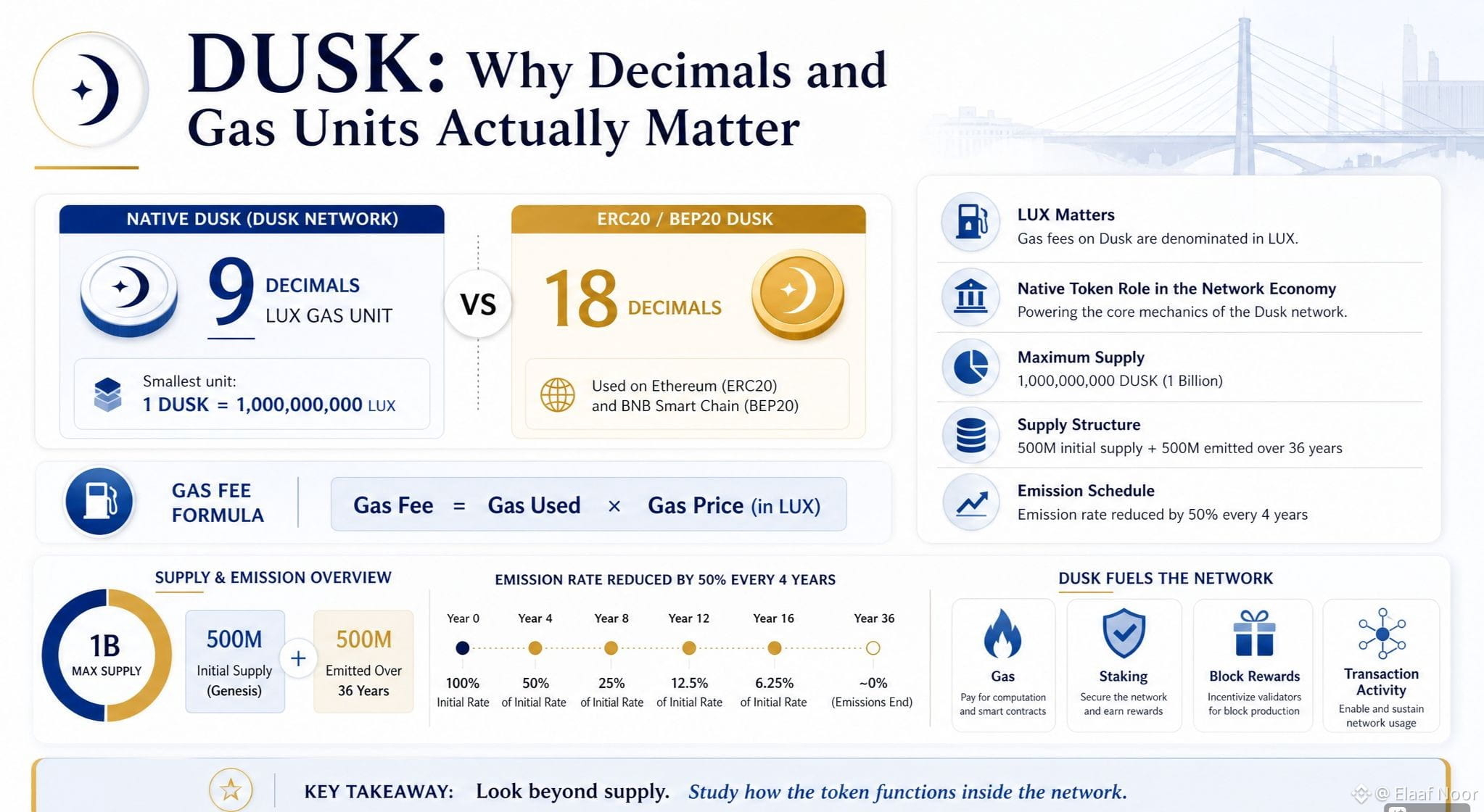
I found a small Dusk detail that I completely overlooked before.
DUSK on the native Dusk network doesn't actually use 18 decimals.
It uses 9 decimals.
The smallest unit is called LUX:
1 DUSK = 1,000,000,000 LUX.
ERC20 & BEP20 DUSK in the otherhand used 18 decimals.
At first I thought:
Okay… that is just a technical implementation detail
But then I realized why this actually matters.
DUSK is the native gas token on Dusk.
Every transaction consumes gas, and fees are calculated using gas used × gas price, with the gas price denominated in LUX.
So the token isn't just an asset being transferred around the network.
Its smallest unit is directly part of how Dusk's execution economics work.
And there is another part I found interesting.
The network's maximum supply is 1 billion DUSK:
500M initial supply
+
500M emitted over 36 years.
Those emissions don't stay flat either.
The emission rate is reduced by 50% every four years.
So the network's security economics are designed to change over time as transaction-fee activity becomes more important.
This made me look at DUSK differently.
Instead of only asking:
What is the token supply?
I am more interested in:
How does the native token actually function inside the network's economic machinery?
Gas.
Staking.
Block rewards.
And eventually transaction activity.
That is a much more useful way to understand a network token than just looking at the maximum supply number.
Have you ever looked deep into a tokens decimal structure or gas units, or do you usually just track the price and supply? Let me know below...
#dusk $DUSK @Dusk_Foundation
I found a small Dusk detail that I completely overlooked before.
DUSK on the native Dusk network doesn't actually use 18 decimals.
It uses 9 decimals.
The smallest unit is called LUX:
1 DUSK = 1,000,000,000 LUX.
ERC20 & BEP20 DUSK in the otherhand used 18 decimals.
At first I thought:
Okay… that is just a technical implementation detail
But then I realized why this actually matters.
DUSK is the native gas token on Dusk.
Every transaction consumes gas, and fees are calculated using gas used × gas price, with the gas price denominated in LUX.
So the token isn't just an asset being transferred around the network.
Its smallest unit is directly part of how Dusk's execution economics work.
And there is another part I found interesting.
The network's maximum supply is 1 billion DUSK:
500M initial supply
+
500M emitted over 36 years.
Those emissions don't stay flat either.
The emission rate is reduced by 50% every four years.
So the network's security economics are designed to change over time as transaction-fee activity becomes more important.
This made me look at DUSK differently.
Instead of only asking:
What is the token supply?
I am more interested in:
How does the native token actually function inside the network's economic machinery?
Gas.
Staking.
Block rewards.
And eventually transaction activity.
That is a much more useful way to understand a network token than just looking at the maximum supply number.
Have you ever looked deep into a tokens decimal structure or gas units, or do you usually just track the price and supply? Let me know below...
#dusk $DUSK @Dusk
DUSK on the native Dusk network doesn't actually use 18 decimals.
It uses 9 decimals.
The smallest unit is called LUX:
1 DUSK = 1,000,000,000 LUX.
ERC20 & BEP20 DUSK in the otherhand used 18 decimals.
At first I thought:
Okay… that is just a technical implementation detail
But then I realized why this actually matters.
DUSK is the native gas token on Dusk.
Every transaction consumes gas, and fees are calculated using gas used × gas price, with the gas price denominated in LUX.
So the token isn't just an asset being transferred around the network.
Its smallest unit is directly part of how Dusk's execution economics work.
And there is another part I found interesting.
The network's maximum supply is 1 billion DUSK:
500M initial supply
+
500M emitted over 36 years.
Those emissions don't stay flat either.
The emission rate is reduced by 50% every four years.
So the network's security economics are designed to change over time as transaction-fee activity becomes more important.
This made me look at DUSK differently.
Instead of only asking:
What is the token supply?
I am more interested in:
How does the native token actually function inside the network's economic machinery?
Gas.
Staking.
Block rewards.
And eventually transaction activity.
That is a much more useful way to understand a network token than just looking at the maximum supply number.
Have you ever looked deep into a tokens decimal structure or gas units, or do you usually just track the price and supply? Let me know below...
#dusk $DUSK @Dusk
39
25
904
·
--
I have been thinking about a less obvious part of @termmax : who actually absorbs the risk created by liquidity decisions?
The protocol can separate borrowers / lenders / market makers & Curators, which makes the market more organized. But specialization also means someone has to make the difficult calls.
A market maker has to decide where liquidity is worth providing.
A Curator has to decide how much capital should chase yield versus stay available for borrowers.
And that trade-off gets much harder when conditions change quickly.
Too much capital sitting idle hurts efficiency.
Too much capital pushed toward yield can leave a market looking healthy until borrowers suddenly need liquidity.
That is especially interesting for RWA collateral.
If an asset takes time to liquidate, the problem isn’t necessarily solved just because the collateral can eventually be delivered or sold. Timing becomes part of the risk.
That is why I am less interested in simply asking whether TermMax can generate yield.
I want to understand how the system behaves when the easy conditions disappear.
Who takes the loss from a bad liquidity decision?
How concentrated can Curator decisions become?
And what happens when market makers pull liquidity at exactly the wrong time?
To me these are the questions that separate a sophisticated market structure from one that only looks efficient while conditions are good.
The real test of TermMax won’t be how the system works when liquidity is abundant.
It’ll be how gracefully it handles liquidity when everyone suddenly wants it at once.
#termmax
Who should carry liquidity risk?
I have been thinking about a less obvious part of @TermMax : who actually absorbs the risk created by liquidity decisions?
The protocol can separate borrowers / lenders / market makers & Curators, which makes the market more organized. But specialization also means someone has to make the difficult calls.
A market maker has to decide where liquidity is worth providing.
A Curator has to decide how much capital should chase yield versus stay available for borrowers.
And that trade-off gets much harder when conditions change quickly.
Too much capital sitting idle hurts efficiency.
Too much capital pushed toward yield can leave a market looking healthy until borrowers suddenly need liquidity.
That is especially interesting for RWA collateral.
If an asset takes time to liquidate, the problem isn’t necessarily solved just because the collateral can eventually be delivered or sold. Timing becomes part of the risk.
That is why I am less interested in simply asking whether TermMax can generate yield.
I want to understand how the system behaves when the easy conditions disappear.
Who takes the loss from a bad liquidity decision?
How concentrated can Curator decisions become?
And what happens when market makers pull liquidity at exactly the wrong time?
To me these are the questions that separate a sophisticated market structure from one that only looks efficient while conditions are good.
The real test of TermMax won’t be how the system works when liquidity is abundant.
It’ll be how gracefully it handles liquidity when everyone suddenly wants it at once.
#termmax
Who should carry liquidity risk?
The protocol can separate borrowers / lenders / market makers & Curators, which makes the market more organized. But specialization also means someone has to make the difficult calls.
A market maker has to decide where liquidity is worth providing.
A Curator has to decide how much capital should chase yield versus stay available for borrowers.
And that trade-off gets much harder when conditions change quickly.
Too much capital sitting idle hurts efficiency.
Too much capital pushed toward yield can leave a market looking healthy until borrowers suddenly need liquidity.
That is especially interesting for RWA collateral.
If an asset takes time to liquidate, the problem isn’t necessarily solved just because the collateral can eventually be delivered or sold. Timing becomes part of the risk.
That is why I am less interested in simply asking whether TermMax can generate yield.
I want to understand how the system behaves when the easy conditions disappear.
Who takes the loss from a bad liquidity decision?
How concentrated can Curator decisions become?
And what happens when market makers pull liquidity at exactly the wrong time?
To me these are the questions that separate a sophisticated market structure from one that only looks efficient while conditions are good.
The real test of TermMax won’t be how the system works when liquidity is abundant.
It’ll be how gracefully it handles liquidity when everyone suddenly wants it at once.
#termmax
Who should carry liquidity risk?
🟢 Curators
75%
🔵 Market makers
0%
🟡 Protocol
25%
🔴 Shared risk
0%
4 дауыс • Дауыс беру жабық
43
16
1.2k
·
--
Something I did watch closely if @termmax starts bringing more RWA collateral onchain:
who is actually willing to pay the rate?
A fixed rate by itself doesnot tell me much. The interesting signal is whether different assets start attracting different financing costs based on their liquidity volatility & collateral quality.
That is where I think TermMax could get genuinely interesting.
Imagine two markets with the same maturity but very different collateral. If borrowers consistently accept different rates without incentives forcing the outcome those rates start carrying information.
Not just APY.
Information about how the market values the risk of financing that asset.
But I did be careful about reading too much into an early rate curve.
A pool can look busy because rewards is paying people to be there. A market can show a clean rate while having barely enough liquidity to make that rate meaningful.
So I did personally track three things:
Do borrowers come back after the first trade?
Does liquidity remain when incentives cool off?
Do rates actually move when collateral risk changes?
If those patterns start appearing across multiple maturities and assets then the rates become much more interesting to me.
Because the real signal isnot the curve itself.
It is the participants who keep coming back to price it.
#termmax
What would make you trust TermMax’s RWA credit markets?
Something I did watch closely if @TermMax starts bringing more RWA collateral onchain:
who is actually willing to pay the rate?
A fixed rate by itself doesnot tell me much. The interesting signal is whether different assets start attracting different financing costs based on their liquidity volatility & collateral quality.
That is where I think TermMax could get genuinely interesting.
Imagine two markets with the same maturity but very different collateral. If borrowers consistently accept different rates without incentives forcing the outcome those rates start carrying information.
Not just APY.
Information about how the market values the risk of financing that asset.
But I did be careful about reading too much into an early rate curve.
A pool can look busy because rewards is paying people to be there. A market can show a clean rate while having barely enough liquidity to make that rate meaningful.
So I did personally track three things:
Do borrowers come back after the first trade?
Does liquidity remain when incentives cool off?
Do rates actually move when collateral risk changes?
If those patterns start appearing across multiple maturities and assets then the rates become much more interesting to me.
Because the real signal isnot the curve itself.
It is the participants who keep coming back to price it.
#termmax
What would make you trust TermMax’s RWA credit markets?
who is actually willing to pay the rate?
A fixed rate by itself doesnot tell me much. The interesting signal is whether different assets start attracting different financing costs based on their liquidity volatility & collateral quality.
That is where I think TermMax could get genuinely interesting.
Imagine two markets with the same maturity but very different collateral. If borrowers consistently accept different rates without incentives forcing the outcome those rates start carrying information.
Not just APY.
Information about how the market values the risk of financing that asset.
But I did be careful about reading too much into an early rate curve.
A pool can look busy because rewards is paying people to be there. A market can show a clean rate while having barely enough liquidity to make that rate meaningful.
So I did personally track three things:
Do borrowers come back after the first trade?
Does liquidity remain when incentives cool off?
Do rates actually move when collateral risk changes?
If those patterns start appearing across multiple maturities and assets then the rates become much more interesting to me.
Because the real signal isnot the curve itself.
It is the participants who keep coming back to price it.
#termmax
What would make you trust TermMax’s RWA credit markets?
🟢 Repeat borrowers
100%
🔵 Deep liquidity
0%
🟡 Organic rates
0%
🔴 Less incentives
0%
2 дауыс • Дауыс беру жабық
27
13
6.1k
·
--
Жоғары (өспелі)
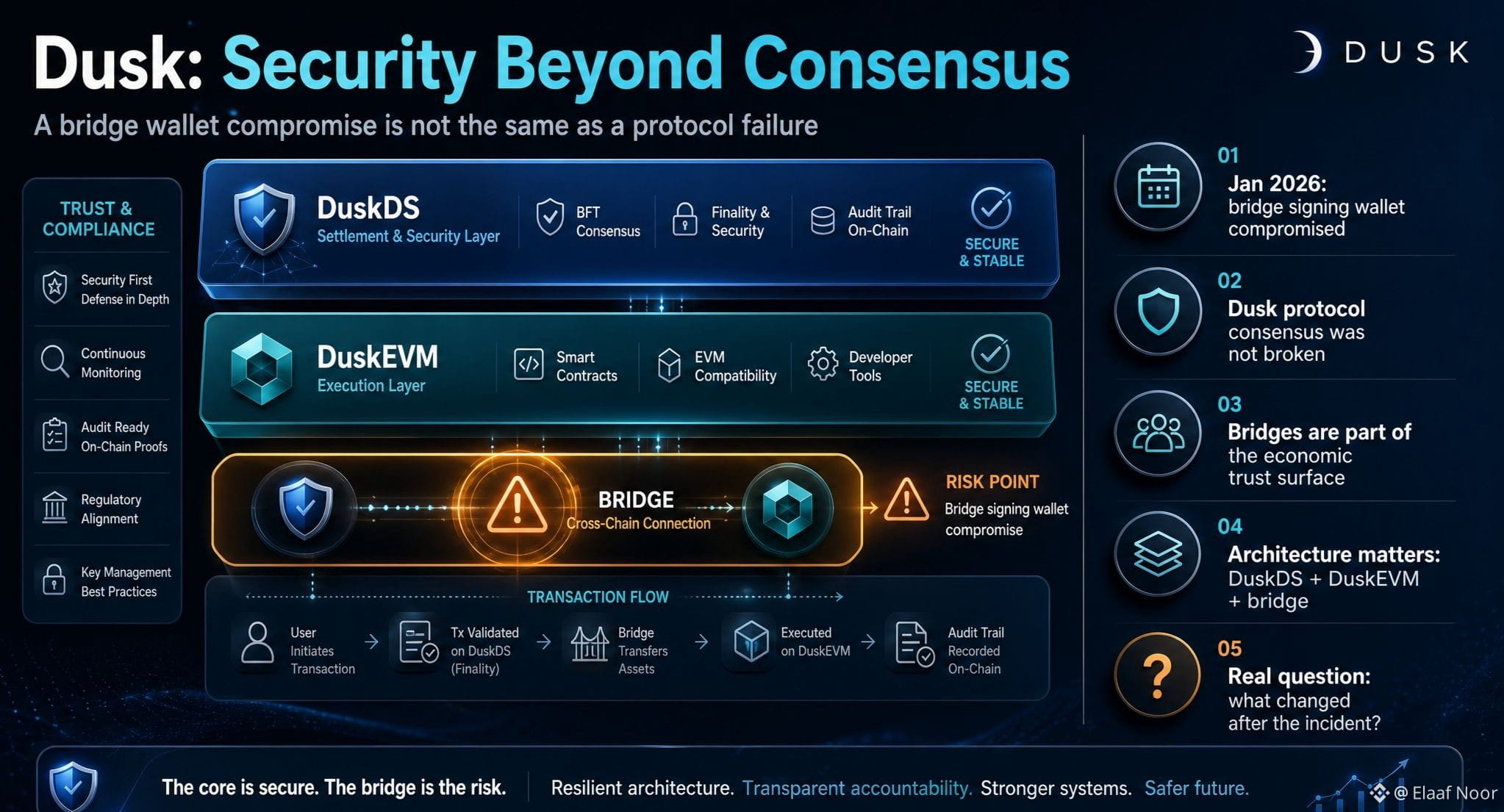
I found something in Dusk's recent technical history that actually made me more interested in the project.
Not because it was positive.
Because it was a useful security lesson.
In January 2026 Dusk disclosed that an attacker compromised a signing wallet used by the Dusk-to-EVM bridge.
The important distinction was that Dusk classified it as a bridge wallet compromise not a consensus failure or an exploit of the Dusk protocol itself.
That difference matters.
Because when you build a multilayer blockchain the protocol isnot the only thing that needs to be secure.
Bridges become part of the economic trust surface too.
And the incident forced me to think about Dusk architecture differently.
DuskDS handles settlement & security.
DuskEVM handles EVM execution.
The bridge connects the environments.
So even if the underlying consensus remains secure a compromised component around asset movement can still create real economic risk.
Dusks post-mortem says the team preserved transaction/server trails / reported the incident & subsequently hardened the bridge service.
I actually prefer seeing this kind of transparency over pretending infrastructure never fails.
The interesting question for me now isnot:
Did Dusk ever have a security incident?
Almost every serious system eventually gets tested.
The better question is:
What changed in the architecture after the incident?
& how much of the remaining bridge trust can be eliminated as Dusk's native architecture evolves?
That is the part I will be watching.
Because for regulated finance security are not just about consensus.
It is about every component that can move or control economic value.
#dusk $DUSK @Dusk_Foundation
I found something in Dusk's recent technical history that actually made me more interested in the project.
Not because it was positive.
Because it was a useful security lesson.
In January 2026 Dusk disclosed that an attacker compromised a signing wallet used by the Dusk-to-EVM bridge.
The important distinction was that Dusk classified it as a bridge wallet compromise not a consensus failure or an exploit of the Dusk protocol itself.
That difference matters.
Because when you build a multilayer blockchain the protocol isnot the only thing that needs to be secure.
Bridges become part of the economic trust surface too.
And the incident forced me to think about Dusk architecture differently.
DuskDS handles settlement & security.
DuskEVM handles EVM execution.
The bridge connects the environments.
So even if the underlying consensus remains secure a compromised component around asset movement can still create real economic risk.
Dusks post-mortem says the team preserved transaction/server trails / reported the incident & subsequently hardened the bridge service.
I actually prefer seeing this kind of transparency over pretending infrastructure never fails.
The interesting question for me now isnot:
Did Dusk ever have a security incident?
Almost every serious system eventually gets tested.
The better question is:
What changed in the architecture after the incident?
& how much of the remaining bridge trust can be eliminated as Dusk's native architecture evolves?
That is the part I will be watching.
Because for regulated finance security are not just about consensus.
It is about every component that can move or control economic value.
#dusk $DUSK @Dusk
Not because it was positive.
Because it was a useful security lesson.
In January 2026 Dusk disclosed that an attacker compromised a signing wallet used by the Dusk-to-EVM bridge.
The important distinction was that Dusk classified it as a bridge wallet compromise not a consensus failure or an exploit of the Dusk protocol itself.
That difference matters.
Because when you build a multilayer blockchain the protocol isnot the only thing that needs to be secure.
Bridges become part of the economic trust surface too.
And the incident forced me to think about Dusk architecture differently.
DuskDS handles settlement & security.
DuskEVM handles EVM execution.
The bridge connects the environments.
So even if the underlying consensus remains secure a compromised component around asset movement can still create real economic risk.
Dusks post-mortem says the team preserved transaction/server trails / reported the incident & subsequently hardened the bridge service.
I actually prefer seeing this kind of transparency over pretending infrastructure never fails.
The interesting question for me now isnot:
Did Dusk ever have a security incident?
Almost every serious system eventually gets tested.
The better question is:
What changed in the architecture after the incident?
& how much of the remaining bridge trust can be eliminated as Dusk's native architecture evolves?
That is the part I will be watching.
Because for regulated finance security are not just about consensus.
It is about every component that can move or control economic value.
#dusk $DUSK @Dusk
44
19
3.4k
·
--
Расталды
August 25 is the date everyone will watch for $TMX.
I am more interested in what happens after it.
A token can create attention overnight. It canot create durable credit demand that quickly.
That why I am looking at TermMax less from the TGE angle & more from the product-market-fit test that comes with it.
The protocol already has a more defined credit model than a basic variable-rate money market. Fixed maturities give both sides something they can actually plan around while isolated markets let risk be separated instead of treating every collateral type the same.
There is another piece I think deserves more attention: capital efficiency.
Liquidity waiting to enter a fixed-rate position didnot necessarily have to remain completely unproductive. The ability to put that capital to work elsewhere until a match is available changes the economics of sitting on the sidelines.
But here is the part I am watching most closely:
What happens when incentives become less important?
If borrowers still want predictable financing lenders still find the risk/reward attractive & curators continue creating useful markets then the TGE becomes more than a token event.
It becomes a transition point for an already-running credit system.
That is the test I care about.
Not how loud August 25 is.
How much real activity remains after the launch-day attention fades.
#termmax @termmax
What matters most after the $TMX TGE?
August 25 is the date everyone will watch for $TMX.
I am more interested in what happens after it.
A token can create attention overnight. It canot create durable credit demand that quickly.
That why I am looking at TermMax less from the TGE angle & more from the product-market-fit test that comes with it.
The protocol already has a more defined credit model than a basic variable-rate money market. Fixed maturities give both sides something they can actually plan around while isolated markets let risk be separated instead of treating every collateral type the same.
There is another piece I think deserves more attention: capital efficiency.
Liquidity waiting to enter a fixed-rate position didnot necessarily have to remain completely unproductive. The ability to put that capital to work elsewhere until a match is available changes the economics of sitting on the sidelines.
But here is the part I am watching most closely:
What happens when incentives become less important?
If borrowers still want predictable financing lenders still find the risk/reward attractive & curators continue creating useful markets then the TGE becomes more than a token event.
It becomes a transition point for an already-running credit system.
That is the test I care about.
Not how loud August 25 is.
How much real activity remains after the launch-day attention fades.
#termmax @TermMax
What matters most after the $TMX TGE?
I am more interested in what happens after it.
A token can create attention overnight. It canot create durable credit demand that quickly.
That why I am looking at TermMax less from the TGE angle & more from the product-market-fit test that comes with it.
The protocol already has a more defined credit model than a basic variable-rate money market. Fixed maturities give both sides something they can actually plan around while isolated markets let risk be separated instead of treating every collateral type the same.
There is another piece I think deserves more attention: capital efficiency.
Liquidity waiting to enter a fixed-rate position didnot necessarily have to remain completely unproductive. The ability to put that capital to work elsewhere until a match is available changes the economics of sitting on the sidelines.
But here is the part I am watching most closely:
What happens when incentives become less important?
If borrowers still want predictable financing lenders still find the risk/reward attractive & curators continue creating useful markets then the TGE becomes more than a token event.
It becomes a transition point for an already-running credit system.
That is the test I care about.
Not how loud August 25 is.
How much real activity remains after the launch-day attention fades.
#termmax @TermMax
What matters most after the $TMX TGE?
🟢 Real borrowing
67%
🔵 Lender demand
0%
🟡 Curator growth
0%
🔴 Rewards
33%
3 дауыс • Дауыс беру жабық
25
11
3.8k
·
--
Жоғары (өспелі)
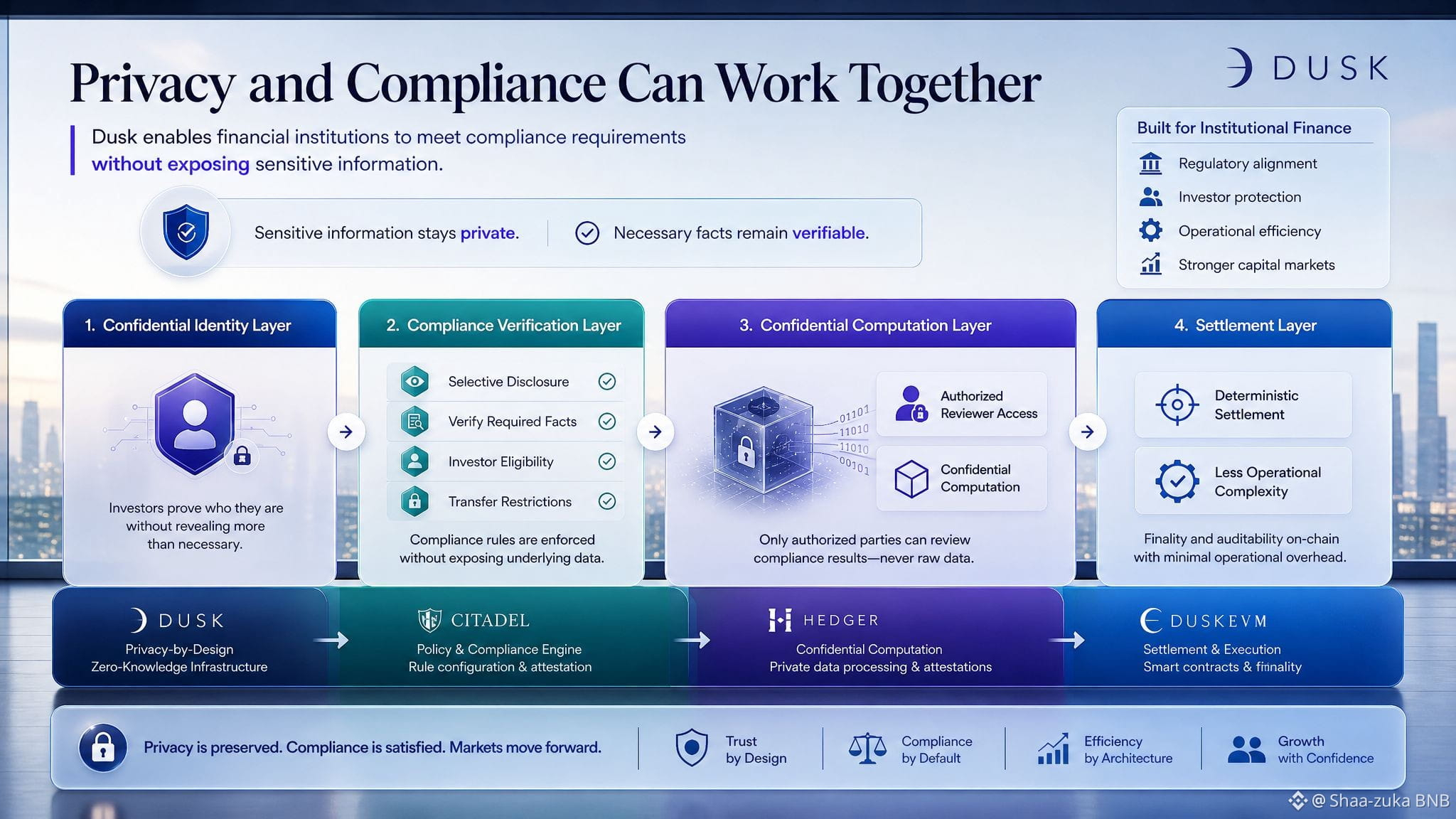
one thing I keep coming back to with Dusk is that privacy and compliance arenot actually opposites.
I used to think regulated finance would always require more transparency.
but then I thought about what compliance actually means.
a regulator may need certain information.
an issuer may need to verify eligibility.
a trading venue may need transfer restrictions.
but none of that automatically means every participant needs to see everything.
that is where Dusk's selective-disclosure approach becomes interesting to me.
instead of treating privacy as:
hide the whole transaction
the model is closer to:
keep sensitive information confidential while making the required facts verifiable.
that sounds like a small distinction.
for securities I donot think it is.
imagine proving that an investor meets an eligibility requirement without unnecessarily exposing unrelated personal information.
or allowing an authorized reviewer to inspect information that isn't publicly visible.
suddenly privacy becomes part of the compliance architecture rather than something bolted on afterwards.
Citadel approaches the identity and access side.
Hedger brings confidential computation into Dusk EVM.
and the underlying network provides deterministic settlement.
I am still interested in seeing how this behaves in more complicated institutional workflows.
because the real test isn't whether privacy works in isolation.
it is whether privacy, compliance and settlement can work together without creating another layer of operational complexity.
that is the Dusk problem I find most interesting right now.
#dusk $DUSK @Dusk_Foundation
one thing I keep coming back to with Dusk is that privacy and compliance arenot actually opposites.
I used to think regulated finance would always require more transparency.
but then I thought about what compliance actually means.
a regulator may need certain information.
an issuer may need to verify eligibility.
a trading venue may need transfer restrictions.
but none of that automatically means every participant needs to see everything.
that is where Dusk's selective-disclosure approach becomes interesting to me.
instead of treating privacy as:
hide the whole transaction
the model is closer to:
keep sensitive information confidential while making the required facts verifiable.
that sounds like a small distinction.
for securities I donot think it is.
imagine proving that an investor meets an eligibility requirement without unnecessarily exposing unrelated personal information.
or allowing an authorized reviewer to inspect information that isn't publicly visible.
suddenly privacy becomes part of the compliance architecture rather than something bolted on afterwards.
Citadel approaches the identity and access side.
Hedger brings confidential computation into Dusk EVM.
and the underlying network provides deterministic settlement.
I am still interested in seeing how this behaves in more complicated institutional workflows.
because the real test isn't whether privacy works in isolation.
it is whether privacy, compliance and settlement can work together without creating another layer of operational complexity.
that is the Dusk problem I find most interesting right now.
#dusk $DUSK @Dusk
I used to think regulated finance would always require more transparency.
but then I thought about what compliance actually means.
a regulator may need certain information.
an issuer may need to verify eligibility.
a trading venue may need transfer restrictions.
but none of that automatically means every participant needs to see everything.
that is where Dusk's selective-disclosure approach becomes interesting to me.
instead of treating privacy as:
hide the whole transaction
the model is closer to:
keep sensitive information confidential while making the required facts verifiable.
that sounds like a small distinction.
for securities I donot think it is.
imagine proving that an investor meets an eligibility requirement without unnecessarily exposing unrelated personal information.
or allowing an authorized reviewer to inspect information that isn't publicly visible.
suddenly privacy becomes part of the compliance architecture rather than something bolted on afterwards.
Citadel approaches the identity and access side.
Hedger brings confidential computation into Dusk EVM.
and the underlying network provides deterministic settlement.
I am still interested in seeing how this behaves in more complicated institutional workflows.
because the real test isn't whether privacy works in isolation.
it is whether privacy, compliance and settlement can work together without creating another layer of operational complexity.
that is the Dusk problem I find most interesting right now.
#dusk $DUSK @Dusk
38
19
5.4k
·
--
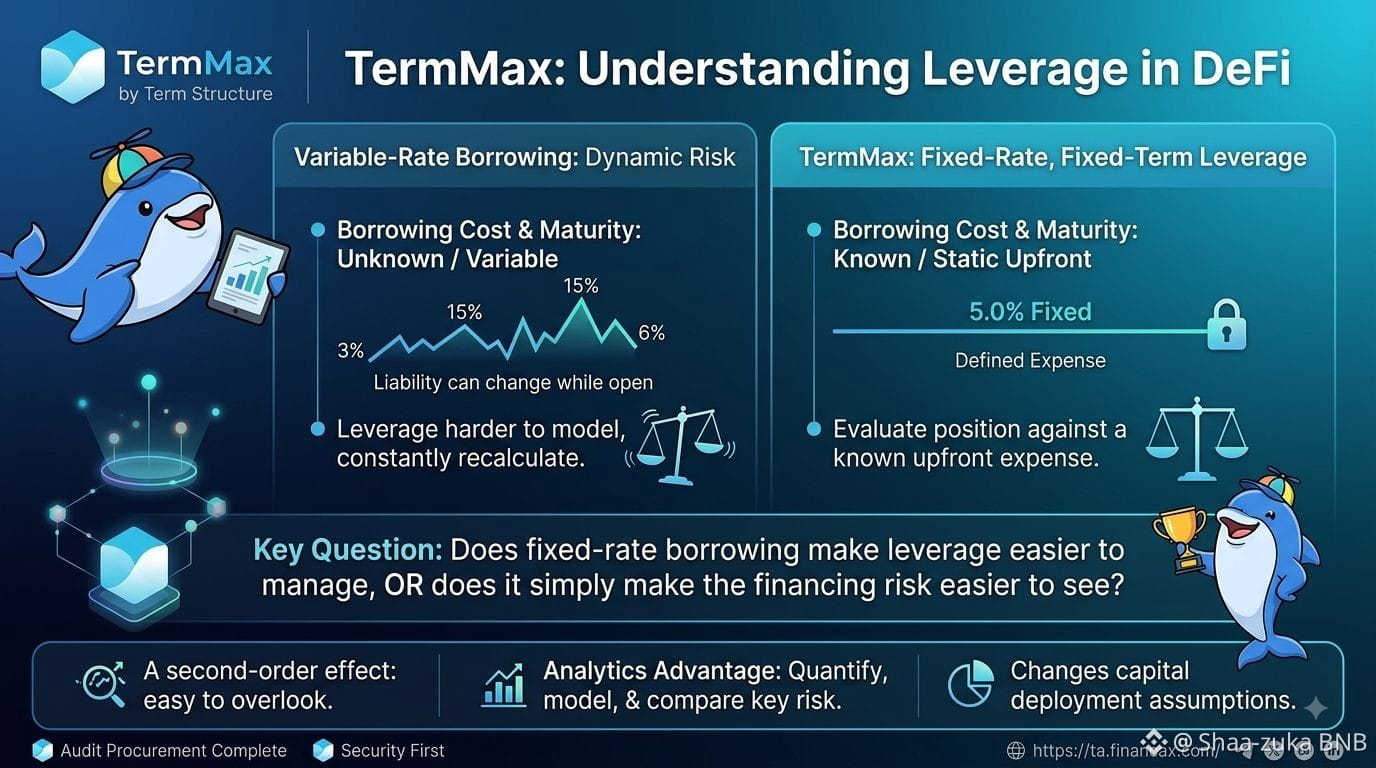
One thing I have been thinking about with @termmax is that the interesting part of fixed-rate borrowing isn’t really the word fixed.
It is the fact that borrowing cost and maturity become known inputs before the position even starts.
With variable rates, your liability can change while the trade is still open. That makes leverage harder to model because one side of the equation keeps moving.
TermMax approaches this differently by structuring borrowing around fixed-rate fixed-term positions.
And that creates a second-order effect I think is easy to overlook.
Once financing cost is known upfront, you can evaluate a leveraged position against a defined expense instead of constantly recalculating what the rate might become.
That doesn’t make leverage safe. Liquidation risk is still liquidation risk.
But from an analytics perspective it makes one part of the risk easier to quantify model and compare.
That is what makes fixed-rate infrastructure interesting to me. It isn’t simply another way to borrow - it changes the assumptions you can use when planning capital deployment.
So I keep coming back to one question:
Does fixed-rate borrowing actually make leverage easier to manage, or does it simply make the financing risk easier to see?
#termmax
One thing I have been thinking about with @TermMax is that the interesting part of fixed-rate borrowing isn’t really the word fixed.
It is the fact that borrowing cost and maturity become known inputs before the position even starts.
With variable rates, your liability can change while the trade is still open. That makes leverage harder to model because one side of the equation keeps moving.
TermMax approaches this differently by structuring borrowing around fixed-rate fixed-term positions.
And that creates a second-order effect I think is easy to overlook.
Once financing cost is known upfront, you can evaluate a leveraged position against a defined expense instead of constantly recalculating what the rate might become.
That doesn’t make leverage safe. Liquidation risk is still liquidation risk.
But from an analytics perspective it makes one part of the risk easier to quantify model and compare.
That is what makes fixed-rate infrastructure interesting to me. It isn’t simply another way to borrow - it changes the assumptions you can use when planning capital deployment.
So I keep coming back to one question:
Does fixed-rate borrowing actually make leverage easier to manage, or does it simply make the financing risk easier to see?
#termmax
It is the fact that borrowing cost and maturity become known inputs before the position even starts.
With variable rates, your liability can change while the trade is still open. That makes leverage harder to model because one side of the equation keeps moving.
TermMax approaches this differently by structuring borrowing around fixed-rate fixed-term positions.
And that creates a second-order effect I think is easy to overlook.
Once financing cost is known upfront, you can evaluate a leveraged position against a defined expense instead of constantly recalculating what the rate might become.
That doesn’t make leverage safe. Liquidation risk is still liquidation risk.
But from an analytics perspective it makes one part of the risk easier to quantify model and compare.
That is what makes fixed-rate infrastructure interesting to me. It isn’t simply another way to borrow - it changes the assumptions you can use when planning capital deployment.
So I keep coming back to one question:
Does fixed-rate borrowing actually make leverage easier to manage, or does it simply make the financing risk easier to see?
#termmax
22
15
2.3k
·
--
Жоғары (өспелі)
I used to think an XSC was basically just a private token standard.
After digging deeper into Dusk, I realized that's a much smaller part of the picture.
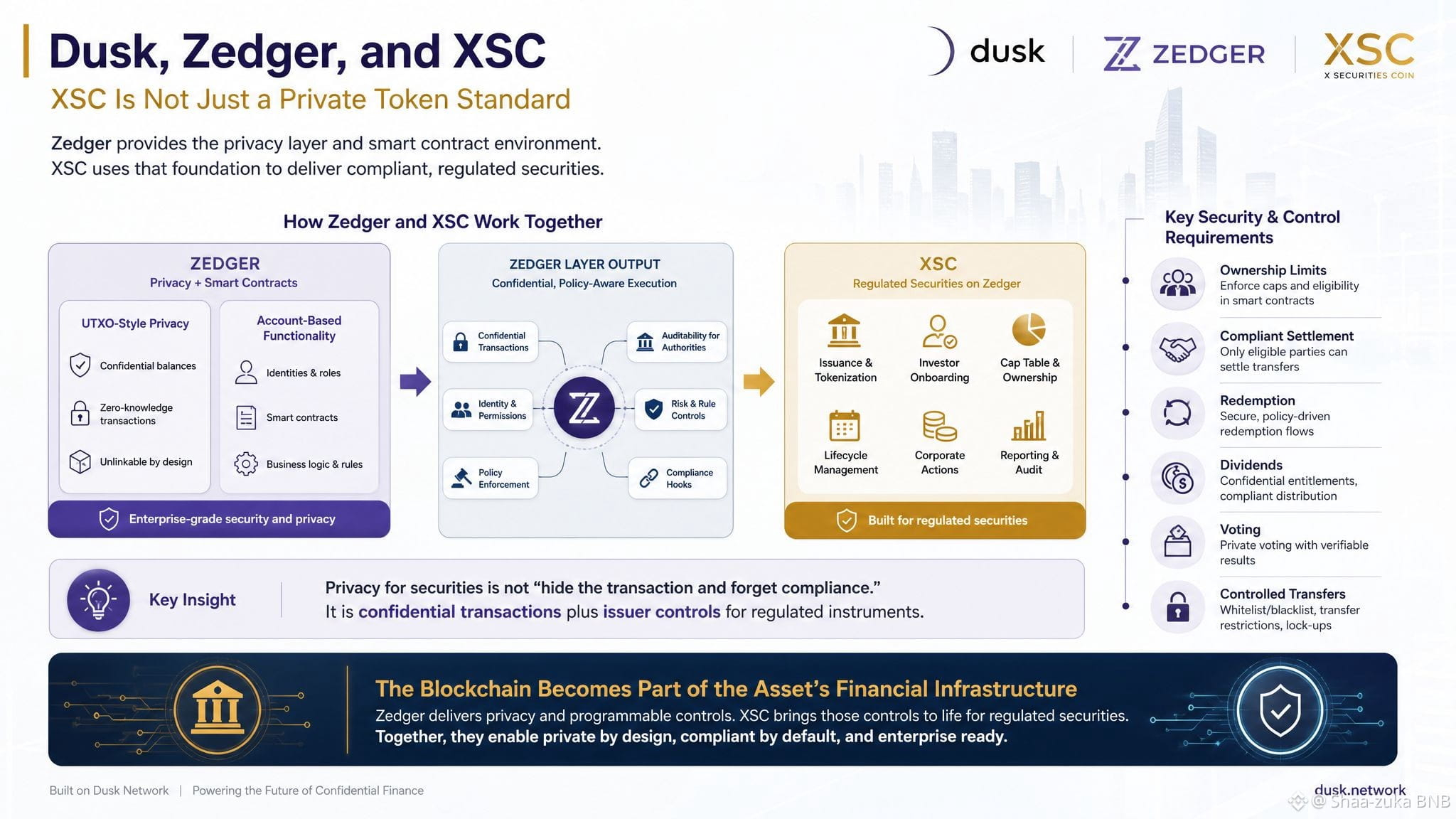
The interesting piece is how Zedger and XSC work together.
Zedger combines UTXO-style privacy with account-based functionality, which is important because securities aren't just simple transfers.
A regulated security may need:
ownership limits
compliant settlement
redemption
dividends
voting
controlled transfers
And Dusk designed XSC around these kinds of requirements.
That changed my understanding of what “privacy for securities” actually means.
It's not:
“Hide the transaction and forget about compliance.”
It's closer to:
Keep transaction information confidential while still giving the asset issuer the rules and controls needed for a regulated financial instrument.
The part I'm still trying to understand better is how these controls behave when a security has complicated lifecycle events - especially when ownership restrictions, voting and distributions happen together.
That's the architectural question I find much more interesting than simply asking whether Dusk is private.
Because if XSC can actually encode the operational rules of a security, then the token isn't just representing the asset.
The blockchain is becoming part of the asset's financial infrastructure.
#dusk $DUSK @Dusk_Foundation
I used to think an XSC was basically just a private token standard.
After digging deeper into Dusk, I realized that's a much smaller part of the picture.
The interesting piece is how Zedger and XSC work together.
Zedger combines UTXO-style privacy with account-based functionality, which is important because securities aren't just simple transfers.
A regulated security may need:
ownership limits
compliant settlement
redemption
dividends
voting
controlled transfers
And Dusk designed XSC around these kinds of requirements.
That changed my understanding of what “privacy for securities” actually means.
It's not:
“Hide the transaction and forget about compliance.”
It's closer to:
Keep transaction information confidential while still giving the asset issuer the rules and controls needed for a regulated financial instrument.
The part I'm still trying to understand better is how these controls behave when a security has complicated lifecycle events - especially when ownership restrictions, voting and distributions happen together.
That's the architectural question I find much more interesting than simply asking whether Dusk is private.
Because if XSC can actually encode the operational rules of a security, then the token isn't just representing the asset.
The blockchain is becoming part of the asset's financial infrastructure.
#dusk $DUSK @Dusk
After digging deeper into Dusk, I realized that's a much smaller part of the picture.
The interesting piece is how Zedger and XSC work together.
Zedger combines UTXO-style privacy with account-based functionality, which is important because securities aren't just simple transfers.
A regulated security may need:
ownership limits
compliant settlement
redemption
dividends
voting
controlled transfers
And Dusk designed XSC around these kinds of requirements.
That changed my understanding of what “privacy for securities” actually means.
It's not:
“Hide the transaction and forget about compliance.”
It's closer to:
Keep transaction information confidential while still giving the asset issuer the rules and controls needed for a regulated financial instrument.
The part I'm still trying to understand better is how these controls behave when a security has complicated lifecycle events - especially when ownership restrictions, voting and distributions happen together.
That's the architectural question I find much more interesting than simply asking whether Dusk is private.
Because if XSC can actually encode the operational rules of a security, then the token isn't just representing the asset.
The blockchain is becoming part of the asset's financial infrastructure.
#dusk $DUSK @Dusk
47
22
1.2k
·
--
Жоғары (өспелі)
Расталды
One technical detail made me stop and think about Dusk differently.
The relationship between DuskDS and DuskEVM did not depend on creating another wrapped version of native $DUSK
@Dusk_Foundation uses a native bridge architecture between the layers.
At 1st, that may sound like a small implementation detail.
I don't think it is.
Every additional bridge, wrapper or external custodian can introduce another assumption into a financial system.
So I started looking at Dusk from a different question:
How many additional trust assumptions does the architecture actually need?
Dusk's model keeps the roles clear:
DuskDS → settlement and network security
DuskEVM → application execution
Native bridge → movement of DUSK between the layers
That is particularly relevant for regulated finance.
If an institution is already dealing with compliance, identity, asset restrictions and disclosure requirements, adding unnecessary infrastructure dependencies isn't exactly helpful.
This is why I like the design principle here:
Don't add complexity where the protocol doesn't need it.
The same philosophy appears elsewhere in Dusk:
privacy where sensitive information needs protection,
transparency where the market needs visibility,
and selective disclosure when an authorized party needs verification.
For me, that is a much stronger thesis than simply saying:
“Dusk has a bridge.”
It is about reducing unnecessary trust assumptions across the financial stack.
#dusk
One technical detail made me stop and think about Dusk differently.
The relationship between DuskDS and DuskEVM did not depend on creating another wrapped version of native $DUSK
@Dusk uses a native bridge architecture between the layers.
At 1st, that may sound like a small implementation detail.
I don't think it is.
Every additional bridge, wrapper or external custodian can introduce another assumption into a financial system.
So I started looking at Dusk from a different question:
How many additional trust assumptions does the architecture actually need?
Dusk's model keeps the roles clear:
DuskDS → settlement and network security
DuskEVM → application execution
Native bridge → movement of DUSK between the layers
That is particularly relevant for regulated finance.
If an institution is already dealing with compliance, identity, asset restrictions and disclosure requirements, adding unnecessary infrastructure dependencies isn't exactly helpful.
This is why I like the design principle here:
Don't add complexity where the protocol doesn't need it.
The same philosophy appears elsewhere in Dusk:
privacy where sensitive information needs protection,
transparency where the market needs visibility,
and selective disclosure when an authorized party needs verification.
For me, that is a much stronger thesis than simply saying:
“Dusk has a bridge.”
It is about reducing unnecessary trust assumptions across the financial stack.
#dusk
The relationship between DuskDS and DuskEVM did not depend on creating another wrapped version of native $DUSK
@Dusk uses a native bridge architecture between the layers.
At 1st, that may sound like a small implementation detail.
I don't think it is.
Every additional bridge, wrapper or external custodian can introduce another assumption into a financial system.
So I started looking at Dusk from a different question:
How many additional trust assumptions does the architecture actually need?
Dusk's model keeps the roles clear:
DuskDS → settlement and network security
DuskEVM → application execution
Native bridge → movement of DUSK between the layers
That is particularly relevant for regulated finance.
If an institution is already dealing with compliance, identity, asset restrictions and disclosure requirements, adding unnecessary infrastructure dependencies isn't exactly helpful.
This is why I like the design principle here:
Don't add complexity where the protocol doesn't need it.
The same philosophy appears elsewhere in Dusk:
privacy where sensitive information needs protection,
transparency where the market needs visibility,
and selective disclosure when an authorized party needs verification.
For me, that is a much stronger thesis than simply saying:
“Dusk has a bridge.”
It is about reducing unnecessary trust assumptions across the financial stack.
#dusk
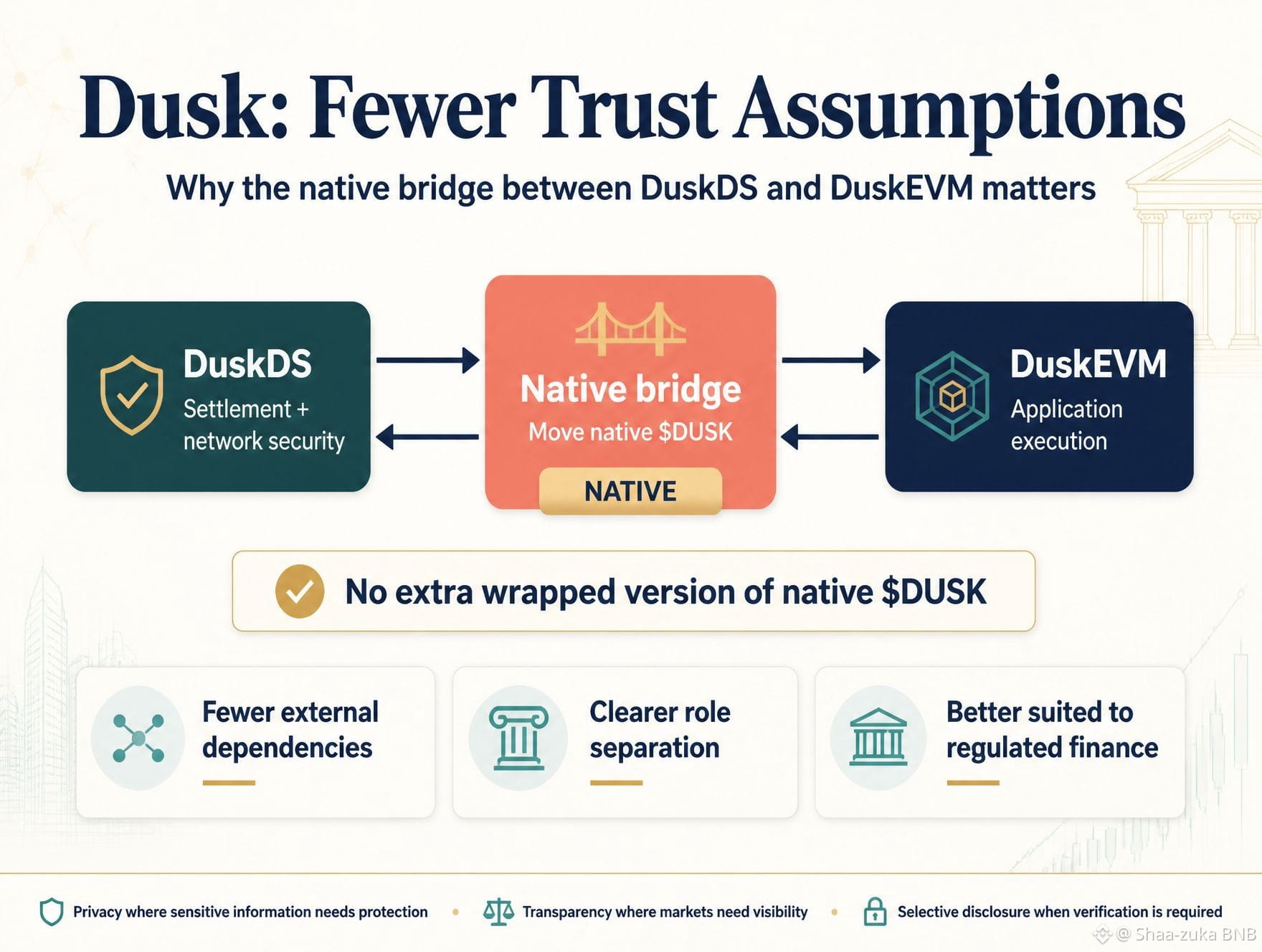
84
36
4k
·
--
Жоғары (өспелі)
Расталды
@Dusk_Foundation isn't trying to make regulated finance more crypto.
It's trying to make regulated finance programmable without making everything public.
That's why DuskEVM is interesting to me.
The upcoming DuskEVM mainnet gives Solidity developers a familiar EVM path into Dusk, while the underlying Dusk stack provides deterministic settlement and data availability.
But the more unusual part is Hedger.
Hedger is the privacy path for EVM applications, combining homomorphic encryption and zero-knowledge proofs so financial workflows can keep sensitive information confidential while still producing verifiable execution.
Think about what that means for an institution.
A fund may need to prove that a transaction is valid without broadcasting every position.
An investor may need to prove eligibility without exposing unnecessary personal information.
A regulated venue may need auditability without turning its entire order flow into public data.
That is a very different privacy thesis from simply hiding everything.
Dusk is aiming for privacy where needed, transparency where useful, and selective disclosure when an authorized party needs to review something.
And $DUSK is the native gas and staking asset securing this infrastructure.
That's why I'm watching DuskEVM closely.
The real test isn't whether Solidity can run on another chain.
It's whether familiar EVM development can be combined with the privacy and settlement requirements of real financial markets.
#dusk
What matters more for institutional EVM apps?
@Dusk isn't trying to make regulated finance more crypto.
It's trying to make regulated finance programmable without making everything public.
That's why DuskEVM is interesting to me.
The upcoming DuskEVM mainnet gives Solidity developers a familiar EVM path into Dusk, while the underlying Dusk stack provides deterministic settlement and data availability.
But the more unusual part is Hedger.
Hedger is the privacy path for EVM applications, combining homomorphic encryption and zero-knowledge proofs so financial workflows can keep sensitive information confidential while still producing verifiable execution.
Think about what that means for an institution.
A fund may need to prove that a transaction is valid without broadcasting every position.
An investor may need to prove eligibility without exposing unnecessary personal information.
A regulated venue may need auditability without turning its entire order flow into public data.
That is a very different privacy thesis from simply hiding everything.
Dusk is aiming for privacy where needed, transparency where useful, and selective disclosure when an authorized party needs to review something.
And $DUSK is the native gas and staking asset securing this infrastructure.
That's why I'm watching DuskEVM closely.
The real test isn't whether Solidity can run on another chain.
It's whether familiar EVM development can be combined with the privacy and settlement requirements of real financial markets.
#dusk
What matters more for institutional EVM apps?
It's trying to make regulated finance programmable without making everything public.
That's why DuskEVM is interesting to me.
The upcoming DuskEVM mainnet gives Solidity developers a familiar EVM path into Dusk, while the underlying Dusk stack provides deterministic settlement and data availability.
But the more unusual part is Hedger.
Hedger is the privacy path for EVM applications, combining homomorphic encryption and zero-knowledge proofs so financial workflows can keep sensitive information confidential while still producing verifiable execution.
Think about what that means for an institution.
A fund may need to prove that a transaction is valid without broadcasting every position.
An investor may need to prove eligibility without exposing unnecessary personal information.
A regulated venue may need auditability without turning its entire order flow into public data.
That is a very different privacy thesis from simply hiding everything.
Dusk is aiming for privacy where needed, transparency where useful, and selective disclosure when an authorized party needs to review something.
And $DUSK is the native gas and staking asset securing this infrastructure.
That's why I'm watching DuskEVM closely.
The real test isn't whether Solidity can run on another chain.
It's whether familiar EVM development can be combined with the privacy and settlement requirements of real financial markets.
#dusk
What matters more for institutional EVM apps?
Privacy
80%
Settlement
20%
5 дауыс • Дауыс беру жабық
85
35
1.2k
·
--
🚨 The CLARITY Act just hit a critical point.
Senate Majority Leader Thune has moved the bill toward a procedural vote after the September 15 recess - potentially one of the last realistic windows for crypto legislation to move in 2026.
But here's the problem:
Getting a vote ≠ getting enough votes to pass.
XRP has already felt the uncertainty, sliding toward the $1 area, while analysts remain cautious about the bill's chances amid election-year politics.
If CLARITY passes → major regulatory clarity for crypto.
If it stalls → the market may have to wait until 2027.
This isn't just another Senate vote. It's a deadline. 👀
#crypto #CLARITYAct #XRP
Do you think the CLARITY Act can pass in 2026?
The next procedural move could decide whether 2026 becomes a breakthrough year for U.S. crypto regulation. 👀
🚨 The CLARITY Act just hit a critical point.
Senate Majority Leader Thune has moved the bill toward a procedural vote after the September 15 recess - potentially one of the last realistic windows for crypto legislation to move in 2026.
But here's the problem:
Getting a vote ≠ getting enough votes to pass.
XRP has already felt the uncertainty, sliding toward the $1 area, while analysts remain cautious about the bill's chances amid election-year politics.
If CLARITY passes → major regulatory clarity for crypto.
If it stalls → the market may have to wait until 2027.
This isn't just another Senate vote. It's a deadline. 👀
#crypto #CLARITYAct #XRP
Do you think the CLARITY Act can pass in 2026?
The next procedural move could decide whether 2026 becomes a breakthrough year for U.S. crypto regulation. 👀
Senate Majority Leader Thune has moved the bill toward a procedural vote after the September 15 recess - potentially one of the last realistic windows for crypto legislation to move in 2026.
But here's the problem:
Getting a vote ≠ getting enough votes to pass.
XRP has already felt the uncertainty, sliding toward the $1 area, while analysts remain cautious about the bill's chances amid election-year politics.
If CLARITY passes → major regulatory clarity for crypto.
If it stalls → the market may have to wait until 2027.
This isn't just another Senate vote. It's a deadline. 👀
#crypto #CLARITYAct #XRP
Do you think the CLARITY Act can pass in 2026?
The next procedural move could decide whether 2026 becomes a breakthrough year for U.S. crypto regulation. 👀
🟢 YES — Crypto gets clarity
92%
🔴 NO — Politics will delay it
8%
24 дауыс • Дауыс беру жабық
3
764
Көбірек контент көру үшін кіріңіз
Binance Square платформасында әлемдік криптоқоғамдастыққа қосылыңыз
⚡️ Криптовалюта туралы ең соңғы және пайдалы ақпаратты алыңыз.
💬 Әлемдегі ең ірі криптобиржаның сеніміне ие.
👍 Расталған авторлардың нақты пікірлерін табыңыз.
Электрондық пошта/телефон нөмірі
Трендтегі тақырыптар
MidnightRises26.66%To$0.05
0 рет көрілді
20 адам талқылап жатыр
You really never can tell how far $BTW can dump in a blink of an eye
The coin has pumped over 20X from $0.05 to $1.4 and you till don't know what comes next?
Next Dump is gonna be as massive as $LSK dump
Like this post if you are ready for the dump
#BTWPriceAnalysis
ORVILLO
·9 лайк
·7.2k рет көрілді
ZcashETFPostsFirstWeeklyOutflow$93.6M
47,950 рет көрілді
143 адам талқылап жатыр
GreekPoliceBustCryptoScamRingArrest17
127,497 рет көрілді
917 адам талқылап жатыр