
Sean Paul UA
7 Жариялаулар

Sean Paul UA
Хабарлау
Пайдаланушыны блоктау
2 Жазылым
1 Жазылушылар
7 лайк басылған
Жазбалар
·
--
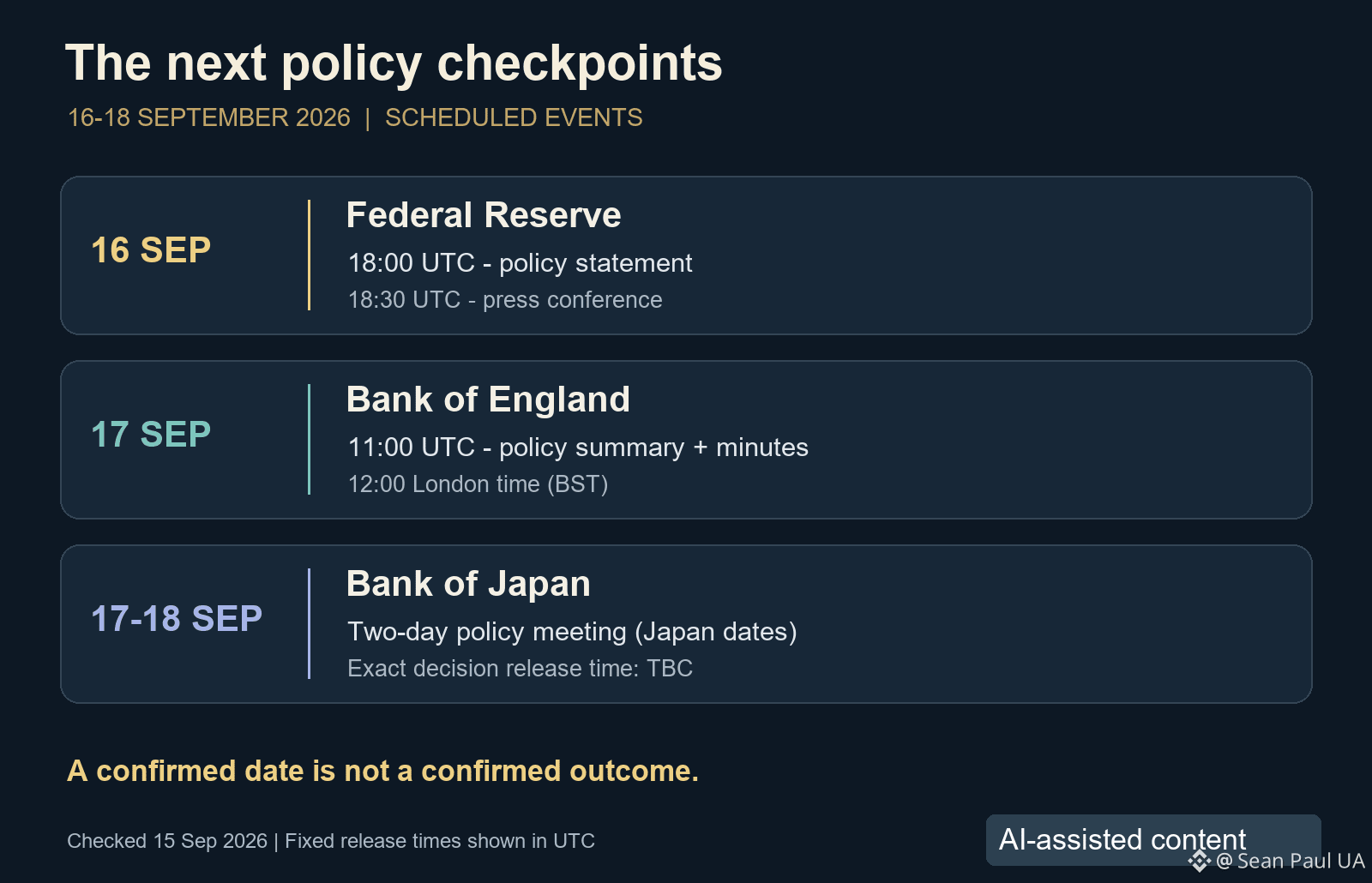
Three central banks are on my calendar for September 16-18. I'm keeping the release times beside the headlines.
First, the Fed: its September 15-16 meeting ends tomorrow. The policy statement is scheduled for September 16 at 18:00 UTC, followed by the press conference at 18:30 UTC. Those are two separate checkpoints for what policymakers actually say.
Next, the Bank of England publishes its policy summary and meeting minutes on September 17 at 11:00 UTC — noon in London.
The Bank of Japan meets on September 17-18, Japan local dates. Its schedule doesn't give an exact decision-release hour, so I'm leaving that time open.
My focus is the wording about the next steps, then how BTC and ETH respond. A confirmed meeting date tells me when to pay attention; it doesn't tell me which way prices will move.
Which message will you watch most closely this week: A) the Fed, B) the Bank of England, or C) the Bank of Japan — and why?
#Macro
Three central banks are on my calendar for September 16-18. I'm keeping the release times beside the headlines.
First, the Fed: its September 15-16 meeting ends tomorrow. The policy statement is scheduled for September 16 at 18:00 UTC, followed by the press conference at 18:30 UTC. Those are two separate checkpoints for what policymakers actually say.
Next, the Bank of England publishes its policy summary and meeting minutes on September 17 at 11:00 UTC — noon in London.
The Bank of Japan meets on September 17-18, Japan local dates. Its schedule doesn't give an exact decision-release hour, so I'm leaving that time open.
My focus is the wording about the next steps, then how BTC and ETH respond. A confirmed meeting date tells me when to pay attention; it doesn't tell me which way prices will move.
Which message will you watch most closely this week: A) the Fed, B) the Bank of England, or C) the Bank of Japan — and why?
#Macro
First, the Fed: its September 15-16 meeting ends tomorrow. The policy statement is scheduled for September 16 at 18:00 UTC, followed by the press conference at 18:30 UTC. Those are two separate checkpoints for what policymakers actually say.
Next, the Bank of England publishes its policy summary and meeting minutes on September 17 at 11:00 UTC — noon in London.
The Bank of Japan meets on September 17-18, Japan local dates. Its schedule doesn't give an exact decision-release hour, so I'm leaving that time open.
My focus is the wording about the next steps, then how BTC and ETH respond. A confirmed meeting date tells me when to pay attention; it doesn't tell me which way prices will move.
Which message will you watch most closely this week: A) the Fed, B) the Bank of England, or C) the Bank of Japan — and why?
#Macro
1
84
·
--
ETH bounced. I still think this recovery has more to prove.
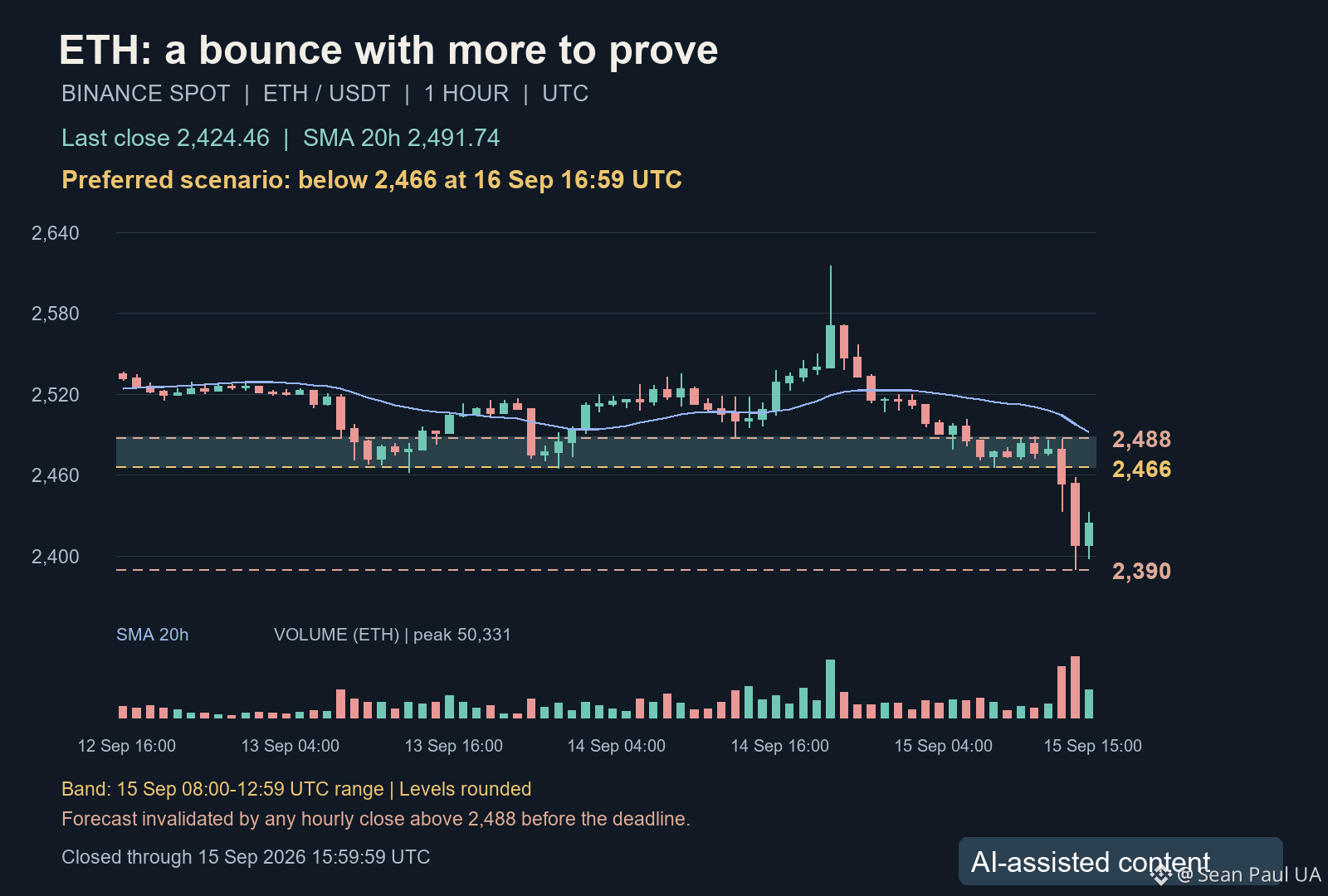
My main forecast is that ETH finishes below 2,466 USDT at the September 16 16:59 UTC hourly close, with the recovery still short of its old range.
At September 15's 15:59 UTC hourly close, ETH was 2,424.46 on Binance spot. That's below both its 20-hour average of 2,491.74 and the earlier 08:00-12:59 UTC range, roughly 2,466-2,488. One green hourly candle hasn't reclaimed either.
The Fed's calendar lists its September 15-16 meeting with economic projections. That is a volatility risk, not evidence that a particular rate decision or ETH move is certain.
The checkpoint is the close of the September 16 16:00-17:00 UTC candle, not a brief price touch.
An hourly close back above 2,466 would strengthen the recovery alternative and put 2,488 in focus.
If the rebound fades, a return to the observed low near 2,390 is the downside alternative; that level is not guaranteed support.
Any hourly close above 2,488 through that checkpoint invalidates my forecast, even if ETH later falls back.
What would change your view first: a reclaim of the old range, or a fresh low? I'd like to hear why.
$ETH #Ethereum
I may earn commissions from trades made through this post.
ETH bounced. I still think this recovery has more to prove.
My main forecast is that ETH finishes below 2,466 USDT at the September 16 16:59 UTC hourly close, with the recovery still short of its old range.
At September 15's 15:59 UTC hourly close, ETH was 2,424.46 on Binance spot. That's below both its 20-hour average of 2,491.74 and the earlier 08:00-12:59 UTC range, roughly 2,466-2,488. One green hourly candle hasn't reclaimed either.
The Fed's calendar lists its September 15-16 meeting with economic projections. That is a volatility risk, not evidence that a particular rate decision or ETH move is certain.
The checkpoint is the close of the September 16 16:00-17:00 UTC candle, not a brief price touch.
An hourly close back above 2,466 would strengthen the recovery alternative and put 2,488 in focus.
If the rebound fades, a return to the observed low near 2,390 is the downside alternative; that level is not guaranteed support.
Any hourly close above 2,488 through that checkpoint invalidates my forecast, even if ETH later falls back.
What would change your view first: a reclaim of the old range, or a fresh low? I'd like to hear why.
$ETH #Ethereum
I may earn commissions from trades made through this post.
My main forecast is that ETH finishes below 2,466 USDT at the September 16 16:59 UTC hourly close, with the recovery still short of its old range.
At September 15's 15:59 UTC hourly close, ETH was 2,424.46 on Binance spot. That's below both its 20-hour average of 2,491.74 and the earlier 08:00-12:59 UTC range, roughly 2,466-2,488. One green hourly candle hasn't reclaimed either.
The Fed's calendar lists its September 15-16 meeting with economic projections. That is a volatility risk, not evidence that a particular rate decision or ETH move is certain.
The checkpoint is the close of the September 16 16:00-17:00 UTC candle, not a brief price touch.
An hourly close back above 2,466 would strengthen the recovery alternative and put 2,488 in focus.
If the rebound fades, a return to the observed low near 2,390 is the downside alternative; that level is not guaranteed support.
Any hourly close above 2,488 through that checkpoint invalidates my forecast, even if ETH later falls back.
What would change your view first: a reclaim of the old range, or a fresh low? I'd like to hear why.
$ETH #Ethereum
I may earn commissions from trades made through this post.
1
64
·
--
BTC's rebound has lost ground. I'm watching the level it broke, rather than another round-number target.
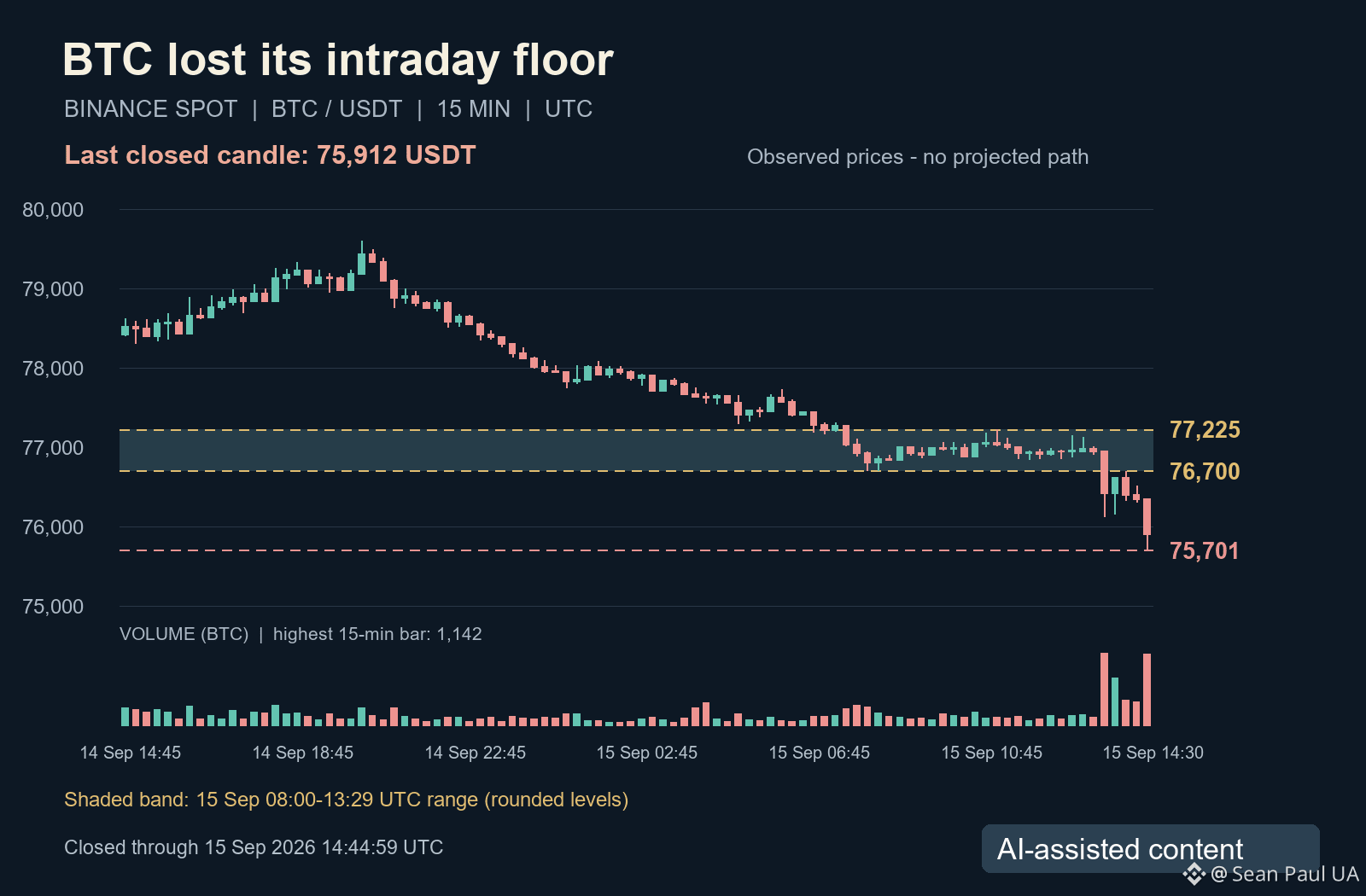
At 14:44 UTC on September 15, the latest completed 15-minute candle closed at 75,912 USDT on Binance spot. The earlier 08:00-13:29 UTC range was roughly 76,700-77,225. Price has since closed below that floor.
That changes my reading from this morning's rebound: a recovery now has a specific area to reclaim. These are rounded observations, not guaranteed support.
I'm watching the remaining hourly closes through September 15 at 23:59 UTC.
An hourly close back above 76,700 would put the old range ceiling near 77,225 back on my map.
If BTC holds above 75,701 but cannot reclaim 76,700, I'd read that as a pause below the broken range, not a repaired uptrend.
An hourly close below 75,701 would confirm more weakness beyond the latest completed 15-minute low.
I'd drop this bearish intraday reading after an hourly close above 77,225; a bounce alone isn't enough.
Where do you expect today's final UTC hourly close: A) above 76,700, B) 75,701-76,700, or C) below 75,701? What supports your view?
$BTC #Bitcoin
I may earn commissions from trades made through this post.
BTC's rebound has lost ground. I'm watching the level it broke, rather than another round-number target.
At 14:44 UTC on September 15, the latest completed 15-minute candle closed at 75,912 USDT on Binance spot. The earlier 08:00-13:29 UTC range was roughly 76,700-77,225. Price has since closed below that floor.
That changes my reading from this morning's rebound: a recovery now has a specific area to reclaim. These are rounded observations, not guaranteed support.
I'm watching the remaining hourly closes through September 15 at 23:59 UTC.
An hourly close back above 76,700 would put the old range ceiling near 77,225 back on my map.
If BTC holds above 75,701 but cannot reclaim 76,700, I'd read that as a pause below the broken range, not a repaired uptrend.
An hourly close below 75,701 would confirm more weakness beyond the latest completed 15-minute low.
I'd drop this bearish intraday reading after an hourly close above 77,225; a bounce alone isn't enough.
Where do you expect today's final UTC hourly close: A) above 76,700, B) 75,701-76,700, or C) below 75,701? What supports your view?
$BTC #Bitcoin
I may earn commissions from trades made through this post.
At 14:44 UTC on September 15, the latest completed 15-minute candle closed at 75,912 USDT on Binance spot. The earlier 08:00-13:29 UTC range was roughly 76,700-77,225. Price has since closed below that floor.
That changes my reading from this morning's rebound: a recovery now has a specific area to reclaim. These are rounded observations, not guaranteed support.
I'm watching the remaining hourly closes through September 15 at 23:59 UTC.
An hourly close back above 76,700 would put the old range ceiling near 77,225 back on my map.
If BTC holds above 75,701 but cannot reclaim 76,700, I'd read that as a pause below the broken range, not a repaired uptrend.
An hourly close below 75,701 would confirm more weakness beyond the latest completed 15-minute low.
I'd drop this bearish intraday reading after an hourly close above 77,225; a bounce alone isn't enough.
Where do you expect today's final UTC hourly close: A) above 76,700, B) 75,701-76,700, or C) below 75,701? What supports your view?
$BTC #Bitcoin
I may earn commissions from trades made through this post.
1
73
·
--
Sixteen vaults doesn't mean sixteen new strategies. That's the detail I noticed in Zama's announcement today.
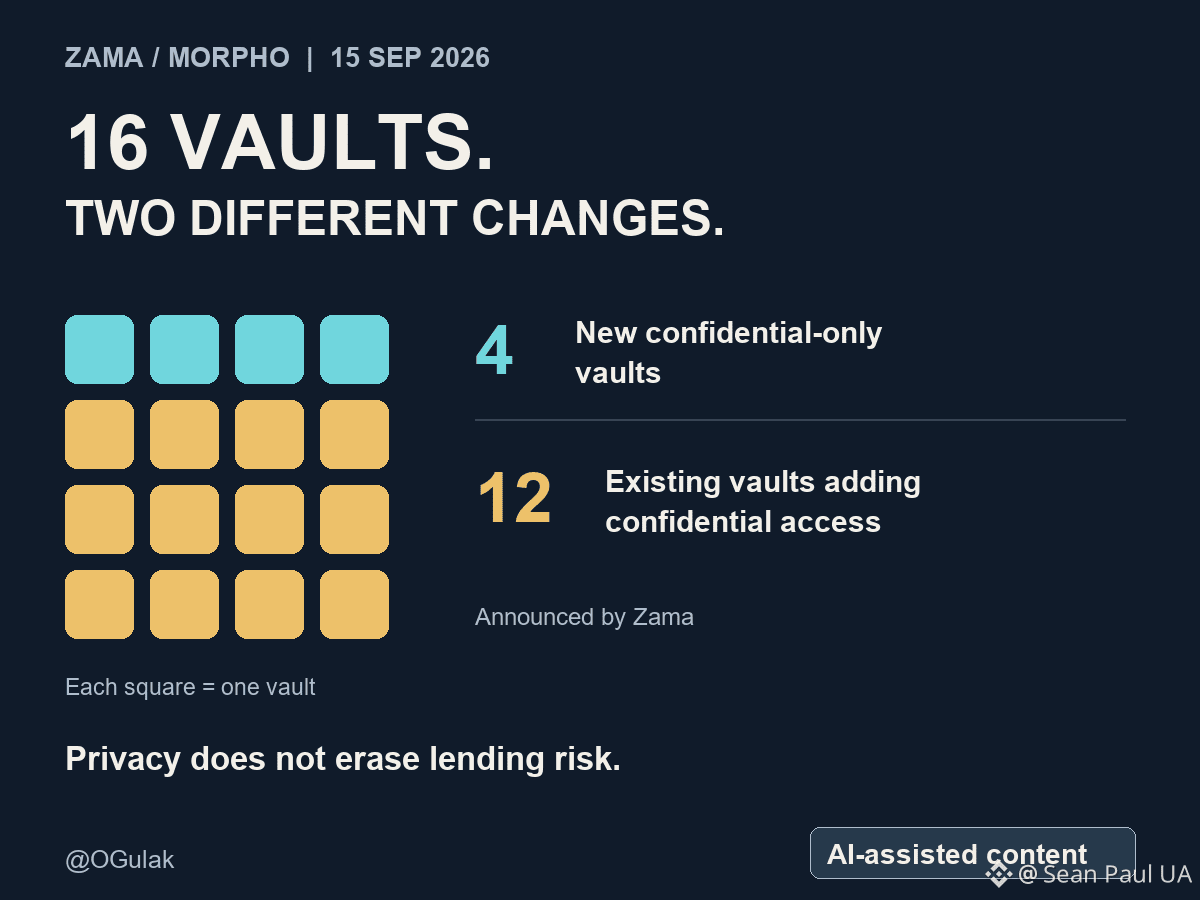
On September 15, Zama announced confidential access to 16 Morpho vaults: four new confidential-only products and 12 existing vaults adding confidential deposits.
The distinction matters. For those 12, the new feature is how users access the strategy. Zama says its confidentiality layer keeps amounts and balances encrypted while preserving public verifiability.
My read: protecting position size may remove one barrier for institutions. It doesn't remove smart-contract, lending or liquidity risk. Morpho's documentation warns that a shortage of liquidity can delay withdrawals.
I'd judge this launch by sustained use and how clearly those risks are explained, rather than the vault count alone. More product choice isn't evidence of more demand, and it isn't a price forecast for ZAMA or MORPHO.
Would private balances change your view of DeFi, or is reliable access to funds the bigger issue? Why?
#DeFi #Privacy
I may earn commissions from trades made through this post.
Sixteen vaults doesn't mean sixteen new strategies. That's the detail I noticed in Zama's announcement today.
On September 15, Zama announced confidential access to 16 Morpho vaults: four new confidential-only products and 12 existing vaults adding confidential deposits.
The distinction matters. For those 12, the new feature is how users access the strategy. Zama says its confidentiality layer keeps amounts and balances encrypted while preserving public verifiability.
My read: protecting position size may remove one barrier for institutions. It doesn't remove smart-contract, lending or liquidity risk. Morpho's documentation warns that a shortage of liquidity can delay withdrawals.
I'd judge this launch by sustained use and how clearly those risks are explained, rather than the vault count alone. More product choice isn't evidence of more demand, and it isn't a price forecast for ZAMA or MORPHO.
Would private balances change your view of DeFi, or is reliable access to funds the bigger issue? Why?
#DeFi #Privacy
I may earn commissions from trades made through this post.
On September 15, Zama announced confidential access to 16 Morpho vaults: four new confidential-only products and 12 existing vaults adding confidential deposits.
The distinction matters. For those 12, the new feature is how users access the strategy. Zama says its confidentiality layer keeps amounts and balances encrypted while preserving public verifiability.
My read: protecting position size may remove one barrier for institutions. It doesn't remove smart-contract, lending or liquidity risk. Morpho's documentation warns that a shortage of liquidity can delay withdrawals.
I'd judge this launch by sustained use and how clearly those risks are explained, rather than the vault count alone. More product choice isn't evidence of more demand, and it isn't a price forecast for ZAMA or MORPHO.
Would private balances change your view of DeFi, or is reliable access to funds the bigger issue? Why?
#DeFi #Privacy
I may earn commissions from trades made through this post.
1
109
·
--
Gold on a blockchain? I'm more interested in what the token actually lets you do.
On September 14, the UK's FCA opened a call for input on tokenised gold. Responses close October 23. This is a request for evidence, not approval of a particular token or a new rule already in force.
The useful idea: make physical gold easier to transfer and use as collateral. The hard part: proving who owns the metal, who holds it, and what happens when someone wants it back.
Over the next four weeks, I'm watching evidence of adoption rather than guessing a token price.
If institutions show credible demand for gold-backed collateral, that could strengthen the case for tokenisation infrastructure.
My base case is discussion and technical work before any broad rollout; the headline alone doesn't identify a winning crypto token.
If custody, redemption or legal rights remain unclear, enthusiasm could fade even if the technology works.
I'd change that cautious view if named institutions demonstrate real settlement use with clear ownership and redemption terms.
Adoption and token returns are different questions. I'd still need to see how any specific token captures value.
What would make tokenised gold useful to you: A) easier transfers, B) reliable redemption into physical gold, or C) using it as collateral? Which matters most, and why?
I may earn commissions from trades made through this post.
Gold on a blockchain? I'm more interested in what the token actually lets you do.
On September 14, the UK's FCA opened a call for input on tokenised gold. Responses close October 23. This is a request for evidence, not approval of a particular token or a new rule already in force.
The useful idea: make physical gold easier to transfer and use as collateral. The hard part: proving who owns the metal, who holds it, and what happens when someone wants it back.
Over the next four weeks, I'm watching evidence of adoption rather than guessing a token price.
If institutions show credible demand for gold-backed collateral, that could strengthen the case for tokenisation infrastructure.
My base case is discussion and technical work before any broad rollout; the headline alone doesn't identify a winning crypto token.
If custody, redemption or legal rights remain unclear, enthusiasm could fade even if the technology works.
I'd change that cautious view if named institutions demonstrate real settlement use with clear ownership and redemption terms.
Adoption and token returns are different questions. I'd still need to see how any specific token captures value.
What would make tokenised gold useful to you: A) easier transfers, B) reliable redemption into physical gold, or C) using it as collateral? Which matters most, and why?
I may earn commissions from trades made through this post.
On September 14, the UK's FCA opened a call for input on tokenised gold. Responses close October 23. This is a request for evidence, not approval of a particular token or a new rule already in force.
The useful idea: make physical gold easier to transfer and use as collateral. The hard part: proving who owns the metal, who holds it, and what happens when someone wants it back.
Over the next four weeks, I'm watching evidence of adoption rather than guessing a token price.
If institutions show credible demand for gold-backed collateral, that could strengthen the case for tokenisation infrastructure.
My base case is discussion and technical work before any broad rollout; the headline alone doesn't identify a winning crypto token.
If custody, redemption or legal rights remain unclear, enthusiasm could fade even if the technology works.
I'd change that cautious view if named institutions demonstrate real settlement use with clear ownership and redemption terms.
Adoption and token returns are different questions. I'd still need to see how any specific token captures value.
What would make tokenised gold useful to you: A) easier transfers, B) reliable redemption into physical gold, or C) using it as collateral? Which matters most, and why?
I may earn commissions from trades made through this post.

1
136
·
--
BTC bounced. Now I'm watching the Fed's message.
The Fed's calendar puts its next meeting on September 15-16, with updated economic projections scheduled alongside it. The outcome is still ahead of us.
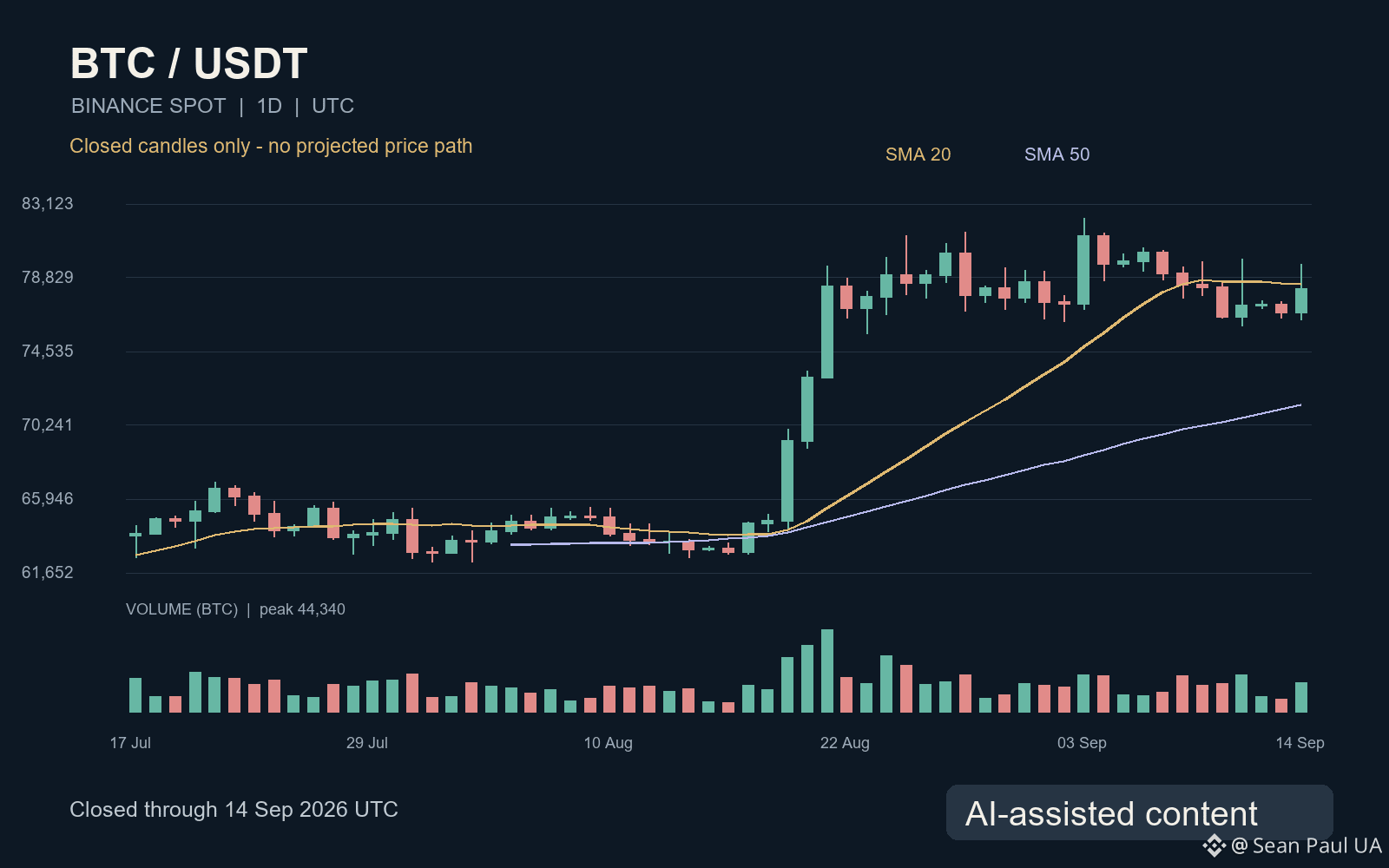
BTC's September 14 daily close was 78,189 USDT, up about 1.75% from the previous close. It still finished slightly below its 20-day average near 78,474. To me, that's a rebound with something left to prove.
My horizon is the September 16 announcement through the September 17 UTC daily close.
If the Fed's message pushes yields and the dollar lower, I'd watch for BTC strength that survives the initial reaction.
If the message brings little surprise, my working scenario is choppy trading rather than a clean new trend.
If the message pushes yields and the dollar higher, I'd watch for renewed pressure on BTC.
I'd drop that directional read if BTC fails to follow through by the next UTC daily close; the policy headline alone isn't confirmation.
Which will matter most for BTC after this meeting: A) the rate decision, B) the projected rate path, or C) the explanation behind them? I'd like to hear your reasoning.
$BTC
BTC bounced. Now I'm watching the Fed's message.
The Fed's calendar puts its next meeting on September 15-16, with updated economic projections scheduled alongside it. The outcome is still ahead of us.
BTC's September 14 daily close was 78,189 USDT, up about 1.75% from the previous close. It still finished slightly below its 20-day average near 78,474. To me, that's a rebound with something left to prove.
My horizon is the September 16 announcement through the September 17 UTC daily close.
If the Fed's message pushes yields and the dollar lower, I'd watch for BTC strength that survives the initial reaction.
If the message brings little surprise, my working scenario is choppy trading rather than a clean new trend.
If the message pushes yields and the dollar higher, I'd watch for renewed pressure on BTC.
I'd drop that directional read if BTC fails to follow through by the next UTC daily close; the policy headline alone isn't confirmation.
Which will matter most for BTC after this meeting: A) the rate decision, B) the projected rate path, or C) the explanation behind them? I'd like to hear your reasoning.
$BTC
The Fed's calendar puts its next meeting on September 15-16, with updated economic projections scheduled alongside it. The outcome is still ahead of us.
BTC's September 14 daily close was 78,189 USDT, up about 1.75% from the previous close. It still finished slightly below its 20-day average near 78,474. To me, that's a rebound with something left to prove.
My horizon is the September 16 announcement through the September 17 UTC daily close.
If the Fed's message pushes yields and the dollar lower, I'd watch for BTC strength that survives the initial reaction.
If the message brings little surprise, my working scenario is choppy trading rather than a clean new trend.
If the message pushes yields and the dollar higher, I'd watch for renewed pressure on BTC.
I'd drop that directional read if BTC fails to follow through by the next UTC daily close; the policy headline alone isn't confirmation.
Which will matter most for BTC after this meeting: A) the rate decision, B) the projected rate path, or C) the explanation behind them? I'd like to hear your reasoning.
$BTC
1
88
·
--
BTC daily: three conditions worth watching
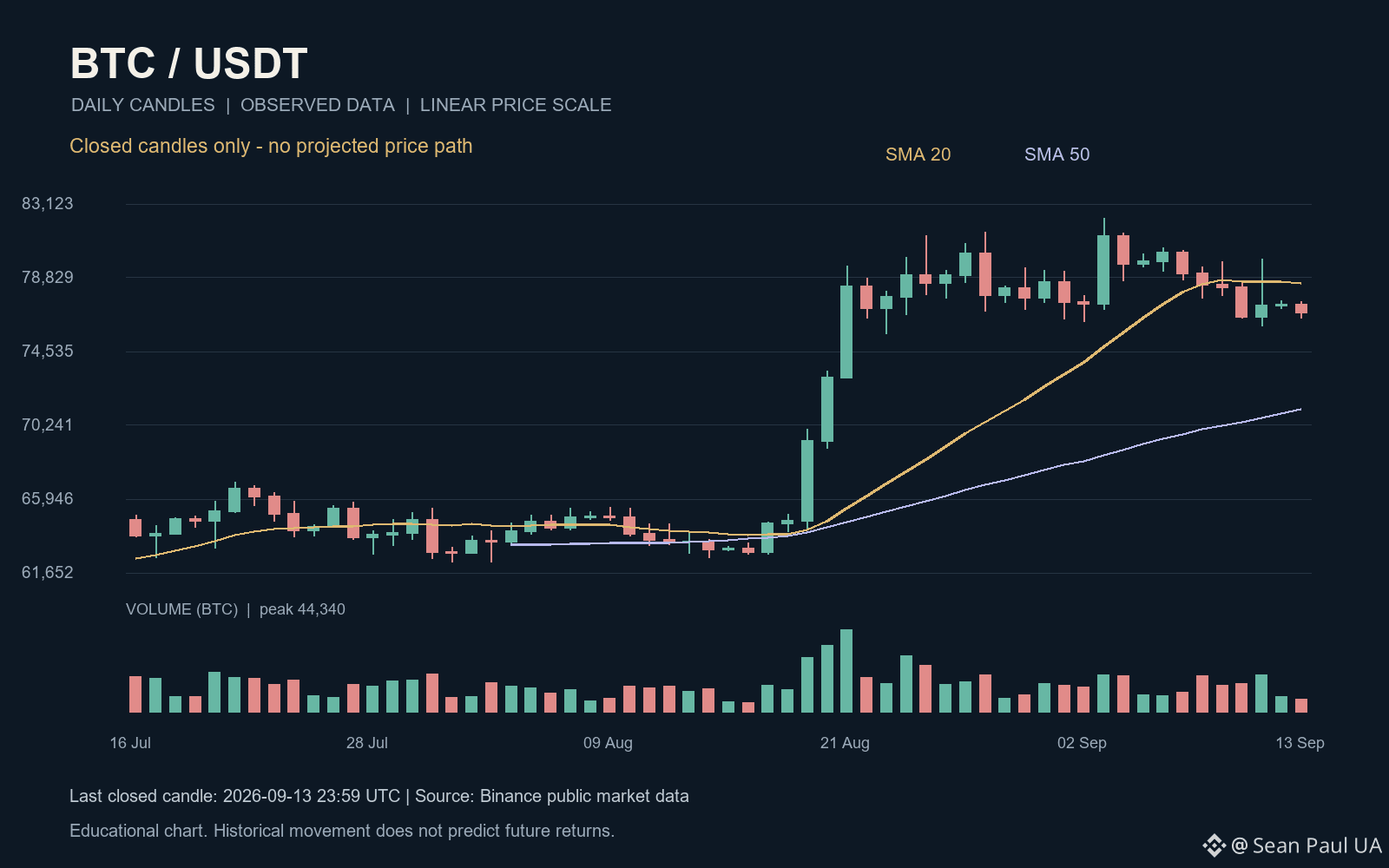
As of 2026-09-13 UTC, the last closed daily candle was 76,842 USDT. The 20-day average is 78,491; the 50-day average is 71,193. These describe recent price action, not future returns.
The latest 20 closed daily candles span 76,047-82,300 USDT. Those observed extremes give us a transparent reference range, not guaranteed support or resistance.
Horizon: the next 7 daily closes.
Upside: a daily close above 82,300, followed by another holding above it, would support a breakout interpretation.
Base: daily closes stay inside the reference range; direction remains unresolved.
Downside: a daily close below 76,047, followed by failure to reclaim it, would support a breakdown interpretation.
Invalidation: a breakout that returns inside the range loses confirmation; a sustained exit invalidates the range scenario.
BTC daily: three conditions worth watching
As of 2026-09-13 UTC, the last closed daily candle was 76,842 USDT. The 20-day average is 78,491; the 50-day average is 71,193. These describe recent price action, not future returns.
The latest 20 closed daily candles span 76,047-82,300 USDT. Those observed extremes give us a transparent reference range, not guaranteed support or resistance.
Horizon: the next 7 daily closes.
Upside: a daily close above 82,300, followed by another holding above it, would support a breakout interpretation.
Base: daily closes stay inside the reference range; direction remains unresolved.
Downside: a daily close below 76,047, followed by failure to reclaim it, would support a breakdown interpretation.
Invalidation: a breakout that returns inside the range loses confirmation; a sustained exit invalidates the range scenario.
As of 2026-09-13 UTC, the last closed daily candle was 76,842 USDT. The 20-day average is 78,491; the 50-day average is 71,193. These describe recent price action, not future returns.
The latest 20 closed daily candles span 76,047-82,300 USDT. Those observed extremes give us a transparent reference range, not guaranteed support or resistance.
Horizon: the next 7 daily closes.
Upside: a daily close above 82,300, followed by another holding above it, would support a breakout interpretation.
Base: daily closes stay inside the reference range; direction remains unresolved.
Downside: a daily close below 76,047, followed by failure to reclaim it, would support a breakdown interpretation.
Invalidation: a breakout that returns inside the range loses confirmation; a sustained exit invalidates the range scenario.
1
96
Көбірек контент көру үшін кіріңіз
Binance Square платформасында әлемдік криптоқоғамдастыққа қосылыңыз
⚡️ Криптовалюта туралы ең соңғы және пайдалы ақпаратты алыңыз.
💬 Әлемдегі ең ірі криптобиржаның сеніміне ие.
👍 Расталған авторлардың нақты пікірлерін табыңыз.
Электрондық пошта/телефон нөмірі
Трендтегі тақырыптар
FedRateWatch
568,244 рет көрілді
2,675 адам талқылап жатыр
Share & Win Traffic Reward in our Trending Hashtag Campaign
✨Topic: FOMC September, What's The Fed's Next Move?
👉How to Join:
Publish a short post or article with hashtag #FedRateWatch
Create content based on the below angles:
- August core CPI rose 0.3% month-over-month, and the odds of a 25bp hike this week are now close to 90%. Do you anticipate a rate hike this week? Is it a one-off, or the start of a longer hiking cycle?
- If the hike lands, how does it play out for BTC, tech stocks, and gold? Bullish or bearish?
- How are you planning to trade next? Share your BTC, stocks or gold trade/holdings with our trade sharing widget.
⏰Campaign Period:
- 2026-09-15 11:00 - 2026-09-17 3:00 UTC
🎁Reward:
- Qualified posts that comply with the above guidelines and contain more than 100 words will be reviewed and may receive a random traffic boost of 500 to 3,000 views. You will receive a notification from your feed secretary if your post is selected.
- Get a chance to have your article featured on Binance Square Official
Need ideas for your post? Visit the topic page #FedRateWatch or the Square Guide on How to Post for Better Reach.
Binance Square Official
·382 лайк
·842.7k рет көрілді
BitcoinSlidesTo$76000
21,559 рет көрілді
117 адам талқылап жатыр
BitcoinReboundsTo$79K
61,889 рет көрілді
401 адам талқылап жатыр