
بھائی_Azhar09
2.7k Жариялаулар

بھائی_Azhar09
Хабарлау
Пайдаланушыны блоктау
“I gave everyone a piece of me, and somehow lost myself.”
812 Жазылым
6.3K+ Жазылушылар
2.5K+ лайк басылған
Жазбалар
Барлығы
Баға ұсыныстары
Тікелей эфир
Расталды
#sxt $SXT Something I keep thinking about when it comes to AI is that producing an answer and proving that the answer is correct are two completely different things.
Imagine an AI agent working with millions of financial records. It processes the data, runs SQL queries, generates a report, and recommends an important business decision. Everything looks convincing, but how can anyone independently confirm that the calculations behind that recommendation are accurate?
This is where I find Space and Time ($SXT ) particularly interesting.
Its Proof of SQL technology brings an important concept into the picture: verifiable computation. Instead of simply trusting the output of a database query, cryptographic proofs can be generated to demonstrate that the computation was performed correctly.
What makes this more interesting is that verification does not necessarily require exposing the underlying private data. Organizations can maintain data confidentiality while making the results of computations verifiable.
I believe this could become increasingly relevant as AI agents take on more responsibility in finance, analytics, and automated decision-making.
But there is another side worth considering. A mathematically correct calculation based on inaccurate or manipulated data can still produce a misleading result. So, verifying computation is one part of the trust problem, not the entire solution.
For me, the bigger question is no longer just how intelligent AI can become, but how much of its work can actually be independently verified.
That is the direction in which I want to keep watching Space and Time develop. No premature conclusions, just genuine curiosity about its real-world potential.
What matters more for trustworthy AI: better intelligence or verifiable results?
@SpaceandTimeDB
#sxt $SXT Something I keep thinking about when it comes to AI is that producing an answer and proving that the answer is correct are two completely different things.
Imagine an AI agent working with millions of financial records. It processes the data, runs SQL queries, generates a report, and recommends an important business decision. Everything looks convincing, but how can anyone independently confirm that the calculations behind that recommendation are accurate?
This is where I find Space and Time ($SXT ) particularly interesting.
Its Proof of SQL technology brings an important concept into the picture: verifiable computation. Instead of simply trusting the output of a database query, cryptographic proofs can be generated to demonstrate that the computation was performed correctly.
What makes this more interesting is that verification does not necessarily require exposing the underlying private data. Organizations can maintain data confidentiality while making the results of computations verifiable.
I believe this could become increasingly relevant as AI agents take on more responsibility in finance, analytics, and automated decision-making.
But there is another side worth considering. A mathematically correct calculation based on inaccurate or manipulated data can still produce a misleading result. So, verifying computation is one part of the trust problem, not the entire solution.
For me, the bigger question is no longer just how intelligent AI can become, but how much of its work can actually be independently verified.
That is the direction in which I want to keep watching Space and Time develop. No premature conclusions, just genuine curiosity about its real-world potential.
What matters more for trustworthy AI: better intelligence or verifiable results?
@SpaceandTime
Imagine an AI agent working with millions of financial records. It processes the data, runs SQL queries, generates a report, and recommends an important business decision. Everything looks convincing, but how can anyone independently confirm that the calculations behind that recommendation are accurate?
This is where I find Space and Time ($SXT ) particularly interesting.
Its Proof of SQL technology brings an important concept into the picture: verifiable computation. Instead of simply trusting the output of a database query, cryptographic proofs can be generated to demonstrate that the computation was performed correctly.
What makes this more interesting is that verification does not necessarily require exposing the underlying private data. Organizations can maintain data confidentiality while making the results of computations verifiable.
I believe this could become increasingly relevant as AI agents take on more responsibility in finance, analytics, and automated decision-making.
But there is another side worth considering. A mathematically correct calculation based on inaccurate or manipulated data can still produce a misleading result. So, verifying computation is one part of the trust problem, not the entire solution.
For me, the bigger question is no longer just how intelligent AI can become, but how much of its work can actually be independently verified.
That is the direction in which I want to keep watching Space and Time develop. No premature conclusions, just genuine curiosity about its real-world potential.
What matters more for trustworthy AI: better intelligence or verifiable results?
@SpaceandTime
1
161
real high and low
real high and low

Elite Crypto Club 秘密
·
--
[Қайта ойнату] 🎙️ Gold & Crypto Live Analysis | Real High & Low | Elite FX
02 сағ 03 а 32 с · 74 рет тыңдалды
53
real high and low
real high and low
Elite Crypto Club 秘密
·
--
[Қайта ойнату] 🎙️ Gold & Crypto Live Analysis | Real High & Low | Elite FX
01 сағ 29 а 53 с · 99 рет тыңдалды
78
The current crypto market structure reveals stark divergences across these three assets, offering distinct technical narratives ranging from explosive reversal to heavy distribution and steady bullish continuation. Looking at $AKE on the daily chart, the asset has triggered a massive, high-volume trend reversal from its rock-bottom structural floor at 0.001877, printing an explosive daily surge of over 103%. The sheer volume influx strongly indicates that long-term accumulation has shifted into aggressive markup phase, favoring a strong upward continuation if the immediate local resistance at 0.006351 gets cleared. In complete contras
{future}(AKEUSDT)
$AIN is undergoing intense capitulation on the lower timeframes, shedding over 60% of its value as heavy selling pressure forces price down to a fragile consolidation zone near 0.1051. The asset is showing severe relative weakness, and until it can firmly reclaim structural support levels above 0.1300, the technical direction remains heavily skewed toward a bearish breakdown continuation.
{future}(AINUSDT)
Meanwhile, $CYBER is demonstrating the most stable, reliable market structure of the trio on its 15-minute timeframe, maintaining a highly structured bullish trend of higher highs and higher lows. After bouncing decisively off its local floor at 0.2570, CYBER rallied hard toward 0.4111 and is now forming a tight, bullish flag consolidation right near its recent highs at 0.3797. This clean price action shows intense buying interest defending any minor dips, keeping the short-term directional bias firmly to the upside as the asset builds energy for another potential breakout leg.
{future}(CYBERUSDT)
#BinanceReopensWithdrawalsForMoreAssets #JobsReportRaisesHikeOdds #USMidtermsCouldShakeUpUS-IranTies #CanUSStocksReboundAfterNonfarmPayrolls? #JobsReportRaisesHikeOdds
Which setup has the highest probability next?
The current crypto market structure reveals stark divergences across these three assets, offering distinct technical narratives ranging from explosive reversal to heavy distribution and steady bullish continuation. Looking at $AKE on the daily chart, the asset has triggered a massive, high-volume trend reversal from its rock-bottom structural floor at 0.001877, printing an explosive daily surge of over 103%. The sheer volume influx strongly indicates that long-term accumulation has shifted into aggressive markup phase, favoring a strong upward continuation if the immediate local resistance at 0.006351 gets cleared. In complete contras
$AIN is undergoing intense capitulation on the lower timeframes, shedding over 60% of its value as heavy selling pressure forces price down to a fragile consolidation zone near 0.1051. The asset is showing severe relative weakness, and until it can firmly reclaim structural support levels above 0.1300, the technical direction remains heavily skewed toward a bearish breakdown continuation.
Meanwhile, $CYBER is demonstrating the most stable, reliable market structure of the trio on its 15-minute timeframe, maintaining a highly structured bullish trend of higher highs and higher lows. After bouncing decisively off its local floor at 0.2570, CYBER rallied hard toward 0.4111 and is now forming a tight, bullish flag consolidation right near its recent highs at 0.3797. This clean price action shows intense buying interest defending any minor dips, keeping the short-term directional bias firmly to the upside as the asset builds energy for another potential breakout leg.
#BinanceReopensWithdrawalsForMoreAssets #JobsReportRaisesHikeOdds #USMidtermsCouldShakeUpUS-IranTies #CanUSStocksReboundAfterNonfarmPayrolls? #JobsReportRaisesHikeOdds
Which setup has the highest probability next?
$AIN is undergoing intense capitulation on the lower timeframes, shedding over 60% of its value as heavy selling pressure forces price down to a fragile consolidation zone near 0.1051. The asset is showing severe relative weakness, and until it can firmly reclaim structural support levels above 0.1300, the technical direction remains heavily skewed toward a bearish breakdown continuation.
Meanwhile, $CYBER is demonstrating the most stable, reliable market structure of the trio on its 15-minute timeframe, maintaining a highly structured bullish trend of higher highs and higher lows. After bouncing decisively off its local floor at 0.2570, CYBER rallied hard toward 0.4111 and is now forming a tight, bullish flag consolidation right near its recent highs at 0.3797. This clean price action shows intense buying interest defending any minor dips, keeping the short-term directional bias firmly to the upside as the asset builds energy for another potential breakout leg.
#BinanceReopensWithdrawalsForMoreAssets #JobsReportRaisesHikeOdds #USMidtermsCouldShakeUpUS-IranTies #CanUSStocksReboundAfterNonfarmPayrolls? #JobsReportRaisesHikeOdds
Which setup has the highest probability next?
AKE Reversal Long 🚀
43%
AIN Breakdown Short 📉
18%
CYBER Trend Long 📈
39%
28 дауыс • Дауыс беру жабық
1
1.3k
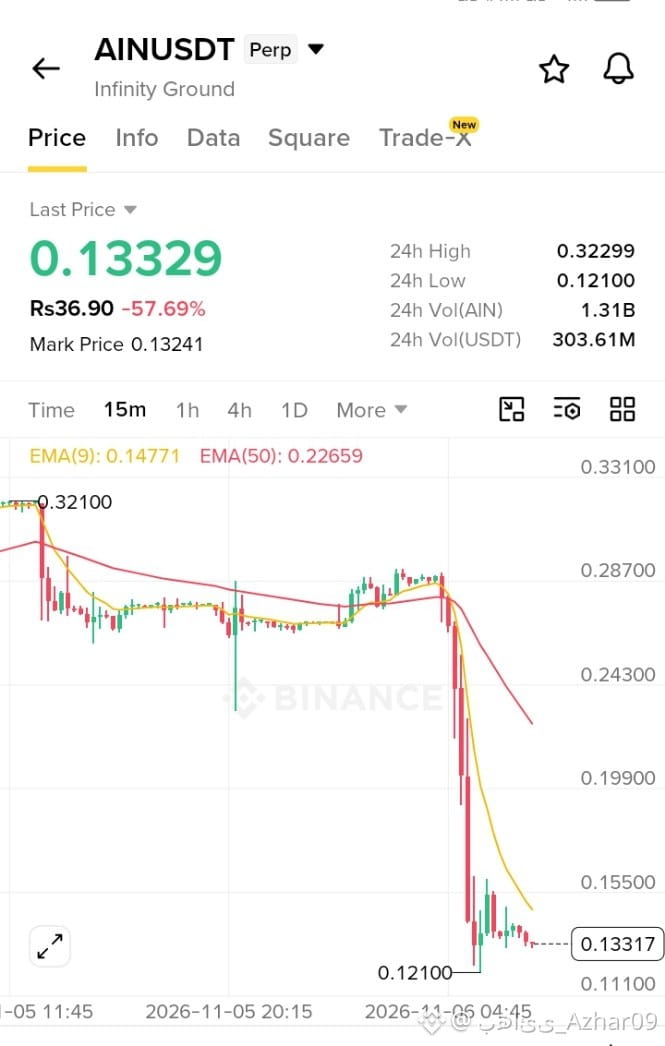
$AIN is displaying a heavy bearish breakdown
after slipping below key consolidation zones, currently hovering right above its local low of 0.12100. The massive sell-off printed a steep downward expansion, and the current minor bounce looks like weak, low-volume consolidation rather than a reversal. As long as price remains pinned beneath the EMA(9) around 0.1477, the path of least resistance is further downside. Watch the 0.1210 support closely; a clean break opens up a fresh leg down.
Entry Zone: 0.1332 - 0.1360
TP1: 0.1250
TP2: 0.1210
TP3: 0.1120
SL: 0.1435
{future}(AINUSDT)
#AIN #BinanceReopensWithdrawalsForMoreAssets #AnthropicIPOValuationDoubts #StrategySTRCResumesIssuanceAfterOver170Days #Nasdaq100Tumbles6%
$AIN is displaying a heavy bearish breakdown
after slipping below key consolidation zones, currently hovering right above its local low of 0.12100. The massive sell-off printed a steep downward expansion, and the current minor bounce looks like weak, low-volume consolidation rather than a reversal. As long as price remains pinned beneath the EMA(9) around 0.1477, the path of least resistance is further downside. Watch the 0.1210 support closely; a clean break opens up a fresh leg down.
Entry Zone: 0.1332 - 0.1360
TP1: 0.1250
TP2: 0.1210
TP3: 0.1120
SL: 0.1435
#AIN #BinanceReopensWithdrawalsForMoreAssets #AnthropicIPOValuationDoubts #StrategySTRCResumesIssuanceAfterOver170Days #Nasdaq100Tumbles6%
after slipping below key consolidation zones, currently hovering right above its local low of 0.12100. The massive sell-off printed a steep downward expansion, and the current minor bounce looks like weak, low-volume consolidation rather than a reversal. As long as price remains pinned beneath the EMA(9) around 0.1477, the path of least resistance is further downside. Watch the 0.1210 support closely; a clean break opens up a fresh leg down.
Entry Zone: 0.1332 - 0.1360
TP1: 0.1250
TP2: 0.1210
TP3: 0.1120
SL: 0.1435
#AIN #BinanceReopensWithdrawalsForMoreAssets #AnthropicIPOValuationDoubts #StrategySTRCResumesIssuanceAfterOver170Days #Nasdaq100Tumbles6%
1
361
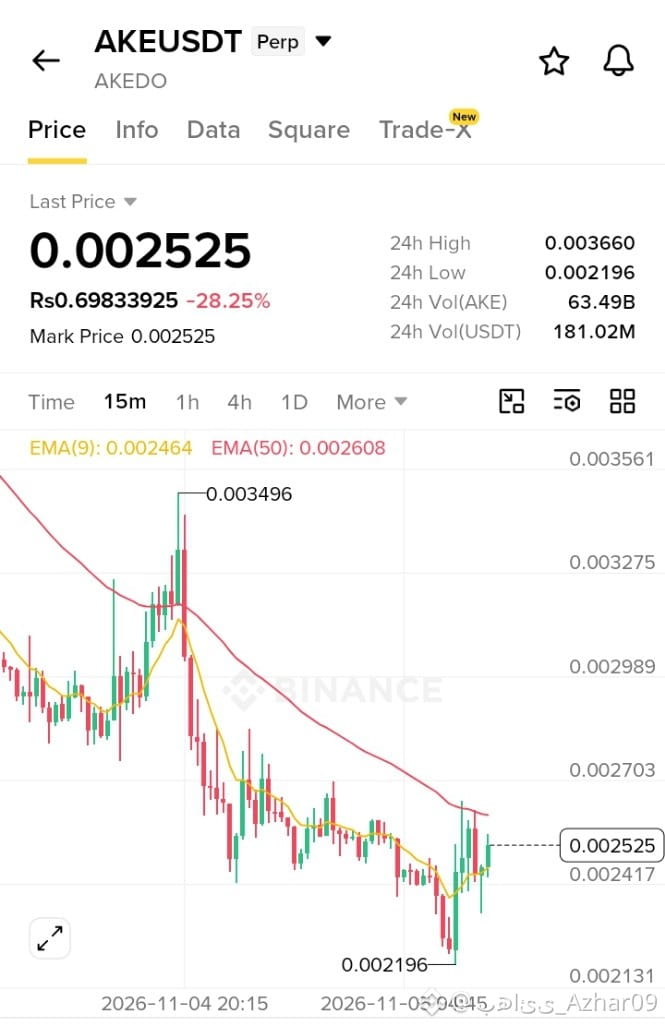
The $AKE pair is trapped in a massive bearish markdown phase, crashing over 28% intraday and dropping sequentially along its declining EMAs. On the short-term 15 minute chart, the price is wedged in a tight, late stage bearish pennant directly beneath the EMA(50) resistance at 0.002608. This prolonged compression right against the absolute horizontal floor of 0.002196 reveals a severe absence of buyers, signaling high probability that sellers are refueling for an imminent capitulation breakdown.
{future}(AKEUSDT)
#USMidterms-WhatAreMarketsExpecting? #Binance98PercentReplenished $ELSA $CAP #BTCRebounds80K #USOctoberNFP-AreRateCutsStillPossible
The $AKE pair is trapped in a massive bearish markdown phase, crashing over 28% intraday and dropping sequentially along its declining EMAs. On the short-term 15 minute chart, the price is wedged in a tight, late stage bearish pennant directly beneath the EMA(50) resistance at 0.002608. This prolonged compression right against the absolute horizontal floor of 0.002196 reveals a severe absence of buyers, signaling high probability that sellers are refueling for an imminent capitulation breakdown.
#USMidterms-WhatAreMarketsExpecting? #Binance98PercentReplenished $ELSA $CAP #BTCRebounds80K #USOctoberNFP-AreRateCutsStillPossible
#USMidterms-WhatAreMarketsExpecting? #Binance98PercentReplenished $ELSA $CAP #BTCRebounds80K #USOctoberNFP-AreRateCutsStillPossible
1
698
Market Rotation: LSK Explosive Breakout vs. TRUMP Sharp Liquidation
$LSK is showing explosive short-term momentum, breaking past local resistance levels with a strong green candle structure after finding a firm floor around the 0.1743 area. The chart displays a healthy bullish accumulation followed by an aggressive expansion phase, pulling the current price up to 0.2069 with a notable 16% daily surge. Volume looks highly supportive of this breakout, suggesting heavy buyers stepping in to drive momentum further toward major technical targets.
{future}(LSKUSDT)
On the flip side, the $TRUMP chart depicts a completely contrasting narrative dominated by intense distribution. The price has entered a steep downward spiral, consistently collapsing from its local high of 1.604 and breaking through multiple support levels down to 1.394. Sellers are aggressively commanding the order flow as panic or positioning shifts ahead of upcoming macro events, pushing the asset right up against its absolute local low at 1.388. Watching both layouts reveals a classic capital rotation game where risk is moving out of bleeding political meme plays directly into surging technical setups.
{future}(TRUMPUSDT)
$AKE
#LSKUSDT #TrumpCrypto #USMidterms-WhatAreMarketsExpecting? #BinanceIncidentReport
Where is the momentum?
Market Rotation: LSK Explosive Breakout vs. TRUMP Sharp Liquidation
$LSK is showing explosive short-term momentum, breaking past local resistance levels with a strong green candle structure after finding a firm floor around the 0.1743 area. The chart displays a healthy bullish accumulation followed by an aggressive expansion phase, pulling the current price up to 0.2069 with a notable 16% daily surge. Volume looks highly supportive of this breakout, suggesting heavy buyers stepping in to drive momentum further toward major technical targets.
On the flip side, the $TRUMP chart depicts a completely contrasting narrative dominated by intense distribution. The price has entered a steep downward spiral, consistently collapsing from its local high of 1.604 and breaking through multiple support levels down to 1.394. Sellers are aggressively commanding the order flow as panic or positioning shifts ahead of upcoming macro events, pushing the asset right up against its absolute local low at 1.388. Watching both layouts reveals a classic capital rotation game where risk is moving out of bleeding political meme plays directly into surging technical setups.
$AKE
#LSKUSDT #TrumpCrypto #USMidterms-WhatAreMarketsExpecting? #BinanceIncidentReport
Where is the momentum?
$LSK is showing explosive short-term momentum, breaking past local resistance levels with a strong green candle structure after finding a firm floor around the 0.1743 area. The chart displays a healthy bullish accumulation followed by an aggressive expansion phase, pulling the current price up to 0.2069 with a notable 16% daily surge. Volume looks highly supportive of this breakout, suggesting heavy buyers stepping in to drive momentum further toward major technical targets.
On the flip side, the $TRUMP chart depicts a completely contrasting narrative dominated by intense distribution. The price has entered a steep downward spiral, consistently collapsing from its local high of 1.604 and breaking through multiple support levels down to 1.394. Sellers are aggressively commanding the order flow as panic or positioning shifts ahead of upcoming macro events, pushing the asset right up against its absolute local low at 1.388. Watching both layouts reveals a classic capital rotation game where risk is moving out of bleeding political meme plays directly into surging technical setups.
$AKE
#LSKUSDT #TrumpCrypto #USMidterms-WhatAreMarketsExpecting? #BinanceIncidentReport
Where is the momentum?
LSK 🚀
45%
TRUMP 📉
50%
Both ⚖️
5%
151 дауыс • Дауыс беру жабық
2
6.4k
Rule of IDM
Rule of IDM
Elite Crypto Club 秘密
·
--
[Қайта ойнату] 🎙️ Gold & Crypto Live Analysis | Rule Of IDM | Elite FX
02 сағ 09 а 37 с · 76 рет тыңдалды
115
Расталды
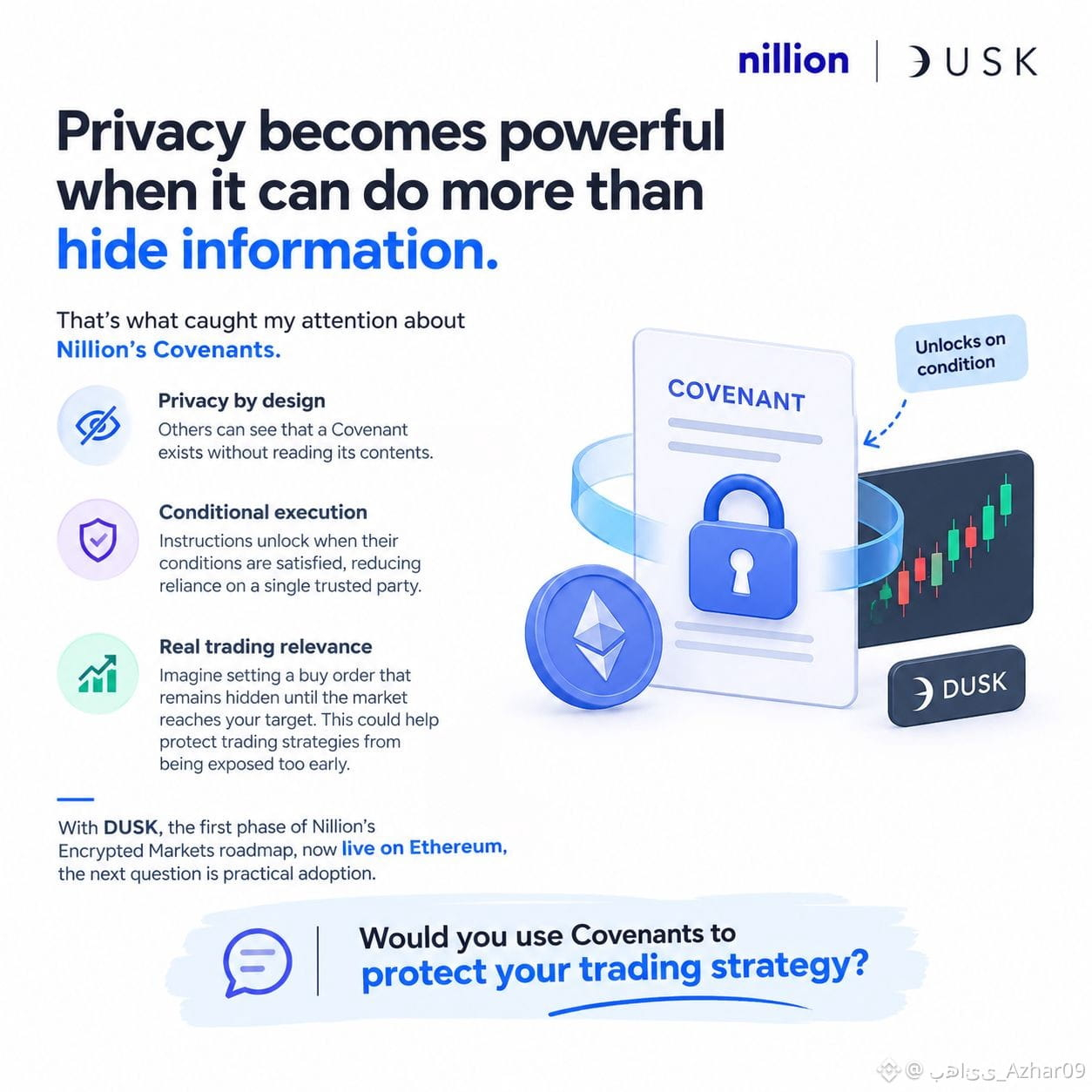
What interests me most about Nillion is its approach to blockchain privacy: protecting the intention behind an action, not just the transaction itself. On public blockchains, trading orders and strategies can reveal valuable information before execution. This visibility can create opportunities for others to react to a trader’s plans. @nillionnetwork ’s Covenants offer an interesting alternative. A Covenant is an encrypted instruction nobody can read until its conditions are met. You could set a sell order at a specific price, submit a sealed auction bid, or schedule a payment. The instruction remains encrypted while waiting and can execute when its condition is satisfied, without a bot, keeper service, or third party holding it. Personally, I like the idea of keeping strategies private without giving up onchain execution. Use cases such as less exposed stop loss orders, sealed bids, and automated payments could make this technology useful beyond theory. The other important development is that Dusk, the first release of Covenants, is now live on Ethereum mainnet. This is a real launch, not a testnet. Anyone can create a Covenant, run a node, or build with the SDK. Dusk is only the first era of Nillion’s seven era roadmap, which runs through 2028. Its initial focus on price and time conditions provides a starting point, with more releases expected before the end of the year. I’m most excited to see how future eras expand Covenant capabilities and whether developers turn these ideas into applications people actually use. Adoption, reliability, and real-world performance will ultimately matter more than promises. Nillion is exploring a different layer of blockchain privacy, and I’ll be watching how this ecosystem develops. What would you use first: a private stop loss order, a sealed auction bid, or an automated payment?
@nillionnetwork #NIL $NIL
What interests me most about Nillion is its approach to blockchain privacy: protecting the intention behind an action, not just the transaction itself. On public blockchains, trading orders and strategies can reveal valuable information before execution. This visibility can create opportunities for others to react to a trader’s plans. @Nillion ’s Covenants offer an interesting alternative. A Covenant is an encrypted instruction nobody can read until its conditions are met. You could set a sell order at a specific price, submit a sealed auction bid, or schedule a payment. The instruction remains encrypted while waiting and can execute when its condition is satisfied, without a bot, keeper service, or third party holding it. Personally, I like the idea of keeping strategies private without giving up onchain execution. Use cases such as less exposed stop loss orders, sealed bids, and automated payments could make this technology useful beyond theory. The other important development is that Dusk, the first release of Covenants, is now live on Ethereum mainnet. This is a real launch, not a testnet. Anyone can create a Covenant, run a node, or build with the SDK. Dusk is only the first era of Nillion’s seven era roadmap, which runs through 2028. Its initial focus on price and time conditions provides a starting point, with more releases expected before the end of the year. I’m most excited to see how future eras expand Covenant capabilities and whether developers turn these ideas into applications people actually use. Adoption, reliability, and real-world performance will ultimately matter more than promises. Nillion is exploring a different layer of blockchain privacy, and I’ll be watching how this ecosystem develops. What would you use first: a private stop loss order, a sealed auction bid, or an automated payment?
@Nillion #NIL $NIL
@Nillion #NIL $NIL
5
241
join everyone
join everyone
Elite Crypto Club 秘密
·
--
[Қайта ойнату] 🎙️ XAUUSD Live Analysis | Gold & Bitcoin Analysis | Elite FX
46 а 05 с · 80 рет тыңдалды
64
join everyone informative discussion about crypto
join everyone informative discussion about crypto
Elite Crypto Club 秘密
·
--
[Қайта ойнату] 🎙️ XAUUSD Live Analysis | Gold & Bitcoin Analysis | Elite FX
51 а 51 с · 104 рет тыңдалды
2
70
Thank you, Sir Elite, for your dedication and efforts. We truly appreciate your hard work and guidance. May Allah bless you always ❤️
Thank you, Sir Elite, for your dedication and efforts. We truly appreciate your hard work and guidance. May Allah bless you always ❤️
Elite Crypto Club 秘密
·
--
[Қайта ойнату] 🎙️ Gold & Crypto Live Analysis | Types Of Trends | Elite FX
01 сағ 58 а 21 с · 96 рет тыңдалды
1
223
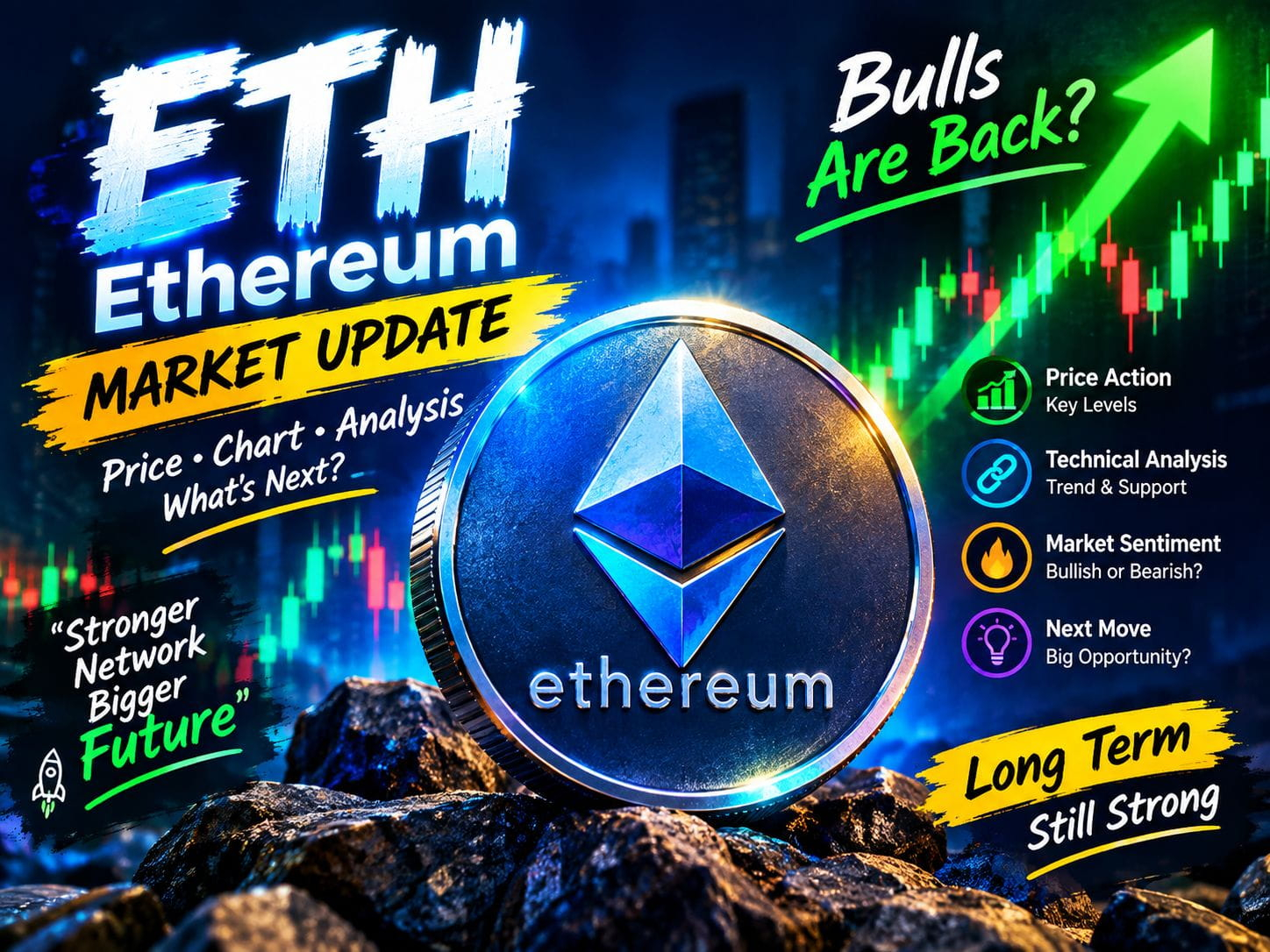
🎙️ ETH LIVE 🔴 | BIG MOVE AHEAD?
ETH PRICE UPDATE 🚀
ETH NEXT MOVE? 🔥
Соңы
02 сағ 17 а 00 с
475
4
0
claim big one
claim big one
Muzamil Abbas⁷⁵ 穆扎米尔_阿巴斯
·
--
Жоғары (өспелі)🚨 $SOLV GIVEAWAY ALERT 🚨
🎁 $50 WORTH OF SOLV 🎁
I’m giving away $50 worth of Solv to one lucky winner! ❤️
How to participate:
✅ Follow Muzamil Abbas
❤️ Like this post
🔄 Repost this post
💬 Comment 1
That’s it! 2200 lucky participant's will receive $50 worth of Solv 🎁
Good luck everyone
#MuzammilAbbas⁷⁵穆扎米拉巴斯
#SOLV #Giveaway #Binance #Crypto
$SENT
$MTL

2
85
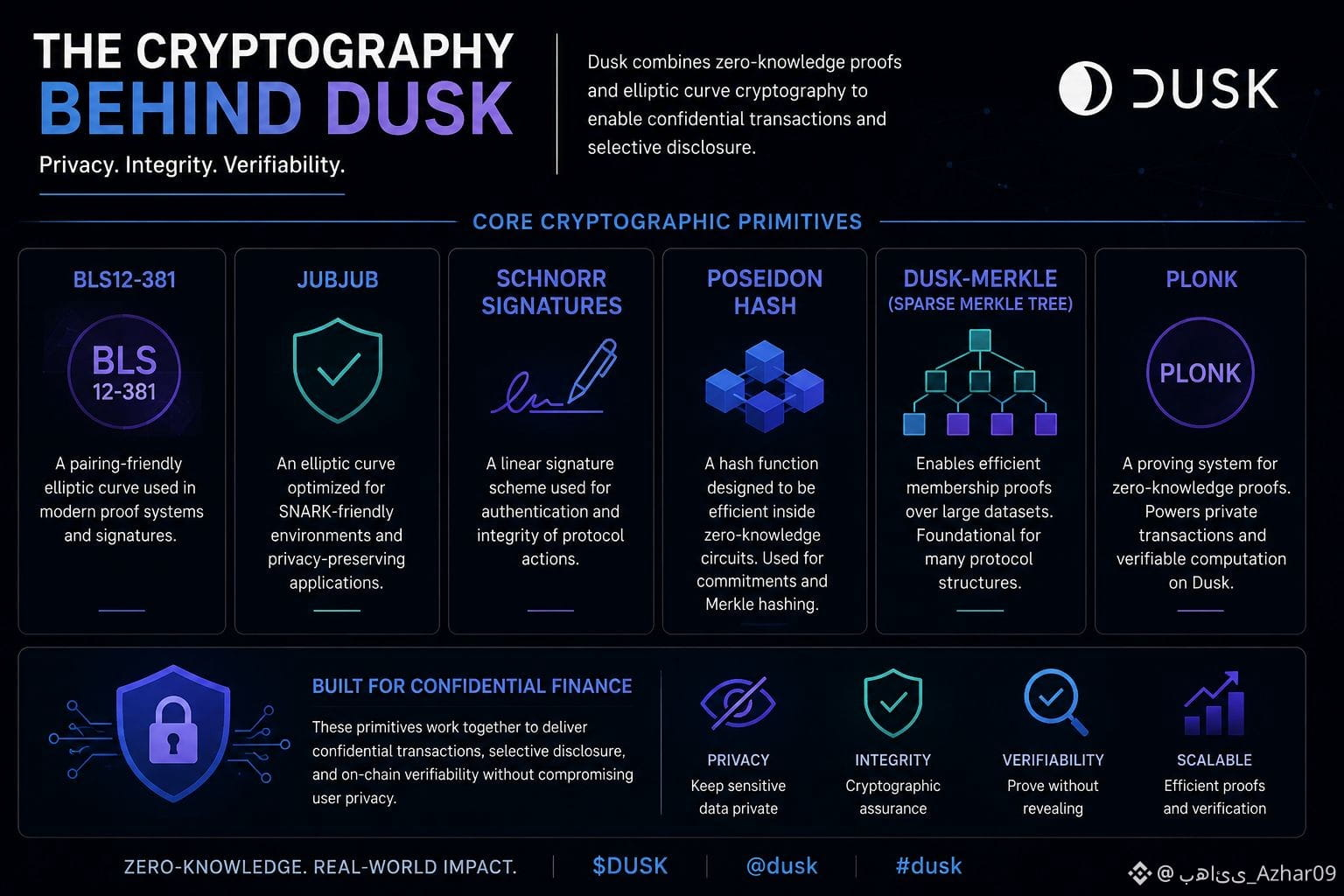
$DUSK @Dusk_Foundation I went deeper into Dusk’s cryptography and realized the interesting part isn’t one specific primitive. It’s how several pieces work together to support privacy without making verification disappear. Dusk uses zero knowledge proofs alongside primitives such as BLS12-381, JubJub, Schnorr signatures, Poseidon, sparse Merkle trees, and PLONK.
PLONK is particularly interesting because it provides the proving framework: developers can define circuits, generate proofs, and have those proofs verified on-chain without exposing the underlying private information.That creates a useful model for financial applications.You don’t necessarily need to reveal the entire transaction to prove that it is valid.You can prove the required claim while keeping sensitive details confidential.That’s where I think Dusk’s cryptography becomes more than technical terminology. It supports the broader idea of selective disclosure reveal what needs to be verified, rather than publishing everything by default.For regulated markets, that distinction could be critical.Privacy isn’t about hiding the truth.
It’s about proving what matters without exposing everything else.#dusk
$TRUMP
{future}(TRUMPUSDT)
$SCRT
{future}(SCRTUSDT)
{future}(DUSKUSDT)
$DUSK @Dusk I went deeper into Dusk’s cryptography and realized the interesting part isn’t one specific primitive. It’s how several pieces work together to support privacy without making verification disappear. Dusk uses zero knowledge proofs alongside primitives such as BLS12-381, JubJub, Schnorr signatures, Poseidon, sparse Merkle trees, and PLONK.
PLONK is particularly interesting because it provides the proving framework: developers can define circuits, generate proofs, and have those proofs verified on-chain without exposing the underlying private information.That creates a useful model for financial applications.You don’t necessarily need to reveal the entire transaction to prove that it is valid.You can prove the required claim while keeping sensitive details confidential.That’s where I think Dusk’s cryptography becomes more than technical terminology. It supports the broader idea of selective disclosure reveal what needs to be verified, rather than publishing everything by default.For regulated markets, that distinction could be critical.Privacy isn’t about hiding the truth.
It’s about proving what matters without exposing everything else.#dusk
$TRUMP
$SCRT
PLONK is particularly interesting because it provides the proving framework: developers can define circuits, generate proofs, and have those proofs verified on-chain without exposing the underlying private information.That creates a useful model for financial applications.You don’t necessarily need to reveal the entire transaction to prove that it is valid.You can prove the required claim while keeping sensitive details confidential.That’s where I think Dusk’s cryptography becomes more than technical terminology. It supports the broader idea of selective disclosure reveal what needs to be verified, rather than publishing everything by default.For regulated markets, that distinction could be critical.Privacy isn’t about hiding the truth.
It’s about proving what matters without exposing everything else.#dusk
$TRUMP
$SCRT
3
10
479
Расталды
$DUSK @Dusk_Foundation I went down a bit of a Dusk docs rabbit hole tonight and ended up connecting two things I initially thought were completely unrelated: Citadel 2 and Dusk Improvement Proposals (DIPs).
Citadel 2 tackles a very practical identity problem.
A trusted License Provider verifies a user off-chain and signs the relevant attributes. The user can later generate a zero-knowledge proof showing they hold a valid registered license, without putting their personal details or the exact license used on-chain.
What I found important is that Citadel doesn't decide whether someone gets access.
The Service Provider still decides which providers it trusts, which attributes are acceptable, and whether a session is expired or revoked.
Then I looked at the DIP process.
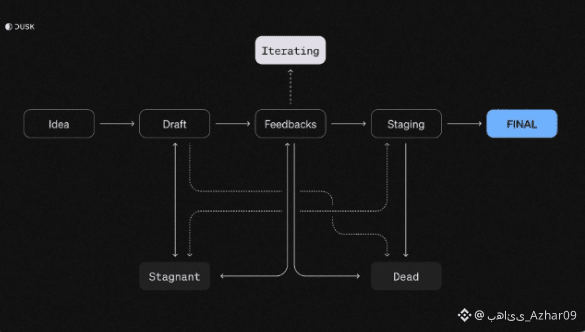
DIPs are Dusk’s structured way of proposing protocol changes, covering everything from consensus and transaction processing to new standards and features. A proposal moves through Idea → Draft → Feedback → Staging → Active, with technical specifications, rationale, security considerations, testing, and implementation details forming part of the process.
If a technical proposal reaches staging, it can be tested on Nocturne before being incorporated into production after consensus.
The connection I see is pretty interesting:
Citadel 2 is about proving the right thing without exposing unnecessary identity data.
DIPs are about changing the protocol through a process where the proposed changes can be examined and challenged.
One focuses on privacy-preserving identity.
The other focuses on how the underlying protocol evolves.
For infrastructure aimed at regulated applications, I think both sides matter.
Privacy needs strong cryptography.
Protocol evolution needs strong review.
#dusk
$DUSK @Dusk I went down a bit of a Dusk docs rabbit hole tonight and ended up connecting two things I initially thought were completely unrelated: Citadel 2 and Dusk Improvement Proposals (DIPs).
Citadel 2 tackles a very practical identity problem.
A trusted License Provider verifies a user off-chain and signs the relevant attributes. The user can later generate a zero-knowledge proof showing they hold a valid registered license, without putting their personal details or the exact license used on-chain.
What I found important is that Citadel doesn't decide whether someone gets access.
The Service Provider still decides which providers it trusts, which attributes are acceptable, and whether a session is expired or revoked.
Then I looked at the DIP process.
DIPs are Dusk’s structured way of proposing protocol changes, covering everything from consensus and transaction processing to new standards and features. A proposal moves through Idea → Draft → Feedback → Staging → Active, with technical specifications, rationale, security considerations, testing, and implementation details forming part of the process.
If a technical proposal reaches staging, it can be tested on Nocturne before being incorporated into production after consensus.
The connection I see is pretty interesting:
Citadel 2 is about proving the right thing without exposing unnecessary identity data.
DIPs are about changing the protocol through a process where the proposed changes can be examined and challenged.
One focuses on privacy-preserving identity.
The other focuses on how the underlying protocol evolves.
For infrastructure aimed at regulated applications, I think both sides matter.
Privacy needs strong cryptography.
Protocol evolution needs strong review.
#dusk
Citadel 2 tackles a very practical identity problem.
A trusted License Provider verifies a user off-chain and signs the relevant attributes. The user can later generate a zero-knowledge proof showing they hold a valid registered license, without putting their personal details or the exact license used on-chain.
What I found important is that Citadel doesn't decide whether someone gets access.
The Service Provider still decides which providers it trusts, which attributes are acceptable, and whether a session is expired or revoked.
Then I looked at the DIP process.
DIPs are Dusk’s structured way of proposing protocol changes, covering everything from consensus and transaction processing to new standards and features. A proposal moves through Idea → Draft → Feedback → Staging → Active, with technical specifications, rationale, security considerations, testing, and implementation details forming part of the process.
If a technical proposal reaches staging, it can be tested on Nocturne before being incorporated into production after consensus.
The connection I see is pretty interesting:
Citadel 2 is about proving the right thing without exposing unnecessary identity data.
DIPs are about changing the protocol through a process where the proposed changes can be examined and challenged.
One focuses on privacy-preserving identity.
The other focuses on how the underlying protocol evolves.
For infrastructure aimed at regulated applications, I think both sides matter.
Privacy needs strong cryptography.
Protocol evolution needs strong review.
#dusk
2
8
204
$DUSK I’ve been going through @Dusk_Foundation docs again, and the terminology actually tells a bigger story than I expected.
But honestly, I was confused at first, why does Dusk need so many different components, and how do they actually fit together?
At first, names like Moonlight, Phoenix, DuskDS, DuskEVM, Citadel and XSC felt like separate technical pieces.
Then the architecture started making more sense.
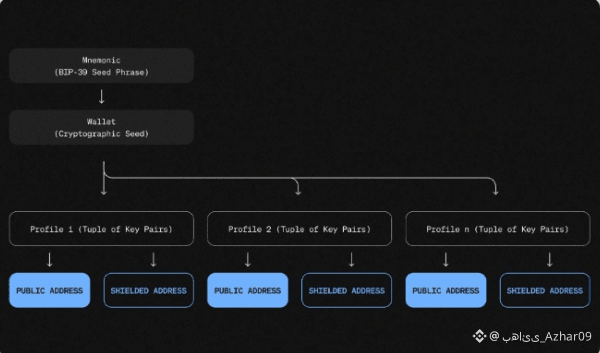
Moonlight handles public, account-based transactions, while Phoenix provides the shielded UTXO based model for privacy-preserving transactions.
Underneath them sits DuskDS, providing consensus, finality and data availability. On the execution side, Dusk has DuskEVM for EVM-compatible applications and DuskVM for Rust/WASM smart contracts directly on the L1.
Then there’s Citadel, focused on identity and selective disclosure, while XSC provides a standard for confidential smart contracts that can adapt to business and compliance requirements.
What I find interesting is that Dusk isn’t treating privacy as one isolated feature.
The stack seems designed around different visibility and execution requirements depending on the financial workflow.
Even the ecosystem reflects that broader approach, with integrations such as Chainlink and NPEX alongside community tools and applications.
I’m still watching the biggest question: how much real financial activity can eventually run through all these pieces?
Because architecture can be impressive on paper.
The real test is when the pieces have to work together in production.#dusk
$DUSK I’ve been going through @Dusk docs again, and the terminology actually tells a bigger story than I expected.
But honestly, I was confused at first, why does Dusk need so many different components, and how do they actually fit together?
At first, names like Moonlight, Phoenix, DuskDS, DuskEVM, Citadel and XSC felt like separate technical pieces.
Then the architecture started making more sense.
Moonlight handles public, account-based transactions, while Phoenix provides the shielded UTXO based model for privacy-preserving transactions.
Underneath them sits DuskDS, providing consensus, finality and data availability. On the execution side, Dusk has DuskEVM for EVM-compatible applications and DuskVM for Rust/WASM smart contracts directly on the L1.
Then there’s Citadel, focused on identity and selective disclosure, while XSC provides a standard for confidential smart contracts that can adapt to business and compliance requirements.
What I find interesting is that Dusk isn’t treating privacy as one isolated feature.
The stack seems designed around different visibility and execution requirements depending on the financial workflow.
Even the ecosystem reflects that broader approach, with integrations such as Chainlink and NPEX alongside community tools and applications.
I’m still watching the biggest question: how much real financial activity can eventually run through all these pieces?
Because architecture can be impressive on paper.
The real test is when the pieces have to work together in production.#dusk
But honestly, I was confused at first, why does Dusk need so many different components, and how do they actually fit together?
At first, names like Moonlight, Phoenix, DuskDS, DuskEVM, Citadel and XSC felt like separate technical pieces.
Then the architecture started making more sense.
Moonlight handles public, account-based transactions, while Phoenix provides the shielded UTXO based model for privacy-preserving transactions.
Underneath them sits DuskDS, providing consensus, finality and data availability. On the execution side, Dusk has DuskEVM for EVM-compatible applications and DuskVM for Rust/WASM smart contracts directly on the L1.
Then there’s Citadel, focused on identity and selective disclosure, while XSC provides a standard for confidential smart contracts that can adapt to business and compliance requirements.
What I find interesting is that Dusk isn’t treating privacy as one isolated feature.
The stack seems designed around different visibility and execution requirements depending on the financial workflow.
Even the ecosystem reflects that broader approach, with integrations such as Chainlink and NPEX alongside community tools and applications.
I’m still watching the biggest question: how much real financial activity can eventually run through all these pieces?
Because architecture can be impressive on paper.
The real test is when the pieces have to work together in production.#dusk
5
11
139
Көбірек контент көру үшін кіріңіз
Binance Square платформасында әлемдік криптоқоғамдастыққа қосылыңыз
⚡️ Криптовалюта туралы ең соңғы және пайдалы ақпаратты алыңыз.
💬 Әлемдегі ең ірі криптобиржаның сеніміне ие.
👍 Расталған авторлардың нақты пікірлерін табыңыз.
Электрондық пошта/телефон нөмірі
Трендтегі тақырыптар
NvidiaBeatsEstimatesWith$130BQ4Outlook
17,261 рет көрілді
200 адам талқылап жатыр
Nvidia Beats With $115.8 Billion in Revenue, Guides to $130 Billion and Adds $150 Billion Buyback
Binance News
·49 лайк
·43.5k рет көрілді
AnthropicIPOPriceCouldExceed$80
22,019 рет көрілді
172 адам талқылап жатыр
RussiaCentralBankAddsAlfaBankToCryptoExchangeRegister
0 рет көрілді
6 адам талқылап жатыр