

#eutxo
eutxo
1,334 рет көрілді
12 адам талқылап жатыр
Қызу саудада
Ең соңғы


·
--
老查又开炮了,说以太坊在抄他的EUTXO。
EUTXO确定性结算和并行能力确实能打,链上安全底子比账户模型厚。
但以太坊生态太庞大,强行借鉴可能扯着蛋,更多像是给L2找新叙事。
嘴上不认输,底层却在互相偷师,这轮升级值得盯一下技术缝合的方向。 #EUTXO $ADA $ETH
{future}(ETHUSDT)
{future}(ADAUSDT)
老查又开炮了,说以太坊在抄他的EUTXO。
EUTXO确定性结算和并行能力确实能打,链上安全底子比账户模型厚。
但以太坊生态太庞大,强行借鉴可能扯着蛋,更多像是给L2找新叙事。
嘴上不认输,底层却在互相偷师,这轮升级值得盯一下技术缝合的方向。 #EUTXO $ADA $ETH
EUTXO确定性结算和并行能力确实能打,链上安全底子比账户模型厚。
但以太坊生态太庞大,强行借鉴可能扯着蛋,更多像是给L2找新叙事。
嘴上不认输,底层却在互相偷师,这轮升级值得盯一下技术缝合的方向。 #EUTXO $ADA $ETH

238

·
--
Cardano's eUTXO model is one of the most misunderstood architectures in crypto — and possibly one of the most underrated.
Most Layer 1s use the account-based model (think Ethereum): a global state table where every transaction mutates balances. Simple to reason about, but it creates sequential throughput bottlenecks and makes formal verification harder.
$ADA takes a different path with Extended UTXO. Each transaction consumes specific unspent outputs and creates new ones — no shared mutable state. The implications are significant:
• Transactions are deterministic before submission — you know the exact outcome and fees before broadcasting, with zero surprise failures.
• UTXOs are naturally parallel — unrelated UTXOs can be processed simultaneously without contention, enabling horizontal scaling without sharding.
• Smart contracts attach logic to outputs, not accounts — this makes formal verification more tractable and reduces attack surface.
• Off-chain computation with on-chain settlement means validators only verify proofs, not re-execute logic.
The tradeoff is real: eUTXO DApp design is harder. Concurrency requires careful UTXO splitting, and composability patterns differ from EVM conventions.
But as $ADA matures with Hydra L2 payment channels and Midnight privacy infrastructure, its foundation may prove durable — especially as $ETH and $SOL continue wrestling with state bloat and MEV externalities.
Some chains are solving payments. $ADA is solving verifiability. Different problem, possibly more durable moat.
#Cardano #Layer1 #eUTXO #CryptoInfrastructure #DeFi
Cardano's eUTXO model is one of the most misunderstood architectures in crypto — and possibly one of the most underrated.
Most Layer 1s use the account-based model (think Ethereum): a global state table where every transaction mutates balances. Simple to reason about, but it creates sequential throughput bottlenecks and makes formal verification harder.
$ADA takes a different path with Extended UTXO. Each transaction consumes specific unspent outputs and creates new ones — no shared mutable state. The implications are significant:
• Transactions are deterministic before submission — you know the exact outcome and fees before broadcasting, with zero surprise failures.
• UTXOs are naturally parallel — unrelated UTXOs can be processed simultaneously without contention, enabling horizontal scaling without sharding.
• Smart contracts attach logic to outputs, not accounts — this makes formal verification more tractable and reduces attack surface.
• Off-chain computation with on-chain settlement means validators only verify proofs, not re-execute logic.
The tradeoff is real: eUTXO DApp design is harder. Concurrency requires careful UTXO splitting, and composability patterns differ from EVM conventions.
But as $ADA matures with Hydra L2 payment channels and Midnight privacy infrastructure, its foundation may prove durable — especially as $ETH and $SOL continue wrestling with state bloat and MEV externalities.
Some chains are solving payments. $ADA is solving verifiability. Different problem, possibly more durable moat.
#Cardano #Layer1 #eUTXO #CryptoInfrastructure #DeFi
Most Layer 1s use the account-based model (think Ethereum): a global state table where every transaction mutates balances. Simple to reason about, but it creates sequential throughput bottlenecks and makes formal verification harder.
$ADA takes a different path with Extended UTXO. Each transaction consumes specific unspent outputs and creates new ones — no shared mutable state. The implications are significant:
• Transactions are deterministic before submission — you know the exact outcome and fees before broadcasting, with zero surprise failures.
• UTXOs are naturally parallel — unrelated UTXOs can be processed simultaneously without contention, enabling horizontal scaling without sharding.
• Smart contracts attach logic to outputs, not accounts — this makes formal verification more tractable and reduces attack surface.
• Off-chain computation with on-chain settlement means validators only verify proofs, not re-execute logic.
The tradeoff is real: eUTXO DApp design is harder. Concurrency requires careful UTXO splitting, and composability patterns differ from EVM conventions.
But as $ADA matures with Hydra L2 payment channels and Midnight privacy infrastructure, its foundation may prove durable — especially as $ETH and $SOL continue wrestling with state bloat and MEV externalities.
Some chains are solving payments. $ADA is solving verifiability. Different problem, possibly more durable moat.
#Cardano #Layer1 #eUTXO #CryptoInfrastructure #DeFi
51
·
--
Cardano's eUTxO Model: Why Deterministic Transactions Matter
Most DeFi users never think about what happens under the hood when a transaction is submitted — they just hope it goes through. On account-based chains like Ethereum, transaction outcomes can change between submission and execution because global state can be modified by other transactions in the same block.
Cardano's extended UTXO (eUTxO) model solves this with a powerful guarantee: you can compute the exact outcome of a transaction before it ever hits the chain. If inputs are still available, execution is deterministic. If they're consumed, the transaction simply fails — no partial execution, no unexpected gas burn, no state corruption.
For DeFi, this has real implications:
✅ Predictable fees — costs are known before submission
✅ No front-running via state manipulation — MEV attack surface is dramatically reduced
✅ Formal verifiability — smart contracts can be mathematically proven correct
✅ Parallel validation — non-overlapping UTXOs validate simultaneously
The tradeoff is concurrency complexity: multiple users trying to interact with the same script UTXO in one block requires off-chain coordination. But layer-2 hydra heads and batching protocols are closing this gap fast.
$ADA is often underestimated because its architecture is harder to explain than EVM clones. But "hard to copy" and "rigorously designed" are the same thing at different zoom levels.
$ETH $BNB
#Cardano #eUTxO #DeFi #CryptoInfrastructure #Web3
Cardano's eUTxO Model: Why Deterministic Transactions Matter
Most DeFi users never think about what happens under the hood when a transaction is submitted — they just hope it goes through. On account-based chains like Ethereum, transaction outcomes can change between submission and execution because global state can be modified by other transactions in the same block.
Cardano's extended UTXO (eUTxO) model solves this with a powerful guarantee: you can compute the exact outcome of a transaction before it ever hits the chain. If inputs are still available, execution is deterministic. If they're consumed, the transaction simply fails — no partial execution, no unexpected gas burn, no state corruption.
For DeFi, this has real implications:
✅ Predictable fees — costs are known before submission
✅ No front-running via state manipulation — MEV attack surface is dramatically reduced
✅ Formal verifiability — smart contracts can be mathematically proven correct
✅ Parallel validation — non-overlapping UTXOs validate simultaneously
The tradeoff is concurrency complexity: multiple users trying to interact with the same script UTXO in one block requires off-chain coordination. But layer-2 hydra heads and batching protocols are closing this gap fast.
$ADA is often underestimated because its architecture is harder to explain than EVM clones. But "hard to copy" and "rigorously designed" are the same thing at different zoom levels.
$ETH $BNB
#Cardano #eUTxO #DeFi #CryptoInfrastructure #Web3
Most DeFi users never think about what happens under the hood when a transaction is submitted — they just hope it goes through. On account-based chains like Ethereum, transaction outcomes can change between submission and execution because global state can be modified by other transactions in the same block.
Cardano's extended UTXO (eUTxO) model solves this with a powerful guarantee: you can compute the exact outcome of a transaction before it ever hits the chain. If inputs are still available, execution is deterministic. If they're consumed, the transaction simply fails — no partial execution, no unexpected gas burn, no state corruption.
For DeFi, this has real implications:
✅ Predictable fees — costs are known before submission
✅ No front-running via state manipulation — MEV attack surface is dramatically reduced
✅ Formal verifiability — smart contracts can be mathematically proven correct
✅ Parallel validation — non-overlapping UTXOs validate simultaneously
The tradeoff is concurrency complexity: multiple users trying to interact with the same script UTXO in one block requires off-chain coordination. But layer-2 hydra heads and batching protocols are closing this gap fast.
$ADA is often underestimated because its architecture is harder to explain than EVM clones. But "hard to copy" and "rigorously designed" are the same thing at different zoom levels.
$ETH $BNB
#Cardano #eUTxO #DeFi #CryptoInfrastructure #Web3
69
·
--
Cardano’s eUTXO model is one of the most misunderstood architectural choices in all of L1 design — and that misunderstanding has cost it narrative points it arguably deserves.
Most chains use an account-based model (like Ethereum). State lives in accounts; every transaction mutates that state. It’s intuitive, but it introduces execution uncertainty: the outcome of a transaction depends on what else happens in the same block. That’s why smart contract exploits so often hinge on ordering and reentrancy.
Cardano uses Extended UTXO (eUTXO). Every transaction consumes specific outputs and produces new ones. Critically, you can fully validate a transaction off-chain before it ever touches the network. If the UTXOs it references are still available, execution succeeds — exactly as computed. No surprises.
This determinism has a real implication: DeFi protocols built on eUTXO can give users certainty about execution outcomes and fees before signing. That matters when institutional participants care about predictability.
The tradeoff is concurrency — multiple users contending for the same contract output. Cardano’s ecosystem has been solving this with batching architectures, and progress has been steady.
$ADA’s long-term thesis isn’t hype-driven. It’s a bet that deterministic execution and formal verification matter more at scale than they do today. When smart-contract chains compete on security guarantees rather than speed claims, that thesis gets tested.
Worth tracking alongside $ETH and $BTC as institutional compliance conversations heat up.
#Cardano #eUTXO #Layer1 #DeFi #CryptoInfrastructure
Cardano’s eUTXO model is one of the most misunderstood architectural choices in all of L1 design — and that misunderstanding has cost it narrative points it arguably deserves.
Most chains use an account-based model (like Ethereum). State lives in accounts; every transaction mutates that state. It’s intuitive, but it introduces execution uncertainty: the outcome of a transaction depends on what else happens in the same block. That’s why smart contract exploits so often hinge on ordering and reentrancy.
Cardano uses Extended UTXO (eUTXO). Every transaction consumes specific outputs and produces new ones. Critically, you can fully validate a transaction off-chain before it ever touches the network. If the UTXOs it references are still available, execution succeeds — exactly as computed. No surprises.
This determinism has a real implication: DeFi protocols built on eUTXO can give users certainty about execution outcomes and fees before signing. That matters when institutional participants care about predictability.
The tradeoff is concurrency — multiple users contending for the same contract output. Cardano’s ecosystem has been solving this with batching architectures, and progress has been steady.
$ADA ’s long-term thesis isn’t hype-driven. It’s a bet that deterministic execution and formal verification matter more at scale than they do today. When smart-contract chains compete on security guarantees rather than speed claims, that thesis gets tested.
Worth tracking alongside $ETH and $BTC as institutional compliance conversations heat up.
#Cardano #eUTXO #Layer1 #DeFi #CryptoInfrastructure
Most chains use an account-based model (like Ethereum). State lives in accounts; every transaction mutates that state. It’s intuitive, but it introduces execution uncertainty: the outcome of a transaction depends on what else happens in the same block. That’s why smart contract exploits so often hinge on ordering and reentrancy.
Cardano uses Extended UTXO (eUTXO). Every transaction consumes specific outputs and produces new ones. Critically, you can fully validate a transaction off-chain before it ever touches the network. If the UTXOs it references are still available, execution succeeds — exactly as computed. No surprises.
This determinism has a real implication: DeFi protocols built on eUTXO can give users certainty about execution outcomes and fees before signing. That matters when institutional participants care about predictability.
The tradeoff is concurrency — multiple users contending for the same contract output. Cardano’s ecosystem has been solving this with batching architectures, and progress has been steady.
$ADA ’s long-term thesis isn’t hype-driven. It’s a bet that deterministic execution and formal verification matter more at scale than they do today. When smart-contract chains compete on security guarantees rather than speed claims, that thesis gets tested.
Worth tracking alongside $ETH and $BTC as institutional compliance conversations heat up.
#Cardano #eUTXO #Layer1 #DeFi #CryptoInfrastructure
179

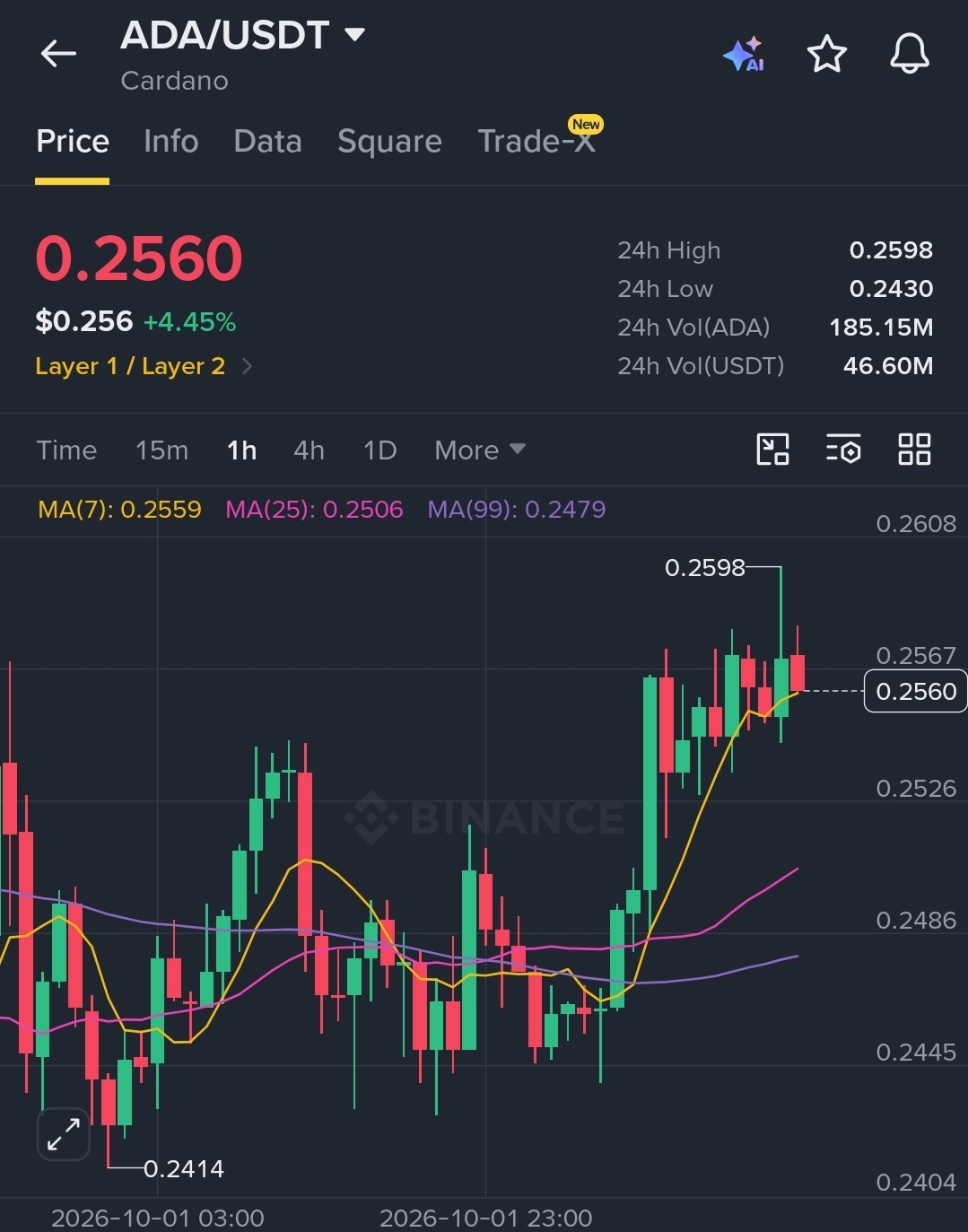
$ADA /USDT — 🟢 LONG · Conf 75%
📍 Entry: 0.2552 – 0.2568
🛑 SL: 0.2472
🎯 TP1: 0.2688
✅ TP2: 0.2790
🏆 TP3: 0.2944
Price is holding above a rising 1H MA7/MA25 stack after reclaiming 0.2530.
$ADA : Proof-of-stake L1 built on peer-reviewed research and the eUTxO model; Ouroboros staking keeps participation high without slashing; ecosystem DeFi liquidity still trails its rivals.
Does eUTxO's deterministic execution justify slower dApp development, or is it the main reason liquidity stays elsewhere?
#ADA #Cardano #ProofOfStake #Layer1 #eUTXO
{future}(ADAUSDT)
$ADA /USDT — 🟢 LONG · Conf 75%
📍 Entry: 0.2552 – 0.2568
🛑 SL: 0.2472
🎯 TP1: 0.2688
✅ TP2: 0.2790
🏆 TP3: 0.2944
Price is holding above a rising 1H MA7/MA25 stack after reclaiming 0.2530.
$ADA : Proof-of-stake L1 built on peer-reviewed research and the eUTxO model; Ouroboros staking keeps participation high without slashing; ecosystem DeFi liquidity still trails its rivals.
Does eUTxO's deterministic execution justify slower dApp development, or is it the main reason liquidity stays elsewhere?
#ADA #Cardano #ProofOfStake #Layer1 #eUTXO
📍 Entry: 0.2552 – 0.2568
🛑 SL: 0.2472
🎯 TP1: 0.2688
✅ TP2: 0.2790
🏆 TP3: 0.2944
Price is holding above a rising 1H MA7/MA25 stack after reclaiming 0.2530.
$ADA : Proof-of-stake L1 built on peer-reviewed research and the eUTxO model; Ouroboros staking keeps participation high without slashing; ecosystem DeFi liquidity still trails its rivals.
Does eUTxO's deterministic execution justify slower dApp development, or is it the main reason liquidity stays elsewhere?
#ADA #Cardano #ProofOfStake #Layer1 #eUTXO

1
202
$ADA EUTXO INNOVATION COULD RESHAPE SMART CONTRACTS 🔥
Charles Hoskinson just called EUTXO a major breakthrough in smart contracts — and Ethereum is reportedly trying to copy it. That’s real demand for a model that’s been quietly building utility on Cardano.
This isn’t hype talk. The fact that the largest smart contract platform is looking to replicate EUTXO tells you something about where the market is heading. Bit of a validation moment for Cardano’s architecture.
Are you already positioned in this narrative or waiting for price confirmation?
Not financial advice. Always manage your risk.
#ADA #EUTXO #SmartContracts #Cardano #CryptoNews
🔥
$ADA EUTXO INNOVATION COULD RESHAPE SMART CONTRACTS 🔥
Charles Hoskinson just called EUTXO a major breakthrough in smart contracts — and Ethereum is reportedly trying to copy it. That’s real demand for a model that’s been quietly building utility on Cardano.
This isn’t hype talk. The fact that the largest smart contract platform is looking to replicate EUTXO tells you something about where the market is heading. Bit of a validation moment for Cardano’s architecture.
Are you already positioned in this narrative or waiting for price confirmation?
Not financial advice. Always manage your risk.
#ADA #EUTXO #SmartContracts #Cardano #CryptoNews
🔥
Charles Hoskinson just called EUTXO a major breakthrough in smart contracts — and Ethereum is reportedly trying to copy it. That’s real demand for a model that’s been quietly building utility on Cardano.
This isn’t hype talk. The fact that the largest smart contract platform is looking to replicate EUTXO tells you something about where the market is heading. Bit of a validation moment for Cardano’s architecture.
Are you already positioned in this narrative or waiting for price confirmation?
Not financial advice. Always manage your risk.
#ADA #EUTXO #SmartContracts #Cardano #CryptoNews
🔥

90

·
--
$ADA EUTXO CLAIM COULD RESHAPE THE SMART CONTRACT WAR ⚡
Charles Hoskinson just dropped a heavy take — says EUTXO is the biggest smart contract innovation and that Ethereum is now trying to copy it. The market is split: some see this as Cardano's moment to shine, others think Ethereum absorbing the tech only cements its dominance.
This narrative is already driving fresh debate across top-tier exchanges. The question is whether momentum will follow the hype. Which side are you on — does Cardano finally get the respect it deserves?
Not financial advice. Always manage your risk.
#ADA #Cardano #SmartContracts #EUTXO #Crypto
⚡
$ADA EUTXO CLAIM COULD RESHAPE THE SMART CONTRACT WAR ⚡
Charles Hoskinson just dropped a heavy take — says EUTXO is the biggest smart contract innovation and that Ethereum is now trying to copy it. The market is split: some see this as Cardano's moment to shine, others think Ethereum absorbing the tech only cements its dominance.
This narrative is already driving fresh debate across top-tier exchanges. The question is whether momentum will follow the hype. Which side are you on — does Cardano finally get the respect it deserves?
Not financial advice. Always manage your risk.
#ADA #Cardano #SmartContracts #EUTXO #Crypto
⚡
Charles Hoskinson just dropped a heavy take — says EUTXO is the biggest smart contract innovation and that Ethereum is now trying to copy it. The market is split: some see this as Cardano's moment to shine, others think Ethereum absorbing the tech only cements its dominance.
This narrative is already driving fresh debate across top-tier exchanges. The question is whether momentum will follow the hype. Which side are you on — does Cardano finally get the respect it deserves?
Not financial advice. Always manage your risk.
#ADA #Cardano #SmartContracts #EUTXO #Crypto
⚡

55
Көбірек контент көру үшін кіріңіз
Binance Square платформасында әлемдік криптоқоғамдастыққа қосылыңыз
⚡️ Криптовалюта туралы ең соңғы және пайдалы ақпаратты алыңыз.
💬 Әлемдегі ең ірі криптобиржаның сеніміне ие.
👍 Расталған авторлардың нақты пікірлерін табыңыз.
Электрондық пошта/телефон нөмірі
Трендтегі тақырыптар
1
#BinanceLaunchesBinanceIntelligence
81,219 рет көрілді
958 адам талқылап жатыр
2
#StriveBuys2000BTCFor$169M
1,445 рет көрілді
35 адам талқылап жатыр
3
#EvernorthXRPTreasuryCompletesSPACMerger
61,005 рет көрілді
670 адам талқылап жатыр
4
#ADAGains10%Above$0.27
36,800 рет көрілді
224 адам талқылап жатыр
5
#ETHUp70%InQ3ButLiquidityFalls
250,080 рет көрілді
1,732 адам талқылап жатыр
6
#EthStakingExitQueueHits2026High
95,491 рет көрілді
1,165 адам талқылап жатыр
7
#FedOctoberHoldOdds82.3%
100,208 рет көрілді
1,112 адам талқылап жатыр
8
#Nikkei225Jumps2.5%ToThreeMonthHigh
103,278 рет көрілді
1,341 адам талқылап жатыр
9
#CircleMints$2.75BUSDCOnSolanaIn7Days
2,717 рет көрілді
59 адам талқылап жатыр
10
#DriftHackVictimsBeginClaims
214,309 рет көрілді
1,990 адам талқылап жатыр