
#cryptohack
cryptohack
629,161 рет көрілді
863 адам талқылап жатыр
Қызу саудада
Ең соңғы

⚖️ US prosecutors seek recovery of $1.1 billion crypto stolen in North Korea-linked Binance hack $247 million moved through Bitcoin mixers
#CryptoHack #NorthKorea #Binance
$BTC
⚖️ US prosecutors seek recovery of $1.1 billion crypto stolen in North Korea-linked Binance hack $247 million moved through Bitcoin mixers
#CryptoHack #NorthKorea #Binance
$BTC
#CryptoHack #NorthKorea #Binance
$BTC
1
61

·
--
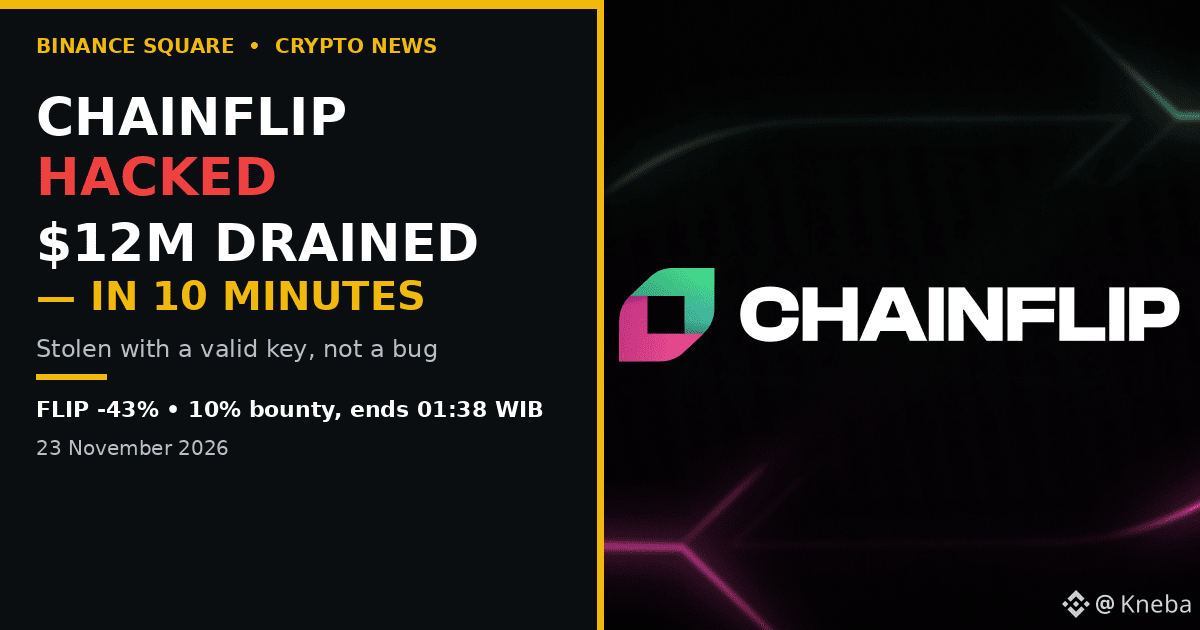
🚨 DEX CHAINFLIP DIREtas $12 JUTA — PAKAI KUNCI YANG SAH!
1. Peretas menguras vault Bitcoin & Ethereum Chainflip pada Sabtu, 21 Nov — total sekitar $12 juta: 122,86 BTC, 520 ETH, plus jutaan USDC & USDT.
2. Yang bikin heboh: ini BUKAN bug smart contract. Peretas memakai tanda tangan yang sah dari kunci validator Chainflip — tapi nomor tanda tangannya aneh, 39 digit, satu-satunya yang keluar dari urutan 299.677 tanda tangan sebelumnya.
3. Seluruh serangan cuma makan waktu kurang dari 10 menit. Dana langsung dicuci lewat Tornado Cash.
4. Token FLIP anjlok −42,9% dalam 24 jam. Chainflip menawarkan bounty 10% kalau peretas mengembalikan 90% dana sebelum 01:38 WIB nanti malam.
5. Protokol kini masuk mode aman penuh: deposit, withdrawal, dan swap dimatikan sementara.
Menurut kalian, ini kebocoran kunci atau ada orang dalam?
#Chainflip #FLIP #CryptoHack #DeFi #Ethereum
359

·
--

Мақала
THE HACKER DIDN'T BREAK IN — THEY USED CHAINFLIP'S OWN KEYOn Saturday morning, Chainflip lost about $12 million in under ten minutes. The terrifying part is not the speed. It is the method: the attacker never broke a smart contract. They walked out with the protocol's own signing key.
It started at 01:41 ET, when a single transaction moved 122.86 BTC — about $7.1 million — out of Chainflip's Bitcoin vault to a fresh address. About half an hour later, the Ethereum vault was emptied in one call: 520.22 ETH, 3.25 million USDC and 758,141 USDT, roughly $4.86 million more. Combined, the haul was about $12 million — more than 80% of the protocol's entire locked value, which stood near $14.45 million a week earlier.
Chainflip paused the protocol within hours and put it into full safe mode: deposits, withdrawals, swaps and quoting all disabled. But the damage was done, and the forensics told a stranger story than a bug. The withdrawal passed the vault's signature check — because the signature was valid. It came from Chainflip's own aggregate signing key, the FROST threshold key that requires 100 of the protocol's 150 validators to jointly produce, and rotates every few days. The last rotation was November 18.
The one fingerprint that gave it away was a number. Every Chainflip withdrawal carries a nonce, a unique stamp that normally ticks up by one — around 315,000 at the time. The attacker's transaction carried a 39-digit nonce. In a review of all 299,677 signatures the vault has accepted since 2023, it was the only one that broke the sequence.
The preparation had been running for ten days. Funds linked to the attacker passed through Tornado Cash on November 11. On November 20, they bought FLIP and registered a validator account. A minute before the drain, the fresh wallet received its gas from Tornado Cash. After the theft, nearly all the proceeds went back through the mixer. The Bitcoin sat at the attacker's second address as of Sunday afternoon.
Chainflip's answer was a deal, delivered on-chain: keep 10% — roughly $1.2 million — and return the other 90% by 18:38 UTC tonight, and it counts as a white-hat recovery, with law enforcement complaints dropped. The team says it has identified the server used to register the validator account, fixed the vulnerability, and believes the attacker can be tracked from metadata left behind. Founder Simon Harman is in contact with law enforcement, an incident report is due Monday, and compensation plans are still being worked on.
The market rendered its own verdict. FLIP held near $0.48 for hours before the exploit, then collapsed by about a third within hours and roughly 47% within a day. This is Chainflip's second vault exploit in 2026.
The lesson is the uncomfortable one: the vault did not fail its signature check. The signature was real. When the key itself is the weapon, no lock on the door matters.
$FLIP $BTC $ETH
#ChainflipHackedAgain #FLIP #defi #CryptoHack
THE HACKER DIDN'T BREAK IN — THEY USED CHAINFLIP'S OWN KEY
On Saturday morning, Chainflip lost about $12 million in under ten minutes. The terrifying part is not the speed. It is the method: the attacker never broke a smart contract. They walked out with the protocol's own signing key.
It started at 01:41 ET, when a single transaction moved 122.86 BTC — about $7.1 million — out of Chainflip's Bitcoin vault to a fresh address. About half an hour later, the Ethereum vault was emptied in one call: 520.22 ETH, 3.25 million USDC and 758,141 USDT, roughly $4.86 million more. Combined, the haul was about $12 million — more than 80% of the protocol's entire locked value, which stood near $14.45 million a week earlier.
Chainflip paused the protocol within hours and put it into full safe mode: deposits, withdrawals, swaps and quoting all disabled. But the damage was done, and the forensics told a stranger story than a bug. The withdrawal passed the vault's signature check — because the signature was valid. It came from Chainflip's own aggregate signing key, the FROST threshold key that requires 100 of the protocol's 150 validators to jointly produce, and rotates every few days. The last rotation was November 18.
The one fingerprint that gave it away was a number. Every Chainflip withdrawal carries a nonce, a unique stamp that normally ticks up by one — around 315,000 at the time. The attacker's transaction carried a 39-digit nonce. In a review of all 299,677 signatures the vault has accepted since 2023, it was the only one that broke the sequence.
The preparation had been running for ten days. Funds linked to the attacker passed through Tornado Cash on November 11. On November 20, they bought FLIP and registered a validator account. A minute before the drain, the fresh wallet received its gas from Tornado Cash. After the theft, nearly all the proceeds went back through the mixer. The Bitcoin sat at the attacker's second address as of Sunday afternoon.
Chainflip's answer was a deal, delivered on-chain: keep 10% — roughly $1.2 million — and return the other 90% by 18:38 UTC tonight, and it counts as a white-hat recovery, with law enforcement complaints dropped. The team says it has identified the server used to register the validator account, fixed the vulnerability, and believes the attacker can be tracked from metadata left behind. Founder Simon Harman is in contact with law enforcement, an incident report is due Monday, and compensation plans are still being worked on.
The market rendered its own verdict. FLIP held near $0.48 for hours before the exploit, then collapsed by about a third within hours and roughly 47% within a day. This is Chainflip's second vault exploit in 2026.
The lesson is the uncomfortable one: the vault did not fail its signature check. The signature was real. When the key itself is the weapon, no lock on the door matters.
$FLIP $BTC $ETH
#ChainflipHackedAgain #FLIP #defi #CryptoHack
159


·
--
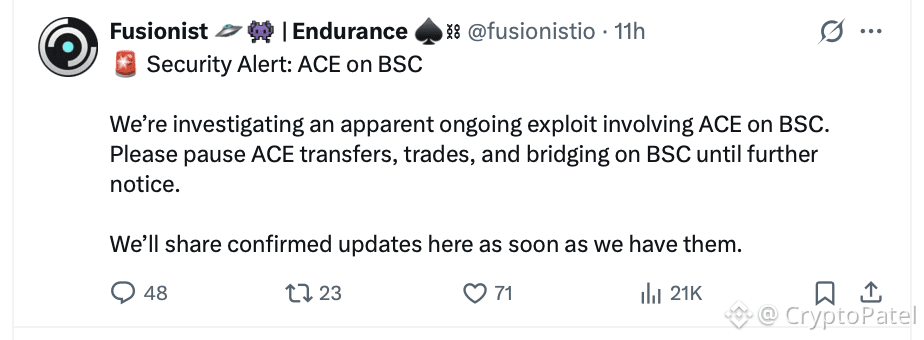
$5.7M EXPLOIT: FUSIONIST'S ACE BRIDGE TURNED INTO A FREE-FOR-ALL!
Fusionist's ACE bridge reportedly suffered a major exploit on November 22, but the biggest damage happened after the initial attack.
Here's what happened.👇
1️⃣ An attacker reportedly abused privileged minting permissions to create enormous quantities of unbacked $ACE tokens on BNB Chain.
The attacker dumped those tokens and extracted approximately $2M in USDT.
2️⃣ But here's the shocking part.
The bridge continued operating despite the compromised token supply.
Traders started buying cheap ACE on BNB Chain, bridging it to Endurance, receiving genuine ACE, and selling it for profit.
3️⃣ The result?
🔹 ~53.7M genuine ACE released.
🔹 ~24 addresses received the tokens.
🔹 ~$3.7M in real ACE reserves drained.
🔹 Remaining bridge balance: approximately 0.08 ACE.
One reported trader turned $50 into approximately $17,670.
4️⃣ Fusionist warned users to stop #ACE trading on BNB Chain and avoid bridging between BNB Chain and Endurance.
Gate also announced a rollback of affected ACE/USDT trades.
CRYPTOPATEL TAKE:
The attacker reportedly extracted $2M, but the broken bridge allowed other traders to drain another $3.7M in genuine assets.
How could a bridge continue releasing real assets after its token supply was compromised?
One security failure. Two waves of damage.
Figures are based on reported on-chain investigations. Final audited losses remain unconfirmed.
#Fusionist #ACE #CryptoHack
981

·
--
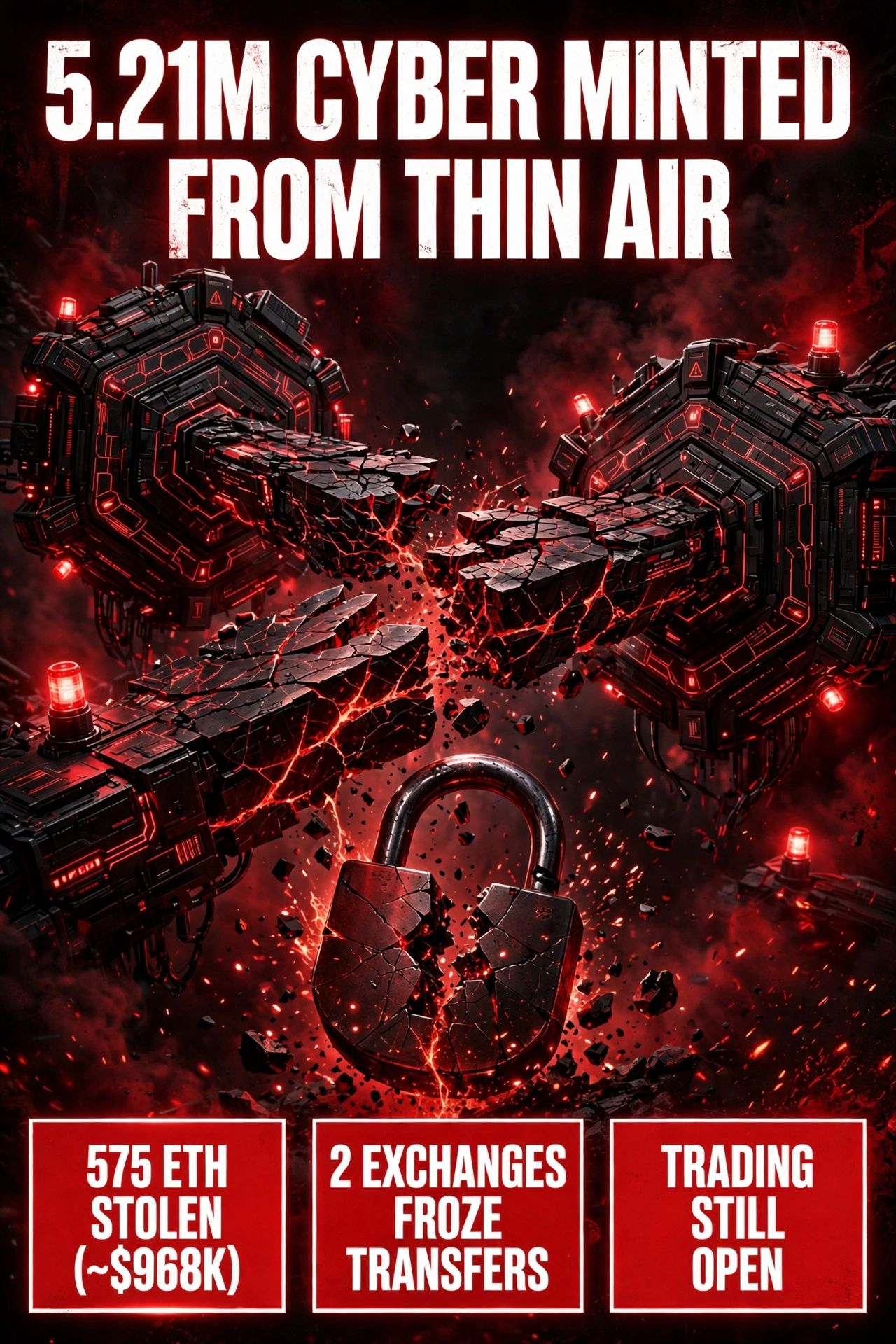
🚨 5.21M $CYBER minted from thin air — Korea's top exchanges just froze transfers
Cyber's cross-chain bridge was hit: an attacker minted 5.21M unbacked CYBER on Solana, then drained the same amount from its Ethereum lockbox — and sold it for ~575 ETH (~$968K).
Upbit and Bithumb have now suspended CYBER deposits and withdrawals. Trading stays open, but no reopening date yet. Cyber says it's still investigating — cause unconfirmed, don't use the bridge.
Not financial advice.
$CYBER #Cyber #CryptoHack
40
·
--
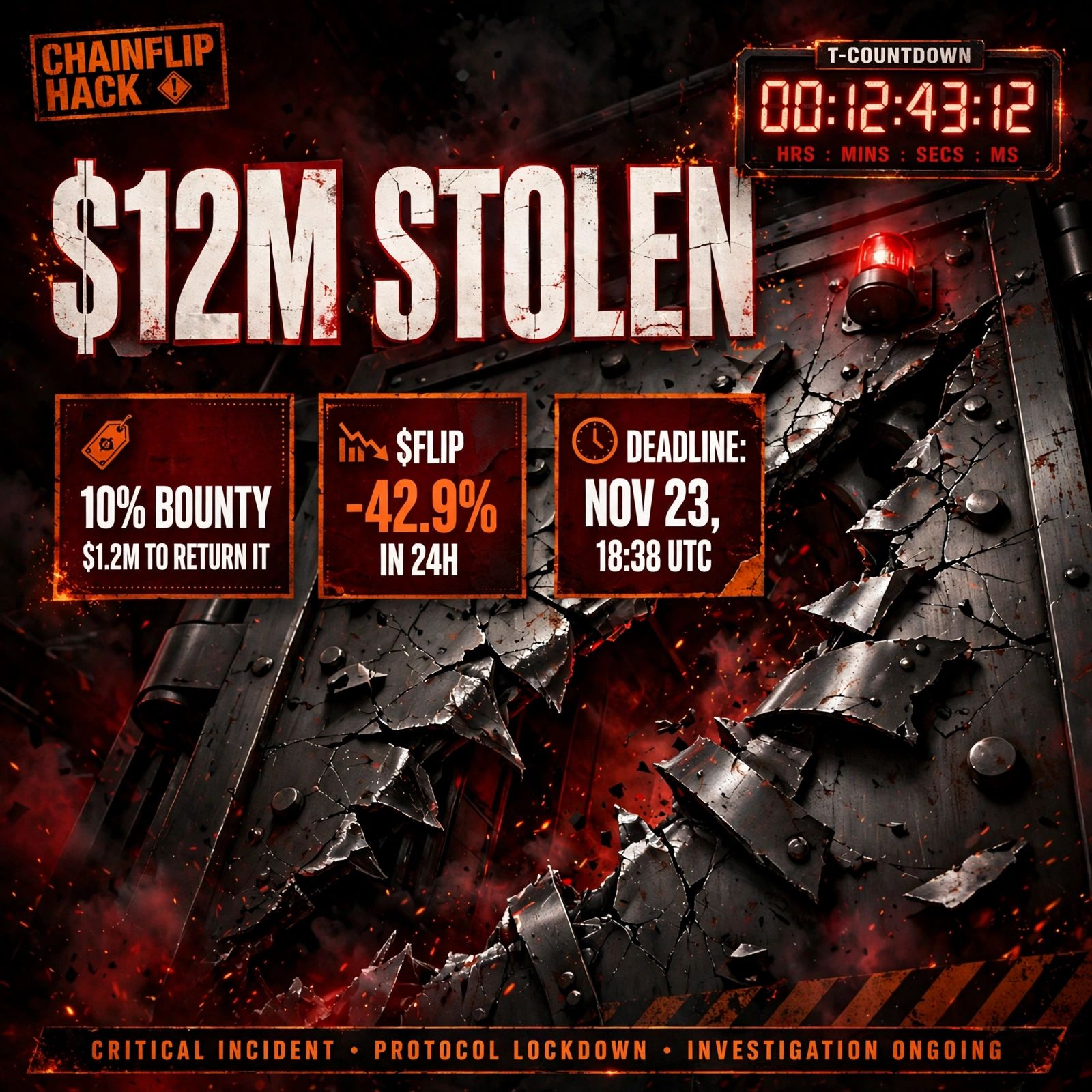
🚨 It was NEVER just $4.86M — Chainflip just confirmed $12M stolen
Chainflip Labs confirmed the real damage: $12M drained from its vaults — 122.86 BTC, 520.22 ETH, 3.25M USDC + 758K USDT.
Now the protocol is offering the hacker a 10% bounty (~$1.2M) to return 90% by Nov 23, 18:38 UTC — white-hat treatment, law enforcement complaints dropped.
$FLIP is down -42.9% in 24h. Attack traced to Tornado Cash funding on Nov 11 + a rogue validator account.
Not financial advice.
$FLIP #Chainflip #CryptoHack
1
·
--
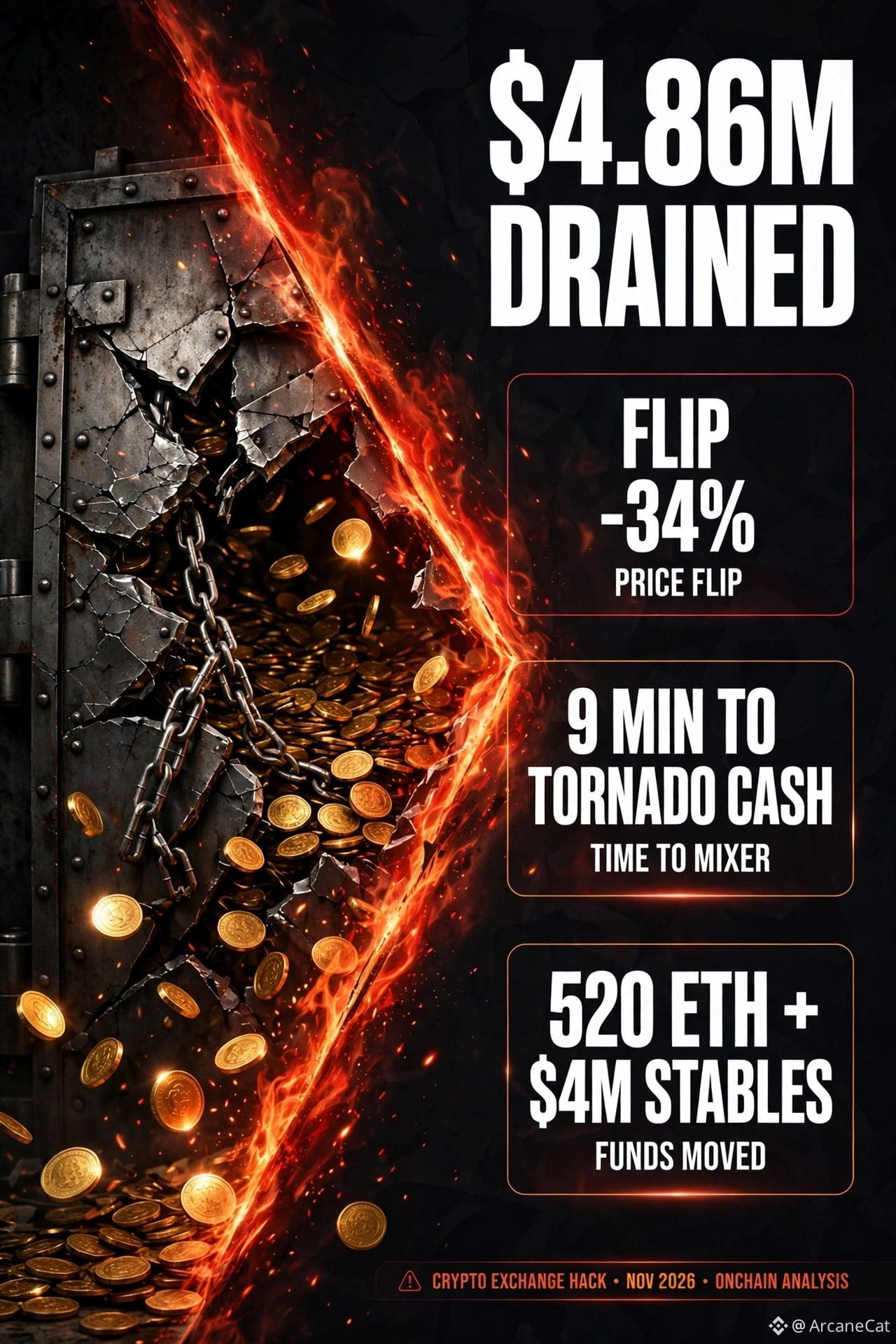
🚨 Chainflip just got drained — $4.86M gone in ONE transaction 🔥
Cross-chain DEX Chainflip halted everything after its Ethereum vault was emptied: 520 ETH + $3.25M USDC + $758K USDT.
The withdrawal carried a VALID signature — trackers suspect the validators' aggregate signing key was compromised. Funds hit Tornado Cash within 9 minutes.
$FLIP crashed -34% (market cap $41.6M → $27.1M). LPs can't withdraw until safe mode ends.
Second exploit in 2 months for Chainflip — after the September Tron incident. 👀
Not financial advice.
#Chainflip #FLIP #CryptoHack
17

·
--
🔒 Binance hack: where things stand after 3 weeks
📊 According to reports (~$6.4B stolen):
🔹 Frozen: ~$2.82B (Binance says ~$2.85B)
🔹 Recovered: only ~$32M
🔹 Still with attackers: ~$2.67B
💡 Frozen means thieves can't spend it, not that it's back. Returning funds is slow.
✅ Binance is covering affected users from its own reserves.
Do you think the frozen funds will come back? 👇
#Binance #BinanceSquare #CryptoHack #CryptoNews
Not financial advice. The $32M figure is from one investigator and Binance hasn't confirmed it.
60

·
--
Bitcoin mining power was redirected without permission through Luxor's software.
Mining services provider Luxor Technology says hashrate from just over a dozen client accounts was temporarily redirected through its Commander software.
The affected mining machines were pointed toward another mining pool without authorization.
But here's what Luxor says:
• NO customer data was leaked or stolen.
• The company PATCHED Commander within two hours.
• Affected machines began returning to their original configurations.
• All affected clients will be FULLY COMPENSATED for the redirected mining power.
• Commander is now operating normally.
Luxor says customers don't need to take any action.
Why is this important?
Unlike a traditional crypto wallet theft, redirected mining power can go unnoticed until miners realize their expected pool payouts are missing or lower than expected.
A mining operation doesn't always need to lose its machines to lose money.
Sometimes, someone simply redirects the hashrate.
#bitcoinmining #cryptohack

3

·
--
🚨 BREAKING:
Hackers inject credit card, crypto-stealing malware into 178 major websites
Ledger and Coinpass were among the businesses whose websites served malware designed to steal visitors’ crypto and credit card details, according to security researchers....
This is a significant development for $INJ. The market reaction will be worth watching closely.
What's your prediction for the next 30 days? 👇
#GeopoliticalRisk #CryptoHack #AIxCrypto #CryptoNews #Binance
🚨 BREAKING:
Hackers inject credit card, crypto-stealing malware into 178 major websites
Ledger and Coinpass were among the businesses whose websites served malware designed to steal visitors’ crypto and credit card details, according to security researchers....
This is a significant development for $INJ . The market reaction will be worth watching closely.
What's your prediction for the next 30 days? 👇
#GeopoliticalRisk #CryptoHack #AIxCrypto #CryptoNews #Binance
1
490
Мақала
URGENT WARNING: 186 Websites HACKED — Your Copy-Paste Is NOT Safe!URGENT WARNING: 186 Websites HACKED — Your Copy-Paste Is NOT Safe!
A new supply-chain attack — named OPTIMJACK —
Has infected at least 186 websites so far!
And the attack is STILL ongoing!
WHAT HAPPENED?
Hackers compromised Optimizely!
Optimizely is the company that provides A/B-testing / website optimization services to websites.
Hackers the injected malicious JavaScript into it —
Any website using Optimizely's script got infected!
WHAT DOES THIS MALWARE DO?
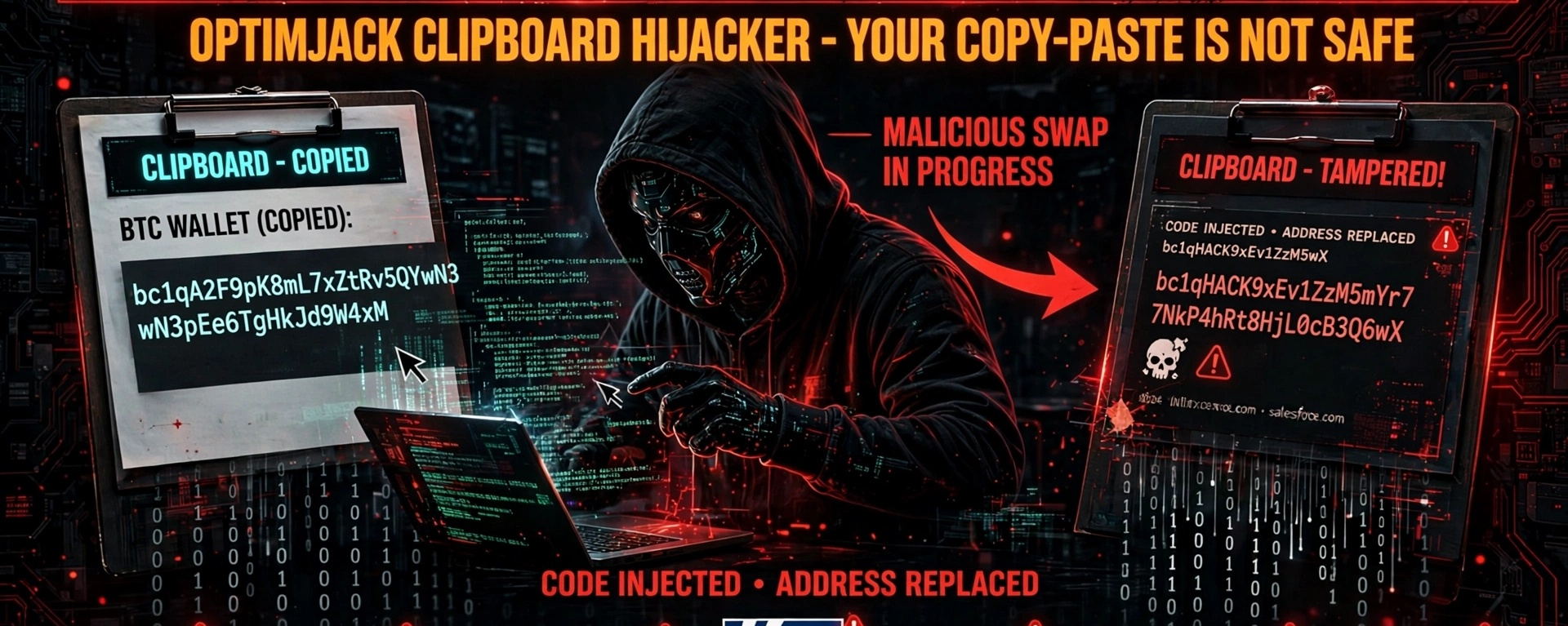
It's a CLIPBOARD HIJACKER!
Meaning:
1️⃣ You COPY a crypto wallet address from a website
2️⃣ Before you paste it, the malware CHANGES the address
3️⃣ Your money goes to the hacker's wallet!
It is also stealing payment-card information!
WHICH BIG WEBSITES WERE HIT?
Security researcher Scott Helme confirmed:
📍 CNN
📍 BBC
📍 Zoom
📍 Fox News
📍 Salesforce
📍 GitLab
📍 American Eagle
📍 Hootsuite
And 178 more websites!
Think about it — even sites like CNN and BBC are not safe!
HOW MUCH DAMAGE WAS DONE?
At first it looked like $7,040 was lost,
But after forensic investigation by Alex Thorn, Head of Research at Galaxy Digital:
✅ Actual loss is only ~$2,266!
✅ 9 blockchains were targeted, but the attack only worked on 5!
✅ Only 18 unique addresses were affected!
✅ Only 19 fraudulent transactions happened!
✅ Victims on Bitcoin lost only ~$600 — the rest were the attackers' own internal movements!
Meaning — The attack was BIG, but the loss was SMALL! Good news!
HOW TO PROTECT YOURSELF? — 5 RULES!
1️⃣ ALWAYS re-check the address AFTER pasting — match the first 4 and last 4 characters!
2️⃣ Send a SMALL TEST transaction before a big amount!
3️⃣ Use QR code, it's better than copy-paste!
4️⃣ Verify the address on your hardware wallet screen!
5️⃣ Think twice before entering card details on any site!
WHY IS THIS ATTACK SO DANGEROUS?
Because you won't even know it!
You copied the correct address, but pasted the wrong one!
And in crypto, once a transaction is gone — it NEVER comes back!
Do you check the address after copy-paste? 👇
YES — I always check 🟢
URGENT WARNING: 186 Websites HACKED — Your Copy-Paste Is NOT Safe!
A new supply-chain attack — named OPTIMJACK —
Has infected at least 186 websites so far!
And the attack is STILL ongoing!
WHAT HAPPENED?
Hackers compromised Optimizely!
Optimizely is the company that provides A/B-testing / website optimization services to websites.
Hackers the injected malicious JavaScript into it —
Any website using Optimizely's script got infected!
WHAT DOES THIS MALWARE DO?
It's a CLIPBOARD HIJACKER!
Meaning:
1️⃣ You COPY a crypto wallet address from a website
2️⃣ Before you paste it, the malware CHANGES the address
3️⃣ Your money goes to the hacker's wallet!
It is also stealing payment-card information!
WHICH BIG WEBSITES WERE HIT?
Security researcher Scott Helme confirmed:
📍 CNN
📍 BBC
📍 Zoom
📍 Fox News
📍 Salesforce
📍 GitLab
📍 American Eagle
📍 Hootsuite
And 178 more websites!
Think about it — even sites like CNN and BBC are not safe!
HOW MUCH DAMAGE WAS DONE?
At first it looked like $7,040 was lost,
But after forensic investigation by Alex Thorn, Head of Research at Galaxy Digital:
✅ Actual loss is only ~$2,266!
✅ 9 blockchains were targeted, but the attack only worked on 5!
✅ Only 18 unique addresses were affected!
✅ Only 19 fraudulent transactions happened!
✅ Victims on Bitcoin lost only ~$600 — the rest were the attackers' own internal movements!
Meaning — The attack was BIG, but the loss was SMALL! Good news!
HOW TO PROTECT YOURSELF? — 5 RULES!
1️⃣ ALWAYS re-check the address AFTER pasting — match the first 4 and last 4 characters!
2️⃣ Send a SMALL TEST transaction before a big amount!
3️⃣ Use QR code, it's better than copy-paste!
4️⃣ Verify the address on your hardware wallet screen!
5️⃣ Think twice before entering card details on any site!
WHY IS THIS ATTACK SO DANGEROUS?
Because you won't even know it!
You copied the correct address, but pasted the wrong one!
And in crypto, once a transaction is gone — it NEVER comes back!
Do you check the address after copy-paste? 👇
YES — I always check 🟢
NO — I will from now on 🔴
I USE QR — I don't use copy-paste 🟡
#CryptoHack #CyberSecurity #bitcoin #ScamAlert
NO — I will from now on 🔴
I USE QR — I don't use copy-paste 🟡
#CryptoHack #CyberSecurity #bitcoin #ScamAlert #OPTIMJACKAttackInfectsAtLeast186Websites
URGENT WARNING: 186 Websites HACKED — Your Copy-Paste Is NOT Safe!
URGENT WARNING: 186 Websites HACKED — Your Copy-Paste Is NOT Safe!
A new supply-chain attack — named OPTIMJACK —
Has infected at least 186 websites so far!
And the attack is STILL ongoing!
WHAT HAPPENED?
Hackers compromised Optimizely!
Optimizely is the company that provides A/B-testing / website optimization services to websites.
Hackers the injected malicious JavaScript into it —
Any website using Optimizely's script got infected!
WHAT DOES THIS MALWARE DO?
It's a CLIPBOARD HIJACKER!
Meaning:
1️⃣ You COPY a crypto wallet address from a website
2️⃣ Before you paste it, the malware CHANGES the address
3️⃣ Your money goes to the hacker's wallet!
It is also stealing payment-card information!
WHICH BIG WEBSITES WERE HIT?
Security researcher Scott Helme confirmed:
📍 CNN
📍 BBC
📍 Zoom
📍 Fox News
📍 Salesforce
📍 GitLab
📍 American Eagle
📍 Hootsuite
And 178 more websites!
Think about it — even sites like CNN and BBC are not safe!
HOW MUCH DAMAGE WAS DONE?
At first it looked like $7,040 was lost,
But after forensic investigation by Alex Thorn, Head of Research at Galaxy Digital:
✅ Actual loss is only ~$2,266!
✅ 9 blockchains were targeted, but the attack only worked on 5!
✅ Only 18 unique addresses were affected!
✅ Only 19 fraudulent transactions happened!
✅ Victims on Bitcoin lost only ~$600 — the rest were the attackers' own internal movements!
Meaning — The attack was BIG, but the loss was SMALL! Good news!
HOW TO PROTECT YOURSELF? — 5 RULES!
1️⃣ ALWAYS re-check the address AFTER pasting — match the first 4 and last 4 characters!
2️⃣ Send a SMALL TEST transaction before a big amount!
3️⃣ Use QR code, it's better than copy-paste!
4️⃣ Verify the address on your hardware wallet screen!
5️⃣ Think twice before entering card details on any site!
WHY IS THIS ATTACK SO DANGEROUS?
Because you won't even know it!
You copied the correct address, but pasted the wrong one!
And in crypto, once a transaction is gone — it NEVER comes back!
Do you check the address after copy-paste? 👇
YES — I always check 🟢
NO — I will from now on 🔴
I USE QR — I don't use copy-paste 🟡
#CryptoHack #CyberSecurity #bitcoin #ScamAlert
NO — I will from now on 🔴
I USE QR — I don't use copy-paste 🟡
#CryptoHack #CyberSecurity #bitcoin #ScamAlert #OPTIMJACKAttackInfectsAtLeast186Websites
A new supply-chain attack — named OPTIMJACK —
Has infected at least 186 websites so far!
And the attack is STILL ongoing!
WHAT HAPPENED?
Hackers compromised Optimizely!
Optimizely is the company that provides A/B-testing / website optimization services to websites.
Hackers the injected malicious JavaScript into it —
Any website using Optimizely's script got infected!
WHAT DOES THIS MALWARE DO?
It's a CLIPBOARD HIJACKER!
Meaning:
1️⃣ You COPY a crypto wallet address from a website
2️⃣ Before you paste it, the malware CHANGES the address
3️⃣ Your money goes to the hacker's wallet!
It is also stealing payment-card information!
WHICH BIG WEBSITES WERE HIT?
Security researcher Scott Helme confirmed:
📍 CNN
📍 BBC
📍 Zoom
📍 Fox News
📍 Salesforce
📍 GitLab
📍 American Eagle
📍 Hootsuite
And 178 more websites!
Think about it — even sites like CNN and BBC are not safe!
HOW MUCH DAMAGE WAS DONE?
At first it looked like $7,040 was lost,
But after forensic investigation by Alex Thorn, Head of Research at Galaxy Digital:
✅ Actual loss is only ~$2,266!
✅ 9 blockchains were targeted, but the attack only worked on 5!
✅ Only 18 unique addresses were affected!
✅ Only 19 fraudulent transactions happened!
✅ Victims on Bitcoin lost only ~$600 — the rest were the attackers' own internal movements!
Meaning — The attack was BIG, but the loss was SMALL! Good news!
HOW TO PROTECT YOURSELF? — 5 RULES!
1️⃣ ALWAYS re-check the address AFTER pasting — match the first 4 and last 4 characters!
2️⃣ Send a SMALL TEST transaction before a big amount!
3️⃣ Use QR code, it's better than copy-paste!
4️⃣ Verify the address on your hardware wallet screen!
5️⃣ Think twice before entering card details on any site!
WHY IS THIS ATTACK SO DANGEROUS?
Because you won't even know it!
You copied the correct address, but pasted the wrong one!
And in crypto, once a transaction is gone — it NEVER comes back!
Do you check the address after copy-paste? 👇
YES — I always check 🟢
URGENT WARNING: 186 Websites HACKED — Your Copy-Paste Is NOT Safe!
A new supply-chain attack — named OPTIMJACK —
Has infected at least 186 websites so far!
And the attack is STILL ongoing!
WHAT HAPPENED?
Hackers compromised Optimizely!
Optimizely is the company that provides A/B-testing / website optimization services to websites.
Hackers the injected malicious JavaScript into it —
Any website using Optimizely's script got infected!
WHAT DOES THIS MALWARE DO?
It's a CLIPBOARD HIJACKER!
Meaning:
1️⃣ You COPY a crypto wallet address from a website
2️⃣ Before you paste it, the malware CHANGES the address
3️⃣ Your money goes to the hacker's wallet!
It is also stealing payment-card information!
WHICH BIG WEBSITES WERE HIT?
Security researcher Scott Helme confirmed:
📍 CNN
📍 BBC
📍 Zoom
📍 Fox News
📍 Salesforce
📍 GitLab
📍 American Eagle
📍 Hootsuite
And 178 more websites!
Think about it — even sites like CNN and BBC are not safe!
HOW MUCH DAMAGE WAS DONE?
At first it looked like $7,040 was lost,
But after forensic investigation by Alex Thorn, Head of Research at Galaxy Digital:
✅ Actual loss is only ~$2,266!
✅ 9 blockchains were targeted, but the attack only worked on 5!
✅ Only 18 unique addresses were affected!
✅ Only 19 fraudulent transactions happened!
✅ Victims on Bitcoin lost only ~$600 — the rest were the attackers' own internal movements!
Meaning — The attack was BIG, but the loss was SMALL! Good news!
HOW TO PROTECT YOURSELF? — 5 RULES!
1️⃣ ALWAYS re-check the address AFTER pasting — match the first 4 and last 4 characters!
2️⃣ Send a SMALL TEST transaction before a big amount!
3️⃣ Use QR code, it's better than copy-paste!
4️⃣ Verify the address on your hardware wallet screen!
5️⃣ Think twice before entering card details on any site!
WHY IS THIS ATTACK SO DANGEROUS?
Because you won't even know it!
You copied the correct address, but pasted the wrong one!
And in crypto, once a transaction is gone — it NEVER comes back!
Do you check the address after copy-paste? 👇
YES — I always check 🟢
NO — I will from now on 🔴
I USE QR — I don't use copy-paste 🟡
#CryptoHack #CyberSecurity #bitcoin #ScamAlert
NO — I will from now on 🔴
I USE QR — I don't use copy-paste 🟡
#CryptoHack #CyberSecurity #bitcoin #ScamAlert #OPTIMJACKAttackInfectsAtLeast186Websites
BTC-1,81%
GLXYUS+0,23%
2
165

·
--
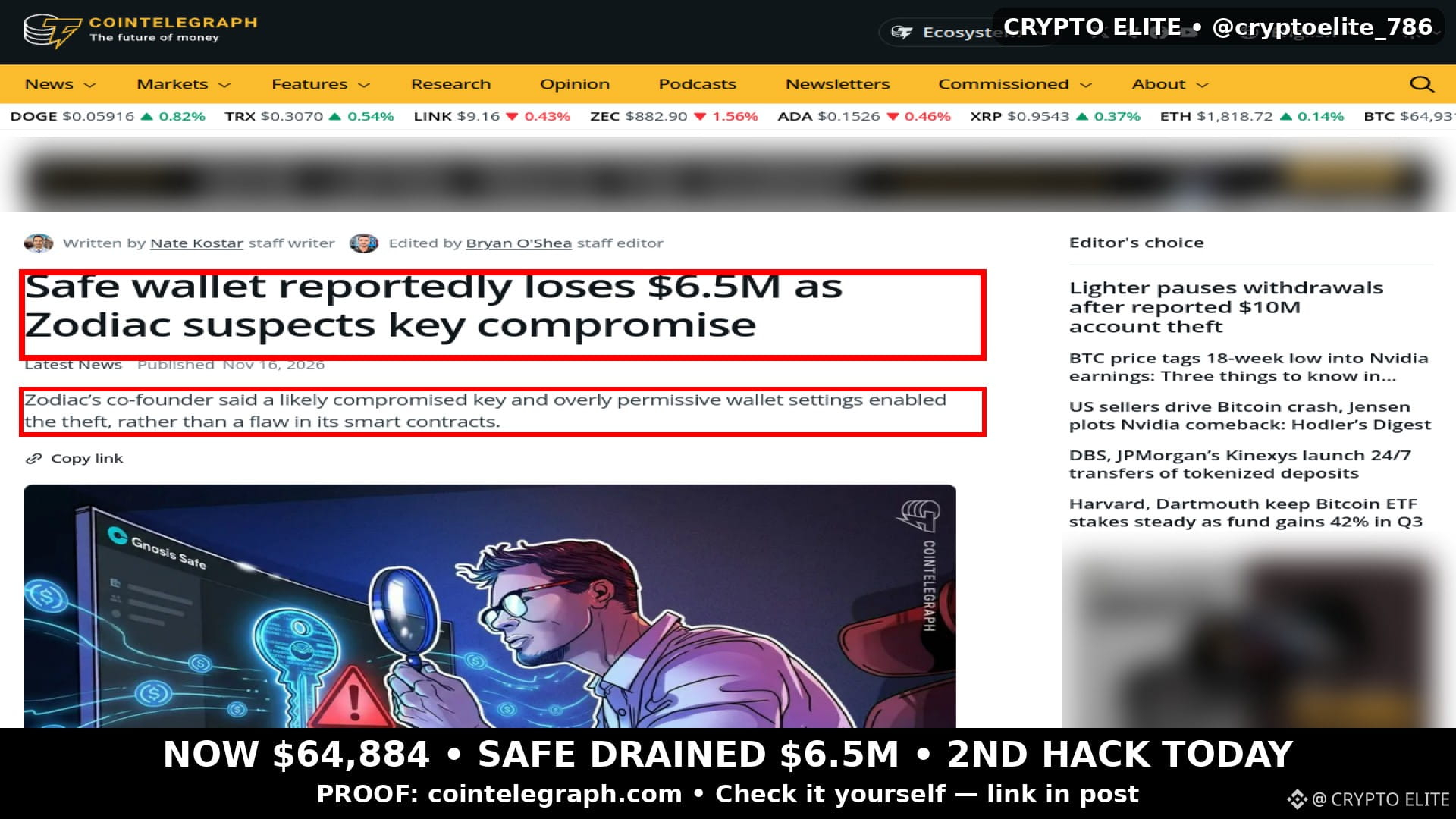
🚨🔓 SAFE WALLET DRAINED $6.5M — KEY COMPROMISED! 🔓🚨
A Gnosis Safe multisig wallet was drained of ~$6.45M — $4.3M in USDC + $1.7M in syrupUSDC gone.
Zodiac's co-founder says it was a likely compromised key and overly permissive wallet settings — NOT a flaw in the smart contracts.
The hacker already spent ~$813K buying XMR (Monero) on Hyperliquid to hide the trail.
This is the SECOND major drain TODAY — Lighter lost $15.5M this morning. Wallets are under attack right now.
Do you still trust multisig wallets with your funds? 👇
THE PROOF — check this news yourself here:
https://cointelegraph.com/news/safe-wallet-reportedly-loses-millions-after-key-compromise
$BTC $ETH #SafeWallet #CryptoHack #Security
1
140
·
--
MapleStory Universe Hacked: User Data Exposed, No Crypto Stolen
Nexon's blockchain game MapleStory Universe halted all services on Nov 12 after hackers breached part of its off-chain servers. User data was exposed — wallet addresses, partial emails, login histories and API keys from 328 apps — but Nexon says no assets were stolen and the blockchain and smart contracts were untouched. Services stay down for emergency maintenance while servers are replaced.
$NXPC #MapleStory #NXPC #CryptoHack #Gaming
Not financial advice.

18

·
--
Мақала
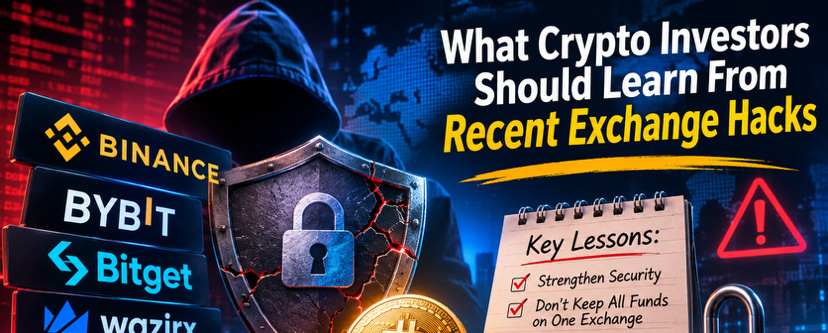
What Crypto Investors Should Learn From Recent Exchange HacksThe cryptocurrency industry has made enormous progress over the years, but recent security incidents have reminded us of one important reality: No cryptocurrency exchange is completely immune to hacking.
From Binance and Bybit to Bitget, WazirX, and DMM Bitcoin, several major platforms have experienced serious security breaches involving hundreds of millions or even billions of dollars.
These incidents raise important questions about exchange security, user protection, and the risks of keeping digital assets on centralized platforms.
More importantly, they teach us that protecting cryptocurrency is not just about securing private keys. It also involves protecting employees, internal systems, transaction approvals, and the infrastructure behind exchanges.
Let’s look at what happened and what the entire crypto community should learn from these incidents.
1. Recent Exchange Hacks: What Happened?
Binance :- October 2026
On October 29, Binance experienced a major security incident involving approximately $6.34 billion in affected digital assets.
According to Binance’s initial investigation, attackers compromised internal wallet transaction-signing infrastructure and used unauthorized access to initiate transfers across multiple blockchain networks.
The incident involved sophisticated attacks targeting internal systems and authorization processes.
Binance stated that it would absorb the financial impact rather than pass the losses to users. Its November 3 update reported that 98% of affected token assets had been replenished, while approximately $2.85 billion in assets had been frozen or intercepted.
This incident demonstrated that even exchanges with extensive security resources can face serious infrastructure vulnerabilities.
Bybit :- February 2025
Bybit suffered one of the largest cryptocurrency thefts in history, losing approximately $1.5 billion.
The attackers manipulated the transaction interface used by wallet signers, making malicious transactions appear legitimate.
This was particularly concerning because the targeted wallet was a cold wallet, which many users consider highly secure.
The FBI attributed the attack to North Korea’s TraderTraitor hacking operation.
The biggest lesson was that cold storage and multiple transaction approvals are not enough if the signing process itself can be manipulated.
Bitget :- September 2026
Bitget also experienced a significant security breach involving approximately $387.5 million in digital assets.
According to the exchange, attackers compromised backend infrastructure connected to its wallet operations and manipulated transaction information during the authorization process.
Bitget stated that its cold wallets remained unaffected and that its protection fund would cover the losses.
This incident highlighted how vulnerabilities in internal systems can put exchange assets at risk even without directly stealing private keys.
WazirX and DMM Bitcoin :- 2024
These incidents also deserve attention.
WazirX suffered a security breach involving more than $230 million from a multisignature wallet in July 2024.
DMM Bitcoin lost approximately $305 million in Bitcoin following a security incident in May 2024.
Together, these cases demonstrate that exchange security has been a major challenge for the industry for years.
2. What Do These Attacks Have in Common?
Although the attacks involved different techniques, several important patterns emerge.
First, hackers are targeting people, not just technology.
Social engineering, compromised employee devices, fake recruitment opportunities, and malicious software can provide attackers with access to systems that would otherwise be difficult to penetrate.
Second, private keys are not the only security concern.
Even if private keys remain protected, compromised transaction interfaces, backend services, or authorization systems can create opportunities for unauthorized transfers.
Third, sophisticated attacks are becoming harder to detect.
Attackers may spend months preparing an operation, studying internal systems, and identifying weaknesses before moving any funds.
Finally, recovering stolen cryptocurrency is extremely difficult.
Blockchain transactions are generally irreversible. Although exchanges, blockchain investigators, and stablecoin issuers can sometimes freeze or trace assets, recovering everything is not guaranteed.
3. What Should Cryptocurrency Exchanges Improve?
These incidents should encourage every exchange to strengthen its security infrastructure.
Here are some important improvements the industry needs:
Stronger transaction verification: Every large transaction should undergo independent verification before approval.
Better employee security: Hardware security keys, device monitoring, strict access permissions, and cybersecurity training should be standard.
Withdrawal protection: Unusual or unusually large transfers should automatically trigger additional security checks.Independent security audits: Exchanges should regularly test their wallets, backend systems, internal APIs, and transaction-signing infrastructure.Better monitoring: Suspicious login activity, unexpected permission changes, and abnormal withdrawal patterns should be detected immediately.
Transparent incident reporting: Exchanges should communicate honestly about security failures, recovery efforts, and customer protection.
Security should never be treated as a one-time achievement. It requires continuous investment and improvement.
4. What Should Ordinary Crypto Investors Learn?
This is probably the most important part for everyday users.
We cannot control how an exchange manages its internal infrastructure, but we can take steps to reduce our own exposure.
Don’t keep all your assets on one exchange.
Centralized exchanges are useful for trading, but keeping your entire portfolio on a single platform creates concentration risk.
Consider keeping only the funds you need for active trading on exchanges. For long-term holdings, learn about self-custody and reputable hardware wallets.
Understand hot wallets and cold wallets.
Hot wallets are connected to online infrastructure and are generally used for faster transactions.
Cold wallets keep private keys offline and are generally better suited for long-term storage.
Both have advantages and limitations. Self-custody also means you are responsible for protecting your recovery phrase and private keys.
Enable stronger account protection.
Use two-factor authentication, passkeys or hardware security keys where supported, withdrawal address whitelisting, anti-phishing codes, and unique passwords.
Never share your seed phrase.
No legitimate exchange employee, support agent, or project representative needs your wallet recovery phrase.
Anyone asking for it should be treated as a potential scammer.
Be careful with suspicious links and downloads.
Fake job opportunities, malicious applications, browser extensions, and phishing websites can compromise your devices and accounts.
The Binance incident is a reminder that even seemingly legitimate professional opportunities can be used as attack vectors.
Understand Proof of Reserves.
Proof of Reserves can help users verify certain exchange-held assets, depending on the methodology.
However, it does not guarantee that an exchange cannot be hacked or that its internal security systems are flawless.
Financial transparency and cybersecurity are two different things.
5. Does This Mean Centralized Exchanges Are Unsafe?
Not necessarily.
Centralized exchanges remain an essential part of the cryptocurrency ecosystem. They provide liquidity, trading infrastructure, fiat deposits and withdrawals, derivatives markets, and access to thousands of digital assets.
However, users should understand that a large reputation does not automatically mean zero risk.
Even exchanges with substantial financial reserves can experience security failures.
At the same time, self-custody is not completely risk-free. Losing a recovery phrase or signing a malicious transaction can also result in permanent losses.
The goal should not be to blindly trust exchanges or completely avoid them.
It should be to understand the risks and manage them intelligently.
Conclusion: Protecting Capital Matters More Than Ever
The Binance, Bybit, Bitget, WazirX, and DMM Bitcoin incidents should change how we think about cryptocurrency security.
For years, many investors have focused primarily on price movements, trading volume, market capitalization, leverage, and potential returns.
But the security of the platform holding those assets deserves just as much attention.
A profitable trade means nothing if the infrastructure protecting your funds fails.
The biggest lessons are simple:
Never assume that a major exchange is impossible to hack.
Avoid keeping all your investments in one place.
Learn about self-custody and wallet security.
Protect your devices, passwords, and recovery phrases.
Demand transparency and accountability from exchanges.Remember that protecting capital is just as important as growing it.
Crypto was built around financial independence, but financial independence also requires personal responsibility.
The future of this industry will not depend only on faster blockchains, better trading platforms, or wider adoption. It will also depend on whether users can trust the systems protecting their money.
Because in crypto, protecting your capital is just as important as making profits.
#CryptoHack #Binance $AGT
$BNB $TSLA
{future}(BNBUSDT)
What Crypto Investors Should Learn From Recent Exchange Hacks
The cryptocurrency industry has made enormous progress over the years, but recent security incidents have reminded us of one important reality: No cryptocurrency exchange is completely immune to hacking.
From Binance and Bybit to Bitget, WazirX, and DMM Bitcoin, several major platforms have experienced serious security breaches involving hundreds of millions or even billions of dollars.
These incidents raise important questions about exchange security, user protection, and the risks of keeping digital assets on centralized platforms.
More importantly, they teach us that protecting cryptocurrency is not just about securing private keys. It also involves protecting employees, internal systems, transaction approvals, and the infrastructure behind exchanges.
Let’s look at what happened and what the entire crypto community should learn from these incidents.
1. Recent Exchange Hacks: What Happened?
Binance :- October 2026
On October 29, Binance experienced a major security incident involving approximately $6.34 billion in affected digital assets.
According to Binance’s initial investigation, attackers compromised internal wallet transaction-signing infrastructure and used unauthorized access to initiate transfers across multiple blockchain networks.
The incident involved sophisticated attacks targeting internal systems and authorization processes.
Binance stated that it would absorb the financial impact rather than pass the losses to users. Its November 3 update reported that 98% of affected token assets had been replenished, while approximately $2.85 billion in assets had been frozen or intercepted.
This incident demonstrated that even exchanges with extensive security resources can face serious infrastructure vulnerabilities.
Bybit :- February 2025
Bybit suffered one of the largest cryptocurrency thefts in history, losing approximately $1.5 billion.
The attackers manipulated the transaction interface used by wallet signers, making malicious transactions appear legitimate.
This was particularly concerning because the targeted wallet was a cold wallet, which many users consider highly secure.
The FBI attributed the attack to North Korea’s TraderTraitor hacking operation.
The biggest lesson was that cold storage and multiple transaction approvals are not enough if the signing process itself can be manipulated.
Bitget :- September 2026
Bitget also experienced a significant security breach involving approximately $387.5 million in digital assets.
According to the exchange, attackers compromised backend infrastructure connected to its wallet operations and manipulated transaction information during the authorization process.
Bitget stated that its cold wallets remained unaffected and that its protection fund would cover the losses.
This incident highlighted how vulnerabilities in internal systems can put exchange assets at risk even without directly stealing private keys.
WazirX and DMM Bitcoin :- 2024
These incidents also deserve attention.
WazirX suffered a security breach involving more than $230 million from a multisignature wallet in July 2024.
DMM Bitcoin lost approximately $305 million in Bitcoin following a security incident in May 2024.
Together, these cases demonstrate that exchange security has been a major challenge for the industry for years.
2. What Do These Attacks Have in Common?
Although the attacks involved different techniques, several important patterns emerge.
First, hackers are targeting people, not just technology.
Social engineering, compromised employee devices, fake recruitment opportunities, and malicious software can provide attackers with access to systems that would otherwise be difficult to penetrate.
Second, private keys are not the only security concern.
Even if private keys remain protected, compromised transaction interfaces, backend services, or authorization systems can create opportunities for unauthorized transfers.
Third, sophisticated attacks are becoming harder to detect.
Attackers may spend months preparing an operation, studying internal systems, and identifying weaknesses before moving any funds.
Finally, recovering stolen cryptocurrency is extremely difficult.
Blockchain transactions are generally irreversible. Although exchanges, blockchain investigators, and stablecoin issuers can sometimes freeze or trace assets, recovering everything is not guaranteed.
3. What Should Cryptocurrency Exchanges Improve?
These incidents should encourage every exchange to strengthen its security infrastructure.
Here are some important improvements the industry needs:
Stronger transaction verification: Every large transaction should undergo independent verification before approval.
Better employee security: Hardware security keys, device monitoring, strict access permissions, and cybersecurity training should be standard.
Withdrawal protection: Unusual or unusually large transfers should automatically trigger additional security checks.Independent security audits: Exchanges should regularly test their wallets, backend systems, internal APIs, and transaction-signing infrastructure.Better monitoring: Suspicious login activity, unexpected permission changes, and abnormal withdrawal patterns should be detected immediately.
Transparent incident reporting: Exchanges should communicate honestly about security failures, recovery efforts, and customer protection.
Security should never be treated as a one-time achievement. It requires continuous investment and improvement.
4. What Should Ordinary Crypto Investors Learn?
This is probably the most important part for everyday users.
We cannot control how an exchange manages its internal infrastructure, but we can take steps to reduce our own exposure.
Don’t keep all your assets on one exchange.
Centralized exchanges are useful for trading, but keeping your entire portfolio on a single platform creates concentration risk.
Consider keeping only the funds you need for active trading on exchanges. For long-term holdings, learn about self-custody and reputable hardware wallets.
Understand hot wallets and cold wallets.
Hot wallets are connected to online infrastructure and are generally used for faster transactions.
Cold wallets keep private keys offline and are generally better suited for long-term storage.
Both have advantages and limitations. Self-custody also means you are responsible for protecting your recovery phrase and private keys.
Enable stronger account protection.
Use two-factor authentication, passkeys or hardware security keys where supported, withdrawal address whitelisting, anti-phishing codes, and unique passwords.
Never share your seed phrase.
No legitimate exchange employee, support agent, or project representative needs your wallet recovery phrase.
Anyone asking for it should be treated as a potential scammer.
Be careful with suspicious links and downloads.
Fake job opportunities, malicious applications, browser extensions, and phishing websites can compromise your devices and accounts.
The Binance incident is a reminder that even seemingly legitimate professional opportunities can be used as attack vectors.
Understand Proof of Reserves.
Proof of Reserves can help users verify certain exchange-held assets, depending on the methodology.
However, it does not guarantee that an exchange cannot be hacked or that its internal security systems are flawless.
Financial transparency and cybersecurity are two different things.
5. Does This Mean Centralized Exchanges Are Unsafe?
Not necessarily.
Centralized exchanges remain an essential part of the cryptocurrency ecosystem. They provide liquidity, trading infrastructure, fiat deposits and withdrawals, derivatives markets, and access to thousands of digital assets.
However, users should understand that a large reputation does not automatically mean zero risk.
Even exchanges with substantial financial reserves can experience security failures.
At the same time, self-custody is not completely risk-free. Losing a recovery phrase or signing a malicious transaction can also result in permanent losses.
The goal should not be to blindly trust exchanges or completely avoid them.
It should be to understand the risks and manage them intelligently.
Conclusion: Protecting Capital Matters More Than Ever
The Binance, Bybit, Bitget, WazirX, and DMM Bitcoin incidents should change how we think about cryptocurrency security.
For years, many investors have focused primarily on price movements, trading volume, market capitalization, leverage, and potential returns.
But the security of the platform holding those assets deserves just as much attention.
A profitable trade means nothing if the infrastructure protecting your funds fails.
The biggest lessons are simple:
Never assume that a major exchange is impossible to hack.
Avoid keeping all your investments in one place.
Learn about self-custody and wallet security.
Protect your devices, passwords, and recovery phrases.
Demand transparency and accountability from exchanges.Remember that protecting capital is just as important as growing it.
Crypto was built around financial independence, but financial independence also requires personal responsibility.
The future of this industry will not depend only on faster blockchains, better trading platforms, or wider adoption. It will also depend on whether users can trust the systems protecting their money.
Because in crypto, protecting your capital is just as important as making profits.
#CryptoHack #Binance $AGT
$BNB $TSLA
73

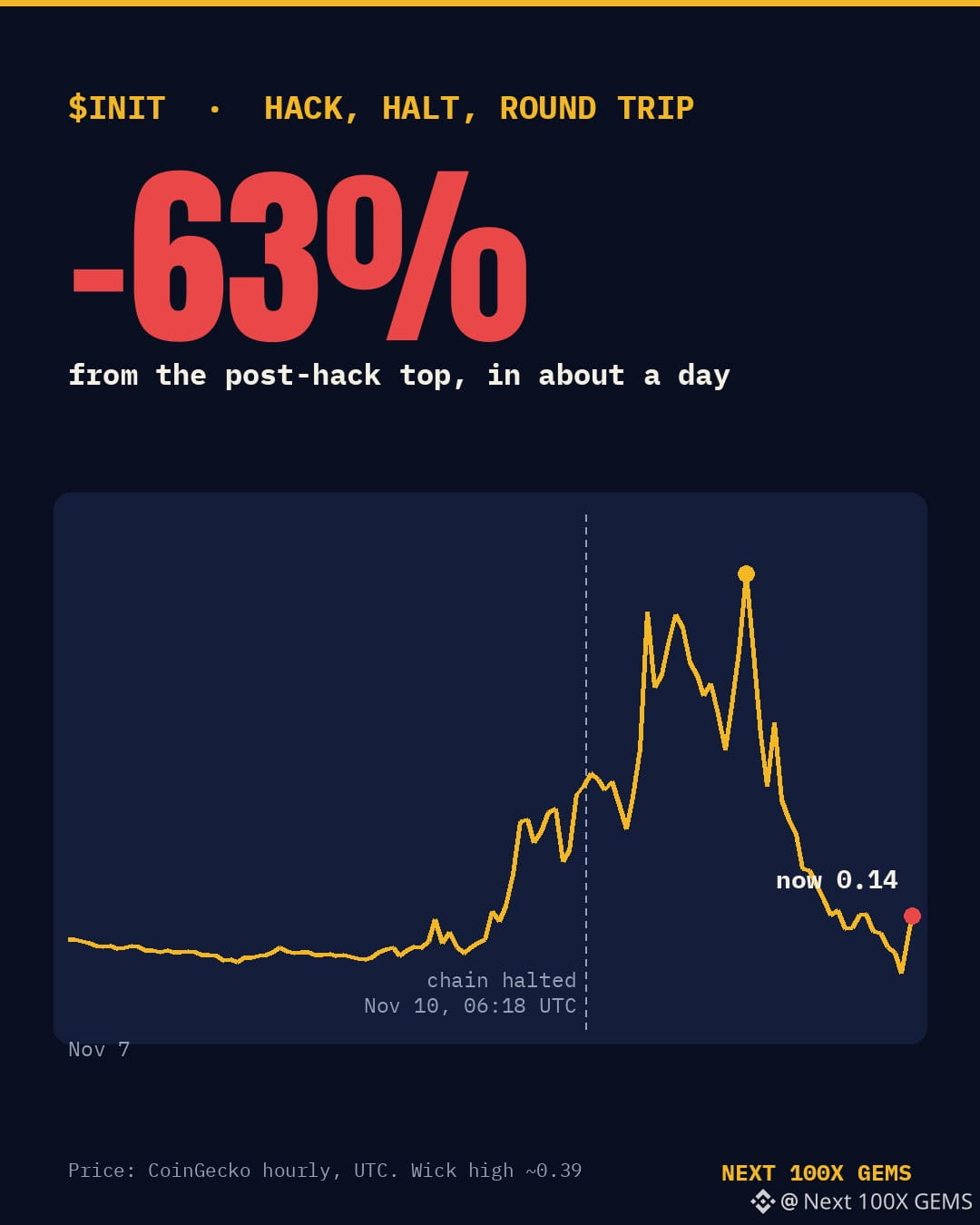
$INIT nearly tripled after its own chain got hacked. Then it gave it all back.
On Nov 10, Initia halted its layer 1 after an attacker used a compromised cloud key to forge withdrawals and move about 3.27 million dollars. No INIT was taken.
The token went from about 0.13 on Nov 9 to a 0.39 wick early Nov 11. It now trades near 0.14, about 63% under that wick.
Our count: around 1.3 billion dollars of INIT futures traded in 24 hours. That is more than 40 times the token's whole market cap of roughly 30 million.
Second halt in 18 days. The leverage left faster than the attacker did.
$INIT
#Initia #CryptoHack
NFA. DYOR.
1
4.5k
·
--
Initia Hacked Again: $3.27M Stolen, $INIT Crashes 52%
Initia halted its L1 on Nov 10 after an attacker used a compromised cloud key to forge withdrawals from five rollups, draining ~$3.27M — its second exploit in three weeks. $2.16M remains frozen on the paused chain, with no restart date yet.
$INIT doubled to ~$0.30 during the halt, then crashed back to ~$0.136, down 52% in 24h.
Not financial advice.
$INIT #Initia #CryptoHack

4
5.6k

UXLINK Exploit Triggers $148M Market Dump
A $148M selloff by the UXLINK hacker is impacting ETH, SOL, and XRP liquidity.
#CryptoHack #MarketVolatility
UXLINK Exploit Triggers $148M Market Dump
A $148M selloff by the UXLINK hacker is impacting ETH, SOL, and XRP liquidity.
#CryptoHack #MarketVolatility
A $148M selloff by the UXLINK hacker is impacting ETH, SOL, and XRP liquidity.
#CryptoHack #MarketVolatility
92
·
--
⚡ BREAKING NOW:
Asian crypto exchanges batten down the hatches as hacks surge: Asia Express
Asian crypto exchanges are scrambling to tighten security on fears of a wave of potentially AI-assisted hacks, even as regional governments embrace tokenization and stablecoins....
This is a significant development for $TIA $SCR. The market reaction will be worth watching closely.
Agree? Drop a ❤️. Disagree? Tell me why 👇
#CryptoHack #CryptoRally #AIxCrypto #CryptoNews #Binance
⚡ BREAKING NOW:
Asian crypto exchanges batten down the hatches as hacks surge: Asia Express
Asian crypto exchanges are scrambling to tighten security on fears of a wave of potentially AI-assisted hacks, even as regional governments embrace tokenization and stablecoins....
This is a significant development for $TIA $SCR . The market reaction will be worth watching closely.
Agree? Drop a ❤️. Disagree? Tell me why 👇
#CryptoHack #CryptoRally #AIxCrypto #CryptoNews #Binance
260

·
--
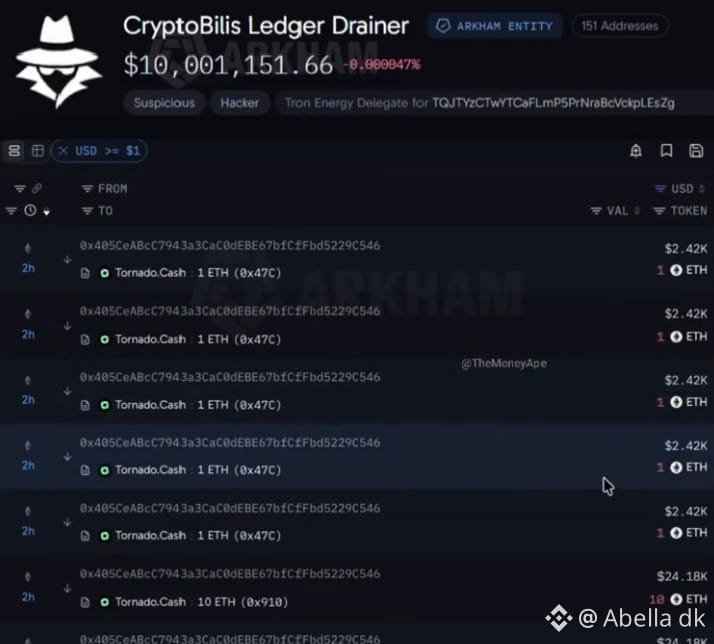
🔥 BINANCE HACKER NEXT? TORNADO CASH ENTERS THE PICTURE! 🚨
The CryptoBilis Ledger drainer has deposited another 885 $ETH worth $2.14 MILLION into Tornado Cash!
$APPB
Here is where things get interesting:
💰 Over $62 MILLION in stolen crypto has reportedly been sold.
🔒 Around $10 MILLION in $USDT remains frozen by Tether.
🌪️ The attacker continues moving stolen ETH through Tornado Cash, making transaction tracing more difficult.
But here's the BIG question:
Could the Binance hacker follow the same playbook?
If Binance's attacker starts moving stolen funds through Tornado Cash, investigators could face another complicated tracing challenge.
However, mixers don't guarantee complete anonymity. Blockchain investigators can still track transaction patterns and follow connected wallets.
🚨 The crypto security battle is far from over! $BTC
What do you think? Will the Binance hacker use Tornado Cash next?
#Binance #CryptoSecurity #Ethereum #TornadoCash #CryptoHack
6
4
240

·
--
🚨 HOW BINANCE LOST $6.34 BILLION - FULL STORY REVEALED
This is NOT a simple hack. It's a Hollywood movie plot.
*June 2026:* Hacker posts fake job ad
Binance dev downloads "AI tool" - it's malware
*Oct 20:* Malware spreads to 3 engineers
Steals wallet signing keys
*Oct 29, 2:00 PM:*
233M XRP stolen in 4 MINUTES
Then BTC, ETH, everything - $6.34B in 20 minutes
FBI confirms: North Korea's TraderTraitor group
*Binance response today:*
✅ $2.85B FROZEN with law enforcement
✅ 98% of funds REPLENISHED from own money
✅ 236 withdrawal pairs LIVE
✅ More than 100% set aside to cover losses
From biggest hack in history to 98% recovered in 5 days.
If this was a bank, it would be dead. Binance is buying back $6B with cash.
Bullish for $BNB $BTC ?
#Binance #bnb #CryptoHack
1
164
Көбірек контент көру үшін кіріңіз
Binance Square платформасында әлемдік криптоқоғамдастыққа қосылыңыз
⚡️ Криптовалюта туралы ең соңғы және пайдалы ақпаратты алыңыз.
💬 Әлемдегі ең ірі криптобиржаның сеніміне ие.
👍 Расталған авторлардың нақты пікірлерін табыңыз.
Электрондық пошта/телефон нөмірі
Трендтегі тақырыптар
1
#Bitcoin'sReboundFadesBelow$60K
3,953 рет көрілді
114 адам талқылап жатыр
2
#NVIDIAReinstatesJensenHuangasCEO
226,342 рет көрілді
1,614 адам талқылап жатыр
3
#WillMarketsStageAThanksgivingReliefRally?
311,323 рет көрілді
2,382 адам талқылап жатыр
4
#WillOctCorePCEShiftFedHikeExpectations?
108,786 рет көрілді
1,151 адам талқылап жатыр
5
#EvolveAtBinanceBlockchainWeek
225,930 рет көрілді
1,451 адам талқылап жатыр
6
#SouthKoreaBeginsCryptoProviderShareholderReviews
3,079 рет көрілді
91 адам талқылап жатыр
7
#USAddsMegaspeedToEntityList
8,187 рет көрілді
171 адам талқылап жатыр
8
#GrayscaleLaunches2xLeveragedZcashETF
5,647 рет көрілді
114 адам талқылап жатыр
9
#StrategyValueFallsBelowItsBitcoinHoldings
3,976 рет көрілді
123 адам талқылап жатыр
10
#CFTCRequiresAtLeast20%HaircutsOnBTCAndETHReserves
2,354 рет көрілді
84 адам талқылап жатыр