
Tradeassi_com
247 投稿

Tradeassi_com
報告
ユーザーをブロック
trading platform where you can live track coins in your strategy condition
5 フォロー
14 フォロワー
22 いいね
1 バッジ
投稿
翻訳参照
Tether says it holds about 150,000 BTC. Its Sept 30 report implied about 100,000Did Tether really add about 50,000 BTC in a month, or does the 150K count something the audited line doesn't?
Tether CEO Paolo Ardoino said in his Plan B Forum talk in Lugano that the company holds about 150,000 $BTC, worth more than 11.5B USD (reported today by Wu Blockchain, ZeroHedge).
Why the number stands out:
- Tether's Q3 attestation (BDO, published Oct 30) valued its bitcoin at 8.37B USD as of Sept 30, at 83,621.23 USD per coin. That works out to roughly 100,060 BTC.
- At the end of June it was roughly 98,930 BTC, so Q3 added only about 1,100 coins.
- 150,000 vs about 100,000 is a gap of about 50,000 BTC, roughly 3.8B USD at today's price.
- For scale: Tether's policy is to put up to 15% of quarterly net profit into BTC. 15% of Q3's 1.5B USD profit is about 225M USD.
What we don't know: whether Tether bought that much in October, or whether the 150K includes bitcoin held outside the reserve line (indirect exposure, mining, other entities). Nothing published so far breaks it down. Until there's a wallet list or the Q4 report, treat 150K as a CEO's round number, not an audited figure.
The cushion side: Q3 excess reserves were 7.95B USD on 191.5B USD of assets, with 132.4B USD in direct and indirect T-bill holdings. Because BTC buys come from profits, a BTC drawdown hits that buffer first, not the $USDT backing, at least as the policy is described.
Tape (Binance, 02:14 UTC Nov 3):
- BTC 77,040 USD, -1.74% 24h (range 76,664 to 78,878)
- BTC 1h closes since the 01:13 UTC report: 77,114, then 77,040. Flat.
Context, not cause: the headline didn't move price. BTC was already red on the day, and the market is waiting on Tuesday's US midterms.
My take: a bigger BTC stack at the largest stablecoin issuer reads as a long-term bid, but a 50K-coin gap deserves an on-chain answer, not just a keynote line.
Big position moves show up live in whale alerts on tradeassi.com.
Source: https://tradeassi.com/en/news/8288653b-c91e-4cd8-b38a-32e8b360a4f3
NFA.
Tether says it holds about 150,000 BTC. Its Sept 30 report implied about 100,000
Did Tether really add about 50,000 BTC in a month, or does the 150K count something the audited line doesn't?
Tether CEO Paolo Ardoino said in his Plan B Forum talk in Lugano that the company holds about 150,000 $BTC, worth more than 11.5B USD (reported today by Wu Blockchain, ZeroHedge).
Why the number stands out:
- Tether's Q3 attestation (BDO, published Oct 30) valued its bitcoin at 8.37B USD as of Sept 30, at 83,621.23 USD per coin. That works out to roughly 100,060 BTC.
- At the end of June it was roughly 98,930 BTC, so Q3 added only about 1,100 coins.
- 150,000 vs about 100,000 is a gap of about 50,000 BTC, roughly 3.8B USD at today's price.
- For scale: Tether's policy is to put up to 15% of quarterly net profit into BTC. 15% of Q3's 1.5B USD profit is about 225M USD.
What we don't know: whether Tether bought that much in October, or whether the 150K includes bitcoin held outside the reserve line (indirect exposure, mining, other entities). Nothing published so far breaks it down. Until there's a wallet list or the Q4 report, treat 150K as a CEO's round number, not an audited figure.
The cushion side: Q3 excess reserves were 7.95B USD on 191.5B USD of assets, with 132.4B USD in direct and indirect T-bill holdings. Because BTC buys come from profits, a BTC drawdown hits that buffer first, not the $USDT backing, at least as the policy is described.
Tape (Binance, 02:14 UTC Nov 3):
- BTC 77,040 USD, -1.74% 24h (range 76,664 to 78,878)
- BTC 1h closes since the 01:13 UTC report: 77,114, then 77,040. Flat.
Context, not cause: the headline didn't move price. BTC was already red on the day, and the market is waiting on Tuesday's US midterms.
My take: a bigger BTC stack at the largest stablecoin issuer reads as a long-term bid, but a 50K-coin gap deserves an on-chain answer, not just a keynote line.
Big position moves show up live in whale alerts on tradeassi.com.
Source: https://tradeassi.com/en/news/8288653b-c91e-4cd8-b38a-32e8b360a4f3
NFA.
103
一晩で27,553 ETHを買った「クジラ」は泥棒だった:EU事業体の口座から1億600万米ドルが流出一晩中「ETHを狂ったように買っていたクジラ」は強気筋ではありませんでした。ZachXBTによると、盗んだステーブルコインを使っていた泥棒でした。この買い注文を強気のサインと読み取っていたでしょうか?
判明していること(11月2日(月)):
ZachXBTは、11月1日(日)に匿名のEU事業体の取引所口座から1億600万米ドル超が盗まれた疑いを指摘しました。被害者も取引所も、損失を確認していません。
- Bitqueryによるオンチェーン追跡では、11月1日12:25 UTC以降、3つの取引所口座(OKX、Kraken、Crypto.com)から約1億880万米ドル相当のUSDCが流出し、そのうち約7,320万米ドル相当が23:00 UTCまでの3時間に流出したとされています。Bitqueryによると、これらの取引所が侵害されたことを示すものはなく、出金は1人の顧客の口座から行われました。
一晩で27,553 ETHを買った「クジラ」は泥棒だった:EU事業体の口座から1億600万米ドルが流出
一晩中「ETHを狂ったように買っていたクジラ」は強気筋ではありませんでした。ZachXBTによると、盗んだステーブルコインを使っていた泥棒でした。この買い注文を強気のサインと読み取っていたでしょうか?
判明していること(11月2日(月)):
ZachXBTは、11月1日(日)に匿名のEU事業体の取引所口座から1億600万米ドル超が盗まれた疑いを指摘しました。被害者も取引所も、損失を確認していません。
- Bitqueryによるオンチェーン追跡では、11月1日12:25 UTC以降、3つの取引所口座(OKX、Kraken、Crypto.com)から約1億880万米ドル相当のUSDCが流出し、そのうち約7,320万米ドル相当が23:00 UTCまでの3時間に流出したとされています。Bitqueryによると、これらの取引所が侵害されたことを示すものはなく、出金は1人の顧客の口座から行われました。
判明していること(11月2日(月)):
ZachXBTは、11月1日(日)に匿名のEU事業体の取引所口座から1億600万米ドル超が盗まれた疑いを指摘しました。被害者も取引所も、損失を確認していません。
- Bitqueryによるオンチェーン追跡では、11月1日12:25 UTC以降、3つの取引所口座(OKX、Kraken、Crypto.com)から約1億880万米ドル相当のUSDCが流出し、そのうち約7,320万米ドル相当が23:00 UTCまでの3時間に流出したとされています。Bitqueryによると、これらの取引所が侵害されたことを示すものはなく、出金は1人の顧客の口座から行われました。
1
8
10.2k
翻訳参照
Brazil's Mercado Bitcoin freezes withdrawals after a 40M+ USD drain across 10 chains. Who's next?
Four days after Binance, another exchange hack. Brazil's largest crypto exchange, Mercado Bitcoin, froze all deposits and withdrawals today after wallets linked to it were drained across at least 10 blockchains. Is this a one-off, or are attackers now working down the exchange list?
What we know (Mon Nov 2):
- Mercado Bitcoin says it "identified and swiftly contained" a security incident overnight, with no customer losses and no data leak. Deposits and withdrawals are paused as a precaution. Bloomberg reports it will absorb all losses.
- Security firm Hypernative estimates more than 40M USD in suspicious outflows. Most of it moved in a 34-minute window (06:19-06:53 UTC), with sweeps of BTC deposit addresses starting at 02:15 UTC. Plain transfers, not a smart contract exploit, so the attacker had signing access somehow.
- Flagged holdings: about 2,852 ETH, 106 BTC, 10,700 SOL and 6.7M XLM plus 200+ other tokens. Arkham groups 36 addresses holding about 46M USD.
- Tether froze more than 4.5M USDT tied to the incident. The exchange published the destination addresses for tracking.
- The exchange has not confirmed a loss figure, which system was hit, or a reopening date. No attribution, and no public link to the Binance attack.
The tape (Binance spot, 16:38 UTC, 24h):
- $BTC 77,464 (-0.8%)
- $ETH 2,270 (+0.1%)
- $SOL 93.53 (-1.2%)
- $XLM 0.1674 (-0.2%)
Context, not cause. 40M USD is small next to the Binance breach, and the majors barely moved. The risk is the pattern: two exchange hot-wallet breaches in one week.
My take: watch whether the 106 BTC and 2,852 ETH start moving toward mixers or bridges, and how fast Mercado reopens. If more exchanges pause withdrawals this week, sentiment (already in fear) takes another hit.
Do you keep anything on an exchange right now, or is it all self-custody after this week?
Source: https://tradeassi.com/en/news/a3cd0b49-8930-4719-a76e-720a7101f941
Not financial advice. DYOR.
135
香港的银行刚刚不再下午5点关门了 👀
スタンダードチャータード銀行が香港で24時間365日利用できるトークン化預金サービスを開始し、すでに金融機関が実際の取引の決済に利用しています。
背景を簡単に説明すると:
- トークン化預金の24時間決済を目指すHKMAの「Project Ensemble」のもとで運営
- HKMAは規制対象のステーブルコインにも試験を拡大中
- HSBCのRedCoinやFintech Weekの取り組みとも連携
暗号資産は眠らない。そして今や、伝統的金融の一部も眠らなくなりました。一方、BTCは80Kを下回る77.9K前後で推移しています。
24時間365日利用できる銀行決済網は、ステーブルコインを後押しするのでしょうか。それとも競合するのでしょうか?
出典:tradeassi.com/en/news/story/hong-kong-advances-247-tokenized-settlement-with-standard-chartered-launch
#ステーブルコイン #香港 #トークン化
78
翻訳参照
Polymarket got hit through a third-party script, so is "decentralized" really safe when one monitoring script can pause trading?
Polymarket just set a $3.9M refund plan after a compromised third-party monitoring script caused a temporary trading pause. Users are getting reimbursed, which is the right move.
My take: the smart contracts weren't the weak link, a vendor script was. After this week's big exchange hack headlines, supply-chain risk is the thing to watch. Fast, clean refunds keep trust, but prediction markets will need tighter vendor audits.
Source: https://tradeassi.com/en/news/7f753fb5-8a09-4aec-b2c6-78d3774908cf
#crypto #Polymarket #security
66
Binanceは今朝、過去最大となる63億米ドルのハッキングから3日後に出金を再開しました。ユーザーの動きは速く、約10時間で38億米ドル近くが流出しました。これは取り付け騒ぎでしょうか。それとも、木曜日からできなかったことをユーザーが実行しただけでしょうか?
最新情報(11月1日・日):
- 第1段階はUTC 06:00に開始し、まずBitcoinネットワークが対象となりました。先週のユーザー需要に基づく順位に従い、BTC、ETH、USDT、USDC、BNB、SOL、XRPなど、15のネットワークと資産が対象です。Binanceは、取引量が多い状態が続く間は遅延が発生する可能性があると警告しています。
- Binanceによると、盗まれた資金の約95%を補填できる見込みです(土曜日時点では90%)。上位10資産の残高は100%裏付けられています。不足分の5%は、流動性の低い小規模トークンで、Binanceは市場取引やOTC取引を通じて引き続き買い集めています。
- 盗まれた資金のうち約30億米ドルが凍結されています。その大半はステーブルコインです。BTCとETHはこの方法では凍結できません。
- Binanceによると、出金は再開直後に急増しましたが、現在は落ち着きつつあり、入金もかなりの額に上っています。
数字:
- Crypto Briefing:およそ10時間で38億米ドル近くが出金されました。
- DefiLlamaのBinanceウォレットダッシュボード(UTC 16:39)では、24時間の純流出額は約42.5億米ドル。引き続き追跡されている資金は約1,310億米ドルで、およそ3%に相当します。
相場(Binance現物、UTC 16:39、24時間):
- $BTC 78,055(+0.6%)
- $ETH 2,268(+0.7%)
- $BNB 711.6(+0.8%)
- $SOL 94.68(-1.5%)
背景であり、原因ではありません。今日、1つの取引所から数十億ドルが流出しても主要銘柄の価格はあまり動きませんでした。そのため、流出の多くは売却ではなく、コインの移動だったというのが私の見方です。
私の見解:出金が3日間停止されていた以上、ある程度の流出は避けられませんでした。今後48時間が試金石です。流出は落ち着くのか、残りのネットワークは予定どおり再開するのか、そして準備金の完全な証明は約束どおり公開されるのか。
今回の件を受けて、Binanceに資金を残しますか?それとも、すでに移しましたか?
出典:https://tradeassi.com/en/news/737f1b9d-e6aa-44ee-87ec-58c4f629df7e
投資助言ではありません。ご自身で調査してください。
79
翻訳参照
FBI officially names North Korea's TraderTraitor for the Binance hack and asks crypto infra to block the funds
Until today the FBI only said it was "aware" of the Binance theft. Now it has named who did it. So what can anyone actually do about stolen ETH that has no issuer to freeze it?
What is new (FBI announcement, Sat Oct 31):
- The FBI attributes the theft of more than 6 billion USD from Binance (around Oct 29) to North Korean activity it tracks as TraderTraitor, the same group it blamed for the 1.5 billion USD Bybit theft in Feb 2025.
- Together with the Secret Service and IRS Criminal Investigation, it published a list of linked addresses and asked THORNode operators, RPC operators, instant exchanges, DeFi services and analytics firms to block transactions tied to them.
- The agencies say the stolen assets are being converted mainly into ETH, and they expect more laundering through DeFi and instant-swap services.
Why it matters:
- Stablecoin issuers froze part of the haul within hours. ETH has no issuer, so stopping it now depends on the services the funds pass through next.
- This is a request, not a sanctions designation or a court order. A blocked transaction is not a recovered one.
- THORChain is named directly. Its public node API (22:46 UTC) still shows trading paused on 11 of 13 chains after this morning's reorg halt; AVAX and XRP have resumed.
- Binance still targets Nov 1 for restarting withdrawals.
The tape (Binance spot, 22:46 UTC Oct 31, 24h):
- $BTC 77,642 (+0.8%)
- $ETH 2,258 (+0.9%)
- $BNB 703.4 (+0.5%)
- $RUNE 0.655 (+1.4%)
Context, not cause. A quiet tape does not mean the market has priced the laundering risk either way.
My take: an official attribution and a public address list make the trail harder to use, but the real scorecard is freezes and funds returned. Watch which providers confirm blocks, and whether the Nov 1 withdrawal restart holds.
Do you think the FBI's block request will actually slow the laundering?
Source: https://tradeassi.com/en/news/80027e1a-82de-4884-9aa9-e92eb61da056
Not financial advice. DYOR.
135

記事
Ethereumのリオーグにより10 ETHが二重返金され、THORChainが全チェーンでスワップを停止Ethereumのリオーグにより10 ETHが二重返金され、THORChainが全チェーンでスワップを停止
クロスチェーンブリッジがすでに検知した入金は、どこまで「確定」しているのでしょうか? THORChainは痛い目に遭って、その答えを知ることになりました。Ethereumのブロックが1つ差し替えられ、たった10 ETHのミスでネットワーク全体のスワップが停止しました。
何が起きたか(10月31日(土)):
- 11:34 UTC、Ethereumで1ブロックのリオーグが発生しました。THORChainの事後検証によると、10 ETHの入金が破棄されたブロックに含まれており、メインチェーンに戻ることはありませんでした。
- THORChainはすでにその入金を検知し、確定していました。その後、スワップは価格制限に引っかかって失敗し、返金されました。そのため、ボールトは受け取っていない10 ETHを払い出すことになりました。同じ送信者による実際の入金も返金されました。
Ethereumのリオーグにより10 ETHが二重返金され、THORChainが全チェーンでスワップを停止
Ethereumのリオーグにより10 ETHが二重返金され、THORChainが全チェーンでスワップを停止
クロスチェーンブリッジがすでに検知した入金は、どこまで「確定」しているのでしょうか? THORChainは痛い目に遭って、その答えを知ることになりました。Ethereumのブロックが1つ差し替えられ、たった10 ETHのミスでネットワーク全体のスワップが停止しました。
何が起きたか(10月31日(土)):
- 11:34 UTC、Ethereumで1ブロックのリオーグが発生しました。THORChainの事後検証によると、10 ETHの入金が破棄されたブロックに含まれており、メインチェーンに戻ることはありませんでした。
- THORChainはすでにその入金を検知し、確定していました。その後、スワップは価格制限に引っかかって失敗し、返金されました。そのため、ボールトは受け取っていない10 ETHを払い出すことになりました。同じ送信者による実際の入金も返金されました。
869
記事
翻訳参照
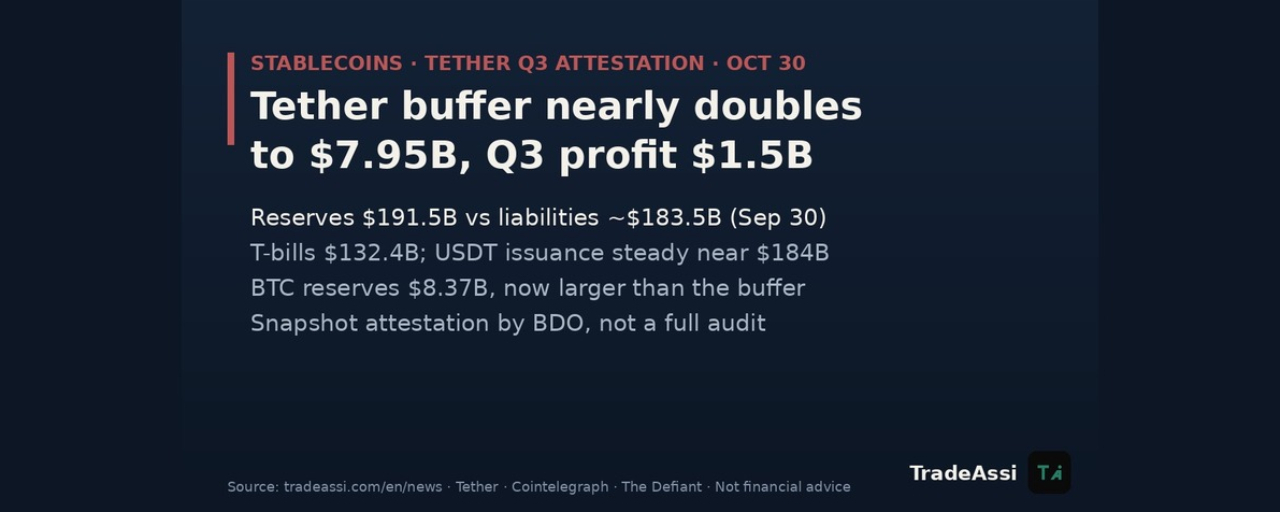
Tether Q3: $1.5B profit, reserve buffer nearly doubles to $7.95B, and BTC now tops the bufferTether Q3: $1.5B profit, reserve buffer nearly doubles to $7.95B, and BTC now tops the buffer
Tether published its Q3 2026 attestation today, prepared by BDO. In a week when traders are asking hard questions about where their money sits, the biggest stablecoin issuer just showed its balance sheet. Here is what is in it, and what is not.
The numbers (as of Sep 30, per Tether):
- Total reserve assets: $191.5B. Total liabilities: about $183.5B, almost all of it USDT in circulation.
- Excess reserves (the buffer): $7.95B, up from $4.1B at the end of Q2. An increase of about $3.8B in one quarter.
- Q3 net operating profit: $1.5B, in line with Q2. About $4.5B for the first nine months of 2026.
- Most of the income came from US Treasury bills and reverse repos.
- Direct and indirect T-bill holdings: $132.4B. Cointelegraph notes that is close to South Korea's $134.2B and above the UAE's $116.1B in US government debt.
- USDT issuance held broadly steady around $184B through the first three quarters.
The bitcoin part:
- Tether's BTC reserves were valued at $8.37B at Sep 30, up from about $5.8B at the end of June (Cointelegraph).
- That means the BTC pile is now bigger than the whole $7.95B buffer.
- My rough math, not Tether's: BTC closed Sep 30 at about $83,624 on Binance and trades near $76,632 now, about 8.4% lower. If the BTC holdings are unchanged, that is roughly $0.7B off their value, which would leave the buffer nearer $7.25B, all else equal. Still positive, but it shows how much the cushion now leans on BTC.
What the report does not tell you:
- An attestation is a snapshot of one day (Sep 30), not a check of activity through the quarter (The Defiant).
- Tether says KPMG US completed its first full financial statement audit in August, but those statements have not been made public.
Why it matters this week:
- Tether is one of the issuers that froze stablecoins tied to the Binance theft, and USDT is the main quote asset on most exchanges. A bigger buffer is the number that matters if redemptions spike.
- USDT is about 60% of a $297.3B stablecoin market (DefiLlama via Cointelegraph).
The tape (Binance spot, 19:41 UTC Oct 30, 24h):
- $BTC 76,632 (-5.3%), 24h low 76,326
- $ETH 2,232.67 (-4.5%), 24h low 2,174
Snapshot only, not proof of cause.
My take: the profit headline is the boring part. The real story is that the safety net nearly doubled while BTC became its biggest swing factor. Next attestation, watch whether the buffer grows faster than the BTC position.
Does a BTC-heavy buffer make you more or less comfortable holding USDT?
Source: https://tradeassi.com/en/news/e2bbbc51-9d89-4548-b015-97f0bb0cc02a
Not financial advice. DYOR.
Tether Q3: $1.5B profit, reserve buffer nearly doubles to $7.95B, and BTC now tops the buffer
Tether Q3: $1.5B profit, reserve buffer nearly doubles to $7.95B, and BTC now tops the buffer
Tether published its Q3 2026 attestation today, prepared by BDO. In a week when traders are asking hard questions about where their money sits, the biggest stablecoin issuer just showed its balance sheet. Here is what is in it, and what is not.
The numbers (as of Sep 30, per Tether):
- Total reserve assets: $191.5B. Total liabilities: about $183.5B, almost all of it USDT in circulation.
- Excess reserves (the buffer): $7.95B, up from $4.1B at the end of Q2. An increase of about $3.8B in one quarter.
- Q3 net operating profit: $1.5B, in line with Q2. About $4.5B for the first nine months of 2026.
- Most of the income came from US Treasury bills and reverse repos.
- Direct and indirect T-bill holdings: $132.4B. Cointelegraph notes that is close to South Korea's $134.2B and above the UAE's $116.1B in US government debt.
- USDT issuance held broadly steady around $184B through the first three quarters.
The bitcoin part:
- Tether's BTC reserves were valued at $8.37B at Sep 30, up from about $5.8B at the end of June (Cointelegraph).
- That means the BTC pile is now bigger than the whole $7.95B buffer.
- My rough math, not Tether's: BTC closed Sep 30 at about $83,624 on Binance and trades near $76,632 now, about 8.4% lower. If the BTC holdings are unchanged, that is roughly $0.7B off their value, which would leave the buffer nearer $7.25B, all else equal. Still positive, but it shows how much the cushion now leans on BTC.
What the report does not tell you:
- An attestation is a snapshot of one day (Sep 30), not a check of activity through the quarter (The Defiant).
- Tether says KPMG US completed its first full financial statement audit in August, but those statements have not been made public.
Why it matters this week:
- Tether is one of the issuers that froze stablecoins tied to the Binance theft, and USDT is the main quote asset on most exchanges. A bigger buffer is the number that matters if redemptions spike.
- USDT is about 60% of a $297.3B stablecoin market (DefiLlama via Cointelegraph).
The tape (Binance spot, 19:41 UTC Oct 30, 24h):
- $BTC 76,632 (-5.3%), 24h low 76,326
- $ETH 2,232.67 (-4.5%), 24h low 2,174
Snapshot only, not proof of cause.
My take: the profit headline is the boring part. The real story is that the safety net nearly doubled while BTC became its biggest swing factor. Next attestation, watch whether the buffer grows faster than the BTC position.
Does a BTC-heavy buffer make you more or less comfortable holding USDT?
Source: https://tradeassi.com/en/news/e2bbbc51-9d89-4548-b015-97f0bb0cc02a
Not financial advice. DYOR.
71
記事
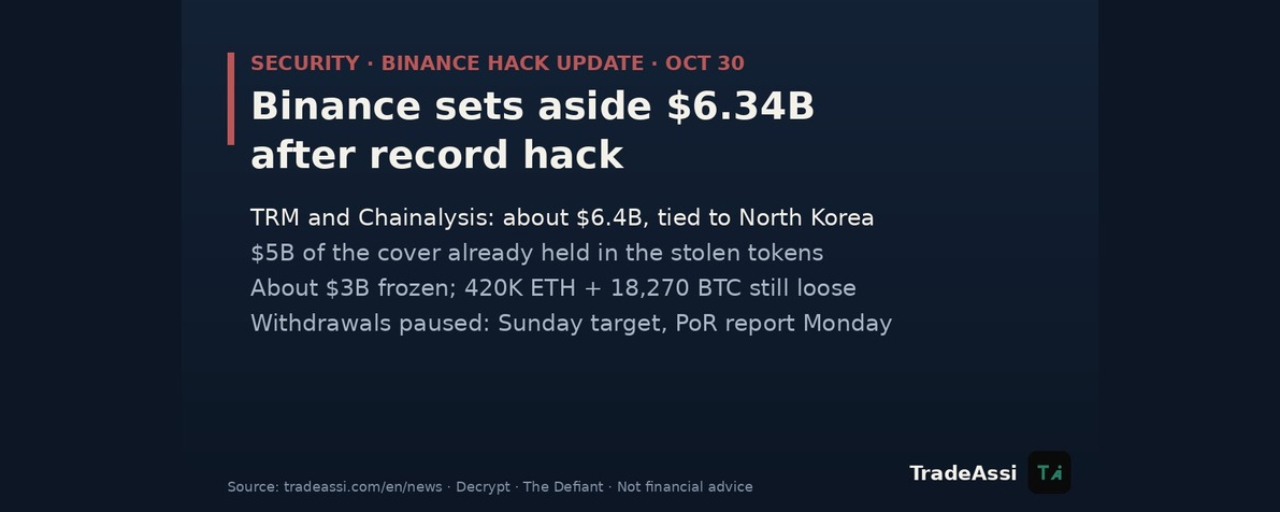
Binanceハッキング続報:63億4,000万ドルを確保、北朝鮮の関与を指摘、出金再開は日曜日の見込み昨日、Binanceのホットウォレットから資金が流出した疑いについてお伝えしました。被害額は25億〜58億ドルと推定されていましたが、確認は取れていませんでした。この24時間で状況がはっきりしてきました。ハッキングは確認され、被害額もより明確になり、Binanceは誰が負担するのかを明らかにし、捜査当局は容疑者の名前を挙げました。
被害額:
TRM Labsは、10のブロックチェーン上でBinanceのウォレットから持ち出された盗難額を約63億6,000万ドルと推定しています。その大半は、木曜日のUTC 20時05分から約20分間で移動されました。Chainalysisの推定額は約64億ドルです。
これにより、記録上最大の暗号資産盗難事件となり、2025年2月のBybitハッキング事件で盗まれた15億ドルの約4倍に相当します。
Binanceハッキング続報:63億4,000万ドルを確保、北朝鮮の関与を指摘、出金再開は日曜日の見込み
昨日、Binanceのホットウォレットから資金が流出した疑いについてお伝えしました。被害額は25億〜58億ドルと推定されていましたが、確認は取れていませんでした。この24時間で状況がはっきりしてきました。ハッキングは確認され、被害額もより明確になり、Binanceは誰が負担するのかを明らかにし、捜査当局は容疑者の名前を挙げました。
被害額:
TRM Labsは、10のブロックチェーン上でBinanceのウォレットから持ち出された盗難額を約63億6,000万ドルと推定しています。その大半は、木曜日のUTC 20時05分から約20分間で移動されました。Chainalysisの推定額は約64億ドルです。
これにより、記録上最大の暗号資産盗難事件となり、2025年2月のBybitハッキング事件で盗まれた15億ドルの約4倍に相当します。
被害額:
TRM Labsは、10のブロックチェーン上でBinanceのウォレットから持ち出された盗難額を約63億6,000万ドルと推定しています。その大半は、木曜日のUTC 20時05分から約20分間で移動されました。Chainalysisの推定額は約64億ドルです。
これにより、記録上最大の暗号資産盗難事件となり、2025年2月のBybitハッキング事件で盗まれた15億ドルの約4倍に相当します。
105
翻訳参照
Coinbase Q3: 719M profit, but 715M was crypto on its own books. Prediction markets are the story Coinbase printed a 719M USD profit for Q3. About 715M of that came from gains on crypto it holds on its own balance sheet. Strip that out and adjusted net income was 78M. So the headline is mostly a mark-to-market number. The business underneath is the useful part.
What Coinbase reported (Oct 29, after the US close)
Total revenue about 1.22B, flat vs Q2 and down 35% vs a year ago.Transaction revenue 590M, down 1% vs Q2 but above the roughly 527M analysts expected. Consumer spot volume was down 59% year over year per the 10-Q.Trading volume 134.5B, global market share 10.7%, the fourth straight quarterly gain.Prediction markets passed 200M in annualized revenue, only launched in February. Daily traders up 60%+ vs Q2.Subscription and services 570M, about 49% of net revenue, with 307M from stablecoins. Average USDC held in Coinbase products hit a record 22B.Same filing: CEO Brian Armstrong adopted a 10b5-1 plan to sell up to about 8.17M shares (roughly 1.31B) from Nov 16 through Oct 2027, above preset price thresholds. Ehrsam and Choi have plans too.
My take This is a quarter where retail spot trading dried up and Coinbase still held revenue flat. That came from predictions, derivatives and stablecoin revenue, not from people buying coins. It also tells you how quiet spot retail has been. The insider sale plans are pre-scheduled, so I would not read them as a call on price, but the size is worth knowing.
Tape check (Binance spot 24hr, pulled 02:11 UTC Oct 30, reference only)
BTC 76,985, down 3.8% on 24h, range 76,500 to 81,971ETH 2,203, down 4.5% on 24hUSDC/USDT 1.0016 The tape today is about other headlines, not this earnings report.
Question for you: if spot volume stays this low, do exchanges become prediction market and stablecoin businesses first, and trading venues second?
I track exchange headlines like this in the TradeAssi news feed, sorted by impact and sentiment.
Source: https://tradeassi.com/en/news/d303fbb0-fe31-4f3d-99ac-9cdc042a478f Also: https://tradeassi.com/en/news/dcbcc1d4-7686-4a2b-b5f5-4bd156fcf48a
Not financial advice. DYOR.
#Coinbase #Earnings #PredictionMarkets #USDC #CryptoNews
Coinbase Q3: 719M profit, but 715M was crypto on its own books. Prediction markets are the story
Coinbase printed a 719M USD profit for Q3. About 715M of that came from gains on crypto it holds on its own balance sheet. Strip that out and adjusted net income was 78M. So the headline is mostly a mark-to-market number. The business underneath is the useful part.
What Coinbase reported (Oct 29, after the US close)
Total revenue about 1.22B, flat vs Q2 and down 35% vs a year ago.Transaction revenue 590M, down 1% vs Q2 but above the roughly 527M analysts expected. Consumer spot volume was down 59% year over year per the 10-Q.Trading volume 134.5B, global market share 10.7%, the fourth straight quarterly gain.Prediction markets passed 200M in annualized revenue, only launched in February. Daily traders up 60%+ vs Q2.Subscription and services 570M, about 49% of net revenue, with 307M from stablecoins. Average USDC held in Coinbase products hit a record 22B.Same filing: CEO Brian Armstrong adopted a 10b5-1 plan to sell up to about 8.17M shares (roughly 1.31B) from Nov 16 through Oct 2027, above preset price thresholds. Ehrsam and Choi have plans too.
My take This is a quarter where retail spot trading dried up and Coinbase still held revenue flat. That came from predictions, derivatives and stablecoin revenue, not from people buying coins. It also tells you how quiet spot retail has been. The insider sale plans are pre-scheduled, so I would not read them as a call on price, but the size is worth knowing.
Tape check (Binance spot 24hr, pulled 02:11 UTC Oct 30, reference only)
BTC 76,985, down 3.8% on 24h, range 76,500 to 81,971ETH 2,203, down 4.5% on 24hUSDC/USDT 1.0016 The tape today is about other headlines, not this earnings report.
Question for you: if spot volume stays this low, do exchanges become prediction market and stablecoin businesses first, and trading venues second?
I track exchange headlines like this in the TradeAssi news feed, sorted by impact and sentiment.
Source: https://tradeassi.com/en/news/d303fbb0-fe31-4f3d-99ac-9cdc042a478f Also: https://tradeassi.com/en/news/dcbcc1d4-7686-4a2b-b5f5-4bd156fcf48a
Not financial advice. DYOR.
#Coinbase #Earnings #PredictionMarkets #USDC #CryptoNews
102
翻訳参照
Binance probes suspected hot-wallet drain of up to ~$5.5B; Tether and Circle freeze ~$1.8BBinance probes suspected hot-wallet drain of up to ~$5.5B; Tether and Circle freeze ~$1.8B
Huge outflows left Binance hot wallets this afternoon. Binance says it is investigating and has NOT confirmed any impact on user funds. If it is confirmed as a hack, it would be the largest crypto hack on record. Treat every number below as early and moving.
What happened (Thu Oct 29, UTC):
~20:21: an address funded through Tornado Cash installs an EIP-7702 delegation on a Binance-labeled hot wallet (EIP-7702 lets a normal wallet run delegated smart-contract code).20:24: about 3 minutes later, that wallet sends 167,464 ETH plus 63 token transfers, including about 1.615B USDT, to a brand-new address (Etherscan, via Decrypt).20:24-21:04: analysts flag large outflows of ETH, USDT and USDC from Binance hot wallets. Receiving addresses were new and pushed funds onward within minutes.21:04: Tether freezes about 975M USDT and Circle about 823M USDC in the main receiving address, roughly $1.8B in total. Tether later put its frozen total above 1.5B USDT.
The numbers (estimates differ):
Decrypt tally: about $5.57B across 3 chains, $3.51B on Ethereum, $1.44B in 18,270 BTC and $630M on Tron.The Block reports outflows of up to $5.8B. Crypto Briefing cites $2.5B to $3.5B.How the attacker got the required signature is still unknown.
What Binance and CZ said:
Binance on X: "we have not confirmed any impact to user funds" and updates will come through official channels.CZ said on X the outflows looked like a hack, that user funds were safe and losses would be covered in full (via Crypto Briefing). A promise, not yet a post-mortem.
Why traders care:
Liquidations were about $628M in an hour, mostly longs (Crypto Briefing, BeInCrypto).Stablecoin freezes worked fast. ETH and BTC have no such switch.The previous record was Bybit, about $1.5B in Feb 2025.
The tape (Binance spot, 22:42 UTC):
$BNB 704.36 (-7.0% 24h), range 680 to 761$BTC 79,136 (-2.7%), $ETH 2,279.4 (-3.5%) Snapshot only, not proof of cause.
My take: wait for Binance's own verified update before acting on screenshots. Watch three things: the root cause, whether frozen USDT/USDC is returned, and any confirmed user balance impact.
Are you moving funds right now, or waiting for the official report?
Source: https://tradeassi.com/en/news/d7538f96-e465-43ee-82f4-f274b25933d1
Not financial advice. DYOR.
Binance probes suspected hot-wallet drain of up to ~$5.5B; Tether and Circle freeze ~$1.8B
Binance probes suspected hot-wallet drain of up to ~$5.5B; Tether and Circle freeze ~$1.8B
Huge outflows left Binance hot wallets this afternoon. Binance says it is investigating and has NOT confirmed any impact on user funds. If it is confirmed as a hack, it would be the largest crypto hack on record. Treat every number below as early and moving.
What happened (Thu Oct 29, UTC):
~20:21: an address funded through Tornado Cash installs an EIP-7702 delegation on a Binance-labeled hot wallet (EIP-7702 lets a normal wallet run delegated smart-contract code).20:24: about 3 minutes later, that wallet sends 167,464 ETH plus 63 token transfers, including about 1.615B USDT, to a brand-new address (Etherscan, via Decrypt).20:24-21:04: analysts flag large outflows of ETH, USDT and USDC from Binance hot wallets. Receiving addresses were new and pushed funds onward within minutes.21:04: Tether freezes about 975M USDT and Circle about 823M USDC in the main receiving address, roughly $1.8B in total. Tether later put its frozen total above 1.5B USDT.
The numbers (estimates differ):
Decrypt tally: about $5.57B across 3 chains, $3.51B on Ethereum, $1.44B in 18,270 BTC and $630M on Tron.The Block reports outflows of up to $5.8B. Crypto Briefing cites $2.5B to $3.5B.How the attacker got the required signature is still unknown.
What Binance and CZ said:
Binance on X: "we have not confirmed any impact to user funds" and updates will come through official channels.CZ said on X the outflows looked like a hack, that user funds were safe and losses would be covered in full (via Crypto Briefing). A promise, not yet a post-mortem.
Why traders care:
Liquidations were about $628M in an hour, mostly longs (Crypto Briefing, BeInCrypto).Stablecoin freezes worked fast. ETH and BTC have no such switch.The previous record was Bybit, about $1.5B in Feb 2025.
The tape (Binance spot, 22:42 UTC):
$BNB 704.36 (-7.0% 24h), range 680 to 761$BTC 79,136 (-2.7%), $ETH 2,279.4 (-3.5%) Snapshot only, not proof of cause.
My take: wait for Binance's own verified update before acting on screenshots. Watch three things: the root cause, whether frozen USDT/USDC is returned, and any confirmed user balance impact.
Are you moving funds right now, or waiting for the official report?
Source: https://tradeassi.com/en/news/d7538f96-e465-43ee-82f4-f274b25933d1
Not financial advice. DYOR.
81
翻訳参照
Polymarket halts trading after a third-party breach drains about $2.65M from ~995 accountsPolymarket went into cancel-only mode today after users reported funds leaving their accounts without permission. Third security incident there this year.
What happened (Thu Oct 29, all times UTC):
~17:05: a fresh wallet starts receiving funds (investigator StarPlatinum). ~$2.0M by 17:50, ~$2.68M by 18:05.18:05: status page shows cancel-only mode, relayer paused.18:37: Polymarket says it "identified and fixed" the issue on Polymarket.com. One of its third-party providers was compromised, the case went to law enforcement, and "anyone who has been impacted will be made whole."18:55: trading to resume ~3pm ET. Marked resolved 19:05.
The numbers:
Analyst Conor Grogan counts 995 accounts drained for about $2,654,211. Largest single losses: about $341K and $307K.Per Arkham data cited by Decrypt, the suspected attacker wallet (0x3F99...fc18) holds about $2.65M in $POL, swapped from bridged USDC.e via Relay. StarPlatinum counts about 28.6M POL.
How it worked (early findings, not final):
Hudson Rock says a script loaded from DebugBear, a web performance monitoring service, looked for a logged-in trading session, tried to sell the user's positions and send the funds out. The attacker wallet was hard-coded in it.How the compromise started is not established yet. No full post-mortem.
Why traders care:
No smart-contract bug reported. This looks like a website supply-chain attack: the frontend is the weak point.Same pattern as June, when a compromised vendor let hackers inject code into the frontend and take about $3M from fewer than 15 accounts. In May, a private key leak drained about $700K from an internal wallet.
The tape (Binance spot, 19:39 UTC):
$POL 0.0921, flat in 24h, range 0.0895 to 0.0950$BTC 80,848 (-0.5%), $ETH 2,334.8 (-1.1%) Snapshot only, not proof of cause.
My take: "made whole" is the right promise, but three incidents in one year is the real story. Until a post-mortem lands, I would treat any session on a web frontend as a hot wallet.
Do you keep funds parked on prediction markets, or withdraw after every bet?
Source: https://tradeassi.com/en/news/1a331591-3ea4-45db-a2cb-c248f4d12939
Not financial advice. DYOR.
Polymarket halts trading after a third-party breach drains about $2.65M from ~995 accounts
Polymarket went into cancel-only mode today after users reported funds leaving their accounts without permission. Third security incident there this year.
What happened (Thu Oct 29, all times UTC):
~17:05: a fresh wallet starts receiving funds (investigator StarPlatinum). ~$2.0M by 17:50, ~$2.68M by 18:05.18:05: status page shows cancel-only mode, relayer paused.18:37: Polymarket says it "identified and fixed" the issue on Polymarket.com. One of its third-party providers was compromised, the case went to law enforcement, and "anyone who has been impacted will be made whole."18:55: trading to resume ~3pm ET. Marked resolved 19:05.
The numbers:
Analyst Conor Grogan counts 995 accounts drained for about $2,654,211. Largest single losses: about $341K and $307K.Per Arkham data cited by Decrypt, the suspected attacker wallet (0x3F99...fc18) holds about $2.65M in $POL, swapped from bridged USDC.e via Relay. StarPlatinum counts about 28.6M POL.
How it worked (early findings, not final):
Hudson Rock says a script loaded from DebugBear, a web performance monitoring service, looked for a logged-in trading session, tried to sell the user's positions and send the funds out. The attacker wallet was hard-coded in it.How the compromise started is not established yet. No full post-mortem.
Why traders care:
No smart-contract bug reported. This looks like a website supply-chain attack: the frontend is the weak point.Same pattern as June, when a compromised vendor let hackers inject code into the frontend and take about $3M from fewer than 15 accounts. In May, a private key leak drained about $700K from an internal wallet.
The tape (Binance spot, 19:39 UTC):
$POL 0.0921, flat in 24h, range 0.0895 to 0.0950$BTC 80,848 (-0.5%), $ETH 2,334.8 (-1.1%) Snapshot only, not proof of cause.
My take: "made whole" is the right promise, but three incidents in one year is the real story. Until a post-mortem lands, I would treat any session on a web frontend as a hot wallet.
Do you keep funds parked on prediction markets, or withdraw after every bet?
Source: https://tradeassi.com/en/news/1a331591-3ea4-45db-a2cb-c248f4d12939
Not financial advice. DYOR.
75
翻訳参照
Peer opened an Alipay lane for USDC on Base. Alipay shut the door in a day. Who blinks next?107 orders. About 7.1K dollars. 45 buyers since Aug 21. A tiny pipe, and Alipay still came out within a day to say "not us." That speed says more than the volume.
What happened
Peer, a P2P app, announced a beta where you buy USDC on Base by paying a seller in yuan through Alipay, or sell USDC and get paid in yuan on Alipay. Peer says the USDC sits locked onchain and releases once the payment verifies, so nobody sends first.Peer itself says there is no official partnership with Alipay.On Oct 28 Alipay posted, in Chinese and English, that it does not support crypto trading, that third-party claims of an Alipay crypto on-ramp are false and unauthorized, and told users to watch their accounts and funds.
My take This is not a "China opens up" story. It is a reminder of where P2P risk really sits. The smart contract escrow can be clean, but the fiat leg runs on a payment app that has long said it blocks crypto activity. If an account gets flagged, the contract cannot help you. Seller risk moves from "will they send" to "will my payment account survive."
Flip side: demand for stablecoin access is not going away. A 7K pipe is a test, not a market. Watch whether Peer drops the Alipay label or lets it grow.
Tape check (Binance spot, 02:10 UTC Oct 29, reference only)
BTC 80,037, down 1.1% on 24h, low 79,883ETH 2,310, down 1.9% on 24hUSDC/USDT 1.0010, flat No visible market reaction. This is a rails story, not a price catalyst.
Question for you: would you route a stablecoin buy through a payment app that has publicly said it does not want you there? Or is P2P with escrow good enough if the size stays small?
I track stories like this in the TradeAssi news feed, which sorts crypto headlines by impact and sentiment.
Source: https://tradeassi.com/en/news/d9db434e-6038-4bd9-a287-efacd3505940 Also: https://tradeassi.com/en/news/fc63416e-7eb7-44eb-8023-5681efe13711
Not financial advice. DYOR.
#Stablecoins #USDC #P2P #Alipay #CryptoNews
Peer opened an Alipay lane for USDC on Base. Alipay shut the door in a day. Who blinks next?
107 orders. About 7.1K dollars. 45 buyers since Aug 21. A tiny pipe, and Alipay still came out within a day to say "not us." That speed says more than the volume.
What happened
Peer, a P2P app, announced a beta where you buy USDC on Base by paying a seller in yuan through Alipay, or sell USDC and get paid in yuan on Alipay. Peer says the USDC sits locked onchain and releases once the payment verifies, so nobody sends first.Peer itself says there is no official partnership with Alipay.On Oct 28 Alipay posted, in Chinese and English, that it does not support crypto trading, that third-party claims of an Alipay crypto on-ramp are false and unauthorized, and told users to watch their accounts and funds.
My take This is not a "China opens up" story. It is a reminder of where P2P risk really sits. The smart contract escrow can be clean, but the fiat leg runs on a payment app that has long said it blocks crypto activity. If an account gets flagged, the contract cannot help you. Seller risk moves from "will they send" to "will my payment account survive."
Flip side: demand for stablecoin access is not going away. A 7K pipe is a test, not a market. Watch whether Peer drops the Alipay label or lets it grow.
Tape check (Binance spot, 02:10 UTC Oct 29, reference only)
BTC 80,037, down 1.1% on 24h, low 79,883ETH 2,310, down 1.9% on 24hUSDC/USDT 1.0010, flat No visible market reaction. This is a rails story, not a price catalyst.
Question for you: would you route a stablecoin buy through a payment app that has publicly said it does not want you there? Or is P2P with escrow good enough if the size stays small?
I track stories like this in the TradeAssi news feed, which sorts crypto headlines by impact and sentiment.
Source: https://tradeassi.com/en/news/d9db434e-6038-4bd9-a287-efacd3505940 Also: https://tradeassi.com/en/news/fc63416e-7eb7-44eb-8023-5681efe13711
Not financial advice. DYOR.
#Stablecoins #USDC #P2P #Alipay #CryptoNews
88
記事
翻訳参照
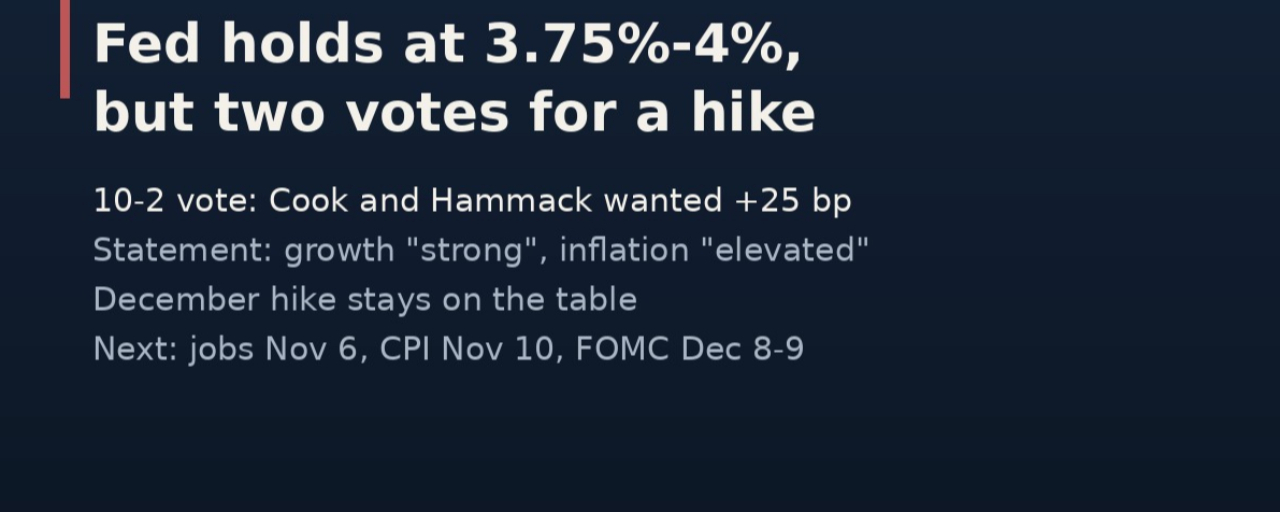
Fed holds at 3.75%-4% in a 10-2 vote, two officials wanted a hike: what crypto traders watch nextThe Fed just kept rates where they are. But the vote was not unanimous, and both dissenters wanted to go higher, not lower.
What happened (Fed statement, Wed Oct 28, 2 PM ET):
The FOMC held the federal funds target range at 3.75% to 4.00%.Vote: 10-2. Governor Lisa Cook and Cleveland Fed President Beth Hammack preferred a 25 bp hike.The statement says economic activity is "expanding at a strong pace", up from "solid" in September, and that inflation "remains elevated".Key line: "the accumulation of more information will help the Committee determine the policy stance appropriate".Context from the coverage: the Fed hiked 12-0 in September, its first hike since 2023. CME FedWatch had a hold at roughly 90% before the release, so the decision itself was no surprise.
Why it matters for crypto:
The surprise, if any, is the hawkish tilt. Two votes for a hike keep a December move on the table. Pre-decision pricing put December hike odds above 70%, per Decrypt.Higher policy rates keep Treasury yields high, and that competes with non-yielding assets like $BTC for capital.The data calendar now matters more than the meeting: October jobs on Nov 6, October CPI on Nov 10, then the Dec 8-9 meeting with new projections.
What the tape did (Binance spot, 5-minute bars, numbers only):
$BTC: 80,860 before the release, then an 18:00 UTC bar that swung from 80,722 to 81,186 and closed at 80,959.At 19:42 UTC: $BTC 81,319 (+0.7% 24h, range 80,397 to 81,823), $ETH 2,363 (+0.6%), $SOL 102.41 (+1.2%).
A quick two-way wick and then drift. That is a snapshot, not proof of cause.
Chair Kevin Warsh's press conference followed at 2:30 PM ET. This post sticks to the written statement.
My take: a hold that two officials voted against is not a dovish hold. For crypto, the next real test is Nov 6 and Nov 10, not today.
Are you positioned for a December hike, or betting the data cools first?
Source: https://tradeassi.com/en/news/027a3672-b6c6-474a-87d8-5c09b177777f
Not financial advice. DYOR.
Fed holds at 3.75%-4% in a 10-2 vote, two officials wanted a hike: what crypto traders watch next
The Fed just kept rates where they are. But the vote was not unanimous, and both dissenters wanted to go higher, not lower.
What happened (Fed statement, Wed Oct 28, 2 PM ET):
The FOMC held the federal funds target range at 3.75% to 4.00%.Vote: 10-2. Governor Lisa Cook and Cleveland Fed President Beth Hammack preferred a 25 bp hike.The statement says economic activity is "expanding at a strong pace", up from "solid" in September, and that inflation "remains elevated".Key line: "the accumulation of more information will help the Committee determine the policy stance appropriate".Context from the coverage: the Fed hiked 12-0 in September, its first hike since 2023. CME FedWatch had a hold at roughly 90% before the release, so the decision itself was no surprise.
Why it matters for crypto:
The surprise, if any, is the hawkish tilt. Two votes for a hike keep a December move on the table. Pre-decision pricing put December hike odds above 70%, per Decrypt.Higher policy rates keep Treasury yields high, and that competes with non-yielding assets like $BTC for capital.The data calendar now matters more than the meeting: October jobs on Nov 6, October CPI on Nov 10, then the Dec 8-9 meeting with new projections.
What the tape did (Binance spot, 5-minute bars, numbers only):
$BTC: 80,860 before the release, then an 18:00 UTC bar that swung from 80,722 to 81,186 and closed at 80,959.At 19:42 UTC: $BTC 81,319 (+0.7% 24h, range 80,397 to 81,823), $ETH 2,363 (+0.6%), $SOL 102.41 (+1.2%).
A quick two-way wick and then drift. That is a snapshot, not proof of cause.
Chair Kevin Warsh's press conference followed at 2:30 PM ET. This post sticks to the written statement.
My take: a hold that two officials voted against is not a dovish hold. For crypto, the next real test is Nov 6 and Nov 10, not today.
Are you positioned for a December hike, or betting the data cools first?
Source: https://tradeassi.com/en/news/027a3672-b6c6-474a-87d8-5c09b177777f
Not financial advice. DYOR.
88

記事
米財務省、北朝鮮のIT労働者による暗号資産資金移動をめぐり、個人10人とロシア拠点の隠れみの組織に制裁本日10月28日(水)、米財務省外国資産管理局(OFAC)は、北朝鮮による偽装IT労働者計画の運営または資金提供に関与したとして、個人10人と1団体に制裁を科し、暗号資産アドレス8件をSDNリストに追加しました。
何が起きたのか:
対象:ロシアを拠点とする仲介者と北朝鮮のIT労働者、およびロシア・ウラジオストクにある北朝鮮支配下の組織、第一金融技術開発センター(FFTDC)。
ロシア国籍のイリヤ・ボイコフは、北朝鮮のIT労働者派遣会社Alisのために、約350万ドル相当の暗号資産を交換・換金した疑いが持たれている。
米財務省、北朝鮮のIT労働者による暗号資産資金移動をめぐり、個人10人とロシア拠点の隠れみの組織に制裁
本日10月28日(水)、米財務省外国資産管理局(OFAC)は、北朝鮮による偽装IT労働者計画の運営または資金提供に関与したとして、個人10人と1団体に制裁を科し、暗号資産アドレス8件をSDNリストに追加しました。
何が起きたのか:
対象:ロシアを拠点とする仲介者と北朝鮮のIT労働者、およびロシア・ウラジオストクにある北朝鮮支配下の組織、第一金融技術開発センター(FFTDC)。
ロシア国籍のイリヤ・ボイコフは、北朝鮮のIT労働者派遣会社Alisのために、約350万ドル相当の暗号資産を交換・換金した疑いが持たれている。
何が起きたのか:
対象:ロシアを拠点とする仲介者と北朝鮮のIT労働者、およびロシア・ウラジオストクにある北朝鮮支配下の組織、第一金融技術開発センター(FFTDC)。
ロシア国籍のイリヤ・ボイコフは、北朝鮮のIT労働者派遣会社Alisのために、約350万ドル相当の暗号資産を交換・換金した疑いが持たれている。
169
ログインして、さらにコンテンツを読む
厳選トピックで世界の暗号資産トレーダーの仲間入り
⚡️ 暗号資産に関する最新かつ有益な情報が見つかります。
💬 世界最大の暗号資産取引所から信頼されています。
👍 認証を受けたクリエイターから、有益なインサイトを得られます。
メール / 電話番号