Binance Square
TYSON BNB
9.2k 投稿

TYSON BNB

厳選トピック確認済
💵 Learn and Earn 💵
取引を発注
超高頻度トレーダー
1.9年
488 フォロー
33.7K+ フォロワー
18.9K+ いいね
投稿
ポートフォリオ
PINNED
·
--
翻訳参照
Got curious about the Cosmos side of @babylonlabs_io today, since everyone only talks about the Bitcoin half of the story. Babylon Genesis is built as a Cosmos-SDK chain, hmm.. which means it fully supports IBC — the Inter-Blockchain Communication protocol. So the BTC security layer isn't sitting in isolation, it can actually talk to the wider Cosmos ecosystem natively. That's a quieter detail than the $5.6B TVL number, but maybe more important long-term. Bitcoin's security plus Cosmos's interoperability stack is a different pitch than just "we lock BTC." It means BSNs onboarding here aren't just borrowing security, they're plugging into a network of chains that can already move assets and messages between each other. Feels like the BTC headline number is the thing that gets attention, hmm.. but the IBC plumbing underneath is what actually determines how far this scales past the first few Bitcoin Supercharged Networks. Wondering if that interoperability angle ends up mattering more than the raw TVL once more BSNs are live and actually need to coordinate with each other. #baby $BABY {future}(BABYUSDT)
Got curious about the Cosmos side of @BabylonLabs_io today, since everyone only talks about the Bitcoin half of the story. Babylon Genesis is built as a Cosmos-SDK chain, hmm.. which means it fully supports IBC — the Inter-Blockchain Communication protocol. So the BTC security layer isn't sitting in isolation, it can actually talk to the wider Cosmos ecosystem natively.
That's a quieter detail than the $5.6B TVL number, but maybe more important long-term. Bitcoin's security plus Cosmos's interoperability stack is a different pitch than just "we lock BTC." It means BSNs onboarding here aren't just borrowing security, they're plugging into a network of chains that can already move assets and messages between each other.
Feels like the BTC headline number is the thing that gets attention, hmm.. but the IBC plumbing underneath is what actually determines how far this scales past the first few Bitcoin Supercharged Networks.
Wondering if that interoperability angle ends up mattering more than the raw TVL once more BSNs are live and actually need to coordinate with each other.
#baby $BABY
翻訳参照
One thing that stands out to me is that central banks still aren't slowing down on gold. In Q2 alone, they added 289 tonnes, the strongest quarterly buying since late 2024, with Poland leading the purchases. That's interesting because central banks usually don't chase short-term price moves. Their decisions are often about long-term reserve management. this signals that gold continues to be viewed as a strategic asset, even in an environment where markets are focused on AI, equities, and crypto. If institutions responsible for managing national reserves are consistently increasing their gold holdings, it's worth paying attention to the message behind that allocation. I'm not saying this is bearish for risk assets. But it does suggest that some of the biggest players in the world are still prioritizing stability and diversification alongside growth. Sometimes, watching where central banks quietly allocate capital tells you more than watching daily market headlines. $XAU $XAUT {future}(XAUUSDT) #GOLD #centralbank #WTICrudeOpensDown8% #BerkshireSharesHit8MonthHigh #TrumpCancelsIranStrikePendingDeal
One thing that stands out to me is that central banks still aren't slowing down on gold.
In Q2 alone, they added 289 tonnes, the strongest quarterly buying since late 2024, with Poland leading the purchases. That's interesting because central banks usually don't chase short-term price moves. Their decisions are often about long-term reserve management.
this signals that gold continues to be viewed as a strategic asset, even in an environment where markets are focused on AI, equities, and crypto. If institutions responsible for managing national reserves are consistently increasing their gold holdings, it's worth paying attention to the message behind that allocation.
I'm not saying this is bearish for risk assets. But it does suggest that some of the biggest players in the world are still prioritizing stability and diversification alongside growth.
Sometimes, watching where central banks quietly allocate capital tells you more than watching daily market headlines.
$XAU $XAUT
#GOLD #centralbank #WTICrudeOpensDown8% #BerkshireSharesHit8MonthHigh #TrumpCancelsIranStrikePendingDeal
翻訳参照
Was stacking @babylonlabs_io up against other "Bitcoin productivity" plays today, mostly out of curiosity about who else is even trying this. Alphagain's numbers put Babylon at roughly 10x the TVL of the next closest Bitcoin staking protocol. hmm.. Not a close race, more like a category leader that showed up early and just kept compounding its lead. That gap is the interesting part. In most crypto verticals, a 10x lead gets challenged fast — forks show up, incentives get copied, liquidity fragments across five competitors within a year. Bitcoin staking hasn't seen that yet, at least not at this scale. Could mean the moat is real — native BTC staking without wrapping is genuinely hard to replicate cleanly, the technical bar is higher than people assume. hmm.. Or it could just mean nobody's tried hard enough yet, and the category's still too early for real competition to have formed. Either way, first-mover advantage this size doesn't happen often in this space. Watching to see if it holds once bigger players decide BTCfi is worth actually competing for. #baby $BABY {future}(BABYUSDT)
Was stacking @BabylonLabs_io up against other "Bitcoin productivity" plays today, mostly out of curiosity about who else is even trying this. Alphagain's numbers put Babylon at roughly 10x the TVL of the next closest Bitcoin staking protocol. hmm.. Not a close race, more like a category leader that showed up early and just kept compounding its lead.
That gap is the interesting part. In most crypto verticals, a 10x lead gets challenged fast — forks show up, incentives get copied, liquidity fragments across five competitors within a year. Bitcoin staking hasn't seen that yet, at least not at this scale.
Could mean the moat is real — native BTC staking without wrapping is genuinely hard to replicate cleanly, the technical bar is higher than people assume. hmm.. Or it could just mean nobody's tried hard enough yet, and the category's still too early for real competition to have formed.
Either way, first-mover advantage this size doesn't happen often in this space. Watching to see if it holds once bigger players decide BTCfi is worth actually competing for.
#baby $BABY
·
--
ブリッシュ
翻訳参照
The total crypto market added more than $130 billion over the last 30 days, yet the market cap is still moving within a relatively tight range instead of breaking into a sustained trend. That tells me fresh capital is entering the market, but it's being distributed rather than chasing every asset higher. that's a healthier setup than a straight vertical rally. When new money rotates between sectors instead of creating a broad speculative spike, it usually means investors are being selective rather than simply buying everything. The next few weeks will be important. If another wave of capital enters and pushes total market cap above recent highs, this past month's inflow could look like the beginning of a larger expansion phase. If not, it may simply be a rotation inside an established range. Either way, $130B in one month is a reminder that liquidity is still finding its way into crypto. The question now is whether that liquidity keeps building or starts fading. $BTC $ETH $BNB {future}(BNBUSDT) {future}(ETHUSDT) {future}(BTCUSDT) #CryptoMarketMoves #BitcoinMiningDifficultyFalls14%FromYearHigh #ColdcardFlawDrains594BTC #HedgeFundsAddBullishOilBets #XRPLedgerProposesLettingBanksCoverUserFees
The total crypto market added more than $130 billion over the last 30 days, yet the market cap is still moving within a relatively tight range instead of breaking into a sustained trend. That tells me fresh capital is entering the market, but it's being distributed rather than chasing every asset higher.
that's a healthier setup than a straight vertical rally. When new money rotates between sectors instead of creating a broad speculative spike, it usually means investors are being selective rather than simply buying everything.
The next few weeks will be important. If another wave of capital enters and pushes total market cap above recent highs, this past month's inflow could look like the beginning of a larger expansion phase. If not, it may simply be a rotation inside an established range.
Either way, $130B in one month is a reminder that liquidity is still finding its way into crypto. The question now is whether that liquidity keeps building or starts fading.
$BTC $ETH $BNB
#CryptoMarketMoves #BitcoinMiningDifficultyFalls14%FromYearHigh #ColdcardFlawDrains594BTC #HedgeFundsAddBullishOilBets #XRPLedgerProposesLettingBanksCoverUserFees
翻訳参照
The most interesting part of Solana's latest compute limit upgrade isn't that the cap increased from 60M to 100M compute units—it's how quickly the network started using the extra room. Within days, roughly 10–23% of blocks were already exceeding the old 60M CU limit. That tells me the previous ceiling wasn't theoretical; it was actively constraining a meaningful share of network activity. What also stands out is that the median block size barely changed. Most transactions didn't suddenly become larger. Instead, the upgrade mainly benefited the busiest periods, allowing blocks that would have previously hit the limit to continue processing more compute-heavy workloads. that's a sign of targeted scaling rather than artificial demand. The network didn't become permanently heavier—it simply removed a bottleneck that was affecting peak usage. The real test now isn't whether Solana can support 100M CUs. It's whether developers and applications continue filling that additional capacity over time, or whether the current spike was only temporary. That's the metric I'll be watching. $SOL {future}(SOLUSDT) #solana #USAndJapanJointlyInterveneToBuyYen #KospiSurgesAsMuchAs17%RecordGain #SouthKoreanStocksReboundAfterSelloff #USQ2GDPGrows1.5%
The most interesting part of Solana's latest compute limit upgrade isn't that the cap increased from 60M to 100M compute units—it's how quickly the network started using the extra room.
Within days, roughly 10–23% of blocks were already exceeding the old 60M CU limit. That tells me the previous ceiling wasn't theoretical; it was actively constraining a meaningful share of network activity.
What also stands out is that the median block size barely changed. Most transactions didn't suddenly become larger. Instead, the upgrade mainly benefited the busiest periods, allowing blocks that would have previously hit the limit to continue processing more compute-heavy workloads.
that's a sign of targeted scaling rather than artificial demand. The network didn't become permanently heavier—it simply removed a bottleneck that was affecting peak usage.
The real test now isn't whether Solana can support 100M CUs. It's whether developers and applications continue filling that additional capacity over time, or whether the current spike was only temporary. That's the metric I'll be watching.
$SOL
#solana #USAndJapanJointlyInterveneToBuyYen #KospiSurgesAsMuchAs17%RecordGain #SouthKoreanStocksReboundAfterSelloff #USQ2GDPGrows1.5%
翻訳参照
Spent the morning trying to actually understand how @babylonlabs_io 's slashing works instead of just skimming the summary line everyone repeats. If a finality provider misbehaves, the protocol can submit a slashing transaction that captures the delegated BTC. Same logic as any PoS slashing, just applied to Bitcoin sitting in a time-locked script instead of a wrapped token. That's the part that makes the "no bridge, no custodian" pitch actually hold up under pressure. Security isn't just "trust us, BTC is locked" — there's an enforcement mechanism if a validator acts badly, and it hits real BTC, not some IOU on another chain. hmm.. But it also means the same BTC carries real slashing risk the moment you delegate it to a provider. Choosing who you delegate to isn't a cosmetic decision, it's the actual risk surface. A bad or careless finality provider can cost you the locked Bitcoin itself. Most people probably see "56,800 BTC locked, $5.6B secured" and stop there. Fewer are actually looking at validator track records before delegating. Wonder how much slashing risk is silently sitting on autopilot right now. #baby $BABY {future}(BABYUSDT)
Spent the morning trying to actually understand how @BabylonLabs_io 's slashing works instead of just skimming the summary line everyone repeats. If a finality provider misbehaves, the protocol can submit a slashing transaction that captures the delegated BTC. Same logic as any PoS slashing, just applied to Bitcoin sitting in a time-locked script instead of a wrapped token.
That's the part that makes the "no bridge, no custodian" pitch actually hold up under pressure. Security isn't just "trust us, BTC is locked" — there's an enforcement mechanism if a validator acts badly, and it hits real BTC, not some IOU on another chain.
hmm.. But it also means the same BTC carries real slashing risk the moment you delegate it to a provider. Choosing who you delegate to isn't a cosmetic decision, it's the actual risk surface. A bad or careless finality provider can cost you the locked Bitcoin itself.
Most people probably see "56,800 BTC locked, $5.6B secured" and stop there. Fewer are actually looking at validator track records before delegating. Wonder how much slashing risk is silently sitting on autopilot right now.
#baby $BABY
翻訳参照
The part that stands out to me isn't just how much Bitcoin Strategy has bought—it's how one-sided its capital allocation has become. According to the latest figures, the company has purchased 48 times more Bitcoin than it has sold year-to-date. At the same time, it has issued roughly 300 times more STRC than it has repurchased. That tells me the strategy is still focused on bringing in fresh capital rather than reducing outstanding securities. It's a simple but important signal. Strategy isn't behaving like a company that's slowing down its Bitcoin accumulation. Instead, it's continuing to fund purchases by expanding its financing base. Whether that's the right approach will depend on Bitcoin's long-term performance. If BTC continues to appreciate, the strategy looks disciplined. If markets weaken for an extended period, investors will pay much closer attention to how sustainable that financing model really is. the message from the numbers is clear: Strategy is still prioritizing accumulation over deleveraging. $BTC $STRC {future}(STRCUSDT) {future}(BTCUSDT) #strategy #BTC #strc #KospiUp15.13%InMorningTrade #KospiHitsIntradayRecordUp17%
The part that stands out to me isn't just how much Bitcoin Strategy has bought—it's how one-sided its capital allocation has become.
According to the latest figures, the company has purchased 48 times more Bitcoin than it has sold year-to-date. At the same time, it has issued roughly 300 times more STRC than it has repurchased. That tells me the strategy is still focused on bringing in fresh capital rather than reducing outstanding securities.
It's a simple but important signal. Strategy isn't behaving like a company that's slowing down its Bitcoin accumulation. Instead, it's continuing to fund purchases by expanding its financing base.
Whether that's the right approach will depend on Bitcoin's long-term performance. If BTC continues to appreciate, the strategy looks disciplined. If markets weaken for an extended period, investors will pay much closer attention to how sustainable that financing model really is.
the message from the numbers is clear: Strategy is still prioritizing accumulation over deleveraging.
$BTC $STRC
#strategy #BTC #strc #KospiUp15.13%InMorningTrade #KospiHitsIntradayRecordUp17%
翻訳参照
The statistic that caught my attention isn't that Bitcoin is down 49%—it's that this is still the mildest bear market by drawdown compared to previous cycles. Every major Bitcoin bear market has eventually forced investors through deep capitulation. This cycle has been different. The decline has been painful, but nowhere near the 70–80% drawdowns that defined earlier cycles. that changes how this market should be viewed. A shallower bear market suggests the structure of Bitcoin ownership may be evolving. Institutional participation, ETFs, and a larger long-term holder base appear to be absorbing selling pressure that would have triggered much steeper declines in previous cycles. That doesn't mean the bottom is already in. A milder drawdown doesn't guarantee a shorter bear market, and history rarely repeats perfectly. But if Bitcoin eventually recovers from a 49% decline instead of the massive crashes seen in prior cycles, this bear market could be remembered less for its severity and more for how different its structure was. $BTC {future}(BTCUSDT) #BTC #BEARISH📉 #SouthKoreanStocksReboundAfterSelloff #SouthKoreanStocksReboundAfterSelloff #NasdaqRebounds2.8%EndingSixDaySlide
The statistic that caught my attention isn't that Bitcoin is down 49%—it's that this is still the mildest bear market by drawdown compared to previous cycles.
Every major Bitcoin bear market has eventually forced investors through deep capitulation. This cycle has been different. The decline has been painful, but nowhere near the 70–80% drawdowns that defined earlier cycles.
that changes how this market should be viewed. A shallower bear market suggests the structure of Bitcoin ownership may be evolving. Institutional participation, ETFs, and a larger long-term holder base appear to be absorbing selling pressure that would have triggered much steeper declines in previous cycles.
That doesn't mean the bottom is already in. A milder drawdown doesn't guarantee a shorter bear market, and history rarely repeats perfectly.
But if Bitcoin eventually recovers from a 49% decline instead of the massive crashes seen in prior cycles, this bear market could be remembered less for its severity and more for how different its structure was.
$BTC
#BTC #BEARISH📉 #SouthKoreanStocksReboundAfterSelloff #SouthKoreanStocksReboundAfterSelloff #NasdaqRebounds2.8%EndingSixDaySlide
翻訳参照
The number that stands out to me isn't DeFi lending growth—it's how concentrated that growth has become. Aave now controls 47.8% of all active onchain loans, meaning nearly half of the lending market depends on a single protocol. That's an incredible achievement, but it also changes how I think about DeFi risk. When one platform becomes this dominant, its upgrades, governance decisions, and risk parameters start influencing the entire lending ecosystem, not just its own users. Innovation is great, but concentration creates a different kind of dependency. the next stage for DeFi isn't just growing total loan volume. It's seeing whether competitors can build enough trust and liquidity to reduce reliance on a single protocol. A healthy market is usually one where users have multiple strong options, not just one clear leader. Aave has clearly earned its position. The question now is whether the rest of the lending sector can catch up, or if DeFi lending becomes increasingly synonymous with Aave itself. $AAVE $MORPHO $SPK {future}(SPKUSDT) {future}(MORPHOUSDT) {future}(AAVEUSDT)
The number that stands out to me isn't DeFi lending growth—it's how concentrated that growth has become.
Aave now controls 47.8% of all active onchain loans, meaning nearly half of the lending market depends on a single protocol. That's an incredible achievement, but it also changes how I think about DeFi risk.
When one platform becomes this dominant, its upgrades, governance decisions, and risk parameters start influencing the entire lending ecosystem, not just its own users. Innovation is great, but concentration creates a different kind of dependency.
the next stage for DeFi isn't just growing total loan volume. It's seeing whether competitors can build enough trust and liquidity to reduce reliance on a single protocol. A healthy market is usually one where users have multiple strong options, not just one clear leader.
Aave has clearly earned its position. The question now is whether the rest of the lending sector can catch up, or if DeFi lending becomes increasingly synonymous with Aave itself.
$AAVE $MORPHO $SPK
🎙️ 维护生态平衡,建设币安广场。
cover
終了
05 時間 16 分 45 秒
10.8k
38
76
確認済み
翻訳参照
Looked up who's actually behind @babylonlabs_io today, curious after seeing the TVL numbers so often without knowing the backstory. Founder's a Stanford professor, David Tse, alongside co-founder Fisher Yu. Not the usual anonymous-team crypto origin story — actual academic credentials, published research background, the kind of thing that's rare to see attached to a project this size. Funding side checks out too.. — around $96 million raised across rounds, backers including Paradigm, Polychain, Bullish. That's serious money from funds that don't throw checks at every BTCfi idea that shows up. Doesn't automatically mean the token thesis works out, funding and credentials don't guarantee product-market fit. But it does explain why this got real attention early instead of getting dismissed as another wrapped-BTC clone. hmm.. The pedigree bought it a longer runway to prove the mechanism actually works at scale. Wondering how much of the current TVL is genuinely sticky belief in the model versus just capital that followed the names on the cap table in first. #baby $BABY {future}(BABYUSDT)
Looked up who's actually behind @BabylonLabs_io today, curious after seeing the TVL numbers so often without knowing the backstory. Founder's a Stanford professor, David Tse, alongside co-founder Fisher Yu. Not the usual anonymous-team crypto origin story — actual academic credentials, published research background, the kind of thing that's rare to see attached to a project this size. Funding side checks out too.. — around $96 million raised across rounds, backers including Paradigm, Polychain, Bullish. That's serious money from funds that don't throw checks at every BTCfi idea that shows up. Doesn't automatically mean the token thesis works out, funding and credentials don't guarantee product-market fit. But it does explain why this got real attention early instead of getting dismissed as another wrapped-BTC clone. hmm.. The pedigree bought it a longer runway to prove the mechanism actually works at scale.
Wondering how much of the current TVL is genuinely sticky belief in the model versus just capital that followed the names on the cap table in first.
#baby $BABY
·
--
ブリッシュ
翻訳参照
More than $1.1 trillion was added to the U.S. stock market in a single trading session, but the number that stands out to me is Microsoft's contribution. Microsoft alone gained around $450 billion in market value in one day, setting a new record and overtaking Nvidia's previous mark. That says a lot about how concentrated today's market has become. A handful of mega-cap companies can now move the entire index more than dozens of smaller companies combined. I don't see this as automatically bullish or bearish. It's simply a reminder that index performance and broad market performance aren't always the same thing. When a few giants are responsible for such a large share of the gains, it's worth asking whether the rally is broad-based or being carried by a small group of leaders. that's the more interesting takeaway than the record itself. New highs grab attention, but market concentration often tells a deeper story about where investors are placing their confidence. $MSFT $NVDA $INTC {future}(INTCUSDT) {future}(NVDAUSDT) {future}(MSFTUSDT) #USStockMarket #BullishMomentum #NasdaqRebounds2.8%EndingSixDaySlide #USStocksOpenHigherStorageSharesRebound #USGDPGrows1.5%InQ2
More than $1.1 trillion was added to the U.S. stock market in a single trading session, but the number that stands out to me is Microsoft's contribution.
Microsoft alone gained around $450 billion in market value in one day, setting a new record and overtaking Nvidia's previous mark. That says a lot about how concentrated today's market has become. A handful of mega-cap companies can now move the entire index more than dozens of smaller companies combined.
I don't see this as automatically bullish or bearish. It's simply a reminder that index performance and broad market performance aren't always the same thing. When a few giants are responsible for such a large share of the gains, it's worth asking whether the rally is broad-based or being carried by a small group of leaders.
that's the more interesting takeaway than the record itself. New highs grab attention, but market concentration often tells a deeper story about where investors are placing their confidence.
$MSFT $NVDA $INTC
#USStockMarket #BullishMomentum #NasdaqRebounds2.8%EndingSixDaySlide #USStocksOpenHigherStorageSharesRebound #USGDPGrows1.5%InQ2
翻訳参照
Historically, Bitcoin bear markets have lasted around 383 days on average. The current cycle has been running for roughly 296 days, which naturally leads many people to ask whether there's still more downside ahead. I don't think it's enough to compare calendars. Every Bitcoin cycle has been shaped by different macro conditions, liquidity, regulation, and institutional participation. The number of days alone has never been the reason a bear market ends. That said, history does remind us that bear markets often last longer than most investors expect. If this cycle eventually follows the historical average, it would suggest that patience may still matter more than trying to predict the exact bottom. this chart is less about calling the next move and more about managing expectations. Time has been one of the biggest factors in every previous recovery. Whether this cycle breaks the pattern or not, I'll be watching price action and liquidity—not just the calendar. $BTC {future}(BTCUSDT) #BTC #FOMCWatching #USCourtRejectsCFTCWisconsinInjunctionBid #WTIAndBrentOilRiseOver6% #MetaFalls10%OnEarningsMiss
Historically, Bitcoin bear markets have lasted around 383 days on average. The current cycle has been running for roughly 296 days, which naturally leads many people to ask whether there's still more downside ahead.
I don't think it's enough to compare calendars. Every Bitcoin cycle has been shaped by different macro conditions, liquidity, regulation, and institutional participation. The number of days alone has never been the reason a bear market ends.
That said, history does remind us that bear markets often last longer than most investors expect. If this cycle eventually follows the historical average, it would suggest that patience may still matter more than trying to predict the exact bottom.
this chart is less about calling the next move and more about managing expectations. Time has been one of the biggest factors in every previous recovery. Whether this cycle breaks the pattern or not, I'll be watching price action and liquidity—not just the calendar.
$BTC
#BTC #FOMCWatching #USCourtRejectsCFTCWisconsinInjunctionBid #WTIAndBrentOilRiseOver6% #MetaFalls10%OnEarningsMiss
翻訳参照
$BEAT is getting the most attention this week with an $81.66M token unlock, while SUI follows with a $15.93M unlock. What I always look at isn't the dollar value alone—it's how large the unlock is relative to the project's market cap and circulating supply. A large unlock doesn't automatically mean the price will fall, but it does increase the amount of tokens that can potentially enter the market. SUI's unlock is relatively small compared to its market cap, so the market may absorb it without much disruption if demand stays strong. BEAT is a different story. With a much larger unlock relative to its size, traders will likely watch for any increase in selling pressure. token unlocks aren't automatic sell signals. They're events that can shift supply dynamics. The projects that maintain strong demand usually absorb new supply much better than those relying purely on hype. BEAT and SUI are definitely the unlocks I'll be watching most closely. $BEAT $SUI {future}(SUIUSDT) {future}(BEATUSDT) #beat #sui #tokenunlocks #IraqCrudeExportsFallSharply #KoreanStocksFallSecondDayOnSKHynixResults
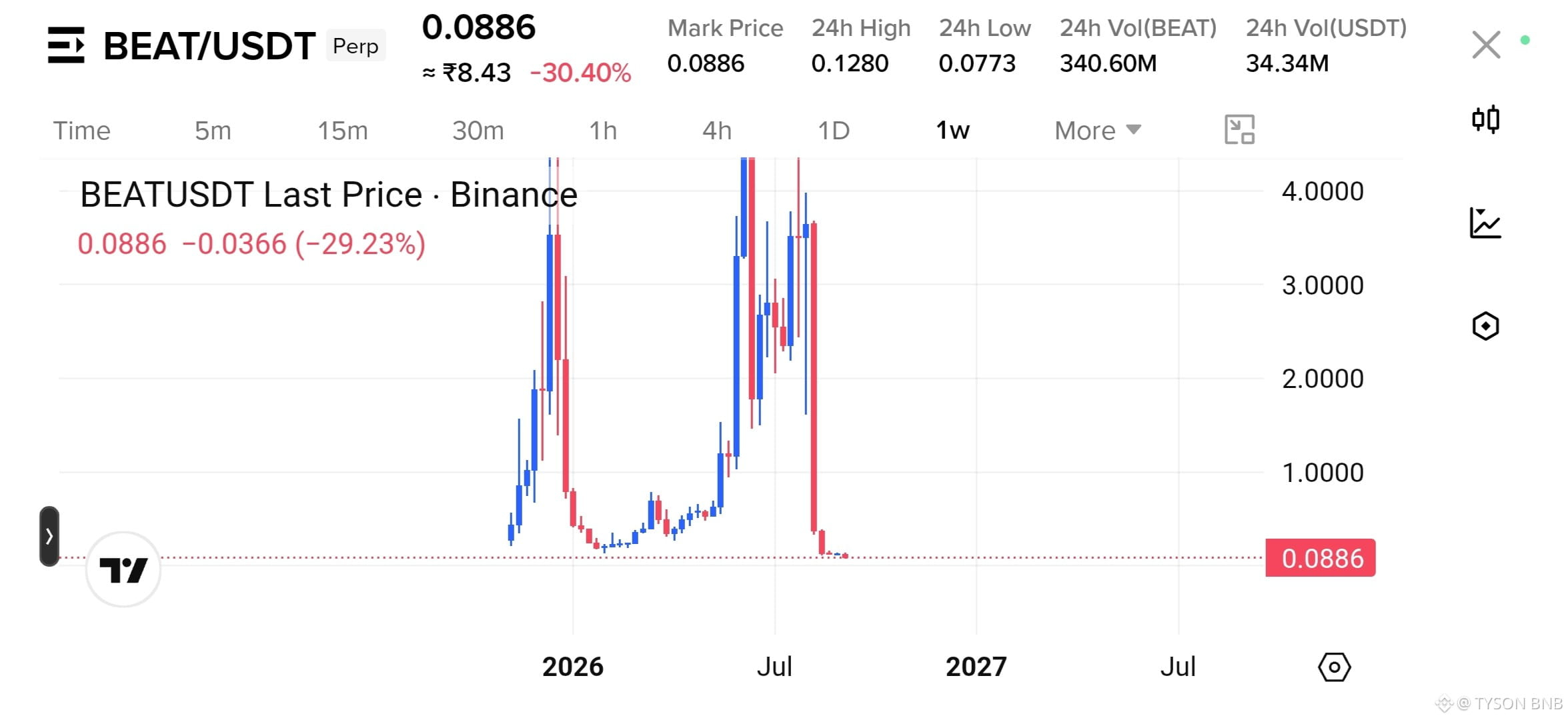
$BEAT is getting the most attention this week with an $81.66M token unlock, while SUI follows with a $15.93M unlock.
What I always look at isn't the dollar value alone—it's how large the unlock is relative to the project's market cap and circulating supply. A large unlock doesn't automatically mean the price will fall, but it does increase the amount of tokens that can potentially enter the market.
SUI's unlock is relatively small compared to its market cap, so the market may absorb it without much disruption if demand stays strong. BEAT is a different story. With a much larger unlock relative to its size, traders will likely watch for any increase in selling pressure.
token unlocks aren't automatic sell signals. They're events that can shift supply dynamics. The projects that maintain strong demand usually absorb new supply much better than those relying purely on hype.
BEAT and SUI are definitely the unlocks I'll be watching most closely.
$BEAT $SUI

#beat #sui #tokenunlocks #IraqCrudeExportsFallSharply #KoreanStocksFallSecondDayOnSKHynixResults
翻訳参照
Watching the @babylonlabs_io block explorer, I noticed block times hover around 6 seconds—typical Cosmos finality. But Bitcoin checkpoints happen roughly every 10–20 minutes, depending on block confirmations. hmm.. That means Babylon's "Bitcoin-secured" finality is actually asynchronous: the chain finalizes transactions locally, then later anchors a batch to Bitcoin via checkpoint transactions. During that gap—potentially dozens of Babylon blocks—the state is fully reversible if the validator set colludes or experiences a reorg. The Bitcoin covenant only secures the checkpointed state, not the intermediate blocks. In practice, this creates a finality ladder: quick local-finality for UX, but true Bitcoin-level finality lags by minutes. The docs frame this as a trade-off, not a flaw. But it introduces an attack surface: a validator coalition could finalize a dishonest state, extract value, and then unbond before the checkpoint commits, leaving Bitcoin to finalize a different canonical history. The slashing mechanism relies on catching misbehavior before the unbonding period, but that period is measured in days—so if the attack occurs within the window, the checkpoint might already be on Bitcoin, making reversal costly. This is similar to Ethereum's checkpointing but with Bitcoin's slower finality, making the latency gap wider. The marketing emphasizes "finality from Bitcoin" but omits that it's eventual, not instantaneous. If a coordinated validator group executes a short-range reorg on Babylon, can Bitcoin's security actually reverse it, or does the checkpoint finality make it permanent despite the fraud? #baby $BABY {future}(BABYUSDT)
Watching the @BabylonLabs_io block explorer, I noticed block times hover around 6 seconds—typical Cosmos finality. But Bitcoin checkpoints happen roughly every 10–20 minutes, depending on block confirmations. hmm.. That means Babylon's "Bitcoin-secured" finality is actually asynchronous: the chain finalizes transactions locally, then later anchors a batch to Bitcoin via checkpoint transactions.
During that gap—potentially dozens of Babylon blocks—the state is fully reversible if the validator set colludes or experiences a reorg. The Bitcoin covenant only secures the checkpointed state, not the intermediate blocks. In practice, this creates a finality ladder: quick local-finality for UX, but true Bitcoin-level finality lags by minutes.
The docs frame this as a trade-off, not a flaw. But it introduces an attack surface: a validator coalition could finalize a dishonest state, extract value, and then unbond before the checkpoint commits, leaving Bitcoin to finalize a different canonical history. The slashing mechanism relies on catching misbehavior before the unbonding period, but that period is measured in days—so if the attack occurs within the window, the checkpoint might already be on Bitcoin, making reversal costly.
This is similar to Ethereum's checkpointing but with Bitcoin's slower finality, making the latency gap wider. The marketing emphasizes "finality from Bitcoin" but omits that it's eventual, not instantaneous.
If a coordinated validator group executes a short-range reorg on Babylon, can Bitcoin's security actually reverse it, or does the checkpoint finality make it permanent despite the fraud?
#baby $BABY
翻訳参照
Nvidia's rising 5-year CDS is an interesting signal because it shows that the market is starting to price in more risk as the company pursues its reported $750 billion AI infrastructure strategy. I don't see this as investors suddenly losing confidence in Nvidia. To me, it's the opposite. The market recognizes the scale of the opportunity, but it's also acknowledging that financing an AI buildout of this size comes with bigger execution and balance-sheet risks. That's an important distinction. A company can have outstanding growth prospects while simultaneously becoming riskier from a credit perspective. The AI race is no longer just about building the best chips. It's becoming a capital-intensive competition where companies are committing enormous amounts of money to secure long-term leadership. Nvidia's higher CDS isn't a bearish signal on AI. It's a reminder that the bigger the ambition, the greater the financial risk investors will demand compensation for. As AI spending accelerates, credit markets may become just as important to watch as earnings reports. $NVDAB $NVDA {future}(NVDAUSDT) {spot}(NVDABUSDT) #NVIDIA #cds #SKHynixQ2RevenueMissesEstimates #GrubMarketFilesConfidentiallyForUSIPO #USTreasuryYieldsRetreat
Nvidia's rising 5-year CDS is an interesting signal because it shows that the market is starting to price in more risk as the company pursues its reported $750 billion AI infrastructure strategy.
I don't see this as investors suddenly losing confidence in Nvidia. To me, it's the opposite. The market recognizes the scale of the opportunity, but it's also acknowledging that financing an AI buildout of this size comes with bigger execution and balance-sheet risks.
That's an important distinction. A company can have outstanding growth prospects while simultaneously becoming riskier from a credit perspective.
The AI race is no longer just about building the best chips. It's becoming a capital-intensive competition where companies are committing enormous amounts of money to secure long-term leadership.
Nvidia's higher CDS isn't a bearish signal on AI. It's a reminder that the bigger the ambition, the greater the financial risk investors will demand compensation for. As AI spending accelerates, credit markets may become just as important to watch as earnings reports.
$NVDAB $NVDA
#NVIDIA #cds #SKHynixQ2RevenueMissesEstimates #GrubMarketFilesConfidentiallyForUSIPO #USTreasuryYieldsRetreat
翻訳参照
Across Protocol's exploiter returning 331.8 ETH, worth roughly $624K, is a positive sign, but I don't think it's the main story. The protocol lost around $3.6 million, so this repayment covers only a fraction of the total funds. Partial returns are always better than nothing, but they don't erase the damage caused by the exploit. What I'll be watching now is whether the remaining funds are recovered and how the team strengthens security going forward. In crypto, users don't judge a protocol only by whether it gets hacked—they judge it by how it responds afterward. Incidents like this are a reminder that bridge and cross-chain infrastructure still carry meaningful risks, even as the technology matures. Returning funds is a step in the right direction. Restoring confidence, however, will take much more than one transaction. $ACX $ETH {future}(ETHUSDT) {future}(ACXUSDT) #AcrossProtocol #Ethereum #GrubMarketFilesConfidentiallyForUSIPO #KospiCrashes11%OnChinaDUVChipThreat #VisaToCut2600JobsExpandStablecoins
Across Protocol's exploiter returning 331.8 ETH, worth roughly $624K, is a positive sign, but I don't think it's the main story.
The protocol lost around $3.6 million, so this repayment covers only a fraction of the total funds. Partial returns are always better than nothing, but they don't erase the damage caused by the exploit.
What I'll be watching now is whether the remaining funds are recovered and how the team strengthens security going forward. In crypto, users don't judge a protocol only by whether it gets hacked—they judge it by how it responds afterward.
Incidents like this are a reminder that bridge and cross-chain infrastructure still carry meaningful risks, even as the technology matures.
Returning funds is a step in the right direction. Restoring confidence, however, will take much more than one transaction.
$ACX $ETH
#AcrossProtocol #Ethereum #GrubMarketFilesConfidentiallyForUSIPO #KospiCrashes11%OnChinaDUVChipThreat #VisaToCut2600JobsExpandStablecoins
翻訳参照
RWA quietly became the strongest narrative in crypto this July, posting a median return of around 10%, ahead of every other major sector. What stands out to me isn't just the performance. It's the consistency. While other narratives bounced between winners and losers, RWA projects continued attracting capital. That suggests investors are looking beyond hype and paying more attention to sectors showing real adoption. I don't think this means every RWA token is a buy. Strong narrative performance often attracts speculation, and that can push weaker projects higher than they deserve. But the broader trend is hard to ignore. Tokenization has gone from being a future idea to an active market that institutions and crypto-native users are both exploring. July reinforced one thing: narratives still matter in crypto, but the ones connected to real use cases tend to have more staying power. This month, that leadership clearly belonged to RWA. $ONDO $PLUME $OM {future}(PLUMEUSDT) {future}(ONDOUSDT) #RWA #GAINERS #DowRisesOver500Points #USTreasuryYieldsRetreat #SKHynixQ2RevenueMissesEstimates
RWA quietly became the strongest narrative in crypto this July, posting a median return of around 10%, ahead of every other major sector.
What stands out to me isn't just the performance. It's the consistency. While other narratives bounced between winners and losers, RWA projects continued attracting capital. That suggests investors are looking beyond hype and paying more attention to sectors showing real adoption.
I don't think this means every RWA token is a buy. Strong narrative performance often attracts speculation, and that can push weaker projects higher than they deserve.
But the broader trend is hard to ignore. Tokenization has gone from being a future idea to an active market that institutions and crypto-native users are both exploring.
July reinforced one thing: narratives still matter in crypto, but the ones connected to real use cases tend to have more staying power. This month, that leadership clearly belonged to RWA.
$ONDO $PLUME $OM
#RWA #GAINERS #DowRisesOver500Points #USTreasuryYieldsRetreat #SKHynixQ2RevenueMissesEstimates
翻訳参照
Checked the $BABY chart again this morning, coffee going cold, familiar routine by now. Token bottomed around $0.0107 back in March, sitting comfortably above $0.02 now — roughly doubled off the low. The move lined up with two things hitting around the same time: TVL milestones getting hit, and news of an Aave integration. That's the part that actually interests me more than the price itself. An Aave integration means BABY-related activity potentially plugging into one of the biggest lending markets in DeFi — a real usage bridge, not just a listing announcement. hmm.. Price reacting to that instead of just random momentum feels like a healthier kind of pump. Still, doubling off a March low doesn't mean much on its own. Plenty of tokens bounce hard off a bottom and go nowhere after. The real test is whether that Aave connection turns into actual sustained flow, or if it was a one-time news spike that traders already priced in and moved on from. Watching to see if the next leg is driven by more integrations like this, or if it just chops sideways now that the news is old. @babylonlabs_io #baby
Checked the $BABY chart again this morning, coffee going cold, familiar routine by now. Token bottomed around $0.0107 back in March, sitting comfortably above $0.02 now — roughly doubled off the low. The move lined up with two things hitting around the same time: TVL milestones getting hit, and news of an Aave integration.
That's the part that actually interests me more than the price itself. An Aave integration means BABY-related activity potentially plugging into one of the biggest lending markets in DeFi — a real usage bridge, not just a listing announcement. hmm.. Price reacting to that instead of just random momentum feels like a healthier kind of pump.
Still, doubling off a March low doesn't mean much on its own. Plenty of tokens bounce hard off a bottom and go nowhere after. The real test is whether that Aave connection turns into actual sustained flow, or if it was a one-time news spike that traders already priced in and moved on from.
Watching to see if the next leg is driven by more integrations like this, or if it just chops sideways now that the news is old.
@BabylonLabs_io #baby
翻訳参照
$COTI Right now, I'm seeing the first signs of hesitation. If this rejection continues, I think a healthy pullback is more likely before the next trend develops. Trade Plan 🔴 Entry: 0.0136 – 0.0138 🛑 Stop Loss: 0.0145 🎯 TP1: 0.0128 🎯 TP2: 0.0120 I'll only take this trade if sellers continue defending the current resistance. If price breaks above 0.0145 with strong momentum, I'll invalidate the setup and stay out. I don't short because price is high—I short when momentum starts fading. short trade 👉 $COTI {future}(COTIUSDT)
$COTI Right now, I'm seeing the first signs of hesitation. If this rejection continues, I think a healthy pullback is more likely before the next trend develops.

Trade Plan

🔴 Entry: 0.0136 – 0.0138
🛑 Stop Loss: 0.0145
🎯 TP1: 0.0128
🎯 TP2: 0.0120

I'll only take this trade if sellers continue defending the current resistance. If price breaks above 0.0145 with strong momentum, I'll invalidate the setup and stay out.

I don't short because price is high—I short when momentum starts fading.

short trade 👉 $COTI
ログインして、さらにコンテンツを読む
厳選トピックで世界の暗号資産トレーダーの仲間入り
⚡️ 暗号資産に関する最新かつ有益な情報が見つかります。
💬 世界最大の暗号資産取引所から信頼されています。
👍 認証を受けたクリエイターから、有益なインサイトを得られます。
メール / 電話番号
サイトマップ
Cookieの設定
プラットフォーム利用規約