

beer_ford
5.9k 投稿

beer_ford
報告
ユーザーをブロック
Trading Master
取引を発注

SHIBホルダー
高頻度トレーダー
3.6年
352 フォロー
18.4K+ フォロワー
11.6K+ いいね
投稿
ポートフォリオ
すべて
引用
ライブ
PINNED
·
--
一部該当
翻訳参照
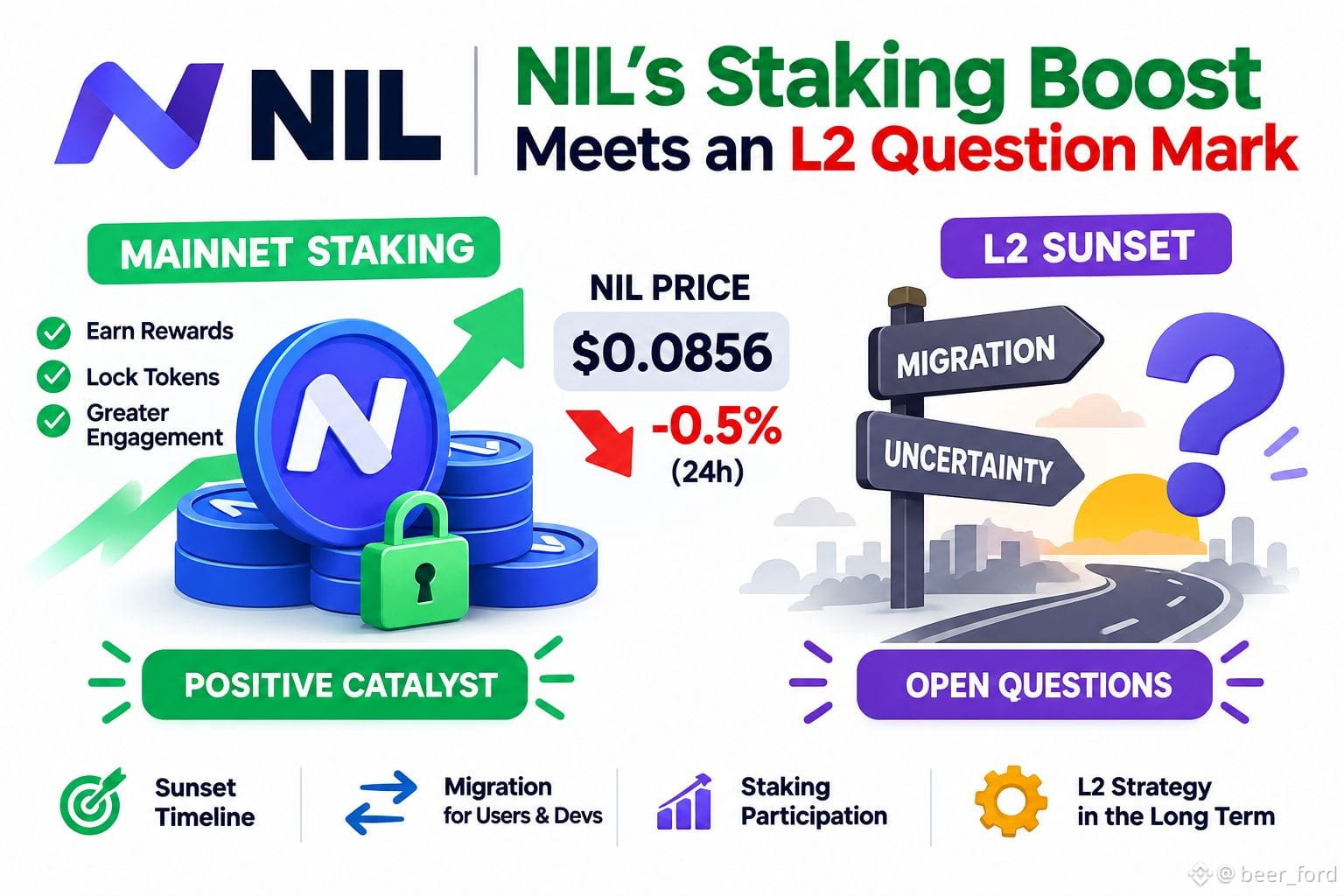
**Headline:** NIL's Staking Boost Meets an L2 Question Mark
NIL's mainnet staking gave holders something to be encouraged about, but the Layer-2 sunset appears to have taken that goodwill back. Per the figures supplied, the token slipped 0.5% over 24 hours to $0.0856. That's a small move, not a breakdown.
What stands out is the pattern. Staking is a tangible, near-term positive: it gives holders a reason to lock tokens and engage. An L2 transition, by contrast, raises open questions, and markets often price uncertainty more heavily than incremental good news. That's interpretation, though, not proof of cause. A single day's move can't tell us why people sold.
For anyone digging deeper, a few things are worth checking in NIL's official documentation and announcements:
• The exact sunset timeline
• How migration is handled for users and developers
• Whether staking participation is growing
• How the team positions L2 within its longer-term ecosystem strategy
A sunset isn't automatically a negative. It could signal consolidation around the mainnet. Clear communication and smooth migration could help rebuild confidence, while vague timelines could keep sentiment cautious…
I haven't verified live market data or official sources here, so treat the numbers above as user-supplied….
When a project pairs a positive catalyst with a structural change, which do you weigh more heavily: the incentive or the uncertainty?
#NIL #crypto #staking #Layer2
#nil $NIL @nillionnetwork
**Headline:** NIL's Staking Boost Meets an L2 Question Mark
NIL's mainnet staking gave holders something to be encouraged about, but the Layer-2 sunset appears to have taken that goodwill back. Per the figures supplied, the token slipped 0.5% over 24 hours to $0.0856. That's a small move, not a breakdown.
What stands out is the pattern. Staking is a tangible, near-term positive: it gives holders a reason to lock tokens and engage. An L2 transition, by contrast, raises open questions, and markets often price uncertainty more heavily than incremental good news. That's interpretation, though, not proof of cause. A single day's move can't tell us why people sold.
For anyone digging deeper, a few things are worth checking in NIL's official documentation and announcements:
• The exact sunset timeline
• How migration is handled for users and developers
• Whether staking participation is growing
• How the team positions L2 within its longer-term ecosystem strategy
A sunset isn't automatically a negative. It could signal consolidation around the mainnet. Clear communication and smooth migration could help rebuild confidence, while vague timelines could keep sentiment cautious…
I haven't verified live market data or official sources here, so treat the numbers above as user-supplied….
When a project pairs a positive catalyst with a structural change, which do you weigh more heavily: the incentive or the uncertainty?
#NIL #crypto #staking #Layer2
#nil $NIL @Nillion
8
15
781
·
--
翻訳参照
$SKL
{future}(SKLUSDT)
SKALE offers Ethereum-compatible chains with zero gas fees for end users, since developers cover costs through the token model. That's attractive for games and high-frequency apps. The open question is whether enough applications choose it to generate steady demand for the network's token.
$SKL
SKALE offers Ethereum-compatible chains with zero gas fees for end users, since developers cover costs through the token model. That's attractive for games and high-frequency apps. The open question is whether enough applications choose it to generate steady demand for the network's token.
SKALE offers Ethereum-compatible chains with zero gas fees for end users, since developers cover costs through the token model. That's attractive for games and high-frequency apps. The open question is whether enough applications choose it to generate steady demand for the network's token.
87
·
--
翻訳参照
$AUDIO
{spot}(AUDIOUSDT)
Audius tries to give independent musicians a decentralized alternative to streaming platforms. Music is a sector where crypto has a clear story but modest mainstream traction. Listener growth and artist retention matter more than token mechanics, and rights issues add complexity.
$AUDIO
Audius tries to give independent musicians a decentralized alternative to streaming platforms. Music is a sector where crypto has a clear story but modest mainstream traction. Listener growth and artist retention matter more than token mechanics, and rights issues add complexity.
Audius tries to give independent musicians a decentralized alternative to streaming platforms. Music is a sector where crypto has a clear story but modest mainstream traction. Listener growth and artist retention matter more than token mechanics, and rights issues add complexity.
51
·
--
翻訳参照
$LINEA
{future}(LINEAUSDT)
Layer-2 networks increasingly compete on distribution, and Linea benefits from its ties to the Consensys ecosystem, including wallet access. That helps with onboarding. Still, user retention after airdrop-style campaigns is the cleaner measure of strength. Fee economics and token supply schedule deserve a close read too.
$LINEA
Layer-2 networks increasingly compete on distribution, and Linea benefits from its ties to the Consensys ecosystem, including wallet access. That helps with onboarding. Still, user retention after airdrop-style campaigns is the cleaner measure of strength. Fee economics and token supply schedule deserve a close read too.
Layer-2 networks increasingly compete on distribution, and Linea benefits from its ties to the Consensys ecosystem, including wallet access. That helps with onboarding. Still, user retention after airdrop-style campaigns is the cleaner measure of strength. Fee economics and token supply schedule deserve a close read too.
204
·
--
翻訳参照
$LRC
Loopring was an early bet on zero-knowledge rollups for Ethereum, long before the idea became mainstream. Being early doesn't guarantee staying relevant. Larger Layer-2 networks have since pulled most developer attention, so renewed product traction would need to show up in actual usage.
$LRC
Loopring was an early bet on zero-knowledge rollups for Ethereum, long before the idea became mainstream. Being early doesn't guarantee staying relevant. Larger Layer-2 networks have since pulled most developer attention, so renewed product traction would need to show up in actual usage.
Loopring was an early bet on zero-knowledge rollups for Ethereum, long before the idea became mainstream. Being early doesn't guarantee staying relevant. Larger Layer-2 networks have since pulled most developer attention, so renewed product traction would need to show up in actual usage.
9
·
--
翻訳参照
$BICO
{future}(BICOUSDT)
Gas fees and wallet friction scare off newcomers. Biconomy builds account abstraction and transaction tooling that lets apps hide those details. It's infrastructure, so success is quiet: developer adoption. Competition from other wallet and infrastructure providers is strong, and token demand is the part to verify.
$BICO
Gas fees and wallet friction scare off newcomers. Biconomy builds account abstraction and transaction tooling that lets apps hide those details. It's infrastructure, so success is quiet: developer adoption. Competition from other wallet and infrastructure providers is strong, and token demand is the part to verify.
Gas fees and wallet friction scare off newcomers. Biconomy builds account abstraction and transaction tooling that lets apps hide those details. It's infrastructure, so success is quiet: developer adoption. Competition from other wallet and infrastructure providers is strong, and token demand is the part to verify.
372
·
--
翻訳参照
$SAND
{future}(SANDUSDT)
The Sandbox sells a user-generated virtual world, where creators build experiences and trade assets. Metaverse excitement has cooled, so fundamentals matter more now. Active creators, recurring events and genuine player numbers would clarify whether the platform sustains itself without constant promotional momentum.
$SAND
The Sandbox sells a user-generated virtual world, where creators build experiences and trade assets. Metaverse excitement has cooled, so fundamentals matter more now. Active creators, recurring events and genuine player numbers would clarify whether the platform sustains itself without constant promotional momentum.
The Sandbox sells a user-generated virtual world, where creators build experiences and trade assets. Metaverse excitement has cooled, so fundamentals matter more now. Active creators, recurring events and genuine player numbers would clarify whether the platform sustains itself without constant promotional momentum.
56
·
--
翻訳参照
$BICO
{future}(BICOUSDT)
Blockchain applications often lose users when wallets, gas fees, and network switching create friction. Biconomy focuses on infrastructure designed to simplify Web3 transactions and onboarding. Its growth depends on developers integrating these tools and users benefiting from a smoother experience. The strongest evidence is repeat usage, not simply the number of supported chains or integrations.
$BICO
Blockchain applications often lose users when wallets, gas fees, and network switching create friction. Biconomy focuses on infrastructure designed to simplify Web3 transactions and onboarding. Its growth depends on developers integrating these tools and users benefiting from a smoother experience. The strongest evidence is repeat usage, not simply the number of supported chains or integrations.
Blockchain applications often lose users when wallets, gas fees, and network switching create friction. Biconomy focuses on infrastructure designed to simplify Web3 transactions and onboarding. Its growth depends on developers integrating these tools and users benefiting from a smoother experience. The strongest evidence is repeat usage, not simply the number of supported chains or integrations.
202
·
--
翻訳参照
$ZEN
{future}(ZENUSDT)
Privacy infrastructure faces a demanding test: delivering meaningful protection while remaining accessible to users and developers. Horizen’s evolving technology and ecosystem need to demonstrate practical applications, robust security, and sustainable participation. The broader privacy narrative may attract interest, but measurable product adoption and clear technical trade-offs are what support long-term credibility.
$ZEN
Privacy infrastructure faces a demanding test: delivering meaningful protection while remaining accessible to users and developers. Horizen’s evolving technology and ecosystem need to demonstrate practical applications, robust security, and sustainable participation. The broader privacy narrative may attract interest, but measurable product adoption and clear technical trade-offs are what support long-term credibility.
Privacy infrastructure faces a demanding test: delivering meaningful protection while remaining accessible to users and developers. Horizen’s evolving technology and ecosystem need to demonstrate practical applications, robust security, and sustainable participation. The broader privacy narrative may attract interest, but measurable product adoption and clear technical trade-offs are what support long-term credibility.
190
·
--
翻訳参照
$DASH
{future}(DASHUSDT)
Payment-focused cryptocurrencies compete against established digital payment options, not just other tokens. Dash’s relevance depends on whether users find it practical for transfers, merchant payments, and everyday transactions. Adoption should be measured through usable payment access, transaction consistency, and merchant acceptance rather than assuming that faster settlement alone creates widespread demand.
$DASH
Payment-focused cryptocurrencies compete against established digital payment options, not just other tokens. Dash’s relevance depends on whether users find it practical for transfers, merchant payments, and everyday transactions. Adoption should be measured through usable payment access, transaction consistency, and merchant acceptance rather than assuming that faster settlement alone creates widespread demand.
Payment-focused cryptocurrencies compete against established digital payment options, not just other tokens. Dash’s relevance depends on whether users find it practical for transfers, merchant payments, and everyday transactions. Adoption should be measured through usable payment access, transaction consistency, and merchant acceptance rather than assuming that faster settlement alone creates widespread demand.
226
·
--
翻訳参照
$ONT
{future}(ONTUSDT)
Digital identity infrastructure becomes useful when people and organizations can verify information without unnecessary data exposure. Ontology focuses on identity and data solutions, but practical adoption depends on integrations, usability, and clear reasons for users to participate. Real deployments and repeat usage are stronger indicators than broad promises about decentralized identity.
$ONT
Digital identity infrastructure becomes useful when people and organizations can verify information without unnecessary data exposure. Ontology focuses on identity and data solutions, but practical adoption depends on integrations, usability, and clear reasons for users to participate. Real deployments and repeat usage are stronger indicators than broad promises about decentralized identity.
Digital identity infrastructure becomes useful when people and organizations can verify information without unnecessary data exposure. Ontology focuses on identity and data solutions, but practical adoption depends on integrations, usability, and clear reasons for users to participate. Real deployments and repeat usage are stronger indicators than broad promises about decentralized identity.
42
·
--
翻訳参照
$WAVES
A blockchain ecosystem cannot rely indefinitely on name recognition or past market momentum. Waves needs sustained developer activity, useful applications, and dependable network participation to strengthen its position. Tracking ecosystem usage alongside liquidity and governance developments helps separate operational progress from speculative price movements in a competitive Layer-1 landscape.
A blockchain ecosystem cannot rely indefinitely on name recognition or past market momentum. Waves needs sustained developer activity, useful applications, and dependable network participation to strengthen its position. Tracking ecosystem usage alongside liquidity and governance developments helps separate operational progress from speculative price movements in a competitive Layer-1 landscape.
10
·
--
翻訳参照
$MKR
Decentralized stablecoins depend on disciplined risk management, not just demand. Maker’s ecosystem has explored how collateral quality, governance decisions, and borrowing activity shape system resilience. For MKR, the key question is whether protocol revenue and risk controls remain sustainable through changing market conditions, especially during periods of sharp volatility.
Decentralized stablecoins depend on disciplined risk management, not just demand. Maker’s ecosystem has explored how collateral quality, governance decisions, and borrowing activity shape system resilience. For MKR, the key question is whether protocol revenue and risk controls remain sustainable through changing market conditions, especially during periods of sharp volatility.
42
·
--
翻訳参照
$THETA
Video delivery and distributed computing create a practical infrastructure challenge: serving users efficiently without unnecessary cost. Theta’s opportunity depends on real network demand, reliable delivery, and partnerships that translate into measurable usage. Technology adoption is stronger evidence of progress than announcements alone, particularly in a competitive media infrastructure market.
Video delivery and distributed computing create a practical infrastructure challenge: serving users efficiently without unnecessary cost. Theta’s opportunity depends on real network demand, reliable delivery, and partnerships that translate into measurable usage. Technology adoption is stronger evidence of progress than announcements alone, particularly in a competitive media infrastructure market.
67
·
--
翻訳参照
$ZRX
Decentralized exchange infrastructure competes on liquidity, execution quality, and integration simplicity. 0x provides trading infrastructure that applications can use to access token markets, but its relevance depends on developers continuing to choose it. Monitor integrations and actual trading activity rather than assuming growth in decentralized finance automatically benefits every infrastructure token.
Decentralized exchange infrastructure competes on liquidity, execution quality, and integration simplicity. 0x provides trading infrastructure that applications can use to access token markets, but its relevance depends on developers continuing to choose it. Monitor integrations and actual trading activity rather than assuming growth in decentralized finance automatically benefits every infrastructure token.
72
·
--
翻訳参照
$LRC
Scaling Ethereum is not only about reducing transaction fees; users also need simple transfers and dependable applications. Loopring’s Layer-2 approach has aimed to improve transaction efficiency, but adoption depends on its ability to deliver a compelling experience. Active users, application demand, and ecosystem competitiveness are more revealing than technical claims alone.
Scaling Ethereum is not only about reducing transaction fees; users also need simple transfers and dependable applications. Loopring’s Layer-2 approach has aimed to improve transaction efficiency, but adoption depends on its ability to deliver a compelling experience. Active users, application demand, and ecosystem competitiveness are more revealing than technical claims alone.
72
·
--
翻訳参照
$KAVA
Kava combines elements of decentralized finance and blockchain infrastructure, but ecosystem breadth alone does not guarantee durable demand. Track liquidity, active applications, network usage, and developer engagement together. The strongest signal would be users returning for useful services rather than participating only when incentives are unusually attractive.
Kava combines elements of decentralized finance and blockchain infrastructure, but ecosystem breadth alone does not guarantee durable demand. Track liquidity, active applications, network usage, and developer engagement together. The strongest signal would be users returning for useful services rather than participating only when incentives are unusually attractive.
107
·
--
翻訳参照
$ILV
Blockchain games face a difficult balance between entertainment and token economics. Illuvium’s long-term appeal depends on delivering a compelling game experience that keeps players engaged without relying solely on rewards. Product quality, active participation, and sustainable in-game demand are more informative than short-term excitement around gaming tokens.
Blockchain games face a difficult balance between entertainment and token economics. Illuvium’s long-term appeal depends on delivering a compelling game experience that keeps players engaged without relying solely on rewards. Product quality, active participation, and sustainable in-game demand are more informative than short-term excitement around gaming tokens.
2
269
·
--
翻訳参照
$OCEAN
Data markets need more than the promise of sharing information. Ocean Protocol’s vision depends on making datasets discoverable, usable, and accessible under clear permissions. Adoption will hinge on practical integrations and repeat demand from data users. A strong narrative around AI data does not replace evidence of a functioning marketplace.
Data markets need more than the promise of sharing information. Ocean Protocol’s vision depends on making datasets discoverable, usable, and accessible under clear permissions. Adoption will hinge on practical integrations and repeat demand from data users. A strong narrative around AI data does not replace evidence of a functioning marketplace.
1
19
·
--
翻訳参照
$RPL
Rocket Pool offers an alternative approach to Ethereum staking through a decentralized operator model. Its progress depends on operator participation, protocol security, and competitive staking economics. Investors should distinguish growth in staking activity from demand for RPL itself, since protocol usage does not guarantee matching token performance.
Rocket Pool offers an alternative approach to Ethereum staking through a decentralized operator model. Its progress depends on operator participation, protocol security, and competitive staking economics. Investors should distinguish growth in staking activity from demand for RPL itself, since protocol usage does not guarantee matching token performance.
57
ログインして、さらにコンテンツを読む
厳選トピックで世界の暗号資産トレーダーの仲間入り
⚡️ 暗号資産に関する最新かつ有益な情報が見つかります。
💬 世界最大の暗号資産取引所から信頼されています。
👍 認証を受けたクリエイターから、有益なインサイトを得られます。
メール / 電話番号
トレンドトピック
FedWatch
閲覧回数 16.3M
39,205人が討論中
🚨 警報が再び大きく鳴り響いています!
ご存じのとおり、FEDは昨夜、政策金利の決定を発表し、金利は据え置かれました。ここで、#FedWatch に続く他のデータに関する状況を見てみましょう。
年間インフレ率は3.6%に上昇し、月間インフレ率は0.5%まで上昇しました。コアPCE個人消費支出価格指数も、年間ベースで3.1%に達しました。
これらの数値は予想と一致しているものの、本当に懸念すべき点は、インフレが再び加速し始めていることです。FEDの2%目標は、まだかなり遠いように見えます。
私の見解では、これは当面の利下げを正当化することを難しくしています。高金利がより長期間続けば、$BTC やアルトコインに追加の売り圧力をもたらす可能性があります。
暗号資産は持ちこたえることができると思いますか?
Kripto Kurdu
·いいね:20件
·閲覧回数 3.8k
EarningsSeason
閲覧回数 6.4M
31,913人が討論中
USMidtermElections
閲覧回数 26,759
528人が討論中