Binance Square
CRYPTOVERSE Legal _ Global Crypto Lawyers
26 投稿
CRYPTOVERSE Legal _ Global Crypto Lawyers

UAE-based crypto regulatory lawyers helping exchanges, Web3 startups, and fintech platforms obtain licences and navigate global crypto regulations.
17 フォロー
29 フォロワー
41 いいね
投稿
PINNED
·
--
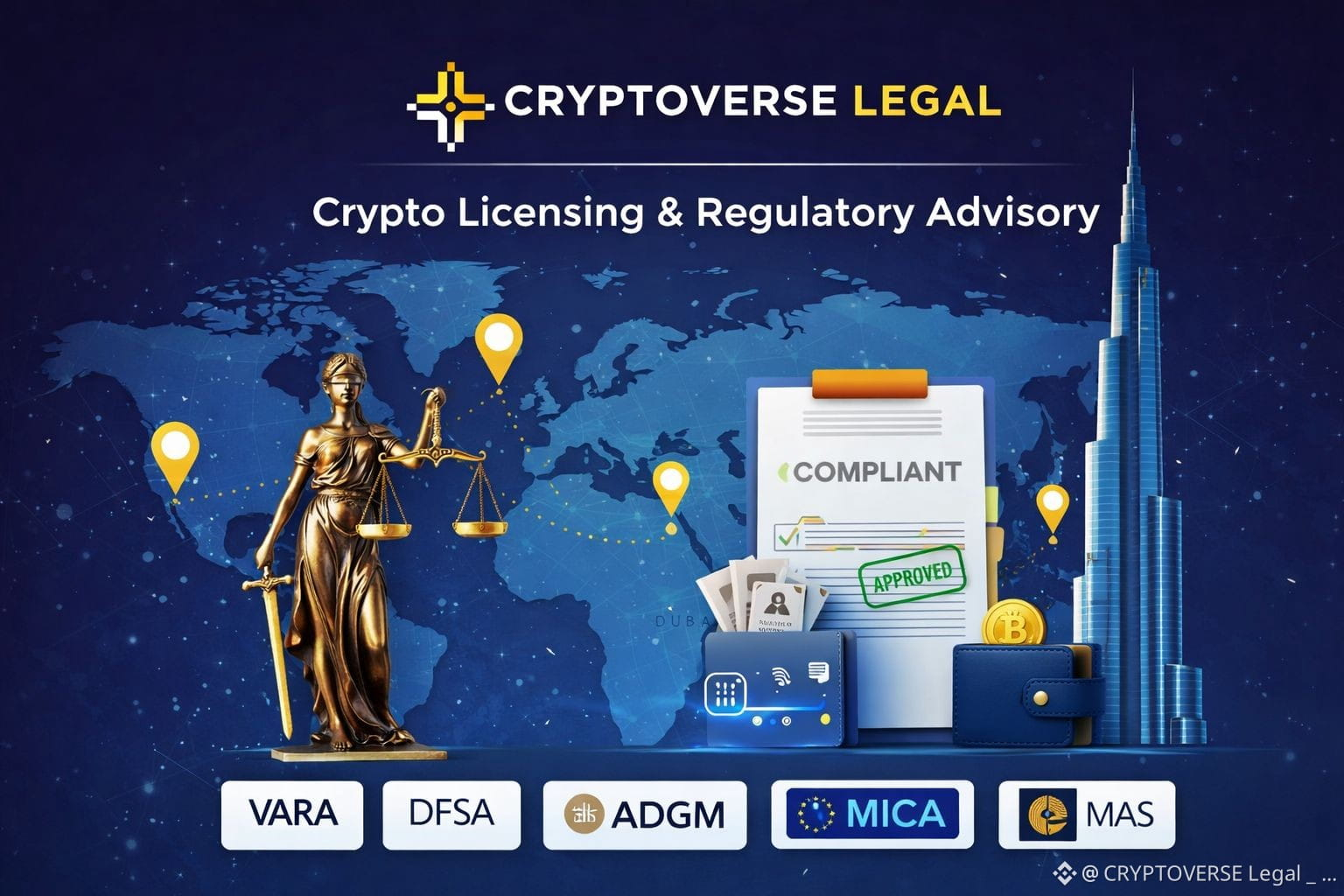
私たちについて – Cryptoverse Legal (暗号弁護士) 暗号産業は規制よりも速く進化しています。 Cryptoverse Legalでは、デジタル資産ビジネスが複雑なグローバル規制をナビゲートし、準拠した暗号運営を開始する手助けをしています。 私たちがアドバイスするのは: • 暗号取引所 • Web3スタートアップ • トークン発行者 • 投資プラットフォーム • 機関投資家 私たちの専門知識には、次の主要な管轄区域における暗号ライセンスおよび規制戦略が含まれます: • UAE (VARA, DFSA, ADGM, CMA & CBUAE) • シンガポール (MAS) • 香港 (SFC) • ヨーロッパ (MiCA) • ケイマン諸島 • セーシェル • モーリシャス • BVI、& その他多数。 私たちの使命はシンプルです: 複雑な暗号規制を明確な道筋に翻訳し、革新的なビジネスが合法的に立ち上げ、成長できるようにします。 暗号規制、ライセンス戦略、および進化するグローバル規制環境に関する洞察を得るために私たちをフォローしてください。 #CryptoRegulation #CryptoLicensing #VARA #DFSA #ADGM
私たちについて – Cryptoverse Legal (暗号弁護士)

暗号産業は規制よりも速く進化しています。

Cryptoverse Legalでは、デジタル資産ビジネスが複雑なグローバル規制をナビゲートし、準拠した暗号運営を開始する手助けをしています。

私たちがアドバイスするのは:

• 暗号取引所
• Web3スタートアップ
• トークン発行者
• 投資プラットフォーム
• 機関投資家

私たちの専門知識には、次の主要な管轄区域における暗号ライセンスおよび規制戦略が含まれます:

• UAE (VARA, DFSA, ADGM, CMA & CBUAE)
• シンガポール (MAS)
• 香港 (SFC)
• ヨーロッパ (MiCA)
• ケイマン諸島
• セーシェル
• モーリシャス
• BVI、& その他多数。

私たちの使命はシンプルです:

複雑な暗号規制を明確な道筋に翻訳し、革新的なビジネスが合法的に立ち上げ、成長できるようにします。

暗号規制、ライセンス戦略、および進化するグローバル規制環境に関する洞察を得るために私たちをフォローしてください。

#CryptoRegulation #CryptoLicensing #VARA #DFSA #ADGM
記事
アメリカはついに暗号規制を定義しようとしている — デジタル資産市場の明確化法案は実際に何を意味するのか何年もの間、グローバルな暗号業界が直面してきた最大の問題の一つは、技術ではありませんでした。 それは規制でした。 もっと具体的に言えば、シンプルな質問に関する明確さの欠如です: 暗号トークンはいつ証券となり、いつ単なるデジタル商品となるのか? アメリカでは、その質問が訴訟、取引所の上場廃止、強制措置、銀行制限、そしてデジタル資産業界全体にわたる数十億ドルの不確実性を引き起こしています。 今、アメリカ合衆国の上院がそれを変えようとしています。

アメリカはついに暗号規制を定義しようとしている — デジタル資産市場の明確化法案は実際に何を意味するのか

何年もの間、グローバルな暗号業界が直面してきた最大の問題の一つは、技術ではありませんでした。
それは規制でした。
もっと具体的に言えば、シンプルな質問に関する明確さの欠如です:
暗号トークンはいつ証券となり、いつ単なるデジタル商品となるのか?
アメリカでは、その質問が訴訟、取引所の上場廃止、強制措置、銀行制限、そしてデジタル資産業界全体にわたる数十億ドルの不確実性を引き起こしています。
今、アメリカ合衆国の上院がそれを変えようとしています。
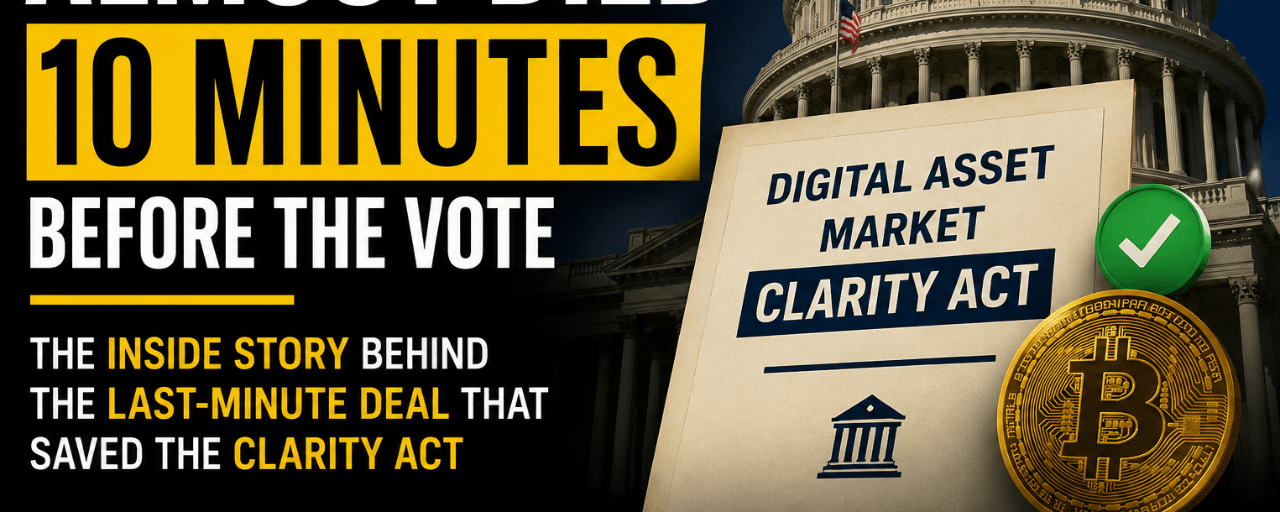
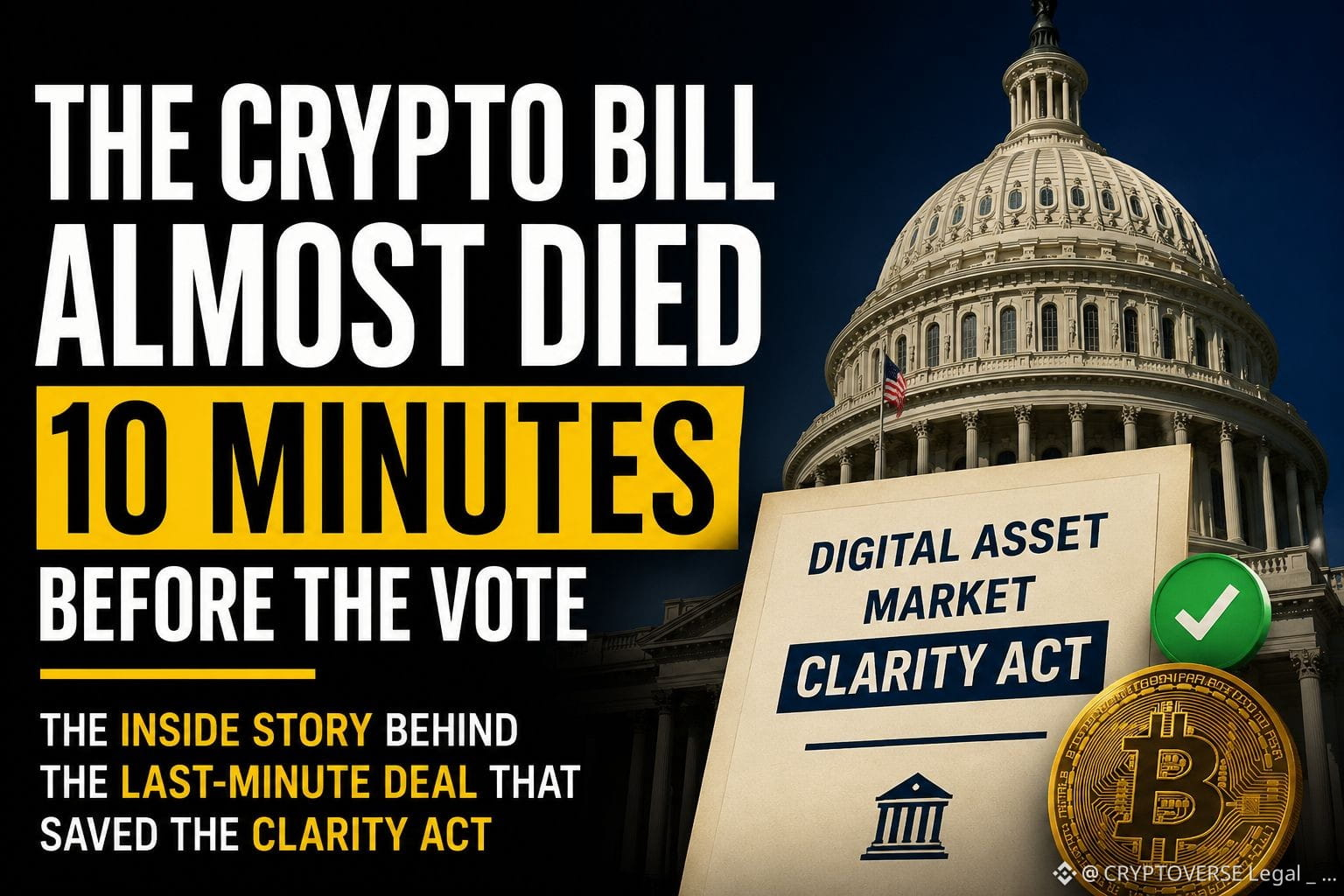
暗号法案は投票の10分前にほぼ死にかけた - ヘッドラインなし。 - 劇的な記者会見もなし。 ただ、議員たちが上院の廊下を急いで走り回り…リアルタイムで修正案を書き込んで…米国史上最も重要な暗号法の一つになるかもしれない法律を救おうとしていた。 これが人々が決して見ることのない部分だ。 誰もが「#クリプトアダプション」について話す。 しかし、規制を可能にするための政治的な戦争が裏で行われていることを理解している人は非常に少ない。 デジタル資産市場の明確化法案は崩壊寸前だった。 前晩、交渉はすでに失敗していた。 民主党と共和党は倫理規則、DeFiの保護、そして規制当局がどこまで踏み込むべきかで膠着状態に陥っていた。 その後、公聴会が始まってから数分後、小さな超党派のグループが上院の「アントルーム」に閉じ込められ、最後の妥協を成立させた。 数週間前ではなく。 前日でもなく。 公聴会そのものの最中に。 これが失敗にどれほど近かったかを示している。 そして、これは非常に重要なことを教えている: 暗号はもはや重要性を求めて戦っているのではない。コントロールを巡って戦っているのだ。 なぜなら、一度政府が議論を始めると: → 誰がデジタル資産を規制するのか → 銀行が暗号とどのように関わることができるのか → トークン化の枠組み → 開発者のための保護 …それは業界が無視できないほど重要になったことを意味する。 これはもはや「西部の野生の時代」ではない。 これは制度化の段階だ。 そして、次の10年間で暗号で最大の勝者は… 最も声高なプロジェクトではなく… 規制が完全に成熟する前に正しくポジショニングされたものになるだろう。 小売業者がチャートを見ている間に… 政府は静かに委員会室で金融システムを再設計している。 そして、多くの人々はルールがすでに書かれるまでそれに気付かないだろう。 あなたは同意しますか? @Cryptoverse_DXB をフォローして、これに似たヒントやアップデートを受け取りましょう。 #cryptolawyer #DubaiCryptoLawyer #UAECryptoLawyer #DesmondTatsi #USClarityAct
暗号法案は投票の10分前にほぼ死にかけた

- ヘッドラインなし。
- 劇的な記者会見もなし。

ただ、議員たちが上院の廊下を急いで走り回り…リアルタイムで修正案を書き込んで…米国史上最も重要な暗号法の一つになるかもしれない法律を救おうとしていた。

これが人々が決して見ることのない部分だ。

誰もが「#クリプトアダプション」について話す。
しかし、規制を可能にするための政治的な戦争が裏で行われていることを理解している人は非常に少ない。

デジタル資産市場の明確化法案は崩壊寸前だった。

前晩、交渉はすでに失敗していた。
民主党と共和党は倫理規則、DeFiの保護、そして規制当局がどこまで踏み込むべきかで膠着状態に陥っていた。

その後、公聴会が始まってから数分後、小さな超党派のグループが上院の「アントルーム」に閉じ込められ、最後の妥協を成立させた。

数週間前ではなく。

前日でもなく。

公聴会そのものの最中に。

これが失敗にどれほど近かったかを示している。

そして、これは非常に重要なことを教えている:

暗号はもはや重要性を求めて戦っているのではない。コントロールを巡って戦っているのだ。

なぜなら、一度政府が議論を始めると:

→ 誰がデジタル資産を規制するのか
→ 銀行が暗号とどのように関わることができるのか
→ トークン化の枠組み
→ 開発者のための保護

…それは業界が無視できないほど重要になったことを意味する。

これはもはや「西部の野生の時代」ではない。

これは制度化の段階だ。

そして、次の10年間で暗号で最大の勝者は…

最も声高なプロジェクトではなく…

規制が完全に成熟する前に正しくポジショニングされたものになるだろう。

小売業者がチャートを見ている間に…

政府は静かに委員会室で金融システムを再設計している。

そして、多くの人々はルールがすでに書かれるまでそれに気付かないだろう。

あなたは同意しますか?

@CRYPTOVERSE Legal _ Global Crypto Lawyers をフォローして、これに似たヒントやアップデートを受け取りましょう。

#cryptolawyer #DubaiCryptoLawyer #UAECryptoLawyer #DesmondTatsi #USClarityAct
記事
VARAライセンス ドバイの解説:創業者、取引所、トークン発行者向けの実践ガイドVARAライセンス ドバイ、クリプトライセンス ドバイ、またはバーチャルアセットライセンス ドバイを検索すると、通常は同じ広範なメッセージが異なる形で繰り返されるよ: ドバイはクリプトフレンドリーだ。 VARAは規制機関だ。 ライセンスが必要だ。 正しいチャネルを通じて申請してね。 ルールに従ってね。 それは全部真実だよ。でも、本気で創業する人たち、取引所、ブローカー、カストディアン、送金ビジネス、トークン発行者にとっては、まだ足りないんだ。 本当の質問はもっと実践的だよね: VARAライセンスって法的および商業的に実際には何を意味するの?

VARAライセンス ドバイの解説:創業者、取引所、トークン発行者向けの実践ガイド

VARAライセンス ドバイ、クリプトライセンス ドバイ、またはバーチャルアセットライセンス ドバイを検索すると、通常は同じ広範なメッセージが異なる形で繰り返されるよ:
ドバイはクリプトフレンドリーだ。
VARAは規制機関だ。
ライセンスが必要だ。
正しいチャネルを通じて申請してね。
ルールに従ってね。
それは全部真実だよ。でも、本気で創業する人たち、取引所、ブローカー、カストディアン、送金ビジネス、トークン発行者にとっては、まだ足りないんだ。
本当の質問はもっと実践的だよね:
VARAライセンスって法的および商業的に実際には何を意味するの?
記事
ドバイの仮想資産ライセンス: VARAフレームワークが実際にどう機能するかドバイの仮想資産ライセンスが何を意味するのか、多くの創業者に聞くと、最初の答えは大体こんな感じだ: 「それはドバイで暗号ビジネスを運営するための法的な許可だ。」 それは間違ってはいない。 でも、あまりにも薄っぺらいね。 本気でドバイで暗号ビジネスを立ち上げたり、構築したり、マーケティングしたり、スケールさせたりするつもりなら、それよりずっと有用な答えが必要だ。 理解しなきゃいけないのは、 VARAライセンスが実際に何かということは、 ライセンスが必要な時は、 フレームワークがどのように構成されているか、 なぜアクティビティの分類がそんなに重要なのか、

ドバイの仮想資産ライセンス: VARAフレームワークが実際にどう機能するか

ドバイの仮想資産ライセンスが何を意味するのか、多くの創業者に聞くと、最初の答えは大体こんな感じだ:
「それはドバイで暗号ビジネスを運営するための法的な許可だ。」
それは間違ってはいない。
でも、あまりにも薄っぺらいね。
本気でドバイで暗号ビジネスを立ち上げたり、構築したり、マーケティングしたり、スケールさせたりするつもりなら、それよりずっと有用な答えが必要だ。
理解しなきゃいけないのは、
VARAライセンスが実際に何かということは、
ライセンスが必要な時は、
フレームワークがどのように構成されているか、
なぜアクティビティの分類がそんなに重要なのか、
記事
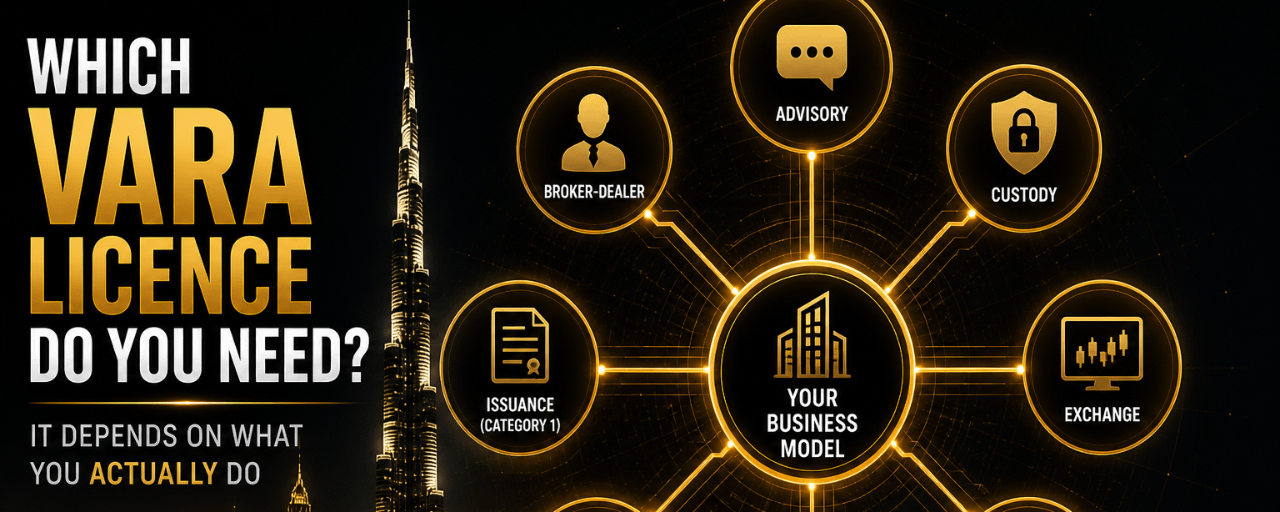
私のクリプトビジネスにはどのVARAライセンスが必要ですか?ドバイのクリプト創業者が犯す最も一般的なミスの一つは、申請が行われる前に起こる: 彼らは間違ったライセンスカテゴリーを選んでいる。 時々、彼らは取引インターフェースがあるために取引所ライセンスが必要だと思っている。 時々、彼らは「資産を保有していない」ためにアドバイザリーだけが必要だと仮定している。 時々、彼らは自分自身をこう呼ぶことでライセンスの範囲外にいると信じている: インフラストラクチャー、 ミドルウェア、 ウォレットソリューション、 トレジャリーレイヤー、 またはトークンエコシステム。

私のクリプトビジネスにはどのVARAライセンスが必要ですか?

ドバイのクリプト創業者が犯す最も一般的なミスの一つは、申請が行われる前に起こる:
彼らは間違ったライセンスカテゴリーを選んでいる。
時々、彼らは取引インターフェースがあるために取引所ライセンスが必要だと思っている。
時々、彼らは「資産を保有していない」ためにアドバイザリーだけが必要だと仮定している。
時々、彼らは自分自身をこう呼ぶことでライセンスの範囲外にいると信じている:
インフラストラクチャー、
ミドルウェア、
ウォレットソリューション、
トレジャリーレイヤー、
またはトークンエコシステム。
記事
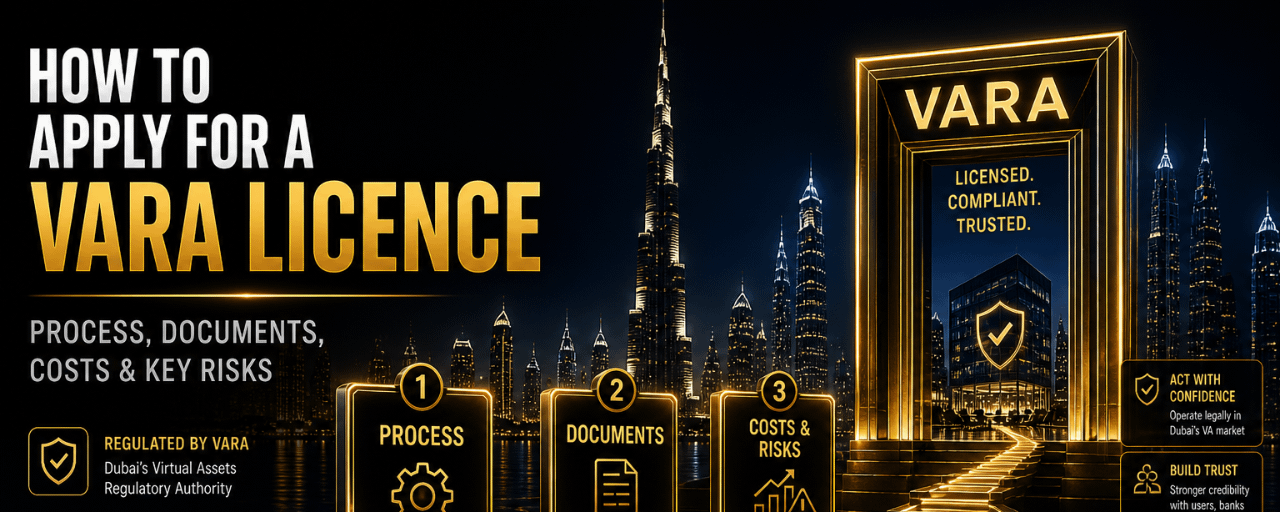
ドバイでのVARAライセンス申請方法:プロセス、書類、コスト、そして主要なリスクパート1の2 ドバイで暗号ビジネスを立ち上げることを計画しているなら、他の初期段階の質問よりも急速に重要になる質問が一つある: 実際にVARAライセンスの申請をどうするのか? 理論的にはそうではない。 マーケティング用語でもない。 そして、普通の会社設立の手続きにいくつかの暗号関連の書類が付いているように聞こえるような単純化された方法でもない。 実際のプロセスはそれよりも要求が厳しい。 なぜなら、一旦創業者、取引所、ブローカー、カストディアン、送金業者、マネージャー、またはトークン発行者が「ドバイは魅力的だ」とから「ドバイで運営したい」と移行すると、ライセンスの問題は法的なサイドの問題ではなくなるからだ。それは、ビジネスプラン全体における中心的な戦略的質問の一つになる。

ドバイでのVARAライセンス申請方法:プロセス、書類、コスト、そして主要なリスク

パート1の2
ドバイで暗号ビジネスを立ち上げることを計画しているなら、他の初期段階の質問よりも急速に重要になる質問が一つある:
実際にVARAライセンスの申請をどうするのか?
理論的にはそうではない。
マーケティング用語でもない。
そして、普通の会社設立の手続きにいくつかの暗号関連の書類が付いているように聞こえるような単純化された方法でもない。
実際のプロセスはそれよりも要求が厳しい。
なぜなら、一旦創業者、取引所、ブローカー、カストディアン、送金業者、マネージャー、またはトークン発行者が「ドバイは魅力的だ」とから「ドバイで運営したい」と移行すると、ライセンスの問題は法的なサイドの問題ではなくなるからだ。それは、ビジネスプラン全体における中心的な戦略的質問の一つになる。
記事
翻訳参照
Can You Operate a Crypto Business in Dubai Without a VARA Licence?This is one of the most common questions founders ask about Dubai, and it usually comes from one of four assumptions: “We’re not an exchange.”“We’re only a platform.”“We’re offshore.”“We’re just marketing for now.” Under the VARA framework, those assumptions can be misleading. The legal question is not whether the business sounds “crypto-adjacent” or whether it prefers a softer commercial label. The real question is whether the business is carrying on one or more regulated VA Activities in or from Dubai outside DIFC. VARA says that any firm seeking to carry on Virtual Asset activities in or from Dubai, excluding DIFC, has a legal obligation to be licensed before commencing operations. The VARA Rulebook states the same point even more directly: all entities wishing to carry out one or more VA Activities in the Emirate must seek authorisation from VARA prior to conducting any VA Activity, and must apply for, obtain, and maintain a licence for each VA Activity they will conduct. So the short answer is: Sometimes yes, but only if you are genuinely not carrying on a regulated VA Activity in or from Dubai, and only if your marketing and conduct also stay outside the regulated perimeter. That means this is not a branding question. It is a threshold question. This guide explains: when the answer may be “no, not necessarily,”when the answer is much more likely “yes, you need a licence,”why offshore status is not a safe shortcut,why “just marketing” can still create real exposure,and how founders should think about the VARA perimeter before launch. 1) The first thing to understand: Dubai does not regulate labels, it regulates activities A lot of businesses describe themselves as: platform,infrastructure,wallet solution,DLT provider,token ecosystem,middleware,market gateway. Those labels may be commercially useful. But they do not answer the legal question under VARA. VARA’s official Licensed Activities page says VASPs seeking to offer listed activities must apply for and receive a licence before undertaking VA activities in Dubai, and that any VASP or traditional-economy entity seeking to offer those VA activities must be licensed before beginning operations in or from Dubai. The same page also states that no virtual asset activity is “exempt” from regulatory supervision, and that even services offered by DLT service providers may require a VARA licence. That means the threshold question is always functional: Are you giving personalised virtual asset advice?Are you arranging or intermediating transactions?Are you safeguarding or controlling client virtual assets?Are you operating a trading venue?Are you lending or borrowing virtual assets?Are you managing virtual assets for others?Are you transferring or settling virtual assets?Are you issuing a Category 1 token? If the answer is yes to one or more of those, the licensing conversation is very likely real. 2) The key phrase is “in or from Dubai” Many founders think the question turns only on whether they are serving Dubai residents. That is too narrow. VARA’s licensing page says the obligation applies to firms seeking to carry on Virtual Asset activities in or from Dubai, excluding DIFC. Its licensed-activities page likewise says businesses must be licensed before beginning operations in or from the Emirate of Dubai, whether the service is offered to Dubai residents or, where permissible, to global customers from Dubai. That wording matters enormously. It means the threshold is not limited to: businesses targeting Dubai consumers only, orbusinesses physically performing all activity inside Dubai only. If Dubai is the operating base, management base, or service-delivery base for the regulated function, VARA can become relevant. This is why the right question is not: “Are our users in Dubai?” It is: “Are we carrying on a regulated VA Activity in or from Dubai?” That is the real threshold test. 3) So can you operate without a licence? Yes — if you are genuinely not carrying on a regulated VA Activity in or from Dubai, and if you are not falling into the marketing perimeter in a way that independently creates exposure. The licensing rule applies when an entity wishes to carry out one or more VA Activities in the Emirate; the flip side is that an entity not carrying out a regulated VA Activity does not automatically require a VARA licence. But that answer depends entirely on the actual facts and structure of the business. This means some businesses may potentially operate without a VARA licence where they are, for example: building software without intermediating transactions,offering tools that do not safeguard, route, settle, advise on, or execute regulated activity,remaining genuinely outside the listed activity categories,and staying outside the regulated marketing perimeter for Dubai/UAE. But that “yes” is much narrower than many founders hope. A business does not get outside the regime merely by saying: “we’re software,”“we’re just infrastructure,”“we don’t touch funds,”or “we’re not an exchange.” Those statements may be true, or they may just be imprecise commercial shorthand hiding a regulated function. VARA’s own public page warns that even DLT providers may require a licence if what they are doing falls inside the supervised perimeter. 4) The clearest cases where the answer is “no, not without a licence” Some business models are squarely inside the regime. If you are: operating an exchange or order book,converting fiat to virtual assets or one virtual asset to another,arranging or routing client transactions,safeguarding client assets or wallet access,managing virtual assets for clients,lending or borrowing virtual assets,transferring or settling virtual assets,or issuing Category 1 virtual assets, then the answer is generally not: “yes, you can operate without a licence.” It is much more likely: “no, you need a VARA licence first.” VARA’s licensed-activities page lists those regulated categories, and its licensing page says the licence must exist prior to commencing operations. This is why a lot of “we’re not an exchange” arguments fail. A business may not be an exchange and still be: a broker-dealer,a custodian,a transfer/settlement provider,or a manager. The threshold is broader than exchange activity alone. 5) “We are offshore” is not a magic shield This is one of the most persistent misconceptions. A lot of firms assume that if the parent company is incorporated offshore, then they can somehow use Dubai operationally without falling inside the VARA perimeter. That is often too simplistic. The reason is the same key phrase: in or from Dubai. VARA’s public licensing guidance is framed in those terms, not in terms of corporate nationality only. So if the regulated activity is being carried on in or from Dubai, offshore incorporation by itself does not answer the threshold question. That means the better question is not: “Where is our holding company incorporated?” It is: “Where is the regulated activity actually being carried on from, and how is Dubai being used operationally?” If the real answer is “from Dubai,” then the offshore label often does much less work than founders expect. 6) “We only market” can still be a problem Some businesses assume that even if they are not yet fully live, they can still freely market their future crypto services in Dubai or into the UAE. That is a dangerous assumption. VARA’s Marketing Regulations 2024 state that no entity may carry out any marketing of or relating to any Virtual Asset or VA Activity in or targeting the UAE unless it complies with those regulations. More specifically, marketing of VA Activities in or targeting the UAE must only be carried out by: a VASP licensed by VARA to carry out that VA Activity, oron behalf of, and approved by, a VASP licensed by VARA for that activity. VARA’s rulebook portal also states in plain language that businesses are not permitted to offer regulated virtual asset services or activities in Dubai without VARA approval or a confirmation of no objection. So even if a business is not fully operational yet, “just marketing” can still create real exposure if what is being marketed is a regulated VA Activity connected to the UAE/Dubai market. That means the answer to: “Can we at least market without a licence?” is often not safely “yes.” 7) There are limited marketing exemptions, but they are narrow Some founders hear that there are marketing exemptions and assume that means general flexibility. That is not the right reading. VARA’s marketing guidance and rulebook carve-outs are narrow and fact-specific. For example, one exemption pathway applies only if the entity: is not located in the Emirate,does not conduct any VA Activity in the Emirate,and does not carry out any marketing of or relating to any Virtual Asset or VA Activity in or targeting the UAE. There are also content-focused exemptions where the overall purpose of the content, taken as a whole, is not marketing of or relating to a Virtual Asset or VA Activity in or targeting the UAE. That means these are not broad safe harbours for businesses that are substantively trying to build UAE-facing crypto demand. If the content is really marketing, or the business is really conducting activities in or from Dubai, the exemption logic is much less likely to help. 8) Event participation is not a free workaround Another common assumption is: “We can at least exhibit, speak, or show up at Dubai crypto events without worrying too much about licensing.” That is also risky. VARA’s FAQ says event organisers must apply for VA event permits in Dubai through the DET e-permit system and confirms adherence to VARA’s Marketing Regulations and Guidelines. VARA’s marketing guidance further explains that certain non-licensed marketing flexibility is tightly limited in the context of physical events in the Emirate, and that exhibitors must be careful not to distribute promotional materials outside the permitted event context. So if a business is using events as a proxy for market entry, it should not assume that the event setting itself solves the threshold problem. It often does not. 9) DLT and software businesses: where the answer gets fact-sensitive This is the grey area where many founders want a clean yes/no answer. If the business is genuinely: software-only,non-custodial,non-intermediating,non-executing,and not performing a listed VA Activity in or from Dubai, then it may potentially sit outside the licensing threshold. The key remains the same: the licensing requirement is triggered by carrying on one or more VA Activities in the Emirate. But the caution matters here. A lot of businesses say: “We’re only infrastructure” when the infrastructure is actually routing or executing a regulated function. Or they say: “We don’t touch the assets” when in practice they control key access, transaction initiation, settlement logic, or the environment through which the regulated function is performed. That is why software and DLT businesses should be especially careful. The threshold analysis is often highly fact-sensitive, and VARA’s own public page warns that DLT service providers are not automatically outside supervision. 10) Traditional businesses can still need a licence Another misconception is that only “crypto-native” startups need VARA licences. That is incorrect. VARA’s licensed-activities page expressly says that any VASP or traditional economy entity seeking to offer the listed VA Activities must apply for and receive a licence before it can begin operations in or from Dubai. So a traditional financial, payments, advisory, treasury, or tech business can still cross the threshold if it begins performing one of the regulated VA Activities. Again, the trigger follows the function, not the business’s historical identity. 11) Client-facing activity is one of the clearest indicators A practical way to think about the threshold is to ask how close the business sits to the client and the VA activity itself. If the business is: entering into client agreements for VA Activities,onboarding clients into a regulated service,receiving or executing client instructions,controlling wallet access,moving assets,or offering a regulated VA function directly, the licensing threshold is much more likely to be triggered. VARA’s Market Conduct Rulebook requires valid client acceptance prior to the VASP providing any VA Activities to the client, which reinforces that licensed VA activity and client-facing service provision are closely linked in the framework. That is another reason why “pilot mode” or “soft launch” can be dangerous language. Once the regulated function is actually being provided, the threshold issue is no longer theoretical. 12) If you do need a licence, the whole rulebook environment follows Another reason this threshold question matters is that once the business is inside the perimeter, it is not just filing one form. Licensed VASPs must comply not only with the licensing requirement itself, but also with: the Company Rulebook,the Compliance and Risk Management Rulebook,the Technology and Information Rulebook,the Market Conduct Rulebook,and the activity-specific rulebooks relevant to the VA Activity being carried on. That means the threshold question is not just: “Do we need a licence?” It is also: “Are we stepping into the full regulated operating environment that comes with that licence?” That is why founders should want the threshold analysis done early and done properly. 13) The practical signs that the answer is probably “no, not without a licence” If several of the following are true, the safe answer is often not “yes, you can operate without a licence”: You are operating in or from Dubai outside DIFC.Your business model maps onto one or more of VARA’s listed VA Activities.Customer instructions, wallets, or virtual assets are moving through your service in a meaningful way.You are giving personalised advice, arranging transactions, safeguarding assets, exchanging, lending, managing, transferring, settling, or issuing Category 1 assets.You are using Dubai as a business base even if the customer base is global.You are marketing VA Activities in or targeting the UAE without already having the proper VARA footing. If that sounds like your business, the prudent next step is usually not to “see how far you can go without a licence.” It is to get the perimeter analysis done properly. Final takeaway If you want the cleanest practical answer to: “Can you operate a crypto business in Dubai without a VARA licence?” it is this: Yes, but only if you are genuinely not carrying on a regulated VA Activity in or from Dubai outside DIFC, and only if your conduct and marketing also stay outside the VARA-regulated perimeter. The moment the business starts carrying on one or more VA Activities in or from Dubai, the licensing obligation is engaged. VARA’s public licensing guidance and Rulebook are explicit on that point. That means the real founder question is not: “Can we avoid the licence?” It is: “What are we actually doing, where are we doing it from, and does that place us inside the VARA perimeter?” That is the threshold question that matters. And in Dubai, getting that answer wrong can create avoidable cost, delay, and regulatory risk very early. How CRYPTOVERSE Legal Can Help At CRYPTOVERSE Legal Consultancy, we help founders, exchanges, token issuers, brokers, custodians, transfer businesses, DLT providers, and digital asset operators determine whether their business model can genuinely operate outside the VARA licensing perimeter, or whether a VARA licence in Dubai is in fact required. Our support includes regulatory perimeter analysis, activity classification, jurisdiction and structuring review, marketing-risk assessment, token-issuance analysis, and broader VARA licensing strategy. If you want tailored guidance on whether you can operate your crypto business in Dubai without a VARA licence, and where the real threshold sits for your specific model, contact CRYPTOVERSE Legal Consultancy to discuss your regulatory strategy. #VARALicenceDubai

Can You Operate a Crypto Business in Dubai Without a VARA Licence?

This is one of the most common questions founders ask about Dubai, and it usually comes from one of four assumptions:
“We’re not an exchange.”“We’re only a platform.”“We’re offshore.”“We’re just marketing for now.”
Under the VARA framework, those assumptions can be misleading. The legal question is not whether the business sounds “crypto-adjacent” or whether it prefers a softer commercial label. The real question is whether the business is carrying on one or more regulated VA Activities in or from Dubai outside DIFC. VARA says that any firm seeking to carry on Virtual Asset activities in or from Dubai, excluding DIFC, has a legal obligation to be licensed before commencing operations. The VARA Rulebook states the same point even more directly: all entities wishing to carry out one or more VA Activities in the Emirate must seek authorisation from VARA prior to conducting any VA Activity, and must apply for, obtain, and maintain a licence for each VA Activity they will conduct.
So the short answer is:
Sometimes yes, but only if you are genuinely not carrying on a regulated VA Activity in or from Dubai, and only if your marketing and conduct also stay outside the regulated perimeter.
That means this is not a branding question. It is a threshold question.
This guide explains:
when the answer may be “no, not necessarily,”when the answer is much more likely “yes, you need a licence,”why offshore status is not a safe shortcut,why “just marketing” can still create real exposure,and how founders should think about the VARA perimeter before launch.
1) The first thing to understand: Dubai does not regulate labels, it regulates activities
A lot of businesses describe themselves as:
platform,infrastructure,wallet solution,DLT provider,token ecosystem,middleware,market gateway.
Those labels may be commercially useful. But they do not answer the legal question under VARA. VARA’s official Licensed Activities page says VASPs seeking to offer listed activities must apply for and receive a licence before undertaking VA activities in Dubai, and that any VASP or traditional-economy entity seeking to offer those VA activities must be licensed before beginning operations in or from Dubai. The same page also states that no virtual asset activity is “exempt” from regulatory supervision, and that even services offered by DLT service providers may require a VARA licence.
That means the threshold question is always functional:
Are you giving personalised virtual asset advice?Are you arranging or intermediating transactions?Are you safeguarding or controlling client virtual assets?Are you operating a trading venue?Are you lending or borrowing virtual assets?Are you managing virtual assets for others?Are you transferring or settling virtual assets?Are you issuing a Category 1 token?
If the answer is yes to one or more of those, the licensing conversation is very likely real.
2) The key phrase is “in or from Dubai”
Many founders think the question turns only on whether they are serving Dubai residents.
That is too narrow.
VARA’s licensing page says the obligation applies to firms seeking to carry on Virtual Asset activities in or from Dubai, excluding DIFC. Its licensed-activities page likewise says businesses must be licensed before beginning operations in or from the Emirate of Dubai, whether the service is offered to Dubai residents or, where permissible, to global customers from Dubai.
That wording matters enormously.
It means the threshold is not limited to:
businesses targeting Dubai consumers only, orbusinesses physically performing all activity inside Dubai only.
If Dubai is the operating base, management base, or service-delivery base for the regulated function, VARA can become relevant.
This is why the right question is not:
“Are our users in Dubai?”
It is:
“Are we carrying on a regulated VA Activity in or from Dubai?”
That is the real threshold test.
3) So can you operate without a licence?
Yes — if you are genuinely not carrying on a regulated VA Activity in or from Dubai, and if you are not falling into the marketing perimeter in a way that independently creates exposure. The licensing rule applies when an entity wishes to carry out one or more VA Activities in the Emirate; the flip side is that an entity not carrying out a regulated VA Activity does not automatically require a VARA licence. But that answer depends entirely on the actual facts and structure of the business.
This means some businesses may potentially operate without a VARA licence where they are, for example:
building software without intermediating transactions,offering tools that do not safeguard, route, settle, advise on, or execute regulated activity,remaining genuinely outside the listed activity categories,and staying outside the regulated marketing perimeter for Dubai/UAE.
But that “yes” is much narrower than many founders hope.
A business does not get outside the regime merely by saying:
“we’re software,”“we’re just infrastructure,”“we don’t touch funds,”or “we’re not an exchange.”
Those statements may be true, or they may just be imprecise commercial shorthand hiding a regulated function. VARA’s own public page warns that even DLT providers may require a licence if what they are doing falls inside the supervised perimeter.
4) The clearest cases where the answer is “no, not without a licence”
Some business models are squarely inside the regime.
If you are:
operating an exchange or order book,converting fiat to virtual assets or one virtual asset to another,arranging or routing client transactions,safeguarding client assets or wallet access,managing virtual assets for clients,lending or borrowing virtual assets,transferring or settling virtual assets,or issuing Category 1 virtual assets,
then the answer is generally not: “yes, you can operate without a licence.” It is much more likely: “no, you need a VARA licence first.” VARA’s licensed-activities page lists those regulated categories, and its licensing page says the licence must exist prior to commencing operations.
This is why a lot of “we’re not an exchange” arguments fail. A business may not be an exchange and still be:
a broker-dealer,a custodian,a transfer/settlement provider,or a manager.
The threshold is broader than exchange activity alone.
5) “We are offshore” is not a magic shield
This is one of the most persistent misconceptions.
A lot of firms assume that if the parent company is incorporated offshore, then they can somehow use Dubai operationally without falling inside the VARA perimeter.
That is often too simplistic.
The reason is the same key phrase:
in or from Dubai. VARA’s public licensing guidance is framed in those terms, not in terms of corporate nationality only. So if the regulated activity is being carried on in or from Dubai, offshore incorporation by itself does not answer the threshold question.
That means the better question is not:
“Where is our holding company incorporated?”
It is:
“Where is the regulated activity actually being carried on from, and how is Dubai being used operationally?”
If the real answer is “from Dubai,” then the offshore label often does much less work than founders expect.
6) “We only market” can still be a problem
Some businesses assume that even if they are not yet fully live, they can still freely market their future crypto services in Dubai or into the UAE.
That is a dangerous assumption.
VARA’s Marketing Regulations 2024 state that no entity may carry out any marketing of or relating to any Virtual Asset or VA Activity in or targeting the UAE unless it complies with those regulations. More specifically, marketing of VA Activities in or targeting the UAE must only be carried out by:
a VASP licensed by VARA to carry out that VA Activity, oron behalf of, and approved by, a VASP licensed by VARA for that activity.
VARA’s rulebook portal also states in plain language that businesses are not permitted to offer regulated virtual asset services or activities in Dubai without VARA approval or a confirmation of no objection.
So even if a business is not fully operational yet, “just marketing” can still create real exposure if what is being marketed is a regulated VA Activity connected to the UAE/Dubai market.
That means the answer to:
“Can we at least market without a licence?”
is often not safely “yes.”
7) There are limited marketing exemptions, but they are narrow
Some founders hear that there are marketing exemptions and assume that means general flexibility.
That is not the right reading.
VARA’s marketing guidance and rulebook carve-outs are narrow and fact-specific. For example, one exemption pathway applies only if the entity:
is not located in the Emirate,does not conduct any VA Activity in the Emirate,and does not carry out any marketing of or relating to any Virtual Asset or VA Activity in or targeting the UAE.
There are also content-focused exemptions where the overall purpose of the content, taken as a whole, is not marketing of or relating to a Virtual Asset or VA Activity in or targeting the UAE.
That means these are not broad safe harbours for businesses that are substantively trying to build UAE-facing crypto demand. If the content is really marketing, or the business is really conducting activities in or from Dubai, the exemption logic is much less likely to help.
8) Event participation is not a free workaround
Another common assumption is:
“We can at least exhibit, speak, or show up at Dubai crypto events without worrying too much about licensing.”
That is also risky.
VARA’s FAQ says event organisers must apply for VA event permits in Dubai through the DET e-permit system and confirms adherence to VARA’s Marketing Regulations and Guidelines.
VARA’s marketing guidance further explains that certain non-licensed marketing flexibility is tightly limited in the context of physical events in the Emirate, and that exhibitors must be careful not to distribute promotional materials outside the permitted event context.
So if a business is using events as a proxy for market entry, it should not assume that the event setting itself solves the threshold problem. It often does not.
9) DLT and software businesses: where the answer gets fact-sensitive
This is the grey area where many founders want a clean yes/no answer.
If the business is genuinely:
software-only,non-custodial,non-intermediating,non-executing,and not performing a listed VA Activity in or from Dubai,
then it may potentially sit outside the licensing threshold. The key remains the same: the licensing requirement is triggered by carrying on one or more VA Activities in the Emirate.
But the caution matters here.
A lot of businesses say:
“We’re only infrastructure”
when the infrastructure is actually routing or executing a regulated function.
Or they say:
“We don’t touch the assets”
when in practice they control key access, transaction initiation, settlement logic, or the environment through which the regulated function is performed.
That is why software and DLT businesses should be especially careful. The threshold analysis is often highly fact-sensitive, and VARA’s own public page warns that DLT service providers are not automatically outside supervision.
10) Traditional businesses can still need a licence
Another misconception is that only “crypto-native” startups need VARA licences.
That is incorrect.
VARA’s licensed-activities page expressly says that any VASP or traditional economy entity seeking to offer the listed VA Activities must apply for and receive a licence before it can begin operations in or from Dubai.
So a traditional financial, payments, advisory, treasury, or tech business can still cross the threshold if it begins performing one of the regulated VA Activities.
Again, the trigger follows the function, not the business’s historical identity.
11) Client-facing activity is one of the clearest indicators
A practical way to think about the threshold is to ask how close the business sits to the client and the VA activity itself.
If the business is:
entering into client agreements for VA Activities,onboarding clients into a regulated service,receiving or executing client instructions,controlling wallet access,moving assets,or offering a regulated VA function directly,
the licensing threshold is much more likely to be triggered. VARA’s Market Conduct Rulebook requires valid client acceptance prior to the VASP providing any VA Activities to the client, which reinforces that licensed VA activity and client-facing service provision are closely linked in the framework.
That is another reason why “pilot mode” or “soft launch” can be dangerous language. Once the regulated function is actually being provided, the threshold issue is no longer theoretical.
12) If you do need a licence, the whole rulebook environment follows
Another reason this threshold question matters is that once the business is inside the perimeter, it is not just filing one form.
Licensed VASPs must comply not only with the licensing requirement itself, but also with:
the Company Rulebook,the Compliance and Risk Management Rulebook,the Technology and Information Rulebook,the Market Conduct Rulebook,and the activity-specific rulebooks relevant to the VA Activity being carried on.
That means the threshold question is not just:
“Do we need a licence?”
It is also:
“Are we stepping into the full regulated operating environment that comes with that licence?”
That is why founders should want the threshold analysis done early and done properly.
13) The practical signs that the answer is probably “no, not without a licence”
If several of the following are true, the safe answer is often not “yes, you can operate without a licence”:
You are operating in or from Dubai outside DIFC.Your business model maps onto one or more of VARA’s listed VA Activities.Customer instructions, wallets, or virtual assets are moving through your service in a meaningful way.You are giving personalised advice, arranging transactions, safeguarding assets, exchanging, lending, managing, transferring, settling, or issuing Category 1 assets.You are using Dubai as a business base even if the customer base is global.You are marketing VA Activities in or targeting the UAE without already having the proper VARA footing.
If that sounds like your business, the prudent next step is usually not to “see how far you can go without a licence.” It is to get the perimeter analysis done properly.
Final takeaway
If you want the cleanest practical answer to:
“Can you operate a crypto business in Dubai without a VARA licence?”
it is this:
Yes, but only if you are genuinely not carrying on a regulated VA Activity in or from Dubai outside DIFC, and only if your conduct and marketing also stay outside the VARA-regulated perimeter. The moment the business starts carrying on one or more VA Activities in or from Dubai, the licensing obligation is engaged. VARA’s public licensing guidance and Rulebook are explicit on that point.
That means the real founder question is not:
“Can we avoid the licence?”
It is:
“What are we actually doing, where are we doing it from, and does that place us inside the VARA perimeter?”
That is the threshold question that matters.
And in Dubai, getting that answer wrong can create avoidable cost, delay, and regulatory risk very early.
How CRYPTOVERSE Legal Can Help
At CRYPTOVERSE Legal Consultancy, we help founders, exchanges, token issuers, brokers, custodians, transfer businesses, DLT providers, and digital asset operators determine whether their business model can genuinely operate outside the VARA licensing perimeter, or whether a VARA licence in Dubai is in fact required. Our support includes regulatory perimeter analysis, activity classification, jurisdiction and structuring review, marketing-risk assessment, token-issuance analysis, and broader VARA licensing strategy.
If you want tailored guidance on whether you can operate your crypto business in Dubai without a VARA licence, and where the real threshold sits for your specific model, contact CRYPTOVERSE Legal Consultancy to discuss your regulatory strategy.
#VARALicenceDubai
記事
翻訳参照
VARA Licence Application Process in Dubai: Step-by-Step Guide for New FirmsPart 1 of 2 If you are planning to launch a crypto business in Dubai, one of the first serious questions you will eventually face is not about branding, tokenomics, or market timing. It is this: How does the VARA licence application process actually work for a new firm? Not the vague version. Not the oversimplified version. And not the version that makes it sound like a standard company-registration exercise with a few extra forms attached. The real version. Because once a business moves beyond general interest in Dubai and begins seriously evaluating the market, the licensing process quickly becomes one of the most commercially important parts of the whole strategy. It affects: how early the business needs to start preparing,what documents must exist before filing,how the legal entity is set up,what can and cannot be done before full approval,how long the process may take,and how much avoidable delay the business creates for itself. And that last point matters more than many founders first realise. A lot of businesses think the real challenge is “getting the regulator comfortable.” Often, the bigger challenge is making sure the business itself is clear enough, structured enough, and documented enough before the regulator starts asking obvious questions. That is exactly why this article matters. If you have searched: VARA licence application processhow to apply for a VARA licenceVARA licence DubaiVARA new firm applicationVARA Approval to IncorporateVARA VASP licence processhow long does a VARA licence takeVARA application documents then this guide is built for you. This article focuses specifically on the process for new firms, because VARA itself distinguishes between the route for new firms and the route for certain existing / legacy firms. On its official licensing page, VARA states that new firms apply through a two-stage process: first Approval to Incorporate (ATI), and then the full VASP Licence application. VARA also states that any firm seeking to carry on Virtual Asset activities in or from Dubai, excluding DIFC, has a legal obligation to be licensed by VARA before commencing operations. That is the starting point. And once you understand that, the next thing to understand is even more important: The VARA application process is not just a filing process. It is a readiness process. That single idea explains why some applications move more coherently than others. So in this first part, we are going to break down: what the VARA application process for new firms really is,how the two formal stages work,what ATI actually means,what businesses often misunderstand about the process,and why the strongest applications usually begin before the formal filing ever starts. Let’s begin with the first thing many businesses get wrong. 1) The process is not just “submit and wait” A lot of first-time applicants imagine the licensing process as something like this: Fill out a formUpload a few documentsWait for approvalGet licensed That is not how this market works. VARA’s own public guidance already tells a much more serious story. For new firms, VARA says the process has two formal stages: Stage 1: Approval to Incorporate (ATI)Stage 2: Full VASP Licence. At first glance, that may still sound manageable. But once you look at what sits underneath those two stages, it becomes obvious that this is not just a procedural pipeline. It is a regulator-driven assessment of whether the applicant is fit to become, and then operate as, a licensed virtual asset business in Dubai. That is a very different proposition. Because a serious application is not merely proving that: the founders are enthusiastic,the product idea exists,or the entity can be incorporated. It is proving that the business can be: structured,governed,funded,controlled,documented,and ultimately supervised. This is why businesses that approach the process too casually often experience it as “slower than expected.” In many cases, the delay is not caused by a mysterious regulator. It is caused by the business discovering, during the process, that it is not yet as licensing-ready as it assumed. That is why the better way to think about the VARA application process is this: The formal process has two stages. The real journey usually has three phases. Those three phases are: Pre-filing readinessStage 1 — ATIStage 2 — Full VASP Licence VARA formally describes only the last two because those are the official steps. But commercially, serious applicants know that the first phase often determines how the rest of the journey feels. We will come back to that. 2) Step zero: the readiness phase most founders underestimate Before you even reach the first formal filing stage, there is a less visible but extremely important phase: the readiness phase. VARA does not label it this way on the public website. But in practice, this is where the strongest applications are built. Why? Because by the time a business reaches the formal process, a number of questions should already have been answered internally: What exact VA Activity is the business applying for?Is it one activity or more than one?Is the business model aligned with the licence scope being sought?Who are the beneficial owners and senior management?How will the governance structure work?What does the customer journey actually look like?How do fiat and virtual assets move through the model?What technology and control systems support the activity?Is the Regulatory Business Plan coherent?Are the compliance and AML frameworks aligned to the real operating model?Is the business financially and prudentially ready to support the application? These are not secondary questions. They are the real architecture of the file. And this is exactly why a lot of businesses get stuck later: they begin the formal licensing journey before they have properly solved the readiness phase. If you want the process to feel manageable, the business should ideally enter Stage 1 with: a clearly defined scope,a real business model,a plausible governance story,an organised ownership structure,and a clear plan for operational setup after ATI. Without that, even the first stage can become heavier than expected. So before thinking about how to apply for a VARA licence, a smart founder should ask: “How prepared are we to explain ourselves properly once the process begins?” That is the right step-zero question. 3) Stage 1: Approval to Incorporate (ATI) Now let’s move into the first formal stage. VARA’s official licensing page for new firms says that applying for a VASP Licence is completed in two stages, and that the first stage is an application for Approval to Incorporate (ATI). The purpose of ATI is to allow the applicant to establish the legal entity and commence operational setup. This point is crucial. ATI is not the licence. ATI is the first formal gateway toward the licence. That distinction matters a great deal because businesses often emotionally overread ATI. They treat it as a near-final approval when, in reality, it is permission to continue building toward the licensed operating model. What happens in Stage 1? VARA’s public guidance says that the Stage 1 process includes the following: Submit an Initial Disclosure Questionnaire (IDQ) to Dubai Economy & Tourism (DET) or the relevant Free Zone.Provide additional documentation as required, including a business plan and details of the firm’s beneficial owners and senior management.Pay initial fees required to commence application review, typically 50% of the licence application fee.Receive an Approval to Incorporate (ATI), allowing the firm to finalise legal incorporation and complete operational setup such as office space rental and employee onboarding. That is the formal sequence. But the commercial meaning is just as important. This stage is where the business first introduces itself to the Dubai regulatory ecosystem in a serious way. It is where the applicant begins to say: who we are,what we want to do,who owns and manages us,and why we should be allowed to move into the legal-incorporation and setup phase. That is why even the early-stage materials matter. If the business plan is weak, if the ownership structure is confusing, or if the activity appears to fall outside the regulatory perimeter, VARA expressly reserves the right not to issue ATI. So Stage 1 is not a rubber stamp. It is an early filter. 4) What ATI actually allows — and what it does not This is one of the most important practical distinctions in the whole process. VARA’s public licensing page includes a specific note at Stage 1: At this point, the firm is not permitted to carry on Virtual Asset activities. That is as clear as it gets. ATI allows the firm to: finalise legal incorporation,complete operational setup,arrange office space,onboard employees,and build out the operational platform needed to support the later VASP application. ATI does not allow the business to begin regulated VA activities. This matters because a lot of firms confuse: being permitted to establish the vehicle, withbeing permitted to operate the regulated business. Those are not the same thing. So if you are thinking about: marketing aggressively after ATI,onboarding clients after ATI,treating ATI as public evidence that the business is already licensed,or acting like the regulatory question is “basically solved,” that is a dangerous misunderstanding of the process. ATI is a meaningful milestone. But it is still only the first formal stage. It says: “You may continue building.” It does not say: “You may now conduct regulated virtual asset activity.” That distinction should shape how the business behaves publicly and operationally after Stage 1. 5) Why VARA reserves the right to stop the process at ATI stage Another point founders often miss is that ATI is still a substantive regulatory decision point. VARA’s licensing page expressly states that it reserves the right not to issue an ATI where: the firm’s activities fall outside the regulatory perimeter, orthe firm may not meet appropriate standards to be regulated. This is very revealing. It shows that Stage 1 is not just about legal incorporation mechanics. It is about whether the business is a plausible candidate for regulation under VARA at all. That means the regulator is already thinking about two important things: 1. Perimeter fit Does the activity really belong in the VARA framework? If the business is describing something that sits outside the relevant perimeter, then the process may stop before it progresses further. 2. Regulatory suitability Even if the activity is in scope, does the business appear serious and credible enough to continue toward regulation? That is why early-stage structure matters so much. A weak ATI package can create problems before the “real” licensing stage even begins. And this is also why the businesses that prepare properly before filing tend to feel more in control of the process. They have already pressure-tested the model against the perimeter and built a cleaner early-stage story. 6) Who do you submit through: DET or Free Zone? This is another practical point that comes up repeatedly. VARA’s official licensing page states that application submissions can be made through: Dubai Economy & Tourism (DET) for mainland firms, orany relevant Dubai Free Zone in the Emirate of Dubai, excluding DIFC. That means a new firm does not simply submit “directly into Dubai” in the abstract. The commercial licensor matters: mainland via DET,or the chosen Dubai Free Zone. This has strategic implications because the entity setup route and commercial location should align with the broader operating plan. A lot of founders still think about legal setup and regulatory strategy as separate discussions. In reality, they are connected from the very beginning. The commercial licensor is part of the entry architecture. That is one reason the ATI stage matters so much. It sits at the point where: legal incorporation,commercial location,and regulatory pathway Begin to converge. 7) Why good applicants treat Stage 1 as a credibility test, not just an administrative step The biggest mistake a new firm can make is to treat ATI like a technical hurdle. That mindset often leads to weak early submissions because the business is still speaking in broad internal language rather than regulator-facing language. A stronger approach is to treat Stage 1 as a credibility test. At this point, the applicant should be able to explain: what regulated activity it wants to conduct,who the business owners and senior managers are,why the legal entity should be set up for this purpose,and why the application is not speculative or premature. This does not mean the full submission has to be fully built at ATI stage. It does mean the early narrative must be coherent enough to justify letting the firm move into the next stage. And this is exactly why strong licensing strategies often begin earlier than founders expect. They begin before submission: when the business defines the activity correctly,prepares the ownership and management story,tests whether the model belongs inside the VARA perimeter,and begins drafting the narrative that will later expand into the full application. That is the difference between: entering Stage 1 as a curious startup, andentering Stage 1 as a serious future applicant. The regulator can feel the difference. 8) Where Part 2 will go next Part 1 has focused on the front half of the journey: how the new-firm process is structured,what ATI is,what it allows,what it does not allow,and why early readiness matters before the formal process even begins. In Part 2, we will move into the second formal stage and the heavier operational burden behind it, including: what happens after ATI,the full VASP Licence submission stage,meetings, interviews, and feedback from VARA,the application documentation burden,the compulsory rulebooks for all VASP applicants,the activity-specific rulebooks,what tends to slow applications down,and how new firms can approach the process more strategically. Part 2 of 2 In Part 1, we focused on the front end of the process: the fact that VARA’s route for new firms is formally divided into two stages,the importance of the pre-filing readiness phase,the purpose of Approval to Incorporate (ATI),and the crucial distinction between being allowed to set up and being allowed to conduct regulated Virtual Asset activities. Now we move into the stage that most founders are really asking about when they search terms like: VARA application documentsVARA licence processhow to apply for a VARA licenceVARA VASP licencehow long does VARA licence takeVARA licence requirements This is the stage where the file stops being preliminary and starts becoming real. Because once ATI has been granted, the business is no longer only proving that it can be incorporated and operationally prepared. It now has to prove that it is genuinely ready to become a licensed and supervised Virtual Asset Service Provider in Dubai. That is a much higher standard. And this is where the quality of the preparation begins to show very clearly. Some firms reach this stage with: a clean scope,aligned documents,realistic financials,and a well-structured RBP. Others arrive with: unresolved activity questions,weak governance narratives,thin policies,unclear customer flows,and a business model that still sounds more like a pitch deck than a regulated operation. The regulator notices the difference. That is why Stage 2 is not simply the “longer form version” of Stage 1. It is a substantive evaluation of whether the firm can actually operate under VARA’s framework. Let’s break that down properly. 1) Stage 2: the full VASP Licence application After ATI, the next step is the full VASP Licence application. VARA’s public licensing page states that once ATI is obtained, the applicant proceeds to the second stage, which includes: preparing the full application pack,engaging in meetings and interviews,submitting further information where requested,paying the balance of the application fees and the first year’s supervision fees,and, if successful, receiving the VASP Licence. VARA also notes that it may issue the licence subject to certain conditions in some cases. This is one of the most important transitions in the whole licensing journey. At ATI stage, the regulator is effectively asking: “Should this business be allowed to establish the legal and operational base needed to continue toward licensing?” At full VASP stage, the question becomes: “Is this business ready to be licensed and supervised for the regulated activity it has asked to conduct?” That is a much more demanding question. Because the regulator is no longer evaluating an intention to build. It is evaluating a built regulatory case. That case must be supported by: the legal structure,the governance structure,the prudential model,the compliance framework,the technology environment,the customer journey,and the overall coherence of the business as presented in the file. This is where weak preparation usually shows up quickly. 2) The documentation burden is broad — and intentionally so VARA’s website is very clear that the list of application documents it publishes is non-exhaustive. That means the firm should not treat the website as a closed checklist and assume that once those boxes are ticked, nothing else can be asked for.  This is important for two reasons. First, it signals that the process is fact-sensitive A simpler model may trigger a more straightforward review. A more complex model, for example one involving exchange, custody, transfer rails, DeFi exposure, token issuance, or payment-like functionality, may generate a broader documentary burden. Second, it means the application is not just about completeness A weak applicant often asks: “Have we attached everything?” A strong applicant asks: “Does the file help the regulator understand the business clearly enough to trust it?” That is a more useful way to think about the application. The documents are not just there to fill a folder. They are there to tell a coherent story about a business that can be governed and supervised. 3) The four core documentation buckets VARA’s published materials group the application documents into four broad categories: Corporate Structure and GovernanceRisk and ComplianceTechnologyOther Supporting Information.  This structure is useful because it reflects how the regulator itself is likely to read the business. A. Corporate Structure and Governance This bucket includes the materials that explain: who the applicant is,who owns it,who controls it,how it is funded,who the key people are,and how the governance framework works. VARA’s examples in this category include: certificate of incorporation,UBO list,fit and proper confirmations,source of funds,organisational structure,governance framework,local entity website,key personnel documents,Regulatory Business Plan,financial projections,financial statements,proof of paid-up capital,insurance certificates,succession plan,and wind-down plan. This tells you immediately that the regulator is not only looking at the business idea. It is looking at the institution behind the idea. B. Risk and Compliance This is where the file starts showing how the business identifies, manages, and monitors risk. VARA’s examples here include: enterprise risk management framework,risk assessment,compliance manual,compliance monitoring programme,AML/CFT policy and procedures,outsourcing policy and agreements,conflicts of interest policy,insider lists,customer journey workflows,terms and conditions,privacy policy,marketing policy and plan,sample marketing materials,market conduct policy,and records management policy. This is a very revealing list. It shows that VARA expects more than basic legal documentation. It expects a control environment. C. Technology For many VASPs, the technology stack is inseparable from the service being licensed. That is why VARA’s document examples include: technology infrastructure design,technology risk assessment framework,business continuity and disaster recovery planning,key and wallet management policy,information security policy,and penetration testing results.  This is especially important for: exchanges,custodians,broker-dealers,and transfer and settlement businesses. D. Other Supporting Information This category allows for additional supporting materials depending on the business model, including: whitepapers,proprietary trading information,DeFi-related information,and VA payment materials. This is another reminder that the application expands with complexity. 4) The universal rulebooks every VASP applicant should expect to deal with One of the biggest misunderstandings in the market is that applicants think primarily in terms of the activity-specific licence. That is important — but it is not the whole framework. Your reviewed materials and the wider VARA rulebook structure make clear that licensed firms are generally expected to comply not just with the activity-specific rulebook, but also with broader baseline rulebooks, including: the Company Rulebookthe Compliance and Risk Management Rulebookthe Technology and Information Rulebookand the Market Conduct Rulebook This is commercially very important. Because it means the licensing burden is not limited to: “What are the rules for our activity?” It also includes: “What kind of institution must we become in order to carry on that activity properly?” That broader framework affects: governance,compliance,risk management,technology controls,market-facing conduct,and prudential readiness. This is exactly why businesses that approach the process with only an “activity checklist” mindset usually find the full application stage heavier than expected. The regulator is not only licensing the activity. It is licensing the operating environment around that activity. 5) Meetings, interviews, and regulator engagement Another point worth making very clearly is this: The full VASP application stage is not a silent upload process. VARA’s licensing page states that Stage 2 may involve: meetings,interviews,and requests for additional information or clarification. This matters because some founders still imagine the process as a “send documents and wait” exercise. It is better understood as an interactive review process. That means the applicant must be ready not only to submit documents, but also to: explain the business model coherently,answer follow-up questions consistently,defend the scope being applied for,clarify technology and transaction flows,and respond to issues without creating contradictions in the file. This is where weak internal coordination can create real problems. If: finance says one thing,the RBP says another,compliance documentation implies something else,and management gives a different answer in a meeting, then the file begins to look unstable. That is why good application management matters as much as good drafting. Strong applicants usually maintain: an issues log,clear document ownership,version control,and one coherent internal understanding of the business model. That is the kind of discipline that helps the process move more smoothly. 6) What tends to slow new-firm applications down When founders ask how long does a VARA licence take, the most honest answer is that timing depends heavily on: the complexity of the model,the quality of the submission,and how many clarification or remediation rounds the business triggers. That is why the better question is often: “What causes delay?” Here are some of the most common causes. Weak or unclear activity scoping If the business is not clearly applying for the right regulated activity — or if the business model described appears broader than the scope requested — the file becomes harder to assess. Thin or overly promotional RBP If the Regulatory Business Plan sounds like a growth deck rather than a regulator-facing operating blueprint, the regulator will usually need more detail and more clarification. Poorly explained customer and asset flows This is especially important in crypto. If the file does not clearly show: who initiates what,where assets move,who controls wallets,what third parties are involved,and where the regulated function sits, then the review becomes harder. Underdeveloped governance or personnel structure If the key functions and reporting lines are vague, the business may not look mature enough for licensing. Generic compliance framework A template AML or compliance pack that is not clearly tailored to the actual business model is often easy for a regulator to see through. Weak technology documentation For higher-risk models, vague explanations of infrastructure, wallet arrangements, resilience, or security can materially slow the process. These are not exotic mistakes. They are very common. And most of them can be reduced by doing more disciplined work before the full application stage begins. 7) What strong applicants do differently at Stage 2 By now, the difference between stronger and weaker applicants should feel much clearer. The strongest applicants usually do a few things consistently well: They treat the file as one integrated story They do not let the RBP, financials, policies, and operational descriptions drift in different directions. They prepare for interaction, not just submission They know there will likely be meetings and questions, and they organise internally for that reality. They align legal, compliance, business, and technology teams early They do not wait until after submission to find out that internal stakeholders are describing the business differently. They know what ATI did — and did not — resolve They understand that ATI allowed them to build the legal and operational platform, but the real licensing case still has to be won at Stage 2. They think like future regulated entities They do not act like startups trying to “get through” the process. They act like businesses preparing to live under supervision once the licence is granted. This mindset shift is subtle, but extremely important. It often affects not only the quality of the application, but also the quality of the business itself by the time it reaches the end of the process. 8) The licence is not the end of the work One final point is worth making before we close. Even once the VASP Licence is granted, the story is not over. VARA’s framework makes clear that licensed firms remain subject to: annual supervision fees,prudential requirements,the applicable rulebooks,and ongoing regulatory expectations tied to the activities they are licensed to conduct. This matters because applicants should not think of the process as: “Get the licence and then figure the rest out later.” A better mindset is: “Use the application process to build the business into the kind of regulated institution that can carry the licence well.” That is one of the biggest strategic advantages of approaching the VARA process properly. The business that emerges at the end should be stronger, clearer, and more governable than the one that entered. Final takeaway If you are a new firm trying to understand the VARA licence application process in Dubai, the most useful summary is this: The formal route has two stages Approval to Incorporate (ATI)Full VASP Licence. But the real journey has three phases Pre-filing readinessATIFull application and review And the strongest applications are usually the ones that take the first phase seriously. Because once the process reaches Stage 2, the regulator is not just asking whether the firm wants to be licensed. It is asking whether the firm is: properly structured,properly documented,properly governed,and genuinely ready to become a supervised virtual asset business in Dubai. That is the real meaning of the process. And if you understand that early, you make better decisions: about timing,about scope,about documentation,and about how to prepare the business before formal review begins. How CRYPTOVERSE Legal Can Help At CRYPTOVERSE Legal, we help new firms navigate the VARA licence application process in Dubai with greater clarity, discipline, and strategic structure.  Our support includes activity classification, pre-filing readiness planning, ATI-stage support, Regulatory Business Plan drafting, governance and compliance framework development, document-pack preparation, and end-to-end advisory throughout the full VASP application process.  We work with founders, exchanges, brokers, custodians, token issuers, and digital asset businesses to help them avoid avoidable delays, strengthen weak areas early, and build a more coherent regulator-ready file before and during review.  Our focus is not just on helping clients submit an application, but on helping them approach the VARA process in a way that reflects real regulatory readiness. If you are preparing to launch a crypto business in Dubai and want tailored guidance on the VARA licence application process for new firms, contact CRYPTOVERSE Legal Consultancy to discuss your licensing strategy. FAQs 1. What is the VARA licence process in Dubai for new firms? The Virtual Assets Regulatory Authority (VARA) licence process has two stages: Approval to Incorporate (ATI) and the full VASP licence application. It begins with pre-filing readiness, followed by regulatory review, documentation submission, and final licensing approval. 2. What is Approval to Incorporate (ATI) in VARA licensing? ATI is the first stage of the VARA licence process. It allows a firm to legally incorporate and set up operations in Dubai but does not permit conducting virtual asset activities until the full VASP licence is granted. 3. How long does it take to get a VARA licence in Dubai? The VARA licence process typically takes 3 to 6 months or longer, depending on business complexity, documentation quality, and regulatory feedback cycles. Delays often occur due to weak preparation or unclear business models. 4. What documents are required for a VARA VASP licence? VARA requires documents across four areas: corporate structure, compliance and AML policies, technology systems, and supporting materials like financial projections and business plans. The exact requirements depend on the activity and business model. 5. Can a firm operate after receiving VARA ATI approval? No, firms cannot conduct virtual asset activities after ATI approval. ATI only allows company setup and operational preparation. Full regulatory approval is required before offering crypto services. 6. What are common reasons VARA licence applications are delayed? Common delays include unclear activity scope, weak Regulatory Business Plans, inconsistent documentation, poor governance structures, and inadequate compliance or technology frameworks. #VARALicenceDubai

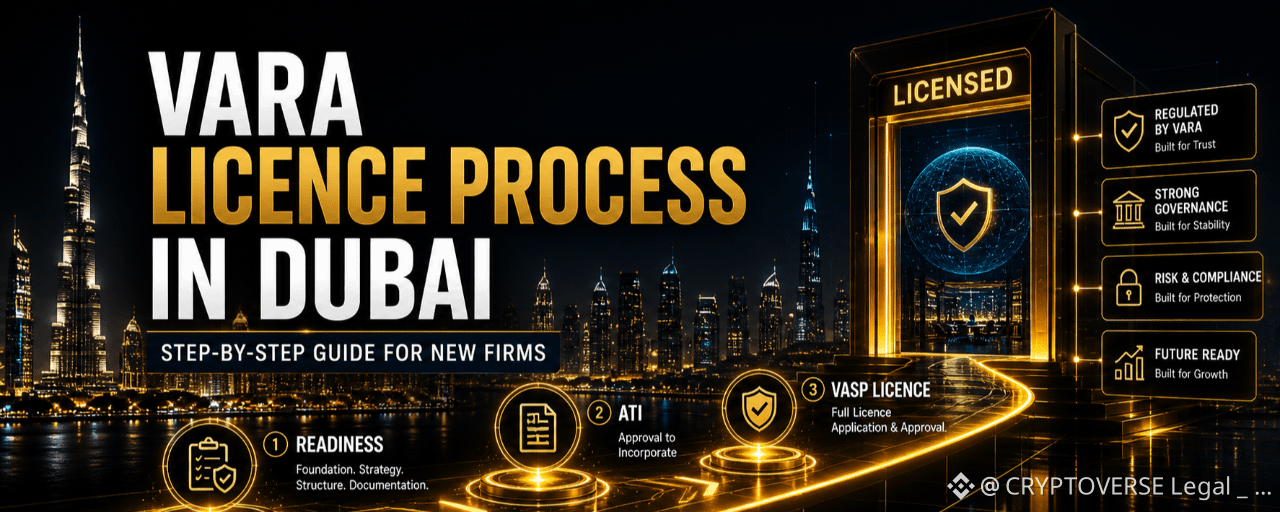
VARA Licence Application Process in Dubai: Step-by-Step Guide for New Firms

Part 1 of 2
If you are planning to launch a crypto business in Dubai, one of the first serious questions you will eventually face is not about branding, tokenomics, or market timing.
It is this:
How does the VARA licence application process actually work for a new firm?
Not the vague version.
Not the oversimplified version.
And not the version that makes it sound like a standard company-registration exercise with a few extra forms attached.
The real version.
Because once a business moves beyond general interest in Dubai and begins seriously evaluating the market, the licensing process quickly becomes one of the most commercially important parts of the whole strategy.
It affects:
how early the business needs to start preparing,what documents must exist before filing,how the legal entity is set up,what can and cannot be done before full approval,how long the process may take,and how much avoidable delay the business creates for itself.
And that last point matters more than many founders first realise.
A lot of businesses think the real challenge is “getting the regulator comfortable.”
Often, the bigger challenge is making sure the business itself is clear enough, structured enough, and documented enough before the regulator starts asking obvious questions.
That is exactly why this article matters.
If you have searched:
VARA licence application processhow to apply for a VARA licenceVARA licence DubaiVARA new firm applicationVARA Approval to IncorporateVARA VASP licence processhow long does a VARA licence takeVARA application documents
then this guide is built for you.
This article focuses specifically on the process for new firms, because VARA itself distinguishes between the route for new firms and the route for certain existing / legacy firms. On its official licensing page, VARA states that new firms apply through a two-stage process: first Approval to Incorporate (ATI), and then the full VASP Licence application. VARA also states that any firm seeking to carry on Virtual Asset activities in or from Dubai, excluding DIFC, has a legal obligation to be licensed by VARA before commencing operations.
That is the starting point.
And once you understand that, the next thing to understand is even more important:
The VARA application process is not just a filing process. It is a readiness process.
That single idea explains why some applications move more coherently than others.
So in this first part, we are going to break down:
what the VARA application process for new firms really is,how the two formal stages work,what ATI actually means,what businesses often misunderstand about the process,and why the strongest applications usually begin before the formal filing ever starts.
Let’s begin with the first thing many businesses get wrong.
1) The process is not just “submit and wait”
A lot of first-time applicants imagine the licensing process as something like this:
Fill out a formUpload a few documentsWait for approvalGet licensed
That is not how this market works.
VARA’s own public guidance already tells a much more serious story.
For new firms, VARA says the process has two formal stages:
Stage 1: Approval to Incorporate (ATI)Stage 2: Full VASP Licence.
At first glance, that may still sound manageable. But once you look at what sits underneath those two stages, it becomes obvious that this is not just a procedural pipeline. It is a regulator-driven assessment of whether the applicant is fit to become, and then operate as, a licensed virtual asset business in Dubai.
That is a very different proposition.
Because a serious application is not merely proving that:
the founders are enthusiastic,the product idea exists,or the entity can be incorporated.
It is proving that the business can be:
structured,governed,funded,controlled,documented,and ultimately supervised.
This is why businesses that approach the process too casually often experience it as “slower than expected.” In many cases, the delay is not caused by a mysterious regulator. It is caused by the business discovering, during the process, that it is not yet as licensing-ready as it assumed.
That is why the better way to think about the VARA application process is this:
The formal process has two stages.
The real journey usually has three phases.
Those three phases are:
Pre-filing readinessStage 1 — ATIStage 2 — Full VASP Licence
VARA formally describes only the last two because those are the official steps. But commercially, serious applicants know that the first phase often determines how the rest of the journey feels.
We will come back to that.
2) Step zero: the readiness phase most founders underestimate
Before you even reach the first formal filing stage, there is a less visible but extremely important phase:
the readiness phase.
VARA does not label it this way on the public website. But in practice, this is where the strongest applications are built.
Why?
Because by the time a business reaches the formal process, a number of questions should already have been answered internally:
What exact VA Activity is the business applying for?Is it one activity or more than one?Is the business model aligned with the licence scope being sought?Who are the beneficial owners and senior management?How will the governance structure work?What does the customer journey actually look like?How do fiat and virtual assets move through the model?What technology and control systems support the activity?Is the Regulatory Business Plan coherent?Are the compliance and AML frameworks aligned to the real operating model?Is the business financially and prudentially ready to support the application?
These are not secondary questions. They are the real architecture of the file.
And this is exactly why a lot of businesses get stuck later: they begin the formal licensing journey before they have properly solved the readiness phase.
If you want the process to feel manageable, the business should ideally enter Stage 1 with:
a clearly defined scope,a real business model,a plausible governance story,an organised ownership structure,and a clear plan for operational setup after ATI.
Without that, even the first stage can become heavier than expected.
So before thinking about how to apply for a VARA licence, a smart founder should ask:
“How prepared are we to explain ourselves properly once the process begins?”
That is the right step-zero question.
3) Stage 1: Approval to Incorporate (ATI)
Now let’s move into the first formal stage.
VARA’s official licensing page for new firms says that applying for a VASP Licence is completed in two stages, and that the first stage is an application for Approval to Incorporate (ATI). The purpose of ATI is to allow the applicant to establish the legal entity and commence operational setup.
This point is crucial.
ATI is not the licence.
ATI is the first formal gateway toward the licence.
That distinction matters a great deal because businesses often emotionally overread ATI. They treat it as a near-final approval when, in reality, it is permission to continue building toward the licensed operating model.
What happens in Stage 1?
VARA’s public guidance says that the Stage 1 process includes the following:
Submit an Initial Disclosure Questionnaire (IDQ) to Dubai Economy & Tourism (DET) or the relevant Free Zone.Provide additional documentation as required, including a business plan and details of the firm’s beneficial owners and senior management.Pay initial fees required to commence application review, typically 50% of the licence application fee.Receive an Approval to Incorporate (ATI), allowing the firm to finalise legal incorporation and complete operational setup such as office space rental and employee onboarding.
That is the formal sequence.
But the commercial meaning is just as important.
This stage is where the business first introduces itself to the Dubai regulatory ecosystem in a serious way. It is where the applicant begins to say:
who we are,what we want to do,who owns and manages us,and why we should be allowed to move into the legal-incorporation and setup phase.
That is why even the early-stage materials matter.
If the business plan is weak, if the ownership structure is confusing, or if the activity appears to fall outside the regulatory perimeter, VARA expressly reserves the right not to issue ATI.
So Stage 1 is not a rubber stamp.
It is an early filter.
4) What ATI actually allows — and what it does not
This is one of the most important practical distinctions in the whole process.
VARA’s public licensing page includes a specific note at Stage 1:
At this point, the firm is not permitted to carry on Virtual Asset activities.
That is as clear as it gets.
ATI allows the firm to:
finalise legal incorporation,complete operational setup,arrange office space,onboard employees,and build out the operational platform needed to support the later VASP application.
ATI does not allow the business to begin regulated VA activities.
This matters because a lot of firms confuse:
being permitted to establish the vehicle,
withbeing permitted to operate the regulated business.
Those are not the same thing.
So if you are thinking about:
marketing aggressively after ATI,onboarding clients after ATI,treating ATI as public evidence that the business is already licensed,or acting like the regulatory question is “basically solved,”
that is a dangerous misunderstanding of the process.
ATI is a meaningful milestone.
But it is still only the first formal stage.
It says:
“You may continue building.”
It does not say:
“You may now conduct regulated virtual asset activity.”
That distinction should shape how the business behaves publicly and operationally after Stage 1.
5) Why VARA reserves the right to stop the process at ATI stage
Another point founders often miss is that ATI is still a substantive regulatory decision point.
VARA’s licensing page expressly states that it reserves the right not to issue an ATI where:
the firm’s activities fall outside the regulatory perimeter, orthe firm may not meet appropriate standards to be regulated.
This is very revealing.
It shows that Stage 1 is not just about legal incorporation mechanics. It is about whether the business is a plausible candidate for regulation under VARA at all.
That means the regulator is already thinking about two important things:
1. Perimeter fit
Does the activity really belong in the VARA framework?
If the business is describing something that sits outside the relevant perimeter, then the process may stop before it progresses further.
2. Regulatory suitability
Even if the activity is in scope, does the business appear serious and credible enough to continue toward regulation?
That is why early-stage structure matters so much.
A weak ATI package can create problems before the “real” licensing stage even begins.
And this is also why the businesses that prepare properly before filing tend to feel more in control of the process. They have already pressure-tested the model against the perimeter and built a cleaner early-stage story.
6) Who do you submit through: DET or Free Zone?
This is another practical point that comes up repeatedly.
VARA’s official licensing page states that application submissions can be made through:
Dubai Economy & Tourism (DET) for mainland firms, orany relevant Dubai Free Zone in the Emirate of Dubai, excluding DIFC.
That means a new firm does not simply submit “directly into Dubai” in the abstract. The commercial licensor matters:
mainland via DET,or the chosen Dubai Free Zone.
This has strategic implications because the entity setup route and commercial location should align with the broader operating plan.
A lot of founders still think about legal setup and regulatory strategy as separate discussions. In reality, they are connected from the very beginning.
The commercial licensor is part of the entry architecture.
That is one reason the ATI stage matters so much. It sits at the point where:
legal incorporation,commercial location,and regulatory pathway
Begin to converge.
7) Why good applicants treat Stage 1 as a credibility test, not just an administrative step
The biggest mistake a new firm can make is to treat ATI like a technical hurdle.
That mindset often leads to weak early submissions because the business is still speaking in broad internal language rather than regulator-facing language.
A stronger approach is to treat Stage 1 as a credibility test.
At this point, the applicant should be able to explain:
what regulated activity it wants to conduct,who the business owners and senior managers are,why the legal entity should be set up for this purpose,and why the application is not speculative or premature.
This does not mean the full submission has to be fully built at ATI stage. It does mean the early narrative must be coherent enough to justify letting the firm move into the next stage.
And this is exactly why strong licensing strategies often begin earlier than founders expect.
They begin before submission:
when the business defines the activity correctly,prepares the ownership and management story,tests whether the model belongs inside the VARA perimeter,and begins drafting the narrative that will later expand into the full application.
That is the difference between:
entering Stage 1 as a curious startup, andentering Stage 1 as a serious future applicant.
The regulator can feel the difference.
8) Where Part 2 will go next
Part 1 has focused on the front half of the journey:
how the new-firm process is structured,what ATI is,what it allows,what it does not allow,and why early readiness matters before the formal process even begins.
In Part 2, we will move into the second formal stage and the heavier operational burden behind it, including:
what happens after ATI,the full VASP Licence submission stage,meetings, interviews, and feedback from VARA,the application documentation burden,the compulsory rulebooks for all VASP applicants,the activity-specific rulebooks,what tends to slow applications down,and how new firms can approach the process more strategically.
Part 2 of 2
In Part 1, we focused on the front end of the process:
the fact that VARA’s route for new firms is formally divided into two stages,the importance of the pre-filing readiness phase,the purpose of Approval to Incorporate (ATI),and the crucial distinction between being allowed to set up and being allowed to conduct regulated Virtual Asset activities.
Now we move into the stage that most founders are really asking about when they search terms like:
VARA application documentsVARA licence processhow to apply for a VARA licenceVARA VASP licencehow long does VARA licence takeVARA licence requirements
This is the stage where the file stops being preliminary and starts becoming real.
Because once ATI has been granted, the business is no longer only proving that it can be incorporated and operationally prepared. It now has to prove that it is genuinely ready to become a licensed and supervised Virtual Asset Service Provider in Dubai.
That is a much higher standard.
And this is where the quality of the preparation begins to show very clearly.
Some firms reach this stage with:
a clean scope,aligned documents,realistic financials,and a well-structured RBP.
Others arrive with:
unresolved activity questions,weak governance narratives,thin policies,unclear customer flows,and a business model that still sounds more like a pitch deck than a regulated operation.
The regulator notices the difference.
That is why Stage 2 is not simply the “longer form version” of Stage 1. It is a substantive evaluation of whether the firm can actually operate under VARA’s framework.
Let’s break that down properly.
1) Stage 2: the full VASP Licence application
After ATI, the next step is the full VASP Licence application.
VARA’s public licensing page states that once ATI is obtained, the applicant proceeds to the second stage, which includes:
preparing the full application pack,engaging in meetings and interviews,submitting further information where requested,paying the balance of the application fees and the first year’s supervision fees,and, if successful, receiving the VASP Licence. VARA also notes that it may issue the licence subject to certain conditions in some cases.
This is one of the most important transitions in the whole licensing journey.
At ATI stage, the regulator is effectively asking:
“Should this business be allowed to establish the legal and operational base needed to continue toward licensing?”
At full VASP stage, the question becomes:
“Is this business ready to be licensed and supervised for the regulated activity it has asked to conduct?”
That is a much more demanding question.
Because the regulator is no longer evaluating an intention to build. It is evaluating a built regulatory case.
That case must be supported by:
the legal structure,the governance structure,the prudential model,the compliance framework,the technology environment,the customer journey,and the overall coherence of the business as presented in the file.
This is where weak preparation usually shows up quickly.
2) The documentation burden is broad — and intentionally so
VARA’s website is very clear that the list of application documents it publishes is non-exhaustive. That means the firm should not treat the website as a closed checklist and assume that once those boxes are ticked, nothing else can be asked for.
This is important for two reasons.
First, it signals that the process is fact-sensitive
A simpler model may trigger a more straightforward review.
A more complex model, for example one involving exchange, custody, transfer rails, DeFi exposure, token issuance, or payment-like functionality, may generate a broader documentary burden.
Second, it means the application is not just about completeness
A weak applicant often asks:
“Have we attached everything?”
A strong applicant asks:
“Does the file help the regulator understand the business clearly enough to trust it?”
That is a more useful way to think about the application.
The documents are not just there to fill a folder. They are there to tell a coherent story about a business that can be governed and supervised.
3) The four core documentation buckets
VARA’s published materials group the application documents into four broad categories:
Corporate Structure and GovernanceRisk and ComplianceTechnologyOther Supporting Information.
This structure is useful because it reflects how the regulator itself is likely to read the business.
A. Corporate Structure and Governance
This bucket includes the materials that explain:
who the applicant is,who owns it,who controls it,how it is funded,who the key people are,and how the governance framework works.
VARA’s examples in this category include:
certificate of incorporation,UBO list,fit and proper confirmations,source of funds,organisational structure,governance framework,local entity website,key personnel documents,Regulatory Business Plan,financial projections,financial statements,proof of paid-up capital,insurance certificates,succession plan,and wind-down plan.
This tells you immediately that the regulator is not only looking at the business idea. It is looking at the institution behind the idea.
B. Risk and Compliance
This is where the file starts showing how the business identifies, manages, and monitors risk.
VARA’s examples here include:
enterprise risk management framework,risk assessment,compliance manual,compliance monitoring programme,AML/CFT policy and procedures,outsourcing policy and agreements,conflicts of interest policy,insider lists,customer journey workflows,terms and conditions,privacy policy,marketing policy and plan,sample marketing materials,market conduct policy,and records management policy.
This is a very revealing list.
It shows that VARA expects more than basic legal documentation. It expects a control environment.
C. Technology
For many VASPs, the technology stack is inseparable from the service being licensed.
That is why VARA’s document examples include:
technology infrastructure design,technology risk assessment framework,business continuity and disaster recovery planning,key and wallet management policy,information security policy,and penetration testing results.
This is especially important for:
exchanges,custodians,broker-dealers,and transfer and settlement businesses.
D. Other Supporting Information
This category allows for additional supporting materials depending on the business model, including:
whitepapers,proprietary trading information,DeFi-related information,and VA payment materials.
This is another reminder that the application expands with complexity.
4) The universal rulebooks every VASP applicant should expect to deal with
One of the biggest misunderstandings in the market is that applicants think primarily in terms of the activity-specific licence.
That is important — but it is not the whole framework.
Your reviewed materials and the wider VARA rulebook structure make clear that licensed firms are generally expected to comply not just with the activity-specific rulebook, but also with broader baseline rulebooks, including:
the Company Rulebookthe Compliance and Risk Management Rulebookthe Technology and Information Rulebookand the Market Conduct Rulebook
This is commercially very important.
Because it means the licensing burden is not limited to:
“What are the rules for our activity?”
It also includes:
“What kind of institution must we become in order to carry on that activity properly?”
That broader framework affects:
governance,compliance,risk management,technology controls,market-facing conduct,and prudential readiness.
This is exactly why businesses that approach the process with only an “activity checklist” mindset usually find the full application stage heavier than expected.
The regulator is not only licensing the activity.
It is licensing the operating environment around that activity.
5) Meetings, interviews, and regulator engagement
Another point worth making very clearly is this:
The full VASP application stage is not a silent upload process.
VARA’s licensing page states that Stage 2 may involve:
meetings,interviews,and requests for additional information or clarification.
This matters because some founders still imagine the process as a “send documents and wait” exercise.
It is better understood as an interactive review process.
That means the applicant must be ready not only to submit documents, but also to:
explain the business model coherently,answer follow-up questions consistently,defend the scope being applied for,clarify technology and transaction flows,and respond to issues without creating contradictions in the file.
This is where weak internal coordination can create real problems.
If:
finance says one thing,the RBP says another,compliance documentation implies something else,and management gives a different answer in a meeting,
then the file begins to look unstable.
That is why good application management matters as much as good drafting.
Strong applicants usually maintain:
an issues log,clear document ownership,version control,and one coherent internal understanding of the business model.
That is the kind of discipline that helps the process move more smoothly.
6) What tends to slow new-firm applications down
When founders ask how long does a VARA licence take, the most honest answer is that timing depends heavily on:
the complexity of the model,the quality of the submission,and how many clarification or remediation rounds the business triggers.
That is why the better question is often:
“What causes delay?”
Here are some of the most common causes.
Weak or unclear activity scoping
If the business is not clearly applying for the right regulated activity — or if the business model described appears broader than the scope requested — the file becomes harder to assess.
Thin or overly promotional RBP
If the Regulatory Business Plan sounds like a growth deck rather than a regulator-facing operating blueprint, the regulator will usually need more detail and more clarification.
Poorly explained customer and asset flows
This is especially important in crypto. If the file does not clearly show:
who initiates what,where assets move,who controls wallets,what third parties are involved,and where the regulated function sits,
then the review becomes harder.
Underdeveloped governance or personnel structure
If the key functions and reporting lines are vague, the business may not look mature enough for licensing.
Generic compliance framework
A template AML or compliance pack that is not clearly tailored to the actual business model is often easy for a regulator to see through.
Weak technology documentation
For higher-risk models, vague explanations of infrastructure, wallet arrangements, resilience, or security can materially slow the process.
These are not exotic mistakes. They are very common. And most of them can be reduced by doing more disciplined work before the full application stage begins.
7) What strong applicants do differently at Stage 2
By now, the difference between stronger and weaker applicants should feel much clearer.
The strongest applicants usually do a few things consistently well:
They treat the file as one integrated story
They do not let the RBP, financials, policies, and operational descriptions drift in different directions.
They prepare for interaction, not just submission
They know there will likely be meetings and questions, and they organise internally for that reality.
They align legal, compliance, business, and technology teams early
They do not wait until after submission to find out that internal stakeholders are describing the business differently.
They know what ATI did — and did not — resolve
They understand that ATI allowed them to build the legal and operational platform, but the real licensing case still has to be won at Stage 2.
They think like future regulated entities
They do not act like startups trying to “get through” the process. They act like businesses preparing to live under supervision once the licence is granted.
This mindset shift is subtle, but extremely important.
It often affects not only the quality of the application, but also the quality of the business itself by the time it reaches the end of the process.
8) The licence is not the end of the work
One final point is worth making before we close.
Even once the VASP Licence is granted, the story is not over.
VARA’s framework makes clear that licensed firms remain subject to:
annual supervision fees,prudential requirements,the applicable rulebooks,and ongoing regulatory expectations tied to the activities they are licensed to conduct.
This matters because applicants should not think of the process as:
“Get the licence and then figure the rest out later.”
A better mindset is:
“Use the application process to build the business into the kind of regulated institution that can carry the licence well.”
That is one of the biggest strategic advantages of approaching the VARA process properly. The business that emerges at the end should be stronger, clearer, and more governable than the one that entered.
Final takeaway
If you are a new firm trying to understand the VARA licence application process in Dubai, the most useful summary is this:
The formal route has two stages
Approval to Incorporate (ATI)Full VASP Licence.
But the real journey has three phases
Pre-filing readinessATIFull application and review
And the strongest applications are usually the ones that take the first phase seriously.
Because once the process reaches Stage 2, the regulator is not just asking whether the firm wants to be licensed.
It is asking whether the firm is:
properly structured,properly documented,properly governed,and genuinely ready to become a supervised virtual asset business in Dubai.
That is the real meaning of the process.
And if you understand that early, you make better decisions:
about timing,about scope,about documentation,and about how to prepare the business before formal review begins.
How CRYPTOVERSE Legal Can Help
At CRYPTOVERSE Legal, we help new firms navigate the VARA licence application process in Dubai with greater clarity, discipline, and strategic structure.
Our support includes activity classification, pre-filing readiness planning, ATI-stage support, Regulatory Business Plan drafting, governance and compliance framework development, document-pack preparation, and end-to-end advisory throughout the full VASP application process.
We work with founders, exchanges, brokers, custodians, token issuers, and digital asset businesses to help them avoid avoidable delays, strengthen weak areas early, and build a more coherent regulator-ready file before and during review.
Our focus is not just on helping clients submit an application, but on helping them approach the VARA process in a way that reflects real regulatory readiness.
If you are preparing to launch a crypto business in Dubai and want tailored guidance on the VARA licence application process for new firms, contact CRYPTOVERSE Legal Consultancy to discuss your licensing strategy.
FAQs
1. What is the VARA licence process in Dubai for new firms?
The Virtual Assets Regulatory Authority (VARA) licence process has two stages: Approval to Incorporate (ATI) and the full VASP licence application. It begins with pre-filing readiness, followed by regulatory review, documentation submission, and final licensing approval.
2. What is Approval to Incorporate (ATI) in VARA licensing?
ATI is the first stage of the VARA licence process. It allows a firm to legally incorporate and set up operations in Dubai but does not permit conducting virtual asset activities until the full VASP licence is granted.
3. How long does it take to get a VARA licence in Dubai?
The VARA licence process typically takes 3 to 6 months or longer, depending on business complexity, documentation quality, and regulatory feedback cycles. Delays often occur due to weak preparation or unclear business models.
4. What documents are required for a VARA VASP licence?
VARA requires documents across four areas: corporate structure, compliance and AML policies, technology systems, and supporting materials like financial projections and business plans. The exact requirements depend on the activity and business model.
5. Can a firm operate after receiving VARA ATI approval?
No, firms cannot conduct virtual asset activities after ATI approval. ATI only allows company setup and operational preparation. Full regulatory approval is required before offering crypto services.
6. What are common reasons VARA licence applications are delayed?
Common delays include unclear activity scope, weak Regulatory Business Plans, inconsistent documentation, poor governance structures, and inadequate compliance or technology frameworks.
#VARALicenceDubai
記事
翻訳参照
Crypto Licence in Dubai: Everything You Need to Know About VARA LicensingPart 1 of 2 If you type crypto licence in Dubai, VARA licence Dubai, or virtual asset licence Dubai into Google, you will usually find the same kind of content repeating itself: Dubai is crypto-friendly. VARA regulates virtual assets. You need a licence. Apply through the regulator. Comply with the rules. All of that is true. And yet, for most founders, exchanges, token issuers, and digital asset operators, it is still not enough. Because the real questions are not that generic. The real questions sound more like this: What does a crypto licence in Dubai actually mean under VARA?Do I need one for my exact business model?Which activity applies to me?Is a token project treated the same as an exchange?What does the process really look like?How expensive is it once you include capital and compliance?What mistakes slow down the application?And most importantly: how do I approach Dubai in a way that makes my business look serious from day one? That is what this guide is designed to answer. Because if you are reading this, you are probably not looking for generic commentary. You are likely already somewhere on the decision curve: evaluating Dubai as a market,planning a VARA application,trying to understand the VARA licence requirements,comparing VARA vs ADGM or other UAE routes,or assessing whether your platform, exchange, custody model, token issuance plan, or transfer structure falls inside the Dubai regulatory perimeter. If that is where you are, the first thing to understand is this: A crypto licence in Dubai is not one single universal licence. It is a regulatory outcome under an activity-based framework. That matters immensely. Because Dubai does not regulate “crypto businesses” in one giant bucket. VARA’s official licensed activities page makes clear that firms seeking to offer listed VA Activities must apply for and receive a licence from VARA before beginning operations in or from Dubai, and that firms licensed for multiple activities must meet the requirements for each activity in full.  That means the right starting point is not: “How do I get the licence?” It is: “What exactly is my business asking VARA to license?” That distinction changes everything: the scope,the fees,the capital requirements,the documentation burden,the rulebooks that apply,and the difficulty of the entire process. This article will break that down in a more practical and readable way. Part 1 focuses on the strategic foundations: what VARA is,what a Dubai crypto licence really is,who needs one,which activities are regulated,why many businesses get the perimeter analysis wrong,and how the formal licensing process is structured. Part 2 will go deeper into: the full application documentation stack,VARA licence cost and capital,the Regulatory Business Plan,governance and prudential readiness,common mistakes,and how serious applicants improve their chances of a smoother process. Let’s begin where every serious conversation should begin. 1) What is a crypto licence in Dubai, really? The phrase crypto licence in Dubai sounds simple. But under the VARA framework, it is actually a shorthand expression for something much more specific. The relevant formal concept is the Virtual Asset Service Provider Licence, or VASP Licence. VARA’s FAQ states that any entity wishing to carry out regulated Virtual Asset activities and services in or from the emirate of Dubai must apply for a Virtual Asset Service Provider Licence. VARA’s main site also states that it is responsible for regulating and overseeing the provision, use, and exchange of virtual assets in and from the emirate of Dubai.  So when people search: crypto licence DubaiVARA VASP licencevirtual asset licence DubaiDubai crypto licence they are usually referring to the process of obtaining a VARA licence to carry out one or more regulated VA Activities in or from Dubai. That sounds straightforward enough — until you realise that this is not one single one-size-fits-all permission. It is an activity-based licence framework. That means what you need depends on what your business actually does. If your business advises clients, that is one activity. If it operates an exchange, that is another. If it safeguards client assets, that is another. If it transfers or settles virtual assets, that is another. If it issues certain categories of tokens, that may be another again.  This is one of the first major misunderstandings in the market. A lot of businesses assume they can think about licensing at the company level: “We are a crypto business, so we need a crypto licence.” VARA looks at it differently: “What exact regulated activity or activities are you asking permission to conduct?” That is a more sophisticated approach. It is also a much more demanding one. Because it means the licensing question is tied directly to the operating model, not just the company identity. 2) Why VARA matters so much in Dubai To understand the Dubai licensing landscape, you have to understand the regulator. VARA is not just another government office issuing permits. It is a specialist authority created specifically for the virtual asset sector. The VARA Rulebook states that the VARA Regulations were designed as a tailor-made virtual asset regime for the provision of permissible activities and services to customers and investors from the emirate of Dubai, and were published pursuant to Law No. 4 of 2022 Regulating Virtual Assets in the Emirate of Dubai.  That matters because it tells the market something important: Dubai is not regulating virtual assets reluctantly. It is regulating them intentionally. VARA’s own public materials repeatedly emphasise responsible innovation, clear guardrails, and consumer protection. Its marketing rulebook pages also state that VARA is the sole authority regulating virtual assets across Dubai’s free zones and mainland, except within DIFC.  That means if your business wants to operate in or from Dubai, excluding DIFC, VARA is not peripheral to your market-entry strategy. It is your market-entry strategy. This is why so many searches around who regulates crypto in Dubai lead back to VARA. It is the core institution shaping what legal, prudential, conduct, technology, and marketing standards serious virtual asset businesses must satisfy in Dubai.  And once you understand that, you start to see why licensing in Dubai is not merely about compliance. It is about credibility. A VARA-licensed business is not just saying: “We set up in Dubai.” It is saying: “We built ourselves inside a regulator-defined market structure.” That matters to investors. It matters to banks. It matters to institutional counterparties. And increasingly, it matters to customers too. 3) Who actually needs a VARA licence? Let’s answer one of the most important search queries directly: Who needs a VARA licence in Dubai? VARA’s FAQ answers this in fairly clear language: any entity wishing to carry out regulated Virtual Asset activities and services in or from the emirate of Dubai must apply for a VASP Licence. Its licensed activities page then makes clear that any VASP or traditional economy entity seeking to offer the listed VA Activities must apply for and receive a licence from VARA before it can begin operations in or from Dubai. That means the threshold question is not: “Are we a crypto company?” The threshold question is: “Are we performing a regulated VA Activity in or from Dubai?” If the answer is yes, you likely need a licence. And here is where many businesses get into trouble: they ask the question too late. They build the platform first. They design the token first. They market first. They onboard users first. And only then do they ask whether the business has already crossed into regulated territory. That is backwards. The right approach is to analyse the activity before the business hard-codes the wrong assumptions into the product, the customer journey, and the launch plan. Because once the business model is built around the wrong perimeter assumption, correcting it can be expensive. 4) The regulated activities under VARA If you are trying to understand which VARA licence do I need, this is the heart of the analysis. VARA’s licensed activities page lists the core regulated VA Activities. These include: Virtual Assets Advisory ServicesBroker-Dealer ServicesCustody ServicesExchange ServicesLending and Borrowing ServicesVA Management and Investment ServicesVA Transfer and Settlement Servicesand Category 1 VA Issuance.  Let’s make this practical. Advisory Services This is not just content or general commentary. VARA’s activity description ties it to offering a personal recommendation to a client in relation to actions or transactions involving virtual assets. If the recommendation is linked to the client’s circumstances, this can become regulated.  Broker-Dealer Services This is one of the broadest and most commercially common categories. It covers businesses that receive, route, solicit, facilitate, or otherwise stand between the client and a transaction chain. Custody Services If the business safeguards or controls client VAs, custody questions arise. This is one of the more sensitive licence categories because it directly affects client-asset protection. Exchange Services If the business operates a marketplace, order book, or matching engine, or facilitates conversion between fiat and VAs or between one VA and another, exchange licensing may be required. Lending and Borrowing Services This covers models involving the transfer or lending of virtual assets from one party to another, with an obligation of return. VA Management and Investment Services If the business manages, administers, or has responsibility over another person’s VAs, investment-management style questions become relevant. VA Transfer and Settlement Services This is one of the most misunderstood categories. It covers the transmission, transfer, and settlement of virtual assets from one entity to another or from one entity to another wallet, address, or location.  Category 1 VA Issuance This is especially relevant for certain issuance models, including fiat-referenced and asset-referenced virtual assets.  Why does all of this matter? Because once the activity is identified, a whole chain of consequences follows: application fee,annual supervision fee,paid-up capital,applicable rulebooks,document burden,prudential and compliance expectations. This is why a good licensing strategy begins with activity classification — not with forms. 5) The common business models that often trigger a VARA licence Many readers searching do I need a VARA licence are not thinking in formal activity labels. They are thinking in business-model language. So let’s translate. “We are building a crypto exchange.” Very likely relevant to Exchange Services, and possibly other activities depending on whether custody, brokerage, or transfer functionality is also built in.  “We are launching an OTC desk or routing client orders.” Potentially Broker-Dealer Services. “We are a wallet or custody provider.” Potentially Custody Services, and possibly more depending on how the model works. “We are offering a transfer / remittance / settlement rail.” Potentially VA Transfer and Settlement Services. This is especially important because many infrastructure businesses incorrectly assume that moving assets is “just backend functionality,” when VARA treats it as a standalone regulated activity. “We are issuing a stablecoin or asset-backed token.” Potentially Category 1 VA Issuance, depending on the structure.  “We are just giving strategies or recommendations.” Potentially Advisory Services, if the recommendations are personal and tied to client circumstances. “We are managing crypto on behalf of clients.” Potentially VA Management and Investment Services. That is why businesses should be very careful with broad startup language like: “platform”“infrastructure”“ecosystem”“utility”“community product” Those labels may be useful in fundraising or brand messaging. They are often almost useless in perimeter analysis. VARA cares about function, not vibe. 6) The formal application process for new firms: the two-stage structure One of the most searched phrases is VARA application process. VARA’s licensing page for new firms gives a clear high-level answer: the application is completed in two steps. Step 1 — Approval to Incorporate (ATI) VARA states that new firms begin by applying for Approval to Incorporate, which allows them to establish a legal entity and commence operational setup. The published process states that the applicant should: submit an Initial Disclosure Questionnaire (IDQ) to Dubai Economy & Tourism (DET) or a relevant Free Zone;provide additional documents, including a business plan and details of beneficial owners and senior management;pay initial fees, typically 50% of the licence application fee;and, if successful, receive ATI.  Step 2 — VASP Licence After ATI, the business can move to the full VASP Licence application stage. This is one of the most important practical points in the entire Dubai licensing journey: ATI is not the licence. It is permission to establish the regulated operating vehicle and continue preparing. It does not mean the business is authorised to carry on the regulated activity. That distinction matters because many businesses become overconfident once ATI is granted. But the real regulatory burden lies in the full VASP application stage. And that is exactly where many of the hardest questions begin: what documents are needed,what does the RBP have to say,how much does the licence really cost,what capital must be locked in,and what makes a file look credible rather than rushed? That is what we will unpack in Part 2. 7) Why smart applicants think in three stages, not two Although VARA formally describes the process for new firms in two stages, serious applicants often think of it as a three-stage journey: Sharpen the AxeATIFull VASP Licence That unofficial first stage, the readiness phase, is where the strongest applicants separate themselves from the weakest ones. This is where they: define the correct activity scope,design the governance structure,identify key personnel,draft the Regulatory Business Plan,build the prudential model,develop AML and Travel Rule logic,prepare customer-flow and asset-flow documentation,and collect the full supporting record needed for formal submission. This is not something VARA labels as a formal step. But commercially, it is often the most important step of all. Because the businesses that skip it are usually the ones who later feel that: the regulator asked too many questions,the process was slower than expected,the file kept getting refined under pressure,and the whole application felt heavier than planned. Often, the real problem is not that VARA was unusually demanding. It is that the business entered the process before it had properly converted itself into a licensable operating model. That is the difference between: submitting an idea and submitting a regulator-ready business. 8) What happens next By now, Part 1 should have made one thing clear: A crypto licence in Dubai is not a generic permission slip. It is a structured regulatory outcome under VARA’s activity-based regime. That means the real work starts with: understanding the regulator,identifying the correct licensed activity,knowing whether the business falls inside the perimeter,and approaching the process with enough seriousness to build the file properly. In Part 2, we will go deeper into the execution side, including: the full VARA application document stackwhat a strong Regulatory Business Plan must containVARA licence cost, fees, and paid-up capital in contextgovernance, AML, technology, and prudential readinessand the most common reasons crypto businesses struggle in the VARA process. Part 2 of 2 In Part 1, we dealt with the question most founders ask first: What is a crypto licence in Dubai, and do we actually need one? Now we move into the part that usually determines whether a business gets through the VARA process smoothly or painfully: What does the application really involve, what does it cost, and what does the regulator expect to see? This is where licensing stops being a website search and starts becoming a real project. Because once a founder understands that VARA licensing is activity-based, two other realities come into focus immediately. First, the process is not just about submitting forms. Second, the burden is not just about paying a fee. A serious VARA application involves: a full document stack,a coherent Regulatory Business Plan,governance and compliance architecture,prudential and capital readiness,technology and security controls,and enough internal structure to convince the regulator that the applicant is not simply ambitious, but actually ready for regulated life. VARA’s published licensing materials for new firms and its application documentation pages make that clear by setting out the two-stage ATI-to-VASP process and by listing broad categories of required documentation across corporate structure, compliance, technology, and supporting materials.  That is why many businesses underestimate the licensing process the first time they look at it. They think they are budgeting for an application. In reality, they are budgeting for the transition from a crypto business concept into a regulator-facing institution. That is a very different task. So let’s walk through what that really means. 1) The document stack: what VARA actually expects One of the most useful things VARA has done publicly is make clear that the application document list is non-exhaustive. That is important because it signals two things at once: the regulator expects a broad evidence pack; andthe exact burden may expand depending on the complexity of the model. This is why smart applicants do not ask: “What is the fewest number of files we can upload?” They ask: “What does the regulator need to see in order to trust this operating model?” That mindset produces a far stronger application. Corporate structure and governance materials VARA’s published examples in this category include: certificate of incorporation,UBO list,fit and proper confirmations,source of funds,organisational structure,governance framework,local entity website,key personnel details such as job descriptions, CVs, and passport copies,Regulatory Business Plan,financial projections,group and entity-level financial statements,proof of paid-up capital,available capital locked-up,reserve account reports,insurance certificates,succession plan,wind-down plan,and close links / associated entities analysis. That list alone tells you a lot about the regulator’s mindset. VARA is not just asking: who is the company? It is asking:who owns it,who controls it,how it is funded,who is accountable,and how resilient the structure looks if something goes wrong. A sloppy or opaque governance presentation can weaken the whole file, even if the business model itself is commercially attractive. Risk and compliance materials This category is where the regulator begins testing whether the business truly understands the risks of its own operating model. Published examples include: enterprise risk management framework and methodology,latest enterprise risk assessment,trade execution and settlement documentation where relevant,compliance manual,compliance monitoring programme,group compliance breaches,AML/CFT policy and procedures,current AML/CFT programme status,anti-bribery and corruption policy,outsourcing policy and agreements,conflicts of interest policy,insider lists,customer journey workflows,terms and conditions / client agreements,privacy policy,marketing policy and plan,sample marketing materials,new product policy,VA listing policy where relevant,market conduct policy,VA assets analysis,and records management policy. This is where many weak applicants get exposed. Why? Because they often have: a general idea of the product,some early commercial documents,maybe a few compliance templates, but not a fully aligned control architecture. VARA is looking for a control environment, not just a binder of policies. Technology materials For many crypto businesses, this is where the licensing file becomes especially operational. VARA’s examples include: technology infrastructure design,technology risk assessment framework and methodology,Business Continuity Management and IT Disaster Recovery Plan,key and wallet management policy where relevant,UAE public keys and wallet addresses where relevant,information security policy,and penetration testing results. This is critical for businesses such as: exchanges,custodians,broker-dealers,and transfer/settlement providers. A regulator cannot meaningfully supervise a virtual asset business if the technology layer remains vague, under-governed, or poorly explained. Other supporting materials Depending on the model, the file may also need: a whitepaper,proprietary trading supporting information,DeFi supporting information,and VA payment supporting information.  This is one reason no serious applicant should rely on a “one-size-fits-all” document checklist. The more complex the model, the more bespoke the file becomes. 2) The Regulatory Business Plan: the heart of the application If the application file were a body, the Regulatory Business Plan (RBP) would be the nervous system. It is one of the most important parts of the whole process because it ties together: the business model,the activity scope,the customer journey,the governance structure,the financial model,the technology architecture,the outsourcing logic,and the compliance and prudential story. VARA’s published materials expressly include the RBP in the application pack, alongside customer journey workflows, projections, organisational structure, and infrastructure details.  A strong RBP should explain, in clear regulator-facing language: what the business does,what exact VA Activity or activities are being applied for,what the launch scope is,who the target customers are,how customers are onboarded,how money and VAs move through the model,what risks arise,which systems and third parties are involved,and how the business remains financially and operationally supportable after licensing. What a weak RBP does wrong is usually very predictable. It often: sounds like marketing,describes the product but not the operating model,avoids the details of fiat and VA flows,overstates growth while understating control,or fails to align with the documents sitting around it. That is why the RBP is so commercially important. Founders often think the most impressive part of the application is the business idea. In practice, the regulator is often more interested in whether the applicant can explain that idea in a disciplined, coherent, and governable way. This is also why searches like VARA Regulatory Business Plan, VARA application documents, and how to build a VARA file are so commercially relevant. The RBP is not just another required document. It is where the business proves it understands itself. 3) VARA licence cost: what businesses usually get wrong When businesses search VARA licence cost or crypto licence Dubai cost, they are usually looking for a number. What they actually need is a framework. Because the cost of a VARA licence does not come down to a single figure. It comes down to two layers: Layer 1 — Fees These include: the application fee,the licence extension fee for additional activities,and the annual supervision fee. Schedule 2 of the VARA framework sets these out by activity. Examples: Advisory Services — application fee AED 40,000, annual supervision fee AED 80,000VA Transfer and Settlement Services — application fee AED 40,000, annual supervision fee AED 80,000Broker-Dealer, Category 1 Issuance, Custody, Exchange, Lending and Borrowing, VA Management and Investment Services — application fee AED 100,000, annual supervision fee AED 200,000. VARA also states that applications will not be processed until the relevant fees are paid.  Layer 2 — Prudential cost This is where the real financial seriousness of the licence becomes visible. Under Part VI of the VARA framework, licensed entities may need to maintain: Paid-Up CapitalNet Liquid Assets (NLA)InsuranceReserve Assets, where relevant. Examples of paid-up capital thresholds include: Advisory Services — AED 100,000VA Transfer and Settlement Services — higher of AED 500,000 or 25% of fixed annual overheadsCustody Services — higher of AED 600,000 or 25% of fixed annual overheadsExchange Services — higher of AED 800,000 or 15% of fixed annual overheads, or AED 1,500,000 or 25% of fixed annual overheads depending on approved custody arrangementsLending and Borrowing Services — higher of AED 500,000 or 25% of fixed annual overheadsVA Management and Investment Services — higher of AED 280,000 or 15% of fixed annual overheads, or AED 500,000 or 25% of fixed annual overheads depending on custody arrangements.  VARA also requires Net Liquid Assets of at least 1.2 times monthly operating expenses, and where relevant reserve assets equal to 100% of liabilities owed to clients, held 1:1 in the same VA. This is why a business that looks at the fee table only is not really budgeting for the licence. It is budgeting for the application form. The true cost of a virtual asset licence in Dubai includes the cost of becoming prudentially credible. 4) Governance, personnel, and fit-and-proper expectations A surprising number of crypto businesses still approach licensing as though the product is everything. Under VARA, the people and governance around the product matter just as much. The application materials and wider rulebook architecture make clear that the regulator expects: credible governance arrangements,key personnel documentation,a governance framework,and fit-and-proper evidence around relevant roles. This is where businesses often discover they need more than: a founder-led management view,or a general corporate structure. The regulator wants to know: who is accountable,who controls compliance,who owns the risk function,who is responsible for information security,and whether the governance actually matches the activity being applied for. That matters particularly for higher-intensity models such as: exchanges,custodians,and client-asset-touching businesses. A firm that wants to look credible under VARA should not merely “have people.” It should have a structure around those people that the regulator can understand and supervise. 5) AML, Travel Rule, and the compliance architecture If the governance story proves the business has accountability, the AML/compliance story proves the business understands risk. VARA’s published application materials expressly call for: AML/CFT policy and procedures,current AML/CFT programme status,compliance manual,compliance monitoring programme,enterprise risk framework,enterprise risk assessment,outsourcing and conduct controls,customer journey workflows,and related compliance documents. For certain activities, especially VA Transfer and Settlement Services, the position becomes even more explicit. The activity-specific rulebook states that the VASP must comply with AML/CFT requirements under the Compliance and Risk Management Rulebook, including the Travel Rule. This means a serious file should be able to explain: how customers are onboarded,what due diligence is performed,how transactions are screened,how suspicious behaviour is escalated,how Travel Rule information is handled where relevant,and how records are maintained. A generic policy set copied from another jurisdiction is unlikely to inspire much confidence if it does not clearly align with the actual Dubai operating model. 6) Technology and operational resilience: where crypto-native weakness often shows Many founders think of technology as a business advantage. VARA also sees it as a regulatory risk point. That is why the application asks for detailed materials on infrastructure, technology risk, BCM/DR, information security, penetration testing, and wallet management where applicable. For some firms, this becomes one of the hardest parts of the application. Not because the product is weak. But because the product has never been explained in a way that a regulator can supervise. That is a major difference. A business can look technologically strong in a pitch deck and still look regulatorily weak in an application if: the architecture is vague,controls are underdeveloped,resilience is untested,or security governance is superficial. That is why serious crypto businesses preparing for a VARA licence in Dubai should stop treating technology explanation as an appendix. For many models, it is part of the core licensing case. 7) The common mistakes that slow applications down By now, you can probably see why some firms move through the process better than others. In most cases, delay does not come from one dramatic flaw. It comes from accumulations of weak preparation. The most common issues include: unclear activity scope,trying to fit a broader model into a narrower licence class,weak RBP,unclear customer and asset flows,thin prudential support,generic AML controls,weak governance narrative,underdeveloped technology explanation,inconsistent documents,and poor response management once regulator questions begin. This is why businesses that search how long does a VARA licence take often get unsatisfying answers. There is no universal timeline that means much unless you also ask: how ready is the file?how complex is the model?how clear is the scope?how many rounds of clarification will the applicant trigger? The process is structured. But it is also fact-sensitive. And the better prepared the business is before formal submission, the better the odds that review will be more coherent. 8) What serious applicants do differently At this point, the difference between weak and strong applicants becomes easier to describe. Strong applicants: define the correct activity scope early,build the readiness phase before formal filing,draft the RBP as a central document,align the file internally,budget for the full prudential burden rather than only the application fee,build governance and AML as operating architecture,explain technology like a regulated business,and manage regulator questions with discipline. In other words, they stop behaving like a startup trying to win approval and start behaving like a future regulated institution. That is one of the biggest mindset shifts in the Dubai market. A business that approaches VARA like a mere administrative obstacle often struggles. A business that approaches VARA as part of building long-term credibility is far more likely to benefit from the process. 9) Final takeaway: what “everything you need to know” really means If you came to this article searching for: crypto licence DubaiVARA licence requirementshow to apply for a VARA licenceVARA licence costor how to get a VARA licence in Dubai then the most useful conclusion is this: A VARA licence is not just a regulatory permission. It is a test of whether your crypto business is ready to operate credibly in Dubai. That means success usually depends on five things: getting the activity classification right;preparing properly before ATI and full submission;building a strong Regulatory Business Plan;aligning governance, compliance, prudential, and technology architecture;and treating the licensing process as a serious operating-readiness project, not a paperwork exercise. That is the real answer behind the search query. Not just: “Here is the licence.” But: “Here is what it takes to become the kind of business that can carry the licence well.” And that is the mindset serious operators should bring to Dubai. How CRYPTOVERSE Legal Can Help CRYPTOVERSE Legal advises founders, investors, exchanges, token issuers, and digital asset businesses on the legal and regulatory realities of obtaining a crypto licence in Dubai under the VARA framework. We help clients move beyond general assumptions by identifying the correct licensing pathway, analysing which regulated activity applies to the business model, and clarifying the practical implications for compliance, governance, token issuance, prudential readiness, and market entry.  Our support includes VARA licence strategy, activity classification, Regulatory Business Plan support, token issuance analysis, compliance framework design, marketing-risk review, capital planning, and end-to-end application readiness support. Whether you are still evaluating Dubai or already preparing your submission, we help bring structure, legal clarity, and stronger positioning to the process. If you want tailored guidance on securing a crypto licence in Dubai or understanding how VARA applies to your business model, get in touch with CRYPTOVERSE Legal Consultancy to book a consultation. FAQs 1. What is a crypto licence in Dubai under VARA? A crypto licence in Dubai refers to a Virtual Asset Service Provider (VASP) licence issued by Virtual Assets Regulatory Authority. It allows businesses to legally offer regulated crypto activities such as exchange, custody, or advisory services in Dubai. 2. Who needs a VARA licence in Dubai? Any business performing regulated virtual asset activities—such as operating an exchange, providing custody, or facilitating crypto transfers—must obtain a VARA licence before operating in or from Dubai. 3. What is the VARA licensing process in Dubai? The VARA licensing process has two main stages: Approval to Incorporate (ATI)Full VASP Licence application Most successful applicants also complete a preparation phase to align compliance, governance, and documentation before applying. 4. How long does it take to get a VARA licence? There is no fixed timeline. Approval depends on: Business model complexityQuality of documentationRegulatory readiness Well-prepared applications move significantly faster than poorly structured ones. #VARALicence

Crypto Licence in Dubai: Everything You Need to Know About VARA Licensing

Part 1 of 2
If you type crypto licence in Dubai, VARA licence Dubai, or virtual asset licence Dubai into Google, you will usually find the same kind of content repeating itself:
Dubai is crypto-friendly.
VARA regulates virtual assets.
You need a licence.
Apply through the regulator.
Comply with the rules.
All of that is true.
And yet, for most founders, exchanges, token issuers, and digital asset operators, it is still not enough.
Because the real questions are not that generic.
The real questions sound more like this:
What does a crypto licence in Dubai actually mean under VARA?Do I need one for my exact business model?Which activity applies to me?Is a token project treated the same as an exchange?What does the process really look like?How expensive is it once you include capital and compliance?What mistakes slow down the application?And most importantly: how do I approach Dubai in a way that makes my business look serious from day one?
That is what this guide is designed to answer.
Because if you are reading this, you are probably not looking for generic commentary. You are likely already somewhere on the decision curve:
evaluating Dubai as a market,planning a VARA application,trying to understand the VARA licence requirements,comparing VARA vs ADGM or other UAE routes,or assessing whether your platform, exchange, custody model, token issuance plan, or transfer structure falls inside the Dubai regulatory perimeter.
If that is where you are, the first thing to understand is this:
A crypto licence in Dubai is not one single universal licence.
It is a regulatory outcome under an activity-based framework.
That matters immensely.
Because Dubai does not regulate “crypto businesses” in one giant bucket. VARA’s official licensed activities page makes clear that firms seeking to offer listed VA Activities must apply for and receive a licence from VARA before beginning operations in or from Dubai, and that firms licensed for multiple activities must meet the requirements for each activity in full.
That means the right starting point is not:
“How do I get the licence?”
It is:
“What exactly is my business asking VARA to license?”
That distinction changes everything:
the scope,the fees,the capital requirements,the documentation burden,the rulebooks that apply,and the difficulty of the entire process.
This article will break that down in a more practical and readable way.
Part 1 focuses on the strategic foundations:
what VARA is,what a Dubai crypto licence really is,who needs one,which activities are regulated,why many businesses get the perimeter analysis wrong,and how the formal licensing process is structured.
Part 2 will go deeper into:
the full application documentation stack,VARA licence cost and capital,the Regulatory Business Plan,governance and prudential readiness,common mistakes,and how serious applicants improve their chances of a smoother process.
Let’s begin where every serious conversation should begin.
1) What is a crypto licence in Dubai, really?
The phrase crypto licence in Dubai sounds simple. But under the VARA framework, it is actually a shorthand expression for something much more specific.
The relevant formal concept is the Virtual Asset Service Provider Licence, or VASP Licence.
VARA’s FAQ states that any entity wishing to carry out regulated Virtual Asset activities and services in or from the emirate of Dubai must apply for a Virtual Asset Service Provider Licence. VARA’s main site also states that it is responsible for regulating and overseeing the provision, use, and exchange of virtual assets in and from the emirate of Dubai.
So when people search:
crypto licence DubaiVARA VASP licencevirtual asset licence DubaiDubai crypto licence
they are usually referring to the process of obtaining a VARA licence to carry out one or more regulated VA Activities in or from Dubai.
That sounds straightforward enough — until you realise that this is not one single one-size-fits-all permission.
It is an activity-based licence framework.
That means what you need depends on what your business actually does.
If your business advises clients, that is one activity.
If it operates an exchange, that is another.
If it safeguards client assets, that is another.
If it transfers or settles virtual assets, that is another.
If it issues certain categories of tokens, that may be another again.
This is one of the first major misunderstandings in the market.
A lot of businesses assume they can think about licensing at the company level:
“We are a crypto business, so we need a crypto licence.”
VARA looks at it differently:
“What exact regulated activity or activities are you asking permission to conduct?”
That is a more sophisticated approach.
It is also a much more demanding one.
Because it means the licensing question is tied directly to the operating model, not just the company identity.
2) Why VARA matters so much in Dubai
To understand the Dubai licensing landscape, you have to understand the regulator.
VARA is not just another government office issuing permits. It is a specialist authority created specifically for the virtual asset sector. The VARA Rulebook states that the VARA Regulations were designed as a tailor-made virtual asset regime for the provision of permissible activities and services to customers and investors from the emirate of Dubai, and were published pursuant to Law No. 4 of 2022 Regulating Virtual Assets in the Emirate of Dubai.
That matters because it tells the market something important:
Dubai is not regulating virtual assets reluctantly.
It is regulating them intentionally.
VARA’s own public materials repeatedly emphasise responsible innovation, clear guardrails, and consumer protection. Its marketing rulebook pages also state that VARA is the sole authority regulating virtual assets across Dubai’s free zones and mainland, except within DIFC.
That means if your business wants to operate in or from Dubai, excluding DIFC, VARA is not peripheral to your market-entry strategy.
It is your market-entry strategy.
This is why so many searches around who regulates crypto in Dubai lead back to VARA. It is the core institution shaping what legal, prudential, conduct, technology, and marketing standards serious virtual asset businesses must satisfy in Dubai.
And once you understand that, you start to see why licensing in Dubai is not merely about compliance.
It is about credibility.
A VARA-licensed business is not just saying:
“We set up in Dubai.”
It is saying:
“We built ourselves inside a regulator-defined market structure.”
That matters to investors.
It matters to banks.
It matters to institutional counterparties.
And increasingly, it matters to customers too.
3) Who actually needs a VARA licence?
Let’s answer one of the most important search queries directly:
Who needs a VARA licence in Dubai?
VARA’s FAQ answers this in fairly clear language: any entity wishing to carry out regulated Virtual Asset activities and services in or from the emirate of Dubai must apply for a VASP Licence. Its licensed activities page then makes clear that any VASP or traditional economy entity seeking to offer the listed VA Activities must apply for and receive a licence from VARA before it can begin operations in or from Dubai.
That means the threshold question is not:
“Are we a crypto company?”
The threshold question is:
“Are we performing a regulated VA Activity in or from Dubai?”
If the answer is yes, you likely need a licence.
And here is where many businesses get into trouble:
they ask the question too late.
They build the platform first.
They design the token first.
They market first.
They onboard users first.
And only then do they ask whether the business has already crossed into regulated territory.
That is backwards.
The right approach is to analyse the activity before the business hard-codes the wrong assumptions into the product, the customer journey, and the launch plan.
Because once the business model is built around the wrong perimeter assumption, correcting it can be expensive.
4) The regulated activities under VARA
If you are trying to understand which VARA licence do I need, this is the heart of the analysis.
VARA’s licensed activities page lists the core regulated VA Activities. These include:
Virtual Assets Advisory ServicesBroker-Dealer ServicesCustody ServicesExchange ServicesLending and Borrowing ServicesVA Management and Investment ServicesVA Transfer and Settlement Servicesand Category 1 VA Issuance.
Let’s make this practical.
Advisory Services
This is not just content or general commentary. VARA’s activity description ties it to offering a personal recommendation to a client in relation to actions or transactions involving virtual assets. If the recommendation is linked to the client’s circumstances, this can become regulated.
Broker-Dealer Services
This is one of the broadest and most commercially common categories. It covers businesses that receive, route, solicit, facilitate, or otherwise stand between the client and a transaction chain.
Custody Services
If the business safeguards or controls client VAs, custody questions arise. This is one of the more sensitive licence categories because it directly affects client-asset protection.
Exchange Services
If the business operates a marketplace, order book, or matching engine, or facilitates conversion between fiat and VAs or between one VA and another, exchange licensing may be required.
Lending and Borrowing Services
This covers models involving the transfer or lending of virtual assets from one party to another, with an obligation of return.
VA Management and Investment Services
If the business manages, administers, or has responsibility over another person’s VAs, investment-management style questions become relevant.
VA Transfer and Settlement Services
This is one of the most misunderstood categories. It covers the transmission, transfer, and settlement of virtual assets from one entity to another or from one entity to another wallet, address, or location.
Category 1 VA Issuance
This is especially relevant for certain issuance models, including fiat-referenced and asset-referenced virtual assets.
Why does all of this matter?
Because once the activity is identified, a whole chain of consequences follows:
application fee,annual supervision fee,paid-up capital,applicable rulebooks,document burden,prudential and compliance expectations.
This is why a good licensing strategy begins with activity classification — not with forms.
5) The common business models that often trigger a VARA licence
Many readers searching do I need a VARA licence are not thinking in formal activity labels. They are thinking in business-model language.
So let’s translate.
“We are building a crypto exchange.”
Very likely relevant to Exchange Services, and possibly other activities depending on whether custody, brokerage, or transfer functionality is also built in.
“We are launching an OTC desk or routing client orders.”
Potentially Broker-Dealer Services.
“We are a wallet or custody provider.”
Potentially Custody Services, and possibly more depending on how the model works.
“We are offering a transfer / remittance / settlement rail.”
Potentially VA Transfer and Settlement Services. This is especially important because many infrastructure businesses incorrectly assume that moving assets is “just backend functionality,” when VARA treats it as a standalone regulated activity.
“We are issuing a stablecoin or asset-backed token.”
Potentially Category 1 VA Issuance, depending on the structure.
“We are just giving strategies or recommendations.”
Potentially Advisory Services, if the recommendations are personal and tied to client circumstances.
“We are managing crypto on behalf of clients.”
Potentially VA Management and Investment Services.
That is why businesses should be very careful with broad startup language like:
“platform”“infrastructure”“ecosystem”“utility”“community product”
Those labels may be useful in fundraising or brand messaging. They are often almost useless in perimeter analysis.
VARA cares about function, not vibe.
6) The formal application process for new firms: the two-stage structure
One of the most searched phrases is VARA application process.
VARA’s licensing page for new firms gives a clear high-level answer: the application is completed in two steps.
Step 1 — Approval to Incorporate (ATI)
VARA states that new firms begin by applying for Approval to Incorporate, which allows them to establish a legal entity and commence operational setup. The published process states that the applicant should:
submit an Initial Disclosure Questionnaire (IDQ) to Dubai Economy & Tourism (DET) or a relevant Free Zone;provide additional documents, including a business plan and details of beneficial owners and senior management;pay initial fees, typically 50% of the licence application fee;and, if successful, receive ATI.
Step 2 — VASP Licence
After ATI, the business can move to the full VASP Licence application stage.
This is one of the most important practical points in the entire Dubai licensing journey:
ATI is not the licence.
It is permission to establish the regulated operating vehicle and continue preparing. It does not mean the business is authorised to carry on the regulated activity.
That distinction matters because many businesses become overconfident once ATI is granted. But the real regulatory burden lies in the full VASP application stage.
And that is exactly where many of the hardest questions begin:
what documents are needed,what does the RBP have to say,how much does the licence really cost,what capital must be locked in,and what makes a file look credible rather than rushed?
That is what we will unpack in Part 2.
7) Why smart applicants think in three stages, not two
Although VARA formally describes the process for new firms in two stages, serious applicants often think of it as a three-stage journey:
Sharpen the AxeATIFull VASP Licence
That unofficial first stage, the readiness phase, is where the strongest applicants separate themselves from the weakest ones.
This is where they:
define the correct activity scope,design the governance structure,identify key personnel,draft the Regulatory Business Plan,build the prudential model,develop AML and Travel Rule logic,prepare customer-flow and asset-flow documentation,and collect the full supporting record needed for formal submission.
This is not something VARA labels as a formal step.
But commercially, it is often the most important step of all.
Because the businesses that skip it are usually the ones who later feel that:
the regulator asked too many questions,the process was slower than expected,the file kept getting refined under pressure,and the whole application felt heavier than planned.
Often, the real problem is not that VARA was unusually demanding. It is that the business entered the process before it had properly converted itself into a licensable operating model.
That is the difference between:
submitting an idea and submitting a regulator-ready business.
8) What happens next
By now, Part 1 should have made one thing clear:
A crypto licence in Dubai is not a generic permission slip. It is a structured regulatory outcome under VARA’s activity-based regime.
That means the real work starts with:
understanding the regulator,identifying the correct licensed activity,knowing whether the business falls inside the perimeter,and approaching the process with enough seriousness to build the file properly.
In Part 2, we will go deeper into the execution side, including:
the full VARA application document stackwhat a strong Regulatory Business Plan must containVARA licence cost, fees, and paid-up capital in contextgovernance, AML, technology, and prudential readinessand the most common reasons crypto businesses struggle in the VARA process.
Part 2 of 2
In Part 1, we dealt with the question most founders ask first:
What is a crypto licence in Dubai, and do we actually need one?
Now we move into the part that usually determines whether a business gets through the VARA process smoothly or painfully:
What does the application really involve, what does it cost, and what does the regulator expect to see?
This is where licensing stops being a website search and starts becoming a real project.
Because once a founder understands that VARA licensing is activity-based, two other realities come into focus immediately.
First, the process is not just about submitting forms.
Second, the burden is not just about paying a fee.
A serious VARA application involves:
a full document stack,a coherent Regulatory Business Plan,governance and compliance architecture,prudential and capital readiness,technology and security controls,and enough internal structure to convince the regulator that the applicant is not simply ambitious, but actually ready for regulated life. VARA’s published licensing materials for new firms and its application documentation pages make that clear by setting out the two-stage ATI-to-VASP process and by listing broad categories of required documentation across corporate structure, compliance, technology, and supporting materials.
That is why many businesses underestimate the licensing process the first time they look at it. They think they are budgeting for an application. In reality, they are budgeting for the transition from a crypto business concept into a regulator-facing institution.
That is a very different task.
So let’s walk through what that really means.
1) The document stack: what VARA actually expects
One of the most useful things VARA has done publicly is make clear that the application document list is non-exhaustive. That is important because it signals two things at once:
the regulator expects a broad evidence pack; andthe exact burden may expand depending on the complexity of the model.
This is why smart applicants do not ask:
“What is the fewest number of files we can upload?”
They ask:
“What does the regulator need to see in order to trust this operating model?”
That mindset produces a far stronger application.
Corporate structure and governance materials
VARA’s published examples in this category include:
certificate of incorporation,UBO list,fit and proper confirmations,source of funds,organisational structure,governance framework,local entity website,key personnel details such as job descriptions, CVs, and passport copies,Regulatory Business Plan,financial projections,group and entity-level financial statements,proof of paid-up capital,available capital locked-up,reserve account reports,insurance certificates,succession plan,wind-down plan,and close links / associated entities analysis.
That list alone tells you a lot about the regulator’s mindset.
VARA is not just asking:
who is the company?
It is asking:who owns it,who controls it,how it is funded,who is accountable,and how resilient the structure looks if something goes wrong.
A sloppy or opaque governance presentation can weaken the whole file, even if the business model itself is commercially attractive.
Risk and compliance materials
This category is where the regulator begins testing whether the business truly understands the risks of its own operating model.
Published examples include:
enterprise risk management framework and methodology,latest enterprise risk assessment,trade execution and settlement documentation where relevant,compliance manual,compliance monitoring programme,group compliance breaches,AML/CFT policy and procedures,current AML/CFT programme status,anti-bribery and corruption policy,outsourcing policy and agreements,conflicts of interest policy,insider lists,customer journey workflows,terms and conditions / client agreements,privacy policy,marketing policy and plan,sample marketing materials,new product policy,VA listing policy where relevant,market conduct policy,VA assets analysis,and records management policy.
This is where many weak applicants get exposed.
Why? Because they often have:
a general idea of the product,some early commercial documents,maybe a few compliance templates,
but not a fully aligned control architecture.
VARA is looking for a control environment, not just a binder of policies.
Technology materials
For many crypto businesses, this is where the licensing file becomes especially operational.
VARA’s examples include:
technology infrastructure design,technology risk assessment framework and methodology,Business Continuity Management and IT Disaster Recovery Plan,key and wallet management policy where relevant,UAE public keys and wallet addresses where relevant,information security policy,and penetration testing results.
This is critical for businesses such as:
exchanges,custodians,broker-dealers,and transfer/settlement providers.
A regulator cannot meaningfully supervise a virtual asset business if the technology layer remains vague, under-governed, or poorly explained.
Other supporting materials
Depending on the model, the file may also need:
a whitepaper,proprietary trading supporting information,DeFi supporting information,and VA payment supporting information.
This is one reason no serious applicant should rely on a “one-size-fits-all” document checklist. The more complex the model, the more bespoke the file becomes.
2) The Regulatory Business Plan: the heart of the application
If the application file were a body, the Regulatory Business Plan (RBP) would be the nervous system.
It is one of the most important parts of the whole process because it ties together:
the business model,the activity scope,the customer journey,the governance structure,the financial model,the technology architecture,the outsourcing logic,and the compliance and prudential story. VARA’s published materials expressly include the RBP in the application pack, alongside customer journey workflows, projections, organisational structure, and infrastructure details.
A strong RBP should explain, in clear regulator-facing language:
what the business does,what exact VA Activity or activities are being applied for,what the launch scope is,who the target customers are,how customers are onboarded,how money and VAs move through the model,what risks arise,which systems and third parties are involved,and how the business remains financially and operationally supportable after licensing.
What a weak RBP does wrong is usually very predictable.
It often:
sounds like marketing,describes the product but not the operating model,avoids the details of fiat and VA flows,overstates growth while understating control,or fails to align with the documents sitting around it.
That is why the RBP is so commercially important.
Founders often think the most impressive part of the application is the business idea. In practice, the regulator is often more interested in whether the applicant can explain that idea in a disciplined, coherent, and governable way.
This is also why searches like VARA Regulatory Business Plan, VARA application documents, and how to build a VARA file are so commercially relevant. The RBP is not just another required document. It is where the business proves it understands itself.
3) VARA licence cost: what businesses usually get wrong
When businesses search VARA licence cost or crypto licence Dubai cost, they are usually looking for a number.
What they actually need is a framework.
Because the cost of a VARA licence does not come down to a single figure.
It comes down to two layers:
Layer 1 — Fees
These include:
the application fee,the licence extension fee for additional activities,and the annual supervision fee. Schedule 2 of the VARA framework sets these out by activity.
Examples:
Advisory Services — application fee AED 40,000, annual supervision fee AED 80,000VA Transfer and Settlement Services — application fee AED 40,000, annual supervision fee AED 80,000Broker-Dealer, Category 1 Issuance, Custody, Exchange, Lending and Borrowing, VA Management and Investment Services — application fee AED 100,000, annual supervision fee AED 200,000.
VARA also states that applications will not be processed until the relevant fees are paid.
Layer 2 — Prudential cost
This is where the real financial seriousness of the licence becomes visible.
Under Part VI of the VARA framework, licensed entities may need to maintain:
Paid-Up CapitalNet Liquid Assets (NLA)InsuranceReserve Assets, where relevant.
Examples of paid-up capital thresholds include:
Advisory Services — AED 100,000VA Transfer and Settlement Services — higher of AED 500,000 or 25% of fixed annual overheadsCustody Services — higher of AED 600,000 or 25% of fixed annual overheadsExchange Services — higher of AED 800,000 or 15% of fixed annual overheads, or AED 1,500,000 or 25% of fixed annual overheads depending on approved custody arrangementsLending and Borrowing Services — higher of AED 500,000 or 25% of fixed annual overheadsVA Management and Investment Services — higher of AED 280,000 or 15% of fixed annual overheads, or AED 500,000 or 25% of fixed annual overheads depending on custody arrangements.
VARA also requires Net Liquid Assets of at least 1.2 times monthly operating expenses, and where relevant reserve assets equal to 100% of liabilities owed to clients, held 1:1 in the same VA.
This is why a business that looks at the fee table only is not really budgeting for the licence. It is budgeting for the application form.
The true cost of a virtual asset licence in Dubai includes the cost of becoming prudentially credible.
4) Governance, personnel, and fit-and-proper expectations
A surprising number of crypto businesses still approach licensing as though the product is everything.
Under VARA, the people and governance around the product matter just as much.
The application materials and wider rulebook architecture make clear that the regulator expects:
credible governance arrangements,key personnel documentation,a governance framework,and fit-and-proper evidence around relevant roles.
This is where businesses often discover they need more than:
a founder-led management view,or a general corporate structure.
The regulator wants to know:
who is accountable,who controls compliance,who owns the risk function,who is responsible for information security,and whether the governance actually matches the activity being applied for.
That matters particularly for higher-intensity models such as:
exchanges,custodians,and client-asset-touching businesses.
A firm that wants to look credible under VARA should not merely “have people.”
It should have a structure around those people that the regulator can understand and supervise.
5) AML, Travel Rule, and the compliance architecture
If the governance story proves the business has accountability, the AML/compliance story proves the business understands risk.
VARA’s published application materials expressly call for:
AML/CFT policy and procedures,current AML/CFT programme status,compliance manual,compliance monitoring programme,enterprise risk framework,enterprise risk assessment,outsourcing and conduct controls,customer journey workflows,and related compliance documents.
For certain activities, especially VA Transfer and Settlement Services, the position becomes even more explicit. The activity-specific rulebook states that the VASP must comply with AML/CFT requirements under the Compliance and Risk Management Rulebook, including the Travel Rule.
This means a serious file should be able to explain:
how customers are onboarded,what due diligence is performed,how transactions are screened,how suspicious behaviour is escalated,how Travel Rule information is handled where relevant,and how records are maintained.
A generic policy set copied from another jurisdiction is unlikely to inspire much confidence if it does not clearly align with the actual Dubai operating model.
6) Technology and operational resilience: where crypto-native weakness often shows
Many founders think of technology as a business advantage.
VARA also sees it as a regulatory risk point.
That is why the application asks for detailed materials on infrastructure, technology risk, BCM/DR, information security, penetration testing, and wallet management where applicable.
For some firms, this becomes one of the hardest parts of the application.
Not because the product is weak.
But because the product has never been explained in a way that a regulator can supervise.
That is a major difference.
A business can look technologically strong in a pitch deck and still look regulatorily weak in an application if:
the architecture is vague,controls are underdeveloped,resilience is untested,or security governance is superficial.
That is why serious crypto businesses preparing for a VARA licence in Dubai should stop treating technology explanation as an appendix. For many models, it is part of the core licensing case.
7) The common mistakes that slow applications down
By now, you can probably see why some firms move through the process better than others.
In most cases, delay does not come from one dramatic flaw.
It comes from accumulations of weak preparation.
The most common issues include:
unclear activity scope,trying to fit a broader model into a narrower licence class,weak RBP,unclear customer and asset flows,thin prudential support,generic AML controls,weak governance narrative,underdeveloped technology explanation,inconsistent documents,and poor response management once regulator questions begin.
This is why businesses that search how long does a VARA licence take often get unsatisfying answers. There is no universal timeline that means much unless you also ask:
how ready is the file?how complex is the model?how clear is the scope?how many rounds of clarification will the applicant trigger?
The process is structured.
But it is also fact-sensitive.
And the better prepared the business is before formal submission, the better the odds that review will be more coherent.
8) What serious applicants do differently
At this point, the difference between weak and strong applicants becomes easier to describe.
Strong applicants:
define the correct activity scope early,build the readiness phase before formal filing,draft the RBP as a central document,align the file internally,budget for the full prudential burden rather than only the application fee,build governance and AML as operating architecture,explain technology like a regulated business,and manage regulator questions with discipline.
In other words, they stop behaving like a startup trying to win approval and start behaving like a future regulated institution.
That is one of the biggest mindset shifts in the Dubai market.
A business that approaches VARA like a mere administrative obstacle often struggles.
A business that approaches VARA as part of building long-term credibility is far more likely to benefit from the process.
9) Final takeaway: what “everything you need to know” really means
If you came to this article searching for:
crypto licence DubaiVARA licence requirementshow to apply for a VARA licenceVARA licence costor how to get a VARA licence in Dubai
then the most useful conclusion is this:
A VARA licence is not just a regulatory permission. It is a test of whether your crypto business is ready to operate credibly in Dubai.
That means success usually depends on five things:
getting the activity classification right;preparing properly before ATI and full submission;building a strong Regulatory Business Plan;aligning governance, compliance, prudential, and technology architecture;and treating the licensing process as a serious operating-readiness project, not a paperwork exercise.
That is the real answer behind the search query.
Not just:
“Here is the licence.”
But:
“Here is what it takes to become the kind of business that can carry the licence well.”
And that is the mindset serious operators should bring to Dubai.
How CRYPTOVERSE Legal Can Help
CRYPTOVERSE Legal advises founders, investors, exchanges, token issuers, and digital asset businesses on the legal and regulatory realities of obtaining a crypto licence in Dubai under the VARA framework. We help clients move beyond general assumptions by identifying the correct licensing pathway, analysing which regulated activity applies to the business model, and clarifying the practical implications for compliance, governance, token issuance, prudential readiness, and market entry.
Our support includes VARA licence strategy, activity classification, Regulatory Business Plan support, token issuance analysis, compliance framework design, marketing-risk review, capital planning, and end-to-end application readiness support. Whether you are still evaluating Dubai or already preparing your submission, we help bring structure, legal clarity, and stronger positioning to the process.
If you want tailored guidance on securing a crypto licence in Dubai or understanding how VARA applies to your business model, get in touch with CRYPTOVERSE Legal Consultancy to book a consultation.
FAQs
1. What is a crypto licence in Dubai under VARA?
A crypto licence in Dubai refers to a Virtual Asset Service Provider (VASP) licence issued by Virtual Assets Regulatory Authority. It allows businesses to legally offer regulated crypto activities such as exchange, custody, or advisory services in Dubai.
2. Who needs a VARA licence in Dubai?
Any business performing regulated virtual asset activities—such as operating an exchange, providing custody, or facilitating crypto transfers—must obtain a VARA licence before operating in or from Dubai.
3. What is the VARA licensing process in Dubai?
The VARA licensing process has two main stages:
Approval to Incorporate (ATI)Full VASP Licence application
Most successful applicants also complete a preparation phase to align compliance, governance, and documentation before applying.
4. How long does it take to get a VARA licence?
There is no fixed timeline. Approval depends on:
Business model complexityQuality of documentationRegulatory readiness
Well-prepared applications move significantly faster than poorly structured ones.
#VARALicence
記事
VARA規則の下でのドバイにおけるトークン発行のステップバイステップガイド多くのトークン創設者は、トークンの立ち上げで最も難しい部分はスマートコントラクトの構築だと考えています。 通常はそうではありません。 ドバイでは、より難しい部分はしばしば規制当局の目におけるトークンの理解です。 それは多くのプロジェクトが過小評価する部分です。彼らはトークノミクス、供給配分、ステーキングロジック、上場計画、コミュニティの展開を洗練させるのに数週間を費やします。そして、ローンチの近くのどこかで、誰かが初日から尋ねるべきだった質問をします。 私たちは実際にこのトークンを、私たちが構築した方法でドバイで発行することが許可されているのでしょうか?

VARA規則の下でのドバイにおけるトークン発行のステップバイステップガイド

多くのトークン創設者は、トークンの立ち上げで最も難しい部分はスマートコントラクトの構築だと考えています。
通常はそうではありません。
ドバイでは、より難しい部分はしばしば規制当局の目におけるトークンの理解です。
それは多くのプロジェクトが過小評価する部分です。彼らはトークノミクス、供給配分、ステーキングロジック、上場計画、コミュニティの展開を洗練させるのに数週間を費やします。そして、ローンチの近くのどこかで、誰かが初日から尋ねるべきだった質問をします。
私たちは実際にこのトークンを、私たちが構築した方法でドバイで発行することが許可されているのでしょうか?
記事
ドバイでトークンを発行するための法的チェックリスト(高額な間違いを避ける)トークンの発行は、すべての間違った理由でワクワクするかもしれません。 通常、勢いがあります。チームは活気づいています。コミュニティは更新を求めています。アドバイザーはトークンがライブになる時期を尋ねています。マーケティングは日付を求めています。プロダクトチームはユーティリティ、上場、パートナーシップ、成長ループについて話しています。誰かがホワイトペーパーを磨いています。別の誰かが早期アクセスラウンドを推進しています。 そして、通常それが起こるべき時より遅れて、一つの質問が不快感を引き起こし始める: 私たちは実際にこのトークンをドバイで発行するための法的な準備が整っていますか?

ドバイでトークンを発行するための法的チェックリスト(高額な間違いを避ける)

トークンの発行は、すべての間違った理由でワクワクするかもしれません。
通常、勢いがあります。チームは活気づいています。コミュニティは更新を求めています。アドバイザーはトークンがライブになる時期を尋ねています。マーケティングは日付を求めています。プロダクトチームはユーティリティ、上場、パートナーシップ、成長ループについて話しています。誰かがホワイトペーパーを磨いています。別の誰かが早期アクセスラウンドを推進しています。
そして、通常それが起こるべき時より遅れて、一つの質問が不快感を引き起こし始める:
私たちは実際にこのトークンをドバイで発行するための法的な準備が整っていますか?
記事
ドバイでの暗号ビジネスの運営:VARAが立ち上げ前に期待すること3のうちの1 ドバイで暗号ビジネスを立ち上げる場合、ほとんどの創業者がすぐに尋ねる中で、最も重要な質問があります: VARAはあなたが立ち上げる前に何を期待していますか? 立ち上げた後ではありません。 ウェブサイトが公開された後ではありません。 トークンコミュニティがすでに成長している後ではありません。 早期ユーザーのオンボーディングを開始した後や、製品のソフトマーケティングを始めた後ではありません。 立ち上げる前。 この区別は重要です。なぜなら、ドバイ市場で最も一般的な間違いの一つは、規制の準備がライセンス申請が提出されたとき、あるいはさらに悪いことに、ライセンスが付与されたときにのみ始まると仮定することだからです。

ドバイでの暗号ビジネスの運営:VARAが立ち上げ前に期待すること

3のうちの1
ドバイで暗号ビジネスを立ち上げる場合、ほとんどの創業者がすぐに尋ねる中で、最も重要な質問があります:
VARAはあなたが立ち上げる前に何を期待していますか?
立ち上げた後ではありません。
ウェブサイトが公開された後ではありません。
トークンコミュニティがすでに成長している後ではありません。
早期ユーザーのオンボーディングを開始した後や、製品のソフトマーケティングを始めた後ではありません。
立ち上げる前。
この区別は重要です。なぜなら、ドバイ市場で最も一般的な間違いの一つは、規制の準備がライセンス申請が提出されたとき、あるいはさらに悪いことに、ライセンスが付与されたときにのみ始まると仮定することだからです。
記事
バミューダでの暗号ライセンス申請の完全ガイド:真剣なデジタル資産ビジネスが申請する前に知っておくべきこと 1. エグゼクティブサマリー グローバルなデジタル資産業界では、規制の明確さはもはや選択肢ではありません。それは、投機的なベンチャーとして留まる企業と、永続的な金融機関となる企業との間の境界線です。 過去10年間、世界中の法域は、デジタル資産ビジネスが規制された金融システム内でどのように運営されるべきかを定義するのに苦労してきました。一部は断片的またはあいまいな枠組みを課しました。他は、機関の信頼を引き付けるのに十分な規制の深みがないライセンス制度を導入しました。

バミューダでの暗号ライセンス申請の完全ガイド:

真剣なデジタル資産ビジネスが申請する前に知っておくべきこと
1. エグゼクティブサマリー
グローバルなデジタル資産業界では、規制の明確さはもはや選択肢ではありません。それは、投機的なベンチャーとして留まる企業と、永続的な金融機関となる企業との間の境界線です。
過去10年間、世界中の法域は、デジタル資産ビジネスが規制された金融システム内でどのように運営されるべきかを定義するのに苦労してきました。一部は断片的またはあいまいな枠組みを課しました。他は、機関の信頼を引き付けるのに十分な規制の深みがないライセンス制度を導入しました。
一つの国、五つの暗号規制当局: UAEの説明 スレッド 🧵 ほとんどの創業者はUAEに単一の暗号規制当局があると思っています。 実際には、デジタル資産を監督する5つの異なる当局があります。 これを理解することは、暗号ビジネスを立ち上げる前に重要です。 内訳は以下の通りです 👇 1️⃣ VARA — ドバイ仮想資産規制当局 仮想資産規制当局は、DIFCの外でドバイで運営されている暗号ビジネスを監督しています。 焦点分野: • 取引所 • ブローカーディーラー • 保管サービス。 2️⃣ DFSA — DIFC金融規制当局 ドバイ金融サービス当局は、DIFC内の暗号活動を規制しています。 彼らのフレームワークは主に以下に焦点を当てています: • 投資トークン • トークン化された証券。 3️⃣ ADGM — アブダビデジタル資産ハブ 金融サービス規制当局は、世界で最も古い暗号規制フレームワークの一つを持っています。 ADGMは以下をライセンスします: • 取引所 • ブローカー • 保管者。 4️⃣ CMA — 連邦証券規制当局 資本市場当局は、金融自由地域の外でデジタル資産を監督しています。 5️⃣ 中央銀行 — 支払いトークン UAEの中央銀行は、支払いトークンとステーブルコインを規制しています。 重要な洞察 UAEの複数規制当局モデルは、異なる暗号セクターのための専門的な規制フレームワークを可能にするように設計されています。 適切な管轄を選ぶことは重要です。 暗号ライセンスとグローバル規制に関する洞察については、@Cryptoverse_DXB をフォローしてください。 #CryptoLaw #DubaiCrypto #VARA #DFSA #ADGM
一つの国、五つの暗号規制当局: UAEの説明
スレッド 🧵

ほとんどの創業者はUAEに単一の暗号規制当局があると思っています。
実際には、デジタル資産を監督する5つの異なる当局があります。
これを理解することは、暗号ビジネスを立ち上げる前に重要です。

内訳は以下の通りです 👇

1️⃣ VARA — ドバイ仮想資産規制当局
仮想資産規制当局は、DIFCの外でドバイで運営されている暗号ビジネスを監督しています。
焦点分野:
• 取引所
• ブローカーディーラー
• 保管サービス。

2️⃣ DFSA — DIFC金融規制当局
ドバイ金融サービス当局は、DIFC内の暗号活動を規制しています。
彼らのフレームワークは主に以下に焦点を当てています:
• 投資トークン
• トークン化された証券。

3️⃣ ADGM — アブダビデジタル資産ハブ
金融サービス規制当局は、世界で最も古い暗号規制フレームワークの一つを持っています。
ADGMは以下をライセンスします:
• 取引所
• ブローカー
• 保管者。

4️⃣ CMA — 連邦証券規制当局
資本市場当局は、金融自由地域の外でデジタル資産を監督しています。

5️⃣ 中央銀行 — 支払いトークン
UAEの中央銀行は、支払いトークンとステーブルコインを規制しています。
重要な洞察

UAEの複数規制当局モデルは、異なる暗号セクターのための専門的な規制フレームワークを可能にするように設計されています。

適切な管轄を選ぶことは重要です。

暗号ライセンスとグローバル規制に関する洞察については、@CRYPTOVERSE Legal _ Global Crypto Lawyers をフォローしてください。

#CryptoLaw #DubaiCrypto #VARA #DFSA #ADGM
記事
SECナイジェリアVASP登録、ARIPサンドボックスプログラム、ISA 2025コンプライアンス、および市場参入戦略ナイジェリアにおける暗号ライセンスの究極のガイド (2025年版) ナイジェリアは正式に構造化された暗号規制の時代に突入しました。 2025年の投資と証券法(ISA 2025)の施行により、仮想資産取引所とデジタル資産運営者は、ナイジェリアの資本市場法的枠組みに正式に統合されました。この発展は、ナイジェリアのユーザーにサービスを提供する暗号ビジネスの規制環境を根本的に再形成しました。 暗号取引所、カストディプロバイダー、ブローカー、トークン発行者、デジタル資産プラットフォームにとって、重要な質問はもはやナイジェリアが暗号を規制するかどうかではなく、どのようにコンプライアンスを確保するかです。

SECナイジェリアVASP登録、ARIPサンドボックスプログラム、ISA 2025コンプライアンス、および市場参入戦略

ナイジェリアにおける暗号ライセンスの究極のガイド (2025年版)
ナイジェリアは正式に構造化された暗号規制の時代に突入しました。
2025年の投資と証券法(ISA 2025)の施行により、仮想資産取引所とデジタル資産運営者は、ナイジェリアの資本市場法的枠組みに正式に統合されました。この発展は、ナイジェリアのユーザーにサービスを提供する暗号ビジネスの規制環境を根本的に再形成しました。
暗号取引所、カストディプロバイダー、ブローカー、トークン発行者、デジタル資産プラットフォームにとって、重要な質問はもはやナイジェリアが暗号を規制するかどうかではなく、どのようにコンプライアンスを確保するかです。
記事
DIFCにおけるDFSA暗号ライセンスに関する究極のガイド (2026)導入:デジタル資産市場の制度化 過去10年間、デジタル資産は実験的な技術からグローバル金融の最もダイナミックなセクターの1つへと進化してきました。分散型のピアツーピアシステムとして始まったものは、デジタル資産取引所、機関取引プラットフォーム、ブロックチェーンインフラプロバイダー、トークン化された証券、及びデジタル資産のカストディサービスを含む急速に拡大するエコシステムへと成熟しました。 この進化は、デジタル資産を伝統的な金融システムにより近づけました。機関投資家、ヘッジファンド、銀行、資産運用会社は、デジタル資産を投資戦略や金融インフラに統合する方法をますます探求しています。

DIFCにおけるDFSA暗号ライセンスに関する究極のガイド (2026)

導入:デジタル資産市場の制度化
過去10年間、デジタル資産は実験的な技術からグローバル金融の最もダイナミックなセクターの1つへと進化してきました。分散型のピアツーピアシステムとして始まったものは、デジタル資産取引所、機関取引プラットフォーム、ブロックチェーンインフラプロバイダー、トークン化された証券、及びデジタル資産のカストディサービスを含む急速に拡大するエコシステムへと成熟しました。
この進化は、デジタル資産を伝統的な金融システムにより近づけました。機関投資家、ヘッジファンド、銀行、資産運用会社は、デジタル資産を投資戦略や金融インフラに統合する方法をますます探求しています。
記事
BVI VASPライセンス取得の完全ガイド; 要件、コスト、タイムライン、およびコンプライアンス(パート 1 — 要件) バージン諸島は、信頼できる規制枠組みを求めながら運営の柔軟性を維持する暗号ビジネスにとって、世界で最も魅力的な管轄区域の一つとして急速に成長しています。 2022年の仮想資産サービスプロバイダ法の導入により、管轄区域はデジタル資産に関与するサービスを提供する暗号ビジネスを規制する専用の法制度を設けました。この枠組みの規制監視は、バージン諸島金融サービス委員会(FSC)が担当し、仮想資産サービスプロバイダ(VASP)として運営される企業を監督しています。

BVI VASPライセンス取得の完全ガイド; 要件、コスト、タイムライン、およびコンプライアンス

(パート 1 — 要件)
バージン諸島は、信頼できる規制枠組みを求めながら運営の柔軟性を維持する暗号ビジネスにとって、世界で最も魅力的な管轄区域の一つとして急速に成長しています。
2022年の仮想資産サービスプロバイダ法の導入により、管轄区域はデジタル資産に関与するサービスを提供する暗号ビジネスを規制する専用の法制度を設けました。この枠組みの規制監視は、バージン諸島金融サービス委員会(FSC)が担当し、仮想資産サービスプロバイダ(VASP)として運営される企業を監督しています。
UAEにおける暗号交換を開始する方法(ステップバイステップ) UAEは、暗号交換を開始するのに最も魅力的な法域の一つとなっています。 しかし、ほとんどの創業者はライセンス取得プロセスを誤解しています。 実際にどう機能するのかは以下の通りです👇 1️⃣ ステップ1:適切な規制当局を選択 UAEには1つの暗号規制当局はありません。 次の中から選択する必要があります: 1. ドバイの仮想資産規制当局(VARA) - DIFCを除くドバイのエミレート内の暗号活動を規制します。 2. DIFCのドバイ金融サービス当局 - DIFC内の暗号活動を規制します。 3. ADGMの金融サービス規制当局(FSRA) - ADGM内の暗号活動を規制します。 4. UAEの資本市場当局(CMA) - DIFCおよびADGMを除くUAE内の暗号活動を規制します。 5. UAE中央銀行(CBUAE) - UAE内の決済トークンサービス(ステーブルコイン)を規制します。 各レジームは異なる種類のビジネスを対象としています。 2️⃣ ステップ2:ビジネスモデルを定義 規制当局は、あなたが計画している活動を最初に調査します。 例:交換業務、ブローカー業務、保管、資産管理など。 必要なライセンスは、この構造に完全に依存します。 3️⃣ ステップ3:コンプライアンスフレームワークを構築 ここがほとんどの申請が失敗する場所です。 規制当局は、AMLポリシー、ガバナンス構造、リスク管理フレームワーク、内部統制などを期待しています。 4️⃣ ステップ4:ライセンス申請の準備 申請には通常:ビジネスプラン、財務予測、技術アーキテクチャ、コンプライアンス文書などが含まれます。 5️⃣ ステップ5:規制レビュー 規制当局は、管理インタビュー、運営評価、財務レビューを実施します。 この段階は複雑さに応じて3〜12ヶ月かかる場合があります。 暗号ライセンスは単に書類を提出することではありません。 あなたのビジネスが規制当局の準備ができていることを示すことです。 グローバルな暗号規制に関するさらなる洞察については@Cryptoverse_DXB に従ってください。 #CryptoRegulation #CryptoLicensing
UAEにおける暗号交換を開始する方法(ステップバイステップ)

UAEは、暗号交換を開始するのに最も魅力的な法域の一つとなっています。

しかし、ほとんどの創業者はライセンス取得プロセスを誤解しています。

実際にどう機能するのかは以下の通りです👇

1️⃣ ステップ1:適切な規制当局を選択

UAEには1つの暗号規制当局はありません。
次の中から選択する必要があります:

1. ドバイの仮想資産規制当局(VARA) - DIFCを除くドバイのエミレート内の暗号活動を規制します。
2. DIFCのドバイ金融サービス当局 - DIFC内の暗号活動を規制します。
3. ADGMの金融サービス規制当局(FSRA) - ADGM内の暗号活動を規制します。
4. UAEの資本市場当局(CMA) - DIFCおよびADGMを除くUAE内の暗号活動を規制します。
5. UAE中央銀行(CBUAE) - UAE内の決済トークンサービス(ステーブルコイン)を規制します。

各レジームは異なる種類のビジネスを対象としています。

2️⃣ ステップ2:ビジネスモデルを定義
規制当局は、あなたが計画している活動を最初に調査します。
例:交換業務、ブローカー業務、保管、資産管理など。

必要なライセンスは、この構造に完全に依存します。

3️⃣ ステップ3:コンプライアンスフレームワークを構築

ここがほとんどの申請が失敗する場所です。
規制当局は、AMLポリシー、ガバナンス構造、リスク管理フレームワーク、内部統制などを期待しています。

4️⃣ ステップ4:ライセンス申請の準備

申請には通常:ビジネスプラン、財務予測、技術アーキテクチャ、コンプライアンス文書などが含まれます。

5️⃣ ステップ5:規制レビュー

規制当局は、管理インタビュー、運営評価、財務レビューを実施します。

この段階は複雑さに応じて3〜12ヶ月かかる場合があります。

暗号ライセンスは単に書類を提出することではありません。
あなたのビジネスが規制当局の準備ができていることを示すことです。

グローバルな暗号規制に関するさらなる洞察については@CRYPTOVERSE Legal _ Global Crypto Lawyers に従ってください。

#CryptoRegulation #CryptoLicensing
記事
暗号専属トレーディング会社のための適切なフリーゾーンの選択: 真剣なトレーダーが知っておくべきことUAEで会社を設立する際に暗号専属トレーダーが行う最初の、そして最も重要な決定の1つは、適切なフリーゾーンを選択することです。 ほとんどのトレーダーは、この決定が行政的なものであると仮定しています。 それは違います。 それは戦略的です。 あなたが選択するフリーゾーンは、あなたの会社がどれだけ早く運営を開始できるか、銀行があなたのビジネスをどのように分類するか、取引所があなたの法人をどのようにオンボードするか、そしてあなたの取引会社がどれだけ効率的にスケールできるかを決定します。 この決定は運営能力を決定します。 それでもほとんどのトレーダーは、UAEのフリーゾーン間の構造的な違いを完全に理解せずに選択します。

暗号専属トレーディング会社のための適切なフリーゾーンの選択: 真剣なトレーダーが知っておくべきこと

UAEで会社を設立する際に暗号専属トレーダーが行う最初の、そして最も重要な決定の1つは、適切なフリーゾーンを選択することです。
ほとんどのトレーダーは、この決定が行政的なものであると仮定しています。
それは違います。
それは戦略的です。
あなたが選択するフリーゾーンは、あなたの会社がどれだけ早く運営を開始できるか、銀行があなたのビジネスをどのように分類するか、取引所があなたの法人をどのようにオンボードするか、そしてあなたの取引会社がどれだけ効率的にスケールできるかを決定します。
この決定は運営能力を決定します。
それでもほとんどのトレーダーは、UAEのフリーゾーン間の構造的な違いを完全に理解せずに選択します。
ログインして、さらにコンテンツを読む
厳選トピックで世界の暗号資産トレーダーの仲間入り
⚡️ 暗号資産に関する最新かつ有益な情報が見つかります。
💬 世界最大の暗号資産取引所から信頼されています。
👍 認証を受けたクリエイターから、有益なインサイトを得られます。
メール / 電話番号
サイトマップ
Cookieの設定
プラットフォーム利用規約