

Is Binance safer than Coinbase? Both exchanges have strong security measures, and neither is safer in every respect. They differ in how they show transparency, how they protect assets, and how they are regulated. Binance stands out for evidence that users can check themselves, and that is what this comparison focuses on.
Proof of Reserves: Two Kinds of Transparency
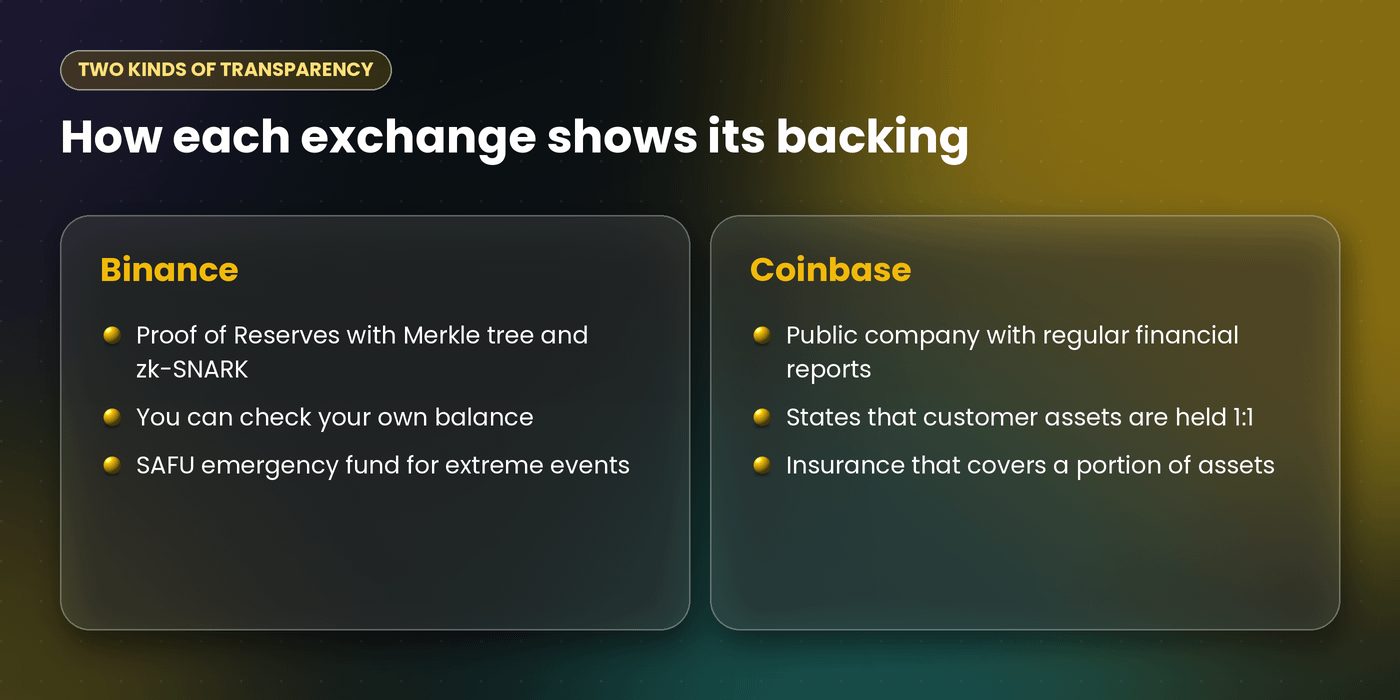
Binance commits to holding user assets at least 1:1 and publishes Proof of Reserves built with a Merkle tree and zk-SNARKs. Each user can find a Record ID and Merkle leaf in their own account and confirm that their covered balance was included in the snapshot. Coinbase takes a different route. It is a publicly traded company in the United States, so it publishes regular financial reports, and it states that customer assets are held 1:1. It does not offer a Merkle-tree check that an individual user can run. These are two different forms of transparency: one lets you verify your own balance, the other gives you company-level financial disclosure.
SAFU vs. Coinbase Insurance
Binance maintains SAFU, the Secure Asset Fund for Users, created in 2018 as an emergency reserve for extreme events on the platform side. Coinbase says it keeps most customer assets in cold storage and carries insurance that covers a portion of the assets it holds. Both have limits. SAFU does not cover losses from personal scams, phishing or trading decisions. Coinbase's insurance does not cover losses caused by compromised customer credentials. Neither arrangement is a guarantee against every loss.
Account Security
Both platforms support passkeys and authenticator-based 2FA, and both let you restrict withdrawals to approved addresses. On Binance, the main tools are passkeys or an authenticator app, the Anti-Phishing Code that marks genuine emails, the withdrawal whitelist, and Binance Verify for checking official channels. Practical steps that apply on either exchange:
Use a passkey or authenticator app, not SMS
Turn on address whitelisting for withdrawals
Check every message that claims to be from the exchange before you act
Review logged-in devices and API keys regularly
Security Incident Response
Prevention and response are different things. In October 2026 Binance suffered a security incident involving its hot wallets, which shows that prevention failed on that day. The response is what users can judge. Binance paused withdrawals as a precaution, announced on 12 November that all affected balances had been covered with company funds from its treasury, SAFU and its futures insurance fund, published a new reserve snapshot, and said on 26 November that the withdrawal suspension had been fully lifted. Coinbase stated that it was not affected by that incident.
How Can I Verify My Own Balance Is Backed?
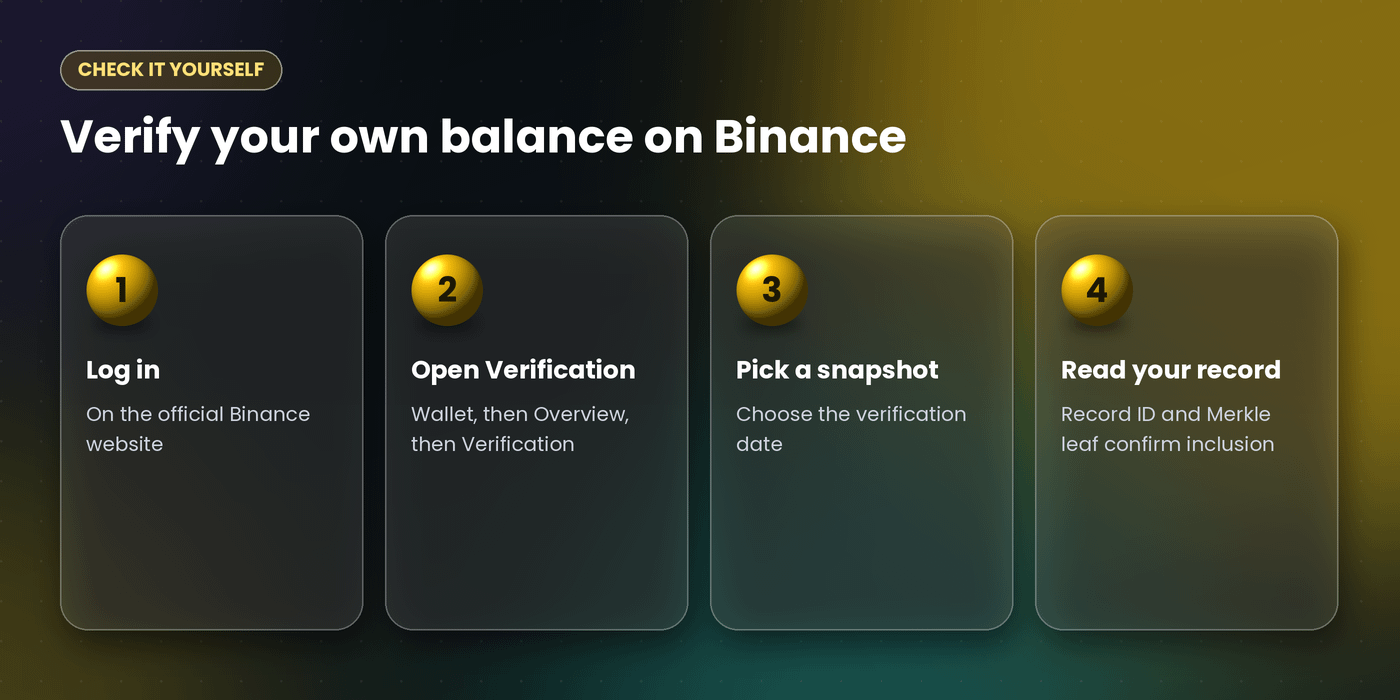
Log in on the official Binance website, open Wallet, then Overview, then Verification, and choose a snapshot date. Your Record ID and Merkle leaf show that your balance was included. The result reflects the snapshot date, not your live balance.
Conclusion
Binance stands out for its independently verifiable Proof of Reserves and its SAFU emergency fund. Coinbase offers public-company financial disclosures and its own security protections. Neither exchange can be called universally safer. Look at the protections, the limits and the regulatory arrangements that matter most for your own situation and country.
This article is for information only and is not financial advice.
Latest Binance update: Binance security incident announcement
Balance check guide: How to Verify Your Account Balance on Binance