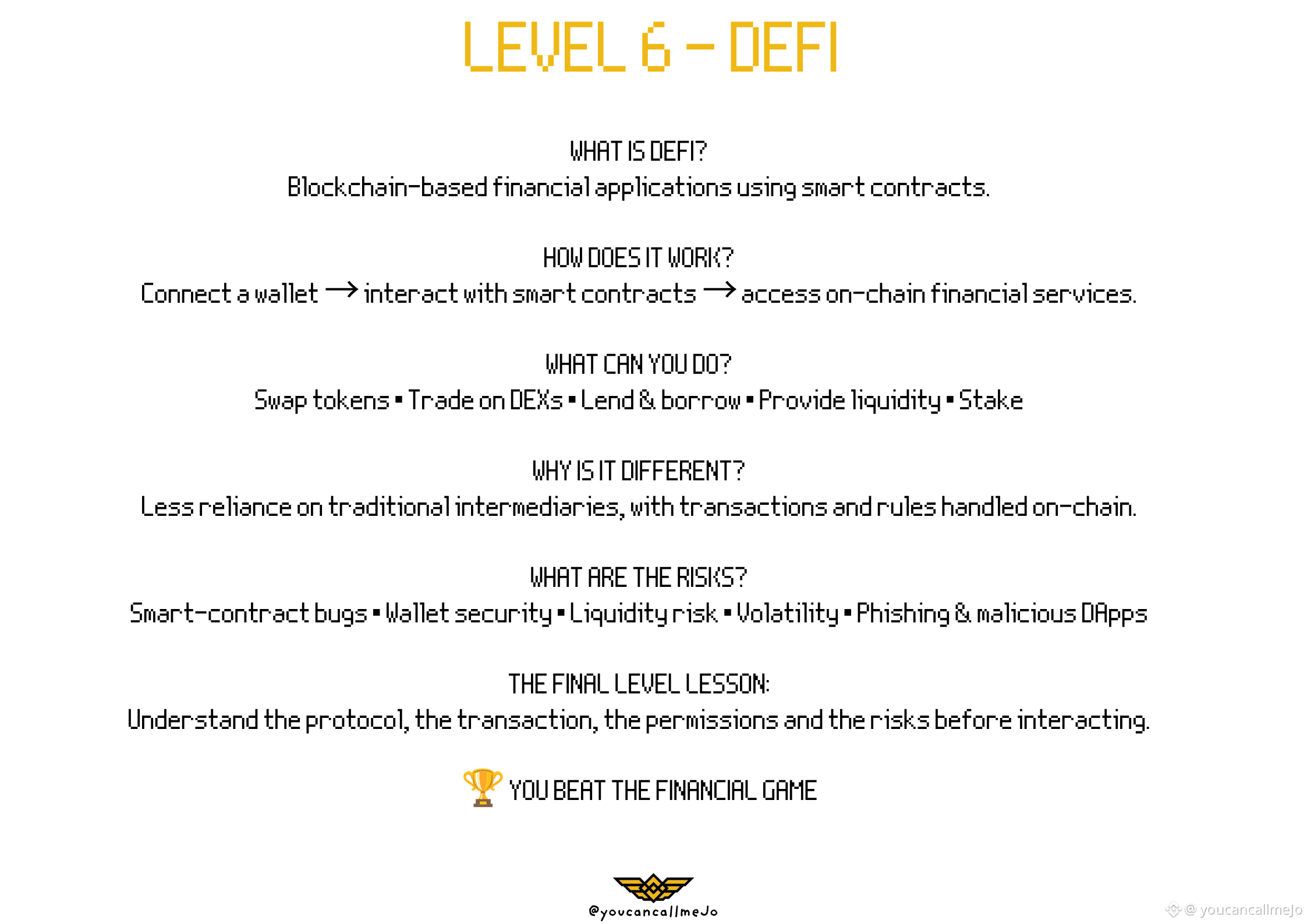
🎮 LEVEL 6 — DeFi: Enter the On-Chain Financial World
🏦 WHAT IS DeFi?
DeFi is an ecosystem of financial applications built on blockchain networks, where users can interact with financial services through wallets, smart contracts and decentralized applications (DApps) rather than relying entirely on traditional intermediaries.
Think of it as moving from: “Go through the institution.” to: “Connect your wallet to the protocol.”
🔗 HOW DOES IT WORK?
Smart contracts are programs on a blockchain that execute predefined rules. Instead of a bank employee processing a transaction manually, the smart contract can handle the agreed logic automatically once its conditions are met.
This enables services such as:
• Decentralized exchanges (DEXs)
• Lending & borrowing
• Liquidity pools
• Staking
• Token swaps
• Other on-chain financial applications
For example, on a DEX, users can connect a compatible wallet and trade through blockchain-based smart contracts rather than depositing assets with a centralized exchange.
💡 THE BIG DIFFERENCE
In traditional finance, an institution often sits between you and the financial service. In DeFi, the interaction can happen directly between your wallet and a blockchain-based protocol. But that doesn't mean every DeFi system is completely decentralized or automatically safe. Different protocols have different levels of decentralization, governance and control.
⚠️ AND HERE COMES THE RISK
DeFi changes the way financial services operate, but it also changes the risks you need to understand.
Smart-contract vulnerabilities, phishing, malicious DApps, private-key security, network fees, liquidity risks and token price volatility can all matter. And unlike a traditional financial platform, an on-chain transaction may not have an easy “undo” button. Binance specifically recommends verifying DApps and understanding permissions before approving transactions.
🏆 YOU BEAT THE FINANCIAL LEVEL.
#Binance #learnwithbinance #defi #Web3 #DEX
🏦 WHAT IS DeFi?
DeFi is an ecosystem of financial applications built on blockchain networks, where users can interact with financial services through wallets, smart contracts and decentralized applications (DApps) rather than relying entirely on traditional intermediaries.
Think of it as moving from: “Go through the institution.” to: “Connect your wallet to the protocol.”
🔗 HOW DOES IT WORK?
Smart contracts are programs on a blockchain that execute predefined rules. Instead of a bank employee processing a transaction manually, the smart contract can handle the agreed logic automatically once its conditions are met.
This enables services such as:
• Decentralized exchanges (DEXs)
• Lending & borrowing
• Liquidity pools
• Staking
• Token swaps
• Other on-chain financial applications
For example, on a DEX, users can connect a compatible wallet and trade through blockchain-based smart contracts rather than depositing assets with a centralized exchange.
💡 THE BIG DIFFERENCE
In traditional finance, an institution often sits between you and the financial service. In DeFi, the interaction can happen directly between your wallet and a blockchain-based protocol. But that doesn't mean every DeFi system is completely decentralized or automatically safe. Different protocols have different levels of decentralization, governance and control.
⚠️ AND HERE COMES THE RISK
DeFi changes the way financial services operate, but it also changes the risks you need to understand.
Smart-contract vulnerabilities, phishing, malicious DApps, private-key security, network fees, liquidity risks and token price volatility can all matter. And unlike a traditional financial platform, an on-chain transaction may not have an easy “undo” button. Binance specifically recommends verifying DApps and understanding permissions before approving transactions.
🏆 YOU BEAT THE FINANCIAL LEVEL.
#Binance #learnwithbinance #defi #Web3 #DEX