Binance Square
#shareyourthoughts

shareyourthoughts

閲覧回数 25,854
102人が討論中
Mirza_X_Mustafa
·
--
今日、GRVTのフィル・ストリームを、より広いオーダー状態ストリームとは別に理解するために少し時間を取りました。というのも、フィルには、オーダー状態だけでは十分に表せない情報が含まれているからです。 オーダー状態の更新は、たとえば「オーダーが部分的に執行された」ということを教えてくれます。一方、フィル・イベントは、実際の執行そのもの(価格・数量)について、そしておそらくその特定のフィルに対して課金された手数料について、具体的に伝えます。 これらは関連していますが別個の情報です。オーダー状態はオーダー全体のステータスの話で、フィル・イベントは、そのステータスに寄与する各個別の執行(実行)についての話です。 なぜGRVTは、フィルの詳細をオーダー状態の更新に折り込むのではなく、これらを別々のストリームとして公開しているのでしょうか。 私の推測では、単一のオーダーは時間の経過とともに複数のフィルを生成し得ます。部分的に、複数の別々のマッチにまたがって執行されるため、それぞれのフィルを独立した離散的なイベントとして扱うことで、クライアントは、オーダー状態スナップショットの連なりだけから履歴を推測する必要なしに、執行履歴(平均フィル価格、手数料の累積など)を正確に再構築できるようになるのだと思います。 精密な会計処理やパフォーマンス分析をしている人にとっては、フィル・ストリームが実際の真実(source of truth)である可能性が高いです。オーダー状態は「今どのような状態か」を教え、フィルは「そこにどうやって到達したか」を正確に示します。 ただし、複雑なオーダータイプの場合に、単一のフィル・イベントが複数のオーダーにまたがり得るのか、それともフィルは常にGRVT上の単一の発生元オーダーに対して一対一で対応するのか、まだ確認しながら作業中です。 $EVAA $LAB $ALLO #ShareYourThoughts @grvt_io #grvt
今日、GRVTのフィル・ストリームを、より広いオーダー状態ストリームとは別に理解するために少し時間を取りました。というのも、フィルには、オーダー状態だけでは十分に表せない情報が含まれているからです。

オーダー状態の更新は、たとえば「オーダーが部分的に執行された」ということを教えてくれます。一方、フィル・イベントは、実際の執行そのもの(価格・数量)について、そしておそらくその特定のフィルに対して課金された手数料について、具体的に伝えます。

これらは関連していますが別個の情報です。オーダー状態はオーダー全体のステータスの話で、フィル・イベントは、そのステータスに寄与する各個別の執行(実行)についての話です。

なぜGRVTは、フィルの詳細をオーダー状態の更新に折り込むのではなく、これらを別々のストリームとして公開しているのでしょうか。

私の推測では、単一のオーダーは時間の経過とともに複数のフィルを生成し得ます。部分的に、複数の別々のマッチにまたがって執行されるため、それぞれのフィルを独立した離散的なイベントとして扱うことで、クライアントは、オーダー状態スナップショットの連なりだけから履歴を推測する必要なしに、執行履歴(平均フィル価格、手数料の累積など)を正確に再構築できるようになるのだと思います。

精密な会計処理やパフォーマンス分析をしている人にとっては、フィル・ストリームが実際の真実(source of truth)である可能性が高いです。オーダー状態は「今どのような状態か」を教え、フィルは「そこにどうやって到達したか」を正確に示します。

ただし、複雑なオーダータイプの場合に、単一のフィル・イベントが複数のオーダーにまたがり得るのか、それともフィルは常にGRVT上の単一の発生元オーダーに対して一対一で対応するのか、まだ確認しながら作業中です。

$EVAA $LAB $ALLO
#ShareYourThoughts
@grvt_io #grvt
Fills Ledger Orders Risk
40%
Unified single stream
20%
Fills only Atomic
40%
I pray my DB matches
0%
15 投票 • 投票は終了しました
翻訳参照
Mapped the three core entities from the Q3 2025 report against what exists in current documentation because the original framing used slightly different language and its worth confirming the structure held constant across the terminology evolution. Original framing, three cooperating roles that mirror traditional real world control systems Applications define policies and request evaluations for specific actions. Operators decentralized validators who evaluate policies by verifying whether proposed intents comply with stated rules. Data Providers sourced by developers to supply onchain and offchain inputs required for policy evaluation such as identity attestations risk scores or regulatory lists. Current documentation describes essentially the same three roles with more architectural detail layered on Applications register as Policy Clients and submit transaction intents. Data Providers integrate through WASM plugins with resource limits and ECDSA Attested outputs. The core threerole structure is identical. What's been added since Q3 2025 is implementation specificity the original framing described what each role does functionally current documentation adds exactly I actually think mapping the two versions side by side confirms something useful the fundamental architecture three cooperating roles creating a continuous authorization loop of define evaluate enforce record was set early and has remained structurally stable while the technical implementation details filled in around it. Thats a sign of architectural conviction rather than repeated redesign. The question is whether any of the three roles gained or lost responsibilities between the original framing and now, beyond the added technical specificity whether for example Data Providers originally had a narrower scope that expanded to include the oracle chaining and zkTLS capabilities documented later. $EVAA $LAB #Shareyourthoughts @NewtonProtocol $NEWT #Newt Which role evolved the most since Q3 2025?
Mapped the three core entities from the Q3 2025 report against what exists in current documentation because the original framing used slightly different language and its worth confirming the structure held constant across the terminology evolution.

Original framing, three cooperating roles that mirror traditional real world control systems Applications define policies and request evaluations for specific actions.

Operators decentralized validators who evaluate policies by verifying whether proposed intents comply with stated rules. Data Providers sourced by developers to supply onchain and offchain inputs required for policy evaluation such as identity attestations risk scores or regulatory lists.

Current documentation describes essentially the same three roles with more architectural detail layered on Applications register as Policy Clients and submit transaction intents.

Data Providers integrate through WASM plugins with resource limits and ECDSA Attested outputs.

The core threerole structure is identical. What's been added since Q3 2025 is implementation specificity the original framing described what each role does functionally current documentation adds exactly

I actually think mapping the two versions side by side confirms something useful the fundamental architecture three cooperating roles creating a continuous authorization loop of define evaluate enforce record was set early and has remained structurally stable while the technical implementation details filled in around it.

Thats a sign of architectural conviction rather than repeated redesign.

The question is whether any of the three roles gained or lost responsibilities between the original framing and now, beyond the added technical specificity whether for example Data Providers originally had a narrower scope that expanded to include the oracle chaining and zkTLS capabilities documented later.
$EVAA $LAB
#Shareyourthoughts
@NewtonProtocol $NEWT #Newt
Which role evolved the most since Q3 2025?
Applications
34%
Operators
0%
Data Providers
33%
None mainly implementation
33%
3 投票 • 投票は終了しました
記事
翻訳参照
Operator network degradation failure thresholdsBeen turning over the 0perator network reliability question this week because the whitepaper covers what Newton does well under normal conditions but is less specific about what applications should expect when condiTions are not normal. The architecture has real fault toLerance built in. The Gateway handles operator routing caching and request deduplication. Force inclusion mechanisms allow applications to submit tasks directly to the operator network bypassing the Gateway entirely if censorship is Detected. The two phase conseNsus design means a single slow operator does not stall the whole evaluation the Aggregator exits as soon as enough stake has signEd. These are genuine resilience properties. What the whitepaper Does not specify is the failure threshold. How many operators need to go offline before Newtons consensus mechanism can no longer meet quorum? What does an applicaTion experience when quorum can't be reached does the task queue timeout with an error or block indefinitely? Whats the expected recovery time if a significant portion of the operator set experiences coorDinated downtime? These questions matter differenTly depending on the application. A DeFi protocol requiring Newton attestation for every transfer has zero tolerance for sustained outages if attestations stop being produced transFers stop executing. A lower frequency use case like gated access to a tokenized fund might tolerate minutes of degradation without meaningful harm. The whitepaper does not appear to distinguish these cases or provide different availability expectations for diffeRent use case categories. The force inclusion mechaNism addresses censorship a specific case where the Gateway is dishonestly refusing to route tasks. It does not clearLy address the scenario where operators themselves are offline degraded or simply failing to reach consensus within normal laTency windows. I actually think this Gap matters more right now at mainnet beta stage than it will later. Early adopter protocols are taking on network reliability risk that is not fully documented. Understtanding what the failure modes look like and what applications are expected to do when they occur seems like essential information for any team deploying Newton in a proDuction context. #newt #Newt #ShareYourThoughts What I still have not worKed out is whether the operator sets geographic distribution requirement is specifically designed to reduce correLated failure risk or whether its primarily about censorship resistance and whether those two goals require different operator set composiitions. @NewtonProtocol $NEWT #Newt $LAB $VANRY

Operator network degradation failure thresholds

Been turning over the 0perator network reliability question this week because the whitepaper covers what Newton does well under normal conditions but is less specific about what applications should expect when condiTions are not normal.
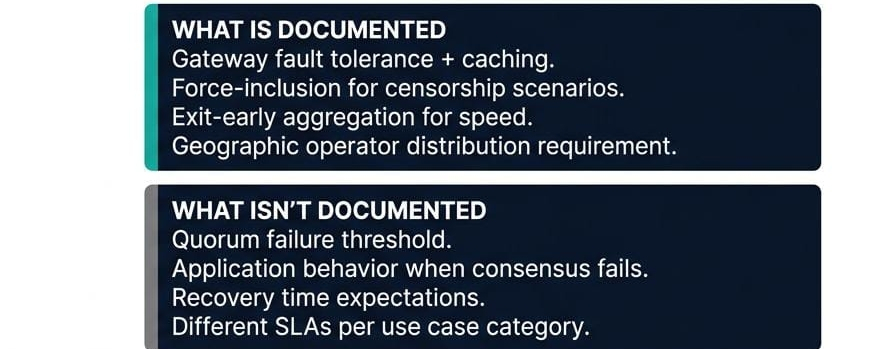
The architecture has real fault toLerance built in. The Gateway handles operator routing caching and request deduplication. Force inclusion mechanisms allow applications to submit tasks directly to the operator network bypassing the Gateway entirely if censorship is Detected.
The two phase conseNsus design means a single slow operator does not stall the whole evaluation the Aggregator exits as soon as enough stake has signEd. These are genuine resilience properties.
What the whitepaper Does not specify is the failure threshold. How many operators need to go offline before Newtons consensus mechanism can no longer meet quorum? What does an applicaTion experience when quorum can't be reached does the task queue timeout with an error or block indefinitely? Whats the expected recovery time if a significant portion of the operator set experiences coorDinated downtime?
These questions matter differenTly depending on the application. A DeFi protocol requiring Newton attestation for every transfer has zero tolerance for sustained outages if attestations stop being produced transFers stop executing. A lower frequency use case like gated access to a tokenized fund might tolerate minutes of degradation without meaningful harm. The whitepaper does not appear to distinguish these cases or provide different availability expectations for diffeRent use case categories.
The force inclusion mechaNism addresses censorship a specific case where the Gateway is dishonestly refusing to route tasks. It does not clearLy address the scenario where operators themselves are offline degraded or simply failing to reach consensus within normal laTency windows.
I actually think this Gap matters more right now at mainnet beta stage than it will later. Early adopter protocols are taking on network reliability risk that is not fully documented. Understtanding what the failure modes look like and what applications are expected to do when they occur seems like essential information for any team deploying Newton in a proDuction context.
#newt #Newt #ShareYourThoughts
What I still have not worKed out is whether the operator sets geographic distribution requirement is specifically designed to reduce correLated failure risk or whether its primarily about censorship resistance and whether those two goals require different operator set composiitions.
@NewtonProtocol $NEWT #Newt $LAB $VANRY
記事
翻訳参照
Three Pillars maturity gap analysisPulled Newton's three pillars apart this week Verifiable Credentials Programmable Policies CrossChain Interoperability to understand which is most developed which has the most gaps and which creates the most dependency risk for applications building on Newton now. The three pillars aren't at the same maturity level and treating them as equivalent understas the risk profile of early adoption. Programmable Policies is the most mature pillar. Rego OPA is an established enterprise policy language with extensive tooling years of production use in Kubernetes admission control and API authorization. The Newton Rego extensions add new capabilities on a stable base. Policy evaluation via sandboxed WASM data providers IPFS content addressed storage and BLS attested evaluation is technically well specified. The policy engine is the clearest most complete part of Newton's design. Cross Chain Interoperability is mature in specification but dependent on external standards. The source chain/destination chain model BLS Signed Merkle root synchronization and ELIP 008 compliance are clearly defined. The dependency risk this pillar inherits both EigenLayers and destination chains evolution paths. Newtons cross-chain properties are only as stable as the specifications they depend on. Verifiable Credentials is the least mature pillar in practice. The W3C standard is solid. The Newton Identity Oracle design is well Specified. But the issuer ecosystem doesnt yet exist at scale who actually issues KYC credentials, financial credentials and onchain behavior credentials in Newton Compatible format at production volumes for real users? Credential portability is only valuable when credentials are actually issued and accepted across multiple applications. That ecosystem is being built not used. I actually think the maturity gap in the credential issuer ecosystem is the most significant practical constraint on Newtons near term adoption more than any technical limitation. The policy engine is ready. The credentials it needs to evaluate arent widely available yet. What I havenot worked out is who bears the cost of building the issuer ecosystem whether thats Newtons core team institutional partners or a third party ecosystem that needs incentivizing before network effects become real. #new #NEWT #Shareyourthoughts $LAB $HMSTR @NewtonProtocol $NEWT #Newt

Three Pillars maturity gap analysis

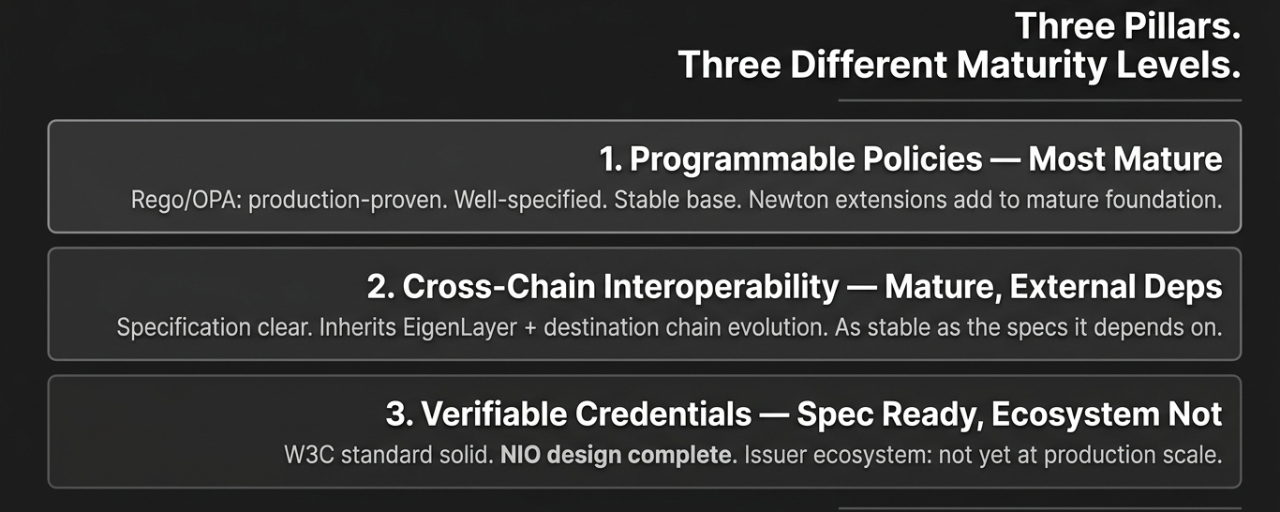
Pulled Newton's three pillars apart this week Verifiable Credentials Programmable Policies CrossChain Interoperability to understand which is most developed which has the most gaps and which creates the most dependency risk for applications building on Newton now.
The three pillars aren't at the same maturity level and treating them as equivalent understas the risk profile of early adoption.
Programmable Policies is the most mature pillar. Rego OPA is an established enterprise policy language with extensive tooling years of production use in Kubernetes admission control and API authorization. The Newton Rego extensions add new capabilities on a stable base. Policy evaluation via sandboxed WASM data providers IPFS content addressed storage and BLS attested evaluation is technically well specified. The policy engine is the clearest most complete part of Newton's design.
Cross Chain Interoperability is mature in specification but dependent on external standards. The source chain/destination chain model BLS Signed Merkle root synchronization and ELIP 008 compliance are clearly defined. The dependency risk this pillar inherits both EigenLayers and destination chains evolution paths. Newtons cross-chain properties are only as stable as the specifications they depend on.
Verifiable Credentials is the least mature pillar in practice. The W3C standard is solid. The Newton Identity Oracle design is well Specified. But the issuer ecosystem doesnt yet exist at scale who actually issues KYC credentials, financial credentials and onchain behavior credentials in Newton Compatible format at production volumes for real users? Credential portability is only valuable when credentials are actually issued and accepted across multiple applications. That ecosystem is being built not used.
I actually think the maturity gap in the credential issuer ecosystem is the most significant practical constraint on Newtons near term adoption more than any technical limitation. The policy engine is ready. The credentials it needs to evaluate arent widely available yet.
What I havenot worked out is who bears the cost of building the issuer ecosystem whether thats Newtons core team institutional partners or a third party ecosystem that needs incentivizing before network effects become real.
#new #NEWT #Shareyourthoughts $LAB $HMSTR
@NewtonProtocol $NEWT #Newt
記事
翻訳参照
Newtons credible neutrality claim is worth examining from a specific angle neutral for whom andThe whitepaper frames Newton as neutral infrastructure a bridge between entities that need different things from the same financial system. A regulated bank needs auditability. A DeFi protocol needs permissionless access. A user needs privacy. A regulator needs oversight. Newton doesnt ask these parties to choose the same approach. Worth asking which of these parties benefits most from this framing and which least. Regulated institutions banks asset managers payment providers benefit most directly. They need compliance infrastructure to participate in onchain finance at all. Newton gives them verifiable policy enforcement with an audit trail that satisfies regulatory requirements. The compliance receipts are cryptographically superior to what they have now. The economic case is clear. #newt Anonymous DeFi users benefit less. Newton doesnt require anyone to use it protocols choose to integrate it or not. But as Newton adoption grows among institutional DeFi protocols the pools with deepest liquidity will increasingly require Newton attestations. Anonymous users without verifiable credentials will find themselves progressively excluded from the most liquid venues not by Newton directly, but by the policy choices of protocols that use it. Newton doesn't discriminate. The policies it enforces do. #NEWT AI agents benefit in principle Newtons programmatic authorization is designed for machine-speed transactions. But the credential model depends on AI agents having verifiable identities compliance histories and authorization chains that don't naturally exist for autonomous systems today. The infrastructure is ready before the identity layer for agents is. Not saying any of this is wrong. Infrastructure that primarily serves regulated institutions is still useful infrastructure. But the neutral bridge between different requirements framing somewhat obscures that the parties who benefit most are the ones with the most conventional compliance needs. I actually think framing this as neutral for all parties does Newton a disservice the institutional compliance use case is compelling enough on its own terms without needing to claim it serves anonymous DeFi users equally. What I haven't worked out is whether Newton's growth depends on anonymous DeFi users participating, or whether institutional adoption is sufficient and whether those two growth paths require fundamentally different design choices. #ShareYourThoughts $HMSTR $VELVET @NewtonProtocol $NEWT #Newt

Newtons credible neutrality claim is worth examining from a specific angle neutral for whom and

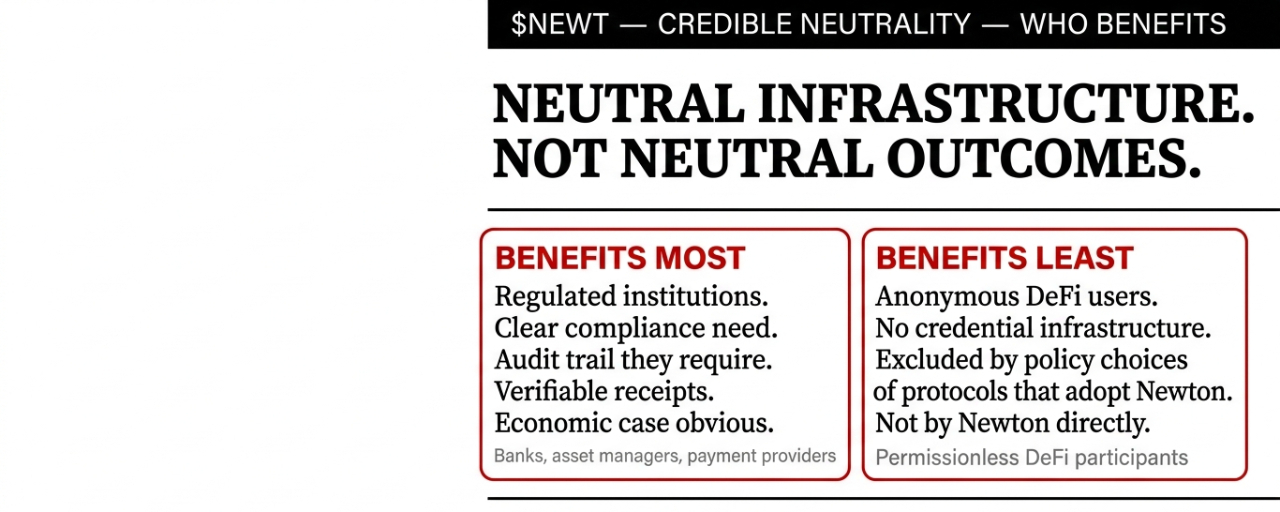
The whitepaper frames Newton as neutral infrastructure a bridge between entities that need different things from the same financial system. A regulated bank needs auditability. A DeFi protocol needs permissionless access. A user needs privacy. A regulator needs oversight. Newton doesnt ask these parties to choose the same approach.
Worth asking which of these parties benefits most from this framing and which least.
Regulated institutions banks asset managers payment providers benefit most directly. They need compliance infrastructure to participate in onchain finance at all. Newton gives them verifiable policy enforcement with an audit trail that satisfies regulatory requirements. The compliance receipts are cryptographically superior to what they have now. The economic case is clear.
#newt
Anonymous DeFi users benefit less. Newton doesnt require anyone to use it protocols choose to integrate it or not. But as Newton adoption grows among institutional DeFi protocols the pools with deepest liquidity will increasingly require Newton attestations. Anonymous users without verifiable credentials will find themselves progressively excluded from the most liquid venues not by Newton directly, but by the policy choices of protocols that use it. Newton doesn't discriminate. The policies it enforces do.
#NEWT
AI agents benefit in principle Newtons programmatic authorization is designed for machine-speed transactions. But the credential model depends on AI agents having verifiable identities compliance histories and authorization chains that don't naturally exist for autonomous systems today. The infrastructure is ready before the identity layer for agents is.
Not saying any of this is wrong. Infrastructure that primarily serves regulated institutions is still useful infrastructure. But the neutral bridge between different requirements framing somewhat obscures that the parties who benefit most are the ones with the most conventional compliance needs.
I actually think framing this as neutral for all parties does Newton a disservice the institutional compliance use case is compelling enough on its own terms without needing to claim it serves anonymous DeFi users equally.
What I haven't worked out is whether Newton's growth depends on anonymous DeFi users participating, or whether institutional adoption is sufficient and whether those two growth paths require fundamentally different design choices.
#ShareYourThoughts $HMSTR $VELVET
@NewtonProtocol $NEWT #Newt
やあみんな 🤫 $SENTIS コインを少し持っているよ。$SENTIS は先月の最後の 2 か月で急騰したのを見て、深く観察していたんだ.. $SENTIS は 1 ドルから 2 ドルまで上がると思う... このコインについてどう思う... #Shareyourthoughts 他の人たちと 🤝
やあみんな 🤫 $SENTIS コインを少し持っているよ。$SENTIS は先月の最後の 2 か月で急騰したのを見て、深く観察していたんだ..
$SENTIS は 1 ドルから 2 ドルまで上がると思う... このコインについてどう思う... #Shareyourthoughts 他の人たちと 🤝
·
--
ブリッシュ
みなさんこんにちは、もしクリプトでお金を稼ぐ方法を共有したいなら、それはみんなにとって良いトピックになるでしょう #Shareyourthoughts $BTC $ETH $BNB #
·
--
ブリッシュ
🔥 現在の市場のセンチメントは慎重に強気です。 ビットコインが強く保持され、機関投資家が積極的に買い増している状況は、市場が無視できるものではありません。 どのディップも以前より早く買われており、これは通常、裏での自信を示しています。 もしこのモメンタムが続けば、このサイクルは多くの人を驚かせるかもしれません。🚀📊 それでも、ボラティリティはクリプト界の王です — 一つのヘッドラインが一晩で全てを変えることがあります。 スマートマネーはリスクを管理しながら、チャンスに備えています。 {future}(BTCUSDT) {future}(ETHUSDT) {future}(BNBUSDT) $BTC $ETH $BNB #shareyourthoughts #bitcoin #Bullish #crypto #BinanceSquareFamily
🔥 現在の市場のセンチメントは慎重に強気です。

ビットコインが強く保持され、機関投資家が積極的に買い増している状況は、市場が無視できるものではありません。

どのディップも以前より早く買われており、これは通常、裏での自信を示しています。

もしこのモメンタムが続けば、このサイクルは多くの人を驚かせるかもしれません。🚀📊

それでも、ボラティリティはクリプト界の王です — 一つのヘッドラインが一晩で全てを変えることがあります。

スマートマネーはリスクを管理しながら、チャンスに備えています。


$BTC $ETH $BNB

#shareyourthoughts
#bitcoin
#Bullish
#crypto
#BinanceSquareFamily
·
--
ブリッシュ
#Shareyourthoughts 意見は重要だ。 $BR についての予測をシェアしよう... 私は上昇すると予想している、そして見てください、皆さん。 @Bedrock
#Shareyourthoughts

意見は重要だ。

$BR についての予測をシェアしよう... 私は上昇すると予想している、そして見てください、皆さん。

@Bedrock
Mstar201
·
--
ブリッシュ
#bedrock $BR ( インサイト ) 💭👑

@Bedrock 💰👑

ベッドロック ($BR ) は、マルチアセット流動化再ステーキングプロトコルを提供するブロックチェーンプロジェクトで、ユーザーが流動性を保持しながら、イーサリアム、$BTC ビットコイン、そしてDePIN報酬で強化された利回りを得ることを可能にします。

@Binance Earn Official @Binance Square Official

素晴らしい機会が待っています 💰🍾🏆

#writetoearn #BedRockProtocol を成長させるためにベストを尽くしてください
ログインして、さらにコンテンツを読む
厳選トピックで世界の暗号資産トレーダーの仲間入り
⚡️ 暗号資産に関する最新かつ有益な情報が見つかります。
💬 世界最大の暗号資産取引所から信頼されています。
👍 認証を受けたクリエイターから、有益なインサイトを得られます。
メール / 電話番号