

LegendGroot
180 Posting

LegendGroot
Laporkan
Blokir Pengguna
Chart Mastery | Web3 Edge | Precision Entries 📍 Spotting opportunity while others sleep. DYOR x.com/LegendGroot1
30 Mengikuti
26 Pengikut
46 Disukai
Posting
Semua
Live
PINNED
·
--
Bullish
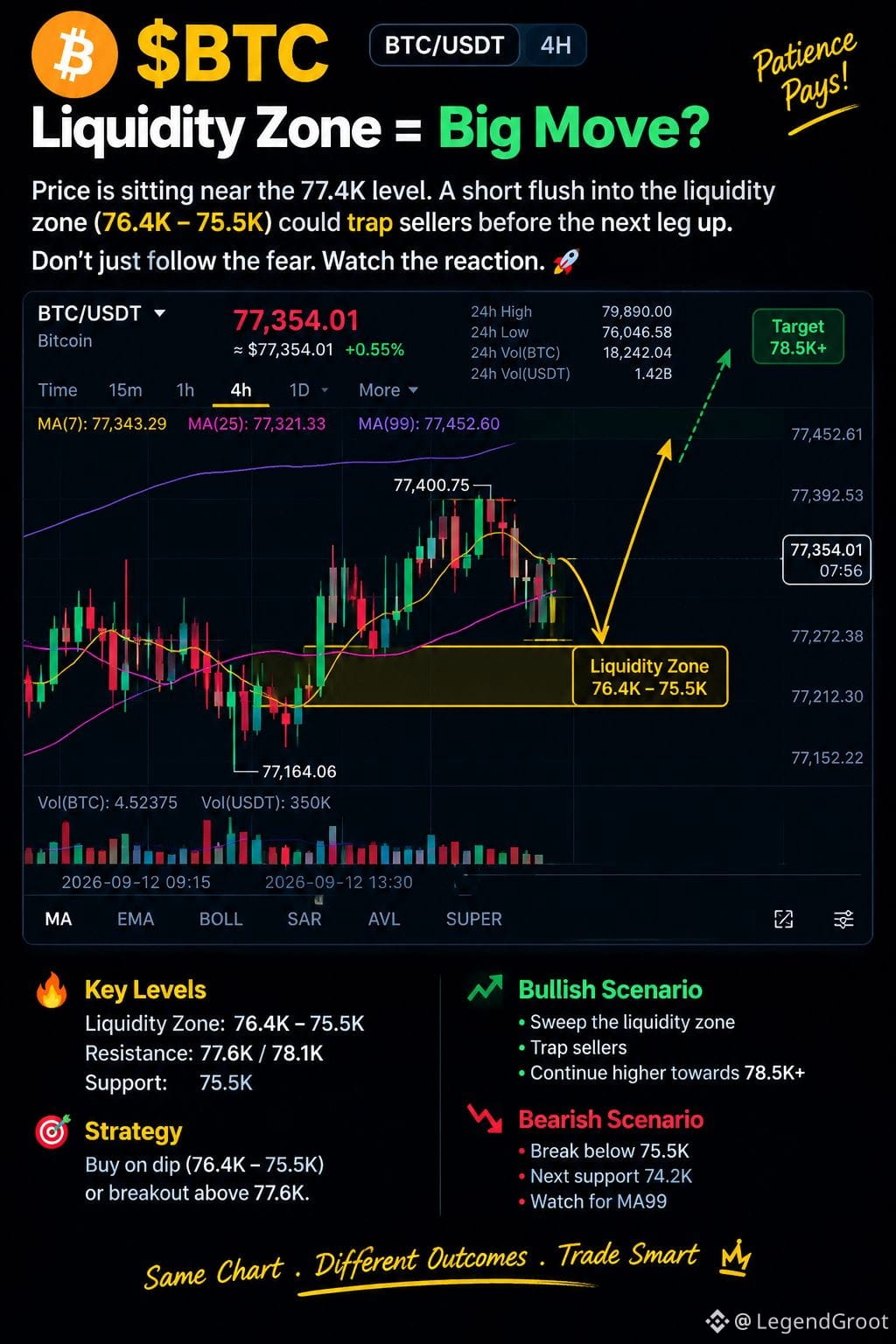
🔥 $BTC — Ketakutan Sudah Diperhitungkan?
Bitcoin bertahan di sekitar $77,3K setelah memantul dari area $77,16K.
MA7 dan MA25 berada dekat dengan harga, sementara $77,45K menjadi resistance kunci yang perlu diperhatikan.
Jika BTC berhasil merebut kembali $77,6K, momentum bisa meningkat menuju $78K+. 👀
Tapi jika support jebol, bisa jadi flush yang lebih dalam terjadi lebih dulu.
Semua orang menunggu headline.
Uang pintar memperhatikan reaksinya. 🚀
#BTC #Bitcoin #Crypto
🔥 $BTC — Ketakutan Sudah Diperhitungkan?
Bitcoin bertahan di sekitar $77,3K setelah memantul dari area $77,16K.
MA7 dan MA25 berada dekat dengan harga, sementara $77,45K menjadi resistance kunci yang perlu diperhatikan.
Jika BTC berhasil merebut kembali $77,6K, momentum bisa meningkat menuju $78K+. 👀
Tapi jika support jebol, bisa jadi flush yang lebih dalam terjadi lebih dulu.
Semua orang menunggu headline.
Uang pintar memperhatikan reaksinya. 🚀
#BTC #Bitcoin #Crypto
Bitcoin bertahan di sekitar $77,3K setelah memantul dari area $77,16K.
MA7 dan MA25 berada dekat dengan harga, sementara $77,45K menjadi resistance kunci yang perlu diperhatikan.
Jika BTC berhasil merebut kembali $77,6K, momentum bisa meningkat menuju $78K+. 👀
Tapi jika support jebol, bisa jadi flush yang lebih dalam terjadi lebih dulu.
Semua orang menunggu headline.
Uang pintar memperhatikan reaksinya. 🚀
#BTC #Bitcoin #Crypto
3
1
6
3.3k
·
--
Bullish
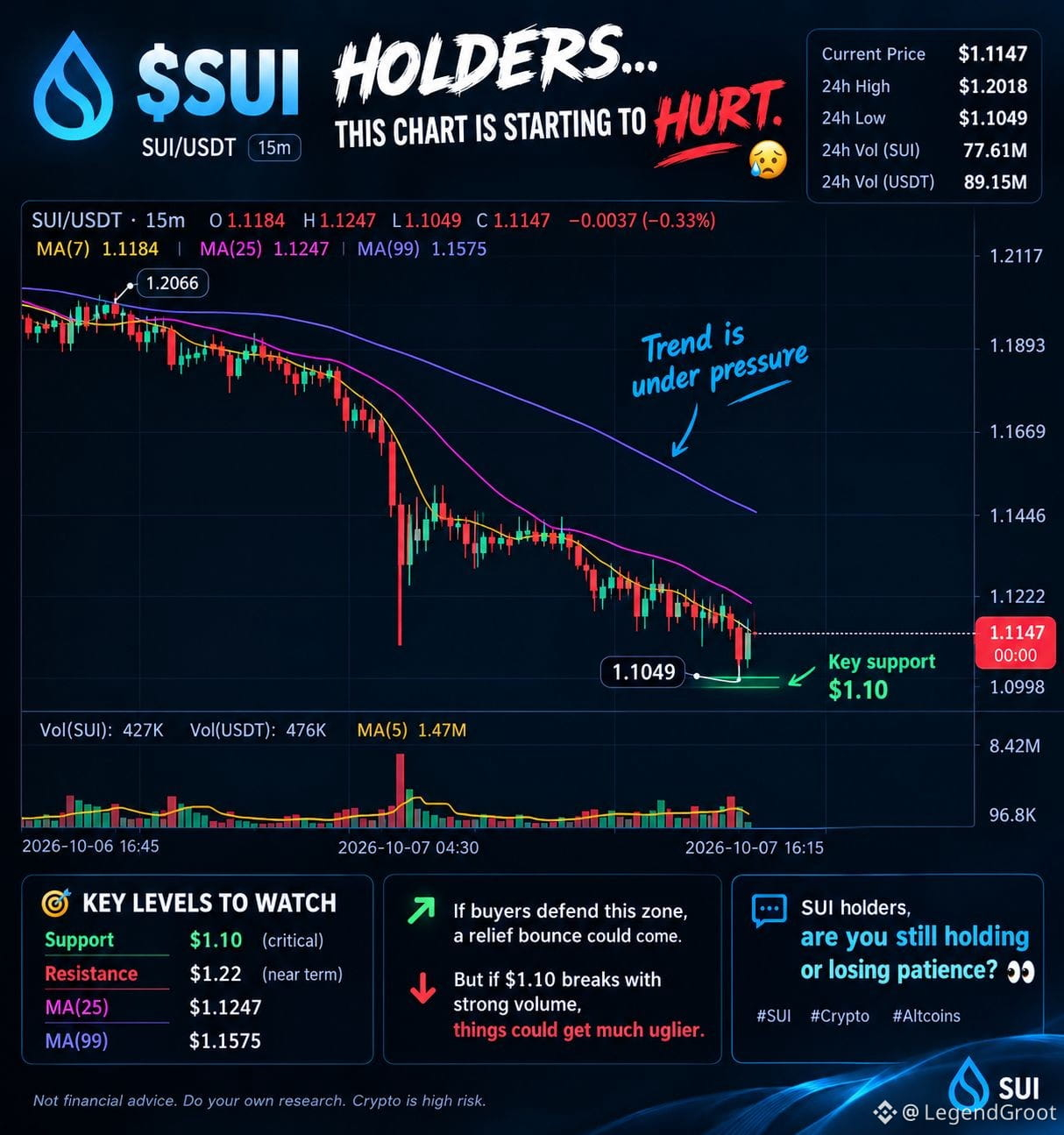
Para pemegang $SUI … grafik ini mulai bikin sakit hati. 😥
SUI turun lebih dari 6% hari ini, diperdagangkan di sekitar $1.11 setelah aksi jual tajam lainnya.
Trennya jelas sedang tertekan, dan $1.10 kini menjadi level yang saya pantau ketat.
Jika pembeli mempertahankan zona ini, pantulan pemulihan bisa terjadi.
Namun, jika $1.10 ditembus dengan volume besar, situasinya bisa jauh lebih buruk.
Para pemegang SUI, kalian masih bertahan atau mulai kehilangan kesabaran? 👀
#SUI #Crypto #Altcoins
{spot}(SUIUSDT)
Para pemegang $SUI … grafik ini mulai bikin sakit hati. 😥
SUI turun lebih dari 6% hari ini, diperdagangkan di sekitar $1.11 setelah aksi jual tajam lainnya.
Trennya jelas sedang tertekan, dan $1.10 kini menjadi level yang saya pantau ketat.
Jika pembeli mempertahankan zona ini, pantulan pemulihan bisa terjadi.
Namun, jika $1.10 ditembus dengan volume besar, situasinya bisa jauh lebih buruk.
Para pemegang SUI, kalian masih bertahan atau mulai kehilangan kesabaran? 👀
#SUI #Crypto #Altcoins
SUI turun lebih dari 6% hari ini, diperdagangkan di sekitar $1.11 setelah aksi jual tajam lainnya.
Trennya jelas sedang tertekan, dan $1.10 kini menjadi level yang saya pantau ketat.
Jika pembeli mempertahankan zona ini, pantulan pemulihan bisa terjadi.
Namun, jika $1.10 ditembus dengan volume besar, situasinya bisa jauh lebih buruk.
Para pemegang SUI, kalian masih bertahan atau mulai kehilangan kesabaran? 👀
#SUI #Crypto #Altcoins
141
·
--
Bullish
🚨 BINANCE BARU SAJA TERJUN KE PERSAINGAN AI.
Namun, ini lebih besar daripada sekadar chatbot AI lainnya.
Binance Intelligence menghadirkan 3 lapisan hebat:
⚡ Agent OS → Developer membangun agen AI yang terhubung dengan trading, data & dompet.
🤖 Binance AI → Pengguna sehari-hari mendapatkan wawasan pasar, notifikasi & alat yang dipersonalisasi.
🔥 AI Pro → Trader tingkat lanjut dapat mengubah prompt sederhana menjadi strategi otomatis, mengujinya, dan berpotensi menjalankannya 24/7.
Bagian yang menarik?
AI tak lagi sekadar menjelaskan pasar.
AI mulai berinteraksi langsung dengan infrastruktur keuangan.
Kripto + AI semakin nyata. 👀
#Binance #AI #Crypto #Web3 $BTC $BNB $SOL
🚨 BINANCE BARU SAJA TERJUN KE PERSAINGAN AI.
Namun, ini lebih besar daripada sekadar chatbot AI lainnya.
Binance Intelligence menghadirkan 3 lapisan hebat:
⚡ Agent OS → Developer membangun agen AI yang terhubung dengan trading, data & dompet.
🤖 Binance AI → Pengguna sehari-hari mendapatkan wawasan pasar, notifikasi & alat yang dipersonalisasi.
🔥 AI Pro → Trader tingkat lanjut dapat mengubah prompt sederhana menjadi strategi otomatis, mengujinya, dan berpotensi menjalankannya 24/7.
Bagian yang menarik?
AI tak lagi sekadar menjelaskan pasar.
AI mulai berinteraksi langsung dengan infrastruktur keuangan.
Kripto + AI semakin nyata. 👀
#Binance #AI #Crypto #Web3 $BTC $BNB $SOL
Namun, ini lebih besar daripada sekadar chatbot AI lainnya.
Binance Intelligence menghadirkan 3 lapisan hebat:
⚡ Agent OS → Developer membangun agen AI yang terhubung dengan trading, data & dompet.
🤖 Binance AI → Pengguna sehari-hari mendapatkan wawasan pasar, notifikasi & alat yang dipersonalisasi.
🔥 AI Pro → Trader tingkat lanjut dapat mengubah prompt sederhana menjadi strategi otomatis, mengujinya, dan berpotensi menjalankannya 24/7.
Bagian yang menarik?
AI tak lagi sekadar menjelaskan pasar.
AI mulai berinteraksi langsung dengan infrastruktur keuangan.
Kripto + AI semakin nyata. 👀
#Binance #AI #Crypto #Web3 $BTC $BNB $SOL

98
·
--
Bullish
$RLC
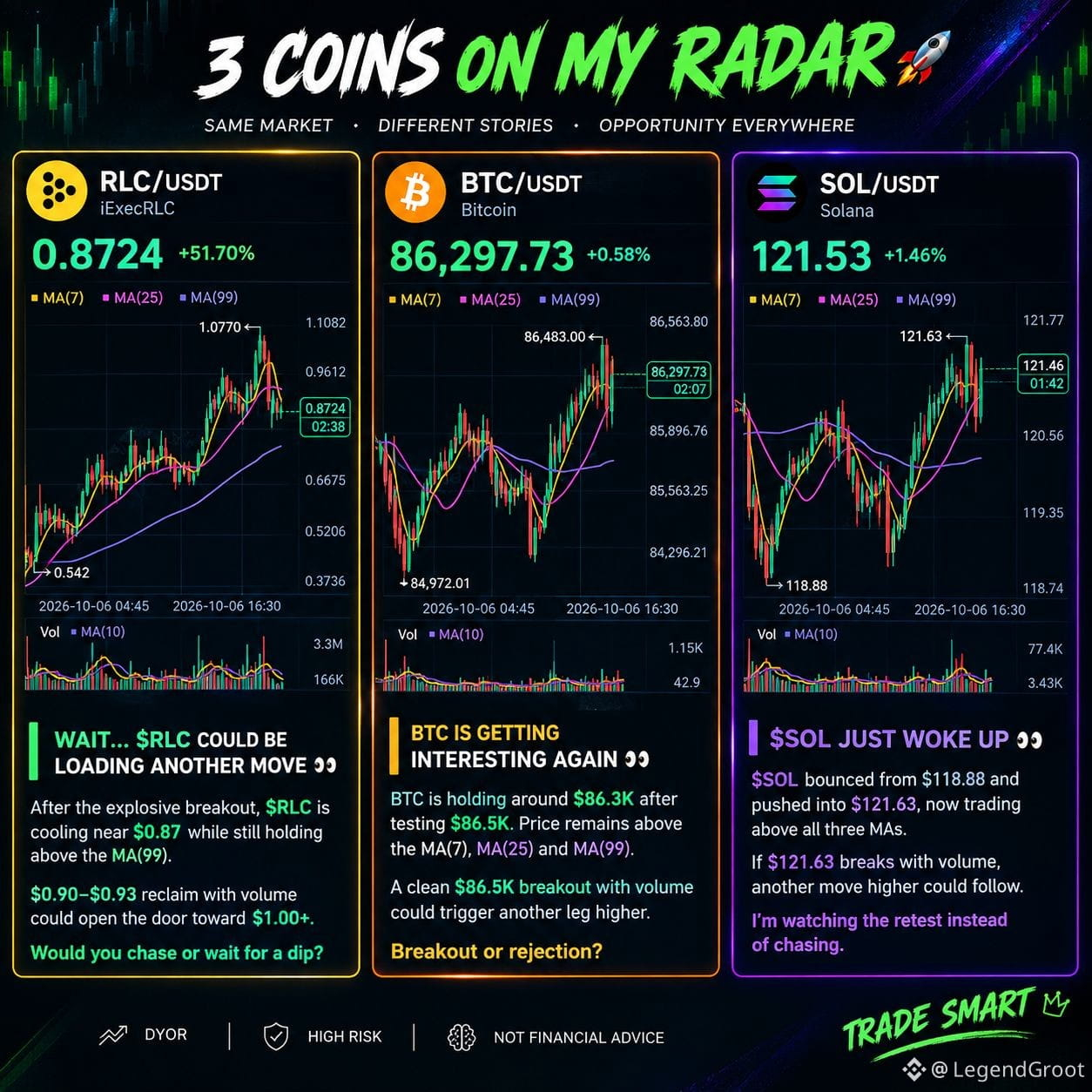
TUNGGU… RLC BISA JADI SEDANG BERSIAP UNTUK PERGERAKAN BERIKUTNYA 👀
Setelah breakout yang eksplosif, pergerakan RLC mulai mereda di dekat $0.87, tetapi masih bertahan di atas MA(99).
Jika berhasil merebut kembali level $0.90–$0.93 dengan volume, harga bisa melaju menuju $1.00+.
Kamu bakal ikut masuk sekarang atau menunggu harga turun?
$BTC
BTC MULAI MENARIK LAGI 👀
BTC bertahan di sekitar $86.3K setelah menguji $86.5K. Harga masih berada di atas MA(7), MA(25), dan MA(99).
Breakout solid di atas $86.5K dengan volume bisa memicu kenaikan berikutnya.
Breakout atau penolakan?
$SOL
SOL BARU SAJA BANGKIT 👀
SOL memantul dari $118.88 dan naik ke $121.63, kini diperdagangkan di atas ketiga MA.
Jika menembus $121.63 dengan volume, kenaikan berikutnya bisa menyusul.
Aku memantau retest, bukan mengejar harga.
Masih bullish?
Kamu juga bisa membuat postingan ini lebih ringkas lagi
Buat hook-nya lebih viral #RLC #BTC #SOL
$RLC
TUNGGU… RLC BISA JADI SEDANG BERSIAP UNTUK PERGERAKAN BERIKUTNYA 👀
Setelah breakout yang eksplosif, pergerakan RLC mulai mereda di dekat $0.87, tetapi masih bertahan di atas MA(99).
Jika berhasil merebut kembali level $0.90–$0.93 dengan volume, harga bisa melaju menuju $1.00+.
Kamu bakal ikut masuk sekarang atau menunggu harga turun?
$BTC
BTC MULAI MENARIK LAGI 👀
BTC bertahan di sekitar $86.3K setelah menguji $86.5K. Harga masih berada di atas MA(7), MA(25), dan MA(99).
Breakout solid di atas $86.5K dengan volume bisa memicu kenaikan berikutnya.
Breakout atau penolakan?
$SOL
SOL BARU SAJA BANGKIT 👀
SOL memantul dari $118.88 dan naik ke $121.63, kini diperdagangkan di atas ketiga MA.
Jika menembus $121.63 dengan volume, kenaikan berikutnya bisa menyusul.
Aku memantau retest, bukan mengejar harga.
Masih bullish?
Kamu juga bisa membuat postingan ini lebih ringkas lagi
Buat hook-nya lebih viral #RLC #BTC #SOL
TUNGGU… RLC BISA JADI SEDANG BERSIAP UNTUK PERGERAKAN BERIKUTNYA 👀
Setelah breakout yang eksplosif, pergerakan RLC mulai mereda di dekat $0.87, tetapi masih bertahan di atas MA(99).
Jika berhasil merebut kembali level $0.90–$0.93 dengan volume, harga bisa melaju menuju $1.00+.
Kamu bakal ikut masuk sekarang atau menunggu harga turun?
$BTC
BTC MULAI MENARIK LAGI 👀
BTC bertahan di sekitar $86.3K setelah menguji $86.5K. Harga masih berada di atas MA(7), MA(25), dan MA(99).
Breakout solid di atas $86.5K dengan volume bisa memicu kenaikan berikutnya.
Breakout atau penolakan?
$SOL
SOL BARU SAJA BANGKIT 👀
SOL memantul dari $118.88 dan naik ke $121.63, kini diperdagangkan di atas ketiga MA.
Jika menembus $121.63 dengan volume, kenaikan berikutnya bisa menyusul.
Aku memantau retest, bukan mengejar harga.
Masih bullish?
Kamu juga bisa membuat postingan ini lebih ringkas lagi
Buat hook-nya lebih viral #RLC #BTC #SOL
270
·
--
Bullish
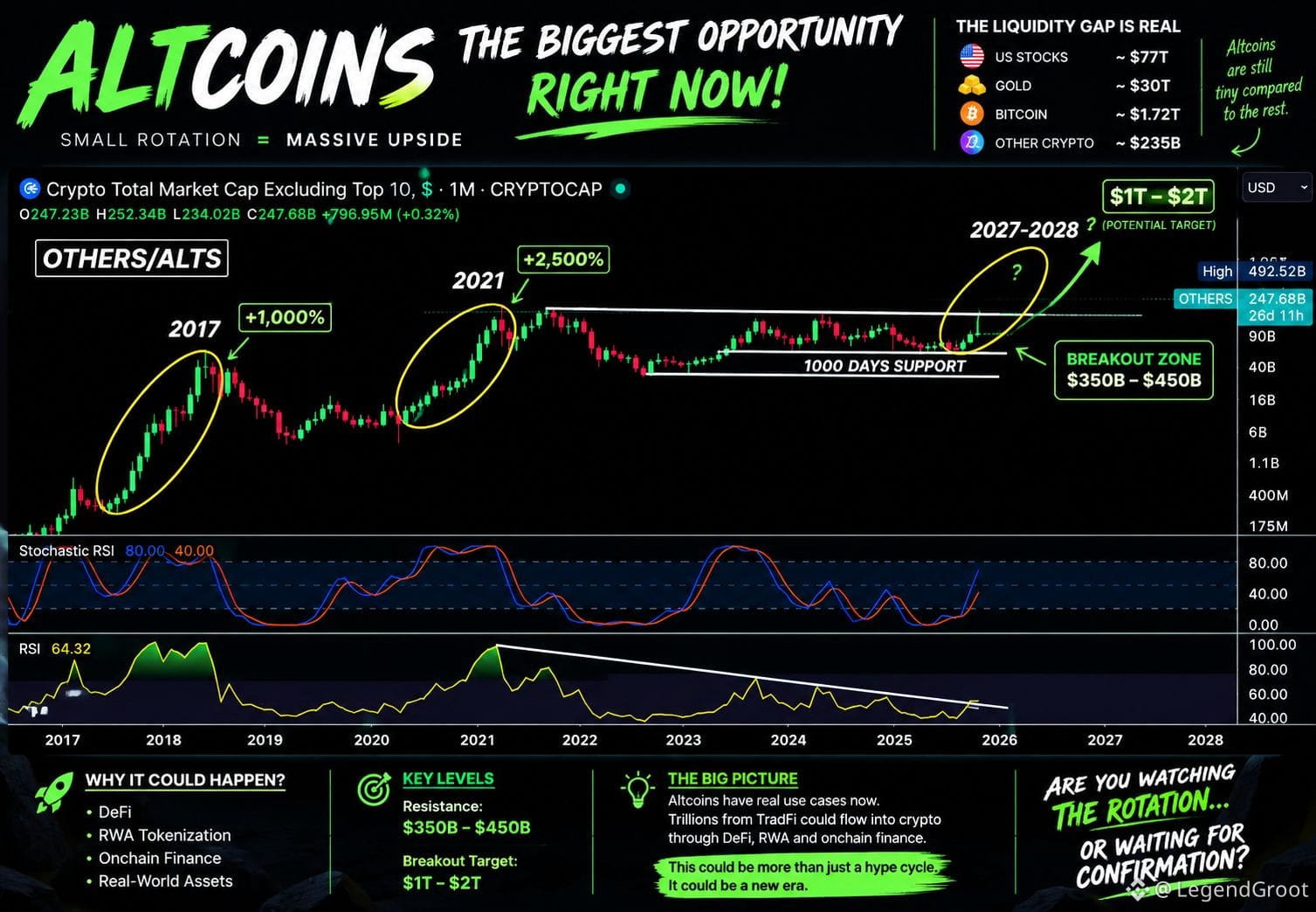
ORANG-ORANG MUNGKIN MEREMEHKAN PERGERAKAN ALTCOIN BERIKUTNYA
Banyak trader menyerah pada altcoin setelah bertahun-tahun harga bergerak menyamping dengan menyakitkan.
Justru itulah yang mungkin membuat peluang ini mulai menarik.
Lihat kesenjangan likuiditasnya:
🇺🇸 Saham: ~$77T
🥇 Emas: ~$30T
₿ Bitcoin: ~$1.72T
🪙 Kripto lainnya: ~$235B
Dibandingkan dengan modal yang berada di aset lain, nilai altcoin sangat kecil.
Tidak perlu ada perpindahan dana triliunan dolar dalam semalam.
Pergeseran likuiditas yang relatif kecil bisa mendorong sektor ini melonjak tajam.
$350B–$450B adalah zona utama yang saya pantau.
Penembusan yang meyakinkan di atas level itu bisa mengubah struktur pasar sepenuhnya dan berpotensi membuka jalan menuju $1T–$2T dalam jangka panjang.
Dan kali ini, narasinya lebih besar daripada sekadar sensasi.
DeFi.
Tokenisasi RWA.
Keuangan on-chain.
Aset dunia nyata yang berpindah ke blockchain.
Peluang altcoin terbesar mungkin muncul SEBELUM semua orang mulai membicarakannya.
Apakah kamu memantau pergeseran ini atau menunggu konfirmasi? 👀#BTC走势分析 #BTC #TradingSignals $BTC $BNB $SOL
ORANG-ORANG MUNGKIN MEREMEHKAN PERGERAKAN ALTCOIN BERIKUTNYA
Banyak trader menyerah pada altcoin setelah bertahun-tahun harga bergerak menyamping dengan menyakitkan.
Justru itulah yang mungkin membuat peluang ini mulai menarik.
Lihat kesenjangan likuiditasnya:
🇺🇸 Saham: ~$77T
🥇 Emas: ~$30T
₿ Bitcoin: ~$1.72T
🪙 Kripto lainnya: ~$235B
Dibandingkan dengan modal yang berada di aset lain, nilai altcoin sangat kecil.
Tidak perlu ada perpindahan dana triliunan dolar dalam semalam.
Pergeseran likuiditas yang relatif kecil bisa mendorong sektor ini melonjak tajam.
$350B–$450B adalah zona utama yang saya pantau.
Penembusan yang meyakinkan di atas level itu bisa mengubah struktur pasar sepenuhnya dan berpotensi membuka jalan menuju $1T–$2T dalam jangka panjang.
Dan kali ini, narasinya lebih besar daripada sekadar sensasi.
DeFi.
Tokenisasi RWA.
Keuangan on-chain.
Aset dunia nyata yang berpindah ke blockchain.
Peluang altcoin terbesar mungkin muncul SEBELUM semua orang mulai membicarakannya.
Apakah kamu memantau pergeseran ini atau menunggu konfirmasi? 👀#BTC走势分析 #BTC #TradingSignals $BTC $BNB $SOL
Banyak trader menyerah pada altcoin setelah bertahun-tahun harga bergerak menyamping dengan menyakitkan.
Justru itulah yang mungkin membuat peluang ini mulai menarik.
Lihat kesenjangan likuiditasnya:
🇺🇸 Saham: ~$77T
🥇 Emas: ~$30T
₿ Bitcoin: ~$1.72T
🪙 Kripto lainnya: ~$235B
Dibandingkan dengan modal yang berada di aset lain, nilai altcoin sangat kecil.
Tidak perlu ada perpindahan dana triliunan dolar dalam semalam.
Pergeseran likuiditas yang relatif kecil bisa mendorong sektor ini melonjak tajam.
$350B–$450B adalah zona utama yang saya pantau.
Penembusan yang meyakinkan di atas level itu bisa mengubah struktur pasar sepenuhnya dan berpotensi membuka jalan menuju $1T–$2T dalam jangka panjang.
Dan kali ini, narasinya lebih besar daripada sekadar sensasi.
DeFi.
Tokenisasi RWA.
Keuangan on-chain.
Aset dunia nyata yang berpindah ke blockchain.
Peluang altcoin terbesar mungkin muncul SEBELUM semua orang mulai membicarakannya.
Apakah kamu memantau pergeseran ini atau menunggu konfirmasi? 👀#BTC走势分析 #BTC #TradingSignals $BTC $BNB $SOL
105
·
--
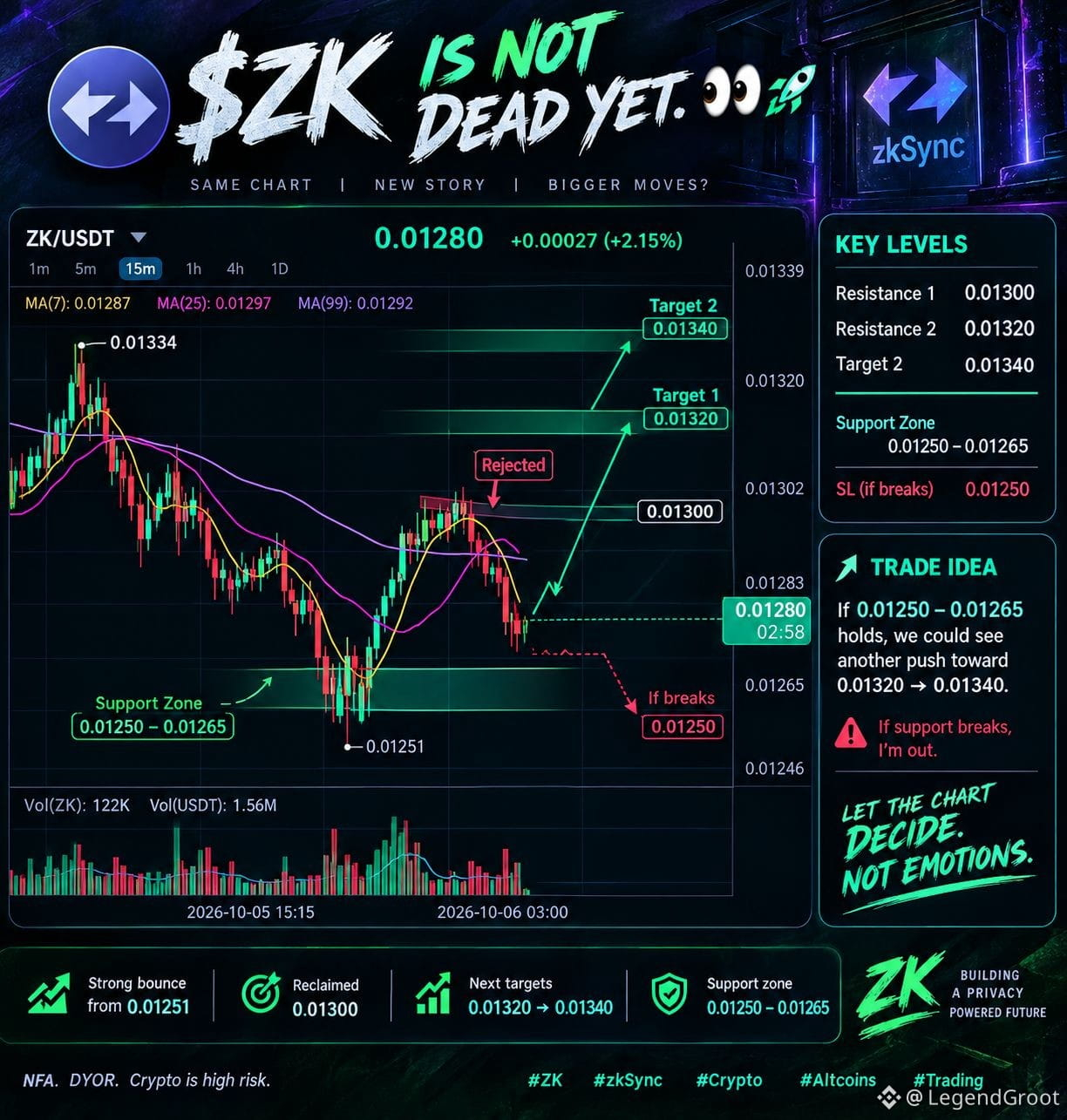
$ZK BELUM MATI. 👀🔥
Semua orang mengamati candle merah, tapi aku mengamati strukturnya.
$ZK memantul kuat dari 0.01251 dan kembali menembus 0.01300 sebelum ditolak.
Sekarang harga kembali mendekati 0.01280.
Jika level 0.01250–0.01265 bertahan, dorongan lain menuju 0.01320 → 0.01340 bisa menarik. 🚀
Tapi jika support jebol, aku keluar.
Biarkan grafik yang menentukan. Bukan emosi.
NFA. DYOR. Kripto berisiko tinggi.
#ZK #Zksync #Crypto #Altcoins #Trading
$ZK BELUM MATI. 👀🔥
Semua orang mengamati candle merah, tapi aku mengamati strukturnya.
$ZK memantul kuat dari 0.01251 dan kembali menembus 0.01300 sebelum ditolak.
Sekarang harga kembali mendekati 0.01280.
Jika level 0.01250–0.01265 bertahan, dorongan lain menuju 0.01320 → 0.01340 bisa menarik. 🚀
Tapi jika support jebol, aku keluar.
Biarkan grafik yang menentukan. Bukan emosi.
NFA. DYOR. Kripto berisiko tinggi.
#ZK #Zksync #Crypto #Altcoins #Trading
Semua orang mengamati candle merah, tapi aku mengamati strukturnya.
$ZK memantul kuat dari 0.01251 dan kembali menembus 0.01300 sebelum ditolak.
Sekarang harga kembali mendekati 0.01280.
Jika level 0.01250–0.01265 bertahan, dorongan lain menuju 0.01320 → 0.01340 bisa menarik. 🚀
Tapi jika support jebol, aku keluar.
Biarkan grafik yang menentukan. Bukan emosi.
NFA. DYOR. Kripto berisiko tinggi.
#ZK #Zksync #Crypto #Altcoins #Trading
250
·
--
Bullish
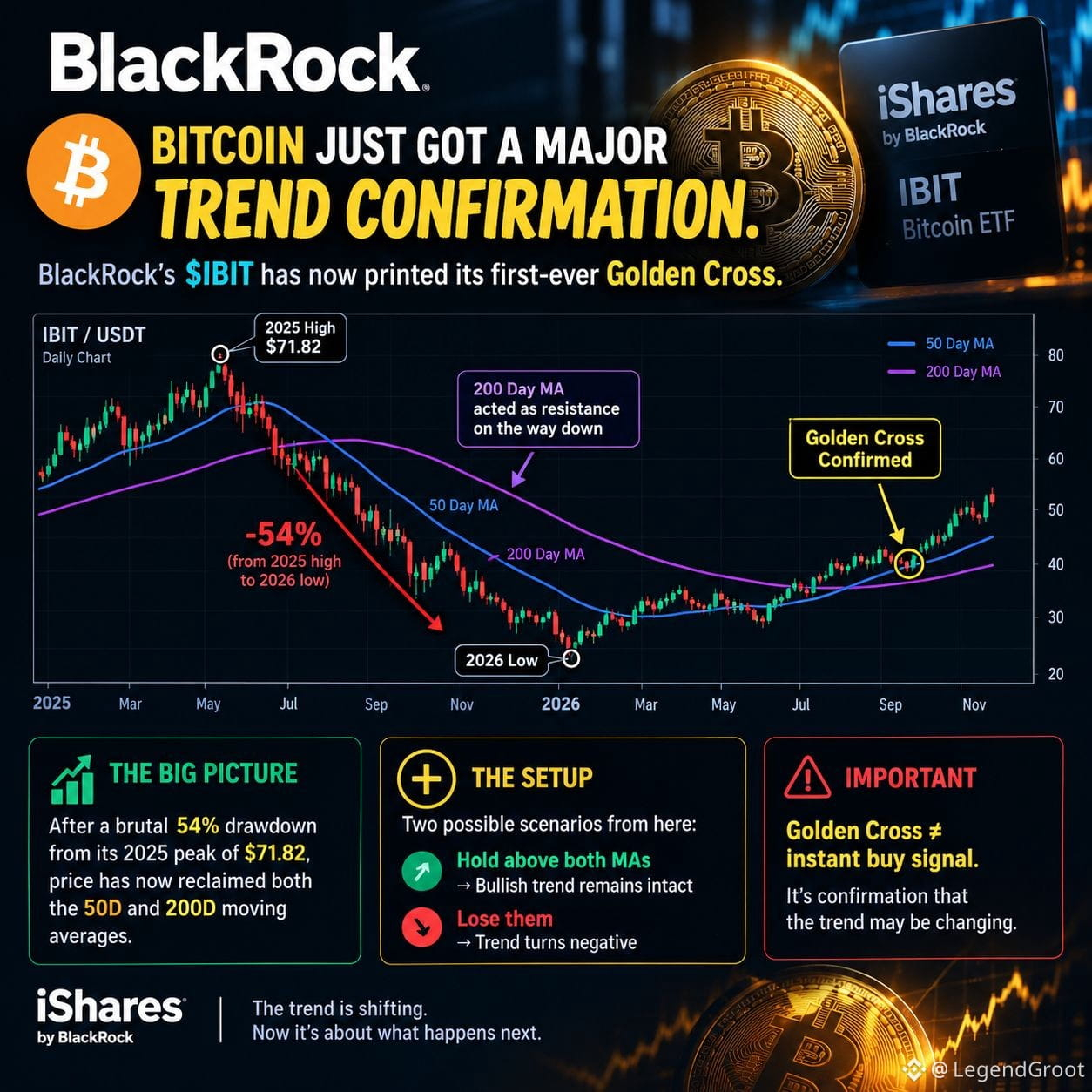
🚨 SESUATU BARU SAJA BERUBAH UNTUK BITCOIN.
$IBIT milik BlackRock mencetak Golden Cross pertamanya.
Setelah turun 54% dari puncaknya pada 2025 di $71.82, harga kini kembali menembus rata-rata pergerakan 50D dan 200D.
Skenarionya sederhana:
🟢 Bertahan di atas kedua MA → struktur bullish menguat
🔴 Turun di bawah keduanya → tren melemah dengan cepat
Golden Cross BUKAN sinyal beli.
Namun, mengabaikan perubahan tren ini bisa menjadi kesalahan. #bitcoin $BTC
🚨 SESUATU BARU SAJA BERUBAH UNTUK BITCOIN.
$IBIT milik BlackRock mencetak Golden Cross pertamanya.
Setelah turun 54% dari puncaknya pada 2025 di $71.82, harga kini kembali menembus rata-rata pergerakan 50D dan 200D.
Skenarionya sederhana:
🟢 Bertahan di atas kedua MA → struktur bullish menguat
🔴 Turun di bawah keduanya → tren melemah dengan cepat
Golden Cross BUKAN sinyal beli.
Namun, mengabaikan perubahan tren ini bisa menjadi kesalahan. #bitcoin $BTC
$IBIT milik BlackRock mencetak Golden Cross pertamanya.
Setelah turun 54% dari puncaknya pada 2025 di $71.82, harga kini kembali menembus rata-rata pergerakan 50D dan 200D.
Skenarionya sederhana:
🟢 Bertahan di atas kedua MA → struktur bullish menguat
🔴 Turun di bawah keduanya → tren melemah dengan cepat
Golden Cross BUKAN sinyal beli.
Namun, mengabaikan perubahan tren ini bisa menjadi kesalahan. #bitcoin $BTC
82
·
--
Bullish
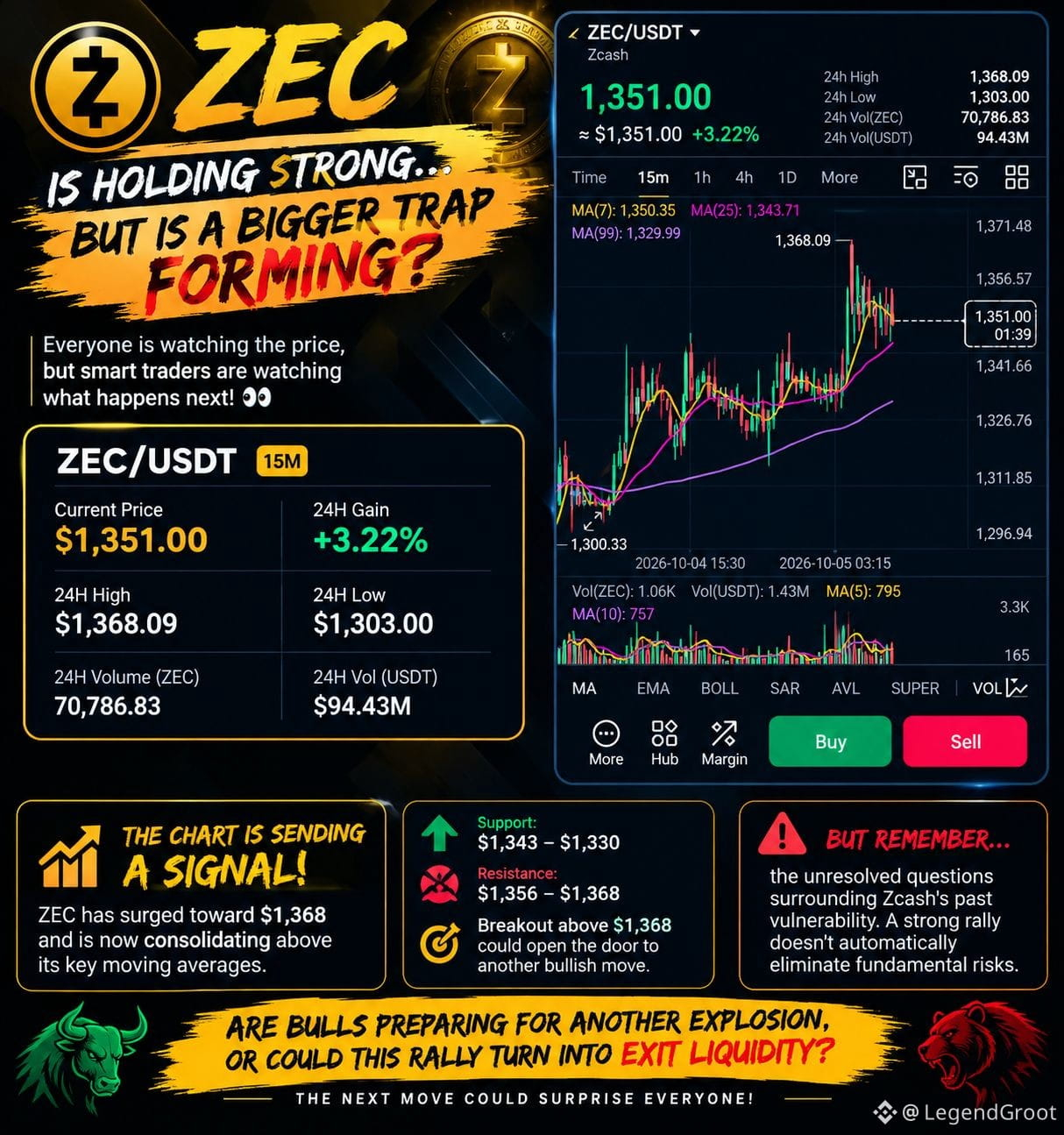
🚨 $ZEC IS HOLDING STRONG… BUT IS A BIGGER TRAP FORMING? 🐋🔥
Semua orang memperhatikan harga, tapi trader pintar memperhatikan apa yang terjadi selanjutnya! 👀
📊 ZEC/USDT — UPDATE PASAR 15M
💰 Harga Saat Ini: $1,351
🟢 Kenaikan 24H: +3.22%
🚀 Tertinggi 24H: $1,368.09
📉 Terendah 24H: $1,303
📊 Volume 24H: $94.43M
🔥 GRAFIK MEMBERIKAN SEBUAH SINYAL!
ZEC telah melonjak mendekati $1,368 dan kini sedang konsolidasi di atas moving average kuncinya.
🟢 Support: $1,343–$1,330
🚀 Resistance: $1,356–$1,368
🎯 Tembus di atas $1,368 bisa membuka peluang untuk langkah bullish berikutnya.
⚠️ Tapi ingat, masih ada pertanyaan yang belum terjawab terkait kerentanan Zcash di masa lalu. Reli yang kuat tidak otomatis menghilangkan risiko fundamental.
🐂 Apakah para bull sedang mempersiapkan ledakan lain, atau reli ini justru bisa berubah menjadi exit liquidity?
LANGKAH BERIKUTNYA BISA MENGEJUTKAN SEMUA ORANG! 🔥
#ZEC #Zcash #Crypto #Altcoins #TradingSignals #Binance
{spot}(ZECUSDT)
🚨 $ZEC IS HOLDING STRONG… BUT IS A BIGGER TRAP FORMING? 🐋🔥
Semua orang memperhatikan harga, tapi trader pintar memperhatikan apa yang terjadi selanjutnya! 👀
📊 ZEC/USDT — UPDATE PASAR 15M
💰 Harga Saat Ini: $1,351
🟢 Kenaikan 24H: +3.22%
🚀 Tertinggi 24H: $1,368.09
📉 Terendah 24H: $1,303
📊 Volume 24H: $94.43M
🔥 GRAFIK MEMBERIKAN SEBUAH SINYAL!
ZEC telah melonjak mendekati $1,368 dan kini sedang konsolidasi di atas moving average kuncinya.
🟢 Support: $1,343–$1,330
🚀 Resistance: $1,356–$1,368
🎯 Tembus di atas $1,368 bisa membuka peluang untuk langkah bullish berikutnya.
⚠️ Tapi ingat, masih ada pertanyaan yang belum terjawab terkait kerentanan Zcash di masa lalu. Reli yang kuat tidak otomatis menghilangkan risiko fundamental.
🐂 Apakah para bull sedang mempersiapkan ledakan lain, atau reli ini justru bisa berubah menjadi exit liquidity?
LANGKAH BERIKUTNYA BISA MENGEJUTKAN SEMUA ORANG! 🔥
#ZEC #Zcash #Crypto #Altcoins #TradingSignals #Binance
Semua orang memperhatikan harga, tapi trader pintar memperhatikan apa yang terjadi selanjutnya! 👀
📊 ZEC/USDT — UPDATE PASAR 15M
💰 Harga Saat Ini: $1,351
🟢 Kenaikan 24H: +3.22%
🚀 Tertinggi 24H: $1,368.09
📉 Terendah 24H: $1,303
📊 Volume 24H: $94.43M
🔥 GRAFIK MEMBERIKAN SEBUAH SINYAL!
ZEC telah melonjak mendekati $1,368 dan kini sedang konsolidasi di atas moving average kuncinya.
🟢 Support: $1,343–$1,330
🚀 Resistance: $1,356–$1,368
🎯 Tembus di atas $1,368 bisa membuka peluang untuk langkah bullish berikutnya.
⚠️ Tapi ingat, masih ada pertanyaan yang belum terjawab terkait kerentanan Zcash di masa lalu. Reli yang kuat tidak otomatis menghilangkan risiko fundamental.
🐂 Apakah para bull sedang mempersiapkan ledakan lain, atau reli ini justru bisa berubah menjadi exit liquidity?
LANGKAH BERIKUTNYA BISA MENGEJUTKAN SEMUA ORANG! 🔥
#ZEC #Zcash #Crypto #Altcoins #TradingSignals #Binance
196
·
--
Bullish
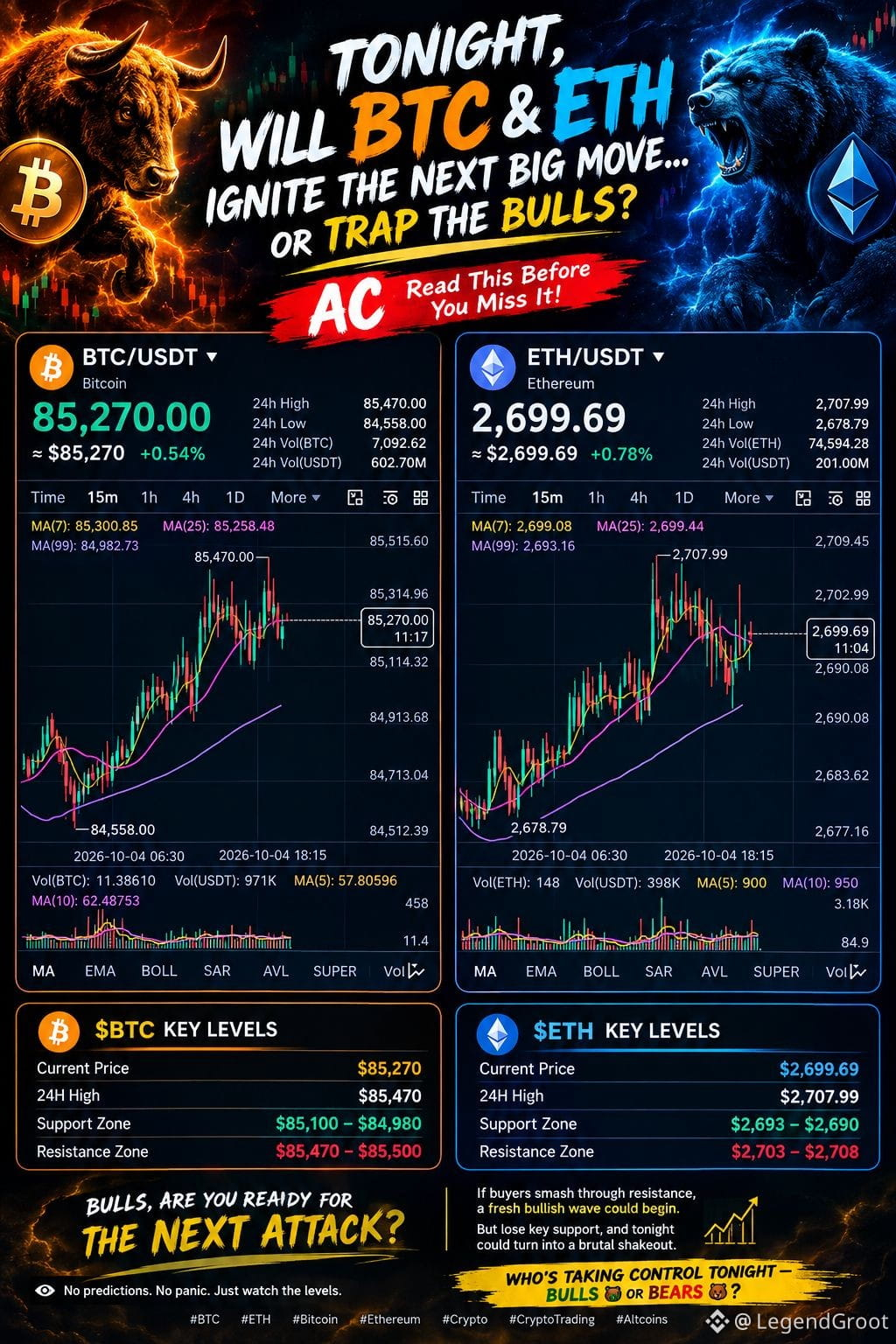
🚨 MALAM INI, APA BTC & ETH AKAN MENYALA UNTUK GERAKAN BESAR BERIKUTNYA… ATAU MENJEBak PARA BULL? 🐂🔥
⚔️ Perang sedang memanas, dan chart sedang mengirim pesan!
🟠 $BTC
{spot}(BTCUSDT)
: $85,270
🔥 Tertinggi 24H: $85,470
🟢 Support: $85,100–$84,980
🚀 Resistance: $85,470–$85,500
🔵 $ETH
{spot}(ETHUSDT)
: $2,699.69
🔥 Tertinggi 24H: $2,707.99
🟢 Support: $2,693–$2,690
🚀 Resistance: $2,703–$2,708
🐉 BULL, APA KALIAN SIAP UNTUK SERANGAN BERIKUTNYA?
Jika pembeli menembus resistance, gelombang bullish baru bisa mulai. Tapi jika kehilangan support kunci, malam ini bisa berubah jadi shakeout yang brutal.
👀 Tanpa prediksi. Tanpa panik. Hanya pantau levelnya.
🔥 SIAPA YANG AMBIL KENDALI MALAM INI — BULL 🐂 ATAU BEAR 🐻?
#BTC #ETH #Bitcoin #Ethereum #Crypto #CryptoTrading #Altcoins
🚨 MALAM INI, APA BTC & ETH AKAN MENYALA UNTUK GERAKAN BESAR BERIKUTNYA… ATAU MENJEBak PARA BULL? 🐂🔥
⚔️ Perang sedang memanas, dan chart sedang mengirim pesan!
🟠 $BTC
: $85,270
🔥 Tertinggi 24H: $85,470
🟢 Support: $85,100–$84,980
🚀 Resistance: $85,470–$85,500
🔵 $ETH
: $2,699.69
🔥 Tertinggi 24H: $2,707.99
🟢 Support: $2,693–$2,690
🚀 Resistance: $2,703–$2,708
🐉 BULL, APA KALIAN SIAP UNTUK SERANGAN BERIKUTNYA?
Jika pembeli menembus resistance, gelombang bullish baru bisa mulai. Tapi jika kehilangan support kunci, malam ini bisa berubah jadi shakeout yang brutal.
👀 Tanpa prediksi. Tanpa panik. Hanya pantau levelnya.
🔥 SIAPA YANG AMBIL KENDALI MALAM INI — BULL 🐂 ATAU BEAR 🐻?
#BTC #ETH #Bitcoin #Ethereum #Crypto #CryptoTrading #Altcoins
⚔️ Perang sedang memanas, dan chart sedang mengirim pesan!
🟠 $BTC
: $85,270
🔥 Tertinggi 24H: $85,470
🟢 Support: $85,100–$84,980
🚀 Resistance: $85,470–$85,500
🔵 $ETH
: $2,699.69
🔥 Tertinggi 24H: $2,707.99
🟢 Support: $2,693–$2,690
🚀 Resistance: $2,703–$2,708
🐉 BULL, APA KALIAN SIAP UNTUK SERANGAN BERIKUTNYA?
Jika pembeli menembus resistance, gelombang bullish baru bisa mulai. Tapi jika kehilangan support kunci, malam ini bisa berubah jadi shakeout yang brutal.
👀 Tanpa prediksi. Tanpa panik. Hanya pantau levelnya.
🔥 SIAPA YANG AMBIL KENDALI MALAM INI — BULL 🐂 ATAU BEAR 🐻?
#BTC #ETH #Bitcoin #Ethereum #Crypto #CryptoTrading #Altcoins
102
·
--
Bullish
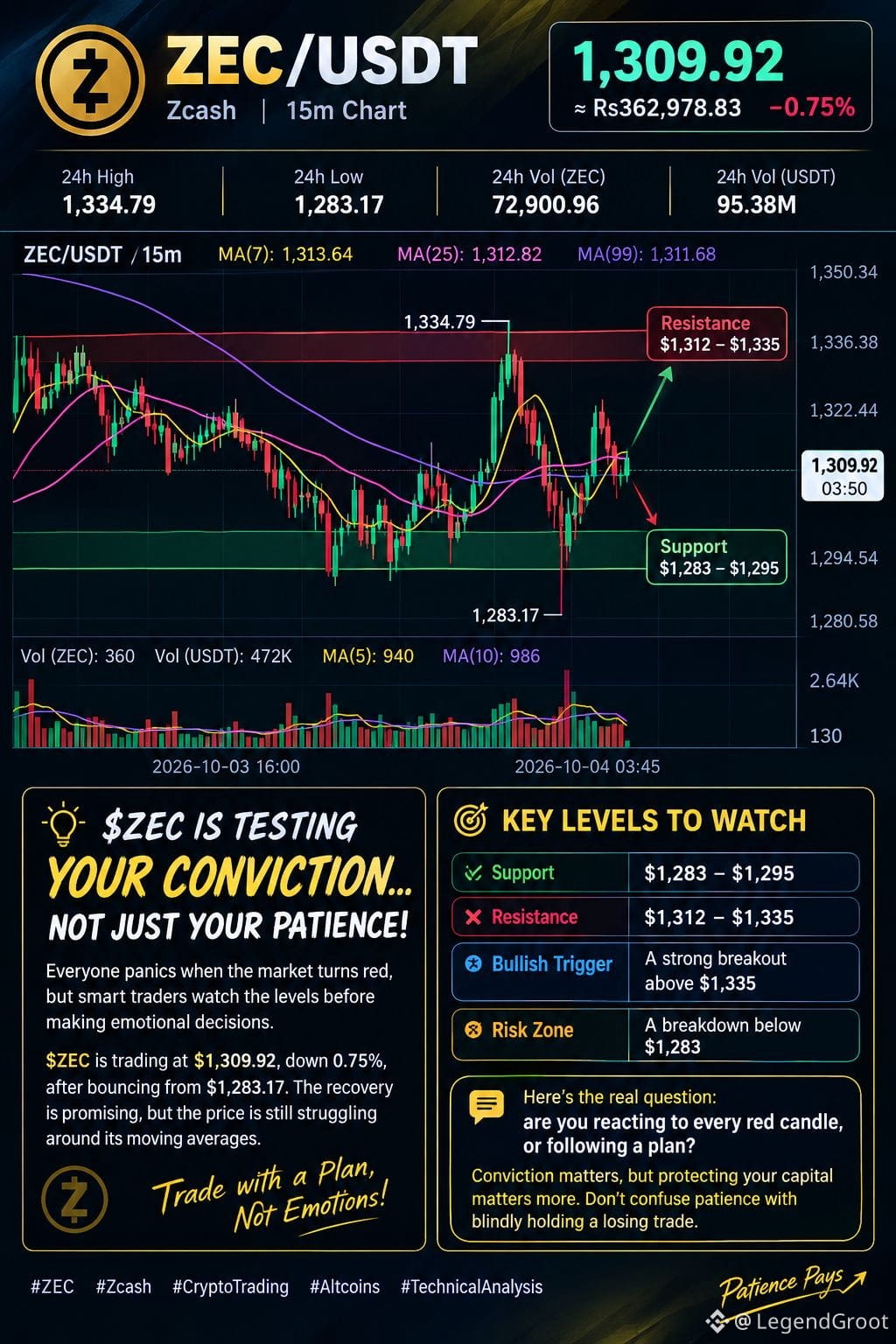
🚨 $ZEC SEDANG MENGUJI KEYAKINAN ANDA… BUKAN HANYA KESABARAN ANDA! 🧠🔥
Semua orang panik saat pasar berubah merah, tetapi trader cerdas memperhatikan level-levelnya sebelum mengambil keputusan emosional.
$ZEC sedang diperdagangkan pada $1,309.92, turun 0,75%, setelah memantul dari $1,283.17. Pemulihannya cukup menjanjikan, tetapi harga masih kesulitan di sekitar rata-rata pergerakannya.
📊 Level penting untuk diperhatikan:
🟢 Support: $1,283–$1,295
🚀 Resistance: $1,312–$1,335
🎯 Pemicu bullish: Terjadi breakout kuat di atas $1,335
⚠️ Zona risiko: Terjadi penurunan di bawah $1,283
Ini pertanyaannya yang sebenarnya: apakah Anda bereaksi pada setiap candle merah, atau mengikuti rencana?
Keyakinan itu penting, tapi melindungi modal lebih penting. Jangan samakan kesabaran dengan membiarkan diri terjebak pada trade yang merugi.
#ZEC #Zcash #CryptoTrading #Altcoins #TechnicalAnalysis
🚨 $ZEC SEDANG MENGUJI KEYAKINAN ANDA… BUKAN HANYA KESABARAN ANDA! 🧠🔥
Semua orang panik saat pasar berubah merah, tetapi trader cerdas memperhatikan level-levelnya sebelum mengambil keputusan emosional.
$ZEC sedang diperdagangkan pada $1,309.92, turun 0,75%, setelah memantul dari $1,283.17. Pemulihannya cukup menjanjikan, tetapi harga masih kesulitan di sekitar rata-rata pergerakannya.
📊 Level penting untuk diperhatikan:
🟢 Support: $1,283–$1,295
🚀 Resistance: $1,312–$1,335
🎯 Pemicu bullish: Terjadi breakout kuat di atas $1,335
⚠️ Zona risiko: Terjadi penurunan di bawah $1,283
Ini pertanyaannya yang sebenarnya: apakah Anda bereaksi pada setiap candle merah, atau mengikuti rencana?
Keyakinan itu penting, tapi melindungi modal lebih penting. Jangan samakan kesabaran dengan membiarkan diri terjebak pada trade yang merugi.
#ZEC #Zcash #CryptoTrading #Altcoins #TechnicalAnalysis
Semua orang panik saat pasar berubah merah, tetapi trader cerdas memperhatikan level-levelnya sebelum mengambil keputusan emosional.
$ZEC sedang diperdagangkan pada $1,309.92, turun 0,75%, setelah memantul dari $1,283.17. Pemulihannya cukup menjanjikan, tetapi harga masih kesulitan di sekitar rata-rata pergerakannya.
📊 Level penting untuk diperhatikan:
🟢 Support: $1,283–$1,295
🚀 Resistance: $1,312–$1,335
🎯 Pemicu bullish: Terjadi breakout kuat di atas $1,335
⚠️ Zona risiko: Terjadi penurunan di bawah $1,283
Ini pertanyaannya yang sebenarnya: apakah Anda bereaksi pada setiap candle merah, atau mengikuti rencana?
Keyakinan itu penting, tapi melindungi modal lebih penting. Jangan samakan kesabaran dengan membiarkan diri terjebak pada trade yang merugi.
#ZEC #Zcash #CryptoTrading #Altcoins #TechnicalAnalysis
300
·
--
Artikel
Lihat terjemahan
Ethereum: The Vision of a Decentralized Future Is Bigger Than Most People Realize
Background: The IEthereum: The Vision of a Decentralized Future Is Bigger Than Most People Realize
Background: The Idea That Changed Blockchain Forever
There are some projects in crypto that attract attention because of their price, and then there are projects that quietly change how the entire industry works. Ethereum belongs to the second category. When I look at Ethereum, Im not just looking at a cryptocurrency or another blockchain competing for market attention. Im looking at an idea that has grown into a global network where developers, businesses, investors, and everyday users can build and interact without depending entirely on traditional financial systems.
Ethereum was introduced by Vitalik Buterin and officially launched in July 2015. The original vision was to take blockchain technology beyond simple digital payments and create a platform where programmable agreements could operate without a central authority. This idea became the foundation of smart contracts, decentralized applications, and an entirely new way of building digital services. What makes this journey interesting is that Ethereum was not designed to solve just one problem. It was designed to give people the tools to create solutions that its original developers might never have imagined.
Over the years, Ethereum has become an important part of decentralized finance, digital ownership, stablecoin infrastructure, tokenization, and blockchain development. Were seeing a network that continues to evolve while thousands of independent developers experiment with new possibilities. Its history also shows something important about technology: long-term progress is rarely a straight line. Ethereum has faced high transaction costs, network congestion, technical challenges, and growing competition. Yet its community continues to work on improvements rather than treating the original design as something that can never change.
Technology: What Makes Ethereum Different
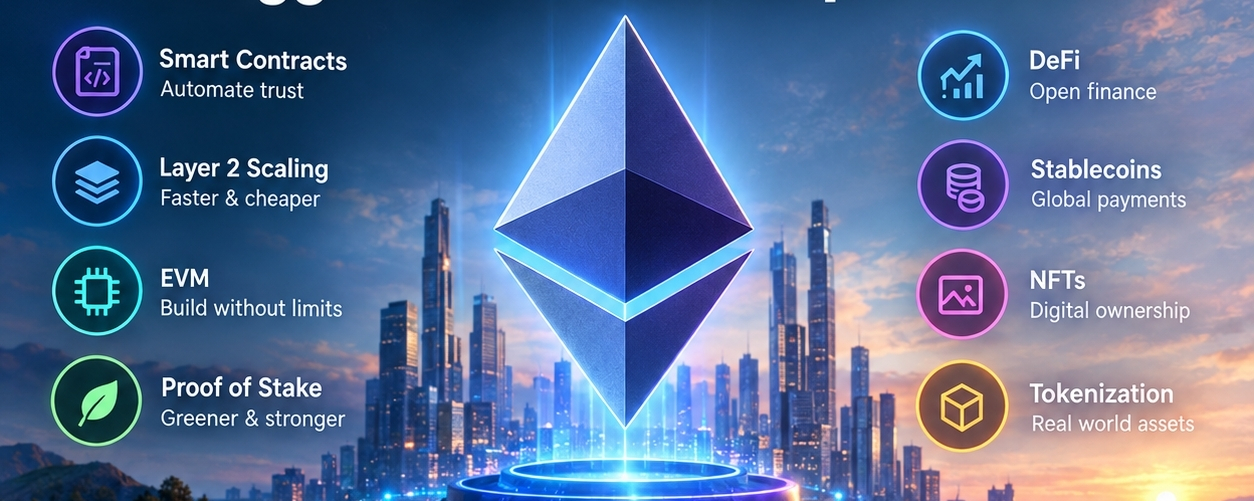
At the heart of Ethereum is a powerful idea called smart contracts. These are programs stored and executed on the blockchain that follow predefined rules. Instead of depending on a company or individual to manually approve every action, smart contracts can automatically carry out transactions when their conditions are met. This creates opportunities for financial applications, digital marketplaces, automated agreements, and systems that remain accessible to users around the world.
Ethereum uses the Ethereum Virtual Machine, commonly known as the EVM. Think of it as the computing environment that allows smart contracts to run consistently across the network. Developers can create applications using established programming languages and tools, while the blockchain records the resulting transactions and contract activity. This shared environment is an important reason why Ethereum has attracted so many builders. It gives developers a foundation on which they can create new services without having to build an entirely independent blockchain from scratch.
Another major change in Ethereum's history was The Merge in September 2022. Ethereum moved from proof of work to proof of stake, replacing energy-intensive mining with a system in which validators stake ETH to help secure the network. According to Ethereum's published documentation, this transition reduced its energy consumption by approximately 99.95 percent. For me, this change represents more than a technical upgrade. It demonstrates that a large blockchain can make fundamental changes to its security model while preserving its existing network and transaction history.
Ethereum also has a fee mechanism that makes its economic design especially interesting. Under EIP-1559, part of the transaction fee is burned, meaning it is permanently removed from circulation. The amount of ETH burned depends on network activity and the base fee. This creates an important connection between actual network usage and ETH supply. However, burning does not guarantee that ETH will become deflationary at all times, because new ETH is also issued to reward validators.
ETH Token: More Than Just a Digital Asset
ETH is the native asset of Ethereum, and its role extends far beyond buying and selling. It is used to pay transaction fees, interact with smart contracts, transfer value, and participate in the network's proof-of-stake security system. Whenever users perform certain activities on Ethereum, they need ETH to cover the computational resources their transactions consume. This gives ETH a direct functional relationship with the network.
Staking is another important part of its utility. People can stake ETH to help secure Ethereum and receive rewards for participating in validation. Running an independent validator requires 32 ETH under the standard setup, although smaller holders can participate through staking services and other arrangements. Staking introduces a different way to engage with a crypto asset, but it also comes with risks, including changing reward rates, operational failures, liquidity limitations, and possible penalties for validator misconduct.
The economic design of ETH deserves close attention. New ETH enters circulation through validator rewards, while transaction fee burning removes some ETH from circulation. When network demand and fee activity are high, the amount burned can increase. When activity is lower, issuance may exceed burning. This balance makes Ethereum's monetary system dynamic rather than dependent on a fixed supply cap.
I believe understanding this distinction is important for anyone researching Ethereum. A strong network does not automatically mean its token price must rise. The relationship between adoption, transaction activity, token demand, issuance, and market valuation is complex. Real research means looking beyond attractive price predictions and asking whether the network is creating lasting utility.
Real Use: Where Ethereum Meets Everyday Life
The real story of Ethereum becomes easier to understand when we look at what people are actually building on it. Decentralized finance is one of its most recognized use cases. DeFi applications allow users to exchange assets, provide liquidity, borrow, lend, and interact with financial protocols through smart contracts. These systems can operate continuously and offer access to financial services without requiring every transaction to pass through a traditional financial institution.
Stablecoins are another major part of the Ethereum ecosystem. They allow users and businesses to transfer digital assets designed to track the value of currencies such as the US dollar. Stablecoins can support international payments, digital trading, and onchain financial activity. Their usefulness is not limited to speculation. For people who face barriers in traditional financial systems, access to digital dollar-based assets can offer additional financial options, although regulatory, issuer, custody, and depegging risks remain important.
Ethereum has also played a major role in the development of NFTs and digital ownership. NFTs introduced new ways to represent unique digital items, collectibles, membership rights, and certain real-world assets. Not every NFT project has meaningful long-term value, and the market has experienced considerable speculation. Still, the technology demonstrated how blockchain records can establish publicly verifiable ownership and enable new forms of digital interaction.
Tokenization is another area worth watching. The idea is to represent financial instruments, ownership rights, or other assets as blockchain-based tokens. In theory, tokenization can support programmable settlement, improved transparency, and new ways of distributing access to assets. Ethereum's smart contract infrastructure makes it a natural environment for experimenting with these systems. However, real-world tokenization still depends on legal frameworks, trustworthy asset custody, regulatory compliance, and genuine demand. Technology alone cannot solve every problem connected to traditional assets.
These examples reveal something important about Ethereum. Its value as a platform is not restricted to one application or one industry. The same underlying infrastructure can support financial services, digital identity experiments, gaming economies, payment systems, and entirely new business models. That flexibility is one of the reasons developers continue to build on it.
Layer 2: Making Ethereum More Accessible
One of Ethereum's biggest challenges has always been scalability. When many users compete to use the main network at the same time, transaction fees can become expensive. This creates a difficult situation for smaller users and applications that depend on frequent transactions. A blockchain may offer powerful technology, but if ordinary people cannot afford to use it, its practical reach becomes limited.
Layer 2 networks are an important part of Ethereum's response to this problem. They process transactions outside the main Ethereum execution environment and use Ethereum in different ways for security, settlement, or data availability. Rollups are a particularly important category because they can bundle multiple transactions and publish relevant data or proofs to Ethereum.
The Dencun upgrade in March 2024 introduced blob transactions through EIP-4844. This gave rollups a more cost-efficient way to publish transaction data to Ethereum. The objective was to reduce the costs that rollups face when using the main network, creating the possibility of cheaper transactions for their users.
The broader ecosystem has continued developing beyond Dencun. Ethereum's roadmap includes improvements to data availability, execution capacity, and the experience of moving between different networks. The Fusaka upgrade, delivered in December 2025 according to the Ethereum Foundation's published update, introduced PeerDAS, a technology designed to let validators sample data instead of downloading all blob data themselves. This helps support greater data capacity while managing the burden placed on individual network participants.
Still, there is an important challenge that deserves attention. More Layer 2 networks can improve capacity and create specialized environments, but they can also divide liquidity and make the user experience confusing. Moving assets between networks is not always simple, and security properties vary across different systems. Ethereum's long-term success depends not only on creating more networks but also on making the entire ecosystem feel connected and understandable.
Ecosystem: The Power of Developers and Community
A blockchain is more than its code. Its long-term strength also depends on the people who build applications, maintain infrastructure, discover vulnerabilities, and help new users understand the technology. Ethereum has developed a broad international ecosystem of independent developers, researchers, infrastructure providers, application teams, and community contributors.
One of Ethereum's important strengths is its open development culture. People can study the protocol, propose improvements, build applications, and participate in public technical discussions. This does not mean every participant has equal influence or that disagreements never occur. Ethereum's development process can be complex, and decisions about upgrades often require extensive technical discussion and coordination. But open participation remains a central part of its design philosophy.
The EVM has also helped create a large body of developer knowledge and reusable infrastructure. Teams can build on established tools and standards rather than starting from zero. This reduces some development barriers and makes it easier for different applications to interact with familiar technical foundations.
Another important part of the ecosystem is interoperability. As more Layer 2 networks and independent applications emerge, users need ways to move assets and information between them. Better interoperability can reduce friction and allow applications to benefit from a wider pool of users and liquidity. It is not simply a technical convenience. It directly affects how useful the overall network feels to the people who depend on it.
For me, this is where Ethereum's community-driven model becomes particularly meaningful. Its future is not determined by one company announcing a new product. It is shaped through ongoing work by many different groups, each bringing different ideas and priorities. That process can be slow, but it also creates opportunities for experimentation and long-term adaptation.
Security and Decentralization: The Foundations That Matter
Speed and low fees attract attention, but security and decentralization are what make a blockchain trustworthy over time. Ethereum uses proof of stake to coordinate validators and protect the network. Validators are required to put ETH at risk, creating financial incentives to follow the protocol and penalties for certain forms of misconduct.
This approach has changed how Ethereum operates compared with its original mining-based system. It also creates new considerations, including validator concentration, staking service dependencies, and the economic influence of large participants. Decentralization is not a simple yes-or-no property. It depends on how many independent participants can operate the network, how power is distributed, and whether users can verify activity without relying on a small group of intermediaries.
Ethereum's ongoing research includes efforts to improve censorship resistance, make validators more resilient, and reduce protocol complexity. The development of proposer-builder separation and inclusion-list mechanisms is part of this wider effort. These proposals aim to address some of the risks associated with transaction ordering and block construction.
Security also extends beyond the core blockchain. Smart contracts can contain vulnerabilities, bridges can introduce additional risks, and applications may depend on external infrastructure. Even if Ethereum itself continues operating correctly, users can still lose assets through poorly designed applications, compromised wallets, malicious contracts, or careless transaction approvals.
That is why responsible adoption matters. The strongest technology still needs careful implementation, transparent risk communication, and users who understand the systems they interact with.
Future Outlook: What Could Come Next
Ethereum's future is closely connected to its ability to scale while preserving the qualities that made it valuable in the first place. Its published roadmap focuses on improving execution capacity, increasing data availability, making the user experience smoother, and strengthening the security of the core protocol. These are not isolated goals. Each one affects how developers build applications and how ordinary users experience the network.
In 2026, the Ethereum Foundation has outlined work around scaling, improving user experience, and hardening the main network. Planned improvements associated with Glamsterdam include proposer-builder separation and block-level access lists. These efforts are intended to support better network performance and improve the way transactions are processed. Their implementation and exact timing remain subject to development and testing.
Account abstraction is another important direction. The goal is to make blockchain accounts more flexible and easier to use. Features such as transaction batching, sponsored fees, and improved account recovery could reduce some of the difficulties that discourage new users. Ethereum has already taken steps in this direction through EIP-7702, introduced in the Pectra upgrade.
If these developments continue successfully, Ethereum could become more accessible to people who do not want to understand every technical detail behind a blockchain transaction. That kind of improvement may be less dramatic than a major price rally, but it could have a deeper effect on real adoption.
At the same time, Ethereum faces serious challenges. Competing blockchain ecosystems continue to experiment with faster transactions, lower fees, and different development models. Regulatory uncertainty can affect applications and institutional adoption. Technical upgrades can take longer than expected, and the benefits of scaling do not automatically translate into higher ETH demand.
The relationship between Layer 2 growth and ETH value will also deserve continued attention. More activity across Ethereum-connected networks may expand the ecosystem, but the economic benefits flowing back to the main network depend on how those systems use Ethereum for settlement, security, and data. This is an area where real measurements matter more than assumptions.
I see Ethereum's future as an ongoing experiment rather than a guaranteed success story. Its strongest opportunity is to become a reliable foundation for a broad digital economy. Whether it achieves that goal will depend on technical execution, user experience, developer activity, security, and the ability to create value that people actually need.
Conclusion: A Technology Built for More Than the Next Market Cycle
When I look at Ethereum, what stands out to me is not simply its position in the crypto market. It is the larger ambition behind the network. Ethereum represents the belief that people should have access to open infrastructure where they can build, exchange value, and create digital services without needing permission from a single controlling organization.
The journey has never been perfect. High fees have frustrated users. Technical decisions have sparked disagreements. Security incidents across the wider ecosystem have reminded everyone that innovation carries real risks. And there is still plenty of work to do before blockchain applications feel natural and affordable for the average person.
But that is also what makes the Ethereum story worth following. Were seeing a technology that continues to evolve through research, experimentation, and the work of a global community. Its developers are not simply trying to make another token more popular. They are working toward a network that can support financial applications, digital ownership, and new forms of online coordination at a much larger scale.
Im interested in Ethereum because its story reaches beyond short-term market movements. Every meaningful improvement in security, usability, and accessibility creates another opportunity for people to participate in an open digital economy. The real question is not only how far ETH can move in the market, but how much useful activity the network can support over the coming years.
The future is never guaranteed in crypto. Yet the idea behind Ethereum remains powerful: technology should create opportunities, not just profits, and innovation should give more people the ability to participate. For anyone who believes the internet can become more open, more transparent, and more accessible, Ethereum is a project whose next chapter is worth watching with curiosity, patience, and a clear understanding of both its promise and its risks.
Ethereum: The Vision of a Decentralized Future Is Bigger Than Most People Realize Background: The I
Ethereum: The Vision of a Decentralized Future Is Bigger Than Most People Realize
Background: The Idea That Changed Blockchain Forever
There are some projects in crypto that attract attention because of their price, and then there are projects that quietly change how the entire industry works. Ethereum belongs to the second category. When I look at Ethereum, Im not just looking at a cryptocurrency or another blockchain competing for market attention. Im looking at an idea that has grown into a global network where developers, businesses, investors, and everyday users can build and interact without depending entirely on traditional financial systems.
Ethereum was introduced by Vitalik Buterin and officially launched in July 2015. The original vision was to take blockchain technology beyond simple digital payments and create a platform where programmable agreements could operate without a central authority. This idea became the foundation of smart contracts, decentralized applications, and an entirely new way of building digital services. What makes this journey interesting is that Ethereum was not designed to solve just one problem. It was designed to give people the tools to create solutions that its original developers might never have imagined.
Over the years, Ethereum has become an important part of decentralized finance, digital ownership, stablecoin infrastructure, tokenization, and blockchain development. Were seeing a network that continues to evolve while thousands of independent developers experiment with new possibilities. Its history also shows something important about technology: long-term progress is rarely a straight line. Ethereum has faced high transaction costs, network congestion, technical challenges, and growing competition. Yet its community continues to work on improvements rather than treating the original design as something that can never change.
Technology: What Makes Ethereum Different
At the heart of Ethereum is a powerful idea called smart contracts. These are programs stored and executed on the blockchain that follow predefined rules. Instead of depending on a company or individual to manually approve every action, smart contracts can automatically carry out transactions when their conditions are met. This creates opportunities for financial applications, digital marketplaces, automated agreements, and systems that remain accessible to users around the world.
Ethereum uses the Ethereum Virtual Machine, commonly known as the EVM. Think of it as the computing environment that allows smart contracts to run consistently across the network. Developers can create applications using established programming languages and tools, while the blockchain records the resulting transactions and contract activity. This shared environment is an important reason why Ethereum has attracted so many builders. It gives developers a foundation on which they can create new services without having to build an entirely independent blockchain from scratch.
Another major change in Ethereum's history was The Merge in September 2022. Ethereum moved from proof of work to proof of stake, replacing energy-intensive mining with a system in which validators stake ETH to help secure the network. According to Ethereum's published documentation, this transition reduced its energy consumption by approximately 99.95 percent. For me, this change represents more than a technical upgrade. It demonstrates that a large blockchain can make fundamental changes to its security model while preserving its existing network and transaction history.
Ethereum also has a fee mechanism that makes its economic design especially interesting. Under EIP-1559, part of the transaction fee is burned, meaning it is permanently removed from circulation. The amount of ETH burned depends on network activity and the base fee. This creates an important connection between actual network usage and ETH supply. However, burning does not guarantee that ETH will become deflationary at all times, because new ETH is also issued to reward validators.
ETH Token: More Than Just a Digital Asset
ETH is the native asset of Ethereum, and its role extends far beyond buying and selling. It is used to pay transaction fees, interact with smart contracts, transfer value, and participate in the network's proof-of-stake security system. Whenever users perform certain activities on Ethereum, they need ETH to cover the computational resources their transactions consume. This gives ETH a direct functional relationship with the network.
Staking is another important part of its utility. People can stake ETH to help secure Ethereum and receive rewards for participating in validation. Running an independent validator requires 32 ETH under the standard setup, although smaller holders can participate through staking services and other arrangements. Staking introduces a different way to engage with a crypto asset, but it also comes with risks, including changing reward rates, operational failures, liquidity limitations, and possible penalties for validator misconduct.
The economic design of ETH deserves close attention. New ETH enters circulation through validator rewards, while transaction fee burning removes some ETH from circulation. When network demand and fee activity are high, the amount burned can increase. When activity is lower, issuance may exceed burning. This balance makes Ethereum's monetary system dynamic rather than dependent on a fixed supply cap.
I believe understanding this distinction is important for anyone researching Ethereum. A strong network does not automatically mean its token price must rise. The relationship between adoption, transaction activity, token demand, issuance, and market valuation is complex. Real research means looking beyond attractive price predictions and asking whether the network is creating lasting utility.
Real Use: Where Ethereum Meets Everyday Life
The real story of Ethereum becomes easier to understand when we look at what people are actually building on it. Decentralized finance is one of its most recognized use cases. DeFi applications allow users to exchange assets, provide liquidity, borrow, lend, and interact with financial protocols through smart contracts. These systems can operate continuously and offer access to financial services without requiring every transaction to pass through a traditional financial institution.
Stablecoins are another major part of the Ethereum ecosystem. They allow users and businesses to transfer digital assets designed to track the value of currencies such as the US dollar. Stablecoins can support international payments, digital trading, and onchain financial activity. Their usefulness is not limited to speculation. For people who face barriers in traditional financial systems, access to digital dollar-based assets can offer additional financial options, although regulatory, issuer, custody, and depegging risks remain important.
Ethereum has also played a major role in the development of NFTs and digital ownership. NFTs introduced new ways to represent unique digital items, collectibles, membership rights, and certain real-world assets. Not every NFT project has meaningful long-term value, and the market has experienced considerable speculation. Still, the technology demonstrated how blockchain records can establish publicly verifiable ownership and enable new forms of digital interaction.
Tokenization is another area worth watching. The idea is to represent financial instruments, ownership rights, or other assets as blockchain-based tokens. In theory, tokenization can support programmable settlement, improved transparency, and new ways of distributing access to assets. Ethereum's smart contract infrastructure makes it a natural environment for experimenting with these systems. However, real-world tokenization still depends on legal frameworks, trustworthy asset custody, regulatory compliance, and genuine demand. Technology alone cannot solve every problem connected to traditional assets.
These examples reveal something important about Ethereum. Its value as a platform is not restricted to one application or one industry. The same underlying infrastructure can support financial services, digital identity experiments, gaming economies, payment systems, and entirely new business models. That flexibility is one of the reasons developers continue to build on it.
Layer 2: Making Ethereum More Accessible
One of Ethereum's biggest challenges has always been scalability. When many users compete to use the main network at the same time, transaction fees can become expensive. This creates a difficult situation for smaller users and applications that depend on frequent transactions. A blockchain may offer powerful technology, but if ordinary people cannot afford to use it, its practical reach becomes limited.
Layer 2 networks are an important part of Ethereum's response to this problem. They process transactions outside the main Ethereum execution environment and use Ethereum in different ways for security, settlement, or data availability. Rollups are a particularly important category because they can bundle multiple transactions and publish relevant data or proofs to Ethereum.
The Dencun upgrade in March 2024 introduced blob transactions through EIP-4844. This gave rollups a more cost-efficient way to publish transaction data to Ethereum. The objective was to reduce the costs that rollups face when using the main network, creating the possibility of cheaper transactions for their users.
The broader ecosystem has continued developing beyond Dencun. Ethereum's roadmap includes improvements to data availability, execution capacity, and the experience of moving between different networks. The Fusaka upgrade, delivered in December 2025 according to the Ethereum Foundation's published update, introduced PeerDAS, a technology designed to let validators sample data instead of downloading all blob data themselves. This helps support greater data capacity while managing the burden placed on individual network participants.
Still, there is an important challenge that deserves attention. More Layer 2 networks can improve capacity and create specialized environments, but they can also divide liquidity and make the user experience confusing. Moving assets between networks is not always simple, and security properties vary across different systems. Ethereum's long-term success depends not only on creating more networks but also on making the entire ecosystem feel connected and understandable.
Ecosystem: The Power of Developers and Community
A blockchain is more than its code. Its long-term strength also depends on the people who build applications, maintain infrastructure, discover vulnerabilities, and help new users understand the technology. Ethereum has developed a broad international ecosystem of independent developers, researchers, infrastructure providers, application teams, and community contributors.
One of Ethereum's important strengths is its open development culture. People can study the protocol, propose improvements, build applications, and participate in public technical discussions. This does not mean every participant has equal influence or that disagreements never occur. Ethereum's development process can be complex, and decisions about upgrades often require extensive technical discussion and coordination. But open participation remains a central part of its design philosophy.
The EVM has also helped create a large body of developer knowledge and reusable infrastructure. Teams can build on established tools and standards rather than starting from zero. This reduces some development barriers and makes it easier for different applications to interact with familiar technical foundations.
Another important part of the ecosystem is interoperability. As more Layer 2 networks and independent applications emerge, users need ways to move assets and information between them. Better interoperability can reduce friction and allow applications to benefit from a wider pool of users and liquidity. It is not simply a technical convenience. It directly affects how useful the overall network feels to the people who depend on it.
For me, this is where Ethereum's community-driven model becomes particularly meaningful. Its future is not determined by one company announcing a new product. It is shaped through ongoing work by many different groups, each bringing different ideas and priorities. That process can be slow, but it also creates opportunities for experimentation and long-term adaptation.
Security and Decentralization: The Foundations That Matter
Speed and low fees attract attention, but security and decentralization are what make a blockchain trustworthy over time. Ethereum uses proof of stake to coordinate validators and protect the network. Validators are required to put ETH at risk, creating financial incentives to follow the protocol and penalties for certain forms of misconduct.
This approach has changed how Ethereum operates compared with its original mining-based system. It also creates new considerations, including validator concentration, staking service dependencies, and the economic influence of large participants. Decentralization is not a simple yes-or-no property. It depends on how many independent participants can operate the network, how power is distributed, and whether users can verify activity without relying on a small group of intermediaries.
Ethereum's ongoing research includes efforts to improve censorship resistance, make validators more resilient, and reduce protocol complexity. The development of proposer-builder separation and inclusion-list mechanisms is part of this wider effort. These proposals aim to address some of the risks associated with transaction ordering and block construction.
Security also extends beyond the core blockchain. Smart contracts can contain vulnerabilities, bridges can introduce additional risks, and applications may depend on external infrastructure. Even if Ethereum itself continues operating correctly, users can still lose assets through poorly designed applications, compromised wallets, malicious contracts, or careless transaction approvals.
That is why responsible adoption matters. The strongest technology still needs careful implementation, transparent risk communication, and users who understand the systems they interact with.
Future Outlook: What Could Come Next
Ethereum's future is closely connected to its ability to scale while preserving the qualities that made it valuable in the first place. Its published roadmap focuses on improving execution capacity, increasing data availability, making the user experience smoother, and strengthening the security of the core protocol. These are not isolated goals. Each one affects how developers build applications and how ordinary users experience the network.
In 2026, the Ethereum Foundation has outlined work around scaling, improving user experience, and hardening the main network. Planned improvements associated with Glamsterdam include proposer-builder separation and block-level access lists. These efforts are intended to support better network performance and improve the way transactions are processed. Their implementation and exact timing remain subject to development and testing.
Account abstraction is another important direction. The goal is to make blockchain accounts more flexible and easier to use. Features such as transaction batching, sponsored fees, and improved account recovery could reduce some of the difficulties that discourage new users. Ethereum has already taken steps in this direction through EIP-7702, introduced in the Pectra upgrade.
If these developments continue successfully, Ethereum could become more accessible to people who do not want to understand every technical detail behind a blockchain transaction. That kind of improvement may be less dramatic than a major price rally, but it could have a deeper effect on real adoption.
At the same time, Ethereum faces serious challenges. Competing blockchain ecosystems continue to experiment with faster transactions, lower fees, and different development models. Regulatory uncertainty can affect applications and institutional adoption. Technical upgrades can take longer than expected, and the benefits of scaling do not automatically translate into higher ETH demand.
The relationship between Layer 2 growth and ETH value will also deserve continued attention. More activity across Ethereum-connected networks may expand the ecosystem, but the economic benefits flowing back to the main network depend on how those systems use Ethereum for settlement, security, and data. This is an area where real measurements matter more than assumptions.
I see Ethereum's future as an ongoing experiment rather than a guaranteed success story. Its strongest opportunity is to become a reliable foundation for a broad digital economy. Whether it achieves that goal will depend on technical execution, user experience, developer activity, security, and the ability to create value that people actually need.
Conclusion: A Technology Built for More Than the Next Market Cycle
When I look at Ethereum, what stands out to me is not simply its position in the crypto market. It is the larger ambition behind the network. Ethereum represents the belief that people should have access to open infrastructure where they can build, exchange value, and create digital services without needing permission from a single controlling organization.
The journey has never been perfect. High fees have frustrated users. Technical decisions have sparked disagreements. Security incidents across the wider ecosystem have reminded everyone that innovation carries real risks. And there is still plenty of work to do before blockchain applications feel natural and affordable for the average person.
But that is also what makes the Ethereum story worth following. Were seeing a technology that continues to evolve through research, experimentation, and the work of a global community. Its developers are not simply trying to make another token more popular. They are working toward a network that can support financial applications, digital ownership, and new forms of online coordination at a much larger scale.
Im interested in Ethereum because its story reaches beyond short-term market movements. Every meaningful improvement in security, usability, and accessibility creates another opportunity for people to participate in an open digital economy. The real question is not only how far ETH can move in the market, but how much useful activity the network can support over the coming years.
The future is never guaranteed in crypto. Yet the idea behind Ethereum remains powerful: technology should create opportunities, not just profits, and innovation should give more people the ability to participate. For anyone who believes the internet can become more open, more transparent, and more accessible, Ethereum is a project whose next chapter is worth watching with curiosity, patience, and a clear understanding of both its promise and its risks.
Background: The Idea That Changed Blockchain Forever
There are some projects in crypto that attract attention because of their price, and then there are projects that quietly change how the entire industry works. Ethereum belongs to the second category. When I look at Ethereum, Im not just looking at a cryptocurrency or another blockchain competing for market attention. Im looking at an idea that has grown into a global network where developers, businesses, investors, and everyday users can build and interact without depending entirely on traditional financial systems.
Ethereum was introduced by Vitalik Buterin and officially launched in July 2015. The original vision was to take blockchain technology beyond simple digital payments and create a platform where programmable agreements could operate without a central authority. This idea became the foundation of smart contracts, decentralized applications, and an entirely new way of building digital services. What makes this journey interesting is that Ethereum was not designed to solve just one problem. It was designed to give people the tools to create solutions that its original developers might never have imagined.
Over the years, Ethereum has become an important part of decentralized finance, digital ownership, stablecoin infrastructure, tokenization, and blockchain development. Were seeing a network that continues to evolve while thousands of independent developers experiment with new possibilities. Its history also shows something important about technology: long-term progress is rarely a straight line. Ethereum has faced high transaction costs, network congestion, technical challenges, and growing competition. Yet its community continues to work on improvements rather than treating the original design as something that can never change.
Technology: What Makes Ethereum Different
At the heart of Ethereum is a powerful idea called smart contracts. These are programs stored and executed on the blockchain that follow predefined rules. Instead of depending on a company or individual to manually approve every action, smart contracts can automatically carry out transactions when their conditions are met. This creates opportunities for financial applications, digital marketplaces, automated agreements, and systems that remain accessible to users around the world.
Ethereum uses the Ethereum Virtual Machine, commonly known as the EVM. Think of it as the computing environment that allows smart contracts to run consistently across the network. Developers can create applications using established programming languages and tools, while the blockchain records the resulting transactions and contract activity. This shared environment is an important reason why Ethereum has attracted so many builders. It gives developers a foundation on which they can create new services without having to build an entirely independent blockchain from scratch.
Another major change in Ethereum's history was The Merge in September 2022. Ethereum moved from proof of work to proof of stake, replacing energy-intensive mining with a system in which validators stake ETH to help secure the network. According to Ethereum's published documentation, this transition reduced its energy consumption by approximately 99.95 percent. For me, this change represents more than a technical upgrade. It demonstrates that a large blockchain can make fundamental changes to its security model while preserving its existing network and transaction history.
Ethereum also has a fee mechanism that makes its economic design especially interesting. Under EIP-1559, part of the transaction fee is burned, meaning it is permanently removed from circulation. The amount of ETH burned depends on network activity and the base fee. This creates an important connection between actual network usage and ETH supply. However, burning does not guarantee that ETH will become deflationary at all times, because new ETH is also issued to reward validators.
ETH Token: More Than Just a Digital Asset
ETH is the native asset of Ethereum, and its role extends far beyond buying and selling. It is used to pay transaction fees, interact with smart contracts, transfer value, and participate in the network's proof-of-stake security system. Whenever users perform certain activities on Ethereum, they need ETH to cover the computational resources their transactions consume. This gives ETH a direct functional relationship with the network.
Staking is another important part of its utility. People can stake ETH to help secure Ethereum and receive rewards for participating in validation. Running an independent validator requires 32 ETH under the standard setup, although smaller holders can participate through staking services and other arrangements. Staking introduces a different way to engage with a crypto asset, but it also comes with risks, including changing reward rates, operational failures, liquidity limitations, and possible penalties for validator misconduct.
The economic design of ETH deserves close attention. New ETH enters circulation through validator rewards, while transaction fee burning removes some ETH from circulation. When network demand and fee activity are high, the amount burned can increase. When activity is lower, issuance may exceed burning. This balance makes Ethereum's monetary system dynamic rather than dependent on a fixed supply cap.
I believe understanding this distinction is important for anyone researching Ethereum. A strong network does not automatically mean its token price must rise. The relationship between adoption, transaction activity, token demand, issuance, and market valuation is complex. Real research means looking beyond attractive price predictions and asking whether the network is creating lasting utility.
Real Use: Where Ethereum Meets Everyday Life
The real story of Ethereum becomes easier to understand when we look at what people are actually building on it. Decentralized finance is one of its most recognized use cases. DeFi applications allow users to exchange assets, provide liquidity, borrow, lend, and interact with financial protocols through smart contracts. These systems can operate continuously and offer access to financial services without requiring every transaction to pass through a traditional financial institution.
Stablecoins are another major part of the Ethereum ecosystem. They allow users and businesses to transfer digital assets designed to track the value of currencies such as the US dollar. Stablecoins can support international payments, digital trading, and onchain financial activity. Their usefulness is not limited to speculation. For people who face barriers in traditional financial systems, access to digital dollar-based assets can offer additional financial options, although regulatory, issuer, custody, and depegging risks remain important.
Ethereum has also played a major role in the development of NFTs and digital ownership. NFTs introduced new ways to represent unique digital items, collectibles, membership rights, and certain real-world assets. Not every NFT project has meaningful long-term value, and the market has experienced considerable speculation. Still, the technology demonstrated how blockchain records can establish publicly verifiable ownership and enable new forms of digital interaction.
Tokenization is another area worth watching. The idea is to represent financial instruments, ownership rights, or other assets as blockchain-based tokens. In theory, tokenization can support programmable settlement, improved transparency, and new ways of distributing access to assets. Ethereum's smart contract infrastructure makes it a natural environment for experimenting with these systems. However, real-world tokenization still depends on legal frameworks, trustworthy asset custody, regulatory compliance, and genuine demand. Technology alone cannot solve every problem connected to traditional assets.
These examples reveal something important about Ethereum. Its value as a platform is not restricted to one application or one industry. The same underlying infrastructure can support financial services, digital identity experiments, gaming economies, payment systems, and entirely new business models. That flexibility is one of the reasons developers continue to build on it.
Layer 2: Making Ethereum More Accessible
One of Ethereum's biggest challenges has always been scalability. When many users compete to use the main network at the same time, transaction fees can become expensive. This creates a difficult situation for smaller users and applications that depend on frequent transactions. A blockchain may offer powerful technology, but if ordinary people cannot afford to use it, its practical reach becomes limited.
Layer 2 networks are an important part of Ethereum's response to this problem. They process transactions outside the main Ethereum execution environment and use Ethereum in different ways for security, settlement, or data availability. Rollups are a particularly important category because they can bundle multiple transactions and publish relevant data or proofs to Ethereum.
The Dencun upgrade in March 2024 introduced blob transactions through EIP-4844. This gave rollups a more cost-efficient way to publish transaction data to Ethereum. The objective was to reduce the costs that rollups face when using the main network, creating the possibility of cheaper transactions for their users.
The broader ecosystem has continued developing beyond Dencun. Ethereum's roadmap includes improvements to data availability, execution capacity, and the experience of moving between different networks. The Fusaka upgrade, delivered in December 2025 according to the Ethereum Foundation's published update, introduced PeerDAS, a technology designed to let validators sample data instead of downloading all blob data themselves. This helps support greater data capacity while managing the burden placed on individual network participants.
Still, there is an important challenge that deserves attention. More Layer 2 networks can improve capacity and create specialized environments, but they can also divide liquidity and make the user experience confusing. Moving assets between networks is not always simple, and security properties vary across different systems. Ethereum's long-term success depends not only on creating more networks but also on making the entire ecosystem feel connected and understandable.
Ecosystem: The Power of Developers and Community
A blockchain is more than its code. Its long-term strength also depends on the people who build applications, maintain infrastructure, discover vulnerabilities, and help new users understand the technology. Ethereum has developed a broad international ecosystem of independent developers, researchers, infrastructure providers, application teams, and community contributors.
One of Ethereum's important strengths is its open development culture. People can study the protocol, propose improvements, build applications, and participate in public technical discussions. This does not mean every participant has equal influence or that disagreements never occur. Ethereum's development process can be complex, and decisions about upgrades often require extensive technical discussion and coordination. But open participation remains a central part of its design philosophy.
The EVM has also helped create a large body of developer knowledge and reusable infrastructure. Teams can build on established tools and standards rather than starting from zero. This reduces some development barriers and makes it easier for different applications to interact with familiar technical foundations.
Another important part of the ecosystem is interoperability. As more Layer 2 networks and independent applications emerge, users need ways to move assets and information between them. Better interoperability can reduce friction and allow applications to benefit from a wider pool of users and liquidity. It is not simply a technical convenience. It directly affects how useful the overall network feels to the people who depend on it.
For me, this is where Ethereum's community-driven model becomes particularly meaningful. Its future is not determined by one company announcing a new product. It is shaped through ongoing work by many different groups, each bringing different ideas and priorities. That process can be slow, but it also creates opportunities for experimentation and long-term adaptation.
Security and Decentralization: The Foundations That Matter
Speed and low fees attract attention, but security and decentralization are what make a blockchain trustworthy over time. Ethereum uses proof of stake to coordinate validators and protect the network. Validators are required to put ETH at risk, creating financial incentives to follow the protocol and penalties for certain forms of misconduct.
This approach has changed how Ethereum operates compared with its original mining-based system. It also creates new considerations, including validator concentration, staking service dependencies, and the economic influence of large participants. Decentralization is not a simple yes-or-no property. It depends on how many independent participants can operate the network, how power is distributed, and whether users can verify activity without relying on a small group of intermediaries.
Ethereum's ongoing research includes efforts to improve censorship resistance, make validators more resilient, and reduce protocol complexity. The development of proposer-builder separation and inclusion-list mechanisms is part of this wider effort. These proposals aim to address some of the risks associated with transaction ordering and block construction.
Security also extends beyond the core blockchain. Smart contracts can contain vulnerabilities, bridges can introduce additional risks, and applications may depend on external infrastructure. Even if Ethereum itself continues operating correctly, users can still lose assets through poorly designed applications, compromised wallets, malicious contracts, or careless transaction approvals.
That is why responsible adoption matters. The strongest technology still needs careful implementation, transparent risk communication, and users who understand the systems they interact with.
Future Outlook: What Could Come Next
Ethereum's future is closely connected to its ability to scale while preserving the qualities that made it valuable in the first place. Its published roadmap focuses on improving execution capacity, increasing data availability, making the user experience smoother, and strengthening the security of the core protocol. These are not isolated goals. Each one affects how developers build applications and how ordinary users experience the network.
In 2026, the Ethereum Foundation has outlined work around scaling, improving user experience, and hardening the main network. Planned improvements associated with Glamsterdam include proposer-builder separation and block-level access lists. These efforts are intended to support better network performance and improve the way transactions are processed. Their implementation and exact timing remain subject to development and testing.
Account abstraction is another important direction. The goal is to make blockchain accounts more flexible and easier to use. Features such as transaction batching, sponsored fees, and improved account recovery could reduce some of the difficulties that discourage new users. Ethereum has already taken steps in this direction through EIP-7702, introduced in the Pectra upgrade.
If these developments continue successfully, Ethereum could become more accessible to people who do not want to understand every technical detail behind a blockchain transaction. That kind of improvement may be less dramatic than a major price rally, but it could have a deeper effect on real adoption.
At the same time, Ethereum faces serious challenges. Competing blockchain ecosystems continue to experiment with faster transactions, lower fees, and different development models. Regulatory uncertainty can affect applications and institutional adoption. Technical upgrades can take longer than expected, and the benefits of scaling do not automatically translate into higher ETH demand.
The relationship between Layer 2 growth and ETH value will also deserve continued attention. More activity across Ethereum-connected networks may expand the ecosystem, but the economic benefits flowing back to the main network depend on how those systems use Ethereum for settlement, security, and data. This is an area where real measurements matter more than assumptions.
I see Ethereum's future as an ongoing experiment rather than a guaranteed success story. Its strongest opportunity is to become a reliable foundation for a broad digital economy. Whether it achieves that goal will depend on technical execution, user experience, developer activity, security, and the ability to create value that people actually need.
Conclusion: A Technology Built for More Than the Next Market Cycle
When I look at Ethereum, what stands out to me is not simply its position in the crypto market. It is the larger ambition behind the network. Ethereum represents the belief that people should have access to open infrastructure where they can build, exchange value, and create digital services without needing permission from a single controlling organization.
The journey has never been perfect. High fees have frustrated users. Technical decisions have sparked disagreements. Security incidents across the wider ecosystem have reminded everyone that innovation carries real risks. And there is still plenty of work to do before blockchain applications feel natural and affordable for the average person.
But that is also what makes the Ethereum story worth following. Were seeing a technology that continues to evolve through research, experimentation, and the work of a global community. Its developers are not simply trying to make another token more popular. They are working toward a network that can support financial applications, digital ownership, and new forms of online coordination at a much larger scale.
Im interested in Ethereum because its story reaches beyond short-term market movements. Every meaningful improvement in security, usability, and accessibility creates another opportunity for people to participate in an open digital economy. The real question is not only how far ETH can move in the market, but how much useful activity the network can support over the coming years.
The future is never guaranteed in crypto. Yet the idea behind Ethereum remains powerful: technology should create opportunities, not just profits, and innovation should give more people the ability to participate. For anyone who believes the internet can become more open, more transparent, and more accessible, Ethereum is a project whose next chapter is worth watching with curiosity, patience, and a clear understanding of both its promise and its risks.
62
·
--
Bullish
🚨⚡ BITCOIN BARU SAJA MENEKAN REM… TAPI APAKAH INI KALM SEBELUM LETUPAN BERIKUTNYA? 💥
$BTC sedang bertahan di dekat $84,756 setelah penurunan dramatis dari $87,220 ke $83,888. Sekarang pertarungan sesungguhnya sedang berlangsung.
📊 LEVEL YANG PALING PENTING:
🟢 Support: $84,450 – $83,888
🔴 Resistance: $85,187 – $86,056
🔥 Para pembeli mencoba menstabilkan harga, tetapi para penjual belum menghilang. Terobosan kuat atau penolakan lain dapat mengubah seluruh gambaran jangka pendek.
🐂 BULLS ATAU BEARS — SIAPA YANG MENGENDALIKAN LANGKAH BERIKUTNYA BITCOIN?
👇 Tulis prediksimu di komentar!
#BTC #Bitcoin #Crypto #Trading #CryptoMarket 🙉
🚨⚡ BITCOIN BARU SAJA MENEKAN REM… TAPI APAKAH INI KALM SEBELUM LETUPAN BERIKUTNYA? 💥
$BTC sedang bertahan di dekat $84,756 setelah penurunan dramatis dari $87,220 ke $83,888. Sekarang pertarungan sesungguhnya sedang berlangsung.
📊 LEVEL YANG PALING PENTING:
🟢 Support: $84,450 – $83,888
🔴 Resistance: $85,187 – $86,056
🔥 Para pembeli mencoba menstabilkan harga, tetapi para penjual belum menghilang. Terobosan kuat atau penolakan lain dapat mengubah seluruh gambaran jangka pendek.
🐂 BULLS ATAU BEARS — SIAPA YANG MENGENDALIKAN LANGKAH BERIKUTNYA BITCOIN?
👇 Tulis prediksimu di komentar!
#BTC #Bitcoin #Crypto #Trading #CryptoMarket 🙉
$BTC sedang bertahan di dekat $84,756 setelah penurunan dramatis dari $87,220 ke $83,888. Sekarang pertarungan sesungguhnya sedang berlangsung.
📊 LEVEL YANG PALING PENTING:
🟢 Support: $84,450 – $83,888
🔴 Resistance: $85,187 – $86,056
🔥 Para pembeli mencoba menstabilkan harga, tetapi para penjual belum menghilang. Terobosan kuat atau penolakan lain dapat mengubah seluruh gambaran jangka pendek.
🐂 BULLS ATAU BEARS — SIAPA YANG MENGENDALIKAN LANGKAH BERIKUTNYA BITCOIN?
👇 Tulis prediksimu di komentar!
#BTC #Bitcoin #Crypto #Trading #CryptoMarket 🙉
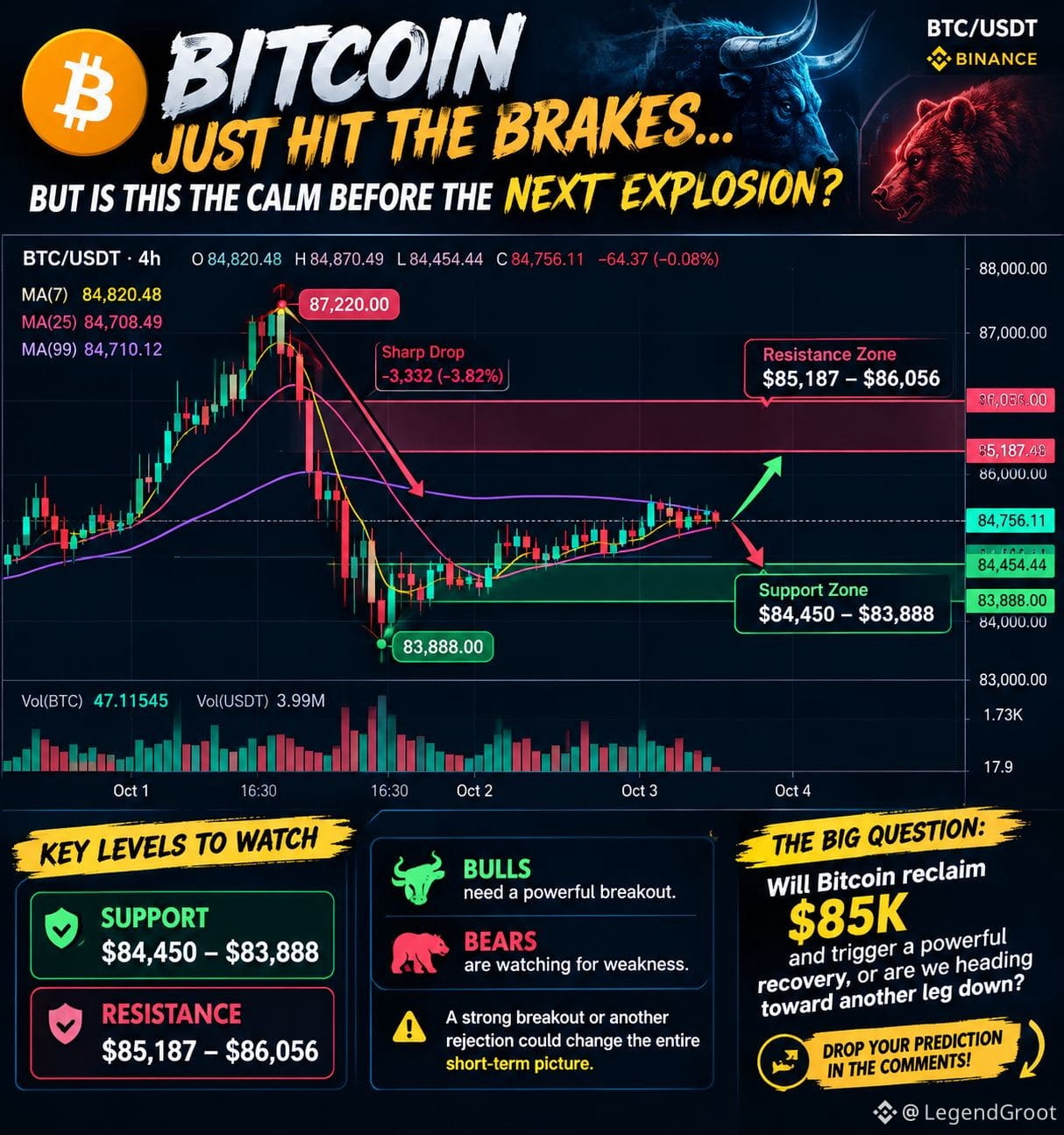
78
·
--
Bullish
🚨🔥 $FIL — LANGKAH BESAR BERIKUTNYA SEDANG DIMUAT! 🐂💥
⚡ BULLS KEMBALI AKTIF!
💰 Harga: $1.0434 (+2.96%)
📈 Tertinggi 24H: $1.0599
🛡️ Support Utama: $1.0290
🎯 Zona Breakout: $1.0500–$1.0600
🚀 SETUP TRADING:
🟢 LONG WATCH: Penutupan candle 15M yang kuat di atas $1.0600 dengan volume dapat menjadi sinyal peluang breakout.
🎯 Level Potensi Naik: $1.0700 → $1.0850 → $1.1000
🔴 PERINGATAN BEAR: Jika terjadi breakdown di bawah $1.0290, bisa membuka jalan untuk pullback yang lebih dalam.
⚔️ RENCANA PERMAINANNYA:
Jangan kejar candle. Pantau breakout, pastikan volume, dan kelola risiko Anda.
🔥 $FIL AT DI TITIK KEPUTUSAN!
BREAKOUT ATAU FAKEDOUT? 👀
💬 BULLS, APA KITA MENUJU $1.10 BERIKUTNYA? 🚀
#FIL #CryptoSignals #TradingSetup #Altcoins #CryptoMarke #BreakoutAlert
🚨🔥 $FIL — LANGKAH BESAR BERIKUTNYA SEDANG DIMUAT! 🐂💥
⚡ BULLS KEMBALI AKTIF!
💰 Harga: $1.0434 (+2.96%)
📈 Tertinggi 24H: $1.0599
🛡️ Support Utama: $1.0290
🎯 Zona Breakout: $1.0500–$1.0600
🚀 SETUP TRADING:
🟢 LONG WATCH: Penutupan candle 15M yang kuat di atas $1.0600 dengan volume dapat menjadi sinyal peluang breakout.
🎯 Level Potensi Naik: $1.0700 → $1.0850 → $1.1000
🔴 PERINGATAN BEAR: Jika terjadi breakdown di bawah $1.0290, bisa membuka jalan untuk pullback yang lebih dalam.
⚔️ RENCANA PERMAINANNYA:
Jangan kejar candle. Pantau breakout, pastikan volume, dan kelola risiko Anda.
🔥 $FIL AT DI TITIK KEPUTUSAN!
BREAKOUT ATAU FAKEDOUT? 👀
💬 BULLS, APA KITA MENUJU $1.10 BERIKUTNYA? 🚀
#FIL #CryptoSignals #TradingSetup #Altcoins #CryptoMarke #BreakoutAlert
⚡ BULLS KEMBALI AKTIF!
💰 Harga: $1.0434 (+2.96%)
📈 Tertinggi 24H: $1.0599
🛡️ Support Utama: $1.0290
🎯 Zona Breakout: $1.0500–$1.0600
🚀 SETUP TRADING:
🟢 LONG WATCH: Penutupan candle 15M yang kuat di atas $1.0600 dengan volume dapat menjadi sinyal peluang breakout.
🎯 Level Potensi Naik: $1.0700 → $1.0850 → $1.1000
🔴 PERINGATAN BEAR: Jika terjadi breakdown di bawah $1.0290, bisa membuka jalan untuk pullback yang lebih dalam.
⚔️ RENCANA PERMAINANNYA:
Jangan kejar candle. Pantau breakout, pastikan volume, dan kelola risiko Anda.
🔥 $FIL AT DI TITIK KEPUTUSAN!
BREAKOUT ATAU FAKEDOUT? 👀
💬 BULLS, APA KITA MENUJU $1.10 BERIKUTNYA? 🚀
#FIL #CryptoSignals #TradingSetup #Altcoins #CryptoMarke #BreakoutAlert
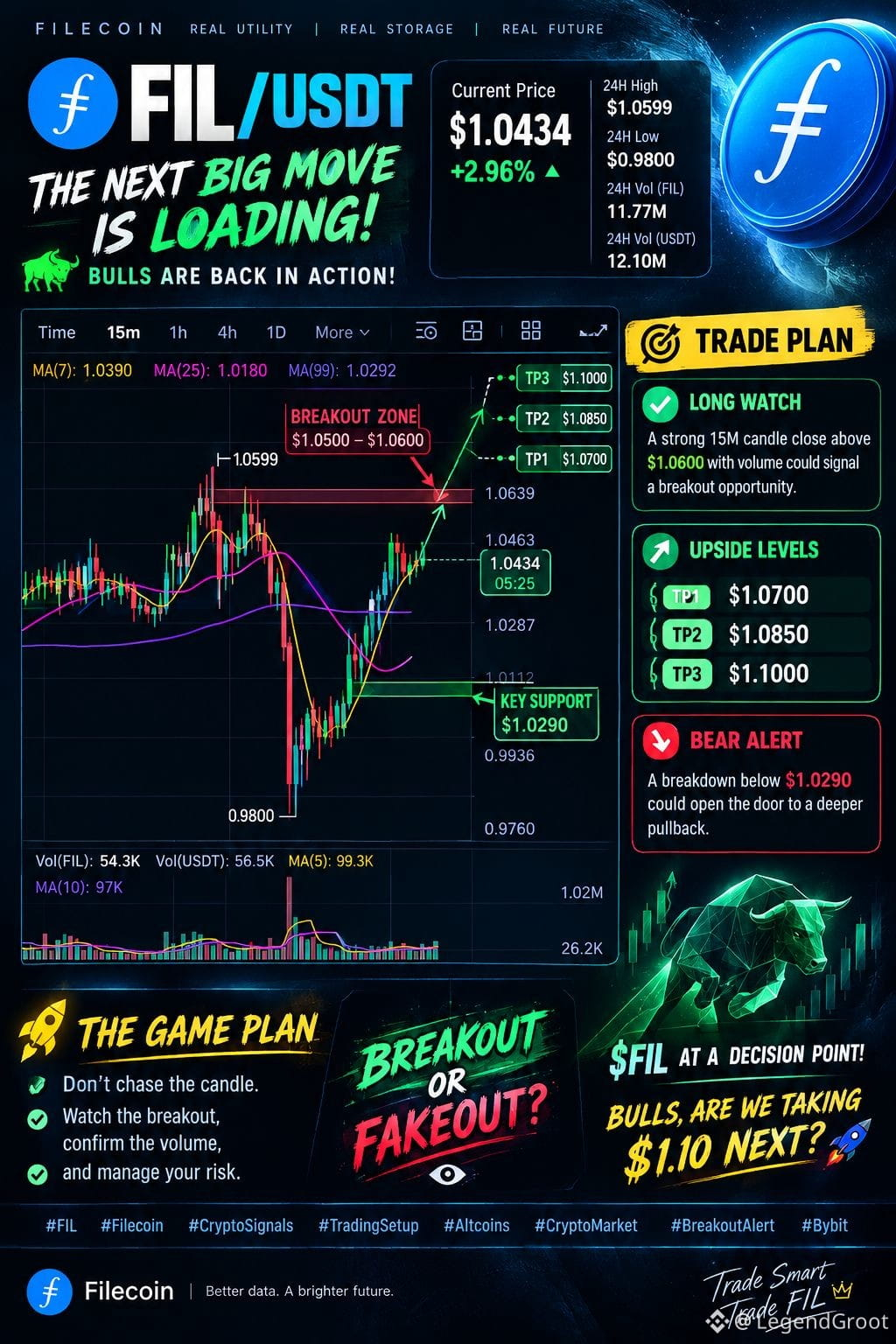
648
·
--
Bullish
🚨 LANGKAH KRIPTO BERIKUTNYA BISA DIMULAI TEPAT DI SINI!⚡🔥
Bitcoin & Ethereum Sedang Ada di Titik Balik yang Kritis! 👀📊
Grafik berkedip dengan tanda peringatan: momentum telah berubah, dan para bullish perlu bangkit untuk melawan.
🟠 $BTC — Bitcoin
💰 Harga: $85,252
🔻 Support Utama: $84,500
🎯 Resistance: $85,500–$86,075
🚀 Reclaim yang kuat bisa membuka jalan menuju $87,220.
🔵 $ETH — Ethereum
💰 Harga: $2,694
🔻 Support Utama: $2,687
🎯 Resistance: $2,718–$2,728
🚀 Tembus batas bisa membuat $2,777 kembali jadi sorotan.
⚡ PERTANYAAN BESAR:
Apakah momentum makro akan mendorong breakout berikutnya, atau trader akan menghadapi shakeout likuiditas lainnya?
Trader cerdas memantau levelnya, bukan mengejar candle. 🎯
#Bitcoin #Ethereum #BTC #ETH #CryptoMarket #TradingSignals #CryptoAnalysis #Bybit
🚨 LANGKAH KRIPTO BERIKUTNYA BISA DIMULAI TEPAT DI SINI!⚡🔥
Bitcoin & Ethereum Sedang Ada di Titik Balik yang Kritis! 👀📊
Grafik berkedip dengan tanda peringatan: momentum telah berubah, dan para bullish perlu bangkit untuk melawan.
🟠 $BTC — Bitcoin
💰 Harga: $85,252
🔻 Support Utama: $84,500
🎯 Resistance: $85,500–$86,075
🚀 Reclaim yang kuat bisa membuka jalan menuju $87,220.
🔵 $ETH — Ethereum
💰 Harga: $2,694
🔻 Support Utama: $2,687
🎯 Resistance: $2,718–$2,728
🚀 Tembus batas bisa membuat $2,777 kembali jadi sorotan.
⚡ PERTANYAAN BESAR:
Apakah momentum makro akan mendorong breakout berikutnya, atau trader akan menghadapi shakeout likuiditas lainnya?
Trader cerdas memantau levelnya, bukan mengejar candle. 🎯
#Bitcoin #Ethereum #BTC #ETH #CryptoMarket #TradingSignals #CryptoAnalysis #Bybit
Bitcoin & Ethereum Sedang Ada di Titik Balik yang Kritis! 👀📊
Grafik berkedip dengan tanda peringatan: momentum telah berubah, dan para bullish perlu bangkit untuk melawan.
🟠 $BTC — Bitcoin
💰 Harga: $85,252
🔻 Support Utama: $84,500
🎯 Resistance: $85,500–$86,075
🚀 Reclaim yang kuat bisa membuka jalan menuju $87,220.
🔵 $ETH — Ethereum
💰 Harga: $2,694
🔻 Support Utama: $2,687
🎯 Resistance: $2,718–$2,728
🚀 Tembus batas bisa membuat $2,777 kembali jadi sorotan.
⚡ PERTANYAAN BESAR:
Apakah momentum makro akan mendorong breakout berikutnya, atau trader akan menghadapi shakeout likuiditas lainnya?
Trader cerdas memantau levelnya, bukan mengejar candle. 🎯
#Bitcoin #Ethereum #BTC #ETH #CryptoMarket #TradingSignals #CryptoAnalysis #Bybit
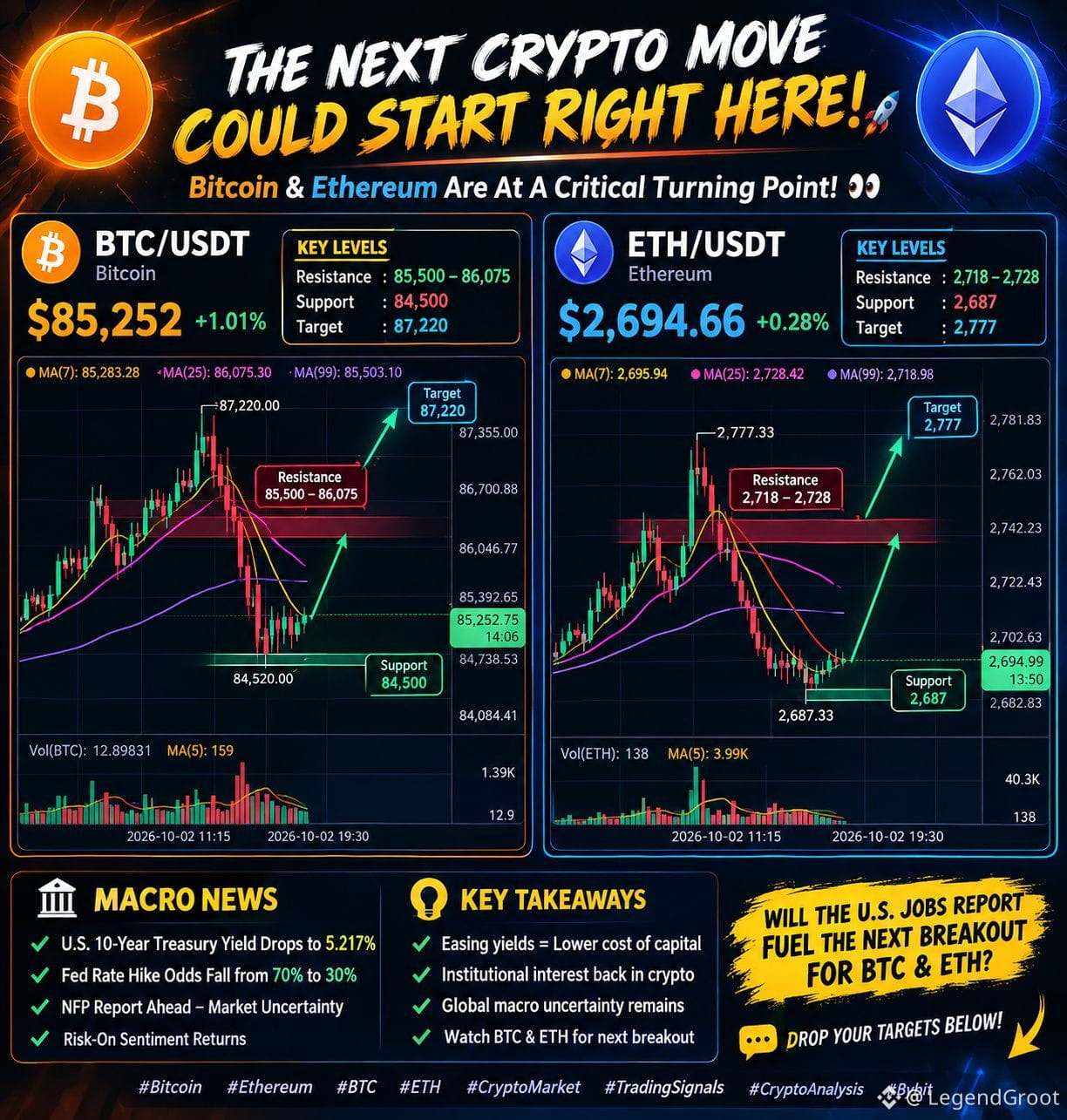
63
·
--
Bullish
🚨 Bitcoin Kembali Jadi Sorotan — $87K Bisa Menyusul! 🔥
$BTC sedang diperdagangkan di $86,383, bertahan di atas level $86K setelah dorongan kuat menuju $86,912.
Grafik 15 menit menunjukkan pembeli mempertahankan penurunan terbaru, dengan harga tetap berada di atas MA(7) pada $86,294 dan MA(25) pada $86,233.
👀 Ini yang saya pantau:
🟢 Jika terjadi breakout yang rapi di atas $86,912, bisa membuka peluang menuju $87K dan seterusnya.
🔴 Jika momentum melemah, $86K adalah area pertama yang perlu diperhatikan, diikuti oleh $85,760 sebagai dukungan jangka pendek yang penting.
Bitcoin tetap bertahan. Pertanyaan sebenarnya sekarang adalah apakah pembeli punya kekuatan yang cukup untuk menembus resistance. ⚡
#Bitcoin #BTC #CryptoTrading #BTCUSDT #PriceAction
🚨 Bitcoin Kembali Jadi Sorotan — $87K Bisa Menyusul! 🔥
$BTC sedang diperdagangkan di $86,383, bertahan di atas level $86K setelah dorongan kuat menuju $86,912.
Grafik 15 menit menunjukkan pembeli mempertahankan penurunan terbaru, dengan harga tetap berada di atas MA(7) pada $86,294 dan MA(25) pada $86,233.
👀 Ini yang saya pantau:
🟢 Jika terjadi breakout yang rapi di atas $86,912, bisa membuka peluang menuju $87K dan seterusnya.
🔴 Jika momentum melemah, $86K adalah area pertama yang perlu diperhatikan, diikuti oleh $85,760 sebagai dukungan jangka pendek yang penting.
Bitcoin tetap bertahan. Pertanyaan sebenarnya sekarang adalah apakah pembeli punya kekuatan yang cukup untuk menembus resistance. ⚡
#Bitcoin #BTC #CryptoTrading #BTCUSDT #PriceAction
$BTC sedang diperdagangkan di $86,383, bertahan di atas level $86K setelah dorongan kuat menuju $86,912.
Grafik 15 menit menunjukkan pembeli mempertahankan penurunan terbaru, dengan harga tetap berada di atas MA(7) pada $86,294 dan MA(25) pada $86,233.
👀 Ini yang saya pantau:
🟢 Jika terjadi breakout yang rapi di atas $86,912, bisa membuka peluang menuju $87K dan seterusnya.
🔴 Jika momentum melemah, $86K adalah area pertama yang perlu diperhatikan, diikuti oleh $85,760 sebagai dukungan jangka pendek yang penting.
Bitcoin tetap bertahan. Pertanyaan sebenarnya sekarang adalah apakah pembeli punya kekuatan yang cukup untuk menembus resistance. ⚡
#Bitcoin #BTC #CryptoTrading #BTCUSDT #PriceAction
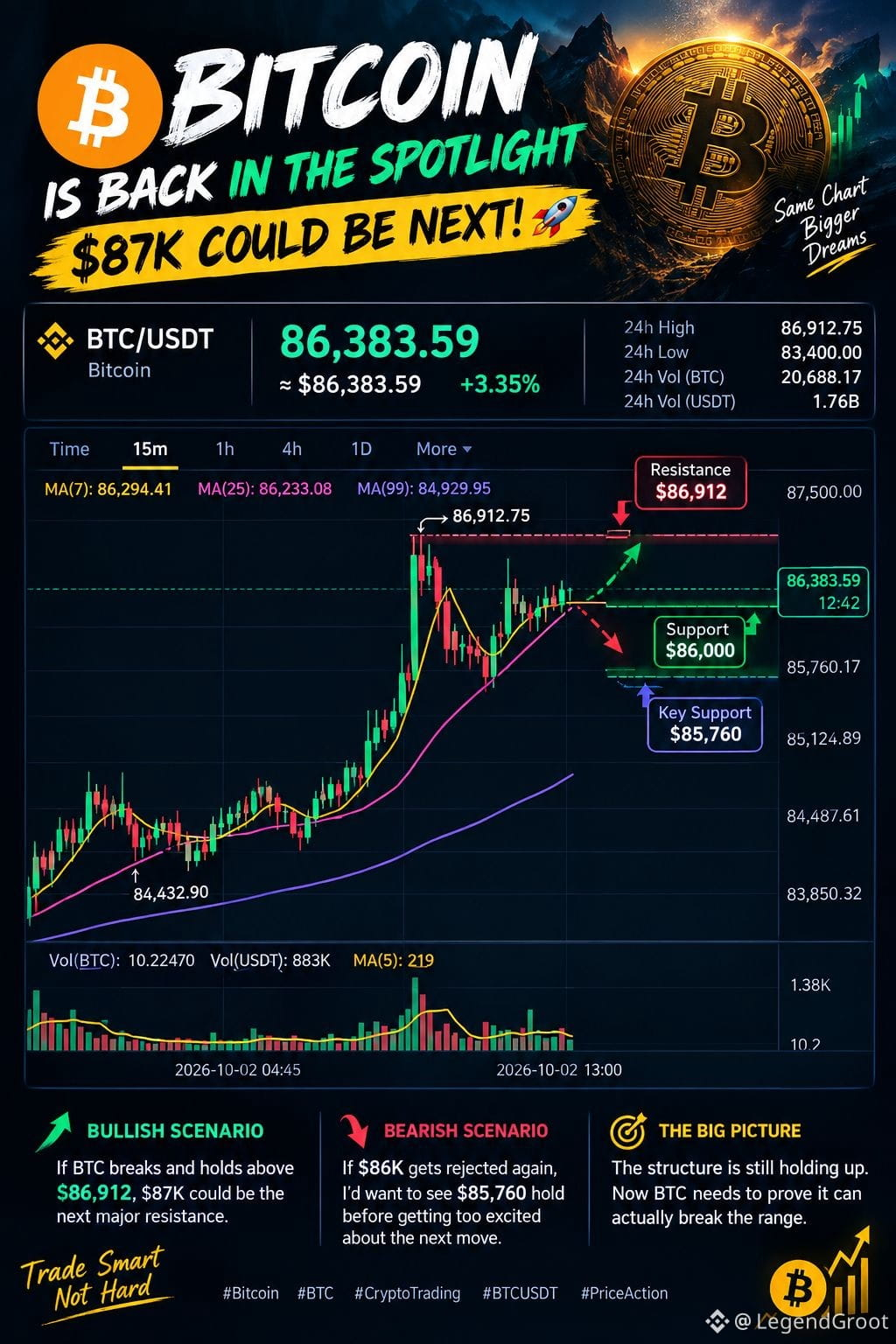
65
·
--
Bullish
🚨 **Bitcoin Sedang Mengirim Pesan yang Diabaikan Kebanyakan Trader.**
Semua orang memperhatikan harga. Uang pintar memperhatikan struktur. 👀
$BTC diperdagangkan pada **$84,612**, melakukan koreksi dari **puncak $85,273**. Harga sekarang berada di bawah MA(7) dan MA(25), sementara MA(99) yang berada di dekat **$84,156** tetap menjadi level penting yang perlu diperhatikan.
⚡ **Satu breakout bisa mengubah seluruh gambaran. Satu breakdown bisa membalik momentum.**
Peluang sebenarnya bukan mengejar setiap candle. Ini tentang memahami langkah mana yang benar-benar penting.
**Apakah kamu mengawasi breakout, atau bersiap untuk penurunan yang lebih dalam?** 👇
#Bitcoin #BTC #CryptoMark #Trading
🚨 **Bitcoin Sedang Mengirim Pesan yang Diabaikan Kebanyakan Trader.**
Semua orang memperhatikan harga. Uang pintar memperhatikan struktur. 👀
$BTC diperdagangkan pada **$84,612**, melakukan koreksi dari **puncak $85,273**. Harga sekarang berada di bawah MA(7) dan MA(25), sementara MA(99) yang berada di dekat **$84,156** tetap menjadi level penting yang perlu diperhatikan.
⚡ **Satu breakout bisa mengubah seluruh gambaran. Satu breakdown bisa membalik momentum.**
Peluang sebenarnya bukan mengejar setiap candle. Ini tentang memahami langkah mana yang benar-benar penting.
**Apakah kamu mengawasi breakout, atau bersiap untuk penurunan yang lebih dalam?** 👇
#Bitcoin #BTC #CryptoMark #Trading
Semua orang memperhatikan harga. Uang pintar memperhatikan struktur. 👀
$BTC diperdagangkan pada **$84,612**, melakukan koreksi dari **puncak $85,273**. Harga sekarang berada di bawah MA(7) dan MA(25), sementara MA(99) yang berada di dekat **$84,156** tetap menjadi level penting yang perlu diperhatikan.
⚡ **Satu breakout bisa mengubah seluruh gambaran. Satu breakdown bisa membalik momentum.**
Peluang sebenarnya bukan mengejar setiap candle. Ini tentang memahami langkah mana yang benar-benar penting.
**Apakah kamu mengawasi breakout, atau bersiap untuk penurunan yang lebih dalam?** 👇
#Bitcoin #BTC #CryptoMark #Trading
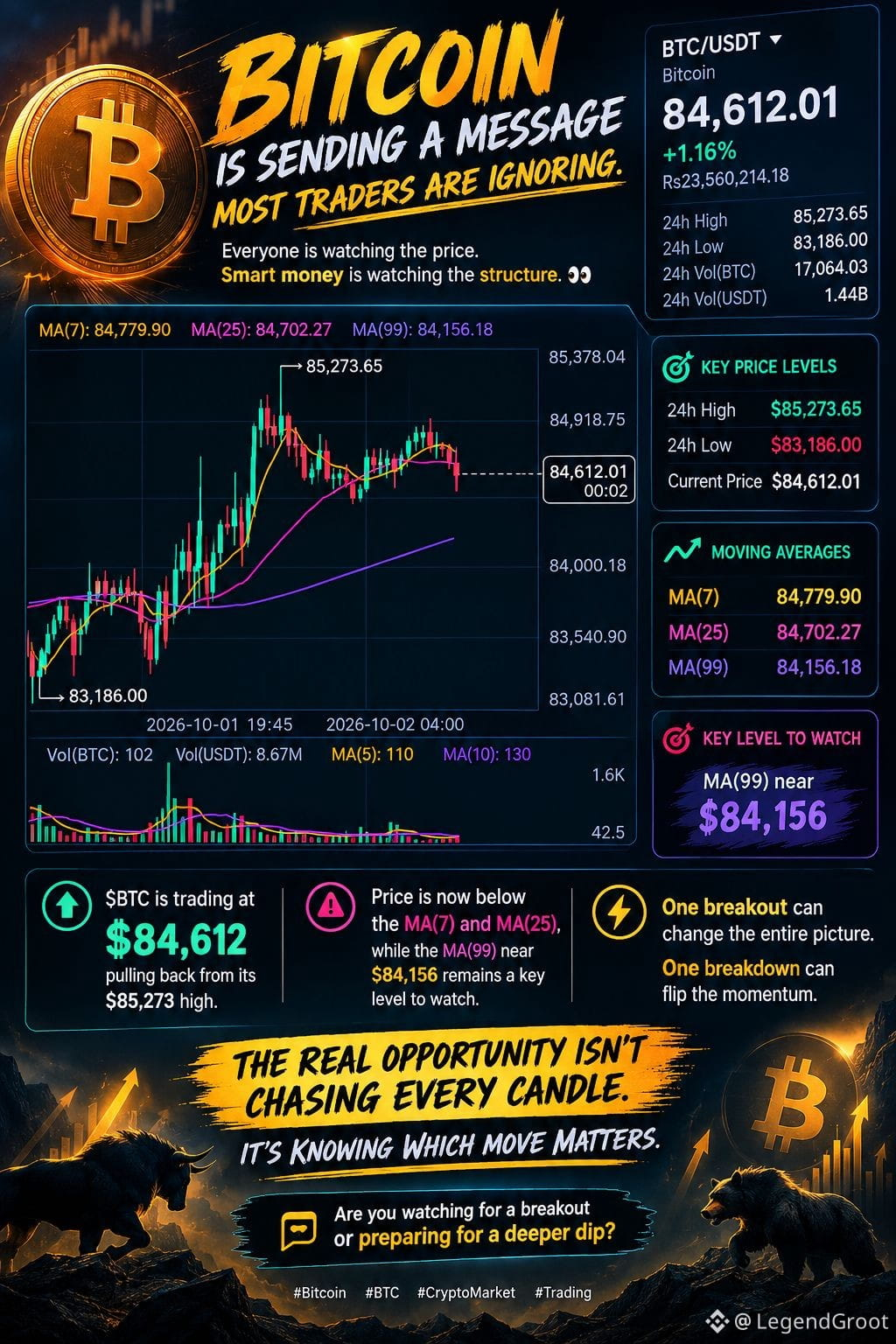
84
·
--
Bullish
🚨 $QNT SEDANG MENGALAMI TEKANAN JUAL YANG BERAT! ⚠️
Quant baru saja mengalami penurunan tajam, turun hampir 14% dalam 24 jam setelah menyentuh area $307. Saat ini, QNT diperdagangkan di sekitar $258, dan sedang menguji area dukungan kritis.
📉 Grafik menampilkan tanda peringatan:
🔻 Harga berada di bawah MA(7), MA(25), dan MA(99).
🎯 $257.80 adalah dukungan terdekat yang perlu diawasi.
⚡ Penembusan (breakdown) dapat memicu penurunan lebih lanjut, sementara pantulan kuat bisa membuka peluang pemulihan.
Langkah berikutnya bisa menunjukkan apakah para bull siap melawan atau penjual masih mengendalikan pasar. 👀🔥
#QNT #Quant #CryptoMarket #Altcoins #PriceAction #CryptoTrading
🚨 $QNT SEDANG MENGALAMI TEKANAN JUAL YANG BERAT! ⚠️
Quant baru saja mengalami penurunan tajam, turun hampir 14% dalam 24 jam setelah menyentuh area $307. Saat ini, QNT diperdagangkan di sekitar $258, dan sedang menguji area dukungan kritis.
📉 Grafik menampilkan tanda peringatan:
🔻 Harga berada di bawah MA(7), MA(25), dan MA(99).
🎯 $257.80 adalah dukungan terdekat yang perlu diawasi.
⚡ Penembusan (breakdown) dapat memicu penurunan lebih lanjut, sementara pantulan kuat bisa membuka peluang pemulihan.
Langkah berikutnya bisa menunjukkan apakah para bull siap melawan atau penjual masih mengendalikan pasar. 👀🔥
#QNT #Quant #CryptoMarket #Altcoins #PriceAction #CryptoTrading
Quant baru saja mengalami penurunan tajam, turun hampir 14% dalam 24 jam setelah menyentuh area $307. Saat ini, QNT diperdagangkan di sekitar $258, dan sedang menguji area dukungan kritis.
📉 Grafik menampilkan tanda peringatan:
🔻 Harga berada di bawah MA(7), MA(25), dan MA(99).
🎯 $257.80 adalah dukungan terdekat yang perlu diawasi.
⚡ Penembusan (breakdown) dapat memicu penurunan lebih lanjut, sementara pantulan kuat bisa membuka peluang pemulihan.
Langkah berikutnya bisa menunjukkan apakah para bull siap melawan atau penjual masih mengendalikan pasar. 👀🔥
#QNT #Quant #CryptoMarket #Altcoins #PriceAction #CryptoTrading
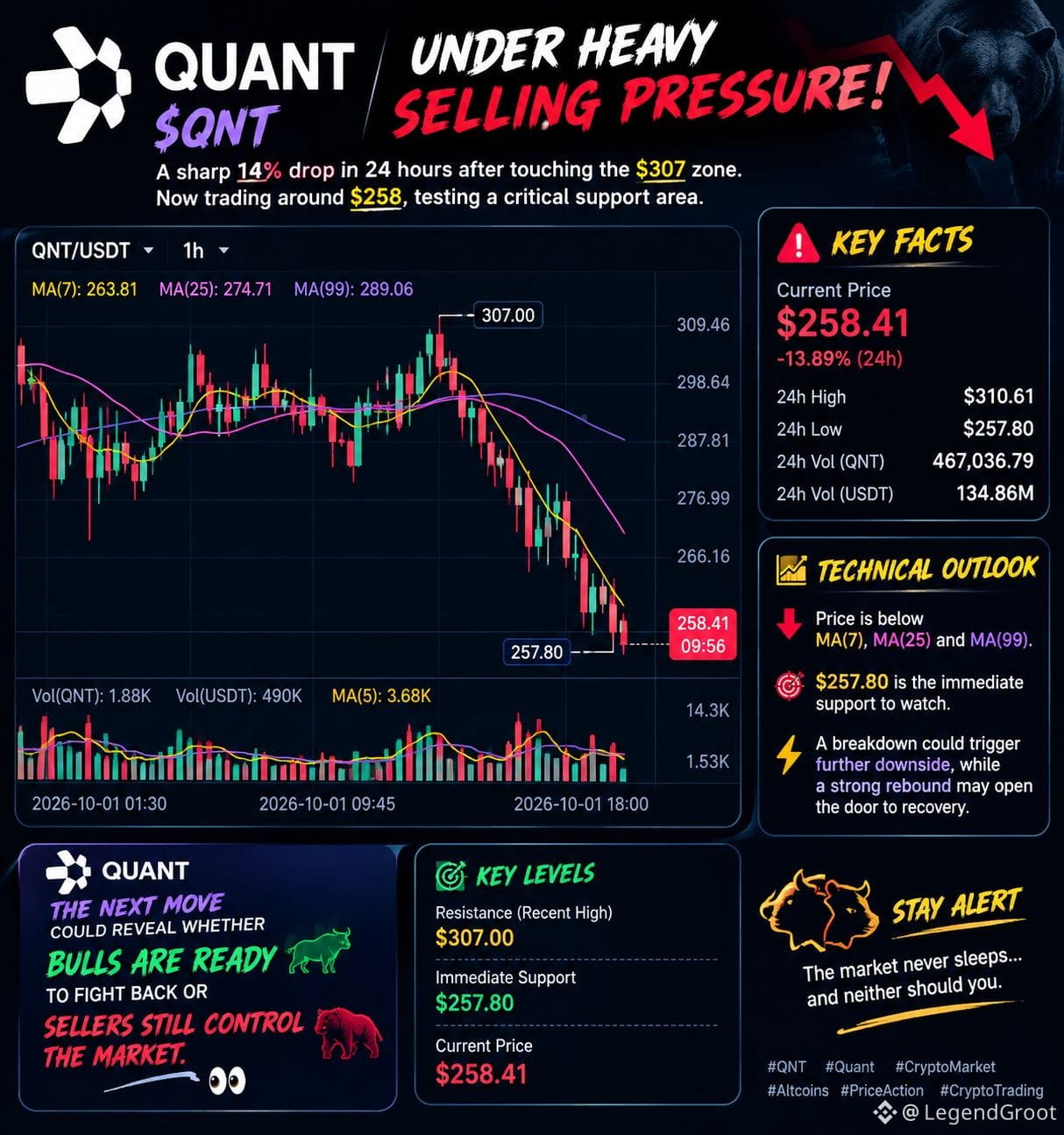
580
·
--
Bullish
🚨 PASAR SEDANG BERGERAK — APA KAMU SEDANG MEMANTAU? 👀🔥
Momentum sedang menguat, dan 3 chart ini tidak bisa diabaikan.
🚀 $MOVR R +83% — momentum yang meledak-ledak
⚡ $SOON +17.7% — pembeli masih aktif
🔥 $QNT +8.5% — merebut kembali rata-rata kunci
Tiga chart. Satu tema:
Momentum menarik perhatian. Struktur menguatkan. 📈
⚠️ Kripto itu volatil. Jangan kejar lonjakan. DYOR & kelola risiko.
#MOVR #SOON #QNT #Crypto #BinanceSquare
🚨 PASAR SEDANG BERGERAK — APA KAMU SEDANG MEMANTAU? 👀🔥
Momentum sedang menguat, dan 3 chart ini tidak bisa diabaikan.
🚀 $MOVR R +83% — momentum yang meledak-ledak
⚡ $SOON +17.7% — pembeli masih aktif
🔥 $QNT +8.5% — merebut kembali rata-rata kunci
Tiga chart. Satu tema:
Momentum menarik perhatian. Struktur menguatkan. 📈
⚠️ Kripto itu volatil. Jangan kejar lonjakan. DYOR & kelola risiko.
#MOVR #SOON #QNT #Crypto #BinanceSquare
Momentum sedang menguat, dan 3 chart ini tidak bisa diabaikan.
🚀 $MOVR R +83% — momentum yang meledak-ledak
⚡ $SOON +17.7% — pembeli masih aktif
🔥 $QNT +8.5% — merebut kembali rata-rata kunci
Tiga chart. Satu tema:
Momentum menarik perhatian. Struktur menguatkan. 📈
⚠️ Kripto itu volatil. Jangan kejar lonjakan. DYOR & kelola risiko.
#MOVR #SOON #QNT #Crypto #BinanceSquare
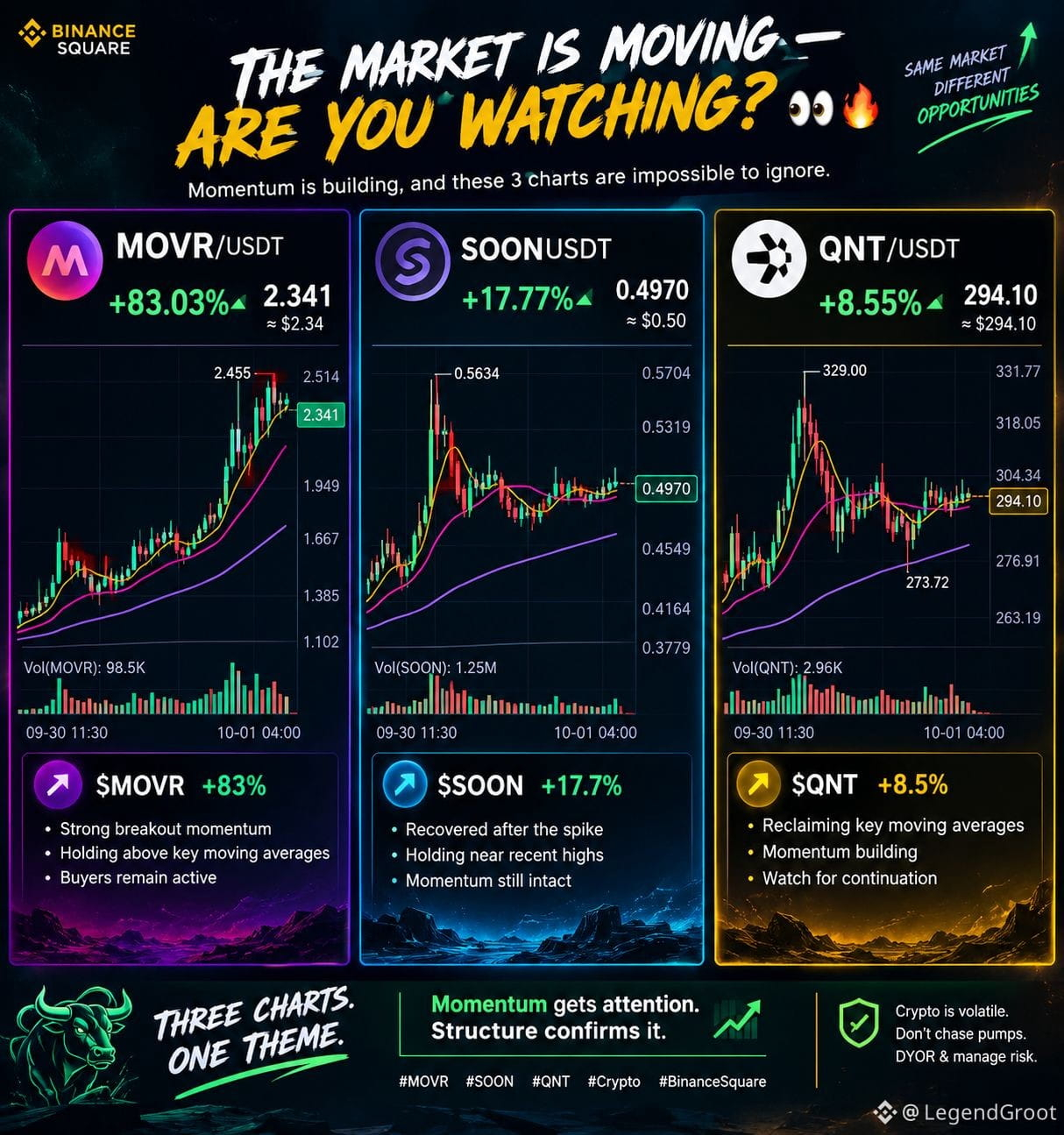
743
·
--
Bullish
Lihat terjemahan
Based on your chart, the bullish BTC breakout path can be mapped like this:
$BTC Bullish Breakout Roadmap 🚀
$84.3K → First reclaim/trigger. A clean 15m/1h close above it would show buyers are regaining control.
$85.2K–$85.6K → Major resistance zone and recent spike high.
$85.6K breakout → Stronger confirmation if $BTC closes above it with expanding volume and holds the level on a retest.
$86.0K–$86.5K → Next upside resistance area visible on the chart.
Above $86.5K → Momentum structure would be materially stronger, opening room for further continuation.
Momentum confirmation: higher highs + higher lows, rising volume on the breakout, and BTC holding $84.3K after the reclaim.
Key invalidation: losing the $83.5K–$83.6K MA99 area would weaken this bullish setup.
Based on your chart, the bullish BTC breakout path can be mapped like this:
$BTC Bullish Breakout Roadmap 🚀
$84.3K → First reclaim/trigger. A clean 15m/1h close above it would show buyers are regaining control.
$85.2K–$85.6K → Major resistance zone and recent spike high.
$85.6K breakout → Stronger confirmation if $BTC closes above it with expanding volume and holds the level on a retest.
$86.0K–$86.5K → Next upside resistance area visible on the chart.
Above $86.5K → Momentum structure would be materially stronger, opening room for further continuation.
Momentum confirmation: higher highs + higher lows, rising volume on the breakout, and BTC holding $84.3K after the reclaim.
Key invalidation: losing the $83.5K–$83.6K MA99 area would weaken this bullish setup.
$BTC Bullish Breakout Roadmap 🚀
$84.3K → First reclaim/trigger. A clean 15m/1h close above it would show buyers are regaining control.
$85.2K–$85.6K → Major resistance zone and recent spike high.
$85.6K breakout → Stronger confirmation if $BTC closes above it with expanding volume and holds the level on a retest.
$86.0K–$86.5K → Next upside resistance area visible on the chart.
Above $86.5K → Momentum structure would be materially stronger, opening room for further continuation.
Momentum confirmation: higher highs + higher lows, rising volume on the breakout, and BTC holding $84.3K after the reclaim.
Key invalidation: losing the $83.5K–$83.6K MA99 area would weaken this bullish setup.
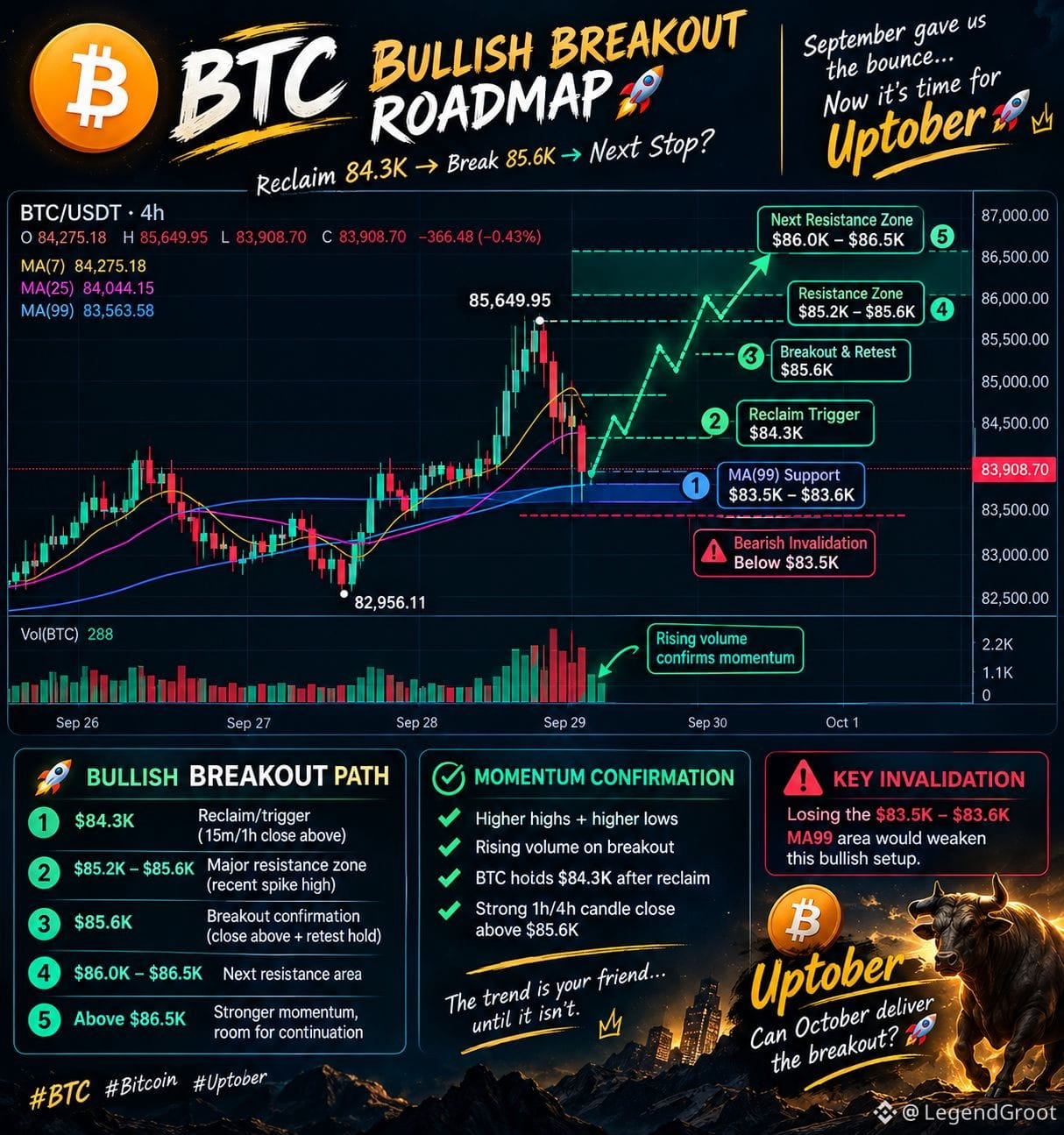
42
·
--
Bullish
Berdasarkan chart Anda, jalur bullish breakout BTC dapat dipetakan seperti ini:
$BTC Rencana Perjalanan Bullish Breakout 🚀
$84.3K → Reclaim/trigger pertama. Close 15m/1h yang bersih di atasnya akan menunjukkan bahwa pembeli kembali menguasai.
$85.2K–$85.6K → Zona resistance utama dan puncak (swing high) dari lonjakan terbaru.
$85.6K breakout → Konfirmasi yang lebih kuat jika $BTC ditutup di atas level ini dengan volume yang meningkat dan mempertahankan level tersebut saat retest.
$86.0K–$86.5K → Area resistance upside berikutnya yang terlihat di chart.
Di atas $86.5K → Struktur momentum akan menjadi jauh lebih kuat, membuka ruang untuk kelanjutan berikutnya.
Konfirmasi momentum: higher highs + higher lows, volume yang naik saat breakout, dan BTC bertahan di $84.3K setelah reclaim.
Invalidasi utama: kehilangan area MA99 $83.5K–$83.6K akan melemahkan setup bullish ini.
Berdasarkan chart Anda, jalur bullish breakout BTC dapat dipetakan seperti ini:
$BTC Rencana Perjalanan Bullish Breakout 🚀
$84.3K → Reclaim/trigger pertama. Close 15m/1h yang bersih di atasnya akan menunjukkan bahwa pembeli kembali menguasai.
$85.2K–$85.6K → Zona resistance utama dan puncak (swing high) dari lonjakan terbaru.
$85.6K breakout → Konfirmasi yang lebih kuat jika $BTC ditutup di atas level ini dengan volume yang meningkat dan mempertahankan level tersebut saat retest.
$86.0K–$86.5K → Area resistance upside berikutnya yang terlihat di chart.
Di atas $86.5K → Struktur momentum akan menjadi jauh lebih kuat, membuka ruang untuk kelanjutan berikutnya.
Konfirmasi momentum: higher highs + higher lows, volume yang naik saat breakout, dan BTC bertahan di $84.3K setelah reclaim.
Invalidasi utama: kehilangan area MA99 $83.5K–$83.6K akan melemahkan setup bullish ini.
$BTC Rencana Perjalanan Bullish Breakout 🚀
$84.3K → Reclaim/trigger pertama. Close 15m/1h yang bersih di atasnya akan menunjukkan bahwa pembeli kembali menguasai.
$85.2K–$85.6K → Zona resistance utama dan puncak (swing high) dari lonjakan terbaru.
$85.6K breakout → Konfirmasi yang lebih kuat jika $BTC ditutup di atas level ini dengan volume yang meningkat dan mempertahankan level tersebut saat retest.
$86.0K–$86.5K → Area resistance upside berikutnya yang terlihat di chart.
Di atas $86.5K → Struktur momentum akan menjadi jauh lebih kuat, membuka ruang untuk kelanjutan berikutnya.
Konfirmasi momentum: higher highs + higher lows, volume yang naik saat breakout, dan BTC bertahan di $84.3K setelah reclaim.
Invalidasi utama: kehilangan area MA99 $83.5K–$83.6K akan melemahkan setup bullish ini.
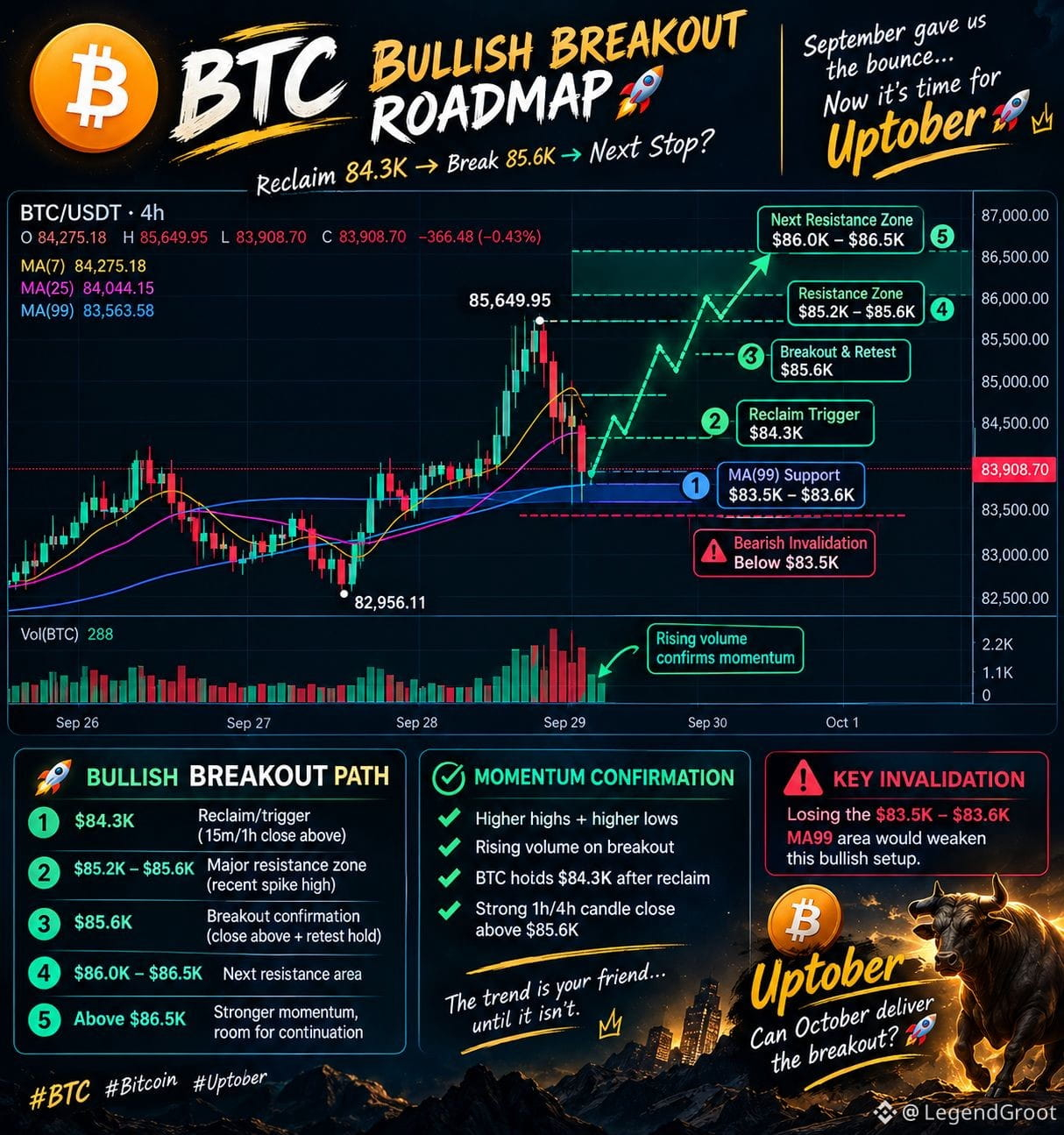
80
Masuk untuk menjelajahi konten lainnya
Bergabunglah dengan pengguna kripto global di Binance Square
⚡️ Dapatkan informasi terbaru dan berguna tentang kripto.
💬 Dipercayai oleh bursa kripto terbesar di dunia.
👍 Temukan wawasan nyata dari kreator terverifikasi.
Email/Nomor Ponsel
Topik Sedang Tren
FedMinutesFocusOnOctoberPause
89,816 penayangan
992 Berdiskusi
PANTAU TERUS
$BTC $ETH $SOL
The Fed kembali memberi pasar petunjuk penting soal arah suku bunga berikutnya. 👀
Risalah FOMC September jadi perhatian utama malam ini. Pertanyaannya sederhana:
Oktober bakal hike lagi atau PAUSE?
Saat ini, peluang Fed menahan suku bunga di Oktober sudah mencapai sekitar 79,3%, sementara peluang kenaikan 25 bps hanya sekitar 20,7%.
Menariknya, setelah Fed menaikkan suku bunga ke 3,75%–4,00% pada September, data tenaga kerja terbaru justru menunjukkan pelemahan.
Kalau minutes malam ini menunjukkan Fed mulai lebih berhati-hati, PAUSE Oktober bisa semakin kuat.
Dan ini penting buat crypto. 👀
Jeda kenaikan suku bunga bisa memberi sedikit ruang bagi aset berisiko seperti BTC untuk bernapas.
Tapi kalau minutes justru terdengar hawkish…
BTC bisa kembali kena tekanan. 📉
Malam ini bakal menarik. 👀🔥
#FedMinutesFocusOnOctoberPause
erlandd
·Disukai 1 Kali
·285 penayangan
BinanceLaunchesBinanceIntelligence
1M penayangan
6,244 Berdiskusi
EvernorthDelaysNasdaqDebutToOct12
5,289 penayangan
190 Berdiskusi