
mikeskcv
28 Posting

mikeskcv
Laporkan
Blokir Pengguna
5 Mengikuti
1 Pengikut
10 Disukai
Posting
·
--
Suku bunga bank sentral kembali menjadi berita, dan menarik untuk melihat bagaimana aset tradisional meresponsnya. TradFi di Binance nyaman karena Anda tidak perlu membuka lima tab berbeda dengan berbagai bursa—semuanya ada di satu tempat, dan gambaran pasar tersusun lebih cepat.
#TradFi #Binance #CreateWithBinance #ринок
Suku bunga bank sentral kembali menjadi berita, dan menarik untuk melihat bagaimana aset tradisional meresponsnya. TradFi di Binance nyaman karena Anda tidak perlu membuka lima tab berbeda dengan berbagai bursa—semuanya ada di satu tempat, dan gambaran pasar tersusun lebih cepat.
#TradFi #Binance #CreateWithBinance #ринок
#TradFi #Binance #CreateWithBinance #ринок
114
·
--
Mencoba bStocks minggu ini. Membeli sebagian kecil Apple — pesanan saya diproses lebih cepat daripada melalui broker biasa, dan biayanya menyenangkan. Sementara ini plus.
#bStocks #Binance #CreateWithBinance #інвестиції
Mencoba bStocks minggu ini. Membeli sebagian kecil Apple — pesanan saya diproses lebih cepat daripada melalui broker biasa, dan biayanya menyenangkan. Sementara ini plus.
#bStocks #Binance #CreateWithBinance #інвестиції
#bStocks #Binance #CreateWithBinance #інвестиції
181
·
--
Lihat terjemahan
#termmax @termmax
What if the most interesting part of DeFi lending isn't the yield?
But who gets to choose the terms?
That's what I find interesting about TermMax.
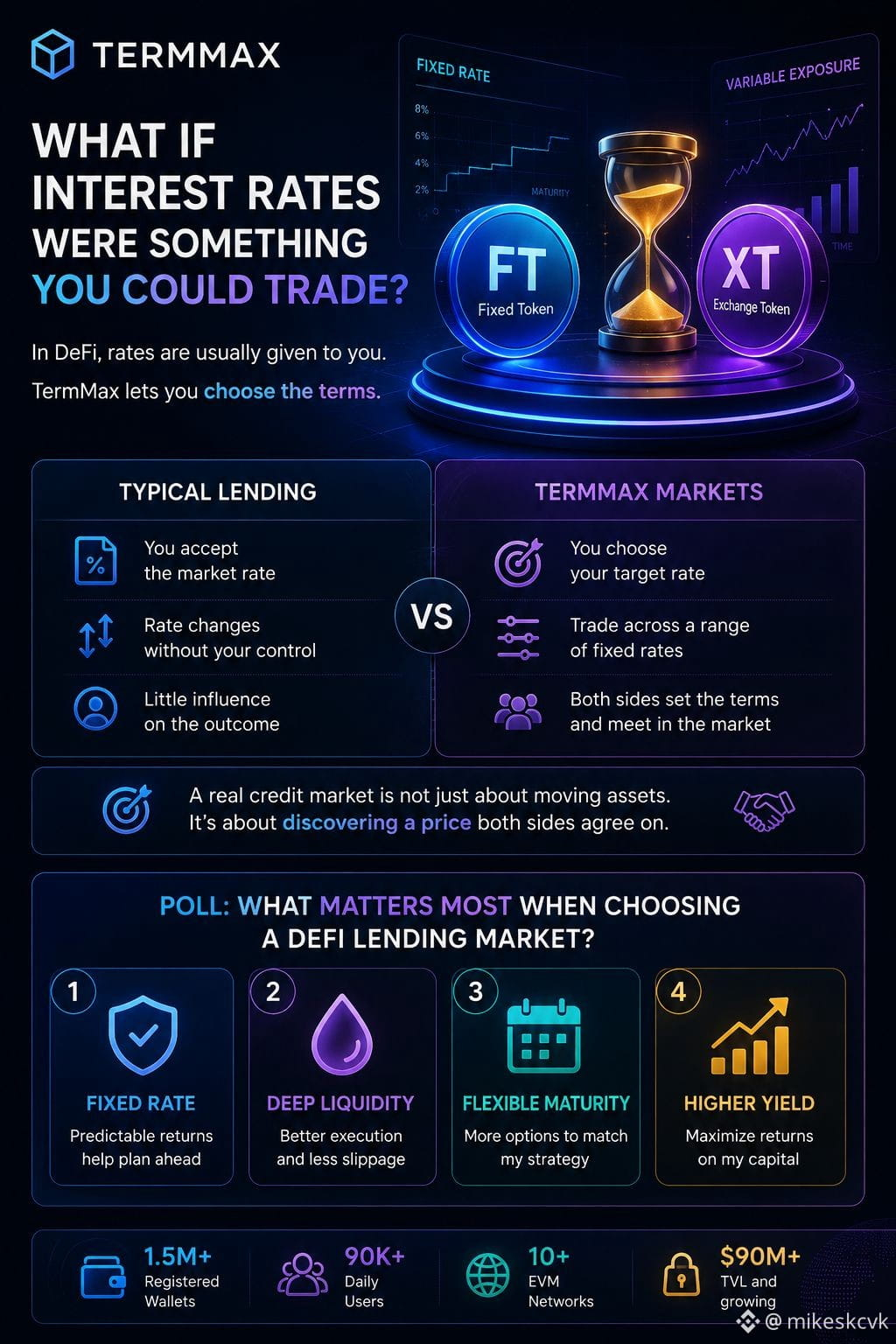
In a typical lending market, you mostly accept whatever rate the market is giving you.
But fixed-rate markets introduce another possibility.
A borrower can think:
“At what rate does this loan actually make sense for
me?”
And a lender can think:
“At what return am I comfortable locking my capital?”
Now the interest rate isn't just a number on a dashboard.
It's part of the negotiation.
That changes how I look at on-chain credit.
Because a real financial market isn't only about moving assets from A to B.
It's about discovering a price that both sides are willing to accept.
TermMax is experimenting with that idea on-chain.
And honestly, I think this is a more interesting question than chasing the highest APY:
Can DeFi create efficient markets for the price of time and capital?
That's what I'll be watching.
#termmax @TermMax
What if the most interesting part of DeFi lending isn't the yield?
But who gets to choose the terms?
That's what I find interesting about TermMax.
In a typical lending market, you mostly accept whatever rate the market is giving you.
But fixed-rate markets introduce another possibility.
A borrower can think:
“At what rate does this loan actually make sense for
me?”
And a lender can think:
“At what return am I comfortable locking my capital?”
Now the interest rate isn't just a number on a dashboard.
It's part of the negotiation.
That changes how I look at on-chain credit.
Because a real financial market isn't only about moving assets from A to B.
It's about discovering a price that both sides are willing to accept.
TermMax is experimenting with that idea on-chain.
And honestly, I think this is a more interesting question than chasing the highest APY:
Can DeFi create efficient markets for the price of time and capital?
That's what I'll be watching.
What if the most interesting part of DeFi lending isn't the yield?
But who gets to choose the terms?
That's what I find interesting about TermMax.
In a typical lending market, you mostly accept whatever rate the market is giving you.
But fixed-rate markets introduce another possibility.
A borrower can think:
“At what rate does this loan actually make sense for
me?”
And a lender can think:
“At what return am I comfortable locking my capital?”
Now the interest rate isn't just a number on a dashboard.
It's part of the negotiation.
That changes how I look at on-chain credit.
Because a real financial market isn't only about moving assets from A to B.
It's about discovering a price that both sides are willing to accept.
TermMax is experimenting with that idea on-chain.
And honestly, I think this is a more interesting question than chasing the highest APY:
Can DeFi create efficient markets for the price of time and capital?
That's what I'll be watching.
88
·
--
Lihat terjemahan
#termmax @termmax
The most interesting TermMax update isn't the $TMX TGE.
It's something much less exciting at first glance:
App V2.
Why?
Because DeFi has a fragmentation problem.
One chain for this position.
Another chain for that vault.
Different interfaces.
Different orders.
Different liquidity.
You can have a great protocol and still make the user experience feel like managing five different accounts.
TermMax V2 is moving in the opposite direction.
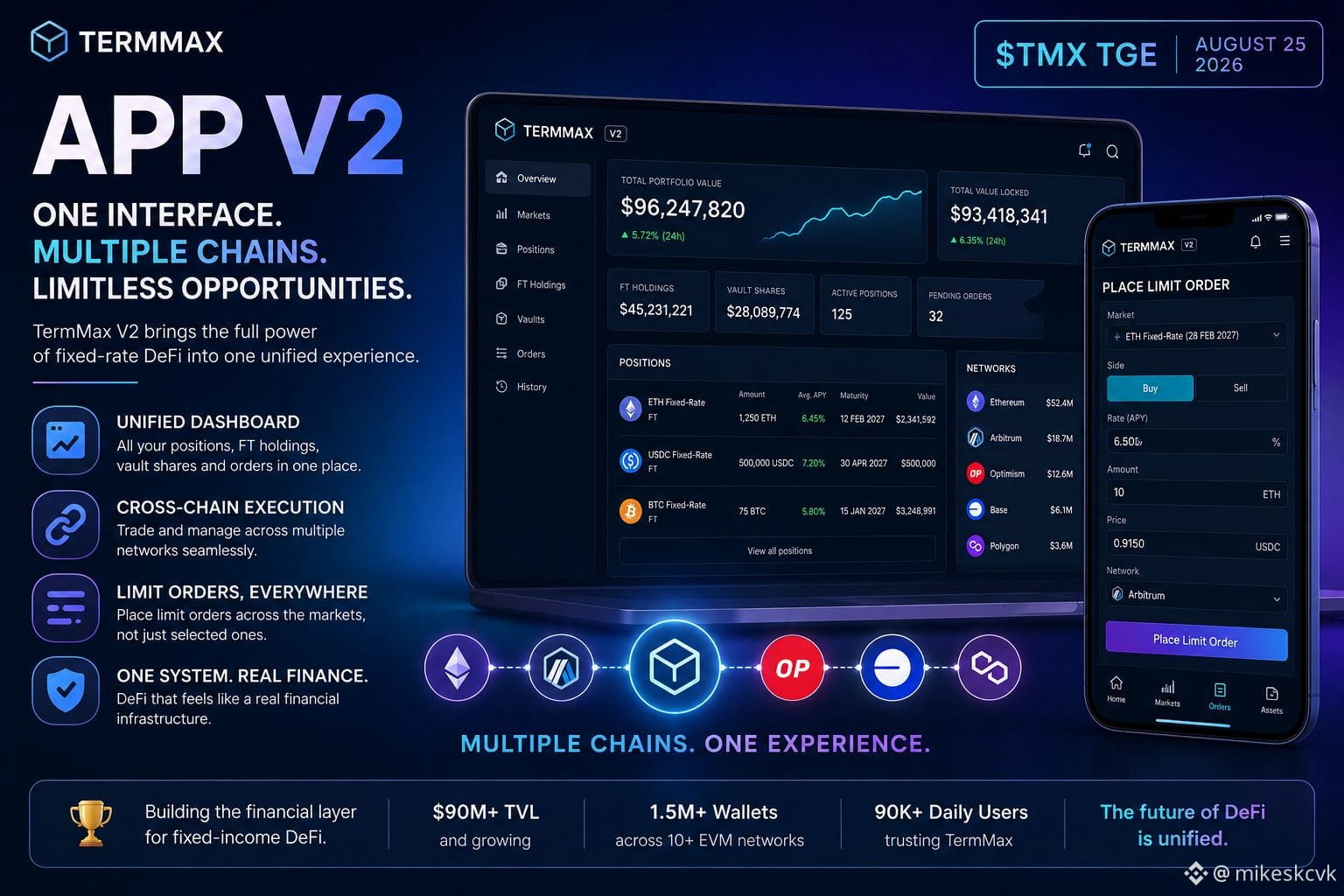
One interface for multiple chains.
One dashboard for positions, FT holdings, vault shares and orders.
And limit orders across the markets instead of restricting them to selected ones.
That might sound like a UX improvement.
I think it's more important than that.
If fixed-rate DeFi is supposed to become actual financial infrastructure, users shouldn't have to think about the underlying chain every time they make a transaction.
The chain should become the infrastructure.
The product should be the market.
And this is where TermMax gets interesting to me.
The next stage of DeFi may not be about adding more protocols.
It may be about making the protocols we already have feel like one financial system.
$TMX TGE is coming on August 25.
But I'm more interested in what happens after the infrastructure is already built.
#termmax @TermMax
The most interesting TermMax update isn't the $TMX TGE.
It's something much less exciting at first glance:
App V2.
Why?
Because DeFi has a fragmentation problem.
One chain for this position.
Another chain for that vault.
Different interfaces.
Different orders.
Different liquidity.
You can have a great protocol and still make the user experience feel like managing five different accounts.
TermMax V2 is moving in the opposite direction.
One interface for multiple chains.
One dashboard for positions, FT holdings, vault shares and orders.
And limit orders across the markets instead of restricting them to selected ones.
That might sound like a UX improvement.
I think it's more important than that.
If fixed-rate DeFi is supposed to become actual financial infrastructure, users shouldn't have to think about the underlying chain every time they make a transaction.
The chain should become the infrastructure.
The product should be the market.
And this is where TermMax gets interesting to me.
The next stage of DeFi may not be about adding more protocols.
It may be about making the protocols we already have feel like one financial system.
$TMX TGE is coming on August 25.
But I'm more interested in what happens after the infrastructure is already built.
The most interesting TermMax update isn't the $TMX TGE.
It's something much less exciting at first glance:
App V2.
Why?
Because DeFi has a fragmentation problem.
One chain for this position.
Another chain for that vault.
Different interfaces.
Different orders.
Different liquidity.
You can have a great protocol and still make the user experience feel like managing five different accounts.
TermMax V2 is moving in the opposite direction.
One interface for multiple chains.
One dashboard for positions, FT holdings, vault shares and orders.
And limit orders across the markets instead of restricting them to selected ones.
That might sound like a UX improvement.
I think it's more important than that.
If fixed-rate DeFi is supposed to become actual financial infrastructure, users shouldn't have to think about the underlying chain every time they make a transaction.
The chain should become the infrastructure.
The product should be the market.
And this is where TermMax gets interesting to me.
The next stage of DeFi may not be about adding more protocols.
It may be about making the protocols we already have feel like one financial system.
$TMX TGE is coming on August 25.
But I'm more interested in what happens after the infrastructure is already built.
1
82
·
--
Bullish
Lihat terjemahan
#termmax @termmax
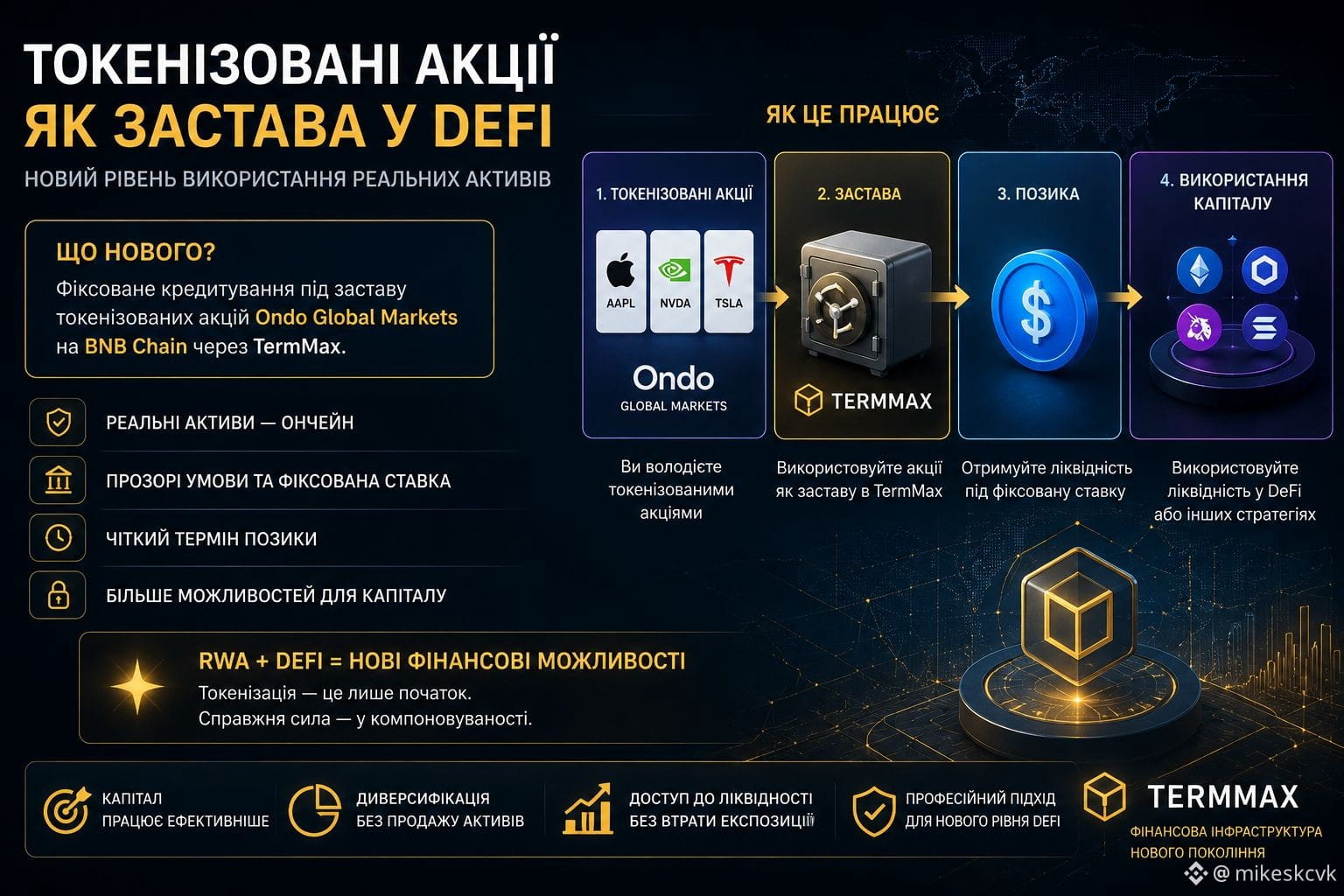
Більшість людей дивляться на токенізовані акції як на спосіб отримати доступ до традиційних ринків через блокчейн.
Але мені цікавіше інше питання.
Що, якщо такі активи можуть не просто лежати в портфелі?
Що, якщо вони можуть працювати як фінансовий інструмент?
Саме тут стає цікаво.
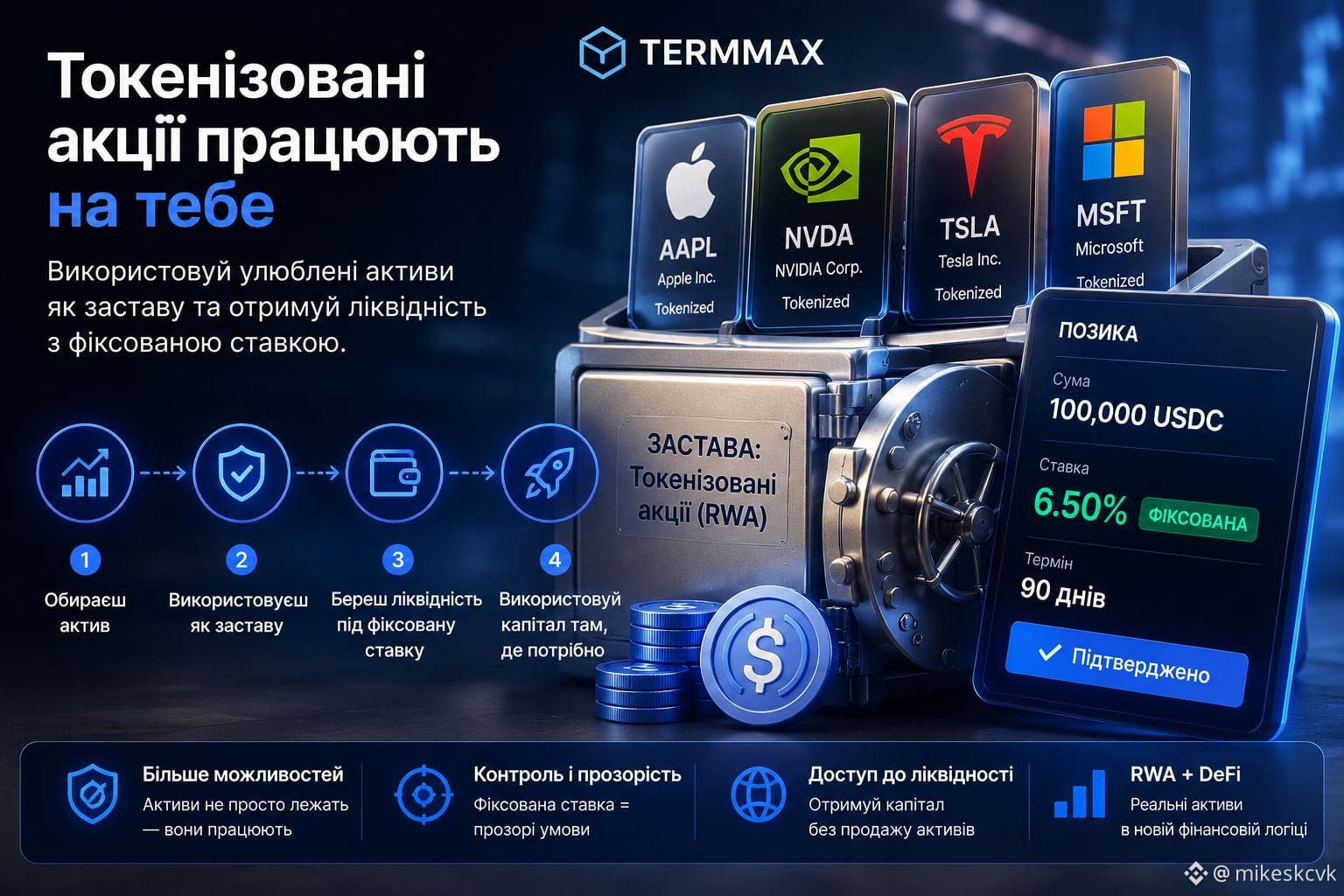
TermMax дозволяє використовувати токенізовані акції як заставу для отримання ліквідності під фіксовану ставку.
Тобто актив не просто відображає ціну акції.
Він стає частиною DeFi-екосистеми.
У результаті з'являється нова логіка:
📈 Тримаєш токенізовані акції
🔒 Використовуєш їх як заставу
💵 Отримуєш ліквідність
🚀 Використовуєш капітал в інших стратегіях
На мою думку, саме тут прихований справжній потенціал RWA.
Не в самій токенізації.
А в тому, що реальні активи починають взаємодіяти з DeFi так само гнучко, як криптоактиви.
І що більше таких сценаріїв з'являтиметься, то цікавішою ставатиме вся екосистема.
Токенізація — це лише перший крок.
Справжня цінність починається тоді, коли активи можна використовувати по-новому.
#termmax @TermMax
Більшість людей дивляться на токенізовані акції як на спосіб отримати доступ до традиційних ринків через блокчейн.
Але мені цікавіше інше питання.
Що, якщо такі активи можуть не просто лежати в портфелі?
Що, якщо вони можуть працювати як фінансовий інструмент?
Саме тут стає цікаво.
TermMax дозволяє використовувати токенізовані акції як заставу для отримання ліквідності під фіксовану ставку.
Тобто актив не просто відображає ціну акції.
Він стає частиною DeFi-екосистеми.
У результаті з'являється нова логіка:
📈 Тримаєш токенізовані акції
🔒 Використовуєш їх як заставу
💵 Отримуєш ліквідність
🚀 Використовуєш капітал в інших стратегіях
На мою думку, саме тут прихований справжній потенціал RWA.
Не в самій токенізації.
А в тому, що реальні активи починають взаємодіяти з DeFi так само гнучко, як криптоактиви.
І що більше таких сценаріїв з'являтиметься, то цікавішою ставатиме вся екосистема.
Токенізація — це лише перший крок.
Справжня цінність починається тоді, коли активи можна використовувати по-новому.
Більшість людей дивляться на токенізовані акції як на спосіб отримати доступ до традиційних ринків через блокчейн.
Але мені цікавіше інше питання.
Що, якщо такі активи можуть не просто лежати в портфелі?
Що, якщо вони можуть працювати як фінансовий інструмент?
Саме тут стає цікаво.
TermMax дозволяє використовувати токенізовані акції як заставу для отримання ліквідності під фіксовану ставку.
Тобто актив не просто відображає ціну акції.
Він стає частиною DeFi-екосистеми.
У результаті з'являється нова логіка:
📈 Тримаєш токенізовані акції
🔒 Використовуєш їх як заставу
💵 Отримуєш ліквідність
🚀 Використовуєш капітал в інших стратегіях
На мою думку, саме тут прихований справжній потенціал RWA.
Не в самій токенізації.
А в тому, що реальні активи починають взаємодіяти з DeFi так само гнучко, як криптоактиви.
І що більше таких сценаріїв з'являтиметься, то цікавішою ставатиме вся екосистема.
Токенізація — це лише перший крок.
Справжня цінність починається тоді, коли активи можна використовувати по-новому.
138
·
--
Lihat terjemahan
Most people look at a lending protocol and ask:
“What's the APY?”
I think that's only half the story.
The other half is what happens to your capital while you're earning that APY.
Can you predict when the position ends?
Do you know exactly what you're lending into?
Can you build a strategy around a specific maturity?
That's the part of TermMax I find interesting.
Its approach treats lending more like an actual financial instrument: the position has defined terms and a maturity instead of being just another deposit sitting in a pool.
And this matters beyond retail DeFi.
If on-chain credit is ever going to attract serious capital, investors will need more than attractive yields.
They'll need products they can understand, price and plan around.
Maybe DeFi's next upgrade isn't another way to chase yield.
Maybe it's making lending feel more like a real financial market.
That's a much more interesting direction to me.
#termmax @termmax
Quick DeFi poll 👇
When you choose a lending opportunity, what do you care about MOST?
Most people look at a lending protocol and ask:
“What's the APY?”
I think that's only half the story.
The other half is what happens to your capital while you're earning that APY.
Can you predict when the position ends?
Do you know exactly what you're lending into?
Can you build a strategy around a specific maturity?
That's the part of TermMax I find interesting.
Its approach treats lending more like an actual financial instrument: the position has defined terms and a maturity instead of being just another deposit sitting in a pool.
And this matters beyond retail DeFi.
If on-chain credit is ever going to attract serious capital, investors will need more than attractive yields.
They'll need products they can understand, price and plan around.
Maybe DeFi's next upgrade isn't another way to chase yield.
Maybe it's making lending feel more like a real financial market.
That's a much more interesting direction to me.
#termmax @TermMax
Quick DeFi poll 👇
When you choose a lending opportunity, what do you care about MOST?
“What's the APY?”
I think that's only half the story.
The other half is what happens to your capital while you're earning that APY.
Can you predict when the position ends?
Do you know exactly what you're lending into?
Can you build a strategy around a specific maturity?
That's the part of TermMax I find interesting.
Its approach treats lending more like an actual financial instrument: the position has defined terms and a maturity instead of being just another deposit sitting in a pool.
And this matters beyond retail DeFi.
If on-chain credit is ever going to attract serious capital, investors will need more than attractive yields.
They'll need products they can understand, price and plan around.
Maybe DeFi's next upgrade isn't another way to chase yield.
Maybe it's making lending feel more like a real financial market.
That's a much more interesting direction to me.
#termmax @TermMax
Quick DeFi poll 👇
When you choose a lending opportunity, what do you care about MOST?
Higher APY
0%
Fixed maturity
0%
Liquidity
0%
Risk / security
0%
0 Voting • Voting ditutup
56
·
--
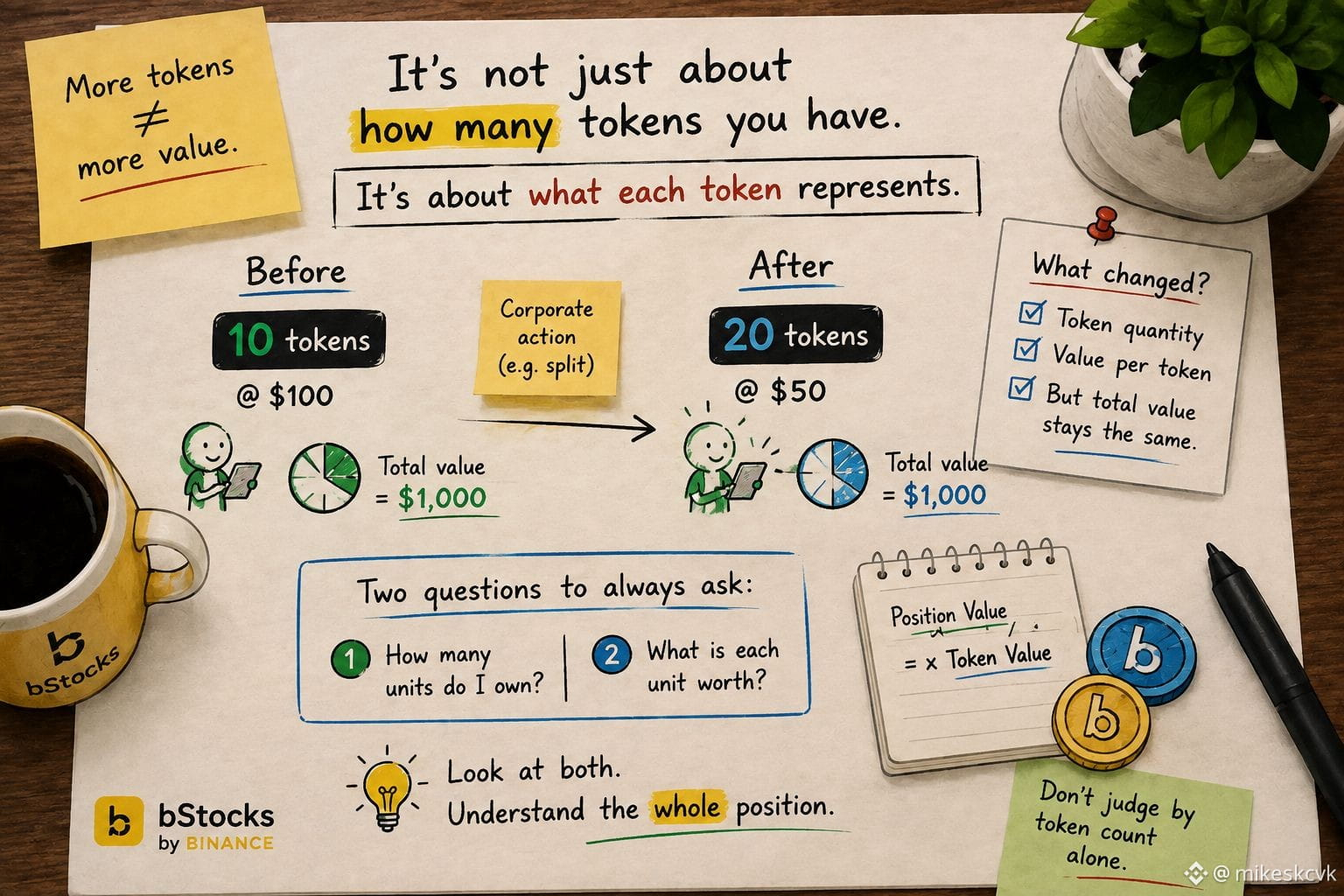
Dulu saya mengira saldo yang lebih besar secara otomatis berarti posisi yang lebih besar.
Lalu saya mulai memberi perhatian lebih pada apa sebenarnya yang diwakili oleh satu unit.
Bayangkan saya punya 10 token.
Nanti, saya melihat lagi dan ternyata menjadi 20.
Naluri pertama saya mungkin adalah:
“Bagus. Saya menggandakan posisi saya.”
Tapi kesimpulan itu bisa benar-benar salah.
Jika suatu aksi korporat mengubah struktur unit, jumlah token bisa berubah sementara paparan ekonominya disesuaikan pada saat yang sama.
Jadi saldo saja tidak cukup.
Sekarang saya memikirkannya sebagai dua pertanyaan terpisah:
Berapa banyak unit yang saya miliki?
dan
Berapa nilai setiap unit?
Dua angka itu perlu dilihat bersama.
Kalau tidak, perubahan sederhana dalam jumlah bisa menciptakan kesan yang sangat menyesatkan.
Itu alasan yang sama kenapa saya tidak menilai sebuah perusahaan hanya dari jumlah sahamnya.
Saham lebih banyak tidak otomatis berarti nilai lebih besar.
Unit-nya yang penting.
Harganya yang penting.
Dan hubungan di antara keduanya bahkan lebih penting.
Ini detail kecil, tapi tepat jenis detail yang bisa membuat aset token tampak membingungkan padahal sebenarnya tidak ada hal yang tidak biasa terjadi pada posisi ekonomi yang mendasarinya.
Maukah Anda mengecek jumlah token terlebih dahulu, atau nilai total posisi terlebih dahulu?
#bstockscis @BinanceCIS
Dulu saya mengira saldo yang lebih besar secara otomatis berarti posisi yang lebih besar.
Lalu saya mulai memberi perhatian lebih pada apa sebenarnya yang diwakili oleh satu unit.
Bayangkan saya punya 10 token.
Nanti, saya melihat lagi dan ternyata menjadi 20.
Naluri pertama saya mungkin adalah:
“Bagus. Saya menggandakan posisi saya.”
Tapi kesimpulan itu bisa benar-benar salah.
Jika suatu aksi korporat mengubah struktur unit, jumlah token bisa berubah sementara paparan ekonominya disesuaikan pada saat yang sama.
Jadi saldo saja tidak cukup.
Sekarang saya memikirkannya sebagai dua pertanyaan terpisah:
Berapa banyak unit yang saya miliki?
dan
Berapa nilai setiap unit?
Dua angka itu perlu dilihat bersama.
Kalau tidak, perubahan sederhana dalam jumlah bisa menciptakan kesan yang sangat menyesatkan.
Itu alasan yang sama kenapa saya tidak menilai sebuah perusahaan hanya dari jumlah sahamnya.
Saham lebih banyak tidak otomatis berarti nilai lebih besar.
Unit-nya yang penting.
Harganya yang penting.
Dan hubungan di antara keduanya bahkan lebih penting.
Ini detail kecil, tapi tepat jenis detail yang bisa membuat aset token tampak membingungkan padahal sebenarnya tidak ada hal yang tidak biasa terjadi pada posisi ekonomi yang mendasarinya.
Maukah Anda mengecek jumlah token terlebih dahulu, atau nilai total posisi terlebih dahulu?
#bstockscis @BinanceCIS
Lalu saya mulai memberi perhatian lebih pada apa sebenarnya yang diwakili oleh satu unit.
Bayangkan saya punya 10 token.
Nanti, saya melihat lagi dan ternyata menjadi 20.
Naluri pertama saya mungkin adalah:
“Bagus. Saya menggandakan posisi saya.”
Tapi kesimpulan itu bisa benar-benar salah.
Jika suatu aksi korporat mengubah struktur unit, jumlah token bisa berubah sementara paparan ekonominya disesuaikan pada saat yang sama.
Jadi saldo saja tidak cukup.
Sekarang saya memikirkannya sebagai dua pertanyaan terpisah:
Berapa banyak unit yang saya miliki?
dan
Berapa nilai setiap unit?
Dua angka itu perlu dilihat bersama.
Kalau tidak, perubahan sederhana dalam jumlah bisa menciptakan kesan yang sangat menyesatkan.
Itu alasan yang sama kenapa saya tidak menilai sebuah perusahaan hanya dari jumlah sahamnya.
Saham lebih banyak tidak otomatis berarti nilai lebih besar.
Unit-nya yang penting.
Harganya yang penting.
Dan hubungan di antara keduanya bahkan lebih penting.
Ini detail kecil, tapi tepat jenis detail yang bisa membuat aset token tampak membingungkan padahal sebenarnya tidak ada hal yang tidak biasa terjadi pada posisi ekonomi yang mendasarinya.
Maukah Anda mengecek jumlah token terlebih dahulu, atau nilai total posisi terlebih dahulu?
#bstockscis @BinanceCIS
1
1
99
·
--
Lihat terjemahan
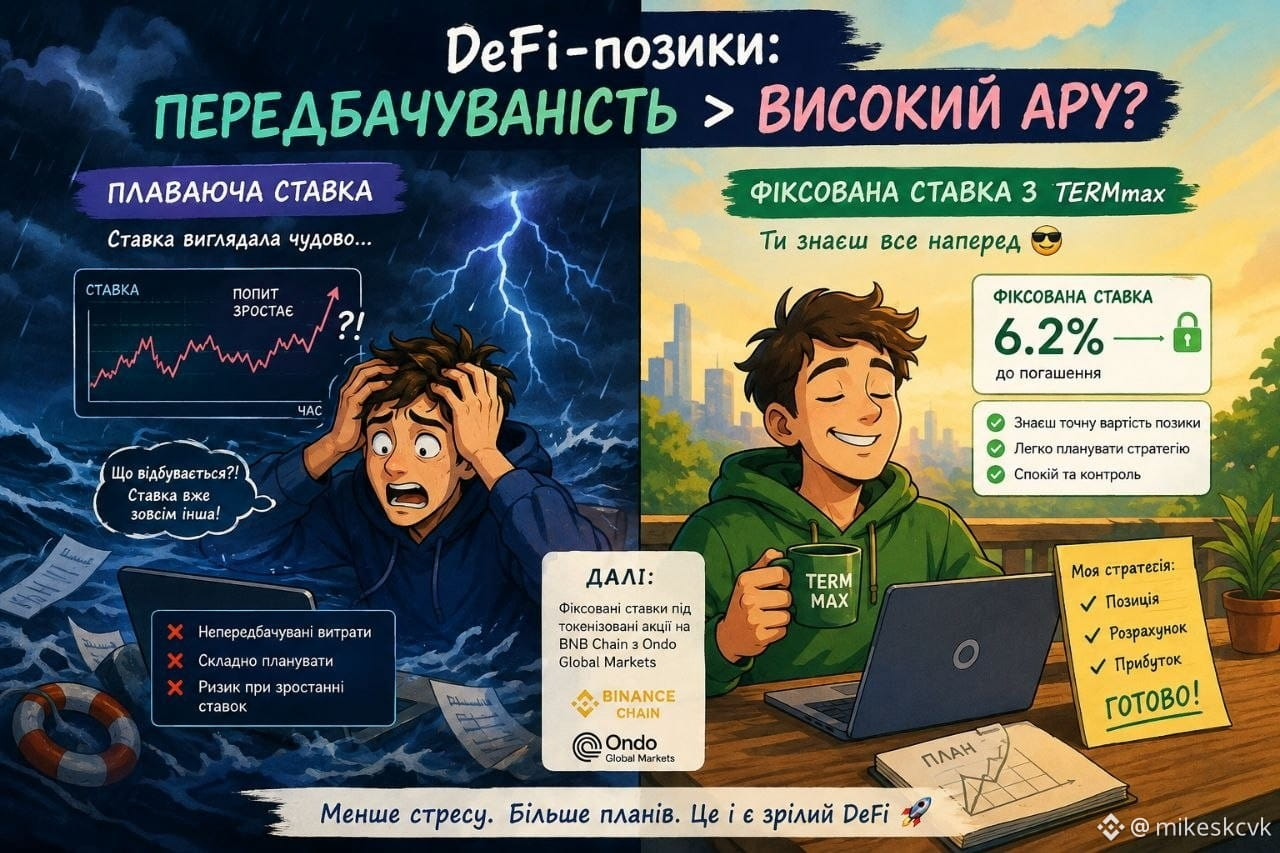
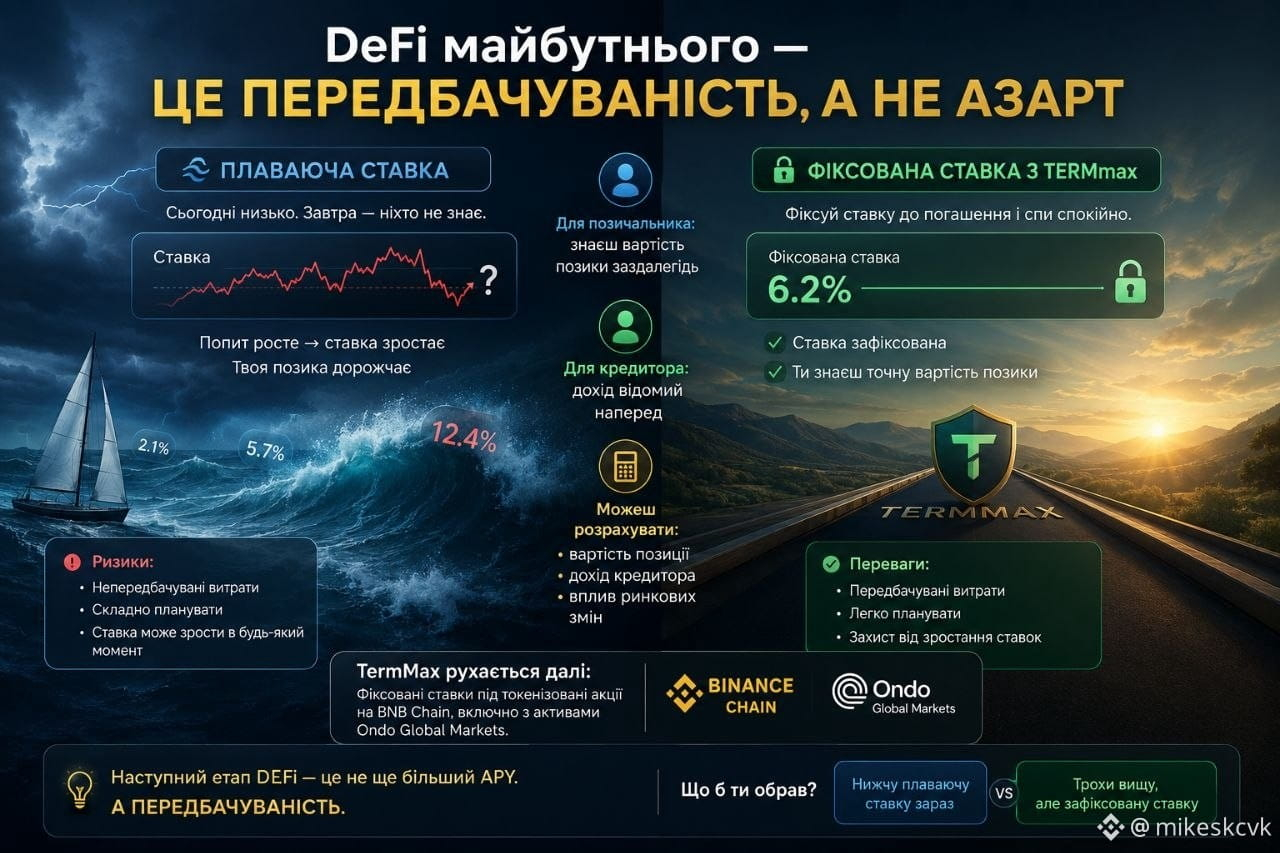
DeFi привчив нас до плаваючих ставок.
Поки тобі не знадобиться позика на кілька місяців.
Сьогодні ставка вигідна. Завтра через зміну попиту чи ліквідності вартість позики вже інша.
Саме тому мені цікавий TermMax.
Тут можна зафіксувати ставку до моменту погашення.
Для позичальника — зрозуміла вартість позики.
Для кредитора — прогнозований дохід.
І це особливо цікаво для більших стратегій, де важливо заздалегідь знати вартість капіталу.
Ще цікавіше, що TermMax рухається у бік RWA. Команда вже інтегрувала fixed-rate borrowing під токенізовані акції на BNB Chain.
Можливо, наступний етап DeFi — не максимальний APY.
А передбачуваність.
Що оберете: нижчу плаваючу ставку чи трохи вищу, але зафіксовану?
#termmax @termmax
DeFi привчив нас до плаваючих ставок.
Поки тобі не знадобиться позика на кілька місяців.
Сьогодні ставка вигідна. Завтра через зміну попиту чи ліквідності вартість позики вже інша.
Саме тому мені цікавий TermMax.
Тут можна зафіксувати ставку до моменту погашення.
Для позичальника — зрозуміла вартість позики.
Для кредитора — прогнозований дохід.
І це особливо цікаво для більших стратегій, де важливо заздалегідь знати вартість капіталу.
Ще цікавіше, що TermMax рухається у бік RWA. Команда вже інтегрувала fixed-rate borrowing під токенізовані акції на BNB Chain.
Можливо, наступний етап DeFi — не максимальний APY.
А передбачуваність.
Що оберете: нижчу плаваючу ставку чи трохи вищу, але зафіксовану?
#termmax @TermMax
Поки тобі не знадобиться позика на кілька місяців.
Сьогодні ставка вигідна. Завтра через зміну попиту чи ліквідності вартість позики вже інша.
Саме тому мені цікавий TermMax.
Тут можна зафіксувати ставку до моменту погашення.
Для позичальника — зрозуміла вартість позики.
Для кредитора — прогнозований дохід.
І це особливо цікаво для більших стратегій, де важливо заздалегідь знати вартість капіталу.
Ще цікавіше, що TermMax рухається у бік RWA. Команда вже інтегрувала fixed-rate borrowing під токенізовані акції на BNB Chain.
Можливо, наступний етап DeFi — не максимальний APY.
А передбачуваність.
Що оберете: нижчу плаваючу ставку чи трохи вищу, але зафіксовану?
#termmax @TermMax
131
·
--
Lihat terjemahan
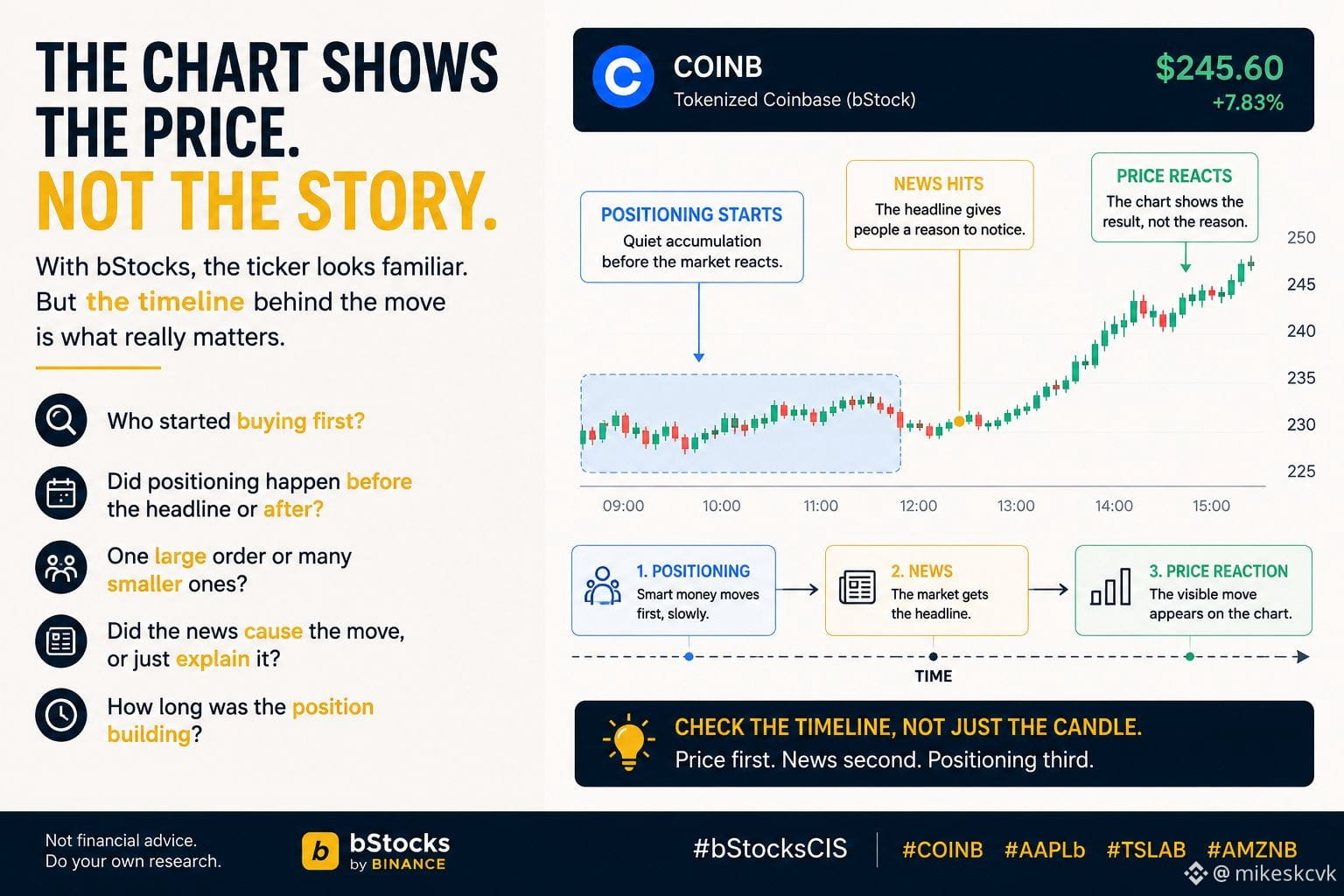
One thing I’ve started paying more attention to with tokenized stocks is the difference between what the chart shows and what actually happened before the chart moved.
Take #COINB as an example.
A sharp green candle can make it look like the market suddenly “decided” that the company was worth more.
But the candle only tells me where the market traded.
It doesn’t tell me: — who started buying first
— how long the position was building
— whether the move came from one large order or many smaller ones
— whether the price reaction happened before or after the headline
— or whether the headline simply gave traders a reason to notice the move.
That last part is easy to miss.
Sometimes the news is the explanation people remember, while the positioning happened much earlier.
And that changes how I read a chart.
Instead of asking:
“Why did #COINB go up today?”
I’d rather ask:
“What was already happening before today?”
For bStocks, I think this distinction is especially useful because the interface can make a traditional stock ticker feel very familiar. The familiar ticker doesn’t mean every piece of market information should be interpreted exactly like a normal brokerage position.
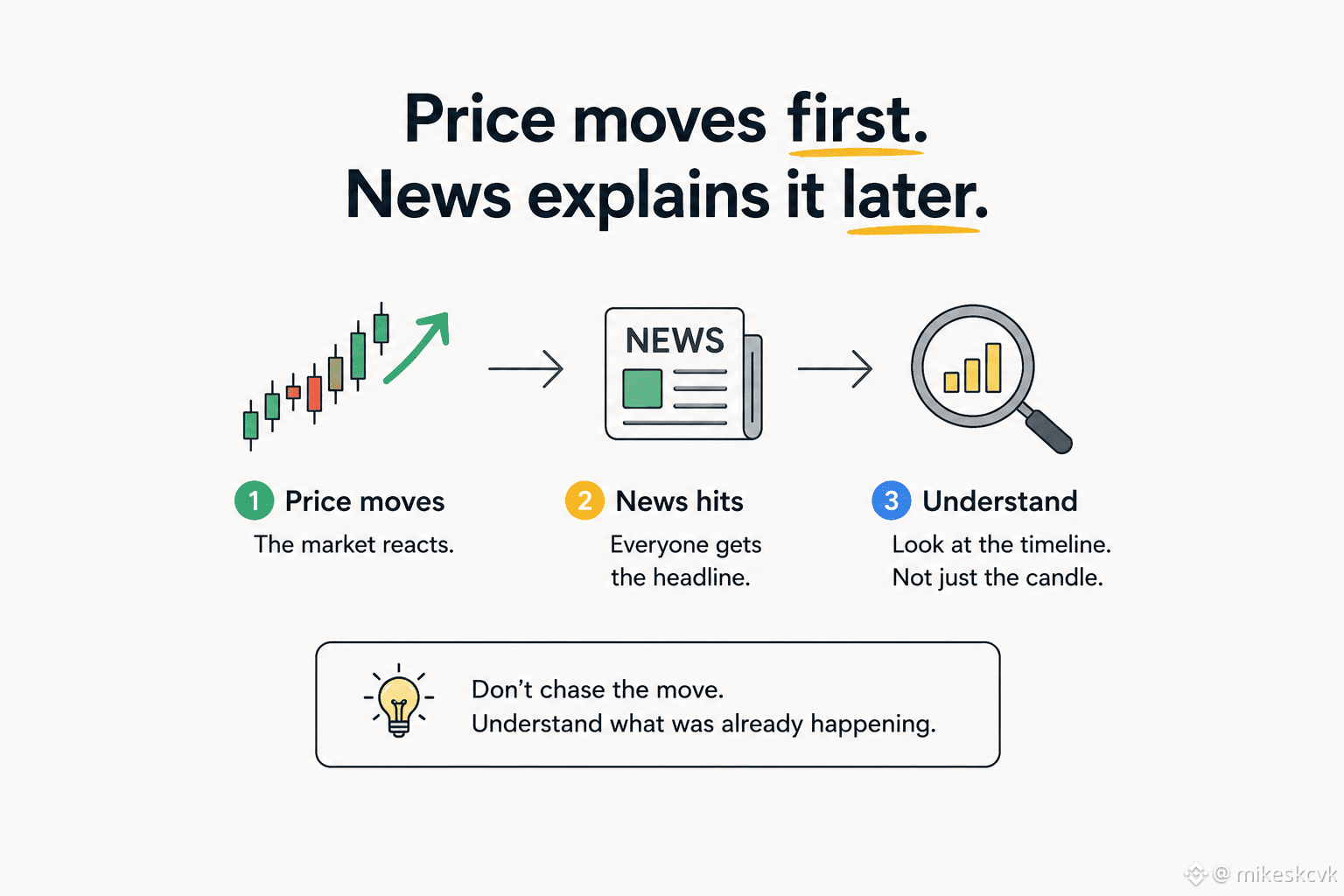
So now, when I see a big move, my first instinct isn’t to chase the candle.
I check the timeline.
Price first.
News second.
Positioning third.
The order matters more than I thought.
#bstockscis @BinanceCIS
One thing I’ve started paying more attention to with tokenized stocks is the difference between what the chart shows and what actually happened before the chart moved.
Take #COINB as an example.
A sharp green candle can make it look like the market suddenly “decided” that the company was worth more.
But the candle only tells me where the market traded.
It doesn’t tell me: — who started buying first
— how long the position was building
— whether the move came from one large order or many smaller ones
— whether the price reaction happened before or after the headline
— or whether the headline simply gave traders a reason to notice the move.
That last part is easy to miss.
Sometimes the news is the explanation people remember, while the positioning happened much earlier.
And that changes how I read a chart.
Instead of asking:
“Why did #COINB go up today?”
I’d rather ask:
“What was already happening before today?”
For bStocks, I think this distinction is especially useful because the interface can make a traditional stock ticker feel very familiar. The familiar ticker doesn’t mean every piece of market information should be interpreted exactly like a normal brokerage position.
So now, when I see a big move, my first instinct isn’t to chase the candle.
I check the timeline.
Price first.
News second.
Positioning third.
The order matters more than I thought.
#bstockscis @BinanceCIS
Take #COINB as an example.
A sharp green candle can make it look like the market suddenly “decided” that the company was worth more.
But the candle only tells me where the market traded.
It doesn’t tell me: — who started buying first
— how long the position was building
— whether the move came from one large order or many smaller ones
— whether the price reaction happened before or after the headline
— or whether the headline simply gave traders a reason to notice the move.
That last part is easy to miss.
Sometimes the news is the explanation people remember, while the positioning happened much earlier.
And that changes how I read a chart.
Instead of asking:
“Why did #COINB go up today?”
I’d rather ask:
“What was already happening before today?”
For bStocks, I think this distinction is especially useful because the interface can make a traditional stock ticker feel very familiar. The familiar ticker doesn’t mean every piece of market information should be interpreted exactly like a normal brokerage position.
So now, when I see a big move, my first instinct isn’t to chase the candle.
I check the timeline.
Price first.
News second.
Positioning third.
The order matters more than I thought.
#bstockscis @BinanceCIS
82
·
--
Lihat terjemahan
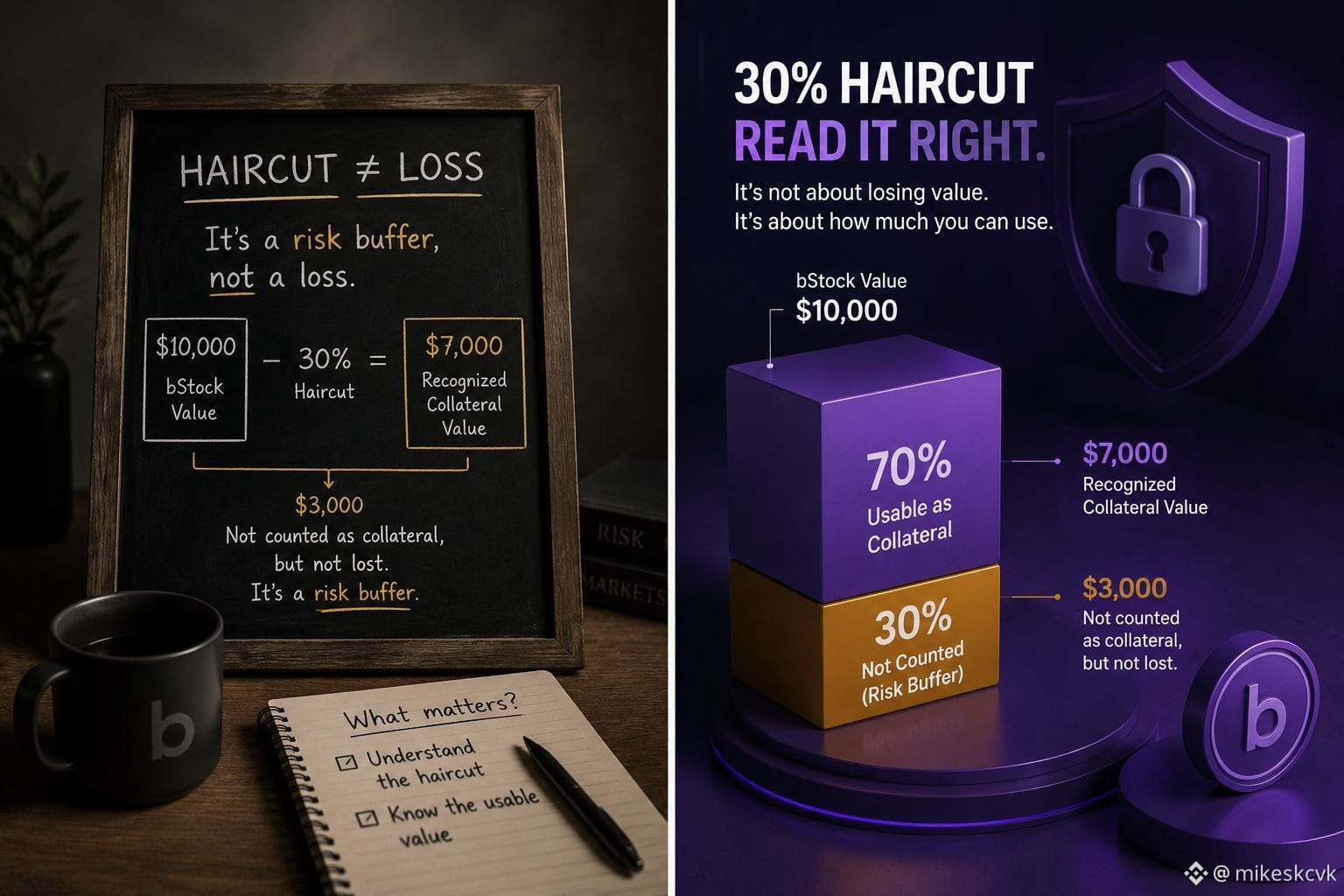
I used to read a collateral haircut as if it were a simple discount.
That was the wrong mental model.
Say a tokenized stock has a 30% haircut.
My first instinct would be:
“Okay, so 30% of the asset is basically gone.”
But that is not what the number is telling you.
The more useful question is:
How much of the asset’s value can actually be recognized as collateral?
If you have $10,000 of a bStock and the applicable haircut is 30%, the recognized collateral value is $7,000.
The remaining $3,000 hasn’t disappeared.
It simply isn't counted toward the collateral value under that haircut assumption.
That distinction matters because collateral calculations are about risk buffers, not about declaring part of an asset worthless.
And there is another detail I would check before doing any calculation:
What exactly is the haircut applied to?
The answer can depend on the asset, the relevant rules, and the specific collateral framework.
So instead of remembering:
“30% haircut = 30% loss,”
I now remember:
“30% haircut = 70% recognized collateral value.”
A small wording difference, but a completely different way to read the number.
For me, this is one of those bStocks concepts that becomes much easier once you stop thinking about the percentage as a “loss” and start thinking about it as a risk-adjusted collateral value.
Would you interpret a 30% haircut correctly without doing the calculation?
{spot}(NVDABUSDT)
$NVDAB
#bstockscis @BinanceCIS
I used to read a collateral haircut as if it were a simple discount.
That was the wrong mental model.
Say a tokenized stock has a 30% haircut.
My first instinct would be:
“Okay, so 30% of the asset is basically gone.”
But that is not what the number is telling you.
The more useful question is:
How much of the asset’s value can actually be recognized as collateral?
If you have $10,000 of a bStock and the applicable haircut is 30%, the recognized collateral value is $7,000.
The remaining $3,000 hasn’t disappeared.
It simply isn't counted toward the collateral value under that haircut assumption.
That distinction matters because collateral calculations are about risk buffers, not about declaring part of an asset worthless.
And there is another detail I would check before doing any calculation:
What exactly is the haircut applied to?
The answer can depend on the asset, the relevant rules, and the specific collateral framework.
So instead of remembering:
“30% haircut = 30% loss,”
I now remember:
“30% haircut = 70% recognized collateral value.”
A small wording difference, but a completely different way to read the number.
For me, this is one of those bStocks concepts that becomes much easier once you stop thinking about the percentage as a “loss” and start thinking about it as a risk-adjusted collateral value.
Would you interpret a 30% haircut correctly without doing the calculation?
$NVDAB
#bstockscis @BinanceCIS
That was the wrong mental model.
Say a tokenized stock has a 30% haircut.
My first instinct would be:
“Okay, so 30% of the asset is basically gone.”
But that is not what the number is telling you.
The more useful question is:
How much of the asset’s value can actually be recognized as collateral?
If you have $10,000 of a bStock and the applicable haircut is 30%, the recognized collateral value is $7,000.
The remaining $3,000 hasn’t disappeared.
It simply isn't counted toward the collateral value under that haircut assumption.
That distinction matters because collateral calculations are about risk buffers, not about declaring part of an asset worthless.
And there is another detail I would check before doing any calculation:
What exactly is the haircut applied to?
The answer can depend on the asset, the relevant rules, and the specific collateral framework.
So instead of remembering:
“30% haircut = 30% loss,”
I now remember:
“30% haircut = 70% recognized collateral value.”
A small wording difference, but a completely different way to read the number.
For me, this is one of those bStocks concepts that becomes much easier once you stop thinking about the percentage as a “loss” and start thinking about it as a risk-adjusted collateral value.
Would you interpret a 30% haircut correctly without doing the calculation?
$NVDAB
#bstockscis @BinanceCIS
96
·
--
Lihat terjemahan
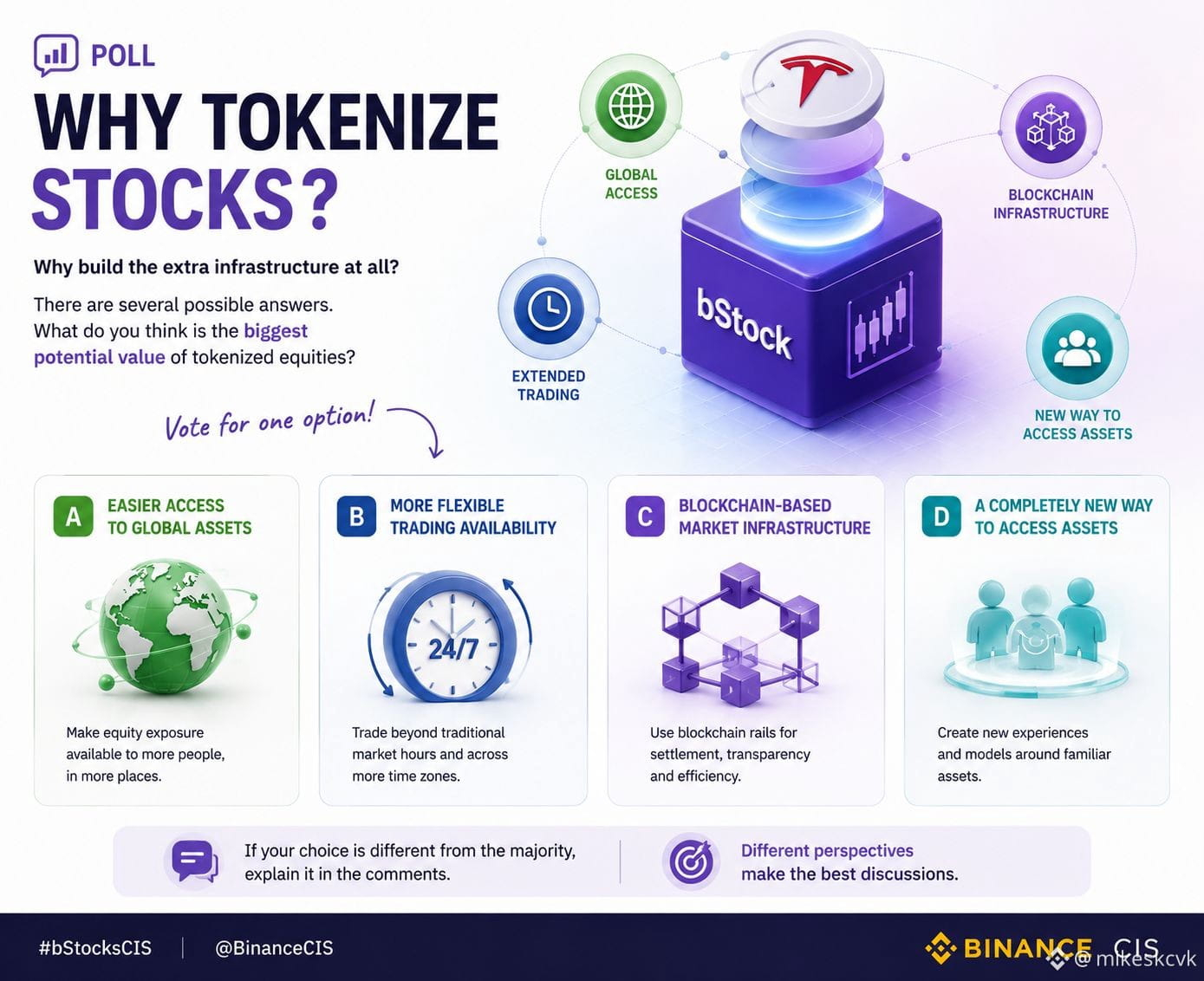
I keep seeing the same assumption:
“Tokenized stocks are just traditional stocks in another format.”
But if that were the whole point, the question becomes pretty simple:
Why build the extra infrastructure at all?
There are several possible answers.
Maybe the biggest value is making equity exposure more accessible.
Maybe it is the ability to interact with markets through blockchain infrastructure.
May$be extended trading availability matters more.
Or maybe the real advantage is simply creating a different way for people to access familiar assets.
I don't think there is one universal answer.
So I'm curious what the community actually thinks.
What is the biggest potential value of tokenized equities?
A — Easier access to global assets
B — More flexible trading availability
C — Blockchain-based market infrastructure
D — A completely new way to access familiar assets
Vote for one.
And if your choice is different from the majority, explain it — that's probably where the interesting discussion starts.
#bstockscis @BinanceCIS
I keep seeing the same assumption:
“Tokenized stocks are just traditional stocks in another format.”
But if that were the whole point, the question becomes pretty simple:
Why build the extra infrastructure at all?
There are several possible answers.
Maybe the biggest value is making equity exposure more accessible.
Maybe it is the ability to interact with markets through blockchain infrastructure.
May$be extended trading availability matters more.
Or maybe the real advantage is simply creating a different way for people to access familiar assets.
I don't think there is one universal answer.
So I'm curious what the community actually thinks.
What is the biggest potential value of tokenized equities?
A — Easier access to global assets
B — More flexible trading availability
C — Blockchain-based market infrastructure
D — A completely new way to access familiar assets
Vote for one.
And if your choice is different from the majority, explain it — that's probably where the interesting discussion starts.
#bstockscis @BinanceCIS
“Tokenized stocks are just traditional stocks in another format.”
But if that were the whole point, the question becomes pretty simple:
Why build the extra infrastructure at all?
There are several possible answers.
Maybe the biggest value is making equity exposure more accessible.
Maybe it is the ability to interact with markets through blockchain infrastructure.
May$be extended trading availability matters more.
Or maybe the real advantage is simply creating a different way for people to access familiar assets.
I don't think there is one universal answer.
So I'm curious what the community actually thinks.
What is the biggest potential value of tokenized equities?
A — Easier access to global assets
B — More flexible trading availability
C — Blockchain-based market infrastructure
D — A completely new way to access familiar assets
Vote for one.
And if your choice is different from the majority, explain it — that's probably where the interesting discussion starts.
#bstockscis @BinanceCIS
76
·
--
Bullish
Lihat terjemahan
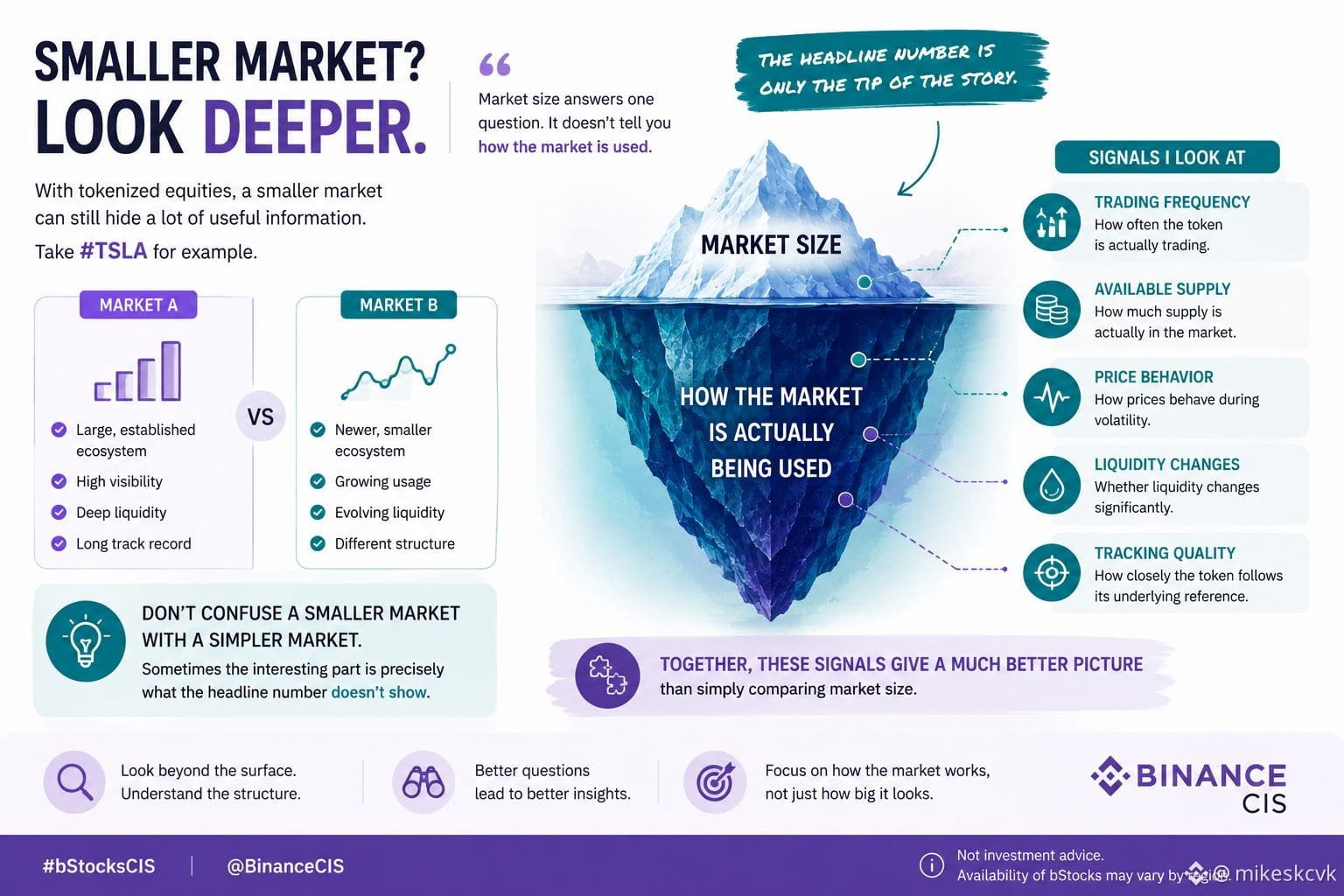
A smaller market does not automatically mean an uninteresting market.
That is something I keep in mind when looking at tokenized equities.
Imagine two markets showing almost the same underlying asset.
One has a huge established ecosystem.
The other is newer, smaller, and built around tokenized exposure.
It would be easy to look at the second one and say:
“Too small. Move on.”
But size answers only one question.
It doesn't tell me how the market is being used.
For example, with #TSLA I would rather look at several signals together:
→ how often the token trades
→ how much supply is actually available
→ how prices behave during volatility
→ whether liquidity changes significantly
→ how closely the token follows its underlying reference
None of these tells the whole story alone.
But together, they give a much better picture than simply comparing market size.
That is probably my biggest takeaway from studying bStocks:
Don't confuse a smaller market with a simpler market.
Sometimes the interesting part is precisely what the headline number doesn't show.
#bstockscis @BinanceCIS
A smaller market does not automatically mean an uninteresting market.
That is something I keep in mind when looking at tokenized equities.
Imagine two markets showing almost the same underlying asset.
One has a huge established ecosystem.
The other is newer, smaller, and built around tokenized exposure.
It would be easy to look at the second one and say:
“Too small. Move on.”
But size answers only one question.
It doesn't tell me how the market is being used.
For example, with #TSLA I would rather look at several signals together:
→ how often the token trades
→ how much supply is actually available
→ how prices behave during volatility
→ whether liquidity changes significantly
→ how closely the token follows its underlying reference
None of these tells the whole story alone.
But together, they give a much better picture than simply comparing market size.
That is probably my biggest takeaway from studying bStocks:
Don't confuse a smaller market with a simpler market.
Sometimes the interesting part is precisely what the headline number doesn't show.
#bstockscis @BinanceCIS
That is something I keep in mind when looking at tokenized equities.
Imagine two markets showing almost the same underlying asset.
One has a huge established ecosystem.
The other is newer, smaller, and built around tokenized exposure.
It would be easy to look at the second one and say:
“Too small. Move on.”
But size answers only one question.
It doesn't tell me how the market is being used.
For example, with #TSLA I would rather look at several signals together:
→ how often the token trades
→ how much supply is actually available
→ how prices behave during volatility
→ whether liquidity changes significantly
→ how closely the token follows its underlying reference
None of these tells the whole story alone.
But together, they give a much better picture than simply comparing market size.
That is probably my biggest takeaway from studying bStocks:
Don't confuse a smaller market with a simpler market.
Sometimes the interesting part is precisely what the headline number doesn't show.
#bstockscis @BinanceCIS
1
80
·
--
Lihat terjemahan
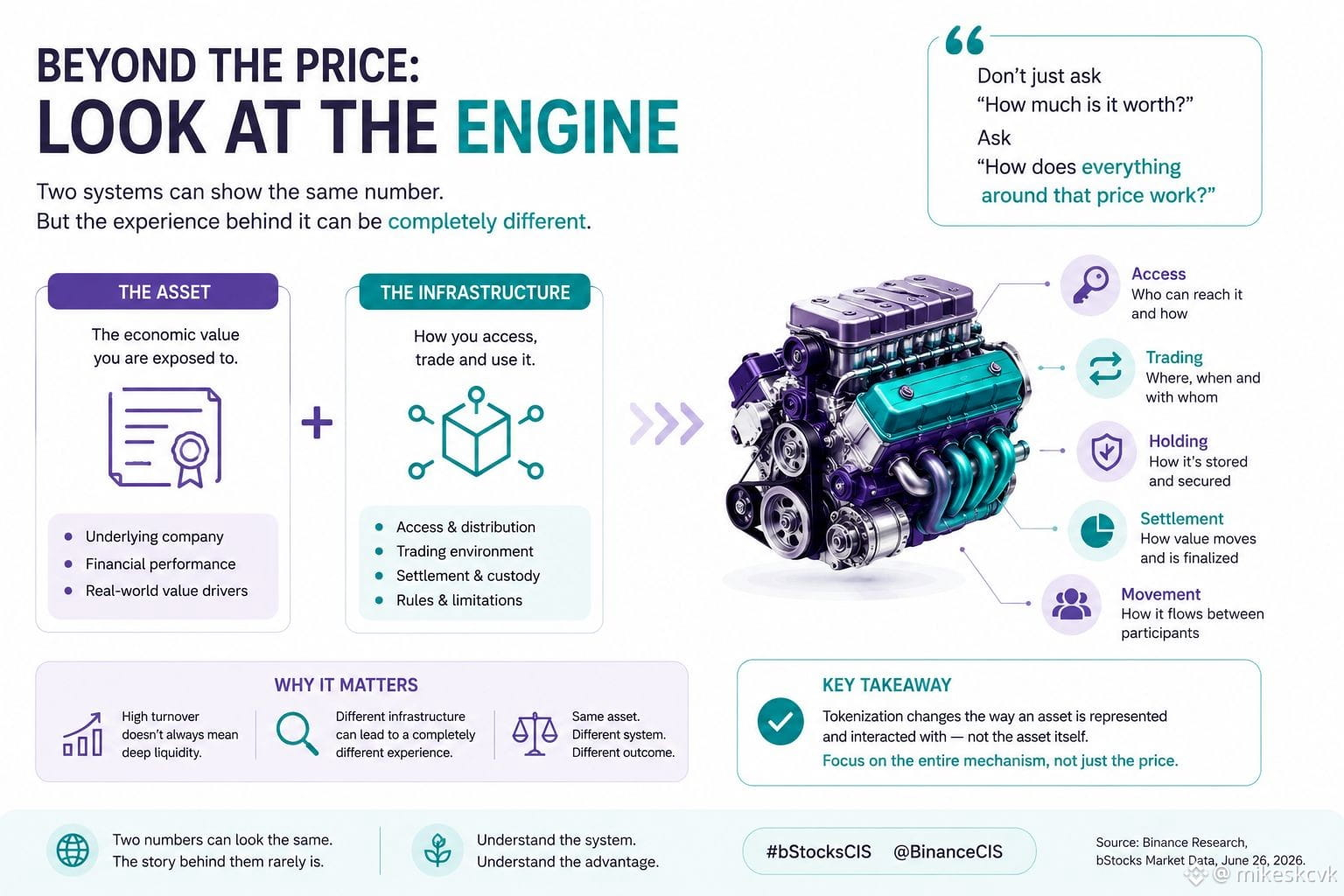
I used to think that when evaluating a new financial product, the most important thing was understanding what exactly you are buying.
Now I'd add another question:
What happens around that asset after you buy it?
That's where tokenized stocks become much more interesting than a simple comparison with traditional markets.
An asset isn't just a price.
There is an entire process around it:
access → trading → holding → settlement → movement between participants
If you only look at the price chart, most of that story disappears.
So I try to separate two things.
The asset — what the economic value is connected to.
The infrastructure — how that asset is represented and accessed by the user.
Those are not the same thing.
And that's one of the parts of bStocks I find most interesting.
Tokenization doesn't magically change the underlying asset.
It changes the way that asset is represented and interacted with inside a different financial environment.
So my main takeaway is simple:
Don't evaluate a tokenized product only by asking:
“How much is it worth?”
Ask:
“How does everything around that price actually work?”
Two systems can display a very similar number on a screen while providing a completely different experience underneath.
And that's the difference I'm most interested in watching with bStocks.
@BinanceCIS #bstockscis
I used to think that when evaluating a new financial product, the most important thing was understanding what exactly you are buying.
Now I'd add another question:
What happens around that asset after you buy it?
That's where tokenized stocks become much more interesting than a simple comparison with traditional markets.
An asset isn't just a price.
There is an entire process around it:
access → trading → holding → settlement → movement between participants
If you only look at the price chart, most of that story disappears.
So I try to separate two things.
The asset — what the economic value is connected to.
The infrastructure — how that asset is represented and accessed by the user.
Those are not the same thing.
And that's one of the parts of bStocks I find most interesting.
Tokenization doesn't magically change the underlying asset.
It changes the way that asset is represented and interacted with inside a different financial environment.
So my main takeaway is simple:
Don't evaluate a tokenized product only by asking:
“How much is it worth?”
Ask:
“How does everything around that price actually work?”
Two systems can display a very similar number on a screen while providing a completely different experience underneath.
And that's the difference I'm most interested in watching with bStocks.
@BinanceCIS #bstockscis
Now I'd add another question:
What happens around that asset after you buy it?
That's where tokenized stocks become much more interesting than a simple comparison with traditional markets.
An asset isn't just a price.
There is an entire process around it:
access → trading → holding → settlement → movement between participants
If you only look at the price chart, most of that story disappears.
So I try to separate two things.
The asset — what the economic value is connected to.
The infrastructure — how that asset is represented and accessed by the user.
Those are not the same thing.
And that's one of the parts of bStocks I find most interesting.
Tokenization doesn't magically change the underlying asset.
It changes the way that asset is represented and interacted with inside a different financial environment.
So my main takeaway is simple:
Don't evaluate a tokenized product only by asking:
“How much is it worth?”
Ask:
“How does everything around that price actually work?”
Two systems can display a very similar number on a screen while providing a completely different experience underneath.
And that's the difference I'm most interested in watching with bStocks.
@BinanceCIS #bstockscis
1
80
·
--
Lihat terjemahan
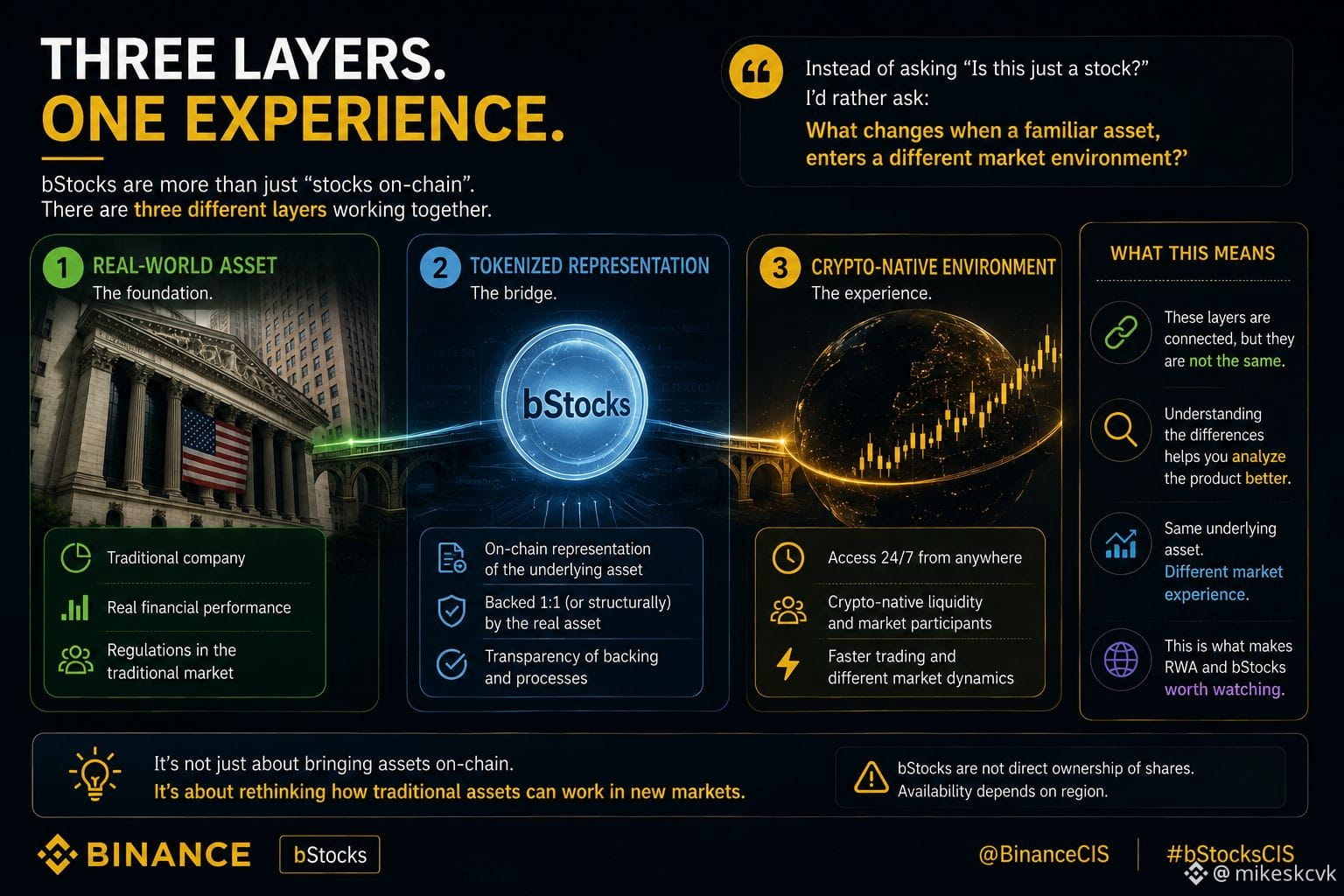
I think one of the easiest ways to misunderstand tokenized stocks is to focus only on the word “stock”.
The more I look at bStocks, the more I see three different things happening at once.
There is the real-world asset.
Then there is the tokenized representation.
And finally, there is the crypto-native environment where the token can be traded.
Those three layers are connected, but they are not the same thing.
And that changes how I would look at the product.
Instead of asking:
“Is this just a stock?”
I'd rather ask:
“What changes when a familiar asset enters a different market environment?”
Trading hours, access, liquidity and the way people interact with the asset can all become part of the picture.
That shift in perspective makes much more sense to me than simply comparing a token to a traditional share.
Same underlying idea.
Different market experience. 🔎
That's what makes this space worth watching. 🌍@BinanceCIS 😀 #bstockscis
I think one of the easiest ways to misunderstand tokenized stocks is to focus only on the word “stock”.
The more I look at bStocks, the more I see three different things happening at once.
There is the real-world asset.
Then there is the tokenized representation.
And finally, there is the crypto-native environment where the token can be traded.
Those three layers are connected, but they are not the same thing.
And that changes how I would look at the product.
Instead of asking:
“Is this just a stock?”
I'd rather ask:
“What changes when a familiar asset enters a different market environment?”
Trading hours, access, liquidity and the way people interact with the asset can all become part of the picture.
That shift in perspective makes much more sense to me than simply comparing a token to a traditional share.
Same underlying idea.
Different market experience. 🔎
That's what makes this space worth watching. 🌍@BinanceCIS 😀 #bstockscis
The more I look at bStocks, the more I see three different things happening at once.
There is the real-world asset.
Then there is the tokenized representation.
And finally, there is the crypto-native environment where the token can be traded.
Those three layers are connected, but they are not the same thing.
And that changes how I would look at the product.
Instead of asking:
“Is this just a stock?”
I'd rather ask:
“What changes when a familiar asset enters a different market environment?”
Trading hours, access, liquidity and the way people interact with the asset can all become part of the picture.
That shift in perspective makes much more sense to me than simply comparing a token to a traditional share.
Same underlying idea.
Different market experience. 🔎
That's what makes this space worth watching. 🌍@BinanceCIS 😀 #bstockscis
73
·
--
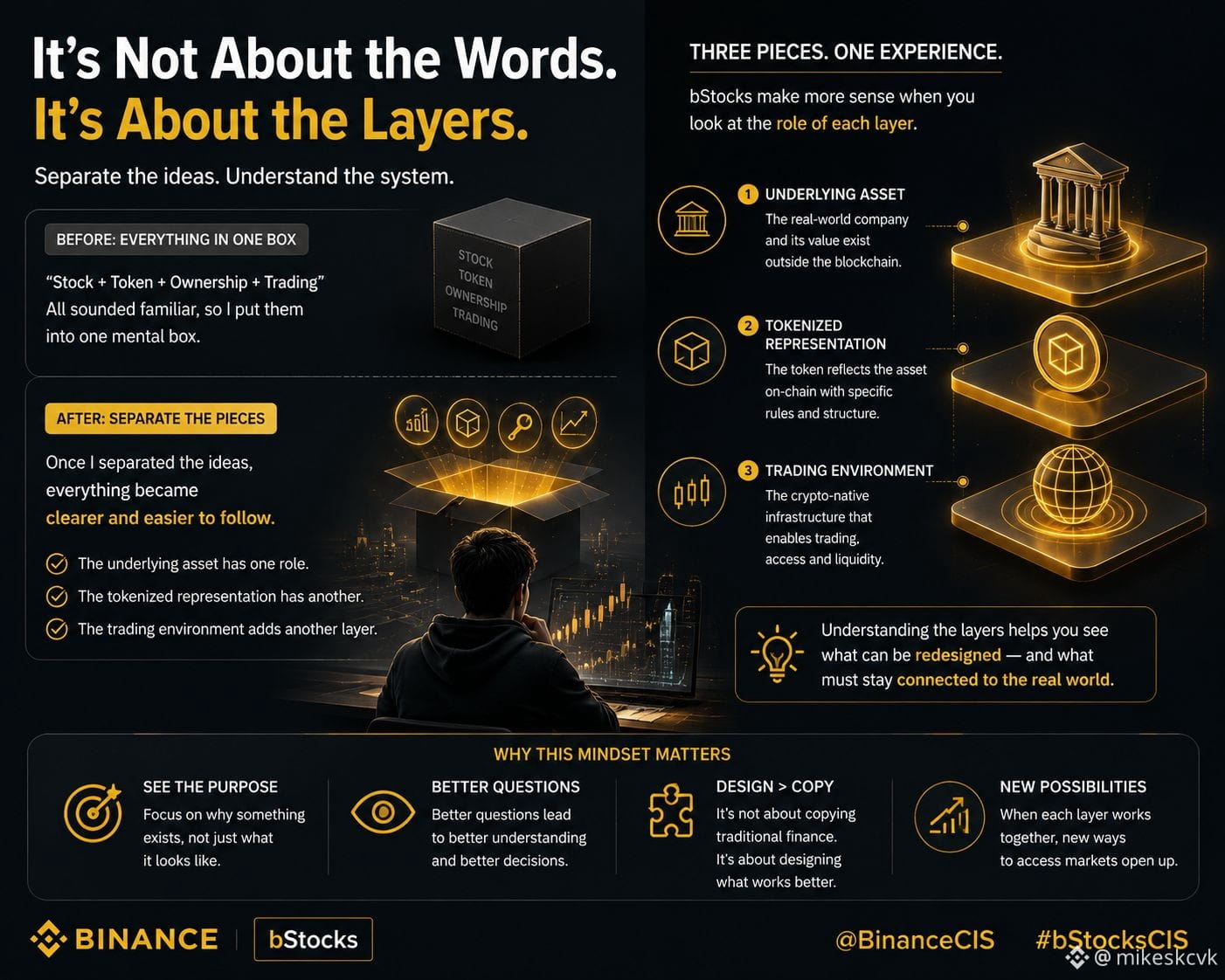
Dulu saya mengira bagian tersulit dalam memahami saham token adalah teknologinya.
Jujur, saya pikir yang sulit justru istilahnya.
Kata-kata seperti “saham”, “token”, “kepemilikan”, dan “trading” terdengar akrab, jadi sangat mudah untuk memasukkan semuanya ke dalam satu kotak pikiran.
Tapi bStocks membuat saya melambat dan memisahkan gagasan-gagasan itu.
Aset yang ditokenisasi tidak menarik hanya karena terlihat familiar.
Yang menarik adalah infrastrukturnya.
Aset yang mendasarinya punya satu peran.
Representasi tokennya punya peran lain.
Dan lingkungan perdagangannya menambah lapisan lagi di atasnya.
Begitu saya mulai memisahkan bagian-bagian itu, seluruh konsep menjadi jauh lebih mudah diikuti.
Mungkin itu juga alasan kenapa RWA menarik bagi saya.
Ini bukan sekadar tentang memindahkan aset tradisional ke blockchain.
Ini tentang mencari tahu bagian mana dari pengalaman keuangan lama yang bisa didesain ulang tanpa kehilangan keterhubungan dengan aset yang mendasarinya.
Masih belajar, tapi saya pasti sekarang melihat tokenisasi dengan cara yang berbeda. 🔎
@BinanceCIS #bstockscis
Dulu saya mengira bagian tersulit dalam memahami saham token adalah teknologinya.
Jujur, saya pikir yang sulit justru istilahnya.
Kata-kata seperti “saham”, “token”, “kepemilikan”, dan “trading” terdengar akrab, jadi sangat mudah untuk memasukkan semuanya ke dalam satu kotak pikiran.
Tapi bStocks membuat saya melambat dan memisahkan gagasan-gagasan itu.
Aset yang ditokenisasi tidak menarik hanya karena terlihat familiar.
Yang menarik adalah infrastrukturnya.
Aset yang mendasarinya punya satu peran.
Representasi tokennya punya peran lain.
Dan lingkungan perdagangannya menambah lapisan lagi di atasnya.
Begitu saya mulai memisahkan bagian-bagian itu, seluruh konsep menjadi jauh lebih mudah diikuti.
Mungkin itu juga alasan kenapa RWA menarik bagi saya.
Ini bukan sekadar tentang memindahkan aset tradisional ke blockchain.
Ini tentang mencari tahu bagian mana dari pengalaman keuangan lama yang bisa didesain ulang tanpa kehilangan keterhubungan dengan aset yang mendasarinya.
Masih belajar, tapi saya pasti sekarang melihat tokenisasi dengan cara yang berbeda. 🔎
@BinanceCIS #bstockscis
Jujur, saya pikir yang sulit justru istilahnya.
Kata-kata seperti “saham”, “token”, “kepemilikan”, dan “trading” terdengar akrab, jadi sangat mudah untuk memasukkan semuanya ke dalam satu kotak pikiran.
Tapi bStocks membuat saya melambat dan memisahkan gagasan-gagasan itu.
Aset yang ditokenisasi tidak menarik hanya karena terlihat familiar.
Yang menarik adalah infrastrukturnya.
Aset yang mendasarinya punya satu peran.
Representasi tokennya punya peran lain.
Dan lingkungan perdagangannya menambah lapisan lagi di atasnya.
Begitu saya mulai memisahkan bagian-bagian itu, seluruh konsep menjadi jauh lebih mudah diikuti.
Mungkin itu juga alasan kenapa RWA menarik bagi saya.
Ini bukan sekadar tentang memindahkan aset tradisional ke blockchain.
Ini tentang mencari tahu bagian mana dari pengalaman keuangan lama yang bisa didesain ulang tanpa kehilangan keterhubungan dengan aset yang mendasarinya.
Masih belajar, tapi saya pasti sekarang melihat tokenisasi dengan cara yang berbeda. 🔎
@BinanceCIS #bstockscis
92
·
--
Saya sedang memikirkan bStocks dari arah yang berlawanan hari ini.
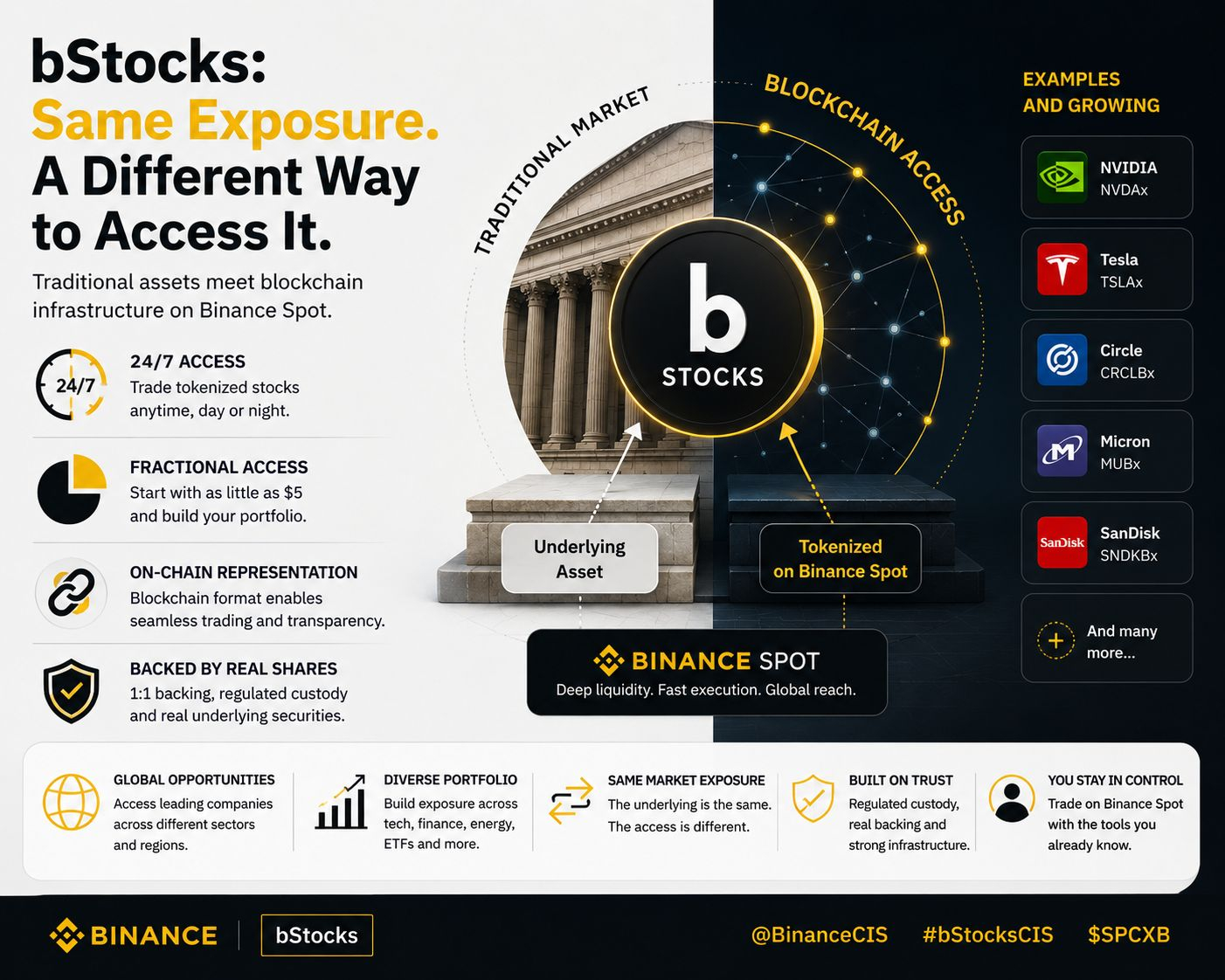
Daripada bertanya “saham mana yang tokenized?”, menurut saya pertanyaan yang lebih baik adalah “apa yang berubah ketika paparan pasar yang sama dikonversi menjadi format berbasis blockchain?”
Anda mendapatkan lingkungan trading yang berbeda, akses 24/7 di Binance Spot, akses berbasis pecahan, dan representasi di dalam rantai — sementara struktur dasarnya tetap terhubung kembali ke aset tradisional.
Perpaduan itu mungkin bagian paling menarik bagi saya.
Ini bukan tentang menggantikan pasar saham. Ini tentang bereksperimen dengan cara lain untuk mengaksesnya. 🔎🌍
@BinanceCIS #bStocksCIS $SPCXB
Saya sedang memikirkan bStocks dari arah yang berlawanan hari ini.
Daripada bertanya “saham mana yang tokenized?”, menurut saya pertanyaan yang lebih baik adalah “apa yang berubah ketika paparan pasar yang sama dikonversi menjadi format berbasis blockchain?”
Anda mendapatkan lingkungan trading yang berbeda, akses 24/7 di Binance Spot, akses berbasis pecahan, dan representasi di dalam rantai — sementara struktur dasarnya tetap terhubung kembali ke aset tradisional.
Perpaduan itu mungkin bagian paling menarik bagi saya.
Ini bukan tentang menggantikan pasar saham. Ini tentang bereksperimen dengan cara lain untuk mengaksesnya. 🔎🌍
@BinanceCIS #bStocksCIS $SPCXB
Daripada bertanya “saham mana yang tokenized?”, menurut saya pertanyaan yang lebih baik adalah “apa yang berubah ketika paparan pasar yang sama dikonversi menjadi format berbasis blockchain?”
Anda mendapatkan lingkungan trading yang berbeda, akses 24/7 di Binance Spot, akses berbasis pecahan, dan representasi di dalam rantai — sementara struktur dasarnya tetap terhubung kembali ke aset tradisional.
Perpaduan itu mungkin bagian paling menarik bagi saya.
Ini bukan tentang menggantikan pasar saham. Ini tentang bereksperimen dengan cara lain untuk mengaksesnya. 🔎🌍
@BinanceCIS #bStocksCIS $SPCXB
162
·
--
Sesuatu yang menurutku menarik saat menggali bStocks adalah perbedaan antara aset itu sendiri dan cara kamu mengaksesnya.
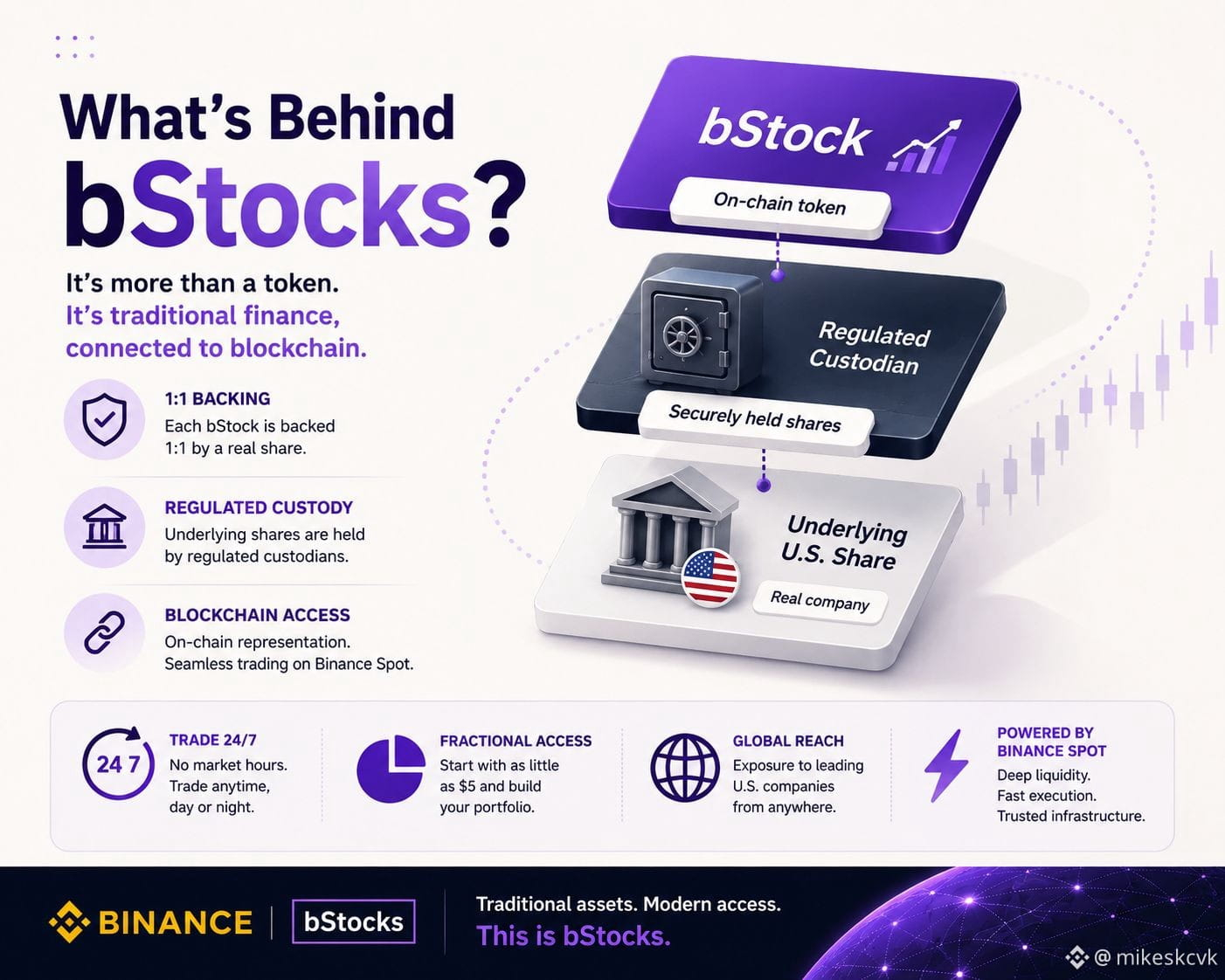
Masih ada sekuritas yang mendasari di balik strukturnya, dengan dukungan 1:1 dan kustodian yang teregulasi. Bagian blockchain mengubah cara eksposur tersebut direpresentasikan dan diperdagangkan.
Jadi aku tidak akan menggambarkan bStocks sekadar sebagai “saham yang dipindahkan ke blockchain”.
Ada banyak hal lain yang terjadi di baliknya—kustodi, tokenisasi, infrastruktur perdagangan, serta keterkaitannya dengan Binance Spot.
Jujur, bagian yang menurutku lebih menarik adalah itu daripada sekadar melihat grafik harga. 😅🔎
@BinanceCIS $SPCXB #bstockscis
Sesuatu yang menurutku menarik saat menggali bStocks adalah perbedaan antara aset itu sendiri dan cara kamu mengaksesnya.
Masih ada sekuritas yang mendasari di balik strukturnya, dengan dukungan 1:1 dan kustodian yang teregulasi. Bagian blockchain mengubah cara eksposur tersebut direpresentasikan dan diperdagangkan.
Jadi aku tidak akan menggambarkan bStocks sekadar sebagai “saham yang dipindahkan ke blockchain”.
Ada banyak hal lain yang terjadi di baliknya—kustodi, tokenisasi, infrastruktur perdagangan, serta keterkaitannya dengan Binance Spot.
Jujur, bagian yang menurutku lebih menarik adalah itu daripada sekadar melihat grafik harga. 😅🔎
@BinanceCIS $SPCXB #bstockscis
Masih ada sekuritas yang mendasari di balik strukturnya, dengan dukungan 1:1 dan kustodian yang teregulasi. Bagian blockchain mengubah cara eksposur tersebut direpresentasikan dan diperdagangkan.
Jadi aku tidak akan menggambarkan bStocks sekadar sebagai “saham yang dipindahkan ke blockchain”.
Ada banyak hal lain yang terjadi di baliknya—kustodi, tokenisasi, infrastruktur perdagangan, serta keterkaitannya dengan Binance Spot.
Jujur, bagian yang menurutku lebih menarik adalah itu daripada sekadar melihat grafik harga. 😅🔎
@BinanceCIS $SPCXB #bstockscis
1
114
·
--
Lihat terjemahan
I used to think the value of bStocks was only about putting stocks on the blockchain.
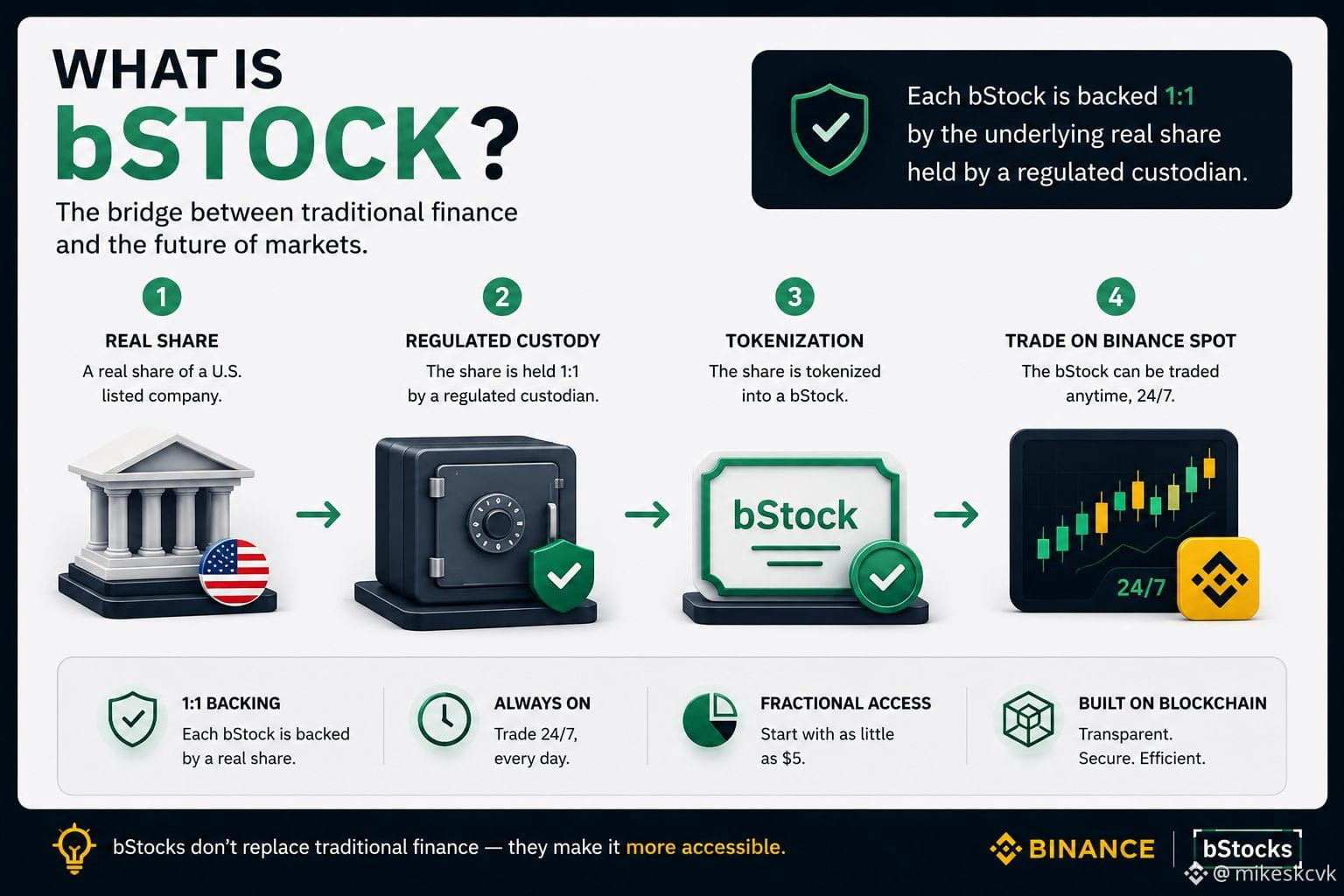
After reading more about how they work, I think the real value is the structure behind them.
Binance explains that each bStock is backed 1:1 by an underlying share held by a regulated custodian. That connection between traditional finance and blockchain is what makes the concept interesting to me.
Sometimes understanding how a product works is more valuable than watching its price chart.
Have you spent more time learning the mechanics of bStocks, or are you mainly following the market? 📚💭
#bstockscis
I used to think the value of bStocks was only about putting stocks on the blockchain.
After reading more about how they work, I think the real value is the structure behind them.
Binance explains that each bStock is backed 1:1 by an underlying share held by a regulated custodian. That connection between traditional finance and blockchain is what makes the concept interesting to me.
Sometimes understanding how a product works is more valuable than watching its price chart.
Have you spent more time learning the mechanics of bStocks, or are you mainly following the market? 📚💭
#bstockscis
After reading more about how they work, I think the real value is the structure behind them.
Binance explains that each bStock is backed 1:1 by an underlying share held by a regulated custodian. That connection between traditional finance and blockchain is what makes the concept interesting to me.
Sometimes understanding how a product works is more valuable than watching its price chart.
Have you spent more time learning the mechanics of bStocks, or are you mainly following the market? 📚💭
#bstockscis
1
103
·
--
Satu hal yang saya suka tentang blockchain adalah bahwa sekarang bukan hanya tentang kripto.
Proyek seperti bStocks menunjukkan bagaimana teknologi dapat digunakan untuk mewakili aset keuangan tradisional dalam bentuk digital. Apakah model ini akan menjadi arus utama atau tidak, menarik untuk melihat bagaimana dunia keuangan terus berkembang.
Saya penasaran untuk melihat bagaimana tokenisasi akan berada dalam beberapa tahun ke depan.
Aset dunia nyata apa yang menurut Anda bisa ditokenisasi berikutnya? 💭🚀
@BinanceCIS $SPCXB #bstockscis
Satu hal yang saya suka tentang blockchain adalah bahwa sekarang bukan hanya tentang kripto.
Proyek seperti bStocks menunjukkan bagaimana teknologi dapat digunakan untuk mewakili aset keuangan tradisional dalam bentuk digital. Apakah model ini akan menjadi arus utama atau tidak, menarik untuk melihat bagaimana dunia keuangan terus berkembang.
Saya penasaran untuk melihat bagaimana tokenisasi akan berada dalam beberapa tahun ke depan.
Aset dunia nyata apa yang menurut Anda bisa ditokenisasi berikutnya? 💭🚀
@BinanceCIS $SPCXB #bstockscis
Proyek seperti bStocks menunjukkan bagaimana teknologi dapat digunakan untuk mewakili aset keuangan tradisional dalam bentuk digital. Apakah model ini akan menjadi arus utama atau tidak, menarik untuk melihat bagaimana dunia keuangan terus berkembang.
Saya penasaran untuk melihat bagaimana tokenisasi akan berada dalam beberapa tahun ke depan.
Aset dunia nyata apa yang menurut Anda bisa ditokenisasi berikutnya? 💭🚀
@BinanceCIS $SPCXB #bstockscis

1
1
109
·
--
Lihat terjemahan
Я помітив цікаву особливість bStocks: найважливіше тут не лише сам актив, а спосіб його представлення.
Токенізація не створює нову компанію і не змінює базову цінну паперу. Вона дозволяє взаємодіяти з активом через блокчейн-інфраструктуру, зберігаючи зв'язок із реальним базовим активом.
Мені здається, саме такі рішення показують, як поступово поєднуються традиційні фінанси та Web3.
Як думаєте, які ще реальні активи можуть бути токенізовані в майбутньому?
@BinanceCIS #bStocksCIS $SPCXB #BinanceSquare
{spot}(SPCXBUSDT)
#bstockscis
Я помітив цікаву особливість bStocks: найважливіше тут не лише сам актив, а спосіб його представлення.
Токенізація не створює нову компанію і не змінює базову цінну паперу. Вона дозволяє взаємодіяти з активом через блокчейн-інфраструктуру, зберігаючи зв'язок із реальним базовим активом.
Мені здається, саме такі рішення показують, як поступово поєднуються традиційні фінанси та Web3.
Як думаєте, які ще реальні активи можуть бути токенізовані в майбутньому?
@BinanceCIS #bStocksCIS $SPCXB #BinanceSquare
#bstockscis
Токенізація не створює нову компанію і не змінює базову цінну паперу. Вона дозволяє взаємодіяти з активом через блокчейн-інфраструктуру, зберігаючи зв'язок із реальним базовим активом.
Мені здається, саме такі рішення показують, як поступово поєднуються традиційні фінанси та Web3.
Як думаєте, які ще реальні активи можуть бути токенізовані в майбутньому?
@BinanceCIS #bStocksCIS $SPCXB #BinanceSquare
#bstockscis

1
1
65
Masuk untuk menjelajahi konten lainnya
Bergabunglah dengan pengguna kripto global di Binance Square
⚡️ Dapatkan informasi terbaru dan berguna tentang kripto.
💬 Dipercayai oleh bursa kripto terbesar di dunia.
👍 Temukan wawasan nyata dari kreator terverifikasi.
Email/Nomor Ponsel
Topik Sedang Tren
StellarActivatesProtocol28At211TPS
1,832 penayangan
74 Berdiskusi
Stellar baru saja mengaktifkan Protokol 28, setelah pemungutan suara upgrade mainnet pada 16 September. Jaringan juga mencatat TPS (transaksi per detik) 211+ yang berkelanjutan selama 100 blok berturut-turut, sebuah rekor throughput baru.
🚀 Mengapa Protokol 28 penting
CAP-85: memungkinkan upgrade atomik di seluruh grup smart contract Soroban.
CAP-86: membuat migrasi data kontrak lebih fleksibel.
CAP-83: meningkatkan penanganan konsensus dan mendukung pemrosesan yang lebih cepat untuk kumpulan transaksi.
Rekor 211 TPS seharusnya tidak sepenuhnya dikaitkan dengan Protokol 28; pengunduhan kumpulan transaksi secara paralel sedang digulirkan secara bertahap.
Ekosistem Stellar juga sedang melihat aktivitas yang signifikan pada stablecoin, DeFi, dan aset dunia nyata yang tokenisasi.
📊 Pandangan pasar XLM
XLM dilaporkan berada sekitar $0.18–$0.186 pada saat aktivasi Protokol 28, dengan kenaikan intraday sekitar 4% di salah satu momen.
Jangka pendek: katalis yang bullish, tetapi konfirmasi sebaiknya datang dari pergerakan harga/volume, bukan hanya dari judul upgrade semata.
Level kunci yang perlu dipantau:
Support: ~$0.18
Resistance: ~$0.186–$0.19
Break yang berkelanjutan di atas resistance dapat memperkuat setup bullish.
Kehilangan ~$0.18 akan melemahkan momentum jangka pendek.
Intinya: Protokol 28 adalah upgrade infrastruktur yang berarti, sementara tonggak 211 TPS menunjukkan throughput dunia nyata yang semakin membaik. Katalis berikutnya yang penting adalah apakah developer dan aplikasi benar-benar mengadopsi kemampuan baru tersebut.
#StellarActivatesProtocol28At211TPS #XLM #SECGrantsInnovationExemptionForTokenizedStocks #XRPGains3%AsRippleAddsMPPSupport #levelsabovemagical
$XLM
$ONE
$ETC
Levels Above Magical
·Disukai 1 Kali
·126 penayangan
SECGrantsInnovationExemptionForTokenizedStocks
1,304 penayangan
101 Berdiskusi
XRPGains3%AsRippleAddsMPPSupport
763 penayangan
73 Berdiskusi