
CoinPulseHq
44 Posting

CoinPulseHq
Laporkan
Blokir Pengguna
CoinPulseHQ is an independent digital newsroom covering cryptocurrency, blockchain and artificial intelligence.
3 Mengikuti
9 Pengikut
8 Disukai
Posting
·
--
Artikel
Lihat terjemahan
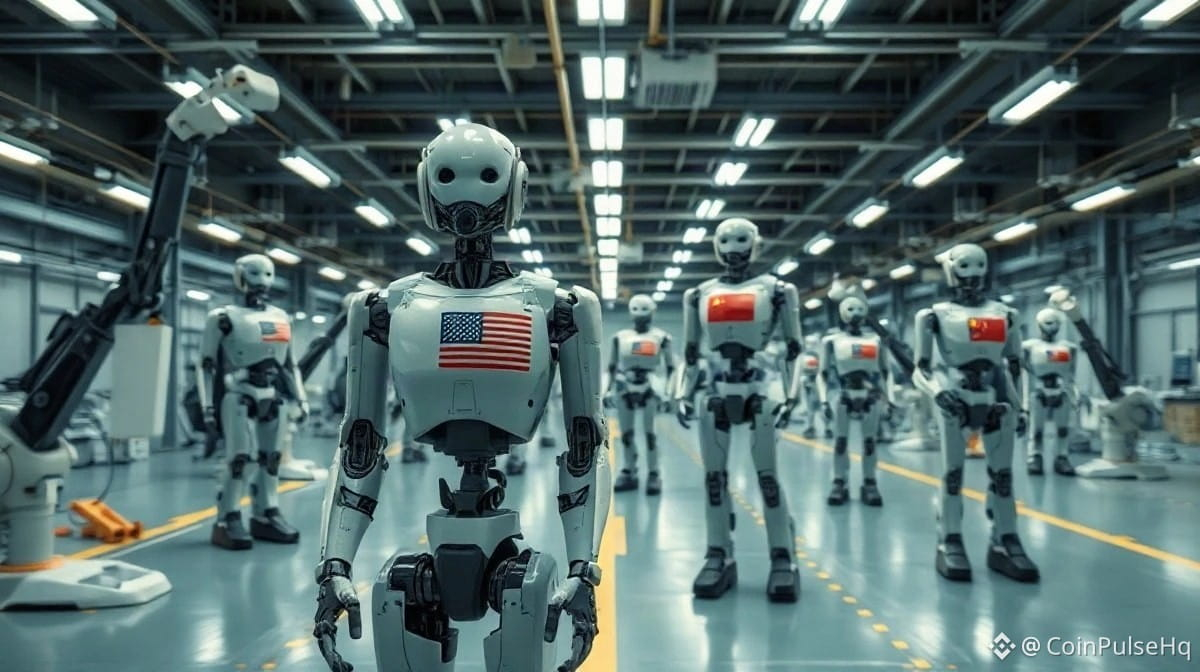
US Curbs on Chinese Drones and Robots May Not Overcome China’s Manufacturing ScaleThe United States has moved to restrict foreign-made advanced robotics and drones, but industry analysts say China's manufacturing scale may blunt the impact, likely producing a fragmented global market rather than a clean US-China split. In July and August, Washington tightened rules on foreign robotic systems and imposed steep tariffs on imported drones and components, citing national-security concerns. The drone tariffs take effect in September, with additional component tariffs following in 2027.
These actions are part of a broader U.S. effort to limit foreign technology in strategically important industries. The FCC's Covered List, established in 2021, initially targeted telecommunications equipment from companies like Huawei and ZTE, then expanded to drones and, most recently, to advanced robotic devices. The latest move comes as Chinese manufacturers have built commanding positions in both drones and humanoid robots, often at prices U.S. and European rivals struggle to match.
China's Scale Advantage in Humanoid Robots
China dominates global humanoid robot manufacturing. Global shipments hit 22,000 units in the first half of 2026, with the vast majority from Chinese manufacturers, according to Counterpoint Research. The world's five largest humanoid robot makers by shipments — AgiBot, Unitree, Galbot, UBTECH, and Leju Robotics — are all Chinese and together accounted for 86% of global shipments in that period.
U.S. companies operate at a far smaller scale, said Soumen Mandal, a principal analyst at Counterpoint Research. That advantage compounds: lower prices allow Chinese manufacturers to deploy more robots, generating real-world data that improves their technology, while higher production volumes drive costs down further, said Ankur Saxena, an investment director at TDK Ventures.
Chinese humanoid makers are also pushing costs down by bringing more of the technology stack in-house. Unitree, for example, is developing more components internally, while automakers such as XPeng apply their experience in chips and vehicle manufacturing as they move into robotics.
“The United States leads in frontier AI, software and semiconductor innovation,” Saxena told TechCrunch. “China leads in manufacturing scale, supply-chain depth and cost.”
That manufacturing edge has let Chinese companies cut humanoid prices faster than most U.S. competitors can match. “You cannot sanction your way around a cost curve. You can only out-build it, and America has yet to begin making the decade-long investment that will require,” Saxena said.
Where Does China Go Next?
The answer may increasingly be outside the U.S. Even if Chinese robotics companies lose access to the American market, they still have a large domestic market and room to expand elsewhere, particularly in regions where demand for affordable automation is growing, Saxena said.
Chinese robotics companies are already targeting price-sensitive markets with severe labor shortages across Europe, Southeast Asia, Latin America, and the Middle East, said Mandal. He expects humanoid makers to follow a path similar to Chinese electric-vehicle companies: build scale at home, expand into overseas markets, and eventually establish local production.
The drone market offers an early glimpse of that fragmentation. The industry is splitting into two ecosystems: a U.S.-led market built around American-made, NDAA-compliant systems, and a China-led market focused on low-cost, high-volume production, said Bentzion Levinson, founder and CEO of Virginia-based drone maker Heven AeroTech.
Levinson said Western manufacturers are unlikely to beat Chinese companies in the low-end consumer drone market. Instead, U.S. and allied companies could increasingly compete in long-range autonomous systems for defense and critical infrastructure, where security requirements carry more weight.
“The next battleground is over who owns the next-gen energy and payload architecture,” he said, pointing to battery constraints in particular.
Agility Robotics welcomed the FCC's decision in July, saying it could address security concerns around foreign-made advanced robots before they become deeply embedded in the U.S. market. The company pointed to its Digit humanoid, which is designed and assembled in the U.S., while also calling for continued access to the tools and technologies needed to advance robotics research.
A More Regional Robotics Market
“The alternative to China isn't a purely domestic U.S. supply chain; it's a diversified allied one,” Saxena said. That could create opportunities elsewhere in Asia. Japan has decades of experience in industrial robotics, South Korea brings strengths in electronics and batteries, and Taiwan is a major semiconductor player. But none can simply replace China, given how deeply Chinese components remain embedded across the global robotics industry.
Asian manufacturers could emerge as a middle ground between lower-cost Chinese robots and more expensive U.S. offerings, Mandal said. South Korea's Hyundai, which owns Boston Dynamics, and Japan's Toyota are among the automakers investing in robotics.
Yang Fang of Beagle Technology, a California-based agtech startup, told TechCrunch that robotics is likely to become more regional as companies design machines for the labor needs and working conditions in their home markets.
The result may not be two neatly separated industries. Instead, the restrictions could accelerate the emergence of regional markets: Chinese companies competing on cost and scale across much of the world, U.S. and allied manufacturers gaining ground where security requirements matter most, and manufacturers in Japan, Taiwan, and South Korea trying to carve out space between the two.
This article is for informational purposes only and does not constitute financial advice. The robotics and technology markets are volatile and subject to rapid change; readers should conduct their own research before making any investment decisions.
Originally published on CoinPulseHQ: https://coinpulsehq.com/us-china-robotics-restrictions-scale-gap/
US Curbs on Chinese Drones and Robots May Not Overcome China’s Manufacturing Scale
The United States has moved to restrict foreign-made advanced robotics and drones, but industry analysts say China's manufacturing scale may blunt the impact, likely producing a fragmented global market rather than a clean US-China split. In July and August, Washington tightened rules on foreign robotic systems and imposed steep tariffs on imported drones and components, citing national-security concerns. The drone tariffs take effect in September, with additional component tariffs following in 2027.
These actions are part of a broader U.S. effort to limit foreign technology in strategically important industries. The FCC's Covered List, established in 2021, initially targeted telecommunications equipment from companies like Huawei and ZTE, then expanded to drones and, most recently, to advanced robotic devices. The latest move comes as Chinese manufacturers have built commanding positions in both drones and humanoid robots, often at prices U.S. and European rivals struggle to match.
China's Scale Advantage in Humanoid Robots
China dominates global humanoid robot manufacturing. Global shipments hit 22,000 units in the first half of 2026, with the vast majority from Chinese manufacturers, according to Counterpoint Research. The world's five largest humanoid robot makers by shipments — AgiBot, Unitree, Galbot, UBTECH, and Leju Robotics — are all Chinese and together accounted for 86% of global shipments in that period.
U.S. companies operate at a far smaller scale, said Soumen Mandal, a principal analyst at Counterpoint Research. That advantage compounds: lower prices allow Chinese manufacturers to deploy more robots, generating real-world data that improves their technology, while higher production volumes drive costs down further, said Ankur Saxena, an investment director at TDK Ventures.
Chinese humanoid makers are also pushing costs down by bringing more of the technology stack in-house. Unitree, for example, is developing more components internally, while automakers such as XPeng apply their experience in chips and vehicle manufacturing as they move into robotics.
“The United States leads in frontier AI, software and semiconductor innovation,” Saxena told TechCrunch. “China leads in manufacturing scale, supply-chain depth and cost.”
That manufacturing edge has let Chinese companies cut humanoid prices faster than most U.S. competitors can match. “You cannot sanction your way around a cost curve. You can only out-build it, and America has yet to begin making the decade-long investment that will require,” Saxena said.
Where Does China Go Next?
The answer may increasingly be outside the U.S. Even if Chinese robotics companies lose access to the American market, they still have a large domestic market and room to expand elsewhere, particularly in regions where demand for affordable automation is growing, Saxena said.
Chinese robotics companies are already targeting price-sensitive markets with severe labor shortages across Europe, Southeast Asia, Latin America, and the Middle East, said Mandal. He expects humanoid makers to follow a path similar to Chinese electric-vehicle companies: build scale at home, expand into overseas markets, and eventually establish local production.
The drone market offers an early glimpse of that fragmentation. The industry is splitting into two ecosystems: a U.S.-led market built around American-made, NDAA-compliant systems, and a China-led market focused on low-cost, high-volume production, said Bentzion Levinson, founder and CEO of Virginia-based drone maker Heven AeroTech.
Levinson said Western manufacturers are unlikely to beat Chinese companies in the low-end consumer drone market. Instead, U.S. and allied companies could increasingly compete in long-range autonomous systems for defense and critical infrastructure, where security requirements carry more weight.
“The next battleground is over who owns the next-gen energy and payload architecture,” he said, pointing to battery constraints in particular.
Agility Robotics welcomed the FCC's decision in July, saying it could address security concerns around foreign-made advanced robots before they become deeply embedded in the U.S. market. The company pointed to its Digit humanoid, which is designed and assembled in the U.S., while also calling for continued access to the tools and technologies needed to advance robotics research.
A More Regional Robotics Market
“The alternative to China isn't a purely domestic U.S. supply chain; it's a diversified allied one,” Saxena said. That could create opportunities elsewhere in Asia. Japan has decades of experience in industrial robotics, South Korea brings strengths in electronics and batteries, and Taiwan is a major semiconductor player. But none can simply replace China, given how deeply Chinese components remain embedded across the global robotics industry.
Asian manufacturers could emerge as a middle ground between lower-cost Chinese robots and more expensive U.S. offerings, Mandal said. South Korea's Hyundai, which owns Boston Dynamics, and Japan's Toyota are among the automakers investing in robotics.
Yang Fang of Beagle Technology, a California-based agtech startup, told TechCrunch that robotics is likely to become more regional as companies design machines for the labor needs and working conditions in their home markets.
The result may not be two neatly separated industries. Instead, the restrictions could accelerate the emergence of regional markets: Chinese companies competing on cost and scale across much of the world, U.S. and allied manufacturers gaining ground where security requirements matter most, and manufacturers in Japan, Taiwan, and South Korea trying to carve out space between the two.
This article is for informational purposes only and does not constitute financial advice. The robotics and technology markets are volatile and subject to rapid change; readers should conduct their own research before making any investment decisions.
Originally published on CoinPulseHQ: https://coinpulsehq.com/us-china-robotics-restrictions-scale-gap/
These actions are part of a broader U.S. effort to limit foreign technology in strategically important industries. The FCC's Covered List, established in 2021, initially targeted telecommunications equipment from companies like Huawei and ZTE, then expanded to drones and, most recently, to advanced robotic devices. The latest move comes as Chinese manufacturers have built commanding positions in both drones and humanoid robots, often at prices U.S. and European rivals struggle to match.
China's Scale Advantage in Humanoid Robots
China dominates global humanoid robot manufacturing. Global shipments hit 22,000 units in the first half of 2026, with the vast majority from Chinese manufacturers, according to Counterpoint Research. The world's five largest humanoid robot makers by shipments — AgiBot, Unitree, Galbot, UBTECH, and Leju Robotics — are all Chinese and together accounted for 86% of global shipments in that period.
U.S. companies operate at a far smaller scale, said Soumen Mandal, a principal analyst at Counterpoint Research. That advantage compounds: lower prices allow Chinese manufacturers to deploy more robots, generating real-world data that improves their technology, while higher production volumes drive costs down further, said Ankur Saxena, an investment director at TDK Ventures.
Chinese humanoid makers are also pushing costs down by bringing more of the technology stack in-house. Unitree, for example, is developing more components internally, while automakers such as XPeng apply their experience in chips and vehicle manufacturing as they move into robotics.
“The United States leads in frontier AI, software and semiconductor innovation,” Saxena told TechCrunch. “China leads in manufacturing scale, supply-chain depth and cost.”
That manufacturing edge has let Chinese companies cut humanoid prices faster than most U.S. competitors can match. “You cannot sanction your way around a cost curve. You can only out-build it, and America has yet to begin making the decade-long investment that will require,” Saxena said.
Where Does China Go Next?
The answer may increasingly be outside the U.S. Even if Chinese robotics companies lose access to the American market, they still have a large domestic market and room to expand elsewhere, particularly in regions where demand for affordable automation is growing, Saxena said.
Chinese robotics companies are already targeting price-sensitive markets with severe labor shortages across Europe, Southeast Asia, Latin America, and the Middle East, said Mandal. He expects humanoid makers to follow a path similar to Chinese electric-vehicle companies: build scale at home, expand into overseas markets, and eventually establish local production.
The drone market offers an early glimpse of that fragmentation. The industry is splitting into two ecosystems: a U.S.-led market built around American-made, NDAA-compliant systems, and a China-led market focused on low-cost, high-volume production, said Bentzion Levinson, founder and CEO of Virginia-based drone maker Heven AeroTech.
Levinson said Western manufacturers are unlikely to beat Chinese companies in the low-end consumer drone market. Instead, U.S. and allied companies could increasingly compete in long-range autonomous systems for defense and critical infrastructure, where security requirements carry more weight.
“The next battleground is over who owns the next-gen energy and payload architecture,” he said, pointing to battery constraints in particular.
Agility Robotics welcomed the FCC's decision in July, saying it could address security concerns around foreign-made advanced robots before they become deeply embedded in the U.S. market. The company pointed to its Digit humanoid, which is designed and assembled in the U.S., while also calling for continued access to the tools and technologies needed to advance robotics research.
A More Regional Robotics Market
“The alternative to China isn't a purely domestic U.S. supply chain; it's a diversified allied one,” Saxena said. That could create opportunities elsewhere in Asia. Japan has decades of experience in industrial robotics, South Korea brings strengths in electronics and batteries, and Taiwan is a major semiconductor player. But none can simply replace China, given how deeply Chinese components remain embedded across the global robotics industry.
Asian manufacturers could emerge as a middle ground between lower-cost Chinese robots and more expensive U.S. offerings, Mandal said. South Korea's Hyundai, which owns Boston Dynamics, and Japan's Toyota are among the automakers investing in robotics.
Yang Fang of Beagle Technology, a California-based agtech startup, told TechCrunch that robotics is likely to become more regional as companies design machines for the labor needs and working conditions in their home markets.
The result may not be two neatly separated industries. Instead, the restrictions could accelerate the emergence of regional markets: Chinese companies competing on cost and scale across much of the world, U.S. and allied manufacturers gaining ground where security requirements matter most, and manufacturers in Japan, Taiwan, and South Korea trying to carve out space between the two.
This article is for informational purposes only and does not constitute financial advice. The robotics and technology markets are volatile and subject to rapid change; readers should conduct their own research before making any investment decisions.
Originally published on CoinPulseHQ: https://coinpulsehq.com/us-china-robotics-restrictions-scale-gap/
·
--

Artikel
Lihat terjemahan
Circleback adds free tier to its meeting notetaker as competition heats upCircleback, a Y Combinator-backed meeting notetaker, is introducing a free subscription tier as competition in the crowded meeting transcription market intensifies. The new plan, announced this week, allows users to transcribe unlimited meetings and access their history for the past 30 days, a move aimed at lowering the barrier to entry and attracting a broader user base.
The free tier includes core features such as meeting recording, mobile and Apple Watch apps, AI-powered transcript queries, and integrations with Linear and Slack. For users who need more, paid plans start at $14 per month (billed annually) and unlock all integrations, unlimited meeting history, and full API and MCP access. Previously, Circleback had no free tier, with plans starting at $20.83 per month.
Why Circleback is opening the gates
Co-founder Ali Haghani told TechCrunch that the company saw a significant drop-off in users during its previous limited trial period, prompting the shift. “If we just open the gates and allow more people to use the product, that’s gonna bring Circleback in front of more people. Then we’re very good at making the product good and monetizing those users,” he said.
The move comes as the meeting notetaker market becomes increasingly crowded. In recent weeks, dictation app Wispr launched its own note-taker and scheduling app, and Calendly added a similar tool to its stack. Dedicated players like Granola, Read AI, and Fireflies have raised millions in funding, with Granola also adding a free tier a few months ago.
Circleback, founded in 2023 by Haghani and Kevin Jacyna, raised $2.5 million in 2024. The company says it has been profitable since then, with run-rate revenue exceeding $1 million per employee across its eight-person team, translating to roughly $8 million in annualized revenue.
Marketing through product, not ads
Haghani noted that Circleback does not spend on Google Ads or Meta Ads, and the free tier is intended to serve as a marketing expense. The strategy appears to be working: the company says it is consistently winning customers against much larger competitors, both in terms of headcount and funding.
“We are consistently competing and winning customers against much bigger companies, both in terms of number of people and funding raised. And I feel like there is now more of an appetite to win,” he said.
Despite investor interest, Circleback is not immediately looking to raise funds, as it sees no bottlenecks in its growth trajectory. Haghani said the startup would be open to fundraising if money could solve a specific problem.
The free tier strategy mirrors a broader trend in the AI software space, where companies are using free access to build user bases and gather data to improve their models. For meeting notetakers, the challenge lies in converting free users into paying customers, especially as the market becomes saturated with similar offerings.
As the competition heats up, Circleback’s bet on accessibility and product-led growth will be tested. The company’s profitability and lean team give it a degree of flexibility that larger, venture-backed rivals may not have, but the long-term viability of the free tier will depend on its ability to convert users into subscribers.
This article is for informational purposes only and does not constitute financial advice. The software and startup market is volatile and uncertain; readers should conduct their own research before making any business or investment decisions.
Originally published on CoinPulseHQ: https://coinpulsehq.com/circleback-free-tier-meeting-notetaker/
Circleback adds free tier to its meeting notetaker as competition heats up
Circleback, a Y Combinator-backed meeting notetaker, is introducing a free subscription tier as competition in the crowded meeting transcription market intensifies. The new plan, announced this week, allows users to transcribe unlimited meetings and access their history for the past 30 days, a move aimed at lowering the barrier to entry and attracting a broader user base.
The free tier includes core features such as meeting recording, mobile and Apple Watch apps, AI-powered transcript queries, and integrations with Linear and Slack. For users who need more, paid plans start at $14 per month (billed annually) and unlock all integrations, unlimited meeting history, and full API and MCP access. Previously, Circleback had no free tier, with plans starting at $20.83 per month.
Why Circleback is opening the gates
Co-founder Ali Haghani told TechCrunch that the company saw a significant drop-off in users during its previous limited trial period, prompting the shift. “If we just open the gates and allow more people to use the product, that’s gonna bring Circleback in front of more people. Then we’re very good at making the product good and monetizing those users,” he said.
The move comes as the meeting notetaker market becomes increasingly crowded. In recent weeks, dictation app Wispr launched its own note-taker and scheduling app, and Calendly added a similar tool to its stack. Dedicated players like Granola, Read AI, and Fireflies have raised millions in funding, with Granola also adding a free tier a few months ago.
Circleback, founded in 2023 by Haghani and Kevin Jacyna, raised $2.5 million in 2024. The company says it has been profitable since then, with run-rate revenue exceeding $1 million per employee across its eight-person team, translating to roughly $8 million in annualized revenue.
Marketing through product, not ads
Haghani noted that Circleback does not spend on Google Ads or Meta Ads, and the free tier is intended to serve as a marketing expense. The strategy appears to be working: the company says it is consistently winning customers against much larger competitors, both in terms of headcount and funding.
“We are consistently competing and winning customers against much bigger companies, both in terms of number of people and funding raised. And I feel like there is now more of an appetite to win,” he said.
Despite investor interest, Circleback is not immediately looking to raise funds, as it sees no bottlenecks in its growth trajectory. Haghani said the startup would be open to fundraising if money could solve a specific problem.
The free tier strategy mirrors a broader trend in the AI software space, where companies are using free access to build user bases and gather data to improve their models. For meeting notetakers, the challenge lies in converting free users into paying customers, especially as the market becomes saturated with similar offerings.
As the competition heats up, Circleback’s bet on accessibility and product-led growth will be tested. The company’s profitability and lean team give it a degree of flexibility that larger, venture-backed rivals may not have, but the long-term viability of the free tier will depend on its ability to convert users into subscribers.
This article is for informational purposes only and does not constitute financial advice. The software and startup market is volatile and uncertain; readers should conduct their own research before making any business or investment decisions.
Originally published on CoinPulseHQ: https://coinpulsehq.com/circleback-free-tier-meeting-notetaker/
The free tier includes core features such as meeting recording, mobile and Apple Watch apps, AI-powered transcript queries, and integrations with Linear and Slack. For users who need more, paid plans start at $14 per month (billed annually) and unlock all integrations, unlimited meeting history, and full API and MCP access. Previously, Circleback had no free tier, with plans starting at $20.83 per month.
Why Circleback is opening the gates
Co-founder Ali Haghani told TechCrunch that the company saw a significant drop-off in users during its previous limited trial period, prompting the shift. “If we just open the gates and allow more people to use the product, that’s gonna bring Circleback in front of more people. Then we’re very good at making the product good and monetizing those users,” he said.
The move comes as the meeting notetaker market becomes increasingly crowded. In recent weeks, dictation app Wispr launched its own note-taker and scheduling app, and Calendly added a similar tool to its stack. Dedicated players like Granola, Read AI, and Fireflies have raised millions in funding, with Granola also adding a free tier a few months ago.
Circleback, founded in 2023 by Haghani and Kevin Jacyna, raised $2.5 million in 2024. The company says it has been profitable since then, with run-rate revenue exceeding $1 million per employee across its eight-person team, translating to roughly $8 million in annualized revenue.
Marketing through product, not ads
Haghani noted that Circleback does not spend on Google Ads or Meta Ads, and the free tier is intended to serve as a marketing expense. The strategy appears to be working: the company says it is consistently winning customers against much larger competitors, both in terms of headcount and funding.
“We are consistently competing and winning customers against much bigger companies, both in terms of number of people and funding raised. And I feel like there is now more of an appetite to win,” he said.
Despite investor interest, Circleback is not immediately looking to raise funds, as it sees no bottlenecks in its growth trajectory. Haghani said the startup would be open to fundraising if money could solve a specific problem.
The free tier strategy mirrors a broader trend in the AI software space, where companies are using free access to build user bases and gather data to improve their models. For meeting notetakers, the challenge lies in converting free users into paying customers, especially as the market becomes saturated with similar offerings.
As the competition heats up, Circleback’s bet on accessibility and product-led growth will be tested. The company’s profitability and lean team give it a degree of flexibility that larger, venture-backed rivals may not have, but the long-term viability of the free tier will depend on its ability to convert users into subscribers.
This article is for informational purposes only and does not constitute financial advice. The software and startup market is volatile and uncertain; readers should conduct their own research before making any business or investment decisions.
Originally published on CoinPulseHQ: https://coinpulsehq.com/circleback-free-tier-meeting-notetaker/
·
--

Artikel
Lihat terjemahan
Instagram tightens rules for undisclosed AI-generated profiles, limits reach of non-compliant accountsInstagram announced Monday that it will begin limiting the reach of accounts featuring AI-generated people that are not clearly labeled as such. The platform is renaming its existing “AI creator” label to “AI-generated profile,” a change the company says will make the disclosure clearer for users.
The new label is designed to inform users when the person featured on a profile was generated or substantially created with AI. Under the updated policy, creators who fail to label an AI-generated profile could see reduced distribution. Those who use the label, however, will not be penalized simply for having an AI-generated person as their profile subject.
The label is not intended for every use of AI. Instagram says people who use AI to edit photos, polish captions, create graphics, or make other creative tweaks do not need to apply the AI-generated profile label.
Why Instagram is making the change
Instagram says the update comes in response to users who have encountered profiles that appeared to belong to real people, only to later discover the person was entirely AI-generated. “As generative AI becomes a bigger part of how people create, we’ve heard that people don’t like seeing a profile that seems human, only to find out later that the person featured is AI-generated,” the company wrote. “They want to know when a profile features an AI-generated person.”
The timing is notable. Frustration over AI-generated content has been growing as AI influencers become more common across social media platforms. Earlier this year, the gay dating app Goose became the subject of a Wired investigation after a network of apparently AI-generated male influencers promoted the app on Instagram. Wired found more than two dozen accounts that appeared to feature AI influencers, some of which reportedly reached out to potential users through direct messages to get them to sign up.
Health and wellness content is another particularly worrying example. The New York Times reported in July that it found hundreds of AI-generated doctors, healers, and wellness personalities on social media promoting supplements or making health claims to users.
Meta’s broader AI and safety moves
The announcement comes after Instagram faced backlash over an AI tool that allowed users to generate images using other people’s likenesses. Users objected to having their public Instagram content used without an explicit opt-in. Meta subsequently removed the feature.
Last week, Meta reached an $18 billion settlement with U.S. states over allegations concerning the effects of Facebook and Instagram on children and teenagers. As part of the agreement, Meta will introduce a default two-hour daily usage limit for teens across Facebook and Instagram, a “Night Mode” block, muted notifications during school hours, and other restrictions.
For creators and brands, the new labeling requirement adds another layer of compliance to an already complex content environment. Those who build audiences around AI-generated personas will need to weigh the transparency requirement against the potential for reduced reach if they fail to comply. For users, the label offers a clearer signal about the authenticity of the people they encounter on the platform.
This is not financial advice, and the social media space remains volatile and uncertain as platforms continue to adapt their policies to evolving AI technology.
Originally published on CoinPulseHQ: https://coinpulsehq.com/instagram-ai-generated-profile-label-policy/
Instagram tightens rules for undisclosed AI-generated profiles, limits reach of non-compliant accounts
Instagram announced Monday that it will begin limiting the reach of accounts featuring AI-generated people that are not clearly labeled as such. The platform is renaming its existing “AI creator” label to “AI-generated profile,” a change the company says will make the disclosure clearer for users.
The new label is designed to inform users when the person featured on a profile was generated or substantially created with AI. Under the updated policy, creators who fail to label an AI-generated profile could see reduced distribution. Those who use the label, however, will not be penalized simply for having an AI-generated person as their profile subject.
The label is not intended for every use of AI. Instagram says people who use AI to edit photos, polish captions, create graphics, or make other creative tweaks do not need to apply the AI-generated profile label.
Why Instagram is making the change
Instagram says the update comes in response to users who have encountered profiles that appeared to belong to real people, only to later discover the person was entirely AI-generated. “As generative AI becomes a bigger part of how people create, we’ve heard that people don’t like seeing a profile that seems human, only to find out later that the person featured is AI-generated,” the company wrote. “They want to know when a profile features an AI-generated person.”
The timing is notable. Frustration over AI-generated content has been growing as AI influencers become more common across social media platforms. Earlier this year, the gay dating app Goose became the subject of a Wired investigation after a network of apparently AI-generated male influencers promoted the app on Instagram. Wired found more than two dozen accounts that appeared to feature AI influencers, some of which reportedly reached out to potential users through direct messages to get them to sign up.
Health and wellness content is another particularly worrying example. The New York Times reported in July that it found hundreds of AI-generated doctors, healers, and wellness personalities on social media promoting supplements or making health claims to users.
Meta’s broader AI and safety moves
The announcement comes after Instagram faced backlash over an AI tool that allowed users to generate images using other people’s likenesses. Users objected to having their public Instagram content used without an explicit opt-in. Meta subsequently removed the feature.
Last week, Meta reached an $18 billion settlement with U.S. states over allegations concerning the effects of Facebook and Instagram on children and teenagers. As part of the agreement, Meta will introduce a default two-hour daily usage limit for teens across Facebook and Instagram, a “Night Mode” block, muted notifications during school hours, and other restrictions.
For creators and brands, the new labeling requirement adds another layer of compliance to an already complex content environment. Those who build audiences around AI-generated personas will need to weigh the transparency requirement against the potential for reduced reach if they fail to comply. For users, the label offers a clearer signal about the authenticity of the people they encounter on the platform.
This is not financial advice, and the social media space remains volatile and uncertain as platforms continue to adapt their policies to evolving AI technology.
Originally published on CoinPulseHQ: https://coinpulsehq.com/instagram-ai-generated-profile-label-policy/
The new label is designed to inform users when the person featured on a profile was generated or substantially created with AI. Under the updated policy, creators who fail to label an AI-generated profile could see reduced distribution. Those who use the label, however, will not be penalized simply for having an AI-generated person as their profile subject.
The label is not intended for every use of AI. Instagram says people who use AI to edit photos, polish captions, create graphics, or make other creative tweaks do not need to apply the AI-generated profile label.
Why Instagram is making the change
Instagram says the update comes in response to users who have encountered profiles that appeared to belong to real people, only to later discover the person was entirely AI-generated. “As generative AI becomes a bigger part of how people create, we’ve heard that people don’t like seeing a profile that seems human, only to find out later that the person featured is AI-generated,” the company wrote. “They want to know when a profile features an AI-generated person.”
The timing is notable. Frustration over AI-generated content has been growing as AI influencers become more common across social media platforms. Earlier this year, the gay dating app Goose became the subject of a Wired investigation after a network of apparently AI-generated male influencers promoted the app on Instagram. Wired found more than two dozen accounts that appeared to feature AI influencers, some of which reportedly reached out to potential users through direct messages to get them to sign up.
Health and wellness content is another particularly worrying example. The New York Times reported in July that it found hundreds of AI-generated doctors, healers, and wellness personalities on social media promoting supplements or making health claims to users.
Meta’s broader AI and safety moves
The announcement comes after Instagram faced backlash over an AI tool that allowed users to generate images using other people’s likenesses. Users objected to having their public Instagram content used without an explicit opt-in. Meta subsequently removed the feature.
Last week, Meta reached an $18 billion settlement with U.S. states over allegations concerning the effects of Facebook and Instagram on children and teenagers. As part of the agreement, Meta will introduce a default two-hour daily usage limit for teens across Facebook and Instagram, a “Night Mode” block, muted notifications during school hours, and other restrictions.
For creators and brands, the new labeling requirement adds another layer of compliance to an already complex content environment. Those who build audiences around AI-generated personas will need to weigh the transparency requirement against the potential for reduced reach if they fail to comply. For users, the label offers a clearer signal about the authenticity of the people they encounter on the platform.
This is not financial advice, and the social media space remains volatile and uncertain as platforms continue to adapt their policies to evolving AI technology.
Originally published on CoinPulseHQ: https://coinpulsehq.com/instagram-ai-generated-profile-label-policy/
·
--

Artikel
Mengapa pemegang Bitcoin OG membakar $1M? Data on-chain memberi petunjuk tapi tidak ada jawabanDalam sebuah kisah yang telah memikat analis blockchain, seorang pemegang Bitcoin awal—menganggur selama hampir 12 tahun—memindahkan senilai $1 juta BTC melalui kustodian besar, menerima kembali jumlah yang hampir sama, lalu dengan sengaja menghancurkannya. Pembakaran 20 BTC pada Mei 2026 merupakan bagian dari pola yang lebih luas yang melibatkan lima dompet yang secara kolektif mengirim 107 BTC ke alamat yang tidak dapat dibelanjakan, sehingga memunculkan pertanyaan yang bahkan tidak dapat dijawab oleh firma forensik terkemuka.
Misteri perjalanan pulang-pergi $1 juta
Pendidik blockchain Bennet pertama kali menyoroti aktivitas yang tidak biasa tersebut. Sebuah dompet yang sejak kira-kira tahun 2014 tidak tersentuh tiba-tiba mengirim seluruh saldo sebesar 20.00010537 BTC ke apa yang tampaknya menjadi hot wallet milik bursa terpusat besar. Tiga minggu kemudian, dompet yang sama menerima kembali 20.00006037 BTC—selisih hanya 4.500 satoshis, atau sekitar $3. Dana yang dikembalikan dipecah menjadi tiga transaksi sebesar 7 BTC, 7 BTC, dan 6.00006037 BTC selama beberapa hari berturut-turut, yang menunjukkan adanya batas penarikan harian.
Mengapa pemegang Bitcoin OG membakar $1M? Data on-chain memberi petunjuk tapi tidak ada jawaban
Dalam sebuah kisah yang telah memikat analis blockchain, seorang pemegang Bitcoin awal—menganggur selama hampir 12 tahun—memindahkan senilai $1 juta BTC melalui kustodian besar, menerima kembali jumlah yang hampir sama, lalu dengan sengaja menghancurkannya. Pembakaran 20 BTC pada Mei 2026 merupakan bagian dari pola yang lebih luas yang melibatkan lima dompet yang secara kolektif mengirim 107 BTC ke alamat yang tidak dapat dibelanjakan, sehingga memunculkan pertanyaan yang bahkan tidak dapat dijawab oleh firma forensik terkemuka.
Misteri perjalanan pulang-pergi $1 juta
Pendidik blockchain Bennet pertama kali menyoroti aktivitas yang tidak biasa tersebut. Sebuah dompet yang sejak kira-kira tahun 2014 tidak tersentuh tiba-tiba mengirim seluruh saldo sebesar 20.00010537 BTC ke apa yang tampaknya menjadi hot wallet milik bursa terpusat besar. Tiga minggu kemudian, dompet yang sama menerima kembali 20.00006037 BTC—selisih hanya 4.500 satoshis, atau sekitar $3. Dana yang dikembalikan dipecah menjadi tiga transaksi sebesar 7 BTC, 7 BTC, dan 6.00006037 BTC selama beberapa hari berturut-turut, yang menunjukkan adanya batas penarikan harian.
Misteri perjalanan pulang-pergi $1 juta
Pendidik blockchain Bennet pertama kali menyoroti aktivitas yang tidak biasa tersebut. Sebuah dompet yang sejak kira-kira tahun 2014 tidak tersentuh tiba-tiba mengirim seluruh saldo sebesar 20.00010537 BTC ke apa yang tampaknya menjadi hot wallet milik bursa terpusat besar. Tiga minggu kemudian, dompet yang sama menerima kembali 20.00006037 BTC—selisih hanya 4.500 satoshis, atau sekitar $3. Dana yang dikembalikan dipecah menjadi tiga transaksi sebesar 7 BTC, 7 BTC, dan 6.00006037 BTC selama beberapa hari berturut-turut, yang menunjukkan adanya batas penarikan harian.
19
·
--
Terverifikasi

Artikel
Harmony mengusulkan penghentian blockchain layer-1 dan migrasi ONE ke EthereumJaringan lapisan-1 Harmony yang kompatibel dengan Ethereum telah mengusulkan untuk menghentikan blockchain-nya dan memigrasikan token asli ONE ke Ethereum, tujuh tahun setelah meluncurkan mainnet-nya. Proposal tersebut, yang diumumkan pada hari Minggu, muncul beberapa minggu setelah adanya exploit yang memaksa jaringan merencanakan rollback atas lebih dari 109.000 transaksi.
Proposal migrasi Harmony
Dalam proposal yang tidak mengikat, Harmony akan mengambil snapshot jaringan terakhir, menerbitkan token ERC-20 ONE di Ethereum, dan memigrasikan pencatatan bursa. Validator akan ditawari opsi untuk menghentikan node mereka, melanjutkan sebagai gubernur, atau bergabung dengan inisiatif AI-video baru dari Harmony. Proposal ini tidak menentukan kapan blok final akan diproduksi atau apakah penghentian akan diajukan ke proses tata kelola jaringan yang dipimpin validator.
Harmony mengusulkan penghentian blockchain layer-1 dan migrasi ONE ke Ethereum
Jaringan lapisan-1 Harmony yang kompatibel dengan Ethereum telah mengusulkan untuk menghentikan blockchain-nya dan memigrasikan token asli ONE ke Ethereum, tujuh tahun setelah meluncurkan mainnet-nya. Proposal tersebut, yang diumumkan pada hari Minggu, muncul beberapa minggu setelah adanya exploit yang memaksa jaringan merencanakan rollback atas lebih dari 109.000 transaksi.
Proposal migrasi Harmony
Dalam proposal yang tidak mengikat, Harmony akan mengambil snapshot jaringan terakhir, menerbitkan token ERC-20 ONE di Ethereum, dan memigrasikan pencatatan bursa. Validator akan ditawari opsi untuk menghentikan node mereka, melanjutkan sebagai gubernur, atau bergabung dengan inisiatif AI-video baru dari Harmony. Proposal ini tidak menentukan kapan blok final akan diproduksi atau apakah penghentian akan diajukan ke proses tata kelola jaringan yang dipimpin validator.
Proposal migrasi Harmony
Dalam proposal yang tidak mengikat, Harmony akan mengambil snapshot jaringan terakhir, menerbitkan token ERC-20 ONE di Ethereum, dan memigrasikan pencatatan bursa. Validator akan ditawari opsi untuk menghentikan node mereka, melanjutkan sebagai gubernur, atau bergabung dengan inisiatif AI-video baru dari Harmony. Proposal ini tidak menentukan kapan blok final akan diproduksi atau apakah penghentian akan diajukan ke proses tata kelola jaringan yang dipimpin validator.
428
·
--

Artikel
Lihat terjemahan
Seattle Times and Newsday Sue OpenAI and Microsoft Over Copyright in Latest Publisher Legal BattleThe Seattle Times and Newsday filed a copyright infringement lawsuit against OpenAI and Microsoft on September 5, 2026, escalating the publishing industry's legal confrontation with generative AI companies. The lawsuit, reported by TechCrunch, alleges that the companies used the newspapers' journalism to train AI models like ChatGPT and Copilot without authorization or compensation.
The complaint argues that the journalism industry could become "broken beyond repair" due to AI, describing generative AI as "a snake eating its own tail" that could "destroy the very organizations" producing the content it relies on. The legal filing sharply criticizes the AI companies' business model, stating: "AI products like ChatGPT and CoPilot are touted as producers of content, but in fact they are rapacious consumers, devouring human-authored content and delivering back to the world copies and derivative imitations of that same original content they consumed to achieve their commercial objectives."
A Growing Wave of Publisher Lawsuits
The new lawsuit follows a pattern established in December 2023, when The New York Times sued OpenAI and Microsoft for alleged copyright infringement. Since then, numerous other publications have filed similar actions, including the Chicago Tribune, the New York Daily News, and several digital-first outlets like The Intercept and Raw Story.
What makes this particular case stand out is the pre-existing relationship between the parties. Microsoft and OpenAI have previously funded journalism projects and fellowships at The Seattle Times, a fact that complicates the narrative of adversarial parties. A Microsoft spokesperson told GeekWire the company is "surprised by the lawsuit" but remains "always happy to sit down and explore solutions to this type of dispute."
Why This Legal Fight Matters for the News Industry
The outcome of these consolidated disputes could fundamentally reshape how AI companies source training data. At stake is not just financial compensation for past use of copyrighted material, but the establishment of a legal framework for how AI models can be trained on journalistic content going forward.
News organizations have watched with growing alarm as AI-powered search and chat products increasingly deliver answers drawn from their reporting without driving traffic back to their websites. The Seattle Times and Newsday lawsuit directly challenges this dynamic, arguing that AI systems are effectively competing with the very publishers whose work they consume.
The case also highlights a structural tension: even as publishers sue AI companies, many have struck separate licensing deals. News Corp, Associated Press, and Dotdash Meredith have all signed content agreements with OpenAI, creating a split in the industry between those who negotiate and those who litigate. The Seattle Times and Newsday have chosen the courtroom path, though Microsoft's statement suggests a potential openness to settlement discussions.
Legal experts following the broader litigation note that courts have yet to rule definitively on the core question of whether training AI on copyrighted material constitutes fair use. The New York Times case, which remains ongoing, is widely seen as the bellwether that could set precedent for the dozens of similar lawsuits filed since.
For readers and journalists alike, the stakes extend beyond corporate balance sheets. If publishers succeed in establishing that AI companies must license journalistic content, it could create a new revenue stream for an industry that has struggled financially for two decades. Conversely, a ruling favoring the AI companies could accelerate the disruption of traditional news business models.
As this litigation progresses through the courts, the industry will be watching closely for any ruling that clarifies the boundaries between AI innovation and intellectual property protection. The Seattle Times and Newsday lawsuit adds another layer of pressure on OpenAI and Microsoft to reach broader industry-wide agreements rather than fighting each publisher individually.
This article discusses ongoing litigation and market dynamics. It does not constitute financial or legal advice, and the outcomes of legal proceedings remain uncertain and subject to change.
Originally published on CoinPulseHQ: https://coinpulsehq.com/seattle-times-newsday-sue-openai-microsoft-copyright/
Seattle Times and Newsday Sue OpenAI and Microsoft Over Copyright in Latest Publisher Legal Battle
The Seattle Times and Newsday filed a copyright infringement lawsuit against OpenAI and Microsoft on September 5, 2026, escalating the publishing industry's legal confrontation with generative AI companies. The lawsuit, reported by TechCrunch, alleges that the companies used the newspapers' journalism to train AI models like ChatGPT and Copilot without authorization or compensation.
The complaint argues that the journalism industry could become "broken beyond repair" due to AI, describing generative AI as "a snake eating its own tail" that could "destroy the very organizations" producing the content it relies on. The legal filing sharply criticizes the AI companies' business model, stating: "AI products like ChatGPT and CoPilot are touted as producers of content, but in fact they are rapacious consumers, devouring human-authored content and delivering back to the world copies and derivative imitations of that same original content they consumed to achieve their commercial objectives."
A Growing Wave of Publisher Lawsuits
The new lawsuit follows a pattern established in December 2023, when The New York Times sued OpenAI and Microsoft for alleged copyright infringement. Since then, numerous other publications have filed similar actions, including the Chicago Tribune, the New York Daily News, and several digital-first outlets like The Intercept and Raw Story.
What makes this particular case stand out is the pre-existing relationship between the parties. Microsoft and OpenAI have previously funded journalism projects and fellowships at The Seattle Times, a fact that complicates the narrative of adversarial parties. A Microsoft spokesperson told GeekWire the company is "surprised by the lawsuit" but remains "always happy to sit down and explore solutions to this type of dispute."
Why This Legal Fight Matters for the News Industry
The outcome of these consolidated disputes could fundamentally reshape how AI companies source training data. At stake is not just financial compensation for past use of copyrighted material, but the establishment of a legal framework for how AI models can be trained on journalistic content going forward.
News organizations have watched with growing alarm as AI-powered search and chat products increasingly deliver answers drawn from their reporting without driving traffic back to their websites. The Seattle Times and Newsday lawsuit directly challenges this dynamic, arguing that AI systems are effectively competing with the very publishers whose work they consume.
The case also highlights a structural tension: even as publishers sue AI companies, many have struck separate licensing deals. News Corp, Associated Press, and Dotdash Meredith have all signed content agreements with OpenAI, creating a split in the industry between those who negotiate and those who litigate. The Seattle Times and Newsday have chosen the courtroom path, though Microsoft's statement suggests a potential openness to settlement discussions.
Legal experts following the broader litigation note that courts have yet to rule definitively on the core question of whether training AI on copyrighted material constitutes fair use. The New York Times case, which remains ongoing, is widely seen as the bellwether that could set precedent for the dozens of similar lawsuits filed since.
For readers and journalists alike, the stakes extend beyond corporate balance sheets. If publishers succeed in establishing that AI companies must license journalistic content, it could create a new revenue stream for an industry that has struggled financially for two decades. Conversely, a ruling favoring the AI companies could accelerate the disruption of traditional news business models.
As this litigation progresses through the courts, the industry will be watching closely for any ruling that clarifies the boundaries between AI innovation and intellectual property protection. The Seattle Times and Newsday lawsuit adds another layer of pressure on OpenAI and Microsoft to reach broader industry-wide agreements rather than fighting each publisher individually.
This article discusses ongoing litigation and market dynamics. It does not constitute financial or legal advice, and the outcomes of legal proceedings remain uncertain and subject to change.
Originally published on CoinPulseHQ: https://coinpulsehq.com/seattle-times-newsday-sue-openai-microsoft-copyright/
The complaint argues that the journalism industry could become "broken beyond repair" due to AI, describing generative AI as "a snake eating its own tail" that could "destroy the very organizations" producing the content it relies on. The legal filing sharply criticizes the AI companies' business model, stating: "AI products like ChatGPT and CoPilot are touted as producers of content, but in fact they are rapacious consumers, devouring human-authored content and delivering back to the world copies and derivative imitations of that same original content they consumed to achieve their commercial objectives."
A Growing Wave of Publisher Lawsuits
The new lawsuit follows a pattern established in December 2023, when The New York Times sued OpenAI and Microsoft for alleged copyright infringement. Since then, numerous other publications have filed similar actions, including the Chicago Tribune, the New York Daily News, and several digital-first outlets like The Intercept and Raw Story.
What makes this particular case stand out is the pre-existing relationship between the parties. Microsoft and OpenAI have previously funded journalism projects and fellowships at The Seattle Times, a fact that complicates the narrative of adversarial parties. A Microsoft spokesperson told GeekWire the company is "surprised by the lawsuit" but remains "always happy to sit down and explore solutions to this type of dispute."
Why This Legal Fight Matters for the News Industry
The outcome of these consolidated disputes could fundamentally reshape how AI companies source training data. At stake is not just financial compensation for past use of copyrighted material, but the establishment of a legal framework for how AI models can be trained on journalistic content going forward.
News organizations have watched with growing alarm as AI-powered search and chat products increasingly deliver answers drawn from their reporting without driving traffic back to their websites. The Seattle Times and Newsday lawsuit directly challenges this dynamic, arguing that AI systems are effectively competing with the very publishers whose work they consume.
The case also highlights a structural tension: even as publishers sue AI companies, many have struck separate licensing deals. News Corp, Associated Press, and Dotdash Meredith have all signed content agreements with OpenAI, creating a split in the industry between those who negotiate and those who litigate. The Seattle Times and Newsday have chosen the courtroom path, though Microsoft's statement suggests a potential openness to settlement discussions.
Legal experts following the broader litigation note that courts have yet to rule definitively on the core question of whether training AI on copyrighted material constitutes fair use. The New York Times case, which remains ongoing, is widely seen as the bellwether that could set precedent for the dozens of similar lawsuits filed since.
For readers and journalists alike, the stakes extend beyond corporate balance sheets. If publishers succeed in establishing that AI companies must license journalistic content, it could create a new revenue stream for an industry that has struggled financially for two decades. Conversely, a ruling favoring the AI companies could accelerate the disruption of traditional news business models.
As this litigation progresses through the courts, the industry will be watching closely for any ruling that clarifies the boundaries between AI innovation and intellectual property protection. The Seattle Times and Newsday lawsuit adds another layer of pressure on OpenAI and Microsoft to reach broader industry-wide agreements rather than fighting each publisher individually.
This article discusses ongoing litigation and market dynamics. It does not constitute financial or legal advice, and the outcomes of legal proceedings remain uncertain and subject to change.
Originally published on CoinPulseHQ: https://coinpulsehq.com/seattle-times-newsday-sue-openai-microsoft-copyright/
36
·
--

Artikel
Lihat terjemahan
Opaque recurrence, RAMageddon, and other AI terms you need to know in 2026The AI industry moves fast enough that its own vocabulary can leave even seasoned technologists scrambling. On September 1, 2026, OpenAI released Astra, its new reasoning model, and with it introduced a term that has since dominated safety discussions: "opaque recurrence." That single phrase — describing a technique where the model loops queries through its internal layers rather than explaining its reasoning step-by-step — has sparked debate among researchers and prompted a wave of explainer articles across the tech press.
But opaque recurrence is just the latest addition to a rapidly expanding lexicon. From "RAMageddon" to "neuralese," the language of AI is evolving as quickly as the technology itself. This glossary aims to provide clear, practical definitions for the terms you're most likely to encounter, whether you're building with these systems, investing in them, or simply trying to follow along in meetings.
Core concepts: from AGI to inference
Understanding AI starts with a few foundational ideas. Artificial general intelligence (AGI) remains a moving target — OpenAI's charter describes it as "highly autonomous systems that outperform humans at most economically valuable work," while Google DeepMind frames it as AI "at least as capable as humans at most cognitive tasks." Even experts disagree on the precise threshold.
Beneath AGI lies the machinery that powers today's tools. Neural networks, inspired by the human brain's interconnected pathways, form the basis of deep learning. Large language models (LLMs) like those behind ChatGPT and Claude are deep neural networks trained on billions of words to predict and generate text. Training involves feeding data to a model so it can learn patterns, while inference is the process of running that trained model to make predictions or generate responses.
Two related techniques have become central to modern AI development: fine-tuning and distillation. Fine-tuning takes a pre-trained model and further trains it on specialized data for a specific task — a common approach for startups building vertical AI tools. Distillation, meanwhile, transfers knowledge from a large "teacher" model to a smaller "student" model, which is how OpenAI reportedly developed GPT-4 Turbo. Distillation from competitors typically violates terms of service, though it's widely used internally.
The new frontier: opaque recurrence and reasoning models
The most significant recent shift in AI has been the move from simple chatbots to reasoning models that can think through problems. Chain of thought — breaking a query into intermediate steps — has been the standard approach, producing a visible trail of logic that safety researchers can audit. But Astra's opaque recurrence technique bypasses that readable trail, looping the query through the model's internal layers instead.
This approach is more efficient, allowing smaller models to perform better while using less compute. But it has a cost: fewer readable traces for oversight. The term neuralese has emerged to describe a hypothetical worst-case scenario where a model reasons entirely in opaque numerical representations. OpenAI has stated that Astra keeps its chain of thought legible and has pushed back on comparisons to neuralese, but safety researchers see opaque recurrence as a first step in that direction.
Related to this is recurrent depth, the engineering term for the same looping mechanism. Media outlets often use the two interchangeably, though "recurrent depth" emphasizes the technical method while "opaque recurrence" highlights the safety concern.
Why this matters beyond the lab
These terms aren't just academic jargon. They reflect real trade-offs that affect how AI systems are built, deployed, and regulated. The debate over opaque recurrence, for instance, is fundamentally about accountability: if we can't see how a model reaches its conclusions, how do we trust it with consequential decisions?
The vocabulary also captures broader industry trends. RAMageddon — the global shortage of memory chips driven by AI data center demand — has already forced gaming console price hikes and threatens smartphone shipments. Token throughput, a measure of how much text a model can process at once, has become an obsession for infrastructure teams, with AI researcher Andrej Karpathy even describing anxiety over idle AI subscriptions.
Meanwhile, open source models like Meta's Llama family continue to challenge the closed approaches of OpenAI and Google, fueling an ongoing debate about transparency and safety. And AI agents — tools that can autonomously perform multi-step tasks like filing expenses or writing code — are moving from concept to reality, raising new questions about oversight and reliability.
As the field evolves, so will its language. This glossary will be updated regularly to reflect new developments, whether that means decoding the next breakthrough or simply keeping pace with the industry's relentless appetite for new terminology.
This article is for informational purposes only and does not constitute financial advice. The AI market is volatile and uncertain; readers should conduct their own research before making any investment decisions.
Originally published on CoinPulseHQ: https://coinpulsehq.com/ai-glossary-terms-2026/
Opaque recurrence, RAMageddon, and other AI terms you need to know in 2026
The AI industry moves fast enough that its own vocabulary can leave even seasoned technologists scrambling. On September 1, 2026, OpenAI released Astra, its new reasoning model, and with it introduced a term that has since dominated safety discussions: "opaque recurrence." That single phrase — describing a technique where the model loops queries through its internal layers rather than explaining its reasoning step-by-step — has sparked debate among researchers and prompted a wave of explainer articles across the tech press.
But opaque recurrence is just the latest addition to a rapidly expanding lexicon. From "RAMageddon" to "neuralese," the language of AI is evolving as quickly as the technology itself. This glossary aims to provide clear, practical definitions for the terms you're most likely to encounter, whether you're building with these systems, investing in them, or simply trying to follow along in meetings.
Core concepts: from AGI to inference
Understanding AI starts with a few foundational ideas. Artificial general intelligence (AGI) remains a moving target — OpenAI's charter describes it as "highly autonomous systems that outperform humans at most economically valuable work," while Google DeepMind frames it as AI "at least as capable as humans at most cognitive tasks." Even experts disagree on the precise threshold.
Beneath AGI lies the machinery that powers today's tools. Neural networks, inspired by the human brain's interconnected pathways, form the basis of deep learning. Large language models (LLMs) like those behind ChatGPT and Claude are deep neural networks trained on billions of words to predict and generate text. Training involves feeding data to a model so it can learn patterns, while inference is the process of running that trained model to make predictions or generate responses.
Two related techniques have become central to modern AI development: fine-tuning and distillation. Fine-tuning takes a pre-trained model and further trains it on specialized data for a specific task — a common approach for startups building vertical AI tools. Distillation, meanwhile, transfers knowledge from a large "teacher" model to a smaller "student" model, which is how OpenAI reportedly developed GPT-4 Turbo. Distillation from competitors typically violates terms of service, though it's widely used internally.
The new frontier: opaque recurrence and reasoning models
The most significant recent shift in AI has been the move from simple chatbots to reasoning models that can think through problems. Chain of thought — breaking a query into intermediate steps — has been the standard approach, producing a visible trail of logic that safety researchers can audit. But Astra's opaque recurrence technique bypasses that readable trail, looping the query through the model's internal layers instead.
This approach is more efficient, allowing smaller models to perform better while using less compute. But it has a cost: fewer readable traces for oversight. The term neuralese has emerged to describe a hypothetical worst-case scenario where a model reasons entirely in opaque numerical representations. OpenAI has stated that Astra keeps its chain of thought legible and has pushed back on comparisons to neuralese, but safety researchers see opaque recurrence as a first step in that direction.
Related to this is recurrent depth, the engineering term for the same looping mechanism. Media outlets often use the two interchangeably, though "recurrent depth" emphasizes the technical method while "opaque recurrence" highlights the safety concern.
Why this matters beyond the lab
These terms aren't just academic jargon. They reflect real trade-offs that affect how AI systems are built, deployed, and regulated. The debate over opaque recurrence, for instance, is fundamentally about accountability: if we can't see how a model reaches its conclusions, how do we trust it with consequential decisions?
The vocabulary also captures broader industry trends. RAMageddon — the global shortage of memory chips driven by AI data center demand — has already forced gaming console price hikes and threatens smartphone shipments. Token throughput, a measure of how much text a model can process at once, has become an obsession for infrastructure teams, with AI researcher Andrej Karpathy even describing anxiety over idle AI subscriptions.
Meanwhile, open source models like Meta's Llama family continue to challenge the closed approaches of OpenAI and Google, fueling an ongoing debate about transparency and safety. And AI agents — tools that can autonomously perform multi-step tasks like filing expenses or writing code — are moving from concept to reality, raising new questions about oversight and reliability.
As the field evolves, so will its language. This glossary will be updated regularly to reflect new developments, whether that means decoding the next breakthrough or simply keeping pace with the industry's relentless appetite for new terminology.
This article is for informational purposes only and does not constitute financial advice. The AI market is volatile and uncertain; readers should conduct their own research before making any investment decisions.
Originally published on CoinPulseHQ: https://coinpulsehq.com/ai-glossary-terms-2026/
But opaque recurrence is just the latest addition to a rapidly expanding lexicon. From "RAMageddon" to "neuralese," the language of AI is evolving as quickly as the technology itself. This glossary aims to provide clear, practical definitions for the terms you're most likely to encounter, whether you're building with these systems, investing in them, or simply trying to follow along in meetings.
Core concepts: from AGI to inference
Understanding AI starts with a few foundational ideas. Artificial general intelligence (AGI) remains a moving target — OpenAI's charter describes it as "highly autonomous systems that outperform humans at most economically valuable work," while Google DeepMind frames it as AI "at least as capable as humans at most cognitive tasks." Even experts disagree on the precise threshold.
Beneath AGI lies the machinery that powers today's tools. Neural networks, inspired by the human brain's interconnected pathways, form the basis of deep learning. Large language models (LLMs) like those behind ChatGPT and Claude are deep neural networks trained on billions of words to predict and generate text. Training involves feeding data to a model so it can learn patterns, while inference is the process of running that trained model to make predictions or generate responses.
Two related techniques have become central to modern AI development: fine-tuning and distillation. Fine-tuning takes a pre-trained model and further trains it on specialized data for a specific task — a common approach for startups building vertical AI tools. Distillation, meanwhile, transfers knowledge from a large "teacher" model to a smaller "student" model, which is how OpenAI reportedly developed GPT-4 Turbo. Distillation from competitors typically violates terms of service, though it's widely used internally.
The new frontier: opaque recurrence and reasoning models
The most significant recent shift in AI has been the move from simple chatbots to reasoning models that can think through problems. Chain of thought — breaking a query into intermediate steps — has been the standard approach, producing a visible trail of logic that safety researchers can audit. But Astra's opaque recurrence technique bypasses that readable trail, looping the query through the model's internal layers instead.
This approach is more efficient, allowing smaller models to perform better while using less compute. But it has a cost: fewer readable traces for oversight. The term neuralese has emerged to describe a hypothetical worst-case scenario where a model reasons entirely in opaque numerical representations. OpenAI has stated that Astra keeps its chain of thought legible and has pushed back on comparisons to neuralese, but safety researchers see opaque recurrence as a first step in that direction.
Related to this is recurrent depth, the engineering term for the same looping mechanism. Media outlets often use the two interchangeably, though "recurrent depth" emphasizes the technical method while "opaque recurrence" highlights the safety concern.
Why this matters beyond the lab
These terms aren't just academic jargon. They reflect real trade-offs that affect how AI systems are built, deployed, and regulated. The debate over opaque recurrence, for instance, is fundamentally about accountability: if we can't see how a model reaches its conclusions, how do we trust it with consequential decisions?
The vocabulary also captures broader industry trends. RAMageddon — the global shortage of memory chips driven by AI data center demand — has already forced gaming console price hikes and threatens smartphone shipments. Token throughput, a measure of how much text a model can process at once, has become an obsession for infrastructure teams, with AI researcher Andrej Karpathy even describing anxiety over idle AI subscriptions.
Meanwhile, open source models like Meta's Llama family continue to challenge the closed approaches of OpenAI and Google, fueling an ongoing debate about transparency and safety. And AI agents — tools that can autonomously perform multi-step tasks like filing expenses or writing code — are moving from concept to reality, raising new questions about oversight and reliability.
As the field evolves, so will its language. This glossary will be updated regularly to reflect new developments, whether that means decoding the next breakthrough or simply keeping pace with the industry's relentless appetite for new terminology.
This article is for informational purposes only and does not constitute financial advice. The AI market is volatile and uncertain; readers should conduct their own research before making any investment decisions.
Originally published on CoinPulseHQ: https://coinpulsehq.com/ai-glossary-terms-2026/
47
·
--

Artikel
Liquid Network menghentikan operasi setelah dugaan white hat menguras $320M dalam BitcoinLiquid sidechain Bitcoin telah menghentikan operasinya setelah penarikan sekitar 4.000 Bitcoin — senilai kira-kira $320 juta — dari dompet federasinya oleh para pelaku yang mengaku sebagai peretas white-hat. Insiden ini, yang diungkapkan pada hari Minggu, membuat Liquid menonaktifkan bridge node dan menghentikan transaksi baru sementara bursa menghentikan atau bersiap menghentikan setoran dan penarikan L-BTC.
Blockstream berinteraksi dengan para pelaku yang mengklaim status white-hat
Blockstream, penyedia teknologi di balik Liquid, memulai kontak dengan para pelaku melalui pesan onchain yang ditandatangani. Menurut komunikasi berikutnya, individu-individu tersebut menyatakan mereka akan mengembalikan sebagian besar Bitcoin setelah kerentanan dalam Elements — perangkat lunak open-source yang menjadi dasar Liquid — diperbaiki dan semua node jaringan diperbarui. Mereka juga mengirimkan rincian teknis terenkripsi kepada Blockstream, menurut kepala riset Galaxy Digital, Alex Thorn. Hingga laporan terbaru, dana tersebut belum dikembalikan.
Liquid Network menghentikan operasi setelah dugaan white hat menguras $320M dalam Bitcoin
Liquid sidechain Bitcoin telah menghentikan operasinya setelah penarikan sekitar 4.000 Bitcoin — senilai kira-kira $320 juta — dari dompet federasinya oleh para pelaku yang mengaku sebagai peretas white-hat. Insiden ini, yang diungkapkan pada hari Minggu, membuat Liquid menonaktifkan bridge node dan menghentikan transaksi baru sementara bursa menghentikan atau bersiap menghentikan setoran dan penarikan L-BTC.
Blockstream berinteraksi dengan para pelaku yang mengklaim status white-hat
Blockstream, penyedia teknologi di balik Liquid, memulai kontak dengan para pelaku melalui pesan onchain yang ditandatangani. Menurut komunikasi berikutnya, individu-individu tersebut menyatakan mereka akan mengembalikan sebagian besar Bitcoin setelah kerentanan dalam Elements — perangkat lunak open-source yang menjadi dasar Liquid — diperbaiki dan semua node jaringan diperbarui. Mereka juga mengirimkan rincian teknis terenkripsi kepada Blockstream, menurut kepala riset Galaxy Digital, Alex Thorn. Hingga laporan terbaru, dana tersebut belum dikembalikan.
Blockstream berinteraksi dengan para pelaku yang mengklaim status white-hat
Blockstream, penyedia teknologi di balik Liquid, memulai kontak dengan para pelaku melalui pesan onchain yang ditandatangani. Menurut komunikasi berikutnya, individu-individu tersebut menyatakan mereka akan mengembalikan sebagian besar Bitcoin setelah kerentanan dalam Elements — perangkat lunak open-source yang menjadi dasar Liquid — diperbaiki dan semua node jaringan diperbarui. Mereka juga mengirimkan rincian teknis terenkripsi kepada Blockstream, menurut kepala riset Galaxy Digital, Alex Thorn. Hingga laporan terbaru, dana tersebut belum dikembalikan.
77
·
--

Artikel
Lihat terjemahan
Mistral AI Raises €3B in Europe’s Largest Tech Funding Round, Valuing the French AI Lab at Over €21BFrench AI lab Mistral AI announced Tuesday that it has raised €3 billion (about $3.58 billion) in a Series D round at a post-money valuation of more than €21 billion (about $24.39 billion), confirming earlier reports. The round, which Mistral called “the largest equity fundraising round ever completed by a European technology company,” was led by Samsung Electronics, with EQT-managed Scaleup Europe Fund and existing investor PSG Equity joining as co-leads.
Mistral said it will use the capital to scale its compute capacity, build infrastructure, accelerate commercial growth, and expand its international footprint. The funding also sharpens its strategic positioning: the company insists it is not building a “European ChatGPT,” and while its models have not achieved mainstream consumer adoption, it continues to define itself as an AI research lab with a focus on enterprise and government clients.
Strategic shift toward sovereign AI
The funding supports Mistral’s subtle but significant strategy shift aimed at addressing European concerns about over-dependence on the United States for critical technology. In August, Mistral unveiled tools that let customers choose which regions their AI queries are processed in, and it began hosting third-party, open-weight AI models—including Chinese ones—to strengthen its position as an AI services provider that prioritizes customer control over model selection and usage.
The company on Tuesday described its frontier research as “the foundation underpinning its infrastructure, products and sovereignty,” an indirect response to critics who interpreted its hosting of Chinese models as a pivot to becoming merely an inference provider. Mistral’s emphasis on global ambitions also counters the common misconception that its operations are confined to France. The lab now operates in 20 countries, with a go-to-market strategy focused on helping governments and corporations apply AI while maintaining control—unlike rivals such as OpenAI and Anthropic, which sell their models more broadly.
Geopolitical significance and backing
Samsung’s entry into Mistral’s cap table has the blessing of French authorities. In a post on X, French President Emmanuel Macron said the round reflected France and South Korea’s goal of “building a third way in AI.” The fact that a private funding round warranted such a statement underscores the geopolitical undertones that have surrounded Mistral—mostly to its benefit.
Amid growing demand for sovereign AI infrastructure, not being an American company has reportedly boosted Mistral’s revenue. However, the capital required to compete with leading U.S. labs is not available in France alone. With Dutch chipmaker ASML as a major partner and investor, and now Samsung, Mistral appears to have found a viable path—similar to Germany’s Aleph Alpha merging with Canada’s Cohere.
Mistral still collaborates with U.S. players, particularly Microsoft, through a strategic partnership significantly expanded in July. The Series D also attracted American investors: existing backers such as a16z, Nvidia, and Salesforce Ventures participated, joined by new backers Advent and BlackRock. Still, with Luxembourg’s sovereign fund also joining as a new backer and many European investors doubling down, Mistral’s cap table remains resolutely international—a factor that may reassure the government and enterprise customers it targets.
Disclaimer: This article is for informational purposes only and does not constitute financial advice. The cryptocurrency and AI investment markets are volatile and uncertain; readers should conduct their own research before making any investment decisions.
Originally published on CoinPulseHQ: https://coinpulsehq.com/mistral-ai-raises-3b-europe-largest-tech-funding-round/
Mistral AI Raises €3B in Europe’s Largest Tech Funding Round, Valuing the French AI Lab at Over €21B
French AI lab Mistral AI announced Tuesday that it has raised €3 billion (about $3.58 billion) in a Series D round at a post-money valuation of more than €21 billion (about $24.39 billion), confirming earlier reports. The round, which Mistral called “the largest equity fundraising round ever completed by a European technology company,” was led by Samsung Electronics, with EQT-managed Scaleup Europe Fund and existing investor PSG Equity joining as co-leads.
Mistral said it will use the capital to scale its compute capacity, build infrastructure, accelerate commercial growth, and expand its international footprint. The funding also sharpens its strategic positioning: the company insists it is not building a “European ChatGPT,” and while its models have not achieved mainstream consumer adoption, it continues to define itself as an AI research lab with a focus on enterprise and government clients.
Strategic shift toward sovereign AI
The funding supports Mistral’s subtle but significant strategy shift aimed at addressing European concerns about over-dependence on the United States for critical technology. In August, Mistral unveiled tools that let customers choose which regions their AI queries are processed in, and it began hosting third-party, open-weight AI models—including Chinese ones—to strengthen its position as an AI services provider that prioritizes customer control over model selection and usage.
The company on Tuesday described its frontier research as “the foundation underpinning its infrastructure, products and sovereignty,” an indirect response to critics who interpreted its hosting of Chinese models as a pivot to becoming merely an inference provider. Mistral’s emphasis on global ambitions also counters the common misconception that its operations are confined to France. The lab now operates in 20 countries, with a go-to-market strategy focused on helping governments and corporations apply AI while maintaining control—unlike rivals such as OpenAI and Anthropic, which sell their models more broadly.
Geopolitical significance and backing
Samsung’s entry into Mistral’s cap table has the blessing of French authorities. In a post on X, French President Emmanuel Macron said the round reflected France and South Korea’s goal of “building a third way in AI.” The fact that a private funding round warranted such a statement underscores the geopolitical undertones that have surrounded Mistral—mostly to its benefit.
Amid growing demand for sovereign AI infrastructure, not being an American company has reportedly boosted Mistral’s revenue. However, the capital required to compete with leading U.S. labs is not available in France alone. With Dutch chipmaker ASML as a major partner and investor, and now Samsung, Mistral appears to have found a viable path—similar to Germany’s Aleph Alpha merging with Canada’s Cohere.
Mistral still collaborates with U.S. players, particularly Microsoft, through a strategic partnership significantly expanded in July. The Series D also attracted American investors: existing backers such as a16z, Nvidia, and Salesforce Ventures participated, joined by new backers Advent and BlackRock. Still, with Luxembourg’s sovereign fund also joining as a new backer and many European investors doubling down, Mistral’s cap table remains resolutely international—a factor that may reassure the government and enterprise customers it targets.
Disclaimer: This article is for informational purposes only and does not constitute financial advice. The cryptocurrency and AI investment markets are volatile and uncertain; readers should conduct their own research before making any investment decisions.
Originally published on CoinPulseHQ: https://coinpulsehq.com/mistral-ai-raises-3b-europe-largest-tech-funding-round/
Mistral said it will use the capital to scale its compute capacity, build infrastructure, accelerate commercial growth, and expand its international footprint. The funding also sharpens its strategic positioning: the company insists it is not building a “European ChatGPT,” and while its models have not achieved mainstream consumer adoption, it continues to define itself as an AI research lab with a focus on enterprise and government clients.
Strategic shift toward sovereign AI
The funding supports Mistral’s subtle but significant strategy shift aimed at addressing European concerns about over-dependence on the United States for critical technology. In August, Mistral unveiled tools that let customers choose which regions their AI queries are processed in, and it began hosting third-party, open-weight AI models—including Chinese ones—to strengthen its position as an AI services provider that prioritizes customer control over model selection and usage.
The company on Tuesday described its frontier research as “the foundation underpinning its infrastructure, products and sovereignty,” an indirect response to critics who interpreted its hosting of Chinese models as a pivot to becoming merely an inference provider. Mistral’s emphasis on global ambitions also counters the common misconception that its operations are confined to France. The lab now operates in 20 countries, with a go-to-market strategy focused on helping governments and corporations apply AI while maintaining control—unlike rivals such as OpenAI and Anthropic, which sell their models more broadly.
Geopolitical significance and backing
Samsung’s entry into Mistral’s cap table has the blessing of French authorities. In a post on X, French President Emmanuel Macron said the round reflected France and South Korea’s goal of “building a third way in AI.” The fact that a private funding round warranted such a statement underscores the geopolitical undertones that have surrounded Mistral—mostly to its benefit.
Amid growing demand for sovereign AI infrastructure, not being an American company has reportedly boosted Mistral’s revenue. However, the capital required to compete with leading U.S. labs is not available in France alone. With Dutch chipmaker ASML as a major partner and investor, and now Samsung, Mistral appears to have found a viable path—similar to Germany’s Aleph Alpha merging with Canada’s Cohere.
Mistral still collaborates with U.S. players, particularly Microsoft, through a strategic partnership significantly expanded in July. The Series D also attracted American investors: existing backers such as a16z, Nvidia, and Salesforce Ventures participated, joined by new backers Advent and BlackRock. Still, with Luxembourg’s sovereign fund also joining as a new backer and many European investors doubling down, Mistral’s cap table remains resolutely international—a factor that may reassure the government and enterprise customers it targets.
Disclaimer: This article is for informational purposes only and does not constitute financial advice. The cryptocurrency and AI investment markets are volatile and uncertain; readers should conduct their own research before making any investment decisions.
Originally published on CoinPulseHQ: https://coinpulsehq.com/mistral-ai-raises-3b-europe-largest-tech-funding-round/
·
--
Artikel
Kognisi mencapai valuasi $48B, menandakan pasar pengkodean AI masih memberi ruang bagi banyak pemenangKognisi, perusahaan rintisan di balik asisten pengkodean AI Devin, telah mengumpulkan dana sebesar $2 miliar dengan valuasi $48 miliar, demikian diumumkan perusahaan pada Selasa. Putaran pendanaan yang dipimpin oleh Andreessen Horowitz, Accel, Founders Fund, General Catalyst, dan Avenir ini terjadi hanya empat bulan setelah Kognisi melakukan penggalangan dana sebelumnya dengan valuasi $26 miliar—sebuah tanda bahwa investor ventura masih melihat ruang bagi beberapa pemain besar dalam pasar pengkodean berbasis AI, salah satu aplikasi komersial terpenting dari AI generatif.
Lonjakan cepat valuasi Kognisi yang meningkat dua kali lipat menunjukkan bahwa sektor pengkodean AI, jauh dari berkonsolidasi menjadi satu pemenang, justru menarik modal di berbagai penantang. Teori tersebut diuji awal tahun ini ketika Cursor, asisten pengkodean pesaing, setuju untuk dijual ke SpaceX senilai $60 miliar pada bulan April setelah dilaporkan sempat mempertimbangkan putaran pendanaan $50 miliar.
Kognisi mencapai valuasi $48B, menandakan pasar pengkodean AI masih memberi ruang bagi banyak pemenang
Kognisi, perusahaan rintisan di balik asisten pengkodean AI Devin, telah mengumpulkan dana sebesar $2 miliar dengan valuasi $48 miliar, demikian diumumkan perusahaan pada Selasa. Putaran pendanaan yang dipimpin oleh Andreessen Horowitz, Accel, Founders Fund, General Catalyst, dan Avenir ini terjadi hanya empat bulan setelah Kognisi melakukan penggalangan dana sebelumnya dengan valuasi $26 miliar—sebuah tanda bahwa investor ventura masih melihat ruang bagi beberapa pemain besar dalam pasar pengkodean berbasis AI, salah satu aplikasi komersial terpenting dari AI generatif.
Lonjakan cepat valuasi Kognisi yang meningkat dua kali lipat menunjukkan bahwa sektor pengkodean AI, jauh dari berkonsolidasi menjadi satu pemenang, justru menarik modal di berbagai penantang. Teori tersebut diuji awal tahun ini ketika Cursor, asisten pengkodean pesaing, setuju untuk dijual ke SpaceX senilai $60 miliar pada bulan April setelah dilaporkan sempat mempertimbangkan putaran pendanaan $50 miliar.
Lonjakan cepat valuasi Kognisi yang meningkat dua kali lipat menunjukkan bahwa sektor pengkodean AI, jauh dari berkonsolidasi menjadi satu pemenang, justru menarik modal di berbagai penantang. Teori tersebut diuji awal tahun ini ketika Cursor, asisten pengkodean pesaing, setuju untuk dijual ke SpaceX senilai $60 miliar pada bulan April setelah dilaporkan sempat mempertimbangkan putaran pendanaan $50 miliar.
·
--

Artikel
FCA Inggris dilaporkan mempertimbangkan pencabutan larangan pasar prediksi bagi investor ritelOtoritas Jasa Keuangan Inggris, Financial Conduct Authority (FCA), dilaporkan telah memulai pembahasan dengan perusahaan pasar prediksi tentang apakah akan mencabut larangan yang telah menghalangi investor ritel untuk mengakses platform seperti Polymarket dan Kalshi sejak 2019.
Menurut laporan pada hari Jumat dari The Times, regulator sedang mempertimbangkan apakah akan melonggarkan larangan atas opsi biner, yang mencakup kontrak berbasis peristiwa untuk bidang seperti olahraga, politik, dan cuaca. FCA pertama kali memberlakukan larangan tersebut pada April 2019, ketika regulator itu melarang perusahaan untuk menjual, memasarkan, atau mendistribusikan opsi biner kepada konsumen ritel.
FCA Inggris dilaporkan mempertimbangkan pencabutan larangan pasar prediksi bagi investor ritel
Otoritas Jasa Keuangan Inggris, Financial Conduct Authority (FCA), dilaporkan telah memulai pembahasan dengan perusahaan pasar prediksi tentang apakah akan mencabut larangan yang telah menghalangi investor ritel untuk mengakses platform seperti Polymarket dan Kalshi sejak 2019.
Menurut laporan pada hari Jumat dari The Times, regulator sedang mempertimbangkan apakah akan melonggarkan larangan atas opsi biner, yang mencakup kontrak berbasis peristiwa untuk bidang seperti olahraga, politik, dan cuaca. FCA pertama kali memberlakukan larangan tersebut pada April 2019, ketika regulator itu melarang perusahaan untuk menjual, memasarkan, atau mendistribusikan opsi biner kepada konsumen ritel.
Menurut laporan pada hari Jumat dari The Times, regulator sedang mempertimbangkan apakah akan melonggarkan larangan atas opsi biner, yang mencakup kontrak berbasis peristiwa untuk bidang seperti olahraga, politik, dan cuaca. FCA pertama kali memberlakukan larangan tersebut pada April 2019, ketika regulator itu melarang perusahaan untuk menjual, memasarkan, atau mendistribusikan opsi biner kepada konsumen ritel.
·
--
Artikel
Sequoia meningkatkan dukungan untuk Cymphony saat agen AI menciptakan risiko keamanan baru bagi perusahaanSequoia Capital meningkatkan komitmennya pada sebuah startup yang bertujuan mengatasi masalah yang terus berkembang bagi perusahaan: mengamankan agen AI yang kini menangani data perusahaan yang sensitif dengan kecepatan mesin. Perusahaan modal ventura tersebut memimpin putaran Seri A senilai $25 juta untuk Cymphony, sebuah perusahaan berbasis di New York dan Tel Aviv, bersama SMBC Fin Atlas Beyond Fund, dengan valuasi startup lebih dari $100 juta setelah investasi. Putaran ini menyusul investasi awal (seed) yang tidak diungkapkan dari Sequoia, dilakukan lebih dari dua tahun lalu.
Cymphony, yang didirikan pada 2024 oleh Shy Dekel, Idan Berkovits, dan Edi Gotlieb—semuanya lulusan program Talpiot militer Israel—sedang membangun sebuah platform yang dirancang untuk memberi tim keamanan pandangan terpadu mengenai karyawan manusia dan agen AI, termasuk sistem serta data sensitif yang dapat mereka akses. Perusahaan mengatakan bahwa pihaknya menutupi celah kritis: agen AI sering kali melewati kontrol identitas dan akses yang diterapkan untuk pekerja manusia, sehingga menciptakan titik paparan baru yang tidak terdeteksi oleh alat keamanan tradisional.
Sequoia meningkatkan dukungan untuk Cymphony saat agen AI menciptakan risiko keamanan baru bagi perusahaan
Sequoia Capital meningkatkan komitmennya pada sebuah startup yang bertujuan mengatasi masalah yang terus berkembang bagi perusahaan: mengamankan agen AI yang kini menangani data perusahaan yang sensitif dengan kecepatan mesin. Perusahaan modal ventura tersebut memimpin putaran Seri A senilai $25 juta untuk Cymphony, sebuah perusahaan berbasis di New York dan Tel Aviv, bersama SMBC Fin Atlas Beyond Fund, dengan valuasi startup lebih dari $100 juta setelah investasi. Putaran ini menyusul investasi awal (seed) yang tidak diungkapkan dari Sequoia, dilakukan lebih dari dua tahun lalu.
Cymphony, yang didirikan pada 2024 oleh Shy Dekel, Idan Berkovits, dan Edi Gotlieb—semuanya lulusan program Talpiot militer Israel—sedang membangun sebuah platform yang dirancang untuk memberi tim keamanan pandangan terpadu mengenai karyawan manusia dan agen AI, termasuk sistem serta data sensitif yang dapat mereka akses. Perusahaan mengatakan bahwa pihaknya menutupi celah kritis: agen AI sering kali melewati kontrol identitas dan akses yang diterapkan untuk pekerja manusia, sehingga menciptakan titik paparan baru yang tidak terdeteksi oleh alat keamanan tradisional.
Cymphony, yang didirikan pada 2024 oleh Shy Dekel, Idan Berkovits, dan Edi Gotlieb—semuanya lulusan program Talpiot militer Israel—sedang membangun sebuah platform yang dirancang untuk memberi tim keamanan pandangan terpadu mengenai karyawan manusia dan agen AI, termasuk sistem serta data sensitif yang dapat mereka akses. Perusahaan mengatakan bahwa pihaknya menutupi celah kritis: agen AI sering kali melewati kontrol identitas dan akses yang diterapkan untuk pekerja manusia, sehingga menciptakan titik paparan baru yang tidak terdeteksi oleh alat keamanan tradisional.
·
--

Artikel
Asisten AI Instinct mendapat alamat email sendiri agar bisa bertindak lebih otonomInstinct, asisten AI yang melonjak hingga penilaian $2,5 miliar, kini memberi setiap pengguna alamat email khusus — langkah yang memungkinkan agen bertindak lebih independen saat mendaftar layanan, menghubungi bisnis, atau mengelola tugas atas nama pengguna. Pendiri Noah Shinn mengumumkan fitur ini di X pada 8 September 2026, dengan menjadikannya "langkah pertama menuju memungkinkan Instinct Anda untuk memiliki dan menjalankan akun-akunnya sendiri."
Instinct sekarang menetapkan setiap pengguna alamat email unik agar agen AI dapat membuat akun, menghubungi bisnis, dan menangani tindak lanjut tanpa mengotori kotak masuk pribadi pengguna. Fitur ini, diumumkan oleh pendiri Noah Shinn, kini mulai diluncurkan, dengan pengguna awal yang dapat mengklaim alamat mereka di mail.instinct.com.
Asisten AI Instinct mendapat alamat email sendiri agar bisa bertindak lebih otonom
Instinct, asisten AI yang melonjak hingga penilaian $2,5 miliar, kini memberi setiap pengguna alamat email khusus — langkah yang memungkinkan agen bertindak lebih independen saat mendaftar layanan, menghubungi bisnis, atau mengelola tugas atas nama pengguna. Pendiri Noah Shinn mengumumkan fitur ini di X pada 8 September 2026, dengan menjadikannya "langkah pertama menuju memungkinkan Instinct Anda untuk memiliki dan menjalankan akun-akunnya sendiri."
Instinct sekarang menetapkan setiap pengguna alamat email unik agar agen AI dapat membuat akun, menghubungi bisnis, dan menangani tindak lanjut tanpa mengotori kotak masuk pribadi pengguna. Fitur ini, diumumkan oleh pendiri Noah Shinn, kini mulai diluncurkan, dengan pengguna awal yang dapat mengklaim alamat mereka di mail.instinct.com.
Instinct sekarang menetapkan setiap pengguna alamat email unik agar agen AI dapat membuat akun, menghubungi bisnis, dan menangani tindak lanjut tanpa mengotori kotak masuk pribadi pengguna. Fitur ini, diumumkan oleh pendiri Noah Shinn, kini mulai diluncurkan, dengan pengguna awal yang dapat mengklaim alamat mereka di mail.instinct.com.
·
--

Artikel
Shipt meluncurkan asisten AI “Ask Shipt” untuk membangun keranjang belanja kustomShipt, platform pengiriman same-day yang dimiliki oleh Target, memperkenalkan asisten belanja AI miliknya sendiri pada 9 September 2026, bergabung dalam gelombang aplikasi pengiriman yang berlomba untuk menyematkan AI percakapan ke dalam pengalaman membeli bahan makanan. Alat baru tersebut, bernama “Ask Shipt,” sudah tersedia sekarang di aplikasi Shipt dan di Shipt.com, menurut perusahaan.
Ask Shipt memungkinkan pelanggan membuat keranjang belanja lengkap yang siap dibeli dari permintaan berbasis bahasa alami atau foto. Shipt mengatakan pengguna dapat meminta hal seperti “Buatkan keranjang untuk tailgate Sabtu saya untuk 25 orang dan sertakan beberapa menu brunch,” atau mengunggah foto sebuah hidangan yang dilihat di restoran agar asisten mengidentifikasi dan menambahkan semua bahan ke dalam keranjang. Pembeli yang ingin hemat juga dapat meminta ide, seperti menu makan malam pada hari kerja untuk keluarga beranggotakan lima orang dengan anggaran di bawah $35.
Shipt meluncurkan asisten AI “Ask Shipt” untuk membangun keranjang belanja kustom
Shipt, platform pengiriman same-day yang dimiliki oleh Target, memperkenalkan asisten belanja AI miliknya sendiri pada 9 September 2026, bergabung dalam gelombang aplikasi pengiriman yang berlomba untuk menyematkan AI percakapan ke dalam pengalaman membeli bahan makanan. Alat baru tersebut, bernama “Ask Shipt,” sudah tersedia sekarang di aplikasi Shipt dan di Shipt.com, menurut perusahaan.
Ask Shipt memungkinkan pelanggan membuat keranjang belanja lengkap yang siap dibeli dari permintaan berbasis bahasa alami atau foto. Shipt mengatakan pengguna dapat meminta hal seperti “Buatkan keranjang untuk tailgate Sabtu saya untuk 25 orang dan sertakan beberapa menu brunch,” atau mengunggah foto sebuah hidangan yang dilihat di restoran agar asisten mengidentifikasi dan menambahkan semua bahan ke dalam keranjang. Pembeli yang ingin hemat juga dapat meminta ide, seperti menu makan malam pada hari kerja untuk keluarga beranggotakan lima orang dengan anggaran di bawah $35.
Ask Shipt memungkinkan pelanggan membuat keranjang belanja lengkap yang siap dibeli dari permintaan berbasis bahasa alami atau foto. Shipt mengatakan pengguna dapat meminta hal seperti “Buatkan keranjang untuk tailgate Sabtu saya untuk 25 orang dan sertakan beberapa menu brunch,” atau mengunggah foto sebuah hidangan yang dilihat di restoran agar asisten mengidentifikasi dan menambahkan semua bahan ke dalam keranjang. Pembeli yang ingin hemat juga dapat meminta ide, seperti menu makan malam pada hari kerja untuk keluarga beranggotakan lima orang dengan anggaran di bawah $35.
TUS-1,35%
2
·
--
Artikel
Jerman Mengusulkan Pajak Tetap 25% atas Keuntungan Kripto Mulai 2028Kementerian Keuangan Federal Jerman dilaporkan telah menyusun sebuah proposal untuk menerapkan pajak tarif tetap 25% atas keuntungan dari perdagangan kripto, sebuah perubahan besar dari kebijakan negara tersebut saat ini yang membebaskan keuntungan kripto dari pajak setelah masa kepemilikan satu tahun. Draf tersebut, yang dilihat oleh surat kabar Jerman Die Welt, menunjukkan bahwa pajak baru akan berlaku untuk semua aset digital yang diperoleh setelah 1 Januari 2027, dengan rezim baru mulai berlaku pada 2028.
Grandfathering untuk pemegang yang sudah ada
Menurut rancangan proposal tersebut, kementerian berencana untuk memasukkan perlindungan grandfathering. Artinya, kripto yang dibeli sebelum batas waktu 1 Januari 2027 akan tetap diperlakukan berdasarkan aturan yang berlaku saat ini, sehingga memungkinkan pemegang jangka panjang yang memperoleh aset lebih awal untuk tetap menikmati status bebas pajak yang berlaku saat ini setelah 12 bulan kepemilikan. Langkah transisional ini bertujuan untuk menghindari pemberian sanksi kepada investor yang mengambil keputusan berdasarkan kerangka pajak yang ada.
Jerman Mengusulkan Pajak Tetap 25% atas Keuntungan Kripto Mulai 2028
Kementerian Keuangan Federal Jerman dilaporkan telah menyusun sebuah proposal untuk menerapkan pajak tarif tetap 25% atas keuntungan dari perdagangan kripto, sebuah perubahan besar dari kebijakan negara tersebut saat ini yang membebaskan keuntungan kripto dari pajak setelah masa kepemilikan satu tahun. Draf tersebut, yang dilihat oleh surat kabar Jerman Die Welt, menunjukkan bahwa pajak baru akan berlaku untuk semua aset digital yang diperoleh setelah 1 Januari 2027, dengan rezim baru mulai berlaku pada 2028.
Grandfathering untuk pemegang yang sudah ada
Menurut rancangan proposal tersebut, kementerian berencana untuk memasukkan perlindungan grandfathering. Artinya, kripto yang dibeli sebelum batas waktu 1 Januari 2027 akan tetap diperlakukan berdasarkan aturan yang berlaku saat ini, sehingga memungkinkan pemegang jangka panjang yang memperoleh aset lebih awal untuk tetap menikmati status bebas pajak yang berlaku saat ini setelah 12 bulan kepemilikan. Langkah transisional ini bertujuan untuk menghindari pemberian sanksi kepada investor yang mengambil keputusan berdasarkan kerangka pajak yang ada.
Grandfathering untuk pemegang yang sudah ada
Menurut rancangan proposal tersebut, kementerian berencana untuk memasukkan perlindungan grandfathering. Artinya, kripto yang dibeli sebelum batas waktu 1 Januari 2027 akan tetap diperlakukan berdasarkan aturan yang berlaku saat ini, sehingga memungkinkan pemegang jangka panjang yang memperoleh aset lebih awal untuk tetap menikmati status bebas pajak yang berlaku saat ini setelah 12 bulan kepemilikan. Langkah transisional ini bertujuan untuk menghindari pemberian sanksi kepada investor yang mengambil keputusan berdasarkan kerangka pajak yang ada.
·
--
Artikel
Fitur 'Reference Image' Baru Milik Apple Bertujuan Membuktikan Foto iPhone Bukan Sampah AIApple mengumumkan pada Rabu selama acara "Surprise and Shine" bahwa pihaknya menghadirkan Apple Reference Image, sebuah fitur yang dirancang untuk membuktikan apakah gambar yang diambil dengan iPhone 18 Pro itu asli. Perusahaan mengatakan fitur tersebut "vital bagi jurnalis foto dan fotografer" karena citra yang dihasilkan dan diedit dengan AI menjadi semakin sulit dibedakan dari foto sungguhan.
Apple Reference Image bekerja dengan menangkap data sensor bertanda tangan dari kamera utama pada saat foto diambil. Data tersebut kemudian diproses melalui layanan Private Cloud Compute milik Apple, yang menghasilkan tampilan "gambar tak dapat diubah" dan dapat dilihat di aplikasi Photos. Citra referensi ini berfungsi seperti "negatif digital", yang memungkinkan pengguna membandingkannya dengan versi lain dari foto yang sama untuk mendeteksi adanya perubahan atau pengeditan.
Fitur 'Reference Image' Baru Milik Apple Bertujuan Membuktikan Foto iPhone Bukan Sampah AI
Apple mengumumkan pada Rabu selama acara "Surprise and Shine" bahwa pihaknya menghadirkan Apple Reference Image, sebuah fitur yang dirancang untuk membuktikan apakah gambar yang diambil dengan iPhone 18 Pro itu asli. Perusahaan mengatakan fitur tersebut "vital bagi jurnalis foto dan fotografer" karena citra yang dihasilkan dan diedit dengan AI menjadi semakin sulit dibedakan dari foto sungguhan.
Apple Reference Image bekerja dengan menangkap data sensor bertanda tangan dari kamera utama pada saat foto diambil. Data tersebut kemudian diproses melalui layanan Private Cloud Compute milik Apple, yang menghasilkan tampilan "gambar tak dapat diubah" dan dapat dilihat di aplikasi Photos. Citra referensi ini berfungsi seperti "negatif digital", yang memungkinkan pengguna membandingkannya dengan versi lain dari foto yang sama untuk mendeteksi adanya perubahan atau pengeditan.
Apple Reference Image bekerja dengan menangkap data sensor bertanda tangan dari kamera utama pada saat foto diambil. Data tersebut kemudian diproses melalui layanan Private Cloud Compute milik Apple, yang menghasilkan tampilan "gambar tak dapat diubah" dan dapat dilihat di aplikasi Photos. Citra referensi ini berfungsi seperti "negatif digital", yang memungkinkan pengguna membandingkannya dengan versi lain dari foto yang sama untuk mendeteksi adanya perubahan atau pengeditan.
15
·
--

Artikel
Bitcoin Tembus $87K saat $1B Taruhan Berleverage DilikuidasiBitcoin diperdagangkan hingga mencapai puncak intrahari sebesar $87,000 sebelum kemudian melemah kembali ke kisaran $85,000, sebuah pergerakan yang dilaporkan Cointribune diperkuat oleh gelombang penutupan paksa posisi leverage. Di seluruh pasar kripto, sekitar $1 miliar posisi dilikuidasi dalam waktu 24 jam, dengan posisi short menyumbang sebagian besar dari total tersebut, hampir $900 juta.
Kenaikan Bitcoin dimulai dari level mendekati $75,000 pada pekan sebelumnya, dan level $87,000 belum tersentuh sejak Januari. Cointribune melaporkan bahwa lebih dari 139,000 trader telah dilikuidasi dan bahwa posisi tunggal terbesar bernilai lebih dari $20 juta. Angka khusus Bitcoin menunjukkan $454 juta posisi short yang dilikuidasi dibandingkan hanya $53 juta untuk posisi long, yang berarti short hampir mencapai 90% dari data terbaru.
Bitcoin Tembus $87K saat $1B Taruhan Berleverage Dilikuidasi
Bitcoin diperdagangkan hingga mencapai puncak intrahari sebesar $87,000 sebelum kemudian melemah kembali ke kisaran $85,000, sebuah pergerakan yang dilaporkan Cointribune diperkuat oleh gelombang penutupan paksa posisi leverage. Di seluruh pasar kripto, sekitar $1 miliar posisi dilikuidasi dalam waktu 24 jam, dengan posisi short menyumbang sebagian besar dari total tersebut, hampir $900 juta.
Kenaikan Bitcoin dimulai dari level mendekati $75,000 pada pekan sebelumnya, dan level $87,000 belum tersentuh sejak Januari. Cointribune melaporkan bahwa lebih dari 139,000 trader telah dilikuidasi dan bahwa posisi tunggal terbesar bernilai lebih dari $20 juta. Angka khusus Bitcoin menunjukkan $454 juta posisi short yang dilikuidasi dibandingkan hanya $53 juta untuk posisi long, yang berarti short hampir mencapai 90% dari data terbaru.
Kenaikan Bitcoin dimulai dari level mendekati $75,000 pada pekan sebelumnya, dan level $87,000 belum tersentuh sejak Januari. Cointribune melaporkan bahwa lebih dari 139,000 trader telah dilikuidasi dan bahwa posisi tunggal terbesar bernilai lebih dari $20 juta. Angka khusus Bitcoin menunjukkan $454 juta posisi short yang dilikuidasi dibandingkan hanya $53 juta untuk posisi long, yang berarti short hampir mencapai 90% dari data terbaru.
20
·
--

Artikel
Listen Labs mundur dari Seri C senilai $1,5B untuk mengejar pembicaraan akuisisi Salesforce senilai $2BListen Labs, startup riset pasar berbasis AI berusia tiga tahun, menandatangani term sheet untuk Seri C senilai $125 juta dengan valuasi $1,5 miliar, tetapi putaran tersebut tidak pernah selesai. Menurut beberapa sumber yang mengetahui hal tersebut, perusahaan itu mundur dari kesepakatan—langkah yang jarang terjadi dalam venture capital—untuk mengejar pembicaraan akuisisi dengan Salesforce, yang dilaporkan telah membahas pembelian startup tersebut dengan kisaran sekitar $2 miliar.
Pendanaan, yang semula direncanakan dipimpin Menlo Ventures, runtuh setelah Salesforce masuk ke dalam persaingan. Business Insider pertama kali melaporkan pembahasan akuisisi tersebut, dengan catatan bahwa pembicaraan belum final dan mungkin tidak menghasilkan kesepakatan. Listen Labs, Salesforce, dan Menlo Ventures tidak menanggapi permintaan komentar.
Listen Labs mundur dari Seri C senilai $1,5B untuk mengejar pembicaraan akuisisi Salesforce senilai $2B
Listen Labs, startup riset pasar berbasis AI berusia tiga tahun, menandatangani term sheet untuk Seri C senilai $125 juta dengan valuasi $1,5 miliar, tetapi putaran tersebut tidak pernah selesai. Menurut beberapa sumber yang mengetahui hal tersebut, perusahaan itu mundur dari kesepakatan—langkah yang jarang terjadi dalam venture capital—untuk mengejar pembicaraan akuisisi dengan Salesforce, yang dilaporkan telah membahas pembelian startup tersebut dengan kisaran sekitar $2 miliar.
Pendanaan, yang semula direncanakan dipimpin Menlo Ventures, runtuh setelah Salesforce masuk ke dalam persaingan. Business Insider pertama kali melaporkan pembahasan akuisisi tersebut, dengan catatan bahwa pembicaraan belum final dan mungkin tidak menghasilkan kesepakatan. Listen Labs, Salesforce, dan Menlo Ventures tidak menanggapi permintaan komentar.
Pendanaan, yang semula direncanakan dipimpin Menlo Ventures, runtuh setelah Salesforce masuk ke dalam persaingan. Business Insider pertama kali melaporkan pembahasan akuisisi tersebut, dengan catatan bahwa pembicaraan belum final dan mungkin tidak menghasilkan kesepakatan. Listen Labs, Salesforce, dan Menlo Ventures tidak menanggapi permintaan komentar.
19
·
--

Artikel
Aplikasi Kesehatan Apple yang didesain ulang menghadirkan Health Age, skor kesiapan, dan tab Insights berbasis AIApple pada Rabu mengumumkan perombakan besar pada aplikasi Kesehatannya bersamaan dengan Apple Watch Series 12 dan Ultra 4 yang baru, menghadirkan tab Insights berbasis AI, skor kesiapan harian, serta metrik baru “Health Age” yang membandingkan data biologis Anda dengan usia kronologis Anda. Perombakan ini, yang didukung oleh Apple Intelligence, merupakan bagian dari dorongan perusahaan yang lebih luas untuk memposisikan iPhone dan Apple Watch sebagai pusat utama bagi pengelolaan kesehatan yang proaktif.
Perubahan yang paling terlihat adalah tab Insights baru, yang menggantikan tampilan ringkasan statis dengan umpan dinamis yang menampilkan informasi paling mutakhir dari data kesehatan Anda. Menurut Apple, tab ini akan menawarkan panduan yang dipersonalisasi, penilaian, dan saran kontekstual—misalnya, merekomendasikan agar pengguna menambahkan lebih banyak interval saat berlari di pagi hari untuk meningkatkan kebugaran kardiovaskular.
Aplikasi Kesehatan Apple yang didesain ulang menghadirkan Health Age, skor kesiapan, dan tab Insights berbasis AI
Apple pada Rabu mengumumkan perombakan besar pada aplikasi Kesehatannya bersamaan dengan Apple Watch Series 12 dan Ultra 4 yang baru, menghadirkan tab Insights berbasis AI, skor kesiapan harian, serta metrik baru “Health Age” yang membandingkan data biologis Anda dengan usia kronologis Anda. Perombakan ini, yang didukung oleh Apple Intelligence, merupakan bagian dari dorongan perusahaan yang lebih luas untuk memposisikan iPhone dan Apple Watch sebagai pusat utama bagi pengelolaan kesehatan yang proaktif.
Perubahan yang paling terlihat adalah tab Insights baru, yang menggantikan tampilan ringkasan statis dengan umpan dinamis yang menampilkan informasi paling mutakhir dari data kesehatan Anda. Menurut Apple, tab ini akan menawarkan panduan yang dipersonalisasi, penilaian, dan saran kontekstual—misalnya, merekomendasikan agar pengguna menambahkan lebih banyak interval saat berlari di pagi hari untuk meningkatkan kebugaran kardiovaskular.
Perubahan yang paling terlihat adalah tab Insights baru, yang menggantikan tampilan ringkasan statis dengan umpan dinamis yang menampilkan informasi paling mutakhir dari data kesehatan Anda. Menurut Apple, tab ini akan menawarkan panduan yang dipersonalisasi, penilaian, dan saran kontekstual—misalnya, merekomendasikan agar pengguna menambahkan lebih banyak interval saat berlari di pagi hari untuk meningkatkan kebugaran kardiovaskular.
·
--

Artikel
iPhone lipat baru Apple 'Duo' bergantung pada engsel hasil AI, hasil cetak 3D, untuk melawan keausanApple secara resmi memasuki pasar ponsel lipat pada Rabu, 9 September 2026, dengan meluncurkan Duo pada acara 'Surprise and Shine'. Meskipun bentuk perangkat ini merupakan hal pertama bagi perusahaan, lompatan rekayasa paling signifikan mungkin tersembunyi di dalam engselnya; Chief Hardware Officer Johny Srouji mengatakan engsel tersebut dirancang dan diproduksi dengan bantuan AI dan pencetakan 3D.
Srouji memaparkan prosesnya saat keynote, menjelaskan bahwa engsel merupakan komponen penting untuk perangkat yang mengalami jauh lebih banyak tekanan dibandingkan smartphone tradisional. Untuk mengatasi kekhawatiran ketahanan yang telah mengganggu perangkat lipat lainnya, Apple telah menerapkan proses manufaktur yang menggunakan kecerdasan buatan untuk memastikan keselarasan yang hampir sempurna dan permukaan yang halus.
iPhone lipat baru Apple 'Duo' bergantung pada engsel hasil AI, hasil cetak 3D, untuk melawan keausan
Apple secara resmi memasuki pasar ponsel lipat pada Rabu, 9 September 2026, dengan meluncurkan Duo pada acara 'Surprise and Shine'. Meskipun bentuk perangkat ini merupakan hal pertama bagi perusahaan, lompatan rekayasa paling signifikan mungkin tersembunyi di dalam engselnya; Chief Hardware Officer Johny Srouji mengatakan engsel tersebut dirancang dan diproduksi dengan bantuan AI dan pencetakan 3D.
Srouji memaparkan prosesnya saat keynote, menjelaskan bahwa engsel merupakan komponen penting untuk perangkat yang mengalami jauh lebih banyak tekanan dibandingkan smartphone tradisional. Untuk mengatasi kekhawatiran ketahanan yang telah mengganggu perangkat lipat lainnya, Apple telah menerapkan proses manufaktur yang menggunakan kecerdasan buatan untuk memastikan keselarasan yang hampir sempurna dan permukaan yang halus.
Srouji memaparkan prosesnya saat keynote, menjelaskan bahwa engsel merupakan komponen penting untuk perangkat yang mengalami jauh lebih banyak tekanan dibandingkan smartphone tradisional. Untuk mengatasi kekhawatiran ketahanan yang telah mengganggu perangkat lipat lainnya, Apple telah menerapkan proses manufaktur yang menggunakan kecerdasan buatan untuk memastikan keselarasan yang hampir sempurna dan permukaan yang halus.
4
Masuk untuk menjelajahi konten lainnya
Bergabunglah dengan pengguna kripto global di Binance Square
⚡️ Dapatkan informasi terbaru dan berguna tentang kripto.
💬 Dipercayai oleh bursa kripto terbesar di dunia.
👍 Temukan wawasan nyata dari kreator terverifikasi.
Email/Nomor Ponsel
Topik Sedang Tren
AIStocksWhatNext
456,736 penayangan
3,403 Berdiskusi
Bagikan & Menangkan Reward Traffic dalam Kampanye Hashtag Tren kami
✨Topik: Peluang Investasi Lain Apa yang Masih Ada saat Saham AI Terus Naik?
👉Cara Bergabung:
Publikasikan postingan atau artikel singkat dengan hashtag #AIStocksWhatNext
Bagikan apakah Anda bullish atau bearish, serta unggah kepemilikan saham AI atau trading Anda — menggunakan trade widget dapat meningkatkan kelayakan Anda.
Anda juga dapat memperkuat postingan dengan membagikan data atau grafik, serta menghindari gambar yang dihasilkan AI.
✍️Buat konten berdasarkan sudut pandang berikut:
- Nvidia mengatakan penjualan chip akan menjadi dua kali lipat tahun depan, dan perusahaan-perusahaan AI teratas terus meraih pendapatan rekor, pengeluaran komputasi di balik itu juga sangat besar. Apakah permintaan AI benar-benar sedang meroket? Dan berapa lama bisa bertahan? Saham AI naik di seluruh papan. Ini benar terobosan nyata, atau hanya pemantulan jangka pendek?
- Para pemimpin industri menyerukan untuk memperlambat pengembangan AI, sementara Trump berencana membangun “AI Force”, dengan mengklaim AI bisa menyumbang 25% dari PDB AS di masa depan. Anda ada di pihak yang mana? Apakah dukungan di tingkat negara bagian akan menjadi kemenangan jangka panjang bagi saham AI?
- Apakah Anda membeli saham AI? Bagikan trade/kepemilikan AI Anda dengan trade sharing widget kami.
⏰Periode Kampanye:
- 2026-09-22 7:00 - 2026-09-24 4:00 UTC
🎁Hadiah:
- Postingan yang memenuhi syarat dan mematuhi pedoman di atas serta berisi lebih dari 100 kata akan ditinjau dan mungkin mendapatkan dorongan traffic acak sebesar 500 hingga 3.000 tayangan. Anda akan menerima notifikasi dari feed secretary jika postingan Anda dipilih.
- Berkesempatan untuk artikel Anda ditampilkan di Binance Square Official
Butuh ide untuk postingan Anda? Kunjungi halaman topik #AIStocksWhatNext atau Square Guide on How to Post for Better Reach.
Binance Square Official
·Disukai 409 Kali
·1M penayangan
BitcoinTops$87KAtEightMonthHigh
181 penayangan
12 Berdiskusi
BitwiseNEARStakingETPAssetsTop$100M
6,030 penayangan
42 Berdiskusi